Facebook Instagram Youtube Twitter

What is Surface Hardening – Case Hardening – Definition

Case hardening or surface hardening is the process in which hardness the surface (case) of an object is enhanced, while the inner core of the object remains elastic and tough.

Hardening of Metals

In materials science, hardness is the ability to withstand surface indentation (localized plastic deformation) and scratching. Hardness is probably the most poorly defined material property because it may indicate resistance to scratching, resistance to abrasion, resistance to indentation or even resistance to shaping or localized plastic deformation. Hardness is important from an engineering standpoint because resistance to wear by either friction or erosion by steam, oil, and water generally increases with hardness.

Hardening is a metallurgical metalworking process used to increase the hardness of a metal. The hardness of a metal is directly proportional to the uniaxial yield stress at the location of the imposed strain. To improve the hardness of a pure metal, we can use different ways, which include:

Surface Hardening – Case Hardening

Case hardening or surface hardening is the process in which hardness the surface (case) of an object is enhanced, while the inner core of the object remains elastic and tough. After this process surface hardness, wear-resistance and fatigue life are enhanced. This is accomplished by several processes such as a carburizing or nitriding process by which a component is exposed to a carbonaceous or nitrogenous atmosphere at elevated temperature. As was written, two main material characteristics are influenced:

  • Hardness and wear resistance is significantly enhanced. In materials science, hardness is the ability to withstand surface indentation (localized plastic deformation) and scratching. Hardness is probably the most poorly defined material property because it may indicate resistance to scratching, resistance to abrasion, resistance to indentation or even resistance to shaping or localized plastic deformation. Hardness is important from an engineering standpoint because resistance to wear by either friction or erosion by steam, oil, and water generally increases with hardness.
  • Toughness is not negatively influenced. Toughness is the ability of a material to absorb energy and plastically deform without fracturing. One definition of toughness (for high-strain rate, fracture toughness) is that it is a property that is indicative of a material’s resistance to fracture when a crack (or other stress-concentrating defect) is present.

For iron or steel with low carbon content, which has poor to no hardenability of its own, the case-hardening process involves infusing additional carbon or nitrogen into the surface layer. Case hardening is useful in parts such as a cam or ring gear that must have a very hard surface to resist wear, along with a tough interior to resist the impact that occurs during operation. Further, the surface hardening of steel has an advantage over through hardening (that is, hardening the metal uniformly throughout the piece) because less expensive low-carbon and medium-carbon steels can be surface hardened without the problems of distortion and cracking associated with the through hardening of thick sections. A carbon- or nitrogen-rich outer surface layer (or case) is introduced by atomic diffusion from the gaseous phase. The case is normally on the order of 1 mm deep and is harder than the inner core of material.

Classification of Case Hardening Methods

Case hardening by surface treatment can be classified further as diffusion treatments or localized heating treatments. Diffusion methods introduce alloying elements that enter the surface by diffusion, either as solid-solution agents or as hardenability agents that assist martensite formation during subsequent quenching. In this process, the concentration of alloying element is increased at the surface of a steel component. Diffusion methods include:

  • Carburizing. Carburizing is a case hardening process in which the surface carbon concentration of a ferrous alloy (usually a low-carbon steel) is increased by diffusion from the surrounding environment. Carburizing produces hard, highly wear-resistant surface (medium case depths) of product with excellent capacity for contact load, good bending fatigue strength and good resistance to seizure.
  • Nitriding. Nitriding is a case hardening process in which the surface nitrogen concentration of a ferrous is increased by diffusion from the surrounding environment to create case-hardened surface. Nitriding produces hard, highly wear-resistant surface (shallow case depths) of product with fair capacity for contact load, good bending fatigue strength and excellent resistance to seizure.
  • Boriding. Boriding, also called boronizing is a thermochemical diffusion process similar to nitrocarburising in which boron atoms diffuse into the substrate to produce hard and wear-resistant surface layers. The process requires a high treatment temperature (1073-1323 K) and long duration (1-12 h), and can be applied to a wide range of materials such as steels, cast iron, cermets, and non-ferrous alloys.
  • Titanium-carbon and Titanium-nitride Hardening. Titanium nitride (an extremely hard ceramic material), or titanium carbide coatings can be used in the tools made of this kind of steels through physical vapor deposition process to improve the performance and life span of the tool. TiN has a Vickers hardness of 1800–2100 and it has metallic gold color.

Localized heating methods for case hardening include:

  • Flame hardening. Flame hardening is a surface hardening technique which uses a single torch with a specially designed head to provide a very rapid means of heating the metal, which is then cooled rapidly, generally using water. This creates a “case” of martensite on the surface, while the inner core of the object remains elastic and tough. It is similar technique as induction hardening. A carbon content of 0.3–0.6 wt% C is needed for this type of hardening.
  • Induction hardening. Induction hardening is a surface hardening technique which uses induction coils to provide a very rapid means of heating the metal, which is then cooled rapidly, generally using water. This creates a “case” of martensite on the surface. A carbon content of 0.3–0.6 wt% C is needed for this type of hardening.
  • Laser hardening. Laser hardening is a surface hardening technique which uses a laser beam to provide a very rapid means of heating the metal, which is then cooled rapidly (generally by self-quenching). This creates a “case” of martensite on the surface, while the inner core of the object remains elastic and tough.

Carburizing – Advantages and Application

Carburizing is a case hardening process in which the surface carbon concentration of a ferrous alloy (usually a low-carbon steel) is increased by diffusion from the surrounding environment. Carburizing produces hard, highly wear-resistant surface (medium case depths) of product with excellent capacity for contact load, good bending fatigue strength and good resistance to seizure. Carburizing is usually used for low-carbon steels, which are heated to a temperature sufficient to render the steel austenitic, followed by quenching and tempering to form a martensitic micro-structure. So that a high-carbon martensitic case with good wear and fatigue resistance is superimposed on a tough, low-carbon steel core. In its earliest application, parts were simply placed in a suitable container and covered with a thick layer of carbon powder (pack carburizing). Today, the steel piece is exposed, at an elevated temperature (usually above 850°C), to an atmosphere rich in a hydrocarbon gas, such as methane (CH4). In gas carburizing, commercially the most important variant of carburizing, the source of carbon is a carbon-rich furnace atmosphere produced either from gaseous hydrocarbons, for example, methane (CH4), propane (C3H3), and butane (C4H10), or from vaporized hydro-carbon liquids. Heat enhances the diffusion of carbon into the steel surface and subsurface regions. The depth of diffusion (case depth) follows a time-temperature dependence such that:

Case depth ∝ D . √Time

 where the diffusivity factor, D, depends on temperature, the chemical composition of the steel, and the concentration gradient of carbon at the surface. In terms of temperature, the diffusivity factor increases exponentially as a function of absolute temperature. This diffusion rate increases greatly with increasing temperature; the rate of carbon addition at 925°C is about 40% greater than at 870°C. Depth of any carburized case is a function of time and temperature.

Nitriding

Nitriding is a case hardening process in which the surface nitrogen concentration of a ferrous is increased by diffusion from the surrounding environment to create case-hardened surface. Nitriding produces hard, highly wear-resistant surface (shallow case depths) of product with fair capacity for contact load, good bending fatigue strength and excellent resistance to seizure. In contrast to carburizing, in nitriding nitrogen is added into ferrite instead of austenite. Therefore nitriding does not involve heating into the austenite phase field and a subsequent quench to form martensite. A temperature is significantly lower and range of 500 to 550 °C is typically used. These processes are most commonly used on low-carbon, low-alloy steels. They are also used on medium and high-carbon steels, titanium, aluminium and molybdenum. The most significant hardening is achieved with a class of alloy steels (nitralloy type) that contain approximately 1% Al. Typical applications include production of machine components, shafts, axles, gears, crankshafts, camshafts, cam followers, valve parts, extruder screws, die-casting tools or forging dies.

Carbonitriding

Carbonitriding is a case hardening heat treatment that introduces carbon and nitrogen in the austenite of steel conducted from 1073 K to 1173 K. This treatment is similar to carburizing in that the austenite  composition is changed and high surface hardness is produced by quenching to form martensite. Carbonitriding is often applied to inexpensive, easily machined low carbon steel to impart the surface properties of more expensive and difficult to work grades of steel without the need for drastic quenching, resulting in less distortion and reducing the danger of cracking the work. Surface hardness of carbonitrided parts ranges from 55 to 62 HRC. Carbonitriding (around 850 °C / 1550 °F) is carried out at temperatures substantially higher than plain nitriding (around 530 °C / 990 °F) but slightly lower than those used for carburizing (around 950 °C / 1700 °F) and for shorter times. It is often performed on power transmission parts, such as gear teeth, cams, shafts, bearings, which are submitted to structural and surface fatigue operating conditions.

Boriding

Boriding, also called boronizing is a thermochemical diffusion process similar to nitrocarburising in which boron atoms diffuse into the substrate to produce hard and wear-resistant surface layers. The process requires a high treatment temperature (1073-1323 K) and long duration (1-12 h), and can be applied to a wide range of materials such as steels, cast iron, cermets, and non-ferrous alloys. The resulting surface contains metal borides, such as iron borides, nickel borides, and cobalt borides. As pure materials, these borides have extremely high hardness and wear resistance.

Their favorable properties are manifested even when they are a small fraction of the bulk solid. The properties of boride layers are usually superior to those formed by nitriding and carburising, particularly in terms of their hardness. Most borided steel surfaces will have iron boride layer hardnesses ranging from 1200-1600 HV. Nickel-based superalloys such as Inconel and Hastalloys will typically have nickel boride layer hardnesses of 1700-2300 HV. Hardness of the boride layer can be retained at higher temperatures than, for example, that of nitrided cases. On the other hand both gas carburizing and plasma nitriding have the advantage over boronizing because those two processes offer reduced operating and maintenance costs, require shorter processing times, and are relatively easy to operate. Boriding is typically is used for many high-performance applications such as automotive, machine tools, aerospace, hydraulic tools, agricultural and defense industries etc.

Titanium-nitride and Titanium-carbide Coatings
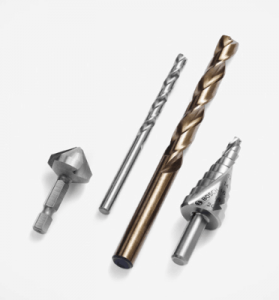
High speed steel
High speed steel (HSS) is a tool steel with high hardness, high wear resistance and high heat resistance. High-speed steel is often used in power-saw blades and drill bits.

Titanium nitride (an extremely hard ceramic material), or titanium carbide coatings can be used in the tools made of this kind of steels through physical vapor deposition process to improve the performance and life span of the tool.

TiN has a Vickers hardness of 1800–2100 and it has metallic gold color. A well-known use for TiN coating is for edge retention and corrosion resistance on machine tooling, such as drill bits and milling cutters, often improving their lifetime by a factor of three or more.

TiC, is an extremely hard (Mohs 9–9.5) refractory ceramic material, similar to tungsten carbide. It is also used as an abrasion-resistant surface coating on metal parts, such as tool bits and watch mechanisms. Titanium carbide is also used as a heat shield coating for atmospheric reentry of spacecraft.

For example, molybdenum high-speed steel – AISI M2 is the “standard” and most widely used industrial HSS. This type of steel may be coated with titanium nitride. Molybdenum high speed steels are designated as Group M steels according to the AISI classification system. M2 HSS has small and evenly distributed carbides giving high wear resistance, though its decarburization sensitivity is a little bit high. It is usually used to manufacture a variety of tools, such as drill bits, taps and reamers. The carbon and alloy contents are balanced at sufficient levels to provide high attainable hardening response, excellent wear resistance, high resistance to the softening effects of elevated temperature, and good toughness for effective use in industrial cutting applications.

Induction Hardening

Induction hardening is a surface hardening technique which uses induction coils to provide a very rapid means of heating the metal, which is then cooled rapidly, generally using water. This creates a “case” of martensite on the surface. A carbon content of 0.3–0.6 wt% C is needed for this type of hardening. Martensite is a very hard metastable structure with a body-centered tetragonal (BCT) crystal structure. Martensite is formed in steels when the cooling rate from austenite is at such a high rate that carbon atoms do not have time to diffuse out of the crystal structure in large enough quantities to form cementite (Fe3C). Induction hardening produces hard, highly wear-resistant surface (deep case depths) with good capacity for contact load and good bending fatigue strength. Material has fair resistance to seizure.

Heating is accomplished by placing a steel part in the magnetic field generated by high-frequency alternating current passing through an inductor, usually a watercooled copper coil. These so-called eddy currents dissipate energy and produce heat by flowing against the resistance of an imperfect conductor. With induction heating, the steel can be heated very quickly to red-hot at the surface, before the heat can penetrate any distance into the metal. The surface is then quenched, hardening it, and is often used without further tempering. This makes the surface very resistant to wear, and the core of the component remains unaffected by the treatment and its physical properties are those of the bar from which it was machined, whilst the hardness of the case can be within the range 37/58 HRC. Induction surface hardened low alloyed medium carbon steels are widely used for critical automotive and machine applications which require high wear resistance. A common use for induction hardening is for hardening the bearing surfaces, or “journals”, on automotive crankshafts or the rods of hydraulic cylinders. Wear resistance behavior of induction hardened parts depends on hardening depth and the magnitude and distribution of residual compressive stress in the surface layer.

Flame Hardening

Flame hardening is a surface hardening technique which uses a single torch with a specially designed head to provide a very rapid means of heating the metal, which is then cooled rapidly, generally using water. This creates a “case” of martensite on the surface, while the inner core of the object remains elastic and tough. It is similar technique as induction hardening. A carbon content of 0.3–0.6 wt% C is needed for this type of hardening.

Martensite is a very hard metastable structure with a body-centered tetragonal (BCT) crystal structure. Martensite is formed in steels when the cooling rate from austenite is at such a high rate that carbon atoms do not have time to diffuse out of the crystal structure in large enough quantities to form cementite (Fe3C). Flame hardening produces hard, highly wear-resistant surface (deep case depths) with good capacity for contact load and good bending fatigue strength. It can be used for hardening of low-cost steels and low capital investment are required.

A common use for induction hardening is for hardening of large parts such as gears and machine tool ways, with sizes or shapes that would make furnace heat treatment impractical. The gear will usually be quenched and tempered to a specific hardness first, making a majority of the gear tough, and then the teeth are quickly heated and immediately quenched, hardening only the surface. Wear resistance behavior of induction hardened parts depends on hardening depth and the magnitude and distribution of residual compressive stress in the surface layer.

Laser Hardening

Laser hardening is a surface hardening technique which uses a laser beam to provide a very rapid means of heating the metal, which is then cooled rapidly (generally by self-quenching). This creates a “case” of martensite on the surface, while the inner core of the object remains elastic and tough. The heat generated by the absorption of the laser light is controlled to prevent melting and is therefore used in the selective austenitization of local surface regions. Self-quenching phenomenon applies after removing the heat source from the interaction zone. Thermal energy absorbed by surface layer is quickly distributed to the entire workpiece.

Martensite is a very hard metastable structure with a body-centered tetragonal (BCT) crystal structure. Martensite is formed in steels when the cooling rate from austenite is at such a high rate that carbon atoms do not have time to diffuse out of the crystal structure in large enough quantities to form cementite (Fe3C). Laser hardening produces hard, highly wear-resistant surface (shallow case depths). Thin surface zones that are heated and cooled very rapidly results in very fine martensitic micro-structures, even in steels with relatively low hardenability. Laser hardening is widely used to harden localized areas of steel and cast iron machine components. Main advantages are: possibility of selective surface heat treatment of complex parts, minimal deformations of processed parts, process is fast, clean and computer controlled.

References:
Materials Science:

U.S. Department of Energy, Material Science. DOE Fundamentals Handbook, Volume 1 and 2. January 1993.
U.S. Department of Energy, Material Science. DOE Fundamentals Handbook, Volume 2 and 2. January 1993.
William D. Callister, David G. Rethwisch. Materials Science and Engineering: An Introduction 9th Edition, Wiley; 9 edition (December 4, 2013), ISBN-13: 978-1118324578.
Eberhart, Mark (2003). Why Things Break: Understanding the World by the Way It Comes Apart. Harmony. ISBN 978-1-4000-4760-4.
Gaskell, David R. (1995). Introduction to the thermodynamics of Materials (4th ed.). Taylor and Francis Publishing. ISBN 978-1-56032-992-3.
González-Viñas, W. & Mancini, H.L. (2004). An Introduction to Materials Science. Princeton University Press. ISBN 978-0-691-07097-1.
Ashby, Michael; Hugh Shercliff; David Cebon (2007). Materials: engineering, science, processing and design (1st ed.). Butterworth-Heinemann. ISBN 978-0-7506-8391-3.
J. R. Lamarsh, A. J. Baratta, Introduction to Nuclear Engineering, 3d ed., Prentice-Hall, 2001, ISBN: 0-201-82498-1.

See above:
Metalworking

We hope, this article, Surface Hardening – Case Hardening, helps you. If so, give us a like in the sidebar. Main purpose of this website is to help the public to learn some interesting and important information about materials and their properties.
What is Precipitation Hardening – Age Hardening – Definition

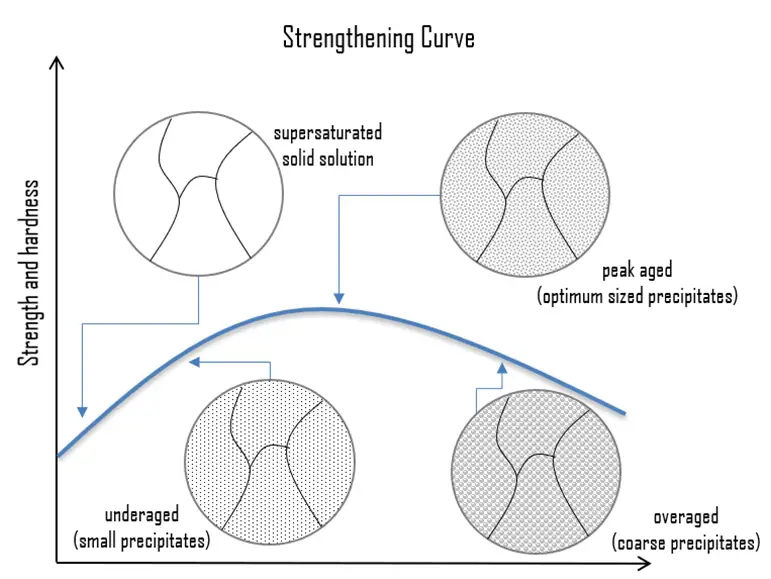
Precipitation hardening, also called age hardening or particle hardening, is a heat treatment technique based on the formation of extremely small, uniformly dispersed particles (precipitates) of a second phase within the original phase matrix to enhance the strength and hardness of some metal alloys.

Hardening of Metals

In materials science, hardness is the ability to withstand surface indentation (localized plastic deformation) and scratching. Hardness is probably the most poorly defined material property because it may indicate resistance to scratching, resistance to abrasion, resistance to indentation or even resistance to shaping or localized plastic deformation. Hardness is important from an engineering standpoint because resistance to wear by either friction or erosion by steam, oil, and water generally increases with hardness.

Hardening is a metallurgical metalworking process used to increase the hardness of a metal. The hardness of a metal is directly proportional to the uniaxial yield stress at the location of the imposed strain. To improve the hardness of a pure metal, we can use different ways, which include:

Precipitation Hardening – Age Hardening

Precipitation hardeningPrecipitation hardening, also called age hardening or particle hardening, is a heat treatment technique based on the formation of extremely small, uniformly dispersed particles (precipitates) of a second phase within the original phase matrix to enhance the strength and hardness of some metal alloys. Second phase particles present further type of obstacles for dislocation movement, though the particles are not necessarily single atoms. The presence of a second phase particle represents a distortion in the matrix lattice. Therefore, the obstacles which hinder the dislocation motion are either the strain field around second phase particles or the second phase particles itself or both. Precipitation hardening is used to increase the yield strength of malleable materials, including most structural alloys of aluminium, magnesium, nickel, titanium, and some steels and stainless steels. In superalloys, it is known to cause yield strength anomaly providing excellent high-temperature strength.
Nickel-base superalloys include solid-solution-strengthened alloys and age-hardenable alloys. Age-hardenable alloys consist of an austenitic (fcc) matrix dispersed with coherent precipitation of an Ni3(Al,Ti) intermetallic with an fcc structure. Ni-based superalloys are alloys with nickel as the primary alloying element are preferred as blade material in the previously discussed applications, rather than Co- or Fe-based superalloys. What is significant for Ni-based superalloys is their high strength, creep and corrosion resistance at high temperatures. It is common to cast turbine blades in directionally solidified form or single-crystal form.

In case of aluminium alloys, precipitation strengthening can increase the yield strength of aluminium from about five times up to about fifteen times that of unalloyed aluminium. Especially 2xxx series, which are alloyed with copper, can be precipitation hardened to strengths comparable to steel. In terms of age hardening, solution annealed aluminum-copper alloys can be aged naturally at room temperature for four days or more to obtain maximum properties such as hardness and strength. This process is known as natural aging. The aging process also can be accelerated to a matter of hours after solution treatment and quenching by heating the supersaturated alloy to a specific temperature and holding at that temperature for a specified time. This process is called artificial aging. Typically, aluminum 6061 alloy is heat treated at 533°C (990°F) for a sufficient period of time followed by quenching in water. Precipitation hardening process can be performed at 160°C (320°F) for 18 h followed by air cooling. This process is again repeated at 177°C (350°F) for 8 h followed by cooling in air.

In case of copper beryllium, the high strength of this alloy is attained also by precipitation hardening. The precipitation hardening results from the precipitation of a beryllium containing phase from a supersaturated solid solution of mostly pure copper. Copper beryllium is the hardest and strongest of any copper alloy (UTS up to 1,400 MPa), in the fully heat treated and cold worked condition. It combines high strength with non-magnetic and non-sparking qualities and it is similar in mechanical properties to many high strength alloy steels but, compared to steels, it has better corrosion resistance.

17-4PH Stainless Steel

For example, precipitation-hardened stainless steel 17-4 PH (AISI 630) have an initial microstructure of austenite or martensite. Austenitic grades are converted to martensitic grades through heat treatment (e.g. throung heat treatment at about 1040 °C followed by quenching) before precipitation hardening can be done. Subsequent ageing treatment at about 475 °C precipitates Nb and Cu-rich phases that increase the strength up to above 1000 MPa yield strength. In all heat treatments performed the predominant microstructure is lath martensite. Unlike austenitic alloys, however, heat treatment strengthens PH steels to levels higher than martensitic alloys. Precipitation-hardening stainless steels are designated by the AISI 600-series. Of all of the available stainless grades, they generally offer the greatest combination of high strength coupled with excellent toughness and corrosion resistance.  They are as corrosion resistant as austenitic grades. Common uses are in the aerospace and some other high-technology industries.

Example – Aluminium Alloys – 6061 Alloy

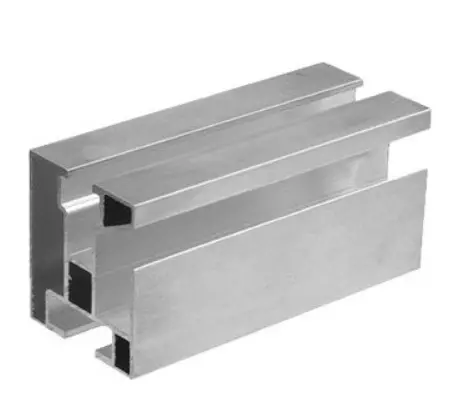
aluminium alloyIn general, 6000 series aluminium alloys are alloyed with magnesium and silicon. Alloy 6061 is one of the most widely used alloys in the 6000 Series. It has good mechanical properties, it is easy to machine, it is weldable, and can be precipitation hardened, but not to the high strengths that 2000 and 7000 can reach. It has very good corrosion resistance and very good weldability although reduced strength in the weld zone. The mechanical properties of 6061 depend greatly on the temper, or heat treatment, of the material. In comparison to 2024 alloy, 6061 is more easily worked and remains resistant to corrosion even when the surface is abraded.

References:
Materials Science:

U.S. Department of Energy, Material Science. DOE Fundamentals Handbook, Volume 1 and 2. January 1993.
U.S. Department of Energy, Material Science. DOE Fundamentals Handbook, Volume 2 and 2. January 1993.
William D. Callister, David G. Rethwisch. Materials Science and Engineering: An Introduction 9th Edition, Wiley; 9 edition (December 4, 2013), ISBN-13: 978-1118324578.
Eberhart, Mark (2003). Why Things Break: Understanding the World by the Way It Comes Apart. Harmony. ISBN 978-1-4000-4760-4.
Gaskell, David R. (1995). Introduction to the thermodynamics of Materials (4th ed.). Taylor and Francis Publishing. ISBN 978-1-56032-992-3.
González-Viñas, W. & Mancini, H.L. (2004). An Introduction to Materials Science. Princeton University Press. ISBN 978-0-691-07097-1.
Ashby, Michael; Hugh Shercliff; David Cebon (2007). Materials: engineering, science, processing and design (1st ed.). Butterworth-Heinemann. ISBN 978-0-7506-8391-3.
J. R. Lamarsh, A. J. Baratta, Introduction to Nuclear Engineering, 3d ed., Prentice-Hall, 2001, ISBN: 0-201-82498-1.


See above:
Metalworking

We hope, this article, Precipitation Hardening – Age Hardening, helps you. If so, give us a like in the sidebar. Main purpose of this website is to help the public to learn some interesting and important information about materials and their properties.

What is Dispersion Hardening – Definition

Dispersion hardening involves the inclusion of small, hard particles in the metal, thus restricting the movement of dislocations, and thereby raising the strength properties.

Hardening of Metals

In materials science, hardness is the ability to withstand surface indentation (localized plastic deformation) and scratching. Hardness is probably the most poorly defined material property because it may indicate resistance to scratching, resistance to abrasion, resistance to indentation or even resistance to shaping or localized plastic deformation. Hardness is important from an engineering standpoint because resistance to wear by either friction or erosion by steam, oil, and water generally increases with hardness.

Hardening is a metallurgical metalworking process used to increase the hardness of a metal. The hardness of a metal is directly proportional to the uniaxial yield stress at the location of the imposed strain. To improve the hardness of a pure metal, we can use different ways, which include:

Dispersion Hardening

Dispersion hardening involves the inclusion of small, hard particles in the metal, thus restricting the movement of dislocations, and thereby raising the strength properties. It is, in many ways, very similar to age hardening. The difference lies in the precipitates themselves—the particles are chosen because of their thermal stability, that is, their resistance to particle coarsening or growth at high temperatures. Dispersoid particles influence the grain structure. The increase in strength is due to the grain structure formed as a result of the presence of dispersoids.

References:
Materials Science:

U.S. Department of Energy, Material Science. DOE Fundamentals Handbook, Volume 1 and 2. January 1993.
U.S. Department of Energy, Material Science. DOE Fundamentals Handbook, Volume 2 and 2. January 1993.
William D. Callister, David G. Rethwisch. Materials Science and Engineering: An Introduction 9th Edition, Wiley; 9 edition (December 4, 2013), ISBN-13: 978-1118324578.
Eberhart, Mark (2003). Why Things Break: Understanding the World by the Way It Comes Apart. Harmony. ISBN 978-1-4000-4760-4.
Gaskell, David R. (1995). Introduction to the thermodynamics of Materials (4th ed.). Taylor and Francis Publishing. ISBN 978-1-56032-992-3.
González-Viñas, W. & Mancini, H.L. (2004). An Introduction to Materials Science. Princeton University Press. ISBN 978-0-691-07097-1.
Ashby, Michael; Hugh Shercliff; David Cebon (2007). Materials: engineering, science, processing and design (1st ed.). Butterworth-Heinemann. ISBN 978-0-7506-8391-3.
J. R. Lamarsh, A. J. Baratta, Introduction to Nuclear Engineering, 3d ed., Prentice-Hall, 2001, ISBN: 0-201-82498-1.

See above:
Metalworking

We hope, this article, Dispersion Hardening, helps you. If so, give us a like in the sidebar. Main purpose of this website is to help the public to learn some interesting and important information about materials and their properties.

What is Grain Refinement – Grain Boundary Strenthening – Definition

Grain-boundary strengthening (or Hall–Petch strengthening) is a method of strengthening materials by changing their average crystallite (grain) size.

Strengthening of Metals

The strength of metals and alloys can be modified through various combinations of cold working, alloying, and heat treating. As discussed in the previous section, the ability of a crystalline material to plastically deform largely depends on the ability for dislocation to move within a material. Therefore, impeding the movement of dislocations will result in the strengthening of the material. For example, a microstructure with finer grains typically results in both higher strength and superior toughness compared to the same alloy with physically larger grains. In case of grain size, there may also be tradeoff between strength and creep characteristics. Other strengthening mechanisms are achieved at the expense of lower ductility and toughness. There are many strengthening mechanisms, which include:

Grain Refinement – Grain Boundary Strengthening

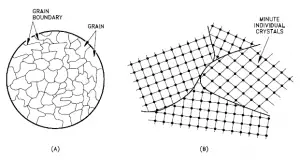
Grains - Grain Boundaries
Grains and Boundaries Source: U.S. Department of Energy, Material Science. DOE Fundamentals Handbook, Volume 1 and 2. January 1993.

Grain-boundary strengthening (or Hall–Petch strengthening) is a method of strengthening materials by changing their average crystallite (grain) size. The size of the grain determines the properties of the metal. For example, smaller grain size increases tensile strength and tends to increase ductility. A larger grain size is preferred for improved high-temperature creep properties. Decreasing the grain size also is an effective way to increase ductility. When grain size is reduced, there are more grains with a greater number of arbitrarily aligned slip planes for the dislocations in the grains. This provides more opportunity for some slip to occur in a stressed material. Grain boundaries act as an impediment to dislocation motion for the following two reasons:

  1. Dislocation must change its direction of motion due to the differing orientation of grains.
  2. Discontinuity of slip planes from grain one to grain two.

Thus, grain refinement provides an important means to improve not only strength, but also ductility and toughness. Many other strengthening mechanisms are achieved at the expense of ductility and toughness. For many materials, the yield strength σ varies with grain size according to

σy = σy,0 + k/dx

In this expression, termed the Hall–Petch equation, k is a constant, d is the average grain diameter and σy,0 is the original yield stress. Note that this equation is not valid for both very large (i.e., coarse) grain and extremely fine grain polycrystalline materials.

The synergistic effect of alloying elements and heat treatment produces a tremendous variety of microstructures and properties of steels.

  • Vanadium. Vanadium is generally added to steel to inhibit grain growth during heat treatment. In controlling grain growth, it improves both the strength and toughness of hardened and tempered steels. The size of the grain determines the properties of the metal. For example, smaller grain size increases tensile strength and tends to increase ductility. A larger grain size is preferred for improved high-temperature creep properties.
  • Tungsten. Tungsten produces stable carbides and refines grain size so as to increase hardness, particularly at high temperatures. Tungsten is used extensively in high-speed tool steels and has been proposed as a substitute for molybdenum in reduced-activation ferritic steels for nuclear applications.
References:
Materials Science:

U.S. Department of Energy, Material Science. DOE Fundamentals Handbook, Volume 1 and 2. January 1993.
U.S. Department of Energy, Material Science. DOE Fundamentals Handbook, Volume 2 and 2. January 1993.
William D. Callister, David G. Rethwisch. Materials Science and Engineering: An Introduction 9th Edition, Wiley; 9 edition (December 4, 2013), ISBN-13: 978-1118324578.
Eberhart, Mark (2003). Why Things Break: Understanding the World by the Way It Comes Apart. Harmony. ISBN 978-1-4000-4760-4.
Gaskell, David R. (1995). Introduction to the thermodynamics of Materials (4th ed.). Taylor and Francis Publishing. ISBN 978-1-56032-992-3.
González-Viñas, W. & Mancini, H.L. (2004). An Introduction to Materials Science. Princeton University Press. ISBN 978-0-691-07097-1.
Ashby, Michael; Hugh Shercliff; David Cebon (2007). Materials: engineering, science, processing and design (1st ed.). Butterworth-Heinemann. ISBN 978-0-7506-8391-3.
J. R. Lamarsh, A. J. Baratta, Introduction to Nuclear Engineering, 3d ed., Prentice-Hall, 2001, ISBN: 0-201-82498-1.

See above:
Metalworking

We hope, this article, Grain Refinement – Grain Boundary Strenthening, helps you. If so, give us a like in the sidebar. Main purpose of this website is to help the public to learn some interesting and important information about materials and their properties.

What is Hall-Petch Equation – Hall-Petch method – Definition

In this expression, termed the Hall–Petch equation, k is a constant, d is the average grain diameter and σy,0 is the original yield stress. Note that this equation is not valid for both very large (i.e., coarse) grain and extremely fine grain polycrystalline materials.

Hall-Petch Equation – Hall-Petch method

Grains - Grain Boundaries
Grains and Boundaries Source: U.S. Department of Energy, Material Science. DOE Fundamentals Handbook, Volume 1 and 2. January 1993.

Grain-boundary strengthening (or Hall–Petch strengthening) is a method of strengthening materials by changing their average crystallite (grain) size. The size of the grain determines the properties of the metal. For example, smaller grain size increases tensile strength and tends to increase ductility. A larger grain size is preferred for improved high-temperature creep properties. Decreasing the grain size also is an effective way to increase ductility. When grain size is reduced, there are more grains with a greater number of arbitrarily aligned slip planes for the dislocations in the grains. This provides more opportunity for some slip to occur in a stressed material. Grain boundaries act as an impediment to dislocation motion for the following two reasons:

  1. Dislocation must change its direction of motion due to the differing orientation of grains.
  2. Discontinuity of slip planes from grain one to grain two.

Thus, grain refinement provides an important means to improve not only strength, but also ductility and toughness. Many other strengthening mechanisms are achieved at the expense of ductility and toughness. For many materials, the yield strength σ varies with grain size according to

σy = σy,0 + k/dx

In this expression, termed the Hall–Petch equation, k is a constant, d is the average grain diameter and σy,0 is the original yield stress. Note that this equation is not valid for both very large (i.e., coarse) grain and extremely fine grain polycrystalline materials.

The synergistic effect of alloying elements and heat treatment produces a tremendous variety of microstructures and properties of steels.

  • Vanadium. Vanadium is generally added to steel to inhibit grain growth during heat treatment. In controlling grain growth, it improves both the strength and toughness of hardened and tempered steels. The size of the grain determines the properties of the metal. For example, smaller grain size increases tensile strength and tends to increase ductility. A larger grain size is preferred for improved high-temperature creep properties.
  • Tungsten. Tungsten produces stable carbides and refines grain size so as to increase hardness, particularly at high temperatures. Tungsten is used extensively in high-speed tool steels and has been proposed as a substitute for molybdenum in reduced-activation ferritic steels for nuclear applications.
References:
Materials Science:

U.S. Department of Energy, Material Science. DOE Fundamentals Handbook, Volume 1 and 2. January 1993.
U.S. Department of Energy, Material Science. DOE Fundamentals Handbook, Volume 2 and 2. January 1993.
William D. Callister, David G. Rethwisch. Materials Science and Engineering: An Introduction 9th Edition, Wiley; 9 edition (December 4, 2013), ISBN-13: 978-1118324578.
Eberhart, Mark (2003). Why Things Break: Understanding the World by the Way It Comes Apart. Harmony. ISBN 978-1-4000-4760-4.
Gaskell, David R. (1995). Introduction to the thermodynamics of Materials (4th ed.). Taylor and Francis Publishing. ISBN 978-1-56032-992-3.
González-Viñas, W. & Mancini, H.L. (2004). An Introduction to Materials Science. Princeton University Press. ISBN 978-0-691-07097-1.
Ashby, Michael; Hugh Shercliff; David Cebon (2007). Materials: engineering, science, processing and design (1st ed.). Butterworth-Heinemann. ISBN 978-0-7506-8391-3.
J. R. Lamarsh, A. J. Baratta, Introduction to Nuclear Engineering, 3d ed., Prentice-Hall, 2001, ISBN: 0-201-82498-1.

See above:
Metalworking

We hope, this article, Hall-Petch Equation – Hall-Petch method, helps you. If so, give us a like in the sidebar. Main purpose of this website is to help the public to learn some interesting and important information about materials and their properties.

What is Solid Solution Strengthening – Alloying – Definition

Solid Solution Strengthening – Alloying. The synergistic effect of alloying elements and heat treatment produces a tremendous variety of microstructures and properties.

Strengthening of Metals

The strength of metals and alloys can be modified through various combinations of cold working, alloying, and heat treating. As discussed in the previous section, the ability of a crystalline material to plastically deform largely depends on the ability for dislocation to move within a material. Therefore, impeding the movement of dislocations will result in the strengthening of the material. For example, a microstructure with finer grains typically results in both higher strength and superior toughness compared to the same alloy with physically larger grains. In case of grain size, there may also be tradeoff between strength and creep characteristics. Other strengthening mechanisms are achieved at the expense of lower ductility and toughness. There are many strengthening mechanisms, which include:

Solid Solition Strengthening – Alloying

Young's Modulus of Elasticity - Table of MaterialsAtoms of different elements dissolved in the matrix phase can lead to its strengthening by solid solution strengthening. High-purity metals are almost always softer and weaker than alloys composed of the same base metal. Increasing the concentration of the impurity results in an attendant increase in tensile and yield strengths. The solute may incorporate into the solvent crystal lattice substitutionally, by replacing a solvent particle in the lattice, or interstitially, by fitting into the space between solvent particles. This impose lattice strains on surrounding atoms resulting in a lattice strain field. Even small amounts of solute can affect the electrical and physical properties of the solvent. Steel, probably the most common structural metal, is a good example of an alloy. It is an alloy of iron and carbon, with other elements to give it certain desirable properties. Adding a small amount of non-metallic carbon to iron trades its great ductility for the greater strength. Adding a small amount of non-metallic carbon to iron trades its great ductility for the greater strength. For non-ferrous alloys, manganese and magnesium are examples of elements added to aluminum for the purpose of solid solution strengthening.
Alloying Agents

Pure iron is too soft to be used for the purpose of structure, but the addition of small quantities of other elements (carbon, manganese or silicon for instance) greatly increases its mechanical strength. Alloys are usually stronger than pure metals, although they generally offer reduced electrical and thermal conductivity. Strength is the most important criterion by which many structural materials are judged. Therefore, alloys are used for engineering construction. The synergistic effect of alloying elements and heat treatment produces a tremendous variety of microstructures and properties.

  • Carbon. Carbon is a non-metallic element, which is an important alloying element in all ferrous metal based materials. Carbon is always present in metallic alloys, i.e. in all grades of stainless steel and heat resistant alloys. Carbon is a very strong austenitizer and increases the strength of steel. In fact, it is the principal hardening element and is essential to the formation of cementite, Fe3C, pearlite, spheroidite, and iron-carbon martensite. Adding a small amount of non-metallic carbon to iron trades its great ductility for the greater strength. If it is combined with chromium as a separate constituent (chromium carbide), it may have a detrimental effect on corrosion resistance by removing some of the chromium from solid solution in the alloy and, as a consequence, reducing the amount of chromium available to ensure corrosion resistance.
  • Chromium. Chromium increases hardness, strength, and corrosion resistance. The strengthening effect of forming stable metal carbides at the grain boundaries and the strong increase in corrosion resistance made chromium an important alloying material for steel. The resistance of these metallic alloys to the chemical effects of corrosive agents is based on passivation. For passivation to occur and remain stable, the Fe-Cr alloy must have a minimum chromium content of about 11% by weight, above which passivity can occur and below which it is impossible. Chromium can be used as a hardening element and is frequently used with a toughening element such as nickel to produce superior mechanical properties. At higher temperatures, chromium contributes increased strength. The high-speed tool steels contain between 3 and 5% chromium. It is ordinarily used for applications of this nature in conjunction with molybdenum.
  • Nickel. Nickel is one of most common alloying elements. About 65% of nickel production is used in stainless steels. Because nickel does not form any carbide compounds in steel, it remains in solution in the ferrite, thus strengthening and toughening the ferrite phase. Nickel steels are easily heat treated because nickel lowers the critical cooling rate. Nickel based alloys (e.g. Fe-Cr-Ni(Mo) alloys) alloys exhibit excellent ductility and toughness, even at high strength levels and these properties are retained up to low temperatures. Nickel also reduces thermal expansion for better dimensional stability. Nickel is the base elements for superalloys, which are are a group of nickel, iron–nickel and cobalt alloys used in jet engines. These metals have excellent resistance to thermal creep deformation and retain their stiffness, strength, toughness and dimensional stability at temperatures much higher than the other aerospace structural materials.
  • Molybdenum. Found in small quantities in stainless steels, molybdenum increases hardenability and strength, particularly at high temperatures. The high melting point of molybdenum makes it important for giving strength to steel and other metallic alloys at high temperatures. Molybdenum is unique in the extent to which it increases the high-temperature tensile and creep strengths of steel. It retards the transformation of austenite to pearlite far more than it does the transformation of austenite to bainite; thus, bainite may be produced by continuous cooling of molybdenum-containing steels.
  • Vanadium. Vanadium is generally added to steel to inhibit grain growth during heat treatment. In controlling grain growth, it improves both the strength and toughness of hardened and tempered steels. The size of the grain determines the properties of the metal. For example, smaller grain size increases tensile strength and tends to increase ductility. A larger grain size is preferred for improved high-temperature creep properties. Vanadium is added to promote abrasion resistance and to produce hard and stable carbides which being only partly soluble, release little carbon into the matrix.
  • Tungsten. Produces stable carbides and refines grain size so as to increase hardness, particularly at high temperatures. Tungsten is used extensively in high-speed tool steels and has been proposed as a substitute for molybdenum in reduced-activation ferritic steels for nuclear applications. The addition of about 10% of tungsten and molybdenum in total maximises efficiently the hardness and toughness of high speed steels and maintains those properties at the high temperatures generated when cutting metals. Tungsten and molybdenum are  interchangeable at an atomic level and both promote resistance to tempering which gives improved tool cutting performance at higher   temperatures.
References:
Materials Science:

U.S. Department of Energy, Material Science. DOE Fundamentals Handbook, Volume 1 and 2. January 1993.
U.S. Department of Energy, Material Science. DOE Fundamentals Handbook, Volume 2 and 2. January 1993.
William D. Callister, David G. Rethwisch. Materials Science and Engineering: An Introduction 9th Edition, Wiley; 9 edition (December 4, 2013), ISBN-13: 978-1118324578.
Eberhart, Mark (2003). Why Things Break: Understanding the World by the Way It Comes Apart. Harmony. ISBN 978-1-4000-4760-4.
Gaskell, David R. (1995). Introduction to the thermodynamics of Materials (4th ed.). Taylor and Francis Publishing. ISBN 978-1-56032-992-3.
González-Viñas, W. & Mancini, H.L. (2004). An Introduction to Materials Science. Princeton University Press. ISBN 978-0-691-07097-1.
Ashby, Michael; Hugh Shercliff; David Cebon (2007). Materials: engineering, science, processing and design (1st ed.). Butterworth-Heinemann. ISBN 978-0-7506-8391-3.
J. R. Lamarsh, A. J. Baratta, Introduction to Nuclear Engineering, 3d ed., Prentice-Hall, 2001, ISBN: 0-201-82498-1.

See above:
Metalworking

We hope, this article, Solid Solution Strengthening – Alloying, helps you. If so, give us a like in the sidebar. Main purpose of this website is to help the public to learn some interesting and important information about materials and their properties.

What is Work Hardening – Cold Working – Definition

Work hardening may be desirable, undesirable, or inconsequential, depending on the context. It is called cold-working because the plastic deformation must occurs at a temperature low enough that atoms cannot rearrange themselves.

Strengthening of Metals

The strength of metals and alloys can be modified through various combinations of cold working, alloying, and heat treating. As discussed in the previous section, the ability of a crystalline material to plastically deform largely depends on the ability for dislocation to move within a material. Therefore, impeding the movement of dislocations will result in the strengthening of the material. For example, a microstructure with finer grains typically results in both higher strength and superior toughness compared to the same alloy with physically larger grains. In case of grain size, there may also be tradeoff between strength and creep characteristics. Other strengthening mechanisms are achieved at the expense of lower ductility and toughness. There are many strengthening mechanisms, which include:

Work Hardening – Cold Working

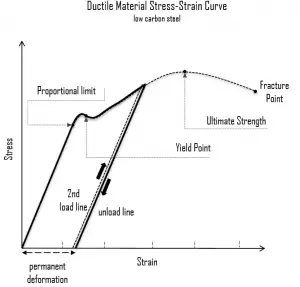
permanent deformationStrain hardening is also called work-hardening or cold-working is a strengthening method often used in materials whose strength cannot be increased by heat treatment, e.g. by changes in their phase composition. Work hardening may be desirable, undesirable, or inconsequential, depending on the context. It is called cold-working because the plastic deformation must occurs at a temperature low enough that atoms cannot rearrange themselves. The simplest way of cold- working is beating a red-hot piece of metal on anvil. Cold-working is a process of making a metal harder and stronger through plastic deformation. When a metal is plastically deformed, dislocations move and additional dislocations are generated. Dislocations can move if the atoms from one of the surrounding planes break their bonds and rebond with the atoms at the terminating edge. The dislocation density in a metal increases with deformation or cold work because of dislocation multiplication or the formation of new dislocations. The more dislocations within a material, the more they will interact and become pinned or tangled. This will result in a decrease in the mobility of the dislocations and a strengthening of the material. Cold working involves the reduction in thickness of a material. Plate and sheet of different thickness are produced by cold rolling. Wire and tubes of different diameter and wall thickness are produced by drawing. All aluminum alloys can be strengthened by cold working.
Alloys not amenable to heat treatment, including low-carbon steel, are often work-hardened. Some materials cannot be work-hardened at low temperatures, such as indium, however others can only be strengthened via work hardening, such as pure copper and aluminum.

Strain hardening is one of stages in the stress-strain curve is the strain hardening region. This region starts as the strain goes beyond yield point, and ends at the ultimate strength point, which is the maximal stress shown in the stress-strain curve. In this region, the stress mainly increases as material elongates, except that there is a nearly flat region at the beginning.

References:
Materials Science:

U.S. Department of Energy, Material Science. DOE Fundamentals Handbook, Volume 1 and 2. January 1993.
U.S. Department of Energy, Material Science. DOE Fundamentals Handbook, Volume 2 and 2. January 1993.
William D. Callister, David G. Rethwisch. Materials Science and Engineering: An Introduction 9th Edition, Wiley; 9 edition (December 4, 2013), ISBN-13: 978-1118324578.
Eberhart, Mark (2003). Why Things Break: Understanding the World by the Way It Comes Apart. Harmony. ISBN 978-1-4000-4760-4.
Gaskell, David R. (1995). Introduction to the thermodynamics of Materials (4th ed.). Taylor and Francis Publishing. ISBN 978-1-56032-992-3.
González-Viñas, W. & Mancini, H.L. (2004). An Introduction to Materials Science. Princeton University Press. ISBN 978-0-691-07097-1.
Ashby, Michael; Hugh Shercliff; David Cebon (2007). Materials: engineering, science, processing and design (1st ed.). Butterworth-Heinemann. ISBN 978-0-7506-8391-3.
J. R. Lamarsh, A. J. Baratta, Introduction to Nuclear Engineering, 3d ed., Prentice-Hall, 2001, ISBN: 0-201-82498-1.

See above:
Metalworking

We hope, this article, Work Hardening – Cold Working, helps you. If so, give us a like in the sidebar. Main purpose of this website is to help the public to learn some interesting and important information about materials and their properties.

What is Strengthening of Metals – Definition

Strengthening of Metals. Impeding the movement of dislocations will result in the strengthening of the material. For example, a microstructure with finer grains typically results in both higher strength and superior toughness compared to the same alloy with physically larger grains.

Strength and hardness are different material properties. Strength is the ability of a material to resist deformation, while hardness is the ability to withstand surface indentation and scratching.These properties are not interchangeable yet their improvements are based on similar but not same procedures.

High strength of materials is useful in many applications. A primary application of strengthened materials is for construction. In order to have stronger buildings and bridges, one must have a strong frame that can support high tensile or compressive load and resist plastic deformation. Tools are also based on high-strength materials (e.g. tool steel or beryllium copper).

High hardness of materials is required for other applications. A primary application of hardened materials is for machine cutting tools (drill bits, taps, lathe tools), which need be much harder than the material they are operating on in order to be effective. These cutting tools are usually made of high-speed steel. Knife blades also uses a high hardness steels to keep a sharp edge of blade. Bearings must have a very hard surface that will withstand continued stresses.

Strengthening of Metals

The strength of metals and alloys can be modified through various combinations of cold working, alloying, and heat treating. As discussed in the previous section, the ability of a crystalline material to plastically deform largely depends on the ability for dislocation to move within a material. Therefore, impeding the movement of dislocations will result in the strengthening of the material. For example, a microstructure with finer grains typically results in both higher strength and superior toughness compared to the same alloy with physically larger grains. In case of grain size, there may also be tradeoff between strength and creep characteristics. Other strengthening mechanisms are achieved at the expense of lower ductility and toughness. There are many strengthening mechanisms, which include:

Hardness and Tensile Strength

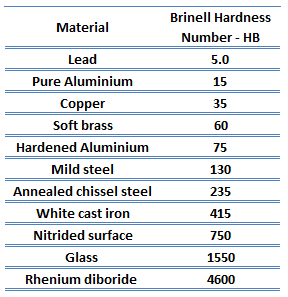
Besides the correlation between different hardness numbers, there are also some correlations possible with other material properties. For example, for heat-treated plain carbon steels and medium alloy steels, another convenient conversion is that of Brinell hardness to ultimate tensile strength. In this case, the ultimate tensile strength (in psi) approximately equals the Brinell Hardness Number multiplied by 500. Generally, a high hardness will indicate a relatively high strength and low ductility in the material.

In industry, hardness tests on metals are used mainly as a check on the quality and uniformity of metals, especially during heat treatment operations. The tests can generally be applied to the finished product without significant damage.

References:
Materials Science:

U.S. Department of Energy, Material Science. DOE Fundamentals Handbook, Volume 1 and 2. January 1993.
U.S. Department of Energy, Material Science. DOE Fundamentals Handbook, Volume 2 and 2. January 1993.
William D. Callister, David G. Rethwisch. Materials Science and Engineering: An Introduction 9th Edition, Wiley; 9 edition (December 4, 2013), ISBN-13: 978-1118324578.
Eberhart, Mark (2003). Why Things Break: Understanding the World by the Way It Comes Apart. Harmony. ISBN 978-1-4000-4760-4.
Gaskell, David R. (1995). Introduction to the thermodynamics of Materials (4th ed.). Taylor and Francis Publishing. ISBN 978-1-56032-992-3.
González-Viñas, W. & Mancini, H.L. (2004). An Introduction to Materials Science. Princeton University Press. ISBN 978-0-691-07097-1.
Ashby, Michael; Hugh Shercliff; David Cebon (2007). Materials: engineering, science, processing and design (1st ed.). Butterworth-Heinemann. ISBN 978-0-7506-8391-3.
J. R. Lamarsh, A. J. Baratta, Introduction to Nuclear Engineering, 3d ed., Prentice-Hall, 2001, ISBN: 0-201-82498-1.

See above:
Metalworking

We hope, this article, Strengthening of Metals, helps you. If so, give us a like in the sidebar. Main purpose of this website is to help the public to learn some interesting and important information about materials and their properties.

What is Hardening of Metals – Definition

Hardening of metals is a metallurgical metalworking process used to increase the hardness of a metal. The hardness of a metal is directly proportional to the uniaxial yield stress at the location of the imposed strain.

Strength and hardness are different material properties. Strength is the ability of a material to resist deformation, while hardness is the ability to withstand surface indentation and scratching.These properties are not interchangeable yet their improvements are based on similar but not same procedures.

High strength of materials is useful in many applications. A primary application of strengthened materials is for construction. In order to have stronger buildings and bridges, one must have a strong frame that can support high tensile or compressive load and resist plastic deformation. Tools are also based on high-strength materials (e.g. tool steel or beryllium copper).

High hardness of materials is required for other applications. A primary application of hardened materials is for machine cutting tools (drill bits, taps, lathe tools), which need be much harder than the material they are operating on in order to be effective. These cutting tools are usually made of high-speed steel. Knife blades also uses a high hardness steels to keep a sharp edge of blade. Bearings must have a very hard surface that will withstand continued stresses.

Hardening of Metals

In materials science, hardness is the ability to withstand surface indentation (localized plastic deformation) and scratching. Hardness is probably the most poorly defined material property because it may indicate resistance to scratching, resistance to abrasion, resistance to indentation or even resistance to shaping or localized plastic deformation. Hardness is important from an engineering standpoint because resistance to wear by either friction or erosion by steam, oil, and water generally increases with hardness.

Hardening is a metallurgical metalworking process used to increase the hardness of a metal. The hardness of a metal is directly proportional to the uniaxial yield stress at the location of the imposed strain. To improve the hardness of a pure metal, we can use different ways, which include:

Hardness and Tensile Strength

Besides the correlation between different hardness numbers, there are also some correlations possible with other material properties. For example, for heat-treated plain carbon steels and medium alloy steels, another convenient conversion is that of Brinell hardness to ultimate tensile strength. In this case, the ultimate tensile strength (in psi) approximately equals the Brinell Hardness Number multiplied by 500. Generally, a high hardness will indicate a relatively high strength and low ductility in the material.

In industry, hardness tests on metals are used mainly as a check on the quality and uniformity of metals, especially during heat treatment operations. The tests can generally be applied to the finished product without significant damage.

References:
Materials Science:

U.S. Department of Energy, Material Science. DOE Fundamentals Handbook, Volume 1 and 2. January 1993.
U.S. Department of Energy, Material Science. DOE Fundamentals Handbook, Volume 2 and 2. January 1993.
William D. Callister, David G. Rethwisch. Materials Science and Engineering: An Introduction 9th Edition, Wiley; 9 edition (December 4, 2013), ISBN-13: 978-1118324578.
Eberhart, Mark (2003). Why Things Break: Understanding the World by the Way It Comes Apart. Harmony. ISBN 978-1-4000-4760-4.
Gaskell, David R. (1995). Introduction to the thermodynamics of Materials (4th ed.). Taylor and Francis Publishing. ISBN 978-1-56032-992-3.
González-Viñas, W. & Mancini, H.L. (2004). An Introduction to Materials Science. Princeton University Press. ISBN 978-0-691-07097-1.
Ashby, Michael; Hugh Shercliff; David Cebon (2007). Materials: engineering, science, processing and design (1st ed.). Butterworth-Heinemann. ISBN 978-0-7506-8391-3.
J. R. Lamarsh, A. J. Baratta, Introduction to Nuclear Engineering, 3d ed., Prentice-Hall, 2001, ISBN: 0-201-82498-1.

See above:
Metalworking

We hope, this article, Hardening of Metals, helps you. If so, give us a like in the sidebar. Main purpose of this website is to help the public to learn some interesting and important information about materials and their properties.

Stainless Steels vs Superalloys – Comparison – Pros and Cons

Stainless steel is a steel alloy with at least 10.5% chromium. Superalloys, or high-performance alloys, are non-ferrous alloys (nickel based) that exhibit outstanding strength and surface stability at high temperatures.

Stainless Steels

304 stainless steelIn metallurgy, stainless steel is a steel alloy with at least 10.5% chromium with or without other alloying elements and a maximum of 1.2% carbon by mass. Stainless steels, also known as inox steels or inox from French inoxydable (inoxidizable), are steel alloys, which are very well known for their corrosion resistance, which increases with increasing chromium content. Corrosion resistance may also be enhanced by nickel and molybdenum additions. The resistance of these metallic alloys to the chemical effects of corrosive  agents is based on passivation. For passivation to occur and remain stable, the Fe-Cr alloy must have a minimum chromium content of about 10.5% by weight, above which passivity can occur and below which it is impossible. Chromium can be used as a hardening element and is frequently used with a toughening element such as nickel to produce superior mechanical properties.

Uses of Stainless Steels – Applications

Strength and corrosion resistance of stainless steel often make it the material of choice in transportation and processing equipment, engine parts, and firearms. Most of the structural applications occur in the chemical and power engineering industries, which account for more than third of the market for stainless steel products. The wide variety of applications includes nuclear reactor vessels, heat exchangers. The body of the reactor vessel is constructed of a high-quality low-alloy carbon steel, but all surfaces that come into contact with reactor coolant (highly corrosive due to the presence of boric acid) are clad with a minimum of about 3 to 10 mm of austenitic stainless steel in order to minimize corrosion.

Stainless steel can be rolled into sheets, plates, bars, wire, and tubing. Stainless steels do not need to be painted or coated, which makes them suitable for use in applications where cleanliness is required: in cookware, cutlery and surgical instruments.

Types of Stainless Steels

Stainless steel is a generic term for a large family of corrosion resistant alloys containing at least 10.5% chromium and  may contain other alloying elements. There are numerous grades of stainless steel with varying chromium and molybdenum contents and with varying crystallographic structure to suit the environment the alloy must endure. Stainless steels can be divided into five categories:

  • Ferritic stainless steels. In ferritic stainless steels, carbon is kept to low levels (C<0.08%) and the chromium content can range from 10.50 to 30.00%. They are usually limited in use to relatively thin sections due to lack of toughness in welds. Moreover, they have relatively poor high-temperature strength. Ferritic steels are chosen for their resistance to stress corrosion cracking, which makes them an attractive alternative to austenitic stainless steels in applications where chloride-induced SCC is prevalent.
  • Austenitic stainless steels. Austenitic stainless steels contain between 16 and 25% Cr and can also contain nitrogen in solution, both of which contribute to their relatively high corrosion resistance. Austenitic stainless steels have the best corrosion resistance of all stainless steels and they have excellent cryogenic properties, and good high-temperature strength. The best known grade is AISI 304 stainless, which contains both chromium (between 15% and 20%) and nickel (between 2% and 10.5%) metals as the main non-iron constituents. 304 stainless steel has excellent resistance to a wide range of atmospheric environments and many corrosive media. These alloys are usually characterized as ductile, weldable, and hardenable by cold forming.
  • Martensitic stainless steels. Martensitic stainless steels are similar to ferritic steels in being based on chromium but have higher carbon levels up as high as 1%. They are sometimes classified as low-carbon and high-carbon martensitic stainless steels. They have moderate corrosion resistance, but are considered hard, strong, slightly brittle. They are magnetic and they can be nondestructively tested using the magnetic particle inspection method, unlike austenitic stainless steel.  A common martensitic stainless is AISI 440C, which contains 16 to 18% chromium and 0.95 to 1.2% carbon. Grade 440C stainless steel is used in the following applications: gage blocks, cutlery, ball bearings and races, molds and dies, knives.
  • Duplex Stainless Steels. Duplex stainless steels, as their name indicates, are a combination of two of the main alloy types. They have a mixed microstructure of austenite and ferrite, the aim usually being to produce a 50/50 mix, although in commercial alloys the ratio may be 40/60.  Their corrosion resistance is similar to their austenitic counterparts, but their stress-corrosion resistance (especially to chloride stress corrosion cracking), tensile strength, and yield strengths (roughly twice the yield strength of austenitic stainless steels) are generally superior to that of the austenitic grades. Superduplex steels have enhanced strength and resistance to all forms of corrosion compared to standard austenitic steels. Common uses are in marine applications, petrochemical plant, desalination plant, heat exchangers and papermaking industry. Today, the oil and gas industry is the largest user and has pushed for more corrosion resistant grades, leading to the development of superduplex steels.
  • PH Stainless Steels. PH stainless steels (precipitation-hardening) contain around 17% chromium and 4% nickel. These steels can develop very high strength through additions of aluminum, titanium, niobium, vanadium, and/or nitrogen, which form coherent intermetallic precipitates during a heat treatment process referred to as heat aging. Of all of the available stainless grades, they generally offer the greatest combination of high strength coupled with excellent toughness and corrosion resistance.  They are as corrosion resistant as austenitic grades. Common uses are in the aerospace and some other high-technology industries.

Superalloys

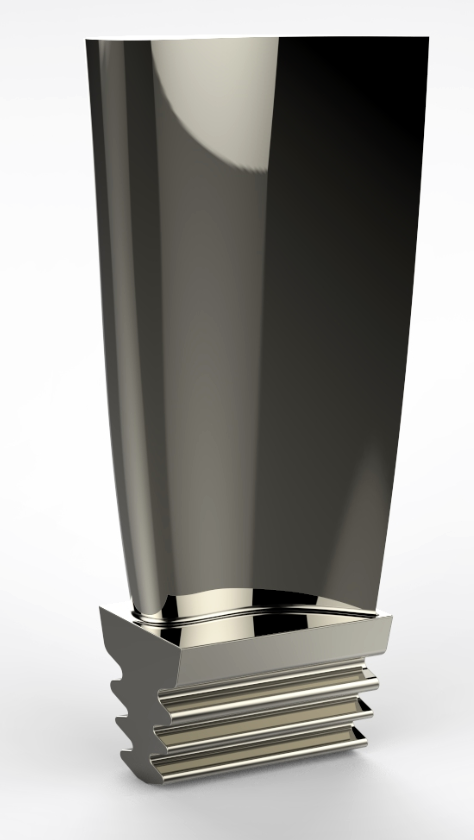
superalloys - inconel - turbine bladeSuperalloys, or high-performance alloys, are non-ferrous alloys that exhibit outstanding strength and surface stability at high temperatures. Their ability to operate safely at a high fraction of their melting point (up to 85% of their melting points (Tm) expressed in degrees Kelvin, 0.85) is their key characteristics. Superalloys are generally used at temperatures above 540 °C (1000 °F), as at these temperatures ordinary steel and titanium alloys are losing their strengths, also corrosion is common in steels at this temperature. At high temperatures, superalloys retain mechanical strength, resistance to thermal creep deformation, surface stability, and resistance to corrosion or oxidation. Some nickel-based superalloys can withstand temperatures beyond 1200°C, depending on the composition of the alloy.​ Superalloys are often cast as a single crystal, while grain boundaries may provide strength, they decrease creep resistance.

They were initially developed for use in aircraft piston engine turbosuperchargers. Today, the most common application is in aircraft turbine components, which must withstand exposure to severely oxidizing environments and high temperatures for reasonable time periods. Current applications include:

  • Aircraft gas turbines
  • Steam turbine power plants
  • Medical applications
  • Space vehicles and rocket engines
  • Heat-treating equipment
  • Nuclear power plants

Nickel is the base element for superalloys, which are are a group of nickel, iron–nickel and cobalt alloys used in jet engines. These metals have excellent resistance to thermal creep deformation and retain their stiffness, strength, toughness and dimensional stability at temperatures much higher than the other aerospace structural materials.

Inconel 718

Properties of Stainless Steels vs Superalloys

Material properties are intensive properties, that means they are independent of the amount of mass and may vary from place to place within the system at any moment. The basis of materials science involves studying the structure of materials, and relating them to their properties (mechanical, electrical etc.). Once a materials scientist knows about this structure-property correlation, they can then go on to study the relative performance of a material in a given application. The major determinants of the structure of a material and thus of its properties are its constituent chemical elements and the way in which it has been processed into its final form.

Density of Stainless Steels vs Superalloys

Density of typical superalloy is 8.22 g/cm3.

Density of typical stainless steel is 8.0 g/cm3 (304 steel).

Density is defined as the mass per unit volume. It is an intensive property, which is mathematically defined as mass divided by volume:

ρ = m/V

In words, the density (ρ) of a substance is the total mass (m) of that substance divided by the total volume (V) occupied by that substance. The standard SI unit is kilograms per cubic meter (kg/m3). The Standard English unit is pounds mass per cubic foot (lbm/ft3).

Since the density (ρ) of a substance is the total mass (m) of that substance divided by the total volume (V) occupied by that substance, it is obvious, the density of a substance strongly depends on its atomic mass and also on the atomic number density (N; atoms/cm3),

  • Atomic Weight. The atomic mass is carried by the atomic nucleus, which occupies only about 10-12 of the total volume of the atom or less, but it contains all the positive charge and at least 99.95% of the total mass of the atom. Therefore it is determined by the mass number (number of protons and neutrons).
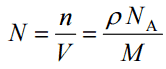
  • Atomic Number Density. The atomic number density (N; atoms/cm3), which is associated with atomic radii, is the number of atoms of a given type per unit volume (V; cm3) of the material. The atomic number density (N; atoms/cm3) of a pure material having atomic or molecular weight (M; grams/mol) and the material density (⍴; gram/cm3) is easily computed from the following equation using Avogadro’s number (NA = 6.022×10²³ atoms or molecules per mole):Atomic Number Density
  • Crystal Structure. Density of crystalline substance is significantly affected by its crystal structure. FCC structure, along with its hexagonal relative (hcp), has the most efficient packing factor (74%). Metals containing FCC structures include austenite, aluminum, copper, lead, silver, gold, nickel, platinum, and thorium.

Mechanical Properties of Stainless Steels vs Superalloys

Materials are frequently chosen for various applications because they have desirable combinations of mechanical characteristics. For structural applications, material properties are crucial and engineers must take them into account.

Strength of Stainless Steels vs Superalloys

In mechanics of materials, the strength of a material is its ability to withstand an applied load without failure or plastic deformation. Strength of materials basically considers the relationship between the external loads applied to a material and the resulting deformation or change in material dimensions. Strength of a material is its ability to withstand this applied load without failure or plastic deformation.

Ultimate Tensile Strength

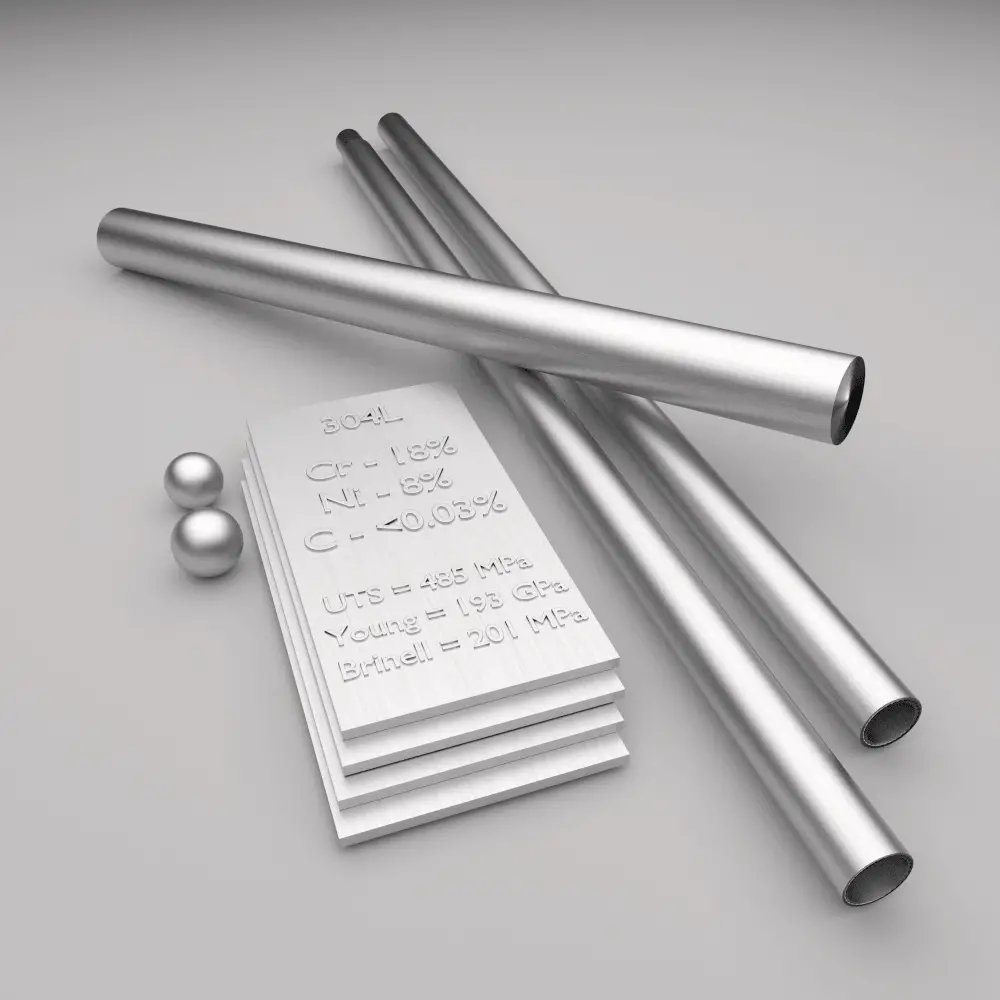
Ultimate tensile strength of stainless steel – type 304L is 485 MPa.

Ultimate tensile strength of ferritic stainless steel – Grade 430 is 480 MPa.

Ultimate tensile strength of martensitic stainless steel – Grade 440C is 760 MPa.

Ultimate tensile strength of superalloy – Inconel 718 depends on heat treatment process, but it is about 1200 MPa.

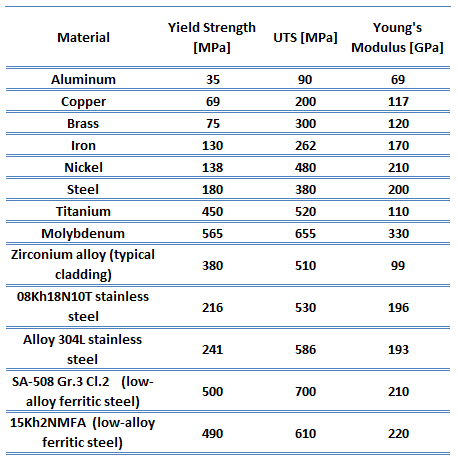
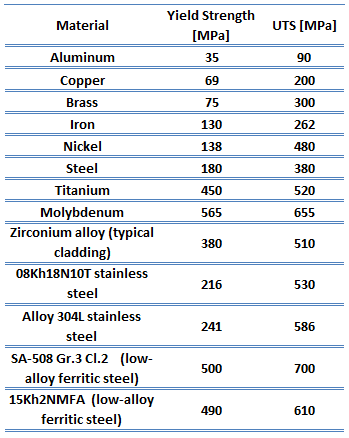
Yield Strength - Ultimate Tensile Strength - Table of MaterialsThe ultimate tensile strength is the maximum on the engineering stress-strain curve. This corresponds to the maximum stress that can be sustained by a structure in tension. Ultimate tensile strength is often shortened to “tensile strength” or even to “the ultimate.”  If this stress is applied and maintained, fracture will result. Often, this value is significantly more than the yield stress (as much as 50 to 60 percent more than the yield for some types of metals). When a ductile material reaches its ultimate strength, it experiences necking where the cross-sectional area reduces locally. The stress-strain curve contains no higher stress than the ultimate strength. Even though deformations can continue to increase, the stress usually decreases after the ultimate strength has been achieved. It is an intensive property; therefore its value does not depend on the size of the test specimen. However, it is dependent on other factors, such as the preparation of the specimen, the presence or otherwise of surface defects, and the temperature of the test environment and material. Ultimate tensile strengths vary from 50 MPa for an aluminum to as high as 3000 MPa for very high-strength steels.

Yield Strength

Yield strength of stainless steel – type 304L is  170 MPa.

Yield strength of ferritic stainless steel – Grade 430 is  310 MPa.

Yield strength of martensitic stainless steel – Grade 440C is 450 MPa.

Yield strength of superalloy – Inconel 718 depends on heat treatment process, but it is about 1030 MPa.

The yield point is the point on a stress-strain curve that indicates the limit of elastic behavior and the beginning plastic behavior. Yield strength or yield stress is the material property defined as the stress at which a material begins to deform plastically whereas yield point is the point where nonlinear (elastic + plastic) deformation begins. Prior to the yield point, the material will deform elastically and will return to its original shape when the applied stress is removed. Once the yield point is passed, some fraction of the deformation will be permanent and non-reversible. Some steels and other materials exhibit a behaviour termed a yield point phenomenon. Yield strengths vary from 35 MPa for a low-strength aluminum to greater than 1400 MPa for very high-strength steels.

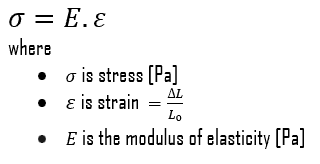
Young’s Modulus of Elasticity

Young’s modulus of elasticity of ferritic stainless steel – Grade 430 is 220 GPa.

Young’s modulus of elasticity of martensitic stainless steel – Grade 440C is 200 GPa.

Young’s modulus of elasticity of duplex stainless steels – SAF 2205 is 200 GPa.

Young’s modulus of elasticity of superalloy – Inconel 718 is 200 GPa.

The Young’s modulus of elasticity is the elastic modulus for tensile and compressive stress in the linear elasticity regime of a uniaxial deformation and is usually assessed by tensile tests. Up to a limiting stress, a body will be able to recover its dimensions on removal of the load. The applied stresses cause the atoms in a crystal to move from their equilibrium position. All the atoms are displaced the same amount and still maintain their relative geometry. When the stresses are removed, all the atoms return to their original positions and no permanent deformation occurs. According to the Hooke’s law, the stress is proportional to the strain (in the elastic region), and the slope is Young’s modulus. Young’s modulus is equal to the longitudinal stress divided by the strain.

Hardness of Stainless Steels vs Superalloys

Brinell hardness of ferritic stainless steel – Grade 430 is approximately 180 MPa.

Brinell hardness of martensitic stainless steel – Grade 440C is approximately 270 MPa.

Brinell hardness of duplex stainless steels – SAF 2205 is approximately 217 MPa.

Brinell hardness of superalloy – Inconel 718 depends on heat treatment process, but it is approximately 330 MPa.

Brinell hardness number

Rockwell hardness test is one of the most common indentation hardness tests, that has been developed for hardness testing. In contrast to Brinell test, the Rockwell tester measures the depth of penetration of an indenter under a large load (major load) compared to the penetration made by a preload (minor load). The minor load establishes the zero position. The major load is applied, then removed while still maintaining the minor load. The difference between depth of penetration before and after application of the major load is used to calculate the Rockwell hardness number. That is, the penetration depth and hardness are inversely proportional. The chief advantage of Rockwell hardness is its ability to display hardness values directly. The result is a dimensionless number noted as HRA, HRB, HRC, etc., where the last letter is the respective Rockwell scale.

The Rockwell C test is performed with a Brale penetrator (120°diamond cone) and a major load of 150kg.

Thermal Properties of Stainless Steels vs Superalloys

Thermal properties of materials refer to the response of materials to changes in their thermodynamics/thermodynamic-properties/what-is-temperature-physics/”>temperature and to the application of heat. As a solid absorbs thermodynamics/what-is-energy-physics/”>energy in the form of heat, its temperature rises and its dimensions increase. But different materials react to the application of heat differently.

Heat capacity, thermal expansion, and thermal conductivity are properties that are often critical in the practical use of solids.

Melting Point of Stainless Steels vs Superalloys

Melting point of stainless steel – type 304 steel is around 1450°C.

Melting point of ferritic stainless steel – Grade 430 steel is around 1450°C.

Melting point of martensitic stainless steel – Grade 440C steel is around 1450°C.

Melting point of superalloy – Inconel 718 steel is around 1400°C.

In general, melting is a phase change of a substance from the solid to the liquid phase. The melting point of a substance is the temperature at which this phase change occurs. The melting point also defines a condition in which the solid and liquid can exist in equilibrium.

Thermal Conductivity of Stainless Steels vs Superalloys

The thermal conductivity of stainless steel – type 304 is 20 W/(m.K).

The thermal conductivity of ferritic stainless steel – Grade 430 is 26 W/(m.K).

The thermal conductivity of martensitic stainless steel – Grade 440C is 24 W/(m.K).

The thermal conductivity of superalloy – Inconel 718 is 6.5 W/(m.K).

The heat transfer characteristics of a solid material are measured by a property called the thermal conductivity, k (or λ), measured in W/m.K. It is a measure of a substance’s ability to transfer heat through a material by conduction. Note that Fourier’s law applies for all matter, regardless of its state (solid, liquid, or gas), therefore, it is also defined for liquids and gases.

The thermal conductivity of most liquids and solids varies with temperature. For vapors, it also depends upon pressure. In general:

thermal conductivity - definition

Most materials are very nearly homogeneous, therefore we can usually write k = k (T). Similar definitions are associated with thermal conductivities in the y- and z-directions (ky, kz), but for an isotropic material the thermal conductivity is independent of the direction of transfer, kx = ky = kz = k.

References:
Materials Science:

U.S. Department of Energy, Material Science. DOE Fundamentals Handbook, Volume 1 and 2. January 1993.
U.S. Department of Energy, Material Science. DOE Fundamentals Handbook, Volume 2 and 2. January 1993.
William D. Callister, David G. Rethwisch. Materials Science and Engineering: An Introduction 9th Edition, Wiley; 9 edition (December 4, 2013), ISBN-13: 978-1118324578.
Eberhart, Mark (2003). Why Things Break: Understanding the World by the Way It Comes Apart. Harmony. ISBN 978-1-4000-4760-4.
Gaskell, David R. (1995). Introduction to the thermodynamics of Materials (4th ed.). Taylor and Francis Publishing. ISBN 978-1-56032-992-3.
González-Viñas, W. & Mancini, H.L. (2004). An Introduction to Materials Science. Princeton University Press. ISBN 978-0-691-07097-1.
Ashby, Michael; Hugh Shercliff; David Cebon (2007). Materials: engineering, science, processing and design (1st ed.). Butterworth-Heinemann. ISBN 978-0-7506-8391-3.
J. R. Lamarsh, A. J. Baratta, Introduction to Nuclear Engineering, 3d ed., Prentice-Hall, 2001, ISBN: 0-201-82498-1.

See above:
Alloys

We hope, this article, Stainless Steels vs Superalloys – Comparison – Pros and Cons, helps you. If so, give us a like in the sidebar. Main purpose of this website is to help the public to learn some interesting and important information about materials and their properties.