Facebook Instagram Youtube Twitter

What is Characteristics of Strong Interaction – Definition

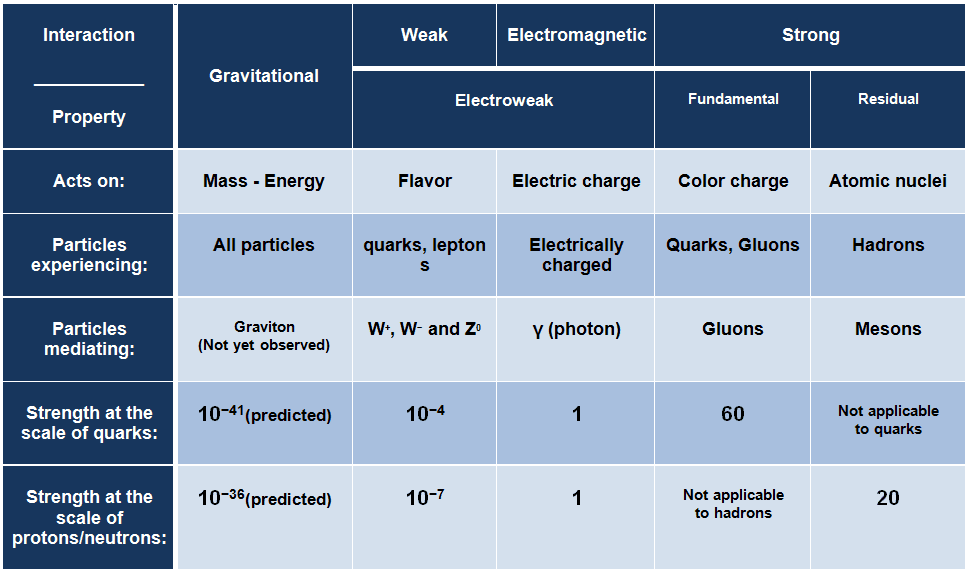
In general, the strong interaction is very complicated interaction, because it significantly varies with distance. At the scale of quarks, the strong force is approximately 100 times as strong as electromagnetic force, a million times as strong as the weak interaction, and 1043 times as strong as gravitation. Material Properties

Characteristics of Strong Interaction
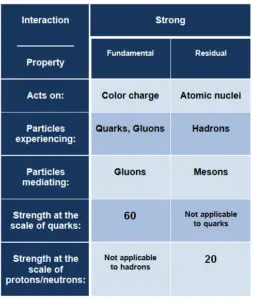
strong interaction and strong force

The strong interaction or strong force is one of the four fundamental forces and involves the exchange of the vector gauge bosons known as gluons. In general, the strong interaction is very complicated interaction, because it significantly varies with distance.

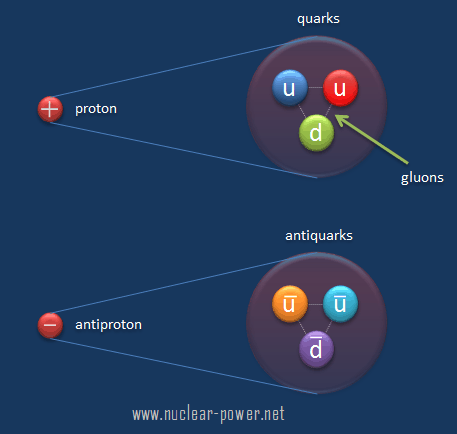
In strong interactions the quarks exchange gluons, the carriers of the strong force. Gluons carry the color charge of the strong nuclear force. Color charge is analogous to electromagnetic charge, but quarks carry three types of color charge (red, green, blue) and antiquarks carry three types of anticolor (antired, antigreen, antiblue). Gluons may be thought of as carrying both color and anticolor.

Most of the mass of a common proton or neutron is the result of the strong force field energy. The individual quarks provide only about 1% of the mass of a proton. Noteworthy, because most of yourthermodynamics/thermodynamic-properties/what-is-mass-and-weight/”> mass is due to the protons and neutrons in your body, your mass (and therefore your weight on a bathroom scale) comes primarily from the gluons that bind the constituent quarks together, rather than from the quarks themselves. Mass is primarily a measure of the energies of the quark motion and the quark-binding fields.

Range of Strong Force

As was written, the strong interaction is very complicated interaction, because it significantly varies with distance. At distances comparable to the diameter of a proton, the strong force is approximately 100 times as strong as electromagnetic force. At smaller distances, however, the strong force between quarks becomes weaker, and the quarks begin to behave like independent particles. In particle physics, this effect is known as asymptotic freedom.

As a result, the strong force can leaks out of individual nucleons (as the residual strong force) to influence the adjacent particle. On the other hand, the strong force cannot reach outside the nucleus. This is due to color confinement, which implies that the strong force acts only between pairs of quarks. Simply, color charged particles (such as quarks and gluons) cannot be isolated (below Hagedorn temperature) and therefore in collections of bound quarks (i.e., hadrons), the net color-charge of the quarks essentially cancels out, resulting in a limit of the action of the forces.

Strength of Strong Force

It is the strongest of the four fundamental forces, but as was written, it significantly varies with distance. At the scale of quarks, the strong force is approximately 100 times as strong as electromagnetic force, a million times as strong as the weak interaction, and 1043 times as strong as gravitation.

Particles in Strong Interaction
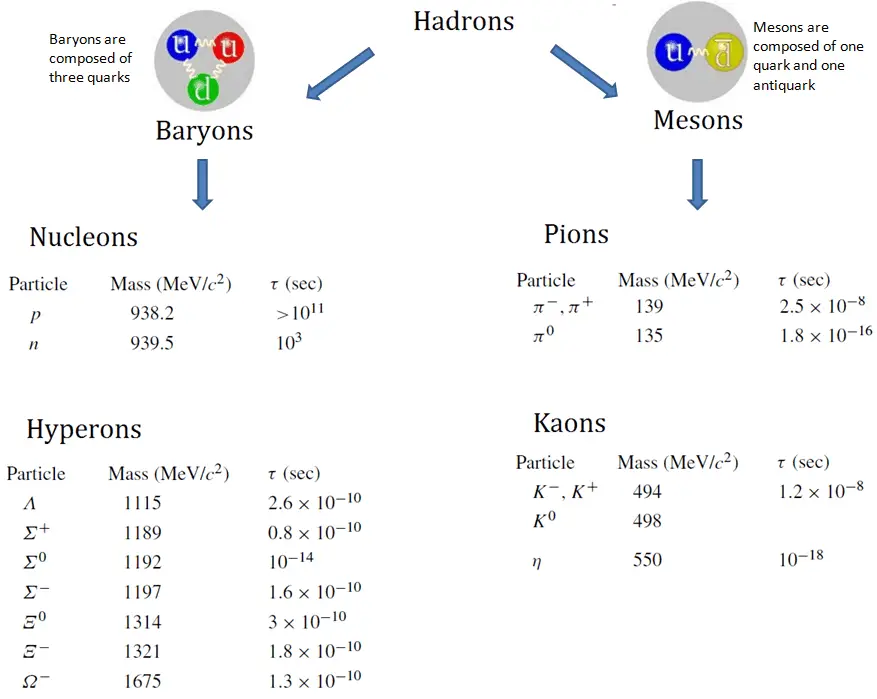
hadrons-baryons-mesonsIn general, particles that do participate in strong interactions are called hadrons: protons and neutrons are hadrons. The hadrons are further sub-divided into baryons and mesons, according to the number of quarks they contain. Protons and neutrons each contain three quarks; they belong to the family of particles called the baryons. Other baryons are the lambda, sigma, xi, and omega particles. On the other hand mesons bosons and they are composed of two quarks: a quark and an antiquark. Besides charge and spin (1/2 for the baryons), two other quantum numbers are assigned to these particles: baryon number (B) and strangeness (S). Baryons have a baryon number, B, of 1, while their antiparticles, called antibaryons, have a baryon number of −1. A nucleus of deuterium (deuteron), for example, contains one proton and one neutron (each with a baryon number of 1) and has a baryon number of 2. Since baryons make up most of the mass of ordinary atoms, the everyday matter is often referred to as baryonic matter.

The conservation of baryon number is an important rule for interactions and decays of baryons. No known interactions violate conservation of baryon number.

References:
Nuclear and Reactor Physics:
  1. J. R. Lamarsh, Introduction to Nuclear Reactor Theory, 2nd ed., Addison-Wesley, Reading, MA (1983).
  2. J. R. Lamarsh, A. J. Baratta, Introduction to Nuclear Engineering, 3d ed., Prentice-Hall, 2001, ISBN: 0-201-82498-1.
  3. W. M. Stacey, Nuclear Reactor Physics, John Wiley & Sons, 2001, ISBN: 0- 471-39127-1.
  4. Glasstone, Sesonske. Nuclear Reactor Engineering: Reactor Systems Engineering, Springer; 4th edition, 1994, ISBN: 978-0412985317
  5. W.S.C. Williams. Nuclear and Particle Physics. Clarendon Press; 1 edition, 1991, ISBN: 978-0198520467
  6. G.R.Keepin. Physics of Nuclear Kinetics. Addison-Wesley Pub. Co; 1st edition, 1965
  7. Robert Reed Burn, Introduction to Nuclear Reactor Operation, 1988.
  8. U.S. Department of Energy, Nuclear Physics and Reactor Theory. DOE Fundamentals Handbook, Volume 1 and 2. January 1993.
  9. Paul Reuss, Neutron Physics. EDP Sciences, 2008. ISBN: 978-2759800414.

Advanced Reactor Physics:

  1. K. O. Ott, W. A. Bezella, Introductory Nuclear Reactor Statics, American Nuclear Society, Revised edition (1989), 1989, ISBN: 0-894-48033-2.
  2. K. O. Ott, R. J. Neuhold, Introductory Nuclear Reactor Dynamics, American Nuclear Society, 1985, ISBN: 0-894-48029-4.
  3. D. L. Hetrick, Dynamics of Nuclear Reactors, American Nuclear Society, 1993, ISBN: 0-894-48453-2.
  4. E. E. Lewis, W. F. Miller, Computational Methods of Neutron Transport, American Nuclear Society, 1993, ISBN: 0-894-48452-4.

See also:

Strong Interactions

We hope, this article, Characteristics of Strong Interaction, helps you. If so, give us a like in the sidebar. Main purpose of this website is to help the public to learn some interesting and important information about materials and their properties.
What is Strong Interaction – Strong Force – Definition

The strong interaction or strong force is one of the four fundamental forces and involves the exchange of the vector gauge bosons known as gluons. The strong nuclear force confines quarks into hadron particles as well as acts to hold neutrons and protons together in nuclei. Strong Interaction – Strong Force

Strong Interaction – Strong Force

Strong Interaction - GluonsThe strong interaction or strong force is one of the four fundamental forces and involves the exchange of the vector gauge bosons known as gluons. In general, the strong interaction is very complicated interaction, because it significantly varies with distance. The strong nuclear force holds most ordinary matter together because it confines quarks into hadron particles such as the proton and neutron. Moreover, the strong force is the force which can hold a nucleus together against the enormous forces of repulsion (electromagnetic force) of the protons is strong indeed. From this point of view, we have to distinguish between:

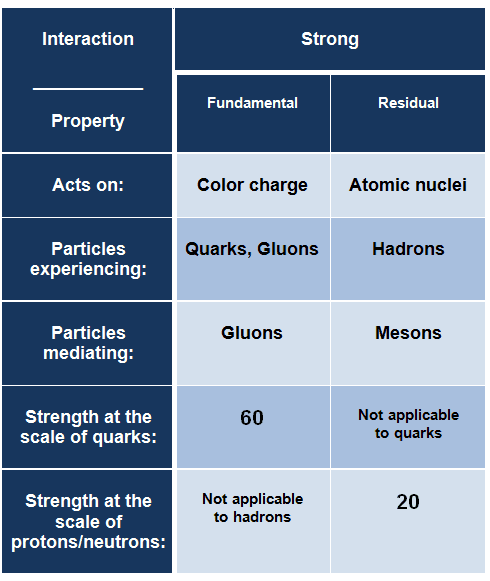
  • Fundamental Strong Force. The fundamental strong force, or the strong force, is a very short range (less than about 0.8 fm, the radius of a nucleon) force, that acts directly between quarks. This force holds quarks together to form protons, neutrons, and other hadron particles. The strong interaction is mediated by the exchange of massless particles called gluons that act between quarks, antiquarks, and other gluons.
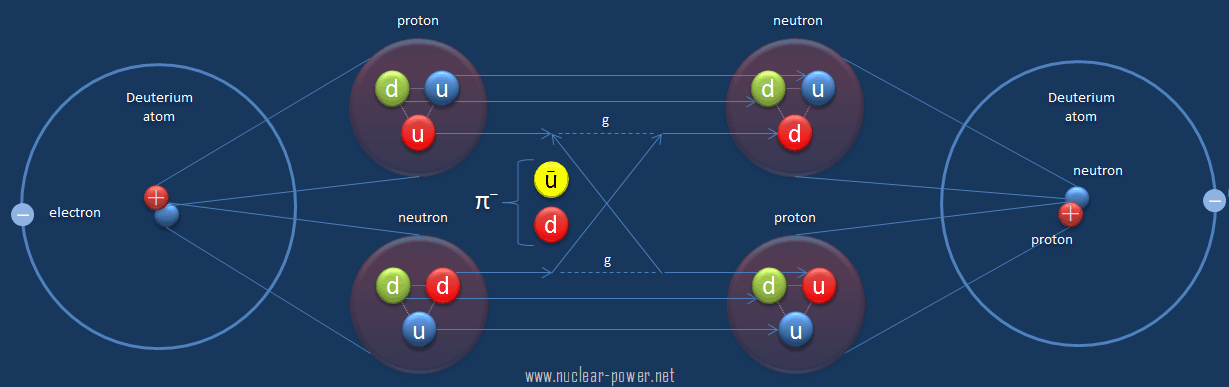
  • Residual Strong Force. The residual strong force, also known as the nuclear force, is a very short range (about 1 to 3 fm) force, which acts to hold neutrons and protons together in nuclei. In nuclei, this force acts against the enormous repulsive electromagnetic force of the protons. The term residual is associated with the fact, it is the residuum of the fundamental strong interaction between the quarks that make up the protons and neutrons. The residual strong force acts indirectly through the virtual π and ρ mesons, which transmit the force between nucleons that holds the nucleus together.

strong interaction and strong forceIn strong interactions the quarks exchange gluons, the carriers of the strong force. Gluons carry the color charge of the strong nuclear force. Color charge is analogous to electromagnetic charge, but quarks carry three types of color charge (red, green, blue) and antiquarks carry three types of anticolor (antired, antigreen, antiblue). Gluons may be thought of as carrying both color and anticolor.

Most of the mass of a common proton or neutron is the result of the strong force field energy. The individual quarks provide only about 1% of the mass of a proton. Noteworthy, because most of yourthermodynamics/thermodynamic-properties/what-is-mass-and-weight/”> mass is due to the protons and neutrons in your body, your mass (and therefore your weight on a bathroom scale) comes primarily from the gluons that bind the constituent quarks together, rather than from the quarks themselves. Mass is primarily a measure of the energies of the quark motion and the quark-binding fields.

Range of Strong Force

As was written, the strong interaction is very complicated interaction, because it significantly varies with distance. At distances comparable to the diameter of a proton, the strong force is approximately 100 times as strong as electromagnetic force. At smaller distances, however, the strong force between quarks becomes weaker, and the quarks begin to behave like independent particles. In particle physics, this effect is known as asymptotic freedom.

As a result, the strong force can leaks out of individual nucleons (as the residual strong force) to influence the adjacent particle. On the other hand, the strong force cannot reach outside the nucleus. This is due to color confinement, which implies that the strong force acts only between pairs of quarks. Simply, color charged particles (such as quarks and gluons) cannot be isolated (below Hagedorn temperature) and therefore in collections of bound quarks (i.e., hadrons), the net color-charge of the quarks essentially cancels out, resulting in a limit of the action of the forces.

Strength of Strong Force

It is the strongest of the four fundamental forces, but as was written, it significantly varies with distance. At the scale of quarks, the strong force is approximately 100 times as strong as electromagnetic force, a million times as strong as the weak interaction, and 1043 times as strong as gravitation.

What are Gluons – Mass of Quark

The mass of the neutron is 939.565 MeV/c2, whereas the mass of the three quarks is only about 10 MeV/c2 (only about 1% of the mass-energy of the neutron). Like the proton, most of mass (energy) of the neutron is in the form of the strong nuclear force energy (gluons). The quarks of the neutron are held together by gluons, the exchange particles for the strong nuclear force. Gluons carry the color charge of the strong nuclear force.

Therefore, we have to distinguish between current quark mass (also called the mass of the ‘naked’ quarks) and constituent quark mass. Current quark mass refers to the mass of a quark by itself, while constituent quark mass refers to the current quark mass plus the mass of the gluon particle field surrounding the quark.

Noteworthy, because most of your mass is due to the protons and neutrons in your body, your mass (and therefore your weight on a bathroom scale) comes primarily from the gluons that bind the constituent quarks together, rather than from the quarks themselves. Mass is primarily a measure of the energies of the quark motion and the quark-binding fields any real object. It must be noted, gluons are inherently massless, they possess energy.

Particles in Strong Interaction

hadrons-baryons-mesonsIn general, particles that do participate in strong interactions are called hadrons: protons and neutrons are hadrons. The hadrons are further sub-divided into baryons and mesons, according to the number of quarks they contain. Protons and neutrons each contain three quarks; they belong to the family of particles called the baryons. Other baryons are the lambda, sigma, xi, and omega particles. On the other hand mesons bosons and they are composed of two quarks: a quark and an antiquark. Besides charge and spin (1/2 for the baryons), two other quantum numbers are assigned to these particles: baryon number (B) and strangeness (S). Baryons have a baryon number, B, of 1, while their antiparticles, called antibaryons, have a baryon number of −1. A nucleus of deuterium (deuteron), for example, contains one proton and one neutron (each with a baryon number of 1) and has a baryon number of 2. Since baryons make up most of the mass of ordinary atoms, the everyday matter is often referred to as baryonic matter.

The conservation of baryon number is an important rule for interactions and decays of baryons. No known interactions violate conservation of baryon number.

Nuclear Force – Residual Strong Force

The residual strong force, also known as the nuclear force, is a very short range (about 1 to 3 fm) force, which acts to hold neutrons and protons together in nuclei. In nuclei, this force acts against the enormous repulsive electromagnetic force of the protons. It acts equally only between pairs of neutrons, pairs of protons, or a neutron and a proton. The term residual is associated with the fact, it is the residuum of the fundamental strong interaction between the quarks that make up the protons and neutrons. The residual strong force acts indirectly through the virtual π and ρ mesons, which transmit the force between nucleons that holds the nucleus together.

Nuclear Force - Principle
The residual strong force acts indirectly through the virtual π and ρ mesons, which transmit the force between nucleons that holds the nucleus together.

As was written, hadrons appear nearly without color charge, and the fundamental strong force is therefore nearly absent between those hadrons except that the cancellation is not quite perfect. The fundamental strong force can leaks out of individual nucleons (as the residual strong force) to influence the adjacent particle. As for the fundamental strong force, the residual force does diminish rapidly with distance, and is thus very short-range. Therefore, neither the residual strong force cannot reach outside the nucleus. This is due to color confinement, which implies that the strong force acts only between pairs of quarks. Simply, color charged particles (such as quarks and gluons) cannot be isolated (below Hagedorn temperature) and therefore in collections of bound quarks (i.e., hadrons), the net color-charge of the quarks essentially cancels out, resulting in a limit of the action of the forces.

Notwithstanding they have identical origin, the residual strong force is much weaker than the fundamental strong force. It is very much like the electromagnetic forces between neutral atoms (van der Waals forces), which form molecules and are much weaker than the electromagnetic forces that hold electrons in association with the nucleus, forming the atoms.

Atomic nuclei consist of protons and neutrons, which attract each other through the nuclear force, while protons repel each other via the electromagnetic force due to their positive charge. These two forces compete, leading to various stability of nuclei. There are only certain combinations of neutrons and protons, which forms stable nuclei. Neutrons stabilize the nucleus, because they attract each other and protons , which helps offset the electrical repulsion between protons. As a result, as the number of protons increases, an increasing ratio of neutrons to protons is needed to form a stable nucleus. If there are too many (neutrons also obey the Pauli exclusion principle) or too few neutrons for a given number of protons, the resulting nucleus is not stable and it undergoes radioactive decay. Unstable isotopes decay through various radioactive decay pathways, most commonly alpha decay, beta decay, or electron capture. Many other rare types of decay, such as spontaneous fission or neutron emission are known.

See also: Liquid Drop Model

References:
Nuclear and Reactor Physics:
  1. J. R. Lamarsh, Introduction to Nuclear Reactor Theory, 2nd ed., Addison-Wesley, Reading, MA (1983).
  2. J. R. Lamarsh, A. J. Baratta, Introduction to Nuclear Engineering, 3d ed., Prentice-Hall, 2001, ISBN: 0-201-82498-1.
  3. W. M. Stacey, Nuclear Reactor Physics, John Wiley & Sons, 2001, ISBN: 0- 471-39127-1.
  4. Glasstone, Sesonske. Nuclear Reactor Engineering: Reactor Systems Engineering, Springer; 4th edition, 1994, ISBN: 978-0412985317
  5. W.S.C. Williams. Nuclear and Particle Physics. Clarendon Press; 1 edition, 1991, ISBN: 978-0198520467
  6. G.R.Keepin. Physics of Nuclear Kinetics. Addison-Wesley Pub. Co; 1st edition, 1965
  7. Robert Reed Burn, Introduction to Nuclear Reactor Operation, 1988.
  8. U.S. Department of Energy, Nuclear Physics and Reactor Theory. DOE Fundamentals Handbook, Volume 1 and 2. January 1993.
  9. Paul Reuss, Neutron Physics. EDP Sciences, 2008. ISBN: 978-2759800414.

Advanced Reactor Physics:

  1. K. O. Ott, W. A. Bezella, Introductory Nuclear Reactor Statics, American Nuclear Society, Revised edition (1989), 1989, ISBN: 0-894-48033-2.
  2. K. O. Ott, R. J. Neuhold, Introductory Nuclear Reactor Dynamics, American Nuclear Society, 1985, ISBN: 0-894-48029-4.
  3. D. L. Hetrick, Dynamics of Nuclear Reactors, American Nuclear Society, 1993, ISBN: 0-894-48453-2.
  4. E. E. Lewis, W. F. Miller, Computational Methods of Neutron Transport, American Nuclear Society, 1993, ISBN: 0-894-48452-4.

See also:

Fundamental Interactions

We hope, this article, Strong Interaction – Strong Force, helps you. If so, give us a like in the sidebar. Main purpose of this website is to help the public to learn some interesting and important information about materials and their properties.
What is Electroweak Interaction – Electroweak Force – Definition

At high energy the weak force and electromagnetic force are unified as a single electroweak force. The unification energy is on the order of 100 GeV. Electroweak Interaction – Electroweak Force

Electroweak Interaction

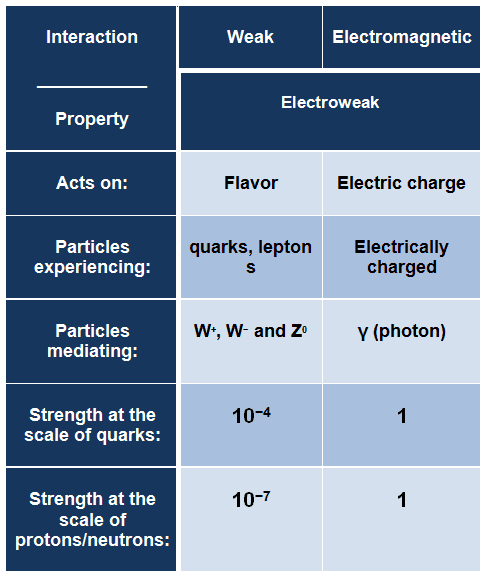
Although weak force is considered one of the four fundamental forces, at high energy the weak force and electromagnetic force are unified as a single electroweak force. The unification energy is on the order of 100 GeV.  At low energies electromagnetic and weak interaction appear to be very different. Electroweak theory is very important for modern cosmology. In the history of the universe, during the quark epoch (shortly after the Big Bang) the unified force broke into the two separate forces as the universe cooled.

For contributions to the unification of the weak and electromagnetic interaction between elementary particles, Abdus Salam, Sheldon Glashow and Steven Weinberg were awarded the 1979 Nobel Prize in Physics.

Weak Interaction

weak and electromagnetic interactionThe weak interaction or weak force is one of the four fundamental forces and involves the exchange of the intermediate vector bosons, the W and the Z. Since these bosons are very massive (on the order of 80 GeV, the uncertainty principle dictates a range of about 10-18 meters which is less than the diameter of a proton. As a result, the weak interaction takes place only at very small, sub-atomic distances.

The weak interaction responsible for some nuclear phenomena such as beta decay, which can be understood in terms of the weak force operating on the quarks within the neutron. One of two down quarks changes into an up quark by emitting a W– boson (carries away a negative charge). The W– boson then decays into a beta particle and an antineutrino. This process is equivalent to the process, in which a neutrino interacts with a neutron.

weak interaction - weak force

Electromagnetic Interaction

The electromagnetic force is the force responsible for all electromagnetic processes. It acts between electrically charged particles. It is infinite-ranged force, much stronger than gravitational force, obeys the inverse square law, but neither electricity nor magnetism adds up in the way that gravitational force does. Since there are positive and negative charges (poles), these charges tend to cancel each other out. Electromagnetism includes the electrostatic force acting between charged particles at rest, and the combined effect of electric and magnetic forces acting between charged particles moving relative to each other.

The photon, the quantum of electromagnetic radiation, is an elementary particle, which is the force carrier of the electromagnetic force. Photons are gauge bosons having no electric charge or rest mass and one unit of spin. Common to all photons is the speed of light, the universal constant of physics. In empty space, the photon moves at c (the speed of light – 299 792 458 metres per second).

References:
References:
Nuclear and Reactor Physics:
  1. J. R. Lamarsh, Introduction to Nuclear Reactor Theory, 2nd ed., Addison-Wesley, Reading, MA (1983).
  2. J. R. Lamarsh, A. J. Baratta, Introduction to Nuclear Engineering, 3d ed., Prentice-Hall, 2001, ISBN: 0-201-82498-1.
  3. W. M. Stacey, Nuclear Reactor Physics, John Wiley & Sons, 2001, ISBN: 0- 471-39127-1.
  4. Glasstone, Sesonske. Nuclear Reactor Engineering: Reactor Systems Engineering, Springer; 4th edition, 1994, ISBN: 978-0412985317
  5. W.S.C. Williams. Nuclear and Particle Physics. Clarendon Press; 1 edition, 1991, ISBN: 978-0198520467
  6. G.R.Keepin. Physics of Nuclear Kinetics. Addison-Wesley Pub. Co; 1st edition, 1965
  7. Robert Reed Burn, Introduction to Nuclear Reactor Operation, 1988.
  8. U.S. Department of Energy, Nuclear Physics and Reactor Theory. DOE Fundamentals Handbook, Volume 1 and 2. January 1993.
  9. Paul Reuss, Neutron Physics. EDP Sciences, 2008. ISBN: 978-2759800414.

Advanced Reactor Physics:

  1. K. O. Ott, W. A. Bezella, Introductory Nuclear Reactor Statics, American Nuclear Society, Revised edition (1989), 1989, ISBN: 0-894-48033-2.
  2. K. O. Ott, R. J. Neuhold, Introductory Nuclear Reactor Dynamics, American Nuclear Society, 1985, ISBN: 0-894-48029-4.
  3. D. L. Hetrick, Dynamics of Nuclear Reactors, American Nuclear Society, 1993, ISBN: 0-894-48453-2.
  4. E. E. Lewis, W. F. Miller, Computational Methods of Neutron Transport, American Nuclear Society, 1993, ISBN: 0-894-48452-4.

See also:

Fundamental Interactions

We hope, this article, Electroweak Interaction - Electroweak Force, helps you. If so, give us a like in the sidebar. Main purpose of this website is to help the public to learn some interesting and important information about materials and their properties.
What is Weak Interaction – Weak Force – Definition

The weak interaction or weak force is one of the four fundamental forces and involves the exchange of the intermediate vector bosons, the W and the Z. Weak Interaction – Weak Force

Weak Interaction – Weak Force

weak and electromagnetic interactionThe weak interaction or weak force is one of the four fundamental forces and involves the exchange of the intermediate vector bosons, the W and the Z. Since these bosons are very massive (on the order of 80 GeV, the uncertainty principle dictates a range of about 10-18 meters which is less than the diameter of a proton. As a result, the weak interaction takes place only at very small, sub-atomic distances.

The weak interaction responsible for some nuclear phenomena such as beta decay, which can be understood in terms of the weak force operating on the quarks within the neutron. One of two down quarks changes into an up quark by emitting a W– boson (carries away a negative charge). The W– boson then decays into a beta particle and an antineutrino. This process is equivalent to the process, in which a neutrino interacts with a neutron.

weak interaction - weak force

As can be seen from the figure, the weak interaction changes one flavor of quark into another. Note that, the Standard Model counts six flavours of quarks and six flavours of leptons. The weak interaction is the only process in which a quark can change to another quark, or a lepton to another lepton (flavor change). Neither the strong interaction nor electromagnetic permit flavour changing. This fact is crucial in many decays of nuclear particles. In the fusion process, which, for example, powers the Sun, two protons interact via the weak force to form a deuterium nucleus, which reacts further to generate helium. Without the weak interaction, the diproton would decay back into two hydrogen-1 unbound protons through proton emission. As a result, the sun would not burn without it since the weak interaction causes the transmutation p -> n.

Electroweak Interaction

Although weak force is considered one of the four fundamental forces, at high energy the weak force and electromagnetic force are unified as a single electroweak force. The unification energy is on the order of 100 GeV.  At low energies electromagnetic and weak interaction appear to be very different. Electroweak theory is very important for modern cosmology. In the history of the universe, during the quark epoch (shortly after the Big Bang) the unified force broke into the two separate forces as the universe cooled.

For contributions to the unification of the weak and electromagnetic interaction between elementary particles, Abdus Salam, Sheldon Glashow and Steven Weinberg were awarded the 1979 Nobel Prize in Physics.

References:
Nuclear and Reactor Physics:
  1. J. R. Lamarsh, Introduction to Nuclear Reactor Theory, 2nd ed., Addison-Wesley, Reading, MA (1983).
  2. J. R. Lamarsh, A. J. Baratta, Introduction to Nuclear Engineering, 3d ed., Prentice-Hall, 2001, ISBN: 0-201-82498-1.
  3. W. M. Stacey, Nuclear Reactor Physics, John Wiley & Sons, 2001, ISBN: 0- 471-39127-1.
  4. Glasstone, Sesonske. Nuclear Reactor Engineering: Reactor Systems Engineering, Springer; 4th edition, 1994, ISBN: 978-0412985317
  5. W.S.C. Williams. Nuclear and Particle Physics. Clarendon Press; 1 edition, 1991, ISBN: 978-0198520467
  6. G.R.Keepin. Physics of Nuclear Kinetics. Addison-Wesley Pub. Co; 1st edition, 1965
  7. Robert Reed Burn, Introduction to Nuclear Reactor Operation, 1988.
  8. U.S. Department of Energy, Nuclear Physics and Reactor Theory. DOE Fundamentals Handbook, Volume 1 and 2. January 1993.
  9. Paul Reuss, Neutron Physics. EDP Sciences, 2008. ISBN: 978-2759800414.

Advanced Reactor Physics:

  1. K. O. Ott, W. A. Bezella, Introductory Nuclear Reactor Statics, American Nuclear Society, Revised edition (1989), 1989, ISBN: 0-894-48033-2.
  2. K. O. Ott, R. J. Neuhold, Introductory Nuclear Reactor Dynamics, American Nuclear Society, 1985, ISBN: 0-894-48029-4.
  3. D. L. Hetrick, Dynamics of Nuclear Reactors, American Nuclear Society, 1993, ISBN: 0-894-48453-2.
  4. E. E. Lewis, W. F. Miller, Computational Methods of Neutron Transport, American Nuclear Society, 1993, ISBN: 0-894-48452-4.

See also:

Fundamental Interactions

We hope, this article, Weak Interaction – Weak Force, helps you. If so, give us a like in the sidebar. Main purpose of this website is to help the public to learn some interesting and important information about materials and their properties.

What is Electrostatic Force – Formula – Coulomb’s Law – Definition

Electrostatic Force – Formula – Coulomb’s Law. The electrostatic force is directly proportional to the electrical charges of the two particles and inversely proportional to the square of the distance between the particles. Material Properties

Electrostatic Force – Formula – Coulomb’s Law

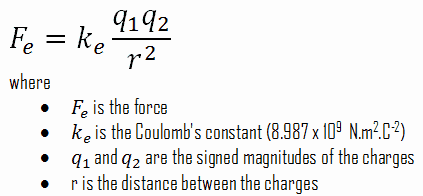
Forces between static electrically charged particles are governed by the Coulomb’s law. Coulomb’s Law can be used to calculate the force between charged particles (e.g. two protons). The electrostatic force is directly proportional to the electrical charges of the two particles and inversely proportional to the square of the distance between the particles. Coulomb’s Law is stated as the following equation.

Both, the Coulomb’s law and the magnetic force, are summarized in the Lorentz force law. Fundamentally, both magnetic and electric forces are manifestations of an exchange force involving the exchange of photons.

The photon, the quantum of electromagnetic radiation, is an elementary particle, which is the force carrier of the electromagnetic force. Photons are gauge bosons having no electric charge or rest mass and one unit of spin. Common to all photons is the speed of light, the universal constant of physics. In empty space, the photon moves at c (the speed of light – 299 792 458 metres per second).

The electromagnetic force plays a major role in determining the internal properties of most objects encountered in daily life. The chemical properties of atoms and molecules are determined by the number of protons, in fact, by number and arrangement of electrons. The configuration of these electrons follows from the principles of quantum mechanics. The number of electrons in each element’s electron shells, particularly the outermost valence shell, is the primary factor in determining its chemical bonding behavior. In the periodic table, the elements are listed in order of increasing atomic number Z. In fact, the forces of electric attraction and repulsion of electric charges are so dominant over the other three fundamental forces that they can be considered to be negligible as determiners of atomic and molecular structure.

Example: Electrostatic Force

Noteworthy, in a four liters of water there is about 2.1 x 10⁸C of total electron charge. Thus, if we place two bottles a meter apart, the electrons in one of the bottles repel those in the other bottle with a force of 4.1 x 1026N. This tremendous force is comparable with the force than the planet Earth would weigh if weighed on another Earth. Ut, as was written, there are also positive (protons) and these charges tend to cancel each other out.

References:
Nuclear and Reactor Physics:
  1. J. R. Lamarsh, Introduction to Nuclear Reactor Theory, 2nd ed., Addison-Wesley, Reading, MA (1983).
  2. J. R. Lamarsh, A. J. Baratta, Introduction to Nuclear Engineering, 3d ed., Prentice-Hall, 2001, ISBN: 0-201-82498-1.
  3. W. M. Stacey, Nuclear Reactor Physics, John Wiley & Sons, 2001, ISBN: 0- 471-39127-1.
  4. Glasstone, Sesonske. Nuclear Reactor Engineering: Reactor Systems Engineering, Springer; 4th edition, 1994, ISBN: 978-0412985317
  5. W.S.C. Williams. Nuclear and Particle Physics. Clarendon Press; 1 edition, 1991, ISBN: 978-0198520467
  6. G.R.Keepin. Physics of Nuclear Kinetics. Addison-Wesley Pub. Co; 1st edition, 1965
  7. Robert Reed Burn, Introduction to Nuclear Reactor Operation, 1988.
  8. U.S. Department of Energy, Nuclear Physics and Reactor Theory. DOE Fundamentals Handbook, Volume 1 and 2. January 1993.
  9. Paul Reuss, Neutron Physics. EDP Sciences, 2008. ISBN: 978-2759800414.

Advanced Reactor Physics:

  1. K. O. Ott, W. A. Bezella, Introductory Nuclear Reactor Statics, American Nuclear Society, Revised edition (1989), 1989, ISBN: 0-894-48033-2.
  2. K. O. Ott, R. J. Neuhold, Introductory Nuclear Reactor Dynamics, American Nuclear Society, 1985, ISBN: 0-894-48029-4.
  3. D. L. Hetrick, Dynamics of Nuclear Reactors, American Nuclear Society, 1993, ISBN: 0-894-48453-2.
  4. E. E. Lewis, W. F. Miller, Computational Methods of Neutron Transport, American Nuclear Society, 1993, ISBN: 0-894-48452-4.

See also:

Electromagnetic Force

We hope, this article, Electrostatic Force – Formula – Coulomb’s Law, helps you. If so, give us a like in the sidebar. Main purpose of this website is to help the public to learn some interesting and important information about materials and their properties.
What is Electromagnetic Interaction – Electromagnetic Force – Definition

The electromagnetic force is the force responsible for all electromagnetic processes. It acts between electrically charged particles. Electromagnetic Interaction – Electromagnetic Force

Electromagnetic Interaction – Electromagnetic Force

weak and electromagnetic interactionThe electromagnetic force is the force responsible for all electromagnetic processes. It acts between electrically charged particles. It is infinite-ranged force, much stronger than gravitational force, obeys the inverse square law, but neither electricity nor magnetism adds up in the way that gravitational force does. Since there are positive and negative charges (poles), these charges tend to cancel each other out. Electromagnetism includes the electrostatic force acting between charged particles at rest, and the combined effect of electric and magnetic forces acting between charged particles moving relative to each other.

The photon, the quantum of electromagnetic radiation, is an elementary particle, which is the force carrier of the electromagnetic force. Photons are gauge bosons having no electric charge or rest mass and one unit of spin. Common to all photons is the speed of light, the universal constant of physics. In empty space, the photon moves at c (the speed of light – 299 792 458 metres per second).

Forces between static electrically charged particles are governed by the Coulomb’s law. Coulomb’s Law can be used to calculate the force between charged particles (e.g. two protons). The electrostatic force is directly proportional to the electrical charges of the two particles and inversely proportional to the square of the distance between the particles. Coulomb’s Law is stated as the following equation.

Both, the Coulomb’s law and the magnetic force, are summarized in the Lorentz force law. Fundamentally, both magnetic and electric forces are manifestations of an exchange force involving the exchange of photons.

The electromagnetic force plays a major role in determining the internal properties of most objects encountered in daily life. The chemical properties of atoms and molecules are determined by the number of protons, in fact, by number and arrangement of electrons. The configuration of these electrons follows from the principles of quantum mechanics. The number of electrons in each element’s electron shells, particularly the outermost valence shell, is the primary factor in determining its chemical bonding behavior. In the periodic table, the elements are listed in order of increasing atomic number Z. In fact, the forces of electric attraction and repulsion of electric charges are so dominant over the other three fundamental forces that they can be considered to be negligible as determiners of atomic and molecular structure.

Although electromagnetic force is considered one of the four fundamental forces, at high energy the weak force and electromagnetic force are unified as a single electroweak force. The unification energy is on the order of 100 GeV.  At low energies electromagnetic and weak interaction appear to be very different. Electroweak theory is very important for modern cosmology. In the history of the universe, during the quark epoch (shortly after the Big Bang) the unified force broke into the two separate forces as the universe cooled.

For contributions to the unification of the weak and electromagnetic interaction between elementary particles, Abdus Salam, Sheldon Glashow and Steven Weinberg were awarded the 1979 Nobel Prize in Physics.

Example: Electromagnetic Force

Noteworthy, in a four liters of water there is about 2.1 x 10⁸C of total electron charge. Thus, if we place two bottles a meter apart, the electrons in one of the bottles repel those in the other bottle with a force of 4.1 x 1026N. This tremendous force is comparable with the force than the planet Earth would weigh if weighed on another Earth. Ut, as was written, there are also positive (protons) and these charges tend to cancel each other out.

References:
Nuclear and Reactor Physics:
  1. J. R. Lamarsh, Introduction to Nuclear Reactor Theory, 2nd ed., Addison-Wesley, Reading, MA (1983).
  2. J. R. Lamarsh, A. J. Baratta, Introduction to Nuclear Engineering, 3d ed., Prentice-Hall, 2001, ISBN: 0-201-82498-1.
  3. W. M. Stacey, Nuclear Reactor Physics, John Wiley & Sons, 2001, ISBN: 0- 471-39127-1.
  4. Glasstone, Sesonske. Nuclear Reactor Engineering: Reactor Systems Engineering, Springer; 4th edition, 1994, ISBN: 978-0412985317
  5. W.S.C. Williams. Nuclear and Particle Physics. Clarendon Press; 1 edition, 1991, ISBN: 978-0198520467
  6. G.R.Keepin. Physics of Nuclear Kinetics. Addison-Wesley Pub. Co; 1st edition, 1965
  7. Robert Reed Burn, Introduction to Nuclear Reactor Operation, 1988.
  8. U.S. Department of Energy, Nuclear Physics and Reactor Theory. DOE Fundamentals Handbook, Volume 1 and 2. January 1993.
  9. Paul Reuss, Neutron Physics. EDP Sciences, 2008. ISBN: 978-2759800414.

Advanced Reactor Physics:

  1. K. O. Ott, W. A. Bezella, Introductory Nuclear Reactor Statics, American Nuclear Society, Revised edition (1989), 1989, ISBN: 0-894-48033-2.
  2. K. O. Ott, R. J. Neuhold, Introductory Nuclear Reactor Dynamics, American Nuclear Society, 1985, ISBN: 0-894-48029-4.
  3. D. L. Hetrick, Dynamics of Nuclear Reactors, American Nuclear Society, 1993, ISBN: 0-894-48453-2.
  4. E. E. Lewis, W. F. Miller, Computational Methods of Neutron Transport, American Nuclear Society, 1993, ISBN: 0-894-48452-4.

See also:

Fundamental Interactions

We hope, this article, Electromagnetic Interaction – Electromagnetic Force, helps you. If so, give us a like in the sidebar. Main purpose of this website is to help the public to learn some interesting and important information about materials and their properties.
What is Gravitational Force – Equation – Formula – Definition

Gravitational Force – Equation – Formula. Gravitational force is directly proportional to the masses of the bodies and inversely proportional to the square of the distance between the bodies. Material Properties

Gravitational Force – Equation – Formula

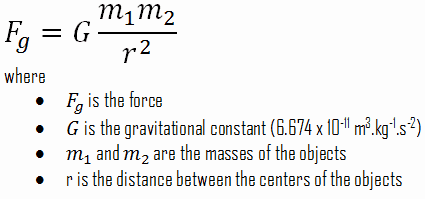
Gravity was the first force to be investigated scientifically. The gravitational force was described systematically by Isaac Newton in the 17th century. Newton stated that the gravitational force acts between all objects having mass (including objects ranging from atoms and photons, to planets and stars) and is directly proportional to the masses of the bodies and inversely proportional to the square of the distance between the bodies. Since energy and mass are equivalent, all forms of energy (including light) cause gravitation and are under the influence of it. The range of this force is ∞ and it is weaker than the other forces. This relationship is shown in the equation below.

Gravitational Force – Formula

The equation illustrates that the larger the masses of the objects or the smaller the distance between the objects, the greater the gravitational force. So even though the masses of nucleons are very small, the fact that the distance between nucleons is extremely short may make the gravitational force significant. The gravitational force between two protons that are separated by a distance of 10-20 meters is about 10-24 newtons. Gravity is the weakest of the four fundamental forces of physics, approximately 1038 times weaker than the strong force. On the other hand, gravity is additive. Every speck of matter that you put into a lump contributes to the overall overall gravity of the lump. Since it is also a very long range force, it is dominant force at the macroscopic scale, and is the cause of the formation, shape and trajectory (orbit) of astronomical bodies.

General theory of relativity is the fundamental theory of gravity. This theory describes gravity not as a force, but as a consequence of the curvature of spacetime caused by the uneven distribution of mass. In theories of quantum gravity, the graviton is the hypothetical elementary particle that mediates the force of gravity.

References:
Nuclear and Reactor Physics:
  1. J. R. Lamarsh, Introduction to Nuclear Reactor Theory, 2nd ed., Addison-Wesley, Reading, MA (1983).
  2. J. R. Lamarsh, A. J. Baratta, Introduction to Nuclear Engineering, 3d ed., Prentice-Hall, 2001, ISBN: 0-201-82498-1.
  3. W. M. Stacey, Nuclear Reactor Physics, John Wiley & Sons, 2001, ISBN: 0- 471-39127-1.
  4. Glasstone, Sesonske. Nuclear Reactor Engineering: Reactor Systems Engineering, Springer; 4th edition, 1994, ISBN: 978-0412985317
  5. W.S.C. Williams. Nuclear and Particle Physics. Clarendon Press; 1 edition, 1991, ISBN: 978-0198520467
  6. G.R.Keepin. Physics of Nuclear Kinetics. Addison-Wesley Pub. Co; 1st edition, 1965
  7. Robert Reed Burn, Introduction to Nuclear Reactor Operation, 1988.
  8. U.S. Department of Energy, Nuclear Physics and Reactor Theory. DOE Fundamentals Handbook, Volume 1 and 2. January 1993.
  9. Paul Reuss, Neutron Physics. EDP Sciences, 2008. ISBN: 978-2759800414.

Advanced Reactor Physics:

  1. K. O. Ott, W. A. Bezella, Introductory Nuclear Reactor Statics, American Nuclear Society, Revised edition (1989), 1989, ISBN: 0-894-48033-2.
  2. K. O. Ott, R. J. Neuhold, Introductory Nuclear Reactor Dynamics, American Nuclear Society, 1985, ISBN: 0-894-48029-4.
  3. D. L. Hetrick, Dynamics of Nuclear Reactors, American Nuclear Society, 1993, ISBN: 0-894-48453-2.
  4. E. E. Lewis, W. F. Miller, Computational Methods of Neutron Transport, American Nuclear Society, 1993, ISBN: 0-894-48452-4.

See also:

Gravitational Force

We hope, this article, Gravitational Force – Equation – Formula, helps you. If so, give us a like in the sidebar. Main purpose of this website is to help the public to learn some interesting and important information about materials and their properties.

What is Gravitational Interaction – Gravitational Force – Definition

Gravitational force is directly proportional to the masses of the bodies and inversely proportional to the square of the distance between the bodies. Gravitational Interaction

Gravitational Interaction – Gravitational Force

gravitational interaction and gravitational forceGravity was the first force to be investigated scientifically. The gravitational force was described systematically by Isaac Newton in the 17th century. Newton stated that the gravitational force acts between all objects having mass (including objects ranging from atoms and photons, to planets and stars) and is directly proportional to the masses of the bodies and inversely proportional to the square of the distance between the bodies. Since energy and mass are equivalent, all forms of energy (including light) cause gravitation and are under the influence of it. The range of this force is ∞ and it is weaker than the other forces. This relationship is shown in the equation below.

The equation illustrates that the larger the masses of the objects or the smaller the distance between the objects, the greater the gravitational force. So even though the masses of nucleons are very small, the fact that the distance between nucleons is extremely short may make the gravitational force significant. The gravitational force between two protons that are separated by a distance of 10-20 meters is about 10-24 newtons. Gravity is the weakest of the four fundamental forces of physics, approximately 1038 times weaker than the strong force. On the other hand, gravity is additive. Every speck of matter that you put into a lump contributes to the overall overall gravity of the lump. Since it is also a very long range force, it is dominant force at the macroscopic scale, and is the cause of the formation, shape and trajectory (orbit) of astronomical bodies.

General theory of relativity is the fundamental theory of gravity. This theory describes gravity not as a force, but as a consequence of the curvature of spacetime caused by the uneven distribution of mass. In theories of quantum gravity, the graviton is the hypothetical elementary particle that mediates the force of gravity.

Artificial Gravity

In the 20th century, Einstein’s principle of equivalence put all observers, moving or accelerating, on the same footing. Einstein summarised this notion in a postulate:

Principle of Equivalence:

An observer cannot determine, in any way whatsoever, whether the laboratory he occupies is in a uniform gravitational field or is in a reference frame that is accelerating relative to an inertial frame.

This led to an ambiguity as to what exactly is meant by the force of gravity and weight. A scale in an accelerating elevator cannot be distinguished from a scale in a gravitational field.  Gravitational force and weight thereby became essentially frame-dependent quantities. According to the general theory of relativity, gravitational and inertial mass are not different properties of matter but two aspects of a fundamental and single property of matter.

Artificial Gravity

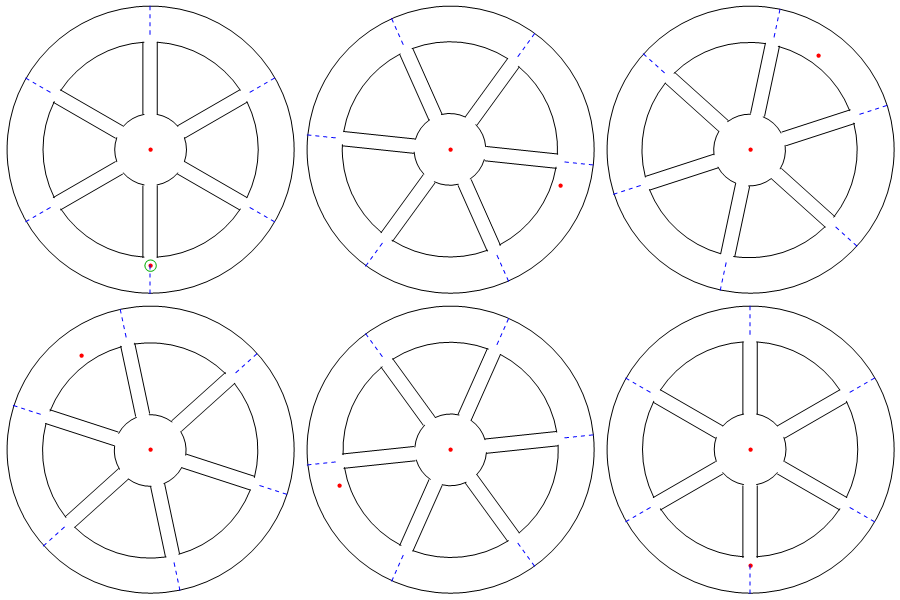
An animation of a 50-meter diameter rotating space-station. Source: wikipedia.org (P.Fraundorf) License: CC BY-SA 4.0

In situations in which gravitation is absent but the chosen coordinate system is not inertial, but is accelerated with the observer, then g-forces and corresponding proper accelerations felt by observers in these coordinate systems are caused by the mechanical forces which resist their weight in such systems. The most realistic method of producing artificial gravity, for example aboard a space station, can be imitated in a rotating spaceship. Objects inside would be pushed toward the hull and they will have some weight. This weight is produced by fictitious forces or “inertial forces” which appear in all such accelerated coordinate systems. Unlike real gravity, which pulls towards a center of the planet, the centripetal force pushes towards the axis of rotation.

References:
Nuclear and Reactor Physics:
  1. J. R. Lamarsh, Introduction to Nuclear Reactor Theory, 2nd ed., Addison-Wesley, Reading, MA (1983).
  2. J. R. Lamarsh, A. J. Baratta, Introduction to Nuclear Engineering, 3d ed., Prentice-Hall, 2001, ISBN: 0-201-82498-1.
  3. W. M. Stacey, Nuclear Reactor Physics, John Wiley & Sons, 2001, ISBN: 0- 471-39127-1.
  4. Glasstone, Sesonske. Nuclear Reactor Engineering: Reactor Systems Engineering, Springer; 4th edition, 1994, ISBN: 978-0412985317
  5. W.S.C. Williams. Nuclear and Particle Physics. Clarendon Press; 1 edition, 1991, ISBN: 978-0198520467
  6. G.R.Keepin. Physics of Nuclear Kinetics. Addison-Wesley Pub. Co; 1st edition, 1965
  7. Robert Reed Burn, Introduction to Nuclear Reactor Operation, 1988.
  8. U.S. Department of Energy, Nuclear Physics and Reactor Theory. DOE Fundamentals Handbook, Volume 1 and 2. January 1993.
  9. Paul Reuss, Neutron Physics. EDP Sciences, 2008. ISBN: 978-2759800414.

Advanced Reactor Physics:

  1. K. O. Ott, W. A. Bezella, Introductory Nuclear Reactor Statics, American Nuclear Society, Revised edition (1989), 1989, ISBN: 0-894-48033-2.
  2. K. O. Ott, R. J. Neuhold, Introductory Nuclear Reactor Dynamics, American Nuclear Society, 1985, ISBN: 0-894-48029-4.
  3. D. L. Hetrick, Dynamics of Nuclear Reactors, American Nuclear Society, 1993, ISBN: 0-894-48453-2.
  4. E. E. Lewis, W. F. Miller, Computational Methods of Neutron Transport, American Nuclear Society, 1993, ISBN: 0-894-48452-4.

See also:

Fundamental Interactions

We hope, this article, Gravitational Interaction – Gravitational Force, helps you. If so, give us a like in the sidebar. Main purpose of this website is to help the public to learn some interesting and important information about materials and their properties.
What is Fundamental Interaction – Fundamental Force – Definition

The fundamental interactions, also known as fundamental forces, are interactions among elementary particles that do not appear to be reducible to more basic interactions. Material Properties

Fundamental Interactions – Fundamental Forces

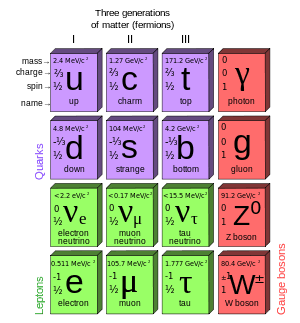
Three generations of matter.
The Standard Model

In physics, the fundamental interactions, also known as fundamental forces, are interactions among elementary particles that do not appear to be reducible to more basic interactions. These interactions govern how particles and also macroscopic objects interact and how certain particles decay. Generally, they can be classified into one of four fundamental forces:

  • Gravitational force. Gravity was the first force to be investigated scientifically. The gravitational force was described systematically by Isaac Newton in the 17th century. Newton stated that the gravitational force acts between all objects having mass (including objects ranging from atoms and photons, to planets and stars) and is directly proportional to the masses of the bodies and inversely proportional to the square of the distance between the bodies. Since energy and mass are equivalent, all forms of energy (including light) cause gravitation and are under the influence of it.  Gravity is the weakest of the four fundamental forces of physics, approximately 1038 times weaker than the strong force. On the other hand, gravity is additive. Every speck of matter that you put into a lump contributes to the overall overall gravity of the lump. Since it is also a very long range force, it is dominant force at the macroscopic scale, and is the cause of the formation, shape and trajectory (orbit) of astronomical bodies.
  • Electromagnetic force.  The electromagnetic force is the force responsible for all electromagnetic processes. It acts between electrically charged particles. It is infinite-ranged force, much stronger than gravitational force, obeys the inverse square law, but neither electricity nor magnetism adds up in the way that gravitational force does. Since there are positive and negative charges (poles), these charges tend to cancel each other out.
  • Weak force. The weak interaction or weak force is one of the four fundamental forces and involves the exchange of the intermediate vector bosons, the W and the Z. Since these bosons are very massive (on the order of 80 GeV, the uncertainty principle dictates a range of about 10-18 meters which is less than the diameter of a proton. As a result, the weak interaction takes place only at very small, sub-atomic distances.
  • Strong force. The strong interaction or strong force is one of the four fundamental forces and involves the exchange of the vector gauge bosons known as gluons. In general, the strong interaction is very complicated interaction, because it significantly varies with distance. The strong nuclear force holds most ordinary matter together because it confines quarks into hadron particles such as the proton and neutron. Moreover, the strong force is the force which can hold a nucleus together against the enormous forces of repulsion of the protons is strong indeed.

These fundamental interactions are characterized on the basis of the following four criteria:

  • the types of particles that experience the force
  • the range over which the force is effective
  • the relative strength of the force
  • the nature of the particles that mediate the force

Fundamental Interactions and Fundamental Forces

 
References:
Nuclear and Reactor Physics:
  1. J. R. Lamarsh, Introduction to Nuclear Reactor Theory, 2nd ed., Addison-Wesley, Reading, MA (1983).
  2. J. R. Lamarsh, A. J. Baratta, Introduction to Nuclear Engineering, 3d ed., Prentice-Hall, 2001, ISBN: 0-201-82498-1.
  3. W. M. Stacey, Nuclear Reactor Physics, John Wiley & Sons, 2001, ISBN: 0- 471-39127-1.
  4. Glasstone, Sesonske. Nuclear Reactor Engineering: Reactor Systems Engineering, Springer; 4th edition, 1994, ISBN: 978-0412985317
  5. W.S.C. Williams. Nuclear and Particle Physics. Clarendon Press; 1 edition, 1991, ISBN: 978-0198520467
  6. G.R.Keepin. Physics of Nuclear Kinetics. Addison-Wesley Pub. Co; 1st edition, 1965
  7. Robert Reed Burn, Introduction to Nuclear Reactor Operation, 1988.
  8. U.S. Department of Energy, Nuclear Physics and Reactor Theory. DOE Fundamentals Handbook, Volume 1 and 2. January 1993.
  9. Paul Reuss, Neutron Physics. EDP Sciences, 2008. ISBN: 978-2759800414.

Advanced Reactor Physics:

  1. K. O. Ott, W. A. Bezella, Introductory Nuclear Reactor Statics, American Nuclear Society, Revised edition (1989), 1989, ISBN: 0-894-48033-2.
  2. K. O. Ott, R. J. Neuhold, Introductory Nuclear Reactor Dynamics, American Nuclear Society, 1985, ISBN: 0-894-48029-4.
  3. D. L. Hetrick, Dynamics of Nuclear Reactors, American Nuclear Society, 1993, ISBN: 0-894-48453-2.
  4. E. E. Lewis, W. F. Miller, Computational Methods of Neutron Transport, American Nuclear Society, 1993, ISBN: 0-894-48452-4.

See also:

Nuclear Physics

We hope, this article, Fundamental Interaction – Fundamental Force, helps you. If so, give us a like in the sidebar. Main purpose of this website is to help the public to learn some interesting and important information about materials and their properties.
What is Electron Cloud – Definition

Electron cloud model is a model of an atom, in which the atom consist of a small but massive nucleus surrounded by a cloud of rapidly moving electrons. Material Properties

Electron Cloud

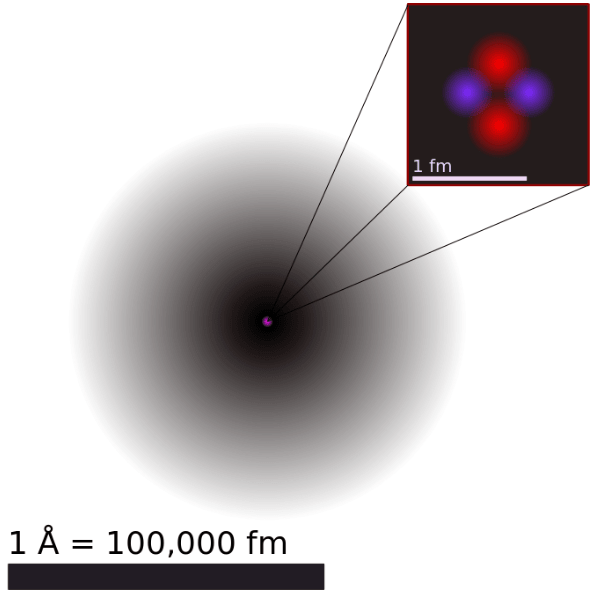
atomic-nucleus-volume-minElectron cloud model is a model of an atom, in which the atom consist of a small but massive nucleus surrounded by a cloud of rapidly moving electrons. The electron cloud model says that we cannot know exactly where an electron is at any given time, but the electrons are more likely to be in specific areas. Electron cloud model defines the zone of probability describing the electron’s location, because of the uncertainty principle.

The electrons in an atom are attracted to the protons in the nucleus by the electromagnetic force. This force binds the electrons inside an electrostatic potential well surrounding the smaller nucleus, which means that an external source of energy is needed for the electron to escape.

The number of electrons in an electrically-neutral atom is the same as the number of protons in the nucleus. The total electrical charge of the nucleus is therefore +Ze, where e (elementary charge) equals to 1,602 x 10-19coulombs. Each electron is influenced by the electric fields produced by the positive nuclear charge and the other (Z – 1) negative electrons in the atom.

Since the number of electrons and their arrangement are responsible for the chemical behavior of atoms, the atomic number identifies the various chemical elements. The configuration of these electrons follows from the principles of quantum mechanics. The number of electrons in each element’s electron shells, particularly the outermost valence shell, is the primary factor in determining its chemical bonding behavior. In the periodic table, the elements are listed in order of increasing atomic number Z.

See also: Is an atom an empty space?

 
References:
Nuclear and Reactor Physics:
  1. J. R. Lamarsh, Introduction to Nuclear Reactor Theory, 2nd ed., Addison-Wesley, Reading, MA (1983).
  2. J. R. Lamarsh, A. J. Baratta, Introduction to Nuclear Engineering, 3d ed., Prentice-Hall, 2001, ISBN: 0-201-82498-1.
  3. W. M. Stacey, Nuclear Reactor Physics, John Wiley & Sons, 2001, ISBN: 0- 471-39127-1.
  4. Glasstone, Sesonske. Nuclear Reactor Engineering: Reactor Systems Engineering, Springer; 4th edition, 1994, ISBN: 978-0412985317
  5. W.S.C. Williams. Nuclear and Particle Physics. Clarendon Press; 1 edition, 1991, ISBN: 978-0198520467
  6. G.R.Keepin. Physics of Nuclear Kinetics. Addison-Wesley Pub. Co; 1st edition, 1965
  7. Robert Reed Burn, Introduction to Nuclear Reactor Operation, 1988.
  8. U.S. Department of Energy, Nuclear Physics and Reactor Theory. DOE Fundamentals Handbook, Volume 1 and 2. January 1993.
  9. Paul Reuss, Neutron Physics. EDP Sciences, 2008. ISBN: 978-2759800414.

Advanced Reactor Physics:

  1. K. O. Ott, W. A. Bezella, Introductory Nuclear Reactor Statics, American Nuclear Society, Revised edition (1989), 1989, ISBN: 0-894-48033-2.
  2. K. O. Ott, R. J. Neuhold, Introductory Nuclear Reactor Dynamics, American Nuclear Society, 1985, ISBN: 0-894-48029-4.
  3. D. L. Hetrick, Dynamics of Nuclear Reactors, American Nuclear Society, 1993, ISBN: 0-894-48453-2.
  4. E. E. Lewis, W. F. Miller, Computational Methods of Neutron Transport, American Nuclear Society, 1993, ISBN: 0-894-48452-4.

See also:

Electron

We hope, this article, Electron Cloud, helps you. If so, give us a like in the sidebar. Main purpose of this website is to help the public to learn some interesting and important information about materials and their properties.