Radioactive Decay – Equation – Formula. This article summarizes equations and formulas used for calculations of radioactive decay including decay law and bateman equations. Material Properties
Decay Law – Equation – Formula
The radioactive decay law states that the probability per unit time that a nucleus will decay is a constant, independent of time. This constant is called the decay constant and is denoted by λ, “lambda”. This constant probability may vary greatly between different types of nuclei, leading to the many different observed decay rates. The radioactive decay of certain number of atoms (mass) is exponential in time.
Radioactive decay law: N = N.e-λt
The rate of nuclear decay is also measured in terms of half-lives. The half-life is the amount of time it takes for a given isotope to lose half of its radioactivity. If a radioisotope has a half-life of 14 days, half of its atoms will have decayed within 14 days. In 14 more days, half of that remaining half will decay, and so on. Half lives range from millionths of a second for highly radioactive fission products to billions of years for long-lived materials (such as naturally occurring uranium). Notice that short half lives go with large decay constants. Radioactive material with a short half life is much more radioactive (at the time of production) but will obviously lose its radioactivity rapidly. No matter how long or short the half life is, after seven half lives have passed, there is less than 1 percent of the initial activity remaining.
The radioactive decay law can be derived also for activity calculations or mass of radioactive material calculations:
(Number of nuclei) N = N.e-λt (Activity) A = A.e-λt (Mass) m = m.e-λt
, where N (number of particles) is the total number of particles in the sample, A (total activity) is the number of decays per unit time of a radioactive sample, m is the mass of remaining radioactive material.
Decay Constant and Half-Life – Equation – Formula
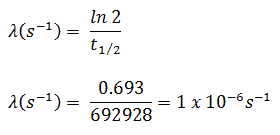
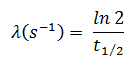
In calculations of radioactivity one of two parameters (decay constant or half-life), which characterize the rate of decay, must be known. There is a relation between the half-life (t1/2) and the decay constant λ. The relationship can be derived from decay law by setting N = ½ No. This gives:
where ln 2 (the natural log of 2) equals 0.693. If the decay constant (λ) is given, it is easy to calculate the half-life, and vice-versa.
Bateman Equations
In physics, the Bateman equations are a set of first-order differential equations, which describe the time evolution of nuclide concentrations undergoing serial or linear decay chain. The model was formulated by Ernest Rutherford in 1905 and the analytical solution for the case of radioactive decay in a linear chain was provided by Harry Bateman in 1910. This model can be also used in nuclear depletion codes to solve nuclear transmutation and decay problems.
For example, ORIGEN is a computer code system for calculating the buildup, decay, and processing of radioactive materials. ORIGEN uses a matrix exponential method to solve a large system of coupled, linear, first-order ordinary differential equations (similar to the Bateman equations) with constant coefficients.
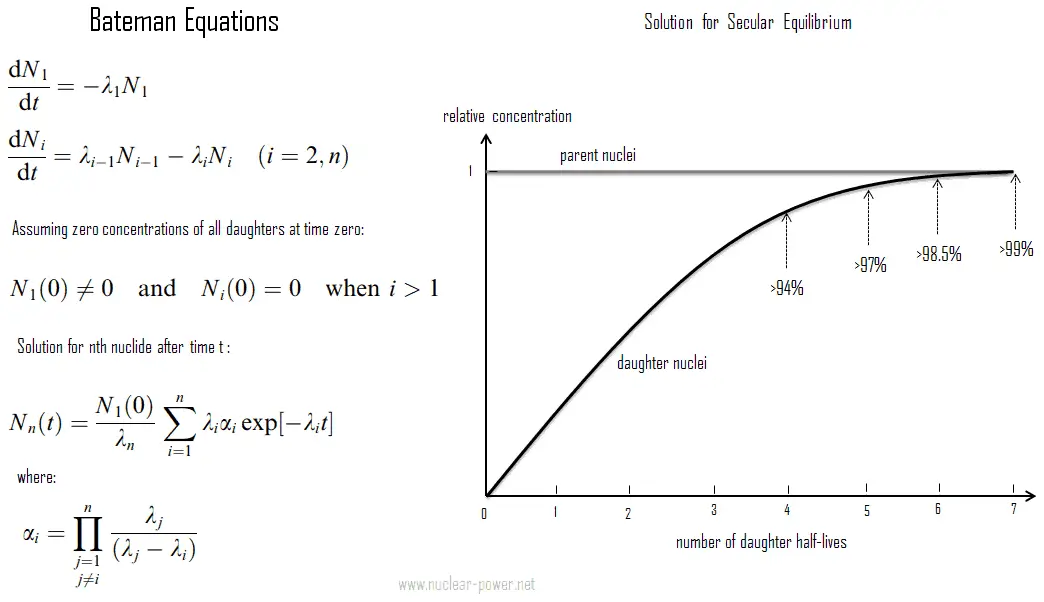
The Bateman equations for radioactive decay case of n – nuclide series in linear chain describing nuclide concentrations are as follows:
Example – Radioactive Decay Law
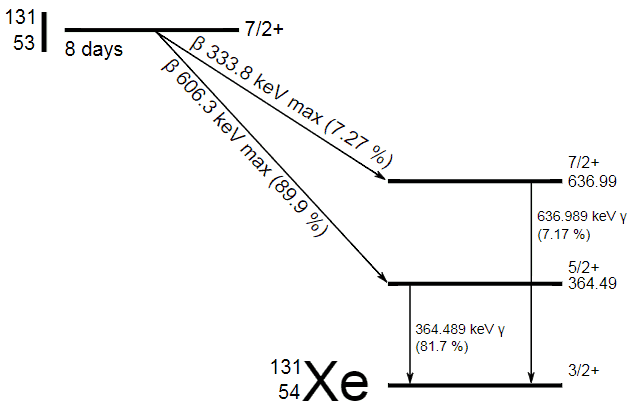
A sample of material contains 1 mikrogram of iodine-131. Note that, iodine-131 plays a major role as a radioactive isotope present in nuclear fission products, and it a major contributor to the health hazards when released into the atmosphere during an accident. Iodine-131 has a half-life of 8.02 days.
Calculate:
The number of iodine-131 atoms initially present.
The activity of the iodine-131 in curies.
The number of iodine-131 atoms that will remain in 50 days.
The time it will take for the activity to reach 0.1 mCi.
Solution:
The number of atoms of iodine-131 can be determined using isotopic mass as below.
NI-131 = mI-131 . NA / MI-131
NI-131 = (1 μg) x (6.02×10²³ nuclei/mol) / (130.91 g/mol)
NI-131 = 4.6 x 10¹⁵ nuclei
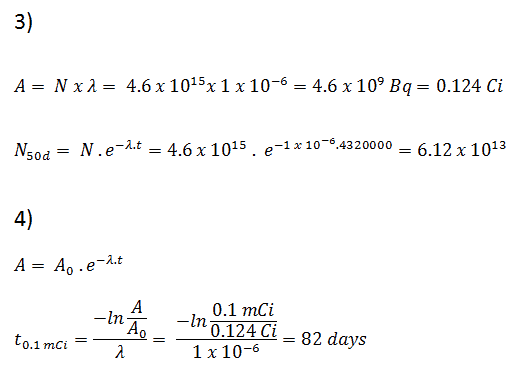
The activity of the iodine-131 in curies can be determined using its decay constant:
The iodine-131 has half-live of 8.02 days (692928 sec) and therefore its decay constant is:
Using this value for the decay constant we can determine the activity of the sample:
3) and 4) The number of iodine-131 atoms that will remain in 50 days (N50d) and the time it will take for the activity to reach 0.1 mCi can be calculated using the decay law:
As can be seen, after 50 days the number of iodine-131 atoms and thus the activity will be about 75 times lower. After 82 days the activity will be approximately 1200 times lower. Therefore, the time of ten half-lives (factor 210 = 1024) is widely used to define residual activity.
Robert Reed Burn, Introduction to Nuclear Reactor Operation, 1988.
U.S. Department of Energy, Nuclear Physics and Reactor Theory. DOE Fundamentals Handbook, Volume 1 and 2. January 1993.
Paul Reuss, Neutron Physics. EDP Sciences, 2008. ISBN: 978-2759800414.
See also:
Radioactive Equilibrium
We hope, this article, Radioactive Decay – Equation – Formula, helps you. If so, give us a like in the sidebar. Main purpose of this website is to help the public to learn some interesting and important information about materials and their properties.
In physics, the Bateman equations are a set of first-order differential equations, which describe the time evolution of nuclide concentrations undergoing serial or linear decay chain. Bateman equations can be also used in nuclear depletion codes to solve nuclear transmutation and decay problems. Material Properties
In physics, the Bateman equations are a set of first-order differential equations, which describe the time evolution of nuclide concentrations undergoing serial or linear decay chain. The model was formulated by Ernest Rutherford in 1905 and the analytical solution for the case of radioactive decay in a linear chain was provided by Harry Bateman in 1910. This model can be also used in nuclear depletion codes to solve nuclear transmutation and decay problems.
For example, ORIGEN is a computer code system for calculating the buildup, decay, and processing of radioactive materials. ORIGEN uses a matrix exponential method to solve a large system of coupled, linear, first-order ordinary differential equations (similar to the Bateman equations) with constant coefficients.
The Bateman equations for radioactive decay case of n – nuclide series in linear chain describing nuclide concentrations are as follows:
Bateman Equations for Nuclear Transmutation
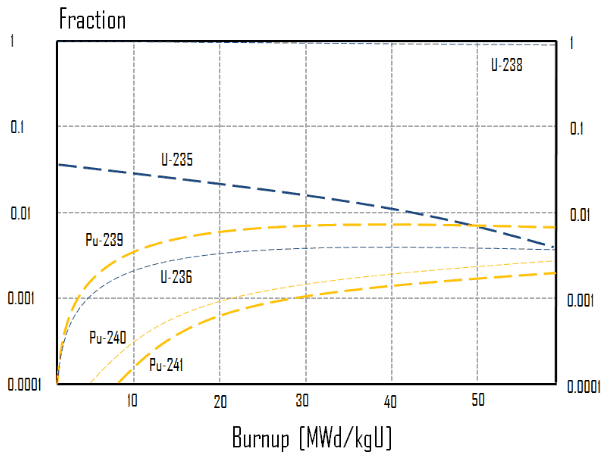
Isotopic changes of 4% uranium-235 fuel as a function of fuel burnup.
As was written, this model can be also used in nuclear depletion codes to solve nuclear transmutation and decay problems as well. In case of transmutation the decay constants that govern Bateman equations for a decay case are substituted by transmutation constants. By the transmutation constant λi,j we understand probability of the ith nuclide production per time unit from the jth nuclide destruction, as a result of nuclear interaction with the whole spectrum of interacting particles or due to the natural nuclear decay.
These equations are usually used for the exact evolution of isotopic changes in the nuclear fuel during fuel depletion. Fuel depletion is usually modelled mathematically as a set of differential equations known as evolution equations.
Special Reference: Jerzy Cetnar, General solution of Bateman equations for nuclear transmutations. Annals of Nuclear Energy 33 (2006). January 2006.
Robert Reed Burn, Introduction to Nuclear Reactor Operation, 1988.
U.S. Department of Energy, Nuclear Physics and Reactor Theory. DOE Fundamentals Handbook, Volume 1 and 2. January 1993.
Paul Reuss, Neutron Physics. EDP Sciences, 2008. ISBN: 978-2759800414.
See also:
Radioactive Equilibrium
We hope, this article, Bateman Equation – Radioactive Decay, helps you. If so, give us a like in the sidebar. Main purpose of this website is to help the public to learn some interesting and important information about materials and their properties.
The transient radioactive equilibrium exists when a half-life of the parent nucleus is longer than a half-life of the daughter nucleus, but the concentration of parent nuclei significantly decreases in time. Material Properties
In physics of nuclear decays, a radioactive equilibrium exists when a radioactive nuclide is decaying at the same rate at which it is being produced. The disintegrating nucleus is usually referred to as the parent nucleus and the nucleus remaining after the event as the daughter nucleus. The daughter nucleus can either be stable or radioactive. If it is radioactive, then it decays into a daughter nucleus and so on. Thus, each radioactive parent nucleus can initiate a series of decays, with each decay-product having its own characteristic decay constant.
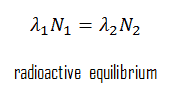
Concentration of daughter nuclei in the radioactive equilibrium depends primarily on proportions of half-lives (or decay constants) of parent and daughter nuclei. Since the production rate and decay rate are equal, the number of atoms present remains constant over time. In any case, a radioactive equilibrium is not established immediately, but it only takes place after a transition period. This period is of the order of few half-lifes of the longest-lived nucleus in the decay chain. In case of radioactive decay chains, a radioactive equilibrium may be established between each member of the decay chain.
As was written, proportionality of half-lives is a key parameter, which determines type of radioactive equilibrium:
Radioactive equilibrium is not established when a half-life of the parent nucleus is shorter than a half-life of the daughter nucleus. In this case the production rate and decay rate of certain member of decay chain cannot be equal.
Secular radioactive equilibrium exists when the parent nucleus has an extremely long half-life. This type of equilibrium is particularly important in nature. Over the 4.5 billion years of the Earth’s history, especially uranium 238, uranium 235 and thorium 232 and members of their decay chains have reached radioactive equilibria between the parent nucleus and the various descendants.
Transient radioactive equilibrium exists when a half-life of the parent nucleus is longer than a half-life of the daughter nucleus. In this case, the parent nuclide and the daughter nuclide decay at essentially the same rate.
Transient Radioactive Equilibrium
The transient radioactive equilibrium exists when a half-life of the parent nucleus is longer than a half-life of the daughter nucleus, but the concentration of parent nuclei significantly decreases in time. In this case, the parent nuclide and the daughter nuclide may decay at essentially the same rate, but both concentrations of nuclides decreases as the concentration of parent nuclei decreases. Contrary to secular equilibrium, the half-life of the daughter nuclei is not negligible compared to parent’s half-life.
An example of this type of compound decay process is a Technetium-99m generator producing technetium-99m for nuclear medicine diagnostic procedures from molybdenum-99. Technetium-99m’s short half-life of 6 hours makes storage impossible and would make transport very expensive. Therefere, for medical purposes, molybdenum-99 is used to produce technetium-99m. These two isotopes are in the transient equilibrium. The decay constant for molybdenum-99 is considerably smaller than the decay constant for technetium-99m. Although the decay constant for molybdenum-99 is smaller, the actual rate of decay is initially larger than that of molybdenum-99 because of the great difference in their initial concentrations. As the concentration of the daughter increases, the rate of decay of the daughter will approach and eventually match the decay rate of the parent. When this occurs, they are said to be in the transient equilibrium. In case of Technetium-99m generator, transient equilibrium occurs after about four half-lives. Today, technetium-99m is the most utilized element in nuclear medicine and is employed in a wide variety of nuclear medicine imaging studies.
Also the transient equilibrium can occasionally be disrupted when one of the intermediary nuclei leaves the sample where its ancestors are confined.
Transient Radioactive Equilibrium with Source – Example
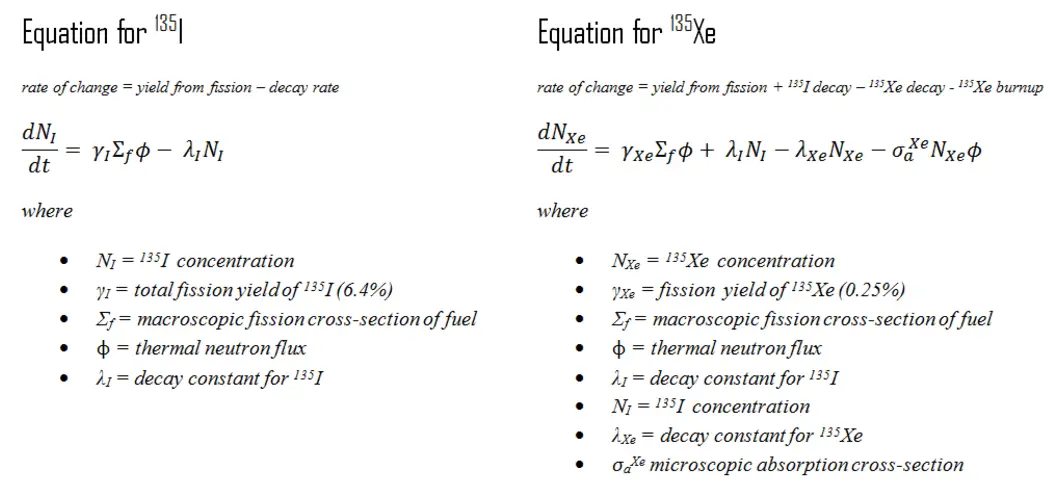
A special example of radioactive equilibrium are concentrations of iodine-135 and xenon-135 in a nuclear reactor, but in this case, the xenon burnup must be taken into account. Note that, in this special case, the half-life of the parent nucleus is shorter than the half-life of the daughter nucleus. The production and removal of xenon can be characterized by the following differential equations:
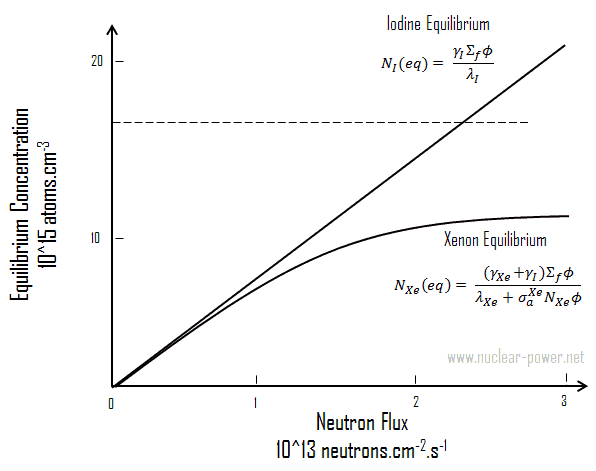
When the rate of production of iodine equals the rate of removal of iodine, equilibrium exists. This equilibrium also known as “xenon 135 reservoir”, since all of this iodine must undergo a decay to xenon. In equilibrium, the iodine concentration remains constant and is designated NI(eq). The following equation for the iodine equilibrium concentration can be determined from the preceding equation by setting the dNI/dt =0. Since the equilibrium iodine concentration is proportional to the fission reaction rate, it is also proportional to reactor power level.
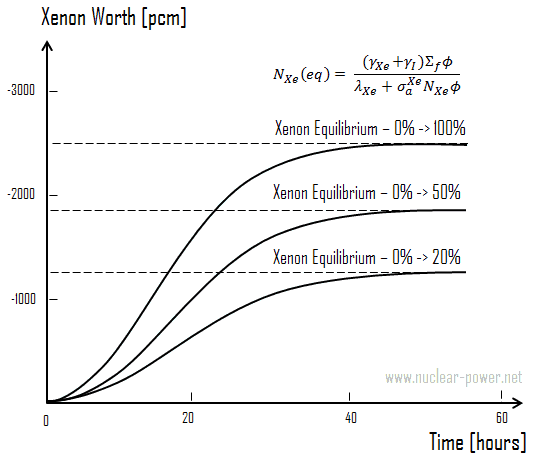
When the rate of production of xenon 135 equals the rate of removal, equilibrium exists also for xenon. The xenon concentration remains constant and is designated NXe(eq). The following equation (1) for the xenon equilibrium concentration can be determined from the preceding equation by setting the dNXe/dt =0. For xenon 135 to be in equilibrium, iodine 135 must also be in equilibrium. Substituting the expression for equilibrium iodine 135 concentration into the equation for equilibrium xenon (1) results in the following (2).
From this equation it can be seen that the equilibrium value for xenon 135 increases as power increases, because the numerator is proportional to the fission reaction rate. But the thermal flux is also in the denominator. Therefore, as the thermal flux exceeds some value, the xenon burnup begins to dominate, and at approximately 1015 neutrons.cm-2.s-1, the xenon-135 concentration approaches a limiting value. The equilibrium iodine 135 and xenon 135 concentrations as a function of neutron flux are illustrated in the following figure.
Robert Reed Burn, Introduction to Nuclear Reactor Operation, 1988.
U.S. Department of Energy, Nuclear Physics and Reactor Theory. DOE Fundamentals Handbook, Volume 1 and 2. January 1993.
Paul Reuss, Neutron Physics. EDP Sciences, 2008. ISBN: 978-2759800414.
See also:
Radioactive Equilibrium
We hope, this article, Transient Equilibrium – Radioactive Equilibrium, helps you. If so, give us a like in the sidebar. Main purpose of this website is to help the public to learn some interesting and important information about materials and their properties.
Secular radioactive equilibrium exists when the parent nucleus has an extremely long half-life. Secular equilibrium is typical for natural radioactive series, such as the thorium series or the uranium series. Material Properties
In physics of nuclear decays, a radioactive equilibrium exists when a radioactive nuclide is decaying at the same rate at which it is being produced. The disintegrating nucleus is usually referred to as the parent nucleus and the nucleus remaining after the event as the daughter nucleus. The daughter nucleus can either be stable or radioactive. If it is radioactive, then it decays into a daughter nucleus and so on. Thus, each radioactive parent nucleus can initiate a series of decays, with each decay-product having its own characteristic decay constant.
Concentration of daughter nuclei in the radioactive equilibrium depends primarily on proportions of half-lives (or decay constants) of parent and daughter nuclei. Since the production rate and decay rate are equal, the number of atoms present remains constant over time. In any case, a radioactive equilibrium is not established immediately, but it only takes place after a transition period. This period is of the order of few half-lifes of the longest-lived nucleus in the decay chain. In case of radioactive decay chains, a radioactive equilibrium may be established between each member of the decay chain.
As was written, proportionality of half-lives is a key parameter, which determines type of radioactive equilibrium:
Radioactive equilibrium is not established when a half-life of the parent nucleus is shorter than a half-life of the daughter nucleus. In this case the production rate and decay rate of certain member of decay chain cannot be equal.
Secular radioactive equilibrium exists when the parent nucleus has an extremely long half-life. This type of equilibrium is particularly important in nature. Over the 4.5 billion years of the Earth’s history, especially uranium 238, uranium 235 and thorium 232 and members of their decay chains have reached radioactive equilibria between the parent nucleus and the various descendants.
Transient radioactive equilibrium exists when a half-life of the parent nucleus is longer than a half-life of the daughter nucleus. In this case, the parent nuclide and the daughter nuclide decay at essentially the same rate.
Secular Equilibrium
Secular radioactive equilibrium exists when the parent nucleus has an extremely long half-life. Secular equilibrium is typical for natural radioactive series, such as the thorium series or the uranium series. For the uranium series with uranium-238 (with a half-life of 4.47 billion years), where all of the elements in the chain are in secular equilibrium, each of the descendants has built up to an equilibrium amount and all decay at the rate set by the original parent. The only exception is the final stable element (lead-206) on the end of the chain. Its number of atoms is constantly increasing. In any case, a radioactive equilibrium is not established immediately, but it only takes place after a transition period. This period is of the order of few half-lifes of the longest-lived nucleus in the decay chain (234U for the uranium series; 231Pa for the actinium series). In case of radioactive decay chains, a radioactive equilibrium may be established between each member of the decay chain.
As can be seen, the secular equilibrium is particularly important in nature. Over the 4.5 billion years of the Earth’s history, especially uranium 238, uranium 235 and thorium 232 and members of their decay chains have reached radioactive equilibria between the parent nucleus and the various descendants. The half-lives of all their descendants are all extremely variable, and it is difficult to represent a range of timescales going from individual seconds to millions of years. Since daughter radioisotopes have different half-lives then secular equilibrium is reached after some time. In the long decay chain for a naturally radioactive element, such as uranium-238, where all of the elements in the chain are in secular equilibrium, each of the descendants has built up to an equilibrium amount and all decay at the rate set by the original parent. If and when equilibrium is achieved, each successive daughter isotope is present in direct proportion to its half-life (or to its decay constant).
Since its activity is inversely proportional to its half-life, each nuclide in the decay chain finally contributes as many individual transformations as the head of the chain. Radioactive cascade in the secular equilibrium significantly influences radioactivity (disintegrations per second) of natural samples and natural materials. All the descendants are present, at least transiently, in any natural sample, whether metal, compound, or mineral. For example, pure uranium-238 is weakly radioactive (proportional to its long half-life), but a uranium ore is about 13 times more radioactive (approximately 13 descendants in the decay chain) than the pure uranium-238 metal because of its daughter isotopes (e.g. radon, radium etc.) it contains. Not only are unstable radium isotopes significant radioactivity emitters, but as the next stage in the decay chain they also generate radon, a heavy, inert, naturally occurring radioactive gas. Moreover the decay heat of uranium and its decay products (e.g. radon, radium etc.) contributes to heating of Earth’s core. Together with thorium and potassium-40 in the Earth’s mantle is thought that these elements are the main source of heat that keeps the Earth’s core liquid.
The secular equilibrium can occasionally be disrupted when one of the intermediary nuclei leaves the sample (e.g. radon released from soil) where its ancestors are confined. These local disruptions are important to consider in the use of dating techniques. Disruption of the secular equilibrium also influences radioactivity of fresh nuclear fuel. Most of PWRs use the uranium fuel, which is in the form of uranium dioxide. But this uranium dioxide must be chemically purified and most of its decay chain is not present in the fresh nuclear fuel.
Radioactive Equilibrium of Uranium-234
Isotope of uranium-234 is a member of the uranium series. This isotope has the half-life of only 2.46×10⁵ years and therefore it do not belong to primordial nuclides (unlike 235U and 238U). On the other hand, this isotope is still present in the Earth’s crust, but this is due to the fact 234U is an indirect decay product of 238U. 238U decays via alpha decay into 234U. 234U decays via alpha decay into 230Th, except very small fraction (on the order of ppm) of nuclei which decays by spontaneous fission.
In a natural sample of uranium, these nuclei are present in the unalterable proportions of the radioactive equilibrium of the 238U filiation at a ratio of one atom of 234U for about 18 500 nuclei of 238U. As a result of this equilibrium these two isotopes (238U and 234U) contribute equally to the radioactivity of natural uranium.
Robert Reed Burn, Introduction to Nuclear Reactor Operation, 1988.
U.S. Department of Energy, Nuclear Physics and Reactor Theory. DOE Fundamentals Handbook, Volume 1 and 2. January 1993.
Paul Reuss, Neutron Physics. EDP Sciences, 2008. ISBN: 978-2759800414.
See also:
Radioactive Equilibrium
We hope, this article, Secular Equilibrium – Radioactive Equilibrium, helps you. If so, give us a like in the sidebar. Main purpose of this website is to help the public to learn some interesting and important information about materials and their properties.
In physics of nuclear decays, a radioactive equilibrium exists when a radioactive nuclide is decaying at the same rate at which it is being produced. The radioactive equilibrium is not established immediately, but it only takes place after a transition period. Material Properties
In physics of nuclear decays, a radioactive equilibrium exists when a radioactive nuclide is decaying at the same rate at which it is being produced. The disintegrating nucleus is usually referred to as the parent nucleus and the nucleus remaining after the event as the daughter nucleus. The daughter nucleus can either be stable or radioactive. If it is radioactive, then it decays into a daughter nucleus and so on. Thus, each radioactive parent nucleus can initiate a series of decays, with each decay-product having its own characteristic decay constant.
Concentration of daughter nuclei in the radioactive equilibrium depends primarily on proportions of half-lives (or decay constants) of parent and daughter nuclei. Since the production rate and decay rate are equal, the number of atoms present remains constant over time. In any case, a radioactive equilibrium is not established immediately, but it only takes place after a transition period. This period is of the order of few half-lifes of the longest-lived nucleus in the decay chain. In case of radioactive decay chains, a radioactive equilibrium may be established between each member of the decay chain.
As was written, proportionality of half-lives is a key parameter, which determines type of radioactive equilibrium:
Radioactive equilibrium is not established when a half-life of the parent nucleus is shorter than a half-life of the daughter nucleus. In this case the production rate and decay rate of certain member of decay chain cannot be equal.
Secular radioactive equilibrium exists when the parent nucleus has an extremely long half-life. This type of equilibrium is particularly important in nature. Over the 4.5 billion years of the Earth’s history, especially uranium 238, uranium 235 and thorium 232 and members of their decay chains have reached radioactive equilibria between the parent nucleus and the various descendants.
Transient radioactive equilibrium exists when a half-life of the parent nucleus is longer than a half-life of the daughter nucleus. In this case, the parent nuclide and the daughter nuclide decay at essentially the same rate.
Secular Equilibrium
Secular radioactive equilibrium exists when the parent nucleus has an extremely long half-life. Secular equilibrium is typical for natural radioactive series, such as the thorium series or the uranium series. For the uranium series with uranium-238 (with a half-life of 4.47 billion years), where all of the elements in the chain are in secular equilibrium, each of the descendants has built up to an equilibrium amount and all decay at the rate set by the original parent. The only exception is the final stable element (lead-206) on the end of the chain. Its number of atoms is constantly increasing. In any case, a radioactive equilibrium is not established immediately, but it only takes place after a transition period. This period is of the order of few half-lifes of the longest-lived nucleus in the decay chain (234U for the uranium series; 231Pa for the actinium series). In case of radioactive decay chains, a radioactive equilibrium may be established between each member of the decay chain.
As can be seen, the secular equilibrium is particularly important in nature. Over the 4.5 billion years of the Earth’s history, especially uranium 238, uranium 235 and thorium 232 and members of their decay chains have reached radioactive equilibria between the parent nucleus and the various descendants. The half-lives of all their descendants are all extremely variable, and it is difficult to represent a range of timescales going from individual seconds to millions of years. Since daughter radioisotopes have different half-lives then secular equilibrium is reached after some time. In the long decay chain for a naturally radioactive element, such as uranium-238, where all of the elements in the chain are in secular equilibrium, each of the descendants has built up to an equilibrium amount and all decay at the rate set by the original parent. If and when equilibrium is achieved, each successive daughter isotope is present in direct proportion to its half-life (or to its decay constant).
Since its activity is inversely proportional to its half-life, each nuclide in the decay chain finally contributes as many individual transformations as the head of the chain. Radioactive cascade in the secular equilibrium significantly influences radioactivity (disintegrations per second) of natural samples and natural materials. All the descendants are present, at least transiently, in any natural sample, whether metal, compound, or mineral. For example, pure uranium-238 is weakly radioactive (proportional to its long half-life), but a uranium ore is about 13 times more radioactive (approximately 13 descendants in the decay chain) than the pure uranium-238 metal because of its daughter isotopes (e.g. radon, radium etc.) it contains. Not only are unstable radium isotopes significant radioactivity emitters, but as the next stage in the decay chain they also generate radon, a heavy, inert, naturally occurring radioactive gas. Moreover the decay heat of uranium and its decay products (e.g. radon, radium etc.) contributes to heating of Earth’s core. Together with thorium and potassium-40 in the Earth’s mantle is thought that these elements are the main source of heat that keeps the Earth’s core liquid.
The secular equilibrium can occasionally be disrupted when one of the intermediary nuclei leaves the sample (e.g. radon released from soil) where its ancestors are confined. These local disruptions are important to consider in the use of dating techniques. Disruption of the secular equilibrium also influences radioactivity of fresh nuclear fuel. Most of PWRs use the uranium fuel, which is in the form of uranium dioxide. But this uranium dioxide must be chemically purified and most of its decay chain is not present in the fresh nuclear fuel.
Radioactive Equilibrium of Uranium-234
Isotope of uranium-234 is a member of the uranium series. This isotope has the half-life of only 2.46×10⁵ years and therefore it do not belong to primordial nuclides (unlike 235U and 238U). On the other hand, this isotope is still present in the Earth’s crust, but this is due to the fact 234U is an indirect decay product of 238U. 238U decays via alpha decay into 234U. 234U decays via alpha decay into 230Th, except very small fraction (on the order of ppm) of nuclei which decays by spontaneous fission.
In a natural sample of uranium, these nuclei are present in the unalterable proportions of the radioactive equilibrium of the 238U filiation at a ratio of one atom of 234U for about 18 500 nuclei of 238U. As a result of this equilibrium these two isotopes (238U and 234U) contribute equally to the radioactivity of natural uranium.
Transient Radioactive Equilibrium
The transient radioactive equilibrium exists when a half-life of the parent nucleus is longer than a half-life of the daughter nucleus, but the concentration of parent nuclei significantly decreases in time. In this case, the parent nuclide and the daughter nuclide may decay at essentially the same rate, but both concentrations of nuclides decreases as the concentration of parent nuclei decreases. Contrary to secular equilibrium, the half-life of the daughter nuclei is not negligible compared to parent’s half-life.
An example of this type of compound decay process is a Technetium-99m generator producing technetium-99m for nuclear medicine diagnostic procedures from molybdenum-99. Technetium-99m’s short half-life of 6 hours makes storage impossible and would make transport very expensive. Therefere, for medical purposes, molybdenum-99 is used to produce technetium-99m. These two isotopes are in the transient equilibrium. The decay constant for molybdenum-99 is considerably smaller than the decay constant for technetium-99m. Although the decay constant for molybdenum-99 is smaller, the actual rate of decay is initially larger than that of molybdenum-99 because of the great difference in their initial concentrations. As the concentration of the daughter increases, the rate of decay of the daughter will approach and eventually match the decay rate of the parent. When this occurs, they are said to be in the transient equilibrium. In case of Technetium-99m generator, transient equilibrium occurs after about four half-lives. Today, technetium-99m is the most utilized element in nuclear medicine and is employed in a wide variety of nuclear medicine imaging studies.
Also the transient equilibrium can occasionally be disrupted when one of the intermediary nuclei leaves the sample where its ancestors are confined.
Transient Radioactive Equilibrium with Source – Example
A special example of radioactive equilibrium are concentrations of iodine-135 and xenon-135 in a nuclear reactor, but in this case, the xenon burnup must be taken into account. Note that, in this special case, the half-life of the parent nucleus is shorter than the half-life of the daughter nucleus. The production and removal of xenon can be characterized by the following differential equations:
When the rate of production of iodine equals the rate of removal of iodine, equilibrium exists. This equilibrium also known as “xenon 135 reservoir”, since all of this iodine must undergo a decay to xenon. In equilibrium, the iodine concentration remains constant and is designated NI(eq). The following equation for the iodine equilibrium concentration can be determined from the preceding equation by setting the dNI/dt =0. Since the equilibrium iodine concentration is proportional to the fission reaction rate, it is also proportional to reactor power level.
When the rate of production of xenon 135 equals the rate of removal, equilibrium exists also for xenon. The xenon concentration remains constant and is designated NXe(eq). The following equation (1) for the xenon equilibrium concentration can be determined from the preceding equation by setting the dNXe/dt =0. For xenon 135 to be in equilibrium, iodine 135 must also be in equilibrium. Substituting the expression for equilibrium iodine 135 concentration into the equation for equilibrium xenon (1) results in the following (2).
From this equation it can be seen that the equilibrium value for xenon 135 increases as power increases, because the numerator is proportional to the fission reaction rate. But the thermal flux is also in the denominator. Therefore, as the thermal flux exceeds some value, the xenon burnup begins to dominate, and at approximately 1015 neutrons.cm-2.s-1, the xenon-135 concentration approaches a limiting value. The equilibrium iodine 135 and xenon 135 concentrations as a function of neutron flux are illustrated in the following figure.
Bateman Equations
In physics, the Bateman equations are a set of first-order differential equations, which describe the time evolution of nuclide concentrations undergoing serial or linear decay chain. The model was formulated by Ernest Rutherford in 1905 and the analytical solution for the case of radioactive decay in a linear chain was provided by Harry Bateman in 1910. This model can be also used in nuclear depletion codes to solve nuclear transmutation and decay problems.
For example, ORIGEN is a computer code system for calculating the buildup, decay, and processing of radioactive materials. ORIGEN uses a matrix exponential method to solve a large system of coupled, linear, first-order ordinary differential equations (similar to the Bateman equations) with constant coefficients.
The Bateman equations for radioactive decay case of n – nuclide series in linear chain describing nuclide concentrations are as follows:
Bateman Equations for Nuclear Transmutation
Isotopic changes of 4% uranium-235 fuel as a function of fuel burnup.
As was written, this model can be also used in nuclear depletion codes to solve nuclear transmutation and decay problems as well. In case of transmutation the decay constants that govern Bateman equations for a decay case are substituted by transmutation constants. By the transmutation constant λi,j we understand probability of the ith nuclide production per time unit from the jth nuclide destruction, as a result of nuclear interaction with the whole spectrum of interacting particles or due to the natural nuclear decay.
These equations are usually used for the exact evolution of isotopic changes in the nuclear fuel during fuel depletion. Fuel depletion is usually modelled mathematically as a set of differential equations known as evolution equations.
Special Reference: Jerzy Cetnar, General solution of Bateman equations for nuclear transmutations. Annals of Nuclear Energy 33 (2006). January 2006.
Robert Reed Burn, Introduction to Nuclear Reactor Operation, 1988.
U.S. Department of Energy, Nuclear Physics and Reactor Theory. DOE Fundamentals Handbook, Volume 1 and 2. January 1993.
Paul Reuss, Neutron Physics. EDP Sciences, 2008. ISBN: 978-2759800414.
See also:
Radioactive Decay
We hope, this article, Radioactive Equilibrium, helps you. If so, give us a like in the sidebar. Main purpose of this website is to help the public to learn some interesting and important information about materials and their properties.
The neptunium series is a radioactive series beginning with neptunium-237. Its members are produced artificially by nuclear reactions due to the short half-life of neptunium-237. Material Properties
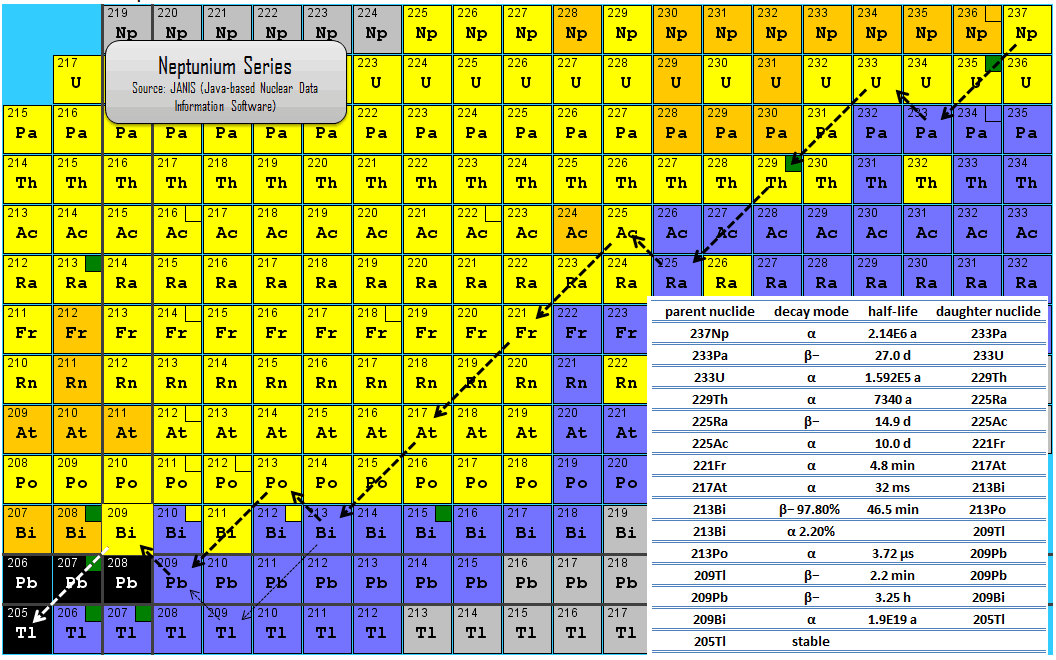
The neptunium series is a radioactive series beginning with neptunium-237. Its members are produced artificially by nuclear reactions and do not occur naturally, because the half-life of the longest lived isotope in the series is short compared to the age of the earth. This radioactive decay chain consists of unstable heavy atomic nuclei that decay through a sequence of alpha and beta decays until a stable nucleus is achieved. In case of neptunium series, the stable nucleus is bismuth-209 (with half-life of 1.9E19 years) and thallium-205.
Since alpha decay represents the disintegration of a parent nucleus to a daughter through the emission of the nucleus of a helium atom (which contains four nucleons), there are only four decay series. Within each series, therefore, the mass number of the members may be expressed as four times an appropriate integer (n) plus the constant for that series. As a result, the neptunium series is known as the 4n+1 series.
The total thermodynamics/what-is-energy-physics/”>energy released from neptunium-237 to thallium-205, including the energy lost to neutrinos, is 50.0 MeV.
In some kind of smoke detectors, you can meet radionuclides from this series. Ionization smoke detectors usually use a radioisotope, typically americium-241, to ionize air and to detect smoke. In this case americium-241 decays to neptunium-237 and is, in fact, a member of neptunium series.
Types of Decay in Neptunium Series
Within each radioactive series, there are two main modes of radioactive decay:
Alpha decay. Alpha decay represents the disintegration of a parent nucleus to a daughter through the emission of the nucleus of a helium atom. Alpha particles consist of two protons and two neutrons bound together into a particle identical to a helium nucleus. Because of its very large mass (more than 7000 times the mass of the beta particle) and its charge, it heavy ionizes material and has a very short range.
Beta decay. Beta decay or β decay represents the disintegration of a parent nucleus to a daughter through the emission of the beta particle. Beta particles are high-energy, high-speed electrons or positrons emitted by certain types of radioactive nuclei such as potassium-40. The beta particles have greater range of penetration than alpha particles, but still much less than gamma rays.The beta particles emitted are a form of ionizing radiation also known as beta rays. The production of beta particles is termed beta decay.
Robert Reed Burn, Introduction to Nuclear Reactor Operation, 1988.
U.S. Department of Energy, Nuclear Physics and Reactor Theory. DOE Fundamentals Handbook, Volume 1 and 2. January 1993.
Paul Reuss, Neutron Physics. EDP Sciences, 2008. ISBN: 978-2759800414.
See also:
Radioactive Series
We hope, this article, Neptunium Series, helps you. If so, give us a like in the sidebar. Main purpose of this website is to help the public to learn some interesting and important information about materials and their properties.
The actinium series, known also as actinium cascade, is one of three classical radioactive series beginning with naturally occurring uranium-235. Material Properties
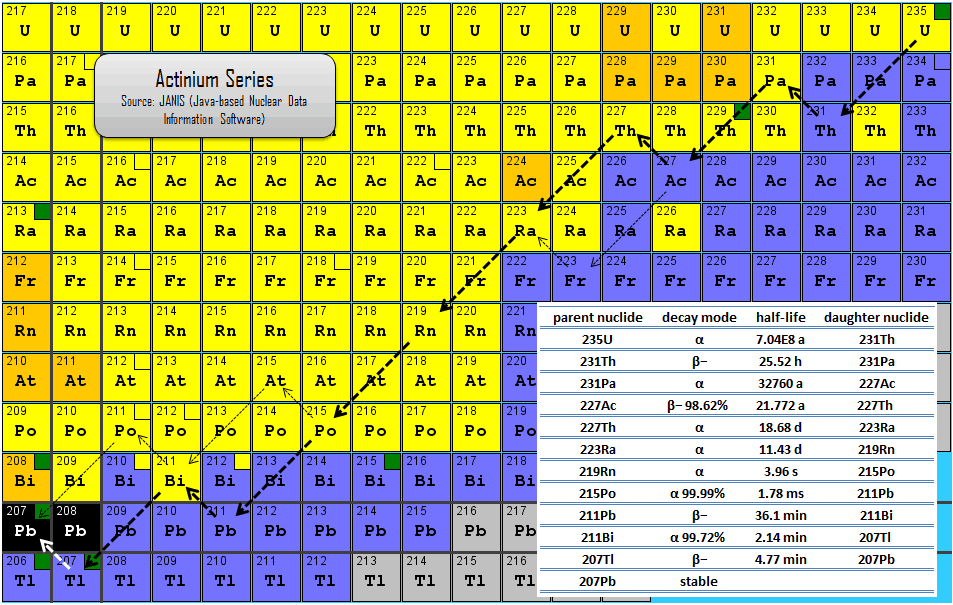
The actinium series, known also as the actinium cascade, is one of three classical radioactive series beginning with naturally occurring uranium-235. This radioactive decay chain consists of unstable heavy atomic nuclei that decay through a sequence of alpha and beta decays until a stable nucleus is achieved. In case of actinium series, the stable nucleus is lead-207.
Since alpha decay represents the disintegration of a parent nucleus to a daughter through the emission of the nucleus of a helium atom (which contains four nucleons), there are only four decay series. Within each series, therefore, the mass number of the members may be expressed as four times an appropriate integer (n) plus the constant for that series. As a result, the actinium series is known as the 4n+3 series.
The total energy released from uranium-235 to lead-207, including the energy lost to neutrinos, is 46.4 MeV.
Activity of Natural Samples – Actinium Series
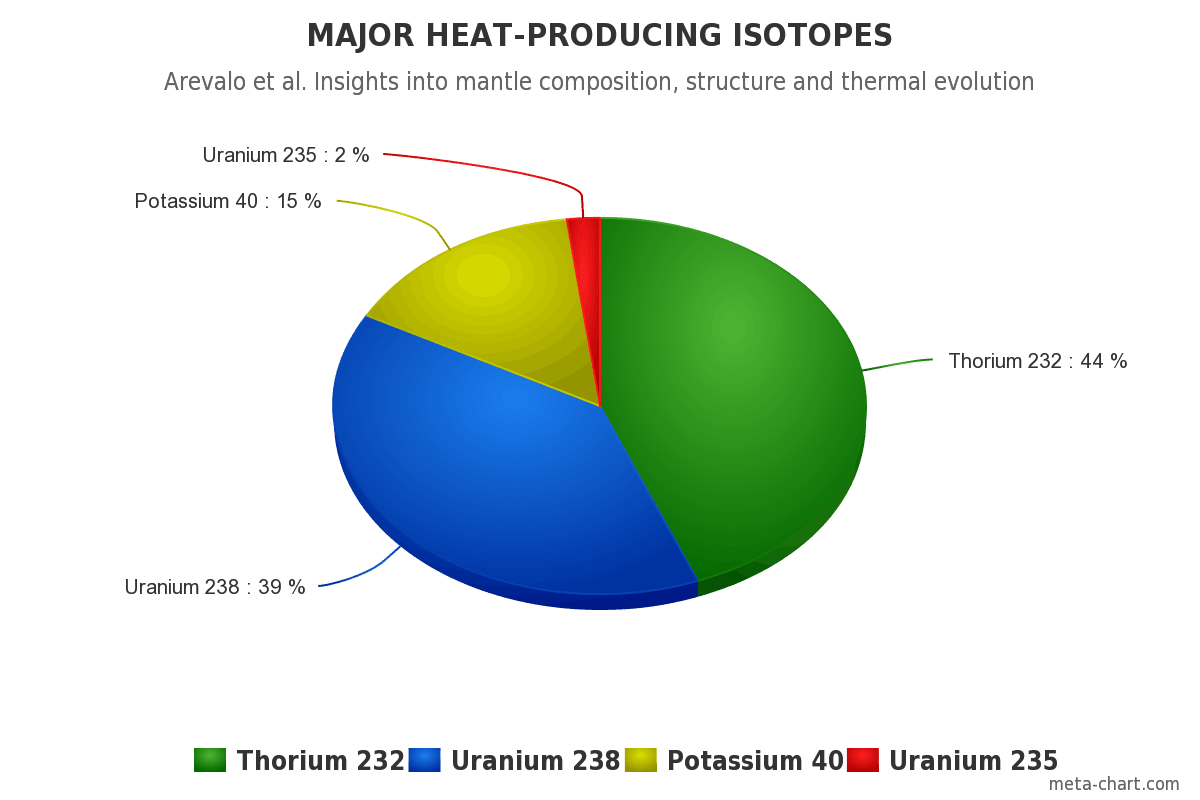
Actinium cascade influences radioactivity (disintegrations per second) of natural samples and natural materials, although, in this case activity of natural samples is determined primarily by uranium-238. Uranium-235, which alone constitutes 0.72% of natural uranium has half-life of 7.04×10⁸ years (6.5 times shorter than the isotope 238) and therefore its abundance is lower than 238U(99.28%). All the descendants of uranium-235 and uranium-238 are present, at least transiently, in any natural uranium-containing sample, whether metal, compound, or mineral. For example, pure uranium-238 is weakly radioactive (proportional to its long half-life), but a uranium ore is about 13 times more radioactive than the pure uranium-238 metal because of its daughter isotopes (e.g. radon, radium etc.) it contains. Not only are unstable radium isotopes significant radioactivity emitters, but as the next stage in the decay chain they also generate radon, a heavy, inert, naturally occurring radioactive gas. Moreover the decay heat of uranium and its decay products (e.g. radon, radium etc.) contributes to heating of Earth’s core. Together with thorium and potassium-40 in the Earth’s mantle is thought that these elements are the main source of heat that keeps the Earth’s core liquid.
Types of Decay in Actinium Series
Within each radioactive series, there are two main modes of radioactive decay:
Alpha decay. Alpha decay represents the disintegration of a parent nucleus to a daughter through the emission of the nucleus of a helium atom. Alpha particles consist of two protons and two neutrons bound together into a particle identical to a helium nucleus. Because of its very large mass (more than 7000 times the mass of the beta particle) and its charge, it heavy ionizes material and has a very short range.
Beta decay. Beta decay or β decay represents the disintegration of a parent nucleus to a daughter through the emission of the beta particle. Beta particles are high-energy, high-speed electrons or positrons emitted by certain types of radioactive nuclei such as potassium-40. The beta particles have greater range of penetration than alpha particles, but still much less than gamma rays.The beta particles emitted are a form of ionizing radiation also known as beta rays. The production of beta particles is termed beta decay.
Robert Reed Burn, Introduction to Nuclear Reactor Operation, 1988.
U.S. Department of Energy, Nuclear Physics and Reactor Theory. DOE Fundamentals Handbook, Volume 1 and 2. January 1993.
Paul Reuss, Neutron Physics. EDP Sciences, 2008. ISBN: 978-2759800414.
See also:
Radioactive Series
We hope, this article, Actinium Series, helps you. If so, give us a like in the sidebar. Main purpose of this website is to help the public to learn some interesting and important information about materials and their properties.
The uranium series, known also as radium series, is one of three classical radioactive series or cascades beginning with naturally occurring uranium-238. Material Properties
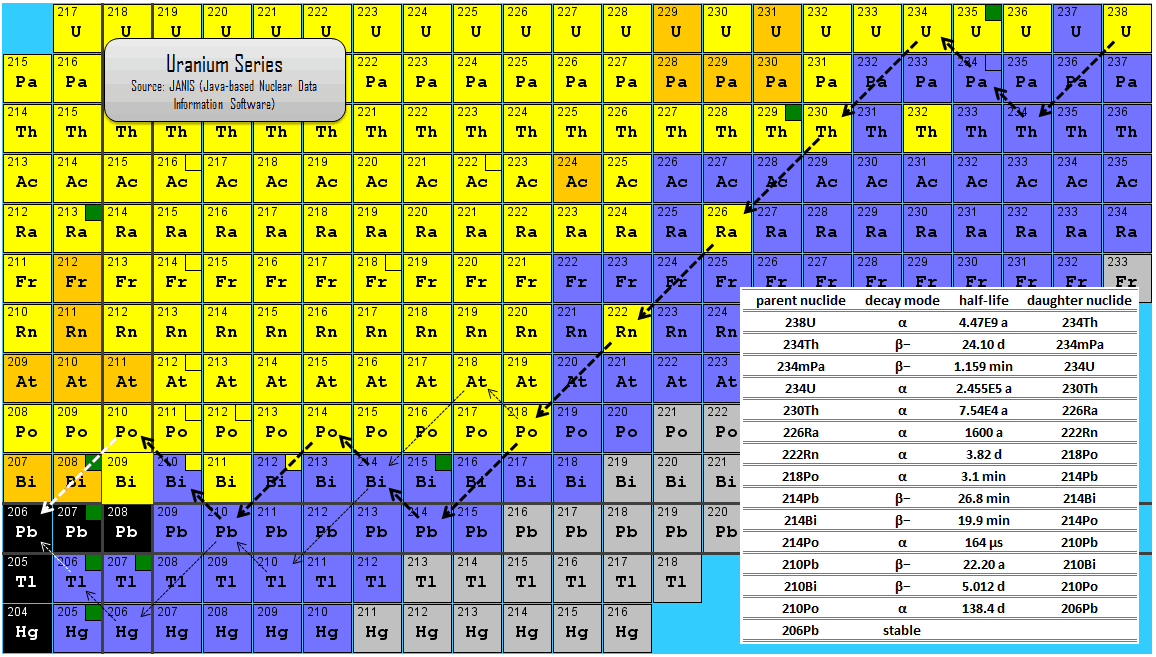
The uranium series, known also as radium series, is one of three classical radioactive series beginning with naturally occurring uranium-238. This radioactive decay chain consists of unstable heavy atomic nuclei that decay through a sequence of alpha and beta decays until a stable nucleus is achieved. In case of uranium series, the stable nucleus is lead-206.
Since alpha decay represents the disintegration of a parent nucleus to a daughter through the emission of the nucleus of a helium atom (which contains four nucleons), there are only four decay series. Within each series, therefore, the mass number of the members may be expressed as four times an appropriate integer (n) plus the constant for that series. As a result, the uranium series is known as the 4n+2 series.
The total thermodynamics/what-is-energy-physics/”>energy released from uranium-238 to lead-206, including the energy lost to neutrinos, is 51.7 MeV.
Uranium Series and Uranium-234
Isotope of uranium-234 is a member of this series. This isotope has the half-life of only 2.46×10⁵ years and therefore it do not belong to primordial nuclides (unlike 235U and 238U). On the other hand, this isotope is still present in the Earth’s crust, but this is due to the fact 234U is an indirect decay product of 238U. 238U decays via alpha decay into 234U. 234U decays via alpha decay into 230Th, except very small fraction (on the order of ppm) of nuclei which decays by spontaneous fission.
In a natural sample of uranium, these nuclei are present in the unalterable proportions of the radioactive equilibrium of the 238U filiation at a ratio of one atom of 234U for about 18 500 nuclei of 238U. As a result of this equilibrium these two isotopes (238U and 234U) contribute equally to the radioactivity of natural uranium.
Activity of Natural Samples – Uranium Series
Uranium cascade significantly influences radioactivity (disintegrations per second) of natural samples and natural materials. All the descendants are present, at least transiently, in any natural uranium-containing sample, whether metal, compound, or mineral. For example, pure uranium-238 is weakly radioactive (proportional to its long half-life), but a uranium ore is about 13 times more radioactive than the pure uranium-238 metal because of its daughter isotopes (e.g. radon, radium etc.) it contains. Not only are unstable radium isotopes significant radioactivity emitters, but as the next stage in the decay chain they also generate radon, a heavy, inert, naturally occurring radioactive gas. Moreover the decay heat of uranium and its decay products (e.g. radon, radium etc.) contributes to heating of Earth’s core. Together with thorium and potassium-40 in the Earth’s mantle is thought that these elements are the main source of heat that keeps the Earth’s core liquid.
Types of Decay in Uranium Series
Within each radioactive series, there are two main modes of radioactive decay:
Alpha decay. Alpha decay represents the disintegration of a parent nucleus to a daughter through the emission of the nucleus of a helium atom. Alpha particles consist of two protons and two neutrons bound together into a particle identical to a helium nucleus. Because of its very large mass (more than 7000 times the mass of the beta particle) and its charge, it heavy ionizes material and has a very short range.
Beta decay. Beta decay or β decay represents the disintegration of a parent nucleus to a daughter through the emission of the beta particle. Beta particles are high-energy, high-speed electrons or positrons emitted by certain types of radioactive nuclei such as potassium-40. The beta particles have greater range of penetration than alpha particles, but still much less than gamma rays.The beta particles emitted are a form of ionizing radiation also known as beta rays. The production of beta particles is termed beta decay.
Robert Reed Burn, Introduction to Nuclear Reactor Operation, 1988.
U.S. Department of Energy, Nuclear Physics and Reactor Theory. DOE Fundamentals Handbook, Volume 1 and 2. January 1993.
Paul Reuss, Neutron Physics. EDP Sciences, 2008. ISBN: 978-2759800414.
See also:
Radioactive Series
We hope, this article, Uranium Series, helps you. If so, give us a like in the sidebar. Main purpose of this website is to help the public to learn some interesting and important information about materials and their properties.
The thorium series (or thorium cascade) is one of three classical radioactive series beginning with naturally occurring thorium-232. Thorium series significantly influences radioactivity natural materials. Material Properties
The thorium series is one of three classical radioactive series beginning with naturally occurring thorium-232. This radioactive decay chain consists of unstable heavy atomic nuclei that decay through a sequence of alpha and beta decays until a stable nucleus is achieved. In case of thorium series, the stable nucleus is lead-208.
Since alpha decay represents the disintegration of a parent nucleus to a daughter through the emission of the nucleus of a helium atom (which contains four nucleons), there are only four decay series. Within each series, therefore, the mass number of the members may be expressed as four times an appropriate integer (n) plus the constant for that series. As a result, the thorium series is known as the 4n series.
The total thermodynamics/what-is-energy-physics/”>energy released from thorium-232 to lead-208, including the energy lost to neutrinos, is 42.6 MeV.
Activity of Natural Samples – Thorium Series
Thorium cascade significantly influences radioactivity (disintegrations per second) of natural samples and natural materials. All the descendants are present, at least transiently, in any natural thorium-containing sample, whether metal, compound, or mineral. For example, pure thorium-232 is weakly radioactive (proportional to its long half-life), but a thorium ore is about 10 times more radioactive than the pure thorium-232 metal because of its daughter isotopes (e.g. radon, radium etc.) it contains. Not only are unstable radium isotopes significant radioactivity emitters, but as the next stage in the decay chain they also generate radon, a heavy, inert, naturally occurring radioactive gas. Moreover the decay heat of thorium and its decay products (e.g. radon, radium etc.) contributes to heating of Earth’s core. Together with uranium and potassium-40 in the Earth’s mantle is thought that these elements are the main source of heat that keeps the Earth’s core liquid.
Types of Decay in Thorium Series
Within each radioactive series, there are two main modes of radioactive decay:
Alpha decay. Alpha decay represents the disintegration of a parent nucleus to a daughter through the emission of the nucleus of a helium atom. Alpha particles consist of two protons and two neutrons bound together into a particle identical to a helium nucleus. Because of its very large mass (more than 7000 times the mass of the beta particle) and its charge, it heavy ionizes material and has a very short range.
Beta decay. Beta decay or β decay represents the disintegration of a parent nucleus to a daughter through the emission of the beta particle. Beta particles are high-energy, high-speed electrons or positrons emitted by certain types of radioactive nuclei such as potassium-40. The beta particles have greater range of penetration than alpha particles, but still much less than gamma rays.The beta particles emitted are a form of ionizing radiation also known as beta rays. The production of beta particles is termed beta decay.
Robert Reed Burn, Introduction to Nuclear Reactor Operation, 1988.
U.S. Department of Energy, Nuclear Physics and Reactor Theory. DOE Fundamentals Handbook, Volume 1 and 2. January 1993.
Paul Reuss, Neutron Physics. EDP Sciences, 2008. ISBN: 978-2759800414.
See also:
Radioactive Series
We hope, this article, Thorium Series, helps you. If so, give us a like in the sidebar. Main purpose of this website is to help the public to learn some interesting and important information about materials and their properties.
Radioactive series (known also as a radioactive cascades) are three naturally occurring radioactive decay chains and one artificial radioactive decay chain of unstable heavy atomic nuclei. Material Properties
Radioactive series (known also as a radioactive cascades) are three naturally occurring radioactive decay chains and one artificial radioactive decay chain of unstable heavy atomic nuclei that decay through a sequence of alpha and beta decays until a stable nucleus is achieved. Most radioisotopes do not decay directly to a stable state and all isotopes within the series decay in the same way. In physics of nuclear decays, the disintegrating nucleus is usually referred to as the parent nucleus and the nucleus remaining after the event as the daughter nucleus. Since alpha decay represents the disintegration of a parent nucleus to a daughter through the emission of the nucleus of a helium atom (which contains four nucleons), there are only four decay series. Within each series, therefore, the mass number of the members may be expressed as four times an appropriate integer (n) plus the constant for that series. As a result, the thorium series is known as the 4n series, the neptunium series as the 4n + 1 series, the uranium series as the 4n + 2 series and the actinium series as the 4n + 3 series.
Three of the sets are called natural or classical series. The fourth set, the neptunium series, is headed by neptunium-237. Its members are produced artificially by nuclear reactions and do not occur naturally.
The classical series are headed by primordial unstable nuclei. Primordial nuclides are nuclides found on the Earth that have existed in their current form since before Earth was formed. The previous four series consist of the radioisotopes, that are the descendants of four heavy nuclei with long and very long half-lives:
the thorium series with thorium-232 (with a half-life of 14.0 billion years),
the uranium series with uranium-238 (which lives for 4.47 billion years),
the actinium series with uranium-235 (with a half-life of 0.7 billion years).
the neptunium series with neptunium-237 (with a half-life of 2 million years).
The half-lives of all the daughter nuclei are all extremely variable, and it is difficult to represent a range of timescales going from individual seconds to billions of years. Since daughter radioisotopes have different half-lives then secular equilibrium is reached after some time. In the long decay chain for a naturally radioactive element, such as uranium-238, where all of the elements in the chain are in secular equilibrium, each of the descendants has built up to an equilibrium amount and all decay at the rate set by the original parent. If and when equilibrium is achieved, each successive daughter isotope is present in direct proportion to its half-life. Since its activity is inversely proportional to its half-life, each nuclide in the decay chain finally contributes as many individual transformations as the head of the chain.
As can be seen from figures, branching occurs in all four of the radioactive series. That means the decay of a given species may occur in more than one way. For example, in the thorium series, bismuth-212 decays partially by negative beta emission to polonium-212 and partially by alpha emission to thallium-206.
Radioactive cascade significantly influences radioactivity (disintegrations per second) of natural samples and natural materials. All the descendants are present, at least transiently, in any natural sample, whether metal, compound, or mineral. For example, pure uranium-238 is weakly radioactive (proportional to its long half-life), but a uranium ore is about 13 times more radioactive than the pure uranium-238 metal because of its daughter isotopes (e.g. radon, radium etc.) it contains. Not only are unstable radium isotopes significant radioactivity emitters, but as the next stage in the decay chain they also generate radon, a heavy, inert, naturally occurring radioactive gas. Moreover the decay heat of uranium and its decay products (e.g. radon, radium etc.) contributes to heating of Earth’s core. Together with thorium and potassium-40 in the Earth’s mantle is thought that these elements are the main source of heat that keeps the Earth’s core liquid.
Within each radioactive series, there are two main modes of radioactive decay:
Alpha decay. Alpha decay represents the disintegration of a parent nucleus to a daughter through the emission of the nucleus of a helium atom. Alpha particles consist of two protons and two neutrons bound together into a particle identical to a helium nucleus. Because of its very large mass (more than 7000 times the mass of the beta particle) and its charge, it heavy ionizes material and has a very short range.
Beta decay. Beta decay or β decay represents the disintegration of a parent nucleus to a daughter through the emission of the beta particle. Beta particles are high-energy, high-speed electrons or positrons emitted by certain types of radioactive nuclei such as potassium-40. The beta particles have greater range of penetration than alpha particles, but still much less than gamma rays.The beta particles emitted are a form of ionizing radiation also known as beta rays. The production of beta particles is termed beta decay.
Thorium Series
The thorium series is one of three classical radioactive series beginning with naturally occurring thorium-232. This radioactive decay chain consists of unstable heavy atomic nuclei that decay through a sequence of alpha and beta decays until a stable nucleus is achieved. In case of thorium series, the stable nucleus is lead-208.
Since alpha decay represents the disintegration of a parent nucleus to a daughter through the emission of the nucleus of a helium atom (which contains four nucleons), there are only four decay series. Within each series, therefore, the mass number of the members may be expressed as four times an appropriate integer (n) plus the constant for that series. As a result, the thorium series is known as the 4n series.
The total thermodynamics/what-is-energy-physics/”>energy released from thorium-232 to lead-208, including the energy lost to neutrinos, is 42.6 MeV.
Neptunium Series
The neptunium series is a radioactive series beginning with neptunium-237. Its members are produced artificially by nuclear reactions and do not occur naturally, because the half-life of the longest lived isotope in the series is short compared to the age of the earth. This radioactive decay chain consists of unstable heavy atomic nuclei that decay through a sequence of alpha and beta decays until a stable nucleus is achieved. In case of neptunium series, the stable nucleus is bismuth-209 (with half-life of 1.9E19 years) and thallium-205.
Since alpha decay represents the disintegration of a parent nucleus to a daughter through the emission of the nucleus of a helium atom (which contains four nucleons), there are only four decay series. Within each series, therefore, the mass number of the members may be expressed as four times an appropriate integer (n) plus the constant for that series. As a result, the neptunium series is known as the 4n+1 series.
The total thermodynamics/what-is-energy-physics/”>energy released from neptunium-237 to thallium-205, including the energy lost to neutrinos, is 50.0 MeV.
In some kind of smoke detectors, you can meet radionuclides from this series. Ionization smoke detectors usually use a radioisotope, typically americium-241, to ionize air and to detect smoke. In this case americium-241 decays to neptunium-237 and is, in fact, a member of neptunium series.
Uranium Series
The uranium series, known also as radium series, is one of three classical radioactive series beginning with naturally occurring uranium-238. This radioactive decay chain consists of unstable heavy atomic nuclei that decay through a sequence of alpha and beta decays until a stable nucleus is achieved. In case of uranium series, the stable nucleus is lead-206.
Since alpha decay represents the disintegration of a parent nucleus to a daughter through the emission of the nucleus of a helium atom (which contains four nucleons), there are only four decay series. Within each series, therefore, the mass number of the members may be expressed as four times an appropriate integer (n) plus the constant for that series. As a result, the uranium series is known as the 4n+2 series.
The total thermodynamics/what-is-energy-physics/”>energy released from uranium-238 to lead-206, including the energy lost to neutrinos, is 51.7 MeV.
Uranium Series and Uranium-234
Isotope of uranium-234 is a member of this series. This isotope has the half-life of only 2.46×10⁵ years and therefore it do not belong to primordial nuclides (unlike 235U and 238U). On the other hand, this isotope is still present in the Earth’s crust, but this is due to the fact 234U is an indirect decay product of 238U. 238U decays via alpha decay into 234U. 234U decays via alpha decay into 230Th, except very small fraction (on the order of ppm) of nuclei which decays by spontaneous fission.
In a natural sample of uranium, these nuclei are present in the unalterable proportions of the radioactive equilibrium of the 238U filiation at a ratio of one atom of 234U for about 18 500 nuclei of 238U. As a result of this equilibrium these two isotopes (238U and 234U) contribute equally to the radioactivity of natural uranium.
Actinium Series
The actinium series is one of three classical radioactive series beginning with naturally occurring uranium-235. This radioactive decay chain consists of unstable heavy atomic nuclei that decay through a sequence of alpha and beta decays until a stable nucleus is achieved. In case of actinium series, the stable nucleus is lead-207.
Since alpha decay represents the disintegration of a parent nucleus to a daughter through the emission of the nucleus of a helium atom (which contains four nucleons), there are only four decay series. Within each series, therefore, the mass number of the members may be expressed as four times an appropriate integer (n) plus the constant for that series. As a result, the actinium series is known as the 4n+3 series.
The total energy released from uranium-235 to lead-207, including the energy lost to neutrinos, is 46.4 MeV.
Robert Reed Burn, Introduction to Nuclear Reactor Operation, 1988.
U.S. Department of Energy, Nuclear Physics and Reactor Theory. DOE Fundamentals Handbook, Volume 1 and 2. January 1993.
Paul Reuss, Neutron Physics. EDP Sciences, 2008. ISBN: 978-2759800414.
See also:
Radioactive Decay
We hope, this article, Radioactive Series – Radioactive Cascade, helps you. If so, give us a like in the sidebar. Main purpose of this website is to help the public to learn some interesting and important information about materials and their properties.

 where ln 2 (the natural log of 2) equals 0.693. If the decay constant (λ) is given, it is easy to calculate the half-life, and vice-versa.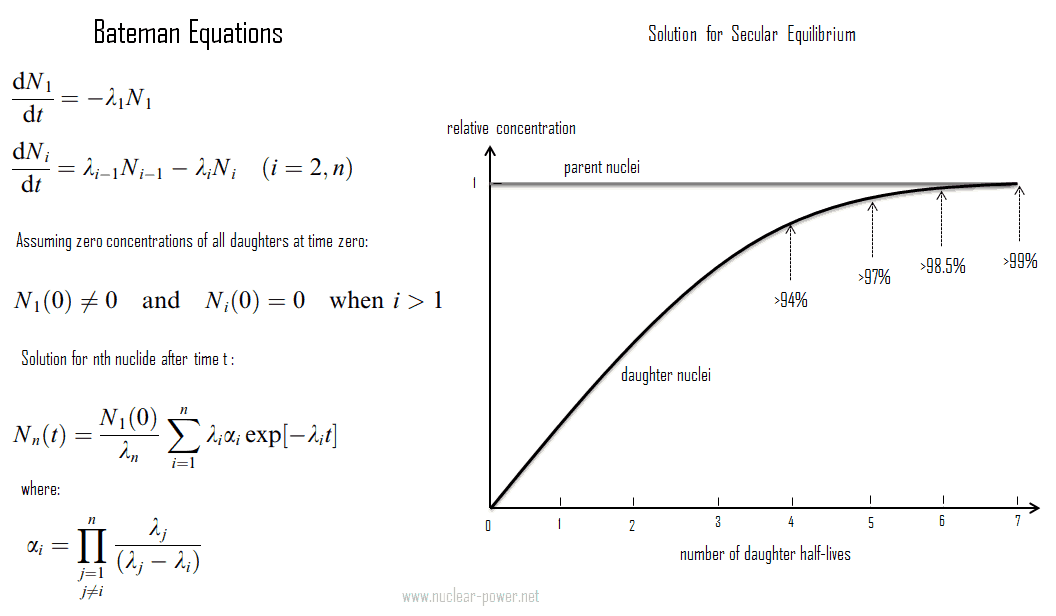
 A sample of material contains 1 mikrogram of iodine-131. Note that, iodine-131 plays a major role as a radioactive isotope present in nuclear fission products, and it a major contributor to the health hazards when released into the atmosphere during an accident. Iodine-131 has a half-life of 8.02 days.