Potassium-40 is an unstable (radioactive) naturally-occurring isotope of potassium. It has a very long half-life of 1.251×10^9 years. Potassium-40 – Characteristics
Potassium is a naturally-occurring chemical element with atomic number 19 which means there are 19 protons and 19 electrons in the atomic structure. The chemical symbol for potassium is K (from Neo-Latin kalium).
Natural potassium consists primarily of isotope K-39 (93.26%), therefore the atomic mass of potassium element is close to the atomic mass of K-39 isotope (39.098 u). Natural potassium also consists of two other isotopes: K-41 (6.73%) and K-40 (0.012%). Potassium-40 is an unstable (radioactive) naturally-occurring isotope of potassium. It has a very long half-life of 1.251×10⁹ years. Therefore, this isotope belong to primordial nuclides, because its half-life is comparable to the age of the Earth.
Traces of K-40 are found in all potassium, and it is the most common radioisotope in the human body. K-40 is a radioactive isotope of potassium which has a very long half-life of 1.251×10⁹ years and undergoes both types of beta decay. From this point of view, also a human body can be considered as a source of antimatter.
About 89.28% of the time (10.72% is by electron capture), it decays to calcium-40 with emission of a beta particle (β−, an electron) with a maximum energy of 1.33 MeV and an antineutrino, which is an antiparticle to the neutrino.
Very rarely (0.001% of the time) it will decay to Ar-40 by emitting a positron (β+) and a neutrino.
Potassium-40 inside Body – Radiation Dose
The potassium concentration in the human body is strictly based on the homeostatic principle. Potassium is more or less distributed in the body (especially in soft tissues) following intake in foods. A 70-kg man contains about 126 g of potassium (0.18%), most of that is located in muscles. The daily consumption of potassium is approximately 2.5 gram. Hence the concentration of potassium-40 is nearly stable in all persons at a level of about 55 Bq/kg (3850 Bq in total), which corresponds to the annual effective dose of 0.2 mSv.
Banana Equivalent Dose – BED
Banana equivalent dose, BED, is an informal dose quantity of ionizing radiation exposure. Banana equivalent dose is intended as a general educational example to compare a dose of radioactivity to the dose one is exposed to by eating one average-sized banana. One BED is often correlated to 10-7 Sievert (0.1 µSv).
Bananas contain significantly high potassium concentrations, which is vital for the functioning of all living cells. The transfer of potassium ions through nerve cell membranes is necessary for normal nerve transmission. But natural potassium also contains a radioactive isotope potassium-40 (0.012%). Potassium-40 is a radioactive isotope of potassium which has a very long half-life of 1.251×10⁹ years and undergoes both types of beta decay.
One BED is often correlated to 10-7 Sievert (0.1 µSv). The radiation exposure from consuming a banana is approximately 1% of the average daily exposure to radiation, which is 100 banana equivalent doses (BED). A chest CT scan delivers 58,000 BED (5.8 mSv). A lethal dose, the dose that kills a human with a 50% risk within 30 days (LD50/30) of radiation, is approximately 50,000,000 BED (5000 mSv). However, in practice, this dose is not cumulative, as the principal radioactive component is excreted to maintain metabolic equilibrium. Moreover, there is also a problem with the collective dose.
The BED is only meant to inform the public about the existence of very low levels of natural radioactivity within a natural food and is not a formally adopted dose measurement.
Internal Radiation – Is it dangerous?
We must emphasize, eating bananas, working as airline flight crew or living in locations with, increases your annual dose rate. But it does not mean, that it must be dangerous. In each case, intensity of radiation also matters. It is very similar as for heat from a fire (less energetic radiation). If you are too close, the intensity of heat radiation is high and you can get burned. If you are at the right distance, you can withstand there without any problems and moreover it is comfortable. If you are too far from heat source, the insufficiency of heat can also hurt you. This analogy, in a certain sense, can be applied to radiation also from radiation sources.
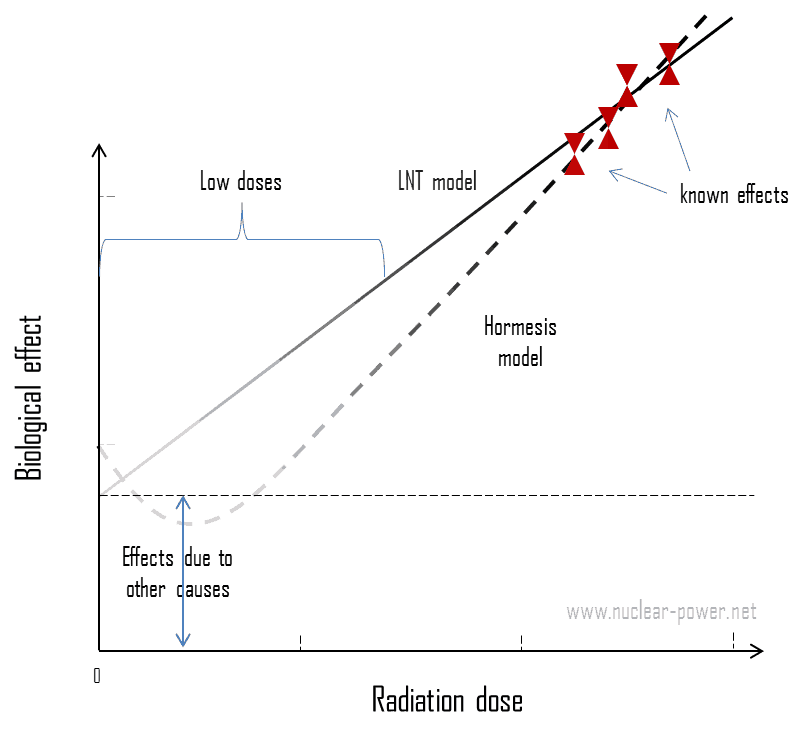
Alternative assumptions for the extrapolation of the cancer risk vs. radiation dose to low-dose levels, given a known risk at a high dose: LNT model, and hormesis model.
In case of internal radiation, we are talking usually about so called “low doses”. Low dose here means additional small doses comparable to the normal background radiation (10 µSv = average daily dose received from natural background). The doses are very very low and therefore the probability of cancer induction could be almost negligible. Secondly, and this is crucial, the truth about low-dose radiation health effects still needs to be found. It is not exactly known, whether these low doses of radiation are detrimental or beneficial (and where is the threshold). Government and regulatory bodies assume a LNT model instead of a threshold or hormesis not because it is the more scientifically convincing, but because it is the more conservative estimate. Problem of this model is that it neglects a number of defence biological processes that may be crucial at low doses. The research during the last two decades is very interesting and show that small doses of radiation given at a low dose rate stimulate the defense mechanisms. Therefore the LNT model is not universally accepted with some proposing an adaptive dose–response relationship where low doses are protective and high doses are detrimental. Many studies have contradicted the LNT model and many of these have shown adaptive response to low dose radiation resulting in reduced mutations and cancers. This phenomenon is known as radiation hormesis.
Robert Reed Burn, Introduction to Nuclear Reactor Operation, 1988.
U.S. Department of Energy, Nuclear Physics and Reactor Theory. DOE Fundamentals Handbook, Volume 1 and 2. January 1993.
Paul Reuss, Neutron Physics. EDP Sciences, 2008. ISBN: 978-2759800414.
See also:
Internal Sources
We hope, this article, Potassium-40 – Characteristics – Half-life, helps you. If so, give us a like in the sidebar. Main purpose of this website is to help the public to learn some interesting and important information about materials and their properties.
Internal Source of Radiation. Potassium-40 and carbon-40 are largest components of internal radiation exposure from biologically functional components of the human body. Material Properties
In addition to the cosmic and terrestrial sources, all people also have some radioactive isotopes inside their bodies from birth. These isotopes are especially potassium-40, carbon-14 and also the isotopes of uranium and thorium. The variation in radiation dose from one person to another is not as great as the variation in dose from cosmic and terrestrial sources. The average annual radiation dose to a person from internal radioactive materials other than radon is about 0.3 mSv/year of which:
0.2 mSv/year comes from potassium-40,
0.12 mSv/year comes from the uranium and thorium series,
12 μSv/year comes from carbon-40.
The most important isotope with regard to dose is potassium-40. The dominant component of inhalation exposure is the short-lived decay products of radon. But this issue is so important, that it was treated separately in the previous section (Radon – Health Effects).
Excluding internal contamination by external radioactive material (radon, uranium et.c), potassium-40 and carbon-40 are largest components of internal radiation exposure from biologically functional components of the human body.
Potassium-40
Potassium is a naturally-occurring chemical element with atomic number 19 which means there are 19 protons and 19 electrons in the atomic structure. The chemical symbol for potassium is K (from Neo-Latin kalium).
Natural potassium consists primarily of isotope K-39 (93.26%), therefore the atomic mass of potassium element is close to the atomic mass of K-39 isotope (39.098 u). Natural potassium also consists of two other isotopes: K-41 (6.73%) and K-40 (0.012%). Potassium-40 is an unstable (radioactive) naturally-occurring isotope of potassium. It has a very long half-life of 1.251×10⁹ years. Therefore, this isotope belong to primordial nuclides, because its half-life is comparable to the age of the Earth.
Traces of K-40 are found in all potassium, and it is the most common radioisotope in the human body. K-40 is a radioactive isotope of potassium which has a very long half-life of 1.251×10⁹ years and undergoes both types of beta decay. From this point of view, also a human body can be considered as a source of antimatter.
About 89.28% of the time (10.72% is by electron capture), it decays to calcium-40 with emission of a beta particle (β−, an electron) with a maximum energy of 1.33 MeV and an antineutrino, which is an antiparticle to the neutrino.
Very rarely (0.001% of the time) it will decay to Ar-40 by emitting a positron (β+) and a neutrino.
Potassium-40 inside Body – Radiation Dose
The potassium concentration in the human body is strictly based on the homeostatic principle. Potassium is more or less distributed in the body (especially in soft tissues) following intake in foods. A 70-kg man contains about 126 g of potassium (0.18%), most of that is located in muscles. The daily consumption of potassium is approximately 2.5 gram. Hence the concentration of potassium-40 is nearly stable in all persons at a level of about 55 Bq/kg (3850 Bq in total), which corresponds to the annual effective dose of 0.2 mSv.
Banana Equivalent Dose – BED
Banana equivalent dose, BED, is an informal dose quantity of ionizing radiation exposure. Banana equivalent dose is intended as a general educational example to compare a dose of radioactivity to the dose one is exposed to by eating one average-sized banana. One BED is often correlated to 10-7 Sievert (0.1 µSv).
Bananas contain significantly high potassium concentrations, which is vital for the functioning of all living cells. The transfer of potassium ions through nerve cell membranes is necessary for normal nerve transmission. But natural potassium also contains a radioactive isotope potassium-40 (0.012%). Potassium-40 is a radioactive isotope of potassium which has a very long half-life of 1.251×10⁹ years and undergoes both types of beta decay.
One BED is often correlated to 10-7 Sievert (0.1 µSv). The radiation exposure from consuming a banana is approximately 1% of the average daily exposure to radiation, which is 100 banana equivalent doses (BED). A chest CT scan delivers 58,000 BED (5.8 mSv). A lethal dose, the dose that kills a human with a 50% risk within 30 days (LD50/30) of radiation, is approximately 50,000,000 BED (5000 mSv). However, in practice, this dose is not cumulative, as the principal radioactive component is excreted to maintain metabolic equilibrium. Moreover, there is also a problem with the collective dose.
The BED is only meant to inform the public about the existence of very low levels of natural radioactivity within a natural food and is not a formally adopted dose measurement.
Internal Dose from Uranium and Thorium
As was written, all people also have some radioactive isotopes inside their bodies from birth. These isotopes are especially potassium-40, carbon-14 and isotopes from the uranium and thorium series. The variation in radiation dose from one person to another is not as great as the variation in dose from cosmic and terrestrial sources. The average annual radiation dose to a person from internal radioactive materials other than radon is about 0.3 mSv/year of which:
0.2 mSv/year comes from potassium-40,
0.12 mSv/year comes from the uranium and thorium series,
12 μSv/year comes from carbon-14.
UNSCEAR have, based on a large number of investigations, presented values about the annual intake by humans of the different isotopes. We can mention the following:
Ra-226 (22 Bq/year),
Pb-210 (30 Bq/year),
Po-210 (58 Bq/year) and
Ra-228 (15 Bq/year).
Note that, the dominant component of natural background exposure, which comes from the short-lived decay products of radon, is not involved here. This issue is so important, that it was treated separately in the previous section (Terrestrial Radiation).
As a result, the UNSCEAR 2000 report estimates an annual effective dose of 0.12 mSv, which comes from internal exposure by isotopes of the uranium and thorium series. The main contributor to this dose is Po-210. Note that, polonium-210, the decay product of lead-210, emits a 5.3 MeV alpha particle, which provides most of equivalent dose. The radiation weighting factor for alpha radiation is equal to 20. An absorbed dose of 1 mGy by alpha particles will lead to an equivalent dose of 20 mSv.
Internal Doses from carbon-14 and tritium are described in the following article: Cosmogenic Radionuclides
Internal Radiation – Is it dangerous?
We must emphasize, eating bananas, working as airline flight crew or living in locations with, increases your annual dose rate. But it does not mean, that it must be dangerous. In each case, intensity of radiation also matters. It is very similar as for heat from a fire (less energetic radiation). If you are too close, the intensity of heat radiation is high and you can get burned. If you are at the right distance, you can withstand there without any problems and moreover it is comfortable. If you are too far from heat source, the insufficiency of heat can also hurt you. This analogy, in a certain sense, can be applied to radiation also from radiation sources.
Alternative assumptions for the extrapolation of the cancer risk vs. radiation dose to low-dose levels, given a known risk at a high dose: LNT model, and hormesis model.
In case of internal radiation, we are talking usually about so called “low doses”. Low dose here means additional small doses comparable to the normal background radiation (10 µSv = average daily dose received from natural background). The doses are very very low and therefore the probability of cancer induction could be almost negligible. Secondly, and this is crucial, the truth about low-dose radiation health effects still needs to be found. It is not exactly known, whether these low doses of radiation are detrimental or beneficial (and where is the threshold). Government and regulatory bodies assume a LNT model instead of a threshold or hormesis not because it is the more scientifically convincing, but because it is the more conservative estimate. Problem of this model is that it neglects a number of defence biological processes that may be crucial at low doses. The research during the last two decades is very interesting and show that small doses of radiation given at a low dose rate stimulate the defense mechanisms. Therefore the LNT model is not universally accepted with some proposing an adaptive dose–response relationship where low doses are protective and high doses are detrimental. Many studies have contradicted the LNT model and many of these have shown adaptive response to low dose radiation resulting in reduced mutations and cancers. This phenomenon is known as radiation hormesis.
Robert Reed Burn, Introduction to Nuclear Reactor Operation, 1988.
U.S. Department of Energy, Nuclear Physics and Reactor Theory. DOE Fundamentals Handbook, Volume 1 and 2. January 1993.
Paul Reuss, Neutron Physics. EDP Sciences, 2008. ISBN: 978-2759800414.
See also:
Sources
We hope, this article, Internal Source of Radiation, helps you. If so, give us a like in the sidebar. Main purpose of this website is to help the public to learn some interesting and important information about materials and their properties.
Radon is a naturally occuring noble gas, that posses a very important health risks for the population. The average annual radiation dose to a person from radon is about 2 mSv/year and it may vary over many orders of magnitude from place to place. Radon – Health Effects – Health Risks
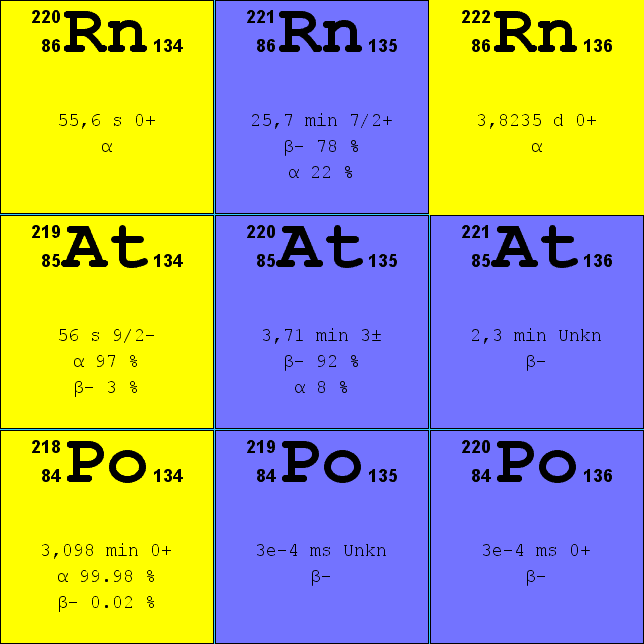
Radon is a colorless, odorless, tasteless noble gas, occurring naturally as the decay product of radium. All isotopes of radon are radioactive, but the two radon isotopes radon-222 and radon-220 are very important from radiation protection point of view.
Source: JANIS (Java-based Nuclear Data Information Software); ENDF/B-VII.1
Radon-222. The radon-222 isotope is a natural decay product of the most stable uranium isotope (uranium-238), thus it is a member of uranium series.
Radon-220. The radon-220 isotope, commonly referred to as thoron, is a natural decay product of the most stable thorium isotope (thorium-232), thus it is a member of thorium series.
It is important to note that radon is a noble gas, whereas all its decay products are metals. The main mechanism for the entry of radon into the atmosphere is diffusion through the soil. As a gas, radon diffuses through rocks and the soil. When radon disintegrates, the daughter metallic isotopes are ions that will be attached to other molecules like water and to aerosol particles in the air. Therefore all discussions of radon concentrations in the environment refer to radon-222. While the average rate of production of radon-220 (thoron) is about the same as that of radon-222, the amount of radon-220 in the environment is much less than that of radon-222 because of significantly shorter half-life (it has less time to diffuse) of radon-222 (55 seconds, versus 3.8 days respectively). Simply radon-220 has lower chance to escape from bedrock.
Radon-222
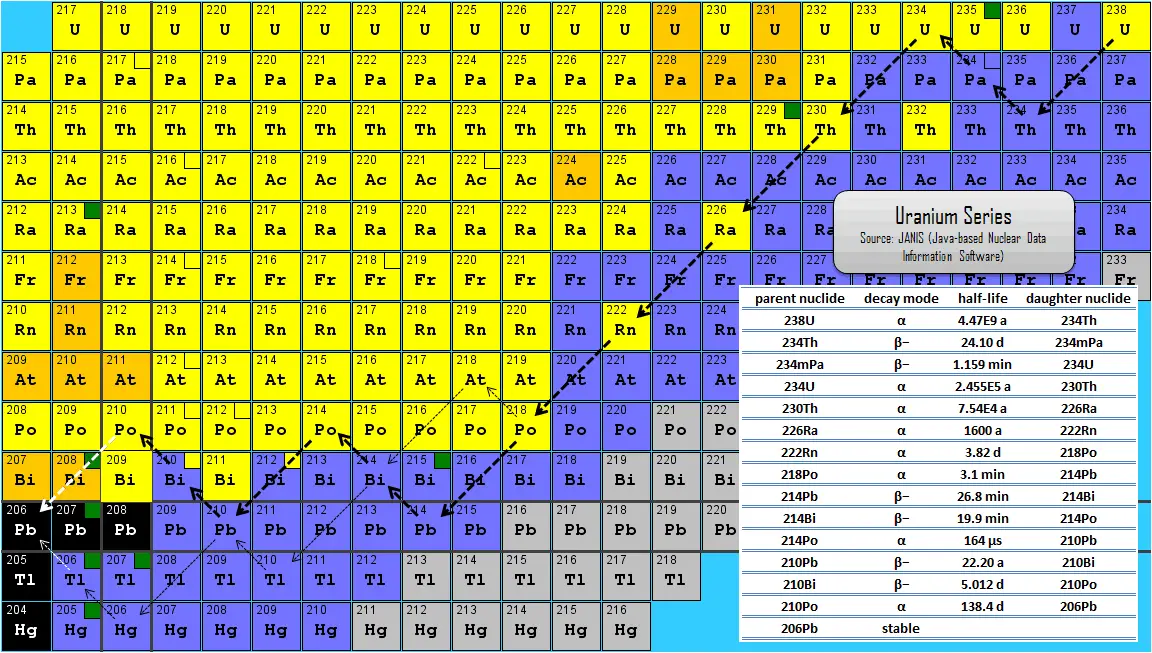
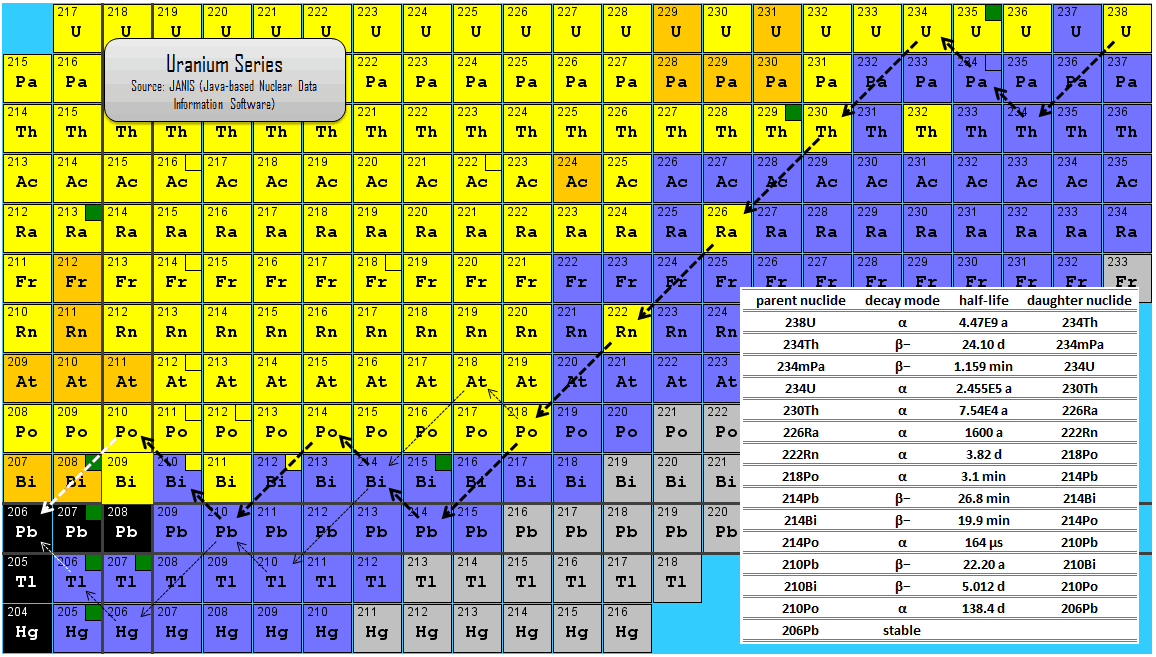
Uranium Series – Source of radon-222.
Radon-222 is a gas produced by the decay of radium-226. Both are a part of the natural uranium series. Since uranium is found in soil throughout the world in varying concentrations, also dose from gaseous radon is varying throughout the world. Radon-222 is the most important and most stable isotope of radon. It has a half-life of only 3.8 days, making radon one of the rarest elements since it decays away so quickly. An important source of natural radiation is radon gas, which seeps continuously from bedrock but can, because of its high density, accumulate in poorly ventilated houses. The fact radon is gas plays a crucial role in spreading of all its daughter nuclei. Simply radon is a transport medium from bedrock to atmosphere (or inside buildings) for its short-lived decay products (Pb-210 and Po-210), that posses much more health risks.
Health Effects of Radon
Radon is usually the largest natural source of radiation contributing to the exposure of members of the public, sometimes accounting for half the total exposure from all sources. The health risk due to exposure to radon and thoron comes principally from the inhalation of the short-lived decay products (Pb-210 and Po-210) and the resulting alpha particle irradiation of the bronchi and the lungs.
As long as these isotopes are outside the body, only the gamma radiation will be able to give a dose. But radon is a gas and diffuses out of the ground to mix with air. The half-life of radon-222 is long compared with the residence time of air in the lungs, so that relatively little radon decay during respiration. Moreover, radon is a noble gas and its inertness prevents its long-term retention within body. But when radon disintegrates, the daughter metallic isotopes (Pb-210 and Po-210) are not inert and they be attached to other molecules like water and to aerosol particles in air. When these particles are inhaled, some of lead-210 is retained by the body. Ingestion of lead-210 is also a possible way. Since lead-210 is a weak beta emitter, it does not cause major doses. Lead-210 is thus a transport medium from indoor air to the body. The radiation from radon and its decay products is a mixture of alpha particles and beta particles as well as gamma radiation. When the isotopes come inside the body, all types of radiation contribute.
But it is the polonium-210, the decay product of lead-210, that emits a 5.3 MeV alpha particle, which provides most of equivalent dose. Alpha particles, that belongs to high-LET radiation, are fairly massive and carry a double positive charge, so they tend to travel only a short distance and do not penetrate very far into tissue if at all. However alpha particles will deposit their energy over a smaller volume (possibly only a few cells if they enter a body) and cause more damage to those few cells (more than 80 % of the absorbed energy from radon is due to the alpha particles). Therefore, the radiation weighting factor for alpha radiation is equal to 20. An absorbed dose of 1 mGy by alpha particles will lead to an equivalent dose of 20 mSv. In summary, radon and lead can be viewed as different sorts of carriers for polonium-210.
The amount of isotopes ingested with the food is negligible, and all concern is about the breathing and the deposition of radon daughters in the bronchi and in the lungs. Among non-smokers, radon is the largest cause of lung cancer and, overall, the second-leading cause. The average annual radiation dose to a person from radon is about 2 mSv/year and it may vary over many orders of magnitude from place to place. According to a 2003 report EPA’s Assessment of Risks from Radon in Homes, epidemiological evidence shows a clear link between lung cancer and high concentrations of radon.
It must be emphasized, cigarettes contain also polonium-210, originating from the decay products of radon, which stick to tobacco leaves. Polonium-210 emits a 5.3 MeV alpha particle, which provides most of equivalent dose. Heavy smoking results in a dose of 160 mSv/year to localized spots at the bifurcations of segmental bronchi in the lungs from the decay of polonium-210. This dose is not readily comparable to the radiation protection limits, since the latter deal with whole body doses, while the dose from smoking is delivered to a very small portion of the body.
Radon inside Houses
It must be emphasized, the concentrations of radon-222 and radon-220 in the soil and in the building materials vary over many orders of magnitude from place to place and show significant time variation at any given site. Locations with higher radon background are well mapped in each country. In the open air, it ranges from 1 to 100 Bq/m3, even less (0.1 Bq/m3) above the ocean. In caves or aerated mines, or ill-aerated houses, its concentration climbs to 20–2,000 Bq/m3. In the outdoor atmosphere, there is also some advection caused by wind and changes in barometric pressure.
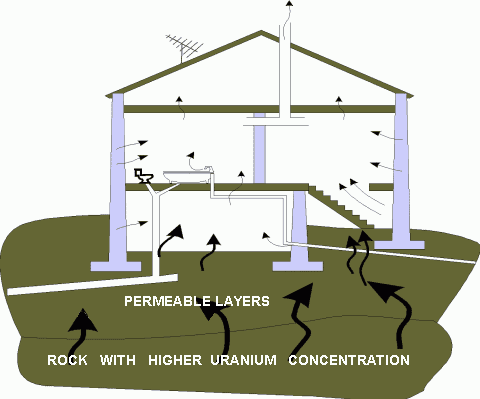
The radon gas can penetrate into the house through cracks (due to a chimney effect) in the floor and walls of the basement. Source: suro.cz
Problems with radon are in houses, where it can accumulate especially, due to its high density, in low areas such as basements and crawl spaces. Radon can also occur in ground water – for example, in some spring waters and hot springs. Several possibilities exist for the release of radon into houses. The fact radon is a noble gas plays a crucial role in spreading of all its daughter nuclei. Simply radon is a transport medium from bedrock to atmosphere (or inside buildings) for its short-lived decay products (Pb-210 and Po-210), that posses much more health risks. The main sources are the rock or soil on which the house is built, as well as the water supply. The main mechanism for the entry of radon into buildings is diffusion through the soil. As a gas, radon diffuses through rocks and the soil. The radon gas can penetrate into the house through cracks (due to a chimney effect) in the floor and walls of the basement. Heating of the air creates a suction of air from the lower part of the house, towards the higher part of the house. Without any radon membrane, this actually means that air from the ground beneath the house is sucked into the house through numerous floor cracks and openings.
Furthermore, the building materials (e.g., some granites) is also a source for radon. Another source for radon is the water supply. Water from wells, in particular in regions with radium rich granite, may contain high radon concentrations. This is material with higher uranium/radium concentrations from which radon is continuously generated. Such materials, e.g., slag, fly ash, etc., could be used in some locations. For building materials that are used for the construction of houses, the critical limits for the specific radium concentrations must be determined.
The greatest risk of radon exposure arises in buildings that are airtight, insufficiently ventilated, and have foundation leaks that allow air from the soil into basements and dwelling rooms. The inside radon level vary considerable with weather, time of the year and even time of the day – and of course with the airing system. For example, sleeping with an open window can reduce the radon content considerable.
Most countries have adopted a radon concentration of 200–400 Bq/m3 for indoor air as an Action or Reference Level. If testing shows levels less than 4 picocuries radon per liter of air (150 Bq/m3), then no action is necessary. Very high radon concentrations (>1000 Bq/m3) have been found in houses built on soils with a high uranium content and/or high permeability of the ground.
Mitigation of Radon
Mitigation of radon in the air is accomplished through ventilation, either collected below a concrete floor slab or a membrane on the ground, or by increasing the air changes per hour in the building. A radon resisting membranes are usually produced from low density polyethylene (LDPE) and are extended across the whole of the building, including the floor and walls. Another way for mitigation of radon is a treatment system using aeration or activated charcoal to remove radon from domestic water supplies.
Properties of Radon
Radon is a chemical element with atomic number86 which means there are 86 protons and 86 electrons in the atomic structure. The chemical symbol for Radon is Rn.
Radon is a radioactive, colorless, odorless, tasteless noble gas. Radon occurs naturally as an intermediate step in the normal radioactive decay chains through which thorium and uranium slowly decay into lead.
Radon – Properties
Element
Radon
Atomic Number
86
Symbol
Rn
Element Category
Noble Gas
Phase at STP
Gas
Atomic Mass [amu]
222
Density at STP [g/cm3]
9.73
Electron Configuration
[Hg] 6p6
Possible Oxidation States
0
Electron Affinity [kJ/mol]
—
Electronegativity [Pauling scale]
—
1st Ionization Energy [eV]
10.7485
Year of Discovery
1900
Discoverer
Dorn, Friedrich Ernst
Thermal properties
Melting Point [Celsius scale]
-71
Boiling Point [Celsius scale]
-61.8
Thermal Conductivity [W/m K]
0.00361
Specific Heat [J/g K]
0.09
Heat of Fusion [kJ/mol]
2.89
Heat of Vaporization [kJ/mol]
16.4
Atomic Mass of Radon
Atomic mass of Radon is 222 u.
Note that, each element may contain more isotopes, therefore this resulting atomic mass is calculated from naturally-occuring isotopes and their abundance.
The unit of measure for mass is the atomic mass unit (amu). One atomic mass unit is equal to 1.66 x 10⁻²⁴ grams. One unified atomic mass unit is approximately the mass of one nucleon (either a single proton or neutron) and is numerically equivalent to 1 g/mol.
Density of Radon
Density of Radon is 9.73g/cm3.
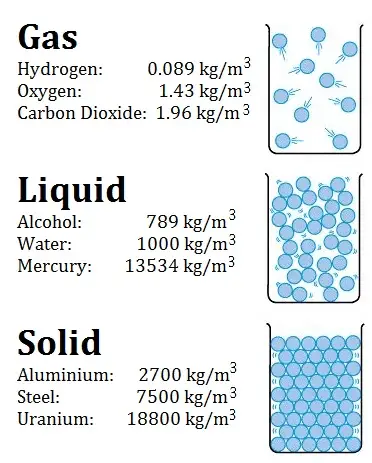
Typical densities of various substances at atmospheric pressure.
Density is defined as the mass per unit volume. It is an thermodynamics/extensive-and-intensive-properties/”>intensive property, which is mathematically defined as mass divided by volume:
ρ = m/V
In words, the density (ρ) of a substance is the total mass (m) of that substance divided by the total volume (V) occupied by that substance. The standard SI unit is kilograms per cubic meter (kg/m3). The Standard English unit is pounds mass per cubic foot (lbm/ft3).
See also: thermodynamics/thermodynamic-properties/what-is-density-physics/”>What is Density
See also: thermodynamics/thermodynamic-properties/what-is-density-physics/densest-materials-on-the-earth/”>Densest Materials of the Earth
Radon – Melting Point and Boiling Point
Melting point of Radon is -71°C.
Boiling point of Radon is -61.8°C.
Note that, these points are associated with the thermodynamics/thermodynamic-properties/what-is-pressure-physics/atmospheric-pressure/”>standard atmospheric pressure.
Radon – Specific Heat, Latent Heat of Fusion, Latent Heat of Vaporization
Specific heat of Radon is 0.09 J/g K.
Latent Heat of Fusion of Radon is 2.89 kJ/mol.
Latent Heat of Vaporization of Radon is 16.4 kJ/mol.
Robert Reed Burn, Introduction to Nuclear Reactor Operation, 1988.
U.S. Department of Energy, Nuclear Physics and Reactor Theory. DOE Fundamentals Handbook, Volume 1 and 2. January 1993.
Paul Reuss, Neutron Physics. EDP Sciences, 2008. ISBN: 978-2759800414.
See also:
Sources
We hope, this article, Radon – Health Effects – Health Risks, helps you. If so, give us a like in the sidebar. Main purpose of this website is to help the public to learn some interesting and important information about materials and their properties.
Terrestrial radiation refers to sources of radiation that are in the soil, water, and vegetation. The major isotopes of concern for terrestrial radiation are potassium, uranium and the decay products of uranium, such as thorium, radium, and radon. Material Properties
Terrestrial radiation refers to sources of radiation that are in the soil, water, and vegetation. The major isotopes of concern for terrestrial radiation are potassium, uranium and the decay products of uranium, such as thorium, radium, and radon. Note that, terrestrial radiation includes an external exposure caused by these radionuclides. An internal dose caused by these redionuclides is discussed in: Internal Source of Radiation.
These radionuclides are in trace amounts all around us. When the Earth was formed, a number of radioactive elements were formed. After the four billion years, all the shorter-lived isotopes have decayed. But some of these isotopes have very long half-lives, billions of years, and are still present. These radionuclides are known as primordial radionuclides and contributes to the annual dose to an individual. Because most of the natural radioactive isotopes are heavy, more than one disintegration is necessary before a stable atom is reached. This sequence of unstable atomic nuclei and their modes of decays, which leads to a stable nucleus, is known as the radioactive series.
All, natural radionuclides are usually divided into two groups depending upon their origin:
Primordial radionuclides. Primordial radionuclides are radionuclides found on the Earth that have existed in their current form since before Earth was formed. Primordial radionuclides are residues from the Big Bang, from cosmogenic sources, and from ancient supernova explosions which occurred before the formation of the solar system. Bismuth, thorium, uranium and plutonium are primordial radionuclides because they have half-lives long enough to still be found on the Earth. Potassium-40 also belongs to primordial nuclides.
Cosmogenic radionuclides. Cosmogenic radionuclides are those which are continually being produced by the interaction of cosmic rays.
Dose from Terrestrial Radiation
Low levels of uranium, thorium, and their decay products are found everywhere. Some of these materials are ingested with food and water, while others, such as radon, are inhaled. The dose from terrestrial sources also varies in different parts of the world. Locations with higher concentrations of uranium and thorium in their soil have higher dose levels. The average dose rate that originates from terrestrial nuclides (except radon exposure) is about 0.057 µGy/hr. The maximum values have been measured on monazite sand in Guarapari, Brazil (up to 50 µGy/hr and in Kerala, India (about 2 µGy/hr), and on rocks with a high radium concentration in Ramsar, Iran (from 1 to 10 µGy/hr).
The major isotopes of concern for terrestrial radiation are uranium and the decay products of uranium, such as thorium, radium, and radon. Radon is usually the largest natural source of radiation contributing to the exposure of members of the public, sometimes accounting for half the total exposure from all sources. It is so important, that is is usually treated separately. The average annual radiation dose to a person from radon and its decay products is about 2 mSv/year and it may vary over many orders of magnitude from place to place.
Radon – Health Effects
Radon is a colorless, odorless, tasteless noble gas, occurring naturally as the decay product of radium. All isotopes of radon are radioactive, but the two radon isotopes radon-222 and radon-220 are very important from radiation protection point of view.
Radon-222. The radon-222 isotope is a natural decay product of the most stable uranium isotope (uranium-238), thus it is a member of uranium series.
Radon-220. The radon-220 isotope, commonly referred to as thoron, is a natural decay product of the most stable thorium isotope (thorium-232), thus it is a member of thorium series.
It is important to note that radon is a noble gas, whereas all its decay products are metals. The main mechanism for the entry of radon into the atmosphere is diffusion through the soil. As a gas, radon diffuses through rocks and the soil. When radon disintegrates, the daughter metallic isotopes are ions that will be attached to other molecules like water and to aerosol particles in the air. Therefore all discussions of radon concentrations in the environment refer to radon-222. While the average rate of production of radon-220 (thoron) is about the same as that of radon-222, the amount of radon-220 in the environment is much less than that of radon-222 because of significantly shorter half-life (it has less time to diffuse) of radon-222 (55 seconds, versus 3.8 days respectively). Simply radon-220 has lower chance to escape from bedrock.
Radon-222 is a gas produced by the decay of radium-226. Both are a part of the natural uranium series. Since uranium is found in soil throughout the world in varying concentrations, also dose from gaseous radon is varying throughout the world. Radon-222 is the most important and most stable isotope of radon. It has a half-life of only 3.8 days, making radon one of the rarest elements since it decays away so quickly. An important source of natural radiation is radon gas, which seeps continuously from bedrock but can, because of its high density, accumulate in poorly ventilated houses. The fact radon is gas plays a crucial role in spreading of all its daughter nuclei. Simply radon is a transport medium from bedrock to atmosphere (or inside buildings) for its short-lived decay products (Pb-210 and Po-210), that posses much more health risks.
Radioactive Series in Nature
Radioactive series (known also as a radioactive cascades) are three naturally occurring radioactive decay chains and one artificial radioactive decay chain of unstable heavy atomic nuclei that decay through a sequence of alpha and beta decays until a stable nucleus is achieved. Most radioisotopes do not decay directlyto a stable state and all isotopes within the series decay in the same way. In physics of nuclear decays, the disintegrating nucleus is usually referred to as the parent nucleus and the nucleus remaining after the event as the daughter nucleus. Since alpha decay represents the disintegration of a parent nucleus to a daughter through the emission of the nucleus of a helium atom (which contains four nucleons), there are only four decay series. Within each series, therefore, the mass number of the members may be expressed as four times an appropriate integer (n) plus the constant for that series. As a result, the thorium series is known as the 4n series, the neptunium series as the 4n + 1 series, the uranium series as the 4n + 2 series and the actinium series as the 4n + 3 series.
Three of the sets are called natural or classical series. The fourth set, the neptunium series, is headed by neptunium-237. Its members are produced artificially by nuclear reactions and do not occur naturally.
The classical series are headed by primordial unstable nuclei. Primordial nuclides are nuclides found on the Earth that have existed in their current form since before Earth was formed. The previous four series consist of the radioisotopes, that are the descendants of four heavy nuclei with long and very long half-lives:
the thorium series with thorium-232 (with a half-life of 14.0 billion years),
the uranium series with uranium-238 (which lives for 4.47 billion years),
the actinium series with uranium-235 (with a half-life of 0.7 billion years).
the neptunium series with neptunium-237 (with a half-life of 2 million years).
The half-lives of all the daughter nuclei are all extremely variable, and it is difficult to represent a range of timescales going from individual seconds to billions of years. Since daughter radioisotopes have different half-lives then secular equilibrium is reached after some time. In the long decay chain for a naturally radioactive element, such as uranium-238, where all of the elements in the chain are in secular equilibrium, each of the descendants has built up to an equilibrium amount and all decay at the rate set by the original parent. If and when equilibrium is achieved, each successive daughter isotope is present in direct proportion to its half-life. Since its activity is inversely proportional to its half-life, each nuclide in the decay chain finally contributes as many individual transformations as the head of the chain.
As can be seen from figures, branching occurs in all four of the radioactive series. That means the decay of a given species may occur in more than one way. For example, in the thorium series, bismuth-212 decays partially by negative beta emission to polonium-212 and partially by alpha emission to thallium-206.
Radioactive cascade significantly influences radioactivity (disintegrations per second) of natural samples and natural materials. All the descendants are present, at least transiently, in any natural sample, whether metal, compound, or mineral. For example, pure uranium-238 is weakly radioactive (proportional to its long half-life), but a uranium ore is about 13 times more radioactive than the pure uranium-238 metal because of its daughter isotopes (e.g. radon, radium etc.) it contains. Not only are unstable radium isotopes significant radioactivity emitters, but as the next stage in the decay chain they also generate radon, a heavy, inert, naturally occurring radioactive gas. Radon itself is a radioactive noble gas, but the main issue is that it is a transport medium from bedrock to atmosphere (or inside buildings) for its short-lived decay products (Pb-210 and Po-210), that posses much more health risks.
Radiation from Uranium and its Decay Products
Uranium cascade significantly influences radioactivity (disintegrations per second) of natural samples and natural materials. All the descendants are present, at least transiently, in any natural uranium-containing sample, whether metal, compound, or mineral. For example, pure uranium-238 is weakly radioactive (proportional to its long half-life), but a uranium ore is about 13 times more radioactive than the pure uranium-238 metal because of its daughter isotopes (e.g. radon, radium etc.) it contains. Not only are unstable radium isotopes significant radioactivity emitters, but as the next stage in the decay chain they also generate radon, a heavy, inert, naturally occurring radioactive gas.
Radiation from Thorium and its Decay Products
Thorium cascade significantly influences radioactivity(disintegrations per second) of natural samples and natural materials. All the descendants are present, at least transiently, in any natural thorium-containing sample, whether metal, compound, or mineral. For example, pure thorium-232 is weakly radioactive (proportional to its long half-life), but a thorium ore is about 10 times more radioactive than the pure thorium-232 metal because of its daughter isotopes (e.g. radon, radium etc.) it contains. Not only are unstable radium isotopes significant radioactivity emitters, but as the next stage in the decay chain they also generate radon, a heavy, inert, naturally occurring radioactive gas.
Liquid Earth’s Core
All three naturally-occurring isotopes of uranium (238U, 235U and 234U) and naturally-occurring isotope of thorium have very long half-life (e.g. 4.47×10⁹ years for 238U). Because of this very long half-life uranium and thorium are weakly radioactive and contributes to low levels of natural background radiation in the environment. These isotopes are alpha radioactive (emitting alpha particle), but they can also rarely undergo a spontaneous fission.
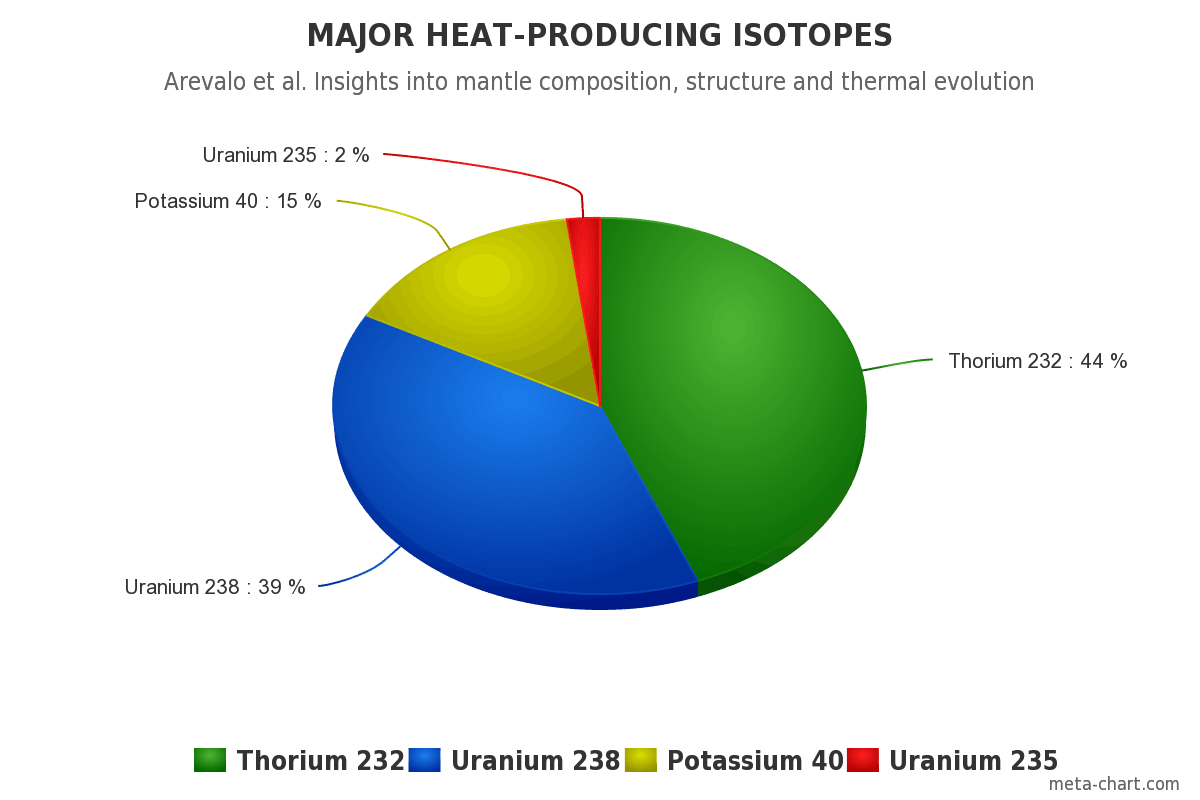
All naturally-occurring isotopes belong to primordial nuclides, because their half-life is comparable to the age of the Earth (~4.54×10⁹ years). Uranium has the second highest atomic mass of these primordial nuclides, lighter only than plutonium. Moreover the decay heat of uranium and thorium and their decay products (e.g. radon, radium etc.) contributes to heating of Earth’s core. Together with potassium-40 in the Earth’s mantle is thought that these elements are the main source of heat that keeps the Earth’s core liquid.
Terrestrial Radiation – Is it dangerous?
We must emphasize, eating bananas, working as airline flight crew or living in locations with, increases your annual dose rate. But it does not mean, that it must be dangerous. In each case, intensity of radiation also matters. It is very similar as for heat from a fire (less energetic radiation). If you are too close, the intensity of heat radiation is high and you can get burned. If you are at the right distance, you can withstand there without any problems and moreover it is comfortable. If you are too far from heat source, the insufficiency of heat can also hurt you. This analogy, in a certain sense, can be applied to radiation also from radiation sources.
Alternative assumptions for the extrapolation of the cancer risk vs. radiation dose to low-dose levels, given a known risk at a high dose: LNT model, and hormesis model.
In case of terrestrial radiation, we are talking usually about so called “low doses”. Low dose here means additional small doses comparable to the normal background radiation (10 µSv = average daily dose received from natural background). The doses are very very low and therefore the probability of cancer induction could be almost negligible. Secondly, and this is crucial, the truth about low-dose radiation health effects still needs to be found. It is not exactly known, whether these low doses of radiation are detrimental or beneficial (and where is the threshold). Government and regulatory bodies assume a LNT model instead of a threshold or hormesis not because it is the more scientifically convincing, but because it is the more conservative estimate. Problem of this model is that it neglects a number of defence biological processes that may be crucial at low doses. The research during the last two decades is very interesting and show that small doses of radiation given at a low dose rate stimulate the defense mechanisms. Therefore the LNT model is not universally accepted with some proposing an adaptive dose–response relationship where low doses are protective and high doses are detrimental. Many studies have contradicted the LNT model and many of these have shown adaptive response to low dose radiation resulting in reduced mutations and cancers. This phenomenon is known as radiation hormesis.
Robert Reed Burn, Introduction to Nuclear Reactor Operation, 1988.
U.S. Department of Energy, Nuclear Physics and Reactor Theory. DOE Fundamentals Handbook, Volume 1 and 2. January 1993.
Paul Reuss, Neutron Physics. EDP Sciences, 2008. ISBN: 978-2759800414.
See also:
Sources
We hope, this article, Terrestrial Radiation, helps you. If so, give us a like in the sidebar. Main purpose of this website is to help the public to learn some interesting and important information about materials and their properties.
Cosmic radiation refers to sources of radiation in the form of cosmic rays that come from the Sun or from outer space. The primary cosmic radiation consist of a mixture of high-energy protons (~87%), alpha particles (~11%), high-energy electrons (~1%) and a trace of heavier nuclei (~1%). Material Properties
Cosmic Radiation
Source: nasa.gov License: Public Domain
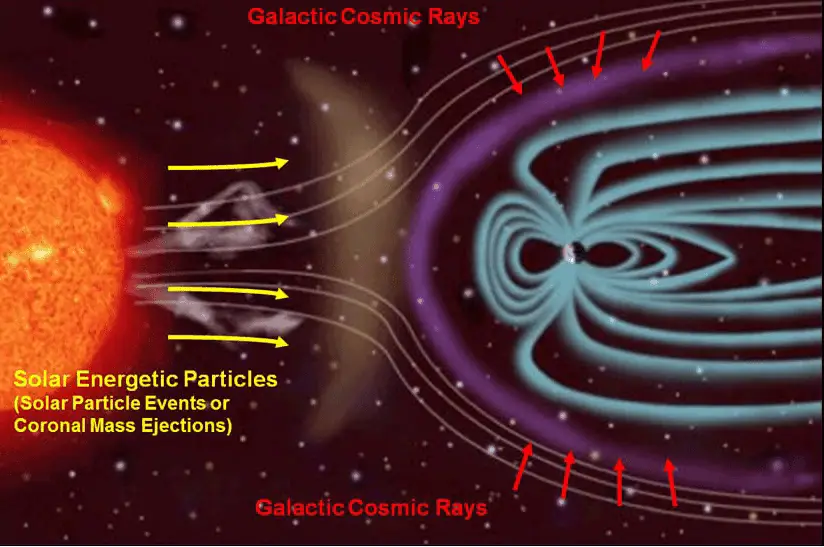
Cosmic radiation refers to sources of radiation in the form of cosmic rays that come from the Sun or from outer space. The earth has always been bombarded by high-energy particles originating in outer space that generate secondary particle showers in the lower atmosphere. Charged particles (especially high-energy protons) from the sun and outer space interact with the earth’s atmosphere and magnetic field to produce a shower of radiation (i.e. air shower), typically beta and gamma radiation. If you live at higher elevations or are a frequent airline passenger, this exposure can be significantly higher, since the atmosphere is thinner here. The effects of the earth’s magnetic field also determines the dose from cosmic radiation.
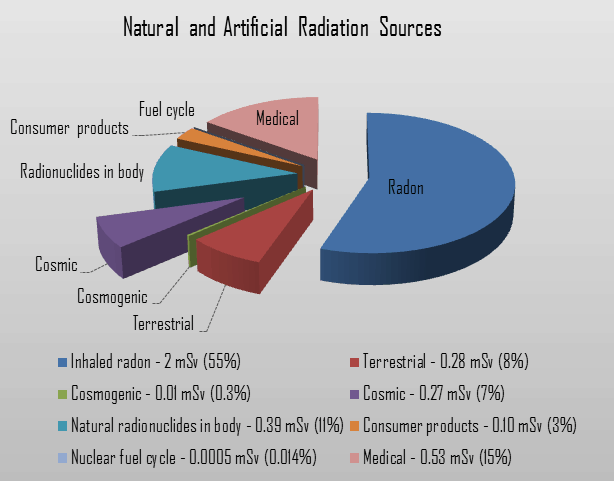
At ground level the muons, with energies mostly between 1 and 20 GeV, contribute about 75 % of the absorbed dose rate in free air. The remainder comes from electrons produced by the muons or present in the electromagnetic cascade. The annual cosmic ray dose at sea level is around 0.27 mSv (27 mrem).
Composition of Cosmic Radiation
The primary cosmic radiation consist of a mixture of high-energy protons (~87%), alpha particles (~11%), high-energy electrons (~1%) and a trace of heavier nuclei (~1%). The energy of these particles range between 108 eV and 1020 eV. A very small fraction are stable particles of antimatter, such as positrons or antiprotons. The precise nature of this remaining fraction is an area of active research.
Subsequently, a large number of secondary particles, in particular, neutrons and charged pions are produced as a result of interactions between primary particles and the earth’s atmosphere. Since pions are short-lived subatomic particles, the subsequent decay of the pions result in the production of high-energy muons. At ground level the muons, with energies mostly between 1 and 20 GeV, contribute about 75 % of the absorbed dose rate in free air. The dose rate from cosmic radiation varies in different parts of the world and it depends strongly on the geomagnetic field, altitude, and solar cycle. The cosmic radiation dose rate on airplanes is so high that, according to the United Nations UNSCEAR 2000 Report, airline flight crew workers receive more dose on average than any other worker, including those in nuclear power plants.
We also have to include the neutrons at ground level. Cosmic rays interact with nuclei in the atmosphere, and produce also high-energy neutrons. According to UNSCEAR the fluency of neutrons is 0.0123 cm-2s–1 at sea level for a geomagnetic latitude of 45 N. Based on this, the effective annual dose from neutrons at sea level and at 50 degree latitude is estimated to be 0.08 mSv (8 mrem). Noteworthy, in the vicinity of larger heavier objects, e.g. buildings or ships, the neutron flux measures higher. This effect is known as “cosmic ray induced neutron signature”, or “ship effect” as it was first detected with ships at sea. Cosmic rays create showers in the atmosphere that include a broad spectrum of secondary neutrons, muons and protons. The secondary neutrons may be of a very high energy and may induce spallation events in materials at ground level. Therefore in the vicinity of larger heavier objects, these multiple neutrons produced in spallation events are referred to as “ship effect” neutrons.
Neutrons produced in the upper atmosphere are also responsible for generation of radioactive carbon-14, which is the best known cosmogenic radionuclide. Carbon-14 is continuously formed in the upper atmosphere by the interaction of cosmic rays with atmospheric nitrogen. On average just one out of every 1.3 x 10¹² carbon atoms in the atmosphere is a radioactive carbon-14 atom. As a result, all living biological substances contain the same amount of C-14 per gram of carbon, that is 0.3 Bq of carbon-14 activity per gram of carbon. As long as the biological system is alive the level is constant due to constant intake of all isotopes of carbon. When the biological system dies, it stops exchanging carbon with its environment, and from that point onwards the amount of carbon-14 it contains begins to decrease as the carbon-14 undergoes radioactive decay.
Energy of Cosmic Rays
The energies of the most energetic ultra-high-energy cosmic rays (UHECRs) have been observed to approach 3 x 10²⁰ eV, about 40 million times the energy of particles accelerated by the Large Hadron Collider. The origin of the high energy particles is from outer space. It is assumed that particles with an energy up to about 1015 eV are coming from our own galaxy, whereas those with the highest energies probably have an extragalactic origin.
Classification of Cosmic Radiation
Cosmic radiation can be divided into different types according to its origin. There are three main sources of such radiation:
Solar Cosmic Radiation. Solar cosmic radiation refers to sources of radiation in the form of high-energy particles (predominantly protons) emitted by the sun, primarily in solar particle events (SPEs).
Galactic Cosmic Radiation. Galactic cosmic radiation, GCR, refers to sources of radiation in the form of high-energy particles originating outside the solar system, but generally from within our Milky Way galaxy.
Radiation from Earth’s Radiation Belts (van Allen belts). Van Allen radiation belts are zones of high-energy particles (especially protons) trapped by earth’s magnetic field.
Galactic Cosmic Radiation
Galactic cosmic radiation, GCR, refers to sources of radiation in the form of high-energy particles originating outside the solar system. GCR are high-energy nuclei from which all of the surrounding electrons have been stripped away during their high-speed passage through the galaxy. The GCR incident on the upper atmosphere consist of a nucleonic component, which aggregate accounts for 98% of the total (2% are electrons). The nucleonic component then consist of a mixture of high-energy protons (~86%), alpha particles (~12%), and a trace of heavier nuclei (~1%). GCR are trapped by the galactic magnetic field, therefore they have probably been accelerated within the last few million years, and have traveled many times across the galaxy. Their acceleration mechanism is uncertain, but one of possible mechanisms is that the particle are accelerated by shock waves expanding from supernovas. The energy of these particles range between 108 eV and 1020 eV. A very small fraction are stable particles of antimatter, such as positrons or antiprotons.
The precise nature of this remaining fraction is an area of active research. The GCR fluence rate varies with solar activity, being lower when solar activity is higher. At solar minimums, due to lower solar magnetic field shielding, the fluence is significantly higher than at solar maximum.
Solar Cosmic Radiation – Solar Particle Event
Solar cosmic radiation refers to sources of radiation in the form of high-energy particles (predominantly protons) emitted by the Sun, primarily in solar particle events (SPEs). The solar radiation incident on the upper atmosphere consist mostly of protons (99%), with energies generally below 100 MeV. Solar particle events, for example, occur when protons emitted by the Sun become accelerated either close to the Sun during a flare or in interplanetary space by coronal mass ejection shocks. Note that, the Sun has an 11-year cycle, which culminates in a dramatic increase in the number and intensity of solar flares, especially during periods when there are numerous sunspots.
Solar radiation is a significant radiation hazard to spacecraft and astronauts, also produces significant dose rates at high altitudes, but only the most energetic radiation contribute to doses at ground level. Note that, anyone who had been on the Moon’s surface during a particularly violent solar eruption in 2005 would have received a lethal dose.
Radiation from Earth’s Radiation Belts – Van Allen belts
Source: nasa.gov License: Public Domain
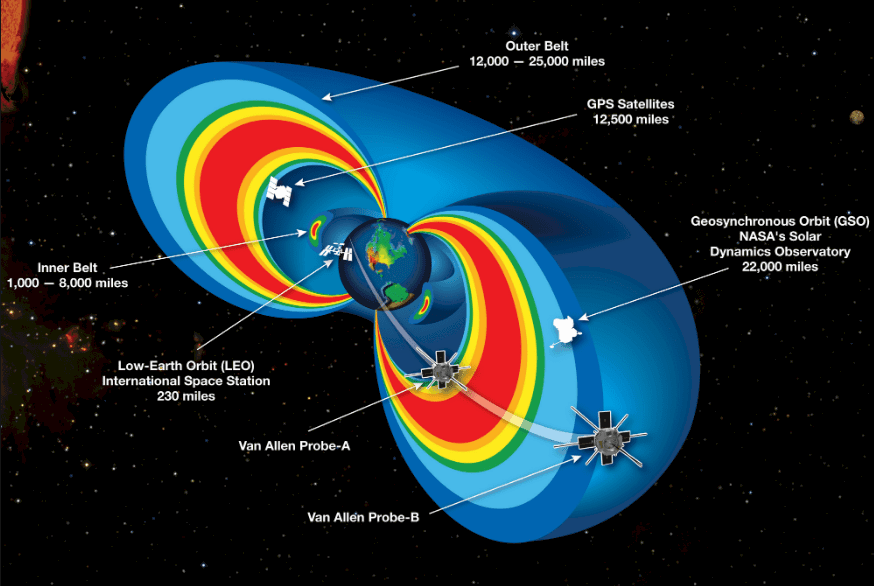
Van Allen radiation belts are zones of high-energy particles (especially protons) trapped by earth’s magnetic field. Most of these high-energy particles originate from the solar wind, that were captured by and held around a planet by that earth’s magnetic field. The van Allen belt is formed like a torus above the equator. There are two van Allen radiation belts, an internal belt is centered at about 3,000 kilometers and an outer belt is centered at about 22,000 kilometers from the earth’s surface. It contains mainly energetic protons in the 10-100 MeV range.
Spacecraft travelling beyond low Earth orbit enter the zone of radiation of the Van Allen belts. Beyond the belts, they face additional hazards from cosmic rays and solar particle events. A region between the inner and outer Van Allen belts lies at two to four Earth radii and is sometimes referred to as the “safe zone”.
Dose Rate in Airplane – Radiation in Flight
Exposure to cosmic radiation increases rapidly with altitude. In flight there are two principal sources of natural radiation to consider: Galactic Cosmic Rays which are always present, and Solar Proton Events, sometimes called Solar Cosmic Ray (SCR) events, which occur sporadically. The dose rate from cosmic radiation varies in different parts of the world and it depends strongly on the geomagnetic field, altitude, and solar cycle. The radiation field at aircraft altitudes consist of neutrons, protons and pions. In flight, neutrons contribute 40 – 80% of the equivalent dose, depending on the geomagnetic field, altitude, and solar cycle. The cosmic radiation dose rate on airplanes is so high (but not dangerous) that, according to the United Nations UNSCEAR 2000 Report, airline flight crew workers receive more dose on average than any other worker, including those in nuclear power plants.
The ground level dose rate is on average about 0.10 μSv/h, but at the maximum flight altitude (8.8 km or 29,000 ft) it can reach about 2.0 μSv/h (or even higher values). A dose rate of 4 μSv/h may be used to represent the average dose rate for all long haul flights (due to higher altitudes). It must be added, for supersonic planes like the Concorde, that could make a transatlantic flight in 3.5 hours, the exposure rate (about 9 μSv/h) at their altitude of 18 km was increased enough to result in the same cosmic ray exposure per crossing as for conventional jets trundling along at about 8 km.
Shielding of Cosmic Radiation
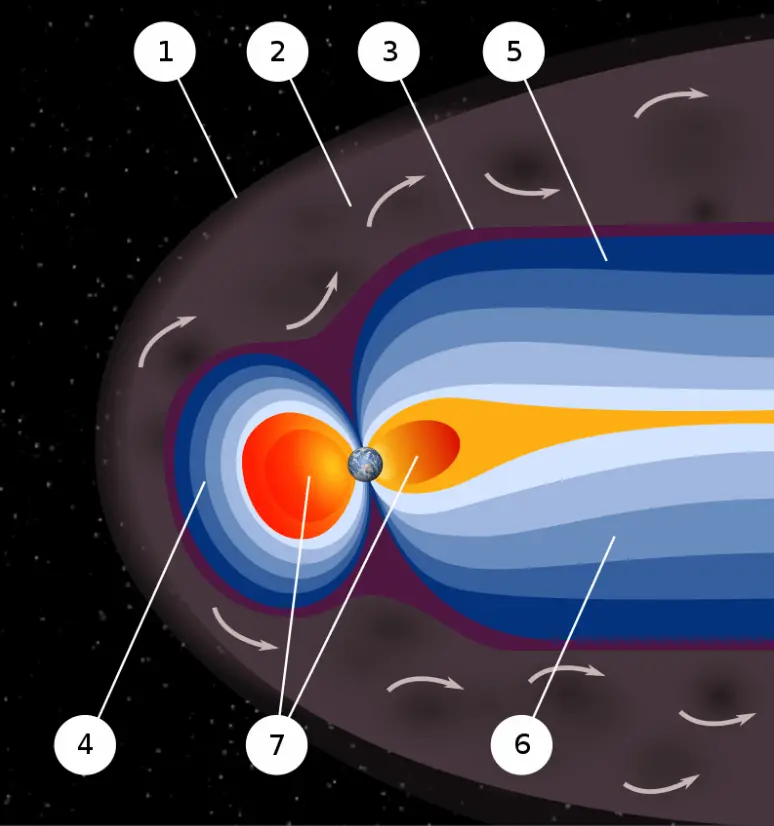
An artist’s rendering of the structure of a magnetosphere: 1) Bow shock. 2) Magnetosheath. 3) Magnetopause. 4) Magnetosphere. 5) Northern tail lobe. 6) Southern tail lobe. 7) Plasmasphere. Source: nasa.gov License: Public Domain
Earth’s magnetic field provides a vital radiation shield of cosmic radiation. In addition to a protective atmosphere, we are also lucky that Earth has a magnetic field. Magnetic field extends several tens of thousands of kilometers into space, protecting the Earth from the charged particles of the solar wind and cosmic rays that would otherwise strip away the upper atmosphere, including the ozone layer that protects the Earth from harmful ultraviolet radiation. It shields us from the full effects of the solar wind and GCR. Without this protection, Earth’s biosphere might not exist as it does today, or would be at least limited to the subsurface. Earth’s magnetic field provides also a radiation shield for astronauts and the ISS itself, because it is in low Earth orbit.
Calculations of the loss of carbon dioxide from the atmosphere of Mars, resulting from scavenging of ions by the solar wind, indicate that the dissipation of the magnetic field of Mars caused a near total loss of its atmosphere.
Cosmic Radiation – Is it dangerous?
We must emphasize, eating bananas, working as airline flight crew or living in locations with, increases your annual dose rate. But it does not mean, that it must be dangerous. In each case, intensity of radiation also matters. It is very similar as for heat from a fire (less energetic radiation). If you are too close, the intensity of heat radiation is high and you can get burned. If you are at the right distance, you can withstand there without any problems and moreover it is comfortable. If you are too far from heat source, the insufficiency of heat can also hurt you. This analogy, in a certain sense, can be applied to radiation also from radiation sources.
Alternative assumptions for the extrapolation of the cancer risk vs. radiation dose to low-dose levels, given a known risk at a high dose: LNT model, and hormesis model.
In case of radiation from cosmic rays, we are talking about so called “low doses”. Low dose here means additional small doses comparable to the normal background radiation (10 µSv = average daily dose received from natural background). The doses are very very low and therefore the probability of cancer induction could be almost negligible. Secondly, and this is crucial, the truth about low-dose radiation health effects still needs to be found. It is not exactly known, whether these low doses of radiation are detrimental or beneficial (and where is the threshold). Government and regulatory bodies assume a LNT model instead of a threshold or hormesis not because it is the more scientifically convincing, but because it is the more conservative estimate. Problem of this model is that it neglects a number of defence biological processes that may be crucial at low doses. The research during the last two decades is very interesting and show that small doses of radiation given at a low dose rate stimulate the defense mechanisms. Therefore the LNT model is not universally accepted with some proposing an adaptive dose–response relationship where low doses are protective and high doses are detrimental. Many studies have contradicted the LNT model and many of these have shown adaptive response to low dose radiation resulting in reduced mutations and cancers. This phenomenon is known as radiation hormesis.
Robert Reed Burn, Introduction to Nuclear Reactor Operation, 1988.
U.S. Department of Energy, Nuclear Physics and Reactor Theory. DOE Fundamentals Handbook, Volume 1 and 2. January 1993.
Paul Reuss, Neutron Physics. EDP Sciences, 2008. ISBN: 978-2759800414.
See also:
Sources
We hope, this article, Cosmic Radiation – Cosmic Ray, helps you. If so, give us a like in the sidebar. Main purpose of this website is to help the public to learn some interesting and important information about materials and their properties.
Radiation is all around us. In general, there are two broad categories of radiation sources: Natural Background Radiation and Man-Made Sources of Radiation. Material Properties
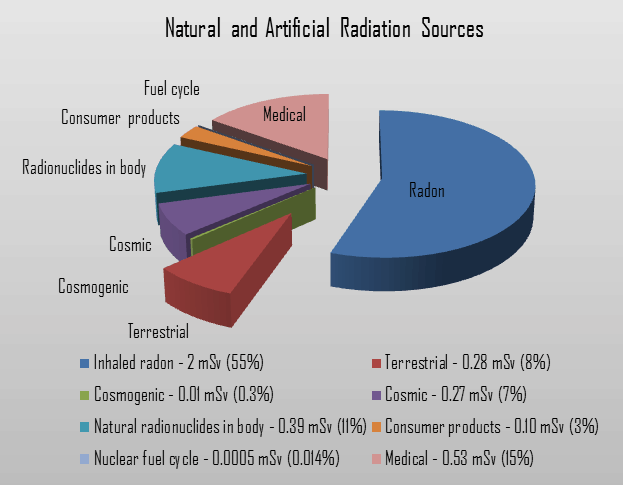
Radiation is all around us. In, around, and above the world we live in. It is a natural energy force that surrounds us. It is a part of our natural world that has been here since the birth of our planet. All living creatures, from the beginning of time, have been, and are still being, exposed to ionizing radiation. Ionizing radiation is generated through nuclear reactions, nuclear decay, by very high temperature, or via acceleration of charged particles in electromagnetic fields. But in general, there are two broad categories of radiation sources:
Natural Background Radiation. Natural background radiation includes radiation produced by the Sun, lightnings, primordial radioisotopes or supernova explosions etc.
Man-Made Sources of Radiation. Man-made sources include medical uses of radiation, residues from nuclear tests, industrial uses of radiation etc.
Special Reference: Sources and effects of ionizing radiation, Annex B. UNSCEAR. New York, 2010. ISBN: 978-92-1-142274-0.
The United Nations Scientific Committee on the Effects of Atomic Radiation (UNSCEAR) itemized types of human exposures as:
public exposure, which is the exposure of individual members of the public and of the population in general
occupational radiation exposure, which is the exposure of workers in situations where their exposure is directly related to or required by their work
Natural Background Radiation
All living creatures, from the beginning of time, have been, and are still being, exposed to ionizing radiation. This radiation is not associated with any human activity. There are radioactive isotopes in our bodies, houses, air, water and in the soil. We all are also exposed to radiation from outer space.
Types of Natural Background Radiation
We divide all these natural radiation sources into three groups:
Cosmic Radiation. Cosmic radiation refers to sources of radiation in the form of cosmic rays that come from the sun or from outer space. At ground level the muons, with energies mostly between 1 and 20 GeV, contribute about 75 % of the absorbed dose rate in free air. The remainder comes from electrons produced by the muons or present in the electromagnetic cascade. The annual cosmic ray dose at sea level is around 0.27 mSv (27 mrem). If you live at higher elevations or are a frequent airline passenger, this exposure can be significantly higher, since the atmosphere is thinner here. The effects of the earth’s magnetic field also determines the dose from cosmic radiation.
Terrestrial Radiation. Terrestrial radiation refers to sources of radiation that are in the soil, water, and vegetation. The major isotopes of concern for terrestrial radiation are uranium and the decay products of uranium, such as thorium, radium, and radon. The average dose rate that originates from terrestrial nuclides (except radon exposure) is about 0.057 µGy/hr. The maximum values have been measured on monazite sand in Guarapari, Brazil (up to 50 µGy/hr and in Kerala, India (about 2 µGy/hr), and on rocks with a high radium concentration in Ramsar, Iran (from 1 to 10 µGy/hr). The average annual radiation dose to a person from radon is about 2 mSv/year and it may vary over many orders of magnitude from place to place. Radon is so important, that it is usually treated separately.
Internal Radiation. In addition to the cosmic and terrestrial sources, all people also have radioactive potassium-40, carbon-14, lead-210, and other isotopes inside their bodies from birth. The concentration of potassium-40 is nearly stable in all persons at a level of about 55 Bq/kg (3850 Bq in total), which corresponds to the annual effective dose of 0.2 mSv. The annual dose from carbon-14 is estimated to be about 12 μSv/year.
Background Radiation and Health Hazard
You can not go through life without radiation. The danger of ionizing radiation lies in the fact that the radiation is invisible and not directly detectable by human senses. People can neither see nor feel radiation, yet it deposits energy to the molecules of the body.
Alternative assumptions for the extrapolation of the cancer risk vs. radiation dose to low-dose levels, given a known risk at a high dose: LNT model, and hormesis model.
But don’t worry, the doses from background radiation are usually very small (except radon exposure). Low dose here means additional small doses comparable to the normal background radiation (10 µSv = average daily dose received from natural background). The problem is that, at very low doses, it is practically impossible to correlate any irradiation with certain biological effects. This is because the baseline cancer rate is already very high and the risk of developing cancer fluctuates 40% because of individual life style and environmental effects, obscuring the subtle effects of low-level radiation.
Secondly, and this is crucial, the truth about low-dose radiation health effects still needs to be found. It is not exactly known, whether these low doses of radiation are detrimental or beneficial (and where is the threshold). Government and regulatory bodies assume a LNT model instead of a threshold or hormesis not because it is the more scientifically convincing, but because it is the more conservative estimate. Problem of this model is that it neglects a number of defence biological processes that may be crucial at low doses. The research during the last two decades is very interesting and show that small doses of radiation given at a low dose rate stimulate the defense mechanisms. Therefore the LNT model is not universally accepted with some proposing an adaptive dose–response relationship where low doses are protective and high doses are detrimental. Many studies have contradicted the LNT model and many of these have shown adaptive response to low dose radiation resulting in reduced mutations and cancers. This phenomenon is known as radiation hormesis.
According to the radiation hormesis hypothesis, radiation exposure comparable to and just above the natural background level of radiation is not harmful but beneficial, while accepting that much higher levels of radiation are hazardous. Arguments for hormesis center around some large-scale epidemiological studies and the evidence from animal irradiation experiments, but most notably the recent advances in knowledge of the adaptive response. Proponents of radiation hormesis typically claim that radio-protective responses in cells and the immune system not only counter the harmful effects of radiation but additionally act to inhibit spontaneous cancer not related to radiation exposure.
Robert Reed Burn, Introduction to Nuclear Reactor Operation, 1988.
U.S. Department of Energy, Nuclear Physics and Reactor Theory. DOE Fundamentals Handbook, Volume 1 and 2. January 1993.
Paul Reuss, Neutron Physics. EDP Sciences, 2008. ISBN: 978-2759800414.
See also:
Radiation Protection
We hope, this article, Source of Radiation, helps you. If so, give us a like in the sidebar. Main purpose of this website is to help the public to learn some interesting and important information about materials and their properties.
Uranium-lead dating is based on the measurement of the first and the last member of the uranium series. Uranium-lead dating is one of the oldest radiometric dating methods. Material Properties
Radiometric dating (or radioactive dating) is any technique used to date organic and also inorganic materials from a process involving radioactive decay. The method compares the abundance of a naturally occurring radioactive isotope within the material to the abundance of its decay products, which form at a known constant rate of decay.
The radioactive decay law states that the probability per unit time that a nucleus will decay is a constant, independent of time. This constant is called the decay constant and is denoted by λ, “lambda”. This constant probability may vary greatly between different types of nuclei, leading to the many different observed decay rates. The radioactive decay of certain number of atoms (mass) is exponential in time.
Radioactive decay law: N = N0.e-λt
One of the oldest radiometric dating methods is uranium-lead dating. The age of the earth’s crust can be estimated from the ratio between the amounts of uranium-238 and lead-206 found in geological specimens. The long half-life of the isotope uranium-238 (4.51×10⁹ years) makes it well-suited for use in estimating the age of the earliest igneous rocks and for other types of radiometric dating, including uranium–thorium dating and uranium–uranium dating.
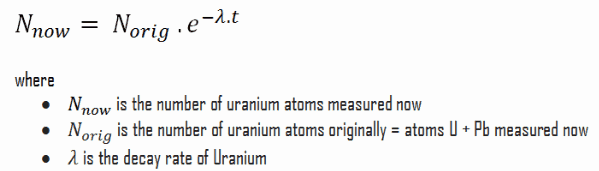
Uranium-lead dating is based on the measurement of the first and the last member of the uranium series, which is one of three classical radioactive series beginning with naturally occurring uranium-238. This radioactive decay chain consists of unstable heavy atomic nuclei that decay through a sequence of alpha and beta decays until a stable nucleus is achieved. In case of uranium series, the stable nucleus is lead-206. The assumption made is that all the lead-206 nuclei found in the specimen today were originally uranium-238 nuclei. That means at the crust’s formation the specimen contained no lead-206 nuclei. If no other lead isotopes are found in the specimen, this is a reasonable assumption. Under this condition, the age of the sample can be calculated by assuming exponential decay of uranium-238. That is:
Uranium-lead dating method is usually performed on the mineral zircon. Zircons from Jack Hills in Western Australia, have yielded U-Pb ages up to 4.404 billion years, interpreted to be the age of crystallization, making them the oldest minerals so far dated on Earth.
Age of the Earth – Uranium-lead Dating
The age of the Earth is about 4.54 billion years. This dating is based on evidence from radiometric age-dating of meteorite material and is consistent with the radiometric ages of the oldest-known terrestrial and lunar samples.
Robert Reed Burn, Introduction to Nuclear Reactor Operation, 1988.
U.S. Department of Energy, Nuclear Physics and Reactor Theory. DOE Fundamentals Handbook, Volume 1 and 2. January 1993.
Paul Reuss, Neutron Physics. EDP Sciences, 2008. ISBN: 978-2759800414.
See also:
Radiometric Dating
We hope, this article, Uranium-lead Dating, helps you. If so, give us a like in the sidebar. Main purpose of this website is to help the public to learn some interesting and important information about materials and their properties.
The age of the Earth is about 4.54 billion years. The oldest zircons from Jack Hills in Western Australia have yielded U-Pb ages up to 4.404 billion years, interpreted to be the age of crystallization. Material Properties
The age of the Earth is about 4.54 billion years. This dating is based on evidence from radiometric age-dating of meteorite material and is consistent with the radiometric ages of the oldest-known terrestrial and lunar samples.
One of the oldest radiometric dating methods is uranium-lead dating. The age of the earth’s crust can be estimated from the ratio between the amounts of uranium-238 and lead-206 found in geological specimens. The long half-life of the isotope uranium-238 (4.51×10⁹ years) makes it well-suited for use in estimating the age of the earliest igneous rocks and for other types of radiometric dating, including uranium–thorium dating and uranium–uranium dating.
Uranium-lead dating is based on the measurement of the first and the last member of the uranium series, which is one of three classical radioactive series beginning with naturally occurring uranium-238. This radioactive decay chain consists of unstable heavy atomic nuclei that decay through a sequence of alpha and beta decays until a stable nucleus is achieved. In case of uranium series, the stable nucleus is lead-206. The assumption made is that all the lead-206 nuclei found in the specimen today were originally uranium-238 nuclei. That means at the crust’s formation the specimen contained no lead-206 nuclei. If no other lead isotopes are found in the specimen, this is a reasonable assumption. Under this condition, the age of the sample can be calculated by assuming exponential decay of uranium-238. That is:
Uranium-lead dating method is usually performed on the mineral zircon. Zircons from Jack Hills in Western Australia, have yielded U-Pb ages up to 4.404 billion years, interpreted to be the age of crystallization, making them the oldest minerals so far dated on Earth.
Robert Reed Burn, Introduction to Nuclear Reactor Operation, 1988.
U.S. Department of Energy, Nuclear Physics and Reactor Theory. DOE Fundamentals Handbook, Volume 1 and 2. January 1993.
Paul Reuss, Neutron Physics. EDP Sciences, 2008. ISBN: 978-2759800414.
See also:
Radiometric Dating
We hope, this article, Age of the Earth – How old is the Earth, helps you. If so, give us a like in the sidebar. Main purpose of this website is to help the public to learn some interesting and important information about materials and their properties.
Carbon-14 dating, known also as radiocarbon dating, is a method for determining the age of an object containing organic material by using the properties of radionuclide carbon-14. Material Properties
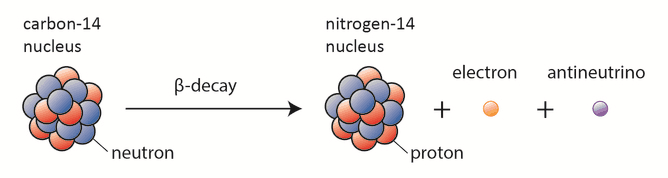
Carbon-14 dating, known also as radiocarbon dating, is a method for determining the age of an object containing organic material by using the properties of radionuclide carbon-14. Radioactive carbon-14 has a half-life of 5730 years and undergoes β− decay, where the neutron is converted into a proton, an electron, and an electron antineutrino:
Beta decay of C-14 nucleus.
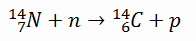
In spite of this short half-life compared to the age of the earth, carbon-14 is a naturally occurring isotope. Its presence can be explained by the following simple observation. Our atmosphere contains many gases, including nitrogen-14. Besides, the atmosphere is constantly bombarded with high energy cosmic rays, consisting of protons, heavier nuclei, or gamma rays. These cosmic rays interact with nuclei in the atmosphere, and produce also high-energy neutrons. These neutrons produced in these collisions can be absorbed by nitrogen-14 to produce an isotope of carbon-14:
Carbon-14 can also be produced in the atmosphere by other neutron reactions, including in particular 13C(n,γ)14C and 17O(n,α)14C. As a result, carbon-14 is continuously formed in the upper atmosphere by the interaction of cosmic rays with atmospheric nitrogen. On average just one out of every 1.3 x 10¹² carbon atoms in the atmosphere is a radioactive carbon-14 atom.
The resulting carbon-14 combines with atmospheric oxygen to form radioactive carbon dioxide, which is incorporated into plants by photosynthesis. Consequently, all biological systems as plants, animals and humans contain a certain level of radioactive carbon-14. As long as the biological system is alive the level is constant due to constant intake of all isotopes of carbon. When the biological system dies, it stops exchanging carbon with its environment, and from that point onwards the amount of carbon-14 it contains begins to decrease as the carbon-14 undergoes radioactive decay. On the other hand, the amount of stable carbon-12 remains unchanged. As a result, the relative concentration of these two isotopes in any organism changes after its death. The method enables datings to be made up to about 20,000 years ago with an accuracy of about ±100 years.
The technique of carbon dating was suggested initially by Willard Libby and his colleagues in 1949. In 1960, Willard Libby was awarded the Nobel Prize in chemistry for this work.
Robert Reed Burn, Introduction to Nuclear Reactor Operation, 1988.
U.S. Department of Energy, Nuclear Physics and Reactor Theory. DOE Fundamentals Handbook, Volume 1 and 2. January 1993.
Paul Reuss, Neutron Physics. EDP Sciences, 2008. ISBN: 978-2759800414.
See also:
Radiometric Dating
We hope, this article, Carbon-14 Dating – Radiocarbon Dating, helps you. If so, give us a like in the sidebar. Main purpose of this website is to help the public to learn some interesting and important information about materials and their properties.
Radiometric dating (or radioactive dating) is any technique used to date organic and also inorganic materials from a process involving radioactive decay. Radiometric dating methods are used in geochronology to establish the geologic time scale. Material Properties
Radiometric dating (or radioactive dating) is any technique used to date organic and also inorganic materials from a process involving radioactive decay. The method compares the abundance of a naturally occurring radioactive isotope within the material to the abundance of its decay products, which form at a known constant rate of decay.
All these methods are based on the fact the rate at which radioactive nuclei disintegrate is unaffected by their environment, it can be used to estimate the age of any material sample or object which contains a radioactive isotope. Calculations of the decay of radioactive nuclei are relatively straightforward, owing to the fact that there is only one fundamental law governing all decay process.
The radioactive decay law states that the probability per unit time that a nucleus will decay is a constant, independent of time. This constant is called the decay constant and is denoted by λ, “lambda”. This constant probability may vary greatly between different types of nuclei, leading to the many different observed decay rates. The radioactive decay of certain number of atoms (mass) is exponential in time.
Radioactive decay law: N = N0.e-λt
Among the best-known techniques are:
carbon-14 dating,
potassium–argon dating,
uranium–lead dating.
Radiometric dating methods are used in geochronology to establish the geologic time scale and can be also used to date archaeological materials, including ancient artifacts.
Carbon-14 Dating – Radiocarbon Dating
Carbon-14 dating, known also as radiocarbon dating, is a method for determining the age of an object containing organic material by using the properties of radionuclide carbon-14. Radioactive carbon-14 has a half-life of 5730 years and undergoes β− decay, where the neutron is converted into a proton, an electron, and an electron antineutrino:
Beta decay of C-14 nucleus.
In spite of this short half-life compared to the age of the earth, carbon-14 is a naturally occurring isotope. Its presence can be explained by the following simple observation. Our atmosphere contains many gases, including nitrogen-14. Besides, the atmosphere is constantly bombarded with high energy cosmic rays, consisting of protons, heavier nuclei, or gamma rays. These cosmic rays interact with nuclei in the atmosphere, and produce also high-energy neutrons. These neutrons produced in these collisions can be absorbed by nitrogen-14 to produce an isotope of carbon-14:
Carbon-14 can also be produced in the atmosphere by other neutron reactions, including in particular 13C(n,γ)14C and 17O(n,α)14C. As a result, carbon-14 is continuously formed in the upper atmosphere by the interaction of cosmic rays with atmospheric nitrogen. On average just one out of every 1.3 x 10¹² carbon atoms in the atmosphere is a radioactive carbon-14 atom.
The resulting carbon-14 combines with atmospheric oxygen to form radioactive carbon dioxide, which is incorporated into plants by photosynthesis. Consequently, all biological systems as plants, animals and humans contain a certain level of radioactive carbon-14. As long as the biological system is alive the level is constant due to constant intake of all isotopes of carbon. When the biological system dies, it stops exchanging carbon with its environment, and from that point onwards the amount of carbon-14 it contains begins to decrease as the carbon-14 undergoes radioactive decay. On the other hand, the amount of stable carbon-12 remains unchanged. As a result, the relative concentration of these two isotopes in any organism changes after its death. The method enables datings to be made up to about 20,000 years ago with an accuracy of about ±100 years.
The technique of carbon dating was suggested initially by Willard Libby and his colleagues in 1949. In 1960, Willard Libby was awarded the Nobel Prize in chemistry for this work.
Age of the Earth – Uranium-lead Dating
The age of the Earth is about 4.54 billion years. This dating is based on evidence from radiometric age-dating of meteorite material and is consistent with the radiometric ages of the oldest-known terrestrial and lunar samples.
One of the oldest radiometric dating methods is uranium-lead dating. The age of the earth’s crust can be estimated from the ratio between the amounts of uranium-238 and lead-206 found in geological specimens. The long half-life of the isotope uranium-238 (4.51×10⁹ years) makes it well-suited for use in estimating the age of the earliest igneous rocks and for other types of radiometric dating, including uranium–thorium dating and uranium–uranium dating.
Uranium-lead dating is based on the measurement of the first and the last member of the uranium series, which is one of three classical radioactive series beginning with naturally occurring uranium-238. This radioactive decay chain consists of unstable heavy atomic nuclei that decay through a sequence of alpha and beta decays until a stable nucleus is achieved. In case of uranium series, the stable nucleus is lead-206. The assumption made is that all the lead-206 nuclei found in the specimen today were originally uranium-238 nuclei. That means at the crust’s formation the specimen contained no lead-206 nuclei. If no other lead isotopes are found in the specimen, this is a reasonable assumption. Under this condition, the age of the sample can be calculated by assuming exponential decay of uranium-238. That is:
Uranium-lead dating method is usually performed on the mineral zircon. Zircons from Jack Hills in Western Australia, have yielded U-Pb ages up to 4.404 billion years, interpreted to be the age of crystallization, making them the oldest minerals so far dated on Earth.
Robert Reed Burn, Introduction to Nuclear Reactor Operation, 1988.
U.S. Department of Energy, Nuclear Physics and Reactor Theory. DOE Fundamentals Handbook, Volume 1 and 2. January 1993.
Paul Reuss, Neutron Physics. EDP Sciences, 2008. ISBN: 978-2759800414.
See also:
Radioactive Decay
We hope, this article, Radiometric Dating – Radioactive Dating, helps you. If so, give us a like in the sidebar. Main purpose of this website is to help the public to learn some interesting and important information about materials and their properties.