Facebook Instagram Youtube Twitter

What is Elastic Collision – Definition

A perfectly elastic collisions are defined as those in which there is no net conversion of kinetic energy into other forms (such as heat or noise). Material Properties

Elastic Collisions

A perfectly elastic collision is defined as one in which there is no net conversion of kinetic energy into other forms (such as heat or noise). For the brief moment during which the two objects are in contact, some (or all) of the energy is stored momentarily in the form of elastic potential energy. But if we compare the total kinetic energy just before the collision with the total kinetic energy just after the collision, and they are found to be the same, then we say that the total kinetic energy is conserved.

[xyz-ihs snippet=”collisions”]
  • Some large-scale interactions like the slingshot type gravitational interactions (also known as a planetary swing-by or a gravity-assist manoeuvre) between satellites and planets are perfectly elastic.
  • Collisions between very hard spheres may be nearly elastic, so it is useful to calculate the limiting case of an elastic collision.
  • Collisions in ideal gases approach perfectly elastic collisions, as do scattering interactions of sub-atomic particles which are deflected by the electromagnetic force.
  • Rutherford scattering is the elastic scattering of charged particles also by the electromagnetic force.
  • A neutron-nucleus scattering reaction may be also elastic, but in this case the neutron is deflected by the strong nuclear force.
 
Equations of Conservation of Momentum and Energy
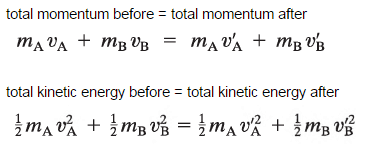
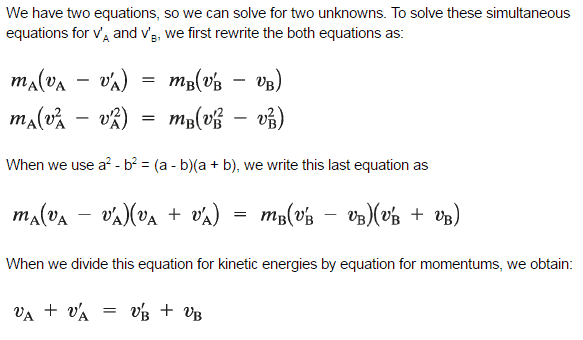
Let us assume the one dimensional elastic collision of two objects, the object A and the object B. These two objects are moving with velocities vA and vB along the x axis before the collision. After the collision, their velocities are v’A and v’B. The conservation of the total momentum demands that the total momentum before the collision is the same as the total momentum after the collision. Likewise, the conservation of the total kinetic energy, which demands that the total kinetic energy of both objects before the collision is the same as the total kinetic energy after the collision. Both law may be expressed in equations as:

equations-of-conservation-of-momentum-energy

solution-conservation-of-momentum-energy

The relative speed of the two objects after the collision has the same magnitude (but opposite direction) as before the collision, no matter what the masses are.

Elastic Nuclear Collision
See also: Neutron Moderators

It is known the fission neutrons are of importance in any chain-reacting system. All neutrons produced by fission are born as fast neutrons with high kinetic energy. Before such neutrons can efficiently cause additional fissions, they must be slowed down by collisions with nuclei in the moderator of the reactor. The probability of the fission U-235 becomes very large at the thermal energies of slow neutrons. This fact implies increase of multiplication factor of the reactor (i.e. lower fuel enrichment is needed to sustain chain reaction).

The neutrons released during fission with an average energy of 2 MeV in a reactor on average undergo a number of collisions (elastic or inelastic) before they are absorbed. During the scattering reaction, a fraction of the neutron’s kinetic energy is transferred to the nucleus. Using the laws of conservation of momentum and energy and the analogy of collisions of billiard balls for elastic scattering, it is possible to derive the following equation for the mass of target or moderator nucleus (M), energy of incident neutron (Ei) and the energy of scattered neutron (Es).

equation momentum energy

where A is the atomic mass number.In case of the hydrogen (A = 1) as the target nucleus, the incident neutron can be completely stopped. But this works when the direction of the neutron is completely reversed (i.e. scattered at 180°). In reality, the direction of scattering ranges from 0 to 180 ° and the energy transferred also ranges from 0% to maximum. Therefore, the average energy of scattered neutron is taken as the average of energies with scattering angle 0 and 180°.

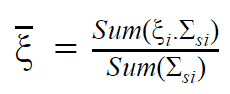
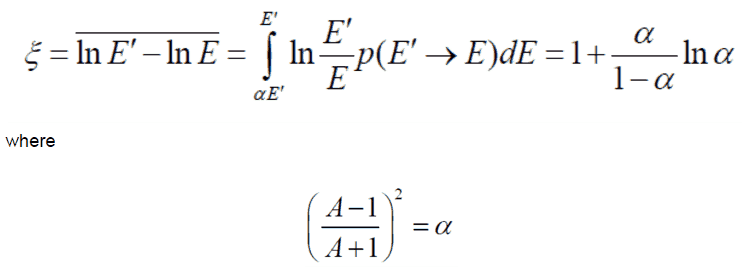
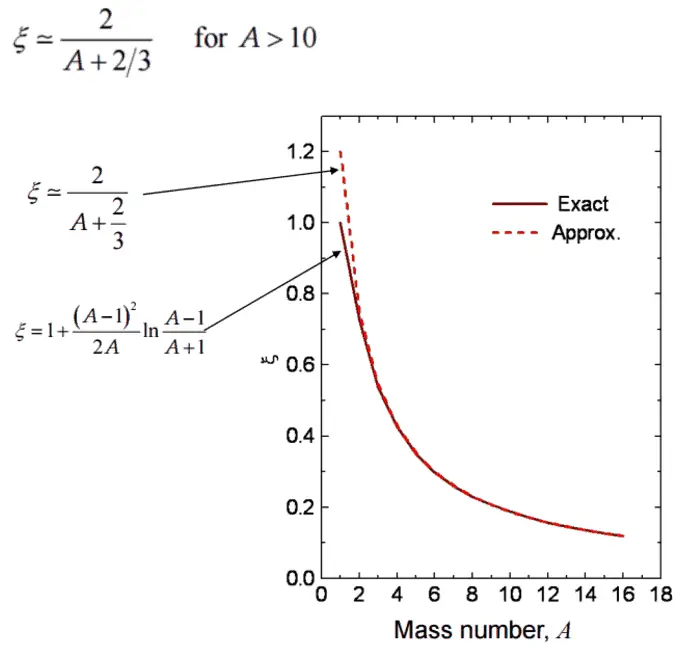
Moreover, it is useful to work with logarithmic quantities and therefore one defines the logarithmic energy decrement per collision (ξ) as a key material constant describing energy transfers during a neutron slowing down. ξ is not dependent on energy, only on A and is defined as follows:logarithmic energy decrement - equationFor heavy target nuclei, ξ may be approximated by following formula:the logarithmic energy decrement per collisionFrom these equations it is easy to determine the number of collisions required to slow down a neutron from, for example from 2 MeV to 1 eV.

Example: Determine the number of collisions required for thermalization for the 2 MeV neutron in the carbon.

ξCARBON = 0.158

N(2MeV → 1eV) = ln 2⋅106/ξ =14.5/0.158 = 92

Table of average logarithmic energy decrement for some elements
Table of average logarithmic energy decrement for some elements.

For a mixture of isotopes:

the logarithmic energy decrement for mixtures

Example: Elastic Nuclear Collision
A neutron (n) of mass 1.01 u traveling with a speed of 3.60 x 104m/s interacts with a carbon (C) nucleus (mC = 12.00 u) initially at rest in an elastic head-on collision.

What are the velocities of the neutron and carbon nucleus after the collision?

Solution:

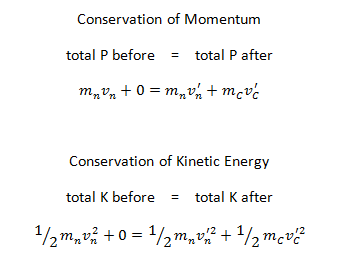
This is an elastic head-on collision of two objects with unequal masses. We have to use the conservation laws of momentum and of kinetic energy, and apply them to our system of two particles.

conservation-laws-elastic-collisions

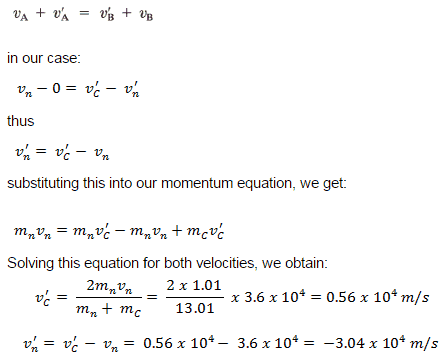
We can solve this system of equation or we can use the equation derived in previous section. This equation stated that the relative speed of the two objects after the collision has the same magnitude (but opposite direction) as before the collision, no matter what the masses are.

solution-elastic-collision

The minus sign for v’ tells us that the neutron scatters back of the carbon nucleus, because the carbon nucleus is significantly heavier. On the other hand its speed is less than its initial speed. This process is known as the neutron moderation and it significantly depends on the mass of moderator nuclei.

 
References:
Nuclear and Reactor Physics:
  1. J. R. Lamarsh, Introduction to Nuclear Reactor Theory, 2nd ed., Addison-Wesley, Reading, MA (1983).
  2. J. R. Lamarsh, A. J. Baratta, Introduction to Nuclear Engineering, 3d ed., Prentice-Hall, 2001, ISBN: 0-201-82498-1.
  3. W. M. Stacey, Nuclear Reactor Physics, John Wiley & Sons, 2001, ISBN: 0- 471-39127-1.
  4. Glasstone, Sesonske. Nuclear Reactor Engineering: Reactor Systems Engineering, Springer; 4th edition, 1994, ISBN: 978-0412985317
  5. W.S.C. Williams. Nuclear and Particle Physics. Clarendon Press; 1 edition, 1991, ISBN: 978-0198520467
  6. Kenneth S. Krane. Introductory Nuclear Physics, 3rd Edition, Wiley, 1987, ISBN: 978-0471805533
  7. G.R.Keepin. Physics of Nuclear Kinetics. Addison-Wesley Pub. Co; 1st edition, 1965
  8. Robert Reed Burn, Introduction to Nuclear Reactor Operation, 1988.
  9. U.S. Department of Energy, Nuclear Physics and Reactor Theory. DOE Fundamentals Handbook, Volume 1 and 2. January 1993.

Advanced Reactor Physics:

  1. K. O. Ott, W. A. Bezella, Introductory Nuclear Reactor Statics, American Nuclear Society, Revised edition (1989), 1989, ISBN: 0-894-48033-2.
  2. K. O. Ott, R. J. Neuhold, Introductory Nuclear Reactor Dynamics, American Nuclear Society, 1985, ISBN: 0-894-48029-4.
  3. D. L. Hetrick, Dynamics of Nuclear Reactors, American Nuclear Society, 1993, ISBN: 0-894-48453-2.
  4. E. E. Lewis, W. F. Miller, Computational Methods of Neutron Transport, American Nuclear Society, 1993, ISBN: 0-894-48452-4.

See also:

Conservation of Energy

We hope, this article, Elastic Collision, helps you. If so, give us a like in the sidebar. Main purpose of this website is to help the public to learn some interesting and important information about materials and their properties.

What is Conservative – Nonconservative Force – Definition

We now take into account nonconservative forces such as friction, since they are important in real situations. Nonconservative Forces – Definition

Law of Conservation of Energy

The law of conservation of energy is one of the basic laws of physics along with the conservation of mass and the conservation of momentum. The law of conservation of energy states that energy can change from one form into another, but it cannot be created or destroyed. Or the general definition is:

The total energy of an isolated system remains constant over time.

law of conservation of energy - pendulum
Newton’s cradle. A device that demonstrates the Law of Conservation of Mechanical Energy and Momentum.

Energy can be defined as the capacity for doing work. It may exist in a variety of forms and may be transformed from one type of energy to another in hundreds of ways.

For example, burning gasoline to power cars is an energy conversion process we rely on. The chemical energy in gasoline is converted to thermal energy, which is then converted to mechanical energy that makes the car move. The mechanical energy has been converted to kinetic energy. When we use the brakes to stop a car, that kinetic energy is converted by friction back to heat, or thermal energy.

A consequence of the law of conservation of energy is that a perpetual motion machine of the first kind, which produces work without the input of energy, cannot exist.

The concept of energy conservation is widely used in many fields. In this article the following fields are discussed:

  • Conservation of Mechanical Energy
  • Conservation of Energy in Fluid Mechanics
  • Conservation of Energy in thermodynamics
  • Conservation of Energy in Electrical Circuits
  • Conservation of Energy in Chemical Reactions
  • Conservation of Energy in Special Relativity Theory
  • Conservation of Energy in Nuclear Reactions

Law of Conservation of Energy in Classical Physics

Conservation of Mechanical Energy

First the principle of the Conservation of Mechanical Energy was stated:

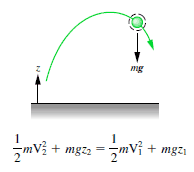
The total mechanical energy (defined as the sum of its potential and kinetic energies) of a particle being acted on by only conservative forces is constant.

conservartion-of-mechanical-energy-exampleAn isolated system is one in which no external force causes energy changes. If only conservative forces act on an object and U is the potential energy function for the total conservative force, then

Emech = U + K

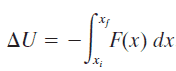
The potential energy, U, depends on the position of an object subjected to a conservative force.

potential-energy-equation

It is defined as the object’s ability to do work and is increased as the object is moved in the opposite direction of the direction of the force.

The potential energy associated with a system consisting of Earth and a nearby particle is gravitational potential energy.

gravitational-potential-energy-equation

The kinetic energy, K, depends on the speed of an object and is the ability of a moving object to do work on other objects when it collides with them.

 K = ½ mv2

The above mentioned definition (Emech = U + K) assumes that the system is free of friction and other non-conservative forces. The difference between a conservative and a non-conservative force is that when a conservative force moves an object from one point to another, the work done by the conservative force is independent of the path.

In any real situation, frictional forces and other non-conservative forces are present, but in many cases their effects on the system are so small that the principle of conservation of mechanical energy can be used as a fair approximation. For example the frictional force is a non-conservative force, because it acts to reduce the mechanical energy in a system.

Note that non-conservative forces do not always reduce the mechanical energy. A non-conservative force changes the mechanical energy, there are forces that increase the total mechanical energy, like the force provided by a motor or engine, is also a non-conservative force.

The Law of Conservation of Energy – Nonconservative Forces

We now take into account nonconservative forces such as friction, since they are important in real situations. For example, consider again the pendulum, but this time let us include air resistance. The pendulum will slow down, because of friction. In this, and in other natural processes, the mechanical energy (sum of the kinetic and potential energies) does not remain constant but decreases. Because frictional forces reduce the mechanical energy (but not the total energy), they are called nonconservative forces (or dissipative forces). But in the nineteenth-century it was demonstrated the total energy is conserved in any process. In case of pendulum its initial kinetic energy is all transformed into thermal energy.

For each type of force, conservative or nonconservative, it has always been found possible to define a type of energy that corresponds to the work done by such a force. And it has been found experimentally that the total energy E always remains constant. The general law of conservation of energy can be stated as follows:

The total energy E of a system (the sum of its mechanical energy and its internal energies, including thermal energy) can change only by amounts of energy that are transferred to or from the system.

 
References:
Nuclear and Reactor Physics:
  1. J. R. Lamarsh, Introduction to Nuclear Reactor Theory, 2nd ed., Addison-Wesley, Reading, MA (1983).
  2. J. R. Lamarsh, A. J. Baratta, Introduction to Nuclear Engineering, 3d ed., Prentice-Hall, 2001, ISBN: 0-201-82498-1.
  3. W. M. Stacey, Nuclear Reactor Physics, John Wiley & Sons, 2001, ISBN: 0- 471-39127-1.
  4. Glasstone, Sesonske. Nuclear Reactor Engineering: Reactor Systems Engineering, Springer; 4th edition, 1994, ISBN: 978-0412985317
  5. W.S.C. Williams. Nuclear and Particle Physics. Clarendon Press; 1 edition, 1991, ISBN: 978-0198520467
  6. Kenneth S. Krane. Introductory Nuclear Physics, 3rd Edition, Wiley, 1987, ISBN: 978-0471805533
  7. G.R.Keepin. Physics of Nuclear Kinetics. Addison-Wesley Pub. Co; 1st edition, 1965
  8. Robert Reed Burn, Introduction to Nuclear Reactor Operation, 1988.
  9. U.S. Department of Energy, Nuclear Physics and Reactor Theory. DOE Fundamentals Handbook, Volume 1 and 2. January 1993.

Advanced Reactor Physics:

  1. K. O. Ott, W. A. Bezella, Introductory Nuclear Reactor Statics, American Nuclear Society, Revised edition (1989), 1989, ISBN: 0-894-48033-2.
  2. K. O. Ott, R. J. Neuhold, Introductory Nuclear Reactor Dynamics, American Nuclear Society, 1985, ISBN: 0-894-48029-4.
  3. D. L. Hetrick, Dynamics of Nuclear Reactors, American Nuclear Society, 1993, ISBN: 0-894-48453-2.
  4. E. E. Lewis, W. F. Miller, Computational Methods of Neutron Transport, American Nuclear Society, 1993, ISBN: 0-894-48452-4.

See also:

Conservation of Energy

We hope, this article, Conservative – Nonconservative Force, helps you. If so, give us a like in the sidebar. Main purpose of this website is to help the public to learn some interesting and important information about materials and their properties.

What is Example of Conservation of Mechanical Energy – Pendulum – Definition

Assume a pendulum (ball of mass m suspended on a string of length L. Example of Conservation of Mechanical Energy – Pendulum

Example of Conservation of Mechanical Energy – Pendulum

conservartion-of-mechanical-energy-pendulumAssume a pendulum (ball of mass m suspended on a string of length L that we have pulled up so that the ball is a height H < L above its lowest point on the arc of its stretched string motion. The pendulum is subjected to the conservative gravitational force where frictional forces like air drag and friction at the pivot are negligible.

We release it from rest. How fast is it going at the bottom?

conservartion-of-mechanical-energy-pendulum2

The pendulum reaches greatest kinetic energy and least potential energy when in the vertical position, because it will have the greatest speed and be nearest the Earth at this point. On the other hand, it will have its least kinetic energy and greatest potential energy at the extreme positions of its swing, because it has zero speed and is farthest from Earth at these points.

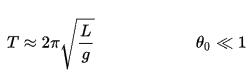
If the amplitude is limited to small swings, the period T of a simple pendulum, the time taken for a complete cycle, is:

period-of-pendulum-conservation-of-energy

where L is the length of the pendulum and g is the local acceleration of gravity. For small swings the period of swing is approximately the same for different size swings. That is, the period is independent of amplitude.

 
References:
Nuclear and Reactor Physics:
  1. J. R. Lamarsh, Introduction to Nuclear Reactor Theory, 2nd ed., Addison-Wesley, Reading, MA (1983).
  2. J. R. Lamarsh, A. J. Baratta, Introduction to Nuclear Engineering, 3d ed., Prentice-Hall, 2001, ISBN: 0-201-82498-1.
  3. W. M. Stacey, Nuclear Reactor Physics, John Wiley & Sons, 2001, ISBN: 0- 471-39127-1.
  4. Glasstone, Sesonske. Nuclear Reactor Engineering: Reactor Systems Engineering, Springer; 4th edition, 1994, ISBN: 978-0412985317
  5. W.S.C. Williams. Nuclear and Particle Physics. Clarendon Press; 1 edition, 1991, ISBN: 978-0198520467
  6. Kenneth S. Krane. Introductory Nuclear Physics, 3rd Edition, Wiley, 1987, ISBN: 978-0471805533
  7. G.R.Keepin. Physics of Nuclear Kinetics. Addison-Wesley Pub. Co; 1st edition, 1965
  8. Robert Reed Burn, Introduction to Nuclear Reactor Operation, 1988.
  9. U.S. Department of Energy, Nuclear Physics and Reactor Theory. DOE Fundamentals Handbook, Volume 1 and 2. January 1993.

Advanced Reactor Physics:

  1. K. O. Ott, W. A. Bezella, Introductory Nuclear Reactor Statics, American Nuclear Society, Revised edition (1989), 1989, ISBN: 0-894-48033-2.
  2. K. O. Ott, R. J. Neuhold, Introductory Nuclear Reactor Dynamics, American Nuclear Society, 1985, ISBN: 0-894-48029-4.
  3. D. L. Hetrick, Dynamics of Nuclear Reactors, American Nuclear Society, 1993, ISBN: 0-894-48453-2.
  4. E. E. Lewis, W. F. Miller, Computational Methods of Neutron Transport, American Nuclear Society, 1993, ISBN: 0-894-48452-4.

See also:

Conservation of Energy

We hope, this article, Example of Conservation of Mechanical Energy – Pendulum, helps you. If so, give us a like in the sidebar. Main purpose of this website is to help the public to learn some interesting and important information about materials and their properties.

What is Total Mechanical Energy – Definition

The total mechanical energy (defined as the sum of its potential and kinetic energies) of a particle being acted on by only conservative forces is constant. Material Properties

Definition of Total Mechanical Energy

First the principle of the Conservation of Mechanical Energy was stated:

The total mechanical energy (defined as the sum of its potential and kinetic energies) of a particle being acted on by only conservative forces is constant.

conservartion-of-mechanical-energy-exampleAn isolated system is one in which no external force causes energy changes. If only conservative forces act on an object and U is the potential energy function for the total conservative force, then

Emech = U + K

The potential energy, U, depends on the position of an object subjected to a conservative force.

potential-energy-equation

It is defined as the object’s ability to do work and is increased as the object is moved in the opposite direction of the direction of the force.

The potential energy associated with a system consisting of Earth and a nearby particle is gravitational potential energy.

gravitational-potential-energy-equation

The kinetic energy, K, depends on the speed of an object and is the ability of a moving object to do work on other objects when it collides with them.

 K = ½ mv2

The above mentioned definition (Emech = U + K) assumes that the system is free of friction and other non-conservative forces. The difference between a conservative and a non-conservative force is that when a conservative force moves an object from one point to another, the work done by the conservative force is independent of the path.

In any real situation, frictional forces and other non-conservative forces are present, but in many cases their effects on the system are so small that the principle of conservation of mechanical energy can be used as a fair approximation. For example the frictional force is a non-conservative force, because it acts to reduce the mechanical energy in a system.

Note that non-conservative forces do not always reduce the mechanical energy. A non-conservative force changes the mechanical energy, there are forces that increase the total mechanical energy, like the force provided by a motor or engine, is also a non-conservative force.

 
Example of Conservation of Mechanical Energy - Pendulum
conservartion-of-mechanical-energy-pendulumAssume a pendulum (ball of mass m suspended on a string of length L that we have pulled up so that the ball is a height H < L above its lowest point on the arc of its stretched string motion. The pendulum is subjected to the conservative gravitational force where frictional forces like air drag and friction at the pivot are negligible.

We release it from rest. How fast is it going at the bottom?

conservartion-of-mechanical-energy-pendulum2

The pendulum reaches greatest kinetic energy and least potential energy when in the vertical position, because it will have the greatest speed and be nearest the Earth at this point. On the other hand, it will have its least kinetic energy and greatest potential energy at the extreme positions of its swing, because it has zero speed and is farthest from Earth at these points.

If the amplitude is limited to small swings, the period T of a simple pendulum, the time taken for a complete cycle, is:

period-of-pendulum-conservation-of-energy

where L is the length of the pendulum and g is the local acceleration of gravity. For small swings the period of swing is approximately the same for different size swings. That is, the period is independent of amplitude.

The Law of Conservation of Energy – Nonconservative Forces

We now take into account nonconservative forces such as friction, since they are important in real situations. For example, consider again the pendulum, but this time let us include air resistance. The pendulum will slow down, because of friction. In this, and in other natural processes, the mechanical energy (sum of the kinetic and potential energies) does not remain constant but decreases. Because frictional forces reduce the mechanical energy (but not the total energy), they are called nonconservative forces (or dissipative forces). But in the nineteenth-century it was demonstrated the total energy is conserved in any process. In case of pendulum its initial kinetic energy is all transformed into thermal energy.

For each type of force, conservative or nonconservative, it has always been found possible to define a type of energy that corresponds to the work done by such a force. And it has been found experimentally that the total energy E always remains constant. The general law of conservation of energy can be stated as follows:

The total energy E of a system (the sum of its mechanical energy and its internal energies, including thermal energy) can change only by amounts of energy that are transferred to or from the system.

Conservation of Momentum and Energy in Collisions

The use of the conservation laws for momentum and energy is very important also in particle collisions. This is a very powerful rule because it can allow us to determine the results of a collision without knowing the details of the collision. The law of conservation of momentum states that in the collision of two objects such as billiard balls, the total momentum is conserved. The assumption of conservation of momentum as well as the conservation of kinetic energy makes possible the calculation of the final velocities in two-body collisions. At this point we have to distinguish between two types of collisions:

  • Elastic collisions
  • Inelastic collisions

Elastic Collisions

A perfectly elastic collision is defined as one in which there is no net conversion of kinetic energy into other forms (such as heat or noise). For the brief moment during which the two objects are in contact, some (or all) of the energy is stored momentarily in the form of elastic potential energy. But if we compare the total kinetic energy just before the collision with the total kinetic energy just after the collision, and they are found to be the same, then we say that the total kinetic energy is conserved.

[xyz-ihs snippet=”collisions”]
  • Some large-scale interactions like the slingshot type gravitational interactions (also known as a planetary swing-by or a gravity-assist manoeuvre) between satellites and planets are perfectly elastic.
  • Collisions between very hard spheres may be nearly elastic, so it is useful to calculate the limiting case of an elastic collision.
  • Collisions in ideal gases approach perfectly elastic collisions, as do scattering interactions of sub-atomic particles which are deflected by the electromagnetic force.
  • Rutherford scattering is the elastic scattering of charged particles also by the electromagnetic force.
  • A neutron-nucleus scattering reaction may be also elastic, but in this case the neutron is deflected by the strong nuclear force.
 
References:
Nuclear and Reactor Physics:
  1. J. R. Lamarsh, Introduction to Nuclear Reactor Theory, 2nd ed., Addison-Wesley, Reading, MA (1983).
  2. J. R. Lamarsh, A. J. Baratta, Introduction to Nuclear Engineering, 3d ed., Prentice-Hall, 2001, ISBN: 0-201-82498-1.
  3. W. M. Stacey, Nuclear Reactor Physics, John Wiley & Sons, 2001, ISBN: 0- 471-39127-1.
  4. Glasstone, Sesonske. Nuclear Reactor Engineering: Reactor Systems Engineering, Springer; 4th edition, 1994, ISBN: 978-0412985317
  5. W.S.C. Williams. Nuclear and Particle Physics. Clarendon Press; 1 edition, 1991, ISBN: 978-0198520467
  6. Kenneth S. Krane. Introductory Nuclear Physics, 3rd Edition, Wiley, 1987, ISBN: 978-0471805533
  7. G.R.Keepin. Physics of Nuclear Kinetics. Addison-Wesley Pub. Co; 1st edition, 1965
  8. Robert Reed Burn, Introduction to Nuclear Reactor Operation, 1988.
  9. U.S. Department of Energy, Nuclear Physics and Reactor Theory. DOE Fundamentals Handbook, Volume 1 and 2. January 1993.

Advanced Reactor Physics:

  1. K. O. Ott, W. A. Bezella, Introductory Nuclear Reactor Statics, American Nuclear Society, Revised edition (1989), 1989, ISBN: 0-894-48033-2.
  2. K. O. Ott, R. J. Neuhold, Introductory Nuclear Reactor Dynamics, American Nuclear Society, 1985, ISBN: 0-894-48029-4.
  3. D. L. Hetrick, Dynamics of Nuclear Reactors, American Nuclear Society, 1993, ISBN: 0-894-48453-2.
  4. E. E. Lewis, W. F. Miller, Computational Methods of Neutron Transport, American Nuclear Society, 1993, ISBN: 0-894-48452-4.

See also:

Conservation of Energy

We hope, this article, Total Mechanical Energy, helps you. If so, give us a like in the sidebar. Main purpose of this website is to help the public to learn some interesting and important information about materials and their properties.

What is Conservation of Momentum and Energy in Collisions – Definition

The use of the conservation laws for momentum and energy is very important also in particle collisions. This is a very powerful rule also in nuclear collisions. Material Properties

Conservation of Momentum and Energy in Collisions

The use of the conservation laws for momentum and energy is very important also in particle collisions. This is a very powerful rule because it can allow us to determine the results of a collision without knowing the details of the collision. The law of conservation of momentum states that in the collision of two objects such as billiard balls, the total momentum is conserved. The assumption of conservation of momentum as well as the conservation of kinetic energy makes possible the calculation of the final velocities in two-body collisions. At this point we have to distinguish between two types of collisions:

  • Elastic collisions
  • Inelastic collisions

Elastic Collisions

A perfectly elastic collision is defined as one in which there is no net conversion of kinetic energy into other forms (such as heat or noise). For the brief moment during which the two objects are in contact, some (or all) of the energy is stored momentarily in the form of elastic potential energy. But if we compare the total kinetic energy just before the collision with the total kinetic energy just after the collision, and they are found to be the same, then we say that the total kinetic energy is conserved.

[xyz-ihs snippet=”collisions”]
  • Some large-scale interactions like the slingshot type gravitational interactions (also known as a planetary swing-by or a gravity-assist manoeuvre) between satellites and planets are perfectly elastic.
  • Collisions between very hard spheres may be nearly elastic, so it is useful to calculate the limiting case of an elastic collision.
  • Collisions in ideal gases approach perfectly elastic collisions, as do scattering interactions of sub-atomic particles which are deflected by the electromagnetic force.
  • Rutherford scattering is the elastic scattering of charged particles also by the electromagnetic force.
  • A neutron-nucleus scattering reaction may be also elastic, but in this case the neutron is deflected by the strong nuclear force.
 
Equations of Conservation of Momentum and Energy
Let us assume the one dimensional elastic collision of two objects, the object A and the object B. These two objects are moving with velocities vA and vB along the x axis before the collision. After the collision, their velocities are v’A and v’B. The conservation of the total momentum demands that the total momentum before the collision is the same as the total momentum after the collision. Likewise, the conservation of the total kinetic energy, which demands that the total kinetic energy of both objects before the collision is the same as the total kinetic energy after the collision. Both law may be expressed in equations as:

equations-of-conservation-of-momentum-energy

solution-conservation-of-momentum-energy

The relative speed of the two objects after the collision has the same magnitude (but opposite direction) as before the collision, no matter what the masses are.

Elastic Nuclear Collision
See also: Neutron Moderators

It is known the fission neutrons are of importance in any chain-reacting system. All neutrons produced by fission are born as fast neutrons with high kinetic energy. Before such neutrons can efficiently cause additional fissions, they must be slowed down by collisions with nuclei in the moderator of the reactor. The probability of the fission U-235 becomes very large at the thermal energies of slow neutrons. This fact implies increase of multiplication factor of the reactor (i.e. lower fuel enrichment is needed to sustain chain reaction).

The neutrons released during fission with an average energy of 2 MeV in a reactor on average undergo a number of collisions (elastic or inelastic) before they are absorbed. During the scattering reaction, a fraction of the neutron’s kinetic energy is transferred to the nucleus. Using the laws of conservation of momentum and energy and the analogy of collisions of billiard balls for elastic scattering, it is possible to derive the following equation for the mass of target or moderator nucleus (M), energy of incident neutron (Ei) and the energy of scattered neutron (Es).

equation momentum energy

where A is the atomic mass number.In case of the hydrogen (A = 1) as the target nucleus, the incident neutron can be completely stopped. But this works when the direction of the neutron is completely reversed (i.e. scattered at 180°). In reality, the direction of scattering ranges from 0 to 180 ° and the energy transferred also ranges from 0% to maximum. Therefore, the average energy of scattered neutron is taken as the average of energies with scattering angle 0 and 180°.

Moreover, it is useful to work with logarithmic quantities and therefore one defines the logarithmic energy decrement per collision (ξ) as a key material constant describing energy transfers during a neutron slowing down. ξ is not dependent on energy, only on A and is defined as follows:logarithmic energy decrement - equationFor heavy target nuclei, ξ may be approximated by following formula:the logarithmic energy decrement per collisionFrom these equations it is easy to determine the number of collisions required to slow down a neutron from, for example from 2 MeV to 1 eV.
Example: Determine the number of collisions required for thermalization for the 2 MeV neutron in the carbon.

ξCARBON = 0.158

N(2MeV → 1eV) = ln 2⋅106/ξ =14.5/0.158 = 92
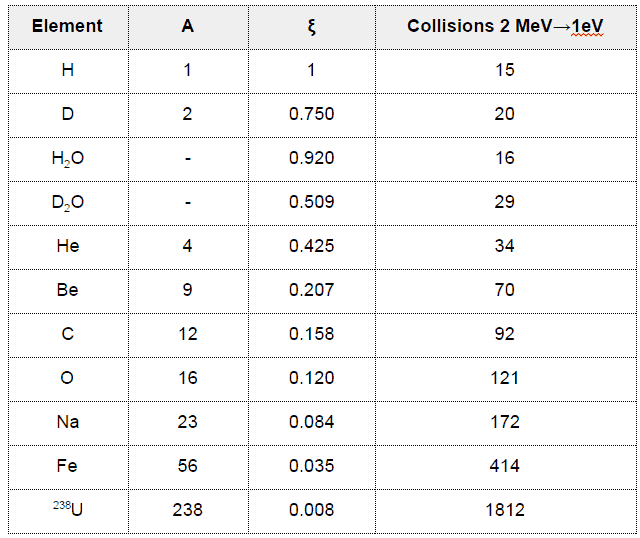
Table of average logarithmic energy decrement for some elements
Table of average logarithmic energy decrement for some elements.

For a mixture of isotopes:

the logarithmic energy decrement for mixtures

Example: Elastic Nuclear Collision
A neutron (n) of mass 1.01 u traveling with a speed of 3.60 x 104m/s interacts with a carbon (C) nucleus (mC = 12.00 u) initially at rest in an elastic head-on collision.

What are the velocities of the neutron and carbon nucleus after the collision?

Solution:

This is an elastic head-on collision of two objects with unequal masses. We have to use the conservation laws of momentum and of kinetic energy, and apply them to our system of two particles.
conservation-laws-elastic-collisions

We can solve this system of equation or we can use the equation derived in previous section. This equation stated that the relative speed of the two objects after the collision has the same magnitude (but opposite direction) as before the collision, no matter what the masses are.
solution-elastic-collision

The minus sign for v’ tells us that the neutron scatters back of the carbon nucleus, because the carbon nucleus is significantly heavier. On the other hand its speed is less than its initial speed. This process is known as the neutron moderation and it significantly depends on the mass of moderator nuclei.

Inelastic Collisions

An inelastic collision is one in which part of the kinetic energy is changed to some other form of energy in the collision. Any macroscopic collision between objects will convert some of the kinetic energy into internal energy and other forms of energy, so no large scale impacts are perfectly elastic. For example, in collisions of common bodies, such as two cars, some energy is always transferred from kinetic energy to other forms of energy, such as thermal energy or energy of sound. The inelastic collision of two bodies always involves a loss in the kinetic energy of the system. The greatest loss occurs if the bodies stick together, in which case the collision is called a completely inelastic collision. Thus, the kinetic energy of the system is not conserved, while the total energy is conserved as required by the general principle of conservation of energy. Momentum is conserved in inelastic collisions, but one cannot track the kinetic energy through the collision since some of it is converted to other forms of energy.

In nuclear physics, an inelastic collision is one in which the incoming particle causes the nucleus it strikes to become excited or to break up. Deep inelastic scattering is a method of probing the structure of subatomic particles in much the same way as Rutherford probed the inside of the atom (see Rutherford scattering).

In nuclear reactors, inelastic collisions are of importance in neutron moderation process. An inelastic scattering plays an important role in slowing down neutrons especially at high energies and by heavy nuclei. Inelastic scattering occurs above a threshold energy. This threshold energy is higher than the energy the first excited state of target nucleus (due to the laws of conservation) and it is given by following formula:

Et = ((A+1)/A)* ε1

where Et is known as the inelastic threshold energy and ε1 is the energy of the first excited state. Therefore especially scattering data of 238U, which is a major component of nuclear fuel in commercial power reactors, are one of the most important data in the neutron transport calculations in the reactor core.

 
Example: Ballistic Pendulum
Ballistic Pendulum
The ballistic pendulum is a kind of “transformer,” exchanging the high speed of a light object (the bullet) for the low speed of a massive object.

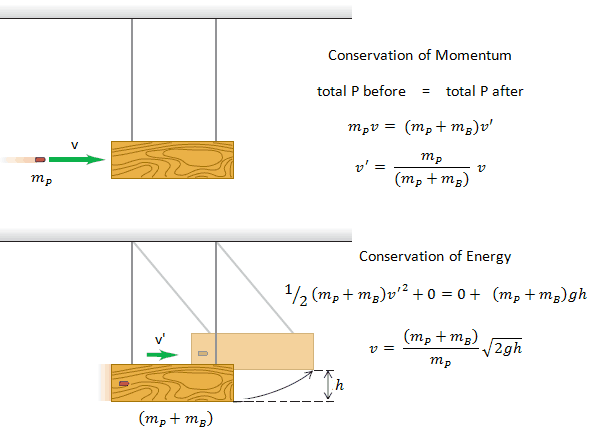
A ballistic pendulum is a device for measuring the velocity of a projectile, such as a bullet. The ballistic pendulum is a kind of “transformer,” exchanging the high speed of a light object (the bullet) for the low speed of a massive object (the block). When a bullet is fired into the block, its momentum is transferred to the block. The bullet’s momentum can be determined from the amplitude of the pendulum swing.

When the bullet is embedding itself in the block, it occurs so quickly that the block does not move appreciably. The supporting strings remain nearly vertical, so negligible external horizontal force acts on the bullet–block system, and the horizontal component of momentum is conserved. Mechanical energy is not conserved during this stage, however, because a nonconservative force does work (the force of friction between bullet and block).

In the second stage, the bullet and block move together. The only forces acting on this system are gravity (a conservative force) and the string tensions (which do no work). Thus, as the block swings, mechanical energy is conserved. Momentum is not conserved during this stage, however, because there is a net external force (the forces of gravity and string tension don’t cancel when the strings are inclined).

Equations governing the ballistic pendulum

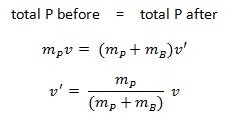
In the first stage momentum is conserved and therefore:

conservation-of-momentum-inelastic

where v is the initial velocity of the projectile of mass mP. v’ is the velocity of the block and embedded projectile (both of mass mP + mB) just after the collision, before they have moved significantly.

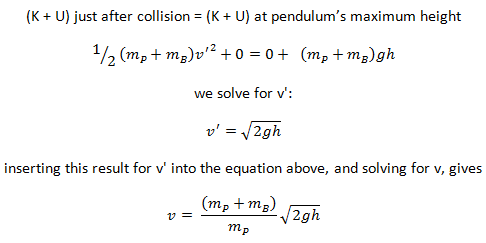
In the second stage mechanical energy is conserved. We choose y = 0 when the pendulum hangs vertically, and then y = h when the block and embedded projectile system reaches its maximum height. The system swings up and comes to rest for an instant at a height y, where its kinetic energy is zero and the potential energy is (mP + mB)gh. Thus we write the law of conservation of energy:

solution-inelastic-collision

which is the initial velocity of the projectile and our final result.

When we use some realistic numbers:

  • mP = 5 g
  • mB = 2 kg
  • h = 3 cm
  • v = ?

then we have:

solution-example

 
References:
Nuclear and Reactor Physics:
  1. J. R. Lamarsh, Introduction to Nuclear Reactor Theory, 2nd ed., Addison-Wesley, Reading, MA (1983).
  2. J. R. Lamarsh, A. J. Baratta, Introduction to Nuclear Engineering, 3d ed., Prentice-Hall, 2001, ISBN: 0-201-82498-1.
  3. W. M. Stacey, Nuclear Reactor Physics, John Wiley & Sons, 2001, ISBN: 0- 471-39127-1.
  4. Glasstone, Sesonske. Nuclear Reactor Engineering: Reactor Systems Engineering, Springer; 4th edition, 1994, ISBN: 978-0412985317
  5. W.S.C. Williams. Nuclear and Particle Physics. Clarendon Press; 1 edition, 1991, ISBN: 978-0198520467
  6. Kenneth S. Krane. Introductory Nuclear Physics, 3rd Edition, Wiley, 1987, ISBN: 978-0471805533
  7. G.R.Keepin. Physics of Nuclear Kinetics. Addison-Wesley Pub. Co; 1st edition, 1965
  8. Robert Reed Burn, Introduction to Nuclear Reactor Operation, 1988.
  9. U.S. Department of Energy, Nuclear Physics and Reactor Theory. DOE Fundamentals Handbook, Volume 1 and 2. January 1993.

Advanced Reactor Physics:

  1. K. O. Ott, W. A. Bezella, Introductory Nuclear Reactor Statics, American Nuclear Society, Revised edition (1989), 1989, ISBN: 0-894-48033-2.
  2. K. O. Ott, R. J. Neuhold, Introductory Nuclear Reactor Dynamics, American Nuclear Society, 1985, ISBN: 0-894-48029-4.
  3. D. L. Hetrick, Dynamics of Nuclear Reactors, American Nuclear Society, 1993, ISBN: 0-894-48453-2.
  4. E. E. Lewis, W. F. Miller, Computational Methods of Neutron Transport, American Nuclear Society, 1993, ISBN: 0-894-48452-4.

See also:

Conservation of Energy

We hope, this article, Conservation of Momentum and Energy in Collisions, helps you. If so, give us a like in the sidebar. Main purpose of this website is to help the public to learn some interesting and important information about materials and their properties.

What is Conservation of Mechanical Energy – Definition

The principle (or Law) of the Conservation of Mechanical Energy was stated: The total mechanical energy of a particle being acted on by only conservative forces is constant. Material Properties

Law of Conservation of Energy in Classical Physics

Conservation of Mechanical Energy

First the principle of the Conservation of Mechanical Energy was stated:

The total mechanical energy (defined as the sum of its potential and kinetic energies) of a particle being acted on by only conservative forces is constant.

conservartion-of-mechanical-energy-exampleAn isolated system is one in which no external force causes energy changes. If only conservative forces act on an object and U is the potential energy function for the total conservative force, then

Emech = U + K

The potential energy, U, depends on the position of an object subjected to a conservative force.

potential-energy-equation

It is defined as the object’s ability to do work and is increased as the object is moved in the opposite direction of the direction of the force.

The potential energy associated with a system consisting of Earth and a nearby particle is gravitational potential energy.

gravitational-potential-energy-equation

The kinetic energy, K, depends on the speed of an object and is the ability of a moving object to do work on other objects when it collides with them.

 K = ½ mv2

The above mentioned definition (Emech = U + K) assumes that the system is free of friction and other non-conservative forces. The difference between a conservative and a non-conservative force is that when a conservative force moves an object from one point to another, the work done by the conservative force is independent of the path.

In any real situation, frictional forces and other non-conservative forces are present, but in many cases their effects on the system are so small that the principle of conservation of mechanical energy can be used as a fair approximation. For example the frictional force is a non-conservative force, because it acts to reduce the mechanical energy in a system.

Note that non-conservative forces do not always reduce the mechanical energy. A non-conservative force changes the mechanical energy, there are forces that increase the total mechanical energy, like the force provided by a motor or engine, is also a non-conservative force.

 
Example of Conservation of Mechanical Energy - Pendulum
conservartion-of-mechanical-energy-pendulumAssume a pendulum (ball of mass m suspended on a string of length L that we have pulled up so that the ball is a height H < L above its lowest point on the arc of its stretched string motion. The pendulum is subjected to the conservative gravitational force where frictional forces like air drag and friction at the pivot are negligible.

We release it from rest. How fast is it going at the bottom?

conservartion-of-mechanical-energy-pendulum2

The pendulum reaches greatest kinetic energy and least potential energy when in the vertical position, because it will have the greatest speed and be nearest the Earth at this point. On the other hand, it will have its least kinetic energy and greatest potential energy at the extreme positions of its swing, because it has zero speed and is farthest from Earth at these points.

If the amplitude is limited to small swings, the period T of a simple pendulum, the time taken for a complete cycle, is:

period-of-pendulum-conservation-of-energy

where L is the length of the pendulum and g is the local acceleration of gravity. For small swings the period of swing is approximately the same for different size swings. That is, the period is independent of amplitude.

The Law of Conservation of Energy – Nonconservative Forces

We now take into account nonconservative forces such as friction, since they are important in real situations. For example, consider again the pendulum, but this time let us include air resistance. The pendulum will slow down, because of friction. In this, and in other natural processes, the mechanical energy (sum of the kinetic and potential energies) does not remain constant but decreases. Because frictional forces reduce the mechanical energy (but not the total energy), they are called nonconservative forces (or dissipative forces). But in the nineteenth-century it was demonstrated the total energy is conserved in any process. In case of pendulum its initial kinetic energy is all transformed into thermal energy.

For each type of force, conservative or nonconservative, it has always been found possible to define a type of energy that corresponds to the work done by such a force. And it has been found experimentally that the total energy E always remains constant. The general law of conservation of energy can be stated as follows:

The total energy E of a system (the sum of its mechanical energy and its internal energies, including thermal energy) can change only by amounts of energy that are transferred to or from the system.

 
References:
Nuclear and Reactor Physics:
  1. J. R. Lamarsh, Introduction to Nuclear Reactor Theory, 2nd ed., Addison-Wesley, Reading, MA (1983).
  2. J. R. Lamarsh, A. J. Baratta, Introduction to Nuclear Engineering, 3d ed., Prentice-Hall, 2001, ISBN: 0-201-82498-1.
  3. W. M. Stacey, Nuclear Reactor Physics, John Wiley & Sons, 2001, ISBN: 0- 471-39127-1.
  4. Glasstone, Sesonske. Nuclear Reactor Engineering: Reactor Systems Engineering, Springer; 4th edition, 1994, ISBN: 978-0412985317
  5. W.S.C. Williams. Nuclear and Particle Physics. Clarendon Press; 1 edition, 1991, ISBN: 978-0198520467
  6. Kenneth S. Krane. Introductory Nuclear Physics, 3rd Edition, Wiley, 1987, ISBN: 978-0471805533
  7. G.R.Keepin. Physics of Nuclear Kinetics. Addison-Wesley Pub. Co; 1st edition, 1965
  8. Robert Reed Burn, Introduction to Nuclear Reactor Operation, 1988.
  9. U.S. Department of Energy, Nuclear Physics and Reactor Theory. DOE Fundamentals Handbook, Volume 1 and 2. January 1993.

Advanced Reactor Physics:

  1. K. O. Ott, W. A. Bezella, Introductory Nuclear Reactor Statics, American Nuclear Society, Revised edition (1989), 1989, ISBN: 0-894-48033-2.
  2. K. O. Ott, R. J. Neuhold, Introductory Nuclear Reactor Dynamics, American Nuclear Society, 1985, ISBN: 0-894-48029-4.
  3. D. L. Hetrick, Dynamics of Nuclear Reactors, American Nuclear Society, 1993, ISBN: 0-894-48453-2.
  4. E. E. Lewis, W. F. Miller, Computational Methods of Neutron Transport, American Nuclear Society, 1993, ISBN: 0-894-48452-4.

See also:

Conservation of Energy

We hope, this article, Conservation of Mechanical Energy, helps you. If so, give us a like in the sidebar. Main purpose of this website is to help the public to learn some interesting and important information about materials and their properties.
What is Conservation of Momentum and Energy – Definition

The assumption of conservation of momentum and the conservation of kinetic energy makes possible the calculation of the final velocities in two-body collisions. Material Properties

Conservation of Momentum and Energy

The law of conservation of energy is one of the basic laws of physics along with the conservation of mass and the conservation of momentum. The law of conservation of energy states that energy can change from one form into another, but it cannot be created or destroyed. Or the general definition is:

The total energy of an isolated system remains constant over time.

law of conservation of energy - pendulum
Newton’s cradle. A device that demonstrates the Law of Conservation of Mechanical Energy and Momentum.

Energy can be defined as the capacity for doing work. It may exist in a variety of forms and may be transformed from one type of energy to another in hundreds of ways.

For example, burning gasoline to power cars is an energy conversion process we rely on. The chemical energy in gasoline is converted to thermal energy, which is then converted to mechanical energy that makes the car move. The mechanical energy has been converted to kinetic energy. When we use the brakes to stop a car, that kinetic energy is converted by friction back to heat, or thermal energy.

A consequence of the law of conservation of energy is that a perpetual motion machine of the first kind, which produces work without the input of energy, cannot exist.

Conservation of Mechanical Energy

First the principle of the Conservation of Mechanical Energy was stated:

The total mechanical energy (defined as the sum of its potential and kinetic energies) of a particle being acted on by only conservative forces is constant.

conservartion-of-mechanical-energy-exampleAn isolated system is one in which no external force causes energy changes. If only conservative forces act on an object and U is the potential energy function for the total conservative force, then

Emech = U + K

The potential energy, U, depends on the position of an object subjected to a conservative force.

potential-energy-equation

It is defined as the object’s ability to do work and is increased as the object is moved in the opposite direction of the direction of the force.

The potential energy associated with a system consisting of Earth and a nearby particle is gravitational potential energy.

gravitational-potential-energy-equation

The kinetic energy, K, depends on the speed of an object and is the ability of a moving object to do work on other objects when it collides with them.

 K = ½ mv2

The above mentioned definition (Emech = U + K) assumes that the system is free of friction and other non-conservative forces. The difference between a conservative and a non-conservative force is that when a conservative force moves an object from one point to another, the work done by the conservative force is independent of the path.

In any real situation, frictional forces and other non-conservative forces are present, but in many cases their effects on the system are so small that the principle of conservation of mechanical energy can be used as a fair approximation. For example the frictional force is a non-conservative force, because it acts to reduce the mechanical energy in a system.

Note that non-conservative forces do not always reduce the mechanical energy. A non-conservative force changes the mechanical energy, there are forces that increase the total mechanical energy, like the force provided by a motor or engine, is also a non-conservative force.

 
Example of Conservation of Mechanical Energy - Pendulum
conservartion-of-mechanical-energy-pendulumAssume a pendulum (ball of mass m suspended on a string of length L that we have pulled up so that the ball is a height H < L above its lowest point on the arc of its stretched string motion. The pendulum is subjected to the conservative gravitational force where frictional forces like air drag and friction at the pivot are negligible.

We release it from rest. How fast is it going at the bottom?

conservartion-of-mechanical-energy-pendulum2

The pendulum reaches greatest kinetic energy and least potential energy when in the vertical position, because it will have the greatest speed and be nearest the Earth at this point. On the other hand, it will have its least kinetic energy and greatest potential energy at the extreme positions of its swing, because it has zero speed and is farthest from Earth at these points.

If the amplitude is limited to small swings, the period T of a simple pendulum, the time taken for a complete cycle, is:

period-of-pendulum-conservation-of-energy

where L is the length of the pendulum and g is the local acceleration of gravity. For small swings the period of swing is approximately the same for different size swings. That is, the period is independent of amplitude.

Conservation of Momentum and Energy in Collisions

The use of the conservation laws for momentum and energy is very important also in particle collisions. This is a very powerful rule because it can allow us to determine the results of a collision without knowing the details of the collision. The law of conservation of momentum states that in the collision of two objects such as billiard balls, the total momentum is conserved. The assumption of conservation of momentum as well as the conservation of kinetic energy makes possible the calculation of the final velocities in two-body collisions. At this point we have to distinguish between two types of collisions:

  • Elastic collisions
  • Inelastic collisions

Elastic Collisions

A perfectly elastic collision is defined as one in which there is no net conversion of kinetic energy into other forms (such as heat or noise). For the brief moment during which the two objects are in contact, some (or all) of the energy is stored momentarily in the form of elastic potential energy. But if we compare the total kinetic energy just before the collision with the total kinetic energy just after the collision, and they are found to be the same, then we say that the total kinetic energy is conserved.

[xyz-ihs snippet=”collisions”]
  • Some large-scale interactions like the slingshot type gravitational interactions (also known as a planetary swing-by or a gravity-assist manoeuvre) between satellites and planets are perfectly elastic.
  • Collisions between very hard spheres may be nearly elastic, so it is useful to calculate the limiting case of an elastic collision.
  • Collisions in ideal gases approach perfectly elastic collisions, as do scattering interactions of sub-atomic particles which are deflected by the electromagnetic force.
  • Rutherford scattering is the elastic scattering of charged particles also by the electromagnetic force.
  • A neutron-nucleus scattering reaction may be also elastic, but in this case the neutron is deflected by the strong nuclear force.
 
Equations of Conservation of Momentum and Energy
Let us assume the one dimensional elastic collision of two objects, the object A and the object B. These two objects are moving with velocities vA and vB along the x axis before the collision. After the collision, their velocities are v’A and v’B. The conservation of the total momentum demands that the total momentum before the collision is the same as the total momentum after the collision. Likewise, the conservation of the total kinetic energy, which demands that the total kinetic energy of both objects before the collision is the same as the total kinetic energy after the collision. Both law may be expressed in equations as:

equations-of-conservation-of-momentum-energy

solution-conservation-of-momentum-energy

The relative speed of the two objects after the collision has the same magnitude (but opposite direction) as before the collision, no matter what the masses are.

Elastic Nuclear Collision
See also: Neutron Moderators

It is known the fission neutrons are of importance in any chain-reacting system. All neutrons produced by fission are born as fast neutrons with high kinetic energy. Before such neutrons can efficiently cause additional fissions, they must be slowed down by collisions with nuclei in the moderator of the reactor. The probability of the fission U-235 becomes very large at the thermal energies of slow neutrons. This fact implies increase of multiplication factor of the reactor (i.e. lower fuel enrichment is needed to sustain chain reaction).

The neutrons released during fission with an average energy of 2 MeV in a reactor on average undergo a number of collisions (elastic or inelastic) before they are absorbed. During the scattering reaction, a fraction of the neutron’s kinetic energy is transferred to the nucleus. Using the laws of conservation of momentum and energy and the analogy of collisions of billiard balls for elastic scattering, it is possible to derive the following equation for the mass of target or moderator nucleus (M), energy of incident neutron (Ei) and the energy of scattered neutron (Es).

equation momentum energy

where A is the atomic mass number.In case of the hydrogen (A = 1) as the target nucleus, the incident neutron can be completely stopped. But this works when the direction of the neutron is completely reversed (i.e. scattered at 180°). In reality, the direction of scattering ranges from 0 to 180 ° and the energy transferred also ranges from 0% to maximum. Therefore, the average energy of scattered neutron is taken as the average of energies with scattering angle 0 and 180°.

Moreover, it is useful to work with logarithmic quantities and therefore one defines the logarithmic energy decrement per collision (ξ) as a key material constant describing energy transfers during a neutron slowing down. ξ is not dependent on energy, only on A and is defined as follows:logarithmic energy decrement - equationFor heavy target nuclei, ξ may be approximated by following formula:the logarithmic energy decrement per collisionFrom these equations it is easy to determine the number of collisions required to slow down a neutron from, for example from 2 MeV to 1 eV.

Example: Determine the number of collisions required for thermalization for the 2 MeV neutron in the carbon.

ξCARBON = 0.158

N(2MeV → 1eV) = ln 2⋅106/ξ =14.5/0.158 = 92

Table of average logarithmic energy decrement for some elements
Table of average logarithmic energy decrement for some elements.

For a mixture of isotopes:

the logarithmic energy decrement for mixtures

Example: Elastic Nuclear Collision
A neutron (n) of mass 1.01 u traveling with a speed of 3.60 x 104m/s interacts with a carbon (C) nucleus (mC = 12.00 u) initially at rest in an elastic head-on collision.

What are the velocities of the neutron and carbon nucleus after the collision?

Solution:

This is an elastic head-on collision of two objects with unequal masses. We have to use the conservation laws of momentum and of kinetic energy, and apply them to our system of two particles.

conservation-laws-elastic-collisions

We can solve this system of equation or we can use the equation derived in previous section. This equation stated that the relative speed of the two objects after the collision has the same magnitude (but opposite direction) as before the collision, no matter what the masses are.

solution-elastic-collision

The minus sign for v’ tells us that the neutron scatters back of the carbon nucleus, because the carbon nucleus is significantly heavier. On the other hand its speed is less than its initial speed. This process is known as the neutron moderation and it significantly depends on the mass of moderator nuclei.

Inelastic Collisions

An inelastic collision is one in which part of the kinetic energy is changed to some other form of energy in the collision. Any macroscopic collision between objects will convert some of the kinetic energy into internal energy and other forms of energy, so no large scale impacts are perfectly elastic. For example, in collisions of common bodies, such as two cars, some energy is always transferred from kinetic energy to other forms of energy, such as thermal energy or energy of sound. The inelastic collision of two bodies always involves a loss in the kinetic energy of the system. The greatest loss occurs if the bodies stick together, in which case the collision is called a completely inelastic collision. Thus, the kinetic energy of the system is not conserved, while the total energy is conserved as required by the general principle of conservation of energy. Momentum is conserved in inelastic collisions, but one cannot track the kinetic energy through the collision since some of it is converted to other forms of energy.

In nuclear physics, an inelastic collision is one in which the incoming particle causes the nucleus it strikes to become excited or to break up. Deep inelastic scattering is a method of probing the structure of subatomic particles in much the same way as Rutherford probed the inside of the atom (see Rutherford scattering).

In nuclear reactors, inelastic collisions are of importance in neutron moderation process. An inelastic scattering plays an important role in slowing down neutrons especially at high energies and by heavy nuclei. Inelastic scattering occurs above a threshold energy. This threshold energy is higher than the energy the first excited state of target nucleus (due to the laws of conservation) and it is given by following formula:

Et = ((A+1)/A)* ε1

where Et is known as the inelastic threshold energy and ε1 is the energy of the first excited state. Therefore especially scattering data of 238U, which is a major component of nuclear fuel in commercial power reactors, are one of the most important data in the neutron transport calculations in the reactor core.

 
Example: Ballistic Pendulum
Ballistic Pendulum
The ballistic pendulum is a kind of “transformer,” exchanging the high speed of a light object (the bullet) for the low speed of a massive object.

A ballistic pendulum is a device for measuring the velocity of a projectile, such as a bullet. The ballistic pendulum is a kind of “transformer,” exchanging the high speed of a light object (the bullet) for the low speed of a massive object (the block). When a bullet is fired into the block, its momentum is transferred to the block. The bullet’s momentum can be determined from the amplitude of the pendulum swing.

When the bullet is embedding itself in the block, it occurs so quickly that the block does not move appreciably. The supporting strings remain nearly vertical, so negligible external horizontal force acts on the bullet–block system, and the horizontal component of momentum is conserved. Mechanical energy is not conserved during this stage, however, because a nonconservative force does work (the force of friction between bullet and block).

In the second stage, the bullet and block move together. The only forces acting on this system are gravity (a conservative force) and the string tensions (which do no work). Thus, as the block swings, mechanical energy is conserved. Momentum is not conserved during this stage, however, because there is a net external force (the forces of gravity and string tension don’t cancel when the strings are inclined).

Equations governing the ballistic pendulum

In the first stage momentum is conserved and therefore:

conservation-of-momentum-inelastic

where v is the initial velocity of the projectile of mass mP. v’ is the velocity of the block and embedded projectile (both of mass mP + mB) just after the collision, before they have moved significantly.

In the second stage mechanical energy is conserved. We choose y = 0 when the pendulum hangs vertically, and then y = h when the block and embedded projectile system reaches its maximum height. The system swings up and comes to rest for an instant at a height y, where its kinetic energy is zero and the potential energy is (mP + mB)gh. Thus we write the law of conservation of energy:

solution-inelastic-collision

which is the initial velocity of the projectile and our final result.

When we use some realistic numbers:

  • mP = 5 g
  • mB = 2 kg
  • h = 3 cm
  • v = ?

then we have:

solution-example

 
References:
Nuclear and Reactor Physics:
  1. J. R. Lamarsh, Introduction to Nuclear Reactor Theory, 2nd ed., Addison-Wesley, Reading, MA (1983).
  2. J. R. Lamarsh, A. J. Baratta, Introduction to Nuclear Engineering, 3d ed., Prentice-Hall, 2001, ISBN: 0-201-82498-1.
  3. W. M. Stacey, Nuclear Reactor Physics, John Wiley & Sons, 2001, ISBN: 0- 471-39127-1.
  4. Glasstone, Sesonske. Nuclear Reactor Engineering: Reactor Systems Engineering, Springer; 4th edition, 1994, ISBN: 978-0412985317
  5. W.S.C. Williams. Nuclear and Particle Physics. Clarendon Press; 1 edition, 1991, ISBN: 978-0198520467
  6. Kenneth S. Krane. Introductory Nuclear Physics, 3rd Edition, Wiley, 1987, ISBN: 978-0471805533
  7. G.R.Keepin. Physics of Nuclear Kinetics. Addison-Wesley Pub. Co; 1st edition, 1965
  8. Robert Reed Burn, Introduction to Nuclear Reactor Operation, 1988.
  9. U.S. Department of Energy, Nuclear Physics and Reactor Theory. DOE Fundamentals Handbook, Volume 1 and 2. January 1993.

Advanced Reactor Physics:

  1. K. O. Ott, W. A. Bezella, Introductory Nuclear Reactor Statics, American Nuclear Society, Revised edition (1989), 1989, ISBN: 0-894-48033-2.
  2. K. O. Ott, R. J. Neuhold, Introductory Nuclear Reactor Dynamics, American Nuclear Society, 1985, ISBN: 0-894-48029-4.
  3. D. L. Hetrick, Dynamics of Nuclear Reactors, American Nuclear Society, 1993, ISBN: 0-894-48453-2.
  4. E. E. Lewis, W. F. Miller, Computational Methods of Neutron Transport, American Nuclear Society, 1993, ISBN: 0-894-48452-4.

See also:

Conservation of Energy

We hope, this article, Conservation of Momentum and Energy, helps you. If so, give us a like in the sidebar. Main purpose of this website is to help the public to learn some interesting and important information about materials and their properties.

What is Law of Conservation of Energy – Example – Definition

The law of conservation of energy is one of the basic laws of physics. This page offers many examples of the law of conservation of energy. Material Properties

Law of Conservation of Energy

The law of conservation of energy is one of the basic laws of physics along with the conservation of mass and the conservation of momentum. The law of conservation of energy states that energy can change from one form into another, but it cannot be created or destroyed. Or the general definition is:

The total energy of an isolated system remains constant over time.

law of conservation of energy - pendulum
Newton’s cradle. A device that demonstrates the Law of Conservation of Mechanical Energy and Momentum.

Energy can be defined as the capacity for doing work. It may exist in a variety of forms and may be transformed from one type of energy to another in hundreds of ways.

For example, burning gasoline to power cars is an energy conversion process we rely on. The chemical energy in gasoline is converted to thermal energy, which is then converted to mechanical energy that makes the car move. The mechanical energy has been converted to kinetic energy. When we use the brakes to stop a car, that kinetic energy is converted by friction back to heat, or thermal energy.

A consequence of the law of conservation of energy is that a perpetual motion machine of the first kind, which produces work without the input of energy, cannot exist.

Example: Conservation of Mechanical Energy

 
Example of Conservation of Mechanical Energy - Pendulum
conservartion-of-mechanical-energy-pendulumAssume a pendulum (ball of mass m suspended on a string of length L that we have pulled up so that the ball is a height H < L above its lowest point on the arc of its stretched string motion. The pendulum is subjected to the conservative gravitational force where frictional forces like air drag and friction at the pivot are negligible.

We release it from rest. How fast is it going at the bottom?

conservartion-of-mechanical-energy-pendulum2

The pendulum reaches greatest kinetic energy and least potential energy when in the vertical position, because it will have the greatest speed and be nearest the Earth at this point. On the other hand, it will have its least kinetic energy and greatest potential energy at the extreme positions of its swing, because it has zero speed and is farthest from Earth at these points.

If the amplitude is limited to small swings, the period T of a simple pendulum, the time taken for a complete cycle, is:

period-of-pendulum-conservation-of-energy

where L is the length of the pendulum and g is the local acceleration of gravity. For small swings the period of swing is approximately the same for different size swings. That is, the period is independent of amplitude.

Example: Elastic Collisions

 
Example: Elastic Nuclear Collision
A neutron (n) of mass 1.01 u traveling with a speed of 3.60 x 104m/s interacts with a carbon (C) nucleus (mC = 12.00 u) initially at rest in an elastic head-on collision.

What are the velocities of the neutron and carbon nucleus after the collision?

Solution:

This is an elastic head-on collision of two objects with unequal masses. We have to use the conservation laws of momentum and of kinetic energy, and apply them to our system of two particles.

conservation-laws-elastic-collisions

We can solve this system of equation or we can use the equation derived in previous section. This equation stated that the relative speed of the two objects after the collision has the same magnitude (but opposite direction) as before the collision, no matter what the masses are.

solution-elastic-collision

The minus sign for v’ tells us that the neutron scatters back of the carbon nucleus, because the carbon nucleus is significantly heavier. On the other hand its speed is less than its initial speed. This process is known as the neutron moderation and it significantly depends on the mass of moderator nuclei.

Example: Inelastic Collisions

 
Example: Ballistic Pendulum
Ballistic Pendulum
The ballistic pendulum is a kind of “transformer,” exchanging the high speed of a light object (the bullet) for the low speed of a massive object.

A ballistic pendulum is a device for measuring the velocity of a projectile, such as a bullet. The ballistic pendulum is a kind of “transformer,” exchanging the high speed of a light object (the bullet) for the low speed of a massive object (the block). When a bullet is fired into the block, its momentum is transferred to the block. The bullet’s momentum can be determined from the amplitude of the pendulum swing.

When the bullet is embedding itself in the block, it occurs so quickly that the block does not move appreciably. The supporting strings remain nearly vertical, so negligible external horizontal force acts on the bullet–block system, and the horizontal component of momentum is conserved. Mechanical energy is not conserved during this stage, however, because a nonconservative force does work (the force of friction between bullet and block).

In the second stage, the bullet and block move together. The only forces acting on this system are gravity (a conservative force) and the string tensions (which do no work). Thus, as the block swings, mechanical energy is conserved. Momentum is not conserved during this stage, however, because there is a net external force (the forces of gravity and string tension don’t cancel when the strings are inclined).

Equations governing the ballistic pendulum

In the first stage momentum is conserved and therefore:

conservation-of-momentum-inelastic

where v is the initial velocity of the projectile of mass mP. v’ is the velocity of the block and embedded projectile (both of mass mP + mB) just after the collision, before they have moved significantly.

In the second stage mechanical energy is conserved. We choose y = 0 when the pendulum hangs vertically, and then y = h when the block and embedded projectile system reaches its maximum height. The system swings up and comes to rest for an instant at a height y, where its kinetic energy is zero and the potential energy is (mP + mB)gh. Thus we write the law of conservation of energy:

solution-inelastic-collision

which is the initial velocity of the projectile and our final result.

When we use some realistic numbers:

  • mP = 5 g
  • mB = 2 kg
  • h = 3 cm
  • v = ?

then we have:

solution-example

Conservation of Energy in Chemical Reactions

Example: Combustion of Hydrogen

Combustion of Hydrogen
In a flame of pure hydrogen gas, burning in air, the hydrogen (H2) reacts with oxygen (O2) to form water (H2O) and releases energy.

Consider the combustion of hydrogen in air. In a flame of pure hydrogen gas, burning in air, the hydrogen (H2) reacts with oxygen (O2) to form water (H2O) and releases energy.

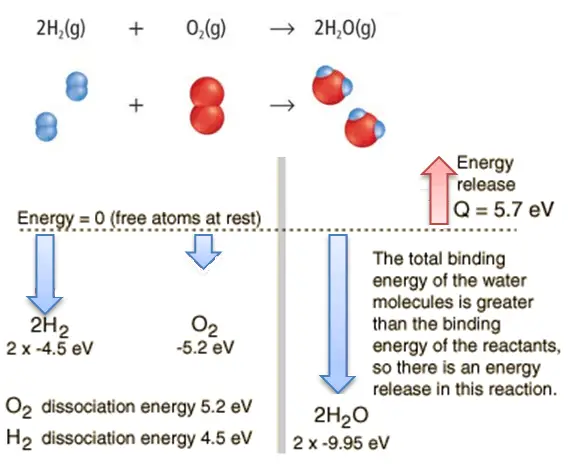
Energetically, the process can be considered to require the energy to dissociate the H2 and O2, but then the bonding of the H2O returns the system to a bound state with negative potential. It is actually more negative than the bound states of the reactants, and the formation of the two water molecules is therefore an exothermic reaction, which releases 5.7 eV of energy.

2H2(g) + O2(g) → 2H2O(g)

The balance of energy before and after the reaction can be illustrated schematically with the state in which all atoms are free taken as the reference for energy.

Example: Law of Conservation of Mass-Energy – Mass-Energy Equivalence

 
Example: Mass defect of a 63Cu
Calculate the mass defect of a 63Cu nucleus if the actual mass of 63Cu in its nuclear ground state is 62.91367 u.

63Cu nucleus has 29 protons and also has (63 – 29) 34 neutrons.

The mass of a proton is 1.00728 u and a neutron is 1.00867 u.

The combined mass is: 29 protons x (1.00728 u/proton) + 34 neutrons x (1.00867 u/neutron) = 63.50590 u

The mass defect is Δm = 63.50590 u – 62.91367 u =  0.59223 u

Convert the mass defect into energy (nuclear binding energy).

(0.59223 u/nucleus) x (1.6606 x 10⁻²⁷ kg/u) = 9.8346 x 10⁻²⁸ kg/nucleus

ΔE = Δmc2

ΔE = (9.8346 x 10⁻²⁸ kg/nucleus) x (2.9979 x 10⁸ m/s)2 = 8.8387 x 10⁻¹¹ J/nucleus

The energy calculated in the previous example is the nuclear binding energy.  However, the nuclear binding energy may be expressed as kJ/mol (for better understanding).

Calculate the nuclear binding energy of 1 mole of 63Cu:

(8.8387 x 10⁻¹¹ J/nucleus) x (1 kJ/1000 J) x (6.022 x 10²³ nuclei/mol) = 5.3227 x 10¹⁰ kJ/mol of nuclei.

One mole of 63Cu (~63 grams) is bound by the nuclear binding energy (5.3227 x 10¹⁰ kJ/mol) which is equivalent to:

  • 14.8 million kilowatt-hours (≈ 15 GW·h)
  • 336,100 US gallons of automotive gasoline
Example: Mass defect of the reactor core
Calculate the mass defect of the 3000MWth reactor core after one year of operation.

It is known the average recoverable energy per fission is about 200 MeV, being the total energy minus the energy of the energy of antineutrinos that are radiated away.

The reaction rate per entire 3000MWth reactor core is about  9.33×10¹⁹ fissions / second.

The overall energy release in the units of joules is:

200×106 (eV) x 1.602×10⁻¹⁹ (J/eV) x 9.33×10¹⁹ (s-1) x 31.5×106 (seconds in year) = 9.4×10¹⁶ J/year

The mass defect is calculated as:

Δm = ΔE/c2

Δm = 9.4×10¹⁶ / (2.9979 x 10⁸)2 = 1.046 kg

That means in a typical 3000MWth reactor core about 1 kilogram of matter is converted into pure energy.

Note that, a typical annual uranium load for a 3000MWth reactor core is about 20 tonnes of enriched uranium (i.e. about 22.7 tonnes of UO2). Entire reactor core may contain about 80 tonnes of enriched uranium.

Mass defect directly from E=mc2

The mass defect can be calculated directly from the Einstein relationship (E = mc2) as:

Δm = ΔE/c2

Δm = 3000×106 (W = J/s) x 31.5×10⁶ (seconds in year) / (2.9979 x 10⁸)2 = 1,051 kg

Example: Conservation of Energy in Nuclear Reactions

 
Example: Exothermic Reaction - DT Fusion
Q-value of DT fusion reaction

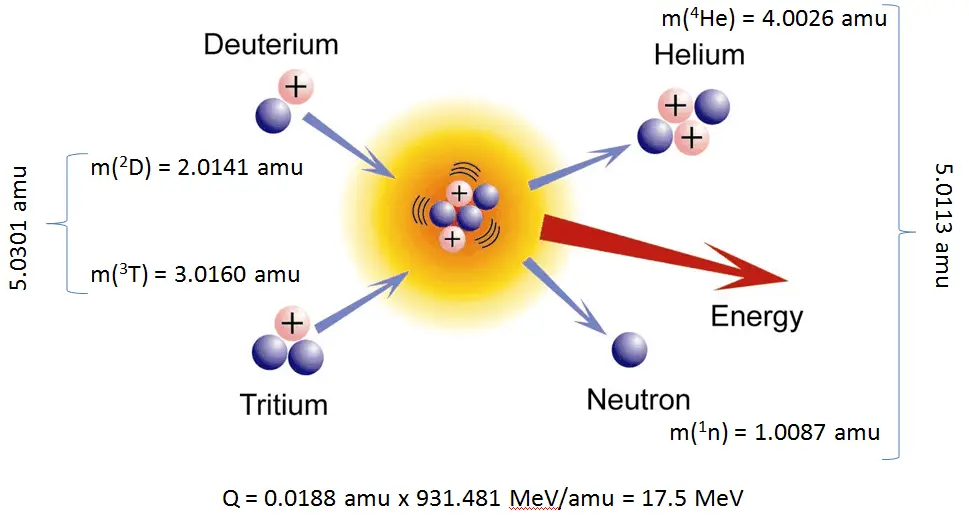
The DT fusion reaction of deuterium and tritium is particularly interesting because of its potential of providing energy for the future. Calculate the reaction Q-value.

3T (d, n) 4He

The atom masses of the reactants and products are:

m(3T) = 3.0160 amu

m(2D) = 2.0141 amu

m(1n) = 1.0087 amu

m(4He) = 4.0026 amu

Using the mass-energy equivalence, we get the Q-value of this reaction as:

Q = {(3.0160+2.0141) [amu] – (1.0087+4.0026) [amu]} x 931.481 [MeV/amu]

= 0.0188 x 931.481 = 17.5 MeV

Example: Endothermic Reaction - Photoneutrons
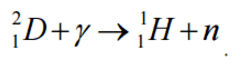
In nuclear reactors the gamma radiation plays a significant role also in reactor kinetics and in a subcriticality control. Especially in nuclear reactors with D2O moderator (CANDU reactors) or with Be reflectors (some experimental reactors). Neutrons can be produced also in (γ, n) reactions and therefore they are usually referred to as photoneutrons.

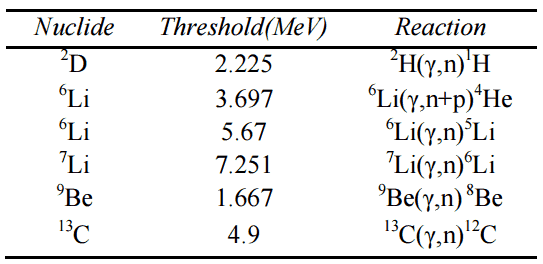
A high energy photon (gamma ray) can under certain conditions eject a neutron from a nucleus. It occurs when its energy exceeds the binding energy of the neutron in the nucleus. Most nuclei have binding energies in excess of 6 MeV, which is above the energy of most gamma rays from fission. On the other hand there are few nuclei with sufficiently low binding energy to be of practical interest. These are: 2D, 9Be, 6Li, 7Li and 13C. As can be seen from the table the lowest threshold have 9Be with 1.666 MeV and 2D with 2.226 MeV.

Photoneutron sources
Nuclides with low photodisintegration
threshold energies.

In case of deuterium, neutrons can be produced by the interaction of gamma rays (with a minimum energy of 2.22 MeV) with deuterium:

Photoneutron - deuterium

The reaction Q-value is calculated below:

The atom masses of the reactant and products are:

m(2D) = 2.01363 amu

m(1n) = 1.00866 amu

m(1H) = 1.00728 amu

Using the mass-energy equivalence, we get the Q-value of this reaction as:

Q = {2.01363 [amu] – (1.00866+1.00728) [amu]} x 931.481 [MeV/amu]

= -0.00231 x 931.481 = -2.15 MeV

 
References:
Nuclear and Reactor Physics:
  1. J. R. Lamarsh, Introduction to Nuclear Reactor Theory, 2nd ed., Addison-Wesley, Reading, MA (1983).
  2. J. R. Lamarsh, A. J. Baratta, Introduction to Nuclear Engineering, 3d ed., Prentice-Hall, 2001, ISBN: 0-201-82498-1.
  3. W. M. Stacey, Nuclear Reactor Physics, John Wiley & Sons, 2001, ISBN: 0- 471-39127-1.
  4. Glasstone, Sesonske. Nuclear Reactor Engineering: Reactor Systems Engineering, Springer; 4th edition, 1994, ISBN: 978-0412985317
  5. W.S.C. Williams. Nuclear and Particle Physics. Clarendon Press; 1 edition, 1991, ISBN: 978-0198520467
  6. Kenneth S. Krane. Introductory Nuclear Physics, 3rd Edition, Wiley, 1987, ISBN: 978-0471805533
  7. G.R.Keepin. Physics of Nuclear Kinetics. Addison-Wesley Pub. Co; 1st edition, 1965
  8. Robert Reed Burn, Introduction to Nuclear Reactor Operation, 1988.
  9. U.S. Department of Energy, Nuclear Physics and Reactor Theory. DOE Fundamentals Handbook, Volume 1 and 2. January 1993.

Advanced Reactor Physics:

  1. K. O. Ott, W. A. Bezella, Introductory Nuclear Reactor Statics, American Nuclear Society, Revised edition (1989), 1989, ISBN: 0-894-48033-2.
  2. K. O. Ott, R. J. Neuhold, Introductory Nuclear Reactor Dynamics, American Nuclear Society, 1985, ISBN: 0-894-48029-4.
  3. D. L. Hetrick, Dynamics of Nuclear Reactors, American Nuclear Society, 1993, ISBN: 0-894-48453-2.
  4. E. E. Lewis, W. F. Miller, Computational Methods of Neutron Transport, American Nuclear Society, 1993, ISBN: 0-894-48452-4.

See also:

Conservation of Energy

We hope, this article, Law of Conservation of Energy – Example, helps you. If so, give us a like in the sidebar. Main purpose of this website is to help the public to learn some interesting and important information about materials and their properties.
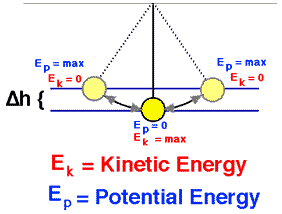
What is Conservation of Energy – Formula – Equation – Definition

Conservation of Energy – Formula – Equation. The total kinetic energy of both objects before the collision is the same as the total kinetic energy after the collision. Both law may be expressed in equations as. Material Properties

Law of Conservation of Energy

The law of conservation of energy is one of the basic laws of physics along with the conservation of mass and the conservation of momentum. The law of conservation of energy states that energy can change from one form into another, but it cannot be created or destroyed. Or the general definition is:

The total energy of an isolated system remains constant over time.

law of conservation of energy - pendulum
Newton’s cradle. A device that demonstrates the Law of Conservation of Mechanical Energy and Momentum.

Energy can be defined as the capacity for doing work. It may exist in a variety of forms and may be transformed from one type of energy to another in hundreds of ways.

For example, burning gasoline to power cars is an energy conversion process we rely on. The chemical energy in gasoline is converted to thermal energy, which is then converted to mechanical energy that makes the car move. The mechanical energy has been converted to kinetic energy. When we use the brakes to stop a car, that kinetic energy is converted by friction back to heat, or thermal energy.

A consequence of the law of conservation of energy is that a perpetual motion machine of the first kind, which produces work without the input of energy, cannot exist.

Conservation of Energy – Formula – Equation

Let us assume the one dimensional elastic collision of two objects, the object A and the object B. These two objects are moving with velocities vA and vB along the x axis before the collision. After the collision, their velocities are v’A and v’B. The conservation of the total momentum demands that the total momentum before the collision is the same as the total momentum after the collision. Likewise, the conservation of the total kinetic energy, which demands that the total kinetic energy of both objects before the collision is the same as the total kinetic energy after the collision. Both law may be expressed in equations as:

equations-of-conservation-of-momentum-energy

solution-conservation-of-momentum-energy

The relative speed of the two objects after the collision has the same magnitude (but opposite direction) as before the collision, no matter what the masses are.

 
Elastic Nuclear Collision
See also: Neutron Moderators

It is known the fission neutrons are of importance in any chain-reacting system. All neutrons produced by fission are born as fast neutrons with high kinetic energy. Before such neutrons can efficiently cause additional fissions, they must be slowed down by collisions with nuclei in the moderator of the reactor. The probability of the fission U-235 becomes very large at the thermal energies of slow neutrons. This fact implies increase of multiplication factor of the reactor (i.e. lower fuel enrichment is needed to sustain chain reaction).

The neutrons released during fission with an average energy of 2 MeV in a reactor on average undergo a number of collisions (elastic or inelastic) before they are absorbed. During the scattering reaction, a fraction of the neutron’s kinetic energy is transferred to the nucleus. Using the laws of conservation of momentum and energy and the analogy of collisions of billiard balls for elastic scattering, it is possible to derive the following equation for the mass of target or moderator nucleus (M), energy of incident neutron (Ei) and the energy of scattered neutron (Es).

equation momentum energy

where A is the atomic mass number.In case of the hydrogen (A = 1) as the target nucleus, the incident neutron can be completely stopped. But this works when the direction of the neutron is completely reversed (i.e. scattered at 180°). In reality, the direction of scattering ranges from 0 to 180 ° and the energy transferred also ranges from 0% to maximum. Therefore, the average energy of scattered neutron is taken as the average of energies with scattering angle 0 and 180°.

Moreover, it is useful to work with logarithmic quantities and therefore one defines the logarithmic energy decrement per collision (ξ) as a key material constant describing energy transfers during a neutron slowing down. ξ is not dependent on energy, only on A and is defined as follows:logarithmic energy decrement - equationFor heavy target nuclei, ξ may be approximated by following formula:the logarithmic energy decrement per collisionFrom these equations it is easy to determine the number of collisions required to slow down a neutron from, for example from 2 MeV to 1 eV.

Example: Determine the number of collisions required for thermalization for the 2 MeV neutron in the carbon.

ξCARBON = 0.158

N(2MeV → 1eV) = ln 2⋅106/ξ =14.5/0.158 = 92

Table of average logarithmic energy decrement for some elements
Table of average logarithmic energy decrement for some elements.

For a mixture of isotopes:

the logarithmic energy decrement for mixtures

Example: Elastic Nuclear Collision
A neutron (n) of mass 1.01 u traveling with a speed of 3.60 x 104m/s interacts with a carbon (C) nucleus (mC = 12.00 u) initially at rest in an elastic head-on collision.

What are the velocities of the neutron and carbon nucleus after the collision?

Solution:

This is an elastic head-on collision of two objects with unequal masses. We have to use the conservation laws of momentum and of kinetic energy, and apply them to our system of two particles.

conservation-laws-elastic-collisions

We can solve this system of equation or we can use the equation derived in previous section. This equation stated that the relative speed of the two objects after the collision has the same magnitude (but opposite direction) as before the collision, no matter what the masses are.

solution-elastic-collision

The minus sign for v’ tells us that the neutron scatters back of the carbon nucleus, because the carbon nucleus is significantly heavier. On the other hand its speed is less than its initial speed. This process is known as the neutron moderation and it significantly depends on the mass of moderator nuclei.

 
Example of Conservation of Mechanical Energy - Pendulum
conservartion-of-mechanical-energy-pendulumAssume a pendulum (ball of mass m suspended on a string of length L that we have pulled up so that the ball is a height H < L above its lowest point on the arc of its stretched string motion. The pendulum is subjected to the conservative gravitational force where frictional forces like air drag and friction at the pivot are negligible.

We release it from rest. How fast is it going at the bottom?

conservartion-of-mechanical-energy-pendulum2

The pendulum reaches greatest kinetic energy and least potential energy when in the vertical position, because it will have the greatest speed and be nearest the Earth at this point. On the other hand, it will have its least kinetic energy and greatest potential energy at the extreme positions of its swing, because it has zero speed and is farthest from Earth at these points.

If the amplitude is limited to small swings, the period T of a simple pendulum, the time taken for a complete cycle, is:

period-of-pendulum-conservation-of-energy

where L is the length of the pendulum and g is the local acceleration of gravity. For small swings the period of swing is approximately the same for different size swings. That is, the period is independent of amplitude.

 
References:
Nuclear and Reactor Physics:
  1. J. R. Lamarsh, Introduction to Nuclear Reactor Theory, 2nd ed., Addison-Wesley, Reading, MA (1983).
  2. J. R. Lamarsh, A. J. Baratta, Introduction to Nuclear Engineering, 3d ed., Prentice-Hall, 2001, ISBN: 0-201-82498-1.
  3. W. M. Stacey, Nuclear Reactor Physics, John Wiley & Sons, 2001, ISBN: 0- 471-39127-1.
  4. Glasstone, Sesonske. Nuclear Reactor Engineering: Reactor Systems Engineering, Springer; 4th edition, 1994, ISBN: 978-0412985317
  5. W.S.C. Williams. Nuclear and Particle Physics. Clarendon Press; 1 edition, 1991, ISBN: 978-0198520467
  6. Kenneth S. Krane. Introductory Nuclear Physics, 3rd Edition, Wiley, 1987, ISBN: 978-0471805533
  7. G.R.Keepin. Physics of Nuclear Kinetics. Addison-Wesley Pub. Co; 1st edition, 1965
  8. Robert Reed Burn, Introduction to Nuclear Reactor Operation, 1988.
  9. U.S. Department of Energy, Nuclear Physics and Reactor Theory. DOE Fundamentals Handbook, Volume 1 and 2. January 1993.

Advanced Reactor Physics:

  1. K. O. Ott, W. A. Bezella, Introductory Nuclear Reactor Statics, American Nuclear Society, Revised edition (1989), 1989, ISBN: 0-894-48033-2.
  2. K. O. Ott, R. J. Neuhold, Introductory Nuclear Reactor Dynamics, American Nuclear Society, 1985, ISBN: 0-894-48029-4.
  3. D. L. Hetrick, Dynamics of Nuclear Reactors, American Nuclear Society, 1993, ISBN: 0-894-48453-2.
  4. E. E. Lewis, W. F. Miller, Computational Methods of Neutron Transport, American Nuclear Society, 1993, ISBN: 0-894-48452-4.

See also:

Conservation of Energy

We hope, this article, Conservation of Energy – Formula – Equation, helps you. If so, give us a like in the sidebar. Main purpose of this website is to help the public to learn some interesting and important information about materials and their properties.
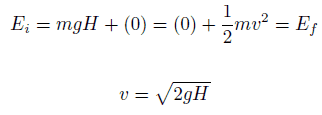
What is Law of Conservation of Energy – Definition

What is the law of conservation of energy? The general definition is that: The total energy of an isolated system remains constant over time. Material Properties

What is the Law of Conservation of Energy

The law of conservation of energy is one of the basic laws of physics along with the conservation of mass and the conservation of momentum. The law of conservation of energy states that energy can change from one form into another, but it cannot be created or destroyed. Or the general definition is:

The total energy of an isolated system remains constant over time.

law of conservation of energy - pendulum
Newton’s cradle. A device that demonstrates the Law of Conservation of Mechanical Energy and Momentum.

Energy can be defined as the capacity for doing work. It may exist in a variety of forms and may be transformed from one type of energy to another in hundreds of ways.

For example, burning gasoline to power cars is an energy conversion process we rely on. The chemical energy in gasoline is converted to thermal energy, which is then converted to mechanical energy that makes the car move. The mechanical energy has been converted to kinetic energy. When we use the brakes to stop a car, that kinetic energy is converted by friction back to heat, or thermal energy.

A consequence of the law of conservation of energy is that a perpetual motion machine of the first kind, which produces work without the input of energy, cannot exist.

 
References:
Nuclear and Reactor Physics:
  1. J. R. Lamarsh, Introduction to Nuclear Reactor Theory, 2nd ed., Addison-Wesley, Reading, MA (1983).
  2. J. R. Lamarsh, A. J. Baratta, Introduction to Nuclear Engineering, 3d ed., Prentice-Hall, 2001, ISBN: 0-201-82498-1.
  3. W. M. Stacey, Nuclear Reactor Physics, John Wiley & Sons, 2001, ISBN: 0- 471-39127-1.
  4. Glasstone, Sesonske. Nuclear Reactor Engineering: Reactor Systems Engineering, Springer; 4th edition, 1994, ISBN: 978-0412985317
  5. W.S.C. Williams. Nuclear and Particle Physics. Clarendon Press; 1 edition, 1991, ISBN: 978-0198520467
  6. Kenneth S. Krane. Introductory Nuclear Physics, 3rd Edition, Wiley, 1987, ISBN: 978-0471805533
  7. G.R.Keepin. Physics of Nuclear Kinetics. Addison-Wesley Pub. Co; 1st edition, 1965
  8. Robert Reed Burn, Introduction to Nuclear Reactor Operation, 1988.
  9. U.S. Department of Energy, Nuclear Physics and Reactor Theory. DOE Fundamentals Handbook, Volume 1 and 2. January 1993.

Advanced Reactor Physics:

  1. K. O. Ott, W. A. Bezella, Introductory Nuclear Reactor Statics, American Nuclear Society, Revised edition (1989), 1989, ISBN: 0-894-48033-2.
  2. K. O. Ott, R. J. Neuhold, Introductory Nuclear Reactor Dynamics, American Nuclear Society, 1985, ISBN: 0-894-48029-4.
  3. D. L. Hetrick, Dynamics of Nuclear Reactors, American Nuclear Society, 1993, ISBN: 0-894-48453-2.
  4. E. E. Lewis, W. F. Miller, Computational Methods of Neutron Transport, American Nuclear Society, 1993, ISBN: 0-894-48452-4.

See also:

Conservation of Energy

We hope, this article, Law of Conservation of Energy, helps you. If so, give us a like in the sidebar. Main purpose of this website is to help the public to learn some interesting and important information about materials and their properties.