Exothermic vs. Endothermic Reaction. The positive Q reactions are said to be exothermic (or exergic). The negative Q reactions are said to be endothermic (or endoergic). Material Properties
Exothermic vs. Endothermic Reactions
For reactions in which there is an increase in the kinetic energy of the products Q is positive. The positive Q reactions are said to be exothermic (or exergic). There is a net release of energy, since the kinetic energy of the final state is greater than the kinetic energy of the initial state.
For reactions in which there is a decrease in the kinetic energy of the products Q is negative. The negative Q reactions are said to be endothermic (or endoergic) and they require a net energy input.
The Q-value of this reaction is given by:
Q = [ma + mA – (mb + mB)]c2
which is the same as the excess kinetic energy of the final products:
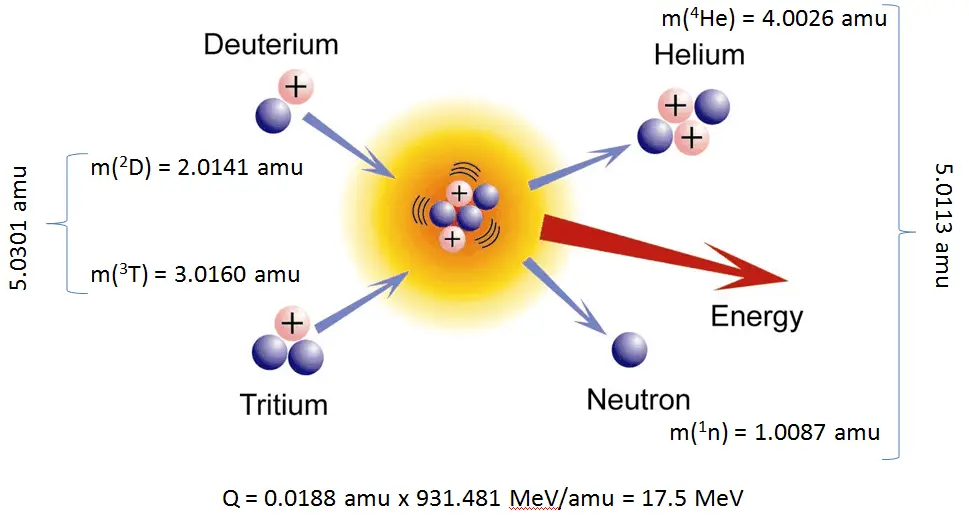
The DT fusion reaction of deuterium and tritium is particularly interesting because of its potential of providing energy for the future. Calculate the reaction Q-value.
3T (d, n) 4He
The atom masses of the reactants and products are:
Q = {(3.0160+2.0141) [amu] – (1.0087+4.0026) [amu]} x 931.481 [MeV/amu]
= 0.0188 x 931.481 = 17.5 MeV
Exothermic Reaction - Tritium
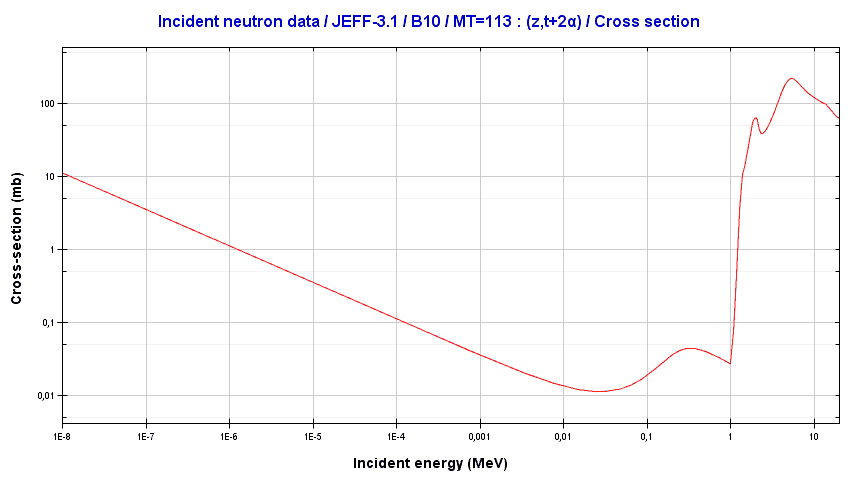
Cross-section of 10B(n,2alpha)T reaction.
Tritium is a byproduct in nuclear reactors. Most of the tritium produced in nuclear power plants stems from the boric acid, which is commonly used as a chemical shim to compensate an excess of initial reactivity. Main reaction, in which the tritium is generated from boron is below:
10B(n,2*alpha)T
This reaction of a neutron with an isotope 10B is the main way, how radioactive tritium in primary circuit of all PWRs is generated. Note that, this reaction is a threshold reaction due to its cross-section.
Calculate the reaction Q-value.
The atom masses of the reactants and products are:
Q = {(10.0129+1.00866) [amu] – (3.01604+2 x 4.0026) [amu]} x 931.481 [MeV/amu]
= 0.00036 x 931.481 = 0.335 MeV
[/su_accordion]
Endothermic Reactions
Endothermic Reaction - Photoneutrons
In nuclear reactors the gamma radiation plays a significant role also in reactor kinetics and in a subcriticality control. Especially in nuclear reactors with D2O moderator (CANDU reactors) or with Be reflectors (some experimental reactors). Neutrons can be produced also in (γ, n) reactions and therefore they are usually referred to as photoneutrons.
A high energy photon (gamma ray) can under certain conditions eject a neutron from a nucleus. It occurs when its energy exceedsthe binding energy of the neutron in the nucleus. Most nuclei have binding energies in excess of 6 MeV, which is above the energy of most gamma rays from fission. On the other hand there are few nuclei with sufficiently low binding energy to be of practical interest. These are: 2D, 9Be, 6Li, 7Li and 13C. As can be seen from the table the lowest threshold have 9Be with 1.666 MeV and 2D with 2.226 MeV.
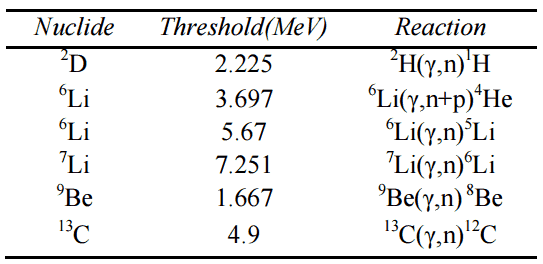
Nuclides with low photodisintegration threshold energies.
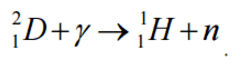
In case of deuterium, neutrons can be produced by the interaction of gamma rays (with a minimum energy of 2.22 MeV) with deuterium:
Robert Reed Burn, Introduction to Nuclear Reactor Operation, 1988.
U.S. Department of Energy, Nuclear Physics and Reactor Theory. DOE Fundamentals Handbook, Volume 1 and 2. January 1993.
Advanced Reactor Physics:
K. O. Ott, W. A. Bezella, Introductory Nuclear Reactor Statics, American Nuclear Society, Revised edition (1989), 1989, ISBN: 0-894-48033-2.
K. O. Ott, R. J. Neuhold, Introductory Nuclear Reactor Dynamics, American Nuclear Society, 1985, ISBN: 0-894-48029-4.
D. L. Hetrick, Dynamics of Nuclear Reactors, American Nuclear Society, 1993, ISBN: 0-894-48453-2.
E. E. Lewis, W. F. Miller, Computational Methods of Neutron Transport, American Nuclear Society, 1993, ISBN: 0-894-48452-4.
See also:
Nuclear Reactions
We hope, this article, Exothermic vs. Endothermic Reaction, helps you. If so, give us a like in the sidebar. Main purpose of this website is to help the public to learn some interesting and important information about materials and their properties.
The negative Q reactions are said to be endothermic (or endoergic) and they require a net energy input. Production of photoneutrons is an example endothermic reaction. Material Properties
Endothermic Reactions
In nuclear and particle physics the energetics of nuclear reactions is determined by the Q-value of that reaction. The Q-value of the reaction is defined as the difference between the sum of the masses of the initial reactants and the sum of the masses of the final products, in energy units (usually in MeV).
Consider a typical reaction, in which the projectile a and the target A gives place to two products, B and b. This can also be expressed in the notation that we used so far, a + A → B + b, or even in a more compact notation, A(a,b)B.
which is the same as the excess kinetic energy of the final products:
Q = Tfinal – Tinitial
= Tb + TB – (Ta + TA)
For reactions in which there is a decrease in the kinetic energy of the products Q is negative. The negative Q reactions are said to be endothermic (or endoergic) and they require a net energy input.
In nuclear reactors the gamma radiation plays a significant role also in reactor kinetics and in a subcriticality control. Especially in nuclear reactors with D2O moderator (CANDU reactors) or with Be reflectors (some experimental reactors). Neutrons can be produced also in (γ, n) reactions and therefore they are usually referred to as photoneutrons.
A high energy photon (gamma ray) can under certain conditions eject a neutron from a nucleus. It occurs when its energy exceedsthe binding energy of the neutron in the nucleus. Most nuclei have binding energies in excess of 6 MeV, which is above the energy of most gamma rays from fission. On the other hand there are few nuclei with sufficiently low binding energy to be of practical interest. These are: 2D, 9Be, 6Li, 7Li and 13C. As can be seen from the table the lowest threshold have 9Be with 1.666 MeV and 2D with 2.226 MeV.
Nuclides with low photodisintegration threshold energies.
In case of deuterium, neutrons can be produced by the interaction of gamma rays (with a minimum energy of 2.22 MeV) with deuterium:
Robert Reed Burn, Introduction to Nuclear Reactor Operation, 1988.
U.S. Department of Energy, Nuclear Physics and Reactor Theory. DOE Fundamentals Handbook, Volume 1 and 2. January 1993.
Advanced Reactor Physics:
K. O. Ott, W. A. Bezella, Introductory Nuclear Reactor Statics, American Nuclear Society, Revised edition (1989), 1989, ISBN: 0-894-48033-2.
K. O. Ott, R. J. Neuhold, Introductory Nuclear Reactor Dynamics, American Nuclear Society, 1985, ISBN: 0-894-48029-4.
D. L. Hetrick, Dynamics of Nuclear Reactors, American Nuclear Society, 1993, ISBN: 0-894-48453-2.
E. E. Lewis, W. F. Miller, Computational Methods of Neutron Transport, American Nuclear Society, 1993, ISBN: 0-894-48452-4.
See also:
Nuclear Reactions
We hope, this article, Endothermic Reaction, helps you. If so, give us a like in the sidebar. Main purpose of this website is to help the public to learn some interesting and important information about materials and their properties.
The positive Q reactions are said to be exothermic (or exergic). Exothermic reactions release energy. For example fusion reaction or fission reaction. Material Properties
Exothermic Reactions
Q-value of DT fusion reaction
In nuclear and particle physics the energetics of nuclear reactions is determined by the Q-value of that reaction. The Q-value of the reaction is defined as the difference between the sum of the masses of the initial reactants and the sum of the masses of the final products, in energy units (usually in MeV).
Consider a typical reaction, in which the projectile a and the target A gives place to two products, B and b. This can also be expressed in the notation that we used so far, a + A → B + b, or even in a more compact notation, A(a,b)B.
which is the same as the excess kinetic energy of the final products:
Q = Tfinal – Tinitial
= Tb + TB – (Ta + TA)
For reactions in which there is an increase in the kinetic energy of the products Q is positive. The positive Q reactions are said to be exothermic (or exergic). There is a net release of energy, since the kinetic energy of the final state is greater than the kinetic energy of the initial state.
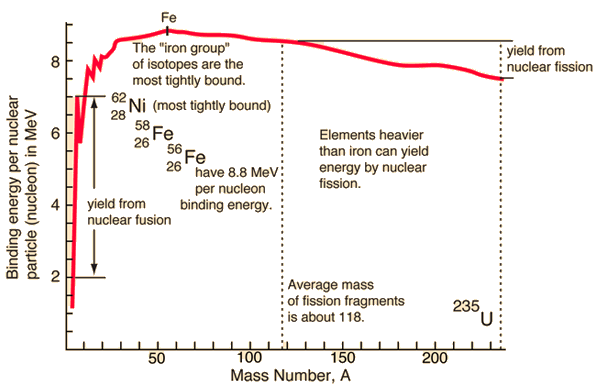
Nuclear binding energy curve. Source: hyperphysics.phy-astr.gsu.edu
Nuclear fission is a nuclear reaction in which the nucleus of an atom splits into smaller parts (lighter nuclei). The fission process often produces free neutrons and photons (in the form of gamma rays), and releases a large amount of energy.
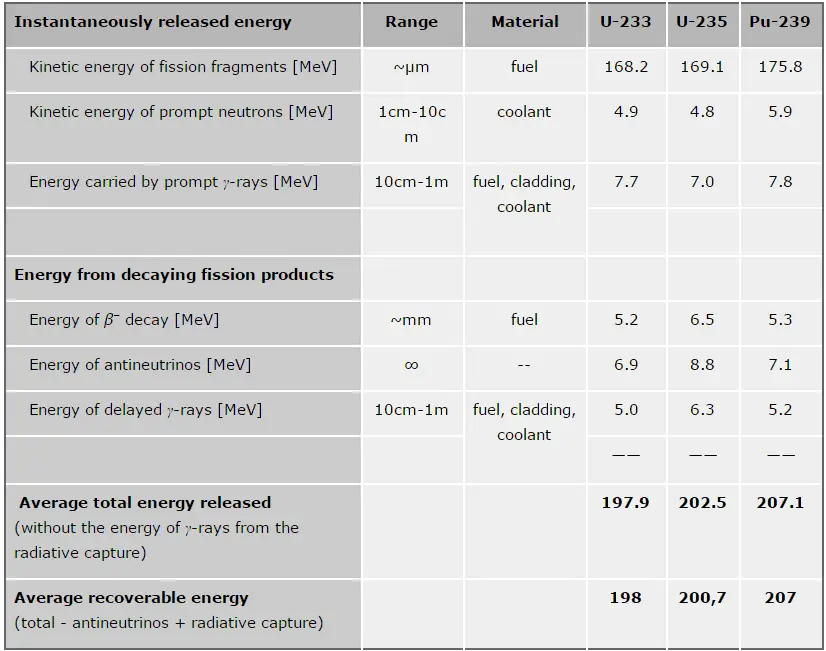
From the nuclear binding energy curve and from the table it can be seen that, in the case of splitting a 235U nucleus into two parts, the binding energy of the fragments (A ≈ 120) together is larger than that of the original 235U nucleus. According to the Weizsaecker formula, the total energy released for such reaction will be approximately 235 x (8.5 – 7.6) ≈ 200 MeV (it can also be derived from nuclear binding curve).
The DT fusion reaction of deuterium and tritium is particularly interesting because of its potential of providing energy for the future. Calculate the reaction Q-value.
3T (d, n) 4He
The atom masses of the reactants and products are:
Q = {(3.0160+2.0141) [amu] – (1.0087+4.0026) [amu]} x 931.481 [MeV/amu]
= 0.0188 x 931.481 = 17.5 MeV
Example of Exothermic Reaction – Tritium in Reactors
Cross-section of 10B(n,2alpha)T reaction.
Tritium is a byproduct in nuclear reactors. Most of the tritium produced in nuclear power plants stems from the boric acid, which is commonly used as a chemical shim to compensate an excess of initial reactivity. Main reaction, in which the tritium is generated from boron is below:
10B(n,2*alpha)T
This reaction of a neutron with an isotope 10B is the main way, how radioactive tritium in primary circuit of all PWRs is generated. Note that, this reaction is a threshold reaction due to its cross-section.
Calculate the reaction Q-value.
The atom masses of the reactants and products are:
Robert Reed Burn, Introduction to Nuclear Reactor Operation, 1988.
U.S. Department of Energy, Nuclear Physics and Reactor Theory. DOE Fundamentals Handbook, Volume 1 and 2. January 1993.
Advanced Reactor Physics:
K. O. Ott, W. A. Bezella, Introductory Nuclear Reactor Statics, American Nuclear Society, Revised edition (1989), 1989, ISBN: 0-894-48033-2.
K. O. Ott, R. J. Neuhold, Introductory Nuclear Reactor Dynamics, American Nuclear Society, 1985, ISBN: 0-894-48029-4.
D. L. Hetrick, Dynamics of Nuclear Reactors, American Nuclear Society, 1993, ISBN: 0-894-48453-2.
E. E. Lewis, W. F. Miller, Computational Methods of Neutron Transport, American Nuclear Society, 1993, ISBN: 0-894-48452-4.
See also:
Nuclear Reactions
We hope, this article, Exothermic Reaction, helps you. If so, give us a like in the sidebar. Main purpose of this website is to help the public to learn some interesting and important information about materials and their properties.
Energetics of nuclear reactions is determined by the Q-value of that reaction. The Q-value of the reaction is defined as the difference between masses reactants and products. Material Properties
Q-value – Energetics of Nuclear Reactions
Q-value of DT fusion reaction
In nuclear and particle physics the energetics of nuclear reactions is determined by the Q-value of that reaction. The Q-value of the reaction is defined as the difference between the sum of the masses of the initial reactants and the sum of the masses of the final products, in energy units (usually in MeV).
Consider a typical reaction, in which the projectile a and the target A gives place to two products, B and b. This can also be expressed in the notation that we used so far, a + A → B + b, or even in a more compact notation, A(a,b)B.
which is the same as the excess kinetic energy of the final products:
Q = Tfinal – Tinitial
= Tb + TB – (Ta + TA)
For reactions in which there is an increase in the kinetic energy of the products Q is positive. The positive Q reactions are said to be exothermic (or exergic). There is a net release of energy, since the kinetic energy of the final state is greater than the kinetic energy of the initial state.
For reactions in which there is a decrease in the kinetic energy of the products Q is negative. The negative Q reactions are said to be endothermic (or endoergic) and they require a net energy input.
The DT fusion reaction of deuterium and tritium is particularly interesting because of its potential of providing energy for the future. Calculate the reaction Q-value.
3T (d, n) 4He
The atom masses of the reactants and products are:
Q = {(3.0160+2.0141) [amu] – (1.0087+4.0026) [amu]} x 931.481 [MeV/amu]
= 0.0188 x 931.481 = 17.5 MeV
Example: Exothermic Reaction - Tritium in Reactors
Cross-section of 10B(n,2alpha)T reaction.
Tritium is a byproduct in nuclear reactors. Most of the tritium produced in nuclear power plants stems from the boric acid, which is commonly used as a chemical shim to compensate an excess of initial reactivity. Main reaction, in which the tritium is generated from boron is below:
10B(n,2*alpha)T
This reaction of a neutron with an isotope 10B is the main way, how radioactive tritium in primary circuit of all PWRs is generated. Note that, this reaction is a threshold reaction due to its cross-section.
Calculate the reaction Q-value.
The atom masses of the reactants and products are:
Q = {(10.0129+1.00866) [amu] – (3.01604+2 x 4.0026) [amu]} x 931.481 [MeV/amu]
= 0.00036 x 931.481 = 0.335 MeV
Q-value of Endothermic Reactions
Example: Endothermic Reaction - Photoneutrons
In nuclear reactors the gamma radiation plays a significant role also in reactor kinetics and in a subcriticality control. Especially in nuclear reactors with D2O moderator (CANDU reactors) or with Be reflectors (some experimental reactors). Neutrons can be produced also in (γ, n) reactions and therefore they are usually referred to as photoneutrons.
A high energy photon (gamma ray) can under certain conditions eject a neutron from a nucleus. It occurs when its energy exceedsthe binding energy of the neutron in the nucleus. Most nuclei have binding energies in excess of 6 MeV, which is above the energy of most gamma rays from fission. On the other hand there are few nuclei with sufficiently low binding energy to be of practical interest. These are: 2D, 9Be, 6Li, 7Li and 13C. As can be seen from the table the lowest threshold have 9Be with 1.666 MeV and 2D with 2.226 MeV.
Nuclides with low photodisintegration threshold energies.
In case of deuterium, neutrons can be produced by the interaction of gamma rays (with a minimum energy of 2.22 MeV) with deuterium:
Robert Reed Burn, Introduction to Nuclear Reactor Operation, 1988.
U.S. Department of Energy, Nuclear Physics and Reactor Theory. DOE Fundamentals Handbook, Volume 1 and 2. January 1993.
Advanced Reactor Physics:
K. O. Ott, W. A. Bezella, Introductory Nuclear Reactor Statics, American Nuclear Society, Revised edition (1989), 1989, ISBN: 0-894-48033-2.
K. O. Ott, R. J. Neuhold, Introductory Nuclear Reactor Dynamics, American Nuclear Society, 1985, ISBN: 0-894-48029-4.
D. L. Hetrick, Dynamics of Nuclear Reactors, American Nuclear Society, 1993, ISBN: 0-894-48453-2.
E. E. Lewis, W. F. Miller, Computational Methods of Neutron Transport, American Nuclear Society, 1993, ISBN: 0-894-48452-4.
See also:
Nuclear Reactions
We hope, this article, Q-value – Energetics of Nuclear Reactions, helps you. If so, give us a like in the sidebar. Main purpose of this website is to help the public to learn some interesting and important information about materials and their properties.
The binding energy which is proportional to this mass difference is known as the mass defect. The mass defect may be calculated directly from e=mc2 equation. Material Properties
Mass Defect
In special theory of relativity certain types of matter may be created or destroyed, but in all of these processes, the mass and energy associated with such matter remains unchanged in quantity. It was found the rest mass of an atomic nucleus is measurably smaller than the sum of the rest masses of its constituent protons, neutrons and electrons. Mass was no longer considered unchangeable in the closed system. The difference is a measure of the nuclear binding energywhich holds the nucleus together. According to the Einstein relationship (E=mc2), this binding energy is proportional to this mass difference and it is known as the mass defect.
Nuclear binding energy curve. Source: hyperphysics.phy-astr.gsu.edu
During the nuclear splitting or nuclear fusion, some of the mass of the nucleus gets converted into huge amounts of energy and thus this mass is removed from the total mass of the original particles, and the mass is missing in the resulting nucleus. The nuclear binding energies are enormous, they are on the order of a million times greater than the electron binding energies of atoms.
Atomic Mass Unit
Atomic mass unit
It is defined as one twelfth of the mass of an unbound neutral atom of carbon-12 in its nuclear and electronic ground state, and has a value of 1.66054×10⁻²⁷ kg.
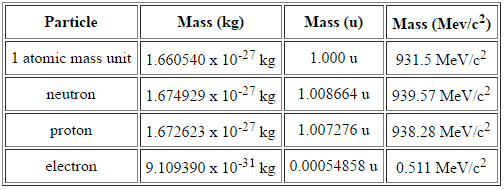
Masses of protons, neutrons and electrons in various units.
Examples of mass defect calculation
Example: Mass defect of a 63Cu
Calculate the mass defect of a 63Cu nucleus if the actual mass of 63Cu in its nuclear ground state is 62.91367 u.
63Cu nucleus has 29 protons and also has (63 – 29) 34 neutrons.
The mass of a proton is 1.00728 u and a neutron is 1.00867 u.
The combined mass is: 29 protons x (1.00728 u/proton) + 34 neutrons x (1.00867 u/neutron) = 63.50590 u
The mass defect is Δm = 63.50590 u – 62.91367 u = 0.59223 u
ΔE = (9.8346 x 10⁻²⁸ kg/nucleus) x (2.9979 x 10⁸ m/s)2 = 8.8387 x 10⁻¹¹ J/nucleus
The energy calculated in the previous example is the nuclear binding energy. However, the nuclear binding energy may be expressed as kJ/mol (for better understanding).
Calculate the nuclear binding energy of 1 mole of 63Cu:
(8.8387 x 10⁻¹¹ J/nucleus) x (1 kJ/1000 J) x (6.022 x 10²³ nuclei/mol) = 5.3227 x 10¹⁰ kJ/mol of nuclei.
One mole of 63Cu (~63 grams) is bound by the nuclear binding energy (5.3227 x 10¹⁰ kJ/mol) which is equivalent to:
14.8 million kilowatt-hours (≈ 15 GW·h)
336,100 US gallons of automotive gasoline
Example: Mass defect of the reactor core
Calculate the mass defect of the 3000MWthreactor core after one year of operation.
The reaction rate per entire 3000MWth reactor core is about 9.33×10¹⁹ fissions / second.
The overall energy release in the units of joules is:
200×106 (eV) x 1.602×10⁻¹⁹ (J/eV) x 9.33×10¹⁹ (s-1) x 31.5×106 (seconds in year) = 9.4×10¹⁶ J/year
The mass defect is calculated as:
Δm = ΔE/c2
Δm = 9.4×10¹⁶ / (2.9979 x 10⁸)2 = 1.046 kg
That means in a typical 3000MWth reactor core about 1 kilogram of matter is converted into pure energy.
Note that, a typical annual uranium load for a 3000MWth reactor core is about 20 tonnes of enriched uranium(i.e. about 22.7 tonnes of UO2). Entire reactor core may contain about 80 tonnes of enriched uranium.
Mass defect directly from E=mc2
The mass defect can be calculated directly from the Einstein relationship (E = mc2) as:
Δm = ΔE/c2
Δm = 3000×106 (W = J/s) x 31.5×10⁶ (seconds in year) / (2.9979 x 10⁸)2 = 1.051 kg
References:
Nuclear and Reactor Physics:
J. R. Lamarsh, Introduction to Nuclear Reactor Theory, 2nd ed., Addison-Wesley, Reading, MA (1983).
J. R. Lamarsh, A. J. Baratta, Introduction to Nuclear Engineering, 3d ed., Prentice-Hall, 2001, ISBN: 0-201-82498-1.
W. M. Stacey, Nuclear Reactor Physics, John Wiley & Sons, 2001, ISBN: 0- 471-39127-1.
Robert Reed Burn, Introduction to Nuclear Reactor Operation, 1988.
U.S. Department of Energy, Nuclear Physics and Reactor Theory. DOE Fundamentals Handbook, Volume 1 and 2. January 1993.
Advanced Reactor Physics:
K. O. Ott, W. A. Bezella, Introductory Nuclear Reactor Statics, American Nuclear Society, Revised edition (1989), 1989, ISBN: 0-894-48033-2.
K. O. Ott, R. J. Neuhold, Introductory Nuclear Reactor Dynamics, American Nuclear Society, 1985, ISBN: 0-894-48029-4.
D. L. Hetrick, Dynamics of Nuclear Reactors, American Nuclear Society, 1993, ISBN: 0-894-48453-2.
E. E. Lewis, W. F. Miller, Computational Methods of Neutron Transport, American Nuclear Society, 1993, ISBN: 0-894-48452-4.
See also:
Laws of Conservation
We hope, this article, Mass Defect, helps you. If so, give us a like in the sidebar. Main purpose of this website is to help the public to learn some interesting and important information about materials and their properties.

Laws of Conservation. A conservation law states that a measurable property of an isolated physical system does not change as the system evolves over time. Material Properties
Laws of Conservation
In physics, a conservation law states that a particular measurable property of an isolated physical system does not change as the system evolves over time. These properties are sometimes called “constants of the motion“. These quantities are said to be “conserved” and the conservation laws which result can be considered to be the most fundamental principles of mechanics. In mechanics, examples of conserved quantities are energy, momentum, and angular momentum. The laws of conservation are exact for an isolated system.
Laws of Conservation in Nuclear Reactions
A nuclear reaction is considered to be the process in which two nuclear particles (two nuclei or a nucleus and a nucleon) interact to produce two or more nuclear particles or ˠ-rays (gamma rays). Thus, a nuclear reaction must cause a transformation of at least one nuclide to another. Sometimes if a nucleus interacts with another nucleus or particle without changing the nature of any nuclide, the process is referred to a nuclear scattering, rather than a nuclear reaction.
In analyzing nuclear reactions, we apply the many conservation laws. Nuclear reactions are subject to classical conservation laws for charge, momentum, angular momentum, and energy (including rest energies). Additional conservation laws, not anticipated by classical physics, are are electric charge, lepton number and baryon number. Certain of these laws are obeyed under all circumstances, others are not. We have accepted conservation of energy and momentum. In all the examples given we assume that the number of protons and the number of neutrons is separately conserved. We shall find circumstances and conditions in which this rule is not true. Where we are considering non-relativistic nuclear reactions, it is essentially true. However, where we are considering relativistic nuclear energies or those involving the weak interactions, we shall find that these principles must be extended.
Some conservation principles have arisen from theoretical considerations, others are just empirical relationships. Notwithstanding, any reaction not expressly forbidden by the conservation laws will generally occur, if perhaps at a slow rate. This expectation is based on quantum mechanics. Unless the barrier between the initial and final states is infinitely high, there is always a non-zero probability that a system will make the transition between them.
For purposes of this article it is sufficient to note four of the fundamental laws governing these reactions.
Conservation of nucleons. The total number of nucleons before and after a reaction are the same.
Conservation of charge. The sum of the charges on all the particles before and after a reaction are the same
Conservation of momentum. The total momentum of the interacting particles before and after a reaction are the same.
Conservation of energy. Energy, including rest mass energy, is conserved in nuclear reactions.
The Law of Conservation of Matter
The law of conservation of matter or principle of matter conservation states that the mass of an object or collection of objects never changes over time, no matter how the constituent parts rearrange themselves.
The mass can neither be created nor destroyed.
The law requires that during any nuclear reaction, radioactive decay or chemical reaction in an isolated system, the total mass of the reactants or starting materials must be equal to the mass of the products.
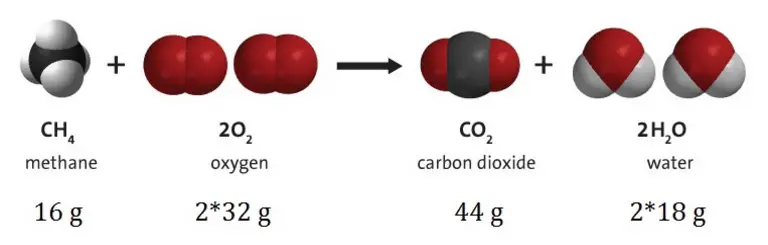
The concept of mass conservation is widely used in many fields such as chemistry, mechanics, and fluid dynamics. In chemistry the law of conservation of matter may be explained in the following way (see the picture of combustion of methane). The masses of a methane and oxygentogether must be equal to the masses of carbon dioxide and water. In other words, during a chemical reaction, everything you start with, you must end up with, but it might look different.
Historically, already the ancient Greeks proposed the idea that the total amount of matter in the universe is constant. The principle of conservation of mass was first outlined by Mikhail Lomonosov in 1748. However, the law of conservation of matter (or the principle of mass/matter conservation) as a fundamental principle of physics was discovered in by Antoine Lavoisier in the late 18th century. It was of great importance in progressing from alchemy to modern chemistry. Before this discovery, there were questions like:
Why a piece of wood weighs less after burning?
Can a matter or some of its part disappear?
In the case of burned wood the problem was the measurement of the weight of released gases. Measurements of the weight of released gases was complicated, because of the buoyancy effect of the Earth’s atmosphere on the weight of gases. Once understood, the conservation of matter was of crucial importance in the progress from alchemy to the modern natural science of chemistry.
Law of Conservation of Energy
The law of conservation of energy is one of the basic laws of physics along with the conservation of mass and the conservation of momentum. The law of conservation of energy states that energy can change from one form into another, but it cannot be created or destroyed. Or the general definition is:
The total energy of an isolated system remains constant over time.
Newton’s cradle. A device that demonstrates the Law of Conservation of Mechanical Energy and Momentum.
Energy can be defined as the capacity for doing work. It may exist in a variety of forms and may be transformed from one type of energy to another in hundreds of ways.
For example, burning gasoline to power cars is an energy conversion process we rely on. The chemical energy in gasoline is converted to thermal energy, which is then converted to mechanical energy that makes the car move. The mechanical energy has been converted to kinetic energy. When we use the brakes to stop a car, that kinetic energy is converted by friction back to heat, or thermal energy.
A consequence of the law of conservation of energy is that a perpetual motion machine of the first kind, which produces work without the input of energy, cannot exist.
The concept of energy conservation is widely used in many fields. In this article the following fields are discussed:
Law of Conservation of Mass-Energy – Mass-Energy Equivalence
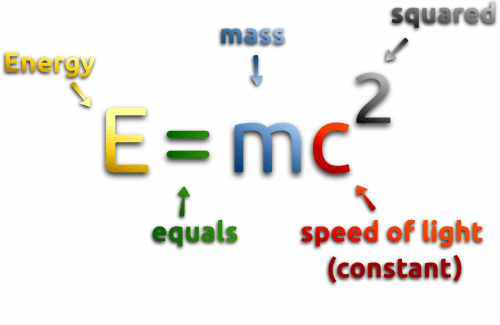
At the beginning of the 20th century, the notion of mass underwent a radical revision. Mass lost its absoluteness. One of the striking results of Einstein’s theory of relativity is that mass and energy are equivalent and convertible one into the other. Equivalence of the mass and energy is described by Einstein’s famous formula E = mc2. In words, energy equals mass multiplied by the speed of light squared. Because the speed of light is a very large number, the formula implies that any small amount of matter contains a very large amount of energy. The mass of an object was seen to be equivalent to energy, to be interconvertible with energy, and to increase significantly at exceedingly high speeds near that of light. The total energy of an object was understood to comprise its rest mass as well as its increase of mass caused by increase in kinetic energy.
In special theory of relativity certain types of matter may be created or destroyed, but in all of these processes, the mass and energy associated with such matter remains unchanged in quantity. It was found the rest mass an atomic nucleus is measurably smaller than the sum of the rest masses of its constituent protons, neutrons and electrons. Mass was no longer considered unchangeable in the closed system. The difference is a measure of the nuclear binding energy which holds the nucleus together. According to the Einstein relationship (E = mc2) this binding energy is proportional to this mass difference and it is known as the mass defect.
Example: Mass defect of a 63Cu
Calculate the mass defect of a 63Cu nucleus if the actual mass of 63Cu in its nuclear ground state is 62.91367 u.
63Cu nucleus has 29 protons and also has (63 – 29) 34 neutrons.
The mass of a proton is 1.00728 u and a neutron is 1.00867 u.
The combined mass is: 29 protons x (1.00728 u/proton) + 34 neutrons x (1.00867 u/neutron) = 63.50590 u
The mass defect is Δm = 63.50590 u – 62.91367 u = 0.59223 u
ΔE = (9.8346 x 10⁻²⁸ kg/nucleus) x (2.9979 x 10⁸ m/s)2 = 8.8387 x 10⁻¹¹ J/nucleus
The energy calculated in the previous example is the nuclear binding energy. However, the nuclear binding energy may be expressed as kJ/mol (for better understanding).
Calculate the nuclear binding energy of 1 mole of 63Cu:
(8.8387 x 10⁻¹¹ J/nucleus) x (1 kJ/1000 J) x (6.022 x 10²³ nuclei/mol) = 5.3227 x 10¹⁰ kJ/mol of nuclei.
One mole of 63Cu (~63 grams) is bound by the nuclear binding energy (5.3227 x 10¹⁰ kJ/mol) which is equivalent to:
14.8 million kilowatt-hours (≈ 15 GW·h)
336,100 US gallons of automotive gasoline
Example: Mass defect of the reactor core
Calculate the mass defect of the 3000MWthreactor core after one year of operation.
The reaction rate per entire 3000MWth reactor core is about 9.33×10¹⁹ fissions / second.
The overall energy release in the units of joules is:
200×106 (eV) x 1.602×10⁻¹⁹ (J/eV) x 9.33×10¹⁹ (s-1) x 31.5×106 (seconds in year) = 9.4×10¹⁶ J/year
The mass defect is calculated as:
Δm = ΔE/c2
Δm = 9.4×10¹⁶ / (2.9979 x 10⁸)2 = 1.046 kg
That means in a typical 3000MWth reactor core about 1 kilogram of matter is converted into pure energy.
Note that, a typical annual uranium load for a 3000MWth reactor core is about 20 tonnes of enriched uranium(i.e. about 22.7 tonnes of UO2). Entire reactor core may contain about 80 tonnes of enriched uranium.
Mass defect directly from E=mc2
The mass defect can be calculated directly from the Einstein relationship (E = mc2) as:
Δm = ΔE/c2
Δm = 3000×106 (W = J/s) x 31.5×10⁶ (seconds in year) / (2.9979 x 10⁸)2 = 1.051 kg
Nuclear binding energy curve. Source: hyperphysics.phy-astr.gsu.edu
During the nuclear splitting or nuclear fusion, some of the mass of the nucleus gets converted into huge amounts of energy and thus this mass is removed from the total mass of the original particles, and the mass is missing in the resulting nucleus. The nuclear binding energies are enormous, they are of the order of a million times greater than the electron binding energies of atoms.
Generally, in both chemical and nuclear reactions, some conversion between rest mass and energy occurs, so that the products generally have smaller or greater mass than the reactants. Therefore the new conservation principle is the conservation of mass-energy.
Robert Reed Burn, Introduction to Nuclear Reactor Operation, 1988.
U.S. Department of Energy, Nuclear Physics and Reactor Theory. DOE Fundamentals Handbook, Volume 1 and 2. January 1993.
Advanced Reactor Physics:
K. O. Ott, W. A. Bezella, Introductory Nuclear Reactor Statics, American Nuclear Society, Revised edition (1989), 1989, ISBN: 0-894-48033-2.
K. O. Ott, R. J. Neuhold, Introductory Nuclear Reactor Dynamics, American Nuclear Society, 1985, ISBN: 0-894-48029-4.
D. L. Hetrick, Dynamics of Nuclear Reactors, American Nuclear Society, 1993, ISBN: 0-894-48453-2.
E. E. Lewis, W. F. Miller, Computational Methods of Neutron Transport, American Nuclear Society, 1993, ISBN: 0-894-48452-4.
We hope, this article, Law of Conservation, helps you. If so, give us a like in the sidebar. Main purpose of this website is to help the public to learn some interesting and important information about materials and their properties.
The law of conservation of matter / mass. The law of conservation of matter or principle of mass conservation states that the mass can neither be created nor destroyed. Material Properties
The Law of Conservation of Matter – Conservation of Mass
The law of conservation of matter or principle of matter conservation states that the mass of an object or collection of objects never changes over time, no matter how the constituent parts rearrange themselves.
The mass can neither be created nor destroyed.
The law requires that during any nuclear reaction, radioactive decay or chemical reaction in an isolated system, the total mass of the reactants or starting materials must be equal to the mass of the products.
The concept of mass conservation is widely used in many fields such as chemistry, mechanics, and fluid dynamics. In chemistry the law of conservation of matter may be explained in the following way (see the picture of combustion of methane). The masses of a methane and oxygentogether must be equal to the masses of carbon dioxide and water. In other words, during a chemical reaction, everything you start with, you must end up with, but it might look different.
Historically, already the ancient Greeks proposed the idea that the total amount of matter in the universe is constant. The principle of conservation of mass was first outlined by Mikhail Lomonosov in 1748. However, the law of conservation of matter (or the principle of mass/matter conservation) as a fundamental principle of physics was discovered in by Antoine Lavoisier in the late 18th century. It was of great importance in progressing from alchemy to modern chemistry. Before this discovery, there were questions like:
Why a piece of wood weighs less after burning?
Can a matter or some of its part disappear?
In the case of burned wood the problem was the measurement of the weight of released gases. Measurements of the weight of released gases was complicated, because of the buoyancy effect of the Earth’s atmosphere on the weight of gases. Once understood, the conservation of matter was of crucial importance in the progress from alchemy to the modern natural science of chemistry.
Example: Conservation of Flow Rate in Reactor Core
In this example, we will calculate the flow rate through a reactor core from continuity equation. It is an illustrative example, following data do not represent any reactor design.
ṁin = ṁout
(ρAv)in = (ρAv)out
____________________________
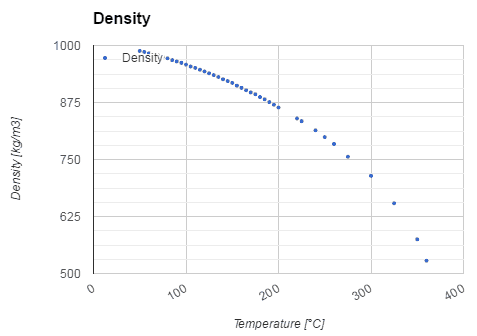
Density as a function of temperature of water
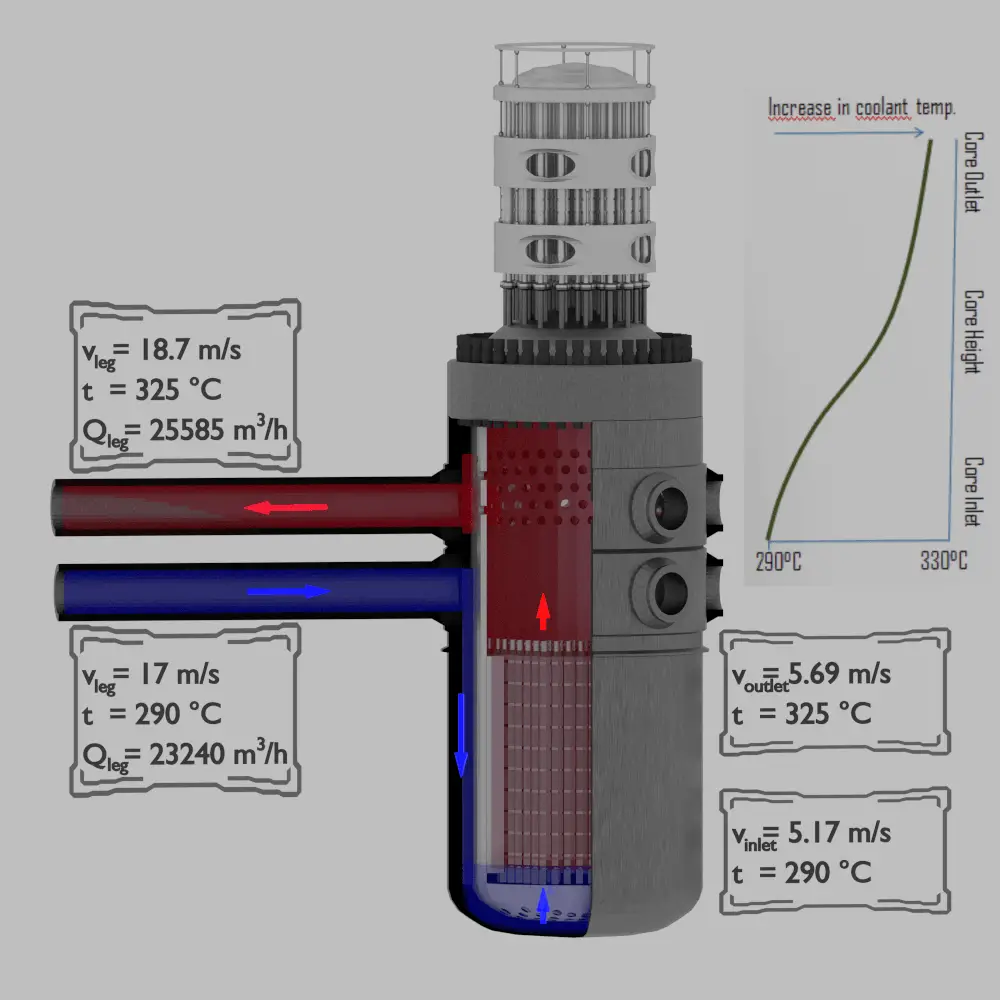
Pressurized water reactors are cooled and moderated by high-pressure liquid water (e.g. 16MPa). At this pressure water boils at approximately 350°C (662°F). Inlet temperature of the water is about 290°C (⍴ ~ 720 kg/m3). The water (coolant) is heated in the reactor core to approximately 325°C (⍴ ~ 654 kg/m3) as the water flows through the core.
The primary circuit of typical PWR is divided into 4 independent loops (piping diameter ~ 700mm), each loop comprises a steam generator and one main coolant pump. Inside the reactor pressure vessel (RPV), the coolant first flows down outside the reactor core (through the downcomer). From the bottom of the pressure vessel, the flow is reversed up through the core, where the coolant temperature increases as it passes through the fuel rods and the assemblies formed by them.
Calculate:
the primary piping volumetric flow rate (m3/s),
the primary piping flow velocity (m/s),
the core inlet flow velocity (m/s),
the core outlet flow velocity (m/s)
when
the mass flow rate in the hot leg of primary piping is equal to 4648 kg/s,
Reactor core flow cross-section is equal to 5m2,
Primary piping flow cross-section (single loop) is equal to 0.38 m2
Results:
Example of flow rates in a reactor. It is an illustrative example, data do not represent any reactor design.
The Law of Conservation of Matter in Special Relativity Theory
At the beginning of the 20th century, the notion of mass underwent a radical revision. Mass lost its absoluteness. One of the striking results of Einstein’s theory of relativity is that mass and energy are equivalent and convertible one into the other. Equivalence of the mass and energy is described by Einstein’s famous formula E = mc2. In words, energy equals mass multiplied by the speed of light squared. Because the speed of light is a very large number, the formula implies that any small amount of matter contains a very large amount of energy. The mass of an object was seen to be equivalent to energy, to be interconvertible with energy, and to increase significantly at exceedingly high speeds near that of light. The total energy of an object was understood to comprise its rest mass as well as its increase of mass caused by increase in kinetic energy.
In special theory of relativity certain types of matter may be created or destroyed, but in all of these processes, the mass and energy associated with such matter remains unchanged in quantity. It was found the rest mass an atomic nucleus is measurably smaller than the sum of the rest masses of its constituent protons, neutrons and electrons. Mass was no longer considered unchangeable in the closed system. The difference is a measure of the nuclear binding energy which holds the nucleus together. According to the Einstein relationship (E = mc2) this binding energy is proportional to this mass difference and it is known as the mass defect.
Example: Mass defect of a 63Cu
Calculate the mass defect of a 63Cu nucleus if the actual mass of 63Cu in its nuclear ground state is 62.91367 u.
63Cu nucleus has 29 protons and also has (63 – 29) 34 neutrons.
The mass of a proton is 1.00728 u and a neutron is 1.00867 u.
The combined mass is: 29 protons x (1.00728 u/proton) + 34 neutrons x (1.00867 u/neutron) = 63.50590 u
The mass defect is Δm = 63.50590 u – 62.91367 u = 0.59223 u
ΔE = (9.8346 x 10⁻²⁸ kg/nucleus) x (2.9979 x 10⁸ m/s)2 = 8.8387 x 10⁻¹¹ J/nucleus
The energy calculated in the previous example is the nuclear binding energy. However, the nuclear binding energy may be expressed as kJ/mol (for better understanding).
Calculate the nuclear binding energy of 1 mole of 63Cu:
(8.8387 x 10⁻¹¹ J/nucleus) x (1 kJ/1000 J) x (6.022 x 10²³ nuclei/mol) = 5.3227 x 10¹⁰ kJ/mol of nuclei.
One mole of 63Cu (~63 grams) is bound by the nuclear binding energy (5.3227 x 10¹⁰ kJ/mol) which is equivalent to:
14.8 million kilowatt-hours (≈ 15 GW·h)
336,100 US gallons of automotive gasoline
Example: Mass defect of the reactor core
Calculate the mass defect of the 3000MWthreactor core after one year of operation.
The reaction rate per entire 3000MWth reactor core is about 9.33×10¹⁹ fissions / second.
The overall energy release in the units of joules is:
200×106 (eV) x 1.602×10⁻¹⁹ (J/eV) x 9.33×10¹⁹ (s-1) x 31.5×106 (seconds in year) = 9.4×10¹⁶ J/year
The mass defect is calculated as:
Δm = ΔE/c2
Δm = 9.4×10¹⁶ / (2.9979 x 10⁸)2 = 1.046 kg
That means in a typical 3000MWth reactor core about 1 kilogram of matter is converted into pure energy.
Note that, a typical annual uranium load for a 3000MWth reactor core is about 20 tonnes of enriched uranium(i.e. about 22.7 tonnes of UO2). Entire reactor core may contain about 80 tonnes of enriched uranium.
Mass defect directly from E=mc2
The mass defect can be calculated directly from the Einstein relationship (E = mc2) as:
Δm = ΔE/c2
Δm = 3000×106 (W = J/s) x 31.5×10⁶ (seconds in year) / (2.9979 x 10⁸)2 = 1.051 kg
Nuclear binding energy curve. Source: hyperphysics.phy-astr.gsu.edu
During the nuclear splitting or nuclear fusion, some of the mass of the nucleus gets converted into huge amounts of energy and thus this mass is removed from the total mass of the original particles, and the mass is missing in the resulting nucleus. The nuclear binding energies are enormous, they are of the order of a million times greater than the electron binding energies of atoms.
Generally, in both chemical and nuclear reactions, some conversion between rest mass and energy occurs, so that the products generally have smaller or greater mass than the reactants. Therefore the new conservation principle is the conservation of mass-energy.
Matter – Antimattercreation occurs naturally in high-energy processes involving cosmic rays, and also in high-energy experiments in accelerators in Earth. High-energy cosmic rays impacting Earth’s atmosphere (or any other matter in the Solar System) produce minute quantities of antiparticles in the resulting particle jets, which are immediately annihilated by contact with nearby matter. The presence of the resulting antimatter is detectable by the two gamma rays (with 511 keV) produced every time positrons annihilate with nearby matter.
Antimatter creation is also very common in nuclear decayof many isotopes. Let assume a decay of potassium-40. Naturally occurring potassium is composed of three isotopes, of which 40K is radioactive. Traces of 40K are found in all potassium, and it is the most common radioisotope in the human body. 40K is a radioactive isotope of potassium which has a very long half-life of 1.251×10⁹ years and undergoes both types of beta decay.
About 89.28% of the time (10.72% is by electron capture), it decays to calcium-40 (40Ca) with emission of a beta particle (β−, an electron) with a maximum energy of 1.33 MeV and an antineutrino, which is an antiparticle to the neutrino.
Very rarely (0.001% of the time) it will decay to 40Ar by emitting a positron (β+) and a neutrino.
Another very interesting source of antimatter is, in fact, a nuclear reactor. Nuclear reactors are the major source of human-generated antineutrinos. This is due to the fact that antineutrinos are produced in a negative beta decay. In a nuclear reactor occurs especially the β−decay, because the common feature of the fission fragments is an excess of neutrons. Please note that billions of solar neutrinos per second pass (mostly without any interaction) through every square centimeter (~6×10¹⁰) on the Earth’s surface and antineutrino radiation is by no means dangerous.
Finally, the fact is that antimatter is much more common, than it may seem.
In January 2011, research by the American Astronomical Society discovered antimatter (positrons) originating above thunderstorm clouds. It is suggested that these positrons are formed in terrestrial gamma-ray flashes (TGF). These positrons are produced in gamma-ray flashes created by electrons accelerated by strong electric fields in the clouds. TGFs are brief bursts occurring inside thunderstorms and associated with lightning. The streams of positrons and electrons collide higher in the atmosphere to generate more gamma rays. About 500 TGFs may occur every day worldwide, but mostly go undetected.
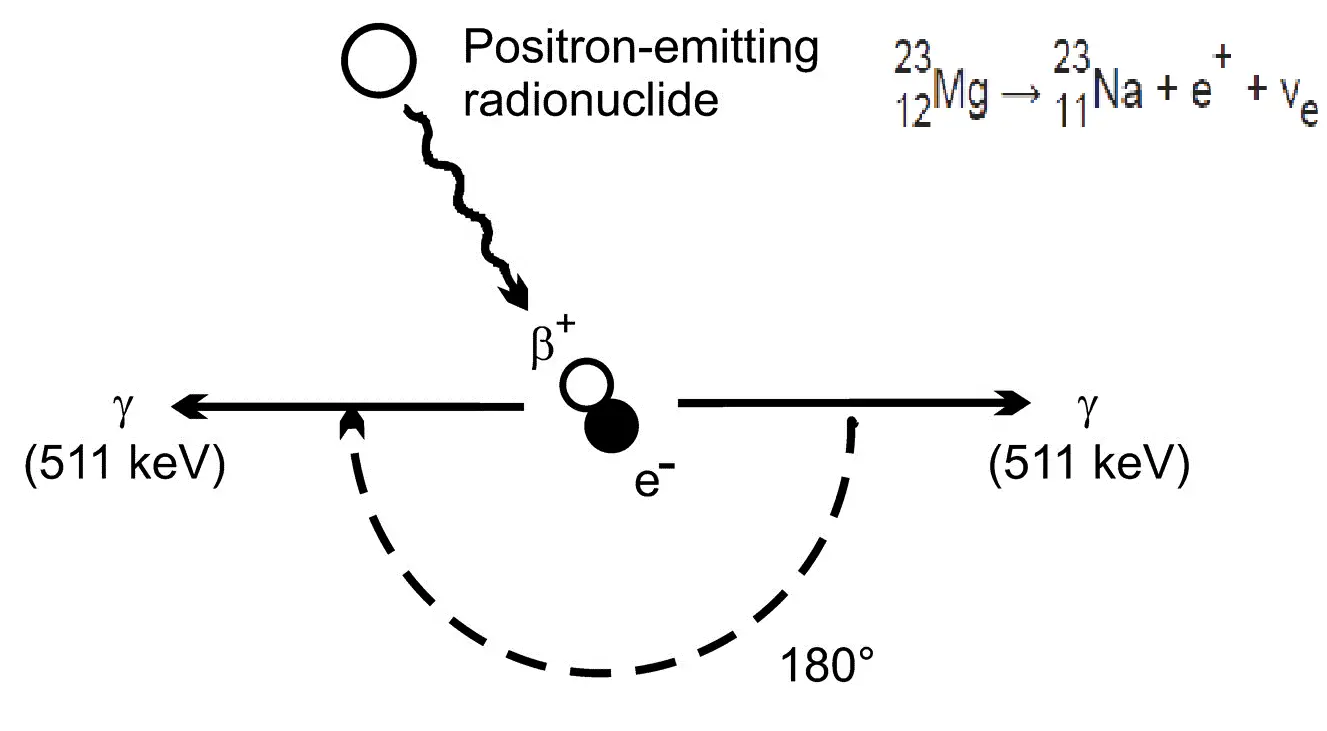
When a positron (antimatter particle) comes to rest, it interacts with an electron, resulting in the annihilation of the both particles and the complete conversion of their rest mass to pure energy in the form of two oppositely directed 0.511 MeV photons.
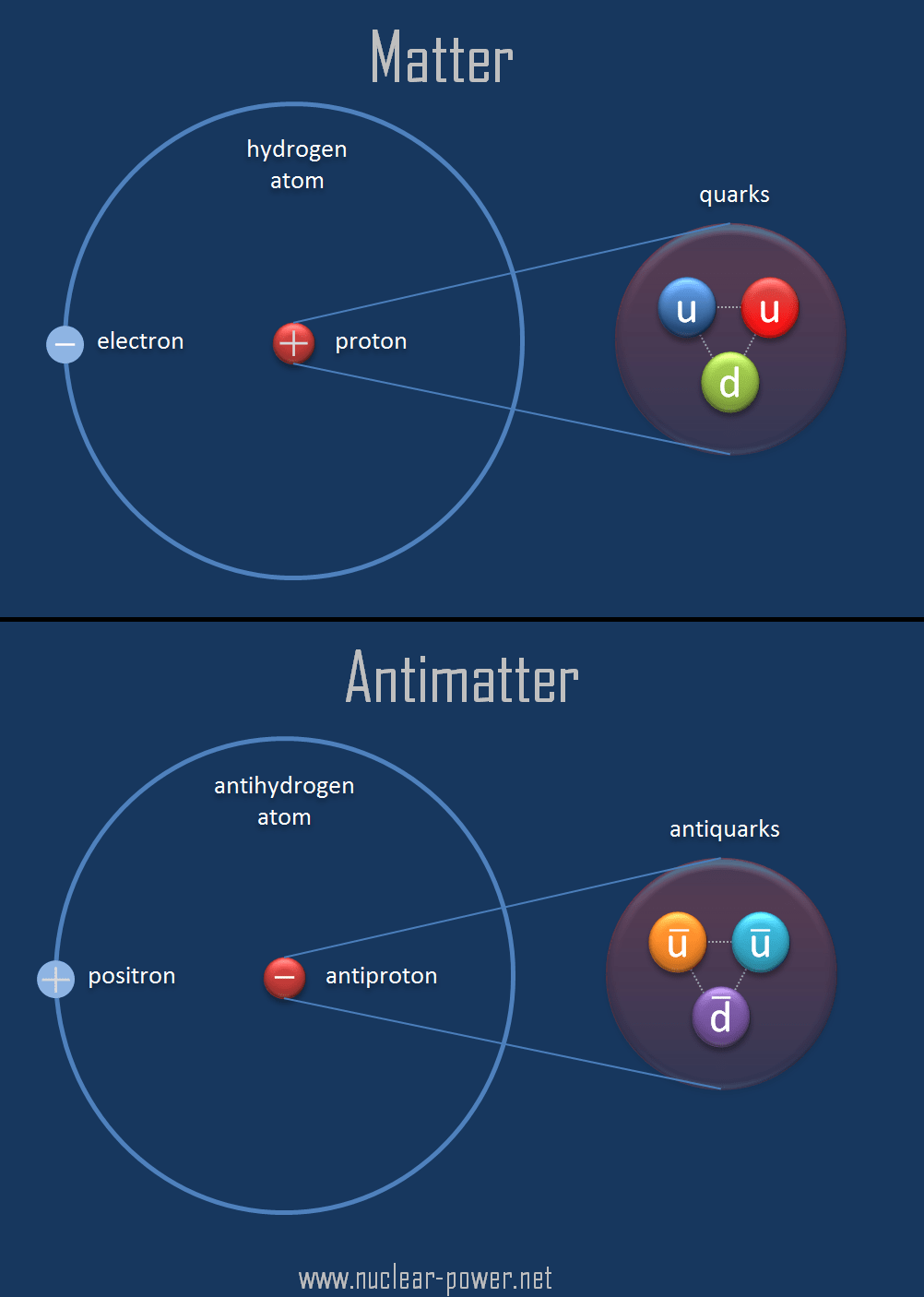
As was written, a particle and its antiparticle have the same mass as one another, but opposite electric charge, and other differences in quantum numbers. That means a proton has positive charge while an antiproton has negative charge and therefore they attract each other. A collision between any particle and its antiparticle partner is known to lead to their mutual annihilation. Since matterand antimatter carry an immense amount of energy (due to E = mc2), their mutual annihilation is associated with production of intense photons (gamma rays), neutrinos, and sometimes less-massive particle–antiparticle pairs.
One of best known processes is electron-positron annihilation. Electron–positron annihilation occurs when a negatively charged electron and a positively charged positron collide.When a low-energy electron annihilates a low-energy positron (antiparticle of electron), they can only produce two or more photons (gamma rays). The production of only one photon is forbidden because of conservation of linear momentum and total energy. The production of another particle is also forbidden because of both particles (electron-positron) together do not carry enough mass-energy to produce heavier particles. When an electron and a positron collide, they annihilate resulting in the complete conversion of their rest mass to pure energy (according to the E=mc2 formula) in the form of two oppositely directed 0.511 MeV gamma rays (photons).
e− + e+ → γ + γ (2x 0.511 MeV)
This process must satisfy a number of conservation laws, including:
Conservation of electric charge. The net charge before and after is zero.
Conservation of linear momentum and total energy. T
Conservation of angular momentum.
The Law of Conservation of Matter in Fluid Dynamics
The mass can neither be created nor destroyed.
Continuity Equation – Definition
This principle is generally known as the conservation of matter principle and states that the mass of an object or collection of objects never changes over time, no matter how the constituent parts rearrange themselves. This principle can be use in the analysis of flowing fluids. Conservation of mass in fluid dynamics states that all mass flow rates into a control volume are equal to all mass flow rates out of the control volume plus the rate of change of mass within the control volume. This principle is expressed mathematically by following equation:
ṁin = ṁout +∆m⁄∆t
Mass entering per unit time = Mass leaving per unit time + Increase of mass in the control volume per unit time
Example of flow rates in a reactor. It is an illustrative example, data do not represent any reactor design.
This equation describes nonsteady-state flow. Nonsteady-state flow refers to the condition where the fluid properties at any single point in the system may change over time. Steady-state flow refers to the condition where the fluid properties (temperature, pressure, and velocity) at any single point in the system do not change over time. But one of the most significant properties that is constant in a steady-state flow system is the system mass flow rate. This means that there is no accumulation of mass within any component in the system.
The continuity equation is simply a mathematical expression of the principle of conservation of mass. For a control volume that has a single inlet and a single outlet, the principle of conservation of mass states that, for steady-state flow, the mass flow rate into the volume must equal the mass flow rate out.
ṁin = ṁout
Mass entering per unit time = Mass leaving per unit time
This equation is called the continuity equation for steady one-dimensional flow. For a steady flow through a control volume with many inlets and outlets, the net mass flow must be zero, where inflows are negative and outflows are positive.
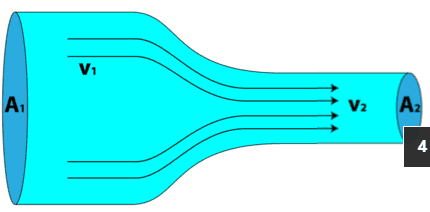
This principle can be applied to a streamtube such as that shown above. No fluid flows across the boundary made by the streamlines so mass only enters and leaves through the two ends of this streamtube section.
When a fluid is in motion, it must move in such a way that mass is conserved. To see how mass conservation places restrictions on the velocity field, consider the steady flow of fluid through a duct (that is, the inlet and outlet flows do not vary with time).
Differential Form of Continuity Equation
A general continuity equation can also be written in a differential form:
∂⍴⁄∂t + ∇ . (⍴ ͞v) = σ
where
∇ . is divergence,
ρ is the density of quantity q,
⍴ ͞v is the flux of quantity q,
σ is the generation of q per unit volume per unit time. Terms that generate (σ > 0) or remove (σ < 0) q are referred to as a “sources” and “sinks” respectively. If q is a conserved quantity (such as energy), σ is equal to 0.
References:
Nuclear and Reactor Physics:
J. R. Lamarsh, Introduction to Nuclear Reactor Theory, 2nd ed., Addison-Wesley, Reading, MA (1983).
J. R. Lamarsh, A. J. Baratta, Introduction to Nuclear Engineering, 3d ed., Prentice-Hall, 2001, ISBN: 0-201-82498-1.
W. M. Stacey, Nuclear Reactor Physics, John Wiley & Sons, 2001, ISBN: 0- 471-39127-1.
Robert Reed Burn, Introduction to Nuclear Reactor Operation, 1988.
U.S. Department of Energy, Nuclear Physics and Reactor Theory. DOE Fundamentals Handbook, Volume 1 and 2. January 1993.
Advanced Reactor Physics:
K. O. Ott, W. A. Bezella, Introductory Nuclear Reactor Statics, American Nuclear Society, Revised edition (1989), 1989, ISBN: 0-894-48033-2.
K. O. Ott, R. J. Neuhold, Introductory Nuclear Reactor Dynamics, American Nuclear Society, 1985, ISBN: 0-894-48029-4.
D. L. Hetrick, Dynamics of Nuclear Reactors, American Nuclear Society, 1993, ISBN: 0-894-48453-2.
E. E. Lewis, W. F. Miller, Computational Methods of Neutron Transport, American Nuclear Society, 1993, ISBN: 0-894-48452-4.
See also:
Laws of Conservation
We hope, this article, Law of Conservation of Matter, helps you. If so, give us a like in the sidebar. Main purpose of this website is to help the public to learn some interesting and important information about materials and their properties.

Beta radiation consist of free electrons or positrons at relativistic speeds. These particles are known as the beta particles. What is the beta radiation. Material Properties
Forms of Ionizing Radiation
Interaction of Radiation with Matter
Ionizing radiation is categorized by the nature of the particles or electromagnetic waves that create the ionizing effect. These particles/waves have different ionization mechanisms, and may be grouped as:
Directly ionizing. Charged particles (atomic nuclei, electrons, positrons, protons, muons, etc.) can ionize atoms directly by fundamental interaction through the Coulomb force if it carries sufficient kinetic energy. These particles must be moving at relativistic speeds to reach the required kinetic energy. Even photons (gamma rays and X-rays) can ionize atoms directly (despite they are electrically neutral) through the Photoelectric effect and the Compton effect, but secondary (indirect) ionization is much more significant.
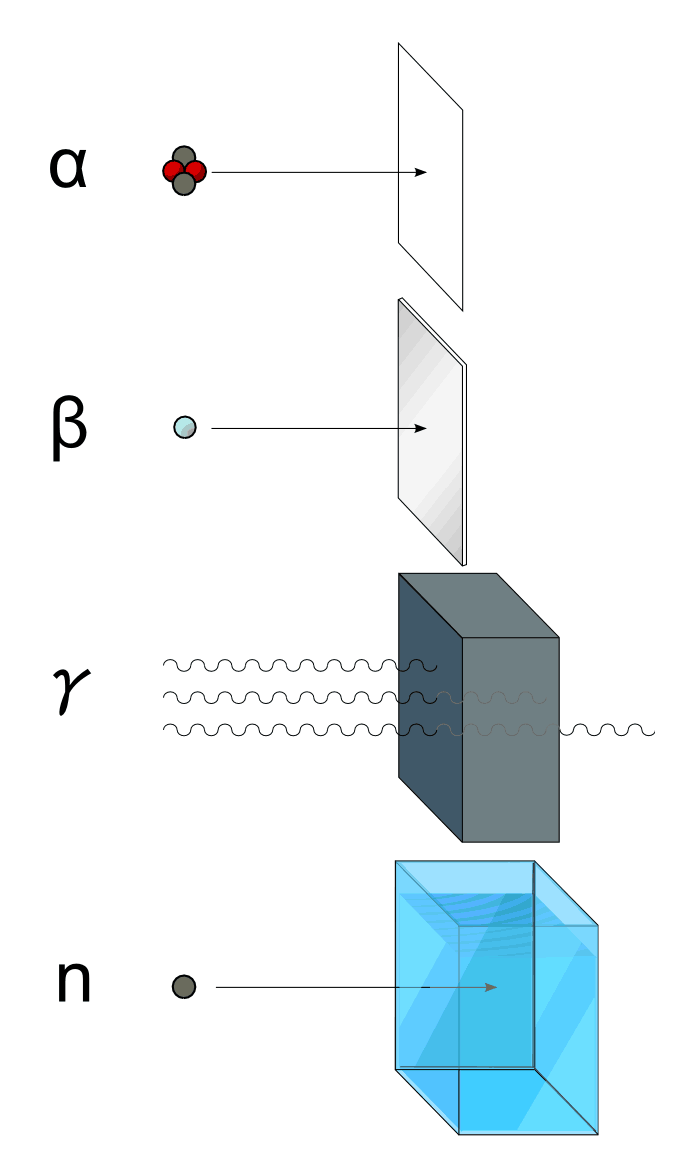
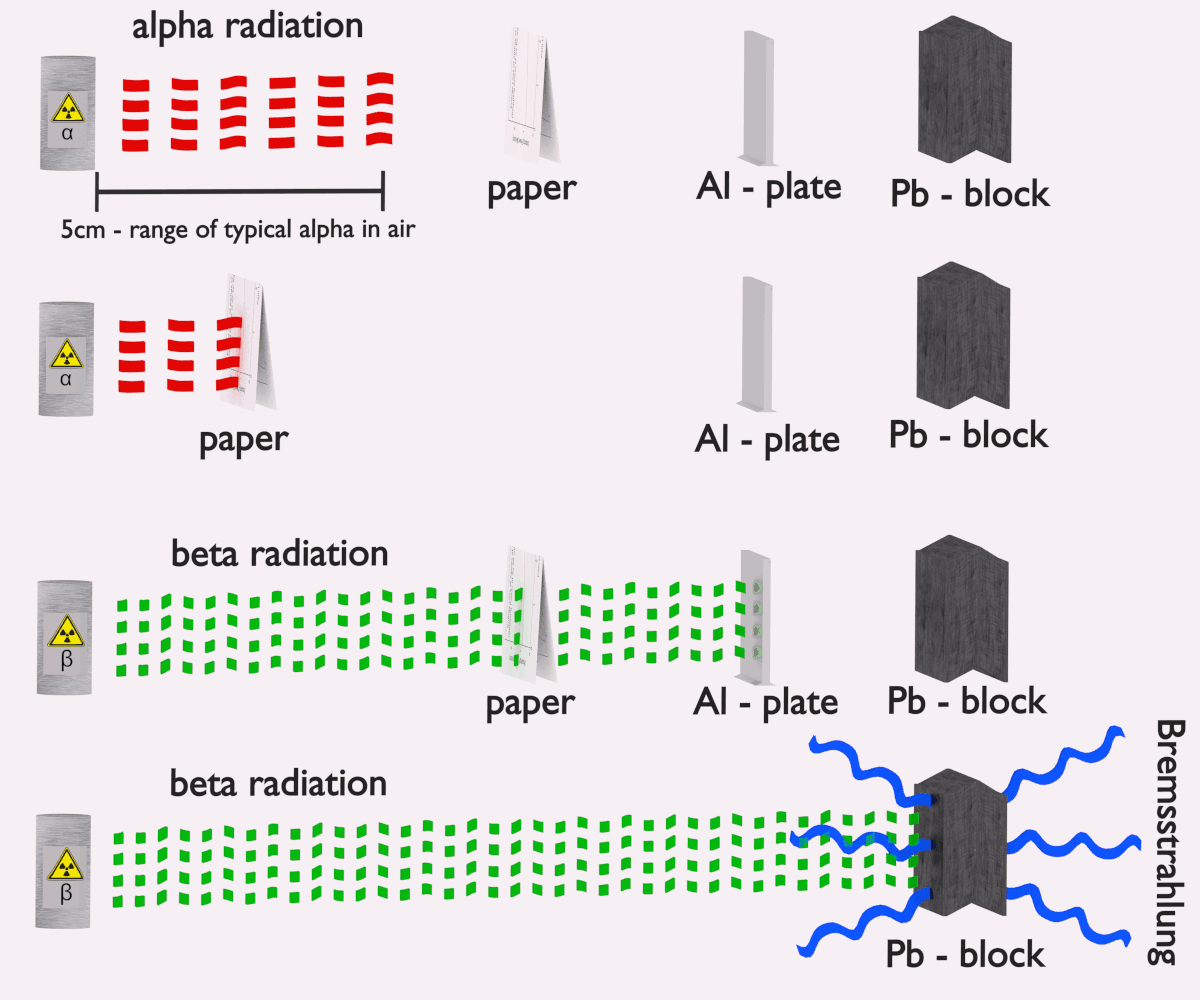
Alpha radiation. Alpha radiation consist of alpha particles at high energy/speed. The production of alpha particles is termed alpha decay. Alpha particles consist of two protons and two neutrons bound together into a particle identical to a helium nucleus. Alpha particles are relatively large and carry a double positive charge. They are not very penetrating and a piece of paper can stop them. They travel only a few centimeters but deposit all their energies along their short paths.
Beta radiation. Beta radiation consist of free electrons or positrons at relativistic speeds. Beta particles (electrons) are much smaller than alpha particles. They carry a single negative charge. They are more penetrating than alpha particles, but thin aluminum metal can stop them. They can travel several meters but deposit less energy at any one point along their paths than alpha particles.
Indirectly ionizing. Indirect ionizing radiation is electrically neutral particles and therefore does not interact strongly with matter. The bulk of the ionization effects are due to secondary ionizations.
Photon radiation (Gamma rays or X-rays). Photon radiation consist of high energy photons. These photons are particles/waves (Wave-Particle Duality) without rest mass or electrical charge. They can travel 10 meters or more in air. This is a long distance compared to alpha or beta particles. However, gamma rays deposit less energy along their paths. Lead, water, and concrete stop gamma radiation. Photons (gamma rays and X-rays) can ionize atoms directly through the Photoelectric effect and the Compton effect, where the relatively energetic electron is produced. The secondary electron will go on to produce multiple ionization events, therefore the secondary (indirect) ionization is much more significant.
Neutron radiation. Neutron radiation consist of free neutrons at any energies/speeds. Neutrons can be emitted by nuclear fission or by the decay of some radioactive atoms. Neutrons have zero electrical charge and cannot directly cause ionization. Neutrons ionize matter only indirectly. For example, when neutrons strike the hydrogen nuclei, proton radiation (fast protons) results. Neutrons can range from high speed, high energy particles to low speed, low energy particles (called thermal neutrons). Neutrons can travel hundreds of feet in air without any interaction.
Beta Radiation
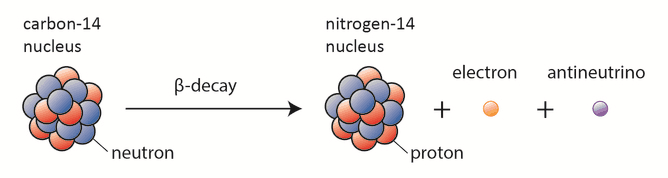
Beta radiation consist of free electrons or positrons at relativistic speeds. These particles are known as the beta particles. Beta particles are high-energy, high-speed electrons or positrons emitted by certain fission fragments or by certain primordial radioactive nuclei such as potassium-40. The beta particles are a form of ionizing radiation also known as beta rays. The production of beta particles is termed beta decay. There are two forms of beta decay, the electron decay (β− decay) and the positron decay (β+ decay). In a nuclear reactor occurs especially the β− decay, because the common feature of the fission products is an excess of neutrons (see Nuclear Stability). An unstable fission fragment with the excess of neutrons undergoes β− decay, where the neutron is converted into a proton, an electron, and an electron antineutrino.
Beta decay of C-14 nucleus.
Characteristics of Beta Radiation
Key characteristics of beta radiation are summarized in following points:
Beta particlesare energetic electrons, they are relatively light and carry a single negative charge.
Their mass is equal to the mass of the orbital electrons with which they are interacting and unlike the alpha particle a much larger fraction of its kinetic energy can be lost in a single interaction.
Their path is not so straightforward. The beta particles follow a very zig-zag path through absorbing material. This resulting path of particle is longer than the linear penetration (range) into the material.
Since they have very low mass, beta particles reach mostly relativistic energies.
Beta particles also differ from other heavy charged particles in the fraction of energy lost by radiative process known as the bremsstrahlung. Therefore for high energy beta radiation shielding dense materials are inappropriate.
When the beta particle moves faster than the speed of light (phase velocity) in the material it generates a shock wave of electromagnetic radiation known as the Cherenkov radiation.
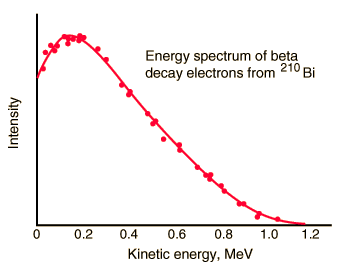
The beta emission has the continuous spectrum.
A 1 MeV beta particle can travel approximately 3.5 meters in air.
Due to the presence of the bremsstrahlung low atomic number (Z) materials are appropriate as beta particle shields.
Radiation Protection Principles - Time, Distance, Shielding
In radiation protection there are three ways how to protect people from identified radiation sources:
Limiting Time. The amount of radiation exposure depends directly (linearly) on the time people spend near the source of radiation. The dose can be reduced by limiting exposure time.
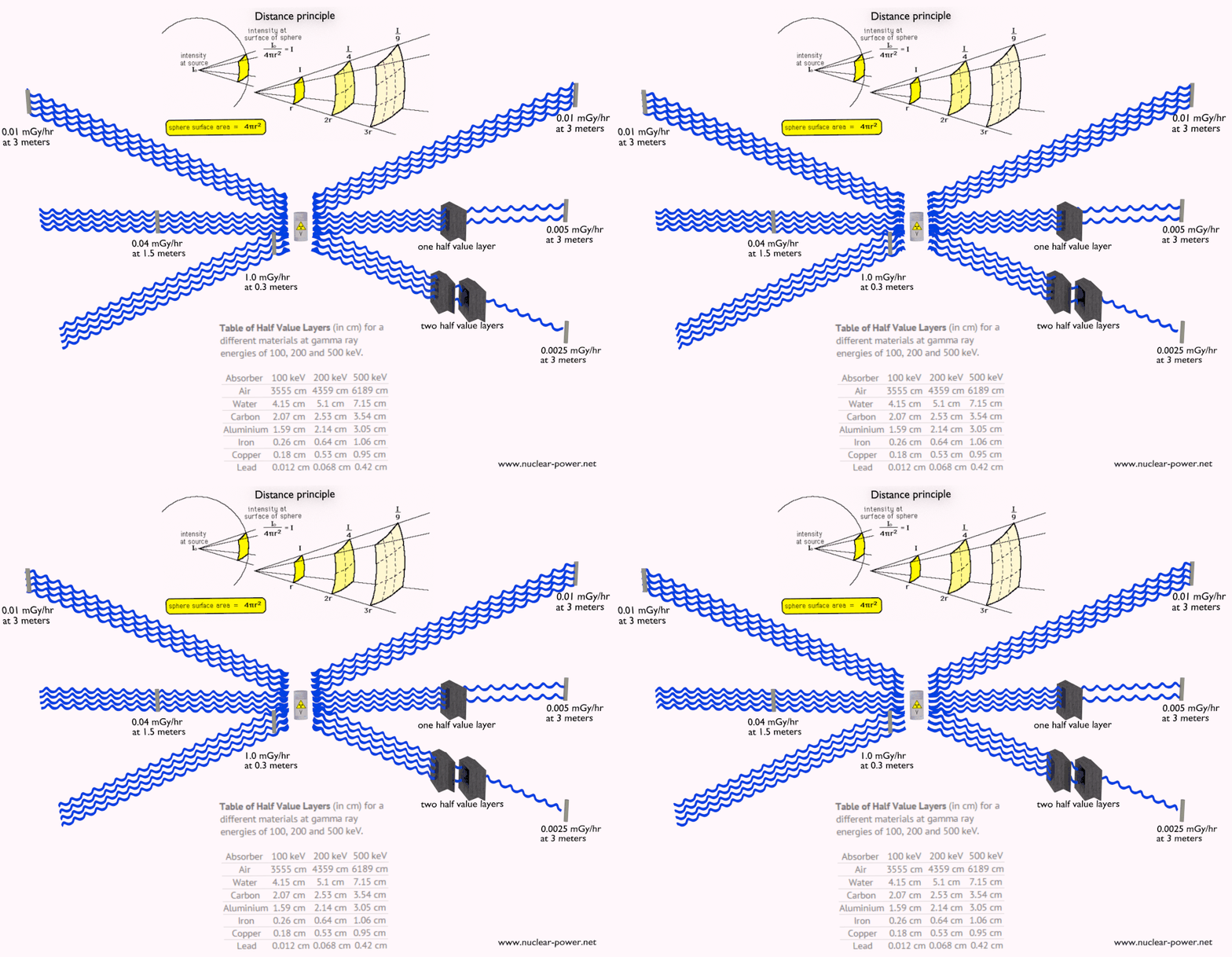
Distance. The amount of radiation exposure depends on the distance from the source of radiation. Similarly to a heat from a fire, if you are too close, the intensity of heat radiation is high and you can get burned. If you are at the right distance, you can withstand there without any problems and moreover it is comfortable. If you are too far from heat source, the insufficiency of heat can also hurt you. This analogy, in a certain sense, can be applied to radiation also from radiation sources.
Shielding. Finally, if the source is too intensive and time or distance do not provide sufficient radiation protection, the shielding must be used. Radiation shielding usually consist of barriers of lead, concrete or water. There are many many materials, which can be used for radiation shielding, but there are many many situations in radiation protection. It highly depends on the type of radiation to be shielded, its energy and many other parametres. For example, even depleted uranium can be used as a good protection from gamma radiation, but on the other hand uranium is absolutely inappropriate shielding of neutron radiation.
Principles of Radiation Protection – Time, Distance, Shielding
[/su_accordion]
Shielding of Beta Radiation – Electrons
Beta radiation ionizes matter weaker than alpha radiation. On the other hand the ranges of beta particles are longer and depends strongly on initial kinetic energy of particle. Some have enough energy to be of concern regarding external exposure. A 1 MeV beta particle can travel approximately 3.5 meters in air. Such beta particles can penetrate into the body and deposit dose to internal structures near the surface. Therefore greater shielding than in case of alpha radiation is required.
Materials with low atomic number Z are appropriate as beta particle shields. With high Z materials the bremsstrahlung (secondary radiation – X-rays) is associated. This radiation is created during slowing down of beta particles while they travel in a very dense medium. Heavy clothing, thick cardboard or thin aluminium plate will provide protection from beta radiation and prevents of production of the bremsstrahlung.
The coulomb forces that constitute the major mechanism of energy loss for electrons are present for either positive or negative charge on the particle and constitute the major mechanism of energy loss also for positrons. Whatever the interaction involves a repulsive or attractive force between the incident particle and orbital electron (or atomic nucleus), the impulse and energy transfer for particles of equal mass are about the same. Therefore positrons interact similarly with matter when they are energetic. The track of positrons in material is similar to the track of electrons. Even their specific energy loss and range are about the same for equal initial energies.
At the end of their path, positrons differ significantly from electrons. When a positron (antimatter particle) comes to rest, it interacts with an electron (matter particle), resulting in the annihilation of the both particles and the complete conversion of their rest mass to pure energy (according to the E=mc2 formula) in the form of two oppositely directed 0.511 MeV gamma rays(photons).
Therefore any positron shield have to include also a gamma ray shield. In order to minimize the bremsstrahlung a multi-layered radiation shield is appropriate. Material for the first layer must fulfill the requirements for negative beta radiation shielding. First layer of such shield may be for example a thin aluminium plate (to shield positrons), while the second layer of such shield may be a dense material such as lead or depleted uranium.
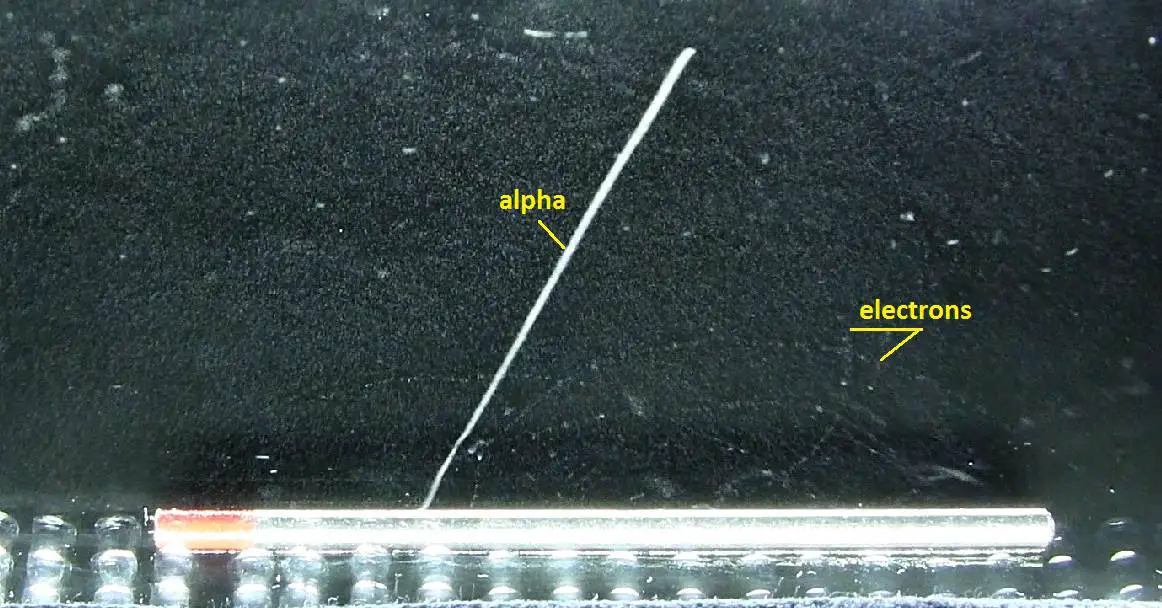
Alpha particles and electrons (deflected by a magnetic field) from a thorium rod in a cloud chamber. Source: wikipedia.org
[
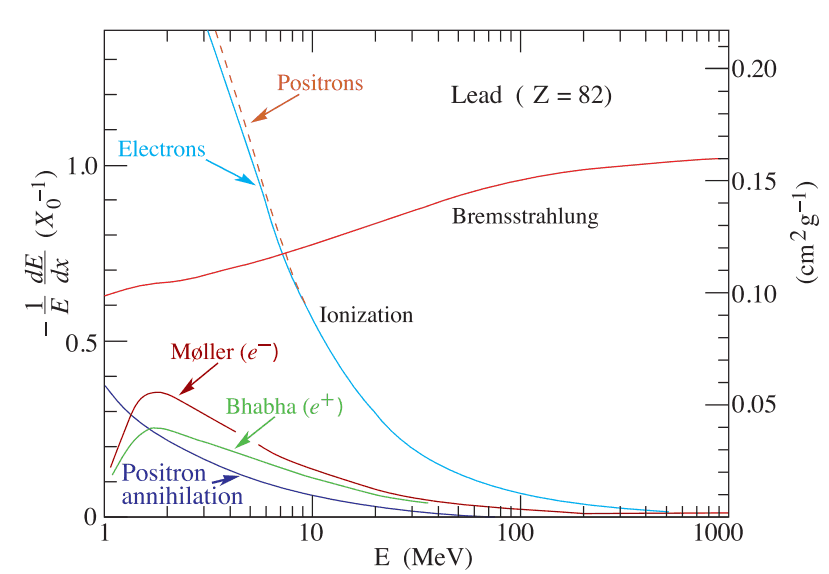
Fractional energy loss per radiation length in lead as a function of electron or positron energy. Source: http://pdg.lbl.gov/The shape of this energy curve depends on what fraction of the reaction energy (Q value-the amount of energy released by the reaction) is carried by the electron or neutrino.
The shape of this energy curve depends on what fraction of the reaction energy (Q value-the amount of energy released by the reaction) is carried by the electron or neutrino.Basic materials for beta particles shielding.
References:
Nuclear and Reactor Physics:
J. R. Lamarsh, Introduction to Nuclear Reactor Theory, 2nd ed., Addison-Wesley, Reading, MA (1983).
J. R. Lamarsh, A. J. Baratta, Introduction to Nuclear Engineering, 3d ed., Prentice-Hall, 2001, ISBN: 0-201-82498-1.
W. M. Stacey, Nuclear Reactor Physics, John Wiley & Sons, 2001, ISBN: 0- 471-39127-1.
Robert Reed Burn, Introduction to Nuclear Reactor Operation, 1988.
U.S. Department of Energy, Nuclear Physics and Reactor Theory. DOE Fundamentals Handbook, Volume 1 and 2. January 1993.
Advanced Reactor Physics:
K. O. Ott, W. A. Bezella, Introductory Nuclear Reactor Statics, American Nuclear Society, Revised edition (1989), 1989, ISBN: 0-894-48033-2.
K. O. Ott, R. J. Neuhold, Introductory Nuclear Reactor Dynamics, American Nuclear Society, 1985, ISBN: 0-894-48029-4.
D. L. Hetrick, Dynamics of Nuclear Reactors, American Nuclear Society, 1993, ISBN: 0-894-48453-2.
E. E. Lewis, W. F. Miller, Computational Methods of Neutron Transport, American Nuclear Society, 1993, ISBN: 0-894-48452-4.
See also:
See also:
Radiation
See also:
We hope, this article, Beta Radiation, helps you. If so, give us a like in the sidebar. Main purpose of this website is to help the public to learn some interesting and important information about materials and their properties.
Alpha radiation consist of alpha particles, that are energetic nuclei of helium. The production of alpha radiation is termed alpha decay. Shielding of alpha radiation does not pose a difficult problem. Material Properties
Forms of Ionizing Radiation
Interaction of Radiation with Matter
Ionizing radiation is categorized by the nature of the particles or electromagnetic waves that create the ionizing effect. These particles/waves have different ionization mechanisms, and may be grouped as:
Directly ionizing. Charged particles (atomic nuclei, electrons, positrons, protons, muons, etc.) can ionize atoms directly by fundamental interaction through the Coulomb force if it carries sufficient kinetic energy. These particles must be moving at relativistic speeds to reach the required kinetic energy. Even photons (gamma rays and X-rays) can ionize atoms directly (despite they are electrically neutral) through the Photoelectric effect and the Compton effect, but secondary (indirect) ionization is much more significant.
Alpha radiation. Alpha radiation consist of alpha particles at high energy/speed. The production of alpha particles is termed alpha decay. Alpha particles consist of two protons and two neutrons bound together into a particle identical to a helium nucleus. Alpha particles are relatively large and carry a double positive charge. They are not very penetrating and a piece of paper can stop them. They travel only a few centimeters but deposit all their energies along their short paths.
Beta radiation. Beta radiation consist of free electrons or positrons at relativistic speeds. Beta particles (electrons) are much smaller than alpha particles. They carry a single negative charge. They are more penetrating than alpha particles, but thin aluminum metal can stop them. They can travel several meters but deposit less energy at any one point along their paths than alpha particles.
Indirectly ionizing. Indirect ionizing radiation is electrically neutral particles and therefore does not interact strongly with matter. The bulk of the ionization effects are due to secondary ionizations.
Photon radiation (Gamma rays or X-rays). Photon radiation consist of high energy photons. These photons are particles/waves (Wave-Particle Duality) without rest mass or electrical charge. They can travel 10 meters or more in air. This is a long distance compared to alpha or beta particles. However, gamma rays deposit less energy along their paths. Lead, water, and concrete stop gamma radiation. Photons (gamma rays and X-rays) can ionize atoms directly through the Photoelectric effect and the Compton effect, where the relatively energetic electron is produced. The secondary electron will go on to produce multiple ionization events, therefore the secondary (indirect) ionization is much more significant.
Neutron radiation. Neutron radiation consist of free neutrons at any energies/speeds. Neutrons can be emitted by nuclear fission or by the decay of some radioactive atoms. Neutrons have zero electrical charge and cannot directly cause ionization. Neutrons ionize matter only indirectly. For example, when neutrons strike the hydrogen nuclei, proton radiation (fast protons) results. Neutrons can range from high speed, high energy particles to low speed, low energy particles (called thermal neutrons). Neutrons can travel hundreds of feet in air without any interaction.
Alpha Radiation
Alpha radiation consist of alpha particles, that are energetic nuclei of helium. The production of alpha particles is termed alpha decay. Alpha particles consist of two protons and two neutrons bound together into a particle identical to a helium nucleus. Alpha particles are relatively large and carry a double positive charge.
Key characteristics of alpha particles are summarized in few following points:
Alpha particles are energetic nuclei of helium and they are relatively heavy and carry a double positive charge.
Typical alpha particle have kinetic energy about 5 MeV. This is due to the nature of alpha decay.
Pure alpha decay is very rare, alpha decay is frequently accompanied by gamma radiation.
Alpha particles interact with matter primarily through coulomb forces (ionization and excitation of matter) between their positive charge and the negative charge of the electrons from atomic orbitals.
Alpha particles heavily ionize matter and they quickly lose their kinetic energy. Therefore alpha particles have very short ranges. On the other hand they deposit all their energies along their short paths.
For example, the ranges of a 5 MeV alpha particle (most have such initial energy) are approximately only 0,002 cm in aluminium alloy or approximately 3.5 cm in air.
The stopping power is well described by the Bethe formula.
The Bragg curve is typical for alpha particles and for other heavy charged particles and describes energy loss of ionizing radiation during travel through matter.
Alpha particles and electrons (deflected by a magnetic field) from a thorium rod in a cloud chamber. Source: wikipedia.orgBasic materials for alpha particles shielding.
The stopping power of most materials is very high for alpha particles and for heavy charged particles. Therefore alpha particles have very short ranges. For example, the ranges of a 5 MeV alpha particle (most have such initial energy) are approximately only 0,002 cm in aluminium alloy or approximately 3.5 cm in air. Most alpha particles can be stopped by a thin piece of paper. Even the dead cells in the outer layer of human skin provides adequate shielding because alpha particles can’t penetrate it.
Alpha particles are energetic nuclei of helium. The production of alpha particles is termed alpha decay. Alpha particles consist of two protons and two neutrons bound together into a particle identical to a helium nucleus. Alpha particles are relatively large and carry a double positive charge. They are not very penetrating and a piece of paper can stop them. They travel only a few centimeters but deposit all their energies along their short paths. In nuclear reactors they are produced for example in the fuel (alpha decay of heavy nuclei). Alpha particles are commonly emitted by all of the heavy radioactive nuclei occuring in the nature (uranium, thorium or radium), as well as the transuranic elements (neptunium, plutonium or americium). Especially energeticalpha particles (except artificially accelerated helium nuclei) are produced in a nuclear process, which is known as a ternary fission. In this process, the nucleus of uranium is splitted into three charged particles (fission fragments) instead of the normal two. The smallest of the fission fragments most probably (90% probability) being an extra energetic alpha particle.
Interaction of Alpha Particles with Matter
Since the electromagnetic interaction extends over some distance, it is not necessary for an alpha particles to make a direct collision with an atom. They can transfer energy simply by passing close by. Alpha particlesinteract with matter primarily through coulomb forces between their positive charge and the negative charge of the electrons from atomic orbitals. In general, the alpha particles (like other charged particles) transfer energy mostly by:
Excitation. The charged particle can transfer energy to the atom, raising electrons to a higher energy levels.
Ionization. Ionization can occur, when the charged particle have enough energy to remove an electron. This results in a creation of ion pairs in surrounding matter.
Creation of pairs requires energy, which is lost from the kinetic energy of the alpha particle causing it to decelerate. The positive ions and free electrons created by the passage of the alpha particle will then reunite, releasing energy in the form of heat (e.g. vibrational energy or rotational energy of atoms). There are considerable differences in the ways of energy loss and scattering between the passage of light charged particles such as positrons and electrons and heavy charged particles such as fission fragments, alpha particles, muons. Most of these differences are based on the different dynamics of the collision process. In general, when a heavy particle collides with a much lighter particle (electrons in the atomic orbitals), the laws of energy and momentum conservation predict that only a small fraction of the massive particle’s energy can be transferred to the less massive particle. The actual amount of transferred energy depends on how closely the charged particles passes through the atom and it depends also on restrictions from quantisation of energy levels.
The shielding of alpha radiation alone does not pose a difficult problem. On the other hand alpha radioactive nuclides can lead to serious health hazards when they are ingested or inhaled (internal contamination). When they are ingested or inhaled, the alpha particles from their decay significantly harm the internal living tissue. Moreover pure alpha radiation is very rare, alpha decay is frequently accompanied by gamma radiation which shielding is another issue.
Radiation Protection Principles - Time, Distance, Shielding
In radiation protection there are three ways how to protect people from identified radiation sources:
Limiting Time. The amount of radiation exposure depends directly (linearly) on the time people spend near the source of radiation. The dose can be reduced by limiting exposure time.
Distance. The amount of radiation exposure depends on the distance from the source of radiation. Similarly to a heat from a fire, if you are too close, the intensity of heat radiation is high and you can get burned. If you are at the right distance, you can withstand there without any problems and moreover it is comfortable. If you are too far from heat source, the insufficiency of heat can also hurt you. This analogy, in a certain sense, can be applied to radiation also from radiation sources.
Shielding. Finally, if the source is too intensive and time or distance do not provide sufficient radiation protection, the shielding must be used. Radiation shielding usually consist of barriers of lead, concrete or water. There are many many materials, which can be used for radiation shielding, but there are many many situations in radiation protection. It highly depends on the type of radiation to be shielded, its energy and many other parametres. For example, even depleted uranium can be used as a good protection from gamma radiation, but on the other hand uranium is absolutely inappropriate shielding of neutron radiation.
Principles of Radiation Protection – Time, Distance, Shielding
References:
Nuclear and Reactor Physics:
J. R. Lamarsh, Introduction to Nuclear Reactor Theory, 2nd ed., Addison-Wesley, Reading, MA (1983).
J. R. Lamarsh, A. J. Baratta, Introduction to Nuclear Engineering, 3d ed., Prentice-Hall, 2001, ISBN: 0-201-82498-1.
W. M. Stacey, Nuclear Reactor Physics, John Wiley & Sons, 2001, ISBN: 0- 471-39127-1.
Robert Reed Burn, Introduction to Nuclear Reactor Operation, 1988.
U.S. Department of Energy, Nuclear Physics and Reactor Theory. DOE Fundamentals Handbook, Volume 1 and 2. January 1993.
Advanced Reactor Physics:
K. O. Ott, W. A. Bezella, Introductory Nuclear Reactor Statics, American Nuclear Society, Revised edition (1989), 1989, ISBN: 0-894-48033-2.
K. O. Ott, R. J. Neuhold, Introductory Nuclear Reactor Dynamics, American Nuclear Society, 1985, ISBN: 0-894-48029-4.
D. L. Hetrick, Dynamics of Nuclear Reactors, American Nuclear Society, 1993, ISBN: 0-894-48453-2.
E. E. Lewis, W. F. Miller, Computational Methods of Neutron Transport, American Nuclear Society, 1993, ISBN: 0-894-48452-4.
See also:
See also:
Radiation
See also:
We hope, this article, Alpha Radiation, helps you. If so, give us a like in the sidebar. Main purpose of this website is to help the public to learn some interesting and important information about materials and their properties.
The macroscopic cross-section represents the effective target area of all of the nuclei contained in the volume of the material. The units are given in cm-1. Material Properties
Macroscopic Cross-section
The difference between the microscopic cross-section and macroscopic cross-section is very important and is restated for clarity. The microscopic cross section represents the effective target area of a single target nucleus for an incident particle. The units are given in barns or cm2.
While the macroscopic cross-section represents the effective target area of all of the nuclei contained in the volume of the material. The units are given in cm-1.
Here σ, which has units of m2, is the microscopic cross-section. Since the units of N (nuclei density) are nuclei/m3, the macroscopic cross-section Σ have units of m-1, thus in fact is an incorrect name, because it is not a correct unit of cross-sections. In terms of Σt (the total cross-section), the equation for the intensity of a neutron beam can be written as
-dI = N.σ.Σt.dx
Dividing this expression by I(x) gives
-dΙ(x)/I(x) = Σt.dx
Since dI(x) is the number of neutrons that collide in dx, the quantity –dΙ(x)/I(x) represents the probability that a neutron that has survived without colliding until x, will collide in the next layer dx. It follows that the probability P(x) that a neutron will travel a distance x without any interaction in the material, which is characterized by Σt, is:
P(x) = e-Σt.x
From this equation, we can derive the probability that a neutron will make its first collision in dx. It will be the quantity P(x)dx. If the probability of the first collision in dx is independent of its past history, the required result will be equal to the probability that a neutron survives up to layer x without any interaction (~Σtdx) times the probability that the neutron will interact in the additional layer dx (i.e. ~e-Σt.x).
P(x)dx = Σtdx . e-Σt.x = Σt e-Σt.x dx
Mean Free Path
From the equation for the probability of the first collision in dx we can calculate the mean free path that is traveled by a neutron between two collisions. This quantity is usually designated by the symbol λ and it is equal to the average value of x, the distance traveled by a neutron without any interaction, over the interaction probability distribution.
whereby one can distinguish λs, λa, λf, etc. This quantity is also known as the relaxation length, because it is the distance in which the intensity of the neutrons that have not caused a reaction has decreased with a factor e.
For materials with high absorption cross-section, the mean free path is very short and neutron absorption occurs mostly on the surface of the material. This surface absorption is called self-shielding because the outer layers of atoms shield the inner layers.
Macroscopic Cross-section of Mixtures and Molecules
Most materials are composed of several chemical elements and compounds. Most of chemical elements contains several isotopes of these elements (e.g. gadolinium with its six stable isotopes). For this reason most materials involve many cross-sections. Therefore, to include all the isotopes within a given material, it is necessary to determine the macroscopic cross section for each isotope and then sum all the individual macroscopic cross-sections.
In this section both factors (different atomic densities and different cross-sections) will be considered in the calculation of the macroscopic cross-section of mixtures.
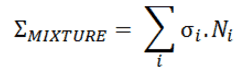
First, consider the Avogadro’s number N0 = 6.022 x 10²³, is the number of particles (molecules, atoms) that is contained in the amount of substance given by one mole. Thus if M is the molecular weight, the ratio N0/M equals to the number of molecules in 1g of the mixture. The number of molecules per cm3 in the material of density ρ and the macroscopic cross-section for mixtures are given by following equations:
Ni = ρi.N0 / Mi
Scattering of slow neutrons by molecules is greater than by free nuclei.
Note that, in some cases, the cross-section of the molecule is not equal to the sum of cross-sections of its individual nuclei. For example the cross-section of neutron elastic scattering of water exhibits anomalies for thermal neutrons. It occurs, because the kinetic energy of an incident neutron is of the order or less than the chemical binding energy and therefore the scattering of slow neutrons by water (H2O) is greater than by free nuclei (2H + O).
Example - Macroscopic cross-section for boron carbide in control rods
A control rod usually contains solid boron carbide with natural boron. Natural boron consists primarily of two stable isotopes,11B (80.1%) and10B(19.9%). Boron carbide has a density of 2.52 g/cm3.
Determine the total macroscopic cross-section and the mean free path.
Density:
MB = 10.8
MC = 12
MMixture = 4 x 10.8 + 1×12 g/mol
NB4C = ρ . Na / MMixture
= (2.52 g/cm3)x(6.02×1023 nuclei/mol)/ (4 x 10.8 + 1×12 g/mol)
= 2.75×10²² molecules of B4C/cm3
NB = 4 x 2.75×1022 atoms of boron/cm3
NC = 1 x 2.75×1022 atoms of carbon/cm3
NB10 = 0.199 x 4 x 2.75×1022 = 2.18×10²² atoms of 10B/cm3
NB11 = 0.801 x 4 x 2.75×1022 = 8.80×10²² atoms of 11B/cm3
NC = 2.75×10²² atoms of 12C/cm3
the microscopic cross-sections
σt10B = 3843 b of which σ(n,alpha)10B = 3840 b
σt11B = 5.07 b
σt12C = 5.01 b
the macroscopic cross-section
ΣtB4C= 3843×10-24 x 2.18×1022 + 5.07×10-24 x 8.80×1022 + 5.01×10-24 x 2.75×1022
= 83.7 + 0.45 + 0.14 = 84.3 cm-1
the mean free path
λt= 1/ΣtB4C = 0.012 cm = 0.12 mm (compare with B4C pellets diameter in control rods which may be around 7mm) λa ≈ 0.12 mm
Example - Atomic number density of 235U in uranium fuel
It was written the macroscopic cross-section is derived from microscopic cross-section and the atomic number density (N):
Σ=σ.N
In this equation, the atomic number density plays the crucial role as the microscopic cross-section, because in the reactor core the atomic number density of certain materials (e.g. water as the moderator) can be simply changed leading into certain reactivity changes. In order to understand the nature of these reactivity changes, we must understand the term the atomic number density.
Most of PWRs use the uranium fuel, which is in the form of uranium dioxide (UO2). Typically, the fuel have enrichment of ω235 = 4% [grams of 235U per gram of uranium] of isotope 235U.
Calculate the atomic number density of 235U (N235U), when:
the molecular weight of the enriched uranium MUO2 = 237.9 + 32 = 269.9 g/mol
the uranium density ⍴UO2 = 10.5 g/cm3
NUO2 = ⍴UO2 . NA / MUO2
NUO2 = (10.5 g/cm3) x (6.02×1023 nuclei/mol)/ 269.9 NUO2 = 2.34 x 10²² molecules of UO2/cm3
NU = 1 x 2.34×1022 atoms of uranium/cm3
NO = 2 x 2.34×1022 atoms of oxide/cm3
N235U = ω235.NA.⍴UO2/M235U x (MU/MUO2)
N235U = 0.04 x 6.02×1023 x 10.5 / 235 x 237.9 / 269.9 =9.48 x 10²⁰ atoms of 235U/cm3
References:
Nuclear and Reactor Physics:
J. R. Lamarsh, Introduction to Nuclear Reactor Theory, 2nd ed., Addison-Wesley, Reading, MA (1983).
J. R. Lamarsh, A. J. Baratta, Introduction to Nuclear Engineering, 3d ed., Prentice-Hall, 2001, ISBN: 0-201-82498-1.
W. M. Stacey, Nuclear Reactor Physics, John Wiley & Sons, 2001, ISBN: 0- 471-39127-1.
Robert Reed Burn, Introduction to Nuclear Reactor Operation, 1988.
U.S. Department of Energy, Nuclear Physics and Reactor Theory. DOE Fundamentals Handbook, Volume 1 and 2. January 1993.
Advanced Reactor Physics:
K. O. Ott, W. A. Bezella, Introductory Nuclear Reactor Statics, American Nuclear Society, Revised edition (1989), 1989, ISBN: 0-894-48033-2.
K. O. Ott, R. J. Neuhold, Introductory Nuclear Reactor Dynamics, American Nuclear Society, 1985, ISBN: 0-894-48029-4.
D. L. Hetrick, Dynamics of Nuclear Reactors, American Nuclear Society, 1993, ISBN: 0-894-48453-2.
E. E. Lewis, W. F. Miller, Computational Methods of Neutron Transport, American Nuclear Society, 1993, ISBN: 0-894-48452-4.
See also:
See also:
Neutron Cross-section
See also:
We hope, this article, Macroscopic Cross-section, helps you. If so, give us a like in the sidebar. Main purpose of this website is to help the public to learn some interesting and important information about materials and their properties.