Facebook Instagram Youtube Twitter

What is Nuclear Breeding – Definition

The nuclear fuel breeding in the fuel cycle of all commercial light water reactors plays a significant role. The nuclear breeding permits the power reactor to operate longer. Material Properties

Nuclear Fuel Breeding

All commercial light water reactors contains both fissile and fertile materials. For example, most PWRs use low enriched uranium fuel with enrichment of 235U up to 5%. Therefore more than 95% of content of fresh fuel is fertile isotope 238U. During fuel burnup the fertile materials (conversion of 238U to fissile 239Pu known as fuel breeding) partially replace fissile 235U, thus permitting the power reactor to operate longer before the amount of fissile material decreases to the point where reactor criticality is no longer manageable.

The fuel breeding in the fuel cycle of all commercial light water reactors plays a significant role. In recent years, the commercial power industry has been emphasizing high-burnup fuels (up to 60 – 70 GWd/tU), which are typically enriched to higher percentages of 235U (up to 5%). As burnup increases, a higher percentage of the total power produced in a reactor is due to the fuel bred inside the reactor. 

Effect of Fuel Temperature on Nuclear Breeding
In LWRs, the fuel temperature influences the rate of nuclear breeding (the breeding ratio). In principle, the increase is the fuel temperature affects primarily the resonance escape probability, which is connected with the phenomenon usually known as the Doppler broadening (primarily 238U).  The impact of this resonance capture reaction  on the neutron balance is evident, the neutron is lost and this effect decreases the effective multiplication factor. On the other hand, this capture leads to formation of unstable nuclei with higher neutron number. Such unstable nuclei undergo a nuclear decay, which may lead to formation of another fissile nuclei. This process is also referred to as the nuclear transmutation and is responsible for new fuel breeding in nuclear reactors.

From this point of view, the neutron is utilized much more effectively when captured by 238U than when captured by absorbator, because the effective multiplication factor must in every state equal to 1 (Note that in PWRs the boric acid is used to compensate an excess of reactivity of reactor core along thefuel cycle). In other words it is better to capture the neutron (lower an excess of reactivity) by 238U, rather than by 10B nuclei.

At HFP (hot full power) state, the fuel temperature is directly given by:

  • Local linear heat rate (W/cm), which is given by neutron flux distribution. See also: Power Distribution
  • Fuel-cladding gap. As the fuel burnup increases the fuel-cladding gap reduces. This reduction is caused by the swelling of the fuel pellets and cladding creep. Fuel pellets swelling occurs because fission gases cause the pellet to swell resulting in a larger volume of the pellet. At the same time, the cladding is distorted by outside pressure (known as the cladding creep). These two effects result in direct fuel-cladding contact (e.g. at burnup of 25 GWd/tU). The direct fuel-cladding contact causes a significant reduction in fuel temperature profile, because the overall thermal conductivity increases due to conductive heat transfer.
  • Core inlet temperature. Core inlet temperature is directly given by system parameters in steam generators. When steam generators are operated at approximately 6.0MPa, it means the saturation temperature is equal to 275.6 °C. Since there must be always ΔT (~15°C) between the primary circuit and the secondary circuit, the reactor coolant (in the cold leg)have about 290.6°C (at HFP) at the inlet of the core. As the system pressure increases, the core inlet temperature must also increase. This increase causes slight increase in fuel temperature.

It can be summarized, the fuel breeding is lower, when the reactor is operated at lower power levels. Note that, in order to lower the reactor power, additional absorbators must be inserted inside the core.  The fuel breeding is higher  (e.g. 1 EFPD surplus), when the core inlet temperature of the reactor coolant is higher (e.g. 1°C for 300 EFPDs). It must be added, the inlet temperature is limited and it cannot be changed arbitrarily.

At a burnup of 30 GWd/tU (gigawatt-days per metric ton of uranium), about 30% of the total energy released comes from bred plutonium. At 40 GWd/tU, that percentage increases to about forty percent. This corresponds to a breeding ratio for these reactors of about 0.4 to 0.5. That means, about half of the fissile fuel in these reactors is bred there. This effect extends the cycle length for such fuels to sometimes nearly twice what it would be otherwise. MOX fuel has a smaller breeding effect than 235U fuel and is thus more challenging and slightly less economic to use due to a quicker drop off in reactivity through cycle life. 
Plutonium 239 breeding
 n+_{92}^{238}textrm{U} {rightarrow} _{92}^{239}textrm{U}+gamma rightarrow _{93}^{239}textrm{Np} rightarrow _{94}^{239}textrm{Pu} 

Neutron capture may also be used to create fissile 239Pu from 238U, which is the dominant constituent of naturally occurring uranium (99.28%). Absorption of a neutron in the 238U nucleus yields 239U. The half-life of 239U is approximately 23.5 minutes. 239U decays (negative beta decay) to 239Np (neptunium), whose half-life is 2.36 days. 239Np decays (negative beta decay)  to 239Pu.

Uranium 233 breeding
n+_{90}^{232}textrm{Th} {rightarrow} _{90}^{232}textrm{Th}+gamma rightarrow _{91}^{233}textrm{Pa} rightarrow _{92}^{233}textrm{U}

232Th is the predominant isotope of natural thorium. If this fertile material is loaded in the nuclear reactor, the nuclei of 232Th absorb a neutron and become nuclei of 233Th. The half-life of 233Th is approximately 21.8 minutes. 233Th decays (negative beta decay) to 233Pa (protactinium), whose half-life is 26.97 days. 233Pa decays (negative beta decay)  to 233U, that is very good fissile material. On the other hand proposed reactor designs must attempt to physically isolate the protactinium from further neutron capture before beta decay can occur.

Comparison of cross-sections

Source: JANIS (Java-based nuclear information software)  http://www.oecd-nea.org/janis/
Fissile / Fertile Material Cross-sections
Source: JANIS (Java-based nuclear information software)
http://www.oecd-nea.org/janis/

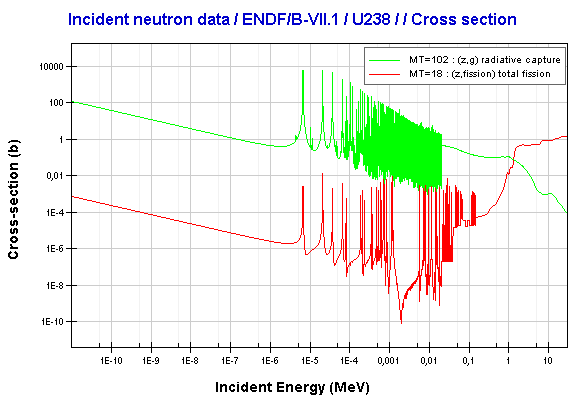
Uranium 238. Comparison of total fission cross-section and cross-section for radiative capture.
Fissile / Fertile Material Cross-sections
Source: JANIS (Java-based nuclear information software)
http://www.oecd-nea.org/janis/

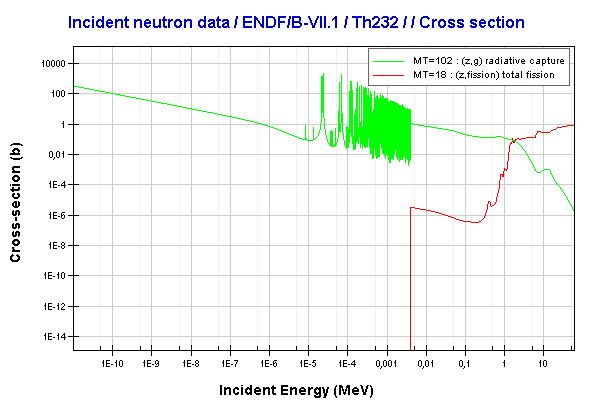
Thorium 232. Comparison of total fission cross-section and cross-section for radiative capture.

Pu-239 breeding. The uranium nucleus absorbs neutron, thus leads to Pu-239 breeding.

Conversion Factor – Breeding Ratio

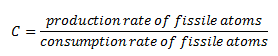
A quantity that characterizes this conversion of fertile into fissile material is known as the conversion factor. The conversion factor is defined as the ratio of fissile material created to fissile material consumed either by fission or absorption. If the ratio is greater than one, it is often referred to as the breeding ratio, for then the reactor is creating more fissile material than it is consuming.
Conversion Factor - Breeding Ratio - definition

When C is unity, one new atom is produced per one atom consumed. It seems fertile material can be converted in the reactor indefinitely without adding new fuel, but in real reactors the content of fertile uranium 238 also decreases and fission products with significant absorption cross-section accumulates in the fuel as fuel burnup increases.

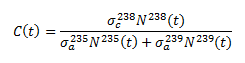
If we use a simplified model, which includes only uranium and plutonium-239, the conversion factor is:
Conversion Factor - Breeding Ratio - equation

This equation indicates that increased fuel enrichment results in a decreased value of C(0), the initial conversion factor. As the content of fissile material decreases with fuel burnup, the conversion factor increases. As this happens an increasing fraction of the fission comes from plutonium.

See also: Conversion Factor

See also:

Glossary

We hope, this article, Nuclear Breeding, helps you. If so, give us a like in the sidebar. Main purpose of this website is to help the public to learn some interesting and important information about materials and their properties.

What is Primordial Matter – Definition

Primordial nuclides are nuclides found on the Earth that have existed in their current form since before Earth was formed. Primordial nuclides. Material Properties
Primordial matter consist of primordial nuclides. Primordial nuclides are nuclides found on the Earth that have existed in their current form since before Earth was formed. Primordial nuclides are residues from the Big Bang, from cosmogenic sources, and from ancient supernova explosions which occurred before the formation of the solar system. Only 288 such nuclides are known.

Bismuth, thorium, uranium and plutonium are primordial nuclides because they have half-lives long enough to still be found on the Earth, while all the others are produced either by radioactive decay or are synthesized in laboratories and nuclear reactors.

See also:

Glossary

We hope, this article, Primordial Matter, helps you. If so, give us a like in the sidebar. Main purpose of this website is to help the public to learn some interesting and important information about materials and their properties.
What is Detection of Antineutrinos / Neutrinos – Definition

Since neutrinos do not ionize matter, they cannot be detected directly. The antineutrino detection is based on the inverse beta decay. Detection of Antineutrinos. Material Properties
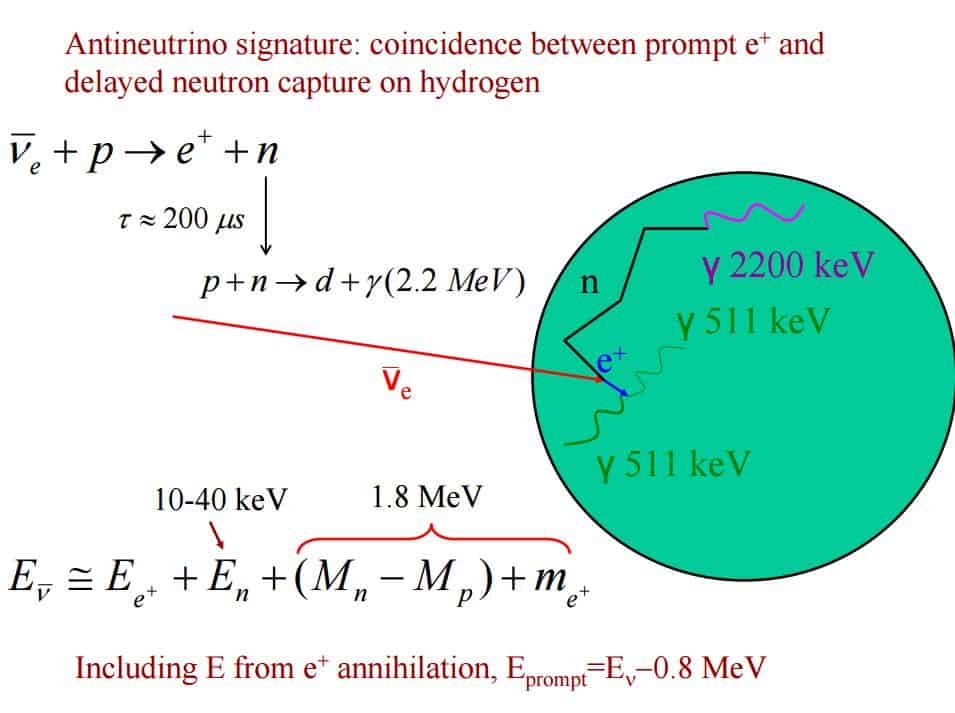
Since neutrinos do not ionize matter, they cannot be detected directly. The antineutrino detection (1995 Nobel Prize for Frederick Reines and Clyde Cowan) is  based on the reaction:

This interaction is symmetrical to the beta decay of free neutron, therefore it sometimes referred to as inverse beta decay. All detection methods require the neutrinos to carry a minimum threshold energy of 1.8 MeV. Only antineutrinos with an energy above the threshold of 1.8 MeV can cause interactions with the protons in the water, producing positrons and neutrons.


Reference: Griffiths, David, Introduction to Elementary Particles, Wiley, 1987.

antineutrino detection
Antineutrino signature: coincidence between prompt positron and delayes neutron capture on hydrogen.
Source: Slides – Dr. Blucher, Enrico Fermi Institute
Antineutrino detector
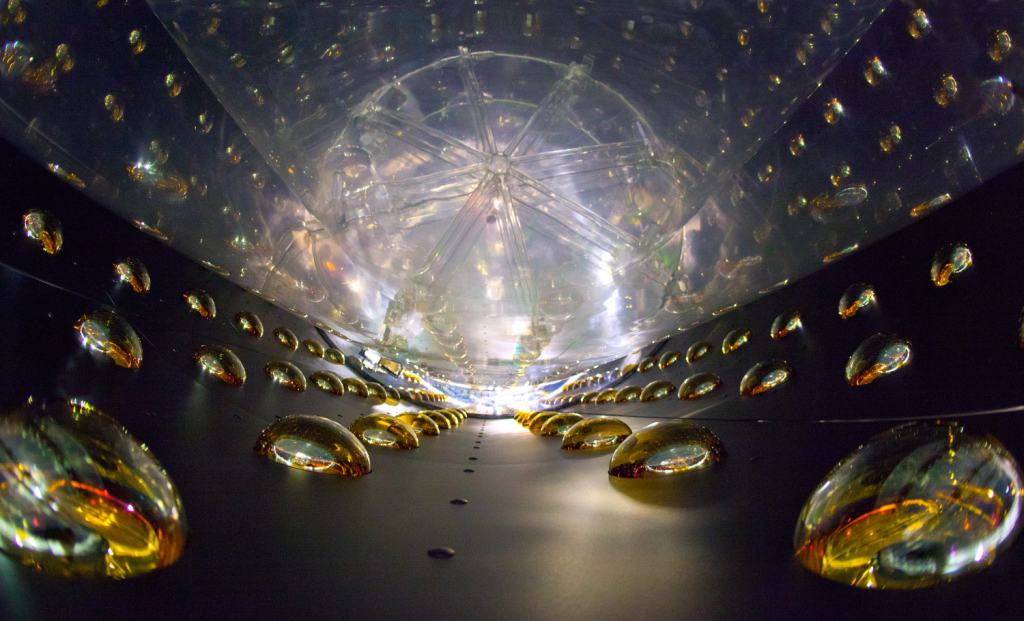
The inside of a cylindrical antineutrino detector before being filled with clear liquid scintillator, which reveals antineutrino interactions by the very faint flashes of light they emit. Sensitive photomultiplier tubes line the detector walls, ready to amplify and record the telltale flashes.
Photo: Roy Kaltschmidt, LBNL
Source: Daya Bay Reactor Neutrino Experiment

See also:

Antineutrino

See also:

Nuclear Reactor as the Antineutrino Source

We hope, this article, Detection of Antineutrinos / Neutrinos, helps you. If so, give us a like in the sidebar. Main purpose of this website is to help the public to learn some interesting and important information about materials and their properties.
What is Antineutrino – Definition

Antineutrinos are the antiparticles of neutrinos. The antineutrino is an elementary subatomic particle with infinitesimal mass and with no electric charge. Material Properties
Antineutrinos are the antiparticles of neutrinos. The antineutrino is an elementary subatomic particle with infinitesimal mass (less than 0.3eV..?) and with no electric charge. Neutrinos and antineutrinos belong to the family of leptons, which means they do not interact via strong nuclear force. Neutrinos are gravitational and weakly interacting subatomic particles with ½ unit of spin. Also antineutrinos (as neutrinos) are very penetrating subatomic particles, capable of passing through Earth without any interaction. Currently (2015), it is not resolved, whether the neutrino and its antiparticle are not identical particles.

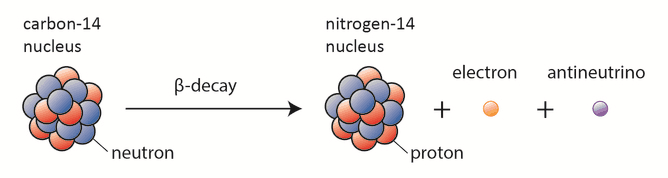
Antineutrinos are produced in the negative beta decay. In a nuclear reactor occurs especially the β− decay, because the common feature of the fission products is an excess of neutrons (see Nuclear Stability). An unstable fission fragment with the excess of neutrons undergoes β− decay, where the neutron is converted into a proton, an electron, and an electron antineutrino. Therefore each nuclear reactor is very powerful source of antineutrinos and researchers around the world investigate the possibilities of using antineutrinos for reactor monitoring.

On the other hand the most powerful source of neutrinos in the solar system is doubtless the Sun itself. Billions of solar neutrinos per second pass (mostly without any interaction) through every square centimeter (~6 x 1010 cm-2s-1) on the Earth’s surface. In the Sun, neutrinos are produced after fusion reaction of two protons during positive beta decay of helium-2 nucleus.

_{2}^{2}textrm{He}rightarrow _{1}^{2}textrm{H} + beta^{+} + nu_{{e}}

Detection of Antineutrinos

Since neutrinos do not ionize matter, they cannot be detected directly. The antineutrino detection (1995 Nobel Prize for Frederick Reines and Clyde Cowan) is  based on the reaction:

This interaction is symmetrical to the beta decay of free neutron, therefore it sometimes referred to as inverse beta decay. All detection methods require the neutrinos to carry a minimum threshold energy of 1.8 MeV. Only antineutrinos with an energy above the threshold of 1.8 MeV can cause interactions with the protons in the water, producing positrons and neutrons.

Nuclear Reactor as the Antineutrino Source

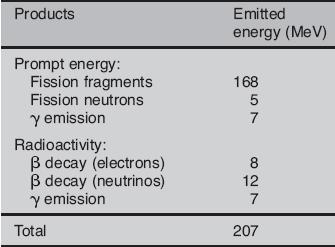
Nuclear reactors are the major source of human-generated antineutrinos. This is due to the fact that antineutrinos are produced in a negative beta decay. In a nuclear reactor occurs especially the β− decay, because the common feature of the fission fragments is an excess of neutrons (see Nuclear Stability). An unstable fission fragment with the excess of neutrons undergoes β− decay, where the neutron is converted into a proton, an electron, and an electron antineutrino. The existence of emission of antineutrinos and their very low cross-section for any interaction leads to very interesting phenomenon. Roughly about 5% (or about 12 MeV of 207 MeV) of released energy per one fission is radiated away from reactor in the form of antineutrinos. For a typical nuclear reactor with a thermal power of 3000 MWth (~1000MWe of electrical power), the total power produced is in fact higher, approximately 3150 MW, of which 150 MW is radiated away into space as antineutrino radiation. This amount of energy is forever lost, since antineutrinos are able to penetrate all reactor materials without any interaction. In fact, a common statement in physics texts is that the mean free path of a neutrino is approximately a light-year of lead. Moreover, a neutrino of moderate energy can easily penetrate a thousand light-years of lead (according to the J. B. Griffiths).

Please note that billions of solar neutrinos per second pass (mostly without any interaction) through every square centimeter (~6×10¹⁰) on the Earth’s surface and antineutrino radiation is by no means dangerous.

Example – Amount of antineutrinos produced:

Stable nuclei with most likely mass number A from U-235 fission are _{40}^{94}textrm{Zr} and _{58}^{140}textrm{Ce}. These nuclei have together 98 protons and 136 neutrons, while fission fragments (parent nuclei) have together 92 protons and 142 neutrons. This means after each U-235 fission the fission fragments must undergo on average 6 negative beta decays (6 neutrons must decay to 6 protons) and therefore 6 antineutrinos must be produced per each fission. The typical nuclear reactor therefore produces approximately 6 x 10²⁰ antineutrinos per second (~200 MeV/fission; ~6 antineutrinos/fission; 3000 MWth; 9.375 x 10¹⁹ fissions/sec).

Reference: Griffiths, David, Introduction to Elementary Particles, Wiley, 1987.

beta decay
Beta decay of C-14 nucleus.
Neutrino event
Source: wikipedia.org
Antineutrino detector
The inside of a cylindrical antineutrino detector before being filled with clear liquid scintillator, which reveals antineutrino interactions by the very faint flashes of light they emit. Sensitive photomultiplier tubes line the detector walls, ready to amplify and record the telltale flashes.
Photo: Roy Kaltschmidt, LBNL
Source: Daya Bay Reactor Neutrino Experiment
antineutrino detection
Source: Slides – Dr. Blucher, Enrico Fermi Institute
Energy from Uranium Fission
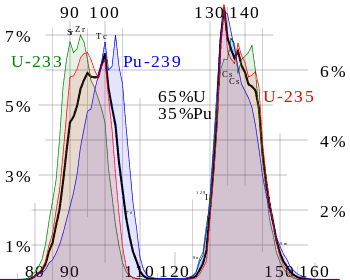
Fission fragment yields
Fission fragment yield for different nuclei. The most probable fragment masses are around mass 95 (Krypton) and 137 (Barium).

See also:

Neutrino

See also:

Fundamental Particles

See also:

We hope, this article, Antineutrino, helps you. If so, give us a like in the sidebar. Main purpose of this website is to help the public to learn some interesting and important information about materials and their properties.

What is Neutrino – Definition

A neutrino is an elementary subatomic particle with infinitesimal mass and with no electric charge. Neutrinos are weakly interacting subatomic particles with ½ unit of spin. Material Properties
A neutrino is an elementary subatomic particle with infinitesimal mass (less than 0.3 eV..?) and with no electric charge. Neutrinos belong to the family of leptons, which means they do not interact via strong nuclear force. Neutrinos are weakly interacting subatomic particles with ½ unit of spin. The term neutrino comes from Italian meaning “little neutral one” and neutrinos are denoted by the Greek letter ν (nu). There are three types of charged leptons, each associated with neutrino, forming three generations (between generations, particle differ by their quantum number and mass). The first generation consist of the electron (e−) and electron-neutrino (νe). The second generation consist of the muon (μ−) and muon neutrino (νμ) The third generation consist of the tau (τ−) and the tau neutrino (ντ). Each type of neutrino is associated with an antimatter particle, called an antineutrino, which also has neutral electric charge and 1/2 spin. Currently (2015), it is not resolved, whether the neutrino and its antiparticle are not identical particles.

Carrying no electric charge they are not affected by electromagnetic forces that act on another charged leptons, such as electrons. Since neutrinos  belong to the family of leptons, they are not subject to the strong force. Neutrinos are subject to the weak force, which is of much shorter range than electromagnetic force and gravity force. Therefore, neutrinos are the most penetrating subatomic particles, capable of passing through Earth without any interaction. It is estimated neutrinos have interaction cross-sections about 20 orders of magnitude less than typical cross-sections of scattering of two nucleons (~10-47m2 = 10-19barn). It is estimated neutrino cross-section for interaction increases linearly with energy of incident neutrino.

Reference: Griffiths, David, Introduction to Elementary Particles, Wiley, 1987.

See also: Antineutrino

See also: Nuclear Reactor as the Antineutrino Source

Neutrino eventSource: wikipedia.org
Antineutrino detectorThe inside of a cylindrical antineutrino detector before being filled with clear liquid scintillator, which reveals antineutrino interactions by the very faint flashes of light they emit. Sensitive photomultiplier tubes line the detector walls, ready to amplify and record the telltale flashes.
Photo: Roy Kaltschmidt, LBNL
Source: Daya Bay Reactor Neutrino Experiment
 
Discovery of the Neutrino

Discovery of the Neutrino

The study of beta decay provided the first physical evidence for the existence of the neutrino. The discovery of the neutrino is based on the law of conservation of energy during the process of beta decay.

In both alpha and gamma decay, the resulting particle (alpha particle or photon) has a narrow energy distribution, since the particle carries the energy from the difference between the initial and final nuclear states. For example, in case of alpha decay, when a parent nucleus breaks down spontaneously to yield a daughter nucleus and an alpha particle, the sum of the mass of the two products does not quite equal the mass of the original nucleus (see Mass Defect). As a result of the law of conservation of energy, this difference appears in the form of the kinetic energy of the alpha particle. Since the same particles appear as products at every breakdown of a particular parent nucleus, the mass-difference should always be the same, and the kinetic energy of the alpha particles should also always be the same. In other words, the beam of alpha particles should be monoenergetic.

It was expected that the same considerations would hold for a parent nucleus breaking down to a daughter nucleus and a beta particle. Because only the electron and the recoiling daughter nucleus were observed beta decay, the process was initially assumed to be a two body process, very much like alpha decay. It would seem reasonable to suppose that the beta particles would form also a monoenergetic beam.

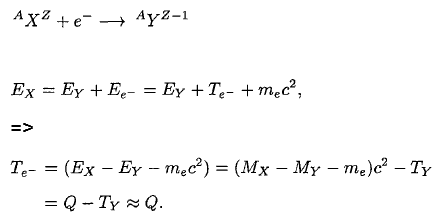
To demonstrate energetics of two-body beta decay, consider the beta decay in which an electron is emitted and the parent nucleus is at rest, conservation of energy requires:

conservation-of-energy-beta-decay

Since the electron is much lighter particle it was expected that it will carry away most of the released energy, which would have a unique value Te-.

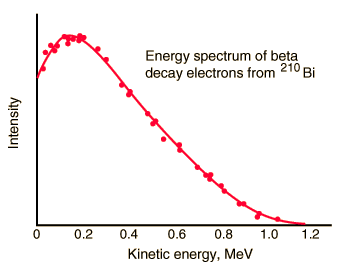
Energy spectrum of beta decay
The shape of this energy curve depends on what fraction of the reaction energy (Q value-the amount of energy released by the reaction) is carried by the electron or neutrino.

But the reality was different. The spectrum of beta particles measured by Lise Meitner and Otto Hahn in 1911 and by Jean Danysz in 1913 showed multiple lines on a diffuse background, however. Moreover virtually all of the emitted beta particles have energies below that predicted by energy conservation in two-body decays. The electrons emitted in beta decay have a continuous rather than a discrete spectrum appeared to contradict conservation of energy, under the then-current assumption that beta decay is the simple emission of an electron from a nucleus. When this was first observed, it appeared to threaten the survival of one of the most important conservation laws in physics!

To account for this energy release, Pauli proposed (in 1931) that there was emitted in the decay process another particle, later named by Fermi the neutrino. It was clear, this particle must be highly penetrating and that the conservation of electric charge requires the neutrino to be electrically neutral. This would explain why it was so hard to detect this particle. The term neutrino comes from Italian meaning “little neutral one” and neutrinos are denoted by the Greek letter ν (nu). In the process of beta decay the neutrino carries the missing energy and also in this process the law of conservation of energy remains valid.

Production of Neutrinos

Neutrinos can be produced in several ways. The most powerful source of neutrinos in the solar system is doubtless the Sun itself. Billions of solar neutrinos per second pass (mostly without any interaction) through every square centimeter (~6 x 1010 cm-2s-1) on the Earth’s surface. In the Sun, neutrinos are produced after fusion reaction of two protons during positive beta decay of helium-2 nucleus.

_{2}^{2}textrm{He}rightarrow _{1}^{2}textrm{H} + beta^{+} + nu_{{e}}

Each nuclear reactor is also very powerful source of neutrinos. In fact, antineutrinos. In a nuclear reactor occurs especially the β− decay, because the common feature of the fission products is an excess of neutrons (see Nuclear Stability). An unstable fission fragment with the excess of neutrons undergoes β− decay, where the neutron is converted into a proton, an electron, and an electron antineutrino.

Reference: Griffiths, David, Introduction to Elementary Particles, Wiley, 1987.

See also:

Fundamental Particles

See also:

Antineutrino

We hope, this article, Neutrino, helps you. If so, give us a like in the sidebar. Main purpose of this website is to help the public to learn some interesting and important information about materials and their properties.
What is Mass Attenuation Coefficient – Definition

The mass attenuation coefficient is defined as the ratio of the linear attenuation coefficient and absorber density (μ/ρ). Material Properties

Mass Attenuation Coefficient

When characterizing an absorbing material, we can use sometimes the mass attenuation coefficient.  The mass attenuation coefficient is defined as the ratio of the linear attenuation coefficient and absorber density (μ/ρ). The attenuation of gamma radiation can be then described by the following equation:

I=I0.e-(μ/ρ).ρl

, where ρ is the material density, (μ/ρ) is the mass attenuation coefficient and ρ.l is the mass thickness. The measurement unit used for the mass attenuation coefficient cm2g-1.For intermediate energies the Compton scattering dominates and different absorbers have approximately equal mass attenuation coefficients. This is due to the fact that cross section of Compton scattering is proportional to the Z (atomic number) and therefore the coefficient is proportional to the material density ρ. At small values of gamma ray energy or at high values of gamma ray energy, where the coefficient is proportional to higher powers of the atomic number Z (for photoelectric effect σf ~ Z5; for pair production σp ~ Z2), the attenuation coefficient μ is not a constant.

See also:

Half Value Layer

See also:

Gamma Ray Attenuation

We hope, this article, Mass Attenuation Coefficient, helps you. If so, give us a like in the sidebar. Main purpose of this website is to help the public to learn some interesting and important information about materials and their properties.
What is Half Value Layer – Definition

The half value layer expresses the thickness of absorbing material needed for reduction of the incident radiation intensity by a factor of two. Material Properties

Half Value Layer

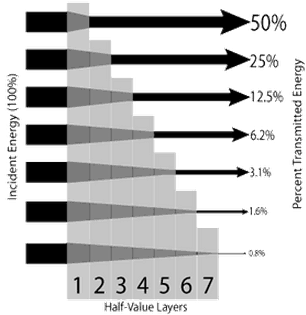
The half value layer expresses the thickness of absorbing material needed for reduction of the incident radiation intensity by a factor of two. There are two main features of the half value layer:

  • The half value layer decreases as the atomic number of the absorber increases. For example 35 m of air is needed to reduce the intensity of a 100 keV gamma ray beam by a factor of two whereas just 0.12 mm of lead can do the same thing.
  • The half value layer for all materials increases with the energy of the gamma rays. For example from 0.26 cm for iron at 100 keV to about 1.06 cm at 500 keV.

half value layer

The half value layer expresses the thickness of absorbing material needed for reduction of the incident radiation intensity by a factor of two. With half value layer it is easy to perform simple calculations.
Source: www.nde-ed.org

Table of Half Value Layers (in cm) for a different materials at gamma ray energies of 100, 200 and 500 keV.

Absorber 100 keV 200 keV 500 keV
Air 3555 cm 4359 cm 6189 cm
Water 4.15 cm 5.1 cm 7.15 cm
Carbon 2.07 cm 2.53 cm 3.54 cm
Aluminium 1.59 cm 2.14 cm 3.05 cm
Iron 0.26 cm 0.64 cm 1.06 cm
Copper 0.18 cm 0.53 cm 0.95 cm
Lead  0.012 cm  0.068 cm  0.42 cm

See also:

Pair Production

See also:

Gamma Ray Attenuation

See also:

Mass Attenuation Coefficient

We hope, this article, Half Value Layer, helps you. If so, give us a like in the sidebar. Main purpose of this website is to help the public to learn some interesting and important information about materials and their properties.
What is Linear Attenuation Coefficient – Definition

The sum of the three partial cross-sections is called the linear attenuation coefficient. Gamma rays attenuation. Material Properties
The total cross-section of interaction of a gamma rays with an atom is equal to the sum of all three mentioned partial cross-sections:σ = σf + σC + σp 
  • σf – Photoelectric effect
  • σC – Compton scattering
  • σp – Pair production

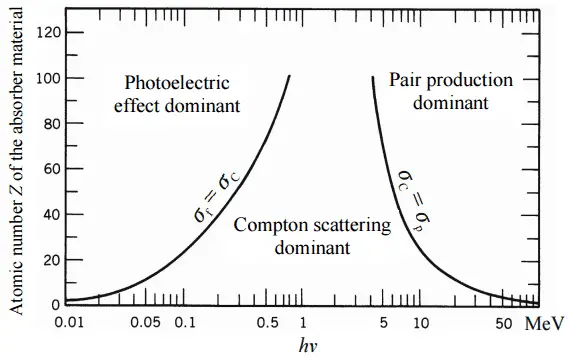
Depending on the gamma ray energy and the absorber material, one of the three partial cross-sections may become much larger than the other two. At small values of gamma ray energy the photoelectric effect dominates. Compton scattering dominates at intermediate energies. The compton scattering also increases with decreasing atomic number of matter, therefore the interval of domination is wider for light nuclei. Finally, electron-positron pair production dominates at high energies.Based on the definition of interaction cross-section, the dependence of gamma rays intensity on thickness of absorber material can be derive. If monoenergetic gamma rays are collimated into a narrow beam and if the detector behind the material only detects the gamma rays that passed through that material without any kind of interaction with this material, then the dependence should be simple exponential attenuation of gamma rays. Each of these interactions removes the photon from the beam either by absorbtion or by scattering away from the detector direction. Therefore the interactions can be characterized by a fixed probability of occurance per unit path length in the absorber. The sum of these probabilities is called the linear attenuation coefficient:

μ = τ(photoelectric) +  σ(Compton) + κ(pair)

Linear Attenuation Coefficient

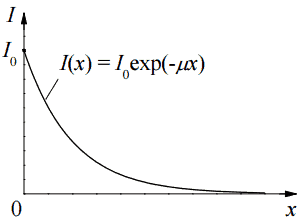
The attenuation of gamma radiation can be then described by the following equation.

I=I0.e-μx

, where I is intensity after attenuation,  Io is incident intensity,  μ is the linear attenuation coefficient (cm-1), and physical thickness of absorber (cm).

The materials listed in the table beside are air, water and a different elements from carbon (Z=6) through to lead (Z=82) and their linear attenuation coefficients are given for three gamma ray energies. There are two main features of the linear attenuation coefficient:

  • The linear attenuation coefficient increases as the atomic number of the absorber increases.
  • The linear attenuation coefficient for all materials decreases with the energy of the gamma rays.

AttenuationDependence of gamma radiation intensity on absorber thickness.Gamma rays attuenuationThe relative importance of various processes of gamma radiation interaction with matter.Linear Attenuation Coefficients

Table of Linear Attenuation Coefficients (in cm-1) for a different materials at gamma ray energies of 100, 200 and 500 keV.

Absorber 100 keV 200 keV 500 keV
Air   0.000195/cm   0.000159/cm   0.000112/cm
Water 0.167/cm 0.136/cm 0.097/cm
Carbon 0.335/cm 0.274/cm 0.196/cm
Aluminium 0.435/cm 0.324/cm 0.227/cm
Iron 2.72/cm 1.09/cm 0.655/cm
Copper 3.8/cm 1.309/cm 0.73/cm
Lead 59.7/cm 10.15/cm 1.64/cm

Read moreWhat is Linear Attenuation Coefficient – Definition

What is Inverse Compton Scattering – Definition

Inverse Compton scattering is the scattering of low energy photons to high energies by relativistic electrons. Material Properties

Compton Scattering

Inverse Compton Scattering

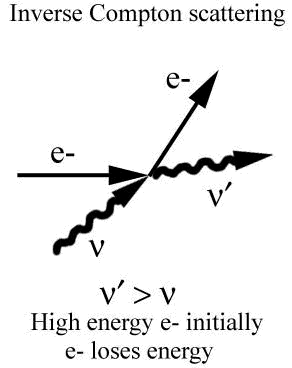
Inverse Compton scattering is the scattering of low energy photons to high energies by relativistic electrons. Relativistic electrons can boost energy of low energy photons by a potentially enormous amount (even gamma rays can be produced). This phenomenon is very important in astrophysics.

Inverse Compton scattering
source: venables.asu.edu

See also:

Compton Edge

See also:

Compton Scattering

We hope, this article, Inverse Compton Scattering, helps you. If so, give us a like in the sidebar. Main purpose of this website is to help the public to learn some interesting and important information about materials and their properties.
What is Compton Edge – Definition

In spectrophotometry, the Compton edge is a feature of the spectrograph that results from the Compton scattering in the scintillator or detector. Material Properties

Compton Scattering

Compton Edge

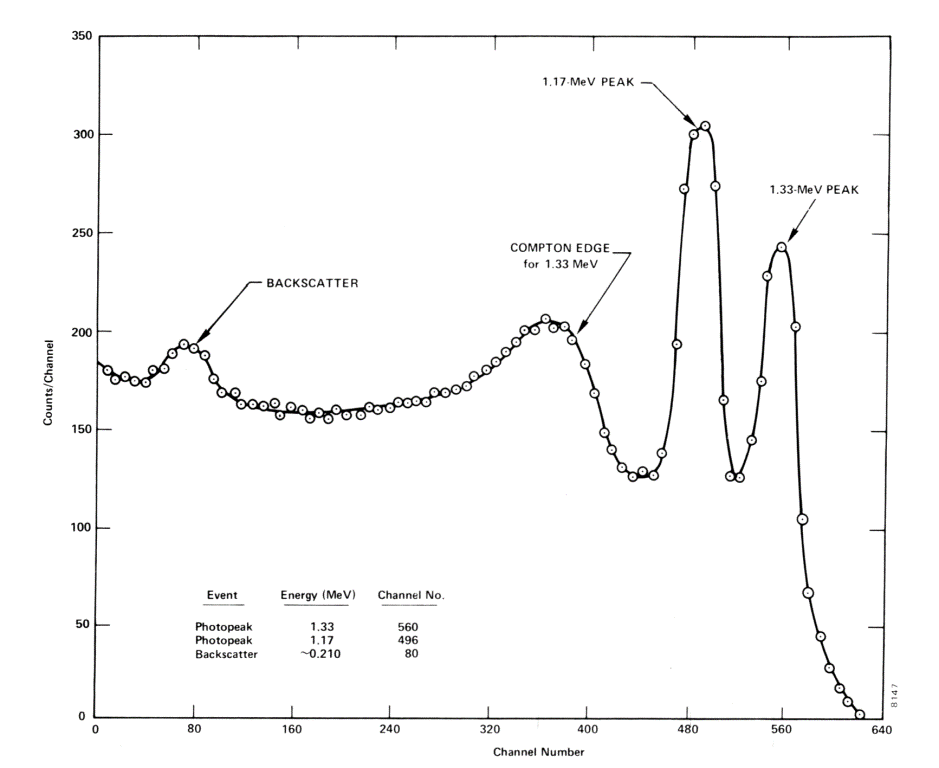
In spectrophotometry, the Compton edge is a feature of the spectrograph that results from the Compton scattering in the scintillator or detector. This feature is due to photons that undergo Compton scattering with a scattering angle of 180° and then escape the detector. When a gamma ray scatters off the detector and escapes, only a fraction of its initial energy can be deposited in the sensitive layer of the detector. It depends on the scattering angle of the photon, how much energy will be deposited in the detector. This leads to a spectrum of energies. The Compton edge energy corresponds to full backscattered photon.

Compton edge of 60Co on gamma spectrometer Na(Tl).

See also:

Cross-Section of Compton Scattering

See also:

Compton Scattering

See also:

Inverse Compton Scattering

We hope, this article, Compton Edge, helps you. If so, give us a like in the sidebar. Main purpose of this website is to help the public to learn some interesting and important information about materials and their properties.