Facebook Instagram Youtube Twitter

What is Uranium 236 – Definition

Definition of uranium 236. Uranium 236 is neither a fissile isotope nor fertile isotope. 236U can be found in spent nuclear fuel or in the reprocessed uranium. Material Properties

Uranium 236

Uranium 236 is not naturally-occurring isotope of uranium. It is a man-made isotope, which can be found in spent nuclear fuel or in the reprocessed uranium. The presence of this isotope in a sample of uranium is evidence that the sample has been in a nuclear reactor. Isotope 236U is formed in a nuclear reactor from fissile isotope 235U. Most of absorption reactions result in fission reaction, but a minority results in radiative capture forming 236U. The cross-section for radiative capture for thermal neutrons is about 99 barns (for 0.0253 eV neutron). Therefore about 15% of all absorption reactions result in radiative capture of neutron. About 85% of all absorption reactions result in fission.

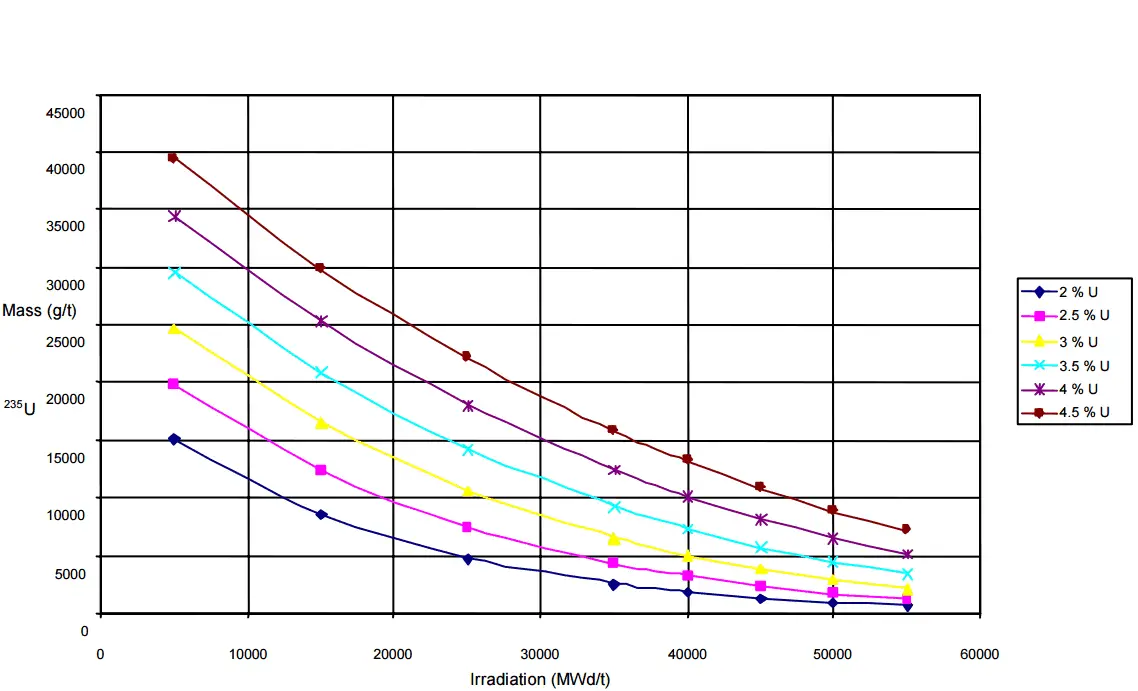
Uranium absorption reactionThis isotope has the half-life of 2.34×10⁷ years and has longer half-life than any other artificial actinide or fission product produced in nuclear reactors. 236U have about 190 times higher specific activity than the isotope 238U. This due to the fact 238U has the half-life about 190 times as long as 236U. This results in high contribution to radioactivity of reprocessed uranium. The amount of 236U present in spent nuclear fuel is directly proportional to the burnup levels and is dependent on initial 235U enrichment. For discharged fuel around 50 MWd/tU HM and enrichment of 4% of 235U it is typically around 0.5 wt%.

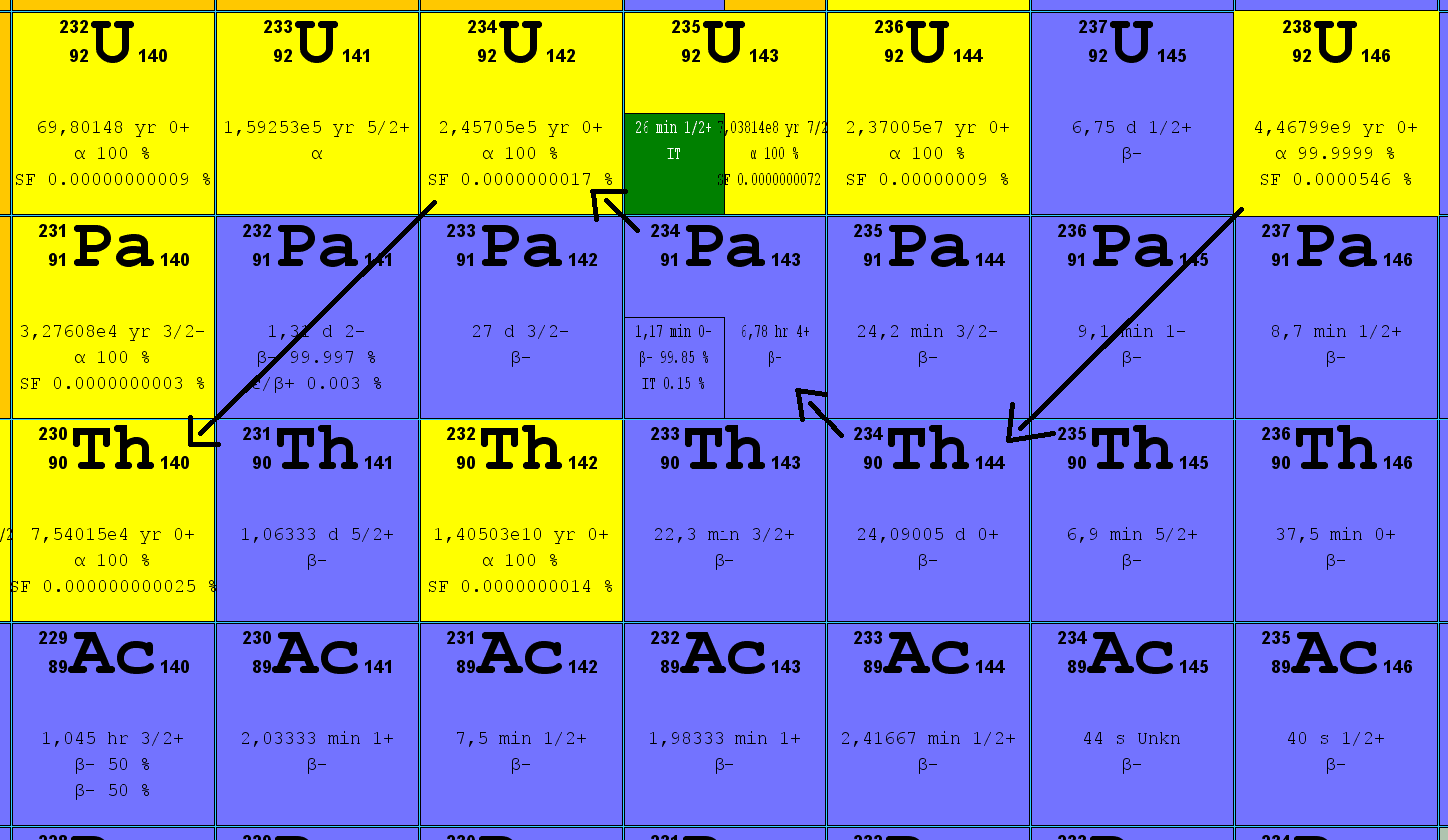
236U decays via alpha decay to 232Th. 236U occasionally decays by spontaneous fission with very low probability of 0.00000009%.

236U is neither a fissile isotope, nor a fertile isotope. 236U is fissionable only by fast neutrons. Radiative capture of a neutron leads to the formation of the isotope 237U, which quickly beta decays to the isotope 237Np. 237Np may absorb another neutron, thus results in formation of 238Np, which quickly beta decay to 238Pu. The presence of this isotope certainly does not contribute to the neutron economy. On the other hand the radiative capture cross-section for 236U is very low and this process does not happen quickly in a thermal reactor.

See also: Neutron Cross-section
Source of nuclear data: JANIS (Java-based Nuclear Data Information Software); The JEFF-3.1.1 Nuclear Data Library
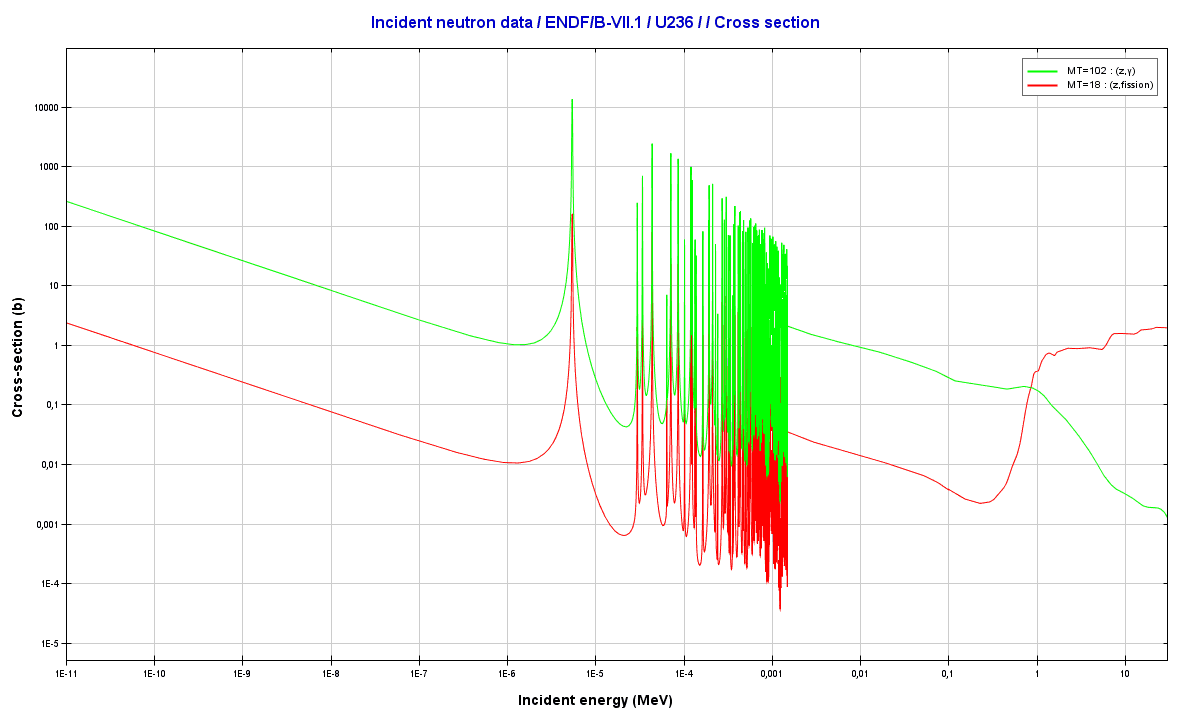
Fissile / Fertile Material Cross-sectionsUranium 236. Comparison of total fission cross-section and cross-section for radiative capture.
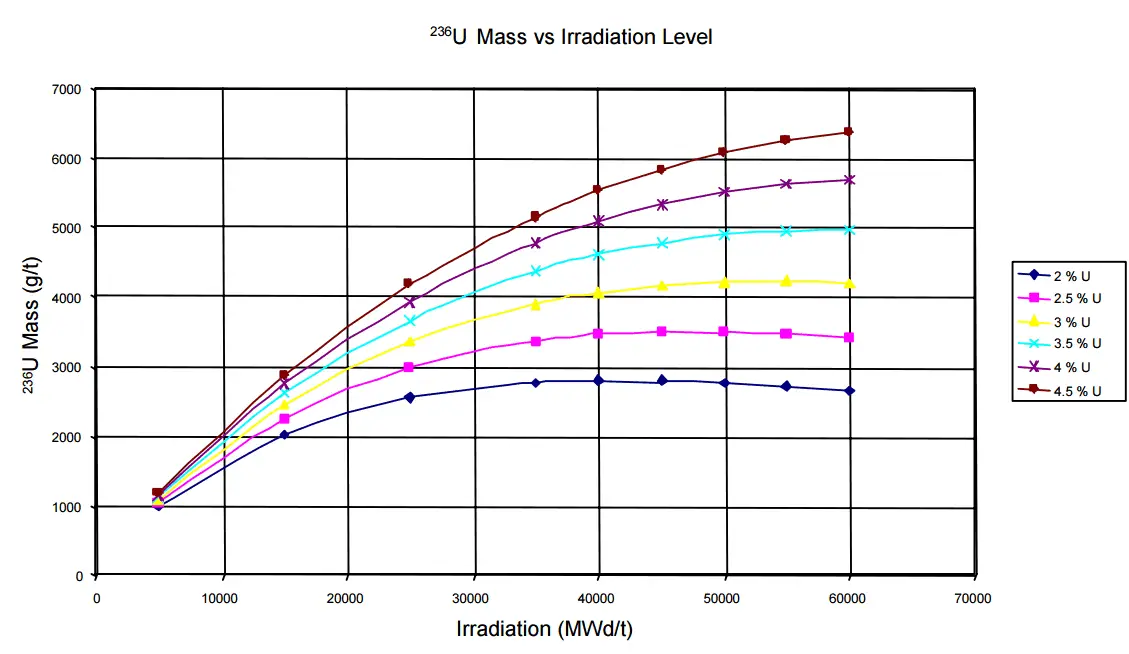
236U content as a function of burnup level of a PWR fuel.236U content as a function of burnup level of a PWR fuel.
Source: IAEA-TECDOC-1529 Management of Reprocessed Uranium

See also:

Uranium 233

See also:

Uranium

See also:

Uranium 232

We hope, this article, Uranium 236, helps you. If so, give us a like in the sidebar. Main purpose of this website is to help the public to learn some interesting and important information about materials and their properties.
What is Uranium 233 – Definition

Definition of uranium 233. Uranium 233, is a key fissile isotope in the thorium fuel cycle. 233U is produced by radiative capture in nuclear reactors containing thorium 232. Material Properties

Uranium 233

Uranium 233 is not naturally-occurring isotope of uranium. It is a man-made isotope and is key fissile isotope in the thorium fuel cycle. This isotope has half-life of 159,200 years. 233U is produced by neutron radiative capture in nuclear reactors containing thorium 232.

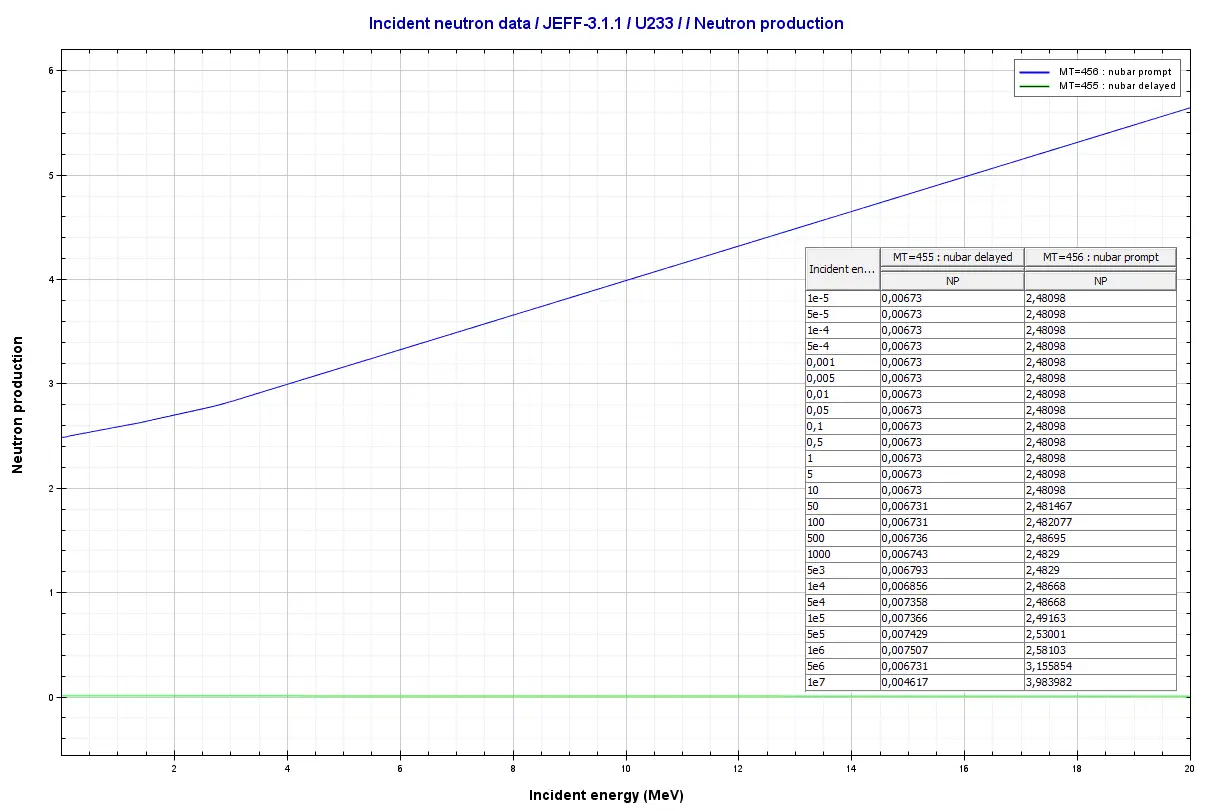
233U is a fissile isotope, which means 233U is capable of undergoing fission reaction after absorbing thermal neutron. Moreover 233U meets also alternative requirement that the amount (~2.48 per one fission by thermal neutron) of neutrons produced by fission of 233U is sufficient to sustain a nuclear fission chain reaction.

For the 233U nuclei, the number of fission neutrons produced per absorption in the fuel (the reproduction factor – η) is greater than 2.0 over a wide range of thermal neutron spectrum, unlike 235U and 239Pu. Therefore breeding can obtained with fast, epithermal or thermal spectra.

233U decays via alpha decay into 229Th. The decay chain of 233U itself is in the neptunium series. 

Uranium 233 breeding
n+_{90}^{232}textrm{Th}  {rightarrow} _{90}^{232}textrm{Th}+gamma rightarrow  _{91}^{233}textrm{Pa} rightarrow  _{92}^{233}textrm{U}

232Th is the predominant isotope of natural thorium. If this fertile material is loaded in the nuclear reactor, the nuclei of 232Th absorb a neutron and become nuclei of 233Th. The half-life of 233Th is approximately 21.8 minutes. 233Th decays (negative beta decay) to 233Pa (protactinium), whose half-life is 26.97 days. 233Pa decays (negative beta decay)  to 233U, that is very good fissile material. On the other hand proposed reactor designs must attempt to physically isolate the protactinium from further neutron capture before beta decay can occur.

Uranium 233 Fission

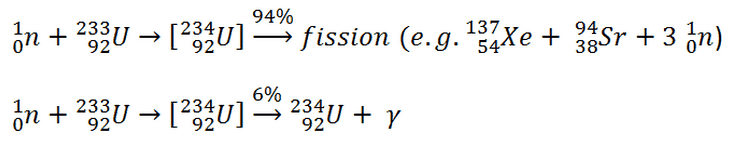
Uranium 233 is a very good fissile isotope and its fission cross-section for thermal neutrons is about 531 barns (for 0.0253 eV neutron). For fast neutrons its fission cross-section is on the order of barns. Most of absorption reactions result in fission reaction, but a minority results in radiative capture forming 234U. The cross-section for radiative capture for thermal neutrons is about 45 barns (for 0.0253 eV neutron). Therefore about 6% of all absorption reactions result in radiative capture of neutron. About 94% of all absorption reactions result in fission. The capture-to-fission ratio is much smaller than the other two major fissile fuels 235U and 239U.

Uranium 233 absorption reaction

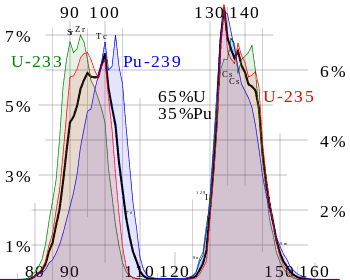
Typically, when uranium 233 nucleus undergoes fission, the nucleus splits into two smaller nuclei (triple fission can also rarely occur), along with a few neutrons (the average is 2.48 neutrons per fission for thermal fission) and release of energy in the form of heat and gamma rays. The average of the fragment atomic mass is about 112, but very few fragments near that average are found. It is much more probable to break up into unequal fragments, and the most probable fragment masses are around mass 93 (strontium) and 137 (xenon).

Most of the fission fragments are highly unstable (radioactive) nuclei and undergo further radioactive decays to stabilize itself, therefore part of the released energy is radiated away from the reactor (See also: Reactor antineutrinos). On the other hand most of the energy released by one fission (~168MeV of total ~200MeV) appears as kinetic energy of these fission fragments. The fission fragments interact strongly with the surrounding atoms or molecules traveling at high speed, causing them to ionize. Creation of ion pairs requires energy, which is lost from the kinetic energy of the charged fission fragment causing it to decelerate. The positive ions and free electrons created by the passage of the charged fission fragment will then reunite, releasing energy in the form of heat (e.g. vibrational energy or rotational energy of atoms). This is the principle how fission fragments heat up fuel in the reactor core.

Fission FragmentsFission fragments after a nucleus fission. Fission fragments interact strongly with the surrounding atoms or molecules traveling at high speed, causing them to ionize.
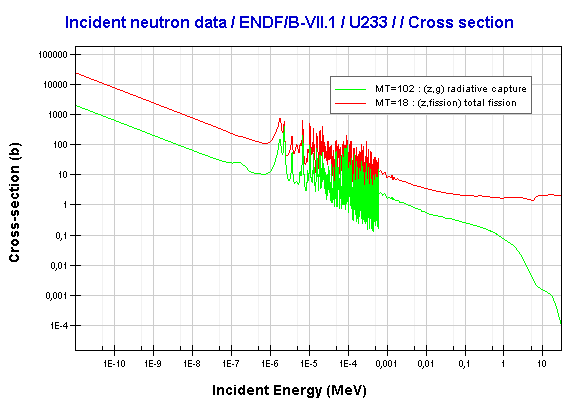
Source of nuclear data: JANIS (Java-based Nuclear Data Information Software); ENDF/B-VII.1
Fissile / Fertile Material Cross-sectionsUranium 233. Comparison of total fission cross-section and cross-section for radiative capture.
Neutron production per one fast fission of uranium 233.Neutron production per one fast fission of uranium 233.
Fission fragment yieldsFission fragment yield for different nuclei. The most probable fragment masses are around mass 93 (Strontium) and 137 (Xenon).

See also:

Uranium 234

See also:

Uranium

See also:

Uranium 236

We hope, this article, Uranium 233, helps you. If so, give us a like in the sidebar. Main purpose of this website is to help the public to learn some interesting and important information about materials and their properties.
What is Uranium 235 – Definition

Definition of uranium 235. Uranium 235, which alone constitutes only 0.71% of natural uranium is a fissile isotope. 235U is a highly strategic fissile material. Material Properties

Uranium 235

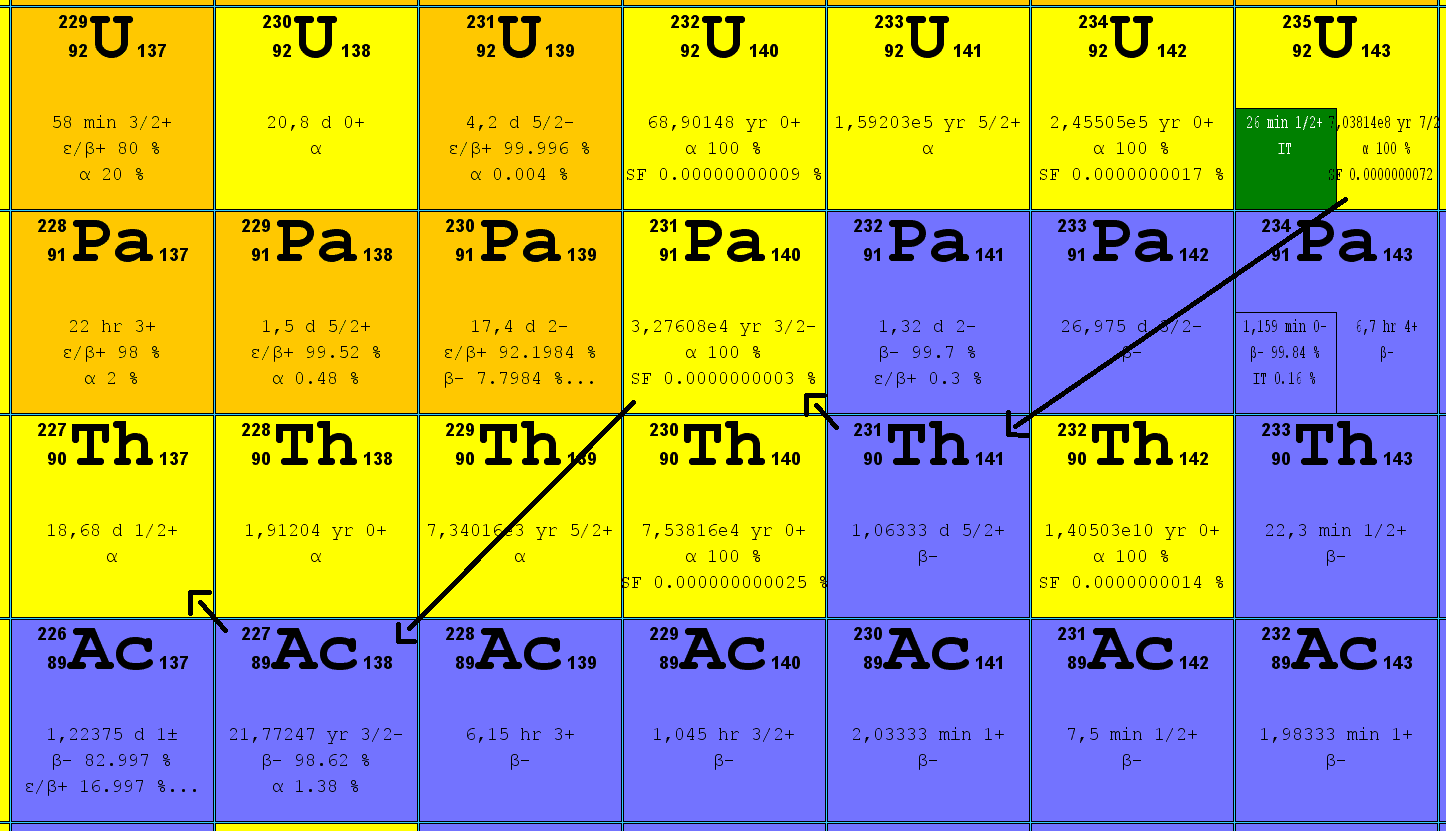
Uranium 235, which alone constitutes 0.72% of natural uranium is the second common isotope of uranium in the nature. This isotope has half-life of 7.04×10⁸ years (6.5 times shorter than the isotope 238) and therefore its abundance is lower than 238U (99.28%). 235U belongs to primordial nuclides, because its half-life is comparable to the age of the Earth (~4.5×10⁹ years). For its very long half-life, it is still present in the Earth’s crust. 235U decays via alpha decay (by way of thorium-231) into 231Pa. 235U occasionally decays by spontaneous fission with very low probability of 0.0000000072%.

235U is a fissile isotope, which means 235U is capable of undergoing fission reaction after absorbing thermal neutron. Moreover, 235U meets also alternative requirement that the amount (~2.43 per one fission by thermal neutron) of neutrons produced by fission of 235U is sufficient to sustain a nuclear fission chain reaction. 235U was the first isotope that was found to be fissile. In fact, 235U is the only existing fissile nucleus from naturally-occurring isotopes and therefore is a highly strategic material. At the time of the formation of the Earth, 235U was 85 times more abundant. The 0.72% observed today are only a residue caused by the difference in the half-lifes of 235U and 238U. If mankind had been present at the beginning of the Earth, they would not have needed to enrich uranium, because the content of fissile 235U was significantly higher.

Uranium 235 Fission

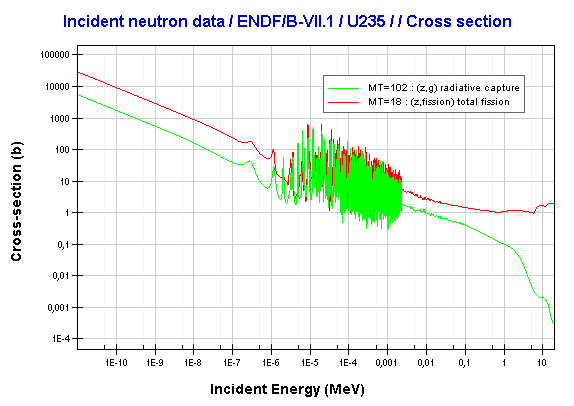
Uranium 235 is a fissile isotope and its fission cross-section for thermal neutrons is about 585 barns (for 0.0253 eV neutron). For fast neutrons its fission cross-section is on the order of barns. Most of absorption reactions result in fission reaction, but a minority results in radiative capture forming 236U. The cross-section for radiative capture for thermal neutrons is about 99 barns (for 0.0253 eV neutron). Therefore about 15% of all absorption reactions result in radiative capture of neutron. About 85% of all absorption reactions result in fission.

Uranium absorption reaction

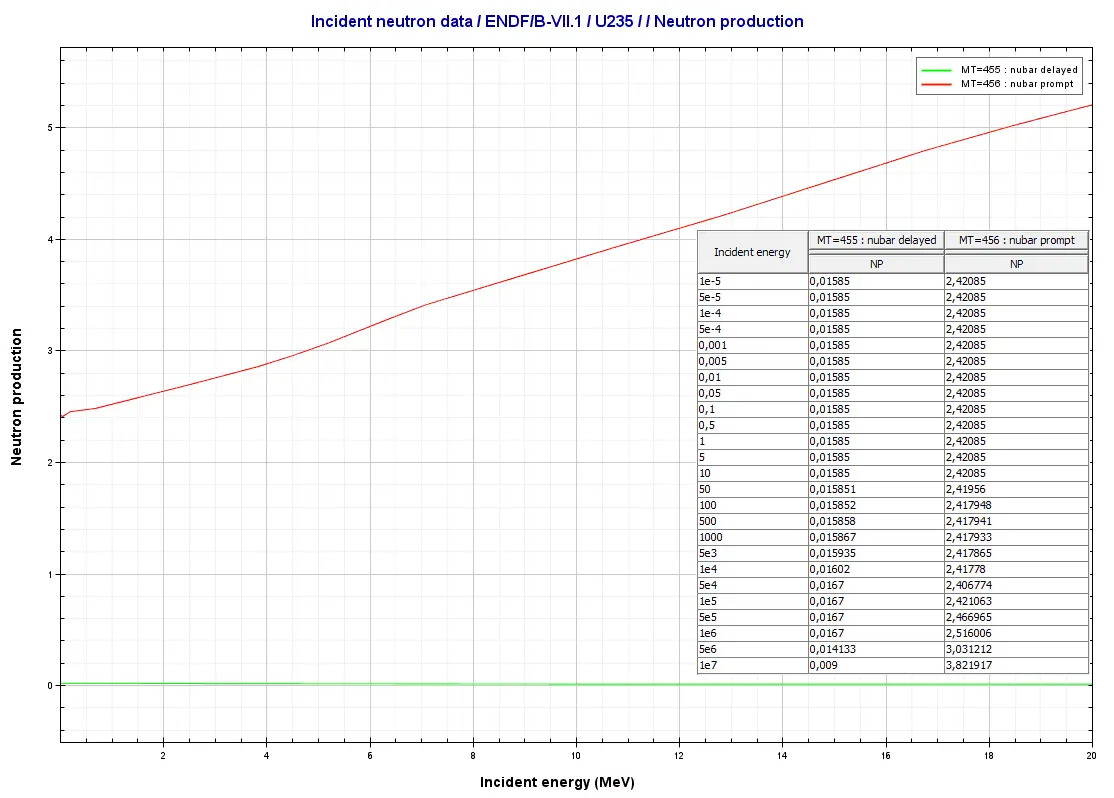
Typically, when uranium 235 nucleus undergoes fission, the nucleus splits into two smaller nuclei (triple fission can also rarely occur), along with a few neutrons (the average is 2.43 neutrons per fission by thermal neutron) and release of energy in the form of heat and gamma rays. The average of the fragment atomic mass is about 118, but very few fragments near that average are found. It is much more probable to break up into unequal fragments, and the most probable fragment masses are around mass 95 (Krypton) and 137 (Barium).

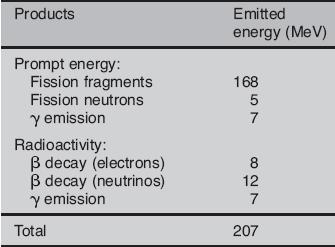
Most of the fission fragments are highly unstable (radioactive) nuclei and undergo further radioactive decays to stabilize itself. Therefore part of the released energy is radiated away from the reactor (See also: Reactor antineutrinos). On the other hand most of the energy released by one fission (~170MeV of total ~200MeV) appears as kinetic energy of these fission fragments. The fission fragments interact strongly with the surrounding atoms or molecules traveling at high speed, causing them to ionize. Creation of ion pairs requires energy, which is lost from the kinetic energy of the charged fission fragment causing it to decelerate. The positive ions and free electrons created by the passage of the charged fission fragment will then reunite, releasing energy in the form of heat (e.g. vibrational energy or rotational energy of atoms). This is the principle how fission fragments heat up fuel in the reactor core.

Source of nuclear data: JANIS (Java-based Nuclear Data Information Software); ENDF/B-VII.1
Fission FragmentsFission fragments after a nucleus fission. Fission fragments interact strongly with the surrounding atoms or molecules traveling at high speed, causing them to ionize.
Uranium 235 decay.Uranium 235 decays via alpha decay into 231Pa.
Fissile / Fertile Material Cross-sectionsUranium 235. Comparison of total fission cross-section and cross-section for radiative capture.
235U content as a function of burnup level of a PWR fuel.235U content as a function of burnup level of a PWR fuel.
Source: IAEA-TECDOC-1529 Management of
Reprocessed Uranium
Neutron production per one fast fission of uranium 235.Neutron production per one fast fission of uranium 235.
Fission fragment yieldsFission fragment yield for different nuclei. The most probable fragment masses are around mass 95 (Krypton) and 137 (Barium).
Energy from Uranium Fission

See also:

Uranium 238

See also:

Uranium

See also:

Uranium 234

We hope, this article, Uranium 235, helps you. If so, give us a like in the sidebar. Main purpose of this website is to help the public to learn some interesting and important information about materials and their properties.
What is Uranium 234 – Definition

Definition of uranium 234. Uranium 234, which alone constitutes only 0.0054% of natural uranium is a fertile isotope. 234U is a non-fissile isotope. Material Properties

Uranium 234

Uranium 234, which alone constitutes only 0.0054% (54 parts per million) of natural uranium is the last naturally-occurring isotope of uranium. This isotope has the half-life of only 2.46×10⁵ years and therefore it do not belong to primordial nuclides (unlike 235U and 238U). On the other hand, this isotope is still present in the Earth’s crust, but this is due to the fact

234U is an indirect decay product of 238U. 238U decays via alpha decay (by way of thorium-234 and protactinium-234) into 234U. 234U decays via alpha decay into 230Th, except very small fraction (on the order of ppm) of nuclei which decays by spontaneous fission.

In a natural sample of uranium, these nuclei are present in the unalterable proportions of the radioactive equilibrium of the 238U filiation at a ratio of one atom of 234U for about 18 500 nuclei of 238U. As a result of this equilibrium these two isotopes (238U and 234U) contribute equally to the radioactivity of natural uranium.

Since an uranium enrichment is a separation of light isotopes from heavy isotopes, the uranium enrichment results also in enrichment of 234U. Therefore enriched uranium contains also more isotope 234U than natural uranium. On the other hand enrichment tails or also depleted uranium contains much less 234U. In nuclear reactors, which use enriched uranium as a fuel, such increased content of 234U is acceptable. An undesirable concentrations may be reached when using reprocessed uranium, because spent nuclear fuel may contain a much higher concentration of about 0.01% of 234U.

234U is a non-fissile isotope and it is therefore not capable of undergoing fission reaction after absorbing thermal neutron. 234U belongs to the group of fertile isotopes.  Radiative capture of a neutron leads to the formation of fissile 235U similarly to 238U which radiative capture leads to the formation of fissile 239Pu. The radiative capture cross-section for 234U is about 100 barns for thermal neutrons and therefore 234U is converted to 235U more easily and therefore at a greater rate than 238U is to 239Pu (nuclei of 238U have a much smaller cross-section of 2 barns). On the other hand, the effect of 235U breeding is almost insignificant in comparison with the 239Pu breeding.

See also: Comparison of cross-sections

Source of nuclear data: JANIS (Java-based Nuclear Data Information Software); ENDF/B-VII.1
Uranium 238 decay.Uranium 238 decays via alpha decay (by way of thorium-234 and protactinium-234) into 234U.
Fissile / Fertile Material Cross-sectionsUranium 234. Comparison of total fission cross-section and cross-section for radiative capture.
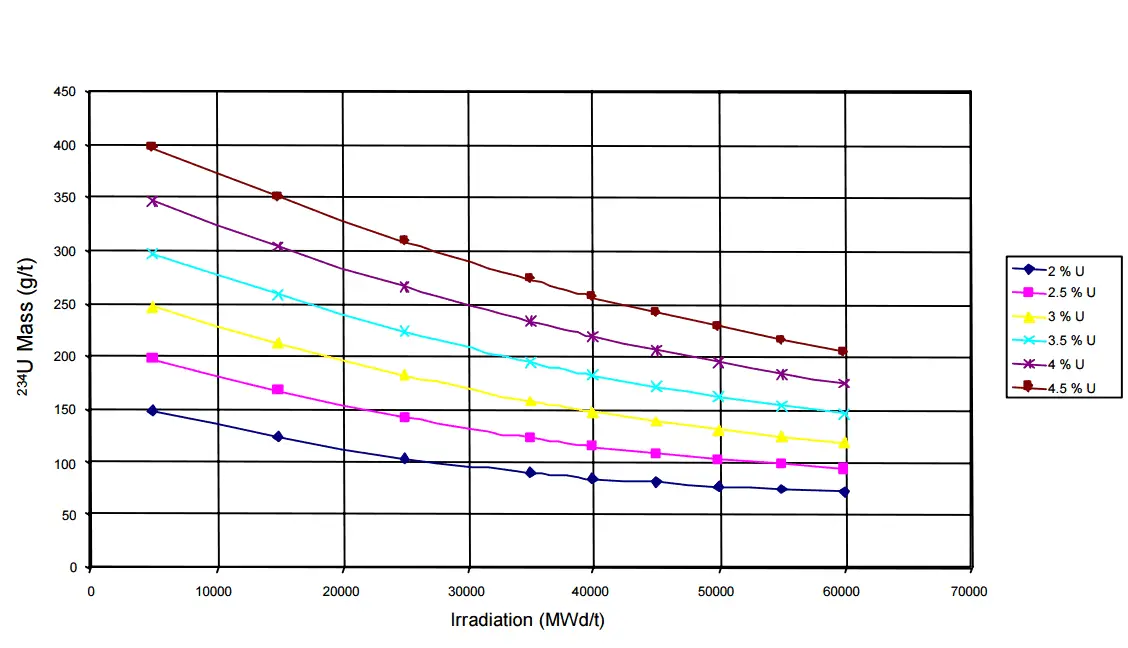
Residual 234U content as function of burnup level of PWR fuel.Residual 234U content as function of burnup level of PWR fuel.
Source: IAEA-TECDOC-1529 Management of Reprocessed Uranium

See also:

Uranium 235

See also:

Uranium

See also:

Uranium 233

We hope, this article, Uranium 234, helps you. If so, give us a like in the sidebar. Main purpose of this website is to help the public to learn some interesting and important information about materials and their properties.
What is Uranium 238 – Definition

Uranium 238, which alone constitutes 99.28% of natural uranium is the most common isotope of uranium in the nature. Uranium 238 is a fertile isotope. Material Properties

Uranium 238

Uranium 238, which alone constitutes 99.28% of natural uranium is the most common isotope of uranium in the nature. This isotope has the longest half-life (4.47×10⁹ years) and therefore its abundance is so high. 238U belongs to primordial nuclides, because its half-life is comparable to the age of the Earth (~4.5×10⁹ years). For its very long half-life, it is still present in the Earth’s crust.238U decays via alpha decay (by way of thorium 234 and protactinium 234) into 234U. 238U occasionally decays by spontaneous fission with probability of 0.000055%.

238U is a fissionable isotope, but is not fissile isotope. 238U is not capable of undergoing fission reaction after absorbing thermal neutron, on the other hand 238U can be fissioned by fast neutron with energy higher than >1MeV. 238U does not meet also alternative requirement to fissile materials. 238U is not capable of sustaining a nuclear fission chain reaction, because too many of neutrons produced by fission of 238U have lower energies than original neutron.

238U belongs also to the group of fertile isotopes. Radiative capture of a neutron leads to the formation of fissile 239Pu. This is the way how 238U contributes to the operation of nuclear reactors and production of electricity through this plutonium. For example, at a burnup of 40GWd/tU, about 40% of the total energy released comes from bred plutonium. This corresponds to a breeding ratio for this fuel burnup of about 0.4 to 0.5. This effect extends the cycle length for such fuels to sometimes nearly twice what it would be otherwise.

See also: Comparison of cross-sections

Plutonium 239 breeding
Equation - Plutinium 239 breeding from Uranium 238Neutron capture may also be used to create fissile 239Pu from 238U, which is the dominant constituent of naturally occurring uranium (99.28%). Absorption of a neutron in the 238U nucleus yields 239U. The half-life of 239U is approximately 23.5 minutes. 239U decays (negative beta decay) to 239Np (neptunium), whose half-life is 2.36 days. 239Np decays (negative beta decay)  to 239Pu.
Doppler broadening - inherent safety feature of uranium 238
The Doppler broadening of resonances is very important phanomenon, which improves reactor stability. The prompt temperature coefficient of most thermal reactors is negative, owing to the nuclear Doppler effect (fuel temperature coefficient – FTC). The broadening of uranium 238 resonances constitute fast acting negative feedback effect that is essential to ensure safe operation of all reactors.

In power reactors this effect acts as follows:

The reactor power increase (heating of a fuel) causes broadening of 238U resonances. This  results in a higher probability of neutron absorbtion, thus causes negative reactivity insertion (reduction of reactor power).

In the thorium fuel cycle 232Th is analogous to 238U in the U-Pu fuel cycle, because it is the fertile component. Some of the radiative captures in 232Th are resonance events, so that the Doppler broadening role of 238U is similar.

Source of nuclear data: JANIS (Java-based Nuclear Data Information Software); ENDF/B-VII.1
Uranium 238 decay.Uranium 238 decays via alpha decay (by way of thorium-234 and protactinium-234) into 234U.
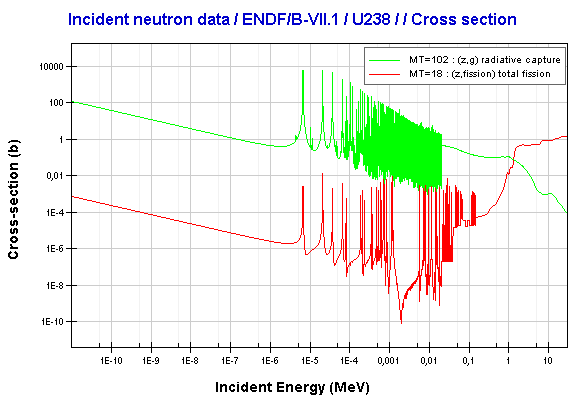
Fissile / Fertile Material Cross-sectionsUranium 238. Comparison of total fission cross-section and cross-section for radiative capture.
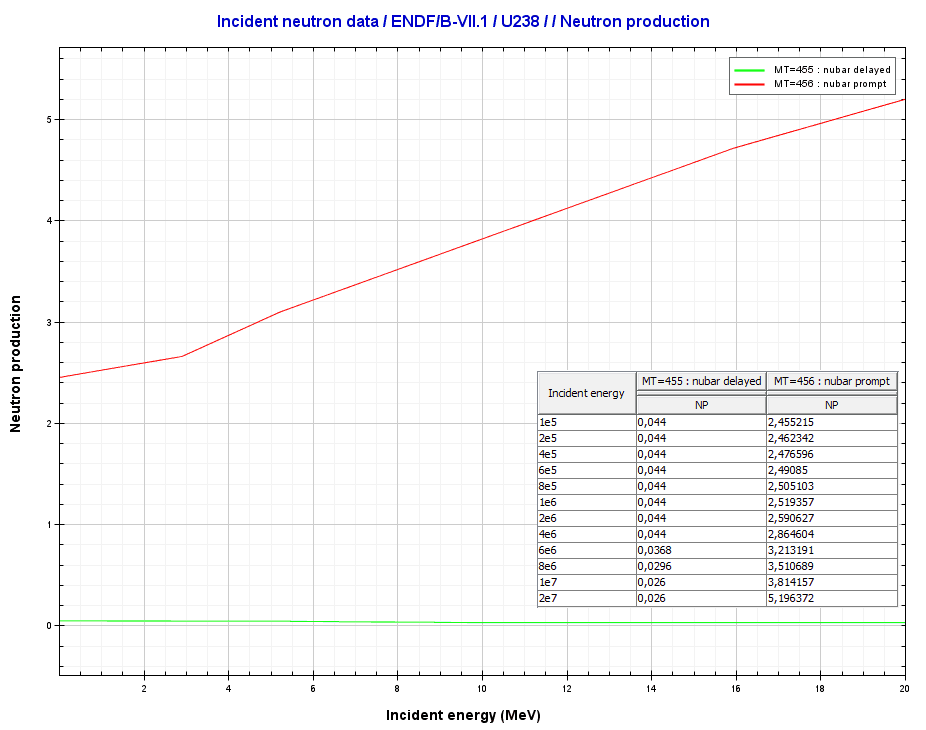
Neutron production per one fast fission of uranium 238.Neutron production per one fast fission of uranium 238.

See also:

Isotopes of Uranium

See also:

Uranium

See also:

Uranium 235

Click edit button to change this text.

We hope, this article, Uranium 238, helps you. If so, give us a like in the sidebar. Main purpose of this website is to help the public to learn some interesting and important information about materials and their properties.
What is Cross-section of Uranium – Definition

Cross-sections of naturally-occuring and artificial isotopes of uranium. Comparison of total fission cross-section and cross-section for radiative capture. Material Properties

Naturally-occurring Isotopes of Uranium

The main naturally-occurring isotopes, which have to be considered in the fuel cycle of all commercial light water reactors, are:

Artificial Isotopes of Uranium

The main artificial isotopes, which have to be considered in the fuel cycle of all commercial light water reactors, are:

Cross-sections of Naturally-occurring Isotopes

Source: JANIS (Java-based Nuclear Data Information Software); The JEFF-3.1.1 Nuclear Data Library

Fissile / Fertile Material Cross-sections

Uranium 238. Comparison of total fission cross-section and cross-section for radiative capture.
Fissile / Fertile Material Cross-sections
Uranium 235. Comparison of total fission cross-section and cross-section for radiative capture.
Fissile / Fertile Material Cross-sections</a
Uranium 234. Comparison of total fission cross-section and cross-section for radiative capture.

Cross-sections of Artificial Isotopes

Source: JANIS (Java-based Nuclear Data Information Software); The JEFF-3.1.1 Nuclear Data Library

Fissile / Fertile Material Cross-sections
Uranium 233. Comparison of total fission cross-section and cross-section for radiative capture.
Fissile / Fertile Material Cross-sections
Uranium 236. Comparison of total fission cross-section and cross-section for radiative capture.
Fissile / Fertile Material Cross-sections
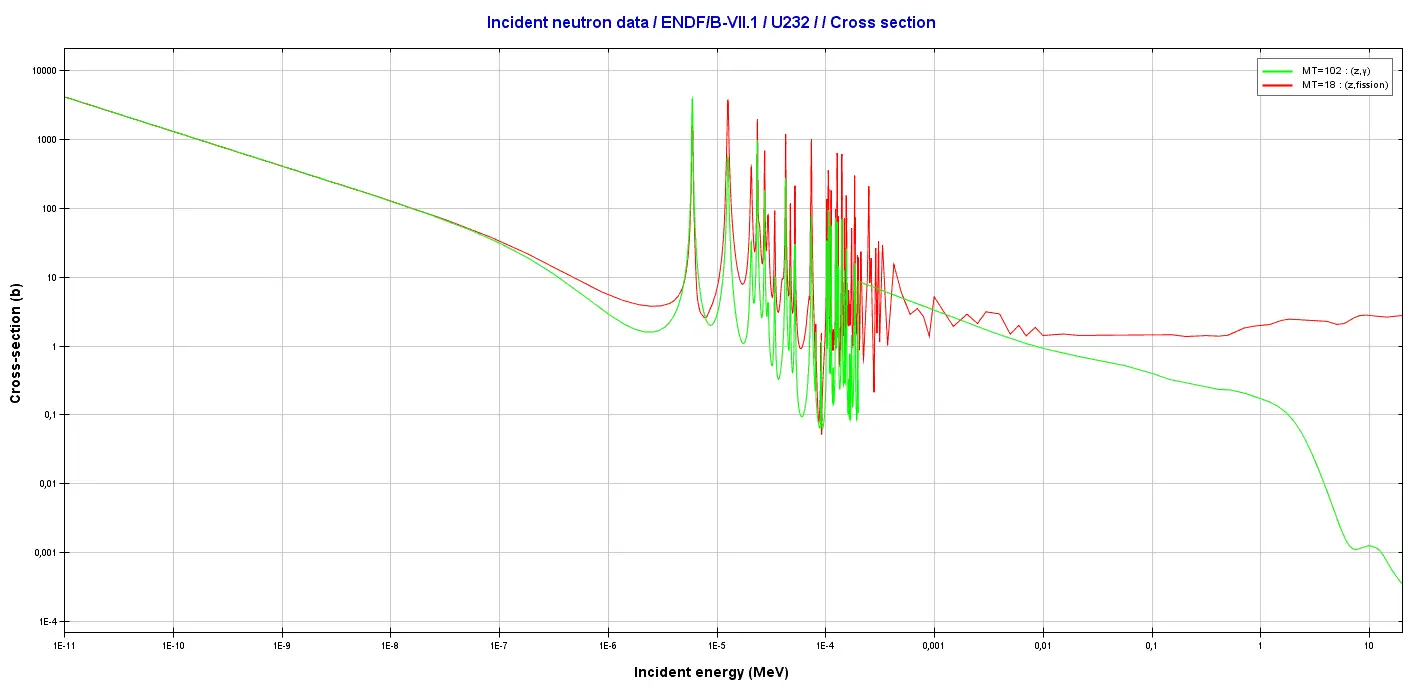
Uranium 232. Comparison of total fission cross-section and cross-section for radiative capture.

Fissile / Fertile Material Cross-sectionsFissile / Fertile Material Cross-sections. Comparison of total fission cross-sections.

See also:

Half-life of Isotopes of Uranium

See also:

Uranium

See also:

Uranium in the Environment

We hope, this article, Cross-section of Uranium, helps you. If so, give us a like in the sidebar. Main purpose of this website is to help the public to learn some interesting and important information about materials and their properties.
What is Uranium in the Environment – Definition

Uranium contributes to low levels of natural background radiation in the environment.Uranium belongs to main sources of heat that keeps the Earth’s core liquid.

Natural Uranium

Natural uranium consists primarily of isotope 238U (99.28%), therefore the atomic mass of uranium element is close to the atomic mass of 238U isotope (238.03u).  Natural uranium also consists of two other isotopes: 235U (0.71%) and 234U (0.0054%). The abundance of  isotopes in the nature is caused by difference in the half-lifes. All three naturally-occurring isotopes of uranium (238U, 235U and 234U)  are unstable.

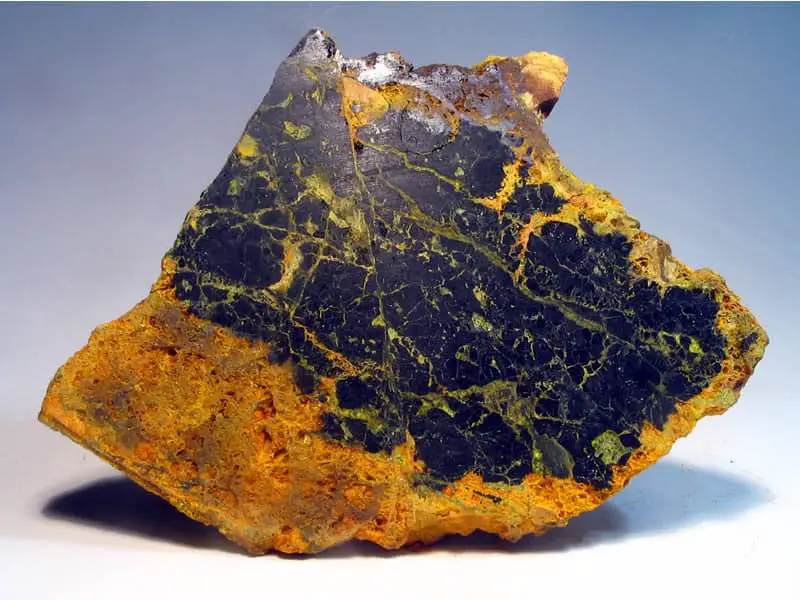
Uraninite - the most common uranium ore.
Uraninite – the most common uranium ore.

Uranium in the Environment

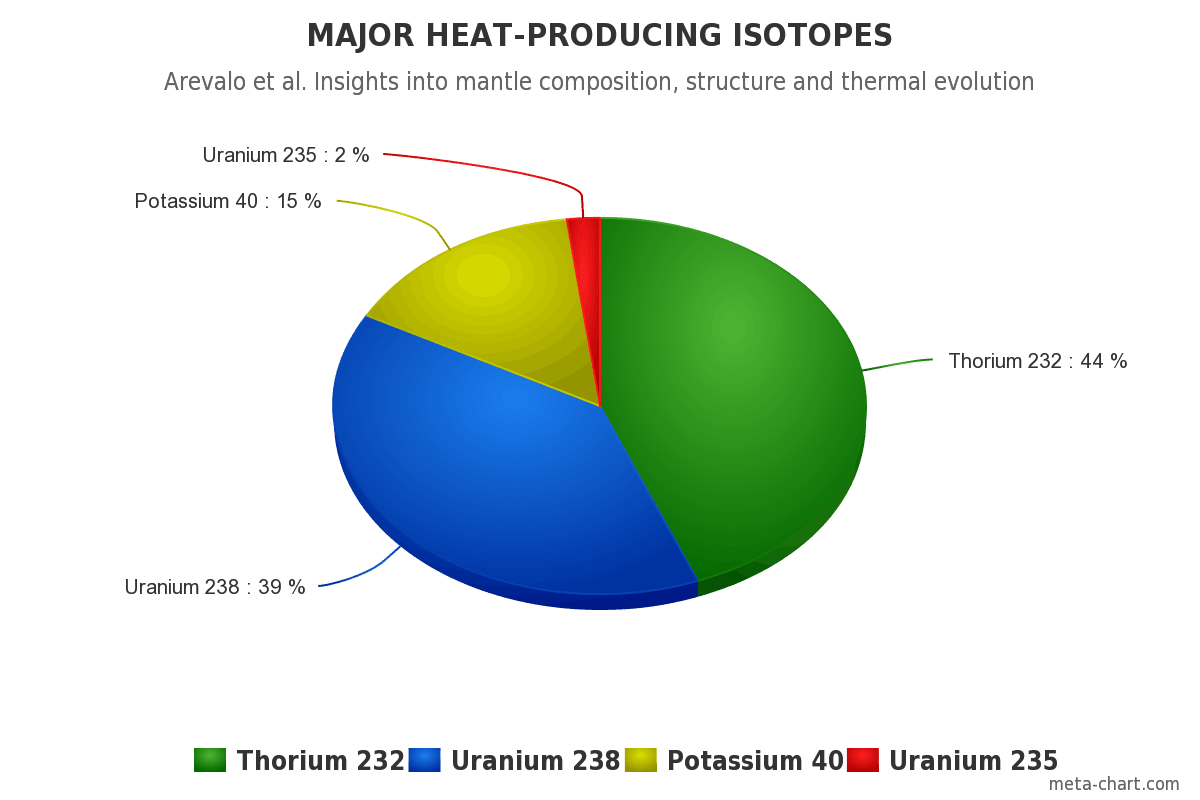
All three naturally-occurring isotopes of uranium (238U, 235U and 234U) have very long half-life (e.g. 4.47×10⁹ years for 238U). Because of this very long half-life uranium is weakly radioactive and contributes to low levels of natural background radiation in the environment. These isotopes are alpha radioactive (emitting alpha particle), but they can also rarely undergo a spontaneous fission. All naturally-occurring isotopes belong to primordial nuclides, because their half-life is comparable to the age of the Earth (~4.54×10⁹ years). Uranium has the second highest atomic mass of these primordial nuclides, lighter only than plutonium. Moreover the decay heat of uranium and its decay products (e.g. radon, radium etc.) contributes to heating of Earth’s core. Together with thorium and potassium-40 in the Earth’s mantle is thought that these elements are the main source of heat that keeps the Earth’s core liquid.

Major heat-producing isotopes.Share of major heat-producing isotopes on the heating of Earth’s core. Uranium 238 has important share of 39%.

See also:

Cross-sections of Uranium

See also:

Uranium

We hope, this article, Uranium in the Environment, helps you. If so, give us a like in the sidebar. Main purpose of this website is to help the public to learn some interesting and important information about materials and their properties.
What is Decay Mode and Half-life of Uranium Isotopes – Definition

Decay mode and half-lifes of isotopes of uranium. Uranium 238, 235 have half-life comparable to the age of the Earth. Uranium 233, 236, 232 are man-made isotopes. Material Properties

Decay mode and Half-lifes of Isotopes of Uranium

Natural uranium consists primarily of isotope 238U (99.28%), therefore the atomic mass of uranium element is close to the atomic mass of 238U isotope (238.03u).  Natural uranium also consists of two other isotopes: 235U (0.71%) and 234U (0.0054%). The abundance of  isotopes in the nature is caused by difference in the half-lifes. All three naturally-occurring isotopes of uranium (238U, 235U and 234U)  are unstable. On the other hand these isotopes (except 234U) belong to primordial nuclides, because their half-life is comparable to the age of the Earth (~4.5×10⁹ years for 238U). In nuclear reactors we have to consider three artificial isotopes, 236U, 233U and 232U. These are produced by transmutation in nuclear reactors from 235U and 232Th.

The main isotopes, which have to be considered in the fuel cycle of all commercial light water reactors, are:

Naturally-occurring isotopes

  • 238U. 238U decays via alpha decay to 234Th with half-life of ~4.5×10⁹ years. 238U occasionally decays by spontaneous fission with probability of 0.000055%. Its specific activity is very low ~3.4×10⁻⁷ Ci/g.
  • 235U. 235U decays via alpha decay (by way of thorium-231) into 231Pa with half-life of ~7×10⁸ years. 235U occasionally decays by spontaneous fission with very low probability of 0.0000000072%. Its specific activity is very low ~2.2×10⁻⁶ Ci/g.
  • 234U. 234U decays via alpha decay to 230Th with half-life of 246 000 years. 234U occasionally decays by spontaneous fission with very low probability of 0.0000000017%. Its specific activity is much higher ~0.0063 Ci/g.

Artificial isotopes

  • 233U. 233U decays via alpha decay into 229Th with half-life of 159 200 years. 233U occasionally decays by spontaneous fission with very low probability of 0.000000006%. Its specific activity is ~0.0098 Ci/g.
  • 236U. 236U decays via alpha decay to 232Th with half-life of ~2.3×10⁷ years. 236U occasionally decays by spontaneous fission with very low probability of 0.00000009%. Its specific activity is ~6.5×10⁻⁵ Ci/g.
  • 232U. 232U decays via alpha decay to 228Th with half-life of 68.9 years. 232U very rarely decays by spontaneous fission. Its specific activity is very high ~22 Ci/g and its decay chain produces very penetrating gamma rays.
Uranium 238 decay.Uranium 238 decay. Source: JANIS (Java-based Nuclear Data Information Software); The JEFF-3.1.1 Nuclear Data Library
Uranium 235 decay.Uranium 235 decay. Source: JANIS (Java-based Nuclear Data Information Software); The JEFF-3.1.1 Nuclear Data Library
Isotope Specific Activity
Uranium 232 22 Ci/g
Uranium 233 0.0098 Ci/g
Uranium 234 0.0063 Ci/g
Uranium 236 0.000065 Ci/g
Uranium 235 0.0000022 Ci/g
Uranium 238 0.00000034 Ci/g

Table of specific activities of isotopes of uranium.

See also:

Uranium 232

See also:

Uranium

See also:

Cross-sections of Uranium

We hope, this article, Decay Mode and Half-life of Uranium Isotopes, helps you. If so, give us a like in the sidebar. Main purpose of this website is to help the public to learn some interesting and important information about materials and their properties.
What is Isotopes of Uranium – Definition

Isotopes of Uranium. The naturally-occuring and artificial isotopes, which have to be considered in the fuel cycle of all commercial light water reactors, are summarized here. Material Properties

Isotopes of Uranium

The main isotopes, which have to be considered in the fuel cycle of all commercial light water reactors, are:Naturally-occurring isotopes

  • 238U. 238U belongs to the group of fertile isotopes. 238U decays via alpha decay to 234Th with half-life of ~4.5×10⁹ years. 238U occasionally decays by spontaneous fission with probability of 0.000055%. Its specific activity is very low ~3.4×10⁻⁷ Ci/g.
  • 235U. 235U belongs to the group of fissile isotopes. In fact, 235U is the only existing fissile nucleus from naturally-occurring isotopes and therefore it is a highly strategic material. 235U decays via alpha decay (by way of thorium-231) into 231Pa with half-life of ~7×10⁸ years. 235U occasionally decays by spontaneous fission with very low probability of 0.0000000072%. Its specific activity is very low ~2.2×10⁻⁶ Ci/g.
  • 234U. 234U belongs to the group of fertile isotopes. 234U decays via alpha decay to 230Th with half-life of 246 000 years. 234U occasionally decays by spontaneous fission with very low probability of 0.0000000017%. Its specific activity is much higher ~0.0063 Ci/g.

Artificial isotopes

  • 233U. 233U belongs to the group of fissile isotopes. It is produced by neutron radiative capture in nuclear reactors containing thorium fuel. 233U decays via alpha decay into 229Th with half-life of 159 200 years. 233U occasionally decays by spontaneous fission with very low probability of 0.000000006%. Its specific activity is ~0.0098 Ci/g.
  • 236U. 236U is neither a fissile isotope, nor a fertile isotope. 236U is fissionable only by fast neutrons. Isotope 236U is formed in a nuclear reactor from fissile isotope 235U. 236U decays via alpha decay to 232Th with half-life of ~2.3×10⁷ years. 236U occasionally decays by spontaneous fission with very low probability of 0.00000009%. Its specific activity is ~6.5×10⁻⁵ Ci/g.
  • 232U. 232U belongs to the group of fertile isotopes. 232U is a side product in the thorium fuel cycle and also this isotope is a decay product of 236Pu in the uranium fuel. 232U decays via alpha decay to 228Th with half-life of 68.9 years. 232U very rarely decays by spontaneous fission. Its specific activity is very high ~22 Ci/g and its decay chain produces very penetrating gamma rays.
Comparison of total fission cross-section and cross-section for radiative capture.

Source: JANIS (Java-based Nuclear Data Information Software); The JEFF-3.1.1 Nuclear Data LibraryFissile / Fertile Material Cross-sectionsUranium 238. Comparison of total fission cross-section and cross-section for radiative capture.

Fissile / Fertile Material Cross-sectionsUranium 235. Comparison of total fission cross-section and cross-section for radiative capture.
Fissile / Fertile Material Cross-sectionsUranium 234. Comparison of total fission cross-section and cross-section for radiative capture.
Fissile / Fertile Material Cross-sectionsUranium 233. Comparison of total fission cross-section and cross-section for radiative capture.
Fissile / Fertile Material Cross-sectionsUranium 236. Comparison of total fission cross-section and cross-section for radiative capture.
Fissile / Fertile Material Cross-sectionsUranium 232. Comparison of total fission cross-section and cross-section for radiative capture.

See also:

What is Uranium?

See also:

Uranium

See also:

Uranium 238

We hope, this article, Isotopes of Uranium, helps you. If so, give us a like in the sidebar. Main purpose of this website is to help the public to learn some interesting and important information about materials and their properties.
What is Uranium – Definition

What is uranium? Uranium is a naturally-occurring chemical element. The chemical symbol for uranium is U. Uranium is widely used as a nuclear fuel in nuclear reactors. Material Properties

What is Uranium

What is uranium?

Uranium is a naturally-occurring chemical element with atomic number 92 which means there are 92 protons and 92 electrons in the atomic structure. The chemical symbol for uranium is U. Uranium was discovered in 1789 by Martin Klaproth in the mineral called pitchblende (uraninite). He named the newly discovered element after the planet Uranus, which had been discovered eight years earlier. It was first isolated as a metal in 1841 by Eugene-Melchior Peligot. Henri Becquerel discovered uranium to be radioactive in 1896. He discovered that uranium minerals could expose a photographic plate through another material. In fact he was the first to discover the process of radioactivity.

Uranium is commonly found  at low levels (a few ppm – parts per million) in all rocks, soil, water, plants, and animals (including humans). Uranium occurs also in seawater, and can be recovered from the ocean water. Significant concentrations of uranium occur in some substances such as uraninite (the most common uranium ore), phosphate rock deposits, and other minerals.

Natural uranium consists primarily of isotope 238U (99.28%), therefore the atomic mass of uranium element is close to the atomic mass of 238U isotope (238.03u).  Natural uranium also consists of two other isotopes: 235U (0.71%) and 234U (0.0054%). The abundance of  isotopes in the nature is caused by difference in the half-lifes. All three naturally-occurring isotopes of uranium (238U, 235U and 234U)  are unstable. On the other hand these isotopes belong to primordial nuclides, because their half-life is comparable to the age of the Earth (~4.5×10⁹ years for 238U). In nuclear reactors we have to consider three artificial isotopes, 236U, 233U and 232U. These are produced by transmutation in nuclear reactors from 235U and 232Th.

Major heat-producing isotopes.Share of major heat-producing isotopes on the heating of Earth’s core. Uranium 238 has important share of 39%.
Uranium 238 decay.
Uranium 235 decay.

Uraninite - the most common uranium ore.
Uraninite – the most common uranium ore.
Fissile / Fertile Material Cross-sectionsUranium 235. Comparison of total fission cross-section and cross-section for radiative capture.Source: JANIS (Java-based Nuclear Data Information Software); The JEFF-3.1.1 Nuclear Data Library
Fissile / Fertile Material Cross-sectionsUranium 238. Comparison of total fission cross-section and cross-section for radiative capture.Source: JANIS (Java-based Nuclear Data Information Software); The JEFF-3.1.1 Nuclear Data Library

See also:

Uranium

See also:

Isotopes of Uranium

We hope, this article, Uranium, helps you. If so, give us a like in the sidebar. Main purpose of this website is to help the public to learn some interesting and important information about materials and their properties.