Nature of an interaction of a beta radiation with matter is different from the alpha radiation, despite the fact that beta particles are also charged particles. Material Properties
Nature of Interaction of Beta Radiation with Matter
Summary of types of interactions:
Inelastic collisions with atomic electrons (Excitation and Ionization)
Elastic scattering off nuclei
Bremsstrahlung.
Cherenkov radiation.
Annihilation (only positrons)
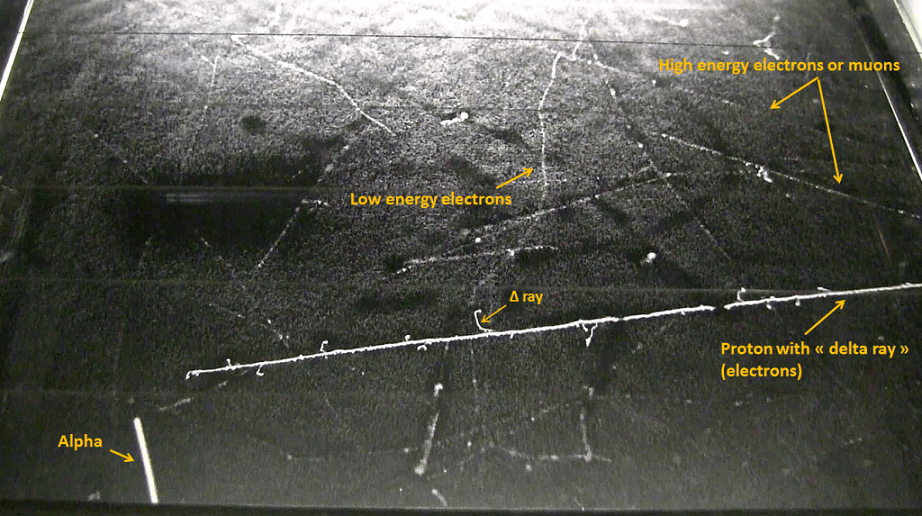
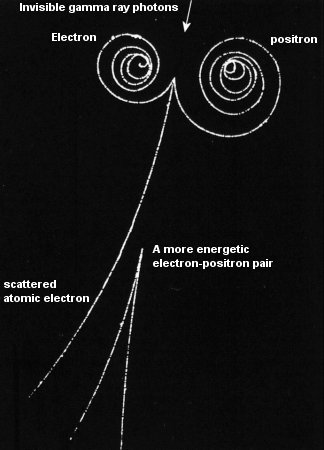
Comparison of particles in a cloud chamber. Source: wikipedia.org
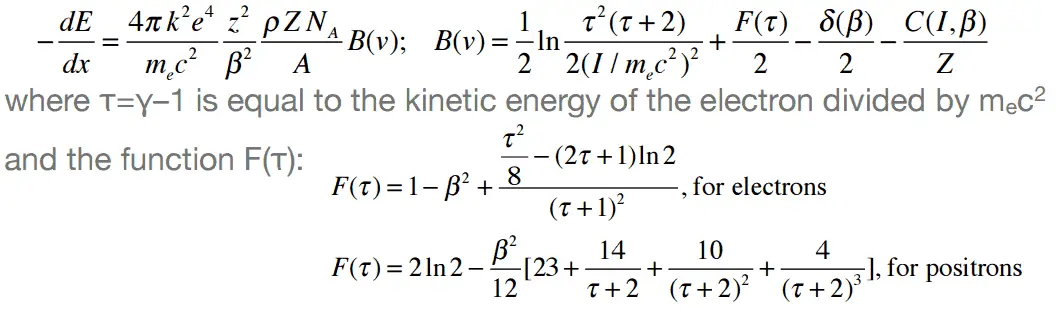
Nature of an interaction of a beta radiation with matter is different from the alpha radiation, despite the fact that beta particles are also charged particles. In comparison with alpha particles, beta particles have much lower mass and they reach mostly relativistic energies. Their mass is equal to the mass of the orbital electrons with which they are interacting and unlike the alpha particle a much larger fraction of its kinetic energy can be lost in a single interaction. Since the beta particles mostly reach relativistic energies, the nonrelativistic Bethe formula cannot be used. For high energy electrons an similar expression has also been derived by Bethe to describe the specific energy loss due to excitation and ionization (the “collisional losses”).
Modified Bethe formula for beta particles.
Moreover, beta particles can interact via electron-nuclear interaction (elastic scattering off nuclei), which can significantly change the direction of beta particle. Therefore their path is not so straightforward. The beta particles follow a very zig-zag path through absorbing material, this resulting path of particle is longer than the linear penetration (range) into the material.
Beta particles also differ from other heavy charged particles in the fraction of energy lost by radiative process known as the bremsstrahlung. From classical theory, when a charged particle is accelerated or decelerated, it must radiate energy and the deceleration radiation is known as the bremsstrahlung (“braking radiation”).
There is another mechanism by which beta particles loss energy via production of electromagnetic radiation. When the beta particle moves faster than the speed of light (phase velocity) in the material it generates a shock wave of electromagnetic radiation known as the Cherenkov radiation.
Positrons interact similarly with matter when they are energetic. But when the positron comes to rest, it interacts with a negatively charged electron, resulting in the annihilation of the electron-positron pair.
See also:
Beta Particle
See also:
Spectrum of Beta Radiation
We hope, this article, Nature of Interaction of Beta Radiation with Matter, helps you. If so, give us a like in the sidebar. Main purpose of this website is to help the public to learn some interesting and important information about materials and their properties.
Beta particles / radiation are high-energy, high-speed electrons or positrons. The beta particles are a form of ionizing radiation also known as beta rays. Material Properties
Description Beta Particles
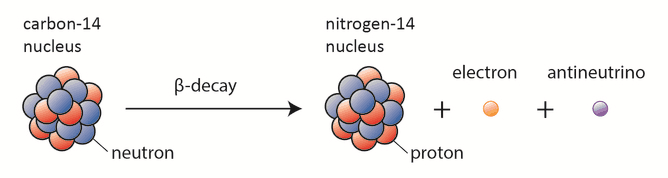
Beta particles are high-energy, high-speed electrons or positrons emitted by certain fission fragments or by certain primordial radioactive nuclei such as potassium-40. The beta particles are a form of ionizing radiation also known as beta rays. The production of beta particles is termed beta decay. There are two forms of beta decay, the electron decay (β− decay) and the positron decay (β+ decay). In a nuclear reactor occurs especially the β− decay, because the common feature of the fission products is an excess of neutrons (see Nuclear Stability). An unstable fission fragment with the excess of neutrons undergoes β− decay, where the neutron is converted into a proton, an electron, and an electron antineutrino.
Beta decay of C-14 nucleus.
β- particles
β- particles (electrons) are energetic electrons. The electrons are negatively charged, almost massless particles that nevertheless account for most of the size of the atom. Electrons were discovered by Sir John Joseph Thomson in 1897. Electrons are located in an electron cloud, which is the area surrounding the nucleus of the atom. The electron is only one member of a class of elementary particles, which forms an atom.
β+ particles
β+ particles (positrons) are antiparticles of negative electrons. Positrons, also called positive electrons, have a positive electric charge and have the same mass and magnitude of charge as the electrons. An annihilation occurs, when a low-energy positron collides with a low-energy electron.
Spectrum of beta particles
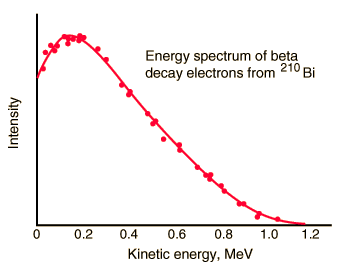
The shape of this energy curve depends on what fraction of the reaction energy (Q value-the amount of energy released by the reaction) is carried by the electron or neutrino.
In the process of beta decay, either an electron or a positron is emitted. This emission is accompanied by the emission of antineutrino (β- decay) or neutrino (β+ decay), which shares energy and momentum of the decay. The beta emission has a characteristic spectrum. This characteristic spectrum is caused by the fact that either a neutrino or an antineutrino is emitted with emission of beta particle. The shape of this energy curve depends on what fraction of the reaction energy (Q value-the amount of energy released by the reaction) is carried by the massive particle. Beta particles can therefore be emitted with any kinetic energy ranging from 0 to Q. By 1934, Enrico Fermi had developed a Fermi theory of beta decay, which predicted the shape of this energy curve.
Nature of Interaction of Beta Radiation with Matter
Summary of types of interactions:
Inelastic collisions with atomic electrons (Excitation and Ionization)
Comparison of particles in a cloud chamber. Source: wikipedia.org
Nature of an interaction of a beta radiation with matter is different from the alpha radiation, despite the fact that beta particles are also charged particles. In comparison with alpha particles, beta particles have much lower mass and they reach mostly relativistic energies. Their mass is equal to the mass of the orbital electrons with which they are interacting and unlike the alpha particle a much larger fraction of its kinetic energy can be lost in a single interaction. Since the beta particles mostly reach relativistic energies, the nonrelativistic Bethe formula cannot be used. For high energy electrons an similar expression has also been derived by Bethe to describe the specific energy loss due to excitation and ionization (the “collisional losses”).
Modified Bethe formula for beta particles.
Moreover, beta particles can interact via electron-nuclear interaction (elastic scattering off nuclei), which can significantly change the direction of beta particle. Therefore their path is not so straightforward. The beta particles follow a very zig-zag path through absorbing material, this resulting path of particle is longer than the linear penetration (range) into the material.
Beta particles also differ from other heavy charged particles in the fraction of energy lost by radiative process known as the bremsstrahlung. From classical theory, when a charged particle is accelerated or decelerated, it must radiate energy and the deceleration radiation is known as the bremsstrahlung (“braking radiation”).
There is another mechanism by which beta particles loss energy via production of electromagnetic radiation. When the beta particle moves faster than the speed of light (phase velocity) in the material it generates a shock wave of electromagnetic radiation known as the Cherenkov radiation.
Positrons interact similarly with matter when they are energetic. But when the positron comes to rest, it interacts with a negatively charged electron, resulting in the annihilation of the electron-positron pair.
Bremsstrahlung
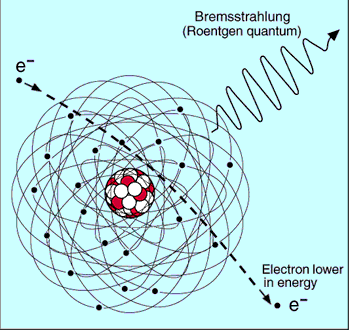
When a electron is accelerated or decelerated it emits radiation and thus loses energy and slows down. This deceleration radiation is known as bremsstrahlung.
The bremsstrahlung is electromagnetic radiation produced by the acceleration or deceleration of a charged particle when deflected by magnetic fields (an electron by magnetic field of particle accelerator) or another charged particle (an electron by an atomic nucleus). The name bremsstrahlung comes from the German. The literal translation is ‘braking radiation’. From classical theory, when a charged particle is accelerated or decelerated, it must radiate energy.
The bremsstrahlung is one of possible interactions of light charged particles with matter (especially with high atomic numbers).
The two commonest occurrences of bremsstrahlung are by:
Deceleration of charged particle. When charged particles enter a material they are decelerated by the electric field of the atomic nuclei and atomic electrons.
Acceleration of charged particle. When ultra-relativistic charged particles move through magnetic fields they are forced to move along a curved path. Since their direction of motion is continually changing, they are also accelerating and so emit bremsstrahlung, in this case it is referred to as synchrotron radiation.
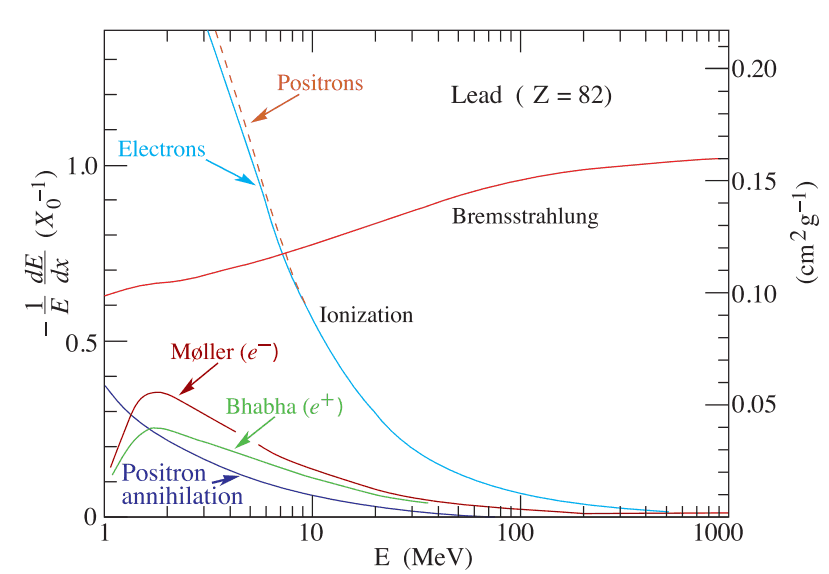
Fractional energy loss per radiation length in lead as a function of electron or positron energy. Source: http://pdg.lbl.gov/
Since the bremsstrahlung is much stronger for lighter particles, this effect is much more important for beta particles than for protons, alpha particles, and heavy charged nuclei (fission fragments). This effect can be neglected at particle energies below about 1 MeV, because the energy loss due to bremsstrahlung is very small. Radiation loss starts to become important only at particle energies well above the minimum ionization energy. At relativistic energies the ratio of loss rate by bremsstrahlung to loss rate by ionization is approximately proportional to the product of the particle’s kinetic energy and the atomic number of the absorber.
The cross section of bremsstrahlung depends on mostly these terms:
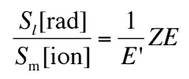
So the ratio of stopping powers of bremsstrahlung and ionization losses is:
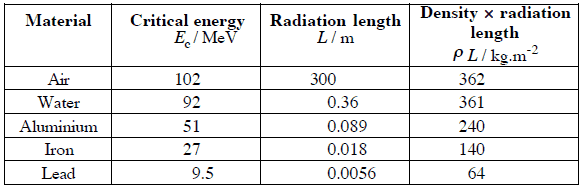
,where E is the particle’s (electron’s) kinetic energy, Z is the mean atomic number of the material and E’ is a proportionality constant; E’ ≈ 800 MeV. The kinetic energy at which energy loss by bremsstrahlung is equal to the energy loss by ionization and excitation (collisional losses) is called the critical energy. Another paremeter is the radiation length, defined as the distance over which the incident electron’s energy is reduced by a factor 1/e (0.37) due to radiation losses alone. Following table give some typical values:
Cherenkov Radiation
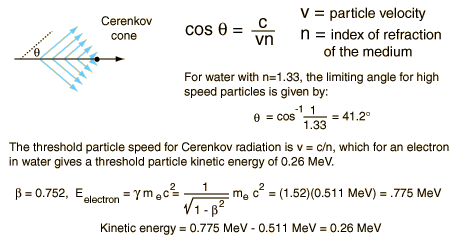
The cherenkov radiation is electromagnetic radiation emitted when a charged particle (such as an electron) moves through a dielectric medium faster than the phase velocity of light in that medium. It is similar to the bow wave produced by a boat travelling faster than the speed of water waves. Cherenkov radiation occurs only if the particle’s speed is higher than the phase velocity of light in the material. Even at high energies the energy lost by Cherenkov radiation is much less than that by the other mechanisms (collisions, bremsstrahlung). It is named after Soviet physicist Pavel Alekseyevich Cherenkov, who shared the Nobel Prize in physics in 1958 with Ilya Frank and Igor Tamm for the discovery of Cherenkov radiation, made in 1934.
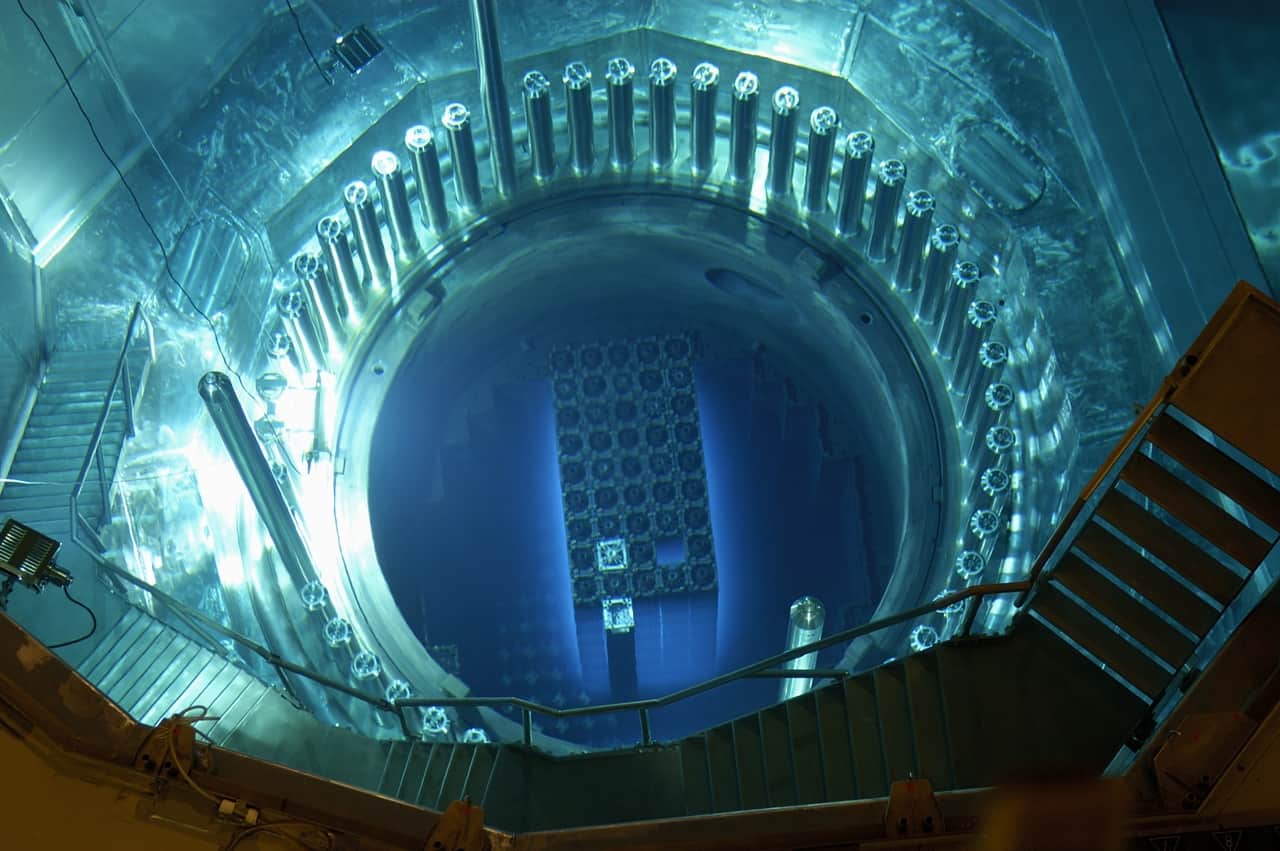
Source: hyperphysics.phy-astr.gsu.eduCherenkov Radiation in the reactor core.
Cherenkov radiation can be used to detect high-energy charged particles (especially beta particles). In nuclear reactors or in a spent nuclear fuel pool, beta particles (high-energy electrons) are released as the fission fragments decay. The glow is visible also after the chain reaction stops (in the reactor). The cherenkov radiation can characterize the remaining radioactivity of spent nuclear fuel, therefore it can be used for measuring of fuel burnup.
Positron Interactions
The coulomb forces that constitute the major mechanism of energy loss for electrons are present for either positive or negative charge on the particle and constitute the major mechanism of energy loss also for positrons. Whatever the interaction involves a repulsive or attractive force between the incident particle and orbital electron (or atomic nucleus), the impulse and energy transfer for particles of equal mass are about the same. Therefore positrons interact similarly with matter when they are energetic. The track of positrons in material is similar to the track of electrons. Even their specific energy loss and range are about the same for equal initial energies.
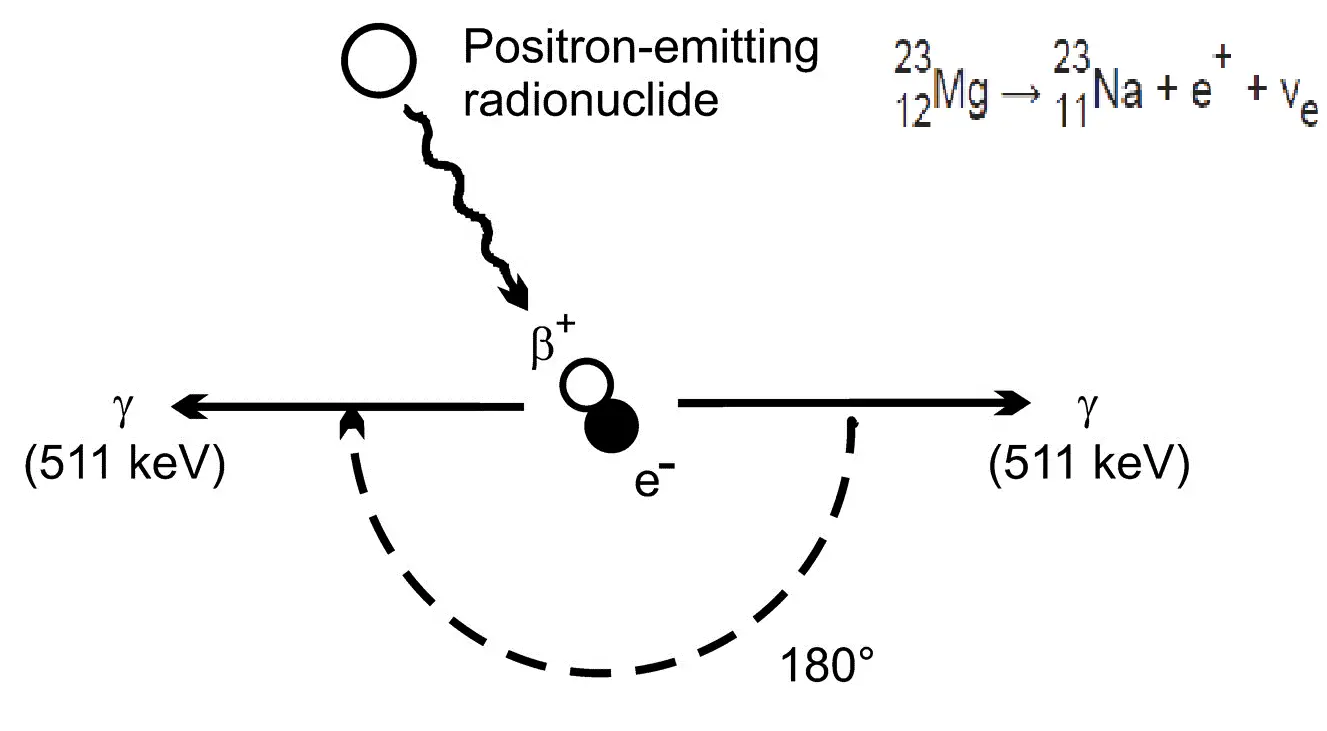
At the end of their path, positrons differ significantly from electrons. When a positron (antimatter particle) comes to rest, it interacts with an electron (matter particle), resulting in the annihilation of the both particles and the complete conversion of their rest mass to pure energy (according to the E=mc2 formula) in the form of two oppositely directed 0.511 MeV gamma rays (photons).
Positron Annihilation
When a positron (antimatter particle) comes to rest, it interacts with an electron, resulting in the annihilation of the both particles and the complete conversion of their rest mass to pure energy in the form of two oppositely directed 0.511 MeV photons.
Electron–positron annihilation occurs when a negatively charged electron and a positively charged positron collide.When a low-energy electron annihilates a low-energy positron (antiparticle of electron), they can only produce two or more photons (gamma rays). The production of only one photon is forbidden because of conservation of linear momentum and total energy. The production of another particle is also forbidden because of both particles (electron-positron) together do not carry enough mass-energy to produce heavier particles. When an electron and a positron collide, they annihilate resulting in the complete conversion of their rest mass to pure energy (according to the E=mc2 formula) in the form of two oppositely directed 0.511 MeV gamma rays (photons).
e− + e+ → γ + γ (2x 0.511 MeV)
This process must satisfy a number of conservation laws, including:
Conservation of electric charge. The net charge before and after is zero.
Conservation of linear momentum and total energy. T
Conservation of angular momentum.
Shielding of Beta Particles – Electrons
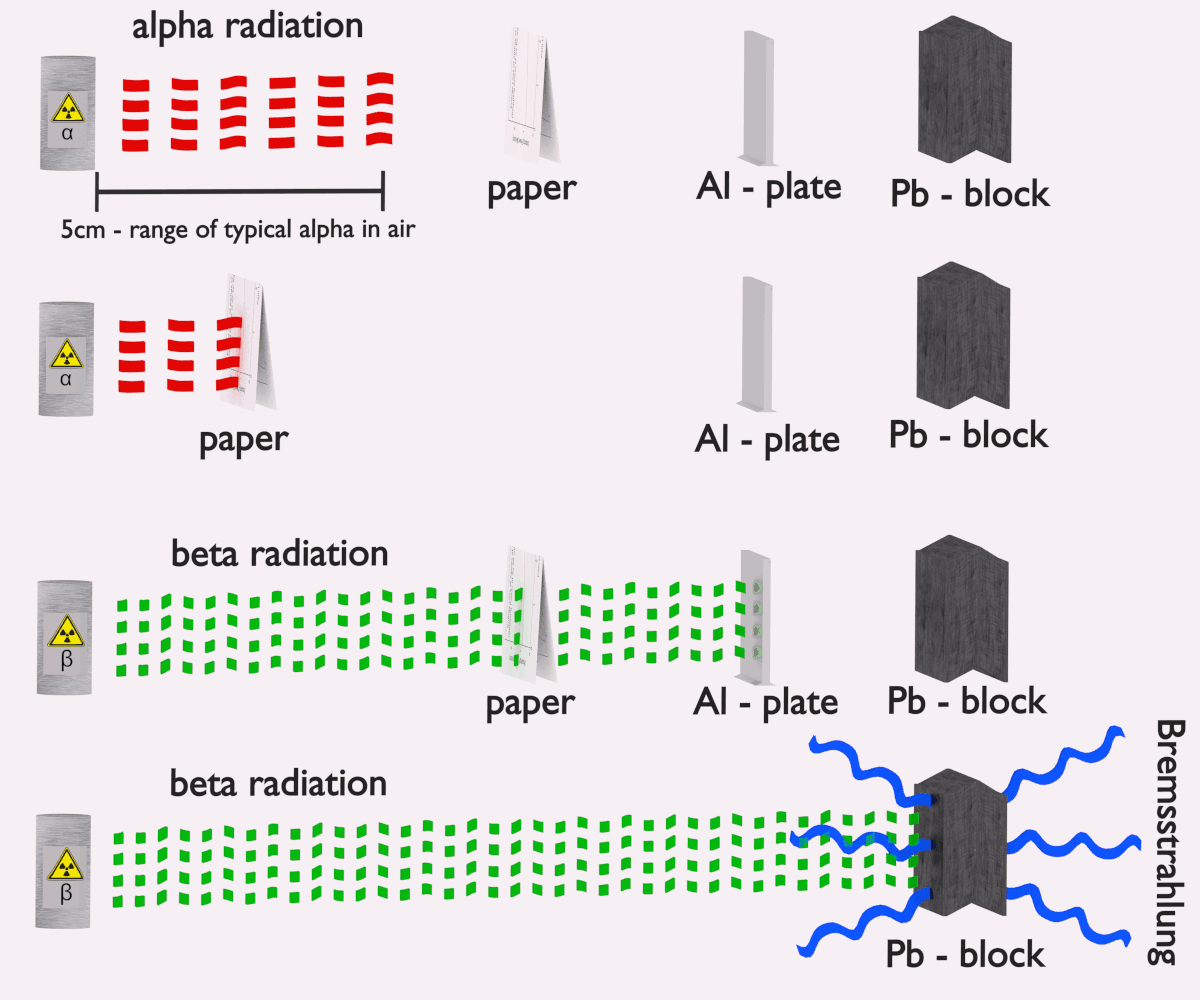
Beta radiation ionizes matter weaker than alpha radiation. On the other hand the ranges of beta particles are longer and depends strongly on initial kinetic energy of particle. Some have enough energy to be of concern regarding external exposure. A 1 MeV beta particle can travel approximately 3.5 meters in air. Such beta particles can penetrate into the body and deposit dose to internal structures near the surface. Therefore greater shielding than in case of alpha radiation is required.
Materials with low atomic number Z are appropriate as beta particle shields. With high Z materials the bremsstrahlung (secondary radiation – X-rays) is associated. This radiation is created during slowing down of beta particles while they travel in a very dense medium. Heavy clothing, thick cardboard or thin aluminium plate will provide protection from beta radiation and prevents of production of the bremsstrahlung.
The coulomb forces that constitute the major mechanism of energy loss for electrons are present for either positive or negative charge on the particle and constitute the major mechanism of energy loss also for positrons. Whatever the interaction involves a repulsive or attractive force between the incident particle and orbital electron (or atomic nucleus), the impulse and energy transfer for particles of equal mass are about the same. Therefore positrons interact similarly with matter when they are energetic. The track of positrons in material is similar to the track of electrons. Even their specific energy loss and range are about the same for equal initial energies.
At the end of their path, positrons differ significantly from electrons. When a positron (antimatter particle) comes to rest, it interacts with an electron (matter particle), resulting in the annihilation of the both particles and the complete conversion of their rest mass to pure energy (according to the E=mc2 formula) in the form of two oppositely directed 0.511 MeV gamma rays(photons).
Therefore any positron shield have to include also a gamma ray shield. In order to minimize the bremsstrahlung a multi-layered radiation shield is appropriate. Material for the first layer must fulfill the requirements for negative beta radiation shielding. First layer of such shield may be for example a thin aluminium plate (to shield positrons), while the second layer of such shield may be a dense material such as lead or depleted uranium.
We hope, this article, Beta Particle, helps you. If so, give us a like in the sidebar. Main purpose of this website is to help the public to learn some interesting and important information about materials and their properties.
Interactions of beta radiation (beta particles) are based mainly on two mechanisms. An excitation and ionization of atoms, and production of bremsstrahlung. Material Properties
Description Beta Particles
Beta particles are high-energy, high-speed electrons or positrons emitted by certain fission fragments or by certain primordial radioactive nuclei such as potassium-40. The beta particles are a form of ionizing radiation also known as beta rays. The production of beta particles is termed beta decay. There are two forms of beta decay, the electron decay (β− decay) and the positron decay (β+ decay). In a nuclear reactor occurs especially the β− decay, because the common feature of the fission products is an excess of neutrons (see Nuclear Stability). An unstable fission fragment with the excess of neutrons undergoes β− decay, where the neutron is converted into a proton, an electron, and an electron antineutrino.
Beta decay of C-14 nucleus.
β- particles
β- particles (electrons) are energetic electrons. The electrons are negatively charged, almost massless particles that nevertheless account for most of the size of the atom. Electrons were discovered by Sir John Joseph Thomson in 1897. Electrons are located in an electron cloud, which is the area surrounding the nucleus of the atom. The electron is only one member of a class of elementary particles, which forms an atom.
β+ particles
β+ particles (positrons) are antiparticles of negative electrons. Positrons, also called positive electrons, have a positive electric charge and have the same mass and magnitude of charge as the electrons. An annihilation occurs, when a low-energy positron collides with a low-energy electron.
Spectrum of beta particles
The shape of this energy curve depends on what fraction of the reaction energy (Q value-the amount of energy released by the reaction) is carried by the electron or neutrino.
In the process of beta decay, either an electron or a positron is emitted. This emission is accompanied by the emission of antineutrino (β- decay) or neutrino (β+ decay), which shares energy and momentum of the decay. The beta emission has a characteristic spectrum. This characteristic spectrum is caused by the fact that either a neutrino or an antineutrino is emitted with emission of beta particle. The shape of this energy curve depends on what fraction of the reaction energy (Q value-the amount of energy released by the reaction) is carried by the massive particle. Beta particles can therefore be emitted with any kinetic energy ranging from 0 to Q. By 1934, Enrico Fermi had developed a Fermi theory of beta decay, which predicted the shape of this energy curve.
Nature of Interaction of Beta Radiation with Matter
Summary of types of interactions:
Inelastic collisions with atomic electrons (Excitation and Ionization)
Comparison of particles in a cloud chamber. Source: wikipedia.org
Nature of an interaction of a beta radiation with matter is different from the alpha radiation, despite the fact that beta particles are also charged particles. In comparison with alpha particles, beta particles have much lower mass and they reach mostly relativistic energies. Their mass is equal to the mass of the orbital electrons with which they are interacting and unlike the alpha particle a much larger fraction of its kinetic energy can be lost in a single interaction. Since the beta particles mostly reach relativistic energies, the nonrelativistic Bethe formula cannot be used. For high energy electrons an similar expression has also been derived by Bethe to describe the specific energy loss due to excitation and ionization (the “collisional losses”).
Modified Bethe formula for beta particles.
Moreover, beta particles can interact via electron-nuclear interaction (elastic scattering off nuclei), which can significantly change the direction of beta particle. Therefore their path is not so straightforward. The beta particles follow a very zig-zag path through absorbing material, this resulting path of particle is longer than the linear penetration (range) into the material.
Beta particles also differ from other heavy charged particles in the fraction of energy lost by radiative process known as the bremsstrahlung. From classical theory, when a charged particle is accelerated or decelerated, it must radiate energy and the deceleration radiation is known as the bremsstrahlung (“braking radiation”).
There is another mechanism by which beta particles loss energy via production of electromagnetic radiation. When the beta particle moves faster than the speed of light (phase velocity) in the material it generates a shock wave of electromagnetic radiation known as the Cherenkov radiation.
Positrons interact similarly with matter when they are energetic. But when the positron comes to rest, it interacts with a negatively charged electron, resulting in the annihilation of the electron-positron pair.
Bremsstrahlung
When a electron is accelerated or decelerated it emits radiation and thus loses energy and slows down. This deceleration radiation is known as bremsstrahlung.
The bremsstrahlung is electromagnetic radiation produced by the acceleration or deceleration of a charged particle when deflected by magnetic fields (an electron by magnetic field of particle accelerator) or another charged particle (an electron by an atomic nucleus). The name bremsstrahlung comes from the German. The literal translation is ‘braking radiation’. From classical theory, when a charged particle is accelerated or decelerated, it must radiate energy.
The bremsstrahlung is one of possible interactions of light charged particles with matter (especially with high atomic numbers).
The two commonest occurrences of bremsstrahlung are by:
Deceleration of charged particle. When charged particles enter a material they are decelerated by the electric field of the atomic nuclei and atomic electrons.
Acceleration of charged particle. When ultra-relativistic charged particles move through magnetic fields they are forced to move along a curved path. Since their direction of motion is continually changing, they are also accelerating and so emit bremsstrahlung, in this case it is referred to as synchrotron radiation.
Fractional energy loss per radiation length in lead as a function of electron or positron energy. Source: http://pdg.lbl.gov/
Since the bremsstrahlung is much stronger for lighter particles, this effect is much more important for beta particles than for protons, alpha particles, and heavy charged nuclei (fission fragments). This effect can be neglected at particle energies below about 1 MeV, because the energy loss due to bremsstrahlung is very small. Radiation loss starts to become important only at particle energies well above the minimum ionization energy. At relativistic energies the ratio of loss rate by bremsstrahlung to loss rate by ionization is approximately proportional to the product of the particle’s kinetic energy and the atomic number of the absorber.
The cross section of bremsstrahlung depends on mostly these terms:
So the ratio of stopping powers of bremsstrahlung and ionization losses is:
,where E is the particle’s (electron’s) kinetic energy, Z is the mean atomic number of the material and E’ is a proportionality constant; E’ ≈ 800 MeV. The kinetic energy at which energy loss by bremsstrahlung is equal to the energy loss by ionization and excitation (collisional losses) is called the critical energy. Another paremeter is the radiation length, defined as the distance over which the incident electron’s energy is reduced by a factor 1/e (0.37) due to radiation losses alone. Following table give some typical values:
Cherenkov Radiation
The cherenkov radiation is electromagnetic radiation emitted when a charged particle (such as an electron) moves through a dielectric medium faster than the phase velocity of light in that medium. It is similar to the bow wave produced by a boat travelling faster than the speed of water waves. Cherenkov radiation occurs only if the particle’s speed is higher than the phase velocity of light in the material. Even at high energies the energy lost by Cherenkov radiation is much less than that by the other mechanisms (collisions, bremsstrahlung). It is named after Soviet physicist Pavel Alekseyevich Cherenkov, who shared the Nobel Prize in physics in 1958 with Ilya Frank and Igor Tamm for the discovery of Cherenkov radiation, made in 1934.
Source: hyperphysics.phy-astr.gsu.eduCherenkov Radiation in the reactor core.
Cherenkov radiation can be used to detect high-energy charged particles (especially beta particles). In nuclear reactors or in a spent nuclear fuel pool, beta particles (high-energy electrons) are released as the fission fragments decay. The glow is visible also after the chain reaction stops (in the reactor). The cherenkov radiation can characterize the remaining radioactivity of spent nuclear fuel, therefore it can be used for measuring of fuel burnup.
Positron Interactions
The coulomb forces that constitute the major mechanism of energy loss for electrons are present for either positive or negative charge on the particle and constitute the major mechanism of energy loss also for positrons. Whatever the interaction involves a repulsive or attractive force between the incident particle and orbital electron (or atomic nucleus), the impulse and energy transfer for particles of equal mass are about the same. Therefore positrons interact similarly with matter when they are energetic. The track of positrons in material is similar to the track of electrons. Even their specific energy loss and range are about the same for equal initial energies.
At the end of their path, positrons differ significantly from electrons. When a positron (antimatter particle) comes to rest, it interacts with an electron (matter particle), resulting in the annihilation of the both particles and the complete conversion of their rest mass to pure energy (according to the E=mc2 formula) in the form of two oppositely directed 0.511 MeV gamma rays (photons).
Positron Annihilation
When a positron (antimatter particle) comes to rest, it interacts with an electron, resulting in the annihilation of the both particles and the complete conversion of their rest mass to pure energy in the form of two oppositely directed 0.511 MeV photons.
Electron–positron annihilation occurs when a negatively charged electron and a positively charged positron collide.When a low-energy electron annihilates a low-energy positron (antiparticle of electron), they can only produce two or more photons (gamma rays). The production of only one photon is forbidden because of conservation of linear momentum and total energy. The production of another particle is also forbidden because of both particles (electron-positron) together do not carry enough mass-energy to produce heavier particles. When an electron and a positron collide, they annihilate resulting in the complete conversion of their rest mass to pure energy (according to the E=mc2 formula) in the form of two oppositely directed 0.511 MeV gamma rays (photons).
e− + e+ → γ + γ (2x 0.511 MeV)
This process must satisfy a number of conservation laws, including:
Conservation of electric charge. The net charge before and after is zero.
Conservation of linear momentum and total energy. T
Conservation of angular momentum.
See also:
Interaction of Heavy Charged Particles with Matter
See also:
Interaction of Radiation with Matter
See also:
Interaction of Gamma Radiation with Matter
We hope, this article, Interaction of Beta Radiation with Matter, helps you. If so, give us a like in the sidebar. Main purpose of this website is to help the public to learn some interesting and important information about materials and their properties.
The Bragg curve is typical for heavy charged particles and describes energy loss of ionizing radiation during travel through matter. Material Properties
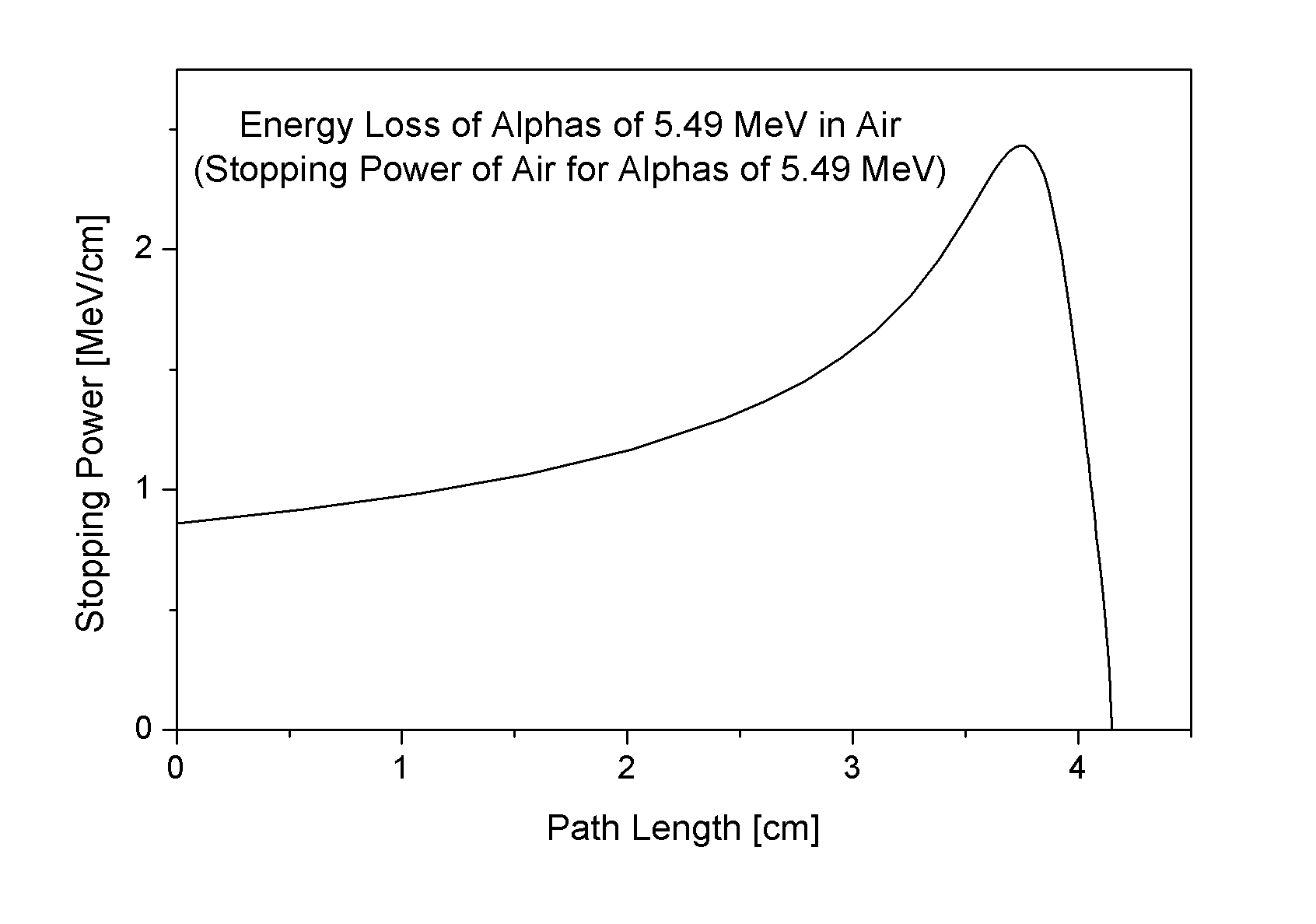
Bragg Curve is typical for heavy charged particles and plots the energy loss during its travel through matter. Source: wikipedia.org
The Bragg curve is typical for heavy charged particles and describes energy loss of ionizing radiation during travel through matter. For this curve is typical the Bragg peak, which is the result of 1/v2 dependency of the stopping power. This peak occurs because the cross section of interaction increases immediately before the particle come to rest. For most of the track, the charge remains unchanged and the specific energy loss increases according to the 1/v2. Near the end of the track, the charge can be reduced through electron pickup and the curve can fall off.
The Bragg curve also differs somewhat due to the effect of straggling. For a given material the range will be the nearly the same for all particles of the same kind with the same initial energy. Because the details of the microscopic interactions undergone by any specific particle vary randomly, a small variation in the range can be observed. This variation is called straggling and it is caused by the statistical nature of the energy loss process which consists of a large number of individual collisions.
This phenomenon, which is described by the Bragg curve, is exploited in particle therapy of cancer, because this allows to concentrate the stopping energy on the tumor while minimizing the effect on the surrounding healthy tissue.
See also:
Stopping Power – Bethe Formula
See also:
Interaction of Heavy Charged Particles with Matter
See also:
We hope, this article, Bragg Curve and Bragg Peak, helps you. If so, give us a like in the sidebar. Main purpose of this website is to help the public to learn some interesting and important information about materials and their properties.
The classical expression that describes the specific stopping power is known as the Bethe formula. The non-relativistic formula was found by Hans Bethe in 1930. Material Properties
A convenient variable that describes the ionization properties of surrounding medium is the stopping power. The linear stopping power of material is defined as the ratio of the differential energy loss for the particle within the material to the corresponding differential path length:
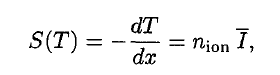
,where T is the kinetic energy of the charged particle, nion is the number of electron-ion pairs formed per unit path length, and I denotes the average energy needed to ionize an atom in the medium. For charged particles, S increases as the particle velocity decreases. The classical expression that describes the specific energy loss is known as the Bethe formula. The non-relativistic formula was found by Hans Bethe in 1930. The relativistic version (see below) was found also by Hans Bethe in 1932.
In this expression, m is the rest mass of the electron, β equals to v/c, what expresses the particle’s velocity relative to the speed of light, γ is the Lorentz factor of the particle, Q equals to its charge, Z is the atomic number of the medium and n is the atoms density in the volume. For nonrelativistic particles (heavy charged particles are mostly nonrelativistic), dT/dx is dependent on 1/v2. This is can be explained by the greater time the charged particle spends in the negative field of the electron, when the velocity is low.
The stopping power of most materials is very high for heavy charged particles and these particles have very short ranges. For example, the range of a 5 MeV alpha particle is approximately only 0,002 cm in aluminium alloy. Most alpha particles can be stopped by an ordinary sheet of paper or living tissue. Therefore the shielding of alpha particles does not pose a difficult problem, but on the other hand alpha radioactive nuclides can lead to serious health hazards when they are ingested or inhaled (internal contamination).
Specifics of Fission Fragments
The fission fragments three two key features (somewhat different from alpha particles or protons), which influence their energy loss during its travel through matter.
High initial energy. Results in a large effective charge.
Large effective charge. The fission fragments start out with lack of many electrons, therefore their specific loss is greater than alpha’s specific loss, for example.
Immediate electron pickup. Results in changes of (-dE/dx) during the travel.
These features results in the continuous decrease in the effective charge carried by the fission fragment as the fragment comes to rest and continuous decrease in -dE/dx. The resulting decrease in -dE/dx (from the electron pickup) is larger than the increase that accompanies a reduction in velocity. The range of typical fission fragment can be approximately half that of a 5 MeV alpha particle.
See also:
Interaction of Heavy Charged Particles with Matter
See also:
We hope, this article, Stopping Power – Bethe Formula, helps you. If so, give us a like in the sidebar. Main purpose of this website is to help the public to learn some interesting and important information about materials and their properties.
Fission fragments or fission products are the products nucleus fissions. Typically, when uranium 235 nucleus undergoes fission, the nucleus splits into two smaller nuclei. Material Properties
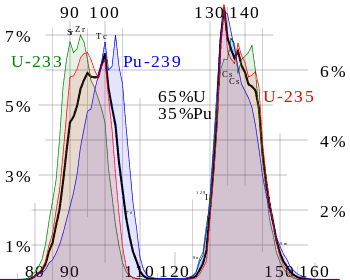
Nuclear fission fragments are the fragments left after a nucleus fissions. Typically, when uranium 235 nucleus undergoes fission, the nucleus splits into two smaller nuclei, along with a few neutrons and release of energy in the form of heat (kinetic energy of the these fission fragments) and gamma rays. The average of the fragment mass is about 118, but very few fragments near that average are found. It is much more probable to break up into unequal fragments, and the most probable fragment masses are around mass 95 (Krypton) and 137 (Barium).
Most of these fission fragments are highly unstable (radioactive) and undergo further radioactive decays to stabilize itself. Fission fragments interact strongly with the surrounding atoms or molecules traveling at high speed, causing them to ionize.
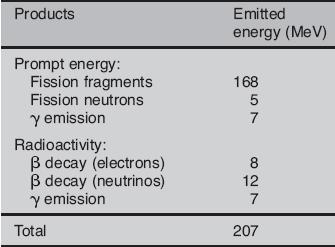
Most of energy released by one fission (~160MeV of total ~200MeV) appears as kinetic energy of the fission fragments.
Energy from Uranium FissionFission fragment yield for different nuclei. The most probable fragment masses are around mass 95 (Krypton) and 137 (Barium).
See also:
Energy Release
See also:
Nuclear Fission
See also:
Prompt Neutrons
We hope, this article, Fission Fragment, helps you. If so, give us a like in the sidebar. Main purpose of this website is to help the public to learn some interesting and important information about materials and their properties.
Alpha particles are energetic nuclei of helium. The production of alpha particles is termed alpha decay. Alpha particles consist of two protons and two neutrons. Material Properties
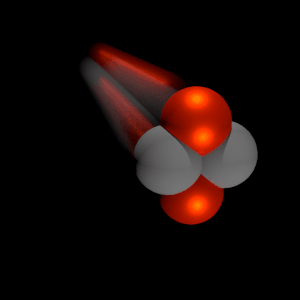
Alpha particles are energetic nuclei of helium. The production of alpha particles is termed alpha decay. Alpha particles consist of two protons and two neutrons bound together into a particle identical to a helium nucleus. Alpha particles are relatively large and carry a double positive charge. They are not very penetrating and a piece of paper can stop them. They travel only a few centimeters but deposit all their energies along their short paths. In nuclear reactors they are produced for example in the fuel (alpha decay of heavy nuclei). Alpha particles are commonly emitted by all of the heavy radioactive nuclei occuring in the nature (uranium, thorium or radium), as well as the transuranic elements (neptunium, plutonium or americium). Especially energeticalpha particles (except artificially accelerated helium nuclei) are produced in a nuclear process, which is known as a ternary fission. In this process, the nucleus of uranium is splitted into three charged particles (fission fragments) instead of the normal two. The smallest of the fission fragments most probably (90% probability) being an extra energetic alpha particle.
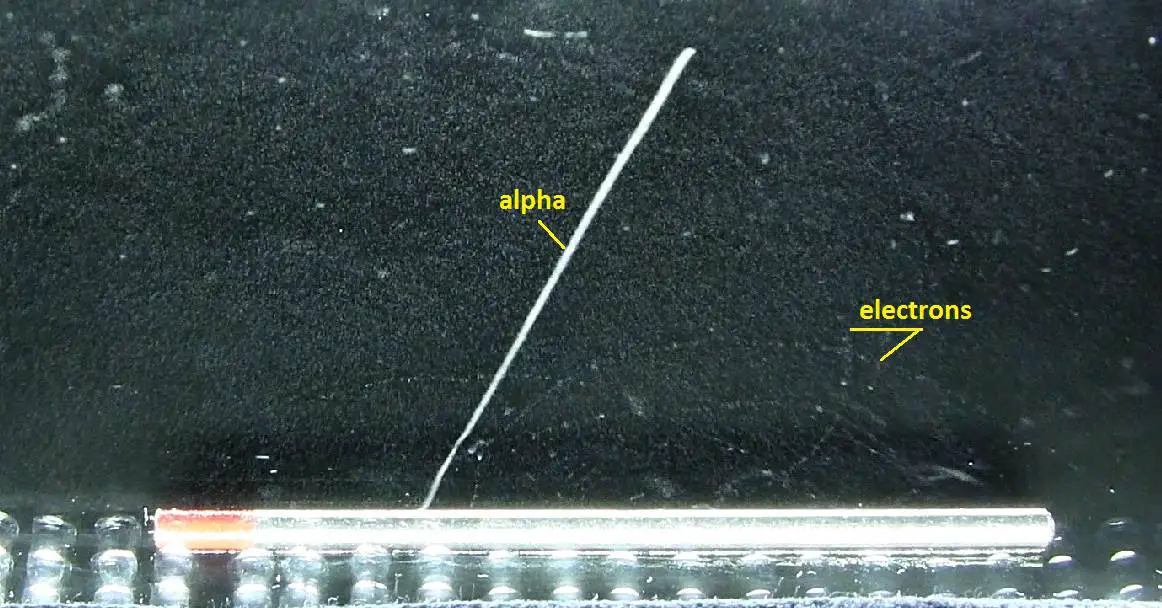
Alpha particles and electrons (deflected by a magnetic field) from a thorium rod in a cloud chamber. Source: wikipedia.org
Interaction of Alpha Particles with Matter
Since the electromagnetic interaction extends over some distance, it is not necessary for an alpha particles to make a direct collision with an atom. They can transfer energy simply by passing close by. Alpha particlesinteract with matter primarily through coulomb forces between their positive charge and the negative charge of the electrons from atomic orbitals. In general, the alpha particles (like other charged particles) transfer energy mostly by:
Excitation. The charged particle can transfer energy to the atom, raising electrons to a higher energy levels.
Ionization. Ionization can occur, when the charged particle have enough energy to remove an electron. This results in a creation of ion pairs in surrounding matter.
Creation of pairs requires energy, which is lost from the kinetic energy of the alpha particle causing it to decelerate. The positive ions and free electrons created by the passage of the alpha particle will then reunite, releasing energy in the form of heat (e.g. vibrational energy or rotational energy of atoms). There are considerable differences in the ways of energy loss and scattering between the passage of light charged particles such as positrons and electrons and heavy charged particles such as fission fragments, alpha particles, muons. Most of these differences are based on the different dynamics of the collision process. In general, when a heavy particle collides with a much lighter particle (electrons in the atomic orbitals), the laws of energy and momentum conservation predict that only a small fraction of the massive particle’s energy can be transferred to the less massive particle. The actual amount of transferred energy depends on how closely the charged particles passes through the atom and it depends also on restrictions from quantisation of energy levels.
A convenient variable that describes the ionization properties of surrounding medium is the stopping power. The linear stopping power of material is defined as the ratio of the differential energy loss for the particle within the material to the corresponding differential path length:
,where T is the kinetic energy of the charged particle, nion is the number of electron-ion pairs formed per unit path length, and I denotes the average energy needed to ionize an atom in the medium. For charged particles, S increases as the particle velocity decreases. The classical expression that describes the specific energy loss is known as the Bethe formula. The non-relativistic formula was found by Hans Bethe in 1930. The relativistic version (see below) was found also by Hans Bethe in 1932.
In this expression, m is the rest mass of the electron, β equals to v/c, what expresses the particle’s velocity relative to the speed of light, γ is the Lorentz factor of the particle, Q equals to its charge, Z is the atomic number of the medium and n is the atoms density in the volume. For nonrelativistic particles (heavy charged particles are mostly nonrelativistic), dT/dx is dependent on 1/v2. This is can be explained by the greater time the charged particle spends in the negative field of the electron, when the velocity is low.
The stopping power of most materials is very high for heavy charged particles and these particles have very short ranges. For example, the range of a 5 MeV alpha particle is approximately only 0,002 cm in aluminium alloy. Most alpha particles can be stopped by an ordinary sheet of paper or living tissue. Therefore the shielding of alpha particles does not pose a difficult problem, but on the other hand alpha radioactive nuclides can lead to serious health hazards when they are ingested or inhaled (internal contamination).
Bragg Curve
Bragg Curve is typical for heavy charged particles and plots the energy loss during its travel through matter. Source: wikipedia.org
The Bragg curve is typical for alpha particles and for other heavy charged particles and describes energy loss of ionizing radiation during travel through matter. For this curve is typical the Bragg peak, which is the result of 1/v2 dependency of the stopping power. This peak occurs because the cross section of interaction increases immediately before the particle come to rest. For most of the track, the charge remains unchanged and the specific energy loss increases according to the 1/v2. Near the end of the track, the charge can be reduced through electron pickup and the curve can fall off.
The Bragg curve also differs somewhat due to the effect of straggling. For a given material the range will be the nearly the same for all particles of the same kind with the same initial energy. Because the details of the microscopic interactions undergone by any specific particle vary randomly, a small variation in the range can be observed. This variation is called straggling and it is caused by the statistical nature of the energy loss process which consists of a large number of individual collisions.
This phenomenon, which is described by the Bragg curve, is exploited in particle therapy of cancer, because this allows to concentrate the stopping energy on the tumor while minimizing the effect on the surrounding healthy tissue.
See also:
Neutron
See also:
Fundamental Particles
See also:
Beta Particle
We hope, this article, Alpha Particle, helps you. If so, give us a like in the sidebar. Main purpose of this website is to help the public to learn some interesting and important information about materials and their properties.
Heavy charged particles are all energetic ions with mass of one atomic mass unit or greater. Knowledge of their interaction with matter must be well known. Material Properties
Heavy charged particles are all energetic ions with mass of one atomic mass unit or greater, such as protons, alpha particles (helium nuclei) or fission fragments. Especially knowledge of the interaction of fission fragments and alpha particles must be well known in the engineering of nuclear reactors.
Description of Alpha Particles
Alpha particles are energetic nuclei of helium. The production of alpha particles is termed alpha decay. Alpha particles consist of two protons and two neutrons bound together into a particle identical to a helium nucleus. Alpha particles are relatively large and carry a double positive charge. They are not very penetrating and a piece of paper can stop them. They travel only a few centimeters but deposit all their energies along their short paths. In nuclear reactors they are produced for example in the fuel (alpha decay of heavy nuclei). Alpha particles are commonly emitted by all of the heavy radioactive nuclei occuring in the nature (uranium, thorium or radium), as well as the transuranic elements (neptunium, plutonium or americium). Especially energeticalpha particles (except artificially accelerated helium nuclei) are produced in a nuclear process, which is known as a ternary fission. In this process, the nucleus of uranium is splitted into three charged particles (fission fragments) instead of the normal two. The smallest of the fission fragments most probably (90% probability) being an extra energetic alpha particle.
Fission fragment yield for different nuclei. The most probable fragment masses are around mass 95 (Krypton) and 137 (Barium).
Description of Fission Fragments
Nuclear fission fragments are the fragments left after a nucleus fissions. Typically, when uranium 235 nucleus undergoes fission, the nucleus splits into two smaller nuclei, along with a few neutrons and release of energy in the form of heat (kinetic energy of the these fission fragments) and gamma rays. The average of the fragment mass is about 118, but very few fragments near that average are found. It is much more probable to break up into unequal fragments, and the most probable fragment masses are around mass 95 (Krypton) and 137 (Barium).
Most of these fission fragments are highly unstable (radioactive) and undergo further radioactive decays to stabilize itself. Fission fragments interact strongly with the surrounding atoms or molecules traveling at high speed, causing them to ionize.
Energy from Uranium Fission
Most of energy released by one fission (~160MeV of total ~200MeV) appears as kinetic energy of the fission fragments.
Nature of Interaction of Charged Particles with Matter
Since the electromagnetic interaction extends over some distance, it is not necessary for the light or heavy charged particle to make a direct collision with an atom. They can transfer energy simply by passing close by. Heavy charged particles, such as fission fragments or alpha particles interact with matter primarily through coulomb forces between their positive charge and the negative charge of the electrons from atomic orbitals. On the other hand, the internal energy of an atom is quantised, therefore only certain amount of energy can be transferred. In general, charged particles transfer energy mostly by:
Excitation. The charged particle can transfer energy to the atom, raising electrons to a higher energy levels.
Ionization. Ionization can occur, when the charged particle have enough energy to remove an electron. This results in a creation of ion pairs in surrounding matter.
Fission fragments after a nucleus fission. Fission fragments interact strongly with the surrounding atoms or molecules traveling at high speed, causing them to ionize.
Creation of pairs requires energy, which is lost from the kinetic energy of the charged particle causing it to decelerate. The positive ions and free electrons created by the passage of the charged particle will then reunite, releasing energy in the form of heat (e.g. vibrational energy or rotational energy of atoms). This is the principle how fission fragments heat up fuel in the reactor core. There are considerable differences in the ways of energy loss and scattering between the passage of light charged particles such as positrons and electrons and heavy charged particles such as fission fragments, alpha particles, muons. Most of these differences are based on the different dynamics of the collision process. In general, when a heavy particle collides with a much lighter particle (electrons in the atomic orbitals), the laws of energy and momentum conservation predict that only a small fraction of the massive particle’s energy can be transferred to the less massive particle. The actual amount of transferred energy depends on how closely the charged particles passes through the atom and it depends also on restrictions from quantisation of energy levels.
The distance required to bring the particle to rest is referred to as its range. The range of fission fragments in solids amounts to only a few microns, and thus most of the energy of fission is converted to heatvery close to the point of fission. In case of gases the range increases to a few centimeters in dependence of gas parameters (density, type of gas etc.) The trajectory of heavy charged particles are not greatly affected, because they interacts with light atomic electrons. Other charged particles, such as the alpha particles behave similarly with one exception – for lighter charged particles the ranges are somewhat longer.
Stopping Power – Bethe Formula
A convenient variable that describes the ionization properties of surrounding medium is the stopping power. The linear stopping power of material is defined as the ratio of the differential energy loss for the particle within the material to the corresponding differential path length:
,where T is the kinetic energy of the charged particle, nion is the number of electron-ion pairs formed per unit path length, and I denotes the average energy needed to ionize an atom in the medium. For charged particles, S increases as the particle velocity decreases. The classical expression that describes the specific energy loss is known as the Bethe formula. The non-relativistic formula was found by Hans Bethe in 1930. The relativistic version (see below) was found also by Hans Bethe in 1932.
In this expression, m is the rest mass of the electron, β equals to v/c, what expresses the particle’s velocity relative to the speed of light, γ is the Lorentz factor of the particle, Q equals to its charge, Z is the atomic number of the medium and n is the atoms density in the volume. For nonrelativistic particles (heavy charged particles are mostly nonrelativistic), dT/dx is dependent on 1/v2. This is can be explained by the greater time the charged particle spends in the negative field of the electron, when the velocity is low.
The stopping power of most materials is very high for heavy charged particles and these particles have very short ranges. For example, the range of a 5 MeV alpha particle is approximately only 0,002 cm in aluminium alloy. Most alpha particles can be stopped by an ordinary sheet of paper or living tissue. Therefore the shielding of alpha particles does not pose a difficult problem, but on the other hand alpha radioactive nuclides can lead to serious health hazards when they are ingested or inhaled (internal contamination).
Specifics of Fission Fragments
The fission fragments three two key features (somewhat different from alpha particles or protons), which influence their energy loss during its travel through matter.
High initial energy. Results in a large effective charge.
Large effective charge. The fission fragments start out with lack of many electrons, therefore their specific loss is greater than alpha’s specific loss, for example.
Immediate electron pickup. Results in changes of (-dE/dx) during the travel.
These features results in the continuous decrease in the effective charge carried by the fission fragment as the fragment comes to rest and continuous decrease in -dE/dx. The resulting decrease in -dE/dx (from the electron pickup) is larger than the increase that accompanies a reduction in velocity. The range of typical fission fragment can be approximately half that of a 5 MeV alpha particle.
Bragg Curve
Bragg Curve is typical for heavy charged particles and plots the energy loss during its travel through matter. Source: wikipedia.org
The Bragg curve is typical for heavy charged particles and describes energy loss of ionizing radiation during travel through matter. For this curve is typical the Bragg peak, which is the result of 1/v2 dependency of the stopping power. This peak occurs because the cross section of interaction increases immediately before the particle come to rest. For most of the track, the charge remains unchanged and the specific energy loss increases according to the 1/v2. Near the end of the track, the charge can be reduced through electron pickup and the curve can fall off.
The Bragg curve also differs somewhat due to the effect of straggling. For a given material the range will be the nearly the same for all particles of the same kind with the same initial energy. Because the details of the microscopic interactions undergone by any specific particle vary randomly, a small variation in the range can be observed. This variation is called straggling and it is caused by the statistical nature of the energy loss process which consists of a large number of individual collisions.
This phenomenon, which is described by the Bragg curve, is exploited in particle therapy of cancer, because this allows to concentrate the stopping energy on the tumor while minimizing the effect on the surrounding healthy tissue.
See also:
Interaction of Radiation with Matter
See also:
Interaction of Beta Radiation with Matter
We hope, this article, Interaction of Heavy Charged Particles with Matter, helps you. If so, give us a like in the sidebar. Main purpose of this website is to help the public to learn some interesting and important information about materials and their properties.
Knowledge of interactions of radiation with matter constitute key knowledge of modern physics and reactor physics. Each type particle interacts in a different way. Material Properties
Knowledge of interactions of radiation with matter constitute key knowledge of modern physics. Modern physics is an experimental science and it is based on experiments, which provide key information for our understanding of nature. Most modern nuclear or particle experiments use a variety of sophisticated devices (detectors) for measuring and detection of sub-atomic particles. In order to be detected, a particle must leave some trace of its presence in a detector. Particles mostly deposit energy along its path. Knowledge of this interaction, how different particles deposit energy in the matter and how much energy particles deposit, is fundamental for our understanding of the problem.
Each type particle interacts in a different way, therefore we must describe interaction of particles (radiation as a flow of these particles) separately. For example charged particles with high energies can directly ionize atoms. On the other hand electrically neutral particles interacts only indirectly, but can also transfer some or all of their energies to the matter. This is the key feature of the categorization of radiation sources. They are usually categorized into two general types as follows:
Charged particles (directly ionizing)
Beta particles. Beta particles are fast electrons or positrons emitted in nuclear beta decay, as well as energetic electrons produced by any other process.
Heavy charged particles. Heavy charged particles are all energetic ions with mass of one atomic mass unit or greater, such as protons, alpha particles (helium nuclei) or fission fragments.
Neutral particles (indirectly ionizing)
Photon radiation (electromagnetic radiation). Photons are particles/waves (Wave-Particle Duality) without rest mass or electrical charge. Also visible light is electromagnetic radiation, but with much lower energies. The electromagnetic radiation of interest includes X-rays emitted in the rearrangement of electron shells of atoms and gamma rays that are emitted from nucleus.
Neutrons. Neutrons can be emitted by nuclear fission or by the decay of some radioactive atoms. Neutrons have zero electrical charge and cannot directly cause ionization.
Neutrinos. Neutrinos are electrically neutral, weakly interacting elementary particles, which have very low cross sections for any interaction with matter and therefore low probabilities for colliding in matter.
The design of all nuclear reactors and other nuclear systems depends fundamentally on the way in which radiation interacts with matter. This knowledge is very important for understanding of:
Neutron Moderation. How neutrons slow down to thermal energies.
Power Distribution. Where is the energy generated?
Reactor Power Measurement. How can we measure the reactor power and how can we control the chain reaction.
Radiation Shielding. How can we shield all the various types of radiation produced in the reactor core.
In nuclear reactor we can typically encounter with one of following types of radiation:
Interaction of Heavy Charged Particles
Heavy charged particles are all energetic ions with mass of one atomic mass unit or greater, such as protons, alpha particles (helium nuclei) or fission fragments. Especially knowledge of the interaction of fission fragments and alpha particles must be well known in the engineering of nuclear reactors.
Description of Alpha Particles
Alpha particles are energetic nuclei of helium. The production of alpha particles is termed alpha decay. Alpha particles consist of two protons and two neutrons bound together into a particle identical to a helium nucleus. Alpha particles are relatively large and carry a double positive charge. They are not very penetrating and a piece of paper can stop them. They travel only a few centimeters but deposit all their energies along their short paths. In nuclear reactors they are produced for example in the fuel (alpha decay of heavy nuclei). Alpha particles are commonly emitted by all of the heavy radioactive nuclei occuring in the nature (uranium, thorium or radium), as well as the transuranic elements (neptunium, plutonium or americium). Especially energeticalpha particles (except artificially accelerated helium nuclei) are produced in a nuclear process, which is known as a ternary fission. In this process, the nucleus of uranium is splitted into three charged particles (fission fragments) instead of the normal two. The smallest of the fission fragments most probably (90% probability) being an extra energetic alpha particle.
Fission fragment yield for different nuclei. The most probable fragment masses are around mass 95 (Krypton) and 137 (Barium).
Description of Fission Fragments
Nuclear fission fragments are the fragments left after a nucleus fissions. Typically, when uranium 235 nucleus undergoes fission, the nucleus splits into two smaller nuclei, along with a few neutrons and release of energy in the form of heat (kinetic energy of the these fission fragments) and gamma rays. The average of the fragment mass is about 118, but very few fragments near that average are found. It is much more probable to break up into unequal fragments, and the most probable fragment masses are around mass 95 (Krypton) and 137 (Barium).
Most of these fission fragments are highly unstable (radioactive) and undergo further radioactive decays to stabilize itself. Fission fragments interact strongly with the surrounding atoms or molecules traveling at high speed, causing them to ionize.
Energy from Uranium Fission
Most of energy released by one fission (~160MeV of total ~200MeV) appears as kinetic energy of the fission fragments.
Nature of Interaction of Charged Particles with Matter
Since the electromagnetic interaction extends over some distance, it is not necessary for the light or heavy charged particle to make a direct collision with an atom. They can transfer energy simply by passing close by. Heavy charged particles, such as fission fragments or alpha particles interact with matter primarily through coulomb forces between their positive charge and the negative charge of the electrons from atomic orbitals. On the other hand, the internal energy of an atom is quantised, therefore only certain amount of energy can be transferred. In general, charged particles transfer energy mostly by:
Excitation. The charged particle can transfer energy to the atom, raising electrons to a higher energy levels.
Ionization. Ionization can occur, when the charged particle have enough energy to remove an electron. This results in a creation of ion pairs in surrounding matter.
Fission fragments after a nucleus fission. Fission fragments interact strongly with the surrounding atoms or molecules traveling at high speed, causing them to ionize.
Creation of pairs requires energy, which is lost from the kinetic energy of the charged particle causing it to decelerate. The positive ions and free electrons created by the passage of the charged particle will then reunite, releasing energy in the form of heat (e.g. vibrational energy or rotational energy of atoms). This is the principle how fission fragments heat up fuel in the reactor core. There are considerable differences in the ways of energy loss and scattering between the passage of light charged particles such as positrons and electrons and heavy charged particles such as fission fragments, alpha particles, muons. Most of these differences are based on the different dynamics of the collision process. In general, when a heavy particle collides with a much lighter particle (electrons in the atomic orbitals), the laws of energy and momentum conservation predict that only a small fraction of the massive particle’s energy can be transferred to the less massive particle. The actual amount of transferred energy depends on how closely the charged particles passes through the atom and it depends also on restrictions from quantisation of energy levels.
The distance required to bring the particle to rest is referred to as its range. The range of fission fragments in solids amounts to only a few microns, and thus most of the energy of fission is converted to heatvery close to the point of fission. In case of gases the range increases to a few centimeters in dependence of gas parameters (density, type of gas etc.) The trajectory of heavy charged particles are not greatly affected, because they interacts with light atomic electrons. Other charged particles, such as the alpha particles behave similarly with one exception – for lighter charged particles the ranges are somewhat longer.
Stopping Power – Bethe Formula
A convenient variable that describes the ionization properties of surrounding medium is the stopping power. The linear stopping power of material is defined as the ratio of the differential energy loss for the particle within the material to the corresponding differential path length:
,where T is the kinetic energy of the charged particle, nion is the number of electron-ion pairs formed per unit path length, and I denotes the average energy needed to ionize an atom in the medium. For charged particles, S increases as the particle velocity decreases. The classical expression that describes the specific energy loss is known as the Bethe formula. The non-relativistic formula was found by Hans Bethe in 1930. The relativistic version (see below) was found also by Hans Bethe in 1932.
In this expression, m is the rest mass of the electron, β equals to v/c, what expresses the particle’s velocity relative to the speed of light, γ is the Lorentz factor of the particle, Q equals to its charge, Z is the atomic number of the medium and n is the atoms density in the volume. For nonrelativistic particles (heavy charged particles are mostly nonrelativistic), dT/dx is dependent on 1/v2. This is can be explained by the greater time the charged particle spends in the negative field of the electron, when the velocity is low.
The stopping power of most materials is very high for heavy charged particles and these particles have very short ranges. For example, the range of a 5 MeV alpha particle is approximately only 0,002 cm in aluminium alloy. Most alpha particles can be stopped by an ordinary sheet of paper or living tissue. Therefore the shielding of alpha particles does not pose a difficult problem, but on the other hand alpha radioactive nuclides can lead to serious health hazards when they are ingested or inhaled (internal contamination).
Specifics of Fission Fragments
The fission fragments three two key features (somewhat different from alpha particles or protons), which influence their energy loss during its travel through matter.
High initial energy. Results in a large effective charge.
Large effective charge. The fission fragments start out with lack of many electrons, therefore their specific loss is greater than alpha’s specific loss, for example.
Immediate electron pickup. Results in changes of (-dE/dx) during the travel.
These features results in the continuous decrease in the effective charge carried by the fission fragment as the fragment comes to rest and continuous decrease in -dE/dx. The resulting decrease in -dE/dx (from the electron pickup) is larger than the increase that accompanies a reduction in velocity. The range of typical fission fragment can be approximately half that of a 5 MeV alpha particle.
Bragg Curve
Bragg Curve is typical for heavy charged particles and plots the energy loss during its travel through matter. Source: wikipedia.org
The Bragg curve is typical for heavy charged particles and describes energy loss of ionizing radiation during travel through matter. For this curve is typical the Bragg peak, which is the result of 1/v2 dependency of the stopping power. This peak occurs because the cross section of interaction increases immediately before the particle come to rest. For most of the track, the charge remains unchanged and the specific energy loss increases according to the 1/v2. Near the end of the track, the charge can be reduced through electron pickup and the curve can fall off.
The Bragg curve also differs somewhat due to the effect of straggling. For a given material the range will be the nearly the same for all particles of the same kind with the same initial energy. Because the details of the microscopic interactions undergone by any specific particle vary randomly, a small variation in the range can be observed. This variation is called straggling and it is caused by the statistical nature of the energy loss process which consists of a large number of individual collisions.
This phenomenon, which is described by the Bragg curve, is exploited in particle therapy of cancer, because this allows to concentrate the stopping energy on the tumor while minimizing the effect on the surrounding healthy tissue.
Beta particles are high-energy, high-speed electrons or positrons emitted by certain fission fragments or by certain primordial radioactive nuclei such as potassium-40. The beta particles are a form of ionizing radiation also known as beta rays. The production of beta particles is termed beta decay. There are two forms of beta decay, the electron decay (β− decay) and the positron decay (β+ decay). In a nuclear reactor occurs especially the β− decay, because the common feature of the fission products is an excess of neutrons (see Nuclear Stability). An unstable fission fragment with the excess of neutrons undergoes β− decay, where the neutron is converted into a proton, an electron, and an electron antineutrino.
Beta decay of C-14 nucleus.
Spectrum of beta particles
The shape of this energy curve depends on what fraction of the reaction energy (Q value-the amount of energy released by the reaction) is carried by the electron or neutrino.
In the process of beta decay, either an electron or a positron is emitted. This emission is accompanied by the emission of antineutrino (β- decay) or neutrino (β+ decay), which shares energy and momentum of the decay. The beta emission has a characteristic spectrum. This characteristic spectrum is caused by the fact that either a neutrino or an antineutrino is emitted with emission of beta particle. The shape of this energy curve depends on what fraction of the reaction energy (Q value-the amount of energy released by the reaction) is carried by the massive particle. Beta particles can therefore be emitted with any kinetic energy ranging from 0 to Q. By 1934, Enrico Fermi had developed a Fermi theory of beta decay, which predicted the shape of this energy curve.
Nature of Interaction of Beta Radiation with Matter
Summary of types of interactions:
Inelastic collisions with atomic electrons (Excitation and Ionization)
Comparison of particles in a cloud chamber. Source: wikipedia.org
Nature of an interaction of a beta radiation with matter is different from the alpha radiation, despite the fact that beta particles are also charged particles. In comparison with alpha particles, beta particles have much lower mass and they reach mostly relativistic energies. Its mass is equal to the mass of the orbital electrons with which they are interacting and unlike the alpha particle a much larger fraction of its kinetic energy can be lost in a single interaction. Since the beta particles mostly reach relativistic energies, the nonrelativistic Bethe formula cannot be used. For high energy electrons an similar expression has also been derived by Bethe to describe the specific energy loss due to excitation and ionization (the “collisional losses”).
Modified Bethe formula for beta particles.
Moreover, beta particles can interact via electron-nuclear interaction (elastic scattering off nuclei), which can significantly change the direction of beta particle. Therefore their path is not so straightforward. The beta particles follow a very zig-zag path through absorbing material, this resulting path of particle is longer than the linear penetration (range) into the material.
Beta particles also differ from other heavy charged particles in the fraction of energy lost by radiative process known as the bremsstrahlung. From classical theory, when a charged particle is accelerated or decelerated, it must radiate energy and the deceleration radiation is known as the bremsstrahlung (“braking radiation”).
There is another mechanism by which beta particles loss energy via production of electromagnetic radiation. When the beta particle moves faster than the speed of light (phase velocity) in the material it generates a shock wave of electromagnetic radiation known as the Cherenkov radiation.
Positrons interact similarly with matter when they are energetic. But when the positron comes to rest, it interacts with a negatively charged electron, resulting in the annihilation of the electron-positron pair.
Bremsstrahlung
When a electron is accelerated or decelerated it emits radiation and thus loses energy and slows down. This deceleration radiation is known as bremsstrahlung.
The bremsstrahlung is electromagnetic radiation produced by the acceleration or deceleration of a charged particle when deflected by magnetic fields (an electron by magnetic field of particle accelerator) or another charged particle (an electron by an atomic nucleus). The name bremsstrahlung comes from the German. The literal translation is ‘braking radiation’. From classical theory, when a charged particle is accelerated or decelerated, it must radiate energy.
The bremsstrahlung is one of possible interactions of light charged particles with matter (especially with high atomic numbers).
The two commonest occurrences of bremsstrahlung are by:
Deceleration of charged particle. When charged particles enter a material they are decelerated by the electric field of the atomic nuclei and atomic electrons.
Acceleration of charged particle. When ultra-relativistic charged particles move through magnetic fields they are forced to move along a curved path. Since their direction of motion is continually changing, they are also accelerating and so emit bremsstrahlung, in this case it is referred to as synchrotron radiation.
Fractional energy loss per radiation length in lead as a function of electron or positron energy. Source: http://pdg.lbl.gov/
Since the bremsstrahlung is much stronger for lighter particles, this effect is much more important for beta particles than for protons, alpha particles, and heavy charged nuclei (fission fragments). This effect can be neglected at particle energies below about 1 MeV, because the energy loss due to bremsstrahlung is very small. Radiation loss starts to become important only at particle energies well above the minimum ionization energy. At relativistic energies the ratio of loss rate by bremsstrahlung to loss rate by ionization is approximately proportional to the product of the particle’s kinetic energy and the atomic number of the absorber.
The cross section of bremsstrahlung depends on mostly these terms:
So the ratio of stopping powers of bremsstrahlung and ionization losses is:
,where E is the particle’s (electron’s) kinetic energy, Z is the mean atomic number of the material and E’ is a proportionality constant; E’ ≈ 800 MeV. The kinetic energy at which energy loss by bremsstrahlung is equal to the energy loss by ionization and excitation (collisional losses) is called the critical energy. Another paremeter is the radiation length, defined as the distance over which the incident electron’s energy is reduced by a factor 1/e (0.37) due to radiation losses alone. Following table give some typical values:
Cherenkov Radiation
The cherenkov radiation is electromagnetic radiation emitted when a charged particle (such as an electron) moves through a dielectric medium faster than the phase velocity of light in that medium. It is similar to the bow wave produced by a boat travelling faster than the speed of water waves. Cherenkov radiation occurs only if the particle’s speed is higher than the phase velocity of light in the material. Even at high energies the energy lost by Cherenkov radiation is much less than that by the other mechanisms (collisions, bremsstrahlung). It is named after Soviet physicist Pavel Alekseyevich Cherenkov, who shared the Nobel Prize in physics in 1958 with Ilya Frank and Igor Tamm for the discovery of Cherenkov radiation, made in 1934.
Source: hyperphysics.phy-astr.gsu.eduCherenkov Radiation in the reactor core.
Cherenkov radiation can be used to detect high-energy charged particles (especially beta particles). In nuclear reactors or in a spent nuclear fuel pool, beta particles (high-energy electrons) are released as the fission fragments decay. The glow is visible also after the chain reaction stops (in the reactor). The cherenkov radiation can characterize the remaining radioactivity of spent nuclear fuel, therefore it can be used for measuring of fuel burnup.
Positron Interactions
The coulomb forces that constitute the major mechanism of energy loss for electrons are present for either positive or negative charge on the particle and constitute the major mechanism of energy loss also for positrons. Whatever the interaction involves a repulsive or attractive force between the incident particle and orbital electron (or atomic nucleus), the impulse and energy transfer for particles of equal mass are about the same. Therefore positrons interact similarly with matter when they are energetic. The track of positrons in material is similar to the track of electrons. Even their specific energy loss and range are about the same for equal initial energies.
At the end of their path, positrons differ significantly from electrons. When a positron (antimatter particle) comes to rest, it interacts with an electron (matter particle), resulting in the annihilation of the both particles and the complete conversion of their rest mass to pure energy (according to the E=mc2 formula) in the form of two oppositely directed 0.511 MeV gamma rays (photons).
Positron Annihilation
When a positron (antimatter particle) comes to rest, it interacts with an electron, resulting in the annihilation of the both particles and the complete conversion of their rest mass to pure energy in the form of two oppositely directed 0.511 MeV photons.
Electron–positron annihilation occurs when a negatively charged electron and a positively charged positron collide.When a low-energy electron annihilates a low-energy positron (antiparticle of electron), they can only produce two or more photons (gamma rays). The production of only one photon is forbidden because of conservation of linear momentum and total energy. The production of another particle is also forbidden because of both particles (electron-positron) together do not carry enough mass-energy to produce heavier particles. When an electron and a positron collide, they annihilate resulting in the complete conversion of their rest mass to pure energy (according to the E=mc2 formula) in the form of two oppositely directed 0.511 MeV gamma rays (photons).
e− + e+ → γ + γ (2x 0.511 MeV)
This process must satisfy a number of conservation laws, including:
Conservation of electric charge. The net charge before and after is zero.
Conservation of linear momentum and total energy. T
Key features of gamma rays are summarized in following few points:
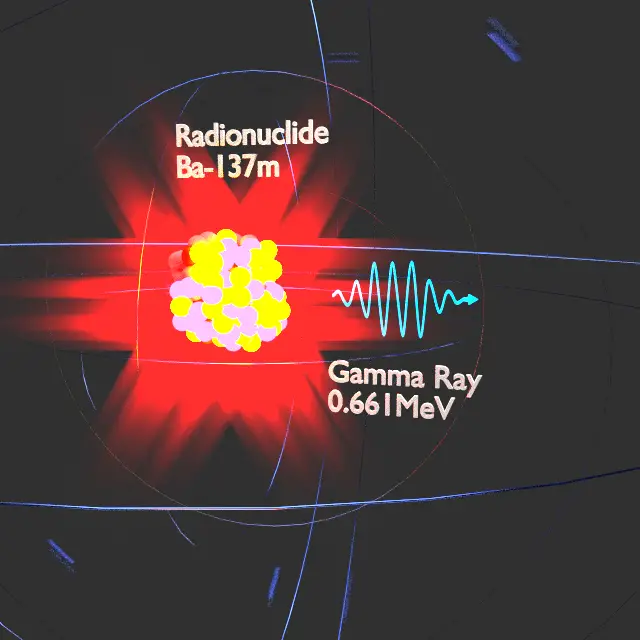
Barium-137m is a product of a common fission product – Caesium – 137. The main gamma ray of Barium-137m is 661keV photon.
Gamma rays are high-energy photons (about 10 000 times as much energy as the visible photons), the same photons as the photons forming the visible range of the electromagnetic spectrum – light.
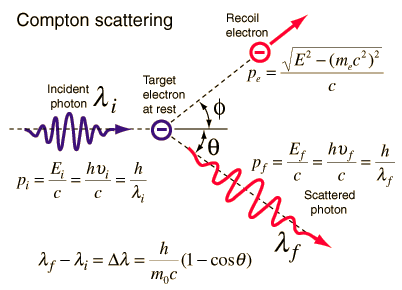
Photons (gamma rays and X-rays) can ionize atoms directly (despite they are electrically neutral) through the Photoelectric effect and the Compton effect, but secondary (indirect) ionization is much more significant.
Gamma rays ionize matter primarily via indirect ionization.
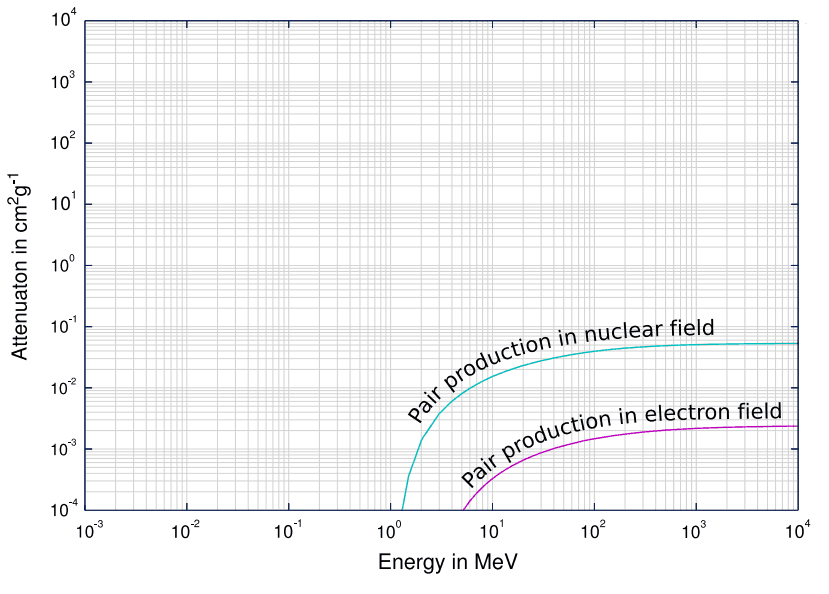
Although a large number of possible interactions are known, there are three key interaction mechanisms with matter.
Gamma rays travel at the speed of light and they can travel thousands of meters in air before spending their energy.
Since the gamma radiation is very penetrating matter, it must be shielded by very dense materials, such as lead or uranium.
The distinction between X-rays and gamma rays is not so simple and has changed in recent decades. According to the currently valid definition, X-rays are emitted by electrons outside the nucleus, while gamma rays are emitted by the nucleus.
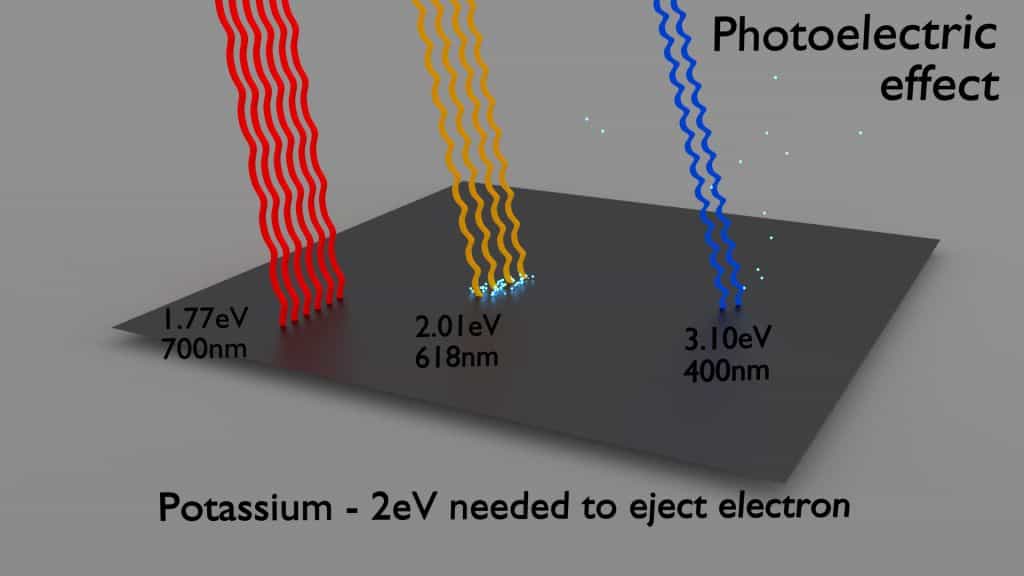
The photoelectric effect leads to the emission of photoelectrons from matter when light (photons) shines upon them.
The maximum energy an electron can receive in any one interaction is hν.
Electrons are only emitted by the photoelectric effect if photon reaches or exceeds a threshold energy.
A free electron (e.g. from atomic cloud) cannot absorb entire energy of the incident photon. This is a result of the need to conserve both momentum and energy.
The cross-section for the emission of n=1 (K-shell) photoelectrons is higher than that of n=2 (L-shell) photoelectrons. This is a result of the need to conserve momentum and energy.
Gamma absorption by an atom. Source: laradioactivite.com/
In the photoelectric effect, a photon undergoes an interaction with an electron which is bound in an atom. In this interaction the incident photon completely disappears and an energetic photoelectron is ejected by the atom from one of its bound shells. The kinetic energy of the ejected photoelectron (Ee) is equal to the incident photon energy (hν) minus the binding energy of the photoelectron in its original shell (Eb).
Ee=hν-Eb
Therefore photoelectrons are only emitted by the photoelectric effect if photon reaches or exceeds a threshold energy – the binding energy of the electron – the work function of the material. For gamma rays with energies of more than hundreds keV, the photoelectron carries off the majority of the incident photon energy – hν.
Following a photoelectric interaction, an ionized absorber atom is created with a vacancy in one of its bound shells. This vacancy is will be quickly filled by an electron from a shell with a lower binding energy (other shells) or through capture of a free electron from the material. The rearrangement of electrons from other shells creates another vacancy, which, in turn, is filled by an electron from an even lower binding energy shell. Therefore a cascade of more characteristic X-rays can be also generated. The probability of characteristic x-ray emission decreases as the atomic number of the absorber decreases. Sometimes , the emission of an Auger electron occurs.
Compton Scattering
Key Characteristics
Compton scattering dominates at intermediate energies.
It is the scattering of photons by atomic electrons
Photons undergo a wavelength shift called the Compton shift.
The energy transferred to the recoil electron can vary from zero to a large fraction of the incident gamma ray energy
In Compton scattering, the incident gamma-ray photon is deflected through an angle Θ with respect to its original direction. This deflection results in a decrease in energy (decrease in photon’s frequency) of the photon and is called the Compton effect. Source: hyperphysics.phy-astr.gsu.edu
Compton scattering is the inelastic or nonclassical scattering of a photon (which may be an X-ray or gamma ray photon) by a charged particle, usually an electron. In Compton scattering, the incident gamma ray photon is deflected through an angle Θ with respect to its original direction. This deflection results in a decrease in energy (decrease in photon’s frequency) of the photon and is called the Compton effect. The photon transfers a portion of its energy to the recoil electron. The energy transferred to the recoil electron can vary from zero to a large fraction of the incident gamma ray energy, because all angles of scattering are possible. The Compton scattering was observed by A. H.Compton in 1923 at Washington University in St. Louis. Compton earned the Nobel Prize in Physics in 1927 for this new understanding about the particle-nature of photons.
In general, pair production is a phenomenon of nature where energy is direct converted to matter. The phenomenon of pair production can be view two different ways. One way is as a particle and antiparticle and the other is as a particle and a hole. The first
way can be represented by formation of electron and positron, from a packet of electromagnetic energy (high energy photon – gamma ray) traveling through matter. It is one of the possible ways in which gamma rays interact with matter. At high energies this interaction dominates.
In order for electron-positron pair production to occur, the electromagnetic energy of the photon must be above a threshold energy, which is equivalent to the rest mass of two electrons. The threshold energy (the total rest mass of produced particles) for electron-positron pair production is equal to 1.02MeV (2 x 0.511MeV) because the rest mass of a single electron is equivalent to 0.511MeV of energy.
If the original photon’s energy is greater than 1.02MeV, any energy above 1.02MeV is according to the conservation law split between the kinetic energy of motion of the two particles.
Cross section of pair production in nuclear field and electron field.
The presence of an electric field of a heavy atom such as lead or uranium is essential in order to satisfy conservation of momentum and energy. In order to satisfy both conservation of momentum and energy, the atomic nucleus must receive some momentum. Therefore a photon pair production in free space cannot occur.
Moreover, the positron is the anti-particle of the electron, so when a positron comes to rest, it interacts with another electron, resulting in the annihilation of the both particles and the complete conversion of their rest mass back to pure energy (according to the E=mc2 formula) in the form of two oppositely directed 0.511 MeV gamma rays (photons). The pair production phenomenon is therefore connected with creation and destruction of matter in one reaction.
Neutrons are neutral particles, therefore they travel in straight lines, deviating from their path only when they actually collide with a nucleus to be scattered into a new direction or absorbed. Neither the electrons surrounding (atomic electron cloud) a nucleus nor the electric field caused by a positively charged nucleus affect a neutron’s flight. In short, neutrons collide with nuclei, not with atoms. A very descriptive feature of the transmission of neutrons through bulk matter is the mean free path length (λ – lambda), which is the mean distance a neutron travels between interactions. It can be calculated from following equation:
λ=1/Σ
Neutrons may interact with nuclei in one of following ways:
Neutron cross-section
Typical cross-sections of fission material. Slowing down neutrons results in increase of probability of interaction (e.g. fission reaction).
The extent to which neutrons interact with nuclei is described in terms of quantities known as cross-sections. Cross-sections are used to express the likelihood of particular interaction between an incident neutron and a target nucleus. It must be noted this likelihood do not depend on real target dimensions. In conjunction with the neutron flux, it enables the calculation of the reaction rate, for example to derive the thermal power of a nuclear power plant. The standard unit for measuring the microscopic cross-section (σ-sigma) is the barn, which is equal to 10-28 m2. This unit is very small, therefore barns (abbreviated as “b”) are commonly used. The microscopic cross-section can be interpreted as the effective ‘target area’ that a nucleus interacts with an incident neutron.
A macroscopic cross-section is derived from microscopic and the material density:
Σ=σ.N
Here σ, which has units of m2, is referred to as the microscopic cross-section. Since the units of N (nuclei density) are nuclei/m3, the macroscopic cross-sectionΣ have units of m-1, thus in fact is an incorrect name, because it is not a correct unit of cross-sections.
Neutron cross-sections constitute a key parameters of nuclear fuel. Neutron cross-sections must be calculated for fresh fuel assemblies usually in two-Dimensional models of the fuel lattice.
The neutron cross-section is variable and depends on:
Target nucleus (hydrogen, boron, uranium, etc.) Each isotop has its own set of cross-sections.
Type of the reaction (capture, fission, etc.). Cross-sections are different for each nuclear reaction.
Neutron energy (thermal neutron, resonance neutron, fast neutron). For a given target and reaction type, the cross-section is strongly dependent on the neutron energy. In the common case, the cross section is usually much larger at low energies than at high energies. This is why most nuclear reactors use a neutron moderator to reduce the energy of the neutron and thus increase the probability of fission, essential to produce energy and sustain the chain reaction.
Target energy (temperature of target material – Doppler broadening) This dependency is not so significant, but the target energy strongly influences inherent safety of nuclear reactors due to a Doppler broadening of resonances.
Typical cross-sections of materials in the reactor
Following table shows neutron cross-sections of the most common isotopes of reactor core.
Table of cross-sections
Reactor Antineutrinos
The inside of a cylindrical antineutrino detector before being filled with clear liquid scintillator, which reveals antineutrino interactions by the very faint flashes of light they emit. Sensitive photomultiplier tubes line the detector walls, ready to amplify and record the telltale flashes. Photo: Roy Kaltschmidt, LBNL Source: Daya Bay Reactor Neutrino Experiment
Nuclear reactors are the major source of human-generated antineutrinos. This is due to the fact that antineutrinos are produced in a negative beta decay. In a nuclear reactor occurs especially the β− decay, because the common feature of the fission fragments is an excess of neutrons (see Nuclear Stability). An unstable fission fragment with the excess of neutrons undergoes β− decay, where the neutron is converted into a proton, an electron, and an electron antineutrino. The existence of emission of antineutrinos and their very low cross-section for any interaction leads to very interesting phenomenon.
Roughly about 5% (or about 12 MeV of 207 MeV) of released energy per one fission is radiated away from reactor in the form of antineutrinos. For a typical nuclear reactor with a thermal power of 3000 MWth (~1000MWe of electrical power), the total power produced is in fact higher, approximately 3150 MW, of which 150 MW is radiated away into space as antineutrino radiation. This amount of energy is forever lost, since antineutrinos are able to penetrate all reactor materials without any interaction. In fact, a common statement in physics texts is that the mean free path of a neutrino is approximately a light-year of lead.
Fission fragment yield for different nuclei. The most probable fragment masses are around mass 95 (Krypton) and 137 (Barium).
Moreover, a neutrino of moderate energy can easily penetrate a thousand light-years of lead (according to the J. B. Griffiths).
Please note that billions of solar neutrinos per second pass (mostly without any interaction) through every square centimeter (~6×10¹⁰) on the Earth’s surface and antineutrino radiation is by no means dangerous.
Example – Amount of antineutrinos produced:
Stable nuclei with most likely mass number A from U-235 fission are and . These nuclei have together 98 protons and 136 neutrons, while fission fragments (parent nuclei) have together 92 protons and 142 neutrons. This means after each U-235 fission the fission fragments must undergo on average 6 negative beta decays (6 neutrons must decay to 6 protons) and therefore 6 antineutrinos must be produced per each fission. The typical nuclear reactor therefore produces approximately 6 x 10²⁰ antineutrinos per second (~200 MeV/fission; ~6 antineutrinos/fission; 3000 MWth; 9.375 x 10¹⁹ fissions/sec).
Reference: Griffiths, David, Introduction to Elementary Particles, Wiley, 1987.
References:
Knoll, Glenn F., RADIATION DETECTION AND MEASUREMENT, 4th edition
Lamarsh, John R., INTRODUCTION TO NUCLEAR ENGINEERING, 2nd edition
See also:
Atomic and Nuclear Physics
See also:
Reactor Physics
See also:
We hope, this article, Interaction of Radiation with Matter, helps you. If so, give us a like in the sidebar. Main purpose of this website is to help the public to learn some interesting and important information about materials and their properties.
A neutron source is any device that emits neutrons. Neutron sources have many applications, they can be used in research, engineering, medicine, chemistry and nuclear power. Material Properties
A neutron source is any device that emits neutrons. Neutron sources have many applications, they can be used in research, engineering, medicine, petroleum exploration, biology, chemistry and nuclear power. A neutron source is characterized by a number of factors:
Significance of the source
Intensity. The rate of neutrons emitted by the source.
Energy distribution of emitted neutrons.
Angular distribution of emitted neutrons.
Mode of emission. Continuous or pulsed operation.
Classification by significance of the source
Large (Significant) neutron sources
Nuclear Reactors. There are nuclei that can undergo fission on their own spontaneously, but only certain nuclei, like uranium-235, uranium-233 and plutonium-239, can sustain a fission chain reaction. This is because these nuclei release neutrons when they break apart, and these neutrons can induce fission of other nuclei. Uranium-235 which exists as 0.7% of naturally occurring uranium undergoes nuclear fission with thermal neutrons with the production of, on average, 2.4 fast neutrons and the release of ~ 180 MeV of energy per fission. Free neutrons released by each fission play very important role as a trigger of the reaction, but they can be also used fo another purpose. For example: One neutron is required to trigger a further fission. Part of free neutrons (let say 0.5 neutrons/fission) is absorbed in other material, but an excess of neutrons (0.9 neutrons/fission) is able to leave the surface of the reactor core and can be used as a neutron source.
Fusion Systems. Nuclear fusion is a nuclear reaction in which two or more atomic nuclei (e.g. D+T) collide at a very high energy and fuse together. Thy byproduct of DT fusion is a free neutron (see picture), therefore also nuclear fusion reaction has the potential to produces large quantities of neutrons.
Spallation Sources. A spallation source is a high-flux neutron source in which protons that have been accelerated to high energies hit a heavy target material, causing the emission of neutrons. The reaction occurs above a certain energy threshold for the incident particle, which is typically 5 – 15 MeV.
Medium neutron sources
Bremssstrahlung from Electron Accelerators / Photofission. Energetic electrons when slowed down rapidly in a heavy target emit intense gamma radiation during the deceleration process. This is known as Bremsstrahlung or braking radiation. The interaction of the gamma radiation with the target produces neutrons via the (γ,n) reaction, or the (γ,fission) reaction when a fissile target is used. e-→Pb → γ→ Pb →(γ,n) and (γ,fission). The Bremsstrahlung γ energy exceeds the binding energy of the “last” neutron in the target. A source strength of 1013 neutrons/second produced in short (i.e. < 5 μs) pulses can be readily realised.
Dense plasme focus. The dense plasma focus (DPF) is a device that is known as an efficient source of neutrons from fusion reactions. Mechanism of dense plasma focus (DPF) is based on nuclear fusion of short-lived plasma of deuterium and/or tritium. This device produces a short-lived plasma by electromagnetic compression and acceleration that is called a pinch. This plasma is during the pinch hot and dense enough to cause nuclear fusion and the emission of neutrons.
Light ion accelerators. Neutrons can be also produced by particle accelerators using targets of deuterium, tritium, lithium, beryllium, and other low-Z materials. In this case the target must be bombarded with accelerated hydrogen (H), deuterium (D), or tritium (T) nuclei.
Small neutron sources
Neutron Generators. Neutrons are produced in the fusion of deuterium and tritium in the following exothermic reaction. 2D + 3T → 4He + n + 17.6 MeV. The neutron is produced with a kinetic energy of 14.1 MeV. This can be achieved on a small scale in the laboratory with a modest 100 kV accelerator for deuterium atoms bombarding a tritium target. Continuous neutron sources of ~1011 neutrons/second can be achieved relatively simply.
Radioisotope source – (α,n) reactions. In certain light isotopes the ‘last’ neutron in the nucleus is weakly bound and is released when the compound nucleus formed following α-particle bombardment decays. The bombardment of beryllium by α-particles leads to the production of neutrons by the following exothermic reaction: 4He + 9Be→12C + n + 5.7 MeV. This reaction yields a weak source of neutrons with an energy spectrum resembling that from a fission source and is used nowadays in portable neutron sources. Radium, plutonium or americium can be used as an α-emitter.
Radioisotope source – (γ,n) reactions. (γ,n) reactions can also be used for the same purpose. In this type of source, because of the greater range of the γ-ray, the two physical components of the source can be separated making it possible to ‘switch off’ the reaction if so required by removing the radioactive source from the beryllium. (γ,n) sources produce a monoenergetic neutrons unlike (α,n) sources. The (γ,n) source uses antimony-124 as the gamma emitter in the following endothermic reaction.
124Sb→124Te + β− + γ
γ + 9Be→8Be + n – 1.66 MeV
Radioisotope source – spontaneous fission. Certain isotopes undergo spontaneous fission with emission of neutrons. The most commonly used spontaneous fission source is the radioactive isotope californium-252. Cf-252 and all other spontaneous fission neutron sources are produced by irradiating uranium or another transuranic element in a nuclear reactor, where neutrons are absorbed in the starting material and its subsequent reaction products, transmuting the starting material into the SF isotope.
A nuclear chain reaction occurs when one single nuclear reaction causes an average of one or more subsequent nuclear reactions.
Neutron Source
Example
Neutron Yield
Released Energy
MeV / neutron
(α,n) reactions
Radium-Beryllium source
8 x 10⁻⁵ / α
6,600,000
(D,T) fusion
400 keV deuterons in neutron generator
4 x 10⁻⁵ / deuteron
10,000
Electron Bremsstrahlung
/ Photofission
100 MeV electrons on uranium
5 x 10⁻² / electron
2,000
Fission
Induced fission of U-235 in thermal reactor
1 / fission
180
Spallation
800 MeV protons on uranium
30 / proton
55
(D,T) fusion
Inertial confinement fusion
1 / fusion
18
See also:
Shielding of Neutrons
See also:
Neutron
We hope, this article, Neutron Source, helps you. If so, give us a like in the sidebar. Main purpose of this website is to help the public to learn some interesting and important information about materials and their properties.