Facebook Instagram Youtube Twitter

What is Normalizing – Thermal Annealing – Definition

Normalizing is an annealing process applied to ferrous alloys to refine grain size, make its structure more uniform, make it more responsive to hardening, and to improve machinability.

The term thermal annealing refers to a heat treatment in which a material is exposed to an elevated temperature for an extended time period and then slowly cooled. This process alters the physical and sometimes chemical properties of a material to increase its ductility and reduce its hardness, making it more workable. In this process, atoms migrate in the crystal lattice and the number of dislocations decreases, leading to a change in ductility and hardness. Metal gets rid of stresses and makes the grain structure large and soft-edged so that when the metal is hit or stressed it dents or perhaps bends, rather than breaking. Typically, annealing is carried out to relieve stresses, increase softness, ductility, and toughness; and/or produce a specific microstructure.

Generally, in plain carbon steels, annealing produces a ferrite-pearlite micro-structure.  Steels may be annealed to facilitate cold working or machining, to improve mechanical or electrical properties, or to promote dimensional stability. The most common structural steels produced have a mixed ferrite-pearlite microstructure. Their applications include beams for bridges and high-rise buildings, plates for ships, and reinforcing bars for roadways. These steels are relatively inexpensive and are produced in large tonnages.

Any annealing cycle consists of three stages:

  • heating to the desired temperature,
  • holding or “soaking” at that temperature,
  • cooling, usually to room temperature.

Time and annealing temperature are important parameters in these procedures. Especially the target temperature defines the annealing thermal cycle.

thermal annealing

Normalizing

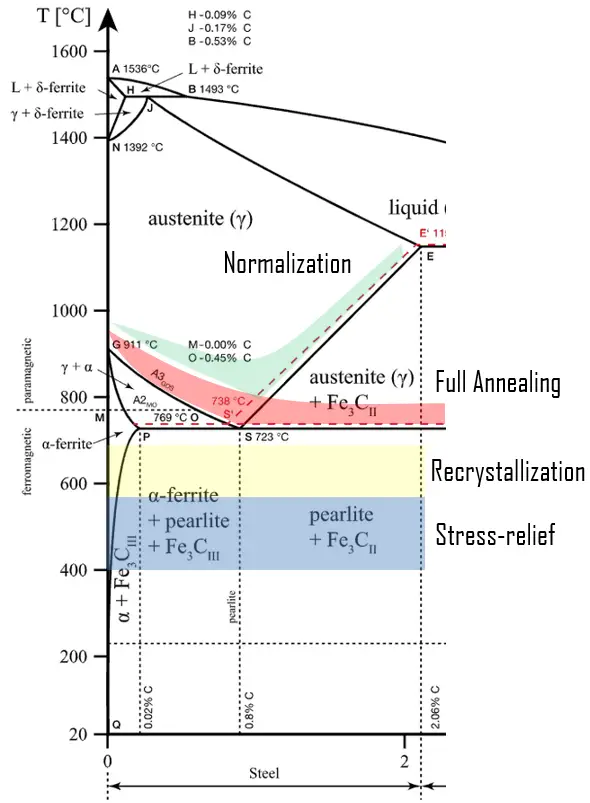
Normalization is an annealing process applied to ferrous alloys to refine grain size, make its structure more uniform, make it more responsive to hardening, and to improve machinability. Normalizing is performed on steels that have been plastically deformed by, for example, a rolling operation. This cold worked steels consist of grains of pearlite, which are irregularly shaped and relatively large and vary substantially in size. Normalizing is an austenitizing heating cycle followed by cooling in still or slightly agitated air. Typically, the temperatures for normalizing are approximately 55 °C above the upper critical line. Normalization temperature is higher than temperature for full annealing, on the other hand the cooling more intense. Normalizing improves machinability of a component and provides dimensional stability if subjected to further heat treatment processes. The main difference between annealing and normalizing is that annealing allows the material to cool at a controlled rate in a furnace. Normalizing allows the material to cool by placing it in a room temperature environment and exposing it to the air in that environment.

References:
Materials Science:

U.S. Department of Energy, Material Science. DOE Fundamentals Handbook, Volume 1 and 2. January 1993.
U.S. Department of Energy, Material Science. DOE Fundamentals Handbook, Volume 2 and 2. January 1993.
William D. Callister, David G. Rethwisch. Materials Science and Engineering: An Introduction 9th Edition, Wiley; 9 edition (December 4, 2013), ISBN-13: 978-1118324578.
Eberhart, Mark (2003). Why Things Break: Understanding the World by the Way It Comes Apart. Harmony. ISBN 978-1-4000-4760-4.
Gaskell, David R. (1995). Introduction to the thermodynamics of Materials (4th ed.). Taylor and Francis Publishing. ISBN 978-1-56032-992-3.
González-Viñas, W. & Mancini, H.L. (2004). An Introduction to Materials Science. Princeton University Press. ISBN 978-0-691-07097-1.
Ashby, Michael; Hugh Shercliff; David Cebon (2007). Materials: engineering, science, processing and design (1st ed.). Butterworth-Heinemann. ISBN 978-0-7506-8391-3.
J. R. Lamarsh, A. J. Baratta, Introduction to Nuclear Engineering, 3d ed., Prentice-Hall, 2001, ISBN: 0-201-82498-1.

See above:
Thermal Annealing

We hope, this article, Normalizing – Thermal Annealing, helps you. If so, give us a like in the sidebar. Main purpose of this website is to help the public to learn some interesting and important information about materials and their properties.

What is Stress-relief Annealing – Definition

Stress-relief annealing is used to relieve stresses from cold working. In contrast to process annealing, this heat treatment is usually performed after the product has been made.

The term thermal annealing refers to a heat treatment in which a material is exposed to an elevated temperature for an extended time period and then slowly cooled. This process alters the physical and sometimes chemical properties of a material to increase its ductility and reduce its hardness, making it more workable. In this process, atoms migrate in the crystal lattice and the number of dislocations decreases, leading to a change in ductility and hardness. Metal gets rid of stresses and makes the grain structure large and soft-edged so that when the metal is hit or stressed it dents or perhaps bends, rather than breaking. Typically, annealing is carried out to relieve stresses, increase softness, ductility, and toughness; and/or produce a specific microstructure.

Generally, in plain carbon steels, annealing produces a ferrite-pearlite micro-structure.  Steels may be annealed to facilitate cold working or machining, to improve mechanical or electrical properties, or to promote dimensional stability. The most common structural steels produced have a mixed ferrite-pearlite microstructure. Their applications include beams for bridges and high-rise buildings, plates for ships, and reinforcing bars for roadways. These steels are relatively inexpensive and are produced in large tonnages.

Any annealing cycle consists of three stages:

  • heating to the desired temperature,
  • holding or “soaking” at that temperature,
  • cooling, usually to room temperature.

Time and annealing temperature are important parameters in these procedures. Especially the target temperature defines the annealing thermal cycle.

thermal annealing

Stress-relief Annealing

Stress-relief annealing is used to relieve stresses from cold working. In contrast to process annealing, this heat treatment is usually performed after the product has been made. Care must be taken to ensure uniform cooling, particularly when a component is composed of variable section sizes. If the rate of cooling is not constant and uniform, new residual stresses can result that are equal to or greater than those that the heat-treating process was intended to relieve. The annealing temperature is typically a relatively low one such that effects resulting from cold working and other heat treatments are not affected. Stress-relief heat treating can reduce distortion and high stresses from welding that can affect service performance.

References:
Materials Science:

U.S. Department of Energy, Material Science. DOE Fundamentals Handbook, Volume 1 and 2. January 1993.
U.S. Department of Energy, Material Science. DOE Fundamentals Handbook, Volume 2 and 2. January 1993.
William D. Callister, David G. Rethwisch. Materials Science and Engineering: An Introduction 9th Edition, Wiley; 9 edition (December 4, 2013), ISBN-13: 978-1118324578.
Eberhart, Mark (2003). Why Things Break: Understanding the World by the Way It Comes Apart. Harmony. ISBN 978-1-4000-4760-4.
Gaskell, David R. (1995). Introduction to the thermodynamics of Materials (4th ed.). Taylor and Francis Publishing. ISBN 978-1-56032-992-3.
González-Viñas, W. & Mancini, H.L. (2004). An Introduction to Materials Science. Princeton University Press. ISBN 978-0-691-07097-1.
Ashby, Michael; Hugh Shercliff; David Cebon (2007). Materials: engineering, science, processing and design (1st ed.). Butterworth-Heinemann. ISBN 978-0-7506-8391-3.
J. R. Lamarsh, A. J. Baratta, Introduction to Nuclear Engineering, 3d ed., Prentice-Hall, 2001, ISBN: 0-201-82498-1.

See above:
Thermal Annealing

We hope, this article, Stress-relief Annealing, helps you. If so, give us a like in the sidebar. Main purpose of this website is to help the public to learn some interesting and important information about materials and their properties.

What is Recrystallization Annealing – Definition

Recrystallization annealing of cold-worked steels (carbon content up to 0.5%) can produce a new grain structure without inducing a phase change. 

Hot working

The term thermal annealing refers to a heat treatment in which a material is exposed to an elevated temperature for an extended time period and then slowly cooled. This process alters the physical and sometimes chemical properties of a material to increase its ductility and reduce its hardness, making it more workable. In this process, atoms migrate in the crystal lattice and the number of dislocations decreases, leading to a change in ductility and hardness. Metal gets rid of stresses and makes the grain structure large and soft-edged so that when the metal is hit or stressed it dents or perhaps bends, rather than breaking. Typically, annealing is carried out to relieve stresses, increase softness, ductility, and toughness; and/or produce a specific microstructure.

Generally, in plain carbon steels, annealing produces a ferrite-pearlite micro-structure.  Steels may be annealed to facilitate cold working or machining, to improve mechanical or electrical properties, or to promote dimensional stability. The most common structural steels produced have a mixed ferrite-pearlite microstructure. Their applications include beams for bridges and high-rise buildings, plates for ships, and reinforcing bars for roadways. These steels are relatively inexpensive and are produced in large tonnages.

Any annealing cycle consists of three stages:

  • heating to the desired temperature,
  • holding or “soaking” at that temperature,
  • cooling, usually to room temperature.

Time and annealing temperature are important parameters in these procedures. Especially the target temperature defines the annealing thermal cycle.

thermal annealing

Recrystallization Annealing

Recrystallization annealing of cold-worked steels (carbon content up to 0.5%) can produce a new grain structure without inducing a phase change.  Metal is heated to a temperature at which the hardening caused by the previous cold-working is removed. During recrystallization, the internal bonds between the atoms change, the crystal lattice does not change. Annealing temperatures are between 550-700 ° C and the endurance is about 1 hour or more, cooling in air. It is used as an inter-operational annealing in cold forming, especially for low-carbon parts.

References:
Materials Science:

U.S. Department of Energy, Material Science. DOE Fundamentals Handbook, Volume 1 and 2. January 1993.
U.S. Department of Energy, Material Science. DOE Fundamentals Handbook, Volume 2 and 2. January 1993.
William D. Callister, David G. Rethwisch. Materials Science and Engineering: An Introduction 9th Edition, Wiley; 9 edition (December 4, 2013), ISBN-13: 978-1118324578.
Eberhart, Mark (2003). Why Things Break: Understanding the World by the Way It Comes Apart. Harmony. ISBN 978-1-4000-4760-4.
Gaskell, David R. (1995). Introduction to the thermodynamics of Materials (4th ed.). Taylor and Francis Publishing. ISBN 978-1-56032-992-3.
González-Viñas, W. & Mancini, H.L. (2004). An Introduction to Materials Science. Princeton University Press. ISBN 978-0-691-07097-1.
Ashby, Michael; Hugh Shercliff; David Cebon (2007). Materials: engineering, science, processing and design (1st ed.). Butterworth-Heinemann. ISBN 978-0-7506-8391-3.
J. R. Lamarsh, A. J. Baratta, Introduction to Nuclear Engineering, 3d ed., Prentice-Hall, 2001, ISBN: 0-201-82498-1.

See above:
Thermal Annealing

We hope, this article, Recrystallization Annealing, helps you. If so, give us a like in the sidebar. Main purpose of this website is to help the public to learn some interesting and important information about materials and their properties.

What is Annealing Thermal Cycle – Annealing Temperature – Definition

Time and annealing temperature are important parameters in these procedures. Especially the target temperature defines the annealing thermal cycle. Annealing Thermal Cycles
Hot working

Any annealing cycle consists of three stages:

  • heating to the desired temperature,
  • holding or “soaking” at that temperature,
  • cooling, usually to room temperature.

Time and annealing temperature are important parameters in these procedures. Especially the target temperature defines the annealing thermal cycle.

Annealing Thermal Cycles

In practice, specific thermal cycles of an almost infinite variety are used to achieve the various goals of annealing. These cycles fall into several broad categories that can be classified according to the temperature to which the steel is heated and the method of cooling used.

  • thermal annealingProcess Annealing. Process annealing is a specific heat treatment that restores some of the ductility to a product being cold-worked so it can be cold-worked further without breaking. It is commonly used during fabrication procedures that require extensive plastic deformation, to allow a continuation of deformation without fracture or excessive energy consumption. The temperature range for process annealing ranges from 260 °C to 760 °C, depending on the alloy in question. This process is mainly suited for low-carbon steel. This is mainly carried out on cold-rolled steel like wire-drawn steel, centrifugally cast ductile iron pipe etc.
  • Stress-relief Annealing. Stress-relief annealing is used to relieve stresses from cold working. In contrast to process annealing, this heat treatment is usually performed after the product has been made. Care must be taken to ensure uniform cooling, particularly when a component is composed of variable section sizes. If the rate of cooling is not constant and uniform, new residual stresses can result that are equal to or greater than those that the heat-treating process was intended to relieve. The annealing temperature is typically a relatively low one such that effects resulting from cold working and other heat treatments are not affected. Stress-relief heat treating can reduce distortion and high stresses from welding that can affect service performance.
  • Recrystallization Annealing. Recrystallization annealing of cold-worked steels (carbon content up to 0.5%) can produce a new grain structure without inducing a phase change.  Metal is heated to a temperature at which the hardening caused by the previous cold-working is removed. During recrystallization, the internal bonds between the atoms change, the crystal lattice does not change. Annealing temperatures are between 550-700 ° C and the endurance is about 1 hour or more, cooling in air. It is used as an inter-operational annealing in cold forming, especially for low-carbon parts.
  • Full Annealing. Full annealing produces a microstructure that is softer and more amenable to other processing such as forming or machining. The temperatures for full annealing are typically 50 °C above the upper critical temperature (A3) for hypoeutectic steels and the lower critical temperature (A1) for hypereutectoid steels. It is referred to as full annealing because it achieves full austenitization of hypoeutectoid steels. The alloy is then furnace cooled. That means, the heat-treating furnace is turned off, and both furnace and steel cool to room temperature at the same rate, which takes several hours. The cooling rate of the steel has to be sufficiently slow so as to not let the austenite transform into bainite or martensite, but rather have it completely transform to pearlite and ferrite or cementite. A full anneal typically results in the second most ductile state a metal can assume for metal alloy. The metal attain relatively low levels of hardness, yield strength and ultimate strength with high plasticity and toughness. Full annealing is often used in low- and medium-carbon steels that will be machined or will experience extensive plastic deformation during a forming operation. Stainless and high-alloy steels may be austenitized (fully annealed) and quenched to minimize the presence of grain boundary carbides or to improve the ferrite distribution.
  • Normalizing. Normalization is an annealing process applied to ferrous alloys to refine grain size, make its structure more uniform, make it more responsive to hardening, and to improve machinability. Normalizing is performed on steels that have been plastically deformed by, for example, a rolling operation. This cold worked steels consist of grains of pearlite, which are irregularly shaped and relatively large and vary substantially in size. Normalizing is an austenitizing heating cycle followed by cooling in still or slightly agitated air. Typically, the temperatures for normalizing are approximately 55 °C above the upper critical line. Normalization temperature is higher than temperature for full annealing, on the other hand the cooling more intense. Normalizing improves machinability of a component and provides dimensional stability if subjected to further heat treatment processes. The main difference between annealing and normalizing is that annealing allows the material to cool at a controlled rate in a furnace. Normalizing allows the material to cool by placing it in a room temperature environment and exposing it to the air in that environment.
References:
Materials Science:

U.S. Department of Energy, Material Science. DOE Fundamentals Handbook, Volume 1 and 2. January 1993.
U.S. Department of Energy, Material Science. DOE Fundamentals Handbook, Volume 2 and 2. January 1993.
William D. Callister, David G. Rethwisch. Materials Science and Engineering: An Introduction 9th Edition, Wiley; 9 edition (December 4, 2013), ISBN-13: 978-1118324578.
Eberhart, Mark (2003). Why Things Break: Understanding the World by the Way It Comes Apart. Harmony. ISBN 978-1-4000-4760-4.
Gaskell, David R. (1995). Introduction to the thermodynamics of Materials (4th ed.). Taylor and Francis Publishing. ISBN 978-1-56032-992-3.
González-Viñas, W. & Mancini, H.L. (2004). An Introduction to Materials Science. Princeton University Press. ISBN 978-0-691-07097-1.
Ashby, Michael; Hugh Shercliff; David Cebon (2007). Materials: engineering, science, processing and design (1st ed.). Butterworth-Heinemann. ISBN 978-0-7506-8391-3.
J. R. Lamarsh, A. J. Baratta, Introduction to Nuclear Engineering, 3d ed., Prentice-Hall, 2001, ISBN: 0-201-82498-1.

See above:
Thermal Annealing

We hope, this article, Annealing Thermal Cycle – Annealing Temperature, helps you. If so, give us a like in the sidebar. Main purpose of this website is to help the public to learn some interesting and important information about materials and their properties.

What is Process Annealing – Definition

Process annealing is a specific heat treatment that restores some of the ductility to a product being cold-worked so it can be cold-worked further without breaking.

The term thermal annealing refers to a heat treatment in which a material is exposed to an elevated temperature for an extended time period and then slowly cooled. This process alters the physical and sometimes chemical properties of a material to increase its ductility and reduce its hardness, making it more workable. In this process, atoms migrate in the crystal lattice and the number of dislocations decreases, leading to a change in ductility and hardness. Metal gets rid of stresses and makes the grain structure large and soft-edged so that when the metal is hit or stressed it dents or perhaps bends, rather than breaking. Typically, annealing is carried out to relieve stresses, increase softness, ductility, and toughness; and/or produce a specific microstructure.

Generally, in plain carbon steels, annealing produces a ferrite-pearlite micro-structure.  Steels may be annealed to facilitate cold working or machining, to improve mechanical or electrical properties, or to promote dimensional stability. The most common structural steels produced have a mixed ferrite-pearlite microstructure. Their applications include beams for bridges and high-rise buildings, plates for ships, and reinforcing bars for roadways. These steels are relatively inexpensive and are produced in large tonnages.

Any annealing cycle consists of three stages:

  • heating to the desired temperature,
  • holding or “soaking” at that temperature,
  • cooling, usually to room temperature.

Time and annealing temperature are important parameters in these procedures. Especially the target temperature defines the annealing thermal cycle.

thermal annealing

Process Annealing

Process annealing is a specific heat treatment that restores some of the ductility to a product being cold-worked so it can be cold-worked further without breaking. It is commonly used during fabrication procedures that require extensive plastic deformation, to allow a continuation of deformation without fracture or excessive energy consumption. The temperature range for process annealing ranges from 260 °C to 760 °C, depending on the alloy in question. This process is mainly suited for low-carbon steel. This is mainly carried out on cold-rolled steel like wire-drawn steel, centrifugally cast ductile iron pipe etc.

References:
Materials Science:

U.S. Department of Energy, Material Science. DOE Fundamentals Handbook, Volume 1 and 2. January 1993.
U.S. Department of Energy, Material Science. DOE Fundamentals Handbook, Volume 2 and 2. January 1993.
William D. Callister, David G. Rethwisch. Materials Science and Engineering: An Introduction 9th Edition, Wiley; 9 edition (December 4, 2013), ISBN-13: 978-1118324578.
Eberhart, Mark (2003). Why Things Break: Understanding the World by the Way It Comes Apart. Harmony. ISBN 978-1-4000-4760-4.
Gaskell, David R. (1995). Introduction to the thermodynamics of Materials (4th ed.). Taylor and Francis Publishing. ISBN 978-1-56032-992-3.
González-Viñas, W. & Mancini, H.L. (2004). An Introduction to Materials Science. Princeton University Press. ISBN 978-0-691-07097-1.
Ashby, Michael; Hugh Shercliff; David Cebon (2007). Materials: engineering, science, processing and design (1st ed.). Butterworth-Heinemann. ISBN 978-0-7506-8391-3.
J. R. Lamarsh, A. J. Baratta, Introduction to Nuclear Engineering, 3d ed., Prentice-Hall, 2001, ISBN: 0-201-82498-1.

See above:
Thermal Annealing

We hope, this article, Process Annealing, helps you. If so, give us a like in the sidebar. Main purpose of this website is to help the public to learn some interesting and important information about materials and their properties.

What is Thermal Processing of Metals – Definition

Thermal Processing of Metals. Metals can be heat treated to alter the properties of strength, ductility, toughness, hardness or resistance to corrosion. There is a number of phenomena that occur in metals and alloys at elevated temperatures.

Hot workingMetals can be heat treated to alter the properties of strength, ductility, toughness, hardness or resistance to corrosion. There is a number of phenomena that occur in metals and alloys at elevated temperatures. For example, recrystallization and the decomposition of austenite. These are effective in altering the mechanical characteristics when appropriate heat  treatments or thermal processes are used. In fact, the use of heat treatments on commercial alloys is an exceedingly common practice. Common heat treatment processes include annealing, precipitation hardening, quenching, and tempering.

  • Annealing. The term annealing refers to a heat treatment in which a material is exposed to an elevated temperature for an extended time period and then slowly cooled. In this process, metal gets rid of stresses and makes the grain structure large and soft-edged so that when the metal is hit or stressed it dents or perhaps bends, rather than breaking; it is also easier to sand, grind, or cut annealed metal.
  • Quenching. The term quenching refers to a heat treatment in which a material is rapidly cooled in water, oil or air to obtain certain material properties, especially hardness. In metallurgy, quenching is most commonly used to harden steel by introducing martensite. There is a balance between hardness and toughness in any steel; the harder the steel, the less tough or impact-resistant it is, and the more impact-resistant it is, the less hard it is.
  • Tempering. The term tempering refers to a heat treatment which is used to increase the toughness of iron-based alloys. Tempering is usually performed after hardening, to reduce some of the excess hardness, and is done by heating the metal to some temperature below the critical point for a certain period of time, then allowing it to cool in still air. Tempering makes the metal less hard while making it better able to sustain impacts without breaking. Tempering will cause the dissolved alloying elements to precipitate, or in the case of quenched steels, improve impact strength and ductile properties.
  • Aging. Age hardening, also called precipitation hardening or particle hardening, is a heat treatment technique based on the formation of extremely small, uniformly dispersed particles of a second phase within the original phase matrix to enhance The strength and hardness of some metal alloys.  Precipitation hardening is used to increase the yield strength of malleable materials, including most structural alloys of aluminium, magnesium, nickel, titanium, and some steels and stainless steels. In superalloys, it is known to cause yield strength anomaly providing excellent high-temperature strength.
References:
Materials Science:

U.S. Department of Energy, Material Science. DOE Fundamentals Handbook, Volume 1 and 2. January 1993.
U.S. Department of Energy, Material Science. DOE Fundamentals Handbook, Volume 2 and 2. January 1993.
William D. Callister, David G. Rethwisch. Materials Science and Engineering: An Introduction 9th Edition, Wiley; 9 edition (December 4, 2013), ISBN-13: 978-1118324578.
Eberhart, Mark (2003). Why Things Break: Understanding the World by the Way It Comes Apart. Harmony. ISBN 978-1-4000-4760-4.
Gaskell, David R. (1995). Introduction to the thermodynamics of Materials (4th ed.). Taylor and Francis Publishing. ISBN 978-1-56032-992-3.
González-Viñas, W. & Mancini, H.L. (2004). An Introduction to Materials Science. Princeton University Press. ISBN 978-0-691-07097-1.
Ashby, Michael; Hugh Shercliff; David Cebon (2007). Materials: engineering, science, processing and design (1st ed.). Butterworth-Heinemann. ISBN 978-0-7506-8391-3.
J. R. Lamarsh, A. J. Baratta, Introduction to Nuclear Engineering, 3d ed., Prentice-Hall, 2001, ISBN: 0-201-82498-1.

See above:
Heat Treatment

We hope, this article, Thermal Processing of Metals, helps you. If so, give us a like in the sidebar. Main purpose of this website is to help the public to learn some interesting and important information about materials and their properties.

What is Thermal Annealing – Definition

The term thermal annealing refers to a heat treatment in which a material is exposed to an elevated temperature for an extended time period and then slowly cooled. This process alters the physical and sometimes chemical properties of a material to increase its ductility and reduce its hardness.

Hot workingMetals can be heat treated to alter the properties of strength, ductility, toughness, hardness or resistance to corrosion. There is a number of phenomena that occur in metals and alloys at elevated temperatures. For example, recrystallization and the decomposition of austenite. These are effective in altering the mechanical characteristics when appropriate heat  treatments or thermal processes are used. In fact, the use of heat treatments on commercial alloys is an exceedingly common practice. Common heat treatment processes include annealing, precipitation hardening, quenching, and tempering.

Thermal Annealing

The term thermal annealing refers to a heat treatment in which a material is exposed to an elevated temperature for an extended time period and then slowly cooled. This process alters the physical and sometimes chemical properties of a material to increase its ductility and reduce its hardness, making it more workable. In this process, atoms migrate in the crystal lattice and the number of dislocations decreases, leading to a change in ductility and hardness. Metal gets rid of stresses and makes the grain structure large and soft-edged so that when the metal is hit or stressed it dents or perhaps bends, rather than breaking. Typically, annealing is carried out to relieve stresses, increase softness, ductility, and toughness; and/or produce a specific microstructure.

Generally, in plain carbon steels, annealing produces a ferrite-pearlite micro-structure.  Steels may be annealed to facilitate cold working or machining, to improve mechanical or electrical properties, or to promote dimensional stability. The most common structural steels produced have a mixed ferrite-pearlite microstructure. Their applications include beams for bridges and high-rise buildings, plates for ships, and reinforcing bars for roadways. These steels are relatively inexpensive and are produced in large tonnages.

Any annealing cycle consists of three stages:

  • heating to the desired temperature,
  • holding or “soaking” at that temperature,
  • cooling, usually to room temperature.

Time and annealing temperature are important parameters in these procedures. Especially the target temperature defines the annealing thermal cycle.

Annealing Thermal Cycles

thermal annealingIn practice, specific thermal cycles of an almost infinite variety are used to achieve the various goals of annealing. These cycles fall into several broad categories that can be classified according to the temperature to which the steel is heated and the method of cooling used.

  • Process Annealing. Process annealing is a specific heat treatment that restores some of the ductility to a product being cold-worked so it can be cold-worked further without breaking. It is commonly used during fabrication procedures that require extensive plastic deformation, to allow a continuation of deformation without fracture or excessive energy consumption. The temperature range for process annealing ranges from 260 °C to 760 °C, depending on the alloy in question. This process is mainly suited for low-carbon steel. This is mainly carried out on cold-rolled steel like wire-drawn steel, centrifugally cast ductile iron pipe etc.
  • Stress-relief Annealing. Stress-relief annealing is used to relieve stresses from cold working. In contrast to process annealing, this heat treatment is usually performed after the product has been made. Care must be taken to ensure uniform cooling, particularly when a component is composed of variable section sizes. If the rate of cooling is not constant and uniform, new residual stresses can result that are equal to or greater than those that the heat-treating process was intended to relieve. The annealing temperature is typically a relatively low one such that effects resulting from cold working and other heat treatments are not affected. Stress-relief heat treating can reduce distortion and high stresses from welding that can affect service performance.
  • Recrystallization Annealing. Recrystallization annealing of cold-worked steels (carbon content up to 0.5%) can produce a new grain structure without inducing a phase change.  Metal is heated to a temperature at which the hardening caused by the previous cold-working is removed. During recrystallization, the internal bonds between the atoms change, the crystal lattice does not change. Annealing temperatures are between 550-700 ° C and the endurance is about 1 hour or more, cooling in air. It is used as an inter-operational annealing in cold forming, especially for low-carbon parts.
  • Full Annealing. Full annealing produces a microstructure that is softer and more amenable to other processing such as forming or machining. The temperatures for full annealing are typically 50 °C above the upper critical temperature (A3) for hypoeutectic steels and the lower critical temperature (A1) for hypereutectoid steels. It is referred to as full annealing because it achieves full austenitization of hypoeutectoid steels. The alloy is then furnace cooled. That means, the heat-treating furnace is turned off, and both furnace and steel cool to room temperature at the same rate, which takes several hours. The cooling rate of the steel has to be sufficiently slow so as to not let the austenite transform into bainite or martensite, but rather have it completely transform to pearlite and ferrite or cementite. A full anneal typically results in the second most ductile state a metal can assume for metal alloy. The metal attain relatively low levels of hardness, yield strength and ultimate strength with high plasticity and toughness. Full annealing is often used in low- and medium-carbon steels that will be machined or will experience extensive plastic deformation during a forming operation. Stainless and high-alloy steels may be austenitized (fully annealed) and quenched to minimize the presence of grain boundary carbides or to improve the ferrite distribution.
  • Normalizing. Normalization is an annealing process applied to ferrous alloys to refine grain size, make its structure more uniform, make it more responsive to hardening, and to improve machinability. Normalizing is performed on steels that have been plastically deformed by, for example, a rolling operation. This cold worked steels consist of grains of pearlite, which are irregularly shaped and relatively large and vary substantially in size. Normalizing is an austenitizing heating cycle followed by cooling in still or slightly agitated air. Typically, the temperatures for normalizing are approximately 55 °C above the upper critical line. Normalization temperature is higher than temperature for full annealing, on the other hand the cooling more intense. Normalizing improves machinability of a component and provides dimensional stability if subjected to further heat treatment processes. The main difference between annealing and normalizing is that annealing allows the material to cool at a controlled rate in a furnace. Normalizing allows the material to cool by placing it in a room temperature environment and exposing it to the air in that environment.

Reactor Pressure Vessel Annealing

materials for reactor pressure vesselThe body of the reactor vessel is constructed of a high-quality low-alloy carbon steel, and all surfaces that come into contact with reactor coolant are clad with a minimum of about 3 to 10 mm of austenitic stainless steel in order to minimize corrosion.

During the operation of a nuclear power plant, the material of the reactor pressure vessel and the material of other reactor internals are exposed to neutron radiation (especially to fast neutrons >0.5MeV), which results in localized embrittlement of the steel and welds in the area of the reactor core. This phenomenon, known as irradiation embrittlment, results in:

  • Steadily increase in DBTT. It is not likely that the DBTT will approach the normal operating temperature of the steel. However, there is a possibility that when the reactor is being shut down or during an abnormal cooldown, the temperature may fall below the DBTT value while the internal pressure is still high.
  • Drop in the upper shelf fracture energy. Radiation effects are also manifested by a drop in the upper shelf fracture energy and decrease in fracture toughness.

All these effects must be monitored by plant operators. Therefore nuclear regulators require that a reactor vessel material surveillance program be conducted in watercooled power reactors.

Once a material of RPV is degraded by radiation embrittlement (e.g. significant increase in Charpy ductile‐brittle transition temperature or reduction of fracture toughness), thermal annealing of the RPV is the only way to recover the RPV material toughness properties.

According to 10 CFR 50.66 – Requirements for thermal annealing of the reactor pressure vessel:

„For those light water nuclear power reactors where neutron radiation has reduced the fracture toughness of the reactor vessel materials, a thermal annealing may be applied to the reactor vessel to recover the fracture toughness of the material.“

 Thermal annealing („dry“ method) of reactor pressure vessel is a method by which the pressure vessel (with all reactor internals removed) is heated up to some temperature (usually between 420 – 460 °C) by use of an external heat source (electrical heaters, hot air), held for a given period (e.g. 100 – 200 hours) and then slowly cooled. The annealing equipment is usually a ring‐shaped furnace with heating elements on its external surface. The power output of installed heaters may reach up to 1 MWe. It was shown that for the specially fabricated materials the upper shelf recovered 100 % after 24 hours annealing and more rapidly than transition temperature. Annealing for 168  hours recovered 90 % of transition temperature shift.

Wet Annealing

There is also a possibility of the so‐called “wet” annealing method which was applied in USA and Belgium. The annealing at that temperature ~340 °C was reached without external heating, but by increasing the coolant temperature achieved by the energy of the circulating pumps of the primary circuit. This type of annealing provides only partial recovery for the material due to the limitation in maximum temperature.

Special Reference: Annealing and re-embrittlement of reactor pressure vessel materials. AMES report N.19; ISSN 1018-5593. European Communities, 2008.

Other Processes

  • Annealing. The term annealing refers to a heat treatment in which a material is exposed to an elevated temperature for an extended time period and then slowly cooled. In this process, metal gets rid of stresses and makes the grain structure large and soft-edged so that when the metal is hit or stressed it dents or perhaps bends, rather than breaking; it is also easier to sand, grind, or cut annealed metal.
  • Quenching. The term quenching refers to a heat treatment in which a material is rapidly cooled in water, oil or air to obtain certain material properties, especially hardness. In metallurgy, quenching is most commonly used to harden steel by introducing martensite. There is a balance between hardness and toughness in any steel; the harder the steel, the less tough or impact-resistant it is, and the more impact-resistant it is, the less hard it is.
  • Tempering. The term tempering refers to a heat treatment which is used to increase the toughness of iron-based alloys. Tempering is usually performed after hardening, to reduce some of the excess hardness, and is done by heating the metal to some temperature below the critical point for a certain period of time, then allowing it to cool in still air. Tempering makes the metal less hard while making it better able to sustain impacts without breaking. Tempering will cause the dissolved alloying elements to precipitate, or in the case of quenched steels, improve impact strength and ductile properties.
  • Aging. Age hardening, also called precipitation hardening or particle hardening, is a heat treatment technique based on the formation of extremely small, uniformly dispersed particles of a second phase within the original phase matrix to enhance The strength and hardness of some metal alloys.  Precipitation hardening is used to increase the yield strength of malleable materials, including most structural alloys of aluminium, magnesium, nickel, titanium, and some steels and stainless steels. In superalloys, it is known to cause yield strength anomaly providing excellent high-temperature strength.
References:
Materials Science:

U.S. Department of Energy, Material Science. DOE Fundamentals Handbook, Volume 1 and 2. January 1993.
U.S. Department of Energy, Material Science. DOE Fundamentals Handbook, Volume 2 and 2. January 1993.
William D. Callister, David G. Rethwisch. Materials Science and Engineering: An Introduction 9th Edition, Wiley; 9 edition (December 4, 2013), ISBN-13: 978-1118324578.
Eberhart, Mark (2003). Why Things Break: Understanding the World by the Way It Comes Apart. Harmony. ISBN 978-1-4000-4760-4.
Gaskell, David R. (1995). Introduction to the thermodynamics of Materials (4th ed.). Taylor and Francis Publishing. ISBN 978-1-56032-992-3.
González-Viñas, W. & Mancini, H.L. (2004). An Introduction to Materials Science. Princeton University Press. ISBN 978-0-691-07097-1.
Ashby, Michael; Hugh Shercliff; David Cebon (2007). Materials: engineering, science, processing and design (1st ed.). Butterworth-Heinemann. ISBN 978-0-7506-8391-3.
J. R. Lamarsh, A. J. Baratta, Introduction to Nuclear Engineering, 3d ed., Prentice-Hall, 2001, ISBN: 0-201-82498-1.

See above:
Heat Treatment

We hope, this article, Thermal Annealing, helps you. If so, give us a like in the sidebar. Main purpose of this website is to help the public to learn some interesting and important information about materials and their properties.

What is Induction Hardening – Advantages and Application – Definition

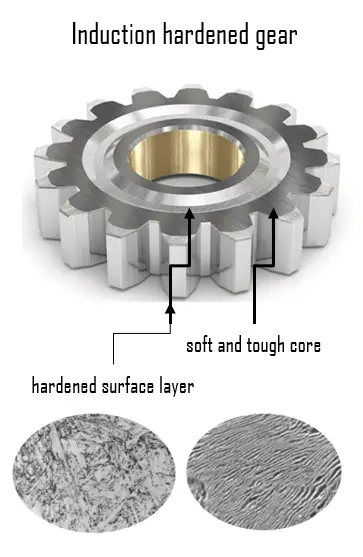
Induction hardening is a surface hardening technique which uses induction coils to provide a very rapid means of heating the metal, which is then cooled rapidly, generally using water. This creates a “case” of martensite on the surface.

Surface Hardening – Case Hardening

Case hardening or surface hardening is the process in which hardness the surface (case) of an object is enhanced, while the inner core of the object remains elastic and tough. After this process surface hardness, wear-resistance and fatigue life are enhanced. This is accomplished by several processes such as a carburizing or nitriding process by which a component is exposed to a carbonaceous or nitrogenous atmosphere at elevated temperature. As was written, two main material characteristics are influenced:

  • Hardness and wear resistance is significantly enhanced. In materials science, hardness is the ability to withstand surface indentation (localized plastic deformation) and scratching. Hardness is probably the most poorly defined material property because it may indicate resistance to scratching, resistance to abrasion, resistance to indentation or even resistance to shaping or localized plastic deformation. Hardness is important from an engineering standpoint because resistance to wear by either friction or erosion by steam, oil, and water generally increases with hardness.
  • Toughness is not negatively influenced. Toughness is the ability of a material to absorb energy and plastically deform without fracturing. One definition of toughness (for high-strain rate, fracture toughness) is that it is a property that is indicative of a material’s resistance to fracture when a crack (or other stress-concentrating defect) is present.

For iron or steel with low carbon content, which has poor to no hardenability of its own, the case-hardening process involves infusing additional carbon or nitrogen into the surface layer. Case hardening is useful in parts such as a cam or ring gear that must have a very hard surface to resist wear, along with a tough interior to resist the impact that occurs during operation. Further, the surface hardening of steel has an advantage over through hardening (that is, hardening the metal uniformly throughout the piece) because less expensive low-carbon and medium-carbon steels can be surface hardened without the problems of distortion and cracking associated with the through hardening of thick sections. A carbon- or nitrogen-rich outer surface layer (or case) is introduced by atomic diffusion from the gaseous phase. The case is normally on the order of 1 mm deep and is harder than the inner core of material.

Induction Hardening

Induction hardeningInduction hardening is a surface hardening technique which uses induction coils to provide a very rapid means of heating the metal, which is then cooled rapidly, generally using water. This creates a “case” of martensite on the surface. A carbon content of 0.3–0.6 wt% C is needed for this type of hardening. Martensite is a very hard metastable structure with a body-centered tetragonal (BCT) crystal structure. Martensite is formed in steels when the cooling rate from austenite is at such a high rate that carbon atoms do not have time to diffuse out of the crystal structure in large enough quantities to form cementite (Fe3C). Induction hardening produces hard, highly wear-resistant surface (deep case depths) with good capacity for contact load and good bending fatigue strength. Material has fair resistance to seizure.

Heating is accomplished by placing a steel part in the magnetic field generated by high-frequency alternating current passing through an inductor, usually a watercooled copper coil. These so-called eddy currents dissipate energy and produce heat by flowing against the resistance of an imperfect conductor. With induction heating, the steel can be heated very quickly to red-hot at the surface, before the heat can penetrate any distance into the metal. The surface is then quenched, hardening it, and is often used without further tempering. This makes the surface very resistant to wear, and the core of the component remains unaffected by the treatment and its physical properties are those of the bar from which it was machined, whilst the hardness of the case can be within the range 37/58 HRC. Induction surface hardened low alloyed medium carbon steels are widely used for critical automotive and machine applications which require high wear resistance. A common use for induction hardening is for hardening the bearing surfaces, or “journals”, on automotive crankshafts or the rods of hydraulic cylinders. Wear resistance behavior of induction hardened parts depends on hardening depth and the magnitude and distribution of residual compressive stress in the surface layer.

Other Case Hardening Methods

Case hardening by surface treatment can be classified further as diffusion treatments or localized heating treatments. Diffusion methods introduce alloying elements that enter the surface by diffusion, either as solid-solution agents or as hardenability agents that assist martensite formation during subsequent quenching. In this process, the concentration of alloying element is increased at the surface of a steel component. Diffusion methods include:

  • Carburizing. Carburizing is a case hardening process in which the surface carbon concentration of a ferrous alloy (usually a low-carbon steel) is increased by diffusion from the surrounding environment. Carburizing produces hard, highly wear-resistant surface (medium case depths) of product with excellent capacity for contact load, good bending fatigue strength and good resistance to seizure.
  • Nitriding. Nitriding is a case hardening process in which the surface nitrogen concentration of a ferrous is increased by diffusion from the surrounding environment to create case-hardened surface. Nitriding produces hard, highly wear-resistant surface (shallow case depths) of product with fair capacity for contact load, good bending fatigue strength and excellent resistance to seizure.
  • Boriding. Boriding, also called boronizing is a thermochemical diffusion process similar to nitrocarburising in which boron atoms diffuse into the substrate to produce hard and wear-resistant surface layers. The process requires a high treatment temperature (1073-1323 K) and long duration (1-12 h), and can be applied to a wide range of materials such as steels, cast iron, cermets, and non-ferrous alloys.
  • Titanium-carbon and Titanium-nitride Hardening. Titanium nitride (an extremely hard ceramic material), or titanium carbide coatings can be used in the tools made of this kind of steels through physical vapor deposition process to improve the performance and life span of the tool. TiN has a Vickers hardness of 1800–2100 and it has metallic gold color.

Localized heating methods for case hardening include:

  • Flame hardening. Flame hardening is a surface hardening technique which uses a single torch with a specially designed head to provide a very rapid means of heating the metal, which is then cooled rapidly, generally using water. This creates a “case” of martensite on the surface, while the inner core of the object remains elastic and tough. It is similar technique as induction hardening. A carbon content of 0.3–0.6 wt% C is needed for this type of hardening.
  • Induction hardening. Induction hardening is a surface hardening technique which uses induction coils to provide a very rapid means of heating the metal, which is then cooled rapidly, generally using water. This creates a “case” of martensite on the surface. A carbon content of 0.3–0.6 wt% C is needed for this type of hardening.
  • Laser hardening. Laser hardening is a surface hardening technique which uses a laser beam to provide a very rapid means of heating the metal, which is then cooled rapidly (generally by self-quenching). This creates a “case” of martensite on the surface, while the inner core of the object remains elastic and tough.
References:
Materials Science:

U.S. Department of Energy, Material Science. DOE Fundamentals Handbook, Volume 1 and 2. January 1993.
U.S. Department of Energy, Material Science. DOE Fundamentals Handbook, Volume 2 and 2. January 1993.
William D. Callister, David G. Rethwisch. Materials Science and Engineering: An Introduction 9th Edition, Wiley; 9 edition (December 4, 2013), ISBN-13: 978-1118324578.
Eberhart, Mark (2003). Why Things Break: Understanding the World by the Way It Comes Apart. Harmony. ISBN 978-1-4000-4760-4.
Gaskell, David R. (1995). Introduction to the thermodynamics of Materials (4th ed.). Taylor and Francis Publishing. ISBN 978-1-56032-992-3.
González-Viñas, W. & Mancini, H.L. (2004). An Introduction to Materials Science. Princeton University Press. ISBN 978-0-691-07097-1.
Ashby, Michael; Hugh Shercliff; David Cebon (2007). Materials: engineering, science, processing and design (1st ed.). Butterworth-Heinemann. ISBN 978-0-7506-8391-3.
J. R. Lamarsh, A. J. Baratta, Introduction to Nuclear Engineering, 3d ed., Prentice-Hall, 2001, ISBN: 0-201-82498-1.

See above:
Case Hardening

We hope, this article, Induction Hardening – Advantages and Application, helps you. If so, give us a like in the sidebar. Main purpose of this website is to help the public to learn some interesting and important information about materials and their properties.

What is Laser Hardening – Advantages and Application – Definition

Laser hardening is a surface hardening technique which uses a laser beam to provide a very rapid means of heating the metal, which is then cooled rapidly (generally by self-quenching). This creates a “case” of martensite on the surface.

Surface Hardening – Case Hardening

Case hardening or surface hardening is the process in which hardness the surface (case) of an object is enhanced, while the inner core of the object remains elastic and tough. After this process surface hardness, wear-resistance and fatigue life are enhanced. This is accomplished by several processes such as a carburizing or nitriding process by which a component is exposed to a carbonaceous or nitrogenous atmosphere at elevated temperature. As was written, two main material characteristics are influenced:

  • Hardness and wear resistance is significantly enhanced. In materials science, hardness is the ability to withstand surface indentation (localized plastic deformation) and scratching. Hardness is probably the most poorly defined material property because it may indicate resistance to scratching, resistance to abrasion, resistance to indentation or even resistance to shaping or localized plastic deformation. Hardness is important from an engineering standpoint because resistance to wear by either friction or erosion by steam, oil, and water generally increases with hardness.
  • Toughness is not negatively influenced. Toughness is the ability of a material to absorb energy and plastically deform without fracturing. One definition of toughness (for high-strain rate, fracture toughness) is that it is a property that is indicative of a material’s resistance to fracture when a crack (or other stress-concentrating defect) is present.

For iron or steel with low carbon content, which has poor to no hardenability of its own, the case-hardening process involves infusing additional carbon or nitrogen into the surface layer. Case hardening is useful in parts such as a cam or ring gear that must have a very hard surface to resist wear, along with a tough interior to resist the impact that occurs during operation. Further, the surface hardening of steel has an advantage over through hardening (that is, hardening the metal uniformly throughout the piece) because less expensive low-carbon and medium-carbon steels can be surface hardened without the problems of distortion and cracking associated with the through hardening of thick sections. A carbon- or nitrogen-rich outer surface layer (or case) is introduced by atomic diffusion from the gaseous phase. The case is normally on the order of 1 mm deep and is harder than the inner core of material.

Laser Hardening

Laser hardeningLaser hardening is a surface hardening technique which uses a laser beam to provide a very rapid means of heating the metal, which is then cooled rapidly (generally by self-quenching). This creates a “case” of martensite on the surface, while the inner core of the object remains elastic and tough. The heat generated by the absorption of the laser light is controlled to prevent melting and is therefore used in the selective austenitization of local surface regions. Self-quenching phenomenon applies after removing the heat source from the interaction zone. Thermal energy absorbed by surface layer is quickly distributed to the entire workpiece.
Martensite is a very hard metastable structure with a body-centered tetragonal (BCT) crystal structure. Martensite is formed in steels when the cooling rate from austenite is at such a high rate that carbon atoms do not have time to diffuse out of the crystal structure in large enough quantities to form cementite (Fe3C). Laser hardening produces hard, highly wear-resistant surface (shallow case depths). Thin surface zones that are heated and cooled very rapidly results in very fine martensitic micro-structures, even in steels with relatively low hardenability. Laser hardening is widely used to harden localized areas of steel and cast iron machine components. Main advantages are: possibility of selective surface heat treatment of complex parts, minimal deformations of processed parts, process is fast, clean and computer controlled.

Other Case Hardening Methods

Case hardening by surface treatment can be classified further as diffusion treatments or localized heating treatments. Diffusion methods introduce alloying elements that enter the surface by diffusion, either as solid-solution agents or as hardenability agents that assist martensite formation during subsequent quenching. In this process, the concentration of alloying element is increased at the surface of a steel component. Diffusion methods include:

  • Carburizing. Carburizing is a case hardening process in which the surface carbon concentration of a ferrous alloy (usually a low-carbon steel) is increased by diffusion from the surrounding environment. Carburizing produces hard, highly wear-resistant surface (medium case depths) of product with excellent capacity for contact load, good bending fatigue strength and good resistance to seizure.
  • Nitriding. Nitriding is a case hardening process in which the surface nitrogen concentration of a ferrous is increased by diffusion from the surrounding environment to create case-hardened surface. Nitriding produces hard, highly wear-resistant surface (shallow case depths) of product with fair capacity for contact load, good bending fatigue strength and excellent resistance to seizure.
  • Boriding. Boriding, also called boronizing is a thermochemical diffusion process similar to nitrocarburising in which boron atoms diffuse into the substrate to produce hard and wear-resistant surface layers. The process requires a high treatment temperature (1073-1323 K) and long duration (1-12 h), and can be applied to a wide range of materials such as steels, cast iron, cermets, and non-ferrous alloys.
  • Titanium-carbon and Titanium-nitride Hardening. Titanium nitride (an extremely hard ceramic material), or titanium carbide coatings can be used in the tools made of this kind of steels through physical vapor deposition process to improve the performance and life span of the tool. TiN has a Vickers hardness of 1800–2100 and it has metallic gold color.

Localized heating methods for case hardening include:

  • Flame hardening. Flame hardening is a surface hardening technique which uses a single torch with a specially designed head to provide a very rapid means of heating the metal, which is then cooled rapidly, generally using water. This creates a “case” of martensite on the surface, while the inner core of the object remains elastic and tough. It is similar technique as induction hardening. A carbon content of 0.3–0.6 wt% C is needed for this type of hardening.
  • Induction hardening. Induction hardening is a surface hardening technique which uses induction coils to provide a very rapid means of heating the metal, which is then cooled rapidly, generally using water. This creates a “case” of martensite on the surface. A carbon content of 0.3–0.6 wt% C is needed for this type of hardening.
  • Laser hardening. Laser hardening is a surface hardening technique which uses a laser beam to provide a very rapid means of heating the metal, which is then cooled rapidly (generally by self-quenching). This creates a “case” of martensite on the surface, while the inner core of the object remains elastic and tough.
References:
Materials Science:

U.S. Department of Energy, Material Science. DOE Fundamentals Handbook, Volume 1 and 2. January 1993.
U.S. Department of Energy, Material Science. DOE Fundamentals Handbook, Volume 2 and 2. January 1993.
William D. Callister, David G. Rethwisch. Materials Science and Engineering: An Introduction 9th Edition, Wiley; 9 edition (December 4, 2013), ISBN-13: 978-1118324578.
Eberhart, Mark (2003). Why Things Break: Understanding the World by the Way It Comes Apart. Harmony. ISBN 978-1-4000-4760-4.
Gaskell, David R. (1995). Introduction to the thermodynamics of Materials (4th ed.). Taylor and Francis Publishing. ISBN 978-1-56032-992-3.
González-Viñas, W. & Mancini, H.L. (2004). An Introduction to Materials Science. Princeton University Press. ISBN 978-0-691-07097-1.
Ashby, Michael; Hugh Shercliff; David Cebon (2007). Materials: engineering, science, processing and design (1st ed.). Butterworth-Heinemann. ISBN 978-0-7506-8391-3.
J. R. Lamarsh, A. J. Baratta, Introduction to Nuclear Engineering, 3d ed., Prentice-Hall, 2001, ISBN: 0-201-82498-1.

See above:
Case Hardening

We hope, this article, Laser Hardening – Advantages and Application, helps you. If so, give us a like in the sidebar. Main purpose of this website is to help the public to learn some interesting and important information about materials and their properties.

What is Flame Hardening – Advantages and Application – Definition

Flame hardening is a surface hardening technique which uses a single torch with a specially designed head to provide a very rapid means of heating the metal, which is then cooled rapidly, generally using water. This creates a “case” of martensite on the surface.

Surface Hardening – Case Hardening

Case hardening or surface hardening is the process in which hardness the surface (case) of an object is enhanced, while the inner core of the object remains elastic and tough. After this process surface hardness, wear-resistance and fatigue life are enhanced. This is accomplished by several processes such as a carburizing or nitriding process by which a component is exposed to a carbonaceous or nitrogenous atmosphere at elevated temperature. As was written, two main material characteristics are influenced:

  • Hardness and wear resistance is significantly enhanced. In materials science, hardness is the ability to withstand surface indentation (localized plastic deformation) and scratching. Hardness is probably the most poorly defined material property because it may indicate resistance to scratching, resistance to abrasion, resistance to indentation or even resistance to shaping or localized plastic deformation. Hardness is important from an engineering standpoint because resistance to wear by either friction or erosion by steam, oil, and water generally increases with hardness.
  • Toughness is not negatively influenced. Toughness is the ability of a material to absorb energy and plastically deform without fracturing. One definition of toughness (for high-strain rate, fracture toughness) is that it is a property that is indicative of a material’s resistance to fracture when a crack (or other stress-concentrating defect) is present.

For iron or steel with low carbon content, which has poor to no hardenability of its own, the case-hardening process involves infusing additional carbon or nitrogen into the surface layer. Case hardening is useful in parts such as a cam or ring gear that must have a very hard surface to resist wear, along with a tough interior to resist the impact that occurs during operation. Further, the surface hardening of steel has an advantage over through hardening (that is, hardening the metal uniformly throughout the piece) because less expensive low-carbon and medium-carbon steels can be surface hardened without the problems of distortion and cracking associated with the through hardening of thick sections. A carbon- or nitrogen-rich outer surface layer (or case) is introduced by atomic diffusion from the gaseous phase. The case is normally on the order of 1 mm deep and is harder than the inner core of material.

Flame Hardening

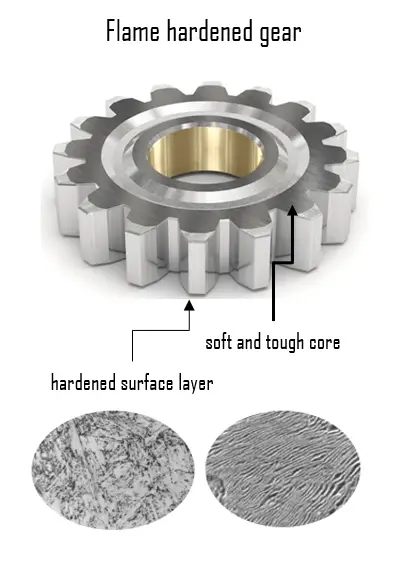
Flame hardeningFlame hardening is a surface hardening technique which uses a single torch with a specially designed head to provide a very rapid means of heating the metal, which is then cooled rapidly, generally using water. This creates a “case” of martensite on the surface, while the inner core of the object remains elastic and tough. It is similar technique as induction hardening. A carbon content of 0.3–0.6 wt% C is needed for this type of hardening.

Martensite is a very hard metastable structure with a body-centered tetragonal (BCT) crystal structure. Martensite is formed in steels when the cooling rate from austenite is at such a high rate that carbon atoms do not have time to diffuse out of the crystal structure in large enough quantities to form cementite (Fe3C). Flame hardening produces hard, highly wear-resistant surface (deep case depths) with good capacity for contact load and good bending fatigue strength. It can be used for hardening of low-cost steels and low capital investment are required.

A common use for induction hardening is for hardening of large parts such as gears and machine tool ways, with sizes or shapes that would make furnace heat treatment impractical. The gear will usually be quenched and tempered to a specific hardness first, making a majority of the gear tough, and then the teeth are quickly heated and immediately quenched, hardening only the surface. Wear resistance behavior of induction hardened parts depends on hardening depth and the magnitude and distribution of residual compressive stress in the surface layer.

Other Case Hardening Methods

Case hardening by surface treatment can be classified further as diffusion treatments or localized heating treatments. Diffusion methods introduce alloying elements that enter the surface by diffusion, either as solid-solution agents or as hardenability agents that assist martensite formation during subsequent quenching. In this process, the concentration of alloying element is increased at the surface of a steel component. Diffusion methods include:

  • Carburizing. Carburizing is a case hardening process in which the surface carbon concentration of a ferrous alloy (usually a low-carbon steel) is increased by diffusion from the surrounding environment. Carburizing produces hard, highly wear-resistant surface (medium case depths) of product with excellent capacity for contact load, good bending fatigue strength and good resistance to seizure.
  • Nitriding. Nitriding is a case hardening process in which the surface nitrogen concentration of a ferrous is increased by diffusion from the surrounding environment to create case-hardened surface. Nitriding produces hard, highly wear-resistant surface (shallow case depths) of product with fair capacity for contact load, good bending fatigue strength and excellent resistance to seizure.
  • Boriding. Boriding, also called boronizing is a thermochemical diffusion process similar to nitrocarburising in which boron atoms diffuse into the substrate to produce hard and wear-resistant surface layers. The process requires a high treatment temperature (1073-1323 K) and long duration (1-12 h), and can be applied to a wide range of materials such as steels, cast iron, cermets, and non-ferrous alloys.
  • Titanium-carbon and Titanium-nitride Hardening. Titanium nitride (an extremely hard ceramic material), or titanium carbide coatings can be used in the tools made of this kind of steels through physical vapor deposition process to improve the performance and life span of the tool. TiN has a Vickers hardness of 1800–2100 and it has metallic gold color.

Localized heating methods for case hardening include:

  • Flame hardening. Flame hardening is a surface hardening technique which uses a single torch with a specially designed head to provide a very rapid means of heating the metal, which is then cooled rapidly, generally using water. This creates a “case” of martensite on the surface, while the inner core of the object remains elastic and tough. It is similar technique as induction hardening. A carbon content of 0.3–0.6 wt% C is needed for this type of hardening.
  • Induction hardening. Induction hardening is a surface hardening technique which uses induction coils to provide a very rapid means of heating the metal, which is then cooled rapidly, generally using water. This creates a “case” of martensite on the surface. A carbon content of 0.3–0.6 wt% C is needed for this type of hardening.
  • Laser hardening. Laser hardening is a surface hardening technique which uses a laser beam to provide a very rapid means of heating the metal, which is then cooled rapidly (generally by self-quenching). This creates a “case” of martensite on the surface, while the inner core of the object remains elastic and tough.
References:
Materials Science:

U.S. Department of Energy, Material Science. DOE Fundamentals Handbook, Volume 1 and 2. January 1993.
U.S. Department of Energy, Material Science. DOE Fundamentals Handbook, Volume 2 and 2. January 1993.
William D. Callister, David G. Rethwisch. Materials Science and Engineering: An Introduction 9th Edition, Wiley; 9 edition (December 4, 2013), ISBN-13: 978-1118324578.
Eberhart, Mark (2003). Why Things Break: Understanding the World by the Way It Comes Apart. Harmony. ISBN 978-1-4000-4760-4.
Gaskell, David R. (1995). Introduction to the thermodynamics of Materials (4th ed.). Taylor and Francis Publishing. ISBN 978-1-56032-992-3.
González-Viñas, W. & Mancini, H.L. (2004). An Introduction to Materials Science. Princeton University Press. ISBN 978-0-691-07097-1.
Ashby, Michael; Hugh Shercliff; David Cebon (2007). Materials: engineering, science, processing and design (1st ed.). Butterworth-Heinemann. ISBN 978-0-7506-8391-3.
J. R. Lamarsh, A. J. Baratta, Introduction to Nuclear Engineering, 3d ed., Prentice-Hall, 2001, ISBN: 0-201-82498-1.

See above:
Case Hardening

We hope, this article, Flame Hardening – Advantages and Application, helps you. If so, give us a like in the sidebar. Main purpose of this website is to help the public to learn some interesting and important information about materials and their properties.