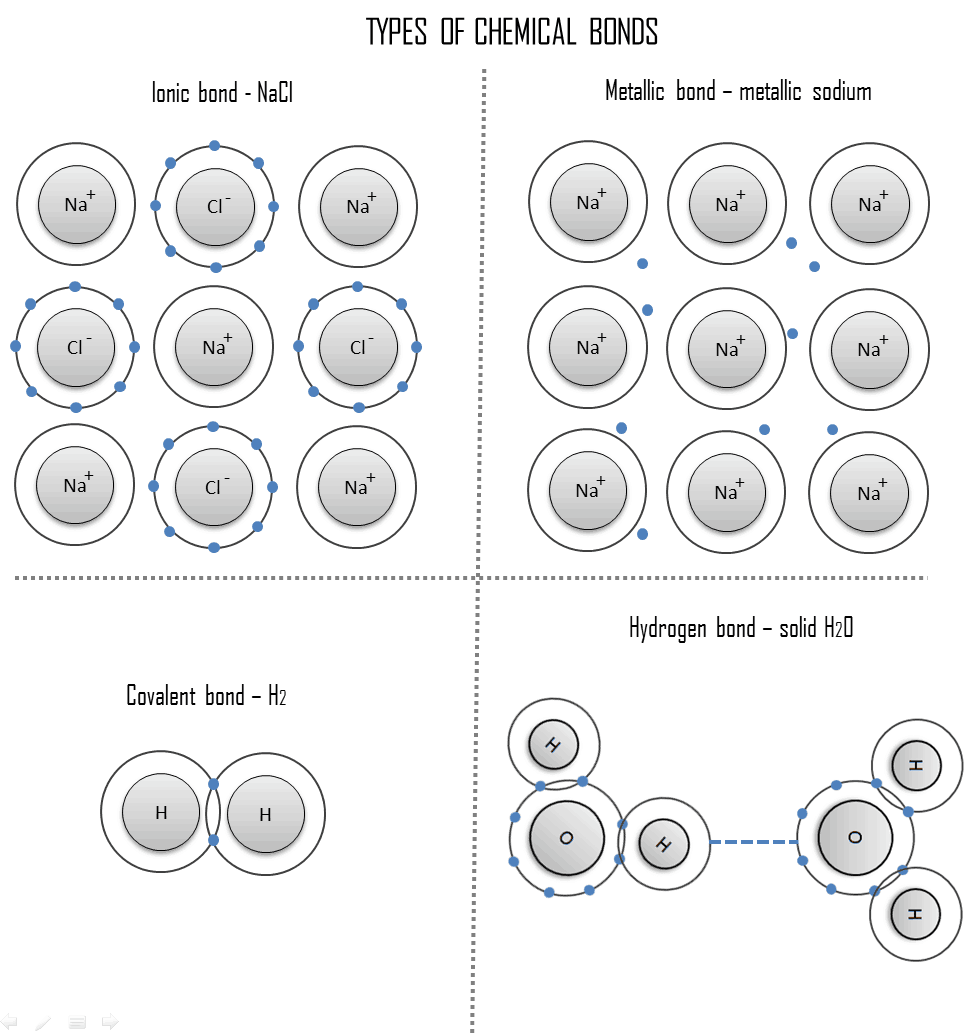
The strength of chemical bonds varies considerably; there are “primary bonds” or “strong bonds” such as ionic, covalent and metallic bonds, and “weak bonds” or “secondary bonds”.
Three different types of primary or chemical bond are found in solids. The strength of chemical bonds varies considerably; there are “primary bonds” or “strong bonds” such as ionic, covalent and metallic bonds, and “weak bonds” or “secondary bonds” such as dipole–dipole interactions, the London dispersion force and hydrogen bonding.
A chemical bond is a lasting attraction between these atoms, ions or molecules that enables the formation of chemical compounds. The bond may result from the electrostatic force of attraction between oppositely charged ions as in ionic bonds or through the sharing of electrons as in covalent bonds. Therefore, the electromagnetic force plays a major role in determining the internal properties of most objects encountered in daily life.
The strength of chemical bonds varies considerably; there are “primary bonds” or “strong bonds” such as ionic, covalent and metallic bonds, and “weak bonds” or “secondary bonds” such as dipole–dipole interactions, the London dispersion force and hydrogen bonding. In this chapter, we will deal primarily with solids because solids are of the most concern in engineering applications of materials. Liquids and gases will be mentioned for comparative purposes only. Molecules in solids are bound tightly together. When the attractions are weaker, the substance may be in a liquid form and free to flow. Gases exhibit virtually no attractive forces between atoms or molecules, and their particles are free to move independently of each other.
References:
Materials Science:
U.S. Department of Energy, Material Science. DOE Fundamentals Handbook, Volume 1 and 2. January 1993.
U.S. Department of Energy, Material Science. DOE Fundamentals Handbook, Volume 2 and 2. January 1993.
William D. Callister, David G. Rethwisch. Materials Science and Engineering: An Introduction 9th Edition, Wiley; 9 edition (December 4, 2013), ISBN-13: 978-1118324578.
Eberhart, Mark (2003). Why Things Break: Understanding the World by the Way It Comes Apart. Harmony. ISBN 978-1-4000-4760-4.
Gaskell, David R. (1995). Introduction to the thermodynamics of Materials (4th ed.). Taylor and Francis Publishing. ISBN 978-1-56032-992-3.
González-Viñas, W. & Mancini, H.L. (2004). An Introduction to Materials Science. Princeton University Press. ISBN 978-0-691-07097-1.
Ashby, Michael; Hugh Shercliff; David Cebon (2007). Materials: engineering, science, processing and design (1st ed.). Butterworth-Heinemann. ISBN 978-0-7506-8391-3.
J. R. Lamarsh, A. J. Baratta, Introduction to Nuclear Engineering, 3d ed., Prentice-Hall, 2001, ISBN: 0-201-82498-1.
See above:
Chemical Bond
We hope, this article, Primary Strong Bonds – Secondary Weak Bonds, helps you. If so, give us a like in the sidebar. Main purpose of this website is to help the public to learn some interesting and important information about materials and their properties.
A chemical bond is a lasting attraction between these atoms, ions or molecules that enables the formation of chemical compounds. The bond may result from the electrostatic force of attraction between oppositely charged ions as in ionic bonds or through the sharing of electrons as in covalent bonds.
Three different types of primary or chemical bond are found in solids. The strength of chemical bonds varies considerably; there are “primary bonds” or “strong bonds” such as ionic, covalent and metallic bonds, and “weak bonds” or “secondary bonds” such as dipole–dipole interactions, the London dispersion force and hydrogen bonding.
The chemical properties of the atom are determined by the number of protons, in fact, by number and arrangement of electrons. The configuration of these electrons follows from the principles of quantum mechanics as well as the Pauli exclusion principle. The number of electrons in each element’s electron shells, particularly the outermost valence shell, is the primary factor in determining its chemical bonding behavior. A chemical bond is a lasting attraction between these atoms, ions or molecules that enables the formation of chemical compounds. The bond may result from the electrostatic force of attraction between oppositely charged ions as in ionic bonds or through the sharing of electrons as in covalent bonds. Therefore, the electromagnetic force plays a major role in determining the internal properties of most objects encountered in daily life. Three different types of primary or chemical bond are found in solids:
Intramolecular bonds
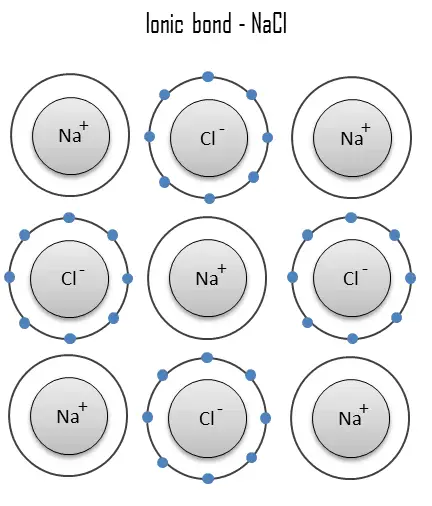
Ionic bond. An ionic bond is a chemical bond, in which one or more electrons are wholly transferred from an atom of one element to the atom of the other, and the elements are held together by the force of attraction due to the opposite polarity of the charge. This type of chemical bond is typical between elements with a large electronegativity difference.
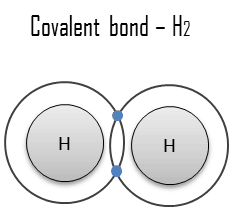
Covalent bond. A covalent bond is a chemical bond formed by shared electrons. Valence electrons are shared when an atom needs electrons to complete its outer shell and can share those electrons with its neighbor. The electrons are then part of both atoms and both shells are filled.
Metallic bond. A metallic bond is a chemical bond, in which the atoms do not share or exchange electrons to bond together. Instead, many electrons (roughly one for each atom) are more or less free to move throughout the metal, so that each electron can interact with many of the fixed atoms.
Intermolecular bonds
Molecular bond. When the electrons of neutral atoms spend more time in one region of their orbit, a temporary weak charge will exist. The molecule will weakly attract other molecules. This is sometimes called the van der Waals or molecular bonds.
Hydrogen bond. A hydrogen bond can be intermolecular (occurring between separate molecules) or intramolecular (occurring among parts of the same molecule). The hydrogen bond is a primarily electrostatic force of attraction between a hydrogen (H) atom which is covalently bound to a more electronegative atom or group.
The strength of chemical bonds varies considerably; there are “primary bonds” or “strong bonds” such as ionic, covalent and metallic bonds, and “weak bonds” or “secondary bonds” such as dipole–dipole interactions, the London dispersion force and hydrogen bonding. In this chapter, we will deal primarily with solids because solids are of the most concern in engineering applications of materials. Liquids and gases will be mentioned for comparative purposes only. Molecules in solids are bound tightly together. When the attractions are weaker, the substance may be in a liquid form and free to flow. Gases exhibit virtually no attractive forces between atoms or molecules, and their particles are free to move independently of each other.
The type of bond not only determines how well a material is held together, but also determines what microscopic properties the material possesses. Properties such as the ability to conduct heat or electrical current are determined by the freedom of movement of electrons. This is dependent on the type of bonding present. Knowledge of the microscopic structure of a material allows us to predict how that material will behave under certain conditions.
Ionic Bond
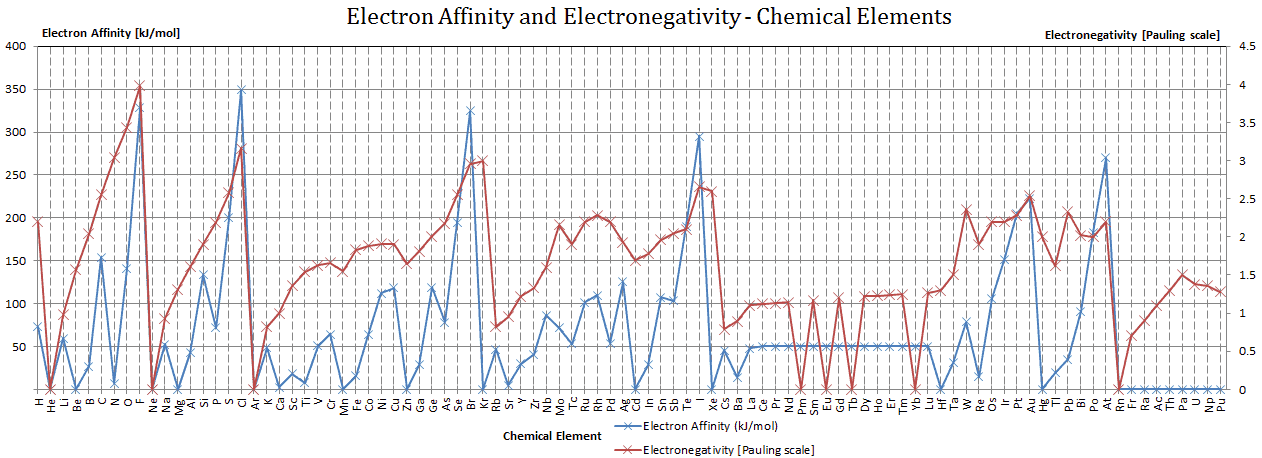
An ionic bond is a chemical bond, in which one or more electrons are wholly transferred from an atom of one element to the atom of the other, and the elements are held together by the force of attraction due to the opposite polarity of the charge. This type of chemical bond is typical between elements with a large electronegativity difference (i.e. elements situated at the horizontal extremities of the periodic table). An ionic bond is always found in compounds composed of both metallic and nonmetallic elements. There is no precise value that distinguishes ionic from covalent bonding, but an electronegativity difference of over 1.7 is likely to be ionic while a difference of less than 1.7 is likely to be covalent.
Ionic bonding leads to separate positive and negative ions. In the process, all the atoms acquire stable or inert gas configurations (i.e., completely filled orbital shells) and, in addition, an electrical charge – that is, they become ions. For example, common table salt is sodium chloride. Sodium chloride (NaCl) is the classic ionic material. A sodium atom can assume the electron structure of neon by a transfer of its one valence 3s electron to a chlorine atom. After such a transfer, the chlorine ion acquires a net negative charge, an electron configuration identical to that of argon; it is also larger than the chlorine atom. These ions are then attracted to each other in a 1:1 ratio to form sodium chloride (NaCl).
Na + Cl → Na+ + Cl− → NaCl
Ionic compounds conduct electricity when molten or in solution, typically as a solid. Ionic compounds generally have a high melting point, depending on the charge of the ions they consist of. The higher the charges the stronger the cohesive forces and the higher the melting point. They also tend to be soluble in water; the stronger the cohesive forces, the lower the solubility.
Covalent Bond
A covalent bond is a chemical bond formed by shared electrons. Valence electrons are shared when an atom needs electrons to complete its outer shell and can share those electrons with its neighbor. The electrons are then part of both atoms and both shells are filled. These electron pairs are known as shared pairs or bonding pairs, and the stable balance of attractive and repulsive forces between atoms, when they share electrons, is known as covalent bonding.
The simplest and most common type is a single bond in which two atoms share two electrons. Other types include the double bond (e.g. H2C=CH2), the triple bond, one- and three-electron bonds, the three-center two-electron bond and three-center four-electron bond.
Covalency is greatest between atoms of similar electronegativities. Thus, covalent bonding does not necessarily require that the two atoms be of the same elements, only that they be of comparable electronegativity (i.e. elements that lie near one another in the periodic table). There is no precise value that distinguishes ionic from covalent bonding, but an electronegativity difference of over 1.7 is likely to be ionic while a difference of less than 1.7 is likely to be covalent.
Metallic Bond
A metallic bond is a chemical bond, in which the atoms do not share or exchange electrons to bond together. Instead, many electrons (roughly one for each atom) are more or less free to move throughout the metal, so that each electron can interact with many of the fixed atoms. The free electrons shield the positively charged ion cores from the mutually repulsive electrostatic forces that they would otherwise exert upon one another; consequently, the metallic bond is nondirectional in character. Metallic bonding is found in metals and their alloys. The free movement or delocalization of bonding electrons leads to classical metallic properties such as luster (surface light reflectivity), electrical and thermal conductivity, ductility, and high tensile strength.
Metal is a material (usually solid) comprising one or more metallic elements (e.g., iron, aluminum, copper, chromium, titanium, gold, nickel), and often also nonmetallic elements (e.g., carbon, nitrogen, oxygen) in relatively small amounts. The unique feature of metals as far as their structure is concerned is the presence of charge carriers, specifically electrons. This feature is given by the nature of metallic bond. The electrical and thermal conductivities of metals originate from the fact that their outer electrons are delocalized.
Hydrogen Bond
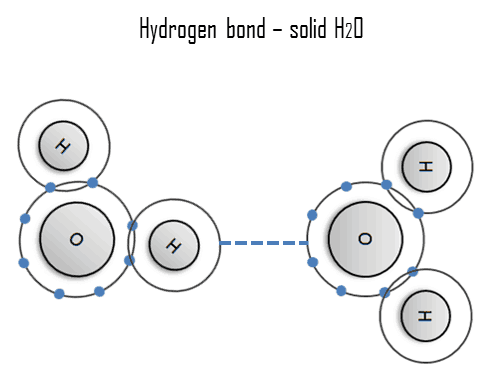
A hydrogen bond can be intermolecular (occurring between separate molecules) or intramolecular (occurring among parts of the same molecule). The hydrogen bond is a primarily electrostatic force of attraction between a hydrogen (H) atom which is covalently bound to a more electronegative atom or group.
A hydrogen is a strong example of an interaction between two permanent dipoles. The large difference in electronegativities between hydrogen and any of fluorine, nitrogen and oxygen, coupled with their lone pairs of electrons, cause strong electrostatic forces between molecules. A ubiquitous example of a hydrogen bond is found between water molecules. Hydrogen bonds are responsible for the high boiling points of water. Each H2O molecule has two hydrogen atoms that can bond to oxygen atoms. In addition, its single O atom can bond to two hydrogen atoms of other H2O molecules. Thus, for solid ice, each water molecule participates in four hydrogen bonds, helping to create an open hexagonal lattice. Liquid water’s high boiling point is due to the high number of hydrogen bonds each molecule can form, relative to its low molecular mass. Owing to the difficulty of breaking these bonds, water has a very high boiling point, melting point, and viscosity compared to otherwise similar liquids not conjoined by hydrogen bonds.
References:
Materials Science:
U.S. Department of Energy, Material Science. DOE Fundamentals Handbook, Volume 1 and 2. January 1993.
U.S. Department of Energy, Material Science. DOE Fundamentals Handbook, Volume 2 and 2. January 1993.
William D. Callister, David G. Rethwisch. Materials Science and Engineering: An Introduction 9th Edition, Wiley; 9 edition (December 4, 2013), ISBN-13: 978-1118324578.
Eberhart, Mark (2003). Why Things Break: Understanding the World by the Way It Comes Apart. Harmony. ISBN 978-1-4000-4760-4.
Gaskell, David R. (1995). Introduction to the thermodynamics of Materials (4th ed.). Taylor and Francis Publishing. ISBN 978-1-56032-992-3.
González-Viñas, W. & Mancini, H.L. (2004). An Introduction to Materials Science. Princeton University Press. ISBN 978-0-691-07097-1.
Ashby, Michael; Hugh Shercliff; David Cebon (2007). Materials: engineering, science, processing and design (1st ed.). Butterworth-Heinemann. ISBN 978-0-7506-8391-3.
J. R. Lamarsh, A. J. Baratta, Introduction to Nuclear Engineering, 3d ed., Prentice-Hall, 2001, ISBN: 0-201-82498-1.
See above:
Materials Science
We hope, this article, Atomic and Chemical Bond, helps you. If so, give us a like in the sidebar. Main purpose of this website is to help the public to learn some interesting and important information about materials and their properties.
Classification of Materials. On the basis of chemistry and atomic structure, materials are classified into three general categories: Metals, Ceramics, Polymers
An understanding of material science is essential for power plant personnel to understand why a material was selected for certain applications within their facility. Almost all processes that take place in the nuclear facilities involve the use of specialized metals. A basic understanding of material science is necessary for nuclear facility operators, maintenance personnel, and the technical staff to safely operate and maintain the facility and facility support systems. Our goal here will be to introduce material engineering of nuclear reactors. The knowledge of thermophysical and nuclear properties of materials is essential for designing nuclear power plants.
Classification of Materials
A material is defined as a substance (most often a solid, but other condensed phases can be included) that is intended to be used for certain applications. There are a myriad of materials around us – they can be found in anything from buildings to spacecraft. On the basis of chemistry and atomic structure, materials are classified into three general categories:
Metallic bond
Metals. Metal is a material (usually solid) comprising one or more metallic elements (e.g., iron, aluminum, copper, chromium, titanium, gold, nickel), and often also nonmetallic elements (e.g., carbon, nitrogen, oxygen) in relatively small amounts. The unique feature of metals as far as their structure is concerned is the presence of charge carriers, specifically electrons. This feature is given by the nature of metallic bond. In metallic bond, the atoms do not share or exchange electrons to bond together. Instead, many electrons (roughly one for each atom) are more or less free to move throughout the metal, so that each electron can interact with many of the fixed atoms. The electrical and thermal conductivities of metals originate from the fact that their outer electrons are delocalized.
Ceramics. A ceramic is a solid material comprising an inorganic compound of metal, non-metal or metalloid atoms primarily held in ionic and covalent bonds. Common examples are earthenware, porcelain, and brick. In nuclear industry, uranium dioxide is a ceramic refractory uranium compound, in many cases used as a nuclear fuel.
Polymers. Polymers are compounds (macromolecules) composed of carbon, hydrogen, and other nonmetallic elements. Polymers range from familiar synthetic plastics such as polystyrene to natural biopolymers such as DNA and proteins that are fundamental to biological structure and function. Some common and familiar polymers are polyethylene (PE), nylon, polycarbonate (PC), polystyrene (PS), and silicone rubber.
In addition, composites are composed of at least two different material types. Another materials category is the advanced materials that are used in high-tech applications, including:
Semiconductors. In general, semiconductors are materials, inorganic or organic, which have the ability to control their conduction depending on chemical structure, temperature, illumination, and presence of dopants. The name semiconductor comes from the fact that these materials have an electrical conductivity between that of a metal, like copper, gold, etc. and an insulator, such as glass.
Biomaterials. In general, a biomaterial is any substance that has been engineered to interact with biological systems for a medical purpose. These materials must not produce toxic substances and must be compatible with body tissues (i.e., must not cause adverse biological reactions).
Smart materials. Smart materials are materials that sense and respond to changes in their environments in predetermined manners.
Nanomaterials are materials that have structural features on the order of a nanometer, some of which may be designed on the atomic/molecular level.
References:
Materials Science:
U.S. Department of Energy, Material Science. DOE Fundamentals Handbook, Volume 1 and 2. January 1993.
U.S. Department of Energy, Material Science. DOE Fundamentals Handbook, Volume 2 and 2. January 1993.
William D. Callister, David G. Rethwisch. Materials Science and Engineering: An Introduction 9th Edition, Wiley; 9 edition (December 4, 2013), ISBN-13: 978-1118324578.
Eberhart, Mark (2003). Why Things Break: Understanding the World by the Way It Comes Apart. Harmony. ISBN 978-1-4000-4760-4.
Gaskell, David R. (1995). Introduction to the thermodynamics of Materials (4th ed.). Taylor and Francis Publishing. ISBN 978-1-56032-992-3.
González-Viñas, W. & Mancini, H.L. (2004). An Introduction to Materials Science. Princeton University Press. ISBN 978-0-691-07097-1.
Ashby, Michael; Hugh Shercliff; David Cebon (2007). Materials: engineering, science, processing and design (1st ed.). Butterworth-Heinemann. ISBN 978-0-7506-8391-3.
J. R. Lamarsh, A. J. Baratta, Introduction to Nuclear Engineering, 3d ed., Prentice-Hall, 2001, ISBN: 0-201-82498-1.
See above:
Materials Science
We hope, this article, Classification of Materials, helps you. If so, give us a like in the sidebar. Main purpose of this website is to help the public to learn some interesting and important information about materials and their properties.
Materials science and engineering is interdisciplinar and very important branch of study, which deals with the design and discovery of new materials, particularly solids.
Materials science and engineering is interdisciplinar and very important branch of study, which deals with the design and discovery of new materials, particularly solids. Materials science is one of the oldest forms of engineering and applied science and The material of choice of a given era is often a defining point (e.g. Stone Age, Bronze Age, Iron Age). The intellectual origins of materials science stem from the Enlightenment, when researchers began to use analytical thinking from chemistry, physics, and engineering to understand ancient, phenomenological observations in metallurgy and mineralogy. Sometimes it is useful to subdivide the discipline of materials science and engineering into materials science and materials engineering subdisciplines. The discipline of materials science involves investigating the relationships that exist between the structures and properties of materials. In contrast, materials engineering is, on the basis of these structure–property correlations, designing or engineering the structure of a material to produce a predetermined set of properties.
Brittle fracture of the U.S. Liberty Ship Esso Manhattan
From a functional perspective, the role of a materials scientist is to develop or synthesize new materials, whereas a materials engineer is called upon to create new products or systems using existing materials and to develop techniques for processing materials.
The basis of materials science involves studying the structure of materials, and relating them to their properties (mechanical, electrical etc.). Once a materials scientist knows about this structure-property correlation, they can then go on to study the relative performance of a material in a given application. The major determinants of the structure of a material and thus of its properties are its constituent chemical elements and the way in which it has been processed into its final form.
Material
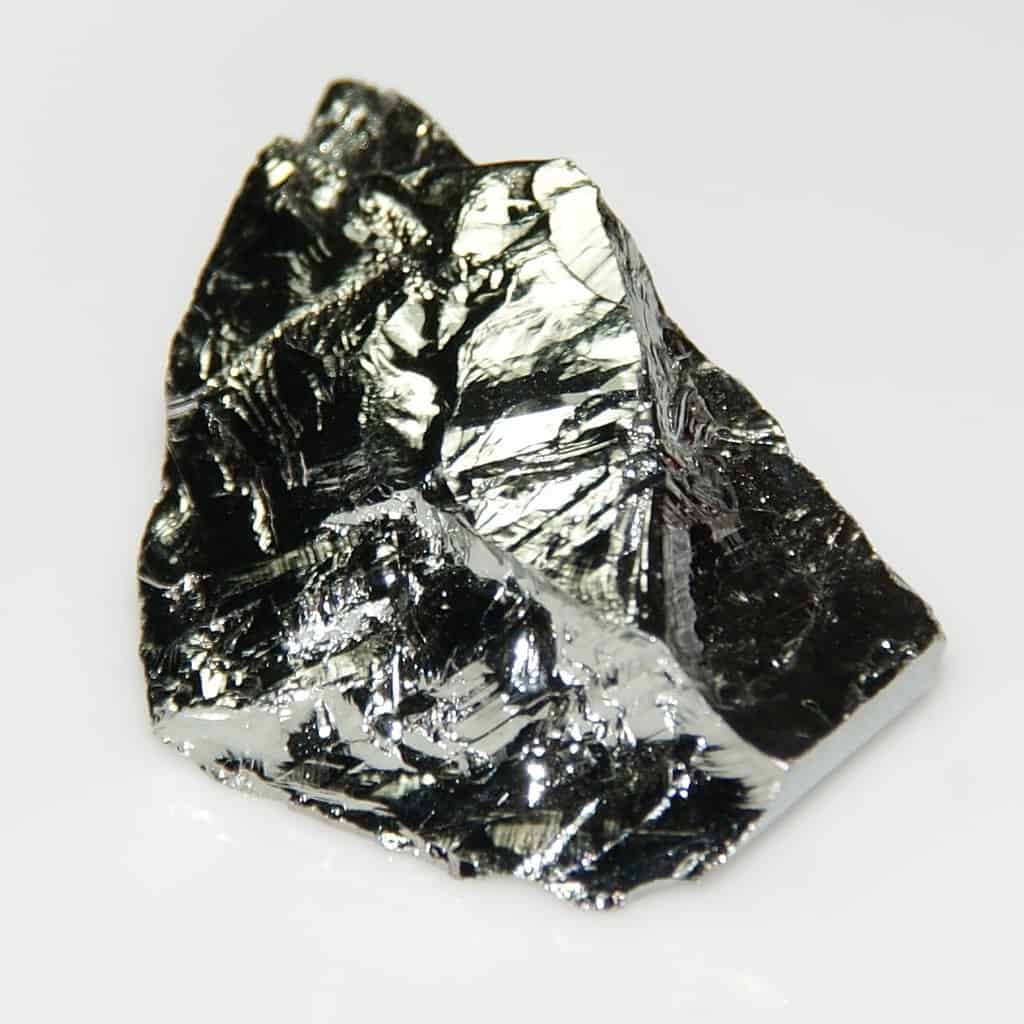
12 grams polycrystalline germanium. Source: wikipedia.org License: CC BY 3.0
A material is defined as a substance (most often a solid, but other condensed phases can be included) that is intended to be used for certain applications. There are a myriad of materials around us – they can be found in anything from buildings to spacecraft. On the basis of chemistry and atomic structure, materials are classified into three general categories:
Metals (metallic elements),
Ceramics (compounds between metallic and nonmetallic elements),
Polymers (compounds composed of carbon, hydrogen, and other nonmetallic elements).
In addition, composites are composed of at least two different material types. New and advanced materials that are being developed include nanomaterials, biomaterials, and energy materials to name a few.
Materials for Nuclear Engineering
An understanding of material science is essential for power plant personnel to understand why a material was selected for certain applications within their facility. Almost all processes that take place in the nuclear facilities involve the use of specialized metals. A basic understanding of material science is necessary for nuclear facility operators, maintenance personnel, and the technical staff to safely operate and maintain the facility and facility support systems. Our goal here will be to introduce material engineering of nuclear reactors. The knowledge of thermophysical and nuclear properties of materials is essential for designing nuclear power plants.
References:
Materials Science:
U.S. Department of Energy, Material Science. DOE Fundamentals Handbook, Volume 1 and 2. January 1993.
U.S. Department of Energy, Material Science. DOE Fundamentals Handbook, Volume 2 and 2. January 1993.
William D. Callister, David G. Rethwisch. Materials Science and Engineering: An Introduction 9th Edition, Wiley; 9 edition (December 4, 2013), ISBN-13: 978-1118324578.
Eberhart, Mark (2003). Why Things Break: Understanding the World by the Way It Comes Apart. Harmony. ISBN 978-1-4000-4760-4.
Gaskell, David R. (1995). Introduction to the thermodynamics of Materials (4th ed.). Taylor and Francis Publishing. ISBN 978-1-56032-992-3.
González-Viñas, W. & Mancini, H.L. (2004). An Introduction to Materials Science. Princeton University Press. ISBN 978-0-691-07097-1.
Ashby, Michael; Hugh Shercliff; David Cebon (2007). Materials: engineering, science, processing and design (1st ed.). Butterworth-Heinemann. ISBN 978-0-7506-8391-3.
J. R. Lamarsh, A. J. Baratta, Introduction to Nuclear Engineering, 3d ed., Prentice-Hall, 2001, ISBN: 0-201-82498-1.
See above:
Nuclear Engineering
We hope, this article, Materials Science, helps you. If so, give us a like in the sidebar. Main purpose of this website is to help the public to learn some interesting and important information about materials and their properties.
A material is defined as a substance (most often a solid, but other condensed phases can be included) that is intended to be used for certain applications.
12 grams polycrystalline germanium. Source: wikipedia.org License: CC BY 3.0
A material is defined as a substance (most often a solid, but other condensed phases can be included) that is intended to be used for certain applications. There are a myriad of materials around us – they can be found in anything from buildings to spacecraft. On the basis of chemistry and atomic structure, materials are classified into three general categories:
Metals (metallic elements),
Ceramics (compounds between metallic and nonmetallic elements),
Polymers (compounds composed of carbon, hydrogen, and other nonmetallic elements).
In addition, composites are composed of at least two different material types. New and advanced materials that are being developed include nanomaterials, biomaterials, and energy materials to name a few.
Materials for Nuclear Engineering
An understanding of material science is essential for power plant personnel to understand why a material was selected for certain applications within their facility. Almost all processes that take place in the nuclear facilities involve the use of specialized metals. A basic understanding of material science is necessary for nuclear facility operators, maintenance personnel, and the technical staff to safely operate and maintain the facility and facility support systems. Our goal here will be to introduce material engineering of nuclear reactors. The knowledge of thermophysical and nuclear properties of materials is essential for designing nuclear power plants.
Classification of Materials
A material is defined as a substance (most often a solid, but other condensed phases can be included) that is intended to be used for certain applications. There are a myriad of materials around us – they can be found in anything from buildings to spacecraft. On the basis of chemistry and atomic structure, materials are classified into three general categories:
Metallic bond
Metals. Metal is a material (usually solid) comprising one or more metallic elements (e.g., iron, aluminum, copper, chromium, titanium, gold, nickel), and often also nonmetallic elements (e.g., carbon, nitrogen, oxygen) in relatively small amounts. The unique feature of metals as far as their structure is concerned is the presence of charge carriers, specifically electrons. This feature is given by the nature of metallic bond. In metallic bond, the atoms do not share or exchange electrons to bond together. Instead, many electrons (roughly one for each atom) are more or less free to move throughout the metal, so that each electron can interact with many of the fixed atoms. The electrical and thermal conductivities of metals originate from the fact that their outer electrons are delocalized.
Ceramics. A ceramic is a solid material comprising an inorganic compound of metal, non-metal or metalloid atoms primarily held in ionic and covalent bonds. Common examples are earthenware, porcelain, and brick. In nuclear industry, uranium dioxide is a ceramic refractory uranium compound, in many cases used as a nuclear fuel.
Polymers. Polymers are compounds (macromolecules) composed of carbon, hydrogen, and other nonmetallic elements. Polymers range from familiar synthetic plastics such as polystyrene to natural biopolymers such as DNA and proteins that are fundamental to biological structure and function. Some common and familiar polymers are polyethylene (PE), nylon, polycarbonate (PC), polystyrene (PS), and silicone rubber.
In addition, composites are composed of at least two different material types. Another materials category is the advanced materials that are used in high-tech applications, including:
Semiconductors. In general, semiconductors are materials, inorganic or organic, which have the ability to control their conduction depending on chemical structure, temperature, illumination, and presence of dopants. The name semiconductor comes from the fact that these materials have an electrical conductivity between that of a metal, like copper, gold, etc. and an insulator, such as glass.
Biomaterials. In general, a biomaterial is any substance that has been engineered to interact with biological systems for a medical purpose. These materials must not produce toxic substances and must be compatible with body tissues (i.e., must not cause adverse biological reactions).
Smart materials. Smart materials are materials that sense and respond to changes in their environments in predetermined manners.
Nanomaterials are materials that have structural features on the order of a nanometer, some of which may be designed on the atomic/molecular level.
References:
Materials Science:
U.S. Department of Energy, Material Science. DOE Fundamentals Handbook, Volume 1 and 2. January 1993.
U.S. Department of Energy, Material Science. DOE Fundamentals Handbook, Volume 2 and 2. January 1993.
William D. Callister, David G. Rethwisch. Materials Science and Engineering: An Introduction 9th Edition, Wiley; 9 edition (December 4, 2013), ISBN-13: 978-1118324578.
Eberhart, Mark (2003). Why Things Break: Understanding the World by the Way It Comes Apart. Harmony. ISBN 978-1-4000-4760-4.
Gaskell, David R. (1995). Introduction to the thermodynamics of Materials (4th ed.). Taylor and Francis Publishing. ISBN 978-1-56032-992-3.
González-Viñas, W. & Mancini, H.L. (2004). An Introduction to Materials Science. Princeton University Press. ISBN 978-0-691-07097-1.
Ashby, Michael; Hugh Shercliff; David Cebon (2007). Materials: engineering, science, processing and design (1st ed.). Butterworth-Heinemann. ISBN 978-0-7506-8391-3.
J. R. Lamarsh, A. J. Baratta, Introduction to Nuclear Engineering, 3d ed., Prentice-Hall, 2001, ISBN: 0-201-82498-1.
See above:
Materials Science
We hope, this article, Type of Material, helps you. If so, give us a like in the sidebar. Main purpose of this website is to help the public to learn some interesting and important information about materials and their properties.
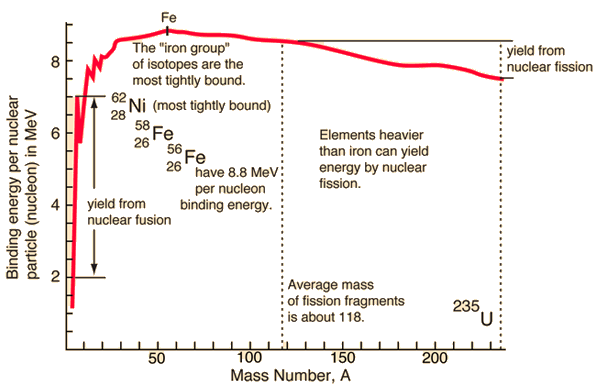
Nuclear binding energy curve. Source: hyperphysics.phy-astr.gsu.edu
If the splitting releases energy and the fusion releases the energy, so where is the breaking point? For understanding this issue it is better to relate the binding energy to one nucleon, to obtain nuclear binding curve. The binding energy per one nucleon is not linear. There is a peak in the binding energy curve in the region of stability near iron and this means that either the breakup of heavier nuclei than iron or the combining of lighter nuclei than iron will yield energy.
The reason the trend reverses after iron peak is the growing positive charge of the nuclei. The electric force has greater range than strong nuclear force. While the strong nuclear force binds only close neighbors the electric force of each proton repels the other protons.
A neutron is one of the subatomic particles that make up matter. In the universe, neutrons are abundant, making up more than half of all visible matter. It has no electric charge and a rest mass equal to 1.67493 × 10⁻²⁷ kg—marginally greater than that of the proton but nearly 1839 times greater than that of the electron. The neutron has a mean square radius of about 0.8×10⁻¹⁵ m, or 0.8 fm, and it is a spin-½ fermion.
The neutrons exist in the nuclei of typical atoms, along with their positively charged counterparts, the protons. Neutrons and protons, commonly called nucleons, are bound together in the atomic nucleus, where they account for 99.9 percent of the atom’s mass. Research in high-energy particle physics in the 20th century revealed that neither the neutron nor the proton is not the smallest building block of matter. Protons and neutrons have also their structure. Inside the protons and neutrons, we find true elementary particles called quarks. Within the nucleus, protons and neutrons are bound together through the strong force, a fundamental interaction that governs the behaviour of the quarks that make up the individual protons and neutrons.
A nuclear stability is determined by the competition between two fundamental interactions. Protons and neutrons are attracted each other via strong force. On the other hand protons repel each other via the electric force due to their positive charge. Therefore neutrons within the nucleus act somewhat like nuclear glue, neutrons attract each other and protons , which helps offset the electrical repulsion between protons. There are only certain combinations of neutrons and protons, which forms stable nuclei. For example, the most common nuclide of the common chemical element lead (Pb) has 82 protons and 126 neutrons.
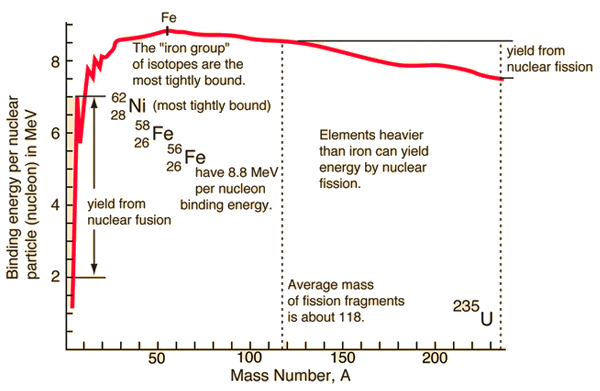
Nuclear binding energy curve. Source: hyperphysics.phy-astr.gsu.edu
Because of the strength of the nuclear force at short distances, the nuclear binding energy (the energy required to disassemble a nucleus of an atom into its component parts) of nucleons is more than seven orders of magnitude larger than the electromagnetic energy binding electrons in atoms. Nuclear reactions (such as nuclear fission or nuclear fusion) therefore have an energy density that is more than 10 000 000x that of chemical reactions.
Knowledge of the behaviour and properties of neutrons is essential to the production of nuclear power. Shortly after the neutron was discovered in 1932, it was quickly realized that neutrons might act to form a nuclear chain reaction. When nuclear fission was discovered in 1938, it became clear that, if a fission reaction produced free neutrons, each of these neutrons might cause further fission reaction in a cascade known as a chain reaction. Knowledge of cross-sections (the key parameter representing probability of interaction between a neutron and a nucleus) became crutial for design of reactor cores and the first nuclear weapon (Trinity, 1945).
Discovery of the Neutron
The story of the discovery of the neutron and its properties is central to the extraordinary developments in atomic physics that occurred in the first half of the 20th century. The neutron was discovered in 1932 by the English physicist James Chadwick, but since the time of Ernest Rutherford it had been known that the atomic mass number A of nuclei is a bit more than twice the atomic number Z for most atoms and that essentially all the mass of the atom is concentrated in the relatively tiny nucleus. The Rutherford’s model for the atom in 1911 claims that atoms have their mass and positive charge concentrated in a very small nucleus.
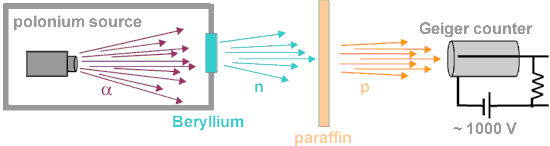
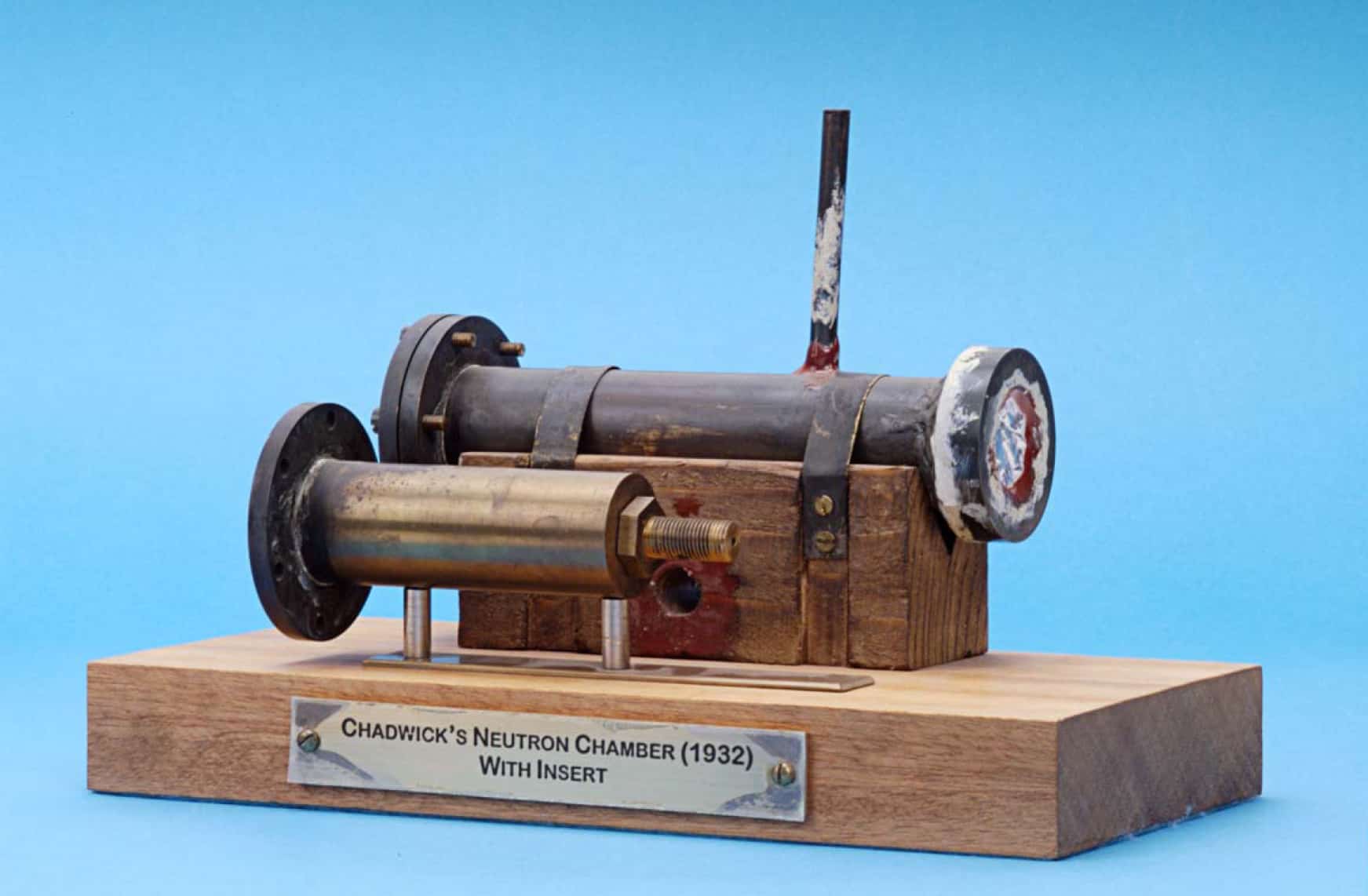
The alpha particles emitted from polonium fell on certain light elements, specifically beryllium, an unusually penetrating radiation is produced. Source: dev.physicslab.orgChadwick’s neutron chamber containing parallel disks of radioactive polonium and beryllium. Radiation is emitted from an aluminium window at the chamber’s end. Source: imgkid.com
An experimental breakthrough came in 1930 with the observation by Bothe and Becker. They found that if the very energetic alpha particles emitted from polonium fell on certain light elements, specifically beryllium, boron, or lithium, an unusually penetrating radiation was produced. Since this radiation was not influenced by an electric field (neutrons have no charge), they presumed it was gamma rays (but much more penetrating). It was shown (Curie and Joliot) that when a paraffin target with this radiation is bombarded, it ejected protons with energy about 5.3 MeV. Paraffin is high in hydrogen content, hence offers a target dense with protons (since neutrons and protons have almost equal mass, protons scatter energetically from neutrons).These experimental results were difficult to interpret. James Chadwick was able to prove that the neutral particle could not be a photon by bombarding targets other than hydrogen, including nitrogen, oxygen, helium and argon. Not only were these inconsistent with photon emission on energy grounds, the cross-section for the interactions was orders of magnitude greater than that for Compton scattering by photons. In Rome, the young physicist Ettore Majorana suggested that the manner in which the new radiation interacted with protons required a new neutral particle.
The task was that of determining the mass of this neutral particle. James Chadwick chose to bombard boron with alpha particles and analyze the interaction of the neutral particles with nitrogen. These particlular targets were chosen partly because the masses of boron and nitrogen were well known. Using kinematics, Chadwick was able to determine the velocity of the protons. Then through conservation of momentum techniques, he was able to determine that the mass of the neutral radiation was almost exactly the same as that of a proton. In 1932, Chadwick proposed that the neutral particle was Rutherford’s neutron. In 1935, he was awarded the Nobel Prize for his discovery.
The quark structure of the neutron. The color assignment of individual quarks is arbitrary, but all three colors must be present. Forces between quarks are mediated by gluons.
Neutrons and protons are classified as hadrons, subatomic particles that are subject to the strong force and as baryons since they are composed of three quarks. The neutron is a composite particle made of two down quarks with charge −⅓ e and one up quark with charge +⅔ e. Since the neutron has no net electric charge, it is not affected by eletric forces, but the neutron does have a slight distribution of electric charge within it. This results in non-zero magnetic moment (dipole moment) of the neutron. Therefore the neutron interacts also via electromagnetic interaction, but much weaker than the proton.
The mass of the neutron is 939.565 MeV/c2, whereas the mass of the three quarks is only about 12 MeV/c2 (only about 1% of the mass-energy of the neutron). Like the proton, most of mass (energy) of the neutron is in the form of the strong nuclear force energy (gluons). The quarks of the neutron are held together by gluons, the exchange particles for the strong nuclear force. Gluons carry the color charge of the strong nuclear force.
Mean square radius of a neutron is ~ 0.8 x 10⁻¹⁵m (0.8 fermi)
The mass of the neutron is 939.565 MeV/c2
Neutrons are ½ spin particles – fermionic statistics
Neutrons are neutral particles – no net electric charge.
Neutrons have non-zero magnetic moment.
Free neutrons (outside a nucleus) are unstable and decay via beta decay. The decay of the neutron involves the weak interaction and is associated with a quark transformation (a down quark is converted to an up quark).
Mean lifetime of a free neutron is 882 seconds (i.e. half-life is 611 seconds ).
A natural neutron background of free neutrons exists everywhere on Earth and it is caused by muons produced in the atmosphere, where high energy cosmic rays collide with particles of Earth’s atmosphere.
Neutrons cannot directly cause ionization. Neutrons ionize matter only indirectly.
Neutrons can travel hundreds of feet in air without any interaction. Neutron radiation is highly penetrating.
The fission process produces free neutrons (2 or 3).
Thermal or cold neutrons have the wavelengths similar to atomic spacings. They can be used in neutron diffraction experiments to determine the atomic and/or magnetic structure of a material.
Free neutrons can be classified according to their kinetic energy. This energy is usually given in electron volts (eV). The term temperature can also describe this energy representing thermal equilibrium between a neutron and a medium with a certain temperature.
Classification of free neutrons according kinetic energies
Cold Neutrons (0 eV; 0.025 eV). Neutrons in thermal equilibrium with very cold surroundings such as liquid deuterium. This spectrum is used for neutron scattering experiments.
Thermal Neutrons. Neutrons in thermal equilibrium with a surrounding medium. Most probable energy at 20°C (68°F) for Maxwellian distribution is 0.025 eV (~2 km/s). This part of neutron’s energy spectrum constitutes most important part of spectrum in thermal reactors.
Epithermal Neutrons (0.025 eV; 0.4 eV). Neutrons of kinetic energy greater than thermal. Some of reactor designs operates with epithermal neutron’s spectrum. This design allows to reach higher fuel breeding ratio than in thermal reactors.
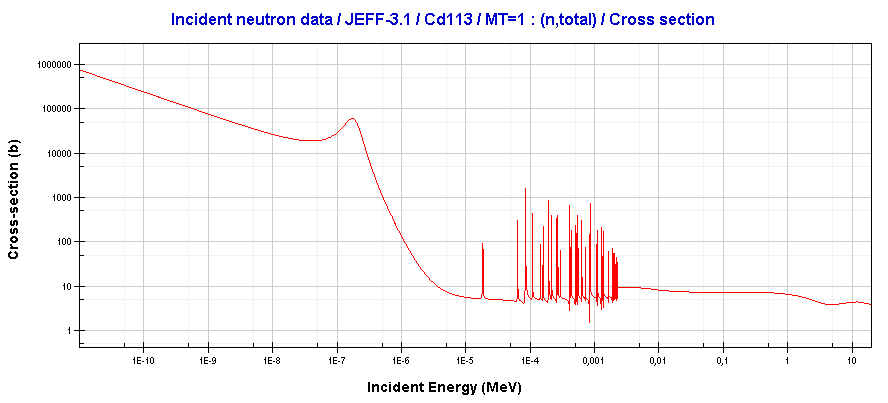
Neutrons of kinetic energy below the cadmium cut-off energy (~0.5 eV) are strongly absorbed by 113-Cd. Source: JANIS (Java-based nuclear information software) www.oecd-nea.org/janis/
Cadmium Neutrons (0.4 eV; 0.5 eV). Neutrons of kinetic energy below the cadmium cut-off energy. One cadmium isotope, 113Cd, absorbs neutrons strongly only if they are below ~0.5 eV (cadmium cut-off energy).
Epicadmium Neutrons (0.5 eV; 1 eV). Neutrons of kinetic energy above the cadmium cut-off energy. These neutrons are not absorbed by cadmium.
Slow Neutrons (1 eV; 10 eV).
Resonance Neutrons (10 eV; 300 eV). The resonance neutrons are called resonance for their special bahavior. At resonance energies the cross-sections can reach peaks more than 100x higher as the base value of cross-section. At this energies the neutron capture significantly exceeds a probability of fission. Therefore it is very important (for thermal reactors) to quickly overcome this range of energy and operate the reactor with thermal neutrons resulting in increase of probability of fission.
Intermediate Neutrons (300 eV; 1 MeV).
Fast Neutrons (1 MeV; 20 MeV). Neutrons of kinetic energy greater than 1 MeV (~15 000 km/s) are usually named fission neutrons. These neutrons are produced by nuclear processes such as nuclear fission or (ɑ,n) reactions. The fission neutrons have a Maxwell-Boltzmann distribution of energy with a mean energy (for 235U fission) 2 MeV. Inside a nuclear reactor the fast neutrons are slowed down to the thermal energies via a process called neutron moderation.
Relativistic Neutrons (20 MeV; ->)
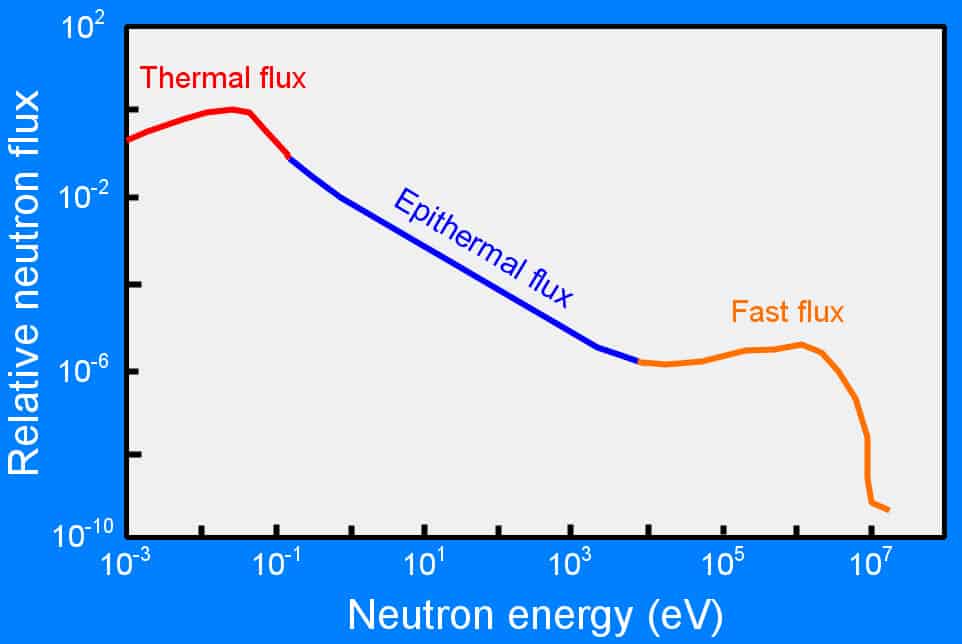
Distribution of kinetic energies of neutrons in the thermal reactor. The fission neutrons (fast flux) are immediately slowed down to the thermal energies via a process called neutron moderation. Source: serc.carleton.edu
The reactor physics does not need this fine division of neutron energies. The neutrons can be roughly (for purposes of reactor physics) divided into three energy ranges:
Thermal neutrons (0.025 eV – 1 eV).
Resonance neutrons (1 eV – 1 keV).
Fast neutrons (1 keV – 10 MeV).
Even most of reactor computing codes use only two neutron energy groups:
Neutrons are neutral particles, therefore they travel in straight lines, deviating from their path only when they actually collide with a nucleus to be scattered into a new direction or absorbed. Neither the electrons surrounding (atomic electron cloud) a nucleus nor the electric field caused by a positively charged nucleus affect a neutron’s flight. In short, neutrons collide with nuclei, not with atoms. A very descriptive feature of the transmission of neutrons through bulk matter is the mean free path length (λ – lambda), which is the mean distance a neutron travels between interactions. It can be calculated from following equation:
λ=1/Σ
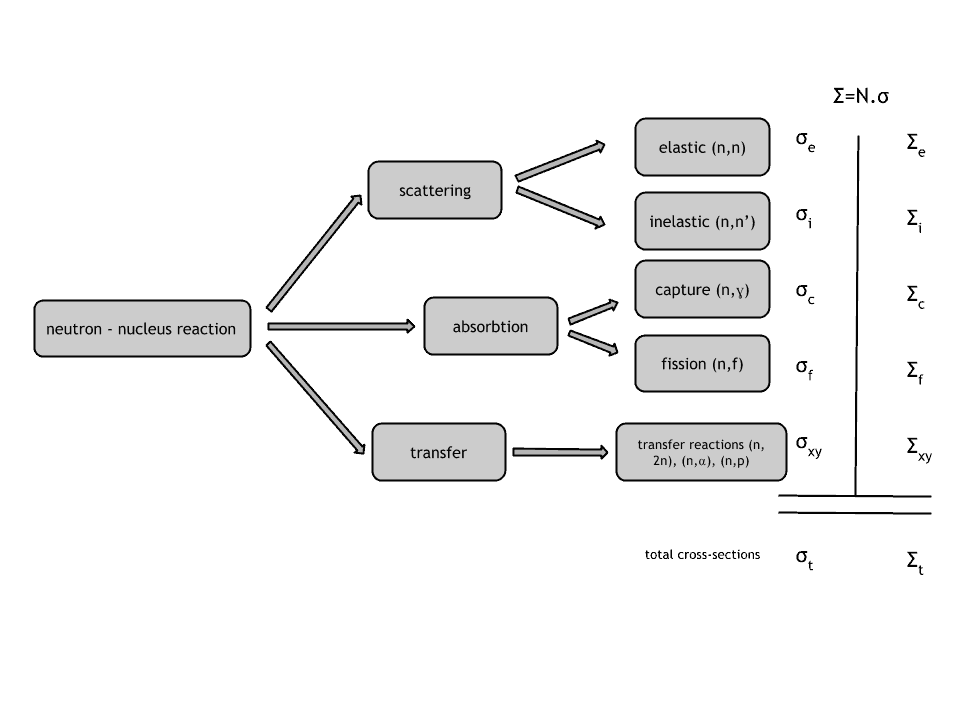
Neutrons may interact with nuclei in one of following ways:
Neutron Cross-section
Typical cross-sections of fission material. Slowing down neutrons results in increase of probability of interaction (e.g. fission reaction).
The extent to which neutrons interact with nuclei is described in terms of quantities known as cross-sections. Cross-sections are used to express the likelihood of particular interaction between an incident neutron and a target nucleus. It must be noted this likelihood do not depend on real target dimensions. In conjunction with the neutron flux, it enables the calculation of the reaction rate, for example to derive the thermal power of a nuclear power plant. The standard unit for measuring the microscopic cross-section (σ-sigma) is the barn, which is equal to 10-28 m2. This unit is very small, therefore barns (abbreviated as “b”) are commonly used. The microscopic cross-section can be interpreted as the effective ‘target area’ that a nucleus interacts with an incident neutron.
A macroscopic cross-section is derived from microscopic and the material density:
Σ=σ.N
Here σ, which has units of m2, is referred to as the microscopic cross-section. Since the units of N (nuclei density) are nuclei/m3, the macroscopic cross-sectionΣ have units of m-1, thus in fact is an incorrect name, because it is not a correct unit of cross-sections.
Neutron cross-sections constitute a key parameters of nuclear fuel. Neutron cross-sections must be calculated for fresh fuel assemblies usually in two-Dimensional models of the fuel lattice.
The neutron cross-section is variable and depends on:
Target nucleus (hydrogen, boron, uranium, etc.) Each isotop has its own set of cross-sections.
Type of the reaction (capture, fission, etc.). Cross-sections are different for each nuclear reaction.
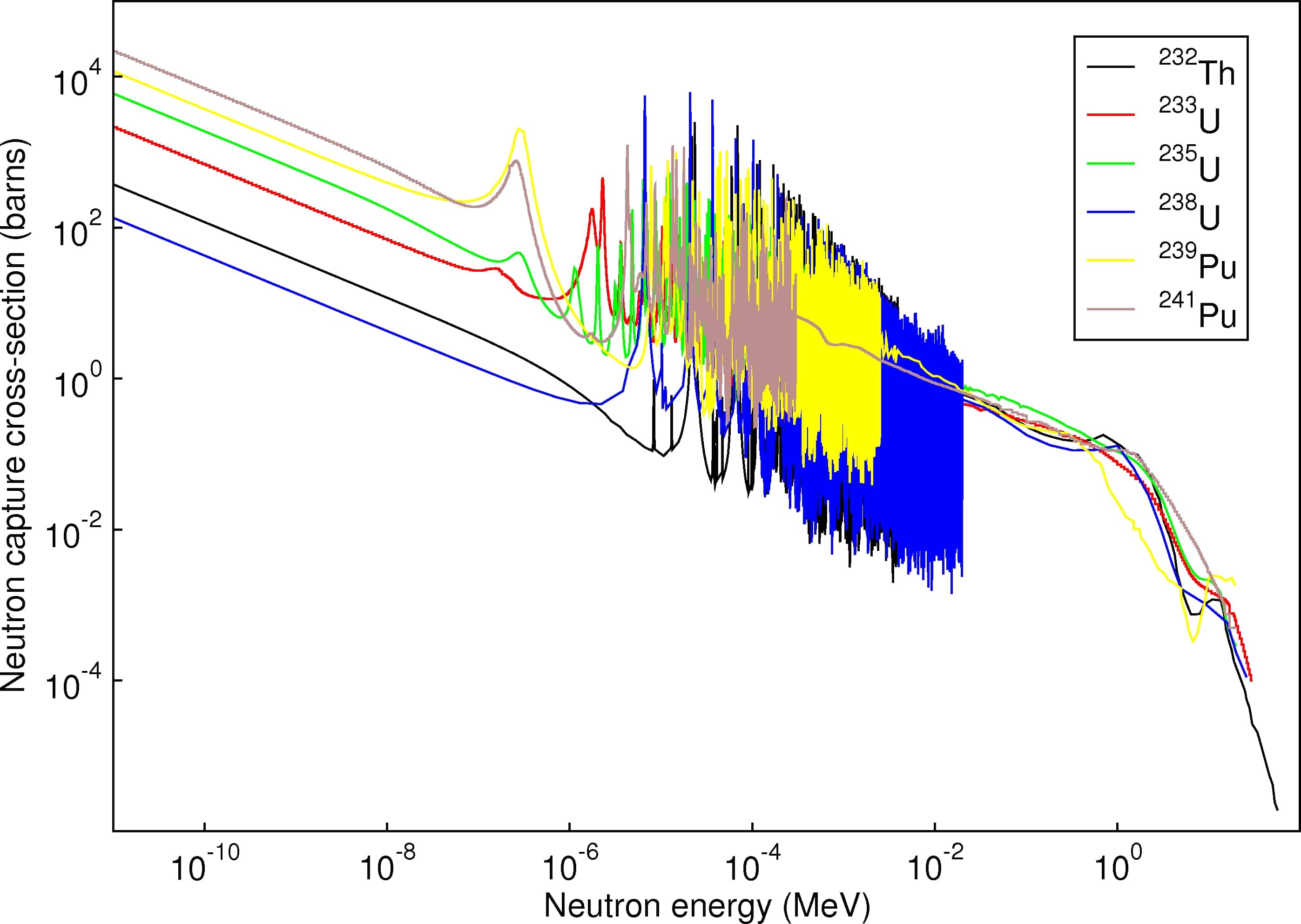
Neutron energy (thermal neutron, resonance neutron, fast neutron). For a given target and reaction type, the cross-section is strongly dependent on the neutron energy. In the common case, the cross section is usually much larger at low energies than at high energies. This is why most nuclear reactors use a neutron moderator to reduce the energy of the neutron and thus increase the probability of fission, essential to produce energy and sustain the chain reaction.
Target energy (temperature of target material – Doppler broadening) This dependency is not so significant, but the target energy strongly influences inherent safety of nuclear reactors due to a Doppler broadening of resonances.
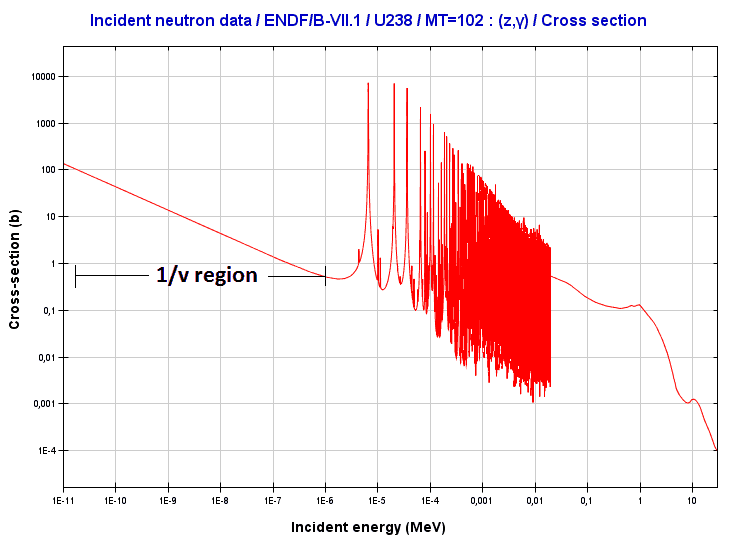
For thermal neutrons (in 1/v region), absorption cross sections increases as the velocity (kinetic energy) of the neutron decreases. Source: JANIS 4.0
For thermal neutrons (in 1/v region), absorption cross-sections increases as the velocity (kinetic energy) of the neutron decreases. Therefore the 1/v Law can be used to determine shift in absorbtion cross-section, if the neutron is in equilibrium with a surrounding medium. This phenomenon is due to the fact the nuclear force between the target nucleus and the neutron has a longer time to interact.
This law is aplicable only for absorbtion cross-section and only in the 1/v region.
Example of cross- sections in 1/v region:
The absorbtion cross-section for 238U at 20°C = 293K (~0.0253 eV) is:
.
The absorbtion cross-section for 238U at 1000°C = 1273K is equal to:
This cross-section reduction is caused only due to the shift of temperature of surrounding medium.
Resonance neutron capture
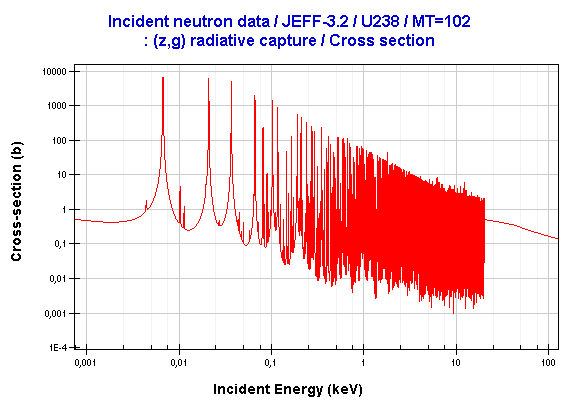
Resonance peaks for radiative capture of U238. At resonance energies the probability of capture can be more than 100x higher as the base value. Source: JANIS program
Absorption cross section is often highly dependent on neutron energy. Note that the nuclear fission produces neutrons with a mean energy of 2 MeV (200 TJ/kg, i.e. 20,000 km/s). The neutron can be roughly divided into three energy ranges:
Fast neutron. (10MeV – 1keV)
Resonance neutron (1keV – 1eV)
Thermal neutron. (1eV – 0.025eV)
The resonance neutrons are called resonance for their special bahavior. At resonance energies the cross-section can reach peaks more than 100x higher as the base value of cross-section. At this energies the neutron capture significantly exceeds a probability of fission. Therefore it is very important (for thermal reactors) to quicklyovercome this range of energy and operate the reactor with thermal neutrons resulting in increase of probability of fission.
Doppler broadening
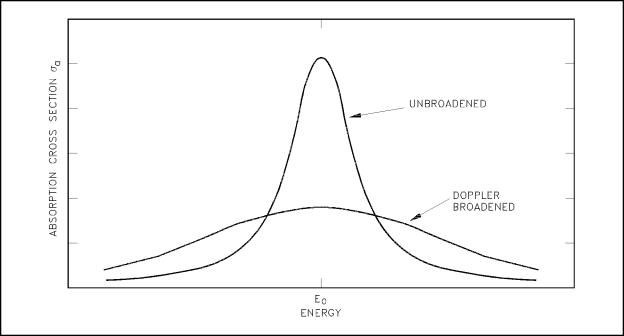
Doppler effect improves reactor stability. Broadened resonance (heating of a fuel) results in a higher probability of absorbtion, thus causes negative reactivity insertion (reduction of reactor power).
A Doppler broadening of resonances is very important phanomenon, which improves reactor stability. The prompt temperature coefficient of most thermal reactors is negative, owing to an nuclear Doppler effect. Although the absorbtion cross-section depends significantly on incident neutron energy, the shape of the cross-section curve depends also on target temperature.
Nuclei are located in atoms which are themselves in continual motion owing to their thermal energy. As a result of these thermal motions neutrons impinging on a target appears to the nuclei in the target to have a continuous spread in energy. This, in turn, has an effect on the observed shape of resonance. The resonance becomes shorter and wider than when the nuclei are at rest.
Although the shape of a resonance changes with temperature, the total area under the resonance remains essentially constant. But this does not implyconstant neutron absorbtion. Despite the constant area under resonance, a resonance integral, which determines the absorbtion, increases with increasing target temperature. This, of course, decreases coefficient k (negative reactivity is inserted).
Typical cross-sections of materials in the reactor
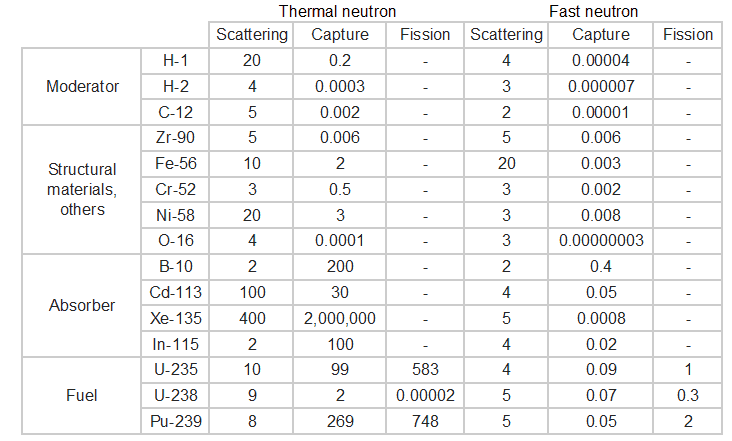
Following table shows neutron cross-sections of the most common isotopes of reactor core.
Table of cross-sections
Types of neutron-nuclear reactions
Elastic Scattering Reaction
Generally, a neutron scattering reaction occurs when a target nucleus emits a single neutron after a neutron-nucleus interaction. In an elastic scattering reaction between a neutron and a target nucleus, there is no energy transferred into nuclear excitation.
Inelastic Scattering Reaction
In an inelastic scattering reaction between a neutron and a target nucleus some energy of the incident neutron is absorbed to the recoiling nucleus and the nucleus remains in the excited state. Thus while momentum is conserved in an inelastic collision, kinetic energy of the “system” is not conserved.
Neutron Absorption
The neutron absorption reaction is the most important type of reactions that take place in a nuclear reactor. The absorption reactions are reactions, where the neutron is completely absorbed and compound nucleus is formed. This is the very important feature, because the mode of decay of such compound nucleus does not depend on the way the compound nucleus was formed. Therefore a variety of emissions or decays may follow. The most important absorption reactions are divided by the exit channel into two following reactions:
Radiative Capture. Most absorption reactions result in the loss of a neutron coupled with the production of one or more gamma rays. This is referred to as a capture reaction, and it is denoted by σγ.
Neutron-induced Fission Reaction. Some nuclei (fissionable nuclei) may undergo a fission event, leading to two or more fission fragments (nuclei of intermediate atomic weight) and a few neutrons. In a fissionable material, the neutron may simply be captured, or it may cause nuclear fission. For fissionable materials we thus divide the absorption cross section as σa = σγ + σf.
Radiative Capture
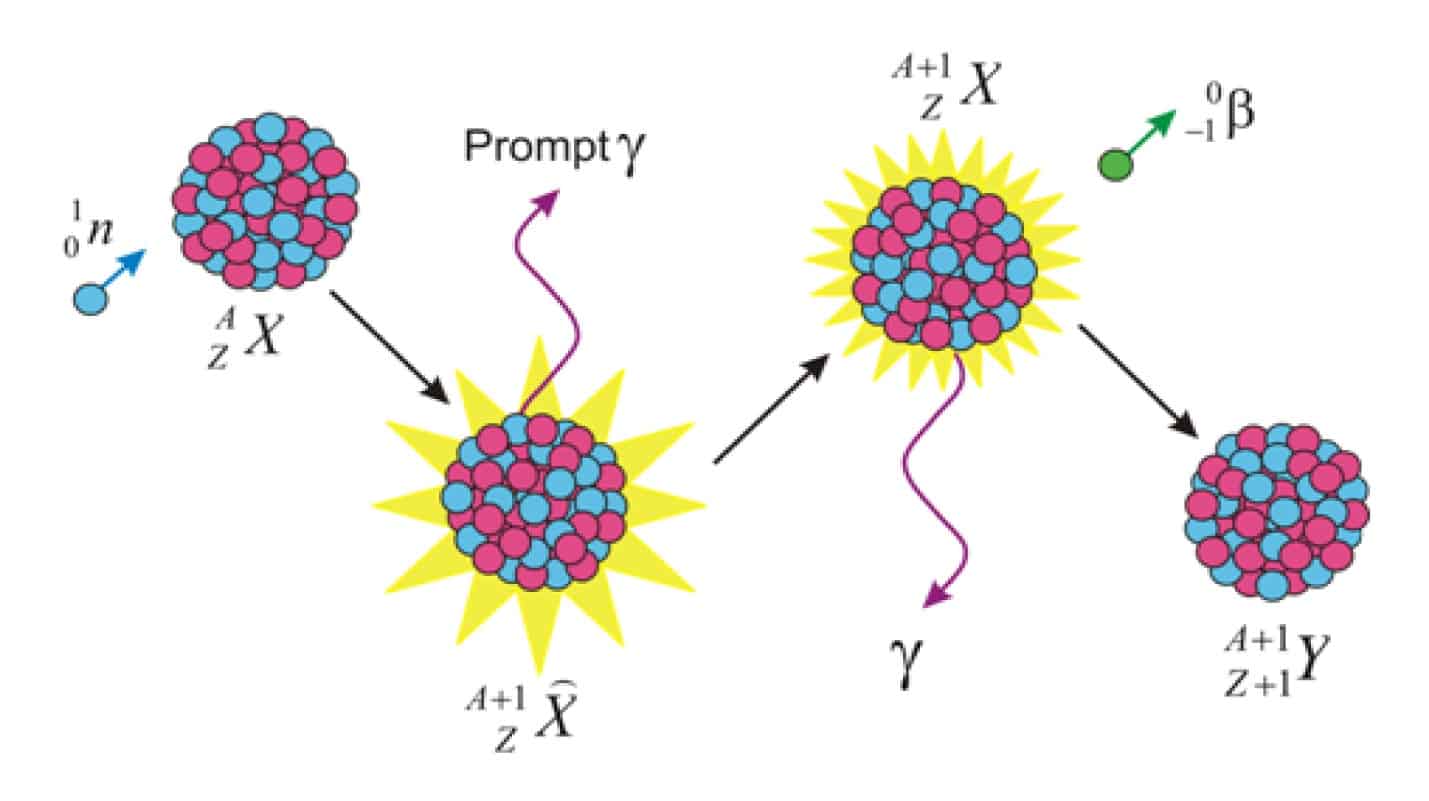
The neutron capture is one of the possible absorption reactions that may occur. In fact, for non-fissionable nuclei it is the only possible absorption reaction. Capture reactions result in the loss of a neutron coupled with the production of one or more gamma rays. This capture reaction is also referred to as a radiative capture or (n, γ) reaction, and its cross-section is denoted by σγ.
The radiative capture is a reaction, in which the incident neutron is completely absorbed and compound nucleus is formed. The compound nucleus then decays to its ground state by gamma emission. This process can occur at all incident neutron energies, but the probability of the interaction strongly depends on the incident neutron energy and also on the target energy (temperature). In fact the energy in the center-of-mass system determines this probability.
Nuclear Fission
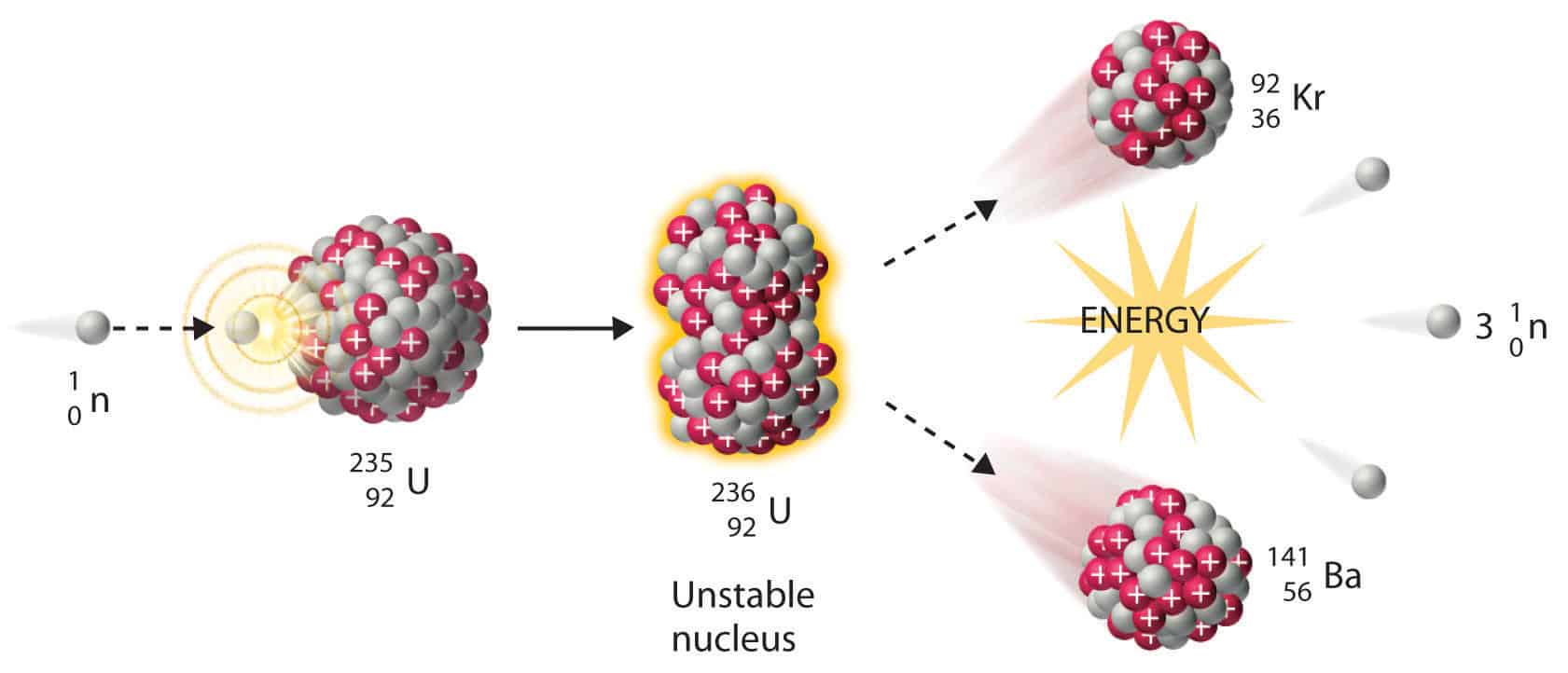
Nuclear fission is a nuclear reaction in which the nucleus of an atom splits into smaller parts (lighter nuclei). The fission process often produces free neutrons and photons (in the form of gamma rays), and releases a large amount of energy. In nuclear physics, nuclear fission is either a nuclear reactionor a radioactive decay process. The case of decay process is called spontaneous fission and it is very rare process.
Neutron Emission
Although the neutron emission is usually associated with nuclear decay, it must be also mentioned in connection with neutron nuclear reactions. Some neutrons interacts with a target nucleus via a compound nucleus. Among these compound nucleus reactions are also reactions, in which a neutron is ejected from nucleus and they may be referred to as neutron emission reactions. The point is that compound nuclei lose its excitation energy in a way, which is identical to the radioactive decay. Very important feature is the fact the mode of decay of compound nucleus does not depend on the way the compound nucleus was formed.
Charged Particle Ejection
Charged particle reactions are usually associated with formation of a compound nucleus, which is excited to a high energy level, that such compound nucleus can eject a new charged particle while the incident neutron remains in the nucleus. After the new particle is ejected, the remaining nucleus is completely changed, but may or may not exist in an excited state depending upon the mass-energy balance of the reaction. This type of reaction is more common for charged particles as incident particles (such as alpha particles, protons, and so on).
The case of neutron-induced charged particle reactions is not so common, but there are some neutron-induced charged particle reactions, that are of importance in the reactivity control and also in the detection of neutrons.
Detection of Neutrons
Since the neutrons are electrically neutral particles, they are mainly subject to strong nuclear forces but not to electric forces. Therefore neutrons are not directly ionizing and they have usually to be converted into charged particles before they can be detected. Generally every type of neutron detector must be equipped with converter (to convert neutron radiation to common detectable radiation) and one of the conventional radiation detectors (scintillation detector, gaseous detector, semiconductor detector, etc.).
Neutron converters
Two basic types of neutron interactions with matter are for this purpose available:
Elastic scattering. The free neutron can be scattered by a nucleus, transferring some of its kinetic energy to the nucleus. If the neutron has enough energy to scatter off nuclei the recoiling nucleus ionizes the material surrounding the converter. In fact, only hydrogen and helium nuclei are light enough for practical application. Charge produced in this way can be collected by the conventional detector to produce a detected signal. Neutrons can transfer more energy to light nuclei. This method is appropriate for detecting fast neutrons (fast neutrons do not have high cross-section for absorption) allowing detection of fast neutrons without a moderator.
Neutron absorption. This is a common method allowing detection of neutrons of entire energy spectrum. This method is is based on variety of absorption reactions (radiative capture, nuclear fission, rearrangement reactions, etc.). The neutron is here absorbed by target material (converter) emitting secondary particles such as protons, alpha particles, beta particles, photons (gamma rays) or fission fragments. Some reactions are threshold reactions (requiring a minimum energy of neutrons), but most of reactions occurs at epithermal and thermal energies. That means the moderation of fast neutrons is required leading in poor energy information of the neutrons. Most common nuclei for the neutron converter material are:
10B(n,α). Where the neutron capture cross-section for thermal neutrons is σ = 3820 barns and the natural boron has abundance of 10B 19,8%.
3He(n,p). Where the neutron capture cross-section for thermal neutrons is σ = 5350 barns and the natural helium has abundance of 3He 0.014%.
6Li(n,α). Where the neutron capture cross-section for thermal neutrons is σ = 925 barns and the natural lithium has abundance of 6Li 7,4%.
113Cd(n,ɣ). Where the neutron capture cross-section for thermal neutrons is σ = 20820 barns and the natural cadmium has abundance of 113Cd 12,2%.
235U(n,fission). Where the fission cross-section for thermal neutrons is σ = 585 barns and the natural uranium has abundance of 235U 0.711%. Uranium as a converter produces fission fragments which are heavy charged particles. This have significant advantage. The heavy charged particles (fission fragments) create a high output signal, because the fragments deposit a large amount of energy in a detector sensitive volume. This allows an easy discrimination of the background radiation (e.i. gamma radiation). This important feature can be used for example in a nuclear reactor power measurement, where the neutron field is accompanied by a significant gamma background.
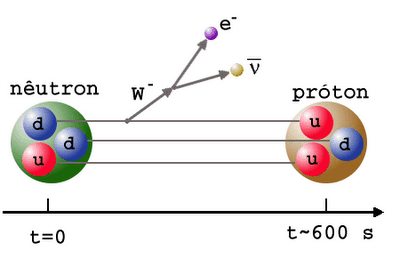
The free neutron decays into a proton, an electron, and an antineutrino with a half-life of about 611 seconds (10.3 minutes). Source: scienceblogs.com
A free neutron is a neutron that is not bounded in a nucleus. The free neutron is, unlike a bounded neutron, subject to radioactive beta decay.
It decays into a proton, an electron, and an antineutrino (the antimatter counterpart of the neutrino, a particle with no charge and little or no mass). A free neutron will decay with a half-life of about 611 seconds (10.3 minutes). This decay involves the weak interaction and is associated with a quark transformation (a down quark is converted to an up quark). The decay of the neutron is a good example of the observations which led to the discovery of the neutrino. Because it decays in this manner, the neutron does not exist in nature in its free state, except among other highly energetic particles in cosmic rays. Since free neutrons are electrically neutral, they pass through the electrical fields within atoms without any interaction and they are interacting with matter almost exclusively through relatively rare collisions with atomic nuclei.
In radiation protection there are three ways how to protect people from identified radiation sources:
Limiting Time. The amount of radiation exposure depends directly (linearly) on the time people spend near the source of radiation. The dose can be reduced by limiting exposure time.
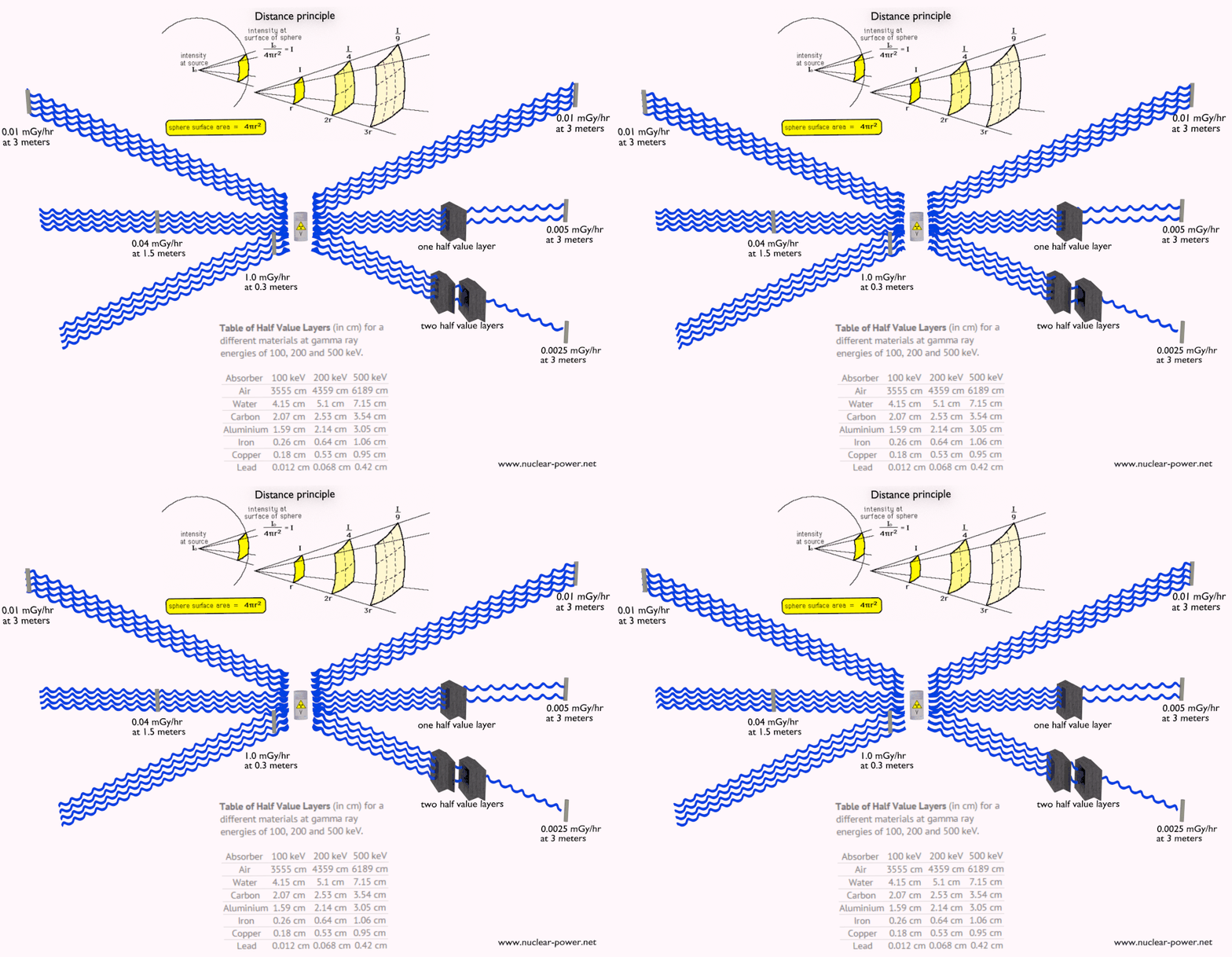
Distance. The amount of radiation exposure depends on the distance from the source of radiation. Similarly to a heat from a fire, if you are too close, the intensity of heat radiation is high and you can get burned. If you are at the right distance, you can withstand there without any problems and moreover it is comfortable. If you are too far from heat source, the insufficiency of heat can also hurt you. This analogy, in a certain sense, can be applied to radiation also from nuclear sources.
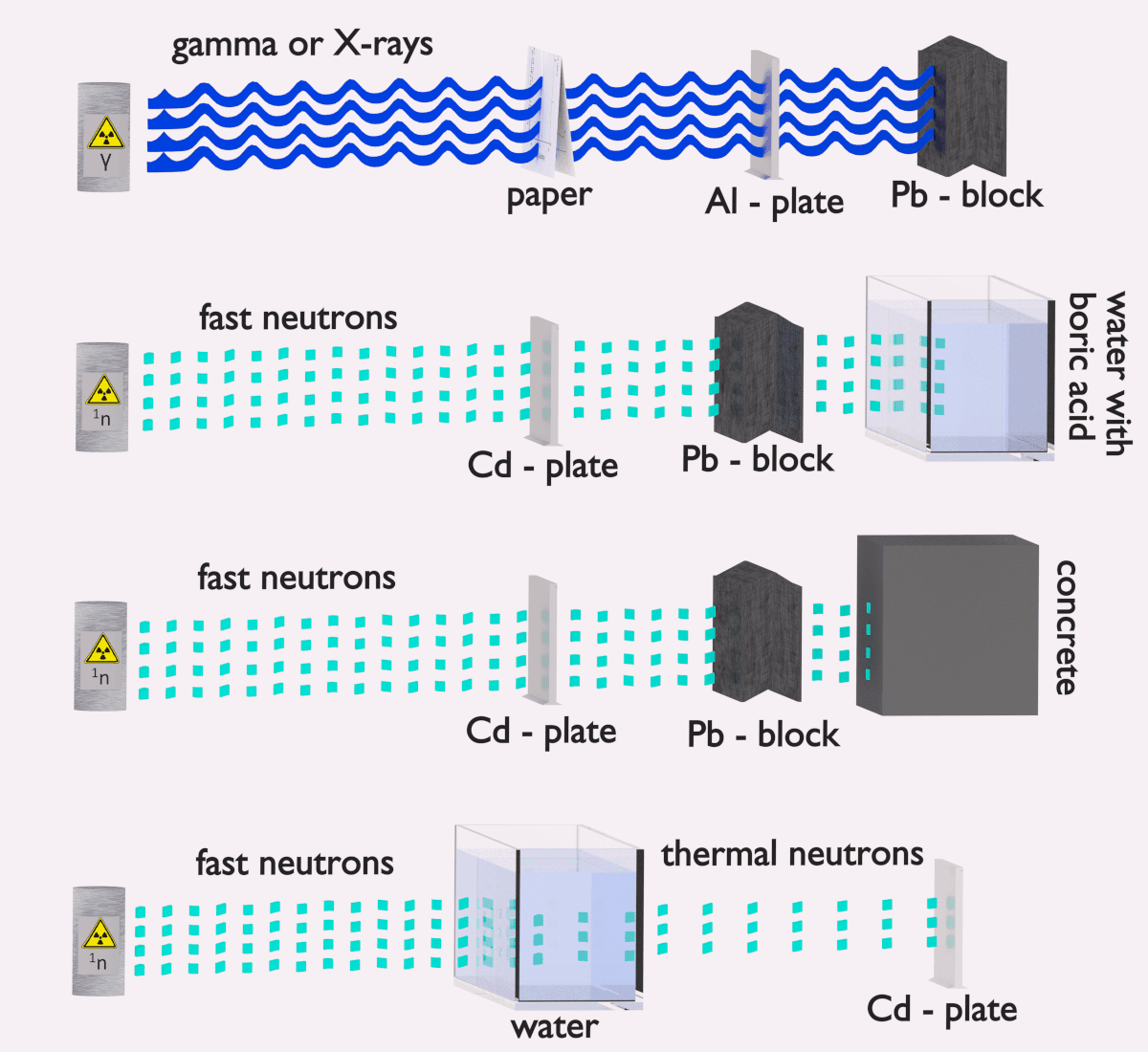
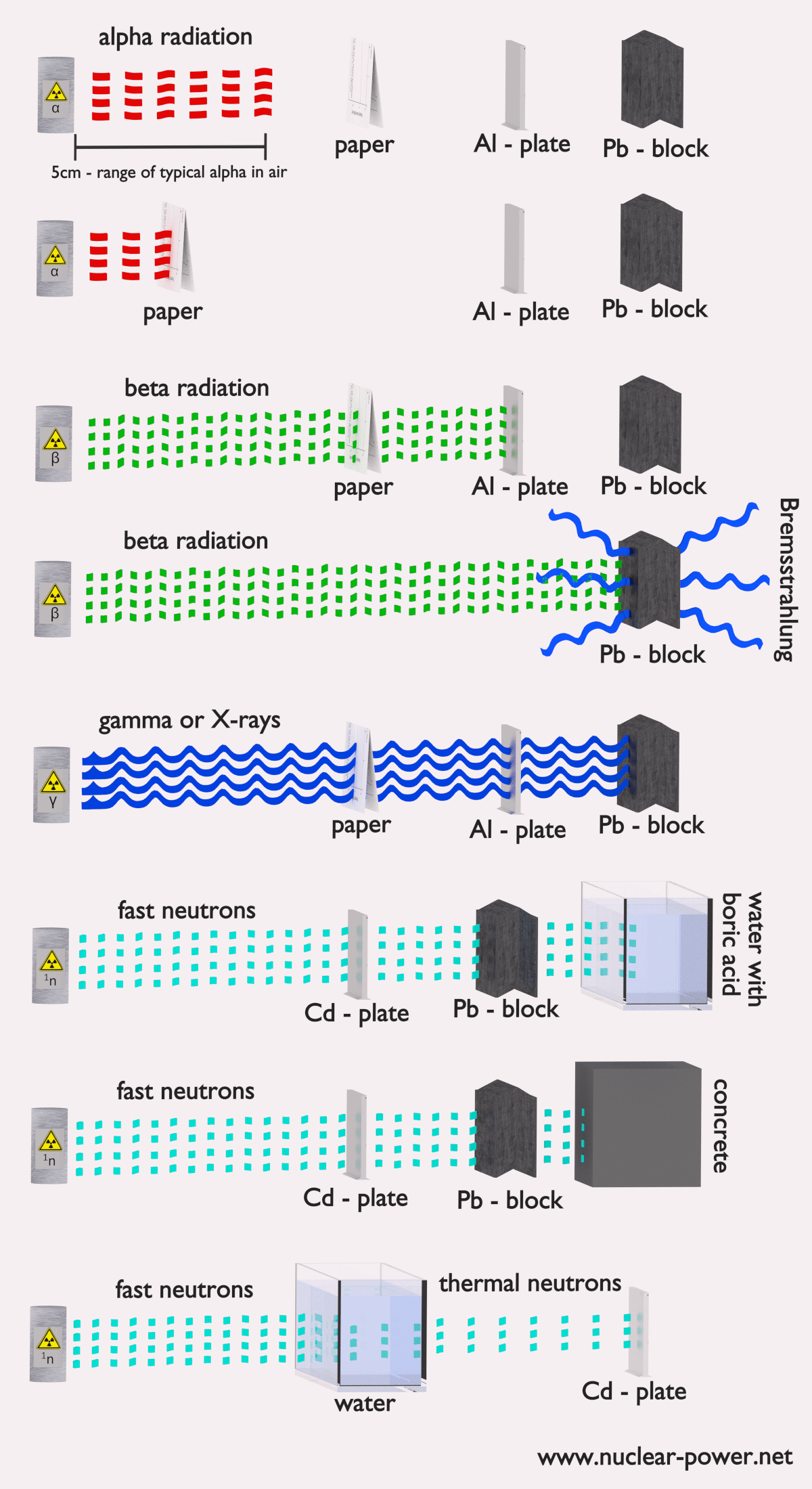
Shielding. Finally, if the source is too intensive and time or distance do not provide sufficient radiation protection the shielding must be used. Radiation shielding usually consist of barriers of lead, concrete or water. Even depleted uranium can be used as a good protection from gamma radiation, but on the other hand uranium is absolutely inappropriate shielding of neutron radiation. In short, it depends on type of radiation to be shielded, which shielding will be effective or not.
Shielding of Neutrons
Water as a neutron shield
There are three main features of neutrons, which are crucial in the shielding of neutrons.
Neutrons have no net electric charge, therefore they cannot be affected or stopped by electric forces. Neutrons ionize matter only indirectly, which makes neutrons highly penetrating type of radiation.
Neutrons scatter with heavy nuclei very elastically. Heavy nuclei very hard slow down a neutron let alone absorb a fast neutron.
An absorption of neutron (one would say shielding) causes initiation of certain nuclear reaction (e.g. radiative capture or even fission), which is accompanied by a number of other types of radiation. In short, neutrons make matter radioactive, therefore with neutrons we have to shield also the other types of radiation.
The best materials for shielding neutrons must be able to:
Slow down neutrons (the same principle as the neutron moderation). First point can be fulfilled only by material containing light atoms (e.g. hydrogen atoms), such as water, polyethylene, and concrete. The nucleus of a hydrogen nucleus contains only a proton. Since a proton and a neutron have almost identical masses, a neutron scattering on a hydrogen nucleus can give up a great amount of its energy (even entire kinetic energy of a neutron can be transferred to a proton after one collision). This is similar to a billiard. Since a cue ball and another billiard ball have identical masses, the cue ball hitting another ball can be made to stop and the other ball will start moving with the same velocity. On the other hand, if a ping pong ball is thrown against a bowling ball (neutron vs. heavy nucleus), the ping pong ball will bounce off with very little change in velocity, only a change in direction. Therefore lead is quite ineffective for blocking neutron radiation, as neutrons are uncharged and can simply pass through dense materials.
Table of cross-sections
Absorb this slow neutron.Thermal neutrons can be easily absorbed by capture in materials with high neutron capture cross sections (thousands of barns) like boron, lithium or cadmium. Generally, only a thin layer of such absorbator is sufficient to shield thermal neutrons. Hydrogen (in the form of water), which can be used to slow down neutrons, have absorbtion cross-section 0.3 barns. This is not enough, but this insufficiency can be offset by sufficient thickness of water shield.
Shield the accompanying radiation. In the case of cadmium shield the absorption of neutrons is accompanied by strong emission of gamma rays. Therefore additional shield is necessary to attenuate the gamma rays. This phenomenon practically does not exist for lithium and is much less important for boron as a neutron absorption material. For this reason, materials containing boron are used often in neutron shields. In addition, boron (in the form of boric acid) is well soluble in water making this combination very efective neutron shield.
Water as a neutron shield
Water due to the high hydrogen content and the availability is efective and common neutron shielding. However, due to the low atomic number of hydrogen and oxygen, water is not acceptable shield against the gamma rays. On the other hand in some cases this disadvantage (low density) can be compensated by high thickness of the water shield. In case of neutrons, water perfectly moderates neutrons, but with absorption of neutrons by hydrogen nucleus secondary gamma rays with the high energy are produced. These gamma rays highly penetrates matter and therefore it can increase requirements on the thickness of the water shield. Adding a boric acid can help with this problem (neutron absorbtion on boron nuclei without strong gamma emission), but results in another problems with corrosion of construction materials.
Concrete as a neutron shield
Most commonly used neutron shielding in many sectors of the nuclear science and engineering is shield of concrete. Concrete is also hydrogen-containing material, but unlike water concrete have higher density (suitable for secondary gamma shielding) and does not need any maintenance. Because concrete is a mixture of several different materials its composition is not constant. So when referring to concrete as a neutron shielding material, the material used in its composition should be told correctly. Generally concrete are divided to “ordinary “ concrete and “heavy” concrete. Heavy concrete uses heavy natural aggregates such as barites (barium sulfate) or magnetite or manufactured aggregates such as iron, steel balls, steel punch or other additives. As a result of these additives, heavy concrete have higher density than ordinary concrete (~2300 kg/m3). Very heavy concrete can achieve density up to 5,900 kg/m3 with iron additives or up to 8900 kg/m3 with lead additives. Heavy concrete provide very effective protection against neutrons.
A neutron source is any device that emits neutrons. Neutron sources have many applications, they can be used in research, engineering, medicine, petroleum exploration, biology, chemistry and nuclear power. A neutron source is characterized by a number of factors:
Significance of the source
Intensity. The rate of neutrons emitted by the source.
Energy distribution of emitted neutrons.
Angular distribution of emitted neutrons.
Mode of emission. Continuous or pulsed operation.
Classification by significance of the source
Large (Significant) neutron sources
Nuclear Reactors. There are nuclei that can undergo fission on their own spontaneously, but only certain nuclei, like uranium-235, uranium-233 and plutonium-239, can sustain a fission chain reaction. This is because these nuclei release neutrons when they break apart, and these neutrons can induce fission of other nuclei. Uranium-235 which exists as 0.7% of naturally occurring uranium undergoes nuclear fission with thermal neutrons with the production of, on average, 2.4 fast neutrons and the release of ~ 180 MeV of energy per fission. Free neutrons released by each fission play very important role as a trigger of the reaction, but they can be also used fo another purpose. For example: One neutron is required to trigger a further fission. Part of free neutrons (let say 0.5 neutrons/fission) is absorbed in other material, but an excess of neutrons (0.9 neutrons/fission) is able to leave the surface of the reactor core and can be used as a neutron source.
Fusion Systems. Nuclear fusion is a nuclear reaction in which two or more atomic nuclei (e.g. D+T) collide at a very high energy and fuse together. Thy byproduct of DT fusion is a free neutron (see picture), therefore also nuclear fusion reaction has the potential to produces large quantities of neutrons.
Spallation Sources. A spallation source is a high-flux neutron source in which protons that have been accelerated to high energies hit a heavy target material, causing the emission of neutrons. The reaction occurs above a certain energy threshold for the incident particle, which is typically 5 – 15 MeV.
Medium neutron sources
Bremssstrahlung from Electron Accelerators / Photofission. Energetic electrons when slowed down rapidly in a heavy target emit intense gamma radiation during the deceleration process. This is known as Bremsstrahlung or braking radiation. The interaction of the gamma radiation with the target produces neutrons via the (γ,n) reaction, or the (γ,fission) reaction when a fissile target is used. e-→Pb → γ→ Pb →(γ,n) and (γ,fission). The Bremsstrahlung γ energy exceeds the binding energy of the “last” neutron in the target. A source strength of 1013 neutrons/second produced in short (i.e. < 5 μs) pulses can be readily realised.
Dense plasme focus. The dense plasma focus (DPF) is a device that is known as an efficient source of neutrons from fusion reactions. Mechanism of dense plasma focus (DPF) is based on nuclear fusion of short-lived plasma of deuterium and/or tritium. This device produces a short-lived plasma by electromagnetic compression and acceleration that is called a pinch. This plasma is during the pinch hot and dense enough to cause nuclear fusion and the emission of neutrons.
Light ion accelerators. Neutrons can be also produced by particle accelerators using targets of deuterium, tritium, lithium, beryllium, and other low-Z materials. In this case the target must be bombarded with accelerated hydrogen (H), deuterium (D), or tritium (T) nuclei.
Small neutron sources
Neutron Generators. Neutrons are produced in the fusion of deuterium and tritium in the following exothermic reaction. 2D + 3T → 4He + n + 17.6 MeV. The neutron is produced with a kinetic energy of 14.1 MeV. This can be achieved on a small scale in the laboratory with a modest 100 kV accelerator for deuterium atoms bombarding a tritium target. Continuous neutron sources of ~1011 neutrons/second can be achieved relatively simply.
Radioisotope source – (α,n) reactions. In certain light isotopes the ‘last’ neutron in the nucleus is weakly bound and is released when the compound nucleus formed following α-particle bombardment decays. The bombardment of beryllium by α-particles leads to the production of neutrons by the following exothermic reaction: 4He + 9Be→12C + n + 5.7 MeV. This reaction yields a weak source of neutrons with an energy spectrum resembling that from a fission source and is used nowadays in portable neutron sources. Radium, plutonium or americium can be used as an α-emitter.
Radioisotope source – (γ,n) reactions. (γ,n) reactions can also be used for the same purpose. In this type of source, because of the greater range of the γ-ray, the two physical components of the source can be separated making it possible to ‘switch off’ the reaction if so required by removing the radioactive source from the beryllium. (γ,n) sources produce a monoenergetic neutrons unlike (α,n) sources. The (γ,n) source uses antimony-124 as the gamma emitter in the following endothermic reaction.
124Sb→124Te + β− + γ
γ + 9Be→8Be + n – 1.66 MeV
Radioisotope source – spontaneous fission. Certain isotopes undergo spontaneous fission with emission of neutrons. The most commonly used spontaneous fission source is the radioactive isotope californium-252. Cf-252 and all other spontaneous fission neutron sources are produced by irradiating uranium or another transuranic element in a nuclear reactor, where neutrons are absorbed in the starting material and its subsequent reaction products, transmuting the starting material into the SF isotope.
Since their discovery in 1932 neutrons play an important role in many fields of modern science. The discovery of the neutron immediately gave scientists a new tool for probing the properties of atomic nuclei. In particular, discovery of neutrons and their properties has been important in the development of nuclear reactors and nuclear weapons. Main branches where the neutrons play key role are summarized below:
Nuclear Reactors
Nuclear fission is a nuclear reaction in which the nucleus of an atom splits into smaller parts (lighter nuclei). Source: chemwiki.ucdavis.edu
A nuclear reactor is a key device of nuclear power plants, nuclear research facilities or nuclear propelled ships. Main purpose of the nuclear reactor is to initiate and control a sustained nuclear chain reaction. The nuclear chain reaction is initiated, sustained and controlled just via the free neutrons. The term chain means that one single nuclear reaction (neutron induced fission) causes an average of one or more subsequent nuclear reactions, thus leading to the possibility of a self-propagating series of these reactions. The “one or more” is the key parameter of reactor physics. To raise or lower the power, the amount of reactions, respectively the amount of the free neutrons in the nuclear core must be changed (using the control rods).
Neutron diffraction
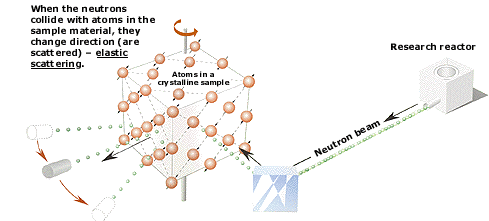
Simple scheme of neutron diffraction experiment. Source: www.psi.ch
Neutron diffraction experiments use an elastic neutron scattering to determine the atomic (or magnetic) structure of a material. The neutron diffraction is based the fact that thermal or cold neutrons have the wavelengths similar to atomic spacings. An examined sample (crystalline solids, gasses, liquids or amorphous materials) must be placed in a neutron beam of thermal (0.025 eV) or cold (neutrons in thermal equilibrium with very cold surroundings such as liquid deuterium) neutrons to obtain a diffraction pattern that provides information about the structure of the examined material. The neutron diffraction experiments are similar to X-ray diffraction experiments, but neutrons interact with matter differently. Photons (X-rays) interact primarily with the electrons surrounding (atomic electron cloud) a nucleus, but neutrons interact only with nuclei. Neither the electrons surrounding (atomic electron cloud) a nucleus nor the electric field caused by a positively charged nucleus affect a neutron’s flight. Due to their different properties, both methods together (neutron diffraction and X-ray diffraction) can provide complementary information about the structure of the material.
Applications in Medicine
Medical applications of neutrons began soon after the discovery of this particle in 1932. Neutrons are highly penetrating matter and ionizing, so they can be used in medical therapies such as radiation therapy or boron capture therapy. Unfortunately neutrons, when they are absorbed in matter, active the matter and leave the matter (target area) radioactive.
Neutron activation analysis
An analyzed sample is first irradiated with neutrons to produce specific radionuclides. The radioactive decay of these produced radionuclides is specific for each element (nuclide). Source: www.naa-online.net
Neutron activation analysis is a method for determining the composition of examined material. This method was discovered in 1936 and stands at the forefront of methods used for quantitative material analysis of major, minor, trace, and rare elements. This method is based on neutron activation, where an analyzed sample is first irradiated with neutrons to produce specific radionuclides. The radioactive decay of these produced radionuclides is specific for each element (nuclide). Each nuclide emits the characterictic gamma rays which are measured using gamma spectroscopy, where gamma rays detected at a particular energy are indicative of a specific radionuclide and determine concentrations of the elements. Main advantage of this method is that neutrons does not destroy the sample. This method can be also used for determine an enrichment of nuclear material.
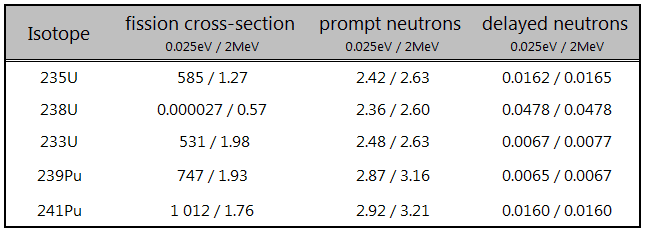
It is known the fission neutrons are of importance in any chain-reacting system. Neutrons trigger the nuclear fission of some nuclei (235U, 238U or even 232Th). What is crucial the fission of such nuclei produces 2, 3 or morefree neutrons.
But not all neutrons are released at the same time following fission. Even the nature of creation of these neutrons is different. From this point of view we usually divide the fission neutrons into two following groups:
Prompt Neutrons. Prompt neutrons are emitted directly from fission and they are emitted within very short time of about 10-14 second.
Delayed Neutrons. Delayed neutrons are emitted by neutron rich fission fragments that are called the delayed neutron precursors. These precursors usually undergo beta decay but a small fraction of them are excited enough to undergo neutron emission. The fact the neutron is produced via this type of decay and this happens orders of magnitude later compared to the emission of the prompt neutrons, plays an extremely important role in the control of the reactor.
A chemical element is a species of atom having the same number of protons in their atomic nuclei (that is, the same atomic number, or Z). For example, the atomic number of carbon is 6, so the element carbon consists of all atoms which have exactly 6 protons. Material Properties
A chemical element is a species of atom having the same number of protons in their atomic nuclei (that is, the same atomic number, or Z). For example, the atomic number of carbon is 6, so the element carbon consists of all atoms which have exactly 6 protons.
The chemical properties of the atom are determined by the number of protons, in fact, by number and arrangement of electrons. The configuration of these electrons follows from the principles of quantum mechanics. The number of electrons in each element’s electron shells, particularly the outermost valence shell, is the primary factor in determining its chemical bonding behavior. In the periodic table, the elements are listed in order of increasing atomic number Z.
Periodic Table
The periodic table is a tabular arrangement of the chemical elements. It is organized in order of increasing atomic number. There is a recurring pattern called the “periodic law” in their properties, in which elements in the same column (group) have similar properties. Generally, within one row (period) the elements are metals to the left, and non-metals to the right, with the elements having similar chemical behaviours placed in the same column.
Chemical Properties of Elements
Every solid, liquid, gas, and plasma is composed of neutral or ionized atoms. The chemical properties of the atom are determined by the number of protons, in fact, by number and arrangement of electrons. The configuration of these electrons follows from the principles of quantum mechanics. The number of electrons in each element’s electron shells, particularly the outermost valence shell, is the primary factor in determining its chemical bonding behavior. In the periodic table, the elements are listed in order of increasing atomic number Z.
The total number of protons in the nucleus of an atom is called the atomic number (or the proton number) of the atom and is given the symbol Z. The number of electrons in an electrically-neutral atom is the same as the number of protons in the nucleus. The total electrical charge of the nucleus is therefore +Ze, where e (elementary charge) equals to 1,602 x 10-19coulombs. Each electron is influenced by the electric fields produced by the positive nuclear charge and the other (Z – 1) negative electrons in the atom.
It is the Pauli exclusion principle that requires the electrons in an atom to occupy different energy levels instead of them all condensing in the ground state. The ordering of the electrons in the ground state of multielectron atoms, starts with the lowest energy state (ground state) and moves progressively from there up the energy scale until each of the atom’s electrons has been assigned a unique set of quantum numbers. This fact has key implications for the building up of the periodic table of elements.
Electron Affinity
In chemistry and atomic physics, the electron affinity of an atom or molecule is defined as:
the change in energy (in kJ/mole) of a neutral atom or molecule (in the gaseous phase) when an electron is added to the atom to form a negative ion.
X + e– → X– + energy Affinity = – ∆H
In other words, it can be expressed as the neutral atom’s likelihood of gaining an electron. Note that, ionization energies measure the tendency of a neutral atom to resist the loss of electrons. Electron affinities are more difficult to measure than ionization energies.
A fluorine atom in the gas phase, for example, gives off energy when it gains an electron to form a fluoride ion.
F + e– → F– – ∆H = Affinity = 328 kJ/mol
To use electron affinities properly, it is essential to keep track of sign. When an electron is added to a neutral atom, energy is released. This affinity is known as the first electron affinity and these energies are negative. By convention, the negative sign shows a release of energy. However, more energy is required to add an electron to a negative ion which overwhelms any the release of energy from the electron attachment process. This affinity is known as the second electron affinity and these energies are positive.
Affinities of Non metals vs. Affinities of Metals
Metals: Metals like to lose valence electrons to form cations to have a fully stable shell. The electron affinity of metals is lower than that of nonmetals. Mercury most weakly attracts an extra electron.
Nonmetals: Generally, nonmetals have more positive electron affinity than metals. Nonmetals like to gain electrons to form anions to have a fully stable electron shell. Chlorine most strongly attracts extra electrons. The electron affinities of the noble gases have not been conclusively measured, so they may or may not have slightly negative values.
Electronegativity
Electronegativity, symbol χ, is a chemical property that describes the tendency of an atom to attract electrons towards this atom. For this purposes, a dimensionless quantity the Pauling scale, symbol χ, is the most commonly used.
The electronegativity of fluorine is:
χ = 4.0
In general, an atom’s electronegativity is affected by both its atomic number and the distance at which its valence electrons reside from the charged nucleus. The higher the associated electronegativity number, the more an element or compound attracts electrons towards it.
The most electronegative atom, fluorine, is assigned a value of 4.0, and values range down to cesium and francium which are the least electronegative at 0.7.
Ionization Energy
Ionization energy, also called ionization potential, is the energy necessary to remove an electron from the neutral atom.
X + energy → X+ + e−
where X is any atom or molecule capable of being ionized, X+ is that atom or molecule with an electron removed (positive ion), and e− is the removed electron.
A nitrogen atom, for example, requires the following ionization energy to remove the outermost electron.
N + IE → N+ + e− IE = 14.5 eV
The ionization energy associated with removal of the first electron is most commonly used. The nth ionization energy refers to the amount of energy required to remove an electron from the species with a charge of (n-1).
1st ionization energy
X → X+ + e−
2nd ionization energy
X+ → X2+ + e−
3rd ionization energy
X2+ → X3+ + e−
Ionization Energy for different Elements
There is an ionization energy for each successive electron removed. The electrons that circle the nucleus move in fairly well-defined orbits. Some of these electrons are more tightly bound in the atom than others. For example, only 7.38 eV is required to remove the outermost electron from a lead atom, while 88,000 eV is required to remove the innermost electron. Helps to understand reactivity of elements (especially metals, which lose electrons).
In general, the ionization energy increases moving up a group and moving left to right across a period. Moreover:
Ionization energy is lowest for the alkali metals which have a single electron outside a closed shell.
Ionization energy increases across a row on the periodic maximum for the noble gases which have closed shells
For example, sodium requires only 496 kJ/mol or 5.14 eV/atom to ionize it. On the other hand neon, the noble gas, immediately preceding it in the periodic table, requires 2081 kJ/mol or 21.56 eV/atom.
Source: wikipedia.org License: CC BY-SA 3.0
References:
References:
Nuclear and Reactor Physics:
J. R. Lamarsh, Introduction to Nuclear Reactor Theory, 2nd ed., Addison-Wesley, Reading, MA (1983).
J. R. Lamarsh, A. J. Baratta, Introduction to Nuclear Engineering, 3d ed., Prentice-Hall, 2001, ISBN: 0-201-82498-1.
W. M. Stacey, Nuclear Reactor Physics, John Wiley & Sons, 2001, ISBN: 0- 471-39127-1.
Robert Reed Burn, Introduction to Nuclear Reactor Operation, 1988.
U.S. Department of Energy, Nuclear Physics and Reactor Theory. DOE Fundamentals Handbook, Volume 1 and 2. January 1993.
Paul Reuss, Neutron Physics. EDP Sciences, 2008. ISBN: 978-2759800414.
Advanced Reactor Physics:
K. O. Ott, W. A. Bezella, Introductory Nuclear Reactor Statics, American Nuclear Society, Revised edition (1989), 1989, ISBN: 0-894-48033-2.
K. O. Ott, R. J. Neuhold, Introductory Nuclear Reactor Dynamics, American Nuclear Society, 1985, ISBN: 0-894-48029-4.
D. L. Hetrick, Dynamics of Nuclear Reactors, American Nuclear Society, 1993, ISBN: 0-894-48453-2.
E. E. Lewis, W. F. Miller, Computational Methods of Neutron Transport, American Nuclear Society, 1993, ISBN: 0-894-48452-4.
See also:
Atom
We hope, this article, Chemical Elements, helps you. If so, give us a like in the sidebar. Main purpose of this website is to help the public to learn some interesting and important information about materials and their properties.
The danger of ionizing radiation lies in the fact that the radiation is invisible and not directly detectable by human senses. People can neither see nor feel radiation, yet it deposits energy to the molecules of material. Material Properties
Executive Summary
Radiation is all around us. We are continually exposed to natural background radiation and it seems to be without any problem. Yes, high doses of ionizing radiation is harmful and potentially lethal to living beings, but these doses must be really high. Moreover, what is not harmful in high doses? Even high amount of water can be lethal to living beings.
The truth about low-dose radiation health effects still needs to be found. It is not exactly known, whether these low doses of radiation are detrimental or beneficial (and where is the threshold). There are studies, that claim, that small doses of radiation given at a low dose rate stimulate the defense mechanisms. Moreover, ionizing radiation can have health benefits in medicine, for example, in diagnostics where X-rays are used to produce pictures of the inside of the body. We do not claim, everything is OK. It also depends on the type of radiation and tissue, which was exposed.
But finally, if you compare risks, which arise from existence of radiation, natural or artificial, with risks, which arise from everyday life, then you must conclude that fear of radiation is irrational. Humans are often inconsistent in our treatment of perceived risks. Even though two situations may have similar risks, people will find one situation permissible and another unjustifiably dangerous.
The problem of ionizing radiation lies in the fact that the radiation is invisible and not directly detectable by human senses. People can neither see nor feel radiation, and therefore they feel fear of this invisible threat.
Ionizing radiation – hazard symbol
How Dangerous is Radiation
Radiation is all around us. In, around, and above the world we live in. It is a natural energy force that surrounds us. It is a part of our natural world that has been here since the birth of our planet. All living creatures, from the beginning of time, have been, and are still being, exposed to ionizing radiation.
For example, potassium-40 is one of isotopes which contributes to internal exposure of human. Traces of potassium-40 are found in all potassium, and it is the most common radioisotope in the human body. Higher amounts can be also found in bananas. Does it mean, eating bananas must be dangerous? Of course not.
Explanation - Banana Equivalent Dose
In all cases, intensity of radiation matters. Banana equivalent dose is intended as a general educational example to compare a dose of radioactivity to the dose one is exposed to by eating one average-sized banana. One BED is often correlated to 10-7 Sievert (0.1 µSv). The radiation exposure from consuming a banana is approximately 1% of the average daily exposure to radiation, which is 100 banana equivalent doses (BED). A chest CT scan delivers 58,000 BED (5.8 mSv). A lethal dose, the dose that kills a human with a 50% risk within 30 days (LD50/30) of radiation, is approximately 50,000,000 BED (5000 mSv). However, in practice, this dose is not cumulative, as the principal radioactive component is excreted to maintain metabolic equilibrium. Moreover, there is also a problem with the collective dose.
The BED is only meant to inform the public about the existence of very low levels of natural radioactivity within a natural food and is not a formally adopted dose measurement.
Whether the source of radiation is natural or man-made, whether it is a large dose of radiation or a small dose, there will be some biological effects. In general, ionizing radiation is harmful and potentially lethal to living beings but can have health benefits in medicine, for example, in radiation therapy for the treatment of cancer and thyrotoxicosis.
But where is the threshold between positive and negative effects of radiation?
What does danger mean?
In the following thoughts, we try to summarize facts and hypothesis, which can help you understand the problem. It is all about the risks arising from exposure to ionizing radiation and about the consistency in all risks of everyday life. But first we have to summarize key facts about ionizing radiation.
Intensity of Radiation – Dose and Dose Rate
Principles of Radiation Protection – Time, Distance, Shielding
Intensity of ionizing radiation is a key factor, which determines health effects from being exposed to any radiation. It is similar as being exposed to heat radiation from a fire (in fact, it is also transferred by photons). If you are too close to a fire, the intensity of thermal radiation is high and you can get burned. If you are at the right distance, you can withstand there without any problems and moreover it is comfortable. If you are too far from heat source, the insufficiency of heat can also hurt you. This analogy, in a certain sense, can be applied to radiation also from ionizing radiation sources.
In short, to get burned (deterministic effects and demonstrable stochastic effects) by ionizing radiation, you must be exposed to really high amount of radiation. But almost everytime, we are talking about so called low doses. As was written, today the protection system is based on the LNT-hypothesis, which is a conservative model used in radiation protection to estimate the health effects from small radiation doses. This model is excellent for setting up a protection system for all use of ionizing radiation. This model assumes, that there is no threshold point and risk increases linearly with a dose, i.e. the LNT model implies that there is no safe dose of ionizing radiation. If this linear model is correct, then natural background radiation is the most hazardous source of radiation to general public health, followed by medical imaging as a close second. It must be added, the research during the last two decades is very interesting and show that small doses of radiation given at a low dose rate stimulate the defense mechanisms. Therefore the LNT model is not universally accepted with some proposing an adaptive dose–response relationship where low doses are protective and high doses are detrimental. Many studies have contradicted the LNT model and many of these have shown adaptive response to low dose radiation resulting in reduced mutations and cancers. On the other hand, it is very important, to what type of radiation is a person exposed.
Natural Background Radiation
Natural background radiation is ionizing radiation, that originates from a variety of natural sources. All living creatures, from the beginning of time, have been, and are still being, exposed to ionizing radiation. This radiation is not associated with any human activity. There are radioactive isotopes in our bodies, houses, air, water and in the soil. We all are also exposed to radiation from outer space.
Sources of Natural Background Radiation
We divide all these natural radiation sources into three groups:
Alternative assumptions for the extrapolation of the cancer risk vs. radiation dose to low-dose levels, given a known risk at a high dose: LNT model, and hormesis model.
You can not go through life without radiation. The danger of ionizing radiation lies in the fact that the radiation is invisible and not directly detectable by human senses. People can neither see nor feel radiation, yet it deposits energy to the molecules of the body.
But don’t worry, the doses from background radiation are usually very small (except radon exposure). Low dose here means additional small doses comparable to the normal background radiation (10 µSv = average daily dose received from natural background). The problem is that, at very low doses, it is practically impossible to correlate any irradiation with certain biological effects. This is because the baseline cancer rate is already very high and the risk of developing cancer fluctuates 40% because of individual life style and environmental effects, obscuring the subtle effects of low-level radiation.
Intensity - Acute and Chronic Doses
Biological effects of radiation and their consequences depends strongly on the level of dose rate obtained. Dose rate is a measure of radiation dose intensity (or strength). Low-level doses are common for everyday life. In the following points there are a few examples of radiation exposure, which can be obtained from various sources.
05 µSv – Sleeping next to someone
09 µSv – Living within 30 miles of a nuclear power plant for a year
1 µSv – Eating one banana
3 µSv – Living within 50 miles of a coal power plant for a year
10 µSv – Average daily dose received from natural background
20 µSv – Chest X-ray
From biological consequences point of view, it is very important to distinguish between doses received over short and extended periods. Therefore, biological effects of radiation are typically divided into two categories.
Acute Doses. An “acute dose” (short-term high-level dose) is one that occurs over a short and finite period of time, i.e., within a day.
Chronic Doses. A “chronic dose” (long-term low-level dose) is a dose that continues for an extended period of time, i.e., weeks and months, so that it is better described by a dose rate.
High doses tend to kill cells, while low doses tend to damage or change them. High doses can cause visually dramatic radiation burns, and/or rapid fatality through acute radiation syndrome. Acute doses below 250 mGy are unlikely to have any observable effects. Acute doses of about 3 to 5 Gy have a 50% chance of killing a person some weeks after the exposure, if a person receives no medical treatment.
Low doses spread out over long periods of time don’t cause an immediate problem to any body organ. The effects of low doses of radiation occur at the level of the cell, and the results may not be observed for many years. Moreover, some studies demonstrate, most of human tissues exhibit a more pronounced tolerance to the effects of low-LET radiation in case of a prolonged exposure compared to a one-time exposure to a similar dose.
In radiation protection, most adverse health effects of radiation exposure are usually divided into two broad classes:
Deterministic effects are threshold health effects, that are related directly to the absorbed radiation dose and the severity of the effect increases as the dose increases.
Stochastic effects occur by chance, generally occurring without a threshold level of dose. Probability of occurrence of stochastic effects is proportional to the dose but the severity of the effect is independent of the dose received.
Deterministic Effects
Deterministic effects (or non-stochastic health effects) are health effects, that are related directly to the absorbed radiation dose and the severity of the effect increases as the dose increases. Deterministic effects have a threshold below which no detectable clinical effects do occur. The threshold may be very low (of the order of magnitude of 0.1 Gy or higher) and may vary from person to person. For doses between 0.25 Gy and 0.5 Gy slight blood changes may be detected by medical evaluations and for doses between 0.5 Gy and 1.5 Gy blood changes will be noted and symptoms of nausea, fatigue, vomiting occur.
Once the threshold has been exceeded, the severity of an effect increases with dose. The reason for the presence of this threshold dose is that radiation damage (serious malfunction or death) of a critical population of cells (high doses tend to kill cells) in a given tissue needs to be sustained before injury is expressed in a clinically relevant form. Therefore, deterministic effects are also termed tissue reaction. They are also called non-stochastic effects to contrast with chance-like stochastic effects (e.g. cancer induction).
Deterministic effects are not necessarily more or less serious than stochastic effects. High doses can cause visually dramatic radiation burns, and/or rapid fatality through acute radiation syndrome. Acute doses below 250 mGy are unlikely to have any observable effects. Acute doses of about 3 to 5 Gy have a 50% chance of killing a person some weeks after the exposure, if a person receives no medical treatment. Deterministic effects can ultimately lead to a temporary nuisance or also to a fatality. Examples of deterministic effects:
Examples of deterministic effects are:
Acute radiation syndrome, by acute whole-body radiation
Radiation burns, from radiation to a particular body surface
Radiation-induced thyroiditis, a potential side effect from radiation treatment against hyperthyroidism
Chronic radiation syndrome, from long-term radiation.
Radiation-induced lung injury, from for example radiation therapy to the lungs
Stochastic Effects
Stochastic effectsof ionizing radiation occur by chance, generally occurring without a threshold level of dose. Probability of occurrence of stochastic effects is proportional to the dose but the severity of the effect is independent of the dose received. The biological effects of radiation on people can be grouped into somatic and hereditary effects. Somatic effects are those suffered by the exposed person. Hereditary effects are those suffered by the offspring of the individual exposed. Cancer risk is usually mentioned as the main stochastic effect of ionizing radiation, but also hereditary disorders are stochastic effects.
According to ICRP:
(83) On the basis of these calculations the Commission proposes nominal probability coefficients for detriment-adjusted cancer risk as 5.5 x 10⁻² Sv-1 for the whole population and 4.1 x 10⁻² Sv-1 for adult workers. For heritable effects, the detriment-adjusted nominal risk in the whole population is estimated as 0.2 x 10⁻² Sv-1 and in adult workers as 0.1 x 10⁻² Sv-1 .
Special Reference: ICRP, 2007. The 2007 Recommendations of the International Commission on Radiological Protection. ICRP Publication 103. Ann. ICRP 37 (2-4).
The SI unit for effective dose, the sievert, represents the equivalent biological effect of the deposit of a joule of gamma rays energy in a kilogram of human tissue. As a result, one sievert represents a 5.5% chance of developing cancer. Note that, the effective dose is not intended as a measure of deterministic health effects, which is the severity of acute tissue damage that is certain to happen, that is measured by the quantity absorbed dose.
Biological Effects and Dose Limits
In radiation protection, dose limits are set to limit stochastic effects to an acceptable level, and to prevent deterministic effects completely. Note that, stochastic effects are those arising from chance: the greater the dose, the more likely the effect. Deterministic effects are those which normally have a threshold: above this, the severity of the effect increases with the dose. Dose limits are a fundamental component of radiation protection, and breaching these limits is against radiation regulation in most countries. Note that, the dose limits described in this article apply to routine operations. They do not apply to an emergency situation when human life is endangered. They do not apply in emergency exposure situations where an individual is attempting to prevent a catastrophic situation.
The limits are split into two groups, the public, and occupationally exposed workers. According to ICRP, occupational exposure refers to all exposure incurred by workers in the course of their work, with the exception of
excluded exposures and exposures from exempt activities involving radiation or exempt sources
any medical exposure
the normal local natural background radiation.
The following table summarizes dose limits for occupationally exposed workers and for the public:
Table of dose limits for occupationally exposed workers and for the public. Source of data: ICRP, 2007. The 2007 Recommendations of the International Commission on Radiological Protection. ICRP Publication 103. Ann. ICRP 37 (2-4).
Source of data: ICRP, 2007. The 2007 Recommendations of the International Commission on Radiological Protection. ICRP Publication 103. Ann. ICRP 37 (2-4).
According to the recommendation of the ICRP in its statement on tissue reactions of 21. April 2011, the equivalent dose limit for the lens of the eye for occupational exposure in planned exposure situations was reduced from 150 mSv/year to 20 mSv/year, averaged over defined periods of 5 years, with no annual dose in a single year exceeding 50 mSv.
Limits on effective dose are for the sum of the relevant effective doses from external exposure in the specified time period and the committed effective dose from intakes of radionuclides in the same period. For adults, the committed effective dose is computed for a 50-year period after intake, whereas for children it is computed for the period up to age 70 years. The effective whole-body dose limit of 20 mSv is an average value over five years. The real limit is 100 mSv in 5 years, with not more than 50 mSv in any one year.
Controversy of LNT Model
As was written previously (LNT model), today the protection system is based on the LNT-hypothesis, which is a conservative model used in radiation protection to estimate the health effects from small radiation doses. This model is excellent for setting up a protection system for all use of ionizing radiation. In comparison to the hormesis model, the LNT model assumes, that there is no threshold point and risk increases linearly with a dose, i.e. the LNT model implies that there is no safe dose of ionizing radiation. If this linear model is correct, then natural background radiation is the most hazardous source of radiation to general public health, followed by medical imaging as a close second.
The LNT model is primarily based on the life span study (LSS) of atomic bomb survivors in Japan. However, while this pattern is undisputed at high doses, this linear extrapolation of risk to low doses is challenged by many recent experiments involving cell mechanisms and there is also high uncertainty involved in estimating risk using only epidemiological studies. The problem is that, at very low doses, it is practically impossible to correlate any irradiation with certain biological effects. This is because the baseline cancer rate is already very high and the risk of developing cancer fluctuates 40% because of individual life style and environmental effects, obscuring the subtle effects of low-level radiation. Government and regulatory bodies assume a LNT model instead of a threshold or hormesis not because it is the more scientifically convincing, but because it is the more conservative estimate.
In case of low doses, its conservativeness (linearity) has enormous consequences and the model is sometimes wrongly (perhaps intentionally) used to quantify the cancerous effect of collective doses of low-level radioactive contamination. A linear dose-effect curve makes it possible to use collective doses to calculate the detrimental effects to an irradiated population. It is also argued that LNT model had caused an irrational fear of radiation, since every microsievert can be converted to the probability of cancer induction, however small this probability is. For example, if ten million people receives an effective dose of 0.1 µSv (an equivalent of eating one banana), then the collective dose will be S = 1 Sv. Does it mean there is 5.5% chance of developing cancer for one person due to eating banana? Note that, for high doses one sievert represents a 5.5% chance of developing cancer.
Problem of this model is that it neglects a number of defence biological processes that may be crucial at low doses. The research during the last two decades is very interesting and show that small doses of radiation given at a low dose rate stimulate the defense mechanisms. Therefore the LNT model is not universally accepted with some proposing an adaptive dose–response relationship where low doses are protective and high doses are detrimental. Many studies have contradicted the LNT model and many of these have shown adaptive response to low dose radiation resulting in reduced mutations and cancers.
Type of Radiation – High-LET x Low-LET
Source: ICRP Publ. 103: The 2007 Recommendations of the International Commission on Radiological Protection
This section is about the fact, that there are several types of ionizing radiation and each type of radiation interacts with matter in a different way. When discussing the intensity of radiation, we have to take into account to which type of radiation are you exposed. For example, alpha radiation tend to travel only a short distance and do not penetrate very far into tissue if at all. Therefore, alpha radiation is sometimes treated as non-hazardous, since it cannot penetrate surface layers of human skin. This is naturally true, but this is not valid for internal exposure by alpha radionuclides. When inhaled or ingested, alpha radiation is much more dangerous than other types of radiation. Note that, the radiation weighting factor for alpha radiation is equal to 20. It was discovered, biological effects of any radiation increases with the linear energy transfer (LET). In short, the biological damage from high-LET radiation (alpha particles, protons or neutrons) is much greater than that from low-LET radiation (gamma rays).
Ionizing radiation is categorized by the nature of the particles or electromagnetic waves that create the ionizing effect. These particles/waves have different ionization mechanisms, and may be grouped as:
Directly ionizing. Charged particles (atomic nuclei, electrons, positrons, protons, muons, etc.) can ionize atoms directly by fundamental interaction through the Coulomb force if it carries sufficient kinetic energy. These particles must be moving at relativistic speeds to reach the required kinetic energy. Even photons (gamma rays and X-rays) can ionize atoms directly (despite they are electrically neutral) through the Photoelectric effect and the Compton effect, but secondary (indirect) ionization is much more significant.
Indirectly ionizing. Indirect ionizing radiation is electrically neutral particles and therefore does not interact strongly with matter. The bulk of the ionization effects are due to secondary ionizations.
As was written, it is crucial, whether we are exposed to radiation from external sources or from internal sources. This is similar as for another dangerous substances. Internal exposure is more dangerous than external exposure, since we are carrying the source of radiation inside our bodies and we cannot use any of radiation protection principles (time, distance, shielding). The intake of radioactive material can occur through various pathways such as ingestion of radioactive contamination in food or liquids, inhalation of radioactive gases, or through intact or wounded skin. On this place, we have to distinguish between radiation and contamination. Radioactive contamination consist of radioactive material, that generate ionizing radiation. It is the source of radiation, not radiation itself. Anytime that radioactive material is not in a sealed radioactive source container and might be spread onto other objects, radioactive contamination is a possibility. For example, radioiodine, iodine-131, is an important radioisotope of iodine. Radioiodine plays a major role as a radioactive isotope present in nuclear fission products, and it is a major contributor to the health hazards when released into the atmosphere during an accident. Iodine-131 has a half-life of 8.02 days. The target tissue for radioiodine exposure is the thyroid gland. The external beta and gamma dose from radioiodine present in the air is quite negligible when compared to the committed dose to the thyroid that would result from breathing this air.
Internal Dose Uptake
If the source of radiation is inside our body, we say, it is internal exposure. The intake of radioactive material can occur through various pathways such as ingestion of radioactive contamination in food or liquids, inhalation of radioactive gases, or through intact or wounded skin. Most radionuclides will give you much more radiation dose if they can somehow enter your body, than they would if they remained outside. For internal doses, we first should distinguish between intake and uptake. Intake means what a person takes in. Uptake means what a person keeps.
When a radioactive compound enters the body, the activity will decrease with time, due both to radioactive decay and to biological clearance. The decrease varies from one radioactive compound to another. For this purpose, the biological half-life is defined in radiation protection.
The biological half-life is the time taken for the amount of a particular element in the body to decrease to half of its initial value due to elimination by biological processes alone, when the rate of removal is roughly exponential. The biological half-life depends on the rate at which the body normally uses a particular compound of an element. Radioactive isotopes that were ingested or taken in through other pathways will gradually be removed from the body via bowels, kidneys, respiration and perspiration. This means that a radioactive substance can be expelled before it has had the chance to decay.
As a result, the biological half-life significantly influences the effective half-life and the overall dose from internal contamination. If a radioactive compound with radioactive half-life (t1/2) is cleared from the body with a biological half-life tb, the effective half-life (te) is given by the expression:
As can be seen, the biological mechanisms always decreases the overall dose from internal contamination. Moreover, if t1/2 is large in comparison to tb, the effective half-life is approximately the same as tb.
For example, tritium has the biological half-life about 10 days, while the radioactive half-life is about 12 years. On the other hand, radionuclides with very short radioactive half-lives have also very short effective half-lives. These radionuclides will deliver, for all practical purposes, the total radiation dose within the first few days or weeks after intake.
For tritium, the annual limit intake (ALI) is 1 x 10⁹ Bq. If you take in 1 x 10⁹ Bq of tritium, you will receive a whole-body dose of 20 mSv. The committed effective dose, E(t), is therefore 20 mSv. It does not depend whether a person intakes this amount of activity in a short time or in a long time. In every case, this person gets the same whole-body dose of 20 mSv.
Contamination versus Radiation
Radioactive contamination consist of radioactive material, that generate ionizing radiation. It is the source of radiation, not radiation itself. Anytime that radioactive material is not in a sealed radioactive source container and might be spread onto other objects, radioactive contamination is a possibility. Radioactive contamination may be characterized by following points:
Radioactive contamination consist of radioactive material (contaminants), that may be solid, liquid or gaseous. Large contaminants can be even visible, but you cannot see radiation produced.
When released, contaminants can be spread by air, water or just by mechanical contact.
We cannot shield contamination.
We can mitigate contamination by protecting integrity of barriers (source container, fuel cladding, reactor vessel, containment building)
Since contaminants interact chemically, they may be contained within objects such as the human body.
We can rid of contamination by many mechanical, chemical (decontaminate surfaces), or biological processes (biological half-life).
It is of the highest importance, which material is the radioactive contaminant (half-life, mode of decay, energy).
Ionizing radiation is formed by high-energy particles (photons, electrons, etc.), that can penetrate matter and ionize (to form ion by losing electrons) target atoms to form ions. Radiation exposure is the consequence of the presence nearby the source of radiation. Radiation exposure as a quantity is defined as a measure of the ionization of material due to ionizing radiation. The danger of ionizing radiation lies in the fact that the radiation is invisible and not directly detectable by human senses. People can neither see nor feel radiation, yet it deposits energy to the molecules of the body. The energy is transferred in small quantities for each interaction between radiation and a molecule and there are usually many such interactions. Unlike radioactive contamination, radiation may be characterized by following points:
Radiation consist consist of high-energy particles that can penetrate matter and ionize (to form ion by losing electrons) target atoms. Radiation is invisible, and not directly detectable by human senses. It must be noted, beta radiation is indirectly visible due to cherenkov radiation.
Unlike contamination, radiation cannot be spread by any medium. It travels through materials until it loses its energy. We can shield radiation (e.g. by standing around the corner).
Exposure to ionizing does not necessary mean, that the object becomes radioactive (except very rare neutron radiation).
Radiation can penetrate barriers, but sufficiently thick barrier can minimize all effects.
Unlike contaminants, radiation cannot interact chemically with matter and cannot be bound inside body.
It is not important, which material is the source of certain radiation. Only type of radiation and energy matters.
Airborne Contamination
Airborne contamination is of particular importance in nuclear power plants, where it must be monitored. Contaminants can become airborne especially during reactor top head remove, reactor refueling, and during manipulations within spent fuel pool. The air can be contaminated with radioactive isotopes especially in particulate form, which poses a particular inhalation hazard. This contamination consists of various fission and activation products that enter the air in gaseous, vapour or particulate form. There are four types of airborne contamination in nuclear power plants, namely:
Particulates. Particulate activity is an internal hazard, because it can be inhaled. Transportable particulate material taken into the respiratory system will enter the blood stream and be carried to all parts of the body. Non-transportable particulates will stay in the lungs with a certain biological half-life. For example, Sr-90, Ra-226 and Pu-239 are radionuclides known as bone-seeking radionuclides. These radionuclides have long biological half-lives and are serious internal hazards. Once deposited in bone, they remain there essentially unchanged in amount during the lifetime of the individual. The continued action of the emitted alpha particles can cause significant injury: over many years they deposit all their energy in a tiny volume of tissue, because the range of the alpha particles is very short.
Noble gases. Radioactive noble gases, such as xenon-133, xenon-135 and krypton-85 are present in reactor coolant especially when fuel leakages are present. As they appear in coolant, they become airborne and they can be inhaled. They are exhaled right after they are inhaled, because the body does not react chemically with them. If workers are working in a noble gas cloud, the external dose they will receive is about 1000 times greater than the internal dose. Because of this, we are only concerned about the external beta and gamma dose rates.
Radioiodine. Radioiodine, iodine-131, is an important radioisotope of iodine. Radioiodine plays a major role as a radioactive isotope present in nuclear fission products, and it is a major contributor to the health hazards when released into the atmosphere during an accident. Iodine-131 has a half-life of 8.02 days. The target tissue for radioiodine exposure is the thyroid gland. The external beta and gamma dose from radioiodine present in the air is quite negligible when compared to the committed dose to the thyroid that would result from breathing this air. The biological half-life for iodine inside the human body is about 80 days (according to ICRP). Iodine in food is absorbed by the body and preferentially concentrated in the thyroid where it is needed for the functioning of that gland. When 131I is present in high levels in the environment from radioactive fallout, it can be absorbed through contaminated food, and will also accumulate in the thyroid. 131I decays with a half-life of 8.02 days with beta particle and gamma emissions. As it decays, it may cause damage to the thyroid. The primary risk from exposure to high levels of 131I is the chance occurrence of radiogenic thyroid cancer in later life. For 131I, ICRP has calculated that if you inhale 1 x 10⁶ Bq, you will receive a thyroid dose of HT = 400 mSv (and weighted whole-body dose of 20 mSv).
Tritium.Tritium is a byproduct in nuclear reactors. Most important source (due to releases of tritiated water) of tritium in nuclear power plants stems from the boric acid, which is commonly used as a chemical shim to compensate an excess of initial reactivity. Note that, tritium emits low-energy beta particles with a short range in body tissues and, therefore, poses a risk to health as a result of internal exposure only following ingestion in drinking water or food, or inhalation or absorption through the skin. The tritium taken into the body is uniformly distributed among all soft tissues. According to the ICRP, a biological half-time of tritium is 10 days for HTO and 40 days for OBT (organically bound tritium) formed from HTO in the body of adults. As a result, for an intake of 1 x 10⁹ Bq of tritium (HTO), an individual will get a whole-body dose of 20 mSv (equal to the intake of 1 x 10⁶ Bq of 131I). While for PWRs tritium poses a minor risk to health, for heavy water reactors, it contributes significantly to collective dose of plant workers. Note that, “Air that is saturated with moderator water at 35°C can give 3 000 mSv/h of tritium to an unprotected worker (See also: J.U.Burnham. Radiation Protection). The best protection from tritium can be achieved using an air-supplied respirator. Tritium cartridge respirators protects workers only by a factor of 3. The only way to reduce the skin absorption is by wearing plastics. In PHWR power plants, workers must wear plastics for work in atmospheres containing more than 500 μSv/h.
Consistency in all Risks
Finally, it is all about the risks arising from exposure to ionizing radiation and about the consistency in all risks of everyday life. In general, danger (also risk or peril) is the possibility of something bad happening. A situation in which there is a risk of something bad happening, is called dangerous, risky or perilous. Yes, the term ionizing radiation sounds very dangerous, but how exactly dangerous radiation is?
Humans are often inconsistent in our treatment of perceived risks. Even though two situations may have similar risks, people will find one situation permissible and another unjustifiably dangerous. For radiation risks, doses to the public must be kept under 1 mSv/year. Even for very conservative case of linear non-threshold assumption, one millisievert represents a 0.0055% chance of some detrimental health effects. Two points:
In our opinion, this is an acceptable risk. Note that, annual doses from natural background radiation in on average about 3.7 mSv/year (10 µSv = average daily dose received from natural background).
Moreover, problem of this model is that it neglects a number of defence biological processes that may be crucial at low doses. The research during the last two decades is very interesting and shows that small doses of radiation given at a low dose rate stimulate the defense mechanisms.
Annually received dose of 1 mSv causes very conservatively about 0.0055% chance of some detrimental health effects. In April 2012, a year after the Fukushima accident, cleanup efforts are supposed to be happening wherever the radiation dose exceeds government regulations. Entire towns are still off limits because the annual dose from the ground is projected to be greater than 50 mSv or even 20 mSv, leaving many people in the area homeless and jobless. But did anyone take into account health effects of this evacuation. The consequences of low-level radiation are often more psychological than radiological. Forced evacuation from a radiological or nuclear accident may lead to social isolation, anxiety, depression, psychosomatic medical problems, reckless behavior, even suicide. Such was the outcome of the 1986 Chernobyl nuclear disaster in Ukraine. A comprehensive 2005 study concluded that “the mental health impact of Chernobyl is the largest public health problem unleashed by the accident to date”. But what if the threshold model is true, and doses of up to 100 mSv/yr actually result in no detectable health risks? This would mean that people are being unnecessarily kept away and prevented from working on their farms for negligible health effects. Recall that the annual dose in some parts of Araxa, Brazil is higher than 20 mSv while the average dose examined in the three-country nuclear worker studies was 30-40 mSv/yr, and that these studies found no significant increase in solid cancers or leukemias from those doses.
Another point of view can be obtained when we will consider all risks of everyday life. What about risks, which arise from transportation. Nearly 1.25 million people die in road crashes each year, on average 3,287 deaths a day. Road crashes are the leading cause of death among young people ages 15-29, and the second leading cause of death worldwide among young people ages 5-14. On a road, people don’t realize the kinetic energy of a car. So why we do not stop driving cars? Yes, transportation is today essential, but so are the peaceful uses of radiation. And what about smoking cigarettes? Cigarettes contain also polonium-210, originating from the decay products of radon, which stick to tobacco leaves. Polonium-210 emits a 5.3 MeV alpha particle, which provides most of equivalent dose. Heavy smoking results in a dose of 160 mSv/year to localized spots at the bifurcations of segmental bronchi in the lungs from the decay of polonium-210. This dose is not readily comparable to the radiation protection limits, since the latter deal with whole body doses, while the dose from smoking is delivered to a very small portion of the body.
Finally, we would like to discuss a very interesting fact. It is generally known, the increasing use of nuclear power and electricity generation using nuclear reactors will lead to a small but increasing radiation dose to the general public. But it is not generally known, power generation from coal also creates additional exposures, and, what is more interesting, while exposure levels are very low, the coal cycle contributes more than half of the total radiation dose to the global population from electricity generation. The nuclear fuel cycle contributes less than one-fifth of this. The collective dose, which are defined as the sum of all individual effective doses in a group of people over the time period or during the operation being considered due to ionizing radiation, is:
670-1400 manSv for coal cycle, depending on the age of the power plant,
130 man Sv for nuclear fuel cycle,
5-160 man Sv for geothermal power,
55 man Sv for natural gas
03 man Sv for oil
Yes, these results should be seen from the perspective of the share of each technology in worldwide electricity production. Since 40 per cent of the world’s energy was produced by the coal cycle in 2010, and 13 per cent by nuclear, the normalized collective dose will be about the same:
7 – 1.4 man Sv/GW.a (man sievert per gigawatt year) for coal cycle
43 man Sv/GW.a (man sievert per gigawatt year) for nuclear fuel cycle
Special Reference: Sources and effects of ionizing radiation, UNSCEAR 2016 – Annex B. New York, 2017. ISBN: 978-92-1-142316-7.
Robert Reed Burn, Introduction to Nuclear Reactor Operation, 1988.
U.S. Department of Energy, Nuclear Physics and Reactor Theory. DOE Fundamentals Handbook, Volume 1 and 2. January 1993.
Paul Reuss, Neutron Physics. EDP Sciences, 2008. ISBN: 978-2759800414.
See also:
Radiation
We hope, this article, Danger of Ionizing Radiation – How Dangerous is Radiation, helps you. If so, give us a like in the sidebar. Main purpose of this website is to help the public to learn some interesting and important information about materials and their properties.
The weak force and the gravitational force are two the four fundamental forces. They are very different. This article summarizes these differences.
Weak Interaction – Weak Force
The weak interaction or weak force is one of the four fundamental forces and involves the exchange of the intermediate vector bosons, the W and the Z. Since these bosons are very massive (on the order of 80 GeV, the uncertainty principle dictates a range of about 10-18meters which is less than the diameter of a proton. As a result, the weak interaction takes place only at very small, sub-atomic distances.
The weak interaction responsible for some nuclear phenomena such as beta decay, which can be understood in terms of the weak force operating on the quarks within the neutron. One of two down quarks changes into an up quark by emitting a W– boson (carries away a negative charge). The W– boson then decays into a beta particle and an antineutrino. This process is equivalent to the process, in which a neutrino interacts with a neutron.
Gravitational Interaction – Gravitational Force
Gravity was the first force to be investigated scientifically. The gravitational force was described systematically by Isaac Newton in the 17th century. Newton stated that the gravitational force acts between all objects having mass (including objects ranging from atoms and photons, to planets and stars) and is directly proportional to the masses of the bodies and inversely proportional to the square of the distance between the bodies. Since energy and mass are equivalent, all forms of energy (including light) cause gravitation and are under the influence of it. The range of this force is ∞ and it is weaker than the other forces. This relationship is shown in the equation below.
The equation illustrates that the larger the masses of the objects or the smaller the distance between the objects, the greater the gravitational force. So even though the masses of nucleons are very small, the fact that the distance between nucleons is extremely short may make the gravitational force significant. The gravitational force between two protons that are separated by a distance of 10-20 meters is about 10-24 newtons. Gravity is the weakest of the four fundamental forces of physics, approximately 1038 times weaker than the strong force. On the other hand, gravity is additive. Every speck of matter that you put into a lump contributes to the overall overall gravity of the lump. Since it is also a very long range force, it is dominant force at the macroscopic scale, and is the cause of the formation, shape and trajectory (orbit) of astronomical bodies.
Weak Force vs Gravitational Force
References:
Nuclear and Reactor Physics:
J. R. Lamarsh, Introduction to Nuclear Reactor Theory, 2nd ed., Addison-Wesley, Reading, MA (1983).
J. R. Lamarsh, A. J. Baratta, Introduction to Nuclear Engineering, 3d ed., Prentice-Hall, 2001, ISBN: 0-201-82498-1.
W. M. Stacey, Nuclear Reactor Physics, John Wiley & Sons, 2001, ISBN: 0- 471-39127-1.
Robert Reed Burn, Introduction to Nuclear Reactor Operation, 1988.
U.S. Department of Energy, Nuclear Physics and Reactor Theory. DOE Fundamentals Handbook, Volume 1 and 2. January 1993.
Paul Reuss, Neutron Physics. EDP Sciences, 2008. ISBN: 978-2759800414.
Advanced Reactor Physics:
K. O. Ott, W. A. Bezella, Introductory Nuclear Reactor Statics, American Nuclear Society, Revised edition (1989), 1989, ISBN: 0-894-48033-2.
K. O. Ott, R. J. Neuhold, Introductory Nuclear Reactor Dynamics, American Nuclear Society, 1985, ISBN: 0-894-48029-4.
D. L. Hetrick, Dynamics of Nuclear Reactors, American Nuclear Society, 1993, ISBN: 0-894-48453-2.
E. E. Lewis, W. F. Miller, Computational Methods of Neutron Transport, American Nuclear Society, 1993, ISBN: 0-894-48452-4.
See also:
Weak Force
We hope, this article, Weak Force vs Gravitational Force, helps you. If so, give us a like in the sidebar. Main purpose of this website is to help the public to learn some interesting and important information about materials and their properties.