Facebook Instagram Youtube Twitter

What is Matter vs. Antimatter – Definition

Matter vs. Antimatter. Our visible Universe is almost entirely composed of matter, and very little antimatter has existed since the Big Bang. Material Properties

Matter vs. Antimatter

What is Matter

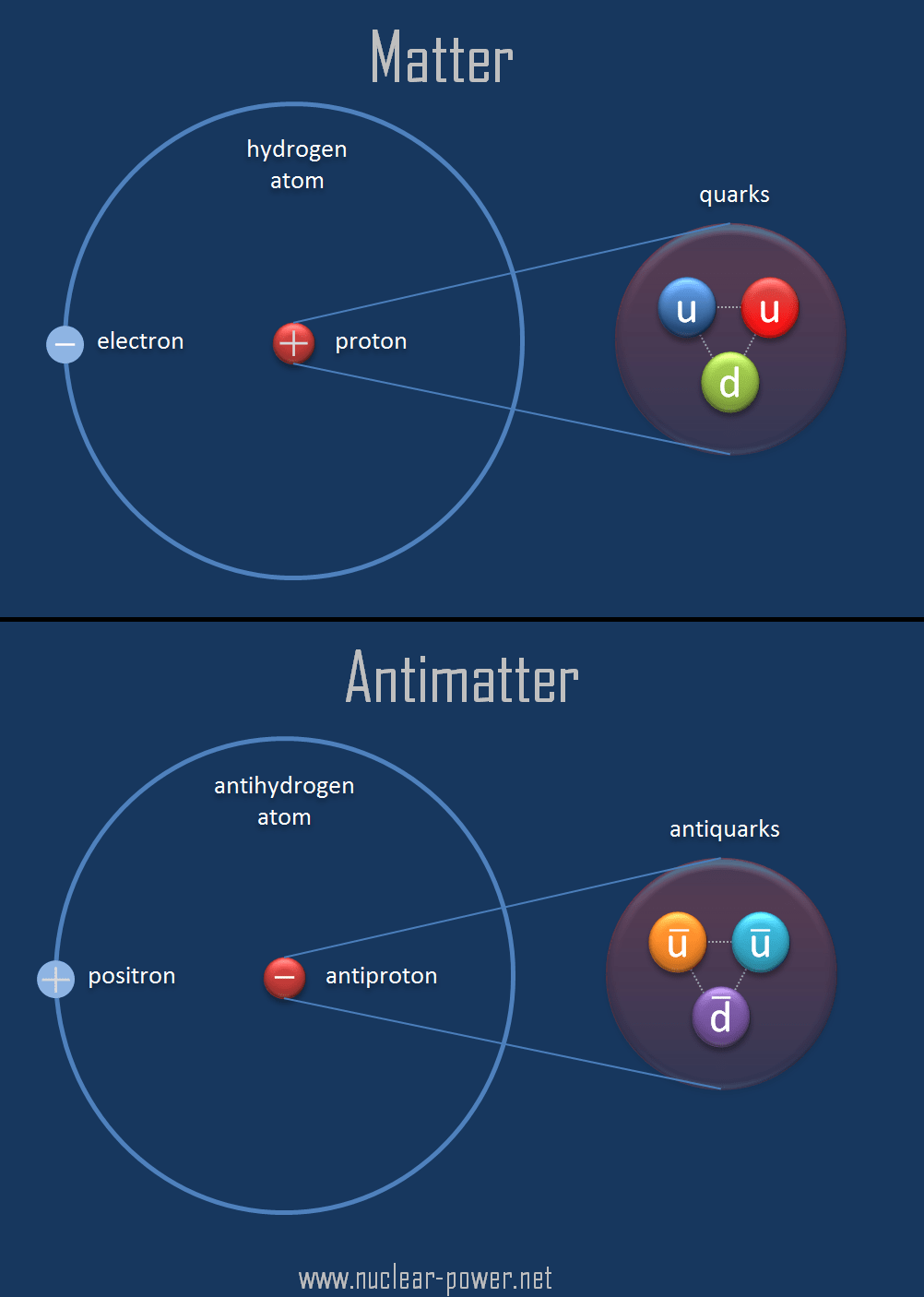
Matter - Hydrogen AtomThe physical world is composed of combinations of various subatomic or fundamental particles. These are the smallest building blocks of matter. All matter except dark matter is made of molecules, which are themselves made of atoms. The atoms consist of two parts. An atomic nucleus and an electron cloud. The electrons are spinning around the atomic nucleus. The nucleus itself is generally made of protons and neutrons but even these are composite objects. Inside the protons and neutrons, we find the quarks.
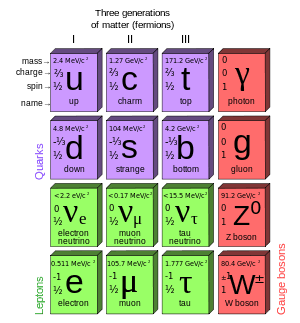
Three generations of matter.

Quarks and electrons are some of the elementary particles. A number of fundamental particles have been discovered in various experiments. So many, that researchers had to organize them, just like Mendeleev did with his periodic table. This is summarized in a theoretical model (concerning the electromagnetic, weak, and strong nuclear interactions) called the Standard Model. In particle physics, an elementary particle or fundamental particle is a particle whose substructure is unknown, thus it is unknown whether it is composed of other particles. Known elementary particles include the fundamental fermions and the fundamental bosons.

Matter vs. Antimatter

What is Antimatter

Antimatter - antihydrogen atomAntimatter is a term referring to material that would be made up of “antiatoms” in which antiprotons and antineutrons would form the nucleus around which positrons (antielectrons) would move. The term is also used for antiparticles in general.

Antimatter particles bind with one another to form antimatter, just as ordinary particles bind to form normal matter. For example, a positron and an antiproton can form an antihydrogen atom. Physical principles indicate that complex antimatter atomic nuclei are possible, as well as anti-atoms corresponding to the known chemical elements.

Our visible Universe is almost entirely composed of matter, and very little antimatter has existed since the Big Bang. This problem is known as the baryon asymmetry. This asymmetry of matter and antimatter in the visible universe is one of the great unsolved problems in physics.

Particles and Antiparticles

Three generations of matter.

Quarks and electrons are some of the elementary particles. A number of fundamental particles have been discovered in various experiments. So many, that researchers had to organize them, just like Mendeleev did with his periodic table. This is summarized in a theoretical model (concerning the electromagnetic, weak, and strong nuclear interactions) called the Standard Model. In particle physics, an elementary particle or fundamental particle is a particle whose substructure is unknown, thus it is unknown whether it is composed of other particles.

In particle physics, corresponding to most kinds of particles there is an associated antiparticle. An antiparticle has the same mass and opposite charge (including electric charge).

For example, for every quark there is a corresponding type of antiparticle. The antiquarks have the same mass, mean lifetime, and spin as their respective quarks, but the electric charge and other charges have the opposite sign.

The original idea for antiparticles came from a relativistic wave equation developed in 1928 by the English scientist P. A. M. Dirac (1902-1984). He realised that his relativistic version of the Schrödinger wave equation for electrons predicted the possibility of antielectrons. These were discovered by Paul Dirac and Carl D. Anderson in 1932 and named positrons. They studied cosmic-ray collisions via a cloud chamber – a particle detector in which moving electrons (or positrons) leave behind trails as they move through the gas. Positron paths in a cloud chamber trace the same helical path as an electron but rotate in the opposite direction with respect to the magnetic field direction due to their having the same magnitude of charge-to-mass ratio but with opposite charge and, therefore, opposite signed charge-to-mass ratios. Although Dirac did not himself use the term antimatter, its use follows on naturally enough from antielectrons, antiprotons, etc.

It was predicted that other particles also would have antiparticles. In 1955 the antiparticle to the proton, the antiproton, which carries a negative charge, was discovered at the University of California, Berkeley. Since then, the antiparticles of many other subatomic particles have been created in particle accelerator experiments. On the other hand, a few, like the photon and π0, do not have distinct antiparticles. These particles are their own antiparticles.

Neutrino vs. Antineutrino

Neutrino event
Source: wikipedia.org

A neutrino is an elementary subatomic particle with infinitesimal mass (less than 0.3 eV..?) and with no electric charge. Neutrinos belong to the family of leptons, which means they do not interact via strong nuclear force. Neutrinos are weakly interacting subatomic particles with ½ unit of spin. The term neutrino comes from Italian meaning “little neutral one” and neutrinos are denoted by the Greek letter ν (nu). There are three types of charged leptons, each associated with neutrino, forming three generations (between generations, particle differ by their quantum number and mass). The first generation consist of the electron (e−) and electron-neutrino (νe). The second generation consist of the muon (μ−) and muon neutrino (νμ) The third generation consist of the tau (τ−) and the tau neutrino (ντ). Each type of neutrino is associated with an antimatter particle, called an antineutrino, which also has neutral electric charge and 1/2 spin. Currently (2015), it is not resolved, whether the neutrino and its antiparticle are not identical particles.
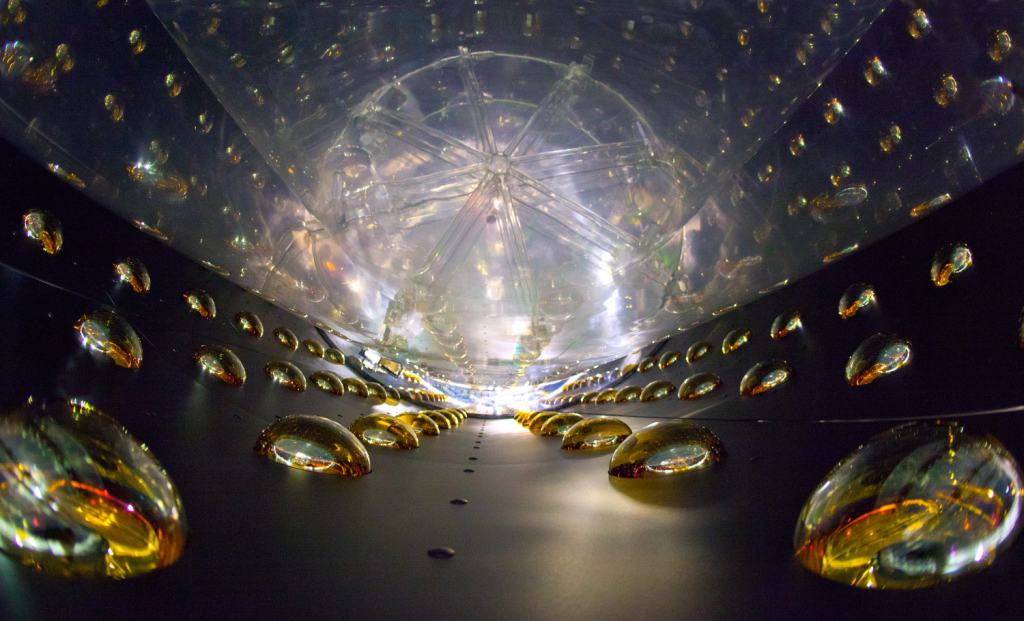
Antineutrino detector
The inside of a cylindrical antineutrino detector before being filled with clear liquid scintillator, which reveals antineutrino interactions by the very faint flashes of light they emit. Sensitive photomultiplier tubes line the detector walls, ready to amplify and record the telltale flashes.
Photo: Roy Kaltschmidt, LBNL
Source: Daya Bay Reactor Neutrino Experiment

Antineutrinos are produced in the negative beta decay. In a nuclear reactor occurs especially the β−decay, because the common feature of the fission products is an excess of neutrons (see Nuclear Stability). An unstable fission fragment with the excess of neutrons undergoes β− decay, where the neutron is converted into a proton, an electron, and an electron antineutrino. Therefore each nuclear reactor is very powerful source of antineutrinos and researchers around the world investigate the possibilities of using antineutrinos for reactor monitoring.

On the other hand the most powerful source of neutrinos in the solar system is doubtless the Sun itself. Billions of solar neutrinos per second pass (mostly without any interaction) through every square centimeter (~6 x 1010 cm-2s-1) on the Earth’s surface. In the Sun, neutrinos are produced after fusion reaction of two protons during positive beta decay of helium-2 nucleus.

_{2}^{2}textrm{He}rightarrow _{1}^{2}textrm{H} + beta^{+} + nu_{{e}}

Matter and Antimatter – Laws of Conservation in Nuclear Reactions

In analyzing nuclear reactions, we apply the many conservation laws. Nuclear reactions are subject to classical conservation laws for charge, momentum, angular momentum, and energy (including rest energies).  Additional conservation laws, not anticipated by classical physics, are are electric charge, lepton number and baryon number. Certain of these laws are obeyed under all circumstances, others are not.

At this point, we describe especially the relationship between antimatter and the following laws of conservation:

Law of Conservation of Lepton Number
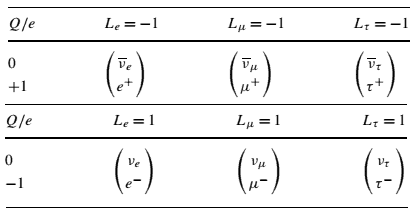
Lepton Number. Conservation of Lepton NumberIn particle physics, the lepton number is used to denote which particles are leptons and which particles are not. Each lepton has a lepton number of 1 and each antilepton has a lepton number of -1. Other non-leptonic particles have a lepton number of 0. The lepton number is a conserved quantum number in all particle reactions. A slight asymmetry in the laws of physics allowed leptons to be created in the Big Bang.

The conservation of lepton number means that whenever a lepton of a certain generation is created or destroyed in a reaction, a corresponding antilepton from the same generation must be created or destroyed. It must be added, there is a separate requirement for each of the three generations of leptons, the electron, muon and tau and their associated neutrinos.

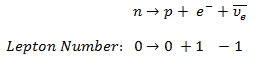
Consider the decay of the neutron. The reaction involves only first generation leptons: electrons and neutrinos:
lepton-number-neutron-decay

Since the lepton number must be equal to zero on both sides and it was found that the reaction is a three-particle decay (the electrons emitted in beta decay have a continuous rather than a discrete spectrum),  the third particle must be an electron antineutrino.

Law of Conservation of Baryon Number

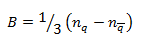
In particle physics, the baryon number is used to denote which particles are baryons and which particles are not. Each baryon has a baryon number of 1 and each antibaryon has a baryon number of -1. Other non-baryonic particles have a baryon number of 0. Since there are exotic hadrons like pentaquarks and tetraquarks, there is a general definition of baryon number as:
baryon-number-equation

where nq is the number of quarks, and nq is the number of antiquarks.

The baryon number is a conserved quantum number in all particle reactions.

The law of conservation of baryon number states that:

The sum of the baryon number of all incoming particles is the same as the sum of the baryon numbers of all particles resulting from the reaction.

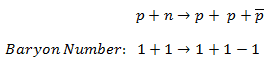
For example, the following reaction has never been observed:
baryon-number-example-violation

even if the incoming proton has sufficient energy and charge, energy, and so on, are conserved. This reaction does not conserve baryon number since the left side has B =+2, and the right has B =+1.

On the other hand, the following reaction (proton-antiproton pair production) does conserve B and does occur if the incoming proton has sufficient energy (the threshold energy = 5.6 GeV):

baryon-number-pair-production

As indicated, B = +2 on both sides of this equation.

From these and other reactions, the conservation of baryon number has been established as a basic principle of physics.

This principle provides basis for the stability of the proton. Since the proton is the lightest particle among all baryons, the hypothetical products of its decay would have to be non-baryons. Thus, the decay would violate the conservation of baryon number. It must be added some theories have suggested that protons are in fact unstable with very long half-life (~1030 years) and that they decay into leptons. There is currently no experimental evidence that proton decay occurs.

Law of Conservation of Electric Charge

The law of conservation of electric charge can be demonstrated also on positron-electron pair production. Since a gamma ray is electrically neutral and sum of the electric charges of electron and positron is also zero, the electric charge in this reaction is also conserved.

Ɣ → e– + e+

It must be added, in order for electron-positron pair production to occur, the electromagnetic energy of the photon must be above a threshold energy, which is equivalent to the rest mass of two electrons. The threshold energy (the total rest mass of produced particles) for electron-positron pair production is equal to 1.02MeV (2 x 0.511MeV) because the rest mass of a single electron is equivalent to 0.511MeV of energy. If the original photon’s energy is greater than 1.02MeV, any energy above 1.02MeV is according to the conservation law split between the kinetic energy of motion of the two particles. The presence of an electric field of a heavy atom such as lead or uranium is essential in order to satisfy conservation of momentum and energy. In order to satisfy both conservation of momentum and energy, the atomic nucleus must receive some momentum. Therefore a photon pair production in free space cannot occur.

 
References:
Nuclear and Reactor Physics:
  1. J. R. Lamarsh, Introduction to Nuclear Reactor Theory, 2nd ed., Addison-Wesley, Reading, MA (1983).
  2. J. R. Lamarsh, A. J. Baratta, Introduction to Nuclear Engineering, 3d ed., Prentice-Hall, 2001, ISBN: 0-201-82498-1.
  3. W. M. Stacey, Nuclear Reactor Physics, John Wiley & Sons, 2001, ISBN: 0- 471-39127-1.
  4. Glasstone, Sesonske. Nuclear Reactor Engineering: Reactor Systems Engineering, Springer; 4th edition, 1994, ISBN: 978-0412985317
  5. W.S.C. Williams. Nuclear and Particle Physics. Clarendon Press; 1 edition, 1991, ISBN: 978-0198520467
  6. G.R.Keepin. Physics of Nuclear Kinetics. Addison-Wesley Pub. Co; 1st edition, 1965
  7. Robert Reed Burn, Introduction to Nuclear Reactor Operation, 1988.
  8. U.S. Department of Energy, Nuclear Physics and Reactor Theory. DOE Fundamentals Handbook, Volume 1 and 2. January 1993.
  9. Paul Reuss, Neutron Physics. EDP Sciences, 2008. ISBN: 978-2759800414.

Advanced Reactor Physics:

  1. K. O. Ott, W. A. Bezella, Introductory Nuclear Reactor Statics, American Nuclear Society, Revised edition (1989), 1989, ISBN: 0-894-48033-2.
  2. K. O. Ott, R. J. Neuhold, Introductory Nuclear Reactor Dynamics, American Nuclear Society, 1985, ISBN: 0-894-48029-4.
  3. D. L. Hetrick, Dynamics of Nuclear Reactors, American Nuclear Society, 1993, ISBN: 0-894-48453-2.
  4. E. E. Lewis, W. F. Miller, Computational Methods of Neutron Transport, American Nuclear Society, 1993, ISBN: 0-894-48452-4.

See also:

Antimatter

We hope, this article, Matter vs. Antimatter, helps you. If so, give us a like in the sidebar. Main purpose of this website is to help the public to learn some interesting and important information about materials and their properties.

What is Conservation of Atomic Number, Neutron Number and Mass Number – Definition

In nuclear reactions, we can assume that the atomic number, the neutron number and its sum the atomic mass number are separately conserved. But in general, it is not true. Material Properties

Atomic Mass Number – Does it conserve in a nuclear reaction?

Proton Number - Atomic NumberIn general, the atomic mass number is not conserved in nuclear reactions.

In analyzing nuclear reactions, we apply the many conservation laws. Nuclear reactions are subject to classical conservation laws for charge, momentum, angular momentum, and energy (including rest energies).  Additional conservation laws, not anticipated by classical physics, are are electric charge, lepton number and baryon number. Certain of these laws are obeyed under all circumstances, others are not. We have accepted conservation of energy and momentum. In reactor physics (non-relativistic physics), we assume that the number of protons (the atomic number), the number of neutrons (the neutron number) and its sum (the atomic mass number) are usually separately conserved. We shall find circumstances and conditions in which  this rule is not true. Where we are considering non-relativistic nuclear reactions, it is essentially true. However, where we are considering relativistic nuclear energies or those involving the weak interactions (e.g. in beta decay the atomic number is not conserved), we shall find that these principles must be extended.

Conservation of Baryon Number

Instead of mass number conservation, physicists define the baryon number, which is a conserved quantum number in all particle reactions.

Baryon number is a generalization of nucleon number, which is conserved in nonrelativistic nuclear reactions and decays. The law of conservation of baryon numberstates that:

The sum of the baryon number of all incoming particles is the same as the sum of the baryon numbers of all particles resulting from the reaction.

For example, the following reaction (proton-antiproton pair production) does conserve B and does occur if the incoming proton has sufficient energy (the threshold energy = 5.6 GeV):

baryon-number-pair-production

As indicated, B = +2 on both sides of this equation.

From these and other reactions, the conservation of baryon number has been established as a basic principle of physics.

This principle provides basis for the stability of the proton. Since the proton is the lightest particle among all baryons, the hypothetical products of its decay would have to be non-baryons. Thus, the decay would violate the conservation of baryon number. It must be added some theories have suggested that protons are in fact unstable with very long half-life (~1030 years) and that they decay into leptons. There is currently no experimental evidence that proton decay occurs.

Neutron Number – Does it conserve in a nuclear reaction?

In general, the neutron number is not conserved in nuclear reactions.

Atomic Number – Does it conserve in a nuclear reaction?

In general, the atomic number is not conserved in nuclear reactions.

Instead of atomic number conservation, an universal conservation law is the conservation of the electric charge.

Conservation of Electric Charge

As was written, the total electrical charge of the nucleus is determined by the atomic number and is equal to +Ze. Conservation of charge is thought to be a universal conservation law. No experimental evidence for any violation of this principle has ever been observed.

For example:

Consider a typical fission reaction such as the one listed below.

Uranium absorption reaction

Typically, when uranium 235 nucleus undergoes fission, the nucleus splits into two smaller nuclei (triple fission can also rarely occur), along with a few neutrons (the average is 2.43 neutrons per fission by thermal neutron) and release of energy in the form of heat and gamma rays. From these reactions we find that in the fission the parent nucleus:

  • 235U contains 92 protons (a charge of +92e),
  • incident neutron is electrically neutral.

The fission fragments:

  • 139Ba contains 56 protons (a charge of +56e),
  • 94Ba contains 36 protons (a charge of +36e)

We see that the total charge is 92e before and after the reaction; thus, charge is conserved. It is noteworthy, the total number of nucleons before and after a reaction are also the same.

 
References:
Nuclear and Reactor Physics:
  1. J. R. Lamarsh, Introduction to Nuclear Reactor Theory, 2nd ed., Addison-Wesley, Reading, MA (1983).
  2. J. R. Lamarsh, A. J. Baratta, Introduction to Nuclear Engineering, 3d ed., Prentice-Hall, 2001, ISBN: 0-201-82498-1.
  3. W. M. Stacey, Nuclear Reactor Physics, John Wiley & Sons, 2001, ISBN: 0- 471-39127-1.
  4. Glasstone, Sesonske. Nuclear Reactor Engineering: Reactor Systems Engineering, Springer; 4th edition, 1994, ISBN: 978-0412985317
  5. W.S.C. Williams. Nuclear and Particle Physics. Clarendon Press; 1 edition, 1991, ISBN: 978-0198520467
  6. G.R.Keepin. Physics of Nuclear Kinetics. Addison-Wesley Pub. Co; 1st edition, 1965
  7. Robert Reed Burn, Introduction to Nuclear Reactor Operation, 1988.
  8. U.S. Department of Energy, Nuclear Physics and Reactor Theory. DOE Fundamentals Handbook, Volume 1 and 2. January 1993.
  9. Paul Reuss, Neutron Physics. EDP Sciences, 2008. ISBN: 978-2759800414.

Advanced Reactor Physics:

  1. K. O. Ott, W. A. Bezella, Introductory Nuclear Reactor Statics, American Nuclear Society, Revised edition (1989), 1989, ISBN: 0-894-48033-2.
  2. K. O. Ott, R. J. Neuhold, Introductory Nuclear Reactor Dynamics, American Nuclear Society, 1985, ISBN: 0-894-48029-4.
  3. D. L. Hetrick, Dynamics of Nuclear Reactors, American Nuclear Society, 1993, ISBN: 0-894-48453-2.
  4. E. E. Lewis, W. F. Miller, Computational Methods of Neutron Transport, American Nuclear Society, 1993, ISBN: 0-894-48452-4.

See also:

Nuclear Structure

We hope, this article, Conservation of Atomic Number, Neutron Number and Mass Number, helps you. If so, give us a like in the sidebar. Main purpose of this website is to help the public to learn some interesting and important information about materials and their properties.

What is Atomic Mass – Isotopic Mass – Definition

The atomic mass, or isotopic mass, is the mass of an atom. The unit of measure for mass is the atomic mass unit (amu). One atomic mass unit is equal to 1.66 x 10⁻²⁴ grams. Material Properties

Atomic Mass – Isotopic Mass

The size and mass of atoms are so small that the use of normal measuring units, while possible, is often inconvenient. Units of measure have been defined for mass and energy on the atomic scale to make measurements more convenient to express. The unit of measure for mass is the atomic mass unit (amu). One atomic mass unit is equal to 1.66 x 10⁻²⁴ grams.

Besides the thermodynamics/thermodynamic-properties/what-is-mass-and-weight/standard-kilogram/”>standard kilogram, it is a second mass standard. It is the carbon-12 atom, which, by international agreement, has been assigned a mass of 12 atomic mass units (u). The relation between the two units is

One atomic mass unit is equal:

1u = 1.66 x 10⁻²⁴ grams.

One unified atomic mass unit is approximately the mass of one nucleon (either a single proton or neutron) and is numerically equivalent to 1 g/mol.

For 12C the atomic mass is exactly 12u, since the atomic mass unit is defined from it. For other isotopes, the isotopic mass usually differs and is usually within 0.1 u of the mass number. For example, 63Cu (29 protons and 34 neutrons) has a mass number of 63 and an isotopic mass in its nuclear ground state is 62.91367 u.

There are two reasons for the difference between mass number and isotopic mass, known as the mass defect:

  1. The neutron is slightly heavier than the proton. This increases the mass of nuclei with more neutrons than protons relative to the atomic mass unit scale based on 12C with equal numbers of protons and neutrons.
  2. The nuclear binding energy varies between nuclei. A nucleus with greater binding energy has a lower total energy, and therefore a lower mass according to Einstein’s mass-energy equivalence relation E = mc2. For 63Cu the atomic mass is less than 63 so this must be the dominant factor.
 
Mass defect of a 63Cu
Calculate the mass defect of a 63Cu nucleus if the actual mass of 63Cu in its nuclear ground state is 62.91367 u.

63Cu nucleus has 29 protons and also has (63 – 29) 34 neutrons.

The mass of a proton is 1.00728 u and a neutron is 1.00867 u.

The combined mass is: 29 protons x (1.00728 u/proton) + 34 neutrons x (1.00867 u/neutron) = 63.50590 u

The mass defect is Δm = 63.50590 u – 62.91367 u =  0.59223 u

Convert the mass defect into energy (nuclear binding energy).

(0.59223 u/nucleus) x (1.6606 x 10⁻²⁷ kg/u) = 9.8346 x 10⁻²⁸ kg/nucleus

ΔE = Δmc2

ΔE = (9.8346 x 10⁻²⁸ kg/nucleus) x (2.9979 x 10⁸ m/s)2 = 8.8387 x 10⁻¹¹ J/nucleus

The energy calculated in the previous example is the nuclear binding energy.  However, the nuclear binding energy may be expressed as kJ/mol (for better understanding).

Calculate the nuclear binding energy of 1 mole of 63Cu:

(8.8387 x 10⁻¹¹ J/nucleus) x (1 kJ/1000 J) x (6.022 x 10²³ nuclei/mol) = 5.3227 x 10¹⁰kJ/mol of nuclei.

One mole of 63Cu (~63 grams) is bound by the nuclear binding energy (5.3227 x 10¹⁰kJ/mol) which is equivalent to:

  • 14.8 million kilowatt-hours (≈ 15 GW·h)
  • 336,100 US gallons of automotive gasoline
 
References:
Nuclear and Reactor Physics:
  1. J. R. Lamarsh, Introduction to Nuclear Reactor Theory, 2nd ed., Addison-Wesley, Reading, MA (1983).
  2. J. R. Lamarsh, A. J. Baratta, Introduction to Nuclear Engineering, 3d ed., Prentice-Hall, 2001, ISBN: 0-201-82498-1.
  3. W. M. Stacey, Nuclear Reactor Physics, John Wiley & Sons, 2001, ISBN: 0- 471-39127-1.
  4. Glasstone, Sesonske. Nuclear Reactor Engineering: Reactor Systems Engineering, Springer; 4th edition, 1994, ISBN: 978-0412985317
  5. W.S.C. Williams. Nuclear and Particle Physics. Clarendon Press; 1 edition, 1991, ISBN: 978-0198520467
  6. G.R.Keepin. Physics of Nuclear Kinetics. Addison-Wesley Pub. Co; 1st edition, 1965
  7. Robert Reed Burn, Introduction to Nuclear Reactor Operation, 1988.
  8. U.S. Department of Energy, Nuclear Physics and Reactor Theory. DOE Fundamentals Handbook, Volume 1 and 2. January 1993.
  9. Paul Reuss, Neutron Physics. EDP Sciences, 2008. ISBN: 978-2759800414.

Advanced Reactor Physics:

  1. K. O. Ott, W. A. Bezella, Introductory Nuclear Reactor Statics, American Nuclear Society, Revised edition (1989), 1989, ISBN: 0-894-48033-2.
  2. K. O. Ott, R. J. Neuhold, Introductory Nuclear Reactor Dynamics, American Nuclear Society, 1985, ISBN: 0-894-48029-4.
  3. D. L. Hetrick, Dynamics of Nuclear Reactors, American Nuclear Society, 1993, ISBN: 0-894-48453-2.
  4. E. E. Lewis, W. F. Miller, Computational Methods of Neutron Transport, American Nuclear Society, 1993, ISBN: 0-894-48452-4.

See also:

Nuclear Structure

We hope, this article, Atomic Mass – Isotopic Mass, helps you. If so, give us a like in the sidebar. Main purpose of this website is to help the public to learn some interesting and important information about materials and their properties.
What is Antimatter – Definition

Antimatter is a term referring to material that would be made up of “antiatoms” that consist of antiprotons, antineutrons and positrons. The term antimatter is also used for antiparticles in general. Material Properties

What is Antimatter

Antimatter - antihydrogen atomAntimatter is a term referring to material that would be made up of “antiatoms” in which antiprotons and antineutrons would form the nucleus around which positrons (antielectrons) would move. The term is also used for antiparticles in general.

Antimatter particles bind with one another to form antimatter, just as ordinary particles bind to form normal matter. For example, a positron and an antiproton can form an antihydrogen atom. Physical principles indicate that complex antimatter atomic nuclei are possible, as well as anti-atoms corresponding to the known chemical elements.

Our visible Universe is almost entirely composed of matter, and very little antimatter has existed since the Big Bang. This problem is known as the baryon asymmetry. This asymmetry of matter and antimatter in the visible universe is one of the great unsolved problems in physics.

Particles and Antiparticles

Three generations of matter.

Quarks and electrons are some of the elementary particles. A number of fundamental particles have been discovered in various experiments. So many, that researchers had to organize them, just like Mendeleev did with his periodic table. This is summarized in a theoretical model (concerning the electromagnetic, weak, and strong nuclear interactions) called the Standard Model. In particle physics, an elementary particle or fundamental particle is a particle whose substructure is unknown, thus it is unknown whether it is composed of other particles.

In particle physics, corresponding to most kinds of particles there is an associated antiparticle. An antiparticle has the same mass and opposite charge (including electric charge).

For example, for every quark there is a corresponding type of antiparticle. The antiquarks have the same mass, mean lifetime, and spin as their respective quarks, but the electric charge and other charges have the opposite sign.

The original idea for antiparticles came from a relativistic wave equation developed in 1928 by the English scientist P. A. M. Dirac (1902-1984). He realised that his relativistic version of the Schrödinger wave equation for electrons predicted the possibility of antielectrons. These were discovered by Paul Dirac and Carl D. Anderson in 1932 and named positrons. They studied cosmic-ray collisions via a cloud chamber – a particle detector in which moving electrons (or positrons) leave behind trails as they move through the gas. Positron paths in a cloud chamber trace the same helical path as an electron but rotate in the opposite direction with respect to the magnetic field direction due to their having the same magnitude of charge-to-mass ratio but with opposite charge and, therefore, opposite signed charge-to-mass ratios. Although Dirac did not himself use the term antimatter, its use follows on naturally enough from antielectrons, antiprotons, etc.

It was predicted that other particles also would have antiparticles. In 1955 the antiparticle to the proton, the antiproton, which carries a negative charge, was discovered at the University of California, Berkeley. Since then, the antiparticles of many other subatomic particles have been created in particle accelerator experiments. On the other hand, a few, like the photon and π0, do not have distinct antiparticles. These particles are their own antiparticles.

 
Neutrino and Antineutrino
Neutrino event
Source: wikipedia.org

A neutrino is an elementary subatomic particle with infinitesimal mass (less than 0.3 eV..?) and with no electric charge. Neutrinos belong to the family of leptons, which means they do not interact via strong nuclear force. Neutrinos are weakly interacting subatomic particles with ½ unit of spin. The term neutrino comes from Italian meaning “little neutral one” and neutrinos are denoted by the Greek letter ν (nu). There are three types of charged leptons, each associated with neutrino, forming three generations (between generations, particle differ by their quantum number and mass). The first generation consist of the electron (e−) and electron-neutrino (νe). The second generation consist of the muon (μ−) and muon neutrino (νμ) The third generation consist of the tau (τ−) and the tau neutrino (ντ). Each type of neutrino is associated with an antimatter particle, called an antineutrino, which also has neutral electric charge and 1/2 spin. Currently (2015), it is not resolved, whether the neutrino and its antiparticle are not identical particles.

Antineutrino detector
The inside of a cylindrical antineutrino detector before being filled with clear liquid scintillator, which reveals antineutrino interactions by the very faint flashes of light they emit. Sensitive photomultiplier tubes line the detector walls, ready to amplify and record the telltale flashes.
Photo: Roy Kaltschmidt, LBNL
Source: Daya Bay Reactor Neutrino Experiment

Antineutrinos are produced in the negative beta decay. In a nuclear reactor occurs especially the β−decay, because the common feature of the fission products is an excess of neutrons (see Nuclear Stability). An unstable fission fragment with the excess of neutrons undergoes β− decay, where the neutron is converted into a proton, an electron, and an electron antineutrino. Therefore each nuclear reactor is very powerful source of antineutrinos and researchers around the world investigate the possibilities of using antineutrinos for reactor monitoring.

On the other hand the most powerful source of neutrinos in the solar system is doubtless the Sun itself. Billions of solar neutrinos per second pass (mostly without any interaction) through every square centimeter (~6 x 1010 cm-2s-1) on the Earth’s surface. In the Sun, neutrinos are produced after fusion reaction of two protons during positive beta decay of helium-2 nucleus.

_{2}^{2}textrm{He}rightarrow _{1}^{2}textrm{H} + beta^{+} + nu_{{e}}

Matter – Antimatter Creation and Annihilation

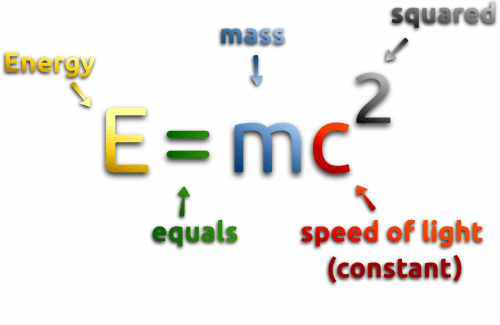
E=MC2At the beginning of the 20th century, the notion of mass underwent a radical revision. Mass lost its absoluteness. One of the striking results of Einstein’s theory of relativity is that mass and energy are equivalent and convertible one into the other. Equivalence of the mass and energy is described by Einstein’s famous formula E = mc2. In words, energy equals mass multiplied by the speed of light squared.

In special theory of relativity certain types of matter may be created or destroyed, but in all of these processes, the mass and energy associated with such matter remains unchanged in quantity. As a result of the conservation of lepton and baryon numbers,  antimatter (antiparticles) can be created out of energy, but only if a particle counterpart for every antiparticle is created as well. It will be demonstrated in the following sections.

Matter – Antimatter Creation

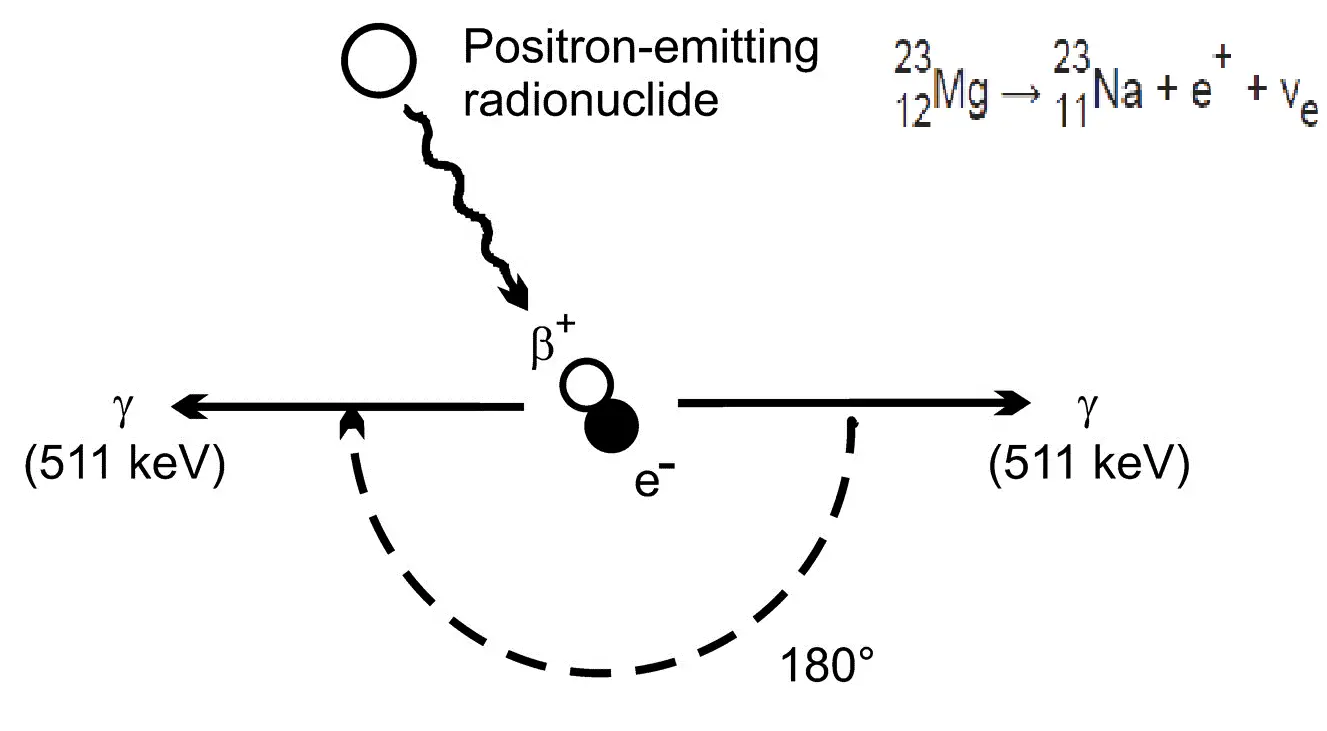
Matter and Antimatter - ComparisonMatter – Antimatter creation occurs naturally in high-energy processes involving cosmic rays, and also in high-energy experiments in accelerators in Earth. High-energy cosmic rays impacting Earth’s atmosphere (or any other matter in the Solar System) produce minute quantities of antiparticles in the resulting particle jets, which are immediately annihilated by contact with nearby matter. The presence of the resulting antimatter is detectable by the two gamma rays (with 511 keV) produced every time positrons annihilate with nearby matter.

Antimatter creation is also very common in nuclear decay of many isotopes. Let assume a decay of potassium-40. Naturally occurring potassium is composed of three isotopes, of which 40K is radioactive. Traces of 40K are found in all potassium, and it is the most common radioisotope in the human body. 40K is a radioactive isotope of potassium which has a very long half-life of 1.251×10⁹ years and undergoes both types of beta decay.

  • About 89.28% of the time (10.72% is by electron capture), it decays to calcium-40 (40Ca) with emission of a beta particle (β−, an electron) with a maximum energy of 1.33 MeV and an antineutrino, which is an antiparticle to the neutrino.
  • Very rarely (0.001% of the time) it will decay to 40Ar by emitting a positron (β+) and a neutrino.

Another very interesting source of antimatter is, in fact, a nuclear reactor. Nuclear reactors are the major source of human-generated antineutrinos. This is due to the fact that antineutrinos are produced in a negative beta decay. In a nuclear reactor occurs especially the β−decay, because the common feature of the fission fragments is an excess of neutrons. Please note that billions of solar neutrinos per second pass (mostly without any interaction) through every square centimeter (~6×10¹⁰) on the Earth’s surface and antineutrino radiation is by no means dangerous.

Finally, the fact is that antimatter is much more common, than it may seem.

In January 2011, research by the American Astronomical Society discovered antimatter (positrons) originating above thunderstorm clouds.  It is suggested that these positrons are formed in terrestrial gamma-ray flashes (TGF). These positrons are produced in gamma-ray flashes created by electrons accelerated by strong electric fields in the clouds. TGFs are brief bursts occurring inside thunderstorms and associated with lightning. The streams of positrons and electrons collide higher in the atmosphere to generate more gamma rays. About 500 TGFs may occur every day worldwide, but mostly go undetected.

 
Electron - Positron Pair Production
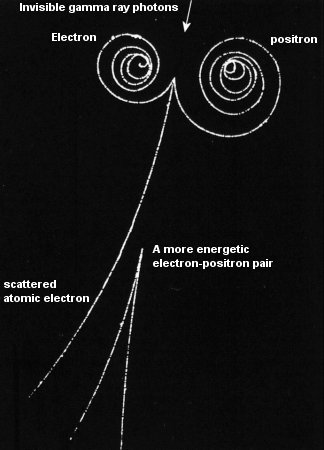
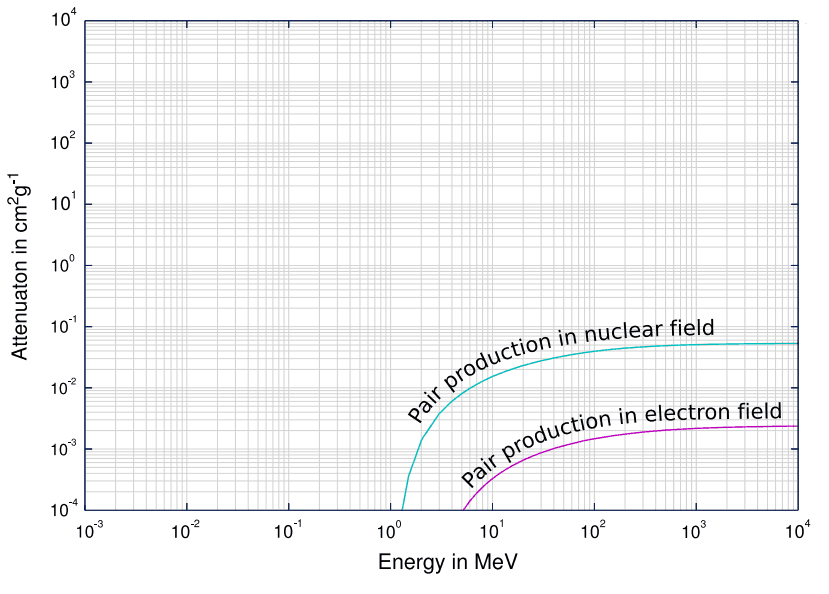
Pair production in chamberIn general, pair production is a phenomenon of nature where energy is direct converted to matter. The phenomenon of pair production can be view two different ways. One way is as a particle and antiparticle and the other is as a particle and a hole. The first way can be represented by formation of electron and positron, from a packet of electromagnetic energy (high energy photon – gamma ray) traveling through matter.  It is one of the possible ways in which gamma rays interact with matter. At high energies this interaction dominates. In order for electron-positron pair production to occur, the electromagnetic energy of the photon must be above a threshold energy, which is equivalent to the rest mass of two electrons. The threshold energy (the total rest mass of produced particles) for electron-positron pair production is equal to 1.02MeV (2 x 0.511MeV) because the rest mass of a single electron is equivalent to 0.511MeV of energy.If the original photon’s energy is greater than 1.02MeV, any energy above 1.02MeV is according to the conservation law split between the kinetic energy of motion of the two particles.
Pair production in nuclear field and electron field.
Cross section of pair production in nuclear field and electron field.

The presence of an electric field of a heavy atom such as lead or uranium is essential in order to satisfy conservation of momentum and energy. In order to satisfy both conservation of momentum and energy, the atomic nucleus must receive some momentum. Therefore a photon pair production in free space cannot occur.Moreover, the positron is the anti-particle of the electron, so when a positron comes to rest, it interacts with another electron, resulting in the annihilation of the both particles and the complete conversion of their rest mass back to pure energy (according to the E=mc2formula) in the form of two oppositely directed 0.511 MeV gamma rays (photons). The pair production phenomenon is therefore connected with creation and destruction of matter in one reaction.

 
Nuclear Reactor as the Antineutrinos Source
Fission fragment yields
Fission fragment yield for different nuclei. The most probable fragment masses are around mass 95 (Krypton) and 137 (Barium).

Nuclear reactors are the major source of human-generated antineutrinos. This is due to the fact that antineutrinos are produced in a negative betadecay. In a nuclear reactor occurs especially the β−decay, because the common feature of the fission fragments is an excess of neutrons (see Nuclear Stability). An unstable fission fragment with the excess of neutrons undergoes β− decay, where the neutron is converted into a proton, an electron, and an electron antineutrino. The existence of emission of antineutrinos and their very low cross-section for any interaction leads to very interesting phenomenon.

Energy from Uranium Fission

Roughly about 5% (or about 12 MeV of 207 MeV) of released energy per one fission is radiated away from reactor in the form of antineutrinos. For a typical nuclear reactor with a thermal power of 3000 MWth (~1000MWe of electrical power), the total power produced is in fact higher, approximately 3150 MW, of which 150 MW is radiated away into space as antineutrino radiation. This amount of energy is forever lost, since antineutrinos are able to penetrate all reactor materials without any interaction. In fact, a common statement in physics texts is that the mean free path of a neutrino is approximately a light-year of lead. Moreover, a neutrino of moderate energy can easily penetrate a thousand light-years of lead (according to the J. B. Griffiths).

Please note that billions of solar neutrinos per second pass (mostly without any interaction) through every square centimeter (~6×10¹⁰) on the Earth’s surface and antineutrino radiation is by no means dangerous.

Example – Amount of antineutrinos produced:

Stable nuclei with most likely mass number A from U-235 fission are _{40}^{94}textrm{Zr} and _{58}^{140}textrm{Ce}. These nuclei have together 98 protons and 136 neutrons, while fission fragments (parent nuclei) have together 92 protons and 142 neutrons. This means after each U-235 fission the fission fragments must undergo on average 6 negative beta decays (6 neutrons must decay to 6 protons) and therefore 6 antineutrinos must be produced per each fission. The typical nuclear reactor therefore produces approximately 6 x 10²⁰ antineutrinos per second(~200 MeV/fission; ~6 antineutrinos/fission; 3000 MWth; 9.375 x 10¹⁹ fissions/sec).

beta decay
Beta decay of C-14 nucleus.

Matter – Antimatter Annihilation

positron annihilation
When a positron (antimatter particle) comes to rest, it interacts with an electron, resulting in the annihilation of the both particles and the complete conversion of their rest mass to pure energy in the form of two oppositely directed 0.511 MeV photons.

As was written, a particle and its antiparticle have the same mass as one another, but opposite electric charge, and other differences in quantum numbers. That means a proton has positive charge while an antiproton has negative charge and therefore they attract each other. A collision between any particle and its antiparticle partner is known to lead to their mutual annihilation. Since matter and antimatter carry an immense amount of energy (due to E = mc2), their mutual annihilation is associated with production of intense photons (gamma rays), neutrinos, and sometimes less-massive particle–antiparticle pairs.

One of best known processes is electron-positron annihilation. Electron–positron annihilation occurs when a negatively charged electron and a positively charged positron collide.When a low-energy electron annihilates a low-energy positron (antiparticle of electron), they can only produce two or more photons (gamma rays). The production of only one photon is forbidden because of conservation of linear momentum and total energy. The production of another particle is also forbidden because of both particles (electron-positron) together do not carry enough mass-energy to produce heavier particles. When an electron and a positron collide, they annihilate resulting in the complete conversion of their rest mass to pure energy (according to the E=mc2 formula) in the form of two oppositely directed 0.511 MeV gamma rays (photons).

e− + e+ → γ + γ (2x 0.511 MeV)

This process must satisfy a number of conservation laws, including:

  • Conservation of electric charge. The net charge before and after is zero.
  • Conservation of linear momentum and total energy. T
  • Conservation of angular momentum.

Matter and Antimatter – Laws of Conservation in Nuclear Reactions

In analyzing nuclear reactions, we apply the many conservation laws. Nuclear reactions are subject to classical conservation laws for charge, momentum, angular momentum, and energy (including rest energies).  Additional conservation laws, not anticipated by classical physics, are are electric charge, lepton number and baryon number. Certain of these laws are obeyed under all circumstances, others are not.

At this point, we describe especially the relationship between antimatter and the following laws of conservation:

Law of Conservation of Lepton Number

Lepton Number. Conservation of Lepton NumberIn particle physics, the lepton number is used to denote which particles are leptons and which particles are not. Each lepton has a lepton number of 1 and each antilepton has a lepton number of -1. Other non-leptonic particles have a lepton number of 0. The lepton number is a conserved quantum number in all particle reactions. A slight asymmetry in the laws of physics allowed leptons to be created in the Big Bang.

The conservation of lepton number means that whenever a lepton of a certain generation is created or destroyed in a reaction, a corresponding antilepton from the same generation must be created or destroyed. It must be added, there is a separate requirement for each of the three generations of leptons, the electron, muon and tau and their associated neutrinos.

Consider the decay of the neutron. The reaction involves only first generation leptons: electrons and neutrinos:

lepton-number-neutron-decay

Since the lepton number must be equal to zero on both sides and it was found that the reaction is a three-particle decay (the electrons emitted in beta decay have a continuous rather than a discrete spectrum),  the third particle must be an electron antineutrino.

Law of Conservation of Baryon Number

In particle physics, the baryon number is used to denote which particles are baryons and which particles are not. Each baryon has a baryon number of 1 and each antibaryon has a baryon number of -1. Other non-baryonic particles have a baryon number of 0. Since there are exotic hadrons like pentaquarks and tetraquarks, there is a general definition of baryon number as:

baryon-number-equation

where nq is the number of quarks, and nq is the number of antiquarks.

The baryon number is a conserved quantum number in all particle reactions.

The law of conservation of baryon number states that:

The sum of the baryon number of all incoming particles is the same as the sum of the baryon numbers of all particles resulting from the reaction.

For example, the following reaction has never been observed:

baryon-number-example-violation

even if the incoming proton has sufficient energy and charge, energy, and so on, are conserved. This reaction does not conserve baryon number since the left side has B =+2, and the right has B =+1.

On the other hand, the following reaction (proton-antiproton pair production) does conserve B and does occur if the incoming proton has sufficient energy (the threshold energy = 5.6 GeV):

baryon-number-pair-production

As indicated, B = +2 on both sides of this equation.

From these and other reactions, the conservation of baryon number has been established as a basic principle of physics.

This principle provides basis for the stability of the proton. Since the proton is the lightest particle among all baryons, the hypothetical products of its decay would have to be non-baryons. Thus, the decay would violate the conservation of baryon number. It must be added some theories have suggested that protons are in fact unstable with very long half-life (~1030 years) and that they decay into leptons. There is currently no experimental evidence that proton decay occurs.

Law of Conservation of Electric Charge

The law of conservation of electric charge can be demonstrated also on positron-electron pair production. Since a gamma ray is electrically neutral and sum of the electric charges of electron and positron is also zero, the electric charge in this reaction is also conserved.

Ɣ → e– + e+

It must be added, in order for electron-positron pair production to occur, the electromagnetic energy of the photon must be above a threshold energy, which is equivalent to the rest mass of two electrons. The threshold energy (the total rest mass of produced particles) for electron-positron pair production is equal to 1.02MeV (2 x 0.511MeV) because the rest mass of a single electron is equivalent to 0.511MeV of energy. If the original photon’s energy is greater than 1.02MeV, any energy above 1.02MeV is according to the conservation law split between the kinetic energy of motion of the two particles. The presence of an electric field of a heavy atom such as lead or uranium is essential in order to satisfy conservation of momentum and energy. In order to satisfy both conservation of momentum and energy, the atomic nucleus must receive some momentum. Therefore a photon pair production in free space cannot occur.

 
References:
Nuclear and Reactor Physics:
  1. J. R. Lamarsh, Introduction to Nuclear Reactor Theory, 2nd ed., Addison-Wesley, Reading, MA (1983).
  2. J. R. Lamarsh, A. J. Baratta, Introduction to Nuclear Engineering, 3d ed., Prentice-Hall, 2001, ISBN: 0-201-82498-1.
  3. W. M. Stacey, Nuclear Reactor Physics, John Wiley & Sons, 2001, ISBN: 0- 471-39127-1.
  4. Glasstone, Sesonske. Nuclear Reactor Engineering: Reactor Systems Engineering, Springer; 4th edition, 1994, ISBN: 978-0412985317
  5. W.S.C. Williams. Nuclear and Particle Physics. Clarendon Press; 1 edition, 1991, ISBN: 978-0198520467
  6. G.R.Keepin. Physics of Nuclear Kinetics. Addison-Wesley Pub. Co; 1st edition, 1965
  7. Robert Reed Burn, Introduction to Nuclear Reactor Operation, 1988.
  8. U.S. Department of Energy, Nuclear Physics and Reactor Theory. DOE Fundamentals Handbook, Volume 1 and 2. January 1993.
  9. Paul Reuss, Neutron Physics. EDP Sciences, 2008. ISBN: 978-2759800414.

Advanced Reactor Physics:

  1. K. O. Ott, W. A. Bezella, Introductory Nuclear Reactor Statics, American Nuclear Society, Revised edition (1989), 1989, ISBN: 0-894-48033-2.
  2. K. O. Ott, R. J. Neuhold, Introductory Nuclear Reactor Dynamics, American Nuclear Society, 1985, ISBN: 0-894-48029-4.
  3. D. L. Hetrick, Dynamics of Nuclear Reactors, American Nuclear Society, 1993, ISBN: 0-894-48453-2.
  4. E. E. Lewis, W. F. Miller, Computational Methods of Neutron Transport, American Nuclear Society, 1993, ISBN: 0-894-48452-4.

See also:

Fundamental Particles

We hope, this article, Antimatter, helps you. If so, give us a like in the sidebar. Main purpose of this website is to help the public to learn some interesting and important information about materials and their properties.
What is Atomic Mass Number – Definition

The total number of protons and neutrons in the nucleus of an atom is called the atomic mass number (or the mass number) of the atom and is given the symbol A. Material Properties

Atomic Mass Number

Proton Number - Atomic Number
Source: chemwiki.ucdavis.edu

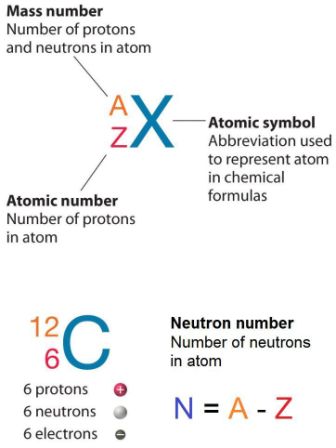
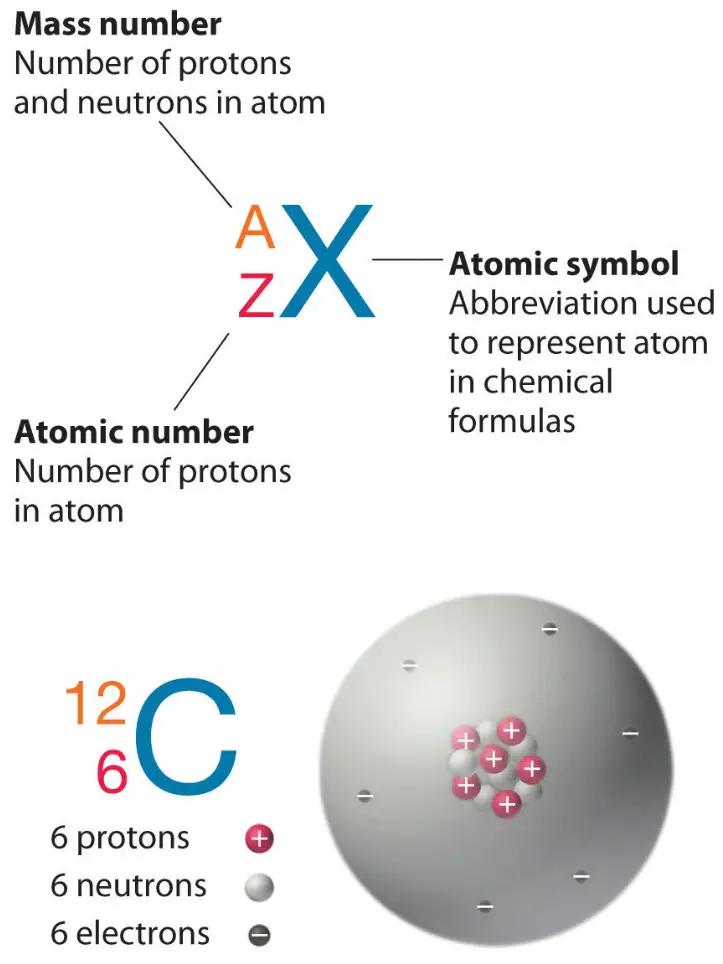
The atom consist of a small but massive nucleus surrounded by a cloud of rapidly moving electrons. The nucleus is composed of protons and neutrons. The total number of protons and neutrons in the nucleus of an atom is called the atomic mass number (or the mass number) of the atom and is given the symbol A.

Neutron number plus atomic number equals atomic mass number: N+Z=A. The difference between the neutron number and the atomic number is known as the neutron excess: D = N – Z = A – 2Z.

The chemical properties of the atom are determined by the number of protons, in fact, by number and arrangement of electrons. The configuration of these electrons follows from the principles of quantum mechanics. The number of electrons in each element’s electron shells, particularly the outermost valence shell, is the primary factor in determining its chemical bonding behavior. In the periodic table, the elements are listed in order of increasing atomic number Z.

The nuclear properties (atomic mass, nuclear cross-sections) of the element are determined by the number of protons (atomic number) and number of neutrons (neutron number). For example, actinides with odd neutron number are usually fissile (fissionable with slow neutrons) while actinides with even neutron number are usually not fissile (but are fissionable with fast neutrons). Heavy nuclei with an even number of protons and an even number of neutrons are (due to Pauli exclusion principle) very stable thanks to the occurrence of ‘paired spin’. On the other hand, nuclei with an odd number of protons and neutrons are mostly unstable.

See also: Weizsaecker Formula Asymmetry and Pairing term

Atomic mass number determines especially the atomic mass of atoms. The mass number is different for each different isotope of a chemical element.

The mass number is written either after the element name or as a superscript to the left of an element’s symbol. For example, the most common isotope of carbon is carbon-12, or 12C.

Atomic Number, Neutron Number and Nuclear Stability

Nuclide chart - Nuclear Stability
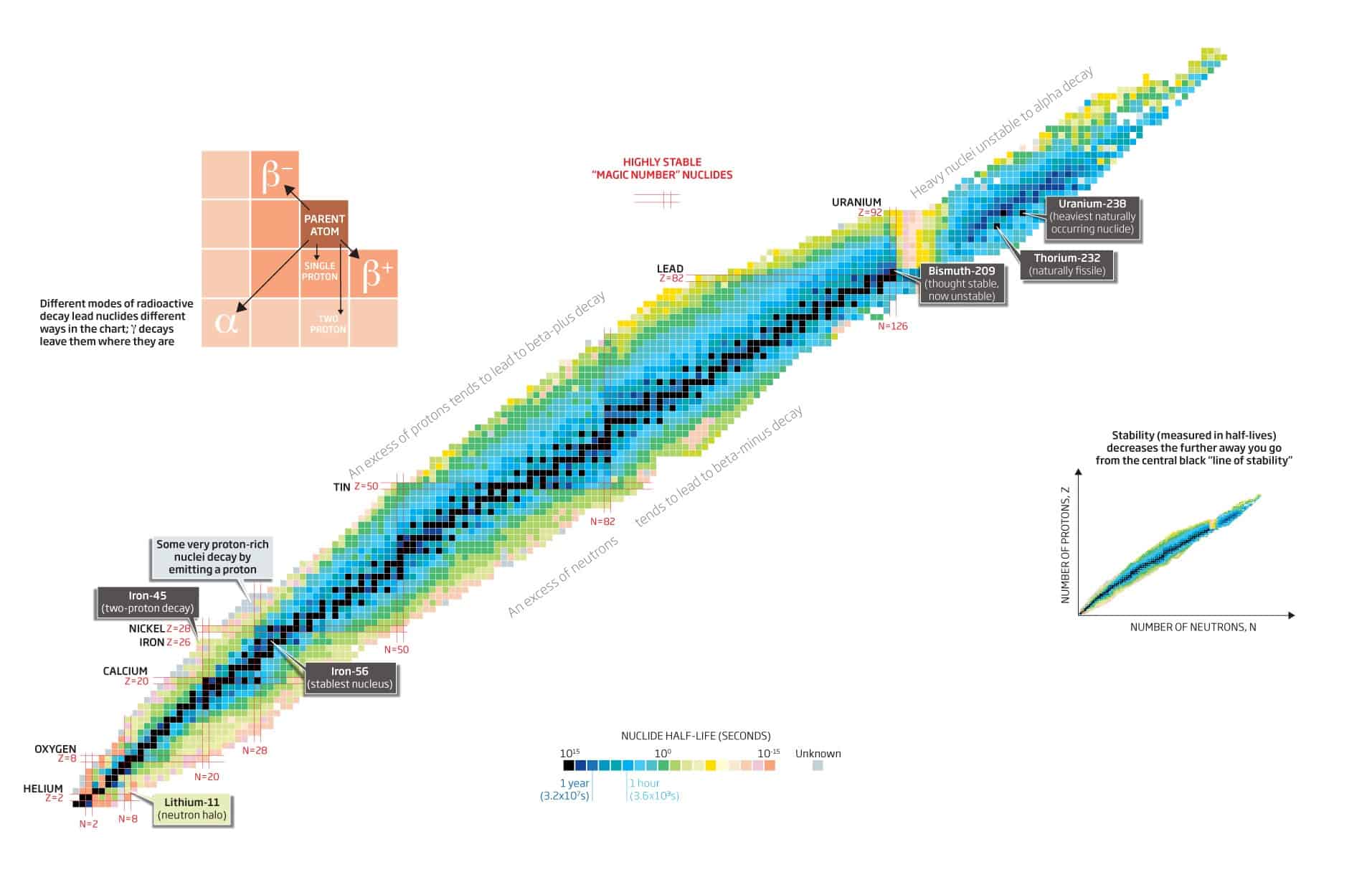
Segre chart – This chart shows a plot of the known nuclides as a function of their atomic and neutron numbers. It can be observed from the chart that there are more neutrons than protons in nuclides with Z greater than about 20 (Calcium). These extra neutrons are necessary for stability of the heavier nuclei. The excess neutrons act somewhat like nuclear glue.

Nuclear Stability is a concept that helps to identify the stability of an isotope. To identify the stability of an isotope it is needed to find the ratio of neutrons to protons. To determine the stability of an isotope you can use the ratio neutron/proton (N/Z). Also to help understand this concept there is a chart of the nuclides, known as a Segre chart. This chart shows a plot of the known nuclides as a function of their atomic and neutron numbers. It can be observed from the chart that there are more neutrons than protons in nuclides with Z greater than about 20 (Calcium). These extra neutrons are necessary for stability of the heavier nuclei. The excess neutrons act somewhat like nuclear glue.

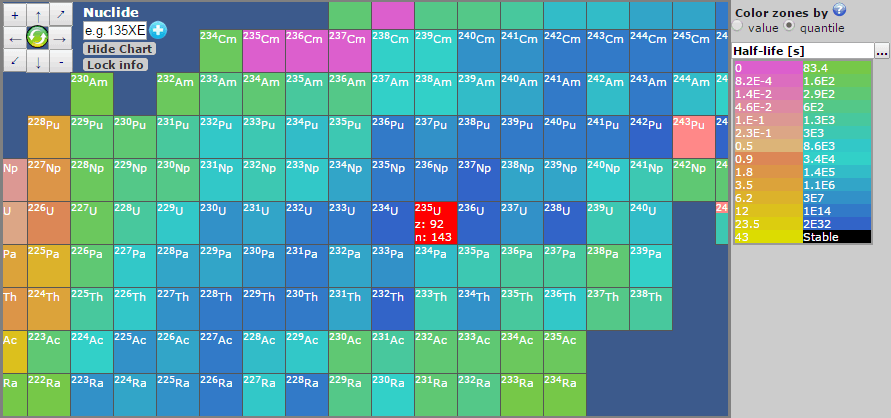
See also: Livechart – iaea.org

Detail of Nuclide Chart.

Atomic nuclei consist of protons and neutrons, which attract each other through the nuclear force, while protons repel each other via the electric force due to their positive charge. These two forces compete, leading to various stability of nuclei. There are only certain combinations of neutrons and protons, which forms stable nuclei.

Neutrons stabilize the nucleus, because they attract each other and protons , which helps offset the electrical repulsion between protons. As a result, as the number of protons increases, an increasing ratio of neutrons to protons is needed to form a stable nucleus. If there are too many or too few neutrons for a given number of protons, the resulting nucleus is not stable and it undergoes radioactive decay. Unstable isotopesdecay through various radioactive decay pathways, most commonly alpha decay, beta decay, or electron capture. Many other rare types of decay, such as spontaneous fission or neutron emission are known. It should be noted that all of these decay pathways may be accompanied by the subsequent emission of gamma radiation. Pure alpha or beta decays are very rare.

Atomic Mass Number – Does it conserve in a nuclear reaction?

In general, the atomic mass number is not conserved in nuclear reactions.

In analyzing nuclear reactions, we apply the many conservation laws. Nuclear reactions are subject to classical conservation laws for charge, momentum, angular momentum, and energy (including rest energies).  Additional conservation laws, not anticipated by classical physics, are are electric charge, lepton number and baryon number. Certain of these laws are obeyed under all circumstances, others are not. We have accepted conservation of energy and momentum. In reactor physics (non-relativistic physics), we assume that the number of protons (the atomic number), the number of neutrons (the neutron number) and its sum (the atomic mass number) are usually separately conserved. We shall find circumstances and conditions in which  this rule is not true. Where we are considering non-relativistic nuclear reactions, it is essentially true. However, where we are considering relativistic nuclear energies or those involving the weak interactions (e.g. in beta decay the atomic number is not conserved), we shall find that these principles must be extended.

Conservation of Baryon Number

Instead of mass number conservation, physicists define the baryon number, which is a conserved quantum number in all particle reactions.

Baryon number is a generalization of nucleon number, which is conserved in nonrelativistic nuclear reactions and decays. The law of conservation of baryon numberstates that:

The sum of the baryon number of all incoming particles is the same as the sum of the baryon numbers of all particles resulting from the reaction.

For example, the following reaction (proton-antiproton pair production) does conserve B and does occur if the incoming proton has sufficient energy (the threshold energy = 5.6 GeV):

baryon-number-pair-production

As indicated, B = +2 on both sides of this equation.

From these and other reactions, the conservation of baryon number has been established as a basic principle of physics.

This principle provides basis for the stability of the proton. Since the proton is the lightest particle among all baryons, the hypothetical products of its decay would have to be non-baryons. Thus, the decay would violate the conservation of baryon number. It must be added some theories have suggested that protons are in fact unstable with very long half-life (~1030 years) and that they decay into leptons. There is currently no experimental evidence that proton decay occurs.

Atomic Mass Number and Neutron Slowing Down

The moderator, which is of importance in thermal reactors, is used to moderate, that is, to slow down, neutrons from fission to thermal energies. The probability that fission will occur depends on incident neutron energy. Physicists calculate with fission cross-section, which determines this probability.

Nuclei with low mass numbers are most effective for this purpose, so the moderator is always a low-mass-number material. Commonly used moderators include regular (light) water (roughly 75% of the world’s reactors), solid graphite (20% of reactors) and heavy water (5% of reactors). Beryllium and beryllium oxide (BeO) have been used occasionally, but they are very costly. Low-mass number materials are effective due to high logarithmic energy decrement per collision (ξ) as a key material constant describing energy transfers during a neutron slowing down.

Atomic Mass Number and Nuclear Radius

Typical nuclear radii are of the order 10−14 m. Assuming spherical shape, nuclear radii can be calculated according to following formula:

r = r0 . A1/3

where r0 = 1.2 x 10⁻¹⁵ m = 1.2 fm

If we use this approximation, we therefore expect the geometrical cross-sections of nuclei to be of the order of πr2 or 4.5×10⁻³⁰ m² for hydrogen nuclei or 1.74×10⁻²⁸ m² for 238U nuclei.

Atomic Mass Number and Nuclear Fission

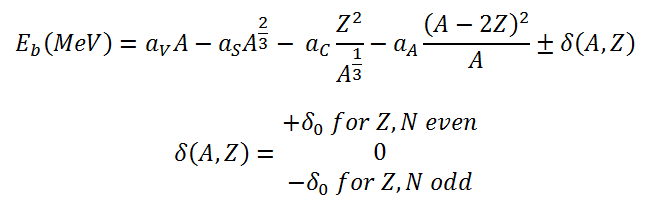
The nuclear binding energy as a function of the mass number A and the number of
protons Z based on the liquid drop model can be written as:

Weizsaecker formula - semi-empirical mass formula

This formula is called the Weizsaecker Formula (or the semi-empirical mass formula). With the aid of the Weizsaecker formula the binding energy can be calculated very well for nearly all isotopes. This formula provides a good fit for heavier nuclei.

From the nuclear binding energy curve and from the table it can be seen that, in the case of splitting a 235U nucleus into two parts, the binding energy of the fragments (A ≈ 120) together is larger than that of the original 235U nucleus. According to the Weizsaecker formula, the total energy released for such reaction will be approximately 235 x (8.5 – 7.6) ≈ 200 MeV.

As well as the critical energy depends on the nuclear structure and is quite large for light nuclei with Z < 90. For heavier nuclei with Z > 90, the critical energy is about 4 to 6 MeV for A-even nuclei, and generally is much lower for A-odd nuclei.

Atomic Mass Number and Atomic Mass (Isotopic Mass)

The size and mass of atoms are so small that the use of normal measuring units, while possible, is often inconvenient. Units of measure have been defined for mass and energy on the atomic
scale to make measurements more convenient to express. The unit of measure for mass is the atomic mass unit (amu). One atomic mass unit is equal to 1.66 x 10⁻²⁴ grams.

Besides the thermodynamics/thermodynamic-properties/what-is-mass-and-weight/standard-kilogram/”>standard kilogram, it is a second mass standard. It is the carbon-12 atom, which, by international agreement, has been assigned a mass of 12 atomic mass units (u). The relation between the two units is

One atomic mass unit is equal:

1u = 1.66 x 10⁻²⁴ grams.

One unified atomic mass unit is approximately the mass of one nucleon (either a single proton or neutron) and is numerically equivalent to 1 g/mol.

For 12C the atomic mass is exactly 12u, since the atomic mass unit is defined from it. For other isotopes, the isotopic mass usually differs and is usually within 0.1 u of the mass number. For example, 63Cu (29 protons and 34 neutrons) has a mass number of 63 and an isotopic mass in its nuclear ground state is 62.91367 u.

There are two reasons for the difference between mass number and isotopic mass, known as the mass defect:

  1. The neutron is slightly heavier than the proton. This increases the mass of nuclei with more neutrons than protons relative to the atomic mass unit scale based on 12C with equal numbers of protons and neutrons.
  2. The nuclear binding energy varies between nuclei. A nucleus with greater binding energy has a lower total energy, and therefore a lower mass according to Einstein’s mass-energy equivalence relation E = mc2. For 63Cu the atomic mass is less than 63 so this must be the dominant factor.
 
Mass defect of a 63Cu
Calculate the mass defect of a 63Cu nucleus if the actual mass of 63Cu in its nuclear ground state is 62.91367 u.

63Cu nucleus has 29 protons and also has (63 – 29) 34 neutrons.

The mass of a proton is 1.00728 u and a neutron is 1.00867 u.

The combined mass is: 29 protons x (1.00728 u/proton) + 34 neutrons x (1.00867 u/neutron) = 63.50590 u

The mass defect is Δm = 63.50590 u – 62.91367 u =  0.59223 u

Convert the mass defect into energy (nuclear binding energy).

(0.59223 u/nucleus) x (1.6606 x 10⁻²⁷ kg/u) = 9.8346 x 10⁻²⁸ kg/nucleus

ΔE = Δmc2

ΔE = (9.8346 x 10⁻²⁸ kg/nucleus) x (2.9979 x 10⁸ m/s)2 = 8.8387 x 10⁻¹¹ J/nucleus

The energy calculated in the previous example is the nuclear binding energy.  However, the nuclear binding energy may be expressed as kJ/mol (for better understanding).

Calculate the nuclear binding energy of 1 mole of 63Cu:

(8.8387 x 10⁻¹¹ J/nucleus) x (1 kJ/1000 J) x (6.022 x 10²³ nuclei/mol) = 5.3227 x 10¹⁰kJ/mol of nuclei.

One mole of 63Cu (~63 grams) is bound by the nuclear binding energy (5.3227 x 10¹⁰kJ/mol) which is equivalent to:

  • 14.8 million kilowatt-hours (≈ 15 GW·h)
  • 336,100 US gallons of automotive gasoline
 
References:
Nuclear and Reactor Physics:
  1. J. R. Lamarsh, Introduction to Nuclear Reactor Theory, 2nd ed., Addison-Wesley, Reading, MA (1983).
  2. J. R. Lamarsh, A. J. Baratta, Introduction to Nuclear Engineering, 3d ed., Prentice-Hall, 2001, ISBN: 0-201-82498-1.
  3. W. M. Stacey, Nuclear Reactor Physics, John Wiley & Sons, 2001, ISBN: 0- 471-39127-1.
  4. Glasstone, Sesonske. Nuclear Reactor Engineering: Reactor Systems Engineering, Springer; 4th edition, 1994, ISBN: 978-0412985317
  5. W.S.C. Williams. Nuclear and Particle Physics. Clarendon Press; 1 edition, 1991, ISBN: 978-0198520467
  6. G.R.Keepin. Physics of Nuclear Kinetics. Addison-Wesley Pub. Co; 1st edition, 1965
  7. Robert Reed Burn, Introduction to Nuclear Reactor Operation, 1988.
  8. U.S. Department of Energy, Nuclear Physics and Reactor Theory. DOE Fundamentals Handbook, Volume 1 and 2. January 1993.
  9. Paul Reuss, Neutron Physics. EDP Sciences, 2008. ISBN: 978-2759800414.

Advanced Reactor Physics:

  1. K. O. Ott, W. A. Bezella, Introductory Nuclear Reactor Statics, American Nuclear Society, Revised edition (1989), 1989, ISBN: 0-894-48033-2.
  2. K. O. Ott, R. J. Neuhold, Introductory Nuclear Reactor Dynamics, American Nuclear Society, 1985, ISBN: 0-894-48029-4.
  3. D. L. Hetrick, Dynamics of Nuclear Reactors, American Nuclear Society, 1993, ISBN: 0-894-48453-2.
  4. E. E. Lewis, W. F. Miller, Computational Methods of Neutron Transport, American Nuclear Society, 1993, ISBN: 0-894-48452-4.

See also:

Nuclear Structure

We hope, this article, Atomic Mass Number, helps you. If so, give us a like in the sidebar. Main purpose of this website is to help the public to learn some interesting and important information about materials and their properties.
What is Neutron Number – Definition

Definition of Neutron Number. The total number of neutrons in the nucleus of an atom is called the neutron number of the atom and is given the symbol N. Material Properties

Neutron Number

Neutron NumberThe atom consist of a small but massive nucleus surrounded by a cloud of rapidly moving electrons. The nucleus is composed of protons and neutrons. The total number of neutrons in the nucleus of an atom is called the neutron number of the atom and is given the symbol N.

Neutron number plus atomic number equals atomic mass number: N+Z=A. The difference between the neutron number and the atomic number is known as the neutron excess: D = N – Z = A – 2Z.

Neutron number is rarely written explicitly in nuclide symbol notation, but appears as a subscript to the right of the element symbol. Nuclides that have the same neutron number but a different proton number are called isotones.

The chemical properties of the atom are determined by the number of protons, in fact, by number and arrangement of electrons. The configuration of these electrons follows from the principles of quantum mechanics. The number of electrons in each element’s electron shells, particularly the outermost valence shell, is the primary factor in determining its chemical bonding behavior. In the periodic table, the elements are listed in order of increasing atomic number Z.

The nuclear properties (atomic mass, nuclear cross-sections) of the element are determined by the number of protons and number of neutrons (neutron number). For example, actinides with odd neutron number are usually fissile (fissionable with slow neutrons) while actinides with even neutron number are usually not fissile (but are fissionable with fast neutrons). Heavy nuclei with an even number of protons and an even number of neutrons are (due to Pauli exclusion principle) very stable thanks to the occurrence of ‘paired spin’. On the other hand, nuclei with an odd number of protons and neutrons are mostly unstable.

See also: Weizsaecker Formula Asymmetry and Pairing term

Hydrogen (H), for example , consist of one electron and one proton. The number of neutrons in a nucleus is known as the neutron number and is given the symbol N. The total number of nucleons, that is, protons and neutrons in a nucleus, is equal to Z + N = A, where A is called the mass number. The various species of atoms whose nuclei contain particular numbers of protons and neutrons are called nuclides. Each nuclide is denoted by chemical symbol of the element (this specifies Z) with tha atomic mass number as supescript.

Thus the symbol 1H refers to the nuclide of hydrogen with a single proton as nucleus. 2H is the hydrogen nuclide with a neutron as well as a proton in the nucleus (2H is also called deuterium or heavy hydrogen). Atoms such as 1H, 2H whose nuclei contain the same number of protons but different number of neutrons (different A) are known as isotopes. Hydrogen has identical chemical properties as deuterium, but has completely different nuclear properties.

Neutron Number and Nuclear Stability

Nuclide chart - Nuclear Stability
Segre chart – This chart shows a plot of the known nuclides as a function of their atomic and neutron numbers. It can be observed from the chart that there are more neutrons than protons in nuclides with Z greater than about 20 (Calcium). These extra neutrons are necessary for stability of the heavier nuclei. The excess neutrons act somewhat like nuclear glue.

Nuclear Stability is a concept that helps to identify the stability of an isotope. To identify the stability of an isotope it is needed to find the ratio of neutrons to protons. To determine the stability of an isotope you can use the ratio neutron/proton (N/Z). Also to help understand this concept there is a chart of the nuclides, known as a Segre chart. This chart shows a plot of the known nuclides as a function of their atomic and neutron numbers. It can be observed from the chart that there are more neutrons than protons in nuclides with Z greater than about 20 (Calcium). These extra neutrons are necessary for stability of the heavier nuclei. The excess neutrons act somewhat like nuclear glue. Only two stable nuclides have fewer neutrons than protons: hydrogen-1 and helium-3.

See also: Livechart – iaea.org

See also: Weizsaecker Formula Asymmetry and Pairing term

Detail of Nuclide Chart.

Atomic nuclei consist of protons and neutrons, which attract each other through the nuclear force, while protons repel each other via the electric force due to their positive charge. These two forces compete, leading to various stability of nuclei. There are only certain combinations of neutrons and protons, which forms stable nuclei.

Neutrons stabilize the nucleus, because they attract each other and protons , which helps offset the electrical repulsion between protons. As a result, as the number of protons increases, an increasing ratio of neutrons to protons is needed to form a stable nucleus. If there are too many or too few neutrons for a given number of protons, the resulting nucleus is not stable and it undergoes radioactive decay. Unstable isotopes decay through various radioactive decay pathways, most commonly alpha decay, beta decay, or electron capture. Many other rare types of decay, such as spontaneous fission or neutron emission are known. It should be noted that all of these decay pathways may be accompanied by the subsequent emission of gamma radiation. Pure alpha or beta decays are very rare.

Neutron Number – Does it conserve in a nuclear reaction?

In general, the neutron number is not conserved in nuclear reactions.

In analyzing nuclear reactions, we apply the many conservation laws. Nuclear reactions are subject to classical conservation laws for charge, momentum, angular momentum, and energy (including rest energies).  Additional conservation laws, not anticipated by classical physics, are are electric charge, lepton number and baryon number. Certain of these laws are obeyed under all circumstances, others are not. We have accepted conservation of energy and momentum. In reactor physics (non-relativistic physics), we assume that the number of neutrons (the neutron number), the number of protons (the proton number) and its sum (the atomic mass number) are usually separately conserved. We shall find circumstances and conditions in which  this rule is not true. Where we are considering non-relativistic nuclear reactions, it is essentially true. However, where we are considering relativistic nuclear energies or those involving the weak interactions (e.g. in beta decay the neutron number is not conserved), we shall find that these principles must be extended.

&nbsp;

 
References:
Nuclear and Reactor Physics:
  1. J. R. Lamarsh, Introduction to Nuclear Reactor Theory, 2nd ed., Addison-Wesley, Reading, MA (1983).
  2. J. R. Lamarsh, A. J. Baratta, Introduction to Nuclear Engineering, 3d ed., Prentice-Hall, 2001, ISBN: 0-201-82498-1.
  3. W. M. Stacey, Nuclear Reactor Physics, John Wiley & Sons, 2001, ISBN: 0- 471-39127-1.
  4. Glasstone, Sesonske. Nuclear Reactor Engineering: Reactor Systems Engineering, Springer; 4th edition, 1994, ISBN: 978-0412985317
  5. W.S.C. Williams. Nuclear and Particle Physics. Clarendon Press; 1 edition, 1991, ISBN: 978-0198520467
  6. G.R.Keepin. Physics of Nuclear Kinetics. Addison-Wesley Pub. Co; 1st edition, 1965
  7. Robert Reed Burn, Introduction to Nuclear Reactor Operation, 1988.
  8. U.S. Department of Energy, Nuclear Physics and Reactor Theory. DOE Fundamentals Handbook, Volume 1 and 2. January 1993.
  9. Paul Reuss, Neutron Physics. EDP Sciences, 2008. ISBN: 978-2759800414.

Advanced Reactor Physics:

  1. K. O. Ott, W. A. Bezella, Introductory Nuclear Reactor Statics, American Nuclear Society, Revised edition (1989), 1989, ISBN: 0-894-48033-2.
  2. K. O. Ott, R. J. Neuhold, Introductory Nuclear Reactor Dynamics, American Nuclear Society, 1985, ISBN: 0-894-48029-4.
  3. D. L. Hetrick, Dynamics of Nuclear Reactors, American Nuclear Society, 1993, ISBN: 0-894-48453-2.
  4. E. E. Lewis, W. F. Miller, Computational Methods of Neutron Transport, American Nuclear Society, 1993, ISBN: 0-894-48452-4.

See also:

Nuclear Structure

We hope, this article, Neutron Number, helps you. If so, give us a like in the sidebar. Main purpose of this website is to help the public to learn some interesting and important information about materials and their properties.
What is Atomic Number – Definition

Atomic number or proton number is defined as the total number of protons in the nucleus. The number of electrons in an electrically-neutral atom is the same as the atomic number. Material Properties

Atomic Number

Proton Number - Atomic Number
Source: chemwiki.ucdavis.edu

The atom consist of a small but massive nucleus surrounded by a cloud of rapidly moving electrons. The nucleus is composed of protons and neutrons. The total number of protons in the nucleus of an atom is called the atomic number (or the proton number) of the atom and is given the symbol Z.

The number of electrons in an electrically-neutral atom is the same as the number of protons in the nucleus. The total electrical charge of the nucleus is therefore +Ze, where e (elementary charge) equals to 1,602 x 10-19coulombs. Each electron is influenced by the electric fields produced by the positive nuclear charge and the other (Z – 1) negative electrons in the atom.

Since the number of electrons is responsible for the chemical bavavior of atoms, the atomic number identifies the various chemical elements.

The chemical properties of the atom are determined by the number of protons, in fact, by number and arrangement of electrons. The configuration of these electrons follows from the principles of quantum mechanics. The number of electrons in each element’s electron shells, particularly the outermost valence shell, is the primary factor in determining its chemical bonding behavior. In the periodic table, the elements are listed in order of increasing atomic number Z.

Hydrogen (H), for example , consist of one electron and one proton. The number of neutrons in a nucleus is known as the neutron number and is given the symbol N. The total number of nucleons, that is, protons and neutrons in a nucleus, is equal to Z + N = A, where A is called the mass number. The various species of atoms whose nuclei contain particular numbers of protons and neutrons are called nuclides. Each nuclide is denoted by chemical symbol of the element (this specifies Z) with tha atomic mass number as supescript.

Thus the symbol 1H refers to the nuclide of hydrogen with a single proton as nucleus. 2H is the hydrogen nuclide with a neutron as well as a proton in the nucleus (2H is also called deuterium or heavy hydrogen). Atoms such as 1H, 2H whose nuclei contain the same number of protons but different number of neutrons (different A) are known as isotopes.

Atomic Number and Nuclear Stability

Nuclide chart - Nuclear Stability
Segre chart – This chart shows a plot of the known nuclides as a function of their atomic and neutron numbers. It can be observed from the chart that there are more neutrons than protons in nuclides with Z greater than about 20 (Calcium). These extra neutrons are necessary for stability of the heavier nuclei. The excess neutrons act somewhat like nuclear glue.

Nuclear Stability is a concept that helps to identify the stability of an isotope. To identify the stability of an isotope it is needed to find the ratio of neutrons to protons. To determine the stability of an isotope you can use the ratio neutron/proton (N/Z). Also to help understand this concept there is a chart of the nuclides, known as a Segre chart. This chart shows a plot of the known nuclides as a function of their atomic and neutron numbers. It can be observed from the chart that there are more neutrons than protons in nuclides with Z greater than about 20 (Calcium). These extra neutrons are necessary for stability of the heavier nuclei. The excess neutrons act somewhat like nuclear glue.

See also: Livechart – iaea.org

Detail of Nuclide Chart.

Atomic nuclei consist of protons and neutrons, which attract each other through the nuclear force, while protons repel each other via the electric force due to their positive charge. These two forces compete, leading to various stability of nuclei. There are only certain combinations of neutrons and protons, which forms stable nuclei.

Neutrons stabilize the nucleus, because they attract each other and protons , which helps offset the electrical repulsion between protons. As a result, as the number of protons increases, an increasing ratio of neutrons to protons is needed to form a stable nucleus. If there are too many or too few neutrons for a given number of protons, the resulting nucleus is not stable and it undergoes radioactive decay. Unstable isotopesdecay through various radioactive decay pathways, most commonly alpha decay, beta decay, or electron capture. Many other rare types of decay, such as spontaneous fission or neutron emission are known. It should be noted that all of these decay pathways may be accompanied by the subsequent emission of gamma radiation. Pure alpha or beta decays are very rare.

Atomic Number – Does it conserve in a nuclear reaction?

In general, the atomic number is not conserved in nuclear reactions.

In analyzing nuclear reactions, we apply the many conservation laws. Nuclear reactions are subject to classical conservation laws for charge, momentum, angular momentum, and energy (including rest energies).  Additional conservation laws, not anticipated by classical physics, are are electric charge, lepton number and baryon number. Certain of these laws are obeyed under all circumstances, others are not. We have accepted conservation of energy and momentum. In reactor physics (non-relativistic physics), we assume that the number of protons (the atomic number), the number of neutrons (the neutron number) and its sum (the atomic mass number) are usually separately conserved. We shall find circumstances and conditions in which  this rule is not true. Where we are considering non-relativistic nuclear reactions, it is essentially true. However, where we are considering relativistic nuclear energies or those involving the weak interactions (e.g. in beta decay the atomic number is not conserved), we shall find that these principles must be extended.

Conservation of Electric Charge

As was written, the total electrical charge of the nucleus is determined by the atomic number and is equal to +Ze. Conservation of charge is thought to be a universal conservation law. No experimental evidence for any violation of this principle has ever been observed.

For example:

Consider a typical fission reaction such as the one listed below.

Uranium absorption reaction

Typically, when uranium 235 nucleus undergoes fission, the nucleus splits into two smaller nuclei (triple fission can also rarely occur), along with a few neutrons (the average is 2.43 neutrons per fission by thermal neutron) and release of energy in the form of heat and gamma rays. From these reactions we find that in the fission the parent nucleus:

  • 235U contains 92 protons (a charge of +92e),
  • incident neutron is electrically neutral.

The fission fragments:

  • 139Ba contains 56 protons (a charge of +56e),
  • 94Ba contains 36 protons (a charge of +36e)

We see that the total charge is 92e before and after the reaction; thus, charge is conserved. It is noteworthy, the total number of nucleons before and after a reaction are also the same.

High Atomic Number Materials Use – Shielding of Gamma Radiation

Table of Half Value Layers (in cm)
Table of Half Value Layers (in cm) for a different materials at gamma ray energies of 100, 200 and 500 keV.

In short, effective shielding of gamma radiation is in most cases based on use of materials with two following material properties:

  • high-density of material. 
  • high atomic number of material  (high Z materials)

However, low-density materials and low Z materials can be compensated with increased thickness, which is as significant as density and atomic number in shielding applications.

A lead is widely used as a gamma shield.  Major advantage of lead shield is in its compactness due to its higher density. On the other hand depleted uranium is much more effective due to its higher Z.  Depleted uranium is used for shielding in portable gamma ray sources.

In nuclear power plants shielding of a reactor core can be provided by materials of reactor pressure vessel, reactor internals (neutron reflector). Also heavy concrete is usually used to shield both neutrons and gamma radiation.

Although water is neither high density nor high Z material, it is commonly used as gamma shields. Water provides a radiation shielding of fuel assemblies in a spent fuel pool during storage or during transports from and into the reactor core.

Atomic Number Density

Atomic number should not be confused with the atomic number density, which completely different physical quantity.

In nuclear physics, the macroscopic cross-section represents the effective target area of all of the nuclei contained in the volume of the material. The macroscopic cross-section is derived from microscopic cross-sectionand the atomic number density (N):

Σ=σ.N

In this equation, the atomic number density plays the crucial role as the microscopic cross-section, because in the reactor core the atomic number density of certain materials (e.g. water as the moderator) can be simply changed leading into certain reactivity changes. In order to understand the nature of these reactivity changes, we must understand the term the atomic number density.

The atomic number density (N; atoms/cm3) is the number of atoms of a given type per unit volume (V; cm3) of the material. The atomic number density (N; atoms/cm3) of a pure material having atomic or molecular weight (M; grams/mol) and the material density (⍴; gram/cm3) is easily computed from the following equation using Avogadro’s number (NA = 6.022×10²³ atoms or molecules per mole):

Atomic Number Density

 
References:
Nuclear and Reactor Physics:
  1. J. R. Lamarsh, Introduction to Nuclear Reactor Theory, 2nd ed., Addison-Wesley, Reading, MA (1983).
  2. J. R. Lamarsh, A. J. Baratta, Introduction to Nuclear Engineering, 3d ed., Prentice-Hall, 2001, ISBN: 0-201-82498-1.
  3. W. M. Stacey, Nuclear Reactor Physics, John Wiley & Sons, 2001, ISBN: 0- 471-39127-1.
  4. Glasstone, Sesonske. Nuclear Reactor Engineering: Reactor Systems Engineering, Springer; 4th edition, 1994, ISBN: 978-0412985317
  5. W.S.C. Williams. Nuclear and Particle Physics. Clarendon Press; 1 edition, 1991, ISBN: 978-0198520467
  6. G.R.Keepin. Physics of Nuclear Kinetics. Addison-Wesley Pub. Co; 1st edition, 1965
  7. Robert Reed Burn, Introduction to Nuclear Reactor Operation, 1988.
  8. U.S. Department of Energy, Nuclear Physics and Reactor Theory. DOE Fundamentals Handbook, Volume 1 and 2. January 1993.
  9. Paul Reuss, Neutron Physics. EDP Sciences, 2008. ISBN: 978-2759800414.

Advanced Reactor Physics:

  1. K. O. Ott, W. A. Bezella, Introductory Nuclear Reactor Statics, American Nuclear Society, Revised edition (1989), 1989, ISBN: 0-894-48033-2.
  2. K. O. Ott, R. J. Neuhold, Introductory Nuclear Reactor Dynamics, American Nuclear Society, 1985, ISBN: 0-894-48029-4.
  3. D. L. Hetrick, Dynamics of Nuclear Reactors, American Nuclear Society, 1993, ISBN: 0-894-48453-2.
  4. E. E. Lewis, W. F. Miller, Computational Methods of Neutron Transport, American Nuclear Society, 1993, ISBN: 0-894-48452-4.

See also:

Nuclear Structure

We hope, this article, Atomic Number, helps you. If so, give us a like in the sidebar. Main purpose of this website is to help the public to learn some interesting and important information about materials and their properties.
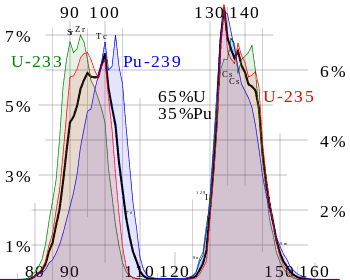
What is Xenon – Definition

What is Xenon – Xe Element. Xenon is a naturally-occurring chemical element with atomic number 54 which means there are 54 protons and 54 electrons in the atomic structure. Material Properties

What is Xenon

What is Xenon – Xe Element

Xenon is a naturally-occurring chemical element with atomic number 54 which means there are 54 protons and 54 electrons in the atomic structure. The chemical symbol for xenon is Xe. Xenon is a colorless, dense, odorless noble gas found in the Earth’s atmosphere in trace amounts.

Xenon was first discovered in 1898 by the Scottish chemist William Ramsay and English chemist Morris Travers. The name xenon for this gas comes from the Greek word ξένον [xenon], neuter singular form of ξένος [xenos], meaning ‘foreign(er)’, ‘strange(r)’, or ‘guest’.

Natural xenon consists of eight stable isotopes, 124Xe (0.095%), 126Xe (0.089%), 128Xe (1.91%), 129Xe (26.4%), 130Xe (4.07%), 131Xe (21.23%), 132Xe (26.91%),  134Xe (10.44%), and one isotope with very long half-life 136Xe (8.86%).

In nuclear industry, especially artificial xenon 135 has a tremendous impact on the operation of a nuclear reactor. For physicists and for reactor operators, it is important to understand the mechanisms that produce and remove xenon from the reactor to predict how the reactor will respond following changes in power level.

Another important isotope is the xenon 133, which has half-life of 5.2 days, and its presence in a reactor coolant indicates (together with xenon 135) a possible failure of fuel cladding. A new defect will often result in a step increase in only the Xe-133 activity, which is measured from reactor coolant. As the defect enlarges, the release rate of the soluble, longer-lived nuclides, particularly I-131, I-134, Cs-134, and Cs-137 will increase.

See also:

Xenon 135

We hope, this article, Xenon, helps you. If so, give us a like in the sidebar. Main purpose of this website is to help the public to learn some interesting and important information about materials and their properties.
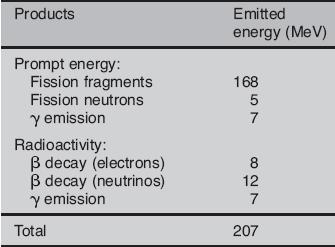
What is Ionization Energy – Definition

What is Ionization Energy. Ionization energy, also called ionization potential, is the energy necessary to remove an electron from the neutral atom. Material Properties

Ionization Energy

Ionization energy, also called ionization potential, is the energy necessary to remove an electron from the neutral atom.

X + energy → X+ + e−

where X is any atom or molecule capable of being ionized, X+ is that atom or molecule with an electron removed (positive ion), and e− is the removed electron.

There is an ionization energy for each successive electron removed. The electrons that circle the nucleus move in fairly well-defined orbits. Some of these electrons are more tightly bound in the atom than others. For example, only 7.38 eV is required to remove the outermost electron from a lead atom, while 88,000 eV is required to remove the innermost electron.

  • Ionization energy is lowest for the alkali metals which have a single electron outside a closed shell.
  • Ionization energy increases across a row on the periodic maximum for the noble gases which have closed shells.

For example, sodium requires only 496 kJ/mol or 5.14 eV/atom to ionize it. On the other hand neon, the noble gas, immediately preceding it in the periodic table, requires 2081 kJ/mol or 21.56 eV/atom.

The ionization energy associated with removal of the first electron is most commonly used. The nth ionization energy refers to the amount of energy required to remove an electron from the species with a charge of (n-1).

1st ionization energy

X → X+ + e−

2nd ionization energy

X+ → X2+ + e−

3rd ionization energy

X2+ → X3+ + e−

For example, only 7.38 eV is required to remove the outermost electron from a lead atom, while 88,000 eV is required to remove the innermost electron.

Ionization energy
Source: wikipedia.org License: CC BY-SA 3.0

Electronvolt – Energy Unit

Electronvolt - definition
Electronvolt is equal to energy gained by a single electron when it is accelerated through 1 volt of electric potential difference. The work done on the charge is given by the charge times the voltage difference, therefore the work W on electron is: W = qV = (1.6 x 10⁻¹⁹ C) x (1 J/C) = 1.6 x 10⁻¹⁹ J.

Electronvolt (unit: eV). Electronvolts are a traditional unit of energy particularly in atomic and nuclear physics. Electronvolt is equal to energy gained by a single electron when it is accelerated through 1 volt of electric potential difference. The work done on the charge is given by the charge times the voltage difference, therefore the work W on electron is: W = qV = (1.6 x 10⁻¹⁹ C) x (1 J/C) = 1.6 x 10⁻¹⁹ J. Since this is very small unit, it is more convenient to use multiples of electronvolts: kilo-electronvolts (keV), mega-electronvolts (MeV), giga-electronvolts (GeV) and so on. Since Albert Einstein showed that mass and energy are equivalent and convertible one into the other, the electronvolt is also a unit of mass. It is common in particle physics, where units of mass and energy are often interchanged, to express mass in units of eV/c2, where c is the speed of light in vacuum (from E = mc2). For example, it can be said the proton has mass of 938.3 MeV, although strictly speaking it should be 938.3 MeV/c2. For another example, an electron–positron annihilation occurs when a negatively charged electron and a positively charged positron (each with a mass of 0.511 MeV/c2) collide. When an electron and a positron collide, they annihilate resulting in the complete conversion of their rest mass to pure energy (according to the E=mc2 formula) in the form of two oppositely directed 0.511 MeV gamma rays (photons).

e− + e+ → γ + γ (2x 0.511 MeV)

  • 1 eV = 1.603 x 10⁻¹⁹ J
  • 1 eV = 3.83 x 10⁻²⁰ cal
  • 1 eV = 1.52 x 10⁻²² BTU

conversion -megawattday, electronvolt - energy units

Example of Energies in Electronvolts

  • Thermal neutrons are neutrons in thermal equilibrium with a surrounding medium of temperature 290K (17 °C or 62 °F). Most probable energy at 17°C (62°F) for Maxwellian distribution is 0.025 eV (~2 km/s).
  • Thermal energy of a molecule is at room temperature about 0.04 eV.
  • Approximately 1 eV corresponds to an infrared photon of wavelength 1240 nm.
  • Visible light photons have energies in range 1.65 eV (red) – 3.26 eV (violet).
  • The first resonance in n + 238U reaction is at 6.67 eV (energy of incident neutron), which corresponds to the first virtual level in 239U, has a total width of only 0.027 eV, and the mean life of this state is 2.4×10⁻¹⁴s.
  • Ionization energy of atomic hydrogen is 13.6 eV.
  • Carbon-14 decays into nitrogen-14 through beta decay (pure beta decay). The emitted beta particles have a maximum energy of 156 keV, while their weighted mean energy is 49 keV.
  • High energy diagnostic medical x-ray photons have kinetic energies of about 200 keV.
  • Thallium 208, which is one of nuclides in the 232U decay chain, emits gamma rays of 2.6 MeV which are very energetic and highly penetrating.
  • Typical kinetic energy of alpha particle from radioactive decay is about 5 MeV. It is caused by the mechanism of their production.
  • The total energy released in a reactor is about 210 MeV per 235U fission, distributed as shown in the table. In a reactor, the average recoverable energy per fission is about 200 MeV, being the total energy minus the energy of the energy of antineutrinos that are radiated away.
  • Cosmic ray can have energies of 1 MeV – 1000 TeV.
 
References:
Reactor Physics and Thermal Hydraulics:
  1. J. R. Lamarsh, Introduction to Nuclear Reactor Theory, 2nd ed., Addison-Wesley, Reading, MA (1983).
  2. J. R. Lamarsh, A. J. Baratta, Introduction to Nuclear Engineering, 3d ed., Prentice-Hall, 2001, ISBN: 0-201-82498-1.
  3. W. M. Stacey, Nuclear Reactor Physics, John Wiley & Sons, 2001, ISBN: 0- 471-39127-1.
  4. Glasstone, Sesonske. Nuclear Reactor Engineering: Reactor Systems Engineering, Springer; 4th edition, 1994, ISBN: 978-0412985317
  5. Todreas Neil E., Kazimi Mujid S. Nuclear Systems Volume I: Thermal Hydraulic Fundamentals, Second Edition. CRC Press; 2 edition, 2012, ISBN: 978-0415802871
  6. Zohuri B., McDaniel P. thermodynamics in Nuclear Power Plant Systems. Springer; 2015, ISBN: 978-3-319-13419-2
  7. Moran Michal J., Shapiro Howard N. Fundamentals of Engineering thermodynamics, Fifth Edition, John Wiley & Sons, 2006, ISBN: 978-0-470-03037-0
  8. Kleinstreuer C. Modern Fluid Dynamics. Springer, 2010, ISBN 978-1-4020-8670-0.
  9. U.S. Department of Energy, thermodynamics, HEAT TRANSFER, AND FLUID FLOW. DOE Fundamentals Handbook, Volume 1, 2 and 3. June 1992.

See also:

Energy

We hope, this article, Ionization Energy, helps you. If so, give us a like in the sidebar. Main purpose of this website is to help the public to learn some interesting and important information about materials and their properties.
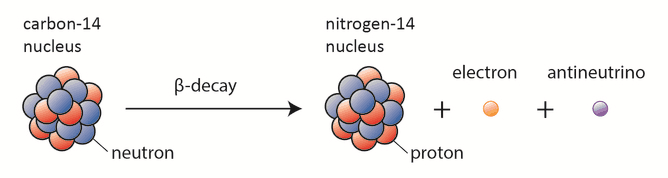
What is Form of Energy – Definition

Forms of Energy. Energy exists in many forms. Common energy forms include mechanical energy that is classically divided into kinetic and potential energy. Material Properties

What is Energy

The Sun
The Sun generates its energy by nuclear fusion of hydrogen nuclei into helium. In its core, the Sun fuses 620 million metric tons of hydrogen each second.
Source: hyperphysics.phy-astr.gsu.edu

The term energy is very very broad and it has many definitions. Technically, energy is a scalar physical quantity that is associated with the state of one or more objects. Energy is generally defined as the potential to do work or produce heat. Sometimes it is like the “currency” for performing work. You must have energy to accomplish work. To do 1 kilojoule of work, you must expend 1 kilojoule of energy. It must be added, this interpretation can be misleading because energy is not necessarily available to do work.

One of the most wonderful properties of the universe is that energy can be transformed from one type to another and transferred from one object to another. Moreover, when transformed from one type to another and transferred from one object to another, the total amount of energy is always the same. It is one of the elementary properties of the universe.

For example, burning gasoline to power cars is an energy conversion process we rely on. The chemical energy in gasoline is converted to thermal energy, which is then converted to mechanical energy that makes the car move. The mechanical energy has been converted to kinetic energy. When we use the brakes to stop a car, that kinetic energy is converted by friction back to heat, or thermal energy.

Forms of Energy

Energy exists in many forms. Common energy forms include mechanical energy that is classically divided into kinetic and potential energy. The kinetic energy is related to the velocity of a moving object. The potential energy is related to an object’s position in a force field (gravitational, electric or magnetic). Tension in a spring or surface film tension are other forms of potential mechanical energy (elastic energy). There are many other forms of energy including electrical, magnetical, chemical, and nuclear energy.

In thermodynamics the concept of energy is broadened to account for other observed changes. thermodynamics deals with another type of energy called “thermal energy” or “internal energy”. The only ways the energy of a closed system can be changed are through transfer of energy by work or by heat. Further, based on the experiments of Joule and others, a fundamental aspect of the energy concept is that energy is conserved. This principle is known as the first law of thermodynamics. In general energy is a fundamental concept of thermodynamics and one of the most significant aspects of engineering analysis.

 
Mechanical energy
In physics, thermodynamics/what-is-energy-physics/what-is-mechanical-energy/”>mechanical energy (Emech) is the energy associated with the motion and position of an object usually in some force field (e.g. gravitational field). Mechanical energy (and also the thermal energy) can be separated into two categories, transient and stored. Transient energy is energy in motion, that is, energy being transferred from one place to another. Stored energy is the energy contained within a substance or object. Transient mechanical energy is commonly referred to as work. Stored mechanical energy exists in one of two forms: kinetic or potential.
Kinetic energy
The thermodynamics/what-is-energy-physics/what-is-kinetic-energy/”>kinetic energy, K, is defined as the energy stored in an object because of its motion. An object in motion has the ability to do work and thus can be said to have energy. It is called kinetic energy, from the Greek word kinetikos, meaning “motion.”

The kinetic energy depends on the speed of an object and is the ability of a moving object to do work on other objects when it collides with them. On the other hand, the kinetic energy of an object represents the amount of energy required to increase the velocity of the object from rest (v = 0) to its final velocity. The kinetic energy also depends linearly on the mass, which is a numerical measure of object’s inertia and the measure of an object’s resistance to acceleration when a force is applied.

We define the quantity:

K = ½ mv2

to be the translational kinetic energy of the object. It must be added, it is called the “translational” kinetic energy to distinguish it from rotational kinetic energy

Potential energy
thermodynamics/what-is-energy-physics/what-is-potential-energy/”>Potential energy, U, is defined as the energy stored in an object subjected to a conservative force. Common types include the gravitational potential energy, the elastic potential energy of an extended spring, and the electric potential energy of an electric charge in an electric field and so on.
Gravitational energy

In classical mechanics, the thermodynamics/what-is-energy-physics/what-is-potential-energy/gravitational-potential-energy/”>gravitational potential energy (U) is energy an object possesses because of its position in a gravitational field. Gravitational potential (V; the gravitational energy per unit mass) at a location is equal to the work (energy transferred) per unit mass that would be needed to move the object from a fixed reference location to the location of the object. The most common use of gravitational potential energy is for an object near the surface of the Earth where the gravitational acceleration can be assumed to be constant at about 9.8 m/s2.

U = mgh

Internal energy
In thermodynamics,thermodynamics/what-is-energy-physics/internal-energy-thermal-energy/”> internal energy (also called the thermal energy) is defined as the energy associated with microscopic forms of energy. It is an thermodynamics/extensive-and-intensive-properties/”>extensive quantity, it depends on the size of the system, or on the amount of substance it contains. The SI unit of internal energy is the joule (J). It is the energy contained within the system, excluding the kinetic energy of motion of the system as a whole and the potential energy of the system. Microscopic forms of energy include those due to the rotation, vibration, translation, and interactions among the molecules of a substance. None of these forms of energy can be measured or evaluated directly, but techniques have been developed to evaluate the change in the total sum of all these microscopic forms of energy.

In addition, energy is can be stored in the chemical bonds between the atoms that make up the molecules. This energy storage on the atomic level includes energy associated with electron orbital states, nuclear spin, and binding forces in the nucleus.

Enthalpy
In thermodynamics, the thermodynamics/what-is-energy-physics/what-is-enthalpy/”>enthalpy is a measurement of energy in a thermodynamic system. It is the thermodynamic quantity equivalent to the total heat content of a system. The enthalpy is defined to be the sum of the internal energy E plus the product of the pressure p and volume V. In many thermodynamic analyses the sum of the internal energy U and the product of pressure p and volume V appears, therefore it is convenient to give the combination a name, enthalpy, and a distinct symbol, H.

The enthalpy is the preferred expression of system energy changes in many chemical, biological, and physical measurements at constant pressure. It is so useful that it is tabulated in the thermodynamics/steam-tables/”>steam tables along with thermodynamics/thermodynamic-properties/what-is-specific-volume/”>specific volume and thermodynamics/what-is-energy-physics/internal-energy-thermal-energy/specific-internal-energy/”>specific internal energy. It is due to the fact, it simplifies the description of energy transfer. At constant pressure, the enthalpy change equals the energy transferred from the environment through heating (Q = H2 – H1) or work other than expansion work. For a variable-pressure process, the difference in enthalpy is not quite as obvious.

Entropy
In thermodynamics and statistical physics, thermodynamics/what-is-energy-physics/what-is-entropy/”>entropy is a quantitative measure of disorder, or of the energy in a system to do work.

In statistical physics, entropy is a measure of the disorder of a system. What disorder refers to is really the number of microscopic configurations, W, that a thermodynamic system can have when in a state as specified by certain macroscopic variables (thermodynamics/thermodynamic-properties/what-is-volume-physics/”>volume, thermodynamics/what-is-energy-physics/”>energy, thermodynamics/thermodynamic-properties/what-is-pressure-physics/”>pressure, and thermodynamics/thermodynamic-properties/what-is-temperature-physics/”>temperature). By “microscopic states”, we mean the exact states of all the molecules making up the system.

Mathematically, the exact definition is:

Entropy = (Boltzmann’s constant k) x logarithm of number of possible states

S = kB logW

This equation, which relates the microscopic details, or microstates, of the system (via W) to its macroscopic state (via the entropy S), is the key idea of statistical mechanics. In a closed system, entropy never decreases, so in the Universe entropy is irreversibly increasing. In an open system (for example, a growing tree), entropy can decrease and order can increase, but only at the expense of an increase in entropy somewhere else (e.g. in the Sun).

Gibbs Free Energy
In thermodynamics, the thermodynamics/what-is-energy-physics/gibbs-free-energy/”>Gibbs free energy is a thermodynamic potential that is defined as the thermodynamics/what-is-energy-physics/what-is-enthalpy/”>enthalpy of the system minus the product of the temperature times the thermodynamics/what-is-energy-physics/what-is-entropy/”>entropy of the system. Since the enthalpy is defined to be the sum of the internal energy E plus the product of the pressure p and volume V.
Electrical Energy
Electrical energy is the energy derived from electric potential energy or kinetic energy. A typical nuclear power plant has an electric-generating capacity of 1000 MWe. It produces 1 000 000 000 joules of electrical energy per second. The heat source in the nuclear power plant is a nuclear reactor. As is typical in all conventional thermal power stations the heat is used to generate steam which drives a steam turbine connected to a generator which produces electricity. The turbines are heat engines and are subject to the efficiency limitations imposed by the second law of thermodynamics. In modern nuclear power plants the overall thermodynamic efficiency is about one-third (33%), so 3000 MWth of thermal power from the fission reaction is needed to generate 1000 MWe of electrical power.

Since voltage is electric potential energy per unit charge, the Kirchhoff’s voltage law can be seen to be a consequence of conservation of electrical energy. Kirchhoff’s voltage law states:

The algebraic sum of the voltages (drops or rises) encountered in traversing any loop of a circuit in a specified direction must be zero.

The algebraic sum of the voltages (drops or rises) encountered in traversing any loop of a circuit in a specified direction must be zero.

kirchhoffs-voltage-law-equation1

Simply, the voltage changes around any closed loop must sum to zero. The sum of the voltage rises is equal to the sum of the voltage drops in a loop. No matter what path you take through an electric circuit, if you return to your starting point you must measure the same voltage, constraining the net change around the loop to be zero. This rule is equivalent to saying that each point on a mountain has only one elevation above sea level. If you start from any point and return to it after walking around the mountain, the algebraic sum of the changes in elevation that you encounter must be zero.

Radiant Energy
In physics, radiant energy is the energy of electromagnetic and gravitational radiation. The term “radiant energy” is most commonly used in the fields of radiometry, solar energy, heating and lighting. As energy, its SI unit is the joule (J). The quantity of radiant energy may be calculated by integrating radiant flux with respect to time. Radiant heat transfer is very important in power industry, because it is one of the most important ways , how thermal energy can be transferred. It does not need a medium, such as air or metal, to take place. Any material that has a temperature above absolute zero gives off some radiant energy. Most energy of this type is in the infra-red region of the electromagnetic spectrum although some of it is in the visible region.

Radiant heat transfer rate from a body (e.g. a black body) to its surroundings is proportional to the fourth power of the absolute temperature and can be expressed by the following equation:

q =  εσT4

where σ is a fundamental physical constant called the Stefan–Boltzmann constant, which is equal to 5.6697×10⁻⁸ W/m2K4. This relationship is called the Stefan–Boltzmann law. The emissivity, ε, of the surface of a material is its effectiveness in emitting energy as thermal radiation and varies between 0.0 and 1.0. By definition, a black body in thermal equilibrium has an emissivity of ε = 1.0. It can be seen, radiation heat transfer is important at very high temperatures and in a vacuum.

Two bodies that radiate toward each other have a net heat flux between them. The net flow rate of heat between them is given by:

Q = εσA1-2(T41 −T42)  [J/s]

q =  εσ(T41 −T42) [J/m2s]

The area factor A1-2, is the area viewed by body 2 of body 1, and can become fairly difficult to calculate.

Ionization Energy
Ionization energy, also called ionization potential, is the energy necessary to remove an electron from the neutral atom.

X + energy → X+ + e−

where X is any atom or molecule capable of being ionized, X+ is that atom or molecule with an electron removed (positive ion), and e− is the removed electron.

There is an ionization energy for each successive electron removed. The electrons that circle the nucleus move in fairly well-defined orbits. Some of these electrons are more tightly bound in the atom than others. For example, only 7.38 eV is required to remove the outermost electron from a lead atom, while 88,000 eV is required to remove the innermost electron.

  • Ionization energy is lowest for the alkali metals which have a single electron outside a closed shell.
  • Ionization energy increases across a row on the periodic maximum for the noble gases which have closed shells.

For example, sodium requires only 496 kJ/mol or 5.14 eV/atom to ionize it. On the other hand neon, the noble gas, immediately preceding it in the periodic table, requires 2081 kJ/mol or 21.56 eV/atom.

The ionization energy associated with removal of the first electron is most commonly used. The nth ionization energy refers to the amount of energy required to remove an electron from the species with a charge of (n-1).

1st ionization energy

X → X+ + e−

2nd ionization energy

X+ → X2+ + e−

3rd ionization energy

X2+ → X3+ + e−

For example, only 7.38 eV is required to remove the outermost electron from a lead atom, while 88,000 eV is required to remove the innermost electron.

Ionization energy
Source: wikipedia.org License: CC BY-SA 3.0
Nuclear Energy
Nuclear energy comes either from spontaneous nuclei conversions or induced nuclei conversions. Among these conversions (nuclear reactions) belong for example nuclear fission, nuclear decay and nuclear fusion. Conversions are associated with mass and energy changes. One of the striking results of Einstein’s theory of relativity is that mass and energy are equivalent and convertible, one into the other. Equivalence of the mass and energy is described by Einstein’s famous formula:

E=MC2

 
References:
Reactor Physics and Thermal Hydraulics:
  1. J. R. Lamarsh, Introduction to Nuclear Reactor Theory, 2nd ed., Addison-Wesley, Reading, MA (1983).
  2. J. R. Lamarsh, A. J. Baratta, Introduction to Nuclear Engineering, 3d ed., Prentice-Hall, 2001, ISBN: 0-201-82498-1.
  3. W. M. Stacey, Nuclear Reactor Physics, John Wiley & Sons, 2001, ISBN: 0- 471-39127-1.
  4. Glasstone, Sesonske. Nuclear Reactor Engineering: Reactor Systems Engineering, Springer; 4th edition, 1994, ISBN: 978-0412985317
  5. Todreas Neil E., Kazimi Mujid S. Nuclear Systems Volume I: Thermal Hydraulic Fundamentals, Second Edition. CRC Press; 2 edition, 2012, ISBN: 978-0415802871
  6. Zohuri B., McDaniel P. thermodynamics in Nuclear Power Plant Systems. Springer; 2015, ISBN: 978-3-319-13419-2
  7. Moran Michal J., Shapiro Howard N. Fundamentals of Engineering thermodynamics, Fifth Edition, John Wiley & Sons, 2006, ISBN: 978-0-470-03037-0
  8. Kleinstreuer C. Modern Fluid Dynamics. Springer, 2010, ISBN 978-1-4020-8670-0.
  9. U.S. Department of Energy, thermodynamics, HEAT TRANSFER, AND FLUID FLOW. DOE Fundamentals Handbook, Volume 1, 2 and 3. June 1992.

See also:

thermodynamics

We hope, this article, Form of Energy, helps you. If so, give us a like in the sidebar. Main purpose of this website is to help the public to learn some interesting and important information about materials and their properties.