Facebook Instagram Youtube Twitter

What is Law of Conservation of Momentum – Definition

In general, the law of conservation of momentum or principle of momentum conservation states that the momentum of an isolated system is a constant. Material Properties

Law of Conservation of Momentum
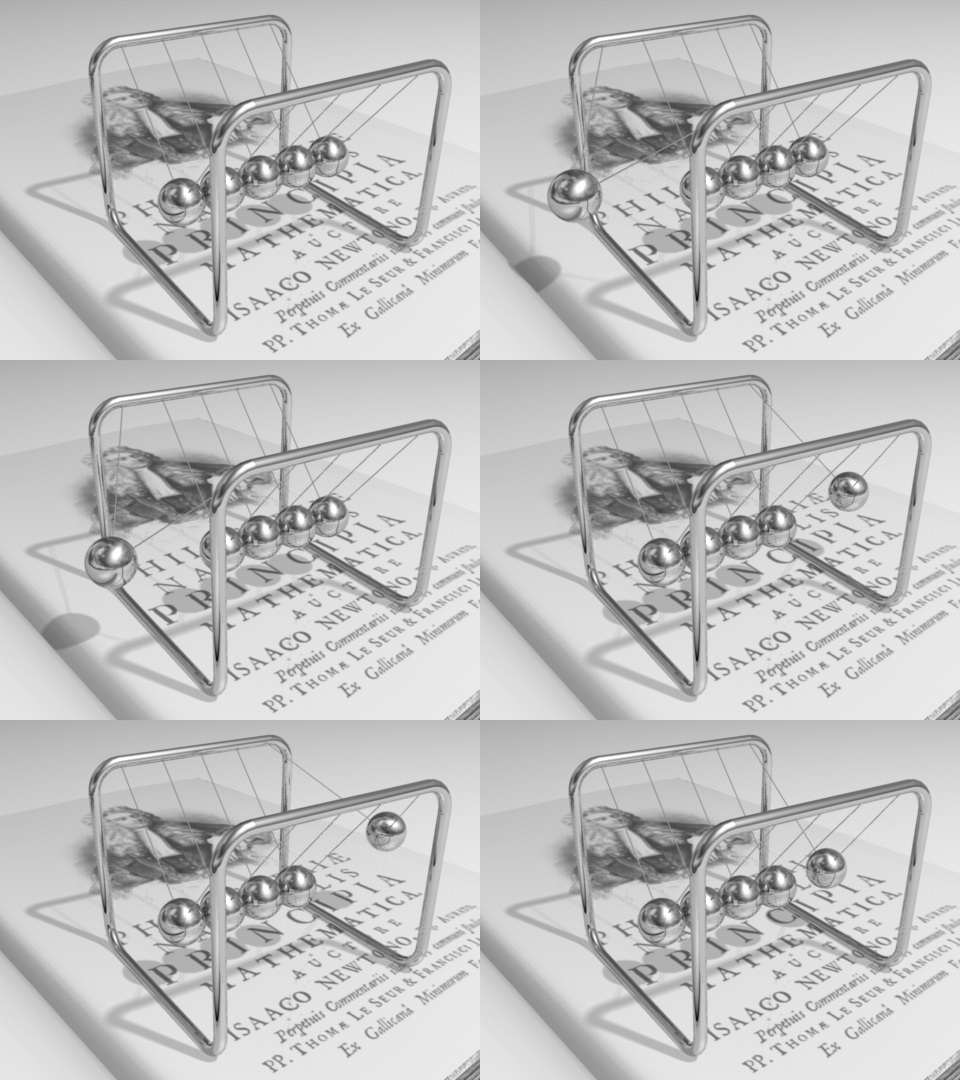
law of conservation of energy - pendulum
Newton’s cradle. A device that demonstrates the Law of Conservation of Mechanical Energy and Momentum.

In general, the law of conservation of momentum or principle of momentum conservation states that the momentum of an isolated system is a constant. The vector sum of the momenta (momentum is equal to the mass of an object multiplied by its velocity) of all the objects of a system cannot be changed by interactions within the system. In classical mechanics, this law is implied by Newton’s laws. This principle is a direct consequence of Newton’s third law.

Let us assume the one dimensional elastic collision of two billiard balls,, the ball A and the ball B. We assume the net external force on this system of two balls is zero—that is, the only significant forces during the collision are the forces that each ball exerts on the other. According to Newton’s third law, the two forces are always equal in magnitude and opposite in direction. Hence, the impulses that act on the two balls are equal and opposite, and the changes in momentum of the two balls are equal and opposite.

These two balls are moving with velocities vA and vB along the x axis before the collision. After the collision, their velocities are v’A and v’B. The conservation of the total momentum demands that the total momentum before the collision is the same as the total momentum after the collision.

conservation-of-momentum-formula

The law of conservation of linear momentum in words:

If no net external force acts on a system of particles, the total linear momentum of the system cannot change.

Conservation of Momentum and Energy in Collisions

The use of the conservation laws for momentum and energy is very important also in particle collisions. This is a very powerful rule because it can allow us to determine the results of a collision without knowing the details of the collision. The law of conservation of momentum states that in the collision of two objects such as billiard balls, the total momentum is conserved. The assumption of conservation of momentum as well as the conservation of kinetic energy makes possible the calculation of the final velocities in two-body collisions. At this point we have to distinguish between two types of collisions:

Elastic Collisions

A perfectly elastic collision is defined as one in which there is no net conversion of kinetic energy into other forms (such as heat or noise). For the brief moment during which the two objects are in contact, some (or all) of the energy is stored momentarily in the form of elastic potential energy. But if we compare the total kinetic energy just before the collision with the total kinetic energy just after the collision, and they are found to be the same, then we say that the total kinetic energy is conserved.

[xyz-ihs snippet=”collisions”]
  • Some large-scale interactions like the slingshot type gravitational interactions (also known as a planetary swing-by or a gravity-assist manoeuvre) between satellites and planets are perfectly elastic.
  • Collisions between very hard spheres may be nearly elastic, so it is useful to calculate the limiting case of an elastic collision.
  • Collisions in ideal gases approach perfectly elastic collisions, as do scattering interactions of sub-atomic particles which are deflected by the electromagnetic force.
  • Rutherford scattering is the elastic scattering of charged particles also by the electromagnetic force.
  • A neutron-nucleus scattering reaction may be also elastic, but in this case the neutron is deflected by the strong nuclear force.
 
Equations of Conservation of Momentum and Energy
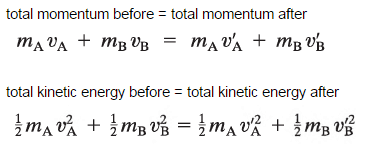
Let us assume the one dimensional elastic collision of two objects, the object A and the object B. These two objects are moving with velocities vA and vB along the x axis before the collision. After the collision, their velocities are v’A and v’B. The conservation of the total momentum demands that the total momentum before the collision is the same as the total momentum after the collision. Likewise, the conservation of the total kinetic energy, which demands that the total kinetic energy of both objects before the collision is the same as the total kinetic energy after the collision. Both law may be expressed in equations as:

equations-of-conservation-of-momentum-energy

solution-conservation-of-momentum-energy

The relative speed of the two objects after the collision has the same magnitude (but opposite direction) as before the collision, no matter what the masses are.

Inelastic Collisions

An inelastic collision is one in which part of the kinetic energy is changed to some other form of energy in the collision. Any macroscopic collision between objects will convert some of the kinetic energy into internal energy and other forms of energy, so no large scale impacts are perfectly elastic. For example, in collisions of common bodies, such as two cars, some energy is always transferred from kinetic energy to other forms of energy, such as thermal energy or energy of sound. The inelastic collision of two bodies always involves a loss in the kinetic energy of the system. The greatest loss occurs if the bodies stick together, in which case the collision is called a completely inelastic collision. Thus, the kinetic energy of the system is not conserved, while the total energy is conserved as required by the general principle of conservation of energy. Momentum is conserved in inelastic collisions, but one cannot track the kinetic energy through the collision since some of it is converted to other forms of energy.

In nuclear physics, an inelastic collision is one in which the incoming particle causes the nucleus it strikes to become excited or to break up. Deep inelastic scattering is a method of probing the structure of subatomic particles in much the same way as Rutherford probed the inside of the atom (see Rutherford scattering).

In nuclear reactors, inelastic collisions are of importance in neutron moderation process. An inelastic scattering plays an important role in slowing down neutrons especially at high energies and by heavy nuclei. Inelastic scattering occurs above a threshold energy. This threshold energy is higher than the energy the first excited state of target nucleus (due to the laws of conservation) and it is given by following formula:

Et = ((A+1)/A)* ε1

where Et is known as the inelastic threshold energy and ε1 is the energy of the first excited state. Therefore especially scattering data of 238U, which is a major component of nuclear fuel in commercial power reactors, are one of the most important data in the neutron transport calculations in the reactor core.

 
Example: Ballistic Pendulum
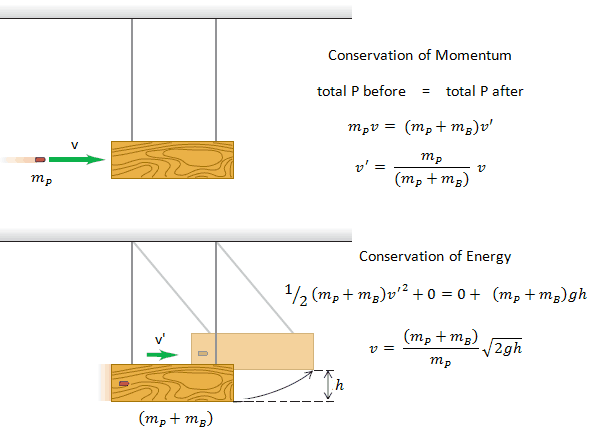
Ballistic Pendulum
The ballistic pendulum is a kind of “transformer,” exchanging the high speed of a light object (the bullet) for the low speed of a massive object.

A ballistic pendulum is a device for measuring the velocity of a projectile, such as a bullet. The ballistic pendulum is a kind of “transformer,” exchanging the high speed of a light object (the bullet) for the low speed of a massive object (the block). When a bullet is fired into the block, its momentum is transferred to the block. The bullet’s momentum can be determined from the amplitude of the pendulum swing.

When the bullet is embedding itself in the block, it occurs so quickly that the block does not move appreciably. The supporting strings remain nearly vertical, so negligible external horizontal force acts on the bullet–block system, and the horizontal component of momentum is conserved. Mechanical energy is not conserved during this stage, however, because a nonconservative force does work (the force of friction between bullet and block).

In the second stage, the bullet and block move together. The only forces acting on this system are gravity (a conservative force) and the string tensions (which do no work). Thus, as the block swings, mechanical energy is conserved. Momentum is not conserved during this stage, however, because there is a net external force (the forces of gravity and string tension don’t cancel when the strings are inclined).

Equations governing the ballistic pendulum

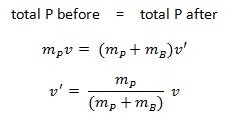
In the first stage momentum is conserved and therefore:

conservation-of-momentum-inelastic

where v is the initial velocity of the projectile of mass mP. v’ is the velocity of the block and embedded projectile (both of mass mP + mB) just after the collision, before they have moved significantly.

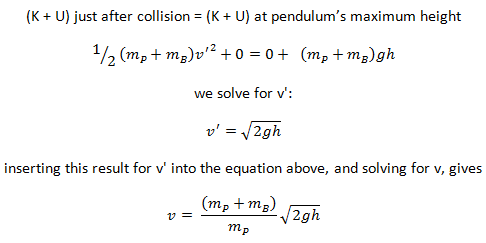
In the second stage mechanical energy is conserved. We choose y = 0 when the pendulum hangs vertically, and then y = h when the block and embedded projectile system reaches its maximum height. The system swings up and comes to rest for an instant at a height y, where its kinetic energy is zero and the potential energy is (mP + mB)gh. Thus we write the law of conservation of energy:

solution-inelastic-collision

which is the initial velocity of the projectile and our final result.

When we use some realistic numbers:

  • mP = 5 g
  • mB = 2 kg
  • h = 3 cm
  • v = ?

then we have:

solution-example

Conservation Laws in Nuclear Reactions

A nuclear reaction is considered to be the process in which two nuclear particles (two nuclei or a nucleus and a nucleon) interact to produce two or more nuclear particles or ˠ-rays (gamma rays). Thus, a nuclear reaction must cause a transformation of at least one nuclide to another. Sometimes if a nucleus interacts with another nucleus or particle without changing the nature of any nuclide, the process is referred to a nuclear scattering, rather than a nuclear reaction.

In analyzing nuclear reactions, we apply the many conservation laws. Nuclear reactions are subject to classical conservation laws for charge, momentum, angular momentum, and energy (including rest energies).  Additional conservation laws, not anticipated by classical physics, are are electric charge, lepton number and baryon number. Certain of these laws are obeyed under all circumstances, others are not. We have accepted conservation of energy and momentum. In all the examples given we assume that the number of protons and the number of neutrons is separately conserved. We shall find circumstances and conditions in which  this rule is not true. Where we are considering non-relativistic nuclear reactions, it is essentially true. However, where we are considering relativistic nuclear energies or those involving the weak interactions, we shall find that these principles must be extended.

Some conservation principles have arisen from theoretical considerations, others are just empirical relationships. Notwithstanding, any reaction not expressly forbidden by the conservation laws will generally occur, if perhaps at a slow rate. This expectation is based on quantum mechanics. Unless the barrier between the initial and final states is infinitely high, there is always a non-zero probability that a system will make the transition between them.

For purposes of this article it is sufficient to note four of the fundamental laws governing these reactions.

  1. Conservation of nucleons. The total number of nucleons before and after a reaction are the same.
  2. Conservation of charge. The sum of the charges on all the particles before and after a reaction are the same
  3. Conservation of momentum. The total momentum of the interacting particles before and after a reaction are the same.
  4. Conservation of energy. Energy, including rest mass energy, is conserved in nuclear reactions.
 
Types of Nuclear Reactions
Although the number of possible nuclear reactions is enormous, nuclear reactions can be sorted by types. Most of nuclear reactions are accompanied by gamma emission. Some examples are:
  • Elastic scattering. Occurs, when no energy is transferred between the target nucleus and the incident particle.

 208Pb (n, n) 208Pb

  •  Inelastic scattering. Occurs, when energy is transferred. The difference of kinetic energies is saved in excited nuclide.

 40Ca (α, α’) 40mCa

  • Capture reactions. Both charged and neutral particles can be captured by nuclei. This is accompanied by the emission of ˠ-rays. Neutron capture reaction produces radioactive nuclides (induced radioactivity).

 238U (n, ˠ) 239U

  • Transfer Reactions. The absorption of a particle accompanied by the emission of one or more particles is called the transfer reaction.

4He (α, p) 7Li

  • Fission reactions. Nuclear fission is a nuclear reaction in which the nucleus of an atom splits into smaller parts (lighter nuclei). The fission process often produces free neutronsand photons (in the form of gamma rays), and releases a large amount of energy.

235U (n, 3 n) fission products

  • Fusion reactions.  Occur when, two or more atomic nuclei collide at a very high speed and join to form a new type of atomic nucleus.The fusion reaction of deuterium and tritium is particularly interesting because of its potential of providing energy for the future.

3T (d, n) 4He

  • Spallation reactions. Occur, when a nucleus is hit by a particle with sufficient energy and momentum to knock out several small fragments or, smash it into many fragments.
  • Nuclear decay (Radioactive decay). Occurs when an unstable atom loses energy by emitting ionizing radiation. Radioactive decay is a random process at the level of single atoms, in that, according to quantum theory, it is impossible to predict when a particular atom will decay. There are many types of radioactive decay:
    • Alpha radioactivity. Alpha particles consist of two protons and two neutrons bound together into a particle identical to a helium nucleus. Because of its very large mass (more than 7000 times the mass of the beta particle) and its charge, it heavy ionizes material and has a very short range.
    • Beta radioactivity. Beta particles are high-energy, high-speed electrons or positrons emitted by certain types of radioactive nuclei such as potassium-40. The beta particles have greater range of penetration than alpha particles, but still much less than gamma rays.The beta particles emitted are a form of ionizing radiation also known as beta rays. The production of beta particles is termed beta decay.
    • Gamma radioactivity. Gamma rays are electromagnetic radiation of an very high frequency and are therefore high energy photons. They are produced by the decay of nuclei as they transition from a high energy state to a lower state known as gamma decay. Most of nuclear reactions are accompanied by gamma emission.
    • Neutron emission. Neutron emission is a type of radioactive decay of nuclei containing excess neutrons (especially fission products), in which a neutron is simply ejected from the nucleus. This type of radiation plays key role in nuclear reactor control, because these neutrons are delayed  neutrons.

Conservation of Momentum in Nuclear Reactions – Neutron Moderation

See also: Neutron Elastic Scattering

See also: Neutron Inelastic Scattering

See also: Neutron Moderators

It is known the fission neutrons are of importance in any chain-reacting system. All neutrons produced by fission are born as fast neutrons with high kinetic energy. Before such neutrons can efficiently cause additional fissions, they must be slowed down by collisions with nuclei in the moderator of the reactor. The probability of the fission U-235 becomes very large at the thermal energies of slow neutrons. This fact implies increase of multiplication factor of the reactor (i.e. lower fuel enrichment is needed to sustain chain reaction).

The neutrons released during fission with an average energy of 2 MeV in a reactor on average undergo a number of collisions (elastic or inelastic) before they are absorbed. During the scattering reaction, a fraction of the neutron’s kinetic energy is transferred to the nucleus. Using the laws of conservation of momentum and energy and the analogy of collisions of billiard balls for elastic scattering, it is possible to derive the following equation for the mass of target or moderator nucleus (M), energy of incident neutron (Ei) and the energy of scattered neutron (Es).

equation momentum energy

where A is the atomic mass number.In case of the hydrogen (A = 1) as the target nucleus, the incident neutron can be completely stopped. But this works when the direction of the neutron is completely reversed (i.e. scattered at 180°). In reality, the direction of scattering ranges from 0 to 180 ° and the energy transferred also ranges from 0% to maximum. Therefore, the average energy of scattered neutron is taken as the average of energies with scattering angle 0 and 180°.

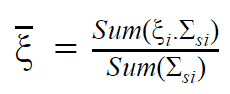
Moreover, it is useful to work with logarithmic quantities and therefore one defines the logarithmic energy decrement per collision (ξ) as a key material constant describing energy transfers during a neutron slowing down. ξ is not dependent on energy, only on A and is defined as follows:logarithmic energy decrement - equationFor heavy target nuclei, ξ may be approximated by following formula:the logarithmic energy decrement per collisionFrom these equations it is easy to determine the number of collisions required to slow down a neutron from, for example from 2 MeV to 1 eV.

Example: Determine the number of collisions required for thermalization for the 2 MeV neutron in the carbon.

ξCARBON = 0.158

N(2MeV → 1eV) = ln 2⋅106/ξ =14.5/0.158 = 92

Table of average logarithmic energy decrement for some elements
Table of average logarithmic energy decrement for some elements.

For a mixture of isotopes:

the logarithmic energy decrement for mixtures

 
Example: Elastic Nuclear Collision
A neutron (n) of mass 1.01 u traveling with a speed of 3.60 x 104m/s interacts with a carbon (C) nucleus (mC = 12.00 u) initially at rest in an elastic head-on collision.

What are the velocities of the neutron and carbon nucleus after the collision?

Solution:

This is an elastic head-on collision of two objects with unequal masses. We have to use the conservation laws of momentum and of kinetic energy, and apply them to our system of two particles.

conservation-laws-elastic-collisions

We can solve this system of equation or we can use the equation derived in previous section. This equation stated that the relative speed of the two objects after the collision has the same magnitude (but opposite direction) as before the collision, no matter what the masses are.

solution-elastic-collision

The minus sign for v’ tells us that the neutron scatters back of the carbon nucleus, because the carbon nucleus is significantly heavier. On the other hand its speed is less than its initial speed. This process is known as the neutron moderation and it significantly depends on the mass of moderator nuclei.

Momentum of a Photon

A photon, the quantum of electromagnetic radiation,  is an elementary particle, which is the force carrier of the electromagnetic force. The modern photon concept was developed (1905) by Albert Einstein to explain of the photoelectric effect, in which he proposed the existence of discrete energy packets during the transmission of light.

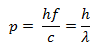
In 1916, Einstein extended his concept of light quanta (photons) by proposing that a quantum of light has linear momentum. Although a photon is massless, it has momentum, which is related to its energy E, frequency f, and wavelength by:

momentum-photon-equation

Thus, when a photon interacts with another object, energy and momentum are transferred, as if there were a collision between the photon and matter in the classical sense.

 
Example: Momentum and Force of a Photon
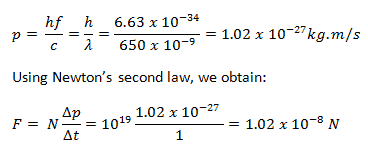
Suppose the 1019 photons (let λ = 650 nm) emitted per second from the 100 W lightbulb.  Suppose all photons are focused onto a piece of black paper and absorbed. Assume that the momentum of a photon changes from p = h/λ to zero.

Calculate the momentum of one photon and calculate the force all these photons could exert on the paper.

Solution:

We use the formula of momentum of a single photon:

momentum-photon-example

Momentum of a Photon – Compton Scattering

Compton Scattering
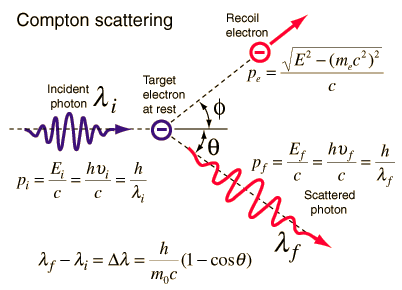
In Compton scattering, the incident gamma-ray photon is deflected through an angle Θ with respect to its original direction. This deflection results in a decrease in energy (decrease in photon’s frequency) of the photon and is called the Compton effect.
Source: hyperphysics.phy-astr.gsu.edu

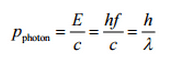
The Compton formula was published in 1923 in the Physical Review. Compton explained that the X-ray shift is caused by particle-like momentum of photons. Compton scattering formula is the mathematical relationship between the shift in wavelength and the scattering angle of the X-rays. In the case of Compton scattering the photon of frequency f collides with an electron at rest. Upon collision, the photon bounces off electron, giving up some of its initial energy (given by Planck’s formula E=hf), While the electron gains momentum (mass x velocity), the photon cannot lower its velocity. As a result of momentum conservation law, the photon must lower its momentum given by:

As a result of momentum conservetion law, the photon must lower its momentum given by this formula.

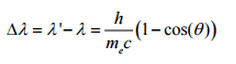
So the decrease in photon’s momentum must be translated into decrease in frequency (increase in wavelength Δλ = λ’ – λ). The shift of the wavelength increased with scattering angle according to the Compton formula:

The shift of the wavelength increased with scattering angle according to the Compton formula

where λ is the initial wavelength of photon λ’ is the wavelength after scattering, h is the Planck constant = 6.626 x 10⁻³⁴ J.s, me is the electron rest mass (0.511 MeV)c is the speed of light Θ is the scattering angle. The minimum change in wavelength (λ′ − λ) for the photon occurs when Θ = 0° (cos(Θ)=1) and is at least zero. The maximum change in wavelength (λ′ − λ) for the photon occurs when Θ = 180° (cos(Θ)=-1). In this case the photon transfers to the electron as much momentum as possible. The maximum change in wavelength can be derived from Compton formula:

The maximum change in wavelength can be derived from Compton formula. Compton length

The quantity h/mec is known as the Compton wavelength of the electron and is equal to 2.43×10⁻¹² m.

Conservation of Momentum in Fluid Dynamics

In general, the law of conservation of momentum or principle of momentum conservation states that the momentum of an isolated system is a constant. The vector sum of the momenta (momentum is equal to the mass of an object multiplied by its velocity) of all the objects of a system cannot be changed by interactions within the system. In classical mechanics, this law is implied by Newton’s laws.

In fluid dynamics, the analysis of motion is performed in the same way as in solid mechanics – by use of Newton’s laws of motion. As can be seen moving fluids are exerting forces. The lift force on an aircraft is exerted by the air moving over the wing.

A jet of water from a hose exerts a force on whatever it hits. But here it is not clear what mass of moving fluid we should use and therefore it is necessary to use a different form of the equation.

Newton’s 2nd Law can be written:

The rate of change of momentum of a body is equal to the resultant force acting on the body, and takes place in the direction of the force.
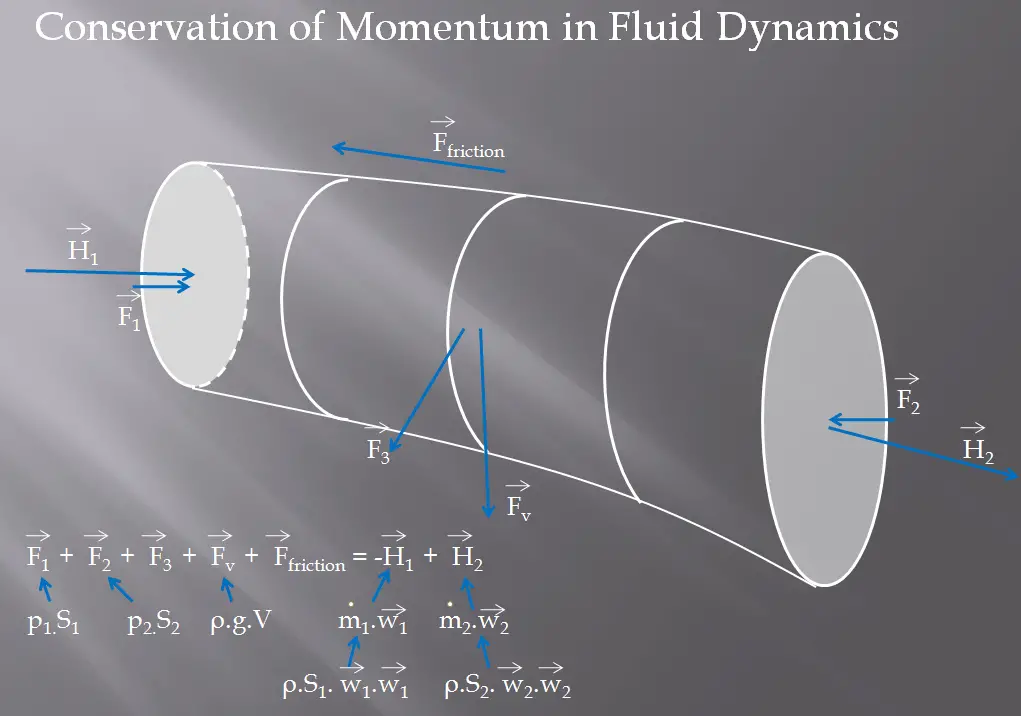
Conservation of Momentum - FluidsWe assume fluid to be both steady and incompressible. To determine the rate of change of momentum for a fluid we will consider a streamtube (control volume) as we did for the Bernoulli equation. In this control volume any change in momentum of the fluid within a control volume is due to the action of external forces on the fluid within the volume.

As can be seen from the picture the control volume method can be used to analyze the law of conservation of momentum in fluid. Control volume is an imaginary surface enclosing a volume of interest. The control volume can be fixed or moving, and it can be rigid or deformable. In order to determine all forces acting on the surfaces of the control volume we have to solve the conservation laws in this control volume.

The first conservation equation we have to consider in the control volume is the continuity equation (the law of conservation of matter). In the simplest form it is represented by following equation:

∑ṁin = ∑ṁout

Sum of mass flow rates entering per unit time = Sum of mass flow rates leaving per unit time

The second conservation equation we have to consider in the control volume is the momentum formula.

Momentum Formula

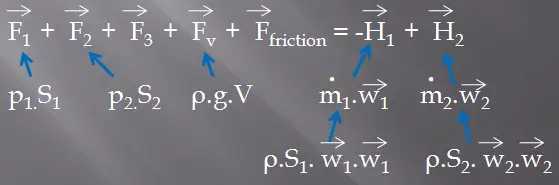
In the simplest form the momentum formula can be represented by following equation:

–
Momentum Formula - fluids

Choosing a Control Volume

A control volume can be selected as any arbitrary volume through which fluid flows. This volume can be static, moving, and even deforming during flow. In order to solve any problem we have to solve basic conservation laws in this volume. It is very important to know all relative flow velocities to the control surface and therefore it is very important to define exactly the boundaries of the control volume during an analysis.

 
Example: The force acting on a deflector elbow
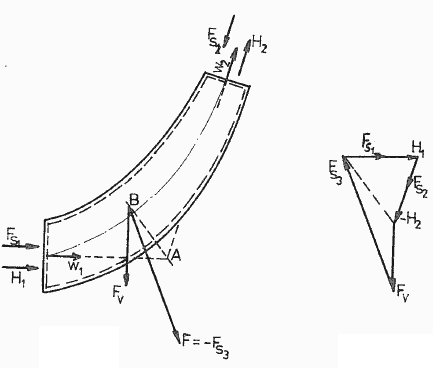
Momentum equation - control volumeAn elbow (let say of primary piping) is used to deflect water flow at a velocity of 17 m/s. The piping diameter is equal to 700 mm. The gauge pressure inside the pipe is about 16 MPa at the temperature of 290°C. Fluid is of constant density ⍴ ~ 720 kg/m3 (at 290°C). The angle of the elbow is 45°.

Calculate the force on the wall of a deflector elbow (i.e. calculate vector F3).

Assumptions:

  • The flow is steady.
  • The frictional losses are negligible.
  • The weight of the elbow is negligible.
  • The weight of the water in the elbow is negligible.

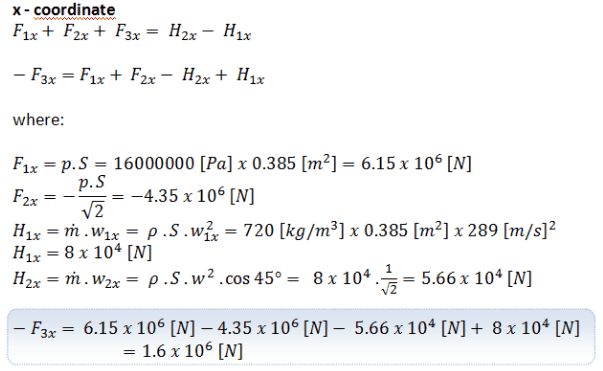
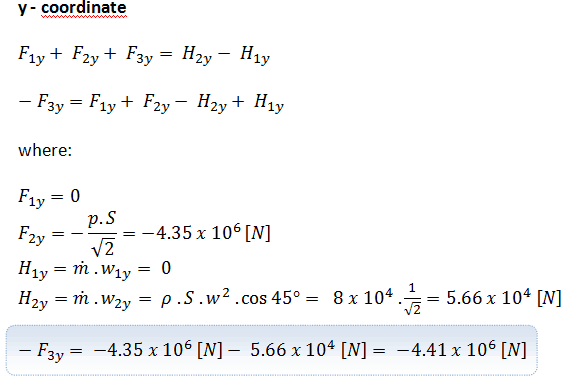
We take the elbow as the control volume. The control volume is shown at the picture. The momentum equation is a vector equation so it has three components. We take the x- and z- coordinates as shown and we will solve the problem separately according to these coordinates.

First, let us consider the component in the x-coordinate. The conservation of linear momentum equation becomes:

Momentum equation - x-coordinate

Second, let us consider the component in the y-coordinate. The conservation of linear momentum equation becomes:

Momentum equation - y-coordinate

The final force acting on the wall of a deflector elbow will be:

Momentum equation - resulting force

Example: Water Jet Striking a Stationary Plate
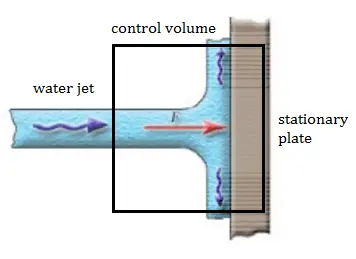
Momentum Equation - Water JetA stationary plate (e.g. blade of a watermill) is used to deflect water flow at a velocity of 1 m/s and at an angle of 90°. It occurs at atmospheric pressure and the mass flow rate is equal to Q =1 m3/s.
  1. Calculate the pressure force.
  2. Calculate the body force.
  3. Calculate the total force.
  4. Calculate the resultant force.

Solution

  1. The pressure force is zero as the pressure at both the inlet and the outlets to the control volume are atmospheric.
  2. As the control volume is small we can ignore the body force due to the weight of gravity.
  3. Fx = ρ.Q.(w1x – w2x) = 1000 . 1 . (1 – 0) = 1000 N
    Fy = 0
    F = (1000, 0)
  4. The resultant force on the plane is the same magnitude but in the opposite direction as the total force F (friction and weight are neglected).

The water jet exerts on the plate the force of 1000 N in the x-direction.

 
References:
Nuclear and Reactor Physics:
  1. J. R. Lamarsh, Introduction to Nuclear Reactor Theory, 2nd ed., Addison-Wesley, Reading, MA (1983).
  2. J. R. Lamarsh, A. J. Baratta, Introduction to Nuclear Engineering, 3d ed., Prentice-Hall, 2001, ISBN: 0-201-82498-1.
  3. W. M. Stacey, Nuclear Reactor Physics, John Wiley & Sons, 2001, ISBN: 0- 471-39127-1.
  4. Glasstone, Sesonske. Nuclear Reactor Engineering: Reactor Systems Engineering, Springer; 4th edition, 1994, ISBN: 978-0412985317
  5. W.S.C. Williams. Nuclear and Particle Physics. Clarendon Press; 1 edition, 1991, ISBN: 978-0198520467
  6. Kenneth S. Krane. Introductory Nuclear Physics, 3rd Edition, Wiley, 1987, ISBN: 978-0471805533
  7. G.R.Keepin. Physics of Nuclear Kinetics. Addison-Wesley Pub. Co; 1st edition, 1965
  8. Robert Reed Burn, Introduction to Nuclear Reactor Operation, 1988.
  9. U.S. Department of Energy, Nuclear Physics and Reactor Theory. DOE Fundamentals Handbook, Volume 1 and 2. January 1993.

Advanced Reactor Physics:

  1. K. O. Ott, W. A. Bezella, Introductory Nuclear Reactor Statics, American Nuclear Society, Revised edition (1989), 1989, ISBN: 0-894-48033-2.
  2. K. O. Ott, R. J. Neuhold, Introductory Nuclear Reactor Dynamics, American Nuclear Society, 1985, ISBN: 0-894-48029-4.
  3. D. L. Hetrick, Dynamics of Nuclear Reactors, American Nuclear Society, 1993, ISBN: 0-894-48453-2.
  4. E. E. Lewis, W. F. Miller, Computational Methods of Neutron Transport, American Nuclear Society, 1993, ISBN: 0-894-48452-4.

See also:

Laws of Conservation

We hope, this article, Law of Conservation of Momentum, helps you. If so, give us a like in the sidebar. Main purpose of this website is to help the public to learn some interesting and important information about materials and their properties.

What is Matter consumption in a nuclear reactor – Definition

Matter consumption in a nuclear reactor. For the reactor of power of 3000MWth, annual matter consumption of this reactor is about 1.051 kg. Material Properties

Matter consumption in a nuclear reactor

In general, the nuclear fission results in the release of enormous quantities of energy. This energy comes from the nuclear binding energy which holds nuclei together. The binding energy per nucleon is higher for fission fragments than for uranium nuclei. It was found the sum of the rest masses of products of fission is measurably smaller than the rest mass of uranium nucleus.

Mass Defect

It is due to the fact during the nuclear fission some of the mass of the nucleus gets converted into these huge amounts of energy and thus this mass is removed from the total mass of the original particle, and the mass is missing in the resulting nuclei.

According to the Einstein relationship (E = mc2) this binding energy is proportional to this mass difference and it is known as the mass defect.

The annual mass defect of a typical 3000MWth reactor  can be calculated directly from the Einstein relationship (E = mc2) as:

Δm = ΔE/c2

Δm = 3000×106 (W = J/s) x 31.5×10⁶ (seconds in year) / (2.9979 x 10⁸)2 = 1.051 kg

E=MC2

Summary:

Consumption of a 3000MWth (~1000MWe) reactor (12-months fuel cycle)

It is an illustrative example, following data do not correspond to any reactor design.

  • Typical reactor may contain about 165 tonnes of fuel (including structural material)
  • Typical reactor may contain about 100 tonnes of enriched uranium (i.e. about 113 tonnes of uranium dioxide).
  • This fuel is loaded within, for example, 157 fuel assemblies composed of over 45,000 fuel rods.
  • A common fuel assembly contain energy for approximately 4 years of operation at full power.
  • Therefore about one quarter of the core is yearly removed to spent fuel pool (i.e. about 40 fuel assemblies), while the remainder is rearranged to a location in the core better suited to its remaining level of enrichment (see Power Distribution).
  • The removed fuel (spent nuclear fuel) still contains about 96% of reusable material (it must be removed due to decreasing kinf of an assembly).
  • Annual natural uranium consumption of this reactor is about 250 tonnes of natural uranium (to produce of about 25 tonnes of enriched uranium).
  • Annual enriched uranium consumption of this reactor is about 25 tonnes of enriched uranium.
  • Annual fissile material consumption of this reactor is about 1 005 kg.
  • Annual matter consumption of this reactor is about 1.051 kg.
  • But it corresponds to about 3 200 000 tons of coal burned in coal-fired power plant per year.
 
References:
Nuclear and Reactor Physics:
  1. J. R. Lamarsh, Introduction to Nuclear Reactor Theory, 2nd ed., Addison-Wesley, Reading, MA (1983).
  2. J. R. Lamarsh, A. J. Baratta, Introduction to Nuclear Engineering, 3d ed., Prentice-Hall, 2001, ISBN: 0-201-82498-1.
  3. W. M. Stacey, Nuclear Reactor Physics, John Wiley & Sons, 2001, ISBN: 0- 471-39127-1.
  4. Glasstone, Sesonske. Nuclear Reactor Engineering: Reactor Systems Engineering, Springer; 4th edition, 1994, ISBN: 978-0412985317
  5. W.S.C. Williams. Nuclear and Particle Physics. Clarendon Press; 1 edition, 1991, ISBN: 978-0198520467
  6. Kenneth S. Krane. Introductory Nuclear Physics, 3rd Edition, Wiley, 1987, ISBN: 978-0471805533
  7. G.R.Keepin. Physics of Nuclear Kinetics. Addison-Wesley Pub. Co; 1st edition, 1965
  8. Robert Reed Burn, Introduction to Nuclear Reactor Operation, 1988.
  9. U.S. Department of Energy, Nuclear Physics and Reactor Theory. DOE Fundamentals Handbook, Volume 1 and 2. January 1993.

Advanced Reactor Physics:

  1. K. O. Ott, W. A. Bezella, Introductory Nuclear Reactor Statics, American Nuclear Society, Revised edition (1989), 1989, ISBN: 0-894-48033-2.
  2. K. O. Ott, R. J. Neuhold, Introductory Nuclear Reactor Dynamics, American Nuclear Society, 1985, ISBN: 0-894-48029-4.
  3. D. L. Hetrick, Dynamics of Nuclear Reactors, American Nuclear Society, 1993, ISBN: 0-894-48453-2.
  4. E. E. Lewis, W. F. Miller, Computational Methods of Neutron Transport, American Nuclear Society, 1993, ISBN: 0-894-48452-4.

See also:

Fuel Consumption

We hope, this article, Matter consumption in a nuclear reactor, helps you. If so, give us a like in the sidebar. Main purpose of this website is to help the public to learn some interesting and important information about materials and their properties.

What is Natural uranium consumption in a nuclear reactor – Definition

Natural uranium consumption in a nuclear reactor. Annual natural uranium consumption of 3000MWth reactor is about 250 tonnes of natural uranium. Material Properties

Natural uranium consumption in a nuclear reactor

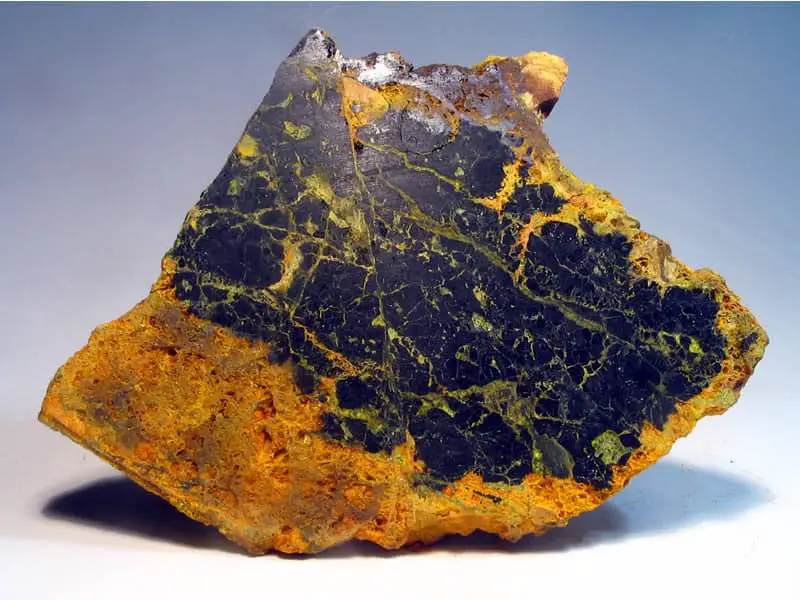
Uraninite - the most common uranium ore.
Uraninite – the most common uranium ore.

Natural uranium refers to uranium with the same isotopic ratio as found in nature. It consists primarily of isotope 238U (99.28%), therefore the atomic mass of uranium element is close to the atomic mass of 238U isotope (238.03u).  Natural uranium also consists of two other isotopes: 235U (0.71%) and 234U (0.0054%). The abundance of  isotopes in the nature is caused by difference in the half-lifes. All three naturally-occurring isotopes of uranium (238U, 235U and 234U)  are unstable. On the other hand these isotopes (except 234U) belong to primordial nuclides, because their half-life is comparable to the age of the Earth (~4.5×10⁹ years for 238U).

Since natural uranium contains only 0.71% of fissile isotope 235U and most of current power reactors require enriched uranium, this natural uranium must be enriched. The level of enrichment required depends on specific reactor design (e.g.  PWRs and BWRs require 3% – 5% of 235U) and specific requirements of the nuclear power plant operator. Without required enrichment these reactors are not able to initiate and sustain a nuclear chain reaction for such a long period as 12 months (or more).

The enrichment process separates gaseous uranium hexafluoride into two streams, one being enriched to the required level and known as low-enriched uranium, the other stream is progressively depleted in U-235 and is called ‘tails’, or simply depleted uranium. Typically, to produce 1 kg of enriched uranium with 5% of 235U, about 10 kg of natural uranium is required with a byproduct of about 9 kg of depleted uranium. Therefore annual natural uranium consumption of 3000MWth reactor is about 250 tonnes of natural uranium (to produce of about 25 tonnes of enriched uranium).

Nuclear Fuel
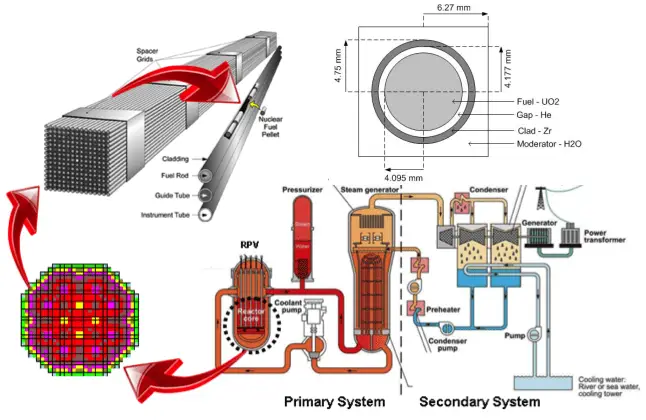
Nuclear reactor, Rector core, Fuel loading pattern, Fuel assembly, Fuel rod, Fuel pellet

Summary:

Consumption of a 3000MWth (~1000MWe) reactor (12-months fuel cycle)

It is an illustrative example, following data do not correspond to any reactor design.

  • Typical reactor may contain about 165 tonnes of fuel (including structural material)
  • Typical reactor may contain about 100 tonnes of enriched uranium (i.e. about 113 tonnes of uranium dioxide).
  • This fuel is loaded within, for example, 157 fuel assemblies composed of over 45,000 fuel rods.
  • A common fuel assembly contain energy for approximately 4 years of operation at full power.
  • Therefore about one quarter of the core is yearly removed to spent fuel pool (i.e. about 40 fuel assemblies), while the remainder is rearranged to a location in the core better suited to its remaining level of enrichment (see Power Distribution).
  • The removed fuel (spent nuclear fuel) still contains about 96% of reusable material (it must be removed due to decreasing kinf of an assembly).
  • Annual natural uranium consumption of this reactor is about 250 tonnes of natural uranium (to produce of about 25 tonnes of enriched uranium).
  • Annual enriched uranium consumption of this reactor is about 25 tonnes of enriched uranium.
  • Annual fissile material consumption of this reactor is about 1 005 kg.
  • Annual matter consumption of this reactor is about 1.051 kg.
  • But it corresponds to about 3 200 000 tons of coal burned in coal-fired power plant per year.
 
References:
Nuclear and Reactor Physics:
  1. J. R. Lamarsh, Introduction to Nuclear Reactor Theory, 2nd ed., Addison-Wesley, Reading, MA (1983).
  2. J. R. Lamarsh, A. J. Baratta, Introduction to Nuclear Engineering, 3d ed., Prentice-Hall, 2001, ISBN: 0-201-82498-1.
  3. W. M. Stacey, Nuclear Reactor Physics, John Wiley & Sons, 2001, ISBN: 0- 471-39127-1.
  4. Glasstone, Sesonske. Nuclear Reactor Engineering: Reactor Systems Engineering, Springer; 4th edition, 1994, ISBN: 978-0412985317
  5. W.S.C. Williams. Nuclear and Particle Physics. Clarendon Press; 1 edition, 1991, ISBN: 978-0198520467
  6. Kenneth S. Krane. Introductory Nuclear Physics, 3rd Edition, Wiley, 1987, ISBN: 978-0471805533
  7. G.R.Keepin. Physics of Nuclear Kinetics. Addison-Wesley Pub. Co; 1st edition, 1965
  8. Robert Reed Burn, Introduction to Nuclear Reactor Operation, 1988.
  9. U.S. Department of Energy, Nuclear Physics and Reactor Theory. DOE Fundamentals Handbook, Volume 1 and 2. January 1993.

Advanced Reactor Physics:

  1. K. O. Ott, W. A. Bezella, Introductory Nuclear Reactor Statics, American Nuclear Society, Revised edition (1989), 1989, ISBN: 0-894-48033-2.
  2. K. O. Ott, R. J. Neuhold, Introductory Nuclear Reactor Dynamics, American Nuclear Society, 1985, ISBN: 0-894-48029-4.
  3. D. L. Hetrick, Dynamics of Nuclear Reactors, American Nuclear Society, 1993, ISBN: 0-894-48453-2.
  4. E. E. Lewis, W. F. Miller, Computational Methods of Neutron Transport, American Nuclear Society, 1993, ISBN: 0-894-48452-4.

See also:

Fuel Consumption

We hope, this article, Natural uranium consumption in a nuclear reactor, helps you. If so, give us a like in the sidebar. Main purpose of this website is to help the public to learn some interesting and important information about materials and their properties.

What is Uranium 235 consumption in a nuclear reactor – Definition

Uranium 235 consumption in a nuclear reactor. Determine the consumption of 235U that must undergo fission each day to provide this thermal power. Material Properties

Uranium 235 consumption in a nuclear reactor

A typical thermal reactor contains about 100 tons of uranium with an average enrichment of 2% (do not confuse it with the enrichment of the fresh fuel, that is about 4%). For the reactor of power of 3000MWth determine the consumption of 235U that must undergo fission each day to provide this thermal power.

Solution:

This problem can be solved very simply. The average recoverable energy per 235U fission is about Er = 200.7 MeV/fission. Since we know that each second we need 3000 MJ of energy, the required reaction rate can be determined directly as:

uranium-consumption

Since each atom of 235U has a mass of 235u x 1.66 x 10-27 kg/u = 3.9 x 10⁻²⁵ kg, the daily consumption of a reactor is:

9.33 x 10¹⁹ fissions/sec x 3.9 x 10-25 kg x 86400 sec/day = 3.14 kg/day

For comparison, a 1000 MWe coal-fired power plant burns about 10 000 tons (about 10 million kg) of coal per day.

Since a typical fuel cycle takes about 320 days (12 month fuel cycle), the annual fuel consumption is about:

3.14 kg/day x 320 days = 1 005 kg of 235U 

Uranium-235 Fission
Uranium 235 is a fissile isotope and its fission cross-section for thermal neutrons is about 585 barns (for 0.0253 eV neutron). For fast neutrons its fission cross-section is on the order of barns. Most of absorption reactions result in fission reaction, but a minority results in radiative capture forming 236U. The cross-section for radiative capture for thermal neutrons is about 99 barns (for 0.0253 eV neutron). Therefore about 15% of all absorption reactions result in radiative capture of neutron. About 85% of all absorption reactions result in fission.

Uranium absorption reaction

Typically, when uranium 235 nucleus undergoes fission, the nucleus splits into two smaller nuclei (triple fission can also rarely occur), along with a few neutrons (the average is 2.43 neutrons per fission by thermal neutron) and release of energy in the form of heat and gamma rays. The average of the fragment atomic mass is about 118, but very few fragments near that average are found. It is much more probable to break up into unequal fragments, and the most probable fragment masses are around mass 95 (Krypton) and 137 (Barium). Most of the fission fragments are highly unstable(radioactive) nuclei and undergo further radioactive decays to stabilize itself.

Energy Release per Fission

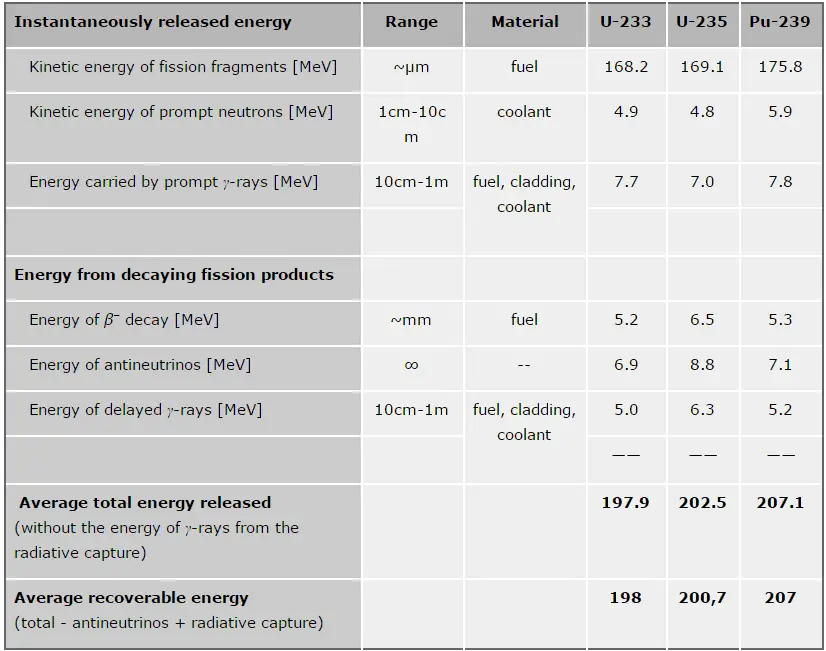
Energy release per fissionIn general, the nuclear fission results in the release of enormous quantities of energy. The amount of energy depends strongly on the nucleus to be fissioned and also depends strongly on the kinetic energy of an incident neutron. In order to calculate the power of a reactor, it is necessary to be able precisely identify the individual components of this energy. At first, it is important to distinguish between the total energy released and the energy that can be recovered in a reactor.

The total energy released in fission can be calculated from binding energies of initial target nucleus to be fissioned and binding energies of fission products. But not all the total energy can be recovered in a reactor. For example, about 10 MeV is released in the form of neutrinos (in fact antineutrinos). Since the neutrinos are weakly interacting (with extremely low cross-section of any interaction), they do not contribute to the energy that can be recovered in a reactor.

See also: Energy Release from Fission

Nuclear Fuel
Nuclear reactor, Rector core, Fuel loading pattern, Fuel assembly, Fuel rod, Fuel pellet

Summary:

Consumption of a 3000MWth (~1000MWe) reactor (12-months fuel cycle)

It is an illustrative example, following data do not correspond to any reactor design.

  • Typical reactor may contain about 165 tonnes of fuel (including structural material)
  • Typical reactor may contain about 100 tonnes of enriched uranium (i.e. about 113 tonnes of uranium dioxide).
  • This fuel is loaded within, for example, 157 fuel assemblies composed of over 45,000 fuel rods.
  • A common fuel assembly contain energy for approximately 4 years of operation at full power.
  • Therefore about one quarter of the core is yearly removed to spent fuel pool (i.e. about 40 fuel assemblies), while the remainder is rearranged to a location in the core better suited to its remaining level of enrichment (see Power Distribution).
  • The removed fuel (spent nuclear fuel) still contains about 96% of reusable material (it must be removed due to decreasing kinf of an assembly).
  • Annual natural uranium consumption of this reactor is about 250 tonnes of natural uranium (to produce of about 25 tonnes of enriched uranium).
  • Annual enriched uranium consumption of this reactor is about 25 tonnes of enriched uranium.
  • Annual fissile material consumption of this reactor is about 1 005 kg.
  • Annual matter consumption of this reactor is about 1.051 kg.
  • But it corresponds to about 3 200 000 tons of coal burned in coal-fired power plant per year.
 
References:
Nuclear and Reactor Physics:
  1. J. R. Lamarsh, Introduction to Nuclear Reactor Theory, 2nd ed., Addison-Wesley, Reading, MA (1983).
  2. J. R. Lamarsh, A. J. Baratta, Introduction to Nuclear Engineering, 3d ed., Prentice-Hall, 2001, ISBN: 0-201-82498-1.
  3. W. M. Stacey, Nuclear Reactor Physics, John Wiley & Sons, 2001, ISBN: 0- 471-39127-1.
  4. Glasstone, Sesonske. Nuclear Reactor Engineering: Reactor Systems Engineering, Springer; 4th edition, 1994, ISBN: 978-0412985317
  5. W.S.C. Williams. Nuclear and Particle Physics. Clarendon Press; 1 edition, 1991, ISBN: 978-0198520467
  6. Kenneth S. Krane. Introductory Nuclear Physics, 3rd Edition, Wiley, 1987, ISBN: 978-0471805533
  7. G.R.Keepin. Physics of Nuclear Kinetics. Addison-Wesley Pub. Co; 1st edition, 1965
  8. Robert Reed Burn, Introduction to Nuclear Reactor Operation, 1988.
  9. U.S. Department of Energy, Nuclear Physics and Reactor Theory. DOE Fundamentals Handbook, Volume 1 and 2. January 1993.

Advanced Reactor Physics:

  1. K. O. Ott, W. A. Bezella, Introductory Nuclear Reactor Statics, American Nuclear Society, Revised edition (1989), 1989, ISBN: 0-894-48033-2.
  2. K. O. Ott, R. J. Neuhold, Introductory Nuclear Reactor Dynamics, American Nuclear Society, 1985, ISBN: 0-894-48029-4.
  3. D. L. Hetrick, Dynamics of Nuclear Reactors, American Nuclear Society, 1993, ISBN: 0-894-48453-2.
  4. E. E. Lewis, W. F. Miller, Computational Methods of Neutron Transport, American Nuclear Society, 1993, ISBN: 0-894-48452-4.

See also:

Fuel Consumption

We hope, this article, Uranium 235 consumption in a nuclear reactor, helps you. If so, give us a like in the sidebar. Main purpose of this website is to help the public to learn some interesting and important information about materials and their properties.

What is Fuel Consumption of Conventional Reactor – Definition

Fuel Consumption of Conventional Reactor. Annual uranium consumption of the nuclear reactor is about 25 tonnes of enriched uranium or about 250 tonnes of natural uranium. Material Properties

Fuel Consumption of Conventional Reactor

A typical nuclear power plant has an electric-generating capacity of 1000 MWe. The heat source in the nuclear power plant is a nuclear reactor. As is typical in all conventional thermal power stations the heat is used to generate steam which drives a steam turbine connected to a generator which produces electricity. The turbines are heat engines and are subject to the efficiency limitations imposed by the second law of thermodynamics. In modern nuclear power plants the overall thermodynamic efficiency is about one-third (33%), so 3000 MWth of thermal power from the fission reaction is needed to generate 1000 MWe of electrical power.

This thermal power is generated in a reactor core, which contains especially the nuclear fuel (fuel assemblies), the moderator and the control rods. The core of the reactor contains all the nuclear fuel assemblies and generates most of the heat (fraction of the heat is generated outside the reactor – e.g. gamma rays energy). The assemblies are exactly placed in the reactor according to a fuel loading pattern.

A typical 1000 MWe (3000 MWth) nuclear core may contain 157 fuel assemblies composed of over 45,000 fuel rods and some 15 million fuel pellets. Generally, a common fuel assembly contain energy for approximately 4 years of operation at full power. Once loaded, fuel stays in the core for 4 years depending on the design of the operating cycle. During these 4 years the reactor core have to be refueled. During refueling, every 12 to 18 months, some of the fuel – usually one third or one quarter of the core – is removed to spent fuel pool, while the remainder is rearranged to a location in the core better suited to its remaining level of enrichment. The removed fuel (one third or one quarter of the core, i.e. 40 assemblies) has to be replaced by a fresh fuel assemblies. It follows, there are about 3-4 fuel batches which differ each other in the fuel burnup.

The total energy released in a reactor is about 210 MeV per 235U fission, distributed as shown in the table. In a reactor, the average recoverable energy per fission is about 200 MeV, being the total energy minus the energy of the energy of antineutrinos that are radiated away. This means that about 3.1⋅1010 fissions per second are required to produce a thermal power of 1 W. Since 1 gram of any fissile material contains about 2.5 x 10²¹ nuclei, the fissioning of 1 gram of fissile material yields about 1 megawatt-day (MWd) of heat energy.

Nuclear Fuel
Nuclear reactor, Rector core, Fuel loading pattern, Fuel assembly, Fuel rod, Fuel pellet

Summary:

Consumption of a 3000MWth (~1000MWe) reactor (12-months fuel cycle)

Spent Fuel - Fuel Assembly
Typical fuel assembly

It is an illustrative example, following data do not correspond to any reactor design.

  • Typical reactor may contain about 165 tonnes of fuel (including structural material)
  • Typical reactor may contain about 100 tonnes of enriched uranium (i.e. about 113 tonnes of uranium dioxide).
  • This fuel is loaded within, for example, 157 fuel assemblies composed of over 45,000 fuel rods.
  • A common fuel assembly contain energy for approximately 4 years of operation at full power.
  • Therefore about one quarter of the core is yearly removed to spent fuel pool (i.e. about 40 fuel assemblies), while the remainder is rearranged to a location in the core better suited to its remaining level of enrichment (see Power Distribution).
  • The removed fuel (spent nuclear fuel) still contains about 96% of reusable material (it must be removed due to decreasing kinf of an assembly).
  • Annual natural uranium consumption of this reactor is about 250 tonnes of natural uranium (to produce of about 25 tonnes of enriched uranium).
  • Annual enriched uranium consumption of this reactor is about 25 tonnes of enriched uranium.
  • Annual fissile material consumption of this reactor is about 1 005 kg.
  • Annual matter consumption of this reactor is about 1.051 kg.
  • But it corresponds to about 3 200 000 tons of coal burned in coal-fired power plant per year.

Uranium 235 consumption in a nuclear reactor

A typical thermal reactor contains about 100 tons of uranium with an average enrichment of 2% (do not confuse it with the enrichment of the fresh fuel, that is about 4%). For the reactor of power of 3000MWth determine the consumption of 235U that must undergo fission each day to provide this thermal power.

Solution:

This problem can be solved very simply. The average recoverable energy per 235U fission is about Er = 200.7 MeV/fission. Since we know that each second we need 3000 MJ of energy, the required reaction rate can be determined directly as:

uranium-consumption

Since each atom of 235U has a mass of 235u x 1.66 x 10-27 kg/u = 3.9 x 10⁻²⁵ kg, the daily consumption of a reactor is:

9.33 x 10¹⁹ fissions/sec x 3.9 x 10-25 kg x 86400 sec/day = 3.14 kg/day

For comparison, a 1000 MWe coal-fired power plant burns about 10 000 tons (about 10 million kg) of coal per day.

Since a typical fuel cycle takes about 320 days (12 month fuel cycle), the annual fuel consumption is about:

3.14 kg/day x 320 days = 1 005 kg of 235U

 
Uranium-235 Fission
Uranium 235 is a fissile isotope and its fission cross-section for thermal neutrons is about 585 barns (for 0.0253 eV neutron). For fast neutrons its fission cross-section is on the order of barns. Most of absorption reactions result in fission reaction, but a minority results in radiative capture forming 236U. The cross-section for radiative capture for thermal neutrons is about 99 barns (for 0.0253 eV neutron). Therefore about 15% of all absorption reactions result in radiative capture of neutron. About 85% of all absorption reactions result in fission.

Uranium absorption reaction

Typically, when uranium 235 nucleus undergoes fission, the nucleus splits into two smaller nuclei (triple fission can also rarely occur), along with a few neutrons (the average is 2.43 neutrons per fission by thermal neutron) and release of energy in the form of heat and gamma rays. The average of the fragment atomic mass is about 118, but very few fragments near that average are found. It is much more probable to break up into unequal fragments, and the most probable fragment masses are around mass 95 (Krypton) and 137 (Barium). Most of the fission fragments are highly unstable(radioactive) nuclei and undergo further radioactive decays to stabilize itself.

Energy Release per Fission

Energy release per fissionIn general, the nuclear fission results in the release of enormous quantities of energy. The amount of energy depends strongly on the nucleus to be fissioned and also depends strongly on the kinetic energy of an incident neutron. In order to calculate the power of a reactor, it is necessary to be able precisely identify the individual components of this energy. At first, it is important to distinguish between the total energy released and the energy that can be recovered in a reactor.

The total energy released in fission can be calculated from binding energies of initial target nucleus to be fissioned and binding energies of fission products. But not all the total energy can be recovered in a reactor. For example, about 10 MeV is released in the form of neutrinos (in fact antineutrinos). Since the neutrinos are weakly interacting (with extremely low cross-section of any interaction), they do not contribute to the energy that can be recovered in a reactor.

See also: Energy Release from Fission

Fissile material consumption in a nuclear reactor

plutonium breedingAll commercial light water reactors contains both fissile and fertile materials. For example, most PWRs use low enriched uranium fuel with enrichment of 235U up to 5%. Therefore more than 95% of content of fresh fuel is fertile isotope 238U.

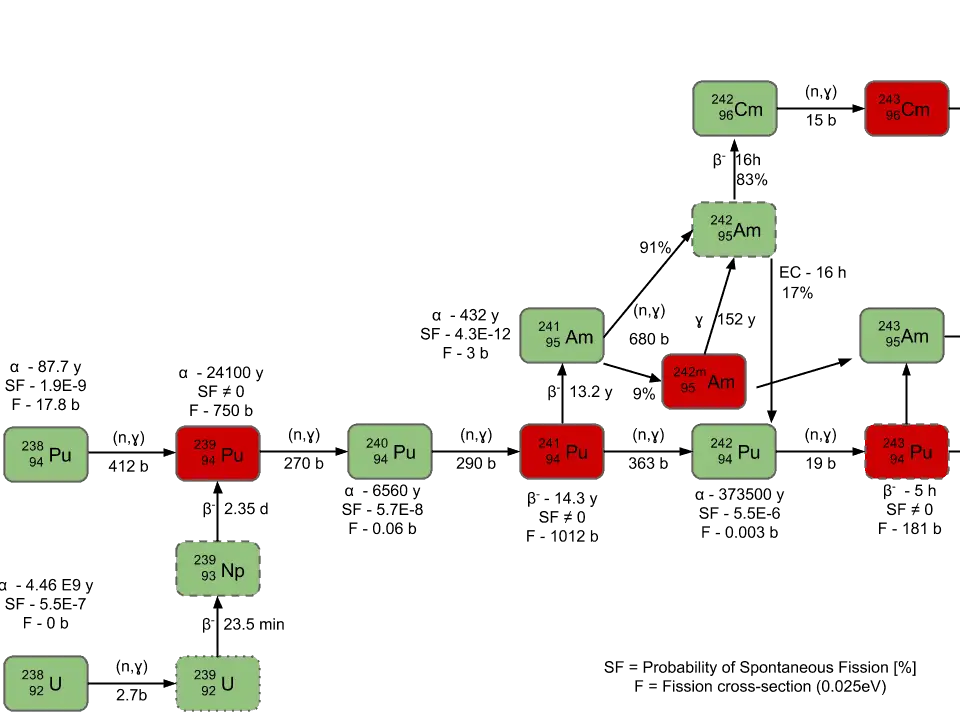
In fact, during fuel burnup the fertile materials (conversion of 238U to fissile 239Pu known as fuel breeding) partially replace fissile 235U, thus in a nuclear reactor more fissile isotopes are involved in power generation. Since the 239Pu fission releases very similar amount of energy, this example can be generalized to:

Annual consumption is: 1 005 kg of all fissile material involved.

The fuel breeding permits power reactors to operate longer before the amount of fissile material decreases to the point where reactor criticality is no longer manageable.

The fuel breeding in the fuel cycle of all commercial light water reactors plays a significant role. In recent years, the commercial power industry has been emphasizing high-burnup fuels (up to 60 – 70 GWd/tU), which are typically enriched to higher percentages of 235U (up to 5%). As burnup increases, a higher percentage of the total power produced in a reactor is due to the fuel bred inside the reactor.

At a burnup of 30 GWd/tU (gigawatt-days per metric ton of uranium), about 30% of the total energy released comes from bred plutonium. At 40 GWd/tU, that percentage increases to about forty percent. This corresponds to a breeding ratio for these reactors of about 0.4 to 0.5. That means, about half of the fissile fuel in these reactors is bred there. This effect extends the cycle length for such fuels to sometimes nearly twice what it would be otherwise. MOX fuel has a smaller breeding effect than 235U fuel and is thus more challenging and slightly less economic to use due to a quicker drop off in reactivity through cycle life.

Natural uranium consumption in a nuclear reactor

Uraninite - the most common uranium ore.
Uraninite – the most common uranium ore.

Natural uranium refers to uranium with the same isotopic ratio as found in nature. It consists primarily of isotope 238U (99.28%), therefore the atomic mass of uranium element is close to the atomic mass of 238U isotope (238.03u).  Natural uranium also consists of two other isotopes: 235U (0.71%) and 234U (0.0054%). The abundance of  isotopes in the nature is caused by difference in the half-lifes. All three naturally-occurring isotopes of uranium (238U, 235U and 234U)  are unstable. On the other hand these isotopes (except 234U) belong to primordial nuclides, because their half-life is comparable to the age of the Earth (~4.5×10⁹ years for 238U).

Since natural uranium contains only 0.71% of fissile isotope 235U and most of current power reactors require enriched uranium, this natural uranium must be enriched. The level of enrichment required depends on specific reactor design (e.g.  PWRs and BWRs require 3% – 5% of 235U) and specific requirements of the nuclear power plant operator. Without required enrichment these reactors are not able to initiate and sustain a nuclear chain reaction for such a long period as 12 months (or more).

The enrichment process separates gaseous uranium hexafluoride into two streams, one being enriched to the required level and known as low-enriched uranium, the other stream is progressively depleted in U-235 and is called ‘tails’, or simply depleted uranium. Typically, to produce 1 kg of enriched uranium with 5% of 235U, about 10 kg of natural uranium is required with a byproduct of about 9 kg of depleted uranium. Therefore annual natural uranium consumption of 3000MWth reactor is about 250 tonnes of natural uranium (to produce of about 25 tonnes of enriched uranium).

Matter consumption in a nuclear reactor

E=MC2In general, the nuclear fission results in the release of enormous quantities of energy. This energy comes from the nuclear binding energy which holds nuclei together. The binding energy per nucleon is higher for fission fragments than for uranium nuclei. It was found the sum of the rest masses of products of fission is measurably smaller than the rest mass of uranium nucleus.

Mass Defect

It is due to the fact during the nuclear fission some of the mass of the nucleus gets converted into these huge amounts of energy and thus this mass is removed from the total mass of the original particle, and the mass is missing in the resulting nuclei.

According to the Einstein relationship (E = mc2) this binding energy is proportional to this mass difference and it is known as the mass defect.

The annual mass defect of a typical 3000MWth reactor  can be calculated directly from the Einstein relationship (E = mc2) as:

Δm = ΔE/c2

Δm = 3000×106 (W = J/s) x 31.5×10⁶ (seconds in year) / (2.9979 x 10⁸)2 = 1.051 kg

 
References:
Nuclear and Reactor Physics:
  1. J. R. Lamarsh, Introduction to Nuclear Reactor Theory, 2nd ed., Addison-Wesley, Reading, MA (1983).
  2. J. R. Lamarsh, A. J. Baratta, Introduction to Nuclear Engineering, 3d ed., Prentice-Hall, 2001, ISBN: 0-201-82498-1.
  3. W. M. Stacey, Nuclear Reactor Physics, John Wiley & Sons, 2001, ISBN: 0- 471-39127-1.
  4. Glasstone, Sesonske. Nuclear Reactor Engineering: Reactor Systems Engineering, Springer; 4th edition, 1994, ISBN: 978-0412985317
  5. W.S.C. Williams. Nuclear and Particle Physics. Clarendon Press; 1 edition, 1991, ISBN: 978-0198520467
  6. Kenneth S. Krane. Introductory Nuclear Physics, 3rd Edition, Wiley, 1987, ISBN: 978-0471805533
  7. G.R.Keepin. Physics of Nuclear Kinetics. Addison-Wesley Pub. Co; 1st edition, 1965
  8. Robert Reed Burn, Introduction to Nuclear Reactor Operation, 1988.
  9. U.S. Department of Energy, Nuclear Physics and Reactor Theory. DOE Fundamentals Handbook, Volume 1 and 2. January 1993.

Advanced Reactor Physics:

  1. K. O. Ott, W. A. Bezella, Introductory Nuclear Reactor Statics, American Nuclear Society, Revised edition (1989), 1989, ISBN: 0-894-48033-2.
  2. K. O. Ott, R. J. Neuhold, Introductory Nuclear Reactor Dynamics, American Nuclear Society, 1985, ISBN: 0-894-48029-4.
  3. D. L. Hetrick, Dynamics of Nuclear Reactors, American Nuclear Society, 1993, ISBN: 0-894-48453-2.
  4. E. E. Lewis, W. F. Miller, Computational Methods of Neutron Transport, American Nuclear Society, 1993, ISBN: 0-894-48452-4.

See also:

Nuclear Fuel

We hope, this article, Fuel Consumption of Conventional Reactor, helps you. If so, give us a like in the sidebar. Main purpose of this website is to help the public to learn some interesting and important information about materials and their properties.

What is Energy Conservation in Beta Decay – Discovery of the Neutrino – Definition

The study of beta decay provided the first physical evidence for the existence of the neutrino. This physical evidence is based on the law of conservation of energy. Material Properties

Energy Conservation in Beta Decay – Discovery of the Neutrino

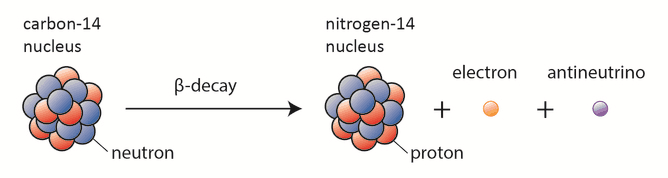
Beta decay (β-decay) is a type of radioactive decay in which a beta particle, and a respective neutrino are emitted from an atomic nucleus. Beta radiation consist of beta particles that are high-energy, high-speed electrons or positrons are emitted during beta decay. By beta decay emission, a neutron is transformed into a proton by the emission of an electron, or conversely a proton is converted into a neutron by emission of a positron, thus changing the nuclide type.

beta decay
Beta decay of C-14 nucleus.

Discovery of the Neutrino

The study of beta decay provided the first physical evidence for the existence of the neutrino. The discovery of the neutrino is based on the law of conservation of energy during the process of beta decay.

In both alpha and gamma decay, the resulting particle (alpha particle or photon) has a narrow energy distribution, since the particle carries the energy from the difference between the initial and final nuclear states. For example, in case of alpha decay, when a parent nucleus breaks down spontaneously to yield a daughter nucleus and an alpha particle, the sum of the mass of the two products does not quite equal the mass of the original nucleus (see Mass Defect). As a result of the law of conservation of energy, this difference appears in the form of the kinetic energy of the alpha particle. Since the same particles appear as products at every breakdown of a particular parent nucleus, the mass-difference should always be the same, and the kinetic energy of the alpha particles should also always be the same. In other words, the beam of alpha particles should be monoenergetic.

It was expected that the same considerations would hold for a parent nucleus breaking down to a daughter nucleus and a beta particle. Because only the electron and the recoiling daughter nucleus were observed beta decay, the process was initially assumed to be a two body process, very much like alpha decay. It would seem reasonable to suppose that the beta particles would form also a monoenergetic beam.

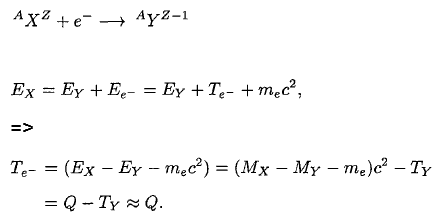
To demonstrate energetics of two-body beta decay, consider the beta decay in which an electron is emitted and the parent nucleus is at rest, conservation of energy requires:

conservation-of-energy-beta-decay

Since the electron is much lighter particle it was expected that it will carry away most of the released energy, which would have a unique value Te-.

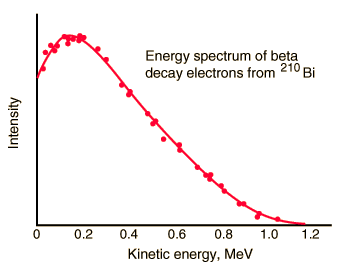
Energy spectrum of beta decay
The shape of this energy curve depends on what fraction of the reaction energy (Q value-the amount of energy released by the reaction) is carried by the electron or neutrino.

But the reality was different. The spectrum of beta particles measured by Lise Meitner and Otto Hahn in 1911 and by Jean Danysz in 1913 showed multiple lines on a diffuse background, however. Moreover virtually all of the emitted beta particles have energies below that predicted by energy conservation in two-body decays. The electrons emitted in beta decay have a continuous rather than a discrete spectrum appeared to contradict conservation of energy, under the then-current assumption that beta decay is the simple emission of an electron from a nucleus. When this was first observed, it appeared to threaten the survival of one of the most important conservation laws in physics!

To account for this energy release, Pauli proposed (in 1931) that there was emitted in the decay process another particle, later named by Fermi the neutrino. It was clear, this particle must be highly penetrating and that the conservation of electric charge requires the neutrino to be electrically neutral. This would explain why it was so hard to detect this particle. The term neutrino comes from Italian meaning “little neutral one” and neutrinos are denoted by the Greek letter ν (nu). In the process of beta decay the neutrino carries the missing energy and also in this process the law of conservation of energy remains valid.

 
References:
Nuclear and Reactor Physics:
  1. J. R. Lamarsh, Introduction to Nuclear Reactor Theory, 2nd ed., Addison-Wesley, Reading, MA (1983).
  2. J. R. Lamarsh, A. J. Baratta, Introduction to Nuclear Engineering, 3d ed., Prentice-Hall, 2001, ISBN: 0-201-82498-1.
  3. W. M. Stacey, Nuclear Reactor Physics, John Wiley & Sons, 2001, ISBN: 0- 471-39127-1.
  4. Glasstone, Sesonske. Nuclear Reactor Engineering: Reactor Systems Engineering, Springer; 4th edition, 1994, ISBN: 978-0412985317
  5. W.S.C. Williams. Nuclear and Particle Physics. Clarendon Press; 1 edition, 1991, ISBN: 978-0198520467
  6. Kenneth S. Krane. Introductory Nuclear Physics, 3rd Edition, Wiley, 1987, ISBN: 978-0471805533
  7. G.R.Keepin. Physics of Nuclear Kinetics. Addison-Wesley Pub. Co; 1st edition, 1965
  8. Robert Reed Burn, Introduction to Nuclear Reactor Operation, 1988.
  9. U.S. Department of Energy, Nuclear Physics and Reactor Theory. DOE Fundamentals Handbook, Volume 1 and 2. January 1993.

Advanced Reactor Physics:

  1. K. O. Ott, W. A. Bezella, Introductory Nuclear Reactor Statics, American Nuclear Society, Revised edition (1989), 1989, ISBN: 0-894-48033-2.
  2. K. O. Ott, R. J. Neuhold, Introductory Nuclear Reactor Dynamics, American Nuclear Society, 1985, ISBN: 0-894-48029-4.
  3. D. L. Hetrick, Dynamics of Nuclear Reactors, American Nuclear Society, 1993, ISBN: 0-894-48453-2.
  4. E. E. Lewis, W. F. Miller, Computational Methods of Neutron Transport, American Nuclear Society, 1993, ISBN: 0-894-48452-4.

See also:

Conservation of Energy

We hope, this article, Energy Conservation in Beta Decay – Discovery of the Neutrino, helps you. If so, give us a like in the sidebar. Main purpose of this website is to help the public to learn some interesting and important information about materials and their properties.

What is Energy Conservation in Nuclear Fission – Definition

Energy Conservation in Nuclear Fission. In general, the nuclear fission results in the release of enormous quantities of energy. According to the law the mass-energy must be conserved. Material Properties

Energy Conservation in Nuclear Fission

Energy release per fissionIn general, the nuclear fission results in the release of enormous quantities of energy. The amount of energy depends strongly on the nucleus to be fissioned and also depends strongly on the kinetic energy of an incident neutron. In order to calculate the power of a reactor, it is necessary to be able precisely identify the individual components of this energy. At first, it is important to distinguish between the total energy released and the energy that can be recovered in a reactor.

The total energy released in fission can be calculated from binding energies of initial target nucleus to be fissioned and binding energies of fission products. But not all the total energy can be recovered in a reactor. For example, about 10 MeV is released in the form of neutrinos (in fact antineutrinos). Since the neutrinos are weakly interacting (with extremely low cross-section of any interaction), they do not contribute to the energy that can be recovered in a reactor.

See also: Energy Release from Fission

 
Example: Mass defect of the reactor core
Calculate the mass defect of the 3000MWth reactor core after one year of operation.

It is known the average recoverable energy per fission is about 200 MeV, being the total energy minus the energy of the energy of antineutrinos that are radiated away.

The reaction rate per entire 3000MWth reactor core is about  9.33×10¹⁹ fissions / second.

The overall energy release in the units of joules is:

200×106 (eV) x 1.602×10⁻¹⁹ (J/eV) x 9.33×10¹⁹ (s-1) x 31.5×106 (seconds in year) = 9.4×10¹⁶ J/year

The mass defect is calculated as:

Δm = ΔE/c2

Δm = 9.4×10¹⁶ / (2.9979 x 10⁸)2 = 1.046 kg

That means in a typical 3000MWth reactor core about 1 kilogram of matter is converted into pure energy.

Note that, a typical annual uranium load for a 3000MWth reactor core is about 20 tonnes of enriched uranium (i.e. about 22.7 tonnes of UO2). Entire reactor core may contain about 80 tonnes of enriched uranium.

Mass defect directly from E=mc2

The mass defect can be calculated directly from the Einstein relationship (E = mc2) as:

Δm = ΔE/c2

Δm = 3000×106 (W = J/s) x 31.5×10⁶ (seconds in year) / (2.9979 x 10⁸)2 = 1,051 kg

 
References:
Nuclear and Reactor Physics:
  1. J. R. Lamarsh, Introduction to Nuclear Reactor Theory, 2nd ed., Addison-Wesley, Reading, MA (1983).
  2. J. R. Lamarsh, A. J. Baratta, Introduction to Nuclear Engineering, 3d ed., Prentice-Hall, 2001, ISBN: 0-201-82498-1.
  3. W. M. Stacey, Nuclear Reactor Physics, John Wiley & Sons, 2001, ISBN: 0- 471-39127-1.
  4. Glasstone, Sesonske. Nuclear Reactor Engineering: Reactor Systems Engineering, Springer; 4th edition, 1994, ISBN: 978-0412985317
  5. W.S.C. Williams. Nuclear and Particle Physics. Clarendon Press; 1 edition, 1991, ISBN: 978-0198520467
  6. Kenneth S. Krane. Introductory Nuclear Physics, 3rd Edition, Wiley, 1987, ISBN: 978-0471805533
  7. G.R.Keepin. Physics of Nuclear Kinetics. Addison-Wesley Pub. Co; 1st edition, 1965
  8. Robert Reed Burn, Introduction to Nuclear Reactor Operation, 1988.
  9. U.S. Department of Energy, Nuclear Physics and Reactor Theory. DOE Fundamentals Handbook, Volume 1 and 2. January 1993.

Advanced Reactor Physics:

  1. K. O. Ott, W. A. Bezella, Introductory Nuclear Reactor Statics, American Nuclear Society, Revised edition (1989), 1989, ISBN: 0-894-48033-2.
  2. K. O. Ott, R. J. Neuhold, Introductory Nuclear Reactor Dynamics, American Nuclear Society, 1985, ISBN: 0-894-48029-4.
  3. D. L. Hetrick, Dynamics of Nuclear Reactors, American Nuclear Society, 1993, ISBN: 0-894-48453-2.
  4. E. E. Lewis, W. F. Miller, Computational Methods of Neutron Transport, American Nuclear Society, 1993, ISBN: 0-894-48452-4.

See also:

Conservation of Energy

We hope, this article, Energy Conservation in Nuclear Fission, helps you. If so, give us a like in the sidebar. Main purpose of this website is to help the public to learn some interesting and important information about materials and their properties.

What is Conservation of Energy in Nuclear Reactions – Definition

Conservation of Energy in Nuclear Reactions. In nuclear reactions, some conversion between rest mass and energy occurs, but the total (relativistic) energy must be conserved. Material Properties

Conservation of Energy in Nuclear Reactions

In analyzing nuclear reactions, we have to apply the general law of conservation of mass-energy. According to this law mass and energy are equivalent and convertible one into the other. It is one of the striking results of Einstein’s theory of relativity. This equivalence of the mass and energy is described by Einstein’s famous formula E = mc2.

Generally, in both chemical and nuclear reactions, some conversion between rest mass and energy occurs, so that the products generally have smaller or greater mass than the reactants.

Conservation of Energy in Nuclear Reactions

In general, the total (relativistic) energy must be conserved.

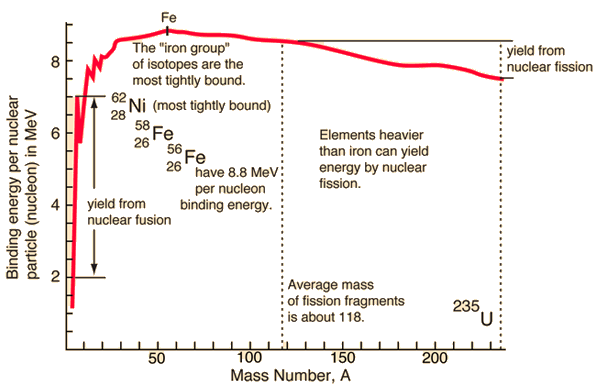
The “missing” rest mass must therefore reappear as kinetic energy released in the reaction. The difference is a measure of the nuclear binding energy which holds the nucleus together.

The nuclear binding energies are enormous, they are of the order of a million times greater than the electron binding energies of atoms.

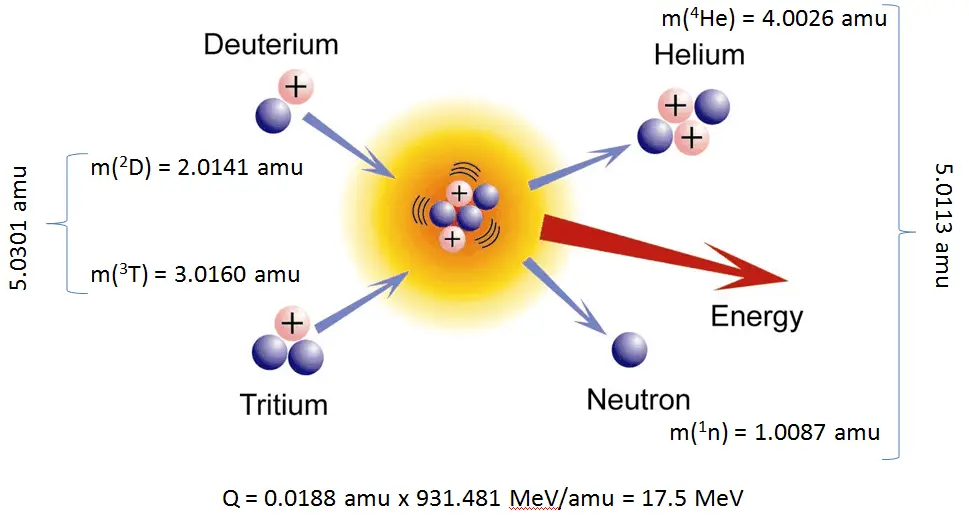
Q-value of DT fusion reaction

The energetics of nuclear reactions is determined by the Q-value of that reaction. The Q-value of the reaction is defined as the difference between the sum of the masses of the initial reactants and the sum of the masses of the final products, in energy units (usually in MeV).

Consider a typical reaction, in which the projectile a and the target A gives place to two products, B and b. This can also be expressed in the notation that we used so far, a + A → B + b, or even in a more compact notation, A(a,b)B.

See also: E=mc2

The Q-value of this reaction is given by:

Q = [ma + mA – (mb + mB)]c2

which is the same as the excess kinetic energy of the final products:

Q = Tfinal – Tinitial

  = Tb + TB – (Ta + TA)

For reactions in which there is an increase in the kinetic energy of the products Q is positive. The positive Q reactions are said to be exothermic (or exergic). There is a net release of energy, since the kinetic energy of the final state is greater than the kinetic energy of the initial state.

For reactions in which there is a decrease in the kinetic energy of the products Q is negative. The negative Q reactions are said to be endothermic (or endoergic) and they require a net energy input.

See also: Q-value Calculator

 
Example: Exothermic Reaction - DT Fusion
Q-value of DT fusion reaction

The DT fusion reaction of deuterium and tritium is particularly interesting because of its potential of providing energy for the future. Calculate the reaction Q-value.

3T (d, n) 4He

The atom masses of the reactants and products are:

m(3T) = 3.0160 amu

m(2D) = 2.0141 amu

m(1n) = 1.0087 amu

m(4He) = 4.0026 amu

Using the mass-energy equivalence, we get the Q-value of this reaction as:

Q = {(3.0160+2.0141) [amu] – (1.0087+4.0026) [amu]} x 931.481 [MeV/amu]

= 0.0188 x 931.481 = 17.5 MeV

Example: Endothermic Reaction - Photoneutrons
In nuclear reactors the gamma radiation plays a significant role also in reactor kinetics and in a subcriticality control. Especially in nuclear reactors with D2O moderator (CANDU reactors) or with Be reflectors (some experimental reactors). Neutrons can be produced also in (γ, n) reactions and therefore they are usually referred to as photoneutrons.

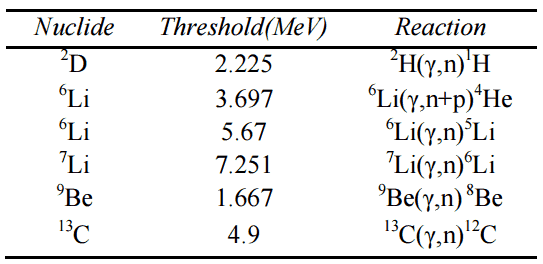
A high energy photon (gamma ray) can under certain conditions eject a neutron from a nucleus. It occurs when its energy exceeds the binding energy of the neutron in the nucleus. Most nuclei have binding energies in excess of 6 MeV, which is above the energy of most gamma rays from fission. On the other hand there are few nuclei with sufficiently low binding energy to be of practical interest. These are: 2D, 9Be, 6Li, 7Li and 13C. As can be seen from the table the lowest threshold have 9Be with 1.666 MeV and 2D with 2.226 MeV.

Photoneutron sources
Nuclides with low photodisintegration
threshold energies.

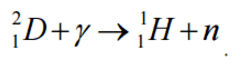
In case of deuterium, neutrons can be produced by the interaction of gamma rays (with a minimum energy of 2.22 MeV) with deuterium:

Photoneutron - deuterium

The reaction Q-value is calculated below:

The atom masses of the reactant and products are:

m(2D) = 2.01363 amu

m(1n) = 1.00866 amu

m(1H) = 1.00728 amu

Using the mass-energy equivalence, we get the Q-value of this reaction as:

Q = {2.01363 [amu] – (1.00866+1.00728) [amu]} x 931.481 [MeV/amu]

= -0.00231 x 931.481 = -2.15 MeV

The energy released in a nuclear reaction can appear mainly in one of three ways:
  • Kinetic energy of the products
  • Emission of gamma rays. Gamma rays are emitted by unstable nuclei in their transition from a high energy state to a lower state known as gamma decay.
  • Metastable state. Some energy may remain in the nucleus, as a metastable energy level.

A small amount of energy may also emerge in the form of X-rays. Generally, products of nuclear reactions may have different atomic numbers, and thus the configuration of their electron shells is different in comparison with reactants. As the electrons rearrange themselves and drop to lower energy levels, internal transition X-rays (X-rays with precisely defined emission lines) may be emitted.

Energy Conservation in Nuclear Fission

Energy release per fissionIn general, the nuclear fission results in the release of enormous quantities of energy. The amount of energy depends strongly on the nucleus to be fissioned and also depends strongly on the kinetic energy of an incident neutron. In order to calculate the power of a reactor, it is necessary to be able precisely identify the individual components of this energy. At first, it is important to distinguish between the total energy released and the energy that can be recovered in a reactor.

The total energy released in fission can be calculated from binding energies of initial target nucleus to be fissioned and binding energies of fission products. But not all the total energy can be recovered in a reactor. For example, about 10 MeV is released in the form of neutrinos (in fact antineutrinos). Since the neutrinos are weakly interacting (with extremely low cross-section of any interaction), they do not contribute to the energy that can be recovered in a reactor.

See also: Energy Release from Fission

 
Example: Mass defect of the reactor core
Calculate the mass defect of the 3000MWth reactor core after one year of operation.

It is known the average recoverable energy per fission is about 200 MeV, being the total energy minus the energy of the energy of antineutrinos that are radiated away.

The reaction rate per entire 3000MWth reactor core is about  9.33×10¹⁹ fissions / second.

The overall energy release in the units of joules is:

200×106 (eV) x 1.602×10⁻¹⁹ (J/eV) x 9.33×10¹⁹ (s-1) x 31.5×106 (seconds in year) = 9.4×10¹⁶ J/year

The mass defect is calculated as:

Δm = ΔE/c2

Δm = 9.4×10¹⁶ / (2.9979 x 10⁸)2 = 1.046 kg

That means in a typical 3000MWth reactor core about 1 kilogram of matter is converted into pure energy.

Note that, a typical annual uranium load for a 3000MWth reactor core is about 20 tonnes of enriched uranium (i.e. about 22.7 tonnes of UO2). Entire reactor core may contain about 80 tonnes of enriched uranium.

Mass defect directly from E=mc2

The mass defect can be calculated directly from the Einstein relationship (E = mc2) as:

Δm = ΔE/c2

Δm = 3000×106 (W = J/s) x 31.5×10⁶ (seconds in year) / (2.9979 x 10⁸)2 = 1.051 kg

Energy Conservation in Beta Decay – Discovery of the Neutrino

Beta decay (β-decay) is a type of radioactive decay in which a beta particle, and a respective neutrino are emitted from an atomic nucleus. Beta radiation consist of beta particles that are high-energy, high-speed electrons or positrons are emitted during beta decay. By beta decay emission, a neutron is transformed into a proton by the emission of an electron, or conversely a proton is converted into a neutron by emission of a positron, thus changing the nuclide type.

The study of beta decay provided the first physical evidence for the existence of the neutrino. This physical evidence is based on the law of conservation of energy during the process of beta decay.

In both alpha and gamma decay, the resulting particle (alpha particle or photon) has a narrow energy distribution, since the particle carries the energy from the difference between the initial and final nuclear states. For example, in case of alpha decay, when a parent nucleus breaks down spontaneously to yield a daughter nucleus and an alpha particle, the sum of the mass of the two products does not quite equal the mass of the original nucleus (see Mass Defect). As a result of the law of conservation of energy, this difference appears in the form of the kinetic energy of the alpha particle. Since the same particles appear as products at every breakdown of a particular parent nucleus, the mass-difference should always be the same, and the kinetic energy of the alpha particles should also always be the same. In other words, the beam of alpha particles should be monoenergetic.

It was expected that the same considerations would hold for a parent nucleus breaking down to a daughter nucleus and a beta particle. Because only the electron and the recoiling daughter nucleus were observed beta decay, the process was initially assumed to be a two body process, very much like alpha decay. It would seem reasonable to suppose that the beta particles would form also a monoenergetic beam.

To demonstrate energetics of two-body beta decay, consider the beta decay in which an electron is emitted and the parent nucleus is at rest, conservation of energy requires:

conservation-of-energy-beta-decay

Since the electron is much lighter particle it was expected that it will carry away most of the released energy, which would have a unique value Te-.

Energy spectrum of beta decay
The shape of this energy curve depends on what fraction of the reaction energy (Q value-the amount of energy released by the reaction) is carried by the electron or neutrino.

But the reality was different. The spectrum of beta particles measured by Lise Meitner and Otto Hahn in 1911 and by Jean Danysz in 1913 showed multiple lines on a diffuse background, however. Moreover virtually all of the emitted beta particles have energies below that predicted by energy conservation in two-body decays. The electrons emitted in beta decay have a continuous rather than a discrete spectrum appeared to contradict conservation of energy, under the then-current assumption that beta decay is the simple emission of an electron from a nucleus. When this was first observed, it appeared to threaten the survival of one of the most important conservation laws in physics!

To account for this energy release, Pauli proposed (in 1931) that there was emitted in the decay process another particle, later named by Fermi the neutrino. It was clear, this particle must be highly penetrating and that the conservation of electric charge requires the neutrino to be electrically neutral. This would explain why it was so hard to detect this particle. The term neutrino comes from Italian meaning “little neutral one” and neutrinos are denoted by the Greek letter ν (nu). In the process of beta decay the neutrino carries the missing energy and also in this process the law of conservation of energy remains valid.

 
References:
Nuclear and Reactor Physics:
  1. J. R. Lamarsh, Introduction to Nuclear Reactor Theory, 2nd ed., Addison-Wesley, Reading, MA (1983).
  2. J. R. Lamarsh, A. J. Baratta, Introduction to Nuclear Engineering, 3d ed., Prentice-Hall, 2001, ISBN: 0-201-82498-1.
  3. W. M. Stacey, Nuclear Reactor Physics, John Wiley & Sons, 2001, ISBN: 0- 471-39127-1.
  4. Glasstone, Sesonske. Nuclear Reactor Engineering: Reactor Systems Engineering, Springer; 4th edition, 1994, ISBN: 978-0412985317
  5. W.S.C. Williams. Nuclear and Particle Physics. Clarendon Press; 1 edition, 1991, ISBN: 978-0198520467
  6. Kenneth S. Krane. Introductory Nuclear Physics, 3rd Edition, Wiley, 1987, ISBN: 978-0471805533
  7. G.R.Keepin. Physics of Nuclear Kinetics. Addison-Wesley Pub. Co; 1st edition, 1965
  8. Robert Reed Burn, Introduction to Nuclear Reactor Operation, 1988.
  9. U.S. Department of Energy, Nuclear Physics and Reactor Theory. DOE Fundamentals Handbook, Volume 1 and 2. January 1993.

Advanced Reactor Physics:

  1. K. O. Ott, W. A. Bezella, Introductory Nuclear Reactor Statics, American Nuclear Society, Revised edition (1989), 1989, ISBN: 0-894-48033-2.
  2. K. O. Ott, R. J. Neuhold, Introductory Nuclear Reactor Dynamics, American Nuclear Society, 1985, ISBN: 0-894-48029-4.
  3. D. L. Hetrick, Dynamics of Nuclear Reactors, American Nuclear Society, 1993, ISBN: 0-894-48453-2.
  4. E. E. Lewis, W. F. Miller, Computational Methods of Neutron Transport, American Nuclear Society, 1993, ISBN: 0-894-48452-4.

See also:

Conservation of Energy

We hope, this article, Conservation of Energy in Nuclear Reactions, helps you. If so, give us a like in the sidebar. Main purpose of this website is to help the public to learn some interesting and important information about materials and their properties.

What is Conservation Law in Nuclear Reactions – Definition

In analyzing nuclear reactions, we apply the many conservation laws. Nuclear reactions are subject to classical conservation laws and also additional laws. Material Properties

Conservation Laws in Nuclear Reactions

A nuclear reaction is considered to be the process in which two nuclear particles (two nuclei or a nucleus and a nucleon) interact to produce two or more nuclear particles or ˠ-rays (gamma rays). Thus, a nuclear reaction must cause a transformation of at least one nuclide to another. Sometimes if a nucleus interacts with another nucleus or particle without changing the nature of any nuclide, the process is referred to a nuclear scattering, rather than a nuclear reaction.

In analyzing nuclear reactions, we apply the many conservation laws. Nuclear reactions are subject to classical conservation laws for charge, momentum, angular momentum, and energy (including rest energies).  Additional conservation laws, not anticipated by classical physics, are are electric charge, lepton number and baryon number. Certain of these laws are obeyed under all circumstances, others are not. We have accepted conservation of energy and momentum. In all the examples given we assume that the number of protons and the number of neutrons is separately conserved. We shall find circumstances and conditions in which  this rule is not true. Where we are considering non-relativistic nuclear reactions, it is essentially true. However, where we are considering relativistic nuclear energies or those involving the weak interactions, we shall find that these principles must be extended.

Some conservation principles have arisen from theoretical considerations, others are just empirical relationships. Notwithstanding, any reaction not expressly forbidden by the conservation laws will generally occur, if perhaps at a slow rate. This expectation is based on quantum mechanics. Unless the barrier between the initial and final states is infinitely high, there is always a non-zero probability that a system will make the transition between them.

For purposes of this article it is sufficient to note four of the fundamental laws governing these reactions.

Conservation Laws in Nuclear Reactions

  1. Conservation of nucleons. The total number of nucleons before and after a reaction are the same.
  2. Conservation of charge. The sum of the charges on all the particles before and after a reaction are the same
  3. Conservation of momentum. The total momentum of the interacting particles before and after a reaction are the same.
  4. Conservation of energy. Energy, including rest mass energy, is conserved in nuclear reactions.
 
Types of Nuclear Reactions
Although the number of possible nuclear reactions is enormous, nuclear reactions can be sorted by types. Most of nuclear reactions are accompanied by gamma emission. Some examples are:
  • Elastic scattering. Occurs, when no energy is transferred between the target nucleus and the incident particle.

 208Pb (n, n) 208Pb

  •  Inelastic scattering. Occurs, when energy is transferred. The difference of kinetic energies is saved in excited nuclide.

 40Ca (α, α’) 40mCa

  • Capture reactions. Both charged and neutral particles can be captured by nuclei. This is accompanied by the emission of ˠ-rays. Neutron capture reaction produces radioactive nuclides (induced radioactivity).

 238U (n, ˠ) 239U

  • Transfer Reactions. The absorption of a particle accompanied by the emission of one or more particles is called the transfer reaction.

4He (α, p) 7Li

  • Fission reactions. Nuclear fission is a nuclear reaction in which the nucleus of an atom splits into smaller parts (lighter nuclei). The fission process often produces free neutronsand photons (in the form of gamma rays), and releases a large amount of energy.

235U (n, 3 n) fission products

  • Fusion reactions.  Occur when, two or more atomic nuclei collide at a very high speed and join to form a new type of atomic nucleus.The fusion reaction of deuterium and tritium is particularly interesting because of its potential of providing energy for the future.

3T (d, n) 4He

  • Spallation reactions. Occur, when a nucleus is hit by a particle with sufficient energy and momentum to knock out several small fragments or, smash it into many fragments.
  • Nuclear decay (Radioactive decay). Occurs when an unstable atom loses energy by emitting ionizing radiation. Radioactive decay is a random process at the level of single atoms, in that, according to quantum theory, it is impossible to predict when a particular atom will decay. There are many types of radioactive decay:
    • Alpha radioactivity. Alpha particles consist of two protons and two neutrons bound together into a particle identical to a helium nucleus. Because of its very large mass (more than 7000 times the mass of the beta particle) and its charge, it heavy ionizes material and has a very short range.
    • Beta radioactivity. Beta particles are high-energy, high-speed electrons or positrons emitted by certain types of radioactive nuclei such as potassium-40. The beta particles have greater range of penetration than alpha particles, but still much less than gamma rays.The beta particles emitted are a form of ionizing radiation also known as beta rays. The production of beta particles is termed beta decay.
    • Gamma radioactivity. Gamma rays are electromagnetic radiation of an very high frequency and are therefore high energy photons. They are produced by the decay of nuclei as they transition from a high energy state to a lower state known as gamma decay. Most of nuclear reactions are accompanied by gamma emission.
    • Neutron emission. Neutron emission is a type of radioactive decay of nuclei containing excess neutrons (especially fission products), in which a neutron is simply ejected from the nucleus. This type of radiation plays key role in nuclear reactor control, because these neutrons are delayed  neutrons.

Conservation of Energy in Nuclear Reactions

In analyzing nuclear reactions, we have to apply the general law of conservation of mass-energy. According to this law mass and energy are equivalent and convertible one into the other. It is one of the striking results of Einstein’s theory of relativity. This equivalence of the mass and energy is described by Einstein’s famous formula E = mc2.

Generally, in both chemical and nuclear reactions, some conversion between rest mass and energy occurs, so that the products generally have smaller or greater mass than the reactants. In general, the total (relativistic) energy must be conserved. The “missing” rest mass must therefore reappear as kinetic energy released in the reaction. The difference is a measure of the nuclear binding energy which holds the nucleus together.

The nuclear binding energies are enormous, they are of the order of a million times greater than the electron binding energies of atoms.

Q-value of DT fusion reaction

The energetics of nuclear reactions is determined by the Q-value of that reaction. The Q-value of the reaction is defined as the difference between the sum of the masses of the initial reactants and the sum of the masses of the final products, in energy units (usually in MeV).

Consider a typical reaction, in which the projectile a and the target A gives place to two products, B and b. This can also be expressed in the notation that we used so far, a + A → B + b, or even in a more compact notation, A(a,b)B.

See also: E=mc2

The Q-value of this reaction is given by:

Q = [ma + mA – (mb + mB)]c2

which is the same as the excess kinetic energy of the final products:

Q = Tfinal – Tinitial

  = Tb + TB – (Ta + TA)

For reactions in which there is an increase in the kinetic energy of the products Q is positive. The positive Q reactions are said to be exothermic (or exergic). There is a net release of energy, since the kinetic energy of the final state is greater than the kinetic energy of the initial state.

For reactions in which there is a decrease in the kinetic energy of the products Q is negative. The negative Q reactions are said to be endothermic (or endoergic) and they require a net energy input.

See also: Q-value Calculator

 
Example: Exothermic Reaction - DT Fusion
Q-value of DT fusion reaction

The DT fusion reaction of deuterium and tritium is particularly interesting because of its potential of providing energy for the future. Calculate the reaction Q-value.

3T (d, n) 4He

The atom masses of the reactants and products are:

m(3T) = 3.0160 amu

m(2D) = 2.0141 amu

m(1n) = 1.0087 amu

m(4He) = 4.0026 amu

Using the mass-energy equivalence, we get the Q-value of this reaction as:

Q = {(3.0160+2.0141) [amu] – (1.0087+4.0026) [amu]} x 931.481 [MeV/amu]

= 0.0188 x 931.481 = 17.5 MeV

Example: Endothermic Reaction - Photoneutrons
In nuclear reactors the gamma radiation plays a significant role also in reactor kinetics and in a subcriticality control. Especially in nuclear reactors with D2O moderator (CANDU reactors) or with Be reflectors (some experimental reactors). Neutrons can be produced also in (γ, n) reactions and therefore they are usually referred to as photoneutrons.

A high energy photon (gamma ray) can under certain conditions eject a neutron from a nucleus. It occurs when its energy exceeds the binding energy of the neutron in the nucleus. Most nuclei have binding energies in excess of 6 MeV, which is above the energy of most gamma rays from fission. On the other hand there are few nuclei with sufficiently low binding energy to be of practical interest. These are: 2D, 9Be, 6Li, 7Li and 13C. As can be seen from the table the lowest threshold have 9Be with 1.666 MeV and 2D with 2.226 MeV.

Photoneutron sources
Nuclides with low photodisintegration
threshold energies.

In case of deuterium, neutrons can be produced by the interaction of gamma rays (with a minimum energy of 2.22 MeV) with deuterium:

Photoneutron - deuterium

The reaction Q-value is calculated below:

The atom masses of the reactant and products are:

m(2D) = 2.01363 amu

m(1n) = 1.00866 amu

m(1H) = 1.00728 amu

Using the mass-energy equivalence, we get the Q-value of this reaction as:

Q = {2.01363 [amu] – (1.00866+1.00728) [amu]} x 931.481 [MeV/amu]

= -0.00231 x 931.481 = -2.15 MeV

The energy released in a nuclear reaction can appear mainly in one of three ways:
  • Kinetic energy of the products
  • Emission of gamma rays. Gamma rays are emitted by unstable nuclei in their transition from a high energy state to a lower state known as gamma decay.
  • Metastable state. Some energy may remain in the nucleus, as a metastable energy level.

A small amount of energy may also emerge in the form of X-rays. Generally, products of nuclear reactions may have different atomic numbers, and thus the configuration of their electron shells is different in comparison with reactants. As the electrons rearrange themselves and drop to lower energy levels, internal transition X-rays (X-rays with precisely defined emission lines) may be emitted.

Conservation of Momentum and Energy in Collisions

The use of the conservation laws for momentum and energy is very important also in particle collisions. This is a very powerful rule because it can allow us to determine the results of a collision without knowing the details of the collision. The law of conservation of momentum states that in the collision of two objects such as billiard balls, the total momentum is conserved. The assumption of conservation of momentum as well as the conservation of kinetic energy makes possible the calculation of the final velocities in two-body collisions. At this point we have to distinguish between two types of collisions:

  • Elastic collisions
  • Inelastic collisions

Elastic Collisions

A perfectly elastic collision is defined as one in which there is no net conversion of kinetic energy into other forms (such as heat or noise). For the brief moment during which the two objects are in contact, some (or all) of the energy is stored momentarily in the form of elastic potential energy. But if we compare the total kinetic energy just before the collision with the total kinetic energy just after the collision, and they are found to be the same, then we say that the total kinetic energy is conserved.

[xyz-ihs snippet=”collisions”]
  • Some large-scale interactions like the slingshot type gravitational interactions (also known as a planetary swing-by or a gravity-assist manoeuvre) between satellites and planets are perfectly elastic.
  • Collisions between very hard spheres may be nearly elastic, so it is useful to calculate the limiting case of an elastic collision.
  • Collisions in ideal gases approach perfectly elastic collisions, as do scattering interactions of sub-atomic particles which are deflected by the electromagnetic force.
  • Rutherford scattering is the elastic scattering of charged particles also by the electromagnetic force.
  • A neutron-nucleus scattering reaction may be also elastic, but in this case the neutron is deflected by the strong nuclear force.
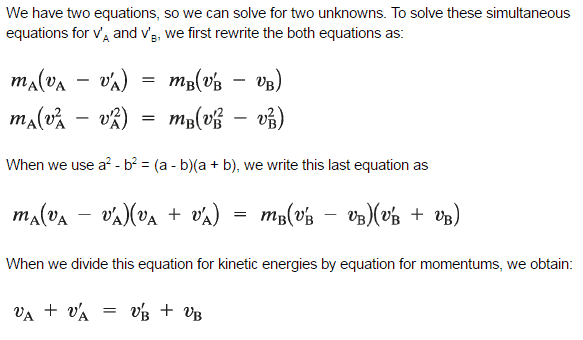
 
Equations of Conservation of Momentum and Energy
Let us assume the one dimensional elastic collision of two objects, the object A and the object B. These two objects are moving with velocities vA and vB along the x axis before the collision. After the collision, their velocities are v’A and v’B. The conservation of the total momentum demands that the total momentum before the collision is the same as the total momentum after the collision. Likewise, the conservation of the total kinetic energy, which demands that the total kinetic energy of both objects before the collision is the same as the total kinetic energy after the collision. Both law may be expressed in equations as:

equations-of-conservation-of-momentum-energy

solution-conservation-of-momentum-energy

The relative speed of the two objects after the collision has the same magnitude (but opposite direction) as before the collision, no matter what the masses are.

Elastic Nuclear Collision
See also: Neutron Moderators

It is known the fission neutrons are of importance in any chain-reacting system. All neutrons produced by fission are born as fast neutrons with high kinetic energy. Before such neutrons can efficiently cause additional fissions, they must be slowed down by collisions with nuclei in the moderator of the reactor. The probability of the fission U-235 becomes very large at the thermal energies of slow neutrons. This fact implies increase of multiplication factor of the reactor (i.e. lower fuel enrichment is needed to sustain chain reaction).

The neutrons released during fission with an average energy of 2 MeV in a reactor on average undergo a number of collisions (elastic or inelastic) before they are absorbed. During the scattering reaction, a fraction of the neutron’s kinetic energy is transferred to the nucleus. Using the laws of conservation of momentum and energy and the analogy of collisions of billiard balls for elastic scattering, it is possible to derive the following equation for the mass of target or moderator nucleus (M), energy of incident neutron (Ei) and the energy of scattered neutron (Es).

equation momentum energy

where A is the atomic mass number.In case of the hydrogen (A = 1) as the target nucleus, the incident neutron can be completely stopped. But this works when the direction of the neutron is completely reversed (i.e. scattered at 180°). In reality, the direction of scattering ranges from 0 to 180 ° and the energy transferred also ranges from 0% to maximum. Therefore, the average energy of scattered neutron is taken as the average of energies with scattering angle 0 and 180°.

Moreover, it is useful to work with logarithmic quantities and therefore one defines the logarithmic energy decrement per collision (ξ) as a key material constant describing energy transfers during a neutron slowing down. ξ is not dependent on energy, only on A and is defined as follows:logarithmic energy decrement - equationFor heavy target nuclei, ξ may be approximated by following formula:the logarithmic energy decrement per collisionFrom these equations it is easy to determine the number of collisions required to slow down a neutron from, for example from 2 MeV to 1 eV.
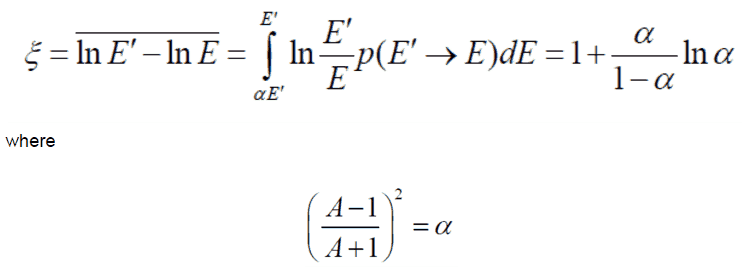
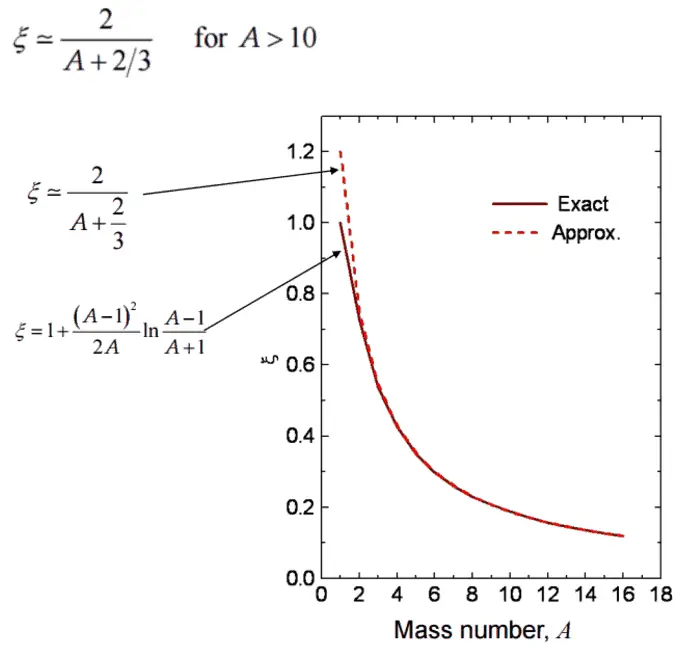
Example: Determine the number of collisions required for thermalization for the 2 MeV neutron in the carbon.

ξCARBON = 0.158

N(2MeV → 1eV) = ln 2⋅106/ξ =14.5/0.158 = 92
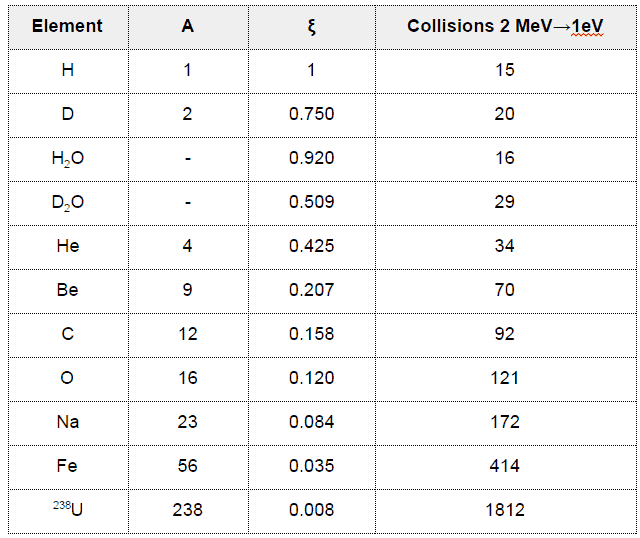
Table of average logarithmic energy decrement for some elements
Table of average logarithmic energy decrement for some elements.

For a mixture of isotopes:

the logarithmic energy decrement for mixtures

Example: Elastic Nuclear Collision
A neutron (n) of mass 1.01 u traveling with a speed of 3.60 x 104m/s interacts with a carbon (C) nucleus (mC = 12.00 u) initially at rest in an elastic head-on collision.

What are the velocities of the neutron and carbon nucleus after the collision?

Solution:

This is an elastic head-on collision of two objects with unequal masses. We have to use the conservation laws of momentum and of kinetic energy, and apply them to our system of two particles.
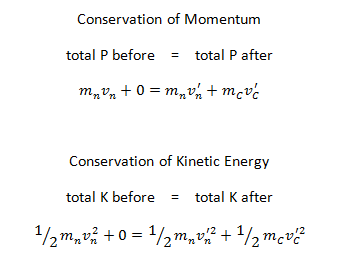
conservation-laws-elastic-collisions

We can solve this system of equation or we can use the equation derived in previous section. This equation stated that the relative speed of the two objects after the collision has the same magnitude (but opposite direction) as before the collision, no matter what the masses are.
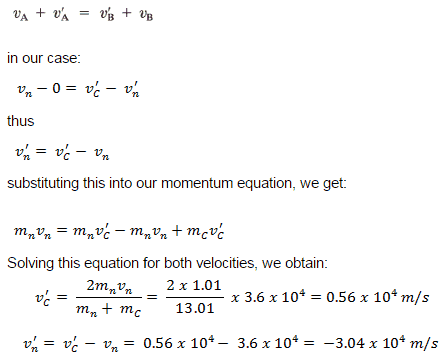
solution-elastic-collision

The minus sign for v’ tells us that the neutron scatters back of the carbon nucleus, because the carbon nucleus is significantly heavier. On the other hand its speed is less than its initial speed. This process is known as the neutron moderation and it significantly depends on the mass of moderator nuclei.

 
References:
Nuclear and Reactor Physics:
  1. J. R. Lamarsh, Introduction to Nuclear Reactor Theory, 2nd ed., Addison-Wesley, Reading, MA (1983).
  2. J. R. Lamarsh, A. J. Baratta, Introduction to Nuclear Engineering, 3d ed., Prentice-Hall, 2001, ISBN: 0-201-82498-1.
  3. W. M. Stacey, Nuclear Reactor Physics, John Wiley & Sons, 2001, ISBN: 0- 471-39127-1.
  4. Glasstone, Sesonske. Nuclear Reactor Engineering: Reactor Systems Engineering, Springer; 4th edition, 1994, ISBN: 978-0412985317
  5. W.S.C. Williams. Nuclear and Particle Physics. Clarendon Press; 1 edition, 1991, ISBN: 978-0198520467
  6. Kenneth S. Krane. Introductory Nuclear Physics, 3rd Edition, Wiley, 1987, ISBN: 978-0471805533
  7. G.R.Keepin. Physics of Nuclear Kinetics. Addison-Wesley Pub. Co; 1st edition, 1965
  8. Robert Reed Burn, Introduction to Nuclear Reactor Operation, 1988.
  9. U.S. Department of Energy, Nuclear Physics and Reactor Theory. DOE Fundamentals Handbook, Volume 1 and 2. January 1993.

Advanced Reactor Physics:

  1. K. O. Ott, W. A. Bezella, Introductory Nuclear Reactor Statics, American Nuclear Society, Revised edition (1989), 1989, ISBN: 0-894-48033-2.
  2. K. O. Ott, R. J. Neuhold, Introductory Nuclear Reactor Dynamics, American Nuclear Society, 1985, ISBN: 0-894-48029-4.
  3. D. L. Hetrick, Dynamics of Nuclear Reactors, American Nuclear Society, 1993, ISBN: 0-894-48453-2.
  4. E. E. Lewis, W. F. Miller, Computational Methods of Neutron Transport, American Nuclear Society, 1993, ISBN: 0-894-48452-4.

See also:

Conservation of Energy

We hope, this article, Conservation Law in Nuclear Reactions, helps you. If so, give us a like in the sidebar. Main purpose of this website is to help the public to learn some interesting and important information about materials and their properties.

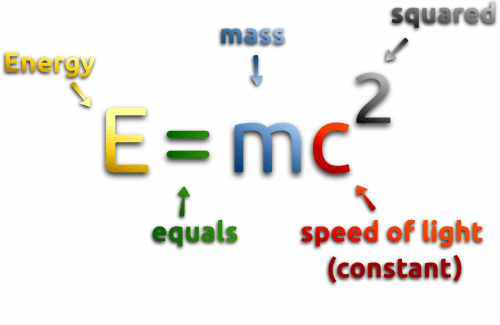
What is Conservation of Mass-Energy – Mass-Energy Equivalence – Definition

Conservation of Mass-Energy – Mass-Energy Equivalence. One of the striking results of Einstein’s theory of relativity is that mass and energy are equivalent and convertible one into the other. Material Properties

Law of Conservation of Energy

The law of conservation of energy is one of the basic laws of physics along with the conservation of mass and the conservation of momentum. The law of conservation of energy states that energy can change from one form into another, but it cannot be created or destroyed. Or the general definition is:

The total energy of an isolated system remains constant over time.

law of conservation of energy - pendulum
Newton’s cradle. A device that demonstrates the Law of Conservation of Mechanical Energy and Momentum.

Energy can be defined as the capacity for doing work. It may exist in a variety of forms and may be transformed from one type of energy to another in hundreds of ways.

For example, burning gasoline to power cars is an energy conversion process we rely on. The chemical energy in gasoline is converted to thermal energy, which is then converted to mechanical energy that makes the car move. The mechanical energy has been converted to kinetic energy. When we use the brakes to stop a car, that kinetic energy is converted by friction back to heat, or thermal energy.

A consequence of the law of conservation of energy is that a perpetual motion machine of the first kind, which produces work without the input of energy, cannot exist.

The concept of energy conservation is widely used in many fields. In this article the following fields are discussed:

  • Conservation of Mechanical Energy
  • Conservation of Energy in Fluid Mechanics
  • Conservation of Energy in thermodynamics
  • Conservation of Energy in Electrical Circuits
  • Conservation of Energy in Chemical Reactions
  • Conservation of Energy in Special Relativity Theory
  • Conservation of Energy in Nuclear Reactions

Law of Conservation of Mass-Energy – Mass-Energy Equivalence

E=MC2At the beginning of the 20th century, the notion of mass underwent a radical revision. Mass lost its absoluteness. One of the striking results of Einstein’s theory of relativity is that mass and energy are equivalent and convertible one into the other. Equivalence of the mass and energy is described by Einstein’s famous formula E = mc2. In words, energy equals mass multiplied by the speed of light squared. Because the speed of light is a very large number, the formula implies that any small amount of matter contains a very large amount of energy. The mass of an object was seen to be equivalent to energy, to be interconvertible with energy, and to increase significantly at exceedingly high speeds near that of light. The total energy of an object was understood to comprise its rest mass as well as its increase of mass caused by increase in kinetic energy.

In special theory of relativity certain types of matter may be created or destroyed, but in all of these processes, the mass and energy associated with such matter remains unchanged in quantity. It was found the rest mass an atomic nucleus is measurably smaller than the sum of the rest masses of its constituent protons, neutrons and electrons. Mass was no longer considered unchangeable in the closed system. The difference is a measure of the nuclear binding energy which holds the nucleus together. According to the Einstein relationship (E = mc2) this binding energy is proportional to this mass difference and it is known as the mass defect.

 
Example: Mass defect of a 63Cu
Calculate the mass defect of a 63Cu nucleus if the actual mass of 63Cu in its nuclear ground state is 62.91367 u.

63Cu nucleus has 29 protons and also has (63 – 29) 34 neutrons.

The mass of a proton is 1.00728 u and a neutron is 1.00867 u.

The combined mass is: 29 protons x (1.00728 u/proton) + 34 neutrons x (1.00867 u/neutron) = 63.50590 u

The mass defect is Δm = 63.50590 u – 62.91367 u =  0.59223 u

Convert the mass defect into energy (nuclear binding energy).

(0.59223 u/nucleus) x (1.6606 x 10⁻²⁷ kg/u) = 9.8346 x 10⁻²⁸ kg/nucleus

ΔE = Δmc2

ΔE = (9.8346 x 10⁻²⁸ kg/nucleus) x (2.9979 x 10⁸ m/s)2 = 8.8387 x 10⁻¹¹ J/nucleus

The energy calculated in the previous example is the nuclear binding energy.  However, the nuclear binding energy may be expressed as kJ/mol (for better understanding).

Calculate the nuclear binding energy of 1 mole of 63Cu:

(8.8387 x 10⁻¹¹ J/nucleus) x (1 kJ/1000 J) x (6.022 x 10²³ nuclei/mol) = 5.3227 x 10¹⁰ kJ/mol of nuclei.

One mole of 63Cu (~63 grams) is bound by the nuclear binding energy (5.3227 x 10¹⁰ kJ/mol) which is equivalent to:

  • 14.8 million kilowatt-hours (≈ 15 GW·h)
  • 336,100 US gallons of automotive gasoline
Example: Mass defect of the reactor core
Calculate the mass defect of the 3000MWth reactor core after one year of operation.

It is known the average recoverable energy per fission is about 200 MeV, being the total energy minus the energy of the energy of antineutrinos that are radiated away.

The reaction rate per entire 3000MWth reactor core is about  9.33×10¹⁹ fissions / second.

The overall energy release in the units of joules is:

200×106 (eV) x 1.602×10⁻¹⁹ (J/eV) x 9.33×10¹⁹ (s-1) x 31.5×106 (seconds in year) = 9.4×10¹⁶ J/year

The mass defect is calculated as:

Δm = ΔE/c2

Δm = 9.4×10¹⁶ / (2.9979 x 10⁸)2 = 1.046 kg

That means in a typical 3000MWth reactor core about 1 kilogram of matter is converted into pure energy.

Note that, a typical annual uranium load for a 3000MWth reactor core is about 20 tonnes of enriched uranium (i.e. about 22.7 tonnes of UO2). Entire reactor core may contain about 80 tonnes of enriched uranium.

Mass defect directly from E=mc2

The mass defect can be calculated directly from the Einstein relationship (E = mc2) as:

Δm = ΔE/c2

Δm = 3000×106 (W = J/s) x 31.5×10⁶ (seconds in year) / (2.9979 x 10⁸)2 = 1.051 kg

Nuclear binding energy curve.
Source: hyperphysics.phy-astr.gsu.edu

During the nuclear splitting or nuclear fusion, some of the mass of the nucleus gets converted into huge amounts of energy and thus this mass is removed from the total mass of the original particles, and the mass is missing in the resulting nucleus. The nuclear binding energies are enormous, they are of the order of a million times greater than the electron binding energies of atoms.

Generally, in both chemical and nuclear reactions, some conversion between rest mass and energy occurs, so that the products generally have smaller or greater mass than the reactants. Therefore the new conservation principle is the conservation of mass-energy.

See also: Energy Release from Fission

Mass Defect

 
References:
Nuclear and Reactor Physics:
  1. J. R. Lamarsh, Introduction to Nuclear Reactor Theory, 2nd ed., Addison-Wesley, Reading, MA (1983).
  2. J. R. Lamarsh, A. J. Baratta, Introduction to Nuclear Engineering, 3d ed., Prentice-Hall, 2001, ISBN: 0-201-82498-1.
  3. W. M. Stacey, Nuclear Reactor Physics, John Wiley & Sons, 2001, ISBN: 0- 471-39127-1.
  4. Glasstone, Sesonske. Nuclear Reactor Engineering: Reactor Systems Engineering, Springer; 4th edition, 1994, ISBN: 978-0412985317
  5. W.S.C. Williams. Nuclear and Particle Physics. Clarendon Press; 1 edition, 1991, ISBN: 978-0198520467
  6. Kenneth S. Krane. Introductory Nuclear Physics, 3rd Edition, Wiley, 1987, ISBN: 978-0471805533
  7. G.R.Keepin. Physics of Nuclear Kinetics. Addison-Wesley Pub. Co; 1st edition, 1965
  8. Robert Reed Burn, Introduction to Nuclear Reactor Operation, 1988.
  9. U.S. Department of Energy, Nuclear Physics and Reactor Theory. DOE Fundamentals Handbook, Volume 1 and 2. January 1993.

Advanced Reactor Physics:

  1. K. O. Ott, W. A. Bezella, Introductory Nuclear Reactor Statics, American Nuclear Society, Revised edition (1989), 1989, ISBN: 0-894-48033-2.
  2. K. O. Ott, R. J. Neuhold, Introductory Nuclear Reactor Dynamics, American Nuclear Society, 1985, ISBN: 0-894-48029-4.
  3. D. L. Hetrick, Dynamics of Nuclear Reactors, American Nuclear Society, 1993, ISBN: 0-894-48453-2.
  4. E. E. Lewis, W. F. Miller, Computational Methods of Neutron Transport, American Nuclear Society, 1993, ISBN: 0-894-48452-4.

See also:

Conservation of Energy

We hope, this article, Conservation of Mass-Energy – Mass-Energy Equivalence, helps you. If so, give us a like in the sidebar. Main purpose of this website is to help the public to learn some interesting and important information about materials and their properties.