Facebook Instagram Youtube Twitter

What is Law of Conservation of Baryon Number – Definition

The law of conservation of baryon number states that the sum of the baryon number before and after a reaction must be coserved. Law of Conservation of Baryon Number

What is Baryon

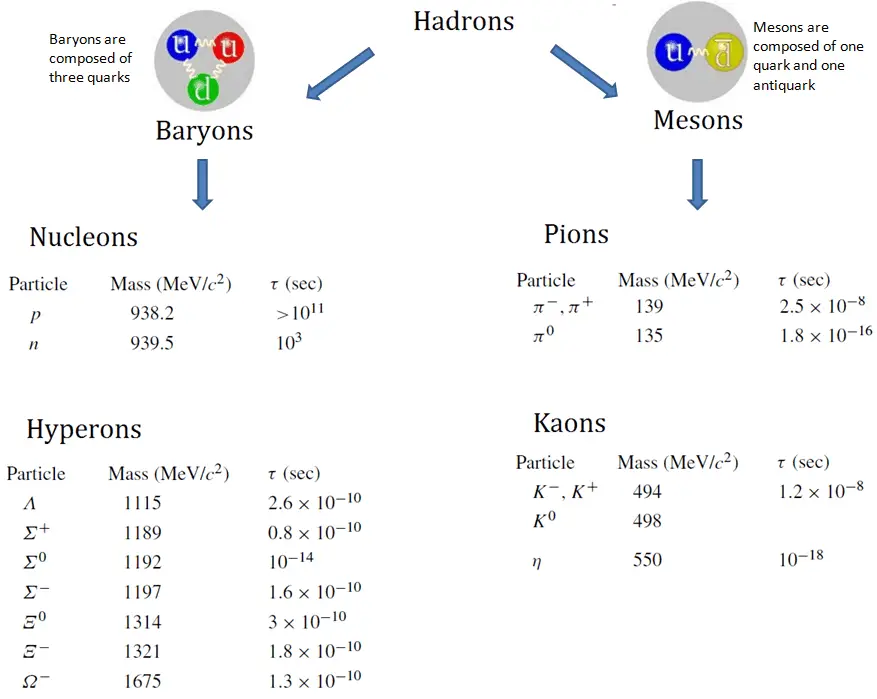
hadrons-baryons-mesonsBaryon is any fermion that undergo strong interactions. In general, particles that do participate in strong interactions are called hadrons: protons and neutrons are hadrons. The hadrons are further sub-divided into baryons and mesons, according to the number of quarks they contain. Protons and neutrons each contain three quarks; they belong to the family of particles called the baryons. Other baryons are the lambda, sigma, xi, and omega particles. On the other hand mesons bosons and they are composed of two quarks: a quark and an antiquark. Besides charge and spin (1/2 for the baryons), two other quantum numbers are assigned to these particles: baryon number (B) and strangeness (S). Baryons have a baryon number, B, of 1, while their antiparticles, called antibaryons, have a baryon number of −1. A nucleus of deuterium (deuteron), for example, contains one proton and one neutron (each with a baryon number of 1) and has a baryon number of 2.

Since baryons make up most of the mass of ordinary atoms, the everyday matter is often referred to as baryonic matter.

The conservation of baryon number is an important rule for interactions and decays of baryons. No known interactions violate conservation of baryon number.

Baryon Number

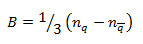
In particle physics, the baryon number is used to denote which particles are baryons and which particles are not. Each baryon has a baryon number of 1 and each antibaryon has a baryon number of -1. Other non-baryonic particles have a baryon number of 0. Since there are exotic hadrons like pentaquarks and tetraquarks, there is a general definition of baryon number as:
baryon-number-equation

where nq is the number of quarks, and nq is the number of antiquarks.

The baryon number is a conserved quantum number in all particle reactions. The term conserved means that the sum of the baryon number of all incoming particles is the same as the sum of the baryon numbers of all particles resulting from the reaction. A slight asymmetry in the laws of physics allowed baryons to be created in the Big Bang.

Law of Conservation of Baryon Number

In analyzing nuclear reactions, we apply the many conservation laws. Nuclear reactions are subject to classical conservation laws for, momentum, angular momentum, and energy (including rest energies).  Additional conservation laws, not anticipated by classical physics, are electric charge, lepton number and baryon number. Certain of these laws are obeyed under all circumstances, others are not.

Baryon number is a generalization of nucleon number, which is conserved in nonrelativistic nuclear reactions and decays. The law of conservation of baryon number states that:

The sum of the baryon number of all incoming particles is the same as the sum of the baryon numbers of all particles resulting from the reaction.

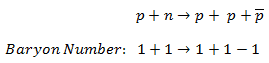
For example, the following reaction has never been observed:
baryon-number-example-violation

even if the incoming proton has sufficient energy and charge, energy, and so on, are conserved. This reaction does not conserve baryon number since the left side has B =+2, and the right has B =+1.

On the other hand, the following reaction (proton-antiproton pair production) does conserve B and does occur if the incoming proton has sufficient energy (the threshold energy = 5.6 GeV):

baryon-number-pair-production

As indicated, B = +2 on both sides of this equation.

From these and other reactions, the conservation of baryon number has been established as a basic principle of physics.

This principle provides basis for the stability of the proton. Since the proton is the lightest particle among all baryons, the hypothetical products of its decay would have to be non-baryons. Thus, the decay would violate the conservation of baryon number. It must be added some theories have suggested that protons are in fact unstable with very long half-life (~1030 years) and that they decay into leptons. There is currently no experimental evidence that proton decay occurs.

 
References:
Nuclear and Reactor Physics:
  1. J. R. Lamarsh, Introduction to Nuclear Reactor Theory, 2nd ed., Addison-Wesley, Reading, MA (1983).
  2. J. R. Lamarsh, A. J. Baratta, Introduction to Nuclear Engineering, 3d ed., Prentice-Hall, 2001, ISBN: 0-201-82498-1.
  3. W. M. Stacey, Nuclear Reactor Physics, John Wiley & Sons, 2001, ISBN: 0- 471-39127-1.
  4. Glasstone, Sesonske. Nuclear Reactor Engineering: Reactor Systems Engineering, Springer; 4th edition, 1994, ISBN: 978-0412985317
  5. W.S.C. Williams. Nuclear and Particle Physics. Clarendon Press; 1 edition, 1991, ISBN: 978-0198520467
  6. Kenneth S. Krane. Introductory Nuclear Physics, 3rd Edition, Wiley, 1987, ISBN: 978-0471805533
  7. G.R.Keepin. Physics of Nuclear Kinetics. Addison-Wesley Pub. Co; 1st edition, 1965
  8. Robert Reed Burn, Introduction to Nuclear Reactor Operation, 1988.
  9. U.S. Department of Energy, Nuclear Physics and Reactor Theory. DOE Fundamentals Handbook, Volume 1 and 2. January 1993.

Advanced Reactor Physics:

  1. K. O. Ott, W. A. Bezella, Introductory Nuclear Reactor Statics, American Nuclear Society, Revised edition (1989), 1989, ISBN: 0-894-48033-2.
  2. K. O. Ott, R. J. Neuhold, Introductory Nuclear Reactor Dynamics, American Nuclear Society, 1985, ISBN: 0-894-48029-4.
  3. D. L. Hetrick, Dynamics of Nuclear Reactors, American Nuclear Society, 1993, ISBN: 0-894-48453-2.
  4. E. E. Lewis, W. F. Miller, Computational Methods of Neutron Transport, American Nuclear Society, 1993, ISBN: 0-894-48452-4.

See also:

Laws of Conservation

We hope, this article, Law of Conservation of Baryon Number, helps you. If so, give us a like in the sidebar. Main purpose of this website is to help the public to learn some interesting and important information about materials and their properties.
What is Lepton Number – Definition

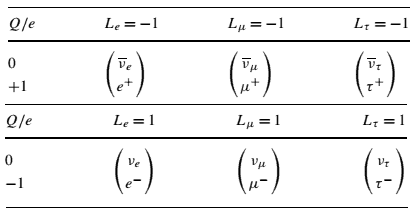
The lepton number is used to denote which particles are leptons and which particles are not. Each lepton has a lepton number of 1 and each antilepton has a lepton number of -1. Material Properties

Lepton Number

Lepton Number. Conservation of Lepton Number

In particle physics, the lepton number is used to denote which particles are leptons and which particles are not. Each lepton has a lepton number of 1 and each antilepton has a lepton number of -1. Other non-leptonic particles have a lepton number of 0. The lepton number is a conserved quantum number in all particle reactions. A slight asymmetry in the laws of physics allowed leptons to be created in the Big Bang.

The conservation of lepton number means that whenever a lepton of a certain generation is created or destroyed in a reaction, a corresponding antilepton from the same generation must be created or destroyed. It must be added, there is a separate requirement for each of the three generations of leptons, the electron, muon and tau and their associated neutrinos.

Example: Electron Capture

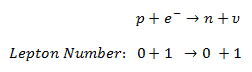
Consider the electron capture mode. The reaction involves only first generation leptons: electrons and neutrinos:

lepton-number-electron-capture

The antineutrino cannot be emitted, because in this case the conservation law would not be fulfilled. The particle emitted with the neutron must be a neutrino.

Example: Neutron Decay

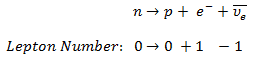
Consider the decay of the neutron. The reaction involves only first generation leptons: electrons and neutrinos:

lepton-number-neutron-decay

Since the lepton number must be equal to zero on both sides and it was found that the reaction is a three-particle decay (the electrons emitted in beta decay have a continuous rather than a discrete spectrum),  the third particle must be an electron antineutrino.

Free Neutron
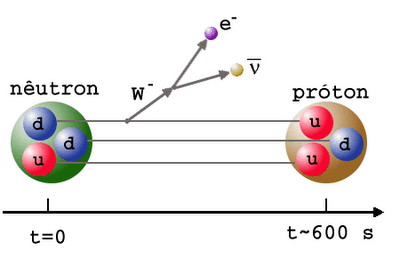
The free neutron decays into a proton, an electron, and an antineutrino with a half-life of about 611 seconds (10.3 minutes).
Source: scienceblogs.com

Example: Muon Decay

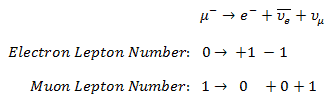
The observation of the following decay reaction leads to the conclusion that there is a separate lepton number for muons which must also be conserved.

lepton-number-muon-decay

This is in fact the most common decay mode of the –.

 
References:
Nuclear and Reactor Physics:
  1. J. R. Lamarsh, Introduction to Nuclear Reactor Theory, 2nd ed., Addison-Wesley, Reading, MA (1983).
  2. J. R. Lamarsh, A. J. Baratta, Introduction to Nuclear Engineering, 3d ed., Prentice-Hall, 2001, ISBN: 0-201-82498-1.
  3. W. M. Stacey, Nuclear Reactor Physics, John Wiley & Sons, 2001, ISBN: 0- 471-39127-1.
  4. Glasstone, Sesonske. Nuclear Reactor Engineering: Reactor Systems Engineering, Springer; 4th edition, 1994, ISBN: 978-0412985317
  5. W.S.C. Williams. Nuclear and Particle Physics. Clarendon Press; 1 edition, 1991, ISBN: 978-0198520467
  6. Kenneth S. Krane. Introductory Nuclear Physics, 3rd Edition, Wiley, 1987, ISBN: 978-0471805533
  7. G.R.Keepin. Physics of Nuclear Kinetics. Addison-Wesley Pub. Co; 1st edition, 1965
  8. Robert Reed Burn, Introduction to Nuclear Reactor Operation, 1988.
  9. U.S. Department of Energy, Nuclear Physics and Reactor Theory. DOE Fundamentals Handbook, Volume 1 and 2. January 1993.

Advanced Reactor Physics:

  1. K. O. Ott, W. A. Bezella, Introductory Nuclear Reactor Statics, American Nuclear Society, Revised edition (1989), 1989, ISBN: 0-894-48033-2.
  2. K. O. Ott, R. J. Neuhold, Introductory Nuclear Reactor Dynamics, American Nuclear Society, 1985, ISBN: 0-894-48029-4.
  3. D. L. Hetrick, Dynamics of Nuclear Reactors, American Nuclear Society, 1993, ISBN: 0-894-48453-2.
  4. E. E. Lewis, W. F. Miller, Computational Methods of Neutron Transport, American Nuclear Society, 1993, ISBN: 0-894-48452-4.

See also:

Leptons

We hope, this article, Lepton Number, helps you. If so, give us a like in the sidebar. Main purpose of this website is to help the public to learn some interesting and important information about materials and their properties.
What is Lepton – Definition

A lepton is an elementary, half-integer spin (spin  1⁄2) particle that does not undergo strong interactions. There are six leptons in the present structure. Material Properties

What is Lepton

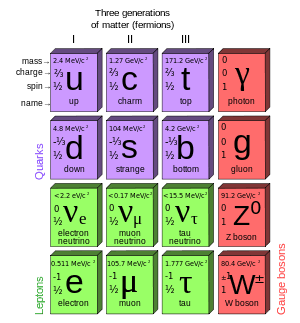
Three generations of matter.

A lepton is an elementary, half-integer spin (spin  1⁄2) particle that does not undergo strong interactions. Particles that do participate in strong interactions are called hadrons.

There are six leptons in the present structure, the electron, muon, and tau particles and their associated neutrinos. Leptons are said to be elementary particles; that is, they do not appear to be made up of smaller units of matter. They behave as point-like particles. All leptons are fermions, i.e. leptons are spin- 1⁄2 particles and thus that they are subject to the Pauli exclusion principle. This fact has key implications for the building up of the periodic table of elements.

Any of the six elementary particles that (with their antiparticles) are not quarks are leptons. Two main classes of leptons exist:

  • Charged leptons. Charged leptons can combine with other particles to form various composite particles such as atoms and positronium.
    • Electron. The electron is a negatively charged particle with a mass that is approximately 1/1836 that of the proton. Electrons are located in an electron cloud, which is the area surrounding the nucleus of the atom. The electron is only one member of a class of elementary particles, which forms an atom.
    • Muon. The muon is an elementary particle similar to the electron, with an electric charge of −1 e and a spin of ½. Muons are heavier, having more than 200 times as much mass as electrons. The muon is an unstable subatomic particle with a mean lifetime of 2.2 µs.
    • Tau. The tau (τ), also called the tau lepton, tau particle, or tauon, is an elementary particle similar to the electron, with an electric charge of −1 e and a spin of ½. Taus are approximately 3,700 times more massive than electrons. Tau leptons have a lifetime of 2.9×10⁻¹³ s.
  • Neutral leptons (better known as neutrinos) are electrically neutral particles that rarely interact with anything, and are consequently rarely observed. A neutrino is an elementary subatomic particle with infinitesimal mass (less than 0.3 eV..?) and with no electric charge. Neutrinos are weakly interacting subatomic particles with ½ unit of spin.
    • Electron neutrino. The electron neutrino is a subatomic lepton elementary particle which has the symbol νe. It has no net electric charge and a spin of ½. Together with the electron it forms the first generation of leptons, hence the name electron neutrino.
    • Muon neutrino. The muon neutrino is a subatomic lepton elementary particle which has the symbol  νμ. It has no net electric charge and a spin of ½. Together with the muon it forms the second generation of leptons, hence the name muon neutrino.
    • Tau neutrino. The tau neutrino is a subatomic lepton elementary particle which has the symbol  ντ. It has no net electric charge and a spin of ½. Together with the tauon it forms the third generation of leptons, hence the name tau neutrino.
 
Production of Neutrinos
Nuclear reactors are the major source of human-generated antineutrinos. This is due to the fact that antineutrinos are produced in a negative beta decay. In a nuclear reactor occurs especially the β−decay, because the common feature of the fission fragments is an excess of neutrons (see Nuclear Stability). An unstable fission fragment with the excess of neutrons undergoes β− decay, where the neutron is converted into a proton, an electron, and an electron antineutrino. The existence of emission of antineutrinos and their very low cross-section for any interaction leads to very interesting phenomenon. Roughly about 5% (or about 12 MeV of 207 MeV) of released energy per one fission is radiated away from reactor in the form of antineutrinos. For a typical nuclear reactor with a thermal power of 3000 MWth(~1000MWe of electrical power), the total power produced is in fact higher, approximately 3150 MW, of which 150 MW is radiated away into space as antineutrino radiation. This amount of energy is forever lost, since antineutrinos are able to penetrate all reactor materials without any interaction. In fact, a common statement in physics texts is that the mean free path of a neutrino is approximately a light-year of lead. Moreover, a neutrino of moderate energy can easily penetrate a thousand light-years of lead (according to the J. B. Griffiths).

Please note that billions of solar neutrinos per second pass (mostly without any interaction) through every square centimeter (~6×10¹⁰) on the Earth’s surface and antineutrino radiation is by no means dangerous.

Example – Amount of antineutrinos produced:

Stable nuclei with most likely mass number A from U-235 fission are  and . These nuclei have together 98 protons and 136 neutrons, while fission fragments (parent nuclei) have together 92 protons and 142 neutrons. This means after each U-235 fission the fission fragments must undergo on average 6 negative beta decays (6 neutrons must decay to 6 protons) and therefore 6 antineutrinos must be produced per each fission. The typical nuclear reactor therefore produces approximately 6 x 10²⁰ antineutrinos per second (~200 MeV/fission; ~6 antineutrinos/fission; 3000 MWth; 9.375 x 10¹⁹fissions/sec).

Law of Conservation of Lepton Number

Lepton Number. Conservation of Lepton Number

In particle physics, the lepton number is used to denote which particles are leptons and which particles are not. Each lepton has a lepton number of 1 and each antilepton has a lepton number of -1. Other non-leptonic particles have a lepton number of 0. The lepton number is a conserved quantum number in all particle reactions. A slight asymmetry in the laws of physics allowed leptons to be created in the Big Bang.

The conservation of lepton number means that whenever a lepton of a certain generation is created or destroyed in a reaction, a corresponding antilepton from the same generation must be created or destroyed. It must be added, there is a separate requirement for each of the three generations of leptons, the electron, muon and tau and their associated neutrinos.

Example: Electron Capture

Consider the electron capture mode. The reaction involves only first generation leptons: electrons and neutrinos:

lepton-number-electron-capture

The antineutrino cannot be emitted, because in this case the conservation law would not be fulfilled. The particle emitted with the neutron must be a neutrino.

Example: Neutron Decay

Consider the decay of the neutron. The reaction involves only first generation leptons: electrons and neutrinos:

lepton-number-neutron-decay

Since the lepton number must be equal to zero on both sides and it was found that the reaction is a three-particle decay (the electrons emitted in beta decay have a continuous rather than a discrete spectrum),  the third particle must be an electron antineutrino.

Free Neutron
The free neutron decays into a proton, an electron, and an antineutrino with a half-life of about 611 seconds (10.3 minutes).
Source: scienceblogs.com

Example: Muon Decay

The observation of the following decay reaction leads to the conclusion that there is a separate lepton number for muons which must also be conserved.

lepton-number-muon-decay

This is in fact the most common decay mode of the –.

 
References:
Nuclear and Reactor Physics:
  1. J. R. Lamarsh, Introduction to Nuclear Reactor Theory, 2nd ed., Addison-Wesley, Reading, MA (1983).
  2. J. R. Lamarsh, A. J. Baratta, Introduction to Nuclear Engineering, 3d ed., Prentice-Hall, 2001, ISBN: 0-201-82498-1.
  3. W. M. Stacey, Nuclear Reactor Physics, John Wiley & Sons, 2001, ISBN: 0- 471-39127-1.
  4. Glasstone, Sesonske. Nuclear Reactor Engineering: Reactor Systems Engineering, Springer; 4th edition, 1994, ISBN: 978-0412985317
  5. W.S.C. Williams. Nuclear and Particle Physics. Clarendon Press; 1 edition, 1991, ISBN: 978-0198520467
  6. Kenneth S. Krane. Introductory Nuclear Physics, 3rd Edition, Wiley, 1987, ISBN: 978-0471805533
  7. G.R.Keepin. Physics of Nuclear Kinetics. Addison-Wesley Pub. Co; 1st edition, 1965
  8. Robert Reed Burn, Introduction to Nuclear Reactor Operation, 1988.
  9. U.S. Department of Energy, Nuclear Physics and Reactor Theory. DOE Fundamentals Handbook, Volume 1 and 2. January 1993.

Advanced Reactor Physics:

  1. K. O. Ott, W. A. Bezella, Introductory Nuclear Reactor Statics, American Nuclear Society, Revised edition (1989), 1989, ISBN: 0-894-48033-2.
  2. K. O. Ott, R. J. Neuhold, Introductory Nuclear Reactor Dynamics, American Nuclear Society, 1985, ISBN: 0-894-48029-4.
  3. D. L. Hetrick, Dynamics of Nuclear Reactors, American Nuclear Society, 1993, ISBN: 0-894-48453-2.
  4. E. E. Lewis, W. F. Miller, Computational Methods of Neutron Transport, American Nuclear Society, 1993, ISBN: 0-894-48452-4.

See also:

Fundamental Particles

We hope, this article, Lepton, helps you. If so, give us a like in the sidebar. Main purpose of this website is to help the public to learn some interesting and important information about materials and their properties.
What is Law of Conservation of Lepton Number – Definition

The law of conservation of lepton number means that sum of lepton numbers before and after a reaction must be conserved. there is a separate requirement for each of the three generations. Material Properties

What is Lepton

Three generations of matter.

A lepton is an elementary, half-integer spin (spin  1⁄2) particle that does not undergo strong interactions. Particles that do participate in strong interactions are called hadrons.

There are six leptons in the present structure, the electron, muon, and tau particles and their associated neutrinos. Leptons are said to be elementary particles; that is, they do not appear to be made up of smaller units of matter. They behave as point-like particles. All leptons are fermions, i.e. leptons are spin- 1⁄2 particles and thus that they are subject to the Pauli exclusion principle. This fact has key implications for the building up of the periodic table of elements.

Any of the six elementary particles that (with their antiparticles) are not quarks are leptons. Two main classes of leptons exist:

  • Charged leptons. Charged leptons can combine with other particles to form various composite particles such as atoms and positronium.
    • Electron. The electron is a negatively charged particle with a mass that is approximately 1/1836 that of the proton. Electrons are located in an electron cloud, which is the area surrounding the nucleus of the atom. The electron is only one member of a class of elementary particles, which forms an atom.
    • Muon. The muon is an elementary particle similar to the electron, with an electric charge of −1 e and a spin of ½. Muons are heavier, having more than 200 times as much mass as electrons. The muon is an unstable subatomic particle with a mean lifetime of 2.2 µs.
    • Tau. The tau (τ), also called the tau lepton, tau particle, or tauon, is an elementary particle similar to the electron, with an electric charge of −1 e and a spin of ½. Taus are approximately 3,700 times more massive than electrons. Tau leptons have a lifetime of 2.9×10⁻¹³ s.
  • Neutral leptons (better known as neutrinos) are electrically neutral particles that rarely interact with anything, and are consequently rarely observed. A neutrino is an elementary subatomic particle with infinitesimal mass (less than 0.3 eV..?) and with no electric charge. Neutrinos are weakly interacting subatomic particles with ½ unit of spin.
    • Electron neutrino. The electron neutrino is a subatomic lepton elementary particle which has the symbol νe. It has no net electric charge and a spin of ½. Together with the electron it forms the first generation of leptons, hence the name electron neutrino.
    • Muon neutrino. The muon neutrino is a subatomic lepton elementary particle which has the symbol  νμ. It has no net electric charge and a spin of ½. Together with the muon it forms the second generation of leptons, hence the name muon neutrino.
    • Tau neutrino. The tau neutrino is a subatomic lepton elementary particle which has the symbol  ντ. It has no net electric charge and a spin of ½. Together with the tauon it forms the third generation of leptons, hence the name tau neutrino.

Law of Conservation of Lepton Number

Lepton Number. Conservation of Lepton Number

In particle physics, the lepton number is used to denote which particles are leptons and which particles are not. Each lepton has a lepton number of 1 and each antilepton has a lepton number of -1. Other non-leptonic particles have a lepton number of 0. The lepton number is a conserved quantum number in all particle reactions. A slight asymmetry in the laws of physics allowed leptons to be created in the Big Bang.

The conservation of lepton number means that whenever a lepton of a certain generation is created or destroyed in a reaction, a corresponding antilepton from the same generation must be created or destroyed. It must be added, there is a separate requirement for each of the three generations of leptons, the electron, muon and tau and their associated neutrinos.

Conservation of Lepton Number – Electron Capture

Consider the electron capture mode. The reaction involves only first generation leptons: electrons and neutrinos:

lepton-number-electron-capture

The antineutrino cannot be emitted, because in this case the conservation law would not be fulfilled. The particle emitted with the neutron must be a neutrino.

Conservation of Lepton Number – Neutron Decay

Consider the decay of the neutron. The reaction involves only first generation leptons: electrons and neutrinos:

lepton-number-neutron-decay

Since the lepton number must be equal to zero on both sides and it was found that the reaction is a three-particle decay (the electrons emitted in beta decay have a continuous rather than a discrete spectrum),  the third particle must be an electron antineutrino.

Conservation of Lepton Number – Muon Decay

The observation of the following decay reaction leads to the conclusion that there is a separate lepton number for muons which must also be conserved.

lepton-number-muon-decay

This is in fact the most common decay mode of the –.

 
References:
Nuclear and Reactor Physics:
  1. J. R. Lamarsh, Introduction to Nuclear Reactor Theory, 2nd ed., Addison-Wesley, Reading, MA (1983).
  2. J. R. Lamarsh, A. J. Baratta, Introduction to Nuclear Engineering, 3d ed., Prentice-Hall, 2001, ISBN: 0-201-82498-1.
  3. W. M. Stacey, Nuclear Reactor Physics, John Wiley & Sons, 2001, ISBN: 0- 471-39127-1.
  4. Glasstone, Sesonske. Nuclear Reactor Engineering: Reactor Systems Engineering, Springer; 4th edition, 1994, ISBN: 978-0412985317
  5. W.S.C. Williams. Nuclear and Particle Physics. Clarendon Press; 1 edition, 1991, ISBN: 978-0198520467
  6. Kenneth S. Krane. Introductory Nuclear Physics, 3rd Edition, Wiley, 1987, ISBN: 978-0471805533
  7. G.R.Keepin. Physics of Nuclear Kinetics. Addison-Wesley Pub. Co; 1st edition, 1965
  8. Robert Reed Burn, Introduction to Nuclear Reactor Operation, 1988.
  9. U.S. Department of Energy, Nuclear Physics and Reactor Theory. DOE Fundamentals Handbook, Volume 1 and 2. January 1993.

Advanced Reactor Physics:

  1. K. O. Ott, W. A. Bezella, Introductory Nuclear Reactor Statics, American Nuclear Society, Revised edition (1989), 1989, ISBN: 0-894-48033-2.
  2. K. O. Ott, R. J. Neuhold, Introductory Nuclear Reactor Dynamics, American Nuclear Society, 1985, ISBN: 0-894-48029-4.
  3. D. L. Hetrick, Dynamics of Nuclear Reactors, American Nuclear Society, 1993, ISBN: 0-894-48453-2.
  4. E. E. Lewis, W. F. Miller, Computational Methods of Neutron Transport, American Nuclear Society, 1993, ISBN: 0-894-48452-4.

See also:

Laws of Conservation

We hope, this article, Law of Conservation of Lepton Number, helps you. If so, give us a like in the sidebar. Main purpose of this website is to help the public to learn some interesting and important information about materials and their properties.
What is Law of Conservation of Electric Charge – Definition

The law of conservation of electric charge states that the algebraic sum of all the electric charges in any closed system is constant. Charge can be created and destroyed, but only in positive-negative pairs. Material Properties

Law of Conservation of Electric Charge

In physics, there are two very important principles concerning the electric charge.

First is the law of conservation of electric charge. This law states that:

The algebraic sum of all the electric charges in any closed system is constant.

The only way to change the net charge of a system is to bring in charge from elsewhere, or remove charge from the system.

Charge can be created and destroyed, but only in positive-negative pairs.

Conservation of charge is thought to be a universal conservation law. No experimental evidence for any violation of this principle has ever been observed. In particle physics, charge conservation means that in elementary particle reactions that create charged particles, equal numbers of positive and negative particles are always created, keeping the net amount of charge unchanged. Even in high-energy interactions in which particles are created and destroyed, such as the creation of positron-electron pairs, the total charge of any closed system is exactly constant.

The second important principle is:

The magnitude of charge of the electron or proton is a natural unit of charge.

We say that charge is quantized. That is, every observable amount of electric charge is always an integer multiple of this basic unit. This unit is called the elementary charge, e, approximately equal to 1.602×10⁻¹⁹ coulombs (except for particles called quarks, which have charges that are integer multiples of  1⁄3e).

Conservation of Charge in Nuclear Reactions

Important examples of the law of conservation of electric charge occur in nuclear reactions such as the radioactive decay of nuclei and the nuclear fission.  In these reactions a nucleus transforms into a different type of nucleus or nuclei.

Consider a typical fission reaction such as the one listed below.

Uranium absorption reaction

Typically, when uranium 235 nucleus undergoes fission, the nucleus splits into two smaller nuclei (triple fission can also rarely occur), along with a few neutrons (the average is 2.43 neutrons per fission by thermal neutron) and release of energy in the form of heat and gamma rays. From these reactions we find that in the fission the parent nucleus:

  • 235U contains 92 protons (a charge of +92e),
  • incident neutron is electrically neutral.

The fission fragments:

  • 139Ba contains 56 protons (a charge of +56e),
  • 94Ba contains 36 protons (a charge of +36e)

We see that the total charge is 92e before and after the reaction; thus, charge is conserved. It is noteworthy, the total number of nucleons before and after a reaction are also the same.

Conservation of Charge in Positron-Electron Pair Production

The law of conservation of electric charge can be demonstrated also on positron-electron pair production. Since a gamma ray is electrically neutral and sum of the electric charges of electron and positron is also zero, the electric charge in this reaction is also conserved.

Ɣ → e– + e+

It must be added, in order for electron-positron pair production to occur, the electromagnetic energy of the photon must be above a threshold energy, which is equivalent to the rest mass of two electrons. The threshold energy (the total rest mass of produced particles) for electron-positron pair production is equal to 1.02MeV (2 x 0.511MeV) because the rest mass of a single electron is equivalent to 0.511MeV of energy. If the original photon’s energy is greater than 1.02MeV, any energy above 1.02MeV is according to the conservation law split between the kinetic energy of motion of the two particles. The presence of an electric field of a heavy atom such as lead or uranium is essential in order to satisfy conservation of momentum and energy. In order to satisfy both conservation of momentum and energy, the atomic nucleus must receive some momentum. Therefore a photon pair production in free space cannot occur.

Conservation of Electric Charge in Neutrino Discovery

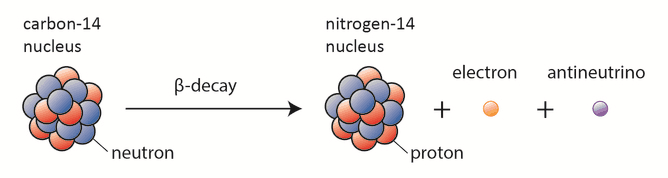
In 1931, Pauli proposed that another particle must be emitted in the beta decay process, because the electrons emitted in beta decay have a continuous rather than a discrete spectrum appeared to contradict conservation of energy, under the then-current assumption that beta decay is the simple emission of an electron from a nucleus. This another particle was later named by Fermi the neutrino. It was clear, this particle must be highly penetrating and that the conservation of electric charge requires the neutrino to be electrically neutral. This would explain why it was so hard to detect this particle. The term neutrino comes from Italian meaning “little neutral one” and neutrinos are denoted by the Greek letter ν (nu). In the process of beta decay the neutrino carries the missing energy and also in this process the law of conservation of energy remains valid.

beta decay
Beta decay of C-14 nucleus.
 
References:
Nuclear and Reactor Physics:
  1. J. R. Lamarsh, Introduction to Nuclear Reactor Theory, 2nd ed., Addison-Wesley, Reading, MA (1983).
  2. J. R. Lamarsh, A. J. Baratta, Introduction to Nuclear Engineering, 3d ed., Prentice-Hall, 2001, ISBN: 0-201-82498-1.
  3. W. M. Stacey, Nuclear Reactor Physics, John Wiley & Sons, 2001, ISBN: 0- 471-39127-1.
  4. Glasstone, Sesonske. Nuclear Reactor Engineering: Reactor Systems Engineering, Springer; 4th edition, 1994, ISBN: 978-0412985317
  5. W.S.C. Williams. Nuclear and Particle Physics. Clarendon Press; 1 edition, 1991, ISBN: 978-0198520467
  6. Kenneth S. Krane. Introductory Nuclear Physics, 3rd Edition, Wiley, 1987, ISBN: 978-0471805533
  7. G.R.Keepin. Physics of Nuclear Kinetics. Addison-Wesley Pub. Co; 1st edition, 1965
  8. Robert Reed Burn, Introduction to Nuclear Reactor Operation, 1988.
  9. U.S. Department of Energy, Nuclear Physics and Reactor Theory. DOE Fundamentals Handbook, Volume 1 and 2. January 1993.

Advanced Reactor Physics:

  1. K. O. Ott, W. A. Bezella, Introductory Nuclear Reactor Statics, American Nuclear Society, Revised edition (1989), 1989, ISBN: 0-894-48033-2.
  2. K. O. Ott, R. J. Neuhold, Introductory Nuclear Reactor Dynamics, American Nuclear Society, 1985, ISBN: 0-894-48029-4.
  3. D. L. Hetrick, Dynamics of Nuclear Reactors, American Nuclear Society, 1993, ISBN: 0-894-48453-2.
  4. E. E. Lewis, W. F. Miller, Computational Methods of Neutron Transport, American Nuclear Society, 1993, ISBN: 0-894-48452-4.

See also:

Laws of Conservation

We hope, this article, Law of Conservation of Electric Charge, helps you. If so, give us a like in the sidebar. Main purpose of this website is to help the public to learn some interesting and important information about materials and their properties.
What is Rotation of Neutron Star – Definition

Rotation of Neutron Star. Neutron stars are the smallest and densest stars known to exist, but they are rotating extremely rapidly. Material Properties

Example: Neutron Star Rotation

A neutron star is the collapsed core of a large star (usually of a red giant). Neutron stars are the smallest and densest stars known to exist, but they are rotating extremely rapidly. This rapid rotation is a direct consequence of the law of conservation of angular momentum. As the star’s core collapses, its rotation rate must increase, because of conservation of angular momentum, hence newly formed neutron stars must rotate at up to several hundred times per second. Some neutron stars emit beams of electromagnetic radiation that make them detectable as pulsars.

For example:

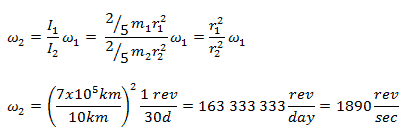
Assume a neutron star of a radius of 7 x 10⁵ km, which collapses under its own gravitation to a radius of 10 km. This star is rotating at a frequency of 1.0 revolution every 30 days. Assume that the star is a homogenous sphere at all times, and loses no mass.

From the law of conservation of angular momentum:

I1ω1 = I2ω2

where the subscripts 1 and 2 refer to initial star and neutron star, respectively. The moment of inertia of a sphere about its central axis is:

I = ⅖ m1r12

therefore

rotation-neutron-star-example

 
References:
Nuclear and Reactor Physics:
  1. J. R. Lamarsh, Introduction to Nuclear Reactor Theory, 2nd ed., Addison-Wesley, Reading, MA (1983).
  2. J. R. Lamarsh, A. J. Baratta, Introduction to Nuclear Engineering, 3d ed., Prentice-Hall, 2001, ISBN: 0-201-82498-1.
  3. W. M. Stacey, Nuclear Reactor Physics, John Wiley & Sons, 2001, ISBN: 0- 471-39127-1.
  4. Glasstone, Sesonske. Nuclear Reactor Engineering: Reactor Systems Engineering, Springer; 4th edition, 1994, ISBN: 978-0412985317
  5. W.S.C. Williams. Nuclear and Particle Physics. Clarendon Press; 1 edition, 1991, ISBN: 978-0198520467
  6. Kenneth S. Krane. Introductory Nuclear Physics, 3rd Edition, Wiley, 1987, ISBN: 978-0471805533
  7. G.R.Keepin. Physics of Nuclear Kinetics. Addison-Wesley Pub. Co; 1st edition, 1965
  8. Robert Reed Burn, Introduction to Nuclear Reactor Operation, 1988.
  9. U.S. Department of Energy, Nuclear Physics and Reactor Theory. DOE Fundamentals Handbook, Volume 1 and 2. January 1993.

Advanced Reactor Physics:

  1. K. O. Ott, W. A. Bezella, Introductory Nuclear Reactor Statics, American Nuclear Society, Revised edition (1989), 1989, ISBN: 0-894-48033-2.
  2. K. O. Ott, R. J. Neuhold, Introductory Nuclear Reactor Dynamics, American Nuclear Society, 1985, ISBN: 0-894-48029-4.
  3. D. L. Hetrick, Dynamics of Nuclear Reactors, American Nuclear Society, 1993, ISBN: 0-894-48453-2.
  4. E. E. Lewis, W. F. Miller, Computational Methods of Neutron Transport, American Nuclear Society, 1993, ISBN: 0-894-48452-4.

See also:

Angular Momentum

We hope, this article, Rotation of Neutron Star, helps you. If so, give us a like in the sidebar. Main purpose of this website is to help the public to learn some interesting and important information about materials and their properties.

What is What is Angular Momentum – Definition – Definition

Angular momentum (rarely, moment of momentum or rotational momentum), L, is the rotational analog of linear momentum. What is Angular Momentum

Whar is Angular Momentum

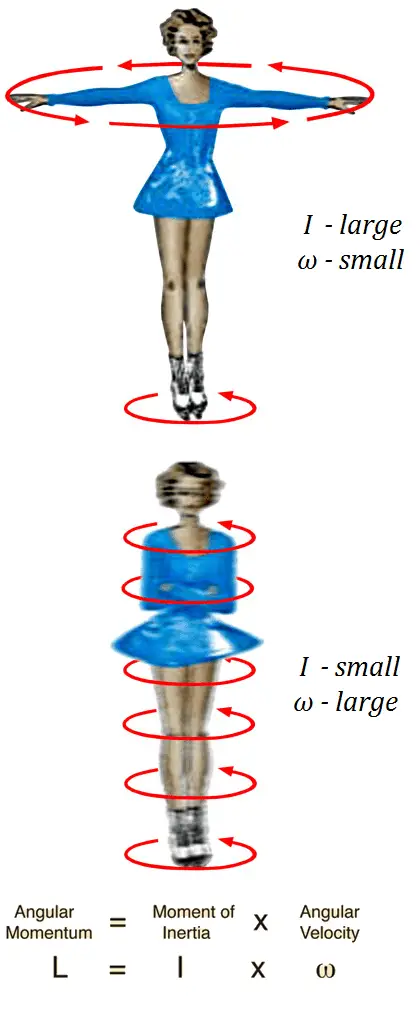
conservation of angular momentumIn physics, the linear momentum, p = mv, has a rotational analog. It is called angular momentum  (rarely, moment of momentum or rotational momentum), L, and for an object rotating about a fixed axis with angular velocity ω, it is defined as:

L = Iω

It is an important quantity in physics because it is a conserved quantity:

The angular momentum of an isolated system remains constant in both magnitude and direction.

When there is zero net torque acting on an object, and the object is rotating about a fixed axis or about an axis through its center of mass whose direction doesn’t change, we can write:

I1ω1 = I2ω2 = constant

Like conservation of energy and of linear momentum, this principle is a universal conservation law, valid at all scales from atomic and nuclear systems to the motions of galaxies. The angular momentum is a vector quantity and therefore it can be generalized as:

The vector sum of the angular momenta of the parts of an isolated system is constant.

This puts a strong constraint on the types of rotational motions which can occur in an isolated system. If one part of the system is given an angular momentum in a given direction, then some other part or parts of the system must simultaneously be given exactly the same angular momentum in the opposite direction.

The law of conservation of angular momentum explains the angular acceleration of an ice skater as she brings her arms and legs closer to the vertical axis of rotation. By bringing part of the mass of her body closer to the axis she decreases her body’s moment of inertia. Because angular momentum is the product of moment of inertia (I) and angular velocity (ω), and the angular momentum remains constant according to this law, the angular velocity of the skater must increase.

I1ω1 = I2ω2

 
References:
Nuclear and Reactor Physics:
  1. J. R. Lamarsh, Introduction to Nuclear Reactor Theory, 2nd ed., Addison-Wesley, Reading, MA (1983).
  2. J. R. Lamarsh, A. J. Baratta, Introduction to Nuclear Engineering, 3d ed., Prentice-Hall, 2001, ISBN: 0-201-82498-1.
  3. W. M. Stacey, Nuclear Reactor Physics, John Wiley & Sons, 2001, ISBN: 0- 471-39127-1.
  4. Glasstone, Sesonske. Nuclear Reactor Engineering: Reactor Systems Engineering, Springer; 4th edition, 1994, ISBN: 978-0412985317
  5. W.S.C. Williams. Nuclear and Particle Physics. Clarendon Press; 1 edition, 1991, ISBN: 978-0198520467
  6. Kenneth S. Krane. Introductory Nuclear Physics, 3rd Edition, Wiley, 1987, ISBN: 978-0471805533
  7. G.R.Keepin. Physics of Nuclear Kinetics. Addison-Wesley Pub. Co; 1st edition, 1965
  8. Robert Reed Burn, Introduction to Nuclear Reactor Operation, 1988.
  9. U.S. Department of Energy, Nuclear Physics and Reactor Theory. DOE Fundamentals Handbook, Volume 1 and 2. January 1993.

Advanced Reactor Physics:

  1. K. O. Ott, W. A. Bezella, Introductory Nuclear Reactor Statics, American Nuclear Society, Revised edition (1989), 1989, ISBN: 0-894-48033-2.
  2. K. O. Ott, R. J. Neuhold, Introductory Nuclear Reactor Dynamics, American Nuclear Society, 1985, ISBN: 0-894-48029-4.
  3. D. L. Hetrick, Dynamics of Nuclear Reactors, American Nuclear Society, 1993, ISBN: 0-894-48453-2.
  4. E. E. Lewis, W. F. Miller, Computational Methods of Neutron Transport, American Nuclear Society, 1993, ISBN: 0-894-48452-4.

See also:

Angular Momentum

We hope, this article, What is Angular Momentum – Definition, helps you. If so, give us a like in the sidebar. Main purpose of this website is to help the public to learn some interesting and important information about materials and their properties.
What is Law of Conservation of Angular Momentum – Definition

The law of conservation of angular momentum is a universal conservation law, valid at all scales from atomic and nuclear systems to the motions of galaxies. Material Properties

Law of Conservation of Angular Momentum

conservation of angular momentumIn physics, the linear momentum, p = mv, has a rotational analog. It is called angular momentum  (rarely, moment of momentum or rotational momentum), L, and for an object rotating about a fixed axis with angular velocity ω, it is defined as:

L = Iω

It is an important quantity in physics because it is a conserved quantity:

The angular momentum of an isolated system remains constant in both magnitude and direction.

When there is zero net torque acting on an object, and the object is rotating about a fixed axis or about an axis through its center of mass whose direction doesn’t change, we can write:

I1ω1 = I2ω2 = constant

Like conservation of energy and of linear momentum, this principle is a universal conservation law, valid at all scales from atomic and nuclear systems to the motions of galaxies. The angular momentum is a vector quantity and therefore it can be generalized as:

The vector sum of the angular momenta of the parts of an isolated system is constant.

This puts a strong constraint on the types of rotational motions which can occur in an isolated system. If one part of the system is given an angular momentum in a given direction, then some other part or parts of the system must simultaneously be given exactly the same angular momentum in the opposite direction.

The law of conservation of angular momentum explains the angular acceleration of an ice skater as she brings her arms and legs closer to the vertical axis of rotation. By bringing part of the mass of her body closer to the axis she decreases her body’s moment of inertia. Because angular momentum is the product of moment of inertia (I) and angular velocity (ω), and the angular momentum remains constant according to this law, the angular velocity of the skater must increase.

I1ω1 = I2ω2

Example: Neutron Star Rotation

A neutron star is the collapsed core of a large star (usually of a red giant). Neutron stars are the smallest and densest stars known to exist, but they are rotating extremely rapidly. This rapid rotation is a direct consequence of the law of conservation of angular momentum. As the star’s core collapses, its rotation rate must increase, because of conservation of angular momentum, hence newly formed neutron stars must rotate at up to several hundred times per second. Some neutron stars emit beams of electromagnetic radiation that make them detectable as pulsars.

For example:

Assume a neutron star of a radius of 7 x 10⁵ km, which collapses under its own gravitation to a radius of 10 km. This star is rotating at a frequency of 1.0 revolution every 30 days. Assume that the star is a homogenous sphere at all times, and loses no mass.

From the law of conservation of angular momentum:

I1ω1 = I2ω2

where the subscripts 1 and 2 refer to initial star and neutron star, respectively. The moment of inertia of a sphere about its central axis is:

I = ⅖ m1r12

therefore

rotation-neutron-star-example

Conservation of Angular Momentum in Fluid Mechanics

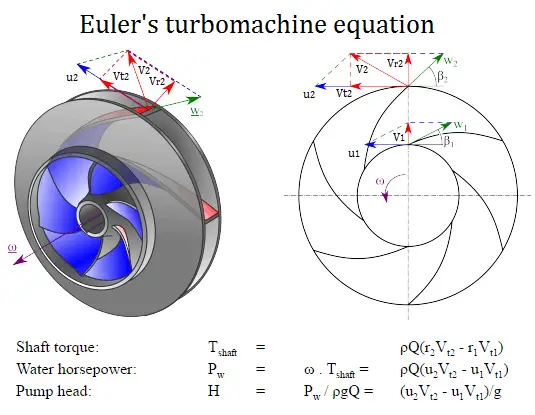
Euler’s turbomachine equation, or sometimes called Euler’s pump equation, plays a central role in turbomachinery as it connects the specific work Y and the geometry and velocities in the impeller. The equation is based on the concepts of conservation of angular momentum and conservation of energy.

The Euler’s turbomachine equations are:

Shaft torque:                         Tshaft    =                                     ρQ(r2Vt2 – r1Vt1)

Water horsepower:             Pw         =     ω . Tshaft        =      ρQ(u2Vt2 – u1Vt1)

Pump head:                            H           =     Pw / ρgQ      =      (u2Vt2 – u1Vt1)/g

where

  • r1 and r2 are the diameters of the impeller at the inlet and outlet respectively.
  • u1 and u2 are the absolute velocities of the impeller (u1 = r1 . ω) at the inlet and outlet respectively.
  • Vt1 and Vt2 are the tangential velocities of the flow at the inlet and outlet respectively.

Euler turbomachine equation

Euler’s turbomachine equations can be used to predict the impact of changing the impeller geometry on the head. It does not matter when we deal with a pump or with a turbine. If torque and angular velocity are of like sign, work is being done on the fluid (a pump or compressor). If torque and angular velocity are of opposite sign work is being extracted from the fluid (a turbine). Thus for the design aspect of turbines and pumps, the Euler equations are extremely useful.

 
References:
Nuclear and Reactor Physics:
  1. J. R. Lamarsh, Introduction to Nuclear Reactor Theory, 2nd ed., Addison-Wesley, Reading, MA (1983).
  2. J. R. Lamarsh, A. J. Baratta, Introduction to Nuclear Engineering, 3d ed., Prentice-Hall, 2001, ISBN: 0-201-82498-1.
  3. W. M. Stacey, Nuclear Reactor Physics, John Wiley & Sons, 2001, ISBN: 0- 471-39127-1.
  4. Glasstone, Sesonske. Nuclear Reactor Engineering: Reactor Systems Engineering, Springer; 4th edition, 1994, ISBN: 978-0412985317
  5. W.S.C. Williams. Nuclear and Particle Physics. Clarendon Press; 1 edition, 1991, ISBN: 978-0198520467
  6. Kenneth S. Krane. Introductory Nuclear Physics, 3rd Edition, Wiley, 1987, ISBN: 978-0471805533
  7. G.R.Keepin. Physics of Nuclear Kinetics. Addison-Wesley Pub. Co; 1st edition, 1965
  8. Robert Reed Burn, Introduction to Nuclear Reactor Operation, 1988.
  9. U.S. Department of Energy, Nuclear Physics and Reactor Theory. DOE Fundamentals Handbook, Volume 1 and 2. January 1993.

Advanced Reactor Physics:

  1. K. O. Ott, W. A. Bezella, Introductory Nuclear Reactor Statics, American Nuclear Society, Revised edition (1989), 1989, ISBN: 0-894-48033-2.
  2. K. O. Ott, R. J. Neuhold, Introductory Nuclear Reactor Dynamics, American Nuclear Society, 1985, ISBN: 0-894-48029-4.
  3. D. L. Hetrick, Dynamics of Nuclear Reactors, American Nuclear Society, 1993, ISBN: 0-894-48453-2.
  4. E. E. Lewis, W. F. Miller, Computational Methods of Neutron Transport, American Nuclear Society, 1993, ISBN: 0-894-48452-4.

See also:

Laws of Conservation

We hope, this article, Law of Conservation of Angular Momentum, helps you. If so, give us a like in the sidebar. Main purpose of this website is to help the public to learn some interesting and important information about materials and their properties.
What is Momentum of Photon – Definition

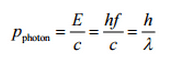
Momentum of Photon. Although a photon (quantum of light) is massless, it has momentum, which is related to its energy E, frequency f, and wavelength

Momentum of Photon

A photon, the quantum of electromagnetic radiation,  is an elementary particle, which is the force carrier of the electromagnetic force. The modern photon concept was developed (1905) by Albert Einstein to explain of the photoelectric effect, in which he proposed the existence of discrete energy packets during the transmission of light.

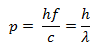
In 1916, Einstein extended his concept of light quanta (photons) by proposing that a quantum of light has linear momentum. Although a photon is massless, it has momentum, which is related to its energy E, frequency f, and wavelength by:

momentum-photon-equation

Thus, when a photon interacts with another object, energy and momentum are transferred, as if there were a collision between the photon and matter in the classical sense.

 
Example: Momentum and Force of a Photon
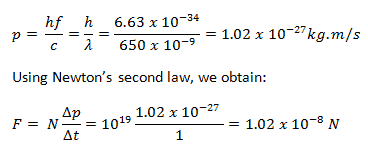
Suppose the 1019 photons (let λ = 650 nm) emitted per second from the 100 W lightbulb.  Suppose all photons are focused onto a piece of black paper and absorbed. Assume that the momentum of a photon changes from p = h/λ to zero.

Calculate the momentum of one photon and calculate the force all these photons could exert on the paper.

Solution:

We use the formula of momentum of a single photon:

momentum-photon-example

Momentum of a Photon – Compton Scattering

Compton Scattering
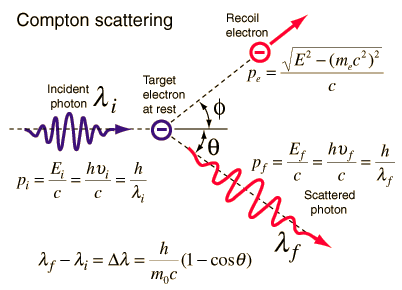
In Compton scattering, the incident gamma-ray photon is deflected through an angle Θ with respect to its original direction. This deflection results in a decrease in energy (decrease in photon’s frequency) of the photon and is called the Compton effect.
Source: hyperphysics.phy-astr.gsu.edu

The Compton formula was published in 1923 in the Physical Review. Compton explained that the X-ray shift is caused by particle-like momentum of photons. Compton scattering formula is the mathematical relationship between the shift in wavelength and the scattering angle of the X-rays. In the case of Compton scattering the photon of frequency f collides with an electron at rest. Upon collision, the photon bounces off electron, giving up some of its initial energy (given by Planck’s formula E=hf), While the electron gains momentum (mass x velocity), the photon cannot lower its velocity. As a result of momentum conservation law, the photon must lower its momentum given by:

As a result of momentum conservetion law, the photon must lower its momentum given by this formula.

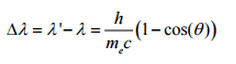
So the decrease in photon’s momentum must be translated into decrease in frequency (increase in wavelength Δλ = λ’ – λ). The shift of the wavelength increased with scattering angle according to the Compton formula:

The shift of the wavelength increased with scattering angle according to the Compton formula

where λ is the initial wavelength of photon λ’ is the wavelength after scattering, h is the Planck constant = 6.626 x 10⁻³⁴ J.s, me is the electron rest mass (0.511 MeV)c is the speed of light Θ is the scattering angle. The minimum change in wavelength (λ′ − λ) for the photon occurs when Θ = 0° (cos(Θ)=1) and is at least zero. The maximum change in wavelength (λ′ − λ) for the photon occurs when Θ = 180° (cos(Θ)=-1). In this case the photon transfers to the electron as much momentum as possible. The maximum change in wavelength can be derived from Compton formula:

The maximum change in wavelength can be derived from Compton formula. Compton length

The quantity h/mec is known as the Compton wavelength of the electron and is equal to 2.43×10⁻¹² m.

 
References:
Nuclear and Reactor Physics:
  1. J. R. Lamarsh, Introduction to Nuclear Reactor Theory, 2nd ed., Addison-Wesley, Reading, MA (1983).
  2. J. R. Lamarsh, A. J. Baratta, Introduction to Nuclear Engineering, 3d ed., Prentice-Hall, 2001, ISBN: 0-201-82498-1.
  3. W. M. Stacey, Nuclear Reactor Physics, John Wiley & Sons, 2001, ISBN: 0- 471-39127-1.
  4. Glasstone, Sesonske. Nuclear Reactor Engineering: Reactor Systems Engineering, Springer; 4th edition, 1994, ISBN: 978-0412985317
  5. W.S.C. Williams. Nuclear and Particle Physics. Clarendon Press; 1 edition, 1991, ISBN: 978-0198520467
  6. Kenneth S. Krane. Introductory Nuclear Physics, 3rd Edition, Wiley, 1987, ISBN: 978-0471805533
  7. G.R.Keepin. Physics of Nuclear Kinetics. Addison-Wesley Pub. Co; 1st edition, 1965
  8. Robert Reed Burn, Introduction to Nuclear Reactor Operation, 1988.
  9. U.S. Department of Energy, Nuclear Physics and Reactor Theory. DOE Fundamentals Handbook, Volume 1 and 2. January 1993.

Advanced Reactor Physics:

  1. K. O. Ott, W. A. Bezella, Introductory Nuclear Reactor Statics, American Nuclear Society, Revised edition (1989), 1989, ISBN: 0-894-48033-2.
  2. K. O. Ott, R. J. Neuhold, Introductory Nuclear Reactor Dynamics, American Nuclear Society, 1985, ISBN: 0-894-48029-4.
  3. D. L. Hetrick, Dynamics of Nuclear Reactors, American Nuclear Society, 1993, ISBN: 0-894-48453-2.
  4. E. E. Lewis, W. F. Miller, Computational Methods of Neutron Transport, American Nuclear Society, 1993, ISBN: 0-894-48452-4.

See also:

Photon

We hope, this article, Momentum of Photon, helps you. If so, give us a like in the sidebar. Main purpose of this website is to help the public to learn some interesting and important information about materials and their properties.
What is What is Conservation of Momentum – Definition – Definition

What is Conservation of Momentum. The conservation of the total momentum demands that the total momentum before the collision is the same as the total momentum after the collision. Material Properties

What is the Law of Conservation of Momentum

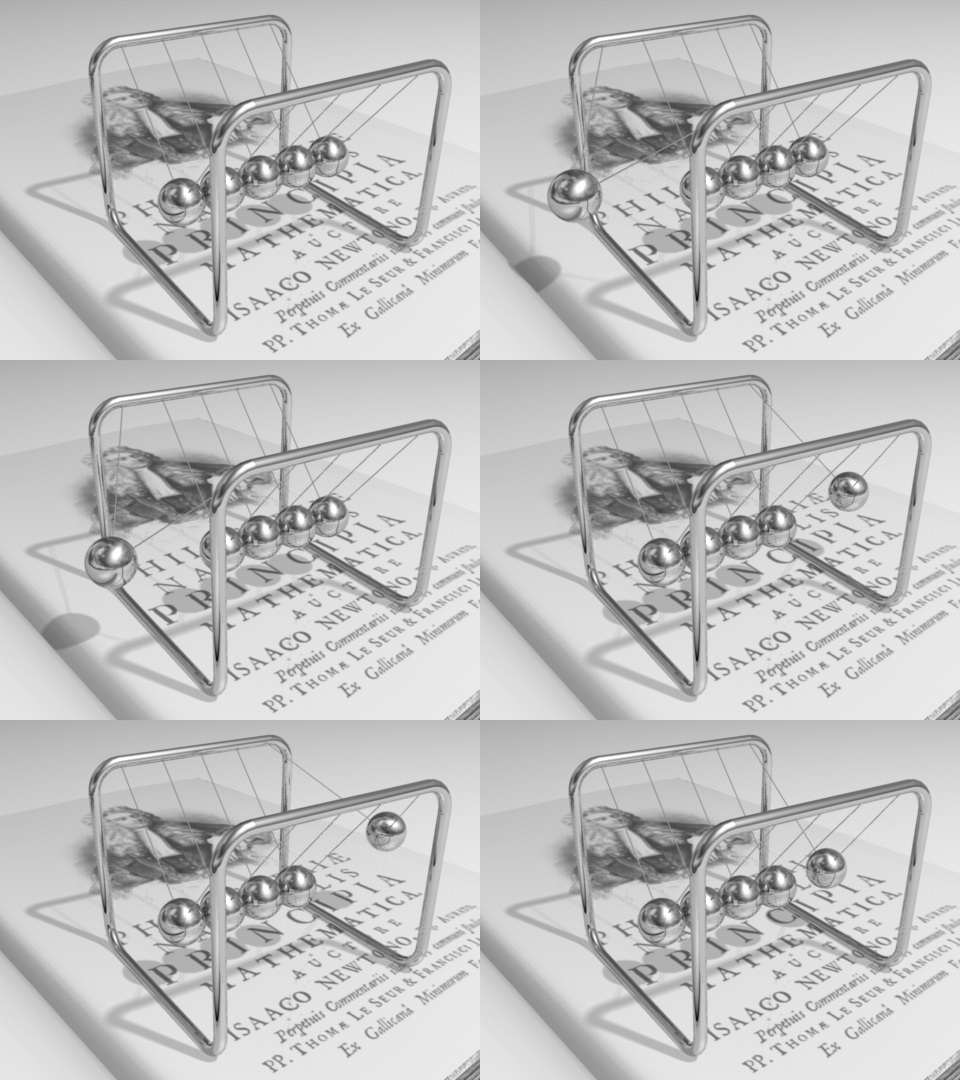
law of conservation of energy - pendulum
Newton’s cradle. A device that demonstrates the Law of Conservation of Mechanical Energy and Momentum.

In general, the law of conservation of momentum or principle of momentum conservation states that the momentum of an isolated system is a constant. The vector sum of the momenta (momentum is equal to the mass of an object multiplied by its velocity) of all the objects of a system cannot be changed by interactions within the system. In classical mechanics, this law is implied by Newton’s laws. This principle is a direct consequence of Newton’s third law.

Let us assume the one dimensional elastic collision of two billiard balls,, the ball A and the ball B. We assume the net external force on this system of two balls is zero—that is, the only significant forces during the collision are the forces that each ball exerts on the other. According to Newton’s third law, the two forces are always equal in magnitude and opposite in direction. Hence, the impulses that act on the two balls are equal and opposite, and the changes in momentum of the two balls are equal and opposite.

These two balls are moving with velocities vA and vB along the x axis before the collision. After the collision, their velocities are v’A and v’B. The conservation of the total momentum demands that the total momentum before the collision is the same as the total momentum after the collision.

conservation-of-momentum-formula

The law of conservation of linear momentum in words:

If no net external force acts on a system of particles, the total linear momentum of the system cannot change.

 
References:
Nuclear and Reactor Physics:
  1. J. R. Lamarsh, Introduction to Nuclear Reactor Theory, 2nd ed., Addison-Wesley, Reading, MA (1983).
  2. J. R. Lamarsh, A. J. Baratta, Introduction to Nuclear Engineering, 3d ed., Prentice-Hall, 2001, ISBN: 0-201-82498-1.
  3. W. M. Stacey, Nuclear Reactor Physics, John Wiley & Sons, 2001, ISBN: 0- 471-39127-1.
  4. Glasstone, Sesonske. Nuclear Reactor Engineering: Reactor Systems Engineering, Springer; 4th edition, 1994, ISBN: 978-0412985317
  5. W.S.C. Williams. Nuclear and Particle Physics. Clarendon Press; 1 edition, 1991, ISBN: 978-0198520467
  6. Kenneth S. Krane. Introductory Nuclear Physics, 3rd Edition, Wiley, 1987, ISBN: 978-0471805533
  7. G.R.Keepin. Physics of Nuclear Kinetics. Addison-Wesley Pub. Co; 1st edition, 1965
  8. Robert Reed Burn, Introduction to Nuclear Reactor Operation, 1988.
  9. U.S. Department of Energy, Nuclear Physics and Reactor Theory. DOE Fundamentals Handbook, Volume 1 and 2. January 1993.

Advanced Reactor Physics:

  1. K. O. Ott, W. A. Bezella, Introductory Nuclear Reactor Statics, American Nuclear Society, Revised edition (1989), 1989, ISBN: 0-894-48033-2.
  2. K. O. Ott, R. J. Neuhold, Introductory Nuclear Reactor Dynamics, American Nuclear Society, 1985, ISBN: 0-894-48029-4.
  3. D. L. Hetrick, Dynamics of Nuclear Reactors, American Nuclear Society, 1993, ISBN: 0-894-48453-2.
  4. E. E. Lewis, W. F. Miller, Computational Methods of Neutron Transport, American Nuclear Society, 1993, ISBN: 0-894-48452-4.

See also:

Laws of Conservation

We hope, this article, What is Conservation of Momentum – Definition, helps you. If so, give us a like in the sidebar. Main purpose of this website is to help the public to learn some interesting and important information about materials and their properties.