Facebook Instagram Youtube Twitter

What is Plutonium – Definition

Plutonium is a transuranic chemical element with atomic number 94. The chemical symbol for plutonium is Pu. Plutonium is mostly produced in nuclear reactors. Material Properties

What is Plutonium

Plutonium is a transuranic chemical element with atomic number 94 which means there are 94 protons and 94 electrons in the atomic structure. The chemical symbol for plutonium is Pu. It is a man-made isotope and is created from uranium in nuclear reactors. Therefore we can find this element in irradiated nuclear fuel or as a fissile material in nuclear weapons. In fact, scientists have found trace amounts of naturally-occurring plutonium. Four isotopes (238Pu, 239Pu, 240Pu and 244Pu) can be found in the nature.

  • Trace amounts of 239Pu originate in radiative capture of neutron on 238U. Free neutrons come from a spontaneous fission reaction of 238U.
  • Trace amounts of 244Pu originate in its relatively long half-life of about 80 million years.
  • The isotope 240Pu is in a decay chain of the isotope 244Pu.  These nuclei are present in the unalterable proportions of the radioactive equilibrium between 244Pu and 240Pu.
  • Extremely small amounts of 238Pu originate in extremely rare double negative beta decay of naturally-occurring isotope 238U.
Fissile / Fertile Material Cross-sectionsFissile / Fertile Material Cross-sections. Comparison of total fission cross-sections.

Source: JANIS (Java-based Nuclear Data Information Software); ENDF/B-VII.1

Plutonium is mostly produced in nuclear reactors. It is a product of the transmutation and subsequent nuclear decay of fertile isotope 238U. The transmutation and decay chain is shown below:

Equation - Plutonium 239 breeding from Uranium 238

Neutron capture may also be used to create fissile 239Pu from 238U, which is the dominant constituent of naturally occurring uranium (99.28%). Absorption of a neutron in the 238U nucleus yields 239U. The half-life of 239U is approximately 23.5 minutes. 239U decays (negative beta decay) to 239Np (neptunium), whose half-life is 2.36 days. 239Np decays (negative beta decay)  to 239Pu.

Higher isotopes of plutonium (240Pu, 241Pu and 242Pu) are created by also by neutron radiative capture, but in this case an absorber must be the plutonium nucleus. For example, 240Pu which is the second most common isotope, is formed by radiative capture of a neutron by 239Pu.The transmutation and decay chain is shown below.

Plutonium in Commercial Power Reactors

The nuclear transmutation of 238U into fissile isotopes of plutonium (the plutonium breeding) in the fuel cycle of all commercial light water reactors plays a significant role. In recent years, the commercial power industry has been emphasizing high-burnup fuels (up to 60 – 70 GWd/tU), which are typically enriched to higher percentages of 235U (up to 5%). As burnup increases, a higher percentage of the total power produced in a reactor is due to the plutonium bred inside the reactor.

At a burnup of 30 GWd/tU (gigawatt-days per metric ton of uranium), about 30% of the total energy released comes from bred plutonium. At 40 GWd/tU, that percentage increases to about forty percent. This corresponds to a breeding ratio for these reactors of about 0.4 to 0.5. That means, about half of the fissile fuel in these reactors is bred there. This effect extends the cycle length for such fuels to sometimes nearly twice what it would be otherwise. MOX fuel has a smaller breeding effect than 235U fuel and is thus more challenging and slightly less economic to use due to a quicker drop off in reactivity through cycle life.
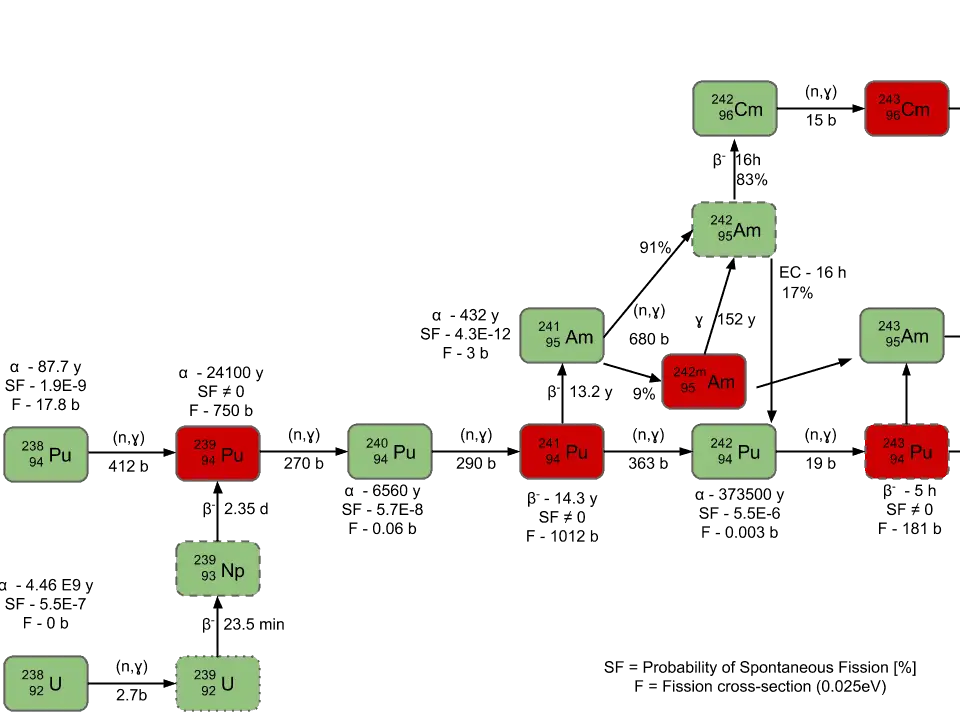
plutonium breedingSource of data: JANIS (Java-based Nuclear Data Information Software); The JEFF-3.1.1 Nuclear Data Library

Isotopes of Plutonium

About twenty plutonium isotopes have been discovered and described. Except 244Pu, all these isotopes are artificial isotopes. The main isotopes, which have to be considered in the fuel cycle of all commercial light water reactors, are:

  • 238Pu. 238Pu belongs to the group of fertile isotopes. 238Pu decays via alpha decay to 234U with half-life of 87.7 years. 238Pu generates very high decay heat and has very high rate of spontaneous fission.
  • 239Pu. 239Pu belongs to the group of fissile isotopes. 239Pu decays via alpha decay to 235U with half-life of 24100 years. This isotope is the principal fissile isotope in use.
  • 240Pu. 240Pu belongs to the group of fertile isotopes. 240Pu decays via alpha decay to 236U with half-life of 6560 years. 240Pu has very high rate of spontaneous fission and has high radiative capture cross-section for thermal and also for resonance neutrons.
  • 241Pu. 241Pu belongs to the group of fissile isotopes. 241Pu decays via negative beta decay to 241Am with half-life of 14.3 years. This fissile isotope decays to non-fissile isotope with high radiative capture cross-section for thermal neutrons. An impact on reactivity of the nuclear fuel  is obvious.
  • 242Pu. 242Pu belongs to the group of non-fissile isotopes. 242Pu decays via alpha decay to 238U with half-life of 37300 years. 242Pu has very high rate of spontaneous fission but its quantity in the irradiated nuclear fuel is relatively low.

Half-lifes of Isotopes of Plutonium

Isotope Half-life / Decay mode Product
238Pu 87.7 y / alpha decay 234U
239Pu 24 100 y / alpha decay 235U
240Pu 6 560 y / alpha decay 236U
241Pu  14.3 y / beta decay 241Am
242Pu  373 500 y / alpha decay 238U
243Pu  4.96 d / beta decay 243Am
244Pu  80 000 000 y / alpha decay 240Pu
Half-life of plutonium isotopes.Half-lifes of isotopes of plutonium.
Source: Java-based Nuclear Data Information Software
Library: The JEFF-3.1.1 Nuclear Data Library

Isotope
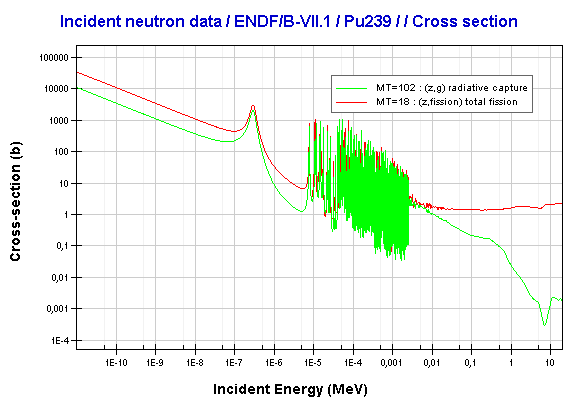
 
Plutonium 239
Fissile / Fertile Material Cross-sections
Source: JANIS (Java-based Nuclear Data Information Software)
Library: ENDF/B-VII.1

239Pu is a fissile isotope, which means 239Pu is capable of undergoing fission reaction after absorbing thermal neutron. Moreover, 239Pu meets also alternative requirement that the amount (~2.88 per one fission by thermal neutron) of neutrons produced by fission of 239Pu is sufficient to sustain a nuclear fission chain reaction. This isotope is the principal fissile isotope of plutonium in use.

It is a man-made isotope and can be found in an irradiated uranium fuel or in a spent uranium fuel. Isotope 239Pu is formed in a nuclear reactor from fertile isotope 238U, which constitute more than 95% of uranium fuel (e.g.  PWRs and BWRs require 3% – 5% of 235U). Absorption of a resonance or thermal neutron by the 238U nucleus yields 239U. The half-life of 239U is approximately 23.5 minutes. 239U decays (negative beta decay) to 239Np (neptunium), whose half-life is 2.36 days. 239Np decays (negative beta decay)  to 239Pu. The transmutation and decay chain is shown below:

Equation - Plutonium 239 breeding from Uranium 238

239Pu itself decays via alpha decay into 235U with half-life of 24 100 years. 239Pu occasionally decays by spontaneous fission with very low rate of 0.00000000031%. On the other hand 239Pu has very high absorption cross-section for thermal neutrons. When loaded into the reactor core 239Pu can be easily fissioned by a neutron or can be transformed into the 240Pu via a radiative capture reaction.

See also: Plutonium 239
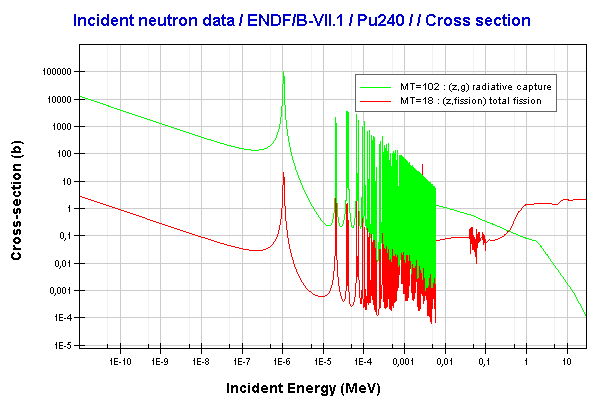
Plutonium 240
Fissile / Fertile Material Cross-sections
Source: JANIS (Java-based Nuclear Data Information Software)
Library: ENDF/B-VII.1

240Pu is a fertile isotope because its fission cross-section is very low in comparison with fissile isotopes. Radiative capture of a neutron leads to the formation of fissile 241Pu similarly to 238U which radiative capture leads to the formation of fissile 239Pu.

It is a man-made isotope and can be found in an irradiated uranium fuel or in a spent uranium fuel. Isotope 240Pu is formed in a nuclear reactor from fissile isotope 239Pu. Absorption of a resonance or thermal neutron by the 239Pu nucleus yields 240Pu.  Trace amounts can be found in the nature. The isotope 240Pu is in a decay chain of the primordial isotope 244Pu.  These nuclei are present in the unalterable proportions of the radioactive equilibrium between 244Pu and 240Pu.

240Pu has relatively high radiative capture cross-section (about 290 barns for thermal neutrons).

240Pu decays via alpha decay into 236U with half-life of 6560 years.

Plutonium 241
241Pu is a fissile isotope, which means 241Pu is capable of undergoing fission reaction after absorbing thermal neutron. Moreover 241Pu meets also alternative requirement that the amount of neutrons produced by fission of 241Pu (~2.94 per one fission by thermal neutron) is sufficient to sustain a nuclear fission chain reaction. Its fission cross-section for thermal neutrons is about 1012 barns (for 0.025 eV neutron). For fast neutrons its fission cross-section is on the order of barns.

Most of absorption reactions result in fission reaction, but a part of reactions result in radiative capture forming 242Pu. The cross-section for radiative capture for thermal neutrons is about 363 barns (for 0.025 eV neutron). Therefore about 74% of all absorption reactions result in radiative capture of neutron. About 26% of all absorption reactions result in fission.

It is a man-made isotope and can be found in an irradiated uranium fuel or in a spent uranium fuel. Isotope 241Pu is formed in a nuclear reactor from fertile isotope 240Pu. Absorption of a resonance or thermal neutron by the 240Pu nucleus yields 241Pu.

241Pu decays via beta decay into 241Am with half-life of only 14.3 years. 241Am has relatively high cross-section for radiative capture for thermal neutrons (~680 barns – 0.025eV). This two phenomena (decrease in fissile isotope and increase in neutron absorber) cause slight decrease in reactivity of irradiated fuel when stored in a spent fuel pool.

See also:

Uranium

See also:

Nuclear Fuel

See also:

We hope, this article, Plutonium, helps you. If so, give us a like in the sidebar. Main purpose of this website is to help the public to learn some interesting and important information about materials and their properties.
What is Decay Mode and Half-life of Uranium 233 – Definition

Decay mode and half-life of uranium 233. Uranium 233 decays via alpha decay. Uranium 233 occasionally decays by spontaneous fission. Material Properties

Decay Mode and Half-life of Uranium 233

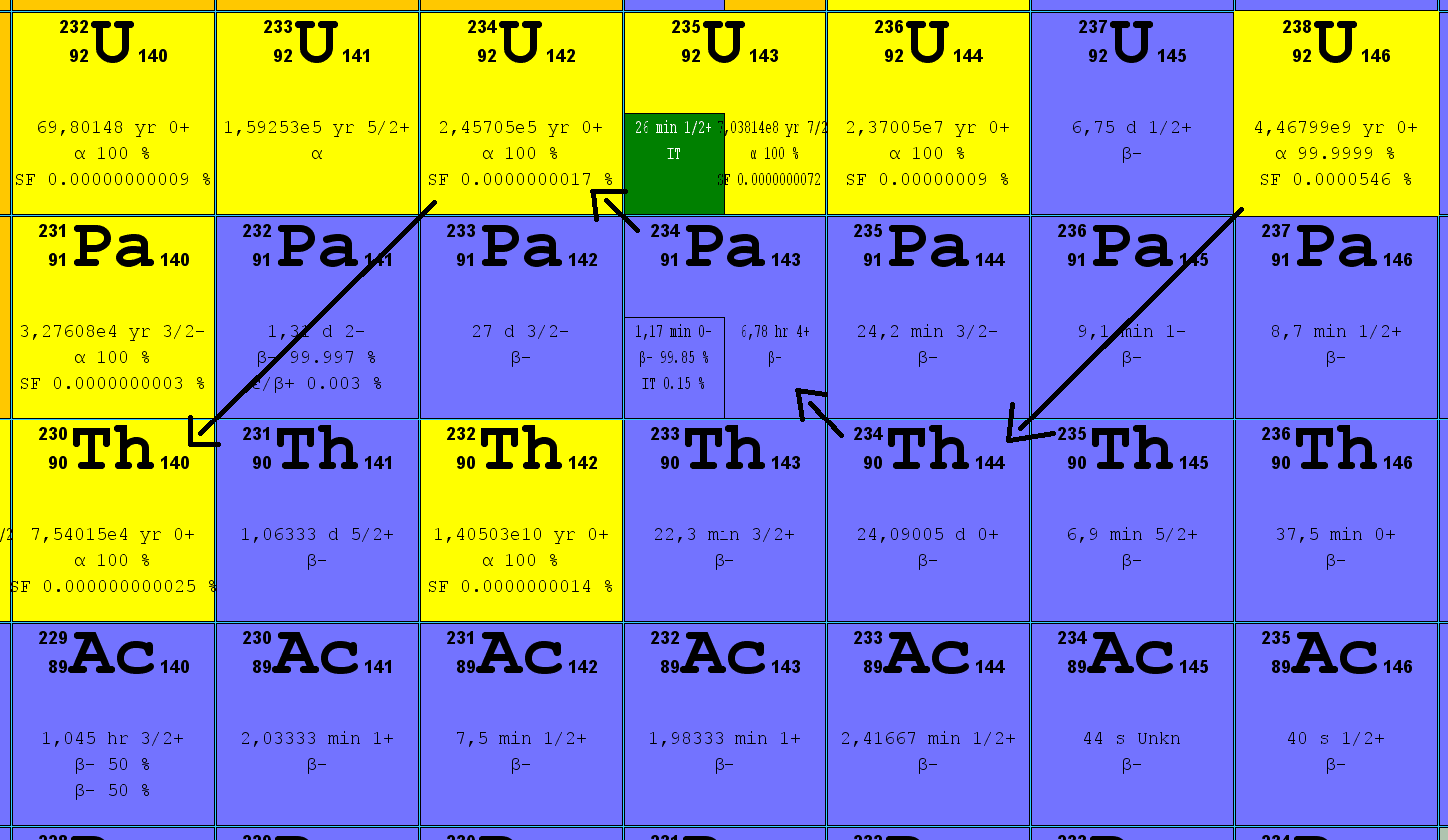
  • Uranium 233 decays via alpha decay into 229Th.
  • Half-life of uranium 233 is 159 200 years.
  • Uranium 233 occasionally decays by spontaneous fission with very low probability of 0.000000006%.
  • Its specific activity is ~0.0098 Ci/g.
Isotope Specific Activity
Uranium 232 22 Ci/g
Uranium 233 0.0098 Ci/g
Uranium 234 0.0063 Ci/g
Uranium 236 0.000065 Ci/g
Uranium 235 0.0000022 Ci/g
Uranium 238 0.00000034 Ci/g

Table of specific activities of isotopes of uranium.

See also:

Uranium 233

We hope, this article, Decay Mode and Half-life of Uranium 233, helps you. If so, give us a like in the sidebar. Main purpose of this website is to help the public to learn some interesting and important information about materials and their properties.
What is Decay Mode and Half-life of Uranium 236 – Definition

Decay mode and half-life of uranium 236. Uranium 236 decays via alpha decay. Uranium 236 occasionally decays by spontaneous fission. Material Properties

Decay Mode and Half-life of Uranium 236

  • Uranium 236 decays via alpha decay to 232Th.
  • Half-life of uranium 236 is ~2.3 x 10⁷ years.
  • Uranium 236 occasionally decays by spontaneous fission with very low probability of 0.00000009%.
  • Its specific activity is ~6.5×10⁻⁵ Ci/g.
Isotope Specific Activity
Uranium 232 22 Ci/g
Uranium 233 0.0098 Ci/g
Uranium 234 0.0063 Ci/g
Uranium 236 0.000065 Ci/g
Uranium 235 0.0000022 Ci/g
Uranium 238 0.00000034 Ci/g

Table of specific activities of isotopes of uranium.

See also:

Uranium 236

We hope, this article, Decay Mode and Half-life of Uranium 236, helps you. If so, give us a like in the sidebar. Main purpose of this website is to help the public to learn some interesting and important information about materials and their properties.
What is Decay Mode and Half-life of Uranium 234 – Definition

Decay mode and half-life of uranium 234. Uranium 234 decays via alpha decay. Uranium 234 occasionally decays by spontaneous fission. Material Properties

Decay mode and Half-life of Uranium 234

  • Uranium 234 decays via alpha decay to 230Th.
  • Half-life of uranium 234 is 246 000 years.
  • Uranium 234 occasionally decays by spontaneous fission with very low probability of 0.0000000017%.
  • Its specific activity is much higher ~0.0063 Ci/g.
Uranium 238 decay.
Uranium 238 decays via alpha decay (by way of thorium-234 and protactinium-234) into 234U.
Source: JANIS (Java-based nuclear information software)
http://www.oecd-nea.org/janis/
Isotope Specific Activity
Uranium 232 22 Ci/g
Uranium 233 0.0098 Ci/g
Uranium 234 0.0063 Ci/g
Uranium 236 0.000065 Ci/g
Uranium 235 0.0000022 Ci/g
Uranium 238 0.00000034 Ci/g

Table of specific activities of isotopes of uranium.

See also:

Uranium 234

We hope, this article, Decay Mode and Half-life of Uranium 234, helps you. If so, give us a like in the sidebar. Main purpose of this website is to help the public to learn some interesting and important information about materials and their properties.

What is Decay Mode and Half-life of Uranium 232 – Definition

Decay mode and half-life of uranium 232. Uranium 232 decays via alpha decay. Uranium 232 occasionally decays by spontaneous fission. Material Properties

Decay mode and Half-life of Uranium 232

  • Uranium 232 decays via alpha decay to 228Th.
  • Half-life of uranium 232 is only 68.9 years.
  • Uranium 232 very rarely decays by spontaneous fission.
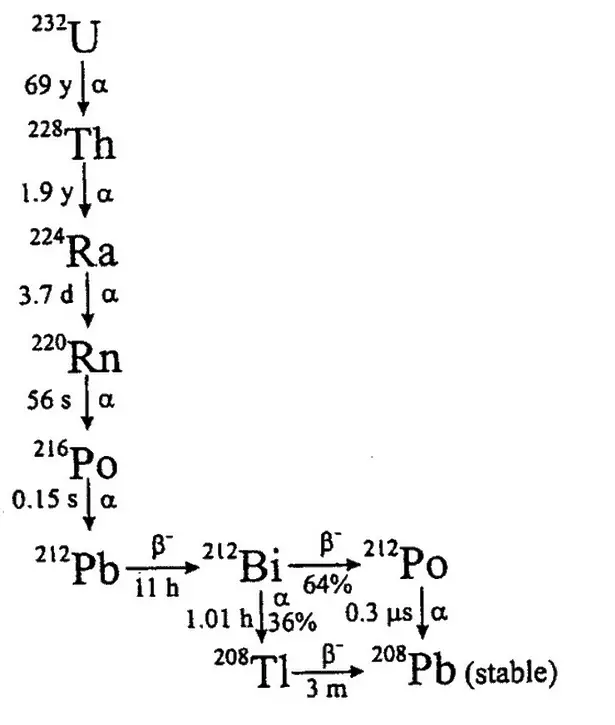
  • Its specific activity is very high ~22 Ci/g and its decay chain produces very penetrating gamma rays.
Uranium 232 decay chain.
Uranium 232 decay chain. This decay chain produces very penetrating gamma rays.
Isotope Specific Activity
Uranium 232 22 Ci/g
Uranium 233 0.0098 Ci/g
Uranium 234 0.0063 Ci/g
Uranium 236 0.000065 Ci/g
Uranium 235 0.0000022 Ci/g
Uranium 238 0.00000034 Ci/g

Table of specific activities of isotopes of uranium.

See also:

See also:

Uranium 232

We hope, this article, Decay Mode and Half-life of Uranium 232, helps you. If so, give us a like in the sidebar. Main purpose of this website is to help the public to learn some interesting and important information about materials and their properties.
What is Decay Mode and Half-life of Uranium 235 – Definition

Decay mode and half-life of uranium 235. Uranium 235 decays via alpha decay. Uranium 235 occasionally decays by spontaneous fission. Material Properties

Decay mode and Half-life of Uranium 235

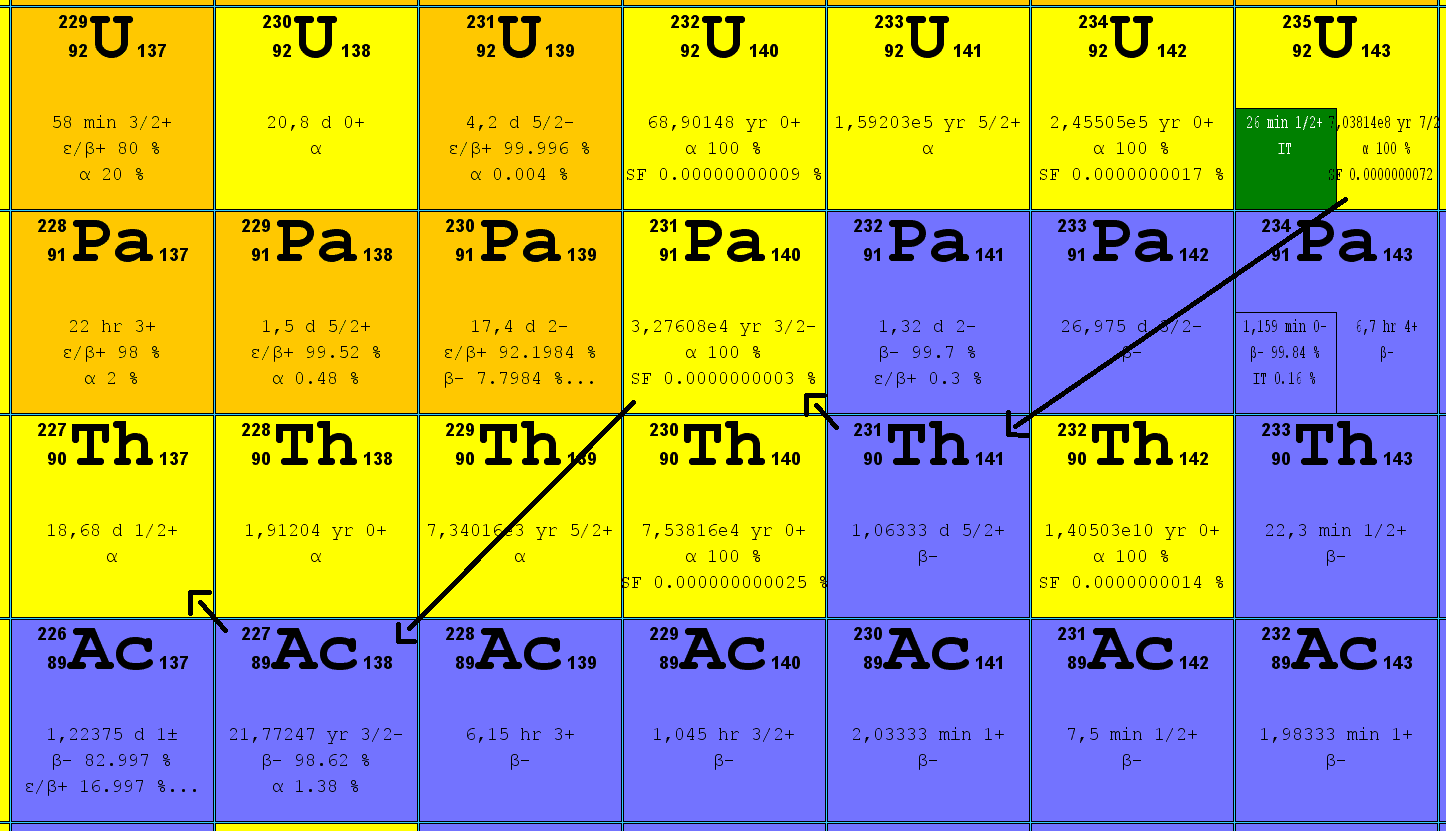
  • Uranium 235 decays via alpha decay (by way of thorium-231) into 231Pa.
  • Half-life of uranium 235 is ~7 x 10⁸ years.
  • Uranium 235 occasionally decays by spontaneous fission with very low probability of 0.0000000072%.
  • Its specific activity is very low ~2.2×10⁻⁶ Ci/g.
Uranium 235 decay.
Uranium 235 decays via alpha decay Source: JANIS (Java-based Nuclear Data Information Software) http://www.oecd-nea.org/janis/http://www.oecd-nea.org/janis/
Isotope Specific Activity
Uranium 232 22 Ci/g
Uranium 233 0.0098 Ci/g
Uranium 234 0.0063 Ci/g
Uranium 236 0.000065 Ci/g
Uranium 235 0.0000022 Ci/g
Uranium 238 0.00000034 Ci/g

Table of specific activities of isotopes of uranium.

See also:

Uranium 235

We hope, this article, Decay Mode and Half-life of Uranium 235, helps you. If so, give us a like in the sidebar. Main purpose of this website is to help the public to learn some interesting and important information about materials and their properties.
What is Decay Mode and Half-life of Uranium 238 – Definition

Decay mode and half-life of uranium 238. Uranium 238 decays via alpha decay. Uranium 238 occasionally decays by spontaneous fission. Material Properties

Decay mode and Half-life of Uranium 238

  • Uranium 238 decays via alpha decay to 234Th.
  • Half-life of uranium 238 is ~4.5×10⁹ years.
  • Uranium 238 occasionally decays by spontaneous fission with probability of 0.000055%.
  • Its specific activity is very low ~3.4×10⁻⁷ Ci/g.
Uranium 238 decay.
Uranium 238 decays via alpha decay (by way of thorium-234 and protactinium-234) into 234U.
Source: JANIS (Java-based nuclear information software)
http://www.oecd-nea.org/janis/
Isotope Specific Activity
Uranium 232 22 Ci/g
Uranium 233 0.0098 Ci/g
Uranium 234 0.0063 Ci/g
Uranium 236 0.000065 Ci/g
Uranium 235 0.0000022 Ci/g
Uranium 238 0.00000034 Ci/g

Table of specific activities of isotopes of uranium.

See also:

Uranium 238

We hope, this article, Decay Mode and Half-life of Uranium 238, helps you. If so, give us a like in the sidebar. Main purpose of this website is to help the public to learn some interesting and important information about materials and their properties.
What is Uranium 233 Fission – Definition

What is uranium 233 fission reaction? When uranium 233 undergoes fission, the nucleus splits into two smaller nuclei, along with a few neutrons. Material Properties

Uranium 233 Fission

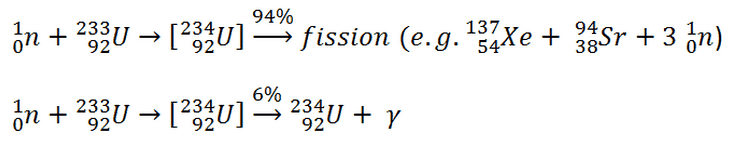
Uranium 233 is a very good fissile isotope and its fission cross-section for thermal neutrons is about 531 barns (for 0.0253 eV neutron). For fast neutrons its fission cross-section is on the order of barns. Most of absorption reactions result in fission reaction, but a minority results in radiative capture forming 234U. The cross-section for radiative capture for thermal neutrons is about 45 barns (for 0.0253 eV neutron). Therefore about 6% of all absorption reactions result in radiative capture of neutron. About 94% of all absorption reactions result in fission. The capture-to-fission ratio is much smaller than the other two major fissile fuels 235U and 239U.

Uranium 233 absorption reaction

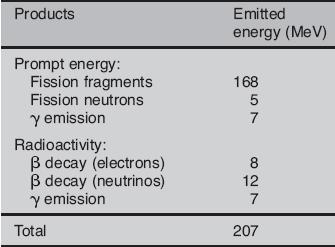
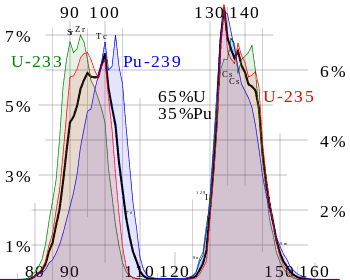
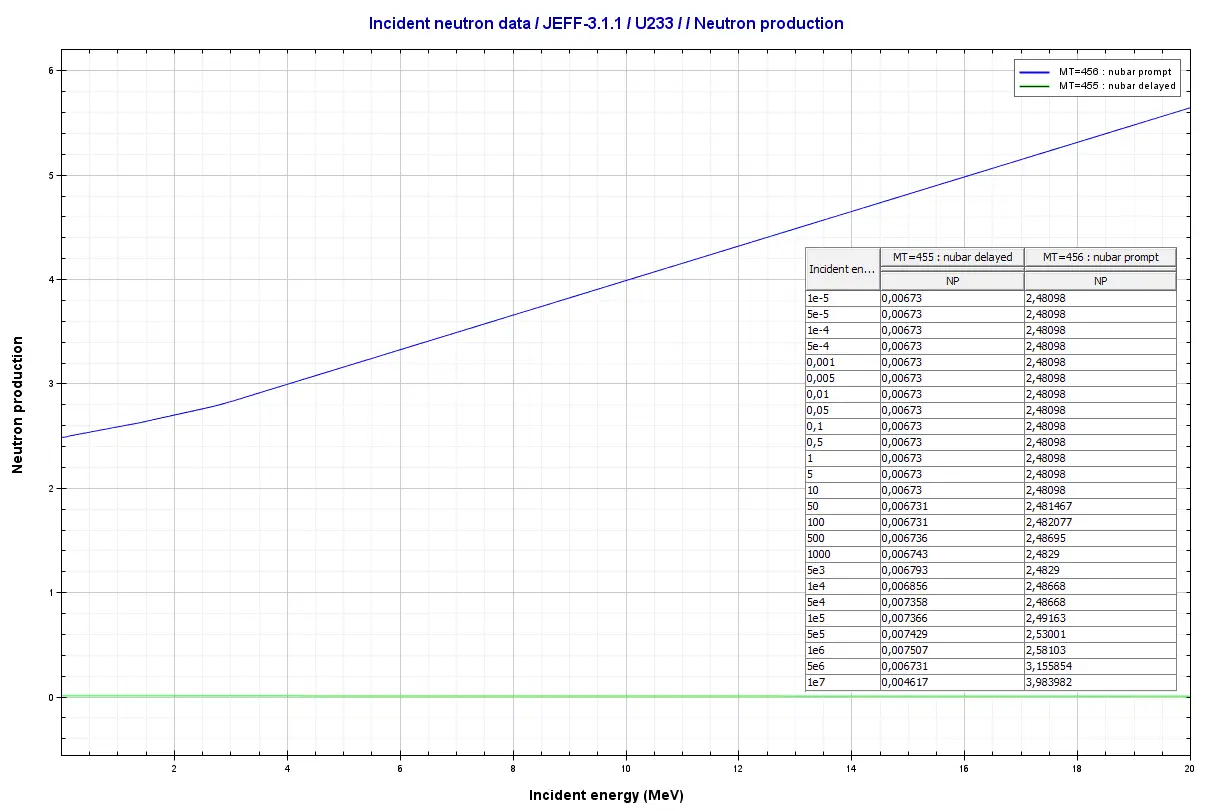
Typically, when uranium 233 nucleus undergoes fission, the nucleus splits into two smaller nuclei (triple fission can also rarely occur), along with a few neutrons (the average is 2.48 neutrons per fission for thermal fission) and release of energy in the form of heat and gamma rays. The average of the fragment atomic mass is about 112, but very few fragments near that average are found. It is much more probable to break up into unequal fragments, and the most probable fragment masses are around mass 93 (strontium) and 137 (xenon).Most of the fission fragments are highly unstable (radioactive) nuclei and undergo further radioactive decays to stabilize itself, therefore part of the released energy is radiated away from the reactor (See also: Reactor antineutrinos). On the other hand most of the energy released by one fission (~168MeV of total ~200MeV) appears as kinetic energy of these fission fragments. The fission fragments interact strongly with the surrounding atoms or molecules traveling at high speed, causing them to ionize. Creation of ion pairs requires energy, which is lost from the kinetic energy of the charged fission fragment causing it to decelerate. The positive ions and free electrons created by the passage of the charged fission fragment will then reunite, releasing energy in the form of heat (e.g. vibrational energy or rotational energy of atoms). This is the principle how fission fragments heat up fuel in the reactor core.

Fission FragmentsFission fragments after a nucleus fission. Fission fragments interact strongly with the surrounding atoms or molecules traveling at high speed, causing them to ionize.
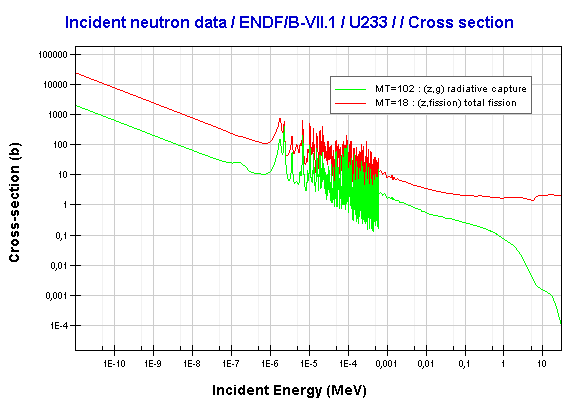
Source of nuclear data: JANIS (Java-based Nuclear Data Information Software); ENDF/B-VII.1
Fissile / Fertile Material Cross-sectionsUranium 233. Comparison of total fission cross-section and cross-section for radiative capture.
Fission fragment yieldsFission fragment yield for different nuclei. The most probable fragment masses are around mass 93 (Strontium) and 137 (Xenon).
Neutron production per one fast fission of uranium 233.Neutron production per one fast fission of uranium 233.

See also:

Uranium 233

We hope, this article, Uranium 233 Fission, helps you. If so, give us a like in the sidebar. Main purpose of this website is to help the public to learn some interesting and important information about materials and their properties.

What is Uranium 235 Fission – Definition

What is uranium 235 fission reaction? When uranium 235 undergoes fission, the nucleus splits into two smaller nuclei, along with a few neutrons. Material Properties

Uranium 235 Fission

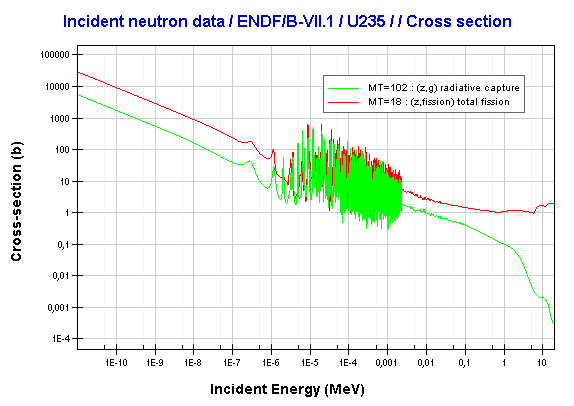
Uranium 235 is a fissile isotope and its fission cross-section for thermal neutrons is about 585 barns (for 0.0253 eV neutron). For fast neutrons its fission cross-section is on the order of barns. Most of absorption reactions result in fission reaction, but a minority results in radiative capture forming 236U. The cross-section for radiative capture for thermal neutrons is about 99 barns (for 0.0253 eV neutron). Therefore about 15% of all absorption reactions result in radiative capture of neutron. About 85% of all absorption reactions result in fission.

Uranium absorption reaction

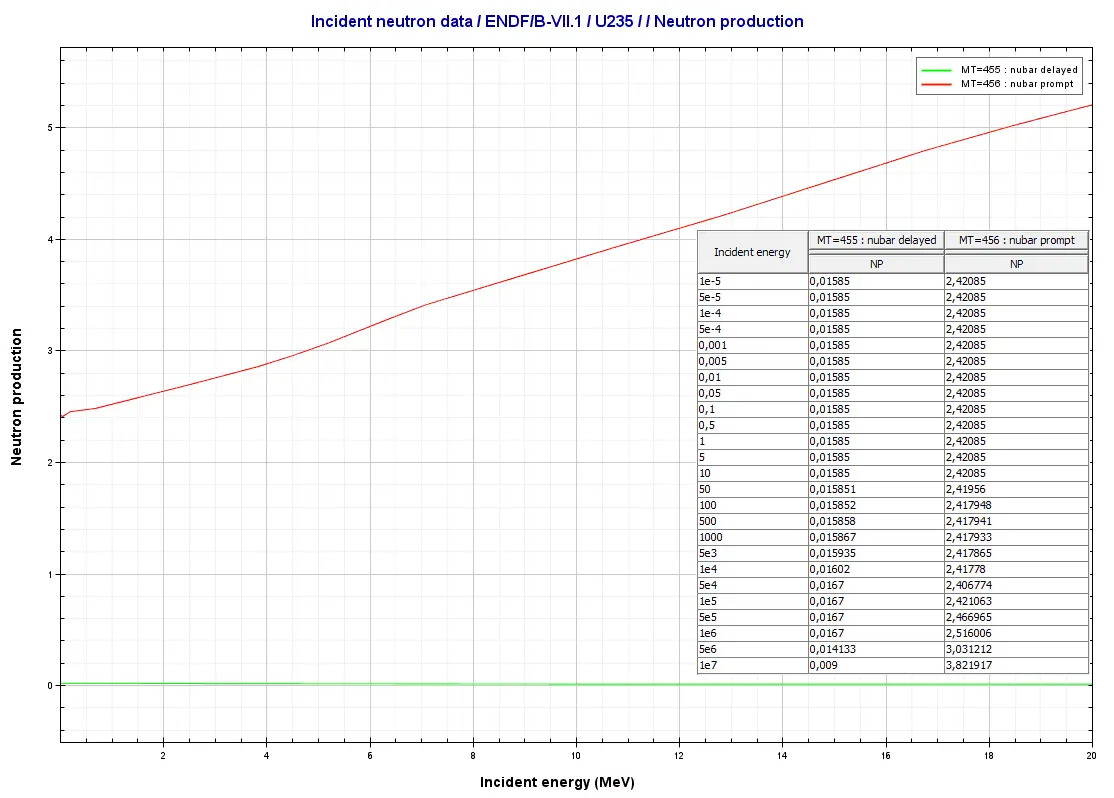
Typically, when uranium 235 nucleus undergoes fission, the nucleus splits into two smaller nuclei (triple fission can also rarely occur), along with a few neutrons (the average is 2.43 neutrons per fission by thermal neutron) and release of energy in the form of heat and gamma rays. The average of the fragment atomic mass is about 118, but very few fragments near that average are found. It is much more probable to break up into unequal fragments, and the most probable fragment masses are around mass 95 (Krypton) and 137 (Barium).

Most of the fission fragments are highly unstable (radioactive) nuclei and undergo further radioactive decays to stabilize itself. Therefore part of the released energy is radiated away from the reactor (See also: Reactor antineutrinos). On the other hand most of the energy released by one fission (~170MeV of total ~200MeV) appears as kinetic energy of these fission fragments. The fission fragments interact strongly with the surrounding atoms or molecules traveling at high speed, causing them to ionize. Creation of ion pairs requires energy, which is lost from the kinetic energy of the charged fission fragment causing it to decelerate. The positive ions and free electrons created by the passage of the charged fission fragment will then reunite, releasing energy in the form of heat (e.g. vibrational energy or rotational energy of atoms). This is the principle how fission fragments heat up fuel in the reactor core.

Source of nuclear data: JANIS (Java-based Nuclear Data Information Software); ENDF/B-VII.1
Fission FragmentsFission fragments after a nucleus fission. Fission fragments interact strongly with the surrounding atoms or molecules traveling at high speed, causing them to ionize.
Uranium 235 decay.Uranium 235 decays via alpha decay into 231Pa.
Fissile / Fertile Material Cross-sectionsUranium 235. Comparison of total fission cross-section and cross-section for radiative capture.
Fission fragment yieldsFission fragment yield for different nuclei. The most probable fragment masses are around mass 95 (Krypton) and 137 (Barium).
Energy from Uranium Fission
Neutron production per one fast fission of uranium 235.Neutron production per one fast fission of uranium 235.

See also:

Uranium 235

We hope, this article, Uranium 235 Fission, helps you. If so, give us a like in the sidebar. Main purpose of this website is to help the public to learn some interesting and important information about materials and their properties.
What is Uranium 232 – Definition

Definition of uranium 232. Uranium 236 is a fissile isotope. It decays via alpha decay. It has half-life of 68.9 years, and therefore the specific activity is very high. Material Properties

Uranium 232

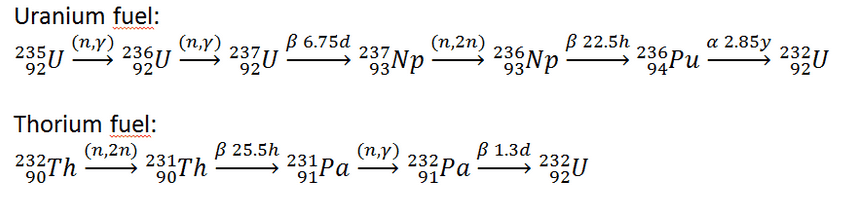
Uranium 232 is not naturally-occurring isotope of uranium. It is a man-made isotope and is a side product in the thorium fuel cycle and also this isotope is a decay product of 236Pu in the uranium fuel. 232U is produced from 235U and 232Th via two of the reaction chains shown below. The formation of this isotope in both reactions results from specific (n,2n) reactions in which an incoming neutron knocks two neutrons out of a target nucleus. 232U can also be produced by two successive single radiative captures of neutron starting with naturally-occurring isotope 230Th. 230Th is a decay product of 234U, which is in turn a decay product of 238U.Uranium 232 production

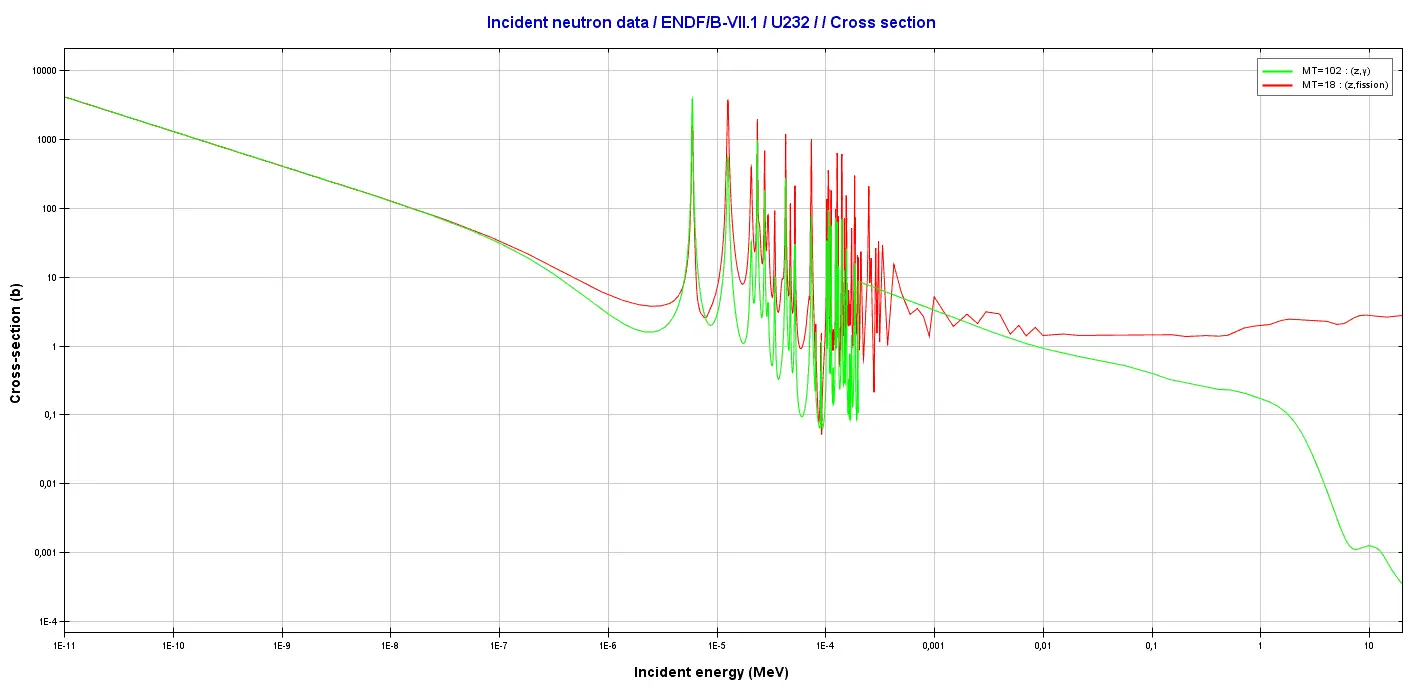
It is unusual, but 232U is a fissile isotope and it is therefore capable of undergoing fission reaction after absorbing thermal neutron. This feature plays no significant role in nuclear reactors, because the amount of 232U is negligible in terms of sustaining a nuclear fission chain reaction. 232U has a significant fission cross-section (75 barns for thermal neutrons) as well as radiative capture cross-section (73 barns for thermal neutrons). Therefore 232U also belongs to the group of fertile isotopes. Radiative capture of a neutron leads to the formation of fissile 233U.

The isotope 232U has another very important feature. 232U has a relatively short half-life of 68.9 years, and therefore the specific activity of 232U is much higher than specific activity of the isotope 238U. In addition the decay chain of 232U produces very penetrating gamma rays. The most important gamma emitter, accounting for about 85 percent of the total dose from 232U after 2 years, is thallium 208, that emits gamma rays of 2.6 MeV which are very energetic and highly penetrating. These intense radiations make handling of fissile 233U or reprocessed uranium contaminated with 232U far more dangerous than conventional fuels.

Reference: Kang, J.; Von Hippel, F. N. (2001). “U‐232 and the proliferation‐resistance of U‐233 in spent fuel”. Science & Global Security

See also: Neutron Cross-section

Source of nuclear data: JANIS (Java-based Nuclear Data Information Software); The JEFF-3.1.1 Nuclear Data Library
Fissile / Fertile Material Cross-sectionsUranium 232. Comparison of total fission cross-section and cross-section for radiative capture.
Uranium 232 decay chain.
Uranium 232 decay chain. This decay chain produces very penetrating gamma rays.

See also:

Uranium 236

See also:

Uranium

See also:

Half-life of Isotopes of Uranium

We hope, this article, Uranium 232, helps you. If so, give us a like in the sidebar. Main purpose of this website is to help the public to learn some interesting and important information about materials and their properties.