Facebook Instagram Youtube Twitter

What is Boron 10 – Definition

Boron is a naturally-occurring chemical element. Natural boron consists primarily of two stable isotopes, boron 11 and boron 10. 10B has high neutron cross-section. Material Properties
Boron is a naturally-occurring chemical element with atomic number 5 which means there are 5 protons and 5 electrons in the atomic structure. The chemical symbol for boron is B. Significant concentrations of boron occur on the Earth in compounds known as the borate minerals. There are over 100 different borate minerals, but the most common are: borax, kernite, ulexite etc.

Natural boron consists primarily of two stable isotopes, 11B (80.1%) and  10B (19.9%). In nuclear industry boron is commonly used as a neutron absorber due to the high neutron cross-section of isotope  10B. Its (n,alpha) reaction cross-section for thermal neutrons is about 3840 barns (for 0.025 eV neutron). Isotope  11B has absorption cross-section for thermal neutrons about 0.005 barns (for 0.025 eV neutron). Most of (n,alpha) reactions of thermal neutrons are 10B(n,alpha)7Li reactions accompanied by 0.48 MeV gamma emission.

(n,alpha) reactions of 10B

Moreover, isotope 10B has high (n,alpha) reaction cross-section along the entire neutron energy spectrum. The cross-sections of most other elements becomes very small at high energies as in the case of cadmium. The cross-section of 10B decreases monotonically with energy. For fast neutrons its cross-section is on the order of barns.

Boron as the neutron absorber has another positive property. The reaction products (after a neutron absorption), helium and lithium, are stable isotopes. Therefore there are minimal problems with decay heating of control rods or burnable absorbers used in the reactor core.

On the other hand production of helium may lead to significant increase in pressure (under rod cladding), when used as the absorbing material in control rods. Moreover 10B is the principal source of radioactive tritium in primary circuit of all PWRs (which use boric acid as a chemical shim), because reactions with neutrons can rarely lead to formation of radioactive tritium via:

 10B(n,2x alpha)3H                             threshold reaction (~1.2 MeV)

and

10B(n,alpha)7Li(n,n+alpha)3H     threshold reaction (~3 MeV).

See also: Tritium

Boron 10. Comparison of total cross-section and cross-section for (n,alpha) reactions.
Source: JANIS (Java-based Nuclear Data Information Software); The JEFF-3.1.1 Nuclear Data Library
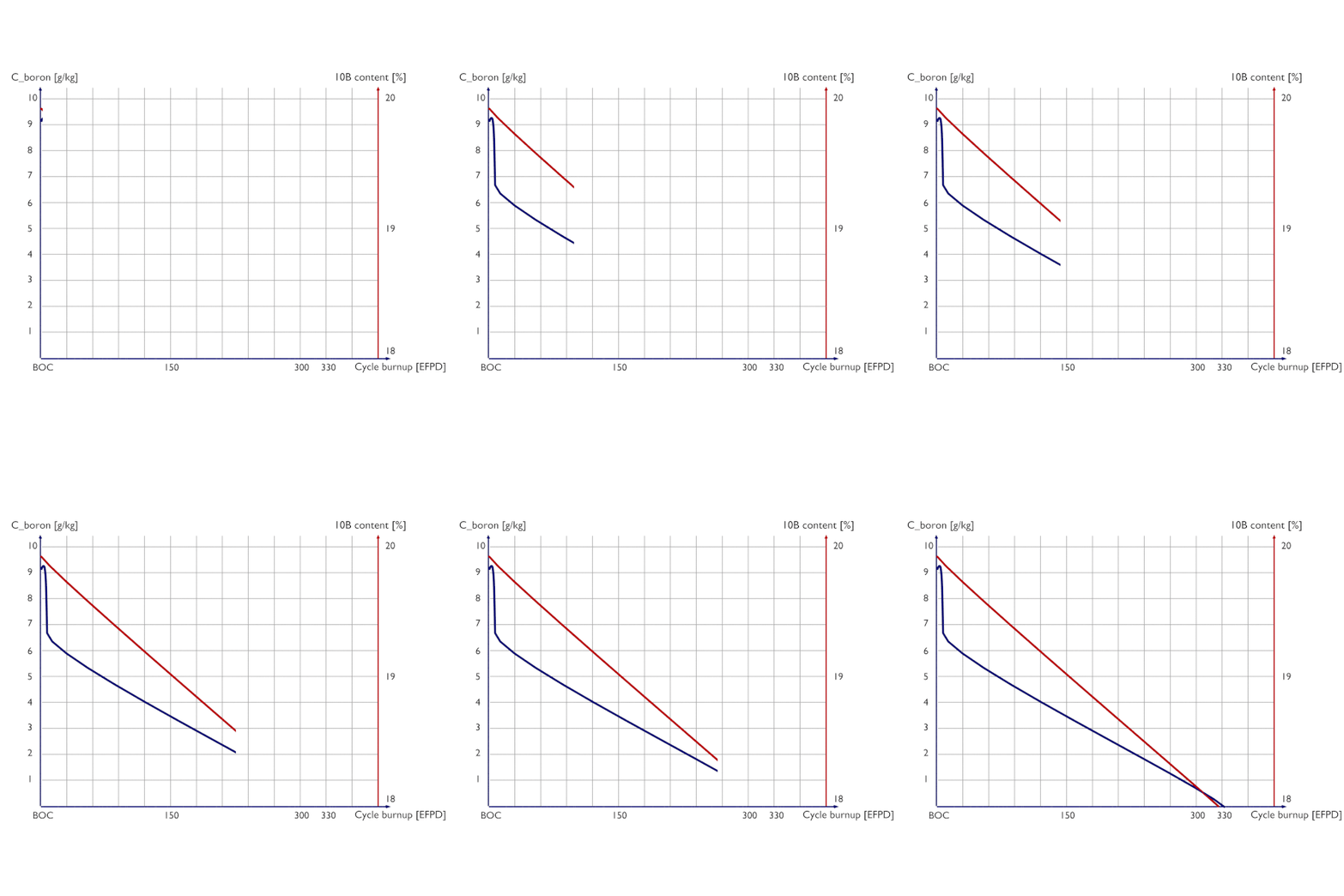
Boron letdown curve (chemical shim) and boron 10 depletion

Boron letdown curve (chemical shim) and boron 10 depletion during a 12-month fuel cycle.

At the beginning of specific fuel cycle concentration of boric acid is highest. At the end of this cycle concentration of boric acid is almost zero and a reactor must be refueled, because there is no positive reactivity that can be inserted to compensate negative reactivity of fuel burnup (increase in reactor slagging).

 
Applications of boron based materials
  • Chemical shim. By chemical shim, we mean that boric acid is dissolved in the coolant/moderator. Chemical shim is used to long term reactivity control.
  • Control rods. Many control rods use isotope 10B as a neutron absorbing material.
  • Safety systems. The one of three primary objectives of nuclear reactor safety systems is to shutdown the reactor and maintain it in a shutdown condition. Therefore all safety systems (which must ensure subcriticality of the reactor after the transient) use high concentrations of boric acid.
  • Burnable absorbers. Isotope 10B is widely used as the integral burnable absorber. When compared to gadolinium absorber (another commonly used burnable material), 10B has an order of magnitude smaller cross-sections. Therefore 10B compensate reactivity longer, but not so heavily.
  • Converter in neutron detectors. Neutrons are not directly ionizing and they have usually to be converted into charged particles before they can be detected. Most common isotope for the neutron converter material is 10B.
Boric Acid - Chemical Shim
By chemical shim, we mean that boric acid is dissolved in the coolant/moderator. Boric acid (molecular formula: H3BO3), is a white powder that is soluble in water. In pressurized water reactors, chemical shim (boric acid) is used to compensate an excess of reactivity of reactor core along the fuel burnup (long term reactivity control). At the beginning of specific fuel cycle concentration of boric acid is highest (see picture). At the end of this cycle concentration of boric acid is almost zero and a reactor must be refueled.

In certain cases also fine power changes can be controlled by chemical shim. If it is desired to increase power, then the boric acid concentration must be diluted, removing 10B from the reactor core and decreasing its poisoning effect. When compared with burnable absorbers (long term reactivity control) or with control rods (rapid reactivity control) the boric acid avoids the unevenness of neutron-flux density in the reactor core, because it is dissolved homogeneously in the coolant in entire reactor core. On the other hand high concentrations of boric acid may lead to positive moderator temperature coefficient and that is undesirable. In this case more burnable absorbers must be used.

Moreover this method is slow in controlling reactivity. Normally, it takes several minutes to change the concentration (dilute or borate) of the boric acid in the primary loop. For rapid changes of reactivity control rods must be used.

Boron 10 Depletion
Since the isotope 10B has a significantly higher neutron cross-section, the 10B depletes much more faster than 11B. Without the addition of fresh boron (19,9% of 10B) into the primary coolant system the enrichment of 10B in boric acid continuously decreases. In the result the enrichment of 10B at the end of the fuel cycle can be for example below 18% of 10B. This phenomenon must be considered in all the criticality calculations (e.g. shutdown margin calculations, estimated critical conditions or general core depletion calculations).

See also:

Glossary

We hope, this article, Boron 10, helps you. If so, give us a like in the sidebar. Main purpose of this website is to help the public to learn some interesting and important information about materials and their properties.
What is Cadmium 113 edge – Definition

113Cd has specific absorption cross-section with cut-off energy (Cadmium edge). Neutrons of kinetic energy below the cadmium cut-off energy (~0.5 eV) are strongly absorbed by 113Cd. Material Properties
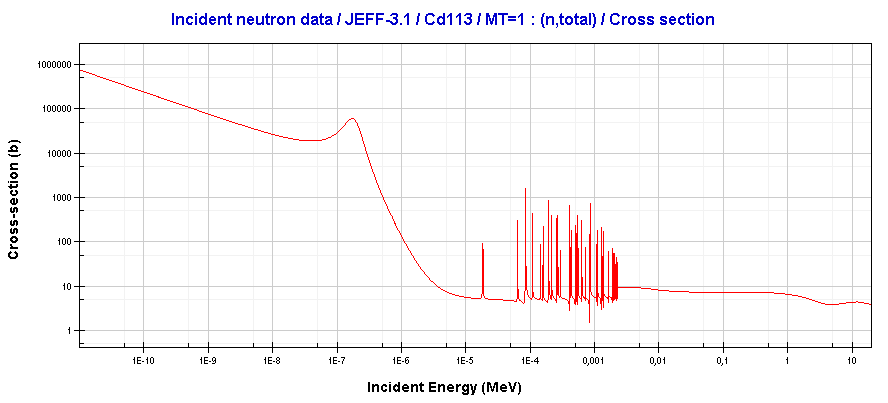
113Cd has specific absorption cross-section. There is a cadmium cut-off energy (Cadmium edge) in the absorption cross-section. Only neutrons of kinetic energy below the cadmium cut-off energy (~0.5 eV) are strongly absorbed by 113Cd. Therefore cadmium is widely used to absorb thermal neutrons in a thermal neutron filters.

n+_{48}^{113}textrm{Cd}  {rightarrow} _{48}^{114}textrm{Cd^{star}} rightarrow  _{48}^{114}textrm{Cd} +gamma

Cadmium cut-off energy
Neutrons of kinetic energy below the cadmium cut-off energy (~0.5 eV) are strongly absorbed by 113-Cd.
Source: JANIS (Java-based Nuclear Data Information Software); The JEFF-3.1 Nuclear Data Library

See also:

Cadmium

We hope, this article, Cadmium 113 edge, helps you. If so, give us a like in the sidebar. Main purpose of this website is to help the public to learn some interesting and important information about materials and their properties.
What is Cadmium – Definition

Cadmium is a naturally-occurring chemical element with atomic number 48. In nuclear industry cadmium is commonly used as a thermal neutron absorber. Material Properties
Cadmium is a naturally-occurring chemical element with atomic number 48 which means there are 48 protons and 48 electrons in the atomic structure. The chemical symbol for cadmium is Cd. Cadmium was first discovered in 1817 by two German chemists – Friedrich Stromeyer and Karl Samuel Leberecht Hermann.

Natural cadmium consists of eight isotopes, 106Cd (1.3%),  108Cd (0.9%), 110Cd (12.5%), 111Cd (12.8%), 112Cd (24.3%), 113Cd (12.2%), 114Cd (28.7%) and 116Cd (7.5%). Two of them are radioactive isotopes with very long half-life (113Cd – 7.7 x 10¹⁵ y and 116Cd – 2.9 x 10¹⁹ y).

In nuclear industry cadmium is commonly used as a thermal neutron absorber due to very high neutron absorption cross-section of 113Cd. 113Cd has specific absorption cross-section. There is a cadmium cut-off energy (Cadmium edge) in the absorption cross-section. Only neutrons of kinetic energy below the cadmium cut-off energy (~0.5 eV) are strongly absorbed by 113Cd. Therefore cadmium is widely used to absorb thermal neutrons in a thermal neutron filters.

n+_{48}^{113}textrm{Cd}  {rightarrow} _{48}^{114}textrm{Cd^{star}} rightarrow  _{48}^{114}textrm{Cd} +gamma

Cadmium cut-off energy
Neutrons of kinetic energy below the cadmium cut-off energy (~0.5 eV) are strongly absorbed by 113-Cd.

Source: JANIS (Java-based Nuclear Data Information Software); The JEFF-3.1 Nuclear Data Library

See also:

Glossary

We hope, this article, Cadmium, helps you. If so, give us a like in the sidebar. Main purpose of this website is to help the public to learn some interesting and important information about materials and their properties.
What is Thorium 232 – Definition

Thorium 232 is the most common isotope of thorium in the nature. 232Th is a fertile isotope, but is not capable of undergoing fission reaction after absorbing thermal neutron. Material Properties

Thorium 232

Thorium 232, which alone makes up nearly all natural thorium, is the most common isotope of thorium in the nature. This isotope has the longest half-life (1.4 x 10¹⁰ years) of all isotopes with more than 83 protons. In fact, its half-life is considerably longer than the age of earth. Therefore 232Th belongs to primordial nuclides.232Th decays via alpha decay into 228Ra . 232Th  occasionally decays by spontaneous fission with very low probability of 1.1 x 10-9 %.

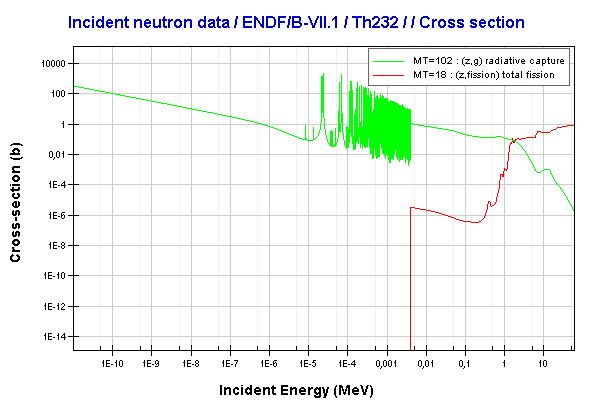
232Th is a fertile isotope. 232Th is not capable of undergoing fission reaction after absorbing thermal neutron, on the other hand 232Th can be fissioned by fast neutron with energy higher than >1MeV. 232Th does not meet also alternative requirement to fissile materials. 232Th is not capable of sustaining a nuclear fission chain reaction, because too many of neutrons produced by fission of 232Th have lower energies than original neutron.Isotope 232Th is key material in the thorium fuel cycle. Radiative capture of a neutron leads to the formation of fissile 233U. This process is called nuclear fuel breeding. 

Uranium 233 breeding
n+_{90}^{232}textrm{Th} {rightarrow} _{90}^{232}textrm{Th}+gamma rightarrow _{91}^{233}textrm{Pa} rightarrow _{92}^{233}textrm{U}232Th is the predominant isotope of natural thorium. If this fertile material is loaded in the nuclear reactor, the nuclei of 232Th absorb a neutron and become nuclei of 233Th. The half-life of 233Th is approximately 21.8 minutes. 233Th decays (negative beta decay) to 233Pa (protactinium), whose half-life is 26.97 days. 233Pa decays (negative beta decay)  to 233U, that is very good fissile material. On the other hand proposed reactor designs must attempt to physically isolate the protactinium from further neutron capture before beta decay can occur.
What is Thorium
Thorium is a naturally-occurring chemical element with atomic number 90 which means there are 90 protons and 90 electrons in the atomic structure. The chemical symbol for thorium is Th. Thorium was discovered in 1828 by norwegian mineralogist Morten Thrane Esmark. Joens Jakob Berzelius, the swedish chemist, named it after Thor, the Norse god of thunder.Thorium  is a naturally-occurring element and it is estimated to be about three times more abundant than uranium. Thorium is commonly found in monazite sands (rare earth metals containing phosphate mineral).Thorium has 6 naturally occurring isotopes. All of these isotopes are unstable (radioactive), but only 232Th is relatively stable with half-life of 14 billion years, which is comparable to the age of the Earth (~4.5×10⁹ years). Isotope 232Th belongs to primordial nuclides and natural thorium consists primarily of isotope 232Th. Other isotopes (230Th, 229Th, 228Th, 234Th and 227Th) occur in nature as trace radioisotopes, which originate from decay of 232Th, 235U and 238U.

Fissile / Fertile Material Cross-sectionsFissile / Fertile Material Cross-sections. Comparison of total fission cross-sections.Source: JANIS (Java-based Nuclear Data Information Software); ENDF/B-VII.1Fissile / Fertile Material Cross-sectionsSource of data: JANIS (Java-based Nuclear Data Information Software); ENDF/B-VII.1

See above:See also:

Thorium

We hope, this article, Thorium 232, helps you. If so, give us a like in the sidebar. Main purpose of this website is to help the public to learn some interesting and important information about materials and their properties.
What is Thorium – Definition

What is Thorium. Thorium is a naturally-occurring chemical element with atomic number 90. The chemical symbol for thorium is Th. Material Properties

What is Thorium

Thorium is a naturally-occurring chemical element with atomic number 90 which means there are 90 protons and 90 electrons in the atomic structure. The chemical symbol for thorium is Th. Thorium was discovered in 1828 by norwegian mineralogist Morten Thrane Esmark. Joens Jakob Berzelius, the swedish chemist, named it after Thor, the Norse god of thunder.

Thorium  is a naturally-occurring element and it is estimated to be about three times more abundant than uranium. Thorium is commonly found in monazite sands (rare earth metals containing phosphate mineral).

Thorium has 6 naturally occurring isotopes. All of these isotopes are unstable (radioactive), but only 232Th is relatively stable with half-life of 14 billion years, which is comparable to the age of the Earth (~4.5×10⁹ years). Isotope 232Th belongs to primordial nuclides and natural thorium consists primarily of isotope 232Th. Other isotopes (230Th, 229Th, 228Th, 234Th and 227Th) occur in nature as trace radioisotopes, which originate from decay of 232Th, 235U and 238U.

Fissile / Fertile Material Cross-sectionsFissile / Fertile Material Cross-sections. Comparison of total fission cross-sections.Source: JANIS (Java-based Nuclear Data Information Software); ENDF/B-VII.1Fissile / Fertile Material Cross-sectionsSource of data: JANIS (Java-based Nuclear Data Information Software); ENDF/B-VII.1

Thorium 232

Thorium 232, which alone makes up nearly all natural thorium, is the most common isotope of thorium in the nature. This isotope has the longest half-life (1.4 x 10¹⁰ years) of all isotopes with more than 83 protons. In fact, its half-life is considerably longer than the age of earth. Therefore 232Th belongs to primordial nuclides.

232Th decays via alpha decay into 228Ra . 232Th  occasionally decays by spontaneous fission with very low probability of 1.1 x 10-9 %.

232Th is a fertile isotope. 232Th is not capable of undergoing fission reaction after absorbing thermal neutron, on the other hand 232Th can be fissioned by fast neutron with energy higher than >1MeV. 232Th does not meet also alternative requirement to fissile materials. 232Th is not capable of sustaining a nuclear fission chain reaction, because too many of neutrons produced by fission of 232Th have lower energies than original neutron.

Isotope 232Th is key material in the thorium fuel cycle. Radiative capture of a neutron leads to the formation of fissile 233U. This process is called nuclear fuel breeding.

 
Uranium 233 breeding
n+_{90}^{232}textrm{Th}  {rightarrow} _{90}^{232}textrm{Th}+gamma rightarrow  _{91}^{233}textrm{Pa} rightarrow  _{92}^{233}textrm{U}

232Th is the predominant isotope of natural thorium. If this fertile material is loaded in the nuclear reactor, the nuclei of 232Th absorb a neutron and become nuclei of 233Th. The half-life of 233Th is approximately 21.8 minutes. 233Th decays (negative beta decay) to 233Pa (protactinium), whose half-life is 26.97 days. 233Pa decays (negative beta decay)  to 233U, that is very good fissile material. On the other hand proposed reactor designs must attempt to physically isolate the protactinium from further neutron capture before beta decay can occur.

See also:

Plutonium

See also:

Nuclear Fuel

See also:

We hope, this article, Thorium, helps you. If so, give us a like in the sidebar. Main purpose of this website is to help the public to learn some interesting and important information about materials and their properties.
What is Plutonium 241 – Definition

241Pu is a fissile isotope of plutonium. Isotope 241Pu is formed in a nuclear reactor from fertile isotope 240Pu. 241Pu decays via beta decay into 241Am. Material Properties

Plutonium 241

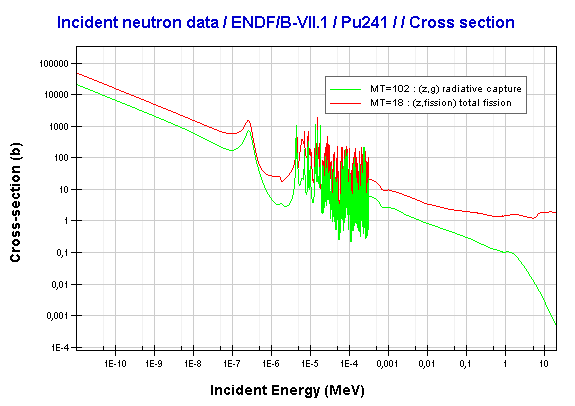
241Pu is a fissile isotope, which means 241Pu is capable of undergoing fission reaction after absorbing thermal neutron. Moreover 241Pu meets also alternative requirement that the amount of neutrons produced by fission of 241Pu (~2.94 per one fission by thermal neutron) is sufficient to sustain a nuclear fission chain reaction. Its fission cross-section for thermal neutrons is about 1012 barns (for 0.025 eV neutron). For fast neutrons its fission cross-section is on the order of barns.

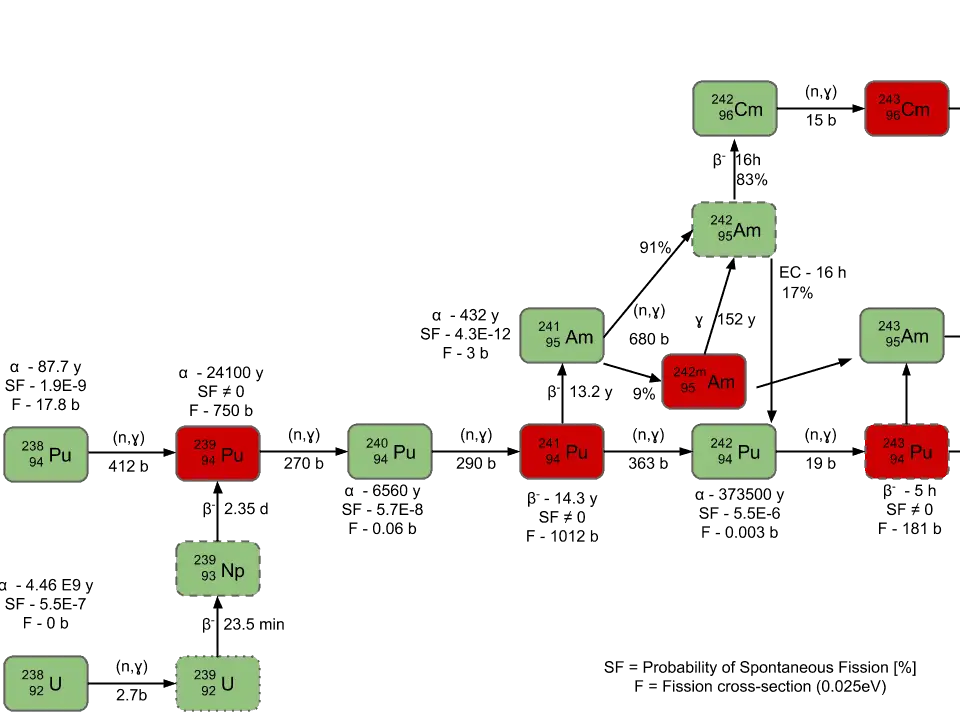
Most of absorption reactions result in fission reaction, but a part of reactions result in radiative capture forming 242Pu. The cross-section for radiative capture for thermal neutrons is about 363 barns (for 0.025 eV neutron). Therefore about 74% of all absorption reactions result in radiative capture of neutron. About 26% of all absorption reactions result in fission.

It is a man-made isotope and can be found in an irradiated uranium fuel or in a spent uranium fuel. Isotope 241Pu is formed in a nuclear reactor from fertile isotope 240Pu. Absorption of a resonance or thermal neutron by the 240Pu nucleus yields 241Pu.241Pu decays via beta decay into 241Am with half-life of only 14.3 years. 241Am has relatively high cross-section for radiative capture for thermal neutrons (~680 barns – 0.025eV). This two phenomena (decrease in fissile isotope and increase in neutron absorber) cause slight decrease in reactivity of irradiated fuel when stored in a spent fuel pool.

Fissile / Fertile Material Cross-sectionsFissile / Fertile Material Cross-sections. Comparison of total fission cross-sections.Source: JANIS (Java-based Nuclear Data Information Software); ENDF/B-VII.1
Fissile / Fertile Material Cross-sectionsPlutonium 241. Comparison of total fission cross-section and cross-section for radiative capture.  Source: JANIS (Java-based Nuclear Data Information Software); ENDF/B-VII.1
plutonium breedingSource of data: JANIS (Java-based Nuclear Data Information Software); The JEFF-3.1.1 Nuclear Data Library

See also:

Plutonium 240

See also:

Plutonium

See also:

We hope, this article, Plutonium 241, helps you. If so, give us a like in the sidebar. Main purpose of this website is to help the public to learn some interesting and important information about materials and their properties.

What is Plutonium 240 – Definition

Plutonium 240 is a fertile isotope because its fission cross-section is very low in comparison with fissile isotopes. Isotope 240Pu is formed in a nuclear reactor. Material Properties

Plutonium 240

240Pu is a fertile isotope because its fission cross-section is very low in comparison with fissile isotopes. Radiative capture of a neutron leads to the formation of fissile 241Pu similarly to 238U which radiative capture leads to the formation of fissile 239Pu.

It is a man-made isotope and can be found in an irradiated uranium fuel or in a spent uranium fuel. Isotope 240Pu is formed in a nuclear reactor from fissile isotope 239Pu. Absorption of a resonance or thermal neutron by the 239Pu nucleus yields 240Pu.  Trace amounts can be found in the nature. The isotope 240Pu is in a decay chain of the primordial isotope 244Pu.  These nuclei are present in the unalterable proportions of the radioactive equilibrium between 244Pu and 240Pu.

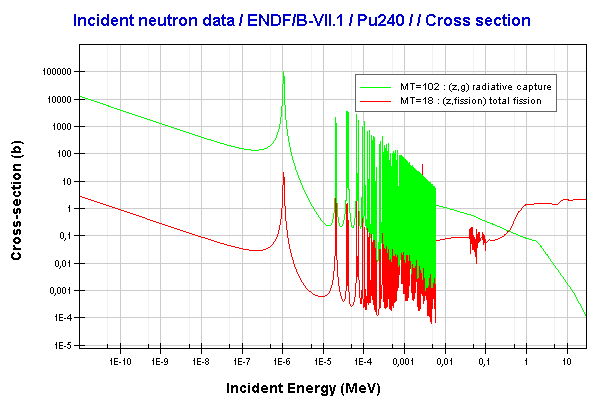
240Pu has relatively high radiative capture cross-section (about 290 barns for thermal neutrons).240Pu decays via alpha decay into 236U with half-life of 6560 years.

Fissile / Fertile Material Cross-sectionsFissile / Fertile Material Cross-sections. Comparison of total fission cross-sections.Source: JANIS (Java-based Nuclear Data Information Software); ENDF/B-VII.1
Fissile / Fertile Material Cross-sectionsPlutonium 240. Comparison of total fission cross-section and cross-section for radiative capture.  Source: JANIS (Java-based Nuclear Data Information Software); ENDF/B-VII.1
plutonium breedingSource of data: JANIS (Java-based Nuclear Data Information Software); The JEFF-3.1.1 Nuclear Data Library

See also:

Plutonium 239

See also:

Plutonium

See also:

Plutonium 241

We hope, this article, Plutonium 240, helps you. If so, give us a like in the sidebar. Main purpose of this website is to help the public to learn some interesting and important information about materials and their properties.

What is Plutonium 239 – Definition

Plutonium 239 is a fissile isotope and its fission cross-section for thermal neutrons is about 750 barns (for 0.025 eV neutron). Material Properties

Plutonium 239

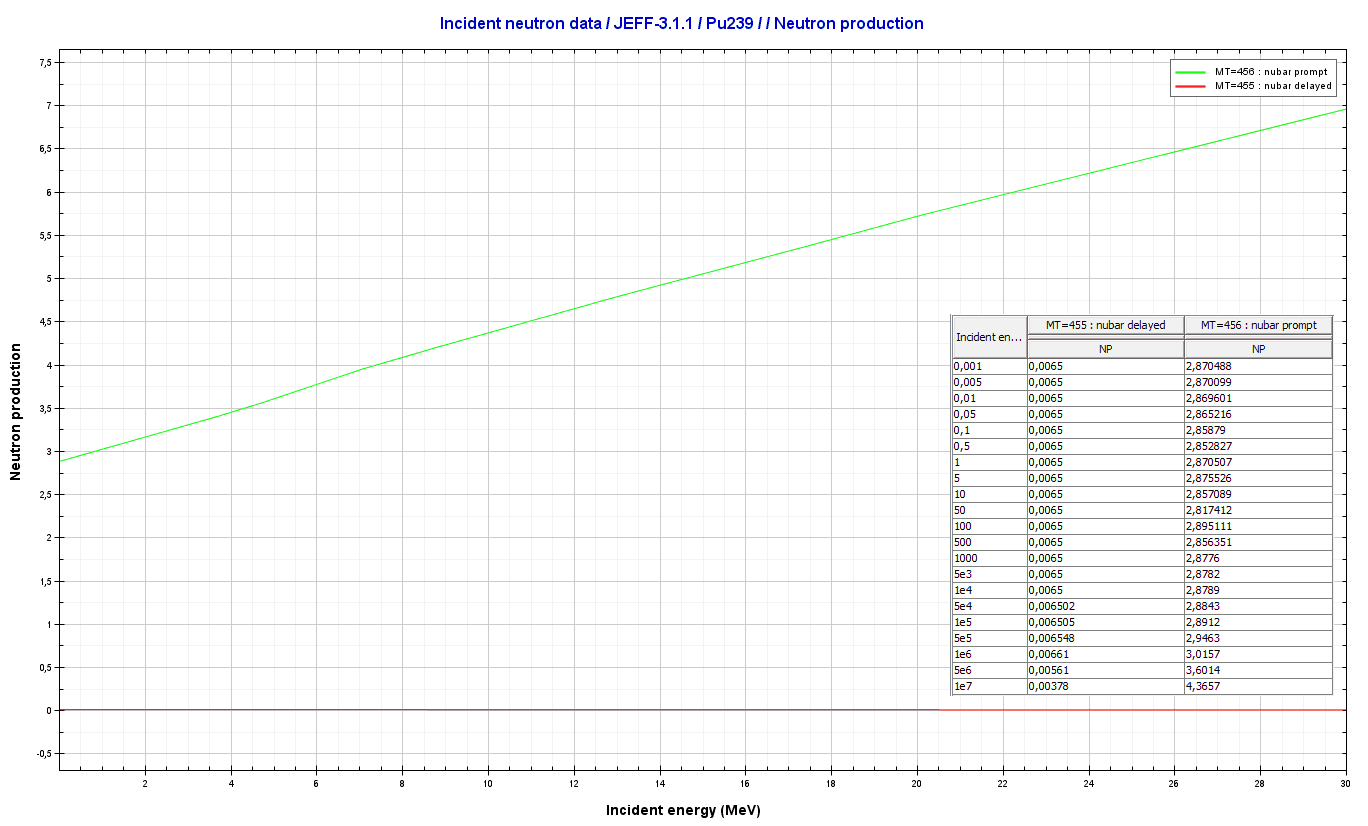
239Pu is a fissile isotope, which means 239Pu is capable of undergoing fission reaction after absorbing thermal neutron. Moreover, 239Pu meets also alternative requirement that the amount (~2.88 per one fission by thermal neutron) of neutrons produced by fission of 239Pu is sufficient to sustain a nuclear fission chain reaction. This isotope is the principal fissile isotope of plutonium in use.It is a man-made isotope and can be found in an irradiated uranium fuel or in a spent uranium fuel. Isotope 239Pu is formed in a nuclear reactor from fertile isotope 238U, which constitute more than 95% of uranium fuel (e.g.  PWRs and BWRs require 3% – 5% of 235U). Absorption of a resonance or thermal neutron by the 238U nucleus yields 239U. The half-life of 239U is approximately 23.5 minutes. 239U decays (negative beta decay) to 239Np (neptunium), whose half-life is 2.36 days. 239Np decays (negative beta decay)  to 239Pu. The transmutation and decay chain is shown below:Equation - Plutonium 239 breeding from Uranium 238239Pu itself decays via alpha decay into 235U with half-life of 24 100 years. 239Pu occasionally decays by spontaneous fission with very low rate of 0.00000000031%. On the other hand 239Pu has very high absorption cross-section for thermal neutrons. When loaded into the reactor core 239Pu can be easily fissioned by a neutron or can be transformed into the 240Pu via a radiative capture reaction.

Plutonium 239 Fission

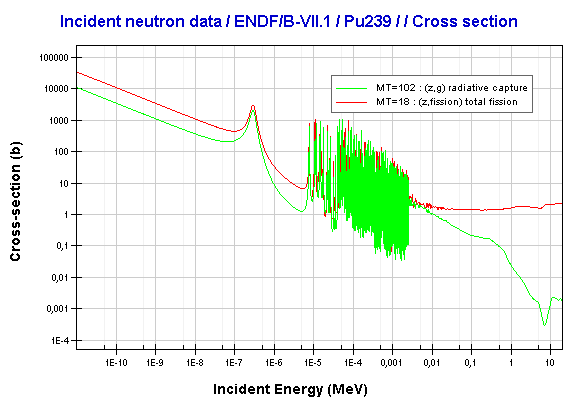
Plutonium 239 is a fissile isotope and its fission cross-section for thermal neutrons is about 750 barns (for 0.025 eV neutron). For fast neutrons its fission cross-section is on the order of barns. Most of absorption reactions result in fission reaction, but a part of reactions result in radiative capture forming 240Pu. The cross-section for radiative capture for thermal neutrons is about 270 barns (for 0.025 eV neutron). Therefore about 27% of all absorption reactions result in radiative capture of incident neutron. About 73% of all absorption reactions result in fission.

Plutonium fission vs. radiative capture

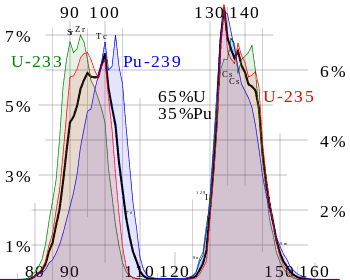
Typically, when plutonium 239 nucleus undergoes fission, the nucleus splits into two smaller nuclei (triple fission can also rarely occur), along with a few neutrons (the average is 2.89 neutrons per fission by thermal neutron) and release of energy in the form of heat and gamma rays. The average of the fragment atomic mass is about 120, but very few fragments near that average are found. It is much more probable to break up into unequal fragments, and the most probable fragment masses are around mass numbers 103 and 134 (and around atomic numbers 40 – Zirconium and 54 – Xenon).

Most of these fission fragments are highly unstable (radioactive) and undergo further radioactive decays to stabilize itself, therefore part of the released energy is radiated away from the reactor. On the other hand most of the energy released by one fission (~175MeV of total ~207MeV) appears as kinetic energy of these fission fragments. The fission fragments interact strongly with the surrounding atoms or molecules traveling at high speed, causing them to ionize. Creation of ion pairs requires energy, which is lost from the kinetic energy of the charged fission fragment causing it to decelerate. The positive ions and free electrons created by the passage of the charged fission fragment will then reunite, releasing energy in the form of heat (e.g. vibrational energy or rotational energy of atoms). This is the principle how fission fragments heat up fuel in the reactor core.

Fission Fragments
plutonium breedingSource of data: JANIS (Java-based Nuclear Data Information Software); The JEFF-3.1.1 Nuclear Data Library
Fissile / Fertile Material Cross-sectionsFissile / Fertile Material Cross-sections. Comparison of total fission cross-sections.Source: JANIS (Java-based Nuclear Data Information Software); ENDF/B-VII.1
Fissile / Fertile Material Cross-sectionsPlutonium 239. Comparison of total fission cross-section and cross-section for radiative capture.

Source: JANIS (Java-based Nuclear Data Information Software); ENDF/B-VII.1

Neutron production per one fission of Plutonium 239.Neutron production per one fission of Plutonium 239.
Source: JANIS (Java-based Nuclear Data Information Software)
The JEFF-3.1.1 Nuclear Data Library
Fission fragment yieldsFission fragment yield for different nuclei. The most probable fragment masses for 239Pu fission are around mass 103 (Zirconium) and 134 (Xenon).

See also:

Half-life of Plutonium

See also:

Plutonium

See also:

Plutonium 240

We hope, this article, Plutonium 239, helps you. If so, give us a like in the sidebar. Main purpose of this website is to help the public to learn some interesting and important information about materials and their properties.

What is Half-life and Decay Mode of Isotopes of Plutonium – Definition

This page summarizes basic decay properties of isotopes of plutonium. Half-lifes, decay modes, products of decay. Isotopes 238, 239, 240, 241, 242, 243, 244

Half-lifes of Isotopes of Plutonium

Isotope Half-life / Decay mode Product
238Pu 87.7 y / alpha decay 234U
239Pu 24 100 y / alpha decay 235U
240Pu 6 560 y / alpha decay 236U
241Pu  14.3 y / beta decay 241Am
242Pu  373 500 y / alpha decay 238U
243Pu  4.96 d / beta decay 243Am
244Pu  80 000 000 y / alpha decay 240Pu
Half-life of plutonium isotopes.Half-lifes of isotopes of plutonium.Source: Java-based Nuclear Data Information SoftwareLibrary: The JEFF-3.1.1 Nuclear Data Library

See also:

Plutonium Isotopes

See also:

Plutonium

See also:

Plutonium 239

We hope, this article, Half-life and Decay Mode of Isotopes of Plutonium, helps you. If so, give us a like in the sidebar. Main purpose of this website is to help the public to learn some interesting and important information about materials and their properties.
What is Plutonium Isotope – Definition

About twenty plutonium isotopes have been discovered and described. The main isotopes, which have to be considered in the fuel cycle of all commercial light water reactors, are here. Material Properties
About twenty plutonium isotopes have been discovered and described. Except 244Pu, all these isotopes are artificial isotopes. The main isotopes, which have to be considered in the fuel cycle of all commercial light water reactors, are:
  • 238Pu. 238Pu belongs to the group of fertile isotopes. 238Pu decays via alpha decay to 234U with half-life of 87.7 years. 238Pu generates very high decay heat and has very high rate of spontaneous fission.
  • 239Pu. 239Pu belongs to the group of fissile isotopes. 239Pu decays via alpha decay to 235U with half-life of 24100 years. This isotope is the principal fissile isotope in use.
  • 240Pu. 240Pu belongs to the group of fertile isotopes. 240Pu decays via alpha decay to 236U with half-life of 6560 years. 240Pu has very high rate of spontaneous fission and has high radiative capture cross-section for thermal and also for resonance neutrons.
  • 241Pu. 241Pu belongs to the group of fissile isotopes. 241Pu decays via negative beta decay to 241Am with half-life of 14.3 years. This fissile isotope decays to non-fissile isotope with high radiative capture cross-section for thermal neutrons. An impact on reactivity of the nuclear fuel  is obvious.
  • 242Pu. 242Pu belongs to the group of non-fissile isotopes. 242Pu decays via alpha decay to 238U with half-life of 37300 years. 242Pu has very high rate of spontaneous fission but its quantity in the irradiated nuclear fuel is relatively low.
Fissile / Fertile Material Cross-sectionsFissile / Fertile Material Cross-sections. Comparison of total fission cross-sections.Source: JANIS (Java-based Nuclear Data Information Software); ENDF/B-VII.1plutonium breedingSource of data: JANIS (Java-based Nuclear Data Information Software); The JEFF-3.1.1 Nuclear Data Library

See also:

Plutonium and Power Reactors

See also:

Plutonium

See also:

Half-life of Plutonium

We hope, this article, Plutonium Isotope, helps you. If so, give us a like in the sidebar. Main purpose of this website is to help the public to learn some interesting and important information about materials and their properties.