 Light metals and its alloys are materials of relatively low density and high strength-to-weight ratios. These metals and alloys are of great importance in engineering applications for use in land, sea, air, and space transportation. Magnesium, aluminium and titanium are light metals of significant commercial importance. These three metals and their alloys comprise the bulk of the high strength-to-weight ratio metallic materials used in industrial systems. Aluminium is the most versatile of these materials and titanium is the most corrosion resistant with very high strength, while magnesium has the lowest density. Their densities of 1.7 (magnesium), 2.7 (aluminium) and 4.5 g/cm3 (titanium) range from 19 to 56% of the densities of the older structural metals, iron (7.9g/cm3) and copper (8.9 g/cm3). The metals commonly classed as light metals are those whose density is less than the density of steel (7.8 g/cm3, or 0.28 lb/in.3).
Since these pure metals are usually softer materials with insufficient strength, they must be alloyed to reach target mechanical properties. For example, high purity aluminium is a soft material with the ultimate strength of approximately 10 MPa, which limits its usability in industrial applications. On the other hand, tensile strength of 6061 aluminium alloy may reach more than 290 MPa depending on the temper of the material. Therefore, we are discussing primarily the alloys instead of pure metals.
Density of Light Metals and Alloys
Density of typical aluminium alloy is 2.7 g/cm3 (6061 alloy).
Density of typical magnesium alloy is 1.8 g/cm3 (Elektron 21).
Density of typical titanium alloy is 4.43 g/cm3 (Ti-6Al-4V).
Density is defined as the mass per unit volume. It is an intensive property, which is mathematically defined as mass divided by volume:
ρ = m/V
In words, the density (ρ) of a substance is the total mass (m) of that substance divided by the total volume (V) occupied by that substance. The standard SI unit is kilograms per cubic meter (kg/m3). The Standard English unit is pounds mass per cubic foot (lbm/ft3).
Since the density (ρ) of a substance is the total mass (m) of that substance divided by the total volume (V) occupied by that substance, it is obvious, the density of a substance strongly depends on its atomic mass and also on the atomic number density (N; atoms/cm3),
- Atomic Weight. The atomic mass is carried by the atomic nucleus, which occupies only about 10-12 of the total volume of the atom or less, but it contains all the positive charge and at least 99.95% of the total mass of the atom. Therefore it is determined by the mass number (number of protons and neutrons).
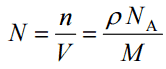
- Atomic Number Density. The atomic number density (N; atoms/cm3), which is associated with atomic radii, is the number of atoms of a given type per unit volume (V; cm3) of the material. The atomic number density (N; atoms/cm3) of a pure material having atomic or molecular weight (M; grams/mol) and the material density (⍴; gram/cm3) is easily computed from the following equation using Avogadro’s number (NA = 6.022×10²³ atoms or molecules per mole):
- Crystal Structure. Density of crystalline substance is significantly affected by its crystal structure. FCC structure, along with its hexagonal relative (hcp), has the most efficient packing factor (74%). Metals containing FCC structures include austenite, aluminum, copper, lead, silver, gold, nickel, platinum, and thorium.
We hope, this article, Density of Light Metals and Alloys, helps you. If so, give us a like in the sidebar. Main purpose of this website is to help the public to learn some interesting and important information about materials and their properties.