The Standard Kilogram. The SI standard of mass is a cylinder of platinum and iridium that is kept at the International Bureau of Weights and Measures
Standard Kilogram
The Standard Kilogram
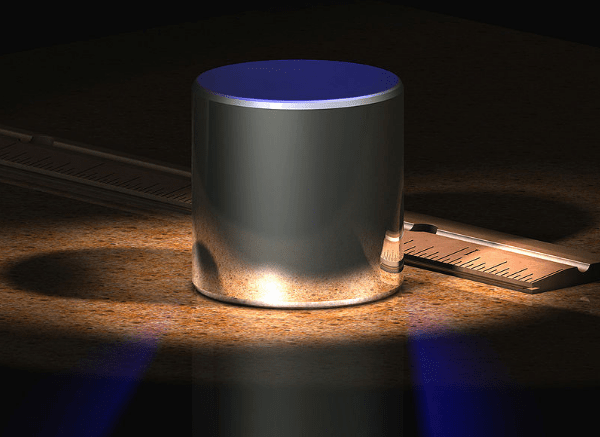
The usual symbol for mass is m and its SI unit is the kilogram. The SI standard of mass is a cylinder of platinum and iridium that is kept at the International Bureau of Weights and Measures near Paris and assigned, by international agreement, a mass of 1 kilogram.
A computer-generated image of the International Prototype kilogram (IPK), which is made from an alloy of 90% platinum and 10% iridium (by weight) and machined into a right-circular cylinder (height = diameter) of 39.17 mm. Source: wikipedia.org; License: CC BY-SA
References:
Reactor Physics and Thermal Hydraulics:
J. R. Lamarsh, Introduction to Nuclear Reactor Theory, 2nd ed., Addison-Wesley, Reading, MA (1983).
J. R. Lamarsh, A. J. Baratta, Introduction to Nuclear Engineering, 3d ed., Prentice-Hall, 2001, ISBN: 0-201-82498-1.
W. M. Stacey, Nuclear Reactor Physics, John Wiley & Sons, 2001, ISBN: 0- 471-39127-1.
Todreas Neil E., Kazimi Mujid S. Nuclear Systems Volume I: Thermal Hydraulic Fundamentals, Second Edition. CRC Press; 2 edition, 2012, ISBN: 978-0415802871
Zohuri B., McDaniel P. thermodynamics in Nuclear Power Plant Systems. Springer; 2015, ISBN: 978-3-319-13419-2
Moran Michal J., Shapiro Howard N. Fundamentals of Engineering thermodynamics, Fifth Edition, John Wiley & Sons, 2006, ISBN: 978-0-470-03037-0
Kleinstreuer C. Modern Fluid Dynamics. Springer, 2010, ISBN 978-1-4020-8670-0.
U.S. Department of Energy, thermodynamics, HEAT TRANSFER, AND FLUID FLOW. DOE Fundamentals Handbook, Volume 1, 2 and 3. June 1992.
See also:
Mass and Weight
We hope, this article, Standard Kilogram, helps you. If so, give us a like in the sidebar. Main purpose of this website is to help the public to learn some interesting and important information about materials and their properties.
The weight of a stone on the Earth, on the Mars and on the Moon. These weights depends on the gravitational fields of these planets. Material Properties
Weight on Earth, Mars and Moon
Mass and weight are related: Bodies having large mass also have large weight. A large stone is hard to throw because of its large mass, and hard to lift off the ground because of its large weight. To understand the relationship between mass and weight, consider a freely falling stone, that has an acceleration of magnitude g (g = 9.81 m/s2 is the acceleration due to Earth’s gravitational field). Newton’s second law tells us that a force must act to produce this acceleration. If a 1 kilogram stone falls with an acceleration of the required force has magnitude:
F = ma = 1 [kg] x 9.81 [m/s2] = 9.8 [kg m/s2] = 9.8 N
The force that makes the body accelerate downward is its weight. Any body near the surface of the earth that has a mass of 1 kg must have a weight of 9.8 N to give it the acceleration we observe when it is in free fall.
Example: The weight of a stone on the Earth, on the Mars and on the Moon
Weight of a stone on the Earth
The acceleration due to Earth’s gravitational field is gEarth = 9.81 m/s2.The weight of a stone with mass 1 kg on the Earth can be calculated as:
FEarth = 1 [kg] x 9.81 [m/s2] = 9.8 [kg m/s2] = 9.8 N
Weight of a stone on the Mars
The acceleration of gravity on the Mars is approximately 38% of the acceleration of gravity on the earth. The acceleration due to Moon’s gravitational field is gMars = 3.71 m/s2.
Therefore the weight of the same stone with mass 1 kg on the Mars is:
FMoon = 1 [kg] x 3.71 [m/s2] = 3.71 [kg m/s2] = 3.71 N
Weight of a stone on the Moon
The acceleration of gravity on the Moon is approximately 1/6 of the acceleration of gravity on the earth. The acceleration due to Moon’s gravitational field is gMoon = 1.62 m/s2.
Therefore the weight of the same stone with mass 1 kg on the Moon is:
FMoon = 1 [kg] x 1.62 [m/s2] = 1.62 [kg m/s2] = 1.62 N
References:
Reactor Physics and Thermal Hydraulics:
J. R. Lamarsh, Introduction to Nuclear Reactor Theory, 2nd ed., Addison-Wesley, Reading, MA (1983).
J. R. Lamarsh, A. J. Baratta, Introduction to Nuclear Engineering, 3d ed., Prentice-Hall, 2001, ISBN: 0-201-82498-1.
W. M. Stacey, Nuclear Reactor Physics, John Wiley & Sons, 2001, ISBN: 0- 471-39127-1.
Todreas Neil E., Kazimi Mujid S. Nuclear Systems Volume I: Thermal Hydraulic Fundamentals, Second Edition. CRC Press; 2 edition, 2012, ISBN: 978-0415802871
Zohuri B., McDaniel P. thermodynamics in Nuclear Power Plant Systems. Springer; 2015, ISBN: 978-3-319-13419-2
Moran Michal J., Shapiro Howard N. Fundamentals of Engineering thermodynamics, Fifth Edition, John Wiley & Sons, 2006, ISBN: 978-0-470-03037-0
Kleinstreuer C. Modern Fluid Dynamics. Springer, 2010, ISBN 978-1-4020-8670-0.
U.S. Department of Energy, thermodynamics, HEAT TRANSFER, AND FLUID FLOW. DOE Fundamentals Handbook, Volume 1, 2 and 3. June 1992.
See also:
Mass and Weight
We hope, this article, Weight on Earth, Mars and Moon – Gravity, helps you. If so, give us a like in the sidebar. Main purpose of this website is to help the public to learn some interesting and important information about materials and their properties.
What is Mass. The mass of an object is a fundamental property of the object. It is a numerical measure of its inertia and the measure of an object’s resistance to acceleration. Material Properties
What is Mass
One of the most familiar forces is the weight of a body, which is the gravitational force that the earth exerts on the body. In general, gravitation is a natural phenomenon by which all things with mass are brought toward one another. The terms mass and weight are often confused with one another, but it is important to distinguish between them. It is absolutely essential to understand clearly the distinctions between these two physical quantities.
Law of Conservation of Matter
The law of conservation of matteror principle of matter conservation states that the mass of an object or collection of objects never changes over time, no matter how the constituent parts rearrange themselves.
The mass can neither be created nor destroyed.
The law requires that during any nuclear reaction, radioactive decay or chemical reaction in an isolated system, the total mass of the reactants or starting materials must be equal to the mass of the products.
The mass of an object is a fundamental property of the object. It is a numerical measure of its inertia and the measure of an object’s resistance to acceleration when a force is applied. It is also a fundamental measure of the amount of matter in the object. The greater the mass, the greater the force needed to cause a given acceleration. This is reflected in Newton’s second law (F=ma).
The mass of a certain body will remain constant even if the gravitational acceleration acting upon that body changes. For example, on earth an object has a certain mass and a certain weight. When the same object is placed in outer space, away from the earth’s gravitational field, its mass remains the same, but it is now in a “weightless” condition. This means in this condition it will weight zero, because gravitational acceleration and, thus, force will equal to zero.
Mass and weight are related: Bodies having large mass also have large weight. A large stone is hard to throw because of its large mass, and hard to lift off the ground because of its large weight. To understand the relationship between mass and weight, consider a freely falling stone, that has an acceleration of magnitude g (g = 9.81 m/s2 is the acceleration due to Earth’s gravitational field). Newton’s second law tells us that a force must act to produce this acceleration. If a 1 kilogram stone falls with an acceleration of the required force has magnitude:
F = ma = 1 [kg] x 9.81 [m/s2] = 9.8 [kg m/s2] = 9.8 N
The force that makes the body accelerate downward is its weight. Any body near the surface of the earth that has a mass of 1 kg must have a weight of 9.8 N to give it the acceleration we observe when it is in free fall.
Example: The weight of a stone on the Earth, on the Mars and on the Moon
Weight of a stone on the Earth
The acceleration due to Earth’s gravitational field is gEarth = 9.81 m/s2.The weight of a stone with mass 1 kg on the Earth can be calculated as:
FEarth = 1 [kg] x 9.81 [m/s2] = 9.8 [kg m/s2] = 9.8 N
Weight of a stone on the Mars
The acceleration of gravity on the Mars is approximately 38% of the acceleration of gravity on the earth. The acceleration due to Moon’s gravitational field is gMars = 3.71 m/s2.
Therefore the weight of the same stone with mass 1 kg on the Mars is:
FMoon = 1 [kg] x 3.71 [m/s2] = 3.71 [kg m/s2] = 3.71 N
Weight of a stone on the Moon
The acceleration of gravity on the Moon is approximately 1/6 of the acceleration of gravity on the earth. The acceleration due to Moon’s gravitational field is gMoon = 1.62 m/s2.
Therefore the weight of the same stone with mass 1 kg on the Moon is:
FMoon = 1 [kg] x 1.62 [m/s2] = 1.62 [kg m/s2] = 1.62 N
The Standard Kilogram
The usual symbol for mass is m and its SI unit is the kilogram. The SI standard of mass is a cylinder of platinum and iridium that is kept at the International Bureau of Weights and Measures near Paris and assigned, by international agreement, a mass of 1 kilogram.
A computer-generated image of the International Prototype kilogram (IPK), which is made from an alloy of 90% platinum and 10% iridium (by weight) and machined into a right-circular cylinder (height = diameter) of 39.17 mm. Source: wikipedia.org; License: CC BY-SA
In special theory of relativity certain types of matter may be created or destroyed, but in all of these processes, the mass and energy associated with such matter remains unchanged in quantity. It was found the rest mass of an atomic nucleus is measurably smaller than the sum of the rest masses of its constituent protons, neutrons and electrons. Mass was no longer considered unchangeable in the closed system. The difference is a measure of the nuclear binding energy which holds the nucleus together. According to the Einstein relationship (E=mc2), this binding energy is proportional to this mass difference and it is known as the mass defect.
Relativistic Mass
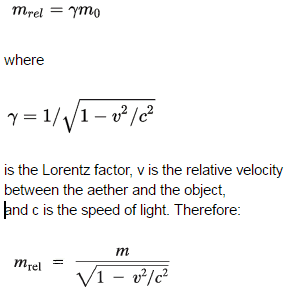
While the mass is normally considered to be an unchanging property of an object, at speeds approaching the speed of light one must consider the increase in the relativistic mass. The relativistic definition of momentum is sometimes interpreted as an increase in the mass of an object. In this interpretation, a particle can have a relativistic mass, mrel. The increase in effective mass with speed is given by the expression:
In this “mass-increase” formula, m is referred to as the rest mass of the object. It follows from this formula, that an object with nonzero rest mass cannot travel at the speed of light. As the object approaches the speed of light, the object’s momentum increase without bound. On the other hand, when the relative velocity is zero, the Lorentz factor is simply equal to 1, and the relativistic mass is reduced to the rest mass. With this interpretation, the mass of an object appears to increase as its speed increases. In must be added, many physicists believe an object has only one mass (its rest mass), and that it is only the momentum that increases with speed.
References:
Reactor Physics and Thermal Hydraulics:
J. R. Lamarsh, Introduction to Nuclear Reactor Theory, 2nd ed., Addison-Wesley, Reading, MA (1983).
J. R. Lamarsh, A. J. Baratta, Introduction to Nuclear Engineering, 3d ed., Prentice-Hall, 2001, ISBN: 0-201-82498-1.
W. M. Stacey, Nuclear Reactor Physics, John Wiley & Sons, 2001, ISBN: 0- 471-39127-1.
Todreas Neil E., Kazimi Mujid S. Nuclear Systems Volume I: Thermal Hydraulic Fundamentals, Second Edition. CRC Press; 2 edition, 2012, ISBN: 978-0415802871
Zohuri B., McDaniel P. thermodynamics in Nuclear Power Plant Systems. Springer; 2015, ISBN: 978-3-319-13419-2
Moran Michal J., Shapiro Howard N. Fundamentals of Engineering thermodynamics, Fifth Edition, John Wiley & Sons, 2006, ISBN: 978-0-470-03037-0
Kleinstreuer C. Modern Fluid Dynamics. Springer, 2010, ISBN 978-1-4020-8670-0.
U.S. Department of Energy, thermodynamics, HEAT TRANSFER, AND FLUID FLOW. DOE Fundamentals Handbook, Volume 1, 2 and 3. June 1992.
See also:
Mass and Weight
We hope, this article, Mass, helps you. If so, give us a like in the sidebar. Main purpose of this website is to help the public to learn some interesting and important information about materials and their properties.
What is mass and weight. The terms mass and weight are physical quantities and are often confused with one another, but it is important to distinguish between them. Material Properties
Mass and Weight
One of the most familiar forces is the weight of a body, which is the gravitational force that the earth exerts on the body. In general, gravitation is a natural phenomenon by which all things with mass are brought toward one another. The terms mass and weight are often confused with one another, but it is important to distinguish between them. It is absolutely essential to understand clearly the distinctions between these two physical quantities.
The mass of an object is a fundamental property of the object. It is a numerical measure of its inertia and the measure of an object’s resistance to acceleration when a force is applied. It is also a fundamental measure of the amount of matter in the object. The greater the mass, the greater the force needed to cause a given acceleration. This is reflected in Newton’s second law (F=ma).
The mass of a certain body will remain constant even if the gravitational acceleration acting upon that body changes. For example, on earth an object has a certain mass and a certain weight. When the same object is placed in outer space, away from the earth’s gravitational field, its mass remains the same, but it is now in a “weightless” condition. This means in this condition it will weight zero, because gravitational acceleration and, thus, force will equal to zero.
Mass and weight are related: Bodies having large mass also have large weight. A large stone is hard to throw because of its large mass, and hard to lift off the ground because of its large weight. To understand the relationship between mass and weight, consider a freely falling stone, that has an acceleration of magnitude g (g = 9.81 m/s2 is the acceleration due to Earth’s gravitational field). Newton’s second law tells us that a force must act to produce this acceleration. If a 1 kilogram stone falls with an acceleration of the required force has magnitude:
F = ma = 1 [kg] x 9.81 [m/s2] = 9.8 [kg m/s2] = 9.8 N
The force that makes the body accelerate downward is its weight. Any body near the surface of the earth that has a mass of 1 kg must have a weight of 9.8 N to give it the acceleration we observe when it is in free fall.
Example: The weight of a stone on the Earth, on the Mars and on the Moon
Weight of a stone on the Earth
The acceleration due to Earth’s gravitational field is gEarth = 9.81 m/s2.The weight of a stone with mass 1 kg on the Earth can be calculated as:
FEarth = 1 [kg] x 9.81 [m/s2] = 9.8 [kg m/s2] = 9.8 N
Weight of a stone on the Mars
The acceleration of gravity on the Mars is approximately 38% of the acceleration of gravity on the earth. The acceleration due to Moon’s gravitational field is gMars = 3.71 m/s2.
Therefore the weight of the same stone with mass 1 kg on the Mars is:
FMoon = 1 [kg] x 3.71 [m/s2] = 3.71 [kg m/s2] = 3.71 N
Weight of a stone on the Moon
The acceleration of gravity on the Moon is approximately 1/6 of the acceleration of gravity on the earth. The acceleration due to Moon’s gravitational field is gMoon = 1.62 m/s2.
Therefore the weight of the same stone with mass 1 kg on the Moon is:
FMoon = 1 [kg] x 1.62 [m/s2] = 1.62 [kg m/s2] = 1.62 N
The Standard Kilogram
The usual symbol for mass is m and its SI unit is the kilogram. The SI standard of mass is a cylinder of platinum and iridium that is kept at the International Bureau of Weights and Measures near Paris and assigned, by international agreement, a mass of 1 kilogram.
A computer-generated image of the International Prototype kilogram (IPK), which is made from an alloy of 90% platinum and 10% iridium (by weight) and machined into a right-circular cylinder (height = diameter) of 39.17 mm. Source: wikipedia.org; License: CC BY-SA
Relativistic Mass
While the mass is normally considered to be an unchanging property of an object, at speeds approaching the speed of light one must consider the increase in the relativistic mass. The relativistic definition of momentum is sometimes interpreted as an increase in the mass of an object. In this interpretation, a particle can have a relativistic mass, mrel. The increase in effective mass with speed is given by the expression:
In this “mass-increase” formula, m is referred to as the rest mass of the object. It follows from this formula, that an object with nonzero rest mass cannot travel at the speed of light. As the object approaches the speed of light, the object’s momentum increase without bound. On the other hand, when the relative velocity is zero, the Lorentz factor is simply equal to 1, and the relativistic mass is reduced to the rest mass. With this interpretation, the mass of an object appears to increase as its speed increases. In must be added, many physicists believe an object has only one mass (its rest mass), and that it is only the momentum that increases with speed.
In special theory of relativity certain types of matter may be created or destroyed, but in all of these processes, the mass and energy associated with such matter remains unchanged in quantity. It was found the rest mass of an atomic nucleus is measurably smaller than the sum of the rest masses of its constituent protons, neutrons and electrons. Mass was no longer considered unchangeable in the closed system. The difference is a measure of the nuclear binding energy which holds the nucleus together. According to the Einstein relationship (E=mc2), this binding energy is proportional to this mass difference and it is known as the mass defect.
What is Weight
The terms are often confused with one another, but it is important to distinguish between them. In science and engineering, the weight of an object is usually taken to be the force on the object due to gravity. In general, gravitation is a natural phenomenon by which all things with mass are brought toward one another.
The mass of an object is a fundamental property of the object. It is a numerical measure of its inertia and the measure of an object’s resistance to acceleration when a force is applied. It is also a fundamental measure of the amount of matter in the object. The greater the mass, the greater the force needed to cause a given acceleration. This is reflected in Newton’s second law (F=ma).
The mass of a certain body will remain constant even if the gravitational acceleration acting upon that body changes. For example, on earth an object has a certain mass and a certain weight. When the same object is placed in outer space, away from the earth’s gravitational field, its mass remains the same, but it is now in a “weightless” condition. This means in this condition it will weight zero, because gravitational acceleration and, thus, force will equal to zero.
Mass and weight are related:
Bodies having large mass also have large weight. A large stone is hard to throw because of its large mass, and hard to lift off the ground because of its large weight. To understand the relationship between mass and weight, consider a freely falling stone, that has an acceleration of magnitude g (g = 9.81 m/s2 is the acceleration due to Earth’s gravitational field). Newton’s second law tells us that a force must act to produce this acceleration. If a 1 kilogram stone falls with an acceleration of the required force has magnitude:
F = ma = 1 [kg] x 9.81 [m/s2] = 9.8 [kg m/s2] = 9.8 N
The force that makes the body accelerate downward is its weight. Any body near the surface of the earth that has a mass of 1 kg must have a weight of 9.8 N to give it the acceleration we observe when it is in free fall.
Example: The weight of a stone on the Earth, on the Mars and on the Moon
Weight of a stone on the Earth
The acceleration due to Earth’s gravitational field is gEarth = 9.81 m/s2.The weight of a stone with mass 1 kg on the Earth can be calculated as:
FEarth = 1 [kg] x 9.81 [m/s2] = 9.8 [kg m/s2] = 9.8 N
Weight of a stone on the Mars
The acceleration of gravity on the Mars is approximately 38% of the acceleration of gravity on the earth. The acceleration due to Moon’s gravitational field is gMars = 3.71 m/s2.
Therefore the weight of the same stone with mass 1 kg on the Mars is:
FMoon = 1 [kg] x 3.71 [m/s2] = 3.71 [kg m/s2] = 3.71 N
Weight of a stone on the Moon
The acceleration of gravity on the Moon is approximately 1/6 of the acceleration of gravity on the earth. The acceleration due to Moon’s gravitational field is gMoon = 1.62 m/s2.
Therefore the weight of the same stone with mass 1 kg on the Moon is:
FMoon = 1 [kg] x 1.62 [m/s2] = 1.62 [kg m/s2] = 1.62 N
Artificial Gravity
In the 20th century, Einstein’s principle of equivalence put all observers, moving or accelerating, on the same footing. Einstein summarised this notion in a postulate:
Principle of Equivalence:
An observer cannot determine, in any way whatsoever, whether the laboratory he occupies is in a uniform gravitational field or is in a reference frame that is accelerating relative to an inertial frame.
This led to an ambiguity as to what exactly is meant by the force of gravity and weight. A scale in an accelerating elevator cannot be distinguished from a scale in a gravitational field. Gravitational force and weight thereby became essentially frame-dependent quantities. According to the general theory of relativity, gravitational and inertial mass are not different properties of matter but two aspects of a fundamental and single property of matter.
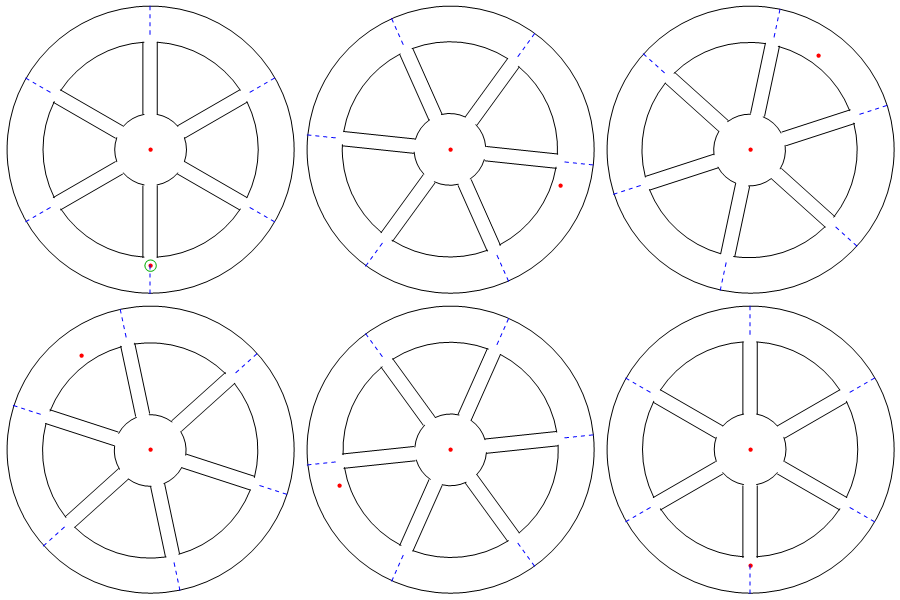
An animation of a 50-meter diameter rotating space-station. Source: wikipedia.org (P.Fraundorf) License: CC BY-SA 4.0
In situations in which gravitation is absent but the chosen coordinate system is not inertial, but is accelerated with the observer, then g-forces and corresponding proper accelerations felt by observers in these coordinate systems are caused by the mechanical forces which resist their weight in such systems. The most realistic method of producing artificial gravity, for example aboard a space station, can be imitated in a rotating spaceship. Objects inside would be pushed toward the hull and they will have some weight. This weight is produced by fictitious forces or “inertial forces” which appear in all such accelerated coordinate systems. Unlike real gravity, which pulls towards a center of the planet, the centripetal force pushes towards the axis of rotation.
References:
Reactor Physics and Thermal Hydraulics:
J. R. Lamarsh, Introduction to Nuclear Reactor Theory, 2nd ed., Addison-Wesley, Reading, MA (1983).
J. R. Lamarsh, A. J. Baratta, Introduction to Nuclear Engineering, 3d ed., Prentice-Hall, 2001, ISBN: 0-201-82498-1.
W. M. Stacey, Nuclear Reactor Physics, John Wiley & Sons, 2001, ISBN: 0- 471-39127-1.
Todreas Neil E., Kazimi Mujid S. Nuclear Systems Volume I: Thermal Hydraulic Fundamentals, Second Edition. CRC Press; 2 edition, 2012, ISBN: 978-0415802871
Zohuri B., McDaniel P. thermodynamics in Nuclear Power Plant Systems. Springer; 2015, ISBN: 978-3-319-13419-2
Moran Michal J., Shapiro Howard N. Fundamentals of Engineering thermodynamics, Fifth Edition, John Wiley & Sons, 2006, ISBN: 978-0-470-03037-0
Kleinstreuer C. Modern Fluid Dynamics. Springer, 2010, ISBN 978-1-4020-8670-0.
U.S. Department of Energy, thermodynamics, HEAT TRANSFER, AND FLUID FLOW. DOE Fundamentals Handbook, Volume 1, 2 and 3. June 1992.
See also:
Thermodynamic Properties
We hope, this article, Mass and Weight – Properties, helps you. If so, give us a like in the sidebar. Main purpose of this website is to help the public to learn some interesting and important information about materials and their properties.
A parity transformation (also called parity inversion) is the flip in the sign of one spatial coordinate. It was originally assumed that parity must be conserved in all particle interactions. Material Properties
What is Parity
Parity is a rather subtle concept and has no classical analogue. It is concerned with the behaviour of wave function under space inversion. Two kinds of parity actually correspond to two different kinds of quantum wave function for a particle.
Symmetric wave function. Wave functions for which the value at the point (-x, -y, -z) is the same as at the point (x, y, z) are known as symmetric wave functions.
Antisymmetric wave function. Wave functions for which the value at the point (-x, -y, -z) is minus the value as at the point (x, y, z) are known as symmetric wave functions.
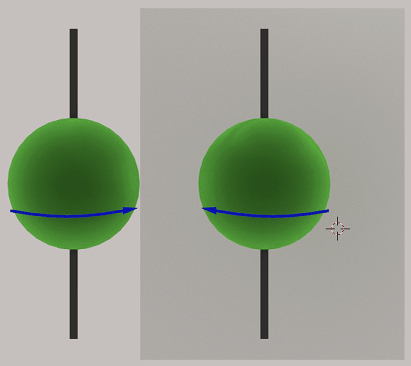
Parity reversal is equivalent to a particle in a mirror. One effect of this is to reverse the spin of the particle.
A parity transformation (also called parity inversion) is the flip in the sign of one spatial coordinate. This is equivalent to studying the mirror image of the original system. It was originally assumed that parity must be conserved in all particle interactions, but it was demonstrated that parity does not have to be conserved in beta decay.
It had been found that the kaon, K (positive or negative), could decay in two different ways, one that produced three pions, the other only two pions. In order to account for this anomaly, Lee and Yang (physicists who were awarded the Nobel prize in 1957) postulated that parity is not conserved in processes of this type. This interaction (the decay of kaon particle) is known as the weak interaction.
Another transformation that is not conserved by the weak interaction is charge conjugation, usually symbolised by the letter C, under which all the particles in a system are replaced by their corresponding antiparticles, without making any other change.
References:
Nuclear and Reactor Physics:
J. R. Lamarsh, Introduction to Nuclear Reactor Theory, 2nd ed., Addison-Wesley, Reading, MA (1983).
J. R. Lamarsh, A. J. Baratta, Introduction to Nuclear Engineering, 3d ed., Prentice-Hall, 2001, ISBN: 0-201-82498-1.
W. M. Stacey, Nuclear Reactor Physics, John Wiley & Sons, 2001, ISBN: 0- 471-39127-1.
Robert Reed Burn, Introduction to Nuclear Reactor Operation, 1988.
U.S. Department of Energy, Nuclear Physics and Reactor Theory. DOE Fundamentals Handbook, Volume 1 and 2. January 1993.
Advanced Reactor Physics:
K. O. Ott, W. A. Bezella, Introductory Nuclear Reactor Statics, American Nuclear Society, Revised edition (1989), 1989, ISBN: 0-894-48033-2.
K. O. Ott, R. J. Neuhold, Introductory Nuclear Reactor Dynamics, American Nuclear Society, 1985, ISBN: 0-894-48029-4.
D. L. Hetrick, Dynamics of Nuclear Reactors, American Nuclear Society, 1993, ISBN: 0-894-48453-2.
E. E. Lewis, W. F. Miller, Computational Methods of Neutron Transport, American Nuclear Society, 1993, ISBN: 0-894-48452-4.
See also:
Law of Conservation
We hope, this article, Law of Conservation of Parity, helps you. If so, give us a like in the sidebar. Main purpose of this website is to help the public to learn some interesting and important information about materials and their properties.
In particle physics and nuclear physics, isospin, I or I3, is a quantum number related to the strong nuclear force. This term was derived from isotopic spin. Material Properties
What is Isospin
In particle physics and nuclear physics, isospin, I or I3, is a quantum number related to the strong nuclear force. Isospin is associated with a conservation law which requires strong interaction decays to conserve isospin. This term was derived from isotopic spin, but physicists prefer the term isobaric spin, which is more precise in meaning.
Isospin was introduced by a German theoretical physicist and one of the key pioneers of quantum mechanics Werner Karl Heisenberg in 1932 as a way of distinguishing between protons and neutrons. It must be added, the concept of isospin was introduced before the development of the quark model, in the 1960s, which provides our modern understanding.
The observations have showed that the strong interaction does not distinguish between these nucleon. The strength of the strong interaction between any pair of nucleons is the same, independent of whether they are interacting as neutrons or as protons. Instead of regarding protons and neutrons as totally different species, as far as strong interactions are concerned, they are regarded as being different isospin states of the same underlying nucleon particle. This particle is called the nucleon. Similarly, the three pions, π0, π+ and π–, seem to be only three different states of the same particle, when only a strong nuclear force interacts. Isospin is mathematically similar to spin, though it has nothing to do with angular momentum. The spin term is tacked on because the addition of the isospins follows the same rules as spin.
The proton has isotopic spin ½ as the neutron has isotopic spin ½, but in case of proton the spin is pointing upwards and the spin of neutron is pointing downwards.
In general, each multiplet is assigned a isospin number I that is a positive integer or half an odd positive integer. Isospin may be considered to be a vector not in coordinate space (x, y, z). The third component, T3, may take on any one of the values T, T − 1, T − 2, . . ., −T in a fashion similar to the values of the z component of angular momentum. Two other components, T1 and T2 can be ignored. Each of T3 values corresponds to a different member of the multiplet. There are 2T + 1 particles in the multiplet. This result follows from counting the possible values of T3. Thus singlets have T = 0, doublets have T = 1/2, and triplets have T = 1.
Total isospin for a collection of particles is computed in the same manner as for ordinary spin. , The maximum value of system isospin is the sum of the individual particle’s isospins. For example if one considers π+ – p scattering, Tmax = 3/2 and T3 = 3/2 so T can only have the value 3/2. For π− − p scattering, Tmax = 3/2 and T3 = −1/2 so T can be either 3/2 or 1/2. In fact, measurement of T for π − -p sometimes produces T = 3/2 and sometimes T = 1/2 but always T3 = −1/2.
Conservation of Isospin
The benefit of introducing isospin is that it vastly simplifies the problems of strong interactions. Thus for a interaction of two nucleons, instead of dealing with four charge states (neutron-neutron, proton-proton, proton-neutron, neutron-proton) we are concerned with only two isospin states, I = 1 and I = 0. The isospin concept tells us why certain strong interactions are forbidden on account of violation of isospin I. Isospin is associated with a conservation law which requires strong interaction decays to conserve isospin. For weak interactions neither T3, nor T need be conserved.
See also: J. Christman, (2001, December 11). ISOSPIN: CONSERVED IN STRONG INTERACTIONS. Retrieved from http://www.physnet.org/modules/pdf_modules/m278.pdf
References:
Nuclear and Reactor Physics:
J. R. Lamarsh, Introduction to Nuclear Reactor Theory, 2nd ed., Addison-Wesley, Reading, MA (1983).
J. R. Lamarsh, A. J. Baratta, Introduction to Nuclear Engineering, 3d ed., Prentice-Hall, 2001, ISBN: 0-201-82498-1.
W. M. Stacey, Nuclear Reactor Physics, John Wiley & Sons, 2001, ISBN: 0- 471-39127-1.
Robert Reed Burn, Introduction to Nuclear Reactor Operation, 1988.
U.S. Department of Energy, Nuclear Physics and Reactor Theory. DOE Fundamentals Handbook, Volume 1 and 2. January 1993.
Advanced Reactor Physics:
K. O. Ott, W. A. Bezella, Introductory Nuclear Reactor Statics, American Nuclear Society, Revised edition (1989), 1989, ISBN: 0-894-48033-2.
K. O. Ott, R. J. Neuhold, Introductory Nuclear Reactor Dynamics, American Nuclear Society, 1985, ISBN: 0-894-48029-4.
D. L. Hetrick, Dynamics of Nuclear Reactors, American Nuclear Society, 1993, ISBN: 0-894-48453-2.
E. E. Lewis, W. F. Miller, Computational Methods of Neutron Transport, American Nuclear Society, 1993, ISBN: 0-894-48452-4.
See also:
Fundamental Particles
We hope, this article, Isospin, helps you. If so, give us a like in the sidebar. Main purpose of this website is to help the public to learn some interesting and important information about materials and their properties.
Law of Conservation of Isospin. Isospin is associated with a conservation law which requires strong interaction decays to conserve isospin. Material Properties
What is Isospin
In particle physics and nuclear physics, isospin, I or I3, is a quantum number related to the strong nuclear force. Isospin is associated with a conservation law which requires strong interaction decays to conserve isospin. This term was derived from isotopic spin, but physicists prefer the term isobaric spin, which is more precise in meaning.
Isospin was introduced by a German theoretical physicist and one of the key pioneers of quantum mechanics Werner Karl Heisenberg in 1932 as a way of distinguishing between protons and neutrons. It must be added, the concept of isospin was introduced before the development of the quark model, in the 1960s, which provides our modern understanding.
The observations have showed that the strong interaction does not distinguish between these nucleon. The strength of the strong interaction between any pair of nucleons is the same, independent of whether they are interacting as neutrons or as protons. Instead of regarding protons and neutrons as totally different species, as far as strong interactions are concerned, they are regarded as being different isospin states of the same underlying nucleon particle. This particle is called the nucleon. Similarly, the three pions, π0, π+ and π–, seem to be only three different states of the same particle, when only a strong nuclear force interacts. Isospin is mathematically similar to spin, though it has nothing to do with angular momentum. The spin term is tacked on because the addition of the isospins follows the same rules as spin.
The proton has isotopic spin ½ as the neutron has isotopic spin ½, but in case of proton the spin is pointing upwards and the spin of neutron is pointing downwards.
In general, each multiplet is assigned a isospin number I that is a positive integer or half an odd positive integer. Isospin may be considered to be a vector not in coordinate space (x, y, z). The third component, T3, may take on any one of the values T, T − 1, T − 2, . . ., −T in a fashion similar to the values of the z component of angular momentum. Two other components, T1 and T2 can be ignored. Each of T3 values corresponds to a different member of the multiplet. There are 2T + 1 particles in the multiplet. This result follows from counting the possible values of T3. Thus singlets have T = 0, doublets have T = 1/2, and triplets have T = 1.
Total isospin for a collection of particles is computed in the same manner as for ordinary spin. , The maximum value of system isospin is the sum of the individual particle’s isospins. For example if one considers π+ – p scattering, Tmax = 3/2 and T3 = 3/2 so T can only have the value 3/2. For π− − p scattering, Tmax = 3/2 and T3 = −1/2 so T can be either 3/2 or 1/2. In fact, measurement of T for π − -p sometimes produces T = 3/2 and sometimes T = 1/2 but always T3 = −1/2.
Conservation of Isospin
The benefit of introducing isospin is that it vastly simplifies the problems of strong interactions. Thus for a interaction of two nucleons, instead of dealing with four charge states (neutron-neutron, proton-proton, proton-neutron, neutron-proton) we are concerned with only two isospin states, I = 1 and I = 0. The isospin concept tells us why certain strong interactions are forbidden on account of violation of isospin I. Isospin is associated with a conservation law which requires strong interaction decays to conserve isospin. For weak interactions neither T3, nor T need be conserved.
See also: J. Christman, (2001, December 11). ISOSPIN: CONSERVED IN STRONG INTERACTIONS. Retrieved from http://www.physnet.org/modules/pdf_modules/m278.pdf
References:
Nuclear and Reactor Physics:
J. R. Lamarsh, Introduction to Nuclear Reactor Theory, 2nd ed., Addison-Wesley, Reading, MA (1983).
J. R. Lamarsh, A. J. Baratta, Introduction to Nuclear Engineering, 3d ed., Prentice-Hall, 2001, ISBN: 0-201-82498-1.
W. M. Stacey, Nuclear Reactor Physics, John Wiley & Sons, 2001, ISBN: 0- 471-39127-1.
Robert Reed Burn, Introduction to Nuclear Reactor Operation, 1988.
U.S. Department of Energy, Nuclear Physics and Reactor Theory. DOE Fundamentals Handbook, Volume 1 and 2. January 1993.
Advanced Reactor Physics:
K. O. Ott, W. A. Bezella, Introductory Nuclear Reactor Statics, American Nuclear Society, Revised edition (1989), 1989, ISBN: 0-894-48033-2.
K. O. Ott, R. J. Neuhold, Introductory Nuclear Reactor Dynamics, American Nuclear Society, 1985, ISBN: 0-894-48029-4.
D. L. Hetrick, Dynamics of Nuclear Reactors, American Nuclear Society, 1993, ISBN: 0-894-48453-2.
E. E. Lewis, W. F. Miller, Computational Methods of Neutron Transport, American Nuclear Society, 1993, ISBN: 0-894-48452-4.
See also:
Law of Conservation
We hope, this article, Law of Conservation of Isospin, helps you. If so, give us a like in the sidebar. Main purpose of this website is to help the public to learn some interesting and important information about materials and their properties.
In general, particles that do participate in strong interactions are called hadrons: protons and neutrons are hadrons. The hadrons are further sub-divided into baryons and mesons. Material Properties
Hadrons
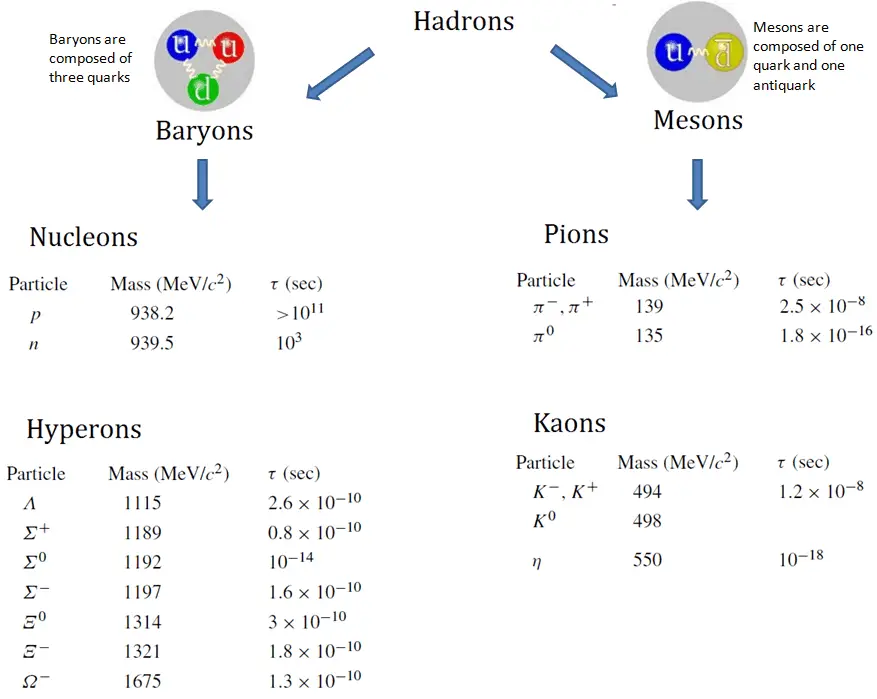
In general, particles that do participate in strong interactions are called hadrons: protons and neutrons are hadrons. The hadrons are further sub-divided into baryons and mesons, according to the number of quarks they contain. Protons and neutrons each contain three quarks; they belong to the family of particles called the baryons. Other baryons are the lambda, sigma, xi, and omega particles. On the other hand mesons bosons and they are composed of two quarks: a quark and an antiquark. Besides charge and spin (1/2 for the baryons), two other quantum numbers are assigned to these particles: baryon number (B) and strangeness (S). Baryons have a baryon number, B, of 1, while their antiparticles, called antibaryons, have a baryon number of −1. A nucleus of deuterium (deuteron), for example, contains one proton and one neutron (each with a baryon number of 1) and has a baryon number of 2.
Since baryons make up most of the mass of ordinary atoms, the everyday matter is often referred to as baryonic matter.
The conservation of baryon number is an important rule for interactions and decays of baryons. No known interactions violate conservation of baryon number.
Neutron
The quark structure of the neutron. The color assignment of individual quarks is arbitrary, but all three colors must be present. Forces between quarks are mediated by gluons.
A neutron is one of the subatomic particlesthat make up matter. In the universe, neutrons are abundant, making up more than half of all visible matter. It has no electric charge and a rest mass equal to 1.67493 × 10⁻²⁷ kg — marginally greater than that of the proton but nearly 1839 times greater than that of the electron. The neutron has a mean square radius of about 0.8×10⁻¹⁵ m, or 0.8 fm, and it is a spin ½ fermion.
Neutrons and protons are classified as hadrons, subatomic particles that are subject to the strong force and as baryons since they are composed ofthree quarks. The neutron is a composite particle made of two down quarks with charge −⅓ e and one up quark with charge +⅔ e. Since the neutron hasno net electric charge, it is not affected by eletric forces, but the neutron does have a slight distribution of electric charge within it. This results in non-zero magnetic moment (dipole moment) of the neutron. Therefore the neutron interacts also via electromagnetic interaction, but much weaker than the proton.
The mass of the neutron is 939.565 MeV/c2, whereas the mass of the three quarks is only about 12 MeV/c2 (only about 1% of the mass-energy of the neutron). Like the proton, most of mass (energy) of the neutron is in the form of the strong nuclear force energy (gluons). The quarks of the neutron are held together by gluons, the exchange particles for the strong nuclear force. Gluons carry the color charge of the strong nuclear force.
References:
Nuclear and Reactor Physics:
J. R. Lamarsh, Introduction to Nuclear Reactor Theory, 2nd ed., Addison-Wesley, Reading, MA (1983).
J. R. Lamarsh, A. J. Baratta, Introduction to Nuclear Engineering, 3d ed., Prentice-Hall, 2001, ISBN: 0-201-82498-1.
W. M. Stacey, Nuclear Reactor Physics, John Wiley & Sons, 2001, ISBN: 0- 471-39127-1.
Robert Reed Burn, Introduction to Nuclear Reactor Operation, 1988.
U.S. Department of Energy, Nuclear Physics and Reactor Theory. DOE Fundamentals Handbook, Volume 1 and 2. January 1993.
Advanced Reactor Physics:
K. O. Ott, W. A. Bezella, Introductory Nuclear Reactor Statics, American Nuclear Society, Revised edition (1989), 1989, ISBN: 0-894-48033-2.
K. O. Ott, R. J. Neuhold, Introductory Nuclear Reactor Dynamics, American Nuclear Society, 1985, ISBN: 0-894-48029-4.
D. L. Hetrick, Dynamics of Nuclear Reactors, American Nuclear Society, 1993, ISBN: 0-894-48453-2.
E. E. Lewis, W. F. Miller, Computational Methods of Neutron Transport, American Nuclear Society, 1993, ISBN: 0-894-48452-4.
See also:
Fundamental Particles
We hope, this article, Hadron, helps you. If so, give us a like in the sidebar. Main purpose of this website is to help the public to learn some interesting and important information about materials and their properties.
In particle physics, the baryon number is used to denote which particles are baryons and which particles are not. Each baryon has a baryon number of 1. Material Properties
Baryon Number
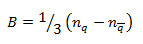
In particle physics, the baryon number is used to denote which particles are baryons and which particles are not. Each baryon has a baryon number of 1 and each antibaryon has a baryon number of -1. Other non-baryonic particles have a baryon number of 0. Since there are exotic hadrons like pentaquarks and tetraquarks, there is a general definition of baryon number as:
where nq is the number of quarks, and nq is the number of antiquarks.
The baryon number is a conserved quantum number in all particle reactions. The term conserved means that the sum of the baryon number of all incoming particles is the same as the sum of the baryon numbers of all particles resulting from the reaction. A slight asymmetry in the laws of physics allowed baryons to be created in the Big Bang.
Examples of Baryon Numbers
For example, the following reaction has never been observed:
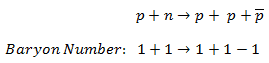
even if the incoming proton has sufficient energy and charge, energy, and so on, are conserved. This reaction does not conserve baryon number since the left side has B =+2, and the right has B =+1.
On the other hand, the following reaction (proton-antiproton pair production) does conserve B and does occur if the incoming proton has sufficient energy (the threshold energy = 5.6 GeV):
As indicated, B = +2 on both sides of this equation.
From these and other reactions, the conservation of baryon number has been established as a basic principle of physics.
This principle provides basis for the stability of the proton. Since the proton is the lightest particle among all baryons, the hypothetical products of its decay would have to be non-baryons. Thus, the decay would violate the conservation of baryon number. It must be added some theories have suggested that protons are in fact unstable with very long half-life (~1030 years) and that they decay into leptons. There is currently no experimental evidence that proton decay occurs.
References:
Nuclear and Reactor Physics:
J. R. Lamarsh, Introduction to Nuclear Reactor Theory, 2nd ed., Addison-Wesley, Reading, MA (1983).
J. R. Lamarsh, A. J. Baratta, Introduction to Nuclear Engineering, 3d ed., Prentice-Hall, 2001, ISBN: 0-201-82498-1.
W. M. Stacey, Nuclear Reactor Physics, John Wiley & Sons, 2001, ISBN: 0- 471-39127-1.
Robert Reed Burn, Introduction to Nuclear Reactor Operation, 1988.
U.S. Department of Energy, Nuclear Physics and Reactor Theory. DOE Fundamentals Handbook, Volume 1 and 2. January 1993.
Advanced Reactor Physics:
K. O. Ott, W. A. Bezella, Introductory Nuclear Reactor Statics, American Nuclear Society, Revised edition (1989), 1989, ISBN: 0-894-48033-2.
K. O. Ott, R. J. Neuhold, Introductory Nuclear Reactor Dynamics, American Nuclear Society, 1985, ISBN: 0-894-48029-4.
D. L. Hetrick, Dynamics of Nuclear Reactors, American Nuclear Society, 1993, ISBN: 0-894-48453-2.
E. E. Lewis, W. F. Miller, Computational Methods of Neutron Transport, American Nuclear Society, 1993, ISBN: 0-894-48452-4.
See also:
Baryons
We hope, this article, Baryon Number, helps you. If so, give us a like in the sidebar. Main purpose of this website is to help the public to learn some interesting and important information about materials and their properties.
What is a baryon? Baryon is any fermion that undergo strong interactions. Baryons are composed of three quarks. Baryons have a baryon number, B, of 1. Material Properties
What is Baryon
Baryon is any fermion that undergo strong interactions. In general, particles that do participate in strong interactions are called hadrons: protons and neutrons are hadrons. The hadrons are further sub-divided into baryons and mesons, according to the number of quarks they contain. Protons and neutrons each contain three quarks; they belong to the family of particles called the baryons. Other baryons are the lambda, sigma, xi, and omega particles. On the other hand mesons bosons and they are composed of two quarks: a quark and an antiquark. Besides charge and spin (1/2 for the baryons), two other quantum numbers are assigned to these particles: baryon number (B) and strangeness (S). Baryons have a baryon number, B, of 1, while their antiparticles, called antibaryons, have a baryon number of −1. A nucleus of deuterium (deuteron), for example, contains one proton and one neutron (each with a baryon number of 1) and has a baryon number of 2.
Since baryons make up most of the mass of ordinary atoms, the everyday matter is often referred to as baryonic matter.
The conservation of baryon number is an important rule for interactions and decays of baryons. No known interactions violate conservation of baryon number.
Neutron
The quark structure of the neutron. The color assignment of individual quarks is arbitrary, but all three colors must be present. Forces between quarks are mediated by gluons.
A neutron is one of the subatomic particlesthat make up matter. In the universe, neutrons are abundant, making up more than half of all visible matter. It has no electric charge and a rest mass equal to 1.67493 × 10⁻²⁷ kg — marginally greater than that of the proton but nearly 1839 times greater than that of the electron. The neutron has a mean square radius of about 0.8×10⁻¹⁵ m, or 0.8 fm, and it is a spin ½ fermion.
Neutrons and protons are classified as hadrons, subatomic particles that are subject to the strong force and as baryons since they are composed ofthree quarks. The neutron is a composite particle made of two down quarks with charge −⅓ e and one up quark with charge +⅔ e. Since the neutron hasno net electric charge, it is not affected by eletric forces, but the neutron does have a slight distribution of electric charge within it. This results in non-zero magnetic moment (dipole moment) of the neutron. Therefore the neutron interacts also via electromagnetic interaction, but much weaker than the proton.
The mass of the neutron is 939.565 MeV/c2, whereas the mass of the three quarks is only about 12 MeV/c2 (only about 1% of the mass-energy of the neutron). Like the proton, most of mass (energy) of the neutron is in the form of the strong nuclear force energy (gluons). The quarks of the neutron are held together by gluons, the exchange particles for the strong nuclear force. Gluons carry the color charge of the strong nuclear force.
Baryon Number
In particle physics, the baryon number is used to denote which particles are baryons and which particles are not. Each baryon has a baryon number of 1 and each antibaryon has a baryon number of -1. Other non-baryonic particles have a baryon number of 0. Since there are exotic hadrons like pentaquarks and tetraquarks, there is a general definition of baryon number as:
where nq is the number of quarks, and nq is the number of antiquarks.
The baryon number is a conserved quantum number in all particle reactions. The term conserved means that the sum of the baryon number of all incoming particles is the same as the sum of the baryon numbers of all particles resulting from the reaction. A slight asymmetry in the laws of physics allowed baryons to be created in the Big Bang.
Law of Conservation of Baryon Number
In analyzing nuclear reactions, we apply the many conservation laws. Nuclear reactions are subject to classical conservation laws for, momentum, angular momentum, and energy(including rest energies). Additional conservation laws, not anticipated by classical physics, are electric charge, lepton number and baryon number. Certain of these laws are obeyed under all circumstances, others are not.
Baryon number is a generalization of nucleon number, which is conserved in nonrelativistic nuclear reactions and decays. The law of conservation of baryon number states that:
The sum of the baryon number of all incoming particles is the same as the sum of the baryon numbers of all particles resulting from the reaction.
For example, the following reaction has never been observed:
even if the incoming proton has sufficient energy and charge, energy, and so on, are conserved. This reaction does not conserve baryon number since the left side has B =+2, and the right has B =+1.
On the other hand, the following reaction (proton-antiproton pair production) does conserve B and does occur if the incoming proton has sufficient energy (the threshold energy = 5.6 GeV):
As indicated, B = +2 on both sides of this equation.
From these and other reactions, the conservation of baryon number has been established as a basic principle of physics.
This principle provides basis for the stability of the proton. Since the proton is the lightest particle among all baryons, the hypothetical products of its decay would have to be non-baryons. Thus, the decay would violate the conservation of baryon number. It must be added some theories have suggested that protons are in fact unstable with very long half-life (~1030 years) and that they decay into leptons. There is currently no experimental evidence that proton decay occurs.
References:
Nuclear and Reactor Physics:
J. R. Lamarsh, Introduction to Nuclear Reactor Theory, 2nd ed., Addison-Wesley, Reading, MA (1983).
J. R. Lamarsh, A. J. Baratta, Introduction to Nuclear Engineering, 3d ed., Prentice-Hall, 2001, ISBN: 0-201-82498-1.
W. M. Stacey, Nuclear Reactor Physics, John Wiley & Sons, 2001, ISBN: 0- 471-39127-1.
Robert Reed Burn, Introduction to Nuclear Reactor Operation, 1988.
U.S. Department of Energy, Nuclear Physics and Reactor Theory. DOE Fundamentals Handbook, Volume 1 and 2. January 1993.
Advanced Reactor Physics:
K. O. Ott, W. A. Bezella, Introductory Nuclear Reactor Statics, American Nuclear Society, Revised edition (1989), 1989, ISBN: 0-894-48033-2.
K. O. Ott, R. J. Neuhold, Introductory Nuclear Reactor Dynamics, American Nuclear Society, 1985, ISBN: 0-894-48029-4.
D. L. Hetrick, Dynamics of Nuclear Reactors, American Nuclear Society, 1993, ISBN: 0-894-48453-2.
E. E. Lewis, W. F. Miller, Computational Methods of Neutron Transport, American Nuclear Society, 1993, ISBN: 0-894-48452-4.
See also:
Fundamental Particles
We hope, this article, Baryon, helps you. If so, give us a like in the sidebar. Main purpose of this website is to help the public to learn some interesting and important information about materials and their properties.