Facebook Instagram Youtube Twitter

What is Microscopic Cross-section – Definition

The standard unit for measuring the microscopic cross-section (σ-sigma) is the barn, which is equal to 10-28 m2. Microscopic cross-sections are used to express the likelihood of particular nuclear interaction. Material Properties

Definition of Cross-section
nuclear cross-sections, microscopic cross-sectionsIn general, the cross-section is an effective area that quantifies the likelihood of certain interaction between an incident object and a target object. The cross-section of a particle is the same as the cross section of a hard object, if the probabilities of hitting them with a ray are the same.

For a given event, the cross section σ is given by

σ = μ/n

where

  • σ is the cross-section of this event [m2],
  • μ is the attenuation coefficient due to the occurrence of this event [m-1],
  • n is the density of the target particles [m-3].

In nuclear physics, the nuclear cross section of a nucleus is commonly used to characterize the probability that a nuclear reaction will occur. The cross-section is typically denoted σ and measured in units of area [m2]. The standard unit for measuring a nuclear cross section is the barn, which is equal to 10−28 m² or 10−24 cm². It can be seen the concept of a nuclear cross section can be quantified physically in terms of “characteristic target area” where a larger area means a larger probability of interaction.

 
Nuclear Radius
Typical nuclear radii are of the order 10−14 m. Assuming spherical shape, nuclear radii can be calculated according to following formula:

r = r0 . A1/3

where r0 = 1.2 x 10⁻¹⁵ m = 1.2 fm

If we use this approximation, we therefore expect the geometrical cross-sections of nuclei to be of the order of πr2 or 4.5×10⁻³⁰ m² for hydrogen nuclei or 1.74×10⁻²⁸ m² for 238U nuclei.

Since there are many nuclear reaction from the incident particle point of view, but, in nuclear reactor physics, neutron-nuclear reactions are of particular interest. In this case the neutron cross-section must be defined.

Total Cross-section
In general, nuclear cross-sections can be measured for all possible interaction processes together, in this case they are called total cross-sections (σt). The total cross section is the sum of all the partial cross sections such as:

σt = σs + σi + σγ + σf + ……

The total cross-section measures the probability that an interaction of any type will occur when neutron interacts with a target.

Interaction of Neutrons with Matter

Neutron Interactions

Neutrons are neutral particles, therefore they travel in straight lines, deviating from their path only when they actually collide with a nucleus to be scattered into a new direction or absorbed. Neither the electrons surrounding (atomic electron cloud) a nucleus nor the electric field caused by a positively charged nucleus affect a neutron’s flight. In short, neutrons collide with nuclei, not with atoms.

Neutrons may interact with nuclei in one of following ways:

See also: Neutron Nuclear Reactions

See also: Direct Nuclear Reactions

See also: Compound Nucleus Reactions
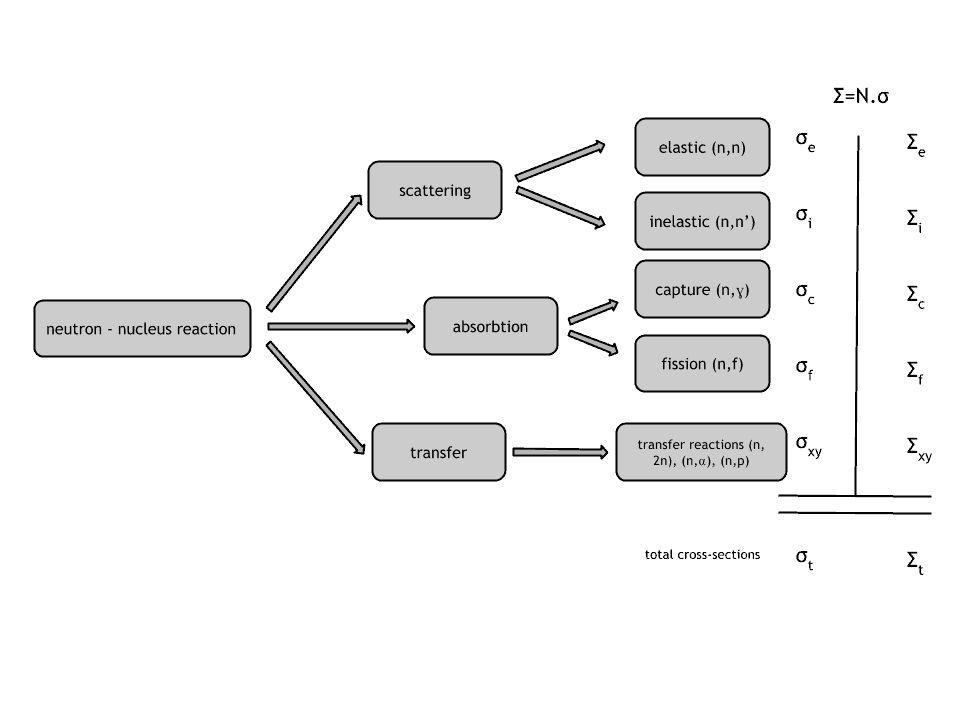
Neutron - Nuclear Reactions

Microscopic Cross-section

The extent to which neutrons interact with nuclei is described in terms of quantities known as cross-sections. Cross-sections are used to express the likelihood of particular interaction between an incident neutron and a target nucleus. It must be noted this likelihood do not depend on real target dimensions. In conjunction with the neutron flux, it enables the calculation of the reaction rate, for example to derive the thermal power of a nuclear power plant. The standard unit for measuring the microscopic cross-section (σ-sigma) is the barn, which is equal to 10-28 m2. This unit is very small, therefore barns (abbreviated as “b”) are commonly used.

The cross-section σ can be interpreted as the effective ‘target area’ that a nucleus interacts with an incident neutron. The larger the effective area, the greater the probability for reaction. This cross-section is usually known as the microscopic cross-section.

The concept of the microscopic cross-section is therefore introduced to represent the probability of a neutron-nucleus reaction. Suppose that a thin ‘film’ of atoms (one atomic layer thick) with Na atoms/cm2 is placed in a monodirectional beam of intensity I0. Then the number of interactions C per cm2 per second will be proportional to the intensity I0 and the atom density Na. We define the proportionality factor as the microscopic cross-section σ:

σt = C/Na.I0

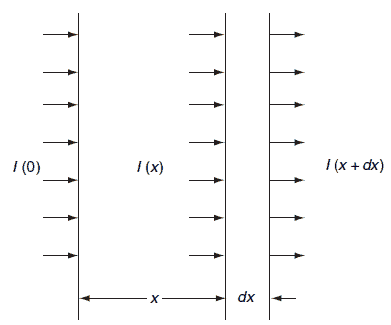
In order to be able to determine the microscopic cross section, transmission measurements are performed on plates of materials. Assume that if a neutron collides with a nucleus it will either be scattered into a different direction or be absorbed (without fission absorption). Assume that there are N (nuclei/cm3) of the material and there will then be N.dx per cm2 in the layer dx.
Only the neutrons that have not interacted will remain traveling in the x direction. This causes the intensity of the uncollided beam will be attenuated as it penetrates deeper into the material.
CR

Then, according to the definition of the microscopic cross section, the reaction rate per unit area is Nσ Ι(x)dx. This is equal to the decrease of the beam intensity, so that:

-dI = N.σ.Ι(x).dx

and

Ι(x) = Ι0e-N.σ.x

It can be seen that whether a neutron will interact with a certain volume of material depends not only on the microscopic cross-section of the individual nuclei but also on the density of nuclei within that volume. It depends on the N.σ factor. This factor is therefore widely defined and it is known as the macroscopic cross section.

The difference between the microscopic and macroscopic cross sections is extremely important. The microscopic cross section represents the effective target area of a single nucleus, while the macroscopic cross section represents the effective target area of all of
the nuclei contained in certain volume.

Microscopic cross-sections constitute a key parameters of nuclear fuel. In general, neutron cross-sections must be calculated for fresh fuel assemblies usually in two-Dimensional models of the fuel lattice.

The neutron cross-section is variable and depends on:

  • Target nucleus (hydrogen, boron, uranium, etc.). Each isotop has its own set of cross-sections.
  • Type of the reaction (capture, fission, etc.). Cross-sections are different for each nuclear reaction.
  • Neutron energy (thermal neutron, resonance neutron, fast neutron). For a given target and reaction type, the cross-section is strongly dependent on the neutron energy. In the common case, the cross section is usually much larger at low energies than at high energies. This is why most nuclear reactors use a neutron moderator to reduce the energy of the neutron and thus increase the probability of fission, essential to produce energy and sustain the chain reaction.
  • Target energy (temperature of target material – Doppler broadening). This dependency is not so significant, but the target energy strongly influences inherent safety of nuclear reactors due to a Doppler broadening of resonances.

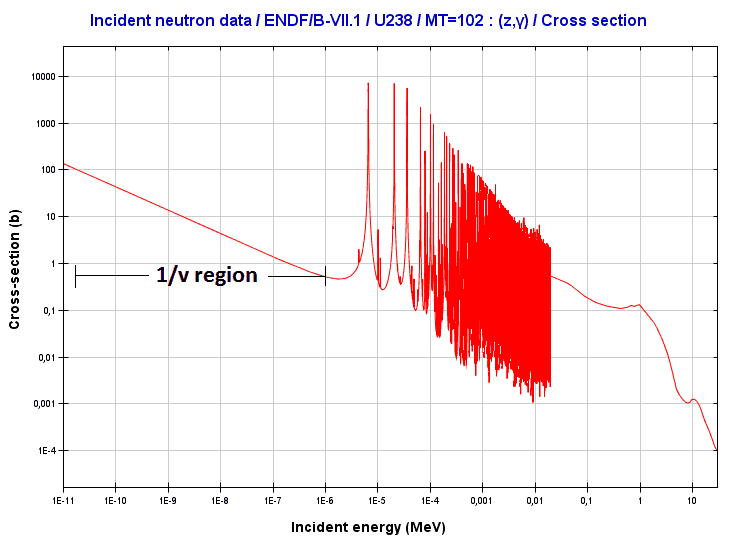
Microscopic cross-section varies with incident neutron energy. Some nuclear reactions exhibit very specific dependency on incident neutron energy. This dependency will be described on the example of the radiative capture reaction. The likelihood of a neutron radiative capture is represented by the radiative capture cross section as σγ. The following dependency is typical for radiative capture, it definitely does not mean, that it is typical for other types of reactions (see elastic scattering cross-section or (n,alpha) reaction cross-section).

The capture cross-section can be divided into three regions according to the incident neutron energy. These regions will be discussed separately.

  • 1/v Region
  • Resonance Region
  • Fast Neutrons Region

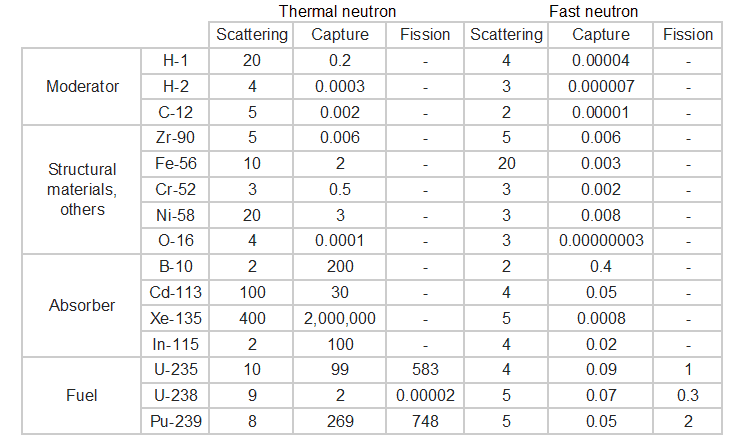
Table of cross-sections

Neutron - Nuclear Reactions
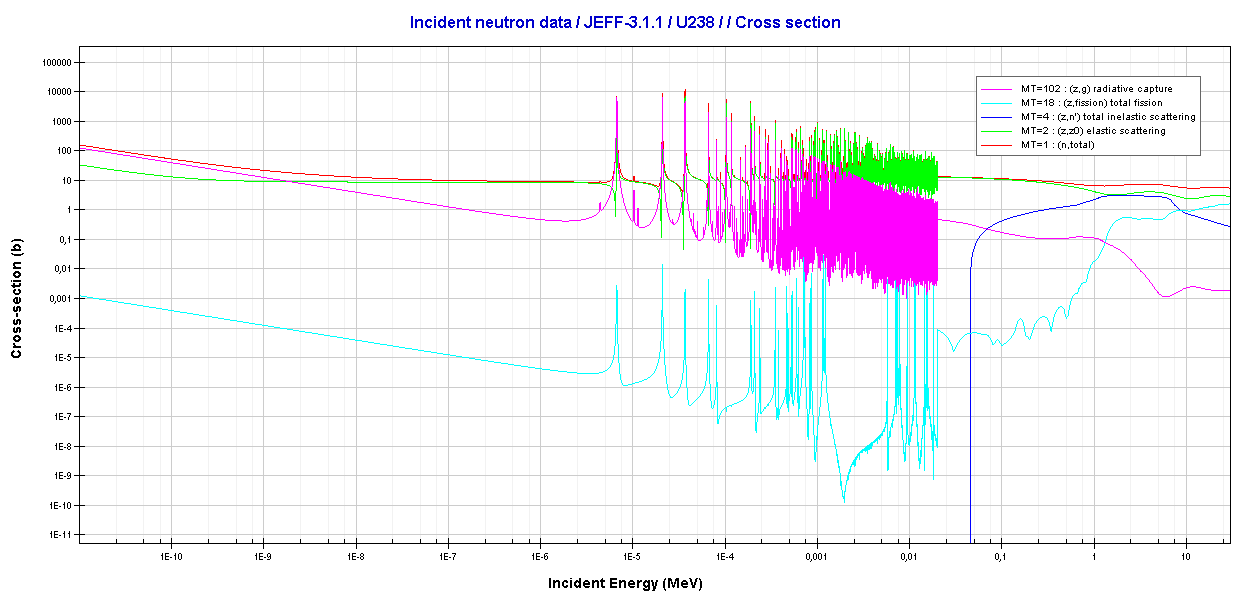
Uranium 238. Neutron absorption and scattering. Comparison of cross-sections.
Uranium 238. Comparison of cross-sections.
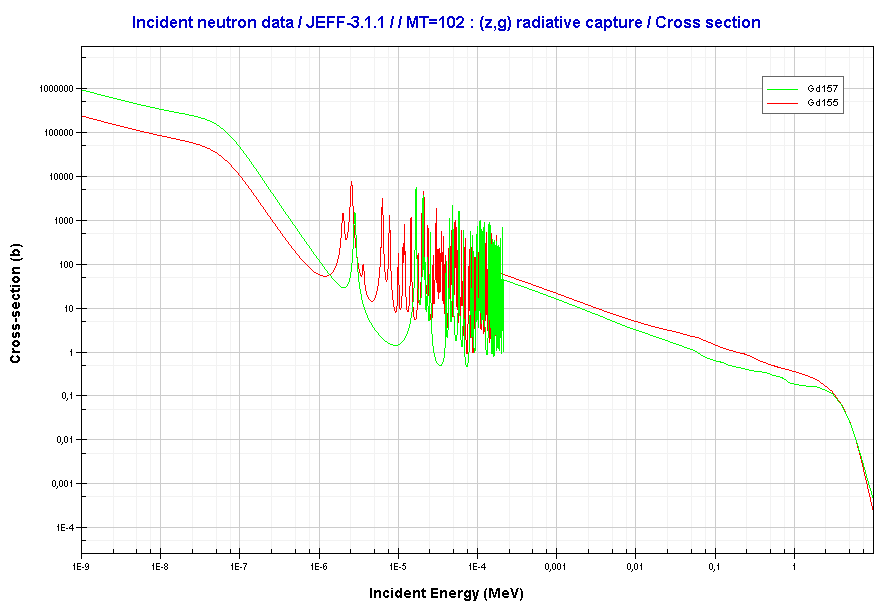
Gadolinium 155 and 157. Comparison of radiative capture cross-sections.
Source: JANIS (Java-based Nuclear Data Information Software); The JEFF-3.1.1 Nuclear Data Library
1/v Law
For thermal neutrons (in 1/v region), absorption cross sections increases as the velocity (kinetic energy) of the neutron decreases.
Source: JANIS 4.0
 
Neutron Elastic Scattering - Cross-section Example
To be an effective moderator, the probability of elastic reaction between neutron and the nucleus must be high. In terms of cross-sections, the elastic scattering cross section of a moderator’s nucleus must be high.

See also: Elastic Scattering Reaction

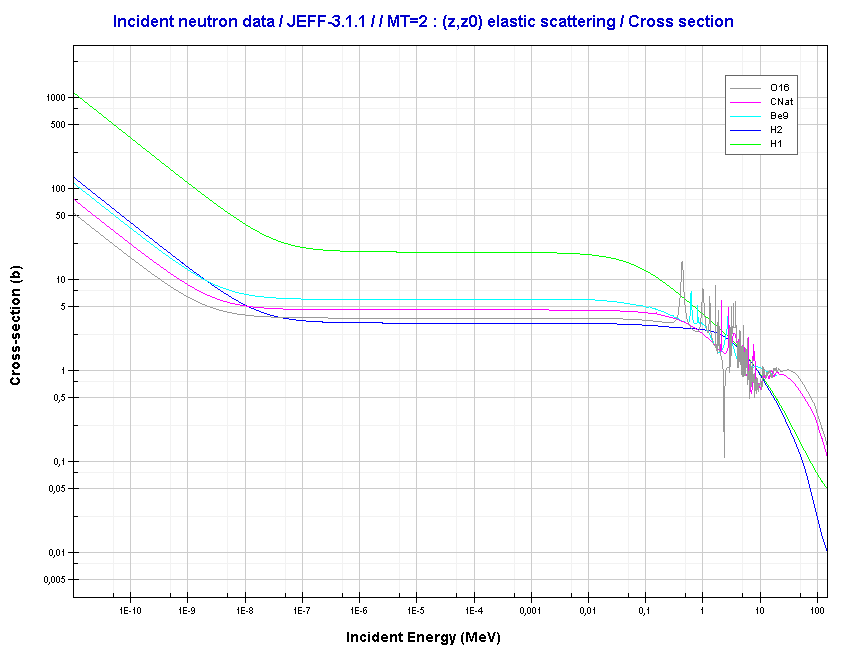
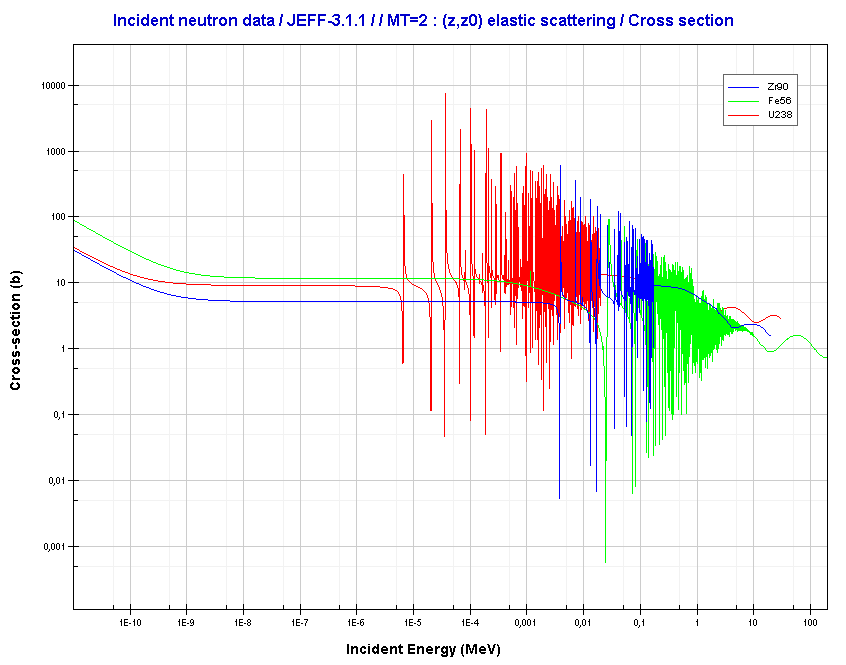
Elastic scattering cross-sections for light elements
Elastic scattering cross-sections for light elements are more or less independent of neutron energy up to 1 MeV. Source: JANIS (Java-based Nuclear Data Information Software); The JEFF-3.1.1 Nuclear Data Library
Elastic scattering cross-sections for heavy elements
For intermediate and heavy elements, the elastic cross-section is constant at low energy with some specifics at higher energy.
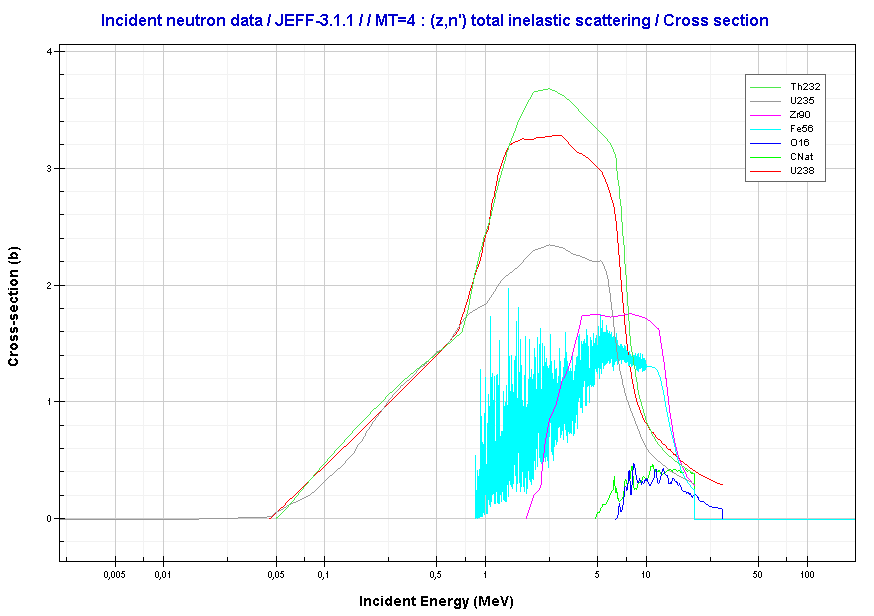
Inelastic Scattering - Cross-section Example
See also: Inelastic Scattering Reaction
Inelastic Neutron Scattering Cross-section
Inelastic scattering plays an important role in slowing down neutrons especially at high energies and by heavy nuclei.
Charged Particle Reaction - Cross-section Example
Boron 10. Comparison of total cross-section and cross-section for (n,alpha) reactions. Source: JANIS (Java-based Nuclear Data Information Software); The JEFF-3.1.1 Nuclear Data Library
Boron 10. Comparison of total cross-section and cross-section for (n,alpha) reactions.
Source: JANIS (Java-based Nuclear Data Information Software); The JEFF-3.1.1 Nuclear Data Library

10B(n,alpha)7Li

This reaction is the most important (n,alpha) reaction of isotope 10B with thermal neutrons. This reaction can be used as in the case of neutron absorbers (chemical shim, burnable absorbers or control rods), and in the case of neutron converters (neutron detectors), because its cross-section is very high and produces energetic alpha particles.

(n,alpha) reactions of 10B

6Li(n,α)3H

This is a reaction allowing detection of neutrons. The reaction cross-section for thermal neutrons is σ = 925 barns and the natural lithium has abundance of 6Li 7,4%.

See also – Charged Particle Reactions

Nuclear Fission - Cross-section Example
See also: Nuclear Fission
Fissile / Fertile Material Cross-sections
Fissile / Fertile Material Cross-sections. Comparison of total fission cross-sections.
Source: JANIS (Java-based Nuclear Data Information Software)
http://www.oecd-nea.org/janis/

1/v Region

In the common case, the cross section is usually much larger at low energies than at high energies. For thermal neutrons (in 1/v region), also radiative capture cross-sections increase as the velocity (kinetic energy) of the neutron decreases. Therefore the 1/v Law can be used to determine shift in capture cross-section, if the neutron is in equilibrium with a surrounding medium. This phenomenon is due to the fact the nuclear force between the target nucleus and the neutron has a longer time to interact.

sigma_a sim frac{1}{v}}} sim frac{1}{sqrt{E}}}}} sim frac{1}{sqrt{T}}}}}

This law is aplicable only for absorbtion cross-section and only in the 1/v region.

Example of cross- sections in 1/v region:

The absorbtion cross-section for 238U at 20°C = 293K (~0.0253 eV) is:

sigma_a(293K) = 2.68b .

The absorbtion cross-section for 238U at 1000°C = 1273K is equal to:

Neutron Cross-section - 1-v law

This cross-section reduction is caused only due to the shift of temperature of surrounding medium.

Resonance Region

The largest cross-sections are usually at neutron energies, that lead to long-lived states of the compound nucleus. The compound nuclei of these certain energies are referred to as nuclear resonances and its formation is typical in the resonance region. The widths of the resonances increase in general with increasing energies. At higher energies the widths may reach the order of the distances between resonances and then no resonances can be observed. The narrowest resonances are usually compound states of heavy nuclei (such as fissionable nuclei).

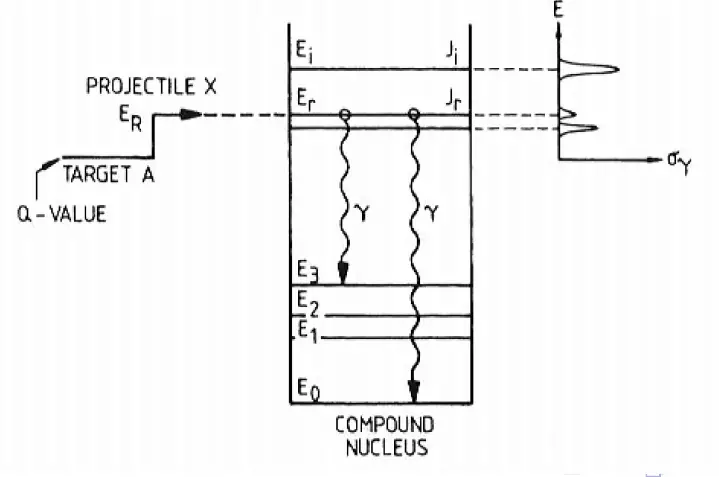
Since the mode of decay of the compound nucleus does not depend on the way the compound nucleus was formed, the nucleus sometimes emits a gamma ray (radiative capture) or sometimes emits a neutron (scattering). In order to understand the way, how a nucleus will stabilize itself, we have to understand the behaviour of compound nucleus.

The compound nucleus emits a neutron only after one neutron obtains an energy in collision with other nucleon greater than its binding energy in the nucleus. It have some delay, because the excitation energy of the compound nucleus is divided among several nucleons. It is obvious the average time that elapses before a neutron can be emitted is much longer for nuclei with large number of nucleons than when only a few nucleons are involved. It is a consequence of sharing the excitation energy among a large number of nucleons.

This is the reason the radiative capture is comparatively unimportant in light nuclei but becomes increasingly important in the heavier nuclei.

It is obvious the compound states (resonances) are observed at low excitation energies. This is due to the fact, the energy gap between the states is large. At high excitation energy, the gap between two compound states is very small and the widths of resonances may reach the order of the distances between resonances. Therefore at high energies no resonances can be observed and the cross section in this energy region is continuous and smooth.

The lifetime of a compound nucleus is inversely proportional to its total width. Narrow resonances therefore correspond to capture while the wider resonances are due to scattering.

See also: Nuclear Resonance

Fast Neutrons Region

The radiative capture cross-section at energies above the resonance region drops rapidly to very small values. This rapid drop is caused by the compound nucleus, which is formed in more highly-excited states. In these highly-excited states it is more likely that one neutron obtains an energy in collision with other nucleon greater than its binding energy in the nucleus. The neutron emission becomes dominant and gamma decay becomes less important. Moreover, at high energies, the inelastic scattering and (n,2n) reaction are highly probable at the expense of both elastic scattering and radiative capture.

Doppler Broadening of Resonances

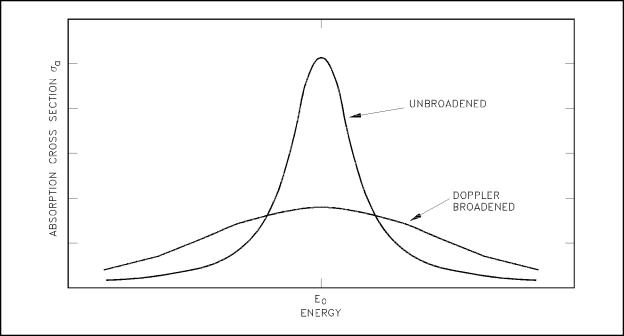
In general, Doppler broadening is the broadening of spectral lines due to the Doppler effect caused by a distribution of kinetic energies of molecules or atoms. In reactor physics a particular case of this phenomenon is the thermal Doppler broadening of the resonance capture cross sections of the fertile material (e.g. 238U or 240Pu) caused by thermal motion of target nuclei in the nuclear fuel.

The Doppler broadening of resonances is very important phenomenon, which improves reactor stability, because it accounts for the dominant part of the fuel temperature coefficient (the change in reactivity per degree change in fuel temperature) in thermal reactors and makes a substantial contribution in fast reactors as well. This coefficient is also called the prompt temperature coefficient because it causes an immediate response on changes in fuel temperature. The prompt temperature coefficient of most thermal reactors is negative.

See also: Doppler Broadening

Doppler effect
Doppler effect improves reactor stability. Broadened resonance (heating of a fuel) results in a higher probability of absorbtion, thus causes negative reactivity insertion (reduction of reactor power).
 
References:
Nuclear and Reactor Physics:
  1. J. R. Lamarsh, Introduction to Nuclear Reactor Theory, 2nd ed., Addison-Wesley, Reading, MA (1983).
  2. J. R. Lamarsh, A. J. Baratta, Introduction to Nuclear Engineering, 3d ed., Prentice-Hall, 2001, ISBN: 0-201-82498-1.
  3. W. M. Stacey, Nuclear Reactor Physics, John Wiley & Sons, 2001, ISBN: 0- 471-39127-1.
  4. Glasstone, Sesonske. Nuclear Reactor Engineering: Reactor Systems Engineering, Springer; 4th edition, 1994, ISBN: 978-0412985317
  5. W.S.C. Williams. Nuclear and Particle Physics. Clarendon Press; 1 edition, 1991, ISBN: 978-0198520467
  6. G.R.Keepin. Physics of Nuclear Kinetics. Addison-Wesley Pub. Co; 1st edition, 1965
  7. Robert Reed Burn, Introduction to Nuclear Reactor Operation, 1988.
  8. U.S. Department of Energy, Nuclear Physics and Reactor Theory. DOE Fundamentals Handbook, Volume 1 and 2. January 1993.

Advanced Reactor Physics:

  1. K. O. Ott, W. A. Bezella, Introductory Nuclear Reactor Statics, American Nuclear Society, Revised edition (1989), 1989, ISBN: 0-894-48033-2.
  2. K. O. Ott, R. J. Neuhold, Introductory Nuclear Reactor Dynamics, American Nuclear Society, 1985, ISBN: 0-894-48029-4.
  3. D. L. Hetrick, Dynamics of Nuclear Reactors, American Nuclear Society, 1993, ISBN: 0-894-48453-2.
  4. E. E. Lewis, W. F. Miller, Computational Methods of Neutron Transport, American Nuclear Society, 1993, ISBN: 0-894-48452-4.

See also:

See also:

Neutron Nuclear Reactions

See also:

We hope, this article, Microscopic Cross-section, helps you. If so, give us a like in the sidebar. Main purpose of this website is to help the public to learn some interesting and important information about materials and their properties.

What is Nuclear Radius – Radius of Nucleus – Definition

Nuclear Radius – Radius of Nucleus. Typical nuclear radii are of the order 10−14 m. Assuming spherical shape, nuclear radii can be calculated according to following formula:

Nuclear Radius

Typical nuclear radii are of the order 10−14 m. Assuming spherical shape, nuclear radii can be calculated according to following formula:

r = r0 . A1/3

where r0 = 1.2 x 10⁻¹⁵ m = 1.2 fm

If we use this approximation, we therefore expect the geometrical cross-sections of nuclei to be of the order of πr2 or 4.5×10⁻³⁰ m² for hydrogen nuclei or 1.74×10⁻²⁸ m² for 238U nuclei.

Since there are many nuclear reaction from the incident particle point of view, but, in nuclear reactor physics, neutron-nuclear reactions are of particular interest. In this case the neutron cross-section must be defined.

See also:

See also:

Neutron Cross-section

See also:

We hope, this article, Nuclear Radius – Radius of Nucleus, helps you. If so, give us a like in the sidebar. Main purpose of this website is to help the public to learn some interesting and important information about materials and their properties.

What is Critical Energy – Threshold Energy for Fission – Definition

Critical Energy – Threshold Energy for Fission. The minimum excitation energy required for fission to occur is known as the critical energy (Ecrit) or threshold energy. Material Properties

Critical Energy – Threshold Energy for Fission

In principle, any nucleus, if brought into sufficiently high excited state, can be splitted. For fission to occur, the excitation energy must be above a particular value for certain nuclide. The minimum excitation energy required for fission to occur is known as the critical energy (Ecrit) or threshold energy.The critical energy depends on the nuclear structure and is quite large for light nuclei with Z < 90. For heavier nuclei with Z > 90, the critical energy is about 4 to 6 MeV for A-even nuclei, and generally is much lower for A-odd nuclei. It must be noted, some heavy nuclei (eg. 240Pu or 252Cf) exhibit fission even in the ground state (without externally added excitation energy). This phenomena is known as the spontaneous fission. This process occur without the addition of the critical energy by the quantum-mechanical process of quantum tunneling through the Coulomb barrier (similarly like alpha particles in the alpha decay). The spontaneous fission contributes to ensure sufficient neutron flux on source range detectors when reactor is subcritical in long term shutdown.

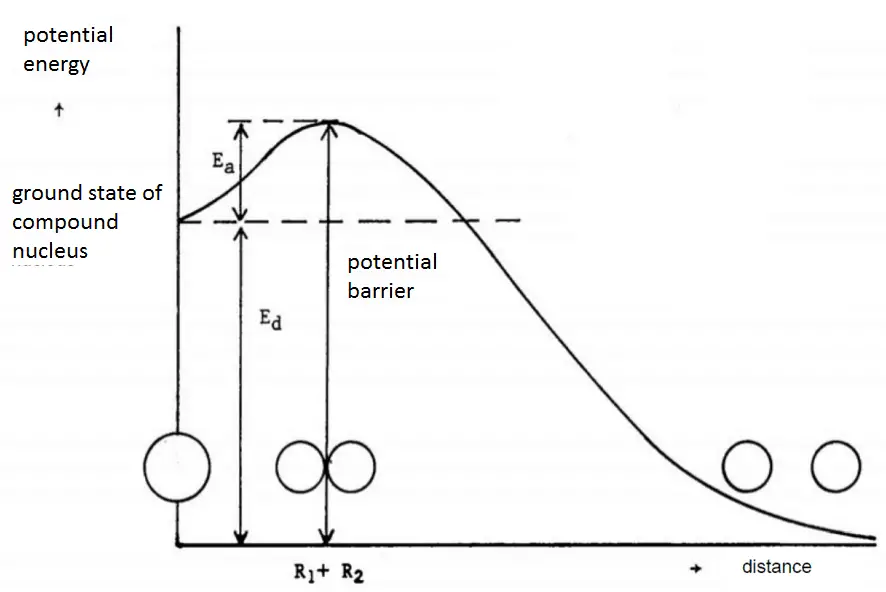
The amount of excitation energy required for fission to occur can be estimated from the magnitude of the electrostatic potential barrier and the dissociation energy of the fission.

In the figure, it is considered the potential energy of the fissioning nucleus as a function of the distance r between the two separating lobes. In order to deform the nucleus into a dumbbell shape, the sufficient kinetic or binding energy must be added to the system. This is due to the fact, nucleons attract one another and energy is required to increase the average distance between them. After the energy is added, the resulting nucleus is in an intermediate state with a larger potential energy than was the potential energy of original nucleus. The height of the potential barrier may be approximated given by:

Ec = Z1.Z2.e2 / (4.π.ε0.(R1+R2))

where R1 and R2 are the respective nuclear radii and ε0 is the permittivity of the vacuum. If this point is reached, the two lobes of the dumbbell begin to separate.

The dissociation energy Ed is equal to the difference between the binding energy of the compound nucleus to be fissioned and the sum of the binding energies of the fission fragments. The minimum activation energy Ea that has to be added to a nucleus to cause fission reaction is thus Ec – Ed.

Critical Energy - Threshold Energy
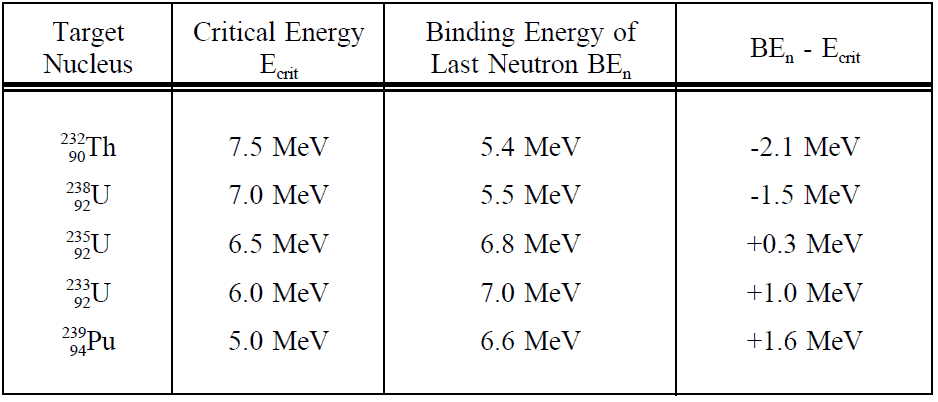
The minimum excitation energy required for fission to occur is known as the critical energy (Ec) or threshold energy.The activation energy Ea of nuclides with mass numbers below about 230 is very large, spontaneous fission of these nuclides does not occur. On the other hand nuclei with atomic numbers A > 260 have negative activation energies, so that these nuclei must undergo a decay or they can undergo spontaneous fission. The following table shows critical energies compared to binding energies of the last neutron of a number of nuclei.

All fissioning nuclei do not split in the same way. Although the mass of the initial nucleus is well defined in a reaction, the masses of resulting fission fragments are not. This is the reason there is no single Q-value, but what is usually referred to as the fission Q-value is actually an average of Q-values over all ways of fission.

Critical Energy to Binding Energy
This table shows critical energies compared to binding energies of the last neutron of a number of nuclei.For nuclei lighter than uranium the critical energies are considerably higher (e.g. Ec ~ 20MeV for 208Pb). This is the reason only the heaviest nuclei are of importance in nuclear engineering.

The excitation energy can be added to a nucleus by a neutron, but it is not the only way, how to induce fission. The excitation energy can be added also by bombardment with photons (photofission) or charged particles. In reactor engineering, the most attractive method of causing fission, however, is by forming a compound nucleus with the aid of a neutron.

In the case of neutron-induced fission reactions, an incident neutron provides additional energy to a target nucleus in the form of the kinetic energy and the nuclear binding energy. Neutrons have the principal advantage, they do not need to overcome the coulomb forces as in the case of charged particles.

It can be seen from the table that for fission of 238U or 232Th the neutron must have some additional kinetic energy (negative BEn – Ecrit value), while absorption of a neutron without kinetic energy can already cause fission of 235U (or 233U, 239Pu). For example, according to the table , the binding energy of the last neutron in 236U is 6.8 MeV (target nucleus is 235U), while the critical energy is only 6.5 MeV. Thus, when a thermal neutron is absorbed by 235U, the compound nucleus 236U is produced at about 0.3 MeV above the critical energy and the nucleus splits immediately. Nuclei such as 235U that lead to fission following the absorption of thermal neutron are called fissile nuclei.

For heavy nuclides with atomic number of higher than 90, most of fissile isotopes meet the fissile rule:

Fissile isotopes have 2 x Z – N = 43 ± 2 (example for 235U: 2 x 92 – 143 = 41)

where Z is number of protons and N is number of neutrons.
In general, the heavy nuclei with an odd number of neutrons (235U, 233U, 239Pu and 241Pu) can easily be split, because the neutron that is absorbed to form a compound nucleus with these nuclei is an ‘even’ neutron, so that the binding energy due to the pairing effect is large.

On the other hand, the heavy nuclei with an even number of neutrons (232Th, 238U, 240Pu and 242Pu) have a threshold energy (the kinetic energy) for fission by neutrons, because the absorbed neutron is an ‘odd’ neutron and this neutron makes relatively little binding energy available. For these nuclides fission is thus a threshold reaction.

For example, according to the table, the binding energy of the last neutron in 239U is only 5.5 MeV (target nucleus is 238U), while the critical energy is 7.0 MeV. Thus, when a thermal neutron is absorbed by 238U, fission cannot occur. In order to cause fission of 238U, the incident neutron must have additional kinetic energy. Nuclei such as 238U that lead to fission following the absorption of fast neutron are called fissionable nuclei. It must be noted, also a 208Pb nucleus may be fissioned when struck by a high energy neutron of about 20MeV, but this nucleus is not ordinarily said to be fissionable.

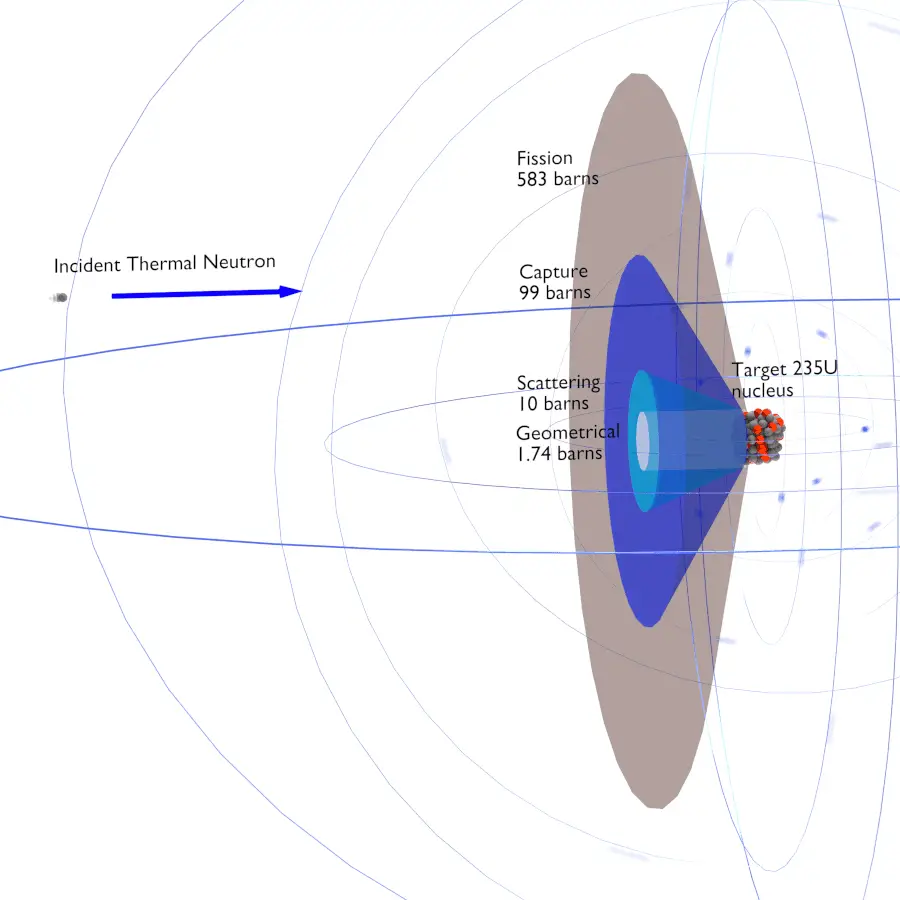
When a nucleus is excited above the potential barrier, it is not sure that fission will occur. Most of absorption reactions result in fission reaction (σf = 585 barns), but a minority results in radiative capture forming 236U. The radiative capture is a reaction, in which the compound nucleus decays to its ground state by gamma emission.The cross-section for radiative capture for thermal neutrons is about 99 barns (for 0.0253 eV neutron). Therefore about 15% of all absorption reactions result in radiative capture of neutron. About 85% of all absorption reactions result in fission.

Uranium absorption reaction

See also: Uranium 235 Fission

See also: Plutonium 239 Fission

See also:

Liquid Drop Model

See also:

Nuclear Fission

See also:

Energy Release

We hope, this article, Critical Energy – Threshold Energy for Fission, helps you. If so, give us a like in the sidebar. Main purpose of this website is to help the public to learn some interesting and important information about materials and their properties.

What is Weizsaecker Formula – Semi-empirical Mass Formula – Definition

With the aid of the Weizsaecker formula (the semi-empirical mass formula) the binding energy can be calculated very well for nearly all isotopes. Material Properties

Weizsaecker Formula – Semi-empirical Mass Formula

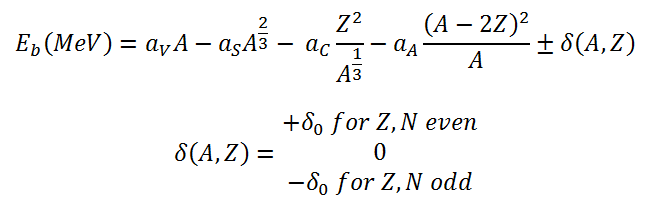
Weizsaecker formula - semi-empirical mass formulaThis formula is called the Weizsaecker Formula (or the semi-empirical mass formula). The physical meaning of this equation can be discussed term by term.

 
Volume term
Volume term – aV.A. The first two terms describe a spherical liquid drop of an incompressible fluid with a contribution from the volume scaling with A and from the surface, scaling with A2/3. The first positive term aV.A is known as the volume term and it is caused by the attracting strong forces between the nucleons. The strong force has a very limited range and a given nucleon may only interact with its direct neighbours. Therefore this term is proportional to A, instead of A2. The coefficient aV is usually about ~ 16 MeV.
Surface term
Surface term – asf.A2/3. The surface term is also based on the strong force, it is, in fact, a correction to the volume term. The point is that particles at the surface of the nucleus are not completely surrounded by other particles. In the volume term, it is suggested that each nucleon interacts with a constant number of nucleons, independent of A. This assumption is very nearly true for nucleons deep within the nucleus, but causes an overestimation of the binding energy on the surface. By analogy with a liquid drop this effect is indicated as the surface tension effect. If the volume of the nucleus is proportional to A, then the geometrical radius should be proportional to A1/3 and therefore the surface term must be proportional to the surface area i.e. proportional to A2/3.
Coulomb term
Coulomb term – aC.Z2.A-⅓. This term describes the Coulomb repulsion between the uniformly distributed protons and is proportional to the number of proton pairs Z2/R, whereby R is proportional to A1/3. This effect lowers the binding energy because of the repulsion between charges of equal sign.
Asymmetry term
Asymmetry term – aA.(A-2Z)2/A. This term cannot be described as ‘classically’ as the first three. This effect is not based on any of the fundamental forces, this effect is based only on the Pauli exclusion principle (no two fermions can occupy exactly the same quantum state in an atom). The heavier nuclei contain more neutrons than protons. These extra neutrons are necessary for stability of the heavier nuclei. They provide (via the attractive forces between the neutrons and protons) some compensation for the repulsion between the protons. On the other hand, if there are significantly more neutrons than protons in a nucleus, some of the neutrons will be higher in energy level in the nucleus. This is the basis for a correction factor, the so-called symmetry term.
Pairing term
Pairing term – δ(A,Z). The last term is the pairing term δ(A,Z). This term captures the effect of spin-coupling. Nuclei with an even number of protons and an even number of neutrons are (due to Pauli exclusion principle) very stable thanks to the occurrence of ‘paired spin’. On the other hand, nuclei with an odd number of protons and neutrons are mostly unstable.
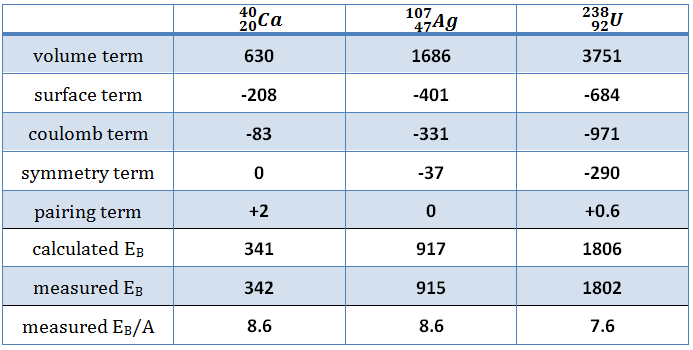
Table of Calculated Binding Energies
the semi-empirical mass formula - weizsaecker formula
Table of binding energies fo some nuclides. Calculated according to the semi-empirical mass formula.
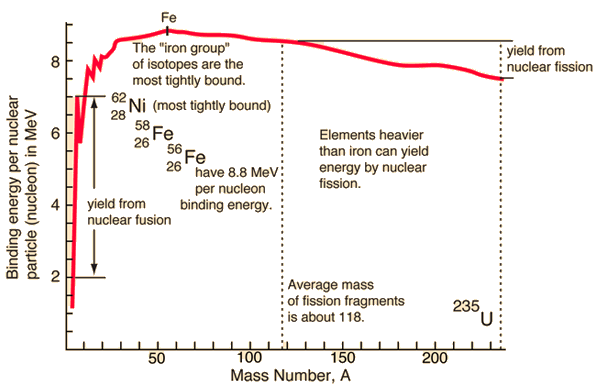
Nuclear binding energy curve.
Source: hyperphysics.phy-astr.gsu.edu

With the aid of the Weizsaecker formula the binding energy can be calculated very well for nearly all isotopes. This formula provides a good fit for heavier nuclei. For light nuclei, especially for 4He, it provides a poor fit. The main reason is the formula does not consider the internal shell structure of the nucleus.

In order to calculate the binding energy, the coefficients aV, aS, aC, aA and aP must be known. The coefficients have units of megaelectronvolts (MeV) and are calculated by fitting to experimentally measured masses of nuclei. They usually vary depending on the fitting methodology. According to ROHLF, J. W., Modern Physics from α to Z0 , Wiley, 1994., the coefficients in the equation are following:Weizsaecker formula - semi-empirical mass formulaUsing the Weizsaecker formula, also the mass of an atomic nucleus can be derived and is given by:m = Z.mp +N.mn -Eb/c2

where mp and mn are the rest mass of a proton and a neutron, respectively, and Eb is the nuclear binding energy of the nucleus.

From the nuclear binding energy curve and from the table it can be seen that, in the case of splitting a 235U nucleus into two parts, the binding energy of the fragments (A ≈ 120) together is larger than that of the original 235U nucleus.

According to the Weizsaecker formula, the total energy released for such reaction will be approximately 235 x (8.5 – 7.6) ≈ 200 MeV.

See also: Liquid Drop Model

See also:

Nuclear Fission

We hope, this article, Weizsaecker Formula – Semi-empirical Mass Formula, helps you. If so, give us a like in the sidebar. Main purpose of this website is to help the public to learn some interesting and important information about materials and their properties.

What is Liquid Drop Model of Nucleus – Definition

According to the liquid drop model, the atomic nucleus behaves like the molecules in a drop of liquid. But in this nuclear scale, the fluid is made of nucleons (protons and neutrons). Material Properties

Liquid Drop Model of Nucleus

Liquid Drop ModelOne of the first models which could describe very well the behavior of the nuclear binding energies and therefore of nuclear masses was the mass formula of von Weizsaecker (also called the semi-empirical mass formula – SEMF), that was published in 1935 by German physicist Carl Friedrich von Weizsäcker. This theory is based on the liquid drop model proposed by George Gamow.

According to this model, the atomic nucleus behaves like the molecules in a drop of liquid. But in this nuclear scale, the fluid is made of nucleons (protons and neutrons), which are held together by the strong nuclear force. The liquid drop model of the nucleus takes into account the fact that the nuclear forces on the nucleons on the surface are different from those on nucleons in the interior of the nucleus. The interior nucleons are completely surrounded by other attracting nucleons. Here is the analogy with the forces that form a drop of liquid.

In the ground state the nucleus is spherical. If the sufficient kinetic or binding energy is added, this spherical nucleus may be distorted into a dumbbell shape and then may be splitted into two fragments. Since these fragments are a more stable configuration, the splitting of such heavy nuclei must be accompanied by energy release. This model does not explain all the properties of the atomic nucleus, but does explain the predicted nuclear binding energies.

The nuclear binding energy as a function of the mass number A and the number ofprotons Z based on the liquid drop model can be written as:Weizsaecker formula - semi-empirical mass formulaThis formula is called the Weizsaecker Formula (or the semi-empirical mass formula). The physical meaning of this equation can be discussed term by term.

 
Volume term
Volume term – aV.A. The first two terms describe a spherical liquid drop of an incompressible fluid with a contribution from the volume scaling with A and from the surface, scaling with A2/3. The first positive term aV.A is known as the volume term and it is caused by the attracting strong forces between the nucleons. The strong force has a very limited range and a given nucleon may only interact with its direct neighbours. Therefore this term is proportional to A, instead of A2. The coefficient aV is usually about ~ 16 MeV.
Surface term
Surface term – asf.A2/3. The surface term is also based on the strong force, it is, in fact, a correction to the volume term. The point is that particles at the surface of the nucleus are not completely surrounded by other particles. In the volume term, it is suggested that each nucleon interacts with a constant number of nucleons, independent of A. This assumption is very nearly true for nucleons deep within the nucleus, but causes an overestimation of the binding energy on the surface. By analogy with a liquid drop this effect is indicated as the surface tension effect. If the volume of the nucleus is proportional to A, then the geometrical radius should be proportional to A1/3 and therefore the surface term must be proportional to the surface area i.e. proportional to A2/3.
Coulomb term
Coulomb term – aC.Z2.A-⅓. This term describes the Coulomb repulsion between the uniformly distributed protons and is proportional to the number of proton pairs Z2/R, whereby R is proportional to A1/3. This effect lowers the binding energy because of the repulsion between charges of equal sign.
Asymmetry term
Asymmetry term – aA.(A-2Z)2/A. This term cannot be described as ‘classically’ as the first three. This effect is not based on any of the fundamental forces, this effect is based only on the Pauli exclusion principle (no two fermions can occupy exactly the same quantum state in an atom). The heavier nuclei contain more neutrons than protons. These extra neutrons are necessary for stability of the heavier nuclei. They provide (via the attractive forces between the neutrons and protons) some compensation for the repulsion between the protons. On the other hand, if there are significantly more neutrons than protons in a nucleus, some of the neutrons will be higher in energy level in the nucleus. This is the basis for a correction factor, the so-called symmetry term.
Pairing term
Pairing term – δ(A,Z). The last term is the pairing term δ(A,Z). This term captures the effect of spin-coupling. Nuclei with an even number of protons and an even number of neutrons are (due to Pauli exclusion principle) very stable thanks to the occurrence of ‘paired spin’. On the other hand, nuclei with an odd number of protons and neutrons are mostly unstable.
Nuclear binding energy curve.
Source: hyperphysics.phy-astr.gsu.edu

With the aid of the Weizsaecker formula the binding energy can be calculated very well for nearly all isotopes. This formula provides a good fit for heavier nuclei. For light nuclei, especially for 4He, it provides a poor fit. The main reason is the formula does not consider the internal shell structure of the nucleus.

In order to calculate the binding energy, the coefficients aV, aS, aC, aA and aP must be known. The coefficients have units of megaelectronvolts (MeV) and are calculated by fitting to experimentally measured masses of nuclei. They usually vary depending on the fitting methodology. According to ROHLF, J. W., Modern Physics from α to Z0 , Wiley, 1994., the coefficients in the equation are following:Weizsaecker formula - semi-empirical mass formulaUsing the Weizsaecker formula, also the mass of an atomic nucleus can be derived and is given by:

m = Z.mp +N.mn -Eb/c2

where mp and mn are the rest mass of a proton and a neutron, respectively, and Eb is the nuclear binding energy of the nucleus.From the nuclear binding energy curve and from the table it can be seen that, in the case of splitting a 235U nucleus into two parts, the binding energy of the fragments (A ≈ 120) together is larger than that of the original 235U nucleus.

According to the Weizsaecker formula, the total energy released for such reaction will be approximately 235 x (8.5 – 7.6) ≈ 200 MeV.

the semi-empirical mass formula - weizsaecker formula
Table of binding energies fo some nuclides. Calculated according to the semi-empirical mass formula.
Critical Energy - Threshold Energy
The minimum excitation energy required for fission to occur is known as the critical energy (Ecrit) or threshold energy.
Critical Energy to Binding Energy
This table shows critical energies compared to binding energies of the last neutron of a number of nuclei.

[/lgc_column]

See also:

Binding Energy

See also:

Nuclear Fission

See also:

Critical Energy

We hope, this article, Liquid Drop Model of Nucleus, helps you. If so, give us a like in the sidebar. Main purpose of this website is to help the public to learn some interesting and important information about materials and their properties.

What is Tritium – Definition

Tritium is the only naturally-occurring radioisotope of hydrogen. Tritium is also a byproduct of the production of electricity by nuclear power plants. Material Properties

Tritium

Tritium is the only naturally-occurring radioisotope of hydrogen. Its atomic number is naturally 1 which means there is 1 proton and 1 electron in the atomic structure. Unlike the hydrogen nucleus and deuterium nucleus, tritium has 2 neutrons in the nucleus. Tritium is naturally-occurring, but it is extremely rare. Tritium is produced in the atmosphere when cosmic rays collide with air molecules. Tritium is also a byproduct of the production of electricity by nuclear power plants. The name of this isotope is formed from the Greek word τρίτος (trítos) meaning “third”.

Decay of Tritium

Tritium is a radioactive isotope, bur it emits a very weak form of radiation, a low-energy beta particle that is similar to an electron. It is a pure beta emitter (i.e. beta emitter without an accompanying gamma radiation). The electron’s kinetic energy varies, with an average of 5.7 keV, while the remaining energy is carried off by the nearly undetectable electron antineutrino. Such a very low energy of electron causes, that the electron cannot penetrate the skin or even does not travel very far in air. Beta particles from tritium can penetrate only about 6.0 mm of air.

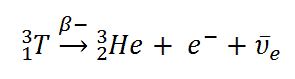
Tritium decays via negative beta decay into helium-3 with half-life of 12.3 years.

Decay of Tritium

3H

Tritium in nuclear reactors

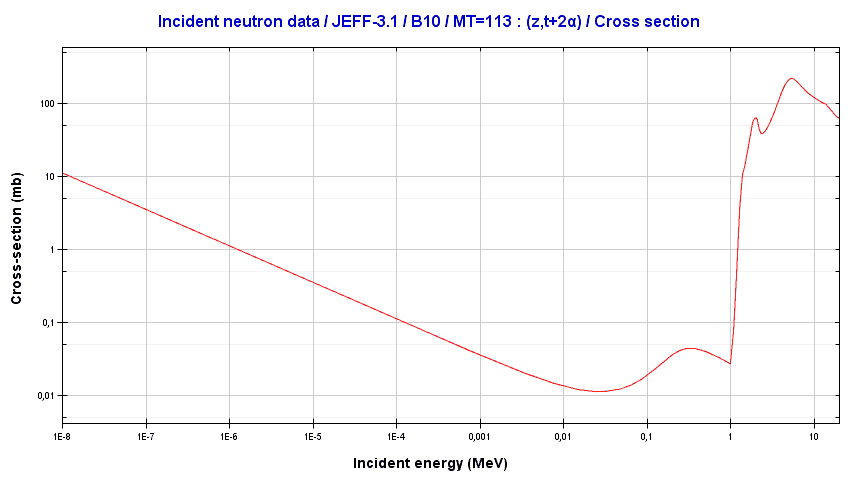
Cross-section of 10B(n,2alpha)T reaction.

Tritium is a byproduct in nuclear reactors. Most important source (due to releases of tritiated water) of tritium in nuclear power plants stems from the boric acid, which is commonly used as a chemical shim to compensate an excess of initial reactivity. Main reactions, in which the tritium is generated from boron are below:

10B(n,T + 2*alpha)

This threshold reaction of fast neutron with an isotope 10B is the main way, how radioactive tritium in primary circuit of all PWRs is generated. 10B is the principal source of radioactive tritium in primary circuit of all PWRs (which use boric acid as a chemical shim). Direct nuclear reactionNote that, this reaction occurs very rarely in comparison with the most common (n,alpha) reaction of isotope 10B with thermal neutrons.

There are more reactions with neutrons, which can rarely lead to formation of radioactive tritium, for example:

10B(n,alpha)7Li + 7Li(n,n+alpha)3H  – threshold reaction (~3 MeV).

Boron 10. Comparison of total cross-section and cross-section for (n,alpha) reactions.
Source: JANIS (Java-based Nuclear Data Information Software); The JEFF-3.1.1 Nuclear Data Library[/caption
Boron 10. Comparison of total cross-section and cross-section for (n,alpha) reactions.

Source: JANIS (Java-based Nuclear Data Information Software); The JEFF-3.1.1 Nuclear Data Library
Tritium is also a fission product (ternary fission) of the splitting of fissionable materials. In fact, fission probably produces more tritium than all other sources in Light Water Reactors. Its production (yield) is of about one atom per each 10,000 fissions. On the other hand only a very small fraction of the fission-product tritium diffuses out of the fuel matrix and fuel cladding into the primary coolant.

Tritium is also produced in reaction with 6Li.

6Li(n,α)3H

This is a reaction allowing detection of neutrons, but in some cases, LiOH is added to control the pH of primary coolant in some LWR. The reaction cross-section for thermal neutrons is σ = 925 barns and the natural lithium has abundance of 6Li 7,4%.

Tritium occurs in nuclear power plants in the form of tritiated water. Tritiated water is like normal water, but is very very weakly radioactive. Therefore it dose not pose a hazard to human health. The releases of tritiated water are closely monitored by plant operators and state supervisors.

Reference: Jacobs D.G. Sources of Tritium and Its Behaviour Upon Release to the Environment. US Atomic Energy Commission, 1968.

Tritium in Nature

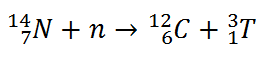
Tritium is produced in the atmosphere when cosmic rays collide with air molecules. In the most important reaction for natural production, a fast neutron (which must have energy greater than 4.0 MeV) interacts with atmospheric nitrogen:

Worldwide, the production of tritium from natural sources is 148 petabecquerels per year. In result, the tritiated water produced participates in the water cycle.

  • about 400 Bq/m3 in continental water
  • about 100 Bq/m3 in oceans

Tritium poses a risk to health as a result of internal exposure only following ingestion in drinking water or food, or inhalation or absorption through the skin. The tritium taken into the body is uniformly distributed among all soft tissues. An average annual dose from natural tritium intake is 0.01 μSv.

In case of artificial tritium ingestion or inhalation, a biological half-time of tritium is 10 days for HTO and 40 days for OBT (organically bound tritium) formed from HTO in the body of adults. It was also shown that the biological half-time of HTO depends strongly on many variables and varies from about 4 to 18 days. During the warmer months, the average half-life is lower, which is attributed to increased water intake. As well as, drinking larger amounts of alcohol will reduce the biological half-life of water in the body.

See also: Tritium in Nature

See also:

Glossary

We hope, this article, Tritium, helps you. If so, give us a like in the sidebar. Main purpose of this website is to help the public to learn some interesting and important information about materials and their properties.

What is Charged Particle Ejection – Definition

Charged particle reactions are nuclear reactions, in which target nucleus is excited to a high energy level and is able to eject a new charged particle. Material Properties

Charged Particle Ejection

Charged particle reactions are usually associated with formation of a compound nucleus, which is excited to a high energy level, that such compound nucleus can eject a new charged particle while the incident neutron remains in the nucleus. After the new particle is ejected, the remaining nucleus is completely changed, but may or may not exist in an excited state depending upon the mass-energy balance of the reaction. This type of reaction is more common for charged particles as incident particles (such as alpha particles, protons, and so on).

The case of neutron-induced charged particle reactions is not so common, but there are some neutron-induced charged particle reactions, that are of importance in the reactivity control and also in the detection of neutrons.

The most important charged particle reactions in nuclear reactor physics are reactions of thermal neutrons with boron nuclei (rather with 10B nuclei). In nuclear industry boron is commonly used as a neutron absorber and a neutron converter (in neutron radiation detectors) due to its high neutron cross-section of isotope 10B along entire neutron energy spectrum. Its (n,alpha) reaction cross-section for thermal neutrons is about 3840 barns (for 0.025 eV neutron). Examples of neutron-induced charged particle reactions are shown below:

See also: Application of boron based materials
See also: Detection of neutrons

σ

Examples of (n,alpha) reactions

10B(n,alpha)7Li

This reaction is the most important (n,alpha) reaction of isotope 10B with thermal neutrons. This reaction can be used as in the case of neutron absorbers (chemical shim, burnable absorbers or control rods), and in the case of neutron converters (neutron detectors), because its cross-section is very high and produces energetic alpha particles.

(n,alpha) reactions of 10B

6Li(n,α)3H

This is a reaction allowing detection of neutrons. The reaction cross-section for thermal neutrons is σ = 925 barns and the natural lithium has abundance of 6Li 7,4%.

Boron 10. Comparison of total cross-section and cross-section for (n,alpha) reactions.
Source: JANIS (Java-based Nuclear Data Information Software); The JEFF-3.1.1 Nuclear Data Library
Boron 10. Comparison of total cross-section and cross-section for (n,alpha) reactions.

Source: JANIS (Java-based Nuclear Data Information Software); The JEFF-3.1.1 Nuclear Data Library

Examples of (n,p) reactions

3He(n,p)3H

This is a reaction allowing detection of neutrons. The reaction cross-section for thermal neutrons is σ = 5350 barns and the natural helium has abundance of isotope 3He 0.014%.

14N (n,p) 14C

This nuclear reaction continually take place especially in the earth’s atmosphere, forming equilibrium amounts of the radionuclide 14C. In nuclear power plants, it is important especially from radiation protection point of view. The reaction is responsible for most of the radiation dose delivered to the human body by thermal neutrons. The nitrogen atoms are contained in proteins, therefore if the human body is exposed to thermal neutrons, then these thermal neutrons may be absorbed by 14N, causing a proton emission. Protons are directly ionizing particles and deposit their energy over a very short distance in the body tissue.

Examples of (n,…) reactions

Cross-section of 10B(n,2alpha)T reaction.

10B(n,T + 2*alpha)

This threshold reaction of fast neutron with an isotope 10B is the main way, how radioactive tritium in primary circuit of all PWRs is generated. 10B is the principal source of radioactive tritium in primary circuit of all PWRs (which use boric acid as a chemical shim). Direct nuclear reactionNote that, this reaction occurs very rarely in comparison with the most common (n,alpha) reaction of isotope 10B with thermal neutrons.

There are more reactions with neutrons, which can rarely lead to formation of radioactive tritium, for example:

10B(n,alpha)7Li + 7Li(n,n+alpha)3H  – threshold reaction (~3 MeV).

 
References:
Nuclear and Reactor Physics:
  1. J. R. Lamarsh, Introduction to Nuclear Reactor Theory, 2nd ed., Addison-Wesley, Reading, MA (1983).
  2. J. R. Lamarsh, A. J. Baratta, Introduction to Nuclear Engineering, 3d ed., Prentice-Hall, 2001, ISBN: 0-201-82498-1.
  3. W. M. Stacey, Nuclear Reactor Physics, John Wiley & Sons, 2001, ISBN: 0- 471-39127-1.
  4. Glasstone, Sesonske. Nuclear Reactor Engineering: Reactor Systems Engineering, Springer; 4th edition, 1994, ISBN: 978-0412985317
  5. W.S.C. Williams. Nuclear and Particle Physics. Clarendon Press; 1 edition, 1991, ISBN: 978-0198520467
  6. G.R.Keepin. Physics of Nuclear Kinetics. Addison-Wesley Pub. Co; 1st edition, 1965
  7. Robert Reed Burn, Introduction to Nuclear Reactor Operation, 1988.
  8. U.S. Department of Energy, Nuclear Physics and Reactor Theory. DOE Fundamentals Handbook, Volume 1 and 2. January 1993.

Advanced Reactor Physics:

  1. K. O. Ott, W. A. Bezella, Introductory Nuclear Reactor Statics, American Nuclear Society, Revised edition (1989), 1989, ISBN: 0-894-48033-2.
  2. K. O. Ott, R. J. Neuhold, Introductory Nuclear Reactor Dynamics, American Nuclear Society, 1985, ISBN: 0-894-48029-4.
  3. D. L. Hetrick, Dynamics of Nuclear Reactors, American Nuclear Society, 1993, ISBN: 0-894-48453-2.
  4. E. E. Lewis, W. F. Miller, Computational Methods of Neutron Transport, American Nuclear Society, 1993, ISBN: 0-894-48452-4.

See also:

See also:

Neutron Reactions

See also:

We hope, this article, Charged Particle Ejection, helps you. If so, give us a like in the sidebar. Main purpose of this website is to help the public to learn some interesting and important information about materials and their properties.
What is Neutron Emission – Definition

The neutron emission is a reaction, in which a neutron is ejected from nucleus. and they may be referred to as neutron emission reactions. Neutron Emission. Material Properties

Neutron Emission

The neutron emission is one of the radioactive decays, by which unstable nuclei may reach the stability. In general, this type of radioactive decay may occur, when nuclei contain significant excess of neutrons or excitation energy. In this type of decay a neutron is simply ejected from the nucleus.

Although the neutron emission is usually associated with nuclear decay, it must be also mentioned in connection with neutron nuclear reactions. Some neutrons interacts with a target nucleus via a compound nucleus. Among these compound nucleus reactions are also reactions, in which a neutron is ejected from nucleus and they may be referred to as neutron emission reactions. The point is that compound nuclei lose its excitation energy in a way, which is identical to the radioactive decay. Very important feature is the fact the mode of decay of compound nucleus does not depend on the way the compound nucleus was formed.
The compound nucleus reactions, in which neutron emission occurs, are:

  • Elastic Scattering Reaction. In some cases, if the kinetic energy of an incident neutron just right to form a resonance, the neutron may be absorbed and a compound nucleus may be formed. This interaction is more unusual (in comparison with potential scattering) and is also known as resonance elastic scattering. Due to formation of the compound nucleus, initial and final neutron are not the same and this reactions may be also referred to as one type of neutron emission reaction.
  • Inelastic Scattering Reaction. In this case, the connection with neutron emission is more obvious. In an inelastic scattering reaction between a neutron and a target nucleus some energy of the incident neutron is absorbed to the recoiling nucleus and the nucleus remains in the excited state. The neutron is emitted then with a lower kinetic energy. If the kinetic energy of an incident neutron is sufficient the double, triple, or more, neutron emission may take place. These events are referred to as (n, 2n), (n, 3n) or (n, …n) reactions. The probability of such reactions increases with increasing incident neutron energies.
  • Nuclear Fission. The fission reaction is very specific reaction and is of importance in many fields of nuclear engineering. It is known the fission reaction produces fission neutrons that are of importance in any chain-reacting system. But not all neutrons are released at the same time following fission. Even the nature of creation of these neutrons is different. From this point of view we usually divide the fission neutrons into two following groups:
    • Prompt Neutrons. Prompt neutrons are emitted directly from fission and they are emitted within very short time of about 10-14 second.
    • Delayed Neutrons. Delayed neutrons are emitted by neutron rich fission fragments that are called the delayed neutron precursors. These precursors usually undergo beta decay but a small fraction of them are excited enough to undergo neutron emission. The fact the neutron is produced via this type of decay and this happens orders of magnitude later compared to the emission of the prompt neutrons, plays an extremely important role in the control of the reactor.
 
References:
Nuclear and Reactor Physics:
  1. J. R. Lamarsh, Introduction to Nuclear Reactor Theory, 2nd ed., Addison-Wesley, Reading, MA (1983).
  2. J. R. Lamarsh, A. J. Baratta, Introduction to Nuclear Engineering, 3d ed., Prentice-Hall, 2001, ISBN: 0-201-82498-1.
  3. W. M. Stacey, Nuclear Reactor Physics, John Wiley & Sons, 2001, ISBN: 0- 471-39127-1.
  4. Glasstone, Sesonske. Nuclear Reactor Engineering: Reactor Systems Engineering, Springer; 4th edition, 1994, ISBN: 978-0412985317
  5. W.S.C. Williams. Nuclear and Particle Physics. Clarendon Press; 1 edition, 1991, ISBN: 978-0198520467
  6. G.R.Keepin. Physics of Nuclear Kinetics. Addison-Wesley Pub. Co; 1st edition, 1965
  7. Robert Reed Burn, Introduction to Nuclear Reactor Operation, 1988.
  8. U.S. Department of Energy, Nuclear Physics and Reactor Theory. DOE Fundamentals Handbook, Volume 1 and 2. January 1993.

Advanced Reactor Physics:

  1. K. O. Ott, W. A. Bezella, Introductory Nuclear Reactor Statics, American Nuclear Society, Revised edition (1989), 1989, ISBN: 0-894-48033-2.
  2. K. O. Ott, R. J. Neuhold, Introductory Nuclear Reactor Dynamics, American Nuclear Society, 1985, ISBN: 0-894-48029-4.
  3. D. L. Hetrick, Dynamics of Nuclear Reactors, American Nuclear Society, 1993, ISBN: 0-894-48453-2.
  4. E. E. Lewis, W. F. Miller, Computational Methods of Neutron Transport, American Nuclear Society, 1993, ISBN: 0-894-48452-4.

See also:

See also:

Neutron Reactions

See also:

We hope, this article, Neutron Emission, helps you. If so, give us a like in the sidebar. Main purpose of this website is to help the public to learn some interesting and important information about materials and their properties.

What is Neutron Capture Cross-section – Definition

The likelihood of a neutron radiative capture is represented by the radiative capture cross-section with three regions: 1/v, resonance and fast region. Material Properties

Neutron Capture Cross-section

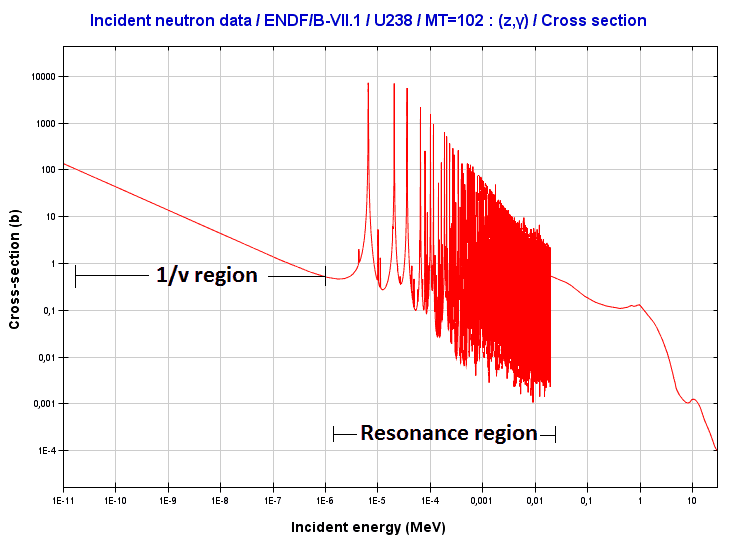
The likelihood of a neutron radiative capture is represented by the radiative capture cross section as σγ. As usual, the cross-section can be divided into three regions according to the incident neutron energy.

  • 1/v Region
  • Resonance Region
  • Fast Neutrons Region

1/v Region

In the common case, the cross section is usually much larger at low energies than at high energies. For thermal neutrons (in 1/v region), also radiative capture cross-sections increase as the velocity (kinetic energy) of the neutron decreases. Therefore the 1/v Law can be used to determine shift in capture cross-section, if the neutron is in equilibrium with a surrounding medium. This phenomenon is due to the fact the nuclear force between the target nucleus and the neutron has a longer time to interact.

Resonance Region

The largest cross-sections are usually at neutron energies, that lead to long-lived states of the compound nucleus. The compound nuclei of these certain energies are referred to as nuclear resonances and its formation is typical in the resonance region. The widths of the resonances increase in general with increasing energies. At higher energies the widths may reach the order of the distances between resonances and then no resonances can be observed. The narrowest resonances are usually compound states of heavy nuclei (such as fissionable nuclei).

Since the mode of decay of the compound nucleus does not depend on the way the compound nucleus was formed, the nucleus sometimes emits a gamma ray (radiative capture) or sometimes emits a neutron (scattering). In order to understand the way, how a nucleus will stabilize itself, we have to understand the behaviour of compound nucleus.

The compound nucleus emits a neutron only after one neutron obtains an energy in collision with other nucleon greater than its binding energy in the nucleus. It have some delay, because the excitation energy of the compound nucleus is divided among several nucleons. It is obvious the average time that elapses before a neutron can be emitted is much longer for nuclei with large number of nucleons than when only a few nucleons are involved. It is a consequence of sharing the excitation energy among a large number of nucleons.

This is the reason the radiative capture is comparatively unimportant in light nuclei but becomes increasingly important in the heavier nuclei.

The lifetime of a compound nucleus is inversely proportional to its total width. Narrow resonances therefore correspond to capture while the wider resonances are due to scattering.

Example:

Source: R. Lamarsh, Introduction to Nuclear Reactor Theory, 2nd ed., Addison-Wesley, Reading, MA (1983).

The first resonance in 238U at 6.67 eV, which corresponds to the first virtual level in 239U, has a total width of only 0.027 eV, and the mean life of this state is 2.4×10⁻¹⁴s. By contrast, the resonance observed at 443 keV in 16O, which corresponds to the first virtual state in 17O, has a total width of 41 keV, giving a mean lifetime of 1.5×10⁻²¹s. Thus it is highly likely that the compound state in 239U decays at least to some extent by gamma ray emission, while compound state in 17O must decay primarily by nucleon emission. The 443-keV resonance in 16O is clearly a scattering resonance, whereas the 6.67-eV resonance in 238U is in part a capture resonance.

σγ

Table of cross-sections

Table of cross-sections.

Resonance region - Compound Nucleus
Radiative Capture Cross-section – region of resonances of 238U nuclei.

Source: JANIS (Java-based Nuclear Data Information Software); The JEFF-3.1.1 Nuclear Data Library

Compound state - resonance
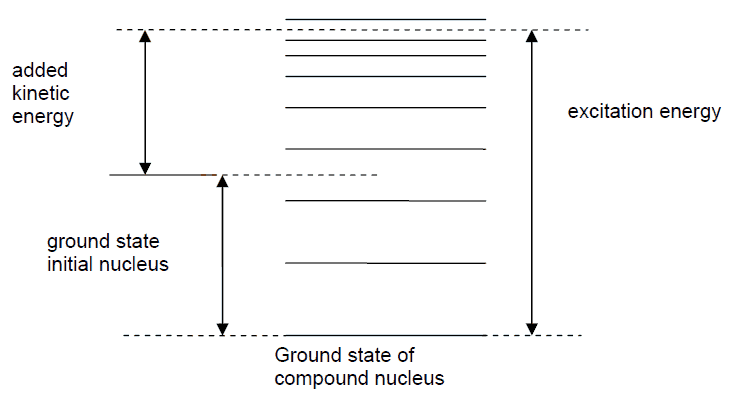
Energy levels of compound state. For neutron absorption reaction on 238U the first resonance E1 corresponds to the excitation energy of 6.67eV. E0 is a base state of 239U.
ground state compound nucleus - excitation
Energy levels of compound state. For neutron absorption reaction on 238U the first resonance E1 corresponds to the excitation energy of 6.67eV. E0 is a base state of 239U.
radiative capture to elastic scattering cross-sections-
Radiative capture and elastic scattering cross-sections in 16O and 238U.

Doppler Broadening

In general, Doppler broadening is the broadening of spectral lines due to the Doppler effect caused by a distribution of kinetic energies of molecules or atoms. In reactor physics a particular case of this phenomenon is the thermal Doppler broadening of resonances caused by the thermal motion of the target particle in the nuclear fuel.

Doppler effect
Doppler effect improves reactor stability. Broadened resonance (heating of a fuel) results in a higher probability of absorbtion, thus causes negative reactivity insertion (reduction of reactor power).

The Doppler broadening of resonances is very important phanomenon, which improves reactor stability. The prompt temperature coefficient of most thermal reactors is negative, owing to an nuclear Doppler effect. Although the absorbtion cross-section depends significantly on incident neutron energy, the shape of the cross-section curve depends also on target temperature.

Nuclei are located in atoms which are themselves in continual motion owing to their thermal energy. As a result of these thermal motions neutrons impinging on a target appears to the nuclei in the target to have a continuous spread in energy. This, in turn, has an effect on the observed shape of resonance. The resonance becomes shorter and wider than when the nuclei are at rest.

Although the shape of a resonance changes with temperature, the total area under the resonance remains essentially constant. But this does not imply constant neutron absorbtion. Despite the constant area under resonance, a resonance integral, which determines the absorbtion, increases with increasing target temperature. This, of course, decreases coefficient k (negative reactivity is inserted).

Fast Neutrons Region

The radiative capture cross-section at energies above the resonance region drops rapidly to very small values. This rapid drop is caused by the compound nucleus, which is formed in more highly-excited states. In these highly-excited states it is more likely that one neutron obtains an energy in collision with other nucleon greater than its binding energy in the nucleus. The neutron emission becomes dominant and gamma decay becomes less important. Moreover, at high energies, the inelastic scattering and (n,2n) reaction are highly probable at the expense of both elastic scattering and radiative capture.

Cross-sections of key isotopes

Source: JANIS (Java-based Nuclear Data Information Software); The JEFF-3.1.1 Nuclear Data Library

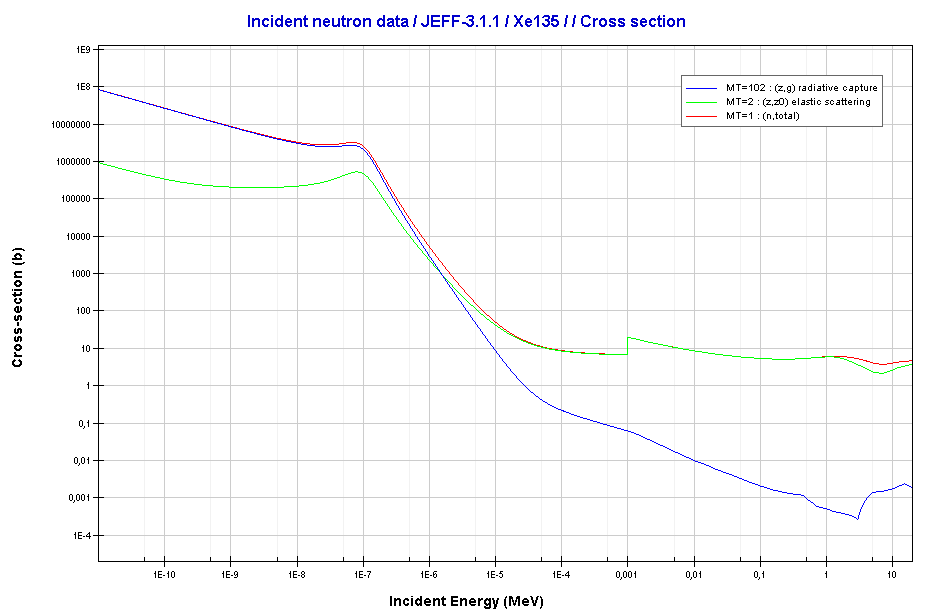
Xenon - 135. Neutron absorption and scattering. Comparison of cross-sections.
Xenon – 135. Neutron absorption and scattering. Comparison of cross-sections.

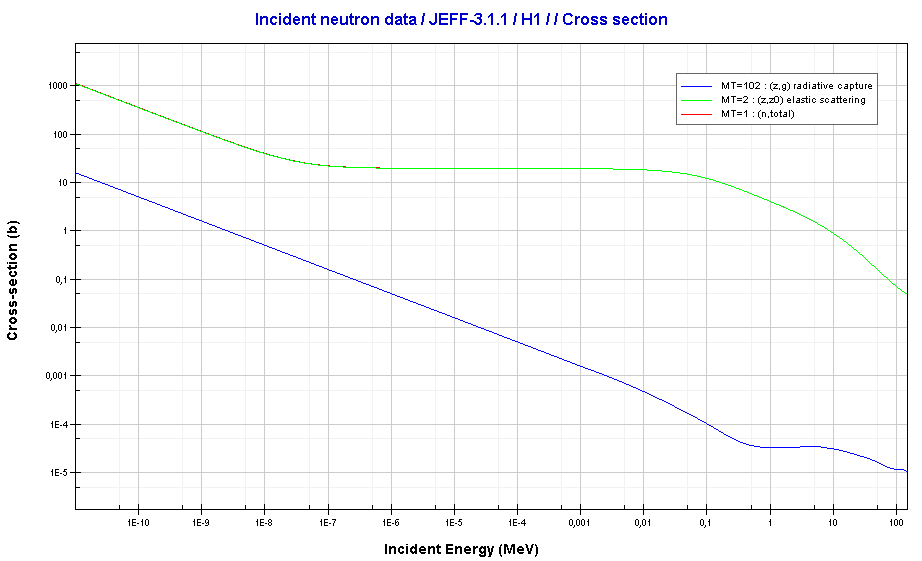
Source: JANIS (Java-based Nuclear Data Information Software); The JEFF-3.1.1 Nuclear Data LibraryHydrogen. Neutron absorption and scattering. Comparison of cross-sections.

Hydrogen. Neutron absorption and scattering. Comparison of cross-sections.

Source: JANIS (Java-based Nuclear Data Information Software); The JEFF-3.1.1 Nuclear Data Library

Gadolinium 155 and 157. Comparison of radiative capture cross-sections.

Source: JANIS (Java-based Nuclear Data Information Software); The JEFF-3.1.1 Nuclear Data Library

 
References:
Nuclear and Reactor Physics:
  1. J. R. Lamarsh, Introduction to Nuclear Reactor Theory, 2nd ed., Addison-Wesley, Reading, MA (1983).
  2. J. R. Lamarsh, A. J. Baratta, Introduction to Nuclear Engineering, 3d ed., Prentice-Hall, 2001, ISBN: 0-201-82498-1.
  3. W. M. Stacey, Nuclear Reactor Physics, John Wiley & Sons, 2001, ISBN: 0- 471-39127-1.
  4. Glasstone, Sesonske. Nuclear Reactor Engineering: Reactor Systems Engineering, Springer; 4th edition, 1994, ISBN: 978-0412985317
  5. W.S.C. Williams. Nuclear and Particle Physics. Clarendon Press; 1 edition, 1991, ISBN: 978-0198520467
  6. G.R.Keepin. Physics of Nuclear Kinetics. Addison-Wesley Pub. Co; 1st edition, 1965
  7. Robert Reed Burn, Introduction to Nuclear Reactor Operation, 1988.
  8. U.S. Department of Energy, Nuclear Physics and Reactor Theory. DOE Fundamentals Handbook, Volume 1 and 2. January 1993.

Advanced Reactor Physics:

  1. K. O. Ott, W. A. Bezella, Introductory Nuclear Reactor Statics, American Nuclear Society, Revised edition (1989), 1989, ISBN: 0-894-48033-2.
  2. K. O. Ott, R. J. Neuhold, Introductory Nuclear Reactor Dynamics, American Nuclear Society, 1985, ISBN: 0-894-48029-4.
  3. D. L. Hetrick, Dynamics of Nuclear Reactors, American Nuclear Society, 1993, ISBN: 0-894-48453-2.
  4. E. E. Lewis, W. F. Miller, Computational Methods of Neutron Transport, American Nuclear Society, 1993, ISBN: 0-894-48452-4.

See also:

Radiative Capture

We hope, this article, Neutron Capture Cross-section, helps you. If so, give us a like in the sidebar. Main purpose of this website is to help the public to learn some interesting and important information about materials and their properties.
What is Neutron Capture – Radiative Capture – Definition

The neutron capture is one of the possible absorption reactions that may occur. This capture reaction is also referred to as a radiative capture or (n, γ) reaction. Material Properties

Neutron Capture – Radiative Capture

The neutron capture is one of the possible absorption reactions that may occur. In fact, for non-fissionable nuclei it is the only possible absorption reaction. Capture reactions result in the loss of a neutron coupled with the production of one or more gamma rays. This capture reaction is also referred to as a radiative capture or (n, γ) reaction, and its cross-section is denoted by σγ.

Neutron Absorption Reaction
The neutron absorption reaction is the most important type of reactions that take place in a nuclear reactor. The absorption reactions are reactions, where the neutron is completely absorbed and compound nucleus is formed. Therefore a variety of emissions or decays may follow. The most important absorption reactions are divided by the exit channel into two following reactions:
  • Radiative Capture. Most absorption reactions result in the loss of a neutron coupled with the production of one or more gamma rays. This is referred to as a capture reaction, and its cross-section is denoted by σγ.
  • Neutron-induced Fission Reaction. Some nuclei (fissionable nuclei) may undergo a fission event, leading to two or more fission fragments (nuclei of intermediate atomic weight) and a few neutrons. In a fissionable material, the neutron may simply be captured, or it may cause nuclear fission. For fissionable materials we thus divide the absorption cross section as σa = σγ + σf.
σγ
The radiative capture is a reaction, in which the incident neutron is completely absorbed and compound nucleus is formed. The compound nucleus then decays to its ground state by gamma emission. This process can occur at all incident neutron energies, but the probability of the interaction strongly depends on the incident neutron energy and also on the target energy (temperature). In fact the energy in the center-of-mass system determines this probability.

Neutron Capture at Small Neutron Flux

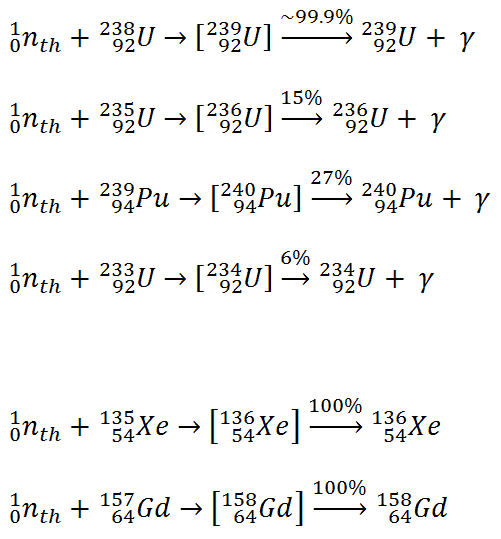
It must be noted we have to distinguish between radiative captures at small neutron flux and at high neutron flux. At small neutron flux, as in a nuclear reactor, the compound nucleus has time to decay between two neutron captures. The most usual capture reactions that occur inside a power reactor are below:

Neutron capture reactions which are of importance in power reactors.

Neutron Capture at High Neutron Flux

At very high flux the atomic nuclei do not necessarily have enough time to decay via beta particle emission between neutron captures. This happens inside stars, where a really tremendous flux may be reached. As a result of many capture reactions without beta decay the mass number rises by a large amount, while the atomic number stays the same. Only afterwards, the highly unstable nuclei decay via many β− decays to stabilize itself.

Since the process entails a succession of many rapid neutron captures, it is called the r-process. The r-process is a nucleosynthesis process that occurs in core-collapse supernovae and is responsible for the creation of approximately half of the neutron-rich atomic nuclei heavier than iron.

Uranium 238. Neutron absorption and scattering. Comparison of cross-sections.
Uranium 238. Comparison of cross-sections.Source: JANIS (Java-based Nuclear Data Information Software); The JEFF-3.1.1 Nuclear Data Library
Xenon - 135. Neutron absorption and scattering. Comparison of cross-sections.
Xenon – 135. Neutron absorption and scattering. Comparison of cross-sections.Source: JANIS (Java-based Nuclear Data Information Software); The JEFF-3.1.1 Nuclear Data Library
Hydrogen. Neutron absorption and scattering. Comparison of cross-sections.
Hydrogen. Neutron absorption and scattering. Comparison of cross-sections.Source: JANIS (Java-based Nuclear Data Information Software); The JEFF-3.1.1 Nuclear Data Library
Gadolinium 155 and 157. Comparison of radiative capture cross-sections.
Source: JANIS (Java-based Nuclear Data Information Software); The JEFF-3.1.1 Nuclear Data Library

Neutron Capture and Fuel Breeding

In reactor calculations, the neutron capture reaction is as important as the fission reaction. Its impact on the neutron balance is evident. But this reaction is of importance also from another point of view. Fissionable nuclei or even fissile nuclei may capture a neutron, this capture leads to formation of unstable nuclei with higher neutron number. Such unstable nuclei undergo a nuclear decay, which may lead to formation of another fissile nuclei. This process is also referred to as the nuclear transmutation and is responsible for new fuel breeding in nuclear reactors.

 
Plutonium 239 breeding
 n+_{92}^{238}textrm{U} {rightarrow} _{92}^{239}textrm{U}+gamma rightarrow _{93}^{239}textrm{Np} rightarrow _{94}^{239}textrm{Pu} 

Neutron capture may also be used to create fissile 239Pu from 238U, which is the dominant constituent of naturally occurring uranium (99.28%). Absorption of a neutron in the 238U nucleus yields 239U. The half-life of 239U is approximately 23.5 minutes. 239U decays (negative beta decay) to 239Np (neptunium), whose half-life is 2.36 days. 239Np decays (negative beta decay)  to 239Pu.

Uranium 233 breeding
n+_{90}^{232}textrm{Th} {rightarrow} _{90}^{232}textrm{Th}+gamma rightarrow _{91}^{233}textrm{Pa} rightarrow _{92}^{233}textrm{U}

232Th is the predominant isotope of natural thorium. If this fertile material is loaded in the nuclear reactor, the nuclei of 232Th absorb a neutron and become nuclei of 233Th. The half-life of 233Th is approximately 21.8 minutes. 233Th decays (negative beta decay) to 233Pa (protactinium), whose half-life is 26.97 days. 233Pa decays (negative beta decay)  to 233U, that is very good fissile material. On the other hand proposed reactor designs must attempt to physically isolate the protactinium from further neutron capture before beta decay can occur.

Radiative Capture Cross-section

The likelihood of a neutron radiative capture is represented by the radiative capture cross section as σγ. As usual, the cross-section can be divided into three regions according to the incident neutron energy.

  • 1/v Region
  • Resonance Region
  • Fast Neutrons Region

1/v Region

In the common case, the cross section is usually much larger at low energies than at high energies. For thermal neutrons (in 1/v region), also radiative capture cross-sections increase as the velocity (kinetic energy) of the neutron decreases. Therefore the 1/v Law can be used to determine shift in capture cross-section, if the neutron is in equilibrium with a surrounding medium. This phenomenon is due to the fact the nuclear force between the target nucleus and the neutron has a longer time to interact.

Resonance Region

The largest cross-sections are usually at neutron energies, that lead to long-lived states of the compound nucleus. The compound nuclei of these certain energies are referred to as nuclear resonances and its formation is typical in the resonance region. The widths of the resonances increase in general with increasing energies. At higher energies the widths may reach the order of the distances between resonances and then no resonances can be observed. The narrowest resonances are usually compound states of heavy nuclei (such as fissionable nuclei).

Since the mode of decay of the compound nucleus does not depend on the way the compound nucleus was formed, the nucleus sometimes emits a gamma ray (radiative capture) or sometimes emits a neutron (scattering). In order to understand the way, how a nucleus will stabilize itself, we have to understand the behaviour of compound nucleus.

The compound nucleus emits a neutron only after one neutron obtains an energy in collision with other nucleon greater than its binding energy in the nucleus. It have some delay, because the excitation energy of the compound nucleus is divided among several nucleons. It is obvious the average time that elapses before a neutron can be emitted is much longer for nuclei with large number of nucleons than when only a few nucleons are involved. It is a consequence of sharing the excitation energy among a large number of nucleons.

This is the reason the radiative capture is comparatively unimportant in light nuclei but becomes increasingly important in the heavier nuclei.

The lifetime of a compound nucleus is inversely proportional to its total width. Narrow resonances therefore correspond to capture while the wider resonances are due to scattering.

Table of cross-sections

Table of cross-sections.

Resonance region - Compound Nucleus
Radiative Capture Cross-section – region of resonances of 238U nuclei.
Source: JANIS (Java-based Nuclear Data Information Software); The JEFF-3.1.1 Nuclear Data Library
Compound state - resonance
ground state compound nucleus - excitation
Energy levels of compound state. For neutron absorption reaction on 238U the first resonance E1 corresponds to the excitation energy of 6.67eV. E0 is a base state of 239U.
radiative capture to elastic scattering cross-sections-
Radiative capture and elastic scattering cross-sections in 16O and 238U.
Example:

Source: R. Lamarsh, Introduction to Nuclear Reactor Theory, 2nd ed., Addison-Wesley, Reading, MA (1983).

The first resonance in 238U at 6.67 eV, which corresponds to the first virtual level in 239U, has a total width of only 0.027 eV, and the mean life of this state is 2.4×10⁻¹⁴s. By contrast, the resonance observed at 443 keV in 16O, which corresponds to the first virtual state in 17O, has a total width of 41 keV, giving a mean lifetime of 1.5×10⁻²¹s. Thus it is highly likely that the compound state in 239U decays at least to some extent by gamma ray emission, while compound state in 17O must decay primarily by nucleon emission. The 443-keV resonance in 16O is clearly a scattering resonance, whereas the 6.67-eV resonance in 238U is in part a capture resonance.

Doppler Broadening

In general, Doppler broadening is the broadening of spectral lines due to the Doppler effect caused by a distribution of kinetic energies of molecules or atoms. In reactor physics a particular case of this phenomenon is the thermal Doppler broadening of resonances caused by the thermal motion of the target particle in the nuclear fuel.

Doppler effect
Doppler effect improves reactor stability. Broadened resonance (heating of a fuel) results in a higher probability of absorbtion, thus causes negative reactivity insertion (reduction of reactor power).

The Doppler broadening of resonances is very important phanomenon, which improves reactor stability. The prompt temperature coefficient of most thermal reactors is negative, owing to an nuclear Doppler effect. Although the absorbtion cross-section depends significantly on incident neutron energy, the shape of the cross-section curve depends also on target temperature.

Nuclei are located in atoms which are themselves in continual motion owing to their thermal energy. As a result of these thermal motions neutrons impinging on a target appears to the nuclei in the target to have a continuous spread in energy. This, in turn, has an effect on the observed shape of resonance. The resonance becomes shorter and wider than when the nuclei are at rest.

Although the shape of a resonance changes with temperature, the total area under the resonance remains essentially constant. But this does not imply constant neutron absorbtion. Despite the constant area under resonance, a resonance integral, which determines the absorbtion, increases with increasing target temperature. This, of course, decreases coefficient k (negative reactivity is inserted).

Fast Neutrons Region

The radiative capture cross-section at energies above the resonance region drops rapidly to very small values. This rapid drop is caused by the compound nucleus, which is formed in more highly-excited states. In these highly-excited states it is more likely that one neutron obtains an energy in collision with other nucleon greater than its binding energy in the nucleus. The neutron emission becomes dominant and gamma decay becomes less important. Moreover, at high energies, the inelastic scattering and (n,2n) reaction are highly probable at the expense of both elastic scattering and radiative capture.

 
References:
Nuclear and Reactor Physics:
  1. J. R. Lamarsh, Introduction to Nuclear Reactor Theory, 2nd ed., Addison-Wesley, Reading, MA (1983).
  2. J. R. Lamarsh, A. J. Baratta, Introduction to Nuclear Engineering, 3d ed., Prentice-Hall, 2001, ISBN: 0-201-82498-1.
  3. W. M. Stacey, Nuclear Reactor Physics, John Wiley & Sons, 2001, ISBN: 0- 471-39127-1.
  4. Glasstone, Sesonske. Nuclear Reactor Engineering: Reactor Systems Engineering, Springer; 4th edition, 1994, ISBN: 978-0412985317
  5. W.S.C. Williams. Nuclear and Particle Physics. Clarendon Press; 1 edition, 1991, ISBN: 978-0198520467
  6. G.R.Keepin. Physics of Nuclear Kinetics. Addison-Wesley Pub. Co; 1st edition, 1965
  7. Robert Reed Burn, Introduction to Nuclear Reactor Operation, 1988.
  8. U.S. Department of Energy, Nuclear Physics and Reactor Theory. DOE Fundamentals Handbook, Volume 1 and 2. January 1993.

Advanced Reactor Physics:

  1. K. O. Ott, W. A. Bezella, Introductory Nuclear Reactor Statics, American Nuclear Society, Revised edition (1989), 1989, ISBN: 0-894-48033-2.
  2. K. O. Ott, R. J. Neuhold, Introductory Nuclear Reactor Dynamics, American Nuclear Society, 1985, ISBN: 0-894-48029-4.
  3. D. L. Hetrick, Dynamics of Nuclear Reactors, American Nuclear Society, 1993, ISBN: 0-894-48453-2.
  4. E. E. Lewis, W. F. Miller, Computational Methods of Neutron Transport, American Nuclear Society, 1993, ISBN: 0-894-48452-4.

See also:

See also:

Neutron Reactions

See also:

We hope, this article, Neutron Capture – Radiative Capture, helps you. If so, give us a like in the sidebar. Main purpose of this website is to help the public to learn some interesting and important information about materials and their properties.