Facebook Instagram Youtube Twitter

What is Neutron Absorption Cross-section – Definition

The likelihood of a neutron absorption is represented by the absorption cross section as σa. Neutron Absorption Cross-section of many materials. Material Properties

Neutron Absorption Cross-section

The likelihood of a neutron absorption is represented by the absorption cross section as σa. The relative likelihoods of an absorption reaction or a neutron scattering are represented by dividing the total cross section into scattering and absorption cross sections:

σt = σs + σa

Given a collision, σa / σt is the probability that the neutron will beabsorbed and σs / σt is the probability that the neutron will be scattered.

σa

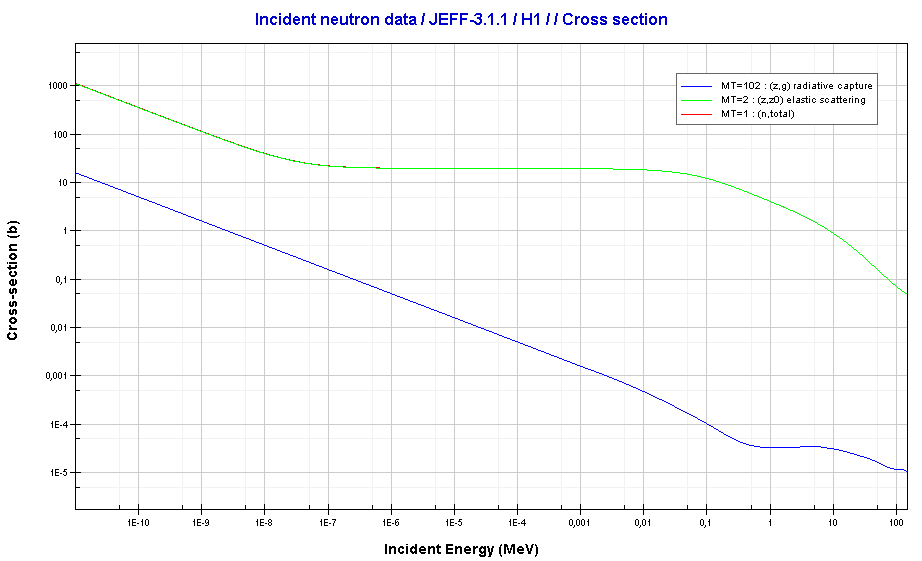
Source: JANIS (Java-based Nuclear Data Information Software); The JEFF-3.1.1 Nuclear Data Library

Hydrogen. Neutron absorption and scattering. Comparison of cross-sections.

Source: JANIS (Java-based Nuclear Data Information Software); The JEFF-3.1.1 Nuclear Data Library
Xenon - 135. Neutron absorption and scattering. Comparison of cross-sections.
Xenon – 135. Neutron absorption and scattering. Comparison of cross-sections.

Source: JANIS (Java-based Nuclear Data Information Software); The JEFF-3.1.1 Nuclear Data Library
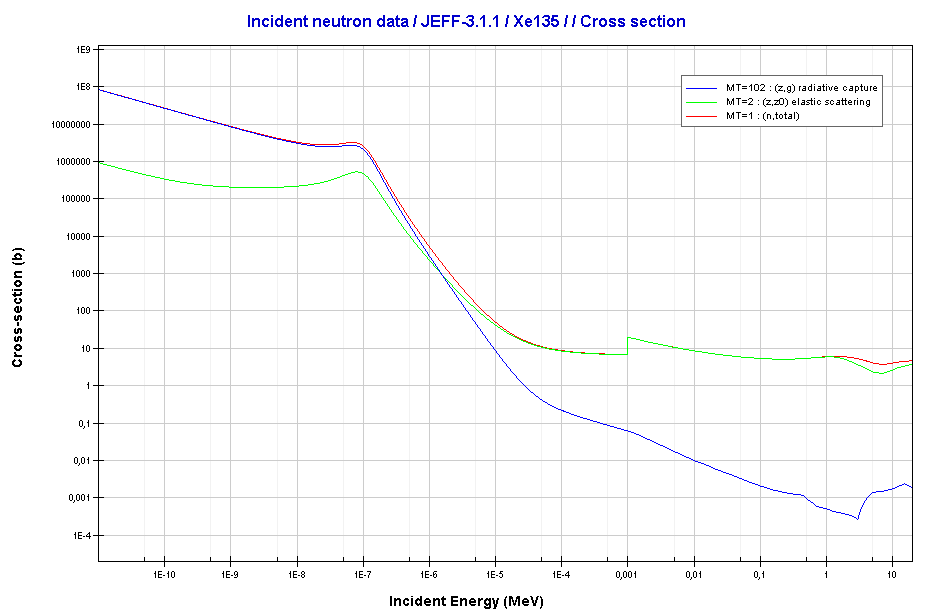
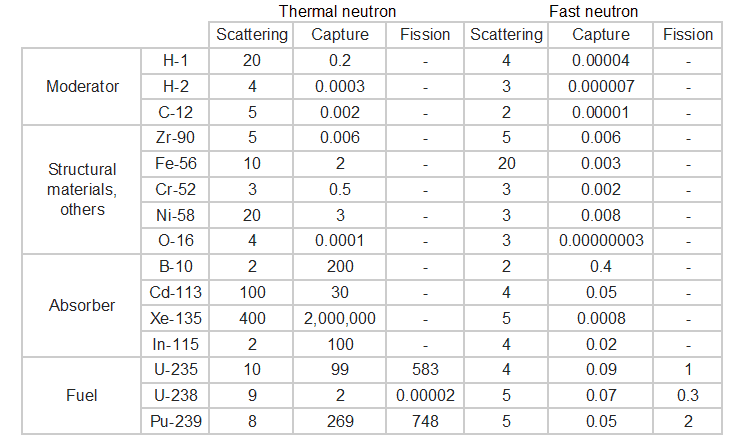
Table of cross-sections
Table of cross-sections.

 
References:
Nuclear and Reactor Physics:
  1. J. R. Lamarsh, Introduction to Nuclear Reactor Theory, 2nd ed., Addison-Wesley, Reading, MA (1983).
  2. J. R. Lamarsh, A. J. Baratta, Introduction to Nuclear Engineering, 3d ed., Prentice-Hall, 2001, ISBN: 0-201-82498-1.
  3. W. M. Stacey, Nuclear Reactor Physics, John Wiley & Sons, 2001, ISBN: 0- 471-39127-1.
  4. Glasstone, Sesonske. Nuclear Reactor Engineering: Reactor Systems Engineering, Springer; 4th edition, 1994, ISBN: 978-0412985317
  5. W.S.C. Williams. Nuclear and Particle Physics. Clarendon Press; 1 edition, 1991, ISBN: 978-0198520467
  6. G.R.Keepin. Physics of Nuclear Kinetics. Addison-Wesley Pub. Co; 1st edition, 1965
  7. Robert Reed Burn, Introduction to Nuclear Reactor Operation, 1988.
  8. U.S. Department of Energy, Nuclear Physics and Reactor Theory. DOE Fundamentals Handbook, Volume 1 and 2. January 1993.

Advanced Reactor Physics:

  1. K. O. Ott, W. A. Bezella, Introductory Nuclear Reactor Statics, American Nuclear Society, Revised edition (1989), 1989, ISBN: 0-894-48033-2.
  2. K. O. Ott, R. J. Neuhold, Introductory Nuclear Reactor Dynamics, American Nuclear Society, 1985, ISBN: 0-894-48029-4.
  3. D. L. Hetrick, Dynamics of Nuclear Reactors, American Nuclear Society, 1993, ISBN: 0-894-48453-2.
  4. E. E. Lewis, W. F. Miller, Computational Methods of Neutron Transport, American Nuclear Society, 1993, ISBN: 0-894-48452-4.

See also:

Neutron Absorption

We hope, this article, Neutron Absorption Cross-section, helps you. If so, give us a like in the sidebar. Main purpose of this website is to help the public to learn some interesting and important information about materials and their properties.

What is Neutron Absorption – Definition

The neutron absorption reaction is the most important type of reactions that take place in a nuclear reactor. Definition of absorption reaction. Material Properties

Neutron Absorption

The neutron absorption reaction is the most important type of reactions that take place in a nuclear reactor. The absorption reactions are reactions, where the neutron is completely absorbed and compound nucleus is formed. This is the very important feature, because the mode of decay of such compound nucleus does not depend on the way the compound nucleus was formed. Therefore a variety of emissions or decays may follow. The most important absorption reactions are divided by the exit channel into two following reactions:

σa
  • Radiative Capture. Most absorption reactions result in the loss of a neutron coupled with the production of one or more gamma rays. This is referred to as a capture reaction, and it is denoted by σγ.
  • Neutron-induced Fission Reaction. Some nuclei (fissionable nuclei) may undergo a fission event, leading to two or more fission fragments (nuclei of intermediate atomic weight) and a few neutrons. In a fissionable material, the neutron may simply be captured, or it may cause nuclear fission. For fissionable materials we thus divide the absorption cross section as σa = σγ + σf.

Neutron Absorption Cross-section

The likelihood of a neutron absorption is represented by the absorption cross section as σa. The relative likelihoods of an absorption reaction or a neutron scattering are represented by dividing the total cross section into scattering and absorption cross sections:

σt = σs + σa

Given a collision, σa / σt is the probability that the neutron will be
absorbed and σs / σt is the probability that the neutron will be scattered.

Table of cross-sections

Table of cross-sections.

Source: JANIS (Java-based Nuclear Data Information Software); The JEFF-3.1.1 Nuclear Data Library
Hydrogen. Neutron absorption and scattering. Comparison of cross-sections.

Source: JANIS (Java-based Nuclear Data Information Software); The JEFF-3.1.1 Nuclear Data Library

Xenon - 135. Neutron absorption and scattering. Comparison of cross-sections.
Xenon – 135. Neutron absorption and scattering. Comparison of cross-sections.

Source: JANIS (Java-based Nuclear Data Information Software); The JEFF-3.1.1 Nuclear Data Library

 
References:
Nuclear and Reactor Physics:
  1. J. R. Lamarsh, Introduction to Nuclear Reactor Theory, 2nd ed., Addison-Wesley, Reading, MA (1983).
  2. J. R. Lamarsh, A. J. Baratta, Introduction to Nuclear Engineering, 3d ed., Prentice-Hall, 2001, ISBN: 0-201-82498-1.
  3. W. M. Stacey, Nuclear Reactor Physics, John Wiley & Sons, 2001, ISBN: 0- 471-39127-1.
  4. Glasstone, Sesonske. Nuclear Reactor Engineering: Reactor Systems Engineering, Springer; 4th edition, 1994, ISBN: 978-0412985317
  5. W.S.C. Williams. Nuclear and Particle Physics. Clarendon Press; 1 edition, 1991, ISBN: 978-0198520467
  6. G.R.Keepin. Physics of Nuclear Kinetics. Addison-Wesley Pub. Co; 1st edition, 1965
  7. Robert Reed Burn, Introduction to Nuclear Reactor Operation, 1988.
  8. U.S. Department of Energy, Nuclear Physics and Reactor Theory. DOE Fundamentals Handbook, Volume 1 and 2. January 1993.

Advanced Reactor Physics:

  1. K. O. Ott, W. A. Bezella, Introductory Nuclear Reactor Statics, American Nuclear Society, Revised edition (1989), 1989, ISBN: 0-894-48033-2.
  2. K. O. Ott, R. J. Neuhold, Introductory Nuclear Reactor Dynamics, American Nuclear Society, 1985, ISBN: 0-894-48029-4.
  3. D. L. Hetrick, Dynamics of Nuclear Reactors, American Nuclear Society, 1993, ISBN: 0-894-48453-2.
  4. E. E. Lewis, W. F. Miller, Computational Methods of Neutron Transport, American Nuclear Society, 1993, ISBN: 0-894-48452-4.

See also:

See also:

Neutron Reactions

See also:

We hope, this article, Neutron Absorption, helps you. If so, give us a like in the sidebar. Main purpose of this website is to help the public to learn some interesting and important information about materials and their properties.
What is E=mc2 Meaning – Definition

E=mc2 is the equivalence of the mass and energy. Each nuclear process can be evaluated from an E = mc2 perspective. E=mc2 meaning. Material Properties

E = mc2 Meaning

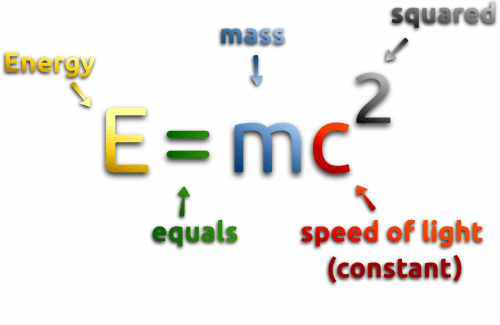
At the beginning of the 20th century, the notion of mass underwent a radical revision. Mass lost its absoluteness. One of the striking results of Einstein’s theory of relativity is that mass and energy are equivalent and convertible one into the other. Equivalence of the mass and energy is described by Einstein’s famous formula E = mc2. In words, energy equals mass multiplied by the speed of light squared. Because the speed of light is a very large number, the formula implies that any small amount of matter contains a very large amount of energy. The mass of an object was seen to be equivalent to energy, to be interconvertible with energy, and to increase significantly at exceedingly high speeds near that of light. The total energy of an object was understood to comprise its rest mass as well as its increase of mass caused by increase in kinetic energy.

In special theory of relativity certain types of matter may be created or destroyed, but in all of these processes, the mass and energy associated with such matter remains unchanged in quantity. It was found the rest mass an atomic nucleus is measurably smaller than the sum of the rest masses of its constituent protons, neutrons and electrons. Mass was no longer considered unchangeable in the closed system. The difference is a measure of the nuclear binding energy which holds the nucleus together. According to the Einstein relationship (E = mc2) this binding energy is proportional to this mass difference and it is known as the mass defect.

E=mc2 represents the new conservation principle – the conservation of mass-energy.

E=MC2 - Nuclear energy
This formule describes equivalence of mass and energy.

, where m is the small amount of mass and c is the speed of light.

What that means? If the nuclear energy is generated (splitting atoms, nuclear fusion), a small amount of mass (saved in the nuclear binding energy) transforms into the pure energy (such as kinetic energy, thermal energy, or radiant energy).

Example:

The energy equivalent of one gram (1/1000 of a kilogram) of mass is equivalent to:

  • 89.9 terajoules
  • 25.0 million kilowatt-hours (≈ 25 GW·h)
  • 21.5 billion kilocalories (≈ 21 Tcal)
  • 85.2 billion BTUs

or to the energy released by combustion of the following:

  • 21.5 kilotons of TNT-equivalent energy (≈ 21 kt)
  • 568,000 US gallons of automotive gasoline

Any time energy is generated, the process can be evaluated from an E = mc2 perspective.

 
Example: Mass defect of a 63Cu
Calculate the mass defect of a 63Cu nucleus if the actual mass of 63Cu in its nuclear ground state is 62.91367 u.

63Cu nucleus has 29 protons and also has (63 – 29) 34 neutrons.

The mass of a proton is 1.00728 u and a neutron is 1.00867 u.

The combined mass is: 29 protons x (1.00728 u/proton) + 34 neutrons x (1.00867 u/neutron) = 63.50590 u

The mass defect is Δm = 63.50590 u – 62.91367 u =  0.59223 u

Convert the mass defect into energy (nuclear binding energy).

(0.59223 u/nucleus) x (1.6606 x 10⁻²⁷ kg/u) = 9.8346 x 10⁻²⁸ kg/nucleus

ΔE = Δmc2

ΔE = (9.8346 x 10⁻²⁸ kg/nucleus) x (2.9979 x 10⁸ m/s)2 = 8.8387 x 10⁻¹¹ J/nucleus

The energy calculated in the previous example is the nuclear binding energy.  However, the nuclear binding energy may be expressed as kJ/mol (for better understanding).

Calculate the nuclear binding energy of 1 mole of 63Cu:

(8.8387 x 10⁻¹¹ J/nucleus) x (1 kJ/1000 J) x (6.022 x 10²³ nuclei/mol) = 5.3227 x 10¹⁰ kJ/mol of nuclei.

One mole of 63Cu (~63 grams) is bound by the nuclear binding energy (5.3227 x 10¹⁰ kJ/mol) which is equivalent to:

  • 14.8 million kilowatt-hours (≈ 15 GW·h)
  • 336,100 US gallons of automotive gasoline
Example: Mass defect of the reactor core
Calculate the mass defect of the 3000MWth reactor core after one year of operation.

It is known the average recoverable energy per fission is about 200 MeV, being the total energy minus the energy of the energy of antineutrinos that are radiated away.

The reaction rate per entire 3000MWth reactor core is about  9.33×10¹⁹ fissions / second.

The overall energy release in the units of joules is:

200×106 (eV) x 1.602×10⁻¹⁹ (J/eV) x 9.33×10¹⁹ (s-1) x 31.5×106 (seconds in year) = 9.4×10¹⁶ J/year

The mass defect is calculated as:

Δm = ΔE/c2

Δm = 9.4×10¹⁶ / (2.9979 x 10⁸)2 = 1.046 kg

That means in a typical 3000MWth reactor core about 1 kilogram of matter is converted into pure energy.

Note that, a typical annual uranium load for a 3000MWth reactor core is about 20 tonnes of enriched uranium (i.e. about 22.7 tonnes of UO2). Entire reactor core may contain about 80 tonnes of enriched uranium.

Mass defect directly from E=mc2

The mass defect can be calculated directly from the Einstein relationship (E = mc2) as:

Δm = ΔE/c2

Δm = 3000×106 (W = J/s) x 31.5×10⁶ (seconds in year) / (2.9979 x 10⁸)2 = 1.051 kg

See also:

Nuclear Energy

We hope, this article, E=mc2 Meaning, helps you. If so, give us a like in the sidebar. Main purpose of this website is to help the public to learn some interesting and important information about materials and their properties.
What is Elastic Scattering Cross-section – Definition

Elastic scattering cross-sections for light elements are more or less independent of neutron energy up to 1 MeV. Nearly all elements have scattering cross-sections in the range of 2 to 20 barns. Material Properties

Elastic Scattering Cross-section

To be an effective moderator, the probability of elastic reaction between neutron and the nucleus must be high. In terms of cross-sections, the elastic scattering cross section of a moderator’s nucleus must be high.

σs
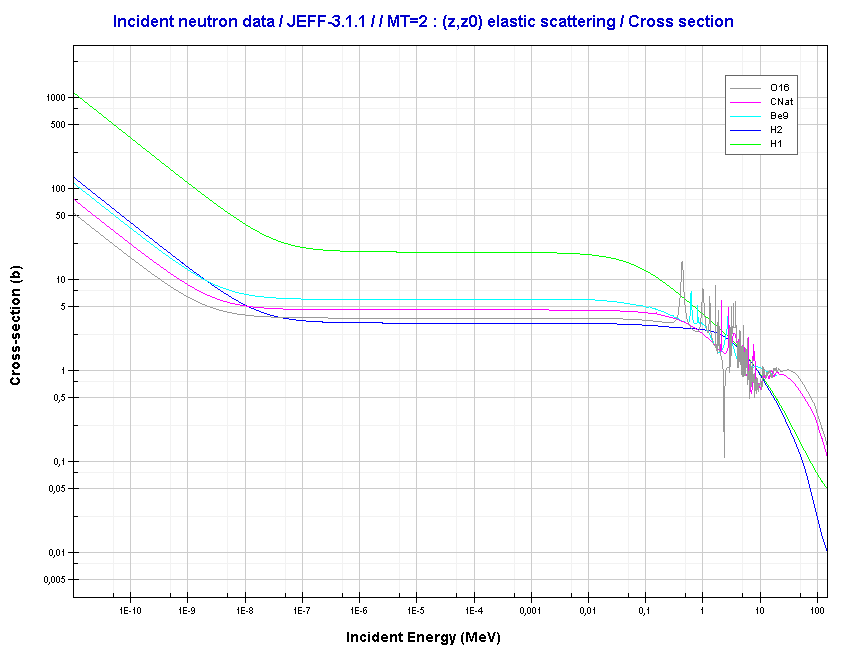
Elastic scattering cross-sections for light elements
Elastic scattering cross-sections for light elements are more or less independent of neutron energy up to 1 MeV. Source: JANIS (Java-based Nuclear Data Information Software); The JEFF-3.1.1 Nuclear Data Library
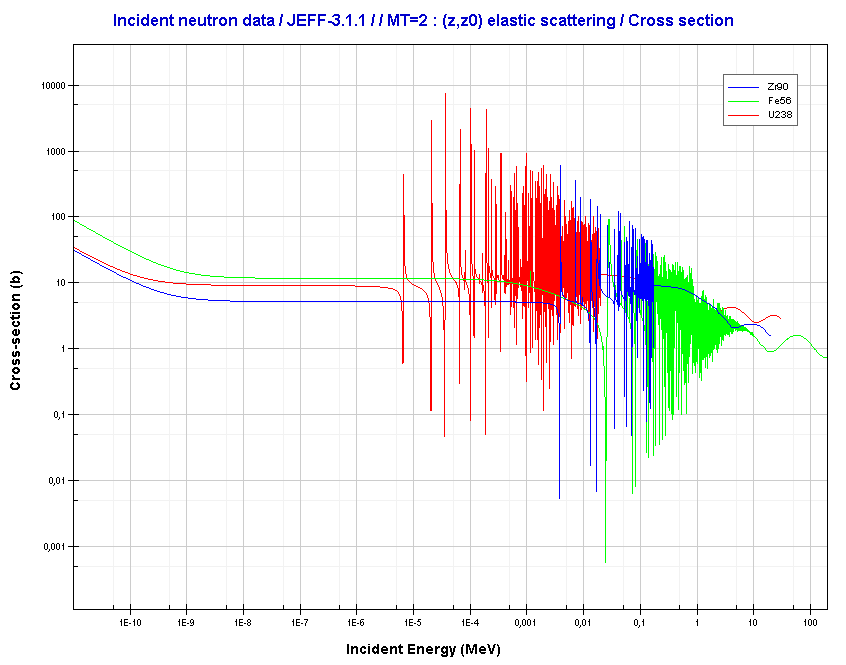
Elastic scattering cross-sections for heavy elements
For intermediate and heavy elements, the elastic cross-section is constant at low energy with some specifics at higher energy.
 
References:
Nuclear and Reactor Physics:
  1. J. R. Lamarsh, Introduction to Nuclear Reactor Theory, 2nd ed., Addison-Wesley, Reading, MA (1983).
  2. J. R. Lamarsh, A. J. Baratta, Introduction to Nuclear Engineering, 3d ed., Prentice-Hall, 2001, ISBN: 0-201-82498-1.
  3. W. M. Stacey, Nuclear Reactor Physics, John Wiley & Sons, 2001, ISBN: 0- 471-39127-1.
  4. Glasstone, Sesonske. Nuclear Reactor Engineering: Reactor Systems Engineering, Springer; 4th edition, 1994, ISBN: 978-0412985317
  5. W.S.C. Williams. Nuclear and Particle Physics. Clarendon Press; 1 edition, 1991, ISBN: 978-0198520467
  6. G.R.Keepin. Physics of Nuclear Kinetics. Addison-Wesley Pub. Co; 1st edition, 1965
  7. Robert Reed Burn, Introduction to Nuclear Reactor Operation, 1988.
  8. U.S. Department of Energy, Nuclear Physics and Reactor Theory. DOE Fundamentals Handbook, Volume 1 and 2. January 1993.

Advanced Reactor Physics:

  1. K. O. Ott, W. A. Bezella, Introductory Nuclear Reactor Statics, American Nuclear Society, Revised edition (1989), 1989, ISBN: 0-894-48033-2.
  2. K. O. Ott, R. J. Neuhold, Introductory Nuclear Reactor Dynamics, American Nuclear Society, 1985, ISBN: 0-894-48029-4.
  3. D. L. Hetrick, Dynamics of Nuclear Reactors, American Nuclear Society, 1993, ISBN: 0-894-48453-2.
  4. E. E. Lewis, W. F. Miller, Computational Methods of Neutron Transport, American Nuclear Society, 1993, ISBN: 0-894-48452-4.

See also:

See also:

Elastic Scattering

See also:

We hope, this article, Elastic Scattering Cross-section, helps you. If so, give us a like in the sidebar. Main purpose of this website is to help the public to learn some interesting and important information about materials and their properties.

What is Key Characteristics of Elastic Scattering – Definition

Key Characteristics of Neutron Elastic Scattering are summarized here. Elastic scattering reaction conserves both momentum and the kinetic energy of the system. Material Properties

Key Characteristics of Elastic Scattering

  • Total kinetic energy of the system is conserved in elastic scattering.
  • In this process, energy lost by the neutron is transferred to the recoiling nucleus.
  • Maximum energy transfer is occurred with an head-on collision.
  • Kinetic energy of the recoiled nucleus depends on the recoiled angle φ of the nucleus.
  • Elastic scattering cross-sections for light elements are more or less independent of neutron energy up to 1 MeV.
  • For intermediate and heavy elements, the elastic cross-section is constant at low energy with some specifics at higher energy.
  • A good approximation is, σs = const, for all elements, that are of importance.
  • At low energy, σs can be described by the one-level Breit-Wigner formula.
  • Nearly all elements have scattering cross-sections in the range of 2 to 20 barns.
  • The important exception is for water and heavy water.
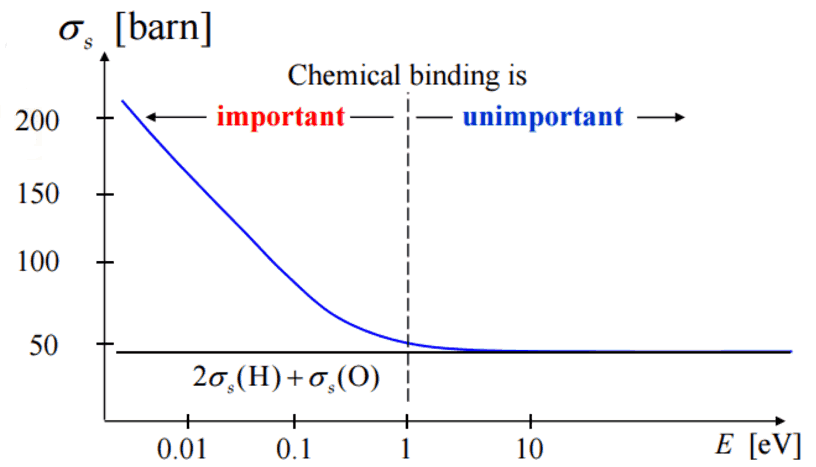
  • If the kinetic energy of an incident neutron is large compared with the chemical binding energy of the atoms in a molecule, the chemical bound can be ignored.
  • If the kinetic energy of an incident neutron is of the order or less than the chemical binding energy, the cross-section of the molecule is not equal to the sum of cross-sections of its individual nuclei.
  • Scattering of slow neutrons by molecules is greater than by free nuclei.
  • Therefore one nucleus microscopic cross-sections do not describe the process correctly, while the macroscopic cross-section (Σs) has a precise meaning.
Scattering of slow neutrons by molecules is greater than by free nuclei.
If the kinetic energy of an incident neutron is large compared with the chemical binding energy of the atoms in a molecule, the chemical bound can be ignored.
If the kinetic energy of an incident neutron is of the order or less than the chemical binding energy, the cross-section of the molecule is not equal to the sum of cross-sections of its individual nuclei.

Elastic Scattering Cross-section

To be an effective moderator, the probability of elastic reaction between neutron and the nucleus must be high. In terms of cross-sections, the elastic scattering cross section of a moderator’s nucleus must be high.

Elastic scattering cross-sections for light elements
Elastic scattering cross-sections for light elements are more or less independent of neutron energy up to 1 MeV. Source: JANIS (Java-based Nuclear Data Information Software); The JEFF-3.1.1 Nuclear Data Library
Elastic scattering cross-sections for heavy elements
For intermediate and heavy elements, the elastic cross-section is constant at low energy with some specifics at higher energy.

 
References:
Nuclear and Reactor Physics:
  1. J. R. Lamarsh, Introduction to Nuclear Reactor Theory, 2nd ed., Addison-Wesley, Reading, MA (1983).
  2. J. R. Lamarsh, A. J. Baratta, Introduction to Nuclear Engineering, 3d ed., Prentice-Hall, 2001, ISBN: 0-201-82498-1.
  3. W. M. Stacey, Nuclear Reactor Physics, John Wiley & Sons, 2001, ISBN: 0- 471-39127-1.
  4. Glasstone, Sesonske. Nuclear Reactor Engineering: Reactor Systems Engineering, Springer; 4th edition, 1994, ISBN: 978-0412985317
  5. W.S.C. Williams. Nuclear and Particle Physics. Clarendon Press; 1 edition, 1991, ISBN: 978-0198520467
  6. G.R.Keepin. Physics of Nuclear Kinetics. Addison-Wesley Pub. Co; 1st edition, 1965
  7. Robert Reed Burn, Introduction to Nuclear Reactor Operation, 1988.
  8. U.S. Department of Energy, Nuclear Physics and Reactor Theory. DOE Fundamentals Handbook, Volume 1 and 2. January 1993.

Advanced Reactor Physics:

  1. K. O. Ott, W. A. Bezella, Introductory Nuclear Reactor Statics, American Nuclear Society, Revised edition (1989), 1989, ISBN: 0-894-48033-2.
  2. K. O. Ott, R. J. Neuhold, Introductory Nuclear Reactor Dynamics, American Nuclear Society, 1985, ISBN: 0-894-48029-4.
  3. D. L. Hetrick, Dynamics of Nuclear Reactors, American Nuclear Society, 1993, ISBN: 0-894-48453-2.
  4. E. E. Lewis, W. F. Miller, Computational Methods of Neutron Transport, American Nuclear Society, 1993, ISBN: 0-894-48452-4.

See also:

See also:

Elastic Scattering

See also:

We hope, this article, Key Characteristics of Elastic Scattering, helps you. If so, give us a like in the sidebar. Main purpose of this website is to help the public to learn some interesting and important information about materials and their properties.
What is Conservation of momentum and kinetic energy – Definition

Conservation of momentum and kinetic energy. total momentum of the two objects before collision is equal to that after the collision. Material Properties

Conservation of momentum and kinetic energy

conservation of momentum and energywhere:

mn = mass of the neutron

mT = mass of the target nucleus T

vn,i = initial neutron speed

vn,f = final neutron speed

vT,i = initial target speed

vT,f = final target speed

See also:

See also:

Glossary

See also:

We hope, this article, Conservation of momentum and kinetic energy, helps you. If so, give us a like in the sidebar. Main purpose of this website is to help the public to learn some interesting and important information about materials and their properties.

What is Inelastic Scattering Cross-section – Definition

Inelastic scattering cross section is relatively small for light nuclei, while is high especially at high energies and by heavy nuclei. Inelastic scattering cross section. Material Properties

Inelastic Scattering Cross-section

Inelastic Neutron Scattering Cross-section
Inelastic scattering plays an important role in slowing down neutrons especially at high energies and by heavy nuclei.
 
References:
Nuclear and Reactor Physics:
  1. J. R. Lamarsh, Introduction to Nuclear Reactor Theory, 2nd ed., Addison-Wesley, Reading, MA (1983).
  2. J. R. Lamarsh, A. J. Baratta, Introduction to Nuclear Engineering, 3d ed., Prentice-Hall, 2001, ISBN: 0-201-82498-1.
  3. W. M. Stacey, Nuclear Reactor Physics, John Wiley & Sons, 2001, ISBN: 0- 471-39127-1.
  4. Glasstone, Sesonske. Nuclear Reactor Engineering: Reactor Systems Engineering, Springer; 4th edition, 1994, ISBN: 978-0412985317
  5. W.S.C. Williams. Nuclear and Particle Physics. Clarendon Press; 1 edition, 1991, ISBN: 978-0198520467
  6. G.R.Keepin. Physics of Nuclear Kinetics. Addison-Wesley Pub. Co; 1st edition, 1965
  7. Robert Reed Burn, Introduction to Nuclear Reactor Operation, 1988.
  8. U.S. Department of Energy, Nuclear Physics and Reactor Theory. DOE Fundamentals Handbook, Volume 1 and 2. January 1993.

Advanced Reactor Physics:

  1. K. O. Ott, W. A. Bezella, Introductory Nuclear Reactor Statics, American Nuclear Society, Revised edition (1989), 1989, ISBN: 0-894-48033-2.
  2. K. O. Ott, R. J. Neuhold, Introductory Nuclear Reactor Dynamics, American Nuclear Society, 1985, ISBN: 0-894-48029-4.
  3. D. L. Hetrick, Dynamics of Nuclear Reactors, American Nuclear Society, 1993, ISBN: 0-894-48453-2.
  4. E. E. Lewis, W. F. Miller, Computational Methods of Neutron Transport, American Nuclear Society, 1993, ISBN: 0-894-48452-4.

See also:

See also:

Inelastic Scattering

See also:

We hope, this article, Inelastic Scattering Cross-section, helps you. If so, give us a like in the sidebar. Main purpose of this website is to help the public to learn some interesting and important information about materials and their properties.
What is Key Characteristics of Inelastic Scattering – Definition

Key Characteristics of Inelastic Scattering are summarized here. Inelastic scattering conserves momentum, while the kinetic energy does not conserves. Material Properties

Key Characteristics of Inelastic Scattering

  • During an inelastic scattering the neutron is absorbed and then re-emitted.
  • While momentum is conserved in an inelastic collision, kinetic energy of the “system” is not conserved.
  • Some energy of the incident neutron is absorbed to the recoiling nucleus and the nucleus remains in the excited state.
  • The nucleus gives up excitation energy by emitting one or more gamma rays.
  • General notation: A(n, n’)A* or A(n, 2n’)B; Example: 14O(n, n’)14O*.
  • Inelastic scattering is a threshold reaction and occurs above a threshold energy.
  • Inelastic scattering cross section is relatively small for light nuclei.
  • For hydrogen nucleus, inelastic scattering does not occur, because it does not have excited states.
  • Inelastic scattering plays an important role in slowing down neutrons especially at high energies and by heavy nuclei (e.g. 238U).
  • Inelastic scattering may be significant for heterogeneous reactors with highly enriched fuel (e.g. in fast neutron reactors).
Inelastic neutron scattering

Inelastic Scattering Cross-section

Inelastic Neutron Scattering Cross-section
Inelastic scattering plays an important role in slowing down neutrons especially at high energies and by heavy nuclei.
 
References:
Nuclear and Reactor Physics:
  1. J. R. Lamarsh, Introduction to Nuclear Reactor Theory, 2nd ed., Addison-Wesley, Reading, MA (1983).
  2. J. R. Lamarsh, A. J. Baratta, Introduction to Nuclear Engineering, 3d ed., Prentice-Hall, 2001, ISBN: 0-201-82498-1.
  3. W. M. Stacey, Nuclear Reactor Physics, John Wiley & Sons, 2001, ISBN: 0- 471-39127-1.
  4. Glasstone, Sesonske. Nuclear Reactor Engineering: Reactor Systems Engineering, Springer; 4th edition, 1994, ISBN: 978-0412985317
  5. W.S.C. Williams. Nuclear and Particle Physics. Clarendon Press; 1 edition, 1991, ISBN: 978-0198520467
  6. G.R.Keepin. Physics of Nuclear Kinetics. Addison-Wesley Pub. Co; 1st edition, 1965
  7. Robert Reed Burn, Introduction to Nuclear Reactor Operation, 1988.
  8. U.S. Department of Energy, Nuclear Physics and Reactor Theory. DOE Fundamentals Handbook, Volume 1 and 2. January 1993.

Advanced Reactor Physics:

  1. K. O. Ott, W. A. Bezella, Introductory Nuclear Reactor Statics, American Nuclear Society, Revised edition (1989), 1989, ISBN: 0-894-48033-2.
  2. K. O. Ott, R. J. Neuhold, Introductory Nuclear Reactor Dynamics, American Nuclear Society, 1985, ISBN: 0-894-48029-4.
  3. D. L. Hetrick, Dynamics of Nuclear Reactors, American Nuclear Society, 1993, ISBN: 0-894-48453-2.
  4. E. E. Lewis, W. F. Miller, Computational Methods of Neutron Transport, American Nuclear Society, 1993, ISBN: 0-894-48452-4.

See also:

See also:

Neutron Reactions

See also:

We hope, this article, Key Characteristics of Inelastic Scattering, helps you. If so, give us a like in the sidebar. Main purpose of this website is to help the public to learn some interesting and important information about materials and their properties.

What is Elastic and Inelastic Scattering – Definition

In an elastic scattering reaction, there is no energy transferred into nuclear excitation. Besides, in an inelastic scattering reaction nuclear excitation occurs. Material Properties

Elastic vs. Inelastic Scattering of Neutrons

Generally, a neutron scattering reaction occurs when a target nucleus emits a single neutron after a neutron-nucleus interaction. In an elastic scattering reaction between a neutron and a target nucleus, there is no energy transferred into nuclear excitation.

Besides, in an inelastic scattering reaction between a neutron and a target nucleus some energy of the incident neutron is absorbed to the recoiling nucleus and the nucleus remains in the excited state. Thus while momentum is conserved in an inelastic collision, kinetic energy of the “system” is not conserved.

Key Characteristics of Elastic Scattering

See also: Neutron Elastic Scattering

  • Elastic scattering is the most important process for slowing down neutrons.
  • Total kinetic energy of the system is conserved in elastic scattering.
  • In this process, energy lost by the neutron is transferred to the recoiling nucleus.
  • Maximum energy transfer is occurred with an head-on collision.
  • Kinetic energy of the recoiled nucleus depends on the recoiled angle φ of the nucleus.
  • Elastic scattering cross-sections for light elements are more or less independent of neutron energy up to 1 MeV.
  • For intermediate and heavy elements, the elastic cross-section is constant at low energy with some specifics at higher energy.
  • A good approximation is, σs = const, for all elements, that are of importance.
  • At low energy, σs can be described by the one-level Breit-Wigner formula.
  • Nearly all elements have scattering cross-sections in the range of 2 to 20 barns.
  • The important exception is for water and heavy water.
  • If the kinetic energy of an incident neutron is large compared with the chemical binding energy of the atoms in a molecule, the chemical bound can be ignored.
  • If the kinetic energy of an incident neutron is of the order or less than the chemical binding energy, the cross-section of the molecule is not equal to the sum of cross-sections of its individual nuclei.
  • Scattering of slow neutrons by molecules is greater than by free nuclei.
  • Therefore one nucleus microscopic cross-sections do not describe the process correctly, while the macroscopic cross-section (Σs) has a precise meaning.

Key Characteristics of Inelastic Scattering

See also: Neutron Inelastic Scattering

  • During an inelastic scattering the neutron is absorbed and then re-emitted.
  • While momentum is conserved in an inelastic collision, kinetic energy of the “system” is not conserved.
  • Some energy of the incident neutron is absorbed to the recoiling nucleus and the nucleus remains in the excited state.
  • The nucleus gives up excitation energy by emitting one or more gamma rays.
  • General notation: A(n, n’)A* or A(n, 2n’)B; Example: 14O(n, n’)14O*.
  • Inelastic scattering is a threshold reaction and occurs above a threshold energy.
  • Inelastic scattering cross section is relatively small for light nuclei.
  • For hydrogen nucleus, inelastic scattering does not occur, because it does not have excited states.
  • Inelastic scattering plays an important role in slowing down neutrons especially at high energies and by heavy nuclei (e.g. 238U).
  • Inelastic scattering may be significant for heterogeneous reactors with highly enriched fuel (e.g. in fast neutron reactors).
 
References:
Nuclear and Reactor Physics:
  1. J. R. Lamarsh, Introduction to Nuclear Reactor Theory, 2nd ed., Addison-Wesley, Reading, MA (1983).
  2. J. R. Lamarsh, A. J. Baratta, Introduction to Nuclear Engineering, 3d ed., Prentice-Hall, 2001, ISBN: 0-201-82498-1.
  3. W. M. Stacey, Nuclear Reactor Physics, John Wiley & Sons, 2001, ISBN: 0- 471-39127-1.
  4. Glasstone, Sesonske. Nuclear Reactor Engineering: Reactor Systems Engineering, Springer; 4th edition, 1994, ISBN: 978-0412985317
  5. W.S.C. Williams. Nuclear and Particle Physics. Clarendon Press; 1 edition, 1991, ISBN: 978-0198520467
  6. G.R.Keepin. Physics of Nuclear Kinetics. Addison-Wesley Pub. Co; 1st edition, 1965
  7. Robert Reed Burn, Introduction to Nuclear Reactor Operation, 1988.
  8. U.S. Department of Energy, Nuclear Physics and Reactor Theory. DOE Fundamentals Handbook, Volume 1 and 2. January 1993.

Advanced Reactor Physics:

  1. K. O. Ott, W. A. Bezella, Introductory Nuclear Reactor Statics, American Nuclear Society, Revised edition (1989), 1989, ISBN: 0-894-48033-2.
  2. K. O. Ott, R. J. Neuhold, Introductory Nuclear Reactor Dynamics, American Nuclear Society, 1985, ISBN: 0-894-48029-4.
  3. D. L. Hetrick, Dynamics of Nuclear Reactors, American Nuclear Society, 1993, ISBN: 0-894-48453-2.
  4. E. E. Lewis, W. F. Miller, Computational Methods of Neutron Transport, American Nuclear Society, 1993, ISBN: 0-894-48452-4.

See also:

See also:

Elastic Scattering

See also:

We hope, this article, Elastic and Inelastic Scattering, helps you. If so, give us a like in the sidebar. Main purpose of this website is to help the public to learn some interesting and important information about materials and their properties.

What is Neutron Inelastic Scattering – Definition

Inelastic scattering reaction is a collision between a neutron and a target nucleus. The nucleus remains in the excited state. Neutron Inelastic Scattering. Material Properties

Neutron Inelastic Scattering

Generally, a neutron scattering reaction occurs when a target nucleus emits a single neutron after a neutron-nucleus interaction. In an elastic scattering reaction between a neutron and a target nucleus, there is no energy transferred into nuclear excitation.

σi
Besides, in an inelastic scattering reaction between a neutron and a target nucleus some energy of the incident neutron is absorbed to the recoiling nucleus and the nucleus remains in the excited state. Thus while momentum is conserved in an inelastic collision, kinetic energy of the “system” is not conserved.

In inelastic neutron scattering, the incident neutron is absorbed by the target nucleus and the interaction take place via compound nucleus formation. The compound nucleus emits then a neutron of lower kinetic energy which leaves the original nucleus in an excited state. The nucleus gives up excitation energy by emitting one or more gamma rays to reach its ground state. In comparison to elastic scattering reactions, it is not easy to write an expression for the average energy loss of inelastic scattering reactions because it depends on the energy levels within the target nucleus.

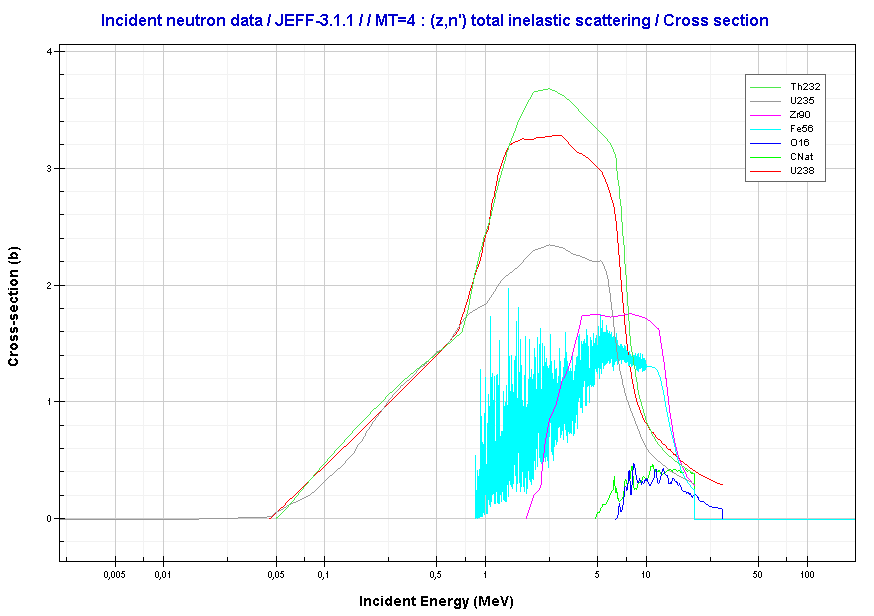
Inelastic scattering occurs above a threshold energy. This threshold energy is higher than the energy the first excited state of target nucleus (due to the laws of conservation) and it is given by following formula:

Et = ((A+1)/A)* ε1

where Et is known as the inelastic threshold energy and ε1 is the energy of the first excited state.

In general, the energy of the first excited state of nuclei decreases with increasing mass number. Therefore an inelastic scattering plays an important role in slowing down neutrons especially at high energies and by heavy nuclei. In calculations of a reactor inelastic scattering by light nuclei (such as oxygen with Et = 6.42 MeV) can ordinarily be ignored. Moreover, the hydrogen nucleus does not have excited states, so only an elastic scattering reaction can occur in that case.

On the other hand an inelastic scattering by uranium nuclei (especially by 238U) must be included. 238U is a major component of nuclear fuel in commercial power reactors, therefore its scattering data are one of the most important data in the neutron transport calculations in the reactor core.

See also: Inelastic Scattering and Capture Cross-section Data of Major Actinides in the Fast Neutron Region, INDC(NDS)-0597. IAEA, 12/2012.

Key Characteristics of Inelastic Scattering

  • During an inelastic scattering the neutron is absorbed and then re-emitted.
  • While momentum is conserved in an inelastic collision, kinetic energy of the “system” is not conserved.
  • Some energy of the incident neutron is absorbed to the recoiling nucleus and the nucleus remains in the excited state.
  • The nucleus gives up excitation energy by emitting one or more gamma rays.
  • General notation: A(n, n’)A* or A(n, 2n’)B; Example: 14O(n, n’)14O*.
  • Inelastic scattering is a threshold reaction and occurs above a threshold energy.
  • Inelastic scattering cross section is relatively small for light nuclei.
  • For hydrogen nucleus, inelastic scattering does not occur, because it does not have excited states.
  • Inelastic scattering plays an important role in slowing down neutrons especially at high energies and by heavy nuclei (e.g. 238U).
  • Inelastic scattering may be significant for heterogeneous reactors with highly enriched fuel (e.g. in fast neutron reactors).
Inelastic neutron scattering

Inelastic Scattering Cross-section

Inelastic Neutron Scattering Cross-section
Inelastic neutron scattering cross sections.

Source: JANIS (Java-based Nuclear Data Information Software); The JEFF-3.1.1 Nuclear Data Library

 
References:
Nuclear and Reactor Physics:
  1. J. R. Lamarsh, Introduction to Nuclear Reactor Theory, 2nd ed., Addison-Wesley, Reading, MA (1983).
  2. J. R. Lamarsh, A. J. Baratta, Introduction to Nuclear Engineering, 3d ed., Prentice-Hall, 2001, ISBN: 0-201-82498-1.
  3. W. M. Stacey, Nuclear Reactor Physics, John Wiley & Sons, 2001, ISBN: 0- 471-39127-1.
  4. Glasstone, Sesonske. Nuclear Reactor Engineering: Reactor Systems Engineering, Springer; 4th edition, 1994, ISBN: 978-0412985317
  5. W.S.C. Williams. Nuclear and Particle Physics. Clarendon Press; 1 edition, 1991, ISBN: 978-0198520467
  6. G.R.Keepin. Physics of Nuclear Kinetics. Addison-Wesley Pub. Co; 1st edition, 1965
  7. Robert Reed Burn, Introduction to Nuclear Reactor Operation, 1988.
  8. U.S. Department of Energy, Nuclear Physics and Reactor Theory. DOE Fundamentals Handbook, Volume 1 and 2. January 1993.

Advanced Reactor Physics:

  1. K. O. Ott, W. A. Bezella, Introductory Nuclear Reactor Statics, American Nuclear Society, Revised edition (1989), 1989, ISBN: 0-894-48033-2.
  2. K. O. Ott, R. J. Neuhold, Introductory Nuclear Reactor Dynamics, American Nuclear Society, 1985, ISBN: 0-894-48029-4.
  3. D. L. Hetrick, Dynamics of Nuclear Reactors, American Nuclear Society, 1993, ISBN: 0-894-48453-2.
  4. E. E. Lewis, W. F. Miller, Computational Methods of Neutron Transport, American Nuclear Society, 1993, ISBN: 0-894-48452-4.

See also:

See also:

Neutron Reactions

See also:

We hope, this article, Neutron Inelastic Scattering, helps you. If so, give us a like in the sidebar. Main purpose of this website is to help the public to learn some interesting and important information about materials and their properties.