Facebook Instagram Youtube Twitter

What is Neutron Elastic Scattering – Definition

Neutron elastic scattering is the most important process for slowing down neutrons. Total kinetic energy of the system is conserved in elastic scattering. Material Properties

Neutron Elastic Scattering

Generally, a neutron scattering reaction occurs when a target nucleus emits a single neutron after a neutron-nucleus interaction. In an elastic scattering reaction between a neutron and a target nucleus, there is no energy transferred into nuclear excitation. The elastic scattering conserves both momentum and kinetic energy of the “system”. It may be modeled as a billiard ball collision between a neutron and a nucleus.

σs
There is usually some transfer of kinetic energy from the incident neutron to the target nucleus. The target nucleus gains the exact amount of kinetic energy that the neutron loses. This interaction can take place via compound nucleus formation, but, in case of elastic scattering, a neutron emission returns the compound nucleus to the ground state of the original nucleus. Therefore the initial and final neutrons do not need to be necessarily the same. The elastic scattering can occur by way of two interaction mechanisms:
  • Potential scattering. In potential scattering, the neutron and the nucleus interact without neutron absorption and the formation of a compound nucleus. In fact, the incident neutron does not necessarily have to “touch” the nucleus and the neutron is scattered by the short range nuclear forces when it approaches close enough to the nucleus. Potential scattering occurs with incident neutrons that have an energy of up to about 1 MeV. It may be modeled as a billiard ball collision between a neutron and a nucleus.
  • Compound-elastic scattering. In some cases, if the kinetic energy of an incident neutron just right to form a resonance, the neutron may be absorbed and a compound nucleus may be formed. This interaction is more unusual and is also known as resonance elastic scattering. Due to formation of the compound nucleus, initial and final neutron are not the same.

Conservation of momentum and kinetic energy

conservation of momentum and energy

where:

mn = mass of the neutron
mT = mass of the target nucleus T
vn,i = initial neutron speed
vn,f = final neutron speed
vT,i = initial target speed
vT,f = final target speed

Key Characteristics of Elastic Scattering

  • Elastic scattering is the most important process for slowing down neutrons.
  • Total kinetic energy of the system is conserved in elastic scattering.
  • In this process, energy lost by the neutron is transferred to the recoiling nucleus.
  • Maximum energy transfer is occurred with an head-on collision.
  • Kinetic energy of the recoiled nucleus depends on the recoiled angle φ of the nucleus.
  • Elastic scattering cross-sections for light elements are more or less independent of neutron energy up to 1 MeV.
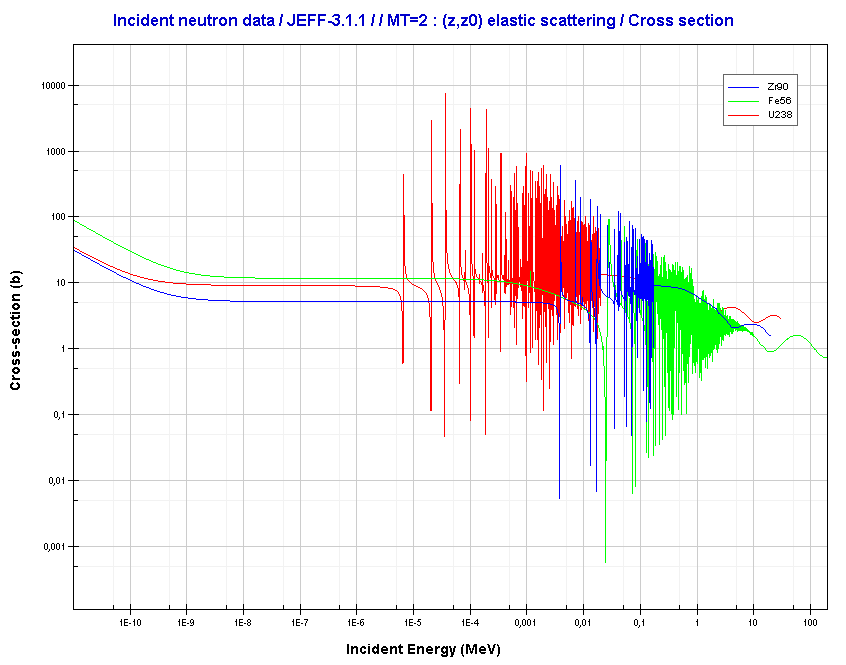
  • For intermediate and heavy elements, the elastic cross-section is constant at low energy with some specifics at higher energy.
  • A good approximation is, σs = const, for all elements, that are of importance.
  • At low energy, σs can be described by the one-level Breit-Wigner formula.
  • Nearly all elements have scattering cross-sections in the range of 2 to 20 barns.
  • The important exception is for water and heavy water.
  • If the kinetic energy of an incident neutron is large compared with the chemical binding energy of the atoms in a molecule, the chemical bound can be ignored.
  • If the kinetic energy of an incident neutron is of the order or less than the chemical binding energy, the cross-section of the molecule is not equal to the sum of cross-sections of its individual nuclei.
  • Scattering of slow neutrons by molecules is greater than by free nuclei.
  • Therefore one nucleus microscopic cross-sections do not describe the process correctly, while the macroscopic cross-section (Σs) has a precise meaning.
Scattering of slow neutrons by molecules is greater than by free nuclei.
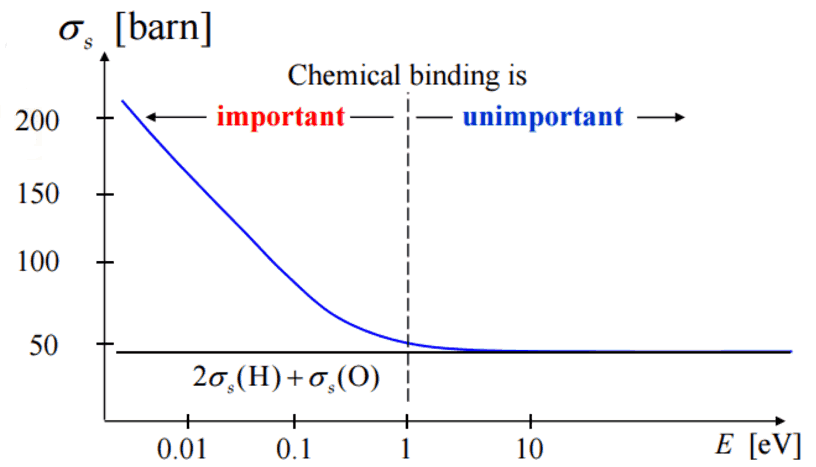
If the kinetic energy of an incident neutron is large compared with the chemical binding energy of the atoms in a molecule, the chemical bound can be ignored.
If the kinetic energy of an incident neutron is of the order or less than the chemical binding energy, the cross-section of the molecule is not equal to the sum of cross-sections of its individual nuclei.
Elastic scattering of molecules.

Elastic Scattering Cross-section

To be an effective moderator, the probability of elastic reaction between neutron and the nucleus must be high. In terms of cross-sections, the elastic scattering cross section of a moderator’s nucleus must be high.
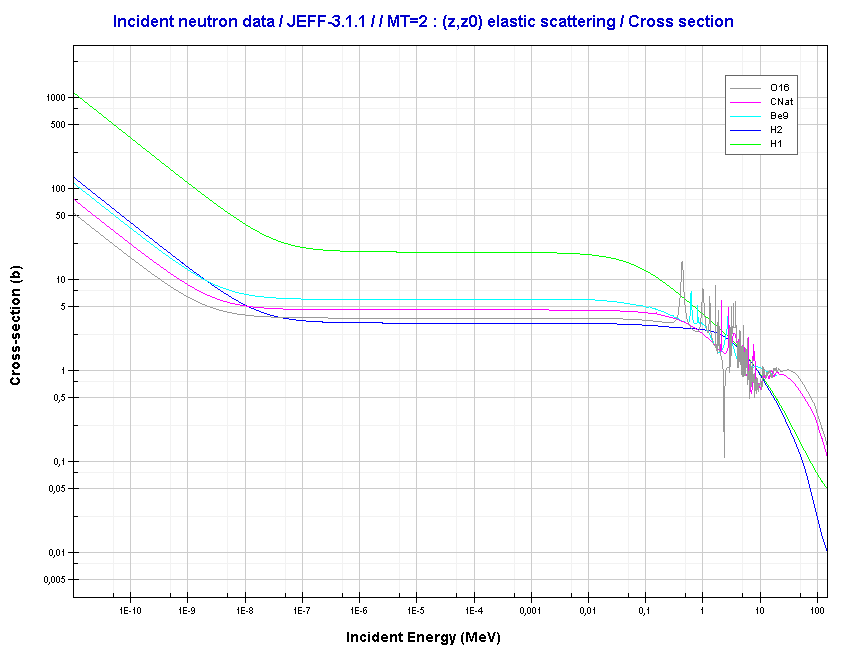
Elastic scattering cross-sections for light elements
Elastic scattering cross-sections for light elements are more or less independent of neutron energy up to 1 MeV.

Source: JANIS (Java-based Nuclear Data Information Software); The JEFF-3.1.1 Nuclear Data Library

Elastic scattering cross-sections for heavy elements
For intermediate and heavy elements, the elastic cross-section is constant at low energy with some specifics at higher energy.

Source: JANIS (Java-based Nuclear Data Information Software); The JEFF-3.1.1 Nuclear Data Library

Elastic Scattering and Neutron Moderators

As can be seen, a high elastic scattering cross-section is important, but does not describe comprehensively capabilities of moderators. In order to describe capabilities of a material to slow down neutrons, three new material variables must be defined:

  • The Average Logarithmic Energy Decrement (ξ)
  • The Macroscopic Slowing Down Power (MSDP)
  • The Moderating Ratio (MR)
Key properties of neutron moderators:
  • high cross-section for neutron scattering
  • high energy loss per collision
  • low cross-section for absorption
  • high melting and boiling point
  • high thermal conductivity
  • high specific heat capacity
  • low viscosity
  • low activity
  • low corrosive
  • cheap
 
Average Logarithmic Energy Decrement
During the scattering reaction, a fraction of the neutron’s kinetic energy is transferred to the nucleus. Using the laws of conservation of momentum and energy and the analogy of collisions of billiard balls for elastic scattering, it is possible to derive the following equation for the mass of target or moderator nucleus (M), energy of incident neutron (Ei) and the energy of scattered neutron (Es).

equation momentum energy

where A is the atomic mass number.

In case of the hydrogen (A = 1) as the target nucleus, the incident neutron can be completely stopped. But this works when the direction of the neutron is completely reversed (i.e. scattered at 180°). In reality, the direction of scattering ranges from 0 to 180 ° and the energy transferred also ranges from 0% to maximum. Therefore, the average energy of scattered neutron is taken as the average of energies with scattering angle 0 and 180°.

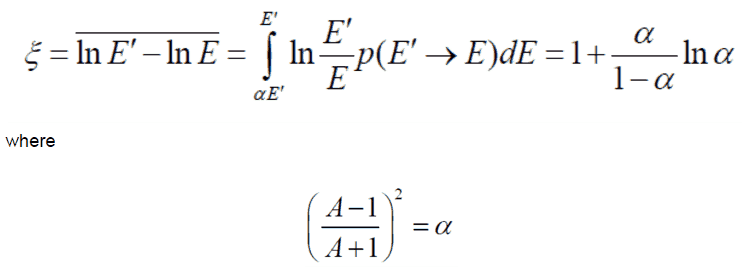
Moreover, it is useful to work with logarithmic quantities and therefore one defines the logarithmic energy decrement per collision (ξ) as a key material constant describing energy transfers during a neutron slowing down. ξ is not dependent on energy, only on A and is defined as follows:

logarithmic energy decrement - equation

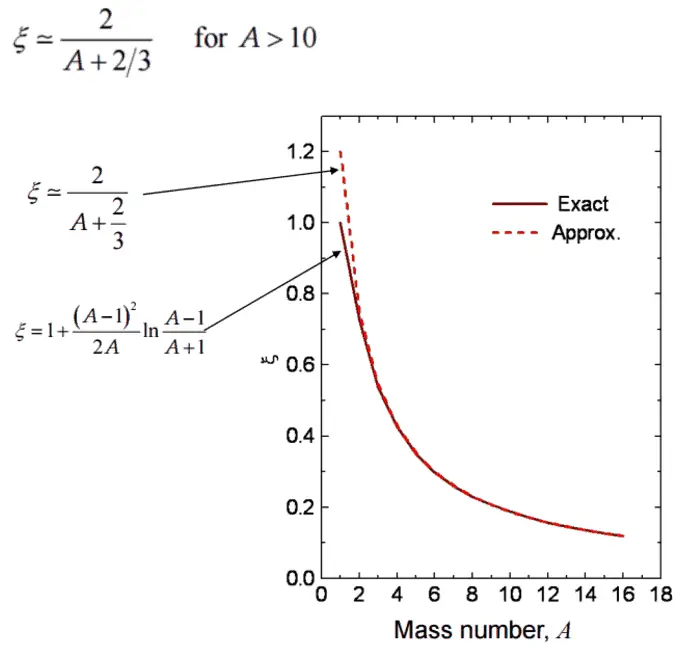
For heavy target nuclei, ξ may be approximated by following formula:
the logarithmic energy decrement per collision

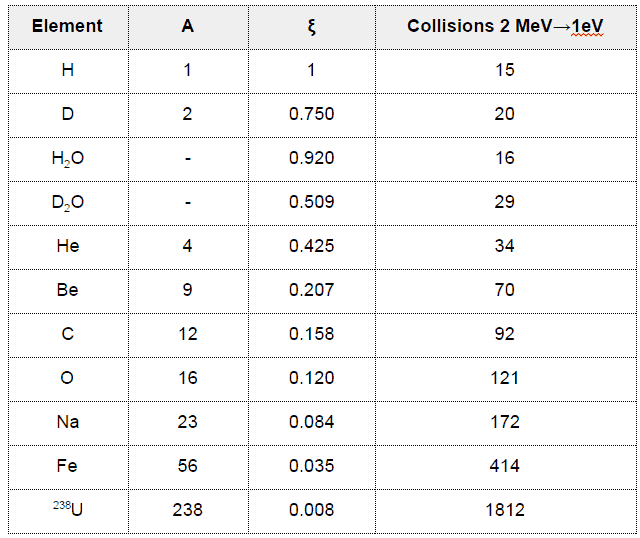
From these equations it is easy to determine the number of collisions required to slow down a neutron from, for example from 2 MeV to 1 eV.

Example:
Determine the number of collisions required for thermalization for the 2 MeV neutron in the carbon.
ξCARBON = 0.158
N(2MeV → 1eV) = ln 2⋅106/ξ =14.5/0.158 = 92

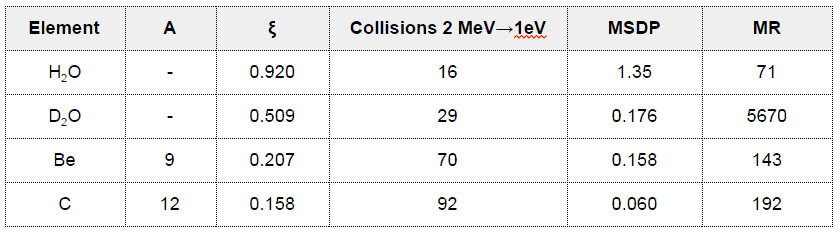
Table of average logarithmic energy decrement for some elements
Table of average logarithmic energy decrement for some elements.

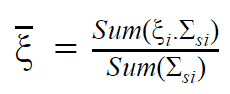
For a mixture of isotopes:

the logarithmic energy decrement for mixtures

Macroscopic Slowing Down Power
We have defined the probability of elastic scattering reaction, we have defined the average energy loss during the reaction. The product of these variables (the logarithmic energy decrement and the macroscopic cross section for scattering in the material) is the macroscopic slowing down power (MSDP).

MSDP = ξ . Σs

The MSDP describes the ability of a given material to slow down neutrons and indicates how rapidly a neutron will slow down in the material, but it does not fully reflect the effectiveness of the material as a moderator. In fact, the material with high MSDP can slow down neutrons with high efficiency, but it can be a poor moderator because of its high probability of absorbing neutrons. It is typical, for example, for boron, which has a high slowing down power but is absolutely inappropriate as a moderator.

The most complete measure of the effectiveness of a moderator is the Moderating Ratio (MR), where:

MR  = ξ . Σs/Σa

Table of macroscopic slowing down power MSDP for some materials.
Moderating Ratio
The moderating ratio or moderator quality is the most complete measure of the effectiveness of a moderator because it takes into account also the absorption effects. When absorption effects are high, most of the neutrons will be absorbed by moderator, leading to lower moderation or lower availability of thermal neutrons.

Therefore a higher ratio of MSDP to absorbtion cross sections ξ . Σs/Σa is desirable for effective moderation. This ratio is called the moderating ratio – MR and can be used as a criterion for comparison of different moderators.

Examples:

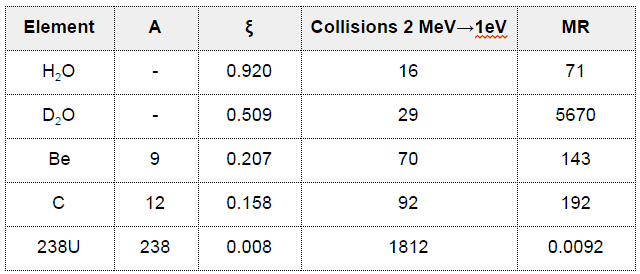
  • Light water has the highest ξ and σs among the moderators (resulting in the highest MSDP) shown in the table, but its moderating ratio is low due to its relatively higher absorption cross section.
  • On the other hand, heavy water has lower ξ and σs, but it has the highest moderating ratio owing to its lowest neutron absorption cross-section.
  • Graphite has much heavier nuclei than hydrogen in water, despite the fact graphite has much lower ξ and σs, it is better moderator than light water due to its lower absorption cross-section compared to that of light water.
Table of moderating ratios MR for some materials.
Table of moderating ratios for some materials.
 
References:
Nuclear and Reactor Physics:
  1. J. R. Lamarsh, Introduction to Nuclear Reactor Theory, 2nd ed., Addison-Wesley, Reading, MA (1983).
  2. J. R. Lamarsh, A. J. Baratta, Introduction to Nuclear Engineering, 3d ed., Prentice-Hall, 2001, ISBN: 0-201-82498-1.
  3. W. M. Stacey, Nuclear Reactor Physics, John Wiley & Sons, 2001, ISBN: 0- 471-39127-1.
  4. Glasstone, Sesonske. Nuclear Reactor Engineering: Reactor Systems Engineering, Springer; 4th edition, 1994, ISBN: 978-0412985317
  5. W.S.C. Williams. Nuclear and Particle Physics. Clarendon Press; 1 edition, 1991, ISBN: 978-0198520467
  6. G.R.Keepin. Physics of Nuclear Kinetics. Addison-Wesley Pub. Co; 1st edition, 1965
  7. Robert Reed Burn, Introduction to Nuclear Reactor Operation, 1988.
  8. U.S. Department of Energy, Nuclear Physics and Reactor Theory. DOE Fundamentals Handbook, Volume 1 and 2. January 1993.

Advanced Reactor Physics:

  1. K. O. Ott, W. A. Bezella, Introductory Nuclear Reactor Statics, American Nuclear Society, Revised edition (1989), 1989, ISBN: 0-894-48033-2.
  2. K. O. Ott, R. J. Neuhold, Introductory Nuclear Reactor Dynamics, American Nuclear Society, 1985, ISBN: 0-894-48029-4.
  3. D. L. Hetrick, Dynamics of Nuclear Reactors, American Nuclear Society, 1993, ISBN: 0-894-48453-2.
  4. E. E. Lewis, W. F. Miller, Computational Methods of Neutron Transport, American Nuclear Society, 1993, ISBN: 0-894-48452-4.

See also:

See also:

Neutron Reactions

See also:

We hope, this article, Neutron Elastic Scattering, helps you. If so, give us a like in the sidebar. Main purpose of this website is to help the public to learn some interesting and important information about materials and their properties.

What is Thermal Neutron – Definition

Thermal neutrons are neutrons in thermal equilibrium with a surrounding medium. Thermal neutron’s most probable energy at 17°C (62°F) is 0.025 eV (~2 km/s).

Thermal Neutron – Reactors

Free neutrons can be classified according to their kinetic energy. This energy is usually given in electron volts (eV). The term temperature can also describe this energy representing thermal equilibrium between a neutron and a medium with a certain temperature.

Thermal Neutrons are neutrons in thermal equilibrium with a surrounding medium of temperature 290K (17 °C or 62 °F). Most probable energy at 17°C (62°F) for Maxwellian distribution is 0.025 eV (~2 km/s). This part of neutron’s energy spectrum constitutes most important part of spectrum in thermal reactors.

Thermal neutrons have a different and often much larger effective neutron absorption cross-section (fission or radiative capture) for a given nuclide than fast neutrons. Therefore the criticality of a thermal reactor can be achieved with a much lower enrichment of nuclear fuel.

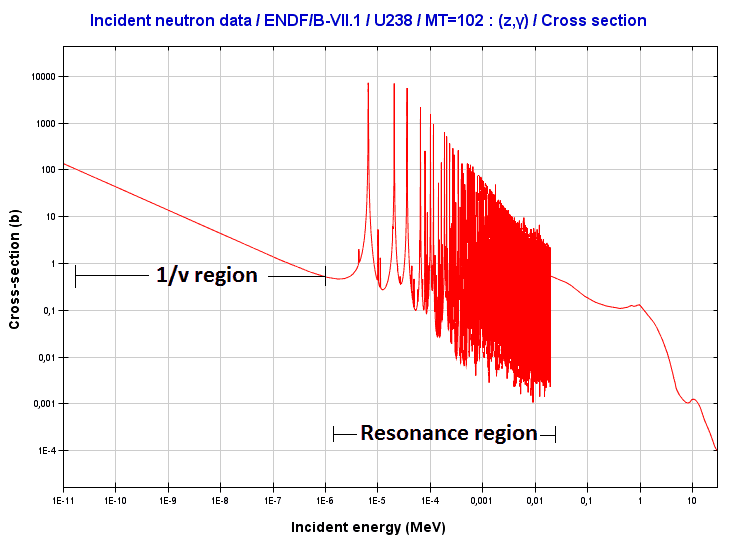
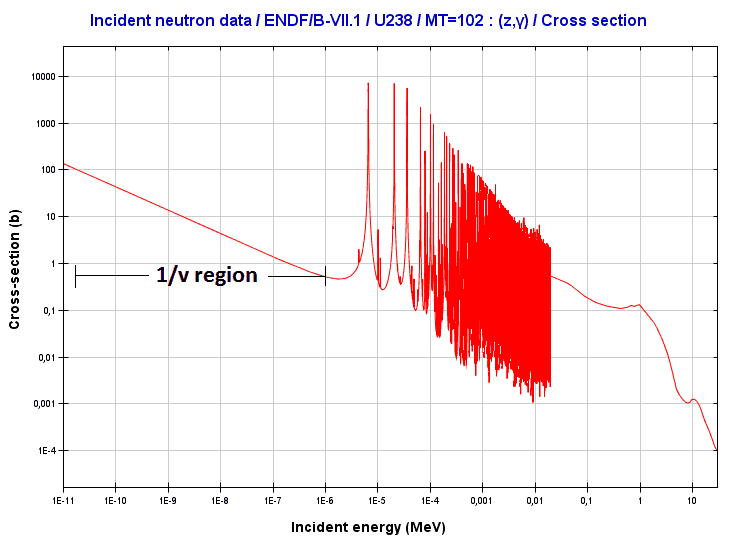
Moreover, thermal neutrons are in the 1/v region and the cross-section behaves according to the 1/v Law. In this region absorption cross-section increases as the velocity (kinetic energy) of the neutron decreases. Therefore the 1/v Law can be used to determine shift in absorbtion cross-section, if the neutron is in equilibrium with a surrounding medium. This phenomenon is due to the fact the nuclear force between the target nucleus and the neutron has a longer time to interact.

See also: Compound Nucleus Reactions

sigma_a sim frac{1}{v}}} sim frac{1}{sqrt{E}}}}} sim frac{1}{sqrt{T}}}}}

Example of cross- sections in 1/v region:

The absorbtion cross-section for 238U at 20°C = 293K (~0.0253 eV) is:

sigma_a(293K) = 2.68b .

The absorbtion cross-section for 238U at 1000°C = 1273K is equal to:

Neutron Cross-section - 1-v law

This cross-section reduction is caused only due to the shift of temperature of surrounding medium.

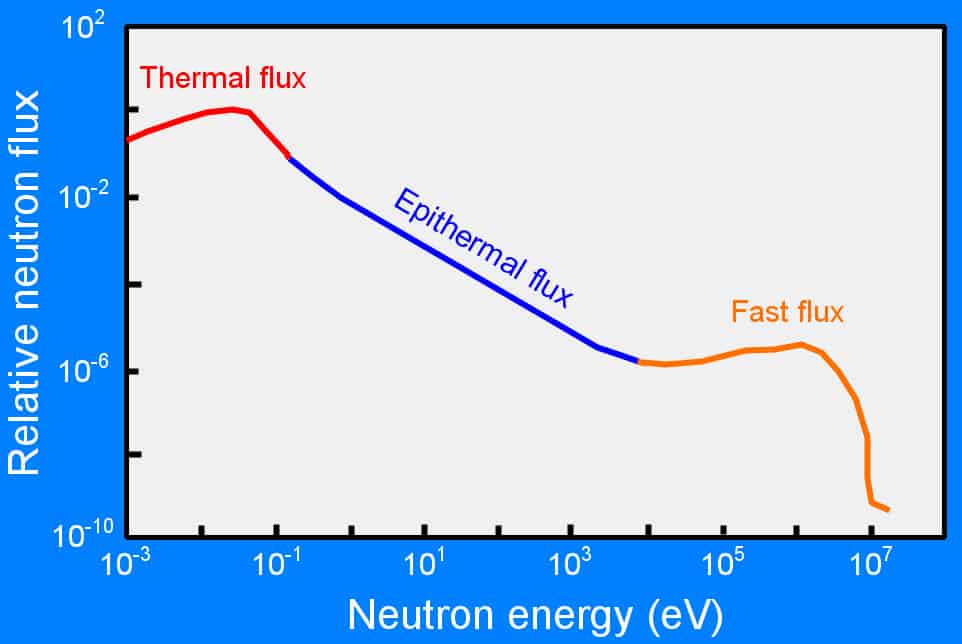
Neutron energies in thermal reactor
Distribution of kinetic energies of neutrons in the thermal reactor. The fission neutrons (fast flux) are immediately slowed down to the thermal energies via a process called neutron moderation.
Source: serc.carleton.edu
1/v Law
For thermal neutrons (in 1/v region), absorption cross sections increases as the velocity (kinetic energy) of the neutron decreases.
Source: JANIS 4.0

Thermal Neutron – Diffraction

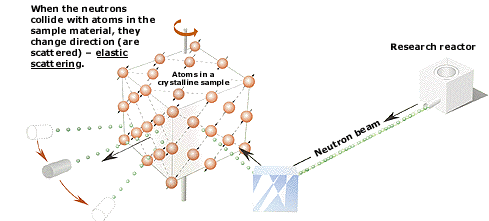
Thermal neutrons are also widely used in neutron diffraction experiments. Neutron diffraction experiments use an elastic neutron scattering to determine the atomic (or magnetic) structure of a material. The neutron diffraction is based the fact that thermal or cold neutrons have the wavelengths similar to atomic spacings.

An examined sample (crystalline solids, gasses, liquids or amorphous materials) must be placed in a neutron beam of thermal (0.025 eV) or cold (neutrons in thermal equilibrium with very cold surroundings such as liquid deuterium) neutrons to obtain a diffraction pattern that provides information about the structure of the examined material. The neutron diffraction experiments are similar to X-ray diffraction experiments, but neutrons interact with matter differently. Photons (X-rays) interact primarily with the electrons surrounding (atomic electron cloud) a nucleus, but neutrons interact only with nuclei. Neither the electrons surrounding (atomic electron cloud) a nucleus nor the electric field caused by a positively charged nucleus affect a neutron’s flight. Due to their different properties, both methods together (neutron diffraction and X-ray diffraction) can provide complementary information about the structure of the material.

Neutron diffraction - applications
Simple scheme of neutron diffraction experiment.
Source: www.psi.ch

See also:

Neutron

Click edit button to change this text.

We hope, this article, Thermal Neutron, helps you. If so, give us a like in the sidebar. Main purpose of this website is to help the public to learn some interesting and important information about materials and their properties.

What is Photoneutron – Definition

Photoneutrons are neutrons produced also in (γ, n) reactions and therefore they are usually referred to as photoneutrons. Photoneutron precursors can be also grouped by their decay constant. Material Properties

Photoneutrons

In nuclear reactors the gamma radiation plays a significant role also in reactor kinetics and in a subcriticality control. Especially in nuclear reactors with D2O moderator (CANDU reactors) or with Be reflectors (some experimental reactors). Neutrons can be produced also in (γ, n) reactions and therefore they are usually referred to as photoneutrons.

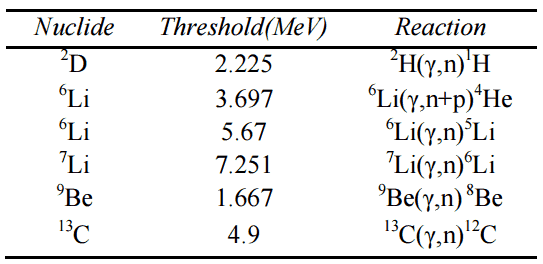
A high energy photon (gamma ray) can under certain conditions eject a neutron from a nucleus. It occurs when its energy exceeds the binding energy of the neutron in the nucleus. Most nuclei have binding energies in excess of 6 MeV, which is above the energy of most gamma rays from fission.On the other hand there are few nuclei with sufficiently low binding energy to be of practical interest. These are: 2D, 9Be, 6Li, 7Li and 13C. As can be seen from the table the lowest threshold have 9Be with 1.666 MeV and 2D with 2.226 MeV.

Photoneutron sources
Nuclides with low photodisintegration
threshold energies.

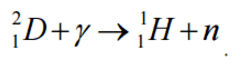
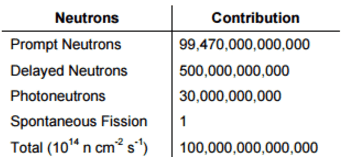
In case of deuterium, neutrons can be produced by the interaction of gamma rays (with a minimum energy of 2.22 MeV) with deuterium:Photoneutron - deuteriumBecause gamma rays can be emitted by fission products with certain delays, and the process is very similar to that through which a “true” delayed neutron is emitted, photoneutrons are usually treated no differently than regular delayed neutrons in the kinetic calculations. Photoneutron precursors can be also grouped by their decay constant, similarly to “real” precursors. The table below shows the relative importance of source neutrons in CANDU reactors by showing the makeup of the full power flux.Photoneutron balanceDespite the fact photoneutrons are of importance especially in CANDU reactors, deuterium nuclei are always present (~0.0156%) also in the light water of LWRs. Moreover the capture of neutrons in the hydrogen nucleus of the water molecules in the moderator yields small amounts of D2O. This enhances the heavy water concentration. Therefore also in LWRs kinetic calculations, photoneutrons from D2O are treated as additional groups of delayed neutrons having characteristic decay constants λj and effective group fractions.

After a nuclear reactor has been operated at full power for some time there will be a considerable build-up of gamma rays from the fission products. This high gamma flux from short-lived fission products will decrease rapidly after shutdown. In the long term the photoneutron source decreases with the decay of long-lived fission products that produce delayed high-energy gamma rays and the photoneutron source drops slowly, decreasing a little each day. The longest-lived fission product with gamma ray energy above the threshold is 140Ba with a half-life of 12.75 days.

The amount of fission products present in the fuel elements depends on how long has been the reactor operated before shut-down and at which power level has been the reactor operated before shut-down. Photoneutrons are usually major source in a reactor and ensure sufficient neutron flux on source range detectors when reactor is subcritical in long term shutdown.

In comparison with fission neutrons, that make a self-sustaining chain reaction possible, delayed neutrons make reactor control possible and photoneutrons are of importance at low power operation.

 
References:
Nuclear and Reactor Physics:
  1. J. R. Lamarsh, Introduction to Nuclear Reactor Theory, 2nd ed., Addison-Wesley, Reading, MA (1983).
  2. J. R. Lamarsh, A. J. Baratta, Introduction to Nuclear Engineering, 3d ed., Prentice-Hall, 2001, ISBN: 0-201-82498-1.
  3. W. M. Stacey, Nuclear Reactor Physics, John Wiley & Sons, 2001, ISBN: 0- 471-39127-1.
  4. Glasstone, Sesonske. Nuclear Reactor Engineering: Reactor Systems Engineering, Springer; 4th edition, 1994, ISBN: 978-0412985317
  5. W.S.C. Williams. Nuclear and Particle Physics. Clarendon Press; 1 edition, 1991, ISBN: 978-0198520467
  6. G.R.Keepin. Physics of Nuclear Kinetics. Addison-Wesley Pub. Co; 1st edition, 1965
  7. Robert Reed Burn, Introduction to Nuclear Reactor Operation, 1988.
  8. U.S. Department of Energy, Nuclear Physics and Reactor Theory. DOE Fundamentals Handbook, Volume 1 and 2. January 1993.

Advanced Reactor Physics:

  1. K. O. Ott, W. A. Bezella, Introductory Nuclear Reactor Statics, American Nuclear Society, Revised edition (1989), 1989, ISBN: 0-894-48033-2.
  2. K. O. Ott, R. J. Neuhold, Introductory Nuclear Reactor Dynamics, American Nuclear Society, 1985, ISBN: 0-894-48029-4.
  3. D. L. Hetrick, Dynamics of Nuclear Reactors, American Nuclear Society, 1993, ISBN: 0-894-48453-2.
  4. E. E. Lewis, W. F. Miller, Computational Methods of Neutron Transport, American Nuclear Society, 1993, ISBN: 0-894-48452-4.

See also:

Eight Groups

See also:

Delayed Neutrons

See also:

Energy Spectra

We hope, this article, Photoneutron, helps you. If so, give us a like in the sidebar. Main purpose of this website is to help the public to learn some interesting and important information about materials and their properties.

What is Compound Nucleus Reaction – Definition

The compound nucleus reactions involve many nucleon-nucleon interactions. The compound nucleus model (idea of compound nucleus formation) was introduced by Niels Bohr in 1936. Material Properties

Nuclear Reactions – Basic Classification

A nuclear reaction is considered to be the process in which two nuclear particles (two nuclei or a nucleus and a nucleon) interact to produce two or more nuclear particles or ˠ-rays (gamma rays). Thus, a nuclear reaction must cause a transformation of at least one nuclide to another. Sometimes if a nucleus interacts with another nucleus or particle without changing the nature of any nuclide, the process is referred to a nuclear scattering, rather than a nuclear reaction.

In order to understand the nature of nuclear reactions, the classification according to the time scale of of these reactions has to be introduced. Interaction time is critical for defining the reaction mechanism.

There are two extreme scenarios for nuclear reactions (not only neutron nuclear reactions):

  • A projectile and a target nucleus are within the range of nuclear forces for the very short time allowing for an interaction of a single nucleon only. These type of reactions are called the direct nuclear reactions.
  • A projectile and a target nucleus are within the range of nuclear forces for the time allowing for a large number of interactions between nucleons. These type of reactions are called the compound nucleus reactions.

In fact, there is always some non-direct (multiple internuclear interaction) component in all reactions, but the direct reactions have this component limited.

Compound Nucleus Reactions

 
What is the Compound Nucleus and the Nuclear Resonance?
There is no difference between the compound nucleus and the nuclear resonance.

The compound nucleus is the intermediate state formed in a compound nucleus reaction. It is normally one of the excited states of the nucleus formed by the combination of the incident particle and target nucleus. If a target nucleus X is bombarded with particles a, it is sometimes observed that the ensuing nuclear reaction takes place with appreciable probability only if the energy of the particle a is in the neighborhood of certain definite energy values. These energy values are referred to as resonance energies. The compound nuclei of these certain energies are reffered to as nuclear resonances. Resonances are usually found only at relatively low energies of the projectile. The widths of the resonances increase in general with increasing energies. At higher energies the widths may reach the order of the distances between resonances and then no resonances can be observed. The narrowest resonances are usually the compound states of heavy nuclei (such as fissionable nuclei) and thermal neutrons (usually in (n,γ) capture reactions). The observation of resonances is by no means restricted to neutron nuclear reactions.

The compound nucleus model (idea of compound nucleus formation) was introduced by Danish physicist Niels Bohr in 1936. This model assumes that incident particle and the target nucleus become indistinguishable after the collision and together constitute the particular excited state of nucleus – the compound nucleus. To become indistinguishable the projectile has to suffer collisions with constituent nucleons of the target nucleus until it has lost its incident energy. In fact many so these collisions lead to a complete thermal equilibrium inside the compound nucleus. The compound nucleus is excited by both the kinetic energy of the projectile and by the binding nuclear energy.

This compound system is a relatively long-lived intermediate state of particle-target composite system and from the definition, the compound nucleus must live for at least several times longer than is the time of transit of an incident particle across the nucleus (~10-22 s). The time scale of compound nucleus reactions is of the order of 10-18 s  –  10-16 s, but lifetimes as long as 10-14 s have been also observed.

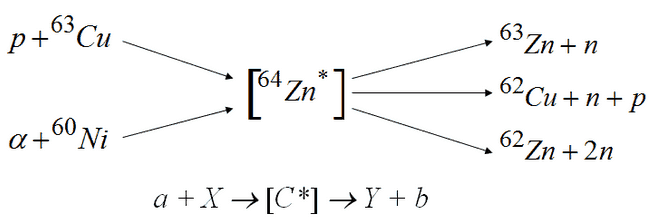
Very important feature and a direct consequence of the thermal equilibrium inside a compound nucleus is the fact the mode of decay of compound nucleus does not depend on the way the compound nucleus is formed. The large number of collisions between nucleons leads to the loss of the information on the entrance channel from the system. The decay mechanism (exit channel) that dominates the decay of C* is determined by the excitation energy in C* and by the law of probability.compound nucleus reaction

These reactions can be considered as a two-stage processes.

  • The first stage is the formation of a compound nucleus expressed by σa+X➝C*
  • The second stage is the decay of a compound nucleus expressed by PC*➝b+Y
  • The result cross-section of certain reaction a+X➝[C*]➝b+Y is given by σ(a,b)= σa+X➝C* . PC*➝b+Y
Uranium absorption reaction
Absorption reaction of fissile 235U. The uncertainty of the exit channel is caused by “loss of memory” of resonance [236U].

Resonances

For the compound nucleus peaks in the cross-section are typical. Each peak is manifesting a particular compound state of nucleus. These peaks and the associated compound nuclei are usually called resonances. The behaviour of the cross-section between two resonances is usually strongly affected by the effect of nearby resonances.

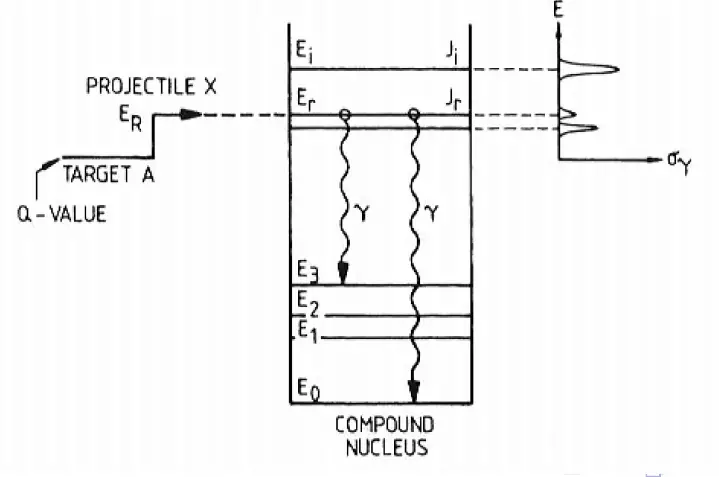
Resonances (particular compound states) are mostly created in neutron nuclear reactions, but  it is by no means restricted to neutron nuclear reactions. The formation of resonances is caused by the quantum nature of nuclear forces. Each nuclear reaction is a transition between different quantum discrete states or energy levels. The discrete nature of energy transitions plays a key role. If the energy of the projectile (the sum of the Q value and the kinetic energy of the projectile) and the energy of target nucleus is equal to a compound nucleus at one of the excitation states, a resonance can be created and peak occurs in the cross section. For light nucleus, the allowable state density in this energy region is much lower and the “distance” between states is higher. For heavy nuclei, such as 238U, we can observe large resonance region in the neutron absorption cross-section.

It is obvious the compound states (resonances) are observed at low excitation energies. This is due to the fact, the energy gap between the states is large. At high excitation energy, the gap between two compound states is very small and the widths of resonances may reach the order of the distances between resonances. Therefore at high energies no resonances can be observed and the cross section in this energy region is continuous and smooth.

Compound state - resonance
Energy levels of compound state. For neutron absorption reaction on 238U the first resonance E1 corresponds to the excitation energy of 6.67eV. E0 is a base state of 239U.
ground state compound nucleus - excitation
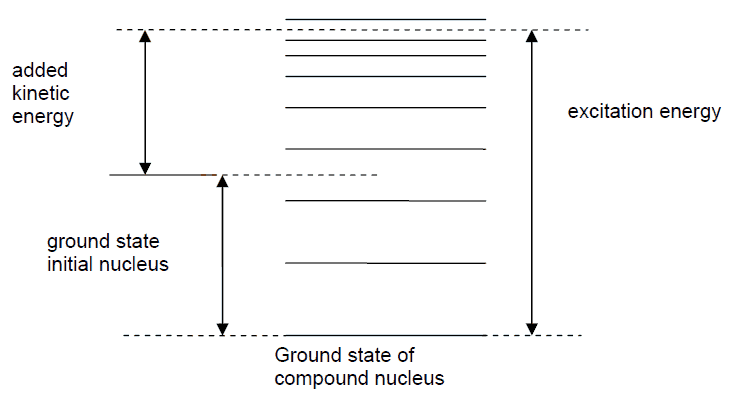
The position of the energy levels during the formation of a compound nucleus. Ground state and energy states.
Resonance region - Compound Nucleus
Region of resonances of 238U nuclei.
Source: JANIS (Java-based Nuclear Data Information Software); The ENDF/B-VII.1 Nuclear Data Library

Direct Reactions vs. Compound Nucleus Reactions

Direct Reactions

  • The direct reactions are fast and involve a single-nucleon interaction.
  • The interaction time must be very short (~10-22 s).
  • The direct reactions require incident particle energy larger than ∼ 5 MeV/Ap. (Ap is the atomic mass number of a projectile)
  • Incident particles interact on the surface of a target nucleus rather than in the volume of a target nucleus.
  • Products of the direct reactions are not distributed isotropically in angle, but they are forward focused.
  • Direct reactions are of importance in measurements of nuclear structure.

Compound Nucleus Reactions

  • The compound nucleus is a relatively long-lived intermediate state of particle-target composite system.
  • The compound nucleus reactions involve many nucleon-nucleon interactions.
  • The large number of collisions between the nucleons leads to a thermal equilibrium inside the compound nucleus.
  • The time scale of compound nucleus reactions is of the order of 10-18 s – 10-16 s.
  • The compound nucleus reactions is usually created if the projectile has low energy.
  • Incident particles interact in the volume of a target nucleus.
  • Products of the compound nucleus reactions are distributed near isotropically in angle (the nucleus loses memory of how it was created – the Bohr’s hypothesis of independence).
  • The mode of decay of compound nucleus do not depend on the way the compound nucleus is formed.
  • Resonances in the cross-section are typical for the compound nucleus reaction.
 
References:
Nuclear and Reactor Physics:
  1. J. R. Lamarsh, Introduction to Nuclear Reactor Theory, 2nd ed., Addison-Wesley, Reading, MA (1983).
  2. J. R. Lamarsh, A. J. Baratta, Introduction to Nuclear Engineering, 3d ed., Prentice-Hall, 2001, ISBN: 0-201-82498-1.
  3. W. M. Stacey, Nuclear Reactor Physics, John Wiley & Sons, 2001, ISBN: 0- 471-39127-1.
  4. Glasstone, Sesonske. Nuclear Reactor Engineering: Reactor Systems Engineering, Springer; 4th edition, 1994, ISBN: 978-0412985317
  5. W.S.C. Williams. Nuclear and Particle Physics. Clarendon Press; 1 edition, 1991, ISBN: 978-0198520467
  6. G.R.Keepin. Physics of Nuclear Kinetics. Addison-Wesley Pub. Co; 1st edition, 1965

Advanced Reactor Physics:

  1. K. O. Ott, W. A. Bezella, Introductory Nuclear Reactor Statics, American Nuclear Society, Revised edition (1989), 1989, ISBN: 0-894-48033-2.
  2. K. O. Ott, R. J. Neuhold, Introductory Nuclear Reactor Dynamics, American Nuclear Society, 1985, ISBN: 0-894-48029-4.
  3. D. L. Hetrick, Dynamics of Nuclear Reactors, American Nuclear Society, 1993, ISBN: 0-894-48453-2.
  4. E. E. Lewis, W. F. Miller, Computational Methods of Neutron Transport, American Nuclear Society, 1993, ISBN: 0-894-48452-4.

See also:

See also:

Neutron Nuclear Reactions

See also:

We hope, this article, Compound Nucleus Reaction, helps you. If so, give us a like in the sidebar. Main purpose of this website is to help the public to learn some interesting and important information about materials and their properties.

What is Direct Nuclear Reaction – Definition

Nuclear reactions, that occur in a time comparable to the time of transit of an incident particle across the nucleus, are called direct nuclear reactions. Material Properties

Nuclear Reactions – Basic Classification

A nuclear reaction is considered to be the process in which two nuclear particles (two nuclei or a nucleus and a nucleon) interact to produce two or more nuclear particles or ˠ-rays (gamma rays). Thus, a nuclear reaction must cause a transformation of at least one nuclide to another. Sometimes if a nucleus interacts with another nucleus or particle without changing the nature of any nuclide, the process is referred to a nuclear scattering, rather than a nuclear reaction.

In order to understand the nature of nuclear reactions, the classification according to the time scale of of these reactions has to be introduced. Interaction time is critical for defining the reaction mechanism.

There are two extreme scenarios for nuclear reactions (not only neutron nuclear reactions):

  • A projectile and a target nucleus are within the range of nuclear forces for the very short time allowing for an interaction of a single nucleon only. These type of reactions are called the direct nuclear reactions.
  • A projectile and a target nucleus are within the range of nuclear forces for the time allowing for a large number of interactions between nucleons. These type of reactions are called the compound nucleus reactions.

In fact, there is always some non-direct (multiple internuclear interaction) component in all reactions, but the direct reactions have this component limited.

Direct Nuclear Reactions

Nuclear reactions, that occur in a time comparable to the time of transit of an incident particle across the nucleus (~10-22 s), are called direct nuclear reactions. Interaction time is critical for defining the reaction mechanism. The very short interaction time allows for an interaction of a single nucleon only (in extreme cases). In fact, there is always some non-direct (a multiple internuclear interaction) component in all reactions, but the direct reactions have this component limited. To limit the time available for multiple internuclear interactions, the reaction have to occur at high energy.

Direct reactions have another property which is very important. Products of a direct reaction are not distributed isotropically in angle, but they are forward focused. This reflects the fact that the projectiles makes only one, or very few, collisions with nucleons in the target nucleus and its forward momentum is not transferred to an entire compound state.

The cross-sections for direct reactions vary smoothly and slowly with energy in contrast to the compound nucleus reactions and these cross-sections are comparable to the geometrical cross-sections of target nuclei. Types of direct reactions:

  • Elastic scattering in which a passing particle and a targes stay in their ground states.  
  • Inelastic scattering in which a passing particle changes its energy state.  For example the (p, p’) reaction.
  • Transfer reactions in which one or more nucleons are transferred to the othes nucleus. These reactions are further classified to as:
    • Stripping reaction in which one or more nucleons are transferred to a target nucleus from passing particle. For example the neutron stripping in the (d, p) reaction.
    • Pick-up reaction in which one or more nucleons are transferred from a target nucleus to a passing particle. For example the neutron pick-up in the (p, d) reaction
  • Break-up reaction in which a breakup of a projectile into two or more fragments occurs.
  • Knock-out reaction in which a single nucleon or a light cluster is removed from the projectile by a collision with the target.

Direct nuclear reaction

Example: This threshold reaction of fast neutron with an isotope 10B is one of the ways, how radioactive tritium in primary circuit of all PWRs is generated.

Direct Reactions vs. Compound Nucleus Reactions

Direct Reactions

  • The direct reactions are fast and involve a single-nucleon interaction.
  • The interaction time must be very short (~10-22 s).
  • The direct reactions require incident particle energy larger than ∼ 5 MeV/Ap. (Ap is the atomic mass number of a projectile)
  • Incident particles interact on the surface of a target nucleus rather than in the volume of a target nucleus.
  • Products of the direct reactions are not distributed isotropically in angle, but they are forward focused.
  • Direct reactions are of importance in measurements of nuclear structure.

Compound Nucleus Reactions

  • The compound nucleus reactions involve many nucleon-nucleon interactions.
  • The large number of collisions between the nucleons leads to a thermal equilibrium inside the compound nucleus.
  • The time scale of compound nucleus reactions is of the order of 10-18 s – 10-16 s.
  • The compound nucleus reactions is usually created if the projectile has low energy.
  • Incident particles interact in the volume of a target nucleus.
  • Products of the compound nucleus reactions are distributed near isotropically in angle (the nucleus loses memory of how it was created – the Bohr’s hypothesis of independence).
  • The mode of decay of compound nucleus do not depend on the way the compound nucleus is formed.
  • Resonances in the cross-section are typical for the compound nucleus reaction.
 
References:
Nuclear and Reactor Physics:
  1. J. R. Lamarsh, Introduction to Nuclear Reactor Theory, 2nd ed., Addison-Wesley, Reading, MA (1983).
  2. J. R. Lamarsh, A. J. Baratta, Introduction to Nuclear Engineering, 3d ed., Prentice-Hall, 2001, ISBN: 0-201-82498-1.
  3. W. M. Stacey, Nuclear Reactor Physics, John Wiley & Sons, 2001, ISBN: 0- 471-39127-1.
  4. Glasstone, Sesonske. Nuclear Reactor Engineering: Reactor Systems Engineering, Springer; 4th edition, 1994, ISBN: 978-0412985317
  5. W.S.C. Williams. Nuclear and Particle Physics. Clarendon Press; 1 edition, 1991, ISBN: 978-0198520467
  6. G.R.Keepin. Physics of Nuclear Kinetics. Addison-Wesley Pub. Co; 1st edition, 1965

Advanced Reactor Physics:

  1. K. O. Ott, W. A. Bezella, Introductory Nuclear Reactor Statics, American Nuclear Society, Revised edition (1989), 1989, ISBN: 0-894-48033-2.
  2. K. O. Ott, R. J. Neuhold, Introductory Nuclear Reactor Dynamics, American Nuclear Society, 1985, ISBN: 0-894-48029-4.
  3. D. L. Hetrick, Dynamics of Nuclear Reactors, American Nuclear Society, 1993, ISBN: 0-894-48453-2.
  4. E. E. Lewis, W. F. Miller, Computational Methods of Neutron Transport, American Nuclear Society, 1993, ISBN: 0-894-48452-4.

See also:

See also:

Neutron Nuclear Reactions

See also:

We hope, this article, Direct Nuclear Reaction, helps you. If so, give us a like in the sidebar. Main purpose of this website is to help the public to learn some interesting and important information about materials and their properties.

What is Neutron Nuclear Reaction – Definition

The study of neutron nuclear reactions and nuclear reactions in general is of paramount importance in physics of nuclear reactors. Neutron Nuclear Reactions

Neutron Nuclear Reactions

The study of neutron nuclear reactions and nuclear reactions in general is of paramount importance in physics of nuclear reactors. Progress in the understanding of nuclear reactions generally has occurred at a faster pace compared to similar studies of  chemical reactions and generally a higher level of sophistication has been achieved.

Shortly after the neutron was discovered in 1932, it was quickly realized that neutrons might act to form a nuclear chain reaction. When nuclear fission was discovered in 1938, it became clear that, if a neutron induced fission reaction produces new free neutrons, that each of these neutrons might cause further fission reaction in a cascade known as a chain reaction. Therefore the calculations of nuclear reactors are determined by the transport of neutrons, their interaction with matter and their multiplication within a nuclear reactor.

neutron nuclear reactions

Definition

A neutron nuclear reaction is considered to be the process in which neutron interacts with a nuclear particle to produce two or more nuclear particles or ˠ-rays (gamma rays). Thus, a neutron nuclear reaction must cause a transformation of the target nuclide to another nuclide. Sometimes if a nucleus interacts with another nucleus or particle without changing the nature of the nuclide, the process is referred to a nuclear scattering, rather than a neutron nuclear reaction.

In order to understand the nature of neutron nuclear reactions, the classification according to the time scale of of these reactions has to be introduced. Interaction time is critical for defining the reaction mechanism.

There are two extreme scenarios for nuclear reactions (not only neutron reactions):

  • A projectile and a target nucleus are within the range of nuclear forces for the very short time allowing for an interaction of a single nucleon only. These type of reactions are called the direct reactions.
  • A projectile and a target nucleus are within the range of nuclear forces for the time allowing for a large number of interactions between nucleons. These type of reactions are called the compound nucleus reactions.

In fact, there is always some non-direct (multiple internuclear interaction) component in all reactions, but the direct reactions have this component limited.

Basic characteristics of direct reactions:

  • The direct reactions are fast and involve a single-nucleon interaction.
  • The interaction time must be very short (~10-22 s).
  • The direct reactions require incident particle energy larger than ∼ 5 MeV/Ap. (Ap is the atomic mass number of a projectile)
  • Incident particles interact on the surface of a target nucleus rather than in the volume of a target nucleus.
  • Products of the direct reactions are not distributed isotropically in angle, but they are forward focused.
  • Direct reactions are of importance in measurements of nuclear structure.

Basic characteristics of compound nucleus reactions:

  • The compound nucleus is a relatively long-lived intermediate state of particle-target composite system.
  • The compound nucleus reactions involve many nucleon-nucleon interactions.
  • The large number of collisions between the nucleons leads to a thermal equilibrium inside the compound nucleus.
  • The time scale of compound nucleus reactions is of the order of 10-18 s – 10-16 s.
  • The compound nucleus reactions is usually created if the projectile has low energy.
  • Incident particles interact in the volume of a target nucleus.
  • Products of the compound nucleus reactions are distributed near isotropically in angle (the nucleus loses memory of how it was created – the Bohr’s hypothesis of independence).
  • The mode of decay of compound nucleus do not depend on the way the compound nucleus is formed.
  • Resonances in the cross-section are typical for the compound nucleus reaction.
 
Direct Nuclear Reactions
Nuclear reactions, that occur in a time comparable to the time of transit of an incident particle across the nucleus (~10-22 s), are called direct reactions. Interaction time is critical for defining the reaction mechanism. The very short interaction time allows for an interaction of a single nucleon only (in extreme cases). In fact, there is always some non-direct (a multiple internuclear interaction) component in all reactions, but the direct reactions have this component limited. To limit the time available for multiple internuclear interactions, the reaction have to occur at high energy.  

Direct reactions have another property which is very important. Products of a direct reaction are not distributed isotropically in angle, but they are forward focused. This reflects the fact that the projectiles makes only one, or very few, collisions with nucleons in the target nucleus and its forward momentum is not transferred to an entire compound state.

The cross-sections for direct reactions vary smoothly and slowly with energy in contrast to the compound nucleus reactions and these cross-sections are comparable to the geometrical cross-sections of target nuclei.

Types of direct reactions:

  • Elastic scattering in which a passing particle and a targes stay in their ground states.  
  • Inelastic scattering in which a passing particle changes its energy state.  For example the (p, p’) reaction.
  • Transfer reactions in which one or more nucleons are transferred to the othes nucleus. These reactions are further classified to as:
    • Stripping reaction in which one or more nucleons are transferred to a target nucleus from passing particle. For example the neutron stripping in the (d, p) reaction.
    • Pick-up reaction in which one or more nucleons are transferred from a target nucleus to a passing particle. For example the neutron pick-up in the (p, d) reaction
  • Break-up reaction in which a breakup of a projectile into two or more fragments occurs.
  • Knock-out reaction in which a single nucleon or a light cluster is removed from the projectile by a collision with the target.

Direct nuclear reaction

Example: This threshold reaction of fast neutron with an isotope 10B is one of the ways, how radioactive tritium in primary circuit of all PWRs is generated.

Compound Nuclear Reactions
The compound nucleus model (idea of compound nucleus formation) was introduced by Danish physicist Niels Bohr in 1936. This model assumes that incident particle and the target nucleus become indistinguishable after the collision and together constitute the particular excited state of nucleus – the compound nucleus. To become indistinguishable the projectile has to suffer collisions with constituent nucleons of the target nucleus until it has lost its incident energy. In fact many so these collisions lead to a complete thermal equilibrium inside the compound nucleus. The compound nucleus is excited by both the kinetic energy of the projectile and by the binding nuclear energy.

This compound system is a relatively long-lived intermediate state of particle-target composite system and from the definition, the compound nucleus must live for at least several times longer than is the time of transit of an incident particle across the nucleus (~10-22 s). The time scale of compound nucleus reactions is of the order of 10-18 s – 10-16 s, but lifetimes as long as 10-14 s have been also observed.

Very important feature and a direct consequence of the thermal equilibrium inside a compound nucleus is the fact the mode of decay of compound nucleus does not depend on the way the compound nucleus is formed. The large number of collisions between nucleons leads to the loss of the information on the entrance channel from the system. The decay mechanism (channel) that dominates the decay of C* is determined by the excitation energy in C*.

compound nucleus reaction

These reactions can be considered as a two-stage processes.

  • The first stage is the formation of a compound nucleus expressed by σa+X➝C*
  • The second stage is the decay of a compound nucleus expressed by PC*➝b+Y
  • The result cross-section of certain reaction a+X➝[C*]➝b+Y is given by σ(a,b)= σa+X➝C* . PC*➝b+Y
Uranium absorption reaction
Absorption reaction of fissile 235U. The uncertainty of the exit channel is caused by “loss of memory” of resonance [236U].

For the compound nucleus peaks in the cross-section are typical. Each peak is manifesting a particular compound state of nucleus. These peaks and the associated compound nuclei are usually called resonances. The behaviour of the cross-section between two resonances is usually strongly affected by the effect of nearby resonances.

Compound state - resonance
Energy levels of compound state. For neutron absorption reaction on 238U the first resonance E1 corresponds to the excitation energy of 6.67eV. E0 is a base state of 239U.

Resonances (particular compound states) are mostly created in neutron nuclear reactions, but  it is by no means restricted to neutron nuclear reactions. The formation of resonances is caused by the quantum nature of nuclear forces. Each nuclear reaction is a transition between different quantum discrete states or energy levels. The discrete nature of energy transitions plays a key role. If the energy of the projectile (the sum of the Q value and the kinetic energy of the projectile) and the energy of target nucleus is equal to a compound nucleus at one of the excitation states, a resonance can be created and peak occurs in the cross section. For light nucleus, the allowable state density in this energy region is much lower and the “distance” between states is higher. For heavy nuclei, such as 238U, we can observe large resonance region in the neutron absorption cross-section.

It is obvious the compound states (resonances) are observed at low excitation energies. This is due to the fact, the energy gap between the states is large. At high excitation energy, the gap between two compound states is very small and the widths of resonances may reach the order of the distances between resonances. Therefore at high energies no resonances can be observed and the cross section in this energy region is continuous and smooth.

Resonance region - Compound Nucleus
Region of resonances of 238U nuclei.
Source: JANIS (Java-based Nuclear Data Information Software); The ENDF/B-VII.1 Nuclear Data Library

The ENDF/B-VII.1 Nuclear Data Library

Types of neutron-nuclear reactions

 
Elastic Scattering Reaction
Generally, a neutron scattering reaction occurs when a target nucleus emits a single neutron after a neutron-nucleus interaction. In an elastic scattering reaction between a neutron and a target nucleus, there is no energy transferred into nuclear excitation.
Inelastic Scattering Reaction
In an inelastic scattering reaction between a neutron and a target nucleus some energy of the incident neutron is absorbed to the recoiling nucleus and the nucleus remains in the excited state. Thus while momentum is conserved in an inelastic collision, kinetic energy of the “system” is not conserved.
Neutron Absorption
The neutron absorption reaction is the most important type of reactions that take place in a nuclear reactor. The absorption reactions are reactions, where the neutron is completely absorbed and compound nucleus is formed. This is the very important feature, because the mode of decay of such compound nucleus does not depend on the way the compound nucleus was formed. Therefore a variety of emissions or decays may follow. The most important absorption reactions are divided by the exit channel into two following reactions:
  • Radiative Capture. Most absorption reactions result in the loss of a neutron coupled with the production of one or more gamma rays. This is referred to as a capture reaction, and it is denoted by σγ.
  • Neutron-induced Fission Reaction. Some nuclei (fissionable nuclei) may undergo a fission event, leading to two or more fission fragments (nuclei of intermediate atomic weight) and a few neutrons. In a fissionable material, the neutron may simply be captured, or it may cause nuclear fission. For fissionable materials we thus divide the absorption cross section as σa = σγ + σf.
Radiative Capture
The neutron capture is one of the possible absorption reactions that may occur. In fact, for non-fissionable nuclei it is the only possible absorption reaction. Capture reactions result in the loss of a neutron coupled with the production of one or more gamma rays. This capture reaction is also referred to as a radiative capture or (n, γ) reaction, and its cross-section is denoted by σγ.

The radiative capture is a reaction, in which the incident neutron is completely absorbed and compound nucleus is formed. The compound nucleus then decays to its ground state by gamma emission. This process can occur at all incident neutron energies, but the probability of the interaction strongly depends on the incident neutron energy and also on the target energy (temperature). In fact the energy in the center-of-mass system determines this probability.

Nuclear Fission
Nuclear fission is a nuclear reaction in which the nucleus of an atom splits into smaller parts (lighter nuclei). The fission process often produces free neutrons and photons (in the form of gamma rays), and releases a large amount of energy. In nuclear physics, nuclear fission is either a nuclear reaction or a radioactive decay process. The case of decay process is called spontaneous fission and it is very rare process.
Neutron Emission
Although the neutron emission is usually associated with nuclear decay, it must be also mentioned in connection with neutron nuclear reactions. Some neutrons interacts with a target nucleus via a compound nucleus. Among these compound nucleus reactions are also reactions, in which a neutron is ejected from nucleus and they may be referred to as neutron emission reactions. The point is that compound nuclei lose its excitation energy in a way, which is identical to the radioactive decay. Very important feature is the fact the mode of decay of compound nucleus does not depend on the way the compound nucleus was formed.
Charged Particle Ejection
Charged particle reactions are usually associated with formation of a compound nucleus, which is excited to a high energy level, that such compound nucleus can eject a new charged particle while the incident neutron remains in the nucleus. After the new particle is ejected, the remaining nucleus is completely changed, but may or may not exist in an excited state depending upon the mass-energy balance of the reaction. This type of reaction is more common for charged particles as incident particles (such as alpha particles, protons, and so on).

The case of neutron-induced charged particle reactions is not so common, but there are some neutron-induced charged particle reactions, that are of importance in the reactivity control and also in the detection of neutrons.

[WpProQuiz 1]
 
References:
Nuclear and Reactor Physics:
  1. J. R. Lamarsh, Introduction to Nuclear Reactor Theory, 2nd ed., Addison-Wesley, Reading, MA (1983).
  2. J. R. Lamarsh, A. J. Baratta, Introduction to Nuclear Engineering, 3d ed., Prentice-Hall, 2001, ISBN: 0-201-82498-1.
  3. W. M. Stacey, Nuclear Reactor Physics, John Wiley & Sons, 2001, ISBN: 0- 471-39127-1.
  4. Glasstone, Sesonske. Nuclear Reactor Engineering: Reactor Systems Engineering, Springer; 4th edition, 1994, ISBN: 978-0412985317
  5. W.S.C. Williams. Nuclear and Particle Physics. Clarendon Press; 1 edition, 1991, ISBN: 978-0198520467
  6. G.R.Keepin. Physics of Nuclear Kinetics. Addison-Wesley Pub. Co; 1st edition, 1965

Advanced Reactor Physics:

  1. K. O. Ott, W. A. Bezella, Introductory Nuclear Reactor Statics, American Nuclear Society, Revised edition (1989), 1989, ISBN: 0-894-48033-2.
  2. K. O. Ott, R. J. Neuhold, Introductory Nuclear Reactor Dynamics, American Nuclear Society, 1985, ISBN: 0-894-48029-4.
  3. D. L. Hetrick, Dynamics of Nuclear Reactors, American Nuclear Society, 1993, ISBN: 0-894-48453-2.
  4. E. E. Lewis, W. F. Miller, Computational Methods of Neutron Transport, American Nuclear Society, 1993, ISBN: 0-894-48452-4.

See also:

See also:

Nuclear Engineering Fundamentals

See also:

We hope, this article, Neutron Nuclear Reaction, helps you. If so, give us a like in the sidebar. Main purpose of this website is to help the public to learn some interesting and important information about materials and their properties.

What is Gadolinium – Definition

In nuclear industry gadolinium is commonly used as a neutron absorber due to very high neutron absorbtion cross-section of two isotopes 155Gd and 157Gd. Material Properties
Gadolinium is a naturally-occurring chemical element with atomic number 64 which means there are 64 protons and 64 electrons in the atomic structure. The chemical symbol for gadolinium is Gd. Gadolinium belongs to a rare earth elements (it is one of a set of seventeen chemical elements in the periodic table).

Gadolinium was first discovered in 1880 by Jean Charles Galissard de Marignac. It is named for mineral (gadolinite), which is named for Finnish chemist Johan Gadolin.

Natural gadolinium consists of six stable isotopes, 154Gd (2.18%), 155Gd (14.8%), 156Gd (20.5%), 157Gd (15.7%), 158Gd (24.8%) and 160Gd (21.9%) and one radioisotope 152Gd (0.2%) with half-life of 1.1 x 10¹⁴ y.

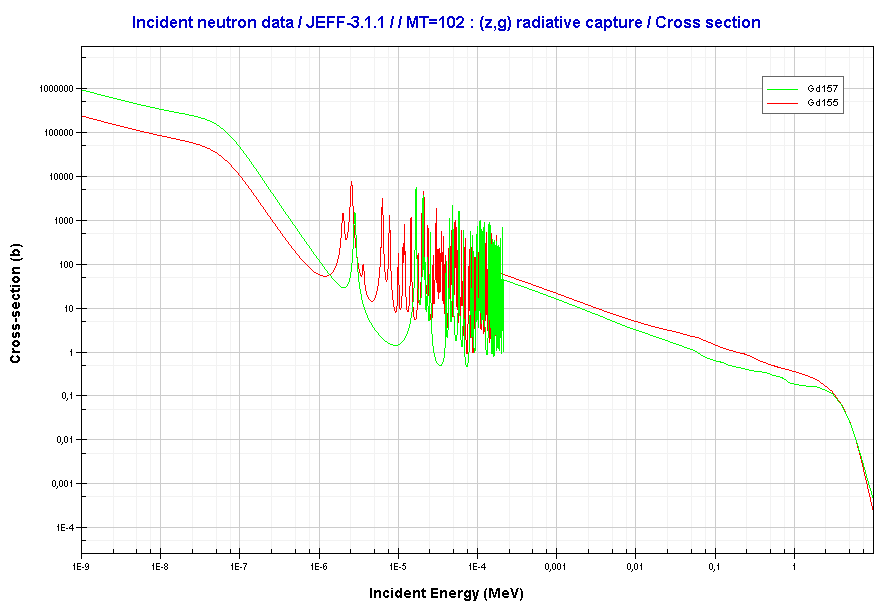
In nuclear industry gadolinium is commonly used as a neutron absorber due to very high neutron absorbtion cross-section of two isotopes 155Gd and 157Gd. In fact their absorption cross-sections are the highest among all stable isotopes. 155Gd has 61 000 barns for thermal neutrons (for 0.025 eV neutron) and 157Gd has even 254 000 barns. For this reason gadolinium is widely used as a burnable absorber, which is commonly used in fresh fuel to compensate an excess of reactivity of reactor core. In comparison with another burnable absorbers gadolinium behaves like a completely black material. Therefore gadolinium is very effective in compensation of the excess of reactivity, but on the other hand an improper distribution of Gd-burnable absorbers may lead to unevenness of neutron-flux density in the reactor core.

Gadolinium 155 and 157. Comparison of radiative capture cross-sections.
Source: JANIS (Java-based Nuclear Data Information Software); The JEFF-3.1.1 Nuclear Data Library
effect of gadolinium absorbers
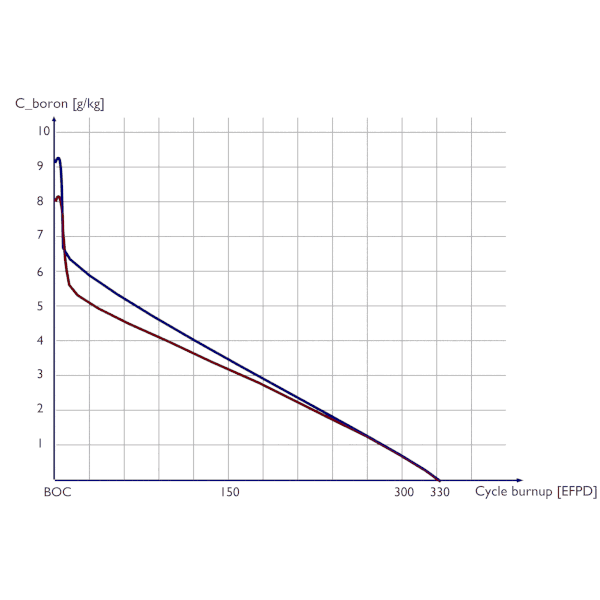
The effect of gadolinium burnable absorbers (BA) can be demonstrated on boron letdown curves. At the beginning of specific fuel cycle the critical concentration of boric acid in the reactor core without burnable absorbers (blue curve) significantly differs from the critical concentration of boric acid in the reactor core with burnable absorbers (red curve). The difference is dependent on the amount of BA used.

See also:

Glossary

We hope, this article, Gadolinium, helps you. If so, give us a like in the sidebar. Main purpose of this website is to help the public to learn some interesting and important information about materials and their properties.

What is Boron 10 Depletion – Definition

Since the isotope 10B has a significantly higher neutron cross-section, the 10B depletes in a reactor core much more faster than 11B. Boron 10 Depletion. Material Properties
Natural boron consists primarily of two stable isotopes, 11B (80.1%) and  10B (19.9%). In nuclear industry boron is commonly used as a neutron absorber due to the high neutron cross-section of isotope  10B. Its (n,alpha) reaction cross-section for thermal neutrons is about 3840 barns (for 0.025 eV neutron). Isotope  11B has absorption cross-section for thermal neutrons about 0.005 barns (for 0.025 eV neutron). Most of (n,alpha) reactions of thermal neutrons are 10B(n,alpha)7Li reactions accompanied by 0.48 MeV gamma emission.

(n,alpha) reactions of 10B

Since the isotope 10B has a significantly higher neutron cross-section, the 10B depletes much more faster than 11B. Without the addition of fresh boron (19,9% of 10B) into the primary coolant system the enrichment of 10B in boric acid continuously decreases. In the result the enrichment of 10B at the end of the fuel cycle can be for example below 18% of 10B. This phenomenon must be considered in all the criticality calculations (e.g. shutdown margin calculations, estimated critical conditions or general core depletion calculations).

Boron 10. Comparison of total cross-section and cross-section for (n,alpha) reactions.
Source: JANIS (Java-based Nuclear Data Information Software); The JEFF-3.1.1 Nuclear Data Library
Boron letdown curve (chemical shim) and boron 10 depletion
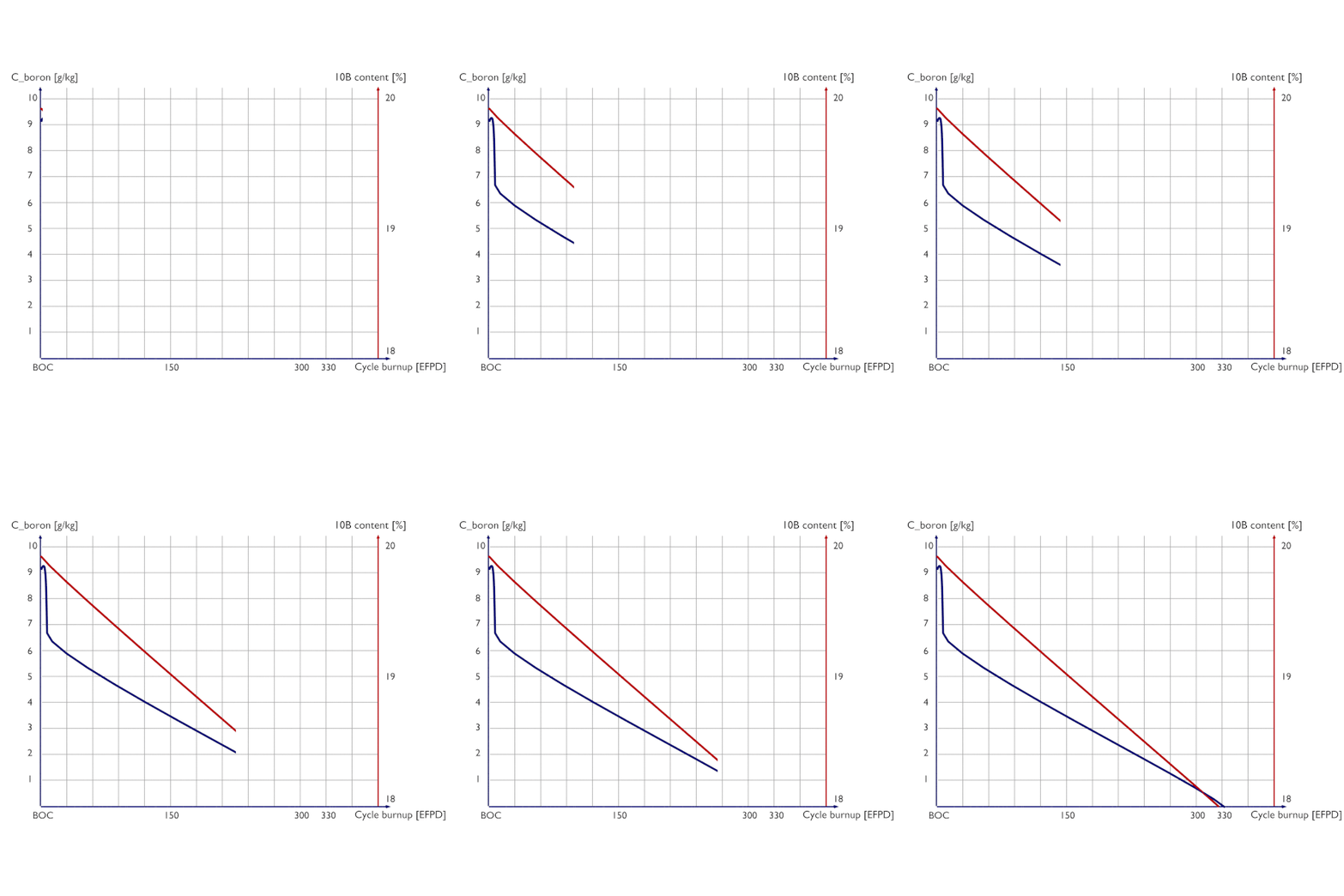
Boron letdown curve (chemical shim) and boron 10 depletion during a 12-month fuel cycle. At the beginning of specific fuel cycle concentration of boric acid is highest. At the end of this cycle concentration of boric acid is almost zero and a reactor must be refueled, because there is no positive reactivity that can be inserted to compensate negative reactivity of fuel burnup (increase in reactor slagging).

See also:

Boric Acid – Chemical Shim

See also:

Boron 10

See also:

H3BO3 Converter

We hope, this article, Boron 10 Depletion, helps you. If so, give us a like in the sidebar. Main purpose of this website is to help the public to learn some interesting and important information about materials and their properties.
What is Boric Acid – Chemical Shim – Definition

In PWRs, chemical shim (boric acid – H3BO3) is used to compensate an excess of reactivity of a reactor core. Chemical shim is boric acid dissolved in the coolant. Material Properties
By chemical shim, we mean that boric acid is dissolved in the coolant/moderator. Boric acid (molecular formula: H3BO3), is a white powder that is soluble in water. In pressurized water reactors, chemical shim (boric acid) is used to compensate an excess of reactivity of reactor core along the fuel burnup (long term reactivity control). At the beginning of specific fuel cycle concentration of boric acid is highest (see picture). At the end of this cycle concentration of boric acid is almost zero and a reactor must be refueled.

In certain cases also fine power changes can be controlled by chemical shim. If it is desired to increase power, then the boric acid concentration must be diluted, removing 10B from the reactor core and decreasing its poisoning effect. When compared with burnable absorbers (long term reactivity control) or with control rods (rapid reactivity control) the boric acid avoids the unevenness of neutron-flux density in the reactor core, because it is dissolved homogeneously in the coolant in entire reactor core. On the other hand high concentrations of boric acid may lead to positive moderator temperature coefficient and that is undesirable. In this case more burnable absorbers must be used.

Moreover this method is slow in controlling reactivity. Normally, it takes several minutes to change the concentration (dilute or borate) of the boric acid in the primary loop. For rapid changes of reactivity control rods must be used.

Boron 10. Comparison of total cross-section and cross-section for (n,alpha) reactions.
Source: JANIS (Java-based Nuclear Data Information Software); The JEFF-3.1.1 Nuclear Data Library
Boron letdown curve (chemical shim) and boron 10 depletion
Boron letdown curve (chemical shim) and boron 10 depletion during a 12-month fuel cycle. At the beginning of specific fuel cycle concentration of boric acid is highest. At the end of this cycle concentration of boric acid is almost zero and a reactor must be refueled, because there is no positive reactivity that can be inserted to compensate negative reactivity of fuel burnup (increase in reactor slagging).

See also:

Applications of Boron in Nuclear Power

See also:

Boron 10

See also:

Boron 10 Depletion

We hope, this article, Boric Acid – Chemical Shim, helps you. If so, give us a like in the sidebar. Main purpose of this website is to help the public to learn some interesting and important information about materials and their properties.
What is Application of Boron – Nuclear Power – Definition

Applications of Boron in Nuclear Power. Boron 10 is very good neutron absorber, therefore it has many applications in reactor control and generally in nuclear power. Material Properties
Isotope 10B has many applications. Its (n,alpha) reaction cross-section for thermal neutrons is about 3840 barns (for 0.025 eV neutron) and therefore it is very good neutron absorber. In nuclear power mostly natural boron is used, but it is not an exception the use of enriched boron (by the isotope 10B). Boron as the neutron absorber has following applications:
  • Chemical shim. By chemical shim, we mean that boric acid is dissolved in the coolant/moderator. Chemical shim is used to long term reactivity control.
  • Control rods. Many control rods use isotope 10B as a neutron absorbing material.
  • Safety systems. The one of three primary objectives of nuclear reactor safety systems is to shutdown the reactor and maintain it in a shutdown condition. Therefore all safety systems (which must ensure subcriticality of the reactor after the transient) use high concentrations of boric acid.
  • Burnable absorbers. Isotope 10B is widely used as the integral burnable absorber. When compared to gadolinium absorber (another commonly used burnable material), 10B has an order of magnitude smaller cross-sections. Therefore 10B compensate reactivity longer, but not so heavily.
  • Converter in neutron detectors. Neutrons are not directly ionizing and they have usually to be converted into charged particles before they can be detected. Most common isotope for the neutron converter material is 10B.

Most of (n,alpha) reactions of thermal neutrons are 10B(n,alpha)7Li reactions accompanied by 0.48 MeV gamma emission.

(n,alpha) reactions of 10B

Boron 10. Comparison of total cross-section and cross-section for (n,alpha) reactions.
Source: JANIS (Java-based Nuclear Data Information Software); The JEFF-3.1.1 Nuclear Data Library
Boron letdown curve (chemical shim) and boron 10 depletion
Boron letdown curve (chemical shim) and boron 10 depletion during a 12-month fuel cycle. At the beginning of specific fuel cycle concentration of boric acid is highest. At the end of this cycle concentration of boric acid is almost zero and a reactor must be refueled, because there is no positive reactivity that can be inserted to compensate negative reactivity of fuel burnup (increase in reactor slagging).

See also:

Boron 10

See also:

Boric Acid – Chemical Shim

We hope, this article, Application of Boron – Nuclear Power, helps you. If so, give us a like in the sidebar. Main purpose of this website is to help the public to learn some interesting and important information about materials and their properties.