Facebook Instagram Youtube Twitter

Myristic acid

Explore the characteristics, sources, uses, health implications, and future research of myristic acid, a key fatty acid.

Introduction to Myristic Acid

Myristic acid, a naturally occurring saturated fatty acid, plays a critical role in various biological and industrial processes. This compound, also known as tetradecanoic acid, is known by its chemical formula of C14H28O2.

Chemical Structure and Properties

Myristic acid is a 14-carbon chain fatty acid, which is represented in the standard structure of fatty acids. The hydrocarbon chain provides the fatty acid’s nonpolar properties, while the carboxyl group (-COOH) endows it with reactivity and polar behavior. The melting point is about 54.4 degrees Celsius, and the boiling point is 250.6 degrees Celsius at 760 mm Hg.

Sources of Myristic Acid

  • Myristic acid is commonly found in animal and vegetable fats and oils. Notably, nutmeg, palm kernel oil, coconut oil, and butter fat are rich sources of this fatty acid.

  • It can also be synthesized in laboratories through various methods such as fatty acid synthesis or the hydrolysis of triglycerides.

Biological Roles

In the context of biology, myristic acid serves multiple important roles. Notably, it is involved in a process known as myristoylation. This post-translational modification of proteins aids in membrane association and protein-protein interactions, which are crucial for cellular function and signaling.

Industrial Uses

  1. Myristic acid has several applications in the cosmetic industry, where it is used as an ingredient in soaps, shampoos, and cosmetic products because of its excellent surfactant and emulsifying properties.

  2. In the food industry, myristic acid is used as a flavoring agent and in the production of esters that are used as food additives.

  3. Myristic acid is also used in the pharmaceutical industry as a precursor in the synthesis of various drugs.

Health Implications

Despite its many uses, there are potential health implications associated with myristic acid. A diet high in myristic acid, like many saturated fats, has been linked with an increased risk of cardiovascular disease. This is due to its potential to raise low-density lipoprotein (LDL) cholesterol, often referred to as ‘bad cholesterol’, which can contribute to arterial plaque formation and heart disease.

Environmental Impact

The environmental impact of myristic acid is also noteworthy. As it is commonly derived from palm kernel oil, the demand for this compound is indirectly linked to the deforestation of tropical rainforests and the endangerment of several species. Hence, sustainable sourcing practices are of the utmost importance.

Future Research

  • Research continues into the use of myristic acid in drug delivery systems. Due to its lipophilic nature, it may increase the bioavailability of certain medications, making them more effective.

  • Studies are also ongoing to better understand the role of myristic acid in cellular signaling and how this can be leveraged for therapeutic interventions in various diseases.

Conclusion

In summary, myristic acid is a fascinating compound with a wide range of applications, from food to pharmaceuticals and cosmetics. It is essential to life, playing key roles in biological processes like protein modification. However, its impact on human health and the environment calls for cautious and responsible use. As research progresses, it is hoped that we can harness the benefits of myristic acid while minimizing its potential downsides. The future of this intriguing compound looks bright, with potential uses in improved drug delivery systems and new therapeutics on the horizon.

Diamond

Explore the formation, properties, and applications of diamonds, from their symbolic beauty to their industrial uses.

Diamond: A Precious and Versatile Gemstone

When it comes to iconic symbols of beauty and longevity, few materials hold a candle to diamond. As one of the Earth’s most precious resources, diamonds have been cherished for their physical allure and their enduring strength for centuries.

But what is a diamond? In essence, it is a solid form of carbon with its atoms arranged in a crystal structure known as diamond cubic. This unique structure gives it extraordinary hardness, making it the hardest known natural material. The word diamond derives from the ancient Greek word adámas, meaning ‘unbreakable’ or ‘invincible’, which perfectly encapsulates this gem’s robust nature.

Formation of Diamonds

Diamonds are born deep within the Earth, under conditions of high temperature and pressure, about 150 kilometers (93 miles) below the Earth’s surface. These conditions exist only in specific areas of the Earth’s mantle. In geological terms, the formation of diamonds began billions of years ago, making them windows into the deep history of our planet.

  • Process: The formation process involves carbon-bearing materials being exposed to high pressure, but at a comparatively low temperature, in the presence of molten rock in Earth’s mantle. Over a long period, ranging from 1 billion to 3.3 billion years (or 25% to 75% of the age of the Earth), these carbon-bearing materials are gradually converted into diamond.
  • Transport to the Surface: Diamonds reach the surface of the Earth via volcanic eruptions. The diamond-bearing rock is carried upwards by the magma during the eruption. These volcanic rocks solidify into a type known as kimberlite and lamproite, where diamonds are usually found.

Physical and Chemical Properties

One of the most distinct characteristics of a diamond is its hardness. On the Mohs scale, which measures the hardness of minerals, diamonds score a perfect 10. This hardness is due to the strong covalent bonding between its carbon atoms, which are arranged in a lattice structure. However, despite being the hardest known substance, diamonds are not indestructible. They can be chipped or shattered if struck with enough force.

Diamonds also exhibit high optical dispersion, causing them to disperse light of different colors, an effect commonly known as “fire”. Their high refractive index makes them extremely shiny, a property that makes them highly desirable in jewelry.

Diamonds are generally insulators, but some blue diamonds are natural semiconductors. Interestingly, some synthetic diamonds are also turned into semiconductors through a process of deliberate contamination with boron.

Industrial Applications

Beyond their famed use in jewelry, diamonds also have significant industrial applications due to their exceptional hardness and thermal conductivity. They are commonly used as cutting, grinding, and drilling tools. In fact, industrial usage accounts for approximately 80% of mined diamonds.

  • Abrasives: Diamonds are used in high-performance abrasives for cutting and grinding tools. They are also used in wire saws and large scale applications like gang saws for cutting blocks of stones.
  • Heat Sinks: Due to their excellent thermal conductivity, diamonds are used in electronic devices as heat sinks. A diamond heat sink can efficiently cool a device, preventing damage due to overheating.
  • High-pressure experiments: Diamonds are used in anvil cells due to their hardness and ability to withstand high pressure. Diamond anvil cells are used in experimental physics and materials science to create extreme pressure conditions.

Synthetic Diamonds

In recent years, technological advancements have led to the production of synthetic or man-made diamonds. These diamonds are produced by high-pressure, high-temperature (HPHT) processes or chemical vapor deposition (CVD) methods. The properties of synthetic diamonds can be engineered for specific applications, giving them a distinct edge over naturally occurring ones in certain industries. Synthetic diamonds are increasingly used in oil and gas drills, as well as in the tech industry for applications like quantum computing and high-power electronics.

Conclusion

In conclusion, diamonds are much more than just sparkling gemstones for ornamentation. Their physical and chemical properties, combined with their formation deep within the Earth, make them a subject of fascination for scientists and gem lovers alike. The industrial applications of diamonds showcase their versatility and reinforce their value not only as symbols of wealth and status but also as essential tools in various fields of human endeavor.

As technology continues to advance, the role of diamonds, both natural and synthetic, will continue to evolve. Whether it’s powering the next generation of electronic devices, serving as a window into the history of our planet, or simply adorning a loved one’s finger, diamonds truly are precious in every sense of the word.

Ethanol (alcohol)

Explore the versatile world of ethanol, its properties, production methods, uses across industries, health effects, and environmental impact.

Introduction to Ethanol

Ethanol, also known as ethyl alcohol or simply alcohol, is a colorless liquid chemical compound widely used in various applications across different sectors. Its chemical formula is C2H5OH.

Properties of Ethanol

Ethanol is a volatile, flammable substance with a strong and somewhat sweet smell. It is fully soluble in water and most organic solvents. In its pure form, it has a boiling point of 78.37 degrees Celsius and a melting point of -114.14 degrees Celsius.

Production and Uses of Ethanol

  • Fermentation: Ethanol is primarily produced via the fermentation process. Yeasts and certain types of bacteria convert sugars (such as glucose, fructose, and sucrose) into ethanol and carbon dioxide. This is the primary method for producing alcoholic beverages and biofuels.
  • Hydration of Ethylene: On an industrial scale, ethanol is also synthesized by hydrating ethylene in the presence of sulfuric acid or phosphoric acid.

Once produced, ethanol has various applications:

  1. Fuel: Ethanol is a common ingredient in gasoline and is used extensively as a biofuel. It helps to reduce the reliance on fossil fuels and decrease carbon emissions.
  2. Disinfectant: Due to its ability to kill bacteria and fungi, it’s used in many hand sanitizers and disinfecting products.
  3. Industrial Solvent: Ethanol serves as a versatile solvent in the manufacturing of a variety of products such as paints, plastics, and personal care products.
  4. Beverages: Ethanol is the active ingredient in alcoholic beverages, contributing to the taste, aroma, and intoxicating effects of these drinks.

Health Effects of Ethanol

Ethanol has a range of effects on human health. In small amounts, as in alcoholic beverages, it can have psychoactive effects, leading to relaxation and sociability. However, excessive consumption can lead to alcoholism, liver damage, and other health problems. When used as a hand sanitizer or disinfectant, it is safe and effective, but ingestion or misuse can be harmful or fatal.

Ethanol in Biofuel Production

Ethanol has gained significant attention in the energy sector as a renewable source of biofuel. This is primarily due to the fact that it is produced from biomass such as corn, sugarcane, and cellulose, which are renewable sources. Bioethanol, as it is often referred to in this context, is used as a fuel for vehicles in its pure form, but it is usually used as a gasoline additive to increase octane and improve vehicle emissions.

Impact on the Environment

While ethanol’s use as a biofuel can help reduce greenhouse gas emissions compared to traditional fossil fuels, its production process, particularly when derived from corn, has been associated with some environmental challenges. These include deforestation, loss of biodiversity, and increased water usage. Consequently, there is a continuous effort to make the production process more sustainable, with a focus on advanced or second-generation biofuels, which use non-food crops or waste materials as feedstock.

Ethanol Safety and Handling

Despite its many uses, ethanol is a flammable and volatile substance and should be handled with care. It should be stored in a cool, well-ventilated area away from heat sources or open flames. Prolonged skin exposure may also cause irritation and dryness.

Regulation of Ethanol

Due to its psychoactive properties when consumed, the production, sale, and use of ethanol in beverages are regulated in many countries. In the industrial sector, strict regulations also exist regarding the use and disposal of ethanol due to its potential environmental impact.

Conclusion

In conclusion, ethanol is an incredibly versatile chemical compound with a wide range of uses spanning various sectors. From its pivotal role in creating alcoholic beverages to serving as an effective disinfectant and being an integral component in biofuel production, its utility cannot be overstated. However, the environmental impact associated with its large-scale production and its potential health effects calls for responsible and sustainable practices in its use. As we continue to harness its potential, striking a balance between utilization and conservation will be critical.

Water

Explore the importance of water, its unique properties, role in the Earth’s systems, societal use, and the challenges in its management.

Introduction to Water: The Fundamental Solvent of Life

Water, chemically represented as H2O, is undoubtedly one of the most significant substances on Earth. As the most abundant compound on our planet’s surface, water plays an integral role in sustaining life and influencing climate patterns.

The Unique Properties of Water

Water possesses a set of unique properties that make it stand out among other substances. The key to these properties lies in its molecular structure, with two hydrogen atoms covalently bonded to one oxygen atom.

  • Universal Solvent: Water is often referred to as the “universal solvent” due to its exceptional ability to dissolve a variety of substances. This property is crucial in biological processes such as nutrient transport and waste removal.
  • High Heat Capacity: Water has a high heat capacity, meaning it can absorb or release large amounts of heat without experiencing significant changes in temperature. This characteristic helps regulate the Earth’s climate and supports life processes.
  • Cohesion and Adhesion: Water molecules have a strong tendency to stick together (cohesion), and they can also adhere to other substances (adhesion). These properties are critical for processes like capillary action, which allows water to travel upwards against gravity in plant stems.
  • Less Dense as a Solid: Unlike most substances, water becomes less dense when it freezes, allowing ice to float on liquid water. This property insulates bodies of water in cold weather, protecting aquatic life.

Water in Earth’s Hydrologic Cycle

Water is continually cycled through various states (liquid, solid, and gas) in the Earth’s hydrologic cycle. This cycle, also known as the water cycle, involves processes such as evaporation, condensation, precipitation, and runoff. The sun provides the energy that drives this cycle, causing water to evaporate from oceans, lakes, and rivers. As this water vapor rises and cools, it condenses to form clouds. Precipitation then returns water to the Earth’s surface, where it may infiltrate the ground or run off into bodies of water, ready to evaporate again.

The Role of Water in Human Society

From a societal perspective, water is an indispensable resource. It is essential for agriculture, industry, and personal hygiene, among many other uses. However, while water covers about 70% of the Earth’s surface, not all of it is readily available or suitable for these purposes. Freshwater, which is safe for consumption and agricultural use, makes up a mere 2.5% of the total water volume on Earth, highlighting the importance of water conservation and management.

Challenges in Water Management

Despite its abundance, access to clean and safe water remains a significant challenge for many communities around the world. Pollution, over-extraction, and climate change are key factors contributing to water scarcity. As populations grow and demand for water increases, sustainable water management practices become ever more crucial.

  • Pollution: Industrial waste, agricultural runoff, and untreated sewage can contaminate water sources, making them unsafe for human consumption and ecosystem health. Innovative technologies and strict regulations are required to mitigate water pollution.
  • Over-extraction: Excessive withdrawal of water for agriculture, industry, and domestic use can deplete water sources, particularly groundwater reserves. It is crucial to manage and balance usage to ensure long-term sustainability.
  • Climate Change: Climate change can alter precipitation patterns and increase the frequency of extreme weather events such as droughts and floods. These changes can exacerbate water scarcity in already vulnerable regions.

The Future of Water

The future of water depends largely on human actions. Innovative solutions such as desalination, water recycling, and efficient irrigation methods can help increase the availability of freshwater. At the same time, water conservation at the individual level can significantly reduce water demand. Policies and strategies aimed at protecting and restoring natural water systems, combined with public education about the importance of water stewardship, are also vital for ensuring a sustainable water future.

Conclusion

Water, the lifeblood of our planet, is a fundamental resource underpinning society and biodiversity alike. Its unique properties and pivotal role in Earth’s systems underscore its irreplaceable value. Yet, the challenges of pollution, over-extraction, and climate change underline the need for urgent action to safeguard this precious resource. By adopting sustainable practices and innovative solutions, we can ensure the availability of clean and safe water for all, securing a healthier, more sustainable future for our planet.

Austenitic Stainless Steel – Density – Strength – Hardness – Melting Point

About Austenitic Stainless Steel – Type 304

Type 304 stainless steel (containing 18%-20% chromium and 8%-10.5% nickel) is the most common stainless steel. It is also known as “18/8” stainless steel because of its composition, which includes 18% chromium and 8% nickel. This alloy resists most types of corrosion. It is an austenitic stainless steel and it has also excellent cryogenic properties, and good high-temperature strength as well as good forming and welding properties. It is less electrically and thermally conductive than carbon steel and is essentially non-magnetic.

Type 304L stainless steel, which is widely used in nuclear industry, is an extra-low carbon version of the 304 steel alloy. This grade has slightly lower mechanical properties than the standard 304 grade, but is still widely used thanks to its versatility. The lower carbon content in 304L minimizes deleterious or harmful carbide precipitation as a result of welding. 304L can, therefore, be used “as welded” in severe corrosion environments, and it eliminates the need for annealing. Grade 304 has also good oxidation resistance in intermittent service to 870 °C, and in continuous service to 925 °C.

The body of the reactor vessel is constructed of a high-quality low-alloy carbon steel, and all surfaces that come into contact with reactor coolant are clad with a minimum of about 3 to 10 mm of austenitic stainless steel in order to minimize corrosion. Since grade 304L does not require post-weld annealing, it is extensively used in heavy gauge components.

austenitic steel properties density strength price

Summary

Name Austenitic Stainless Steel
Phase at STP solid
Density 7850 kg/m3
Ultimate Tensile Strength 515 MPa
Yield Strength 205 MPa
Young’s Modulus of Elasticity 193 GPa
Brinell Hardness 201 BHN
Melting Point 1450 °C
Thermal Conductivity 20 W/mK
Heat Capacity 500 J/g K
Price 2 $/kg

Density of Austenitic Stainless Steel

Typical densities of various substances are at atmospheric pressure. Density is defined as the mass per unit volume. It is an intensive property, which is mathematically defined as mass divided by volume:  ρ = m/V

In words, the density (ρ) of a substance is the total mass (m) of that substance divided by the total volume (V) occupied by that substance. The standard SI unit is kilograms per cubic meter (kg/m3). The Standard English unit is pounds mass per cubic foot (lbm/ft3).

Density of Austenitic Stainless Steel is 7850 kg/m3.


Example: Density

Calculate the height of a cube made of Austenitic Stainless Steel, which weighs one metric ton.

Solution:

Density is defined as the mass per unit volume. It is mathematically defined as mass divided by volume: ρ = m/V

As the volume of a cube is the third power of its sides (V = a3), the height of this cube can be calculated:

density of material - equation

The height of this cube is then a = 0.503 m.

Density of Materials

Material Table - Density of Materials


Mechanical Properties of Austenitic Stainless Steel

Strength of Austenitic Stainless Steel

In mechanics of materials, the strength of a material is its ability to withstand an applied load without failure or plastic deformation. Strength of materials basically considers the relationship between the external loads applied to a material and the resulting deformation or change in material dimensions. In designing structures and machines, it is important to consider these factors, in order that the material selected will have adequate strength to resist applied loads or forces and retain its original shape.

Strength of a material is its ability to withstand this applied load without failure or plastic deformation. For tensile stress, the capacity of a material or structure to withstand loads tending to elongate is known as ultimate tensile strength (UTS). Yield strength or yield stress is the material property defined as the stress at which a material begins to deform plastically whereas yield point is the point where nonlinear (elastic + plastic) deformation begins. In case of tensional stress of a uniform bar (stress-strain curve), the Hooke’s law describes behaviour of a bar in the elastic region. The Young’s modulus of elasticity is the elastic modulus for tensile and compressive stress in the linear elasticity regime of a uniaxial deformation and is usually assessed by tensile tests.

See also: Strength of Materials

Ultimate Tensile Strength of Austenitic Stainless Steel

Ultimate tensile strength of Austenitic Stainless Steel is 280 MPa.

Yield Strength of Austenitic Stainless Steel

Yield strength of Austenitic Stainless Steel is 145 MPa.

Modulus of Elasticity of Austenitic Stainless Steel

The Young’s modulus of elasticity of Austenitic Stainless Steel is 45 GPa.

Hardness of Austenitic Stainless Steel

In materials science, hardness is the ability to withstand surface indentation (localized plastic deformation) and scratching. Brinell hardness test is one of indentation hardness tests, that has been developed for hardness testing. In Brinell tests, a hard, spherical indenter is forced under a specific load into the surface of the metal to be tested.

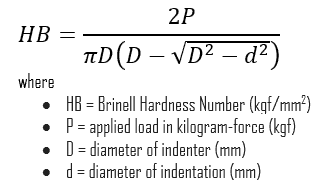
The Brinell hardness number (HB) is the load divided by the surface area of the indentation. The diameter of the impression is measured with a microscope with a superimposed scale. The Brinell hardness number is computed from the equation:

brinell hardness number - definition

Brinell hardness of Austenitic Stainless Steel is approximately 70 BHN(converted).

See also: Hardness of Materials


Example: Strength

Assume a plastic rod, which is made of Austenitic Stainless Steel. This plastic rod has a cross-sectional area of 1 cm2. Calculate the tensile force needed to achieve the ultimate tensile strength for this material, which is: UTS = 280 MPa.

Solution:

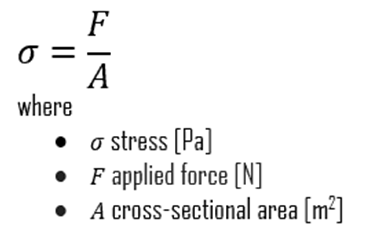
Stress (σ) can be equated to the load per unit area or the force (F) applied per cross-sectional area (A) perpendicular to the force as:

strength of material - equation

therefore, the tensile force needed to achieve the ultimate tensile strength is:

F = UTS x A = 280 x 106 x 0.0001 = 28 000 N

Strength of Materials

Material Table - Strength of Materials

Elasticity of Materials

Material Table - Elasticity of Materials

Hardness of Materials

Material Table - Hardness of Materials  

Thermal Properties of Austenitic Stainless Steel

Austenitic Stainless Steel – Melting Point

Melting point of Austenitic Stainless Steel is 550-640 °C.

Note that, these points are associated with the standard atmospheric pressure. In general, melting is a phase change of a substance from the solid to the liquid phase. The melting point of a substance is the temperature at which this phase change occurs. The melting point also defines a condition in which the solid and liquid can exist in equilibrium. For various chemical compounds and alloys, it is difficult to define the melting point, since they are usually a mixture of various chemical elements.

Austenitic Stainless Steel – Thermal Conductivity

Thermal conductivity of Austenitic Stainless Steel is 116 W/(m·K).

The heat transfer characteristics of a solid material are measured by a property called the thermal conductivity, k (or λ), measured in W/m.K. It is a measure of a substance’s ability to transfer heat through a material by conduction. Note that Fourier’s law applies for all matter, regardless of its state (solid, liquid, or gas), therefore, it is also defined for liquids and gases.

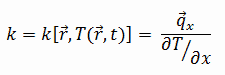
The thermal conductivity of most liquids and solids varies with temperature. For vapors, it also depends upon pressure. In general:

thermal conductivity - definition

Most materials are very nearly homogeneous, therefore we can usually write k = k (T). Similar definitions are associated with thermal conductivities in the y- and z-directions (ky, kz), but for an isotropic material the thermal conductivity is independent of the direction of transfer, kx = ky = kz = k.

Austenitic Stainless Steel – Specific Heat

Specific heat of Austenitic Stainless Steel is 900 J/g K.

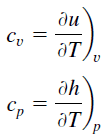
Specific heat, or specific heat capacity, is a property related to internal energy that is very important in thermodynamics. The intensive properties cv and cp are defined for pure, simple compressible substances as partial derivatives of the internal energy u(T, v) and enthalpy h(T, p), respectively:

where the subscripts v and p denote the variables held fixed during differentiation. The properties cv and cp are referred to as specific heats (or heat capacities) because under certain special conditions they relate the temperature change of a system to the amount of energy added by heat transfer. Their SI units are J/kg K or J/mol K.

Melting Point of Materials

Material Table - Melting Point

Thermal Conductivity of Materials

Material Table - Thermal Conductivity

Heat Capacity of Materials

Material Table - Heat Capacity


Aluminium Bronze – Density – Strength – Hardness – Melting Point

About Aluminium Bronze

The aluminum bronzes are a family of copper-based alloys offering a combination of mechanical and chemical properties unmatched by any other alloy series. They contain about 5 to 12% of aluminium. In addition, aluminium bronzes also contain nickel, silicon, manganese, and iron. They have excellent strength, similar to that of low alloy steels, and excellent corrosion resistance especially in seawater and similar environments, where the alloys often outperform many stainless steels. Their excellent resistance to corrosion results from the aluminium in the alloys, which reacts with atmospheric oxygen to form a thin, tough surface layer of alumina (aluminium oxide) which acts as a barrier to corrosion of the copper-rich alloy. They are found in wrought and cast form. Aluminium bronzes are usually golden in color.

aluminium bronze properties density strength price

Summary

Name Aluminium Bronze
Phase at STP solid
Density 7640 kg/m3
Ultimate Tensile Strength 550 MPa
Yield Strength 250 MPa
Young’s Modulus of Elasticity 110 GPa
Brinell Hardness 170 BHN
Melting Point 1030 °C
Thermal Conductivity 59 W/mK
Heat Capacity 380 J/g K
Price 9 $/kg

Density of Aluminium Bronze

Typical densities of various substances are at atmospheric pressure. Density is defined as the mass per unit volume. It is an intensive property, which is mathematically defined as mass divided by volume:  ρ = m/V

In words, the density (ρ) of a substance is the total mass (m) of that substance divided by the total volume (V) occupied by that substance. The standard SI unit is kilograms per cubic meter (kg/m3). The Standard English unit is pounds mass per cubic foot (lbm/ft3).

Density of Aluminium Bronze is 7640 kg/m3.


Example: Density

Calculate the height of a cube made of Aluminium Bronze, which weighs one metric ton.

Solution:

Density is defined as the mass per unit volume. It is mathematically defined as mass divided by volume: ρ = m/V

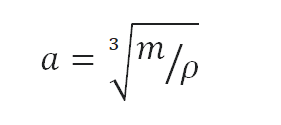
As the volume of a cube is the third power of its sides (V = a3), the height of this cube can be calculated:
density of material - equation

The height of this cube is then a = 0.508 m.

Density of Materials

Material Table - Density of Materials


Mechanical Properties of Aluminium Bronze

Materials are frequently chosen for various applications because they have desirable combinations of mechanical characteristics. For structural applications, material properties are crucial and engineers must take them into account.

Strength of Aluminium Bronze

In mechanics of materials, the strength of a material is its ability to withstand an applied load without failure or plastic deformation. Strength of materials basically considers the relationship between the external loads applied to a material and the resulting deformation or change in material dimensions. Strength of a material is its ability to withstand this applied load without failure or plastic deformation.

Ultimate Tensile Strength

Ultimate tensile strength of aluminium bronze – UNS C95400 is about 550 MPa.
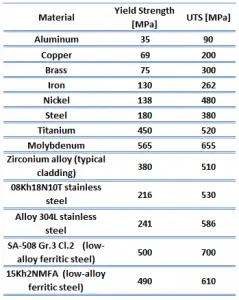
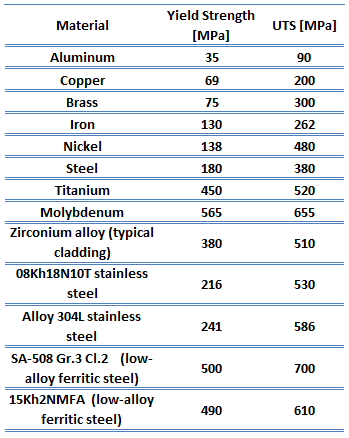
Yield Strength - Ultimate Tensile Strength - Table of MaterialsThe ultimate tensile strength is the maximum on the engineering stress-strain curve. This corresponds to the maximum stress that can be sustained by a structure in tension. Ultimate tensile strength is often shortened to “tensile strength” or even to “the ultimate.”  If this stress is applied and maintained, fracture will result. Often, this value is significantly more than the yield stress (as much as 50 to 60 percent more than the yield for some types of metals). When a ductile material reaches its ultimate strength, it experiences necking where the cross-sectional area reduces locally. The stress-strain curve contains no higher stress than the ultimate strength. Even though deformations can continue to increase, the stress usually decreases after the ultimate strength has been achieved. It is an intensive property; therefore its value does not depend on the size of the test specimen. However, it is dependent on other factors, such as the preparation of the specimen, the presence or otherwise of surface defects, and the temperature of the test environment and material. Ultimate tensile strengths vary from 50 MPa for an aluminum to as high as 3000 MPa for very high-strength steels.

Yield Strength

Yield strength of aluminium bronze – UNS C95400 is about 250 MPa.

The yield point is the point on a stress-strain curve that indicates the limit of elastic behavior and the beginning plastic behavior. Yield strength or yield stress is the material property defined as the stress at which a material begins to deform plastically whereas yield point is the point where nonlinear (elastic + plastic) deformation begins. Prior to the yield point, the material will deform elastically and will return to its original shape when the applied stress is removed. Once the yield point is passed, some fraction of the deformation will be permanent and non-reversible. Some steels and other materials exhibit a behaviour termed a yield point phenomenon. Yield strengths vary from 35 MPa for a low-strength aluminum to greater than 1400 MPa for very high-strength steels.

Young’s Modulus of Elasticity

Young’s modulus of elasticity of aluminium bronze – UNS C95400 is about 110 GPa.

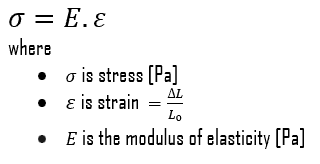
The Young’s modulus of elasticity is the elastic modulus for tensile and compressive stress in the linear elasticity regime of a uniaxial deformation and is usually assessed by tensile tests. Up to a limiting stress, a body will be able to recover its dimensions on removal of the load. The applied stresses cause the atoms in a crystal to move from their equilibrium position. All the atoms are displaced the same amount and still maintain their relative geometry. When the stresses are removed, all the atoms return to their original positions and no permanent deformation occurs. According to the Hooke’s law, the stress is proportional to the strain (in the elastic region), and the slope is Young’s modulus. Young’s modulus is equal to the longitudinal stress divided by the strain.
Hardness of Aluminium Bronze

Brinell hardness of aluminium bronze – UNS C95400 is approximately 170 MPa. The hardness of aluminum bronzes increases with aluminum (and other alloy) content as well as with stresses caused through cold working.
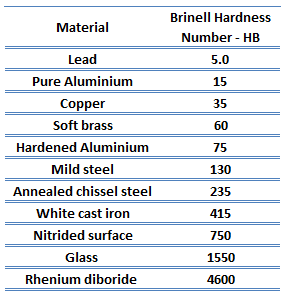
Brinell hardness number

Rockwell hardness test is one of the most common indentation hardness tests, that has been developed for hardness testing. In contrast to Brinell test, the Rockwell tester measures the depth of penetration of an indenter under a large load (major load) compared to the penetration made by a preload (minor load). The minor load establishes the zero position. The major load is applied, then removed while still maintaining the minor load. The difference between depth of penetration before and after application of the major load is used to calculate the Rockwell hardness number. That is, the penetration depth and hardness are inversely proportional. The chief advantage of Rockwell hardness is its ability to display hardness values directly. The result is a dimensionless number noted as HRA, HRB, HRC, etc., where the last letter is the respective Rockwell scale.

The Rockwell C test is performed with a Brale penetrator (120°diamond cone) and a major load of 150kg.


Example: Strength

Assume a plastic rod, which is made of Aluminium Bronze. This plastic rod has a cross-sectional area of 1 cm2. Calculate the tensile force needed to achieve the ultimate tensile strength for this material, which is: UTS = 550 MPa.

Solution:

Stress (σ) can be equated to the load per unit area or the force (F) applied per cross-sectional area (A) perpendicular to the force as:

strength of material - equation

therefore, the tensile force needed to achieve the ultimate tensile strength is:

F = UTS x A = 550 x 106 x 0.0001 = 55 000 N

Strength of Materials

Material Table - Strength of Materials

Elasticity of Materials

Material Table - Elasticity of Materials

Hardness of Materials

Material Table - Hardness of Materials  

Thermal Properties of Aluminium Bronze

Thermal properties of materials refer to the response of materials to changes in their thermodynamics/thermodynamic-properties/what-is-temperature-physics/”>temperature and to the application of heat. As a solid absorbs thermodynamics/what-is-energy-physics/”>energy in the form of heat, its temperature rises and its dimensions increase. But different materials react to the application of heat differently.

Heat capacity, thermal expansion, and thermal conductivity are properties that are often critical in the practical use of solids.

Melting Point of Aluminium Bronze

Melting point of aluminium bronze – UNS C95400 is around 1030°C.

In general, melting is a phase change of a substance from the solid to the liquid phase. The melting point of a substance is the temperature at which this phase change occurs. The melting point also defines a condition in which the solid and liquid can exist in equilibrium.

Thermal Conductivity of Aluminium Bronze

The thermal conductivity of aluminium bronze – UNS C95400 is 59 W/(m.K).

The heat transfer characteristics of a solid material are measured by a property called the thermal conductivity, k (or λ), measured in W/m.K. It is a measure of a substance’s ability to transfer heat through a material by conduction. Note that Fourier’s law applies for all matter, regardless of its state (solid, liquid, or gas), therefore, it is also defined for liquids and gases.

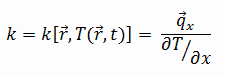
The thermal conductivity of most liquids and solids varies with temperature. For vapors, it also depends upon pressure. In general:
thermal conductivity - definition

Most materials are very nearly homogeneous, therefore we can usually write k = k (T). Similar definitions are associated with thermal conductivities in the y- and z-directions (ky, kz), but for an isotropic material the thermal conductivity is independent of the direction of transfer, kx = ky = kz = k.


Example: Heat transfer calculation

Aluminium Bronze - Thermal ConductivityThermal conductivity is defined as the amount of heat (in watts) transferred through a square area of material of given thickness (in metres) due to a difference in temperature. The lower the thermal conductivity of the material the greater the material’s ability to resist heat transfer.

Calculate the rate of heat flux through a wall 3 m x 10 m in area (A = 30 m2). The wall is 15 cm thick (L1) and it is made of Aluminium Bronze with the thermal conductivity of k1 = 59 W/m.K (poor thermal insulator). Assume that, the indoor and the outdoor temperatures are 22°C and -8°C, and the convection heat transfer coefficients on the inner and the outer sides are h1 = 10 W/m2K and h2 = 30 W/m2K, respectively. Note that, these convection coefficients strongly depend especially on ambient and interior conditions (wind, humidity, etc.).

Calculate the heat flux (heat loss) through this wall.

Solution:

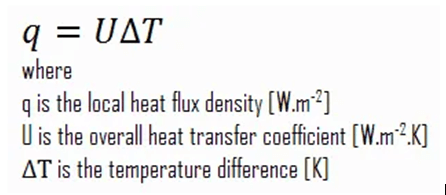
As was written, many of the heat transfer processes involve composite systems and even involve a combination of both conduction and convection. With these composite systems, it is often convenient to work with an overall heat transfer coefficient, known as a U-factor. The U-factor is defined by an expression analogous to Newton’s law of cooling:
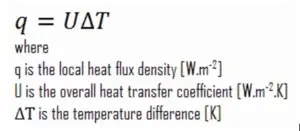
Heat transfer calculation - Newton’s law of cooling

The overall heat transfer coefficient is related to the total thermal resistance and depends on the geometry of the problem.

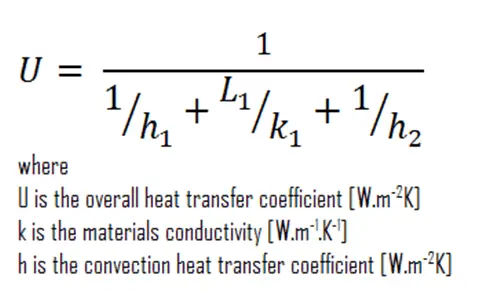
Assuming one-dimensional heat transfer through the plane wall and disregarding radiation, the overall heat transfer coefficient can be calculated as:
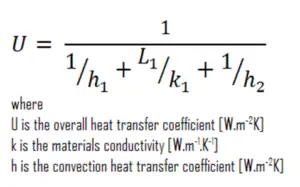
Heat transfer calculation - U-factor


The overall heat transfer coefficient is then: U = 1 / (1/10 + 0.15/59 + 1/30) = 7.36 W/m2K

The heat flux can be then calculated simply as: q = 7.36 [W/m2K] x 30 [K] = 220.79 W/m2

The total heat loss through this wall will be: qloss = q . A = 220.79 [W/m2] x 30 [m2] = 6623.701 W

Melting Point of Materials

Material Table - Melting Point

Thermal Conductivity of Materials

Material Table - Thermal Conductivity

Heat Capacity of Materials

Material Table - Heat Capacity

Tungsten – Density – Strength – Hardness – Melting Point

About Pure Tungsten

Tungsten is a rare metal found naturally on Earth almost exclusively in chemical compounds. Tungsten is an intrinsically brittle and hard material, making it difficult to work.

pure tungsten properties density strength price

Summary

Name Pure Tungsten
Phase at STP solid
Density 19250 kg/m3
Ultimate Tensile Strength 980 MPa
Yield Strength 750 MPa
Young’s Modulus of Elasticity 750 GPa
Brinell Hardness 3695 BHN
Melting Point 1687 °C
Thermal Conductivity 170 W/mK
Heat Capacity 130 J/g K
Price 110 $/kg

Density of Pure Tungsten

Typical densities of various substances are at atmospheric pressure. Density is defined as the mass per unit volume. It is an intensive property, which is mathematically defined as mass divided by volume:  ρ = m/V

In words, the density (ρ) of a substance is the total mass (m) of that substance divided by the total volume (V) occupied by that substance. The standard SI unit is kilograms per cubic meter (kg/m3). The Standard English unit is pounds mass per cubic foot (lbm/ft3).

Density of Pure Tungsten is 19250 kg/m3.


Example: Density

Calculate the height of a cube made of Pure Tungsten, which weighs one metric ton.

Solution:

Density is defined as the mass per unit volume. It is mathematically defined as mass divided by volume: ρ = m/V

As the volume of a cube is the third power of its sides (V = a3), the height of this cube can be calculated:

density of material - equation

The height of this cube is then a = 0.373 m.

Density of Materials

Material Table - Density of Materials


Mechanical Properties of Pure Tungsten

Strength of Pure Tungsten

In mechanics of materials, the strength of a material is its ability to withstand an applied load without failure or plastic deformation. Strength of materials basically considers the relationship between the external loads applied to a material and the resulting deformation or change in material dimensions. In designing structures and machines, it is important to consider these factors, in order that the material selected will have adequate strength to resist applied loads or forces and retain its original shape.

Strength of a material is its ability to withstand this applied load without failure or plastic deformation. For tensile stress, the capacity of a material or structure to withstand loads tending to elongate is known as ultimate tensile strength (UTS). Yield strength or yield stress is the material property defined as the stress at which a material begins to deform plastically whereas yield point is the point where nonlinear (elastic + plastic) deformation begins. In case of tensional stress of a uniform bar (stress-strain curve), the Hooke’s law describes behaviour of a bar in the elastic region. The Young’s modulus of elasticity is the elastic modulus for tensile and compressive stress in the linear elasticity regime of a uniaxial deformation and is usually assessed by tensile tests.

See also: Strength of Materials

Ultimate Tensile Strength of Pure Tungsten

Ultimate tensile strength of Pure Tungsten is 980 MPa.

Yield Strength of Pure Tungsten

Yield strength of Pure Tungsten is 750 MPa.

Modulus of Elasticity of Pure Tungsten

The Young’s modulus of elasticity of Pure Tungsten is 750 GPa.

Hardness of Pure Tungsten

In materials science, hardness is the ability to withstand surface indentation (localized plastic deformation) and scratching. Brinell hardness test is one of indentation hardness tests, that has been developed for hardness testing. In Brinell tests, a hard, spherical indenter is forced under a specific load into the surface of the metal to be tested.

The Brinell hardness number (HB) is the load divided by the surface area of the indentation. The diameter of the impression is measured with a microscope with a superimposed scale. The Brinell hardness number is computed from the equation:

brinell hardness number - definition

Brinell hardness of Pure Tungsten is approximately 2570 BHN (converted).

See also: Hardness of Materials


Example: Strength

Assume a plastic rod, which is made of Pure Tungsten. This plastic rod has a cross-sectional area of 1 cm2. Calculate the tensile force needed to achieve the ultimate tensile strength for this material, which is: UTS = 980 MPa.

Solution:

Stress (σ) can be equated to the load per unit area or the force (F) applied per cross-sectional area (A) perpendicular to the force as:

strength of material - equation

therefore, the tensile force needed to achieve the ultimate tensile strength is:

F = UTS x A = 980 x 106 x 0.0001 = 98 000 N

Strength of Materials

Material Table - Strength of Materials

Elasticity of Materials

Material Table - Elasticity of Materials

Hardness of Materials

Material Table - Hardness of Materials  

Thermal Properties of Pure Tungsten

Pure Tungsten – Melting Point

Melting point of Pure Tungsten is 3695 °C.

Note that, these points are associated with the standard atmospheric pressure. In general, melting is a phase change of a substance from the solid to the liquid phase. The melting point of a substance is the temperature at which this phase change occurs. The melting point also defines a condition in which the solid and liquid can exist in equilibrium. For various chemical compounds and alloys, it is difficult to define the melting point, since they are usually a mixture of various chemical elements.

Pure Tungsten – Thermal Conductivity

Thermal conductivity of Pure Tungsten is 170 W/(m·K).

The heat transfer characteristics of a solid material are measured by a property called the thermal conductivity, k (or λ), measured in W/m.K. It is a measure of a substance’s ability to transfer heat through a material by conduction. Note that Fourier’s law applies for all matter, regardless of its state (solid, liquid, or gas), therefore, it is also defined for liquids and gases.

The thermal conductivity of most liquids and solids varies with temperature. For vapors, it also depends upon pressure. In general:

thermal conductivity - definition

Most materials are very nearly homogeneous, therefore we can usually write k = k (T). Similar definitions are associated with thermal conductivities in the y- and z-directions (ky, kz), but for an isotropic material the thermal conductivity is independent of the direction of transfer, kx = ky = kz = k.

Pure Tungsten – Specific Heat

Specific heat of Pure Tungsten is 130 J/g K.

Specific heat, or specific heat capacity, is a property related to internal energy that is very important in thermodynamics. The intensive properties cv and cp are defined for pure, simple compressible substances as partial derivatives of the internal energy u(T, v) and enthalpy h(T, p), respectively:

where the subscripts v and p denote the variables held fixed during differentiation. The properties cv and cp are referred to as specific heats (or heat capacities) because under certain special conditions they relate the temperature change of a system to the amount of energy added by heat transfer. Their SI units are J/kg K or J/mol K.


Example: Heat transfer calculation

Pure Tungsten - Thermal ConductivityThermal conductivity is defined as the amount of heat (in watts) transferred through a square area of material of given thickness (in metres) due to a difference in temperature. The lower the thermal conductivity of the material the greater the material’s ability to resist heat transfer.

Calculate the rate of heat flux through a wall 3 m x 10 m in area (A = 30 m2). The wall is 15 cm thick (L1) and it is made of Pure Tungsten with the thermal conductivity of k1 = 170 W/m.K (poor thermal insulator). Assume that, the indoor and the outdoor temperatures are 22°C and -8°C, and the convection heat transfer coefficients on the inner and the outer sides are h1 = 10 W/m2K and h2 = 30 W/m2K, respectively. Note that, these convection coefficients strongly depend especially on ambient and interior conditions (wind, humidity, etc.).

Calculate the heat flux (heat loss) through this wall.

Solution:

As was written, many of the heat transfer processes involve composite systems and even involve a combination of both conduction and convection. With these composite systems, it is often convenient to work with an overall heat transfer coefficient, known as a U-factor. The U-factor is defined by an expression analogous to Newton’s law of cooling:

Heat transfer calculation - Newton’s law of cooling

The overall heat transfer coefficient is related to the total thermal resistance and depends on the geometry of the problem.

Assuming one-dimensional heat transfer through the plane wall and disregarding radiation, the overall heat transfer coefficient can be calculated as:

Heat transfer calculation - U-factor


The overall heat transfer coefficient is then: U = 1 / (1/10 + 0.15/170 + 1/30) = 7.45 W/m2K

The heat flux can be then calculated simply as: q = 7.45 [W/m2K] x 30 [K] = 223.52 W/m2

The total heat loss through this wall will be: qloss = q . A = 223.52 [W/m2] x 30 [m2] = 6705.63 W

Melting Point of Materials

Material Table - Melting Point

Thermal Conductivity of Materials

Material Table - Thermal Conductivity

Heat Capacity of Materials
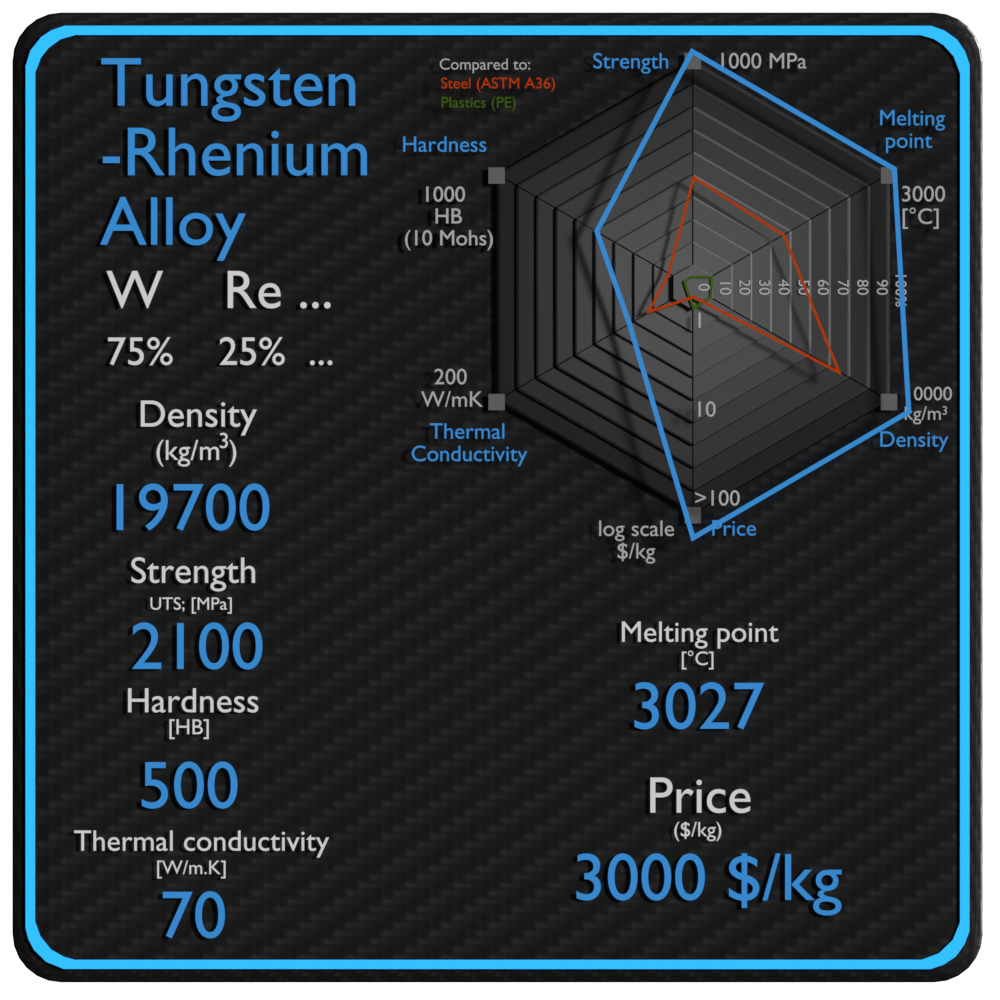
Material Table - Heat Capacity

Tungsten-Rhenium Alloy – Density – Strength – Hardness – Melting Point

About Tungsten-Rhenium Alloy

Tungsten and rhenium are both refractory metals. These metals are well known for their extraordinary resistance to heat and wear. Key requirement to withstand high temperatures is a high melting point and stable mechanical properties (e.g. high hardness) even at high temperatures. These metals are usually combined together to obtain desired fabricability, thermal and mechanical properties. Powder-metallurgy methods can be used in consolidating tungsten-rhenium alloys. Up to 22% rhenium is alloyed with tungsten to improve its high temperature strength and corrosion resistance. The hardness of as-cast W – 30Re alloy is around 500 BHN. This hardness strongly depends on rhenium content.

tungsten rhenium alloy properties density strength price

Summary

Name Tungsten-Rhenium Alloy
Phase at STP solid
Density 19700 kg/m3
Ultimate Tensile Strength 2100 MPa
Yield Strength N/A
Young’s Modulus of Elasticity 400 GPa
Brinell Hardness 500 BHN
Melting Point 3027 °C
Thermal Conductivity 70 W/mK
Heat Capacity 140 J/g K
Price 3000 $/kg

Density of Tungsten-Rhenium Alloy

Typical densities of various substances are at atmospheric pressure. Density is defined as the mass per unit volume. It is an intensive property, which is mathematically defined as mass divided by volume:  ρ = m/V

In words, the density (ρ) of a substance is the total mass (m) of that substance divided by the total volume (V) occupied by that substance. The standard SI unit is kilograms per cubic meter (kg/m3). The Standard English unit is pounds mass per cubic foot (lbm/ft3).

Density of Tungsten-Rhenium Alloy is 19700 kg/m3.


Example: Density

Calculate the height of a cube made of Tungsten-Rhenium Alloy, which weighs one metric ton.

Solution:

Density is defined as the mass per unit volume. It is mathematically defined as mass divided by volume: ρ = m/V

As the volume of a cube is the third power of its sides (V = a3), the height of this cube can be calculated:

density of material - equation

The height of this cube is then a = 0.37 m.

Density of Materials

Material Table - Density of Materials


Mechanical Properties of Tungsten-Rhenium Alloy

Strength of Tungsten-Rhenium Alloy

In mechanics of materials, the strength of a material is its ability to withstand an applied load without failure or plastic deformation. Strength of materials basically considers the relationship between the external loads applied to a material and the resulting deformation or change in material dimensions. In designing structures and machines, it is important to consider these factors, in order that the material selected will have adequate strength to resist applied loads or forces and retain its original shape.

Strength of a material is its ability to withstand this applied load without failure or plastic deformation. For tensile stress, the capacity of a material or structure to withstand loads tending to elongate is known as ultimate tensile strength (UTS). Yield strength or yield stress is the material property defined as the stress at which a material begins to deform plastically whereas yield point is the point where nonlinear (elastic + plastic) deformation begins. In case of tensional stress of a uniform bar (stress-strain curve), the Hooke’s law describes behaviour of a bar in the elastic region. The Young’s modulus of elasticity is the elastic modulus for tensile and compressive stress in the linear elasticity regime of a uniaxial deformation and is usually assessed by tensile tests.

See also: Strength of Materials

Ultimate Tensile Strength of Tungsten-Rhenium Alloy

Ultimate tensile strength of Tungsten-Rhenium Alloy is 2100 MPa.

Yield Strength of Tungsten-Rhenium Alloy

Yield strength of Tungsten-Rhenium Alloy is N/A.

Modulus of Elasticity of Tungsten-Rhenium Alloy

The Young’s modulus of elasticity of Tungsten-Rhenium Alloy is 400 GPa.

Hardness of Tungsten-Rhenium Alloy

In materials science, hardness is the ability to withstand surface indentation (localized plastic deformation) and scratching. Brinell hardness test is one of indentation hardness tests, that has been developed for hardness testing. In Brinell tests, a hard, spherical indenter is forced under a specific load into the surface of the metal to be tested.

The Brinell hardness number (HB) is the load divided by the surface area of the indentation. The diameter of the impression is measured with a microscope with a superimposed scale. The Brinell hardness number is computed from the equation:

brinell hardness number - definition

Brinell hardness of Tungsten-Rhenium Alloy is approximately 500 BHN (converted).

See also: Hardness of Materials


Example: Strength

Assume a plastic rod, which is made of Tungsten-Rhenium Alloy. This plastic rod has a cross-sectional area of 1 cm2. Calculate the tensile force needed to achieve the ultimate tensile strength for this material, which is: UTS = 2100 MPa.

Solution:

Stress (σ) can be equated to the load per unit area or the force (F) applied per cross-sectional area (A) perpendicular to the force as:

strength of material - equation

therefore, the tensile force needed to achieve the ultimate tensile strength is:

F = UTS x A = 2100 x 106 x 0.0001 = 210 000 N

Strength of Materials

Material Table - Strength of Materials

Elasticity of Materials

Material Table - Elasticity of Materials

Hardness of Materials

Material Table - Hardness of Materials  

Thermal Properties of Tungsten-Rhenium Alloy

Tungsten-Rhenium Alloy – Melting Point

Melting point of Tungsten-Rhenium Alloy is 3027 °C.

Note that, these points are associated with the standard atmospheric pressure. In general, melting is a phase change of a substance from the solid to the liquid phase. The melting point of a substance is the temperature at which this phase change occurs. The melting point also defines a condition in which the solid and liquid can exist in equilibrium. For various chemical compounds and alloys, it is difficult to define the melting point, since they are usually a mixture of various chemical elements.

Tungsten-Rhenium Alloy – Thermal Conductivity

Thermal conductivity of Tungsten-Rhenium Alloy is 70 W/(m·K).

The heat transfer characteristics of a solid material are measured by a property called the thermal conductivity, k (or λ), measured in W/m.K. It is a measure of a substance’s ability to transfer heat through a material by conduction. Note that Fourier’s law applies for all matter, regardless of its state (solid, liquid, or gas), therefore, it is also defined for liquids and gases.

The thermal conductivity of most liquids and solids varies with temperature. For vapors, it also depends upon pressure. In general:

thermal conductivity - definition

Most materials are very nearly homogeneous, therefore we can usually write k = k (T). Similar definitions are associated with thermal conductivities in the y- and z-directions (ky, kz), but for an isotropic material the thermal conductivity is independent of the direction of transfer, kx = ky = kz = k.

Tungsten-Rhenium Alloy – Specific Heat

Specific heat of Tungsten-Rhenium Alloy is 140 J/g K.

Specific heat, or specific heat capacity, is a property related to internal energy that is very important in thermodynamics. The intensive properties cv and cp are defined for pure, simple compressible substances as partial derivatives of the internal energy u(T, v) and enthalpy h(T, p), respectively:

where the subscripts v and p denote the variables held fixed during differentiation. The properties cv and cp are referred to as specific heats (or heat capacities) because under certain special conditions they relate the temperature change of a system to the amount of energy added by heat transfer. Their SI units are J/kg K or J/mol K.


Example: Heat transfer calculation

Tungsten-Rhenium Alloy - Thermal ConductivityThermal conductivity is defined as the amount of heat (in watts) transferred through a square area of material of given thickness (in metres) due to a difference in temperature. The lower the thermal conductivity of the material the greater the material’s ability to resist heat transfer.

Calculate the rate of heat flux through a wall 3 m x 10 m in area (A = 30 m2). The wall is 15 cm thick (L1) and it is made of Tungsten-Rhenium Alloy with the thermal conductivity of k1 = 70 W/m.K (poor thermal insulator). Assume that, the indoor and the outdoor temperatures are 22°C and -8°C, and the convection heat transfer coefficients on the inner and the outer sides are h1 = 10 W/m2K and h2 = 30 W/m2K, respectively. Note that, these convection coefficients strongly depend especially on ambient and interior conditions (wind, humidity, etc.).

Calculate the heat flux (heat loss) through this wall.

Solution:

As was written, many of the heat transfer processes involve composite systems and even involve a combination of both conduction and convection. With these composite systems, it is often convenient to work with an overall heat transfer coefficient, known as a U-factor. The U-factor is defined by an expression analogous to Newton’s law of cooling:

Heat transfer calculation - Newton’s law of cooling

The overall heat transfer coefficient is related to the total thermal resistance and depends on the geometry of the problem.

Assuming one-dimensional heat transfer through the plane wall and disregarding radiation, the overall heat transfer coefficient can be calculated as:

Heat transfer calculation - U-factor


The overall heat transfer coefficient is then: U = 1 / (1/10 + 0.15/70 + 1/30) = 7.38 W/m2K

The heat flux can be then calculated simply as: q = 7.38 [W/m2K] x 30 [K] = 221.44 W/m2

The total heat loss through this wall will be: qloss = q . A = 221.44 [W/m2] x 30 [m2] = 6643.23 W

Melting Point of Materials

Material Table - Melting Point

Thermal Conductivity of Materials

Material Table - Thermal Conductivity

Heat Capacity of Materials

Material Table - Heat Capacity

Zirconium-Niobium Alloy – Density – Strength – Hardness – Melting Point

About Zirconium-Niobium Alloy

Zirconium alloys with niobium are used as claddings of fuel elements of VVER and RBMK reactors. These alloys are the basis material of assembly channel of RBMK reactor. The Zr + 1% Nb alloy of type N-1 E-110 is used for fuel element claddings, the Zr + 2.5% Nb alloy of type E-125 is applied for tubes of assembly channels.

The cladding material for the new 17×17 fuel designs is based also on the zirconium-niobium alloys (e.g. Optimized ZIRLO material), which has been demonstrated to have improved corrosion resistance compared with prior fuel cladding materials. The optimized tin level provides a reduced corrosion rate while maintaining the benefits of mechanical strength and resistance to accelerated corrosion from abnormal chemistry conditions.

zirconium niobium alloy properties density strength price

Summary

Name Zirconium-Niobium Alloy
Phase at STP solid
Density 6560 kg/m3
Ultimate Tensile Strength 514 MPa
Yield Strength 381 MPa
Young’s Modulus of Elasticity 99 GPa
Brinell Hardness 89 BHN
Melting Point 1850 °C
Thermal Conductivity 18 W/mK
Heat Capacity 285 J/g K
Price 25 $/kg

Density of Zirconium-Niobium Alloy

Typical densities of various substances are at atmospheric pressure. Density is defined as the mass per unit volume. It is an intensive property, which is mathematically defined as mass divided by volume:  ρ = m/V

In words, the density (ρ) of a substance is the total mass (m) of that substance divided by the total volume (V) occupied by that substance. The standard SI unit is kilograms per cubic meter (kg/m3). The Standard English unit is pounds mass per cubic foot (lbm/ft3).

Density of Zirconium-Niobium Alloy is 6560 kg/m3.


Example: Density

Calculate the height of a cube made of Zirconium-Niobium Alloy, which weighs one metric ton.

Solution:

Density is defined as the mass per unit volume. It is mathematically defined as mass divided by volume: ρ = m/V

As the volume of a cube is the third power of its sides (V = a3), the height of this cube can be calculated:

density of material - equation

The height of this cube is then a = 0.534 m.

Density of Materials

Material Table - Density of Materials


Mechanical Properties of Zirconium-Niobium Alloy

Strength of Zirconium-Niobium Alloy

In mechanics of materials, the strength of a material is its ability to withstand an applied load without failure or plastic deformation. Strength of materials basically considers the relationship between the external loads applied to a material and the resulting deformation or change in material dimensions. Strength of a material is its ability to withstand this applied load without failure or plastic deformation.

Ultimate Tensile Strength

Ultimate tensile strength of Zirconium-Niobium Alloy is about 514 MPa.

Yield Strength - Ultimate Tensile Strength - Table of MaterialsThe ultimate tensile strength is the maximum on the engineering stress-strain curve. This corresponds to the maximum stress that can be sustained by a structure in tension. Ultimate tensile strength is often shortened to “tensile strength” or even to “the ultimate.”  If this stress is applied and maintained, fracture will result. Often, this value is significantly more than the yield stress (as much as 50 to 60 percent more than the yield for some types of metals). When a ductile material reaches its ultimate strength, it experiences necking where the cross-sectional area reduces locally. The stress-strain curve contains no higher stress than the ultimate strength. Even though deformations can continue to increase, the stress usually decreases after the ultimate strength has been achieved. It is an intensive property; therefore its value does not depend on the size of the test specimen. However, it is dependent on other factors, such as the preparation of the specimen, the presence or otherwise of surface defects, and the temperature of the test environment and material. Ultimate tensile strengths vary from 50 MPa for an aluminum to as high as 3000 MPa for very high-strength steels.

Yield Strength

Yield strength of Zirconium-Niobium Alloy is about 381 MPa.

The yield point is the point on a stress-strain curve that indicates the limit of elastic behavior and the beginning plastic behavior. Yield strength or yield stress is the material property defined as the stress at which a material begins to deform plastically whereas yield point is the point where nonlinear (elastic + plastic) deformation begins. Prior to the yield point, the material will deform elastically and will return to its original shape when the applied stress is removed. Once the yield point is passed, some fraction of the deformation will be permanent and non-reversible. Some steels and other materials exhibit a behaviour termed a yield point phenomenon. Yield strengths vary from 35 MPa for a low-strength aluminum to greater than 1400 MPa for very high-strength steels.

Young’s Modulus of Elasticity

Young’s modulus of elasticity of Zirconium-Niobium Alloy is about 99 GPa.

The Young’s modulus of elasticity is the elastic modulus for tensile and compressive stress in the linear elasticity regime of a uniaxial deformation and is usually assessed by tensile tests. Up to a limiting stress, a body will be able to recover its dimensions on removal of the load. The applied stresses cause the atoms in a crystal to move from their equilibrium position. All the atoms are displaced the same amount and still maintain their relative geometry. When the stresses are removed, all the atoms return to their original positions and no permanent deformation occurs. According to the Hooke’s law, the stress is proportional to the strain (in the elastic region), and the slope is Young’s modulus. Young’s modulus is equal to the longitudinal stress divided by the strain.

Hardness of Zirconium-Niobium Alloy

Rockwell hardness of Zirconium-Niobium Alloy is approximately 89 HRB.

Brinell hardness number

Rockwell hardness test is one of the most common indentation hardness tests, that has been developed for hardness testing. In contrast to Brinell test, the Rockwell tester measures the depth of penetration of an indenter under a large load (major load) compared to the penetration made by a preload (minor load). The minor load establishes the zero position. The major load is applied, then removed while still maintaining the minor load. The difference between depth of penetration before and after application of the major load is used to calculate the Rockwell hardness number. That is, the penetration depth and hardness are inversely proportional. The chief advantage of Rockwell hardness is its ability to display hardness values directly. The result is a dimensionless number noted as HRA, HRB, HRC, etc., where the last letter is the respective Rockwell scale.

The Rockwell C test is performed with a Brale penetrator (120°diamond cone) and a major load of 150kg.


Example: Strength

Assume a plastic rod, which is made of Zirconium-Niobium Alloy. This plastic rod has a cross-sectional area of 1 cm2. Calculate the tensile force needed to achieve the ultimate tensile strength for this material, which is: UTS = 514 MPa.

Solution:

Stress (σ) can be equated to the load per unit area or the force (F) applied per cross-sectional area (A) perpendicular to the force as:

strength of material - equation

therefore, the tensile force needed to achieve the ultimate tensile strength is:

F = UTS x A = 514 x 106 x 0.0001 = 51 400 N

Strength of Materials

Material Table - Strength of Materials

Elasticity of Materials

Material Table - Elasticity of Materials

Hardness of Materials

Material Table - Hardness of Materials  

Thermal Properties of Zirconium-Niobium Alloy

Thermal properties of materials refer to the response of materials to changes in their thermodynamics/thermodynamic-properties/what-is-temperature-physics/”>temperature and to the application of heat. As a solid absorbs thermodynamics/what-is-energy-physics/”>energy in the form of heat, its temperature rises and its dimensions increase. But different materials react to the application of heat differently.

Heat capacity, thermal expansion, and thermal conductivity are properties that are often critical in the practical use of solids.

Melting Point of Zirconium-Niobium Alloy

Melting point of Zirconium-Niobium Alloy is around 1850°C.

In general, melting is a phase change of a substance from the solid to the liquid phase. The melting point of a substance is the temperature at which this phase change occurs. The melting point also defines a condition in which the solid and liquid can exist in equilibrium.

Thermal Conductivity of Zirconium-Niobium Alloy

Zirconium alloys have lower thermal conductivity (about 18 W/m.K) than pure zirconium metal (about 22 W/m.K).

The heat transfer characteristics of a solid material are measured by a property called the thermal conductivity, k (or λ), measured in W/m.K. It is a measure of a substance’s ability to transfer heat through a material by conduction. Note that Fourier’s law applies for all matter, regardless of its state (solid, liquid, or gas), therefore, it is also defined for liquids and gases.

The thermal conductivity of most liquids and solids varies with temperature. For vapors, it also depends upon pressure. In general:

thermal conductivity - definition

Most materials are very nearly homogeneous, therefore we can usually write k = k (T). Similar definitions are associated with thermal conductivities in the y- and z-directions (ky, kz), but for an isotropic material the thermal conductivity is independent of the direction of transfer, kx = ky = kz = k.


Example: Heat transfer calculation

Zirconium-Niobium Alloy - Thermal ConductivityThermal conductivity is defined as the amount of heat (in watts) transferred through a square area of material of given thickness (in metres) due to a difference in temperature. The lower the thermal conductivity of the material the greater the material’s ability to resist heat transfer.

Calculate the rate of heat flux through a wall 3 m x 10 m in area (A = 30 m2). The wall is 15 cm thick (L1) and it is made of Zirconium-Niobium Alloy with the thermal conductivity of k1 = 18 W/m.K (poor thermal insulator). Assume that, the indoor and the outdoor temperatures are 22°C and -8°C, and the convection heat transfer coefficients on the inner and the outer sides are h1 = 10 W/m2K and h2 = 30 W/m2K, respectively. Note that, these convection coefficients strongly depend especially on ambient and interior conditions (wind, humidity, etc.).

Calculate the heat flux (heat loss) through this wall.

Solution:

As was written, many of the heat transfer processes involve composite systems and even involve a combination of both conduction and convection. With these composite systems, it is often convenient to work with an overall heat transfer coefficient, known as a U-factor. The U-factor is defined by an expression analogous to Newton’s law of cooling:

Heat transfer calculation - Newton’s law of cooling

The overall heat transfer coefficient is related to the total thermal resistance and depends on the geometry of the problem.

Assuming one-dimensional heat transfer through the plane wall and disregarding radiation, the overall heat transfer coefficient can be calculated as:

Heat transfer calculation - U-factor


The overall heat transfer coefficient is then: U = 1 / (1/10 + 0.15/18 + 1/30) = 7.06 W/m2K

The heat flux can be then calculated simply as: q = 7.06 [W/m2K] x 30 [K] = 211.77 W/m2

The total heat loss through this wall will be: qloss = q . A = 211.77 [W/m2] x 30 [m2] = 6352.94 W

Melting Point of Materials

Material Table - Melting Point

Thermal Conductivity of Materials

Material Table - Thermal Conductivity

Heat Capacity of Materials

Material Table - Heat Capacity

Zirconium-Tin Alloy – Density – Strength – Hardness – Melting Point

About Zirconium-Tin Alloy

Zirconium alloys, in which tin is the basic alloying element, provides improvement of their mechanical properties, have a wide distribution in the USA. A common subgroup has the trade mark Zircaloy. In case of zirconium-tin alloys, the decrease of corrosion resistance in water and steam is taken place that resulted in the need for additional alloying.

Zirconium alloys with niobium are used as claddings of fuel elements of VVER and RBMK reactors. These alloys are the basis material of assembly channel of RBMK reactor. The Zr + 1% Nb alloy of type N-1 E-110 is used for fuel element claddings, the Zr + 2.5% Nb alloy of type E-125 is applied for tubes of assembly channels.

zirconium tin alloy properties density strength price

Summary

Name Zirconium-Tin Alloy
Phase at STP solid
Density 6560 kg/m3
Ultimate Tensile Strength 514 MPa
Yield Strength 381 MPa
Young’s Modulus of Elasticity 99 GPa
Brinell Hardness 89 BHN
Melting Point 1850 °C
Thermal Conductivity 18 W/mK
Heat Capacity 285 J/g K
Price 25 $/kg

Density of Zirconium-Tin Alloy

Typical densities of various substances are at atmospheric pressure. Density is defined as the mass per unit volume. It is an intensive property, which is mathematically defined as mass divided by volume:  ρ = m/V

In words, the density (ρ) of a substance is the total mass (m) of that substance divided by the total volume (V) occupied by that substance. The standard SI unit is kilograms per cubic meter (kg/m3). The Standard English unit is pounds mass per cubic foot (lbm/ft3).

Density of Zirconium-Tin Alloy is 6560 kg/m3.


Example: Density

Calculate the height of a cube made of Zirconium-Tin Alloy, which weighs one metric ton.

Solution:

Density is defined as the mass per unit volume. It is mathematically defined as mass divided by volume: ρ = m/V

As the volume of a cube is the third power of its sides (V = a3), the height of this cube can be calculated:

density of material - equation

The height of this cube is then a = 0.534 m.

Density of Materials

Material Table - Density of Materials


Mechanical Properties of Zirconium-Tin Alloy

Strength of Zirconium-Tin Alloy

In mechanics of materials, the strength of a material is its ability to withstand an applied load without failure or plastic deformation. Strength of materials basically considers the relationship between the external loads applied to a material and the resulting deformation or change in material dimensions. Strength of a material is its ability to withstand this applied load without failure or plastic deformation.

Ultimate Tensile Strength

Ultimate tensile strength of Zirconium-Tin Alloy is about 514 MPa.

Yield Strength - Ultimate Tensile Strength - Table of MaterialsThe ultimate tensile strength is the maximum on the engineering stress-strain curve. This corresponds to the maximum stress that can be sustained by a structure in tension. Ultimate tensile strength is often shortened to “tensile strength” or even to “the ultimate.”  If this stress is applied and maintained, fracture will result. Often, this value is significantly more than the yield stress (as much as 50 to 60 percent more than the yield for some types of metals). When a ductile material reaches its ultimate strength, it experiences necking where the cross-sectional area reduces locally. The stress-strain curve contains no higher stress than the ultimate strength. Even though deformations can continue to increase, the stress usually decreases after the ultimate strength has been achieved. It is an intensive property; therefore its value does not depend on the size of the test specimen. However, it is dependent on other factors, such as the preparation of the specimen, the presence or otherwise of surface defects, and the temperature of the test environment and material. Ultimate tensile strengths vary from 50 MPa for an aluminum to as high as 3000 MPa for very high-strength steels.

Yield Strength

Yield strength of Zirconium-Tin Alloy is about 381 MPa.

The yield point is the point on a stress-strain curve that indicates the limit of elastic behavior and the beginning plastic behavior. Yield strength or yield stress is the material property defined as the stress at which a material begins to deform plastically whereas yield point is the point where nonlinear (elastic + plastic) deformation begins. Prior to the yield point, the material will deform elastically and will return to its original shape when the applied stress is removed. Once the yield point is passed, some fraction of the deformation will be permanent and non-reversible. Some steels and other materials exhibit a behaviour termed a yield point phenomenon. Yield strengths vary from 35 MPa for a low-strength aluminum to greater than 1400 MPa for very high-strength steels.

Young’s Modulus of Elasticity

Young’s modulus of elasticity of Zirconium-Tin Alloy is about 99 GPa.

The Young’s modulus of elasticity is the elastic modulus for tensile and compressive stress in the linear elasticity regime of a uniaxial deformation and is usually assessed by tensile tests. Up to a limiting stress, a body will be able to recover its dimensions on removal of the load. The applied stresses cause the atoms in a crystal to move from their equilibrium position. All the atoms are displaced the same amount and still maintain their relative geometry. When the stresses are removed, all the atoms return to their original positions and no permanent deformation occurs. According to the Hooke’s law, the stress is proportional to the strain (in the elastic region), and the slope is Young’s modulus. Young’s modulus is equal to the longitudinal stress divided by the strain.

Hardness of Zirconium-Tin Alloy

Rockwell hardness of Zirconium-Tin Alloy is approximately 89 HRB.

Brinell hardness number

Rockwell hardness test is one of the most common indentation hardness tests, that has been developed for hardness testing. In contrast to Brinell test, the Rockwell tester measures the depth of penetration of an indenter under a large load (major load) compared to the penetration made by a preload (minor load). The minor load establishes the zero position. The major load is applied, then removed while still maintaining the minor load. The difference between depth of penetration before and after application of the major load is used to calculate the Rockwell hardness number. That is, the penetration depth and hardness are inversely proportional. The chief advantage of Rockwell hardness is its ability to display hardness values directly. The result is a dimensionless number noted as HRA, HRB, HRC, etc., where the last letter is the respective Rockwell scale.

The Rockwell C test is performed with a Brale penetrator (120°diamond cone) and a major load of 150kg.


Example: Strength

Assume a plastic rod, which is made of Zirconium-Tin Alloy. This plastic rod has a cross-sectional area of 1 cm2. Calculate the tensile force needed to achieve the ultimate tensile strength for this material, which is: UTS = 514 MPa.

Solution:

Stress (σ) can be equated to the load per unit area or the force (F) applied per cross-sectional area (A) perpendicular to the force as:

strength of material - equation

therefore, the tensile force needed to achieve the ultimate tensile strength is:

F = UTS x A = 514 x 106 x 0.0001 = 51 400 N

Strength of Materials

Material Table - Strength of Materials

Elasticity of Materials

Material Table - Elasticity of Materials

Hardness of Materials

Material Table - Hardness of Materials  

Thermal Properties of Zirconium-Tin Alloy

Thermal properties of materials refer to the response of materials to changes in their thermodynamics/thermodynamic-properties/what-is-temperature-physics/”>temperature and to the application of heat. As a solid absorbs thermodynamics/what-is-energy-physics/”>energy in the form of heat, its temperature rises and its dimensions increase. But different materials react to the application of heat differently.

Heat capacity, thermal expansion, and thermal conductivity are properties that are often critical in the practical use of solids.

Melting Point of Zirconium-Tin Alloy

Melting point of Zirconium-Tin Alloy is around 1850°C.

In general, melting is a phase change of a substance from the solid to the liquid phase. The melting point of a substance is the temperature at which this phase change occurs. The melting point also defines a condition in which the solid and liquid can exist in equilibrium.

Thermal Conductivity of Zirconium-Tin Alloy

Zirconium alloys have lower thermal conductivity (about 18 W/m.K) than pure zirconium metal (about 22 W/m.K).

The heat transfer characteristics of a solid material are measured by a property called the thermal conductivity, k (or λ), measured in W/m.K. It is a measure of a substance’s ability to transfer heat through a material by conduction. Note that Fourier’s law applies for all matter, regardless of its state (solid, liquid, or gas), therefore, it is also defined for liquids and gases.

The thermal conductivity of most liquids and solids varies with temperature. For vapors, it also depends upon pressure. In general:

thermal conductivity - definition

Most materials are very nearly homogeneous, therefore we can usually write k = k (T). Similar definitions are associated with thermal conductivities in the y- and z-directions (ky, kz), but for an isotropic material the thermal conductivity is independent of the direction of transfer, kx = ky = kz = k.


Example: Heat transfer calculation

Zirconium-Tin Alloy - Thermal ConductivityThermal conductivity is defined as the amount of heat (in watts) transferred through a square area of material of given thickness (in metres) due to a difference in temperature. The lower the thermal conductivity of the material the greater the material’s ability to resist heat transfer.

Calculate the rate of heat flux through a wall 3 m x 10 m in area (A = 30 m2). The wall is 15 cm thick (L1) and it is made of Zirconium-Tin Alloy with the thermal conductivity of k1 = 18 W/m.K (poor thermal insulator). Assume that, the indoor and the outdoor temperatures are 22°C and -8°C, and the convection heat transfer coefficients on the inner and the outer sides are h1 = 10 W/m2K and h2 = 30 W/m2K, respectively. Note that, these convection coefficients strongly depend especially on ambient and interior conditions (wind, humidity, etc.).

Calculate the heat flux (heat loss) through this wall.

Solution:

As was written, many of the heat transfer processes involve composite systems and even involve a combination of both conduction and convection. With these composite systems, it is often convenient to work with an overall heat transfer coefficient, known as a U-factor. The U-factor is defined by an expression analogous to Newton’s law of cooling:

Heat transfer calculation - Newton’s law of cooling

The overall heat transfer coefficient is related to the total thermal resistance and depends on the geometry of the problem.

Assuming one-dimensional heat transfer through the plane wall and disregarding radiation, the overall heat transfer coefficient can be calculated as:

Heat transfer calculation - U-factor


The overall heat transfer coefficient is then: U = 1 / (1/10 + 0.15/18 + 1/30) = 7.06 W/m2K

The heat flux can be then calculated simply as: q = 7.06 [W/m2K] x 30 [K] = 211.77 W/m2

The total heat loss through this wall will be: qloss = q . A = 211.77 [W/m2] x 30 [m2] = 6352.94 W

Melting Point of Materials

Material Table - Melting Point

Thermal Conductivity of Materials

Material Table - Thermal Conductivity

Heat Capacity of Materials

Material Table - Heat Capacity