Facebook Instagram Youtube Twitter

Nihonium – Periodic Table – Atomic Properties

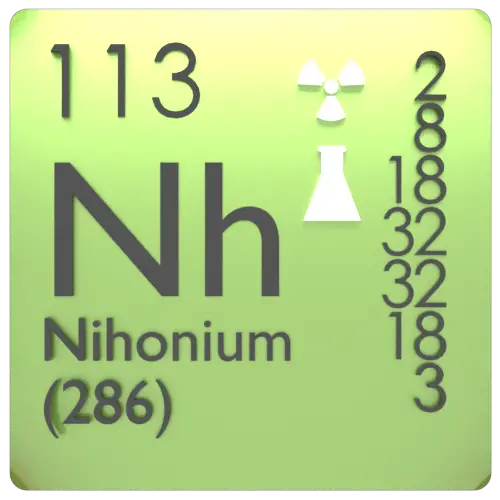
Nihonium-density-atomic-number-mass-radius

—

Summary

Element Nihonium
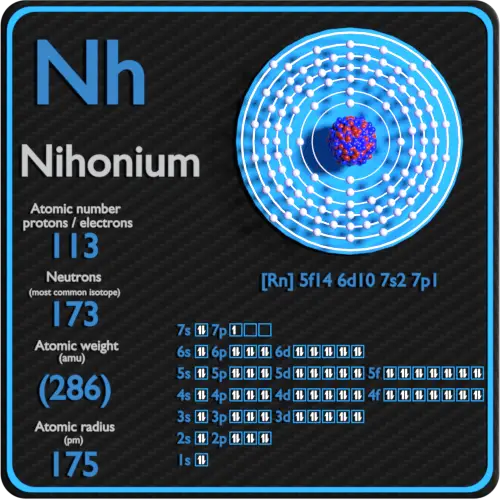
Atomic number 113
Atomic mass [amu] 286
Atomic mass [pm] 175
Density at STP [g/cm3] 16
Number of protons 113
Number of neutrons (typical isotopes) 278,282-287
Number of electrons 113
Electron configuration [Rn] 5f14 6d10 7s2 7p1 ?
Oxidation states +1,+3
Electron affinity [kJ/mol] —
Electronegativity [Pauling scale] —
First ionization energy [eV] —

Atomic Number – Protons, Electrons and Neutrons in Nihonium
Proton Number - Atomic NumberNihonium is a chemical element with atomic number 113 which means there are 113 protons in its nucleus. Total number of protons in the nucleus is called the atomic number of the atom and is given the symbol Z. The total electrical charge of the nucleus is therefore +Ze, where e (elementary charge) equals to 1,602 x 10-19 coulombs.

The total number of neutrons in the nucleus of an atom is called the neutron number of the atom and is given the symbol N. Neutron number plus atomic number equals atomic mass number: N+Z=A. The difference between the neutron number and the atomic number is known as the neutron excess: D = N – Z = A – 2Z.

For stable elements, there is usually a variety of stable isotopes. Isotopes are nuclides that have the same atomic number and are therefore the same element, but differ in the number of neutrons. Mass numbers of typical isotopes of Nihonium are 278,282-287.

Atomic Mass of Nihonium

Atomic mass of Nihonium is 286 u. 

The atomic mass is the mass of an atom. The atomic mass or relative isotopic mass refers to the mass of a single particle, and therefore is tied to a certain specific isotope of an element. The atomic mass is carried by the atomic nucleus, which occupies only about 10-12 of the total volume of the atom or less, but it contains all the positive charge and at least 99.95% of the total mass of the atom. Note that, each element may contain more isotopes, therefore this resulting atomic mass is calculated from naturally-occuring isotopes and their abundance.

Atomic Radius of Nihonium

The atomic radius of Nihonium atom is 175pm (covalent radius).

Atomic Radius of Chemical Elements

It must be noted, atoms lack a well-defined outer boundary. The atomic radius of a chemical element is a measure of the distance out to which the electron cloud extends from the nucleus. However, this assumes the atom to exhibit a spherical shape, which is only obeyed for atoms in vacuum or free space. Therefore, there are various non-equivalent definitions of atomic radius.

Electrons and Electron Configuration

The number of electrons in an electrically-neutral atom is the same as the number of protons in the nucleus. Therefore, the number of electrons in neutral atom of Nihonium is 113. Each electron is influenced by the electric fields produced by the positive nuclear charge and the other (Z – 1) negative electrons in the atom.

Since the number of electrons and their arrangement are responsible for the chemical behavior of atoms, the atomic number identifies the various chemical elements. The configuration of these electrons follows from the principles of quantum mechanics. The number of electrons in each element’s electron shells, particularly the outermost valence shell, is the primary factor in determining its chemical bonding behavior. In the periodic table, the elements are listed in order of increasing atomic number Z.

Electron configuration of Nihonium is [Rn] 5f14 6d10 7s2 7p1 ?.

Possible oxidation states are +1,+3.

Density of Nihonium

Density of Nihonium is 16g/cm3.

Typical densities of various substances are at atmospheric pressure.

Density is defined as the mass per unit volume. It is an intensive property, which is mathematically defined as mass divided by volume:

ρ = m/V

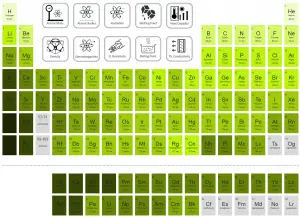
Atomic Masses of Elements
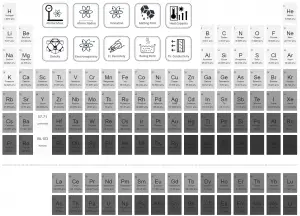
Periodic Table of Elements - atomic mass

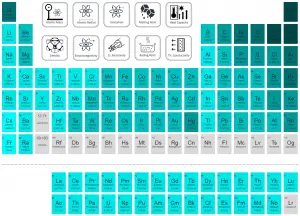
Atomic Radii of Elements

Periodic Table of Elements - atomic radius

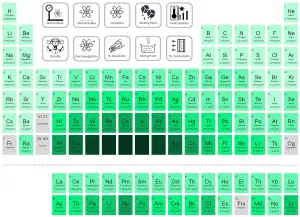
Densities of Elements

Periodic Table of Elements - density

Nihonium-protons-neutrons-electrons-configuration

Nihonium-affinity-electronegativity-ionization

Electron Affinity – Nihonium

Electron affinity of Nihonium is — kJ/mol.

In chemistry and atomic physics, the electron affinity of an atom or molecule is defined as:

the change in energy (in kJ/mole) of a neutral atom or molecule (in the gaseous phase) when an electron is added to the atom to form a negative ion.

X + e– → X– + energy        Affinity = – ∆H

In other words, it can be expressed as the neutral atom’s likelihood of gaining an electron. Note that, ionization energies measure the tendency of a neutral atom to resist the loss of electrons. Electron affinities are more difficult to measure than ionization energies.

Electronegativity of Nihonium

Electronegativity of Nihonium is —.

Electronegativity, symbol χ, is a chemical property that describes the tendency of an atom to attract electrons towards this atom. For this purposes, a dimensionless quantity the Pauling scale, symbol χ, is the most commonly used.

The electronegativity of Nihonium is: χ = —

First Ionization Energy of Nihonium

First Ionization Energy of Nihonium is — eV.

Ionization energy, also called ionization potential, is the energy necessary to remove an electron from the neutral atom.

X + energy → X+ + e−

where X is any atom or molecule capable of being ionized, X+ is that atom or molecule with an electron removed (positive ion), and e− is the removed electron.

A Nihonium atom, for example, requires the following ionization energy to remove the outermost electron.

Nh + IE → Nh+ + e−        IE = — eV

Electronegativity of Elements
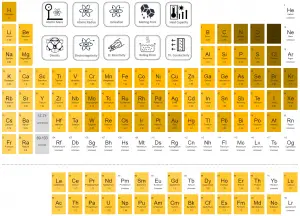
Periodic Table of Elements - electronegativity

Ionization Energy of Elements

Periodic Table of Elements - ionization energy

Nihonium-periodic-table

Source: www.luciteria.com


Properties of other elements

Nihonium - Comparison of Atomic Properties

Periodic Table in 8K resolution

Other properties of Nihonium


Copernicium – Periodic Table – Atomic Properties

Copernicium-density-atomic-number-mass-radius

—

Summary

Element Copernicium
Atomic number 112
Atomic mass [amu] 285
Atomic mass [pm] 122
Density at STP [g/cm3] 23.7
Number of protons 112
Number of neutrons (typical isotopes) 277,281-286
Number of electrons 112
Electron configuration [Rn] 5f14 6d10 7s2 ?
Oxidation states +2
Electron affinity [kJ/mol] —
Electronegativity [Pauling scale] —
First ionization energy [eV] —

Atomic Number – Protons, Electrons and Neutrons in Copernicium

Proton Number - Atomic NumberCopernicium is a chemical element with atomic number 112 which means there are 112 protons in its nucleus. Total number of protons in the nucleus is called the atomic number of the atom and is given the symbol Z. The total electrical charge of the nucleus is therefore +Ze, where e (elementary charge) equals to 1,602 x 10-19 coulombs.

The total number of neutrons in the nucleus of an atom is called the neutron number of the atom and is given the symbol N. Neutron number plus atomic number equals atomic mass number: N+Z=A. The difference between the neutron number and the atomic number is known as the neutron excess: D = N – Z = A – 2Z.

For stable elements, there is usually a variety of stable isotopes. Isotopes are nuclides that have the same atomic number and are therefore the same element, but differ in the number of neutrons. Mass numbers of typical isotopes of Copernicium are 277,281-286.

Atomic Mass of Copernicium

Atomic mass of Copernicium is 285 u. 

The atomic mass is the mass of an atom. The atomic mass or relative isotopic mass refers to the mass of a single particle, and therefore is tied to a certain specific isotope of an element. The atomic mass is carried by the atomic nucleus, which occupies only about 10-12 of the total volume of the atom or less, but it contains all the positive charge and at least 99.95% of the total mass of the atom. Note that, each element may contain more isotopes, therefore this resulting atomic mass is calculated from naturally-occuring isotopes and their abundance.

Atomic Radius of Copernicium

The atomic radius of Copernicium atom is 122pm (covalent radius).

Atomic Radius of Chemical Elements

It must be noted, atoms lack a well-defined outer boundary. The atomic radius of a chemical element is a measure of the distance out to which the electron cloud extends from the nucleus. However, this assumes the atom to exhibit a spherical shape, which is only obeyed for atoms in vacuum or free space. Therefore, there are various non-equivalent definitions of atomic radius.

Electrons and Electron Configuration

The number of electrons in an electrically-neutral atom is the same as the number of protons in the nucleus. Therefore, the number of electrons in neutral atom of Copernicium is 112. Each electron is influenced by the electric fields produced by the positive nuclear charge and the other (Z – 1) negative electrons in the atom.

Since the number of electrons and their arrangement are responsible for the chemical behavior of atoms, the atomic number identifies the various chemical elements. The configuration of these electrons follows from the principles of quantum mechanics. The number of electrons in each element’s electron shells, particularly the outermost valence shell, is the primary factor in determining its chemical bonding behavior. In the periodic table, the elements are listed in order of increasing atomic number Z.

Electron configuration of Copernicium is [Rn] 5f14 6d10 7s2 ?.

Possible oxidation states are +2.

Density of Copernicium

Density of Copernicium is 23.7g/cm3.

Typical densities of various substances are at atmospheric pressure.

Density is defined as the mass per unit volume. It is an intensive property, which is mathematically defined as mass divided by volume:

ρ = m/V

Atomic Masses of Elements

Periodic Table of Elements - atomic mass

Atomic Radii of Elements

Periodic Table of Elements - atomic radius

Densities of Elements

Periodic Table of Elements - density

Copernicium-protons-neutrons-electrons-configuration

Copernicium-affinity-electronegativity-ionization

Electron Affinity – Copernicium

Electron affinity of Copernicium is — kJ/mol.

In chemistry and atomic physics, the electron affinity of an atom or molecule is defined as:

the change in energy (in kJ/mole) of a neutral atom or molecule (in the gaseous phase) when an electron is added to the atom to form a negative ion.

X + e– → X– + energy        Affinity = – ∆H

In other words, it can be expressed as the neutral atom’s likelihood of gaining an electron. Note that, ionization energies measure the tendency of a neutral atom to resist the loss of electrons. Electron affinities are more difficult to measure than ionization energies.

Electronegativity of Copernicium

Electronegativity of Copernicium is —.

Electronegativity, symbol χ, is a chemical property that describes the tendency of an atom to attract electrons towards this atom. For this purposes, a dimensionless quantity the Pauling scale, symbol χ, is the most commonly used.

The electronegativity of Copernicium is: χ = —

First Ionization Energy of Copernicium

First Ionization Energy of Copernicium is — eV.

Ionization energy, also called ionization potential, is the energy necessary to remove an electron from the neutral atom.

X + energy → X+ + e−

where X is any atom or molecule capable of being ionized, X+ is that atom or molecule with an electron removed (positive ion), and e− is the removed electron.

A Copernicium atom, for example, requires the following ionization energy to remove the outermost electron.

Cn + IE → Cn+ + e−        IE = — eV

Electronegativity of Elements

Periodic Table of Elements - electronegativity

Ionization Energy of Elements

Periodic Table of Elements - ionization energy

Copernicium-periodic-table

Source: www.luciteria.com


Properties of other elements

Copernicium - Comparison of Atomic Properties

Periodic Table in 8K resolution

Other properties of Copernicium


Roentgenium – Periodic Table – Atomic Properties

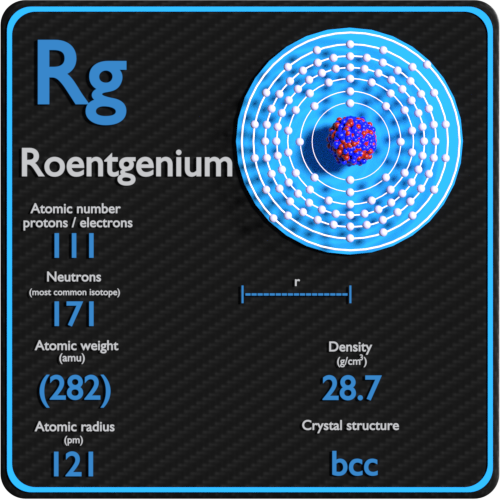
Roentgenium-density-atomic-number-mass-radius

—

Summary

Element Roentgenium
Atomic number 111
Atomic mass [amu] 272
Atomic mass [pm] 121
Density at STP [g/cm3] 28.7
Number of protons 111
Number of neutrons (typical isotopes) 272,274,278-283
Number of electrons 111
Electron configuration [Rn] 5f14 6d9 7s2 ?
Oxidation states —
Electron affinity [kJ/mol] —
Electronegativity [Pauling scale] —
First ionization energy [eV] —

Atomic Number – Protons, Electrons and Neutrons in Roentgenium

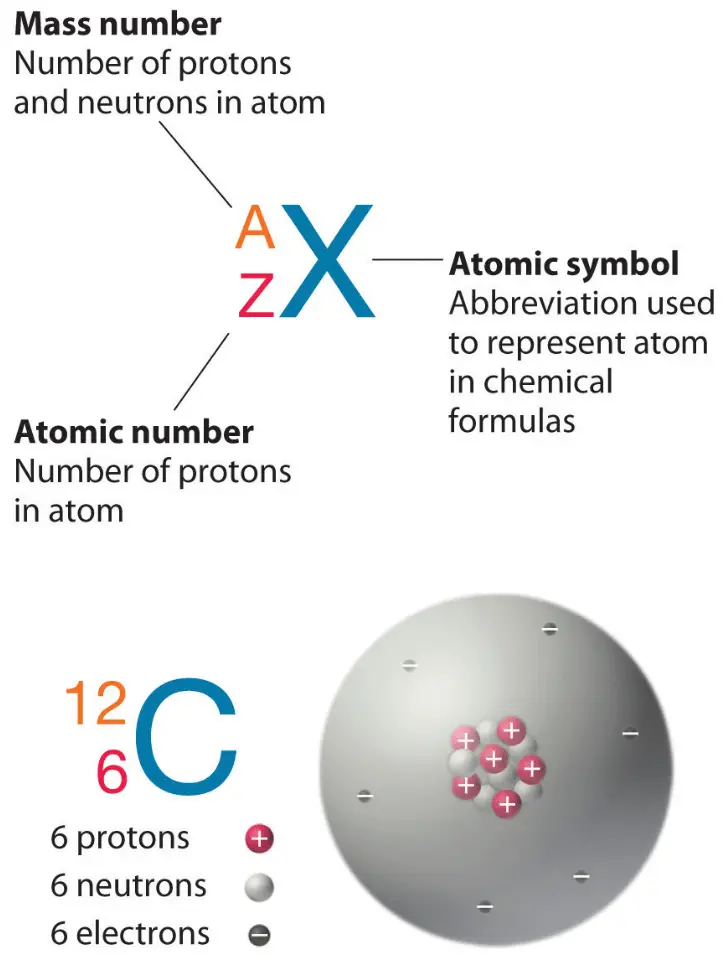
Proton Number - Atomic NumberRoentgenium is a chemical element with atomic number 111 which means there are 111 protons in its nucleus. Total number of protons in the nucleus is called the atomic number of the atom and is given the symbol Z. The total electrical charge of the nucleus is therefore +Ze, where e (elementary charge) equals to 1,602 x 10-19 coulombs.

The total number of neutrons in the nucleus of an atom is called the neutron number of the atom and is given the symbol N. Neutron number plus atomic number equals atomic mass number: N+Z=A. The difference between the neutron number and the atomic number is known as the neutron excess: D = N – Z = A – 2Z.

For stable elements, there is usually a variety of stable isotopes. Isotopes are nuclides that have the same atomic number and are therefore the same element, but differ in the number of neutrons. Mass numbers of typical isotopes of Roentgenium are 272,274,278-283.

Atomic Mass of Roentgenium

Atomic mass of Roentgenium is 272 u. 

The atomic mass is the mass of an atom. The atomic mass or relative isotopic mass refers to the mass of a single particle, and therefore is tied to a certain specific isotope of an element. The atomic mass is carried by the atomic nucleus, which occupies only about 10-12 of the total volume of the atom or less, but it contains all the positive charge and at least 99.95% of the total mass of the atom. Note that, each element may contain more isotopes, therefore this resulting atomic mass is calculated from naturally-occuring isotopes and their abundance.

Atomic Radius of Roentgenium

The atomic radius of Roentgenium atom is 121pm (covalent radius).

Atomic Radius of Chemical Elements

It must be noted, atoms lack a well-defined outer boundary. The atomic radius of a chemical element is a measure of the distance out to which the electron cloud extends from the nucleus. However, this assumes the atom to exhibit a spherical shape, which is only obeyed for atoms in vacuum or free space. Therefore, there are various non-equivalent definitions of atomic radius.

Electrons and Electron Configuration

The number of electrons in an electrically-neutral atom is the same as the number of protons in the nucleus. Therefore, the number of electrons in neutral atom of Roentgenium is 111. Each electron is influenced by the electric fields produced by the positive nuclear charge and the other (Z – 1) negative electrons in the atom.

Since the number of electrons and their arrangement are responsible for the chemical behavior of atoms, the atomic number identifies the various chemical elements. The configuration of these electrons follows from the principles of quantum mechanics. The number of electrons in each element’s electron shells, particularly the outermost valence shell, is the primary factor in determining its chemical bonding behavior. In the periodic table, the elements are listed in order of increasing atomic number Z.

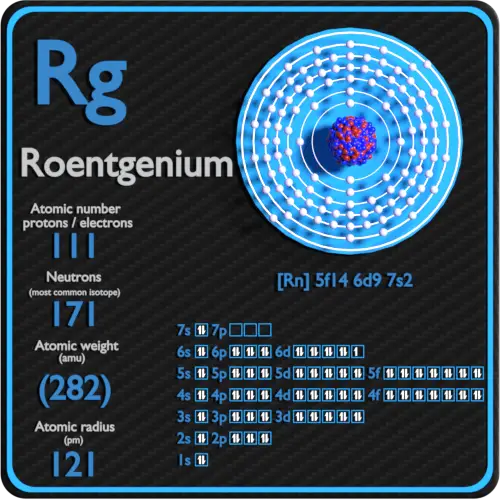
Electron configuration of Roentgenium is [Rn] 5f14 6d9 7s2 ?.

Possible oxidation states are —.

Density of Roentgenium

Density of Roentgenium is 28.7g/cm3.

Typical densities of various substances are at atmospheric pressure.

Density is defined as the mass per unit volume. It is an intensive property, which is mathematically defined as mass divided by volume:

ρ = m/V

Atomic Masses of Elements

Periodic Table of Elements - atomic mass

Atomic Radii of Elements

Periodic Table of Elements - atomic radius

Densities of Elements

Periodic Table of Elements - density

Roentgenium-protons-neutrons-electrons-configuration

Roentgenium-affinity-electronegativity-ionization

Electron Affinity – Roentgenium

Electron affinity of Roentgenium is — kJ/mol.

In chemistry and atomic physics, the electron affinity of an atom or molecule is defined as:

the change in energy (in kJ/mole) of a neutral atom or molecule (in the gaseous phase) when an electron is added to the atom to form a negative ion.

X + e– → X– + energy        Affinity = – ∆H

In other words, it can be expressed as the neutral atom’s likelihood of gaining an electron. Note that, ionization energies measure the tendency of a neutral atom to resist the loss of electrons. Electron affinities are more difficult to measure than ionization energies.

Electronegativity of Roentgenium

Electronegativity of Roentgenium is —.

Electronegativity, symbol χ, is a chemical property that describes the tendency of an atom to attract electrons towards this atom. For this purposes, a dimensionless quantity the Pauling scale, symbol χ, is the most commonly used.

The electronegativity of Roentgenium is: χ = —

First Ionization Energy of Roentgenium

First Ionization Energy of Roentgenium is — eV.

Ionization energy, also called ionization potential, is the energy necessary to remove an electron from the neutral atom.

X + energy → X+ + e−

where X is any atom or molecule capable of being ionized, X+ is that atom or molecule with an electron removed (positive ion), and e− is the removed electron.

A Roentgenium atom, for example, requires the following ionization energy to remove the outermost electron.

Rg + IE → Rg+ + e−        IE = — eV

Electronegativity of Elements

Periodic Table of Elements - electronegativity

Ionization Energy of Elements

Periodic Table of Elements - ionization energy

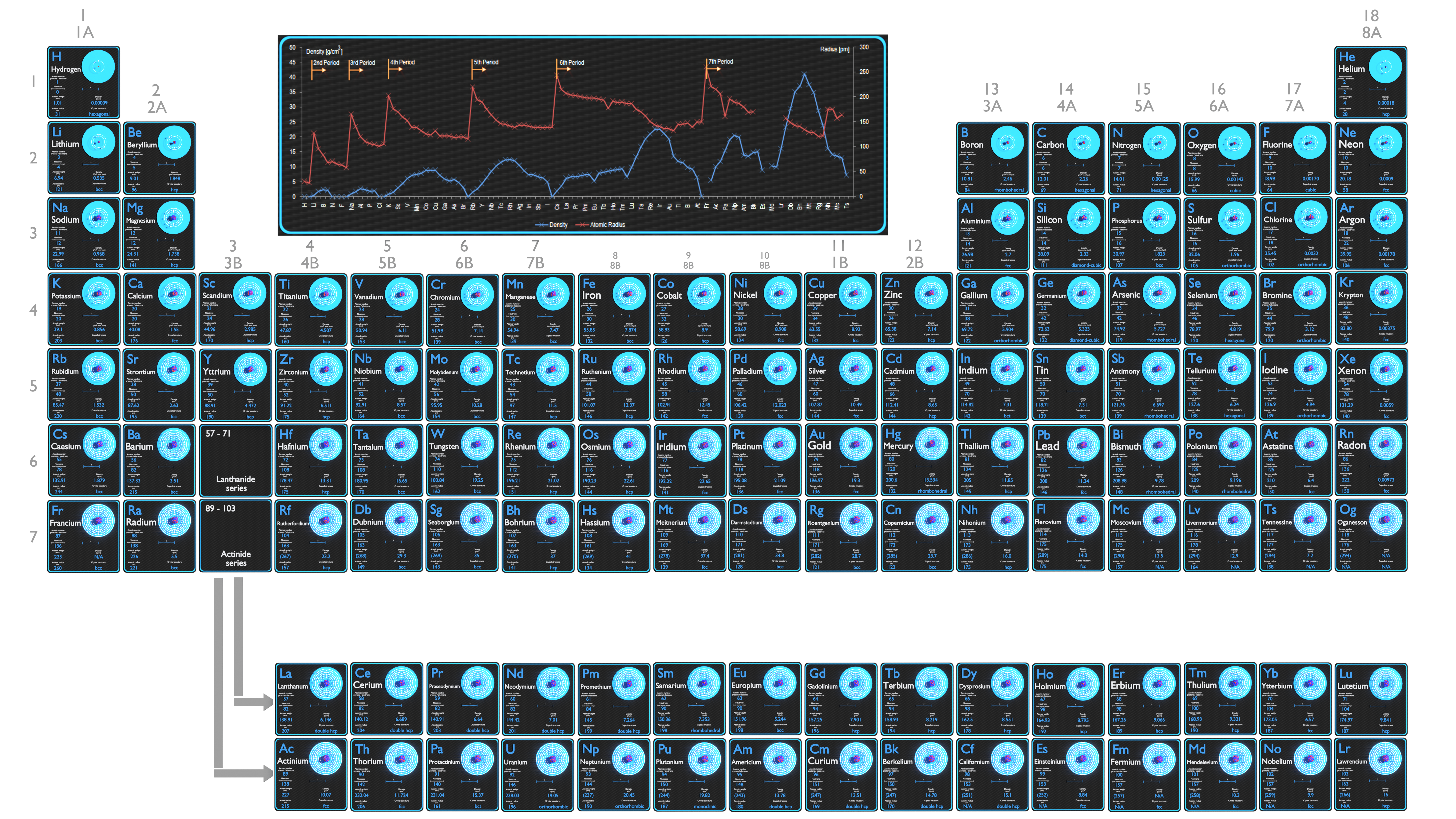
Roentgenium-periodic-table

Source: www.luciteria.com


Properties of other elements

Roentgenium - Comparison of Atomic Properties

Periodic Table in 8K resolution

Other properties of Roentgenium


Darmstadtium – Periodic Table – Atomic Properties

Darmstadtium-density-atomic-number-mass-radius

—

Summary

Element Darmstadtium
Atomic number 110
Atomic mass [amu] 281
Atomic mass [pm] 128
Density at STP [g/cm3] 34.8
Number of protons 110
Number of neutrons (typical isotopes) 279,281
Number of electrons 110
Electron configuration [Rn] 5f14 6d8 7s2 ?
Oxidation states —
Electron affinity [kJ/mol] —
Electronegativity [Pauling scale] —
First ionization energy [eV] —

Atomic Number – Protons, Electrons and Neutrons in Darmstadtium

Proton Number - Atomic NumberDarmstadtium is a chemical element with atomic number 110 which means there are 110 protons in its nucleus. Total number of protons in the nucleus is called the atomic number of the atom and is given the symbol Z. The total electrical charge of the nucleus is therefore +Ze, where e (elementary charge) equals to 1,602 x 10-19 coulombs.

The total number of neutrons in the nucleus of an atom is called the neutron number of the atom and is given the symbol N. Neutron number plus atomic number equals atomic mass number: N+Z=A. The difference between the neutron number and the atomic number is known as the neutron excess: D = N – Z = A – 2Z.

For stable elements, there is usually a variety of stable isotopes. Isotopes are nuclides that have the same atomic number and are therefore the same element, but differ in the number of neutrons. Mass numbers of typical isotopes of Darmstadtium are 279,281.

Atomic Mass of Darmstadtium

Atomic mass of Darmstadtium is 281 u. 

The atomic mass is the mass of an atom. The atomic mass or relative isotopic mass refers to the mass of a single particle, and therefore is tied to a certain specific isotope of an element. The atomic mass is carried by the atomic nucleus, which occupies only about 10-12 of the total volume of the atom or less, but it contains all the positive charge and at least 99.95% of the total mass of the atom. Note that, each element may contain more isotopes, therefore this resulting atomic mass is calculated from naturally-occuring isotopes and their abundance.

Atomic Radius of Darmstadtium

The atomic radius of Darmstadtium atom is 128pm (covalent radius).

Atomic Radius of Chemical Elements

It must be noted, atoms lack a well-defined outer boundary. The atomic radius of a chemical element is a measure of the distance out to which the electron cloud extends from the nucleus. However, this assumes the atom to exhibit a spherical shape, which is only obeyed for atoms in vacuum or free space. Therefore, there are various non-equivalent definitions of atomic radius.

Electrons and Electron Configuration

The number of electrons in an electrically-neutral atom is the same as the number of protons in the nucleus. Therefore, the number of electrons in neutral atom of Darmstadtium is 110. Each electron is influenced by the electric fields produced by the positive nuclear charge and the other (Z – 1) negative electrons in the atom.

Since the number of electrons and their arrangement are responsible for the chemical behavior of atoms, the atomic number identifies the various chemical elements. The configuration of these electrons follows from the principles of quantum mechanics. The number of electrons in each element’s electron shells, particularly the outermost valence shell, is the primary factor in determining its chemical bonding behavior. In the periodic table, the elements are listed in order of increasing atomic number Z.

Electron configuration of Darmstadtium is [Rn] 5f14 6d8 7s2 ?.

Possible oxidation states are —.

Density of Darmstadtium

Density of Darmstadtium is 34.8g/cm3.

Typical densities of various substances are at atmospheric pressure.

Density is defined as the mass per unit volume. It is an intensive property, which is mathematically defined as mass divided by volume:

ρ = m/V

Atomic Masses of Elements

Periodic Table of Elements - atomic mass

Atomic Radii of Elements

Periodic Table of Elements - atomic radius

Densities of Elements

Periodic Table of Elements - density

Darmstadtium-protons-neutrons-electrons-configuration

Darmstadtium-affinity-electronegativity-ionization

Electron Affinity – Darmstadtium

Electron affinity of Darmstadtium is — kJ/mol.

In chemistry and atomic physics, the electron affinity of an atom or molecule is defined as:

the change in energy (in kJ/mole) of a neutral atom or molecule (in the gaseous phase) when an electron is added to the atom to form a negative ion.

X + e– → X– + energy        Affinity = – ∆H

In other words, it can be expressed as the neutral atom’s likelihood of gaining an electron. Note that, ionization energies measure the tendency of a neutral atom to resist the loss of electrons. Electron affinities are more difficult to measure than ionization energies.

Electronegativity of Darmstadtium

Electronegativity of Darmstadtium is —.

Electronegativity, symbol χ, is a chemical property that describes the tendency of an atom to attract electrons towards this atom. For this purposes, a dimensionless quantity the Pauling scale, symbol χ, is the most commonly used.

The electronegativity of Darmstadtium is: χ = —

First Ionization Energy of Darmstadtium

First Ionization Energy of Darmstadtium is — eV.

Ionization energy, also called ionization potential, is the energy necessary to remove an electron from the neutral atom.

X + energy → X+ + e−

where X is any atom or molecule capable of being ionized, X+ is that atom or molecule with an electron removed (positive ion), and e− is the removed electron.

A Darmstadtium atom, for example, requires the following ionization energy to remove the outermost electron.

Ds + IE → Ds+ + e−        IE = — eV

Electronegativity of Elements

Periodic Table of Elements - electronegativity

Ionization Energy of Elements

Periodic Table of Elements - ionization energy

Darmstadtium-periodic-table

Source: www.luciteria.com


Properties of other elements

Darmstadtium - Comparison of Atomic Properties

Periodic Table in 8K resolution

Other properties of Darmstadtium


Meitnerium – Periodic Table – Atomic Properties

Meitnerium-density-atomic-number-mass-radius

—

Summary

Element Meitnerium
Atomic number 109
Atomic mass [amu] 268
Atomic mass [pm] 129
Density at STP [g/cm3] 37.4
Number of protons 109
Number of neutrons (typical isotopes) 274, 276, 278, 282
Number of electrons 109
Electron configuration [Rn] 5f14 6d7 7s2 ?
Oxidation states —
Electron affinity [kJ/mol] —
Electronegativity [Pauling scale] —
First ionization energy [eV] —

Atomic Number – Protons, Electrons and Neutrons in Meitnerium

Proton Number - Atomic NumberMeitnerium is a chemical element with atomic number 109 which means there are 109 protons in its nucleus. Total number of protons in the nucleus is called the atomic number of the atom and is given the symbol Z. The total electrical charge of the nucleus is therefore +Ze, where e (elementary charge) equals to 1,602 x 10-19 coulombs.

The total number of neutrons in the nucleus of an atom is called the neutron number of the atom and is given the symbol N. Neutron number plus atomic number equals atomic mass number: N+Z=A. The difference between the neutron number and the atomic number is known as the neutron excess: D = N – Z = A – 2Z.

For stable elements, there is usually a variety of stable isotopes. Isotopes are nuclides that have the same atomic number and are therefore the same element, but differ in the number of neutrons. Mass numbers of typical isotopes of Meitnerium are 274, 276, 278, 282.

Atomic Mass of Meitnerium

Atomic mass of Meitnerium is 268 u. 

The atomic mass is the mass of an atom. The atomic mass or relative isotopic mass refers to the mass of a single particle, and therefore is tied to a certain specific isotope of an element. The atomic mass is carried by the atomic nucleus, which occupies only about 10-12 of the total volume of the atom or less, but it contains all the positive charge and at least 99.95% of the total mass of the atom. Note that, each element may contain more isotopes, therefore this resulting atomic mass is calculated from naturally-occuring isotopes and their abundance.

Atomic Radius of Meitnerium

The atomic radius of Meitnerium atom is 129pm (covalent radius).

Atomic Radius of Chemical Elements

It must be noted, atoms lack a well-defined outer boundary. The atomic radius of a chemical element is a measure of the distance out to which the electron cloud extends from the nucleus. However, this assumes the atom to exhibit a spherical shape, which is only obeyed for atoms in vacuum or free space. Therefore, there are various non-equivalent definitions of atomic radius.

Electrons and Electron Configuration

The number of electrons in an electrically-neutral atom is the same as the number of protons in the nucleus. Therefore, the number of electrons in neutral atom of Meitnerium is 109. Each electron is influenced by the electric fields produced by the positive nuclear charge and the other (Z – 1) negative electrons in the atom.

Since the number of electrons and their arrangement are responsible for the chemical behavior of atoms, the atomic number identifies the various chemical elements. The configuration of these electrons follows from the principles of quantum mechanics. The number of electrons in each element’s electron shells, particularly the outermost valence shell, is the primary factor in determining its chemical bonding behavior. In the periodic table, the elements are listed in order of increasing atomic number Z.

Electron configuration of Meitnerium is [Rn] 5f14 6d7 7s2 ?.

Possible oxidation states are —.

Density of Meitnerium

Density of Meitnerium is 37.4g/cm3.

Typical densities of various substances are at atmospheric pressure.

Density is defined as the mass per unit volume. It is an intensive property, which is mathematically defined as mass divided by volume:

ρ = m/V

Atomic Masses of Elements

Periodic Table of Elements - atomic mass

Atomic Radii of Elements

Periodic Table of Elements - atomic radius

Densities of Elements

Periodic Table of Elements - density

Meitnerium-protons-neutrons-electrons-configuration

Meitnerium-affinity-electronegativity-ionization

Electron Affinity – Meitnerium

Electron affinity of Meitnerium is — kJ/mol.

In chemistry and atomic physics, the electron affinity of an atom or molecule is defined as:

the change in energy (in kJ/mole) of a neutral atom or molecule (in the gaseous phase) when an electron is added to the atom to form a negative ion.

X + e– → X– + energy        Affinity = – ∆H

In other words, it can be expressed as the neutral atom’s likelihood of gaining an electron. Note that, ionization energies measure the tendency of a neutral atom to resist the loss of electrons. Electron affinities are more difficult to measure than ionization energies.

Electronegativity of Meitnerium

Electronegativity of Meitnerium is —.

Electronegativity, symbol χ, is a chemical property that describes the tendency of an atom to attract electrons towards this atom. For this purposes, a dimensionless quantity the Pauling scale, symbol χ, is the most commonly used.

The electronegativity of Meitnerium is: χ = —

First Ionization Energy of Meitnerium

First Ionization Energy of Meitnerium is — eV.

Ionization energy, also called ionization potential, is the energy necessary to remove an electron from the neutral atom.

X + energy → X+ + e−

where X is any atom or molecule capable of being ionized, X+ is that atom or molecule with an electron removed (positive ion), and e− is the removed electron.

A Meitnerium atom, for example, requires the following ionization energy to remove the outermost electron.

Mt + IE → Mt+ + e−        IE = — eV

Electronegativity of Elements

Periodic Table of Elements - electronegativity

Ionization Energy of Elements

Periodic Table of Elements - ionization energy

Meitnerium-periodic-table

Source: www.luciteria.com


Properties of other elements

Meitnerium - Comparison of Atomic Properties

Periodic Table in 8K resolution

Other properties of Meitnerium


Hassium – Periodic Table – Atomic Properties

Hassium-density-atomic-number-mass-radius

—

Summary

Element Hassium
Atomic number 108
Atomic mass [amu] 277
Atomic mass [pm] 134
Density at STP [g/cm3] 41
Number of protons 108
Number of neutrons (typical isotopes) 269-271
Number of electrons 108
Electron configuration [Rn] 5f14 6d6 7s2
Oxidation states —
Electron affinity [kJ/mol] —
Electronegativity [Pauling scale] —
First ionization energy [eV] —

Atomic Number – Protons, Electrons and Neutrons in Hassium

Proton Number - Atomic NumberHassium is a chemical element with atomic number 108 which means there are 108 protons in its nucleus. Total number of protons in the nucleus is called the atomic number of the atom and is given the symbol Z. The total electrical charge of the nucleus is therefore +Ze, where e (elementary charge) equals to 1,602 x 10-19 coulombs.

The total number of neutrons in the nucleus of an atom is called the neutron number of the atom and is given the symbol N. Neutron number plus atomic number equals atomic mass number: N+Z=A. The difference between the neutron number and the atomic number is known as the neutron excess: D = N – Z = A – 2Z.

For stable elements, there is usually a variety of stable isotopes. Isotopes are nuclides that have the same atomic number and are therefore the same element, but differ in the number of neutrons. Mass numbers of typical isotopes of Hassium are 269-271.

Atomic Mass of Hassium

Atomic mass of Hassium is 277 u. 

The atomic mass is the mass of an atom. The atomic mass or relative isotopic mass refers to the mass of a single particle, and therefore is tied to a certain specific isotope of an element. The atomic mass is carried by the atomic nucleus, which occupies only about 10-12 of the total volume of the atom or less, but it contains all the positive charge and at least 99.95% of the total mass of the atom. Note that, each element may contain more isotopes, therefore this resulting atomic mass is calculated from naturally-occuring isotopes and their abundance.

Atomic Radius of Hassium

The atomic radius of Hassium atom is 134pm (covalent radius).

Atomic Radius of Chemical Elements

It must be noted, atoms lack a well-defined outer boundary. The atomic radius of a chemical element is a measure of the distance out to which the electron cloud extends from the nucleus. However, this assumes the atom to exhibit a spherical shape, which is only obeyed for atoms in vacuum or free space. Therefore, there are various non-equivalent definitions of atomic radius.

Electrons and Electron Configuration

The number of electrons in an electrically-neutral atom is the same as the number of protons in the nucleus. Therefore, the number of electrons in neutral atom of Hassium is 108. Each electron is influenced by the electric fields produced by the positive nuclear charge and the other (Z – 1) negative electrons in the atom.

Since the number of electrons and their arrangement are responsible for the chemical behavior of atoms, the atomic number identifies the various chemical elements. The configuration of these electrons follows from the principles of quantum mechanics. The number of electrons in each element’s electron shells, particularly the outermost valence shell, is the primary factor in determining its chemical bonding behavior. In the periodic table, the elements are listed in order of increasing atomic number Z.

Electron configuration of Hassium is [Rn] 5f14 6d6 7s2.

Possible oxidation states are —.

Density of Hassium

Density of Hassium is 41g/cm3.

Typical densities of various substances are at atmospheric pressure.

Density is defined as the mass per unit volume. It is an intensive property, which is mathematically defined as mass divided by volume:

ρ = m/V

Atomic Masses of Elements

Periodic Table of Elements - atomic mass

Atomic Radii of Elements

Periodic Table of Elements - atomic radius

Densities of Elements

Periodic Table of Elements - density

Hassium-protons-neutrons-electrons-configuration

Hassium-affinity-electronegativity-ionization

Electron Affinity – Hassium

Electron affinity of Hassium is — kJ/mol.

In chemistry and atomic physics, the electron affinity of an atom or molecule is defined as:

the change in energy (in kJ/mole) of a neutral atom or molecule (in the gaseous phase) when an electron is added to the atom to form a negative ion.

X + e– → X– + energy        Affinity = – ∆H

In other words, it can be expressed as the neutral atom’s likelihood of gaining an electron. Note that, ionization energies measure the tendency of a neutral atom to resist the loss of electrons. Electron affinities are more difficult to measure than ionization energies.

Electronegativity of Hassium

Electronegativity of Hassium is —.

Electronegativity, symbol χ, is a chemical property that describes the tendency of an atom to attract electrons towards this atom. For this purposes, a dimensionless quantity the Pauling scale, symbol χ, is the most commonly used.

The electronegativity of Hassium is: χ = —

First Ionization Energy of Hassium

First Ionization Energy of Hassium is — eV.

Ionization energy, also called ionization potential, is the energy necessary to remove an electron from the neutral atom.

X + energy → X+ + e−

where X is any atom or molecule capable of being ionized, X+ is that atom or molecule with an electron removed (positive ion), and e− is the removed electron.

A Hassium atom, for example, requires the following ionization energy to remove the outermost electron.

Hs + IE → Hs+ + e−        IE = — eV

Electronegativity of Elements

Periodic Table of Elements - electronegativity

Ionization Energy of Elements

Periodic Table of Elements - ionization energy

Hassium-periodic-table

Source: www.luciteria.com


Properties of other elements

Hassium - Comparison of Atomic Properties

Periodic Table in 8K resolution

Other properties of Hassium


Bohrium – Periodic Table – Atomic Properties

Bohrium-density-atomic-number-mass-radius

—

Summary

Element Bohrium
Atomic number 107
Atomic mass [amu] 264
Atomic mass [pm] 141
Density at STP [g/cm3] 37
Number of protons 107
Number of neutrons (typical isotopes) 267,270-272,274,278
Number of electrons 107
Electron configuration [Rn] 5f14 6d5 7s2
Oxidation states —
Electron affinity [kJ/mol] —
Electronegativity [Pauling scale] —
First ionization energy [eV] —

Atomic Number – Protons, Electrons and Neutrons in Bohrium

Proton Number - Atomic NumberBohrium is a chemical element with atomic number 107 which means there are 107 protons in its nucleus. Total number of protons in the nucleus is called the atomic number of the atom and is given the symbol Z. The total electrical charge of the nucleus is therefore +Ze, where e (elementary charge) equals to 1,602 x 10-19 coulombs.

The total number of neutrons in the nucleus of an atom is called the neutron number of the atom and is given the symbol N. Neutron number plus atomic number equals atomic mass number: N+Z=A. The difference between the neutron number and the atomic number is known as the neutron excess: D = N – Z = A – 2Z.

For stable elements, there is usually a variety of stable isotopes. Isotopes are nuclides that have the same atomic number and are therefore the same element, but differ in the number of neutrons. Mass numbers of typical isotopes of Bohrium are 267,270-272,274,278.

Atomic Mass of Bohrium

Atomic mass of Bohrium is 264 u. 

The atomic mass is the mass of an atom. The atomic mass or relative isotopic mass refers to the mass of a single particle, and therefore is tied to a certain specific isotope of an element. The atomic mass is carried by the atomic nucleus, which occupies only about 10-12 of the total volume of the atom or less, but it contains all the positive charge and at least 99.95% of the total mass of the atom. Note that, each element may contain more isotopes, therefore this resulting atomic mass is calculated from naturally-occuring isotopes and their abundance.

Atomic Radius of Bohrium

The atomic radius of Bohrium atom is 141pm (covalent radius).

Atomic Radius of Chemical Elements

It must be noted, atoms lack a well-defined outer boundary. The atomic radius of a chemical element is a measure of the distance out to which the electron cloud extends from the nucleus. However, this assumes the atom to exhibit a spherical shape, which is only obeyed for atoms in vacuum or free space. Therefore, there are various non-equivalent definitions of atomic radius.

Electrons and Electron Configuration

The number of electrons in an electrically-neutral atom is the same as the number of protons in the nucleus. Therefore, the number of electrons in neutral atom of Bohrium is 107. Each electron is influenced by the electric fields produced by the positive nuclear charge and the other (Z – 1) negative electrons in the atom.

Since the number of electrons and their arrangement are responsible for the chemical behavior of atoms, the atomic number identifies the various chemical elements. The configuration of these electrons follows from the principles of quantum mechanics. The number of electrons in each element’s electron shells, particularly the outermost valence shell, is the primary factor in determining its chemical bonding behavior. In the periodic table, the elements are listed in order of increasing atomic number Z.

Electron configuration of Bohrium is [Rn] 5f14 6d5 7s2.

Possible oxidation states are —.

Density of Bohrium

Density of Bohrium is 37g/cm3.

Typical densities of various substances are at atmospheric pressure.

Density is defined as the mass per unit volume. It is an intensive property, which is mathematically defined as mass divided by volume:

ρ = m/V

Atomic Masses of Elements

Periodic Table of Elements - atomic mass

Atomic Radii of Elements

Periodic Table of Elements - atomic radius

Densities of Elements

Periodic Table of Elements - density

Bohrium-protons-neutrons-electrons-configuration

Bohrium-affinity-electronegativity-ionization

Electron Affinity – Bohrium

Electron affinity of Bohrium is — kJ/mol.

In chemistry and atomic physics, the electron affinity of an atom or molecule is defined as:

the change in energy (in kJ/mole) of a neutral atom or molecule (in the gaseous phase) when an electron is added to the atom to form a negative ion.

X + e– → X– + energy        Affinity = – ∆H

In other words, it can be expressed as the neutral atom’s likelihood of gaining an electron. Note that, ionization energies measure the tendency of a neutral atom to resist the loss of electrons. Electron affinities are more difficult to measure than ionization energies.

Electronegativity of Bohrium

Electronegativity of Bohrium is —.

Electronegativity, symbol χ, is a chemical property that describes the tendency of an atom to attract electrons towards this atom. For this purposes, a dimensionless quantity the Pauling scale, symbol χ, is the most commonly used.

The electronegativity of Bohrium is: χ = —

First Ionization Energy of Bohrium

First Ionization Energy of Bohrium is — eV.

Ionization energy, also called ionization potential, is the energy necessary to remove an electron from the neutral atom.

X + energy → X+ + e−

where X is any atom or molecule capable of being ionized, X+ is that atom or molecule with an electron removed (positive ion), and e− is the removed electron.

A Bohrium atom, for example, requires the following ionization energy to remove the outermost electron.

Bh + IE → Bh+ + e−        IE = — eV

Electronegativity of Elements

Periodic Table of Elements - electronegativity

Ionization Energy of Elements

Periodic Table of Elements - ionization energy

Bohrium-periodic-table

Source: www.luciteria.com


Properties of other elements

Bohrium - Comparison of Atomic Properties

Periodic Table in 8K resolution

Other properties of Bohrium


Seaborgium – Periodic Table – Atomic Properties

Seaborgium-density-atomic-number-mass-radius

—

Summary

Element Seaborgium
Atomic number 106
Atomic mass [amu] 266
Atomic mass [pm] 143
Density at STP [g/cm3] 35
Number of protons 106
Number of neutrons (typical isotopes) 265,267,269,271
Number of electrons 106
Electron configuration [Rn] 5f14 6d4 7s2
Oxidation states —
Electron affinity [kJ/mol] —
Electronegativity [Pauling scale] —
First ionization energy [eV] —

Atomic Number – Protons, Electrons and Neutrons in Seaborgium

Proton Number - Atomic NumberSeaborgium is a chemical element with atomic number 106 which means there are 106 protons in its nucleus. Total number of protons in the nucleus is called the atomic number of the atom and is given the symbol Z. The total electrical charge of the nucleus is therefore +Ze, where e (elementary charge) equals to 1,602 x 10-19 coulombs.

The total number of neutrons in the nucleus of an atom is called the neutron number of the atom and is given the symbol N. Neutron number plus atomic number equals atomic mass number: N+Z=A. The difference between the neutron number and the atomic number is known as the neutron excess: D = N – Z = A – 2Z.

For stable elements, there is usually a variety of stable isotopes. Isotopes are nuclides that have the same atomic number and are therefore the same element, but differ in the number of neutrons. Mass numbers of typical isotopes of Seaborgium are 265,267,269,271.

Atomic Mass of Seaborgium

Atomic mass of Seaborgium is 266 u. 

The atomic mass is the mass of an atom. The atomic mass or relative isotopic mass refers to the mass of a single particle, and therefore is tied to a certain specific isotope of an element. The atomic mass is carried by the atomic nucleus, which occupies only about 10-12 of the total volume of the atom or less, but it contains all the positive charge and at least 99.95% of the total mass of the atom. Note that, each element may contain more isotopes, therefore this resulting atomic mass is calculated from naturally-occuring isotopes and their abundance.

Atomic Radius of Seaborgium

The atomic radius of Seaborgium atom is 143pm (covalent radius).

Atomic Radius of Chemical Elements

It must be noted, atoms lack a well-defined outer boundary. The atomic radius of a chemical element is a measure of the distance out to which the electron cloud extends from the nucleus. However, this assumes the atom to exhibit a spherical shape, which is only obeyed for atoms in vacuum or free space. Therefore, there are various non-equivalent definitions of atomic radius.

Electrons and Electron Configuration

The number of electrons in an electrically-neutral atom is the same as the number of protons in the nucleus. Therefore, the number of electrons in neutral atom of Seaborgium is 106. Each electron is influenced by the electric fields produced by the positive nuclear charge and the other (Z – 1) negative electrons in the atom.

Since the number of electrons and their arrangement are responsible for the chemical behavior of atoms, the atomic number identifies the various chemical elements. The configuration of these electrons follows from the principles of quantum mechanics. The number of electrons in each element’s electron shells, particularly the outermost valence shell, is the primary factor in determining its chemical bonding behavior. In the periodic table, the elements are listed in order of increasing atomic number Z.

Electron configuration of Seaborgium is [Rn] 5f14 6d4 7s2.

Possible oxidation states are —.

Density of Seaborgium

Density of Seaborgium is 35g/cm3.

Typical densities of various substances are at atmospheric pressure.

Density is defined as the mass per unit volume. It is an intensive property, which is mathematically defined as mass divided by volume:

ρ = m/V

Atomic Masses of Elements

Periodic Table of Elements - atomic mass

Atomic Radii of Elements

Periodic Table of Elements - atomic radius

Densities of Elements

Periodic Table of Elements - density

Seaborgium-protons-neutrons-electrons-configuration

Seaborgium-affinity-electronegativity-ionization

Electron Affinity – Seaborgium

Electron affinity of Seaborgium is — kJ/mol.

In chemistry and atomic physics, the electron affinity of an atom or molecule is defined as:

the change in energy (in kJ/mole) of a neutral atom or molecule (in the gaseous phase) when an electron is added to the atom to form a negative ion.

X + e– → X– + energy        Affinity = – ∆H

In other words, it can be expressed as the neutral atom’s likelihood of gaining an electron. Note that, ionization energies measure the tendency of a neutral atom to resist the loss of electrons. Electron affinities are more difficult to measure than ionization energies.

Electronegativity of Seaborgium

Electronegativity of Seaborgium is —.

Electronegativity, symbol χ, is a chemical property that describes the tendency of an atom to attract electrons towards this atom. For this purposes, a dimensionless quantity the Pauling scale, symbol χ, is the most commonly used.

The electronegativity of Seaborgium is: χ = —

First Ionization Energy of Seaborgium

First Ionization Energy of Seaborgium is — eV.

Ionization energy, also called ionization potential, is the energy necessary to remove an electron from the neutral atom.

X + energy → X+ + e−

where X is any atom or molecule capable of being ionized, X+ is that atom or molecule with an electron removed (positive ion), and e− is the removed electron.

A Seaborgium atom, for example, requires the following ionization energy to remove the outermost electron.

Sg + IE → Sg+ + e−        IE = — eV

Electronegativity of Elements

Periodic Table of Elements - electronegativity

Ionization Energy of Elements

Periodic Table of Elements - ionization energy

Seaborgium-periodic-table

Source: www.luciteria.com


Properties of other elements

Seaborgium - Comparison of Atomic Properties

Periodic Table in 8K resolution

Other properties of Seaborgium


Dubnium – Periodic Table – Atomic Properties

Dubnium-density-atomic-number-mass-radius

—

Summary

Element Dubnium
Atomic number 105
Atomic mass [amu] 262
Atomic mass [pm] 149
Density at STP [g/cm3] 29.3
Number of protons 105
Number of neutrons (typical isotopes) 266-268,270
Number of electrons 105
Electron configuration [Rn] 5f14 6d3 7s2
Oxidation states —
Electron affinity [kJ/mol] —
Electronegativity [Pauling scale] —
First ionization energy [eV] —

Atomic Number – Protons, Electrons and Neutrons in Dubnium

Proton Number - Atomic NumberDubnium is a chemical element with atomic number 105 which means there are 105 protons in its nucleus. Total number of protons in the nucleus is called the atomic number of the atom and is given the symbol Z. The total electrical charge of the nucleus is therefore +Ze, where e (elementary charge) equals to 1,602 x 10-19 coulombs.

The total number of neutrons in the nucleus of an atom is called the neutron number of the atom and is given the symbol N. Neutron number plus atomic number equals atomic mass number: N+Z=A. The difference between the neutron number and the atomic number is known as the neutron excess: D = N – Z = A – 2Z.

For stable elements, there is usually a variety of stable isotopes. Isotopes are nuclides that have the same atomic number and are therefore the same element, but differ in the number of neutrons. Mass numbers of typical isotopes of Dubnium are 266-268,270.

Atomic Mass of Dubnium

Atomic mass of Dubnium is 262 u. 

The atomic mass is the mass of an atom. The atomic mass or relative isotopic mass refers to the mass of a single particle, and therefore is tied to a certain specific isotope of an element. The atomic mass is carried by the atomic nucleus, which occupies only about 10-12 of the total volume of the atom or less, but it contains all the positive charge and at least 99.95% of the total mass of the atom. Note that, each element may contain more isotopes, therefore this resulting atomic mass is calculated from naturally-occuring isotopes and their abundance.

Atomic Radius of Dubnium

The atomic radius of Dubnium atom is 149pm (covalent radius).

Atomic Radius of Chemical Elements

It must be noted, atoms lack a well-defined outer boundary. The atomic radius of a chemical element is a measure of the distance out to which the electron cloud extends from the nucleus. However, this assumes the atom to exhibit a spherical shape, which is only obeyed for atoms in vacuum or free space. Therefore, there are various non-equivalent definitions of atomic radius.

Electrons and Electron Configuration

The number of electrons in an electrically-neutral atom is the same as the number of protons in the nucleus. Therefore, the number of electrons in neutral atom of Dubnium is 105. Each electron is influenced by the electric fields produced by the positive nuclear charge and the other (Z – 1) negative electrons in the atom.

Since the number of electrons and their arrangement are responsible for the chemical behavior of atoms, the atomic number identifies the various chemical elements. The configuration of these electrons follows from the principles of quantum mechanics. The number of electrons in each element’s electron shells, particularly the outermost valence shell, is the primary factor in determining its chemical bonding behavior. In the periodic table, the elements are listed in order of increasing atomic number Z.

Electron configuration of Dubnium is [Rn] 5f14 6d3 7s2.

Possible oxidation states are —.

Density of Dubnium

Density of Dubnium is 29.3g/cm3.

Typical densities of various substances are at atmospheric pressure.

Density is defined as the mass per unit volume. It is an intensive property, which is mathematically defined as mass divided by volume:

ρ = m/V

Atomic Masses of Elements

Periodic Table of Elements - atomic mass

Atomic Radii of Elements

Periodic Table of Elements - atomic radius

Densities of Elements

Periodic Table of Elements - density

Dubnium-protons-neutrons-electrons-configuration

Dubnium-affinity-electronegativity-ionization

Electron Affinity – Dubnium

Electron affinity of Dubnium is — kJ/mol.

In chemistry and atomic physics, the electron affinity of an atom or molecule is defined as:

the change in energy (in kJ/mole) of a neutral atom or molecule (in the gaseous phase) when an electron is added to the atom to form a negative ion.

X + e– → X– + energy        Affinity = – ∆H

In other words, it can be expressed as the neutral atom’s likelihood of gaining an electron. Note that, ionization energies measure the tendency of a neutral atom to resist the loss of electrons. Electron affinities are more difficult to measure than ionization energies.

Electronegativity of Dubnium

Electronegativity of Dubnium is —.

Electronegativity, symbol χ, is a chemical property that describes the tendency of an atom to attract electrons towards this atom. For this purposes, a dimensionless quantity the Pauling scale, symbol χ, is the most commonly used.

The electronegativity of Dubnium is: χ = —

First Ionization Energy of Dubnium

First Ionization Energy of Dubnium is — eV.

Ionization energy, also called ionization potential, is the energy necessary to remove an electron from the neutral atom.

X + energy → X+ + e−

where X is any atom or molecule capable of being ionized, X+ is that atom or molecule with an electron removed (positive ion), and e− is the removed electron.

A Dubnium atom, for example, requires the following ionization energy to remove the outermost electron.

Db + IE → Db+ + e−        IE = — eV

Electronegativity of Elements

Periodic Table of Elements - electronegativity

Ionization Energy of Elements

Periodic Table of Elements - ionization energy

Dubnium-periodic-table

Source: www.luciteria.com


Properties of other elements

Dubnium - Comparison of Atomic Properties

Periodic Table in 8K resolution

Other properties of Dubnium


Rutherfordium – Periodic Table – Atomic Properties

Rutherfordium-density-atomic-number-mass-radius

—

Summary

Element Rutherfordium
Atomic number 104
Atomic mass [amu] 261
Atomic mass [pm] 157
Density at STP [g/cm3] 23.2
Number of protons 104
Number of neutrons (typical isotopes) 263,265-267
Number of electrons 104
Electron configuration [Rn] 5f14 6d2 7s2
Oxidation states +4
Electron affinity [kJ/mol] —
Electronegativity [Pauling scale] —
First ionization energy [eV] —

Atomic Number – Protons, Electrons and Neutrons in Rutherfordium

Proton Number - Atomic NumberRutherfordium is a chemical element with atomic number 104 which means there are 104 protons in its nucleus. Total number of protons in the nucleus is called the atomic number of the atom and is given the symbol Z. The total electrical charge of the nucleus is therefore +Ze, where e (elementary charge) equals to 1,602 x 10-19 coulombs.

The total number of neutrons in the nucleus of an atom is called the neutron number of the atom and is given the symbol N. Neutron number plus atomic number equals atomic mass number: N+Z=A. The difference between the neutron number and the atomic number is known as the neutron excess: D = N – Z = A – 2Z.

For stable elements, there is usually a variety of stable isotopes. Isotopes are nuclides that have the same atomic number and are therefore the same element, but differ in the number of neutrons. Mass numbers of typical isotopes of Rutherfordium are 263,265-267.

Atomic Mass of Rutherfordium

Atomic mass of Rutherfordium is 261 u. 

The atomic mass is the mass of an atom. The atomic mass or relative isotopic mass refers to the mass of a single particle, and therefore is tied to a certain specific isotope of an element. The atomic mass is carried by the atomic nucleus, which occupies only about 10-12 of the total volume of the atom or less, but it contains all the positive charge and at least 99.95% of the total mass of the atom. Note that, each element may contain more isotopes, therefore this resulting atomic mass is calculated from naturally-occuring isotopes and their abundance.

Atomic Radius of Rutherfordium

The atomic radius of Rutherfordium atom is 157pm (covalent radius).

Atomic Radius of Chemical Elements

It must be noted, atoms lack a well-defined outer boundary. The atomic radius of a chemical element is a measure of the distance out to which the electron cloud extends from the nucleus. However, this assumes the atom to exhibit a spherical shape, which is only obeyed for atoms in vacuum or free space. Therefore, there are various non-equivalent definitions of atomic radius.

Electrons and Electron Configuration

The number of electrons in an electrically-neutral atom is the same as the number of protons in the nucleus. Therefore, the number of electrons in neutral atom of Rutherfordium is 104. Each electron is influenced by the electric fields produced by the positive nuclear charge and the other (Z – 1) negative electrons in the atom.

Since the number of electrons and their arrangement are responsible for the chemical behavior of atoms, the atomic number identifies the various chemical elements. The configuration of these electrons follows from the principles of quantum mechanics. The number of electrons in each element’s electron shells, particularly the outermost valence shell, is the primary factor in determining its chemical bonding behavior. In the periodic table, the elements are listed in order of increasing atomic number Z.

Electron configuration of Rutherfordium is [Rn] 5f14 6d2 7s2.

Possible oxidation states are +4.

Density of Rutherfordium

Density of Rutherfordium is 23.2g/cm3.

Typical densities of various substances are at atmospheric pressure.

Density is defined as the mass per unit volume. It is an intensive property, which is mathematically defined as mass divided by volume:

ρ = m/V

Atomic Masses of Elements

Periodic Table of Elements - atomic mass

Atomic Radii of Elements

Periodic Table of Elements - atomic radius

Densities of Elements

Periodic Table of Elements - density

Rutherfordium-protons-neutrons-electrons-configuration

Rutherfordium-affinity-electronegativity-ionization

Electron Affinity – Rutherfordium

Electron affinity of Rutherfordium is — kJ/mol.

In chemistry and atomic physics, the electron affinity of an atom or molecule is defined as:

the change in energy (in kJ/mole) of a neutral atom or molecule (in the gaseous phase) when an electron is added to the atom to form a negative ion.

X + e– → X– + energy        Affinity = – ∆H

In other words, it can be expressed as the neutral atom’s likelihood of gaining an electron. Note that, ionization energies measure the tendency of a neutral atom to resist the loss of electrons. Electron affinities are more difficult to measure than ionization energies.

Electronegativity of Rutherfordium

Electronegativity of Rutherfordium is —.

Electronegativity, symbol χ, is a chemical property that describes the tendency of an atom to attract electrons towards this atom. For this purposes, a dimensionless quantity the Pauling scale, symbol χ, is the most commonly used.

The electronegativity of Rutherfordium is: χ = —

First Ionization Energy of Rutherfordium

First Ionization Energy of Rutherfordium is — eV.

Ionization energy, also called ionization potential, is the energy necessary to remove an electron from the neutral atom.

X + energy → X+ + e−

where X is any atom or molecule capable of being ionized, X+ is that atom or molecule with an electron removed (positive ion), and e− is the removed electron.

A Rutherfordium atom, for example, requires the following ionization energy to remove the outermost electron.

Rf + IE → Rf+ + e−        IE = — eV

Electronegativity of Elements

Periodic Table of Elements - electronegativity

Ionization Energy of Elements

Periodic Table of Elements - ionization energy

Rutherfordium-periodic-table

Source: www.luciteria.com


Properties of other elements

Rutherfordium - Comparison of Atomic Properties

Periodic Table in 8K resolution

Other properties of Rutherfordium