Facebook Instagram Youtube Twitter

Selenium – Periodic Table – Atomic Properties

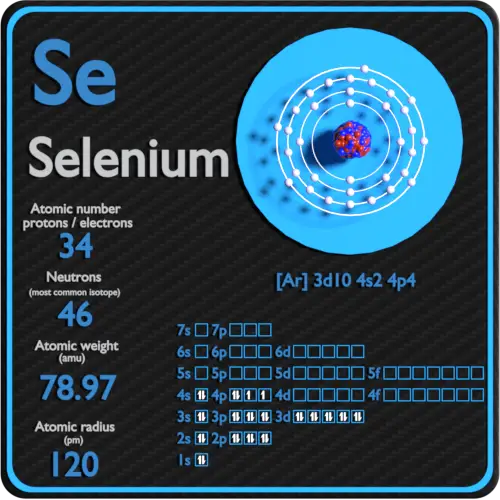
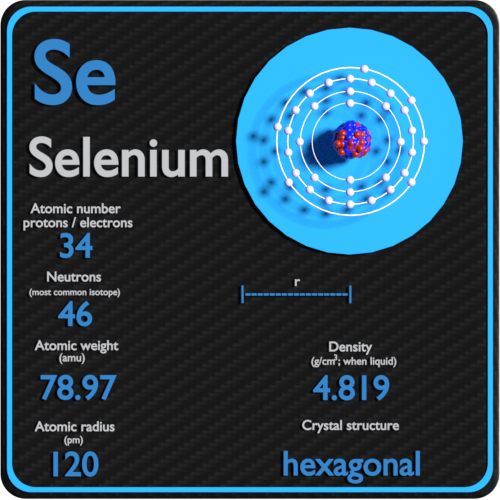
Selenium-density-atomic-number-mass-radius

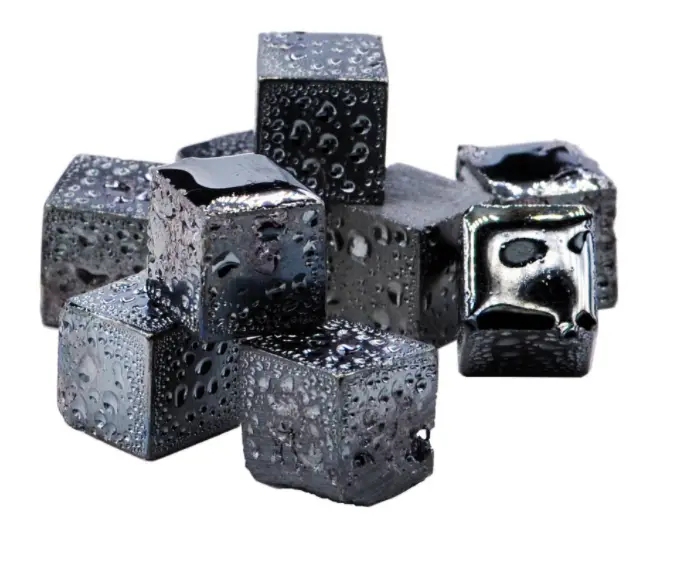
Selenium is a nonmetal with properties that are intermediate between the elements above and below in the periodic table, sulfur and tellurium, and also has similarities to arsenic. It rarely occurs in its elemental state or as pure ore compounds in the Earth’s crust.

Summary

Element Selenium
Atomic number 34
Atomic mass [amu] 78.96
Atomic mass [pm] 120
Density at STP [g/cm3] 4.819
Number of protons 34
Number of neutrons (typical isotopes) 74; 76; 77; 78; 80
Number of electrons 34
Electron configuration [Ar] 3d10 4s2 4p4
Oxidation states +4,6/-2
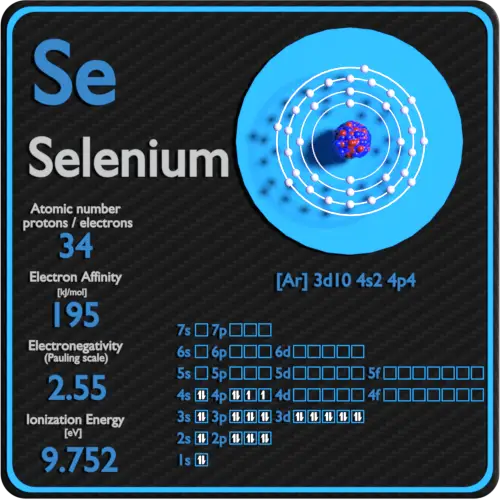
Electron affinity [kJ/mol] 195
Electronegativity [Pauling scale] 2.55
First ionization energy [eV] 9.7524

Atomic Number – Protons, Electrons and Neutrons in Selenium
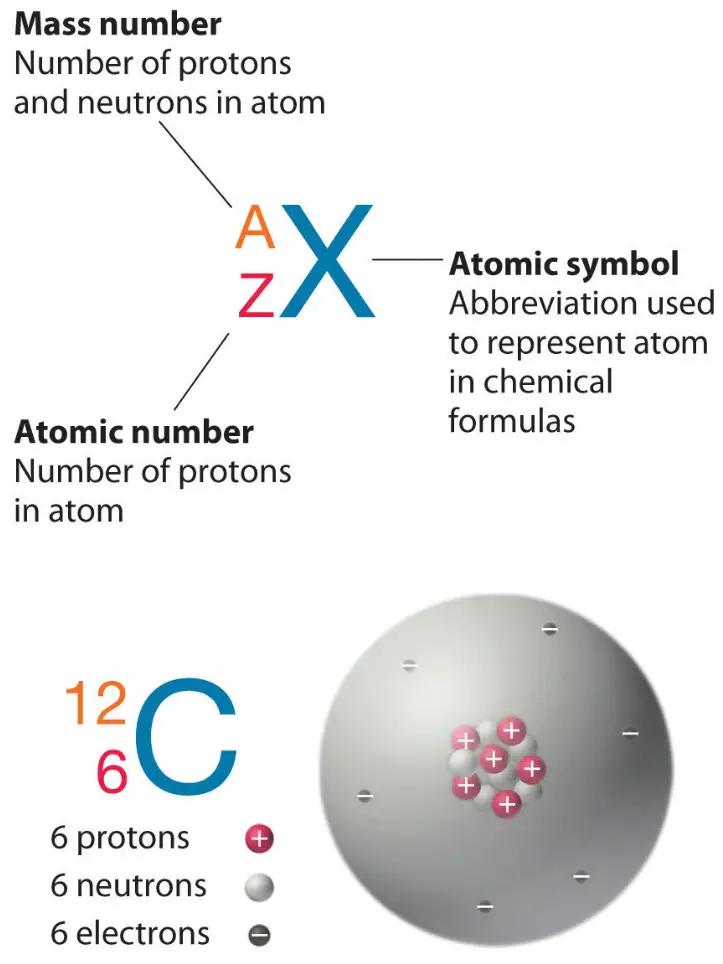
Proton Number - Atomic NumberSelenium is a chemical element with atomic number 34 which means there are 34 protons in its nucleus. Total number of protons in the nucleus is called the atomic number of the atom and is given the symbol Z. The total electrical charge of the nucleus is therefore +Ze, where e (elementary charge) equals to 1,602 x 10-19 coulombs.

The total number of neutrons in the nucleus of an atom is called the neutron number of the atom and is given the symbol N. Neutron number plus atomic number equals atomic mass number: N+Z=A. The difference between the neutron number and the atomic number is known as the neutron excess: D = N – Z = A – 2Z.

For stable elements, there is usually a variety of stable isotopes. Isotopes are nuclides that have the same atomic number and are therefore the same element, but differ in the number of neutrons. Mass numbers of typical isotopes of Selenium are 74; 76; 77; 78; 80.

Atomic Mass of Selenium

Atomic mass of Selenium is 78.96 u. 

The atomic mass is the mass of an atom. The atomic mass or relative isotopic mass refers to the mass of a single particle, and therefore is tied to a certain specific isotope of an element. The atomic mass is carried by the atomic nucleus, which occupies only about 10-12 of the total volume of the atom or less, but it contains all the positive charge and at least 99.95% of the total mass of the atom. Note that, each element may contain more isotopes, therefore this resulting atomic mass is calculated from naturally-occuring isotopes and their abundance.

Atomic Radius of Selenium

The atomic radius of Selenium atom is 120pm (covalent radius).

Atomic Radius of Chemical Elements

It must be noted, atoms lack a well-defined outer boundary. The atomic radius of a chemical element is a measure of the distance out to which the electron cloud extends from the nucleus. However, this assumes the atom to exhibit a spherical shape, which is only obeyed for atoms in vacuum or free space. Therefore, there are various non-equivalent definitions of atomic radius.

Electrons and Electron Configuration

The number of electrons in an electrically-neutral atom is the same as the number of protons in the nucleus. Therefore, the number of electrons in neutral atom of Selenium is 34. Each electron is influenced by the electric fields produced by the positive nuclear charge and the other (Z – 1) negative electrons in the atom.

Since the number of electrons and their arrangement are responsible for the chemical behavior of atoms, the atomic number identifies the various chemical elements. The configuration of these electrons follows from the principles of quantum mechanics. The number of electrons in each element’s electron shells, particularly the outermost valence shell, is the primary factor in determining its chemical bonding behavior. In the periodic table, the elements are listed in order of increasing atomic number Z.

Electron configuration of Selenium is [Ar] 3d10 4s2 4p4.

Possible oxidation states are +4,6/-2.

Density of Selenium

Density of Selenium is 4.819g/cm3.

Typical densities of various substances are at atmospheric pressure.

Density is defined as the mass per unit volume. It is an intensive property, which is mathematically defined as mass divided by volume:

ρ = m/V

Atomic Masses of Elements
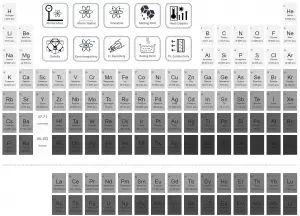
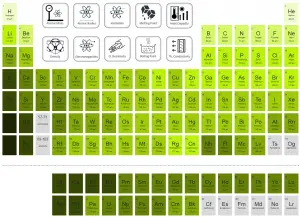
Periodic Table of Elements - atomic mass

Atomic Radii of Elements

Periodic Table of Elements - atomic radius

Densities of Elements

Periodic Table of Elements - density

Selenium-protons-neutrons-electrons-configuration

Selenium-affinity-electronegativity-ionization

Electron Affinity – Selenium

Electron affinity of Selenium is 195 kJ/mol.

In chemistry and atomic physics, the electron affinity of an atom or molecule is defined as:

the change in energy (in kJ/mole) of a neutral atom or molecule (in the gaseous phase) when an electron is added to the atom to form a negative ion.

X + e– → X– + energy        Affinity = – ∆H

In other words, it can be expressed as the neutral atom’s likelihood of gaining an electron. Note that, ionization energies measure the tendency of a neutral atom to resist the loss of electrons. Electron affinities are more difficult to measure than ionization energies.

Electronegativity of Selenium

Electronegativity of Selenium is 2.55.

Electronegativity, symbol χ, is a chemical property that describes the tendency of an atom to attract electrons towards this atom. For this purposes, a dimensionless quantity the Pauling scale, symbol χ, is the most commonly used.

The electronegativity of Selenium is: χ = 2.55

First Ionization Energy of Selenium

First Ionization Energy of Selenium is 9.7524 eV.

Ionization energy, also called ionization potential, is the energy necessary to remove an electron from the neutral atom.

X + energy → X+ + e−

where X is any atom or molecule capable of being ionized, X+ is that atom or molecule with an electron removed (positive ion), and e− is the removed electron.

A Selenium atom, for example, requires the following ionization energy to remove the outermost electron.

Se + IE → Se+ + e−        IE = 9.7524 eV

Electronegativity of Elements
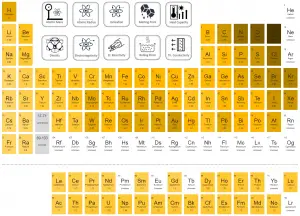
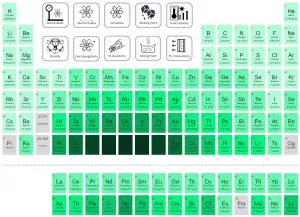
Periodic Table of Elements - electronegativity

Ionization Energy of Elements

Periodic Table of Elements - ionization energy

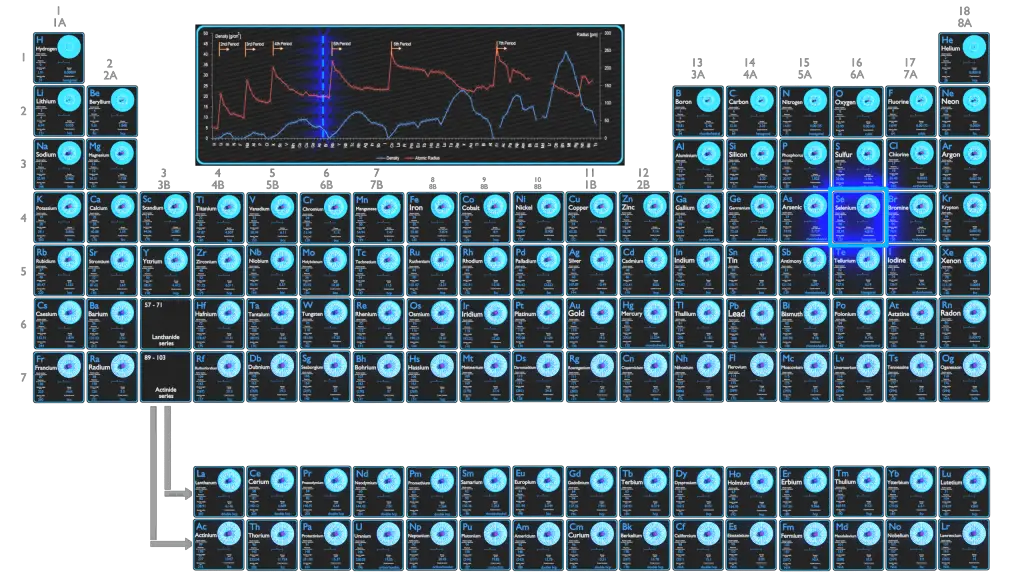
Selenium-periodic-table

Source: www.luciteria.com


Properties of other elements

Selenium - Comparison of Atomic Properties

Periodic Table in 8K resolution

Other properties of Selenium
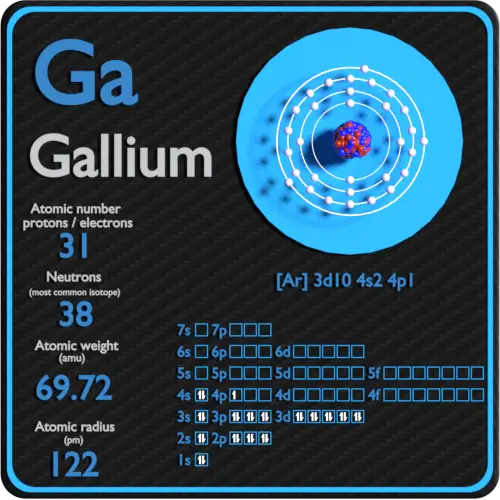
 

Gallium – Periodic Table – Atomic Properties

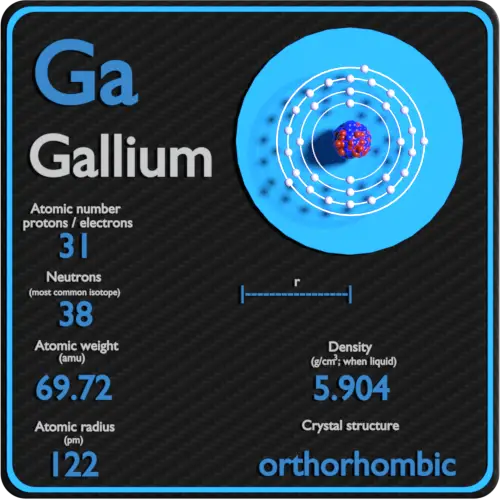
Gallium-density-atomic-number-mass-radius

Gallium has similarities to the other metals of the group, aluminium, indium, and thallium. Gallium does not occur as a free element in nature, but as gallium(III) compounds in trace amounts in zinc ores and in bauxite.

Summary

Element Gallium
Atomic number 31
Atomic mass [amu] 69.723
Atomic mass [pm] 122
Density at STP [g/cm3] 5.904
Number of protons 31
Number of neutrons (typical isotopes) 69; 71
Number of electrons 31
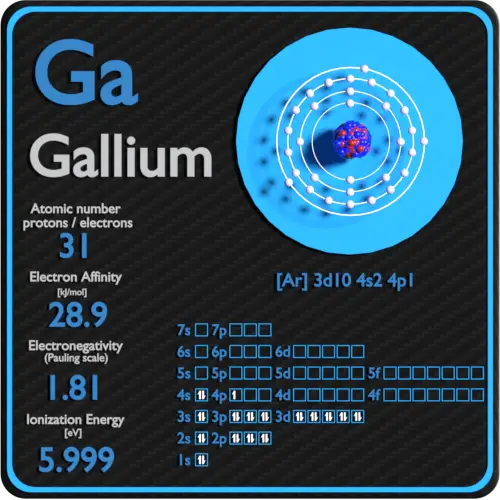
Electron configuration [Ar] 3d10 4s2 4p1
Oxidation states +3
Electron affinity [kJ/mol] 28.9
Electronegativity [Pauling scale] 1.81
First ionization energy [eV] 5.9993

Atomic Number – Protons, Electrons and Neutrons in Gallium

Proton Number - Atomic NumberGallium is a chemical element with atomic number 31 which means there are 31 protons in its nucleus. Total number of protons in the nucleus is called the atomic number of the atom and is given the symbol Z. The total electrical charge of the nucleus is therefore +Ze, where e (elementary charge) equals to 1,602 x 10-19 coulombs.

The total number of neutrons in the nucleus of an atom is called the neutron number of the atom and is given the symbol N. Neutron number plus atomic number equals atomic mass number: N+Z=A. The difference between the neutron number and the atomic number is known as the neutron excess: D = N – Z = A – 2Z.

For stable elements, there is usually a variety of stable isotopes. Isotopes are nuclides that have the same atomic number and are therefore the same element, but differ in the number of neutrons. Mass numbers of typical isotopes of Gallium are 69; 71.

Atomic Mass of Gallium

Atomic mass of Gallium is 69.723 u. 

The atomic mass is the mass of an atom. The atomic mass or relative isotopic mass refers to the mass of a single particle, and therefore is tied to a certain specific isotope of an element. The atomic mass is carried by the atomic nucleus, which occupies only about 10-12 of the total volume of the atom or less, but it contains all the positive charge and at least 99.95% of the total mass of the atom. Note that, each element may contain more isotopes, therefore this resulting atomic mass is calculated from naturally-occuring isotopes and their abundance.

Atomic Radius of Gallium

The atomic radius of Gallium atom is 122pm (covalent radius).

Atomic Radius of Chemical Elements

It must be noted, atoms lack a well-defined outer boundary. The atomic radius of a chemical element is a measure of the distance out to which the electron cloud extends from the nucleus. However, this assumes the atom to exhibit a spherical shape, which is only obeyed for atoms in vacuum or free space. Therefore, there are various non-equivalent definitions of atomic radius.

Electrons and Electron Configuration

The number of electrons in an electrically-neutral atom is the same as the number of protons in the nucleus. Therefore, the number of electrons in neutral atom of Gallium is 31. Each electron is influenced by the electric fields produced by the positive nuclear charge and the other (Z – 1) negative electrons in the atom.

Since the number of electrons and their arrangement are responsible for the chemical behavior of atoms, the atomic number identifies the various chemical elements. The configuration of these electrons follows from the principles of quantum mechanics. The number of electrons in each element’s electron shells, particularly the outermost valence shell, is the primary factor in determining its chemical bonding behavior. In the periodic table, the elements are listed in order of increasing atomic number Z.

Electron configuration of Gallium is [Ar] 3d10 4s2 4p1.

Possible oxidation states are +3.

Density of Gallium

Density of Gallium is 5.904g/cm3.

Typical densities of various substances are at atmospheric pressure.

Density is defined as the mass per unit volume. It is an intensive property, which is mathematically defined as mass divided by volume:

ρ = m/V

Atomic Masses of Elements

Periodic Table of Elements - atomic mass

Atomic Radii of Elements

Periodic Table of Elements - atomic radius

Densities of Elements

Periodic Table of Elements - density

Gallium-protons-neutrons-electrons-configuration

Gallium-affinity-electronegativity-ionization

Electron Affinity – Gallium

Electron affinity of Gallium is 28.9 kJ/mol.

In chemistry and atomic physics, the electron affinity of an atom or molecule is defined as:

the change in energy (in kJ/mole) of a neutral atom or molecule (in the gaseous phase) when an electron is added to the atom to form a negative ion.

X + e– → X– + energy        Affinity = – ∆H

In other words, it can be expressed as the neutral atom’s likelihood of gaining an electron. Note that, ionization energies measure the tendency of a neutral atom to resist the loss of electrons. Electron affinities are more difficult to measure than ionization energies.

Electronegativity of Gallium

Electronegativity of Gallium is 1.81.

Electronegativity, symbol χ, is a chemical property that describes the tendency of an atom to attract electrons towards this atom. For this purposes, a dimensionless quantity the Pauling scale, symbol χ, is the most commonly used.

The electronegativity of Gallium is: χ = 1.81

First Ionization Energy of Gallium

First Ionization Energy of Gallium is 5.9993 eV.

Ionization energy, also called ionization potential, is the energy necessary to remove an electron from the neutral atom.

X + energy → X+ + e−

where X is any atom or molecule capable of being ionized, X+ is that atom or molecule with an electron removed (positive ion), and e− is the removed electron.

A Gallium atom, for example, requires the following ionization energy to remove the outermost electron.

Ga + IE → Ga+ + e−        IE = 5.9993 eV

Electronegativity of Elements

Periodic Table of Elements - electronegativity

Ionization Energy of Elements

Periodic Table of Elements - ionization energy

Gallium-periodic-table

Source: www.luciteria.com


Properties of other elements

Gallium - Comparison of Atomic Properties

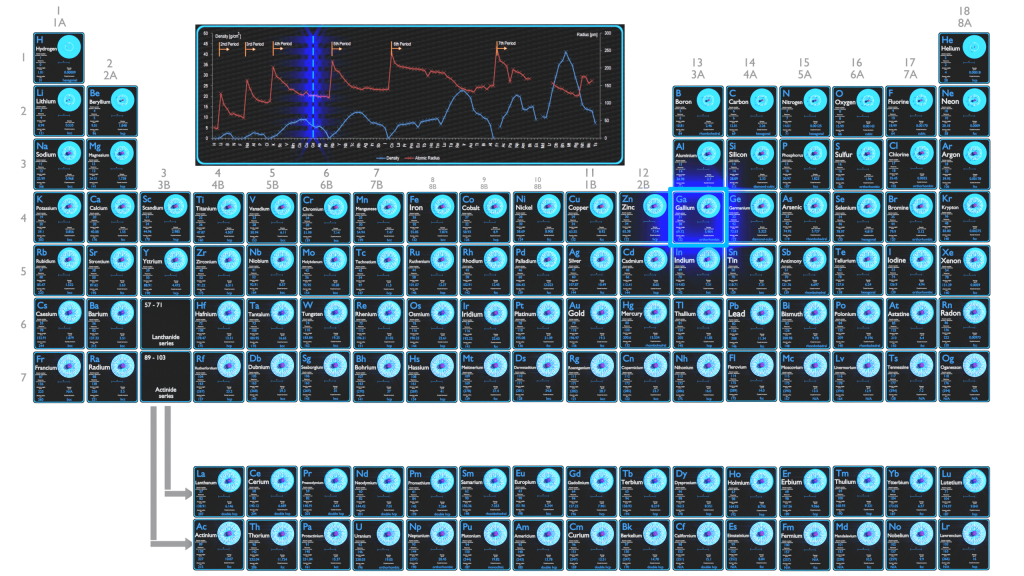
Periodic Table in 8K resolution

Other properties of Gallium


Germanium – Periodic Table – Atomic Properties
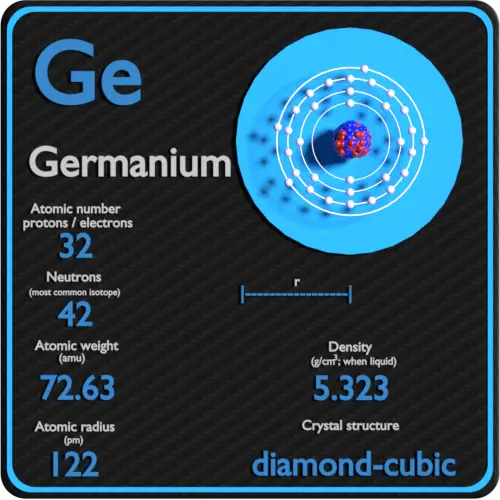
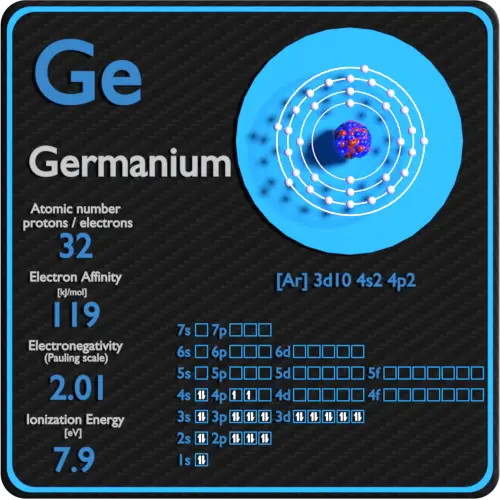
Germanium-density-atomic-number-mass-radius

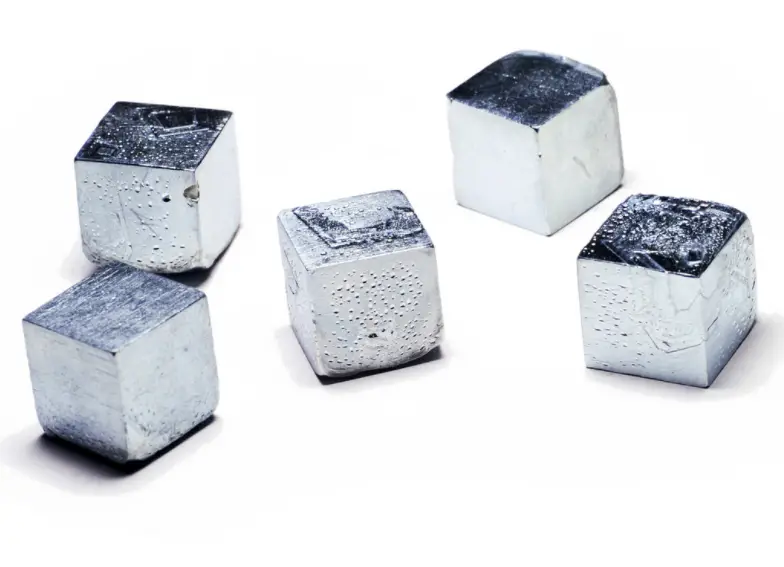
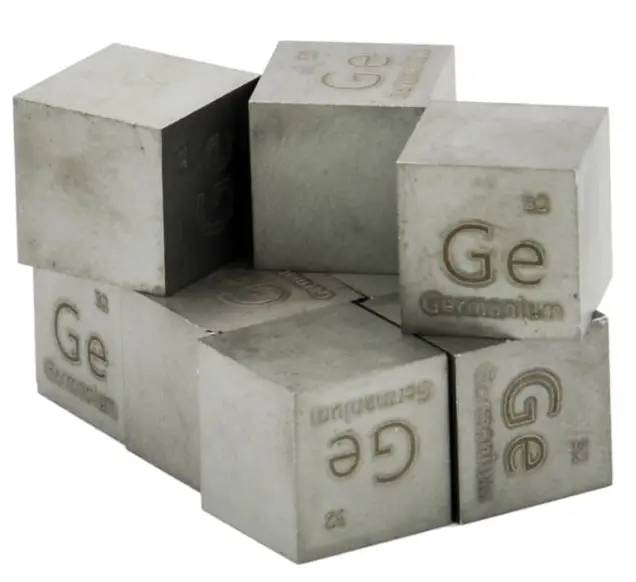
Germanium is a lustrous, hard, grayish-white metalloid in the carbon group, chemically similar to its group neighbors tin and silicon. Pure germanium is a semiconductor with an appearance similar to elemental silicon.
Summary

Element Germanium
Atomic number 32
Atomic mass [amu] 72.64
Atomic mass [pm] 122
Density at STP [g/cm3] 5.323
Number of protons 32
Number of neutrons (typical isotopes) 70; 72; 73; 74
Number of electrons 32
Electron configuration [Ar] 3d10 4s2 4p2
Oxidation states +2,4
Electron affinity [kJ/mol] 119
Electronegativity [Pauling scale] 2.01
First ionization energy [eV] 7.9

Atomic Number – Protons, Electrons and Neutrons in Germanium

Proton Number - Atomic NumberGermanium is a chemical element with atomic number 32 which means there are 32 protons in its nucleus. Total number of protons in the nucleus is called the atomic number of the atom and is given the symbol Z. The total electrical charge of the nucleus is therefore +Ze, where e (elementary charge) equals to 1,602 x 10-19 coulombs.

The total number of neutrons in the nucleus of an atom is called the neutron number of the atom and is given the symbol N. Neutron number plus atomic number equals atomic mass number: N+Z=A. The difference between the neutron number and the atomic number is known as the neutron excess: D = N – Z = A – 2Z.

For stable elements, there is usually a variety of stable isotopes. Isotopes are nuclides that have the same atomic number and are therefore the same element, but differ in the number of neutrons. Mass numbers of typical isotopes of Germanium are 70; 72; 73; 74.

Atomic Mass of Germanium

Atomic mass of Germanium is 72.64 u. 

The atomic mass is the mass of an atom. The atomic mass or relative isotopic mass refers to the mass of a single particle, and therefore is tied to a certain specific isotope of an element. The atomic mass is carried by the atomic nucleus, which occupies only about 10-12 of the total volume of the atom or less, but it contains all the positive charge and at least 99.95% of the total mass of the atom. Note that, each element may contain more isotopes, therefore this resulting atomic mass is calculated from naturally-occuring isotopes and their abundance.

Atomic Radius of Germanium

The atomic radius of Germanium atom is 122pm (covalent radius).

Atomic Radius of Chemical Elements

It must be noted, atoms lack a well-defined outer boundary. The atomic radius of a chemical element is a measure of the distance out to which the electron cloud extends from the nucleus. However, this assumes the atom to exhibit a spherical shape, which is only obeyed for atoms in vacuum or free space. Therefore, there are various non-equivalent definitions of atomic radius.

Electrons and Electron Configuration

The number of electrons in an electrically-neutral atom is the same as the number of protons in the nucleus. Therefore, the number of electrons in neutral atom of Germanium is 32. Each electron is influenced by the electric fields produced by the positive nuclear charge and the other (Z – 1) negative electrons in the atom.

Since the number of electrons and their arrangement are responsible for the chemical behavior of atoms, the atomic number identifies the various chemical elements. The configuration of these electrons follows from the principles of quantum mechanics. The number of electrons in each element’s electron shells, particularly the outermost valence shell, is the primary factor in determining its chemical bonding behavior. In the periodic table, the elements are listed in order of increasing atomic number Z.

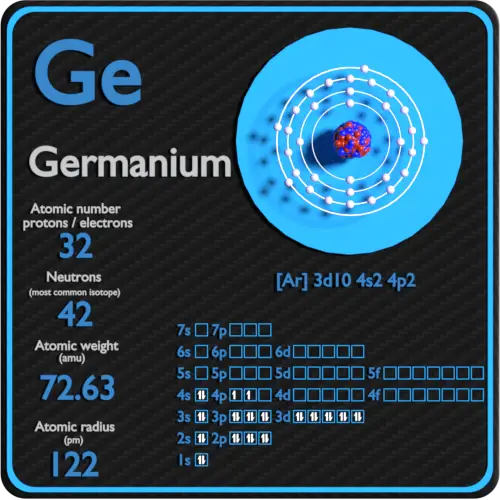
Electron configuration of Germanium is [Ar] 3d10 4s2 4p2.

Possible oxidation states are +2,4.

Density of Germanium

Density of Germanium is 5.323g/cm3.

Typical densities of various substances are at atmospheric pressure.

Density is defined as the mass per unit volume. It is an intensive property, which is mathematically defined as mass divided by volume:

ρ = m/V

Atomic Masses of Elements

Periodic Table of Elements - atomic mass

Atomic Radii of Elements

Periodic Table of Elements - atomic radius

Densities of Elements

Periodic Table of Elements - density

Germanium-protons-neutrons-electrons-configuration

Germanium-affinity-electronegativity-ionization

Electron Affinity – Germanium

Electron affinity of Germanium is 119 kJ/mol.

In chemistry and atomic physics, the electron affinity of an atom or molecule is defined as:

the change in energy (in kJ/mole) of a neutral atom or molecule (in the gaseous phase) when an electron is added to the atom to form a negative ion.

X + e– → X– + energy        Affinity = – ∆H

In other words, it can be expressed as the neutral atom’s likelihood of gaining an electron. Note that, ionization energies measure the tendency of a neutral atom to resist the loss of electrons. Electron affinities are more difficult to measure than ionization energies.

Electronegativity of Germanium

Electronegativity of Germanium is 2.01.

Electronegativity, symbol χ, is a chemical property that describes the tendency of an atom to attract electrons towards this atom. For this purposes, a dimensionless quantity the Pauling scale, symbol χ, is the most commonly used.

The electronegativity of Germanium is: χ = 2.01

First Ionization Energy of Germanium

First Ionization Energy of Germanium is 7.9 eV.

Ionization energy, also called ionization potential, is the energy necessary to remove an electron from the neutral atom.

X + energy → X+ + e−

where X is any atom or molecule capable of being ionized, X+ is that atom or molecule with an electron removed (positive ion), and e− is the removed electron.

A Germanium atom, for example, requires the following ionization energy to remove the outermost electron.

Ge + IE → Ge+ + e−        IE = 7.9 eV

Electronegativity of Elements

Periodic Table of Elements - electronegativity

Ionization Energy of Elements

Periodic Table of Elements - ionization energy

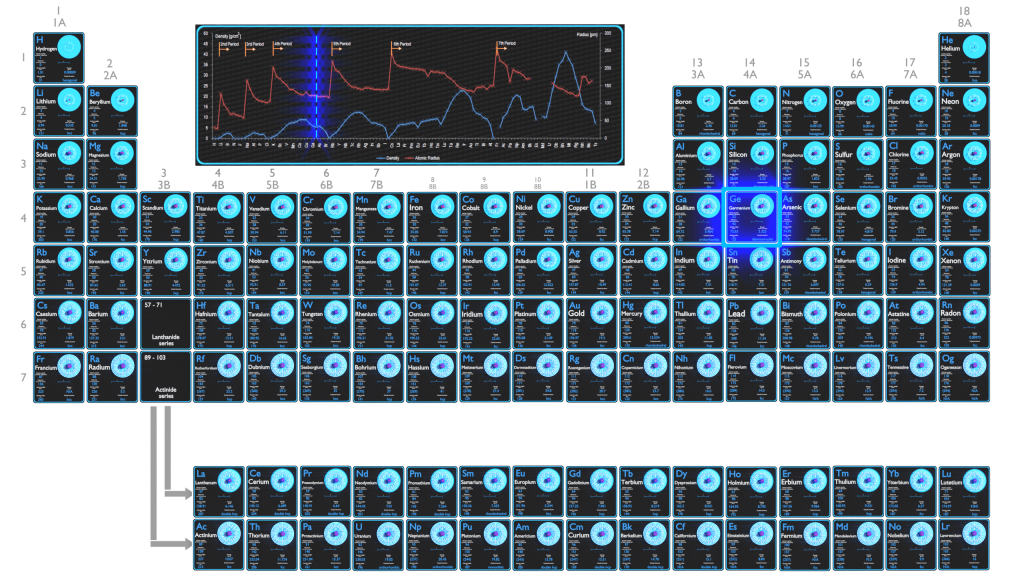
Germanium-periodic-table

Source: www.luciteria.com


Properties of other elements

Germanium - Comparison of Atomic Properties

Periodic Table in 8K resolution

Other properties of Germanium


Copper – Periodic Table – Atomic Properties

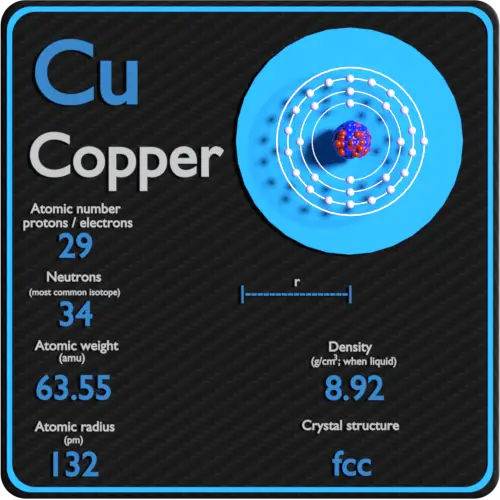
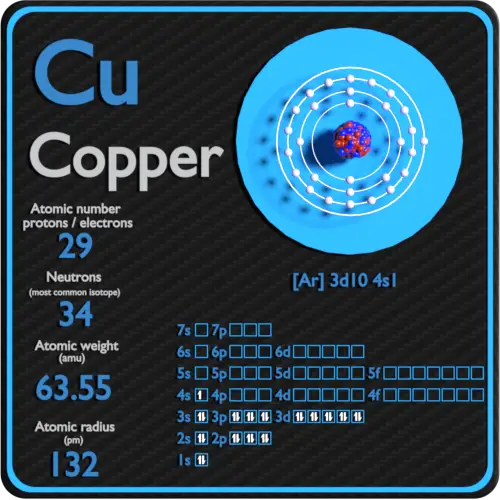
Copper-density-atomic-number-mass-radius

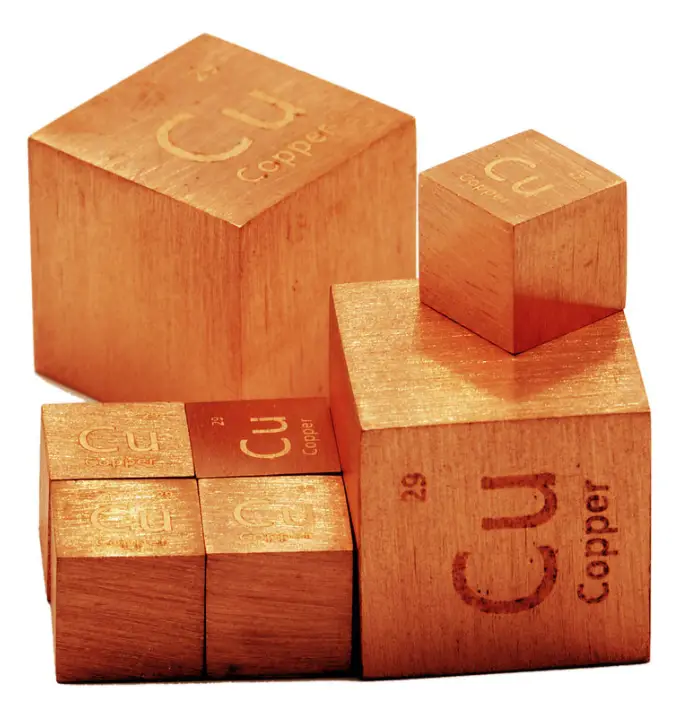
Copper is a soft, malleable, and ductile metal with very high thermal and electrical conductivity. A freshly exposed surface of pure copper has a reddish-orange color. Copper is used as a conductor of heat and electricity, as a building material, and as a constituent of various metal alloys, such as sterling silver used in jewelry, cupronickel used to make marine hardware and coins, and constantan used in strain gauges and thermocouples for temperature measurement.

Summary

Element Copper
Atomic number 29
Atomic mass [amu] 63.546
Atomic mass [pm] 132
Density at STP [g/cm3] 8.92
Number of protons 29
Number of neutrons (typical isotopes) 63; 65
Number of electrons 29
Electron configuration [Ar] 3d10 4s1
Oxidation states +1,2
Electron affinity [kJ/mol] 118.4
Electronegativity [Pauling scale] 1.9
First ionization energy [eV] 7.7264

Atomic Number – Protons, Electrons and Neutrons in Copper

Proton Number - Atomic NumberCopper is a chemical element with atomic number 29 which means there are 29 protons in its nucleus. Total number of protons in the nucleus is called the atomic number of the atom and is given the symbol Z. The total electrical charge of the nucleus is therefore +Ze, where e (elementary charge) equals to 1,602 x 10-19 coulombs.

The total number of neutrons in the nucleus of an atom is called the neutron number of the atom and is given the symbol N. Neutron number plus atomic number equals atomic mass number: N+Z=A. The difference between the neutron number and the atomic number is known as the neutron excess: D = N – Z = A – 2Z.

For stable elements, there is usually a variety of stable isotopes. Isotopes are nuclides that have the same atomic number and are therefore the same element, but differ in the number of neutrons. Mass numbers of typical isotopes of Copper are 63; 65.

Atomic Mass of Copper

Atomic mass of Copper is 63.546 u. 

The atomic mass is the mass of an atom. The atomic mass or relative isotopic mass refers to the mass of a single particle, and therefore is tied to a certain specific isotope of an element. The atomic mass is carried by the atomic nucleus, which occupies only about 10-12 of the total volume of the atom or less, but it contains all the positive charge and at least 99.95% of the total mass of the atom. Note that, each element may contain more isotopes, therefore this resulting atomic mass is calculated from naturally-occuring isotopes and their abundance.

Atomic Radius of Copper

The atomic radius of Copper atom is 132pm (covalent radius).

Atomic Radius of Chemical Elements

It must be noted, atoms lack a well-defined outer boundary. The atomic radius of a chemical element is a measure of the distance out to which the electron cloud extends from the nucleus. However, this assumes the atom to exhibit a spherical shape, which is only obeyed for atoms in vacuum or free space. Therefore, there are various non-equivalent definitions of atomic radius.

Electrons and Electron Configuration

The number of electrons in an electrically-neutral atom is the same as the number of protons in the nucleus. Therefore, the number of electrons in neutral atom of Copper is 29. Each electron is influenced by the electric fields produced by the positive nuclear charge and the other (Z – 1) negative electrons in the atom.

Since the number of electrons and their arrangement are responsible for the chemical behavior of atoms, the atomic number identifies the various chemical elements. The configuration of these electrons follows from the principles of quantum mechanics. The number of electrons in each element’s electron shells, particularly the outermost valence shell, is the primary factor in determining its chemical bonding behavior. In the periodic table, the elements are listed in order of increasing atomic number Z.

Electron configuration of Copper is [Ar] 3d10 4s1.

Possible oxidation states are +1,2.

Density of Copper

Density of Copper is 8.92g/cm3.

Typical densities of various substances are at atmospheric pressure.

Density is defined as the mass per unit volume. It is an intensive property, which is mathematically defined as mass divided by volume:

ρ = m/V

Atomic Masses of Elements

Periodic Table of Elements - atomic mass

Atomic Radii of Elements

Periodic Table of Elements - atomic radius

Densities of Elements

Periodic Table of Elements - density

Copper-protons-neutrons-electrons-configuration

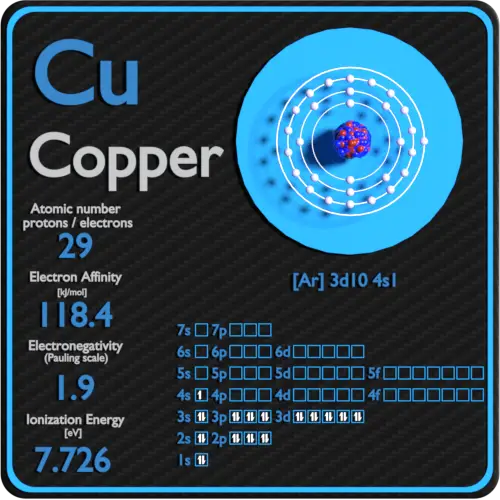
Copper-affinity-electronegativity-ionization

Electron Affinity – Copper

Electron affinity of Copper is 118.4 kJ/mol.

In chemistry and atomic physics, the electron affinity of an atom or molecule is defined as:

the change in energy (in kJ/mole) of a neutral atom or molecule (in the gaseous phase) when an electron is added to the atom to form a negative ion.

X + e– → X– + energy        Affinity = – ∆H

In other words, it can be expressed as the neutral atom’s likelihood of gaining an electron. Note that, ionization energies measure the tendency of a neutral atom to resist the loss of electrons. Electron affinities are more difficult to measure than ionization energies.

Electronegativity of Copper

Electronegativity of Copper is 1.9.

Electronegativity, symbol χ, is a chemical property that describes the tendency of an atom to attract electrons towards this atom. For this purposes, a dimensionless quantity the Pauling scale, symbol χ, is the most commonly used.

The electronegativity of Copper is: χ = 1.9

First Ionization Energy of Copper

First Ionization Energy of Copper is 7.7264 eV.

Ionization energy, also called ionization potential, is the energy necessary to remove an electron from the neutral atom.

X + energy → X+ + e−

where X is any atom or molecule capable of being ionized, X+ is that atom or molecule with an electron removed (positive ion), and e− is the removed electron.

A Copper atom, for example, requires the following ionization energy to remove the outermost electron.

Cu + IE → Cu+ + e−        IE = 7.7264 eV

Electronegativity of Elements

Periodic Table of Elements - electronegativity

Ionization Energy of Elements

Periodic Table of Elements - ionization energy

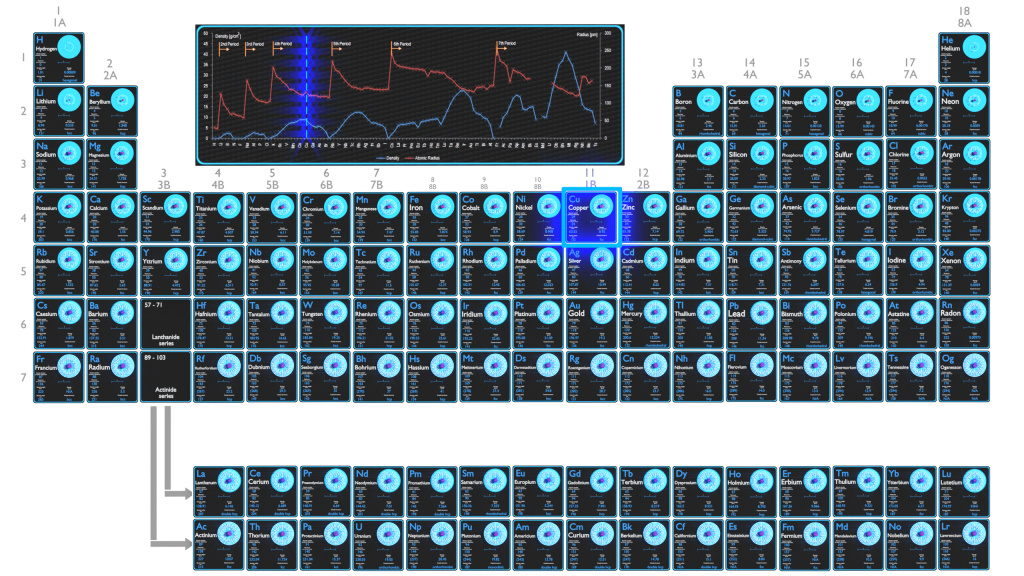
Copper-periodic-table

Source: www.luciteria.com


Properties of other elements

Copper - Comparison of Atomic Properties

Periodic Table in 8K resolution

Other properties of Copper


Zinc – Periodic Table – Atomic Properties

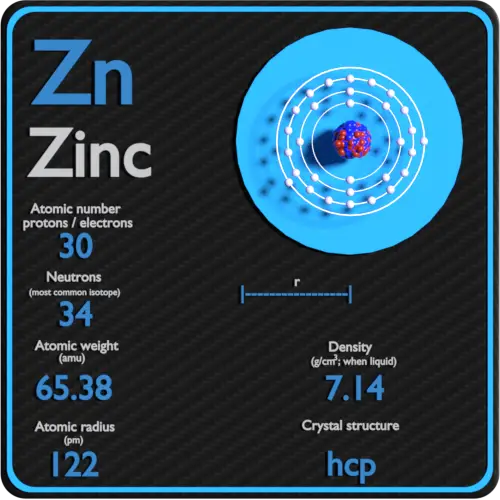
Zinc-density-atomic-number-mass-radius

In some respects zinc is chemically similar to magnesium: both elements exhibit only one normal oxidation state (+2), and the Zn2+ and Mg2+ ions are of similar size.

Summary

Element Zinc
Atomic number 30
Atomic mass [amu] 65.409
Atomic mass [pm] 122
Density at STP [g/cm3] 7.14
Number of protons 30
Number of neutrons (typical isotopes) 64; 66-68; 70
Number of electrons 30
Electron configuration [Ar] 3d10 4s2
Oxidation states +2
Electron affinity [kJ/mol] —
Electronegativity [Pauling scale] 1.65
First ionization energy [eV] 9.3941

Atomic Number – Protons, Electrons and Neutrons in Zinc

Proton Number - Atomic NumberZinc is a chemical element with atomic number 30 which means there are 30 protons in its nucleus. Total number of protons in the nucleus is called the atomic number of the atom and is given the symbol Z. The total electrical charge of the nucleus is therefore +Ze, where e (elementary charge) equals to 1,602 x 10-19 coulombs.

The total number of neutrons in the nucleus of an atom is called the neutron number of the atom and is given the symbol N. Neutron number plus atomic number equals atomic mass number: N+Z=A. The difference between the neutron number and the atomic number is known as the neutron excess: D = N – Z = A – 2Z.

For stable elements, there is usually a variety of stable isotopes. Isotopes are nuclides that have the same atomic number and are therefore the same element, but differ in the number of neutrons. Mass numbers of typical isotopes of Zinc are 64; 66-68; 70.

Atomic Mass of Zinc

Atomic mass of Zinc is 65.409 u. 

The atomic mass is the mass of an atom. The atomic mass or relative isotopic mass refers to the mass of a single particle, and therefore is tied to a certain specific isotope of an element. The atomic mass is carried by the atomic nucleus, which occupies only about 10-12 of the total volume of the atom or less, but it contains all the positive charge and at least 99.95% of the total mass of the atom. Note that, each element may contain more isotopes, therefore this resulting atomic mass is calculated from naturally-occuring isotopes and their abundance.

Atomic Radius of Zinc

The atomic radius of Zinc atom is 122pm (covalent radius).

Atomic Radius of Chemical Elements

It must be noted, atoms lack a well-defined outer boundary. The atomic radius of a chemical element is a measure of the distance out to which the electron cloud extends from the nucleus. However, this assumes the atom to exhibit a spherical shape, which is only obeyed for atoms in vacuum or free space. Therefore, there are various non-equivalent definitions of atomic radius.

Electrons and Electron Configuration

The number of electrons in an electrically-neutral atom is the same as the number of protons in the nucleus. Therefore, the number of electrons in neutral atom of Zinc is 30. Each electron is influenced by the electric fields produced by the positive nuclear charge and the other (Z – 1) negative electrons in the atom.

Since the number of electrons and their arrangement are responsible for the chemical behavior of atoms, the atomic number identifies the various chemical elements. The configuration of these electrons follows from the principles of quantum mechanics. The number of electrons in each element’s electron shells, particularly the outermost valence shell, is the primary factor in determining its chemical bonding behavior. In the periodic table, the elements are listed in order of increasing atomic number Z.

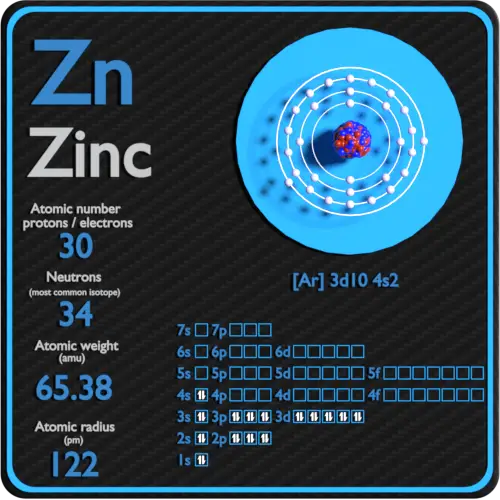
Electron configuration of Zinc is [Ar] 3d10 4s2.

Possible oxidation states are +2.

Density of Zinc

Density of Zinc is 7.14g/cm3.

Typical densities of various substances are at atmospheric pressure.

Density is defined as the mass per unit volume. It is an intensive property, which is mathematically defined as mass divided by volume:

ρ = m/V

Atomic Masses of Elements

Periodic Table of Elements - atomic mass

Atomic Radii of Elements

Periodic Table of Elements - atomic radius

Densities of Elements

Periodic Table of Elements - density

Zinc-protons-neutrons-electrons-configuration

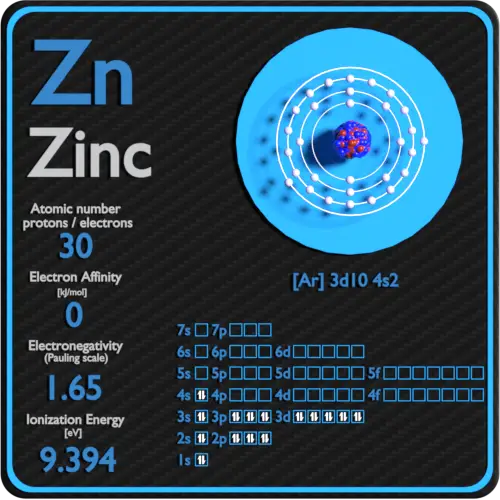
Zinc-affinity-electronegativity-ionization

Electron Affinity – Zinc

Electron affinity of Zinc is — kJ/mol.

In chemistry and atomic physics, the electron affinity of an atom or molecule is defined as:

the change in energy (in kJ/mole) of a neutral atom or molecule (in the gaseous phase) when an electron is added to the atom to form a negative ion.

X + e– → X– + energy        Affinity = – ∆H

In other words, it can be expressed as the neutral atom’s likelihood of gaining an electron. Note that, ionization energies measure the tendency of a neutral atom to resist the loss of electrons. Electron affinities are more difficult to measure than ionization energies.

Electronegativity of Zinc

Electronegativity of Zinc is 1.65.

Electronegativity, symbol χ, is a chemical property that describes the tendency of an atom to attract electrons towards this atom. For this purposes, a dimensionless quantity the Pauling scale, symbol χ, is the most commonly used.

The electronegativity of Zinc is: χ = 1.65

First Ionization Energy of Zinc

First Ionization Energy of Zinc is 9.3941 eV.

Ionization energy, also called ionization potential, is the energy necessary to remove an electron from the neutral atom.

X + energy → X+ + e−

where X is any atom or molecule capable of being ionized, X+ is that atom or molecule with an electron removed (positive ion), and e− is the removed electron.

A Zinc atom, for example, requires the following ionization energy to remove the outermost electron.

Zn + IE → Zn+ + e−        IE = 9.3941 eV

Electronegativity of Elements

Periodic Table of Elements - electronegativity

Ionization Energy of Elements

Periodic Table of Elements - ionization energy

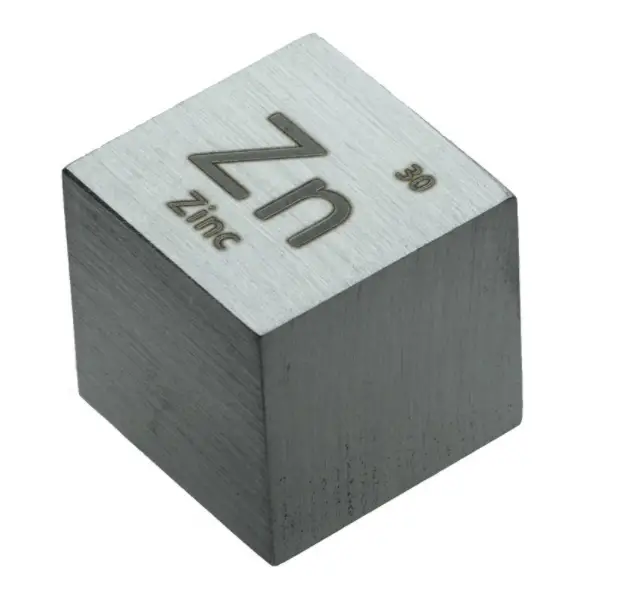
Zinc-periodic-table

Source: www.luciteria.com


Properties of other elements

Zinc - Comparison of Atomic Properties

Periodic Table in 8K resolution

Other properties of Zinc


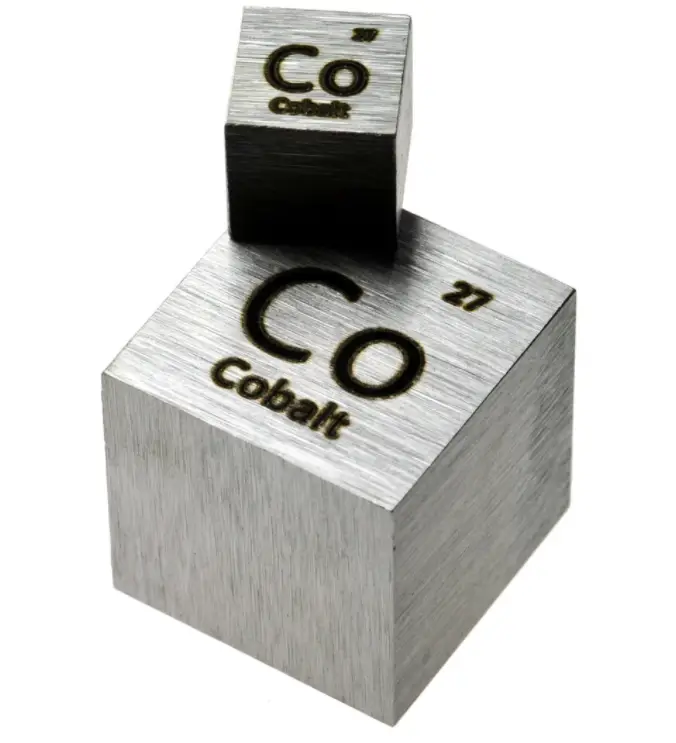
Cobalt – Periodic Table – Atomic Properties

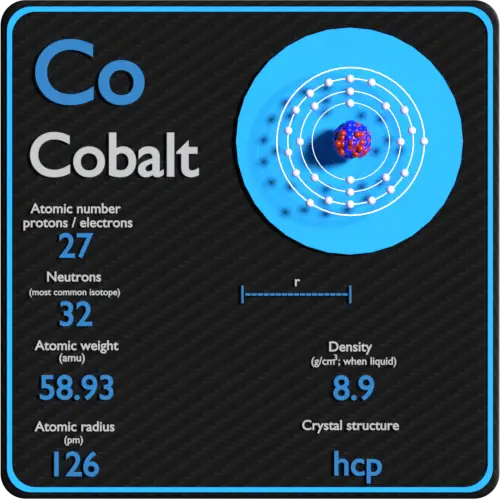
Cobalt-density-atomic-number-mass-radius

Cobalt is found in the Earth’s crust only in chemically combined form, save for small deposits found in alloys of natural meteoric iron. The free element, produced by reductive smelting, is a hard, lustrous, silver-gray metal.

Summary

Element Cobalt
Atomic number 27
Atomic mass [amu] 58.9332
Atomic mass [pm] 126
Density at STP [g/cm3] 8.9
Number of protons 27
Number of neutrons (typical isotopes) 59
Number of electrons 27
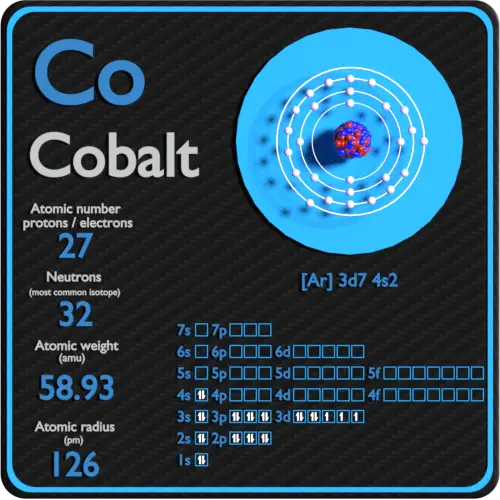
Electron configuration [Ar] 3d7 4s2
Oxidation states +2,3
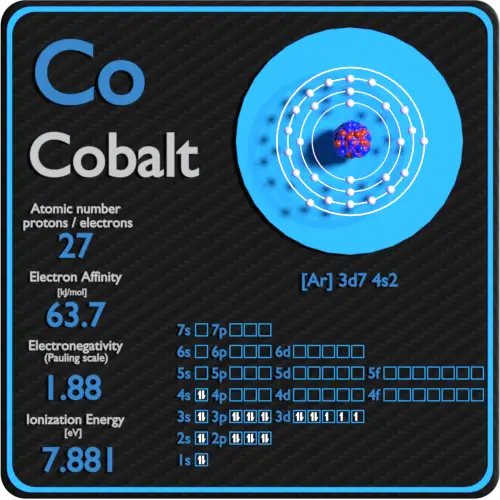
Electron affinity [kJ/mol] 63.7
Electronegativity [Pauling scale] 1.88
First ionization energy [eV] 7.881

Atomic Number – Protons, Electrons and Neutrons in Cobalt

Proton Number - Atomic NumberCobalt is a chemical element with atomic number 27 which means there are 27 protons in its nucleus. Total number of protons in the nucleus is called the atomic number of the atom and is given the symbol Z. The total electrical charge of the nucleus is therefore +Ze, where e (elementary charge) equals to 1,602 x 10-19 coulombs.

The total number of neutrons in the nucleus of an atom is called the neutron number of the atom and is given the symbol N. Neutron number plus atomic number equals atomic mass number: N+Z=A. The difference between the neutron number and the atomic number is known as the neutron excess: D = N – Z = A – 2Z.

For stable elements, there is usually a variety of stable isotopes. Isotopes are nuclides that have the same atomic number and are therefore the same element, but differ in the number of neutrons. Mass numbers of typical isotopes of Cobalt are 59.

Atomic Mass of Cobalt

Atomic mass of Cobalt is 58.9332 u. 

The atomic mass is the mass of an atom. The atomic mass or relative isotopic mass refers to the mass of a single particle, and therefore is tied to a certain specific isotope of an element. The atomic mass is carried by the atomic nucleus, which occupies only about 10-12 of the total volume of the atom or less, but it contains all the positive charge and at least 99.95% of the total mass of the atom. Note that, each element may contain more isotopes, therefore this resulting atomic mass is calculated from naturally-occuring isotopes and their abundance.

Atomic Radius of Cobalt

The atomic radius of Cobalt atom is 126pm (covalent radius).

Atomic Radius of Chemical Elements

It must be noted, atoms lack a well-defined outer boundary. The atomic radius of a chemical element is a measure of the distance out to which the electron cloud extends from the nucleus. However, this assumes the atom to exhibit a spherical shape, which is only obeyed for atoms in vacuum or free space. Therefore, there are various non-equivalent definitions of atomic radius.

Electrons and Electron Configuration

The number of electrons in an electrically-neutral atom is the same as the number of protons in the nucleus. Therefore, the number of electrons in neutral atom of Cobalt is 27. Each electron is influenced by the electric fields produced by the positive nuclear charge and the other (Z – 1) negative electrons in the atom.

Since the number of electrons and their arrangement are responsible for the chemical behavior of atoms, the atomic number identifies the various chemical elements. The configuration of these electrons follows from the principles of quantum mechanics. The number of electrons in each element’s electron shells, particularly the outermost valence shell, is the primary factor in determining its chemical bonding behavior. In the periodic table, the elements are listed in order of increasing atomic number Z.

Electron configuration of Cobalt is [Ar] 3d7 4s2.

Possible oxidation states are +2,3.

Density of Cobalt

Density of Cobalt is 8.9g/cm3.

Typical densities of various substances are at atmospheric pressure.

Density is defined as the mass per unit volume. It is an intensive property, which is mathematically defined as mass divided by volume:

ρ = m/V

Atomic Masses of Elements

Periodic Table of Elements - atomic mass

Atomic Radii of Elements

Periodic Table of Elements - atomic radius

Densities of Elements

Periodic Table of Elements - density

Cobalt-protons-neutrons-electrons-configuration

Cobalt-affinity-electronegativity-ionization

Electron Affinity – Cobalt

Electron affinity of Cobalt is 63.7 kJ/mol.

In chemistry and atomic physics, the electron affinity of an atom or molecule is defined as:

the change in energy (in kJ/mole) of a neutral atom or molecule (in the gaseous phase) when an electron is added to the atom to form a negative ion.

X + e– → X– + energy        Affinity = – ∆H

In other words, it can be expressed as the neutral atom’s likelihood of gaining an electron. Note that, ionization energies measure the tendency of a neutral atom to resist the loss of electrons. Electron affinities are more difficult to measure than ionization energies.

Electronegativity of Cobalt

Electronegativity of Cobalt is 1.88.

Electronegativity, symbol χ, is a chemical property that describes the tendency of an atom to attract electrons towards this atom. For this purposes, a dimensionless quantity the Pauling scale, symbol χ, is the most commonly used.

The electronegativity of Cobalt is: χ = 1.88

First Ionization Energy of Cobalt

First Ionization Energy of Cobalt is 7.881 eV.

Ionization energy, also called ionization potential, is the energy necessary to remove an electron from the neutral atom.

X + energy → X+ + e−

where X is any atom or molecule capable of being ionized, X+ is that atom or molecule with an electron removed (positive ion), and e− is the removed electron.

A Cobalt atom, for example, requires the following ionization energy to remove the outermost electron.

Co + IE → Co+ + e−        IE = 7.881 eV

Electronegativity of Elements

Periodic Table of Elements - electronegativity

Ionization Energy of Elements

Periodic Table of Elements - ionization energy

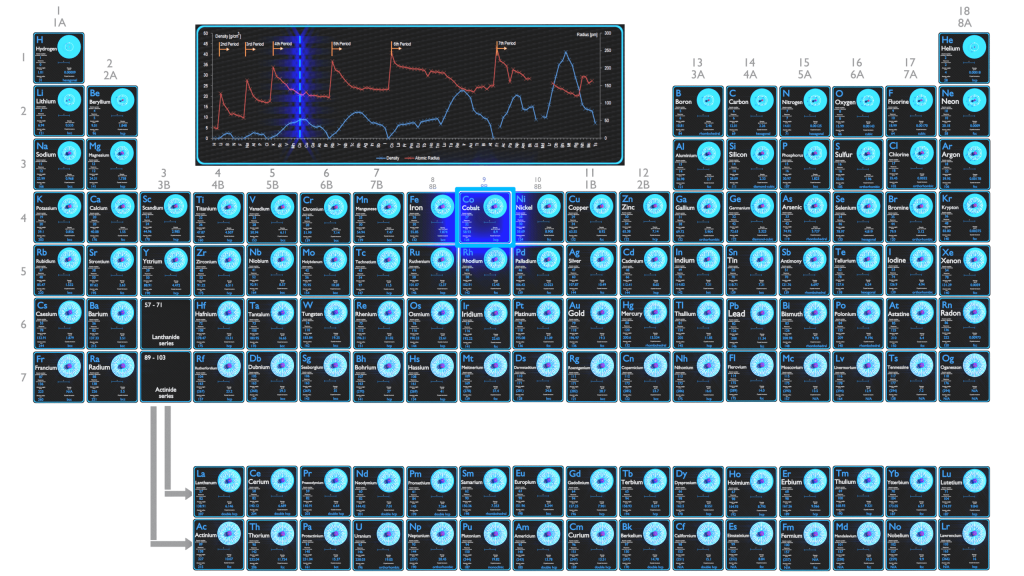
Cobalt-periodic-table

Source: www.luciteria.com


Properties of other elements

Cobalt - Comparison of Atomic Properties

Periodic Table in 8K resolution

Other properties of Cobalt


Nickel – Periodic Table – Atomic Properties

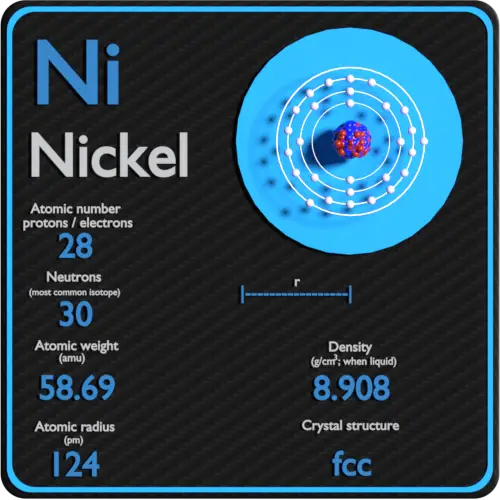
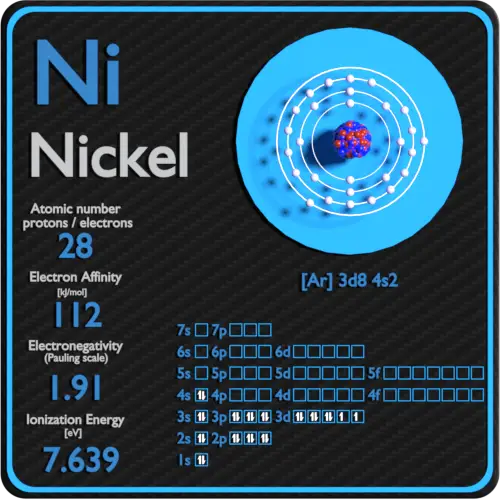
Nickel-density-atomic-number-mass-radius

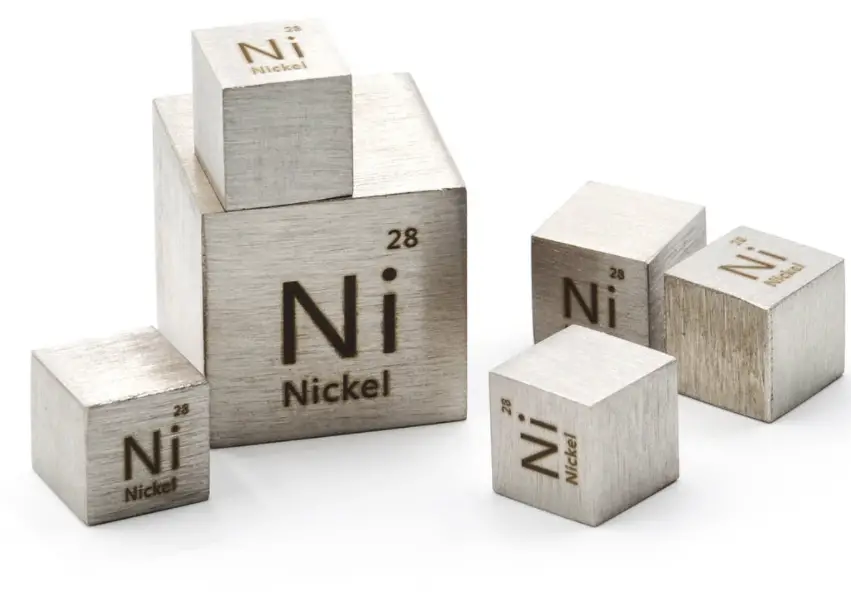
Nickel is a silvery-white lustrous metal with a slight golden tinge. Nickel belongs to the transition metals and is hard and ductile.

Summary

Element Nickel
Atomic number 28
Atomic mass [amu] 58.6934
Atomic mass [pm] 124
Density at STP [g/cm3] 8.908
Number of protons 28
Number of neutrons (typical isotopes) 60; 61; 62; 64
Number of electrons 28
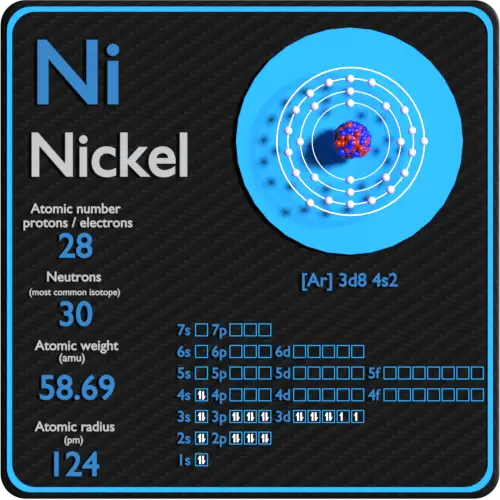
Electron configuration [Ar] 3d8 4s2
Oxidation states +2,3
Electron affinity [kJ/mol] 112
Electronegativity [Pauling scale] 1.91
First ionization energy [eV] 7.6398

Atomic Number – Protons, Electrons and Neutrons in Nickel

Proton Number - Atomic NumberNickel is a chemical element with atomic number 28 which means there are 28 protons in its nucleus. Total number of protons in the nucleus is called the atomic number of the atom and is given the symbol Z. The total electrical charge of the nucleus is therefore +Ze, where e (elementary charge) equals to 1,602 x 10-19 coulombs.

The total number of neutrons in the nucleus of an atom is called the neutron number of the atom and is given the symbol N. Neutron number plus atomic number equals atomic mass number: N+Z=A. The difference between the neutron number and the atomic number is known as the neutron excess: D = N – Z = A – 2Z.

For stable elements, there is usually a variety of stable isotopes. Isotopes are nuclides that have the same atomic number and are therefore the same element, but differ in the number of neutrons. Mass numbers of typical isotopes of Nickel are 60; 61; 62; 64.

Atomic Mass of Nickel

Atomic mass of Nickel is 58.6934 u. 

The atomic mass is the mass of an atom. The atomic mass or relative isotopic mass refers to the mass of a single particle, and therefore is tied to a certain specific isotope of an element. The atomic mass is carried by the atomic nucleus, which occupies only about 10-12 of the total volume of the atom or less, but it contains all the positive charge and at least 99.95% of the total mass of the atom. Note that, each element may contain more isotopes, therefore this resulting atomic mass is calculated from naturally-occuring isotopes and their abundance.

Atomic Radius of Nickel

The atomic radius of Nickel atom is 124pm (covalent radius).

Atomic Radius of Chemical Elements

It must be noted, atoms lack a well-defined outer boundary. The atomic radius of a chemical element is a measure of the distance out to which the electron cloud extends from the nucleus. However, this assumes the atom to exhibit a spherical shape, which is only obeyed for atoms in vacuum or free space. Therefore, there are various non-equivalent definitions of atomic radius.

Electrons and Electron Configuration

The number of electrons in an electrically-neutral atom is the same as the number of protons in the nucleus. Therefore, the number of electrons in neutral atom of Nickel is 28. Each electron is influenced by the electric fields produced by the positive nuclear charge and the other (Z – 1) negative electrons in the atom.

Since the number of electrons and their arrangement are responsible for the chemical behavior of atoms, the atomic number identifies the various chemical elements. The configuration of these electrons follows from the principles of quantum mechanics. The number of electrons in each element’s electron shells, particularly the outermost valence shell, is the primary factor in determining its chemical bonding behavior. In the periodic table, the elements are listed in order of increasing atomic number Z.

Electron configuration of Nickel is [Ar] 3d8 4s2.

Possible oxidation states are +2,3.

Density of Nickel

Density of Nickel is 8.908g/cm3.

Typical densities of various substances are at atmospheric pressure.

Density is defined as the mass per unit volume. It is an intensive property, which is mathematically defined as mass divided by volume:

ρ = m/V

Atomic Masses of Elements

Periodic Table of Elements - atomic mass

Atomic Radii of Elements

Periodic Table of Elements - atomic radius

Densities of Elements

Periodic Table of Elements - density

Nickel-protons-neutrons-electrons-configuration

Nickel-affinity-electronegativity-ionization

Electron Affinity – Nickel

Electron affinity of Nickel is 112 kJ/mol.

In chemistry and atomic physics, the electron affinity of an atom or molecule is defined as:

the change in energy (in kJ/mole) of a neutral atom or molecule (in the gaseous phase) when an electron is added to the atom to form a negative ion.

X + e– → X– + energy        Affinity = – ∆H

In other words, it can be expressed as the neutral atom’s likelihood of gaining an electron. Note that, ionization energies measure the tendency of a neutral atom to resist the loss of electrons. Electron affinities are more difficult to measure than ionization energies.

Electronegativity of Nickel

Electronegativity of Nickel is 1.91.

Electronegativity, symbol χ, is a chemical property that describes the tendency of an atom to attract electrons towards this atom. For this purposes, a dimensionless quantity the Pauling scale, symbol χ, is the most commonly used.

The electronegativity of Nickel is: χ = 1.91

First Ionization Energy of Nickel

First Ionization Energy of Nickel is 7.6398 eV.

Ionization energy, also called ionization potential, is the energy necessary to remove an electron from the neutral atom.

X + energy → X+ + e−

where X is any atom or molecule capable of being ionized, X+ is that atom or molecule with an electron removed (positive ion), and e− is the removed electron.

A Nickel atom, for example, requires the following ionization energy to remove the outermost electron.

Ni + IE → Ni+ + e−        IE = 7.6398 eV

Electronegativity of Elements

Periodic Table of Elements - electronegativity

Ionization Energy of Elements

Periodic Table of Elements - ionization energy

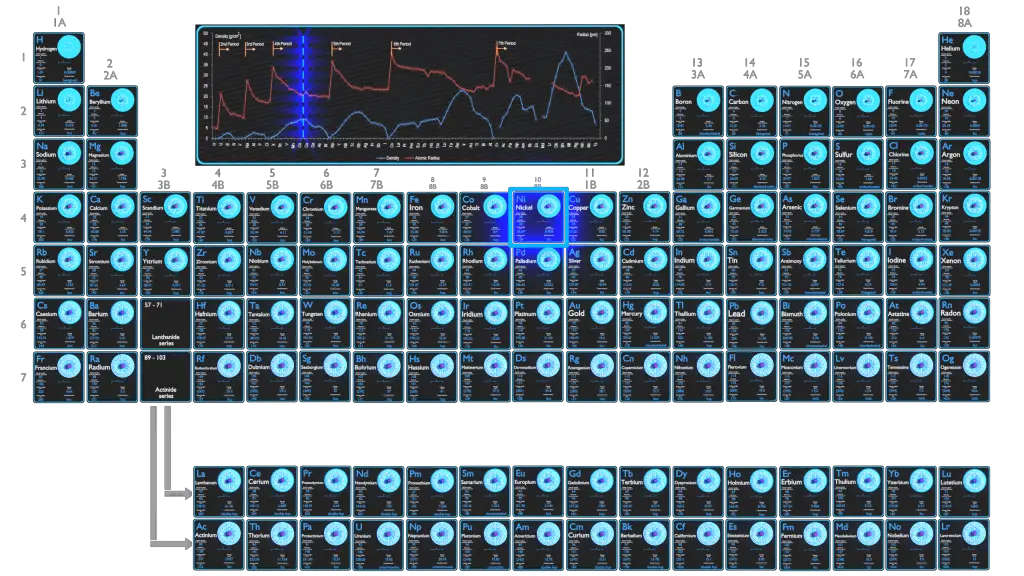
Nickel-periodic-table

Source: www.luciteria.com


Properties of other elements

Nickel - Comparison of Atomic Properties

Periodic Table in 8K resolution

Other properties of Nickel


Manganese – Periodic Table – Atomic Properties

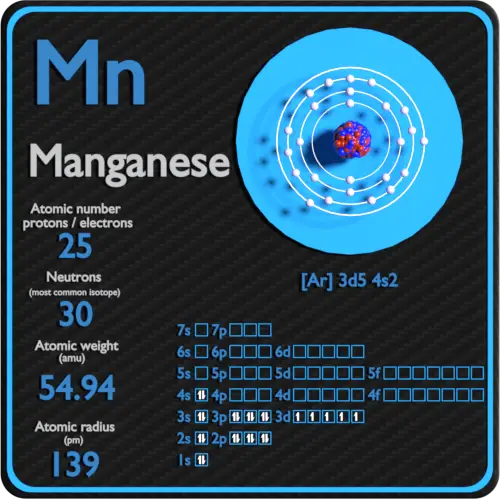
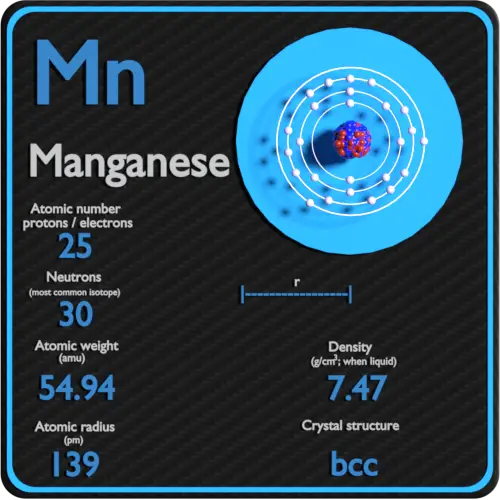
Manganese-density-atomic-number-mass-radius

Manganese is a metal with important industrial metal alloy uses, particularly in stainless steels.

Summary

Element Manganese
Atomic number 25
Atomic mass [amu] 54.938049
Atomic mass [pm] 139
Density at STP [g/cm3] 7.47
Number of protons 25
Number of neutrons (typical isotopes) 55
Number of electrons 25
Electron configuration [Ar] 3d5 4s2
Oxidation states +2,3,4,7
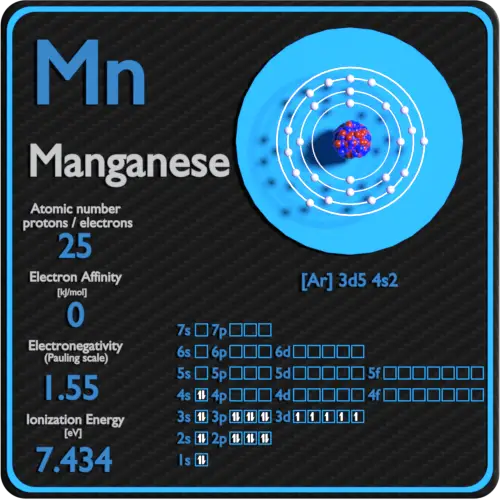
Electron affinity [kJ/mol] —
Electronegativity [Pauling scale] 1.55
First ionization energy [eV] 7.434

Atomic Number – Protons, Electrons and Neutrons in Manganese

Proton Number - Atomic NumberManganese is a chemical element with atomic number 25 which means there are 25 protons in its nucleus. Total number of protons in the nucleus is called the atomic number of the atom and is given the symbol Z. The total electrical charge of the nucleus is therefore +Ze, where e (elementary charge) equals to 1,602 x 10-19 coulombs.

The total number of neutrons in the nucleus of an atom is called the neutron number of the atom and is given the symbol N. Neutron number plus atomic number equals atomic mass number: N+Z=A. The difference between the neutron number and the atomic number is known as the neutron excess: D = N – Z = A – 2Z.

For stable elements, there is usually a variety of stable isotopes. Isotopes are nuclides that have the same atomic number and are therefore the same element, but differ in the number of neutrons. Mass numbers of typical isotopes of Manganese are 55.

Atomic Mass of Manganese

Atomic mass of Manganese is 54.938049 u. 

The atomic mass is the mass of an atom. The atomic mass or relative isotopic mass refers to the mass of a single particle, and therefore is tied to a certain specific isotope of an element. The atomic mass is carried by the atomic nucleus, which occupies only about 10-12 of the total volume of the atom or less, but it contains all the positive charge and at least 99.95% of the total mass of the atom. Note that, each element may contain more isotopes, therefore this resulting atomic mass is calculated from naturally-occuring isotopes and their abundance.

Atomic Radius of Manganese

The atomic radius of Manganese atom is 139pm (covalent radius).

Atomic Radius of Chemical Elements

It must be noted, atoms lack a well-defined outer boundary. The atomic radius of a chemical element is a measure of the distance out to which the electron cloud extends from the nucleus. However, this assumes the atom to exhibit a spherical shape, which is only obeyed for atoms in vacuum or free space. Therefore, there are various non-equivalent definitions of atomic radius.

Electrons and Electron Configuration

The number of electrons in an electrically-neutral atom is the same as the number of protons in the nucleus. Therefore, the number of electrons in neutral atom of Manganese is 25. Each electron is influenced by the electric fields produced by the positive nuclear charge and the other (Z – 1) negative electrons in the atom.

Since the number of electrons and their arrangement are responsible for the chemical behavior of atoms, the atomic number identifies the various chemical elements. The configuration of these electrons follows from the principles of quantum mechanics. The number of electrons in each element’s electron shells, particularly the outermost valence shell, is the primary factor in determining its chemical bonding behavior. In the periodic table, the elements are listed in order of increasing atomic number Z.

Electron configuration of Manganese is [Ar] 3d5 4s2.

Possible oxidation states are +2,3,4,7.

Density of Manganese

Density of Manganese is 7.47g/cm3.

Typical densities of various substances are at atmospheric pressure.

Density is defined as the mass per unit volume. It is an intensive property, which is mathematically defined as mass divided by volume:

ρ = m/V

Atomic Masses of Elements

Periodic Table of Elements - atomic mass

Atomic Radii of Elements

Periodic Table of Elements - atomic radius

Densities of Elements

Periodic Table of Elements - density

Manganese-protons-neutrons-electrons-configuration

Manganese-affinity-electronegativity-ionization

Electron Affinity – Manganese

Electron affinity of Manganese is — kJ/mol.

In chemistry and atomic physics, the electron affinity of an atom or molecule is defined as:

the change in energy (in kJ/mole) of a neutral atom or molecule (in the gaseous phase) when an electron is added to the atom to form a negative ion.

X + e– → X– + energy        Affinity = – ∆H

In other words, it can be expressed as the neutral atom’s likelihood of gaining an electron. Note that, ionization energies measure the tendency of a neutral atom to resist the loss of electrons. Electron affinities are more difficult to measure than ionization energies.

Electronegativity of Manganese

Electronegativity of Manganese is 1.55.

Electronegativity, symbol χ, is a chemical property that describes the tendency of an atom to attract electrons towards this atom. For this purposes, a dimensionless quantity the Pauling scale, symbol χ, is the most commonly used.

The electronegativity of Manganese is: χ = 1.55

First Ionization Energy of Manganese

First Ionization Energy of Manganese is 7.434 eV.

Ionization energy, also called ionization potential, is the energy necessary to remove an electron from the neutral atom.

X + energy → X+ + e−

where X is any atom or molecule capable of being ionized, X+ is that atom or molecule with an electron removed (positive ion), and e− is the removed electron.

A Manganese atom, for example, requires the following ionization energy to remove the outermost electron.

Mn + IE → Mn+ + e−        IE = 7.434 eV

Electronegativity of Elements

Periodic Table of Elements - electronegativity

Ionization Energy of Elements

Periodic Table of Elements - ionization energy

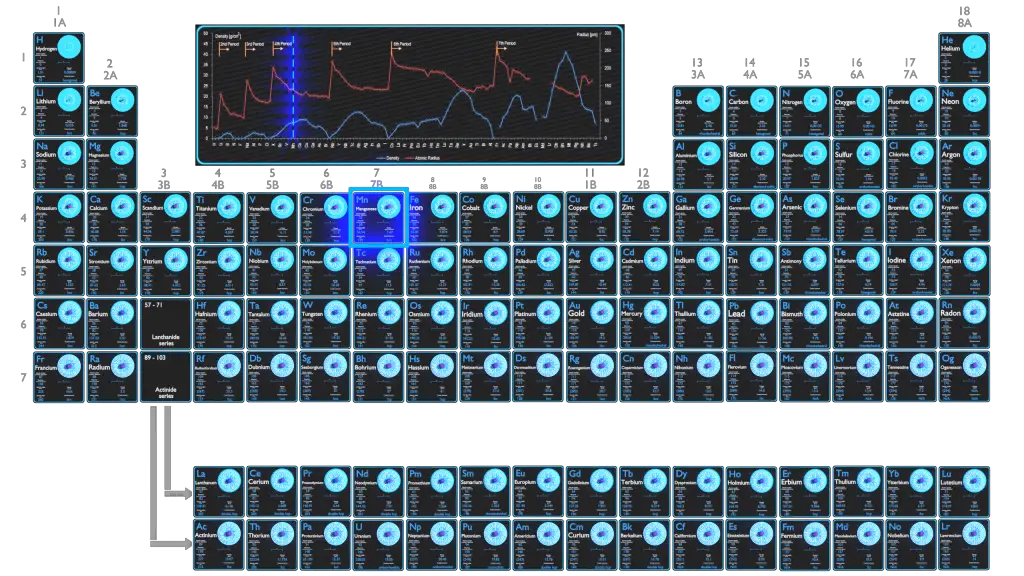
Manganese-periodic-table

Source: www.luciteria.com


Properties of other elements

Manganese - Comparison of Atomic Properties

Periodic Table in 8K resolution

Other properties of Manganese


Iron – Periodic Table – Atomic Properties

Iron-density-atomic-number-mass-radius

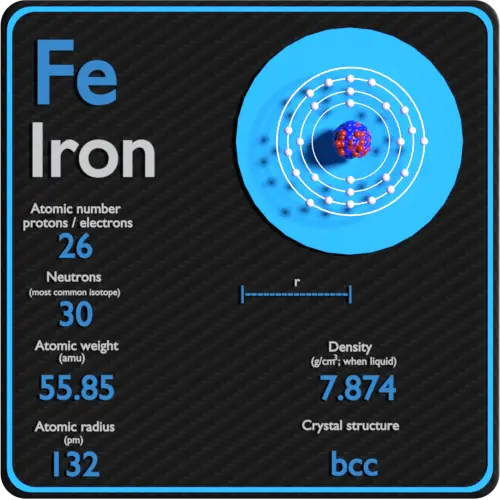
Iron is a metal in the first transition series. It is by mass the most common element on Earth, forming much of Earth’s outer and inner core. It is the fourth most common element in the Earth’s crust. Its abundance in rocky planets like Earth is due to its abundant production by fusion in high-mass stars.

Summary

Element Iron
Atomic number 26
Atomic mass [amu] 55.845
Atomic mass [pm] 132
Density at STP [g/cm3] 7.874
Number of protons 26
Number of neutrons (typical isotopes) 56; 57; 58
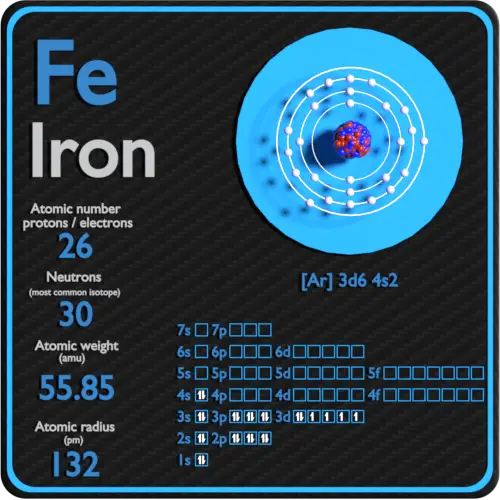
Number of electrons 26
Electron configuration [Ar] 3d6 4s2
Oxidation states +2,3
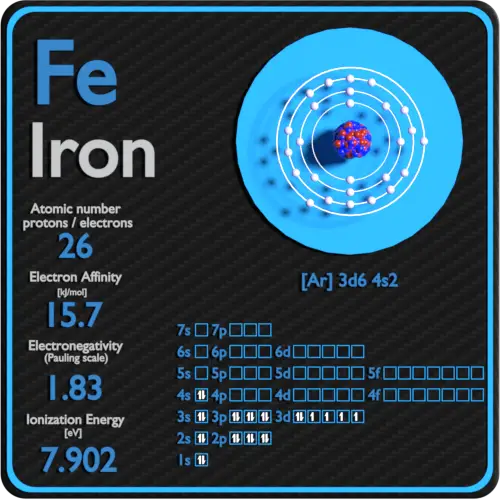
Electron affinity [kJ/mol] 15.7
Electronegativity [Pauling scale] 1.83
First ionization energy [eV] 7.9024

Atomic Number – Protons, Electrons and Neutrons in Iron

Proton Number - Atomic NumberIron is a chemical element with atomic number 26 which means there are 26 protons in its nucleus. Total number of protons in the nucleus is called the atomic number of the atom and is given the symbol Z. The total electrical charge of the nucleus is therefore +Ze, where e (elementary charge) equals to 1,602 x 10-19 coulombs.

The total number of neutrons in the nucleus of an atom is called the neutron number of the atom and is given the symbol N. Neutron number plus atomic number equals atomic mass number: N+Z=A. The difference between the neutron number and the atomic number is known as the neutron excess: D = N – Z = A – 2Z.

For stable elements, there is usually a variety of stable isotopes. Isotopes are nuclides that have the same atomic number and are therefore the same element, but differ in the number of neutrons. Mass numbers of typical isotopes of Iron are 56; 57; 58.

Atomic Mass of Iron

Atomic mass of Iron is 55.845 u. 

The atomic mass is the mass of an atom. The atomic mass or relative isotopic mass refers to the mass of a single particle, and therefore is tied to a certain specific isotope of an element. The atomic mass is carried by the atomic nucleus, which occupies only about 10-12 of the total volume of the atom or less, but it contains all the positive charge and at least 99.95% of the total mass of the atom. Note that, each element may contain more isotopes, therefore this resulting atomic mass is calculated from naturally-occuring isotopes and their abundance.

Atomic Radius of Iron

The atomic radius of Iron atom is 132pm (covalent radius).

Atomic Radius of Chemical Elements

It must be noted, atoms lack a well-defined outer boundary. The atomic radius of a chemical element is a measure of the distance out to which the electron cloud extends from the nucleus. However, this assumes the atom to exhibit a spherical shape, which is only obeyed for atoms in vacuum or free space. Therefore, there are various non-equivalent definitions of atomic radius.

Electrons and Electron Configuration

The number of electrons in an electrically-neutral atom is the same as the number of protons in the nucleus. Therefore, the number of electrons in neutral atom of Iron is 26. Each electron is influenced by the electric fields produced by the positive nuclear charge and the other (Z – 1) negative electrons in the atom.

Since the number of electrons and their arrangement are responsible for the chemical behavior of atoms, the atomic number identifies the various chemical elements. The configuration of these electrons follows from the principles of quantum mechanics. The number of electrons in each element’s electron shells, particularly the outermost valence shell, is the primary factor in determining its chemical bonding behavior. In the periodic table, the elements are listed in order of increasing atomic number Z.

Electron configuration of Iron is [Ar] 3d6 4s2.

Possible oxidation states are +2,3.

Density of Iron

Density of Iron is 7.874g/cm3.

Typical densities of various substances are at atmospheric pressure.

Density is defined as the mass per unit volume. It is an intensive property, which is mathematically defined as mass divided by volume:

ρ = m/V

Atomic Masses of Elements

Periodic Table of Elements - atomic mass

Atomic Radii of Elements

Periodic Table of Elements - atomic radius

Densities of Elements

Periodic Table of Elements - density

Iron-protons-neutrons-electrons-configuration

Iron-affinity-electronegativity-ionization

Electron Affinity – Iron

Electron affinity of Iron is 15.7 kJ/mol.

In chemistry and atomic physics, the electron affinity of an atom or molecule is defined as:

the change in energy (in kJ/mole) of a neutral atom or molecule (in the gaseous phase) when an electron is added to the atom to form a negative ion.

X + e– → X– + energy        Affinity = – ∆H

In other words, it can be expressed as the neutral atom’s likelihood of gaining an electron. Note that, ionization energies measure the tendency of a neutral atom to resist the loss of electrons. Electron affinities are more difficult to measure than ionization energies.

Electronegativity of Iron

Electronegativity of Iron is 1.83.

Electronegativity, symbol χ, is a chemical property that describes the tendency of an atom to attract electrons towards this atom. For this purposes, a dimensionless quantity the Pauling scale, symbol χ, is the most commonly used.

The electronegativity of Iron is: χ = 1.83

First Ionization Energy of Iron

First Ionization Energy of Iron is 7.9024 eV.

Ionization energy, also called ionization potential, is the energy necessary to remove an electron from the neutral atom.

X + energy → X+ + e−

where X is any atom or molecule capable of being ionized, X+ is that atom or molecule with an electron removed (positive ion), and e− is the removed electron.

A Iron atom, for example, requires the following ionization energy to remove the outermost electron.

Fe + IE → Fe+ + e−        IE = 7.9024 eV

Electronegativity of Elements

Periodic Table of Elements - electronegativity

Ionization Energy of Elements

Periodic Table of Elements - ionization energy

Iron-periodic-table

Source: www.luciteria.com


Properties of other elements

Iron - Comparison of Atomic Properties

Periodic Table in 8K resolution

Other properties of Iron


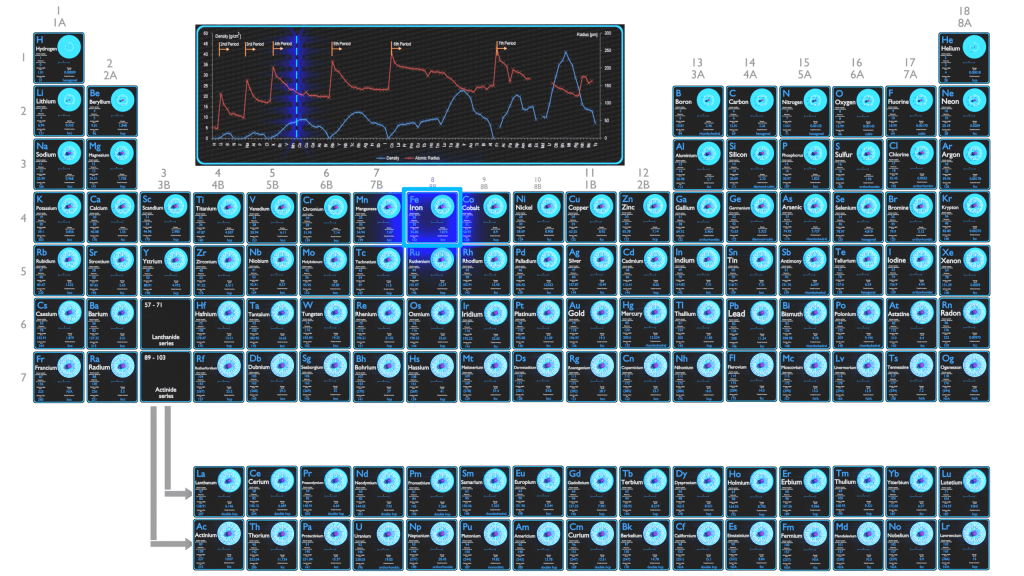
Vanadium – Periodic Table – Atomic Properties

Vanadium-density-atomic-number-mass-radius

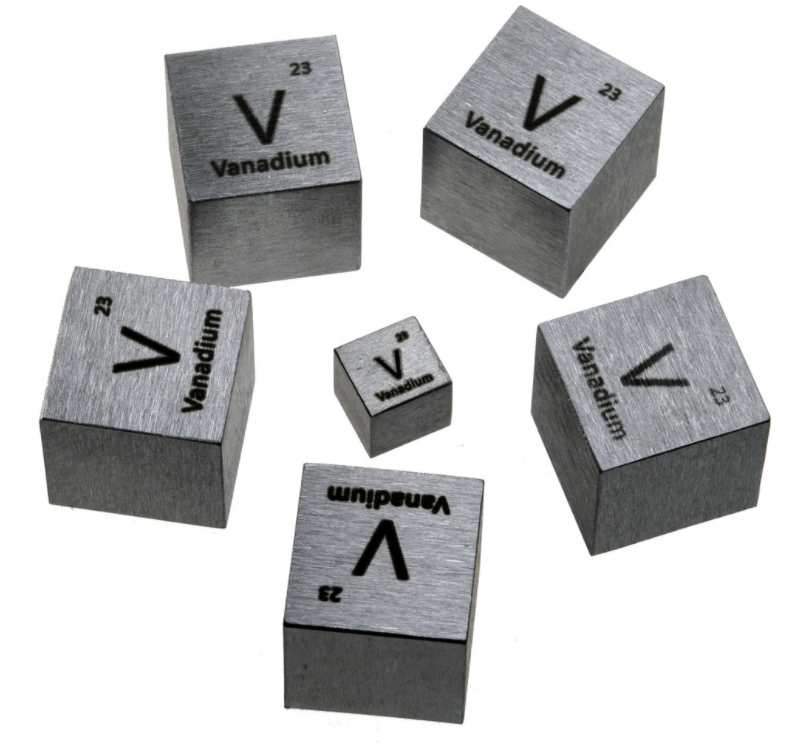
Vanadium is a hard, silvery grey, ductile, and malleable transition metal. The elemental metal is rarely found in nature, but once isolated artificially, the formation of an oxide layer (passivation) stabilizes the free metal somewhat against further oxidation.

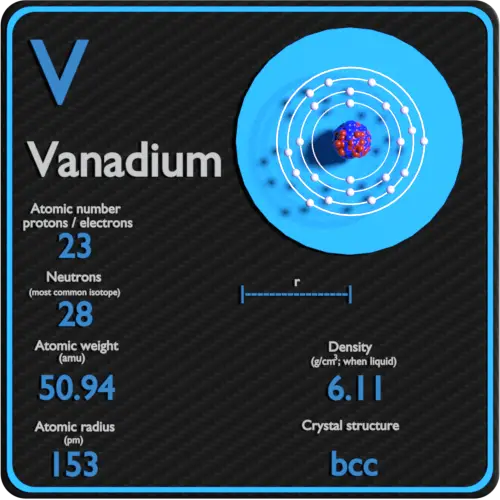
Summary

Element Vanadium
Atomic number 23
Atomic mass [amu] 50.9415
Atomic mass [pm] 153
Density at STP [g/cm3] 6.11
Number of protons 23
Number of neutrons (typical isotopes) 51
Number of electrons 23
Electron configuration [Ar] 3d3 4s2
Oxidation states +2,3,4,5
Electron affinity [kJ/mol] 50.6
Electronegativity [Pauling scale] 1.63
First ionization energy [eV] 6.7463

Atomic Number – Protons, Electrons and Neutrons in Vanadium

Proton Number - Atomic NumberVanadium is a chemical element with atomic number 23 which means there are 23 protons in its nucleus. Total number of protons in the nucleus is called the atomic number of the atom and is given the symbol Z. The total electrical charge of the nucleus is therefore +Ze, where e (elementary charge) equals to 1,602 x 10-19 coulombs.

The total number of neutrons in the nucleus of an atom is called the neutron number of the atom and is given the symbol N. Neutron number plus atomic number equals atomic mass number: N+Z=A. The difference between the neutron number and the atomic number is known as the neutron excess: D = N – Z = A – 2Z.

For stable elements, there is usually a variety of stable isotopes. Isotopes are nuclides that have the same atomic number and are therefore the same element, but differ in the number of neutrons. Mass numbers of typical isotopes of Vanadium are 51.

Atomic Mass of Vanadium

Atomic mass of Vanadium is 50.9415 u. 

The atomic mass is the mass of an atom. The atomic mass or relative isotopic mass refers to the mass of a single particle, and therefore is tied to a certain specific isotope of an element. The atomic mass is carried by the atomic nucleus, which occupies only about 10-12 of the total volume of the atom or less, but it contains all the positive charge and at least 99.95% of the total mass of the atom. Note that, each element may contain more isotopes, therefore this resulting atomic mass is calculated from naturally-occuring isotopes and their abundance.

Atomic Radius of Vanadium

The atomic radius of Vanadium atom is 153pm (covalent radius).

Atomic Radius of Chemical Elements

It must be noted, atoms lack a well-defined outer boundary. The atomic radius of a chemical element is a measure of the distance out to which the electron cloud extends from the nucleus. However, this assumes the atom to exhibit a spherical shape, which is only obeyed for atoms in vacuum or free space. Therefore, there are various non-equivalent definitions of atomic radius.

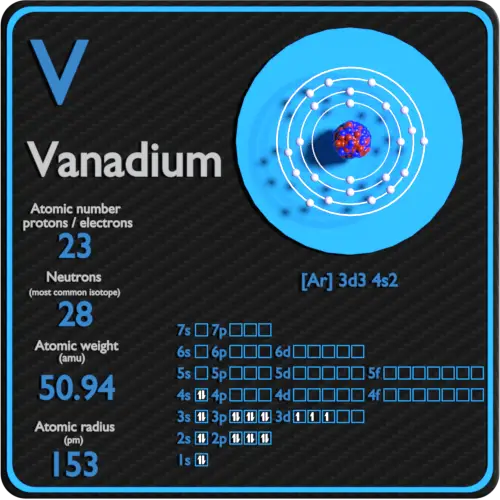
Electrons and Electron Configuration

The number of electrons in an electrically-neutral atom is the same as the number of protons in the nucleus. Therefore, the number of electrons in neutral atom of Vanadium is 23. Each electron is influenced by the electric fields produced by the positive nuclear charge and the other (Z – 1) negative electrons in the atom.

Since the number of electrons and their arrangement are responsible for the chemical behavior of atoms, the atomic number identifies the various chemical elements. The configuration of these electrons follows from the principles of quantum mechanics. The number of electrons in each element’s electron shells, particularly the outermost valence shell, is the primary factor in determining its chemical bonding behavior. In the periodic table, the elements are listed in order of increasing atomic number Z.

Electron configuration of Vanadium is [Ar] 3d3 4s2.

Possible oxidation states are +2,3,4,5.

Density of Vanadium

Density of Vanadium is 6.11g/cm3.

Typical densities of various substances are at atmospheric pressure.

Density is defined as the mass per unit volume. It is an intensive property, which is mathematically defined as mass divided by volume:

ρ = m/V

Atomic Masses of Elements

Periodic Table of Elements - atomic mass

Atomic Radii of Elements

Periodic Table of Elements - atomic radius

Densities of Elements

Periodic Table of Elements - density

Vanadium-protons-neutrons-electrons-configuration

Vanadium-affinity-electronegativity-ionization

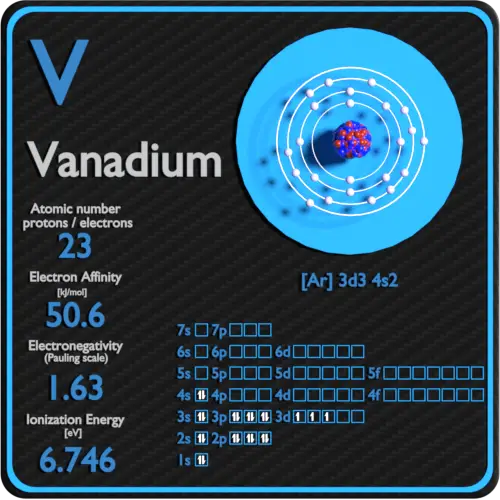
Electron Affinity – Vanadium

Electron affinity of Vanadium is 50.6 kJ/mol.

In chemistry and atomic physics, the electron affinity of an atom or molecule is defined as:

the change in energy (in kJ/mole) of a neutral atom or molecule (in the gaseous phase) when an electron is added to the atom to form a negative ion.

X + e– → X– + energy        Affinity = – ∆H

In other words, it can be expressed as the neutral atom’s likelihood of gaining an electron. Note that, ionization energies measure the tendency of a neutral atom to resist the loss of electrons. Electron affinities are more difficult to measure than ionization energies.

Electronegativity of Vanadium

Electronegativity of Vanadium is 1.63.

Electronegativity, symbol χ, is a chemical property that describes the tendency of an atom to attract electrons towards this atom. For this purposes, a dimensionless quantity the Pauling scale, symbol χ, is the most commonly used.

The electronegativity of Vanadium is: χ = 1.63

First Ionization Energy of Vanadium

First Ionization Energy of Vanadium is 6.7463 eV.

Ionization energy, also called ionization potential, is the energy necessary to remove an electron from the neutral atom.

X + energy → X+ + e−

where X is any atom or molecule capable of being ionized, X+ is that atom or molecule with an electron removed (positive ion), and e− is the removed electron.

A Vanadium atom, for example, requires the following ionization energy to remove the outermost electron.

V + IE → V+ + e−        IE = 6.7463 eV

Electronegativity of Elements

Periodic Table of Elements - electronegativity

Ionization Energy of Elements

Periodic Table of Elements - ionization energy

Vanadium-periodic-table

Source: www.luciteria.com


Properties of other elements

Vanadium - Comparison of Atomic Properties

Periodic Table in 8K resolution

Other properties of Vanadium