Facebook Instagram Youtube Twitter

Duralumin – Density – Strength – Hardness – Melting Point

About Duralumin

Aluminium alloys of 2000 series are alloyed with copper, they can be precipitation hardened to strengths comparable to steel. Formerly referred to as duralumin, they were once the most common aerospace alloys, but were susceptible to stress corrosion cracking and are increasingly replaced by 7000 series in new designs. In addition to aluminium, the main materials in duralumin are copper, manganese and magnesium.

Duralumin (also called duraluminum, duraluminium, duralum, dural(l)ium, or dural) is a strong, lightweight alloy of aluminium discovered in 1910 by Alfred Wilm, a German metallurgist. He discovered that after quenching, an aluminium alloy containing 4% copper would slowly harden when left at room temperature for several days. This process is now known as natural aging. He also designed an alloy (Duralumin) suitable for strengthening by this process in what is now known as preciptitation hardening.  Although an explanation for the phenomenon was not provided until 1919, duralumin was one of the first “age hardening” alloys used.
duralumin properties density strength price

Summary

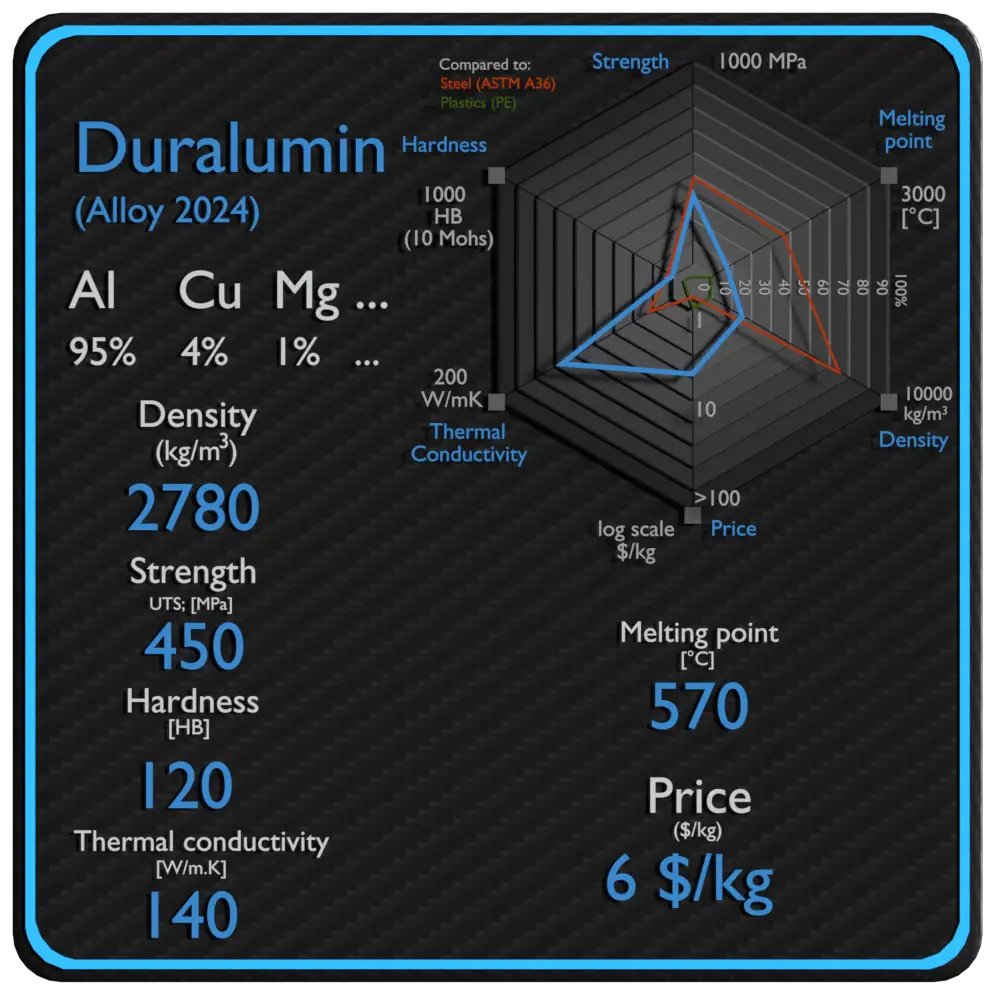
Name Duralumin
Phase at STP solid
Density 2780 kg/m3
Ultimate Tensile Strength 450 MPa
Yield Strength 300 MPa
Young’s Modulus of Elasticity 76 GPa
Brinell Hardness 120 BHN
Melting Point 570 °C
Thermal Conductivity 140 W/mK
Heat Capacity 900 J/g K
Price 6 $/kg

In terms of age hardening, solution annealed aluminium-copper alloys can be aged naturally at room temperature for four days or more to obtain maximum properties such as hardness and strength. This process is known as natural aging. At room temperature, the solubility of copper in aluminium drops to a small fraction of 1%. At this point, the copper solute is locked inside the aluminium lattice (matrix), but must “precipitate” out of the supersaturated aluminium lattice. The aging process also can be accelerated to a matter of hours after solution treatment and quenching by heating the supersaturated alloy to a specific temperature and holding at that temperature for a specified time. This process is called artificial aging.

Duralumin is relatively soft, ductile and easily workable under normal temperature. The alloy can be rolled, forged and extruded into various forms and products. The light weight and high strength of duralumin when compared to steel enabled its application in aircraft construction. Although the addition of copper improves strength, it also makes these alloys susceptible to corrosion. The electrical and heat conductivity of duralumin is less than that of pure aluminium and more than that of steel.

Density of Duralumin

Typical densities of various substances are at atmospheric pressure. Density is defined as the mass per unit volume. It is an intensive property, which is mathematically defined as mass divided by volume:  ρ = m/V

In words, the density (ρ) of a substance is the total mass (m) of that substance divided by the total volume (V) occupied by that substance. The standard SI unit is kilograms per cubic meter (kg/m3). The Standard English unit is pounds mass per cubic foot (lbm/ft3).

Density of Duralumin is 2780 kg/m3.

Example: Density

Calculate the height of a cube made of Duralumin, which weighs one metric ton.

Solution:

Density is defined as the mass per unit volume. It is mathematically defined as mass divided by volume: ρ = m/V

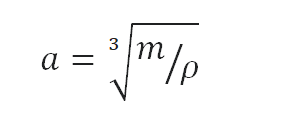
As the volume of a cube is the third power of its sides (V = a3), the height of this cube can be calculated:
density of material - equation

The height of this cube is then a = 0.711 m.

Density of Materials

Material Table - Density of Materials


Mechanical Properties of Duralumin

Strength of Duralumin

In mechanics of materials, the strength of a material is its ability to withstand an applied load without failure or plastic deformation. Strength of materials basically considers the relationship between the external loads applied to a material and the resulting deformation or change in material dimensions. Strength of a material is its ability to withstand this applied load without failure or plastic deformation.

Ultimate Tensile Strength – Duralumin

Ultimate tensile strength of 2024 aluminium alloy depends greatly on the temper of the material, but it is about 450 MPa.
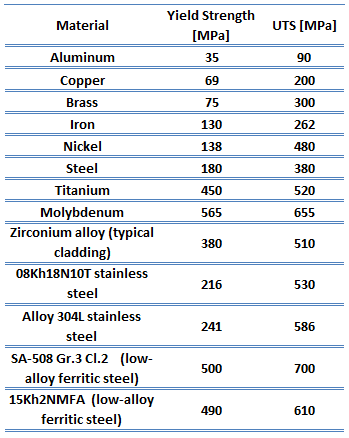
Yield Strength - Ultimate Tensile Strength - Table of MaterialsThe ultimate tensile strength is the maximum on the engineering stress-strain curve. This corresponds to the maximum stress that can be sustained by a structure in tension. Ultimate tensile strength is often shortened to “tensile strength” or even to “the ultimate.”  If this stress is applied and maintained, fracture will result. Often, this value is significantly more than the yield stress (as much as 50 to 60 percent more than the yield for some types of metals). When a ductile material reaches its ultimate strength, it experiences necking where the cross-sectional area reduces locally. The stress-strain curve contains no higher stress than the ultimate strength. Even though deformations can continue to increase, the stress usually decreases after the ultimate strength has been achieved. It is an intensive property; therefore its value does not depend on the size of the test specimen. However, it is dependent on other factors, such as the preparation of the specimen, the presence or otherwise of surface defects, and the temperature of the test environment and material. Ultimate tensile strengths vary from 50 MPa for an aluminum to as high as 3000 MPa for very high-strength steels.

Example: Strength

Assume a plastic rod, which is made of Duralumin. This plastic rod has a cross-sectional area of 1 cm2. Calculate the tensile force needed to achieve the ultimate tensile strength for this material, which is: UTS = 450 MPa.

Solution:

Stress (σ) can be equated to the load per unit area or the force (F) applied per cross-sectional area (A) perpendicular to the force as:
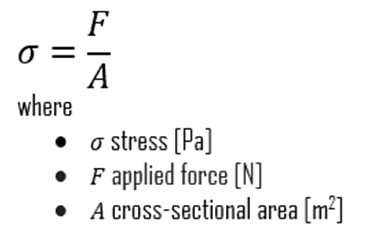
strength of material - equation

therefore, the tensile force needed to achieve the ultimate tensile strength is:

F = UTS x A = 450 x 106 x 0.0001 = 45 000 N

Yield Strength

Yield strength of 2024 aluminium alloy depends greatly on the temper of the material, but it is about 300 MPa.

The yield point is the point on a stress-strain curve that indicates the limit of elastic behavior and the beginning plastic behavior. Yield strength or yield stress is the material property defined as the stress at which a material begins to deform plastically whereas yield point is the point where nonlinear (elastic + plastic) deformation begins. Prior to the yield point, the material will deform elastically and will return to its original shape when the applied stress is removed. Once the yield point is passed, some fraction of the deformation will be permanent and non-reversible. Some steels and other materials exhibit a behaviour termed a yield point phenomenon. Yield strengths vary from 35 MPa for a low-strength aluminum to greater than 1400 MPa for very high-strength steels.

Young’s Modulus of Elasticity

Young’s modulus of elasticity of 2024 aluminium alloy is about 76 GPa.

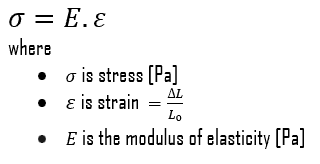
The Young’s modulus of elasticity is the elastic modulus for tensile and compressive stress in the linear elasticity regime of a uniaxial deformation and is usually assessed by tensile tests. Up to a limiting stress, a body will be able to recover its dimensions on removal of the load. The applied stresses cause the atoms in a crystal to move from their equilibrium position. All the atoms are displaced the same amount and still maintain their relative geometry. When the stresses are removed, all the atoms return to their original positions and no permanent deformation occurs. According to the Hooke’s law, the stress is proportional to the strain (in the elastic region), and the slope is Young’s modulus. Young’s modulus is equal to the longitudinal stress divided by the strain.
Hardness of Aluminium Alloys – Duralumin

Brinell hardness of 2024 aluminium alloy depends greatly on the temper of the material, but it is approximately 110 MPa.
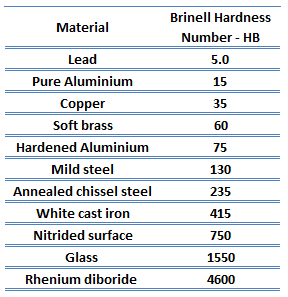
Brinell hardness number

Rockwell hardness test is one of the most common indentation hardness tests, that has been developed for hardness testing. In contrast to Brinell test, the Rockwell tester measures the depth of penetration of an indenter under a large load (major load) compared to the penetration made by a preload (minor load). The minor load establishes the zero position. The major load is applied, then removed while still maintaining the minor load. The difference between depth of penetration before and after application of the major load is used to calculate the Rockwell hardness number. That is, the penetration depth and hardness are inversely proportional. The chief advantage of Rockwell hardness is its ability to display hardness values directly. The result is a dimensionless number noted as HRA, HRB, HRC, etc., where the last letter is the respective Rockwell scale.

The Rockwell C test is performed with a Brale penetrator (120°diamond cone) and a major load of 150kg.

Thermal Properties of Aluminium Alloys – Duralumin

Thermal properties of materials refer to the response of materials to changes in their thermodynamics/thermodynamic-properties/what-is-temperature-physics/”>temperature and to the application of heat. As a solid absorbs thermodynamics/what-is-energy-physics/”>energy in the form of heat, its temperature rises and its dimensions increase. But different materials react to the application of heat differently.

Heat capacity, thermal expansion, and thermal conductivity are properties that are often critical in the practical use of solids.

Melting Point of Aluminium Alloys

Melting point of 2024 aluminium alloy is around 570°C.

In general, melting is a phase change of a substance from the solid to the liquid phase. The melting point of a substance is the temperature at which this phase change occurs. The melting point also defines a condition in which the solid and liquid can exist in equilibrium.

Thermal Conductivity of Aluminium Alloys

The thermal conductivity of 2024 aluminium alloy is 140 W/(m.K).

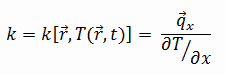
The heat transfer characteristics of a solid material are measured by a property called the thermal conductivity, k (or λ), measured in W/m.K. It is a measure of a substance’s ability to transfer heat through a material by conduction. Note that Fourier’s law applies for all matter, regardless of its state (solid, liquid, or gas), therefore, it is also defined for liquids and gases.

The thermal conductivity of most liquids and solids varies with temperature. For vapors, it also depends upon pressure. In general:
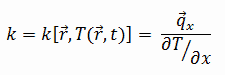
thermal conductivity - definition

Most materials are very nearly homogeneous, therefore we can usually write k = k (T). Similar definitions are associated with thermal conductivities in the y- and z-directions (ky, kz), but for an isotropic material the thermal conductivity is independent of the direction of transfer, kx = ky = kz = k.

Example: Heat transfer calculation
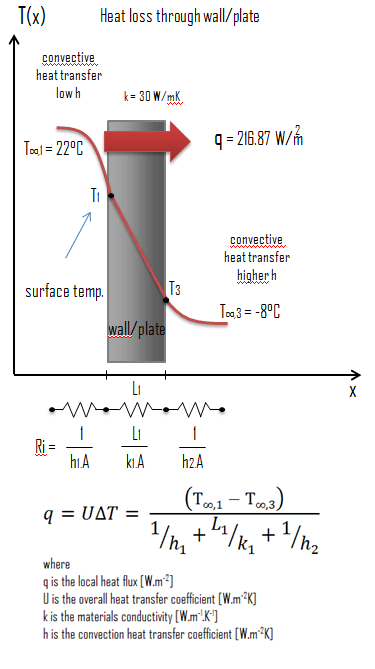
Boron Carbide - Thermal ConductivityThermal conductivity is defined as the amount of heat (in watts) transferred through a square area of material of given thickness (in metres) due to a difference in temperature. The lower the thermal conductivity of the material the greater the material’s ability to resist heat transfer.

Calculate the rate of heat flux through a wall 3 m x 10 m in area (A = 30 m2). The wall is 15 cm thick (L1) and it is made of Duralumin with the thermal conductivity of k1 = 140 W/m.K (poor thermal insulator). Assume that, the indoor and the outdoor temperatures are 22°C and -8°C, and the convection heat transfer coefficients on the inner and the outer sides are h1 = 10 W/m2K and h2 = 30 W/m2K, respectively. Note that, these convection coefficients strongly depend especially on ambient and interior conditions (wind, humidity, etc.).

Calculate the heat flux (heat loss) through this wall.

Solution:

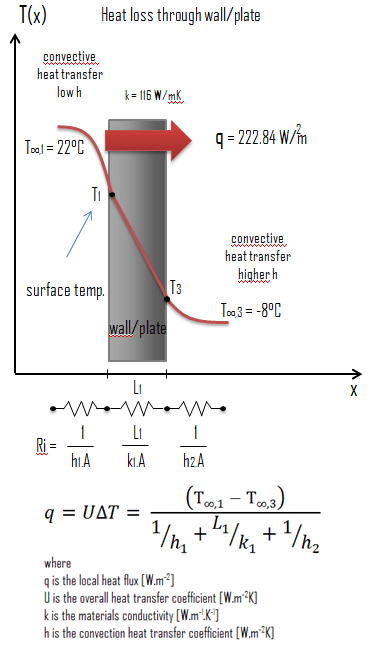
As was written, many of the heat transfer processes involve composite systems and even involve a combination of both conduction and convection. With these composite systems, it is often convenient to work with an overall heat transfer coefficient, known as a U-factor. The U-factor is defined by an expression analogous to Newton’s law of cooling:
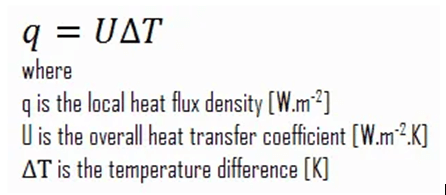
Heat transfer calculation - Newton’s law of cooling

The overall heat transfer coefficient is related to the total thermal resistance and depends on the geometry of the problem.

Assuming one-dimensional heat transfer through the plane wall and disregarding radiation, the overall heat transfer coefficient can be calculated as:
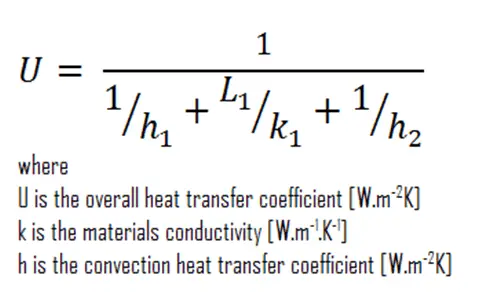
Heat transfer calculation - U-factor


The overall heat transfer coefficient is then: U = 1 / (1/10 + 0.15/140 + 1/30) = 7.44 W/m2K

The heat flux can be then calculated simply as: q = 7.44 [W/m2K] x 30 [K] = 223.21 W/m2

The total heat loss through this wall will be: qloss = q . A = 223.21 [W/m2] x 30 [m2] = 6696.19 W

We hope, this article, Series 2000 – Duralumin, helps you. If so, give us a like in the sidebar. Main purpose of this website is to help the public to learn some interesting and important information about materials and their properties.

Elektron 21 – Density – Strength – Hardness – Melting Point

Elektron 21 – UNS M12310

In general, Elektron is the registered trademark of a wide range of magnesium alloys manufactured by a British company Magnesium Elektron Limited. Elektron 21, designated by UNS M12310, is one of alloys with excellent corrosion resistance and castability. Cast products possess a fine-grained microstructure and pressure tightness. This alloy can be easily machined. Application include motorsports and aerospace, since it possess high strength, light weight and it has excellent vibration damping characteristics.

elektron 21 properties density strength price

Summary

Name Elektron 21
Phase at STP solid
Density 1800 kg/m3
Ultimate Tensile Strength 280 MPa
Yield Strength 145 MPa
Young’s Modulus of Elasticity 45 GPa
Brinell Hardness 70 BHN
Melting Point 550-640 °C
Thermal Conductivity 116 W/mK
Heat Capacity 900 J/g K
Price 40 $/kg

Density of Elektron 21

Typical densities of various substances are at atmospheric pressure. Density is defined as the mass per unit volume. It is an intensive property, which is mathematically defined as mass divided by volume:  ρ = m/V

In words, the density (ρ) of a substance is the total mass (m) of that substance divided by the total volume (V) occupied by that substance. The standard SI unit is kilograms per cubic meter (kg/m3). The Standard English unit is pounds mass per cubic foot (lbm/ft3).

Density of Elektron 21 is 1800 kg/m3.


Example: Density

Calculate the height of a cube made of Elektron 21, which weighs one metric ton.

Solution:

Density is defined as the mass per unit volume. It is mathematically defined as mass divided by volume: ρ = m/V

As the volume of a cube is the third power of its sides (V = a3), the height of this cube can be calculated:

density of material - equation

The height of this cube is then a = 0.822 m.

Density of Materials

Material Table - Density of Materials


Mechanical Properties of Elektron 21 – UNS M12310

Strength of Elektron 21

In mechanics of materials, the strength of a material is its ability to withstand an applied load without failure or plastic deformation. Strength of materials basically considers the relationship between the external loads applied to a material and the resulting deformation or change in material dimensions. In designing structures and machines, it is important to consider these factors, in order that the material selected will have adequate strength to resist applied loads or forces and retain its original shape.

Strength of a material is its ability to withstand this applied load without failure or plastic deformation. For tensile stress, the capacity of a material or structure to withstand loads tending to elongate is known as ultimate tensile strength (UTS). Yield strength or yield stress is the material property defined as the stress at which a material begins to deform plastically whereas yield point is the point where nonlinear (elastic + plastic) deformation begins. In case of tensional stress of a uniform bar (stress-strain curve), the Hooke’s law describes behaviour of a bar in the elastic region. The Young’s modulus of elasticity is the elastic modulus for tensile and compressive stress in the linear elasticity regime of a uniaxial deformation and is usually assessed by tensile tests.

See also: Strength of Materials

Ultimate Tensile Strength of Elektron 21

Ultimate tensile strength of Elektron 21 is 280 MPa.

Yield Strength of Elektron 21

Yield strength of Elektron 21 is 145 MPa.

Modulus of Elasticity of Elektron 21

The Young’s modulus of elasticity of Elektron 21 is 45 GPa.

Hardness of Elektron 21

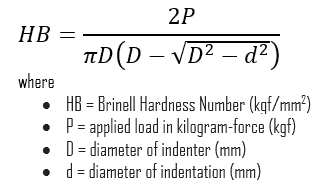
In materials science, hardness is the ability to withstand surface indentation (localized plastic deformation) and scratching. Brinell hardness test is one of indentation hardness tests, that has been developed for hardness testing. In Brinell tests, a hard, spherical indenter is forced under a specific load into the surface of the metal to be tested.

The Brinell hardness number (HB) is the load divided by the surface area of the indentation. The diameter of the impression is measured with a microscope with a superimposed scale. The Brinell hardness number is computed from the equation:

brinell hardness number - definition

Brinell hardness of Elektron 21 is approximately 70 BHN(converted).

See also: Hardness of Materials


Example: Strength

Assume a plastic rod, which is made of Elektron 21. This plastic rod has a cross-sectional area of 1 cm2. Calculate the tensile force needed to achieve the ultimate tensile strength for this material, which is: UTS = 280 MPa.

Solution:

Stress (σ) can be equated to the load per unit area or the force (F) applied per cross-sectional area (A) perpendicular to the force as:

strength of material - equation

therefore, the tensile force needed to achieve the ultimate tensile strength is:

F = UTS x A =280 x 106 x 0.0001 = 28 000 N

Strength of Materials

Material Table - Strength of Materials

Elasticity of Materials

Material Table - Elasticity of Materials

Hardness of Materials

Material Table - Hardness of Materials  

Thermal Properties of Elektron 21 – UNS M12310

Elektron 21 – Melting Point

Melting point of Elektron 21 is 550-640 °C.

Note that, these points are associated with the standard atmospheric pressure. In general, melting is a phase change of a substance from the solid to the liquid phase. The melting point of a substance is the temperature at which this phase change occurs. The melting point also defines a condition in which the solid and liquid can exist in equilibrium. For various chemical compounds and alloys, it is difficult to define the melting point, since they are usually a mixture of various chemical elements.

Elektron 21 – Thermal Conductivity

Thermal conductivity of Elektron 21 is 116 W/(m·K).

The heat transfer characteristics of a solid material are measured by a property called the thermal conductivity, k (or λ), measured in W/m.K. It is a measure of a substance’s ability to transfer heat through a material by conduction. Note that Fourier’s law applies for all matter, regardless of its state (solid, liquid, or gas), therefore, it is also defined for liquids and gases.

The thermal conductivity of most liquids and solids varies with temperature. For vapors, it also depends upon pressure. In general:

thermal conductivity - definition

Most materials are very nearly homogeneous, therefore we can usually write k = k (T). Similar definitions are associated with thermal conductivities in the y- and z-directions (ky, kz), but for an isotropic material the thermal conductivity is independent of the direction of transfer, kx = ky = kz = k.

Elektron 21 – Specific Heat

Specific heat of Elektron 21 is 900 J/g K.

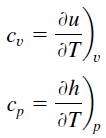
Specific heat, or specific heat capacity, is a property related to internal energy that is very important in thermodynamics. The intensive properties cv and cp are defined for pure, simple compressible substances as partial derivatives of the internal energy u(T, v) and enthalpy h(T, p), respectively:

where the subscripts v and p denote the variables held fixed during differentiation. The properties cv and cp are referred to as specific heats (or heat capacities) because under certain special conditions they relate the temperature change of a system to the amount of energy added by heat transfer. Their SI units are J/kg K or J/mol K.


Example: Heat transfer calculation

Elektron 21 - Thermal ConductivityThermal conductivity is defined as the amount of heat (in watts) transferred through a square area of material of given thickness (in metres) due to a difference in temperature. The lower the thermal conductivity of the material the greater the material’s ability to resist heat transfer.

Calculate the rate of heat flux through a wall 3 m x 10 m in area (A = 30 m2). The wall is 15 cm thick (L1) and it is made of Elektron 21 with the thermal conductivity of k1 = 116 W/m.K (poor thermal insulator). Assume that, the indoor and the outdoor temperatures are 22°C and -8°C, and the convection heat transfer coefficients on the inner and the outer sides are h1 = 10 W/m2K and h2 = 30 W/m2K, respectively. Note that, these convection coefficients strongly depend especially on ambient and interior conditions (wind, humidity, etc.).

Calculate the heat flux (heat loss) through this wall.

Solution:

As was written, many of the heat transfer processes involve composite systems and even involve a combination of both conduction and convection. With these composite systems, it is often convenient to work with an overall heat transfer coefficient, known as a U-factor. The U-factor is defined by an expression analogous to Newton’s law of cooling:

Heat transfer calculation - Newton’s law of cooling

The overall heat transfer coefficient is related to the total thermal resistance and depends on the geometry of the problem.

Assuming one-dimensional heat transfer through the plane wall and disregarding radiation, the overall heat transfer coefficient can be calculated as:

Heat transfer calculation - U-factor


The overall heat transfer coefficient is then: U = 1 / (1/10 + 0.15/116 + 1/30) = 7.43 W/m2K

The heat flux can be then calculated simply as: q = 7.43 [W/m2K] x 30 [K] = 222.84 W/m2

The total heat loss through this wall will be: qloss = q . A = 222.84 [W/m2] x 30 [m2] = 6685.17 W

Melting Point of Materials

Material Table - Melting Point

Thermal Conductivity of Materials

Material Table - Thermal Conductivity

Heat Capacity of Materials

Material Table - Heat Capacity

Uranium Dioxide – Density – Melting Point – Thermal Conductivity

About Uranium Dioxide

Uranium Dioxide is a ceramic refractory uranium compound, in many cases used as a nuclear fuel. Most of LWRs use the uranium fuel, which is in the form of uranium dioxide (chemically UO2). Uranium dioxide is a black semiconducting solid with very low thermal conductivity. On the other hand the uranium dioxide has very high melting point and has well known behavior. Uranium dioxide has significantly lower density than uranium in the metal form. Uranium dioxide has a density of 10.97 g/cm3, but this value may vary with fuel burnup, because at low burnup densification of pellets can occurs and at higher burnup swelling occurs.

uranium dioxide properties density strength price

Summary

Name Uranium Dioxide
Phase at STP solid
Density 10970 kg/m3
Ultimate Tensile Strength N/A
Yield Strength N/A
Young’s Modulus of Elasticity N/A
Brinell Hardness N/A
Melting Point 2847 °C
Thermal Conductivity 8.68 W/mK
Heat Capacity 235 J/g K
Price 60 $/kg

Density of Uranium Dioxide

Typical densities of various substances are at atmospheric pressure. Density is defined as the mass per unit volume. It is an intensive property, which is mathematically defined as mass divided by volume:  ρ = m/V

In words, the density (ρ) of a substance is the total mass (m) of that substance divided by the total volume (V) occupied by that substance. The standard SI unit is kilograms per cubic meter (kg/m3). The Standard English unit is pounds mass per cubic foot (lbm/ft3).

Density of Uranium Dioxide is 10970 kg/m3.


Example: Density

Calculate the height of a cube made of Uranium Dioxide, which weighs one metric ton.

Solution:

Density is defined as the mass per unit volume. It is mathematically defined as mass divided by volume: ρ = m/V

As the volume of a cube is the third power of its sides (V = a3), the height of this cube can be calculated:

density of material - equation

The height of this cube is then a = 0.45 m.

Density of Materials

Material Table - Density of Materials


Thermal Properties of Uranium Dioxide

Uranium Dioxide – Melting Point

Melting point of Uranium Dioxide is 2847 °C.

Note that, these points are associated with the standard atmospheric pressure. In general, melting is a phase change of a substance from the solid to the liquid phase. The melting point of a substance is the temperature at which this phase change occurs. The melting point also defines a condition in which the solid and liquid can exist in equilibrium. For various chemical compounds and alloys, it is difficult to define the melting point, since they are usually a mixture of various chemical elements.

Uranium Dioxide – Thermal Conductivity

Thermal conductivity of Uranium Dioxide is 8.68 W/(m·K).

The heat transfer characteristics of a solid material are measured by a property called the thermal conductivity, k (or λ), measured in W/m.K. It is a measure of a substance’s ability to transfer heat through a material by conduction. Note that Fourier’s law applies for all matter, regardless of its state (solid, liquid, or gas), therefore, it is also defined for liquids and gases.

The thermal conductivity of most liquids and solids varies with temperature. For vapors, it also depends upon pressure. In general:

thermal conductivity - definition

Most materials are very nearly homogeneous, therefore we can usually write k = k (T). Similar definitions are associated with thermal conductivities in the y- and z-directions (ky, kz), but for an isotropic material the thermal conductivity is independent of the direction of transfer, kx = ky = kz = k.

Uranium Dioxide – Specific Heat

Specific heat of Uranium Dioxide is 235 J/g K.

Specific heat, or specific heat capacity, is a property related to internal energy that is very important in thermodynamics. The intensive properties cv and cp are defined for pure, simple compressible substances as partial derivatives of the internal energy u(T, v) and enthalpy h(T, p), respectively:

where the subscripts v and p denote the variables held fixed during differentiation. The properties cv and cp are referred to as specific heats (or heat capacities) because under certain special conditions they relate the temperature change of a system to the amount of energy added by heat transfer. Their SI units are J/kg K or J/mol K.


Example: Heat transfer calculation

Uranium Dioxide - Thermal ConductivityThermal conductivity is defined as the amount of heat (in watts) transferred through a square area of material of given thickness (in metres) due to a difference in temperature. The lower the thermal conductivity of the material the greater the material’s ability to resist heat transfer.

Calculate the rate of heat flux through a wall 3 m x 10 m in area (A = 30 m2). The wall is 15 cm thick (L1) and it is made of Uranium Dioxide with the thermal conductivity of k1 = 8.68 W/m.K (poor thermal insulator). Assume that, the indoor and the outdoor temperatures are 22°C and -8°C, and the convection heat transfer coefficients on the inner and the outer sides are h1 = 10 W/m2K and h2 = 30 W/m2K, respectively. Note that, these convection coefficients strongly depend especially on ambient and interior conditions (wind, humidity, etc.).

Calculate the heat flux (heat loss) through this wall.

Solution:

As was written, many of the heat transfer processes involve composite systems and even involve a combination of both conduction and convection. With these composite systems, it is often convenient to work with an overall heat transfer coefficient, known as a U-factor. The U-factor is defined by an expression analogous to Newton’s law of cooling:

Heat transfer calculation - Newton’s law of cooling

The overall heat transfer coefficient is related to the total thermal resistance and depends on the geometry of the problem.

Assuming one-dimensional heat transfer through the plane wall and disregarding radiation, the overall heat transfer coefficient can be calculated as:

Heat transfer calculation - U-factor


The overall heat transfer coefficient is then: U = 1 / (1/10 + 0.15/8.68 + 1/30) = 6.64 W/m2K

The heat flux can be then calculated simply as: q = 6.64 [W/m2K] x 30 [K] = 199.18 W/m2

The total heat loss through this wall will be: qloss = q . A = 199.18 [W/m2] x 30 [m2] = 5975.52 W

Melting Point of Materials

Material Table - Melting Point

Thermal Conductivity of Materials

Material Table - Thermal Conductivity

Heat Capacity of Materials

Material Table - Heat Capacity

Strength of Materials

Material Table - Strength of Materials

Elasticity of Materials

Material Table - Elasticity of Materials

Hardness of Materials

Material Table - Hardness of Materials  

Graphene – Density – Strength – Melting Point

About Graphene

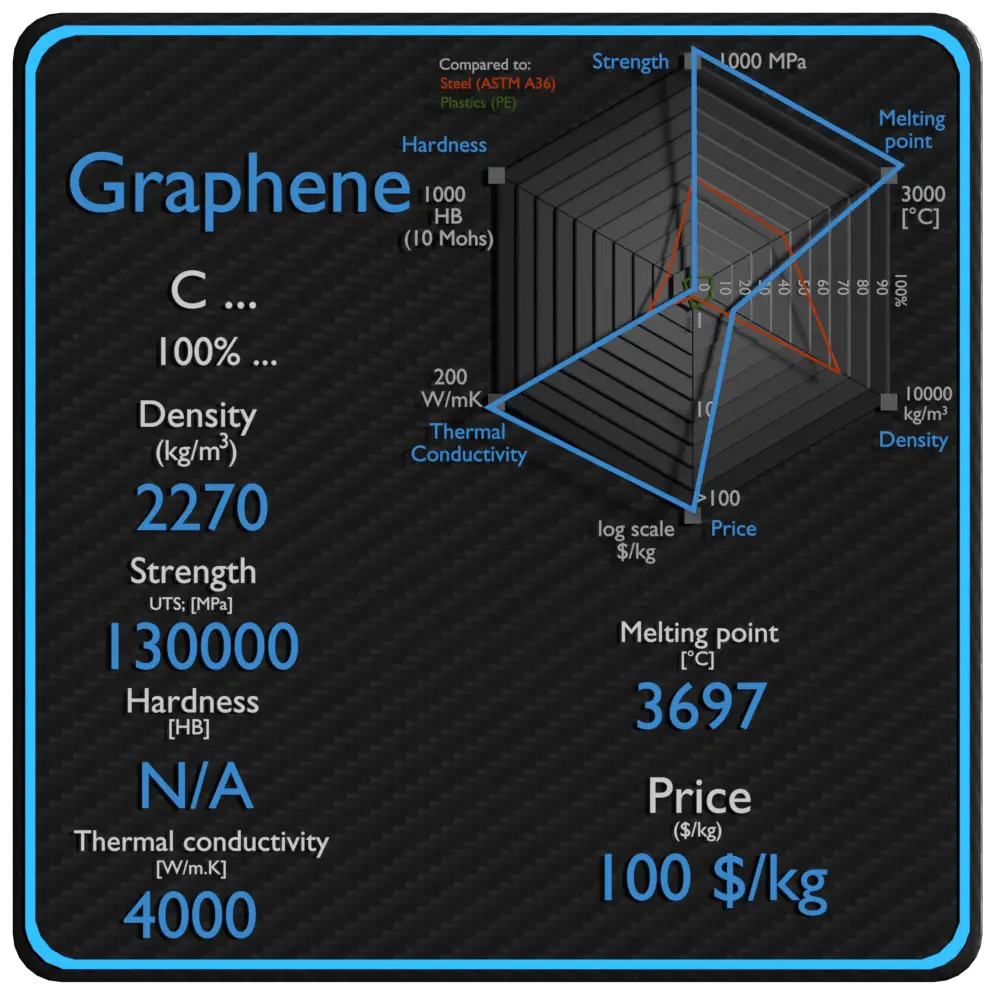
Graphene is an allotrope of carbon consisting of a single layer of atoms hexagonally arranged in a two-dimensional lattice. Graphene is a substance with very interesting properties. Graphene has high thermal conductivity, high electrical conductivity, high elasticity and flexibility, high hardness and strength. These properties, together with the abundance of carbon in nature, have made graphene a very studied material with great possibilities.

graphene properties density strength price

Summary

Name Graphene
Phase at STP solid
Density 2270 kg/m3
Ultimate Tensile Strength 130000 MPa
Yield Strength N/A
Young’s Modulus of Elasticity 1000 GPa
Brinell Hardness N/A
Melting Point 3697 °C
Thermal Conductivity 4000 W/mK
Heat Capacity N/A
Price 100 $/kg

Density of Graphene

Typical densities of various substances are at atmospheric pressure. Density is defined as the mass per unit volume. It is an intensive property, which is mathematically defined as mass divided by volume:  ρ = m/V

In words, the density (ρ) of a substance is the total mass (m) of that substance divided by the total volume (V) occupied by that substance. The standard SI unit is kilograms per cubic meter (kg/m3). The Standard English unit is pounds mass per cubic foot (lbm/ft3).

Density of Graphene is 2270 kg/m3.


Example: Density

Calculate the height of a cube made of Graphene, which weighs one metric ton.

Solution:

Density is defined as the mass per unit volume. It is mathematically defined as mass divided by volume: ρ = m/V

As the volume of a cube is the third power of its sides (V = a3), the height of this cube can be calculated:

density of material - equation

The height of this cube is then a = 0.761 m.

Density of Materials

Material Table - Density of Materials


Mechanical Properties of Graphene

Strength of Graphene

In mechanics of materials, the strength of a material is its ability to withstand an applied load without failure or plastic deformation. Strength of materials basically considers the relationship between the external loads applied to a material and the resulting deformation or change in material dimensions. In designing structures and machines, it is important to consider these factors, in order that the material selected will have adequate strength to resist applied loads or forces and retain its original shape.

Strength of a material is its ability to withstand this applied load without failure or plastic deformation. For tensile stress, the capacity of a material or structure to withstand loads tending to elongate is known as ultimate tensile strength (UTS). Yield strength or yield stress is the material property defined as the stress at which a material begins to deform plastically whereas yield point is the point where nonlinear (elastic + plastic) deformation begins. In case of tensional stress of a uniform bar (stress-strain curve), the Hooke’s law describes behaviour of a bar in the elastic region. The Young’s modulus of elasticity is the elastic modulus for tensile and compressive stress in the linear elasticity regime of a uniaxial deformation and is usually assessed by tensile tests.

See also: Strength of Materials

Ultimate Tensile Strength of Graphene

Ultimate tensile strength of Graphene is 130000 MPa.

Yield Strength of Graphene

Yield strength of Graphene is N/A.

Modulus of Elasticity of Graphene

The Young’s modulus of elasticity of Graphene is 1000 GPa.


Example: Strength

Assume a plastic rod, which is made of Graphene. This plastic rod has a cross-sectional area of 1 cm2. Calculate the tensile force needed to achieve the ultimate tensile strength for this material, which is: UTS = 130000 MPa.

Solution:

Stress (σ) can be equated to the load per unit area or the force (F) applied per cross-sectional area (A) perpendicular to the force as:

strength of material - equation

therefore, the tensile force needed to achieve the ultimate tensile strength is:

F = UTS x A = 130000 x 106 x 0.0001 = 13 000 000 N

Strength of Materials

Material Table - Strength of Materials

Elasticity of Materials

Material Table - Elasticity of Materials

Hardness of Materials

Material Table - Hardness of Materials  

Thermal Properties of Graphene

Graphene – Melting Point

Melting point of Graphene is 3697 °C.

Note that, these points are associated with the standard atmospheric pressure. In general, melting is a phase change of a substance from the solid to the liquid phase. The melting point of a substance is the temperature at which this phase change occurs. The melting point also defines a condition in which the solid and liquid can exist in equilibrium. For various chemical compounds and alloys, it is difficult to define the melting point, since they are usually a mixture of various chemical elements.

Graphene – Thermal Conductivity

Thermal conductivity of Graphene is 4000 W/(m·K).

The heat transfer characteristics of a solid material are measured by a property called the thermal conductivity, k (or λ), measured in W/m.K. It is a measure of a substance’s ability to transfer heat through a material by conduction. Note that Fourier’s law applies for all matter, regardless of its state (solid, liquid, or gas), therefore, it is also defined for liquids and gases.

The thermal conductivity of most liquids and solids varies with temperature. For vapors, it also depends upon pressure. In general:

thermal conductivity - definition

Most materials are very nearly homogeneous, therefore we can usually write k = k (T). Similar definitions are associated with thermal conductivities in the y- and z-directions (ky, kz), but for an isotropic material the thermal conductivity is independent of the direction of transfer, kx = ky = kz = k.

Graphene – Specific Heat

Specific heat of Graphene is 509 J/g K.

Specific heat, or specific heat capacity, is a property related to internal energy that is very important in thermodynamics. The intensive properties cv and cp are defined for pure, simple compressible substances as partial derivatives of the internal energy u(T, v) and enthalpy h(T, p), respectively:

where the subscripts v and p denote the variables held fixed during differentiation. The properties cv and cp are referred to as specific heats (or heat capacities) because under certain special conditions they relate the temperature change of a system to the amount of energy added by heat transfer. Their SI units are J/kg K or J/mol K.


Example: Heat transfer calculation

Graphene - Thermal ConductivityThermal conductivity is defined as the amount of heat (in watts) transferred through a square area of material of given thickness (in metres) due to a difference in temperature. The lower the thermal conductivity of the material the greater the material’s ability to resist heat transfer.

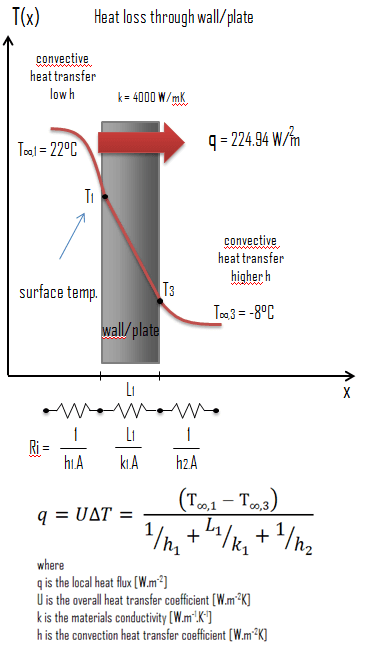
Calculate the rate of heat flux through a wall 3 m x 10 m in area (A = 30 m2). The wall is 15 cm thick (L1) and it is made of Graphene with the thermal conductivity of k1 = 4000 W/m.K (poor thermal insulator). Assume that, the indoor and the outdoor temperatures are 22°C and -8°C, and the convection heat transfer coefficients on the inner and the outer sides are h1 = 10 W/m2K and h2 = 30 W/m2K, respectively. Note that, these convection coefficients strongly depend especially on ambient and interior conditions (wind, humidity, etc.).

Calculate the heat flux (heat loss) through this wall.

Solution:

As was written, many of the heat transfer processes involve composite systems and even involve a combination of both conduction and convection. With these composite systems, it is often convenient to work with an overall heat transfer coefficient, known as a U-factor. The U-factor is defined by an expression analogous to Newton’s law of cooling:

Heat transfer calculation - Newton’s law of cooling

The overall heat transfer coefficient is related to the total thermal resistance and depends on the geometry of the problem.

Assuming one-dimensional heat transfer through the plane wall and disregarding radiation, the overall heat transfer coefficient can be calculated as:

Heat transfer calculation - U-factor


The overall heat transfer coefficient is then: U = 1 / (1/10 + 0.15/4000 + 1/30) = 7.5 W/m2K

The heat flux can be then calculated simply as: q = 7.5 [W/m2K] x 30 [K] = 224.94 W/m2

The total heat loss through this wall will be: qloss = q . A = 224.94 [W/m2] x 30 [m2] = 6748.1 W

Melting Point of Materials

Material Table - Melting Point

Thermal Conductivity of Materials

Material Table - Thermal Conductivity

Heat Capacity of Materials

Material Table - Heat Capacity

Tungsten Carbide – Density – Strength – Hardness – Melting Point

About Tungsten Carbide

Tungsten carbide is a very dense carbide containing equal parts of tungsten and carbon atoms. In its most basic form, tungsten carbide is a fine gray powder, but it can be pressed and formed into shapes through a process called sintering for use in industrial machinery, cutting tools, abrasives, armor-piercing shells and jewellery. Tungsten carbide is approximately twice as stiff (high modulus of elasticity) as steel. Tungsten carbide has very high impact resistance and it has very high strength for a material so hard and rigid. Compressive strength is higher than virtually all melted and cast or forged metals and alloys. With temperature increase to 1400°F, tungsten carbide retains much of its room temperature hardness.

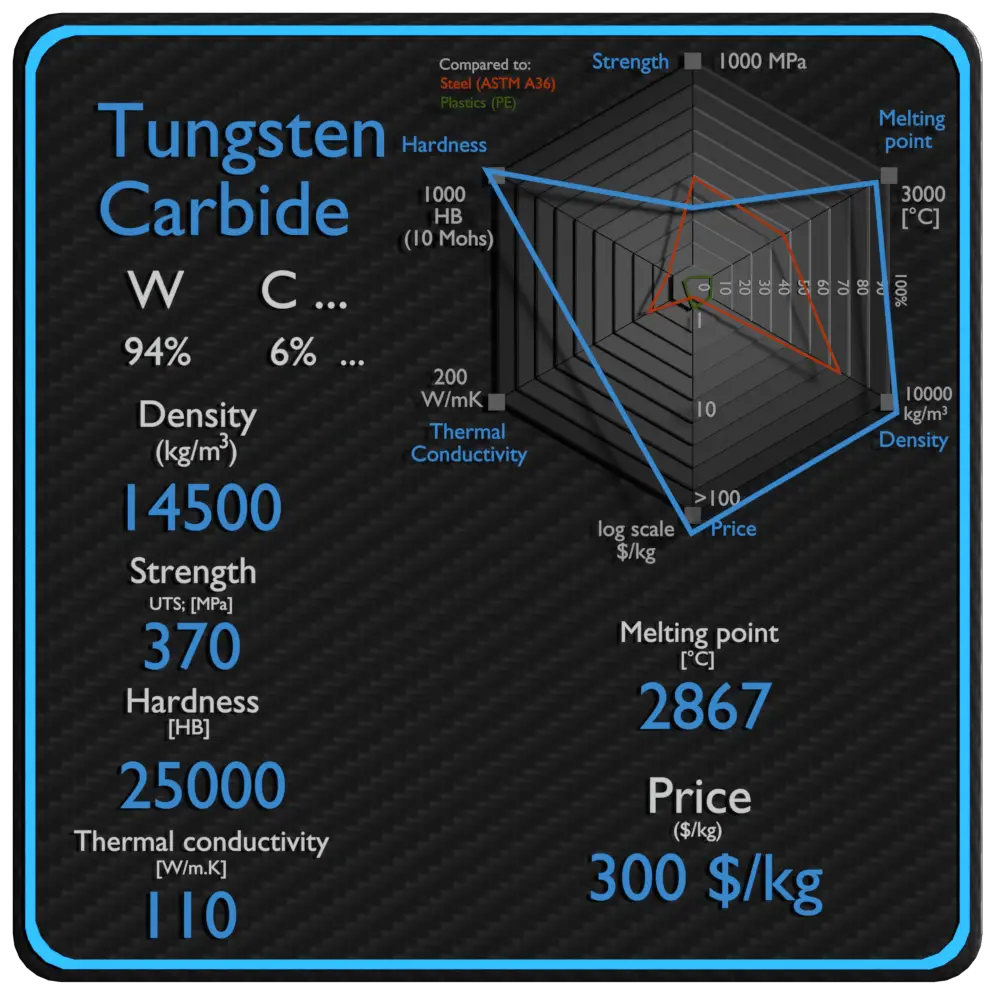
tungsten carbide properties density strength price

Summary

Name Tungsten Carbide
Phase at STP solid
Density 14500 kg/m3
Ultimate Tensile Strength 370 MPa
Yield Strength 330 MPa
Young’s Modulus of Elasticity 600 GPa
Brinell Hardness 25000 BHN
Melting Point 2867 °C
Thermal Conductivity 110 W/mK
Heat Capacity 292 J/g K
Price 300 $/kg

Density of Tungsten Carbide

Typical densities of various substances are at atmospheric pressure. Density is defined as the mass per unit volume. It is an intensive property, which is mathematically defined as mass divided by volume:  ρ = m/V

In words, the density (ρ) of a substance is the total mass (m) of that substance divided by the total volume (V) occupied by that substance. The standard SI unit is kilograms per cubic meter (kg/m3). The Standard English unit is pounds mass per cubic foot (lbm/ft3).

Density of Tungsten Carbide is 14 500 kg/m3.


Example: Density

Calculate the height of a cube made of Tungsten Carbide, which weighs one metric ton.

Solution:

Density is defined as the mass per unit volume. It is mathematically defined as mass divided by volume: ρ = m/V

As the volume of a cube is the third power of its sides (V = a3), the height of this cube can be calculated:

density of material - equation

The height of this cube is then a = 0.41 m.

Density of Materials

Material Table - Density of Materials


Mechanical Properties of Tungsten Carbide

Strength of Tungsten Carbide

In mechanics of materials, the strength of a material is its ability to withstand an applied load without failure or plastic deformation. Strength of materials basically considers the relationship between the external loads applied to a material and the resulting deformation or change in material dimensions. In designing structures and machines, it is important to consider these factors, in order that the material selected will have adequate strength to resist applied loads or forces and retain its original shape.

Strength of a material is its ability to withstand this applied load without failure or plastic deformation. For tensile stress, the capacity of a material or structure to withstand loads tending to elongate is known as ultimate tensile strength (UTS). Yield strength or yield stress is the material property defined as the stress at which a material begins to deform plastically whereas yield point is the point where nonlinear (elastic + plastic) deformation begins. In case of tensional stress of a uniform bar (stress-strain curve), the Hooke’s law describes behaviour of a bar in the elastic region. The Young’s modulus of elasticity is the elastic modulus for tensile and compressive stress in the linear elasticity regime of a uniaxial deformation and is usually assessed by tensile tests.

See also: Strength of Materials

Ultimate Tensile Strength of Tungsten Carbide

Ultimate tensile strength of Tungsten Carbide is 370 MPa.

Yield Strength of Tungsten Carbide

Yield strength of Tungsten Carbide is 330 MPa.

Modulus of Elasticity of Tungsten carbide

The Young’s modulus of elasticity of Tungsten Carbide is 600 MPa.

Hardness of Tungsten Carbide

In materials science, hardness is the ability to withstand surface indentation (localized plastic deformation) and scratching. Brinell hardness test is one of indentation hardness tests, that has been developed for hardness testing. In Brinell tests, a hard, spherical indenter is forced under a specific load into the surface of the metal to be tested.

The Brinell hardness number (HB) is the load divided by the surface area of the indentation. The diameter of the impression is measured with a microscope with a superimposed scale. The Brinell hardness number is computed from the equation:

brinell hardness number - definition

Brinell hardness of tungsten carbide is approximately 25000 BHN (converted).

See also: Hardness of Materials


Example: Strength

Assume a plastic rod, which is made of Tungsten Carbide. This plastic rod has a cross-sectional area of 1 cm2. Calculate the tensile force needed to achieve the ultimate tensile strength for this material, which is: UTS = 370 MPa.

Solution:

Stress (σ) can be equated to the load per unit area or the force (F) applied per cross-sectional area (A) perpendicular to the force as:

strength of material - equation

therefore, the tensile force needed to achieve the ultimate tensile strength is:

F = UTS x A = 370 x 106 x 0.0001 = 37 000 N

Strength of Materials

Material Table - Strength of Materials

Elasticity of Materials

Material Table - Elasticity of Materials

Hardness of Materials

Material Table - Hardness of Materials  

Thermal Properties of Tungsten Carbide

Tungsten Carbide – Melting Point

Melting point of Tungsten Carbide is 2867 °C.

Note that, these points are associated with the standard atmospheric pressure. In general, melting is a phase change of a substance from the solid to the liquid phase. The melting point of a substance is the temperature at which this phase change occurs. The melting point also defines a condition in which the solid and liquid can exist in equilibrium. For various chemical compounds and alloys, it is difficult to define the melting point, since they are usually a mixture of various chemical elements.

Tungsten Carbide – Thermal Conductivity

Thermal conductivity of Tungsten Carbide is 110 W/(m·K).

The heat transfer characteristics of a solid material are measured by a property called the thermal conductivity, k (or λ), measured in W/m.K. It is a measure of a substance’s ability to transfer heat through a material by conduction. Note that Fourier’s law applies for all matter, regardless of its state (solid, liquid, or gas), therefore, it is also defined for liquids and gases.

The thermal conductivity of most liquids and solids varies with temperature. For vapors, it also depends upon pressure. In general:

thermal conductivity - definition

Most materials are very nearly homogeneous, therefore we can usually write k = k (T). Similar definitions are associated with thermal conductivities in the y- and z-directions (ky, kz), but for an isotropic material the thermal conductivity is independent of the direction of transfer, kx = ky = kz = k.

Tungsten Carbide – Specific Heat

Specific heat of Tungsten Carbide is 292 J/g K.

Specific heat, or specific heat capacity, is a property related to internal energy that is very important in thermodynamics. The intensive properties cv and cp are defined for pure, simple compressible substances as partial derivatives of the internal energy u(T, v) and enthalpy h(T, p), respectively:

where the subscripts v and p denote the variables held fixed during differentiation. The properties cv and cp are referred to as specific heats (or heat capacities) because under certain special conditions they relate the temperature change of a system to the amount of energy added by heat transfer. Their SI units are J/kg K or J/mol K.


Example: Heat transfer calculation

Tugsten Carbide - Thermal ConductivityThermal conductivity is defined as the amount of heat (in watts) transferred through a square area of material of given thickness (in metres) due to a difference in temperature. The lower the thermal conductivity of the material the greater the material’s ability to resist heat transfer.

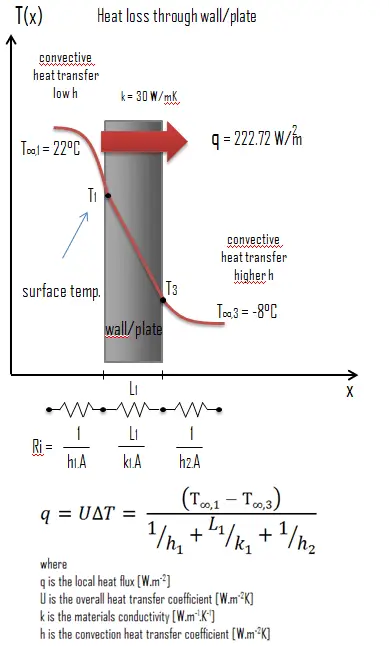
Calculate the rate of heat flux through a wall 3 m x 10 m in area (A = 30 m2). The wall is 15 cm thick (L1) and it is made of Tungsten Carbide with the thermal conductivity of k1 =110 W/m.K (poor thermal insulator). Assume that, the indoor and the outdoor temperatures are 22°C and -8°C, and the convection heat transfer coefficients on the inner and the outer sides are h1 = 10 W/m2K and h2 = 30 W/m2K, respectively. Note that, these convection coefficients strongly depend especially on ambient and interior conditions (wind, humidity, etc.).

Calculate the heat flux (heat loss) through this wall.

Solution:

As was written, many of the heat transfer processes involve composite systems and even involve a combination of both conduction and convection. With these composite systems, it is often convenient to work with an overall heat transfer coefficient, known as a U-factor. The U-factor is defined by an expression analogous to Newton’s law of cooling:

Heat transfer calculation - Newton’s law of cooling

The overall heat transfer coefficient is related to the total thermal resistance and depends on the geometry of the problem.

Assuming one-dimensional heat transfer through the plane wall and disregarding radiation, the overall heat transfer coefficient can be calculated as:

Heat transfer calculation - U-factor


The overall heat transfer coefficient is then: U = 1 / (1/10 + 0.15/110 + 1/30) = 7.42 W/m2K

The heat flux can be then calculated simply as: q = 7.42 [W/m2K] x 30 [K] = 222.72 W/m2

The total heat loss through this wall will be: qloss = q . A = 222.72 [W/m2] x 30 [m2] = 6681.67 W

Melting Point of Materials

Material Table - Melting Point

Thermal Conductivity of Materials

Material Table - Thermal Conductivity

Heat Capacity of Materials

Material Table - Heat Capacity

Carbon Fiber – Density – Strength – Melting Point

About Carbon Fiber

Carbon fiber is a polymer that is is a very strong material that is also very lightweight. Carbon fibers have several advantages including high stiffness, high tensile strength, low weight, high chemical resistance, high temperature tolerance and low thermal expansion. Carbon fiber is five-times stronger than steel and twice as stiff. Though carbon fiber is stronger and stiffer than steel, it is lighter than steel; making it the ideal manufacturing material for many parts. Carbon fibers are usually combined with other materials to form a composite.

carbon fiber properties density strength price

Summary

Name Carbon Fiber
Phase at STP solid
Density 2000 kg/m3
Ultimate Tensile Strength 4000 MPa
Yield Strength 2500 MPa
Young’s Modulus of Elasticity 500 GPa
Brinell Hardness N/A
Melting Point 3657 °C
Thermal Conductivity 100 W/mK
Heat Capacity 800 J/g K
Price 22 $/kg

Density of Carbon Fiber

Typical densities of various substances are at atmospheric pressure. Density is defined as the mass per unit volume. It is an intensive property, which is mathematically defined as mass divided by volume:  ρ = m/V

In words, the density (ρ) of a substance is the total mass (m) of that substance divided by the total volume (V) occupied by that substance. The standard SI unit is kilograms per cubic meter (kg/m3). The Standard English unit is pounds mass per cubic foot (lbm/ft3).

Density of Carbon Fiber is 2000 kg/m3.


Example: Density

Calculate the height of a cube made of Carbon Fiber, which weighs one metric ton.

Solution:

Density is defined as the mass per unit volume. It is mathematically defined as mass divided by volume: ρ = m/V

As the volume of a cube is the third power of its sides (V = a3), the height of this cube can be calculated:

density of material - equation

The height of this cube is then a = 0.793 m.

Density of Materials

Material Table - Density of Materials


Mechanical Properties of Carbon Fiber

Strength of Carbon Fiber

In mechanics of materials, the strength of a material is its ability to withstand an applied load without failure or plastic deformation. Strength of materials basically considers the relationship between the external loads applied to a material and the resulting deformation or change in material dimensions. In designing structures and machines, it is important to consider these factors, in order that the material selected will have adequate strength to resist applied loads or forces and retain its original shape.

Strength of a material is its ability to withstand this applied load without failure or plastic deformation. For tensile stress, the capacity of a material or structure to withstand loads tending to elongate is known as ultimate tensile strength (UTS). Yield strength or yield stress is the material property defined as the stress at which a material begins to deform plastically whereas yield point is the point where nonlinear (elastic + plastic) deformation begins. In case of tensional stress of a uniform bar (stress-strain curve), the Hooke’s law describes behaviour of a bar in the elastic region. The Young’s modulus of elasticity is the elastic modulus for tensile and compressive stress in the linear elasticity regime of a uniaxial deformation and is usually assessed by tensile tests.

See also: Strength of Materials

Ultimate Tensile Strength of Carbon Fiber

Ultimate tensile strength of Carbon Fibre is 4000 MPa.

Yield Strength of Carbon Fiber

Yield strength of Carbon Fibre is 2500 MPa.

Modulus of Elasticity of Carbon Fiber

The Young’s modulus of elasticity of Carbon Fibre is 500 MPa.

Hardness of Carbon Fiber

In materials science, hardness is the ability to withstand surface indentation (localized plastic deformation) and scratching. Brinell hardness test is one of indentation hardness tests, that has been developed for hardness testing. In Brinell tests, a hard, spherical indenter is forced under a specific load into the surface of the metal to be tested.

The Brinell hardness number (HB) is the load divided by the surface area of the indentation. The diameter of the impression is measured with a microscope with a superimposed scale. The Brinell hardness number is computed from the equation:

brinell hardness number - definition

Brinell hardness of Carbon Fiber is approximately N/A.

See also: Hardness of Materials


Example: Strength

Assume a plastic rod, which is made of Carbon Fiber. This plastic rod has a cross-sectional area of 1 cm2. Calculate the tensile force needed to achieve the ultimate tensile strength for this material, which is: UTS = 4000 MPa.

Solution:

Stress (σ) can be equated to the load per unit area or the force (F) applied per cross-sectional area (A) perpendicular to the force as:

strength of material - equation

therefore, the tensile force needed to achieve the ultimate tensile strength is:

F = UTS x A = 4000 x 106 x 0.0001 = 400 000 N

Strength of Materials

Material Table - Strength of Materials

Elasticity of Materials

Material Table - Elasticity of Materials

Hardness of Materials

Material Table - Hardness of Materials  

Thermal Properties of Carbon Fiber

Carbon Fiber – Melting Point

Melting point of Carbon Fiber is 3657 °C.

Note that, these points are associated with the standard atmospheric pressure. In general, melting is a phase change of a substance from the solid to the liquid phase. The melting point of a substance is the temperature at which this phase change occurs. The melting point also defines a condition in which the solid and liquid can exist in equilibrium. For various chemical compounds and alloys, it is difficult to define the melting point, since they are usually a mixture of various chemical elements.

Carbon Fiber – Thermal Conductivity

Thermal conductivity of Carbon Fiber is 100 W/(m·K).

The heat transfer characteristics of a solid material are measured by a property called the thermal conductivity, k (or λ), measured in W/m.K. It is a measure of a substance’s ability to transfer heat through a material by conduction. Note that Fourier’s law applies for all matter, regardless of its state (solid, liquid, or gas), therefore, it is also defined for liquids and gases.

The thermal conductivity of most liquids and solids varies with temperature. For vapors, it also depends upon pressure. In general:

thermal conductivity - definition

Most materials are very nearly homogeneous, therefore we can usually write k = k (T). Similar definitions are associated with thermal conductivities in the y- and z-directions (ky, kz), but for an isotropic material the thermal conductivity is independent of the direction of transfer, kx = ky = kz = k.

Carbon Fiber – Specific Heat

Specific heat of Carbon Fiber is 800 J/g K.

Specific heat, or specific heat capacity, is a property related to internal energy that is very important in thermodynamics. The intensive properties cv and cp are defined for pure, simple compressible substances as partial derivatives of the internal energy u(T, v) and enthalpy h(T, p), respectively:

where the subscripts v and p denote the variables held fixed during differentiation. The properties cv and cp are referred to as specific heats (or heat capacities) because under certain special conditions they relate the temperature change of a system to the amount of energy added by heat transfer. Their SI units are J/kg K or J/mol K.


Example: Heat transfer calculation

Carbon Fiber - Thermal ConductivityThermal conductivity is defined as the amount of heat (in watts) transferred through a square area of material of given thickness (in metres) due to a difference in temperature. The lower the thermal conductivity of the material the greater the material’s ability to resist heat transfer.

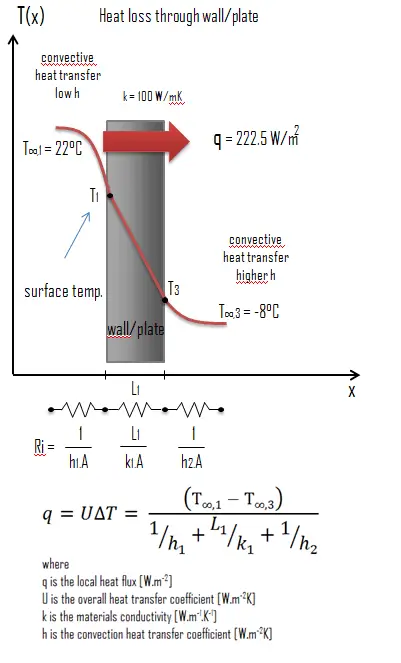
Calculate the rate of heat flux through a wall 3 m x 10 m in area (A = 30 m2). The wall is 15 cm thick (L1) and it is made of Carbon Fiber with the thermal conductivity of k1 = 100 W/m.K (poor thermal insulator). Assume that, the indoor and the outdoor temperatures are 22°C and -8°C, and the convection heat transfer coefficients on the inner and the outer sides are h1 = 10 W/m2K and h2 = 30 W/m2K, respectively. Note that, these convection coefficients strongly depend especially on ambient and interior conditions (wind, humidity, etc.).

Calculate the heat flux (heat loss) through this wall.

Solution:

As was written, many of the heat transfer processes involve composite systems and even involve a combination of both conduction and convection. With these composite systems, it is often convenient to work with an overall heat transfer coefficient, known as a U-factor. The U-factor is defined by an expression analogous to Newton’s law of cooling:

Heat transfer calculation - Newton’s law of cooling

The overall heat transfer coefficient is related to the total thermal resistance and depends on the geometry of the problem.

Assuming one-dimensional heat transfer through the plane wall and disregarding radiation, the overall heat transfer coefficient can be calculated as:

Heat transfer calculation - U-factor


The overall heat transfer coefficient is then: U = 1 / (1/10 + 0.15/100 + 1/30) = 7.42 W/m2K

The heat flux can be then calculated simply as: q = 7.42 [W/m2K] x 30 [K] = 222.5 W/m2

The total heat loss through this wall will be: qloss = q . A = 222.5 [W/m2] x 30 [m2] = 6674.91 W

Melting Point of Materials

Material Table - Melting Point

Thermal Conductivity of Materials

Material Table - Thermal Conductivity

Heat Capacity of Materials

Material Table - Heat Capacity

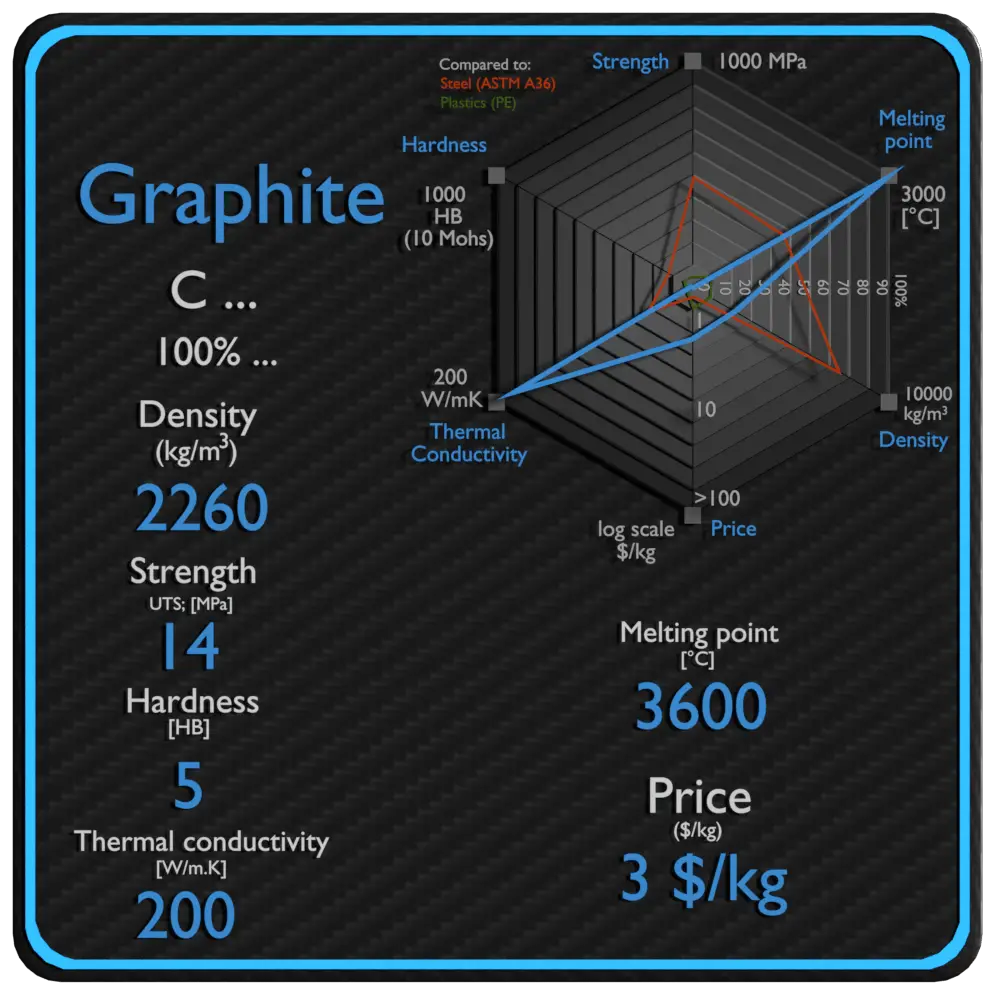
Graphite – Density – Strength – Hardness – Melting Point

About Graphite

Graphite is a crystalline form of the element carbon with its atoms arranged in a hexagonal structure. Its uncommon combination of properties is due to graphite’s crystalline structure. The carbon atoms are set hexagonally in a planar condensed ring system. The layers are stacked parallel to each other. The atoms within the rings are bonded covalently, while the layers are loosely linked together by van der Waals forces. It occurs naturally in this form and is the most stable form of carbon under standard conditions. Although graphite is flexible, it is not elastic and has high electrical and thermal conductivity. It is also chemically inert and highly refractory. Since graphite displays low adsorption of X-rays and neutrons, it is very valuable in nuclear applications.

graphite properties density strength price

Summary

Name Graphite
Phase at STP solid
Density 2260 kg/m3
Ultimate Tensile Strength 14 MPa
Yield Strength N/A
Young’s Modulus of Elasticity 11.5 GPa
Brinell Hardness 5 BHN
Melting Point 3600 °C
Thermal Conductivity 200 W/mK
Heat Capacity 720 J/g K
Price 3 $/kg

Density of Graphite

Typical densities of various substances are at atmospheric pressure. Density is defined as the mass per unit volume. It is an intensive property, which is mathematically defined as mass divided by volume:  ρ = m/V

In words, the density (ρ) of a substance is the total mass (m) of that substance divided by the total volume (V) occupied by that substance. The standard SI unit is kilograms per cubic meter (kg/m3). The Standard English unit is pounds mass per cubic foot (lbm/ft3).

Density of Graphite is 2260 kg/m3.


Example: Density

Calculate the height of a cube made of Graphite, which weighs one metric ton.

Solution:

Density is defined as the mass per unit volume. It is mathematically defined as mass divided by volume: ρ = m/V

As the volume of a cube is the third power of its sides (V = a3), the height of this cube can be calculated:

density of material - equation

The height of this cube is then a = 0.762 m.

Density of Materials

Material Table - Density of Materials


Mechanical Properties of Graphite

Strength of Graphite

In mechanics of materials, the strength of a material is its ability to withstand an applied load without failure or plastic deformation. Strength of materials basically considers the relationship between the external loads applied to a material and the resulting deformation or change in material dimensions. In designing structures and machines, it is important to consider these factors, in order that the material selected will have adequate strength to resist applied loads or forces and retain its original shape.

Strength of a material is its ability to withstand this applied load without failure or plastic deformation. For tensile stress, the capacity of a material or structure to withstand loads tending to elongate is known as ultimate tensile strength (UTS). Yield strength or yield stress is the material property defined as the stress at which a material begins to deform plastically whereas yield point is the point where nonlinear (elastic + plastic) deformation begins. In case of tensional stress of a uniform bar (stress-strain curve), the Hooke’s law describes behaviour of a bar in the elastic region. The Young’s modulus of elasticity is the elastic modulus for tensile and compressive stress in the linear elasticity regime of a uniaxial deformation and is usually assessed by tensile tests.

See also: Strength of Materials

Ultimate Tensile Strength of Graphite

Ultimate tensile strength of Graphite is 14 MPa.

Yield Strength of Graphite

Yield strength of Graphite is N/A.

Modulus of Elasticity of Graphite

The Young’s modulus of elasticity of Graphite is 11.5 MPa.

Hardness of Graphite

In materials science, hardness is the ability to withstand surface indentation (localized plastic deformation) and scratching. Brinell hardness test is one of indentation hardness tests, that has been developed for hardness testing. In Brinell tests, a hard, spherical indenter is forced under a specific load into the surface of the metal to be tested.

The Brinell hardness number (HB) is the load divided by the surface area of the indentation. The diameter of the impression is measured with a microscope with a superimposed scale. The Brinell hardness number is computed from the equation:

brinell hardness number - definition

Brinell hardness of Graphite is approximately 5 BHN (converted).

See also: Hardness of Materials


Example: Strength

Assume a plastic rod, which is made of Graphite. This plastic rod has a cross-sectional area of 1 cm2. Calculate the tensile force needed to achieve the ultimate tensile strength for this material, which is: UTS = 14 MPa.

Solution:

Stress (σ) can be equated to the load per unit area or the force (F) applied per cross-sectional area (A) perpendicular to the force as:

strength of material - equation

therefore, the tensile force needed to achieve the ultimate tensile strength is:

F = UTS x A = 14 x 106 x 0.0001 = 1 400 N

Strength of Materials

Material Table - Strength of Materials

Elasticity of Materials

Material Table - Elasticity of Materials

Hardness of Materials

Material Table - Hardness of Materials  

Thermal Properties of Graphite

Graphite – Melting Point

Melting point of Graphite is 3600 °C.

Note that, these points are associated with the standard atmospheric pressure. In general, melting is a phase change of a substance from the solid to the liquid phase. The melting point of a substance is the temperature at which this phase change occurs. The melting point also defines a condition in which the solid and liquid can exist in equilibrium. For various chemical compounds and alloys, it is difficult to define the melting point, since they are usually a mixture of various chemical elements.

Graphite – Thermal Conductivity

Thermal conductivity of Graphite is 200 W/(m·K).

The heat transfer characteristics of a solid material are measured by a property called the thermal conductivity, k (or λ), measured in W/m.K. It is a measure of a substance’s ability to transfer heat through a material by conduction. Note that Fourier’s law applies for all matter, regardless of its state (solid, liquid, or gas), therefore, it is also defined for liquids and gases.

The thermal conductivity of most liquids and solids varies with temperature. For vapors, it also depends upon pressure. In general:

thermal conductivity - definition

Most materials are very nearly homogeneous, therefore we can usually write k = k (T). Similar definitions are associated with thermal conductivities in the y- and z-directions (ky, kz), but for an isotropic material the thermal conductivity is independent of the direction of transfer, kx = ky = kz = k.

Graphite – Specific Heat

Specific heat of Graphite is 720 J/g K.

Specific heat, or specific heat capacity, is a property related to internal energy that is very important in thermodynamics. The intensive properties cv and cp are defined for pure, simple compressible substances as partial derivatives of the internal energy u(T, v) and enthalpy h(T, p), respectively:

where the subscripts v and p denote the variables held fixed during differentiation. The properties cv and cp are referred to as specific heats (or heat capacities) because under certain special conditions they relate the temperature change of a system to the amount of energy added by heat transfer. Their SI units are J/kg K or J/mol K.


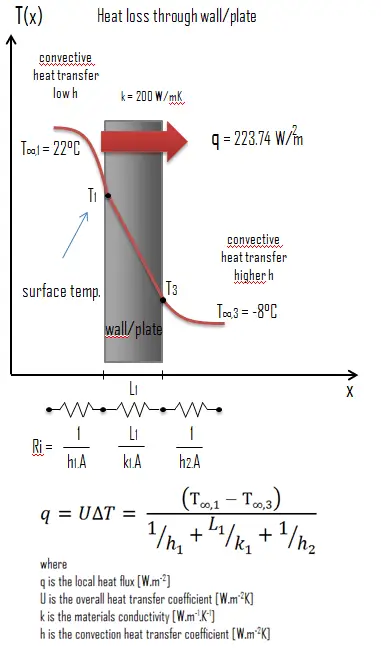
Example: Heat transfer calculation

Graphite - Thermal ConductivityThermal conductivity is defined as the amount of heat (in watts) transferred through a square area of material of given thickness (in metres) due to a difference in temperature. The lower the thermal conductivity of the material the greater the material’s ability to resist heat transfer.

Calculate the rate of heat flux through a wall 3 m x 10 m in area (A = 30 m2). The wall is 15 cm thick (L1) and it is made of Graphite with the thermal conductivity of k1 = 200 W/m.K (poor thermal insulator). Assume that, the indoor and the outdoor temperatures are 22°C and -8°C, and the convection heat transfer coefficients on the inner and the outer sides are h1 = 10 W/m2K and h2 = 30 W/m2K, respectively. Note that, these convection coefficients strongly depend especially on ambient and interior conditions (wind, humidity, etc.).

Calculate the heat flux (heat loss) through this wall.

Solution:

As was written, many of the heat transfer processes involve composite systems and even involve a combination of both conduction and convection. With these composite systems, it is often convenient to work with an overall heat transfer coefficient, known as a U-factor. The U-factor is defined by an expression analogous to Newton’s law of cooling:

Heat transfer calculation - Newton’s law of cooling

The overall heat transfer coefficient is related to the total thermal resistance and depends on the geometry of the problem.

Assuming one-dimensional heat transfer through the plane wall and disregarding radiation, the overall heat transfer coefficient can be calculated as:

Heat transfer calculation - U-factor


The overall heat transfer coefficient is then: U = 1 / (1/10 + 0.15/200 + 1/30) = 7.46 W/m2K

The heat flux can be then calculated simply as: q = 7.46 [W/m2K] x 30 [K] = 223.74 W/m2

The total heat loss through this wall will be: qloss = q . A = 223.74 [W/m2] x 30 [m2] = 6712.24 W

Melting Point of Materials

Material Table - Melting Point

Thermal Conductivity of Materials

Material Table - Thermal Conductivity

Heat Capacity of Materials

Material Table - Heat Capacity

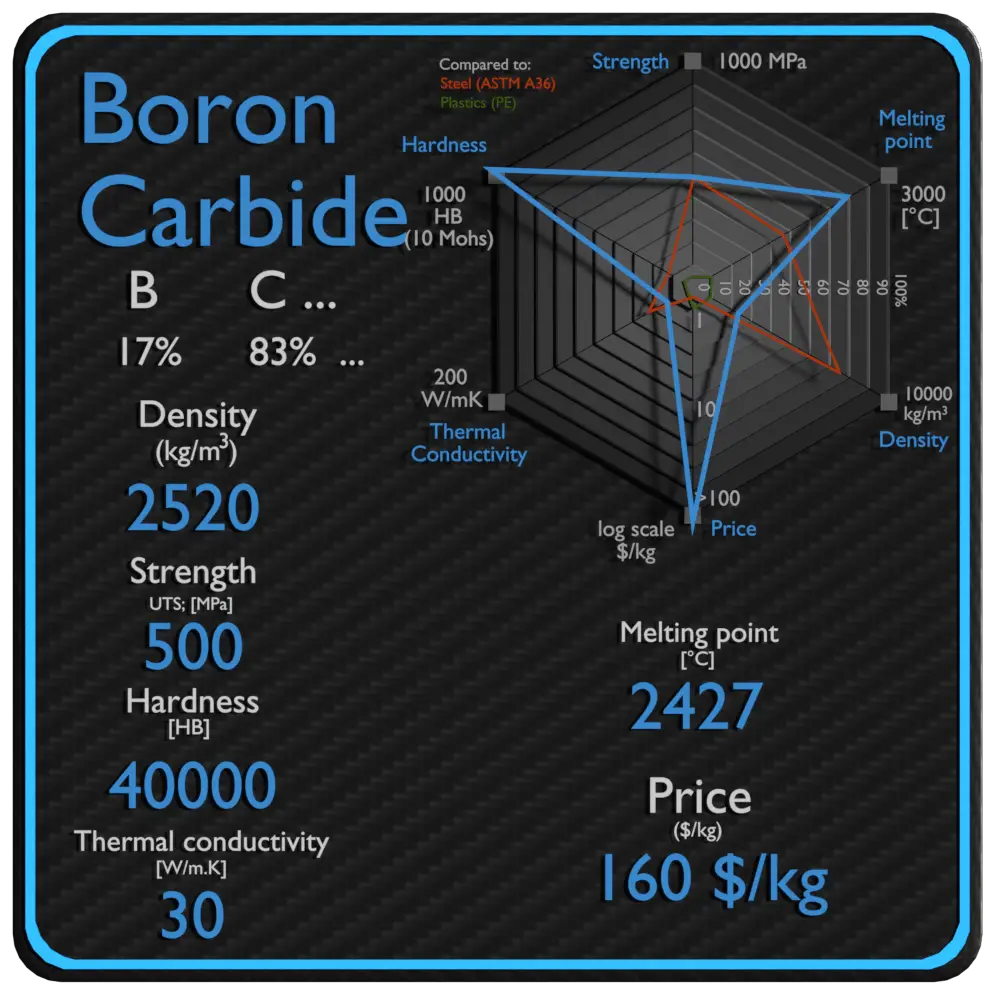
Boron Carbide – Density – Strength – Hardness – Melting Point

About Boron Carbide

Boron carbide (chemical formula approximately B4C) is an extremely hard boron–carbon ceramic and covalent material. It is one of the hardest materials known, ranking third behind diamond and cubic boron nitride. It is the hardest material produced in tonnage quantities.

boron carbide properties density strength price

Summary

Name Boron Carbide
Phase at STP solid
Density 2520 kg/m3
Ultimate Tensile Strength 500 MPa
Yield Strength N/A
Young’s Modulus of Elasticity 460 GPa
Brinell Hardness 40000 BHN
Melting Point 2427 °C
Thermal Conductivity 30 W/mK
Heat Capacity 1000 J/g K
Price 160 $/kg

Density of Boron Carbide

Typical densities of various substances are at atmospheric pressure. Density is defined as the mass per unit volume. It is an intensive property, which is mathematically defined as mass divided by volume:  ρ = m/V

In words, the density (ρ) of a substance is the total mass (m) of that substance divided by the total volume (V) occupied by that substance. The standard SI unit is kilograms per cubic meter (kg/m3). The Standard English unit is pounds mass per cubic foot (lbm/ft3).

Density of Boron Carbide is 2520 kg/m3.


Example: Density

Calculate the height of a cube made of Boron Carbide, which weighs one metric ton.

Solution:

Density is defined as the mass per unit volume. It is mathematically defined as mass divided by volume: ρ = m/V

As the volume of a cube is the third power of its sides (V = a3), the height of this cube can be calculated:

density of material - equation

The height of this cube is then a = 0.735 m.

Density of Materials

Material Table - Density of Materials


Mechanical Properties of Boron Carbide

Strength of Boron Carbide

In mechanics of materials, the strength of a material is its ability to withstand an applied load without failure or plastic deformation. Strength of materials basically considers the relationship between the external loads applied to a material and the resulting deformation or change in material dimensions. In designing structures and machines, it is important to consider these factors, in order that the material selected will have adequate strength to resist applied loads or forces and retain its original shape.

Strength of a material is its ability to withstand this applied load without failure or plastic deformation. For tensile stress, the capacity of a material or structure to withstand loads tending to elongate is known as ultimate tensile strength (UTS). Yield strength or yield stress is the material property defined as the stress at which a material begins to deform plastically whereas yield point is the point where nonlinear (elastic + plastic) deformation begins. In case of tensional stress of a uniform bar (stress-strain curve), the Hooke’s law describes behaviour of a bar in the elastic region. The Young’s modulus of elasticity is the elastic modulus for tensile and compressive stress in the linear elasticity regime of a uniaxial deformation and is usually assessed by tensile tests.

See also: Strength of Materials

Ultimate Tensile Strength of Boron Carbide

Ultimate tensile strength of Boron Carbide is 500 MPa.

Yield Strength of Boron Carbide

Yield strength of Boron Carbide is N/A.

Modulus of Elasticity of Boron Carbide

The Young’s modulus of elasticity of Boron Carbide is 460 MPa.

Hardness of Boron Carbide

In materials science, hardness is the ability to withstand surface indentation (localized plastic deformation) and scratching. Brinell hardness test is one of indentation hardness tests, that has been developed for hardness testing. In Brinell tests, a hard, spherical indenter is forced under a specific load into the surface of the metal to be tested.

The Brinell hardness number (HB) is the load divided by the surface area of the indentation. The diameter of the impression is measured with a microscope with a superimposed scale. The Brinell hardness number is computed from the equation:

brinell hardness number - definition

Brinell hardness of Boron Carbide is approximately 40000 BHN (converted).

See also: Hardness of Materials


Example: Strength

Assume a plastic rod, which is made of Boron Carbide. This plastic rod has a cross-sectional area of 1 cm2. Calculate the tensile force needed to achieve the ultimate tensile strength for this material, which is: UTS = 500 MPa.

Solution:

Stress (σ) can be equated to the load per unit area or the force (F) applied per cross-sectional area (A) perpendicular to the force as:

strength of material - equation

therefore, the tensile force needed to achieve the ultimate tensile strength is:

F = UTS x A = 500 x 106 x 0.0001 = 50 000 N

Strength of Materials

Material Table - Strength of Materials

Elasticity of Materials

Material Table - Elasticity of Materials

Hardness of Materials

Material Table - Hardness of Materials  

Thermal Properties of Boron Carbide

Boron Carbide – Melting Point

Melting point of Boron Carbide is 2427 °C.

Note that, these points are associated with the standard atmospheric pressure. In general, melting is a phase change of a substance from the solid to the liquid phase. The melting point of a substance is the temperature at which this phase change occurs. The melting point also defines a condition in which the solid and liquid can exist in equilibrium. For various chemical compounds and alloys, it is difficult to define the melting point, since they are usually a mixture of various chemical elements.

Boron Carbide – Thermal Conductivity

Thermal conductivity of Boron Carbide is 30 W/(m·K).

The heat transfer characteristics of a solid material are measured by a property called the thermal conductivity, k (or λ), measured in W/m.K. It is a measure of a substance’s ability to transfer heat through a material by conduction. Note that Fourier’s law applies for all matter, regardless of its state (solid, liquid, or gas), therefore, it is also defined for liquids and gases.

The thermal conductivity of most liquids and solids varies with temperature. For vapors, it also depends upon pressure. In general:

thermal conductivity - definition

Most materials are very nearly homogeneous, therefore we can usually write k = k (T). Similar definitions are associated with thermal conductivities in the y- and z-directions (ky, kz), but for an isotropic material the thermal conductivity is independent of the direction of transfer, kx = ky = kz = k.

Boron Carbide – Specific Heat

Specific heat of Boron Carbide is 1000 J/g K.

Specific heat, or specific heat capacity, is a property related to internal energy that is very important in thermodynamics. The intensive properties cv and cp are defined for pure, simple compressible substances as partial derivatives of the internal energy u(T, v) and enthalpy h(T, p), respectively:

where the subscripts v and p denote the variables held fixed during differentiation. The properties cv and cp are referred to as specific heats (or heat capacities) because under certain special conditions they relate the temperature change of a system to the amount of energy added by heat transfer. Their SI units are J/kg K or J/mol K.


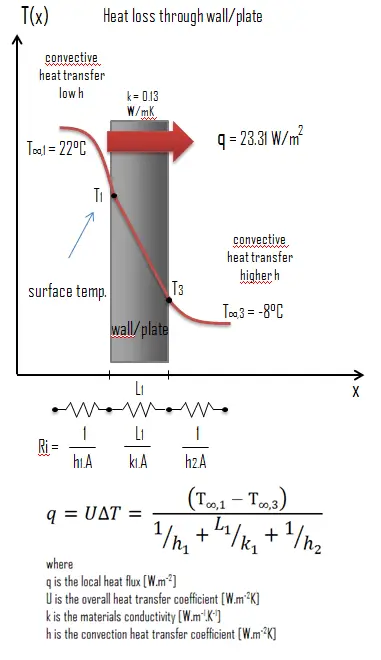
Example: Heat transfer calculation

Boron Carbide - Thermal ConductivityThermal conductivity is defined as the amount of heat (in watts) transferred through a square area of material of given thickness (in metres) due to a difference in temperature. The lower the thermal conductivity of the material the greater the material’s ability to resist heat transfer.

Calculate the rate of heat flux through a wall 3 m x 10 m in area (A = 30 m2). The wall is 15 cm thick (L1) and it is made of Boron Carbide with the thermal conductivity of k1 = 30 W/m.K (poor thermal insulator). Assume that, the indoor and the outdoor temperatures are 22°C and -8°C, and the convection heat transfer coefficients on the inner and the outer sides are h1 = 10 W/m2K and h2 = 30 W/m2K, respectively. Note that, these convection coefficients strongly depend especially on ambient and interior conditions (wind, humidity, etc.).

Calculate the heat flux (heat loss) through this wall.

Solution:

As was written, many of the heat transfer processes involve composite systems and even involve a combination of both conduction and convection. With these composite systems, it is often convenient to work with an overall heat transfer coefficient, known as a U-factor. The U-factor is defined by an expression analogous to Newton’s law of cooling:

Heat transfer calculation - Newton’s law of cooling

The overall heat transfer coefficient is related to the total thermal resistance and depends on the geometry of the problem.

Assuming one-dimensional heat transfer through the plane wall and disregarding radiation, the overall heat transfer coefficient can be calculated as:

Heat transfer calculation - U-factor


The overall heat transfer coefficient is then: U = 1 / (1/10 + 0.15/30 + 1/30) = 7.23 W/m2K

The heat flux can be then calculated simply as: q = 7.23 [W/m2K] x 30 [K] = 216.87 W/m2

The total heat loss through this wall will be: qloss = q . A = 216.87 [W/m2] x 30 [m2] = 6506.02 W

Melting Point of Materials

Material Table - Melting Point

Thermal Conductivity of Materials

Material Table - Thermal Conductivity

Heat Capacity of Materials

Material Table - Heat Capacity

Diesel Fuel – Density – Melting Point – Thermal Conductivity

About Diesel Fuel

In general, diesel fuel is any liquid fuel specifically designed for use in diesel engines, whose fuel ignition takes place, without any spark, as a result of compression of the inlet air mixture and then injection of fuel. Currently, the main source of fuel for road vehicles is petroleum oil. Oil is a naturally occurring, fossil liquid comprising a complex mixture of hydrocarbons of various molecular weights together with various other organic compounds. These components are separated by fractional distillation in an oil refinery in order to produce gasoline, diesel fuel, kerosene and other products.

diesel fuel properties density strength price

Summary

Name Diesel Fuel
Phase at STP liquid
Density 850 kg/m3
Ultimate Tensile Strength N/A
Yield Strength N/A
Young’s Modulus of Elasticity N/A
Brinell Hardness N/A
Melting Point N/A
Thermal Conductivity 0.13 W/mK
Heat Capacity 2100 J/g K
Price 1.1 $/kg

Density of Diesel Fuel

Typical densities of various substances are at atmospheric pressure. Density is defined as the mass per unit volume. It is an intensive property, which is mathematically defined as mass divided by volume:  ρ = m/V

In words, the density (ρ) of a substance is the total mass (m) of that substance divided by the total volume (V) occupied by that substance. The standard SI unit is kilograms per cubic meter (kg/m3). The Standard English unit is pounds mass per cubic foot (lbm/ft3).

Density of Diesel Fuel is 850 kg/m3.


Example: Density

Calculate the height of a cube made of Diesel Fuel, which weighs one metric ton.

Solution:

Density is defined as the mass per unit volume. It is mathematically defined as mass divided by volume: ρ = m/V

As the volume of a cube is the third power of its sides (V = a3), the height of this cube can be calculated:

density of material - equation

The height of this cube is then a = 1.056 m.

Density of Materials

Material Table - Density of Materials


Thermal Properties of Diesel Fuel

Diesel Fuel – Melting Point

Melting point of Diesel Fuel is N/A.

Note that, these points are associated with the standard atmospheric pressure. In general, melting is a phase change of a substance from the solid to the liquid phase. The melting point of a substance is the temperature at which this phase change occurs. The melting point also defines a condition in which the solid and liquid can exist in equilibrium. For various chemical compounds and alloys, it is difficult to define the melting point, since they are usually a mixture of various chemical elements.

Diesel Fuel – Thermal Conductivity

Thermal conductivity of Diesel Fuel is 0.13 W/(m·K).

The heat transfer characteristics of a solid material are measured by a property called the thermal conductivity, k (or λ), measured in W/m.K. It is a measure of a substance’s ability to transfer heat through a material by conduction. Note that Fourier’s law applies for all matter, regardless of its state (solid, liquid, or gas), therefore, it is also defined for liquids and gases.

The thermal conductivity of most liquids and solids varies with temperature. For vapors, it also depends upon pressure. In general:

thermal conductivity - definition

Most materials are very nearly homogeneous, therefore we can usually write k = k (T). Similar definitions are associated with thermal conductivities in the y- and z-directions (ky, kz), but for an isotropic material the thermal conductivity is independent of the direction of transfer, kx = ky = kz = k.

Diesel Fuel – Specific Heat

Specific heat of Diesel Fuel is 2100 J/g K.

Specific heat, or specific heat capacity, is a property related to internal energy that is very important in thermodynamics. The intensive properties cv and cp are defined for pure, simple compressible substances as partial derivatives of the internal energy u(T, v) and enthalpy h(T, p), respectively:

where the subscripts v and p denote the variables held fixed during differentiation. The properties cv and cp are referred to as specific heats (or heat capacities) because under certain special conditions they relate the temperature change of a system to the amount of energy added by heat transfer. Their SI units are J/kg K or J/mol K.


Example: Heat transfer calculation

Diesel Fuel - Thermal ConductivityThermal conductivity is defined as the amount of heat (in watts) transferred through a square area of material of given thickness (in metres) due to a difference in temperature. The lower the thermal conductivity of the material the greater the material’s ability to resist heat transfer.

Calculate the rate of heat flux through a wall 3 m x 10 m in area (A = 30 m2). The wall is 15 cm thick (L1) and it is made of Diesel Fuel with the thermal conductivity of k1 = 0.13 W/m.K (poor thermal insulator). Assume that, the indoor and the outdoor temperatures are 22°C and -8°C, and the convection heat transfer coefficients on the inner and the outer sides are h1 = 10 W/m2K and h2 = 30 W/m2K, respectively. Note that, these convection coefficients strongly depend especially on ambient and interior conditions (wind, humidity, etc.).

Calculate the heat flux (heat loss) through this wall.

Solution:

As was written, many of the heat transfer processes involve composite systems and even involve a combination of both conduction and convection. With these composite systems, it is often convenient to work with an overall heat transfer coefficient, known as a U-factor. The U-factor is defined by an expression analogous to Newton’s law of cooling:

Heat transfer calculation - Newton’s law of cooling

The overall heat transfer coefficient is related to the total thermal resistance and depends on the geometry of the problem.

Assuming one-dimensional heat transfer through the plane wall and disregarding radiation, the overall heat transfer coefficient can be calculated as:

Heat transfer calculation - U-factor


The overall heat transfer coefficient is then: U = 1 / (1/10 + 0.15/0.13 + 1/30) = 0.78 W/m2K

The heat flux can be then calculated simply as: q = 0.78 [W/m2K] x 30 [K] = 23.31 W/m2

The total heat loss through this wall will be: qloss = q . A = 23.31 [W/m2] x 30 [m2] = 699.2 W

Melting Point of Materials

Material Table - Melting Point

Thermal Conductivity of Materials

Material Table - Thermal Conductivity

Heat Capacity of Materials

Material Table - Heat Capacity

Strength of Materials

Material Table - Strength of Materials

Elasticity of Materials

Material Table - Elasticity of Materials

Hardness of Materials

Material Table - Hardness of Materials  

Gasoline – Density – Melting Point – Thermal Conductivity

About Gasoline

Gasoline, or petrol is a clear petroleum-derived flammable liquid that is used primarily as a fuel in most spark-ignited internal combustion engines. Currently, the main source of fuel for road vehicles is petroleum oil. Oil is a naturally occurring, fossil liquid comprising a complex mixture of hydrocarbons of various molecular weights together with various other organic compounds. These components are separated by fractional distillation in an oil refinery in order to produce gasoline, diesel fuel, kerosene and other products.

gasoline properties density strength price

Summary

Name Gasoline
Phase at STP liquid
Density 755 kg/m3
Ultimate Tensile Strength N/A
Yield Strength N/A
Young’s Modulus of Elasticity N/A
Brinell Hardness N/A
Melting Point N/A
Thermal Conductivity 0.16 W/mK
Heat Capacity 2200 J/g K
Price 1.5 $/kg

Density of Gasoline

Typical densities of various substances are at atmospheric pressure. Density is defined as the mass per unit volume. It is an intensive property, which is mathematically defined as mass divided by volume:  ρ = m/V

In words, the density (ρ) of a substance is the total mass (m) of that substance divided by the total volume (V) occupied by that substance. The standard SI unit is kilograms per cubic meter (kg/m3). The Standard English unit is pounds mass per cubic foot (lbm/ft3).

Density of Gasoline is 755 kg/m3.


Example: Density

Calculate the height of a cube made of Gasoline, which weighs one metric ton.

Solution:

Density is defined as the mass per unit volume. It is mathematically defined as mass divided by volume: ρ = m/V

As the volume of a cube is the third power of its sides (V = a3), the height of this cube can be calculated:

density of material - equation

The height of this cube is then a = 1.098 m.

Density of Materials

Material Table - Density of Materials


Thermal Properties of Gasoline

Gasoline – Melting Point

Melting point of Gasoline is N/A.

Note that, these points are associated with the standard atmospheric pressure. In general, melting is a phase change of a substance from the solid to the liquid phase. The melting point of a substance is the temperature at which this phase change occurs. The melting point also defines a condition in which the solid and liquid can exist in equilibrium. For various chemical compounds and alloys, it is difficult to define the melting point, since they are usually a mixture of various chemical elements.

Gasoline – Thermal Conductivity

Thermal conductivity of Gasoline is 0.16 W/(m·K).

The heat transfer characteristics of a solid material are measured by a property called the thermal conductivity, k (or λ), measured in W/m.K. It is a measure of a substance’s ability to transfer heat through a material by conduction. Note that Fourier’s law applies for all matter, regardless of its state (solid, liquid, or gas), therefore, it is also defined for liquids and gases.

The thermal conductivity of most liquids and solids varies with temperature. For vapors, it also depends upon pressure. In general:

thermal conductivity - definition

Most materials are very nearly homogeneous, therefore we can usually write k = k (T). Similar definitions are associated with thermal conductivities in the y- and z-directions (ky, kz), but for an isotropic material the thermal conductivity is independent of the direction of transfer, kx = ky = kz = k.

Gasoline – Specific Heat

Specific heat of Gasoline is 2200 J/g K.

Specific heat, or specific heat capacity, is a property related to internal energy that is very important in thermodynamics. The intensive properties cv and cp are defined for pure, simple compressible substances as partial derivatives of the internal energy u(T, v) and enthalpy h(T, p), respectively:

where the subscripts v and p denote the variables held fixed during differentiation. The properties cv and cp are referred to as specific heats (or heat capacities) because under certain special conditions they relate the temperature change of a system to the amount of energy added by heat transfer. Their SI units are J/kg K or J/mol K.


Example: Heat transfer calculation

Gasoline - Thermal ConductivityThermal conductivity is defined as the amount of heat (in watts) transferred through a square area of material of given thickness (in metres) due to a difference in temperature. The lower the thermal conductivity of the material the greater the material’s ability to resist heat transfer.

Calculate the rate of heat flux through a wall 3 m x 10 m in area (A = 30 m2). The wall is 15 cm thick (L1) and it is made of Gasoline with the thermal conductivity of k1 = 0.16 W/m.K (poor thermal insulator). Assume that, the indoor and the outdoor temperatures are 22°C and -8°C, and the convection heat transfer coefficients on the inner and the outer sides are h1 = 10 W/m2K and h2 = 30 W/m2K, respectively. Note that, these convection coefficients strongly depend especially on ambient and interior conditions (wind, humidity, etc.).

Calculate the heat flux (heat loss) through this wall.

Solution:

As was written, many of the heat transfer processes involve composite systems and even involve a combination of both conduction and convection. With these composite systems, it is often convenient to work with an overall heat transfer coefficient, known as a U-factor. The U-factor is defined by an expression analogous to Newton’s law of cooling:

Heat transfer calculation - Newton’s law of cooling

The overall heat transfer coefficient is related to the total thermal resistance and depends on the geometry of the problem.

Assuming one-dimensional heat transfer through the plane wall and disregarding radiation, the overall heat transfer coefficient can be calculated as:

Heat transfer calculation - U-factor


The overall heat transfer coefficient is then: U = 1 / (1/10 + 0.15/0.16 + 1/30) = 0.93 W/m2K

The heat flux can be then calculated simply as: q = 0.93 [W/m2K] x 30 [K] = 28.02 W/m2

The total heat loss through this wall will be: qloss = q . A = 28.02 [W/m2] x 30 [m2] = 840.47 W

Melting Point of Materials

Material Table - Melting Point

Thermal Conductivity of Materials

Material Table - Thermal Conductivity

Heat Capacity of Materials

Material Table - Heat Capacity

Strength of Materials

Material Table - Strength of Materials

Elasticity of Materials

Material Table - Elasticity of Materials

Hardness of Materials

Material Table - Hardness of Materials