Facebook Instagram Youtube Twitter

Pine Wood – Density – Strength – Melting Point – Thermal Conductivity

About Pine Wood

In general, wood is a porous and fibrous structural tissue found in the stems and roots of trees and other woody plants. It is an organic material – a natural composite of cellulose fibers that are strong in tension and embedded in a matrix of lignin that resists compression. It is common to classify wood as either softwood or hardwood. The wood from conifers (e.g. pine) is called softwood, and the wood from dicotyledons (usually broad-leaved trees, e.g. oak) is called hardwood. These names are a bit misleading, as hardwoods are not necessarily hard, and softwoods are not necessarily soft.
pine wood properties density strength price

Summary

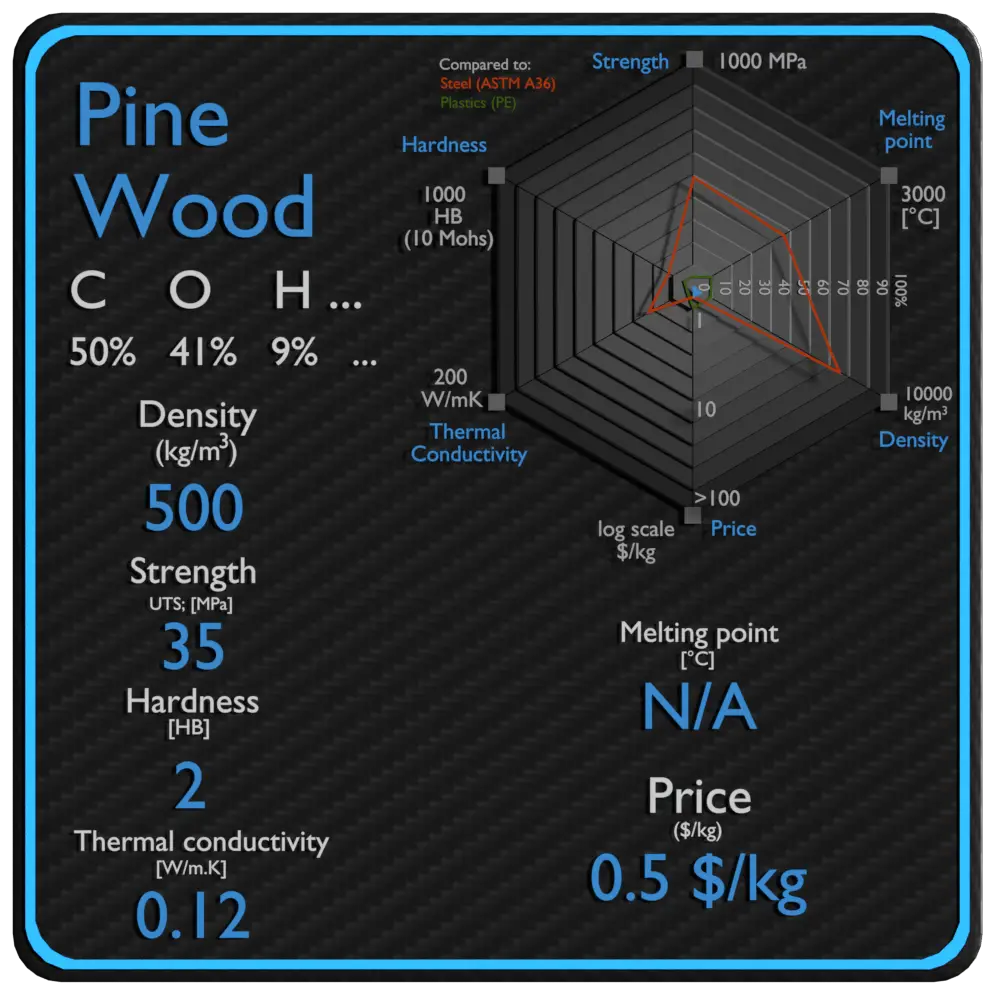
Name Pine Wood
Phase at STP solid
Density 500 kg/m3
Ultimate Tensile Strength 35 MPa
Yield Strength N/A
Young’s Modulus of Elasticity 10 GPa
Brinell Hardness 2 BHN
Melting Point N/A
Thermal Conductivity 0.12 W/mK
Heat Capacity 2300 J/g K
Price 0.5 $/kg

Density of Pine Wood

Typical densities of various substances are at atmospheric pressure. Density is defined as the mass per unit volume. It is an intensive property, which is mathematically defined as mass divided by volume:  ρ = m/V

In words, the density (ρ) of a substance is the total mass (m) of that substance divided by the total volume (V) occupied by that substance. The standard SI unit is kilograms per cubic meter (kg/m3). The Standard English unit is pounds mass per cubic foot (lbm/ft3).

Density of Pine Wood is 500 kg/m3.


Example: Density

Calculate the height of a cube made of Pine Wood, which weighs one metric ton.

Solution:

Density is defined as the mass per unit volume. It is mathematically defined as mass divided by volume: ρ = m/V

As the volume of a cube is the third power of its sides (V = a3), the height of this cube can be calculated:
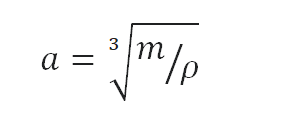
density of material - equation

The height of this cube is then a = 1.26 m.

Density of Materials

Material Table - Density of Materials


Mechanical Properties of Pine Wood

Strength of Pine Wood

In mechanics of materials, the strength of a material is its ability to withstand an applied load without failure or plastic deformation. Strength of materials basically considers the relationship between the external loads applied to a material and the resulting deformation or change in material dimensions. In designing structures and machines, it is important to consider these factors, in order that the material selected will have adequate strength to resist applied loads or forces and retain its original shape.

Strength of a material is its ability to withstand this applied load without failure or plastic deformation. For tensile stress, the capacity of a material or structure to withstand loads tending to elongate is known as ultimate tensile strength (UTS). Yield strength or yield stress is the material property defined as the stress at which a material begins to deform plastically whereas yield point is the point where nonlinear (elastic + plastic) deformation begins. In case of tensional stress of a uniform bar (stress-strain curve), the Hooke’s law describes behaviour of a bar in the elastic region. The Young’s modulus of elasticity is the elastic modulus for tensile and compressive stress in the linear elasticity regime of a uniaxial deformation and is usually assessed by tensile tests.

See also: Strength of Materials

Ultimate Tensile Strength of Pine Wood

Ultimate tensile strength of Pine Wood is 35 MPa.

Yield Strength of Pine Wood

Yield strength of Pine Wood is N/A.

Modulus of Elasticity of Pine Wood

The Young’s modulus of elasticity of Pine Wood is 10 GPa.

Hardness of Pine Wood

In materials science, hardness is the ability to withstand surface indentation (localized plastic deformation) and scratching. Brinell hardness test is one of indentation hardness tests, that has been developed for hardness testing. In Brinell tests, a hard, spherical indenter is forced under a specific load into the surface of the metal to be tested.

The Brinell hardness number (HB) is the load divided by the surface area of the indentation. The diameter of the impression is measured with a microscope with a superimposed scale. The Brinell hardness number is computed from the equation:
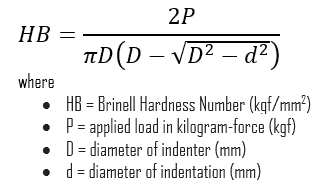
brinell hardness number - definition

Brinell hardness of Pine Wood is approximately  2 BHN (converted).

See also: Hardness of Materials


Example: Strength

Assume a plastic rod, which is made of Pine Wood. This plastic rod has a cross-sectional area of 1 cm2. Calculate the tensile force needed to achieve the ultimate tensile strength for this material, which is: UTS = 35 MPa.

Solution:

Stress (σ) can be equated to the load per unit area or the force (F) applied per cross-sectional area (A) perpendicular to the force as:
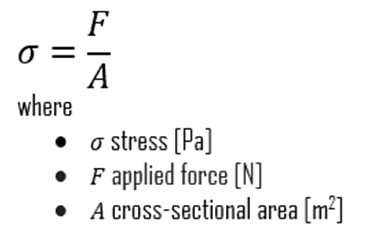
strength of material - equation

therefore, the tensile force needed to achieve the ultimate tensile strength is:

F = UTS x A = 35 x 106 x 0.0001 = 3 500 N

Strength of Materials

Material Table - Strength of Materials

Elasticity of Materials

Material Table - Elasticity of Materials

Hardness of Materials

Material Table - Hardness of Materials  

Thermal Properties of Pine Wood

Pine Wood – Melting Point

Melting point of Pine Wood is N/A.

Note that, these points are associated with the standard atmospheric pressure. In general, melting is a phase change of a substance from the solid to the liquid phase. The melting point of a substance is the temperature at which this phase change occurs. The melting point also defines a condition in which the solid and liquid can exist in equilibrium. For various chemical compounds and alloys, it is difficult to define the melting point, since they are usually a mixture of various chemical elements.

Pine Wood – Thermal Conductivity

Thermal conductivity of Pine Wood is 0.12 W/(m·K).

The heat transfer characteristics of a solid material are measured by a property called the thermal conductivity, k (or λ), measured in W/m.K. It is a measure of a substance’s ability to transfer heat through a material by conduction. Note that Fourier’s law applies for all matter, regardless of its state (solid, liquid, or gas), therefore, it is also defined for liquids and gases.

The thermal conductivity of most liquids and solids varies with temperature. For vapors, it also depends upon pressure. In general:
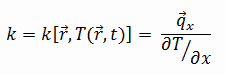
thermal conductivity - definition

Most materials are very nearly homogeneous, therefore we can usually write k = k (T). Similar definitions are associated with thermal conductivities in the y- and z-directions (ky, kz), but for an isotropic material the thermal conductivity is independent of the direction of transfer, kx = ky = kz = k.

Pine Wood – Specific Heat

Specific heat of Pine Wood is 2300 J/g K.

Specific heat, or specific heat capacity, is a property related to internal energy that is very important in thermodynamics. The intensive properties cv and cp are defined for pure, simple compressible substances as partial derivatives of the internal energy u(T, v) and enthalpy h(T, p), respectively:
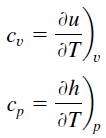
where the subscripts v and p denote the variables held fixed during differentiation. The properties cv and cp are referred to as specific heats (or heat capacities) because under certain special conditions they relate the temperature change of a system to the amount of energy added by heat transfer. Their SI units are J/kg K or J/mol K.


Example: Heat transfer calculation
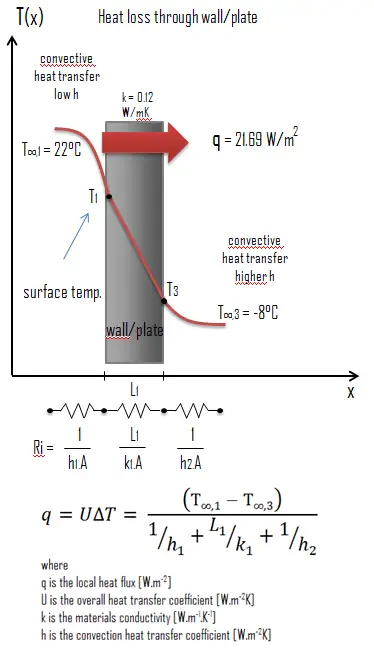
Pine Wood - Thermal ConductivityThermal conductivity is defined as the amount of heat (in watts) transferred through a square area of material of given thickness (in metres) due to a difference in temperature. The lower the thermal conductivity of the material the greater the material’s ability to resist heat transfer.

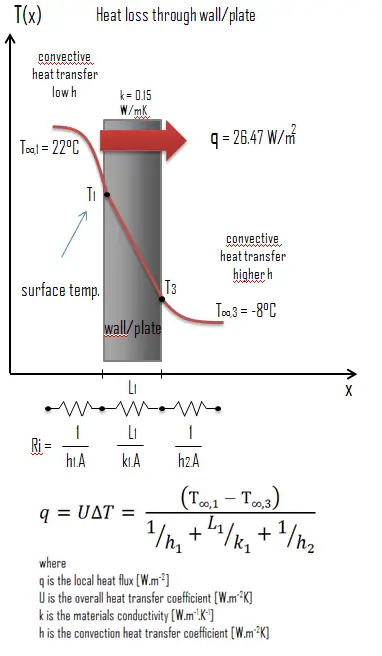
Calculate the rate of heat flux through a wall 3 m x 10 m in area (A = 30 m2). The wall is 15 cm thick (L1) and it is made of Pine Wood with the thermal conductivity of k1 = 0.12 W/m.K (poor thermal insulator). Assume that, the indoor and the outdoor temperatures are 22°C and -8°C, and the convection heat transfer coefficients on the inner and the outer sides are h1 = 10 W/m2K and h2 = 30 W/m2K, respectively. Note that, these convection coefficients strongly depend especially on ambient and interior conditions (wind, humidity, etc.).

Calculate the heat flux (heat loss) through this wall.

Solution:

As was written, many of the heat transfer processes involve composite systems and even involve a combination of both conduction and convection. With these composite systems, it is often convenient to work with an overall heat transfer coefficient, known as a U-factor. The U-factor is defined by an expression analogous to Newton’s law of cooling:
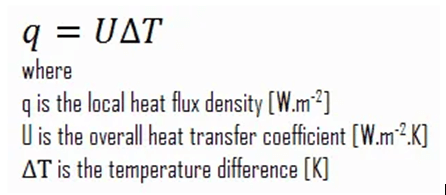
Heat transfer calculation - Newton’s law of cooling

The overall heat transfer coefficient is related to the total thermal resistance and depends on the geometry of the problem.

Assuming one-dimensional heat transfer through the plane wall and disregarding radiation, the overall heat transfer coefficient can be calculated as:
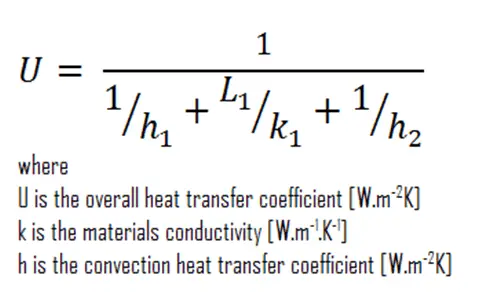
Heat transfer calculation - U-factor


The overall heat transfer coefficient is then: U = 1 / (1/10 + 0.15/0.12 + 1/30) = 0.72 W/m2K

The heat flux can be then calculated simply as: q = 0.72 [W/m2K] x 30 [K] = 21.69 W/m2

The total heat loss through this wall will be: qloss = q . A = 21.69 [W/m2] x 30 [m2] = 650.6 W

Melting Point of Materials

Material Table - Melting Point

Thermal Conductivity of Materials

Material Table - Thermal Conductivity

Heat Capacity of Materials
Material Table - Heat Capacity

Oak Wood – Density – Strength – Melting Point – Thermal Conductivity

About Oak Wood

In general, wood is a porous and fibrous structural tissue found in the stems and roots of trees and other woody plants. It is an organic material – a natural composite of cellulose fibers that are strong in tension and embedded in a matrix of lignin that resists compression. It is common to classify wood as either softwood or hardwood. The wood from conifers (e.g. pine) is called softwood, and the wood from dicotyledons (usually broad-leaved trees, e.g. oak) is called hardwood. These names are a bit misleading, as hardwoods are not necessarily hard, and softwoods are not necessarily soft.

oak wood properties density strength price

Summary

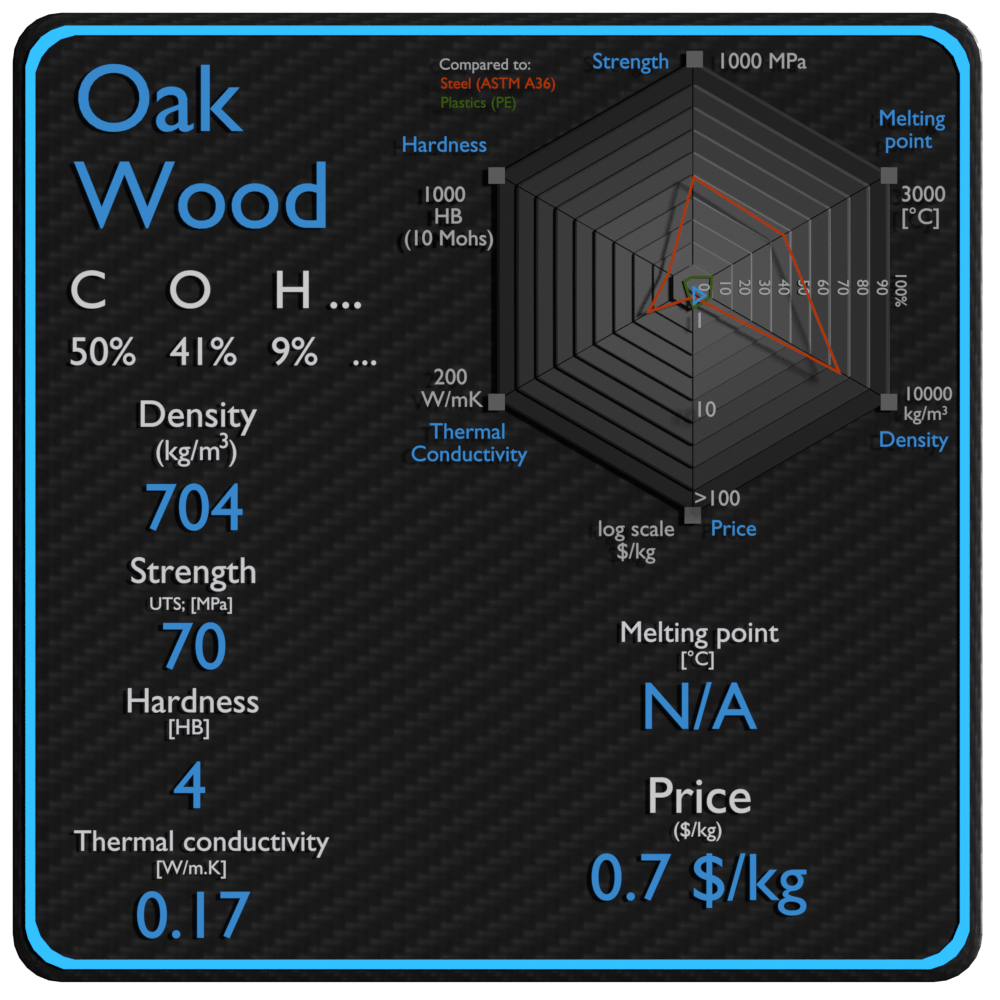
Name Oak Wood
Phase at STP solid
Density 704 kg/m3
Ultimate Tensile Strength 70 MPa
Yield Strength N/A
Young’s Modulus of Elasticity 9 GPa
Brinell Hardness 4 BHN
Melting Point N/A
Thermal Conductivity 0.17 W/mK
Heat Capacity 2000 J/g K
Price 0.7 $/kg

Density of Oak Wood

Typical densities of various substances are at atmospheric pressure. Density is defined as the mass per unit volume. It is an intensive property, which is mathematically defined as mass divided by volume:  ρ = m/V

In words, the density (ρ) of a substance is the total mass (m) of that substance divided by the total volume (V) occupied by that substance. The standard SI unit is kilograms per cubic meter (kg/m3). The Standard English unit is pounds mass per cubic foot (lbm/ft3).

Density of Oak Wood is 704 kg/m3.


Example: Density

Calculate the height of a cube made of Oak Wood, which weighs one metric ton.

Solution:

Density is defined as the mass per unit volume. It is mathematically defined as mass divided by volume: ρ = m/V

As the volume of a cube is the third power of its sides (V = a3), the height of this cube can be calculated:

density of material - equation

The height of this cube is then a = 1.124 m.

Density of Materials

Material Table - Density of Materials


Mechanical Properties of Oak Wood

Strength of Oak Wood

In mechanics of materials, the strength of a material is its ability to withstand an applied load without failure or plastic deformation. Strength of materials basically considers the relationship between the external loads applied to a material and the resulting deformation or change in material dimensions. In designing structures and machines, it is important to consider these factors, in order that the material selected will have adequate strength to resist applied loads or forces and retain its original shape.

Strength of a material is its ability to withstand this applied load without failure or plastic deformation. For tensile stress, the capacity of a material or structure to withstand loads tending to elongate is known as ultimate tensile strength (UTS). Yield strength or yield stress is the material property defined as the stress at which a material begins to deform plastically whereas yield point is the point where nonlinear (elastic + plastic) deformation begins. In case of tensional stress of a uniform bar (stress-strain curve), the Hooke’s law describes behaviour of a bar in the elastic region. The Young’s modulus of elasticity is the elastic modulus for tensile and compressive stress in the linear elasticity regime of a uniaxial deformation and is usually assessed by tensile tests.

See also: Strength of Materials

Ultimate Tensile Strength of Oak Wood

Ultimate tensile strength of Oak Wood is 70 MPa.

Yield Strength of Oak Wood

Yield strength of Oak Wood is N/A.

Modulus of Elasticity of Oak Wood

The Young’s modulus of elasticity of Oak Wood is 9 GPa.

Hardness of Oak Wood

In materials science, hardness is the ability to withstand surface indentation (localized plastic deformation) and scratching. Brinell hardness test is one of indentation hardness tests, that has been developed for hardness testing. In Brinell tests, a hard, spherical indenter is forced under a specific load into the surface of the metal to be tested.

The Brinell hardness number (HB) is the load divided by the surface area of the indentation. The diameter of the impression is measured with a microscope with a superimposed scale. The Brinell hardness number is computed from the equation:

brinell hardness number - definition

Brinell hardness of Oak Wood is approximately  4 BHN (converted).

See also: Hardness of Materials


Example: Strength

Assume a plastic rod, which is made of Oak Wood. This plastic rod has a cross-sectional area of 1 cm2. Calculate the tensile force needed to achieve the ultimate tensile strength for this material, which is: UTS = 70 MPa.

Solution:

Stress (σ) can be equated to the load per unit area or the force (F) applied per cross-sectional area (A) perpendicular to the force as:

strength of material - equation

therefore, the tensile force needed to achieve the ultimate tensile strength is:

F = UTS x A = 70 x 106 x 0.0001 = 7 000 N

Strength of Materials

Material Table - Strength of Materials

Elasticity of Materials

Material Table - Elasticity of Materials

Hardness of Materials

Material Table - Hardness of Materials  

Thermal Properties of Oak Wood

Oak Wood – Melting Point

Melting point of Oak Wood is N/A.

Note that, these points are associated with the standard atmospheric pressure. In general, melting is a phase change of a substance from the solid to the liquid phase. The melting point of a substance is the temperature at which this phase change occurs. The melting point also defines a condition in which the solid and liquid can exist in equilibrium. For various chemical compounds and alloys, it is difficult to define the melting point, since they are usually a mixture of various chemical elements.

Oak Wood – Thermal Conductivity

Thermal conductivity of Oak Wood is 0.17 W/(m·K).

The heat transfer characteristics of a solid material are measured by a property called the thermal conductivity, k (or λ), measured in W/m.K. It is a measure of a substance’s ability to transfer heat through a material by conduction. Note that Fourier’s law applies for all matter, regardless of its state (solid, liquid, or gas), therefore, it is also defined for liquids and gases.

The thermal conductivity of most liquids and solids varies with temperature. For vapors, it also depends upon pressure. In general:

thermal conductivity - definition

Most materials are very nearly homogeneous, therefore we can usually write k = k (T). Similar definitions are associated with thermal conductivities in the y- and z-directions (ky, kz), but for an isotropic material the thermal conductivity is independent of the direction of transfer, kx = ky = kz = k.

Oak Wood – Specific Heat

Specific heat of Oak Wood is 2000 J/g K.

Specific heat, or specific heat capacity, is a property related to internal energy that is very important in thermodynamics. The intensive properties cv and cp are defined for pure, simple compressible substances as partial derivatives of the internal energy u(T, v) and enthalpy h(T, p), respectively:

where the subscripts v and p denote the variables held fixed during differentiation. The properties cv and cp are referred to as specific heats (or heat capacities) because under certain special conditions they relate the temperature change of a system to the amount of energy added by heat transfer. Their SI units are J/kg K or J/mol K.


Example: Heat transfer calculation

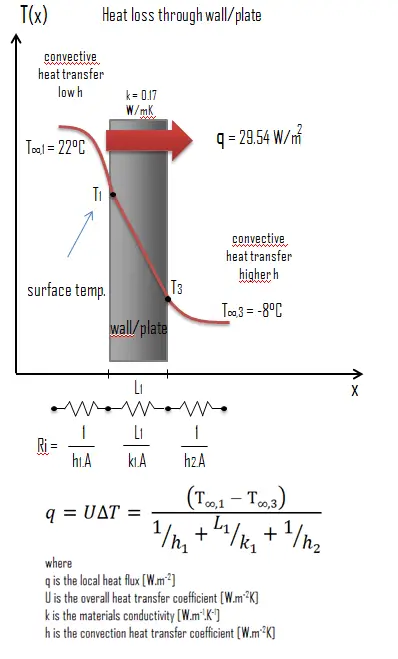
Oak Wood - Thermal ConductivityThermal conductivity is defined as the amount of heat (in watts) transferred through a square area of material of given thickness (in metres) due to a difference in temperature. The lower the thermal conductivity of the material the greater the material’s ability to resist heat transfer.

Calculate the rate of heat flux through a wall 3 m x 10 m in area (A = 30 m2). The wall is 15 cm thick (L1) and it is made of Oak Wood with the thermal conductivity of k1 = 0.17 W/m.K (poor thermal insulator). Assume that, the indoor and the outdoor temperatures are 22°C and -8°C, and the convection heat transfer coefficients on the inner and the outer sides are h1 = 10 W/m2K and h2 = 30 W/m2K, respectively. Note that, these convection coefficients strongly depend especially on ambient and interior conditions (wind, humidity, etc.).

Calculate the heat flux (heat loss) through this wall.

Solution:

As was written, many of the heat transfer processes involve composite systems and even involve a combination of both conduction and convection. With these composite systems, it is often convenient to work with an overall heat transfer coefficient, known as a U-factor. The U-factor is defined by an expression analogous to Newton’s law of cooling:

Heat transfer calculation - Newton’s law of cooling

The overall heat transfer coefficient is related to the total thermal resistance and depends on the geometry of the problem.

Assuming one-dimensional heat transfer through the plane wall and disregarding radiation, the overall heat transfer coefficient can be calculated as:

Heat transfer calculation - U-factor


The overall heat transfer coefficient is then: U = 1 / (1/10 + 0.15/0.17 + 1/30) = 0.985 W/m2K

The heat flux can be then calculated simply as: q = 0.985 [W/m2K] x 30 [K] = 29.54 W/m2

The total heat loss through this wall will be: qloss = q . A = 29.54 [W/m2] x 30 [m2] = 886.1 W

Melting Point of Materials

Material Table - Melting Point

Thermal Conductivity of Materials

Material Table - Thermal Conductivity

Heat Capacity of Materials

Material Table - Heat Capacity

Asphalt Concrete – Density – Strength – Melting Point – Thermal Conductivity

About Asphalt Concrete

Asphalt, also known as bitumen, is black or brown petroleum-like material that has a consistency varying from viscous liquid to glassy solid. It may be found in natural deposits or may be a refined product, and is classed as a pitch. Asphalt consists of compounds of hydrocarbons.

asphalt concrete properties density strength price

Summary

Name Asphalt Concrete
Phase at STP solid
Density 2360 kg/m3
Ultimate Tensile Strength 1.2 MPa
Yield Strength N/A
Young’s Modulus of Elasticity 8 GPa
Brinell Hardness N/A
Melting Point 167 °C
Thermal Conductivity 0.75 W/mK
Heat Capacity 900 J/g K
Price 0.15 $/kg

Density of Asphalt Concrete

Typical densities of various substances are at atmospheric pressure. Density is defined as the mass per unit volume. It is an intensive property, which is mathematically defined as mass divided by volume:  ρ = m/V

In words, the density (ρ) of a substance is the total mass (m) of that substance divided by the total volume (V) occupied by that substance. The standard SI unit is kilograms per cubic meter (kg/m3). The Standard English unit is pounds mass per cubic foot (lbm/ft3).

Density of Asphalt Concrete is 2360 kg/m3.


Example: Density

Calculate the height of a cube made of Asphalt Concrete, which weighs one metric ton.

Solution:

Density is defined as the mass per unit volume. It is mathematically defined as mass divided by volume: ρ = m/V

As the volume of a cube is the third power of its sides (V = a3), the height of this cube can be calculated:

density of material - equation

The height of this cube is then a = 0.751 m.

Density of Materials

Material Table - Density of Materials


Mechanical Properties of Asphalt Concrete

Strength of Asphalt Concrete

In mechanics of materials, the strength of a material is its ability to withstand an applied load without failure or plastic deformation. Strength of materials basically considers the relationship between the external loads applied to a material and the resulting deformation or change in material dimensions. In designing structures and machines, it is important to consider these factors, in order that the material selected will have adequate strength to resist applied loads or forces and retain its original shape.

Strength of a material is its ability to withstand this applied load without failure or plastic deformation. For tensile stress, the capacity of a material or structure to withstand loads tending to elongate is known as ultimate tensile strength (UTS). Yield strength or yield stress is the material property defined as the stress at which a material begins to deform plastically whereas yield point is the point where nonlinear (elastic + plastic) deformation begins. In case of tensional stress of a uniform bar (stress-strain curve), the Hooke’s law describes behaviour of a bar in the elastic region. The Young’s modulus of elasticity is the elastic modulus for tensile and compressive stress in the linear elasticity regime of a uniaxial deformation and is usually assessed by tensile tests.

See also: Strength of Materials

Ultimate Tensile Strength of Asphalt Concrete

Ultimate tensile strength of Asphalt Concrete is 1.2 MPa.

Yield Strength of Asphalt Concrete

Yield strength of Asphalt Concrete is N/A.

Modulus of Elasticity of Asphalt Concrete

The Young’s modulus of elasticity of Asphalt Concrete is 8 GPa.

Hardness of Asphalt Concrete

In materials science, hardness is the ability to withstand surface indentation (localized plastic deformation) and scratching. Brinell hardness test is one of indentation hardness tests, that has been developed for hardness testing. In Brinell tests, a hard, spherical indenter is forced under a specific load into the surface of the metal to be tested.

The Brinell hardness number (HB) is the load divided by the surface area of the indentation. The diameter of the impression is measured with a microscope with a superimposed scale. The Brinell hardness number is computed from the equation:

brinell hardness number - definition

Brinell hardness of Asphalt Concrete is approximately N/A.

See also: Hardness of Materials


Example: Strength

Assume a plastic rod, which is made of Asphalt Concrete. This plastic rod has a cross-sectional area of 1 cm2. Calculate the tensile force needed to achieve the ultimate tensile strength for this material, which is: UTS = 1.2 MPa.

Solution:

Stress (σ) can be equated to the load per unit area or the force (F) applied per cross-sectional area (A) perpendicular to the force as:

strength of material - equation

therefore, the tensile force needed to achieve the ultimate tensile strength is:

F = UTS x A = 1.2 x 106 x 0.0001 = 120 N

Strength of Materials

Material Table - Strength of Materials

Elasticity of Materials

Material Table - Elasticity of Materials

Hardness of Materials

Material Table - Hardness of Materials  

Thermal Properties of Asphalt Concrete

Asphalt Concrete – Melting Point

Melting point of Asphalt Concrete is 167 °C.

Note that, these points are associated with the standard atmospheric pressure. In general, melting is a phase change of a substance from the solid to the liquid phase. The melting point of a substance is the temperature at which this phase change occurs. The melting point also defines a condition in which the solid and liquid can exist in equilibrium. For various chemical compounds and alloys, it is difficult to define the melting point, since they are usually a mixture of various chemical elements.

Asphalt Concrete – Thermal Conductivity

Thermal conductivity of Asphalt Concrete is 0.75 W/(m·K).

The heat transfer characteristics of a solid material are measured by a property called the thermal conductivity, k (or λ), measured in W/m.K. It is a measure of a substance’s ability to transfer heat through a material by conduction. Note that Fourier’s law applies for all matter, regardless of its state (solid, liquid, or gas), therefore, it is also defined for liquids and gases.

The thermal conductivity of most liquids and solids varies with temperature. For vapors, it also depends upon pressure. In general:

thermal conductivity - definition

Most materials are very nearly homogeneous, therefore we can usually write k = k (T). Similar definitions are associated with thermal conductivities in the y- and z-directions (ky, kz), but for an isotropic material the thermal conductivity is independent of the direction of transfer, kx = ky = kz = k.

Asphalt Concrete – Specific Heat

Specific heat of Asphalt Concrete is 900 J/g K.

Specific heat, or specific heat capacity, is a property related to internal energy that is very important in thermodynamics. The intensive properties cv and cp are defined for pure, simple compressible substances as partial derivatives of the internal energy u(T, v) and enthalpy h(T, p), respectively:

where the subscripts v and p denote the variables held fixed during differentiation. The properties cv and cp are referred to as specific heats (or heat capacities) because under certain special conditions they relate the temperature change of a system to the amount of energy added by heat transfer. Their SI units are J/kg K or J/mol K.


Example: Heat transfer calculation

Asphalt Concrete - Thermal ConductivityThermal conductivity is defined as the amount of heat (in watts) transferred through a square area of material of given thickness (in metres) due to a difference in temperature. The lower the thermal conductivity of the material the greater the material’s ability to resist heat transfer.

Calculate the rate of heat flux through a wall 3 m x 10 m in area (A = 30 m2). The wall is 15 cm thick (L1) and it is made of Asphalt Concrete with the thermal conductivity of k1 = 0.75 W/m.K (poor thermal insulator). Assume that, the indoor and the outdoor temperatures are 22°C and -8°C, and the convection heat transfer coefficients on the inner and the outer sides are h1 = 10 W/m2K and h2 = 30 W/m2K, respectively. Note that, these convection coefficients strongly depend especially on ambient and interior conditions (wind, humidity, etc.).

Calculate the heat flux (heat loss) through this wall.

Solution:

As was written, many of the heat transfer processes involve composite systems and even involve a combination of both conduction and convection. With these composite systems, it is often convenient to work with an overall heat transfer coefficient, known as a U-factor. The U-factor is defined by an expression analogous to Newton’s law of cooling:

Heat transfer calculation - Newton’s law of cooling

The overall heat transfer coefficient is related to the total thermal resistance and depends on the geometry of the problem.

Assuming one-dimensional heat transfer through the plane wall and disregarding radiation, the overall heat transfer coefficient can be calculated as:

Heat transfer calculation - U-factor


The overall heat transfer coefficient is then: U = 1 / (1/10 + 0.15/0.75 + 1/30) = 3 W/m2K

The heat flux can be then calculated simply as: q = 3 [W/m2K] x 30 [K] = 90 W/m2

The total heat loss through this wall will be: qloss = q . A = 90 [W/m2] x 30 [m2] = 2700 W

Melting Point of Materials

Material Table - Melting Point

Thermal Conductivity of Materials

Material Table - Thermal Conductivity

Heat Capacity of Materials

Material Table - Heat Capacity

Bituminous Coal – Density – Strength – Melting Point – Thermal Conductivity

About Bituminous Coal

Coal is a rock formed from the decomposition of plant life. It is primarily composed of carbon, with many other trace elements. Bituminous coal or black coal is a relatively soft coal containing a tarlike substance called bitumen or asphalt. It is of higher quality than lignite and Sub-bituminous coal, but of poorer quality than anthracite.

coal properties density strength price

Summary

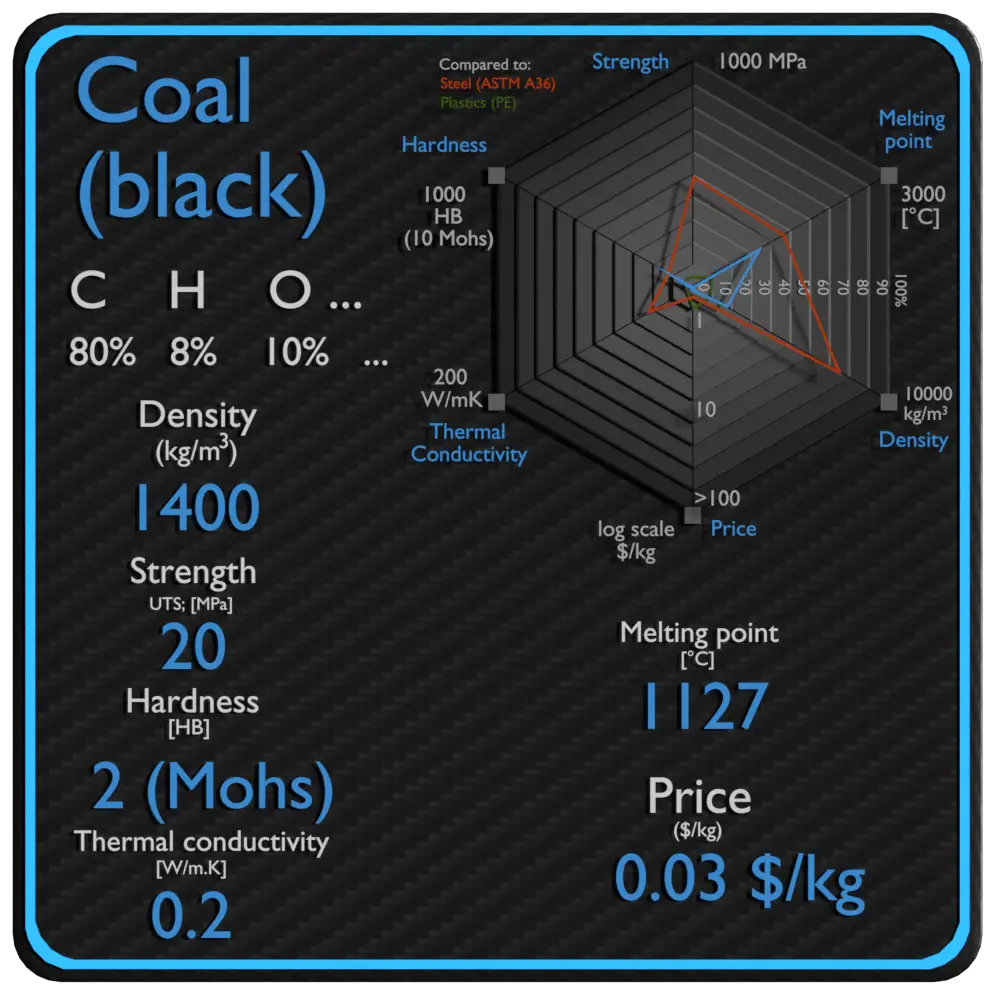
Name Bituminous Coal
Phase at STP solid
Density 1400 kg/m3
Ultimate Tensile Strength 20 MPa
Yield Strength N/A
Young’s Modulus of Elasticity N/A
Brinell Hardness 2 Mohs
Melting Point 1127 °C
Thermal Conductivity 0.2 W/mK
Heat Capacity 1380 J/g K
Price 0.03 $/kg

Density of Bituminous Coal

Typical densities of various substances are at atmospheric pressure. Density is defined as the mass per unit volume. It is an intensive property, which is mathematically defined as mass divided by volume:  ρ = m/V

In words, the density (ρ) of a substance is the total mass (m) of that substance divided by the total volume (V) occupied by that substance. The standard SI unit is kilograms per cubic meter (kg/m3). The Standard English unit is pounds mass per cubic foot (lbm/ft3).

Density of Bituminous Coal is 1400 kg/m3.


Example: Density

Calculate the height of a cube made of Bituminous Coal, which weighs one metric ton.

Solution:

Density is defined as the mass per unit volume. It is mathematically defined as mass divided by volume: ρ = m/V

As the volume of a cube is the third power of its sides (V = a3), the height of this cube can be calculated:

density of material - equation

The height of this cube is then a = 0.894 m.

Density of Materials

Material Table - Density of Materials


Mechanical Properties of Bituminous Coal

Strength of Bituminous Coal

In mechanics of materials, the strength of a material is its ability to withstand an applied load without failure or plastic deformation. Strength of materials basically considers the relationship between the external loads applied to a material and the resulting deformation or change in material dimensions. In designing structures and machines, it is important to consider these factors, in order that the material selected will have adequate strength to resist applied loads or forces and retain its original shape.

Strength of a material is its ability to withstand this applied load without failure or plastic deformation. For tensile stress, the capacity of a material or structure to withstand loads tending to elongate is known as ultimate tensile strength (UTS). Yield strength or yield stress is the material property defined as the stress at which a material begins to deform plastically whereas yield point is the point where nonlinear (elastic + plastic) deformation begins. In case of tensional stress of a uniform bar (stress-strain curve), the Hooke’s law describes behaviour of a bar in the elastic region. The Young’s modulus of elasticity is the elastic modulus for tensile and compressive stress in the linear elasticity regime of a uniaxial deformation and is usually assessed by tensile tests.

See also: Strength of Materials

Ultimate Tensile Strength of Bituminous Coal

Ultimate tensile strength of Bituminous Coal is 20 MPa.

Yield Strength of Bituminous Coal

Yield strength of Bituminous Coal is N/A.

Modulus of Elasticity of Bituminous Coal

The Young’s modulus of elasticity of Bituminous Coal is N/A.

Hardness of Bituminous Coal

In materials science, hardness is the ability to withstand surface indentation (localized plastic deformation) and scratching. Brinell hardness test is one of indentation hardness tests, that has been developed for hardness testing. In Brinell tests, a hard, spherical indenter is forced under a specific load into the surface of the metal to be tested.

The Brinell hardness number (HB) is the load divided by the surface area of the indentation. The diameter of the impression is measured with a microscope with a superimposed scale. The Brinell hardness number is computed from the equation:

brinell hardness number - definition

Hardness of Bituminous Coal is approximately 2 Mohs.

See also: Hardness of Materials


Example: Strength

Assume a plastic rod, which is made of Bituminous Coal. This plastic rod has a cross-sectional area of 1 cm2. Calculate the tensile force needed to achieve the ultimate tensile strength for this material, which is: UTS = 20 MPa.

Solution:

Stress (σ) can be equated to the load per unit area or the force (F) applied per cross-sectional area (A) perpendicular to the force as:

strength of material - equation

therefore, the tensile force needed to achieve the ultimate tensile strength is:

F = UTS x A = 20 x 106 x 0.0001 = 2 000 N

Strength of Materials

Material Table - Strength of Materials

Elasticity of Materials

Material Table - Elasticity of Materials

Hardness of Materials

Material Table - Hardness of Materials  

Thermal Properties of Bituminous Coal

Bituminous Coal – Melting Point

Melting point of Bituminous Coal is 1127 °C.

Note that, these points are associated with the standard atmospheric pressure. In general, melting is a phase change of a substance from the solid to the liquid phase. The melting point of a substance is the temperature at which this phase change occurs. The melting point also defines a condition in which the solid and liquid can exist in equilibrium. For various chemical compounds and alloys, it is difficult to define the melting point, since they are usually a mixture of various chemical elements.

Bituminous Coal – Thermal Conductivity

Thermal conductivity of Bituminous Coal is 0.2 W/(m·K).

The heat transfer characteristics of a solid material are measured by a property called the thermal conductivity, k (or λ), measured in W/m.K. It is a measure of a substance’s ability to transfer heat through a material by conduction. Note that Fourier’s law applies for all matter, regardless of its state (solid, liquid, or gas), therefore, it is also defined for liquids and gases.

The thermal conductivity of most liquids and solids varies with temperature. For vapors, it also depends upon pressure. In general:

thermal conductivity - definition

Most materials are very nearly homogeneous, therefore we can usually write k = k (T). Similar definitions are associated with thermal conductivities in the y- and z-directions (ky, kz), but for an isotropic material the thermal conductivity is independent of the direction of transfer, kx = ky = kz = k.

Bituminous Coal – Specific Heat

Specific heat of Bituminous Coal is 1380 J/g K.

Specific heat, or specific heat capacity, is a property related to internal energy that is very important in thermodynamics. The intensive properties cv and cp are defined for pure, simple compressible substances as partial derivatives of the internal energy u(T, v) and enthalpy h(T, p), respectively:

where the subscripts v and p denote the variables held fixed during differentiation. The properties cv and cp are referred to as specific heats (or heat capacities) because under certain special conditions they relate the temperature change of a system to the amount of energy added by heat transfer. Their SI units are J/kg K or J/mol K.


Example: Heat transfer calculation

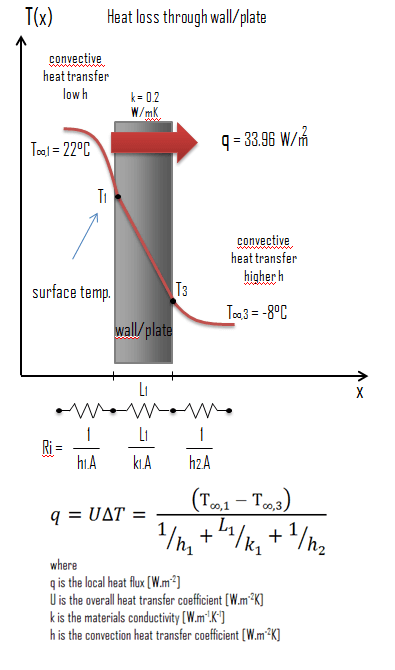
Coal - Thermal ConductivityThermal conductivity is defined as the amount of heat (in watts) transferred through a square area of material of given thickness (in metres) due to a difference in temperature. The lower the thermal conductivity of the material the greater the material’s ability to resist heat transfer.

Calculate the rate of heat flux through a wall 3 m x 10 m in area (A = 30 m2). The wall is 15 cm thick (L1) and it is made of Bituminous Coal with the thermal conductivity of k1 = 0.2 W/m.K (poor thermal insulator). Assume that, the indoor and the outdoor temperatures are 22°C and -8°C, and the convection heat transfer coefficients on the inner and the outer sides are h1 = 10 W/m2K and h2 = 30 W/m2K, respectively. Note that, these convection coefficients strongly depend especially on ambient and interior conditions (wind, humidity, etc.).

Calculate the heat flux (heat loss) through this wall.

Solution:

As was written, many of the heat transfer processes involve composite systems and even involve a combination of both conduction and convection. With these composite systems, it is often convenient to work with an overall heat transfer coefficient, known as a U-factor. The U-factor is defined by an expression analogous to Newton’s law of cooling:

Heat transfer calculation - Newton’s law of cooling

The overall heat transfer coefficient is related to the total thermal resistance and depends on the geometry of the problem.

Assuming one-dimensional heat transfer through the plane wall and disregarding radiation, the overall heat transfer coefficient can be calculated as:

Heat transfer calculation - U-factor


The overall heat transfer coefficient is then: U = 1 / (1/10 + 0.15/0.2 + 1/30) = 1.13 W/m2K

The heat flux can be then calculated simply as: q = 1.13 [W/m2K] x 30 [K] = 33.96 W/m2

The total heat loss through this wall will be: qloss = q . A =33.96 [W/m2] x 30 [m2] = 1018.87 W

Melting Point of Materials

Material Table - Melting Point

Thermal Conductivity of Materials

Material Table - Thermal Conductivity

Heat Capacity of Materials

Material Table - Heat Capacity

Wax – Density – Strength – Melting Point – Thermal Conductivity

About Wax

In general, waxes are a diverse class of organic compounds that are lipophilic, malleable solids near ambient temperatures. They include higher alkanes and lipids, typically with melting points above about 40 °C (104 °F), melting to give low viscosity liquids. Although many natural waxes contain esters, paraffin waxes are hydrocarbons, mixtures of alkanes usually in a homologous series of chain lengths. These materials represent a significant fraction of petroleum.

wax properties density strength price

Summary

Name Wax
Phase at STP solid
Density 960 kg/m3
Ultimate Tensile Strength 0.9 MPa
Yield Strength N/A
Young’s Modulus of Elasticity 0.2 GPa
Brinell Hardness N/A
Melting Point 57 °C
Thermal Conductivity 0.2 W/mK
Heat Capacity 2200 J/g K
Price 1.5 $/kg

Density of Wax

Typical densities of various substances are at atmospheric pressure. Density is defined as the mass per unit volume. It is an intensive property, which is mathematically defined as mass divided by volume:  ρ = m/V

In words, the density (ρ) of a substance is the total mass (m) of that substance divided by the total volume (V) occupied by that substance. The standard SI unit is kilograms per cubic meter (kg/m3). The Standard English unit is pounds mass per cubic foot (lbm/ft3).

Density of Wax is 960 kg/m3.


Example: Density

Calculate the height of a cube made of Wax, which weighs one metric ton.

Solution:

Density is defined as the mass per unit volume. It is mathematically defined as mass divided by volume: ρ = m/V

As the volume of a cube is the third power of its sides (V = a3), the height of this cube can be calculated:

density of material - equation

The height of this cube is then a = 1.014 m.

Density of Materials

Material Table - Density of Materials


Mechanical Properties of Wax

Strength of Wax

In mechanics of materials, the strength of a material is its ability to withstand an applied load without failure or plastic deformation. Strength of materials basically considers the relationship between the external loads applied to a material and the resulting deformation or change in material dimensions. In designing structures and machines, it is important to consider these factors, in order that the material selected will have adequate strength to resist applied loads or forces and retain its original shape.

Strength of a material is its ability to withstand this applied load without failure or plastic deformation. For tensile stress, the capacity of a material or structure to withstand loads tending to elongate is known as ultimate tensile strength (UTS). Yield strength or yield stress is the material property defined as the stress at which a material begins to deform plastically whereas yield point is the point where nonlinear (elastic + plastic) deformation begins. In case of tensional stress of a uniform bar (stress-strain curve), the Hooke’s law describes behaviour of a bar in the elastic region. The Young’s modulus of elasticity is the elastic modulus for tensile and compressive stress in the linear elasticity regime of a uniaxial deformation and is usually assessed by tensile tests.

See also: Strength of Materials

Ultimate Tensile Strength of Wax

Ultimate tensile strength of Wax is 0.9 MPa.

Yield Strength of Wax

Yield strength of Wax is N/A.

Modulus of Elasticity of Wax

The Young’s modulus of elasticity of Wax is 0.2 GPa.

Hardness of Wax

In materials science, hardness is the ability to withstand surface indentation (localized plastic deformation) and scratching. Brinell hardness test is one of indentation hardness tests, that has been developed for hardness testing. In Brinell tests, a hard, spherical indenter is forced under a specific load into the surface of the metal to be tested.

The Brinell hardness number (HB) is the load divided by the surface area of the indentation. The diameter of the impression is measured with a microscope with a superimposed scale. The Brinell hardness number is computed from the equation:

brinell hardness number - definition

Brinell hardness of Wax is approximately N/A.

See also: Hardness of Materials


Example: Strength

Assume a plastic rod, which is made of Wax. This plastic rod has a cross-sectional area of 1 cm2. Calculate the tensile force needed to achieve the ultimate tensile strength for this material, which is: UTS = 0.9 MPa.

Solution:

Stress (σ) can be equated to the load per unit area or the force (F) applied per cross-sectional area (A) perpendicular to the force as:

strength of material - equation

therefore, the tensile force needed to achieve the ultimate tensile strength is:

F = UTS x A = 0.9 x 106 x 0.0001 = 90 N

Strength of Materials

Material Table - Strength of Materials

Elasticity of Materials

Material Table - Elasticity of Materials

Hardness of Materials

Material Table - Hardness of Materials  

Thermal Properties of Wax

Wax – Melting Point

Melting point of Wax is 57 °C.

Note that, these points are associated with the standard atmospheric pressure. In general, melting is a phase change of a substance from the solid to the liquid phase. The melting point of a substance is the temperature at which this phase change occurs. The melting point also defines a condition in which the solid and liquid can exist in equilibrium. For various chemical compounds and alloys, it is difficult to define the melting point, since they are usually a mixture of various chemical elements.

Wax – Thermal Conductivity

Thermal conductivity of Wax is 0.2 W/(m·K).

The heat transfer characteristics of a solid material are measured by a property called the thermal conductivity, k (or λ), measured in W/m.K. It is a measure of a substance’s ability to transfer heat through a material by conduction. Note that Fourier’s law applies for all matter, regardless of its state (solid, liquid, or gas), therefore, it is also defined for liquids and gases.

The thermal conductivity of most liquids and solids varies with temperature. For vapors, it also depends upon pressure. In general:

thermal conductivity - definition

Most materials are very nearly homogeneous, therefore we can usually write k = k (T). Similar definitions are associated with thermal conductivities in the y- and z-directions (ky, kz), but for an isotropic material the thermal conductivity is independent of the direction of transfer, kx = ky = kz = k.

Wax – Specific Heat

Specific heat of Wax is 2200 J/g K.

Specific heat, or specific heat capacity, is a property related to internal energy that is very important in thermodynamics. The intensive properties cv and cp are defined for pure, simple compressible substances as partial derivatives of the internal energy u(T, v) and enthalpy h(T, p), respectively:

where the subscripts v and p denote the variables held fixed during differentiation. The properties cv and cp are referred to as specific heats (or heat capacities) because under certain special conditions they relate the temperature change of a system to the amount of energy added by heat transfer. Their SI units are J/kg K or J/mol K.


Example: Heat transfer calculation

Wax - Thermal ConductivityThermal conductivity is defined as the amount of heat (in watts) transferred through a square area of material of given thickness (in metres) due to a difference in temperature. The lower the thermal conductivity of the material the greater the material’s ability to resist heat transfer.

Calculate the rate of heat flux through a wall 3 m x 10 m in area (A = 30 m2). The wall is 15 cm thick (L1) and it is made of Wax with the thermal conductivity of k1 = 0.2 W/m.K (poor thermal insulator). Assume that, the indoor and the outdoor temperatures are 22°C and -8°C, and the convection heat transfer coefficients on the inner and the outer sides are h1 = 10 W/m2K and h2 = 30 W/m2K, respectively. Note that, these convection coefficients strongly depend especially on ambient and interior conditions (wind, humidity, etc.).

Calculate the heat flux (heat loss) through this wall.

Solution:

As was written, many of the heat transfer processes involve composite systems and even involve a combination of both conduction and convection. With these composite systems, it is often convenient to work with an overall heat transfer coefficient, known as a U-factor. The U-factor is defined by an expression analogous to Newton’s law of cooling:

Heat transfer calculation - Newton’s law of cooling

The overall heat transfer coefficient is related to the total thermal resistance and depends on the geometry of the problem.

Assuming one-dimensional heat transfer through the plane wall and disregarding radiation, the overall heat transfer coefficient can be calculated as:

Heat transfer calculation - U-factor


The overall heat transfer coefficient is then: U = 1 / (1/10 + 0.15/0.2 + 1/30) = 1.13 W/m2K

The heat flux can be then calculated simply as: q = 1.13 [W/m2K] x 30 [K] = 33.96 W/m2

The total heat loss through this wall will be: qloss = q . A = 33.96 [W/m2] x 30 [m2] = 1018.87 W

Melting Point of Materials

Material Table - Melting Point

Thermal Conductivity of Materials

Material Table - Thermal Conductivity

Heat Capacity of Materials

Material Table - Heat Capacity

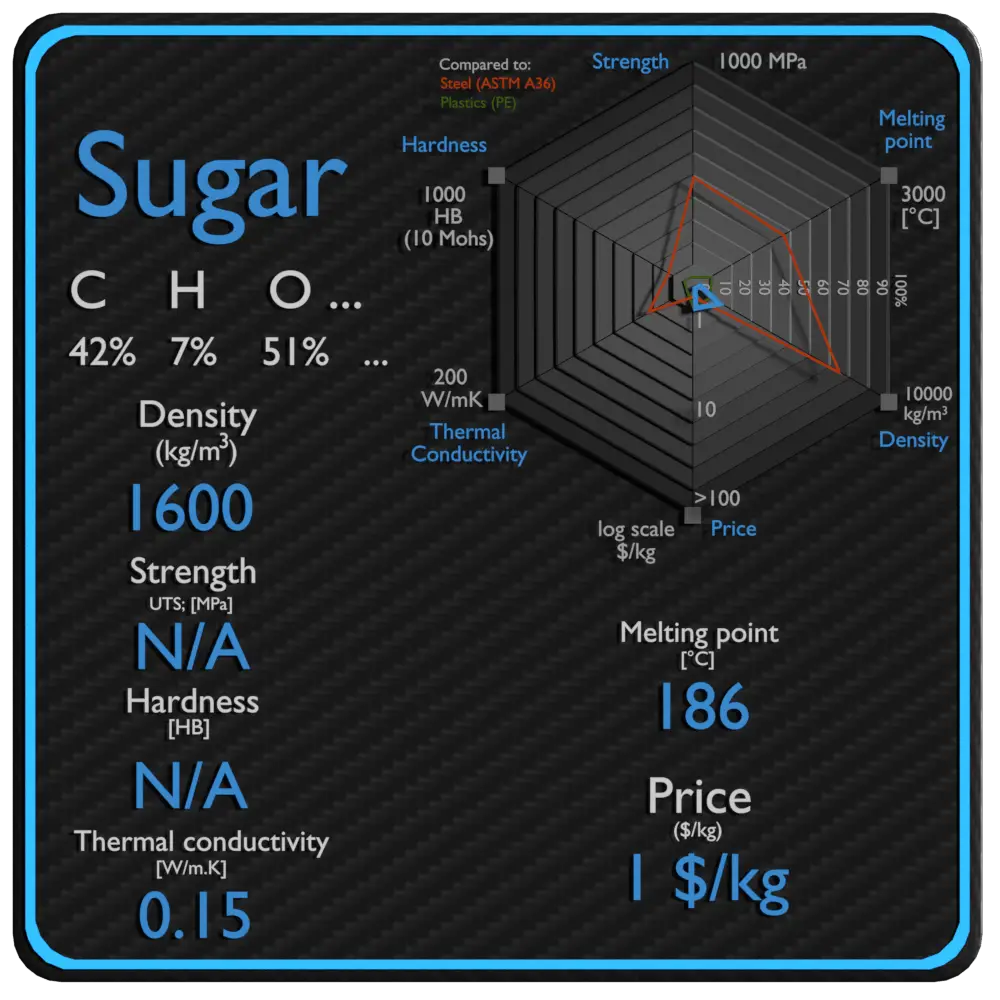
Sugar – Density – Melting Point – Thermal Conductivity

About Sugar

Sugar is colourless, water-soluble compound present in the sap of seed plants and the milk of mammals and making up the simplest group of carbohydrates. The most common sugar is sucrose, a crystalline tabletop and industrial sweetener used in foods and beverages.

sugar properties density strength price

Summary

Name Sugar
Phase at STP solid
Density 1600 kg/m3
Ultimate Tensile Strength N/A
Yield Strength N/A
Young’s Modulus of Elasticity N/A
Brinell Hardness N/A
Melting Point 186 °C
Thermal Conductivity 0.15 W/mK
Heat Capacity 1244 J/g K
Price 1 $/kg

Density of Sugar

Typical densities of various substances are at atmospheric pressure. Density is defined as the mass per unit volume. It is an intensive property, which is mathematically defined as mass divided by volume:  ρ = m/V

In words, the density (ρ) of a substance is the total mass (m) of that substance divided by the total volume (V) occupied by that substance. The standard SI unit is kilograms per cubic meter (kg/m3). The Standard English unit is pounds mass per cubic foot (lbm/ft3).

Density of Sugar is 1600 kg/m3.


Example: Density

Calculate the height of a cube made of Sugar, which weighs one metric ton.

Solution:

Density is defined as the mass per unit volume. It is mathematically defined as mass divided by volume: ρ = m/V

As the volume of a cube is the third power of its sides (V = a3), the height of this cube can be calculated:

density of material - equation

The height of this cube is then a = 0.855 m.

Density of Materials

Material Table - Density of Materials


Thermal Properties of Sugar

Sugar – Melting Point

Melting point of Sugar is 186 °C.

Note that, these points are associated with the standard atmospheric pressure. In general, melting is a phase change of a substance from the solid to the liquid phase. The melting point of a substance is the temperature at which this phase change occurs. The melting point also defines a condition in which the solid and liquid can exist in equilibrium. For various chemical compounds and alloys, it is difficult to define the melting point, since they are usually a mixture of various chemical elements.

Sugar – Thermal Conductivity

Thermal conductivity of Sugar is 0.15 W/(m·K).

The heat transfer characteristics of a solid material are measured by a property called the thermal conductivity, k (or λ), measured in W/m.K. It is a measure of a substance’s ability to transfer heat through a material by conduction. Note that Fourier’s law applies for all matter, regardless of its state (solid, liquid, or gas), therefore, it is also defined for liquids and gases.

The thermal conductivity of most liquids and solids varies with temperature. For vapors, it also depends upon pressure. In general:

thermal conductivity - definition

Most materials are very nearly homogeneous, therefore we can usually write k = k (T). Similar definitions are associated with thermal conductivities in the y- and z-directions (ky, kz), but for an isotropic material the thermal conductivity is independent of the direction of transfer, kx = ky = kz = k.

Sugar – Specific Heat

Specific heat of Sugar is 1244 J/g K.

Specific heat, or specific heat capacity, is a property related to internal energy that is very important in thermodynamics. The intensive properties cv and cp are defined for pure, simple compressible substances as partial derivatives of the internal energy u(T, v) and enthalpy h(T, p), respectively:

where the subscripts v and p denote the variables held fixed during differentiation. The properties cv and cp are referred to as specific heats (or heat capacities) because under certain special conditions they relate the temperature change of a system to the amount of energy added by heat transfer. Their SI units are J/kg K or J/mol K.


Example: Heat transfer calculation

Sugar - Thermal ConductivityThermal conductivity is defined as the amount of heat (in watts) transferred through a square area of material of given thickness (in metres) due to a difference in temperature. The lower the thermal conductivity of the material the greater the material’s ability to resist heat transfer.

Calculate the rate of heat flux through a wall 3 m x 10 m in area (A = 30 m2). The wall is 15 cm thick (L1) and it is made of Sugar with the thermal conductivity of k1 = 0.15 W/m.K (poor thermal insulator). Assume that, the indoor and the outdoor temperatures are 22°C and -8°C, and the convection heat transfer coefficients on the inner and the outer sides are h1 = 10 W/m2K and h2 = 30 W/m2K, respectively. Note that, these convection coefficients strongly depend especially on ambient and interior conditions (wind, humidity, etc.).

Calculate the heat flux (heat loss) through this wall.

Solution:

As was written, many of the heat transfer processes involve composite systems and even involve a combination of both conduction and convection. With these composite systems, it is often convenient to work with an overall heat transfer coefficient, known as a U-factor. The U-factor is defined by an expression analogous to Newton’s law of cooling:

Heat transfer calculation - Newton’s law of cooling

The overall heat transfer coefficient is related to the total thermal resistance and depends on the geometry of the problem.

Assuming one-dimensional heat transfer through the plane wall and disregarding radiation, the overall heat transfer coefficient can be calculated as:

Heat transfer calculation - U-factor


The overall heat transfer coefficient is then: U = 1 / (1/10 + 0.15/0.15 + 1/30) = 0.88 W/m2K

The heat flux can be then calculated simply as: q = 0.88 [W/m2K] x 30 [K] = 26.47 W/m2

The total heat loss through this wall will be: qloss = q . A = 26.47 [W/m2] x 30 [m2] = 794.12 W

Melting Point of Materials

Material Table - Melting Point

Thermal Conductivity of Materials

Material Table - Thermal Conductivity

Heat Capacity of Materials
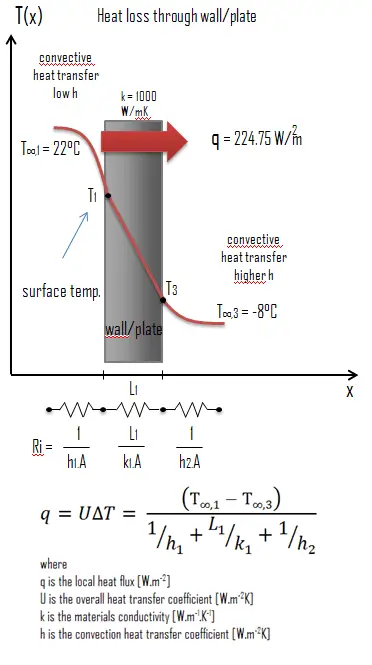
Material Table - Heat Capacity

Strength of Materials

Material Table - Strength of Materials

Elasticity of Materials

Material Table - Elasticity of Materials

Hardness of Materials

Material Table - Hardness of Materials  

Salt – Density – Strength – Melting Point – Thermal Conductivity

About Salt

Salt is a mineral composed primarily of sodium chloride (NaCl), a chemical compound belonging to the larger class of salts; salt in its natural form as a crystalline mineral is known as rock salt or halite. Halite is mainly a sedimentary mineral that usually forms in arid climates where ocean water evaporates. The mineral is typically colorless or white, but may also be light blue, dark blue, purple, pinkA, red, orange, yellow or gray depending on inclusion of other materials, impurities, and structural or isotopic abnormalities in the crystals.

salt properties density strength price

Summary

Name Salt
Phase at STP solid
Density 2200 kg/m3
Ultimate Tensile Strength 1.65 MPa
Yield Strength N/A
Young’s Modulus of Elasticity 20 GPa
Brinell Hardness 6 Mohs
Melting Point 797 °C
Thermal Conductivity 7 W/mK
Heat Capacity 880 J/g K
Price 0.4 $/kg

Density of Salt

Typical densities of various substances are at atmospheric pressure. Density is defined as the mass per unit volume. It is an intensive property, which is mathematically defined as mass divided by volume:  ρ = m/V

In words, the density (ρ) of a substance is the total mass (m) of that substance divided by the total volume (V) occupied by that substance. The standard SI unit is kilograms per cubic meter (kg/m3). The Standard English unit is pounds mass per cubic foot (lbm/ft3).

Density of Salt is 2200 kg/m3.


Example: Density

Calculate the height of a cube made of Salt, which weighs one metric ton.

Solution:

Density is defined as the mass per unit volume. It is mathematically defined as mass divided by volume: ρ = m/V

As the volume of a cube is the third power of its sides (V = a3), the height of this cube can be calculated:

density of material - equation

The height of this cube is then a = 0.769 m.

Density of Materials

Material Table - Density of Materials


Mechanical Properties of Salt

Strength of Salt

In mechanics of materials, the strength of a material is its ability to withstand an applied load without failure or plastic deformation. Strength of materials basically considers the relationship between the external loads applied to a material and the resulting deformation or change in material dimensions. In designing structures and machines, it is important to consider these factors, in order that the material selected will have adequate strength to resist applied loads or forces and retain its original shape.

Strength of a material is its ability to withstand this applied load without failure or plastic deformation. For tensile stress, the capacity of a material or structure to withstand loads tending to elongate is known as ultimate tensile strength (UTS). Yield strength or yield stress is the material property defined as the stress at which a material begins to deform plastically whereas yield point is the point where nonlinear (elastic + plastic) deformation begins. In case of tensional stress of a uniform bar (stress-strain curve), the Hooke’s law describes behaviour of a bar in the elastic region. The Young’s modulus of elasticity is the elastic modulus for tensile and compressive stress in the linear elasticity regime of a uniaxial deformation and is usually assessed by tensile tests.

See also: Strength of Materials

Ultimate Tensile Strength of Salt

Ultimate tensile strength of Salt is 1.65 MPa.

Yield Strength of Salt

Yield strength of Salt is N/A.

Modulus of Elasticity of Salt

The Young’s modulus of elasticity of Salt is 20 GPa.

Hardness of Salt

In materials science, hardness is the ability to withstand surface indentation (localized plastic deformation) and scratching. Brinell hardness test is one of indentation hardness tests, that has been developed for hardness testing. In Brinell tests, a hard, spherical indenter is forced under a specific load into the surface of the metal to be tested.

The Brinell hardness number (HB) is the load divided by the surface area of the indentation. The diameter of the impression is measured with a microscope with a superimposed scale. The Brinell hardness number is computed from the equation:

brinell hardness number - definition

Hardness of Salt is approximately 2 Mohs.

See also: Hardness of Materials


Example: Strength

Assume a plastic rod, which is made of Salt. This plastic rod has a cross-sectional area of 1 cm2. Calculate the tensile force needed to achieve the ultimate tensile strength for this material, which is: UTS = 1.65 MPa.

Solution:

Stress (σ) can be equated to the load per unit area or the force (F) applied per cross-sectional area (A) perpendicular to the force as:

strength of material - equation

therefore, the tensile force needed to achieve the ultimate tensile strength is:

F = UTS x A = 1.65 x 106 x 0.0001 = 165 N

Strength of Materials

Material Table - Strength of Materials

Elasticity of Materials

Material Table - Elasticity of Materials

Hardness of Materials

Material Table - Hardness of Materials  

Thermal Properties of Salt

Salt – Melting Point

Melting point of Salt is 797 °C.

Note that, these points are associated with the standard atmospheric pressure. In general, melting is a phase change of a substance from the solid to the liquid phase. The melting point of a substance is the temperature at which this phase change occurs. The melting point also defines a condition in which the solid and liquid can exist in equilibrium. For various chemical compounds and alloys, it is difficult to define the melting point, since they are usually a mixture of various chemical elements.

Salt – Thermal Conductivity

Thermal conductivity of Salt is 7 W/(m·K).

The heat transfer characteristics of a solid material are measured by a property called the thermal conductivity, k (or λ), measured in W/m.K. It is a measure of a substance’s ability to transfer heat through a material by conduction. Note that Fourier’s law applies for all matter, regardless of its state (solid, liquid, or gas), therefore, it is also defined for liquids and gases.

The thermal conductivity of most liquids and solids varies with temperature. For vapors, it also depends upon pressure. In general:

thermal conductivity - definition

Most materials are very nearly homogeneous, therefore we can usually write k = k (T). Similar definitions are associated with thermal conductivities in the y- and z-directions (ky, kz), but for an isotropic material the thermal conductivity is independent of the direction of transfer, kx = ky = kz = k.

Salt – Specific Heat

Specific heat of Salt is 880 J/g K.

Specific heat, or specific heat capacity, is a property related to internal energy that is very important in thermodynamics. The intensive properties cv and cp are defined for pure, simple compressible substances as partial derivatives of the internal energy u(T, v) and enthalpy h(T, p), respectively:

where the subscripts v and p denote the variables held fixed during differentiation. The properties cv and cp are referred to as specific heats (or heat capacities) because under certain special conditions they relate the temperature change of a system to the amount of energy added by heat transfer. Their SI units are J/kg K or J/mol K.


Example: Heat transfer calculation

Salt - Thermal ConductivityThermal conductivity is defined as the amount of heat (in watts) transferred through a square area of material of given thickness (in metres) due to a difference in temperature. The lower the thermal conductivity of the material the greater the material’s ability to resist heat transfer.

Calculate the rate of heat flux through a wall 3 m x 10 m in area (A = 30 m2). The wall is 15 cm thick (L1) and it is made of Salt with the thermal conductivity of k1 = 7 W/m.K (poor thermal insulator). Assume that, the indoor and the outdoor temperatures are 22°C and -8°C, and the convection heat transfer coefficients on the inner and the outer sides are h1 = 10 W/m2K and h2 = 30 W/m2K, respectively. Note that, these convection coefficients strongly depend especially on ambient and interior conditions (wind, humidity, etc.).

Calculate the heat flux (heat loss) through this wall.

Solution:

As was written, many of the heat transfer processes involve composite systems and even involve a combination of both conduction and convection. With these composite systems, it is often convenient to work with an overall heat transfer coefficient, known as a U-factor. The U-factor is defined by an expression analogous to Newton’s law of cooling:

Heat transfer calculation - Newton’s law of cooling

The overall heat transfer coefficient is related to the total thermal resistance and depends on the geometry of the problem.

Assuming one-dimensional heat transfer through the plane wall and disregarding radiation, the overall heat transfer coefficient can be calculated as:

Heat transfer calculation - U-factor


The overall heat transfer coefficient is then: U = 1 / (1/10 + 0.15/7 + 1/30) = 6.46 W/m2K

The heat flux can be then calculated simply as: q = 6.46 [W/m2K] x 30 [K] = 193.85 W/m2

The total heat loss through this wall will be: qloss = q . A = 193.85 [W/m2] x 30 [m2] = 5815.39 W

Melting Point of Materials

Material Table - Melting Point

Thermal Conductivity of Materials

Material Table - Thermal Conductivity

Heat Capacity of Materials

Material Table - Heat Capacity

Ruby – Density – Strength – Melting Point – Thermal Conductivity

About Ruby

A ruby is a pink to blood-red coloured gemstone, a variety of the mineral corundum (aluminium oxide). Other varieties of gem-quality corundum are called sapphires. Rubies have a hardness of 9.0 on the Mohs scale of mineral hardness.

ruby properties density strength price

Summary

Name Ruby
Phase at STP solid
Density 3980 kg/m3
Ultimate Tensile Strength 2100 MPa
Yield Strength N/A
Young’s Modulus of Elasticity 350 GPa
Brinell Hardness 9 Mohs
Melting Point 2047 °C
Thermal Conductivity 40 W/mK
Heat Capacity 750 J/g K
Price 50000000 $/kg

Density of Ruby

Typical densities of various substances are at atmospheric pressure. Density is defined as the mass per unit volume. It is an intensive property, which is mathematically defined as mass divided by volume:  ρ = m/V

In words, the density (ρ) of a substance is the total mass (m) of that substance divided by the total volume (V) occupied by that substance. The standard SI unit is kilograms per cubic meter (kg/m3). The Standard English unit is pounds mass per cubic foot (lbm/ft3).

Density of Ruby is 3980 kg/m3.


Example: Density

Calculate the height of a cube made of Ruby, which weighs one metric ton.

Solution:

Density is defined as the mass per unit volume. It is mathematically defined as mass divided by volume: ρ = m/V

As the volume of a cube is the third power of its sides (V = a3), the height of this cube can be calculated:

density of material - equation

The height of this cube is then a = 0.631 m.

Density of Materials

Material Table - Density of Materials


Mechanical Properties of Ruby

Strength of Ruby

In mechanics of materials, the strength of a material is its ability to withstand an applied load without failure or plastic deformation. Strength of materials basically considers the relationship between the external loads applied to a material and the resulting deformation or change in material dimensions. In designing structures and machines, it is important to consider these factors, in order that the material selected will have adequate strength to resist applied loads or forces and retain its original shape.

Strength of a material is its ability to withstand this applied load without failure or plastic deformation. For tensile stress, the capacity of a material or structure to withstand loads tending to elongate is known as ultimate tensile strength (UTS). Yield strength or yield stress is the material property defined as the stress at which a material begins to deform plastically whereas yield point is the point where nonlinear (elastic + plastic) deformation begins. In case of tensional stress of a uniform bar (stress-strain curve), the Hooke’s law describes behaviour of a bar in the elastic region. The Young’s modulus of elasticity is the elastic modulus for tensile and compressive stress in the linear elasticity regime of a uniaxial deformation and is usually assessed by tensile tests.

See also: Strength of Materials

Ultimate Tensile Strength of Ruby

Ultimate tensile strength of Ruby is 2100 MPa (compressive).

Yield Strength of Ruby

Yield strength of Ruby is N/A.

Modulus of Elasticity of Ruby

The Young’s modulus of elasticity of Ruby is 350 GPa.

Hardness of Ruby

In materials science, hardness is the ability to withstand surface indentation (localized plastic deformation) and scratching. Brinell hardness test is one of indentation hardness tests, that has been developed for hardness testing. In Brinell tests, a hard, spherical indenter is forced under a specific load into the surface of the metal to be tested.

The Brinell hardness number (HB) is the load divided by the surface area of the indentation. The diameter of the impression is measured with a microscope with a superimposed scale. The Brinell hardness number is computed from the equation:

brinell hardness number - definition

Hardness of Ruby is approximately 9 Mohs.

See also: Hardness of Materials


Example: Strength

Assume a plastic rod, which is made of Ruby. This plastic rod has a cross-sectional area of 1 cm2. Calculate the tensile force needed to achieve the ultimate tensile strength for this material, which is: UTS = 2100 MPa.

Solution:

Stress (σ) can be equated to the load per unit area or the force (F) applied per cross-sectional area (A) perpendicular to the force as:

strength of material - equation

therefore, the tensile force needed to achieve the ultimate tensile strength is:

F = UTS x A = 2100 x 106 x 0.0001 = 210 000 N

Strength of Materials

Material Table - Strength of Materials

Elasticity of Materials

Material Table - Elasticity of Materials

Hardness of Materials

Material Table - Hardness of Materials  

Thermal Properties of Ruby

Ruby – Melting Point

Melting point of Ruby is 2047 °C.

Note that, these points are associated with the standard atmospheric pressure. In general, melting is a phase change of a substance from the solid to the liquid phase. The melting point of a substance is the temperature at which this phase change occurs. The melting point also defines a condition in which the solid and liquid can exist in equilibrium. For various chemical compounds and alloys, it is difficult to define the melting point, since they are usually a mixture of various chemical elements.

Ruby – Thermal Conductivity

Thermal conductivity of Ruby is 40 W/(m·K).

The heat transfer characteristics of a solid material are measured by a property called the thermal conductivity, k (or λ), measured in W/m.K. It is a measure of a substance’s ability to transfer heat through a material by conduction. Note that Fourier’s law applies for all matter, regardless of its state (solid, liquid, or gas), therefore, it is also defined for liquids and gases.

The thermal conductivity of most liquids and solids varies with temperature. For vapors, it also depends upon pressure. In general:

thermal conductivity - definition

Most materials are very nearly homogeneous, therefore we can usually write k = k (T). Similar definitions are associated with thermal conductivities in the y- and z-directions (ky, kz), but for an isotropic material the thermal conductivity is independent of the direction of transfer, kx = ky = kz = k.

Ruby – Specific Heat

Specific heat of Ruby is 750 J/g K.

Specific heat, or specific heat capacity, is a property related to internal energy that is very important in thermodynamics. The intensive properties cv and cp are defined for pure, simple compressible substances as partial derivatives of the internal energy u(T, v) and enthalpy h(T, p), respectively:

where the subscripts v and p denote the variables held fixed during differentiation. The properties cv and cp are referred to as specific heats (or heat capacities) because under certain special conditions they relate the temperature change of a system to the amount of energy added by heat transfer. Their SI units are J/kg K or J/mol K.


Example: Heat transfer calculation

Ruby - Thermal ConductivityThermal conductivity is defined as the amount of heat (in watts) transferred through a square area of material of given thickness (in metres) due to a difference in temperature. The lower the thermal conductivity of the material the greater the material’s ability to resist heat transfer.

Calculate the rate of heat flux through a wall 3 m x 10 m in area (A = 30 m2). The wall is 15 cm thick (L1) and it is made of Ruby with the thermal conductivity of k1 = 40 W/m.K (poor thermal insulator). Assume that, the indoor and the outdoor temperatures are 22°C and -8°C, and the convection heat transfer coefficients on the inner and the outer sides are h1 = 10 W/m2K and h2 = 30 W/m2K, respectively. Note that, these convection coefficients strongly depend especially on ambient and interior conditions (wind, humidity, etc.).

Calculate the heat flux (heat loss) through this wall.

Solution:

As was written, many of the heat transfer processes involve composite systems and even involve a combination of both conduction and convection. With these composite systems, it is often convenient to work with an overall heat transfer coefficient, known as a U-factor. The U-factor is defined by an expression analogous to Newton’s law of cooling:

Heat transfer calculation - Newton’s law of cooling

The overall heat transfer coefficient is related to the total thermal resistance and depends on the geometry of the problem.

Assuming one-dimensional heat transfer through the plane wall and disregarding radiation, the overall heat transfer coefficient can be calculated as:

Heat transfer calculation - U-factor


The overall heat transfer coefficient is then: U = 1 / (1/10 + 0.15/40 + 1/30) = 7.29 W/m2K

The heat flux can be then calculated simply as: q = 7.29 [W/m2K] x 30 [K] = 218.85 W/m2

The total heat loss through this wall will be: qloss = q . A = 218.85 [W/m2] x 30 [m2] = 6565.35 W

Melting Point of Materials

Material Table - Melting Point

Thermal Conductivity of Materials

Material Table - Thermal Conductivity

Heat Capacity of Materials
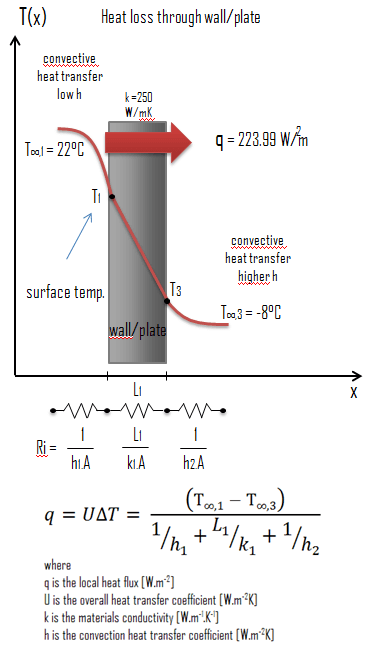
Material Table - Heat Capacity

Diamond – Density – Melting Point – Thermal Conductivity

About Diamond

Diamond is a form of carbon that is crystallised in a cubic structure with each carbon atom linked by a strong, rigid chemical bond to four other atoms. Diamond is the hardest naturally occurring material known. Yet, due to important structural weaknesses, diamond’s toughness is only fair to good. The precise tensile strength of diamond is unknown, however strength up to 60 GPa has been observed, and theoretically it could be as high as 90–225 GPa depending on the sample volume/size, the perfection of diamond lattice and on its orientation. Diamond has a high refractive index (2.417) and moderate dispersion (0.044) properties that give cut diamonds their brilliance.

diamond properties density strength price

Summary

Name Diamond
Phase at STP solid
Density 3500 kg/m3
Ultimate Tensile Strength N/A
Yield Strength 140000 MPa
Young’s Modulus of Elasticity 1050 GPa
Brinell Hardness 45000 BHN
Melting Point 4027 °C
Thermal Conductivity 1000 W/mK
Heat Capacity 1509 J/g K
Price 20000000 $/kg

Density of Diamond

Typical densities of various substances are at atmospheric pressure. Density is defined as the mass per unit volume. It is an intensive property, which is mathematically defined as mass divided by volume:  ρ = m/V

In words, the density (ρ) of a substance is the total mass (m) of that substance divided by the total volume (V) occupied by that substance. The standard SI unit is kilograms per cubic meter (kg/m3). The Standard English unit is pounds mass per cubic foot (lbm/ft3).

Density of Diamond is 3500 kg/m3.


Example: Density

Calculate the height of a cube made of Diamond, which weighs one metric ton.

Solution:

Density is defined as the mass per unit volume. It is mathematically defined as mass divided by volume: ρ = m/V

As the volume of a cube is the third power of its sides (V = a3), the height of this cube can be calculated:

density of material - equation

The height of this cube is then a = 0.659 m.

Density of Materials

Material Table - Density of Materials


Mechanical Properties of Diamond

Strength of Diamond

In mechanics of materials, the strength of a material is its ability to withstand an applied load without failure or plastic deformation. Strength of materials basically considers the relationship between the external loads applied to a material and the resulting deformation or change in material dimensions. In designing structures and machines, it is important to consider these factors, in order that the material selected will have adequate strength to resist applied loads or forces and retain its original shape.

Strength of a material is its ability to withstand this applied load without failure or plastic deformation. For tensile stress, the capacity of a material or structure to withstand loads tending to elongate is known as ultimate tensile strength (UTS). Yield strength or yield stress is the material property defined as the stress at which a material begins to deform plastically whereas yield point is the point where nonlinear (elastic + plastic) deformation begins. In case of tensional stress of a uniform bar (stress-strain curve), the Hooke’s law describes behaviour of a bar in the elastic region. The Young’s modulus of elasticity is the elastic modulus for tensile and compressive stress in the linear elasticity regime of a uniaxial deformation and is usually assessed by tensile tests.

See also: Strength of Materials

Ultimate Tensile Strength of Diamond

Ultimate tensile strength of Diamond is N/A.

Yield Strength of Diamond

Yield strength of Diamond is 140000 MPa (Compressive).

Modulus of Elasticity of Diamond

The Young’s modulus of elasticity of Diamond is 1050 GPa.

Hardness of Diamond

In materials science, hardness is the ability to withstand surface indentation (localized plastic deformation) and scratching. Brinell hardness test is one of indentation hardness tests, that has been developed for hardness testing. In Brinell tests, a hard, spherical indenter is forced under a specific load into the surface of the metal to be tested.

The Brinell hardness number (HB) is the load divided by the surface area of the indentation. The diameter of the impression is measured with a microscope with a superimposed scale. The Brinell hardness number is computed from the equation:

brinell hardness number - definition

Brinell hardness of Diamond is approximately 45000 BHN (converted).

See also: Hardness of Materials

Strength of Materials

Material Table - Strength of Materials

Elasticity of Materials

Material Table - Elasticity of Materials

Hardness of Materials

Material Table - Hardness of Materials  

Thermal Properties of Diamond

Diamond – Melting Point

Melting point of Diamond is 4027 °C.

Note that, these points are associated with the standard atmospheric pressure. In general, melting is a phase change of a substance from the solid to the liquid phase. The melting point of a substance is the temperature at which this phase change occurs. The melting point also defines a condition in which the solid and liquid can exist in equilibrium. For various chemical compounds and alloys, it is difficult to define the melting point, since they are usually a mixture of various chemical elements.

Diamond – Thermal Conductivity

Thermal conductivity of Diamond is 1000 W/(m·K).

The heat transfer characteristics of a solid material are measured by a property called the thermal conductivity, k (or λ), measured in W/m.K. It is a measure of a substance’s ability to transfer heat through a material by conduction. Note that Fourier’s law applies for all matter, regardless of its state (solid, liquid, or gas), therefore, it is also defined for liquids and gases.

The thermal conductivity of most liquids and solids varies with temperature. For vapors, it also depends upon pressure. In general:

thermal conductivity - definition

Most materials are very nearly homogeneous, therefore we can usually write k = k (T). Similar definitions are associated with thermal conductivities in the y- and z-directions (ky, kz), but for an isotropic material the thermal conductivity is independent of the direction of transfer, kx = ky = kz = k.

Diamond – Specific Heat

Specific heat of Diamond is 509 J/g K.

Specific heat, or specific heat capacity, is a property related to internal energy that is very important in thermodynamics. The intensive properties cv and cp are defined for pure, simple compressible substances as partial derivatives of the internal energy u(T, v) and enthalpy h(T, p), respectively:

where the subscripts v and p denote the variables held fixed during differentiation. The properties cv and cp are referred to as specific heats (or heat capacities) because under certain special conditions they relate the temperature change of a system to the amount of energy added by heat transfer. Their SI units are J/kg K or J/mol K.


Example: Heat transfer calculation

Diamond - Thermal ConductivityThermal conductivity is defined as the amount of heat (in watts) transferred through a square area of material of given thickness (in metres) due to a difference in temperature. The lower the thermal conductivity of the material the greater the material’s ability to resist heat transfer.

Calculate the rate of heat flux through a wall 3 m x 10 m in area (A = 30 m2). The wall is 15 cm thick (L1) and it is made of Diamond with the thermal conductivity of k1 = 1000 W/m.K (poor thermal insulator). Assume that, the indoor and the outdoor temperatures are 22°C and -8°C, and the convection heat transfer coefficients on the inner and the outer sides are h1 = 10 W/m2K and h2 = 30 W/m2K, respectively. Note that, these convection coefficients strongly depend especially on ambient and interior conditions (wind, humidity, etc.).

Calculate the heat flux (heat loss) through this wall.

Solution:

As was written, many of the heat transfer processes involve composite systems and even involve a combination of both conduction and convection. With these composite systems, it is often convenient to work with an overall heat transfer coefficient, known as a U-factor. The U-factor is defined by an expression analogous to Newton’s law of cooling:

Heat transfer calculation - Newton’s law of cooling

The overall heat transfer coefficient is related to the total thermal resistance and depends on the geometry of the problem.

Assuming one-dimensional heat transfer through the plane wall and disregarding radiation, the overall heat transfer coefficient can be calculated as:

Heat transfer calculation - U-factor


The overall heat transfer coefficient is then: U = 1 / (1/10 + 0.15/1000 + 1/30) = 7.49 W/m2K

The heat flux can be then calculated simply as: q = 7.49 [W/m2K] x 30 [K] = 224.75 W/m2

The total heat loss through this wall will be: qloss = q . A = 224.75 [W/m2] x 30 [m2] = 6742.42 W

Melting Point of Materials

Material Table - Melting Point

Thermal Conductivity of Materials

Material Table - Thermal Conductivity

Heat Capacity of Materials

Material Table - Heat Capacity

White Gold – Density – Strength – Melting Point – Thermal Conductivity

About White Gold

Pure gold is a bright, slightly reddish yellow, dense, soft, malleable, and ductile metal. It is one of the least reactive chemical elements and is solid under standard conditions. Gold is thought to have been produced in supernova nucleosynthesis, from the collision of neutron stars. White gold is a gold–silver (or nickel or palladium) alloy widely used for specialized jewelry.

white gold properties density strength price

Summary

Name White Gold
Phase at STP solid
Density 15900 kg/m3
Ultimate Tensile Strength 350 MPa
Yield Strength N/A
Young’s Modulus of Elasticity 75 GPa
Brinell Hardness 100 BHN
Melting Point 937 °C
Thermal Conductivity 250 W/mK
Heat Capacity 220 J/g K
Price 45000 $/kg

Density of White Gold

Typical densities of various substances are at atmospheric pressure. Density is defined as the mass per unit volume. It is an intensive property, which is mathematically defined as mass divided by volume:  ρ = m/V

In words, the density (ρ) of a substance is the total mass (m) of that substance divided by the total volume (V) occupied by that substance. The standard SI unit is kilograms per cubic meter (kg/m3). The Standard English unit is pounds mass per cubic foot (lbm/ft3).

Density of White Gold is 15900 kg/m3.


Example: Density

Calculate the height of a cube made of White Gold, which weighs one metric ton.

Solution:

Density is defined as the mass per unit volume. It is mathematically defined as mass divided by volume: ρ = m/V

As the volume of a cube is the third power of its sides (V = a3), the height of this cube can be calculated:

density of material - equation

The height of this cube is then a = 0.398 m.

Density of Materials

Material Table - Density of Materials


Mechanical Properties of White Gold

Strength of White Gold

In mechanics of materials, the strength of a material is its ability to withstand an applied load without failure or plastic deformation. Strength of materials basically considers the relationship between the external loads applied to a material and the resulting deformation or change in material dimensions. In designing structures and machines, it is important to consider these factors, in order that the material selected will have adequate strength to resist applied loads or forces and retain its original shape.

Strength of a material is its ability to withstand this applied load without failure or plastic deformation. For tensile stress, the capacity of a material or structure to withstand loads tending to elongate is known as ultimate tensile strength (UTS). Yield strength or yield stress is the material property defined as the stress at which a material begins to deform plastically whereas yield point is the point where nonlinear (elastic + plastic) deformation begins. In case of tensional stress of a uniform bar (stress-strain curve), the Hooke’s law describes behaviour of a bar in the elastic region. The Young’s modulus of elasticity is the elastic modulus for tensile and compressive stress in the linear elasticity regime of a uniaxial deformation and is usually assessed by tensile tests.

See also: Strength of Materials

Ultimate Tensile Strength of White Gold

Ultimate tensile strength of White Gold is 350 MPa.

Yield Strength of White Gold

Yield strength of White Gold is N/A.

Modulus of Elasticity of White Gold

The Young’s modulus of elasticity of White Gold is 75 GPa.

Hardness of White Gold

In materials science, hardness is the ability to withstand surface indentation (localized plastic deformation) and scratching. Brinell hardness test is one of indentation hardness tests, that has been developed for hardness testing. In Brinell tests, a hard, spherical indenter is forced under a specific load into the surface of the metal to be tested.

The Brinell hardness number (HB) is the load divided by the surface area of the indentation. The diameter of the impression is measured with a microscope with a superimposed scale. The Brinell hardness number is computed from the equation:

brinell hardness number - definition

Brinell hardness of White Gold is approximately 100 BHN(converted).

See also: Hardness of Materials


Example: Strength

Assume a plastic rod, which is made of White Gold. This plastic rod has a cross-sectional area of 1 cm2. Calculate the tensile force needed to achieve the ultimate tensile strength for this material, which is: UTS = 350 MPa.

Solution:

Stress (σ) can be equated to the load per unit area or the force (F) applied per cross-sectional area (A) perpendicular to the force as:

strength of material - equation

therefore, the tensile force needed to achieve the ultimate tensile strength is:

F = UTS x A = 350 x 106 x 0.0001 = 35 000 N

Strength of Materials

Material Table - Strength of Materials

Elasticity of Materials

Material Table - Elasticity of Materials

Hardness of Materials

Material Table - Hardness of Materials  

Thermal Properties of White Gold

White Gold – Melting Point

Melting point of White Gold is 937 °C.

Note that, these points are associated with the standard atmospheric pressure. In general, melting is a phase change of a substance from the solid to the liquid phase. The melting point of a substance is the temperature at which this phase change occurs. The melting point also defines a condition in which the solid and liquid can exist in equilibrium. For various chemical compounds and alloys, it is difficult to define the melting point, since they are usually a mixture of various chemical elements.

White Gold – Thermal Conductivity

Thermal conductivity of White Gold is 250 W/(m·K).

The heat transfer characteristics of a solid material are measured by a property called the thermal conductivity, k (or λ), measured in W/m.K. It is a measure of a substance’s ability to transfer heat through a material by conduction. Note that Fourier’s law applies for all matter, regardless of its state (solid, liquid, or gas), therefore, it is also defined for liquids and gases.

The thermal conductivity of most liquids and solids varies with temperature. For vapors, it also depends upon pressure. In general:

thermal conductivity - definition

Most materials are very nearly homogeneous, therefore we can usually write k = k (T). Similar definitions are associated with thermal conductivities in the y- and z-directions (ky, kz), but for an isotropic material the thermal conductivity is independent of the direction of transfer, kx = ky = kz = k.

White Gold – Specific Heat

Specific heat of White Gold is 220 J/g K.

Specific heat, or specific heat capacity, is a property related to internal energy that is very important in thermodynamics. The intensive properties cv and cp are defined for pure, simple compressible substances as partial derivatives of the internal energy u(T, v) and enthalpy h(T, p), respectively:

where the subscripts v and p denote the variables held fixed during differentiation. The properties cv and cp are referred to as specific heats (or heat capacities) because under certain special conditions they relate the temperature change of a system to the amount of energy added by heat transfer. Their SI units are J/kg K or J/mol K.


Example: Heat transfer calculation

White Gold - Thermal ConductivityThermal conductivity is defined as the amount of heat (in watts) transferred through a square area of material of given thickness (in metres) due to a difference in temperature. The lower the thermal conductivity of the material the greater the material’s ability to resist heat transfer.

Calculate the rate of heat flux through a wall 3 m x 10 m in area (A = 30 m2). The wall is 15 cm thick (L1) and it is made of White Gold with the thermal conductivity of k1 = 250 W/m.K (poor thermal insulator). Assume that, the indoor and the outdoor temperatures are 22°C and -8°C, and the convection heat transfer coefficients on the inner and the outer sides are h1 = 10 W/m2K and h2 = 30 W/m2K, respectively. Note that, these convection coefficients strongly depend especially on ambient and interior conditions (wind, humidity, etc.).

Calculate the heat flux (heat loss) through this wall.

Solution:

As was written, many of the heat transfer processes involve composite systems and even involve a combination of both conduction and convection. With these composite systems, it is often convenient to work with an overall heat transfer coefficient, known as a U-factor. The U-factor is defined by an expression analogous to Newton’s law of cooling:

Heat transfer calculation - Newton’s law of cooling

The overall heat transfer coefficient is related to the total thermal resistance and depends on the geometry of the problem.

Assuming one-dimensional heat transfer through the plane wall and disregarding radiation, the overall heat transfer coefficient can be calculated as:

Heat transfer calculation - U-factor


The overall heat transfer coefficient is then: U = 1 / (1/10 + 0.15/250 + 1/30) = 7.47 W/m2K

The heat flux can be then calculated simply as: q = 7.47 [W/m2K] x 30 [K] = 223.99 W/m2

The total heat loss through this wall will be: qloss = q . A = 223.99 [W/m2] x 30 [m2] = 6719.76 W

Melting Point of Materials

Material Table - Melting Point

Thermal Conductivity of Materials

Material Table - Thermal Conductivity

Heat Capacity of Materials

Material Table - Heat Capacity