Facebook Instagram Youtube Twitter

Ruthenium – Periodic Table – Atomic Properties

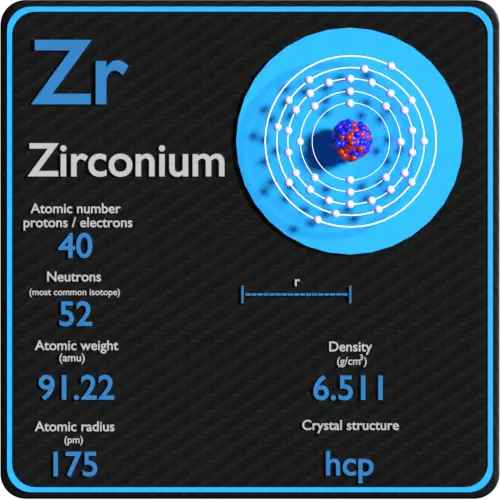
Ruthenium-density-atomic-number-mass-radius

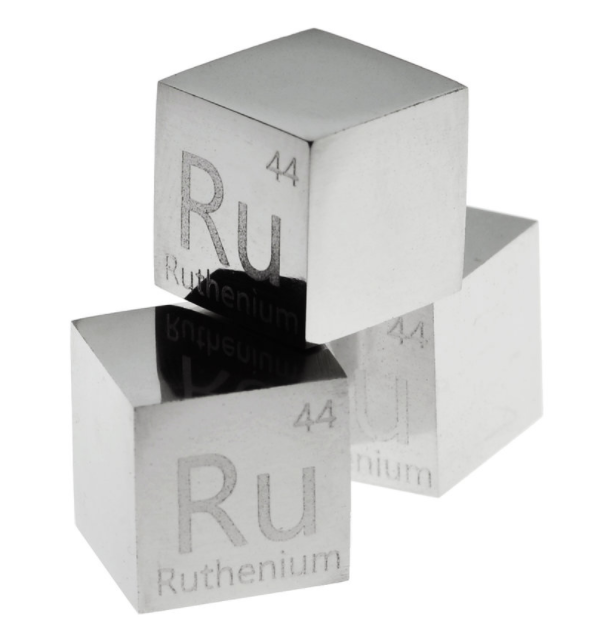
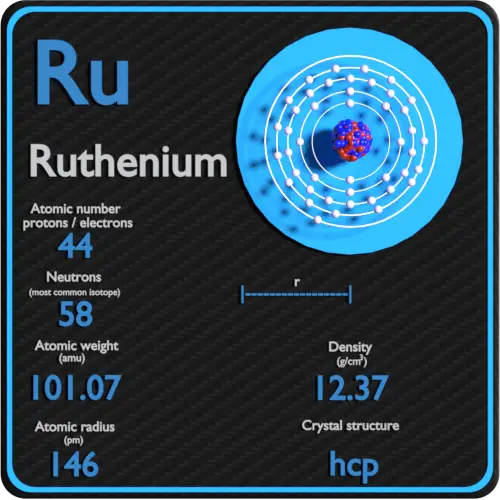
Ruthenium is a rare transition metal belonging to the platinum group of the periodic table. Like the other metals of the platinum group, ruthenium is inert to most other chemicals.

Summary

Element Ruthenium
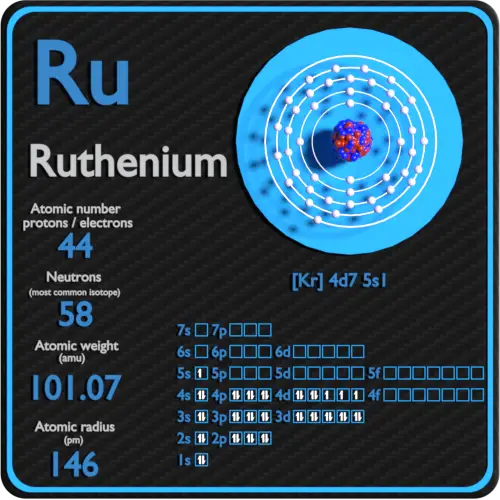
Atomic number 44
Atomic mass [amu] 101.07
Atomic mass [pm] 146
Density at STP [g/cm3] 12.37
Number of protons 44
Number of neutrons (typical isotopes) 98-102
Number of electrons 44
Electron configuration [Kr] 4d7 5s1
Oxidation states +3
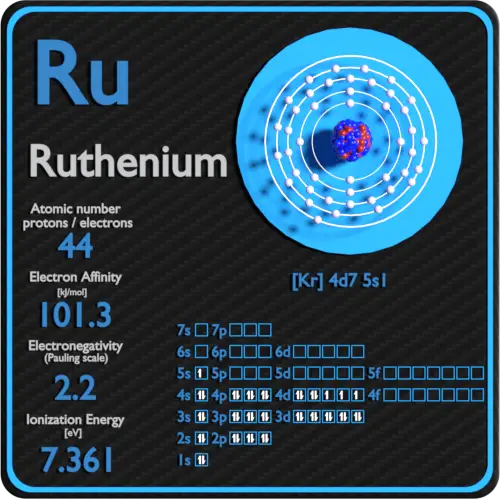
Electron affinity [kJ/mol] 101.3
Electronegativity [Pauling scale] 2.2
First ionization energy [eV] 7.3605

Atomic Number – Protons, Electrons and Neutrons in Ruthenium
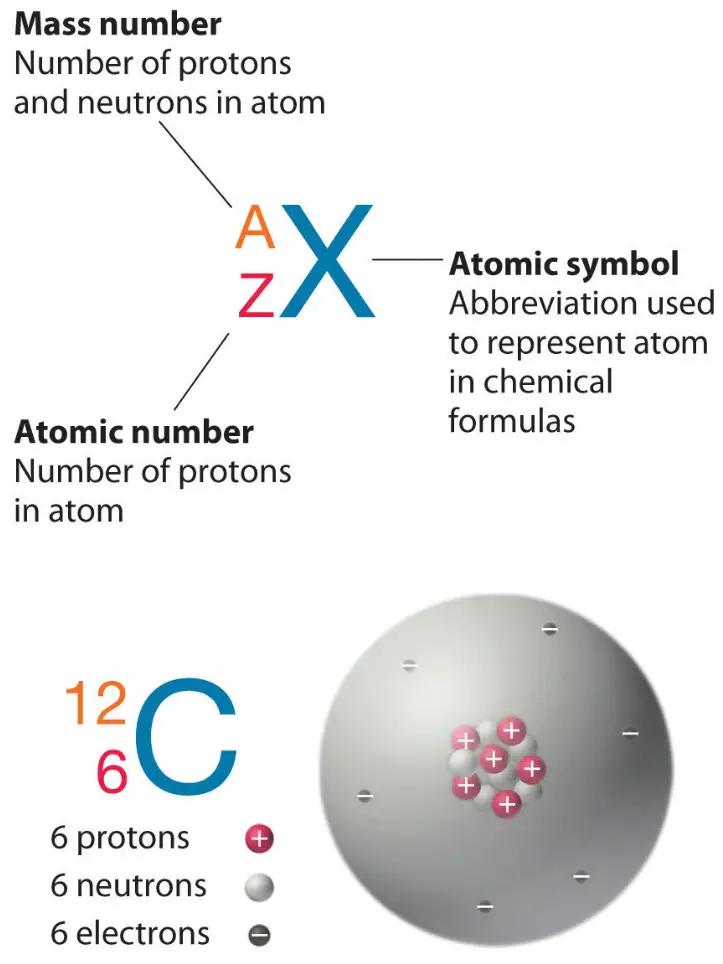
Proton Number - Atomic NumberRuthenium is a chemical element with atomic number 44 which means there are 44 protons in its nucleus. Total number of protons in the nucleus is called the atomic number of the atom and is given the symbol Z. The total electrical charge of the nucleus is therefore +Ze, where e (elementary charge) equals to 1,602 x 10-19 coulombs.

The total number of neutrons in the nucleus of an atom is called the neutron number of the atom and is given the symbol N. Neutron number plus atomic number equals atomic mass number: N+Z=A. The difference between the neutron number and the atomic number is known as the neutron excess: D = N – Z = A – 2Z.

For stable elements, there is usually a variety of stable isotopes. Isotopes are nuclides that have the same atomic number and are therefore the same element, but differ in the number of neutrons. Mass numbers of typical isotopes of Ruthenium are 98-102.

Atomic Mass of Ruthenium

Atomic mass of Ruthenium is 101.07 u. 

The atomic mass is the mass of an atom. The atomic mass or relative isotopic mass refers to the mass of a single particle, and therefore is tied to a certain specific isotope of an element. The atomic mass is carried by the atomic nucleus, which occupies only about 10-12 of the total volume of the atom or less, but it contains all the positive charge and at least 99.95% of the total mass of the atom. Note that, each element may contain more isotopes, therefore this resulting atomic mass is calculated from naturally-occuring isotopes and their abundance.

Atomic Radius of Ruthenium

The atomic radius of Ruthenium atom is 146pm (covalent radius).

Atomic Radius of Chemical Elements

It must be noted, atoms lack a well-defined outer boundary. The atomic radius of a chemical element is a measure of the distance out to which the electron cloud extends from the nucleus. However, this assumes the atom to exhibit a spherical shape, which is only obeyed for atoms in vacuum or free space. Therefore, there are various non-equivalent definitions of atomic radius.

Electrons and Electron Configuration

The number of electrons in an electrically-neutral atom is the same as the number of protons in the nucleus. Therefore, the number of electrons in neutral atom of Ruthenium is 44. Each electron is influenced by the electric fields produced by the positive nuclear charge and the other (Z – 1) negative electrons in the atom.

Since the number of electrons and their arrangement are responsible for the chemical behavior of atoms, the atomic number identifies the various chemical elements. The configuration of these electrons follows from the principles of quantum mechanics. The number of electrons in each element’s electron shells, particularly the outermost valence shell, is the primary factor in determining its chemical bonding behavior. In the periodic table, the elements are listed in order of increasing atomic number Z.

Electron configuration of Ruthenium is [Kr] 4d7 5s1.

Possible oxidation states are +3.

Density of Ruthenium

Density of Ruthenium is 12.37g/cm3.

Typical densities of various substances are at atmospheric pressure.

Density is defined as the mass per unit volume. It is an intensive property, which is mathematically defined as mass divided by volume:

ρ = m/V

Atomic Masses of Elements
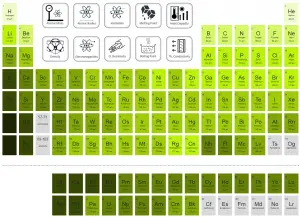
Periodic Table of Elements - atomic mass

Atomic Radii of Elements

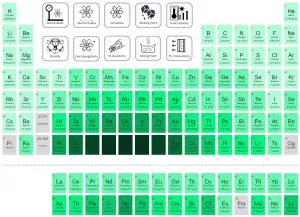
Periodic Table of Elements - atomic radius

Densities of Elements

Periodic Table of Elements - density

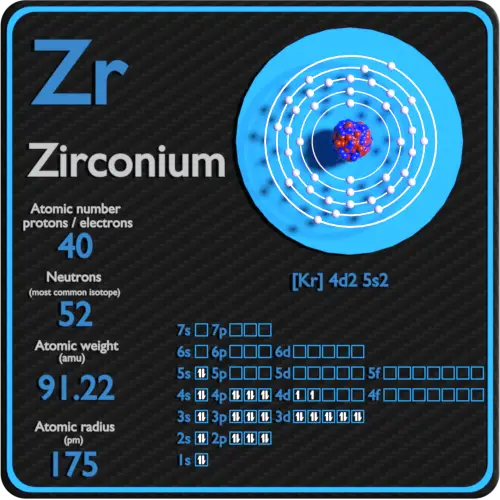
Ruthenium-protons-neutrons-electrons-configuration

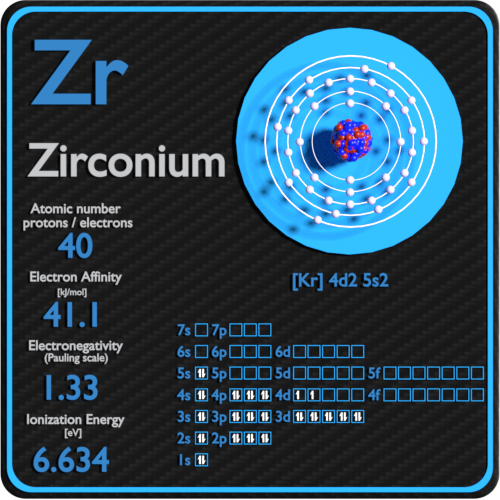
Ruthenium-affinity-electronegativity-ionization

Electron Affinity – Ruthenium

Electron affinity of Ruthenium is 101.3 kJ/mol.

In chemistry and atomic physics, the electron affinity of an atom or molecule is defined as:

the change in energy (in kJ/mole) of a neutral atom or molecule (in the gaseous phase) when an electron is added to the atom to form a negative ion.

X + e– → X– + energy        Affinity = – ∆H

In other words, it can be expressed as the neutral atom’s likelihood of gaining an electron. Note that, ionization energies measure the tendency of a neutral atom to resist the loss of electrons. Electron affinities are more difficult to measure than ionization energies.

Electronegativity of Ruthenium

Electronegativity of Ruthenium is 2.2.

Electronegativity, symbol χ, is a chemical property that describes the tendency of an atom to attract electrons towards this atom. For this purposes, a dimensionless quantity the Pauling scale, symbol χ, is the most commonly used.

The electronegativity of Ruthenium is: χ = 2.2

First Ionization Energy of Ruthenium

First Ionization Energy of Ruthenium is 7.3605 eV.

Ionization energy, also called ionization potential, is the energy necessary to remove an electron from the neutral atom.

X + energy → X+ + e−

where X is any atom or molecule capable of being ionized, X+ is that atom or molecule with an electron removed (positive ion), and e− is the removed electron.

A Ruthenium atom, for example, requires the following ionization energy to remove the outermost electron.

Ru + IE → Ru+ + e−        IE = 7.3605 eV

Electronegativity of Elements
Periodic Table of Elements - electronegativity

Ionization Energy of Elements

Periodic Table of Elements - ionization energy

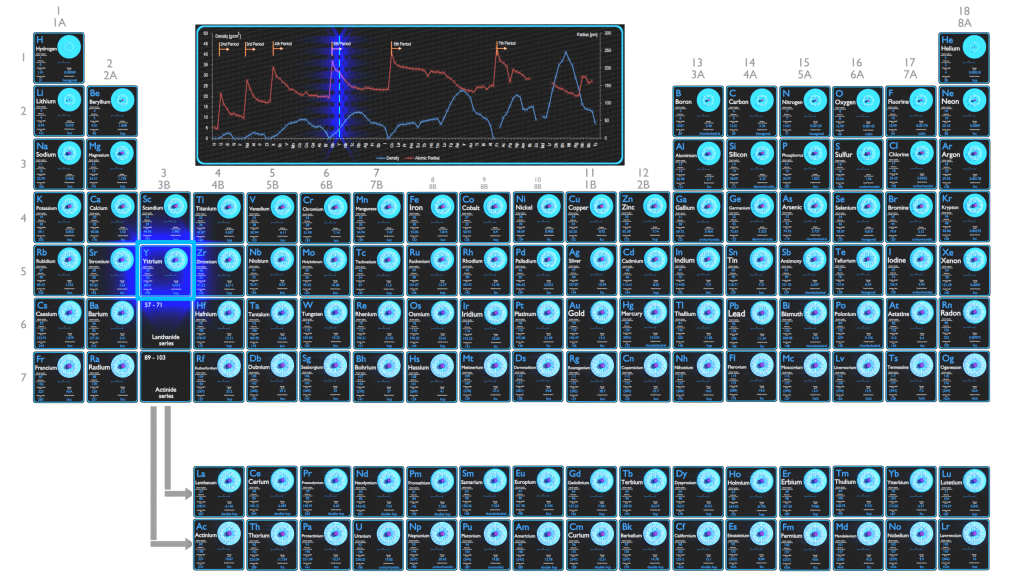
Ruthenium-periodic-table

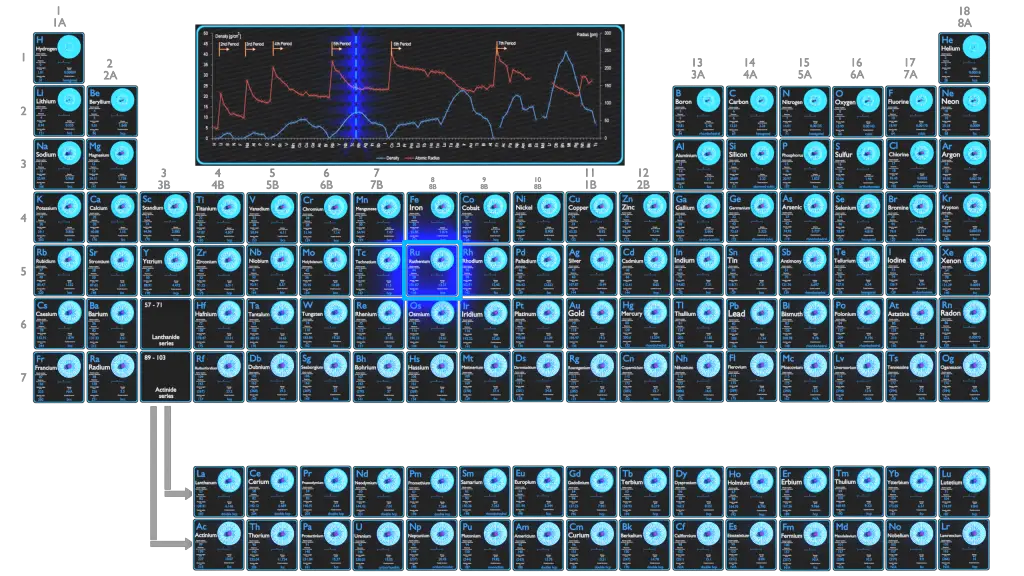
Source: www.luciteria.com


Properties of other elements

Ruthenium - Comparison of Atomic Properties

Periodic Table in 8K resolution

Other properties of Ruthenium
 

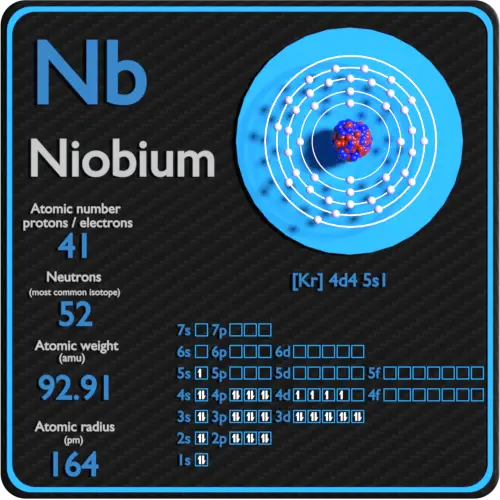
Niobium – Periodic Table – Atomic Properties

Niobium-density-atomic-number-mass-radius

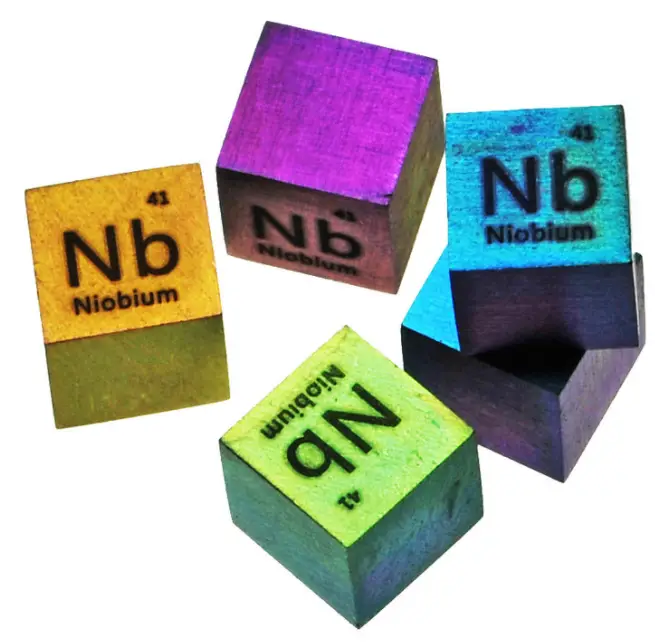
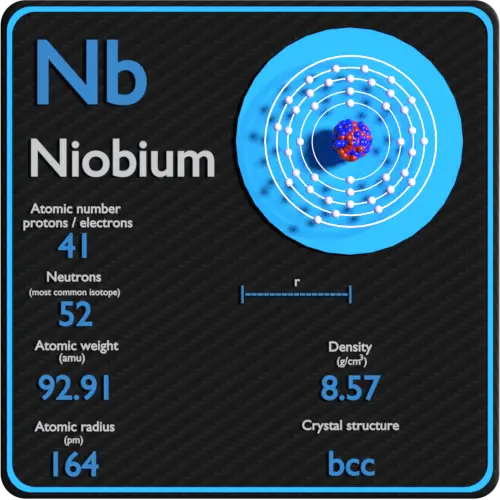
Niobium is a soft, grey, ductile transition metal, often found in the minerals pyrochlore (the main commercial source for niobium) and columbite.

Summary

Element Niobium
Atomic number 41
Atomic mass [amu] 92.90638
Atomic mass [pm] 164
Density at STP [g/cm3] 8.57
Number of protons 41
Number of neutrons (typical isotopes) 93
Number of electrons 41
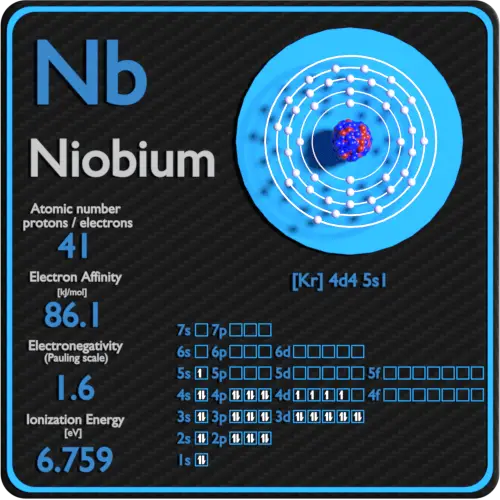
Electron configuration [Kr] 4d4 5s1
Oxidation states +3,5
Electron affinity [kJ/mol] 86.1
Electronegativity [Pauling scale] 1.6
First ionization energy [eV] 6.7589

Atomic Number – Protons, Electrons and Neutrons in Niobium

Proton Number - Atomic NumberNiobium is a chemical element with atomic number 41 which means there are 41 protons in its nucleus. Total number of protons in the nucleus is called the atomic number of the atom and is given the symbol Z. The total electrical charge of the nucleus is therefore +Ze, where e (elementary charge) equals to 1,602 x 10-19 coulombs.

The total number of neutrons in the nucleus of an atom is called the neutron number of the atom and is given the symbol N. Neutron number plus atomic number equals atomic mass number: N+Z=A. The difference between the neutron number and the atomic number is known as the neutron excess: D = N – Z = A – 2Z.

For stable elements, there is usually a variety of stable isotopes. Isotopes are nuclides that have the same atomic number and are therefore the same element, but differ in the number of neutrons. Mass numbers of typical isotopes of Niobium are 93.

Atomic Mass of Niobium

Atomic mass of Niobium is 92.90638 u. 

The atomic mass is the mass of an atom. The atomic mass or relative isotopic mass refers to the mass of a single particle, and therefore is tied to a certain specific isotope of an element. The atomic mass is carried by the atomic nucleus, which occupies only about 10-12 of the total volume of the atom or less, but it contains all the positive charge and at least 99.95% of the total mass of the atom. Note that, each element may contain more isotopes, therefore this resulting atomic mass is calculated from naturally-occuring isotopes and their abundance.

Atomic Radius of Niobium

The atomic radius of Niobium atom is 164pm (covalent radius).

Atomic Radius of Chemical Elements

It must be noted, atoms lack a well-defined outer boundary. The atomic radius of a chemical element is a measure of the distance out to which the electron cloud extends from the nucleus. However, this assumes the atom to exhibit a spherical shape, which is only obeyed for atoms in vacuum or free space. Therefore, there are various non-equivalent definitions of atomic radius.

Electrons and Electron Configuration

The number of electrons in an electrically-neutral atom is the same as the number of protons in the nucleus. Therefore, the number of electrons in neutral atom of Niobium is 41. Each electron is influenced by the electric fields produced by the positive nuclear charge and the other (Z – 1) negative electrons in the atom.

Since the number of electrons and their arrangement are responsible for the chemical behavior of atoms, the atomic number identifies the various chemical elements. The configuration of these electrons follows from the principles of quantum mechanics. The number of electrons in each element’s electron shells, particularly the outermost valence shell, is the primary factor in determining its chemical bonding behavior. In the periodic table, the elements are listed in order of increasing atomic number Z.

Electron configuration of Niobium is [Kr] 4d4 5s1.

Possible oxidation states are +3,5.

Density of Niobium

Density of Niobium is 8.57g/cm3.

Typical densities of various substances are at atmospheric pressure.

Density is defined as the mass per unit volume. It is an intensive property, which is mathematically defined as mass divided by volume:

ρ = m/V

Atomic Masses of Elements

Periodic Table of Elements - atomic mass

Atomic Radii of Elements

Periodic Table of Elements - atomic radius

Densities of Elements

Periodic Table of Elements - density

Niobium-protons-neutrons-electrons-configuration

Niobium-affinity-electronegativity-ionization

Electron Affinity – Niobium

Electron affinity of Niobium is 86.1 kJ/mol.

In chemistry and atomic physics, the electron affinity of an atom or molecule is defined as:

the change in energy (in kJ/mole) of a neutral atom or molecule (in the gaseous phase) when an electron is added to the atom to form a negative ion.

X + e– → X– + energy        Affinity = – ∆H

In other words, it can be expressed as the neutral atom’s likelihood of gaining an electron. Note that, ionization energies measure the tendency of a neutral atom to resist the loss of electrons. Electron affinities are more difficult to measure than ionization energies.

Electronegativity of Niobium

Electronegativity of Niobium is 1.6.

Electronegativity, symbol χ, is a chemical property that describes the tendency of an atom to attract electrons towards this atom. For this purposes, a dimensionless quantity the Pauling scale, symbol χ, is the most commonly used.

The electronegativity of Niobium is: χ = 1.6

First Ionization Energy of Niobium

First Ionization Energy of Niobium is 6.7589 eV.

Ionization energy, also called ionization potential, is the energy necessary to remove an electron from the neutral atom.

X + energy → X+ + e−

where X is any atom or molecule capable of being ionized, X+ is that atom or molecule with an electron removed (positive ion), and e− is the removed electron.

A Niobium atom, for example, requires the following ionization energy to remove the outermost electron.

Nb + IE → Nb+ + e−        IE = 6.7589 eV

Electronegativity of Elements

Periodic Table of Elements - electronegativity

Ionization Energy of Elements

Periodic Table of Elements - ionization energy

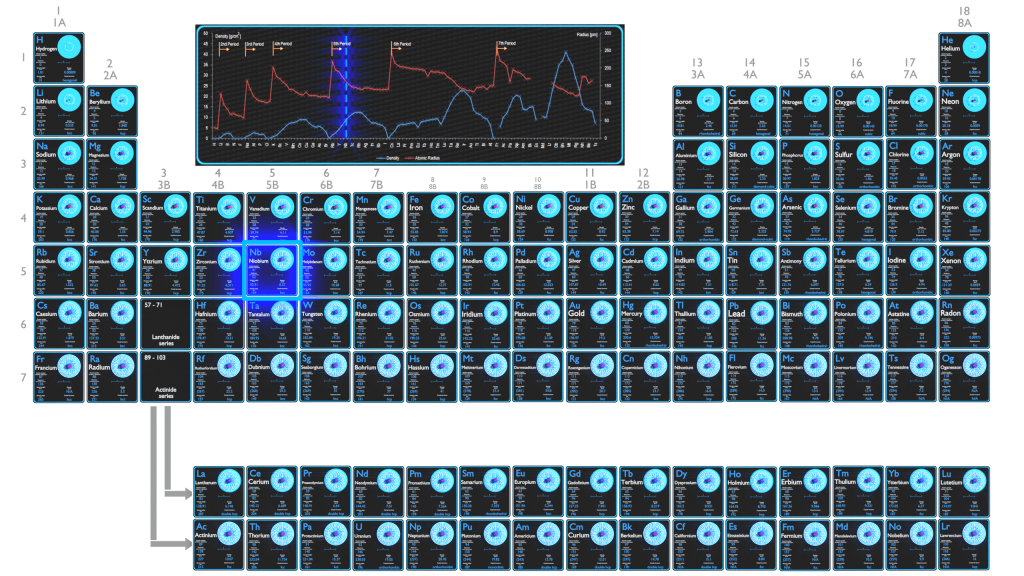
Niobium-periodic-table

Source: www.luciteria.com


Properties of other elements

Niobium - Comparison of Atomic Properties

Periodic Table in 8K resolution

Other properties of Niobium


Molybdenum – Periodic Table – Atomic Properties

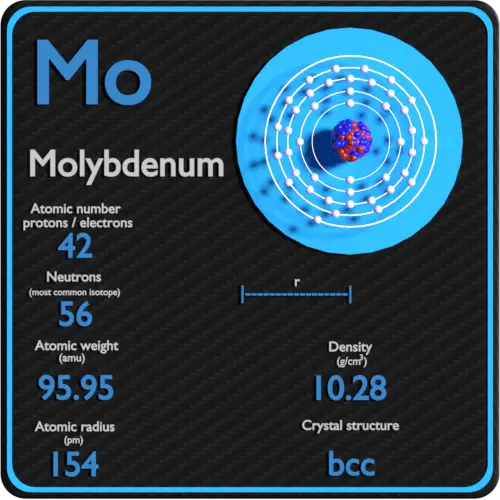
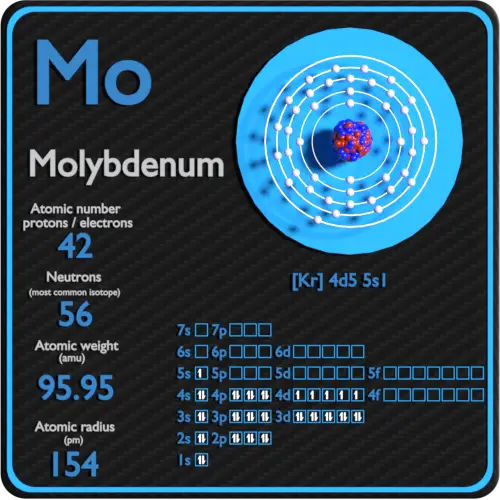
Molybdenum-density-atomic-number-mass-radius

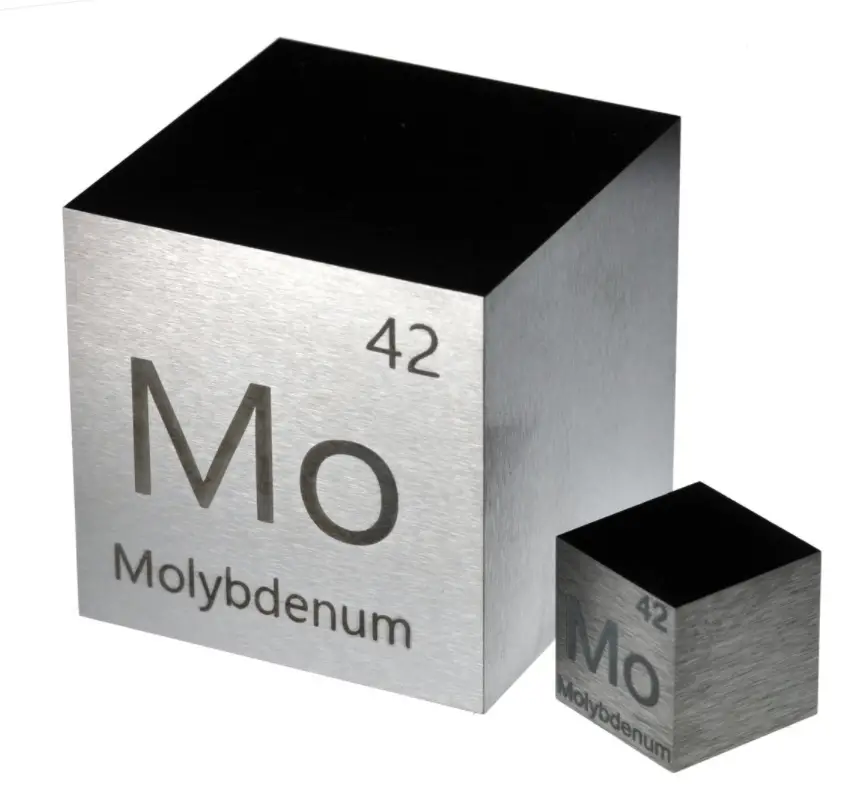
Molybdenum a silvery metal with a gray cast, has the sixth-highest melting point of any element. It readily forms hard, stable carbides in alloys, and for this reason most of world production of the element (about 80%) is used in steel alloys, including high-strength alloys and superalloys.

Summary

Element Molybdenum
Atomic number 42
Atomic mass [amu] 95.94
Atomic mass [pm] 154
Density at STP [g/cm3] 10.28
Number of protons 42
Number of neutrons (typical isotopes) 94-98
Number of electrons 42
Electron configuration [Kr] 4d5 5s1
Oxidation states +6
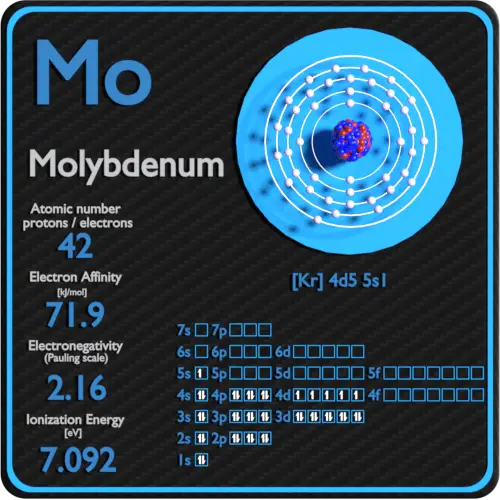
Electron affinity [kJ/mol] 71.9
Electronegativity [Pauling scale] 2.16
First ionization energy [eV] 7.0924

Atomic Number – Protons, Electrons and Neutrons in Molybdenum

Proton Number - Atomic NumberMolybdenum is a chemical element with atomic number 42 which means there are 42 protons in its nucleus. Total number of protons in the nucleus is called the atomic number of the atom and is given the symbol Z. The total electrical charge of the nucleus is therefore +Ze, where e (elementary charge) equals to 1,602 x 10-19 coulombs.

The total number of neutrons in the nucleus of an atom is called the neutron number of the atom and is given the symbol N. Neutron number plus atomic number equals atomic mass number: N+Z=A. The difference between the neutron number and the atomic number is known as the neutron excess: D = N – Z = A – 2Z.

For stable elements, there is usually a variety of stable isotopes. Isotopes are nuclides that have the same atomic number and are therefore the same element, but differ in the number of neutrons. Mass numbers of typical isotopes of Molybdenum are 94-98.

Atomic Mass of Molybdenum

Atomic mass of Molybdenum is 95.94 u. 

The atomic mass is the mass of an atom. The atomic mass or relative isotopic mass refers to the mass of a single particle, and therefore is tied to a certain specific isotope of an element. The atomic mass is carried by the atomic nucleus, which occupies only about 10-12 of the total volume of the atom or less, but it contains all the positive charge and at least 99.95% of the total mass of the atom. Note that, each element may contain more isotopes, therefore this resulting atomic mass is calculated from naturally-occuring isotopes and their abundance.

Atomic Radius of Molybdenum

The atomic radius of Molybdenum atom is 154pm (covalent radius).

Atomic Radius of Chemical Elements

It must be noted, atoms lack a well-defined outer boundary. The atomic radius of a chemical element is a measure of the distance out to which the electron cloud extends from the nucleus. However, this assumes the atom to exhibit a spherical shape, which is only obeyed for atoms in vacuum or free space. Therefore, there are various non-equivalent definitions of atomic radius.

Electrons and Electron Configuration

The number of electrons in an electrically-neutral atom is the same as the number of protons in the nucleus. Therefore, the number of electrons in neutral atom of Molybdenum is 42. Each electron is influenced by the electric fields produced by the positive nuclear charge and the other (Z – 1) negative electrons in the atom.

Since the number of electrons and their arrangement are responsible for the chemical behavior of atoms, the atomic number identifies the various chemical elements. The configuration of these electrons follows from the principles of quantum mechanics. The number of electrons in each element’s electron shells, particularly the outermost valence shell, is the primary factor in determining its chemical bonding behavior. In the periodic table, the elements are listed in order of increasing atomic number Z.

Electron configuration of Molybdenum is [Kr] 4d5 5s1.

Possible oxidation states are +6.

Density of Molybdenum

Density of Molybdenum is 10.28g/cm3.

Typical densities of various substances are at atmospheric pressure.

Density is defined as the mass per unit volume. It is an intensive property, which is mathematically defined as mass divided by volume:

ρ = m/V

Atomic Masses of Elements

Periodic Table of Elements - atomic mass

Atomic Radii of Elements

Periodic Table of Elements - atomic radius

Densities of Elements

Periodic Table of Elements - density

Molybdenum-protons-neutrons-electrons-configuration

Molybdenum-affinity-electronegativity-ionization

Electron Affinity – Molybdenum

Electron affinity of Molybdenum is 71.9 kJ/mol.

In chemistry and atomic physics, the electron affinity of an atom or molecule is defined as:

the change in energy (in kJ/mole) of a neutral atom or molecule (in the gaseous phase) when an electron is added to the atom to form a negative ion.

X + e– → X– + energy        Affinity = – ∆H

In other words, it can be expressed as the neutral atom’s likelihood of gaining an electron. Note that, ionization energies measure the tendency of a neutral atom to resist the loss of electrons. Electron affinities are more difficult to measure than ionization energies.

Electronegativity of Molybdenum

Electronegativity of Molybdenum is 2.16.

Electronegativity, symbol χ, is a chemical property that describes the tendency of an atom to attract electrons towards this atom. For this purposes, a dimensionless quantity the Pauling scale, symbol χ, is the most commonly used.

The electronegativity of Molybdenum is: χ = 2.16

First Ionization Energy of Molybdenum

First Ionization Energy of Molybdenum is 7.0924 eV.

Ionization energy, also called ionization potential, is the energy necessary to remove an electron from the neutral atom.

X + energy → X+ + e−

where X is any atom or molecule capable of being ionized, X+ is that atom or molecule with an electron removed (positive ion), and e− is the removed electron.

A Molybdenum atom, for example, requires the following ionization energy to remove the outermost electron.

Mo + IE → Mo+ + e−        IE = 7.0924 eV

Electronegativity of Elements

Periodic Table of Elements - electronegativity

Ionization Energy of Elements

Periodic Table of Elements - ionization energy

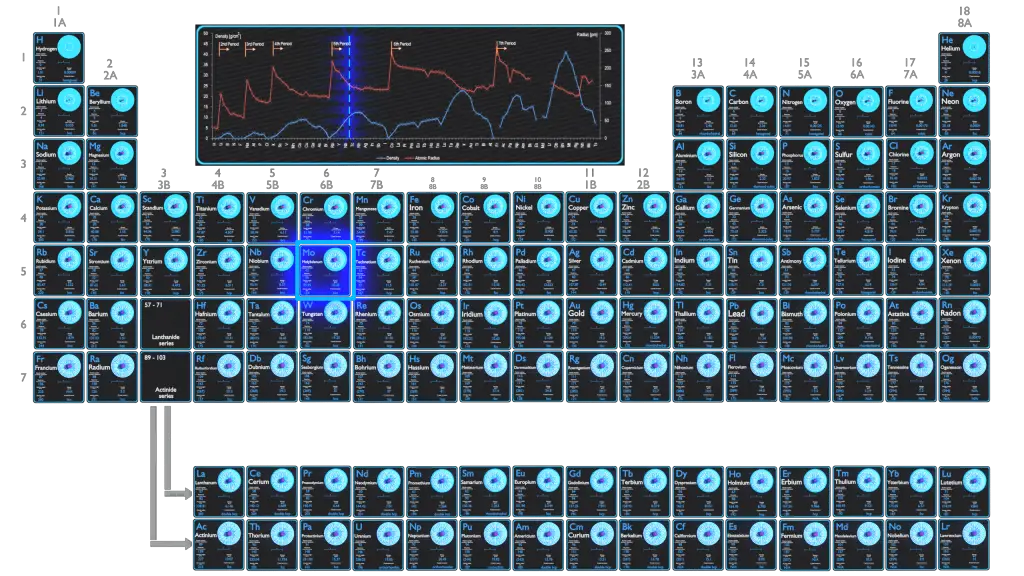
Molybdenum-periodic-table

Source: www.luciteria.com


Properties of other elements

Molybdenum - Comparison of Atomic Properties

Periodic Table in 8K resolution

Other properties of Molybdenum


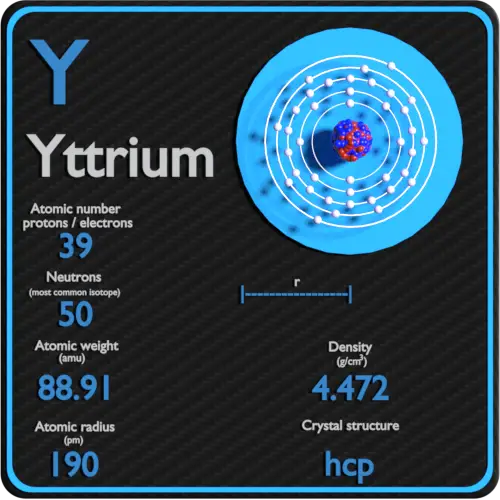
Yttrium – Periodic Table – Atomic Properties

Yttrium-density-atomic-number-mass-radius

Yttrium is a silvery-metallic transition metal chemically similar to the lanthanides and has often been classified as a “rare-earth element”.

Summary

Element Yttrium
Atomic number 39
Atomic mass [amu] 88.90585
Atomic mass [pm] 190
Density at STP [g/cm3] 4.472
Number of protons 39
Number of neutrons (typical isotopes) 89
Number of electrons 39
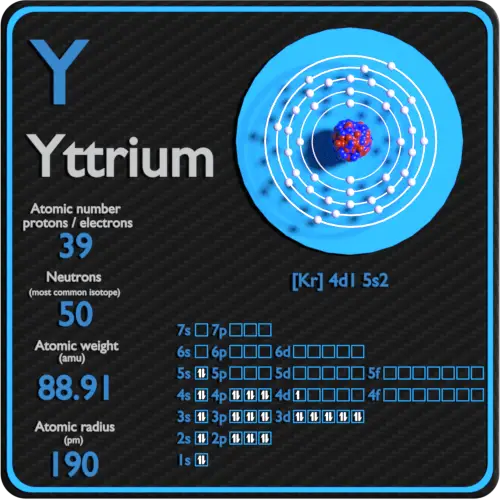
Electron configuration [Kr] 4d1 5s2
Oxidation states +3
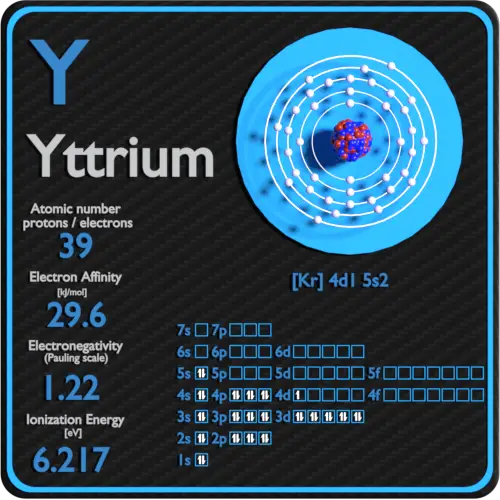
Electron affinity [kJ/mol] 29.6
Electronegativity [Pauling scale] 1.22
First ionization energy [eV] 6.217

Atomic Number – Protons, Electrons and Neutrons in Yttrium

Proton Number - Atomic NumberYttrium is a chemical element with atomic number 39 which means there are 39 protons in its nucleus. Total number of protons in the nucleus is called the atomic number of the atom and is given the symbol Z. The total electrical charge of the nucleus is therefore +Ze, where e (elementary charge) equals to 1,602 x 10-19 coulombs.

The total number of neutrons in the nucleus of an atom is called the neutron number of the atom and is given the symbol N. Neutron number plus atomic number equals atomic mass number: N+Z=A. The difference between the neutron number and the atomic number is known as the neutron excess: D = N – Z = A – 2Z.

For stable elements, there is usually a variety of stable isotopes. Isotopes are nuclides that have the same atomic number and are therefore the same element, but differ in the number of neutrons. Mass numbers of typical isotopes of Yttrium are 89.

Atomic Mass of Yttrium

Atomic mass of Yttrium is 88.90585 u. 

The atomic mass is the mass of an atom. The atomic mass or relative isotopic mass refers to the mass of a single particle, and therefore is tied to a certain specific isotope of an element. The atomic mass is carried by the atomic nucleus, which occupies only about 10-12 of the total volume of the atom or less, but it contains all the positive charge and at least 99.95% of the total mass of the atom. Note that, each element may contain more isotopes, therefore this resulting atomic mass is calculated from naturally-occuring isotopes and their abundance.

Atomic Radius of Yttrium

The atomic radius of Yttrium atom is 190pm (covalent radius).

Atomic Radius of Chemical Elements

It must be noted, atoms lack a well-defined outer boundary. The atomic radius of a chemical element is a measure of the distance out to which the electron cloud extends from the nucleus. However, this assumes the atom to exhibit a spherical shape, which is only obeyed for atoms in vacuum or free space. Therefore, there are various non-equivalent definitions of atomic radius.

Electrons and Electron Configuration

The number of electrons in an electrically-neutral atom is the same as the number of protons in the nucleus. Therefore, the number of electrons in neutral atom of Yttrium is 39. Each electron is influenced by the electric fields produced by the positive nuclear charge and the other (Z – 1) negative electrons in the atom.

Since the number of electrons and their arrangement are responsible for the chemical behavior of atoms, the atomic number identifies the various chemical elements. The configuration of these electrons follows from the principles of quantum mechanics. The number of electrons in each element’s electron shells, particularly the outermost valence shell, is the primary factor in determining its chemical bonding behavior. In the periodic table, the elements are listed in order of increasing atomic number Z.

Electron configuration of Yttrium is [Kr] 4d1 5s2.

Possible oxidation states are +3.

Density of Yttrium

Density of Yttrium is 4.472g/cm3.

Typical densities of various substances are at atmospheric pressure.

Density is defined as the mass per unit volume. It is an intensive property, which is mathematically defined as mass divided by volume:

ρ = m/V

Atomic Masses of Elements

Periodic Table of Elements - atomic mass

Atomic Radii of Elements

Periodic Table of Elements - atomic radius

Densities of Elements

Periodic Table of Elements - density

Yttrium-protons-neutrons-electrons-configuration

Yttrium-affinity-electronegativity-ionization

Electron Affinity – Yttrium

Electron affinity of Yttrium is 29.6 kJ/mol.

In chemistry and atomic physics, the electron affinity of an atom or molecule is defined as:

the change in energy (in kJ/mole) of a neutral atom or molecule (in the gaseous phase) when an electron is added to the atom to form a negative ion.

X + e– → X– + energy        Affinity = – ∆H

In other words, it can be expressed as the neutral atom’s likelihood of gaining an electron. Note that, ionization energies measure the tendency of a neutral atom to resist the loss of electrons. Electron affinities are more difficult to measure than ionization energies.

Electronegativity of Yttrium

Electronegativity of Yttrium is 1.22.

Electronegativity, symbol χ, is a chemical property that describes the tendency of an atom to attract electrons towards this atom. For this purposes, a dimensionless quantity the Pauling scale, symbol χ, is the most commonly used.

The electronegativity of Yttrium is: χ = 1.22

First Ionization Energy of Yttrium

First Ionization Energy of Yttrium is 6.217 eV.

Ionization energy, also called ionization potential, is the energy necessary to remove an electron from the neutral atom.

X + energy → X+ + e−

where X is any atom or molecule capable of being ionized, X+ is that atom or molecule with an electron removed (positive ion), and e− is the removed electron.

A Yttrium atom, for example, requires the following ionization energy to remove the outermost electron.

Y + IE → Y+ + e−        IE = 6.217 eV

Electronegativity of Elements

Periodic Table of Elements - electronegativity

Ionization Energy of Elements

Periodic Table of Elements - ionization energy

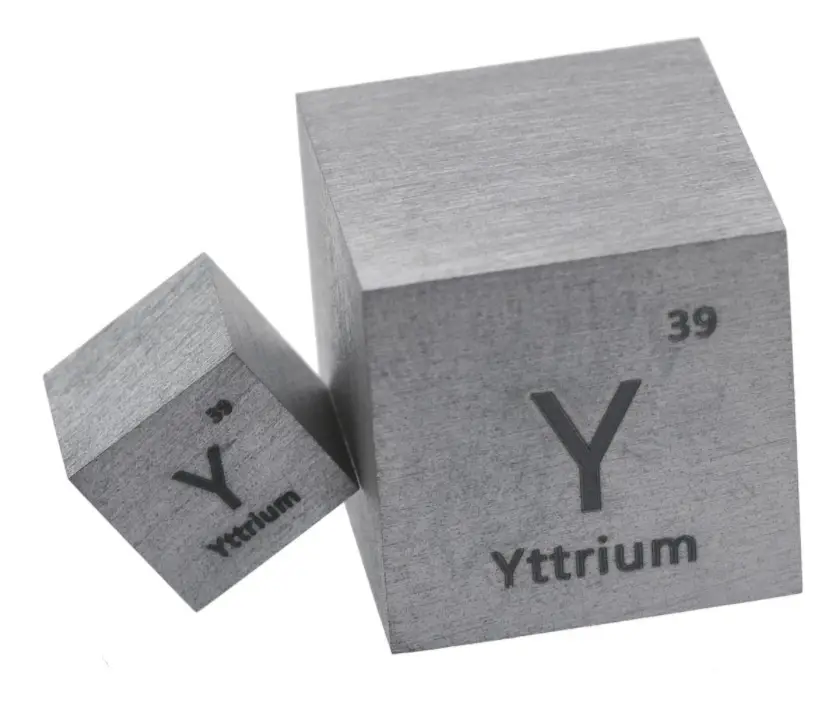
Yttrium-periodic-table

Source: www.luciteria.com


Properties of other elements

Yttrium - Comparison of Atomic Properties

Periodic Table in 8K resolution

Other properties of Yttrium


Zirconium – Periodic Table – Atomic Properties
Zirconium-density-atomic-number-mass-radius

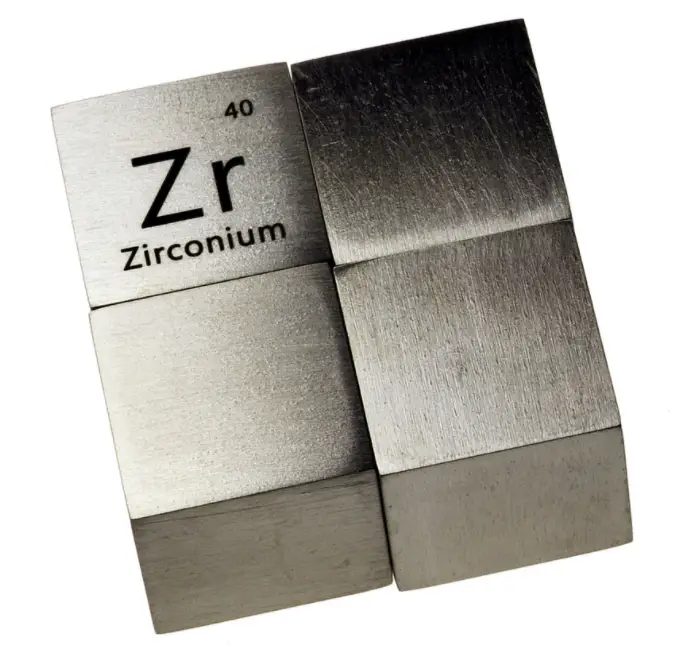
Zirconium is a lustrous, grey-white, strong transition metal that resembles hafnium and, to a lesser extent, titanium. Zirconium is mainly used as a refractory and opacifier, although small amounts are used as an alloying agent for its strong resistance to corrosion. Zirconium is widely used as a cladding for nuclear reactor fuels. The desired properties of these alloys are a low neutron-capture cross-section and resistance to corrosion under normal service conditions.
Summary

Element Zirconium
Atomic number 40
Atomic mass [amu] 91.224
Atomic mass [pm] 175
Density at STP [g/cm3] 6.511
Number of protons 40
Number of neutrons (typical isotopes) 90; 91; 92; 94
Number of electrons 40
Electron configuration [Kr] 4d2 5s2
Oxidation states +4
Electron affinity [kJ/mol] 41.1
Electronegativity [Pauling scale] 1.33
First ionization energy [eV] 6.6339

Atomic Number – Protons, Electrons and Neutrons in Zirconium

Proton Number - Atomic NumberZirconium is a chemical element with atomic number 40 which means there are 40 protons in its nucleus. Total number of protons in the nucleus is called the atomic number of the atom and is given the symbol Z. The total electrical charge of the nucleus is therefore +Ze, where e (elementary charge) equals to 1,602 x 10-19 coulombs.

The total number of neutrons in the nucleus of an atom is called the neutron number of the atom and is given the symbol N. Neutron number plus atomic number equals atomic mass number: N+Z=A. The difference between the neutron number and the atomic number is known as the neutron excess: D = N – Z = A – 2Z.

For stable elements, there is usually a variety of stable isotopes. Isotopes are nuclides that have the same atomic number and are therefore the same element, but differ in the number of neutrons. Mass numbers of typical isotopes of Zirconium are 90; 91; 92; 94.

Atomic Mass of Zirconium

Atomic mass of Zirconium is 91.224 u. 

The atomic mass is the mass of an atom. The atomic mass or relative isotopic mass refers to the mass of a single particle, and therefore is tied to a certain specific isotope of an element. The atomic mass is carried by the atomic nucleus, which occupies only about 10-12 of the total volume of the atom or less, but it contains all the positive charge and at least 99.95% of the total mass of the atom. Note that, each element may contain more isotopes, therefore this resulting atomic mass is calculated from naturally-occuring isotopes and their abundance.

Atomic Radius of Zirconium

The atomic radius of Zirconium atom is 175pm (covalent radius).

Atomic Radius of Chemical Elements

It must be noted, atoms lack a well-defined outer boundary. The atomic radius of a chemical element is a measure of the distance out to which the electron cloud extends from the nucleus. However, this assumes the atom to exhibit a spherical shape, which is only obeyed for atoms in vacuum or free space. Therefore, there are various non-equivalent definitions of atomic radius.

Electrons and Electron Configuration

The number of electrons in an electrically-neutral atom is the same as the number of protons in the nucleus. Therefore, the number of electrons in neutral atom of Zirconium is 40. Each electron is influenced by the electric fields produced by the positive nuclear charge and the other (Z – 1) negative electrons in the atom.

Since the number of electrons and their arrangement are responsible for the chemical behavior of atoms, the atomic number identifies the various chemical elements. The configuration of these electrons follows from the principles of quantum mechanics. The number of electrons in each element’s electron shells, particularly the outermost valence shell, is the primary factor in determining its chemical bonding behavior. In the periodic table, the elements are listed in order of increasing atomic number Z.

Electron configuration of Zirconium is [Kr] 4d2 5s2.

Possible oxidation states are +4.

Density of Zirconium

Density of Zirconium is 6.511g/cm3.

Typical densities of various substances are at atmospheric pressure.

Density is defined as the mass per unit volume. It is an intensive property, which is mathematically defined as mass divided by volume:

ρ = m/V

Atomic Masses of Elements

Periodic Table of Elements - atomic mass

Atomic Radii of Elements

Periodic Table of Elements - atomic radius

Densities of Elements

Periodic Table of Elements - density

Zirconium-protons-neutrons-electrons-configuration

Zirconium-affinity-electronegativity-ionization

Electron Affinity – Zirconium

Electron affinity of Zirconium is 41.1 kJ/mol.

In chemistry and atomic physics, the electron affinity of an atom or molecule is defined as:

the change in energy (in kJ/mole) of a neutral atom or molecule (in the gaseous phase) when an electron is added to the atom to form a negative ion.

X + e– → X– + energy        Affinity = – ∆H

In other words, it can be expressed as the neutral atom’s likelihood of gaining an electron. Note that, ionization energies measure the tendency of a neutral atom to resist the loss of electrons. Electron affinities are more difficult to measure than ionization energies.

Electronegativity of Zirconium

Electronegativity of Zirconium is 1.33.

Electronegativity, symbol χ, is a chemical property that describes the tendency of an atom to attract electrons towards this atom. For this purposes, a dimensionless quantity the Pauling scale, symbol χ, is the most commonly used.

The electronegativity of Zirconium is: χ = 1.33

First Ionization Energy of Zirconium

First Ionization Energy of Zirconium is 6.6339 eV.

Ionization energy, also called ionization potential, is the energy necessary to remove an electron from the neutral atom.

X + energy → X+ + e−

where X is any atom or molecule capable of being ionized, X+ is that atom or molecule with an electron removed (positive ion), and e− is the removed electron.

A Zirconium atom, for example, requires the following ionization energy to remove the outermost electron.

Zr + IE → Zr+ + e−        IE = 6.6339 eV

Electronegativity of Elements

Periodic Table of Elements - electronegativity

Ionization Energy of Elements

Periodic Table of Elements - ionization energy

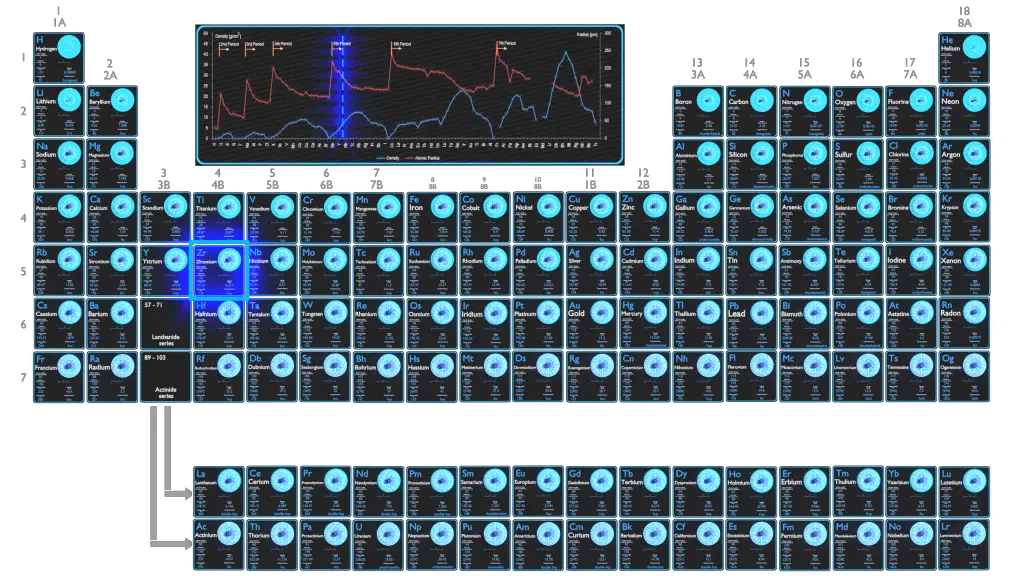
Zirconium-periodic-table

Source: www.luciteria.com


Properties of other elements

Zirconium - Comparison of Atomic Properties

Periodic Table in 8K resolution

Other properties of Zirconium


Rubidium – Periodic Table – Atomic Properties

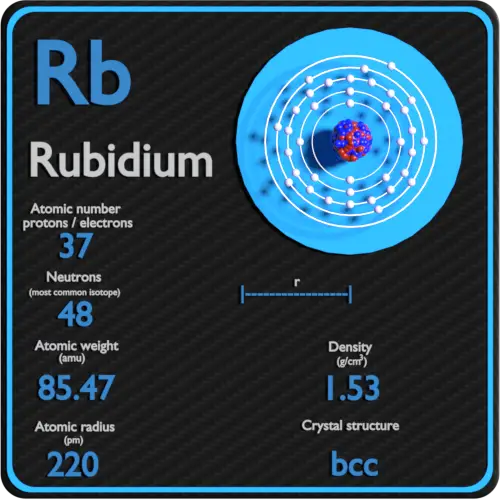
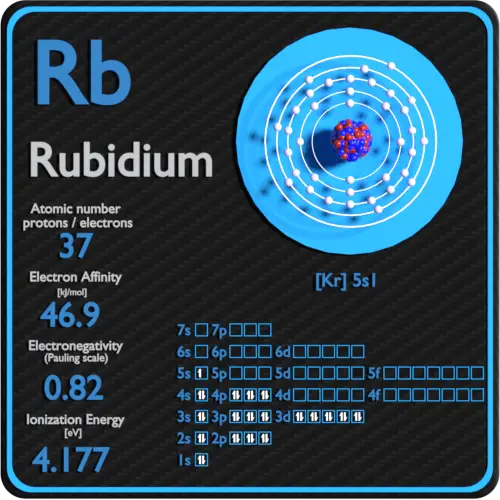
Rubidium-density-atomic-number-mass-radius

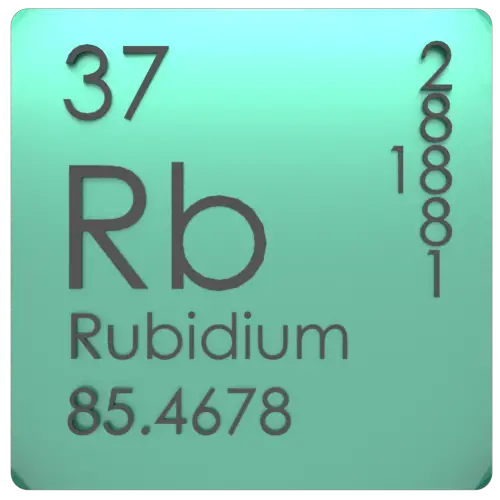
Rubidium is a soft, silvery-white metallic element of the alkali metal group, with an atomic mass of 85.4678. Elemental rubidium is highly reactive, with properties similar to those of other alkali metals, including rapid oxidation in air.

Summary

Element Rubidium
Atomic number 37
Atomic mass [amu] 85.4678
Atomic mass [pm] 220
Density at STP [g/cm3] 1.532
Number of protons 37
Number of neutrons (typical isotopes) 85; 87
Number of electrons 37
Electron configuration [Kr] 5s1
Oxidation states +1
Electron affinity [kJ/mol] 46.9
Electronegativity [Pauling scale] 0.82
First ionization energy [eV] 4.1771

Atomic Number – Protons, Electrons and Neutrons in Rubidium

Proton Number - Atomic NumberRubidium is a chemical element with atomic number 37 which means there are 37 protons in its nucleus. Total number of protons in the nucleus is called the atomic number of the atom and is given the symbol Z. The total electrical charge of the nucleus is therefore +Ze, where e (elementary charge) equals to 1,602 x 10-19 coulombs.

The total number of neutrons in the nucleus of an atom is called the neutron number of the atom and is given the symbol N. Neutron number plus atomic number equals atomic mass number: N+Z=A. The difference between the neutron number and the atomic number is known as the neutron excess: D = N – Z = A – 2Z.

For stable elements, there is usually a variety of stable isotopes. Isotopes are nuclides that have the same atomic number and are therefore the same element, but differ in the number of neutrons. Mass numbers of typical isotopes of Rubidium are 85; 87.

Atomic Mass of Rubidium

Atomic mass of Rubidium is 85.4678 u. 

The atomic mass is the mass of an atom. The atomic mass or relative isotopic mass refers to the mass of a single particle, and therefore is tied to a certain specific isotope of an element. The atomic mass is carried by the atomic nucleus, which occupies only about 10-12 of the total volume of the atom or less, but it contains all the positive charge and at least 99.95% of the total mass of the atom. Note that, each element may contain more isotopes, therefore this resulting atomic mass is calculated from naturally-occuring isotopes and their abundance.

Atomic Radius of Rubidium

The atomic radius of Rubidium atom is 220pm (covalent radius).

Atomic Radius of Chemical Elements

It must be noted, atoms lack a well-defined outer boundary. The atomic radius of a chemical element is a measure of the distance out to which the electron cloud extends from the nucleus. However, this assumes the atom to exhibit a spherical shape, which is only obeyed for atoms in vacuum or free space. Therefore, there are various non-equivalent definitions of atomic radius.

Electrons and Electron Configuration

The number of electrons in an electrically-neutral atom is the same as the number of protons in the nucleus. Therefore, the number of electrons in neutral atom of Rubidium is 37. Each electron is influenced by the electric fields produced by the positive nuclear charge and the other (Z – 1) negative electrons in the atom.

Since the number of electrons and their arrangement are responsible for the chemical behavior of atoms, the atomic number identifies the various chemical elements. The configuration of these electrons follows from the principles of quantum mechanics. The number of electrons in each element’s electron shells, particularly the outermost valence shell, is the primary factor in determining its chemical bonding behavior. In the periodic table, the elements are listed in order of increasing atomic number Z.

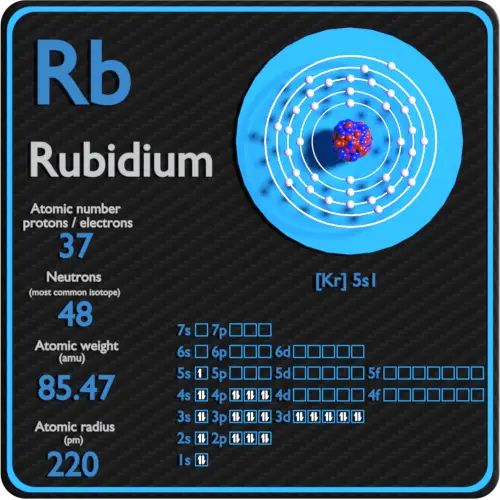
Electron configuration of Rubidium is [Kr] 5s1.

Possible oxidation states are +1.

Density of Rubidium

Density of Rubidium is 1.532g/cm3.

Typical densities of various substances are at atmospheric pressure.

Density is defined as the mass per unit volume. It is an intensive property, which is mathematically defined as mass divided by volume:

ρ = m/V

Atomic Masses of Elements

Periodic Table of Elements - atomic mass

Atomic Radii of Elements

Periodic Table of Elements - atomic radius

Densities of Elements

Periodic Table of Elements - density

Rubidium-protons-neutrons-electrons-configuration

Rubidium-affinity-electronegativity-ionization

Electron Affinity – Rubidium

Electron affinity of Rubidium is 46.9 kJ/mol.

In chemistry and atomic physics, the electron affinity of an atom or molecule is defined as:

the change in energy (in kJ/mole) of a neutral atom or molecule (in the gaseous phase) when an electron is added to the atom to form a negative ion.

X + e– → X– + energy        Affinity = – ∆H

In other words, it can be expressed as the neutral atom’s likelihood of gaining an electron. Note that, ionization energies measure the tendency of a neutral atom to resist the loss of electrons. Electron affinities are more difficult to measure than ionization energies.

Electronegativity of Rubidium

Electronegativity of Rubidium is 0.82.

Electronegativity, symbol χ, is a chemical property that describes the tendency of an atom to attract electrons towards this atom. For this purposes, a dimensionless quantity the Pauling scale, symbol χ, is the most commonly used.

The electronegativity of Rubidium is: χ = 0.82

First Ionization Energy of Rubidium

First Ionization Energy of Rubidium is 4.1771 eV.

Ionization energy, also called ionization potential, is the energy necessary to remove an electron from the neutral atom.

X + energy → X+ + e−

where X is any atom or molecule capable of being ionized, X+ is that atom or molecule with an electron removed (positive ion), and e− is the removed electron.

A Rubidium atom, for example, requires the following ionization energy to remove the outermost electron.

Rb + IE → Rb+ + e−        IE = 4.1771 eV

Electronegativity of Elements

Periodic Table of Elements - electronegativity

Ionization Energy of Elements

Periodic Table of Elements - ionization energy

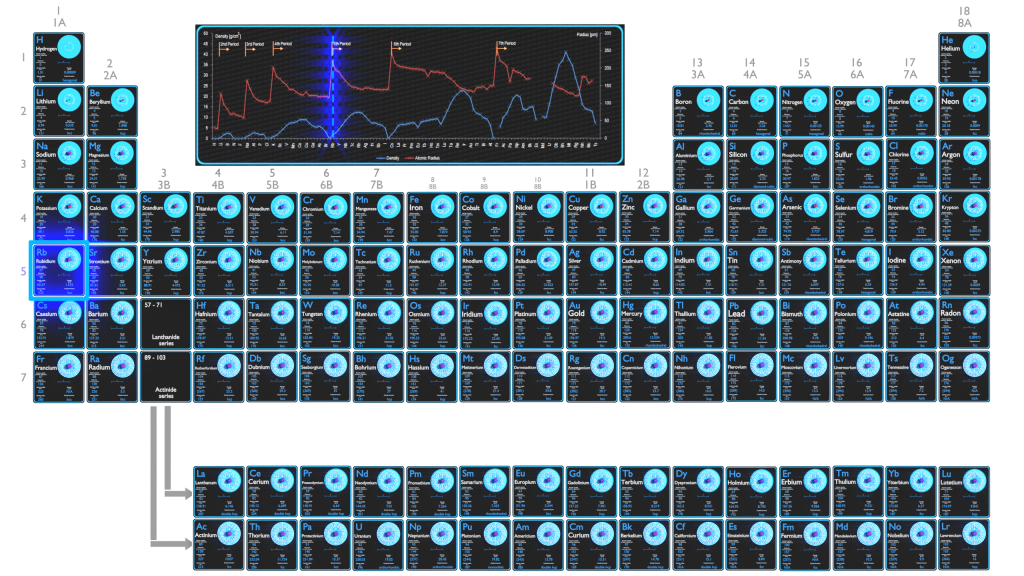
Rubidium-periodic-table

Source: www.luciteria.com


Properties of other elements

Rubidium - Comparison of Atomic Properties

Periodic Table in 8K resolution

Other properties of Rubidium


Strontium – Periodic Table – Atomic Properties

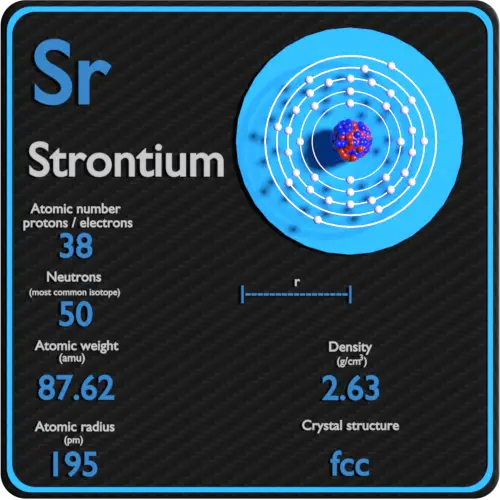
Strontium-density-atomic-number-mass-radius

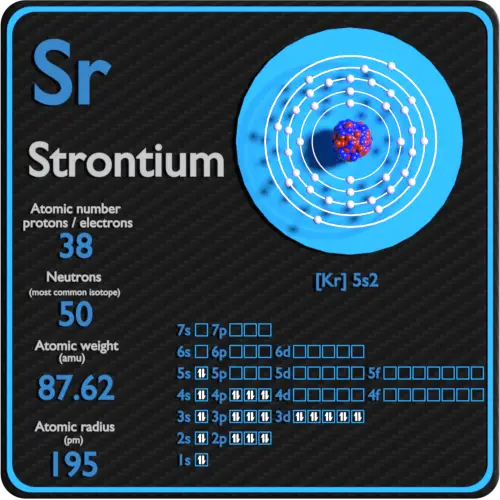
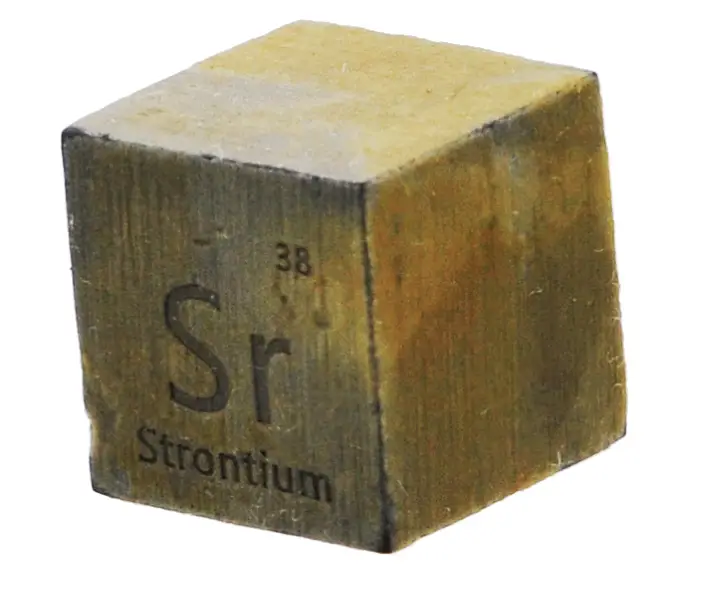
Strontium is an alkaline earth metal, strontium is a soft silver-white yellowish metallic element that is highly reactive chemically.

Summary

Element Strontium
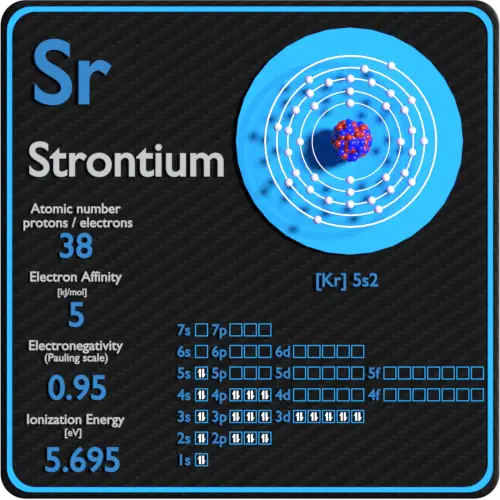
Atomic number 38
Atomic mass [amu] 87.62
Atomic mass [pm] 195
Density at STP [g/cm3] 2.63
Number of protons 38
Number of neutrons (typical isotopes) 84; 86-88
Number of electrons 38
Electron configuration [Kr] 5s2
Oxidation states +2
Electron affinity [kJ/mol] 5.03
Electronegativity [Pauling scale] 0.95
First ionization energy [eV] 5.6948

Atomic Number – Protons, Electrons and Neutrons in Strontium

Proton Number - Atomic NumberStrontium is a chemical element with atomic number 38 which means there are 38 protons in its nucleus. Total number of protons in the nucleus is called the atomic number of the atom and is given the symbol Z. The total electrical charge of the nucleus is therefore +Ze, where e (elementary charge) equals to 1,602 x 10-19 coulombs.

The total number of neutrons in the nucleus of an atom is called the neutron number of the atom and is given the symbol N. Neutron number plus atomic number equals atomic mass number: N+Z=A. The difference between the neutron number and the atomic number is known as the neutron excess: D = N – Z = A – 2Z.

For stable elements, there is usually a variety of stable isotopes. Isotopes are nuclides that have the same atomic number and are therefore the same element, but differ in the number of neutrons. Mass numbers of typical isotopes of Strontium are 84; 86-88.

Atomic Mass of Strontium

Atomic mass of Strontium is 87.62 u. 

The atomic mass is the mass of an atom. The atomic mass or relative isotopic mass refers to the mass of a single particle, and therefore is tied to a certain specific isotope of an element. The atomic mass is carried by the atomic nucleus, which occupies only about 10-12 of the total volume of the atom or less, but it contains all the positive charge and at least 99.95% of the total mass of the atom. Note that, each element may contain more isotopes, therefore this resulting atomic mass is calculated from naturally-occuring isotopes and their abundance.

Atomic Radius of Strontium

The atomic radius of Strontium atom is 195pm (covalent radius).

Atomic Radius of Chemical Elements

It must be noted, atoms lack a well-defined outer boundary. The atomic radius of a chemical element is a measure of the distance out to which the electron cloud extends from the nucleus. However, this assumes the atom to exhibit a spherical shape, which is only obeyed for atoms in vacuum or free space. Therefore, there are various non-equivalent definitions of atomic radius.

Electrons and Electron Configuration

The number of electrons in an electrically-neutral atom is the same as the number of protons in the nucleus. Therefore, the number of electrons in neutral atom of Strontium is 38. Each electron is influenced by the electric fields produced by the positive nuclear charge and the other (Z – 1) negative electrons in the atom.

Since the number of electrons and their arrangement are responsible for the chemical behavior of atoms, the atomic number identifies the various chemical elements. The configuration of these electrons follows from the principles of quantum mechanics. The number of electrons in each element’s electron shells, particularly the outermost valence shell, is the primary factor in determining its chemical bonding behavior. In the periodic table, the elements are listed in order of increasing atomic number Z.

Electron configuration of Strontium is [Kr] 5s2.

Possible oxidation states are +2.

Density of Strontium

Density of Strontium is 2.63g/cm3.

Typical densities of various substances are at atmospheric pressure.

Density is defined as the mass per unit volume. It is an intensive property, which is mathematically defined as mass divided by volume:

ρ = m/V

Atomic Masses of Elements

Periodic Table of Elements - atomic mass

Atomic Radii of Elements

Periodic Table of Elements - atomic radius

Densities of Elements

Periodic Table of Elements - density

Strontium-protons-neutrons-electrons-configuration

Strontium-affinity-electronegativity-ionization

Electron Affinity – Strontium

Electron affinity of Strontium is 5.03 kJ/mol.

In chemistry and atomic physics, the electron affinity of an atom or molecule is defined as:

the change in energy (in kJ/mole) of a neutral atom or molecule (in the gaseous phase) when an electron is added to the atom to form a negative ion.

X + e– → X– + energy        Affinity = – ∆H

In other words, it can be expressed as the neutral atom’s likelihood of gaining an electron. Note that, ionization energies measure the tendency of a neutral atom to resist the loss of electrons. Electron affinities are more difficult to measure than ionization energies.

Electronegativity of Strontium

Electronegativity of Strontium is 0.95.

Electronegativity, symbol χ, is a chemical property that describes the tendency of an atom to attract electrons towards this atom. For this purposes, a dimensionless quantity the Pauling scale, symbol χ, is the most commonly used.

The electronegativity of Strontium is: χ = 0.95

First Ionization Energy of Strontium

First Ionization Energy of Strontium is 5.6948 eV.

Ionization energy, also called ionization potential, is the energy necessary to remove an electron from the neutral atom.

X + energy → X+ + e−

where X is any atom or molecule capable of being ionized, X+ is that atom or molecule with an electron removed (positive ion), and e− is the removed electron.

A Strontium atom, for example, requires the following ionization energy to remove the outermost electron.

Sr + IE → Sr+ + e−        IE = 5.6948 eV

Electronegativity of Elements

Periodic Table of Elements - electronegativity

Ionization Energy of Elements

Periodic Table of Elements - ionization energy

Strontium-periodic-table

Source: www.luciteria.com


Properties of other elements

Strontium - Comparison of Atomic Properties

Periodic Table in 8K resolution

Other properties of Strontium


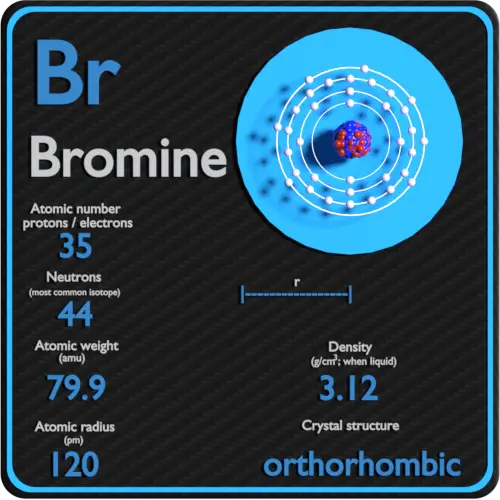
Bromine – Periodic Table – Atomic Properties

Bromine-density-atomic-number-mass-radius

Bromine is the third-lightest halogen, and is a fuming red-brown liquid at room temperature that evaporates readily to form a similarly coloured gas. Its properties are thus intermediate between those of chlorine and iodine.

Summary

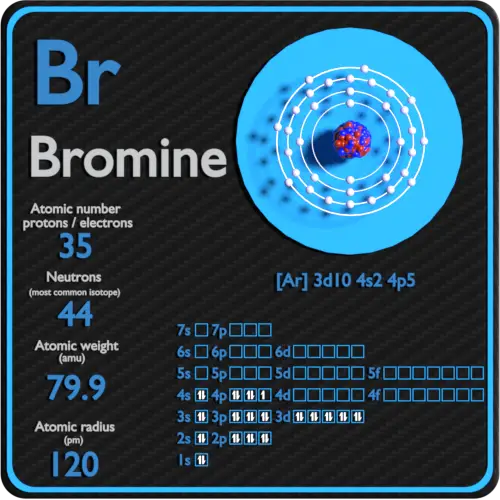
Element Bromine
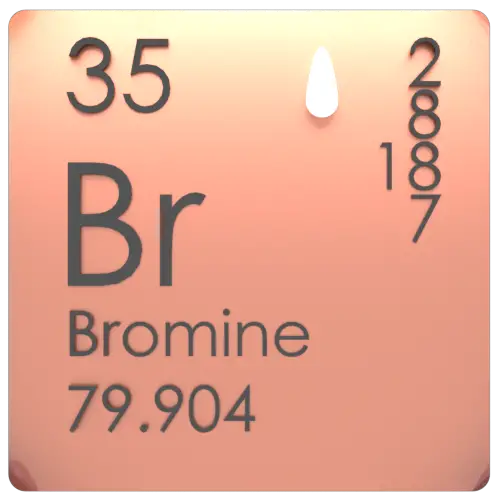
Atomic number 35
Atomic mass [amu] 79.904
Atomic mass [pm] 120
Density at STP [g/cm3] 3.12
Number of protons 35
Number of neutrons (typical isotopes) 79; 81
Number of electrons 35
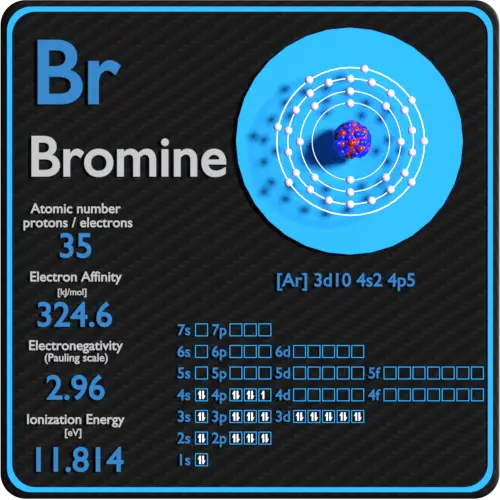
Electron configuration [Ar] 3d10 4s2 4p5
Oxidation states +1,3,5/-1
Electron affinity [kJ/mol] 324.6
Electronegativity [Pauling scale] 2.96
First ionization energy [eV] 11.8138

Atomic Number – Protons, Electrons and Neutrons in Bromine

Proton Number - Atomic NumberBromine is a chemical element with atomic number 35 which means there are 35 protons in its nucleus. Total number of protons in the nucleus is called the atomic number of the atom and is given the symbol Z. The total electrical charge of the nucleus is therefore +Ze, where e (elementary charge) equals to 1,602 x 10-19 coulombs.

The total number of neutrons in the nucleus of an atom is called the neutron number of the atom and is given the symbol N. Neutron number plus atomic number equals atomic mass number: N+Z=A. The difference between the neutron number and the atomic number is known as the neutron excess: D = N – Z = A – 2Z.

For stable elements, there is usually a variety of stable isotopes. Isotopes are nuclides that have the same atomic number and are therefore the same element, but differ in the number of neutrons. Mass numbers of typical isotopes of Bromine are 79; 81.

Atomic Mass of Bromine

Atomic mass of Bromine is 79.904 u. 

The atomic mass is the mass of an atom. The atomic mass or relative isotopic mass refers to the mass of a single particle, and therefore is tied to a certain specific isotope of an element. The atomic mass is carried by the atomic nucleus, which occupies only about 10-12 of the total volume of the atom or less, but it contains all the positive charge and at least 99.95% of the total mass of the atom. Note that, each element may contain more isotopes, therefore this resulting atomic mass is calculated from naturally-occuring isotopes and their abundance.

Atomic Radius of Bromine

The atomic radius of Bromine atom is 120pm (covalent radius).

Atomic Radius of Chemical Elements

It must be noted, atoms lack a well-defined outer boundary. The atomic radius of a chemical element is a measure of the distance out to which the electron cloud extends from the nucleus. However, this assumes the atom to exhibit a spherical shape, which is only obeyed for atoms in vacuum or free space. Therefore, there are various non-equivalent definitions of atomic radius.

Electrons and Electron Configuration

The number of electrons in an electrically-neutral atom is the same as the number of protons in the nucleus. Therefore, the number of electrons in neutral atom of Bromine is 35. Each electron is influenced by the electric fields produced by the positive nuclear charge and the other (Z – 1) negative electrons in the atom.

Since the number of electrons and their arrangement are responsible for the chemical behavior of atoms, the atomic number identifies the various chemical elements. The configuration of these electrons follows from the principles of quantum mechanics. The number of electrons in each element’s electron shells, particularly the outermost valence shell, is the primary factor in determining its chemical bonding behavior. In the periodic table, the elements are listed in order of increasing atomic number Z.

Electron configuration of Bromine is [Ar] 3d10 4s2 4p5.

Possible oxidation states are +1,3,5/-1.

Density of Bromine

Density of Bromine is 3.12g/cm3.

Typical densities of various substances are at atmospheric pressure.

Density is defined as the mass per unit volume. It is an intensive property, which is mathematically defined as mass divided by volume:

ρ = m/V

Atomic Masses of Elements

Periodic Table of Elements - atomic mass

Atomic Radii of Elements

Periodic Table of Elements - atomic radius

Densities of Elements

Periodic Table of Elements - density

Bromine-protons-neutrons-electrons-configuration

Bromine-affinity-electronegativity-ionization

Electron Affinity – Bromine

Electron affinity of Bromine is 324.6 kJ/mol.

In chemistry and atomic physics, the electron affinity of an atom or molecule is defined as:

the change in energy (in kJ/mole) of a neutral atom or molecule (in the gaseous phase) when an electron is added to the atom to form a negative ion.

X + e– → X– + energy        Affinity = – ∆H

In other words, it can be expressed as the neutral atom’s likelihood of gaining an electron. Note that, ionization energies measure the tendency of a neutral atom to resist the loss of electrons. Electron affinities are more difficult to measure than ionization energies.

Electronegativity of Bromine

Electronegativity of Bromine is 2.96.

Electronegativity, symbol χ, is a chemical property that describes the tendency of an atom to attract electrons towards this atom. For this purposes, a dimensionless quantity the Pauling scale, symbol χ, is the most commonly used.

The electronegativity of Bromine is: χ = 2.96

First Ionization Energy of Bromine

First Ionization Energy of Bromine is 11.8138 eV.

Ionization energy, also called ionization potential, is the energy necessary to remove an electron from the neutral atom.

X + energy → X+ + e−

where X is any atom or molecule capable of being ionized, X+ is that atom or molecule with an electron removed (positive ion), and e− is the removed electron.

A Bromine atom, for example, requires the following ionization energy to remove the outermost electron.

Br + IE → Br+ + e−        IE = 11.8138 eV

Electronegativity of Elements

Periodic Table of Elements - electronegativity

Ionization Energy of Elements

Periodic Table of Elements - ionization energy

Bromine-periodic-table

Source: www.luciteria.com


Properties of other elements

Bromine - Comparison of Atomic Properties

Periodic Table in 8K resolution

Other properties of Bromine


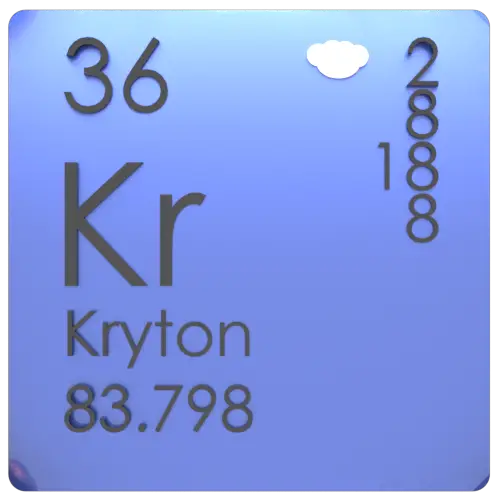
Krypton – Periodic Table – Atomic Properties

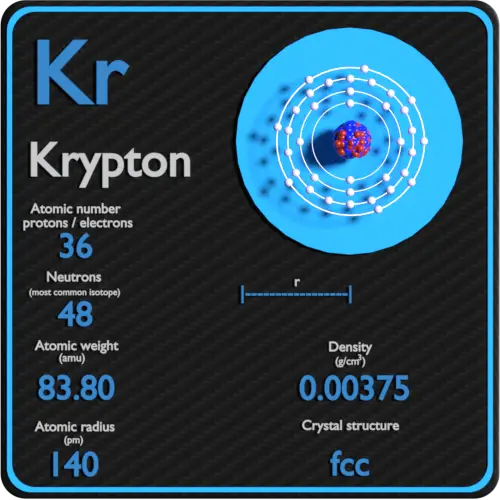
Krypton-density-atomic-number-mass-radius

Krypton is a member of group 18 (noble gases) elements. A colorless, odorless, tasteless noble gas, krypton occurs in trace amounts in the atmosphere and is often used with other rare gases in fluorescent lamps.

Summary

Element Krypton
Atomic number 36
Atomic mass [amu] 83.798
Atomic mass [pm] 116
Density at STP [g/cm3] 0.00375
Number of protons 36
Number of neutrons (typical isotopes) 80; 82-84; 86
Number of electrons 36
Electron configuration [Ar] 3d10 4s2 4p6
Oxidation states 0
Electron affinity [kJ/mol] —
Electronegativity [Pauling scale] 3
First ionization energy [eV] 13.9996

Atomic Number – Protons, Electrons and Neutrons in Krypton

Proton Number - Atomic NumberKrypton is a chemical element with atomic number 36 which means there are 36 protons in its nucleus. Total number of protons in the nucleus is called the atomic number of the atom and is given the symbol Z. The total electrical charge of the nucleus is therefore +Ze, where e (elementary charge) equals to 1,602 x 10-19 coulombs.

The total number of neutrons in the nucleus of an atom is called the neutron number of the atom and is given the symbol N. Neutron number plus atomic number equals atomic mass number: N+Z=A. The difference between the neutron number and the atomic number is known as the neutron excess: D = N – Z = A – 2Z.

For stable elements, there is usually a variety of stable isotopes. Isotopes are nuclides that have the same atomic number and are therefore the same element, but differ in the number of neutrons. Mass numbers of typical isotopes of Krypton are 80; 82-84; 86.

Atomic Mass of Krypton

Atomic mass of Krypton is 83.798 u. 

The atomic mass is the mass of an atom. The atomic mass or relative isotopic mass refers to the mass of a single particle, and therefore is tied to a certain specific isotope of an element. The atomic mass is carried by the atomic nucleus, which occupies only about 10-12 of the total volume of the atom or less, but it contains all the positive charge and at least 99.95% of the total mass of the atom. Note that, each element may contain more isotopes, therefore this resulting atomic mass is calculated from naturally-occuring isotopes and their abundance.

Atomic Radius of Krypton

The atomic radius of Krypton atom is 116pm (covalent radius).

Atomic Radius of Chemical Elements

It must be noted, atoms lack a well-defined outer boundary. The atomic radius of a chemical element is a measure of the distance out to which the electron cloud extends from the nucleus. However, this assumes the atom to exhibit a spherical shape, which is only obeyed for atoms in vacuum or free space. Therefore, there are various non-equivalent definitions of atomic radius.

Electrons and Electron Configuration

The number of electrons in an electrically-neutral atom is the same as the number of protons in the nucleus. Therefore, the number of electrons in neutral atom of Krypton is 36. Each electron is influenced by the electric fields produced by the positive nuclear charge and the other (Z – 1) negative electrons in the atom.

Since the number of electrons and their arrangement are responsible for the chemical behavior of atoms, the atomic number identifies the various chemical elements. The configuration of these electrons follows from the principles of quantum mechanics. The number of electrons in each element’s electron shells, particularly the outermost valence shell, is the primary factor in determining its chemical bonding behavior. In the periodic table, the elements are listed in order of increasing atomic number Z.

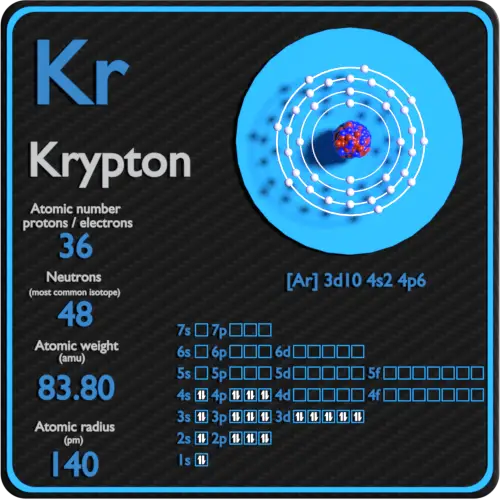
Electron configuration of Krypton is [Ar] 3d10 4s2 4p6.

Possible oxidation states are 0.

Density of Krypton

Density of Krypton is 0.00375g/cm3.

Typical densities of various substances are at atmospheric pressure.

Density is defined as the mass per unit volume. It is an intensive property, which is mathematically defined as mass divided by volume:

ρ = m/V

Atomic Masses of Elements

Periodic Table of Elements - atomic mass

Atomic Radii of Elements

Periodic Table of Elements - atomic radius

Densities of Elements

Periodic Table of Elements - density

Krypton-protons-neutrons-electrons-configuration

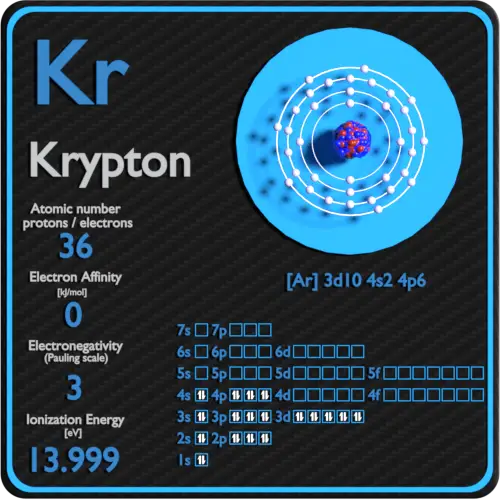
Krypton-affinity-electronegativity-ionization

Electron Affinity – Krypton

Electron affinity of Krypton is — kJ/mol.

In chemistry and atomic physics, the electron affinity of an atom or molecule is defined as:

the change in energy (in kJ/mole) of a neutral atom or molecule (in the gaseous phase) when an electron is added to the atom to form a negative ion.

X + e– → X– + energy        Affinity = – ∆H

In other words, it can be expressed as the neutral atom’s likelihood of gaining an electron. Note that, ionization energies measure the tendency of a neutral atom to resist the loss of electrons. Electron affinities are more difficult to measure than ionization energies.

Electronegativity of Krypton

Electronegativity of Krypton is 3.

Electronegativity, symbol χ, is a chemical property that describes the tendency of an atom to attract electrons towards this atom. For this purposes, a dimensionless quantity the Pauling scale, symbol χ, is the most commonly used.

The electronegativity of Krypton is: χ = 3

First Ionization Energy of Krypton

First Ionization Energy of Krypton is 13.9996 eV.

Ionization energy, also called ionization potential, is the energy necessary to remove an electron from the neutral atom.

X + energy → X+ + e−

where X is any atom or molecule capable of being ionized, X+ is that atom or molecule with an electron removed (positive ion), and e− is the removed electron.

A Krypton atom, for example, requires the following ionization energy to remove the outermost electron.

Kr + IE → Kr+ + e−        IE = 13.9996 eV

Electronegativity of Elements

Periodic Table of Elements - electronegativity

Ionization Energy of Elements

Periodic Table of Elements - ionization energy

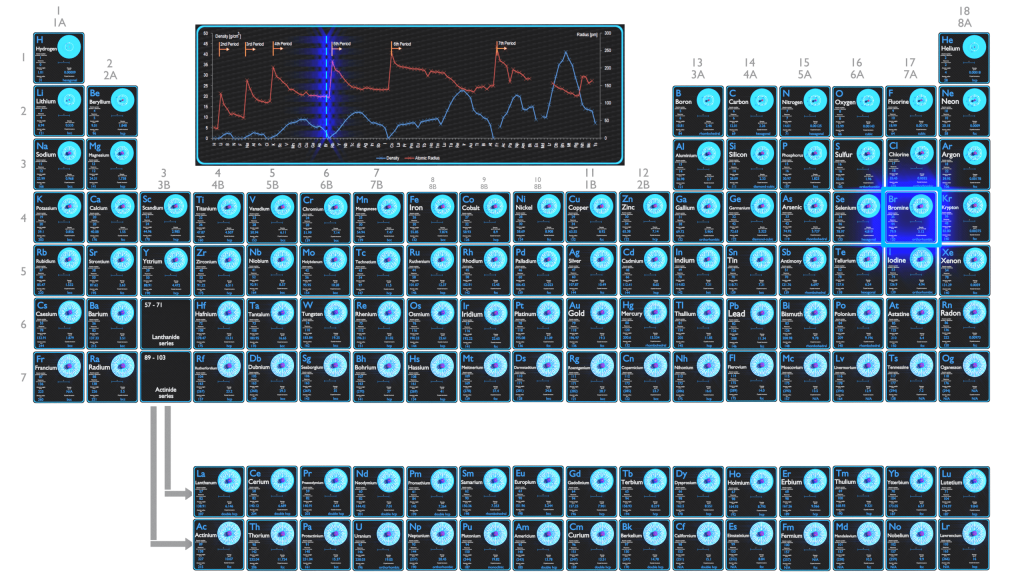
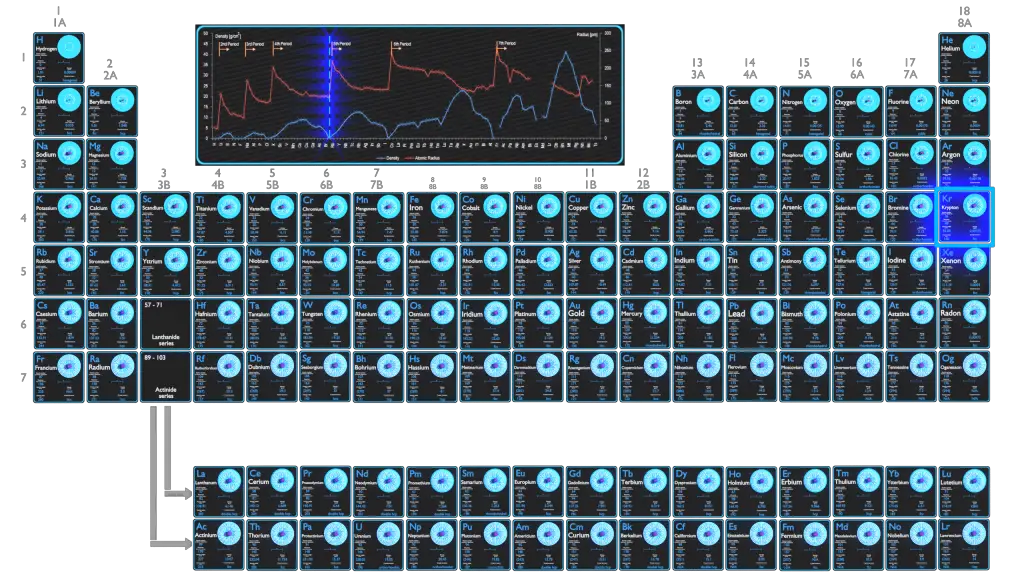
Krypton-periodic-table

Source: www.luciteria.com


Properties of other elements

Krypton - Comparison of Atomic Properties

Periodic Table in 8K resolution

Other properties of Krypton


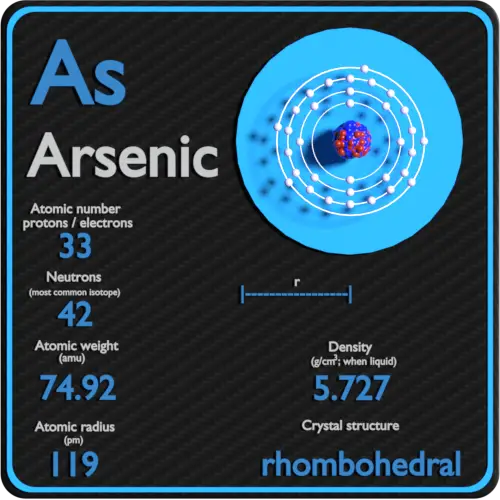
Arsenic – Periodic Table – Atomic Properties

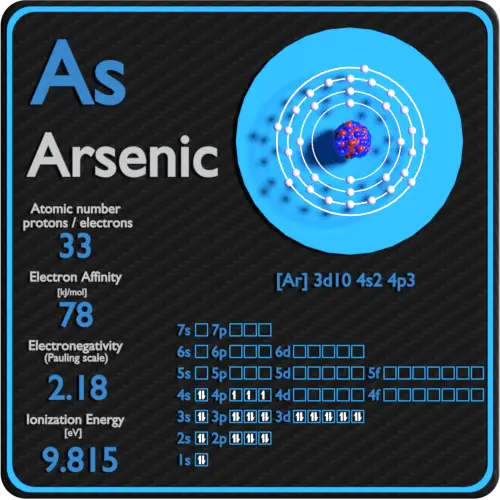
Arsenic-density-atomic-number-mass-radius

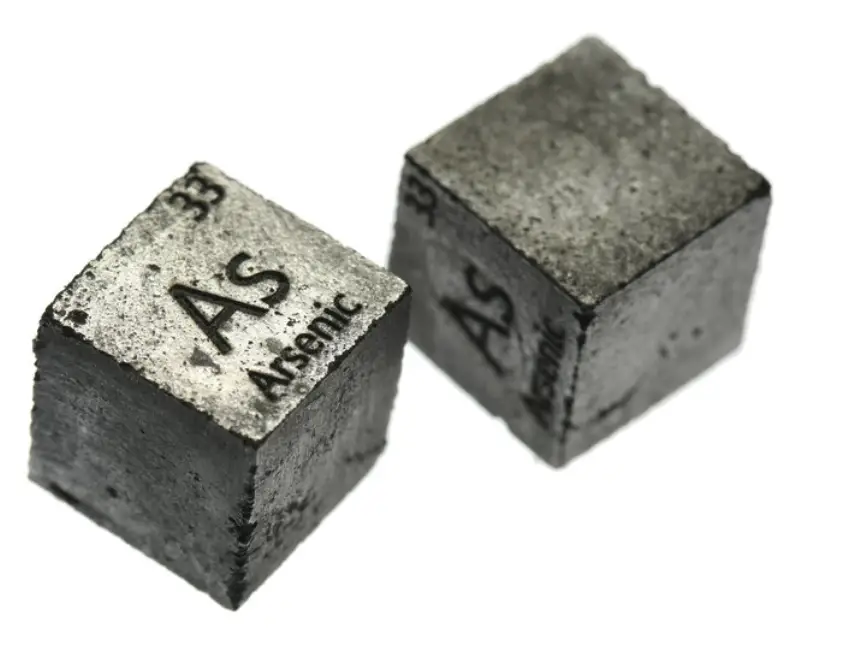
Arsenic occurs in many minerals, usually in combination with sulfur and metals, but also as a pure elemental crystal. Arsenic is a metalloid.

Summary

Element Arsenic
Atomic number 33
Atomic mass [amu] 74.9216
Atomic mass [pm] 119
Density at STP [g/cm3] 5.727
Number of protons 33
Number of neutrons (typical isotopes) 75
Number of electrons 33
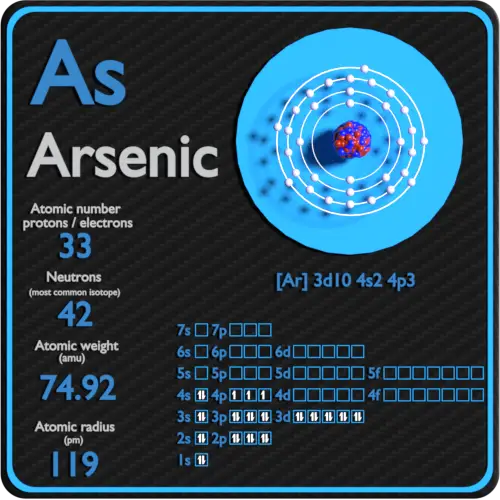
Electron configuration [Ar] 3d10 4s2 4p3
Oxidation states +3,5/-3
Electron affinity [kJ/mol] 78
Electronegativity [Pauling scale] 2.18
First ionization energy [eV] 9.8152

Atomic Number – Protons, Electrons and Neutrons in Arsenic

Proton Number - Atomic NumberArsenic is a chemical element with atomic number 33 which means there are 33 protons in its nucleus. Total number of protons in the nucleus is called the atomic number of the atom and is given the symbol Z. The total electrical charge of the nucleus is therefore +Ze, where e (elementary charge) equals to 1,602 x 10-19 coulombs.

The total number of neutrons in the nucleus of an atom is called the neutron number of the atom and is given the symbol N. Neutron number plus atomic number equals atomic mass number: N+Z=A. The difference between the neutron number and the atomic number is known as the neutron excess: D = N – Z = A – 2Z.

For stable elements, there is usually a variety of stable isotopes. Isotopes are nuclides that have the same atomic number and are therefore the same element, but differ in the number of neutrons. Mass numbers of typical isotopes of Arsenic are 75.

Atomic Mass of Arsenic

Atomic mass of Arsenic is 74.9216 u. 

The atomic mass is the mass of an atom. The atomic mass or relative isotopic mass refers to the mass of a single particle, and therefore is tied to a certain specific isotope of an element. The atomic mass is carried by the atomic nucleus, which occupies only about 10-12 of the total volume of the atom or less, but it contains all the positive charge and at least 99.95% of the total mass of the atom. Note that, each element may contain more isotopes, therefore this resulting atomic mass is calculated from naturally-occuring isotopes and their abundance.

Atomic Radius of Arsenic

The atomic radius of Arsenic atom is 119pm (covalent radius).

Atomic Radius of Chemical Elements

It must be noted, atoms lack a well-defined outer boundary. The atomic radius of a chemical element is a measure of the distance out to which the electron cloud extends from the nucleus. However, this assumes the atom to exhibit a spherical shape, which is only obeyed for atoms in vacuum or free space. Therefore, there are various non-equivalent definitions of atomic radius.

Electrons and Electron Configuration

The number of electrons in an electrically-neutral atom is the same as the number of protons in the nucleus. Therefore, the number of electrons in neutral atom of Arsenic is 33. Each electron is influenced by the electric fields produced by the positive nuclear charge and the other (Z – 1) negative electrons in the atom.

Since the number of electrons and their arrangement are responsible for the chemical behavior of atoms, the atomic number identifies the various chemical elements. The configuration of these electrons follows from the principles of quantum mechanics. The number of electrons in each element’s electron shells, particularly the outermost valence shell, is the primary factor in determining its chemical bonding behavior. In the periodic table, the elements are listed in order of increasing atomic number Z.

Electron configuration of Arsenic is [Ar] 3d10 4s2 4p3.

Possible oxidation states are +3,5/-3.

Density of Arsenic

Density of Arsenic is 5.727g/cm3.

Typical densities of various substances are at atmospheric pressure.

Density is defined as the mass per unit volume. It is an intensive property, which is mathematically defined as mass divided by volume:

ρ = m/V

Atomic Masses of Elements

Periodic Table of Elements - atomic mass

Atomic Radii of Elements

Periodic Table of Elements - atomic radius

Densities of Elements

Periodic Table of Elements - density

Arsenic-protons-neutrons-electrons-configuration

Arsenic-affinity-electronegativity-ionization

Electron Affinity – Arsenic

Electron affinity of Arsenic is 78 kJ/mol.

In chemistry and atomic physics, the electron affinity of an atom or molecule is defined as:

the change in energy (in kJ/mole) of a neutral atom or molecule (in the gaseous phase) when an electron is added to the atom to form a negative ion.

X + e– → X– + energy        Affinity = – ∆H

In other words, it can be expressed as the neutral atom’s likelihood of gaining an electron. Note that, ionization energies measure the tendency of a neutral atom to resist the loss of electrons. Electron affinities are more difficult to measure than ionization energies.

Electronegativity of Arsenic

Electronegativity of Arsenic is 2.18.

Electronegativity, symbol χ, is a chemical property that describes the tendency of an atom to attract electrons towards this atom. For this purposes, a dimensionless quantity the Pauling scale, symbol χ, is the most commonly used.

The electronegativity of Arsenic is: χ = 2.18

First Ionization Energy of Arsenic

First Ionization Energy of Arsenic is 9.8152 eV.

Ionization energy, also called ionization potential, is the energy necessary to remove an electron from the neutral atom.

X + energy → X+ + e−

where X is any atom or molecule capable of being ionized, X+ is that atom or molecule with an electron removed (positive ion), and e− is the removed electron.

A Arsenic atom, for example, requires the following ionization energy to remove the outermost electron.

As + IE → As+ + e−        IE = 9.8152 eV

Electronegativity of Elements

Periodic Table of Elements - electronegativity

Ionization Energy of Elements

Periodic Table of Elements - ionization energy

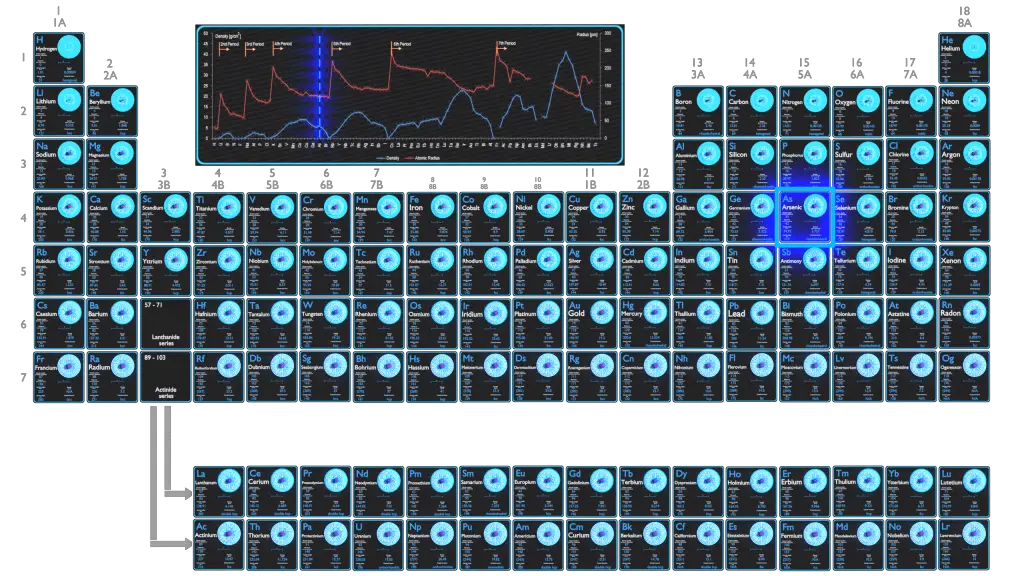
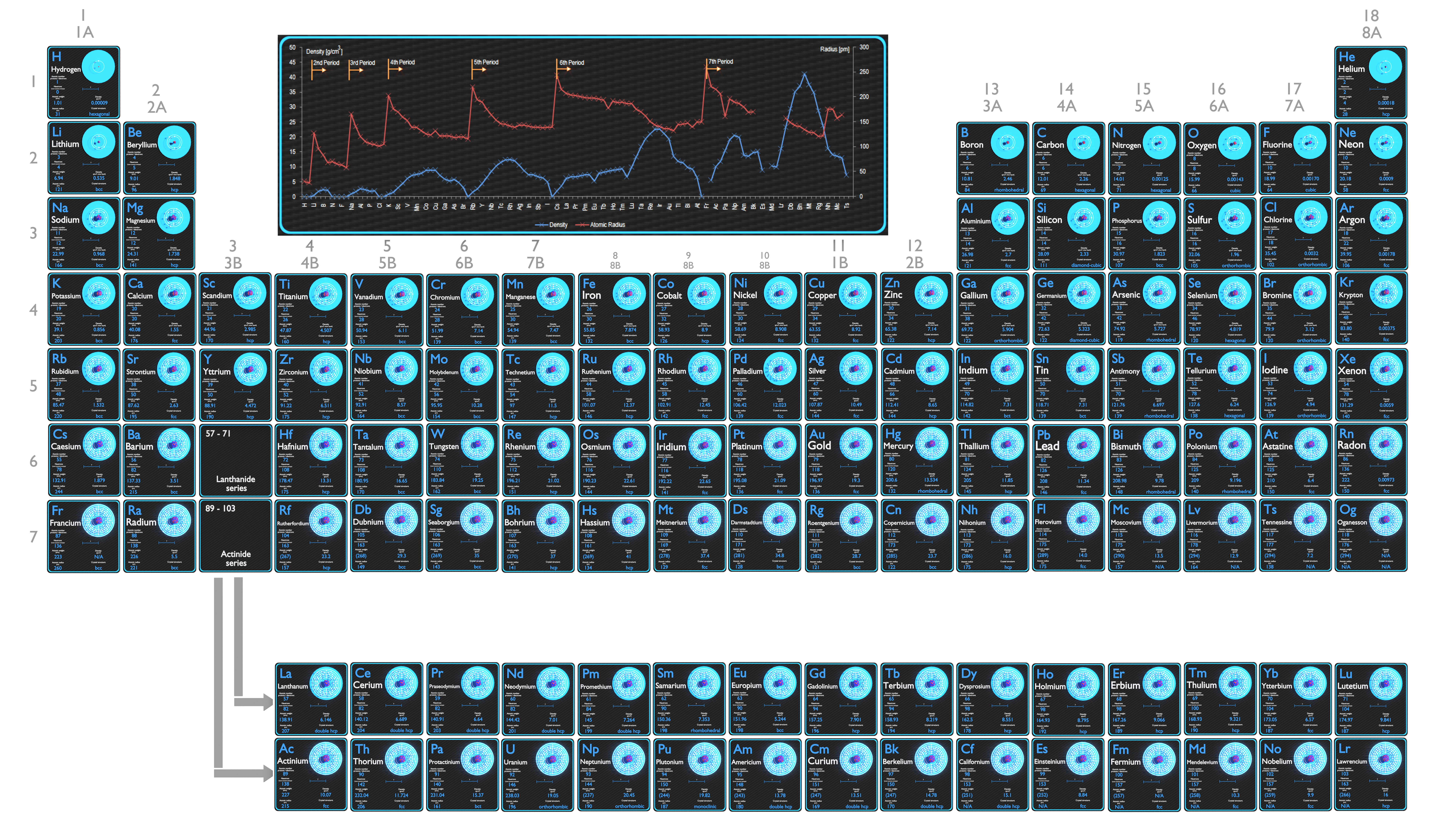
Arsenic-periodic-table

Source: www.luciteria.com


Properties of other elements

Arsenic - Comparison of Atomic Properties

Periodic Table in 8K resolution

Other properties of Arsenic