Facebook Instagram Youtube Twitter

Limestone – Material Table – Applications – Price

About Limestone

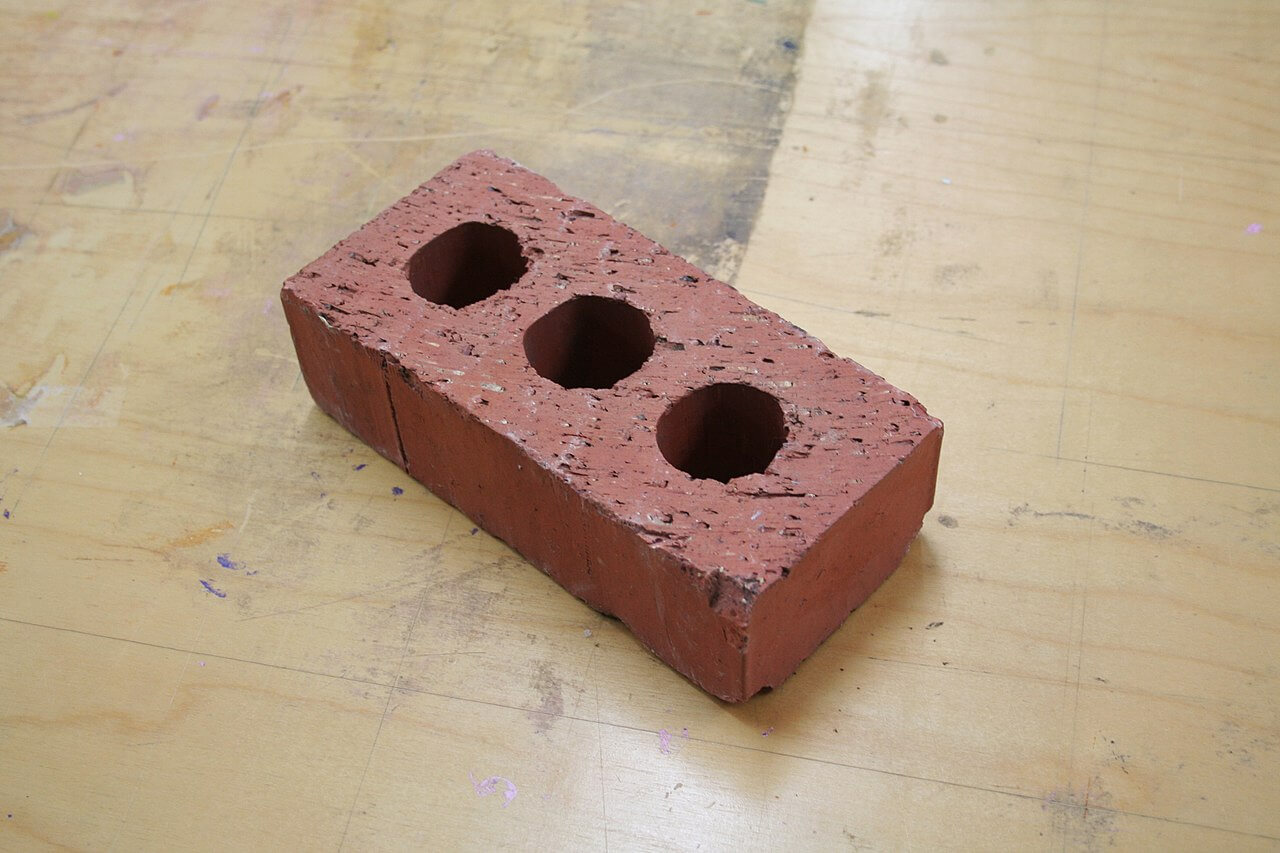
Limestone is very common in architecture, especially in Europe and North America. Limestone is extracted from quarries or mines. Part of the extracted stone, selected according to its chemical composition and optical granulometry, is calcinated at about 1,000 °C (1,830 °F) in different types of lime kilns to produce quicklime. The principal users of lime are steelmaking industry (lowering slag melting temperature) ~ 35 %, environmental uses (desulfurization, water cleaning) ~ 20 %, civil engineering ~ 20 % and chemistry ~ 8 %.
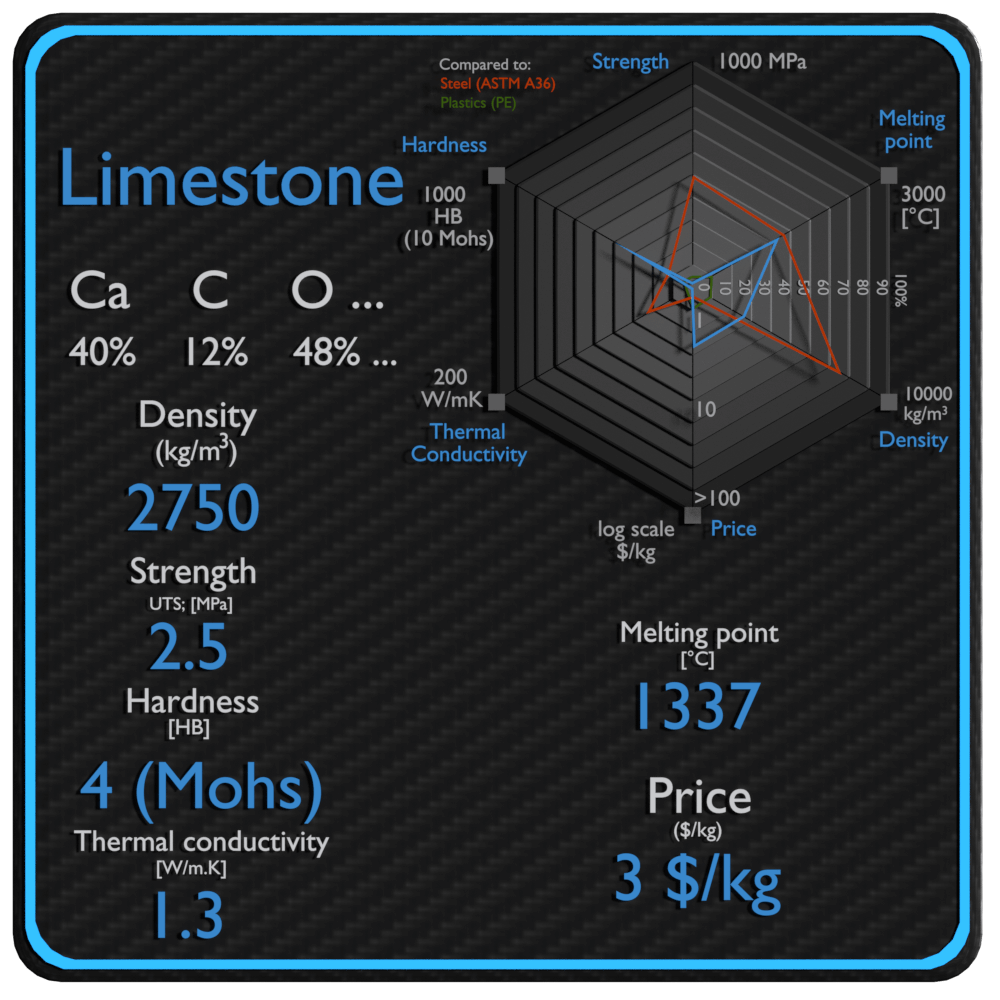
limestone properties density strength price

Summary

Name Limestone
Phase at STP solid
Density 2750 kg/m3
Ultimate Tensile Strength 2.5 MPa
Yield Strength N/A
Young’s Modulus of Elasticity 34 GPa
Brinell Hardness 4 Mohs
Melting Point 1337 °C
Thermal Conductivity 1.3 W/mK
Heat Capacity 840 J/g K
Price 3 $/kg

Composition of Limestone

The main component of limestone is calcium carbonate (CaCO3), also known as calcite, which is formed by the compaction of the remains of coral animals and plants on the bottoms of oceans. It varies from a soft white substance (chalk) to a very hard substance (marble).

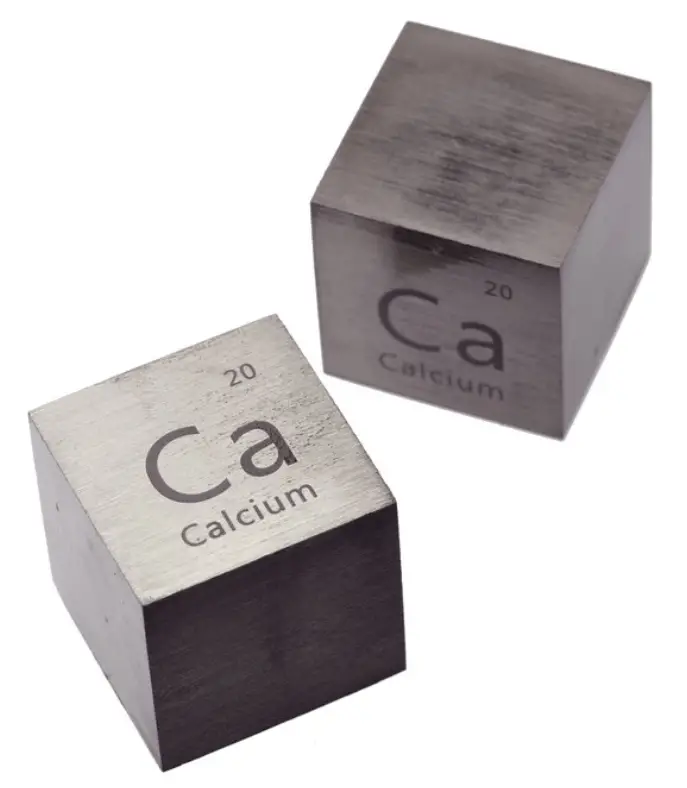
40%Calcium in Periodic Table
12%Carbon in Periodic Table

48%Oxygen in Periodic Table

Applications of Limestone

Limestone - Material Table - Applications - Price
Source: wikipedia.org License: CC-BY SA 3.0

Limestone is very common in architecture, especially in Europe and North America. Limestone is extracted from quarries or mines. Part of the extracted stone, selected according to its chemical composition and optical granulometry, is calcinated at about 1,000 °C (1,830 °F) in different types of lime kilns to produce quicklime. The principal users of lime are steelmaking industry (lowering slag melting temperature) ~ 35 %, environmental uses (desulfurization, water cleaning) ~ 20 %, civil engineering ~ 20 % and chemistry ~ 8 %.

Mechanical Properties of Limestone

Strength of Limestone

In mechanics of materials, the strength of a material is its ability to withstand an applied load without failure or plastic deformation. Strength of materials basically considers the relationship between the external loads applied to a material and the resulting deformation or change in material dimensions. In designing structures and machines, it is important to consider these factors, in order that the material selected will have adequate strength to resist applied loads or forces and retain its original shape.

Strength of a material is its ability to withstand this applied load without failure or plastic deformation. For tensile stress, the capacity of a material or structure to withstand loads tending to elongate is known as ultimate tensile strength (UTS). Yield strength or yield stress is the material property defined as the stress at which a material begins to deform plastically whereas yield point is the point where nonlinear (elastic + plastic) deformation begins. In case of tensional stress of a uniform bar (stress-strain curve), the Hooke’s law describes behaviour of a bar in the elastic region. The Young’s modulus of elasticity is the elastic modulus for tensile and compressive stress in the linear elasticity regime of a uniaxial deformation and is usually assessed by tensile tests.

See also: Strength of Materials

Ultimate Tensile Strength of Limestone

Ultimate tensile strength of Limestone is 2.5 MPa.

Yield Strength of Limestone

Yield strength of Limestone is N/A.

Modulus of Elasticity of Limestone

The Young’s modulus of elasticity of Limestone is 34 GPa.

Hardness of Limestone

In materials science, hardness is the ability to withstand surface indentation (localized plastic deformation) and scratching. Brinell hardness test is one of indentation hardness tests, that has been developed for hardness testing. In Brinell tests, a hard, spherical indenter is forced under a specific load into the surface of the metal to be tested.

The Brinell hardness number (HB) is the load divided by the surface area of the indentation. The diameter of the impression is measured with a microscope with a superimposed scale. The Brinell hardness number is computed from the equation:
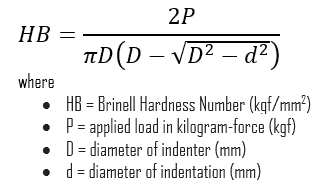
brinell hardness number - definition

Hardness of Limestone is approximately 4 Mohs.

See also: Hardness of Materials

Strength of Materials

Material Table - Strength of Materials

Elasticity of Materials

Material Table - Elasticity of Materials

Hardness of Materials

Material Table - Hardness of Materials  

Thermal Properties of Limestone

Limestone – Melting Point

Melting point of Limestone is 1337 °C.

Note that, these points are associated with the standard atmospheric pressure. In general, melting is a phase change of a substance from the solid to the liquid phase. The melting point of a substance is the temperature at which this phase change occurs. The melting point also defines a condition in which the solid and liquid can exist in equilibrium. For various chemical compounds and alloys, it is difficult to define the melting point, since they are usually a mixture of various chemical elements.

Limestone – Thermal Conductivity

Thermal conductivity of Limestone is 1.3 W/(m·K).

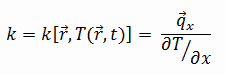
The heat transfer characteristics of a solid material are measured by a property called the thermal conductivity, k (or λ), measured in W/m.K. It is a measure of a substance’s ability to transfer heat through a material by conduction. Note that Fourier’s law applies for all matter, regardless of its state (solid, liquid, or gas), therefore, it is also defined for liquids and gases.

The thermal conductivity of most liquids and solids varies with temperature. For vapors, it also depends upon pressure. In general:
thermal conductivity - definition

Most materials are very nearly homogeneous, therefore we can usually write k = k (T). Similar definitions are associated with thermal conductivities in the y- and z-directions (ky, kz), but for an isotropic material the thermal conductivity is independent of the direction of transfer, kx = ky = kz = k.

Limestone – Specific Heat

Specific heat of Limestone is 840 J/g K.

Specific heat, or specific heat capacity, is a property related to internal energy that is very important in thermodynamics. The intensive properties cv and cp are defined for pure, simple compressible substances as partial derivatives of the internal energy u(T, v) and enthalpy h(T, p), respectively:
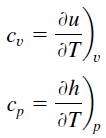
where the subscripts v and p denote the variables held fixed during differentiation. The properties cv and cp are referred to as specific heats (or heat capacities) because under certain special conditions they relate the temperature change of a system to the amount of energy added by heat transfer. Their SI units are J/kg K or J/mol K.

Melting Point of Materials

Material Table - Melting Point

Thermal Conductivity of Materials

Material Table - Thermal Conductivity

Heat Capacity of Materials

Material Table - Heat Capacity

Properties and prices of other materials

material-table-in-8k-resolution
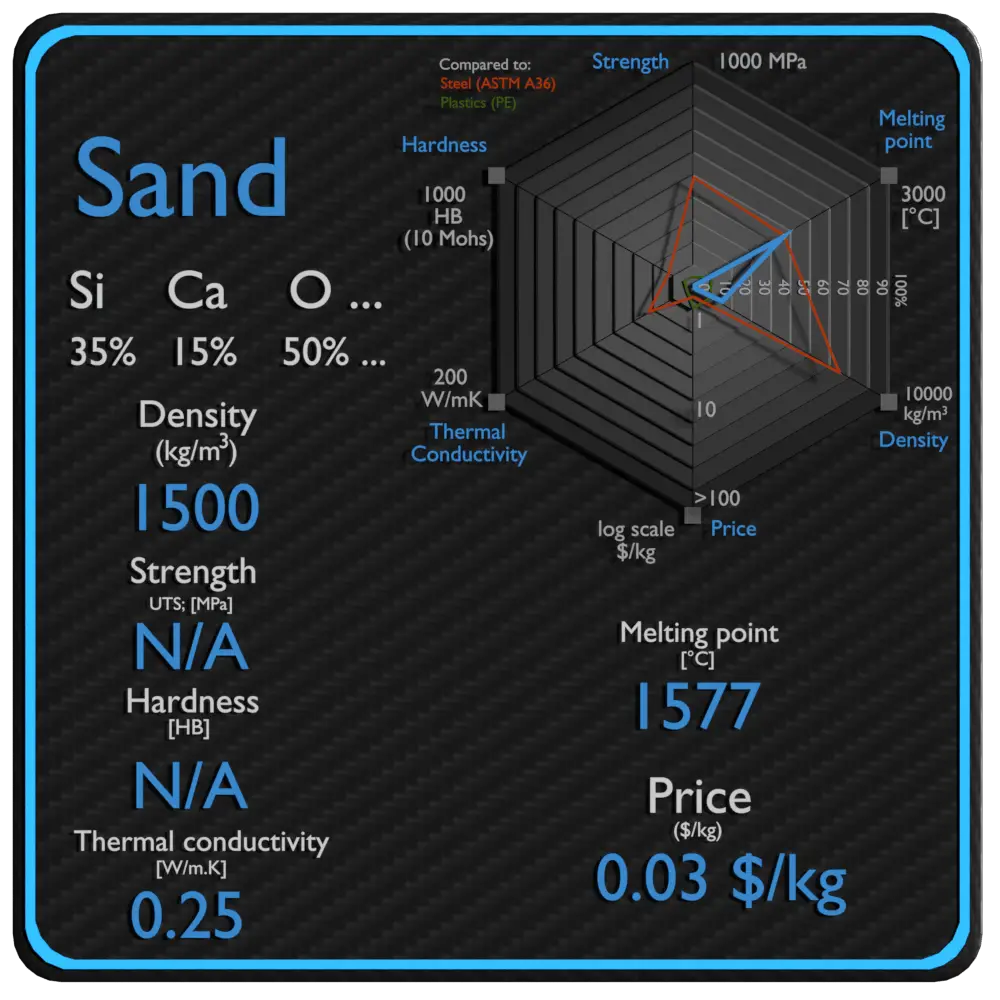
Sand – Material Table – Applications – Price

About Sand

Sand is a granular material composed of finely divided rock and mineral particles. The composition of sand varies, depending on the local rock sources and conditions, but the most common constituent of sand in inland continental settings and non-tropical coastal settings is silica (silicon dioxide, or SiO2), usually in the form of quartz. Silica is one of the most complex and most abundant families of materials, existing as a compound of several minerals and as synthetic product.

sand properties density strength price

Summary

Name Sand
Phase at STP solid
Density 1500 kg/m3
Ultimate Tensile Strength N/A
Yield Strength N/A
Young’s Modulus of Elasticity N/A
Brinell Hardness N/A
Melting Point 1577 °C
Thermal Conductivity 0.25 W/mK
Heat Capacity 830 J/g K
Price 0.03 $/kg

Composition of Sand

The composition of sand varies, depending on the local rock sources and conditions, but the most common constituent of sand in inland continental settings and non-tropical coastal settings is silica (silicon dioxide, or SiO2), usually in the form of quartz. The second most common type of sand is calcium carbonate, for example, aragonite, which has mostly been created, over the past half billion years, by various forms of life, like coral and shellfish.

35%Silicon in Periodic Table

15%Calcium in Periodic Table

50%Oxygen in Periodic Table

Applications of Sand

Sand - Material Table - Applications - Price
Source: wikipedia.org License: CC-BY SA 3.0

Sand is a non-renewable resource over human timescales, and sand suitable for making concrete is in high demand. Because of the growth of population and of cities and the consequent construction activity there is a huge demand for these special kinds of sand, and natural sources are running low. In the pottery and glassmaking industries very pure quartzose sands are used as a source of silica. Similar sands are required for lining the hearths of acid-steel furnaces.

Mechanical Properties of Sand

Strength of Sand

In mechanics of materials, the strength of a material is its ability to withstand an applied load without failure or plastic deformation. Strength of materials basically considers the relationship between the external loads applied to a material and the resulting deformation or change in material dimensions. In designing structures and machines, it is important to consider these factors, in order that the material selected will have adequate strength to resist applied loads or forces and retain its original shape.

Strength of a material is its ability to withstand this applied load without failure or plastic deformation. For tensile stress, the capacity of a material or structure to withstand loads tending to elongate is known as ultimate tensile strength (UTS). Yield strength or yield stress is the material property defined as the stress at which a material begins to deform plastically whereas yield point is the point where nonlinear (elastic + plastic) deformation begins. In case of tensional stress of a uniform bar (stress-strain curve), the Hooke’s law describes behaviour of a bar in the elastic region. The Young’s modulus of elasticity is the elastic modulus for tensile and compressive stress in the linear elasticity regime of a uniaxial deformation and is usually assessed by tensile tests.

See also: Strength of Materials

Ultimate Tensile Strength of Sand

Ultimate tensile strength of Sand is N/A.

Yield Strength of Sand

Yield strength of Sand is N/A.

Modulus of Elasticity of Sand

The Young’s modulus of elasticity of Sand is N/A.

Hardness of Sand

In materials science, hardness is the ability to withstand surface indentation (localized plastic deformation) and scratching. Brinell hardness test is one of indentation hardness tests, that has been developed for hardness testing. In Brinell tests, a hard, spherical indenter is forced under a specific load into the surface of the metal to be tested.

The Brinell hardness number (HB) is the load divided by the surface area of the indentation. The diameter of the impression is measured with a microscope with a superimposed scale. The Brinell hardness number is computed from the equation:

brinell hardness number - definition

Brinell hardness of Sand is approximately N/A.

See also: Hardness of Materials

Strength of Materials

Material Table - Strength of Materials

Elasticity of Materials

Material Table - Elasticity of Materials

Hardness of Materials

Material Table - Hardness of Materials  

Thermal Properties of Sand

Sand – Melting Point

Melting point of Sand is 1577 °C.

Note that, these points are associated with the standard atmospheric pressure. In general, melting is a phase change of a substance from the solid to the liquid phase. The melting point of a substance is the temperature at which this phase change occurs. The melting point also defines a condition in which the solid and liquid can exist in equilibrium. For various chemical compounds and alloys, it is difficult to define the melting point, since they are usually a mixture of various chemical elements.

Sand – Thermal Conductivity

Thermal conductivity of Sand is 0.25 W/(m·K).

The heat transfer characteristics of a solid material are measured by a property called the thermal conductivity, k (or λ), measured in W/m.K. It is a measure of a substance’s ability to transfer heat through a material by conduction. Note that Fourier’s law applies for all matter, regardless of its state (solid, liquid, or gas), therefore, it is also defined for liquids and gases.

The thermal conductivity of most liquids and solids varies with temperature. For vapors, it also depends upon pressure. In general:

thermal conductivity - definition

Most materials are very nearly homogeneous, therefore we can usually write k = k (T). Similar definitions are associated with thermal conductivities in the y- and z-directions (ky, kz), but for an isotropic material the thermal conductivity is independent of the direction of transfer, kx = ky = kz = k.

Sand – Specific Heat

Specific heat of Sand is 830 J/g K.

Specific heat, or specific heat capacity, is a property related to internal energy that is very important in thermodynamics. The intensive properties cv and cp are defined for pure, simple compressible substances as partial derivatives of the internal energy u(T, v) and enthalpy h(T, p), respectively:

where the subscripts v and p denote the variables held fixed during differentiation. The properties cv and cp are referred to as specific heats (or heat capacities) because under certain special conditions they relate the temperature change of a system to the amount of energy added by heat transfer. Their SI units are J/kg K or J/mol K.

Melting Point of Materials

Material Table - Melting Point

Thermal Conductivity of Materials

Material Table - Thermal Conductivity

Heat Capacity of Materials

Material Table - Heat Capacity

Properties and prices of other materials

material-table-in-8k-resolution

Carbon Monoxide – Material Table – Applications – Price

About Carbon Monoxide

Carbon monoxide, (CO), a highly toxic, colourless, odourless, flammable gas produced industrially for use in the manufacture of numerous organic and inorganic chemical products. Carbon monoxide is not found in the air under ordinary conditions, since it is formed by incomplete carbon combustion of coal, natural gas, oil.

carbon monoxide properties density strength price

Summary

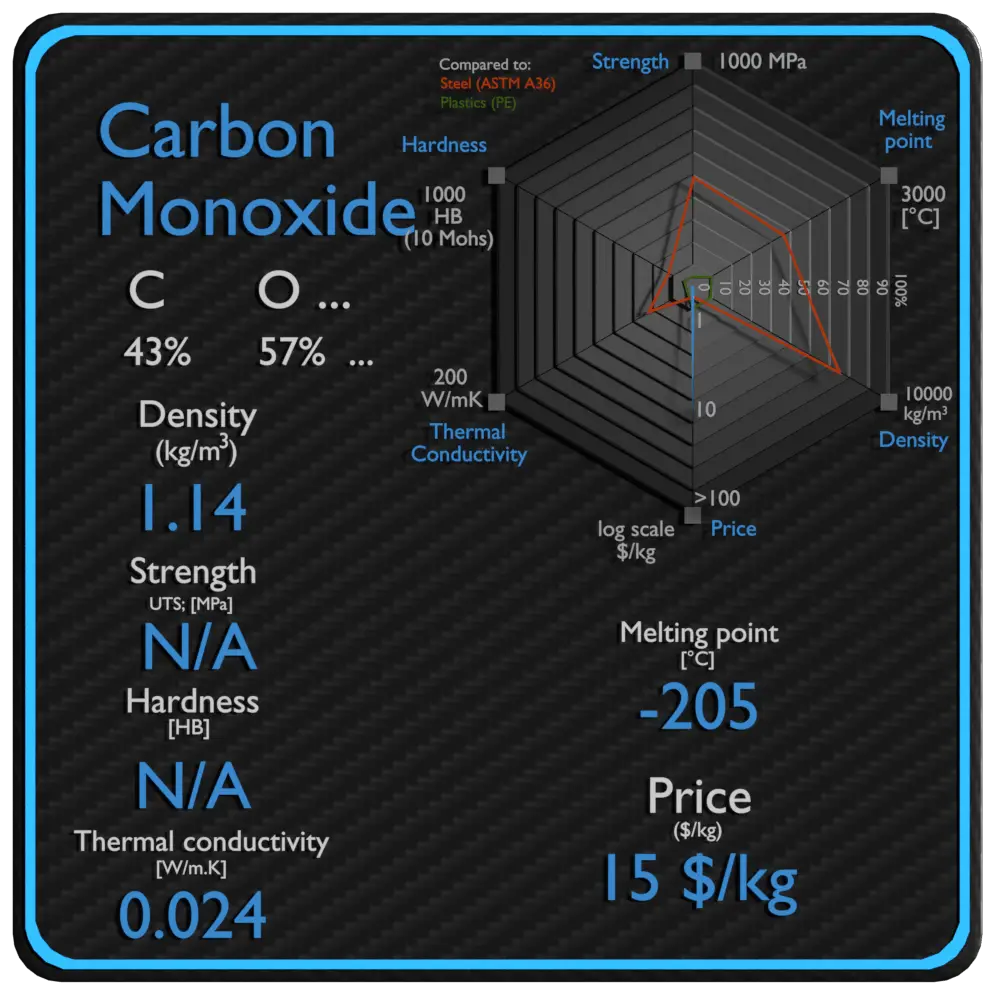
Name Carbon Monoxide
Phase at STP gas
Density 1.14 kg/m3
Ultimate Tensile Strength N/A
Yield Strength N/A
Young’s Modulus of Elasticity N/A
Brinell Hardness N/A
Melting Point -205 °C
Thermal Conductivity 0.024 W/mK
Heat Capacity 1040 J/g K
Price 15 $/kg

Composition of Carbon Monoxide

Carbon monoxide consists of one carbon atom and one oxygen atom, connected by a triple bond that consists of a net two pi bonds and one sigma bond. It is the simplest oxocarbon and is isoelectronic with other triply-bonded diatomic species possessing 10 valence electrons.

43%Carbon in Periodic Table

57%Oxygen in Periodic Table

Applications of Carbon Monoxide

Packaged carbon monoxide is used in a variety of industries for a wide range of applications including: Metal Fabrication: Used in fuel gas mixtures with hydrogen and other gases for industrial and domestic heating. Chemicals: In the manufacture of a variety of chemicals such as acids, esters and alcohols.

Strength of Materials

Material Table - Strength of Materials

Elasticity of Materials

Material Table - Elasticity of Materials

Hardness of Materials

Material Table - Hardness of Materials  

Thermal Properties of Carbon Monoxide

Carbon Monoxide – Melting Point

Melting point of Carbon Monoxide is -205 °C.

Note that, these points are associated with the standard atmospheric pressure. In general, melting is a phase change of a substance from the solid to the liquid phase. The melting point of a substance is the temperature at which this phase change occurs. The melting point also defines a condition in which the solid and liquid can exist in equilibrium. For various chemical compounds and alloys, it is difficult to define the melting point, since they are usually a mixture of various chemical elements.

Carbon Monoxide – Thermal Conductivity

Thermal conductivity of Carbon Monoxide is 0.024 W/(m·K).

The heat transfer characteristics of a solid material are measured by a property called the thermal conductivity, k (or λ), measured in W/m.K. It is a measure of a substance’s ability to transfer heat through a material by conduction. Note that Fourier’s law applies for all matter, regardless of its state (solid, liquid, or gas), therefore, it is also defined for liquids and gases.

The thermal conductivity of most liquids and solids varies with temperature. For vapors, it also depends upon pressure. In general:

thermal conductivity - definition

Most materials are very nearly homogeneous, therefore we can usually write k = k (T). Similar definitions are associated with thermal conductivities in the y- and z-directions (ky, kz), but for an isotropic material the thermal conductivity is independent of the direction of transfer, kx = ky = kz = k.

Carbon Monoxide – Specific Heat

Specific heat of Carbon Monoxide is 1040 J/g K.

Specific heat, or specific heat capacity, is a property related to internal energy that is very important in thermodynamics. The intensive properties cv and cp are defined for pure, simple compressible substances as partial derivatives of the internal energy u(T, v) and enthalpy h(T, p), respectively:

where the subscripts v and p denote the variables held fixed during differentiation. The properties cv and cp are referred to as specific heats (or heat capacities) because under certain special conditions they relate the temperature change of a system to the amount of energy added by heat transfer. Their SI units are J/kg K or J/mol K.

Melting Point of Materials

Material Table - Melting Point

Thermal Conductivity of Materials

Material Table - Thermal Conductivity

Heat Capacity of Materials

Material Table - Heat Capacity

Properties and prices of other materials

material-table-in-8k-resolution

Polycarbonate – Material Table – Applications – Price

About Polycarbonate

Polycarbonate (PC) is a thermoplastic polymer that contains carbonate groups in its chemical structures. It is a crystal clear and colourless, amorphous engineering thermoplastic notable for its high impact resistance (which remains high down to –40°C). A disadvantage includes the need for drying and elevated-temperature processing. PC has limited chemical resistance to numerous aromatic solvents, including benzene, toluene, and xylene and has a weakness to notches.

polycarbonate density strength price

Summary

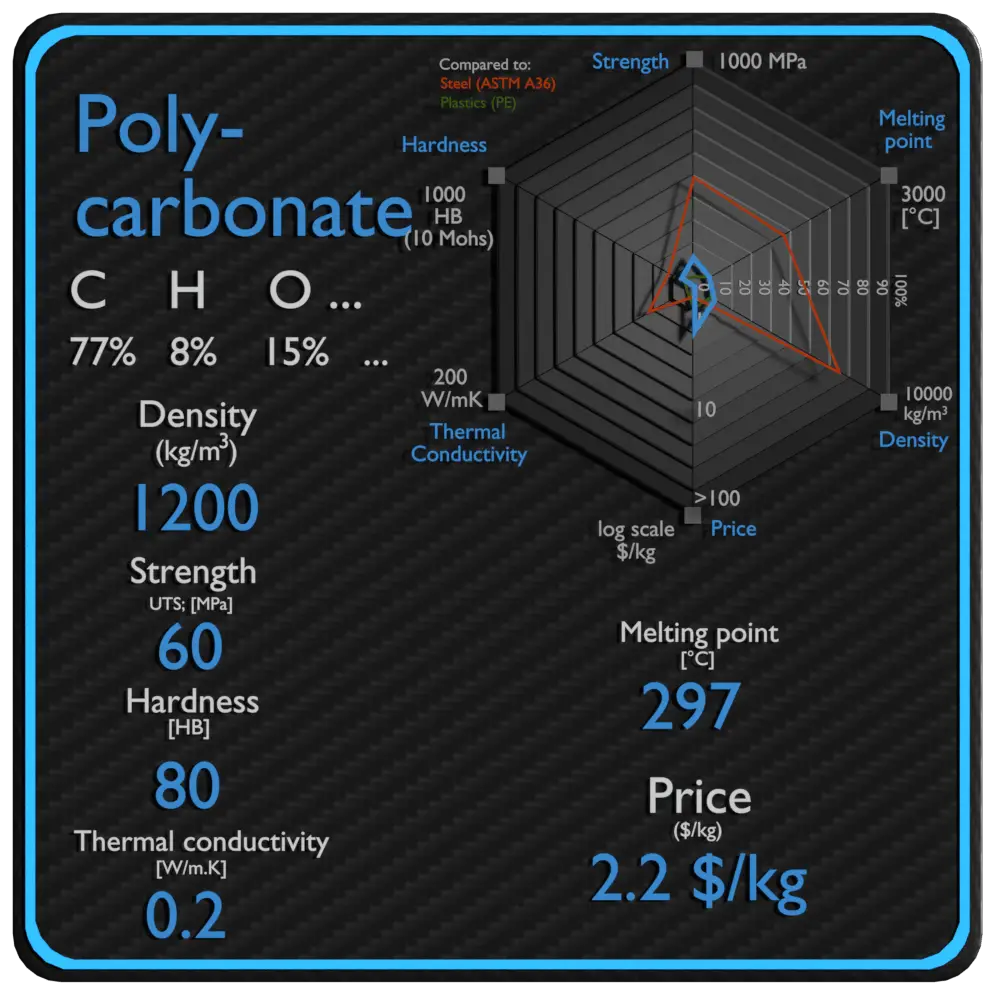
Name Polycarbonate
Phase at STP solid
Density 1200 kg/m3
Ultimate Tensile Strength 60 MPa
Yield Strength N/A
Young’s Modulus of Elasticity 2.3 GPa
Brinell Hardness 80 BHN
Melting Point 297 °C
Thermal Conductivity 0.2 W/mK
Heat Capacity 1200 J/g K
Price 2.2 $/kg

Composition of Polycarbonate

Polycarbonate (PC) is a thermoplastic polymer that contains carbonate groups in its chemical structures. A carbonate ester is an ester of carbonic acid.The structure of PC, with its carbonate and bisphenolic structures, has many characteristics that promote its distinguished properties. The rigidity of the molecule accounts for strong mechanical properties, elevated heat deflection temperatures, and high dimensional stability at elevated temperatures.

77%Carbon in Periodic Table

8%Hydrogen in Periodic Table

15%Oxygen in Periodic Table

Applications of Polycarbonate

Polycarbonate - Material Table - Applications - Price
Source: wikipedia.org License: CC-BY SA 3.0

Polycarbonate is mainly used for electronic applications that capitalize on its collective safety features. Being a good electrical insulator and having heat-resistant and flame-retardant properties, it is used in various products associated with electrical and telecommunications hardware. A major application of polycarbonate is the production of Compact Discs, DVDs, and Blu-ray Discs. Applications where PC is blended with ABS increase the heat distortion temperature of the ABS and improve the low-temperature impact strength of PC. The favorable ease of processing and improved economics make PC/ABS blends well suited for thin-walled electronic housing applications such as laptop computers. PC alone is widely used as vacuum cleaner housings, household appliance housings, and power tools. These are applications where PC’s high impact strength, heat resistance, durability, and high-quality finish justify its expense. It is also used in safety helmets, riot shields, aircraft canopies, traffic light lens housings, and automotive battery cases.

Mechanical Properties of Polycarbonate

Strength of Polycarbonate

In mechanics of materials, the strength of a material is its ability to withstand an applied load without failure or plastic deformation. Strength of materials basically considers the relationship between the external loads applied to a material and the resulting deformation or change in material dimensions. In designing structures and machines, it is important to consider these factors, in order that the material selected will have adequate strength to resist applied loads or forces and retain its original shape.

Strength of a material is its ability to withstand this applied load without failure or plastic deformation. For tensile stress, the capacity of a material or structure to withstand loads tending to elongate is known as ultimate tensile strength (UTS). Yield strength or yield stress is the material property defined as the stress at which a material begins to deform plastically whereas yield point is the point where nonlinear (elastic + plastic) deformation begins. In case of tensional stress of a uniform bar (stress-strain curve), the Hooke’s law describes behaviour of a bar in the elastic region. The Young’s modulus of elasticity is the elastic modulus for tensile and compressive stress in the linear elasticity regime of a uniaxial deformation and is usually assessed by tensile tests.

See also: Strength of Materials

Ultimate Tensile Strength of Polycarbonate

Ultimate tensile strength of Polycarbonate is 60 MPa.

Yield Strength of Polycarbonate

Yield strength of Polycarbonate is N/A.

Modulus of Elasticity of Polycarbonate

The Young’s modulus of elasticity of Polycarbonate is 2.3 GPa.

Hardness of Polycarbonate

In materials science, hardness is the ability to withstand surface indentation (localized plastic deformation) and scratching. Brinell hardness test is one of indentation hardness tests, that has been developed for hardness testing. In Brinell tests, a hard, spherical indenter is forced under a specific load into the surface of the metal to be tested.

The Brinell hardness number (HB) is the load divided by the surface area of the indentation. The diameter of the impression is measured with a microscope with a superimposed scale. The Brinell hardness number is computed from the equation:

brinell hardness number - definition

Brinell hardness of Polycarbonate is approximately 80 BHN (converted).

See also: Hardness of Materials

Strength of Materials

Material Table - Strength of Materials

Elasticity of Materials

Material Table - Elasticity of Materials

Hardness of Materials

Material Table - Hardness of Materials  

Thermal Properties of Polycarbonate

Polycarbonate – Melting Point

Melting point of Polycarbonate is 297 °C.

Note that, these points are associated with the standard atmospheric pressure. In general, melting is a phase change of a substance from the solid to the liquid phase. The melting point of a substance is the temperature at which this phase change occurs. The melting point also defines a condition in which the solid and liquid can exist in equilibrium. For various chemical compounds and alloys, it is difficult to define the melting point, since they are usually a mixture of various chemical elements.

Polycarbonate – Thermal Conductivity

Thermal conductivity of Polycarbonate is 0.2 W/(m·K).

The heat transfer characteristics of a solid material are measured by a property called the thermal conductivity, k (or λ), measured in W/m.K. It is a measure of a substance’s ability to transfer heat through a material by conduction. Note that Fourier’s law applies for all matter, regardless of its state (solid, liquid, or gas), therefore, it is also defined for liquids and gases.

The thermal conductivity of most liquids and solids varies with temperature. For vapors, it also depends upon pressure. In general:

thermal conductivity - definition

Most materials are very nearly homogeneous, therefore we can usually write k = k (T). Similar definitions are associated with thermal conductivities in the y- and z-directions (ky, kz), but for an isotropic material the thermal conductivity is independent of the direction of transfer, kx = ky = kz = k.

Polycarbonate – Specific Heat

Specific heat of Polycarbonate is 1200 J/g K.

Specific heat, or specific heat capacity, is a property related to internal energy that is very important in thermodynamics. The intensive properties cv and cp are defined for pure, simple compressible substances as partial derivatives of the internal energy u(T, v) and enthalpy h(T, p), respectively:

where the subscripts v and p denote the variables held fixed during differentiation. The properties cv and cp are referred to as specific heats (or heat capacities) because under certain special conditions they relate the temperature change of a system to the amount of energy added by heat transfer. Their SI units are J/kg K or J/mol K.

Melting Point of Materials

Material Table - Melting Point

Thermal Conductivity of Materials

Material Table - Thermal Conductivity

Heat Capacity of Materials

Material Table - Heat Capacity

Properties and prices of other materials

material-table-in-8k-resolution
PET – Material Table – Applications – Price

About PET

Polyethylene terephthalate, commonly abbreviated PET, PETE, is the most common thermoplastic polymer resin of the polyester family and is used in fibres for clothing, containers for liquids and foods. Polyethylene terephthalate polyester is a hard, stiff, strong, dimensionally stable material that absorbs very little water.

PET properties density strength price

Summary

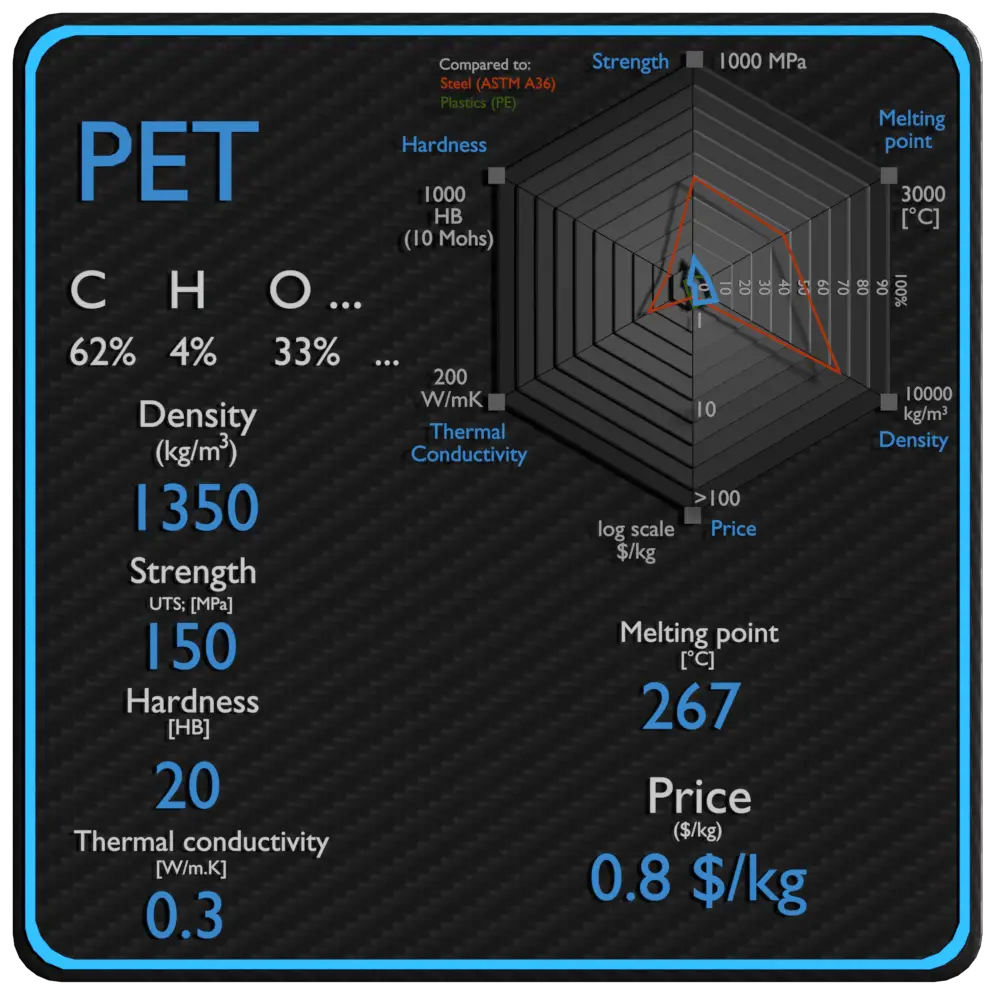
Name PET
Phase at STP solid
Density 1350 kg/m3
Ultimate Tensile Strength 150 MPa
Yield Strength 40 MPa
Young’s Modulus of Elasticity 9 GPa
Brinell Hardness 20 BHN
Melting Point 267 °C
Thermal Conductivity 0.3 W/mK
Heat Capacity 1250 J/g K
Price 0.8 $/kg

Composition of PET

PET consists of polymerized units of the monomer ethylene terephthalate, with repeating (C10H8O4) units. PET is commonly recycled, and has the number “1” as its resin identification code (RIC).

62%Carbon in Periodic Table

4%Hydrogen in Periodic Table

33%Oxygen in Periodic Table

Applications of PET

PET - Material Table - Applications - Price
Source: wikipedia.org License: CC-BY SA 3.0

There are tremendous commercial applications for PET: as an injection-molding-grade material, for blow-molded bottles, and for oriented films. The majority of the world’s PET production is for synthetic fibres (in excess of 60%), with bottle production accounting for about 30% of global demand. In the context of textile applications, PET is referred to by its common name, polyester, whereas the acronym PET is generally used in relation to packaging.

Mechanical Properties of PET

Strength of PET

In mechanics of materials, the strength of a material is its ability to withstand an applied load without failure or plastic deformation. Strength of materials basically considers the relationship between the external loads applied to a material and the resulting deformation or change in material dimensions. In designing structures and machines, it is important to consider these factors, in order that the material selected will have adequate strength to resist applied loads or forces and retain its original shape.

Strength of a material is its ability to withstand this applied load without failure or plastic deformation. For tensile stress, the capacity of a material or structure to withstand loads tending to elongate is known as ultimate tensile strength (UTS). Yield strength or yield stress is the material property defined as the stress at which a material begins to deform plastically whereas yield point is the point where nonlinear (elastic + plastic) deformation begins. In case of tensional stress of a uniform bar (stress-strain curve), the Hooke’s law describes behaviour of a bar in the elastic region. The Young’s modulus of elasticity is the elastic modulus for tensile and compressive stress in the linear elasticity regime of a uniaxial deformation and is usually assessed by tensile tests.

See also: Strength of Materials

Ultimate Tensile Strength of PET

Ultimate tensile strength of PET is 150 MPa.

Yield Strength of PET

Yield strength of PET is 40 MPa.

Modulus of Elasticity of PET

The Young’s modulus of elasticity of PET is 9 GPa.

Hardness of PET

In materials science, hardness is the ability to withstand surface indentation (localized plastic deformation) and scratching. Brinell hardness test is one of indentation hardness tests, that has been developed for hardness testing. In Brinell tests, a hard, spherical indenter is forced under a specific load into the surface of the metal to be tested.

The Brinell hardness number (HB) is the load divided by the surface area of the indentation. The diameter of the impression is measured with a microscope with a superimposed scale. The Brinell hardness number is computed from the equation:

brinell hardness number - definition

Brinell hardness of PET is approximately 20 BHN (converted).

See also: Hardness of Materials

Strength of Materials

Material Table - Strength of Materials

Elasticity of Materials

Material Table - Elasticity of Materials

Hardness of Materials

Material Table - Hardness of Materials  

Thermal Properties of PET

PET – Melting Point

Melting point of PET is 267 °C.

Note that, these points are associated with the standard atmospheric pressure. In general, melting is a phase change of a substance from the solid to the liquid phase. The melting point of a substance is the temperature at which this phase change occurs. The melting point also defines a condition in which the solid and liquid can exist in equilibrium. For various chemical compounds and alloys, it is difficult to define the melting point, since they are usually a mixture of various chemical elements.

PET – Thermal Conductivity

Thermal conductivity of PET is 0.3 W/(m·K).

The heat transfer characteristics of a solid material are measured by a property called the thermal conductivity, k (or λ), measured in W/m.K. It is a measure of a substance’s ability to transfer heat through a material by conduction. Note that Fourier’s law applies for all matter, regardless of its state (solid, liquid, or gas), therefore, it is also defined for liquids and gases.

The thermal conductivity of most liquids and solids varies with temperature. For vapors, it also depends upon pressure. In general:

thermal conductivity - definition

Most materials are very nearly homogeneous, therefore we can usually write k = k (T). Similar definitions are associated with thermal conductivities in the y- and z-directions (ky, kz), but for an isotropic material the thermal conductivity is independent of the direction of transfer, kx = ky = kz = k.

PET – Specific Heat

Specific heat of PET is 1250 J/g K.

Specific heat, or specific heat capacity, is a property related to internal energy that is very important in thermodynamics. The intensive properties cv and cp are defined for pure, simple compressible substances as partial derivatives of the internal energy u(T, v) and enthalpy h(T, p), respectively:

where the subscripts v and p denote the variables held fixed during differentiation. The properties cv and cp are referred to as specific heats (or heat capacities) because under certain special conditions they relate the temperature change of a system to the amount of energy added by heat transfer. Their SI units are J/kg K or J/mol K.

Melting Point of Materials

Material Table - Melting Point

Thermal Conductivity of Materials

Material Table - Thermal Conductivity

Heat Capacity of Materials

Material Table - Heat Capacity

Properties and prices of other materials

material-table-in-8k-resolution
Graphene – Material Table – Applications – Price

About Graphene

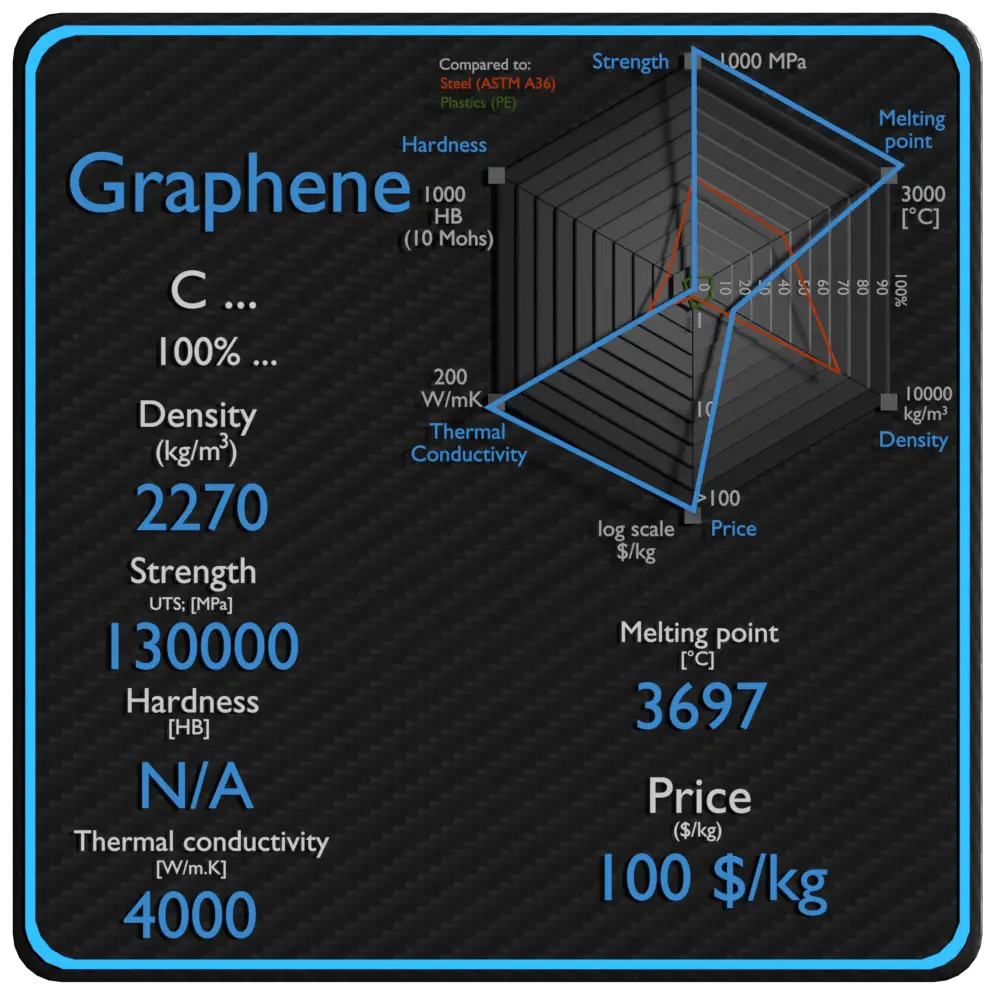
Graphene is an allotrope of carbon consisting of a single layer of atoms hexagonally arranged in a two-dimensional lattice. Graphene is a substance with very interesting properties. Graphene has high thermal conductivity, high electrical conductivity, high elasticity and flexibility, high hardness and strength. These properties, together with the abundance of carbon in nature, have made graphene a very studied material with great possibilities.

graphene properties density strength price

Summary

Name Graphene
Phase at STP solid
Density 2270 kg/m3
Ultimate Tensile Strength 130000 MPa
Yield Strength N/A
Young’s Modulus of Elasticity 1000 GPa
Brinell Hardness N/A
Melting Point 3697 °C
Thermal Conductivity 4000 W/mK
Heat Capacity N/A
Price 100 $/kg

Composition of Graphene

Graphene is a material composed of carbon atoms grouping that are hexagonally positioned. This arrangement results in monolayers of an atom thick. Each atom in a graphene sheet is connected to its three nearest neighbors by a σ-bond, and contributes one electron to a conduction band that extends over the whole sheet.

100%Carbon in Periodic Table

Applications of Graphene

Graphene is a transparent and flexible conductor that holds great promise for various material/device applications, including solar cells, light-emitting diodes (LED), touch panels, and smart windows or phones. Smartphone products with graphene touch screens are already on the market. However, with existing manufacturing processes Graphene is extremely challenging to mass produce which could prove to be a limiting factor in its commercial use.

Mechanical Properties of Graphene

Strength of Graphene

In mechanics of materials, the strength of a material is its ability to withstand an applied load without failure or plastic deformation. Strength of materials basically considers the relationship between the external loads applied to a material and the resulting deformation or change in material dimensions. In designing structures and machines, it is important to consider these factors, in order that the material selected will have adequate strength to resist applied loads or forces and retain its original shape.

Strength of a material is its ability to withstand this applied load without failure or plastic deformation. For tensile stress, the capacity of a material or structure to withstand loads tending to elongate is known as ultimate tensile strength (UTS). Yield strength or yield stress is the material property defined as the stress at which a material begins to deform plastically whereas yield point is the point where nonlinear (elastic + plastic) deformation begins. In case of tensional stress of a uniform bar (stress-strain curve), the Hooke’s law describes behaviour of a bar in the elastic region. The Young’s modulus of elasticity is the elastic modulus for tensile and compressive stress in the linear elasticity regime of a uniaxial deformation and is usually assessed by tensile tests.

See also: Strength of Materials

Ultimate Tensile Strength of Graphene

Ultimate tensile strength of Graphene is 130000 MPa.

Yield Strength of Graphene

Yield strength of Graphene is N/A.

Modulus of Elasticity of Graphene

The Young’s modulus of elasticity of Graphene is 1000 GPa.

Hardness of Graphene

In materials science, hardness is the ability to withstand surface indentation (localized plastic deformation) and scratching. Brinell hardness test is one of indentation hardness tests, that has been developed for hardness testing. In Brinell tests, a hard, spherical indenter is forced under a specific load into the surface of the metal to be tested.

The Brinell hardness number (HB) is the load divided by the surface area of the indentation. The diameter of the impression is measured with a microscope with a superimposed scale. The Brinell hardness number is computed from the equation:

brinell hardness number - definition

Brinell hardness of Graphene is approximately N/A.

See also: Hardness of Materials

Strength of Materials

Material Table - Strength of Materials

Elasticity of Materials

Material Table - Elasticity of Materials

Hardness of Materials

Material Table - Hardness of Materials  

Thermal Properties of Graphene

Graphene – Melting Point

Melting point of Graphene is 3697 °C.

Note that, these points are associated with the standard atmospheric pressure. In general, melting is a phase change of a substance from the solid to the liquid phase. The melting point of a substance is the temperature at which this phase change occurs. The melting point also defines a condition in which the solid and liquid can exist in equilibrium. For various chemical compounds and alloys, it is difficult to define the melting point, since they are usually a mixture of various chemical elements.

Graphene – Thermal Conductivity

Thermal conductivity of Graphene is 4000 W/(m·K).

The heat transfer characteristics of a solid material are measured by a property called the thermal conductivity, k (or λ), measured in W/m.K. It is a measure of a substance’s ability to transfer heat through a material by conduction. Note that Fourier’s law applies for all matter, regardless of its state (solid, liquid, or gas), therefore, it is also defined for liquids and gases.

The thermal conductivity of most liquids and solids varies with temperature. For vapors, it also depends upon pressure. In general:

thermal conductivity - definition

Most materials are very nearly homogeneous, therefore we can usually write k = k (T). Similar definitions are associated with thermal conductivities in the y- and z-directions (ky, kz), but for an isotropic material the thermal conductivity is independent of the direction of transfer, kx = ky = kz = k.

Graphene – Specific Heat

Specific heat of Graphene is 509 J/g K.

Specific heat, or specific heat capacity, is a property related to internal energy that is very important in thermodynamics. The intensive properties cv and cp are defined for pure, simple compressible substances as partial derivatives of the internal energy u(T, v) and enthalpy h(T, p), respectively:

where the subscripts v and p denote the variables held fixed during differentiation. The properties cv and cp are referred to as specific heats (or heat capacities) because under certain special conditions they relate the temperature change of a system to the amount of energy added by heat transfer. Their SI units are J/kg K or J/mol K.

Melting Point of Materials

Material Table - Melting Point

Thermal Conductivity of Materials

Material Table - Thermal Conductivity

Heat Capacity of Materials

Material Table - Heat Capacity

Properties and prices of other materials

material-table-in-8k-resolution
Diamond – Material Table – Applications – Price

About Diamond

Diamond is a form of carbon that is crystallised in a cubic structure with each carbon atom linked by a strong, rigid chemical bond to four other atoms. Diamond is the hardest naturally occurring material known. Yet, due to important structural weaknesses, diamond’s toughness is only fair to good. The precise tensile strength of diamond is unknown, however strength up to 60 GPa has been observed, and theoretically it could be as high as 90–225 GPa depending on the sample volume/size, the perfection of diamond lattice and on its orientation. Diamond has a high refractive index (2.417) and moderate dispersion (0.044) properties that give cut diamonds their brilliance.

diamond properties density strength price

Summary

Name Diamond
Phase at STP solid
Density 3500 kg/m3
Ultimate Tensile Strength N/A
Yield Strength 140000 MPa
Young’s Modulus of Elasticity 1050 GPa
Brinell Hardness 45000 BHN
Melting Point 4027 °C
Thermal Conductivity 1000 W/mK
Heat Capacity 1509 J/g K
Price 20000000 $/kg

Composition of Diamond

Diamond is the allotrope of carbon in which the carbon atoms are arranged in the specific type of cubic lattice called diamond cubic. Diamond is extremely strong owing to its crystal structure, known as diamond cubic, in which each carbon atom has four neighbors covalently bonded to it.

100%Carbon in Periodic Table

Applications of Diamond

Diamond - Material Table - Applications - Price
Source: wikipedia.org License: CC BY-SA 3.0

The most familiar uses of diamonds today are as gemstones used for adornment, and as industrial abrasives for cutting hard materials. The markets for gem-grade and industrial-grade diamonds value diamonds differently. In industry, diamonds applications include oil drilling bits, rock drill cutters, wire drawing dies, extrusion dies, cutting tool inserts, optical grinding tools, coatings for computer hard discs and coatings for ball bearings. Diamond is a wide-band gap semiconductor (Egap = 5.47 eV) with high potential as an electronic device material in many devices. Because diamond has such high thermal conductance it is already used in semiconductor manufacture to prevent silicon and other semiconducting materials from overheating.

Mechanical Properties of Diamond

Strength of Diamond

In mechanics of materials, the strength of a material is its ability to withstand an applied load without failure or plastic deformation. Strength of materials basically considers the relationship between the external loads applied to a material and the resulting deformation or change in material dimensions. In designing structures and machines, it is important to consider these factors, in order that the material selected will have adequate strength to resist applied loads or forces and retain its original shape.

Strength of a material is its ability to withstand this applied load without failure or plastic deformation. For tensile stress, the capacity of a material or structure to withstand loads tending to elongate is known as ultimate tensile strength (UTS). Yield strength or yield stress is the material property defined as the stress at which a material begins to deform plastically whereas yield point is the point where nonlinear (elastic + plastic) deformation begins. In case of tensional stress of a uniform bar (stress-strain curve), the Hooke’s law describes behaviour of a bar in the elastic region. The Young’s modulus of elasticity is the elastic modulus for tensile and compressive stress in the linear elasticity regime of a uniaxial deformation and is usually assessed by tensile tests.

See also: Strength of Materials

Ultimate Tensile Strength of Diamond

Ultimate tensile strength of Diamond is N/A.

Yield Strength of Diamond

Yield strength of Diamond is 140000 MPa (Compressive).

Modulus of Elasticity of Diamond

The Young’s modulus of elasticity of Diamond is 1050 GPa.

Hardness of Diamond

In materials science, hardness is the ability to withstand surface indentation (localized plastic deformation) and scratching. Brinell hardness test is one of indentation hardness tests, that has been developed for hardness testing. In Brinell tests, a hard, spherical indenter is forced under a specific load into the surface of the metal to be tested.

The Brinell hardness number (HB) is the load divided by the surface area of the indentation. The diameter of the impression is measured with a microscope with a superimposed scale. The Brinell hardness number is computed from the equation:

brinell hardness number - definition

Brinell hardness of Diamond is approximately 45000 BHN (converted).

See also: Hardness of Materials

Strength of Materials

Material Table - Strength of Materials

Elasticity of Materials

Material Table - Elasticity of Materials

Hardness of Materials

Material Table - Hardness of Materials  

Thermal Properties of Diamond

Diamond – Melting Point

Melting point of Diamond is 4027 °C.

Note that, these points are associated with the standard atmospheric pressure. In general, melting is a phase change of a substance from the solid to the liquid phase. The melting point of a substance is the temperature at which this phase change occurs. The melting point also defines a condition in which the solid and liquid can exist in equilibrium. For various chemical compounds and alloys, it is difficult to define the melting point, since they are usually a mixture of various chemical elements.

Diamond – Thermal Conductivity

Thermal conductivity of Diamond is 1000 W/(m·K).

The heat transfer characteristics of a solid material are measured by a property called the thermal conductivity, k (or λ), measured in W/m.K. It is a measure of a substance’s ability to transfer heat through a material by conduction. Note that Fourier’s law applies for all matter, regardless of its state (solid, liquid, or gas), therefore, it is also defined for liquids and gases.

The thermal conductivity of most liquids and solids varies with temperature. For vapors, it also depends upon pressure. In general:

thermal conductivity - definition

Most materials are very nearly homogeneous, therefore we can usually write k = k (T). Similar definitions are associated with thermal conductivities in the y- and z-directions (ky, kz), but for an isotropic material the thermal conductivity is independent of the direction of transfer, kx = ky = kz = k.

Diamond – Specific Heat

Specific heat of Diamond is 509 J/g K.

Specific heat, or specific heat capacity, is a property related to internal energy that is very important in thermodynamics. The intensive properties cv and cp are defined for pure, simple compressible substances as partial derivatives of the internal energy u(T, v) and enthalpy h(T, p), respectively:

where the subscripts v and p denote the variables held fixed during differentiation. The properties cv and cp are referred to as specific heats (or heat capacities) because under certain special conditions they relate the temperature change of a system to the amount of energy added by heat transfer. Their SI units are J/kg K or J/mol K.

Melting Point of Materials

Material Table - Melting Point

Thermal Conductivity of Materials

Material Table - Thermal Conductivity

Heat Capacity of Materials

Material Table - Heat Capacity

Properties and prices of other materials

material-table-in-8k-resolution

Porcelain – Material Table – Applications – Price

About Porcelain

Porcelain is a ceramic material made by heating materials, generally including a material like kaolin, in a kiln to temperatures between 1,200 and 1,400 °C. Porcelain and stoneware materialsare about as resistant to acids and chemicals as glass, but with greater strength. This is offset by a greater potential for thermal shock.

porcelain properties density strength price

Summary

Name Porcelain
Phase at STP solid
Density 2400 kg/m3
Ultimate Tensile Strength 29 MPa
Yield Strength N/A
Young’s Modulus of Elasticity N/A
Brinell Hardness 7 Mohs
Melting Point 1927 °C
Thermal Conductivity 1.5 W/mK
Heat Capacity 1050 J/g K
Price 20 $/kg

Composition of Porcelain

Kaolin is the primary material from which porcelain is made, even though clay minerals might account for only a small proportion of the whole. Kaolinite is a clay mineral, part of the group of industrial minerals with the chemical composition Al2Si2O5(OH)4.

25%Silicon in Periodic Table

25%Aluminium in Periodic Table

48%Oxygen in Periodic Table

Applications of Porcelain

Porcelain - Material Table - Applications - Price
Source: wikipedia.org License: CC-BY SA 3.0

Though definitions vary, porcelain can be divided into three main categories: hard-paste, soft-paste and bone china. In China, porcelain is defined as pottery that is resonant when struck. Porcelain can be used as a building material, usually in the form of tiles or large rectangular panels. Porcelain and other ceramic materials have many applications in engineering, especially ceramic engineering. Porcelain is an excellent insulator for use with high voltages, especially in outdoor applications.

Mechanical Properties of Porcelain

Strength of Porcelain

In mechanics of materials, the strength of a material is its ability to withstand an applied load without failure or plastic deformation. Strength of materials basically considers the relationship between the external loads applied to a material and the resulting deformation or change in material dimensions. In designing structures and machines, it is important to consider these factors, in order that the material selected will have adequate strength to resist applied loads or forces and retain its original shape.

Strength of a material is its ability to withstand this applied load without failure or plastic deformation. For tensile stress, the capacity of a material or structure to withstand loads tending to elongate is known as ultimate tensile strength (UTS). Yield strength or yield stress is the material property defined as the stress at which a material begins to deform plastically whereas yield point is the point where nonlinear (elastic + plastic) deformation begins. In case of tensional stress of a uniform bar (stress-strain curve), the Hooke’s law describes behaviour of a bar in the elastic region. The Young’s modulus of elasticity is the elastic modulus for tensile and compressive stress in the linear elasticity regime of a uniaxial deformation and is usually assessed by tensile tests.

See also: Strength of Materials

Ultimate Tensile Strength of Porcelain

Ultimate tensile strength of Porcelain is 29 MPa.

Yield Strength of Porcelain

Yield strength of Porcelain is N/A.

Modulus of Elasticity of Porcelain

The Young’s modulus of elasticity of Porcelain is N/A.

Hardness of Porcelain

In materials science, hardness is the ability to withstand surface indentation (localized plastic deformation) and scratching. Brinell hardness test is one of indentation hardness tests, that has been developed for hardness testing. In Brinell tests, a hard, spherical indenter is forced under a specific load into the surface of the metal to be tested.

The Brinell hardness number (HB) is the load divided by the surface area of the indentation. The diameter of the impression is measured with a microscope with a superimposed scale. The Brinell hardness number is computed from the equation:

brinell hardness number - definition

Hardness of Porcelain is approximately 7 Mohs.

See also: Hardness of Materials

Strength of Materials

Material Table - Strength of Materials

Elasticity of Materials

Material Table - Elasticity of Materials

Hardness of Materials

Material Table - Hardness of Materials  

Thermal Properties of Porcelain

Porcelain – Melting Point

Melting point of Porcelain is 1927 °C.

Note that, these points are associated with the standard atmospheric pressure. In general, melting is a phase change of a substance from the solid to the liquid phase. The melting point of a substance is the temperature at which this phase change occurs. The melting point also defines a condition in which the solid and liquid can exist in equilibrium. For various chemical compounds and alloys, it is difficult to define the melting point, since they are usually a mixture of various chemical elements.

Porcelain – Thermal Conductivity

Thermal conductivity of Porcelain is 1.5 W/(m·K).

The heat transfer characteristics of a solid material are measured by a property called the thermal conductivity, k (or λ), measured in W/m.K. It is a measure of a substance’s ability to transfer heat through a material by conduction. Note that Fourier’s law applies for all matter, regardless of its state (solid, liquid, or gas), therefore, it is also defined for liquids and gases.

The thermal conductivity of most liquids and solids varies with temperature. For vapors, it also depends upon pressure. In general:

thermal conductivity - definition

Most materials are very nearly homogeneous, therefore we can usually write k = k (T). Similar definitions are associated with thermal conductivities in the y- and z-directions (ky, kz), but for an isotropic material the thermal conductivity is independent of the direction of transfer, kx = ky = kz = k.

Porcelain – Specific Heat

Specific heat of Porcelain is 1050 J/g K.

Specific heat, or specific heat capacity, is a property related to internal energy that is very important in thermodynamics. The intensive properties cv and cp are defined for pure, simple compressible substances as partial derivatives of the internal energy u(T, v) and enthalpy h(T, p), respectively:

where the subscripts v and p denote the variables held fixed during differentiation. The properties cv and cp are referred to as specific heats (or heat capacities) because under certain special conditions they relate the temperature change of a system to the amount of energy added by heat transfer. Their SI units are J/kg K or J/mol K.

Melting Point of Materials

Material Table - Melting Point

Thermal Conductivity of Materials

Material Table - Thermal Conductivity

Heat Capacity of Materials

Material Table - Heat Capacity

Properties and prices of other materials

material-table-in-8k-resolution
Brick – Material Table – Applications – Price

About Brick

Bricks are structural clay products, manufactured as standard units, used in building construction. Three basic types of brick are un-fired, fired, and chemically set bricks. Each type is manufactured differently. Fired bricks are burned in a kiln which makes them durable. Modern, fired, clay bricks are formed in one of three processes – soft mud, dry press, or extruded. Depending on the country, either the extruded or soft mud method is the most common, since they are the most economical.

brick properties density strength price

Summary

Name Brick
Phase at STP solid
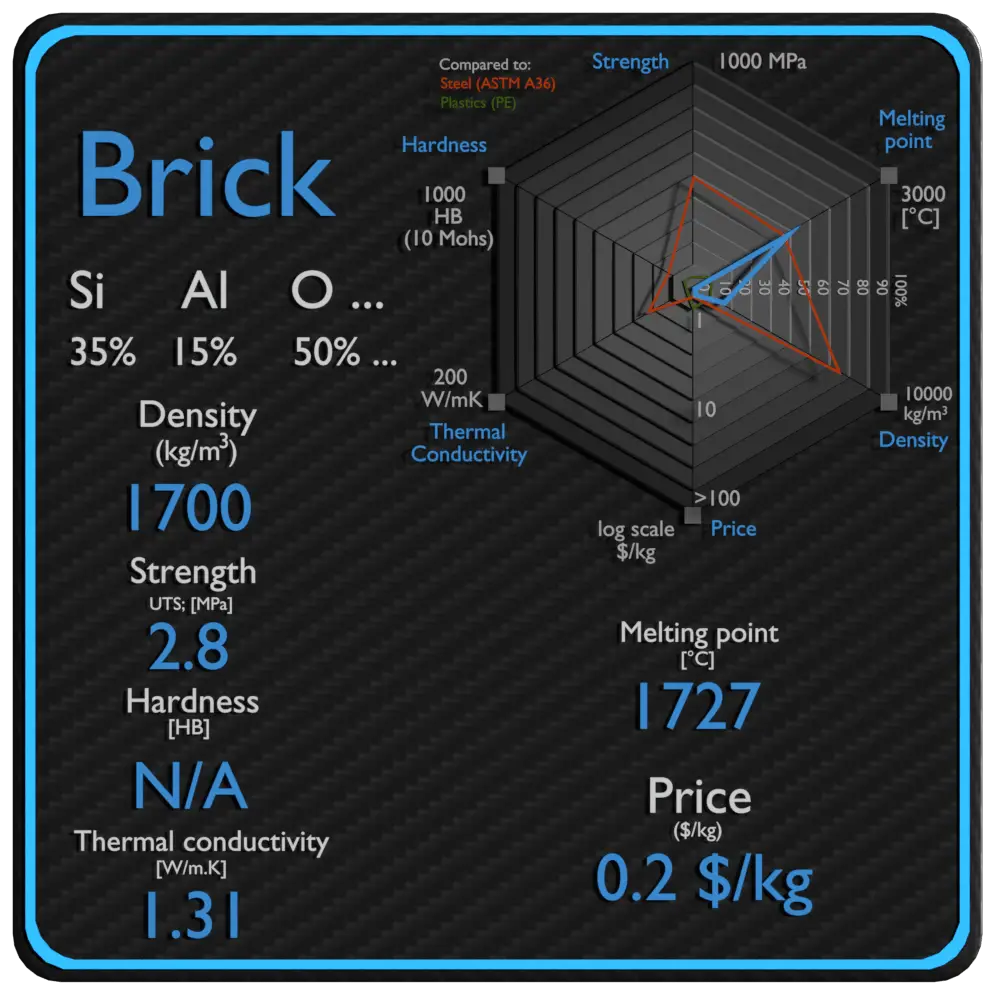
Density 1700 kg/m3
Ultimate Tensile Strength 2.8 MPa
Yield Strength N/A
Young’s Modulus of Elasticity N/A
Brinell Hardness N/A
Melting Point 1727 °C
Thermal Conductivity 1.31 W/mK
Heat Capacity 800 J/g K
Price 0.2 $/kg

Composition of Brick

Normally, bricks contain the following ingredients: Silica (sand) – 50% to 60% by weight; Alumina (clay) – 20% to 30% by weight; Lime – 2 to 5% by weight; Iron oxide – ≤ 7% by weight.

35%Silicon in Periodic Table

15%Aluminium in Periodic Table

50%Oxygen in Periodic Table

Applications of Brick

Brick - Material Table - Applications - Price
Source: wikipedia.org License: CC-BY SA 3.0

Bricks are most often used for both buildings and pavements. Bricks in the metallurgy and glass industries are often used for lining furnaces, in particular refractory bricks such as silica, magnesia, chamotte and neutral (chromomagnesite) refractory bricks.

Mechanical Properties of Brick

Strength of Brick

In mechanics of materials, the strength of a material is its ability to withstand an applied load without failure or plastic deformation. Strength of materials basically considers the relationship between the external loads applied to a material and the resulting deformation or change in material dimensions. In designing structures and machines, it is important to consider these factors, in order that the material selected will have adequate strength to resist applied loads or forces and retain its original shape.

Strength of a material is its ability to withstand this applied load without failure or plastic deformation. For tensile stress, the capacity of a material or structure to withstand loads tending to elongate is known as ultimate tensile strength (UTS). Yield strength or yield stress is the material property defined as the stress at which a material begins to deform plastically whereas yield point is the point where nonlinear (elastic + plastic) deformation begins. In case of tensional stress of a uniform bar (stress-strain curve), the Hooke’s law describes behaviour of a bar in the elastic region. The Young’s modulus of elasticity is the elastic modulus for tensile and compressive stress in the linear elasticity regime of a uniaxial deformation and is usually assessed by tensile tests.

See also: Strength of Materials

Ultimate Tensile Strength of Brick

Ultimate tensile strength of Brick is 2.8 MPa.

Yield Strength of Brick

Yield strength of Brick is N/A.

Modulus of Elasticity of Brick

The Young’s modulus of elasticity of Brick is N/A.

Hardness of Brick

In materials science, hardness is the ability to withstand surface indentation (localized plastic deformation) and scratching. Brinell hardness test is one of indentation hardness tests, that has been developed for hardness testing. In Brinell tests, a hard, spherical indenter is forced under a specific load into the surface of the metal to be tested.

The Brinell hardness number (HB) is the load divided by the surface area of the indentation. The diameter of the impression is measured with a microscope with a superimposed scale. The Brinell hardness number is computed from the equation:

brinell hardness number - definition

Brinell hardness of Brick is approximately N/A.

See also: Hardness of Materials

Strength of Materials

Material Table - Strength of Materials

Elasticity of Materials

Material Table - Elasticity of Materials

Hardness of Materials

Material Table - Hardness of Materials  

Thermal Properties of Brick

Brick – Melting Point

Melting point of Brick is 1727 °C.

Note that, these points are associated with the standard atmospheric pressure. In general, melting is a phase change of a substance from the solid to the liquid phase. The melting point of a substance is the temperature at which this phase change occurs. The melting point also defines a condition in which the solid and liquid can exist in equilibrium. For various chemical compounds and alloys, it is difficult to define the melting point, since they are usually a mixture of various chemical elements.

Brick – Thermal Conductivity

Thermal conductivity of Brick is 1.31 W/(m·K).

The heat transfer characteristics of a solid material are measured by a property called the thermal conductivity, k (or λ), measured in W/m.K. It is a measure of a substance’s ability to transfer heat through a material by conduction. Note that Fourier’s law applies for all matter, regardless of its state (solid, liquid, or gas), therefore, it is also defined for liquids and gases.

The thermal conductivity of most liquids and solids varies with temperature. For vapors, it also depends upon pressure. In general:

thermal conductivity - definition

Most materials are very nearly homogeneous, therefore we can usually write k = k (T). Similar definitions are associated with thermal conductivities in the y- and z-directions (ky, kz), but for an isotropic material the thermal conductivity is independent of the direction of transfer, kx = ky = kz = k.

Brick – Specific Heat

Specific heat of Brick is 800 J/g K.

Specific heat, or specific heat capacity, is a property related to internal energy that is very important in thermodynamics. The intensive properties cv and cp are defined for pure, simple compressible substances as partial derivatives of the internal energy u(T, v) and enthalpy h(T, p), respectively:

where the subscripts v and p denote the variables held fixed during differentiation. The properties cv and cp are referred to as specific heats (or heat capacities) because under certain special conditions they relate the temperature change of a system to the amount of energy added by heat transfer. Their SI units are J/kg K or J/mol K.

Melting Point of Materials

Material Table - Melting Point

Thermal Conductivity of Materials

Material Table - Thermal Conductivity

Heat Capacity of Materials

Material Table - Heat Capacity

Properties and prices of other materials

material-table-in-8k-resolution

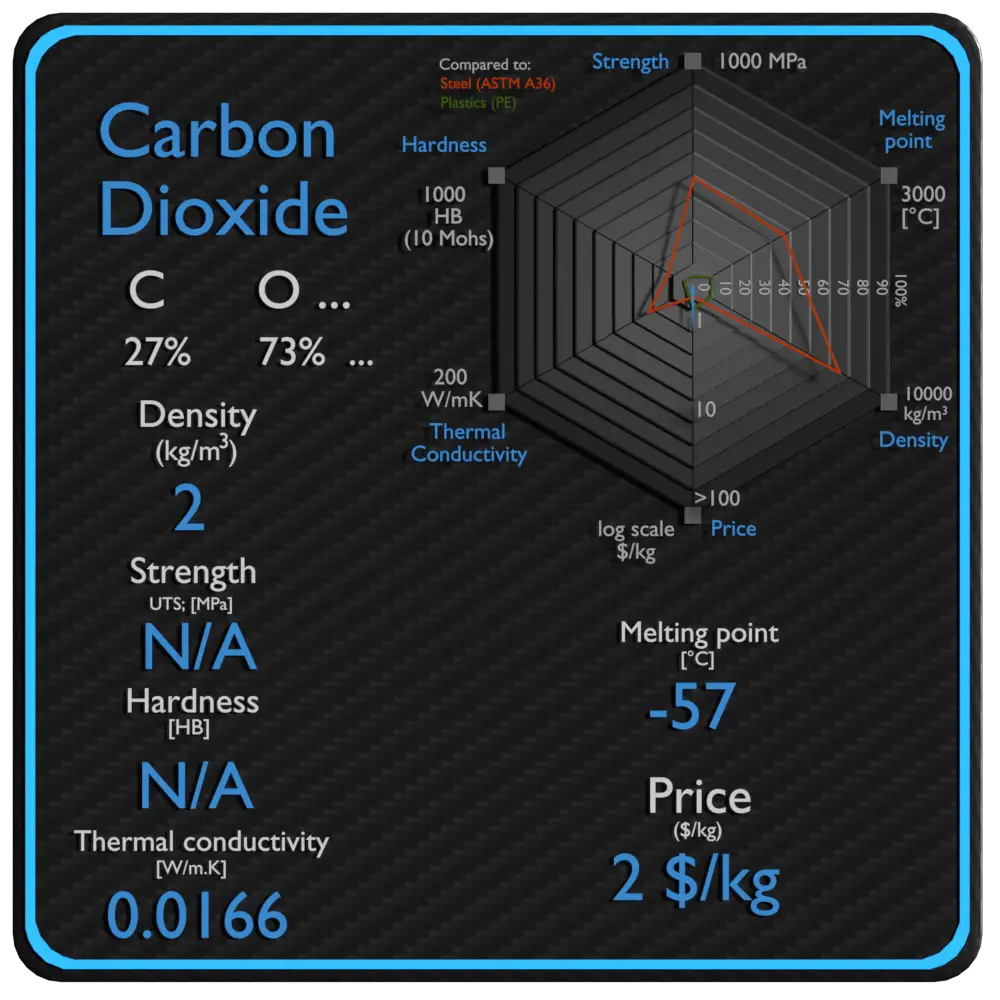
Carbon Dioxide – Material Table – Applications – Price

About Carbon Dioxide

Carbon dioxide is a colorless gas with a density about 53% higher than that of dry air. It is relatively nontoxic and noncombustible, but it is heavier than air and may asphyxiate by the displacement of air. When CO2 is solved in water, the mild carbonic acid, is formed. Cooled CO2 in solid form is called dry ice. Carbon dioxide is a minor component of Earth’s atmosphere but important constituent of air. It is a necessary raw material for most plant life, which remove carbon dioxide from air using the process of photosynthesis. A typical concentration of CO2 in air is currently about 0.040% or 404 ppm. The concentration of atmospheric carbon dioxide rises and falls in a seasonal pattern over a range of about 6 ppmv. The concentration of CO2 in air has also been steadily increasing from year to year for over 70 years. The current rate of increase is about 2.5 ppm per year.

carbon dioxide properties density strength price

Summary

Name Carbon Dioxide
Phase at STP gaseous
Density 2 kg/m3
Ultimate Tensile Strength N/A
Yield Strength N/A
Young’s Modulus of Elasticity N/A
Brinell Hardness N/A
Melting Point -57 °C
Thermal Conductivity 0.0166 W/mK
Heat Capacity 840 J/g K
Price 2 $/kg

Composition of Carbon Dioxide

Carbon dioxide molecules consist of a carbon atom covalently double bonded to two oxygen atoms.

27%Carbon in Periodic Table

73%Oxygen in Periodic Table

Applications of Carbon Dioxide

Carbon Dioxide - Material Table - Applications - Price
Carbon dioxide bubbles in a soft drink. Source: wikipedia.org License: CC-BY SA 3.0

Carbon dioxide is used by the food industry, the oil industry, and the chemical industry. The compound has varied commercial uses but one of its greatest uses as a chemical is in the production of carbonated beverages; it provides the sparkle in carbonated beverages such as soda water, beer and sparkling wine. Carbon dioxide also is used as a refrigerant, in fire extinguishers, for inflating life rafts and life jackets, blasting coal, foaming rubber and plastics, promoting the growth of plants in greenhouses. Carbon dioxide is also used as an atmosphere for welding, although in the welding arc, it reacts to oxidize most metals. Use in the automotive industry is common despite significant evidence that welds made in carbon dioxide are more brittle than those made in more inert atmospheres.


Strength of Materials

Material Table - Strength of Materials

Elasticity of Materials

Material Table - Elasticity of Materials

Hardness of Materials

Material Table - Hardness of Materials  

Thermal Properties of Carbon Dioxide

Carbon Dioxide – Melting Point

Melting point of Carbon Dioxide is -57 °C.

Note that, these points are associated with the standard atmospheric pressure. In general, melting is a phase change of a substance from the solid to the liquid phase. The melting point of a substance is the temperature at which this phase change occurs. The melting point also defines a condition in which the solid and liquid can exist in equilibrium. For various chemical compounds and alloys, it is difficult to define the melting point, since they are usually a mixture of various chemical elements.

Carbon Dioxide – Thermal Conductivity

Thermal conductivity of Carbon Dioxide is 0.0166 W/(m·K).

The heat transfer characteristics of a solid material are measured by a property called the thermal conductivity, k (or λ), measured in W/m.K. It is a measure of a substance’s ability to transfer heat through a material by conduction. Note that Fourier’s law applies for all matter, regardless of its state (solid, liquid, or gas), therefore, it is also defined for liquids and gases.

The thermal conductivity of most liquids and solids varies with temperature. For vapors, it also depends upon pressure. In general:

thermal conductivity - definition

Most materials are very nearly homogeneous, therefore we can usually write k = k (T). Similar definitions are associated with thermal conductivities in the y- and z-directions (ky, kz), but for an isotropic material the thermal conductivity is independent of the direction of transfer, kx = ky = kz = k.

Carbon Dioxide – Specific Heat

Specific heat of Carbon Dioxide is 840 J/g K.

Specific heat, or specific heat capacity, is a property related to internal energy that is very important in thermodynamics. The intensive properties cv and cp are defined for pure, simple compressible substances as partial derivatives of the internal energy u(T, v) and enthalpy h(T, p), respectively:

where the subscripts v and p denote the variables held fixed during differentiation. The properties cv and cp are referred to as specific heats (or heat capacities) because under certain special conditions they relate the temperature change of a system to the amount of energy added by heat transfer. Their SI units are J/kg K or J/mol K.

Melting Point of Materials

Material Table - Melting Point

Thermal Conductivity of Materials

Material Table - Thermal Conductivity

Heat Capacity of Materials

Material Table - Heat Capacity

Properties and prices of other materials

material-table-in-8k-resolution