Facebook Instagram Youtube Twitter

Polypropylene – Material Table – Applications – Price

About Polypropylene

Polypropylene have properties that are similar to polyethylene, but it is slightly harder and more heat resistant. It is a white, mechanically rugged material and has a high chemical resistance. Polypropylene is recyclable and has the number “5” as its resin identification code.

polypropylene properties density strength price

Summary

Name Polypropylene
Phase at STP solid
Density 900 kg/m3
Ultimate Tensile Strength 27 MPa
Yield Strength N/A
Young’s Modulus of Elasticity 1.3 GPa
Brinell Hardness 50 BHN
Melting Point 337 °C
Thermal Conductivity 0.2 W/mK
Heat Capacity 1700 J/g K
Price 1.1 $/kg

Composition of Polypropylene

It is similar to polyethylene in structure except for the substitution of one hydrogen group with a methyl group on every other carbon.

86%Carbon in Periodic Table

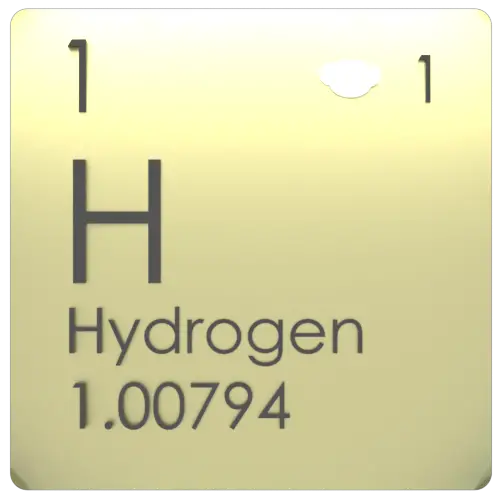
14%Hydrogen in Periodic Table

Applications of Polypropylene

Polypropylene - Material Table - Applications - Price
Source: wikipedia.org License: CC-BY SA 3.0

Polypropylene is a versatile polymer used in applications from films to fibers. Polypropylene is the second-most widely produced commodity plastic (after polyethylene). In 2019, the global market for polypropylene was worth $126.03 billion. Polypropylene has many applications. Injection molding applications cover a broad range from automotive uses such as dome lights, kick panels, and car battery cases to luggage and washing machine parts. Filled PP can be used in automotive applications such as mounts and engine covers.

Mechanical Properties of Polypropylene

Strength of Polypropylene

In mechanics of materials, the strength of a material is its ability to withstand an applied load without failure or plastic deformation. Strength of materials basically considers the relationship between the external loads applied to a material and the resulting deformation or change in material dimensions. In designing structures and machines, it is important to consider these factors, in order that the material selected will have adequate strength to resist applied loads or forces and retain its original shape.

Strength of a material is its ability to withstand this applied load without failure or plastic deformation. For tensile stress, the capacity of a material or structure to withstand loads tending to elongate is known as ultimate tensile strength (UTS). Yield strength or yield stress is the material property defined as the stress at which a material begins to deform plastically whereas yield point is the point where nonlinear (elastic + plastic) deformation begins. In case of tensional stress of a uniform bar (stress-strain curve), the Hooke’s law describes behaviour of a bar in the elastic region. The Young’s modulus of elasticity is the elastic modulus for tensile and compressive stress in the linear elasticity regime of a uniaxial deformation and is usually assessed by tensile tests.

See also: Strength of Materials

Ultimate Tensile Strength of Polypropylene

Ultimate tensile strength of Polypropylene is 27 MPa.

Yield Strength of Polypropylene

Yield strength of Polypropylene is N/A.

Modulus of Elasticity of Polypropylene

The Young’s modulus of elasticity of Polypropylene is 1.3 MPa.

Hardness of Polypropylene

In materials science, hardness is the ability to withstand surface indentation (localized plastic deformation) and scratching. Brinell hardness test is one of indentation hardness tests, that has been developed for hardness testing. In Brinell tests, a hard, spherical indenter is forced under a specific load into the surface of the metal to be tested.

The Brinell hardness number (HB) is the load divided by the surface area of the indentation. The diameter of the impression is measured with a microscope with a superimposed scale. The Brinell hardness number is computed from the equation:
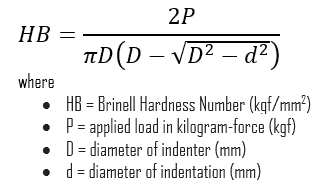
brinell hardness number - definition

Brinell hardness of Polypropylene is approximately 50 BHN (converted).

See also: Hardness of Materials

Strength of Materials

Material Table - Strength of Materials

Elasticity of Materials

Material Table - Elasticity of Materials

Hardness of Materials

Material Table - Hardness of Materials  

Thermal Properties of Polypropylene

Polypropylene  – Melting Point

Melting point of Polypropylene is 337 °C.

Note that, these points are associated with the standard atmospheric pressure. In general, melting is a phase change of a substance from the solid to the liquid phase. The melting point of a substance is the temperature at which this phase change occurs. The melting point also defines a condition in which the solid and liquid can exist in equilibrium. For various chemical compounds and alloys, it is difficult to define the melting point, since they are usually a mixture of various chemical elements.

Polypropylene – Thermal Conductivity

Thermal conductivity of Polypropylene is 0.2 W/(m·K).

The heat transfer characteristics of a solid material are measured by a property called the thermal conductivity, k (or λ), measured in W/m.K. It is a measure of a substance’s ability to transfer heat through a material by conduction. Note that Fourier’s law applies for all matter, regardless of its state (solid, liquid, or gas), therefore, it is also defined for liquids and gases.

The thermal conductivity of most liquids and solids varies with temperature. For vapors, it also depends upon pressure. In general:
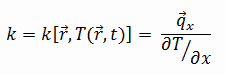
thermal conductivity - definition

Most materials are very nearly homogeneous, therefore we can usually write k = k (T). Similar definitions are associated with thermal conductivities in the y- and z-directions (ky, kz), but for an isotropic material the thermal conductivity is independent of the direction of transfer, kx = ky = kz = k.

Polypropylene – Specific Heat

Specific heat of Polypropylene is 1700 J/g K.

Specific heat, or specific heat capacity, is a property related to internal energy that is very important in thermodynamics. The intensive properties cv and cp are defined for pure, simple compressible substances as partial derivatives of the internal energy u(T, v) and enthalpy h(T, p), respectively:
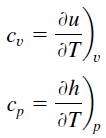
where the subscripts v and p denote the variables held fixed during differentiation. The properties cv and cp are referred to as specific heats (or heat capacities) because under certain special conditions they relate the temperature change of a system to the amount of energy added by heat transfer. Their SI units are J/kg K or J/mol K.

Melting Point of Materials

Material Table - Melting Point

Thermal Conductivity of Materials

Material Table - Thermal Conductivity

Heat Capacity of Materials

Material Table - Heat Capacity

Properties and prices of other materials

material-table-in-8k-resolution
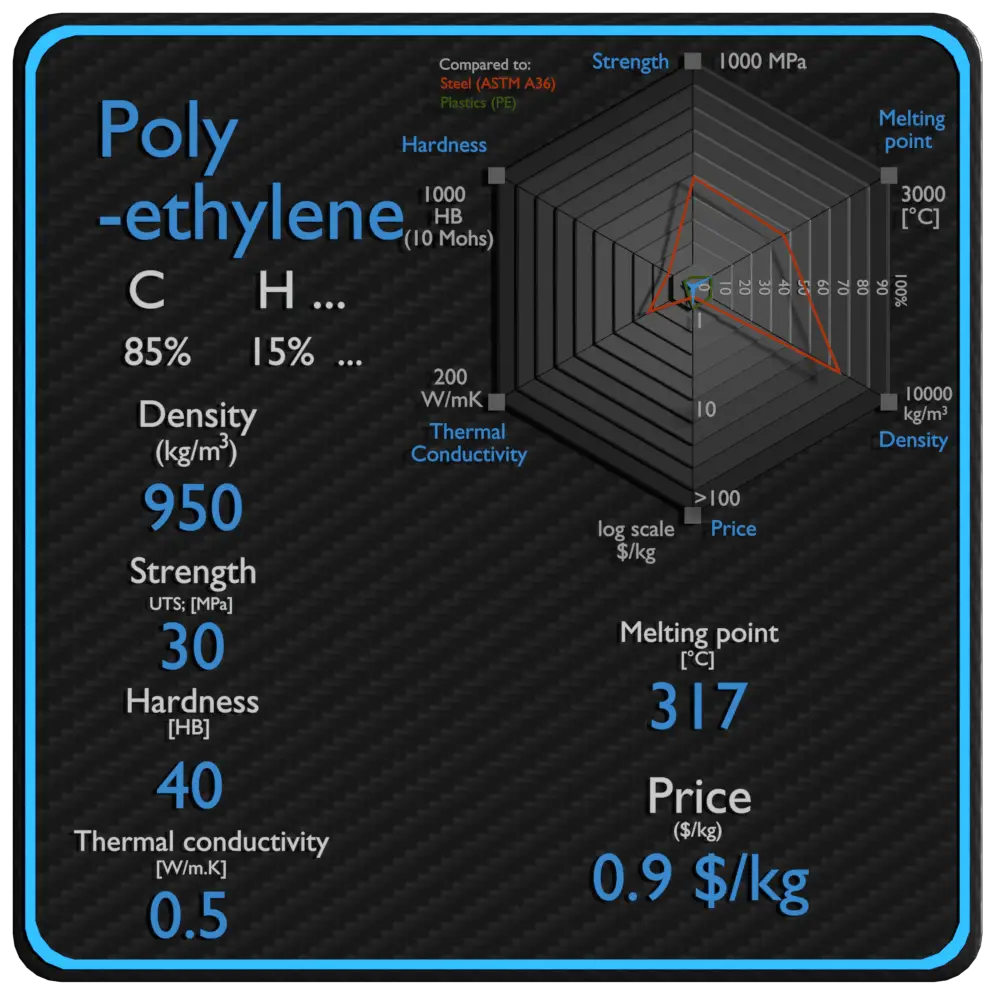
Polyethylene – Material Table – Applications – Price

About Polyethylene

Polyethylene is a whitish, semi-crystalline, and effectively opaque engineering thermoplastic. Polyethylene is classified by its density and branching. From low-density polyethylene (LDPE) to ultra-high-molecular-weight polyethylene (UHMWPE). Its mechanical properties depend significantly on variables such as the extent and type of branching, the crystal structure, and the molecular weight.

polyethylene properties density strength price

Summary

Name Polyethylene
Phase at STP solid
Density 950 kg/m3
Ultimate Tensile Strength 30 MPa
Yield Strength 20 MPa
Young’s Modulus of Elasticity 1 GPa
Brinell Hardness 40 BHN
Melting Point 317 °C
Thermal Conductivity 0.5 W/mK
Heat Capacity 1550 J/g K
Price 0.9 $/kg

Composition of Polyethylene

Its repeat structure is (-CH2CH2-)x, which is written as polyethylene rather than polymethylene (-CH2)x, in deference to the various ethylene polymerization mechanisms. PE has a deceptive simplicity.

85%Carbon in Periodic Table

15%Hydrogen in Periodic Table

Applications of Polyethylene

Polyethylene - Material Table - Applications - Price
Source: wikipedia.org License: CC-BY SA 3.0

Polyethylene (PE) is the highest-volume polymer in the world. Its high toughness, ductility, excellent chemical resistance, low water vapor permeability, and very low water absorption, combined the ease with which it can be processed, make PE of all different density grades an attractive choice for a variety of goods. As of 2017, over 100 million tonnes of polyethylene resins are being produced annually, accounting for 34% of the total plastics market. PE is limited by its relatively low modulus, yield stress, and melting point. PE is used to make containers, bottles, film, and pipes, among other things. LDPE combines high impact strength, toughness, and ductility to make it the material of choice for packaging films, which is one mof its largest applications.

Mechanical Properties of Polyethylene

Strength of Polyethylene

In mechanics of materials, the strength of a material is its ability to withstand an applied load without failure or plastic deformation. Strength of materials basically considers the relationship between the external loads applied to a material and the resulting deformation or change in material dimensions. In designing structures and machines, it is important to consider these factors, in order that the material selected will have adequate strength to resist applied loads or forces and retain its original shape.

Strength of a material is its ability to withstand this applied load without failure or plastic deformation. For tensile stress, the capacity of a material or structure to withstand loads tending to elongate is known as ultimate tensile strength (UTS). Yield strength or yield stress is the material property defined as the stress at which a material begins to deform plastically whereas yield point is the point where nonlinear (elastic + plastic) deformation begins. In case of tensional stress of a uniform bar (stress-strain curve), the Hooke’s law describes behaviour of a bar in the elastic region. The Young’s modulus of elasticity is the elastic modulus for tensile and compressive stress in the linear elasticity regime of a uniaxial deformation and is usually assessed by tensile tests.

See also: Strength of Materials

Ultimate Tensile Strength of Polyethylene

Ultimate tensile strength of Polyethylene is 30 MPa.

Yield Strength of Polyethylene

Yield strength of Polyethylene is 20 MPa.

Modulus of Elasticity of Polyethylene

The Young’s modulus of elasticity of Polyethylene is 1 MPa.

Hardness of Polyethylene

In materials science, hardness is the ability to withstand surface indentation (localized plastic deformation) and scratching. Brinell hardness test is one of indentation hardness tests, that has been developed for hardness testing. In Brinell tests, a hard, spherical indenter is forced under a specific load into the surface of the metal to be tested.

The Brinell hardness number (HB) is the load divided by the surface area of the indentation. The diameter of the impression is measured with a microscope with a superimposed scale. The Brinell hardness number is computed from the equation:

brinell hardness number - definition

Brinell hardness of Polyethylene is approximately 40 BHN (converted).

See also: Hardness of Materials

Strength of Materials

Material Table - Strength of Materials

Elasticity of Materials

Material Table - Elasticity of Materials

Hardness of Materials

Material Table - Hardness of Materials  

Thermal Properties of Polyethylene

Polyethylene  – Melting Point

Melting point of Polyethylene is 317 °C.

Note that, these points are associated with the standard atmospheric pressure. In general, melting is a phase change of a substance from the solid to the liquid phase. The melting point of a substance is the temperature at which this phase change occurs. The melting point also defines a condition in which the solid and liquid can exist in equilibrium. For various chemical compounds and alloys, it is difficult to define the melting point, since they are usually a mixture of various chemical elements.

Polyethylene – Thermal Conductivity

Thermal conductivity of Polyethylene is 0.5 W/(m·K).

The heat transfer characteristics of a solid material are measured by a property called the thermal conductivity, k (or λ), measured in W/m.K. It is a measure of a substance’s ability to transfer heat through a material by conduction. Note that Fourier’s law applies for all matter, regardless of its state (solid, liquid, or gas), therefore, it is also defined for liquids and gases.

The thermal conductivity of most liquids and solids varies with temperature. For vapors, it also depends upon pressure. In general:

thermal conductivity - definition

Most materials are very nearly homogeneous, therefore we can usually write k = k (T). Similar definitions are associated with thermal conductivities in the y- and z-directions (ky, kz), but for an isotropic material the thermal conductivity is independent of the direction of transfer, kx = ky = kz = k.

Polyethylene – Specific Heat

Specific heat of Polyethylene is 1550 J/g K.

Specific heat, or specific heat capacity, is a property related to internal energy that is very important in thermodynamics. The intensive properties cv and cp are defined for pure, simple compressible substances as partial derivatives of the internal energy u(T, v) and enthalpy h(T, p), respectively:

where the subscripts v and p denote the variables held fixed during differentiation. The properties cv and cp are referred to as specific heats (or heat capacities) because under certain special conditions they relate the temperature change of a system to the amount of energy added by heat transfer. Their SI units are J/kg K or J/mol K.

Melting Point of Materials

Material Table - Melting Point

Thermal Conductivity of Materials

Material Table - Thermal Conductivity

Heat Capacity of Materials

Material Table - Heat Capacity

Properties and prices of other materials

material-table-in-8k-resolution
Carbon Fiber – Material Table – Application – Price

About Carbon Fiber

Carbon fiber is a polymer that is is a very strong material that is also very lightweight. Carbon fibers have several advantages including high stiffness, high tensile strength, low weight, high chemical resistance, high temperature tolerance and low thermal expansion. Carbon fiber is five-times stronger than steel and twice as stiff. Though carbon fiber is stronger and stiffer than steel, it is lighter than steel; making it the ideal manufacturing material for many parts. Carbon fibers are usually combined with other materials to form a composite.

carbon fiber properties density strength price

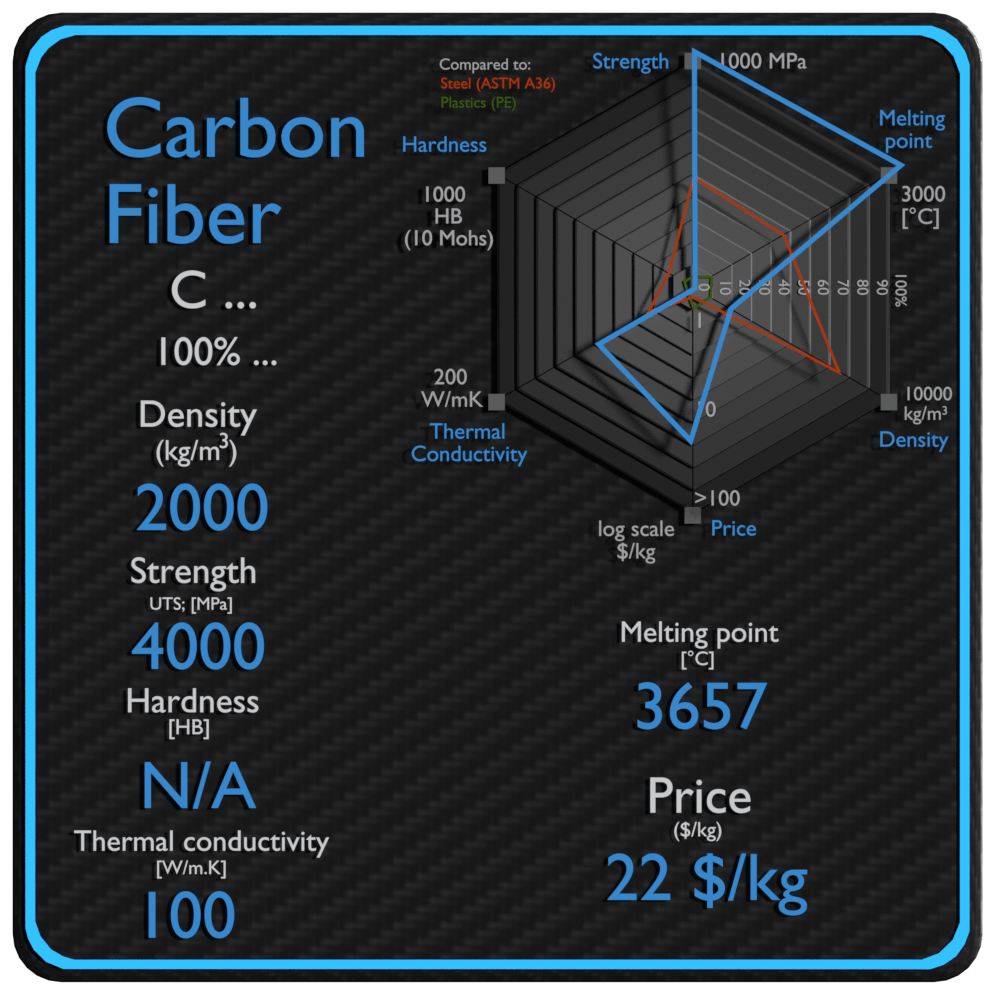
Summary

Name Carbon Fiber
Phase at STP solid
Density 2000 kg/m3
Ultimate Tensile Strength 4000 MPa
Yield Strength 2500 MPa
Young’s Modulus of Elasticity 500 GPa
Brinell Hardness N/A
Melting Point 3657 °C
Thermal Conductivity 100 W/mK
Heat Capacity 800 J/g K
Price 22 $/kg

Composition of Carbon Fiber

To produce a carbon fiber, the carbon atoms are bonded together in crystals that are more or less aligned parallel to the long axis of the fiber as the crystal alignment gives the fiber high strength-to-volume ratio (in other words, it is strong for its size). Several thousand carbon fibers are bundled together to form a tow, which may be used by itself or woven into a fabric.

100%Carbon in Periodic Table

Applications of Carbon Fiber

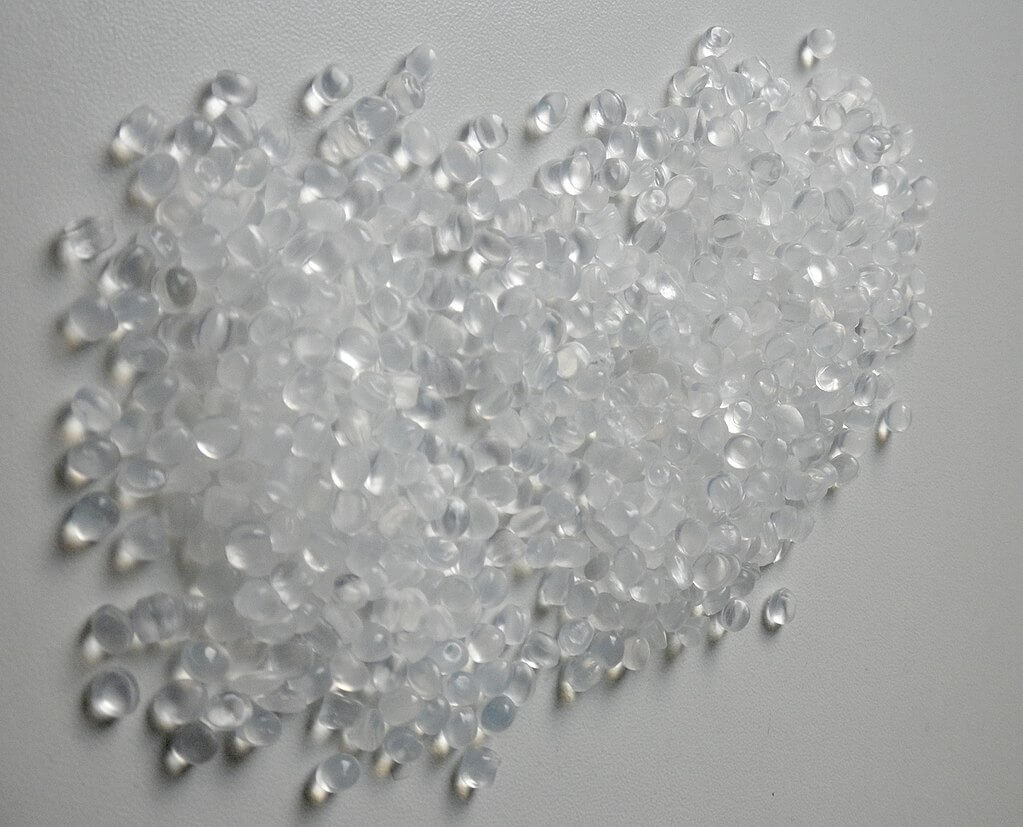
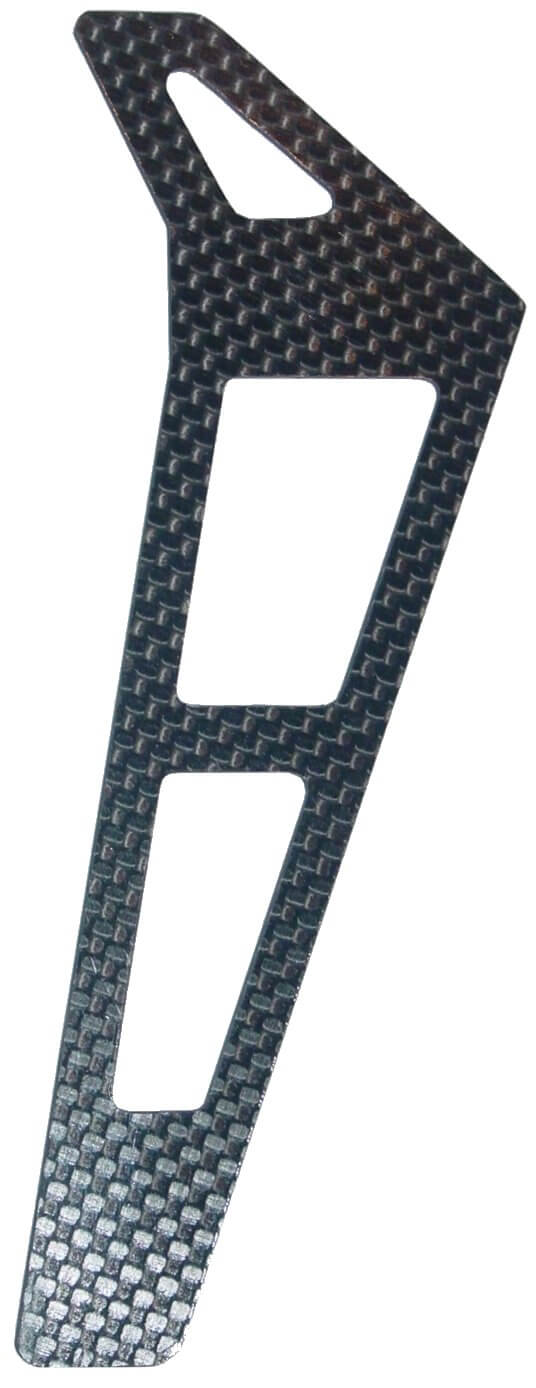
Carbon Fiber - Material Table - Applications - Price
Source: wikipedia.org License: CC-BY SA 3.0

Carbon fiber is most notably used to reinforce composite materials, particularly the class of materials known as carbon fiber or graphite reinforced polymers. Carbon fiber can have higher cost than other materials which has been one of the limiting factors of adoption. In a comparison between steel and carbon fiber materials for automotive materials, carbon fiber may be 10-12x more expensive. The increasing use of carbon fiber composites is displacing aluminum from aerospace applications in favor of other metals because of galvanic corrosion issues.

Mechanical Properties of Carbon Fiber

Strength of Carbon Fiber

In mechanics of materials, the strength of a material is its ability to withstand an applied load without failure or plastic deformation. Strength of materials basically considers the relationship between the external loads applied to a material and the resulting deformation or change in material dimensions. In designing structures and machines, it is important to consider these factors, in order that the material selected will have adequate strength to resist applied loads or forces and retain its original shape.

Strength of a material is its ability to withstand this applied load without failure or plastic deformation. For tensile stress, the capacity of a material or structure to withstand loads tending to elongate is known as ultimate tensile strength (UTS). Yield strength or yield stress is the material property defined as the stress at which a material begins to deform plastically whereas yield point is the point where nonlinear (elastic + plastic) deformation begins. In case of tensional stress of a uniform bar (stress-strain curve), the Hooke’s law describes behaviour of a bar in the elastic region. The Young’s modulus of elasticity is the elastic modulus for tensile and compressive stress in the linear elasticity regime of a uniaxial deformation and is usually assessed by tensile tests.

See also: Strength of Materials

Ultimate Tensile Strength of Carbon Fiber

Ultimate tensile strength of Carbon Fibre is 4000 MPa.

Yield Strength of Carbon Fiber

Yield strength of Carbon Fibre is 2500 MPa.

Modulus of Elasticity of Carbon Fiber

The Young’s modulus of elasticity of Carbon Fibre is 500 MPa.

Hardness of Carbon Fiber

In materials science, hardness is the ability to withstand surface indentation (localized plastic deformation) and scratching. Brinell hardness test is one of indentation hardness tests, that has been developed for hardness testing. In Brinell tests, a hard, spherical indenter is forced under a specific load into the surface of the metal to be tested.

The Brinell hardness number (HB) is the load divided by the surface area of the indentation. The diameter of the impression is measured with a microscope with a superimposed scale. The Brinell hardness number is computed from the equation:

brinell hardness number - definition

Brinell hardness of Carbon Fiber is approximately N/A.

See also: Hardness of Materials

Strength of Materials

Material Table - Strength of Materials

Elasticity of Materials

Material Table - Elasticity of Materials

Hardness of Materials

Material Table - Hardness of Materials  

Thermal Properties of Carbon Fiber

Carbon Fiber – Melting Point

Melting point of Carbon Fiber is 3657 °C.

Note that, these points are associated with the standard atmospheric pressure. In general, melting is a phase change of a substance from the solid to the liquid phase. The melting point of a substance is the temperature at which this phase change occurs. The melting point also defines a condition in which the solid and liquid can exist in equilibrium. For various chemical compounds and alloys, it is difficult to define the melting point, since they are usually a mixture of various chemical elements.

Carbon Fiber – Thermal Conductivity

Thermal conductivity of Carbon Fiber is 100 W/(m·K).

The heat transfer characteristics of a solid material are measured by a property called the thermal conductivity, k (or λ), measured in W/m.K. It is a measure of a substance’s ability to transfer heat through a material by conduction. Note that Fourier’s law applies for all matter, regardless of its state (solid, liquid, or gas), therefore, it is also defined for liquids and gases.

The thermal conductivity of most liquids and solids varies with temperature. For vapors, it also depends upon pressure. In general:

thermal conductivity - definition

Most materials are very nearly homogeneous, therefore we can usually write k = k (T). Similar definitions are associated with thermal conductivities in the y- and z-directions (ky, kz), but for an isotropic material the thermal conductivity is independent of the direction of transfer, kx = ky = kz = k.

Carbon Fiber – Specific Heat

Specific heat of Carbon Fiber is 800 J/g K.

Specific heat, or specific heat capacity, is a property related to internal energy that is very important in thermodynamics. The intensive properties cv and cp are defined for pure, simple compressible substances as partial derivatives of the internal energy u(T, v) and enthalpy h(T, p), respectively:

where the subscripts v and p denote the variables held fixed during differentiation. The properties cv and cp are referred to as specific heats (or heat capacities) because under certain special conditions they relate the temperature change of a system to the amount of energy added by heat transfer. Their SI units are J/kg K or J/mol K.

Melting Point of Materials

Material Table - Melting Point

Thermal Conductivity of Materials

Material Table - Thermal Conductivity

Heat Capacity of Materials

Material Table - Heat Capacity

Properties and prices of other materials

material-table-in-8k-resolution
Graphite – Material Table – Applications – Price

About Graphite

Graphite is a crystalline form of the element carbon with its atoms arranged in a hexagonal structure. Its uncommon combination of properties is due to graphite’s crystalline structure. The carbon atoms are set hexagonally in a planar condensed ring system. The layers are stacked parallel to each other. The atoms within the rings are bonded covalently, while the layers are loosely linked together by van der Waals forces. It occurs naturally in this form and is the most stable form of carbon under standard conditions. Although graphite is flexible, it is not elastic and has high electrical and thermal conductivity. It is also chemically inert and highly refractory. Since graphite displays low adsorption of X-rays and neutrons, it is very valuable in nuclear applications.

graphite properties density strength price

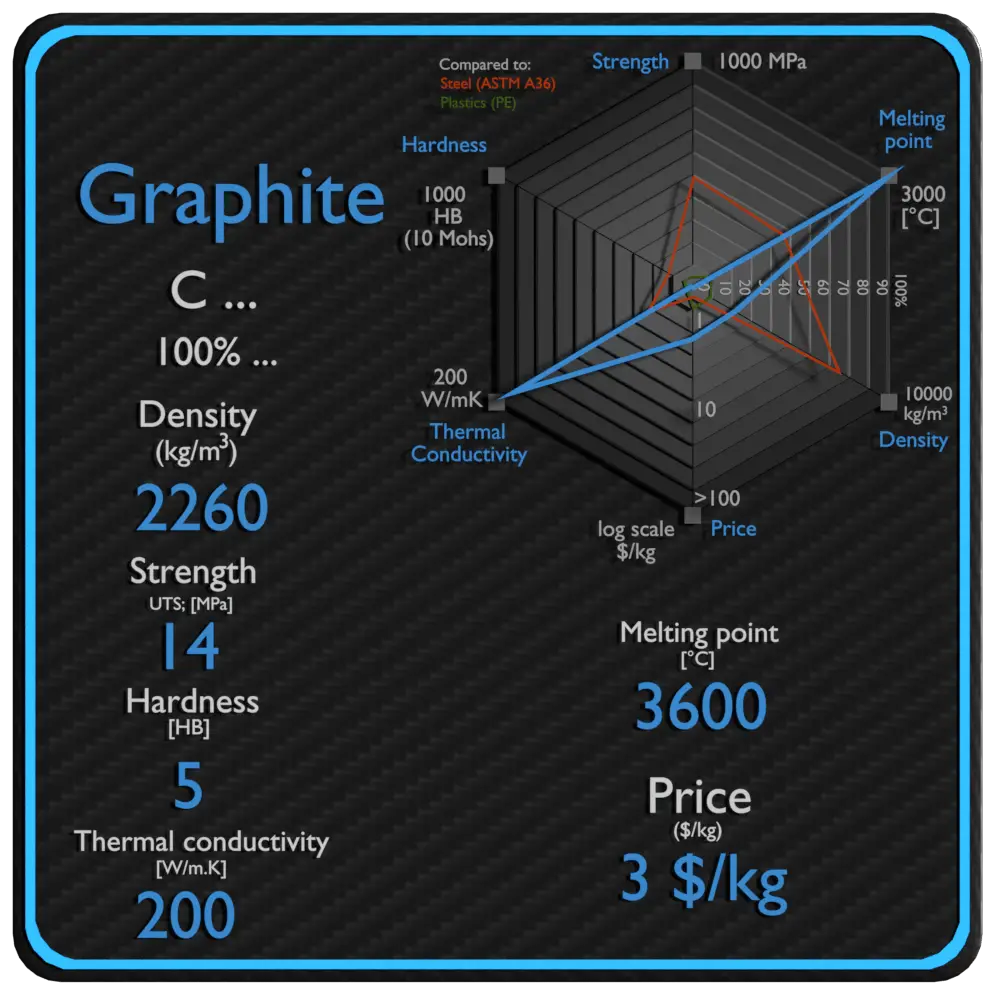
Summary

Name Graphite
Phase at STP solid
Density 2260 kg/m3
Ultimate Tensile Strength 14 MPa
Yield Strength N/A
Young’s Modulus of Elasticity 11.5 GPa
Brinell Hardness 5 BHN
Melting Point 3600 °C
Thermal Conductivity 200 W/mK
Heat Capacity 720 J/g K
Price 3 $/kg

Composition of Graphite

Its uncommon combination of properties is due to graphite’s crystalline structure. The carbon atoms are set hexagonally in a planar condensed ring system. The layers are stacked parallel to each other. The atoms within the rings are bonded covalently, while the layers are loosely linked together by van der Waals forces. It occurs naturally in this form and is the most stable form of carbon under standard conditions.

100%Carbon in Periodic Table

Applications of Graphite

Graphite - Material Table - Applications - Price
Source: wikipedia.org License: CC-BY SA 3.0

Graphite properties determine the variety of the areas of its applications in industry, transport, energetics, defence, medicine, science, sport. On account of its high-temperature stability and chemical inertness, graphite is the perfect candidate for refractory material. According to the USGS, US natural graphite consumption in refractories comprised 12,500 tonnes in 2010. Carbon brushes for electrical motors are manufactured from high purity synthetic graphite. High-purity graphite is also used in nuclear reactors as an neutron moderator. This is due to its very low absorption cross-section. Natural graphite in steelmaking mostly goes into raising the carbon content in molten steel.

Mechanical Properties of Graphite

Strength of Graphite

In mechanics of materials, the strength of a material is its ability to withstand an applied load without failure or plastic deformation. Strength of materials basically considers the relationship between the external loads applied to a material and the resulting deformation or change in material dimensions. In designing structures and machines, it is important to consider these factors, in order that the material selected will have adequate strength to resist applied loads or forces and retain its original shape.

Strength of a material is its ability to withstand this applied load without failure or plastic deformation. For tensile stress, the capacity of a material or structure to withstand loads tending to elongate is known as ultimate tensile strength (UTS). Yield strength or yield stress is the material property defined as the stress at which a material begins to deform plastically whereas yield point is the point where nonlinear (elastic + plastic) deformation begins. In case of tensional stress of a uniform bar (stress-strain curve), the Hooke’s law describes behaviour of a bar in the elastic region. The Young’s modulus of elasticity is the elastic modulus for tensile and compressive stress in the linear elasticity regime of a uniaxial deformation and is usually assessed by tensile tests.

See also: Strength of Materials

Ultimate Tensile Strength of Graphite

Ultimate tensile strength of Graphite is 14 MPa.

Yield Strength of Graphite

Yield strength of Graphite is N/A.

Modulus of Elasticity of Graphite

The Young’s modulus of elasticity of Graphite is 11.5 MPa.

Hardness of Graphite

In materials science, hardness is the ability to withstand surface indentation (localized plastic deformation) and scratching. Brinell hardness test is one of indentation hardness tests, that has been developed for hardness testing. In Brinell tests, a hard, spherical indenter is forced under a specific load into the surface of the metal to be tested.

The Brinell hardness number (HB) is the load divided by the surface area of the indentation. The diameter of the impression is measured with a microscope with a superimposed scale. The Brinell hardness number is computed from the equation:

brinell hardness number - definition

Brinell hardness of Graphite is approximately 5 BHN (converted).

See also: Hardness of Materials

Strength of Materials

Material Table - Strength of Materials

Elasticity of Materials

Material Table - Elasticity of Materials

Hardness of Materials

Material Table - Hardness of Materials  

Thermal Properties of Graphite

Graphite – Melting Point

Melting point of Graphite is 3600 °C.

Note that, these points are associated with the standard atmospheric pressure. In general, melting is a phase change of a substance from the solid to the liquid phase. The melting point of a substance is the temperature at which this phase change occurs. The melting point also defines a condition in which the solid and liquid can exist in equilibrium. For various chemical compounds and alloys, it is difficult to define the melting point, since they are usually a mixture of various chemical elements.

Graphite – Thermal Conductivity

Thermal conductivity of Graphite is 200 W/(m·K).

The heat transfer characteristics of a solid material are measured by a property called the thermal conductivity, k (or λ), measured in W/m.K. It is a measure of a substance’s ability to transfer heat through a material by conduction. Note that Fourier’s law applies for all matter, regardless of its state (solid, liquid, or gas), therefore, it is also defined for liquids and gases.

The thermal conductivity of most liquids and solids varies with temperature. For vapors, it also depends upon pressure. In general:

thermal conductivity - definition

Most materials are very nearly homogeneous, therefore we can usually write k = k (T). Similar definitions are associated with thermal conductivities in the y- and z-directions (ky, kz), but for an isotropic material the thermal conductivity is independent of the direction of transfer, kx = ky = kz = k.

Graphite – Specific Heat

Specific heat of Graphite is 720 J/g K.

Specific heat, or specific heat capacity, is a property related to internal energy that is very important in thermodynamics. The intensive properties cv and cp are defined for pure, simple compressible substances as partial derivatives of the internal energy u(T, v) and enthalpy h(T, p), respectively:

where the subscripts v and p denote the variables held fixed during differentiation. The properties cv and cp are referred to as specific heats (or heat capacities) because under certain special conditions they relate the temperature change of a system to the amount of energy added by heat transfer. Their SI units are J/kg K or J/mol K.

Melting Point of Materials

Material Table - Melting Point

Thermal Conductivity of Materials

Material Table - Thermal Conductivity

Heat Capacity of Materials

Material Table - Heat Capacity

Properties and prices of other materials

material-table-in-8k-resolution
Boron Carbide – Material Table – Applications – Price

About Boron Carbide

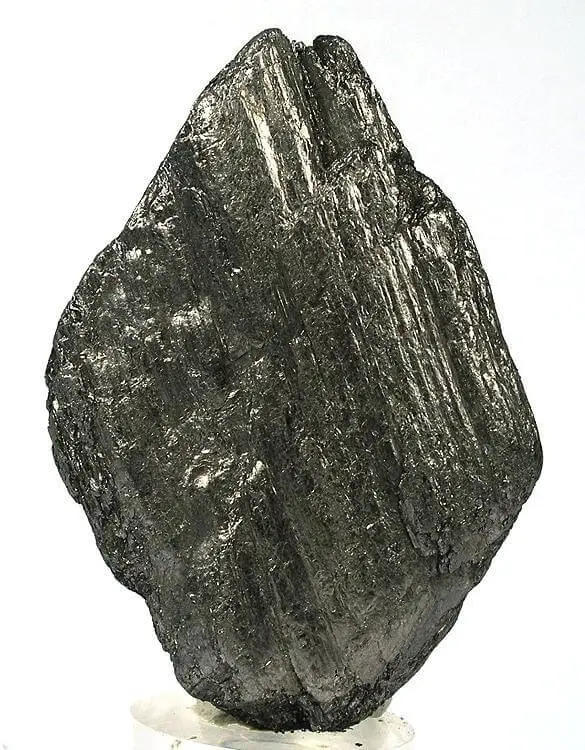
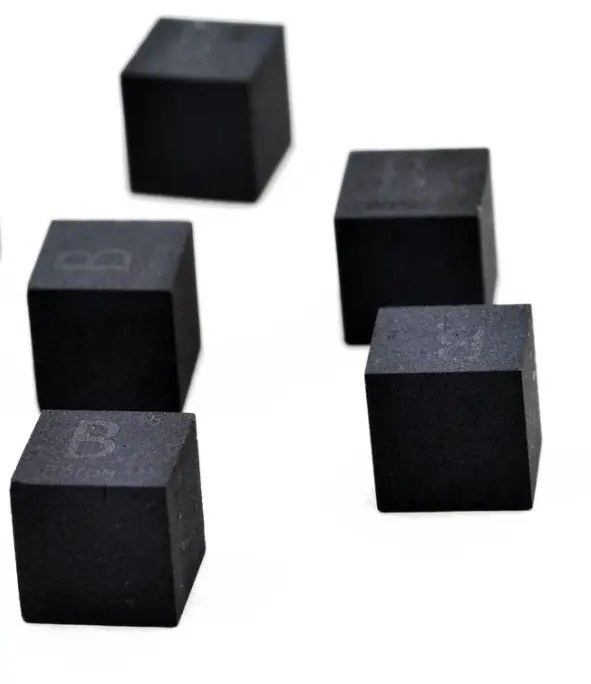
Boron carbide (chemical formula approximately B4C) is an extremely hard boron–carbon ceramic and covalent material. It is one of the hardest materials known, ranking third behind diamond and cubic boron nitride. It is the hardest material produced in tonnage quantities.

boron carbide properties density strength price

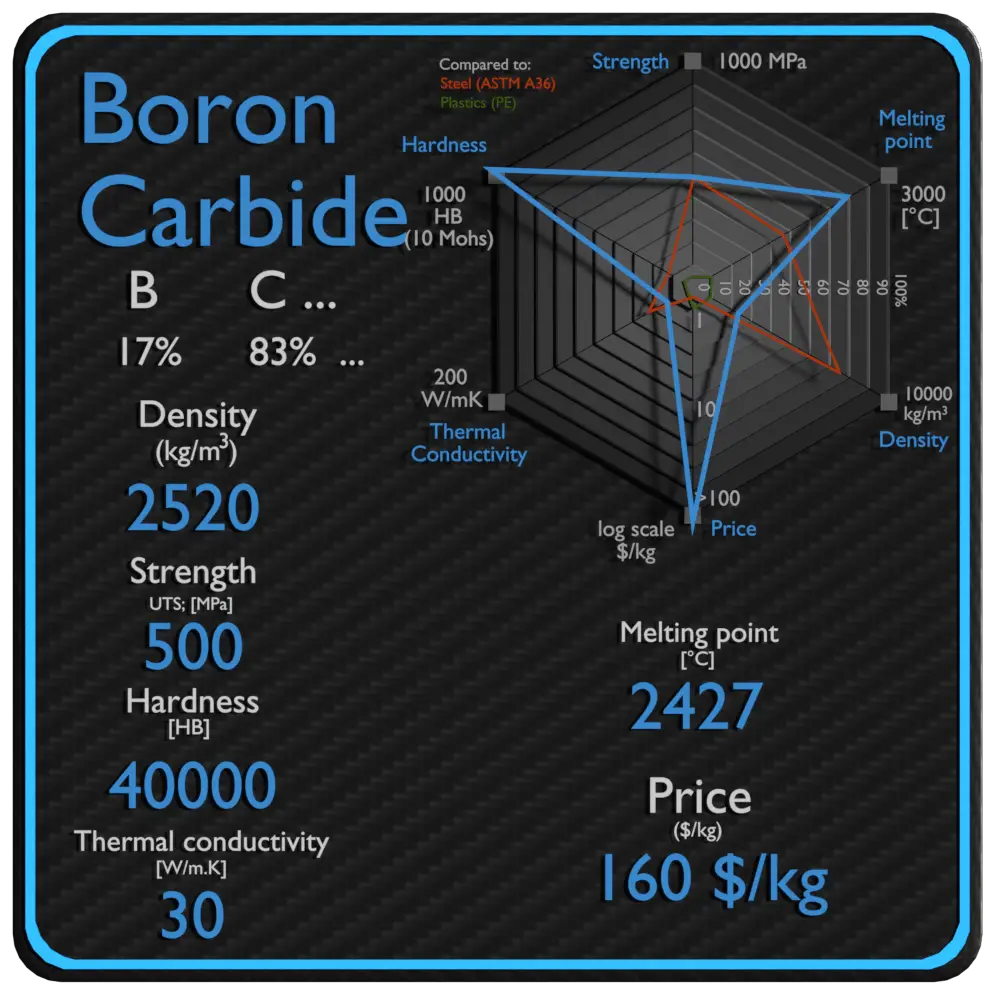
Summary

Name Boron Carbide
Phase at STP solid
Density 2520 kg/m3
Ultimate Tensile Strength 500 MPa
Yield Strength N/A
Young’s Modulus of Elasticity 460 GPa
Brinell Hardness 40000 BHN
Melting Point 2427 °C
Thermal Conductivity 30 W/mK
Heat Capacity 1000 J/g K
Price 160 $/kg

Composition of Boron Carbide

Boron carbide, (B4C), crystalline compound of boron and carbon. Boron carbide has a complex crystal structure typical of icosahedron-based borides.

17%Boron in Periodic Table

83%Carbon in Periodic Table

Applications of Boron Carbide

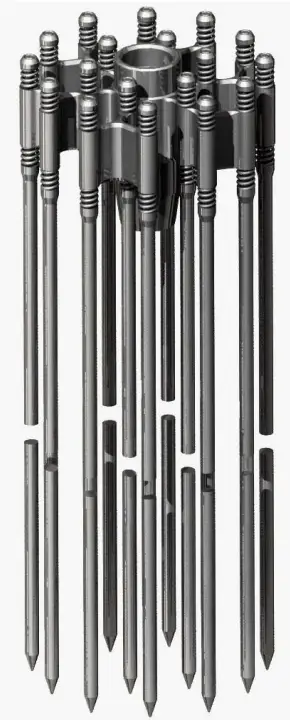
Control rods cluster assembly.
Control rod assembly for VVER reactor. Absorber – boron carbide Source: www.gidropress.podolsk.ru/files/proceedings/mntk2011/documents/mntk2011-108.pdf

Due to its high hardness, boron carbide powder is used as an abrasive in polishing and lapping applications, and also as a loose abrasive in cutting applications such as water jet cutting. Because of its hardness, together with its very low density, it has found application as a reinforcing agent for aluminum in military armour and high-performance bicycles, and its wear resistance has caused it to be employed in sandblasting nozzles and pump seals. Boron carbide is also used in control rods in nuclear reactors.

Mechanical Properties of Boron Carbide

Strength of Boron Carbide

In mechanics of materials, the strength of a material is its ability to withstand an applied load without failure or plastic deformation. Strength of materials basically considers the relationship between the external loads applied to a material and the resulting deformation or change in material dimensions. In designing structures and machines, it is important to consider these factors, in order that the material selected will have adequate strength to resist applied loads or forces and retain its original shape.

Strength of a material is its ability to withstand this applied load without failure or plastic deformation. For tensile stress, the capacity of a material or structure to withstand loads tending to elongate is known as ultimate tensile strength (UTS). Yield strength or yield stress is the material property defined as the stress at which a material begins to deform plastically whereas yield point is the point where nonlinear (elastic + plastic) deformation begins. In case of tensional stress of a uniform bar (stress-strain curve), the Hooke’s law describes behaviour of a bar in the elastic region. The Young’s modulus of elasticity is the elastic modulus for tensile and compressive stress in the linear elasticity regime of a uniaxial deformation and is usually assessed by tensile tests.

See also: Strength of Materials

Ultimate Tensile Strength of Boron Carbide

Ultimate tensile strength of Boron Carbide is 500 MPa.

Yield Strength of Boron Carbide

Yield strength of Boron Carbide is N/A.

Modulus of Elasticity of Boron Carbide

The Young’s modulus of elasticity of Boron Carbide is 460 MPa.

Hardness of Boron Carbide

In materials science, hardness is the ability to withstand surface indentation (localized plastic deformation) and scratching. Brinell hardness test is one of indentation hardness tests, that has been developed for hardness testing. In Brinell tests, a hard, spherical indenter is forced under a specific load into the surface of the metal to be tested.

The Brinell hardness number (HB) is the load divided by the surface area of the indentation. The diameter of the impression is measured with a microscope with a superimposed scale. The Brinell hardness number is computed from the equation:

brinell hardness number - definition

Brinell hardness of Boron Carbide is approximately 40000 BHN (converted).

See also: Hardness of Materials

Strength of Materials

Material Table - Strength of Materials

Elasticity of Materials

Material Table - Elasticity of Materials

Hardness of Materials

Material Table - Hardness of Materials  

Thermal Properties of Boron Carbide

Boron Carbide – Melting Point

Melting point of Boron Carbide is 2427 °C.

Note that, these points are associated with the standard atmospheric pressure. In general, melting is a phase change of a substance from the solid to the liquid phase. The melting point of a substance is the temperature at which this phase change occurs. The melting point also defines a condition in which the solid and liquid can exist in equilibrium. For various chemical compounds and alloys, it is difficult to define the melting point, since they are usually a mixture of various chemical elements.

Boron Carbide – Thermal Conductivity

Thermal conductivity of Boron Carbide is 30 W/(m·K).

The heat transfer characteristics of a solid material are measured by a property called the thermal conductivity, k (or λ), measured in W/m.K. It is a measure of a substance’s ability to transfer heat through a material by conduction. Note that Fourier’s law applies for all matter, regardless of its state (solid, liquid, or gas), therefore, it is also defined for liquids and gases.

The thermal conductivity of most liquids and solids varies with temperature. For vapors, it also depends upon pressure. In general:

thermal conductivity - definition

Most materials are very nearly homogeneous, therefore we can usually write k = k (T). Similar definitions are associated with thermal conductivities in the y- and z-directions (ky, kz), but for an isotropic material the thermal conductivity is independent of the direction of transfer, kx = ky = kz = k.

Boron Carbide – Specific Heat

Specific heat of Boron Carbide is 1000 J/g K.

Specific heat, or specific heat capacity, is a property related to internal energy that is very important in thermodynamics. The intensive properties cv and cp are defined for pure, simple compressible substances as partial derivatives of the internal energy u(T, v) and enthalpy h(T, p), respectively:

where the subscripts v and p denote the variables held fixed during differentiation. The properties cv and cp are referred to as specific heats (or heat capacities) because under certain special conditions they relate the temperature change of a system to the amount of energy added by heat transfer. Their SI units are J/kg K or J/mol K.

Melting Point of Materials

Material Table - Melting Point

Thermal Conductivity of Materials

Material Table - Thermal Conductivity

Heat Capacity of Materials

Material Table - Heat Capacity

Properties and prices of other materials

material-table-in-8k-resolution
Glass – Material Table – Applications – Price

About Glass

Glass is a non-crystalline, often transparent amorphous solid. Glasses have widespread practical, technological, and decorative use in, for example, window panes, tableware, and optics. Since glass is an amorphous (non-crystalline) solid, it is usually formed by the solidification of a melt without crystallisation. Glass is made by cooling molten ingredients such as silica sand with sufficient rapidity to prevent the formation of visible crystals. In some older books, the term has been used synonymously with glass. Nowadays, “glassy solid” or “amorphous solid” is considered to be the overarching concept, and glass the more special case: Glass is an amorphous solid that exhibits a glass transition. The glass you encounter most often is silicate glass, which consists mainly of silica or silicon dioxide, SiO2.

glass properties density strength price

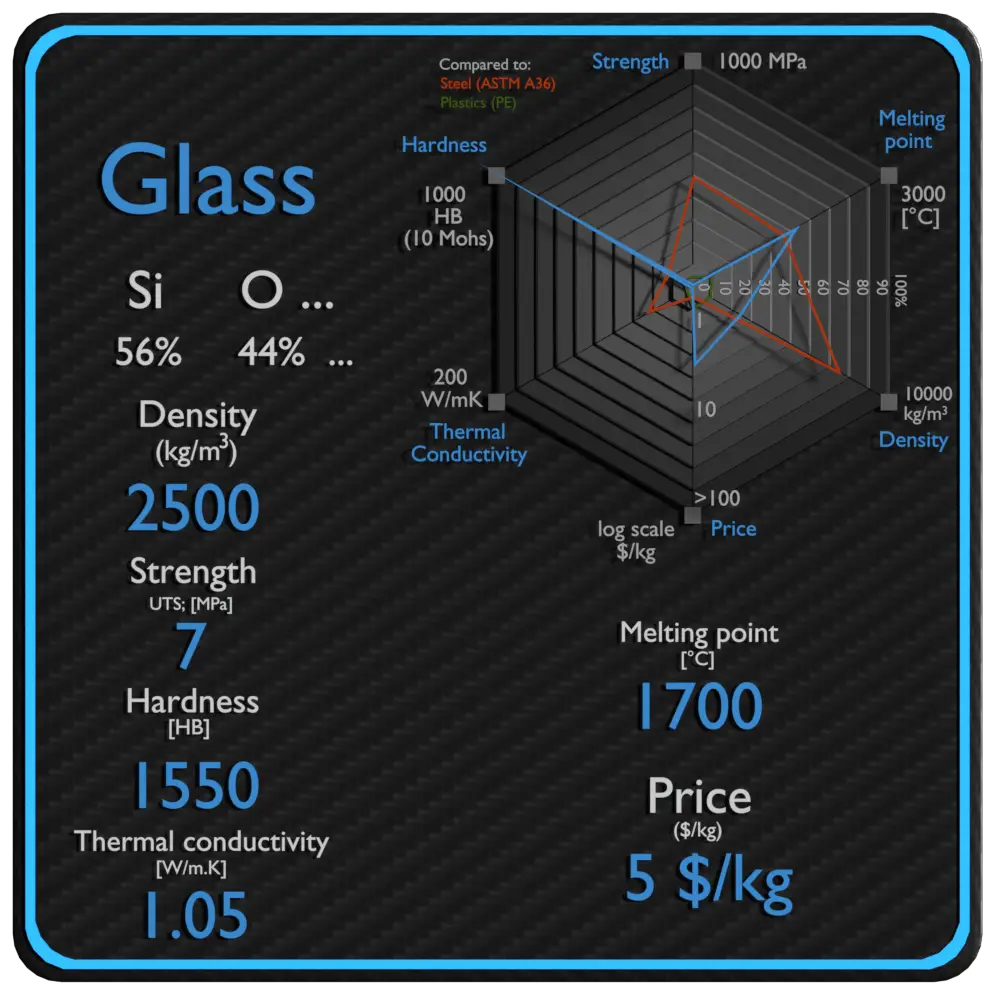
Summary

Name Glass
Phase at STP solid
Density 2500 kg/m3
Ultimate Tensile Strength 7 MPa
Yield Strength N/A
Young’s Modulus of Elasticity 80 GPa
Brinell Hardness 1550 BHN
Melting Point 1700 °C
Thermal Conductivity 1.05 W/mK
Heat Capacity 840 J/g K
Price 5 $/kg

Composition of Glass

The glass you encounter most often is silicate glass, which consists mainly of silica or silicon dioxide, SiO2. Silicon dioxide (SiO2) is a common fundamental constituent of glass. Sodium carbonate (Na2CO3, “soda”) is a common additive and acts to lowers the glass-transition temperature.

56%Silicon in Periodic Table

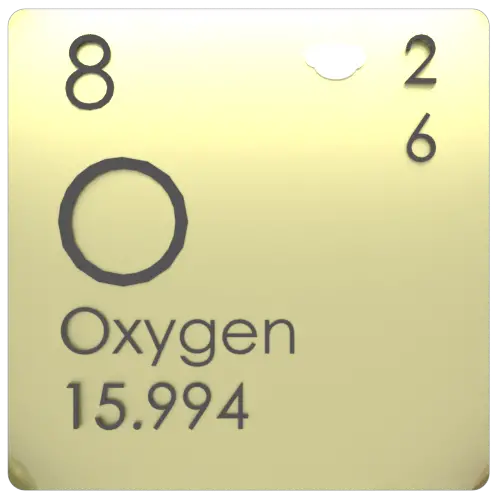
44%Oxygen in Periodic Table

Applications of Glass

Glass - Material Table - Applications - Price
Source: wikipedia.org License: CC-BY SA 3.0

Glasses have widespread practical, technological, and decorative use in, for example, window panes, tableware, and optics. Soda-lime sheet glass is typically used as transparent glazing material, typically as windows in external walls of buildings. Glass is an essential component of tableware and is typically used for water, beer and wine drinking glasses. Glass is a ubiquitous material in optics by virtue of its ability to refract, reflect, and transmit light.

Mechanical Properties of Glass

Strength of Glass

In mechanics of materials, the strength of a material is its ability to withstand an applied load without failure or plastic deformation. Strength of materials basically considers the relationship between the external loads applied to a material and the resulting deformation or change in material dimensions. In designing structures and machines, it is important to consider these factors, in order that the material selected will have adequate strength to resist applied loads or forces and retain its original shape.

Strength of a material is its ability to withstand this applied load without failure or plastic deformation. For tensile stress, the capacity of a material or structure to withstand loads tending to elongate is known as ultimate tensile strength (UTS). Yield strength or yield stress is the material property defined as the stress at which a material begins to deform plastically whereas yield point is the point where nonlinear (elastic + plastic) deformation begins. In case of tensional stress of a uniform bar (stress-strain curve), the Hooke’s law describes behaviour of a bar in the elastic region. The Young’s modulus of elasticity is the elastic modulus for tensile and compressive stress in the linear elasticity regime of a uniaxial deformation and is usually assessed by tensile tests.

See also: Strength of Materials

Ultimate Tensile Strength of Glass

Ultimate tensile strength of Glass is 7 MPa.

Yield Strength of Glass

Yield strength of Glass is N/A.

Modulus of Elasticity of Glass

The Young’s modulus of elasticity of Glass is 80 MPa.

Hardness of Glass

In materials science, hardness is the ability to withstand surface indentation (localized plastic deformation) and scratching. Brinell hardness test is one of indentation hardness tests, that has been developed for hardness testing. In Brinell tests, a hard, spherical indenter is forced under a specific load into the surface of the metal to be tested.

The Brinell hardness number (HB) is the load divided by the surface area of the indentation. The diameter of the impression is measured with a microscope with a superimposed scale. The Brinell hardness number is computed from the equation:

brinell hardness number - definition

Brinell hardness of Glass is approximately 1550 BHN (converted).

See also: Hardness of Materials

Strength of Materials

Material Table - Strength of Materials

Elasticity of Materials

Material Table - Elasticity of Materials

Hardness of Materials

Material Table - Hardness of Materials  

Thermal Properties of Glass

Glass – Melting Point

Melting point of Glass is 1700 °C.

Note that, these points are associated with the standard atmospheric pressure. In general, melting is a phase change of a substance from the solid to the liquid phase. The melting point of a substance is the temperature at which this phase change occurs. The melting point also defines a condition in which the solid and liquid can exist in equilibrium. For various chemical compounds and alloys, it is difficult to define the melting point, since they are usually a mixture of various chemical elements.

Glass – Thermal Conductivity

Thermal conductivity of Glass is 1.05 W/(m·K).

The heat transfer characteristics of a solid material are measured by a property called the thermal conductivity, k (or λ), measured in W/m.K. It is a measure of a substance’s ability to transfer heat through a material by conduction. Note that Fourier’s law applies for all matter, regardless of its state (solid, liquid, or gas), therefore, it is also defined for liquids and gases.

The thermal conductivity of most liquids and solids varies with temperature. For vapors, it also depends upon pressure. In general:

thermal conductivity - definition

Most materials are very nearly homogeneous, therefore we can usually write k = k (T). Similar definitions are associated with thermal conductivities in the y- and z-directions (ky, kz), but for an isotropic material the thermal conductivity is independent of the direction of transfer, kx = ky = kz = k.

Glass – Specific Heat

Specific heat of Glass is 840 J/g K.

Specific heat, or specific heat capacity, is a property related to internal energy that is very important in thermodynamics. The intensive properties cv and cp are defined for pure, simple compressible substances as partial derivatives of the internal energy u(T, v) and enthalpy h(T, p), respectively:

where the subscripts v and p denote the variables held fixed during differentiation. The properties cv and cp are referred to as specific heats (or heat capacities) because under certain special conditions they relate the temperature change of a system to the amount of energy added by heat transfer. Their SI units are J/kg K or J/mol K.

Melting Point of Materials

Material Table - Melting Point

Thermal Conductivity of Materials

Material Table - Thermal Conductivity

Heat Capacity of Materials

Material Table - Heat Capacity

Properties and prices of other materials

material-table-in-8k-resolution
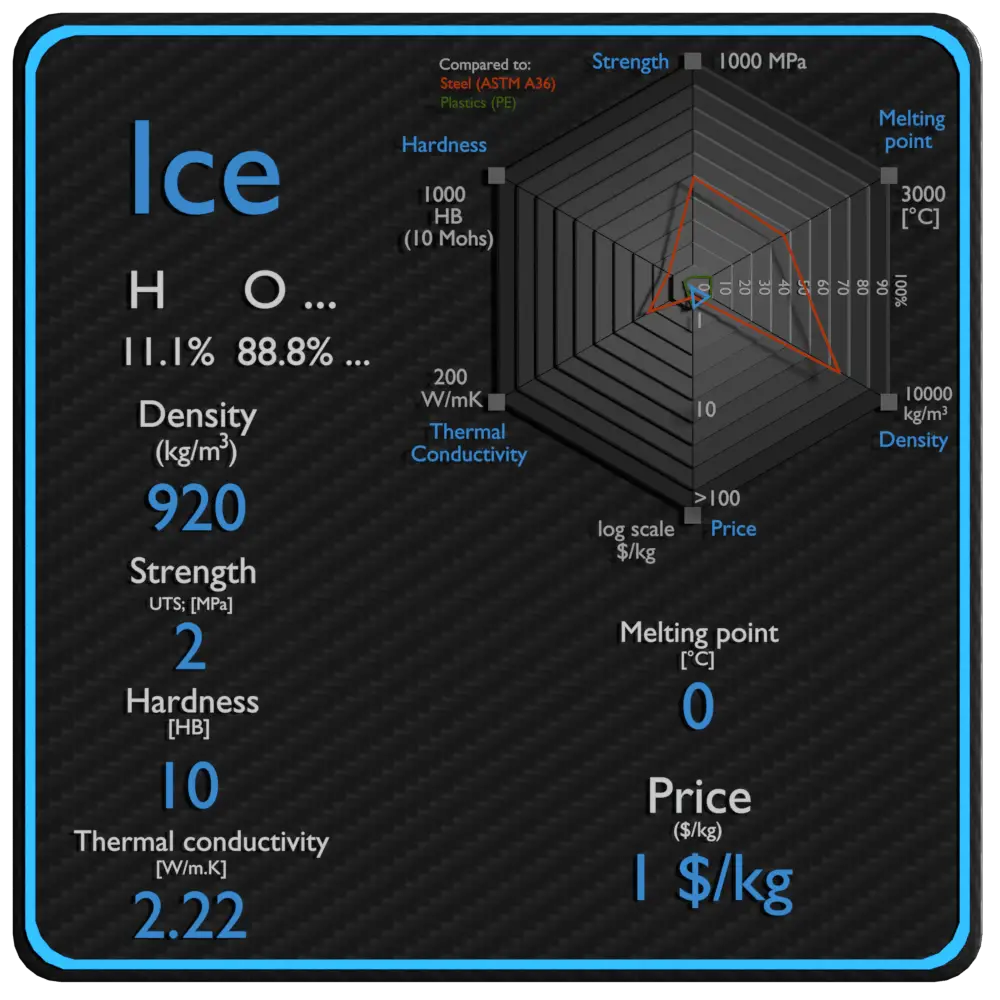
Ice – Material Table – Applications – Price

About Ice

Ice is simply water frozen into a solid state. Depending on the presence of impurities such as particles of soil or bubbles of air, it can appear transparent or a more or less opaque bluish-white color.

ice properties density strength price

Summary

Name Ice
Phase solid
Density 920 kg/m3
Ultimate Tensile Strength 2 MPa
Yield Strength N/A
Young’s Modulus of Elasticity 9.1 GPa
Brinell Hardness 10 BHN
Melting Point 0 °C
Thermal Conductivity 2.22 W/mK
Heat Capacity 2040 J/g K
Price 1 $/kg

Composition of Ice

Ice is simply water frozen into a solid state. Virtually all the ice on Earth’s surface and in its atmosphere is of a hexagonal crystalline structure. Air also contains a variable amount of water vapor, on average around 1% at sea level, and 0.4% over the entire atmosphere.

11.1%Hydrogen in Periodic Table

88.8%Oxygen in Periodic Table

Applications of Ice

Ice - Material Table - Applications - Price
Source: wikipedia.org License: CC-BY SA 3.0

Ice was used for cooling and food preservation for centuries, relying on harvesting natural ice in various forms and then transitioning to the mechanical production of the material. Ice also presents a challenge to transportation in various forms and a setting for winter sports. Types of commercial ice include block ice, cube ice, tube ice, flaked ice, plate ice, and shaved ice. It can be manufactured for an industrial application using special equipment. There are large ice factories that make tones of ice for commercial use in a day. Here, let us discuss how ice is made and the commercial industries that mostly use it.

Mechanical Properties of Ice

Strength of Ice

In mechanics of materials, the strength of a material is its ability to withstand an applied load without failure or plastic deformation. Strength of materials basically considers the relationship between the external loads applied to a material and the resulting deformation or change in material dimensions. In designing structures and machines, it is important to consider these factors, in order that the material selected will have adequate strength to resist applied loads or forces and retain its original shape.

Strength of a material is its ability to withstand this applied load without failure or plastic deformation. For tensile stress, the capacity of a material or structure to withstand loads tending to elongate is known as ultimate tensile strength (UTS). Yield strength or yield stress is the material property defined as the stress at which a material begins to deform plastically whereas yield point is the point where nonlinear (elastic + plastic) deformation begins. In case of tensional stress of a uniform bar (stress-strain curve), the Hooke’s law describes behaviour of a bar in the elastic region. The Young’s modulus of elasticity is the elastic modulus for tensile and compressive stress in the linear elasticity regime of a uniaxial deformation and is usually assessed by tensile tests.

See also: Strength of Materials

Ultimate Tensile Strength of Ice

Ultimate tensile strength of Ice is 2 MPa.

Yield Strength of Ice

Yield strength of Ice is N/A.

Modulus of Elasticity of Ice

The Young’s modulus of elasticity of Ice is 9.1 MPa.

Hardness of Ice

In materials science, hardness is the ability to withstand surface indentation (localized plastic deformation) and scratching. Brinell hardness test is one of indentation hardness tests, that has been developed for hardness testing. In Brinell tests, a hard, spherical indenter is forced under a specific load into the surface of the metal to be tested.

The Brinell hardness number (HB) is the load divided by the surface area of the indentation. The diameter of the impression is measured with a microscope with a superimposed scale. The Brinell hardness number is computed from the equation:

brinell hardness number - definition

Brinell hardness of Ice is approximately 10 BHN (converted).

See also: Hardness of Materials

Strength of Materials

Material Table - Strength of Materials

Elasticity of Materials

Material Table - Elasticity of Materials

Hardness of Materials

Material Table - Hardness of Materials  

Thermal Properties of Ice

Ice – Melting Point

Melting point of Ice is 0 °C.

Note that, these points are associated with the standard atmospheric pressure. In general, melting is a phase change of a substance from the solid to the liquid phase. The melting point of a substance is the temperature at which this phase change occurs. The melting point also defines a condition in which the solid and liquid can exist in equilibrium. For various chemical compounds and alloys, it is difficult to define the melting point, since they are usually a mixture of various chemical elements.

Ice – Thermal Conductivity

Thermal conductivity of Ice is 2.22 W/(m·K).

The heat transfer characteristics of a solid material are measured by a property called the thermal conductivity, k (or λ), measured in W/m.K. It is a measure of a substance’s ability to transfer heat through a material by conduction. Note that Fourier’s law applies for all matter, regardless of its state (solid, liquid, or gas), therefore, it is also defined for liquids and gases.

The thermal conductivity of most liquids and solids varies with temperature. For vapors, it also depends upon pressure. In general:

thermal conductivity - definition

Most materials are very nearly homogeneous, therefore we can usually write k = k (T). Similar definitions are associated with thermal conductivities in the y- and z-directions (ky, kz), but for an isotropic material the thermal conductivity is independent of the direction of transfer, kx = ky = kz = k.

Ice – Specific Heat

Specific heat of Ice is 2040 J/g K.

Specific heat, or specific heat capacity, is a property related to internal energy that is very important in thermodynamics. The intensive properties cv and cp are defined for pure, simple compressible substances as partial derivatives of the internal energy u(T, v) and enthalpy h(T, p), respectively:

where the subscripts v and p denote the variables held fixed during differentiation. The properties cv and cp are referred to as specific heats (or heat capacities) because under certain special conditions they relate the temperature change of a system to the amount of energy added by heat transfer. Their SI units are J/kg K or J/mol K.

Melting Point of Materials

Material Table - Melting Point

Thermal Conductivity of Materials

Material Table - Thermal Conductivity

Heat Capacity of Materials

Material Table - Heat Capacity

Properties and prices of other materials

material-table-in-8k-resolution
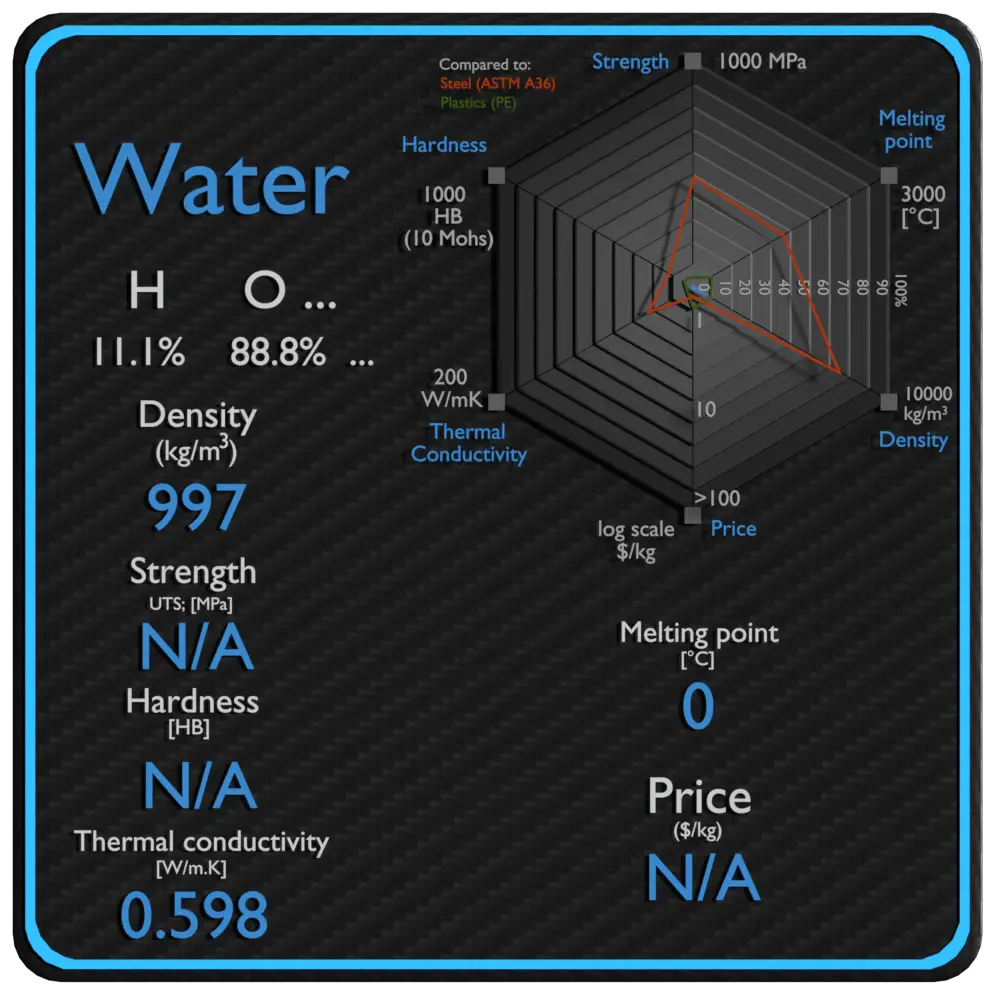
Water – Material Table – Applications – Price

About Water

Water is a transparent and nearly colorless substance composed of the chemical elements hydrogen and oxygen, that are connected by covalent bonds. On Earth, water exists in gaseous (steam or water vapor), liquid, and solid states (ice). It is one of the most plentiful and essential of compounds and it is the main constituent of Earth’s streams, lakes, and oceans, and the fluids of most living organisms.  It is vital for all known forms of life.

water properties density strength price

Summary

Name Water
Phase liquid
Density 997 g/cm3
Ultimate Tensile Strength N/A
Yield Strength N/A
Young’s Modulus of Elasticity N/A
Brinell Hardness N/A
Melting Point 0 °C
Thermal Conductivity 0.598 W/mK
Heat Capacity 4200 J/g K
Price N/A

Composition of Water

Chemically pure water (H2O) contains two elements – hydrogen and oxygen. But in nature such water does not exist and always contains various substances from the air or surface, such as CO2.

11.1%Hydrogen in Periodic Table

88.8%Oxygen in Periodic Table


Applications of Water

Water - Material Table - Applications - Price
Source: wikipedia.org License: CC BY-SA 3.0

Water is necessary for human survival. But it is used in industry, agriculture, chemistry and energy production. In nuclear engineering is water using as a reactor coolant, a moderator or a neutron shielding.

Thermal Properties of Water

Water – Melting Point

Melting point of Water is 0 °C.

Note that, these points are associated with the standard atmospheric pressure. In general, melting is a phase change of a substance from the solid to the liquid phase. The melting point of a substance is the temperature at which this phase change occurs. The melting point also defines a condition in which the solid and liquid can exist in equilibrium. For various chemical compounds and alloys, it is difficult to define the melting point, since they are usually a mixture of various chemical elements.

Water – Thermal Conductivity

Thermal conductivity of Water is 0.598 W/(m·K).

The heat transfer characteristics of a solid material are measured by a property called the thermal conductivity, k (or λ), measured in W/m.K. It is a measure of a substance’s ability to transfer heat through a material by conduction. Note that Fourier’s law applies for all matter, regardless of its state (solid, liquid, or gas), therefore, it is also defined for liquids and gases.

The thermal conductivity of most liquids and solids varies with temperature. For vapors, it also depends upon pressure. In general:

thermal conductivity - definition

Most materials are very nearly homogeneous, therefore we can usually write k = k (T). Similar definitions are associated with thermal conductivities in the y- and z-directions (ky, kz), but for an isotropic material the thermal conductivity is independent of the direction of transfer, kx = ky = kz = k.

Water – Specific Heat

Specific heat of Water is 4200 J/g K.

Specific heat, or specific heat capacity, is a property related to internal energy that is very important in thermodynamics. The intensive properties cv and cp are defined for pure, simple compressible substances as partial derivatives of the internal energy u(T, v) and enthalpy h(T, p), respectively:

where the subscripts v and p denote the variables held fixed during differentiation. The properties cv and cp are referred to as specific heats (or heat capacities) because under certain special conditions they relate the temperature change of a system to the amount of energy added by heat transfer. Their SI units are J/kg K or J/mol K.


Melting Point of Materials

Material Table - Melting Point

Thermal Conductivity of Material

Material Table - Thermal Conductivity

Heat Capacity of Materials

Material Table - Heat Capacity


Properties and prices of other materials

material-table-in-8k-resolution
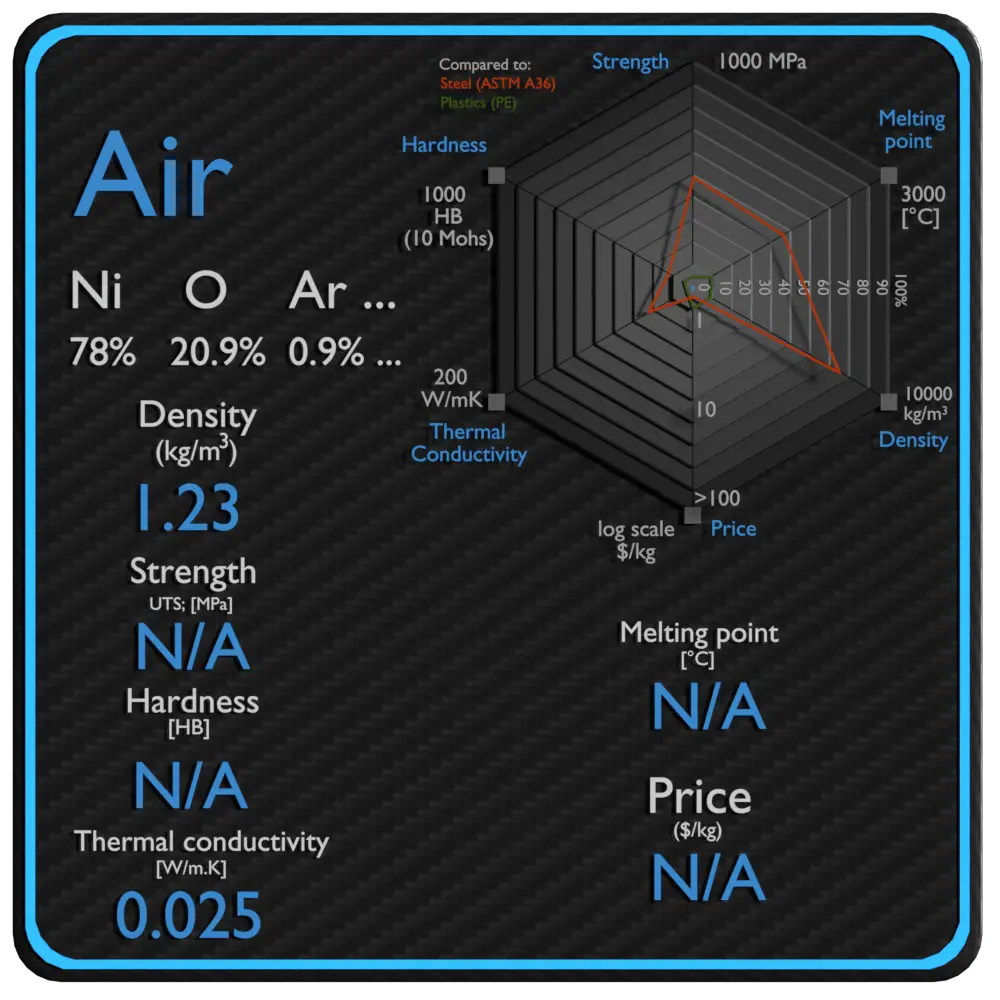
Air – Material Table – Applications – Price

About Air

Air is a mixture of nitrogen, oxygen, argon, carbon dioxide, water vapour, and other trace elements. The atmosphere of Earth is the layer of gases, commonly known as air, retained by Earth’s gravity, surrounding the planet Earth and forming its planetary atmosphere.

air properties density strength price

Summary

Name Air
Phase at STP gas
Density 1.23 kg/m3
Ultimate Tensile Strength N/A
Yield Strength N/A
Young’s Modulus of Elasticity N/A
Brinell Hardness N/A
Melting Point N/A
Thermal Conductivity 0.025 W/mK
Heat Capacity 1006 J/g K
Price N/A

Composition of Air

In engineering calculations, dry air is simplified to be a mixture of nitrogen, oxygen, and argon, and the corresponding mole fractions are 0.7812, 0.2096 and 0.0092, respectively. Air also contains a variable amount of water vapor, on average around 1% at sea level, and 0.4% over the entire atmosphere.

78%Nitrogen in Periodic Table

20.9%Oxygen in Periodic Table

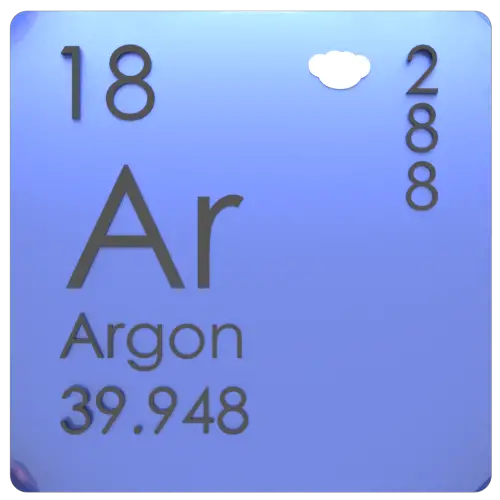
0.9%Argon in Periodic Table

Applications of Air

Air - Material Table - Application - Price
Source: wikipedia.org License: CC BY-SA 3.0

Air is a natural resource and is available abundantly. It is an essential element of nature that support life on earth. Air is equally important for living organisms for their survival just like water. Air is very useful and has many applications. Uses of air are as follows: sustain life and growth, combustion, maintaining temperature, supplier of energy, photosynthesis. Air and other gases are generally good insulators, in the absence of convection. Therefore, many insulating materials (e.g.polystyrene) function simply by having a large number of gas-filled pockets which prevent large-scale convection. Alternation of gas pocket and solid material causes that the heat must be transferred through many interfaces causing rapid decrease in heat transfer coefficient.


Strength of Materials

Material Table - Strength of Materials

Elasticity of Materials

Material Table - Elasticity of Materials

Hardness of Materials

Material Table - Hardness of Materials  

Thermal Properties of Air

Air – Melting Point and Boiling Point

Melting point of Air is N/A.

Boiling point of Air is N/A.

Note that, these points are associated with the standard atmospheric pressure.

Air – Thermal Conductivity

Thermal conductivity of Air is 0.025 W/(m·K).

The heat transfer characteristics of a solid material are measured by a property called the thermal conductivity, k (or λ), measured in W/m.K. It is a measure of a substance’s ability to transfer heat through a material by conduction. Note that Fourier’s law applies for all matter, regardless of its state (solid, liquid, or gas), therefore, it is also defined for liquids and gases.

Coefficient of Thermal Expansion of Air

Linear thermal expansion coefficient of Air is N/A.

Thermal expansion is generally the tendency of matter to change its dimensions in response to a change in temperature. It is usually expressed as a fractional change in length or volume per unit temperature change.

Air – Specific Heat, Latent Heat of Fusion, Latent Heat of Vaporization

Specific heat of Air is 1006 J/g K.

Heat capacity is an extensive property of matter, meaning it is proportional to the size of the system. Heat capacity C has the unit of energy per degree or energy per kelvin. When expressing the same phenomenon as an intensive property, the heat capacity is divided by the amount of substance, mass, or volume, thus the quantity is independent of the size or extent of the sample.

Latent Heat of Fusion of Air is N/A.

Latent Heat of Vaporization of Air is N/A.

Latent heat is the amount of heat added to or removed from a substance to produce a change in phase. This energy breaks down the intermolecular attractive forces, and also must provide the energy necessary to expand the gas (the pΔV work). When latent heat is added, no temperature change occurs. The enthalpy of vaporization is a function of the pressure at which that transformation takes place.

Melting Point of Materials

Material Table - Melting Point

Thermal Conductivity of Materials

Material Table - Thermal Conductivity

Heat Capacity of Materials

Material Table - Heat Capacity

Properties and prices of other materials

material-table-in-8k-resolution
Tungsten Carbide – Material Table – Applications – Price

About Tungsten Carbide

Tungsten Carbide is a very dense carbide containing equal parts of tungsten and carbon atoms. In its most basic form, tungsten carbide is a fine gray powder, but it can be pressed and formed into shapes through a process called sintering for use in industrial machinery, cutting tools, abrasives, armor-piercing shells and jewellery. Tungsten carbide is approximately twice as stiff (high modulus of elasticity) as steel. Tungsten carbide has very high impact resistance and it has very high strength for a material so hard and rigid. Compressive strength is higher than virtually all melted and cast or forged metals and alloys. With temperature increase to 1400°F, tungsten carbide retains much of its room temperature hardness.

tungsten carbide properties density strength price

Summary

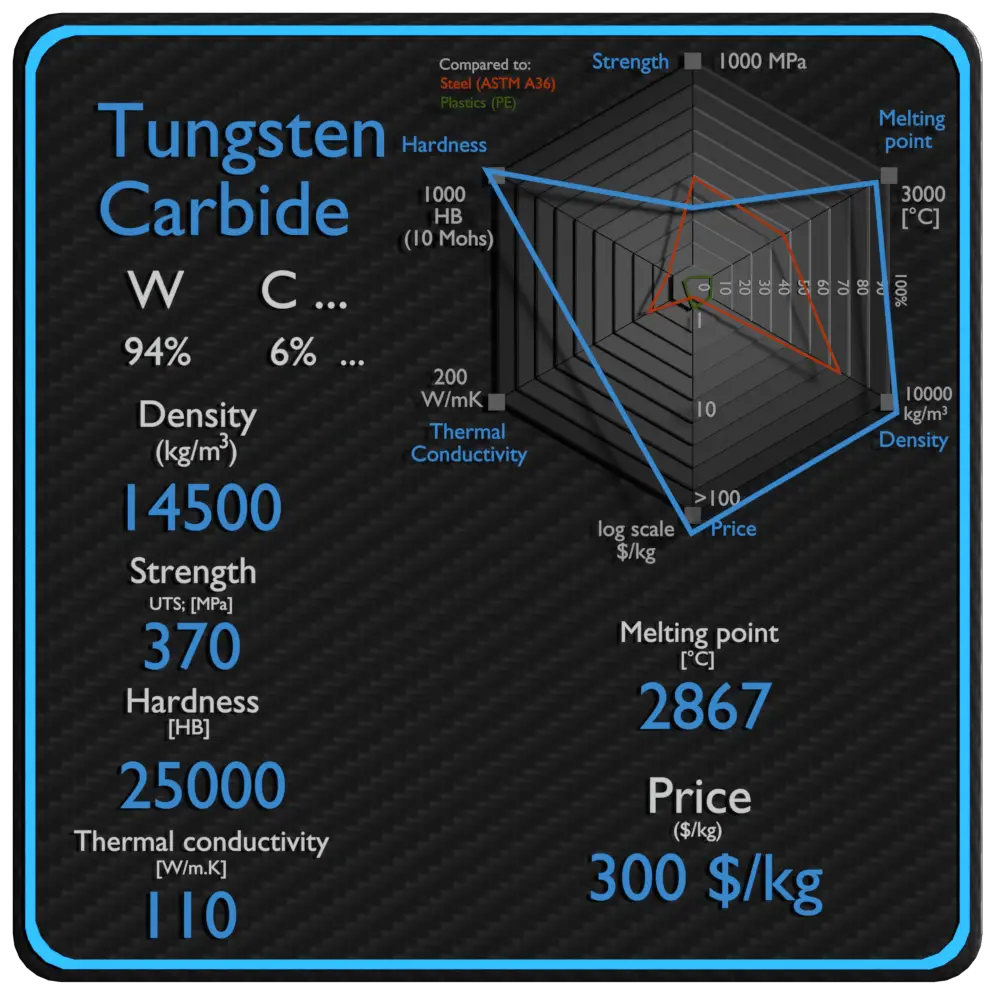
Name Tungsten Carbide
Phase at STP solid
Density 14500 kg/m3
Ultimate Tensile Strength 370 MPa
Yield Strength 330 MPa
Young’s Modulus of Elasticity 600 GPa
Brinell Hardness 25000 BHN
Melting Point 2867 °C
Thermal Conductivity 110 W/mK
Heat Capacity 292 J/g K
Price 300 $/kg

Composition of Tungsten Carbide

Tungsten Carbide is prepared by reaction of tungsten metal and carbon at 1400–2000 °C. Powdered tungsten carbide is mixed with another powdered metal, usually cobalt can be pressed and formed into shapes through a process called sintering. Sintering is usually carried out below the melting temperature, so that a liquid phase is normally not present. Sintering is often chosen as the shaping process for materials with extremely high melting points such as tungsten, molybdenum or uranium dioxide ceramics.

94% Tungsten in Periodic Table

6% Carbon in Periodic Table

Applications of Tungsten Carbide

Tungsten Carbide - Material Table - Applications - Price
Source: wikipedia.org License: CC BY-SA 3.0

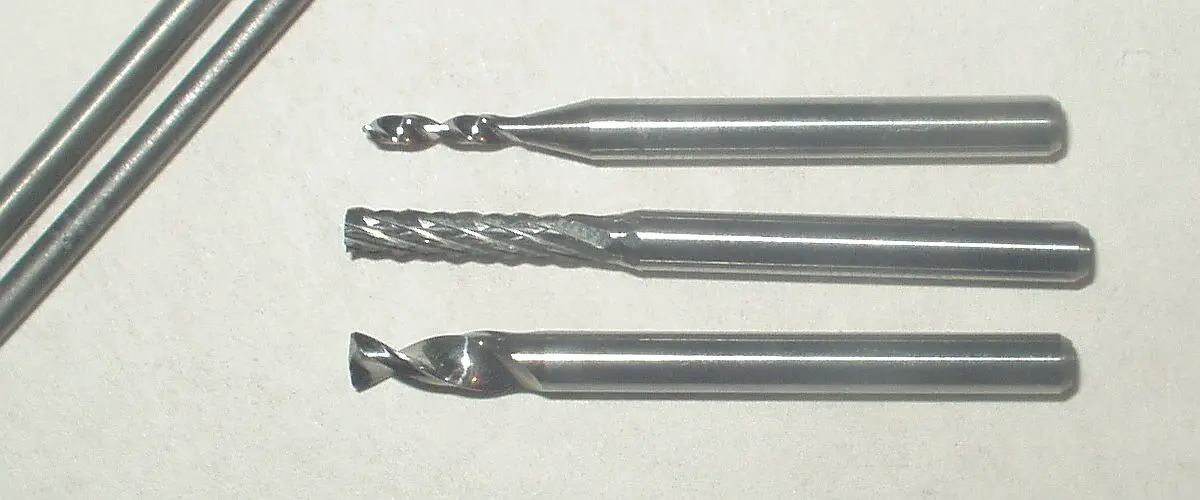
Mining and mineral processing demand wear-resistant machines and components, because the energies and masses of interacting bodies are significant. For this purposes, materials with the highest wear-resistance must be used. For example, Tungsten Carbide is used extensively in mining in top hammer rock drill bits, downhole hammers, roller-cutters, long wall plough chisels, long wall shearer picks, raiseboring reamers, and tunnel boring machines. The cemented composites of tungsten carbide-cobalt are known by many different trade names, including Widia and Carboloy.

Mechanical Properties of Tungsten Carbide

Strength of Tungsten Carbide

In mechanics of materials, the strength of a material is its ability to withstand an applied load without failure or plastic deformation. Strength of materials basically considers the relationship between the external loads applied to a material and the resulting deformation or change in material dimensions. In designing structures and machines, it is important to consider these factors, in order that the material selected will have adequate strength to resist applied loads or forces and retain its original shape.

Strength of a material is its ability to withstand this applied load without failure or plastic deformation. For tensile stress, the capacity of a material or structure to withstand loads tending to elongate is known as ultimate tensile strength (UTS). Yield strength or yield stress is the material property defined as the stress at which a material begins to deform plastically whereas yield point is the point where nonlinear (elastic + plastic) deformation begins. In case of tensional stress of a uniform bar (stress-strain curve), the Hooke’s law describes behaviour of a bar in the elastic region. The Young’s modulus of elasticity is the elastic modulus for tensile and compressive stress in the linear elasticity regime of a uniaxial deformation and is usually assessed by tensile tests.

See also: Strength of Materials

Ultimate Tensile Strength of Tungsten Carbide

Ultimate tensile strength of Tungsten Carbide is 370 MPa.

Yield Strength of Tungsten Carbide

Yield strength of Tungsten Carbide is 330 MPa.

Modulus of Elasticity of Tungsten carbide

The Young’s modulus of elasticity of Tungsten Carbide is 600 MPa.

Hardness of Tungsten Carbide

In materials science, hardness is the ability to withstand surface indentation (localized plastic deformation) and scratching. Brinell hardness test is one of indentation hardness tests, that has been developed for hardness testing. In Brinell tests, a hard, spherical indenter is forced under a specific load into the surface of the metal to be tested.

The Brinell hardness number (HB) is the load divided by the surface area of the indentation. The diameter of the impression is measured with a microscope with a superimposed scale. The Brinell hardness number is computed from the equation:

brinell hardness number - definition

Brinell hardness of Tungsten Carbide is approximately 25000 BHN (converted).

See also: Hardness of Materials

Strength of Materials

Material Table - Strength of Materials

Elasticity of Materials

Material Table - Elasticity of Materials

Hardness of Materials

Material Table - Hardness of Materials  

Thermal Properties of Tungsten Carbide

Tungsten Carbide – Melting Point

Melting point of Tungsten Carbide is 2867 °C.

Note that, these points are associated with the standard atmospheric pressure. In general, melting is a phase change of a substance from the solid to the liquid phase. The melting point of a substance is the temperature at which this phase change occurs. The melting point also defines a condition in which the solid and liquid can exist in equilibrium. For various chemical compounds and alloys, it is difficult to define the melting point, since they are usually a mixture of various chemical elements.

Tungsten Carbide – Thermal Conductivity

Thermal conductivity of Tungsten Carbide is 110 W/(m·K).

The heat transfer characteristics of a solid material are measured by a property called the thermal conductivity, k (or λ), measured in W/m.K. It is a measure of a substance’s ability to transfer heat through a material by conduction. Note that Fourier’s law applies for all matter, regardless of its state (solid, liquid, or gas), therefore, it is also defined for liquids and gases.

The thermal conductivity of most liquids and solids varies with temperature. For vapors, it also depends upon pressure. In general:

thermal conductivity - definition

Most materials are very nearly homogeneous, therefore we can usually write k = k (T). Similar definitions are associated with thermal conductivities in the y- and z-directions (ky, kz), but for an isotropic material the thermal conductivity is independent of the direction of transfer, kx = ky = kz = k.

Tungsten Carbide – Specific Heat

Specific heat of Tungsten Carbide is 292 J/g K.

Specific heat, or specific heat capacity, is a property related to internal energy that is very important in thermodynamics. The intensive properties cv and cp are defined for pure, simple compressible substances as partial derivatives of the internal energy u(T, v) and enthalpy h(T, p), respectively:

where the subscripts v and p denote the variables held fixed during differentiation. The properties cv and cp are referred to as specific heats (or heat capacities) because under certain special conditions they relate the temperature change of a system to the amount of energy added by heat transfer. Their SI units are J/kg K or J/mol K.

Melting Point of Materials

Material Table - Melting Point

Thermal Conductivity of Materials

Material Table - Thermal Conductivity

Heat Capacity of Materials

Material Table - Heat Capacity

Properties and prices of other materials

material-table-in-8k-resolution