Facebook Instagram Youtube Twitter

Platinum – Periodic Table – Atomic Properties

Platinum-density-atomic-number-mass-radius

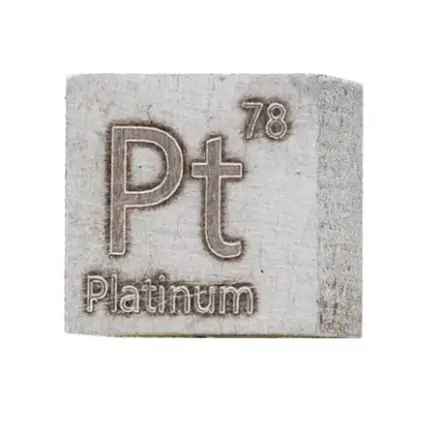
Platinum is a dense, malleable, ductile, highly unreactive, precious, silverish-white transition metal. Platinum is one of the least reactive metals. It has remarkable resistance to corrosion, even at high temperatures, and is therefore considered a noble metal. Platinum is used in catalytic converters, laboratory equipment, electrical contacts and electrodes, platinum resistance thermometers, dentistry equipment, and jewelry.

Summary

Element Platinum
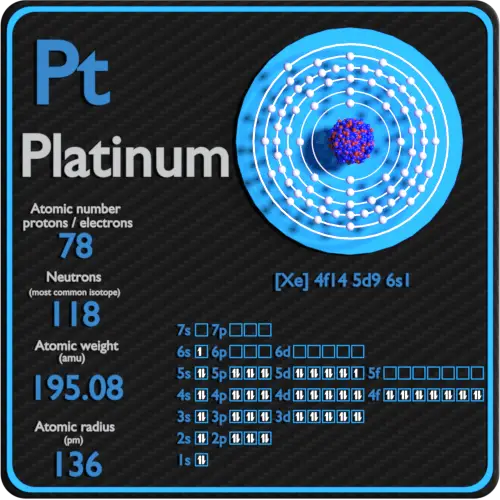
Atomic number 78
Atomic mass [amu] 195.078
Atomic mass [pm] 136
Density at STP [g/cm3] 21.09
Number of protons 78
Number of neutrons (typical isotopes) 194, 195, 196, 198
Number of electrons 78
Electron configuration [Xe] 4f14 5d9 6s1
Oxidation states +2,4
Electron affinity [kJ/mol] 205.3
Electronegativity [Pauling scale] 2.28
First ionization energy [eV] 9

Atomic Number – Protons, Electrons and Neutrons in Platinum
Proton Number - Atomic NumberPlatinum is a chemical element with atomic number 78 which means there are 78 protons in its nucleus. Total number of protons in the nucleus is called the atomic number of the atom and is given the symbol Z. The total electrical charge of the nucleus is therefore +Ze, where e (elementary charge) equals to 1,602 x 10-19 coulombs.

The total number of neutrons in the nucleus of an atom is called the neutron number of the atom and is given the symbol N. Neutron number plus atomic number equals atomic mass number: N+Z=A. The difference between the neutron number and the atomic number is known as the neutron excess: D = N – Z = A – 2Z.

For stable elements, there is usually a variety of stable isotopes. Isotopes are nuclides that have the same atomic number and are therefore the same element, but differ in the number of neutrons. Mass numbers of typical isotopes of Platinum are 194, 195, 196, 198.

Atomic Mass of Platinum

Atomic mass of Platinum is 195.078 u. 

The atomic mass is the mass of an atom. The atomic mass or relative isotopic mass refers to the mass of a single particle, and therefore is tied to a certain specific isotope of an element. The atomic mass is carried by the atomic nucleus, which occupies only about 10-12 of the total volume of the atom or less, but it contains all the positive charge and at least 99.95% of the total mass of the atom. Note that, each element may contain more isotopes, therefore this resulting atomic mass is calculated from naturally-occuring isotopes and their abundance.

Atomic Radius of Platinum

The atomic radius of Platinum atom is 136pm (covalent radius).

Atomic Radius of Chemical Elements

It must be noted, atoms lack a well-defined outer boundary. The atomic radius of a chemical element is a measure of the distance out to which the electron cloud extends from the nucleus. However, this assumes the atom to exhibit a spherical shape, which is only obeyed for atoms in vacuum or free space. Therefore, there are various non-equivalent definitions of atomic radius.

Electrons and Electron Configuration

The number of electrons in an electrically-neutral atom is the same as the number of protons in the nucleus. Therefore, the number of electrons in neutral atom of Platinum is 78. Each electron is influenced by the electric fields produced by the positive nuclear charge and the other (Z – 1) negative electrons in the atom.

Since the number of electrons and their arrangement are responsible for the chemical behavior of atoms, the atomic number identifies the various chemical elements. The configuration of these electrons follows from the principles of quantum mechanics. The number of electrons in each element’s electron shells, particularly the outermost valence shell, is the primary factor in determining its chemical bonding behavior. In the periodic table, the elements are listed in order of increasing atomic number Z.

Electron configuration of Platinum is [Xe] 4f14 5d9 6s1.

Possible oxidation states are +2,4.

Density of Platinum

Density of Platinum is 21.09g/cm3.

Typical densities of various substances are at atmospheric pressure.

Density is defined as the mass per unit volume. It is an intensive property, which is mathematically defined as mass divided by volume:

ρ = m/V

Atomic Masses of Elements
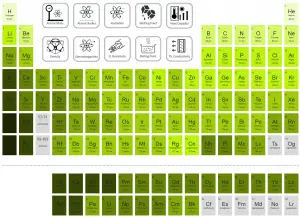
Periodic Table of Elements - atomic mass

Atomic Radii of Elements

Periodic Table of Elements - atomic radius

Densities of Elements

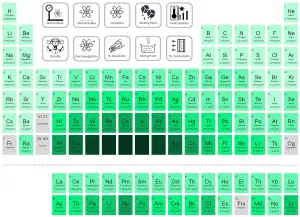
Periodic Table of Elements - density

Platinum-protons-neutrons-electrons-configuration

Platinum-affinity-electronegativity-ionization

Electron Affinity – Platinum

Electron affinity of Platinum is 205.3 kJ/mol.

In chemistry and atomic physics, the electron affinity of an atom or molecule is defined as:

the change in energy (in kJ/mole) of a neutral atom or molecule (in the gaseous phase) when an electron is added to the atom to form a negative ion.

X + e– → X– + energy        Affinity = – ∆H

In other words, it can be expressed as the neutral atom’s likelihood of gaining an electron. Note that, ionization energies measure the tendency of a neutral atom to resist the loss of electrons. Electron affinities are more difficult to measure than ionization energies.

Electronegativity of Platinum

Electronegativity of Platinum is 2.28.

Electronegativity, symbol χ, is a chemical property that describes the tendency of an atom to attract electrons towards this atom. For this purposes, a dimensionless quantity the Pauling scale, symbol χ, is the most commonly used.

The electronegativity of Platinum is: χ = 2.28

First Ionization Energy of Platinum

First Ionization Energy of Platinum is 9 eV.

Ionization energy, also called ionization potential, is the energy necessary to remove an electron from the neutral atom.

X + energy → X+ + e−

where X is any atom or molecule capable of being ionized, X+ is that atom or molecule with an electron removed (positive ion), and e− is the removed electron.

A Platinum atom, for example, requires the following ionization energy to remove the outermost electron.

Pt + IE → Pt+ + e−        IE = 9 eV

Electronegativity of Elements
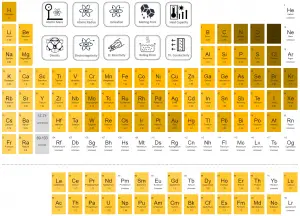
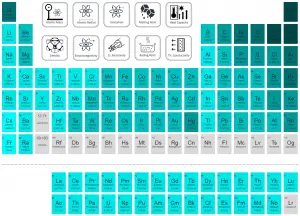
Periodic Table of Elements - electronegativity

Ionization Energy of Elements

Periodic Table of Elements - ionization energy

Platinum-periodic-table

Source: www.luciteria.com


Properties of other elements

Platinum - Comparison of Atomic Properties

Periodic Table in 8K resolution

Other properties of Platinum
 

Iridium – Periodic Table – Atomic Properties

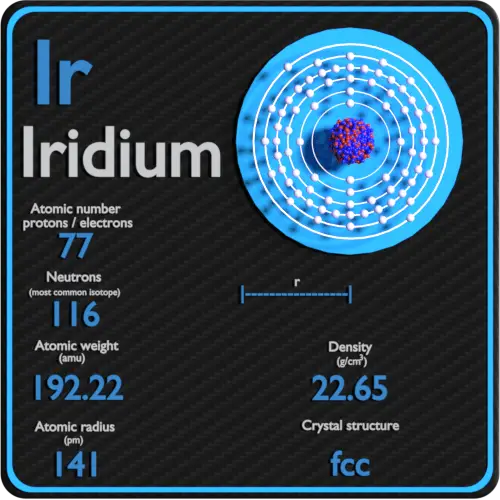
Iridium-density-atomic-number-mass-radius

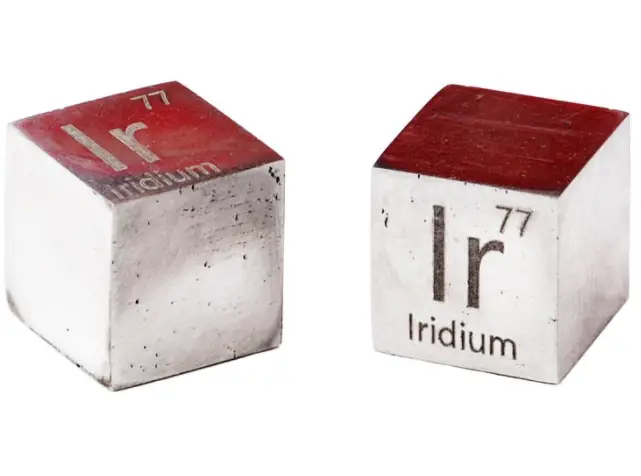
Iridium is a very hard, brittle, silvery-white transition metal of the platinum group, iridium is generally credited with being the second densest element (after osmium). It is also the most corrosion-resistant metal, even at temperatures as high as 2000 °C.

Summary

Element Iridium
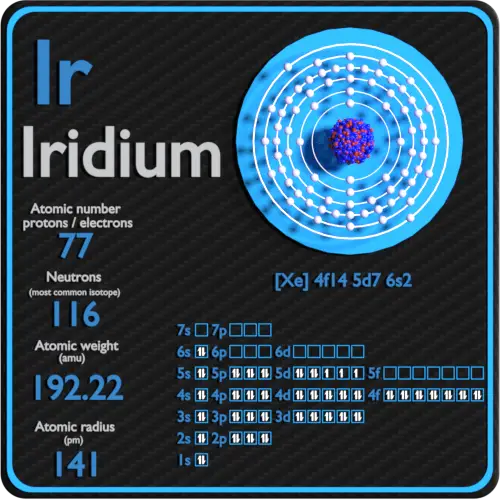
Atomic number 77
Atomic mass [amu] 192.217
Atomic mass [pm] 141
Density at STP [g/cm3] 22.65
Number of protons 77
Number of neutrons (typical isotopes) 191, 193
Number of electrons 77
Electron configuration [Xe] 4f14 5d7 6s2
Oxidation states +3,4
Electron affinity [kJ/mol] 151
Electronegativity [Pauling scale] 2.2
First ionization energy [eV] 9.1

Atomic Number – Protons, Electrons and Neutrons in Iridium

Proton Number - Atomic NumberIridium is a chemical element with atomic number 77 which means there are 77 protons in its nucleus. Total number of protons in the nucleus is called the atomic number of the atom and is given the symbol Z. The total electrical charge of the nucleus is therefore +Ze, where e (elementary charge) equals to 1,602 x 10-19 coulombs.

The total number of neutrons in the nucleus of an atom is called the neutron number of the atom and is given the symbol N. Neutron number plus atomic number equals atomic mass number: N+Z=A. The difference between the neutron number and the atomic number is known as the neutron excess: D = N – Z = A – 2Z.

For stable elements, there is usually a variety of stable isotopes. Isotopes are nuclides that have the same atomic number and are therefore the same element, but differ in the number of neutrons. Mass numbers of typical isotopes of Iridium are 191, 193.

Atomic Mass of Iridium

Atomic mass of Iridium is 192.217 u. 

The atomic mass is the mass of an atom. The atomic mass or relative isotopic mass refers to the mass of a single particle, and therefore is tied to a certain specific isotope of an element. The atomic mass is carried by the atomic nucleus, which occupies only about 10-12 of the total volume of the atom or less, but it contains all the positive charge and at least 99.95% of the total mass of the atom. Note that, each element may contain more isotopes, therefore this resulting atomic mass is calculated from naturally-occuring isotopes and their abundance.

Atomic Radius of Iridium

The atomic radius of Iridium atom is 141pm (covalent radius).

Atomic Radius of Chemical Elements

It must be noted, atoms lack a well-defined outer boundary. The atomic radius of a chemical element is a measure of the distance out to which the electron cloud extends from the nucleus. However, this assumes the atom to exhibit a spherical shape, which is only obeyed for atoms in vacuum or free space. Therefore, there are various non-equivalent definitions of atomic radius.

Electrons and Electron Configuration

The number of electrons in an electrically-neutral atom is the same as the number of protons in the nucleus. Therefore, the number of electrons in neutral atom of Iridium is 77. Each electron is influenced by the electric fields produced by the positive nuclear charge and the other (Z – 1) negative electrons in the atom.

Since the number of electrons and their arrangement are responsible for the chemical behavior of atoms, the atomic number identifies the various chemical elements. The configuration of these electrons follows from the principles of quantum mechanics. The number of electrons in each element’s electron shells, particularly the outermost valence shell, is the primary factor in determining its chemical bonding behavior. In the periodic table, the elements are listed in order of increasing atomic number Z.

Electron configuration of Iridium is [Xe] 4f14 5d7 6s2.

Possible oxidation states are +3,4.

Density of Iridium

Density of Iridium is 22.65g/cm3.

Typical densities of various substances are at atmospheric pressure.

Density is defined as the mass per unit volume. It is an intensive property, which is mathematically defined as mass divided by volume:

ρ = m/V

Atomic Masses of Elements

Periodic Table of Elements - atomic mass

Atomic Radii of Elements

Periodic Table of Elements - atomic radius

Densities of Elements

Periodic Table of Elements - density

Iridium-protons-neutrons-electrons-configuration

Iridium-affinity-electronegativity-ionization

Electron Affinity – Iridium

Electron affinity of Iridium is 151 kJ/mol.

In chemistry and atomic physics, the electron affinity of an atom or molecule is defined as:

the change in energy (in kJ/mole) of a neutral atom or molecule (in the gaseous phase) when an electron is added to the atom to form a negative ion.

X + e– → X– + energy        Affinity = – ∆H

In other words, it can be expressed as the neutral atom’s likelihood of gaining an electron. Note that, ionization energies measure the tendency of a neutral atom to resist the loss of electrons. Electron affinities are more difficult to measure than ionization energies.

Electronegativity of Iridium

Electronegativity of Iridium is 2.2.

Electronegativity, symbol χ, is a chemical property that describes the tendency of an atom to attract electrons towards this atom. For this purposes, a dimensionless quantity the Pauling scale, symbol χ, is the most commonly used.

The electronegativity of Iridium is: χ = 2.2

First Ionization Energy of Iridium

First Ionization Energy of Iridium is 9.1 eV.

Ionization energy, also called ionization potential, is the energy necessary to remove an electron from the neutral atom.

X + energy → X+ + e−

where X is any atom or molecule capable of being ionized, X+ is that atom or molecule with an electron removed (positive ion), and e− is the removed electron.

A Iridium atom, for example, requires the following ionization energy to remove the outermost electron.

Ir + IE → Ir+ + e−        IE = 9.1 eV

Electronegativity of Elements

Periodic Table of Elements - electronegativity

Ionization Energy of Elements

Periodic Table of Elements - ionization energy

Iridium-periodic-table

Source: www.luciteria.com


Properties of other elements

Iridium - Comparison of Atomic Properties

Periodic Table in 8K resolution

Other properties of Iridium


Osmium – Periodic Table – Atomic Properties

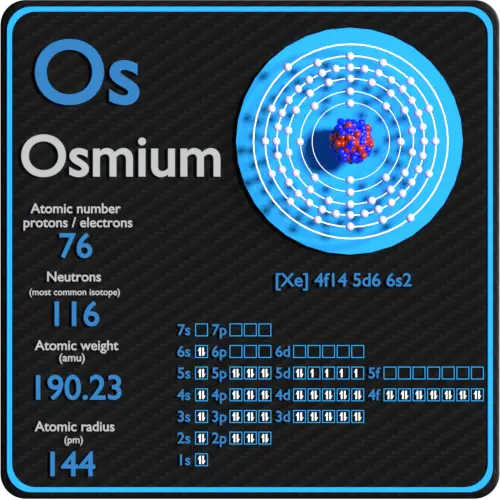
Osmium-density-atomic-number-mass-radius

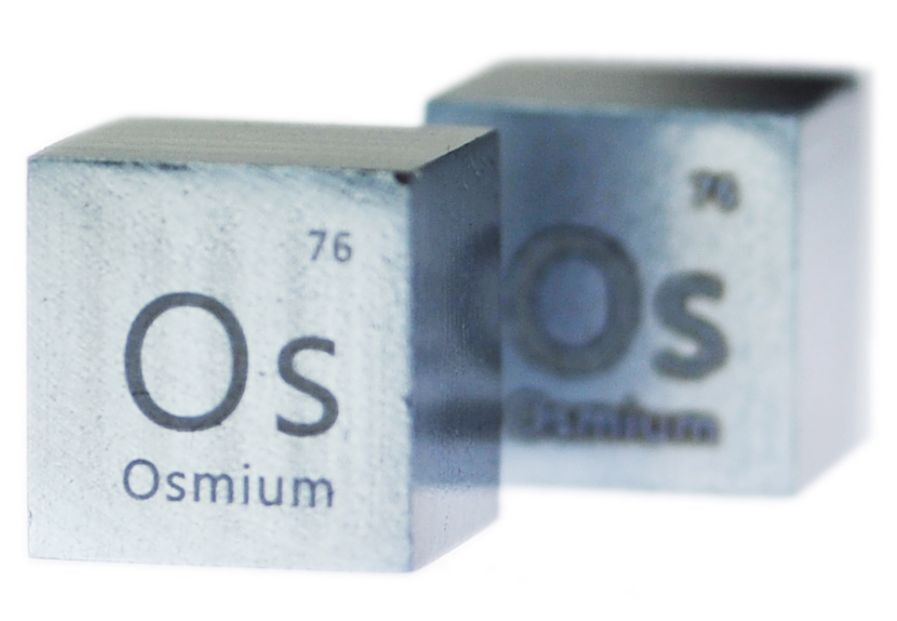
Osmium is a hard, brittle, bluish-white transition metal in the platinum group that is found as a trace element in alloys, mostly in platinum ores. Osmium is the densest naturally occurring element, with a density of 22.59 g/cm3. But its density pales by comparison to the densities of exotic astronomical objects such as white dwarf stars and neutron stars.
Summary

Element Osmium
Atomic number 76
Atomic mass [amu] 190.23
Atomic mass [pm] 144
Density at STP [g/cm3] 22.61
Number of protons 76
Number of neutrons (typical isotopes) 187-190, 192
Number of electrons 76
Electron configuration [Xe] 4f14 5d6 6s2
Oxidation states +3,4
Electron affinity [kJ/mol] 106.1
Electronegativity [Pauling scale] 2.2
First ionization energy [eV] 8.7

Atomic Number – Protons, Electrons and Neutrons in Osmium

Proton Number - Atomic NumberOsmium is a chemical element with atomic number 76 which means there are 76 protons in its nucleus. Total number of protons in the nucleus is called the atomic number of the atom and is given the symbol Z. The total electrical charge of the nucleus is therefore +Ze, where e (elementary charge) equals to 1,602 x 10-19 coulombs.

The total number of neutrons in the nucleus of an atom is called the neutron number of the atom and is given the symbol N. Neutron number plus atomic number equals atomic mass number: N+Z=A. The difference between the neutron number and the atomic number is known as the neutron excess: D = N – Z = A – 2Z.

For stable elements, there is usually a variety of stable isotopes. Isotopes are nuclides that have the same atomic number and are therefore the same element, but differ in the number of neutrons. Mass numbers of typical isotopes of Osmium are 187-190, 192.

Atomic Mass of Osmium

Atomic mass of Osmium is 190.23 u. 

The atomic mass is the mass of an atom. The atomic mass or relative isotopic mass refers to the mass of a single particle, and therefore is tied to a certain specific isotope of an element. The atomic mass is carried by the atomic nucleus, which occupies only about 10-12 of the total volume of the atom or less, but it contains all the positive charge and at least 99.95% of the total mass of the atom. Note that, each element may contain more isotopes, therefore this resulting atomic mass is calculated from naturally-occuring isotopes and their abundance.

Atomic Radius of Osmium

The atomic radius of Osmium atom is 144pm (covalent radius).

Atomic Radius of Chemical Elements

It must be noted, atoms lack a well-defined outer boundary. The atomic radius of a chemical element is a measure of the distance out to which the electron cloud extends from the nucleus. However, this assumes the atom to exhibit a spherical shape, which is only obeyed for atoms in vacuum or free space. Therefore, there are various non-equivalent definitions of atomic radius.

Electrons and Electron Configuration

The number of electrons in an electrically-neutral atom is the same as the number of protons in the nucleus. Therefore, the number of electrons in neutral atom of Osmium is 76. Each electron is influenced by the electric fields produced by the positive nuclear charge and the other (Z – 1) negative electrons in the atom.

Since the number of electrons and their arrangement are responsible for the chemical behavior of atoms, the atomic number identifies the various chemical elements. The configuration of these electrons follows from the principles of quantum mechanics. The number of electrons in each element’s electron shells, particularly the outermost valence shell, is the primary factor in determining its chemical bonding behavior. In the periodic table, the elements are listed in order of increasing atomic number Z.

Electron configuration of Osmium is [Xe] 4f14 5d6 6s2.

Possible oxidation states are +3,4.

Density of Osmium

Density of Osmium is 22.61g/cm3.

Typical densities of various substances are at atmospheric pressure.

Density is defined as the mass per unit volume. It is an intensive property, which is mathematically defined as mass divided by volume:

ρ = m/V

Atomic Masses of Elements

Periodic Table of Elements - atomic mass

Atomic Radii of Elements

Periodic Table of Elements - atomic radius

Densities of Elements

Periodic Table of Elements - density

Osmium-protons-neutrons-electrons-configuration

Osmium-affinity-electronegativity-ionization

Electron Affinity – Osmium

Electron affinity of Osmium is 106.1 kJ/mol.

In chemistry and atomic physics, the electron affinity of an atom or molecule is defined as:

the change in energy (in kJ/mole) of a neutral atom or molecule (in the gaseous phase) when an electron is added to the atom to form a negative ion.

X + e– → X– + energy        Affinity = – ∆H

In other words, it can be expressed as the neutral atom’s likelihood of gaining an electron. Note that, ionization energies measure the tendency of a neutral atom to resist the loss of electrons. Electron affinities are more difficult to measure than ionization energies.

Electronegativity of Osmium

Electronegativity of Osmium is 2.2.

Electronegativity, symbol χ, is a chemical property that describes the tendency of an atom to attract electrons towards this atom. For this purposes, a dimensionless quantity the Pauling scale, symbol χ, is the most commonly used.

The electronegativity of Osmium is: χ = 2.2

First Ionization Energy of Osmium

First Ionization Energy of Osmium is 8.7 eV.

Ionization energy, also called ionization potential, is the energy necessary to remove an electron from the neutral atom.

X + energy → X+ + e−

where X is any atom or molecule capable of being ionized, X+ is that atom or molecule with an electron removed (positive ion), and e− is the removed electron.

A Osmium atom, for example, requires the following ionization energy to remove the outermost electron.

Os + IE → Os+ + e−        IE = 8.7 eV

Electronegativity of Elements

Periodic Table of Elements - electronegativity

Ionization Energy of Elements

Periodic Table of Elements - ionization energy

Osmium-periodic-table

Source: www.luciteria.com


Properties of other elements

Osmium - Comparison of Atomic Properties

Periodic Table in 8K resolution

Other properties of Osmium


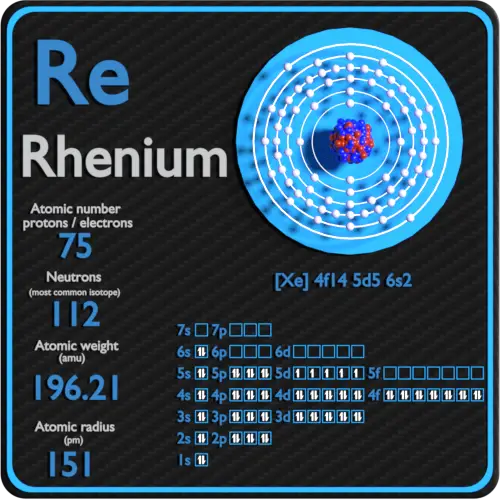
Rhenium – Periodic Table – Atomic Properties

Rhenium-density-atomic-number-mass-radius

Rhenium is a silvery-white, heavy, third-row transition metal in group 7 of the periodic table.

Summary

Element Rhenium
Atomic number 75
Atomic mass [amu] 186.207
Atomic mass [pm] 151
Density at STP [g/cm3] 21.02
Number of protons 75
Number of neutrons (typical isotopes) 185, 187
Number of electrons 75
Electron configuration [Xe] 4f14 5d5 6s2
Oxidation states +4,67
Electron affinity [kJ/mol] 14.5
Electronegativity [Pauling scale] 1.9
First ionization energy [eV] 7.88

Atomic Number – Protons, Electrons and Neutrons in Rhenium

Proton Number - Atomic NumberRhenium is a chemical element with atomic number 75 which means there are 75 protons in its nucleus. Total number of protons in the nucleus is called the atomic number of the atom and is given the symbol Z. The total electrical charge of the nucleus is therefore +Ze, where e (elementary charge) equals to 1,602 x 10-19 coulombs.

The total number of neutrons in the nucleus of an atom is called the neutron number of the atom and is given the symbol N. Neutron number plus atomic number equals atomic mass number: N+Z=A. The difference between the neutron number and the atomic number is known as the neutron excess: D = N – Z = A – 2Z.

For stable elements, there is usually a variety of stable isotopes. Isotopes are nuclides that have the same atomic number and are therefore the same element, but differ in the number of neutrons. Mass numbers of typical isotopes of Rhenium are 185, 187.

Atomic Mass of Rhenium

Atomic mass of Rhenium is 186.207 u. 

The atomic mass is the mass of an atom. The atomic mass or relative isotopic mass refers to the mass of a single particle, and therefore is tied to a certain specific isotope of an element. The atomic mass is carried by the atomic nucleus, which occupies only about 10-12 of the total volume of the atom or less, but it contains all the positive charge and at least 99.95% of the total mass of the atom. Note that, each element may contain more isotopes, therefore this resulting atomic mass is calculated from naturally-occuring isotopes and their abundance.

Atomic Radius of Rhenium

The atomic radius of Rhenium atom is 151pm (covalent radius).

Atomic Radius of Chemical Elements

It must be noted, atoms lack a well-defined outer boundary. The atomic radius of a chemical element is a measure of the distance out to which the electron cloud extends from the nucleus. However, this assumes the atom to exhibit a spherical shape, which is only obeyed for atoms in vacuum or free space. Therefore, there are various non-equivalent definitions of atomic radius.

Electrons and Electron Configuration

The number of electrons in an electrically-neutral atom is the same as the number of protons in the nucleus. Therefore, the number of electrons in neutral atom of Rhenium is 75. Each electron is influenced by the electric fields produced by the positive nuclear charge and the other (Z – 1) negative electrons in the atom.

Since the number of electrons and their arrangement are responsible for the chemical behavior of atoms, the atomic number identifies the various chemical elements. The configuration of these electrons follows from the principles of quantum mechanics. The number of electrons in each element’s electron shells, particularly the outermost valence shell, is the primary factor in determining its chemical bonding behavior. In the periodic table, the elements are listed in order of increasing atomic number Z.

Electron configuration of Rhenium is [Xe] 4f14 5d5 6s2.

Possible oxidation states are +4,67.

Density of Rhenium

Density of Rhenium is 21.02g/cm3.

Typical densities of various substances are at atmospheric pressure.

Density is defined as the mass per unit volume. It is an intensive property, which is mathematically defined as mass divided by volume:

ρ = m/V

Atomic Masses of Elements

Periodic Table of Elements - atomic mass

Atomic Radii of Elements

Periodic Table of Elements - atomic radius

Densities of Elements

Periodic Table of Elements - density

Rhenium-protons-neutrons-electrons-configuration

Rhenium-affinity-electronegativity-ionization

Electron Affinity – Rhenium

Electron affinity of Rhenium is 14.5 kJ/mol.

In chemistry and atomic physics, the electron affinity of an atom or molecule is defined as:

the change in energy (in kJ/mole) of a neutral atom or molecule (in the gaseous phase) when an electron is added to the atom to form a negative ion.

X + e– → X– + energy        Affinity = – ∆H

In other words, it can be expressed as the neutral atom’s likelihood of gaining an electron. Note that, ionization energies measure the tendency of a neutral atom to resist the loss of electrons. Electron affinities are more difficult to measure than ionization energies.

Electronegativity of Rhenium

Electronegativity of Rhenium is 1.9.

Electronegativity, symbol χ, is a chemical property that describes the tendency of an atom to attract electrons towards this atom. For this purposes, a dimensionless quantity the Pauling scale, symbol χ, is the most commonly used.

The electronegativity of Rhenium is: χ = 1.9

First Ionization Energy of Rhenium

First Ionization Energy of Rhenium is 7.88 eV.

Ionization energy, also called ionization potential, is the energy necessary to remove an electron from the neutral atom.

X + energy → X+ + e−

where X is any atom or molecule capable of being ionized, X+ is that atom or molecule with an electron removed (positive ion), and e− is the removed electron.

A Rhenium atom, for example, requires the following ionization energy to remove the outermost electron.

Re + IE → Re+ + e−        IE = 7.88 eV

Electronegativity of Elements

Periodic Table of Elements - electronegativity

Ionization Energy of Elements

Periodic Table of Elements - ionization energy

Rhenium-periodic-table

Source: www.luciteria.com


Properties of other elements

Rhenium - Comparison of Atomic Properties

Periodic Table in 8K resolution

Other properties of Rhenium


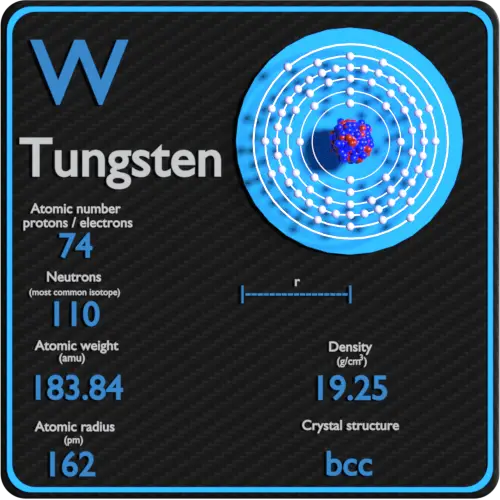
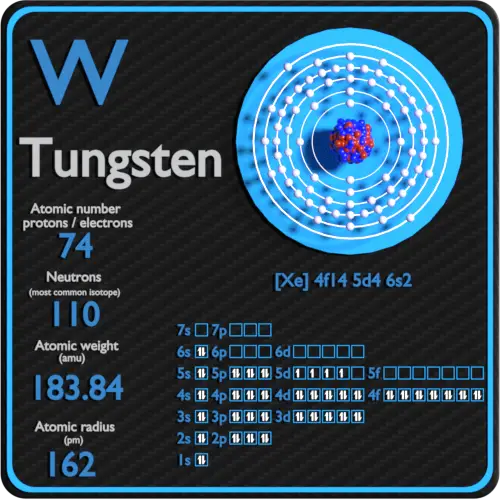
Tungsten – Periodic Table – Atomic Properties

Tungsten-density-atomic-number-mass-radius

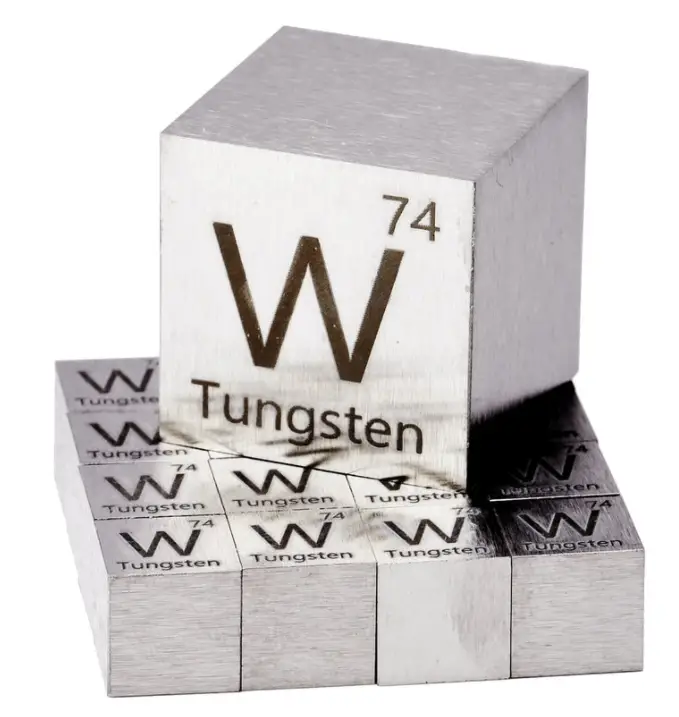
Tungsten is a rare metal that occurs naturally on Earth almost exclusively in chemical compounds. Tungsten is an inherently brittle and hard material, which makes it difficult to work.

Resumen

Element Tungsten
Atomic number 74
Atomic mass [amu] 183.84
Atomic mass [pm] 162
Density at STP [g / cm3] 19.25
Number of protons 74
Number of neutrons (typical isotopes) 182-184, 186
Number of electrons 74
Electron configuration [Xe] 4f14 5d4 6s2
Oxidation states +6
Electron affinity [kJ/mol] 78.6
EElectronegativity [Pauling scale] 2.36
First ionization energy [eV] 7.98

Atomic Number – Protons, Electrons and Neutrons in Tungsten

Proton Number - Atomic NumberTungsten is a chemical element with atomic number 74 which means there are 75 protons in its nucleus. Total number of protons in the nucleus is called the atomic number of the atom and is given the symbol Z. The total electrical charge of the nucleus is therefore +Ze, where e (elementary charge) equals to 1,602 x 10-19 coulombs.

The total number of neutrons in the nucleus of an atom is called the neutron number of the atom and is given the symbol N. Neutron number plus atomic number equals atomic mass number: N+Z=A. The difference between the neutron number and the atomic number is known as the neutron excess: D = N – Z = A – 2Z.

For stable elements, there is usually a variety of stable isotopes. Isotopes are nuclides that have the same atomic number and are therefore the same element, but differ in the number of neutrons. Mass numbers of typical isotopes of Rhenium are 185, 187.

Atomic Mass of Tungsten

Atomic mass of Tungsten is 183.84 u. 

The atomic mass is the mass of an atom. The atomic mass or relative isotopic mass refers to the mass of a single particle, and therefore is tied to a certain specific isotope of an element. The atomic mass is carried by the atomic nucleus, which occupies only about 10-12 of the total volume of the atom or less, but it contains all the positive charge and at least 99.95% of the total mass of the atom. Note that, each element may contain more isotopes, therefore this resulting atomic mass is calculated from naturally-occuring isotopes and their abundance.

Atomic Radius of Tungsten

The atomic radius of Tungsten atom is 162pm (covalent radius).

Atomic Radius of Chemical Elements

It must be noted, atoms lack a well-defined outer boundary. The atomic radius of a chemical element is a measure of the distance out to which the electron cloud extends from the nucleus. However, this assumes the atom to exhibit a spherical shape, which is only obeyed for atoms in vacuum or free space. Therefore, there are various non-equivalent definitions of atomic radius.

Electrons and Electron Configuration

The number of electrons in an electrically-neutral atom is the same as the number of protons in the nucleus. Therefore, the number of electrons in neutral atom of Tungsten is 74. Each electron is influenced by the electric fields produced by the positive nuclear charge and the other (Z – 1) negative electrons in the atom.

Since the number of electrons and their arrangement are responsible for the chemical behavior of atoms, the atomic number identifies the various chemical elements. The configuration of these electrons follows from the principles of quantum mechanics. The number of electrons in each element’s electron shells, particularly the outermost valence shell, is the primary factor in determining its chemical bonding behavior. In the periodic table, the elements are listed in order of increasing atomic number Z.

Electron configuration of Tungsten is [Xe] 4f14 5d4 6s2.

Possible oxidation states are +6.

Density of Tungsten

Density of Tungsten is 19.25g/cm3.

Typical densities of various substances are at atmospheric pressure.

Density is defined as the mass per unit volume. It is an intensive property, which is mathematically defined as mass divided by volume:

ρ = m/V

Atomic Masses of Elements

Periodic Table of Elements - atomic mass

Atomic Radii of Elements

Periodic Table of Elements - atomic radius

Densities of Elements

Periodic Table of Elements - density

Tungsten-protons-neutrons-electrons-configuration

Tungsten-affinity-electronegativity-ionization

Electron Affinity – Tungsten

Electron affinity of Tungsten is 78.6 kJ/mol.

In chemistry and atomic physics, the electron affinity of an atom or molecule is defined as:

the change in energy (in kJ/mole) of a neutral atom or molecule (in the gaseous phase) when an electron is added to the atom to form a negative ion.

X + e– → X– + energy        Affinity = – ∆H

In other words, it can be expressed as the neutral atom’s likelihood of gaining an electron. Note that, ionization energies measure the tendency of a neutral atom to resist the loss of electrons. Electron affinities are more difficult to measure than ionization energies.

Electronegativity of Tungsten

Electronegativity of Tungsten is 2.36.

Electronegativity, symbol χ, is a chemical property that describes the tendency of an atom to attract electrons towards this atom. For this purposes, a dimensionless quantity the Pauling scale, symbol χ, is the most commonly used.

The electronegativity of Tungsten is: χ = 2.36

First Ionization Energy of Tungsten

First Ionization Energy of Tungsten is 7.98 eV.

Ionization energy, also called ionization potential, is the energy necessary to remove an electron from the neutral atom.

X + energy → X+ + e−

where X is any atom or molecule capable of being ionized, X+ is that atom or molecule with an electron removed (positive ion), and e− is the removed electron.

A Tungsten atom, for example, requires the following ionization energy to remove the outermost electron.

W + IE → W+ + e−        IE = 7.98 eV

Electronegativity of Elements

Periodic Table of Elements - electronegativity

Ionization Energy of Elements

Periodic Table of Elements - ionization energy

Tungsten-periodic-table

Source: www.luciteria.com


Properties of other elements

Tungsten - Comparison of Atomic Properties

Periodic Table in 8K resolution

Other properties of Tungsten


Tantalum – Periodic Table – Atomic Properties

Tantalum-density-atomic-number-mass-radius

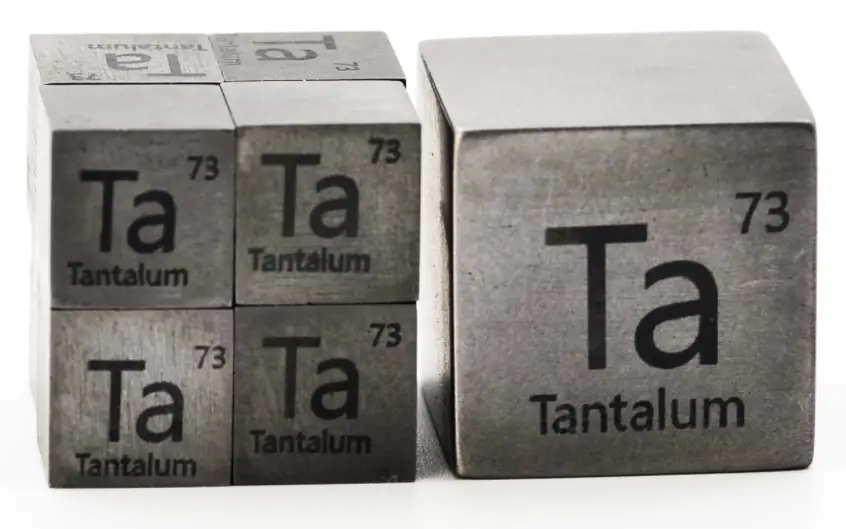
Tantalum is a rare, hard, blue-gray, shiny transition metal that is highly resistant to corrosion.

Resumen

Element Tantalum
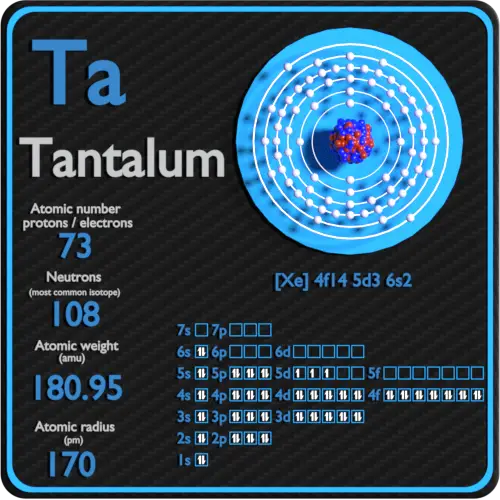
Atomic number 73
Atomic mass [amu] 180.9479
Atomic mass [pm] 170
Density at STP [g / cm3] 16.65
Number of protons 73
Number of neutrons (typical isotopes) 181
Number of electrons 73
Electron configuration [Xe] 4f14 5d3 6s2
Oxidation states +5
Electron affinity [kJ/mol] 31
Electronegativity [Pauling scale] 1.5
First ionization energy [eV] 7.89

Atomic number: protons, electrons and neutrons in Tantalum

Proton Number - Atomic Number

Tantalum is a chemical element with atomic number 73, which means that there are 73 protons in its nucleus. Total number of protons in the nucleus is called the atomic number of the atom and is given the symbol Z. The total electric charge of the nucleus is therefore + Ze, where e (elemental charge) is equal to 1.602 x 10⁻¹⁹  coulombs.

The total number of neutrons in the nucleus of an atom is called the number of neutrons in the atom and is given the symbol N. Number of neutrons plus atomic number equals atomic mass number: N + Z = A. The difference between the number of neutrons and the atomic number is known as the excess neutrons: D = N – Z = A – 2Z.

For stable elements, there are usually a variety of stable isotopes. Isotopes are nuclides that have the same atomic number and are therefore the same element, but differ in the number of neutrons. The typical isotope mass of tantalum is 181.

Atomic mass of Tantalum

The atomic mass of tantalum is 180.9479 u.

Atomic mass is the mass of an atom. Atomic mass or relative isotopic mass refers to the mass of a single particle and is therefore bound to a certain specific isotope of an element. Atomic mass is carried by the atomic nucleus, which occupies only about 10-12  of the total volume of the atom or less, but contains all of the positive charge and at least 99.95% of the total mass of the atom. Note that each element can contain more isotopes, therefore this resulting atomic mass is calculated from the natural isotopes and their abundance.

Atomic radius of Tantalum

The atomic radius of the tantalum atom is 170 pm (covalent radius).Atomic Radius of Chemical Elements

It should be noted that atoms lack a well-defined outer limit. The atomic radius of a chemical element is a measure of the distance the electron cloud extends from the nucleus. However, this assumes that the atom exhibits a spherical shape, which is only obeyed for atoms in a vacuum or free space. Therefore, there are several non-equivalent definitions of atomic radius.


Electrons and electron configuration

The number of electrons in an electrically neutral atom is the same as the number of protons in the nucleus. Therefore, the number of electrons in the neutral tantalum atom is 73. Each electron is influenced by the electric fields produced by the positive nuclear charge and the other negative electrons (Z – 1) in the atom.

Since the number of electrons and their arrangement are responsible for the chemical behavior of atoms, the atomic number identifies the various chemical elements. The configuration of these electrons is derived from the principles of quantum mechanics. The number of electrons in the electron shells of each element, particularly the outermost valence shell, is the main factor in determining its chemical bonding behavior. In the periodic table, the elements are listed in order of increasing atomic number Z.

The electron configuration of tantalum is [Xe] 4f14 5d3 6s2.

Possible oxidation states are +5.

Tantalum density

The density of tantalum is 16.65 g / cm 3 .

Typical densities of various substances are at atmospheric pressure.

Density is defined as the mass per unit volume. It is an intensive property, which is mathematically defined as mass divided by volume:

ρ = m/V

Atomic Masses of Elements

Periodic Table of Elements - atomic mass

Atomic Radii of Elements

Periodic Table of Elements - atomic radius

Densities of Elements

Periodic Table of Elements - density

Tantalum-protons-neutrons-electrons-configuration

Tantalum-affinity-electronegativity-ionization

Electron Affinity – Tantalum

Electron affinity of Tantalum is 31 kJ/mol.

In chemistry and atomic physics, the electron affinity of an atom or molecule is defined as:

the change in energy (in kJ/mole) of a neutral atom or molecule (in the gaseous phase) when an electron is added to the atom to form a negative ion.

X + e– → X– + energy        Affinity = – ∆H

In other words, it can be expressed as the neutral atom’s likelihood of gaining an electron. Note that, ionization energies measure the tendency of a neutral atom to resist the loss of electrons. Electron affinities are more difficult to measure than ionization energies.

Electronegativity of Tantalum

Electronegativity of Tantalum is 1.5.

Electronegativity, symbol χ, is a chemical property that describes the tendency of an atom to attract electrons towards this atom. For this purposes, a dimensionless quantity the Pauling scale, symbol χ, is the most commonly used.

The electronegativity of Tantalum is: χ = 1.5

First Ionization Energy of Tantalum

First Ionization Energy of Tantalum is 7.89 eV.

Ionization energy, also called ionization potential, is the energy necessary to remove an electron from the neutral atom.

X + energy → X+ + e−

where X is any atom or molecule capable of being ionized, X+ is that atom or molecule with an electron removed (positive ion), and e− is the removed electron.

A Tantalum atom, for example, requires the following ionization energy to remove the outermost electron.

Ta + IE → Ta+ + e−        IE = 7.89 eV

Electronegativity of Elements

Periodic Table of Elements - electronegativity

Ionization Energy of Elements

Periodic Table of Elements - ionization energy

Tantalum-periodic-table

Source: www.luciteria.com


Properties of other elements

Tantalum - Comparison of Atomic Properties

Periodic Table in 8K resolution

Other properties of Tantalum


Hafnium – Periodic Table – Atomic Properties

Hafnium-density-atomic-number-mass-radius

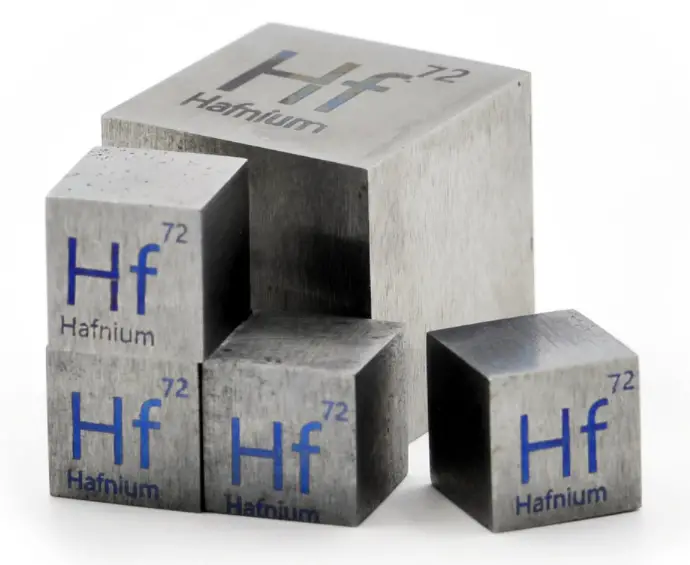
Hafnium is a lustrous, silvery gray, tetravalent transition metal, hafnium chemically resembles zirconium and is found in many zirconium minerals. Hafnium’s large neutron capture cross-section makes it a good material for neutron absorption in control rods in nuclear power plants, but at the same time requires that it be removed from the neutron-transparent corrosion-resistant zirconium alloys used in nuclear reactors.

Summary

Element Hafnium
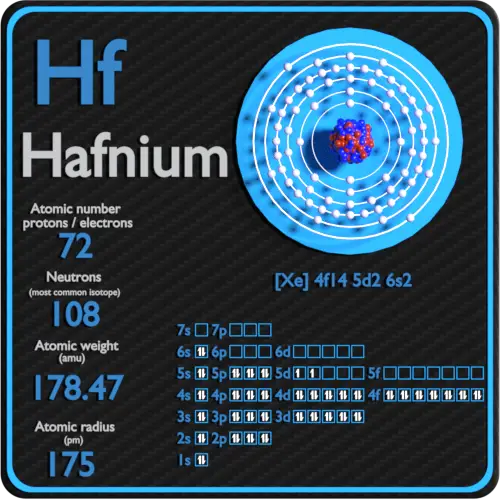
Atomic number 72
Atomic mass [amu] 178.49
Atomic mass [pm] 175
Density at STP [g/cm3] 13.31
Number of protons 72
Number of neutrons (typical isotopes) 176-178, 179, 180
Number of electrons 72
Electron configuration [Xe] 4f14 5d2 6s2
Oxidation states +4
Electron affinity [kJ/mol] 0
Electronegativity [Pauling scale] 1.3
First ionization energy [eV] 6.8251

Atomic Number – Protons, Electrons and Neutrons in Hafnium

Proton Number - Atomic NumberHafnium is a chemical element with atomic number 72 which means there are 72 protons in its nucleus. Total number of protons in the nucleus is called the atomic number of the atom and is given the symbol Z. The total electrical charge of the nucleus is therefore +Ze, where e (elementary charge) equals to 1,602 x 10-19 coulombs.

The total number of neutrons in the nucleus of an atom is called the neutron number of the atom and is given the symbol N. Neutron number plus atomic number equals atomic mass number: N+Z=A. The difference between the neutron number and the atomic number is known as the neutron excess: D = N – Z = A – 2Z.

For stable elements, there is usually a variety of stable isotopes. Isotopes are nuclides that have the same atomic number and are therefore the same element, but differ in the number of neutrons. Mass numbers of typical isotopes of Hafnium are 176-178, 179, 180.

Atomic Mass of Hafnium

Atomic mass of Hafnium is 178.49 u. 

The atomic mass is the mass of an atom. The atomic mass or relative isotopic mass refers to the mass of a single particle, and therefore is tied to a certain specific isotope of an element. The atomic mass is carried by the atomic nucleus, which occupies only about 10-12 of the total volume of the atom or less, but it contains all the positive charge and at least 99.95% of the total mass of the atom. Note that, each element may contain more isotopes, therefore this resulting atomic mass is calculated from naturally-occuring isotopes and their abundance.

Atomic Radius of Hafnium

The atomic radius of Hafnium atom is 175pm (covalent radius).

Atomic Radius of Chemical Elements

It must be noted, atoms lack a well-defined outer boundary. The atomic radius of a chemical element is a measure of the distance out to which the electron cloud extends from the nucleus. However, this assumes the atom to exhibit a spherical shape, which is only obeyed for atoms in vacuum or free space. Therefore, there are various non-equivalent definitions of atomic radius.

Electrons and Electron Configuration

The number of electrons in an electrically-neutral atom is the same as the number of protons in the nucleus. Therefore, the number of electrons in neutral atom of Hafnium is 72. Each electron is influenced by the electric fields produced by the positive nuclear charge and the other (Z – 1) negative electrons in the atom.

Since the number of electrons and their arrangement are responsible for the chemical behavior of atoms, the atomic number identifies the various chemical elements. The configuration of these electrons follows from the principles of quantum mechanics. The number of electrons in each element’s electron shells, particularly the outermost valence shell, is the primary factor in determining its chemical bonding behavior. In the periodic table, the elements are listed in order of increasing atomic number Z.

Electron configuration of Hafnium is [Xe] 4f14 5d2 6s2.

Possible oxidation states are +4.

Density of Hafnium

Density of Hafnium is 13.31g/cm3.

Typical densities of various substances are at atmospheric pressure.

Density is defined as the mass per unit volume. It is an intensive property, which is mathematically defined as mass divided by volume:

ρ = m/V

Atomic Masses of Elements

Periodic Table of Elements - atomic mass

Atomic Radii of Elements

Periodic Table of Elements - atomic radius

Densities of Elements

Periodic Table of Elements - density

Hafnium-protons-neutrons-electrons-configuration

Hafnium-affinity-electronegativity-ionization

Electron Affinity – Hafnium

Electron affinity of Hafnium is 0 kJ/mol.

In chemistry and atomic physics, the electron affinity of an atom or molecule is defined as:

the change in energy (in kJ/mole) of a neutral atom or molecule (in the gaseous phase) when an electron is added to the atom to form a negative ion.

X + e– → X– + energy        Affinity = – ∆H

In other words, it can be expressed as the neutral atom’s likelihood of gaining an electron. Note that, ionization energies measure the tendency of a neutral atom to resist the loss of electrons. Electron affinities are more difficult to measure than ionization energies.

Electronegativity of Hafnium

Electronegativity of Hafnium is 1.3.

Electronegativity, symbol χ, is a chemical property that describes the tendency of an atom to attract electrons towards this atom. For this purposes, a dimensionless quantity the Pauling scale, symbol χ, is the most commonly used.

The electronegativity of Hafnium is: χ = 1.3

First Ionization Energy of Hafnium

First Ionization Energy of Hafnium is 6.8251 eV.

Ionization energy, also called ionization potential, is the energy necessary to remove an electron from the neutral atom.

X + energy → X+ + e−

where X is any atom or molecule capable of being ionized, X+ is that atom or molecule with an electron removed (positive ion), and e− is the removed electron.

A Hafnium atom, for example, requires the following ionization energy to remove the outermost electron.

Hf + IE → Hf+ + e−        IE = 6.8251 eV

Electronegativity of Elements

Periodic Table of Elements - electronegativity

Ionization Energy of Elements

Periodic Table of Elements - ionization energy

Hafnium-periodic-table

Source: www.luciteria.com


Properties of other elements

Hafnium - Comparison of Atomic Properties

Periodic Table in 8K resolution

Other properties of Hafnium


Lutetium – Periodic Table – Atomic Properties

Lutetium-density-atomic-number-mass-radius

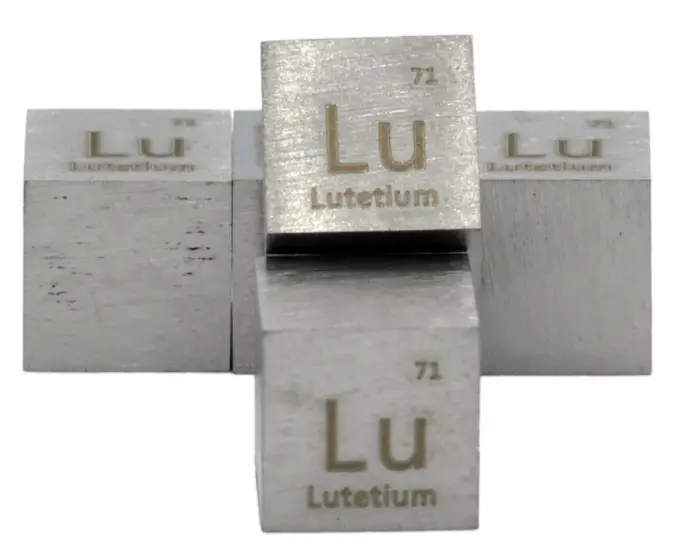
Lutetium is a silvery white metal, which resists corrosion in dry air, but not in moist air. Lutetium is the last element in the lanthanide series, and it is traditionally counted among the rare earths.

Summary

Element Lutetium
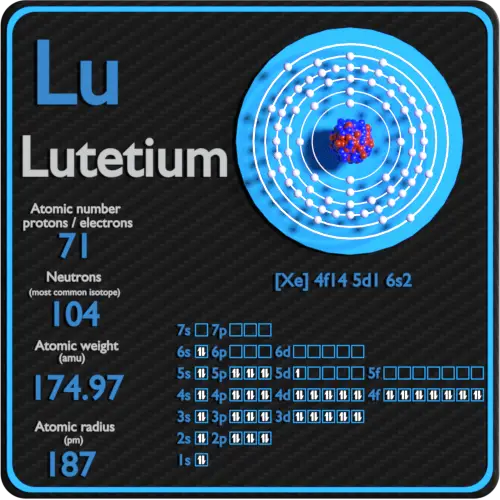
Atomic number 71
Atomic mass [amu] 174.967
Atomic mass [pm] 187
Density at STP [g/cm3] 9.841
Number of protons 71
Number of neutrons (typical isotopes) 175
Number of electrons 71
Electron configuration [Xe] 4f14 5d1 6s2
Oxidation states +3
Electron affinity [kJ/mol] 50
Electronegativity [Pauling scale] 1.27
First ionization energy [eV] 5.4259

Atomic Number – Protons, Electrons and Neutrons in Lutetium

Proton Number - Atomic NumberLutetium is a chemical element with atomic number 71 which means there are 71 protons in its nucleus. Total number of protons in the nucleus is called the atomic number of the atom and is given the symbol Z. The total electrical charge of the nucleus is therefore +Ze, where e (elementary charge) equals to 1,602 x 10-19 coulombs.

The total number of neutrons in the nucleus of an atom is called the neutron number of the atom and is given the symbol N. Neutron number plus atomic number equals atomic mass number: N+Z=A. The difference between the neutron number and the atomic number is known as the neutron excess: D = N – Z = A – 2Z.

For stable elements, there is usually a variety of stable isotopes. Isotopes are nuclides that have the same atomic number and are therefore the same element, but differ in the number of neutrons. Mass numbers of typical isotopes of Lutetium are 175.

Atomic Mass of Lutetium

Atomic mass of Lutetium is 174.967 u. 

The atomic mass is the mass of an atom. The atomic mass or relative isotopic mass refers to the mass of a single particle, and therefore is tied to a certain specific isotope of an element. The atomic mass is carried by the atomic nucleus, which occupies only about 10-12 of the total volume of the atom or less, but it contains all the positive charge and at least 99.95% of the total mass of the atom. Note that, each element may contain more isotopes, therefore this resulting atomic mass is calculated from naturally-occuring isotopes and their abundance.

Atomic Radius of Lutetium

The atomic radius of Lutetium atom is 187pm (covalent radius).

Atomic Radius of Chemical Elements

It must be noted, atoms lack a well-defined outer boundary. The atomic radius of a chemical element is a measure of the distance out to which the electron cloud extends from the nucleus. However, this assumes the atom to exhibit a spherical shape, which is only obeyed for atoms in vacuum or free space. Therefore, there are various non-equivalent definitions of atomic radius.

Electrons and Electron Configuration

The number of electrons in an electrically-neutral atom is the same as the number of protons in the nucleus. Therefore, the number of electrons in neutral atom of Lutetium is 71. Each electron is influenced by the electric fields produced by the positive nuclear charge and the other (Z – 1) negative electrons in the atom.

Since the number of electrons and their arrangement are responsible for the chemical behavior of atoms, the atomic number identifies the various chemical elements. The configuration of these electrons follows from the principles of quantum mechanics. The number of electrons in each element’s electron shells, particularly the outermost valence shell, is the primary factor in determining its chemical bonding behavior. In the periodic table, the elements are listed in order of increasing atomic number Z.

Electron configuration of Lutetium is [Xe] 4f14 5d1 6s2.

Possible oxidation states are +3.

Density of Lutetium

Density of Lutetium is 9.841g/cm3.

Typical densities of various substances are at atmospheric pressure.

Density is defined as the mass per unit volume. It is an intensive property, which is mathematically defined as mass divided by volume:

ρ = m/V

Atomic Masses of Elements

Periodic Table of Elements - atomic mass

Atomic Radii of Elements

Periodic Table of Elements - atomic radius

Densities of Elements

Periodic Table of Elements - density

Lutetium-protons-neutrons-electrons-configuration

Lutetium-affinity-electronegativity-ionization

Electron Affinity – Lutetium

Electron affinity of Lutetium is 50 kJ/mol.

In chemistry and atomic physics, the electron affinity of an atom or molecule is defined as:

the change in energy (in kJ/mole) of a neutral atom or molecule (in the gaseous phase) when an electron is added to the atom to form a negative ion.

X + e– → X– + energy        Affinity = – ∆H

In other words, it can be expressed as the neutral atom’s likelihood of gaining an electron. Note that, ionization energies measure the tendency of a neutral atom to resist the loss of electrons. Electron affinities are more difficult to measure than ionization energies.

Electronegativity of Lutetium

Electronegativity of Lutetium is 1.27.

Electronegativity, symbol χ, is a chemical property that describes the tendency of an atom to attract electrons towards this atom. For this purposes, a dimensionless quantity the Pauling scale, symbol χ, is the most commonly used.

The electronegativity of Lutetium is: χ = 1.27

First Ionization Energy of Lutetium

First Ionization Energy of Lutetium is 5.4259 eV.

Ionization energy, also called ionization potential, is the energy necessary to remove an electron from the neutral atom.

X + energy → X+ + e−

where X is any atom or molecule capable of being ionized, X+ is that atom or molecule with an electron removed (positive ion), and e− is the removed electron.

A Lutetium atom, for example, requires the following ionization energy to remove the outermost electron.

Lu + IE → Lu+ + e−        IE = 5.4259 eV

Electronegativity of Elements

Periodic Table of Elements - electronegativity

Ionization Energy of Elements

Periodic Table of Elements - ionization energy

Lutetium-periodic-table

Source: www.luciteria.com


Properties of other elements

Lutetium - Comparison of Atomic Properties

Periodic Table in 8K resolution

Other properties of Lutetium


Ytterbium – Periodic Table – Atomic Properties

Ytterbium-density-atomic-number-mass-radius

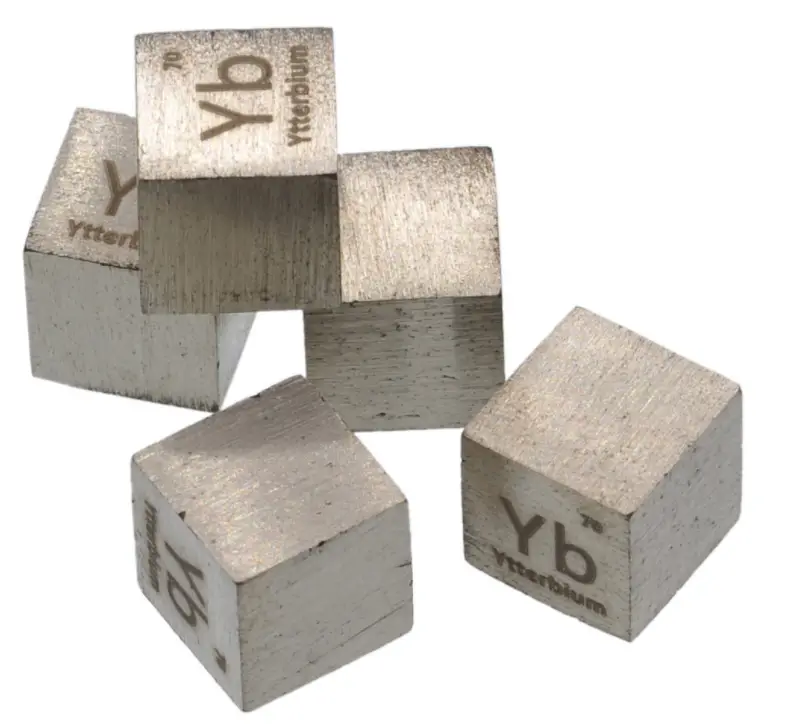
Because of its closed-shell electron configuration, its density and melting and boiling points differ significantly from those of most other lanthanides.

Summary

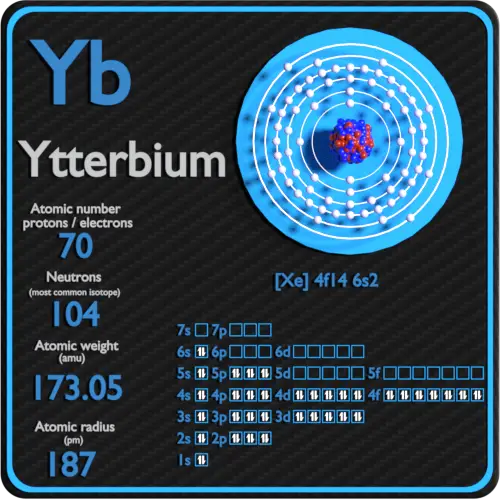
Element Ytterbium
Atomic number 70
Atomic mass [amu] 173.04
Atomic mass [pm] 187
Density at STP [g/cm3] 6.57
Number of protons 70
Number of neutrons (typical isotopes) 170-174, 176
Number of electrons 70
Electron configuration [Xe] 4f14 6s2
Oxidation states +2,3
Electron affinity [kJ/mol] 50
Electronegativity [Pauling scale] —
First ionization energy [eV] 6.2542

Atomic Number – Protons, Electrons and Neutrons in Ytterbium

Proton Number - Atomic NumberYtterbium is a chemical element with atomic number 70 which means there are 70 protons in its nucleus. Total number of protons in the nucleus is called the atomic number of the atom and is given the symbol Z. The total electrical charge of the nucleus is therefore +Ze, where e (elementary charge) equals to 1,602 x 10-19 coulombs.

The total number of neutrons in the nucleus of an atom is called the neutron number of the atom and is given the symbol N. Neutron number plus atomic number equals atomic mass number: N+Z=A. The difference between the neutron number and the atomic number is known as the neutron excess: D = N – Z = A – 2Z.

For stable elements, there is usually a variety of stable isotopes. Isotopes are nuclides that have the same atomic number and are therefore the same element, but differ in the number of neutrons. Mass numbers of typical isotopes of Ytterbium are 170-174, 176.

Atomic Mass of Ytterbium

Atomic mass of Ytterbium is 173.04 u. 

The atomic mass is the mass of an atom. The atomic mass or relative isotopic mass refers to the mass of a single particle, and therefore is tied to a certain specific isotope of an element. The atomic mass is carried by the atomic nucleus, which occupies only about 10-12 of the total volume of the atom or less, but it contains all the positive charge and at least 99.95% of the total mass of the atom. Note that, each element may contain more isotopes, therefore this resulting atomic mass is calculated from naturally-occuring isotopes and their abundance.

Atomic Radius of Ytterbium

The atomic radius of Ytterbium atom is 187pm (covalent radius).

Atomic Radius of Chemical Elements

It must be noted, atoms lack a well-defined outer boundary. The atomic radius of a chemical element is a measure of the distance out to which the electron cloud extends from the nucleus. However, this assumes the atom to exhibit a spherical shape, which is only obeyed for atoms in vacuum or free space. Therefore, there are various non-equivalent definitions of atomic radius.

Electrons and Electron Configuration

The number of electrons in an electrically-neutral atom is the same as the number of protons in the nucleus. Therefore, the number of electrons in neutral atom of Ytterbium is 70. Each electron is influenced by the electric fields produced by the positive nuclear charge and the other (Z – 1) negative electrons in the atom.

Since the number of electrons and their arrangement are responsible for the chemical behavior of atoms, the atomic number identifies the various chemical elements. The configuration of these electrons follows from the principles of quantum mechanics. The number of electrons in each element’s electron shells, particularly the outermost valence shell, is the primary factor in determining its chemical bonding behavior. In the periodic table, the elements are listed in order of increasing atomic number Z.

Electron configuration of Ytterbium is [Xe] 4f14 6s2.

Possible oxidation states are +2,3.

Density of Ytterbium

Density of Ytterbium is 6.57g/cm3.

Typical densities of various substances are at atmospheric pressure.

Density is defined as the mass per unit volume. It is an intensive property, which is mathematically defined as mass divided by volume:

ρ = m/V

Atomic Masses of Elements

Periodic Table of Elements - atomic mass

Atomic Radii of Elements

Periodic Table of Elements - atomic radius

Densities of Elements

Periodic Table of Elements - density

Ytterbium-protons-neutrons-electrons-configuration

Ytterbium-affinity-electronegativity-ionization

Electron Affinity – Ytterbium

Electron affinity of Ytterbium is 50 kJ/mol.

In chemistry and atomic physics, the electron affinity of an atom or molecule is defined as:

the change in energy (in kJ/mole) of a neutral atom or molecule (in the gaseous phase) when an electron is added to the atom to form a negative ion.

X + e– → X– + energy        Affinity = – ∆H

In other words, it can be expressed as the neutral atom’s likelihood of gaining an electron. Note that, ionization energies measure the tendency of a neutral atom to resist the loss of electrons. Electron affinities are more difficult to measure than ionization energies.

Electronegativity of Ytterbium

Electronegativity of Ytterbium is —.

Electronegativity, symbol χ, is a chemical property that describes the tendency of an atom to attract electrons towards this atom. For this purposes, a dimensionless quantity the Pauling scale, symbol χ, is the most commonly used.

The electronegativity of Ytterbium is: χ = —

First Ionization Energy of Ytterbium

First Ionization Energy of Ytterbium is 6.2542 eV.

Ionization energy, also called ionization potential, is the energy necessary to remove an electron from the neutral atom.

X + energy → X+ + e−

where X is any atom or molecule capable of being ionized, X+ is that atom or molecule with an electron removed (positive ion), and e− is the removed electron.

A Ytterbium atom, for example, requires the following ionization energy to remove the outermost electron.

Yb + IE → Yb+ + e−        IE = 6.2542 eV

Electronegativity of Elements

Periodic Table of Elements - electronegativity

Ionization Energy of Elements

Periodic Table of Elements - ionization energy

Ytterbium-periodic-table

Source: www.luciteria.com


Properties of other elements

Ytterbium - Comparison of Atomic Properties

Periodic Table in 8K resolution

Other properties of Ytterbium


Thulium – Periodic Table – Atomic Properties

Thulium-density-atomic-number-mass-radius

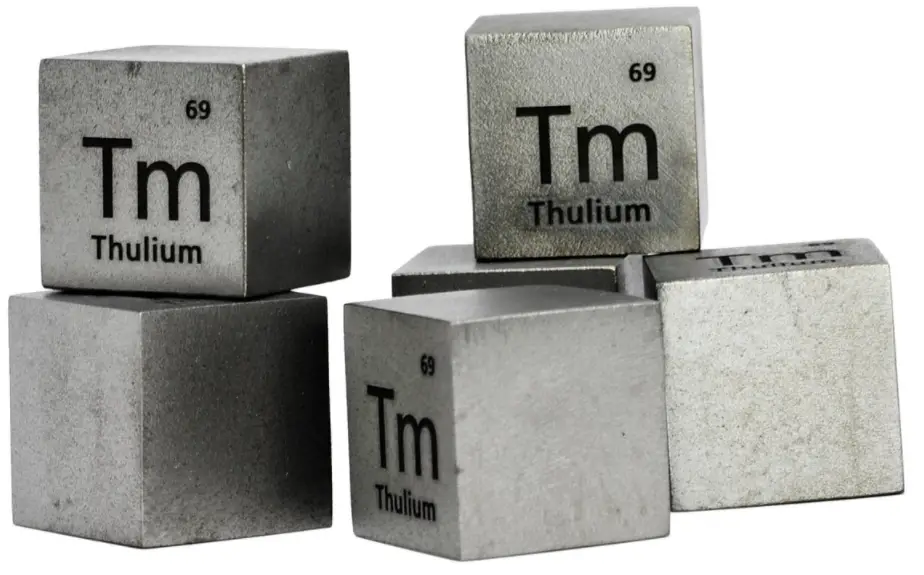
Thulium is an easily workable metal with a bright silvery-gray luster. It is fairly soft and slowly tarnishes in air. Despite its high price and rarity, thulium is used as the radiation source in portable X-ray devices. Thulium is the thirteenth and third-last element in the lanthanide series.

Summary

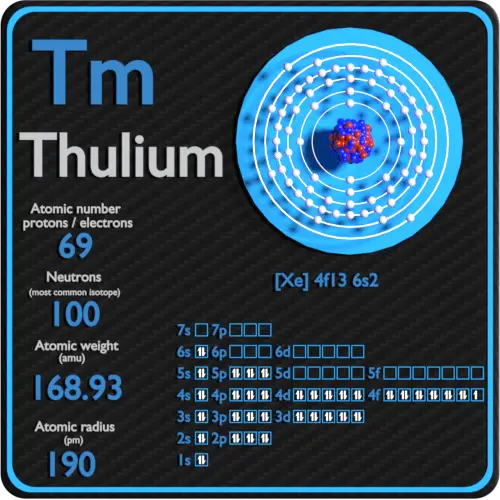
Element Thulium
Atomic number 69
Atomic mass [amu] 168.9342
Atomic mass [pm] 190
Density at STP [g/cm3] 9.321
Number of protons 69
Number of neutrons (typical isotopes) 169
Number of electrons 69
Electron configuration [Xe] 4f13 6s2
Oxidation states +3
Electron affinity [kJ/mol] 50
Electronegativity [Pauling scale] 1.25
First ionization energy [eV] 6.1843

Atomic Number – Protons, Electrons and Neutrons in Thulium

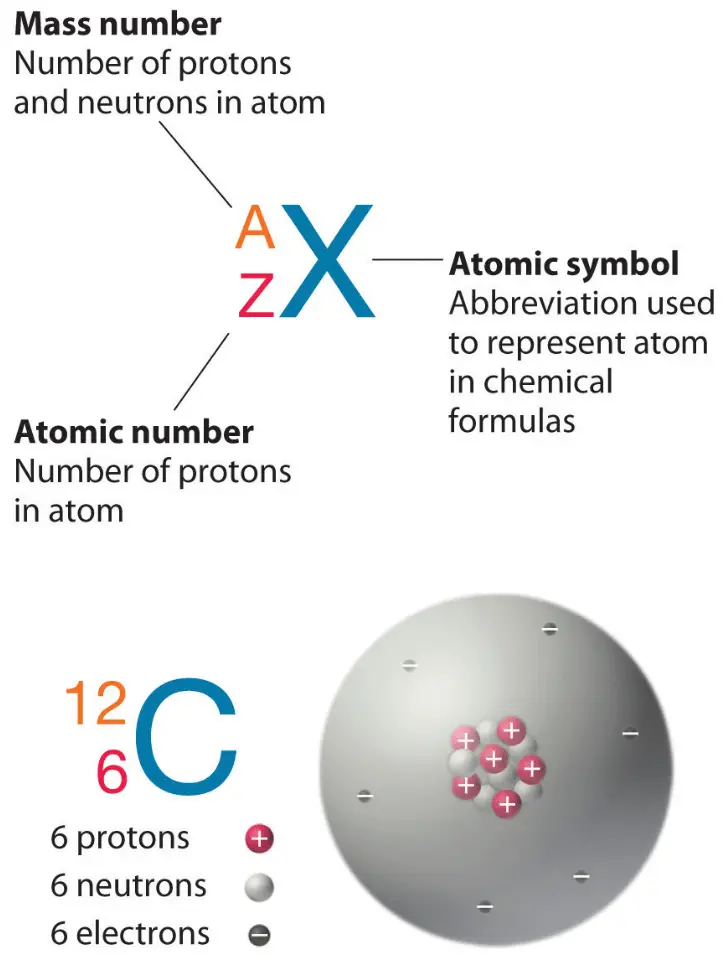
Proton Number - Atomic NumberThulium is a chemical element with atomic number 69 which means there are 69 protons in its nucleus. Total number of protons in the nucleus is called the atomic number of the atom and is given the symbol Z. The total electrical charge of the nucleus is therefore +Ze, where e (elementary charge) equals to 1,602 x 10-19 coulombs.

The total number of neutrons in the nucleus of an atom is called the neutron number of the atom and is given the symbol N. Neutron number plus atomic number equals atomic mass number: N+Z=A. The difference between the neutron number and the atomic number is known as the neutron excess: D = N – Z = A – 2Z.

For stable elements, there is usually a variety of stable isotopes. Isotopes are nuclides that have the same atomic number and are therefore the same element, but differ in the number of neutrons. Mass numbers of typical isotopes of Thulium are 169.

Atomic Mass of Thulium

Atomic mass of Thulium is 168.9342 u. 

The atomic mass is the mass of an atom. The atomic mass or relative isotopic mass refers to the mass of a single particle, and therefore is tied to a certain specific isotope of an element. The atomic mass is carried by the atomic nucleus, which occupies only about 10-12 of the total volume of the atom or less, but it contains all the positive charge and at least 99.95% of the total mass of the atom. Note that, each element may contain more isotopes, therefore this resulting atomic mass is calculated from naturally-occuring isotopes and their abundance.

Atomic Radius of Thulium

The atomic radius of Thulium atom is 190pm (covalent radius).

Atomic Radius of Chemical Elements

It must be noted, atoms lack a well-defined outer boundary. The atomic radius of a chemical element is a measure of the distance out to which the electron cloud extends from the nucleus. However, this assumes the atom to exhibit a spherical shape, which is only obeyed for atoms in vacuum or free space. Therefore, there are various non-equivalent definitions of atomic radius.

Electrons and Electron Configuration

The number of electrons in an electrically-neutral atom is the same as the number of protons in the nucleus. Therefore, the number of electrons in neutral atom of Thulium is 69. Each electron is influenced by the electric fields produced by the positive nuclear charge and the other (Z – 1) negative electrons in the atom.

Since the number of electrons and their arrangement are responsible for the chemical behavior of atoms, the atomic number identifies the various chemical elements. The configuration of these electrons follows from the principles of quantum mechanics. The number of electrons in each element’s electron shells, particularly the outermost valence shell, is the primary factor in determining its chemical bonding behavior. In the periodic table, the elements are listed in order of increasing atomic number Z.

Electron configuration of Thulium is [Xe] 4f13 6s2.

Possible oxidation states are +3.

Density of Thulium

Density of Thulium is 9.321g/cm3.

Typical densities of various substances are at atmospheric pressure.

Density is defined as the mass per unit volume. It is an intensive property, which is mathematically defined as mass divided by volume:

ρ = m/V

Atomic Masses of Elements

Periodic Table of Elements - atomic mass

Atomic Radii of Elements

Periodic Table of Elements - atomic radius

Densities of Elements

Periodic Table of Elements - density

Thulium-protons-neutrons-electrons-configuration

Thulium-affinity-electronegativity-ionization

Electron Affinity – Thulium

Electron affinity of Thulium is 50 kJ/mol.

In chemistry and atomic physics, the electron affinity of an atom or molecule is defined as:

the change in energy (in kJ/mole) of a neutral atom or molecule (in the gaseous phase) when an electron is added to the atom to form a negative ion.

X + e– → X– + energy        Affinity = – ∆H

In other words, it can be expressed as the neutral atom’s likelihood of gaining an electron. Note that, ionization energies measure the tendency of a neutral atom to resist the loss of electrons. Electron affinities are more difficult to measure than ionization energies.

Electronegativity of Thulium

Electronegativity of Thulium is 1.25.

Electronegativity, symbol χ, is a chemical property that describes the tendency of an atom to attract electrons towards this atom. For this purposes, a dimensionless quantity the Pauling scale, symbol χ, is the most commonly used.

The electronegativity of Thulium is: χ = 1.25

First Ionization Energy of Thulium

First Ionization Energy of Thulium is 6.1843 eV.

Ionization energy, also called ionization potential, is the energy necessary to remove an electron from the neutral atom.

X + energy → X+ + e−

where X is any atom or molecule capable of being ionized, X+ is that atom or molecule with an electron removed (positive ion), and e− is the removed electron.

A Thulium atom, for example, requires the following ionization energy to remove the outermost electron.

Tm + IE → Tm+ + e−        IE = 6.1843 eV

Electronegativity of Elements

Periodic Table of Elements - electronegativity

Ionization Energy of Elements

Periodic Table of Elements - ionization energy

Thulium-periodic-table

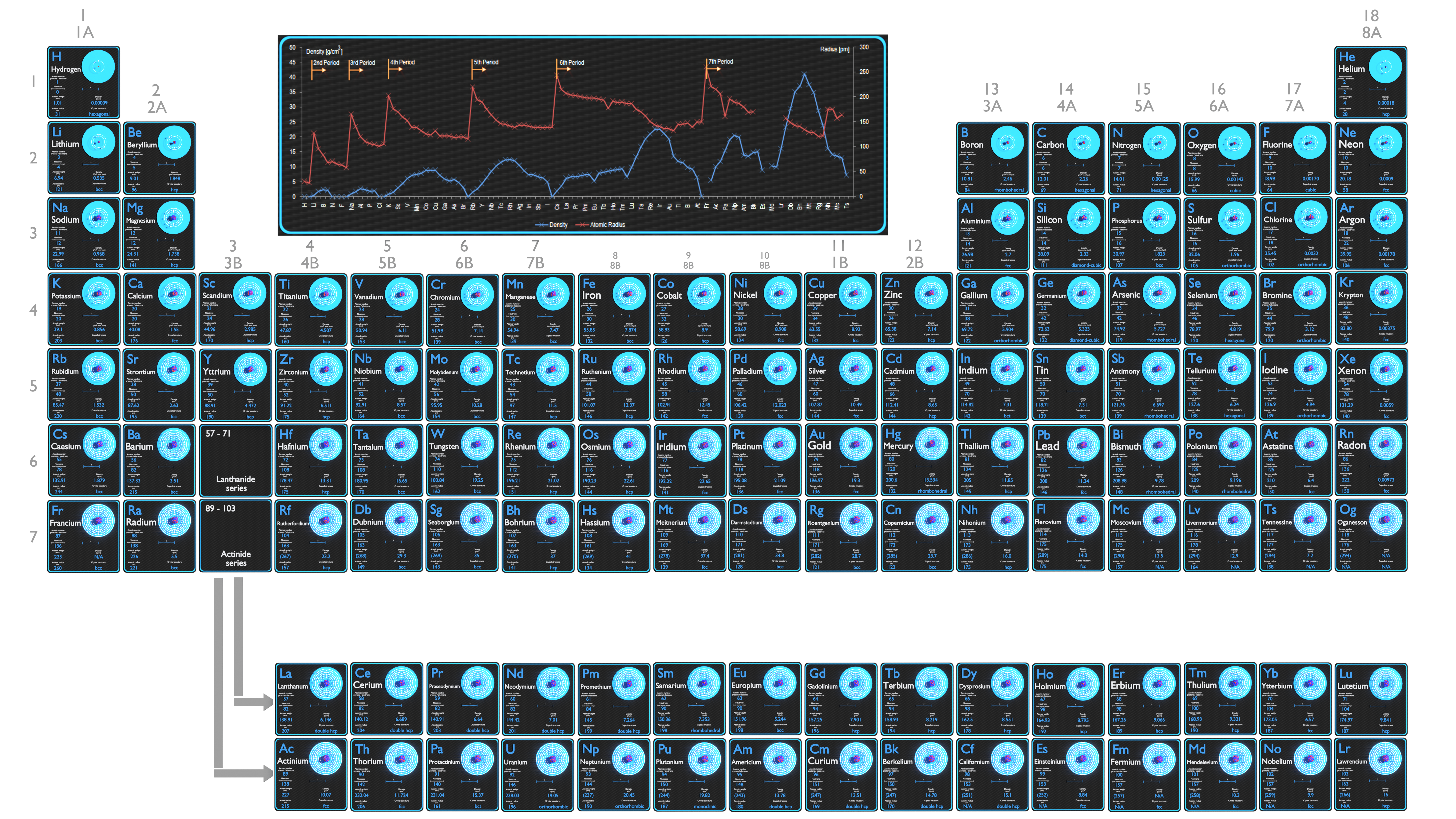
Source: www.luciteria.com


Properties of other elements

Thulium - Comparison of Atomic Properties

Periodic Table in 8K resolution

Other properties of Thulium