Facebook Instagram Youtube Twitter

Plutonium – Periodic Table – Atomic Properties

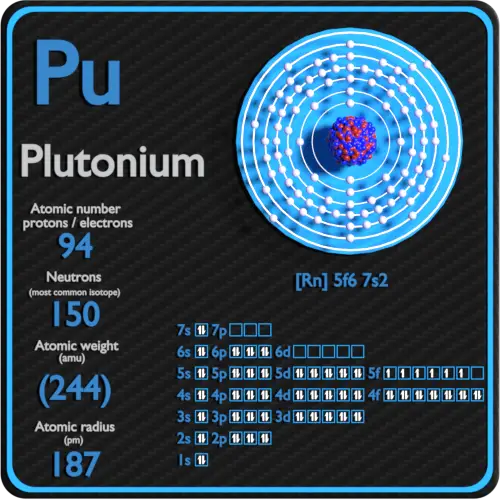
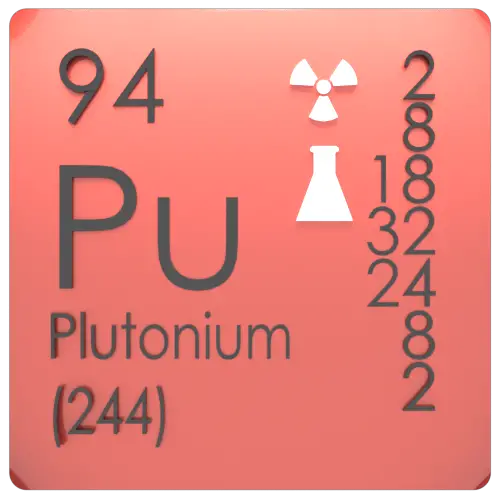
Plutonium-density-atomic-number-mass-radius

Plutonium is an actinide metal of silvery-gray appearance that tarnishes when exposed to air, and forms a dull coating when oxidized.

Summary

Element Plutonium
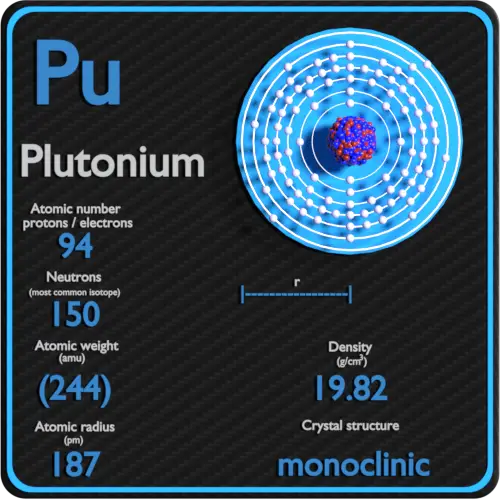
Atomic number 94
Atomic mass [amu] 244
Atomic mass [pm] 187
Density at STP [g/cm3] 19.816
Number of protons 94
Number of neutrons (typical isotopes) 239, 240, 241, 244
Number of electrons 94
Electron configuration [Rn] 5f6 7s2
Oxidation states +3,4,5,6
Electron affinity [kJ/mol]
Electronegativity [Pauling scale] 1.28
First ionization energy [eV] 6.06

Atomic Number – Protons, Electrons and Neutrons in Plutonium
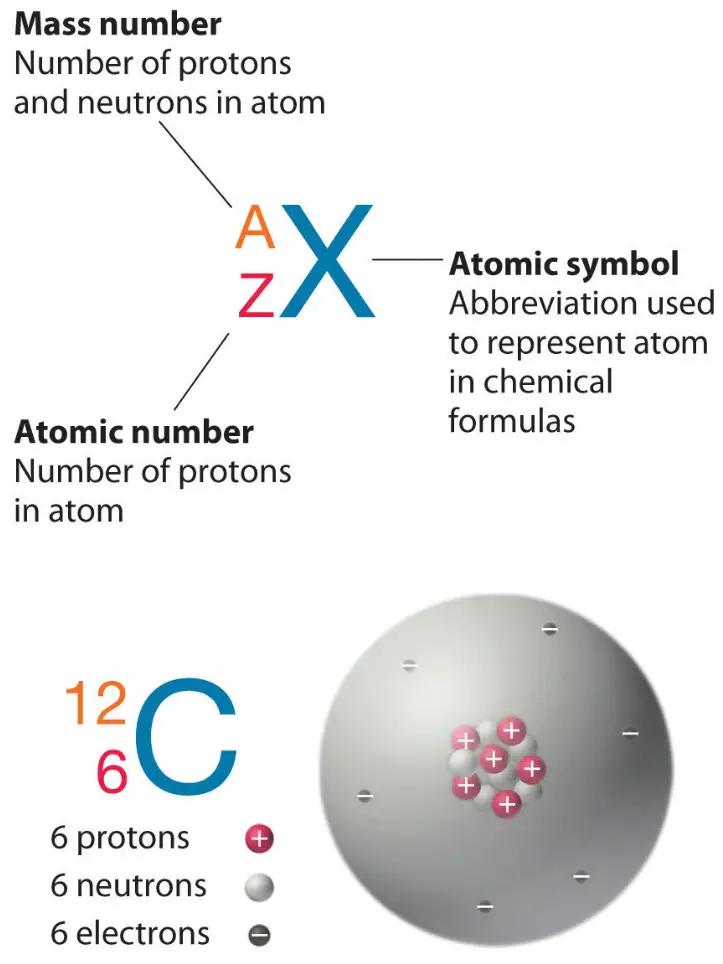
Proton Number - Atomic NumberPlutonium is a chemical element with atomic number 94 which means there are 94 protons in its nucleus. Total number of protons in the nucleus is called the atomic number of the atom and is given the symbol Z. The total electrical charge of the nucleus is therefore +Ze, where e (elementary charge) equals to 1,602 x 10-19 coulombs.

The total number of neutrons in the nucleus of an atom is called the neutron number of the atom and is given the symbol N. Neutron number plus atomic number equals atomic mass number: N+Z=A. The difference between the neutron number and the atomic number is known as the neutron excess: D = N – Z = A – 2Z.

For stable elements, there is usually a variety of stable isotopes. Isotopes are nuclides that have the same atomic number and are therefore the same element, but differ in the number of neutrons. Mass numbers of typical isotopes of Plutonium are 239, 240, 241, 244.

Atomic Mass of Plutonium

Atomic mass of Plutonium is 244 u. 

The atomic mass is the mass of an atom. The atomic mass or relative isotopic mass refers to the mass of a single particle, and therefore is tied to a certain specific isotope of an element. The atomic mass is carried by the atomic nucleus, which occupies only about 10-12 of the total volume of the atom or less, but it contains all the positive charge and at least 99.95% of the total mass of the atom. Note that, each element may contain more isotopes, therefore this resulting atomic mass is calculated from naturally-occuring isotopes and their abundance.

Atomic Radius of Plutonium

The atomic radius of Plutonium atom is 187pm (covalent radius).

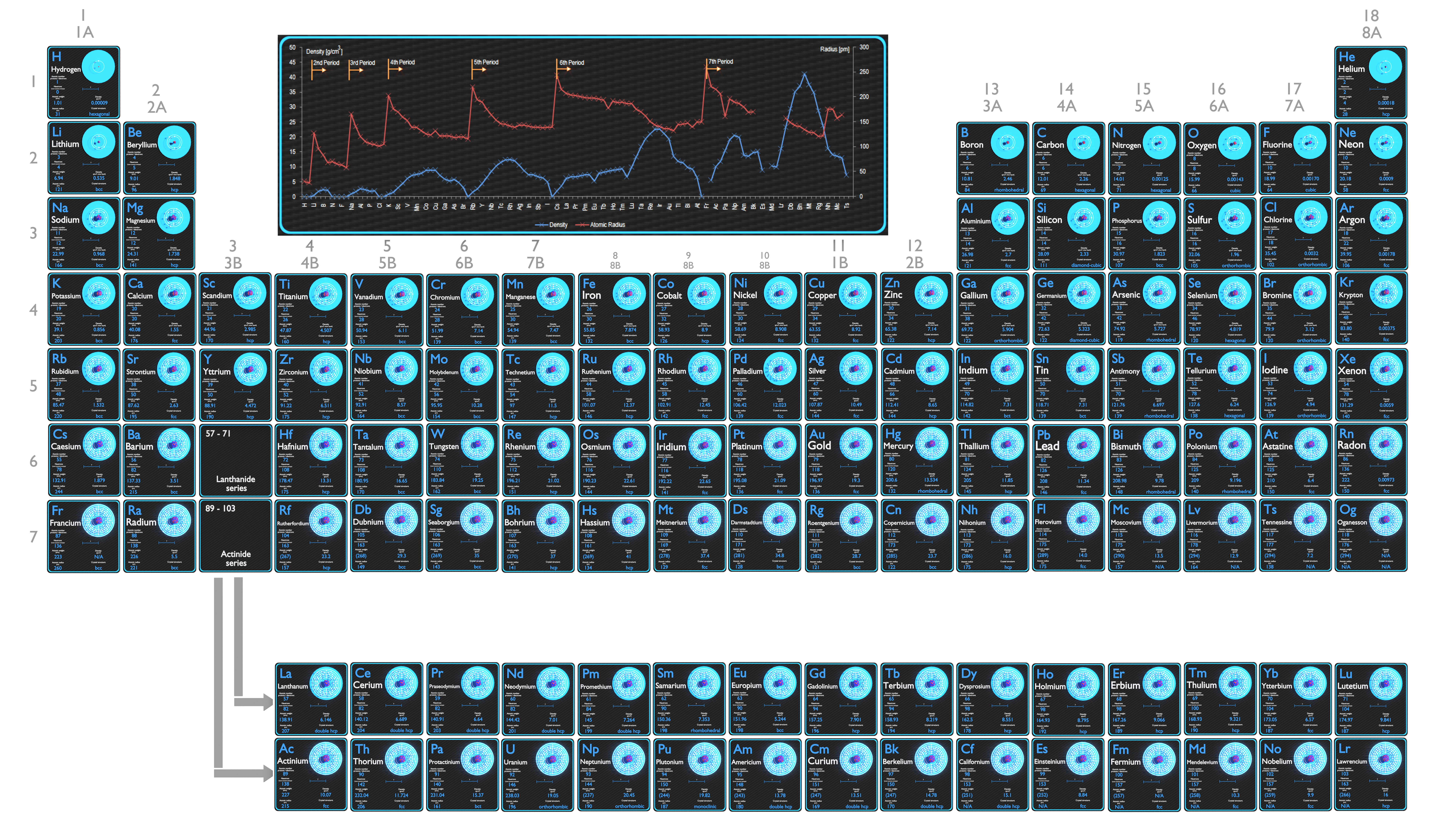
Atomic Radius of Chemical Elements

It must be noted, atoms lack a well-defined outer boundary. The atomic radius of a chemical element is a measure of the distance out to which the electron cloud extends from the nucleus. However, this assumes the atom to exhibit a spherical shape, which is only obeyed for atoms in vacuum or free space. Therefore, there are various non-equivalent definitions of atomic radius.

Electrons and Electron Configuration

The number of electrons in an electrically-neutral atom is the same as the number of protons in the nucleus. Therefore, the number of electrons in neutral atom of Plutonium is 94. Each electron is influenced by the electric fields produced by the positive nuclear charge and the other (Z – 1) negative electrons in the atom.

Since the number of electrons and their arrangement are responsible for the chemical behavior of atoms, the atomic number identifies the various chemical elements. The configuration of these electrons follows from the principles of quantum mechanics. The number of electrons in each element’s electron shells, particularly the outermost valence shell, is the primary factor in determining its chemical bonding behavior. In the periodic table, the elements are listed in order of increasing atomic number Z.

Electron configuration of Plutonium is [Rn] 5f6 7s2.

Possible oxidation states are +3,4,5,6.

Density of Plutonium

Density of Plutonium is 19.816g/cm3.

Typical densities of various substances are at atmospheric pressure.

Density is defined as the mass per unit volume. It is an intensive property, which is mathematically defined as mass divided by volume:

ρ = m/V

Atomic Masses of Elements
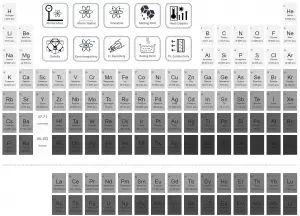
Periodic Table of Elements - atomic mass

Atomic Radii of Elements

Periodic Table of Elements - atomic radius

Densities of Elements

Periodic Table of Elements - density

Plutonium-protons-neutrons-electrons-configuration

Electron Affinity – Plutonium

Electron affinity of Plutonium is — kJ/mol.

In chemistry and atomic physics, the electron affinity of an atom or molecule is defined as:

the change in energy (in kJ/mole) of a neutral atom or molecule (in the gaseous phase) when an electron is added to the atom to form a negative ion.

X + e → X + energy        Affinity = – ∆H

In other words, it can be expressed as the neutral atom’s likelihood of gaining an electron. Note that, ionization energies measure the tendency of a neutral atom to resist the loss of electrons. Electron affinities are more difficult to measure than ionization energies.

Electronegativity of Plutonium

Electronegativity of Plutonium is 1.28.

Electronegativity, symbol χ, is a chemical property that describes the tendency of an atom to attract electrons towards this atom. For this purposes, a dimensionless quantity the Pauling scale, symbol χ, is the most commonly used.

The electronegativity of Plutonium is: χ = 1.28

First Ionization Energy of Plutonium

First Ionization Energy of Plutonium is 6.06 eV.

Ionization energy, also called ionization potential, is the energy necessary to remove an electron from the neutral atom.

X + energy → X+ + e

where X is any atom or molecule capable of being ionized, X+ is that atom or molecule with an electron removed (positive ion), and e is the removed electron.

A Plutonium atom, for example, requires the following ionization energy to remove the outermost electron.

Pu + IE → Pu+ + e        IE = 6.06 eV

Electronegativity of Elements
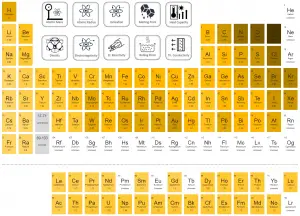
Periodic Table of Elements - electronegativity

Ionization Energy of Elements

Periodic Table of Elements - ionization energy

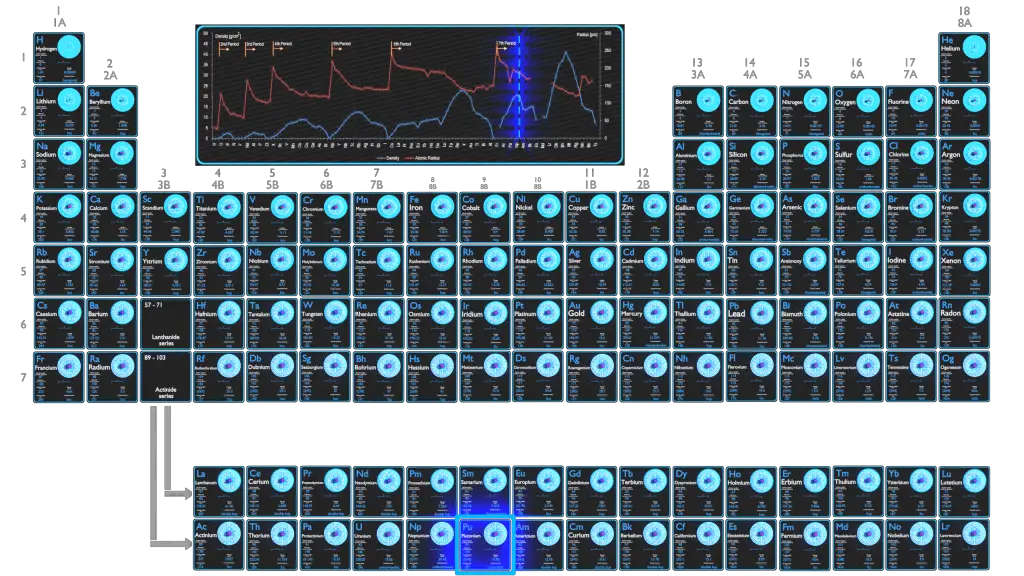
Plutonium-periodic-table

Source: www.luciteria.com


Properties of other elements

Plutonium - Comparison of Atomic Properties

Periodic Table in 8K resolution

Other properties of Plutonium
 

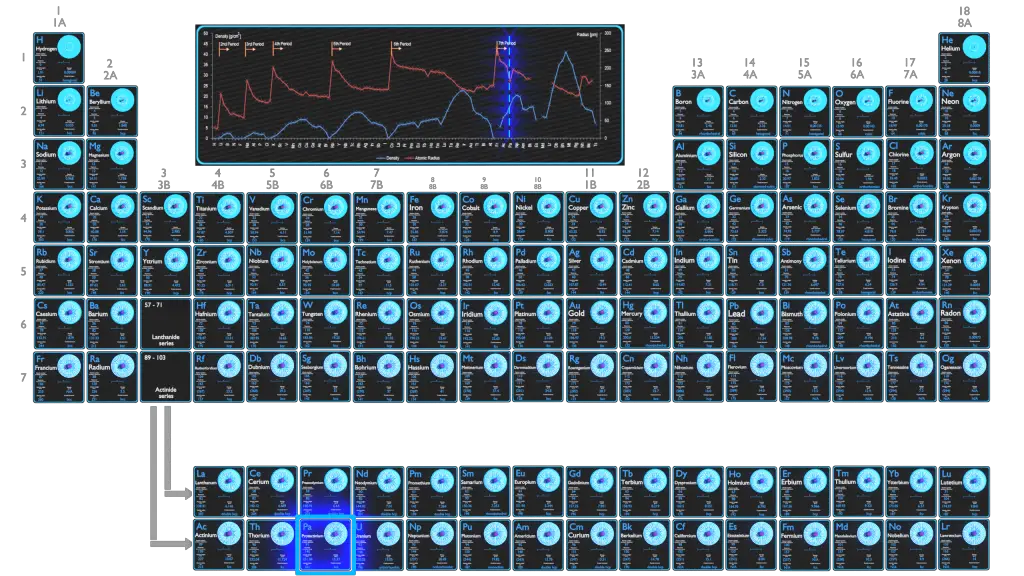
Protactinium – Periodic Table – Atomic Properties

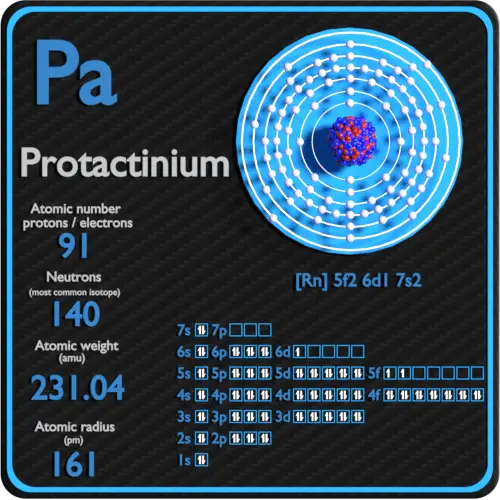
Protactinium-density-atomic-number-mass-radius

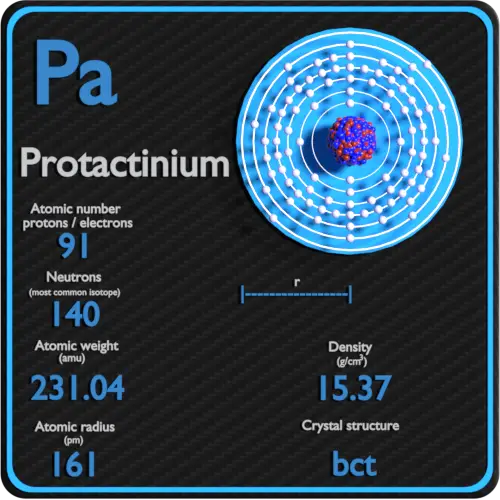
Protactinium is a dense, silvery-gray metal which readily reacts with oxygen, water vapor and inorganic acids.

Summary

Element Protactinium
Atomic number 91
Atomic mass [amu] 231.0359
Atomic mass [pm] 161
Density at STP [g/cm3] 15.37
Number of protons 91
Number of neutrons (typical isotopes) 231
Number of electrons 91
Electron configuration [Rn] 5f2 6d1 7s2
Oxidation states +4,5
Electron affinity [kJ/mol]
Electronegativity [Pauling scale] 1.5
First ionization energy [eV] 5.89

Atomic Number – Protons, Electrons and Neutrons in Protactinium

Proton Number - Atomic NumberProtactinium is a chemical element with atomic number 91 which means there are 91 protons in its nucleus. Total number of protons in the nucleus is called the atomic number of the atom and is given the symbol Z. The total electrical charge of the nucleus is therefore +Ze, where e (elementary charge) equals to 1,602 x 10-19 coulombs.

The total number of neutrons in the nucleus of an atom is called the neutron number of the atom and is given the symbol N. Neutron number plus atomic number equals atomic mass number: N+Z=A. The difference between the neutron number and the atomic number is known as the neutron excess: D = N – Z = A – 2Z.

For stable elements, there is usually a variety of stable isotopes. Isotopes are nuclides that have the same atomic number and are therefore the same element, but differ in the number of neutrons. Mass numbers of typical isotopes of Protactinium are 231.

Atomic Mass of Protactinium

Atomic mass of Protactinium is 231.0359 u. 

The atomic mass is the mass of an atom. The atomic mass or relative isotopic mass refers to the mass of a single particle, and therefore is tied to a certain specific isotope of an element. The atomic mass is carried by the atomic nucleus, which occupies only about 10-12 of the total volume of the atom or less, but it contains all the positive charge and at least 99.95% of the total mass of the atom. Note that, each element may contain more isotopes, therefore this resulting atomic mass is calculated from naturally-occuring isotopes and their abundance.

Atomic Radius of Protactinium

The atomic radius of Protactinium atom is 161pm (covalent radius).

Atomic Radius of Chemical Elements

It must be noted, atoms lack a well-defined outer boundary. The atomic radius of a chemical element is a measure of the distance out to which the electron cloud extends from the nucleus. However, this assumes the atom to exhibit a spherical shape, which is only obeyed for atoms in vacuum or free space. Therefore, there are various non-equivalent definitions of atomic radius.

Electrons and Electron Configuration

The number of electrons in an electrically-neutral atom is the same as the number of protons in the nucleus. Therefore, the number of electrons in neutral atom of Protactinium is 91. Each electron is influenced by the electric fields produced by the positive nuclear charge and the other (Z – 1) negative electrons in the atom.

Since the number of electrons and their arrangement are responsible for the chemical behavior of atoms, the atomic number identifies the various chemical elements. The configuration of these electrons follows from the principles of quantum mechanics. The number of electrons in each element’s electron shells, particularly the outermost valence shell, is the primary factor in determining its chemical bonding behavior. In the periodic table, the elements are listed in order of increasing atomic number Z.

Electron configuration of Protactinium is [Rn] 5f2 6d1 7s2.

Possible oxidation states are +4,5.

Density of Protactinium

Density of Protactinium is 15.37g/cm3.

Typical densities of various substances are at atmospheric pressure.

Density is defined as the mass per unit volume. It is an intensive property, which is mathematically defined as mass divided by volume:

ρ = m/V

Atomic Masses of Elements

Periodic Table of Elements - atomic mass

Atomic Radii of Elements

Periodic Table of Elements - atomic radius

Densities of Elements

Periodic Table of Elements - density

Protactinium-protons-neutrons-electrons-configuration

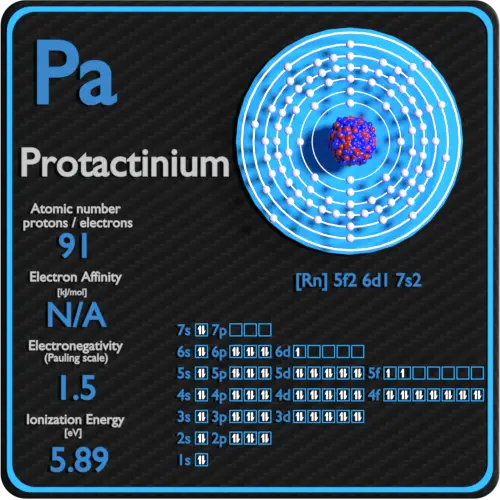
Protactinium-affinity-electronegativity-ionization

Electron Affinity – Protactinium

Electron affinity of Protactinium is — kJ/mol.

In chemistry and atomic physics, the electron affinity of an atom or molecule is defined as:

the change in energy (in kJ/mole) of a neutral atom or molecule (in the gaseous phase) when an electron is added to the atom to form a negative ion.

X + e → X + energy        Affinity = – ∆H

In other words, it can be expressed as the neutral atom’s likelihood of gaining an electron. Note that, ionization energies measure the tendency of a neutral atom to resist the loss of electrons. Electron affinities are more difficult to measure than ionization energies.

Electronegativity of Protactinium

Electronegativity of Protactinium is 1.5.

Electronegativity, symbol χ, is a chemical property that describes the tendency of an atom to attract electrons towards this atom. For this purposes, a dimensionless quantity the Pauling scale, symbol χ, is the most commonly used.

The electronegativity of Protactinium is: χ = 1.5

First Ionization Energy of Protactinium

First Ionization Energy of Protactinium is 5.89 eV.

Ionization energy, also called ionization potential, is the energy necessary to remove an electron from the neutral atom.

X + energy → X+ + e

where X is any atom or molecule capable of being ionized, X+ is that atom or molecule with an electron removed (positive ion), and e is the removed electron.

A Protactinium atom, for example, requires the following ionization energy to remove the outermost electron.

Pa + IE → Pa+ + e        IE = 5.89 eV

Electronegativity of Elements

Periodic Table of Elements - electronegativity

Ionization Energy of Elements

Periodic Table of Elements - ionization energy

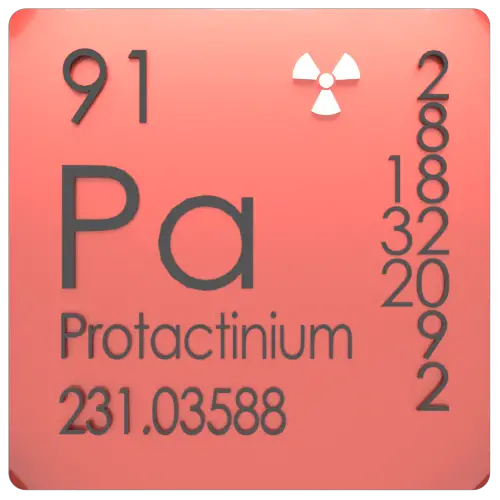
Protactinium-periodic-table

Source: www.luciteria.com


Properties of other elements

Protactinium - Comparison of Atomic Properties

Periodic Table in 8K resolution

Other properties of Protactinium


Uranium – Periodic Table – Atomic Properties

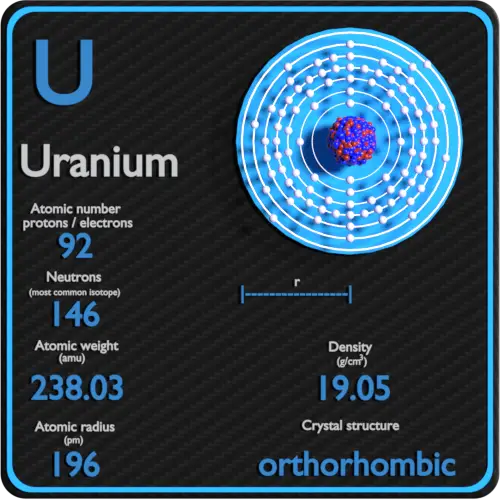
Uranium-density-atomic-number-mass-radius

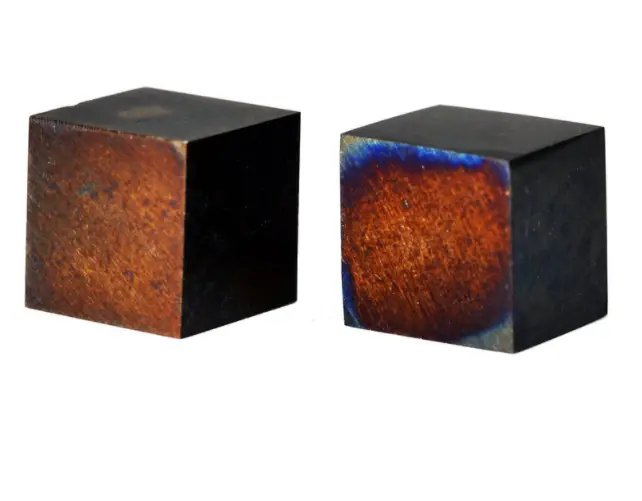
Uranium is a silvery-white metal in the actinide series of the periodic table. Uranium is weakly radioactive because all isotopes of uranium are unstable, with half-lives varying between 159,200 years and 4.5 billion years. Uranium has the highest atomic weight of the primordially occurring elements. Its density is about 70% higher than that of lead, and slightly lower than that of gold or tungsten. Uranium is commonly found at low levels (a few ppm – parts per million) in all rocks, soil, water, plants, and animals (including humans). Uranium occurs also in seawater, and can be recovered from the ocean water. Significant concentrations of uranium occur in some substances such as uraninite (the most common uranium ore), phosphate rock deposits, and other minerals.

Summary

Element Uranium
Atomic number 92
Atomic mass [amu] 238.0289
Atomic mass [pm] 196
Density at STP [g/cm3] 19.05
Number of protons 92
Number of neutrons (typical isotopes) 238, 235
Number of electrons 92
Electron configuration [Rn] 5f3 6d1 7s2
Oxidation states +3,4,5,6
Electron affinity [kJ/mol]
Electronegativity [Pauling scale] 1.38
First ionization energy [eV] 6.1941

Atomic Number – Protons, Electrons and Neutrons in Uranium

Proton Number - Atomic NumberUranium is a chemical element with atomic number 92 which means there are 92 protons in its nucleus. Total number of protons in the nucleus is called the atomic number of the atom and is given the symbol Z. The total electrical charge of the nucleus is therefore +Ze, where e (elementary charge) equals to 1,602 x 10-19 coulombs.

The total number of neutrons in the nucleus of an atom is called the neutron number of the atom and is given the symbol N. Neutron number plus atomic number equals atomic mass number: N+Z=A. The difference between the neutron number and the atomic number is known as the neutron excess: D = N – Z = A – 2Z.

For stable elements, there is usually a variety of stable isotopes. Isotopes are nuclides that have the same atomic number and are therefore the same element, but differ in the number of neutrons. Mass numbers of typical isotopes of Uranium are 238, 235.

Atomic Mass of Uranium

Atomic mass of Uranium is 238.0289 u. 

The atomic mass is the mass of an atom. The atomic mass or relative isotopic mass refers to the mass of a single particle, and therefore is tied to a certain specific isotope of an element. The atomic mass is carried by the atomic nucleus, which occupies only about 10-12 of the total volume of the atom or less, but it contains all the positive charge and at least 99.95% of the total mass of the atom. Note that, each element may contain more isotopes, therefore this resulting atomic mass is calculated from naturally-occuring isotopes and their abundance.

Atomic Radius of Uranium

The atomic radius of Uranium atom is 196pm (covalent radius).

Atomic Radius of Chemical Elements

It must be noted, atoms lack a well-defined outer boundary. The atomic radius of a chemical element is a measure of the distance out to which the electron cloud extends from the nucleus. However, this assumes the atom to exhibit a spherical shape, which is only obeyed for atoms in vacuum or free space. Therefore, there are various non-equivalent definitions of atomic radius.

Electrons and Electron Configuration

The number of electrons in an electrically-neutral atom is the same as the number of protons in the nucleus. Therefore, the number of electrons in neutral atom of Uranium is 92. Each electron is influenced by the electric fields produced by the positive nuclear charge and the other (Z – 1) negative electrons in the atom.

Since the number of electrons and their arrangement are responsible for the chemical behavior of atoms, the atomic number identifies the various chemical elements. The configuration of these electrons follows from the principles of quantum mechanics. The number of electrons in each element’s electron shells, particularly the outermost valence shell, is the primary factor in determining its chemical bonding behavior. In the periodic table, the elements are listed in order of increasing atomic number Z.

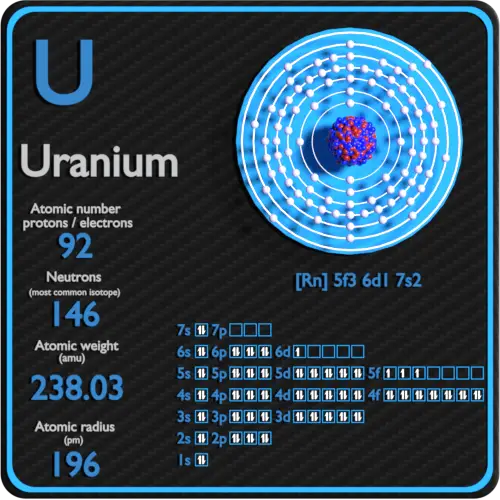
Electron configuration of Uranium is [Rn] 5f3 6d1 7s2.

Possible oxidation states are +3,4,5,6.

Density of Uranium

Density of Uranium is 19.05g/cm3.

Typical densities of various substances are at atmospheric pressure.

Density is defined as the mass per unit volume. It is an intensive property, which is mathematically defined as mass divided by volume:

ρ = m/V

Atomic Masses of Elements

Periodic Table of Elements - atomic mass

Atomic Radii of Elements

Periodic Table of Elements - atomic radius

Densities of Elements

Periodic Table of Elements - density

Uranium-protons-neutrons-electrons-configuration

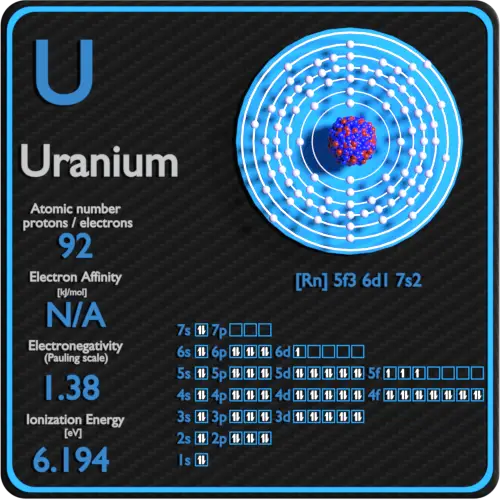
Uranium-affinity-electronegativity-ionization

Electron Affinity – Uranium

Electron affinity of Uranium is — kJ/mol.

In chemistry and atomic physics, the electron affinity of an atom or molecule is defined as:

the change in energy (in kJ/mole) of a neutral atom or molecule (in the gaseous phase) when an electron is added to the atom to form a negative ion.

X + e → X + energy        Affinity = – ∆H

In other words, it can be expressed as the neutral atom’s likelihood of gaining an electron. Note that, ionization energies measure the tendency of a neutral atom to resist the loss of electrons. Electron affinities are more difficult to measure than ionization energies.

Electronegativity of Uranium

Electronegativity of Uranium is 1.38.

Electronegativity, symbol χ, is a chemical property that describes the tendency of an atom to attract electrons towards this atom. For this purposes, a dimensionless quantity the Pauling scale, symbol χ, is the most commonly used.

The electronegativity of Uranium is: χ = 1.38

First Ionization Energy of Uranium

First Ionization Energy of Uranium is 6.1941 eV.

Ionization energy, also called ionization potential, is the energy necessary to remove an electron from the neutral atom.

X + energy → X+ + e

where X is any atom or molecule capable of being ionized, X+ is that atom or molecule with an electron removed (positive ion), and e is the removed electron.

A Uranium atom, for example, requires the following ionization energy to remove the outermost electron.

U + IE → U+ + e        IE = 6.1941 eV

Electronegativity of Elements

Periodic Table of Elements - electronegativity

Ionization Energy of Elements

Periodic Table of Elements - ionization energy

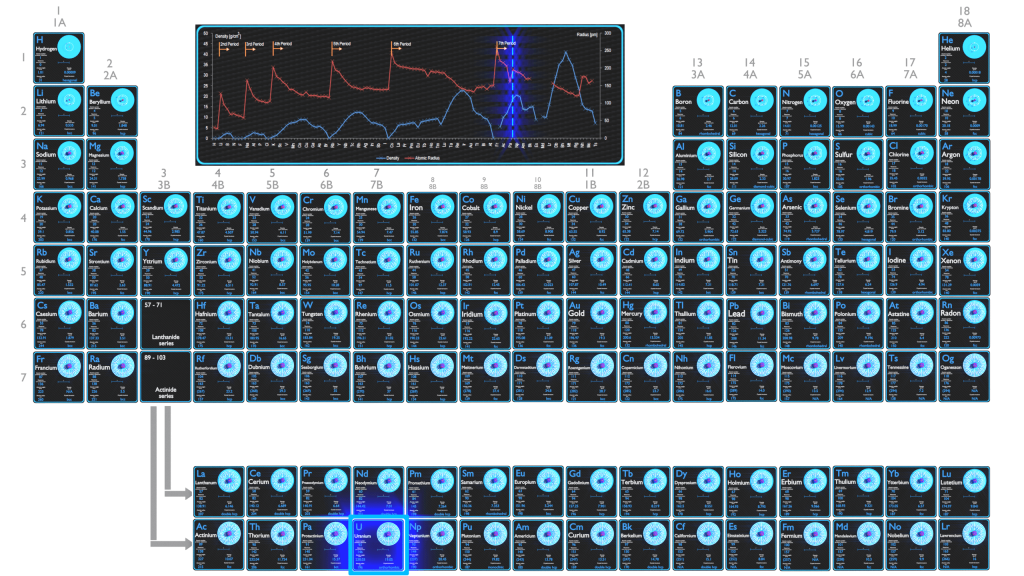
Uranium-periodic-table

Source: www.luciteria.com


Properties of other elements

Uranium - Comparison of Atomic Properties

Periodic Table in 8K resolution

Other properties of Uranium


Actinium – Periodic Table – Atomic Properties

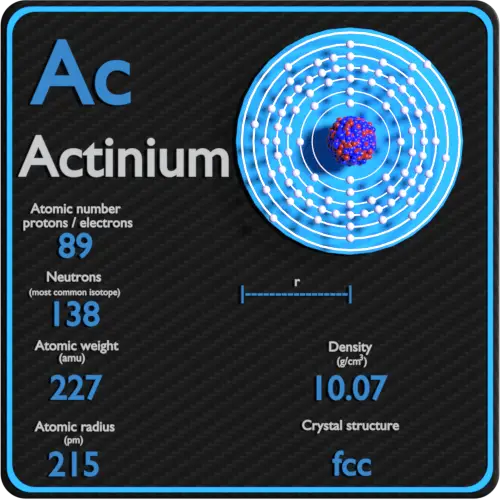
Actinium-density-atomic-number-mass-radius

Actinium is a soft, silvery-white radioactive metal. Actinium gave the name to the actinide series, a group of 15 similar elements between actinium and lawrencium in the periodic table.

Summary

Element Actinium
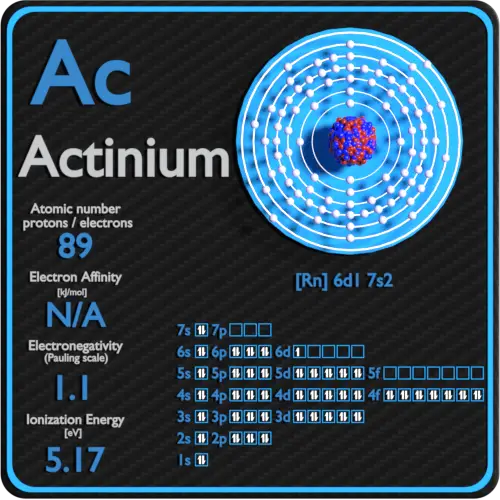
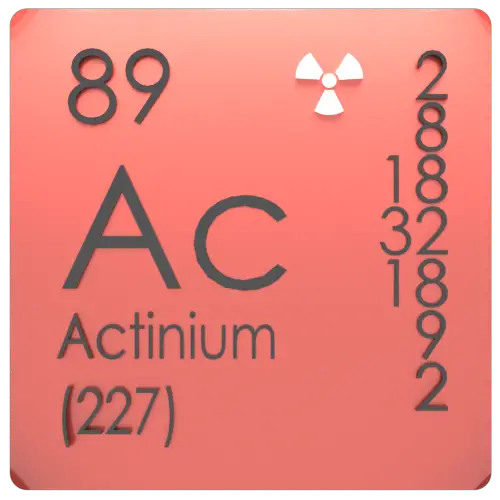
Atomic number 89
Atomic mass [amu] 227
Atomic mass [pm] 215
Density at STP [g/cm3] 10.07
Number of protons 89
Number of neutrons (typical isotopes) 227
Number of electrons 89
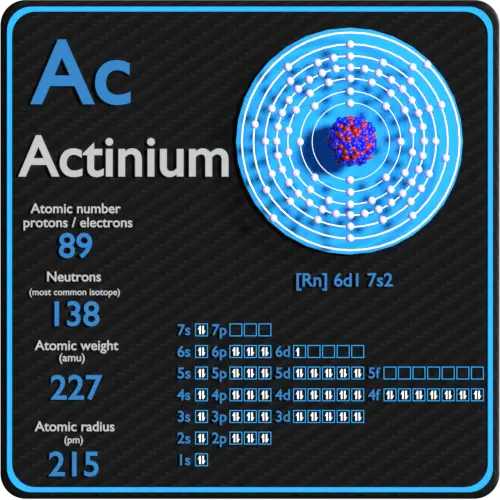
Electron configuration [Rn] 6d1 7s2
Oxidation states +3
Electron affinity [kJ/mol]
Electronegativity [Pauling scale] 1.1
First ionization energy [eV] 5.17

Atomic Number – Protons, Electrons and Neutrons in Actinium

Proton Number - Atomic NumberActinium is a chemical element with atomic number 89 which means there are 89 protons in its nucleus. Total number of protons in the nucleus is called the atomic number of the atom and is given the symbol Z. The total electrical charge of the nucleus is therefore +Ze, where e (elementary charge) equals to 1,602 x 10-19 coulombs.

The total number of neutrons in the nucleus of an atom is called the neutron number of the atom and is given the symbol N. Neutron number plus atomic number equals atomic mass number: N+Z=A. The difference between the neutron number and the atomic number is known as the neutron excess: D = N – Z = A – 2Z.

For stable elements, there is usually a variety of stable isotopes. Isotopes are nuclides that have the same atomic number and are therefore the same element, but differ in the number of neutrons. Mass numbers of typical isotopes of Actinium are 227.

Atomic Mass of Actinium

Atomic mass of Actinium is 227 u. 

The atomic mass is the mass of an atom. The atomic mass or relative isotopic mass refers to the mass of a single particle, and therefore is tied to a certain specific isotope of an element. The atomic mass is carried by the atomic nucleus, which occupies only about 10-12 of the total volume of the atom or less, but it contains all the positive charge and at least 99.95% of the total mass of the atom. Note that, each element may contain more isotopes, therefore this resulting atomic mass is calculated from naturally-occuring isotopes and their abundance.

Atomic Radius of Actinium

The atomic radius of Actinium atom is 215pm (covalent radius).

Atomic Radius of Chemical Elements

It must be noted, atoms lack a well-defined outer boundary. The atomic radius of a chemical element is a measure of the distance out to which the electron cloud extends from the nucleus. However, this assumes the atom to exhibit a spherical shape, which is only obeyed for atoms in vacuum or free space. Therefore, there are various non-equivalent definitions of atomic radius.

Electrons and Electron Configuration

The number of electrons in an electrically-neutral atom is the same as the number of protons in the nucleus. Therefore, the number of electrons in neutral atom of Actinium is 89. Each electron is influenced by the electric fields produced by the positive nuclear charge and the other (Z – 1) negative electrons in the atom.

Since the number of electrons and their arrangement are responsible for the chemical behavior of atoms, the atomic number identifies the various chemical elements. The configuration of these electrons follows from the principles of quantum mechanics. The number of electrons in each element’s electron shells, particularly the outermost valence shell, is the primary factor in determining its chemical bonding behavior. In the periodic table, the elements are listed in order of increasing atomic number Z.

Electron configuration of Actinium is [Rn] 6d1 7s2.

Possible oxidation states are +3.

Density of Actinium

Density of Actinium is 10.07g/cm3.

Typical densities of various substances are at atmospheric pressure.

Density is defined as the mass per unit volume. It is an intensive property, which is mathematically defined as mass divided by volume:

ρ = m/V

Atomic Masses of Elements

Periodic Table of Elements - atomic mass

Atomic Radii of Elements

Periodic Table of Elements - atomic radius

Densities of Elements

Periodic Table of Elements - density

Actinium-protons-neutrons-electrons-configuration

Actinium-affinity-electronegativity-ionization

Electron Affinity – Actinium

Electron affinity of Actinium is — kJ/mol.

In chemistry and atomic physics, the electron affinity of an atom or molecule is defined as:

the change in energy (in kJ/mole) of a neutral atom or molecule (in the gaseous phase) when an electron is added to the atom to form a negative ion.

X + e → X + energy        Affinity = – ∆H

In other words, it can be expressed as the neutral atom’s likelihood of gaining an electron. Note that, ionization energies measure the tendency of a neutral atom to resist the loss of electrons. Electron affinities are more difficult to measure than ionization energies.

Electronegativity of Actinium

Electronegativity of Actinium is 1.1.

Electronegativity, symbol χ, is a chemical property that describes the tendency of an atom to attract electrons towards this atom. For this purposes, a dimensionless quantity the Pauling scale, symbol χ, is the most commonly used.

The electronegativity of Actinium is: χ = 1.1

First Ionization Energy of Actinium

First Ionization Energy of Actinium is 5.17 eV.

Ionization energy, also called ionization potential, is the energy necessary to remove an electron from the neutral atom.

X + energy → X+ + e

where X is any atom or molecule capable of being ionized, X+ is that atom or molecule with an electron removed (positive ion), and e is the removed electron.

A Actinium atom, for example, requires the following ionization energy to remove the outermost electron.

Ac + IE → Ac+ + e        IE = 5.17 eV

Electronegativity of Elements

Periodic Table of Elements - electronegativity

Ionization Energy of Elements

Periodic Table of Elements - ionization energy

Actinium-periodic-table

Source: www.luciteria.com


Properties of other elements

Actinium - Comparison of Atomic Properties

Periodic Table in 8K resolution

Other properties of Actinium


Thorium – Periodic Table – Atomic Properties

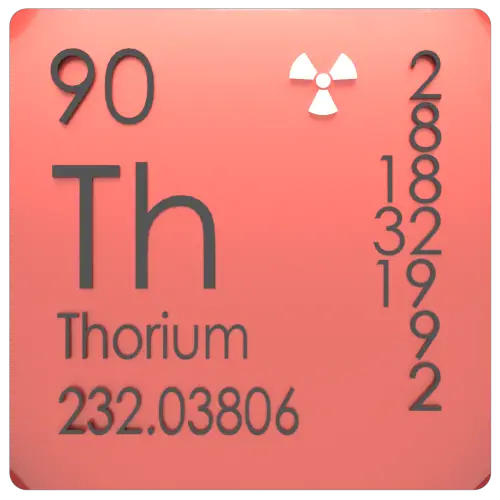
Thorium-density-atomic-number-mass-radius

Thorium metal is silvery and tarnishes black when exposed to air, forming the dioxide. Thorium is moderately hard, malleable, and has a high melting point. Thorium is a naturally-occurring element and it is estimated to be about three times more abundant than uranium. Thorium is commonly found in monazite sands (rare earth metals containing phosphate mineral).

Summary

Element Thorium
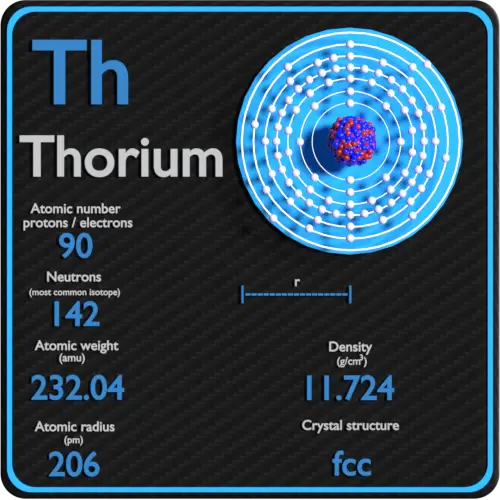
Atomic number 90
Atomic mass [amu] 232.0381
Atomic mass [pm] 206
Density at STP [g/cm3] 11.724
Number of protons 90
Number of neutrons (typical isotopes) 232
Number of electrons 90
Electron configuration [Rn] 6d2 7s2
Oxidation states +4
Electron affinity [kJ/mol]
Electronegativity [Pauling scale] 1.3
First ionization energy [eV] 6.08

Atomic Number – Protons, Electrons and Neutrons in Thorium

Proton Number - Atomic NumberThorium is a chemical element with atomic number 90 which means there are 90 protons in its nucleus. Total number of protons in the nucleus is called the atomic number of the atom and is given the symbol Z. The total electrical charge of the nucleus is therefore +Ze, where e (elementary charge) equals to 1,602 x 10-19 coulombs.

The total number of neutrons in the nucleus of an atom is called the neutron number of the atom and is given the symbol N. Neutron number plus atomic number equals atomic mass number: N+Z=A. The difference between the neutron number and the atomic number is known as the neutron excess: D = N – Z = A – 2Z.

For stable elements, there is usually a variety of stable isotopes. Isotopes are nuclides that have the same atomic number and are therefore the same element, but differ in the number of neutrons. Mass numbers of typical isotopes of Thorium are 232.

Atomic Mass of Thorium

Atomic mass of Thorium is 232.0381 u. 

The atomic mass is the mass of an atom. The atomic mass or relative isotopic mass refers to the mass of a single particle, and therefore is tied to a certain specific isotope of an element. The atomic mass is carried by the atomic nucleus, which occupies only about 10-12 of the total volume of the atom or less, but it contains all the positive charge and at least 99.95% of the total mass of the atom. Note that, each element may contain more isotopes, therefore this resulting atomic mass is calculated from naturally-occuring isotopes and their abundance.

Atomic Radius of Thorium

The atomic radius of Thorium atom is 206pm (covalent radius).

Atomic Radius of Chemical Elements

It must be noted, atoms lack a well-defined outer boundary. The atomic radius of a chemical element is a measure of the distance out to which the electron cloud extends from the nucleus. However, this assumes the atom to exhibit a spherical shape, which is only obeyed for atoms in vacuum or free space. Therefore, there are various non-equivalent definitions of atomic radius.

Electrons and Electron Configuration

The number of electrons in an electrically-neutral atom is the same as the number of protons in the nucleus. Therefore, the number of electrons in neutral atom of Thorium is 90. Each electron is influenced by the electric fields produced by the positive nuclear charge and the other (Z – 1) negative electrons in the atom.

Since the number of electrons and their arrangement are responsible for the chemical behavior of atoms, the atomic number identifies the various chemical elements. The configuration of these electrons follows from the principles of quantum mechanics. The number of electrons in each element’s electron shells, particularly the outermost valence shell, is the primary factor in determining its chemical bonding behavior. In the periodic table, the elements are listed in order of increasing atomic number Z.

Electron configuration of Thorium is [Rn] 6d2 7s2.

Possible oxidation states are +4.

Density of Thorium

Density of Thorium is 11.724g/cm3.

Typical densities of various substances are at atmospheric pressure.

Density is defined as the mass per unit volume. It is an intensive property, which is mathematically defined as mass divided by volume:

ρ = m/V

Atomic Masses of Elements

Periodic Table of Elements - atomic mass

Atomic Radii of Elements

Periodic Table of Elements - atomic radius

Densities of Elements

Periodic Table of Elements - density

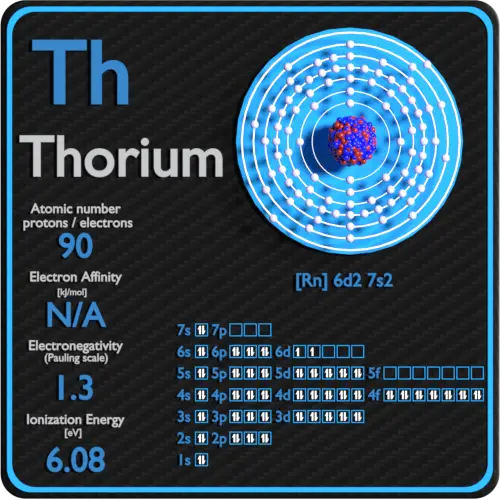
Thorium-protons-neutrons-electrons-configuration

Thorium-affinity-electronegativity-ionization

Electron Affinity – Thorium

Electron affinity of Thorium is — kJ/mol.

In chemistry and atomic physics, the electron affinity of an atom or molecule is defined as:

the change in energy (in kJ/mole) of a neutral atom or molecule (in the gaseous phase) when an electron is added to the atom to form a negative ion.

X + e → X + energy        Affinity = – ∆H

In other words, it can be expressed as the neutral atom’s likelihood of gaining an electron. Note that, ionization energies measure the tendency of a neutral atom to resist the loss of electrons. Electron affinities are more difficult to measure than ionization energies.

Electronegativity of Thorium

Electronegativity of Thorium is 1.3.

Electronegativity, symbol χ, is a chemical property that describes the tendency of an atom to attract electrons towards this atom. For this purposes, a dimensionless quantity the Pauling scale, symbol χ, is the most commonly used.

The electronegativity of Thorium is: χ = 1.3

First Ionization Energy of Thorium

First Ionization Energy of Thorium is 6.08 eV.

Ionization energy, also called ionization potential, is the energy necessary to remove an electron from the neutral atom.

X + energy → X+ + e

where X is any atom or molecule capable of being ionized, X+ is that atom or molecule with an electron removed (positive ion), and e is the removed electron.

A Thorium atom, for example, requires the following ionization energy to remove the outermost electron.

Th + IE → Th+ + e        IE = 6.08 eV

Electronegativity of Elements

Periodic Table of Elements - electronegativity

Ionization Energy of Elements

Periodic Table of Elements - ionization energy

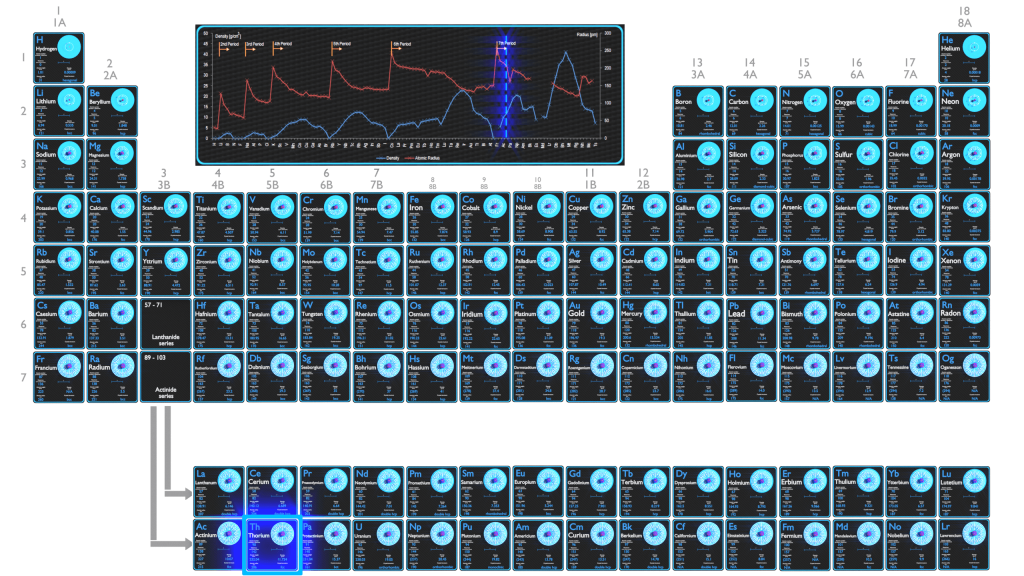
Thorium-periodic-table

Source: www.luciteria.com


Properties of other elements

Thorium - Comparison of Atomic Properties

Periodic Table in 8K resolution

Other properties of Thorium


Francium – Periodic Table – Atomic Properties

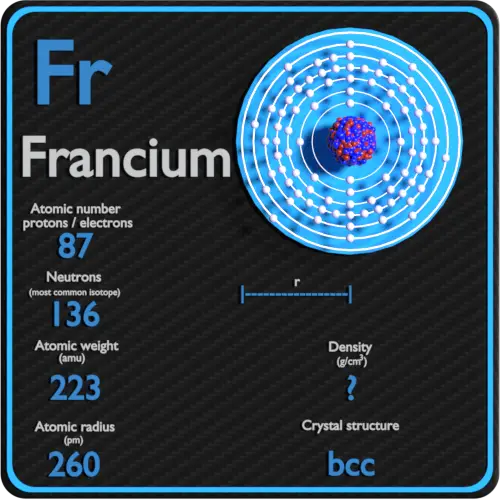
Francium-density-atomic-number-mass-radius

Francium is an alkali metal, that has one valence electron. Francium is the second-least electronegative element, behind only caesium, and is the second rarest naturally occurring element (after astatine). Francium is a highly radioactive metal that decays into astatine, radium, and radon.

Summary

Element Francium
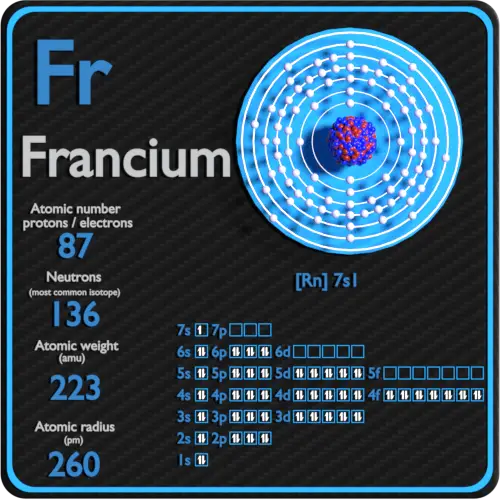
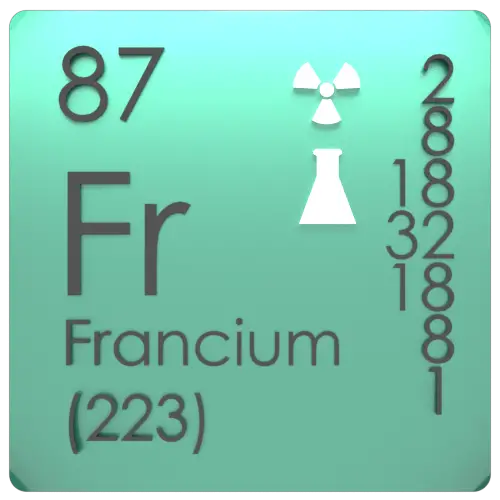
Atomic number 87
Atomic mass [amu] 223
Atomic mass [pm] 260
Density at STP [g/cm3]
Number of protons 87
Number of neutrons (typical isotopes) 223
Number of electrons 87
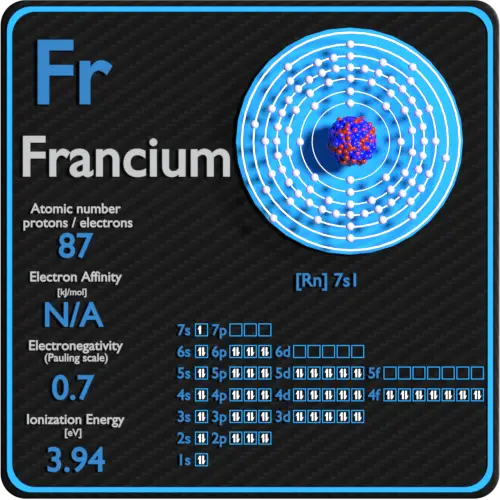
Electron configuration [Rn] 7s1
Oxidation states +1
Electron affinity [kJ/mol]
Electronegativity [Pauling scale] 0.7
First ionization energy [eV] 3.94

Atomic Number – Protons, Electrons and Neutrons in Francium

Proton Number - Atomic NumberFrancium is a chemical element with atomic number 87 which means there are 87 protons in its nucleus. Total number of protons in the nucleus is called the atomic number of the atom and is given the symbol Z. The total electrical charge of the nucleus is therefore +Ze, where e (elementary charge) equals to 1,602 x 10-19 coulombs.

The total number of neutrons in the nucleus of an atom is called the neutron number of the atom and is given the symbol N. Neutron number plus atomic number equals atomic mass number: N+Z=A. The difference between the neutron number and the atomic number is known as the neutron excess: D = N – Z = A – 2Z.

For stable elements, there is usually a variety of stable isotopes. Isotopes are nuclides that have the same atomic number and are therefore the same element, but differ in the number of neutrons. Mass numbers of typical isotopes of Francium are 223.

Atomic Mass of Francium

Atomic mass of Francium is 223 u. 

The atomic mass is the mass of an atom. The atomic mass or relative isotopic mass refers to the mass of a single particle, and therefore is tied to a certain specific isotope of an element. The atomic mass is carried by the atomic nucleus, which occupies only about 10-12 of the total volume of the atom or less, but it contains all the positive charge and at least 99.95% of the total mass of the atom. Note that, each element may contain more isotopes, therefore this resulting atomic mass is calculated from naturally-occuring isotopes and their abundance.

Atomic Radius of Francium

The atomic radius of Francium atom is 260pm (covalent radius).

Atomic Radius of Chemical Elements

It must be noted, atoms lack a well-defined outer boundary. The atomic radius of a chemical element is a measure of the distance out to which the electron cloud extends from the nucleus. However, this assumes the atom to exhibit a spherical shape, which is only obeyed for atoms in vacuum or free space. Therefore, there are various non-equivalent definitions of atomic radius.

Electrons and Electron Configuration

The number of electrons in an electrically-neutral atom is the same as the number of protons in the nucleus. Therefore, the number of electrons in neutral atom of Francium is 87. Each electron is influenced by the electric fields produced by the positive nuclear charge and the other (Z – 1) negative electrons in the atom.

Since the number of electrons and their arrangement are responsible for the chemical behavior of atoms, the atomic number identifies the various chemical elements. The configuration of these electrons follows from the principles of quantum mechanics. The number of electrons in each element’s electron shells, particularly the outermost valence shell, is the primary factor in determining its chemical bonding behavior. In the periodic table, the elements are listed in order of increasing atomic number Z.

Electron configuration of Francium is [Rn] 7s1.

Possible oxidation states are +1.

Density of Francium

Density of Francium is –g/cm3.

Typical densities of various substances are at atmospheric pressure.

Density is defined as the mass per unit volume. It is an intensive property, which is mathematically defined as mass divided by volume:

ρ = m/V

Atomic Masses of Elements

Periodic Table of Elements - atomic mass

Atomic Radii of Elements

Periodic Table of Elements - atomic radius

Densities of Elements

Periodic Table of Elements - density

Francium-protons-neutrons-electrons-configuration

Francium-affinity-electronegativity-ionization

Electron Affinity – Francium

Electron affinity of Francium is — kJ/mol.

In chemistry and atomic physics, the electron affinity of an atom or molecule is defined as:

the change in energy (in kJ/mole) of a neutral atom or molecule (in the gaseous phase) when an electron is added to the atom to form a negative ion.

X + e → X + energy        Affinity = – ∆H

In other words, it can be expressed as the neutral atom’s likelihood of gaining an electron. Note that, ionization energies measure the tendency of a neutral atom to resist the loss of electrons. Electron affinities are more difficult to measure than ionization energies.

Electronegativity of Francium

Electronegativity of Francium is 0.7.

Electronegativity, symbol χ, is a chemical property that describes the tendency of an atom to attract electrons towards this atom. For this purposes, a dimensionless quantity the Pauling scale, symbol χ, is the most commonly used.

The electronegativity of Francium is: χ = 0.7

First Ionization Energy of Francium

First Ionization Energy of Francium is 3.94 eV.

Ionization energy, also called ionization potential, is the energy necessary to remove an electron from the neutral atom.

X + energy → X+ + e

where X is any atom or molecule capable of being ionized, X+ is that atom or molecule with an electron removed (positive ion), and e is the removed electron.

A Francium atom, for example, requires the following ionization energy to remove the outermost electron.

Fr + IE → Fr+ + e        IE = 3.94 eV

Electronegativity of Elements

Periodic Table of Elements - electronegativity

Ionization Energy of Elements

Periodic Table of Elements - ionization energy

Francium-periodic-table

Source: www.luciteria.com


Properties of other elements

Francium - Comparison of Atomic Properties

Periodic Table in 8K resolution

Other properties of Francium


Radium – Periodic Table – Atomic Properties

Radium-density-atomic-number-mass-radius

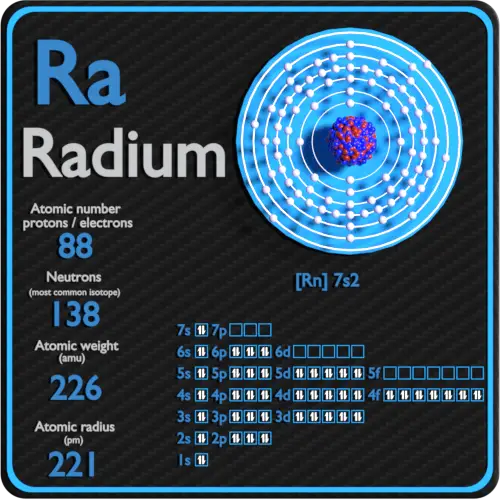
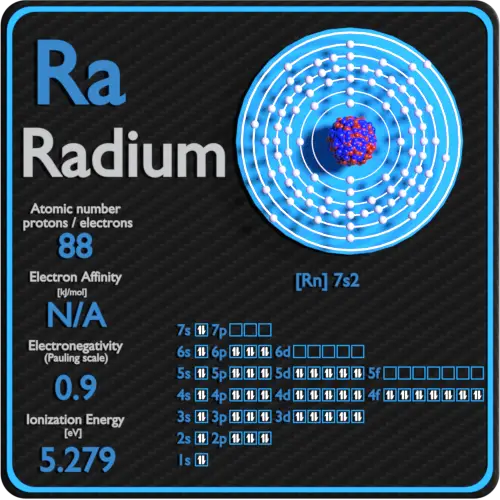
Pure radium is silvery-white alkaline earth metal. All isotopes of radium are highly radioactive, with the most stable isotope being radium-226.

Summary

Element Radium
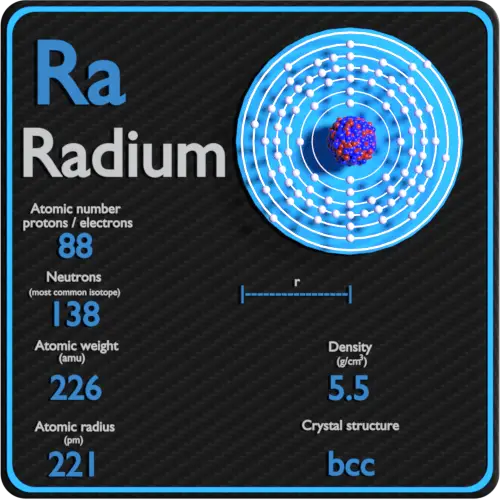
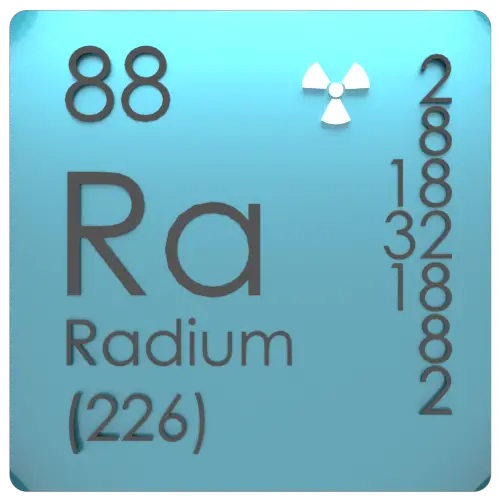
Atomic number 88
Atomic mass [amu] 226
Atomic mass [pm] 221
Density at STP [g/cm3] 5.5
Number of protons 88
Number of neutrons (typical isotopes) 226
Number of electrons 88
Electron configuration [Rn] 7s2
Oxidation states +2
Electron affinity [kJ/mol]
Electronegativity [Pauling scale] 0.9
First ionization energy [eV] 5.2789

Atomic Number – Protons, Electrons and Neutrons in Radium

Proton Number - Atomic NumberRadium is a chemical element with atomic number 88 which means there are 88 protons in its nucleus. Total number of protons in the nucleus is called the atomic number of the atom and is given the symbol Z. The total electrical charge of the nucleus is therefore +Ze, where e (elementary charge) equals to 1,602 x 10-19 coulombs.

The total number of neutrons in the nucleus of an atom is called the neutron number of the atom and is given the symbol N. Neutron number plus atomic number equals atomic mass number: N+Z=A. The difference between the neutron number and the atomic number is known as the neutron excess: D = N – Z = A – 2Z.

For stable elements, there is usually a variety of stable isotopes. Isotopes are nuclides that have the same atomic number and are therefore the same element, but differ in the number of neutrons. Mass numbers of typical isotopes of Radium are 226.

Atomic Mass of Radium

Atomic mass of Radium is 226 u. 

The atomic mass is the mass of an atom. The atomic mass or relative isotopic mass refers to the mass of a single particle, and therefore is tied to a certain specific isotope of an element. The atomic mass is carried by the atomic nucleus, which occupies only about 10-12 of the total volume of the atom or less, but it contains all the positive charge and at least 99.95% of the total mass of the atom. Note that, each element may contain more isotopes, therefore this resulting atomic mass is calculated from naturally-occuring isotopes and their abundance.

Atomic Radius of Radium

The atomic radius of Radium atom is 221pm (covalent radius).

Atomic Radius of Chemical Elements

It must be noted, atoms lack a well-defined outer boundary. The atomic radius of a chemical element is a measure of the distance out to which the electron cloud extends from the nucleus. However, this assumes the atom to exhibit a spherical shape, which is only obeyed for atoms in vacuum or free space. Therefore, there are various non-equivalent definitions of atomic radius.

Electrons and Electron Configuration

The number of electrons in an electrically-neutral atom is the same as the number of protons in the nucleus. Therefore, the number of electrons in neutral atom of Radium is 88. Each electron is influenced by the electric fields produced by the positive nuclear charge and the other (Z – 1) negative electrons in the atom.

Since the number of electrons and their arrangement are responsible for the chemical behavior of atoms, the atomic number identifies the various chemical elements. The configuration of these electrons follows from the principles of quantum mechanics. The number of electrons in each element’s electron shells, particularly the outermost valence shell, is the primary factor in determining its chemical bonding behavior. In the periodic table, the elements are listed in order of increasing atomic number Z.

Electron configuration of Radium is [Rn] 7s2.

Possible oxidation states are +2.

Density of Radium

Density of Radium is 5.5g/cm3.

Typical densities of various substances are at atmospheric pressure.

Density is defined as the mass per unit volume. It is an intensive property, which is mathematically defined as mass divided by volume:

ρ = m/V

Atomic Masses of Elements

Periodic Table of Elements - atomic mass

Atomic Radii of Elements

Periodic Table of Elements - atomic radius

Densities of Elements

Periodic Table of Elements - density

Radium-protons-neutrons-electrons-configuration

Radium-affinity-electronegativity-ionization

Electron Affinity – Radium

Electron affinity of Radium is — kJ/mol.

In chemistry and atomic physics, the electron affinity of an atom or molecule is defined as:

the change in energy (in kJ/mole) of a neutral atom or molecule (in the gaseous phase) when an electron is added to the atom to form a negative ion.

X + e → X + energy        Affinity = – ∆H

In other words, it can be expressed as the neutral atom’s likelihood of gaining an electron. Note that, ionization energies measure the tendency of a neutral atom to resist the loss of electrons. Electron affinities are more difficult to measure than ionization energies.

Electronegativity of Radium

Electronegativity of Radium is 0.9.

Electronegativity, symbol χ, is a chemical property that describes the tendency of an atom to attract electrons towards this atom. For this purposes, a dimensionless quantity the Pauling scale, symbol χ, is the most commonly used.

The electronegativity of Radium is: χ = 0.9

First Ionization Energy of Radium

First Ionization Energy of Radium is 5.2789 eV.

Ionization energy, also called ionization potential, is the energy necessary to remove an electron from the neutral atom.

X + energy → X+ + e

where X is any atom or molecule capable of being ionized, X+ is that atom or molecule with an electron removed (positive ion), and e is the removed electron.

A Radium atom, for example, requires the following ionization energy to remove the outermost electron.

Ra + IE → Ra+ + e        IE = 5.2789 eV

Electronegativity of Elements

Periodic Table of Elements - electronegativity

Ionization Energy of Elements

Periodic Table of Elements - ionization energy

Radium-periodic-table

Source: www.luciteria.com


Properties of other elements

Radium - Comparison of Atomic Properties

Periodic Table in 8K resolution

Other properties of Radium


Astatine – Periodic Table – Atomic Properties

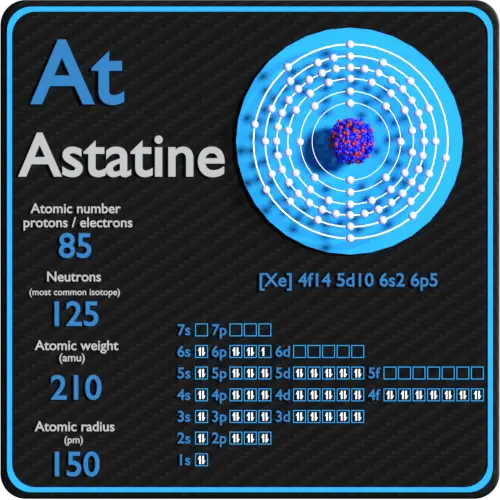
Astatine-density-atomic-number-mass-radius

Astatine is the rarest naturally occurring element on the Earth’s crust. It occurs on Earth as the decay product of various heavier elements. The bulk properties of astatine are not known with any certainty.

Summary

Element Astatine
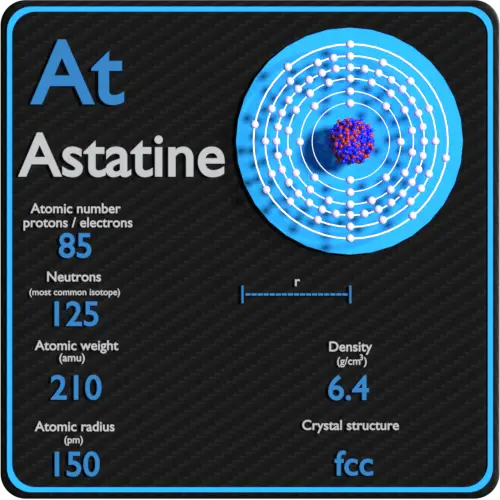
Atomic number 85
Atomic mass [amu] 210
Atomic mass [pm] 150
Density at STP [g/cm3] 6.4
Number of protons 85
Number of neutrons (typical isotopes) 210
Number of electrons 85
Electron configuration [Hg] 6p5
Oxidation states
Electron affinity [kJ/mol] 270.1
Electronegativity [Pauling scale] 2.2
First ionization energy [eV] 9.5

Atomic Number – Protons, Electrons and Neutrons in Astatine

Proton Number - Atomic NumberAstatine is a chemical element with atomic number 85 which means there are 85 protons in its nucleus. Total number of protons in the nucleus is called the atomic number of the atom and is given the symbol Z. The total electrical charge of the nucleus is therefore +Ze, where e (elementary charge) equals to 1,602 x 10-19 coulombs.

The total number of neutrons in the nucleus of an atom is called the neutron number of the atom and is given the symbol N. Neutron number plus atomic number equals atomic mass number: N+Z=A. The difference between the neutron number and the atomic number is known as the neutron excess: D = N – Z = A – 2Z.

For stable elements, there is usually a variety of stable isotopes. Isotopes are nuclides that have the same atomic number and are therefore the same element, but differ in the number of neutrons. Mass numbers of typical isotopes of Astatine are 210.

Atomic Mass of Astatine

Atomic mass of Astatine is 210 u. 

The atomic mass is the mass of an atom. The atomic mass or relative isotopic mass refers to the mass of a single particle, and therefore is tied to a certain specific isotope of an element. The atomic mass is carried by the atomic nucleus, which occupies only about 10-12 of the total volume of the atom or less, but it contains all the positive charge and at least 99.95% of the total mass of the atom. Note that, each element may contain more isotopes, therefore this resulting atomic mass is calculated from naturally-occuring isotopes and their abundance.

Atomic Radius of Astatine

The atomic radius of Astatine atom is 150pm (covalent radius).

Atomic Radius of Chemical Elements

It must be noted, atoms lack a well-defined outer boundary. The atomic radius of a chemical element is a measure of the distance out to which the electron cloud extends from the nucleus. However, this assumes the atom to exhibit a spherical shape, which is only obeyed for atoms in vacuum or free space. Therefore, there are various non-equivalent definitions of atomic radius.

Electrons and Electron Configuration

The number of electrons in an electrically-neutral atom is the same as the number of protons in the nucleus. Therefore, the number of electrons in neutral atom of Astatine is 85. Each electron is influenced by the electric fields produced by the positive nuclear charge and the other (Z – 1) negative electrons in the atom.

Since the number of electrons and their arrangement are responsible for the chemical behavior of atoms, the atomic number identifies the various chemical elements. The configuration of these electrons follows from the principles of quantum mechanics. The number of electrons in each element’s electron shells, particularly the outermost valence shell, is the primary factor in determining its chemical bonding behavior. In the periodic table, the elements are listed in order of increasing atomic number Z.

Electron configuration of Astatine is [Hg] 6p5.

Possible oxidation states are .

Density of Astatine

Density of Astatine is 6.4g/cm3.

Typical densities of various substances are at atmospheric pressure.

Density is defined as the mass per unit volume. It is an intensive property, which is mathematically defined as mass divided by volume:

ρ = m/V

Atomic Masses of Elements

Periodic Table of Elements - atomic mass

Atomic Radii of Elements

Periodic Table of Elements - atomic radius

Densities of Elements

Periodic Table of Elements - density

Astatine-protons-neutrons-electrons-configuration

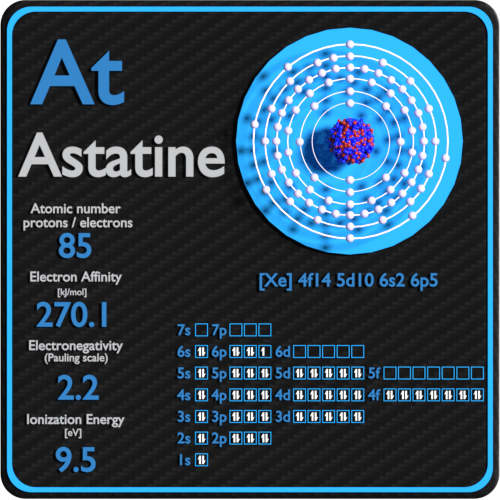
Astatine-affinity-electronegativity-ionization

Electron Affinity – Astatine

Electron affinity of Astatine is 270.1 kJ/mol.

In chemistry and atomic physics, the electron affinity of an atom or molecule is defined as:

the change in energy (in kJ/mole) of a neutral atom or molecule (in the gaseous phase) when an electron is added to the atom to form a negative ion.

X + e → X + energy        Affinity = – ∆H

In other words, it can be expressed as the neutral atom’s likelihood of gaining an electron. Note that, ionization energies measure the tendency of a neutral atom to resist the loss of electrons. Electron affinities are more difficult to measure than ionization energies.

Electronegativity of Astatine

Electronegativity of Astatine is 2.2.

Electronegativity, symbol χ, is a chemical property that describes the tendency of an atom to attract electrons towards this atom. For this purposes, a dimensionless quantity the Pauling scale, symbol χ, is the most commonly used.

The electronegativity of Astatine is: χ = 2.2

First Ionization Energy of Astatine

First Ionization Energy of Astatine is 9.5 eV.

Ionization energy, also called ionization potential, is the energy necessary to remove an electron from the neutral atom.

X + energy → X+ + e

where X is any atom or molecule capable of being ionized, X+ is that atom or molecule with an electron removed (positive ion), and e is the removed electron.

A Astatine atom, for example, requires the following ionization energy to remove the outermost electron.

At + IE → At+ + e        IE = 9.5 eV

Electronegativity of Elements

Periodic Table of Elements - electronegativity

Ionization Energy of Elements

Periodic Table of Elements - ionization energy

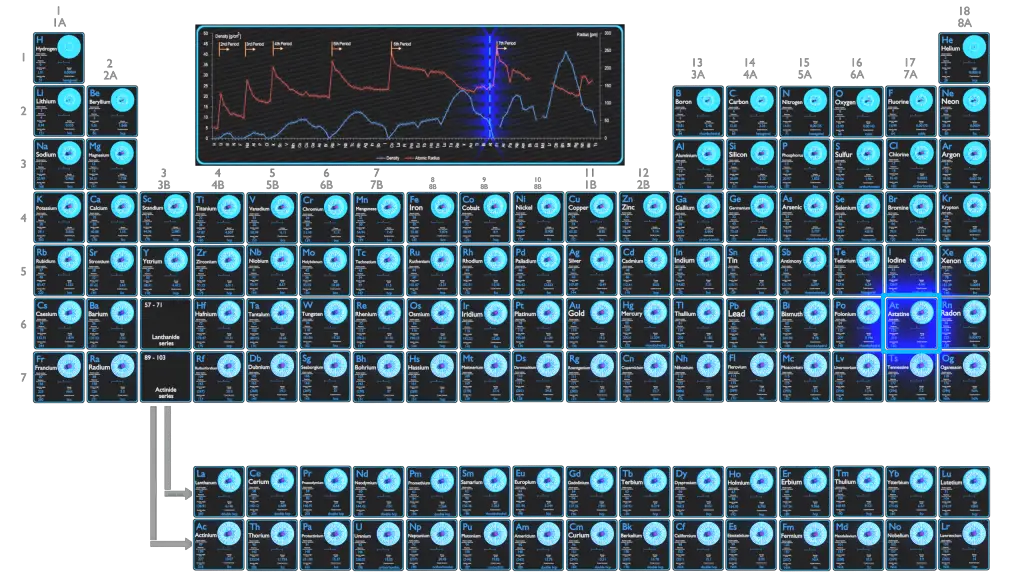
Astatine-periodic-table

Source: www.luciteria.com


Properties of other elements

Astatine - Comparison of Atomic Properties

Periodic Table in 8K resolution

Other properties of Astatine


Radon – Periodic Table – Atomic Properties

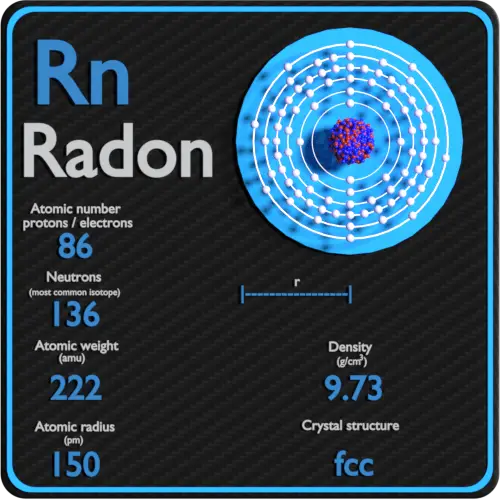
Radon-density-atomic-number-mass-radius

Radon is a radioactive, colorless, odorless, tasteless noble gas. Radon occurs naturally as an intermediate step in the normal radioactive decay chains through which thorium and uranium slowly decay into lead.

Summary

Element Radon
Atomic number 86
Atomic mass [amu] 222
Atomic mass [pm] 150
Density at STP [g/cm3] 0.00973
Number of protons 86
Number of neutrons (typical isotopes) 222
Number of electrons 86
Electron configuration [Hg] 6p6
Oxidation states 0
Electron affinity [kJ/mol]
Electronegativity [Pauling scale]
First ionization energy [eV] 10.7485

Atomic Number – Protons, Electrons and Neutrons in Radon

Proton Number - Atomic NumberRadon is a chemical element with atomic number 86 which means there are 86 protons in its nucleus. Total number of protons in the nucleus is called the atomic number of the atom and is given the symbol Z. The total electrical charge of the nucleus is therefore +Ze, where e (elementary charge) equals to 1,602 x 10-19 coulombs.

The total number of neutrons in the nucleus of an atom is called the neutron number of the atom and is given the symbol N. Neutron number plus atomic number equals atomic mass number: N+Z=A. The difference between the neutron number and the atomic number is known as the neutron excess: D = N – Z = A – 2Z.

For stable elements, there is usually a variety of stable isotopes. Isotopes are nuclides that have the same atomic number and are therefore the same element, but differ in the number of neutrons. Mass numbers of typical isotopes of Radon are 222.

Atomic Mass of Radon

Atomic mass of Radon is 222 u. 

The atomic mass is the mass of an atom. The atomic mass or relative isotopic mass refers to the mass of a single particle, and therefore is tied to a certain specific isotope of an element. The atomic mass is carried by the atomic nucleus, which occupies only about 10-12 of the total volume of the atom or less, but it contains all the positive charge and at least 99.95% of the total mass of the atom. Note that, each element may contain more isotopes, therefore this resulting atomic mass is calculated from naturally-occuring isotopes and their abundance.

Atomic Radius of Radon

The atomic radius of Radon atom is 150pm (covalent radius).

Atomic Radius of Chemical Elements

It must be noted, atoms lack a well-defined outer boundary. The atomic radius of a chemical element is a measure of the distance out to which the electron cloud extends from the nucleus. However, this assumes the atom to exhibit a spherical shape, which is only obeyed for atoms in vacuum or free space. Therefore, there are various non-equivalent definitions of atomic radius.

Electrons and Electron Configuration

The number of electrons in an electrically-neutral atom is the same as the number of protons in the nucleus. Therefore, the number of electrons in neutral atom of Radon is 86. Each electron is influenced by the electric fields produced by the positive nuclear charge and the other (Z – 1) negative electrons in the atom.

Since the number of electrons and their arrangement are responsible for the chemical behavior of atoms, the atomic number identifies the various chemical elements. The configuration of these electrons follows from the principles of quantum mechanics. The number of electrons in each element’s electron shells, particularly the outermost valence shell, is the primary factor in determining its chemical bonding behavior. In the periodic table, the elements are listed in order of increasing atomic number Z.

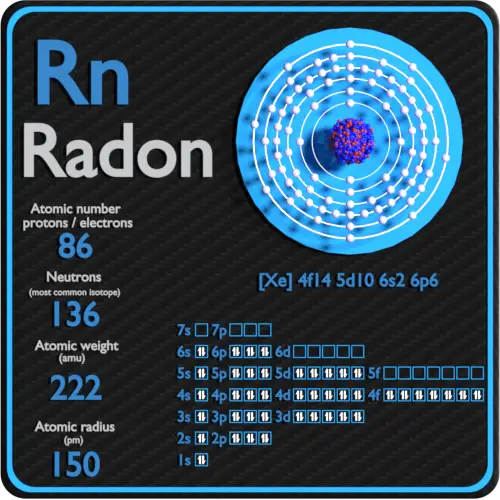
Electron configuration of Radon is [Hg] 6p6.

Possible oxidation states are 0.

Density of Radon

Density of Radon is 0.00973g/cm3.

Typical densities of various substances are at atmospheric pressure.

Density is defined as the mass per unit volume. It is an intensive property, which is mathematically defined as mass divided by volume:

ρ = m/V

Atomic Masses of Elements

Periodic Table of Elements - atomic mass

Atomic Radii of Elements

Periodic Table of Elements - atomic radius

Densities of Elements

Periodic Table of Elements - density

Radon-protons-neutrons-electrons-configuration

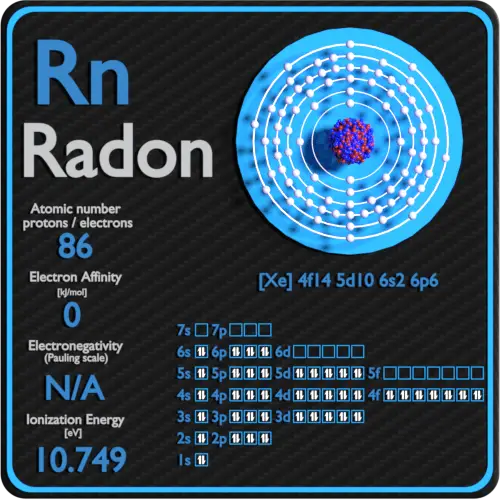
Radon-affinity-electronegativity-ionization

Electron Affinity – Radon

Electron affinity of Radon is — kJ/mol.

In chemistry and atomic physics, the electron affinity of an atom or molecule is defined as:

the change in energy (in kJ/mole) of a neutral atom or molecule (in the gaseous phase) when an electron is added to the atom to form a negative ion.

X + e → X + energy        Affinity = – ∆H

In other words, it can be expressed as the neutral atom’s likelihood of gaining an electron. Note that, ionization energies measure the tendency of a neutral atom to resist the loss of electrons. Electron affinities are more difficult to measure than ionization energies.

Electronegativity of Radon

Electronegativity of Radon is .

Electronegativity, symbol χ, is a chemical property that describes the tendency of an atom to attract electrons towards this atom. For this purposes, a dimensionless quantity the Pauling scale, symbol χ, is the most commonly used.

The electronegativity of Radon is: χ = —

First Ionization Energy of Radon

First Ionization Energy of Radon is 10.7485 eV.

Ionization energy, also called ionization potential, is the energy necessary to remove an electron from the neutral atom.

X + energy → X+ + e

where X is any atom or molecule capable of being ionized, X+ is that atom or molecule with an electron removed (positive ion), and e is the removed electron.

A Radon atom, for example, requires the following ionization energy to remove the outermost electron.

Rn + IE → Rn+ + e        IE = 10.7485 eV

Electronegativity of Elements

Periodic Table of Elements - electronegativity

Ionization Energy of Elements

Periodic Table of Elements - ionization energy

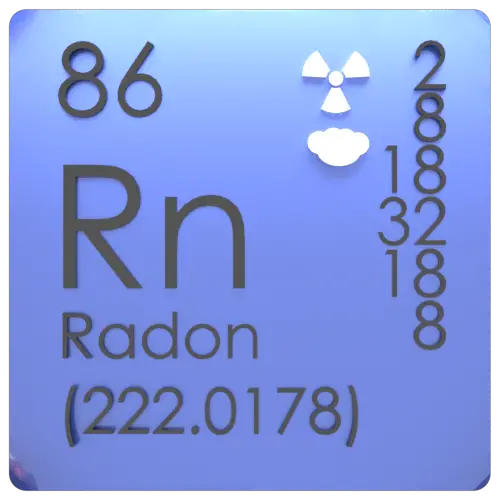
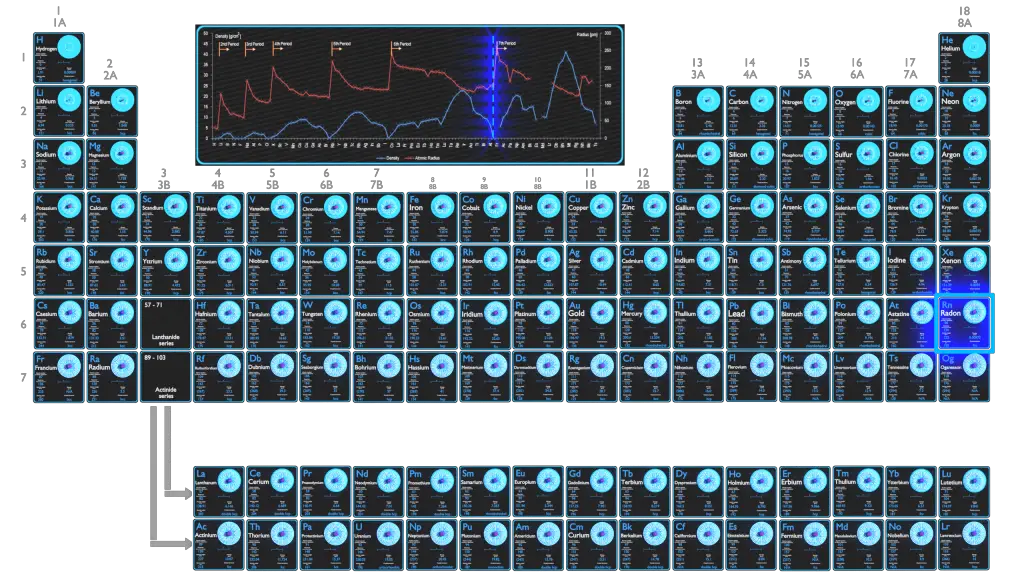
Radon-periodic-table

Source: www.luciteria.com


Properties of other elements

Radon - Comparison of Atomic Properties

Periodic Table in 8K resolution

Other properties of Radon


Polonium – Periodic Table – Atomic Properties
Polonium-density-atomic-number-mass-radius

Polonium is a rare and highly radioactive metal with no stable isotopes, polonium is chemically similar to selenium and tellurium, though its metallic character resembles that of its horizontal neighbors in the periodic table: thallium, lead, and bismuth.
Summary

Element Polonium
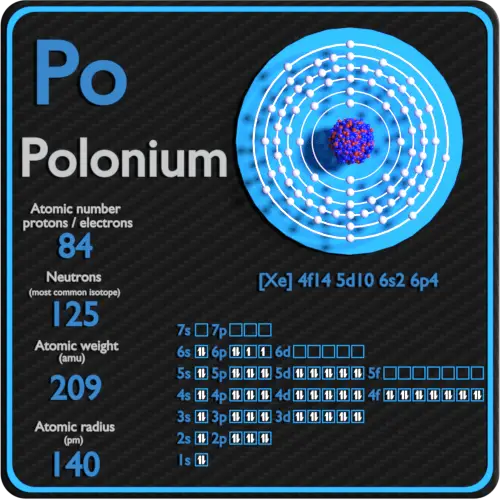
Atomic number 84
Atomic mass [amu] 209
Atomic mass [pm] 140
Density at STP [g/cm3] 9.196
Number of protons 84
Number of neutrons (typical isotopes) 208-210
Number of electrons 84
Electron configuration [Hg] 6p4
Oxidation states +2,4
Electron affinity [kJ/mol] 183.3
Electronegativity [Pauling scale] 2
First ionization energy [eV] 8.4167

Atomic Number – Protons, Electrons and Neutrons in Polonium

Proton Number - Atomic NumberPolonium is a chemical element with atomic number 84 which means there are 84 protons in its nucleus. Total number of protons in the nucleus is called the atomic number of the atom and is given the symbol Z. The total electrical charge of the nucleus is therefore +Ze, where e (elementary charge) equals to 1,602 x 10-19 coulombs.

The total number of neutrons in the nucleus of an atom is called the neutron number of the atom and is given the symbol N. Neutron number plus atomic number equals atomic mass number: N+Z=A. The difference between the neutron number and the atomic number is known as the neutron excess: D = N – Z = A – 2Z.

For stable elements, there is usually a variety of stable isotopes. Isotopes are nuclides that have the same atomic number and are therefore the same element, but differ in the number of neutrons. Mass numbers of typical isotopes of Polonium are 208-210.

Atomic Mass of Polonium

Atomic mass of Polonium is 209 u. 

The atomic mass is the mass of an atom. The atomic mass or relative isotopic mass refers to the mass of a single particle, and therefore is tied to a certain specific isotope of an element. The atomic mass is carried by the atomic nucleus, which occupies only about 10-12 of the total volume of the atom or less, but it contains all the positive charge and at least 99.95% of the total mass of the atom. Note that, each element may contain more isotopes, therefore this resulting atomic mass is calculated from naturally-occuring isotopes and their abundance.

Atomic Radius of Polonium

The atomic radius of Polonium atom is 140pm (covalent radius).

Atomic Radius of Chemical Elements

It must be noted, atoms lack a well-defined outer boundary. The atomic radius of a chemical element is a measure of the distance out to which the electron cloud extends from the nucleus. However, this assumes the atom to exhibit a spherical shape, which is only obeyed for atoms in vacuum or free space. Therefore, there are various non-equivalent definitions of atomic radius.

Electrons and Electron Configuration

The number of electrons in an electrically-neutral atom is the same as the number of protons in the nucleus. Therefore, the number of electrons in neutral atom of Polonium is 84. Each electron is influenced by the electric fields produced by the positive nuclear charge and the other (Z – 1) negative electrons in the atom.

Since the number of electrons and their arrangement are responsible for the chemical behavior of atoms, the atomic number identifies the various chemical elements. The configuration of these electrons follows from the principles of quantum mechanics. The number of electrons in each element’s electron shells, particularly the outermost valence shell, is the primary factor in determining its chemical bonding behavior. In the periodic table, the elements are listed in order of increasing atomic number Z.

Electron configuration of Polonium is [Hg] 6p4.

Possible oxidation states are +2,4.

Density of Polonium

Density of Polonium is 9.196g/cm3.

Typical densities of various substances are at atmospheric pressure.

Density is defined as the mass per unit volume. It is an intensive property, which is mathematically defined as mass divided by volume:

ρ = m/V

Atomic Masses of Elements

Periodic Table of Elements - atomic mass

Atomic Radii of Elements

Periodic Table of Elements - atomic radius

Densities of Elements

Periodic Table of Elements - density

Polonium-protons-neutrons-electrons-configuration

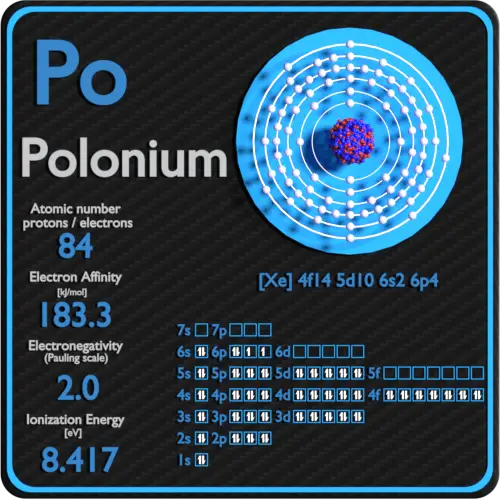
Polonium-affinity-electronegativity-ionization

Electron Affinity – Polonium

Electron affinity of Polonium is 183.3 kJ/mol.

In chemistry and atomic physics, the electron affinity of an atom or molecule is defined as:

the change in energy (in kJ/mole) of a neutral atom or molecule (in the gaseous phase) when an electron is added to the atom to form a negative ion.

X + e → X + energy        Affinity = – ∆H

In other words, it can be expressed as the neutral atom’s likelihood of gaining an electron. Note that, ionization energies measure the tendency of a neutral atom to resist the loss of electrons. Electron affinities are more difficult to measure than ionization energies.

Electronegativity of Polonium

Electronegativity of Polonium is 2.

Electronegativity, symbol χ, is a chemical property that describes the tendency of an atom to attract electrons towards this atom. For this purposes, a dimensionless quantity the Pauling scale, symbol χ, is the most commonly used.

The electronegativity of Polonium is: χ = 2

First Ionization Energy of Polonium

First Ionization Energy of Polonium is 8.4167 eV.

Ionization energy, also called ionization potential, is the energy necessary to remove an electron from the neutral atom.

X + energy → X+ + e

where X is any atom or molecule capable of being ionized, X+ is that atom or molecule with an electron removed (positive ion), and e is the removed electron.

A Polonium atom, for example, requires the following ionization energy to remove the outermost electron.

Po + IE → Po+ + e        IE = 8.4167 eV

Electronegativity of Elements

Periodic Table of Elements - electronegativity

Ionization Energy of Elements

Periodic Table of Elements - ionization energy

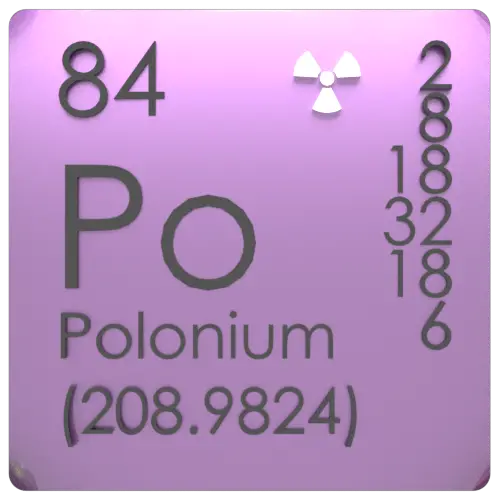
Polonium-periodic-table

Source: www.luciteria.com


Properties of other elements

Polonium - Comparison of Atomic Properties

Periodic Table in 8K resolution

Other properties of Polonium