Facebook Instagram Youtube Twitter

Beryllium – Periodic Table – Atomic Properties

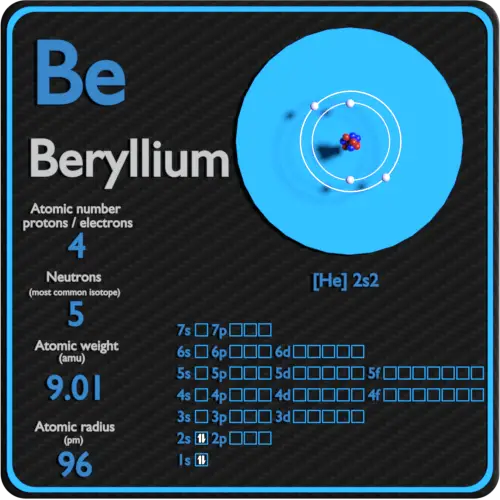
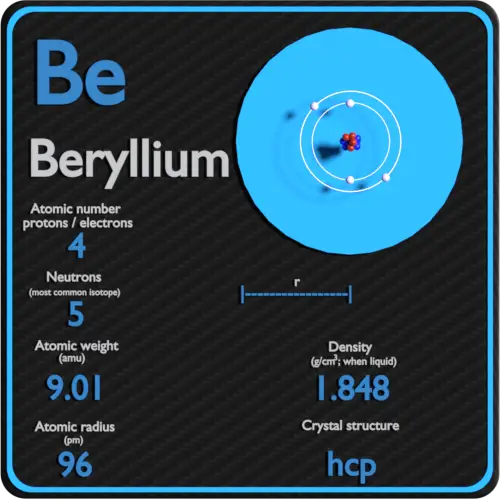
Beryllium-density-atomic-number-mass-radius

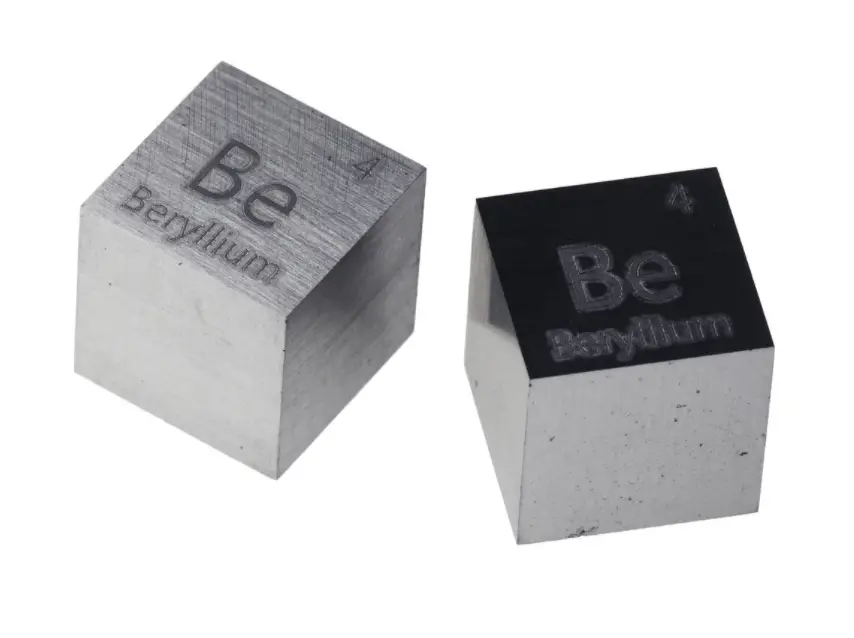
Beryllium is a hard, grayish metal naturally found in mineral rocks, coal, soil, and volcanic dust. The commercial use of beryllium requires the use of appropriate dust control equipment and industrial controls at all times because of the toxicity of inhaled beryllium-containing dusts that can cause a chronic life-threatening allergic disease in some people called berylliosis. Beryllium has a large scattering cross section for high-energy neutrons, about 6 barns for energies above approximately 10 keV. Therefore, it works as a neutron reflector and neutron moderator, effectively slowing the neutrons to the thermal energy. Since berylium has very low threshold energy for neutron emission, it can be used as a neutron source in nuclear reactors. The Sb-Be source is based on (γ,n) reaction (i.e. it emits photoneutrons).

Summary

Element Beryllium
Atomic number 4
Atomic mass [amu] 9.0122
Atomic mass [pm] 96
Density at STP [g/cm3] 1.848
Number of protons 4
Number of neutrons (typical isotopes) 9
Number of electrons 4
Electron configuration [He] 2s2
Oxidation states +1; +2
Electron affinity [kJ/mol]
Electronegativity [Pauling scale] 1.57
First ionization energy [eV] 9.3226

Atomic Number – Protons, Electrons and Neutrons in Beryllium
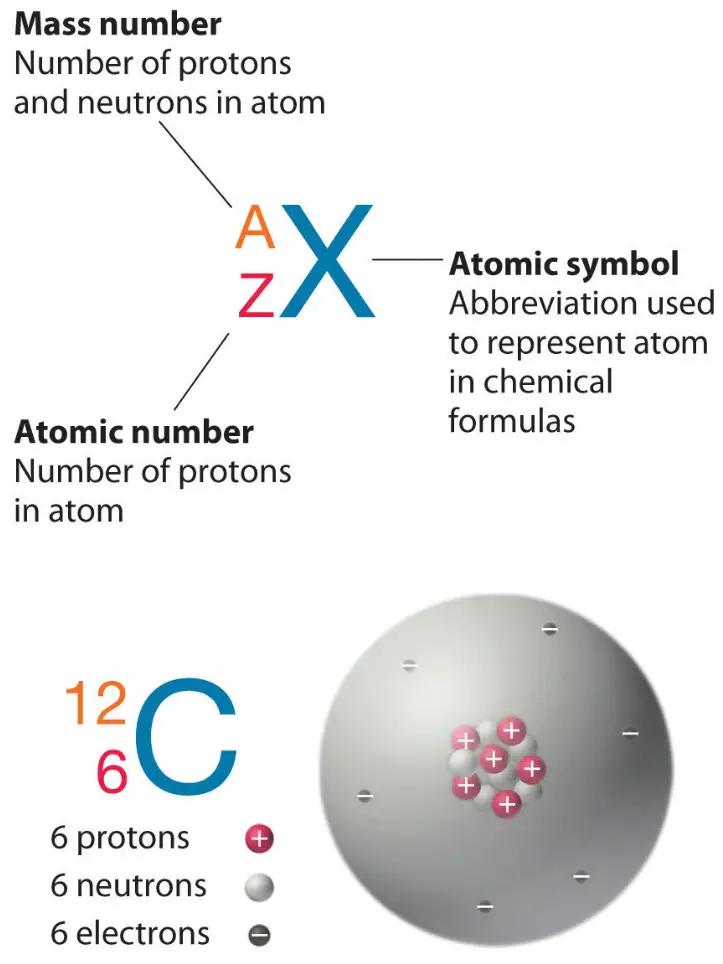
Proton Number - Atomic NumberBeryllium is a chemical element with atomic number 4 which means there are 4 protons in its nucleus. Total number of protons in the nucleus is called the atomic number of the atom and is given the symbol Z. The total electrical charge of the nucleus is therefore +Ze, where e (elementary charge) equals to 1,602 x 10-19 coulombs.

The total number of neutrons in the nucleus of an atom is called the neutron number of the atom and is given the symbol N. Neutron number plus atomic number equals atomic mass number: N+Z=A. The difference between the neutron number and the atomic number is known as the neutron excess: D = N – Z = A – 2Z.

For stable elements, there is usually a variety of stable isotopes. Isotopes are nuclides that have the same atomic number and are therefore the same element, but differ in the number of neutrons. Mass numbers of typical isotopes of Beryllium are 9.

Atomic Mass of Beryllium

Atomic mass of Beryllium is 9.0122 u. 

The atomic mass is the mass of an atom. The atomic mass or relative isotopic mass refers to the mass of a single particle, and therefore is tied to a certain specific isotope of an element. The atomic mass is carried by the atomic nucleus, which occupies only about 10-12 of the total volume of the atom or less, but it contains all the positive charge and at least 99.95% of the total mass of the atom. Note that, each element may contain more isotopes, therefore this resulting atomic mass is calculated from naturally-occuring isotopes and their abundance.

Atomic Radius of Beryllium

The atomic radius of Beryllium atom is 96pm (covalent radius).

Atomic Radius of Chemical Elements

It must be noted, atoms lack a well-defined outer boundary. The atomic radius of a chemical element is a measure of the distance out to which the electron cloud extends from the nucleus. However, this assumes the atom to exhibit a spherical shape, which is only obeyed for atoms in vacuum or free space. Therefore, there are various non-equivalent definitions of atomic radius.

Electrons and Electron Configuration

The number of electrons in an electrically-neutral atom is the same as the number of protons in the nucleus. Therefore, the number of electrons in neutral atom of Beryllium is 4. Each electron is influenced by the electric fields produced by the positive nuclear charge and the other (Z – 1) negative electrons in the atom.

Since the number of electrons and their arrangement are responsible for the chemical behavior of atoms, the atomic number identifies the various chemical elements. The configuration of these electrons follows from the principles of quantum mechanics. The number of electrons in each element’s electron shells, particularly the outermost valence shell, is the primary factor in determining its chemical bonding behavior. In the periodic table, the elements are listed in order of increasing atomic number Z.

Electron configuration of Beryllium is [He] 2s2.

Possible oxidation states are +1; +2.

Density of Beryllium

Density of Beryllium is 1.848g/cm3.

Typical densities of various substances are at atmospheric pressure.

Density is defined as the mass per unit volume. It is an intensive property, which is mathematically defined as mass divided by volume:

ρ = m/V

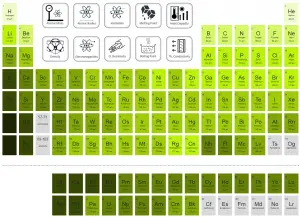
Atomic Masses of Elements
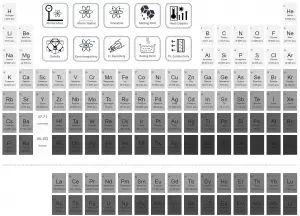
Periodic Table of Elements - atomic mass

Atomic Radii of Elements

Periodic Table of Elements - atomic radius

Densities of Elements

Periodic Table of Elements - density

Beryllium-protons-neutrons-electrons-configuration

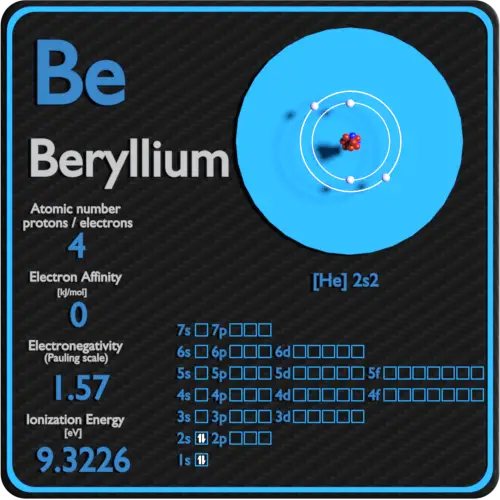
Beryllium-affinity-electronegativity-ionization

Electron Affinity – Beryllium

Electron affinity of Beryllium is — kJ/mol.

In chemistry and atomic physics, the electron affinity of an atom or molecule is defined as:

the change in energy (in kJ/mole) of a neutral atom or molecule (in the gaseous phase) when an electron is added to the atom to form a negative ion.

X + e → X + energy        Affinity = – ∆H

In other words, it can be expressed as the neutral atom’s likelihood of gaining an electron. Note that, ionization energies measure the tendency of a neutral atom to resist the loss of electrons. Electron affinities are more difficult to measure than ionization energies.

Electronegativity of Beryllium

Electronegativity of Beryllium is 1.57.

Electronegativity, symbol χ, is a chemical property that describes the tendency of an atom to attract electrons towards this atom. For this purposes, a dimensionless quantity the Pauling scale, symbol χ, is the most commonly used.

The electronegativity of Beryllium is: χ = 1.57

First Ionization Energy of Beryllium

First Ionization Energy of Beryllium is 9.3226 eV.

Ionization energy, also called ionization potential, is the energy necessary to remove an electron from the neutral atom.

X + energy → X+ + e

where X is any atom or molecule capable of being ionized, X+ is that atom or molecule with an electron removed (positive ion), and e is the removed electron.

A Beryllium atom, for example, requires the following ionization energy to remove the outermost electron.

Be + IE → Be+ + e        IE = 9.3226 eV

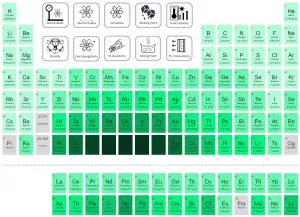
Electronegativity of Elements
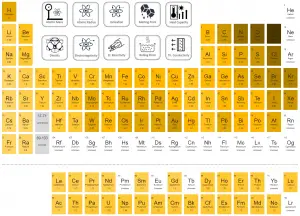
Periodic Table of Elements - electronegativity

Ionization Energy of Elements

Periodic Table of Elements - ionization energy

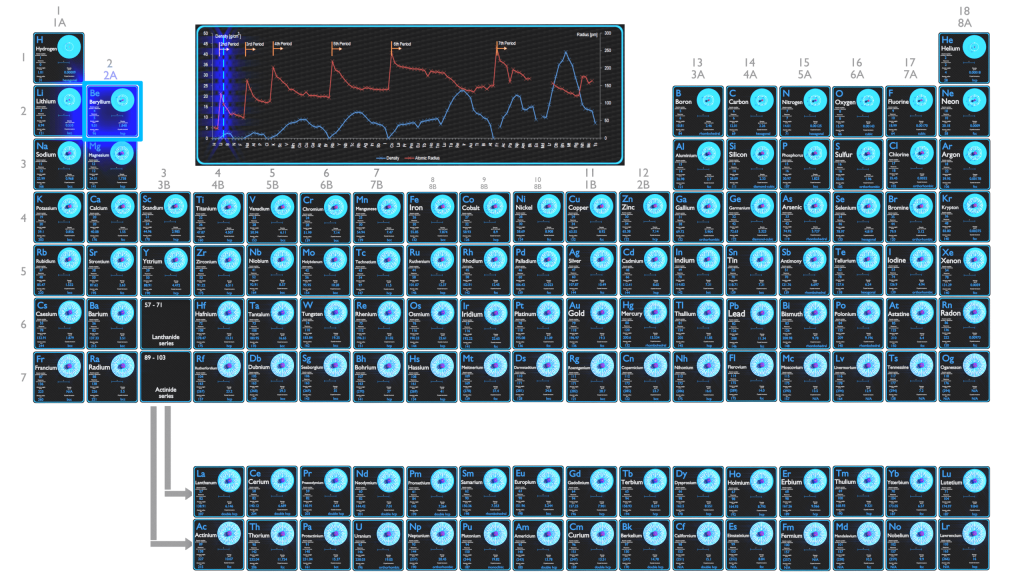
Beryllium-periodic-table

Source: www.luciteria.com


Properties of other elements

Beryllium - Comparison of Atomic Properties

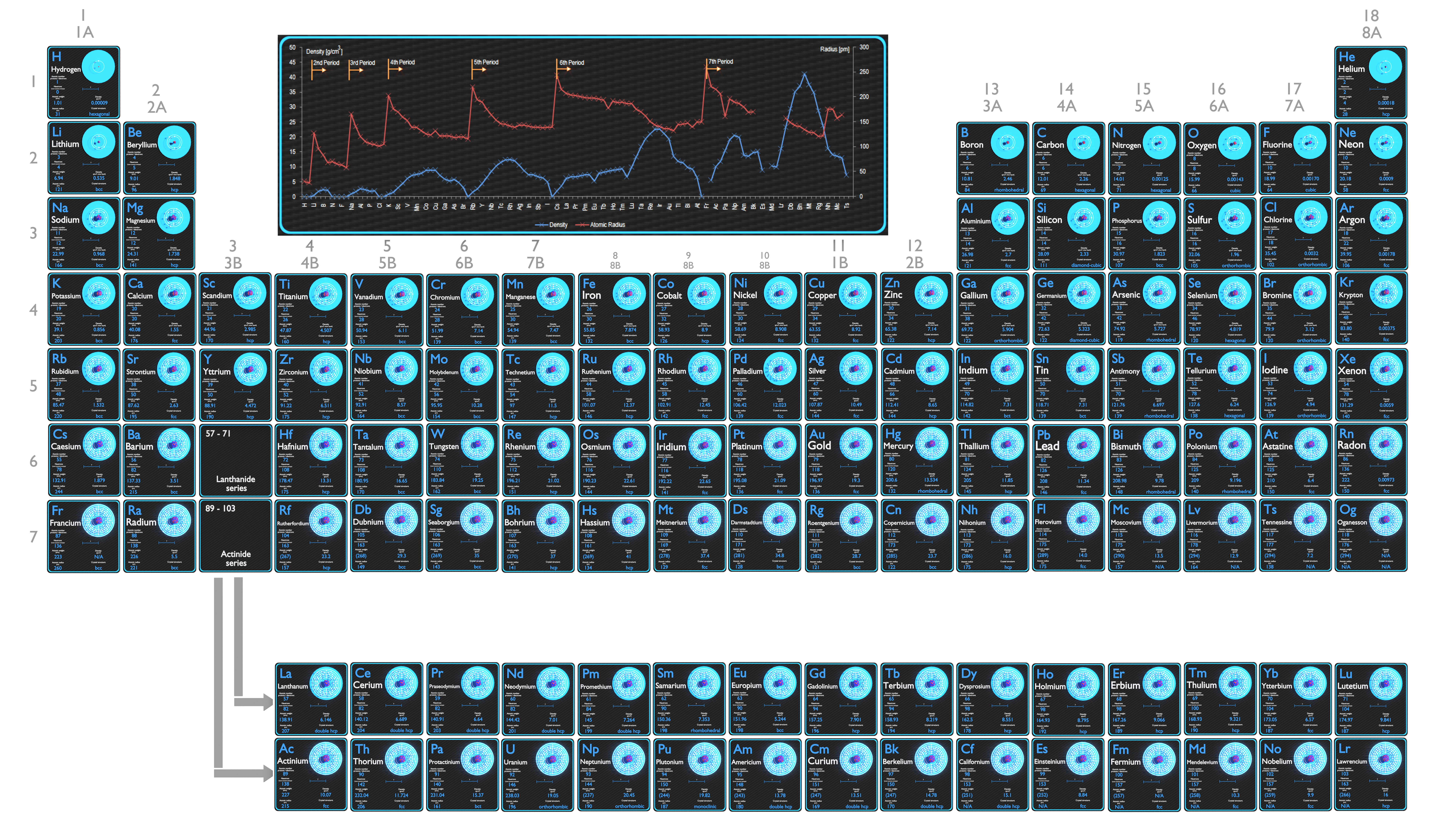
Periodic Table in 8K resolution

Other properties of Beryllium
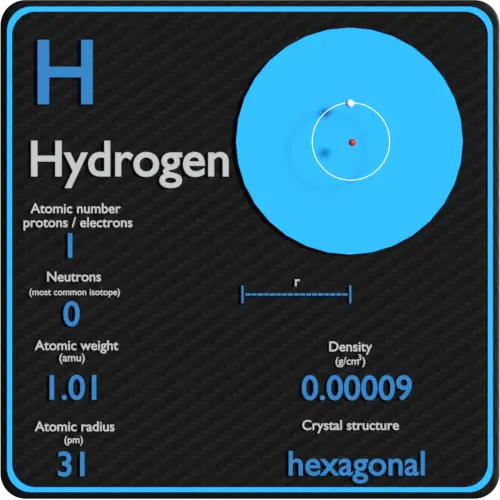
 

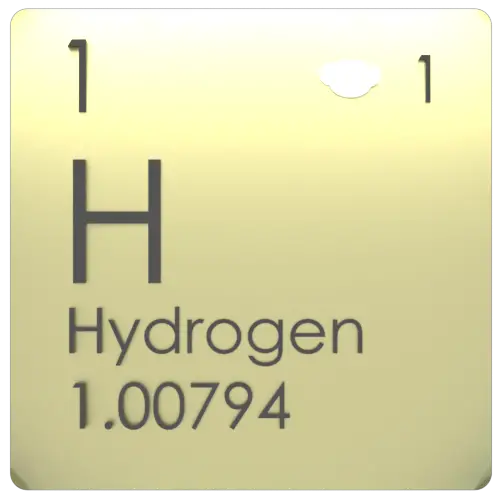
Hydrogen – Periodic Table – Atomic Properties

Hydrogen-density-atomic-number-mass-radius

With a standard atomic weight of circa 1.008, hydrogen is the lightest element on the periodic table. Its monatomic form (H) is the most abundant chemical substance in the Universe, constituting roughly 75% of all baryonic mass.

Summary

Element Hydrogen
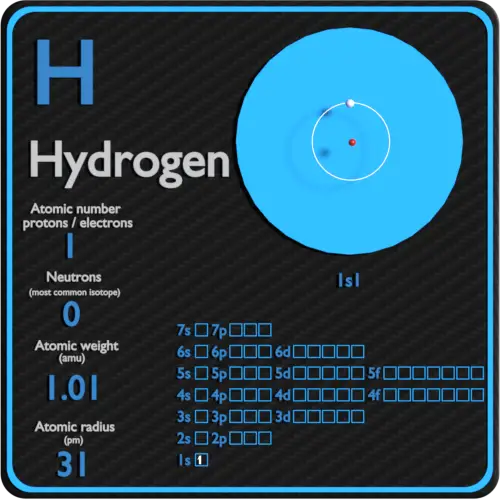
Atomic number 1
Atomic mass [amu] 1.0079
Atomic mass [pm] 31
Density at STP [g/cm3] 0.00009
Number of protons 1
Number of neutrons (typical isotopes) 1; 2
Number of electrons 1
Electron configuration 1s1
Oxidation states +1,-1
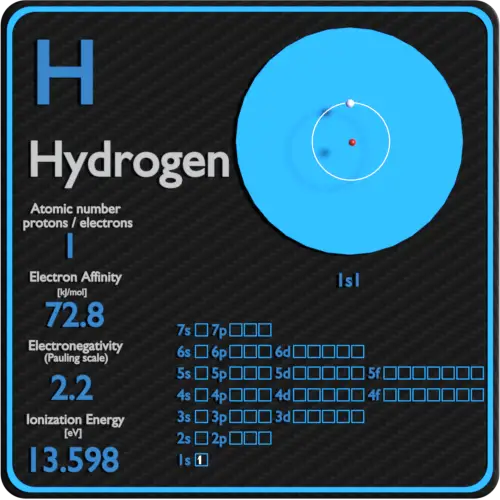
Electron affinity [kJ/mol] 72.8
Electronegativity [Pauling scale] 2.2
First ionization energy [eV] 13.5984

Atomic Number – Protons, Electrons and Neutrons in Hydrogen

Proton Number - Atomic NumberHydrogen is a chemical element with atomic number 1 which means there are 1 protons in its nucleus. Total number of protons in the nucleus is called the atomic number of the atom and is given the symbol Z. The total electrical charge of the nucleus is therefore +Ze, where e (elementary charge) equals to 1,602 x 10-19 coulombs.

The total number of neutrons in the nucleus of an atom is called the neutron number of the atom and is given the symbol N. Neutron number plus atomic number equals atomic mass number: N+Z=A. The difference between the neutron number and the atomic number is known as the neutron excess: D = N – Z = A – 2Z.

For stable elements, there is usually a variety of stable isotopes. Isotopes are nuclides that have the same atomic number and are therefore the same element, but differ in the number of neutrons. Mass numbers of typical isotopes of Hydrogen are 1; 2.

Atomic Mass of Hydrogen

Atomic mass of Hydrogen is 1.0079 u. 

The atomic mass is the mass of an atom. The atomic mass or relative isotopic mass refers to the mass of a single particle, and therefore is tied to a certain specific isotope of an element. The atomic mass is carried by the atomic nucleus, which occupies only about 10-12 of the total volume of the atom or less, but it contains all the positive charge and at least 99.95% of the total mass of the atom. Note that, each element may contain more isotopes, therefore this resulting atomic mass is calculated from naturally-occuring isotopes and their abundance.

Atomic Radius of Hydrogen

The atomic radius of Hydrogen atom is 31pm (covalent radius).

Atomic Radius of Chemical Elements

It must be noted, atoms lack a well-defined outer boundary. The atomic radius of a chemical element is a measure of the distance out to which the electron cloud extends from the nucleus. However, this assumes the atom to exhibit a spherical shape, which is only obeyed for atoms in vacuum or free space. Therefore, there are various non-equivalent definitions of atomic radius.

Electrons and Electron Configuration

The number of electrons in an electrically-neutral atom is the same as the number of protons in the nucleus. Therefore, the number of electrons in neutral atom of Hydrogen is 1. Each electron is influenced by the electric fields produced by the positive nuclear charge and the other (Z – 1) negative electrons in the atom.

Since the number of electrons and their arrangement are responsible for the chemical behavior of atoms, the atomic number identifies the various chemical elements. The configuration of these electrons follows from the principles of quantum mechanics. The number of electrons in each element’s electron shells, particularly the outermost valence shell, is the primary factor in determining its chemical bonding behavior. In the periodic table, the elements are listed in order of increasing atomic number Z.

Electron configuration of Hydrogen is 1s1.

Possible oxidation states are +1,-1.

Density of Hydrogen

Density of Hydrogen is 0.00009g/cm3.

Typical densities of various substances are at atmospheric pressure.

Density is defined as the mass per unit volume. It is an intensive property, which is mathematically defined as mass divided by volume:

ρ = m/V

Atomic Masses of Elements

Periodic Table of Elements - atomic mass

Atomic Radii of Elements

Periodic Table of Elements - atomic radius

Densities of Elements

Periodic Table of Elements - density

Hydrogen-protons-neutrons-electrons-configuration

Hydrogen-affinity-electronegativity-ionization

Electron Affinity – Hydrogen

Electron affinity of Hydrogen is 72.8 kJ/mol.

In chemistry and atomic physics, the electron affinity of an atom or molecule is defined as:

the change in energy (in kJ/mole) of a neutral atom or molecule (in the gaseous phase) when an electron is added to the atom to form a negative ion.

X + e → X + energy        Affinity = – ∆H

In other words, it can be expressed as the neutral atom’s likelihood of gaining an electron. Note that, ionization energies measure the tendency of a neutral atom to resist the loss of electrons. Electron affinities are more difficult to measure than ionization energies.

Electronegativity of Hydrogen

Electronegativity of Hydrogen is 2.2.

Electronegativity, symbol χ, is a chemical property that describes the tendency of an atom to attract electrons towards this atom. For this purposes, a dimensionless quantity the Pauling scale, symbol χ, is the most commonly used.

The electronegativity of Hydrogen is: χ = 2.2

First Ionization Energy of Hydrogen

First Ionization Energy of Hydrogen is 13.5984 eV.

Ionization energy, also called ionization potential, is the energy necessary to remove an electron from the neutral atom.

X + energy → X+ + e

where X is any atom or molecule capable of being ionized, X+ is that atom or molecule with an electron removed (positive ion), and e is the removed electron.

A Hydrogen atom, for example, requires the following ionization energy to remove the outermost electron.

H + IE → H+ + e        IE = 13.5984 eV

Electronegativity of Elements

Periodic Table of Elements - electronegativity

Ionization Energy of Elements

Periodic Table of Elements - ionization energy

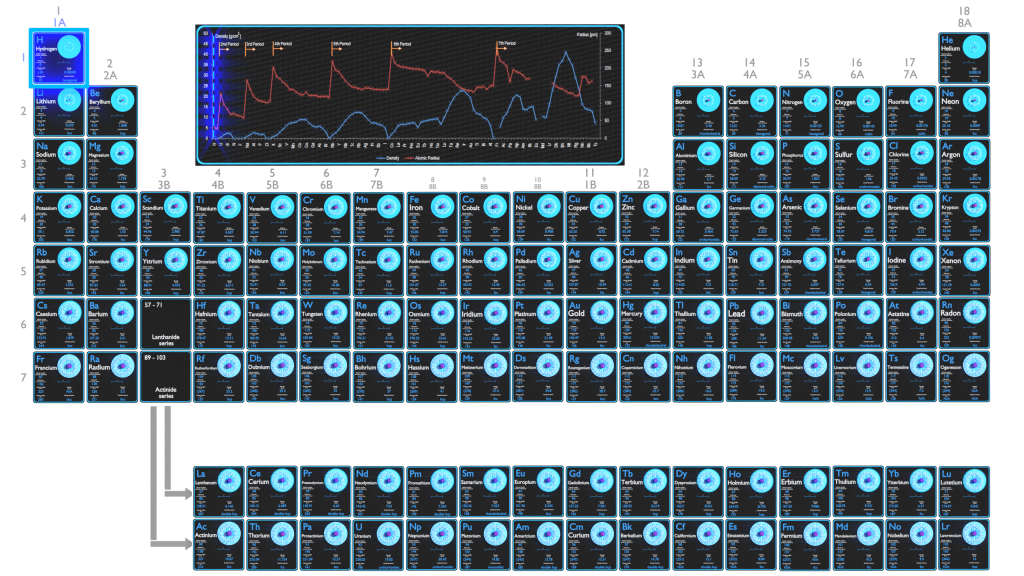
Hydrogen-periodic-table

Source: www.luciteria.com


Properties of other elements

Hydrogen - Comparison of Atomic Properties

Periodic Table in 8K resolution

Other properties of Hydrogen


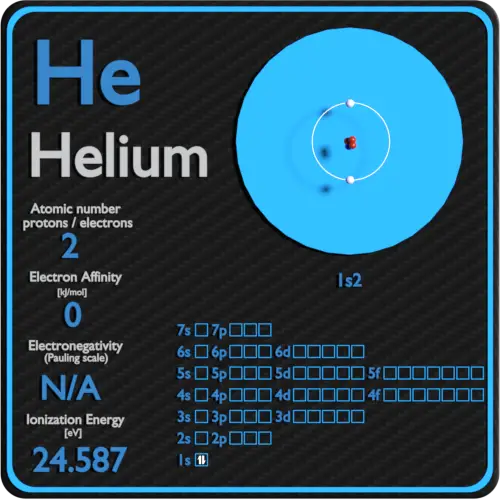
Helium – Periodic Table – Atomic Properties
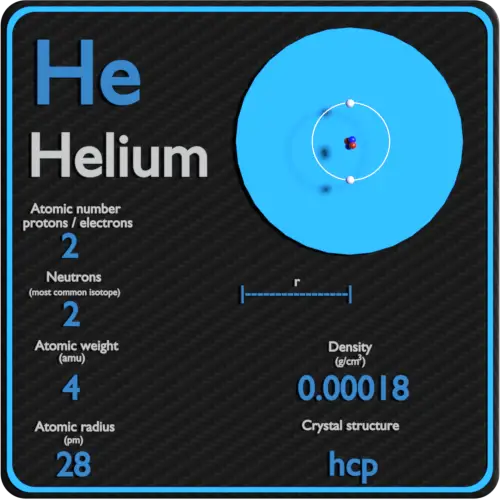
Helium-density-atomic-number-mass-radius

It is a colorless, odorless, tasteless, non-toxic, inert, monatomic gas, the first in the noble gas group in the periodic table. Its boiling point is the lowest among all the elements.

Summary

Element Helium
Atomic number 2
Atomic mass [amu] 4.0026
Atomic mass [pm] 28
Density at STP [g/cm3] 0.00018
Number of protons 2
Number of neutrons (typical isotopes) 3; 4
Number of electrons 2
Electron configuration 1s2
Oxidation states 0
Electron affinity [kJ/mol]
Electronegativity [Pauling scale]
First ionization energy [eV] 24.5874

Atomic Number – Protons, Electrons and Neutrons in Helium
Proton Number - Atomic NumberHelium is a chemical element with atomic number 2 which means there are 2 protons in its nucleus. Total number of protons in the nucleus is called the atomic number of the atom and is given the symbol Z. The total electrical charge of the nucleus is therefore +Ze, where e (elementary charge) equals to 1,602 x 10-19 coulombs.
The total number of neutrons in the nucleus of an atom is called the neutron number of the atom and is given the symbol N. Neutron number plus atomic number equals atomic mass number: N+Z=A. The difference between the neutron number and the atomic number is known as the neutron excess: D = N – Z = A – 2Z.

For stable elements, there is usually a variety of stable isotopes. Isotopes are nuclides that have the same atomic number and are therefore the same element, but differ in the number of neutrons. Mass numbers of typical isotopes of Helium are 3; 4.

Atomic Mass of Helium

Atomic mass of Helium is 4.0026 u. 

The atomic mass is the mass of an atom. The atomic mass or relative isotopic mass refers to the mass of a single particle, and therefore is tied to a certain specific isotope of an element. The atomic mass is carried by the atomic nucleus, which occupies only about 10-12 of the total volume of the atom or less, but it contains all the positive charge and at least 99.95% of the total mass of the atom. Note that, each element may contain more isotopes, therefore this resulting atomic mass is calculated from naturally-occuring isotopes and their abundance.

Atomic Radius of Helium

The atomic radius of Helium atom is 28pm (covalent radius).

Atomic Radius of Chemical Elements

It must be noted, atoms lack a well-defined outer boundary. The atomic radius of a chemical element is a measure of the distance out to which the electron cloud extends from the nucleus. However, this assumes the atom to exhibit a spherical shape, which is only obeyed for atoms in vacuum or free space. Therefore, there are various non-equivalent definitions of atomic radius.

Electrons and Electron Configuration

The number of electrons in an electrically-neutral atom is the same as the number of protons in the nucleus. Therefore, the number of electrons in neutral atom of Helium is 2. Each electron is influenced by the electric fields produced by the positive nuclear charge and the other (Z – 1) negative electrons in the atom.

Since the number of electrons and their arrangement are responsible for the chemical behavior of atoms, the atomic number identifies the various chemical elements. The configuration of these electrons follows from the principles of quantum mechanics. The number of electrons in each element’s electron shells, particularly the outermost valence shell, is the primary factor in determining its chemical bonding behavior. In the periodic table, the elements are listed in order of increasing atomic number Z.

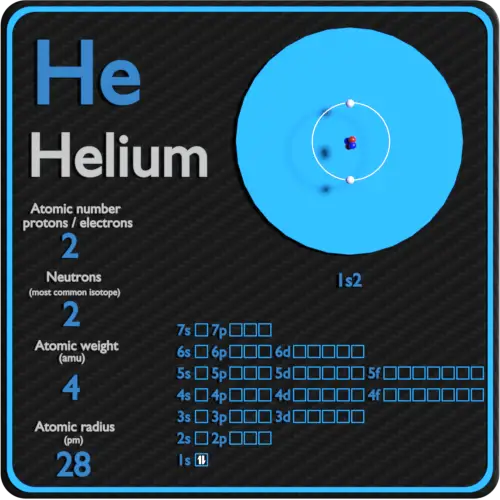
Electron configuration of Helium is 1s2.

Possible oxidation states are 0.

Density of Helium

Density of Helium is 0.00018g/cm3.

Typical densities of various substances are at atmospheric pressure.

Density is defined as the mass per unit volume. It is an intensive property, which is mathematically defined as mass divided by volume:

ρ = m/V

Atomic Masses of Elements

Periodic Table of Elements - atomic mass

Atomic Radii of Elements

Periodic Table of Elements - atomic radius

Densities of Elements

Periodic Table of Elements - density

Helium-protons-neutrons-electrons-configuration

Helium-affinity-electronegativity-ionization

Electron Affinity – Helium

Electron affinity of Helium is — kJ/mol.

In chemistry and atomic physics, the electron affinity of an atom or molecule is defined as:

the change in energy (in kJ/mole) of a neutral atom or molecule (in the gaseous phase) when an electron is added to the atom to form a negative ion.

X + e → X + energy        Affinity = – ∆H

In other words, it can be expressed as the neutral atom’s likelihood of gaining an electron. Note that, ionization energies measure the tendency of a neutral atom to resist the loss of electrons. Electron affinities are more difficult to measure than ionization energies.

Electronegativity of Helium

Electronegativity of Helium is .

Electronegativity, symbol χ, is a chemical property that describes the tendency of an atom to attract electrons towards this atom. For this purposes, a dimensionless quantity the Pauling scale, symbol χ, is the most commonly used.

The electronegativity of Helium is: χ = —

First Ionization Energy of Helium

First Ionization Energy of Helium is 24.5874 eV.

Ionization energy, also called ionization potential, is the energy necessary to remove an electron from the neutral atom.

X + energy → X+ + e

where X is any atom or molecule capable of being ionized, X+ is that atom or molecule with an electron removed (positive ion), and e is the removed electron.

A Helium atom, for example, requires the following ionization energy to remove the outermost electron.

He + IE → He+ + e        IE = 24.5874 eV

Electronegativity of Elements

Periodic Table of Elements - electronegativity

Ionization Energy of Elements

Periodic Table of Elements - ionization energy

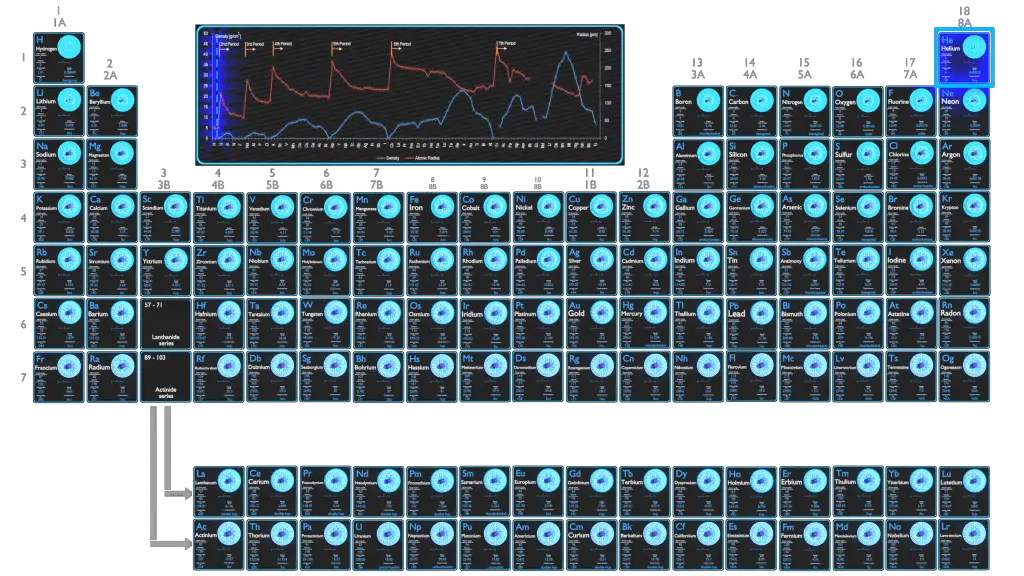
Helium-periodic-table

Source: www.luciteria.com


Properties of other elements

Helium - Comparison of Atomic Properties

Periodic Table in 8K resolution

Other properties of Helium


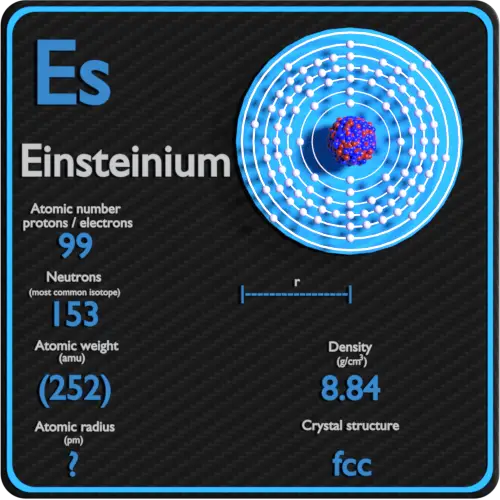
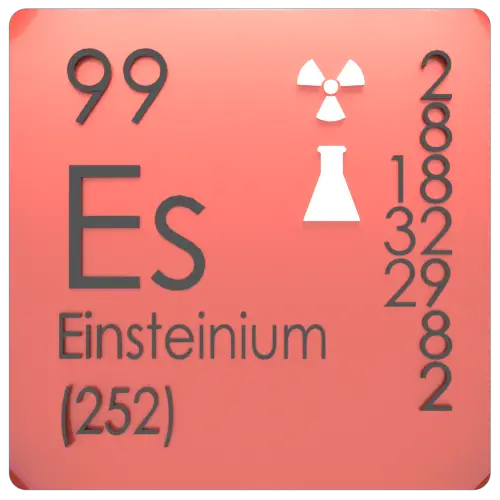
Einsteinium – Periodic Table – Atomic Properties

Einsteinium-density-atomic-number-mass-radius

Einsteinium is the seventh transuranic element, and an actinide.

Summary

Element Einsteinium
Atomic number 99
Atomic mass [amu] 252
Atomic mass [pm]
Density at STP [g/cm3] 8.84
Number of protons 99
Number of neutrons (typical isotopes) 252-255
Number of electrons 99
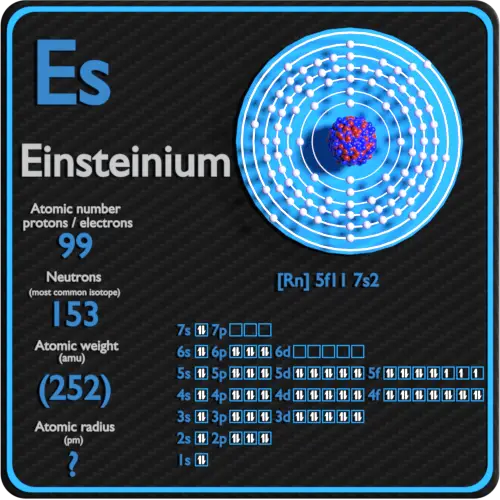
Electron configuration [Rn] 5f11 7s2
Oxidation states +3
Electron affinity [kJ/mol]
Electronegativity [Pauling scale] 1.3
First ionization energy [eV] 6.42

Atomic Number – Protons, Electrons and Neutrons in Einsteinium

Proton Number - Atomic NumberEinsteinium is a chemical element with atomic number 99 which means there are 99 protons in its nucleus. Total number of protons in the nucleus is called the atomic number of the atom and is given the symbol Z. The total electrical charge of the nucleus is therefore +Ze, where e (elementary charge) equals to 1,602 x 10-19 coulombs.

The total number of neutrons in the nucleus of an atom is called the neutron number of the atom and is given the symbol N. Neutron number plus atomic number equals atomic mass number: N+Z=A. The difference between the neutron number and the atomic number is known as the neutron excess: D = N – Z = A – 2Z.

For stable elements, there is usually a variety of stable isotopes. Isotopes are nuclides that have the same atomic number and are therefore the same element, but differ in the number of neutrons. Mass numbers of typical isotopes of Einsteinium are 252-255.

Atomic Mass of Einsteinium

Atomic mass of Einsteinium is 252 u. 

The atomic mass is the mass of an atom. The atomic mass or relative isotopic mass refers to the mass of a single particle, and therefore is tied to a certain specific isotope of an element. The atomic mass is carried by the atomic nucleus, which occupies only about 10-12 of the total volume of the atom or less, but it contains all the positive charge and at least 99.95% of the total mass of the atom. Note that, each element may contain more isotopes, therefore this resulting atomic mass is calculated from naturally-occuring isotopes and their abundance.

Atomic Radius of Einsteinium

The atomic radius of Einsteinium atom is –pm (covalent radius).

Atomic Radius of Chemical Elements

It must be noted, atoms lack a well-defined outer boundary. The atomic radius of a chemical element is a measure of the distance out to which the electron cloud extends from the nucleus. However, this assumes the atom to exhibit a spherical shape, which is only obeyed for atoms in vacuum or free space. Therefore, there are various non-equivalent definitions of atomic radius.

Electrons and Electron Configuration

The number of electrons in an electrically-neutral atom is the same as the number of protons in the nucleus. Therefore, the number of electrons in neutral atom of Einsteinium is 99. Each electron is influenced by the electric fields produced by the positive nuclear charge and the other (Z – 1) negative electrons in the atom.

Since the number of electrons and their arrangement are responsible for the chemical behavior of atoms, the atomic number identifies the various chemical elements. The configuration of these electrons follows from the principles of quantum mechanics. The number of electrons in each element’s electron shells, particularly the outermost valence shell, is the primary factor in determining its chemical bonding behavior. In the periodic table, the elements are listed in order of increasing atomic number Z.

Electron configuration of Einsteinium is [Rn] 5f11 7s2.

Possible oxidation states are +3.

Density of Einsteinium

Density of Einsteinium is 8.84g/cm3.

Typical densities of various substances are at atmospheric pressure.

Density is defined as the mass per unit volume. It is an intensive property, which is mathematically defined as mass divided by volume:

ρ = m/V

Atomic Masses of Elements

Periodic Table of Elements - atomic mass

Atomic Radii of Elements

Periodic Table of Elements - atomic radius

Densities of Elements

Periodic Table of Elements - density

Einsteinium-protons-neutrons-electrons-configuration

Electron Affinity – Einsteinium

Electron affinity of Einsteinium is — kJ/mol.

In chemistry and atomic physics, the electron affinity of an atom or molecule is defined as:

the change in energy (in kJ/mole) of a neutral atom or molecule (in the gaseous phase) when an electron is added to the atom to form a negative ion.

X + e → X + energy        Affinity = – ∆H

In other words, it can be expressed as the neutral atom’s likelihood of gaining an electron. Note that, ionization energies measure the tendency of a neutral atom to resist the loss of electrons. Electron affinities are more difficult to measure than ionization energies.

Electronegativity of Einsteinium

Electronegativity of Einsteinium is 1.3.

Electronegativity, symbol χ, is a chemical property that describes the tendency of an atom to attract electrons towards this atom. For this purposes, a dimensionless quantity the Pauling scale, symbol χ, is the most commonly used.

The electronegativity of Einsteinium is: χ = 1.3

First Ionization Energy of Einsteinium

First Ionization Energy of Einsteinium is 6.42 eV.

Ionization energy, also called ionization potential, is the energy necessary to remove an electron from the neutral atom.

X + energy → X+ + e

where X is any atom or molecule capable of being ionized, X+ is that atom or molecule with an electron removed (positive ion), and e is the removed electron.

A Einsteinium atom, for example, requires the following ionization energy to remove the outermost electron.

Es + IE → Es+ + e        IE = 6.42 eV

Electronegativity of Elements

Periodic Table of Elements - electronegativity

Ionization Energy of Elements

Periodic Table of Elements - ionization energy

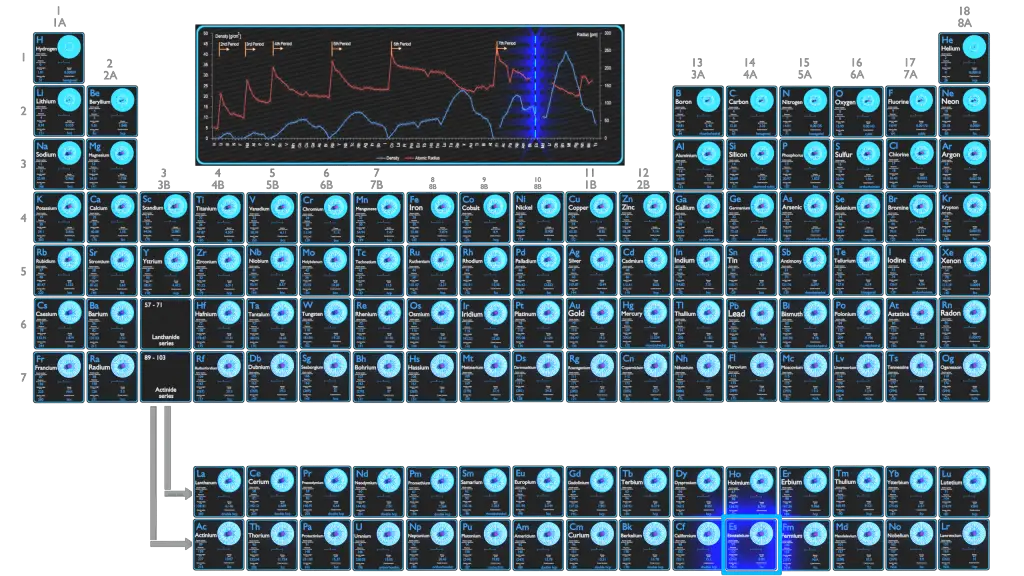
Einsteinium-periodic-table

Source: www.luciteria.com


Properties of other elements

Einsteinium - Comparison of Atomic Properties

Periodic Table in 8K resolution

Other properties of Einsteinium


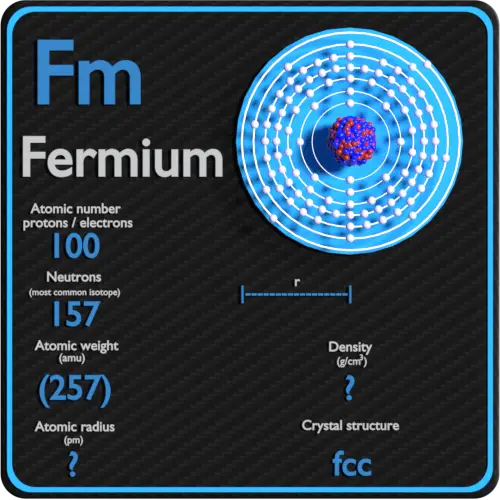
Fermium – Periodic Table – Atomic Properties

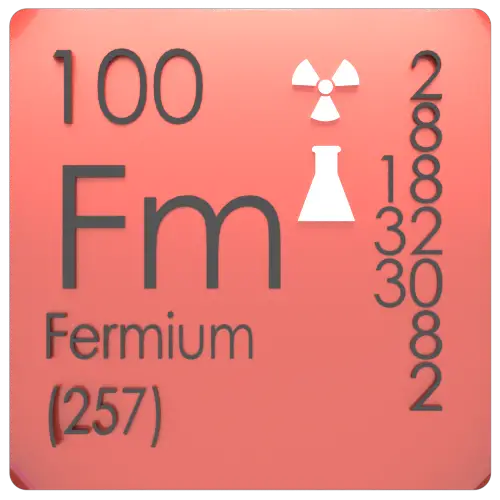
Fermium-density-atomic-number-mass-radius

Fermium is a member of the actinide series. It is the heaviest element that can be formed by neutron bombardment of lighter elements, and hence the last element that can be prepared in macroscopic quantities.

Summary

Element Fermium
Atomic number 100
Atomic mass [amu] 257
Atomic mass [pm]
Density at STP [g/cm3]
Number of protons 100
Number of neutrons (typical isotopes) 252,253,255,257
Number of electrons 100
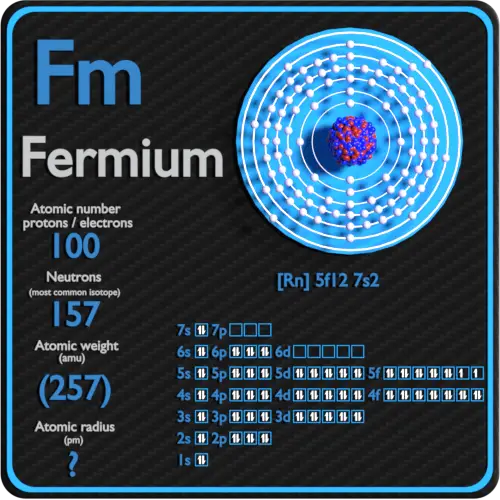
Electron configuration [Rn] 5f12 7s2
Oxidation states +3
Electron affinity [kJ/mol]
Electronegativity [Pauling scale] 1.3
First ionization energy [eV] 6.5

Atomic Number – Protons, Electrons and Neutrons in Fermium

Proton Number - Atomic NumberFermium is a chemical element with atomic number 100 which means there are 100 protons in its nucleus. Total number of protons in the nucleus is called the atomic number of the atom and is given the symbol Z. The total electrical charge of the nucleus is therefore +Ze, where e (elementary charge) equals to 1,602 x 10-19 coulombs.

The total number of neutrons in the nucleus of an atom is called the neutron number of the atom and is given the symbol N. Neutron number plus atomic number equals atomic mass number: N+Z=A. The difference between the neutron number and the atomic number is known as the neutron excess: D = N – Z = A – 2Z.

For stable elements, there is usually a variety of stable isotopes. Isotopes are nuclides that have the same atomic number and are therefore the same element, but differ in the number of neutrons. Mass numbers of typical isotopes of Fermium are 252,253,255,257.

Atomic Mass of Fermium

Atomic mass of Fermium is 257 u. 

The atomic mass is the mass of an atom. The atomic mass or relative isotopic mass refers to the mass of a single particle, and therefore is tied to a certain specific isotope of an element. The atomic mass is carried by the atomic nucleus, which occupies only about 10-12 of the total volume of the atom or less, but it contains all the positive charge and at least 99.95% of the total mass of the atom. Note that, each element may contain more isotopes, therefore this resulting atomic mass is calculated from naturally-occuring isotopes and their abundance.

Atomic Radius of Fermium

The atomic radius of Fermium atom is –pm (covalent radius).

Atomic Radius of Chemical Elements

It must be noted, atoms lack a well-defined outer boundary. The atomic radius of a chemical element is a measure of the distance out to which the electron cloud extends from the nucleus. However, this assumes the atom to exhibit a spherical shape, which is only obeyed for atoms in vacuum or free space. Therefore, there are various non-equivalent definitions of atomic radius.

Electrons and Electron Configuration

The number of electrons in an electrically-neutral atom is the same as the number of protons in the nucleus. Therefore, the number of electrons in neutral atom of Fermium is 100. Each electron is influenced by the electric fields produced by the positive nuclear charge and the other (Z – 1) negative electrons in the atom.

Since the number of electrons and their arrangement are responsible for the chemical behavior of atoms, the atomic number identifies the various chemical elements. The configuration of these electrons follows from the principles of quantum mechanics. The number of electrons in each element’s electron shells, particularly the outermost valence shell, is the primary factor in determining its chemical bonding behavior. In the periodic table, the elements are listed in order of increasing atomic number Z.

Electron configuration of Fermium is [Rn] 5f12 7s2.

Possible oxidation states are +3.

Density of Fermium

Density of Fermium is –g/cm3.

Typical densities of various substances are at atmospheric pressure.

Density is defined as the mass per unit volume. It is an intensive property, which is mathematically defined as mass divided by volume:

ρ = m/V

Atomic Masses of Elements

Periodic Table of Elements - atomic mass

Atomic Radii of Elements

Periodic Table of Elements - atomic radius

Densities of Elements

Periodic Table of Elements - density

Fermium-protons-neutrons-electrons-configuration


Electron Affinity – Fermium

Electron affinity of Fermium is — kJ/mol.

In chemistry and atomic physics, the electron affinity of an atom or molecule is defined as:

the change in energy (in kJ/mole) of a neutral atom or molecule (in the gaseous phase) when an electron is added to the atom to form a negative ion.

X + e → X + energy        Affinity = – ∆H

In other words, it can be expressed as the neutral atom’s likelihood of gaining an electron. Note that, ionization energies measure the tendency of a neutral atom to resist the loss of electrons. Electron affinities are more difficult to measure than ionization energies.

Electronegativity of Fermium

Electronegativity of Fermium is 1.3.

Electronegativity, symbol χ, is a chemical property that describes the tendency of an atom to attract electrons towards this atom. For this purposes, a dimensionless quantity the Pauling scale, symbol χ, is the most commonly used.

The electronegativity of Fermium is: χ = 1.3

First Ionization Energy of Fermium

First Ionization Energy of Fermium is 6.5 eV.

Ionization energy, also called ionization potential, is the energy necessary to remove an electron from the neutral atom.

X + energy → X+ + e

where X is any atom or molecule capable of being ionized, X+ is that atom or molecule with an electron removed (positive ion), and e is the removed electron.

A Fermium atom, for example, requires the following ionization energy to remove the outermost electron.

Fm + IE → Fm+ + e        IE = 6.5 eV

Electronegativity of Elements

Periodic Table of Elements - electronegativity

Ionization Energy of Elements

Periodic Table of Elements - ionization energy

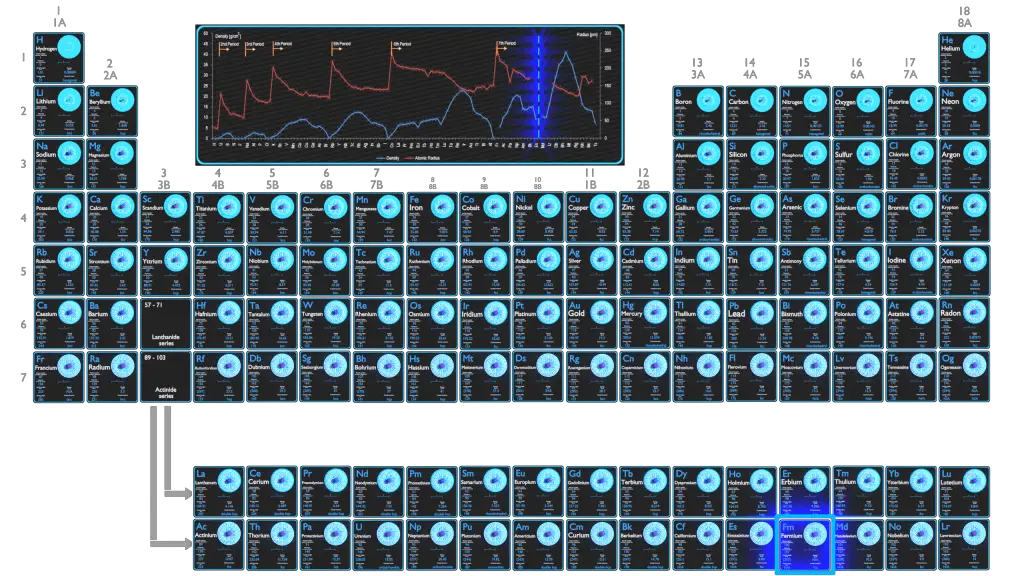
Fermium-periodic-table

Source: www.luciteria.com


Properties of other elements

Fermium - Comparison of Atomic Properties

Periodic Table in 8K resolution

Other properties of Fermium


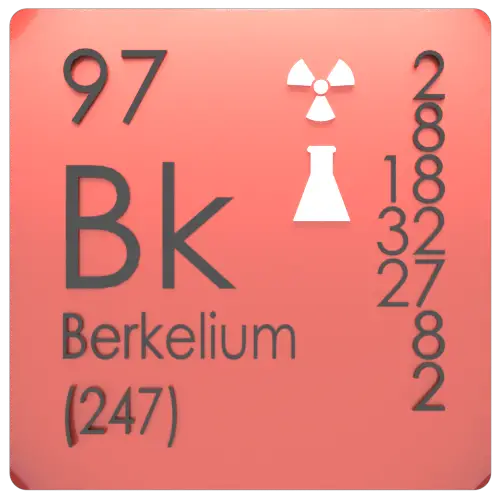
Berkelium – Periodic Table – Atomic Properties

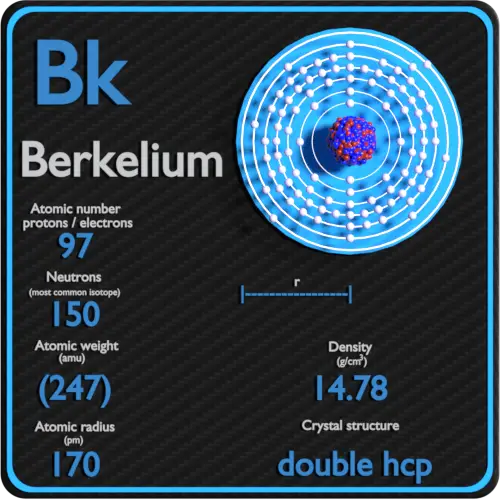
Berkelium-density-atomic-number-mass-radius

Berkelium is a member of the actinide and transuranium element series.

Summary

Element Berkelium
Atomic number 97
Atomic mass [amu] 247
Atomic mass [pm] 170
Density at STP [g/cm3] 14.78
Number of protons 97
Number of neutrons (typical isotopes) 245-249
Number of electrons 97
Electron configuration [Rn] 5f9 7s2
Oxidation states +3,4
Electron affinity [kJ/mol]
Electronegativity [Pauling scale] 1.3
First ionization energy [eV] 6.23

Atomic Number – Protons, Electrons and Neutrons in Berkelium

Proton Number - Atomic NumberBerkelium is a chemical element with atomic number 97 which means there are 97 protons in its nucleus. Total number of protons in the nucleus is called the atomic number of the atom and is given the symbol Z. The total electrical charge of the nucleus is therefore +Ze, where e (elementary charge) equals to 1,602 x 10-19 coulombs.

The total number of neutrons in the nucleus of an atom is called the neutron number of the atom and is given the symbol N. Neutron number plus atomic number equals atomic mass number: N+Z=A. The difference between the neutron number and the atomic number is known as the neutron excess: D = N – Z = A – 2Z.

For stable elements, there is usually a variety of stable isotopes. Isotopes are nuclides that have the same atomic number and are therefore the same element, but differ in the number of neutrons. Mass numbers of typical isotopes of Berkelium are 245-249.

Atomic Mass of Berkelium

Atomic mass of Berkelium is 247 u. 

The atomic mass is the mass of an atom. The atomic mass or relative isotopic mass refers to the mass of a single particle, and therefore is tied to a certain specific isotope of an element. The atomic mass is carried by the atomic nucleus, which occupies only about 10-12 of the total volume of the atom or less, but it contains all the positive charge and at least 99.95% of the total mass of the atom. Note that, each element may contain more isotopes, therefore this resulting atomic mass is calculated from naturally-occuring isotopes and their abundance.

Atomic Radius of Berkelium

The atomic radius of Berkelium atom is 170pm (covalent radius).

Atomic Radius of Chemical Elements

It must be noted, atoms lack a well-defined outer boundary. The atomic radius of a chemical element is a measure of the distance out to which the electron cloud extends from the nucleus. However, this assumes the atom to exhibit a spherical shape, which is only obeyed for atoms in vacuum or free space. Therefore, there are various non-equivalent definitions of atomic radius.

Electrons and Electron Configuration

The number of electrons in an electrically-neutral atom is the same as the number of protons in the nucleus. Therefore, the number of electrons in neutral atom of Berkelium is 97. Each electron is influenced by the electric fields produced by the positive nuclear charge and the other (Z – 1) negative electrons in the atom.

Since the number of electrons and their arrangement are responsible for the chemical behavior of atoms, the atomic number identifies the various chemical elements. The configuration of these electrons follows from the principles of quantum mechanics. The number of electrons in each element’s electron shells, particularly the outermost valence shell, is the primary factor in determining its chemical bonding behavior. In the periodic table, the elements are listed in order of increasing atomic number Z.

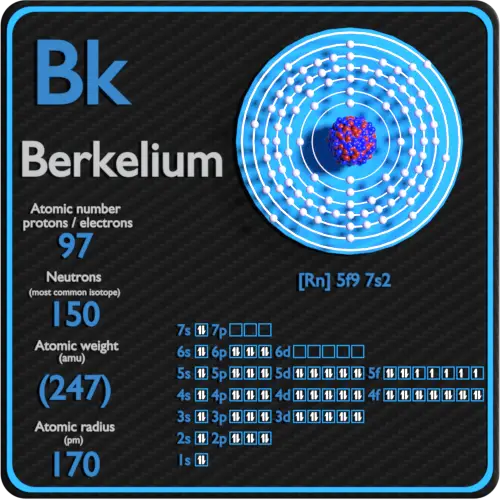
Electron configuration of Berkelium is [Rn] 5f9 7s2.

Possible oxidation states are +3,4.

Density of Berkelium

Density of Berkelium is 14.78g/cm3.

Typical densities of various substances are at atmospheric pressure.

Density is defined as the mass per unit volume. It is an intensive property, which is mathematically defined as mass divided by volume:

ρ = m/V

Atomic Masses of Elements

Periodic Table of Elements - atomic mass

Atomic Radii of Elements

Periodic Table of Elements - atomic radius

Densities of Elements

Periodic Table of Elements - density

Berkelium-protons-neutrons-electrons-configuration

Electron Affinity – Berkelium

Electron affinity of Berkelium is — kJ/mol.

In chemistry and atomic physics, the electron affinity of an atom or molecule is defined as:

the change in energy (in kJ/mole) of a neutral atom or molecule (in the gaseous phase) when an electron is added to the atom to form a negative ion.

X + e → X + energy        Affinity = – ∆H

In other words, it can be expressed as the neutral atom’s likelihood of gaining an electron. Note that, ionization energies measure the tendency of a neutral atom to resist the loss of electrons. Electron affinities are more difficult to measure than ionization energies.

Electronegativity of Berkelium

Electronegativity of Berkelium is 1.3.

Electronegativity, symbol χ, is a chemical property that describes the tendency of an atom to attract electrons towards this atom. For this purposes, a dimensionless quantity the Pauling scale, symbol χ, is the most commonly used.

The electronegativity of Berkelium is: χ = 1.3

First Ionization Energy of Berkelium

First Ionization Energy of Berkelium is 6.23 eV.

Ionization energy, also called ionization potential, is the energy necessary to remove an electron from the neutral atom.

X + energy → X+ + e

where X is any atom or molecule capable of being ionized, X+ is that atom or molecule with an electron removed (positive ion), and e is the removed electron.

A Berkelium atom, for example, requires the following ionization energy to remove the outermost electron.

Bk + IE → Bk+ + e        IE = 6.23 eV

Electronegativity of Elements

Periodic Table of Elements - electronegativity

Ionization Energy of Elements

Periodic Table of Elements - ionization energy

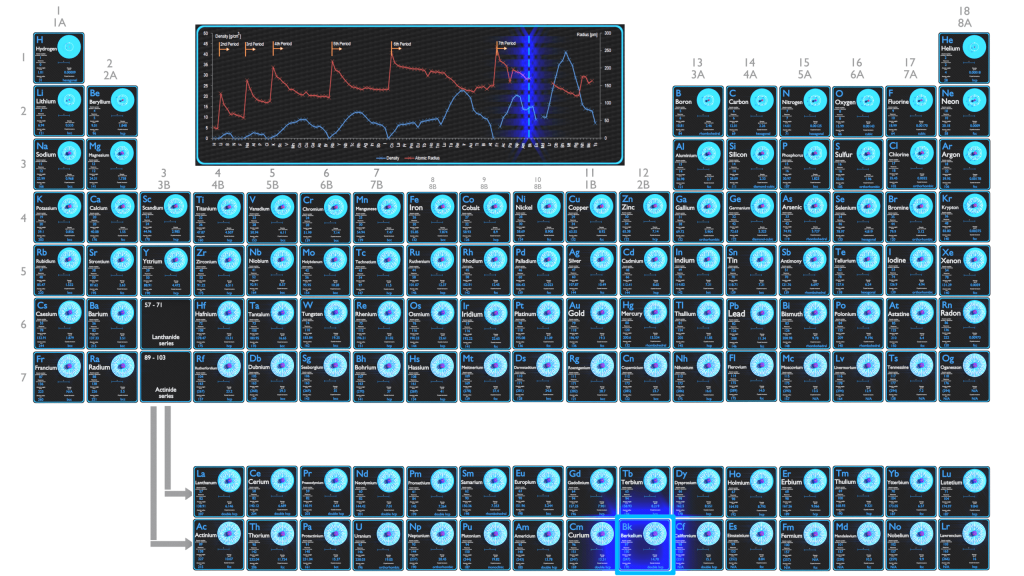
Berkelium-periodic-table

Source: www.luciteria.com


Properties of other elements

Berkelium - Comparison of Atomic Properties

Periodic Table in 8K resolution

Other properties of Berkelium


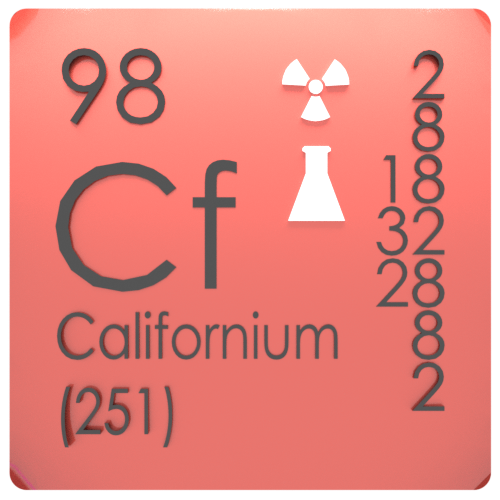
Californium – Periodic Table – Atomic Properties

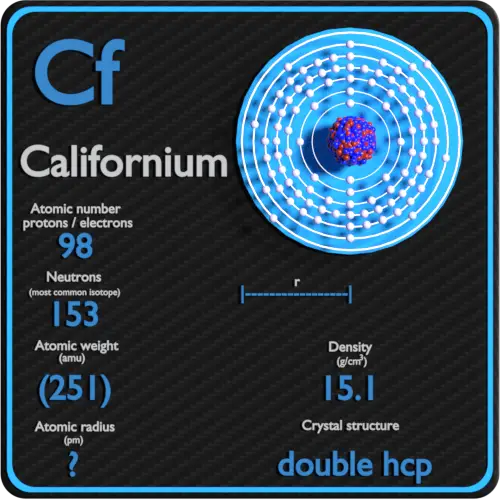
Californium-density-atomic-number-mass-radius

Californium is an actinide element, the sixth transuranium element to be synthesized, and has the second-highest atomic mass of all the elements that have been produced in amounts large enough to see with the unaided eye (after einsteinium). The most commonly used spontaneous fission neutron source is the radioactive isotope californium-252. Cf-252 and all other spontaneous fission neutron sources are produced by irradiating uranium or another transuranic element in a nuclear reactor.

Summary

Element Californium
Atomic number 98
Atomic mass [amu] 251
Atomic mass [pm]
Density at STP [g/cm3] 15.1
Number of protons 98
Number of neutrons (typical isotopes) 248-254
Number of electrons 98
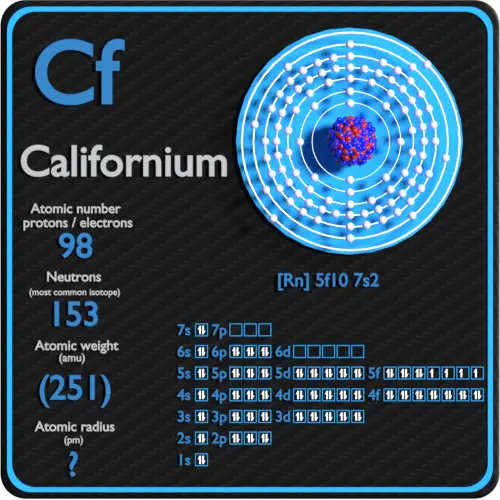
Electron configuration [Rn] 5f10 7s2
Oxidation states +3
Electron affinity [kJ/mol]
Electronegativity [Pauling scale] 1.3
First ionization energy [eV] 6.3

Atomic Number – Protons, Electrons and Neutrons in Californium

Proton Number - Atomic NumberCalifornium is a chemical element with atomic number 98 which means there are 98 protons in its nucleus. Total number of protons in the nucleus is called the atomic number of the atom and is given the symbol Z. The total electrical charge of the nucleus is therefore +Ze, where e (elementary charge) equals to 1,602 x 10-19 coulombs.

The total number of neutrons in the nucleus of an atom is called the neutron number of the atom and is given the symbol N. Neutron number plus atomic number equals atomic mass number: N+Z=A. The difference between the neutron number and the atomic number is known as the neutron excess: D = N – Z = A – 2Z.

For stable elements, there is usually a variety of stable isotopes. Isotopes are nuclides that have the same atomic number and are therefore the same element, but differ in the number of neutrons. Mass numbers of typical isotopes of Californium are 248-254.

Atomic Mass of Californium

Atomic mass of Californium is 251 u. 

The atomic mass is the mass of an atom. The atomic mass or relative isotopic mass refers to the mass of a single particle, and therefore is tied to a certain specific isotope of an element. The atomic mass is carried by the atomic nucleus, which occupies only about 10-12 of the total volume of the atom or less, but it contains all the positive charge and at least 99.95% of the total mass of the atom. Note that, each element may contain more isotopes, therefore this resulting atomic mass is calculated from naturally-occuring isotopes and their abundance.

Atomic Radius of Californium

The atomic radius of Californium atom is –pm (covalent radius).

Atomic Radius of Chemical Elements

It must be noted, atoms lack a well-defined outer boundary. The atomic radius of a chemical element is a measure of the distance out to which the electron cloud extends from the nucleus. However, this assumes the atom to exhibit a spherical shape, which is only obeyed for atoms in vacuum or free space. Therefore, there are various non-equivalent definitions of atomic radius.

Electrons and Electron Configuration

The number of electrons in an electrically-neutral atom is the same as the number of protons in the nucleus. Therefore, the number of electrons in neutral atom of Californium is 98. Each electron is influenced by the electric fields produced by the positive nuclear charge and the other (Z – 1) negative electrons in the atom.

Since the number of electrons and their arrangement are responsible for the chemical behavior of atoms, the atomic number identifies the various chemical elements. The configuration of these electrons follows from the principles of quantum mechanics. The number of electrons in each element’s electron shells, particularly the outermost valence shell, is the primary factor in determining its chemical bonding behavior. In the periodic table, the elements are listed in order of increasing atomic number Z.

Electron configuration of Californium is [Rn] 5f10 7s2.

Possible oxidation states are +3.

Density of Californium

Density of Californium is 15.1g/cm3.

Typical densities of various substances are at atmospheric pressure.

Density is defined as the mass per unit volume. It is an intensive property, which is mathematically defined as mass divided by volume:

ρ = m/V

Atomic Masses of Elements

Periodic Table of Elements - atomic mass

Atomic Radii of Elements

Periodic Table of Elements - atomic radius

Densities of Elements

Periodic Table of Elements - density

Californium-protons-neutrons-electrons-configuration

Electron Affinity – Californium

Electron affinity of Californium is — kJ/mol.

In chemistry and atomic physics, the electron affinity of an atom or molecule is defined as:

the change in energy (in kJ/mole) of a neutral atom or molecule (in the gaseous phase) when an electron is added to the atom to form a negative ion.

X + e → X + energy        Affinity = – ∆H

In other words, it can be expressed as the neutral atom’s likelihood of gaining an electron. Note that, ionization energies measure the tendency of a neutral atom to resist the loss of electrons. Electron affinities are more difficult to measure than ionization energies.

Electronegativity of Californium

Electronegativity of Californium is 1.3.

Electronegativity, symbol χ, is a chemical property that describes the tendency of an atom to attract electrons towards this atom. For this purposes, a dimensionless quantity the Pauling scale, symbol χ, is the most commonly used.

The electronegativity of Californium is: χ = 1.3

First Ionization Energy of Californium

First Ionization Energy of Californium is 6.3 eV.

Ionization energy, also called ionization potential, is the energy necessary to remove an electron from the neutral atom.

X + energy → X+ + e

where X is any atom or molecule capable of being ionized, X+ is that atom or molecule with an electron removed (positive ion), and e is the removed electron.

A Californium atom, for example, requires the following ionization energy to remove the outermost electron.

Cf + IE → Cf+ + e        IE = 6.3 eV

Electronegativity of Elements

Periodic Table of Elements - electronegativity

Ionization Energy of Elements

Periodic Table of Elements - ionization energy

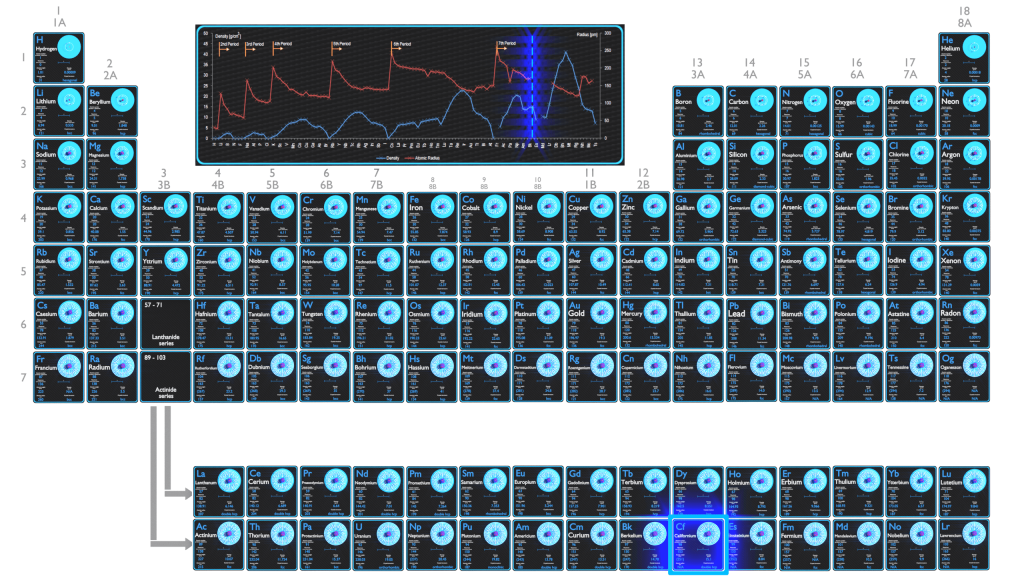
Californium-periodic-table

Source: www.luciteria.com


Properties of other elements

Californium - Comparison of Atomic Properties

Periodic Table in 8K resolution

Other properties of Californium


Americium – Periodic Table – Atomic Properties

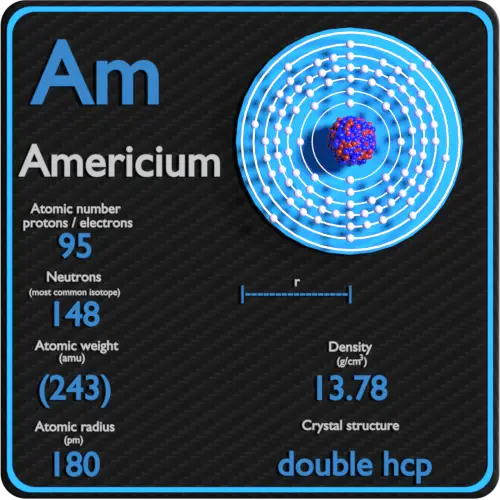
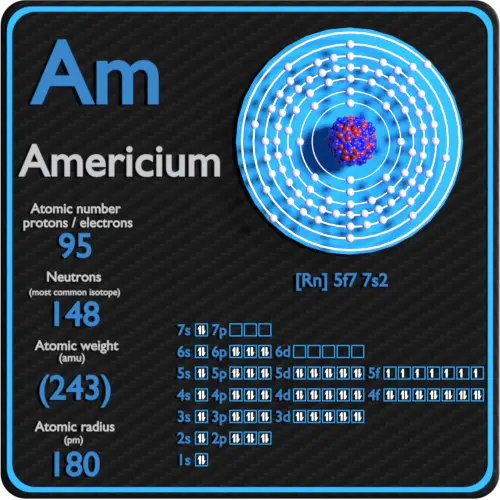
Americium-density-atomic-number-mass-radius

Americium is a transuranic member of the actinide series, in the periodic table located under the lanthanide element europium, and thus by analogy was named after the Americas.

Summary

Element Americium
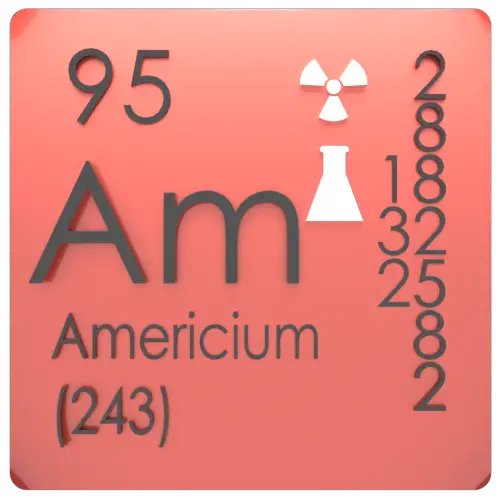
Atomic number 95
Atomic mass [amu] 243
Atomic mass [pm] 180
Density at STP [g/cm3] 13.78
Number of protons 95
Number of neutrons (typical isotopes) 241-243
Number of electrons 95
Electron configuration [Rn] 5f7 7s2
Oxidation states +3,4,5,6
Electron affinity [kJ/mol]
Electronegativity [Pauling scale] 1.3
First ionization energy [eV] 5.9933

Atomic Number – Protons, Electrons and Neutrons in Americium

Proton Number - Atomic NumberAmericium is a chemical element with atomic number 95 which means there are 95 protons in its nucleus. Total number of protons in the nucleus is called the atomic number of the atom and is given the symbol Z. The total electrical charge of the nucleus is therefore +Ze, where e (elementary charge) equals to 1,602 x 10-19 coulombs.

The total number of neutrons in the nucleus of an atom is called the neutron number of the atom and is given the symbol N. Neutron number plus atomic number equals atomic mass number: N+Z=A. The difference between the neutron number and the atomic number is known as the neutron excess: D = N – Z = A – 2Z.

For stable elements, there is usually a variety of stable isotopes. Isotopes are nuclides that have the same atomic number and are therefore the same element, but differ in the number of neutrons. Mass numbers of typical isotopes of Americium are 241-243.

Atomic Mass of Americium

Atomic mass of Americium is 243 u. 

The atomic mass is the mass of an atom. The atomic mass or relative isotopic mass refers to the mass of a single particle, and therefore is tied to a certain specific isotope of an element. The atomic mass is carried by the atomic nucleus, which occupies only about 10-12 of the total volume of the atom or less, but it contains all the positive charge and at least 99.95% of the total mass of the atom. Note that, each element may contain more isotopes, therefore this resulting atomic mass is calculated from naturally-occuring isotopes and their abundance.

Atomic Radius of Americium

The atomic radius of Americium atom is 180pm (covalent radius).

Atomic Radius of Chemical Elements

It must be noted, atoms lack a well-defined outer boundary. The atomic radius of a chemical element is a measure of the distance out to which the electron cloud extends from the nucleus. However, this assumes the atom to exhibit a spherical shape, which is only obeyed for atoms in vacuum or free space. Therefore, there are various non-equivalent definitions of atomic radius.

Electrons and Electron Configuration

The number of electrons in an electrically-neutral atom is the same as the number of protons in the nucleus. Therefore, the number of electrons in neutral atom of Americium is 95. Each electron is influenced by the electric fields produced by the positive nuclear charge and the other (Z – 1) negative electrons in the atom.

Since the number of electrons and their arrangement are responsible for the chemical behavior of atoms, the atomic number identifies the various chemical elements. The configuration of these electrons follows from the principles of quantum mechanics. The number of electrons in each element’s electron shells, particularly the outermost valence shell, is the primary factor in determining its chemical bonding behavior. In the periodic table, the elements are listed in order of increasing atomic number Z.

Electron configuration of Americium is [Rn] 5f7 7s2.

Possible oxidation states are +3,4,5,6.

Density of Americium

Density of Americium is 13.78g/cm3.

Typical densities of various substances are at atmospheric pressure.

Density is defined as the mass per unit volume. It is an intensive property, which is mathematically defined as mass divided by volume:

ρ = m/V

Atomic Masses of Elements

Periodic Table of Elements - atomic mass

Atomic Radii of Elements

Periodic Table of Elements - atomic radius

Densities of Elements

Periodic Table of Elements - density

Americium-protons-neutrons-electrons-configuration

Electron Affinity – Americium

Electron affinity of Americium is — kJ/mol.

In chemistry and atomic physics, the electron affinity of an atom or molecule is defined as:

the change in energy (in kJ/mole) of a neutral atom or molecule (in the gaseous phase) when an electron is added to the atom to form a negative ion.

X + e → X + energy        Affinity = – ∆H

In other words, it can be expressed as the neutral atom’s likelihood of gaining an electron. Note that, ionization energies measure the tendency of a neutral atom to resist the loss of electrons. Electron affinities are more difficult to measure than ionization energies.

Electronegativity of Americium

Electronegativity of Americium is 1.3.

Electronegativity, symbol χ, is a chemical property that describes the tendency of an atom to attract electrons towards this atom. For this purposes, a dimensionless quantity the Pauling scale, symbol χ, is the most commonly used.

The electronegativity of Americium is: χ = 1.3

First Ionization Energy of Americium

First Ionization Energy of Americium is 5.9933 eV.

Ionization energy, also called ionization potential, is the energy necessary to remove an electron from the neutral atom.

X + energy → X+ + e

where X is any atom or molecule capable of being ionized, X+ is that atom or molecule with an electron removed (positive ion), and e is the removed electron.

A Americium atom, for example, requires the following ionization energy to remove the outermost electron.

Am + IE → Am+ + e        IE = 5.9933 eV

Electronegativity of Elements

Periodic Table of Elements - electronegativity

Ionization Energy of Elements

Periodic Table of Elements - ionization energy

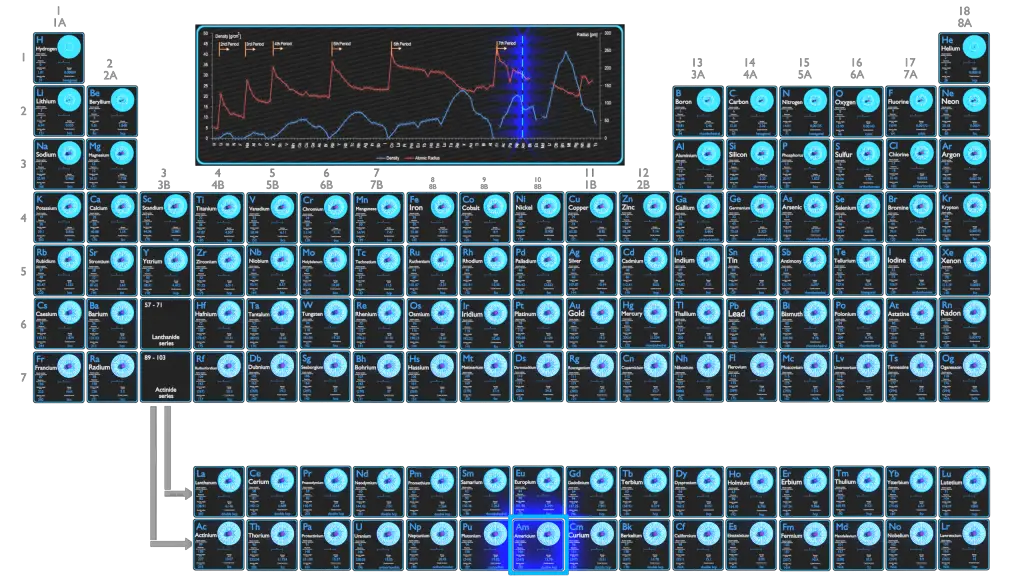
Americium-periodic-table

Source: www.luciteria.com


Properties of other elements

Americium - Comparison of Atomic Properties

Periodic Table in 8K resolution

Other properties of Americium


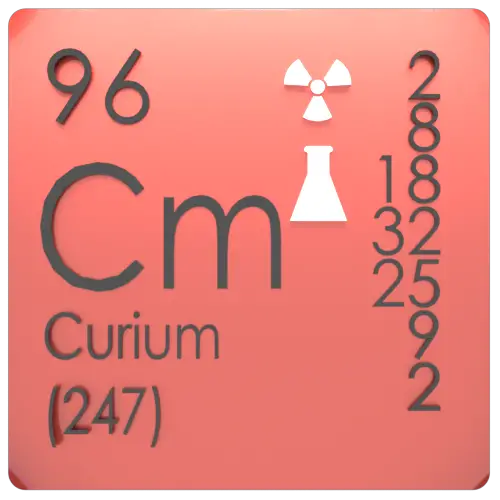
Curium – Periodic Table – Atomic Properties

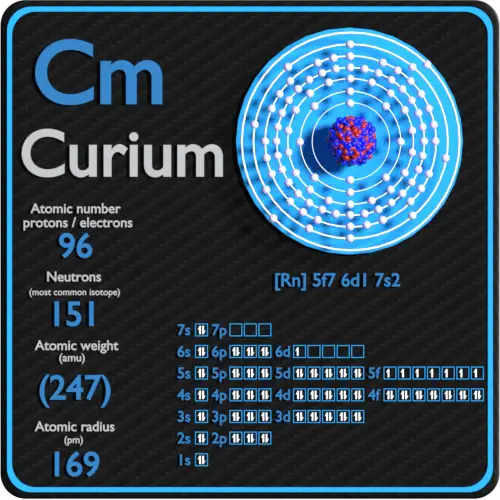
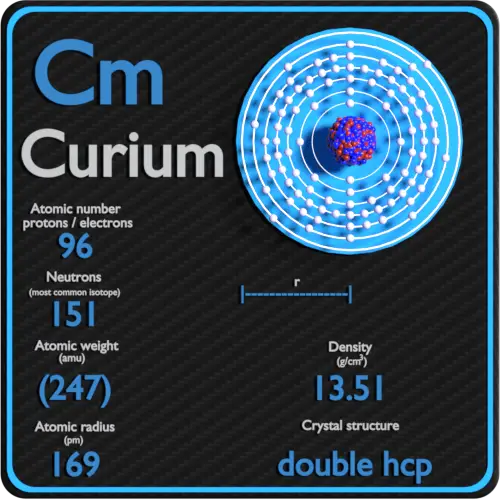
Curium-density-atomic-number-mass-radius

Curium is a hard, dense, silvery metal with a relatively high melting point and boiling point for an actinide.

Summary

Element Curium
Atomic number 96
Atomic mass [amu] 247
Atomic mass [pm] 169
Density at STP [g/cm3] 13.51
Number of protons 96
Number of neutrons (typical isotopes) 242-250
Number of electrons 96
Electron configuration [Rn] 5f7 6d 7s2
Oxidation states +3
Electron affinity [kJ/mol]
Electronegativity [Pauling scale] 1.3
First ionization energy [eV] 6.02

Atomic Number – Protons, Electrons and Neutrons in Curium

Proton Number - Atomic NumberCurium is a chemical element with atomic number 96 which means there are 96 protons in its nucleus. Total number of protons in the nucleus is called the atomic number of the atom and is given the symbol Z. The total electrical charge of the nucleus is therefore +Ze, where e (elementary charge) equals to 1,602 x 10-19 coulombs.

The total number of neutrons in the nucleus of an atom is called the neutron number of the atom and is given the symbol N. Neutron number plus atomic number equals atomic mass number: N+Z=A. The difference between the neutron number and the atomic number is known as the neutron excess: D = N – Z = A – 2Z.

For stable elements, there is usually a variety of stable isotopes. Isotopes are nuclides that have the same atomic number and are therefore the same element, but differ in the number of neutrons. Mass numbers of typical isotopes of Curium are 242-250.

Atomic Mass of Curium

Atomic mass of Curium is 247 u. 

The atomic mass is the mass of an atom. The atomic mass or relative isotopic mass refers to the mass of a single particle, and therefore is tied to a certain specific isotope of an element. The atomic mass is carried by the atomic nucleus, which occupies only about 10-12 of the total volume of the atom or less, but it contains all the positive charge and at least 99.95% of the total mass of the atom. Note that, each element may contain more isotopes, therefore this resulting atomic mass is calculated from naturally-occuring isotopes and their abundance.

Atomic Radius of Curium

The atomic radius of Curium atom is 169pm (covalent radius).

Atomic Radius of Chemical Elements

It must be noted, atoms lack a well-defined outer boundary. The atomic radius of a chemical element is a measure of the distance out to which the electron cloud extends from the nucleus. However, this assumes the atom to exhibit a spherical shape, which is only obeyed for atoms in vacuum or free space. Therefore, there are various non-equivalent definitions of atomic radius.

Electrons and Electron Configuration

The number of electrons in an electrically-neutral atom is the same as the number of protons in the nucleus. Therefore, the number of electrons in neutral atom of Curium is 96. Each electron is influenced by the electric fields produced by the positive nuclear charge and the other (Z – 1) negative electrons in the atom.

Since the number of electrons and their arrangement are responsible for the chemical behavior of atoms, the atomic number identifies the various chemical elements. The configuration of these electrons follows from the principles of quantum mechanics. The number of electrons in each element’s electron shells, particularly the outermost valence shell, is the primary factor in determining its chemical bonding behavior. In the periodic table, the elements are listed in order of increasing atomic number Z.

Electron configuration of Curium is [Rn] 5f7 6d 7s2.

Possible oxidation states are +3.

Density of Curium

Density of Curium is 13.51g/cm3.

Typical densities of various substances are at atmospheric pressure.

Density is defined as the mass per unit volume. It is an intensive property, which is mathematically defined as mass divided by volume:

ρ = m/V

Atomic Masses of Elements

Periodic Table of Elements - atomic mass

Atomic Radii of Elements

Periodic Table of Elements - atomic radius

Densities of Elements

Periodic Table of Elements - density

Curium-protons-neutrons-electrons-configuration

Electron Affinity – Curium

Electron affinity of Curium is — kJ/mol.

In chemistry and atomic physics, the electron affinity of an atom or molecule is defined as:

the change in energy (in kJ/mole) of a neutral atom or molecule (in the gaseous phase) when an electron is added to the atom to form a negative ion.

X + e → X + energy        Affinity = – ∆H

In other words, it can be expressed as the neutral atom’s likelihood of gaining an electron. Note that, ionization energies measure the tendency of a neutral atom to resist the loss of electrons. Electron affinities are more difficult to measure than ionization energies.

Electronegativity of Curium

Electronegativity of Curium is 1.3.

Electronegativity, symbol χ, is a chemical property that describes the tendency of an atom to attract electrons towards this atom. For this purposes, a dimensionless quantity the Pauling scale, symbol χ, is the most commonly used.

The electronegativity of Curium is: χ = 1.3

First Ionization Energy of Curium

First Ionization Energy of Curium is 6.02 eV.

Ionization energy, also called ionization potential, is the energy necessary to remove an electron from the neutral atom.

X + energy → X+ + e

where X is any atom or molecule capable of being ionized, X+ is that atom or molecule with an electron removed (positive ion), and e is the removed electron.

A Curium atom, for example, requires the following ionization energy to remove the outermost electron.

Cm + IE → Cm+ + e        IE = 6.02 eV

Electronegativity of Elements

Periodic Table of Elements - electronegativity

Ionization Energy of Elements

Periodic Table of Elements - ionization energy

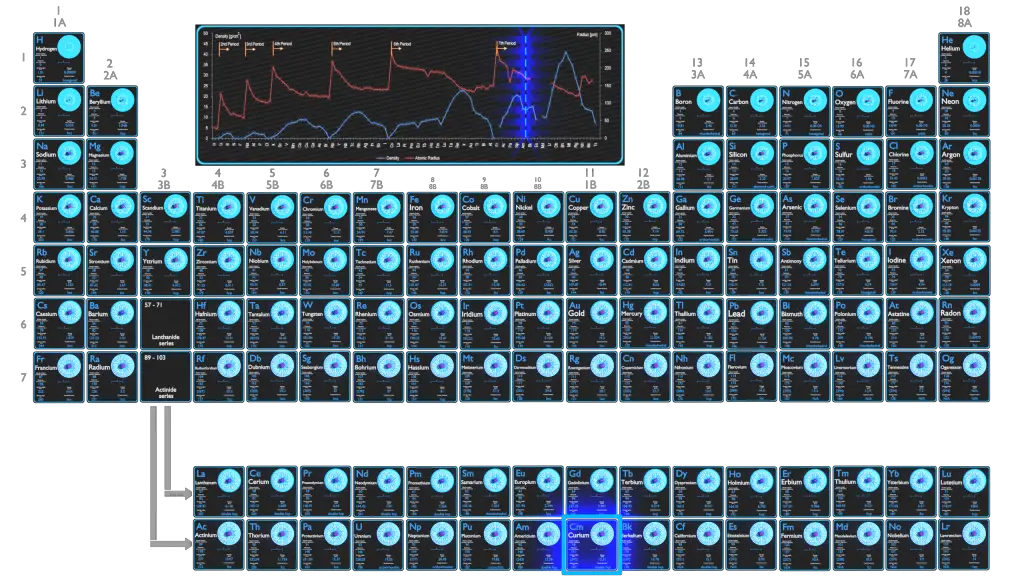
Curium-periodic-table

Source: www.luciteria.com


Properties of other elements

Curium - Comparison of Atomic Properties

Periodic Table in 8K resolution

Other properties of Curium


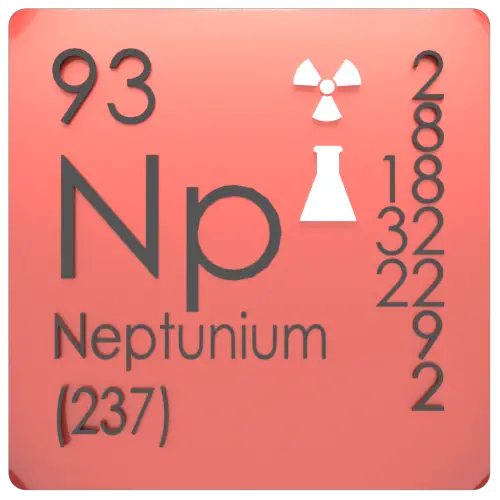
Neptunium – Periodic Table – Atomic Properties

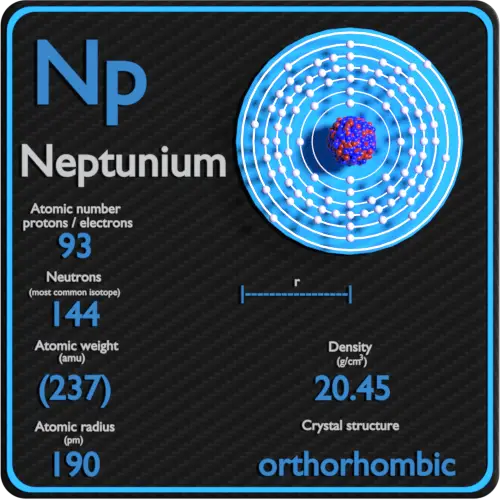
Neptunium-density-atomic-number-mass-radius

Neptunium metal is silvery and tarnishes when exposed to air. Neptunium is the first transuranic element.

Summary

Element Neptunium
Atomic number 93
Atomic mass [amu] 237
Atomic mass [pm] 190
Density at STP [g/cm3] 20.45
Number of protons 93
Number of neutrons (typical isotopes) 237
Number of electrons 93
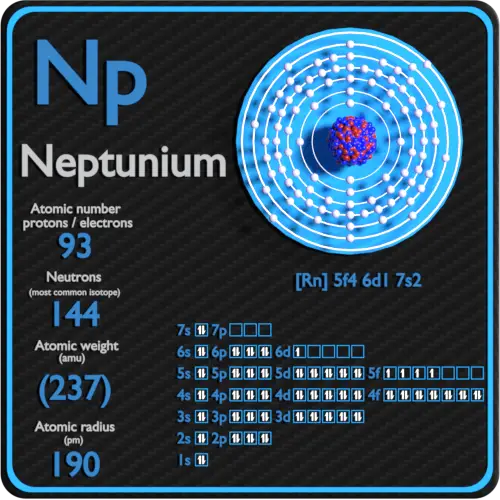
Electron configuration [Rn] 5f4 6d1 7s2
Oxidation states +3,4,5,6
Electron affinity [kJ/mol]
Electronegativity [Pauling scale] 1.36
First ionization energy [eV] 6.2657

Atomic Number – Protons, Electrons and Neutrons in Neptunium

Proton Number - Atomic NumberNeptunium is a chemical element with atomic number 93 which means there are 93 protons in its nucleus. Total number of protons in the nucleus is called the atomic number of the atom and is given the symbol Z. The total electrical charge of the nucleus is therefore +Ze, where e (elementary charge) equals to 1,602 x 10-19 coulombs.

The total number of neutrons in the nucleus of an atom is called the neutron number of the atom and is given the symbol N. Neutron number plus atomic number equals atomic mass number: N+Z=A. The difference between the neutron number and the atomic number is known as the neutron excess: D = N – Z = A – 2Z.

For stable elements, there is usually a variety of stable isotopes. Isotopes are nuclides that have the same atomic number and are therefore the same element, but differ in the number of neutrons. Mass numbers of typical isotopes of Neptunium are 237.

Atomic Mass of Neptunium

Atomic mass of Neptunium is 237 u. 

The atomic mass is the mass of an atom. The atomic mass or relative isotopic mass refers to the mass of a single particle, and therefore is tied to a certain specific isotope of an element. The atomic mass is carried by the atomic nucleus, which occupies only about 10-12 of the total volume of the atom or less, but it contains all the positive charge and at least 99.95% of the total mass of the atom. Note that, each element may contain more isotopes, therefore this resulting atomic mass is calculated from naturally-occuring isotopes and their abundance.

Atomic Radius of Neptunium

The atomic radius of Neptunium atom is 190pm (covalent radius).

Atomic Radius of Chemical Elements

It must be noted, atoms lack a well-defined outer boundary. The atomic radius of a chemical element is a measure of the distance out to which the electron cloud extends from the nucleus. However, this assumes the atom to exhibit a spherical shape, which is only obeyed for atoms in vacuum or free space. Therefore, there are various non-equivalent definitions of atomic radius.

Electrons and Electron Configuration

The number of electrons in an electrically-neutral atom is the same as the number of protons in the nucleus. Therefore, the number of electrons in neutral atom of Neptunium is 93. Each electron is influenced by the electric fields produced by the positive nuclear charge and the other (Z – 1) negative electrons in the atom.

Since the number of electrons and their arrangement are responsible for the chemical behavior of atoms, the atomic number identifies the various chemical elements. The configuration of these electrons follows from the principles of quantum mechanics. The number of electrons in each element’s electron shells, particularly the outermost valence shell, is the primary factor in determining its chemical bonding behavior. In the periodic table, the elements are listed in order of increasing atomic number Z.

Electron configuration of Neptunium is [Rn] 5f4 6d1 7s2.

Possible oxidation states are +3,4,5,6.

Density of Neptunium

Density of Neptunium is 20.45g/cm3.

Typical densities of various substances are at atmospheric pressure.

Density is defined as the mass per unit volume. It is an intensive property, which is mathematically defined as mass divided by volume:

ρ = m/V

Atomic Masses of Elements

Periodic Table of Elements - atomic mass

Atomic Radii of Elements

Periodic Table of Elements - atomic radius

Densities of Elements

Periodic Table of Elements - density

Neptunium-protons-neutrons-electrons-configuration

Electron Affinity – Neptunium

Electron affinity of Neptunium is — kJ/mol.

In chemistry and atomic physics, the electron affinity of an atom or molecule is defined as:

the change in energy (in kJ/mole) of a neutral atom or molecule (in the gaseous phase) when an electron is added to the atom to form a negative ion.

X + e → X + energy        Affinity = – ∆H

In other words, it can be expressed as the neutral atom’s likelihood of gaining an electron. Note that, ionization energies measure the tendency of a neutral atom to resist the loss of electrons. Electron affinities are more difficult to measure than ionization energies.

Electronegativity of Neptunium

Electronegativity of Neptunium is 1.36.

Electronegativity, symbol χ, is a chemical property that describes the tendency of an atom to attract electrons towards this atom. For this purposes, a dimensionless quantity the Pauling scale, symbol χ, is the most commonly used.

The electronegativity of Neptunium is: χ = 1.36

First Ionization Energy of Neptunium

First Ionization Energy of Neptunium is 6.2657 eV.

Ionization energy, also called ionization potential, is the energy necessary to remove an electron from the neutral atom.

X + energy → X+ + e

where X is any atom or molecule capable of being ionized, X+ is that atom or molecule with an electron removed (positive ion), and e is the removed electron.

A Neptunium atom, for example, requires the following ionization energy to remove the outermost electron.

Np + IE → Np+ + e        IE = 6.2657 eV

Electronegativity of Elements

Periodic Table of Elements - electronegativity

Ionization Energy of Elements

Periodic Table of Elements - ionization energy

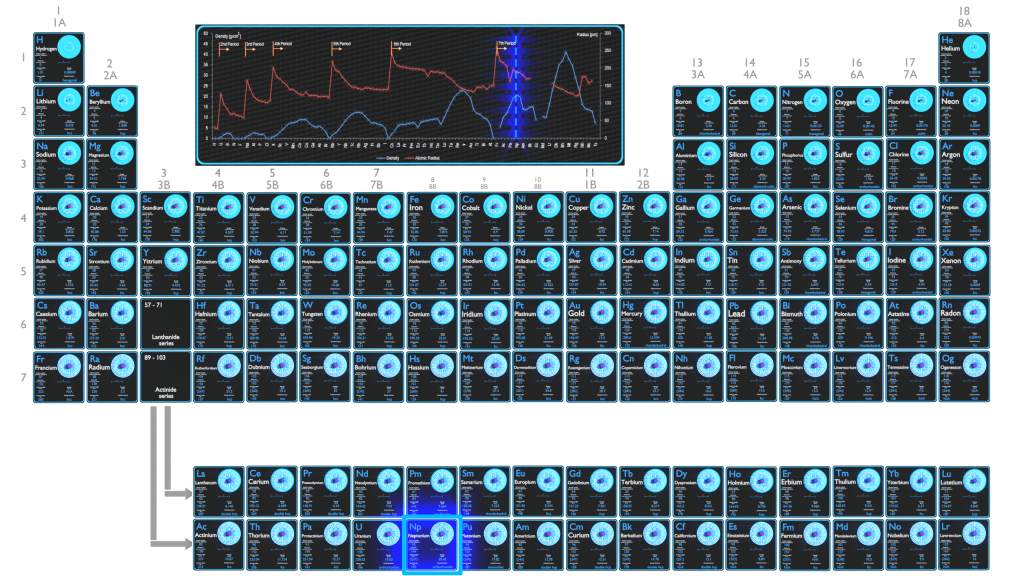
Neptunium-periodic-table

Source: www.luciteria.com


Properties of other elements

Neptunium - Comparison of Atomic Properties

Periodic Table in 8K resolution

Other properties of Neptunium