Facebook Instagram Youtube Twitter

Chromium – Periodic Table – Atomic Properties

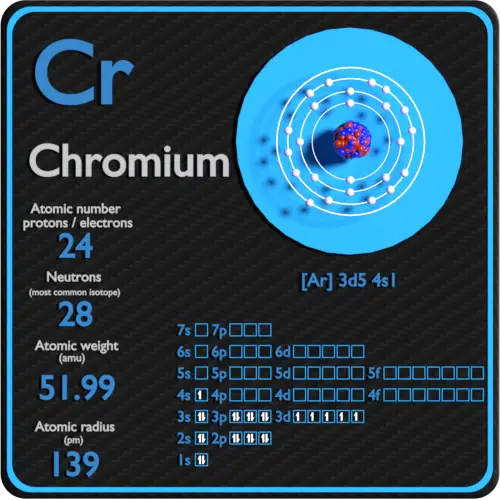
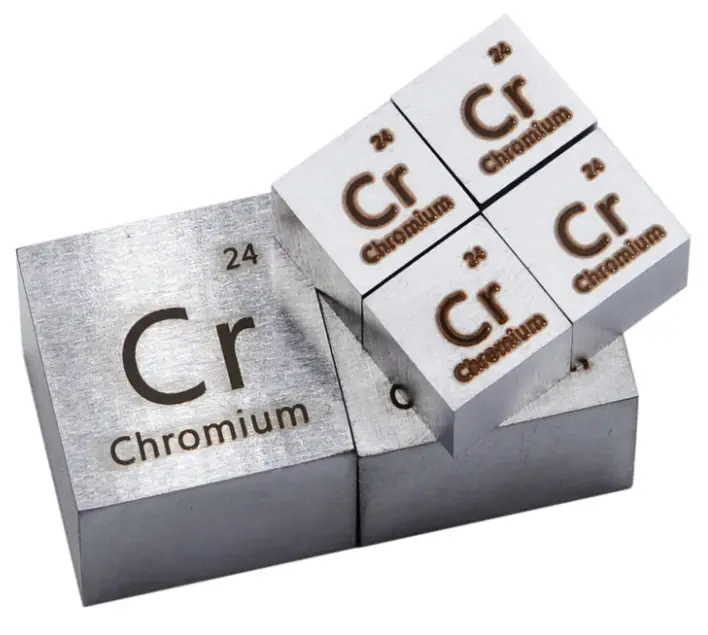
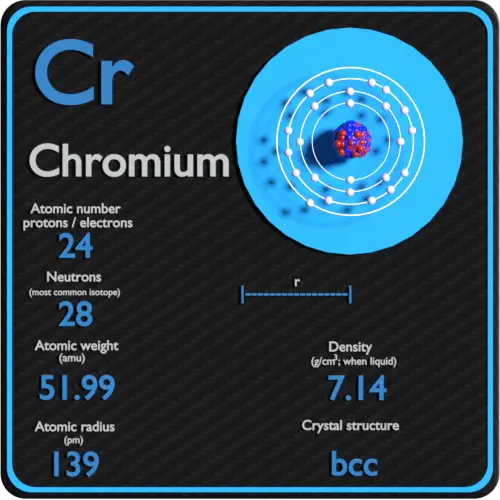
Chromium-density-atomic-number-mass-radius

Chromium is a steely-grey, lustrous, hard and brittle metal[4] which takes a high polish, resists tarnishing, and has a high melting point. A major development was the discovery that steel could be made highly resistant to corrosion and discoloration by adding metallic chromium to form stainless steel.

Summary

Element Chromium
Atomic number 24
Atomic mass [amu] 51.9961
Atomic mass [pm] 139
Density at STP [g/cm3] 7.14
Number of protons 24
Number of neutrons (typical isotopes) 50; 52-54
Number of electrons 24
Electron configuration [Ar] 3d5 4s1
Oxidation states +2,3,6
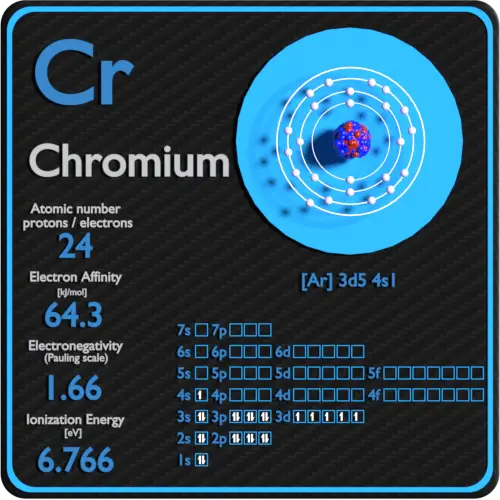
Electron affinity [kJ/mol] 64.3
Electronegativity [Pauling scale] 1.66
First ionization energy [eV] 6.7666

Atomic Number – Protons, Electrons and Neutrons in Chromium
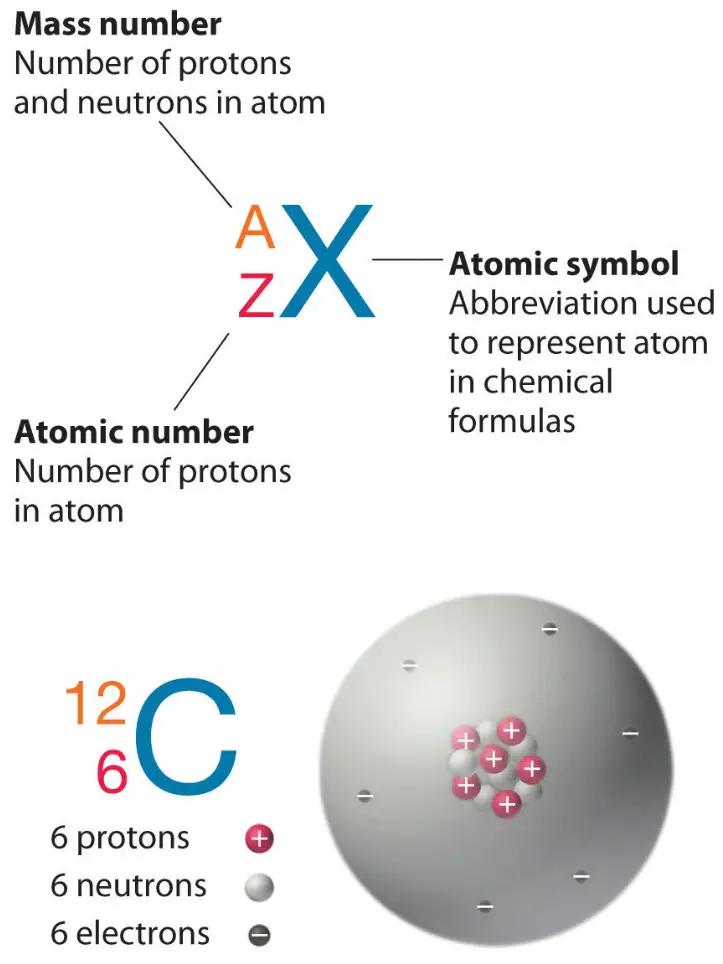
Proton Number - Atomic NumberChromium is a chemical element with atomic number 24 which means there are 24 protons in its nucleus. Total number of protons in the nucleus is called the atomic number of the atom and is given the symbol Z. The total electrical charge of the nucleus is therefore +Ze, where e (elementary charge) equals to 1,602 x 10-19 coulombs.

The total number of neutrons in the nucleus of an atom is called the neutron number of the atom and is given the symbol N. Neutron number plus atomic number equals atomic mass number: N+Z=A. The difference between the neutron number and the atomic number is known as the neutron excess: D = N – Z = A – 2Z.

For stable elements, there is usually a variety of stable isotopes. Isotopes are nuclides that have the same atomic number and are therefore the same element, but differ in the number of neutrons. Mass numbers of typical isotopes of Chromium are 50; 52-54.

Atomic Mass of Chromium

Atomic mass of Chromium is 51.9961 u. 

The atomic mass is the mass of an atom. The atomic mass or relative isotopic mass refers to the mass of a single particle, and therefore is tied to a certain specific isotope of an element. The atomic mass is carried by the atomic nucleus, which occupies only about 10-12 of the total volume of the atom or less, but it contains all the positive charge and at least 99.95% of the total mass of the atom. Note that, each element may contain more isotopes, therefore this resulting atomic mass is calculated from naturally-occuring isotopes and their abundance.

Atomic Radius of Chromium

The atomic radius of Chromium atom is 139pm (covalent radius).

Atomic Radius of Chemical Elements

It must be noted, atoms lack a well-defined outer boundary. The atomic radius of a chemical element is a measure of the distance out to which the electron cloud extends from the nucleus. However, this assumes the atom to exhibit a spherical shape, which is only obeyed for atoms in vacuum or free space. Therefore, there are various non-equivalent definitions of atomic radius.

Electrons and Electron Configuration

The number of electrons in an electrically-neutral atom is the same as the number of protons in the nucleus. Therefore, the number of electrons in neutral atom of Chromium is 24. Each electron is influenced by the electric fields produced by the positive nuclear charge and the other (Z – 1) negative electrons in the atom.

Since the number of electrons and their arrangement are responsible for the chemical behavior of atoms, the atomic number identifies the various chemical elements. The configuration of these electrons follows from the principles of quantum mechanics. The number of electrons in each element’s electron shells, particularly the outermost valence shell, is the primary factor in determining its chemical bonding behavior. In the periodic table, the elements are listed in order of increasing atomic number Z.

Electron configuration of Chromium is [Ar] 3d5 4s1.

Possible oxidation states are +2,3,6.

Density of Chromium

Density of Chromium is 7.14g/cm3.

Typical densities of various substances are at atmospheric pressure.

Density is defined as the mass per unit volume. It is an intensive property, which is mathematically defined as mass divided by volume:

ρ = m/V

Atomic Masses of Elements
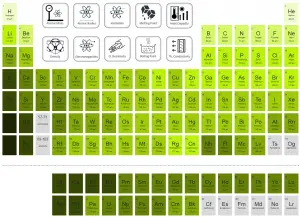
Periodic Table of Elements - atomic mass

Atomic Radii of Elements

Periodic Table of Elements - atomic radius

Densities of Elements

Periodic Table of Elements - density

Chromium-protons-neutrons-electrons-configuration

Chromium-affinity-electronegativity-ionization

Electron Affinity – Chromium

Electron affinity of Chromium is 64.3 kJ/mol.

In chemistry and atomic physics, the electron affinity of an atom or molecule is defined as:

the change in energy (in kJ/mole) of a neutral atom or molecule (in the gaseous phase) when an electron is added to the atom to form a negative ion.

X + e– → X– + energy        Affinity = – ∆H

In other words, it can be expressed as the neutral atom’s likelihood of gaining an electron. Note that, ionization energies measure the tendency of a neutral atom to resist the loss of electrons. Electron affinities are more difficult to measure than ionization energies.

Electronegativity of Chromium

Electronegativity of Chromium is 1.66.

Electronegativity, symbol χ, is a chemical property that describes the tendency of an atom to attract electrons towards this atom. For this purposes, a dimensionless quantity the Pauling scale, symbol χ, is the most commonly used.

The electronegativity of Chromium is: χ = 1.66

First Ionization Energy of Chromium

First Ionization Energy of Chromium is 6.7666 eV.

Ionization energy, also called ionization potential, is the energy necessary to remove an electron from the neutral atom.

X + energy → X+ + e−

where X is any atom or molecule capable of being ionized, X+ is that atom or molecule with an electron removed (positive ion), and e− is the removed electron.

A Chromium atom, for example, requires the following ionization energy to remove the outermost electron.

Cr + IE → Cr+ + e−        IE = 6.7666 eV

Electronegativity of Elements
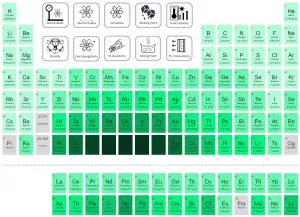
Periodic Table of Elements - electronegativity

Ionization Energy of Elements

Periodic Table of Elements - ionization energy

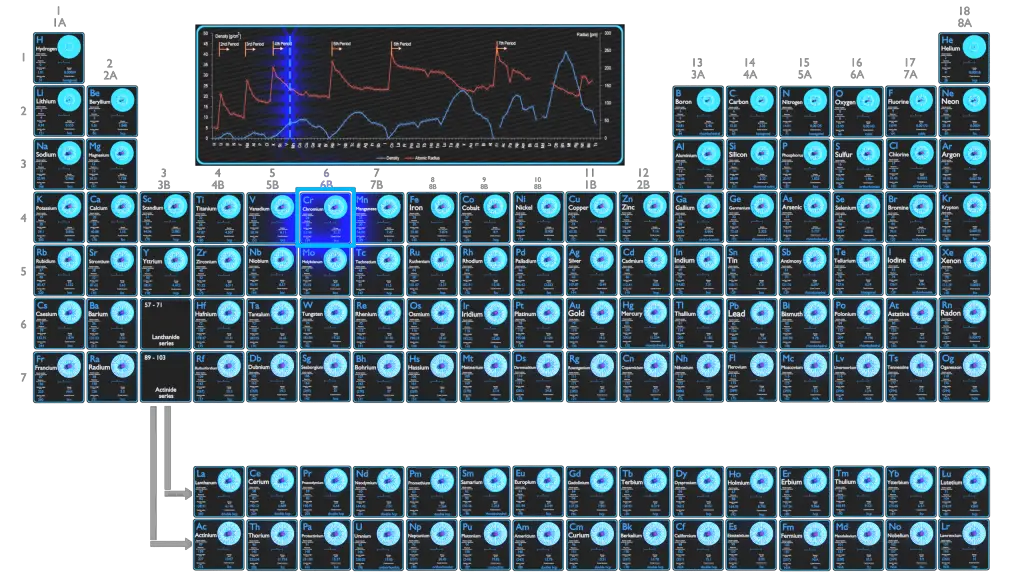
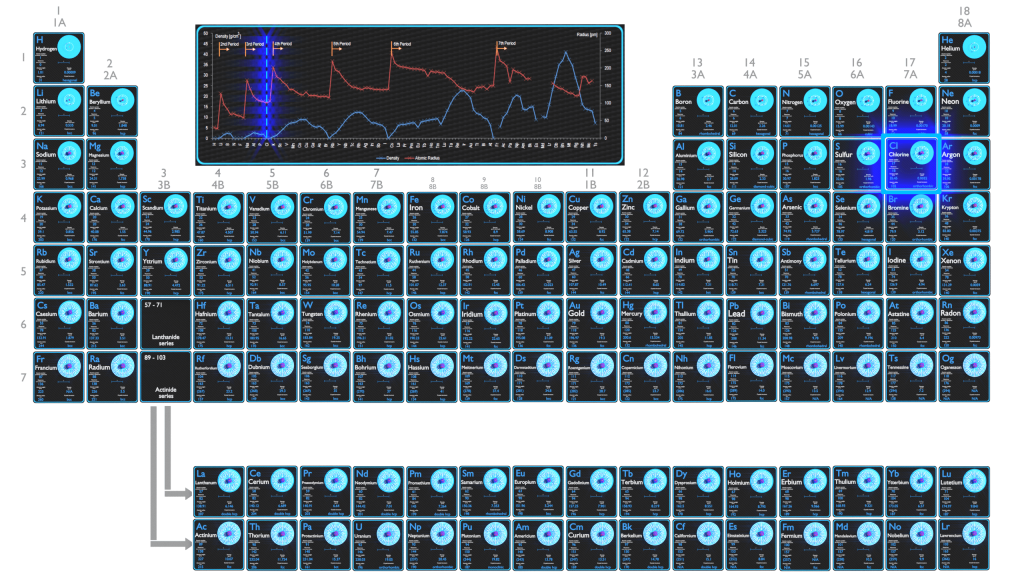
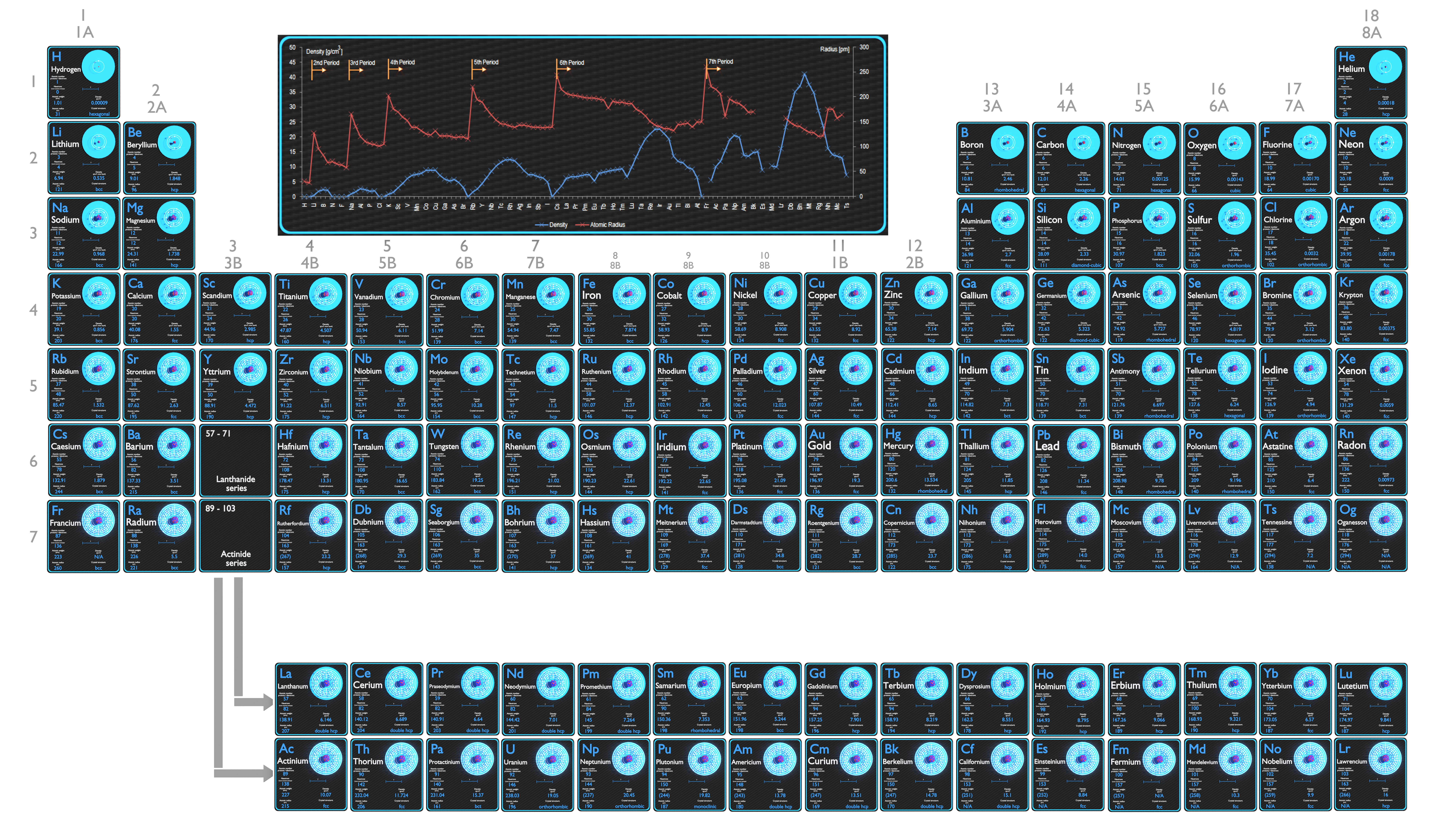
Chromium-periodic-table

Source: www.luciteria.com


Properties of other elements

Chromium - Comparison of Atomic Properties

Periodic Table in 8K resolution

Other properties of Chromium
 

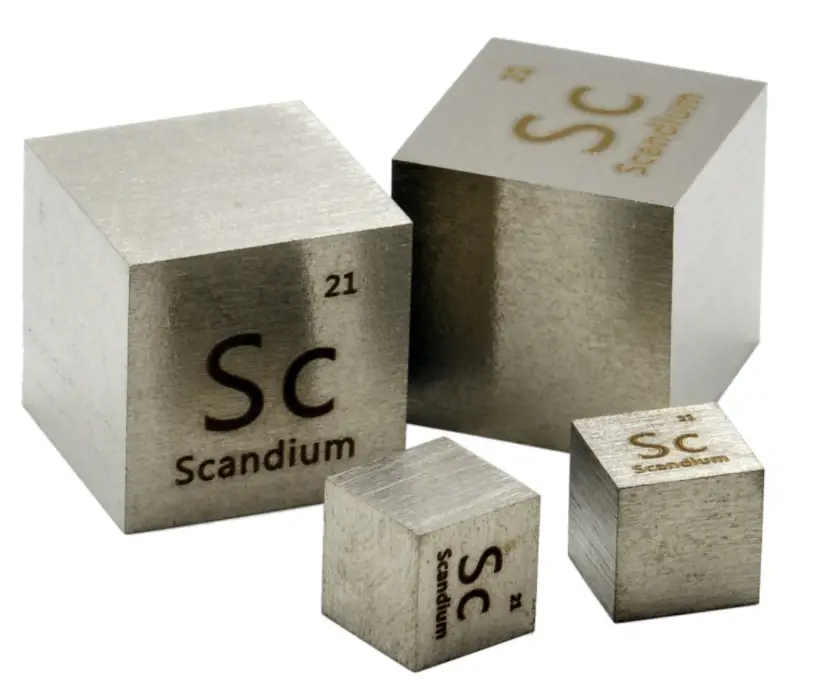
Scandium – Periodic Table – Atomic Properties
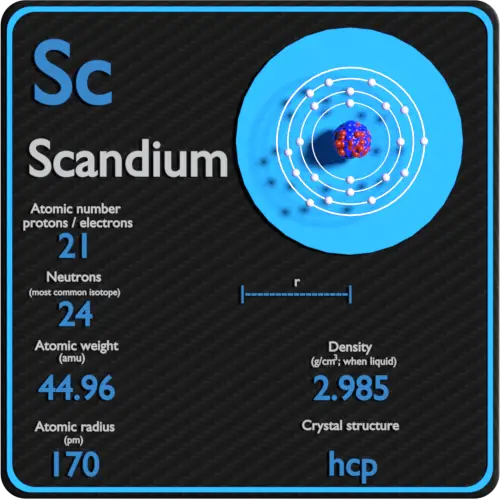
Scandium-density-atomic-number-mass-radius

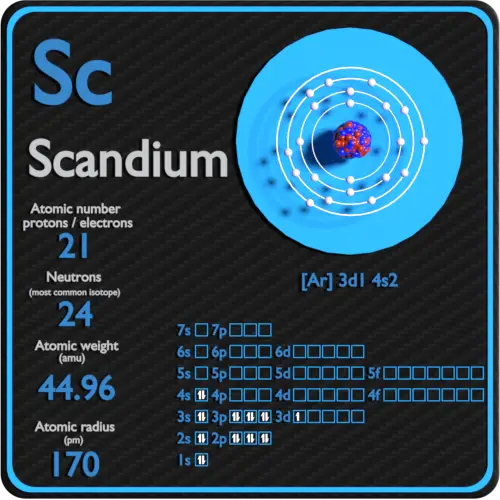
Scandium is a silvery-white metallic d-block element, it has historically been sometimes classified as a rare-earth element, together with yttrium and the lanthanides.
Summary

Element Scandium
Atomic number 21
Atomic mass [amu] 44.9559
Atomic mass [pm] 170
Density at STP [g/cm3] 2.985
Number of protons 21
Number of neutrons (typical isotopes) 45
Number of electrons 21
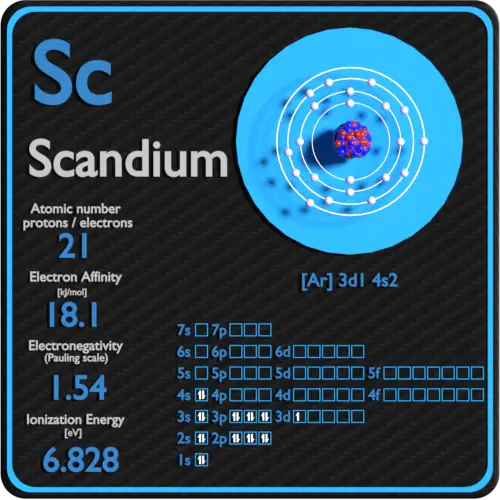
Electron configuration [Ar] 3d1 4s2
Oxidation states +3
Electron affinity [kJ/mol] 18.1
Electronegativity [Pauling scale] 1.36
First ionization energy [eV] 6.5614

Atomic Number – Protons, Electrons and Neutrons in Scandium

Proton Number - Atomic NumberScandium is a chemical element with atomic number 21 which means there are 21 protons in its nucleus. Total number of protons in the nucleus is called the atomic number of the atom and is given the symbol Z. The total electrical charge of the nucleus is therefore +Ze, where e (elementary charge) equals to 1,602 x 10-19 coulombs.

The total number of neutrons in the nucleus of an atom is called the neutron number of the atom and is given the symbol N. Neutron number plus atomic number equals atomic mass number: N+Z=A. The difference between the neutron number and the atomic number is known as the neutron excess: D = N – Z = A – 2Z.

For stable elements, there is usually a variety of stable isotopes. Isotopes are nuclides that have the same atomic number and are therefore the same element, but differ in the number of neutrons. Mass numbers of typical isotopes of Scandium are 45.

Atomic Mass of Scandium

Atomic mass of Scandium is 44.9559 u. 

The atomic mass is the mass of an atom. The atomic mass or relative isotopic mass refers to the mass of a single particle, and therefore is tied to a certain specific isotope of an element. The atomic mass is carried by the atomic nucleus, which occupies only about 10-12 of the total volume of the atom or less, but it contains all the positive charge and at least 99.95% of the total mass of the atom. Note that, each element may contain more isotopes, therefore this resulting atomic mass is calculated from naturally-occuring isotopes and their abundance.

Atomic Radius of Scandium

The atomic radius of Scandium atom is 170pm (covalent radius).

Atomic Radius of Chemical Elements

It must be noted, atoms lack a well-defined outer boundary. The atomic radius of a chemical element is a measure of the distance out to which the electron cloud extends from the nucleus. However, this assumes the atom to exhibit a spherical shape, which is only obeyed for atoms in vacuum or free space. Therefore, there are various non-equivalent definitions of atomic radius.

Electrons and Electron Configuration

The number of electrons in an electrically-neutral atom is the same as the number of protons in the nucleus. Therefore, the number of electrons in neutral atom of Scandium is 21. Each electron is influenced by the electric fields produced by the positive nuclear charge and the other (Z – 1) negative electrons in the atom.

Since the number of electrons and their arrangement are responsible for the chemical behavior of atoms, the atomic number identifies the various chemical elements. The configuration of these electrons follows from the principles of quantum mechanics. The number of electrons in each element’s electron shells, particularly the outermost valence shell, is the primary factor in determining its chemical bonding behavior. In the periodic table, the elements are listed in order of increasing atomic number Z.

Electron configuration of Scandium is [Ar] 3d1 4s2.

Possible oxidation states are +3.

Density of Scandium

Density of Scandium is 2.985g/cm3.

Typical densities of various substances are at atmospheric pressure.

Density is defined as the mass per unit volume. It is an intensive property, which is mathematically defined as mass divided by volume:

ρ = m/V

Atomic Masses of Elements

Periodic Table of Elements - atomic mass

Atomic Radii of Elements

Periodic Table of Elements - atomic radius

Densities of Elements

Periodic Table of Elements - density

Scandium-protons-neutrons-electrons-configuration

Scandium-affinity-electronegativity-ionization

Electron Affinity – Scandium

Electron affinity of Scandium is 18.1 kJ/mol.

In chemistry and atomic physics, the electron affinity of an atom or molecule is defined as:

the change in energy (in kJ/mole) of a neutral atom or molecule (in the gaseous phase) when an electron is added to the atom to form a negative ion.

X + e– → X– + energy        Affinity = – ∆H

In other words, it can be expressed as the neutral atom’s likelihood of gaining an electron. Note that, ionization energies measure the tendency of a neutral atom to resist the loss of electrons. Electron affinities are more difficult to measure than ionization energies.

Electronegativity of Scandium

Electronegativity of Scandium is 1.36.

Electronegativity, symbol χ, is a chemical property that describes the tendency of an atom to attract electrons towards this atom. For this purposes, a dimensionless quantity the Pauling scale, symbol χ, is the most commonly used.

The electronegativity of Scandium is: χ = 1.36

First Ionization Energy of Scandium

First Ionization Energy of Scandium is 6.5614 eV.

Ionization energy, also called ionization potential, is the energy necessary to remove an electron from the neutral atom.

X + energy → X+ + e−

where X is any atom or molecule capable of being ionized, X+ is that atom or molecule with an electron removed (positive ion), and e− is the removed electron.

A Scandium atom, for example, requires the following ionization energy to remove the outermost electron.

Sc + IE → Sc+ + e−        IE = 6.5614 eV

Electronegativity of Elements

Periodic Table of Elements - electronegativity

Ionization Energy of Elements

Periodic Table of Elements - ionization energy

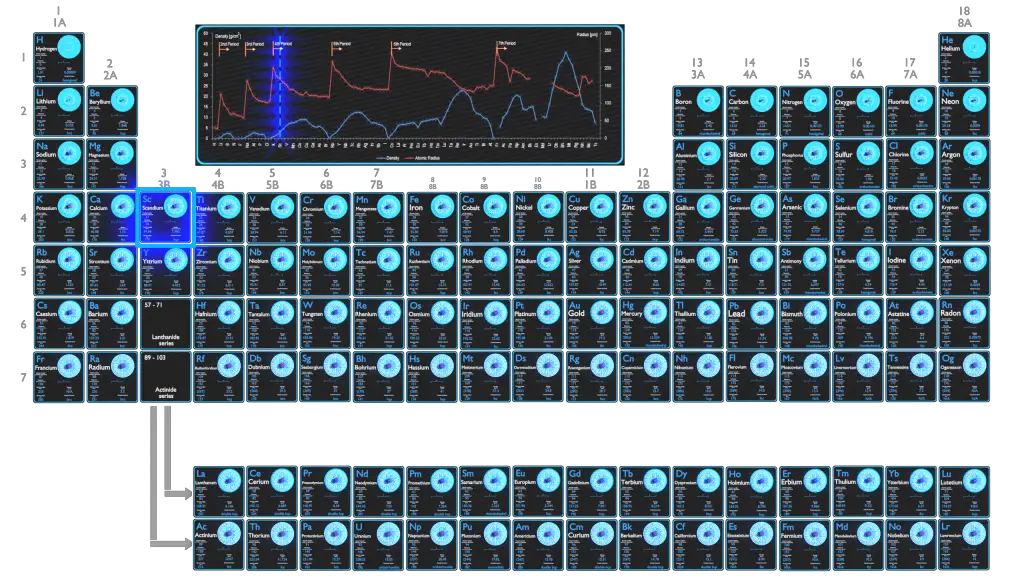
Scandium-periodic-table

Source: www.luciteria.com


Properties of other elements

Scandium - Comparison of Atomic Properties

Periodic Table in 8K resolution

Other properties of Scandium


Titanium – Periodic Table – Atomic Properties

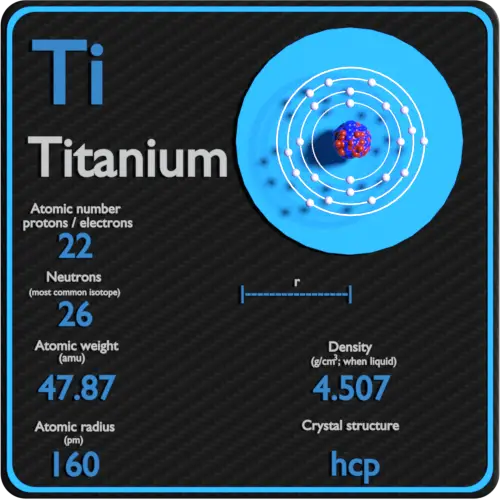
Titanium-density-atomic-number-mass-radius

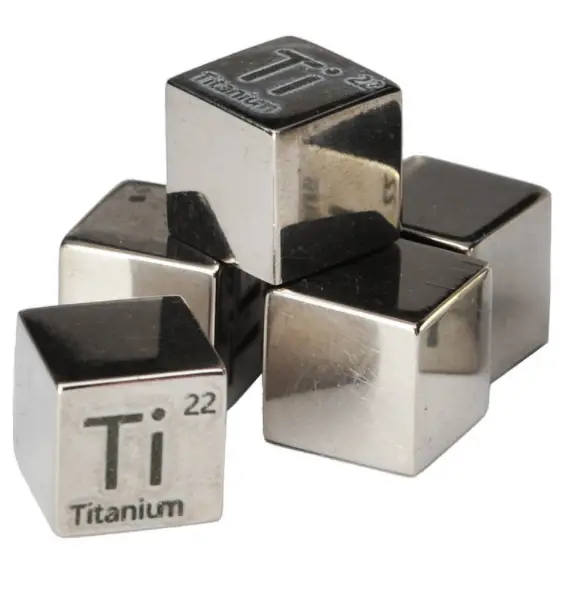
Titanium is a lustrous transition metal with a silver color, low density, and high strength. Titanium is resistant to corrosion in sea water, aqua regia, and chlorine. Titanium can be used in surface condensers. These condensers use tubes that are usually made of stainless steel, copper alloys, or titanium depending on several selection criteria (such as thermal conductivity or corrosion resistance). Titanium condenser tubes are usually the best technical choice, however titanium is very expensive material and the use of titanium condenser tubes is associated with very high initial costs.

Summary

Element Titanium
Atomic number 22
Atomic mass [amu] 47.867
Atomic mass [pm] 160
Density at STP [g/cm3] 4.507
Number of protons 22
Number of neutrons (typical isotopes) 46-50
Number of electrons 22
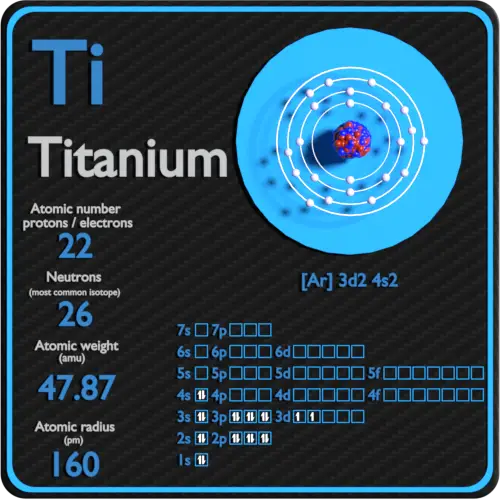
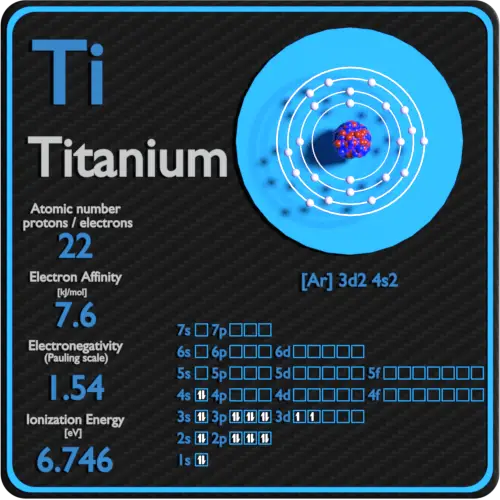
Electron configuration [Ar] 3d2 4s2
Oxidation states +2,3,4
Electron affinity [kJ/mol] 7.6
Electronegativity [Pauling scale] 1.54
First ionization energy [eV] 6.8282

Atomic Number – Protons, Electrons and Neutrons in Titanium

Proton Number - Atomic NumberTitanium is a chemical element with atomic number 22 which means there are 22 protons in its nucleus. Total number of protons in the nucleus is called the atomic number of the atom and is given the symbol Z. The total electrical charge of the nucleus is therefore +Ze, where e (elementary charge) equals to 1,602 x 10-19 coulombs.

The total number of neutrons in the nucleus of an atom is called the neutron number of the atom and is given the symbol N. Neutron number plus atomic number equals atomic mass number: N+Z=A. The difference between the neutron number and the atomic number is known as the neutron excess: D = N – Z = A – 2Z.

For stable elements, there is usually a variety of stable isotopes. Isotopes are nuclides that have the same atomic number and are therefore the same element, but differ in the number of neutrons. Mass numbers of typical isotopes of Titanium are 46-50.

Atomic Mass of Titanium

Atomic mass of Titanium is 47.867 u. 

The atomic mass is the mass of an atom. The atomic mass or relative isotopic mass refers to the mass of a single particle, and therefore is tied to a certain specific isotope of an element. The atomic mass is carried by the atomic nucleus, which occupies only about 10-12 of the total volume of the atom or less, but it contains all the positive charge and at least 99.95% of the total mass of the atom. Note that, each element may contain more isotopes, therefore this resulting atomic mass is calculated from naturally-occuring isotopes and their abundance.

Atomic Radius of Titanium

The atomic radius of Titanium atom is 160pm (covalent radius).

Atomic Radius of Chemical Elements

It must be noted, atoms lack a well-defined outer boundary. The atomic radius of a chemical element is a measure of the distance out to which the electron cloud extends from the nucleus. However, this assumes the atom to exhibit a spherical shape, which is only obeyed for atoms in vacuum or free space. Therefore, there are various non-equivalent definitions of atomic radius.

Electrons and Electron Configuration

The number of electrons in an electrically-neutral atom is the same as the number of protons in the nucleus. Therefore, the number of electrons in neutral atom of Titanium is 22. Each electron is influenced by the electric fields produced by the positive nuclear charge and the other (Z – 1) negative electrons in the atom.

Since the number of electrons and their arrangement are responsible for the chemical behavior of atoms, the atomic number identifies the various chemical elements. The configuration of these electrons follows from the principles of quantum mechanics. The number of electrons in each element’s electron shells, particularly the outermost valence shell, is the primary factor in determining its chemical bonding behavior. In the periodic table, the elements are listed in order of increasing atomic number Z.

Electron configuration of Titanium is [Ar] 3d2 4s2.

Possible oxidation states are +2,3,4.

Density of Titanium

Density of Titanium is 4.507g/cm3.

Typical densities of various substances are at atmospheric pressure.

Density is defined as the mass per unit volume. It is an intensive property, which is mathematically defined as mass divided by volume:

ρ = m/V

Atomic Masses of Elements

Periodic Table of Elements - atomic mass

Atomic Radii of Elements

Periodic Table of Elements - atomic radius

Densities of Elements

Periodic Table of Elements - density

Titanium-protons-neutrons-electrons-configuration

Titanium-affinity-electronegativity-ionization

Electron Affinity – Titanium

Electron affinity of Titanium is 7.6 kJ/mol.

In chemistry and atomic physics, the electron affinity of an atom or molecule is defined as:

the change in energy (in kJ/mole) of a neutral atom or molecule (in the gaseous phase) when an electron is added to the atom to form a negative ion.

X + e– → X– + energy        Affinity = – ∆H

In other words, it can be expressed as the neutral atom’s likelihood of gaining an electron. Note that, ionization energies measure the tendency of a neutral atom to resist the loss of electrons. Electron affinities are more difficult to measure than ionization energies.

Electronegativity of Titanium

Electronegativity of Titanium is 1.54.

Electronegativity, symbol χ, is a chemical property that describes the tendency of an atom to attract electrons towards this atom. For this purposes, a dimensionless quantity the Pauling scale, symbol χ, is the most commonly used.

The electronegativity of Titanium is: χ = 1.54

First Ionization Energy of Titanium

First Ionization Energy of Titanium is 6.8282 eV.

Ionization energy, also called ionization potential, is the energy necessary to remove an electron from the neutral atom.

X + energy → X+ + e−

where X is any atom or molecule capable of being ionized, X+ is that atom or molecule with an electron removed (positive ion), and e− is the removed electron.

A Titanium atom, for example, requires the following ionization energy to remove the outermost electron.

Ti + IE → Ti+ + e−        IE = 6.8282 eV

Electronegativity of Elements

Periodic Table of Elements - electronegativity

Ionization Energy of Elements

Periodic Table of Elements - ionization energy

Titanium-periodic-table

Source: www.luciteria.com


Properties of other elements

Titanium - Comparison of Atomic Properties

Periodic Table in 8K resolution

Other properties of Titanium


Potassium – Periodic Table – Atomic Properties

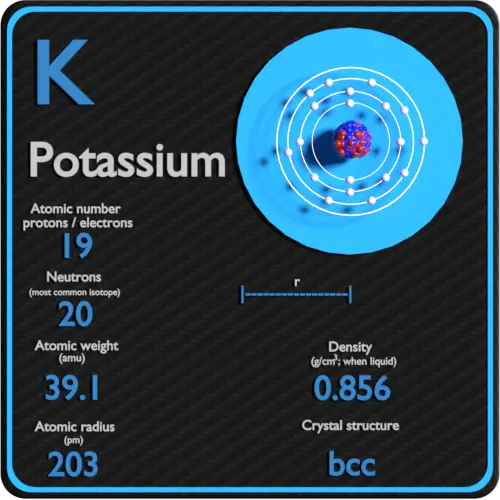
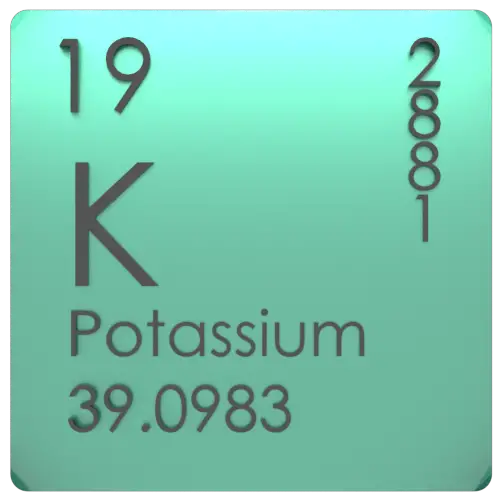
Potassium-density-atomic-number-mass-radius

Potassium was first isolated from potash, the ashes of plants, from which its name derives. In the periodic table, potassium is one of the alkali metals. All of the alkali metals have a single valence electron in the outer electron shell, which is easily removed to create an ion with a positive charge – a cation, which combines with anions to form salts. Naturally occurring potassium is composed of three isotopes, of which 40K is radioactive. Traces of 40K are found in all potassium, and it is the most common radioisotope in the human body.

Summary

Element Potassium
Atomic number 19
Atomic mass [amu] 39.0983
Atomic mass [pm] 203
Density at STP [g/cm3] 0.856
Number of protons 19
Number of neutrons (typical isotopes) 39; 41
Number of electrons 19
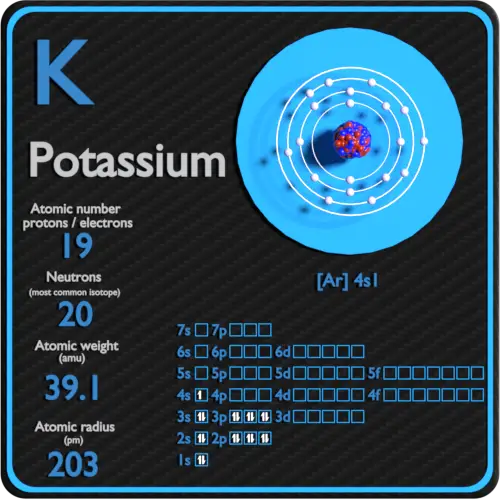
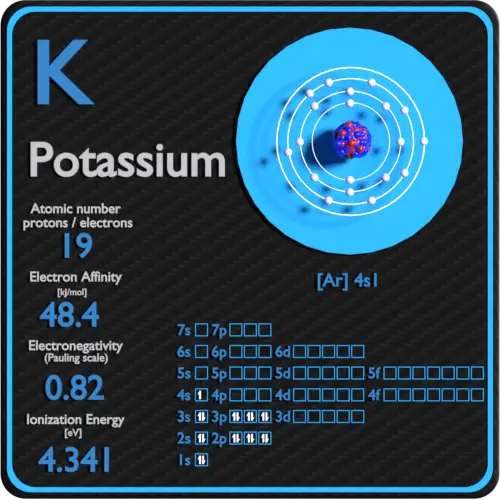
Electron configuration [Ar] 4s1
Oxidation states +1
Electron affinity [kJ/mol] 48.4
Electronegativity [Pauling scale] 0.82
First ionization energy [eV] 4.3407

Atomic Number – Protons, Electrons and Neutrons in Potassium

Proton Number - Atomic NumberPotassium is a chemical element with atomic number 19 which means there are 19 protons in its nucleus. Total number of protons in the nucleus is called the atomic number of the atom and is given the symbol Z. The total electrical charge of the nucleus is therefore +Ze, where e (elementary charge) equals to 1,602 x 10-19 coulombs.

The total number of neutrons in the nucleus of an atom is called the neutron number of the atom and is given the symbol N. Neutron number plus atomic number equals atomic mass number: N+Z=A. The difference between the neutron number and the atomic number is known as the neutron excess: D = N – Z = A – 2Z.

For stable elements, there is usually a variety of stable isotopes. Isotopes are nuclides that have the same atomic number and are therefore the same element, but differ in the number of neutrons. Mass numbers of typical isotopes of Potassium are 39; 41.

Atomic Mass of Potassium

Atomic mass of Potassium is 39.0983 u. 

The atomic mass is the mass of an atom. The atomic mass or relative isotopic mass refers to the mass of a single particle, and therefore is tied to a certain specific isotope of an element. The atomic mass is carried by the atomic nucleus, which occupies only about 10-12 of the total volume of the atom or less, but it contains all the positive charge and at least 99.95% of the total mass of the atom. Note that, each element may contain more isotopes, therefore this resulting atomic mass is calculated from naturally-occuring isotopes and their abundance.

Atomic Radius of Potassium

The atomic radius of Potassium atom is 203pm (covalent radius).

Atomic Radius of Chemical Elements

It must be noted, atoms lack a well-defined outer boundary. The atomic radius of a chemical element is a measure of the distance out to which the electron cloud extends from the nucleus. However, this assumes the atom to exhibit a spherical shape, which is only obeyed for atoms in vacuum or free space. Therefore, there are various non-equivalent definitions of atomic radius.

Electrons and Electron Configuration

The number of electrons in an electrically-neutral atom is the same as the number of protons in the nucleus. Therefore, the number of electrons in neutral atom of Potassium is 19. Each electron is influenced by the electric fields produced by the positive nuclear charge and the other (Z – 1) negative electrons in the atom.

Since the number of electrons and their arrangement are responsible for the chemical behavior of atoms, the atomic number identifies the various chemical elements. The configuration of these electrons follows from the principles of quantum mechanics. The number of electrons in each element’s electron shells, particularly the outermost valence shell, is the primary factor in determining its chemical bonding behavior. In the periodic table, the elements are listed in order of increasing atomic number Z.

Electron configuration of Potassium is [Ar] 4s1.

Possible oxidation states are +1.

Density of Potassium

Density of Potassium is 0.856g/cm3.

Typical densities of various substances are at atmospheric pressure.

Density is defined as the mass per unit volume. It is an intensive property, which is mathematically defined as mass divided by volume:

ρ = m/V

Atomic Masses of Elements

Periodic Table of Elements - atomic mass

Atomic Radii of Elements

Periodic Table of Elements - atomic radius

Densities of Elements

Periodic Table of Elements - density

Potassium-protons-neutrons-electrons-configuration

Potassium-affinity-electronegativity-ionization

Electron Affinity – Potassium

Electron affinity of Potassium is 48.4 kJ/mol.

In chemistry and atomic physics, the electron affinity of an atom or molecule is defined as:

the change in energy (in kJ/mole) of a neutral atom or molecule (in the gaseous phase) when an electron is added to the atom to form a negative ion.

X + e– → X– + energy        Affinity = – ∆H

In other words, it can be expressed as the neutral atom’s likelihood of gaining an electron. Note that, ionization energies measure the tendency of a neutral atom to resist the loss of electrons. Electron affinities are more difficult to measure than ionization energies.

Electronegativity of Potassium

Electronegativity of Potassium is 0.82.

Electronegativity, symbol χ, is a chemical property that describes the tendency of an atom to attract electrons towards this atom. For this purposes, a dimensionless quantity the Pauling scale, symbol χ, is the most commonly used.

The electronegativity of Potassium is: χ = 0.82

First Ionization Energy of Potassium

First Ionization Energy of Potassium is 4.3407 eV.

Ionization energy, also called ionization potential, is the energy necessary to remove an electron from the neutral atom.

X + energy → X+ + e−

where X is any atom or molecule capable of being ionized, X+ is that atom or molecule with an electron removed (positive ion), and e− is the removed electron.

A Potassium atom, for example, requires the following ionization energy to remove the outermost electron.

K + IE → K+ + e−        IE = 4.3407 eV

Electronegativity of Elements

Periodic Table of Elements - electronegativity

Ionization Energy of Elements

Periodic Table of Elements - ionization energy

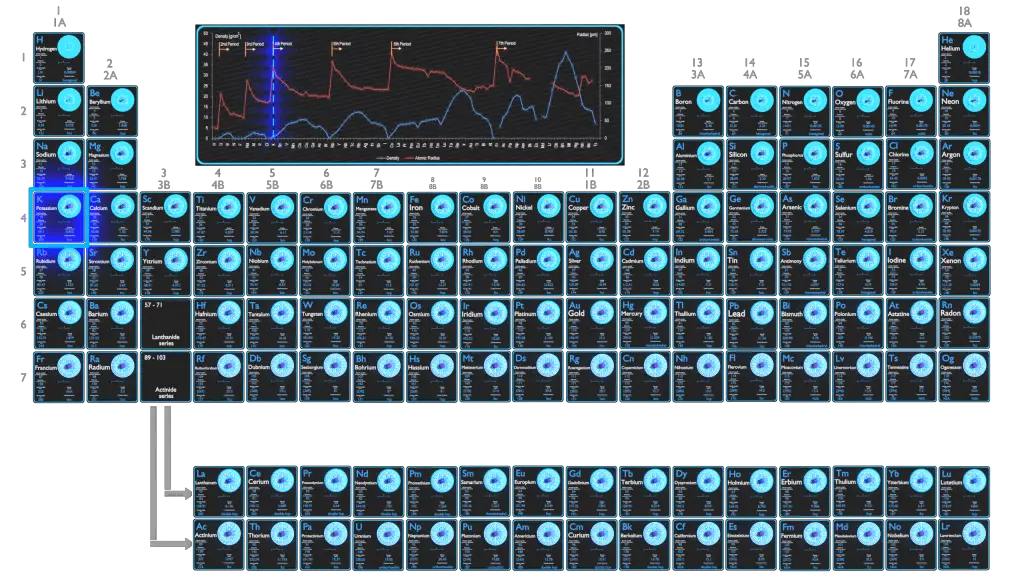
Potassium-periodic-table

Source: www.luciteria.com


Properties of other elements

Potassium - Comparison of Atomic Properties

Periodic Table in 8K resolution

Other properties of Potassium


Calcium – Periodic Table – Atomic Properties

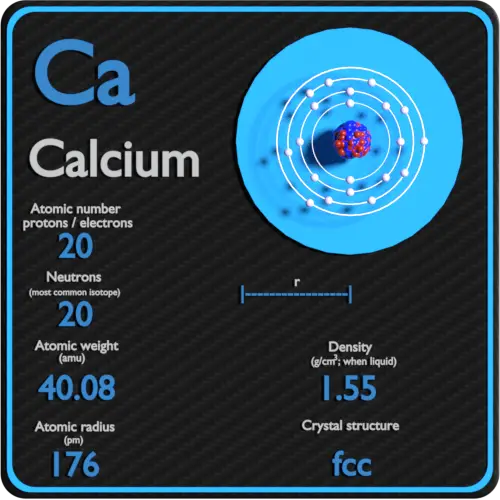
Calcium-density-atomic-number-mass-radius

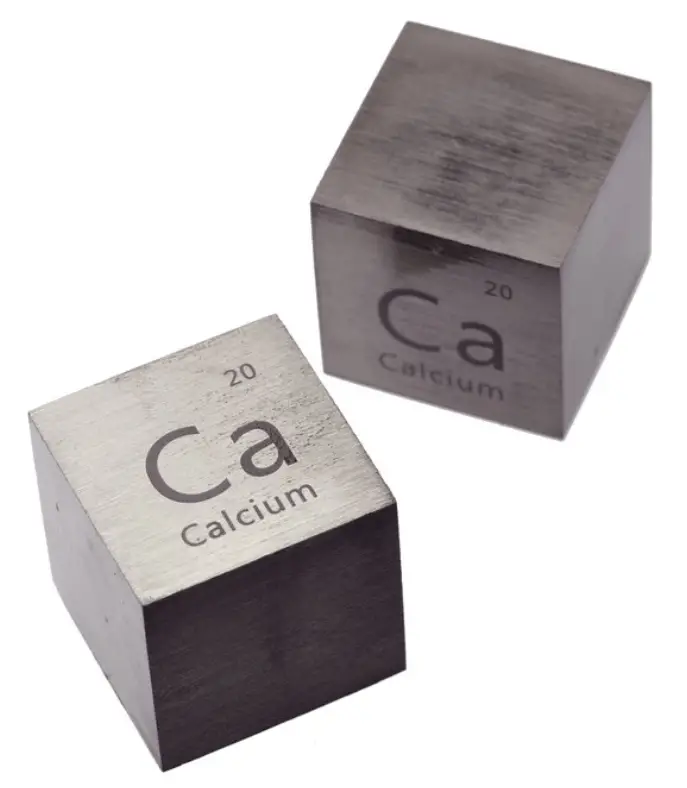
Calcium is an alkaline earth metal, it is a reactive pale yellow metal that forms a dark oxide-nitride layer when exposed to air. Its physical and chemical properties are most similar to its heavier homologues strontium and barium. It is the fifth most abundant element in Earth’s crust and the third most abundant metal, after iron and aluminium.

Summary

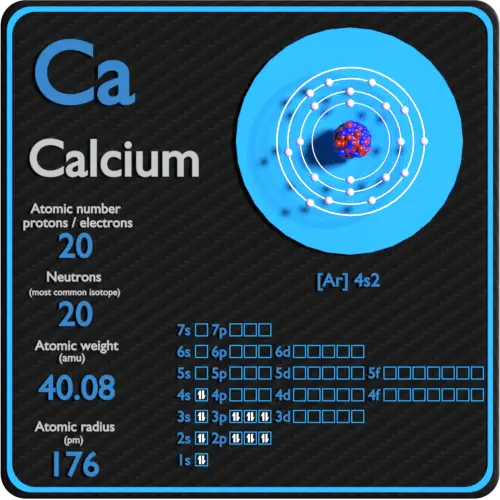
Element Calcium
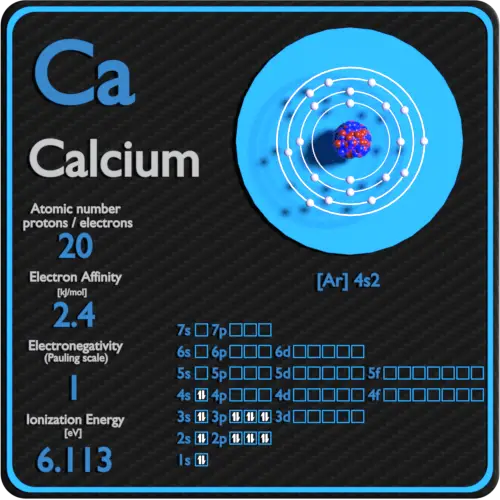
Atomic number 20
Atomic mass [amu] 40.078
Atomic mass [pm] 176
Density at STP [g/cm3] 1.55
Number of protons 20
Number of neutrons (typical isotopes) 40; 42; 43; 44; 46
Number of electrons 20
Electron configuration [Ar] 4s2
Oxidation states +2
Electron affinity [kJ/mol] 2.37
Electronegativity [Pauling scale] 1
First ionization energy [eV] 6.1132

Atomic Number – Protons, Electrons and Neutrons in Calcium

Proton Number - Atomic NumberCalcium is a chemical element with atomic number 20 which means there are 20 protons in its nucleus. Total number of protons in the nucleus is called the atomic number of the atom and is given the symbol Z. The total electrical charge of the nucleus is therefore +Ze, where e (elementary charge) equals to 1,602 x 10-19 coulombs.

The total number of neutrons in the nucleus of an atom is called the neutron number of the atom and is given the symbol N. Neutron number plus atomic number equals atomic mass number: N+Z=A. The difference between the neutron number and the atomic number is known as the neutron excess: D = N – Z = A – 2Z.

For stable elements, there is usually a variety of stable isotopes. Isotopes are nuclides that have the same atomic number and are therefore the same element, but differ in the number of neutrons. Mass numbers of typical isotopes of Calcium are 40; 42; 43; 44; 46.

Atomic Mass of Calcium

Atomic mass of Calcium is 40.078 u. 

The atomic mass is the mass of an atom. The atomic mass or relative isotopic mass refers to the mass of a single particle, and therefore is tied to a certain specific isotope of an element. The atomic mass is carried by the atomic nucleus, which occupies only about 10-12 of the total volume of the atom or less, but it contains all the positive charge and at least 99.95% of the total mass of the atom. Note that, each element may contain more isotopes, therefore this resulting atomic mass is calculated from naturally-occuring isotopes and their abundance.

Atomic Radius of Calcium

The atomic radius of Calcium atom is 176pm (covalent radius).

Atomic Radius of Chemical Elements

It must be noted, atoms lack a well-defined outer boundary. The atomic radius of a chemical element is a measure of the distance out to which the electron cloud extends from the nucleus. However, this assumes the atom to exhibit a spherical shape, which is only obeyed for atoms in vacuum or free space. Therefore, there are various non-equivalent definitions of atomic radius.

Electrons and Electron Configuration

The number of electrons in an electrically-neutral atom is the same as the number of protons in the nucleus. Therefore, the number of electrons in neutral atom of Calcium is 20. Each electron is influenced by the electric fields produced by the positive nuclear charge and the other (Z – 1) negative electrons in the atom.

Since the number of electrons and their arrangement are responsible for the chemical behavior of atoms, the atomic number identifies the various chemical elements. The configuration of these electrons follows from the principles of quantum mechanics. The number of electrons in each element’s electron shells, particularly the outermost valence shell, is the primary factor in determining its chemical bonding behavior. In the periodic table, the elements are listed in order of increasing atomic number Z.

Electron configuration of Calcium is [Ar] 4s2.

Possible oxidation states are +2.

Density of Calcium

Density of Calcium is 1.55g/cm3.

Typical densities of various substances are at atmospheric pressure.

Density is defined as the mass per unit volume. It is an intensive property, which is mathematically defined as mass divided by volume:

ρ = m/V

Atomic Masses of Elements

Periodic Table of Elements - atomic mass

Atomic Radii of Elements

Periodic Table of Elements - atomic radius

Densities of Elements

Periodic Table of Elements - density

Calcium-protons-neutrons-electrons-configuration

Calcium-affinity-electronegativity-ionization

Electron Affinity – Calcium

Electron affinity of Calcium is 2.37 kJ/mol.

In chemistry and atomic physics, the electron affinity of an atom or molecule is defined as:

the change in energy (in kJ/mole) of a neutral atom or molecule (in the gaseous phase) when an electron is added to the atom to form a negative ion.

X + e– → X– + energy        Affinity = – ∆H

In other words, it can be expressed as the neutral atom’s likelihood of gaining an electron. Note that, ionization energies measure the tendency of a neutral atom to resist the loss of electrons. Electron affinities are more difficult to measure than ionization energies.

Electronegativity of Calcium

Electronegativity of Calcium is 1.

Electronegativity, symbol χ, is a chemical property that describes the tendency of an atom to attract electrons towards this atom. For this purposes, a dimensionless quantity the Pauling scale, symbol χ, is the most commonly used.

The electronegativity of Calcium is: χ = 1

First Ionization Energy of Calcium

First Ionization Energy of Calcium is 6.1132 eV.

Ionization energy, also called ionization potential, is the energy necessary to remove an electron from the neutral atom.

X + energy → X+ + e−

where X is any atom or molecule capable of being ionized, X+ is that atom or molecule with an electron removed (positive ion), and e− is the removed electron.

A Calcium atom, for example, requires the following ionization energy to remove the outermost electron.

Ca + IE → Ca+ + e−        IE = 6.1132 eV

Electronegativity of Elements

Periodic Table of Elements - electronegativity

Ionization Energy of Elements

Periodic Table of Elements - ionization energy

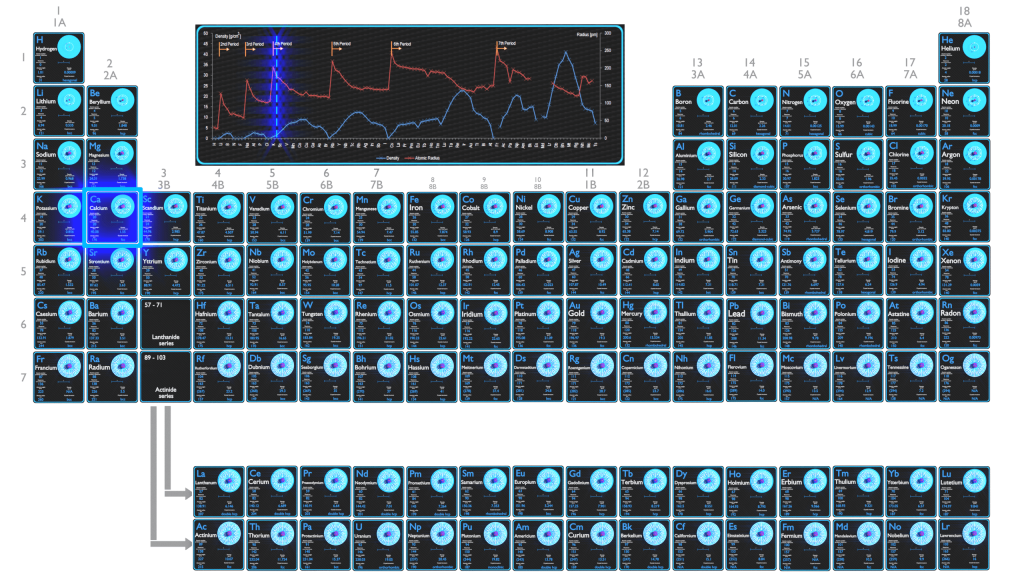
Calcium-periodic-table

Source: www.luciteria.com


Properties of other elements

Calcium - Comparison of Atomic Properties

Periodic Table in 8K resolution

Other properties of Calcium


Chlorine – Periodic Table – Atomic Properties

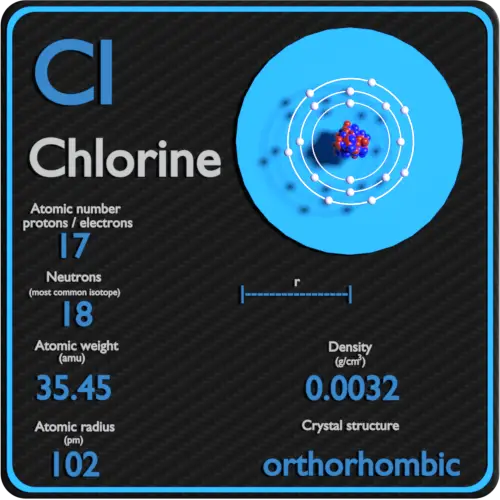
Chlorine-density-atomic-number-mass-radius

Chlorine is a yellow-green gas at room temperature. It is an extremely reactive element and a strong oxidising agent: among the elements, it has the highest electron affinity and the third-highest electronegativity, behind only oxygen and fluorine.

Summary

Element Chlorine
Atomic number 17
Atomic mass [amu] 35.453
Atomic mass [pm] 102
Density at STP [g/cm3] 0.0032
Number of protons 17
Number of neutrons (typical isotopes) 35; 37
Number of electrons 17
Electron configuration [Ne] 3s2 3p5
Oxidation states +1,5,7/-1
Electron affinity [kJ/mol] 349
Electronegativity [Pauling scale] 3.16
First ionization energy [eV] 12.9676

Atomic Number – Protons, Electrons and Neutrons in Chlorine

Proton Number - Atomic NumberChlorine is a chemical element with atomic number 17 which means there are 17 protons in its nucleus. Total number of protons in the nucleus is called the atomic number of the atom and is given the symbol Z. The total electrical charge of the nucleus is therefore +Ze, where e (elementary charge) equals to 1,602 x 10-19 coulombs.

The total number of neutrons in the nucleus of an atom is called the neutron number of the atom and is given the symbol N. Neutron number plus atomic number equals atomic mass number: N+Z=A. The difference between the neutron number and the atomic number is known as the neutron excess: D = N – Z = A – 2Z.

For stable elements, there is usually a variety of stable isotopes. Isotopes are nuclides that have the same atomic number and are therefore the same element, but differ in the number of neutrons. Mass numbers of typical isotopes of Chlorine are 35; 37.

Atomic Mass of Chlorine

Atomic mass of Chlorine is 35.453 u. 

The atomic mass is the mass of an atom. The atomic mass or relative isotopic mass refers to the mass of a single particle, and therefore is tied to a certain specific isotope of an element. The atomic mass is carried by the atomic nucleus, which occupies only about 10-12 of the total volume of the atom or less, but it contains all the positive charge and at least 99.95% of the total mass of the atom. Note that, each element may contain more isotopes, therefore this resulting atomic mass is calculated from naturally-occuring isotopes and their abundance.

Atomic Radius of Chlorine

The atomic radius of Chlorine atom is 102pm (covalent radius).

Atomic Radius of Chemical Elements

It must be noted, atoms lack a well-defined outer boundary. The atomic radius of a chemical element is a measure of the distance out to which the electron cloud extends from the nucleus. However, this assumes the atom to exhibit a spherical shape, which is only obeyed for atoms in vacuum or free space. Therefore, there are various non-equivalent definitions of atomic radius.

Electrons and Electron Configuration

The number of electrons in an electrically-neutral atom is the same as the number of protons in the nucleus. Therefore, the number of electrons in neutral atom of Chlorine is 17. Each electron is influenced by the electric fields produced by the positive nuclear charge and the other (Z – 1) negative electrons in the atom.

Since the number of electrons and their arrangement are responsible for the chemical behavior of atoms, the atomic number identifies the various chemical elements. The configuration of these electrons follows from the principles of quantum mechanics. The number of electrons in each element’s electron shells, particularly the outermost valence shell, is the primary factor in determining its chemical bonding behavior. In the periodic table, the elements are listed in order of increasing atomic number Z.

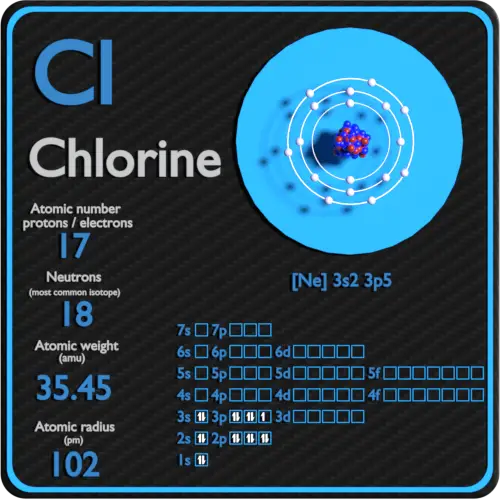
Electron configuration of Chlorine is [Ne] 3s2 3p5.

Possible oxidation states are +1,5,7/-1.

Density of Chlorine

Density of Chlorine is 0.0032g/cm3.

Typical densities of various substances are at atmospheric pressure.

Density is defined as the mass per unit volume. It is an intensive property, which is mathematically defined as mass divided by volume:

ρ = m/V

Atomic Masses of Elements

Periodic Table of Elements - atomic mass

Atomic Radii of Elements

Periodic Table of Elements - atomic radius

Densities of Elements

Periodic Table of Elements - density

Chlorine-protons-neutrons-electrons-configuration

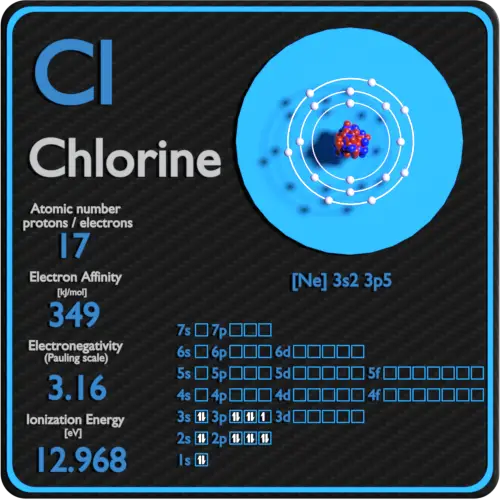
Chlorine-affinity-electronegativity-ionization

Electron Affinity – Chlorine

Electron affinity of Chlorine is 349 kJ/mol.

In chemistry and atomic physics, the electron affinity of an atom or molecule is defined as:

the change in energy (in kJ/mole) of a neutral atom or molecule (in the gaseous phase) when an electron is added to the atom to form a negative ion.

X + e– → X– + energy        Affinity = – ∆H

In other words, it can be expressed as the neutral atom’s likelihood of gaining an electron. Note that, ionization energies measure the tendency of a neutral atom to resist the loss of electrons. Electron affinities are more difficult to measure than ionization energies.

Electronegativity of Chlorine

Electronegativity of Chlorine is 3.16.

Electronegativity, symbol χ, is a chemical property that describes the tendency of an atom to attract electrons towards this atom. For this purposes, a dimensionless quantity the Pauling scale, symbol χ, is the most commonly used.

The electronegativity of Chlorine is: χ = 3.16

First Ionization Energy of Chlorine

First Ionization Energy of Chlorine is 12.9676 eV.

Ionization energy, also called ionization potential, is the energy necessary to remove an electron from the neutral atom.

X + energy → X+ + e−

where X is any atom or molecule capable of being ionized, X+ is that atom or molecule with an electron removed (positive ion), and e− is the removed electron.

A Chlorine atom, for example, requires the following ionization energy to remove the outermost electron.

Cl + IE → Cl+ + e−        IE = 12.9676 eV

Electronegativity of Elements

Periodic Table of Elements - electronegativity

Ionization Energy of Elements

Periodic Table of Elements - ionization energy

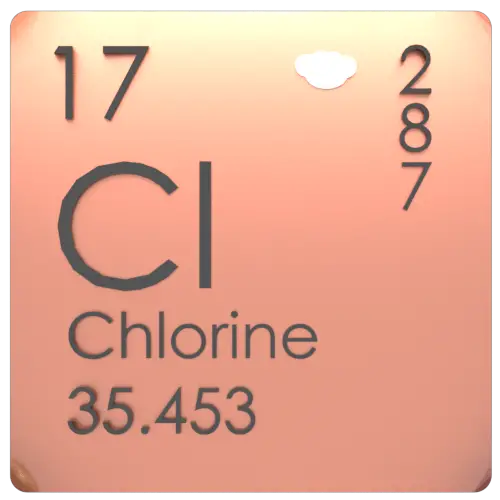
Chlorine-periodic-table

Source: www.luciteria.com


Properties of other elements

Chlorine - Comparison of Atomic Properties

Periodic Table in 8K resolution

Other properties of Chlorine


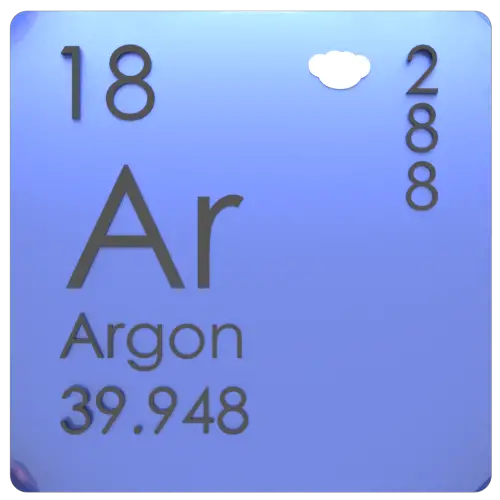
Argon – Periodic Table – Atomic Properties

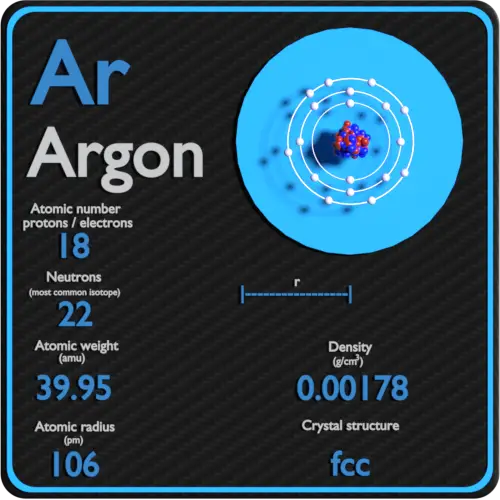
Argon-density-atomic-number-mass-radius

Argon is the third-most abundant gas in the Earth’s atmosphere, at 0.934% (9340 ppmv). It is more than twice as abundant as water vapor (which averages about 4000 ppmv, but varies greatly), 23 times as abundant as carbon dioxide (400 ppmv), and more than 500 times as abundant as neon (18 ppmv). Argon is mostly used as an inert shielding gas in welding and other high-temperature industrial processes where ordinarily unreactive substances become reactive; for example, an argon atmosphere is used in graphite electric furnaces to prevent the graphite from burning.

Summary

Element Argon
Atomic number 18
Atomic mass [amu] 39.948
Atomic mass [pm] 106
Density at STP [g/cm3] 0.00178
Number of protons 18
Number of neutrons (typical isotopes) 36; 38; 40
Number of electrons 18
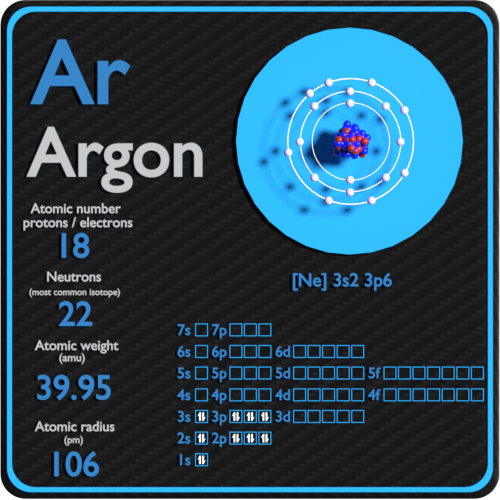
Electron configuration [Ne] 3s2 3p6
Oxidation states 0
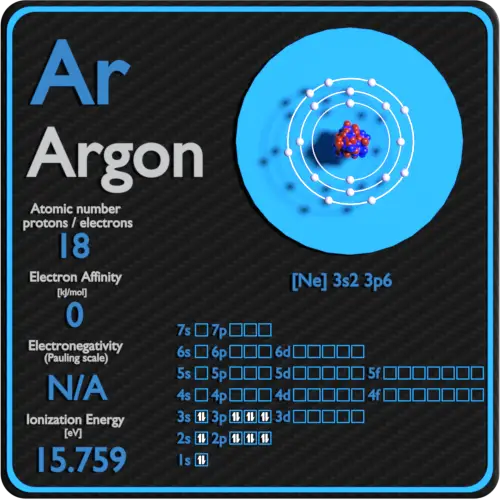
Electron affinity [kJ/mol] —
Electronegativity [Pauling scale] —
First ionization energy [eV] 15.7596

Atomic Number – Protons, Electrons and Neutrons in Argon

Proton Number - Atomic NumberArgon is a chemical element with atomic number 18 which means there are 18 protons in its nucleus. Total number of protons in the nucleus is called the atomic number of the atom and is given the symbol Z. The total electrical charge of the nucleus is therefore +Ze, where e (elementary charge) equals to 1,602 x 10-19 coulombs.

The total number of neutrons in the nucleus of an atom is called the neutron number of the atom and is given the symbol N. Neutron number plus atomic number equals atomic mass number: N+Z=A. The difference between the neutron number and the atomic number is known as the neutron excess: D = N – Z = A – 2Z.

For stable elements, there is usually a variety of stable isotopes. Isotopes are nuclides that have the same atomic number and are therefore the same element, but differ in the number of neutrons. Mass numbers of typical isotopes of Argon are 36; 38; 40.

Atomic Mass of Argon

Atomic mass of Argon is 39.948 u. 

The atomic mass is the mass of an atom. The atomic mass or relative isotopic mass refers to the mass of a single particle, and therefore is tied to a certain specific isotope of an element. The atomic mass is carried by the atomic nucleus, which occupies only about 10-12 of the total volume of the atom or less, but it contains all the positive charge and at least 99.95% of the total mass of the atom. Note that, each element may contain more isotopes, therefore this resulting atomic mass is calculated from naturally-occuring isotopes and their abundance.

Atomic Radius of Argon

The atomic radius of Argon atom is 106pm (covalent radius).

Atomic Radius of Chemical Elements

It must be noted, atoms lack a well-defined outer boundary. The atomic radius of a chemical element is a measure of the distance out to which the electron cloud extends from the nucleus. However, this assumes the atom to exhibit a spherical shape, which is only obeyed for atoms in vacuum or free space. Therefore, there are various non-equivalent definitions of atomic radius.

Electrons and Electron Configuration

The number of electrons in an electrically-neutral atom is the same as the number of protons in the nucleus. Therefore, the number of electrons in neutral atom of Argon is 18. Each electron is influenced by the electric fields produced by the positive nuclear charge and the other (Z – 1) negative electrons in the atom.

Since the number of electrons and their arrangement are responsible for the chemical behavior of atoms, the atomic number identifies the various chemical elements. The configuration of these electrons follows from the principles of quantum mechanics. The number of electrons in each element’s electron shells, particularly the outermost valence shell, is the primary factor in determining its chemical bonding behavior. In the periodic table, the elements are listed in order of increasing atomic number Z.

Electron configuration of Argon is [Ne] 3s2 3p6.

Possible oxidation states are 0.

Density of Argon

Density of Argon is 0.00178g/cm3.

Typical densities of various substances are at atmospheric pressure.

Density is defined as the mass per unit volume. It is an intensive property, which is mathematically defined as mass divided by volume:

ρ = m/V

Atomic Masses of Elements

Periodic Table of Elements - atomic mass

Atomic Radii of Elements

Periodic Table of Elements - atomic radius

Densities of Elements

Periodic Table of Elements - density

Argon-protons-neutrons-electrons-configuration

Argon-affinity-electronegativity-ionization

Electron Affinity – Argon

Electron affinity of Argon is — kJ/mol.

In chemistry and atomic physics, the electron affinity of an atom or molecule is defined as:

the change in energy (in kJ/mole) of a neutral atom or molecule (in the gaseous phase) when an electron is added to the atom to form a negative ion.

X + e– → X– + energy        Affinity = – ∆H

In other words, it can be expressed as the neutral atom’s likelihood of gaining an electron. Note that, ionization energies measure the tendency of a neutral atom to resist the loss of electrons. Electron affinities are more difficult to measure than ionization energies.

Electronegativity of Argon

Electronegativity of Argon is —.

Electronegativity, symbol χ, is a chemical property that describes the tendency of an atom to attract electrons towards this atom. For this purposes, a dimensionless quantity the Pauling scale, symbol χ, is the most commonly used.

The electronegativity of Argon is: χ = —

First Ionization Energy of Argon

First Ionization Energy of Argon is 15.7596 eV.

Ionization energy, also called ionization potential, is the energy necessary to remove an electron from the neutral atom.

X + energy → X+ + e−

where X is any atom or molecule capable of being ionized, X+ is that atom or molecule with an electron removed (positive ion), and e− is the removed electron.

A Argon atom, for example, requires the following ionization energy to remove the outermost electron.

Ar + IE → Ar+ + e−        IE = 15.7596 eV

Electronegativity of Elements

Periodic Table of Elements - electronegativity

Ionization Energy of Elements

Periodic Table of Elements - ionization energy

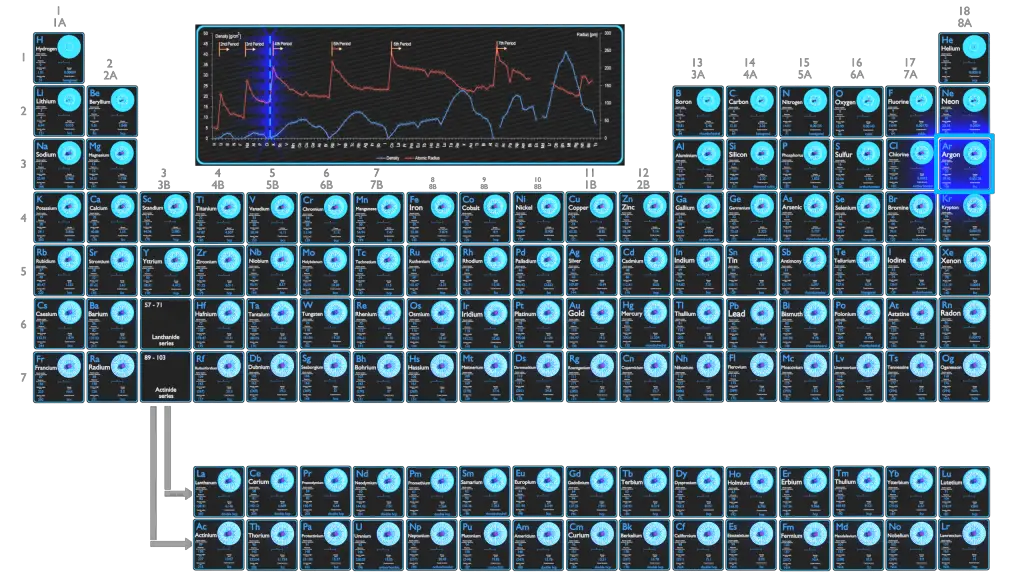
Argon-periodic-table

Source: www.luciteria.com


Properties of other elements

Argon - Comparison of Atomic Properties

Periodic Table in 8K resolution

Other properties of Argon


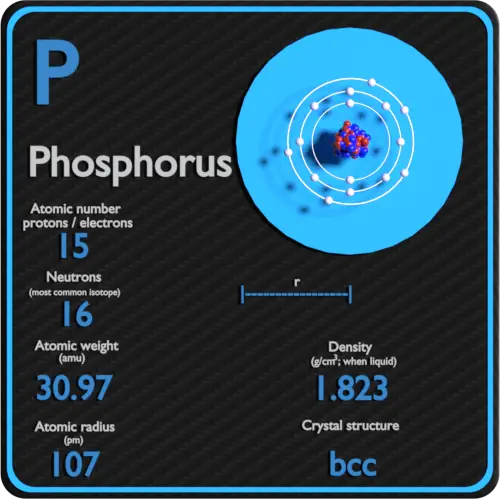
Phosphorus – Periodic Table – Atomic Properties

Phosphorus-density-atomic-number-mass-radius

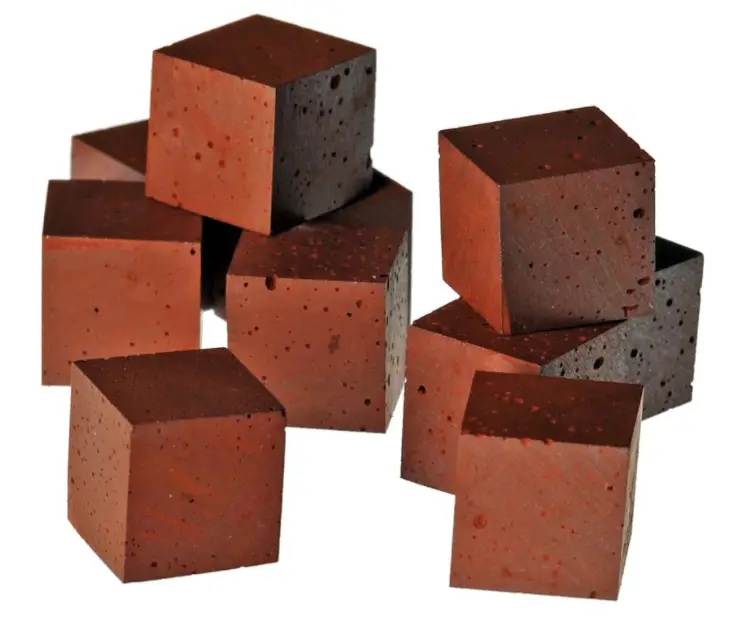
As an element, phosphorus exists in two major forms—white phosphorus and red phosphorus—but because it is highly reactive, phosphorus is never found as a free element on Earth. At 0.099%, phosphorus is the most abundant pnictogen in the Earth’s crust.

Summary

Element Phosphorus
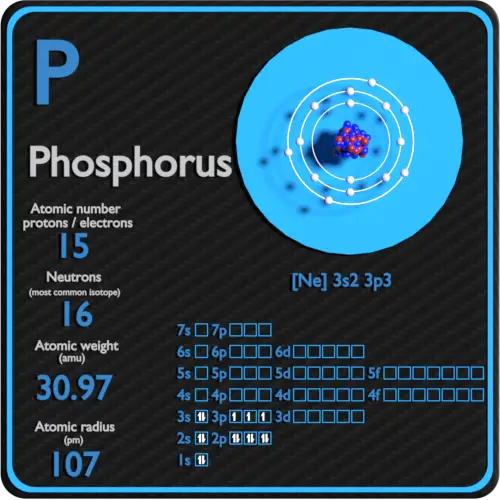
Atomic number 15
Atomic mass [amu] 30.9738
Atomic mass [pm] 107
Density at STP [g/cm3] 1.823
Number of protons 15
Number of neutrons (typical isotopes) 31
Number of electrons 15
Electron configuration [Ne] 3s2 3p3
Oxidation states +3,5/-3
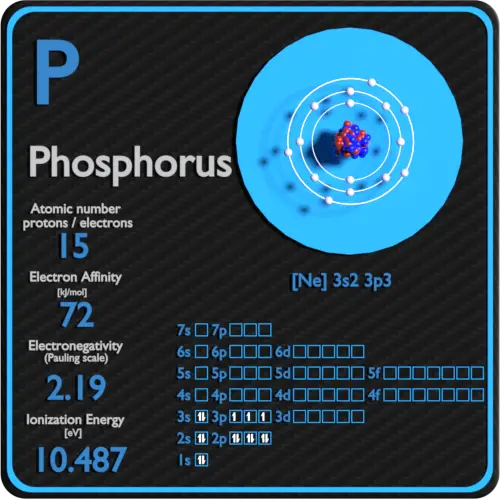
Electron affinity [kJ/mol] 72
Electronegativity [Pauling scale] 2.19
First ionization energy [eV] 10.4867

Atomic Number – Protons, Electrons and Neutrons in Phosphorus

Proton Number - Atomic NumberPhosphorus is a chemical element with atomic number 15 which means there are 15 protons in its nucleus. Total number of protons in the nucleus is called the atomic number of the atom and is given the symbol Z. The total electrical charge of the nucleus is therefore +Ze, where e (elementary charge) equals to 1,602 x 10-19 coulombs.

The total number of neutrons in the nucleus of an atom is called the neutron number of the atom and is given the symbol N. Neutron number plus atomic number equals atomic mass number: N+Z=A. The difference between the neutron number and the atomic number is known as the neutron excess: D = N – Z = A – 2Z.

For stable elements, there is usually a variety of stable isotopes. Isotopes are nuclides that have the same atomic number and are therefore the same element, but differ in the number of neutrons. Mass numbers of typical isotopes of Phosphorus are 31.

Atomic Mass of Phosphorus

Atomic mass of Phosphorus is 30.9738 u. 

The atomic mass is the mass of an atom. The atomic mass or relative isotopic mass refers to the mass of a single particle, and therefore is tied to a certain specific isotope of an element. The atomic mass is carried by the atomic nucleus, which occupies only about 10-12 of the total volume of the atom or less, but it contains all the positive charge and at least 99.95% of the total mass of the atom. Note that, each element may contain more isotopes, therefore this resulting atomic mass is calculated from naturally-occuring isotopes and their abundance.

Atomic Radius of Phosphorus

The atomic radius of Phosphorus atom is 107pm (covalent radius).

Atomic Radius of Chemical Elements

It must be noted, atoms lack a well-defined outer boundary. The atomic radius of a chemical element is a measure of the distance out to which the electron cloud extends from the nucleus. However, this assumes the atom to exhibit a spherical shape, which is only obeyed for atoms in vacuum or free space. Therefore, there are various non-equivalent definitions of atomic radius.

Electrons and Electron Configuration

The number of electrons in an electrically-neutral atom is the same as the number of protons in the nucleus. Therefore, the number of electrons in neutral atom of Phosphorus is 15. Each electron is influenced by the electric fields produced by the positive nuclear charge and the other (Z – 1) negative electrons in the atom.

Since the number of electrons and their arrangement are responsible for the chemical behavior of atoms, the atomic number identifies the various chemical elements. The configuration of these electrons follows from the principles of quantum mechanics. The number of electrons in each element’s electron shells, particularly the outermost valence shell, is the primary factor in determining its chemical bonding behavior. In the periodic table, the elements are listed in order of increasing atomic number Z.

Electron configuration of Phosphorus is [Ne] 3s2 3p3.

Possible oxidation states are +3,5/-3.

Density of Phosphorus

Density of Phosphorus is 1.823g/cm3.

Typical densities of various substances are at atmospheric pressure.

Density is defined as the mass per unit volume. It is an intensive property, which is mathematically defined as mass divided by volume:

ρ = m/V

Atomic Masses of Elements

Periodic Table of Elements - atomic mass

Atomic Radii of Elements

Periodic Table of Elements - atomic radius

Densities of Elements

Periodic Table of Elements - density

Phosphorus-protons-neutrons-electrons-configuration

Phosphorus-affinity-electronegativity-ionization

Electron Affinity – Phosphorus

Electron affinity of Phosphorus is 72 kJ/mol.

In chemistry and atomic physics, the electron affinity of an atom or molecule is defined as:

the change in energy (in kJ/mole) of a neutral atom or molecule (in the gaseous phase) when an electron is added to the atom to form a negative ion.

X + e– → X– + energy        Affinity = – ∆H

In other words, it can be expressed as the neutral atom’s likelihood of gaining an electron. Note that, ionization energies measure the tendency of a neutral atom to resist the loss of electrons. Electron affinities are more difficult to measure than ionization energies.

Electronegativity of Phosphorus

Electronegativity of Phosphorus is 2.19.

Electronegativity, symbol χ, is a chemical property that describes the tendency of an atom to attract electrons towards this atom. For this purposes, a dimensionless quantity the Pauling scale, symbol χ, is the most commonly used.

The electronegativity of Phosphorus is: χ = 2.19

First Ionization Energy of Phosphorus

First Ionization Energy of Phosphorus is 10.4867 eV.

Ionization energy, also called ionization potential, is the energy necessary to remove an electron from the neutral atom.

X + energy → X+ + e−

where X is any atom or molecule capable of being ionized, X+ is that atom or molecule with an electron removed (positive ion), and e− is the removed electron.

A Phosphorus atom, for example, requires the following ionization energy to remove the outermost electron.

P + IE → P+ + e−        IE = 10.4867 eV

Electronegativity of Elements

Periodic Table of Elements - electronegativity

Ionization Energy of Elements

Periodic Table of Elements - ionization energy

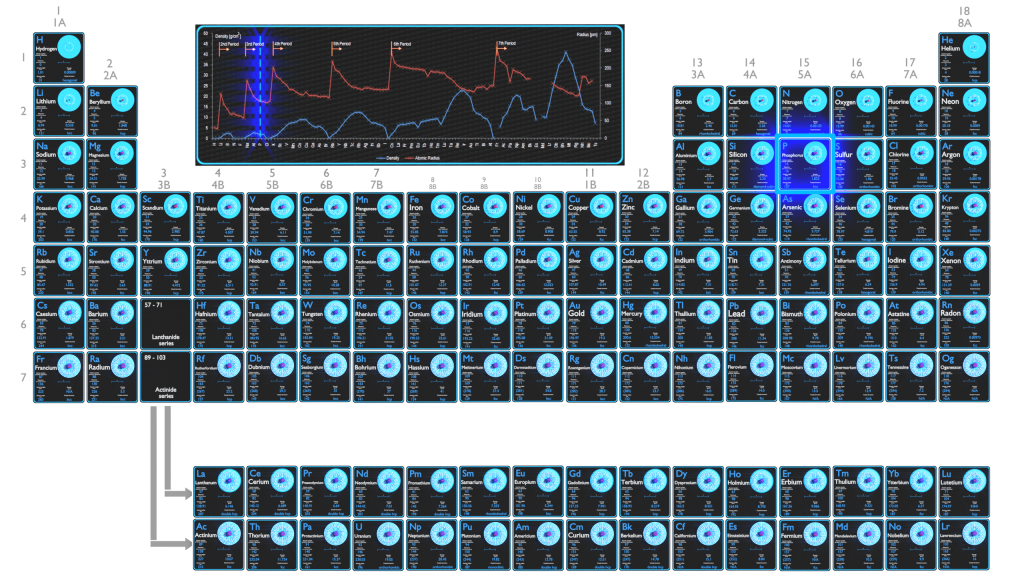
Phosphorus-periodic-table

Source: www.luciteria.com


Properties of other elements

Phosphorus - Comparison of Atomic Properties

Periodic Table in 8K resolution

Other properties of Phosphorus


Sulfur – Periodic Table – Atomic Properties

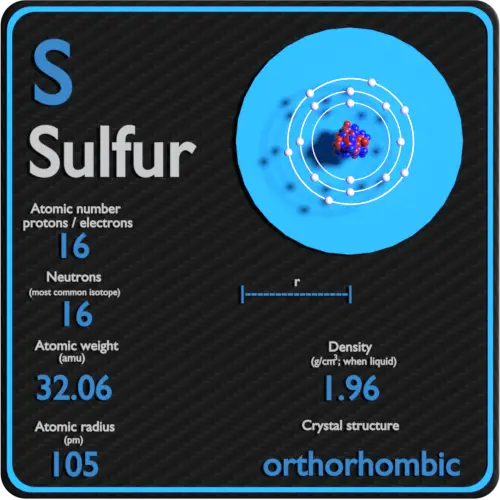
Sulfur-density-atomic-number-mass-radius

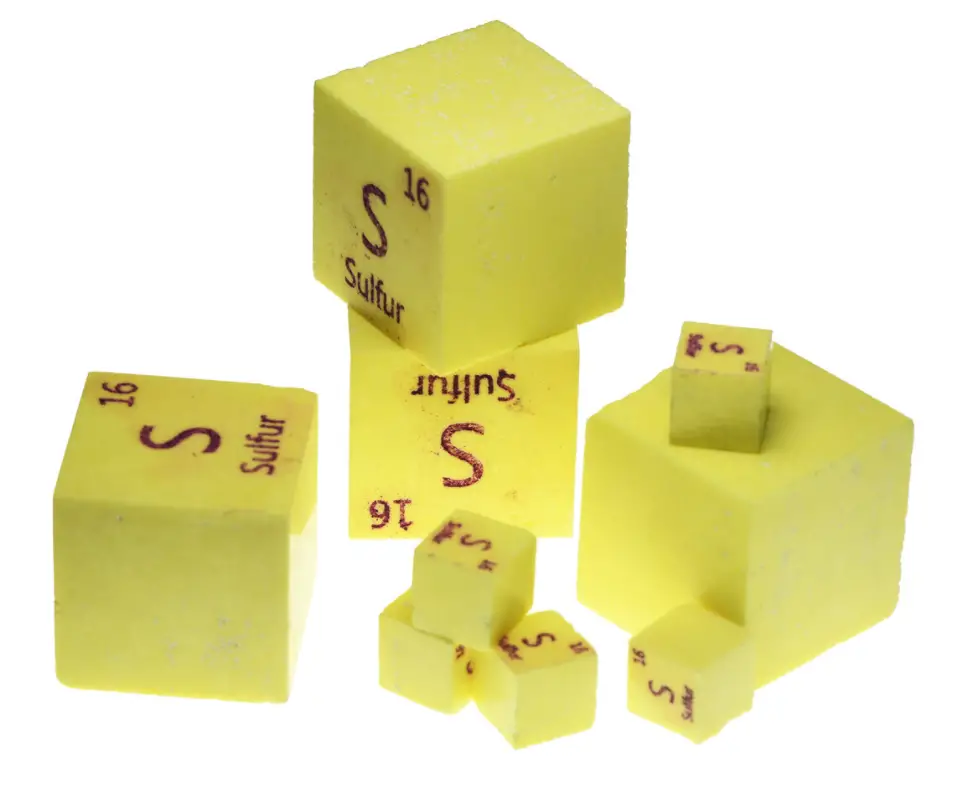
Sulfur is abundant, multivalent, and nonmetallic. Under normal conditions, sulfur atoms form cyclic octatomic molecules with a chemical formula S8. Elemental sulfur is a bright yellow crystalline solid at room temperature. Chemically, sulfur reacts with all elements except for gold, platinum, iridium, tellurium, and the noble gases.

Summary

Element Sulfur
Atomic number 16
Atomic mass [amu] 32.065
Atomic mass [pm] 105
Density at STP [g/cm3] 1.96
Number of protons 16
Number of neutrons (typical isotopes) 23; 33; 34; 36
Number of electrons 16
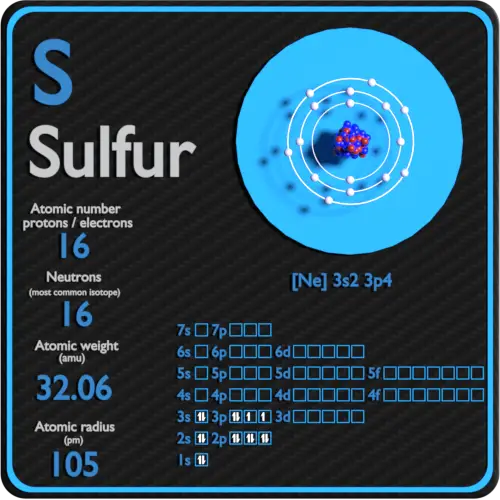
Electron configuration [Ne] 3s2 3p4
Oxidation states +4,6/-2
Electron affinity [kJ/mol] 200
Electronegativity [Pauling scale] 2.58
First ionization energy [eV] 10.36

Atomic Number – Protons, Electrons and Neutrons in Sulfur

Proton Number - Atomic NumberSulfur is a chemical element with atomic number 16 which means there are 16 protons in its nucleus. Total number of protons in the nucleus is called the atomic number of the atom and is given the symbol Z. The total electrical charge of the nucleus is therefore +Ze, where e (elementary charge) equals to 1,602 x 10-19 coulombs.

The total number of neutrons in the nucleus of an atom is called the neutron number of the atom and is given the symbol N. Neutron number plus atomic number equals atomic mass number: N+Z=A. The difference between the neutron number and the atomic number is known as the neutron excess: D = N – Z = A – 2Z.

For stable elements, there is usually a variety of stable isotopes. Isotopes are nuclides that have the same atomic number and are therefore the same element, but differ in the number of neutrons. Mass numbers of typical isotopes of Sulfur are 23; 33; 34; 36.

Atomic Mass of Sulfur

Atomic mass of Sulfur is 32.065 u. 

The atomic mass is the mass of an atom. The atomic mass or relative isotopic mass refers to the mass of a single particle, and therefore is tied to a certain specific isotope of an element. The atomic mass is carried by the atomic nucleus, which occupies only about 10-12 of the total volume of the atom or less, but it contains all the positive charge and at least 99.95% of the total mass of the atom. Note that, each element may contain more isotopes, therefore this resulting atomic mass is calculated from naturally-occuring isotopes and their abundance.

Atomic Radius of Sulfur

The atomic radius of Sulfur atom is 105pm (covalent radius).

Atomic Radius of Chemical Elements

It must be noted, atoms lack a well-defined outer boundary. The atomic radius of a chemical element is a measure of the distance out to which the electron cloud extends from the nucleus. However, this assumes the atom to exhibit a spherical shape, which is only obeyed for atoms in vacuum or free space. Therefore, there are various non-equivalent definitions of atomic radius.

Electrons and Electron Configuration

The number of electrons in an electrically-neutral atom is the same as the number of protons in the nucleus. Therefore, the number of electrons in neutral atom of Sulfur is 16. Each electron is influenced by the electric fields produced by the positive nuclear charge and the other (Z – 1) negative electrons in the atom.

Since the number of electrons and their arrangement are responsible for the chemical behavior of atoms, the atomic number identifies the various chemical elements. The configuration of these electrons follows from the principles of quantum mechanics. The number of electrons in each element’s electron shells, particularly the outermost valence shell, is the primary factor in determining its chemical bonding behavior. In the periodic table, the elements are listed in order of increasing atomic number Z.

Electron configuration of Sulfur is [Ne] 3s2 3p4.

Possible oxidation states are +4,6/-2.

Density of Sulfur

Density of Sulfur is 1.96g/cm3.

Typical densities of various substances are at atmospheric pressure.

Density is defined as the mass per unit volume. It is an intensive property, which is mathematically defined as mass divided by volume:

ρ = m/V

Atomic Masses of Elements

Periodic Table of Elements - atomic mass

Atomic Radii of Elements

Periodic Table of Elements - atomic radius

Densities of Elements

Periodic Table of Elements - density

Sulfur-protons-neutrons-electrons-configuration

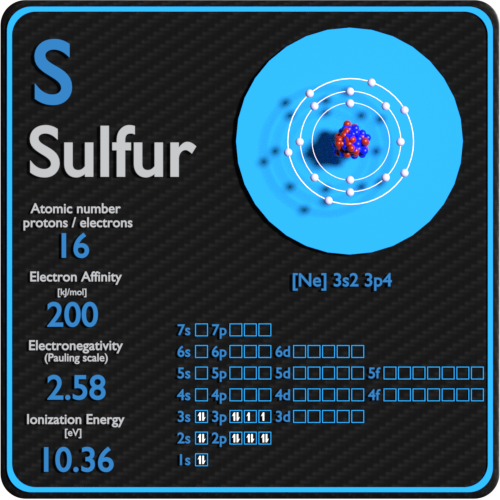
Sulfur-affinity-electronegativity-ionization

Electron Affinity – Sulfur

Electron affinity of Sulfur is 200 kJ/mol.

In chemistry and atomic physics, the electron affinity of an atom or molecule is defined as:

the change in energy (in kJ/mole) of a neutral atom or molecule (in the gaseous phase) when an electron is added to the atom to form a negative ion.

X + e– → X– + energy        Affinity = – ∆H

In other words, it can be expressed as the neutral atom’s likelihood of gaining an electron. Note that, ionization energies measure the tendency of a neutral atom to resist the loss of electrons. Electron affinities are more difficult to measure than ionization energies.

Electronegativity of Sulfur

Electronegativity of Sulfur is 2.58.

Electronegativity, symbol χ, is a chemical property that describes the tendency of an atom to attract electrons towards this atom. For this purposes, a dimensionless quantity the Pauling scale, symbol χ, is the most commonly used.

The electronegativity of Sulfur is: χ = 2.58

First Ionization Energy of Sulfur

First Ionization Energy of Sulfur is 10.36 eV.

Ionization energy, also called ionization potential, is the energy necessary to remove an electron from the neutral atom.

X + energy → X+ + e−

where X is any atom or molecule capable of being ionized, X+ is that atom or molecule with an electron removed (positive ion), and e− is the removed electron.

A Sulfur atom, for example, requires the following ionization energy to remove the outermost electron.

S + IE → S+ + e−        IE = 10.36 eV

Electronegativity of Elements

Periodic Table of Elements - electronegativity

Ionization Energy of Elements

Periodic Table of Elements - ionization energy

Sulfur-periodic-table

Source: www.luciteria.com


Properties of other elements

Sulfur - Comparison of Atomic Properties

Periodic Table in 8K resolution

Other properties of Sulfur


Aluminium – Periodic Table – Atomic Properties

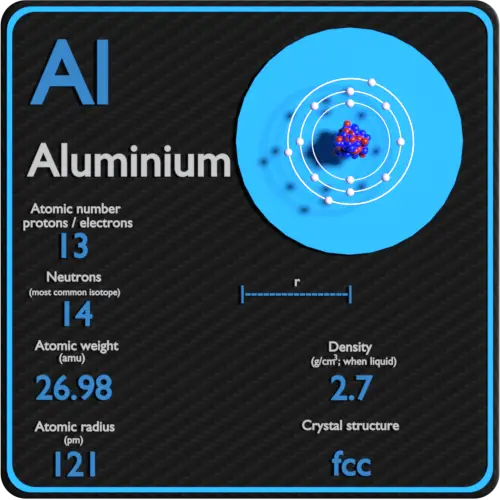
Aluminium-density-atomic-number-mass-radius

Aluminium is a silvery-white, soft, nonmagnetic, ductile metal in the boron group. By mass, aluminium makes up about 8% of the Earth’s crust; it is the third most abundant element after oxygen and silicon and the most abundant metal in the crust, though it is less common in the mantle below.

Summary

Element Aluminium
Atomic number 13
Atomic mass [amu] 26.9815
Atomic mass [pm] 121
Density at STP [g/cm3] 2.7
Number of protons 13
Number of neutrons (typical isotopes) 27
Number of electrons 13
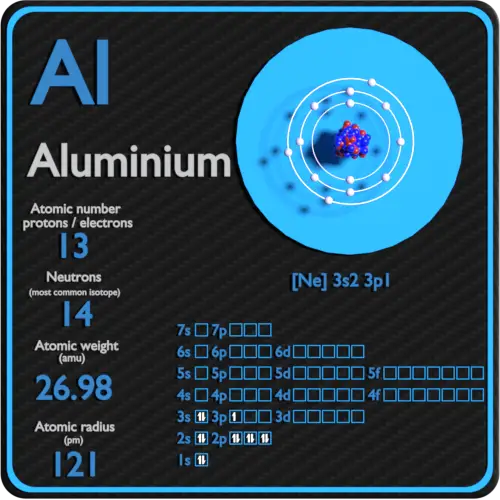
Electron configuration [Ne] 3s2 3p1
Oxidation states -2; -1; +1; +2; +3
Electron affinity [kJ/mol] 42.5
Electronegativity [Pauling scale] 1.61
First ionization energy [eV] 5.9858

Atomic Number – Protons, Electrons and Neutrons in Aluminium

Proton Number - Atomic NumberAluminium is a chemical element with atomic number 13 which means there are 13 protons in its nucleus. Total number of protons in the nucleus is called the atomic number of the atom and is given the symbol Z. The total electrical charge of the nucleus is therefore +Ze, where e (elementary charge) equals to 1,602 x 10-19 coulombs.

The total number of neutrons in the nucleus of an atom is called the neutron number of the atom and is given the symbol N. Neutron number plus atomic number equals atomic mass number: N+Z=A. The difference between the neutron number and the atomic number is known as the neutron excess: D = N – Z = A – 2Z.

For stable elements, there is usually a variety of stable isotopes. Isotopes are nuclides that have the same atomic number and are therefore the same element, but differ in the number of neutrons. Mass numbers of typical isotopes of Aluminium are 27.

Atomic Mass of Aluminium

Atomic mass of Aluminium is 26.9815 u. 

The atomic mass is the mass of an atom. The atomic mass or relative isotopic mass refers to the mass of a single particle, and therefore is tied to a certain specific isotope of an element. The atomic mass is carried by the atomic nucleus, which occupies only about 10-12 of the total volume of the atom or less, but it contains all the positive charge and at least 99.95% of the total mass of the atom. Note that, each element may contain more isotopes, therefore this resulting atomic mass is calculated from naturally-occuring isotopes and their abundance.

Atomic Radius of Aluminium

The atomic radius of Aluminium atom is 121pm (covalent radius).

Atomic Radius of Chemical Elements

It must be noted, atoms lack a well-defined outer boundary. The atomic radius of a chemical element is a measure of the distance out to which the electron cloud extends from the nucleus. However, this assumes the atom to exhibit a spherical shape, which is only obeyed for atoms in vacuum or free space. Therefore, there are various non-equivalent definitions of atomic radius.

Electrons and Electron Configuration

The number of electrons in an electrically-neutral atom is the same as the number of protons in the nucleus. Therefore, the number of electrons in neutral atom of Aluminium is 13. Each electron is influenced by the electric fields produced by the positive nuclear charge and the other (Z – 1) negative electrons in the atom.

Since the number of electrons and their arrangement are responsible for the chemical behavior of atoms, the atomic number identifies the various chemical elements. The configuration of these electrons follows from the principles of quantum mechanics. The number of electrons in each element’s electron shells, particularly the outermost valence shell, is the primary factor in determining its chemical bonding behavior. In the periodic table, the elements are listed in order of increasing atomic number Z.

Electron configuration of Aluminium is [Ne] 3s2 3p1.

Possible oxidation states are -2; -1; +1; +2; +3.

Density of Aluminium

Density of Aluminium is 2.7g/cm3.

Typical densities of various substances are at atmospheric pressure.

Density is defined as the mass per unit volume. It is an intensive property, which is mathematically defined as mass divided by volume:

ρ = m/V

Atomic Masses of Elements

Periodic Table of Elements - atomic mass

Atomic Radii of Elements

Periodic Table of Elements - atomic radius

Densities of Elements

Periodic Table of Elements - density

Aluminium-protons-neutrons-electrons-configuration

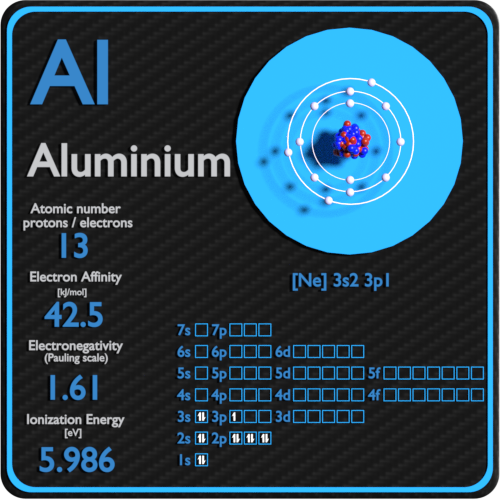
Aluminium-affinity-electronegativity-ionization

Electron Affinity – Aluminium

Electron affinity of Aluminium is 42.5 kJ/mol.

In chemistry and atomic physics, the electron affinity of an atom or molecule is defined as:

the change in energy (in kJ/mole) of a neutral atom or molecule (in the gaseous phase) when an electron is added to the atom to form a negative ion.

X + e– → X– + energy        Affinity = – ∆H

In other words, it can be expressed as the neutral atom’s likelihood of gaining an electron. Note that, ionization energies measure the tendency of a neutral atom to resist the loss of electrons. Electron affinities are more difficult to measure than ionization energies.

Electronegativity of Aluminium

Electronegativity of Aluminium is 1.61.

Electronegativity, symbol χ, is a chemical property that describes the tendency of an atom to attract electrons towards this atom. For this purposes, a dimensionless quantity the Pauling scale, symbol χ, is the most commonly used.

The electronegativity of Aluminium is: χ = 1.61

First Ionization Energy of Aluminium

First Ionization Energy of Aluminium is 5.9858 eV.

Ionization energy, also called ionization potential, is the energy necessary to remove an electron from the neutral atom.

X + energy → X+ + e−

where X is any atom or molecule capable of being ionized, X+ is that atom or molecule with an electron removed (positive ion), and e− is the removed electron.

A Aluminium atom, for example, requires the following ionization energy to remove the outermost electron.

Al + IE → Al+ + e−        IE = 5.9858 eV

Electronegativity of Elements

Periodic Table of Elements - electronegativity

Ionization Energy of Elements

Periodic Table of Elements - ionization energy

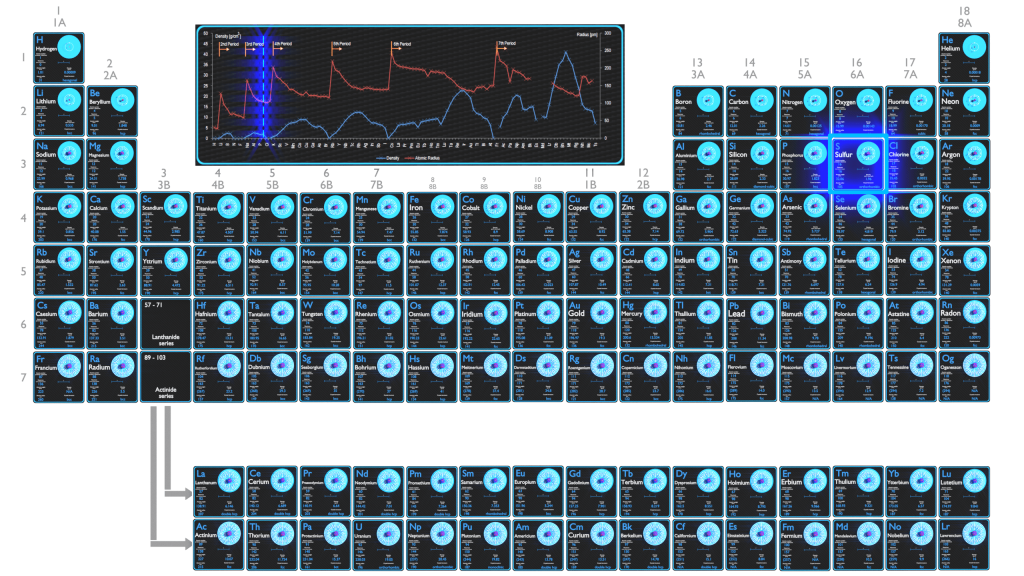
Aluminium-periodic-table

Source: www.luciteria.com


Properties of other elements

Aluminium - Comparison of Atomic Properties

Periodic Table in 8K resolution

Other properties of Aluminium