Facebook Instagram Youtube Twitter

Lanthanum and Cerium – Comparison – Properties

This article contains comparison of key thermal and atomic properties of lanthanum and cerium, two comparable chemical elements from the periodic table. It also contains basic descriptions and applications of both elements. Lanthanum vs Cerium.
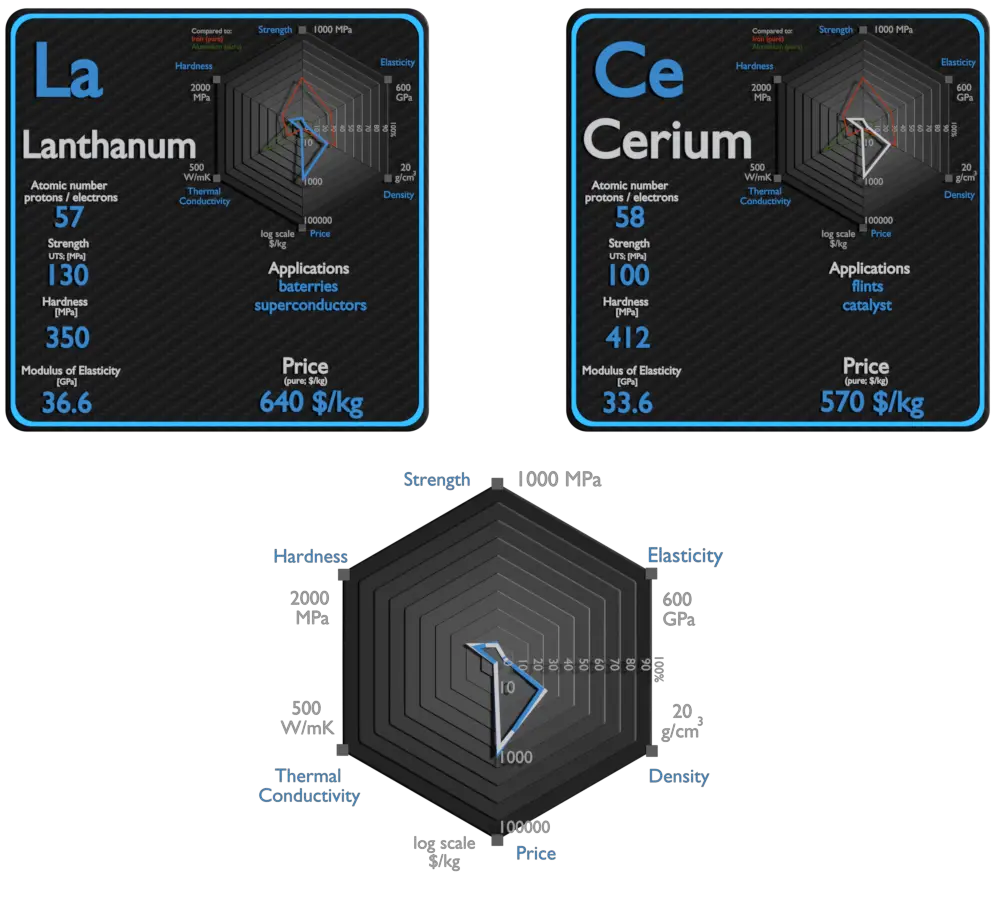
lanthanum and cerium - comparison

Compare lanthanum with another element

Cerium - Properties - Price - Applications - Production

Compare cerium with another element

Lanthanum - Properties - Price - Applications - Production

Samarium - Properties - Price - Applications - Production

Lanthanum and Cerium – About Elements

Lanthanum

Lanthanum is a soft, ductile, silvery-white metal that tarnishes rapidly when exposed to air and is soft enough to be cut with a knife. It is the eponym of the lanthanide series, a group of 15 similar elements between lanthanum and lutetium in the periodic table, of which lanthanum is the first and the prototype. It is also sometimes considered the first element of the 6th-period transition metals and is traditionally counted among the rare earth elements.

Cerium

Cerium is a soft, ductile and silvery-white metal that tarnishes when exposed to air, and it is soft enough to be cut with a knife. Cerium is the second element in the lanthanide series. Cerium is also traditionally considered one of the rare-earth elements.

Lanthanum in Periodic Table

Cerium in Periodic Table

Source: www.luciteria.com

Lanthanum and Cerium – Applications

Lanthanum

Lanthanum is not extensively used metal. However, its alloys have a variety of interesting uses. A lanthanum-nickel alloy is used to store hydrogen gas for use in hydrogen-powered vehicles. Lanthanum is also found in the anode of nickel metal hydride batteries (NiMH) used in hybrid cars. Lanthanum is an important component of mischmetal alloy. A typical composition includes approximately 55% cerium, 25% lanthanum, and 15-18% neodymium with other rare earth metals following. The best-known use for this alloy is in ‘flints’ for cigarette lighters.

Cerium

Cerium is an important component of mischmetal alloy. Ferrocerium is a synthetic pyrophoric alloy that produces hot sparks that can reach temperatures of 3,000 °C (5,430 °F) when rapidly oxidized by the process of striking the rod, thereby fragmenting it and exposing those fragments to the oxygen in the air. A typical composition includes approximately 55% cerium, 25% lanthanum, and 15-18% neodymium with other rare earth metals following. The best-known use for this alloy is in ‘flints’ for cigarette lighters. Ceria is the most widely used compound of cerium. The main application of ceria is as a polishing compound, for example in chemical-mechanical planarization (CMP).

Lanthanum and Cerium – Comparison in Table

Element Lanthanum Cerium
Density 6.146 g/cm 6.689 g/cm3
Ultimate Tensile Strength 130 MPa 100 MPa
Yield Strength 125 MPa 90 MPa
Young’s Modulus of Elasticity 36.6 GPa 33.6 GPa
Mohs Scale 2.5 2.5
Brinell Hardness 350 MPa 412 MPa
Vickers Hardness 360 MPa 300 MPa
Melting Point 920 °C 798 °C
Boiling Point 3454 °C 3457 °C
Thermal Conductivity 13 W/mK 11 W/mK
Thermal Expansion Coefficient 12.1 µm/mK 6.3 µm/mK
Specific Heat 0.19 J/g K 0.19 J/g K
Heat of Fusion 6.2 kJ/mol 5.46 kJ/mol
Heat of Vaporization 414 kJ/mol 414 kJ/mol


Iodine and Caesium – Comparison – Properties

This article contains comparison of key thermal and atomic properties of iodine and caesium, two comparable chemical elements from the periodic table. It also contains basic descriptions and applications of both elements. Iodine vs Caesium.

iodine and caesium - comparison

Compare iodine with another element

Chlorine - Properties - Price - Applications - Production

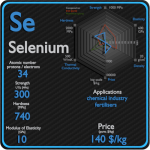
Selenium - Properties - Price - Applications - Production

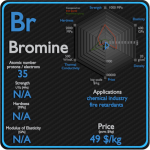
Bromine - Properties - Price - Applications - Production

Rubidium - Properties - Price - Applications - Production

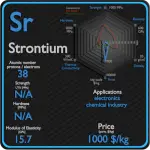
Strontium - Properties - Price - Applications - Production

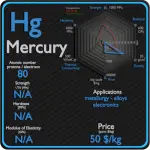
Mercury - Properties - Price - Applications - Production

Caesium - Properties - Price - Applications - Production

Compare caesium with another element

Chlorine - Properties - Price - Applications - Production

Rubidium - Properties - Price - Applications - Production

Iodine - Properties - Price - Applications - Production

Iodine and Caesium – About Elements

Iodine

Iodine is the heaviest of the stable halogens, it exists as a lustrous, purple-black metallic solid at standard conditions that sublimes readily to form a violet gas. Iodine is the least abundant of the stable halogens, being the sixty-first most abundant element. It is even less abundant than the so-called rare earths. It is the heaviest essential mineral nutrient.

Caesium

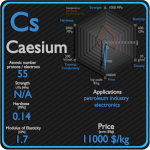
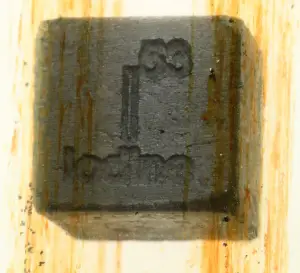
Caesium is a soft, silvery-gold alkali metal with a melting point of 28.5 °C, which makes it one of only five elemental metals that are liquid at or near room temperature. Caesium has physical and chemical properties similar to those of rubidium and potassium.

Iodine in Periodic Table

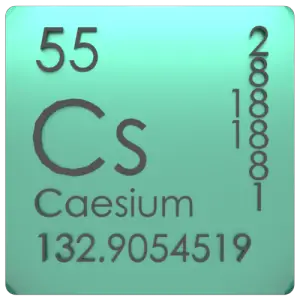
Caesium in Periodic Table

Source: www.luciteria.com

Iodine and Caesium – Applications

Iodine

In addition to nutrition products, iodine and iodine derivatives are used in a wide range of medical, agricultural, and industrial applications. About half of all produced iodine goes into various organoiodine compounds, another 15% remains as the pure element, another 15% is used to form potassium iodide, and another 15% for other inorganic iodine compounds. The leading application is in the production of X-ray contrast media (22%). Iodine’s high atomic number and density make it ideally suited for this application, as its presence in the body can help to increase contrast between tissues, organs, and blood vessels with similar X-ray densities. It is used as an antiseptic for external wounds. Another application driving the demand for iodine is in polarizing film in liquidcrystal display (LCD) screens.

Caesium

The largest present-day use of nonradioactive caesium is in caesium formate drilling fluids for the extractive oil industry. They are also used to make special optical glass, as a catalyst promoter, in vacuum tubes and in radiation monitoring equipment. One of its most important uses is in the ‘caesium clock’ (atomic clock). These clocks are a vital part of the internetand mobile phone networks, as well as Global Positioning System (GPS) satellites. Caesium-137 is a radioisotope commonly used as a gamma-emitter in industrial applications.

Iodine and Caesium – Comparison in Table

Element Iodine Caesium
Density 4.94 g/cm 1.879 g/cm3
Ultimate Tensile Strength N/A N/A
Yield Strength N/A N/A
Young’s Modulus of Elasticity N/A 1.7 GPa
Mohs Scale N/A 0.2
Brinell Hardness N/A 0.14 MPa
Vickers Hardness N/A N/A
Melting Point 113.5 °C 28.4 °C
Boiling Point 184 °C 669 °C
Thermal Conductivity 0.449 W/mK 36 W/mK
Thermal Expansion Coefficient N/A 97 µm/mK
Specific Heat 0.214 J/g K 0.24 J/g K
Heat of Fusion 7.824 kJ/mol 2.092 kJ/mol
Heat of Vaporization 20.752 kJ/mol 67.74 kJ/mol


Iodine and Mercury – Comparison – Properties

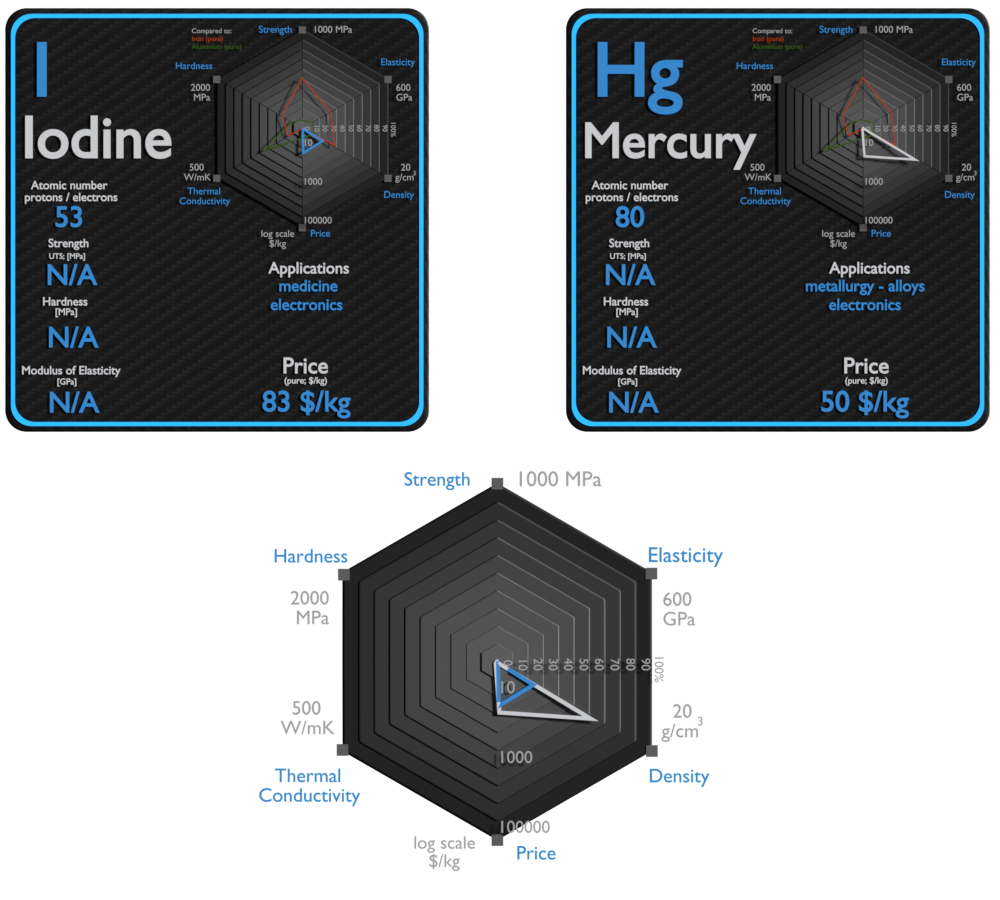
This article contains comparison of key thermal and atomic properties of iodine and mercury, two comparable chemical elements from the periodic table. It also contains basic descriptions and applications of both elements. Iodine vs Mercury.

iodine and mercury - comparison

Compare iodine with another element

Chlorine - Properties - Price - Applications - Production

Selenium - Properties - Price - Applications - Production

Bromine - Properties - Price - Applications - Production

Rubidium - Properties - Price - Applications - Production

Strontium - Properties - Price - Applications - Production

Mercury - Properties - Price - Applications - Production

Caesium - Properties - Price - Applications - Production

Compare mercury with another element

Aluminium - Properties - Price - Applications - Production

Iodine - Properties - Price - Applications - Production

Lead - Properties - Price - Applications - Production

Iodine and Mercury – About Elements

Iodine

Iodine is the heaviest of the stable halogens, it exists as a lustrous, purple-black metallic solid at standard conditions that sublimes readily to form a violet gas. Iodine is the least abundant of the stable halogens, being the sixty-first most abundant element. It is even less abundant than the so-called rare earths. It is the heaviest essential mineral nutrient.

Mercury

Mercury is commonly known as quicksilver and was formerly named hydrargyrum. Mercury is a heavy, silvery d-block element, mercury is the only metallic element that is liquid at standard conditions for temperature and pressure.

Iodine in Periodic Table

Mercury in Periodic Table

Source: www.luciteria.com

Iodine and Mercury – Applications

Iodine

In addition to nutrition products, iodine and iodine derivatives are used in a wide range of medical, agricultural, and industrial applications. About half of all produced iodine goes into various organoiodine compounds, another 15% remains as the pure element, another 15% is used to form potassium iodide, and another 15% for other inorganic iodine compounds. The leading application is in the production of X-ray contrast media (22%). Iodine’s high atomic number and density make it ideally suited for this application, as its presence in the body can help to increase contrast between tissues, organs, and blood vessels with similar X-ray densities. It is used as an antiseptic for external wounds. Another application driving the demand for iodine is in polarizing film in liquidcrystal display (LCD) screens.

Mercury

Mercury is used primarily for the manufacture of industrial chemicals or for electrical and electronic applications. However, because of its toxicity, many uses of mercury are being phased out or are under review. It is used in some thermometers, especially ones which are used to measure high temperatures. Mercury easily forms alloys, called amalgams, with other metals such as gold, silver and tin. The ease with which it amalgamates with gold made it useful in recovering gold from its ores. Mercury amalgams were also used in dental fillings. Gaseous mercury is used in mercury-vapor lamps and some “neon sign” type advertising signs and fluorescent lamps.

Iodine and Mercury – Comparison in Table

Element Iodine Mercury
Density 4.94 g/cm3 13.534 g/cm3
Ultimate Tensile Strength N/A N/A
Yield Strength N/A N/A
Young’s Modulus of Elasticity N/A N/A
Mohs Scale N/A N/A
Brinell Hardness N/A N/A
Vickers Hardness N/A N/A
Melting Point 113.5 °C -38.9 °C
Boiling Point 184 °C 357 °C
Thermal Conductivity 0.449 W/mK 8.3 W/mK
Thermal Expansion Coefficient N/A 60.4 µm/mK
Specific Heat 0.214 J/g K 0.139 J/g K
Heat of Fusion 7.824 kJ/mol 2.295 kJ/mol
Heat of Vaporization 20.752 kJ/mol 59.229 kJ/mol


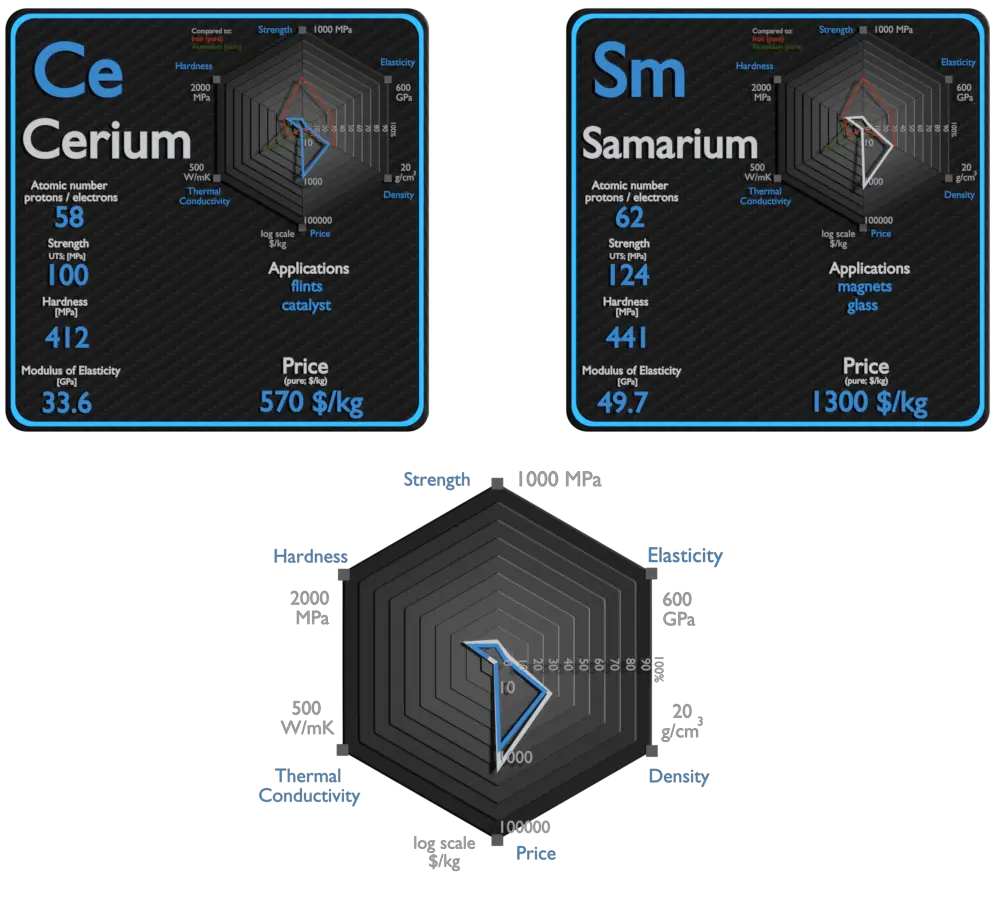
Cerium and Samarium – Comparison – Properties

This article contains comparison of key thermal and atomic properties of cerium and samarium, two comparable chemical elements from the periodic table. It also contains basic descriptions and applications of both elements. Cerium vs Samarium.

cerium and samarium - comparison

Compare cerium with another element

Lanthanum - Properties - Price - Applications - Production

Samarium - Properties - Price - Applications - Production

Compare samarium with another element

Cobalt - Properties - Price - Applications - Production

Cerium - Properties - Price - Applications - Production

Cerium and Samarium – About Elements

Cerium

Cerium is a soft, ductile and silvery-white metal that tarnishes when exposed to air, and it is soft enough to be cut with a knife. Cerium is the second element in the lanthanide series. Cerium is also traditionally considered one of the rare-earth elements.

Samarium

Samarium is a typical member of the lanthanide series, it is a moderately hard silvery metal that readily oxidizes in air. The name samarium is after the mineral samarskite from which it was isolated. Although classified as a rare earth element, samarium is the 40th most abundant element in the Earth’s crust and is more common than such metals as tin. In nuclear industry, especially natural and artificial samarium 149 has an important impact on the operation of a nuclear reactor. Samarium 149 has a very large neutron capture cross-section (about 42 000 barns). Since natural samarium contains about 14% of 149Sm, it can be used as an absorbing material in control rods.

Cerium in Periodic Table

Samarium in Periodic Table

Source: www.luciteria.com

Cerium and Samarium – Applications

Cerium

Cerium is an important component of mischmetal alloy. Ferrocerium is a synthetic pyrophoric alloy that produces hot sparks that can reach temperatures of 3,000 °C (5,430 °F) when rapidly oxidized by the process of striking the rod, thereby fragmenting it and exposing those fragments to the oxygen in the air. A typical composition includes approximately 55% cerium, 25% lanthanum, and 15-18% neodymium with other rare earth metals following. The best-known use for this alloy is in ‘flints’ for cigarette lighters. Ceria is the most widely used compound of cerium. The main application of ceria is as a polishing compound, for example in chemical-mechanical planarization (CMP).

Samarium

Samarium is mainly used in preparing samarium-cobalt alloy magnets for electric guitars, small motors and headphones. Samarium-cobalt magnets are much more powerful than iron magnets. They remain magnetic at high temperatures and so are used in microwave applications. They enabled the miniaturisation of electronic devices. However, neodymium magnets are now more commonly used instead. Its oxide is used for manufacturing special infrared adsorbing glass for carbon arc-lamp electrodes. It is useful in doping calcium fluoride crystals employed in optical lasers.

Cerium and Samarium – Comparison in Table

Element Cerium Samarium
Density 6.689 g/cm3 7.353 g/cm3
Ultimate Tensile Strength 100 MPa 124 MPa
Yield Strength 90 MPa 110 MPa
Young’s Modulus of Elasticity 33.6 GPa 49.7 GPa
Mohs Scale 2.5 N/A
Brinell Hardness 412 MPa 441 MPa
Vickers Hardness 300 MPa 412 MPa
Melting Point 798 °C 1074 °C
Boiling Point 3457 °C 1900 °C
Thermal Conductivity 11 W/mK 13 W/mK
Thermal Expansion Coefficient 6.3 µm/mK 12.7 µm/mK
Specific Heat 0.19 J/g K 0.2 J/g K
Heat of Fusion 5.46 kJ/mol 8.63 kJ/mol
Heat of Vaporization 414 kJ/mol 192 kJ/mol


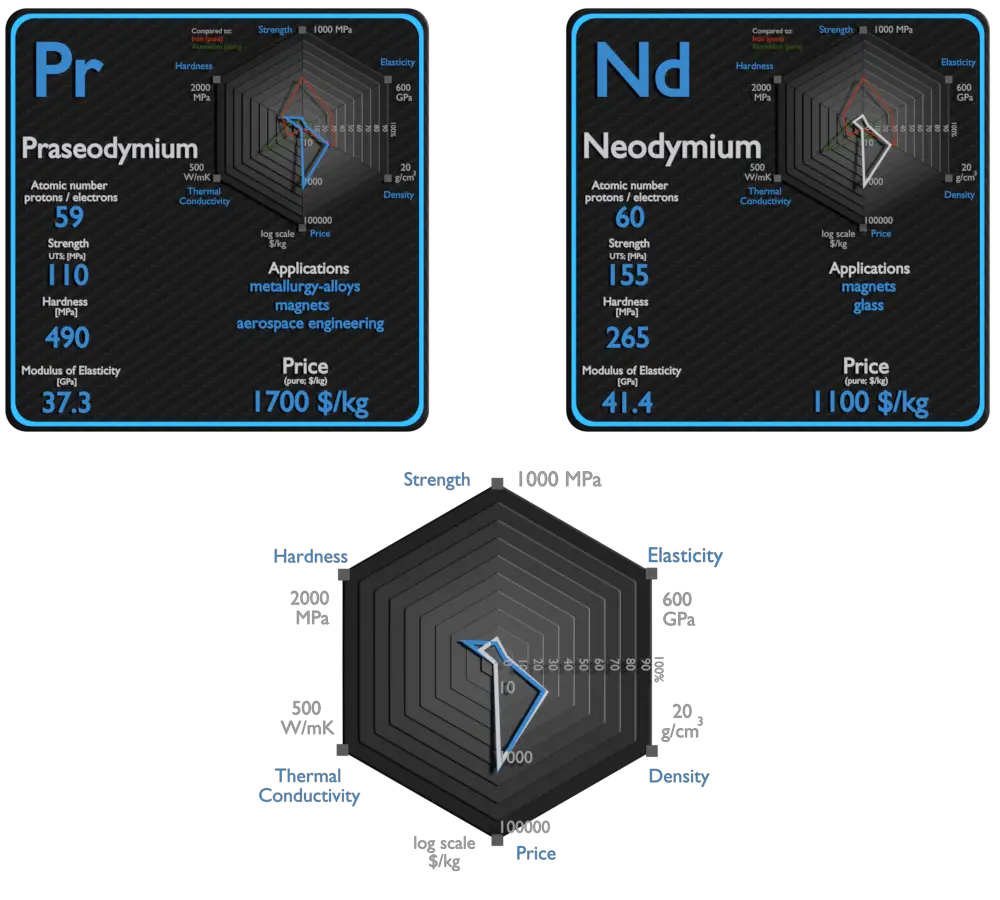
Praseodymium and Neodymium – Comparison – Properties

This article contains comparison of key thermal and atomic properties of praseodymium and neodymium, two comparable chemical elements from the periodic table. It also contains basic descriptions and applications of both elements. Praseodymium vs Neodymium.

praseodymium and neodymium - comparison

Compare praseodymium with another element

Neodymium - Properties - Price - Applications - Production

Compare neodymium with another element

Dysprosium - Properties - Price - Applications - Production

Praseodymium - Properties - Price - Applications - Production

Praseodymium and Neodymium – About Elements

Praseodymium

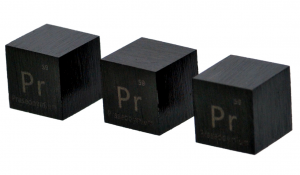
Praseodymium is a soft, silvery, malleable and ductile metal, valued for its magnetic, electrical, chemical, and optical properties. Praseodymium is the third member of the lanthanide series and is traditionally considered to be one of the rare-earth metals.

Neodymium

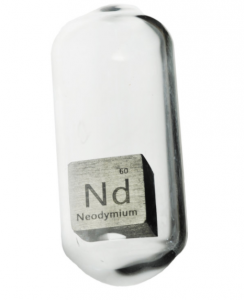
Neodymium is a soft silvery metal that tarnishes in air. Neodymium is not found naturally in metallic form or unmixed with other lanthanides, and it is usually refined for general use. Although neodymium is classed as a rare earth, it is a fairly common element.

Praseodymium in Periodic Table

Neodymium in Periodic Table

Source: www.luciteria.com

Praseodymium and Neodymium – Applications

Praseodymium

Praseodymium is used in a variety of alloys. The high-strength alloy it forms with magnesium is used in aircraft engines. Mischmetal is an alloy containing about 5% praseodymium and is used to make flints for cigarette lighters. In combination with neodymium, another rare-earth element, praseodymium is used to create high-power magnets notable for their strength and durability. Praseodymium compounds give glasses and enamels a yellow color.

Neodymium

The most important use for neodymium is in an alloy with iron and boron to make very strong permanent magnets. These magnets are widely used in such products as microphones, professional loudspeakers, in-ear headphones, high performance hobby DC electric motors, and computer hard disks, where low magnet mass (or volume) or strong magnetic fields are required. Larger neodymium magnets are used in high-power-versus-weight electric motors (for example in hybrid cars) and generators (for example aircraft and wind turbine electric generators). Neodymium is a component, along with praseodymium, of didymium glass. This is a special glass for goggles used during glass blowing and welding. The element colours glass delicate shades of violet, wine-red and grey. Neodymium is also used in the glass for tanning booths, since it transmits the tanning UV rays but not the heating infrared rays.

Praseodymium and Neodymium – Comparison in Table

Element Praseodymium Neodymium
Density 6.64 g/cm3 7.01 g/cm3
Ultimate Tensile Strength 110 MPa 155 MPa
Yield Strength 103 MPa 150 MPa
Young’s Modulus of Elasticity 37.3 GPa 41.4 GPa
Mohs Scale N/A N/A
Brinell Hardness 490 MPa 265 MPa
Vickers Hardness 400 MPa 360 MPa
Melting Point 931 °C 1016 °C
Boiling Point 3130 °C 3074 °C
Thermal Conductivity 13 W/mK 17 W/mK
Thermal Expansion Coefficient 6.7 µm/mK 9.6 µm/mK
Specific Heat 0.19 J/g K 0.19 J/g K
Heat of Fusion 6.89 kJ/mol 7.14 kJ/mol
Heat of Vaporization 296.8 kJ/mol 273 kJ/mol


Samarium and Cobalt – Comparison – Properties

This article contains comparison of key thermal and atomic properties of samarium and cobalt, two comparable chemical elements from the periodic table. It also contains basic descriptions and applications of both elements. Samarium vs Cobalt.

samarium and cobalt - comparison

Compare samarium with another element

Cobalt - Properties - Price - Applications - Production

Cerium - Properties - Price - Applications - Production

Compare cobalt with another element

Lithium - Properties - Price - Applications - Production

Iron - Properties - Price - Applications - Production

Copper - Properties - Price - Applications - Production

Cobalt - Properties - Price - Applications - Production

Cadmium - Properties - Price - Applications - Production

Zinc - Properties - Price - Applications - Production

Silver - Properties - Price - Applications - Production

Gold - Properties - Price - Applications - Production

Tungsten - Properties - Price - Applications - Production

Samarium and Cobalt – About Elements

Samarium

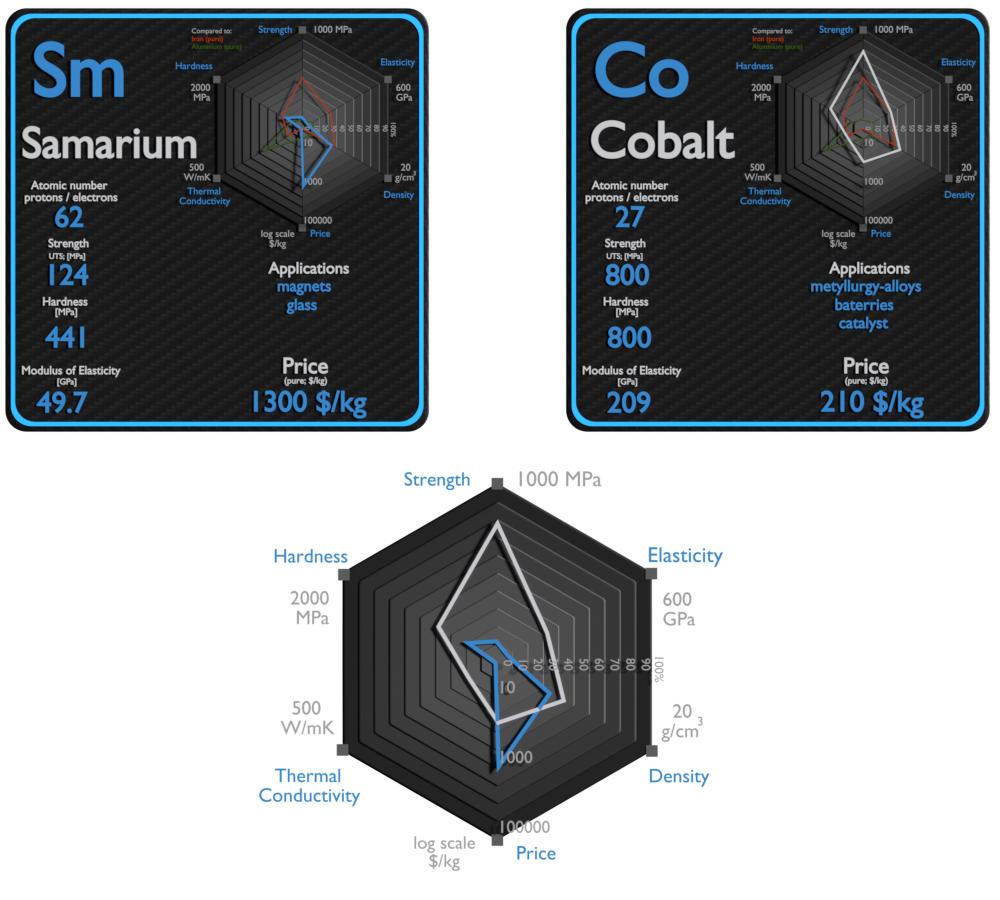
Samarium is a typical member of the lanthanide series, it is a moderately hard silvery metal that readily oxidizes in air. The name samarium is after the mineral samarskite from which it was isolated. Although classified as a rare earth element, samarium is the 40th most abundant element in the Earth’s crust and is more common than such metals as tin. In nuclear industry, especially natural and artificial samarium 149 has an important impact on the operation of a nuclear reactor. Samarium 149 has a very large neutron capture cross-section (about 42 000 barns). Since natural samarium contains about 14% of 149Sm, it can be used as an absorbing material in control rods.

Cobalt

Cobalt is found in the Earth’s crust only in chemically combined form, save for small deposits found in alloys of natural meteoric iron. The free element, produced by reductive smelting, is a hard, lustrous, silver-gray metal.

Samarium in Periodic Table

Cobalt in Periodic Table

Source: www.luciteria.com

Samarium and Cobalt – Applications

Samarium

Samarium is mainly used in preparing samarium-cobalt alloy magnets for electric guitars, small motors and headphones. Samarium-cobalt magnets are much more powerful than iron magnets. They remain magnetic at high temperatures and so are used in microwave applications. They enabled the miniaturisation of electronic devices. However, neodymium magnets are now more commonly used instead. Its oxide is used for manufacturing special infrared adsorbing glass for carbon arc-lamp electrodes. It is useful in doping calcium fluoride crystals employed in optical lasers.

Cobalt

Cobalt has been used in many industrial, commercial, and military applications. Cobalt is primarily used in lithium-ion batteries, and in the manufacture of magnetic, wear-resistant and high-strength alloys. Cobalt-based Superalloys. This class of alloys is relatively new. In 2006, Sato et al. discovered a new phase in the Co–Al–W system. Unlike other superalloys, cobalt-base alloys are characterized by a solid-solution-strengthened austenitic (fcc) matrix in which a small quantity of carbide is distributed. While not used commercially to the extent of Ni-based superalloys, alloying elements found in research Co-based alloys are C, Cr, W, Ni, Ti, Al, Ir, and Ta. They possess better weldability and thermal fatigue resistance as compared to nickel based alloy. Moreover, they have excellent corrosion resistance at high temperatures (980-1100 °C) because of their higher chromium contents. Several cobalt compounds are oxidation catalysts. Typical catalysts are the cobalt carboxylates (known as cobalt soaps). They are also used in paints, varnishes, and inks as “drying agents” through the oxidation of drying oils.

Samarium and Cobalt – Comparison in Table

Element Samarium Cobalt
Density 7.353 g/cm3 8.9 g/cm3
Ultimate Tensile Strength 124 MPa 900 MPa
Yield Strength 110 MPa 220 MPa
Young’s Modulus of Elasticity 49.7 GPa 209 GPa
Mohs Scale N/A 5
Brinell Hardness 441 MPa 800 MPa
Vickers Hardness 412 MPa 1040 MPa
Melting Point 1074 °C 1495 °C
Boiling Point 1900 °C 2927 °C
Thermal Conductivity 19 W/mK 100 W/mK
Thermal Expansion Coefficient 12.7 µm/mK 14 µm/mK
Specific Heat 0.2 J/g K 0.42 J/g K
Heat of Fusion 8.63 kJ/mol 16.19 kJ/mol
Heat of Vaporization 192 kJ/mol 376.5 kJ/mol


Lead and Bismuth – Comparison – Properties

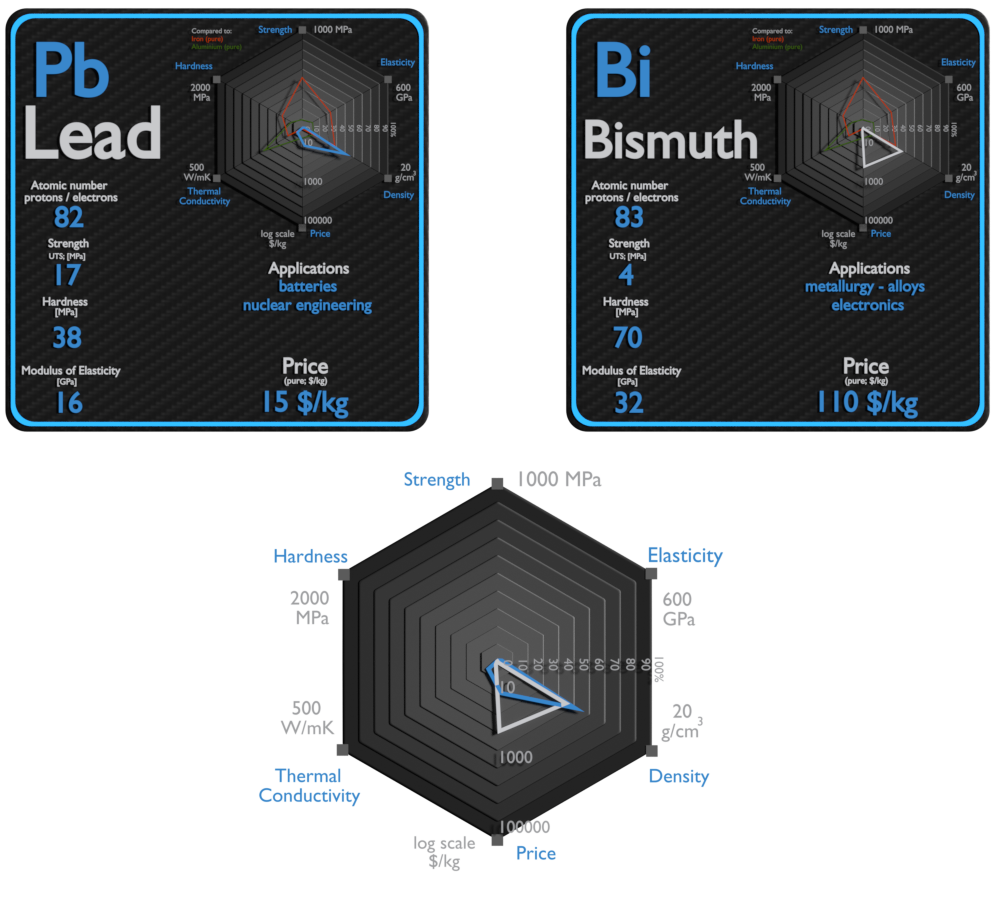
This article contains comparison of key thermal and atomic properties of lead and bismuth, two comparable chemical elements from the periodic table. It also contains basic descriptions and applications of both elements. Lead vs Bismuth.

lead and bismuth - comparison

Compare lead with another element

Iron - Properties - Price - Applications - Production

Arsenic - Properties - Price - Applications - Production

Cadmium - Properties - Price - Applications - Production

Tin - Properties - Price - Applications - Production

Antimony - Properties - Price - Applications - Production

Gold - Properties - Price - Applications - Production

Bismuth - Properties - Price - Applications - Production

Compare bismuth with another element

Lead - Properties - Price - Applications - Production

Lead and Bismuth – About Elements

Lead

Lead is a heavy metal that is denser than most common materials. Lead is soft and malleable, and has a relatively low melting point. Lead is widely used as a gamma shield. Major advantage of lead shield is in its compactness due to its higher density. Lead has the highest atomic number of any stable element and concludes three major decay chains of heavier elements.

Bismuth

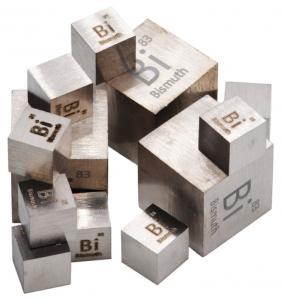
Bismuth is a brittle metal with a silvery white color when freshly produced, but surface oxidation can give it a pink tinge. Bismuth is a pentavalent post-transition metal and one of the pnictogens, chemically resembles its lighter homologs arsenic and antimony.

Lead in Periodic Table

Bismuth in Periodic Table

Source: www.luciteria.com

Lead and Bismuth – Applications

Lead

Lead metal has several useful mechanical properties, including high density, low melting point, ductility, and relative inertness. Lead is widely used for car batteries, pigments, ammunition, cable sheathing, weights for lifting, weight belts for diving, lead crystal glass, radiation protection and in some solders. The largest use of lead in the early 21st century is in lead–acid batteries. The lead in batteries undergoes no direct contact with humans, so there are fewer toxicity concerns. Lead is used in high voltage power cables as sheathing material to prevent water diffusion into insulation; this use is decreasing as lead is being phased out. A lead is widely used as a gamma shield. Major advantage of lead shield is in its compactness due to its higher density. On the other hand depleted uranium is much more effective due to its higher Z. Depleted uranium is used for shielding in portable gamma ray sources.

Bismuth

Bismuth metal is brittle and so it is usually mixed with other metals to make it useful. Its alloys with tin or cadmium have low melting points and are used in fire detectors and extinguishers, electric fuses and solders. Bismuth oxide is used as a yellow pigment for cosmetics and paints. Bismuth alloys are used in soldering, thermocouple materials and magnetic memory devices. Compounds of bismuth are used in lubricating greases, thermoelectric materials, infrared spectrometers. Bismuth oxychloride (BiOCl) is sometimes used in cosmetics, as a pigment in paint for eye shadows, hair sprays and nail polishes.

Lead and Bismuth – Comparison in Table

Element Lead Bismuth
Density 11.34 g/cm3 9.78 g/cm3
Ultimate Tensile Strength 17 MPa 4 MPa
Yield Strength 5.5 MPa 2 MPa
Young’s Modulus of Elasticity 16 GPa 32 GPa
Mohs Scale 1.5 2.5
Brinell Hardness 38 MPa 70 MPa
Vickers Hardness N/A N/A
Melting Point 327.5 °C 271 °C
Boiling Point 1740 °C 1560 °C
Thermal Conductivity 35 W/mK 8 W/mK
Thermal Expansion Coefficient 28.9 µm/mK 13.4 µm/mK
Specific Heat 0.13 J/g K 0.12 J/g K
Heat of Fusion 4.799 kJ/mol 11.3 kJ/mol
Heat of Vaporization 177.7 kJ/mol 104.8 kJ/mol


Thulium and Lutetium – Comparison – Properties

This article contains comparison of key thermal and atomic properties of thulium and lutetium, two comparable chemical elements from the periodic table. It also contains basic descriptions and applications of both elements. Thulium vs Lutetium.

thulium and lutetium - comparison

Compare thulium with another element

Lutetium - Properties - Price - Applications - Production

Compare lutetium with another element

Thulium - Properties - Price - Applications - Production

Thulium and Lutetium – About Elements

Thulium

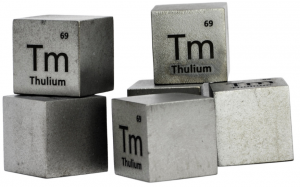
Thulium is an easily workable metal with a bright silvery-gray luster. It is fairly soft and slowly tarnishes in air. Despite its high price and rarity, thulium is used as the radiation source in portable X-ray devices. Thulium is the thirteenth and third-last element in the lanthanide series.

Lutetium

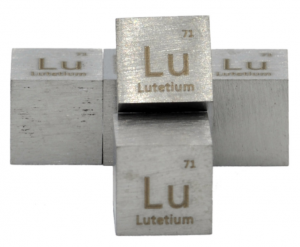
Lutetium is a silvery white metal, which resists corrosion in dry air, but not in moist air. Lutetium is the last element in the lanthanide series, and it is traditionally counted among the rare earths.

Thulium in Periodic Table

Lutetium in Periodic Table

Source: www.luciteria.com

Thulium and Lutetium – Applications

Thulium

The pure metal and compound have few commercial uses: because it is very rare and expensive and has little to offer, thulium find little application outside chemical research. Thulium has been used to create lasers. Thulium lasers require less cooling and function very well at high temperatures and are used in satellites. When stable thulium (Tm-169) is bombarded in a nuclear reactor it can later serve as a radiation source in portable X-ray devices. Thulium-170 is gaining popularity as an X-ray source for cancer treatment via brachytherapy. Thulium has been used in high-temperature superconductors similarly to yttrium. Thulium potentially has use in ferrites, ceramic magnetic materials that are used in microwave equipment. Thulium-doped calcium sulphate has been used in personal radiation dosimeters because it can register, by its fluorescence, especially low levels.

Lutetium

Lutetium is not extensively used metal. Most lutetium is used only in research. One of its few commercial uses is as a catalyst for cracking hydrocarbons in oil refineries. It is used in detectors of positron emission topography that detects cellular activity of the body.

Thulium and Lutetium – Comparison in Table

Element Thulium Lutetium
Density 9.321 g/cm3 9.841 g/cm3
Ultimate Tensile Strength N/A N/A
Yield Strength N/A N/A
Young’s Modulus of Elasticity 74 GPa 68.6 GPa
Mohs Scale N/A N/A
Brinell Hardness 740 MPa 900 MPa
Vickers Hardness 520 MPa 1100 MPa
Melting Point 1545 °C 1663 °C
Boiling Point 1950 °C 3402 °C
Thermal Conductivity 17 W/mK 16 W/mK
Thermal Expansion Coefficient 13.3 µm/mK 9.9 µm/mK
Specific Heat 0.16 J/g K 0.15 J/g K
Heat of Fusion 16.84 kJ/mol 18.6 kJ/mol
Heat of Vaporization 191 kJ/mol 355.9 kJ/mol


Thorium and Uranium – Comparison – Properties

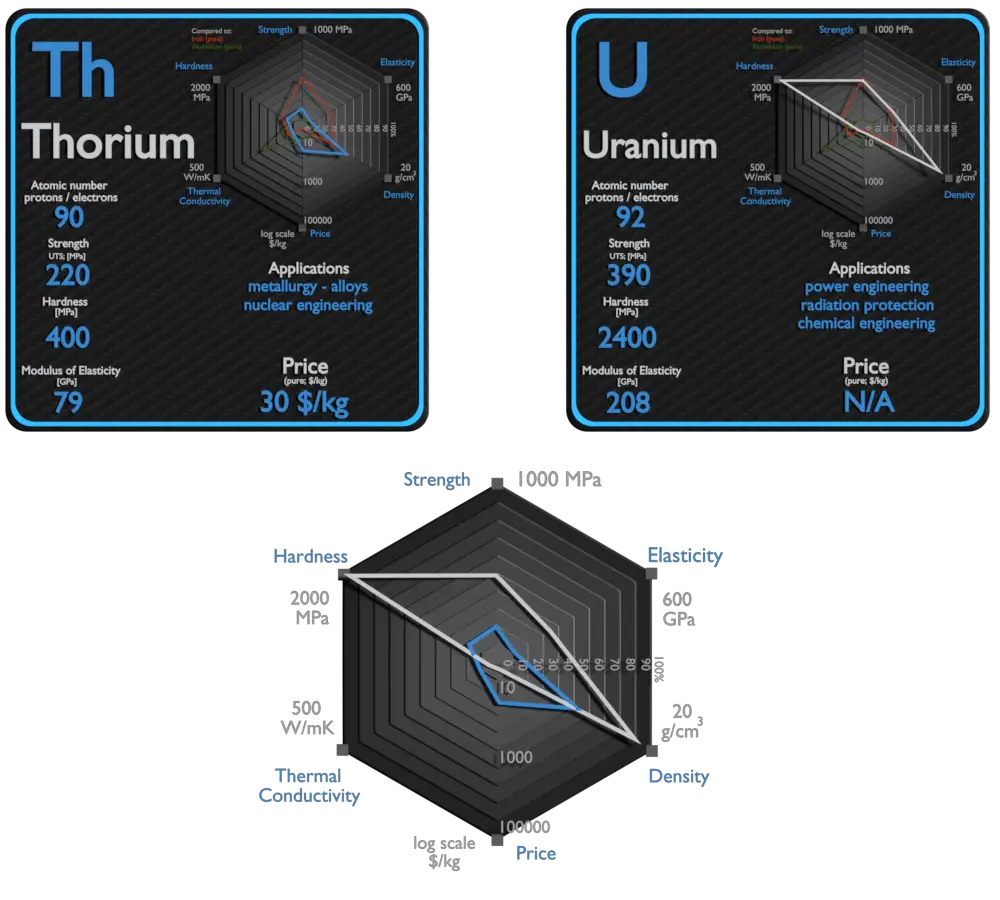
This article contains comparison of key thermal and atomic properties of thorium and uranium, two comparable chemical elements from the periodic table. It also contains basic descriptions and applications of both elements. Thorium vs Uranium.

thorium and uranium - comparison

Compare thorium with another element

Uranium - Properties - Price - Applications - Production

Compare uranium with another element

Titanium - Properties - Price - Applications - Production

Zirconium - Properties - Price - Applications - Production

Thorium - Properties - Price - Applications - Production

Thorium and Uranium – About Elements

Thorium

Thorium metal is silvery and tarnishes black when exposed to air, forming the dioxide. Thorium is moderately hard, malleable, and has a high melting point. Thorium is a naturally-occurring element and it is estimated to be about three times more abundant than uranium. Thorium is commonly found in monazite sands (rare earth metals containing phosphate mineral).

Uranium

Uranium is a silvery-white metal in the actinide series of the periodic table. Uranium is weakly radioactive because all isotopes of uranium are unstable, with half-lives varying between 159,200 years and 4.5 billion years. Uranium has the highest atomic weight of the primordially occurring elements. Its density is about 70% higher than that of lead, and slightly lower than that of gold or tungsten. Uranium is commonly found at low levels (a few ppm – parts per million) in all rocks, soil, water, plants, and animals (including humans). Uranium occurs also in seawater, and can be recovered from the ocean water. Significant concentrations of uranium occur in some substances such as uraninite (the most common uranium ore), phosphate rock deposits, and other minerals.

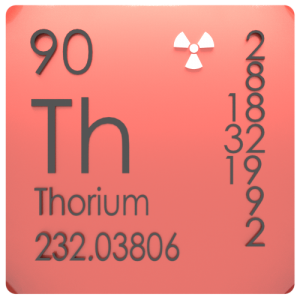
Thorium in Periodic Table

Uranium in Periodic Table

Source: www.luciteria.com

Thorium and Uranium – Applications

Thorium

Most thorium applications use its dioxide (sometimes called “thoria” in the industry), rather than the metal. This compound has a melting point of 3300 °C (6000 °F), the highest of all known oxides; only a few substances have higher melting points.[46] This helps the compound remain solid in a flame, and it considerably increases the brightness of the flame; this is the main reason thorium is used in gas lamp mantles. All substances emit energy (glow) at high temperatures, but the light emitted by thorium is nearly all in the visible spectrum, hence the brightness of thorium mantles. Thorium is an important alloying agent in magnesium, as it imparts greater strength and creep resistance at high temperatures. Thorium oxide is used as an industrial catalyst. Other uses for thorium include heat-resistant ceramics, aircraft engines, and in light bulbs. Thorium can be used as a source of nuclear power. It is about three times as abundant as uranium and about as abundant as lead, and there is probably more energy available from thorium than from both uranium and fossil fuels. 232Th is a fertile isotope. 232Th is not capable of undergoing fission reaction after absorbing thermal neutron, on the other hand 232Th can be fissioned by fast neutron with energy higher than >1MeV. India and China are in the process of developing nuclear power plants with thorium reactors, but this is still a very new technology. Thorium dioxide was formerly added to glass during manufacture to increase the refractive index, producing thoriated glass for use in high-quality camera lenses.

Uranium

The main use of uranium in the civilian sector is to fuel nuclear power plants. One kilogram of uranium-235 can theoretically produce about 20 terajoules of energy, assuming complete fission; as much energy as 1.5 million kilograms (1500 tons) of coal. Typical reactor may contain about 100 tonnes of enriched uranium (i.e. about 113 tonnes of uranium dioxide). This fuel is loaded within, for example, 157 fuel assemblies composed of over 45 000 fuel rods. A common fuel assembly contain energy for approximately 4 years of operation at full power. The removed fuel (spent nuclear fuel) still contains about 96% of reusable material (it must be removed due to decreasing kinf of an assembly). Before (and, occasionally, after) the discovery of radioactivity, uranium was primarily used in small amounts for yellow glass and pottery glazes, such as uranium glass. Uranium is also used by the military to power nuclear submarines and in nuclear weapons. Due to its high density, this material is found in inertial guidance systems and in gyroscopic compasses.[10] Depleted uranium is preferred over similarly dense metals due to its ability to be easily machined and cast as well as its relatively low cost. The main risk of exposure to depleted uranium is chemical poisoning by uranium oxide rather than radioactivity (uranium being only a weak alpha emitter). Depleted uranium is uranium that has much less uranium-235 than natural uranium. It is considerably less radioactive than natural uranium. It is a dense metal that can be used as ballast for ships and counterweights for aircraft. It is also used in ammunition and armour. Depleted uranium can be also used to shield radiation. Depleted uranium is much more effective due to its higher Z. Depleted uranium is used for shielding in portable gamma ray sources. Uranium is used in high-speed steels as an alloying agent to improve strength and toughness. Uranium trioxide (also called uranic oxide) with formula UO3, is an orange-yellow powder and is used as a pigment for ceramics. In glasses it produces a beautiful greenish-yellow “uranium glass”.

Thorium and Uranium – Comparison in Table

Element Thorium Uranium
Density 11.724 g/cm3 19.05 g/cm3
Ultimate Tensile Strength 220 MPa 390 MPa
Yield Strength 144 MPa 190 MPa
Young’s Modulus of Elasticity 79 GPa 208 GPa
Mohs Scale 3 6
Brinell Hardness 400 MPa 2400 MPa
Vickers Hardness 350 MPa 1960 MPa
Melting Point 1750 °C 1132 °C
Boiling Point 4790 °C 4131 °C
Thermal Conductivity 54 W/mK 27 W/mK
Thermal Expansion Coefficient 11 µm/mK 13.9 µm/mK
Specific Heat 0.12 J/g K 0.12 J/g K
Heat of Fusion 13.8 kJ/mol 8.52 kJ/mol
Heat of Vaporization 514.4 kJ/mol 417 kJ/mol


Holmium and Ytterbium – Comparison – Properties

This article contains comparison of key thermal and atomic properties of holmium and ytterbium, two comparable chemical elements from the periodic table. It also contains basic descriptions and applications of both elements. Holmium vs Ytterbium.

holmium and ytterbium - comparison

Compare holmium with another element

Ytterbium - Properties - Price - Applications - Production

Compare ytterbium with another element

Europium - Properties - Price - Applications - Production

Yttrium - Properties - Price - Applications - Production

Holmium and Ytterbium – About Elements

Holmium

Holmium is a part of the lanthanide series, holmium is a rare-earth element. Holmium is a relatively soft and malleable silvery-white metal.

Ytterbium

Because of its closed-shell electron configuration, its density and melting and boiling points differ significantly from those of most other lanthanides.

Holmium in Periodic Table

Ytterbium in Periodic Table

Source: www.luciteria.com

Holmium and Ytterbium – Applications

Holmium

Holmium has the highest magnetic strength of any element, and therefore is used to create the strongest artificially generated magnetic fields. Holmium can absorb neutrons, so it is used in nuclear reactors to keep a chain reaction under control. Its alloys are used in some magnets.

Ytterbium

Ytterbium is beginning to find a variety of uses, such as in memory devices and tuneable lasers. It can also be used as an industrial catalyst and is increasingly being used to replace other catalysts considered to be too toxic and polluting. A small amount of ytterbium is used to add strength to specific steel types. Ytterbium can also be used as a dopant to help improve the grain refinement, strength, and other mechanical properties of stainless steel.

Holmium and Ytterbium – Comparison in Table

Element Holmium Ytterbium
Density 8.795 g/cm3 6.57 g/cm3
Ultimate Tensile Strength 260 MPa 69 MPa
Yield Strength 220 MPa 66 MPa
Young’s Modulus of Elasticity 64.8 GPa 23.9 GPa
Mohs Scale N/A N/A
Brinell Hardness 750 MPa 340 MPa
Vickers Hardness 490 MPa 210 MPa
Melting Point 1474 °C 819 °C
Boiling Point 2600 °C 1196 °C
Thermal Conductivity 16 W/mK 39 W/mK
Thermal Expansion Coefficient 11.2 µm/mK 26.3 µm/mK
Specific Heat 0.16 J/g K 0.15 J/g K
Heat of Fusion 12.2 kJ/mol 7.66 kJ/mol
Heat of Vaporization 241 kJ/mol 128.9 kJ/mol