Facebook Instagram Youtube Twitter

Tungsten and Platinum – Comparison – Properties

This article contains comparison of key thermal and atomic properties of tungsten and platinum, two comparable chemical elements from the periodic table. It also contains basic descriptions and applications of both elements. Tungsten vs Platinum.

tungsten and platinum - comparison

Compare tungsten with another element

Titanium - Properties - Price - Applications - Production

Chromium - Properties - Price - Applications - Production

Cobalt - Properties - Price - Applications - Production

Zirconium - Properties - Price - Applications - Production

Molybdenum - Properties - Price - Applications - Production

Platinum - Properties - Price - Applications - Production

Rhenium - Properties - Price - Applications - Production

Gold - Properties - Price - Applications - Production

Iridium - Properties - Price - Applications - Production

Compare platinum with another element

Nickel - Properties - Price - Applications - Production

Rhodium - Properties - Price - Applications - Production

Palladium - Properties - Price - Applications - Production

Silver - Properties - Price - Applications - Production

Tungsten - Properties - Price - Applications - Production

Iridium - Properties - Price - Applications - Production

Gold - Properties - Price - Applications - Production

Tugsten and Platinum – About Elements

Tungsten

Tungsten is a rare metal found naturally on Earth almost exclusively in chemical compounds. Tungsten is an intrinsically brittle and hard material, making it difficult to work.

Platinum

Platinum is a dense, malleable, ductile, highly unreactive, precious, silverish-white transition metal. Platinum is one of the least reactive metals. It has remarkable resistance to corrosion, even at high temperatures, and is therefore considered a noble metal. Platinum is used in catalytic converters, laboratory equipment, electrical contacts and electrodes, platinum resistance thermometers, dentistry equipment, and jewelry.

Tungsten in Periodic Table

Platinum in Periodic Table

Source: www.luciteria.com

Tungsten and Platinum – Applications

Tungsten

Tungsten is widely used metal. Approximately half of the tungsten is consumed for the production of hard materials – namely tungsten carbide – with the remaining major use being in alloys and steels. Mining and mineral processing demand wear-resistant machines and components, because the energies and masses of interacting bodies are significant. For this purposes, materials with the highest wear-resistance must be used. For example, tungsten carbide is used extensively in mining in top hammer rock drill bits, downhole hammers, roller-cutters, long wall plough chisels, long wall shearer picks, raiseboring reamers, and tunnel boring machines. The remaining 40% is generally used to make various alloys and specialty steels, electrodes, filaments, wires, as well as diverse components for electric, electronic, heating, lighting, and welding applications. High-speed steels are complex iron-base alloys of carbon, chromium, vanadium, molybdenum, or tungsten (as much as 18%), or combinations there of.

Platinum

Platinum is primarily an industrial metal. It is a critical material for many industries and is considered a strategic metal. Platinum is used as a catalyst, platinum is mostly found in vehicle catalytic converters that reduce toxic exhaust chemicals, and also in fuel cells to increase efficiency. The most common use of platinum is as a catalyst in chemical reactions, often as platinum black. In catalytic converters, platinum allows the complete combustion of low concentrations of unburned hydrocarbons from the exhaust into carbon dioxide and water vapor. Platinum has been used in thermocouple devices that measure temperature with high accuracy. Platinum is a component in magnetic coatings for high-density hard disk drives and some of the newer optical storage systems.

Tungsten and Platinum – Comparison in Table

Element Tungsten Platinum
Density 19.25 g/cm3 21.09 g/cm3
Ultimate Tensile Strength 980 MPa 150 MPa
Yield Strength 750 MPa 70 MPa
Young’s Modulus of Elasticity 411 GPa 168 GPa
Mohs Scale 7.5 3.5
Brinell Hardness 3000 MPa 400 MPa
Vickers Hardness 3500 MPa 550 MPa
Melting Point 3410 °C 1772 °C
Boiling Point 59300 °C 3827 °C
Thermal Conductivity 170 W/mK 72 W/mK
Thermal Expansion Coefficient 4.5 µm/mK 8.8 µm/mK
Specific Heat 0.13 J/g K 0.13 J/g K
Heat of Fusion 35.4 kJ/mol 19.6 kJ/mol
Heat of Vaporization 824 kJ/mol 510 kJ/mol


Iridium and Platinum – Comparison – Properties

This article contains comparison of key thermal and atomic properties of iridium and platinum, two comparable chemical elements from the periodic table. It also contains basic descriptions and applications of both elements. Iridium vs Platinum.

iridium and platinum - comparison

Compare iridium with another element

Rhodium - Properties - Price - Applications - Production

Tungsten - Properties - Price - Applications - Production

Osmium - Properties - Price - Applications - Production

Platinum - Properties - Price - Applications - Production

Gold - Properties - Price - Applications - Production

Compare platinum with another element

Nickel - Properties - Price - Applications - Production

Rhodium - Properties - Price - Applications - Production

Palladium - Properties - Price - Applications - Production

Silver - Properties - Price - Applications - Production

Tungsten - Properties - Price - Applications - Production

Iridium - Properties - Price - Applications - Production

Gold - Properties - Price - Applications - Production

Iridium and Platinum – About Elements

Iridium

Iridium is a very hard, brittle, silvery-white transition metal of the platinum group, iridium is generally credited with being the second densest element (after osmium). It is also the most corrosion-resistant metal, even at temperatures as high as 2000 °C.

Platinum

Platinum is a dense, malleable, ductile, highly unreactive, precious, silverish-white transition metal. Platinum is one of the least reactive metals. It has remarkable resistance to corrosion, even at high temperatures, and is therefore considered a noble metal. Platinum is used in catalytic converters, laboratory equipment, electrical contacts and electrodes, platinum resistance thermometers, dentistry equipment, and jewelry.

Iridium in Periodic Table

Platinum in Periodic Table

Source: www.luciteria.com

Iridium and Platinum – Applications

Iridium

Iridium is mainly consumed by the automotive, electronic, and chemical industries. Iridium metal is employed when high corrosion resistance at high temperatures is needed, as in high-performance spark plugs, crucibles for recrystallization of semiconductors at high temperatures, and electrodes for the production of chlorine in the chloralkali process. The demand for iridium surged from 2.5 tonnes in 2009 to 10.4 tonnes in 2010, mostly because of electronics-related applications that saw a rise from 0.2 to 6 tonnes – iridium crucibles are commonly used for growing large high-quality single crystals, demand for which has increased sharply.

Platinum

Platinum is primarily an industrial metal. It is a critical material for many industries and is considered a strategic metal. Platinum is used as a catalyst, platinum is mostly found in vehicle catalytic converters that reduce toxic exhaust chemicals, and also in fuel cells to increase efficiency. The most common use of platinum is as a catalyst in chemical reactions, often as platinum black. In catalytic converters, platinum allows the complete combustion of low concentrations of unburned hydrocarbons from the exhaust into carbon dioxide and water vapor. Platinum has been used in thermocouple devices that measure temperature with high accuracy. Platinum is a component in magnetic coatings for high-density hard disk drives and some of the newer optical storage systems.

Iridium and Platinum – Comparison in Table

Element Iridium Platinum
Density 22.65 g/cm3 21.09 g/cm3
Ultimate Tensile Strength 2000 MPa 150 MPa
Yield Strength N/A 70 MPa
Young’s Modulus of Elasticity 528 GPa 168 GPa
Mohs Scale 6.25 3.5
Brinell Hardness 1670 MPa 400 MPa
Vickers Hardness 1760 MPa 550 MPa
Melting Point 2410 °C 1772 °C
Boiling Point 4130 °C 3827 °C
Thermal Conductivity 150 W/mK 72 W/mK
Thermal Expansion Coefficient 6.4 µm/mK 8.8 µm/mK
Specific Heat 0.13 J/g K 0.13 J/g K
Heat of Fusion 26.1 kJ/mol 19.6 kJ/mol
Heat of Vaporization 604 kJ/mol 510 kJ/mol


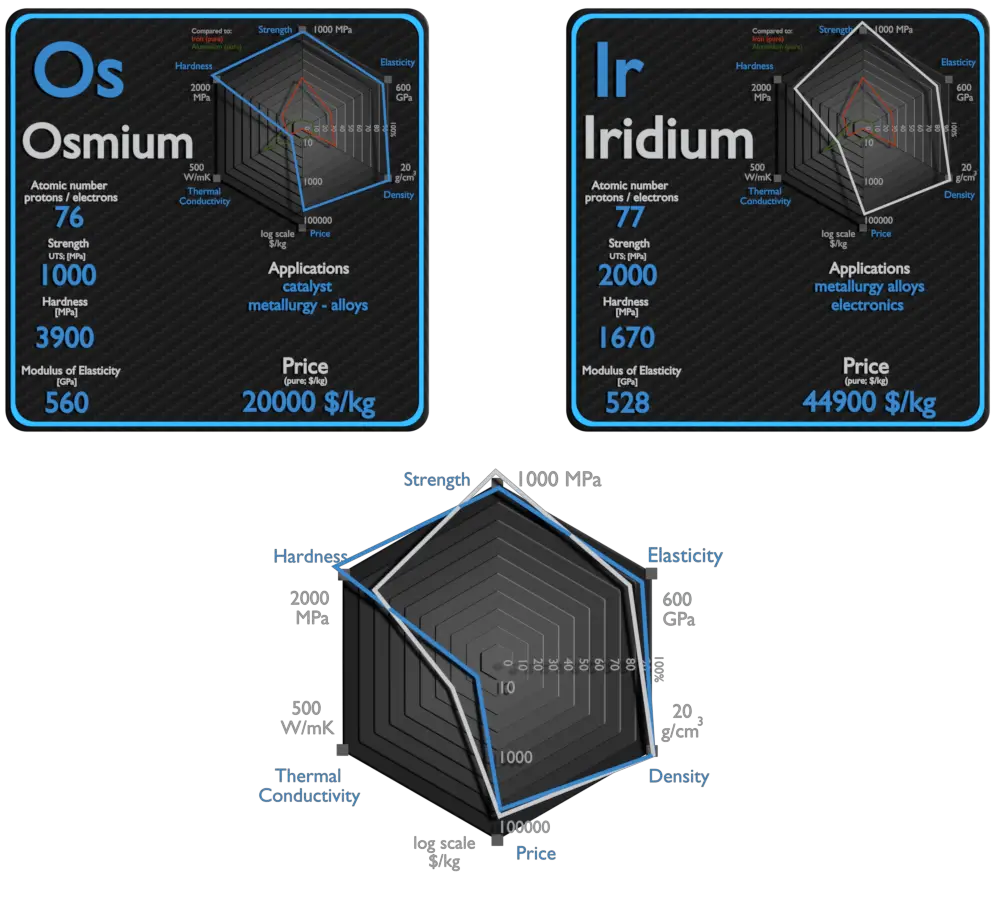
Osmium and Iridium – Comparison – Properties

This article contains comparison of key thermal and atomic properties of osmium and iridium, two comparable chemical elements from the periodic table. It also contains basic descriptions and applications of both elements. Osmium vs Iridium.

osmium and iridium - comparison

Compare osmium with another element

Iridium - Properties - Price - Applications - Production

Gold - Properties - Price - Applications - Production

Compare iridium with another element

Rhodium - Properties - Price - Applications - Production

Tungsten - Properties - Price - Applications - Production

Osmium - Properties - Price - Applications - Production

Platinum - Properties - Price - Applications - Production

Gold - Properties - Price - Applications - Production

Osmium and Iridium – About Elements

Osmium

Osmium is a hard, brittle, bluish-white transition metal in the platinum group that is found as a trace element in alloys, mostly in platinum ores. Osmium is the densest naturally occurring element, with a density of 22.59 g/cm3. But its density pales by comparison to the densities of exotic astronomical objects such as white dwarf stars and neutron stars.

Iridium

Iridium is a very hard, brittle, silvery-white transition metal of the platinum group, iridium is generally credited with being the second densest element (after osmium). It is also the most corrosion-resistant metal, even at temperatures as high as 2000 °C.

Osmium in Periodic Table

Iridium in Periodic Table

Source: www.luciteria.com

Osmium and Iridium – Applications

Osmium

Due to its rarity and hence expense, osmium has only a few industrial uses. It is used to produce very hard alloys for fountain pen tips, instrument pivots, needles and electrical contacts. It is also used in the chemical industry as a catalyst. Finely divided osmium metal can be used as a catalyst e.g. in the process of forming ammonia by combining hydrogen and nitrogen.

Iridium

Iridium is mainly consumed by the automotive, electronic, and chemical industries. Iridium metal is employed when high corrosion resistance at high temperatures is needed, as in high-performance spark plugs, crucibles for recrystallization of semiconductors at high temperatures, and electrodes for the production of chlorine in the chloralkali process. The demand for iridium surged from 2.5 tonnes in 2009 to 10.4 tonnes in 2010, mostly because of electronics-related applications that saw a rise from 0.2 to 6 tonnes – iridium crucibles are commonly used for growing large high-quality single crystals, demand for which has increased sharply.

Osmium and Iridium – Comparison in Table

Element Osmium Iridium
Density 22.61 g/cm3 22.65 g/cm3
Ultimate Tensile Strength 1000 MPa 2000 MPa
Yield Strength N/A N/A
Young’s Modulus of Elasticity N/A 528 GPa
Mohs Scale 7 6.25
Brinell Hardness 3900 MPa 1670 MPa
Vickers Hardness 4140 MPa 1760 MPa
Melting Point 3045 °C 2410 °C
Boiling Point 5030 °C 4130 °C
Thermal Conductivity 88 W/mK 150 W/mK
Thermal Expansion Coefficient 5.1 µm/mK 6.4 µm/mK
Specific Heat 0.13 J/g K 0.13 J/g K
Heat of Fusion 31.8 kJ/mol 26.1 kJ/mol
Heat of Vaporization 746 kJ/mol 604 kJ/mol


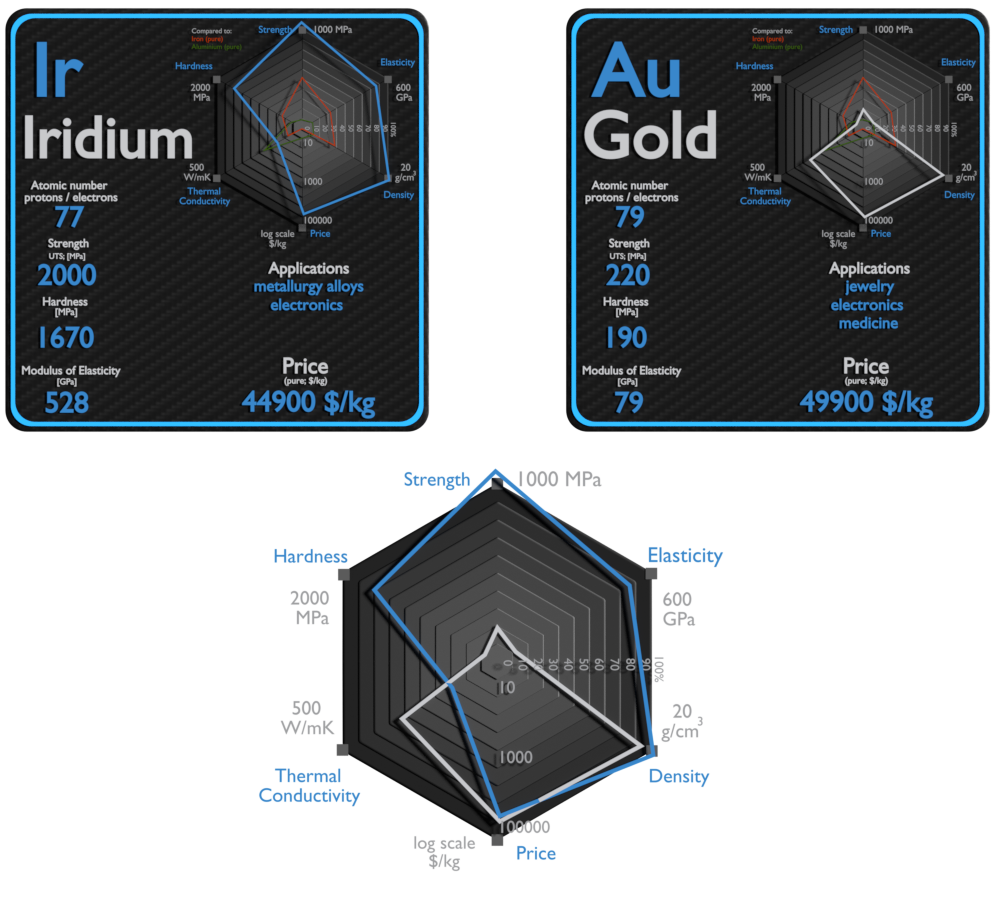
Iridium and Gold – Comparison – Properties

This article contains comparison of key thermal and atomic properties of iridium and gold, two comparable chemical elements from the periodic table. It also contains basic descriptions and applications of both elements. Iridium vs Gold.

iridium and gold - comparison

Compare iridium with another element

Rhodium - Properties - Price - Applications - Production

Tungsten - Properties - Price - Applications - Production

Osmium - Properties - Price - Applications - Production

Platinum - Properties - Price - Applications - Production

Gold - Properties - Price - Applications - Production

Compare gold with another element

Titanium - Properties - Price - Applications - Production

Cobalt - Properties - Price - Applications - Production

Nickel - Properties - Price - Applications - Production

Copper - Properties - Price - Applications - Production

Rhodium - Properties - Price - Applications - Production

Palladium - Properties - Price - Applications - Production

Silver - Properties - Price - Applications - Production

Tungsten - Properties - Price - Applications - Production

Osmium - Properties - Price - Applications - Production

Iridium - Properties - Price - Applications - Production

Platinum - Properties - Price - Applications - Production

Lead - Properties - Price - Applications - Production

Iridium and Gold – About Elements

Iridium

Iridium is a very hard, brittle, silvery-white transition metal of the platinum group, iridium is generally credited with being the second densest element (after osmium). It is also the most corrosion-resistant metal, even at temperatures as high as 2000 °C.

Gold

Gold is a bright, slightly reddish yellow, dense, soft, malleable, and ductile metal. Gold is a transition metal and a group 11 element. It is one of the least reactive chemical elements and is solid under standard conditions. Gold is thought to have been produced in supernova nucleosynthesis, from the collision of neutron stars.

Iridium in Periodic Table

Gold in Periodic Table

Source: www.luciteria.com

Iridium and Gold – Applications

Iridium

Iridium is mainly consumed by the automotive, electronic, and chemical industries. Iridium metal is employed when high corrosion resistance at high temperatures is needed, as in high-performance spark plugs, crucibles for recrystallization of semiconductors at high temperatures, and electrodes for the production of chlorine in the chloralkali process. The demand for iridium surged from 2.5 tonnes in 2009 to 10.4 tonnes in 2010, mostly because of electronics-related applications that saw a rise from 0.2 to 6 tonnes – iridium crucibles are commonly used for growing large high-quality single crystals, demand for which has increased sharply.

Gold

Gold is used extensively in jewellery, either in its pure form or as an alloy. About 75% of all gold produced is used in the jewelry industry. Pure gold is too soft to stand up to the stresses applied to many jewelry items. Craftsmen learned that alloying gold with other metals such as copper, silver, and platinum would increase its durability. The term ‘carat’ indicates the amount of gold present in an alloy. 24-carat is pure gold, but it is very soft. 18- and 9-carat gold alloys are commonly used because they are more durable. Gold’s high malleability, ductility, resistance to corrosion and most other chemical reactions, and conductivity of electricity have led to its continued use in corrosion resistant electrical connectors in all types of computerized devices (its chief industrial use). Gold is also used in infrared shielding, colored-glass production, gold leafing, and tooth restoration. Only 10% of the world consumption of new gold produced goes to industry, but by far the most important industrial use for new gold is in fabrication of corrosion-free electrical connectors in computers and other electrical devices.

Iridium and Gold – Comparison in Table

Element Iridium Gold
Density 22.65 g/cm3 19.3 g/cm3
Ultimate Tensile Strength 2000 MPa 220 MPa
Yield Strength N/A 205 MPa
Young’s Modulus of Elasticity 528 GPa 79 GPa
Mohs Scale 6.25 2.75
Brinell Hardness 1670 MPa 190 MPa
Vickers Hardness 1760 MPa 215 MPa
Melting Point 2410 °C 1064 °C
Boiling Point 4130 °C 2970 °C
Thermal Conductivity 150 W/mK 320 W/mK
Thermal Expansion Coefficient 6.4 µm/mK 14.2 µm/mK
Specific Heat 0.13 J/g K 0.128 J/g K
Heat of Fusion 26.1 kJ/mol 12.55 kJ/mol
Heat of Vaporization 604 kJ/mol 334.4 kJ/mol


Osmium and Gold – Comparison – Properties

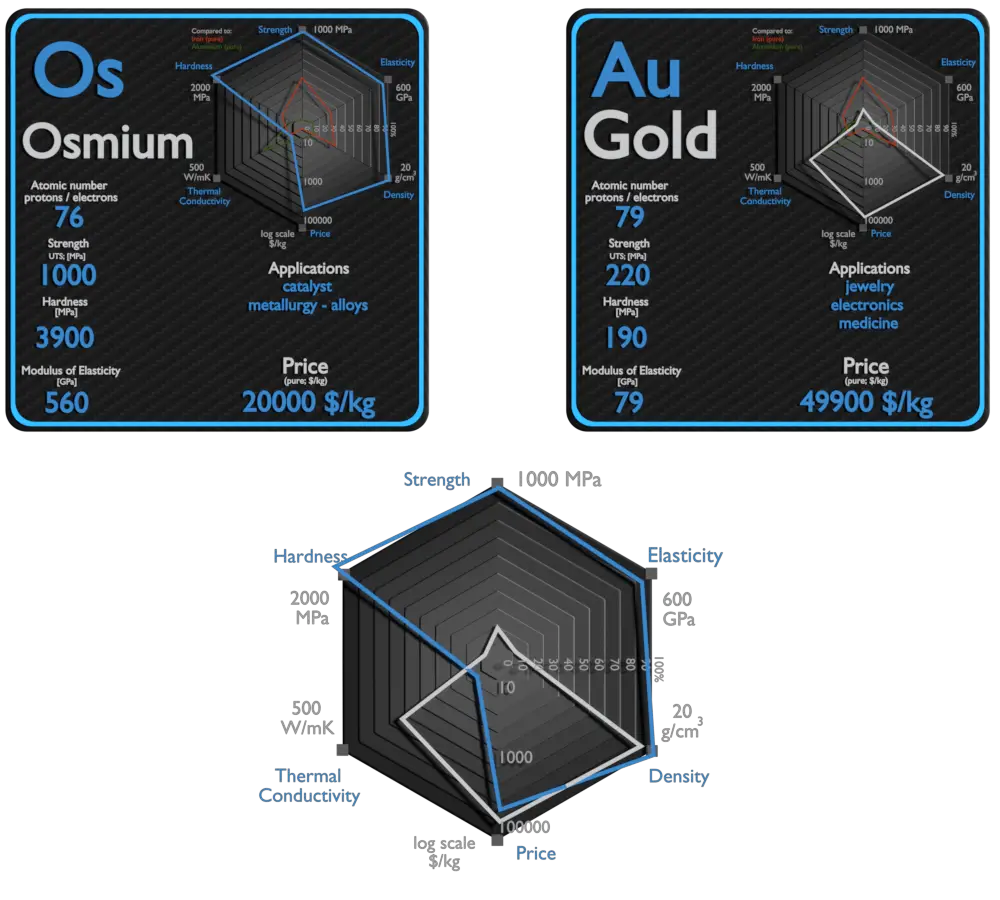
This article contains comparison of key thermal and atomic properties of osmium and gold, two comparable chemical elements from the periodic table. It also contains basic descriptions and applications of both elements. Osmium vs Gold.

osmium and gold - comparison

Compare osmium with another element

Iridium - Properties - Price - Applications - Production

Gold - Properties - Price - Applications - Production

Compare gold with another element

Titanium - Properties - Price - Applications - Production

Cobalt - Properties - Price - Applications - Production

Nickel - Properties - Price - Applications - Production

Copper - Properties - Price - Applications - Production

Rhodium - Properties - Price - Applications - Production

Palladium - Properties - Price - Applications - Production

Silver - Properties - Price - Applications - Production

Tungsten - Properties - Price - Applications - Production

Osmium - Properties - Price - Applications - Production

Iridium - Properties - Price - Applications - Production

Platinum - Properties - Price - Applications - Production

Lead - Properties - Price - Applications - Production

Osmium and Gold – About Elements

Osmium

Osmium is a hard, brittle, bluish-white transition metal in the platinum group that is found as a trace element in alloys, mostly in platinum ores. Osmium is the densest naturally occurring element, with a density of 22.59 g/cm3. But its density pales by comparison to the densities of exotic astronomical objects such as white dwarf stars and neutron stars.

Gold

Gold is a bright, slightly reddish yellow, dense, soft, malleable, and ductile metal. Gold is a transition metal and a group 11 element. It is one of the least reactive chemical elements and is solid under standard conditions. Gold is thought to have been produced in supernova nucleosynthesis, from the collision of neutron stars.

Osmium in Periodic Table

Gold in Periodic Table

Source: www.luciteria.com

Osmium and Gold – Applications

Osmium

Due to its rarity and hence expense, osmium has only a few industrial uses. It is used to produce very hard alloys for fountain pen tips, instrument pivots, needles and electrical contacts. It is also used in the chemical industry as a catalyst. Finely divided osmium metal can be used as a catalyst e.g. in the process of forming ammonia by combining hydrogen and nitrogen.

Gold

Gold is used extensively in jewellery, either in its pure form or as an alloy. About 75% of all gold produced is used in the jewelry industry. Pure gold is too soft to stand up to the stresses applied to many jewelry items. Craftsmen learned that alloying gold with other metals such as copper, silver, and platinum would increase its durability. The term ‘carat’ indicates the amount of gold present in an alloy. 24-carat is pure gold, but it is very soft. 18- and 9-carat gold alloys are commonly used because they are more durable. Gold’s high malleability, ductility, resistance to corrosion and most other chemical reactions, and conductivity of electricity have led to its continued use in corrosion resistant electrical connectors in all types of computerized devices (its chief industrial use). Gold is also used in infrared shielding, colored-glass production, gold leafing, and tooth restoration. Only 10% of the world consumption of new gold produced goes to industry, but by far the most important industrial use for new gold is in fabrication of corrosion-free electrical connectors in computers and other electrical devices.

Osmium and Gold – Comparison in Table

Element Osmium Gold
Density 22.61 g/cm3 19.3 g/cm3
Ultimate Tensile Strength 1000 MPa 220 MPa
Yield Strength N/A 205 MPa
Young’s Modulus of Elasticity N/A 79 GPa
Mohs Scale 7 2.75
Brinell Hardness 3900 MPa 190 MPa
Vickers Hardness 4140 MPa 215 MPa
Melting Point 3045 °C 1064 °C
Boiling Point 5030 °C 2970 °C
Thermal Conductivity 88 W/mK 320 W/mK
Thermal Expansion Coefficient 5.1 µm/mK 14.2 µm/mK
Specific Heat 0.13 J/g K 0.128 J/g K
Heat of Fusion 31.8 kJ/mol 12.55 kJ/mol
Heat of Vaporization 746 kJ/mol 334.4 kJ/mol


Silver and Platinum – Comparison – Properties

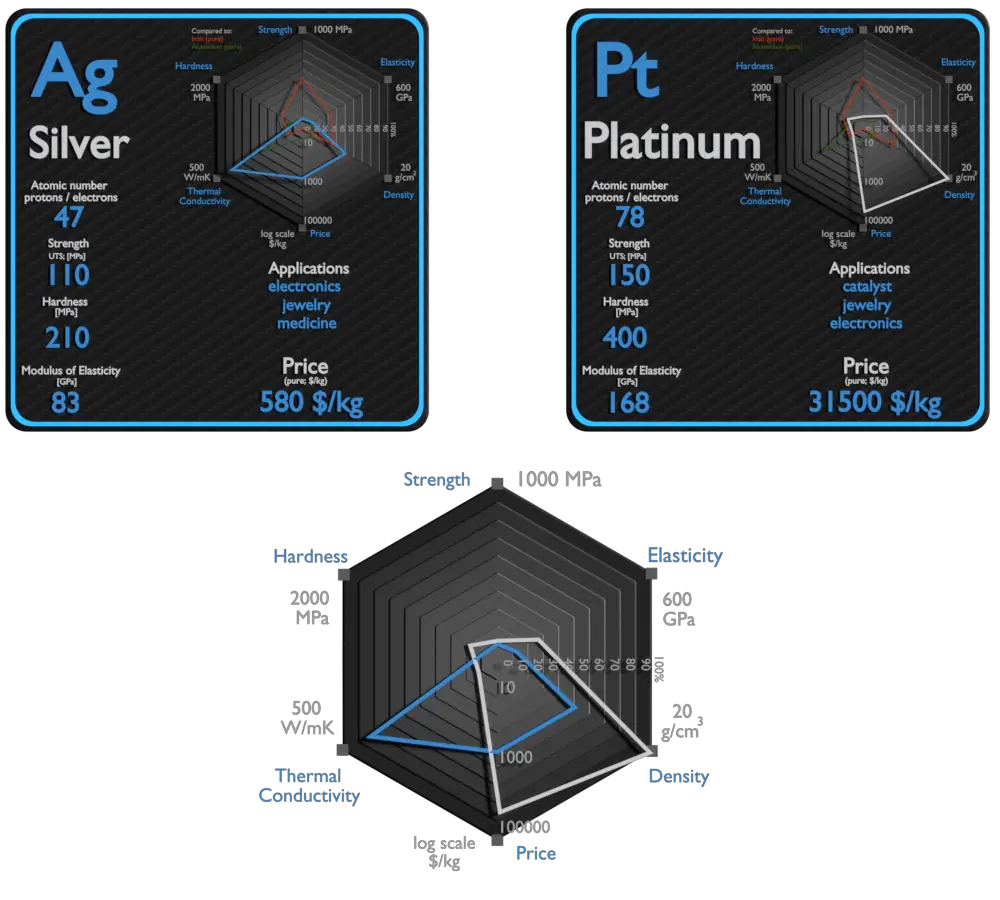
This article contains comparison of key thermal and atomic properties of silver and platinum, two comparable chemical elements from the periodic table. It also contains basic descriptions and applications of both elements. Silver vs Platinum.

silver and platinum - comparison

Compare silver with another element

Chlorine - Properties - Price - Applications - Production

Cobalt - Properties - Price - Applications - Production

Nickel - Properties - Price - Applications - Production

Copper - Properties - Price - Applications - Production

Rhodium - Properties - Price - Applications - Production

Palladium - Properties - Price - Applications - Production

Gold - Properties - Price - Applications - Production

Platinum - Properties - Price - Applications - Production

Compare platinum with another element

Nickel - Properties - Price - Applications - Production

Rhodium - Properties - Price - Applications - Production

Palladium - Properties - Price - Applications - Production

Silver - Properties - Price - Applications - Production

Tungsten - Properties - Price - Applications - Production

Iridium - Properties - Price - Applications - Production

Gold - Properties - Price - Applications - Production

Silver and Platinum – About Elements

Silver

Silver is a soft, white, lustrous transition metal, it exhibits the highest electrical conductivity, thermal conductivity, and reflectivity of any metal. The metal is found in the Earth’s crust in the pure, free elemental form (“native silver”), as an alloy with gold and other metals, and in minerals such as argentite and chlorargyrite. Most silver is produced as a byproduct of copper, gold, lead, and zinc refining.

Platinum

Platinum is a dense, malleable, ductile, highly unreactive, precious, silverish-white transition metal. Platinum is one of the least reactive metals. It has remarkable resistance to corrosion, even at high temperatures, and is therefore considered a noble metal. Platinum is used in catalytic converters, laboratory equipment, electrical contacts and electrodes, platinum resistance thermometers, dentistry equipment, and jewelry.

Silver in Periodic Table

Platinum in Periodic Table

Source: www.luciteria.com

Silver and Platinum – Applications

Silver

Silver has long been valued as a precious metal. Silver metal is used in many bullion coins, sometimes alongside gold. Silver has many important, far-reaching technological and electronic applications. It’s used in everything from cell phones, computers and semiconductors to automobiles, water-purification systems and—because it is the best conductor of heat of all elements—spacecraft solar radiation tiles. Silver is of the upmost importance in photography (where approximately 30% of the U.S. Industrial consumption goes into this application). The medical uses of silver include its use in wound dressings, creams, and as an antibiotic coating on medical devices. Wound dressings containing silver sulfadiazine or silver nanomaterials may be used on external infections.

Platinum

Platinum is primarily an industrial metal. It is a critical material for many industries and is considered a strategic metal. Platinum is used as a catalyst, platinum is mostly found in vehicle catalytic converters that reduce toxic exhaust chemicals, and also in fuel cells to increase efficiency. The most common use of platinum is as a catalyst in chemical reactions, often as platinum black. In catalytic converters, platinum allows the complete combustion of low concentrations of unburned hydrocarbons from the exhaust into carbon dioxide and water vapor. Platinum has been used in thermocouple devices that measure temperature with high accuracy. Platinum is a component in magnetic coatings for high-density hard disk drives and some of the newer optical storage systems.

Silver and Platinum – Comparison in Table

Element Silver Platinum
Density 10.49  g/cm3 21.09 g/cm3
Ultimate Tensile Strength 110 MPa 150 MPa
Yield Strength 45 MPa 70 MPa
Young’s Modulus of Elasticity 83 GPa 168 GPa
Mohs Scale 3.25 3.5
Brinell Hardness 210 MPa 400 MPa
Vickers Hardness 251 MPa 550 MPa
Melting Point 961.78 °C 1772 °C
Boiling Point 2162 °C 3827 °C
Thermal Conductivity 430 W/mK 72 W/mK
Thermal Expansion Coefficient 18.9 µm/mK 8.8 µm/mK
Specific Heat 0.235 J/g K 0.13 J/g K
Heat of Fusion 11.3 kJ/mol 19.6 kJ/mol
Heat of Vaporization 250.58 kJ/mol 510 kJ/mol


Silver and Gold – Comparison – Properties

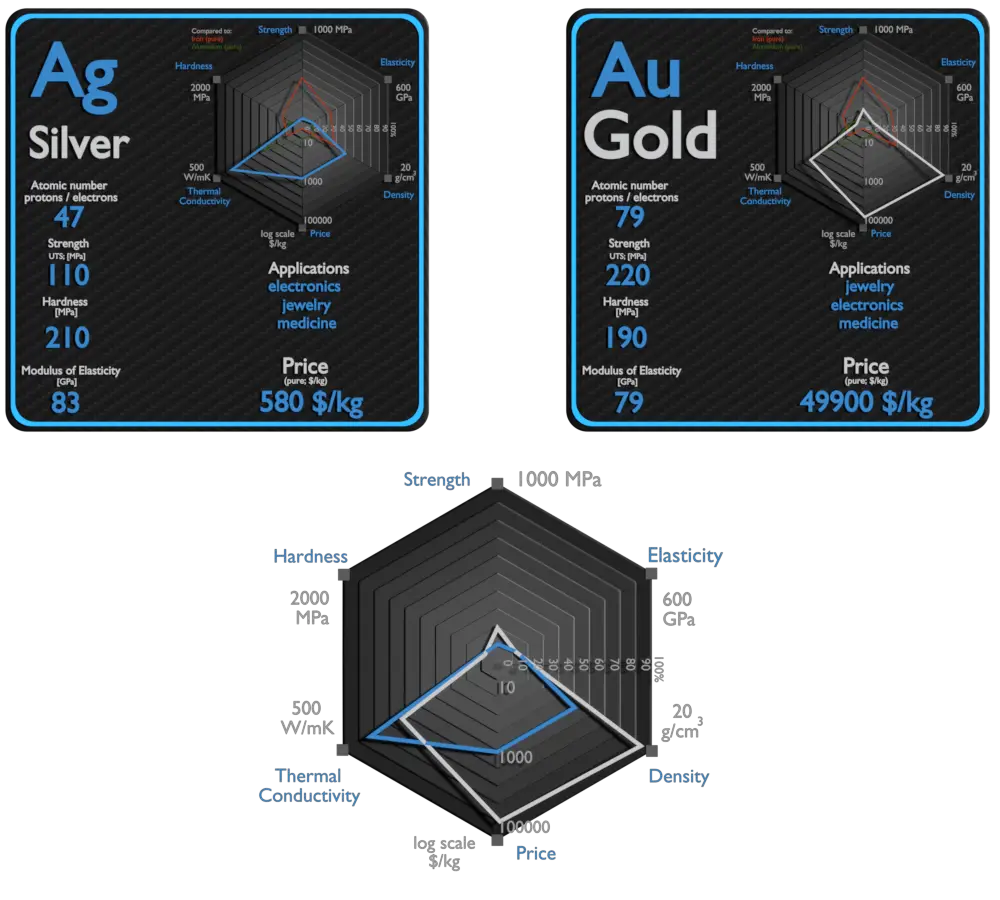
This article contains comparison of key thermal and atomic properties of silver and gold, two comparable chemical elements from the periodic table. It also contains basic descriptions and applications of both elements. Silver vs Gold.

silver and gold - comparison

Compare silver with another element

Chlorine - Properties - Price - Applications - Production

Cobalt - Properties - Price - Applications - Production

Nickel - Properties - Price - Applications - Production

Copper - Properties - Price - Applications - Production

Rhodium - Properties - Price - Applications - Production

Palladium - Properties - Price - Applications - Production

Gold - Properties - Price - Applications - Production

Platinum - Properties - Price - Applications - Production

Compare gold with another element

Titanium - Properties - Price - Applications - Production

Cobalt - Properties - Price - Applications - Production

Nickel - Properties - Price - Applications - Production

Copper - Properties - Price - Applications - Production

Rhodium - Properties - Price - Applications - Production

Palladium - Properties - Price - Applications - Production

Silver - Properties - Price - Applications - Production

Tungsten - Properties - Price - Applications - Production

Osmium - Properties - Price - Applications - Production

Iridium - Properties - Price - Applications - Production

Platinum - Properties - Price - Applications - Production

Lead - Properties - Price - Applications - Production

Silver and Gold – About Elements

Silver

Silver is a soft, white, lustrous transition metal, it exhibits the highest electrical conductivity, thermal conductivity, and reflectivity of any metal. The metal is found in the Earth’s crust in the pure, free elemental form (“native silver”), as an alloy with gold and other metals, and in minerals such as argentite and chlorargyrite. Most silver is produced as a byproduct of copper, gold, lead, and zinc refining.

Gold

Gold is a bright, slightly reddish yellow, dense, soft, malleable, and ductile metal. Gold is a transition metal and a group 11 element. It is one of the least reactive chemical elements and is solid under standard conditions. Gold is thought to have been produced in supernova nucleosynthesis, from the collision of neutron stars.

Silver in Periodic Table

Gold in Periodic Table

Source: www.luciteria.com

Silver and Gold – Applications

Silver

Silver has long been valued as a precious metal. Silver metal is used in many bullion coins, sometimes alongside gold. Silver has many important, far-reaching technological and electronic applications. It’s used in everything from cell phones, computers and semiconductors to automobiles, water-purification systems and—because it is the best conductor of heat of all elements—spacecraft solar radiation tiles. Silver is of the upmost importance in photography (where approximately 30% of the U.S. Industrial consumption goes into this application). The medical uses of silver include its use in wound dressings, creams, and as an antibiotic coating on medical devices. Wound dressings containing silver sulfadiazine or silver nanomaterials may be used on external infections.

Gold

Gold is used extensively in jewellery, either in its pure form or as an alloy. About 75% of all gold produced is used in the jewelry industry. Pure gold is too soft to stand up to the stresses applied to many jewelry items. Craftsmen learned that alloying gold with other metals such as copper, silver, and platinum would increase its durability. The term ‘carat’ indicates the amount of gold present in an alloy. 24-carat is pure gold, but it is very soft. 18- and 9-carat gold alloys are commonly used because they are more durable. Gold’s high malleability, ductility, resistance to corrosion and most other chemical reactions, and conductivity of electricity have led to its continued use in corrosion resistant electrical connectors in all types of computerized devices (its chief industrial use). Gold is also used in infrared shielding, colored-glass production, gold leafing, and tooth restoration. Only 10% of the world consumption of new gold produced goes to industry, but by far the most important industrial use for new gold is in fabrication of corrosion-free electrical connectors in computers and other electrical devices.

Silver and Gold – Comparison in Table

Element Silver Gold
Density 10.49  g/cm3 19.3 g/cm3
Ultimate Tensile Strength 110 MPa 220 MPa
Yield Strength 45 MPa 205 MPa
Young’s Modulus of Elasticity 83 GPa 79 GPa
Mohs Scale 3.25 2.75
Brinell Hardness 210 MPa 190 MPa
Vickers Hardness 251 MPa 215 MPa
Melting Point 961.78 °C 1064 °C
Boiling Point 2162 °C 2970 °C
Thermal Conductivity 430 W/mK 320 W/mK
Thermal Expansion Coefficient 18.9 µm/mK 14.2 µm/mK
Specific Heat 0.235 J/g K 0.128 J/g K
Heat of Fusion 11.3 kJ/mol 12.55 kJ/mol
Heat of Vaporization 250.58 kJ/mol 334.4 kJ/mol


Palladium and Gold – Comparison – Properties

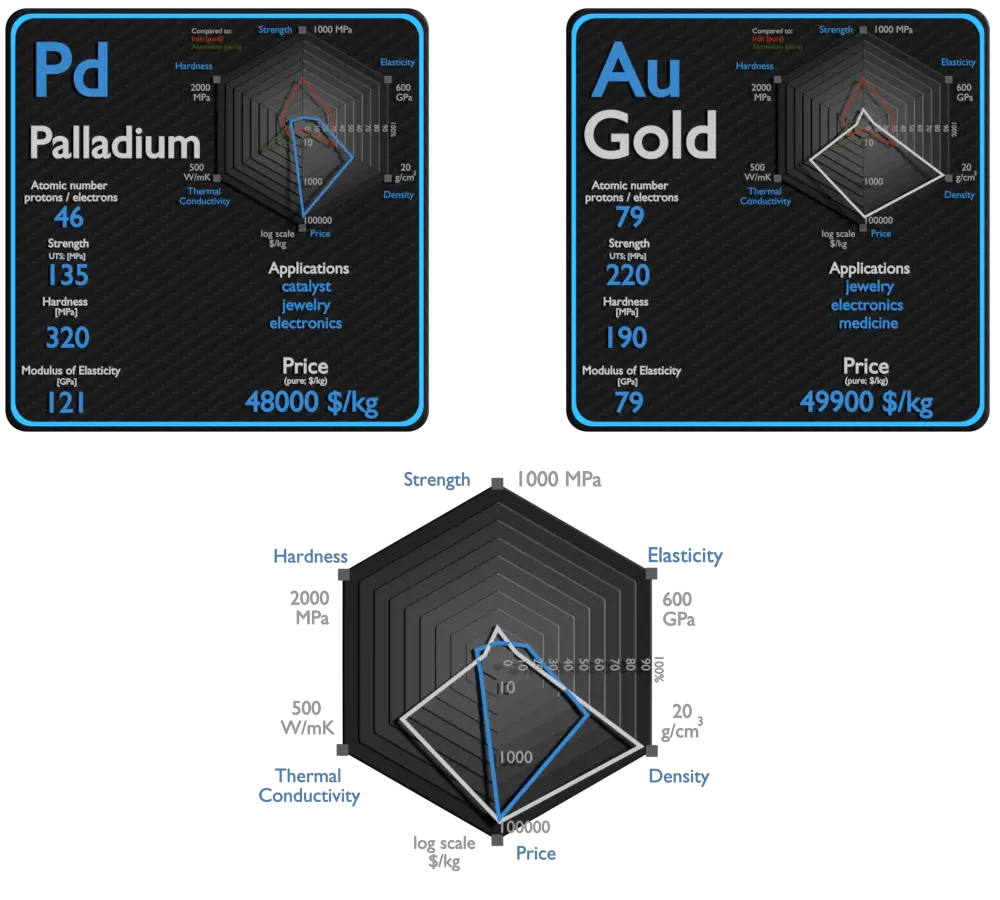
This article contains comparison of key thermal and atomic properties of palladium and gold, two comparable chemical elements from the periodic table. It also contains basic descriptions and applications of both elements. Palladium vs Gold.

palladium and gold - comparison

Compare palladium with another element

Rhodium - Properties - Price - Applications - Production

Gold - Properties - Price - Applications - Production

Platinum - Properties - Price - Applications - Production

Silver - Properties - Price - Applications - Production

Compare gold with another element

Titanium - Properties - Price - Applications - Production

Cobalt - Properties - Price - Applications - Production

Nickel - Properties - Price - Applications - Production

Copper - Properties - Price - Applications - Production

Rhodium - Properties - Price - Applications - Production

Palladium - Properties - Price - Applications - Production

Silver - Properties - Price - Applications - Production

Tungsten - Properties - Price - Applications - Production

Osmium - Properties - Price - Applications - Production

Iridium - Properties - Price - Applications - Production

Platinum - Properties - Price - Applications - Production

Lead - Properties - Price - Applications - Production

Palladium and Gold – About Elements

Palladium

Palladium, platinum, rhodium, ruthenium, iridium and osmium form a group of elements referred to as the platinum group metals (PGMs). These have similar chemical properties, but palladium has the lowest melting point and is the least dense of them. More than half the supply of palladium and its congener platinum is used in catalytic converters.

Gold

Gold is a bright, slightly reddish yellow, dense, soft, malleable, and ductile metal. Gold is a transition metal and a group 11 element. It is one of the least reactive chemical elements and is solid under standard conditions. Gold is thought to have been produced in supernova nucleosynthesis, from the collision of neutron stars.

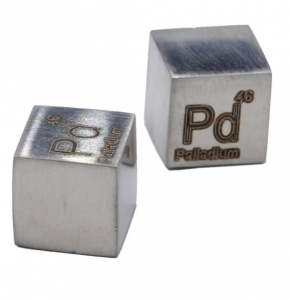
Palladium in Periodic Table

Gold in Periodic Table

Source: www.luciteria.com

Palladium and Gold – Applications

Palladium

More than half the supply of palladium and its congener platinum is used in catalytic converters, which convert as much as 90% of the harmful gases in automobile exhaust into less noxious substances. Palladium is also used in electronics, dentistry, medicine, hydrogen purification, chemical applications, groundwater treatment, and jewelry. Palladium-based alloys are being extensively used in fuel cell technology applications. The metal is also employed in historic photographic printing process. Palladium has been used as a precious metal in jewelry since 1939 as an alternative to platinum in the alloys called “white gold”.

Gold

Gold is used extensively in jewellery, either in its pure form or as an alloy. About 75% of all gold produced is used in the jewelry industry. Pure gold is too soft to stand up to the stresses applied to many jewelry items. Craftsmen learned that alloying gold with other metals such as copper, silver, and platinum would increase its durability. The term ‘carat’ indicates the amount of gold present in an alloy. 24-carat is pure gold, but it is very soft. 18- and 9-carat gold alloys are commonly used because they are more durable. Gold’s high malleability, ductility, resistance to corrosion and most other chemical reactions, and conductivity of electricity have led to its continued use in corrosion resistant electrical connectors in all types of computerized devices (its chief industrial use). Gold is also used in infrared shielding, colored-glass production, gold leafing, and tooth restoration. Only 10% of the world consumption of new gold produced goes to industry, but by far the most important industrial use for new gold is in fabrication of corrosion-free electrical connectors in computers and other electrical devices.

Palladium and Gold – Comparison in Table

Element Palladium Gold
Density 12.023 g/cm3 19.3 g/cm3
Ultimate Tensile Strength 135 MPa 220 MPa
Yield Strength 30 MPa 205 MPa
Young’s Modulus of Elasticity 121 GPa 79 GPa
Mohs Scale 4.8 2.75
Brinell Hardness 320 MPa 190 MPa
Vickers Hardness 400 MPa 215 MPa
Melting Point 1554.9 °C 1064 °C
Boiling Point 2963 °C 2970 °C
Thermal Conductivity 72 W/mK 320 W/mK
Thermal Expansion Coefficient 11.8 µm/mK 14.2 µm/mK
Specific Heat 0.24 J/g K 0.128 J/g K
Heat of Fusion 17.6 kJ/mol 12.55 kJ/mol
Heat of Vaporization 357 kJ/mol 334.4 kJ/mol


Palladium and Platinum – Comparison – Properties

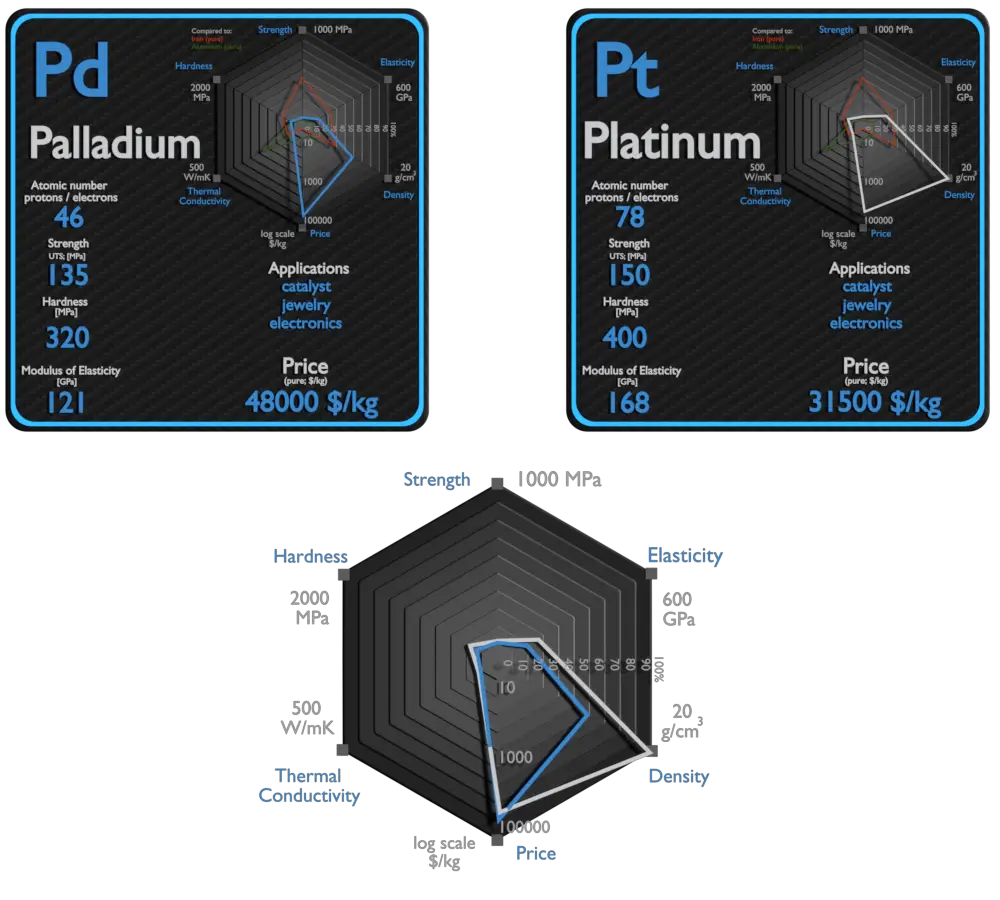
This article contains comparison of key thermal and atomic properties of palladium and platinum, two comparable chemical elements from the periodic table. It also contains basic descriptions and applications of both elements. Palladium vs Platinum.

palladium and platinum - comparison

Compare palladium with another element

Rhodium - Properties - Price - Applications - Production

Gold - Properties - Price - Applications - Production

Platinum - Properties - Price - Applications - Production

Silver - Properties - Price - Applications - Production

Compare platinum with another element

Nickel - Properties - Price - Applications - Production

Rhodium - Properties - Price - Applications - Production

Palladium - Properties - Price - Applications - Production

Silver - Properties - Price - Applications - Production

Tungsten - Properties - Price - Applications - Production

Iridium - Properties - Price - Applications - Production

Gold - Properties - Price - Applications - Production

Palladium and Platinum – About Elements

Palladium

Palladium, platinum, rhodium, ruthenium, iridium and osmium form a group of elements referred to as the platinum group metals (PGMs). These have similar chemical properties, but palladium has the lowest melting point and is the least dense of them. More than half the supply of palladium and its congener platinum is used in catalytic converters.

Platinum

Platinum is a dense, malleable, ductile, highly unreactive, precious, silverish-white transition metal. Platinum is one of the least reactive metals. It has remarkable resistance to corrosion, even at high temperatures, and is therefore considered a noble metal. Platinum is used in catalytic converters, laboratory equipment, electrical contacts and electrodes, platinum resistance thermometers, dentistry equipment, and jewelry.

Palladium in Periodic Table

Platinum in Periodic Table

Source: www.luciteria.com

Palladium and Platinum – Applications

Palladium

More than half the supply of palladium and its congener platinum is used in catalytic converters, which convert as much as 90% of the harmful gases in automobile exhaust into less noxious substances. Palladium is also used in electronics, dentistry, medicine, hydrogen purification, chemical applications, groundwater treatment, and jewelry. Palladium-based alloys are being extensively used in fuel cell technology applications. The metal is also employed in historic photographic printing process. Palladium has been used as a precious metal in jewelry since 1939 as an alternative to platinum in the alloys called “white gold”.

Platinum

Platinum is primarily an industrial metal. It is a critical material for many industries and is considered a strategic metal. Platinum is used as a catalyst, platinum is mostly found in vehicle catalytic converters that reduce toxic exhaust chemicals, and also in fuel cells to increase efficiency. The most common use of platinum is as a catalyst in chemical reactions, often as platinum black. In catalytic converters, platinum allows the complete combustion of low concentrations of unburned hydrocarbons from the exhaust into carbon dioxide and water vapor. Platinum has been used in thermocouple devices that measure temperature with high accuracy. Platinum is a component in magnetic coatings for high-density hard disk drives and some of the newer optical storage systems.

Palladium and Platinum – Comparison in Table

Element Palladium Platinum
Density 12.023 g/cm3 21.09 g/cm3
Ultimate Tensile Strength 135 MPa 150 MPa
Yield Strength 30 MPa 70 MPa
Young’s Modulus of Elasticity 121 GPa 168 GPa
Mohs Scale 4.8 3.5
Brinell Hardness 320 MPa 400 MPa
Vickers Hardness 400 MPa 550 MPa
Melting Point 1554.9 °C 1772 °C
Boiling Point 2963 °C 3827 °C
Thermal Conductivity 72 W/mK 72 W/mK
Thermal Expansion Coefficient 11.8 µm/mK 8.8 µm/mK
Specific Heat 0.24 J/g K 0.13 J/g K
Heat of Fusion 17.6 kJ/mol 19.6 kJ/mol
Heat of Vaporization 357 kJ/mol 510 kJ/mol


Palladium and Silver – Comparison – Properties

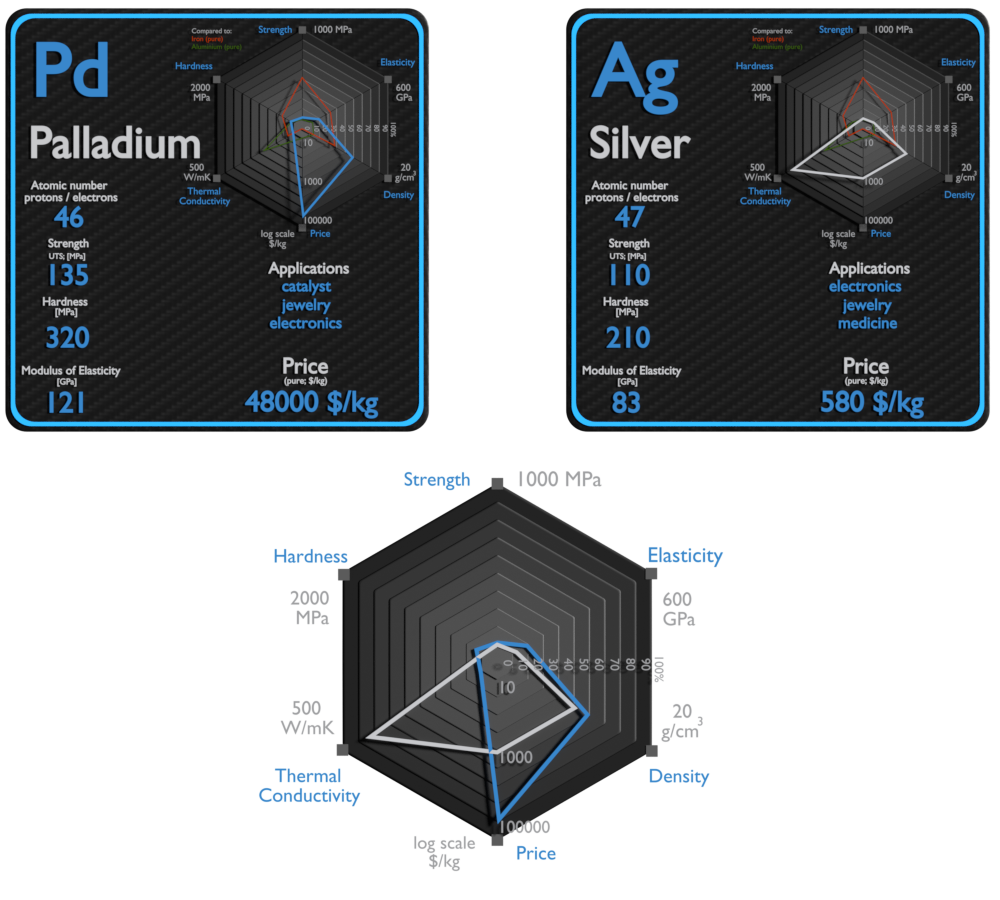
This article contains comparison of key thermal and atomic properties of palladium and silver, two comparable chemical elements from the periodic table. It also contains basic descriptions and applications of both elements. Palladium vs Silver.

palladium and silver - comparison

Compare palladium with another element

Rhodium - Properties - Price - Applications - Production

Gold - Properties - Price - Applications - Production

Platinum - Properties - Price - Applications - Production

Silver - Properties - Price - Applications - Production

Compare silver with another element

Chlorine - Properties - Price - Applications - Production

Cobalt - Properties - Price - Applications - Production

Nickel - Properties - Price - Applications - Production

Copper - Properties - Price - Applications - Production

Rhodium - Properties - Price - Applications - Production

Palladium - Properties - Price - Applications - Production

Gold - Properties - Price - Applications - Production

Platinum - Properties - Price - Applications - Production

Palladium and Silver – About Elements

Palladium

Palladium, platinum, rhodium, ruthenium, iridium and osmium form a group of elements referred to as the platinum group metals (PGMs). These have similar chemical properties, but palladium has the lowest melting point and is the least dense of them. More than half the supply of palladium and its congener platinum is used in catalytic converters.

Silver

Silver is a soft, white, lustrous transition metal, it exhibits the highest electrical conductivity, thermal conductivity, and reflectivity of any metal. The metal is found in the Earth’s crust in the pure, free elemental form (“native silver”), as an alloy with gold and other metals, and in minerals such as argentite and chlorargyrite. Most silver is produced as a byproduct of copper, gold, lead, and zinc refining.

Palladium in Periodic Table

Silver in Periodic Table

Source: www.luciteria.com

Palladium and Silver – Applications

Palladium

More than half the supply of palladium and its congener platinum is used in catalytic converters, which convert as much as 90% of the harmful gases in automobile exhaust into less noxious substances. Palladium is also used in electronics, dentistry, medicine, hydrogen purification, chemical applications, groundwater treatment, and jewelry. Palladium-based alloys are being extensively used in fuel cell technology applications. The metal is also employed in historic photographic printing process. Palladium has been used as a precious metal in jewelry since 1939 as an alternative to platinum in the alloys called “white gold”.

Silver

Silver has long been valued as a precious metal. Silver metal is used in many bullion coins, sometimes alongside gold. Silver has many important, far-reaching technological and electronic applications. It’s used in everything from cell phones, computers and semiconductors to automobiles, water-purification systems and—because it is the best conductor of heat of all elements—spacecraft solar radiation tiles. Silver is of the upmost importance in photography (where approximately 30% of the U.S. Industrial consumption goes into this application). The medical uses of silver include its use in wound dressings, creams, and as an antibiotic coating on medical devices. Wound dressings containing silver sulfadiazine or silver nanomaterials may be used on external infections.

Palladium and Silver – Comparison in Table

Element Palladium Silver
Density 12.023 g/cm3 10.49 g/cm3
Ultimate Tensile Strength 135 MPa 110 MPa
Yield Strength 30 MPa 45 MPa
Young’s Modulus of Elasticity 121 GPa 83 GPa
Mohs Scale 4.8 3.25
Brinell Hardness 320 MPa 210 MPa
Vickers Hardness 400 MPa 251 MPa
Melting Point 1554.9 °C 961.78 °C
Boiling Point 2963 °C 2162 °C
Thermal Conductivity 72 W/mK 430 W/mK
Thermal Expansion Coefficient 11.8 µm/mK 18.9 µm/mK
Specific Heat 0.24 J/g K 0.235 J/g K
Heat of Fusion 17.6 kJ/mol 11.3 kJ/mol
Heat of Vaporization 357 kJ/mol 250.58 kJ/mol