Facebook Instagram Youtube Twitter

Neodymium and Dysprosium – Comparison – Properties

This article contains comparison of key thermal and atomic properties of neodymium and dysprosium, two comparable chemical elements from the periodic table. It also contains basic descriptions and applications of both elements. Neodymium vs Dysprosium.
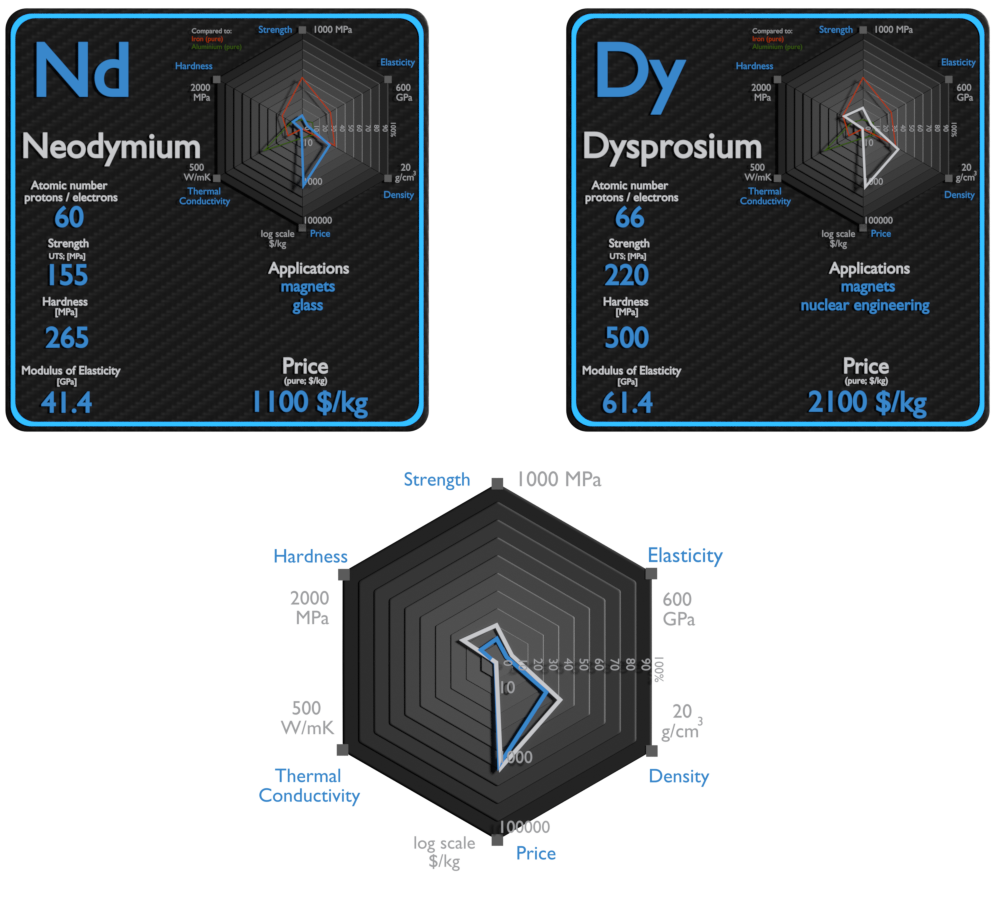
neodymium and dysprosium - comparison

Compare neodymium with another element

Dysprosium - Properties - Price - Applications - Production

Praseodymium - Properties - Price - Applications - Production

Compare dysprosium with another element

Neodymium - Properties - Price - Applications - Production

Europium - Properties - Price - Applications - Production

Terbium - Properties - Price - Applications - Production

Neodymium and Dysprosium – About Elements
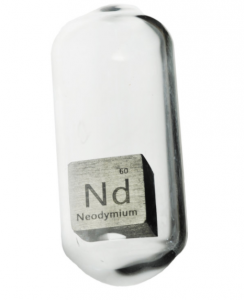
Neodymium

Neodymium is a soft silvery metal that tarnishes in air. Neodymium is not found naturally in metallic form or unmixed with other lanthanides, and it is usually refined for general use. Although neodymium is classed as a rare earth, it is a fairly common element.

Dysprosium

Dysprosium is a rare earth element with a metallic silver luster. Dysprosium is used for its high thermal neutron absorption cross-section in making control rods in nuclear reactors, for its high magnetic susceptibility in data storage applications.

Neodymium in Periodic Table

Dysprosium in Periodic Table

Source: www.luciteria.com

Neodymium and Dysprosium – Applications

Neodymium

The most important use for neodymium is in an alloy with iron and boron to make very strong permanent magnets. These magnets are widely used in such products as microphones, professional loudspeakers, in-ear headphones, high performance hobby DC electric motors, and computer hard disks, where low magnet mass (or volume) or strong magnetic fields are required. Larger neodymium magnets are used in high-power-versus-weight electric motors (for example in hybrid cars) and generators (for example aircraft and wind turbine electric generators). Neodymium is a component, along with praseodymium, of didymium glass. This is a special glass for goggles used during glass blowing and welding. The element colours glass delicate shades of violet, wine-red and grey. Neodymium is also used in the glass for tanning booths, since it transmits the tanning UV rays but not the heating infrared rays.

Dysprosium

Dysprosium is utilized in ferrites and magnetic alloys for microwave use. Dysprosium is increasingly in demand for the permanent magnets used in electric-car motors and wind-turbine generators. Special stainless steels alloyed with dysprosium are used in nuclear control applications, that is, nuclear reactor control rods. The candidate of a new absorber material for accident-tollerant control rods includes gadolinia (Gd2O3), samaria (Sm2O3), europia (Eu2O3), dysprosia (Dy2O3), hafnia (HfO2).

Neodymium and Dysprosium – Comparison in Table

Element Neodymium Dysprosium
Density 7.01 g/cm3 8.551 g/cm3
Ultimate Tensile Strength 155 MPa 220 MPa
Yield Strength 150 MPa 200 MPa
Young’s Modulus of Elasticity 41.4 GPa 61.4 GPa
Mohs Scale N/A N/A
Brinell Hardness 265 MPa 500 MPa
Vickers Hardness 350 MPa 550 MPa
Melting Point 1016 °C 1412 °C
Boiling Point 3074 °C 2567 °C
Thermal Conductivity 17 W/mK 11 W/mK
Thermal Expansion Coefficient 9.6 µm/mK 9.9 µm/mK
Specific Heat 0.19 J/g K 0.17 J/g K
Heat of Fusion 7.14 kJ/mol 11.06 kJ/mol
Heat of Vaporization 273 kJ/mol 230.1 kJ/mol


Terbium and Dysprosium – Comparison – Properties

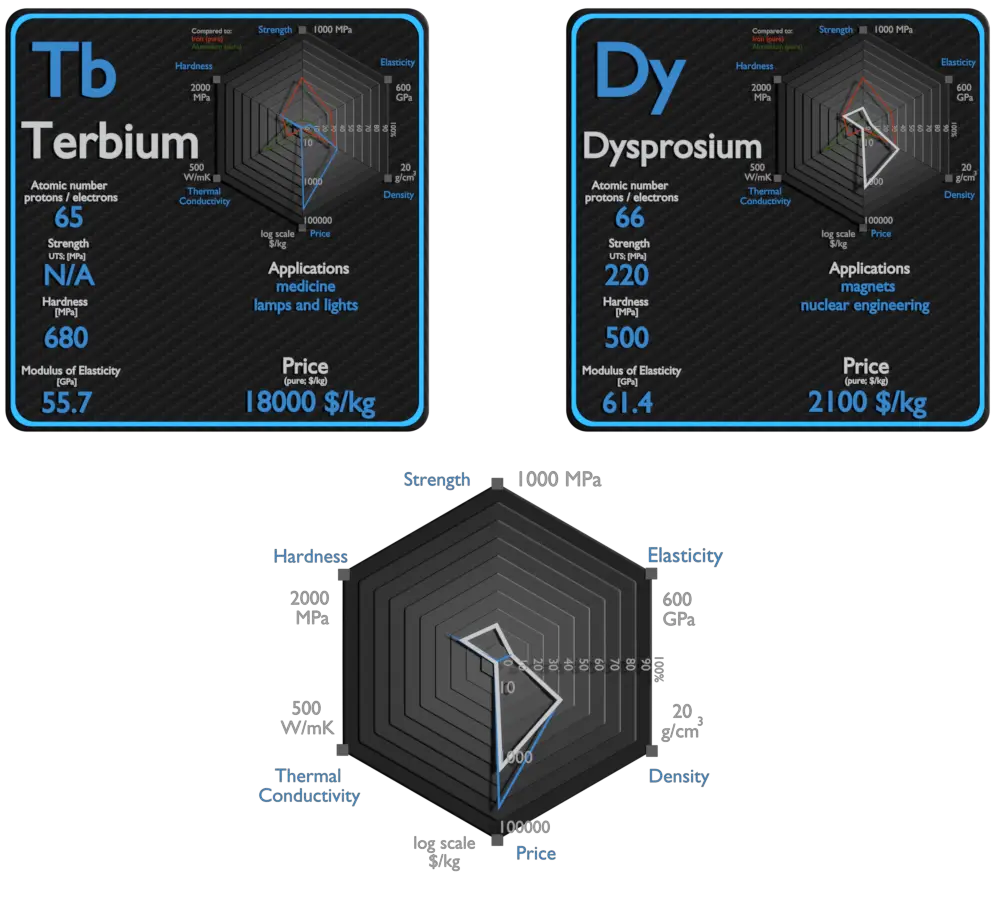
This article contains comparison of key thermal and atomic properties of terbium and dysprosium, two comparable chemical elements from the periodic table. It also contains basic descriptions and applications of both elements. Terbium vs Dysprosium.

terbium and dysprosium - comparison

Compare terbium with another element

Dysprosium - Properties - Price - Applications - Production

Compare dysprosium with another element

Neodymium - Properties - Price - Applications - Production

Europium - Properties - Price - Applications - Production

Terbium - Properties - Price - Applications - Production

Terbium and Dysprosium – About Elements

Terbium

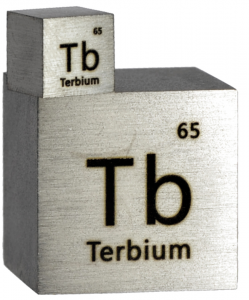
Terbium is a silvery-white, rare earth metal that is malleable, ductile, and soft enough to be cut with a knife. The ninth member of the lanthanide series, terbium is a fairly electropositive metal that reacts with water, evolving hydrogen gas.

Dysprosium

Dysprosium is a rare earth element with a metallic silver luster. Dysprosium is used for its high thermal neutron absorption cross-section in making control rods in nuclear reactors, for its high magnetic susceptibility in data storage applications.

Terbium in Periodic Table

Dysprosium in Periodic Table

Source: www.luciteria.com

Terbium and Dysprosium – Applications

Terbium

Terbium is used as a dopant in calcium fluoride, calcium tungstate, and strontium molybdate, materials that are used in solid-state devices. It is also used in low-energy lightbulbs and mercury lamps. Terbium oxide is used in green phosphors in fluorescent lamps and color TV tubes. It has been used to improve the safety of medical x-rays by allowing the same quality image to be produced with a much shorter exposure time. Terbium salts are used in laser devices.

Dysprosium

Dysprosium is utilized in ferrites and magnetic alloys for microwave use. Dysprosium is increasingly in demand for the permanent magnets used in electric-car motors and wind-turbine generators. Special stainless steels alloyed with dysprosium are used in nuclear control applications, that is, nuclear reactor control rods. The candidate of a new absorber material for accident-tollerant control rods includes gadolinium (Gd2O3), samarium (Sm2O3), europium (Eu2O3), dysprosium (Dy2O3), hafnium (HfO2).

Terbium and Dysprosium – Comparison in Table

Element Terbium Dysprosium
Density 8.219 g/cm3 8.551 g/cm3
Ultimate Tensile Strength N/A 220 MPa
Yield Strength N/A 200 MPa
Young’s Modulus of Elasticity 55.7 GPa 61.4 GPa
Mohs Scale N/A N/A
Brinell Hardness 680 MPa 500 MPa
Vickers Hardness 860 MPa 550 MPa
Melting Point 1365 °C 1412 °C
Boiling Point 3123 °C 2567 °C
Thermal Conductivity 11 W/mK 11 W/mK
Thermal Expansion Coefficient 10.3 µm/mK 9.9 µm/mK
Specific Heat 0.18 J/g K 0.17 J/g K
Heat of Fusion 10.8 kJ/mol 11.06 kJ/mol
Heat of Vaporization 330.9 kJ/mol 230.1 kJ/mol


Europium and Dysprosium – Comparison – Properties

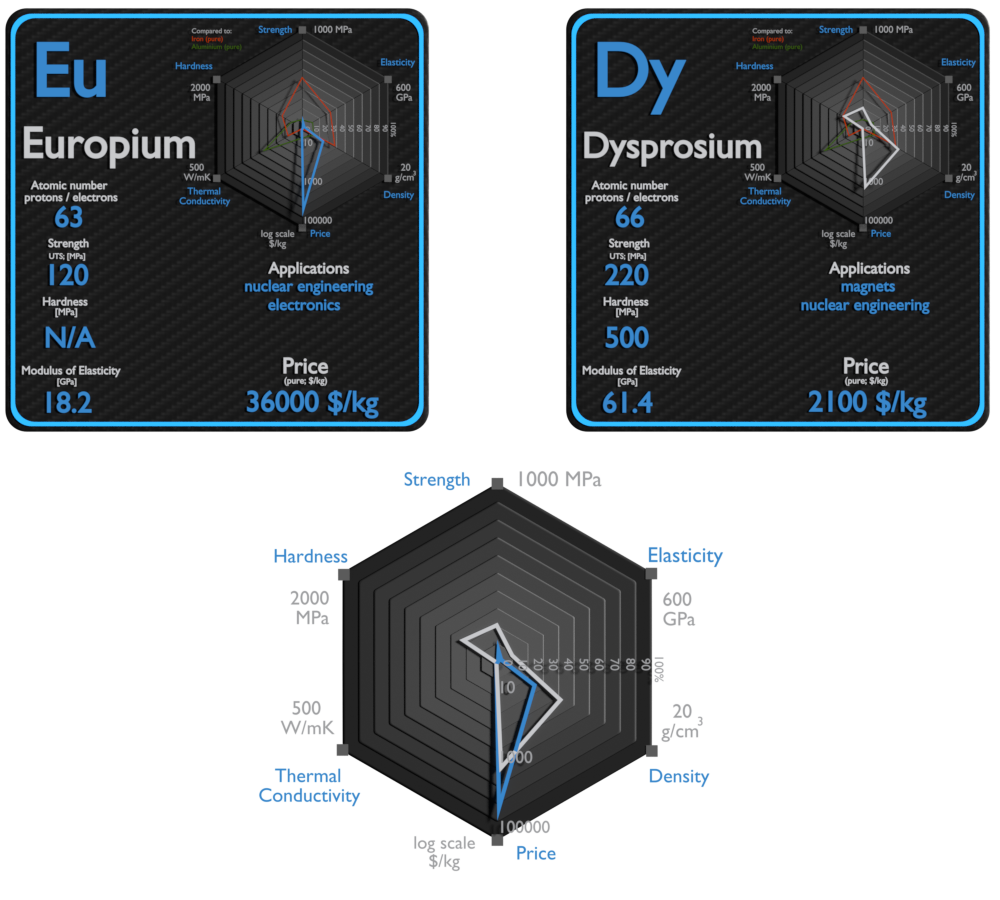
This article contains comparison of key thermal and atomic properties of europium and dysprosium, two comparable chemical elements from the periodic table. It also contains basic descriptions and applications of both elements. Europium vs Dysprosium.

europium and dysprosium - comparison

Compare europium with another element

Gadolinium - Properties - Price - Applications - Production

Dysprosium - Properties - Price - Applications - Production

Tantalum - Properties - Price - Applications - Production

Ytterbium - Properties - Price - Applications - Production

Compare dysprosium with another element

Neodymium - Properties - Price - Applications - Production

Europium - Properties - Price - Applications - Production

Terbium - Properties - Price - Applications - Production

Europium and Dysprosium – About Elements

Europium

Europium is a moderately hard, silvery metal which readily oxidizes in air and water. Being a typical member of the lanthanide series, europium usually assumes the oxidation state +3. Europium is one of the least abundant elements in the universe. Only about 5×10⁻⁸% of all matter in the universe is europium.

Dysprosium

Dysprosium is a rare earth element with a metallic silver luster. Dysprosium is used for its high thermal neutron absorption cross-section in making control rods in nuclear reactors, for its high magnetic susceptibility in data storage applications.

Europium in Periodic Table

Dysprosium in Periodic Table

Source: www.luciteria.com

Europium and Dysprosium – Applications

Europium

Europium is used in the printing of euro banknotes. It glows red under UV light, and forgeries can be detected by the lack of this red glow. It is a dopant in some types of glass in lasers and other optoelectronic devices. Since the isotopes of europium act as good neutron absorbers, they are being studied for use in nuclear control applications, such as in burnable absorbers.

Dysprosium

Dysprosium is utilized in ferrites and magnetic alloys for microwave use. Dysprosium is increasingly in demand for the permanent magnets used in electric-car motors and wind-turbine generators. Special stainless steels alloyed with dysprosium are used in nuclear control applications, that is, nuclear reactor control rods. The candidate of a new absorber material for accident-tollerant control rods includes gadolinium (Gd2O3), samarium (Sm2O3), europium (Eu2O3), dysprosium (Dy2O3), hafnium (HfO2).

Europium and Dysprosium – Comparison in Table

Element Europium Dysprosium
Density 5.244 g/cm3 8.551 g/cm3
Ultimate Tensile Strength 120 MPa 220 MPa
Yield Strength 60 MPa 200 MPa
Young’s Modulus of Elasticity 18.2 GPa 61.4 GPa
Mohs Scale N/A N/A
Brinell Hardness N/A 500 MPa
Vickers Hardness 170 MPa 550 MPa
Melting Point 822 °C 1412 °C
Boiling Point 1529 °C 2567 °C
Thermal Conductivity 14 W/mK 11 W/mK
Thermal Expansion Coefficient 35 µm/mK 9.9 µm/mK
Specific Heat 0.18 J/g K 0.17 J/g K
Heat of Fusion 9.21 kJ/mol 11.06 kJ/mol
Heat of Vaporization 143.5 kJ/mol 230.1 kJ/mol


Europium and Ytterbium – Comparison – Properties

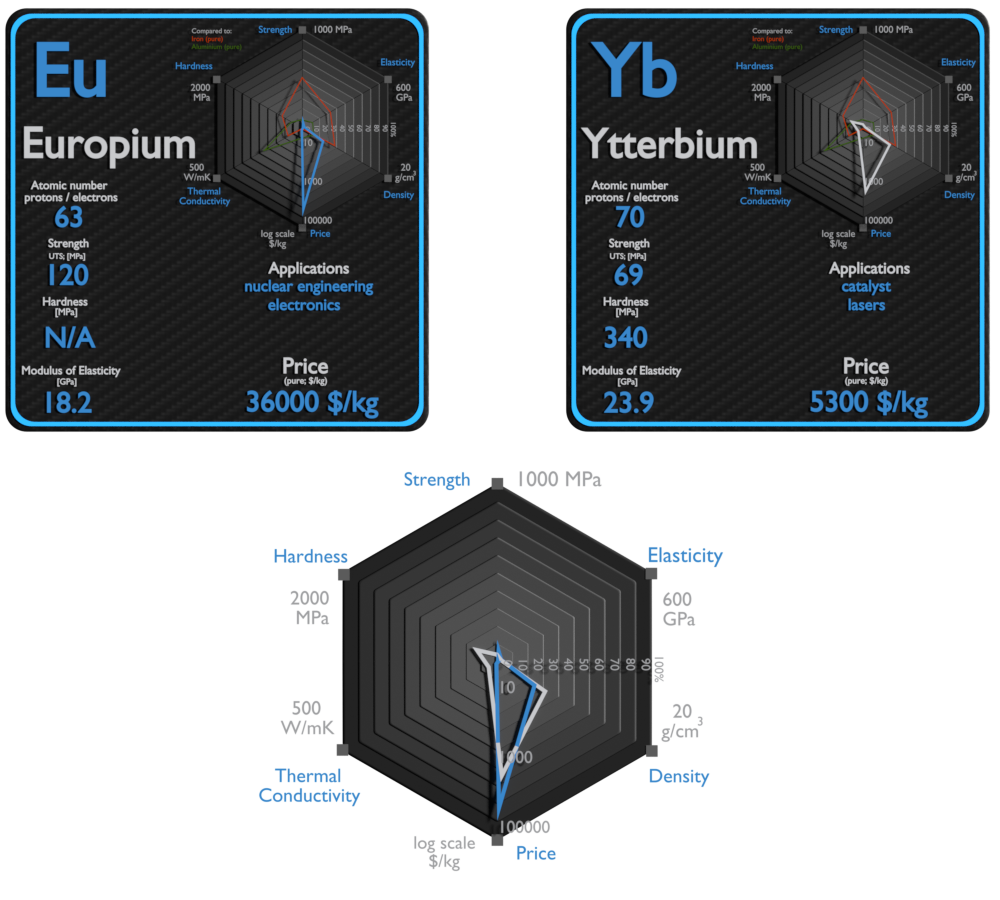
This article contains comparison of key thermal and atomic properties of europium and ytterbium, two comparable chemical elements from the periodic table. It also contains basic descriptions and applications of both elements. Europium vs Ytterbium.

europium and ytterbium - comparison

Compare europium with another element

Gadolinium - Properties - Price - Applications - Production

Dysprosium - Properties - Price - Applications - Production

Tantalum - Properties - Price - Applications - Production

Ytterbium - Properties - Price - Applications - Production

Compare ytterbium with another element

Europium - Properties - Price - Applications - Production

Yttrium - Properties - Price - Applications - Production

Europium and Ytterbium – About Elements

Europium

Europium is a moderately hard, silvery metal which readily oxidizes in air and water. Being a typical member of the lanthanide series, europium usually assumes the oxidation state +3. Europium is one of the least abundant elements in the universe. Only about 5×10⁻⁸% of all matter in the universe is europium.

Ytterbium

Because of its closed-shell electron configuration, its density and melting and boiling points differ significantly from those of most other lanthanides.

Europium in Periodic Table

Ytterbium in Periodic Table

Source: www.luciteria.com

Europium and Ytterbium – Applications

Europium

Europium is used in the printing of euro banknotes. It glows red under UV light, and forgeries can be detected by the lack of this red glow. It is a dopant in some types of glass in lasers and other optoelectronic devices. Since the isotopes of europium act as good neutron absorbers, they are being studied for use in nuclear control applications, such as in burnable absorbers.

Ytterbium

Ytterbium is beginning to find a variety of uses, such as in memory devices and tuneable lasers. It can also be used as an industrial catalyst and is increasingly being used to replace other catalysts considered to be too toxic and polluting. A small amount of ytterbium is used to add strength to specific steel types. Ytterbium can also be used as a dopant to help improve the grain refinement, strength, and other mechanical properties of stainless steel.

Europium and Ytterbium – Comparison in Table

Element Europium Ytterbium
Density 5.244 g/cm3 6.57 g/cm3
Ultimate Tensile Strength 120 MPa 69 MPa
Yield Strength 60 MPa 66 MPa
Young’s Modulus of Elasticity 18.2 GPa 23.9 GPa
Mohs Scale N/A N/A
Brinell Hardness N/A 340 MPa
Vickers Hardness 170 MPa 210 MPa
Melting Point 822 °C 819 °C
Boiling Point 1529 °C 1196 °C
Thermal Conductivity 14 W/mK 39 W/mK
Thermal Expansion Coefficient 35 µm/mK 26.3 µm/mK
Specific Heat 0.18 J/g K 0.15 J/g K
Heat of Fusion 9.21 kJ/mol 7.66 kJ/mol
Heat of Vaporization 143.5 kJ/mol 128.9 kJ/mol


Europium and Gadolinium – Comparison – Properties

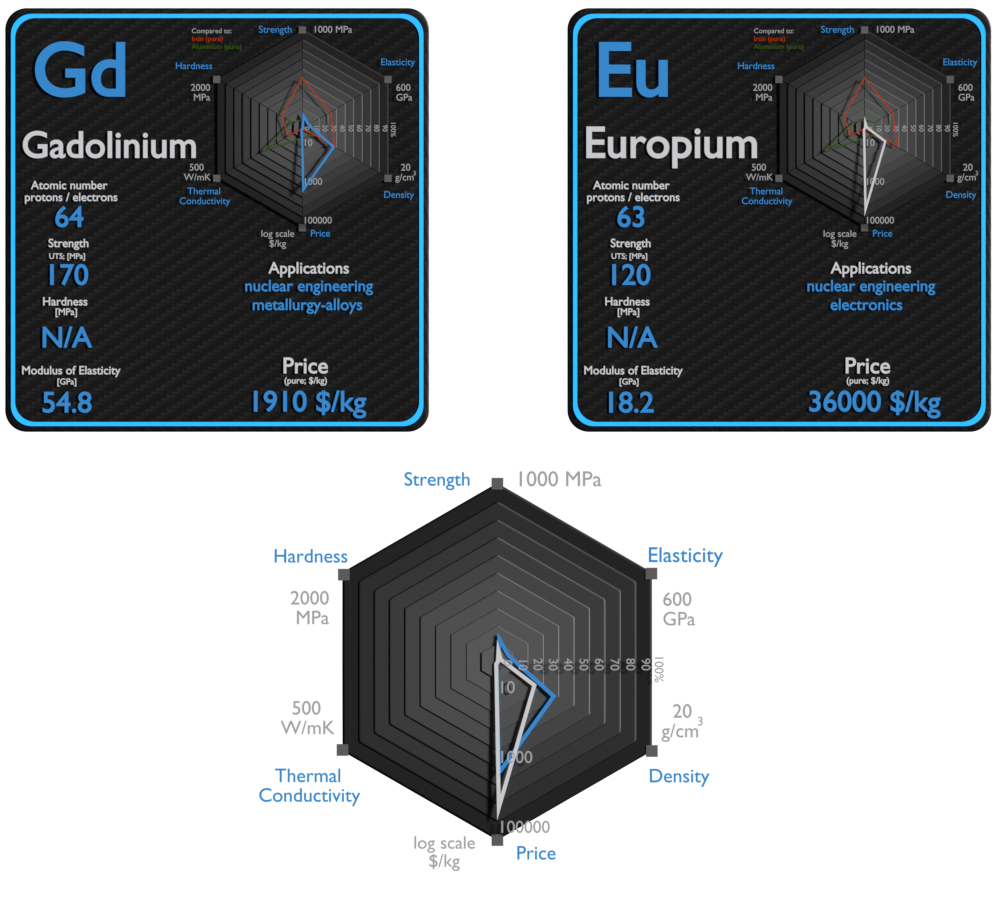
This article contains comparison of key thermal and atomic properties of europium and gadolinium, two comparable chemical elements from the periodic table. It also contains basic descriptions and applications of both elements. Europium vs Gadolinium.

europium and gadolinium - comparison

Compare europium with another element

Gadolinium - Properties - Price - Applications - Production

Dysprosium - Properties - Price - Applications - Production

Tantalum - Properties - Price - Applications - Production

Ytterbium - Properties - Price - Applications - Production

Compare gadolinium with another element

Europium - Properties - Price - Applications - Production

Europium and Gadolinium – About Elements

Europium

Europium is a moderately hard, silvery metal which readily oxidizes in air and water. Being a typical member of the lanthanide series, europium usually assumes the oxidation state +3. Europium is one of the least abundant elements in the universe. Only about 5×10⁻⁸% of all matter in the universe is europium.

Gadolinium

Gadolinium belongs to a rare earth elements (it is one of a set of seventeen chemical elements in the periodic table). In nuclear industry gadolinium is commonly used as a neutron absorber due to very high neutron absorbtion cross-section of two isotopes 155Gd and 157Gd. In fact their absorption cross-sections are the highest among all stable isotopes.

Europium in Periodic Table

Source: www.luciteria.com

Europium and Gadolinium – Applications

Europium

Europium is used in the printing of euro banknotes. It glows red under UV light, and forgeries can be detected by the lack of this red glow. It is a dopant in some types of glass in lasers and other optoelectronic devices. Since the isotopes of europium act as good neutron absorbers, they are being studied for use in nuclear control applications, such as in burnable absorbers.

Gadolinium

Gadolinium possesses unusual metallurgical properties, to the extent that as little as 1% of gadolinium can significantly improve the workability and resistance to oxidation at high temperatures of iron, chromium, and related metals. Gadolinium as a metal or a salt absorbs neutrons and is, therefore, used sometimes for shielding in neutron radiography and in nuclear reactors. Gadolinium is widely used as a burnable absorber, which is commonly used in fresh fuel to compensate an excess of reactivity of reactor core. Among all known stable elements, gadolinium has the highest thermal neutron capture cross-section (49,000 barns). Gadolinium barium copper oxide (GdBCO) has been researched for its superconducting properties with applications in superconducting motors or generators – for example in a wind turbine.

Europium and Gadolinium – Comparison in Table

Element Europium Gadolinium
Density 5.244 g/cm3 7.901 g/cm3
Ultimate Tensile Strength 120 MPa 170 MPa
Yield Strength 60 MPa 160 MPa
Young’s Modulus of Elasticity 18.2 GPa 54.8 GPa
Mohs Scale N/A N/A
Brinell Hardness N/A N/A
Vickers Hardness 170 MPa 570 MPa
Melting Point 822 °C 1313 °C
Boiling Point 1529 °C 3000 °C
Thermal Conductivity 14 W/mK 11 W/mK
Thermal Expansion Coefficient 35 µm/mK 9.4 µm/mK
Specific Heat 0.18 J/g K 0.23 J/g K
Heat of Fusion 9.21 kJ/mol 10.05 kJ/mol
Heat of Vaporization 143.5 kJ/mol 359.4 kJ/mol


Europium and Tantalum – Comparison – Properties

This article contains comparison of key thermal and atomic properties of europium and tantalum, two comparable chemical elements from the periodic table. It also contains basic descriptions and applications of both elements. Europium vs Tantalum.

europium and tantalum - comparison

Compare europium with another element

Gadolinium - Properties - Price - Applications - Production

Dysprosium - Properties - Price - Applications - Production

Tantalum - Properties - Price - Applications - Production

Ytterbium - Properties - Price - Applications - Production

Compare tantalum with another element

Titanium - Properties - Price - Applications - Production

Niobium - Properties - Price - Applications - Production

Europium - Properties - Price - Applications - Production

Hafnium - Properties - Price - Applications - Production

Europium and Tantalum – About Elements

Europium

Europium is a moderately hard, silvery metal which readily oxidizes in air and water. Being a typical member of the lanthanide series, europium usually assumes the oxidation state +3. Europium is one of the least abundant elements in the universe. Only about 5×10⁻⁸% of all matter in the universe is europium.

Tantalum

Tantalum is a rare, hard, blue-gray, lustrous transition metal that is highly corrosion-resistant.

Europium in Periodic Table

Tantalum in Periodic Table

Source: www.luciteria.com

Europium and Tantalum – Applications

Europium

Europium is used in the printing of euro banknotes. It glows red under UV light, and forgeries can be detected by the lack of this red glow. It is a dopant in some types of glass in lasers and other optoelectronic devices. Since the isotopes of europium act as good neutron absorbers, they are being studied for use in nuclear control applications, such as in burnable absorbers.

Tantalum

Tantalum consumption is dominated by capacitors for electronic equipment. Capacitors are electrical components that store energy electrostatically in an electric field, and are used in a wide variety of electric and electronic products. Major end uses for tantalum capacitors include portable telephones, pagers, personal computers, and automotive electronics. Alloyed with other metals, tantalum is also used in making carbide tools for metalworking equipment and in the production of superalloys for jet engine components. Compounds of tantalum such as tantalum pentoxide is used to make capacitors and glass with a high index of refraction for use in camera lenses.

Europium and Tantalum – Comparison in Table

Element Europium Tantalum
Density 5.244 g/cm3 16.65 g/cm3
Ultimate Tensile Strength 120 MPa 760 MPa
Yield Strength 60 MPa 705 MPa
Young’s Modulus of Elasticity 18.2 GPa 186 GPa
Mohs Scale N/A 6.5
Brinell Hardness N/A 800 MPa
Vickers Hardness 170 MPa 870 MPa
Melting Point 822 °C 2996 °C
Boiling Point 1529 °C 5425 °C
Thermal Conductivity 14 W/mK 57 W/mK
Thermal Expansion Coefficient 35 µm/mK 6.3 µm/mK
Specific Heat 0.18 J/g K 0.14 J/g K
Heat of Fusion 9.21 kJ/mol 31.6 kJ/mol
Heat of Vaporization 143.5 kJ/mol 743 kJ/mol


Hafnium and Tantalum – Comparison – Properties

This article contains comparison of key thermal and atomic properties of hafnium and tantalum, two comparable chemical elements from the periodic table. It also contains basic descriptions and applications of both elements. Hafnium vs Tantalum.

hafnium and tantalum - comparison

Compare hafnium with another element

Tantalum - Properties - Price - Applications - Production

Zirconium - Properties - Price - Applications - Production

Compare tantalum with another element

Titanium - Properties - Price - Applications - Production

Niobium - Properties - Price - Applications - Production

Europium - Properties - Price - Applications - Production

Hafnium - Properties - Price - Applications - Production

Hafnium and Tantalum – About Elements

Hafnium

Hafnium is a lustrous, silvery gray, tetravalent transition metal, hafnium chemically resembles zirconium and is found in many zirconium minerals. Hafnium’s large neutron capture cross-section makes it a good material for neutron absorption in control rods in nuclear power plants, but at the same time requires that it be removed from the neutron-transparent corrosion-resistant zirconium alloys used in nuclear reactors.

Tantalum

Tantalum is a rare, hard, blue-gray, lustrous transition metal that is highly corrosion-resistant.

Hafnium in Periodic Table

Tantalum in Periodic Table

Source: www.luciteria.com

Hafnium and Tantalum – Applications

Hafnium

Hafnium has good neutron-absorbing properties, and hence it is used in control rods in nuclear reactors, but at the same time requires that it be removed from the neutron-transparent corrosion-resistant zirconium alloys used in nuclear reactors. While hafnium nitride is the most refractory of all the metal nitrides, hafnium carbide is the most refractory of all the binary materials. With a melting point of about 3900 °C it is one of the most refractory binary compounds known. Hafnium has been successfully alloyed with several metals including iron, titanium and niobium.

Tantalum

Tantalum consumption is dominated by capacitors for electronic equipment. Capacitors are electrical components that store energy electrostatically in an electric field, and are used in a wide variety of electric and electronic products. Major end uses for tantalum capacitors include portable telephones, pagers, personal computers, and automotive electronics. Alloyed with other metals, tantalum is also used in making carbide tools for metalworking equipment and in the production of superalloys for jet engine components. Compounds of tantalum such as tantalum pentoxide is used to make capacitors and glass with a high index of refraction for use in camera lenses.

Hafnium and Tantalum – Comparison in Table

Element Hafnium Tantalum
Density 13.31 g/cm3 16.65 g/cm3
Ultimate Tensile Strength 480 MPa 760 MPa
Yield Strength 125 MPa 705 MPa
Young’s Modulus of Elasticity 78 GPa 186 GPa
Mohs Scale 5.5 6.5
Brinell Hardness 1700 MPa 800 MPa
Vickers Hardness 1700 MPa 870 MPa
Melting Point 2227 °C 2996 °C
Boiling Point 4600  °C 5425 °C
Thermal Conductivity 23 W/mK 57 W/mK
Thermal Expansion Coefficient 5.9 µm/mK 6.3 µm/mK
Specific Heat 0.14 J/g K 0.14 J/g K
Heat of Fusion 24.06 kJ/mol 31.6 kJ/mol
Heat of Vaporization 575 kJ/mol 743 kJ/mol


Tungsten and Iridium – Comparison – Properties

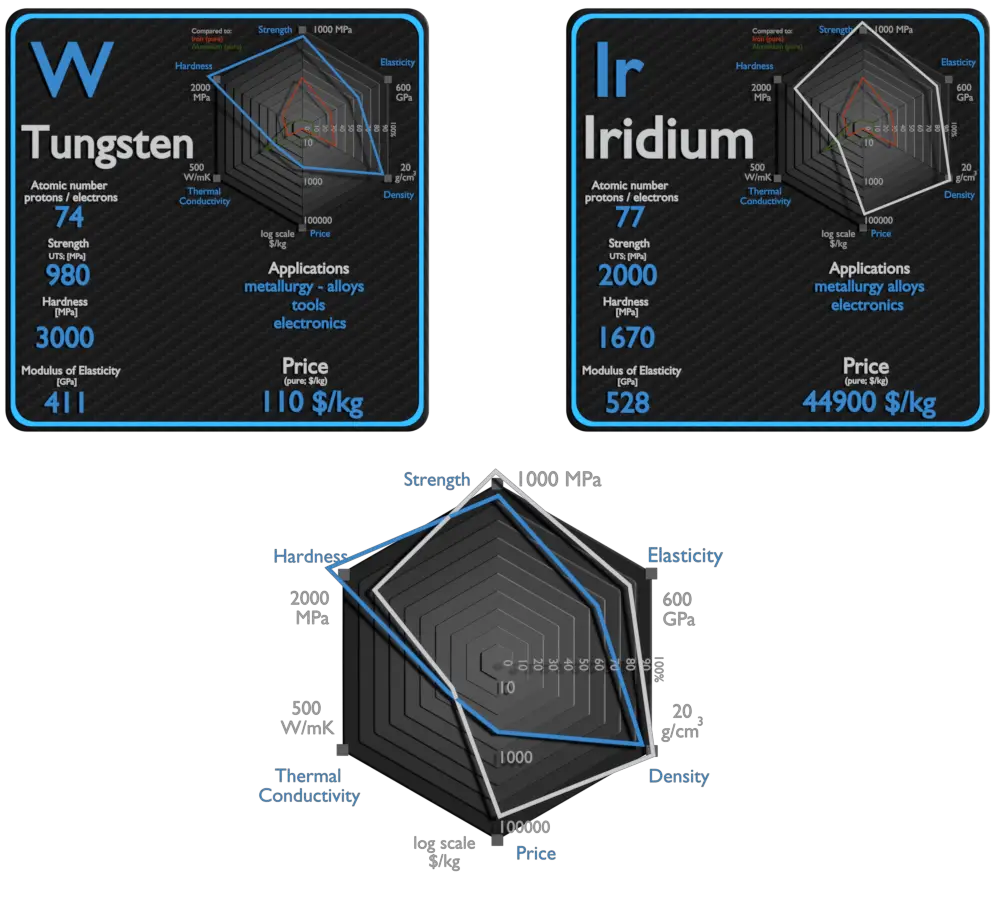
This article contains comparison of key thermal and atomic properties of tungsten and iridium, two comparable chemical elements from the periodic table. It also contains basic descriptions and applications of both elements. Tungsten vs Iridium.

tungsten and iridium - comparison

Compare tungsten with another element

Titanium - Properties - Price - Applications - Production

Chromium - Properties - Price - Applications - Production

Cobalt - Properties - Price - Applications - Production

Zirconium - Properties - Price - Applications - Production

Molybdenum - Properties - Price - Applications - Production

Platinum - Properties - Price - Applications - Production

Rhenium - Properties - Price - Applications - Production

Gold - Properties - Price - Applications - Production

Iridium - Properties - Price - Applications - Production

Compare iridium with another element

Rhodium - Properties - Price - Applications - Production

Tungsten - Properties - Price - Applications - Production

Osmium - Properties - Price - Applications - Production

Platinum - Properties - Price - Applications - Production

Gold - Properties - Price - Applications - Production

Tugsten and Iridium – About Elements

Tungsten

Tungsten is a rare metal found naturally on Earth almost exclusively in chemical compounds. Tungsten is an intrinsically brittle and hard material, making it difficult to work.

Iridium

Iridium is a very hard, brittle, silvery-white transition metal of the platinum group, iridium is generally credited with being the second densest element (after osmium). It is also the most corrosion-resistant metal, even at temperatures as high as 2000 °C.

Tungsten in Periodic Table

Iridium in Periodic Table

Source: www.luciteria.com

Tungsten and Iridium – Applications

Tungsten

Tungsten is widely used metal. Approximately half of the tungsten is consumed for the production of hard materials – namely tungsten carbide – with the remaining major use being in alloys and steels. Mining and mineral processing demand wear-resistant machines and components, because the energies and masses of interacting bodies are significant. For this purposes, materials with the highest wear-resistance must be used. For example, tungsten carbide is used extensively in mining in top hammer rock drill bits, downhole hammers, roller-cutters, long wall plough chisels, long wall shearer picks, raiseboring reamers, and tunnel boring machines. The remaining 40% is generally used to make various alloys and specialty steels, electrodes, filaments, wires, as well as diverse components for electric, electronic, heating, lighting, and welding applications. High-speed steels are complex iron-base alloys of carbon, chromium, vanadium, molybdenum, or tungsten (as much as 18%), or combinations there of.

Iridium

Iridium is mainly consumed by the automotive, electronic, and chemical industries. Iridium metal is employed when high corrosion resistance at high temperatures is needed, as in high-performance spark plugs, crucibles for recrystallization of semiconductors at high temperatures, and electrodes for the production of chlorine in the chloralkali process. The demand for iridium surged from 2.5 tonnes in 2009 to 10.4 tonnes in 2010, mostly because of electronics-related applications that saw a rise from 0.2 to 6 tonnes – iridium crucibles are commonly used for growing large high-quality single crystals, demand for which has increased sharply.

Tungsten and Iridium – Comparison in Table

Element Tungsten Iridium
Density 19.25 g/cm3 22.65 g/cm3
Ultimate Tensile Strength 980 MPa 2000 MPa
Yield Strength 750 MPa N/A
Young’s Modulus of Elasticity 411 GPa 528 GPa
Mohs Scale 7.5 6.25
Brinell Hardness 3000 MPa 1670 MPa
Vickers Hardness 3500 MPa 1760 MPa
Melting Point 3410 °C 2410 °C
Boiling Point 59300 °C 4130 °C
Thermal Conductivity 170 W/mK 150 W/mK
Thermal Expansion Coefficient 4.5 µm/mK 6.4 µm/mK
Specific Heat 0.13 J/g K 0.13 J/g K
Heat of Fusion 35.4 kJ/mol 26.1 kJ/mol
Heat of Vaporization 824 kJ/mol 604 kJ/mol


Tungsten and Gold – Comparison – Properties

This article contains comparison of key thermal and atomic properties of tungsten and gold, two comparable chemical elements from the periodic table. It also contains basic descriptions and applications of both elements. Tungsten vs Gold.

tungsten and gold - comparison

Compare tungsten with another element

Titanium - Properties - Price - Applications - Production

Chromium - Properties - Price - Applications - Production

Cobalt - Properties - Price - Applications - Production

Zirconium - Properties - Price - Applications - Production

Molybdenum - Properties - Price - Applications - Production

Platinum - Properties - Price - Applications - Production

Rhenium - Properties - Price - Applications - Production

Gold - Properties - Price - Applications - Production

Iridium - Properties - Price - Applications - Production

Compare gold with another element

Titanium - Properties - Price - Applications - Production

Cobalt - Properties - Price - Applications - Production

Nickel - Properties - Price - Applications - Production

Copper - Properties - Price - Applications - Production

Rhodium - Properties - Price - Applications - Production

Palladium - Properties - Price - Applications - Production

Silver - Properties - Price - Applications - Production

Tungsten - Properties - Price - Applications - Production

Osmium - Properties - Price - Applications - Production

Iridium - Properties - Price - Applications - Production

Platinum - Properties - Price - Applications - Production

Lead - Properties - Price - Applications - Production

Tugsten and Gold – About Elements

Tungsten

Tungsten is a rare metal found naturally on Earth almost exclusively in chemical compounds. Tungsten is an intrinsically brittle and hard material, making it difficult to work.

Gold

Gold is a bright, slightly reddish yellow, dense, soft, malleable, and ductile metal. Gold is a transition metal and a group 11 element. It is one of the least reactive chemical elements and is solid under standard conditions. Gold is thought to have been produced in supernova nucleosynthesis, from the collision of neutron stars.

Tungsten in Periodic Table

Gold in Periodic Table

Source: www.luciteria.com

Tungsten and Gold – Applications

Tungsten

Tungsten is widely used metal. Approximately half of the tungsten is consumed for the production of hard materials – namely tungsten carbide – with the remaining major use being in alloys and steels. Mining and mineral processing demand wear-resistant machines and components, because the energies and masses of interacting bodies are significant. For this purposes, materials with the highest wear-resistance must be used. For example, tungsten carbide is used extensively in mining in top hammer rock drill bits, downhole hammers, roller-cutters, long wall plough chisels, long wall shearer picks, raiseboring reamers, and tunnel boring machines. The remaining 40% is generally used to make various alloys and specialty steels, electrodes, filaments, wires, as well as diverse components for electric, electronic, heating, lighting, and welding applications. High-speed steels are complex iron-base alloys of carbon, chromium, vanadium, molybdenum, or tungsten (as much as 18%), or combinations there of.

Gold

Gold is used extensively in jewellery, either in its pure form or as an alloy. About 75% of all gold produced is used in the jewelry industry. Pure gold is too soft to stand up to the stresses applied to many jewelry items. Craftsmen learned that alloying gold with other metals such as copper, silver, and platinum would increase its durability. The term ‘carat’ indicates the amount of gold present in an alloy. 24-carat is pure gold, but it is very soft. 18- and 9-carat gold alloys are commonly used because they are more durable. Gold’s high malleability, ductility, resistance to corrosion and most other chemical reactions, and conductivity of electricity have led to its continued use in corrosion resistant electrical connectors in all types of computerized devices (its chief industrial use). Gold is also used in infrared shielding, colored-glass production, gold leafing, and tooth restoration. Only 10% of the world consumption of new gold produced goes to industry, but by far the most important industrial use for new gold is in fabrication of corrosion-free electrical connectors in computers and other electrical devices.

Tungsten and Gold – Comparison in Table

Element Tungsten Gold
Density 19.25 g/cm3 19.3 g/cm3
Ultimate Tensile Strength 980 MPa 220 MPa
Yield Strength 750 MPa 205 MPa
Young’s Modulus of Elasticity 411 GPa 79 GPa
Mohs Scale 7.5 2.75
Brinell Hardness 3000 MPa 190 MPa
Vickers Hardness 3500 MPa 215 MPa
Melting Point 3410 °C 1064 °C
Boiling Point 59300 °C 2970 °C
Thermal Conductivity 170 W/mK 320 W/mK
Thermal Expansion Coefficient 4.5 µm/mK 14.2 µm/mK
Specific Heat 0.13 J/g K 0.128 J/g K
Heat of Fusion 35.4 kJ/mol 12.55 kJ/mol
Heat of Vaporization 824 kJ/mol 334.4 kJ/mol


Tungsten and Rhenium – Comparison – Properties

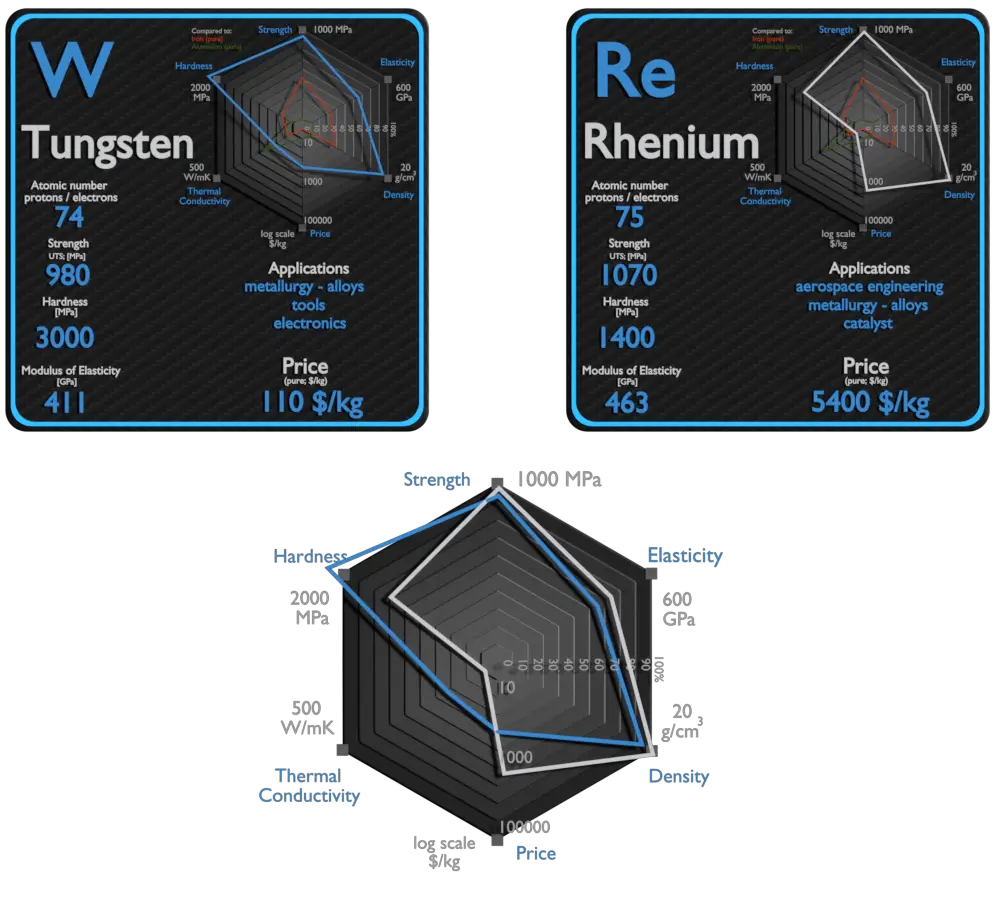
This article contains comparison of key thermal and atomic properties of tungsten and rhenium, two comparable chemical elements from the periodic table. It also contains basic descriptions and applications of both elements. Tungsten vs Rhenium.

tungsten and rhenium - comparison

Compare tungsten with another element

Titanium - Properties - Price - Applications - Production

Chromium - Properties - Price - Applications - Production

Cobalt - Properties - Price - Applications - Production

Zirconium - Properties - Price - Applications - Production

Molybdenum - Properties - Price - Applications - Production

Platinum - Properties - Price - Applications - Production

Rhenium - Properties - Price - Applications - Production

Gold - Properties - Price - Applications - Production

Iridium - Properties - Price - Applications - Production

Compare rhenium with another element

Rhodium - Properties - Price - Applications - Production

Tungsten - Properties - Price - Applications - Production

Tugsten and Rhenium – About Elements

Tungsten

Tungsten is a rare metal found naturally on Earth almost exclusively in chemical compounds. Tungsten is an intrinsically brittle and hard material, making it difficult to work.

Rhenium

Rhenium is a silvery-white, heavy, third-row transition metal in group 7 of the periodic table.

Tungsten in Periodic Table

Rhenium in Periodic Table

Source: www.luciteria.com

Tungsten and Rhenium – Applications

Tungsten

Tungsten is widely used metal. Approximately half of the tungsten is consumed for the production of hard materials – namely tungsten carbide – with the remaining major use being in alloys and steels. Mining and mineral processing demand wear-resistant machines and components, because the energies and masses of interacting bodies are significant. For this purposes, materials with the highest wear-resistance must be used. For example, tungsten carbide is used extensively in mining in top hammer rock drill bits, downhole hammers, roller-cutters, long wall plough chisels, long wall shearer picks, raiseboring reamers, and tunnel boring machines. The remaining 40% is generally used to make various alloys and specialty steels, electrodes, filaments, wires, as well as diverse components for electric, electronic, heating, lighting, and welding applications. High-speed steels are complex iron-base alloys of carbon, chromium, vanadium, molybdenum, or tungsten (as much as 18%), or combinations there of.

Rhenium

More than 80% of the global rhenium usage is in high-temperature superalloys for aircraft applications like turbine blades and engine parts. These alloys contain up to 6% rhenium, making jet engine construction the largest single use for the element. Rhenium is added to nickel-based super alloys to improve creep strength of the alloys. The remaining demand is mostly from petrochemical refining industries. Platinum-rhenium catalysts that are chiefly used in lead-free, high-octane gasoline are another major application of rhenium.

Tungsten and Rhenium – Comparison in Table

Element Tungsten Rhenium
Density 19.25 g/cm3 21.02 g/cm3
Ultimate Tensile Strength 980 MPa 1070 MPa
Yield Strength 750 MPa 290 MPa
Young’s Modulus of Elasticity 411 GPa 463 GPa
Mohs Scale 7.5 7
Brinell Hardness 3000 MPa 1400 MPa
Vickers Hardness 3500 MPa 2500 MPa
Melting Point 3410 °C 3180 °C
Boiling Point 59300 °C 5600 °C
Thermal Conductivity 170 W/mK 48 W/mK
Thermal Expansion Coefficient 4.5 µm/mK 6.2 µm/mK
Specific Heat 0.13 J/g K 0.13 J/g K
Heat of Fusion 35.4 kJ/mol 33.2 kJ/mol
Heat of Vaporization 824 kJ/mol 715 kJ/mol