Facebook Instagram Youtube Twitter

Tin and Antimony – Comparison – Properties

This article contains comparison of key thermal and atomic properties of tin and antimony, two comparable chemical elements from the periodic table. It also contains basic descriptions and applications of both elements. Tin vs Antimony.

tin and antimony - comparison

Compare tin with another element

Nickel - Properties - Price - Applications - Production

Copper - Properties - Price - Applications - Production

Niobium - Properties - Price - Applications - Production

Antimony - Properties - Price - Applications - Production

Lead - Properties - Price - Applications - Production

Compare antimony with another element

Arsenic - Properties - Price - Applications - Production

Tin - Properties - Price - Applications - Production

Tin and Antimony – About Elements

Tin

Tin is a post-transition metal in group 14 of the periodic table. It is obtained chiefly from the mineral cassiterite, which contains tin dioxide. The first alloy used on a large scale was bronze, made of tin and copper, from as early as 3000 BC.

Antimony

Antimony is a lustrous gray metalloid, it is found in nature mainly as the sulfide mineral stibnite. Antimony compounds have been known since ancient times and were powdered for use as medicine and cosmetics, often known by the Arabic name, kohl.

Tin in Periodic Table

Antimony in Periodic Table

Source: www.luciteria.com

Tin and Antimony – Applications

Tin

The largest single application of tin is in the manufacture of tinplate (steel sheet coated with tin), which accounts for approximately 40% of total world tin consumption. Tin bonds readily to iron and steel to prevent corrosion. Tin-plated steel containers are widely used for food preservation, and this forms a large part of the market for metallic tin. Tinning is the process of thinly coating sheets of wrought iron or steel with tin, and the resulting product is known as tinplate. The term is also widely used for the different process of coating a metal with solder before soldering. There are two processes for the tinning of the black plates: hot-dipping and electroplating.

Antimony

The largest applications for metallic antimony are an alloy with lead and tin and the lead antimony plates in lead–acid batteries. Alloys of lead and tin with antimony have improved properties for solders, bullets, and plain bearings. Antimony can be used in fire retardants for many commercial and domestic products. Antimony trichloride is used in the manufacturing flame-proofing compounds as well as paints, ceramic enamels, glass and pottery. Other uses include ball bearings and mixing with alloys with percentages ranging from 1 to 20 greatly increasing the hardness and mechanical strength of the lead. The capability to strengthen already strong alloys is its largest and most widespread use.

Tin and Antimony – Comparison in Table

Element Tin Antimony
Density 7.31 g/cm3 6.697 g/cm3
Ultimate Tensile Strength 220 MPa 11 MPa
Yield Strength N/A N/A
Young’s Modulus of Elasticity 50 GPa 55 GPa
Mohs Scale 1.65 3.15
Brinell Hardness 50 MPa 300 MPa
Vickers Hardness N/A N/A
Melting Point 231.93 °C 631 °C
Boiling Point 2602 °C 1950 °C
Thermal Conductivity 67 W/mK 24 W/mK
Thermal Expansion Coefficient 22 µm/mK 11 µm/mK
Specific Heat 0.227 J/g K 0.21 J/g K
Heat of Fusion 7.029 kJ/mol 19.87 kJ/mol
Heat of Vaporization 295.8 kJ/mol 77.14 kJ/mol


Tin and Lead – Comparison – Properties

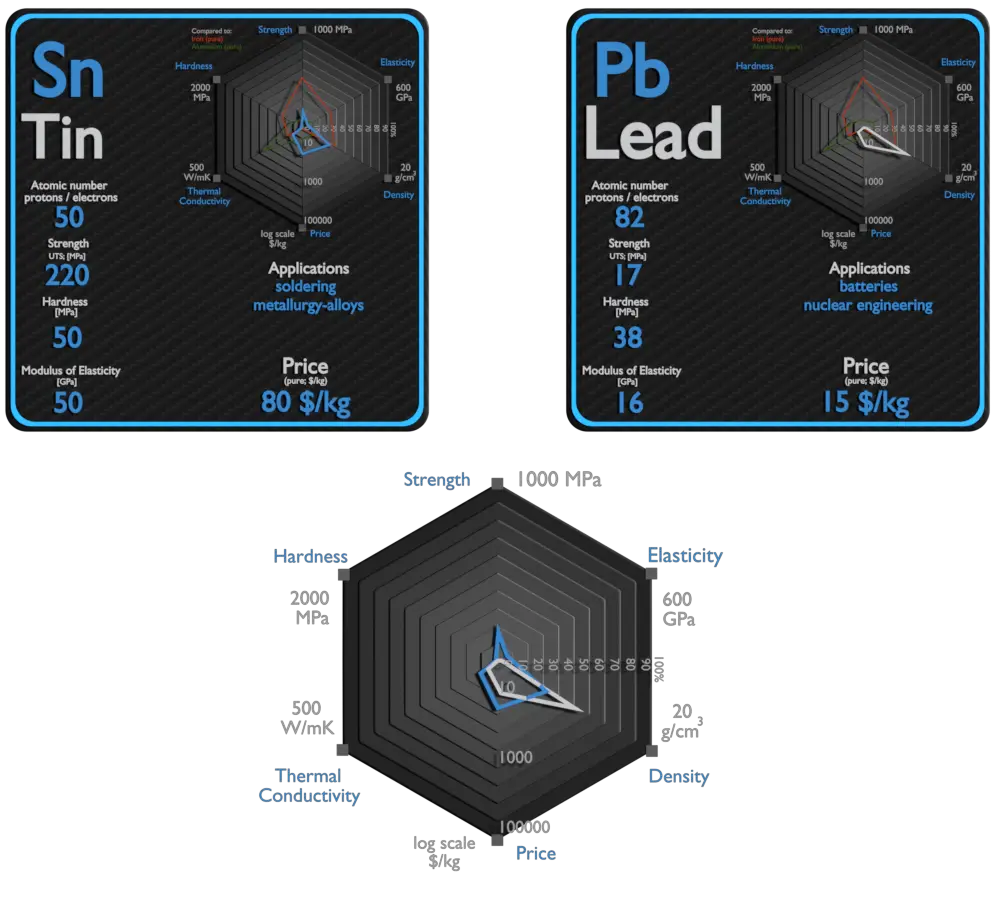
This article contains comparison of key thermal and atomic properties of tin and lead, two comparable chemical elements from the periodic table. It also contains basic descriptions and applications of both elements. Tin vs Lead.

tin and lead - comparison

Compare tin with another element

Nickel - Properties - Price - Applications - Production

Copper - Properties - Price - Applications - Production

Niobium - Properties - Price - Applications - Production

Antimony - Properties - Price - Applications - Production

Lead - Properties - Price - Applications - Production

Compare lead with another element

Iron - Properties - Price - Applications - Production

Arsenic - Properties - Price - Applications - Production

Cadmium - Properties - Price - Applications - Production

Tin - Properties - Price - Applications - Production

Antimony - Properties - Price - Applications - Production

Gold - Properties - Price - Applications - Production

Bismuth - Properties - Price - Applications - Production

Tin and Lead – About Elements

Tin

Tin is a post-transition metal in group 14 of the periodic table. It is obtained chiefly from the mineral cassiterite, which contains tin dioxide. The first alloy used on a large scale was bronze, made of tin and copper, from as early as 3000 BC.

Lead

Lead is a heavy metal that is denser than most common materials. Lead is soft and malleable, and has a relatively low melting point. Lead is widely used as a gamma shield. Major advantage of lead shield is in its compactness due to its higher density. Lead has the highest atomic number of any stable element and concludes three major decay chains of heavier elements.

Tin in Periodic Table

Lead in Periodic Table

Source: www.luciteria.com

Tin and Lead – Applications

Tin

The largest single application of tin is in the manufacture of tinplate (steel sheet coated with tin), which accounts for approximately 40% of total world tin consumption. Tin bonds readily to iron and steel to prevent corrosion. Tin-plated steel containers are widely used for food preservation, and this forms a large part of the market for metallic tin. Tinning is the process of thinly coating sheets of wrought iron or steel with tin, and the resulting product is known as tinplate. The term is also widely used for the different process of coating a metal with solder before soldering. There are two processes for the tinning of the black plates: hot-dipping and electroplating.

Lead

Lead metal has several useful mechanical properties, including high density, low melting point, ductility, and relative inertness. Lead is widely used for car batteries, pigments, ammunition, cable sheathing, weights for lifting, weight belts for diving, lead crystal glass, radiation protection and in some solders. The largest use of lead in the early 21st century is in lead–acid batteries. The lead in batteries undergoes no direct contact with humans, so there are fewer toxicity concerns. Lead is used in high voltage power cables as sheathing material to prevent water diffusion into insulation; this use is decreasing as lead is being phased out. A lead is widely used as a gamma shield. Major advantage of lead shield is in its compactness due to its higher density. On the other hand depleted uranium is much more effective due to its higher Z. Depleted uranium is used for shielding in portable gamma ray sources.

Tin and Lead – Comparison in Table

Element Tin Lead
Density 7.31 g/cm3 11.34 g/cm3
Ultimate Tensile Strength 220 MPa 17 MPa
Yield Strength N/A 5.5 MPa
Young’s Modulus of Elasticity 50 GPa 16 GPa
Mohs Scale 1.65 1.5
Brinell Hardness 50 MPa 38 MPa
Vickers Hardness N/A N/A
Melting Point 231.93 °C 327.5 °C
Boiling Point 2602 °C 1740 °C
Thermal Conductivity 67 W/mK 35 W/mK
Thermal Expansion Coefficient 22 µm/mK 28.9 µm/mK
Specific Heat 0.227 J/g K 0.13 J/g K
Heat of Fusion 7.029 kJ/mol 4.799 kJ/mol
Heat of Vaporization 295.8 kJ/mol 177.7 kJ/mol


Cadmium and Lead – Comparison – Properties

This article contains comparison of key thermal and atomic properties of cadmium and lead, two comparable chemical elements from the periodic table. It also contains basic descriptions and applications of both elements. Cadmium vs Lead.

cadmium and lead - comparison

Compare cadmium with another element

Lithium - Properties - Price - Applications - Production

Cobalt - Properties - Price - Applications - Production

Arsenic - Properties - Price - Applications - Production

Lead - Properties - Price - Applications - Production

Compare lead with another element

Iron - Properties - Price - Applications - Production

Arsenic - Properties - Price - Applications - Production

Cadmium - Properties - Price - Applications - Production

Tin - Properties - Price - Applications - Production

Antimony - Properties - Price - Applications - Production

Gold - Properties - Price - Applications - Production

Bismuth - Properties - Price - Applications - Production

Cadmium and Lead – About Elements

Cadmium

Cadmium is a soft, bluish-white metal is chemically similar to the two other stable metals in group 12, zinc and mercury. In nuclear industry cadmium is commonly used as a thermal neutron absorber due to very high neutron absorption cross-section of 113Cd. 113Cd has specific absorption cross-section.

Lead

Lead is a heavy metal that is denser than most common materials. Lead is soft and malleable, and has a relatively low melting point. Lead is widely used as a gamma shield. Major advantage of lead shield is in its compactness due to its higher density. Lead has the highest atomic number of any stable element and concludes three major decay chains of heavier elements.

Cadmium in Periodic Table

Lead in Periodic Table

Source: www.luciteria.com

Cadmium and Lead – Applications

Cadmium

Cadmium is primarily consumed for the production of rechargeable nickel cadmium batteries. In 2009, 86% of cadmium was used in batteries, predominantly in rechargeable nickel-cadmium batteries. Other end uses include pigments, coatings and plating, and as stabilizers for plastics. Solar cell manufacturing may become another significant market for cadmium in the future. In nuclear industry cadmium is commonly used as a thermal neutron absorber due to very high neutron absorption cross-section of 113Cd. 113Cd has specific absorption cross-section.

Lead

Lead metal has several useful mechanical properties, including high density, low melting point, ductility, and relative inertness. Lead is widely used for car batteries, pigments, ammunition, cable sheathing, weights for lifting, weight belts for diving, lead crystal glass, radiation protection and in some solders. The largest use of lead in the early 21st century is in lead–acid batteries. The lead in batteries undergoes no direct contact with humans, so there are fewer toxicity concerns. Lead is used in high voltage power cables as sheathing material to prevent water diffusion into insulation; this use is decreasing as lead is being phased out. A lead is widely used as a gamma shield. Major advantage of lead shield is in its compactness due to its higher density. On the other hand depleted uranium is much more effective due to its higher Z. Depleted uranium is used for shielding in portable gamma ray sources.

Cadmium and Lead – Comparison in Table

Element Cadmium Lead
Density 8.65 g/cm3 11.34 g/cm3
Ultimate Tensile Strength 75 MPa 17 MPa
Yield Strength N/A 5.5 MPa
Young’s Modulus of Elasticity 50 GPa 16 GPa
Mohs Scale 2 1.5
Brinell Hardness 303 MPa 38 MPa
Vickers Hardness N/A N/A
Melting Point 321.07 °C 327.5 °C
Boiling Point 767 °C 1740 °C
Thermal Conductivity 97 W/mK 35 W/mK
Thermal Expansion Coefficient 30.8 µm/mK 28.9 µm/mK
Specific Heat 0.23 J/g K 0.13 J/g K
Heat of Fusion 6.192 kJ/mol 4.799 kJ/mol
Heat of Vaporization 99.57 kJ/mol 177.7 kJ/mol


Platinum and Gold – Comparison – Properties

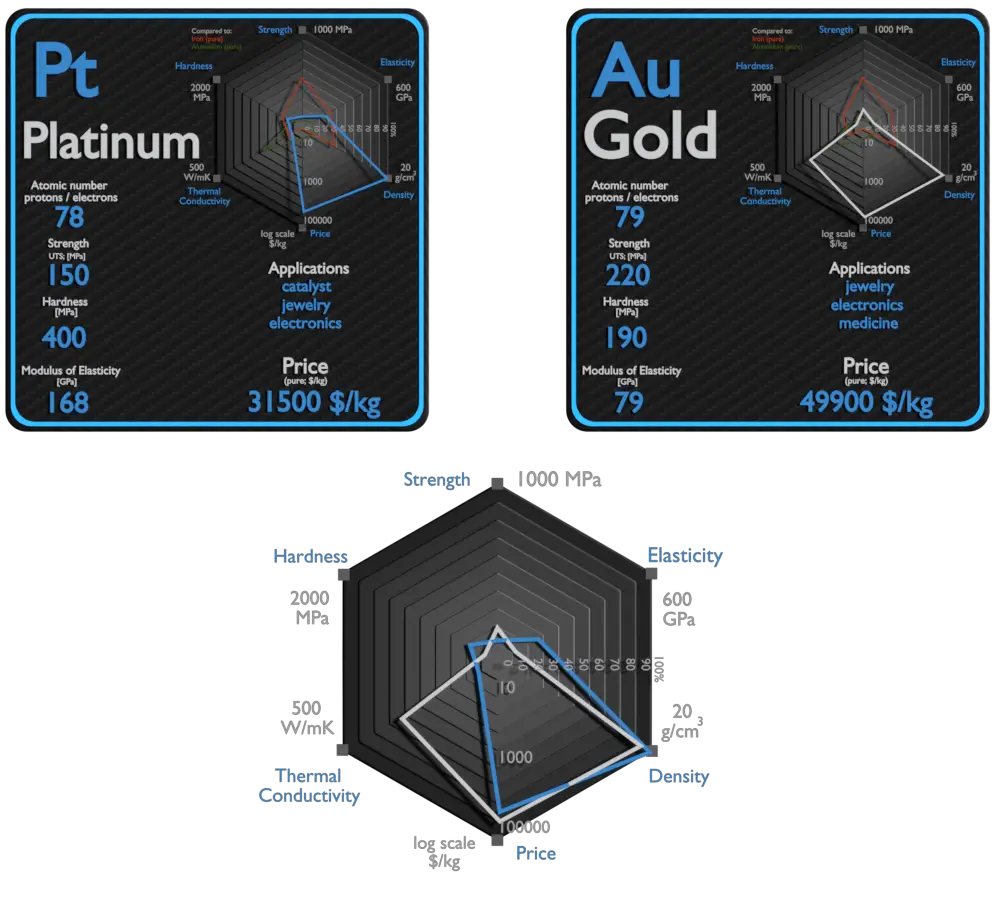
This article contains comparison of key thermal and atomic properties of platinum and gold, two comparable chemical elements from the periodic table. It also contains basic descriptions and applications of both elements. Platinum vs Gold.

platinum and gold - comparison

Compare platinum with another element

Nickel - Properties - Price - Applications - Production

Rhodium - Properties - Price - Applications - Production

Palladium - Properties - Price - Applications - Production

Silver - Properties - Price - Applications - Production

Tungsten - Properties - Price - Applications - Production

Iridium - Properties - Price - Applications - Production

Gold - Properties - Price - Applications - Production

Compare gold with another element

Titanium - Properties - Price - Applications - Production

Cobalt - Properties - Price - Applications - Production

Nickel - Properties - Price - Applications - Production

Copper - Properties - Price - Applications - Production

Rhodium - Properties - Price - Applications - Production

Palladium - Properties - Price - Applications - Production

Silver - Properties - Price - Applications - Production

Tungsten - Properties - Price - Applications - Production

Osmium - Properties - Price - Applications - Production

Iridium - Properties - Price - Applications - Production

Platinum - Properties - Price - Applications - Production

Lead - Properties - Price - Applications - Production

Platinum and Gold – About Elements

Platinum

Platinum is a dense, malleable, ductile, highly unreactive, precious, silverish-white transition metal. Platinum is one of the least reactive metals. It has remarkable resistance to corrosion, even at high temperatures, and is therefore considered a noble metal. Platinum is used in catalytic converters, laboratory equipment, electrical contacts and electrodes, platinum resistance thermometers, dentistry equipment, and jewelry.

Gold

Gold is a bright, slightly reddish yellow, dense, soft, malleable, and ductile metal. Gold is a transition metal and a group 11 element. It is one of the least reactive chemical elements and is solid under standard conditions. Gold is thought to have been produced in supernova nucleosynthesis, from the collision of neutron stars.

Platinum in Periodic Table

Gold in Periodic Table

Source: www.luciteria.com

Platinum and Gold – Applications

Platinum

Platinum is primarily an industrial metal. It is a critical material for many industries and is considered a strategic metal. Platinum is used as a catalyst, platinum is mostly found in vehicle catalytic converters that reduce toxic exhaust chemicals, and also in fuel cells to increase efficiency. The most common use of platinum is as a catalyst in chemical reactions, often as platinum black. In catalytic converters, platinum allows the complete combustion of low concentrations of unburned hydrocarbons from the exhaust into carbon dioxide and water vapor. Platinum has been used in thermocouple devices that measure temperature with high accuracy. Platinum is a component in magnetic coatings for high-density hard disk drives and some of the newer optical storage systems.

Gold

Gold is used extensively in jewellery, either in its pure form or as an alloy. About 75% of all gold produced is used in the jewelry industry. Pure gold is too soft to stand up to the stresses applied to many jewelry items. Craftsmen learned that alloying gold with other metals such as copper, silver, and platinum would increase its durability. The term ‘carat’ indicates the amount of gold present in an alloy. 24-carat is pure gold, but it is very soft. 18- and 9-carat gold alloys are commonly used because they are more durable. Gold’s high malleability, ductility, resistance to corrosion and most other chemical reactions, and conductivity of electricity have led to its continued use in corrosion resistant electrical connectors in all types of computerized devices (its chief industrial use). Gold is also used in infrared shielding, colored-glass production, gold leafing, and tooth restoration. Only 10% of the world consumption of new gold produced goes to industry, but by far the most important industrial use for new gold is in fabrication of corrosion-free electrical connectors in computers and other electrical devices.

Platinum and Gold – Comparison in Table

Element Platinum Gold
Density 21.09 g/cm3 19.3 g/cm3
Ultimate Tensile Strength 150 MPa 220 MPa
Yield Strength 70 MPa 205 MPa
Young’s Modulus of Elasticity 168 GPa 79 GPa
Mohs Scale 3.5 2.75
Brinell Hardness 400 MPa 190 MPa
Vickers Hardness 550 MPa 215 MPa
Melting Point 1772 °C 1064 °C
Boiling Point 3827 °C 2970 °C
Thermal Conductivity 72 W/mK 320 W/mK
Thermal Expansion Coefficient 8.8 µm/mK 14.2 µm/mK
Specific Heat 0.13 J/g K 0.128 J/g K
Heat of Fusion 19.6 kJ/mol 12.55 kJ/mol
Heat of Vaporization 510 kJ/mol 334.4 kJ/mol


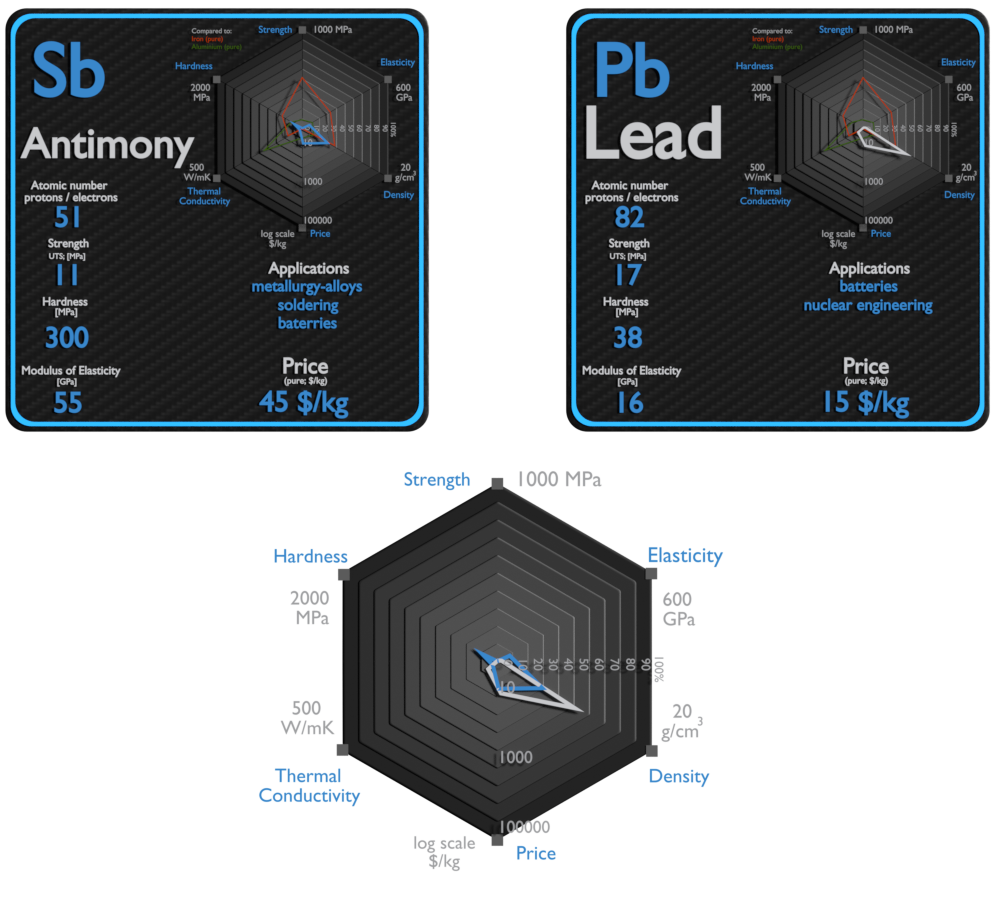
Antimony and Lead – Comparison – Properties

This article contains comparison of key thermal and atomic properties of antimony and lead, two comparable chemical elements from the periodic table. It also contains basic descriptions and applications of both elements. Antimony vs Lead.

antimony and lead - comparison

Compare antimony with another element

Arsenic - Properties - Price - Applications - Production

Tin - Properties - Price - Applications - Production

Compare lead with another element

Iron - Properties - Price - Applications - Production

Arsenic - Properties - Price - Applications - Production

Cadmium - Properties - Price - Applications - Production

Tin - Properties - Price - Applications - Production

Antimony - Properties - Price - Applications - Production

Gold - Properties - Price - Applications - Production

Bismuth - Properties - Price - Applications - Production

Antimony and Lead – About Elements

Antimony

Antimony is a lustrous gray metalloid, it is found in nature mainly as the sulfide mineral stibnite. Antimony compounds have been known since ancient times and were powdered for use as medicine and cosmetics, often known by the Arabic name, kohl.

Lead

Lead is a heavy metal that is denser than most common materials. Lead is soft and malleable, and has a relatively low melting point. Lead is widely used as a gamma shield. Major advantage of lead shield is in its compactness due to its higher density. Lead has the highest atomic number of any stable element and concludes three major decay chains of heavier elements.

Antimony in Periodic Table

Lead in Periodic Table

Source: www.luciteria.com

Antimony and Lead – Applications

Antimony

The largest applications for metallic antimony are an alloy with lead and tin and the lead antimony plates in lead–acid batteries. Alloys of lead and tin with antimony have improved properties for solders, bullets, and plain bearings. Antimony can be used in fire retardants for many commercial and domestic products. Antimony trichloride is used in the manufacturing flame-proofing compounds as well as paints, ceramic enamels, glass and pottery. Other uses include ball bearings and mixing with alloys with percentages ranging from 1 to 20 greatly increasing the hardness and mechanical strength of the lead. The capability to strengthen already strong alloys is its largest and most widespread use.

Lead

Lead metal has several useful mechanical properties, including high density, low melting point, ductility, and relative inertness. Lead is widely used for car batteries, pigments, ammunition, cable sheathing, weights for lifting, weight belts for diving, lead crystal glass, radiation protection and in some solders. The largest use of lead in the early 21st century is in lead–acid batteries. The lead in batteries undergoes no direct contact with humans, so there are fewer toxicity concerns. Lead is used in high voltage power cables as sheathing material to prevent water diffusion into insulation; this use is decreasing as lead is being phased out. A lead is widely used as a gamma shield. Major advantage of lead shield is in its compactness due to its higher density. On the other hand depleted uranium is much more effective due to its higher Z. Depleted uranium is used for shielding in portable gamma ray sources.

Antimony and Lead – Comparison in Table

Element Antimony Lead
Density 6.697 g/cm3 11.34 g/cm3
Ultimate Tensile Strength 11 MPa 17 MPa
Yield Strength N/A 5.5 MPa
Young’s Modulus of Elasticity 55 GPa 16 GPa
Mohs Scale 3.15 1.5
Brinell Hardness 300 MPa 38 MPa
Vickers Hardness N/A N/A
Melting Point 631 °C 327.5 °C
Boiling Point 1950 °C 1740 °C
Thermal Conductivity 24 W/mK 35 W/mK
Thermal Expansion Coefficient 11 µm/mK 28.9 µm/mK
Specific Heat 0.21 J/g K 0.13 J/g K
Heat of Fusion 19.87 kJ/mol 4.799 kJ/mol
Heat of Vaporization 77.14 kJ/mol 177.7 kJ/mol


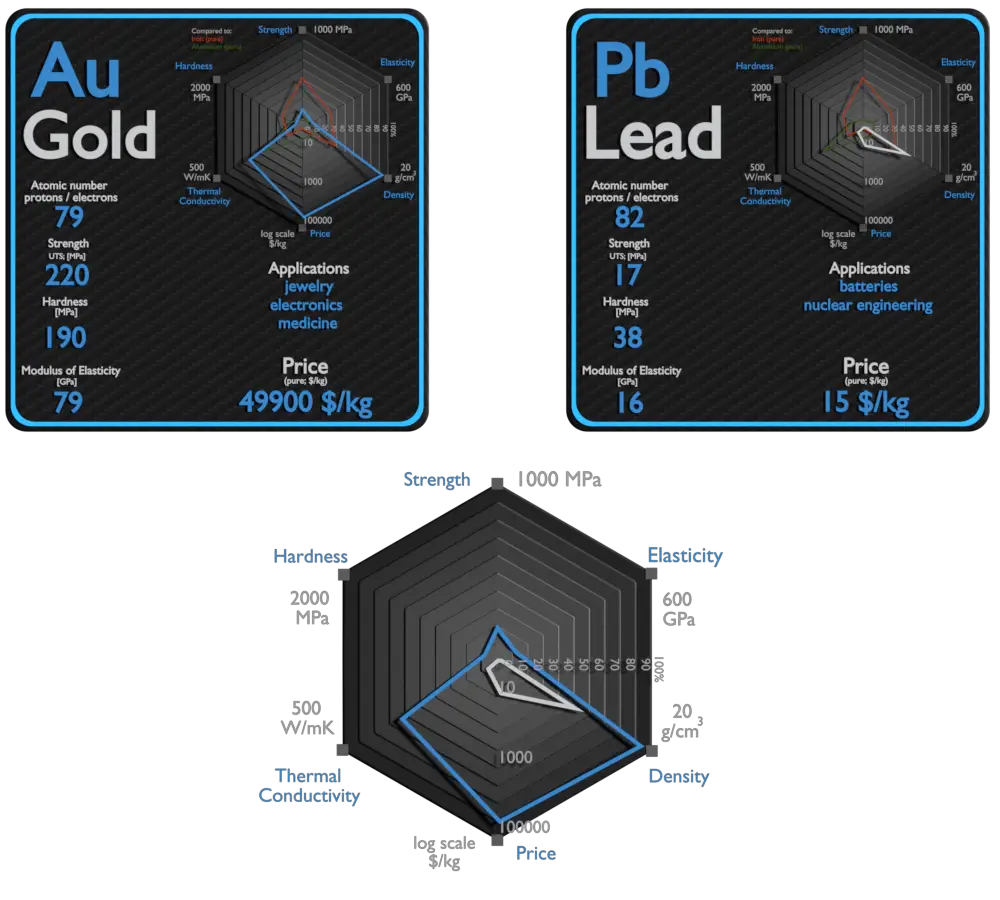
Gold and Lead – Comparison – Properties

This article contains comparison of key thermal and atomic properties of gold and lead, two comparable chemical elements from the periodic table. It also contains basic descriptions and applications of both elements. Gold vs Lead.

gold and lead - comparison

Compare gold with another element

Titanium - Properties - Price - Applications - Production

Cobalt - Properties - Price - Applications - Production

Nickel - Properties - Price - Applications - Production

Copper - Properties - Price - Applications - Production

Rhodium - Properties - Price - Applications - Production

Palladium - Properties - Price - Applications - Production

Silver - Properties - Price - Applications - Production

Tungsten - Properties - Price - Applications - Production

Osmium - Properties - Price - Applications - Production

Iridium - Properties - Price - Applications - Production

Platinum - Properties - Price - Applications - Production

Lead - Properties - Price - Applications - Production

Compare lead with another element

Iron - Properties - Price - Applications - Production

Arsenic - Properties - Price - Applications - Production

Cadmium - Properties - Price - Applications - Production

Tin - Properties - Price - Applications - Production

Antimony - Properties - Price - Applications - Production

Gold - Properties - Price - Applications - Production

Bismuth - Properties - Price - Applications - Production

Gold and Lead – About Elements

Gold

Gold is a bright, slightly reddish yellow, dense, soft, malleable, and ductile metal. Gold is a transition metal and a group 11 element. It is one of the least reactive chemical elements and is solid under standard conditions. Gold is thought to have been produced in supernova nucleosynthesis, from the collision of neutron stars.

Lead

Lead is a heavy metal that is denser than most common materials. Lead is soft and malleable, and has a relatively low melting point. Lead is widely used as a gamma shield. Major advantage of lead shield is in its compactness due to its higher density. Lead has the highest atomic number of any stable element and concludes three major decay chains of heavier elements.

Gold in Periodic Table

Lead in Periodic Table

Source: www.luciteria.com

Gold and Lead – Applications

Gold

Gold is used extensively in jewellery, either in its pure form or as an alloy. About 75% of all gold produced is used in the jewelry industry. Pure gold is too soft to stand up to the stresses applied to many jewelry items. Craftsmen learned that alloying gold with other metals such as copper, silver, and platinum would increase its durability. The term ‘carat’ indicates the amount of gold present in an alloy. 24-carat is pure gold, but it is very soft. 18- and 9-carat gold alloys are commonly used because they are more durable. Gold’s high malleability, ductility, resistance to corrosion and most other chemical reactions, and conductivity of electricity have led to its continued use in corrosion resistant electrical connectors in all types of computerized devices (its chief industrial use). Gold is also used in infrared shielding, colored-glass production, gold leafing, and tooth restoration. Only 10% of the world consumption of new gold produced goes to industry, but by far the most important industrial use for new gold is in fabrication of corrosion-free electrical connectors in computers and other electrical devices.

Lead

Lead metal has several useful mechanical properties, including high density, low melting point, ductility, and relative inertness. Lead is widely used for car batteries, pigments, ammunition, cable sheathing, weights for lifting, weight belts for diving, lead crystal glass, radiation protection and in some solders. The largest use of lead in the early 21st century is in lead–acid batteries. The lead in batteries undergoes no direct contact with humans, so there are fewer toxicity concerns. Lead is used in high voltage power cables as sheathing material to prevent water diffusion into insulation; this use is decreasing as lead is being phased out. A lead is widely used as a gamma shield. Major advantage of lead shield is in its compactness due to its higher density. On the other hand depleted uranium is much more effective due to its higher Z. Depleted uranium is used for shielding in portable gamma ray sources.

Gold and Lead – Comparison in Table

Element Gold Lead
Density 19.3 g/cm3 11.34 g/cm3
Ultimate Tensile Strength 220 MPa 17 MPa
Yield Strength 205 MPa 5.5 MPa
Young’s Modulus of Elasticity 79 GPa 16 GPa
Mohs Scale 2.75 1.5
Brinell Hardness 190 MPa 38 MPa
Vickers Hardness 215 MPa N/A
Melting Point 1064 °C 327.5 °C
Boiling Point 2970 °C 1740 °C
Thermal Conductivity 320 W/mK 35 W/mK
Thermal Expansion Coefficient 14.2 µm/mK 28.9 µm/mK
Specific Heat 0.128 J/g K 0.13 J/g K
Heat of Fusion 12.55 kJ/mol 4.799 kJ/mol
Heat of Vaporization 334.4 kJ/mol 177.7 kJ/mol


Mercury and Lead – Comparison – Properties

This article contains comparison of key thermal and atomic properties of mercury and lead, two comparable chemical elements from the periodic table. It also contains basic descriptions and applications of both elements. Mercury vs Lead.

mercury and lead - comparison

Compare mercury with another element

Aluminium - Properties - Price - Applications - Production

Iodine - Properties - Price - Applications - Production

Lead - Properties - Price - Applications - Production

Compare lead with another element

Iron - Properties - Price - Applications - Production

Arsenic - Properties - Price - Applications - Production

Cadmium - Properties - Price - Applications - Production

Tin - Properties - Price - Applications - Production

Antimony - Properties - Price - Applications - Production

Gold - Properties - Price - Applications - Production

Bismuth - Properties - Price - Applications - Production

Mercury and Lead – About Elements

Mercury

Mercury is commonly known as quicksilver and was formerly named hydrargyrum. Mercury is a heavy, silvery d-block element, mercury is the only metallic element that is liquid at standard conditions for temperature and pressure.

Lead

Lead is a heavy metal that is denser than most common materials. Lead is soft and malleable, and has a relatively low melting point. Lead is widely used as a gamma shield. Major advantage of lead shield is in its compactness due to its higher density. Lead has the highest atomic number of any stable element and concludes three major decay chains of heavier elements.

Mercury in Periodic Table

Lead in Periodic Table

Source: www.luciteria.com

Mercury and Lead – Applications

Mercury

Mercury is used primarily for the manufacture of industrial chemicals or for electrical and electronic applications. However, because of its toxicity, many uses of mercury are being phased out or are under review. It is used in some thermometers, especially ones which are used to measure high temperatures. Mercury easily forms alloys, called amalgams, with other metals such as gold, silver and tin. The ease with which it amalgamates with gold made it useful in recovering gold from its ores. Mercury amalgams were also used in dental fillings. Gaseous mercury is used in mercury-vapor lamps and some “neon sign” type advertising signs and fluorescent lamps.

Lead

Lead metal has several useful mechanical properties, including high density, low melting point, ductility, and relative inertness. Lead is widely used for car batteries, pigments, ammunition, cable sheathing, weights for lifting, weight belts for diving, lead crystal glass, radiation protection and in some solders. The largest use of lead in the early 21st century is in lead–acid batteries. The lead in batteries undergoes no direct contact with humans, so there are fewer toxicity concerns. Lead is used in high voltage power cables as sheathing material to prevent water diffusion into insulation; this use is decreasing as lead is being phased out. A lead is widely used as a gamma shield. Major advantage of lead shield is in its compactness due to its higher density. On the other hand depleted uranium is much more effective due to its higher Z. Depleted uranium is used for shielding in portable gamma ray sources.

Mercury and Lead – Comparison in Table

Element Mercury Lead
Density 13.534 g/cm3 11.34 g/cm3
Ultimate Tensile Strength N/A 17 MPa
Yield Strength N/A 5.5 MPa
Young’s Modulus of Elasticity N/A 16 GPa
Mohs Scale N/A 1.5
Brinell Hardness N/A 38 MPa
Vickers Hardness N/A N/A
Melting Point -38.9 °C 327.5 °C
Boiling Point 357 °C 1740 °C
Thermal Conductivity 8.3 W/mK 35 W/mK
Thermal Expansion Coefficient 60.4 µm/mK 28.9 µm/mK
Specific Heat 0.139 J/g K 0.13 J/g K
Heat of Fusion 2.295 kJ/mol 4.799 kJ/mol
Heat of Vaporization 59.229 kJ/mol 177.7 kJ/mol


Krypton and Xenon – Comparison – Properties

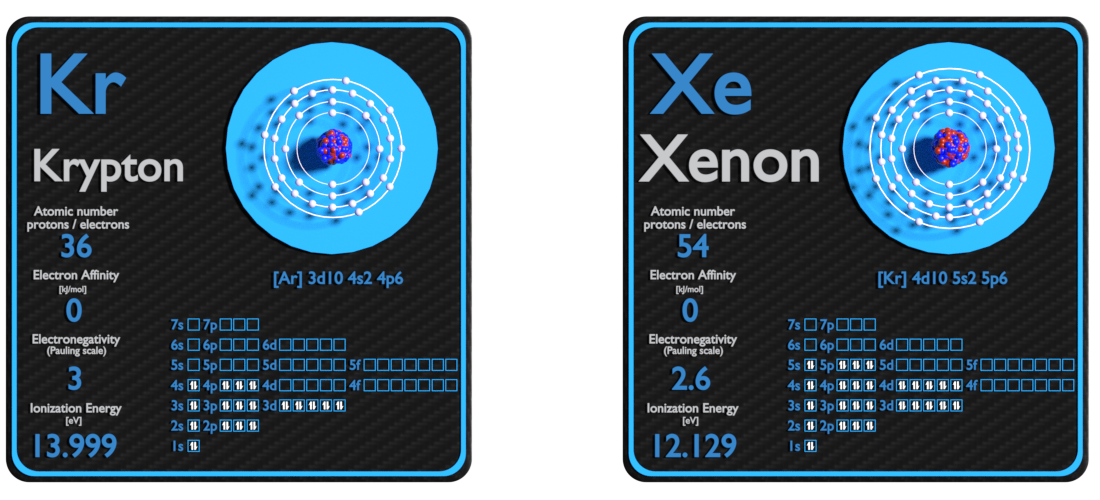
This article contains comparison of key thermal and atomic properties of krypton and xenon, two comparable chemical elements from the periodic table. It also contains basic descriptions and applications of both elements. Krypton vs Xenon.

krypton and xenon - comparison

Compare krypton with another element

Argon - Properties - Price - Applications - Production

Xenon - Properties - Price - Applications - Production

Compare xenon with another element

Helium - Properties - Price - Applications - Production

Neon - Properties - Price - Applications - Production

Krypton - Properties - Price - Applications - Production

Krypton and Xenon – About Elements

Krypton

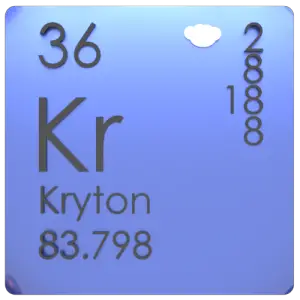
Krypton is a member of group 18 (noble gases) elements. A colorless, odorless, tasteless noble gas, krypton occurs in trace amounts in the atmosphere and is often used with other rare gases in fluorescent lamps.

Xenon

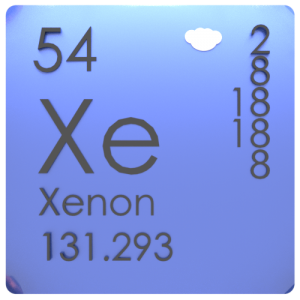
Xenon is a colorless, dense, odorless noble gas found in the Earth’s atmosphere in trace amounts.[10] Although generally unreactive, xenon can undergo a few chemical reactions. Xenon was first discovered in 1898 by the Scottish chemist William Ramsay and English chemist Morris Travers. The name xenon for this gas comes from the Greek word ξένον [xenon], neuter singular form of ξένος [xenos], meaning ‘foreign(er)’, ‘strange(r)’, or ‘guest’. In nuclear industry, especially artificial xenon 135 has a tremendous impact on the operation of a nuclear reactor. For physicists and for reactor operators, it is important to understand the mechanisms that produce and remove xenon from the reactor to predict how the reactor will respond following changes in power level.

Krypton in Periodic Table

Xenon in Periodic Table

Source: www.luciteria.com

Krypton and Xenon – Applications

Krypton

Krypton’s multiple emission lines make ionized krypton gas discharges appear whitish, which in turn makes krypton-based bulbs useful in photography as a white light source. Krypton is used in some photographic flashes for high speed photography. Krypton is also used in MRI/CT techniques.

Xenon

Xenon is useful in the following applications. The white flash of light produced by xenon makes it suitable for usage in strobe lights and to power ruby lasers. Xenon is used in light-emitting devices called xenon flash lamps, used in photographic flashes and stroboscopic lamps.

Krypton and Xenon – Comparison in Table

Element Krypton Xenon
Density 0.00375 g/cm3 0.0059 g/cm3
Ultimate Tensile Strength N/A N/A
Yield Strength N/A N/A
Young’s Modulus of Elasticity N/A N/A
Mohs Scale N/A N/A
Brinell Hardness N/A N/A
Vickers Hardness N/A N/A
Melting Point -248 °C -157.36 °C
Boiling Point -248.7 °C -153.22 °C
Thermal Conductivity 0.00949 W/mK 0.00565 W/mK
Thermal Expansion Coefficient N/A N/A
Specific Heat 0.248 J/g K 0.158 J/g K
Heat of Fusion 1.638 kJ/mol 2.297 kJ/mol
Heat of Vaporization 9.029 kJ/mol 12.636 kJ/mol


Niobium and Tantalum – Comparison – Properties

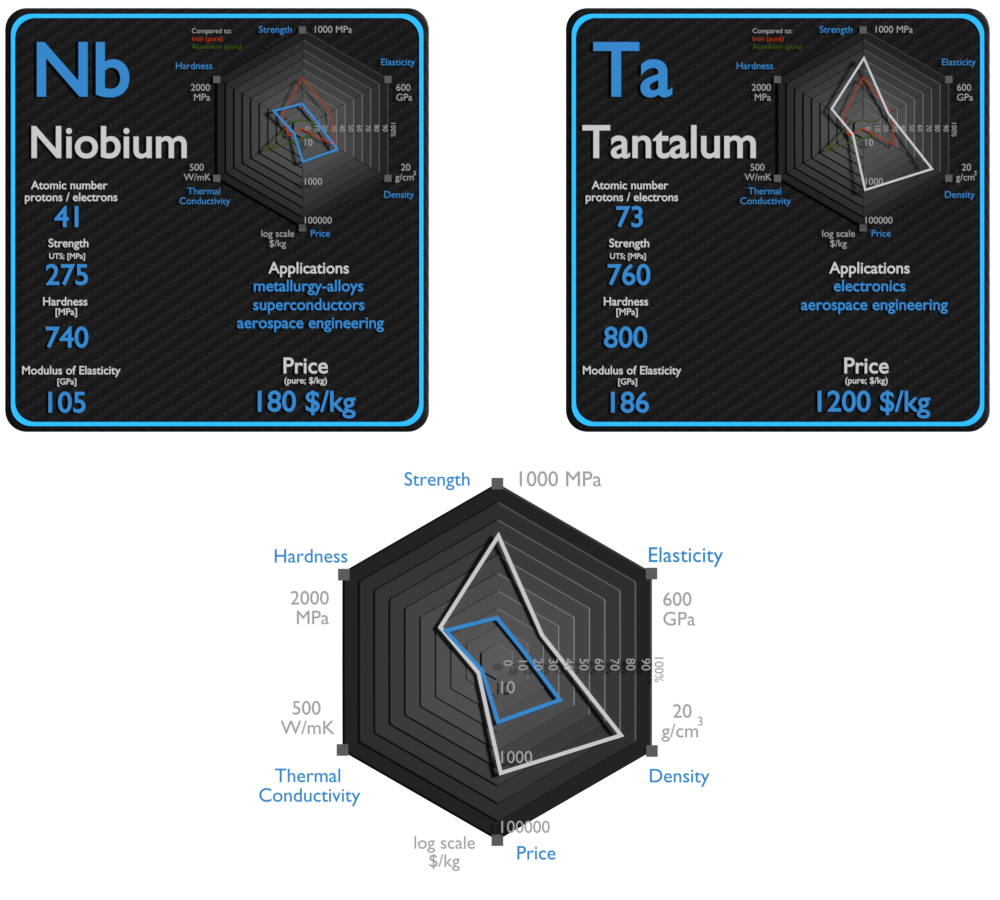
This article contains comparison of key thermal and atomic properties of niobium and tantalum, two comparable chemical elements from the periodic table. It also contains basic descriptions and applications of both elements. Niobium vs Tantalum.

niobium and tantalum - comparison

Compare niobium with another element

Titanium - Properties - Price - Applications - Production

Zirconium - Properties - Price - Applications - Production

Tin - Properties - Price - Applications - Production

Tantalum - Properties - Price - Applications - Production

Compare tantalum with another element

Titanium - Properties - Price - Applications - Production

Niobium - Properties - Price - Applications - Production

Europium - Properties - Price - Applications - Production

Hafnium - Properties - Price - Applications - Production

Niobium and Tantalum – About Elements

Niobium

Niobium is a soft, grey, ductile transition metal, often found in the minerals pyrochlore (the main commercial source for niobium) and columbite.

Tantalum

Tantalum is a rare, hard, blue-gray, lustrous transition metal that is highly corrosion-resistant.

Niobium in Periodic Table

Tantalum in Periodic Table

Source: www.luciteria.com

Niobium and Tantalum – Applications

Niobium

Niobium consumption is dominated by its use as additive to high strength low alloy steel and stainless steel for oil and gas pipelines, car and truck bodies, architectural requirements, tool steels, ships hulls, railroad tracks. However, there are a number of other applications for niobium metal and its compounds. Although niobium has many applications the majority is used in the production of high-grade structural steel. The second largest application for niobium is in nickel-based superalloys. Niobium-tin alloys are used as superconducting magnets.

Tantalum

Tantalum consumption is dominated by capacitors for electronic equipment. Capacitors are electrical components that store energy electrostatically in an electric field, and are used in a wide variety of electric and electronic products. Major end uses for tantalum capacitors include portable telephones, pagers, personal computers, and automotive electronics. Alloyed with other metals, tantalum is also used in making carbide tools for metalworking equipment and in the production of superalloys for jet engine components. Compounds of tantalum such as tantalum pentoxide is used to make capacitors and glass with a high index of refraction for use in camera lenses.

Niobium and Tantalum – Comparison in Table

Element Niobium Tantalum
Density 8.57 g/cm3 16.65 g/cm3
Ultimate Tensile Strength 275 MPa 760 MPa
Yield Strength 70 MPa 705 MPa
Young’s Modulus of Elasticity 105 GPa 186 GPa
Mohs Scale 6 6.5
Brinell Hardness 740 MPa 800 MPa
Vickers Hardness 1300 MPa 870 MPa
Melting Point 2477 °C 2996 °C
Boiling Point 4744 °C 5425 °C
Thermal Conductivity 53.7 W/mK 57 W/mK
Thermal Expansion Coefficient 7.3 µm/mK 6.3 µm/mK
Specific Heat 0.26 J/g K 0.14 J/g K
Heat of Fusion 26.4 kJ/mol 31.6 kJ/mol
Heat of Vaporization 682 kJ/mol 743 kJ/mol


Niobium and Tin – Comparison – Properties

This article contains comparison of key thermal and atomic properties of niobium and tin, two comparable chemical elements from the periodic table. It also contains basic descriptions and applications of both elements. Niobium vs Tin.

niobium and tin - comparison

Compare niobium with another element

Titanium - Properties - Price - Applications - Production

Zirconium - Properties - Price - Applications - Production

Tin - Properties - Price - Applications - Production

Tantalum - Properties - Price - Applications - Production

Compare tin with another element

Nickel - Properties - Price - Applications - Production

Copper - Properties - Price - Applications - Production

Niobium - Properties - Price - Applications - Production

Antimony - Properties - Price - Applications - Production

Lead - Properties - Price - Applications - Production

Niobium and Tin – About Elements

Niobium

Niobium is a soft, grey, ductile transition metal, often found in the minerals pyrochlore (the main commercial source for niobium) and columbite.

Tin

Tin is a post-transition metal in group 14 of the periodic table. It is obtained chiefly from the mineral cassiterite, which contains tin dioxide. The first alloy used on a large scale was bronze, made of tin and copper, from as early as 3000 BC.

Niobium in Periodic Table

Tin in Periodic Table

Source: www.luciteria.com

Niobium and Tin – Applications

Niobium

Niobium consumption is dominated by its use as additive to high strength low alloy steel and stainless steel for oil and gas pipelines, car and truck bodies, architectural requirements, tool steels, ships hulls, railroad tracks. However, there are a number of other applications for niobium metal and its compounds. Although niobium has many applications the majority is used in the production of high-grade structural steel. The second largest application for niobium is in nickel-based superalloys. Niobium-tin alloys are used as superconducting magnets.

Tin

The largest single application of tin is in the manufacture of tinplate (steel sheet coated with tin), which accounts for approximately 40% of total world tin consumption. Tin bonds readily to iron and steel to prevent corrosion. Tin-plated steel containers are widely used for food preservation, and this forms a large part of the market for metallic tin. Tinning is the process of thinly coating sheets of wrought iron or steel with tin, and the resulting product is known as tinplate. The term is also widely used for the different process of coating a metal with solder before soldering. There are two processes for the tinning of the black plates: hot-dipping and electroplating.

Niobium and Tin – Comparison in Table

Element Niobium Tin
Density 8.57 g/cm3 7.31 g/cm3
Ultimate Tensile Strength 275 MPa 220 MPa
Yield Strength 70 MPa N/A
Young’s Modulus of Elasticity 105 GPa 50 GPa
Mohs Scale 6 1.65
Brinell Hardness 740 MPa 50 MPa
Vickers Hardness 1300 MPa N/A
Melting Point 2477 °C 231.93 °C
Boiling Point 4744 °C 2602 °C
Thermal Conductivity 53.7 W/mK 67 W/mK
Thermal Expansion Coefficient 7.3 µm/mK 22 µm/mK
Specific Heat 0.26 J/g K 0.227 J/g K
Heat of Fusion 26.4 kJ/mol 7.029 kJ/mol
Heat of Vaporization 682 kJ/mol 295.8 kJ/mol