Facebook Instagram Youtube Twitter

Hydrogen and Carbon – Comparison – Properties

This article contains comparison of key thermal and atomic properties of hydrogen and carbon, two comparable chemical elements from the periodic table. It also contains basic descriptions and applications of both elements. Hydrogen vs Carbon.

hydrogen and carbon - comparison - properties

Compare hydrogen with another element

Helium - Properties - Price - Applications - Production

Oxygen - Properties - Price - Applications - Production

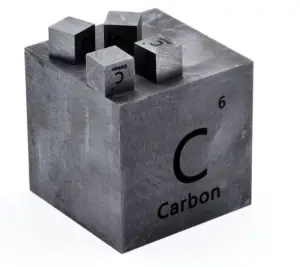
Carbon - Properties - Price - Applications - Production

Aluminium - Properties - Price - Applications - Production

Lithium - Properties - Price - Applications - Production

Nitrogen - Properties - Price - Applications - Production

Fluorine - Properties - Price - Applications - Production

Sodium - Properties - Price - Applications - Production

Calcium - Properties - Price - Applications - Production

Compare carbon with another element

Hydrogen - Properties - Price - Applications - Production

Boron - Properties - Price - Applications - Production

Oxygen - Properties - Price - Applications - Production

Aluminium - Properties - Price - Applications - Production

Nitrogen - Properties - Price - Applications - Production

Iron - Properties - Price - Applications - Production

Chlorine - Properties - Price - Applications - Production

Bromine - Properties - Price - Applications - Production

Hydrogen and Carbon – About Elements

Hydrogen

With a standard atomic weight of circa 1.008, hydrogen is the lightest element on the periodic table. Its monatomic form (H) is the most abundant chemical substance in the Universe, constituting roughly 75% of all baryonic mass.

Carbon

It is nonmetallic and tetravalent—making four electrons available to form covalent chemical bonds. Carbon is one of the few elements known since antiquity. Carbon is the 15th most abundant element in the Earth’s crust, and the fourth most abundant element in the universe by mass after hydrogen, helium, and oxygen.

Hydrogen in Periodic Table

Carbon in Periodic Table

Source: www.luciteria.com

Hydrogen and Carbon – Applications

Hydrogen

Hydrogen is versatile and can be utilized in various ways. These multiple uses can be grouped into two large categories. Hydrogen as a feedstock. A role whose importance is being recognized for decades and will continue to grow and evolve. The largest single use of hydrogen in the world is in ammonia manufacture, which consumes about two-thirds of the world’s hydrogen production. Hydrogen is versatile and can be utilized in various ways. These multiple uses can be grouped into two large categories. Hydrogen as a feedstock for further chemical processes. A role whose importance is being recognized for decades and will continue to grow and evolve. And hydrogen as an energy carrier. Hydrogen is also commonly used in power stations as a coolant in generators due to a number of favorable properties that are a direct result of its light diatomic molecules.

Carbon

The major economic use of carbon other than food and wood is in the form of hydrocarbons, most notably the fossil fuel methane gas and crude oil (petroleum). Graphite and diamonds are two important allotropes of carbon that have wide applications. The uses of carbon and its compounds are extremely varied. It can form alloys with iron, of which the most common is carbon steel. Carbon is a non-metallic element, which is an important alloying element in all ferrous metal based materials. Carbon is always present in metallic alloys, i.e. in all grades of stainless steel and heat resistant alloys. Carbon is a very strong austenitizer and increases the strength of steel. In fact, it is the principal hardening element and is essential to the formation of cementite, Fe3C, pearlite, spheroidite, and iron-carbon martensite. Adding a small amount of non-metallic carbon to iron trades its great ductility for the greater strength. Graphite is combined with clays to form the ‘lead’ used in pencils used for writing and drawing. It is also used as a lubricant and a pigment, as a molding material in glass manufacture, in electrodes for dry batteries and in electroplating and electroforming, in brushes for electric motors and as a neutron moderator in nuclear reactors. Charcoal has been used since earliest times for a large range of purposes including art and medicine, but by far its most important use has been as a metallurgical fuel. Carbon fibers are used where low weight, high stiffness, high conductivity, or where the look of the carbon fiber weave desired.

Hydrogen and Carbon – Comparison in Table

Element Hydrogen Carbon
Density 0.00009 g/cm3 2.26 g/cm3
Ultimate Tensile Strength N/A 15 MPa (graphite); 3500 MPa (carbon fiber)
Yield Strength N/A N/A
Young’s Modulus of Elasticity N/A 4.1 GPa (graphite); 228 GPa (carbon fiber)
Mohs Scale N/A 0.8 (graphite)
Brinell Hardness N/A N/A
Vickers Hardness N/A N/A
Melting Point -259.1 °C 4099 °C
Boiling Point -252.9 °C 4527 °C
Thermal Conductivity 0.1805 W/mK 129 W/mK
Thermal Expansion Coefficient — µm/mK 0.8 µm/mK
Specific Heat 14.304 J/g K 0.71 J/g K
Heat of Fusion 0.05868 kJ/mol — kJ/mol
Heat of Vaporization 0.44936 kJ/mol 355.8 kJ/mol


Hydrogen and Helium – Comparison – Properties

This article contains comparison of key thermal and atomic properties of hydrogen and helium, two comparable chemical elements from the periodic table. It also contains basic descriptions and applications of both elements. Hydrogen vs Helium.

hydrogen and helium - comparison - properties

Compare hydrogen with another element

Helium - Properties - Price - Applications - Production

Oxygen - Properties - Price - Applications - Production

Carbon - Properties - Price - Applications - Production

Aluminium - Properties - Price - Applications - Production

Lithium - Properties - Price - Applications - Production

Nitrogen - Properties - Price - Applications - Production

Fluorine - Properties - Price - Applications - Production

Sodium - Properties - Price - Applications - Production

Calcium - Properties - Price - Applications - Production

Compare helium with another element

Oxygen - Properties - Price - Applications - Production

Argon - Properties - Price - Applications - Production

Aluminium - Properties - Price - Applications - Production

Neon - Properties - Price - Applications - Production

Xenon - Properties - Price - Applications - Production

Hydrogen and Helium – About Elements

Hydrogen

With a standard atomic weight of circa 1.008, hydrogen is the lightest element on the periodic table. Its monatomic form (H) is the most abundant chemical substance in the Universe, constituting roughly 75% of all baryonic mass.

Helium

It is a colorless, odorless, tasteless, non-toxic, inert, monatomic gas, the first in the noble gas group in the periodic table. Its boiling point is the lowest among all the elements.

Hydrogen in Periodic Table

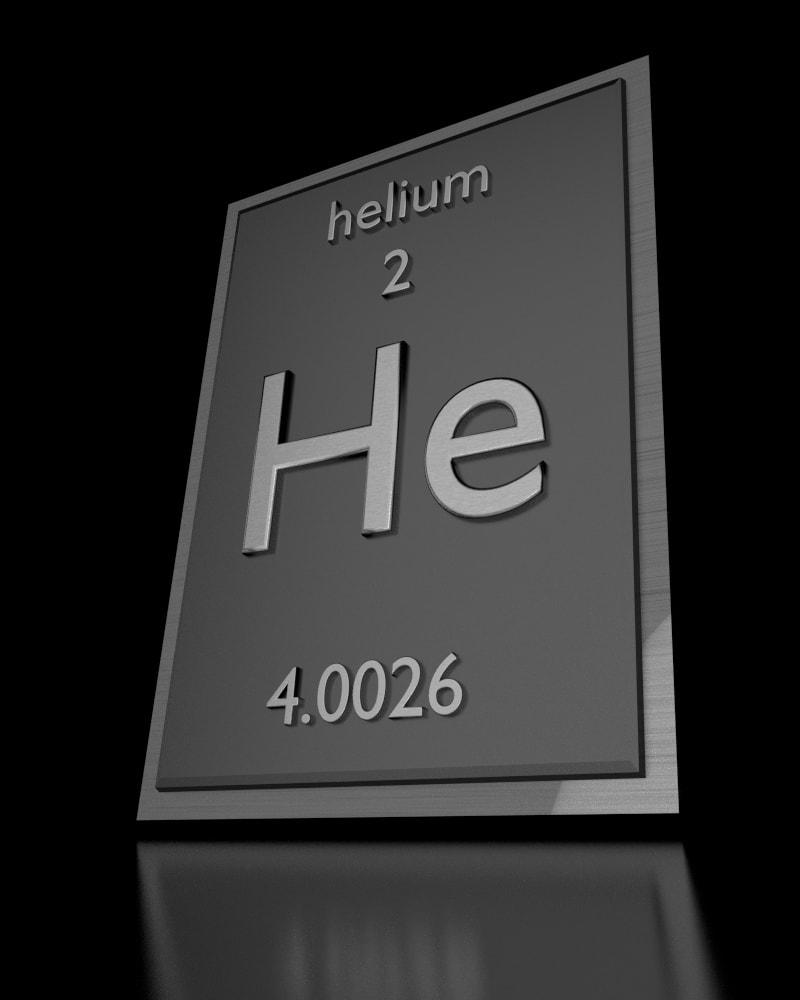
Helium in Periodic Table

Source: www.luciteria.com

Hydrogen and Helium – Applications

Hydrogen

Hydrogen is versatile and can be utilized in various ways. These multiple uses can be grouped into two large categories. Hydrogen as a feedstock. A role whose importance is being recognized for decades and will continue to grow and evolve. The largest single use of hydrogen in the world is in ammonia manufacture, which consumes about two-thirds of the world’s hydrogen production. Hydrogen is versatile and can be utilized in various ways. These multiple uses can be grouped into two large categories. Hydrogen as a feedstock for further chemical processes. A role whose importance is being recognized for decades and will continue to grow and evolve. And hydrogen as an energy carrier. Hydrogen is also commonly used in power stations as a coolant in generators due to a number of favorable properties that are a direct result of its light diatomic molecules.

Helium

Helium is used for many purposes that require some of its unique properties, such as its low boiling point, low density, low solubility, high thermal conductivity, or inertness. Of the 2014 world helium total production of about 32 million kg (180 million standard cubic meters) helium per year, the largest use (about 32% of the total in 2014) is in cryogenic applications, most of which involves cooling the superconducting magnets in medical MRI scanners and NMR spectrometers. Most clinical magnets are superconducting magnets, which require liquid helium to keep them very cold.

Hydrogen and Helium – Comparison in Table

Element Hydrogen Helium
Density 0.00009 g/cm3 0.00018 g/cm3
Ultimate Tensile Strength N/A N/A
Yield Strength N/A N/A
Young’s Modulus of Elasticity N/A N/A
Mohs Scale N/A N/A
Brinell Hardness N/A N/A
Vickers Hardness N/A N/A
Melting Point -259.1 °C -272.2 °C
Boiling Point -252.9 °C -268.9 °C
Thermal Conductivity 0.1805 W/mK 0.1513 W/mK
Thermal Expansion Coefficient — µm/mK — µm/mK
Specific Heat 14.304 J/g K 5.193 J/g K
Heat of Fusion 0.05868 kJ/mol 0.0138 kJ/mol
Heat of Vaporization 0.44936 kJ/mol 0.0845 kJ/mol


Hydrogen and Oxygen – Comparison – Properties

This article contains comparison of key thermal and atomic properties of hydrogen and oxygen, two comparable chemical elements from the periodic table. It also contains basic descriptions and applications of both elements. Hydrogen vs Oxygen.

hydrogen and oxygen - comparison

Compare hydrogen with another element

Helium - Properties - Price - Applications - Production

Oxygen - Properties - Price - Applications - Production

Carbon - Properties - Price - Applications - Production

Aluminium - Properties - Price - Applications - Production

Lithium - Properties - Price - Applications - Production

Nitrogen - Properties - Price - Applications - Production

Fluorine - Properties - Price - Applications - Production

Sodium - Properties - Price - Applications - Production

Calcium - Properties - Price - Applications - Production

Compare oxygen with another element

Sodium - Properties - Price - Applications - Production

Fluorine - Properties - Price - Applications - Production

Magnesium - Properties - Price - Applications - Production

Aluminium - Properties - Price - Applications - Production

Silicon - Properties - Price - Applications - Production

Sulfur - Properties - Price - Applications - Production

Chlorine - Properties - Price - Applications - Production

Potassium - Properties - Price - Applications - Production

Calcium - Properties - Price - Applications - Production

Iron - Properties - Price - Applications - Production

Hydrogen - Properties - Price - Applications - Production

Helium - Properties - Price - Applications - Production

Lithium - Properties - Price - Applications - Production

Beryllium - Properties - Price - Applications - Production

Boron - Properties - Price - Applications - Production

Carbon - Properties - Price - Applications - Production

Hydrogen and Oxygen – About Elements

Hydrogen

With a standard atomic weight of circa 1.008, hydrogen is the lightest element on the periodic table. Its monatomic form (H) is the most abundant chemical substance in the Universe, constituting roughly 75% of all baryonic mass.

Oxygen

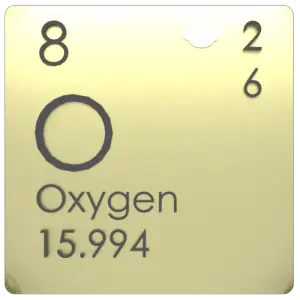
Oxygen is a colourless, odourless reactive gas, the chemical element of atomic number 8 and the life-supporting component of the air. It is a member of the chalcogen group on the periodic table, a highly reactive nonmetal, and an oxidizing agent that readily forms oxides with most elements as well as with other compounds. By mass, oxygen is the third-most abundant element in the universe, after hydrogen and helium.

Hydrogen in Periodic Table

Oxygen in Periodic Table

Source: www.luciteria.com

Hydrogen and Oxygen – Applications

Hydrogen

Hydrogen is versatile and can be utilized in various ways. These multiple uses can be grouped into two large categories. Hydrogen as a feedstock. A role whose importance is being recognized for decades and will continue to grow and evolve. The largest single use of hydrogen in the world is in ammonia manufacture, which consumes about two-thirds of the world’s hydrogen production. Hydrogen is versatile and can be utilized in various ways. These multiple uses can be grouped into two large categories. Hydrogen as a feedstock for further chemical processes. A role whose importance is being recognized for decades and will continue to grow and evolve. And hydrogen as an energy carrier. Hydrogen is also commonly used in power stations as a coolant in generators due to a number of favorable properties that are a direct result of its light diatomic molecules.

Oxygen

Common uses of oxygen include production of steel, plastics and textiles, brazing, welding and cutting of steels and other metals, rocket propellant, oxygen therapy, and life support systems in aircraft, submarines, spaceflight and diving. Smelting of iron ore into steel consumes 55% of commercially produced oxygen. In this process, oxygen is injected through a high-pressure lance into molten iron, which removes sulfur impurities and excess carbon as the respective oxides, sulfur dioxide and carbon dioxide. Uptake of oxygen from the air is the essential purpose of respiration, so oxygen supplementation is used in medicine. Treatment not only increases oxygen levels in the patient’s blood, but has the secondary effect of decreasing resistance to blood flow in many types of diseased lungs, easing work load on the heart.

Hydrogen and Oxygen – Comparison in Table

Element Hydrogen Oxygen
Density 0.00009 g/cm3 0.00143 g/cm3
Ultimate Tensile Strength N/A N/A
Yield Strength N/A N/A
Young’s Modulus of Elasticity N/A N/A
Mohs Scale N/A N/A
Brinell Hardness N/A N/A
Vickers Hardness N/A N/A
Melting Point -259.1 °C -218.4 °C
Boiling Point -252.9 °C -183 °C
Thermal Conductivity 0.1805 W/mK 0.02674 W/mK
Thermal Expansion Coefficient — µm/mK — µm/mK
Specific Heat 14.304 J/g K 0.92 J/g K
Heat of Fusion 0.05868 kJ/mol (O2) 0.444 kJ/mol
Heat of Vaporization 0.44936 kJ/mol (O2) 6.82 kJ/mol


What is Nuclear Binding Curve – Definition

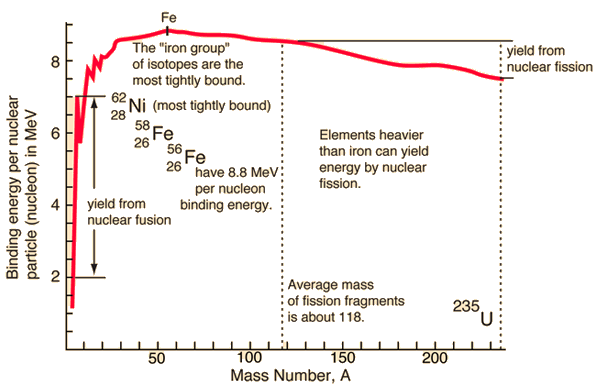
Nuclear binding energy curve.
Nuclear binding energy curve. Source: hyperphysics.phy-astr.gsu.edu

If the splitting releases energy and the fusion releases the energy, so where is the breaking point? For understanding this issue it is better to relate the binding energy to one nucleon, to obtain nuclear binding curve. The binding energy per one nucleon is not linear. There is a peak in the binding energy curve in the region of stability near iron and this means that either the breakup of heavier nuclei than iron or the combining of lighter nuclei than iron will yield energy.

The reason the trend reverses after iron peak is the growing positive charge of the nuclei. The electric force has greater range than strong nuclear force. While the strong nuclear force binds only close neighbors the electric force of each proton repels the other protons.

What is Neutron – Definition

What is Neutron

A neutron is one of the subatomic particles that make up matter. In the universe, neutrons are abundant, making up more than half of all visible matter. It has no electric charge and a rest mass equal to 1.67493 × 10⁻²⁷ kg—marginally greater than that of the proton but nearly 1839 times greater than that of the electron. The neutron has a mean square radius of about 0.8×10⁻¹⁵ m, or 0.8 fm, and it is a spin-½ fermion.

The neutrons exist in the nuclei of typical atoms, along with their positively charged counterparts, the protons. Neutrons and protons, commonly called nucleons, are bound together in the atomic nucleus, where they account for 99.9 percent of the atom’s mass. Research in high-energy particle physics in the 20th century revealed that neither the neutron nor the proton is not the smallest building block of matter. Protons and neutrons have also their structure. Inside the protons and neutrons, we find true elementary particles called quarks. Within the nucleus, protons and neutrons are bound together through the strong force, a fundamental interaction that governs the behaviour of the quarks that make up the individual protons and neutrons.

A nuclear stability is determined by the competition between two fundamental interactions. Protons and neutrons are attracted each other via strong force. On the other hand protons repel each other via the electric force due to their positive charge. Therefore neutrons within the nucleus act somewhat like nuclear glue, neutrons attract each other and protons , which helps offset the electrical repulsion between protons. There are only certain combinations of neutrons and protons, which forms stable nuclei. For example, the most common nuclide of the common chemical element lead (Pb) has 82 protons and 126 neutrons.

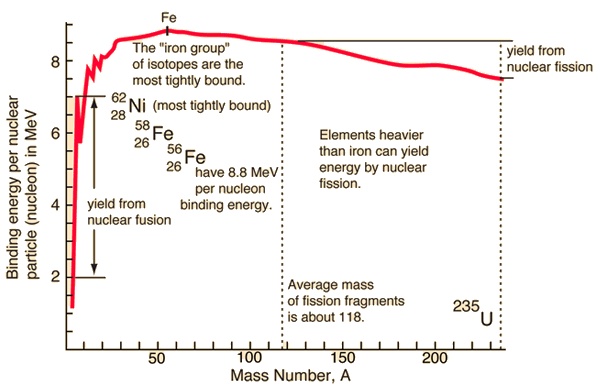
Nuclear binding energy curve.
Source: hyperphysics.phy-astr.gsu.edu

Because of the strength of the nuclear force at short distances, the nuclear binding energy (the energy required to disassemble a nucleus of an atom into its component parts) of nucleons is more than seven orders of magnitude larger than the electromagnetic energy binding electrons in atoms. Nuclear reactions (such as nuclear fission or nuclear fusion) therefore have an energy density that is more than 10 000 000x that of chemical reactions.
Knowledge of the behaviour and properties of neutrons is essential to the production of nuclear power. Shortly after the neutron was discovered in 1932, it was quickly realized that neutrons might act to form a nuclear chain reaction. When nuclear fission was discovered in 1938, it became clear that, if a fission reaction produced free neutrons, each of these neutrons might cause further fission reaction in a cascade known as a chain reaction. Knowledge of cross-sections (the key parameter representing probability of interaction between a neutron and a nucleus) became crutial for design of reactor cores and the first nuclear weapon (Trinity, 1945).

Discovery of the Neutron
The story of the discovery of the neutron and its properties is central to the extraordinary developments in atomic physics that occurred in the first half of the 20th century. The neutron was discovered in 1932 by the English physicist James Chadwick, but since the time of Ernest Rutherford it had been known that the atomic mass number A of nuclei is a bit more than twice the atomic number Z for most atoms and that essentially all the mass of the atom is concentrated in the relatively tiny nucleus. The Rutherford’s model for the atom in 1911 claims that atoms have their mass and positive charge concentrated in a very small nucleus.
Discovery of the Neutron
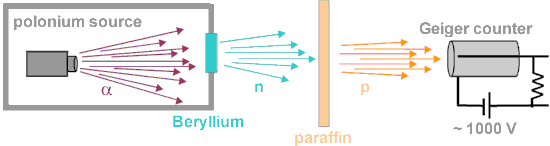
The alpha particles emitted from polonium fell on certain light elements, specifically beryllium, an unusually penetrating radiation is produced.
Source: dev.physicslab.org
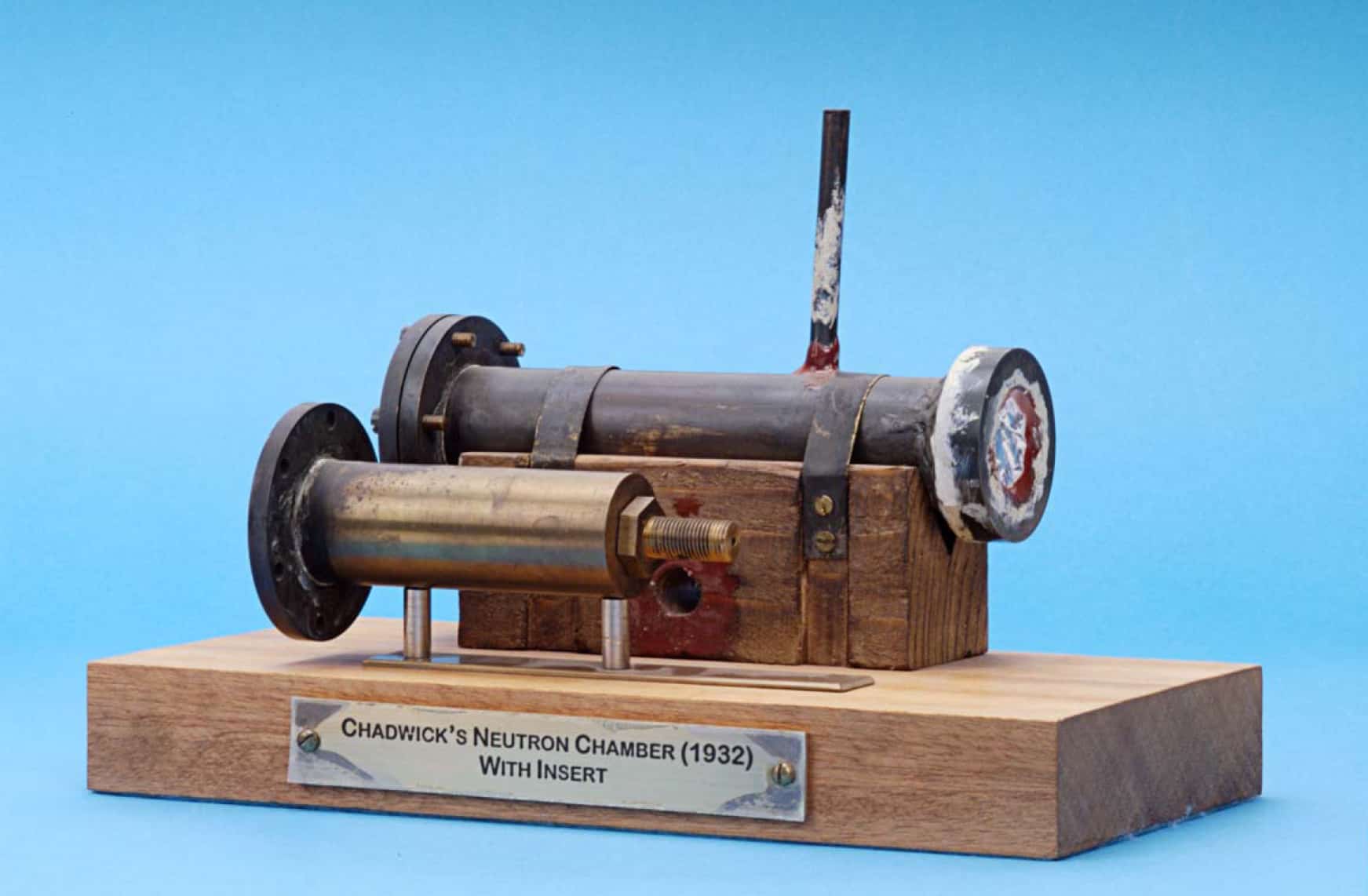
Chadwicks chamber.
Chadwick’s neutron chamber containing parallel disks of radioactive polonium and beryllium. Radiation is emitted from an aluminium window at the chamber’s end.
Source: imgkid.com

An experimental breakthrough came in 1930 with the observation by Bothe and Becker. They found that if the very energetic alpha particles emitted from polonium fell on certain light elements, specifically beryllium, boron, or lithium, an unusually penetrating radiation was produced. Since this radiation was not influenced by an electric field (neutrons have no charge), they presumed it was gamma rays (but much more penetrating). It was shown (Curie and Joliot) that when a paraffin target with this radiation is bombarded, it ejected protons with energy about 5.3 MeV. Paraffin is high in hydrogen content, hence offers a target dense with protons (since neutrons and protons have almost equal mass, protons scatter energetically from neutrons).These experimental results were difficult to interpret. James Chadwick was able to prove that the neutral particle could not be a photon by bombarding targets other than hydrogen, including nitrogen, oxygen, helium and argon. Not only were these inconsistent with photon emission on energy grounds, the cross-section for the interactions was orders of magnitude greater than that for Compton scattering by photons. In Rome, the young physicist Ettore Majorana suggested that the manner in which the new radiation interacted with protons required a new neutral particle.

The task was that of determining the mass of this neutral particle. James Chadwick chose to bombard boron with alpha particles and analyze the interaction of the neutral particles with nitrogen. These particlular targets were chosen partly because the masses of boron and nitrogen were well known. Using kinematics, Chadwick was able to determine the velocity of the protons. Then through conservation of momentum techniques, he was able to determine that the mass of the neutral radiation was almost exactly the same as that of a proton. In 1932, Chadwick proposed that the neutral particle was Rutherford’s neutron. In 1935, he was awarded the Nobel Prize for his discovery.

See also: Discovery of the Neutron

Structure of the Neutron

Quark structure of the Neutron
The quark structure of the neutron. The color assignment of individual quarks is arbitrary, but all three colors must be present. Forces between quarks are mediated by gluons.

Neutrons and protons are classified as hadrons, subatomic particles that are subject to the strong force and as baryons since they are composed of three quarks. The neutron is a composite particle made of two down quarks with charge −⅓  e and one up quark with charge +⅔ e. Since the neutron has no net electric charge, it is not affected by eletric forces, but the neutron does have a slight distribution of electric charge within it. This results in non-zero magnetic moment (dipole moment) of the neutron. Therefore the neutron interacts also via electromagnetic interaction, but much weaker than the proton.

The mass of the neutron is 939.565 MeV/c2, whereas the mass of the three quarks is only about 12 MeV/c2 (only about 1% of the mass-energy of the neutron). Like the proton, most of mass (energy) of the neutron is in the form of the strong nuclear force energy (gluons). The quarks of the neutron are held together by gluons, the exchange particles for the strong nuclear force. Gluons carry the color charge of the strong nuclear force.

See also: Structure of the Neutron

Properties of the Neutron

Key properties of neutrons are summarized below:

  • Mean square radius of a neutron is ~ 0.8 x 10⁻¹⁵m (0.8 fermi)
  • The mass of the neutron is 939.565 MeV/c2
  • Neutrons are ½ spin particles – fermionic statistics
  • Neutrons are neutral particles – no net electric charge.
  • Neutrons have non-zero magnetic moment.
  • Free neutrons (outside a nucleus) are unstable and decay via beta decay. The decay of the neutron involves the weak interaction and is associated with a quark transformation (a down quark is converted to an up quark).
  • Mean lifetime of a free neutron is 882 seconds (i.e. half-life is 611 seconds ).
  • A natural neutron background of free neutrons exists everywhere on Earth and it is caused by muons produced in the atmosphere, where high energy cosmic rays collide with particles of Earth’s atmosphere.
  • Neutrons cannot directly cause ionization. Neutrons ionize matter only indirectly.
  • Neutrons can travel hundreds of feet in air without any interaction. Neutron radiation is highly penetrating.
  • Neutrons trigger the nuclear fission.
  • The fission process produces free neutrons (2 or 3).
  • Thermal or cold neutrons have the wavelengths similar to atomic spacings. They can be used in neutron diffraction experiments to determine the atomic and/or magnetic structure of a material.

See also: Properties of the Neutron

 
Neutron Energy
Free neutrons can be classified according to their kinetic energy. This energy is usually given in electron volts (eV). The term temperature can also describe this energy representing thermal equilibrium between a neutron and a medium with a certain temperature.

Classification of free neutrons according kinetic energies

  • Cold Neutrons (0 eV; 0.025 eV). Neutrons in thermal equilibrium with very cold surroundings such as liquid deuterium. This spectrum is used for neutron scattering experiments.
  • Thermal Neutrons. Neutrons in thermal equilibrium with a surrounding medium. Most probable energy at 20°C (68°F) for Maxwellian distribution is 0.025 eV (~2 km/s). This part of neutron’s energy spectrum constitutes most important part of spectrum in thermal reactors.
  • Epithermal Neutrons (0.025 eV; 0.4 eV). Neutrons of kinetic energy greater than thermal. Some of reactor designs operates with epithermal neutron’s spectrum. This design allows to reach higher fuel breeding ratio than in thermal reactors.
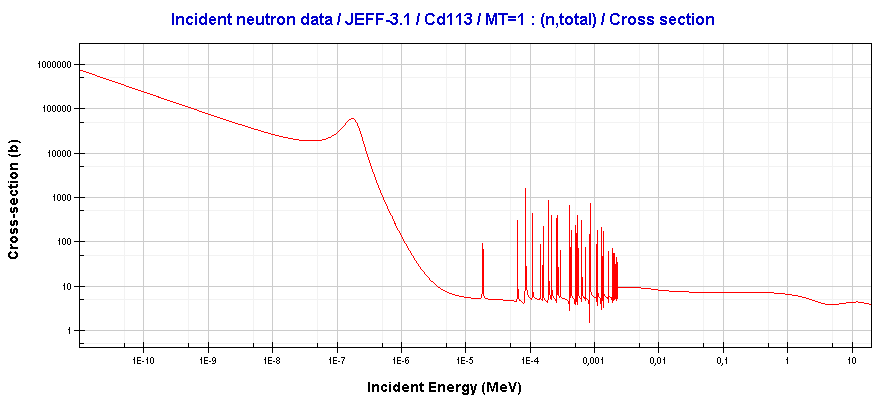
  • Cadmium cut-off energy
    Neutrons of kinetic energy below the cadmium cut-off energy (~0.5 eV) are strongly absorbed by 113-Cd.
    Source: JANIS (Java-based nuclear information software) www.oecd-nea.org/janis/

    Cadmium Neutrons (0.4 eV; 0.5 eV). Neutrons of kinetic energy below the cadmium cut-off energy. One cadmium isotope, 113Cd, absorbs neutrons strongly only if they are below ~0.5 eV (cadmium cut-off energy).

  • Epicadmium Neutrons (0.5 eV; 1 eV). Neutrons of kinetic energy above the cadmium cut-off energy. These neutrons are not absorbed by cadmium.
  • Slow Neutrons (1 eV; 10 eV).
  • Resonance Neutrons (10 eV; 300 eV). The resonance neutrons are called resonance for their special bahavior. At resonance energies the cross-sections can reach peaks more than 100x higher as the base value of cross-section. At this energies the neutron capture significantly exceeds a probability of fission. Therefore it is very important (for thermal reactors) to quickly overcome this range of energy and operate the reactor with thermal neutrons resulting in increase of probability of fission.
  • Intermediate Neutrons (300 eV; 1 MeV).
  • Fast Neutrons (1 MeV; 20 MeV). Neutrons of kinetic energy greater than 1 MeV (~15 000 km/s) are usually named fission neutrons. These neutrons are produced by nuclear processes such as nuclear fission or (ɑ,n) reactions. The fission neutrons have a Maxwell-Boltzmann distribution of energy with a mean energy (for 235U fission) 2 MeV. Inside a nuclear reactor the fast neutrons are slowed down to the thermal energies via a process called neutron moderation.
  • Relativistic Neutrons (20 MeV; ->)
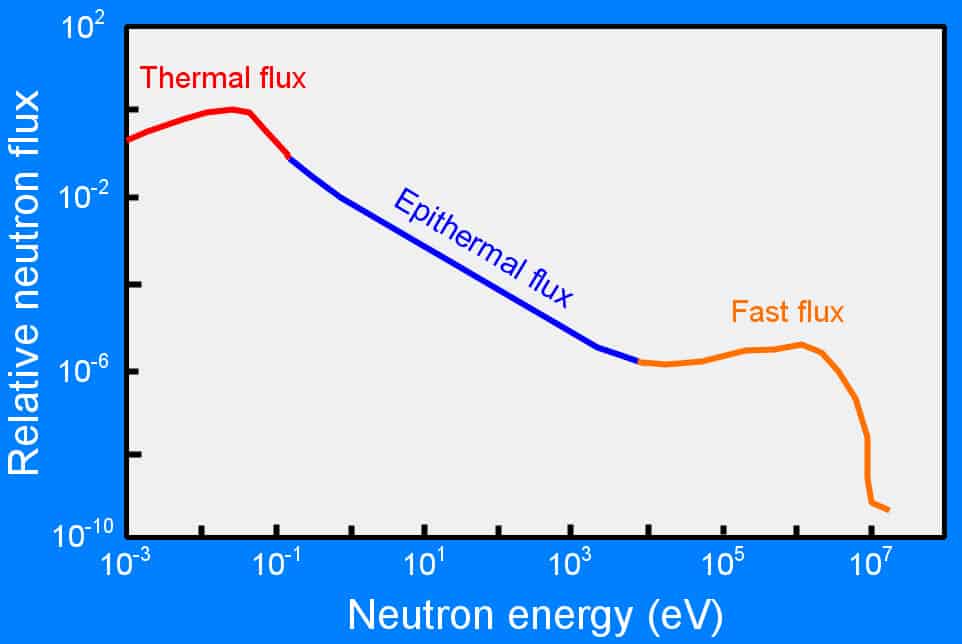
Neutron energies in thermal reactor
Distribution of kinetic energies of neutrons in the thermal reactor. The fission neutrons (fast flux) are immediately slowed down to the thermal energies via a process called neutron moderation.
Source: serc.carleton.edu

The reactor physics does not need this fine division of neutron energies. The neutrons can be roughly (for purposes of reactor physics) divided into three energy ranges:

  • Thermal neutrons (0.025 eV – 1 eV).
  • Resonance neutrons (1 eV – 1 keV).
  • Fast neutrons (1 keV – 10 MeV).

Even most of reactor computing codes use only two neutron energy groups:

  • Slow neutrons group (0.025 eV – 1 keV).
  • Fast neutrons group (1 keV – 10 MeV).

See also: Neutron Energy

Interactions of Neutrons with Matter

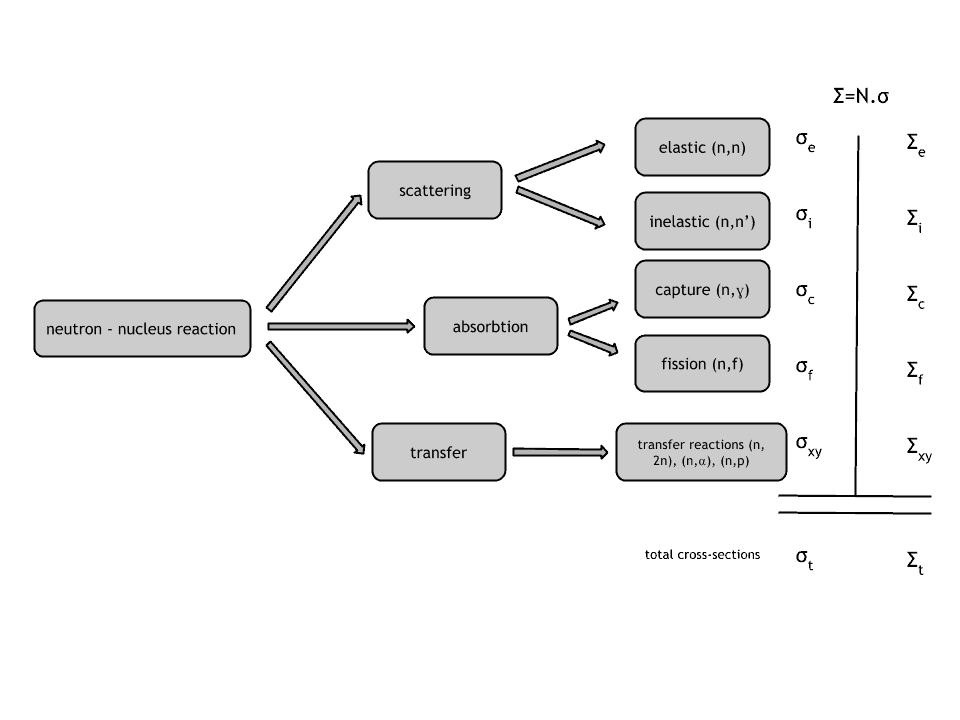
Neutron - Nuclear ReactionsNeutrons are neutral particles, therefore they travel in straight lines, deviating from their path only when they actually collide with a nucleus to be scattered into a new direction or absorbed. Neither the electrons surrounding (atomic electron cloud) a nucleus nor the electric field caused by a positively charged nucleus affect a neutron’s flight. In short, neutrons collide with nuclei, not with atoms. A very descriptive feature of the transmission of neutrons through bulk matter is the mean free path length (λ – lambda), which is the mean distance a neutron travels between interactions. It can be calculated from following equation:

λ=1/Σ

Neutrons may interact with nuclei in one of following ways:

 
Neutron Cross-section
Neutron cross-section
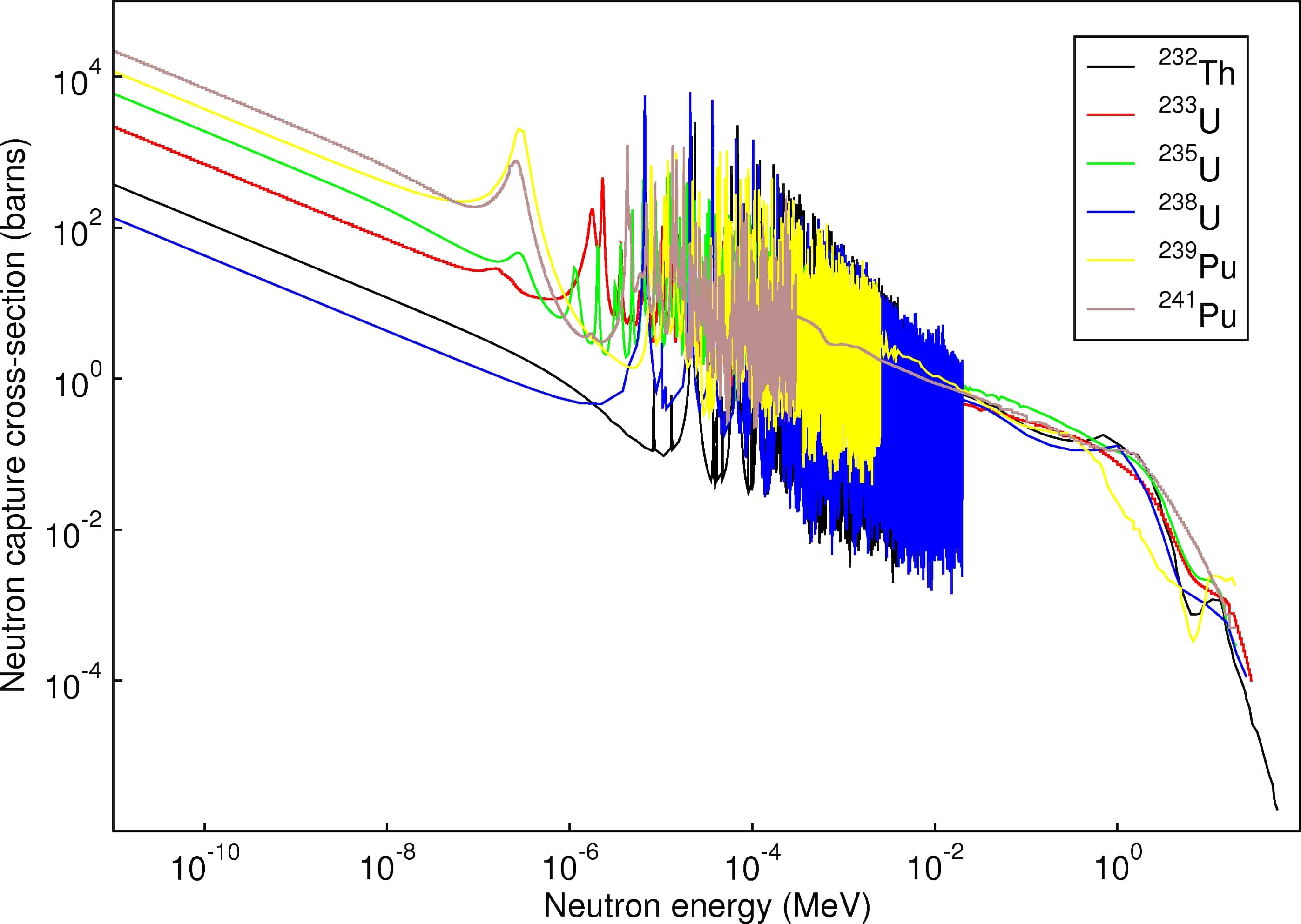
Typical cross-sections of fission material. Slowing down neutrons results in increase of probability of interaction (e.g. fission reaction).

The extent to which neutrons interact with nuclei is described in terms of quantities known as cross-sections. Cross-sections are used to express the likelihood of particular interaction between an incident neutron and a target nucleus. It must be noted this likelihood do not depend on real target dimensions. In conjunction with the neutron flux, it enables the calculation of the reaction rate, for example to derive the thermal power of a nuclear power plant. The standard unit for measuring the microscopic cross-section (σ-sigma) is the barn, which is equal to 10-28 m2. This unit is very small, therefore barns (abbreviated as “b”) are commonly used. The microscopic cross-section can be interpreted as the effective ‘target area’ that a nucleus interacts with an incident neutron.

A macroscopic cross-section is derived from microscopic and the material density:

 Σ=σ.N

 Here σ, which has units of m2, is referred to as the microscopic cross-section. Since the units of N (nuclei density) are nuclei/m3, the macroscopic cross-section Σ have units of m-1, thus in fact is an incorrect name, because it is not a correct unit of cross-sections.

Neutron cross-sections constitute a key parameters of nuclear fuel. Neutron cross-sections  must be calculated for fresh fuel assemblies usually in two-Dimensional models of the fuel lattice.

 The neutron cross-section is variable and depends on:

  • Target nucleus (hydrogen, boron, uranium, etc.) Each isotop has its own set of cross-sections.
  • Type of the reaction (capture, fission, etc.). Cross-sections are different for each nuclear reaction.
  • Neutron energy (thermal neutron, resonance neutron, fast neutron). For a given target and reaction type, the cross-section is strongly dependent on the neutron energy. In the common case, the cross section is usually much larger at low energies than at high energies. This is why most nuclear reactors use a neutron moderator to reduce the energy of the neutron and thus increase the probability of fission, essential to produce energy and sustain the chain reaction.
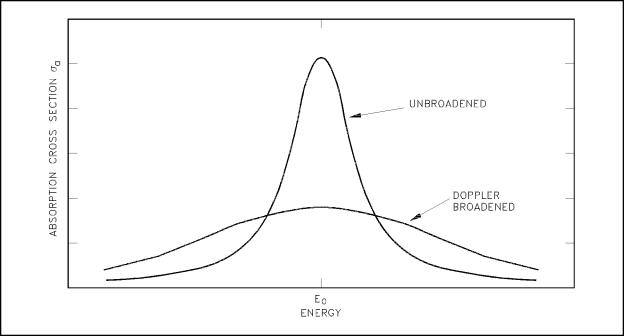
  • Target energy (temperature of target material – Doppler broadening) This dependency is not so significant, but the target energy strongly influences inherent safety of nuclear reactors due to a Doppler broadening of resonances.

See also: JANIS (Java-based nuclear information software) 

See also: Interactions of Neutrons with Matter

See also: Neutron cross-section

Law 1/v

1/v Law
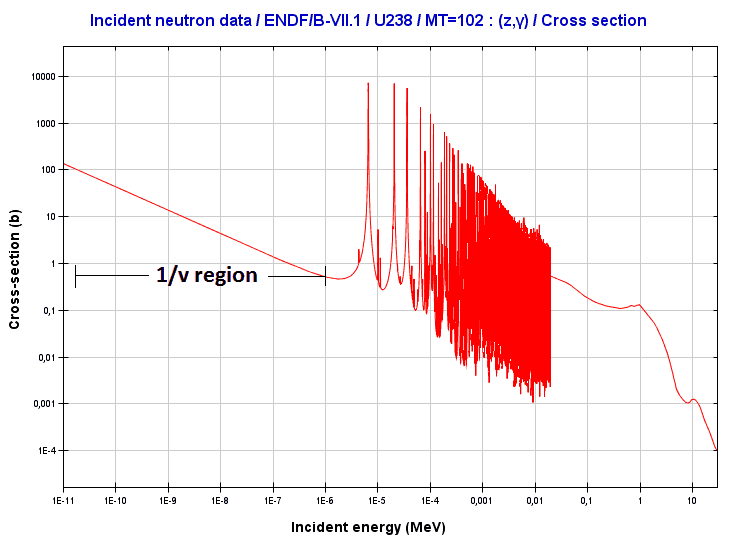
For thermal neutrons (in 1/v region), absorption cross sections increases as the velocity (kinetic energy) of the neutron decreases.
Source: JANIS 4.0

For thermal neutrons (in 1/v region),  absorption cross-sections increases as the velocity (kinetic energy) of the neutron decreases. Therefore the 1/v Law can be used to determine shift in absorbtion cross-section, if the neutron is in equilibrium with a surrounding medium. This phenomenon is due to the fact the nuclear force between the target nucleus and the neutron has a longer time to interact.

\sigma_a \sim \frac{1}{v}}} \sim \frac{1}{\sqrt{E}}}}} \sim \frac{1}{\sqrt{T}}}}}

This law is aplicable only for absorbtion cross-section and only in the 1/v region.

Example of cross- sections in 1/v region:

The absorbtion cross-section for 238U at 20°C = 293K (~0.0253 eV) is:

\sigma_a(293K) = 2.68b .

The absorbtion cross-section for 238U at 1000°C = 1273K is equal to:

Neutron Cross-section - 1-v law

This cross-section reduction is caused only due to the shift of temperature of surrounding medium.

Resonance neutron capture

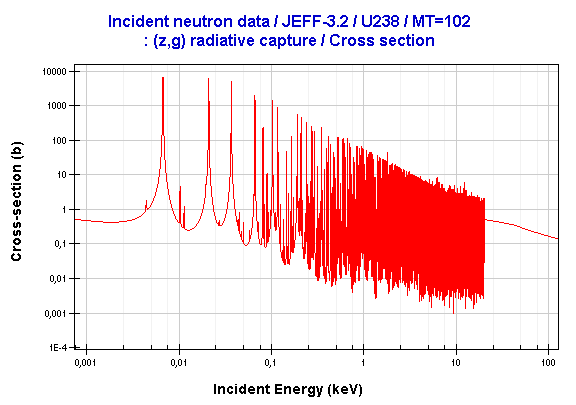
Resonance peaks for radiative capture of U238.
Resonance peaks for radiative capture of U238. At resonance energies the probability of capture can be more than 100x higher as the base value.
Source: JANIS program

Absorption cross section is often highly dependent on neutron energy. Note that the nuclear fission produces neutrons with a mean energy of 2 MeV (200 TJ/kg, i.e. 20,000 km/s). The neutron can be roughly divided into three energy ranges:

  • Fast neutron. (10MeV – 1keV)
  • Resonance neutron (1keV – 1eV)
  • Thermal neutron. (1eV – 0.025eV)

The resonance neutrons are called resonance for their special bahavior. At resonance energies the cross-section can reach peaks more than 100x higher as the base value of cross-section. At this energies the neutron capture significantly exceeds a probability of fission. Therefore it is very important (for thermal reactors) to quickly overcome this range of energy and operate the reactor with thermal neutrons resulting in increase of probability of fission.

Doppler broadening


Doppler effect
Doppler effect improves reactor stability. Broadened resonance (heating of a fuel) results in a higher probability of absorbtion, thus causes negative reactivity insertion (reduction of reactor power).

A Doppler broadening of resonances is very important phanomenon, which improves reactor stability. The prompt temperature coefficient of most thermal reactors is negative, owing to an nuclear Doppler effect. Although the absorbtion cross-section depends significantly on incident neutron energy, the shape of the cross-section curve depends also on target temperature.

Nuclei are located in atoms which are themselves in continual motion owing to their thermal energy. As a result of these thermal motions neutrons impinging on a target appears to the nuclei in the target to have a continuous spread in energy. This, in turn, has an effect on the observed shape of resonance. The resonance becomes shorter and wider than when the nuclei are at rest.

Although the shape of a resonance changes with temperature, the total area under the resonance remains essentially constant. But this does not imply constant neutron absorbtion. Despite the constant area under resonance, a resonance integral, which determines the absorbtion, increases with increasing target temperature. This, of course, decreases coefficient k (negative reactivity is inserted).

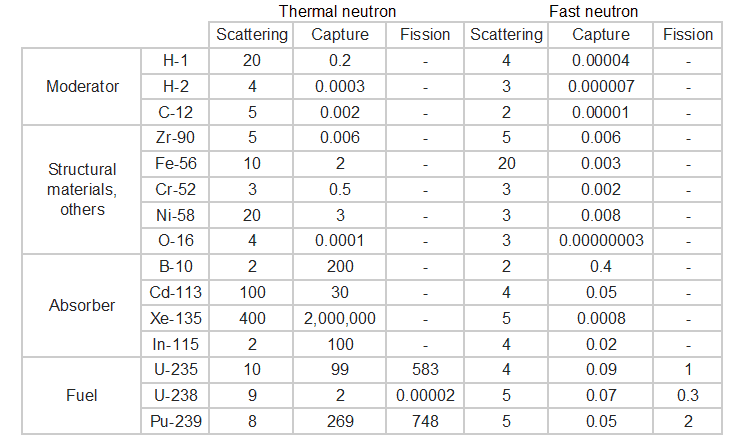
Typical cross-sections of materials in the reactor

Following table shows neutron cross-sections of the most common isotopes of reactor core.

Table of cross-sections

Types of neutron-nuclear reactions

 
Elastic Scattering Reaction
Generally, a neutron scattering reaction occurs when a target nucleus emits a single neutron after a neutron-nucleus interaction. In an elastic scattering reaction between a neutron and a target nucleus, there is no energy transferred into nuclear excitation.
Inelastic Scattering Reaction
In an inelastic scattering reaction between a neutron and a target nucleus some energy of the incident neutron is absorbed to the recoiling nucleus and the nucleus remains in the excited state. Thus while momentum is conserved in an inelastic collision, kinetic energy of the “system” is not conserved.
Neutron Absorption
The neutron absorption reaction is the most important type of reactions that take place in a nuclear reactor. The absorption reactions are reactions, where the neutron is completely absorbed and compound nucleus is formed. This is the very important feature, because the mode of decay of such compound nucleus does not depend on the way the compound nucleus was formed. Therefore a variety of emissions or decays may follow. The most important absorption reactions are divided by the exit channel into two following reactions:
  • Radiative Capture. Most absorption reactions result in the loss of a neutron coupled with the production of one or more gamma rays. This is referred to as a capture reaction, and it is denoted by σγ.
  • Neutron-induced Fission Reaction. Some nuclei (fissionable nuclei) may undergo a fission event, leading to two or more fission fragments (nuclei of intermediate atomic weight) and a few neutrons. In a fissionable material, the neutron may simply be captured, or it may cause nuclear fission. For fissionable materials we thus divide the absorption cross section as σa = σγ + σf.
Radiative Capture
The neutron capture is one of the possible absorption reactions that may occur. In fact, for non-fissionable nuclei it is the only possible absorption reaction. Capture reactions result in the loss of a neutron coupled with the production of one or more gamma rays. This capture reaction is also referred to as a radiative capture or (n, γ) reaction, and its cross-section is denoted by σγ.

The radiative capture is a reaction, in which the incident neutron is completely absorbed and compound nucleus is formed. The compound nucleus then decays to its ground state by gamma emission. This process can occur at all incident neutron energies, but the probability of the interaction strongly depends on the incident neutron energy and also on the target energy (temperature). In fact the energy in the center-of-mass system determines this probability.

Nuclear Fission
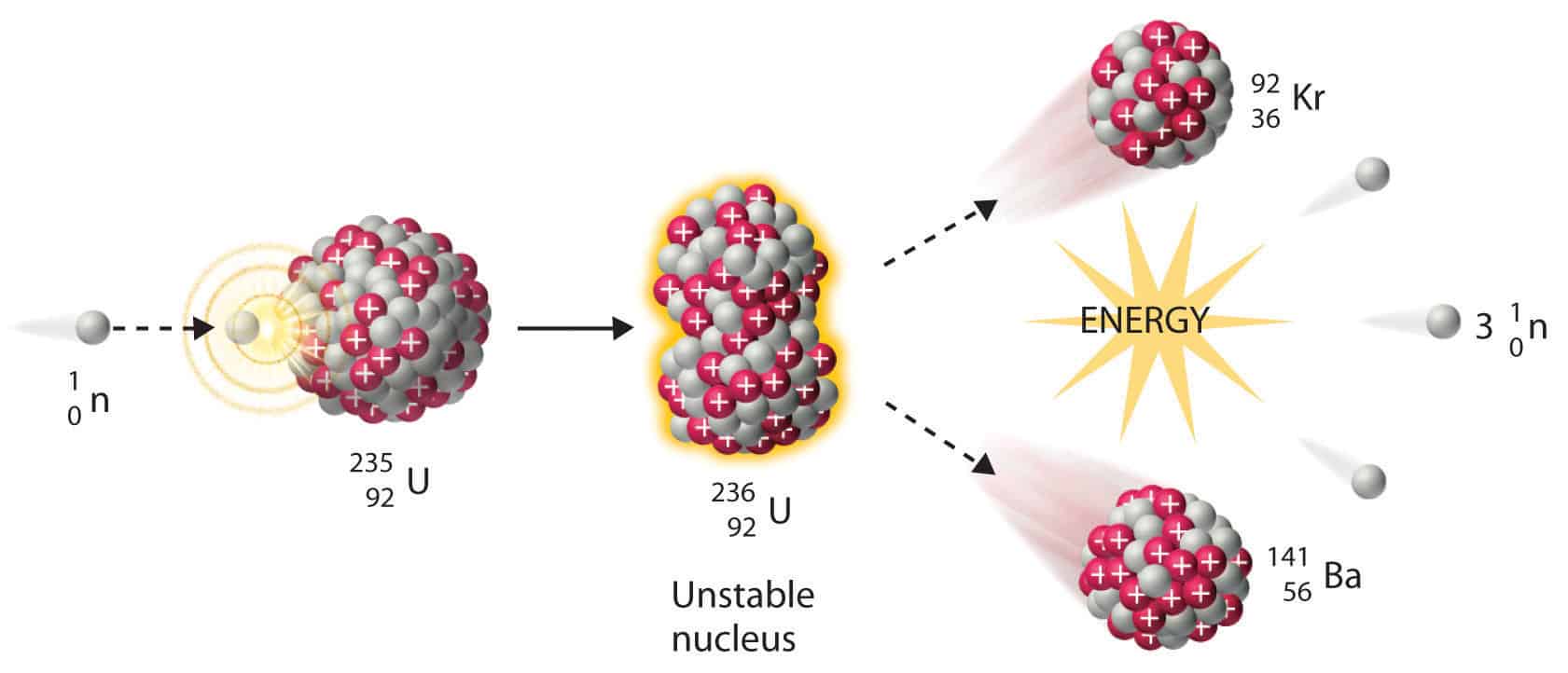
Nuclear fission is a nuclear reaction in which the nucleus of an atom splits into smaller parts (lighter nuclei). The fission process often produces free neutrons and photons (in the form of gamma rays), and releases a large amount of energy. In nuclear physics, nuclear fission is either a nuclear reaction or a radioactive decay process. The case of decay process is called spontaneous fission and it is very rare process.
Neutron Emission
Although the neutron emission is usually associated with nuclear decay, it must be also mentioned in connection with neutron nuclear reactions. Some neutrons interacts with a target nucleus via a compound nucleus. Among these compound nucleus reactions are also reactions, in which a neutron is ejected from nucleus and they may be referred to as neutron emission reactions. The point is that compound nuclei lose its excitation energy in a way, which is identical to the radioactive decay. Very important feature is the fact the mode of decay of compound nucleus does not depend on the way the compound nucleus was formed.
Charged Particle Ejection
Charged particle reactions are usually associated with formation of a compound nucleus, which is excited to a high energy level, that such compound nucleus can eject a new charged particle while the incident neutron remains in the nucleus. After the new particle is ejected, the remaining nucleus is completely changed, but may or may not exist in an excited state depending upon the mass-energy balance of the reaction. This type of reaction is more common for charged particles as incident particles (such as alpha particles, protons, and so on).

The case of neutron-induced charged particle reactions is not so common, but there are some neutron-induced charged particle reactions, that are of importance in the reactivity control and also in the detection of neutrons.

Detection of Neutrons

Since the neutrons are electrically neutral particles, they are mainly subject to strong nuclear forces but not to electric forces. Therefore neutrons are not directly ionizing and they have usually to be converted into charged particles before they can be detected. Generally every type of neutron detector must be equipped with converter (to convert neutron radiation to common detectable radiation) and one of the conventional radiation detectors (scintillation detector, gaseous detector, semiconductor detector, etc.).

Neutron converters

Two basic types of neutron interactions with matter are for this purpose available:

  • Elastic scattering. The free neutron can be scattered by a nucleus, transferring some of its kinetic energy to the nucleus. If the neutron has enough energy to scatter off nuclei the recoiling nucleus ionizes the material surrounding the converter. In fact, only hydrogen and helium nuclei are light enough for practical application. Charge produced in this way can be collected by the conventional detector to produce a detected signal. Neutrons can transfer more energy to light nuclei. This method is appropriate for detecting fast neutrons (fast neutrons do not have high cross-section for absorption) allowing detection of fast neutrons without a moderator.
  • Neutron absorption. This is a common method allowing detection of neutrons of entire energy spectrum. This method is is based on variety of absorption reactions (radiative capture, nuclear fission, rearrangement reactions, etc.). The neutron is here absorbed by target material (converter) emitting secondary particles such as protons, alpha particles, beta particles, photons (gamma rays) or fission fragments. Some reactions are threshold reactions (requiring a minimum energy of neutrons), but most of reactions occurs at epithermal and thermal energies. That means the moderation of fast neutrons is required leading in poor energy information of the neutrons. Most common nuclei for the neutron converter material are:
    • 10B(n,α). Where the neutron capture cross-section for thermal neutrons is σ = 3820 barns and the natural boron has abundance of 10B 19,8%.
    • 3He(n,p). Where the neutron capture cross-section for thermal neutrons is σ = 5350 barns and the natural helium has abundance of 3He 0.014%.
    • 6Li(n,α). Where the neutron capture cross-section for thermal neutrons is σ = 925 barns and the natural lithium has abundance of 6Li 7,4%.
    • 113Cd(n,ɣ). Where the neutron capture cross-section for thermal neutrons is σ = 20820 barns and the natural cadmium has abundance of 113Cd 12,2%.
    • 235U(n,fission). Where the fission cross-section for thermal neutrons is σ = 585 barns and the natural uranium has abundance of 235U 0.711%. Uranium as a converter produces fission fragments which are heavy charged particles. This have significant advantage. The heavy charged particles (fission fragments) create a high output signal, because the fragments deposit a large amount of energy in a detector sensitive volume. This allows an easy discrimination of the background radiation (e.i. gamma radiation). This important feature can be used for example in a nuclear reactor power measurement, where the neutron field is accompanied  by a significant gamma background.

See also: Detection of Neutrons

 
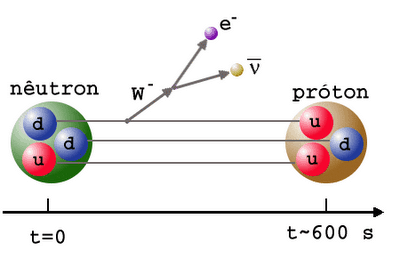
Free Neutron
Free Neutron
The free neutron decays into a proton, an electron, and an antineutrino with a half-life of about 611 seconds (10.3 minutes).
Source: scienceblogs.com

A free neutron is a neutron that is not bounded in a nucleus. The free neutron is, unlike a bounded neutron, subject to radioactive beta decay.

It decays into a proton, an electron, and an antineutrino (the antimatter counterpart of the neutrino, a particle with no charge and little or no mass). A free neutron will decay with a half-life of about 611 seconds (10.3 minutes). This decay involves the weak interaction and is associated with a quark transformation (a down quark is converted to an up quark). The decay of the neutron is a good example of the observations which led to the discovery of the neutrino. Because it decays in this manner, the neutron does not exist in nature in its free state, except among other highly energetic particles in cosmic rays. Since free neutrons are electrically neutral, they pass through the electrical fields within atoms without any interaction and they are interacting with matter almost exclusively through relatively rare collisions with atomic nuclei.

See also: Free Neutron

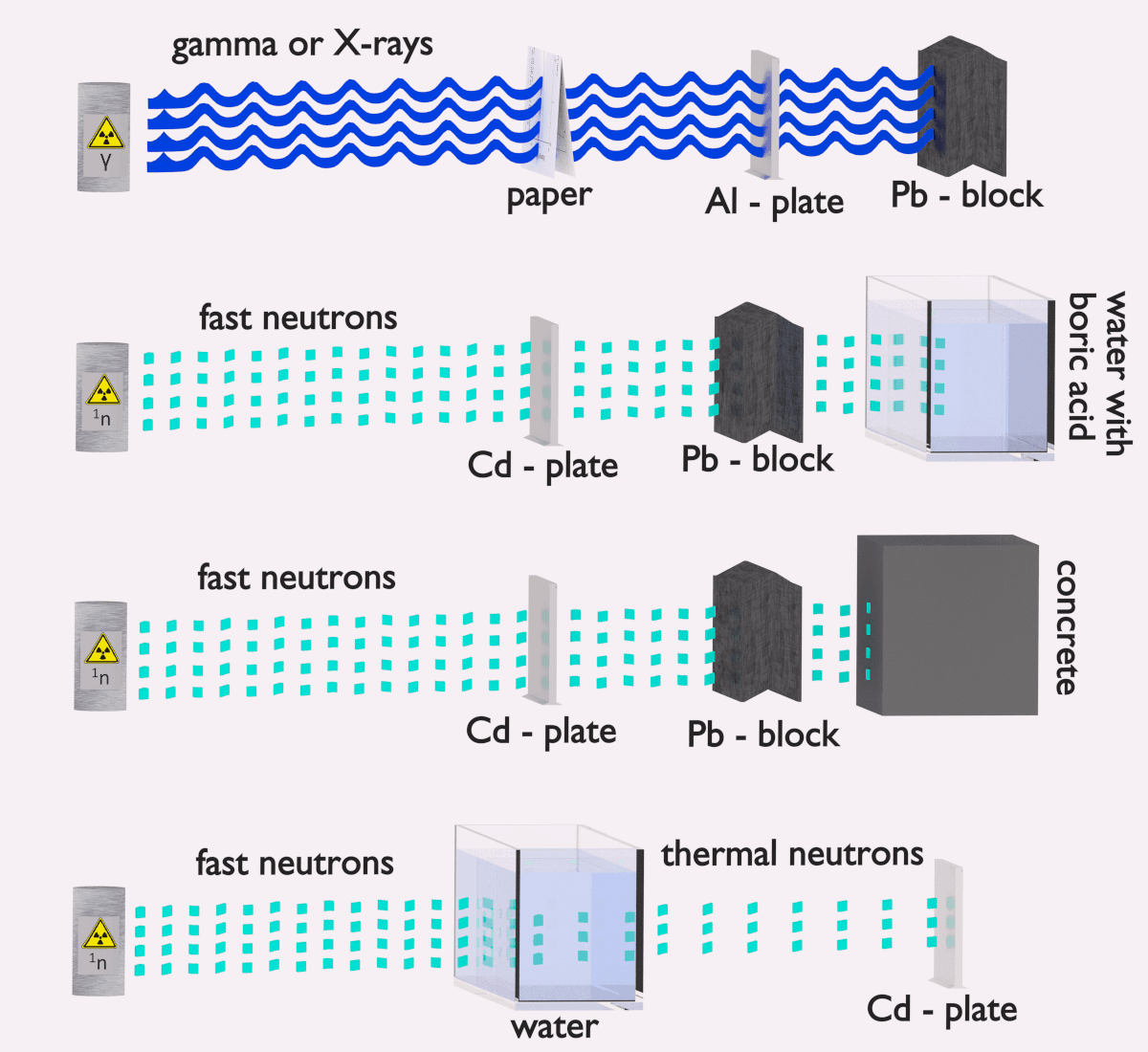
Shielding of Neutron Radiation
In radiation protection there are three ways how to protect people from identified radiation sources:
  • Limiting Time. The amount of radiation exposure depends directly (linearly) on the time people spend near the source of radiation. The dose can be reduced by limiting exposure time.
  • Distance. The amount of radiation exposure depends on the distance from the source of radiation. Similarly to a heat from a fire, if you are too close, the intensity of heat radiation is high and you can get burned. If you are at the right distance, you can withstand there without any problems and moreover it is comfortable. If you are too far from heat source, the insufficiency of heat can also hurt you. This analogy, in a certain sense, can be applied to radiation also from nuclear sources.
  • Shielding. Finally, if the source is too intensive and time or distance do not provide sufficient radiation protection the shielding must be used. Radiation shielding usually consist of barriers of lead, concrete or water. Even depleted uranium can be used as a good protection from gamma radiation, but on the other hand uranium is absolutely inappropriate shielding of neutron radiation. In short, it depends on type of radiation to be shielded, which shielding will be effective or not.

Shielding of Neutrons

Shielding of Neutron Radiation
Water as a neutron shield

There are three main features of neutrons, which are crucial in the shielding of neutrons.

  • Neutrons have no net electric charge, therefore they cannot be affected or stopped by electric forces. Neutrons ionize matter only indirectly, which makes neutrons highly penetrating type of radiation.
  • Neutrons scatter with heavy nuclei very elastically. Heavy nuclei very hard slow down a neutron let alone absorb a fast neutron.
  • An absorption of neutron (one would say shielding) causes initiation of certain nuclear reaction (e.g. radiative capture or even fission), which is accompanied by a number of other types of radiation. In short, neutrons make matter radioactive, therefore with neutrons we have to shield also the other types of radiation.

The best materials for shielding neutrons must be able to:

  • Slow down neutrons (the same principle as the neutron moderation). First point can be fulfilled only by material containing light atoms (e.g. hydrogen atoms), such as water, polyethylene, and concrete. The nucleus of a hydrogen nucleus contains only a proton. Since a proton and a neutron have almost identical masses, a neutron scattering on a hydrogen nucleus can give up a great amount of its energy (even entire kinetic energy of a neutron can be transferred to a proton after one collision). This is similar to a billiard. Since a cue ball and another billiard ball have identical masses, the cue ball hitting another ball can be made to stop and the other ball will start moving with the same velocity. On the other hand, if a ping pong ball is thrown against a bowling ball (neutron vs. heavy nucleus), the ping pong ball will bounce off with very little change in velocity, only a change in direction. Therefore lead is quite ineffective for blocking neutron radiation, as neutrons are uncharged and can simply pass through dense materials.
  • Table of cross-sections
    Table of cross-sections

    Absorb this slow neutron. Thermal neutrons can be easily absorbed by capture in materials with high neutron capture cross sections (thousands of barns) like boron, lithium or cadmium. Generally, only a thin layer of such absorbator is sufficient to shield thermal neutrons. Hydrogen (in the form of water), which can be used to slow down neutrons, have absorbtion cross-section 0.3 barns. This is not enough, but this insufficiency can be offset by sufficient thickness of water shield.

  • Shield the accompanying radiation. In the case of cadmium shield the absorption of neutrons is accompanied by strong emission of gamma rays. Therefore additional shield is necessary to attenuate the gamma rays. This phenomenon practically does not exist for lithium and is much less important for boron as a neutron absorption material. For this reason, materials containing boron are used often in neutron shields. In addition, boron (in the form of boric acid) is well soluble in water making this combination very efective neutron shield.

Water as a neutron shield

Water due to the high hydrogen content and the availability is efective and common neutron shielding. However, due to the low atomic number of hydrogen and oxygen, water is not acceptable shield against the gamma rays. On the other hand in some cases this disadvantage (low density) can be compensated by high thickness of the water shield.  In case of neutrons, water perfectly moderates neutrons, but with absorption of neutrons by hydrogen nucleus secondary gamma rays with the high energy are produced. These gamma rays highly penetrates matter and therefore it can increase requirements on the thickness of the water shield. Adding a boric acid can help with this problem (neutron absorbtion on boron nuclei without strong gamma emission), but results in another problems with corrosion of construction materials.

Concrete as a neutron shield

Most commonly used neutron shielding in many sectors of the nuclear science and engineering is shield of concrete. Concrete is also hydrogen-containing material, but unlike water concrete have higher density (suitable for secondary gamma shielding) and does not need any maintenance. Because concrete is a mixture of several different materials its composition is not constant. So when referring to concrete as a neutron shielding material, the material used in its composition should be told correctly. Generally concrete are divided to “ordinary “ concrete and “heavy” concrete. Heavy concrete uses heavy natural aggregates such as barites  (barium sulfate) or magnetite or manufactured aggregates such as iron, steel balls, steel punch or other additives. As a result of these additives, heavy concrete have higher density than ordinary concrete (~2300 kg/m3). Very heavy concrete can achieve density up to 5,900 kg/m3 with iron additives or up to 8900 kg/m3 with lead additives. Heavy concrete provide very effective protection against neutrons.

See also: Shielding of Neutron Radiation

Neutron Sources

A neutron source is any device that emits neutrons. Neutron sources have many applications, they can be used in research, engineering, medicine, petroleum exploration, biology, chemistry and nuclear power. A neutron source is characterized by a number of factors:

  • Significance of the source
  • Intensity. The rate of neutrons emitted by the source.
  • Energy distribution of emitted neutrons.
  • Angular distribution of emitted neutrons.
  • Mode of emission. Continuous or pulsed operation.

Classification by significance of the source

  • Large (Significant) neutron sources
    • Nuclear Reactors. There are nuclei that can undergo fission on their own spontaneously, but only certain nuclei, like uranium-235, uranium-233 and plutonium-239, can sustain a fission chain reaction. This is because these nuclei release neutrons when they break apart, and these neutrons can induce fission of other nuclei. Uranium-235 which exists as 0.7% of naturally occurring uranium undergoes nuclear fission with thermal neutrons with the production of, on average, 2.4 fast neutrons and the release of ~ 180 MeV of energy per fission. Free neutrons released by each fission play very important role as a trigger of the reaction, but they can be also used fo another purpose. For example: One neutron is required to trigger a further fission. Part of free neutrons (let say 0.5 neutrons/fission) is absorbed in other material, but an excess of neutrons (0.9 neutrons/fission) is able to leave the surface of the reactor core and can be used as a neutron source.
    • Fusion Systems. Nuclear fusion is a nuclear reaction in which two or more atomic nuclei (e.g. D+T) collide at a very high energy and fuse together. Thy byproduct of DT fusion is a free neutron (see picture), therefore also nuclear fusion reaction has the potential to produces large quantities of neutrons.
    • Spallation Sources. A spallation source is a high-flux neutron source in which protons that have been accelerated to high energies hit a heavy target material, causing the emission of neutrons. The reaction occurs above a certain energy threshold for the incident particle, which is typically 5 – 15 MeV.
  • Medium neutron sources
    • Bremssstrahlung from Electron Accelerators / Photofission. Energetic electrons when slowed down rapidly in a heavy target emit intense gamma radiation during the deceleration process. This is known as Bremsstrahlung or braking radiation. The interaction of the gamma radiation with the target produces neutrons via the (γ,n) reaction, or the (γ,fission) reaction when a fissile target is used. e-→Pb → γ→ Pb →(γ,n) and (γ,fission). The Bremsstrahlung γ energy exceeds the binding energy of the “last” neutron in the target. A source strength of 1013 neutrons/second produced in short (i.e. < 5 μs) pulses can be readily realised.
    • Dense plasme focus. The dense plasma focus (DPF) is a device that is known as an efficient source of neutrons from fusion reactions. Mechanism of dense plasma focus (DPF) is based on nuclear fusion of short-lived plasma of deuterium and/or tritium. This device produces a short-lived plasma by electromagnetic compression and acceleration that is called a pinch. This plasma is during the pinch hot and dense enough to cause nuclear fusion and the emission of neutrons.
    • Light ion accelerators. Neutrons can be also produced by particle accelerators using targets of deuterium, tritium, lithium, beryllium, and other low-Z materials. In this case the target must be bombarded with accelerated hydrogen (H), deuterium (D), or tritium (T) nuclei.
  • Small neutron sources
    • Neutron Generators. Neutrons are produced in the fusion of deuterium and tritium in the following exothermic reaction. 2D + 3T → 4He + n + 17.6 MeV.  The neutron is produced with a kinetic energy of 14.1 MeV. This can be achieved on a small scale in the laboratory with a modest 100 kV accelerator for deuterium atoms bombarding a tritium target. Continuous neutron sources of ~1011 neutrons/second can be achieved relatively simply.
    • Radioisotope source – (α,n) reactions. In certain light isotopes the ‘last’ neutron in the nucleus is weakly bound and is released when the compound nucleus formed following α-particle bombardment decays. The bombardment of beryllium by α-particles leads to the production of neutrons by the following exothermic reaction: 4He + 9Be→12C + n + 5.7 MeV. This reaction yields a weak source of neutrons with an energy spectrum resembling that from a fission source and is used nowadays in portable neutron sources. Radium, plutonium or americium can be used as an α-emitter.
    • Radioisotope source – (γ,n) reactions. (γ,n) reactions can also be used for the same purpose. In this type of source, because of the greater range of the γ-ray, the two physical  components of the source can be separated making it possible to ‘switch off’ the reaction if so required by removing the radioactive source from the beryllium. (γ,n) sources produce a monoenergetic neutrons unlike (α,n) sources.  The (γ,n) source uses antimony-124 as the gamma emitter in the following endothermic reaction.

124Sb→124Te + β− + γ

γ + 9Be→8Be + n – 1.66 MeV

    • Radioisotope source – spontaneous fission. Certain isotopes undergo spontaneous fission with emission of neutrons. The most commonly used spontaneous fission source is the radioactive isotope californium-252. Cf-252 and all other spontaneous fission neutron sources are produced by irradiating uranium or another transuranic element in a nuclear reactor, where neutrons are absorbed in the starting material and its subsequent reaction products, transmuting the starting material into the SF isotope.

See also: Neutron Sources

See also: Source Neutrons

 
Application of Neutrons
Since their discovery in 1932 neutrons play an important role in many fields of modern science. The discovery of the neutron immediately gave scientists a new tool for probing the properties of atomic nuclei. In particular, discovery of neutrons and their properties has been important in the development of nuclear reactors and nuclear weapons. Main branches where the neutrons play key role are summarized below:

Nuclear Reactors

Nuclear fission - application of neutrons
Nuclear fission is a nuclear reaction in which the nucleus of an atom splits into smaller parts (lighter nuclei). Source: chemwiki.ucdavis.edu

A nuclear reactor is a key device of nuclear power plants, nuclear research facilities or nuclear propelled ships. Main purpose of the nuclear reactor is to initiate and control a sustained nuclear chain reaction. The nuclear chain reaction is initiated, sustained and controlled just via the free neutrons. The term chain means that one single nuclear reaction (neutron induced fission) causes an average of one or more subsequent nuclear reactions, thus leading to the possibility of a self-propagating series of these reactions. The “one or more” is the key parameter of reactor physics. To raise or lower the power, the amount of reactions, respectively the amount of the free neutrons in the nuclear core must be changed (using the control rods).

Neutron diffraction

Neutron diffraction - applications
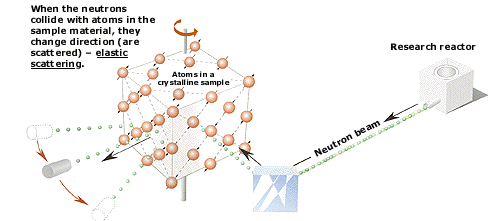
Simple scheme of neutron diffraction experiment.
Source: www.psi.ch

Neutron diffraction experiments use an elastic neutron scattering to determine the atomic (or magnetic) structure of a material. The neutron diffraction is based the fact that thermal or cold neutrons have the wavelengths similar to atomic spacings. An examined sample (crystalline solids, gasses, liquids or amorphous materials) must be placed in a neutron beam of thermal (0.025 eV) or cold (neutrons in thermal equilibrium with very cold surroundings such as liquid deuterium) neutrons to obtain a diffraction pattern that provides information about the structure of the examined material. The neutron diffraction experiments are similar to X-ray diffraction experiments, but neutrons interact with matter differently. Photons (X-rays) interact primarily with the electrons surrounding (atomic electron cloud) a nucleus, but neutrons interact only with nuclei. Neither the electrons surrounding (atomic electron cloud) a nucleus nor the electric field caused by a positively charged nucleus affect a neutron’s flight. Due to their different properties, both methods together (neutron diffraction and X-ray diffraction) can provide complementary information about the structure of the material.

Applications in Medicine

Medical applications of neutrons began soon after the discovery of this particle in 1932. Neutrons are highly penetrating matter and ionizing, so they can be used in medical therapies such as radiation therapy or boron capture therapy. Unfortunately neutrons, when they are absorbed in matter, active the matter and leave the matter (target area) radioactive.

Neutron activation analysis

Neutron activation - application
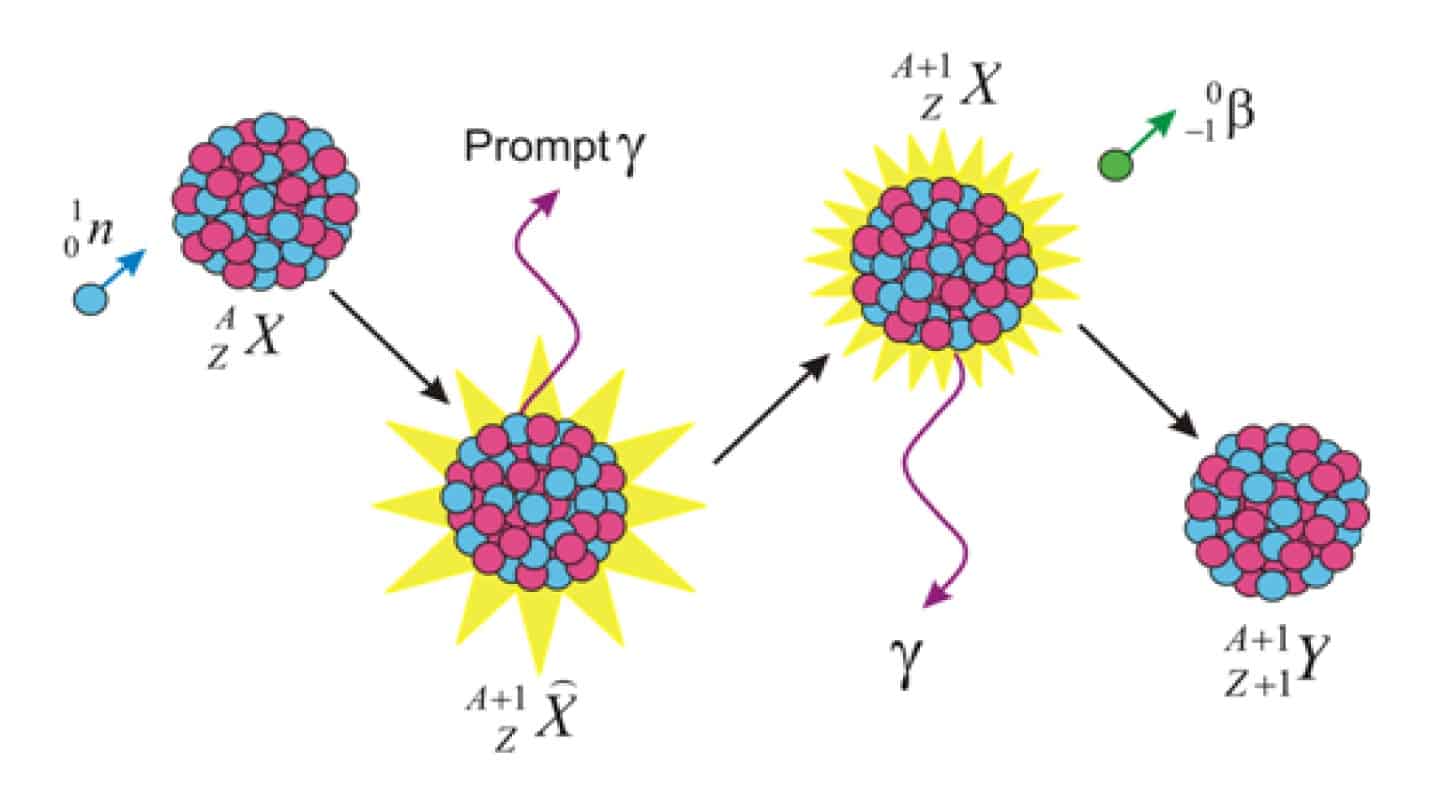
An analyzed sample is first irradiated with neutrons to produce specific radionuclides. The radioactive decay of these produced radionuclides is specific for each element (nuclide).
Source: www.naa-online.net

Neutron activation analysis is a method for determining the composition of examined material. This method was discovered in 1936 and stands at the forefront of methods used for quantitative material analysis of major, minor, trace, and rare elements. This method is based on neutron activation, where an analyzed sample is first irradiated with neutrons to produce specific radionuclides. The radioactive decay of these produced radionuclides is specific for each element (nuclide). Each nuclide emits the characterictic gamma rays which are measured using gamma spectroscopy, where gamma rays detected at a particular energy are indicative of a specific radionuclide and determine concentrations of the elements. Main advantage of this method is that neutrons does not destroy the sample. This method can be also used for determine an enrichment of nuclear material.

See also: Application of Neutrons

Prompt and Delayed Neutrons
It is known the fission neutrons are of importance in any chain-reacting system. Neutrons trigger the nuclear fission of some nuclei (235U, 238U or even 232Th). What is crucial the fission of such nuclei produces 2, 3 or more free neutrons.

But not all neutrons are released at the same time following fission. Even the nature of creation of these neutrons is different. From this point of view we usually divide the fission neutrons into two following groups:

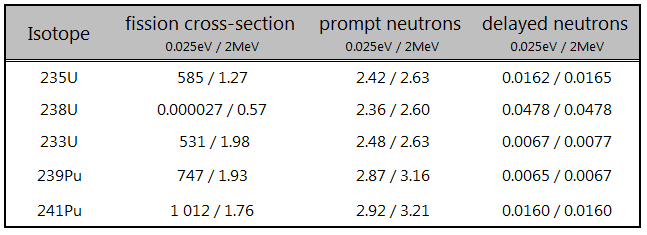
  • Prompt Neutrons. Prompt neutrons are emitted directly from fission and they are emitted within very short time of about 10-14 second.
  • Delayed Neutrons. Delayed neutrons are emitted by neutron rich fission fragments that are called the delayed neutron precursors. These precursors usually undergo beta decay but a small fraction of them are excited enough to undergo neutron emission. The fact the neutron is produced via this type of decay and this happens orders of magnitude later compared to the emission of the prompt neutrons, plays an extremely important role in the control of the reactor.

Table of key prompt and delayed neutrons characteristics

Chemical Elements

A chemical element is a species of atom having the same number of protons in their atomic nuclei (that is, the same atomic number, or Z). For example, the atomic number of carbon is 6, so the element carbon consists of all atoms which have exactly 6 protons. Material Properties

A chemical element is a species of atom having the same number of protons in their atomic nuclei (that is, the same atomic number, or Z). For example, the atomic number of carbon is 6, so the element carbon consists of all atoms which have exactly 6 protons.

The chemical properties of the atom are determined by the number of protons, in fact, by number and arrangement of electrons. The configuration of these electrons follows from the principles of quantum mechanics. The number of electrons in each element’s electron shells, particularly the outermost valence shell, is the primary factor in determining its chemical bonding behavior. In the periodic table, the elements are listed in order of increasing atomic number Z.

Periodic Table

The periodic table is a tabular arrangement of the chemical elements. It is organized in order of increasing atomic number. There is a recurring pattern called the “periodic law” in their properties, in which elements in the same column (group) have similar properties. Generally, within one row (period) the elements are metals to the left, and non-metals to the right, with the elements having similar chemical behaviours placed in the same column.

Chemical Properties of Elements

Every solid, liquid, gas, and plasma is composed of neutral or ionized atoms. The chemical properties of the atom are determined by the number of protons, in fact, by number and arrangement of electrons. The configuration of these electrons follows from the principles of quantum mechanics. The number of electrons in each element’s electron shells, particularly the outermost valence shell, is the primary factor in determining its chemical bonding behavior. In the periodic table, the elements are listed in order of increasing atomic number Z.

The total number of protons in the nucleus of an atom is called the atomic number (or the proton number) of the atom and is given the symbol Z. The number of electrons in an electrically-neutral atom is the same as the number of protons in the nucleus. The total electrical charge of the nucleus is therefore +Ze, where e (elementary charge) equals to 1,602 x 10-19coulombs. Each electron is influenced by the electric fields produced by the positive nuclear charge and the other (Z – 1) negative electrons in the atom.

It is the Pauli exclusion principle that requires the electrons in an atom to occupy different energy levels instead of them all condensing in the ground state. The ordering of the electrons in the ground state of multielectron atoms, starts with the lowest energy state (ground state) and moves progressively from there up the energy scale until each of the atom’s electrons has been assigned a unique set of quantum numbers. This fact has key implications for the building up of the periodic table of elements.

Electron Affinity

In chemistry and atomic physics, the electron affinity of an atom or molecule is defined as:

the change in energy (in kJ/mole) of a neutral atom or molecule (in the gaseous phase) when an electron is added to the atom to form a negative ion.

X + e– → X– + energy        Affinity = – ∆H

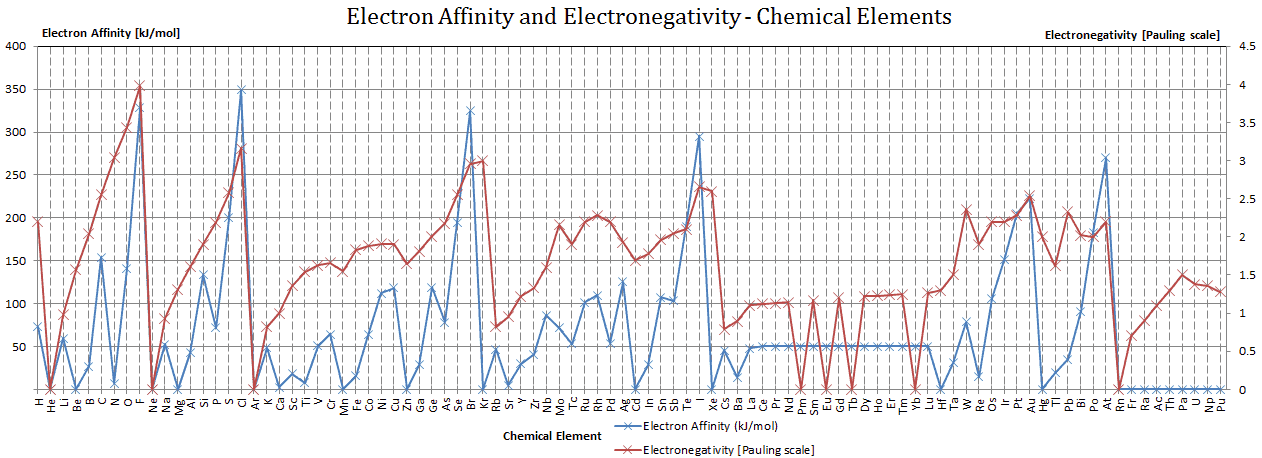
In other words, it can be expressed as the neutral atom’s likelihood of gaining an electron. Note that, ionization energies measure the tendency of a neutral atom to resist the loss of electrons. Electron affinities are more difficult to measure than ionization energies.

A fluorine atom in the gas phase, for example, gives off energy when it gains an electron to form a fluoride ion.

F + e– → F–        – ∆H = Affinity = 328 kJ/mol

To use electron affinities properly, it is essential to keep track of sign. When an electron is added to a neutral atom, energy is released. This affinity is known as the first electron affinity and these energies are negative. By convention, the negative sign shows a release of energy. However, more energy is required to add an electron to a negative ion which overwhelms any the release of energy from the electron attachment process. This affinity is known as the second electron affinity and these energies are positive.

Affinities of Non metals vs. Affinities of Metals

  • Metals: Metals like to lose valence electrons to form cations to have a fully stable shell. The electron affinity of metals is lower than that of nonmetals. Mercury most weakly attracts an extra electron.
  • Nonmetals: Generally, nonmetals have more positive electron affinity than metals. Nonmetals like to gain electrons to form anions to have a fully stable electron shell. Chlorine most strongly attracts extra electrons. The electron affinities of the noble gases have not been conclusively measured, so they may or may not have slightly negative values.

Electronegativity

Electronegativity, symbol χ, is a chemical property that describes the tendency of an atom to attract electrons towards this atom. For this purposes, a dimensionless quantity the Pauling scale, symbol χ, is the most commonly used.

The electronegativity of fluorine is:

χ = 4.0

In general, an atom’s electronegativity is affected by both its atomic number and the distance at which its valence electrons reside from the charged nucleus. The higher the associated electronegativity number, the more an element or compound attracts electrons towards it.

The most electronegative atom, fluorine, is assigned a value of 4.0, and values range down to cesium and francium which are the least electronegative at 0.7.

electron affinity and electronegativity

Ionization Energy

Ionization energy, also called ionization potential, is the energy necessary to remove an electron from the neutral atom.

X + energy → X+ + e−

where X is any atom or molecule capable of being ionized, X+ is that atom or molecule with an electron removed (positive ion), and e− is the removed electron.

A nitrogen atom, for example, requires the following ionization energy to remove the outermost electron.

N + IE → N+ + e−        IE = 14.5 eV

The ionization energy associated with removal of the first electron is most commonly used. The nth ionization energy refers to the amount of energy required to remove an electron from the species with a charge of (n-1).

1st ionization energy

X → X+ + e−

2nd ionization energy

X+ → X2+ + e−

3rd ionization energy

X2+ → X3+ + e−

Ionization Energy for different Elements

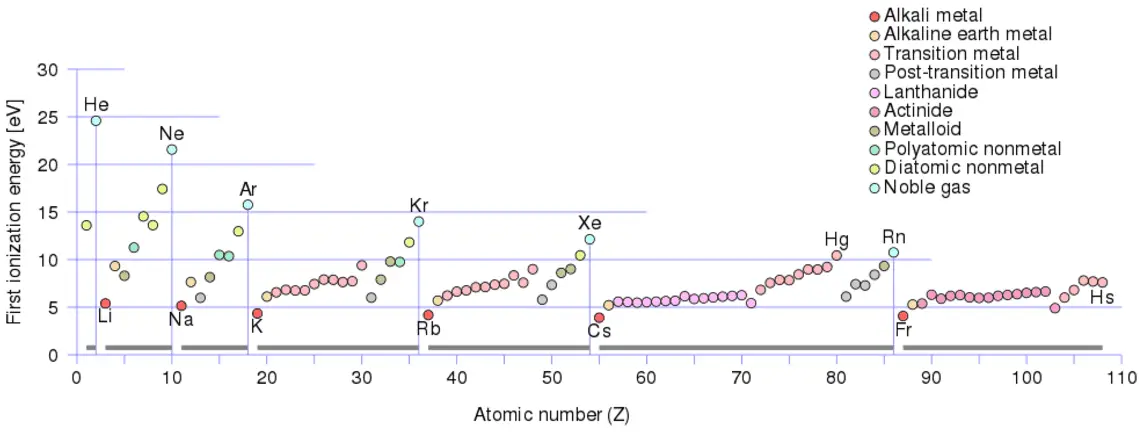
There is an ionization energy for each successive electron removed. The electrons that circle the nucleus move in fairly well-defined orbits. Some of these electrons are more tightly bound in the atom than others. For example, only 7.38 eV is required to remove the outermost electron from a lead atom, while 88,000 eV is required to remove the innermost electron. Helps to understand reactivity of elements (especially metals, which lose electrons).

In general, the ionization energy increases moving up a group and moving left to right across a period. Moreover:

  • Ionization energy is lowest for the alkali metals which have a single electron outside a closed shell.
  • Ionization energy increases across a row on the periodic maximum for the noble gases which have closed shells

For example, sodium requires only 496 kJ/mol or 5.14 eV/atom to ionize it. On the other hand neon, the noble gas, immediately preceding it in the periodic table, requires 2081 kJ/mol or 21.56 eV/atom.

Ionization energy
Source: wikipedia.org License: CC BY-SA 3.0
References:
References:
Nuclear and Reactor Physics:
  1. J. R. Lamarsh, Introduction to Nuclear Reactor Theory, 2nd ed., Addison-Wesley, Reading, MA (1983).
  2. J. R. Lamarsh, A. J. Baratta, Introduction to Nuclear Engineering, 3d ed., Prentice-Hall, 2001, ISBN: 0-201-82498-1.
  3. W. M. Stacey, Nuclear Reactor Physics, John Wiley & Sons, 2001, ISBN: 0- 471-39127-1.
  4. Glasstone, Sesonske. Nuclear Reactor Engineering: Reactor Systems Engineering, Springer; 4th edition, 1994, ISBN: 978-0412985317
  5. W.S.C. Williams. Nuclear and Particle Physics. Clarendon Press; 1 edition, 1991, ISBN: 978-0198520467
  6. G.R.Keepin. Physics of Nuclear Kinetics. Addison-Wesley Pub. Co; 1st edition, 1965
  7. Robert Reed Burn, Introduction to Nuclear Reactor Operation, 1988.
  8. U.S. Department of Energy, Nuclear Physics and Reactor Theory. DOE Fundamentals Handbook, Volume 1 and 2. January 1993.
  9. Paul Reuss, Neutron Physics. EDP Sciences, 2008. ISBN: 978-2759800414.

Advanced Reactor Physics:

  1. K. O. Ott, W. A. Bezella, Introductory Nuclear Reactor Statics, American Nuclear Society, Revised edition (1989), 1989, ISBN: 0-894-48033-2.
  2. K. O. Ott, R. J. Neuhold, Introductory Nuclear Reactor Dynamics, American Nuclear Society, 1985, ISBN: 0-894-48029-4.
  3. D. L. Hetrick, Dynamics of Nuclear Reactors, American Nuclear Society, 1993, ISBN: 0-894-48453-2.
  4. E. E. Lewis, W. F. Miller, Computational Methods of Neutron Transport, American Nuclear Society, 1993, ISBN: 0-894-48452-4.

See also:

Atom

We hope, this article, Chemical Elements, helps you. If so, give us a like in the sidebar. Main purpose of this website is to help the public to learn some interesting and important information about materials and their properties.

What is Strong Force vs Electromagnetic Force – Definition

The strong force and the electromagnetic force are two the four fundamental forces. They are very different. This article summarizes these differences. 

Strong Interaction – Strong Force

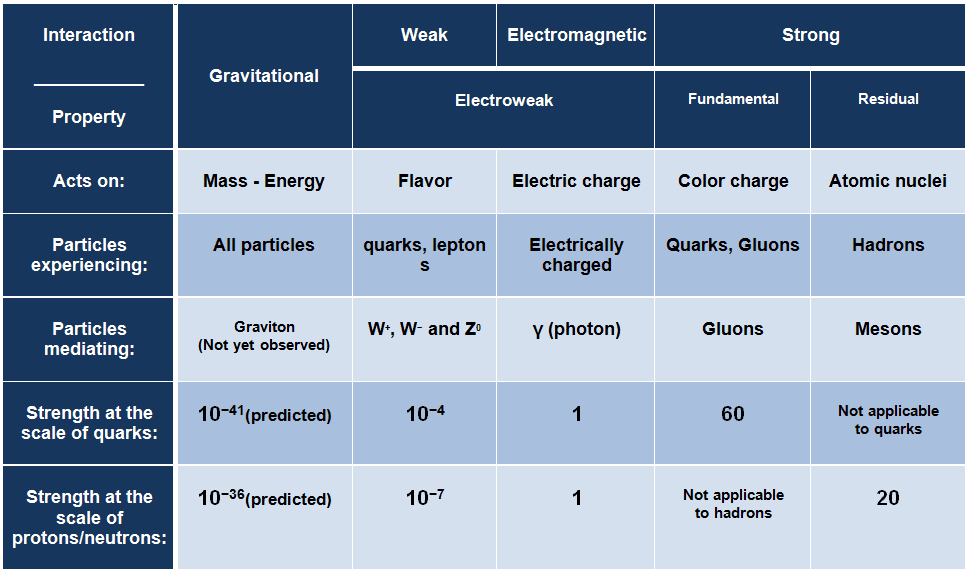
The strong interaction or strong force is one of the four fundamental forces and involves the exchange of the vector gauge bosons known as gluons. In general, the strong interaction is very complicated interaction, because it significantly varies with distance. The strong nuclear force holds most ordinary matter together because it confines quarks into hadron particles such as the proton and neutron. Moreover, the strong force is the force which can hold a nucleus together against the enormous forces of repulsion (electromagnetic force) of the protons is strong indeed. From this point of view, we have to distinguish between:

  • Fundamental Strong Force. The fundamental strong force, or the strong force, is a very short range (less than about 0.8 fm, the radius of a nucleon) force, that acts directly between quarks. This force holds quarks together to form protons, neutrons, and other hadron particles. The strong interaction is mediated by the exchange of massless particles called gluons that act between quarks, antiquarks, and other gluons.
  • Residual Strong Force. The residual strong force, also known as the nuclear force, is a very short range (about 1 to 3 fm) force, which acts to hold neutrons and protons together in nuclei. In nuclei, this force acts against the enormous repulsive electromagnetic force of the protons. The term residual is associated with the fact, it is the residuum of the fundamental strong interaction between the quarks that make up the protons and neutrons. The residual strong force acts indirectly through the virtual π and ρ mesons, which transmit the force between nucleons that holds the nucleus together.

Electromagnetic Interaction – Electromagnetic Force

The electromagnetic force is the force responsible for all electromagnetic processes. It acts between electrically charged particles. It is infinite-ranged force, much stronger than gravitational force, obeys the inverse square law, but neither electricity nor magnetism adds up in the way that gravitational force does. Since there are positive and negative charges (poles), these charges tend to cancel each other out. Electromagnetism includes the electrostatic force acting between charged particles at rest, and the combined effect of electric and magnetic forces acting between charged particles moving relative to each other.

The photon, the quantum of electromagnetic radiation, is an elementary particle, which is the force carrier of the electromagnetic force. Photons are gauge bosons having no electric charge or rest mass and one unit of spin. Common to all photons is the speed of light, the universal constant of physics. In empty space, the photon moves at c (the speed of light – 299 792 458 metres per second).

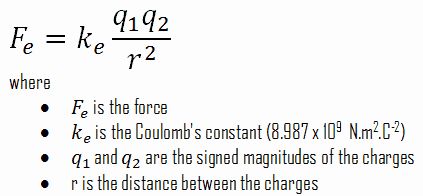
Forces between static electrically charged particles are governed by the Coulomb’s law. Coulomb’s Law can be used to calculate the force between charged particles (e.g. two protons). The electrostatic force is directly proportional to the electrical charges of the two particles and inversely proportional to the square of the distance between the particles. Coulomb’s Law is stated as the following equation.

Both, the Coulomb’s law and the magnetic force, are summarized in the Lorentz force law. Fundamentally, both magnetic and electric forces are manifestations of an exchange force involving the exchange of photons.

The electromagnetic force plays a major role in determining the internal properties of most objects encountered in daily life. The chemical properties of atoms and molecules are determined by the number of protons, in fact, by number and arrangement of electrons.

Strong Force vs Electromagnetic Force

Fundamental Interactions and Fundamental Forces

&nbsp;

References:
Nuclear and Reactor Physics:
  1. J. R. Lamarsh, Introduction to Nuclear Reactor Theory, 2nd ed., Addison-Wesley, Reading, MA (1983).
  2. J. R. Lamarsh, A. J. Baratta, Introduction to Nuclear Engineering, 3d ed., Prentice-Hall, 2001, ISBN: 0-201-82498-1.
  3. W. M. Stacey, Nuclear Reactor Physics, John Wiley & Sons, 2001, ISBN: 0- 471-39127-1.
  4. Glasstone, Sesonske. Nuclear Reactor Engineering: Reactor Systems Engineering, Springer; 4th edition, 1994, ISBN: 978-0412985317
  5. W.S.C. Williams. Nuclear and Particle Physics. Clarendon Press; 1 edition, 1991, ISBN: 978-0198520467
  6. G.R.Keepin. Physics of Nuclear Kinetics. Addison-Wesley Pub. Co; 1st edition, 1965
  7. Robert Reed Burn, Introduction to Nuclear Reactor Operation, 1988.
  8. U.S. Department of Energy, Nuclear Physics and Reactor Theory. DOE Fundamentals Handbook, Volume 1 and 2. January 1993.
  9. Paul Reuss, Neutron Physics. EDP Sciences, 2008. ISBN: 978-2759800414.

Advanced Reactor Physics:

  1. K. O. Ott, W. A. Bezella, Introductory Nuclear Reactor Statics, American Nuclear Society, Revised edition (1989), 1989, ISBN: 0-894-48033-2.
  2. K. O. Ott, R. J. Neuhold, Introductory Nuclear Reactor Dynamics, American Nuclear Society, 1985, ISBN: 0-894-48029-4.
  3. D. L. Hetrick, Dynamics of Nuclear Reactors, American Nuclear Society, 1993, ISBN: 0-894-48453-2.
  4. E. E. Lewis, W. F. Miller, Computational Methods of Neutron Transport, American Nuclear Society, 1993, ISBN: 0-894-48452-4.

See also:

Strong Force

We hope, this article, Strong Force vs Electromagnetic Force, helps you. If so, give us a like in the sidebar. Main purpose of this website is to help the public to learn some interesting and important information about materials and their properties.

What is Strong Force vs Gravitational Force – Definition

The strong force and the gravitational force are two the four fundamental forces. They are very different. This article summarizes these differences. 

Strong Interaction – Strong Force

The strong interaction or strong force is one of the four fundamental forces and involves the exchange of the vector gauge bosons known as gluons. In general, the strong interaction is very complicated interaction, because it significantly varies with distance. The strong nuclear force holds most ordinary matter together because it confines quarks into hadron particles such as the proton and neutron. Moreover, the strong force is the force which can hold a nucleus together against the enormous forces of repulsion (electromagnetic force) of the protons is strong indeed. From this point of view, we have to distinguish between:

  • Fundamental Strong Force. The fundamental strong force, or the strong force, is a very short range (less than about 0.8 fm, the radius of a nucleon) force, that acts directly between quarks. This force holds quarks together to form protons, neutrons, and other hadron particles. The strong interaction is mediated by the exchange of massless particles called gluons that act between quarks, antiquarks, and other gluons.
  • Residual Strong Force. The residual strong force, also known as the nuclear force, is a very short range (about 1 to 3 fm) force, which acts to hold neutrons and protons together in nuclei. In nuclei, this force acts against the enormous repulsive electromagnetic force of the protons. The term residual is associated with the fact, it is the residuum of the fundamental strong interaction between the quarks that make up the protons and neutrons. The residual strong force acts indirectly through the virtual π and ρ mesons, which transmit the force between nucleons that holds the nucleus together.

Gravitational Interaction – Gravitational Force

Gravity was the first force to be investigated scientifically. The gravitational force was described systematically by Isaac Newton in the 17th century. Newton stated that the gravitational force acts between all objects having mass (including objects ranging from atoms and photons, to planets and stars) and is directly proportional to the masses of the bodies and inversely proportional to the square of the distance between the bodies. Since energy and mass are equivalent, all forms of energy (including light) cause gravitation and are under the influence of it. The range of this force is ∞ and it is weaker than the other forces. This relationship is shown in the equation below.

The equation illustrates that the larger the masses of the objects or the smaller the distance between the objects, the greater the gravitational force. So even though the masses of nucleons are very small, the fact that the distance between nucleons is extremely short may make the gravitational force significant. The gravitational force between two protons that are separated by a distance of 10-20 meters is about 10-24 newtons. Gravity is the weakest of the four fundamental forces of physics, approximately 1038 times weaker than the strong force. On the other hand, gravity is additive. Every speck of matter that you put into a lump contributes to the overall overall gravity of the lump. Since it is also a very long range force, it is dominant force at the macroscopic scale, and is the cause of the formation, shape and trajectory (orbit) of astronomical bodies.

Strong Force vs Gravitational Force

Fundamental Interactions and Fundamental Forces

&nbsp;

References:
Nuclear and Reactor Physics:
  1. J. R. Lamarsh, Introduction to Nuclear Reactor Theory, 2nd ed., Addison-Wesley, Reading, MA (1983).
  2. J. R. Lamarsh, A. J. Baratta, Introduction to Nuclear Engineering, 3d ed., Prentice-Hall, 2001, ISBN: 0-201-82498-1.
  3. W. M. Stacey, Nuclear Reactor Physics, John Wiley & Sons, 2001, ISBN: 0- 471-39127-1.
  4. Glasstone, Sesonske. Nuclear Reactor Engineering: Reactor Systems Engineering, Springer; 4th edition, 1994, ISBN: 978-0412985317
  5. W.S.C. Williams. Nuclear and Particle Physics. Clarendon Press; 1 edition, 1991, ISBN: 978-0198520467
  6. G.R.Keepin. Physics of Nuclear Kinetics. Addison-Wesley Pub. Co; 1st edition, 1965
  7. Robert Reed Burn, Introduction to Nuclear Reactor Operation, 1988.
  8. U.S. Department of Energy, Nuclear Physics and Reactor Theory. DOE Fundamentals Handbook, Volume 1 and 2. January 1993.
  9. Paul Reuss, Neutron Physics. EDP Sciences, 2008. ISBN: 978-2759800414.

Advanced Reactor Physics:

  1. K. O. Ott, W. A. Bezella, Introductory Nuclear Reactor Statics, American Nuclear Society, Revised edition (1989), 1989, ISBN: 0-894-48033-2.
  2. K. O. Ott, R. J. Neuhold, Introductory Nuclear Reactor Dynamics, American Nuclear Society, 1985, ISBN: 0-894-48029-4.
  3. D. L. Hetrick, Dynamics of Nuclear Reactors, American Nuclear Society, 1993, ISBN: 0-894-48453-2.
  4. E. E. Lewis, W. F. Miller, Computational Methods of Neutron Transport, American Nuclear Society, 1993, ISBN: 0-894-48452-4.

See also:

Strong Force

We hope, this article, Strong Force vs Gravitational Force, helps you. If so, give us a like in the sidebar. Main purpose of this website is to help the public to learn some interesting and important information about materials and their properties.

What is Electromagnetic Force vs Gravitational Force – Definition

The electromagnetic force and the gravitational force are two the four fundamental forces. They are very different. This article summarizes these differences. 

Electromagnetic Interaction – Electromagnetic Force

The electromagnetic force is the force responsible for all electromagnetic processes. It acts between electrically charged particles. It is infinite-ranged force, much stronger than gravitational force, obeys the inverse square law, but neither electricity nor magnetism adds up in the way that gravitational force does. Since there are positive and negative charges (poles), these charges tend to cancel each other out. Electromagnetism includes the electrostatic force acting between charged particles at rest, and the combined effect of electric and magnetic forces acting between charged particles moving relative to each other.

The photon, the quantum of electromagnetic radiation, is an elementary particle, which is the force carrier of the electromagnetic force. Photons are gauge bosons having no electric charge or rest mass and one unit of spin. Common to all photons is the speed of light, the universal constant of physics. In empty space, the photon moves at c (the speed of light – 299 792 458 metres per second).

Forces between static electrically charged particles are governed by the Coulomb’s law. Coulomb’s Law can be used to calculate the force between charged particles (e.g. two protons). The electrostatic force is directly proportional to the electrical charges of the two particles and inversely proportional to the square of the distance between the particles. Coulomb’s Law is stated as the following equation.

Both, the Coulomb’s law and the magnetic force, are summarized in the Lorentz force law. Fundamentally, both magnetic and electric forces are manifestations of an exchange force involving the exchange of photons.

The electromagnetic force plays a major role in determining the internal properties of most objects encountered in daily life. The chemical properties of atoms and molecules are determined by the number of protons, in fact, by number and arrangement of electrons.

Gravitational Interaction – Gravitational Force

Gravity was the first force to be investigated scientifically. The gravitational force was described systematically by Isaac Newton in the 17th century. Newton stated that the gravitational force acts between all objects having mass (including objects ranging from atoms and photons, to planets and stars) and is directly proportional to the masses of the bodies and inversely proportional to the square of the distance between the bodies. Since energy and mass are equivalent, all forms of energy (including light) cause gravitation and are under the influence of it. The range of this force is ∞ and it is weaker than the other forces. This relationship is shown in the equation below.

The equation illustrates that the larger the masses of the objects or the smaller the distance between the objects, the greater the gravitational force. So even though the masses of nucleons are very small, the fact that the distance between nucleons is extremely short may make the gravitational force significant. The gravitational force between two protons that are separated by a distance of 10-20 meters is about 10-24 newtons. Gravity is the weakest of the four fundamental forces of physics, approximately 1038 times weaker than the strong force. On the other hand, gravity is additive. Every speck of matter that you put into a lump contributes to the overall overall gravity of the lump. Since it is also a very long range force, it is dominant force at the macroscopic scale, and is the cause of the formation, shape and trajectory (orbit) of astronomical bodies.

Electromagnetic Force vs Gravitational Force

Fundamental Interactions and Fundamental Forces

&nbsp;

References:
Nuclear and Reactor Physics:
  1. J. R. Lamarsh, Introduction to Nuclear Reactor Theory, 2nd ed., Addison-Wesley, Reading, MA (1983).
  2. J. R. Lamarsh, A. J. Baratta, Introduction to Nuclear Engineering, 3d ed., Prentice-Hall, 2001, ISBN: 0-201-82498-1.
  3. W. M. Stacey, Nuclear Reactor Physics, John Wiley & Sons, 2001, ISBN: 0- 471-39127-1.
  4. Glasstone, Sesonske. Nuclear Reactor Engineering: Reactor Systems Engineering, Springer; 4th edition, 1994, ISBN: 978-0412985317
  5. W.S.C. Williams. Nuclear and Particle Physics. Clarendon Press; 1 edition, 1991, ISBN: 978-0198520467
  6. G.R.Keepin. Physics of Nuclear Kinetics. Addison-Wesley Pub. Co; 1st edition, 1965
  7. Robert Reed Burn, Introduction to Nuclear Reactor Operation, 1988.
  8. U.S. Department of Energy, Nuclear Physics and Reactor Theory. DOE Fundamentals Handbook, Volume 1 and 2. January 1993.
  9. Paul Reuss, Neutron Physics. EDP Sciences, 2008. ISBN: 978-2759800414.

Advanced Reactor Physics:

  1. K. O. Ott, W. A. Bezella, Introductory Nuclear Reactor Statics, American Nuclear Society, Revised edition (1989), 1989, ISBN: 0-894-48033-2.
  2. K. O. Ott, R. J. Neuhold, Introductory Nuclear Reactor Dynamics, American Nuclear Society, 1985, ISBN: 0-894-48029-4.
  3. D. L. Hetrick, Dynamics of Nuclear Reactors, American Nuclear Society, 1993, ISBN: 0-894-48453-2.
  4. E. E. Lewis, W. F. Miller, Computational Methods of Neutron Transport, American Nuclear Society, 1993, ISBN: 0-894-48452-4.

See also:

Electromagnetic Force

We hope, this article, Electromagnetic Force vs Gravitational Force, helps you. If so, give us a like in the sidebar. Main purpose of this website is to help the public to learn some interesting and important information about materials and their properties.