Facebook Instagram Youtube Twitter

Iron and Copper – Comparison – Properties

This article contains comparison of key thermal and atomic properties of iron and copper, two comparable chemical elements from the periodic table. It also contains basic descriptions and applications of both elements. Iron vs Copper.
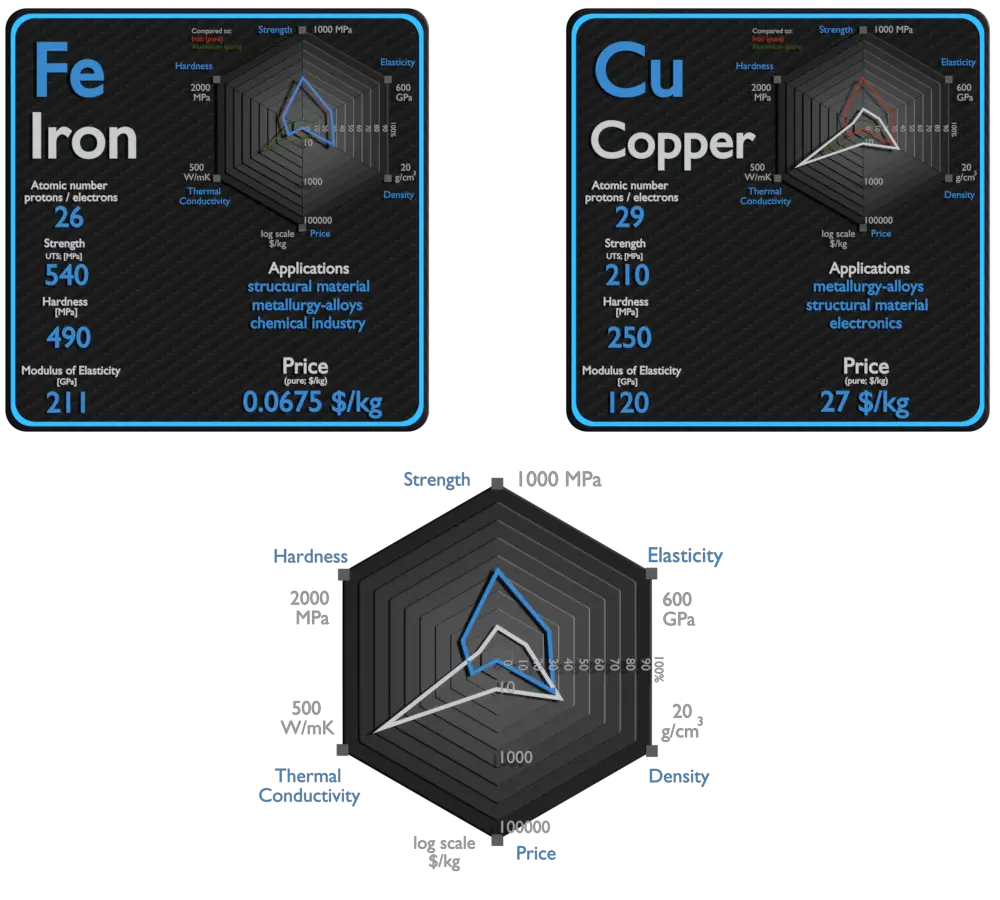
iron and copper - comparison

Compare iron with another element

Carbon - Properties - Price - Applications - Production

Oxygen - Properties - Price - Applications - Production

Fluorine - Properties - Price - Applications - Production

Magnesium - Properties - Price - Applications - Production

Aluminium - Properties - Price - Applications - Production

Chlorine - Properties - Price - Applications - Production

Potassium - Properties - Price - Applications - Production

Calcium - Properties - Price - Applications - Production

Chromium - Properties - Price - Applications - Production

Manganese - Properties - Price - Applications - Production

Cobalt - Properties - Price - Applications - Production

Nickel - Properties - Price - Applications - Production

Copper - Properties - Price - Applications - Production

Zinc - Properties - Price - Applications - Production

Zirconium - Properties - Price - Applications - Production

Lead - Properties - Price - Applications - Production

Compare copper with another element

Beryllium - Properties - Price - Applications - Production

Magnesium - Properties - Price - Applications - Production

Aluminium - Properties - Price - Applications - Production

Silicon - Properties - Price - Applications - Production

Chlorine - Properties - Price - Applications - Production

Titanium - Properties - Price - Applications - Production

Chromium - Properties - Price - Applications - Production

Manganese - Properties - Price - Applications - Production

Iron - Properties - Price - Applications - Production

Cobalt - Properties - Price - Applications - Production

Silver - Properties - Price - Applications - Production

Gold - Properties - Price - Applications - Production

Tin - Properties - Price - Applications - Production

Iron and Copper – About Elements
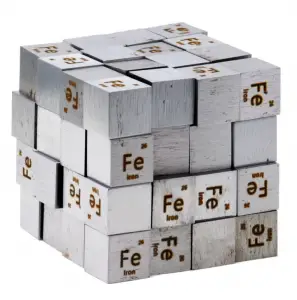
Iron

Iron is a metal in the first transition series. It is by mass the most common element on Earth, forming much of Earth’s outer and inner core. It is the fourth most common element in the Earth’s crust. Its abundance in rocky planets like Earth is due to its abundant production by fusion in high-mass stars.

Copper

Copper is a soft, malleable, and ductile metal with very high thermal and electrical conductivity. A freshly exposed surface of pure copper has a reddish-orange color. Copper is used as a conductor of heat and electricity, as a building material, and as a constituent of various metal alloys, such as sterling silver used in jewelry, cupronickel used to make marine hardware and coins, and constantan used in strain gauges and thermocouples for temperature measurement.

Iron in Periodic Table

Copper in Periodic Table

Source: www.luciteria.com

Iron and Copper – Applications

Iron

Iron is used in numerous sectors such as electronics, manufacturing, automotive, and construction and building. Iron is the most widely used of all the metals, accounting for over 90% of worldwide metal produc0tion. Its low cost and high strength often make it the material of choice material to withstand stress or transmit forces, such as the construction of machinery and machine tools, rails, automobiles, ship hulls, concrete reinforcing bars, and the load-carrying framework of buildings. Since pure iron is quite soft, it is most commonly combined with alloying elements to make steel. Steels are iron–carbon alloys that may contain appreciable concentrations of other alloying elements. Adding a small amount of non-metallic carbon to iron trades its great ductility for the greater strength. Due to its very-high strength, but still substantial toughness, and its ability to be greatly altered by heat treatment, steel is one of the most useful and common ferrous alloy in modern use. There are thousands of alloys that have different compositions and/or heat treatments. The mechanical properties are sensitive to the content of carbon, which is normally less than 1.0 wt%.

Copper

Historically, alloying copper with another metal, for example tin to make bronze, was first practiced about 4000 years after the discovery of copper smelting, and about 2000 years after “natural bronze” had come into general use. An ancient civilization is defined to be in the Bronze Age either by producing bronze by smelting its own copper and alloying with tin, arsenic, or other metals. The major applications of copper are electrical wire (60%), roofing and plumbing (20%), and industrial machinery (15%). Copper is used mostly as a pure metal, but when greater hardness is required, it is put into such alloys as brass and bronze (5% of total use). Copper and copper-based alloys including brasses (Cu-Zn) and bronzes (Cu-Sn) are widely used in different industrial and societal applications. Some of the common uses for brass alloys include costume jewelry, locks, hinges, gears, bearings, ammunition casings, automotive radiators, musical instruments, electronic packaging, and coins. Bronze, or bronze-like alloys and mixtures, were used for coins over a longer period. is still widely used today for springs, bearings, bushings, automobile transmission pilot bearings, and similar fittings, and is particularly common in the bearings of small electric motors. Brass and bronze are common engineering materials in modern architecture and primarily used for roofing and facade cladding due to their visual appearance.

Iron and Copper – Comparison in Table

Element Iron Copper
Density 7.874 g/cm3 8.92 g/cm3
Ultimate Tensile Strength 540 MPa 210 MPa
Yield Strength 50 MPa 33 MPa
Young’s Modulus of Elasticity 211 GPa 120 GPa
Mohs Scale 4.5 3
Brinell Hardness 490 MPa 250 MPa
Vickers Hardness 608 MPa 350 MPa
Melting Point 1538 °C 1084.62 °C
Boiling Point 2861 °C 2562 °C
Thermal Conductivity 80.2 W/mK 401 W/mK
Thermal Expansion Coefficient 11.8 µm/mK 16.5 µm/mK
Specific Heat 0.44 J/g K 0.38 J/g K
Heat of Fusion 13.8 kJ/mol 13.05 kJ/mol
Heat of Vaporization 349.6 kJ/mol 300.3 kJ/mol


Iron and Nickel – Comparison – Properties

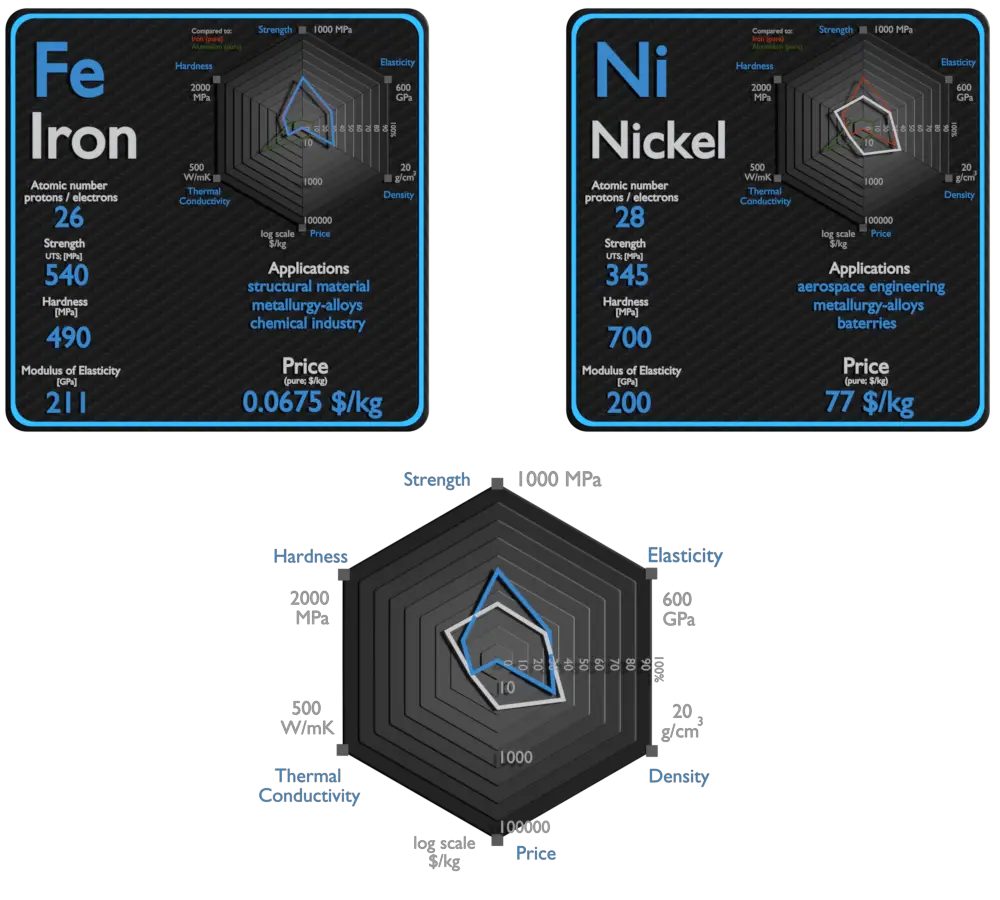
This article contains comparison of key thermal and atomic properties of iron and nickel, two comparable chemical elements from the periodic table. It also contains basic descriptions and applications of both elements. Iron vs Nickel.

iron and nickel - comparison

Compare iron with another element

Carbon - Properties - Price - Applications - Production

Oxygen - Properties - Price - Applications - Production

Fluorine - Properties - Price - Applications - Production

Magnesium - Properties - Price - Applications - Production

Aluminium - Properties - Price - Applications - Production

Chlorine - Properties - Price - Applications - Production

Potassium - Properties - Price - Applications - Production

Calcium - Properties - Price - Applications - Production

Chromium - Properties - Price - Applications - Production

Manganese - Properties - Price - Applications - Production

Cobalt - Properties - Price - Applications - Production

Nickel - Properties - Price - Applications - Production

Copper - Properties - Price - Applications - Production

Zinc - Properties - Price - Applications - Production

Zirconium - Properties - Price - Applications - Production

Lead - Properties - Price - Applications - Production

Compare nickel with another element

Iron - Properties - Price - Applications - Production

Tin - Properties - Price - Applications - Production

Zinc - Properties - Price - Applications - Production

Silver - Properties - Price - Applications - Production

Gold - Properties - Price - Applications - Production

Platinum - Properties - Price - Applications - Production

Iron and Nickel – About Elements

Iron

Iron is a metal in the first transition series. It is by mass the most common element on Earth, forming much of Earth’s outer and inner core. It is the fourth most common element in the Earth’s crust. Its abundance in rocky planets like Earth is due to its abundant production by fusion in high-mass stars.

Nickel

Nickel is a silvery-white lustrous metal with a slight golden tinge. Nickel belongs to the transition metals and is hard and ductile.

Iron in Periodic Table

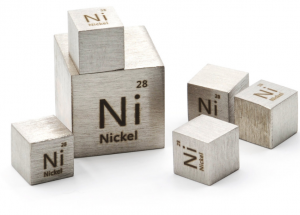
Nickel in Periodic Table

Source: www.luciteria.com

Iron and Nickel – Applications

Iron

Iron is used in numerous sectors such as electronics, manufacturing, automotive, and construction and building. Iron is the most widely used of all the metals, accounting for over 90% of worldwide metal produc0tion. Its low cost and high strength often make it the material of choice material to withstand stress or transmit forces, such as the construction of machinery and machine tools, rails, automobiles, ship hulls, concrete reinforcing bars, and the load-carrying framework of buildings. Since pure iron is quite soft, it is most commonly combined with alloying elements to make steel. Steels are iron–carbon alloys that may contain appreciable concentrations of other alloying elements. Adding a small amount of non-metallic carbon to iron trades its great ductility for the greater strength. Due to its very-high strength, but still substantial toughness, and its ability to be greatly altered by heat treatment, steel is one of the most useful and common ferrous alloy in modern use. There are thousands of alloys that have different compositions and/or heat treatments. The mechanical properties are sensitive to the content of carbon, which is normally less than 1.0 wt%.

Nickel

The global production of nickel is presently used as follows: 68% in stainless steel; 10% in nonferrous alloys; 9% in electroplating; 7% in alloy steel; 3% in foundries; and 4% other uses (including batteries). Nickel is used as a constituent of different types of alloys; for instance, Monel (corrosion resistant material), Nichrome (an alloy used for resistance heating elements), Permalloy (an alloy with high magnetic permeability at low field strength and low hysteresis loss), cupro-nickel, stainless steel, nickel silver, etc. Nickel based alloys (e.g. Fe-Cr-Ni(Mo) alloys) alloys exhibit excellent ductility and toughness, even at high strength levels and these properties are retained up to low temperatures. Nickel and its alloys are highly resistant to corrosion in many environments, especially those that are basic (alkaline). Nickel also reduces thermal expansion for better dimensional stability. Nickel is the base element for superalloys. These metals have excellent resistance to thermal creep deformation and retain their stiffness, strength, toughness and dimensional stability at temperatures much higher than the other aerospace structural materials.

Iron and Nickel – Comparison in Table

Element Iron Nickel
Density 7.874 g/cm3 8.908 g/cm3
Ultimate Tensile Strength 540 MPa 345 MPa
Yield Strength 50 MPa 70 MPa
Young’s Modulus of Elasticity 211 GPa 200 GPa
Mohs Scale 4.5 4
Brinell Hardness 490 MPa 700 MPa
Vickers Hardness 608 MPa 640 MPa
Melting Point 1538 °C 1455 °C
Boiling Point 2861 °C 2730 °C
Thermal Conductivity 80.2 W/mK 90.7 W/mK
Thermal Expansion Coefficient 11.8 µm/mK 13.4 µm/mK
Specific Heat 0.44 J/g K 0.44 J/g K
Heat of Fusion 13.8 kJ/mol 17.47 kJ/mol
Heat of Vaporization 349.6 kJ/mol 370.4 kJ/mol


Iron and Cobalt – Comparison – Properties

This article contains comparison of key thermal and atomic properties of iron and cobalt, two comparable chemical elements from the periodic table. It also contains basic descriptions and applications of both elements. Iron vs Cobalt.

iron and cobalt - comparison

Compare iron with another element

Carbon - Properties - Price - Applications - Production

Oxygen - Properties - Price - Applications - Production

Fluorine - Properties - Price - Applications - Production

Magnesium - Properties - Price - Applications - Production

Aluminium - Properties - Price - Applications - Production

Chlorine - Properties - Price - Applications - Production

Potassium - Properties - Price - Applications - Production

Calcium - Properties - Price - Applications - Production

Chromium - Properties - Price - Applications - Production

Manganese - Properties - Price - Applications - Production

Cobalt - Properties - Price - Applications - Production

Nickel - Properties - Price - Applications - Production

Copper - Properties - Price - Applications - Production

Zinc - Properties - Price - Applications - Production

Zirconium - Properties - Price - Applications - Production

Lead - Properties - Price - Applications - Production

Compare cobalt with another element

Lithium - Properties - Price - Applications - Production

Iron - Properties - Price - Applications - Production

Copper - Properties - Price - Applications - Production

Cobalt - Properties - Price - Applications - Production

Cadmium - Properties - Price - Applications - Production

Zinc - Properties - Price - Applications - Production

Silver - Properties - Price - Applications - Production

Gold - Properties - Price - Applications - Production

Tungsten - Properties - Price - Applications - Production

Iron and Cobalt – About Elements

Iron

Iron is a metal in the first transition series. It is by mass the most common element on Earth, forming much of Earth’s outer and inner core. It is the fourth most common element in the Earth’s crust. Its abundance in rocky planets like Earth is due to its abundant production by fusion in high-mass stars.

Cobalt

Cobalt is found in the Earth’s crust only in chemically combined form, save for small deposits found in alloys of natural meteoric iron. The free element, produced by reductive smelting, is a hard, lustrous, silver-gray metal.

Iron in Periodic Table

Cobalt in Periodic Table

Source: www.luciteria.com

Iron and Cobalt – Applications

Iron

Iron is used in numerous sectors such as electronics, manufacturing, automotive, and construction and building. Iron is the most widely used of all the metals, accounting for over 90% of worldwide metal produc0tion. Its low cost and high strength often make it the material of choice material to withstand stress or transmit forces, such as the construction of machinery and machine tools, rails, automobiles, ship hulls, concrete reinforcing bars, and the load-carrying framework of buildings. Since pure iron is quite soft, it is most commonly combined with alloying elements to make steel. Steels are iron–carbon alloys that may contain appreciable concentrations of other alloying elements. Adding a small amount of non-metallic carbon to iron trades its great ductility for the greater strength. Due to its very-high strength, but still substantial toughness, and its ability to be greatly altered by heat treatment, steel is one of the most useful and common ferrous alloy in modern use. There are thousands of alloys that have different compositions and/or heat treatments. The mechanical properties are sensitive to the content of carbon, which is normally less than 1.0 wt%.

Cobalt

Cobalt has been used in many industrial, commercial, and military applications. Cobalt is primarily used in lithium-ion batteries, and in the manufacture of magnetic, wear-resistant and high-strength alloys. Cobalt-based Superalloys. This class of alloys is relatively new. In 2006, Sato et al. discovered a new phase in the Co–Al–W system. Unlike other superalloys, cobalt-base alloys are characterized by a solid-solution-strengthened austenitic (fcc) matrix in which a small quantity of carbide is distributed. While not used commercially to the extent of Ni-based superalloys, alloying elements found in research Co-based alloys are C, Cr, W, Ni, Ti, Al, Ir, and Ta. They possess better weldability and thermal fatigue resistance as compared to nickel based alloy. Moreover, they have excellent corrosion resistance at high temperatures (980-1100 °C) because of their higher chromium contents. Several cobalt compounds are oxidation catalysts. Typical catalysts are the cobalt carboxylates (known as cobalt soaps). They are also used in paints, varnishes, and inks as “drying agents” through the oxidation of drying oils.

Iron and Cobalt – Comparison in Table

Element Iron Cobalt
Density 7.874 g/cm3 8.9 g/cm3
Ultimate Tensile Strength 540 MPa 800 MPa
Yield Strength 50 MPa 220 MPa
Young’s Modulus of Elasticity 211 GPa 209 GPa
Mohs Scale 4.5 5
Brinell Hardness 490 MPa 800 MPa
Vickers Hardness 608 MPa 1040 MPa
Melting Point 1538 °C 1495 °C
Boiling Point 2861 °C 2927 °C
Thermal Conductivity 80.2 W/mK 100 W/mK
Thermal Expansion Coefficient 11.8 µm/mK 13 µm/mK
Specific Heat 0.44 J/g K 0.42 J/g K
Heat of Fusion 13.8 kJ/mol 16.19 kJ/mol
Heat of Vaporization 349.6 kJ/mol 376.5 kJ/mol


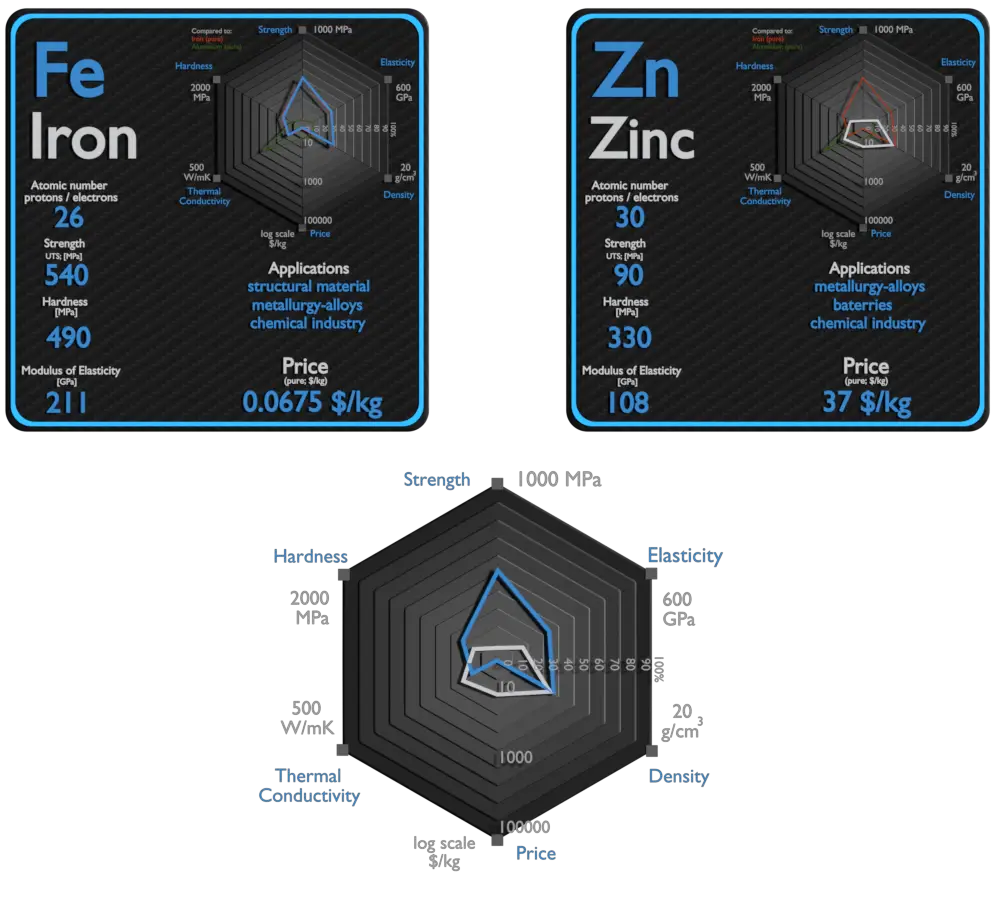
Iron and Zinc – Comparison – Properties

This article contains comparison of key thermal and atomic properties of iron and zinc, two comparable chemical elements from the periodic table. It also contains basic descriptions and applications of both elements. Iron vs Zinc.

iron and zinc - comparison

Compare iron with another element

Carbon - Properties - Price - Applications - Production

Oxygen - Properties - Price - Applications - Production

Fluorine - Properties - Price - Applications - Production

Magnesium - Properties - Price - Applications - Production

Aluminium - Properties - Price - Applications - Production

Chlorine - Properties - Price - Applications - Production

Potassium - Properties - Price - Applications - Production

Calcium - Properties - Price - Applications - Production

Chromium - Properties - Price - Applications - Production

Manganese - Properties - Price - Applications - Production

Cobalt - Properties - Price - Applications - Production

Nickel - Properties - Price - Applications - Production

Copper - Properties - Price - Applications - Production

Zinc - Properties - Price - Applications - Production

Zirconium - Properties - Price - Applications - Production

Lead - Properties - Price - Applications - Production

Compare zinc with another element

Magnesium - Properties - Price - Applications - Production

Potassium - Properties - Price - Applications - Production

Titanium - Properties - Price - Applications - Production

Chromium - Properties - Price - Applications - Production

Manganese - Properties - Price - Applications - Production

Iron - Properties - Price - Applications - Production

Cobalt - Properties - Price - Applications - Production

Nickel - Properties - Price - Applications - Production

Indium - Properties - Price - Applications - Production

Selenium - Properties - Price - Applications - Production

Iron and Zinc – About Elements

Iron

Iron is a metal in the first transition series. It is by mass the most common element on Earth, forming much of Earth’s outer and inner core. It is the fourth most common element in the Earth’s crust. Its abundance in rocky planets like Earth is due to its abundant production by fusion in high-mass stars.

Zinc

In some respects zinc is chemically similar to magnesium: both elements exhibit only one normal oxidation state (+2), and the Zn2+ and Mg2+ ions are of similar size.

Iron in Periodic Table

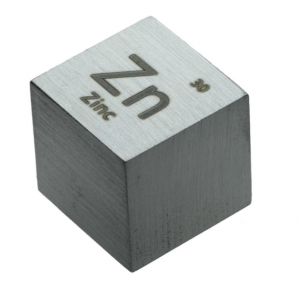
Zinc in Periodic Table

Source: www.luciteria.com

Iron and Zinc – Applications

Iron

Iron is used in numerous sectors such as electronics, manufacturing, automotive, and construction and building. Iron is the most widely used of all the metals, accounting for over 90% of worldwide metal produc0tion. Its low cost and high strength often make it the material of choice material to withstand stress or transmit forces, such as the construction of machinery and machine tools, rails, automobiles, ship hulls, concrete reinforcing bars, and the load-carrying framework of buildings. Since pure iron is quite soft, it is most commonly combined with alloying elements to make steel. Steels are iron–carbon alloys that may contain appreciable concentrations of other alloying elements. Adding a small amount of non-metallic carbon to iron trades its great ductility for the greater strength. Due to its very-high strength, but still substantial toughness, and its ability to be greatly altered by heat treatment, steel is one of the most useful and common ferrous alloy in modern use. There are thousands of alloys that have different compositions and/or heat treatments. The mechanical properties are sensitive to the content of carbon, which is normally less than 1.0 wt%.

Zinc

Corrosion-resistant zinc plating of iron (hot-dip galvanizing) is the major application for zinc. Coating of steel constitutes the largest single use of zinc, but it is used in large tonnages in zinc alloy castings, as zinc dust and oxide, and in wrought zinc products. Galvanized steel is just plain carbon steel that has been coated with a thin zinc layer. The zinc protects iron by corroding first, but zinc corrodes at much lower rates than do steel. Other applications are in electrical batteries, small non-structural castings, and alloys such as brass. A variety of zinc compounds are commonly used, such as zinc carbonate and zinc gluconate (as dietary supplements), zinc chloride (in deodorants), zinc pyrithione (anti-dandruff shampoos), zinc sulfide (in luminescent paints), and dimethylzinc or diethylzinc in the organic laboratory. A key part of the modern materials world in which zinc finds itself is recycling. Zinc, in common with all metals (and unlike synthetic materials) can be recycled indefinitely without degradation.

Iron and Zinc – Comparison in Table

Element Iron Zinc
Density 7.874 g/cm3 7.14 g/cm3
Ultimate Tensile Strength 540 MPa 90 MPa
Yield Strength 50 MPa 75 MPa
Young’s Modulus of Elasticity 211 GPa 108 GPa
Mohs Scale 4.5 2.5
Brinell Hardness 490 MPa 330 MPa
Vickers Hardness 608 MPa N/A
Melting Point 1538 °C 419.53 °C
Boiling Point 2861 °C 907 °C
Thermal Conductivity 80.2 W/mK 116 W/mK
Thermal Expansion Coefficient 11.8 µm/mK 30.2 µm/mK
Specific Heat 0.44 J/g K 0.39 J/g K
Heat of Fusion 13.8 kJ/mol 7.322 kJ/mol
Heat of Vaporization 349.6 kJ/mol 115.3 kJ/mol


Manganese and Zinc – Comparison – Properties

This article contains comparison of key thermal and atomic properties of manganese and zinc, two comparable chemical elements from the periodic table. It also contains basic descriptions and applications of both elements. Manganese vs Zinc.

manganese and zinc - comparison

Compare manganese with another element

Iron - Properties - Price - Applications - Production

Copper - Properties - Price - Applications - Production

Zinc - Properties - Price - Applications - Production

Compare zinc with another element

Magnesium - Properties - Price - Applications - Production

Potassium - Properties - Price - Applications - Production

Titanium - Properties - Price - Applications - Production

Chromium - Properties - Price - Applications - Production

Manganese - Properties - Price - Applications - Production

Iron - Properties - Price - Applications - Production

Cobalt - Properties - Price - Applications - Production

Nickel - Properties - Price - Applications - Production

Indium - Properties - Price - Applications - Production

Selenium - Properties - Price - Applications - Production

Manganese and Zinc – About Elements

Manganese

Manganese is a metal with important industrial metal alloy uses, particularly in stainless steels.

Zinc

In some respects zinc is chemically similar to magnesium: both elements exhibit only one normal oxidation state (+2), and the Zn2+ and Mg2+ ions are of similar size.

Manganese in Periodic Table

Zinc in Periodic Table

Source: www.luciteria.com

Manganese and Zinc – Applications

Manganese

Manganese is an important alloying agent. Almost 90% of the manganese produced annually is used in the production of steel. In steels, manganese improves the rolling and forging qualities, as well as strength, toughness, stiffness, wear resistance, hardness and hardenability. The second largest application for manganese is in aluminium alloys. Aluminium with roughly 1.5% manganese has increased resistance to corrosion through grains that absorb impurities which would lead to galvanic corrosion. Manganese can be formed into many useful compounds. For example, manganese oxide, which can be used in fertilizers and ceramics.

Zinc

Corrosion-resistant zinc plating of iron (hot-dip galvanizing) is the major application for zinc. Coating of steel constitutes the largest single use of zinc, but it is used in large tonnages in zinc alloy castings, as zinc dust and oxide, and in wrought zinc products. Galvanized steel is just plain carbon steel that has been coated with a thin zinc layer. The zinc protects iron by corroding first, but zinc corrodes at much lower rates than do steel. Other applications are in electrical batteries, small non-structural castings, and alloys such as brass. A variety of zinc compounds are commonly used, such as zinc carbonate and zinc gluconate (as dietary supplements), zinc chloride (in deodorants), zinc pyrithione (anti-dandruff shampoos), zinc sulfide (in luminescent paints), and dimethylzinc or diethylzinc in the organic laboratory. A key part of the modern materials world in which zinc finds itself is recycling. Zinc, in common with all metals (and unlike synthetic materials) can be recycled indefinitely without degradation.

Manganese and Zinc – Comparison in Table

Element Manganese Zinc
Density 7.47 g/cm3 7.14 g/cm3
Ultimate Tensile Strength 650 MPa 90 MPa
Yield Strength 230 MPa 75 MPa
Young’s Modulus of Elasticity 198 GPa 108 GPa
Mohs Scale 6 2.5
Brinell Hardness 200 MPa 330 MPa
Vickers Hardness N/A N/A
Melting Point 1246 °C 419.53 °C
Boiling Point 2061 °C 907 °C
Thermal Conductivity 7.82 W/mK 116 W/mK
Thermal Expansion Coefficient 21.7 µm/mK 30.2 µm/mK
Specific Heat 0.48 J/g K 0.39 J/g K
Heat of Fusion 12.05 kJ/mol 7.322 kJ/mol
Heat of Vaporization 266 kJ/mol 115.3 kJ/mol


Manganese and Copper – Comparison – Properties

This article contains comparison of key thermal and atomic properties of manganese and copper, two comparable chemical elements from the periodic table. It also contains basic descriptions and applications of both elements. Manganese vs Copper.

manganese and copper - comparison

Compare manganese with another element

Iron - Properties - Price - Applications - Production

Copper - Properties - Price - Applications - Production

Zinc - Properties - Price - Applications - Production

Compare copper with another element

Beryllium - Properties - Price - Applications - Production

Magnesium - Properties - Price - Applications - Production

Aluminium - Properties - Price - Applications - Production

Silicon - Properties - Price - Applications - Production

Chlorine - Properties - Price - Applications - Production

Titanium - Properties - Price - Applications - Production

Chromium - Properties - Price - Applications - Production

Manganese - Properties - Price - Applications - Production

Iron - Properties - Price - Applications - Production

Cobalt - Properties - Price - Applications - Production

Silver - Properties - Price - Applications - Production

Gold - Properties - Price - Applications - Production

Tin - Properties - Price - Applications - Production

Manganese and Copper – About Elements

Manganese

Manganese is a metal with important industrial metal alloy uses, particularly in stainless steels.

Copper

Copper is a soft, malleable, and ductile metal with very high thermal and electrical conductivity. A freshly exposed surface of pure copper has a reddish-orange color. Copper is used as a conductor of heat and electricity, as a building material, and as a constituent of various metal alloys, such as sterling silver used in jewelry, cupronickel used to make marine hardware and coins, and constantan used in strain gauges and thermocouples for temperature measurement.

Manganese in Periodic Table

Copper in Periodic Table

Source: www.luciteria.com

Manganese and Copper – Applications

Manganese

Manganese is an important alloying agent. Almost 90% of the manganese produced annually is used in the production of steel. In steels, manganese improves the rolling and forging qualities, as well as strength, toughness, stiffness, wear resistance, hardness and hardenability. The second largest application for manganese is in aluminium alloys. Aluminium with roughly 1.5% manganese has increased resistance to corrosion through grains that absorb impurities which would lead to galvanic corrosion. Manganese can be formed into many useful compounds. For example, manganese oxide, which can be used in fertilizers and ceramics.

Copper

Historically, alloying copper with another metal, for example tin to make bronze, was first practiced about 4000 years after the discovery of copper smelting, and about 2000 years after “natural bronze” had come into general use. An ancient civilization is defined to be in the Bronze Age either by producing bronze by smelting its own copper and alloying with tin, arsenic, or other metals. The major applications of copper are electrical wire (60%), roofing and plumbing (20%), and industrial machinery (15%). Copper is used mostly as a pure metal, but when greater hardness is required, it is put into such alloys as brass and bronze (5% of total use). Copper and copper-based alloys including brasses (Cu-Zn) and bronzes (Cu-Sn) are widely used in different industrial and societal applications. Some of the common uses for brass alloys include costume jewelry, locks, hinges, gears, bearings, ammunition casings, automotive radiators, musical instruments, electronic packaging, and coins. Bronze, or bronze-like alloys and mixtures, were used for coins over a longer period. is still widely used today for springs, bearings, bushings, automobile transmission pilot bearings, and similar fittings, and is particularly common in the bearings of small electric motors. Brass and bronze are common engineering materials in modern architecture and primarily used for roofing and facade cladding due to their visual appearance.

Manganese and Copper – Comparison in Table

Element Manganese Copper
Density 7.47 g/cm3 8.92 g/cm3
Ultimate Tensile Strength 650 MPa 120 MPa
Yield Strength 230 MPa 33 MPa
Young’s Modulus of Elasticity 198 GPa 120 GPa
Mohs Scale 6 3
Brinell Hardness 200 MPa 250 MPa
Vickers Hardness N/A 350 MPa
Melting Point 1246 °C 1084.62 °C
Boiling Point 2061 °C 2562 °C
Thermal Conductivity 7.82 W/mK 401 W/mK
Thermal Expansion Coefficient 21.7 µm/mK 16.5 µm/mK
Specific Heat 0.48 J/g K 0.38 J/g K
Heat of Fusion 12.05 kJ/mol 13.05 kJ/mol
Heat of Vaporization 266 kJ/mol 300.3 kJ/mol


Manganese and Iron – Comparison – Properties

This article contains comparison of key thermal and atomic properties of manganese and iron, two comparable chemical elements from the periodic table. It also contains basic descriptions and applications of both elements. Manganese vs Iron.

manganese and iron - comparison

Compare manganese with another element

Iron - Properties - Price - Applications - Production

Copper - Properties - Price - Applications - Production

Zinc - Properties - Price - Applications - Production

Compare iron with another element

Carbon - Properties - Price - Applications - Production

Oxygen - Properties - Price - Applications - Production

Fluorine - Properties - Price - Applications - Production

Magnesium - Properties - Price - Applications - Production

Aluminium - Properties - Price - Applications - Production

Chlorine - Properties - Price - Applications - Production

Potassium - Properties - Price - Applications - Production

Calcium - Properties - Price - Applications - Production

Chromium - Properties - Price - Applications - Production

Manganese - Properties - Price - Applications - Production

Cobalt - Properties - Price - Applications - Production

Nickel - Properties - Price - Applications - Production

Copper - Properties - Price - Applications - Production

Zinc - Properties - Price - Applications - Production

Zirconium - Properties - Price - Applications - Production

Lead - Properties - Price - Applications - Production

Manganese and Iron – About Elements

Manganese

Manganese is a metal with important industrial metal alloy uses, particularly in stainless steels.

Iron

Iron is a metal in the first transition series. It is by mass the most common element on Earth, forming much of Earth’s outer and inner core. It is the fourth most common element in the Earth’s crust. Its abundance in rocky planets like Earth is due to its abundant production by fusion in high-mass stars.

Manganese in Periodic Table

Iron in Periodic Table

Source: www.luciteria.com

Manganese and Iron – Applications

Manganese

Manganese is an important alloying agent. Almost 90% of the manganese produced annually is used in the production of steel. In steels, manganese improves the rolling and forging qualities, as well as strength, toughness, stiffness, wear resistance, hardness and hardenability. The second largest application for manganese is in aluminium alloys. Aluminium with roughly 1.5% manganese has increased resistance to corrosion through grains that absorb impurities which would lead to galvanic corrosion. Manganese can be formed into many useful compounds. For example, manganese oxide, which can be used in fertilizers and ceramics.

Iron

Iron is used in numerous sectors such as electronics, manufacturing, automotive, and construction and building. Iron is the most widely used of all the metals, accounting for over 90% of worldwide metal produc0tion. Its low cost and high strength often make it the material of choice material to withstand stress or transmit forces, such as the construction of machinery and machine tools, rails, automobiles, ship hulls, concrete reinforcing bars, and the load-carrying framework of buildings. Since pure iron is quite soft, it is most commonly combined with alloying elements to make steel. Steels are iron–carbon alloys that may contain appreciable concentrations of other alloying elements. Adding a small amount of non-metallic carbon to iron trades its great ductility for the greater strength. Due to its very-high strength, but still substantial toughness, and its ability to be greatly altered by heat treatment, steel is one of the most useful and common ferrous alloy in modern use. There are thousands of alloys that have different compositions and/or heat treatments. The mechanical properties are sensitive to the content of carbon, which is normally less than 1.0 wt%.

Manganese and Iron – Comparison in Table

Element Manganese Iron
Density 7.47 g/cm3 7.874 g/cm3
Ultimate Tensile Strength 650 MPa 540 MPa
Yield Strength 230 MPa 50 MPa
Young’s Modulus of Elasticity 198 GPa 211 GPa
Mohs Scale 6 4.5
Brinell Hardness 200 MPa 490 MPa
Vickers Hardness N/A 608 MPa
Melting Point 1246 °C 1538 °C
Boiling Point 2061 °C 2861 °C
Thermal Conductivity 7.82 W/mK 80.2 W/mK
Thermal Expansion Coefficient 21.7 µm/mK 11.8 µm/mK
Specific Heat 0.48 J/g K 0.44 J/g K
Heat of Fusion 12.05 kJ/mol 13.8 kJ/mol
Heat of Vaporization 266 kJ/mol 349.6 kJ/mol


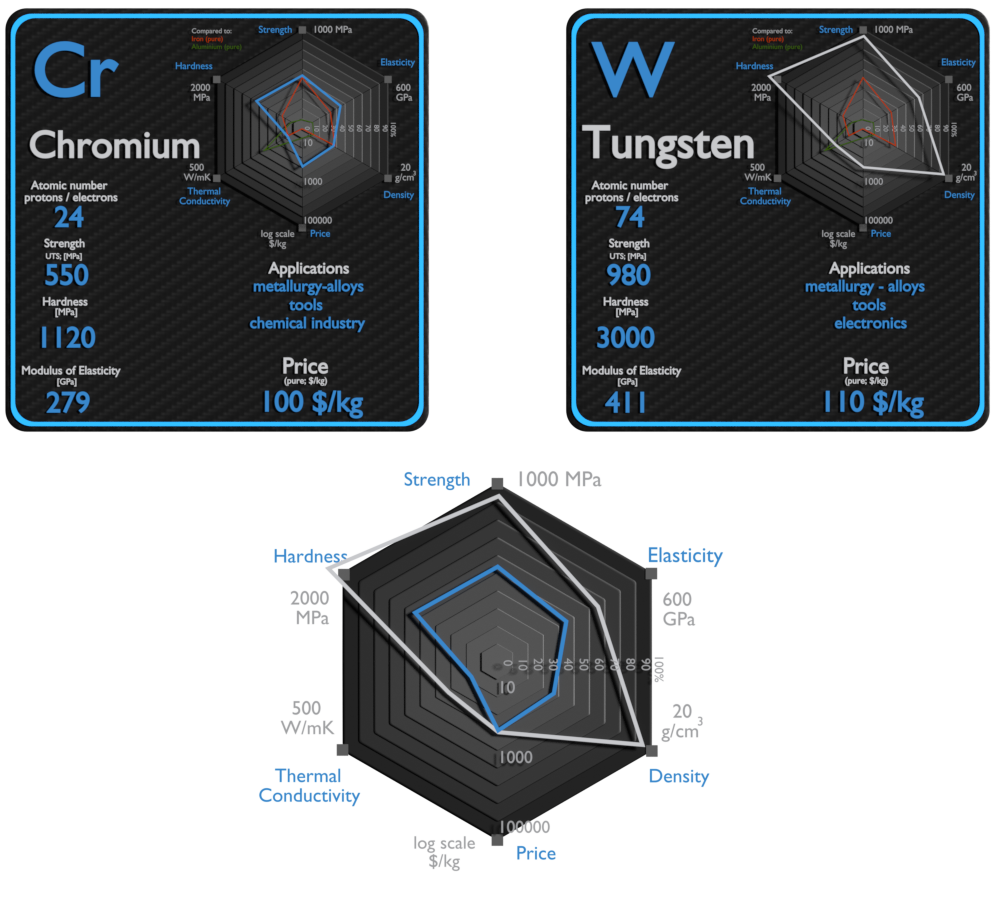
Chromium and Tungsten – Comparison – Properties

This article contains comparison of key thermal and atomic properties of chromium and tungsten, two comparable chemical elements from the periodic table. It also contains basic descriptions and applications of both elements. Chromium vs Tungsten.

chromium and tungsten - comparison

Compare chromium with another element

Copper - Properties - Price - Applications - Production

Iron - Properties - Price - Applications - Production

Zinc - Properties - Price - Applications - Production

Manganese - Properties - Price - Applications - Production

Molybdenum - Properties - Price - Applications - Production

Tungsten - Properties - Price - Applications - Production

Compare tungsten with another element

Titanium - Properties - Price - Applications - Production

Chromium - Properties - Price - Applications - Production

Cobalt - Properties - Price - Applications - Production

Zirconium - Properties - Price - Applications - Production

Molybdenum - Properties - Price - Applications - Production

Platinum - Properties - Price - Applications - Production

Rhenium - Properties - Price - Applications - Production

Gold - Properties - Price - Applications - Production

Iridium - Properties - Price - Applications - Production

Chromium and Tungsten – About Elements

Chromium

Chromium is a steely-grey, lustrous, hard and brittle metal which takes a high polish, resists tarnishing, and has a high melting point. A major development was the discovery that steel could be made highly resistant to corrosion and discoloration by adding metallic chromium to form stainless steel.

Tungsten

Tungsten is a rare metal found naturally on Earth almost exclusively in chemical compounds. Tungsten is an intrinsically brittle and hard material, making it difficult to work.

Chromium in Periodic Table

Tungsten in Periodic Table

Source: www.luciteria.com

Chromium and Tungsten – Applications

Chromium

Chromium is one of the most important and indispensable industrial metals because of its hardness and resistance to corrosion. But it is used for more than the production of stainless steel and nonferrous alloys; it is also used to create pigments and chemicals used to process leather. In metallurgy, Chromium increases hardness, strength, and corrosion resistance. The strengthening effect of forming stable metal carbides at the grain boundaries and the strong increase in corrosion resistance made chromium an important alloying material for steel. Generally speaking, the concentration specified for most grades is approximately 4%. This level appears to result in the best balance between hardness and toughness. Chromium plays an important role in the hardening mechanism and is considered irreplaceable. At higher temperatures, chromium contributes increased strength. It is ordinarily used for applications of this nature in conjunction with molybdenum. The resistance of stainless steels is based on passivation. For passivation to occur and remain stable, the Fe-Cr alloy must have a minimum chromium content of about 11% by weight, above which passivity can occur and below which it is impossible.

Tungsten

Tungsten is widely used metal. Approximately half of the tungsten is consumed for the production of hard materials – namely tungsten carbide – with the remaining major use being in alloys and steels. Mining and mineral processing demand wear-resistant machines and components, because the energies and masses of interacting bodies are significant. For this purposes, materials with the highest wear-resistance must be used. For example, tungsten carbide is used extensively in mining in top hammer rock drill bits, downhole hammers, roller-cutters, long wall plough chisels, long wall shearer picks, raiseboring reamers, and tunnel boring machines. The remaining 40% is generally used to make various alloys and specialty steels, electrodes, filaments, wires, as well as diverse components for electric, electronic, heating, lighting, and welding applications. High-speed steels are complex iron-base alloys of carbon, chromium, vanadium, molybdenum, or tungsten (as much as 18%), or combinations there of.

Chromium and Tungsten – Comparison in Table

Element Chromium Tungsten
Density 7.14 g/cm3 19.25 g/cm3
Ultimate Tensile Strength 550 MPa 982 MPa
Yield Strength 131 MPa 750 MPa
Young’s Modulus of Elasticity 279 GPa 411 GPa
Mohs Scale 8.5 7.5
Brinell Hardness 1120 MPa 3000 MPa
Vickers Hardness 1060 MPa 3500 MPa
Melting Point 1907 °C 3410 °C
Boiling Point 2671 °C 59300 °C
Thermal Conductivity 93.7 W/mK 170 W/mK
Thermal Expansion Coefficient 4.9 µm/mK 4.5 µm/mK
Specific Heat 0.45 J/g K 0.13 J/g K
Heat of Fusion 16.9 kJ/mol 35.4 kJ/mol
Heat of Vaporization 344.3 kJ/mol 824 kJ/mol


Chromium and Molybdenum – Comparison – Properties

This article contains comparison of key thermal and atomic properties of chromium and molybdenum, two comparable chemical elements from the periodic table. It also contains basic descriptions and applications of both elements. Chromium vs Molybdenum.

chromium and molybdenum - comparison

Compare chromium with another element

Copper - Properties - Price - Applications - Production

Iron - Properties - Price - Applications - Production

Zinc - Properties - Price - Applications - Production

Manganese - Properties - Price - Applications - Production

Molybdenum - Properties - Price - Applications - Production

Tungsten - Properties - Price - Applications - Production

Compare molybdenum with another element

Chromium - Properties - Price - Applications - Production

Tungsten - Properties - Price - Applications - Production

Chromium and Molybdenum – About Elements

Chromium

Chromium is a steely-grey, lustrous, hard and brittle metal which takes a high polish, resists tarnishing, and has a high melting point. A major development was the discovery that steel could be made highly resistant to corrosion and discoloration by adding metallic chromium to form stainless steel.

Molybdenum

Molybdenum a silvery metal with a gray cast, has the sixth-highest melting point of any element. It readily forms hard, stable carbides in alloys, and for this reason most of world production of the element (about 80%) is used in steel alloys, including high-strength alloys and superalloys.

Chromium in Periodic Table

Molybdenum in Periodic Table

Source: www.luciteria.com

Chromium and Molybdenum – Applications

Chromium

Chromium is one of the most important and indispensable industrial metals because of its hardness and resistance to corrosion. But it is used for more than the production of stainless steel and nonferrous alloys; it is also used to create pigments and chemicals used to process leather. In metallurgy, Chromium increases hardness, strength, and corrosion resistance. The strengthening effect of forming stable metal carbides at the grain boundaries and the strong increase in corrosion resistance made chromium an important alloying material for steel. Generally speaking, the concentration specified for most grades is approximately 4%. This level appears to result in the best balance between hardness and toughness. Chromium plays an important role in the hardening mechanism and is considered irreplaceable. At higher temperatures, chromium contributes increased strength. It is ordinarily used for applications of this nature in conjunction with molybdenum. The resistance of stainless steels is based on passivation. For passivation to occur and remain stable, the Fe-Cr alloy must have a minimum chromium content of about 11% by weight, above which passivity can occur and below which it is impossible.

Molybdenum

About 86% of molybdenum produced is used in metallurgy, with the rest used in chemical applications. The estimated global use is structural steel 35%, stainless steel 25%, chemicals 14%, tool & high-speed steels 9%, cast iron 6%, molybdenum elemental metal 6%, and superalloys 5%. Molybdenum (about 0.50-8.00%) when added to a tool steel makes it more resistant to high temperature. Molybdenum increases hardenability and strength, particularly at high temperatures due to the high melting point of molybdenum. Molybdenum is unique in the extent to which it increases the high-temperature tensile and creep strengths of steel. Molybdenum anodes replace tungsten in certain low voltage X-ray sources for specialized uses such as mammography. The radioactive isotope molybdenum-99 is used to generate technetium-99m, used for medical imaging. The isotope is handled and stored as the molybdate.

Chromium and Molybdenum – Comparison in Table

Element Chromium Molybdenum
Density 7.14 g/cm3 10.28 g/cm3
Ultimate Tensile Strength 550 MPa 324 MPa
Yield Strength 131 MPa N/A
Young’s Modulus of Elasticity 279 GPa 329 GPa
Mohs Scale 8.5 5.5
Brinell Hardness 1120 MPa 1500 MPa
Vickers Hardness 1060 MPa 1530 MPa
Melting Point 1907 °C 2623 °C
Boiling Point 2671 °C 4639 °C
Thermal Conductivity 93.7 W/mK 138 W/mK
Thermal Expansion Coefficient 4.9 µm/mK 4.8 µm/mK
Specific Heat 0.45 J/g K 0.25 J/g K
Heat of Fusion 16.9 kJ/mol 32 kJ/mol
Heat of Vaporization 344.3 kJ/mol 598 kJ/mol


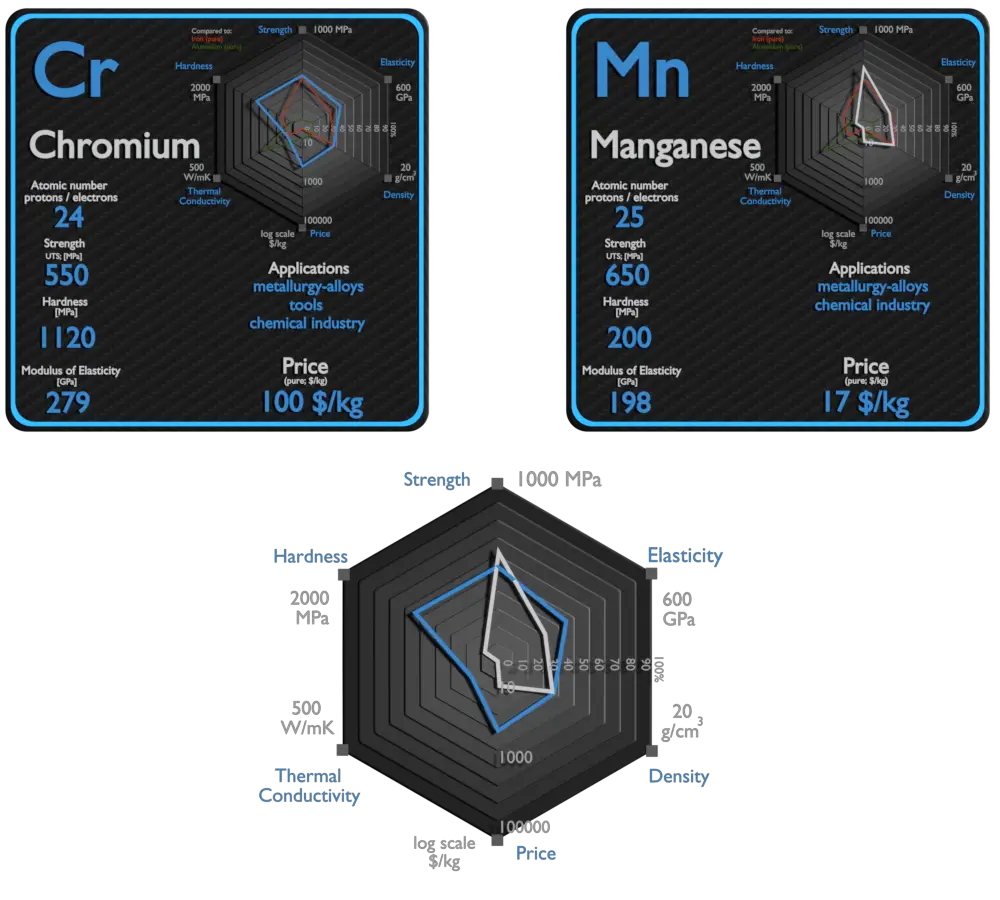
Chromium and Manganese – Comparison – Properties

This article contains comparison of key thermal and atomic properties of chromium and manganese, two comparable chemical elements from the periodic table. It also contains basic descriptions and applications of both elements. Chromium vs Manganese.

chromium and manganese - comparison

Compare chromium with another element

Copper - Properties - Price - Applications - Production

Iron - Properties - Price - Applications - Production

Zinc - Properties - Price - Applications - Production

Manganese - Properties - Price - Applications - Production

Molybdenum - Properties - Price - Applications - Production

Tungsten - Properties - Price - Applications - Production

Compare manganese with another element

Iron - Properties - Price - Applications - Production

Copper - Properties - Price - Applications - Production

Zinc - Properties - Price - Applications - Production

Chromium and Manganese – About Elements

Chromium

Chromium is a steely-grey, lustrous, hard and brittle metal which takes a high polish, resists tarnishing, and has a high melting point. A major development was the discovery that steel could be made highly resistant to corrosion and discoloration by adding metallic chromium to form stainless steel.

Manganese

Manganese is a metal with important industrial metal alloy uses, particularly in stainless steels.

Chromium in Periodic Table

Manganese in Periodic Table

Source: www.luciteria.com

Chromium and Manganese – Applications

Chromium

Chromium is one of the most important and indispensable industrial metals because of its hardness and resistance to corrosion. But it is used for more than the production of stainless steel and nonferrous alloys; it is also used to create pigments and chemicals used to process leather. In metallurgy, Chromium increases hardness, strength, and corrosion resistance. The strengthening effect of forming stable metal carbides at the grain boundaries and the strong increase in corrosion resistance made chromium an important alloying material for steel. Generally speaking, the concentration specified for most grades is approximately 4%. This level appears to result in the best balance between hardness and toughness. Chromium plays an important role in the hardening mechanism and is considered irreplaceable. At higher temperatures, chromium contributes increased strength. It is ordinarily used for applications of this nature in conjunction with molybdenum. The resistance of stainless steels is based on passivation. For passivation to occur and remain stable, the Fe-Cr alloy must have a minimum chromium content of about 11% by weight, above which passivity can occur and below which it is impossible.

Manganese

Manganese is an important alloying agent. Almost 90% of the manganese produced annually is used in the production of steel. In steels, manganese improves the rolling and forging qualities, as well as strength, toughness, stiffness, wear resistance, hardness and hardenability. The second largest application for manganese is in aluminium alloys. Aluminium with roughly 1.5% manganese has increased resistance to corrosion through grains that absorb impurities which would lead to galvanic corrosion. Manganese can be formed into many useful compounds. For example, manganese oxide, which can be used in fertilizers and ceramics.

Chromium and Manganese – Comparison in Table

Element Chromium Manganese
Density 7.14 g/cm3 7.47 g/cm3
Ultimate Tensile Strength 550 MPa 650 MPa
Yield Strength 131 MPa 230 MPa
Young’s Modulus of Elasticity 279 GPa 198 GPa
Mohs Scale 8.5 6
Brinell Hardness 1120 MPa 200 MPa
Vickers Hardness 1060 MPa N/A
Melting Point 1907 °C 1246 °C
Boiling Point 2671 °C 2061 °C
Thermal Conductivity 93.7 W/mK 7.82 W/mK
Thermal Expansion Coefficient 4.9 µm/mK 21.7 µm/mK
Specific Heat 0.45 J/g K 0.48 J/g K
Heat of Fusion 16.9 kJ/mol 12.05 kJ/mol
Heat of Vaporization 344.3 kJ/mol 266 kJ/mol