Facebook Instagram Youtube Twitter

Chromium and Zinc – Comparison – Properties

This article contains comparison of key thermal and atomic properties of chromium and zinc, two comparable chemical elements from the periodic table. It also contains basic descriptions and applications of both elements. Chromium vs Zinc.
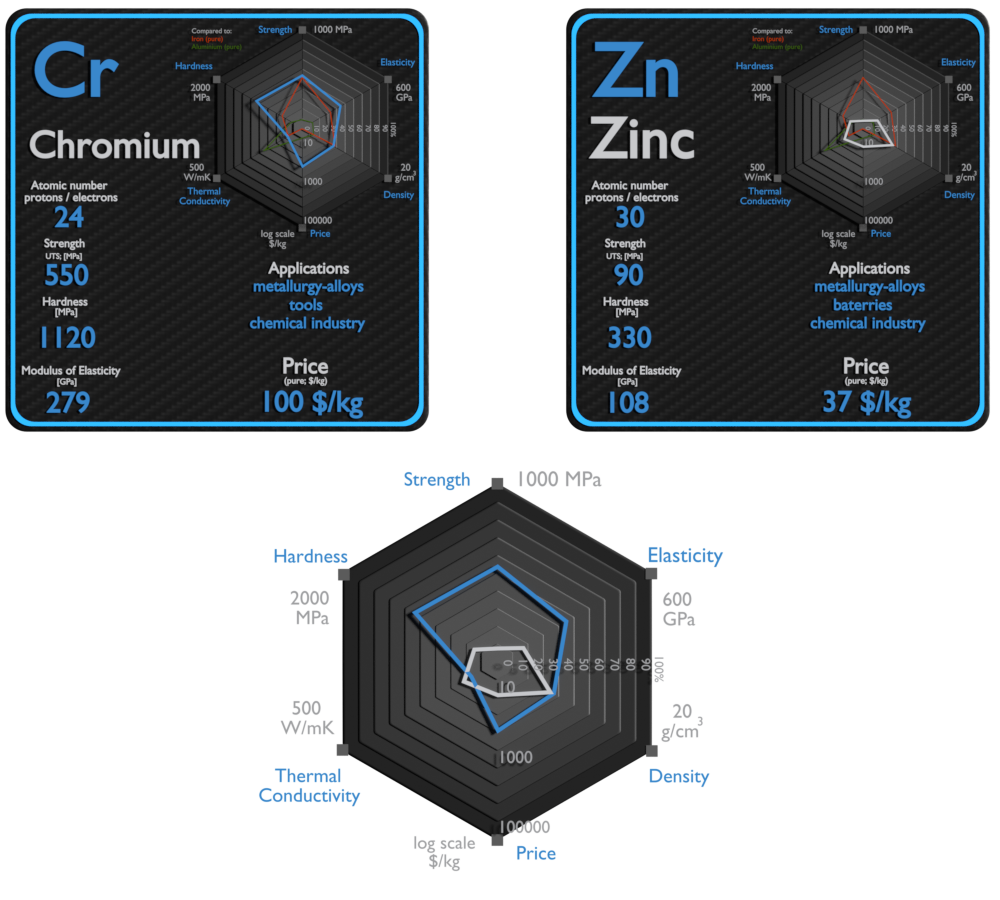

chromium and zinc - comparison

Compare chromium with another element

Copper - Properties - Price - Applications - Production

Iron - Properties - Price - Applications - Production

Zinc - Properties - Price - Applications - Production

Manganese - Properties - Price - Applications - Production

Molybdenum - Properties - Price - Applications - Production

Tungsten - Properties - Price - Applications - Production

Compare zinc with another element

Magnesium - Properties - Price - Applications - Production

Potassium - Properties - Price - Applications - Production

Titanium - Properties - Price - Applications - Production

Chromium - Properties - Price - Applications - Production

Manganese - Properties - Price - Applications - Production

Iron - Properties - Price - Applications - Production

Cobalt - Properties - Price - Applications - Production

Nickel - Properties - Price - Applications - Production

Indium - Properties - Price - Applications - Production

Selenium - Properties - Price - Applications - Production

Chromium and Zinc – About Elements

Chromium

Chromium is a steely-grey, lustrous, hard and brittle metal which takes a high polish, resists tarnishing, and has a high melting point. A major development was the discovery that steel could be made highly resistant to corrosion and discoloration by adding metallic chromium to form stainless steel.

Zinc

In some respects zinc is chemically similar to magnesium: both elements exhibit only one normal oxidation state (+2), and the Zn2+ and Mg2+ ions are of similar size.

Chromium in Periodic Table

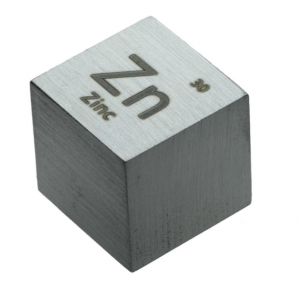
Zinc in Periodic Table

Source: www.luciteria.com

Chromium and Zinc – Applications

Chromium

Chromium is one of the most important and indispensable industrial metals because of its hardness and resistance to corrosion. But it is used for more than the production of stainless steel and nonferrous alloys; it is also used to create pigments and chemicals used to process leather. In metallurgy, Chromium increases hardness, strength, and corrosion resistance. The strengthening effect of forming stable metal carbides at the grain boundaries and the strong increase in corrosion resistance made chromium an important alloying material for steel. Generally speaking, the concentration specified for most grades is approximately 4%. This level appears to result in the best balance between hardness and toughness. Chromium plays an important role in the hardening mechanism and is considered irreplaceable. At higher temperatures, chromium contributes increased strength. It is ordinarily used for applications of this nature in conjunction with molybdenum. The resistance of stainless steels is based on passivation. For passivation to occur and remain stable, the Fe-Cr alloy must have a minimum chromium content of about 11% by weight, above which passivity can occur and below which it is impossible.

Zinc

Corrosion-resistant zinc plating of iron (hot-dip galvanizing) is the major application for zinc. Coating of steel constitutes the largest single use of zinc, but it is used in large tonnages in zinc alloy castings, as zinc dust and oxide, and in wrought zinc products. Galvanized steel is just plain carbon steel that has been coated with a thin zinc layer. The zinc protects iron by corroding first, but zinc corrodes at much lower rates than do steel. Other applications are in electrical batteries, small non-structural castings, and alloys such as brass. A variety of zinc compounds are commonly used, such as zinc carbonate and zinc gluconate (as dietary supplements), zinc chloride (in deodorants), zinc pyrithione (anti-dandruff shampoos), zinc sulfide (in luminescent paints), and dimethylzinc or diethylzinc in the organic laboratory. A key part of the modern materials world in which zinc finds itself is recycling. Zinc, in common with all metals (and unlike synthetic materials) can be recycled indefinitely without degradation.

Chromium and Zinc – Comparison in Table

Element Chromium Zinc
Density 7.14 g/cm3 7.14 g/cm3
Ultimate Tensile Strength 550 MPa 90 MPa
Yield Strength 131 MPa 75 MPa
Young’s Modulus of Elasticity 279 GPa 108 GPa
Mohs Scale 8.5 2.5
Brinell Hardness 1120 MPa 330 MPa
Vickers Hardness 1060 MPa N/A
Melting Point 1907 °C 419.53 °C
Boiling Point 2671 °C 907 °C
Thermal Conductivity 93.7 W/mK 116 W/mK
Thermal Expansion Coefficient 4.9 µm/mK 30.2 µm/mK
Specific Heat 0.45 J/g K 0.39 J/g K
Heat of Fusion 16.9 kJ/mol 7.322 kJ/mol
Heat of Vaporization 344.3 kJ/mol 115.3 kJ/mol


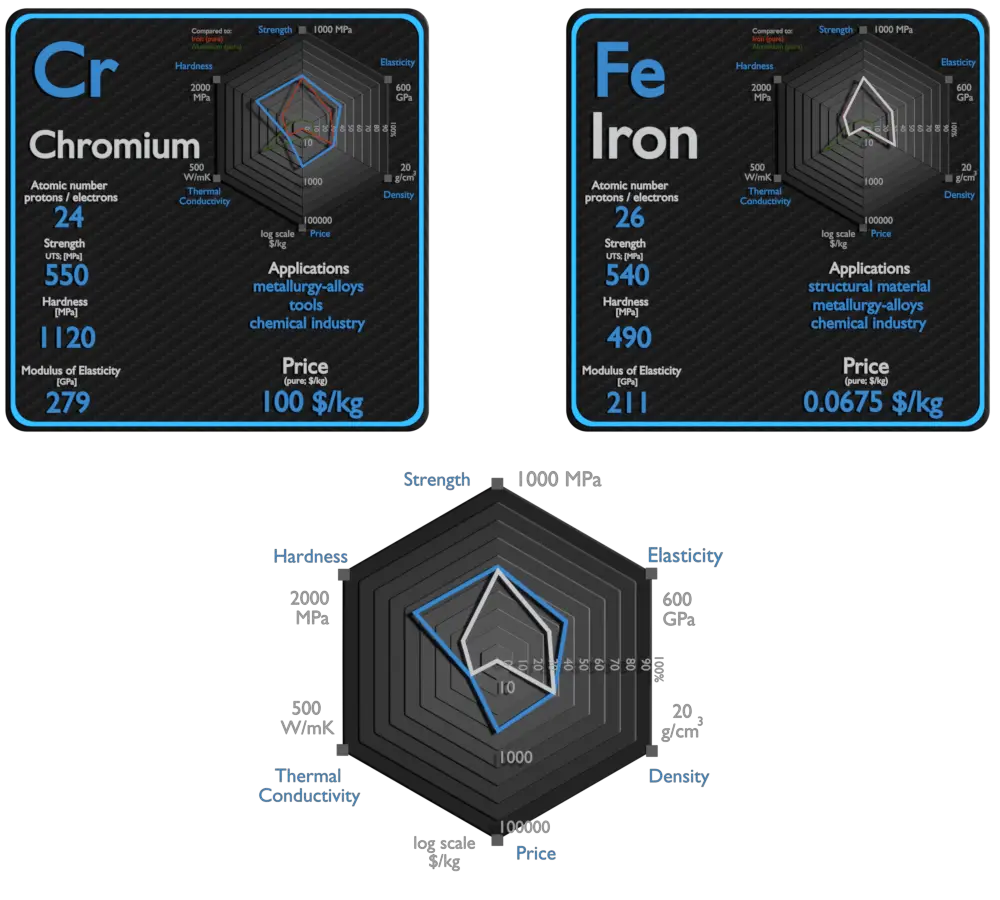
Chromium and Iron – Comparison – Properties

This article contains comparison of key thermal and atomic properties of chromium and iron, two comparable chemical elements from the periodic table. It also contains basic descriptions and applications of both elements. Chromium vs Iron.

chromium and iron - comparison

Compare chromium with another element

Copper - Properties - Price - Applications - Production

Iron - Properties - Price - Applications - Production

Zinc - Properties - Price - Applications - Production

Manganese - Properties - Price - Applications - Production

Molybdenum - Properties - Price - Applications - Production

Tungsten - Properties - Price - Applications - Production

Compare iron with another element

Carbon - Properties - Price - Applications - Production

Oxygen - Properties - Price - Applications - Production

Fluorine - Properties - Price - Applications - Production

Magnesium - Properties - Price - Applications - Production

Aluminium - Properties - Price - Applications - Production

Chlorine - Properties - Price - Applications - Production

Potassium - Properties - Price - Applications - Production

Calcium - Properties - Price - Applications - Production

Chromium - Properties - Price - Applications - Production

Manganese - Properties - Price - Applications - Production

Cobalt - Properties - Price - Applications - Production

Nickel - Properties - Price - Applications - Production

Copper - Properties - Price - Applications - Production

Zinc - Properties - Price - Applications - Production

Zirconium - Properties - Price - Applications - Production

Lead - Properties - Price - Applications - Production

Chromium and Iron – About Elements

Chromium

Chromium is a steely-grey, lustrous, hard and brittle metal which takes a high polish, resists tarnishing, and has a high melting point. A major development was the discovery that steel could be made highly resistant to corrosion and discoloration by adding metallic chromium to form stainless steel.

Iron

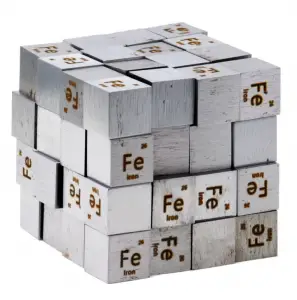
Iron is a metal in the first transition series. It is by mass the most common element on Earth, forming much of Earth’s outer and inner core. It is the fourth most common element in the Earth’s crust. Its abundance in rocky planets like Earth is due to its abundant production by fusion in high-mass stars.

Chromium in Periodic Table

Iron in Periodic Table

Source: www.luciteria.com

Chromium and Iron – Applications

Chromium

Chromium is one of the most important and indispensable industrial metals because of its hardness and resistance to corrosion. But it is used for more than the production of stainless steel and nonferrous alloys; it is also used to create pigments and chemicals used to process leather. In metallurgy, Chromium increases hardness, strength, and corrosion resistance. The strengthening effect of forming stable metal carbides at the grain boundaries and the strong increase in corrosion resistance made chromium an important alloying material for steel. Generally speaking, the concentration specified for most grades is approximately 4%. This level appears to result in the best balance between hardness and toughness. Chromium plays an important role in the hardening mechanism and is considered irreplaceable. At higher temperatures, chromium contributes increased strength. It is ordinarily used for applications of this nature in conjunction with molybdenum. The resistance of stainless steels is based on passivation. For passivation to occur and remain stable, the Fe-Cr alloy must have a minimum chromium content of about 11% by weight, above which passivity can occur and below which it is impossible.

Iron

Iron is used in numerous sectors such as electronics, manufacturing, automotive, and construction and building. Iron is the most widely used of all the metals, accounting for over 90% of worldwide metal produc0tion. Its low cost and high strength often make it the material of choice material to withstand stress or transmit forces, such as the construction of machinery and machine tools, rails, automobiles, ship hulls, concrete reinforcing bars, and the load-carrying framework of buildings. Since pure iron is quite soft, it is most commonly combined with alloying elements to make steel. Steels are iron–carbon alloys that may contain appreciable concentrations of other alloying elements. Adding a small amount of non-metallic carbon to iron trades its great ductility for the greater strength. Due to its very-high strength, but still substantial toughness, and its ability to be greatly altered by heat treatment, steel is one of the most useful and common ferrous alloy in modern use. There are thousands of alloys that have different compositions and/or heat treatments. The mechanical properties are sensitive to the content of carbon, which is normally less than 1.0 wt%.

Chromium and Iron – Comparison in Table

Element Chromium Iron
Density 7.14 g/cm3 7.874 g/cm3
Ultimate Tensile Strength 550 MPa 540 MPa
Yield Strength 131 MPa 50 MPa
Young’s Modulus of Elasticity 279 GPa 211 GPa
Mohs Scale 8.5 4.5
Brinell Hardness 1120 MPa 490 MPa
Vickers Hardness 1060 MPa 608 MPa
Melting Point 1907 °C 1538 °C
Boiling Point 2671 °C 2861 °C
Thermal Conductivity 93.7 W/mK 80.2 W/mK
Thermal Expansion Coefficient 4.9 µm/mK 11.8 µm/mK
Specific Heat 0.45 J/g K 0.44 J/g K
Heat of Fusion 16.9 kJ/mol 13.8 kJ/mol
Heat of Vaporization 344.3 kJ/mol 349.6 kJ/mol


Chromium and Copper – Comparison – Properties

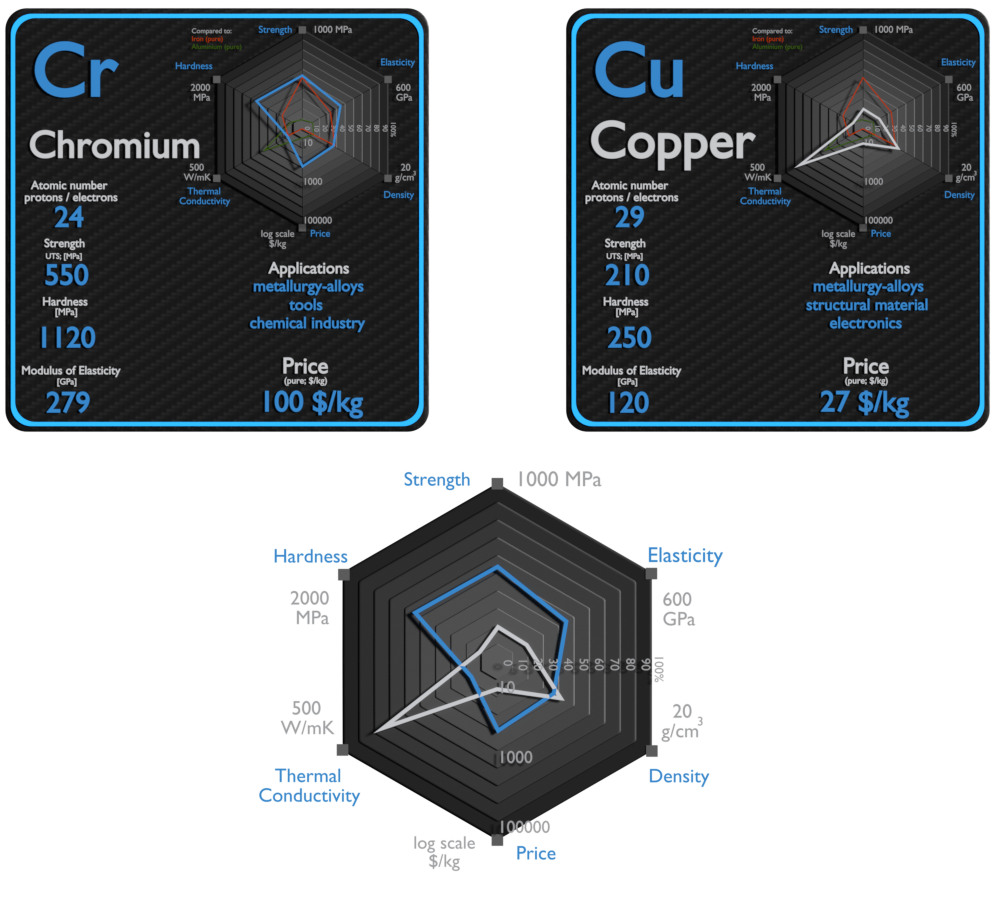
This article contains comparison of key thermal and atomic properties of chromium and copper, two comparable chemical elements from the periodic table. It also contains basic descriptions and applications of both elements. Chromium vs Copper.

chromium and copper - comparison

Compare chromium with another element

Copper - Properties - Price - Applications - Production

Iron - Properties - Price - Applications - Production

Zinc - Properties - Price - Applications - Production

Manganese - Properties - Price - Applications - Production

Molybdenum - Properties - Price - Applications - Production

Tungsten - Properties - Price - Applications - Production

Compare copper with another element

Beryllium - Properties - Price - Applications - Production

Magnesium - Properties - Price - Applications - Production

Aluminium - Properties - Price - Applications - Production

Silicon - Properties - Price - Applications - Production

Chlorine - Properties - Price - Applications - Production

Titanium - Properties - Price - Applications - Production

Chromium - Properties - Price - Applications - Production

Manganese - Properties - Price - Applications - Production

Iron - Properties - Price - Applications - Production

Cobalt - Properties - Price - Applications - Production

Silver - Properties - Price - Applications - Production

Gold - Properties - Price - Applications - Production

Tin - Properties - Price - Applications - Production

Chromium and Copper – About Elements

Chromium

Chromium is a steely-grey, lustrous, hard and brittle metal which takes a high polish, resists tarnishing, and has a high melting point. A major development was the discovery that steel could be made highly resistant to corrosion and discoloration by adding metallic chromium to form stainless steel.

Copper

Copper is a soft, malleable, and ductile metal with very high thermal and electrical conductivity. A freshly exposed surface of pure copper has a reddish-orange color. Copper is used as a conductor of heat and electricity, as a building material, and as a constituent of various metal alloys, such as sterling silver used in jewelry, cupronickel used to make marine hardware and coins, and constantan used in strain gauges and thermocouples for temperature measurement.

Chromium in Periodic Table

Copper in Periodic Table

Source: www.luciteria.com

Chromium and Copper – Applications

Chromium

Chromium is one of the most important and indispensable industrial metals because of its hardness and resistance to corrosion. But it is used for more than the production of stainless steel and nonferrous alloys; it is also used to create pigments and chemicals used to process leather. In metallurgy, Chromium increases hardness, strength, and corrosion resistance. The strengthening effect of forming stable metal carbides at the grain boundaries and the strong increase in corrosion resistance made chromium an important alloying material for steel. Generally speaking, the concentration specified for most grades is approximately 4%. This level appears to result in the best balance between hardness and toughness. Chromium plays an important role in the hardening mechanism and is considered irreplaceable. At higher temperatures, chromium contributes increased strength. It is ordinarily used for applications of this nature in conjunction with molybdenum. The resistance of stainless steels is based on passivation. For passivation to occur and remain stable, the Fe-Cr alloy must have a minimum chromium content of about 11% by weight, above which passivity can occur and below which it is impossible.

Copper

Historically, alloying copper with another metal, for example tin to make bronze, was first practiced about 4000 years after the discovery of copper smelting, and about 2000 years after “natural bronze” had come into general use. An ancient civilization is defined to be in the Bronze Age either by producing bronze by smelting its own copper and alloying with tin, arsenic, or other metals. The major applications of copper are electrical wire (60%), roofing and plumbing (20%), and industrial machinery (15%). Copper is used mostly as a pure metal, but when greater hardness is required, it is put into such alloys as brass and bronze (5% of total use). Copper and copper-based alloys including brasses (Cu-Zn) and bronzes (Cu-Sn) are widely used in different industrial and societal applications. Some of the common uses for brass alloys include costume jewelry, locks, hinges, gears, bearings, ammunition casings, automotive radiators, musical instruments, electronic packaging, and coins. Bronze, or bronze-like alloys and mixtures, were used for coins over a longer period. is still widely used today for springs, bearings, bushings, automobile transmission pilot bearings, and similar fittings, and is particularly common in the bearings of small electric motors. Brass and bronze are common engineering materials in modern architecture and primarily used for roofing and facade cladding due to their visual appearance.

Chromium and Copper – Comparison in Table

Element Chromium Copper
Density 7.14 g/cm3 8.92 g/cm3
Ultimate Tensile Strength 550 MPa 210 MPa
Yield Strength 131 MPa 33 MPa
Young’s Modulus of Elasticity 279 GPa 120 GPa
Mohs Scale 8.5 3
Brinell Hardness 1120 MPa 250 MPa
Vickers Hardness 1060 MPa 350 MPa
Melting Point 1907 °C 1084.62 °C
Boiling Point 2671 °C 2562 °C
Thermal Conductivity 93.7 W/mK 401 W/mK
Thermal Expansion Coefficient 4.9 µm/mK 16.5 µm/mK
Specific Heat 0.45 J/g K 0.38 J/g K
Heat of Fusion 16.9 kJ/mol 13.05 kJ/mol
Heat of Vaporization 344.3 kJ/mol 300.3 kJ/mol


Vanadium and Chromium – Comparison – Properties

This article contains comparison of key thermal and atomic properties of vanadium and chromium, two comparable chemical elements from the periodic table. It also contains basic descriptions and applications of both elements. Vanadium vs Chromium.

vanadium and chromium - comparison

Compare vanadium with another element

Titanium - Properties - Price - Applications - Production

Chromium - Properties - Price - Applications - Production

Compare chromium with another element

Copper - Properties - Price - Applications - Production

Iron - Properties - Price - Applications - Production

Zinc - Properties - Price - Applications - Production

Manganese - Properties - Price - Applications - Production

Molybdenum - Properties - Price - Applications - Production

Tungsten - Properties - Price - Applications - Production

Vanadium and Chromium – About Elements

Vanadium

Vanadium is a hard, silvery grey, ductile, and malleable transition metal. The elemental metal is rarely found in nature, but once isolated artificially, the formation of an oxide layer (passivation) stabilizes the free metal somewhat against further oxidation.

Chromium

Chromium is a steely-grey, lustrous, hard and brittle metal which takes a high polish, resists tarnishing, and has a high melting point. A major development was the discovery that steel could be made highly resistant to corrosion and discoloration by adding metallic chromium to form stainless steel.

Vanadium in Periodic Table

Chromium in Periodic Table

Source: www.luciteria.com

Vanadium and Chromium – Applications

Vanadium

Vanadium is mainly used to produce specialty steel alloys such as high-speed tool steels, and some aluminium alloys. Vanadium is generally added to steel to inhibit grain growth during heat treatment. In controlling grain growth, it improves both the strength and toughness of hardened and tempered steels. Vanadium is added to promote abrasion resistance and to produce hard and stable carbides which being only partly soluble, release little carbon into the matrix. The most important industrial vanadium compound, vanadium pentoxide, is used as a catalyst for the production of sulfuric acid. The vanadium redox battery for energy storage may be an important application in the future.

Chromium

Chromium is one of the most important and indispensable industrial metals because of its hardness and resistance to corrosion. But it is used for more than the production of stainless steel and nonferrous alloys; it is also used to create pigments and chemicals used to process leather. In metallurgy, Chromium increases hardness, strength, and corrosion resistance. The strengthening effect of forming stable metal carbides at the grain boundaries and the strong increase in corrosion resistance made chromium an important alloying material for steel. Generally speaking, the concentration specified for most grades is approximately 4%. This level appears to result in the best balance between hardness and toughness. Chromium plays an important role in the hardening mechanism and is considered irreplaceable. At higher temperatures, chromium contributes increased strength. It is ordinarily used for applications of this nature in conjunction with molybdenum. The resistance of stainless steels is based on passivation. For passivation to occur and remain stable, the Fe-Cr alloy must have a minimum chromium content of about 11% by weight, above which passivity can occur and below which it is impossible.

Vanadium and Chromium – Comparison in Table

Element Vanadium Chromium
Density 6.11 g/cm3 7.14 g/cm3
Ultimate Tensile Strength 800 MPa 550 MPa
Yield Strength 770 MPa 131 MPa
Young’s Modulus of Elasticity 116 GPa 128 GPa
Mohs Scale 6 6.7
Brinell Hardness 700 – 2700 MPa 650 MPa
Vickers Hardness 800 – 3400 MPa 630 MPa
Melting Point 1668 °C 1910 °C
Boiling Point 3287 °C 3407 °C
Thermal Conductivity 21.9 W/mK 30.7 W/mK
Thermal Expansion Coefficient 8.6 µm/mK 8.4 µm/mK
Specific Heat 0.52 J/g K 0.49 J/g K
Heat of Fusion 15.45 kJ/mol 20.9 kJ/mol
Heat of Vaporization 421 kJ/mol 0.452 kJ/mol


Titanium and Uranium – Comparison – Properties

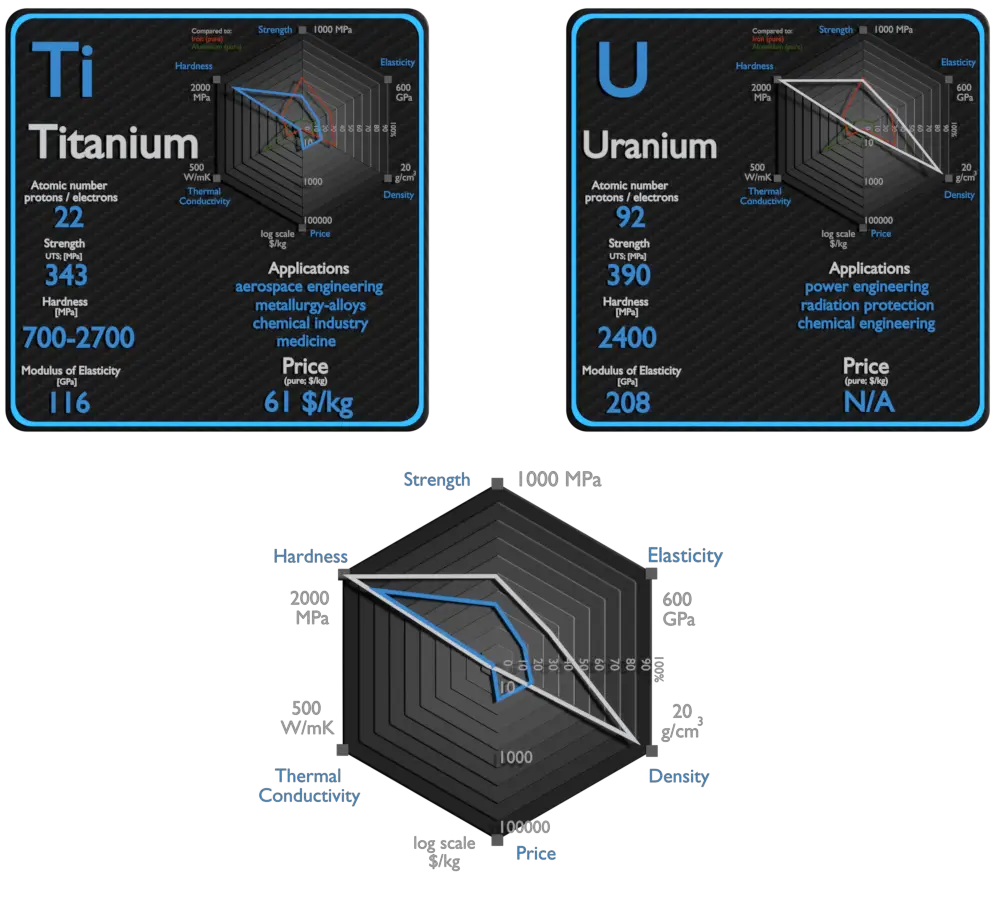
This article contains comparison of key thermal and atomic properties of titanium and uranium, two comparable chemical elements from the periodic table. It also contains basic descriptions and applications of both elements. Titanium vs Uranium.

titanium and uranium - comparison

Compare titanium with another element

Aluminium - Properties - Price - Applications - Production

Vanadium - Properties - Price - Applications - Production

Tungsten - Properties - Price - Applications - Production

Gold - Properties - Price - Applications - Production

Zinc - Properties - Price - Applications - Production

Zirconium - Properties - Price - Applications - Production

Niobium - Properties - Price - Applications - Production

Tantalum - Properties - Price - Applications - Production

Copper - Properties - Price - Applications - Production

Uranium - Properties - Price - Applications - Production

Compare uranium with another element

Titanium - Properties - Price - Applications - Production

Zirconium - Properties - Price - Applications - Production

Thorium - Properties - Price - Applications - Production

Titanium and Uranium – About Elements

Titanium

Titanium is a lustrous transition metal with a silver color, low density, and high strength. Titanium is resistant to corrosion in sea water, aqua regia, and chlorine. Titanium can be used in surface condensers. These condensers use tubes that are usually made of stainless steel, copper alloys, or titanium depending on several selection criteria (such as thermal conductivity or corrosion resistance). Titanium condenser tubes are usually the best technical choice, however titanium is very expensive material and the use of titanium condenser tubes is associated with very high initial costs.

Uranium

Uranium is a silvery-white metal in the actinide series of the periodic table. Uranium is weakly radioactive because all isotopes of uranium are unstable, with half-lives varying between 159,200 years and 4.5 billion years. Uranium has the highest atomic weight of the primordially occurring elements. Its density is about 70% higher than that of lead, and slightly lower than that of gold or tungsten. Uranium is commonly found at low levels (a few ppm – parts per million) in all rocks, soil, water, plants, and animals (including humans). Uranium occurs also in seawater, and can be recovered from the ocean water. Significant concentrations of uranium occur in some substances such as uraninite (the most common uranium ore), phosphate rock deposits, and other minerals.

Titanium in Periodic Table

Uranium in Periodic Table

Source: www.luciteria.com

Titanium and Uranium – Applications

Titanium

The two most useful properties of the metal are corrosion resistance and strength-to-density ratio, the highest of any metallic element. The corrosion resistance of titanium alloys at normal temperatures is unusually high. These properties determine application of titanium and its alloys. The earliest production application of titanium was in 1952, for the nacelles and firewalls of the Douglas DC-7 airliner. High specific strength, good fatigue resistance and creep life, and good fracture toughness are characteristics that make titanium a preferred metal for aerospace applications. Aerospace applications, including use in both structural (airframe) components and jet engines, still account for the largest share of titanium alloy use. On the supersonic aircraft SR-71, titanium was used for 85% of the structure. Due to very high inertness, titanium has many biomedical applications, which is based on its inertness in the human body, that is, resistance to corrosion by body fluids.

Uranium

The main use of uranium in the civilian sector is to fuel nuclear power plants. One kilogram of uranium-235 can theoretically produce about 20 terajoules of energy, assuming complete fission; as much energy as 1.5 million kilograms (1,500 tonnes) of coal. Typical reactor may contain about 100 tonnes of enriched uranium (i.e. about 113 tonnes of uranium dioxide). This fuel is loaded within, for example, 157 fuel assemblies composed of over 45,000 fuel rods. A common fuel assembly contain energy for approximately 4 years of operation at full power. The removed fuel (spent nuclear fuel) still contains about 96% of reusable material (it must be removed due to decreasing kinf of an assembly). Before (and, occasionally, after) the discovery of radioactivity, uranium was primarily used in small amounts for yellow glass and pottery glazes, such as uranium glass. Uranium is also used by the military to power nuclear submarines and in nuclear weapons. Due to its high density, this material is found in inertial guidance systems and in gyroscopic compasses.[10] Depleted uranium is preferred over similarly dense metals due to its ability to be easily machined and cast as well as its relatively low cost. The main risk of exposure to depleted uranium is chemical poisoning by uranium oxide rather than radioactivity (uranium being only a weak alpha emitter). Depleted uranium is uranium that has much less uranium-235 than natural uranium. It is considerably less radioactive than natural uranium. It is a dense metal that can be used as ballast for ships and counterweights for aircraft. It is also used in ammunition and armour. Depleted uranium can be also used to shield radiation. Depleted uranium is much more effective due to its higher Z. Depleted uranium is used for shielding in portable gamma ray sources. Uranium is used in high-speed steels as an alloying agent to improve strength and toughness. Uranium trioxide (also called uranic oxide) with formula UO3, is an orange-yellow powder and is used as a pigment for ceramics. In glasses it produces a beautiful greenish-yellow “uranium glass”.

Titanium and Uranium – Comparison in Table

Element Titanium Uranium
Density 4.507 g/cm3 19.05 g/cm3
Ultimate Tensile Strength 434 MPa, 293 MPa (pure) 390 MPa
Yield Strength 380 MPa 190 MPa
Young’s Modulus of Elasticity 116 GPa 208 GPa
Mohs Scale 6 6
Brinell Hardness 700 – 2700 MPa 2400 MPa
Vickers Hardness 800 – 3400 MPa 1960 MPa
Melting Point 1668 °C 1132 °C
Boiling Point 3287 °C 4131 °C
Thermal Conductivity 21.9 W/mK 27 W/mK
Thermal Expansion Coefficient 8.6 µm/mK 13.9 µm/mK
Specific Heat 0.52 J/g K 0.12 J/g K
Heat of Fusion 15.45 kJ/mol 8.52 kJ/mol
Heat of Vaporization 421 kJ/mol 417 kJ/mol


Titanium and Copper – Comparison – Properties

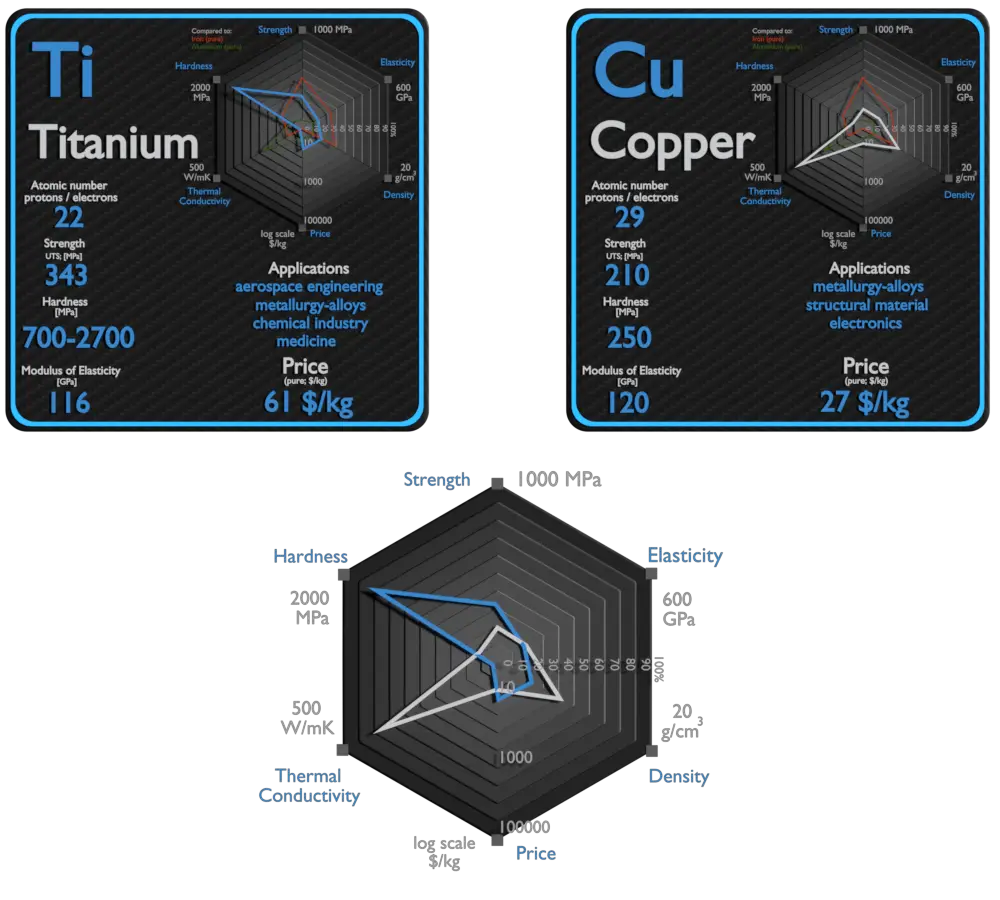
This article contains comparison of key thermal and atomic properties of titanium and copper, two comparable chemical elements from the periodic table. It also contains basic descriptions and applications of both elements. Titanium vs Copper.

titanium and copper - comparison

Compare titanium with another element

Aluminium - Properties - Price - Applications - Production

Vanadium - Properties - Price - Applications - Production

Tungsten - Properties - Price - Applications - Production

Gold - Properties - Price - Applications - Production

Zinc - Properties - Price - Applications - Production

Zirconium - Properties - Price - Applications - Production

Niobium - Properties - Price - Applications - Production

Tantalum - Properties - Price - Applications - Production

Copper - Properties - Price - Applications - Production

Uranium - Properties - Price - Applications - Production

Compare copper with another element

Beryllium - Properties - Price - Applications - Production

Magnesium - Properties - Price - Applications - Production

Aluminium - Properties - Price - Applications - Production

Silicon - Properties - Price - Applications - Production

Chlorine - Properties - Price - Applications - Production

Titanium - Properties - Price - Applications - Production

Chromium - Properties - Price - Applications - Production

Manganese - Properties - Price - Applications - Production

Iron - Properties - Price - Applications - Production

Cobalt - Properties - Price - Applications - Production

Silver - Properties - Price - Applications - Production

Gold - Properties - Price - Applications - Production

Tin - Properties - Price - Applications - Production

Titanium and Copper – About Elements

Titanium

Titanium is a lustrous transition metal with a silver color, low density, and high strength. Titanium is resistant to corrosion in sea water, aqua regia, and chlorine. Titanium can be used in surface condensers. These condensers use tubes that are usually made of stainless steel, copper alloys, or titanium depending on several selection criteria (such as thermal conductivity or corrosion resistance). Titanium condenser tubes are usually the best technical choice, however titanium is very expensive material and the use of titanium condenser tubes is associated with very high initial costs.

Copper

Copper is a soft, malleable, and ductile metal with very high thermal and electrical conductivity. A freshly exposed surface of pure copper has a reddish-orange color. Copper is used as a conductor of heat and electricity, as a building material, and as a constituent of various metal alloys, such as sterling silver used in jewelry, cupronickel used to make marine hardware and coins, and constantan used in strain gauges and thermocouples for temperature measurement.

Titanium in Periodic Table

Copper in Periodic Table

Source: www.luciteria.com

Titanium and Copper – Applications

Titanium

The two most useful properties of the metal are corrosion resistance and strength-to-density ratio, the highest of any metallic element. The corrosion resistance of titanium alloys at normal temperatures is unusually high. These properties determine application of titanium and its alloys. The earliest production application of titanium was in 1952, for the nacelles and firewalls of the Douglas DC-7 airliner. High specific strength, good fatigue resistance and creep life, and good fracture toughness are characteristics that make titanium a preferred metal for aerospace applications. Aerospace applications, including use in both structural (airframe) components and jet engines, still account for the largest share of titanium alloy use. On the supersonic aircraft SR-71, titanium was used for 85% of the structure. Due to very high inertness, titanium has many biomedical applications, which is based on its inertness in the human body, that is, resistance to corrosion by body fluids.

Copper

Historically, alloying copper with another metal, for example tin to make bronze, was first practiced about 4000 years after the discovery of copper smelting, and about 2000 years after “natural bronze” had come into general use. An ancient civilization is defined to be in the Bronze Age either by producing bronze by smelting its own copper and alloying with tin, arsenic, or other metals. The major applications of copper are electrical wire (60%), roofing and plumbing (20%), and industrial machinery (15%). Copper is used mostly as a pure metal, but when greater hardness is required, it is put into such alloys as brass and bronze (5% of total use). Copper and copper-based alloys including brasses (Cu-Zn) and bronzes (Cu-Sn) are widely used in different industrial and societal applications. Some of the common uses for brass alloys include costume jewelry, locks, hinges, gears, bearings, ammunition casings, automotive radiators, musical instruments, electronic packaging, and coins. Bronze, or bronze-like alloys and mixtures, were used for coins over a longer period. is still widely used today for springs, bearings, bushings, automobile transmission pilot bearings, and similar fittings, and is particularly common in the bearings of small electric motors. Brass and bronze are common engineering materials in modern architecture and primarily used for roofing and facade cladding due to their visual appearance.

Titanium and Copper – Comparison in Table

Element Titanium Copper
Density 4.507 g/cm3 8.92 g/cm3
Ultimate Tensile Strength 434 MPa, 293 MPa (pure) 210 MPa
Yield Strength 380 MPa 33 MPa
Young’s Modulus of Elasticity 116 GPa 120 GPa
Mohs Scale 6 3
Brinell Hardness 700 – 2700 MPa 250 MPa
Vickers Hardness 800 – 3400 MPa 350 MPa
Melting Point 1668 °C 1084.62 °C
Boiling Point 3287 °C 2562 °C
Thermal Conductivity 21.9 W/mK 401 W/mK
Thermal Expansion Coefficient 8.6 µm/mK 16.5 µm/mK
Specific Heat 0.52 J/g K 0.38 J/g K
Heat of Fusion 15.45 kJ/mol 13.05 kJ/mol
Heat of Vaporization 421 kJ/mol 300.3 kJ/mol


Titanium and Tantalum – Comparison – Properties

This article contains comparison of key thermal and atomic properties of titanium and tantalum, two comparable chemical elements from the periodic table. It also contains basic descriptions and applications of both elements. Titanium vs Tantalum.

titanium and tantalum - comparison

Compare titanium with another element

Aluminium - Properties - Price - Applications - Production

Vanadium - Properties - Price - Applications - Production

Tungsten - Properties - Price - Applications - Production

Gold - Properties - Price - Applications - Production

Zinc - Properties - Price - Applications - Production

Zirconium - Properties - Price - Applications - Production

Niobium - Properties - Price - Applications - Production

Tantalum - Properties - Price - Applications - Production

Copper - Properties - Price - Applications - Production

Uranium - Properties - Price - Applications - Production

Compare tantalum with another element

Titanium - Properties - Price - Applications - Production

Niobium - Properties - Price - Applications - Production

Europium - Properties - Price - Applications - Production

Hafnium - Properties - Price - Applications - Production

Titanium and Tantalum – About Elements

Titanium

Titanium is a lustrous transition metal with a silver color, low density, and high strength. Titanium is resistant to corrosion in sea water, aqua regia, and chlorine. Titanium can be used in surface condensers. These condensers use tubes that are usually made of stainless steel, copper alloys, or titanium depending on several selection criteria (such as thermal conductivity or corrosion resistance). Titanium condenser tubes are usually the best technical choice, however titanium is very expensive material and the use of titanium condenser tubes is associated with very high initial costs.

Tantalum

Tantalum is a rare, hard, blue-gray, lustrous transition metal that is highly corrosion-resistant.

Titanium in Periodic Table

Tantalum in Periodic Table

Source: www.luciteria.com

Titanium and Tantalum – Applications

Titanium

The two most useful properties of the metal are corrosion resistance and strength-to-density ratio, the highest of any metallic element. The corrosion resistance of titanium alloys at normal temperatures is unusually high. These properties determine application of titanium and its alloys. The earliest production application of titanium was in 1952, for the nacelles and firewalls of the Douglas DC-7 airliner. High specific strength, good fatigue resistance and creep life, and good fracture toughness are characteristics that make titanium a preferred metal for aerospace applications. Aerospace applications, including use in both structural (airframe) components and jet engines, still account for the largest share of titanium alloy use. On the supersonic aircraft SR-71, titanium was used for 85% of the structure. Due to very high inertness, titanium has many biomedical applications, which is based on its inertness in the human body, that is, resistance to corrosion by body fluids.

Tantalum

Tantalum consumption is dominated by capacitors for electronic equipment. Capacitors are electrical components that store energy electrostatically in an electric field, and are used in a wide variety of electric and electronic products. Major end uses for tantalum capacitors include portable telephones, pagers, personal computers, and automotive electronics. Alloyed with other metals, tantalum is also used in making carbide tools for metalworking equipment and in the production of superalloys for jet engine components. Compounds of tantalum such as tantalum pentoxide is used to make capacitors and glass with a high index of refraction for use in camera lenses.

Titanium and Tantalum – Comparison in Table

Element Titanium Tantalum
Density 4.507 g/cm3 16.65 g/cm3
Ultimate Tensile Strength 434 MPa, 293 MPa (pure) 760 MPa
Yield Strength 380 MPa 705 MPa
Young’s Modulus of Elasticity 116 GPa 186 GPa
Mohs Scale 6 6.5
Brinell Hardness 700 – 2700 MPa 800 MPa
Vickers Hardness 800 – 3400 MPa 870 MPa
Melting Point 1668 °C 2996 °C
Boiling Point 3287 °C 5425 °C
Thermal Conductivity 21.9 W/mK 57 W/mK
Thermal Expansion Coefficient 8.6 µm/mK 6.3 µm/mK
Specific Heat 0.52 J/g K 0.14 J/g K
Heat of Fusion 15.45 kJ/mol 31.6 kJ/mol
Heat of Vaporization 421 kJ/mol 743 kJ/mol


Titanium and Niobium – Comparison – Properties

This article contains comparison of key thermal and atomic properties of titanium and niobium, two comparable chemical elements from the periodic table. It also contains basic descriptions and applications of both elements. Titanium vs Niobium.

titanium and niobium - comparison

Compare titanium with another element

Aluminium - Properties - Price - Applications - Production

Vanadium - Properties - Price - Applications - Production

Tungsten - Properties - Price - Applications - Production

Gold - Properties - Price - Applications - Production

Zinc - Properties - Price - Applications - Production

Zirconium - Properties - Price - Applications - Production

Niobium - Properties - Price - Applications - Production

Tantalum - Properties - Price - Applications - Production

Copper - Properties - Price - Applications - Production

Uranium - Properties - Price - Applications - Production

Compare niobium with another element

Titanium - Properties - Price - Applications - Production

Zirconium - Properties - Price - Applications - Production

Tin - Properties - Price - Applications - Production

Tantalum - Properties - Price - Applications - Production

Titanium and Niobium – About Elements

Titanium

Titanium is a lustrous transition metal with a silver color, low density, and high strength. Titanium is resistant to corrosion in sea water, aqua regia, and chlorine. Titanium can be used in surface condensers. These condensers use tubes that are usually made of stainless steel, copper alloys, or titanium depending on several selection criteria (such as thermal conductivity or corrosion resistance). Titanium condenser tubes are usually the best technical choice, however titanium is very expensive material and the use of titanium condenser tubes is associated with very high initial costs.

Niobium

Niobium is a soft, grey, ductile transition metal, often found in the minerals pyrochlore (the main commercial source for niobium) and columbite.

Titanium in Periodic Table

Niobium in Periodic Table

Source: www.luciteria.com

Titanium and Niobium – Applications

Titanium

The two most useful properties of the metal are corrosion resistance and strength-to-density ratio, the highest of any metallic element. The corrosion resistance of titanium alloys at normal temperatures is unusually high. These properties determine application of titanium and its alloys. The earliest production application of titanium was in 1952, for the nacelles and firewalls of the Douglas DC-7 airliner. High specific strength, good fatigue resistance and creep life, and good fracture toughness are characteristics that make titanium a preferred metal for aerospace applications. Aerospace applications, including use in both structural (airframe) components and jet engines, still account for the largest share of titanium alloy use. On the supersonic aircraft SR-71, titanium was used for 85% of the structure. Due to very high inertness, titanium has many biomedical applications, which is based on its inertness in the human body, that is, resistance to corrosion by body fluids.

Niobium

Niobium consumption is dominated by its use as additive to high strength low alloy steel and stainless steel for oil and gas pipelines, car and truck bodies, architectural requirements, tool steels, ships hulls, railroad tracks. However, there are a number of other applications for niobium metal and its compounds. Although niobium has many applications the majority is used in the production of high-grade structural steel. The second largest application for niobium is in nickel-based superalloys. Niobium-tin alloys are used as superconducting magnets.

Titanium and Niobium – Comparison in Table

Element Titanium Niobium
Density 4.507 g/cm3 8.57 g/cm3
Ultimate Tensile Strength 434 MPa, 293 MPa (pure) 275 MPa
Yield Strength 380 MPa 70 MPa
Young’s Modulus of Elasticity 116 GPa 105 GPa
Mohs Scale 6 6
Brinell Hardness 700 – 2700 MPa 740 MPa
Vickers Hardness 800 – 3400 MPa 1300 MPa
Melting Point 1668 °C 2477 °C
Boiling Point 3287 °C 4744 °C
Thermal Conductivity 21.9 W/mK 53.7 W/mK
Thermal Expansion Coefficient 8.6 µm/mK 7.3 µm/mK
Specific Heat 0.52 J/g K 0.26 J/g K
Heat of Fusion 15.45 kJ/mol 26.4 kJ/mol
Heat of Vaporization 421 kJ/mol 682 kJ/mol


Titanium and Zirconium – Comparison – Properties

This article contains comparison of key thermal and atomic properties of titanium and zirconium, two comparable chemical elements from the periodic table. It also contains basic descriptions and applications of both elements. Titanium vs Zirconium.

titanium and zirconium - comparison

Compare titanium with another element

Aluminium - Properties - Price - Applications - Production

Vanadium - Properties - Price - Applications - Production

Tungsten - Properties - Price - Applications - Production

Gold - Properties - Price - Applications - Production

Zinc - Properties - Price - Applications - Production

Zirconium - Properties - Price - Applications - Production

Niobium - Properties - Price - Applications - Production

Tantalum - Properties - Price - Applications - Production

Copper - Properties - Price - Applications - Production

Uranium - Properties - Price - Applications - Production

Compare zirconium with another element

Titanium - Properties - Price - Applications - Production

Iron - Properties - Price - Applications - Production

Hafnium - Properties - Price - Applications - Production

Niobium - Properties - Price - Applications - Production

Tungsten - Properties - Price - Applications - Production

Uranium - Properties - Price - Applications - Production

Titanium and Zirconium – About Elements

Titanium

Titanium is a lustrous transition metal with a silver color, low density, and high strength. Titanium is resistant to corrosion in sea water, aqua regia, and chlorine. Titanium can be used in surface condensers. These condensers use tubes that are usually made of stainless steel, copper alloys, or titanium depending on several selection criteria (such as thermal conductivity or corrosion resistance). Titanium condenser tubes are usually the best technical choice, however titanium is very expensive material and the use of titanium condenser tubes is associated with very high initial costs.

Zirconium

Zirconium is a lustrous, grey-white, strong transition metal that resembles hafnium and, to a lesser extent, titanium. Zirconium is mainly used as a refractory and opacifier, although small amounts are used as an alloying agent for its strong resistance to corrosion. Zirconium is widely used as a cladding for nuclear reactor fuels. The desired properties of these alloys are a low neutron-capture cross-section and resistance to corrosion under normal service conditions.

Titanium in Periodic Table

Zirconium in Periodic Table

Source: www.luciteria.com

Titanium and Zirconium – Applications

Titanium

The two most useful properties of the metal are corrosion resistance and strength-to-density ratio, the highest of any metallic element. The corrosion resistance of titanium alloys at normal temperatures is unusually high. These properties determine application of titanium and its alloys. The earliest production application of titanium was in 1952, for the nacelles and firewalls of the Douglas DC-7 airliner. High specific strength, good fatigue resistance and creep life, and good fracture toughness are characteristics that make titanium a preferred metal for aerospace applications. Aerospace applications, including use in both structural (airframe) components and jet engines, still account for the largest share of titanium alloy use. On the supersonic aircraft SR-71, titanium was used for 85% of the structure. Due to very high inertness, titanium has many biomedical applications, which is based on its inertness in the human body, that is, resistance to corrosion by body fluids.

Zirconium

Most zircon is used directly in high-temperature applications. This material is refractory, hard, and resistant to chemical attack. Because of these properties, zircon finds many applications, few of which are highly publicized. Its main use is as an opacifier, conferring a white, opaque appearance to ceramic materials. Zirconium and its alloys are widely used as a cladding for nuclear reactor fuels. Zirconium alloyed with niobium or tin has excellent corrosion properties. The high corrosion resistance of zirconium alloys results from the natural formation of a dense stable oxide on the surface of the metal. This film is self healing, it continues to grow slowly at temperatures up to approximately 550 °C (1020 °F), and it remains tightly adherent. The desired property of these alloys is also a low neutron-capture cross-section. The disadvantages of zirconium are low strength properties and low heat resistance, which can be eliminated, for example, by alloying with niobium.

Titanium and Zirconium – Comparison in Table

Element Titanium Zirconium
Density 4.507 g/cm3 6.511 g/cm3
Ultimate Tensile Strength 434 MPa, 293 MPa (pure) 330 MPa
Yield Strength 380 MPa 230 MPa
Young’s Modulus of Elasticity 116 GPa 88 GPa
Mohs Scale 6 5
Brinell Hardness 700 – 2700 MPa 650 MPa
Vickers Hardness 800 – 3400 MPa 900 MPa
Melting Point 1668 °C 1855 °C
Boiling Point 3287 °C 4377 °C
Thermal Conductivity 21.9 W/mK 22.7 W/mK
Thermal Expansion Coefficient 8.6 µm/mK 5.7 µm/mK
Specific Heat 0.52 J/g K 0.27 J/g K
Heat of Fusion 15.45 kJ/mol 16.9 kJ/mol
Heat of Vaporization 421 kJ/mol 591 kJ/mol


Titanium and Zinc – Comparison – Properties

This article contains comparison of key thermal and atomic properties of titanium and zinc, two comparable chemical elements from the periodic table. It also contains basic descriptions and applications of both elements. Titanium vs Zinc.

titanium and zinc - comparison

Compare titanium with another element

Aluminium - Properties - Price - Applications - Production

Vanadium - Properties - Price - Applications - Production

Tungsten - Properties - Price - Applications - Production

Gold - Properties - Price - Applications - Production

Zinc - Properties - Price - Applications - Production

Zirconium - Properties - Price - Applications - Production

Niobium - Properties - Price - Applications - Production

Tantalum - Properties - Price - Applications - Production

Copper - Properties - Price - Applications - Production

Uranium - Properties - Price - Applications - Production

Compare zinc with another element

Magnesium - Properties - Price - Applications - Production

Potassium - Properties - Price - Applications - Production

Titanium - Properties - Price - Applications - Production

Chromium - Properties - Price - Applications - Production

Manganese - Properties - Price - Applications - Production

Iron - Properties - Price - Applications - Production

Cobalt - Properties - Price - Applications - Production

Nickel - Properties - Price - Applications - Production

Indium - Properties - Price - Applications - Production

Selenium - Properties - Price - Applications - Production

Titanium and Zinc – About Elements

Titanium

Titanium is a lustrous transition metal with a silver color, low density, and high strength. Titanium is resistant to corrosion in sea water, aqua regia, and chlorine. Titanium can be used in surface condensers. These condensers use tubes that are usually made of stainless steel, copper alloys, or titanium depending on several selection criteria (such as thermal conductivity or corrosion resistance). Titanium condenser tubes are usually the best technical choice, however titanium is very expensive material and the use of titanium condenser tubes is associated with very high initial costs.

Zinc

In some respects zinc is chemically similar to magnesium: both elements exhibit only one normal oxidation state (+2), and the Zn2+ and Mg2+ ions are of similar size.

Titanium in Periodic Table

Zinc in Periodic Table

Source: www.luciteria.com

Titanium and Zinc – Applications

Titanium

The two most useful properties of the metal are corrosion resistance and strength-to-density ratio, the highest of any metallic element. The corrosion resistance of titanium alloys at normal temperatures is unusually high. These properties determine application of titanium and its alloys. The earliest production application of titanium was in 1952, for the nacelles and firewalls of the Douglas DC-7 airliner. High specific strength, good fatigue resistance and creep life, and good fracture toughness are characteristics that make titanium a preferred metal for aerospace applications. Aerospace applications, including use in both structural (airframe) components and jet engines, still account for the largest share of titanium alloy use. On the supersonic aircraft SR-71, titanium was used for 85% of the structure. Due to very high inertness, titanium has many biomedical applications, which is based on its inertness in the human body, that is, resistance to corrosion by body fluids.

Zinc

Corrosion-resistant zinc plating of iron (hot-dip galvanizing) is the major application for zinc. Coating of steel constitutes the largest single use of zinc, but it is used in large tonnages in zinc alloy castings, as zinc dust and oxide, and in wrought zinc products. Galvanized steel is just plain carbon steel that has been coated with a thin zinc layer. The zinc protects iron by corroding first, but zinc corrodes at much lower rates than do steel. Other applications are in electrical batteries, small non-structural castings, and alloys such as brass. A variety of zinc compounds are commonly used, such as zinc carbonate and zinc gluconate (as dietary supplements), zinc chloride (in deodorants), zinc pyrithione (anti-dandruff shampoos), zinc sulfide (in luminescent paints), and dimethylzinc or diethylzinc in the organic laboratory. A key part of the modern materials world in which zinc finds itself is recycling. Zinc, in common with all metals (and unlike synthetic materials) can be recycled indefinitely without degradation.

Titanium and Zinc – Comparison in Table

Element Titanium Zinc
Density 4.507 g/cm3 7.14 g/cm3
Ultimate Tensile Strength 434 MPa, 293 MPa (pure) 90 MPa
Yield Strength 380 MPa 75 MPa
Young’s Modulus of Elasticity 116 GPa 108 GPa
Mohs Scale 6 2.5
Brinell Hardness 700 – 2700 MPa 330 MPa
Vickers Hardness 800 – 3400 MPa N/A
Melting Point 1668 °C 419.53 °C
Boiling Point 3287 °C 907 °C
Thermal Conductivity 21.9 W/mK 116 W/mK
Thermal Expansion Coefficient 8.6 µm/mK 30.2 µm/mK
Specific Heat 0.52 J/g K 0.39 J/g K
Heat of Fusion 15.45 kJ/mol 7.322 kJ/mol
Heat of Vaporization 421 kJ/mol 115.3 kJ/mol