Facebook Instagram Youtube Twitter

Holmium – Protons – Neutrons – Electrons – Electron Configuration

Holmium-protons-neutrons-electrons-configuration

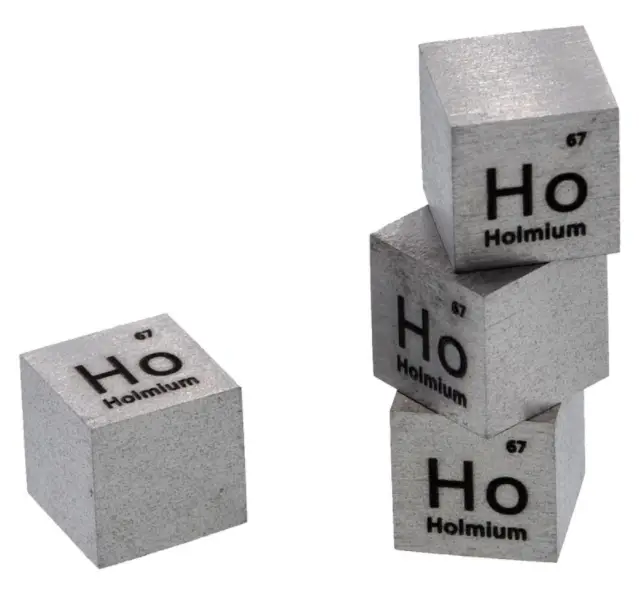
Holmium is a part of the lanthanide series, holmium is a rare-earth element. Holmium is a relatively soft and malleable silvery-white metal.

Protons and Neutrons in Holmium
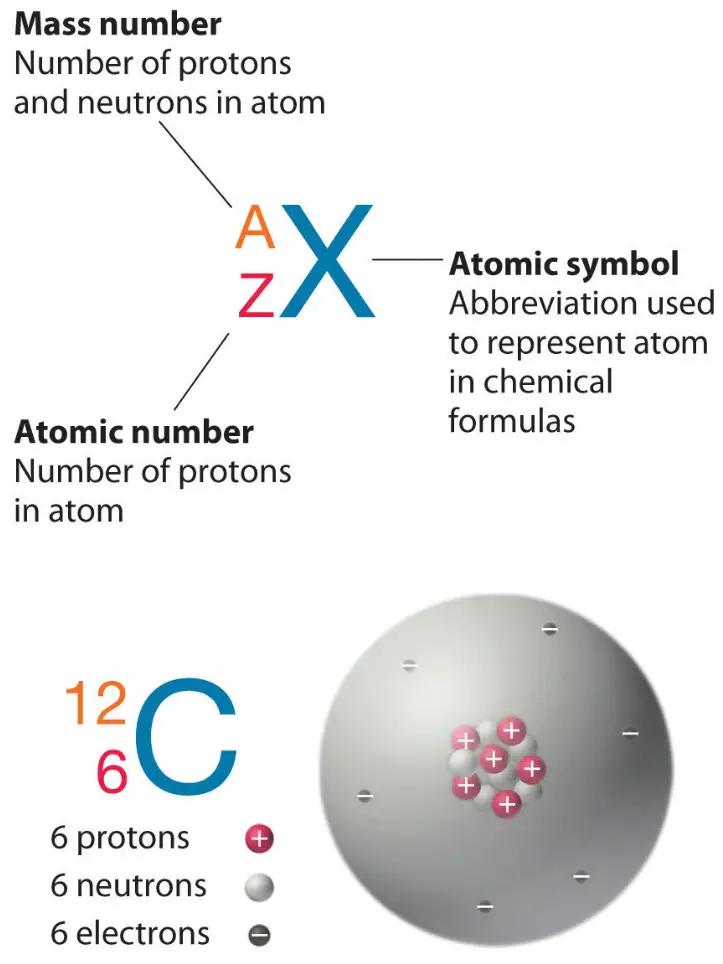
Proton Number - Atomic NumberHolmium is a chemical element with atomic number 67 which means there are 67 protons in its nucleus. Total number of protons in the nucleus is called the atomic number of the atom and is given the symbol Z. The total electrical charge of the nucleus is therefore +Ze, where e (elementary charge) equals to 1,602 x 10-19 coulombs.

The total number of neutrons in the nucleus of an atom is called the neutron number of the atom and is given the symbol N. Neutron number plus atomic number equals atomic mass number: N+Z=A. The difference between the neutron number and the atomic number is known as the neutron excess: D = N – Z = A – 2Z.

For stable elements, there is usually a variety of stable isotopes. Isotopes are nuclides that have the same atomic number and are therefore the same element, but differ in the number of neutrons. Mass numbers of typical isotopes of Holmium are 165. 

Main Isotopes of Holmium

Holmium occurs only in one natural isotope – 165Ho.

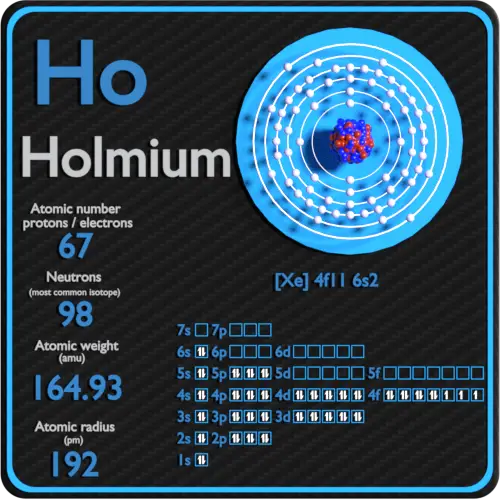
Holmium-165 is composed of 67 protons, 98 neutrons, and 67 electrons.

Naturally Occuring Isotopes

Isotope Abundance Neutron Number
165Ho 100% 98

Typical Unstable Isotopes

Isotope Half-life Decay Mode Product
163Ho 4570 y electron capture 163Dy
166Ho 26.763 h  beta decay 166Er

Electrons and Electron Configuration

The number of electrons in an electrically-neutral atom is the same as the number of protons in the nucleus. Therefore, the number of electrons in neutral atom of Holmium is 67. Each electron is influenced by the electric fields produced by the positive nuclear charge and the other (Z – 1) negative electrons in the atom.

Since the number of electrons and their arrangement are responsible for the chemical behavior of atoms, the atomic number identifies the various chemical elements. The configuration of these electrons follows from the principles of quantum mechanics. The number of electrons in each element’s electron shells, particularly the outermost valence shell, is the primary factor in determining its chemical bonding behavior. In the periodic table, the elements are listed in order of increasing atomic number Z.

Electron configuration of Holmium is [Xe] 4f11 6s2.

Possible oxidation states are +3.
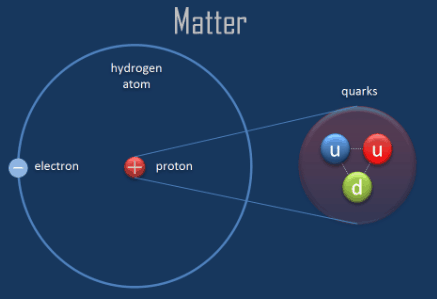
About Protons

protonA proton is one of the subatomic particles that make up matter. In the universe, protons are abundant, making up about half of all visible matter. It has a positive electric charge (+1e) and a rest mass equal to 1.67262 × 10⁻²⁷ kg (938.272 MeV/c2)— marginally lighter than that of the neutron but nearly 1836 times greater than that of the electron. The proton has a mean square radius of about 0.87 × 10⁻¹⁵ m, or 0.87 fm, and it is a spin – ½ fermion.

The protons exist in the nuclei of typical atoms, along with their neutral counterparts, the neutrons. Neutrons and protons, commonly called nucleons, are bound together in the atomic nucleus, where they account for 99.9 percent of the atom’s mass. Research in high-energy particle physics in the 20th century revealed that neither the neutron nor the proton is not the smallest building block of matter.

About Neutrons

A neutron is one of the subatomic particles that make up matter. In the universe, neutrons are abundant, making up more than half of all visible matter. It has no electric charge and a rest mass equal to 1.67493 × 10⁻²⁷ kg—marginally greater than that of the proton but nearly 1839 times greater than that of the electron. The neutron has a mean square radius of about 0.8×10⁻¹⁵ m, or 0.8 fm, and it is a spin-½ fermion.

Atomic nuclei consist of protons and neutrons, which attract each other through the nuclear force, while protons repel each other via the electric force due to their positive charge. These two forces compete, leading to various stability of nuclei. There are only certain combinations of neutrons and protons, which forms stable nuclei.

Neutrons stabilize the nucleus, because they attract each other and protons , which helps offset the electrical repulsion between protons. As a result, as the number of protons increases, an increasing ratio of neutrons to protons is needed to form a stable nucleus. If there are too many or too few neutrons for a given number of protons, the resulting nucleus is not stable and it undergoes radioactive decay. Unstable isotopes decay through various radioactive decay pathways, most commonly alpha decay, beta decay, or electron capture. Many other rare types of decay, such as spontaneous fission or neutron emission are known. It should be noted that all of these decay pathways may be accompanied by the subsequent emission of gamma radiation. Pure alpha or beta decays are very rare.

About Electrons and Electron Configuration

The periodic table is a tabular display of the chemical elements organized on the basis of their atomic numbers, electron configurations, and chemical properties. The electron configuration is the distribution of electrons of an atom or molecule (or other physical structure) in atomic or molecular orbitals. Knowledge of the electron configuration of different atoms is useful in understanding the structure of the periodic table of elements.

Every solid, liquid, gas, and plasma is composed of neutral or ionized atoms. The chemical properties of the atom are determined by the number of protons, in fact, by number and arrangement of electrons. The configuration of these electrons follows from the principles of quantum mechanics. The number of electrons in each element’s electron shells, particularly the outermost valence shell, is the primary factor in determining its chemical bonding behavior. In the periodic table, the elements are listed in order of increasing atomic number Z.

It is the Pauli exclusion principle that requires the electrons in an atom to occupy different energy levels instead of them all condensing in the ground state. The ordering of the electrons in the ground state of multielectron atoms, starts with the lowest energy state (ground state) and moves progressively from there up the energy scale until each of the atom’s electrons has been assigned a unique set of quantum numbers. This fact has key implications for the building up of the periodic table of elements.
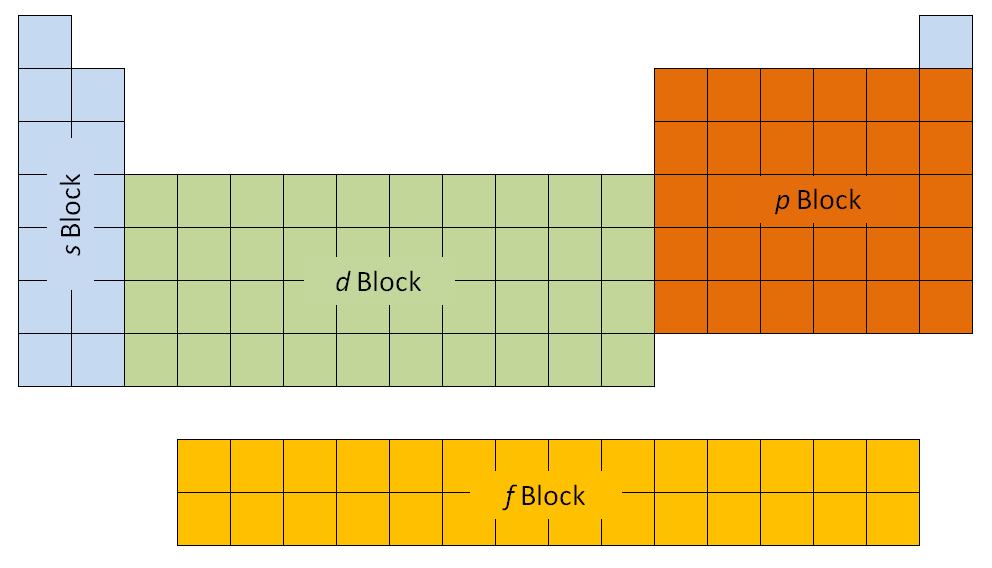
electron configuration - blocks - elementsThe first two columns on the left side of the periodic table are where the s subshells are being occupied. Because of this, the first two rows of the periodic table are labeled the s block. Similarly, the p block are the right-most six columns of the periodic table, the d block is the middle 10 columns of the periodic table, while the f block is the 14-column section that is normally depicted as detached from the main body of the periodic table. It could be part of the main body, but then the periodic table would be rather long and cumbersome.

For atoms with many electrons, this notation can become lengthy and so an abbreviated notation is used. The electron configuration can be visualized as the core electrons, equivalent to the noble gas of the preceding period, and the valence electrons (e.g. [Xe] 6s2 for barium).

Oxidation States

Oxidation states are typically represented by integers which may be positive, zero, or negative. Most elements have more than one possible oxidation state. For example, carbon has nine possible integer oxidation states from −4 to +4.

The current IUPAC Gold Book definition of oxidation state is:

“Oxidation state of an atom is the charge of this atom after ionic approximation of its heteronuclear bonds…”

and the term oxidation number is nearly synonymous. An element that is not combined with any other different elements has an oxidation state of 0. Oxidation state 0 occurs for all elements – it is simply the element in its elemental form. An atom of an element in a compound will have a positive oxidation state if it has had electrons removed. Similarly, adding electrons results in a negative oxidation state. We have also distinguish between the possible and common oxidation states of every element. For example, silicon has nine possible integer oxidation states from −4 to +4, but only -4, 0 and +4 are common oxidation states.

Summary

Element Holmium
Number of protons 67
Number of neutrons (typical isotopes) 165
Number of electrons 67
Electron configuration [Xe] 4f11 6s2
Oxidation states +3

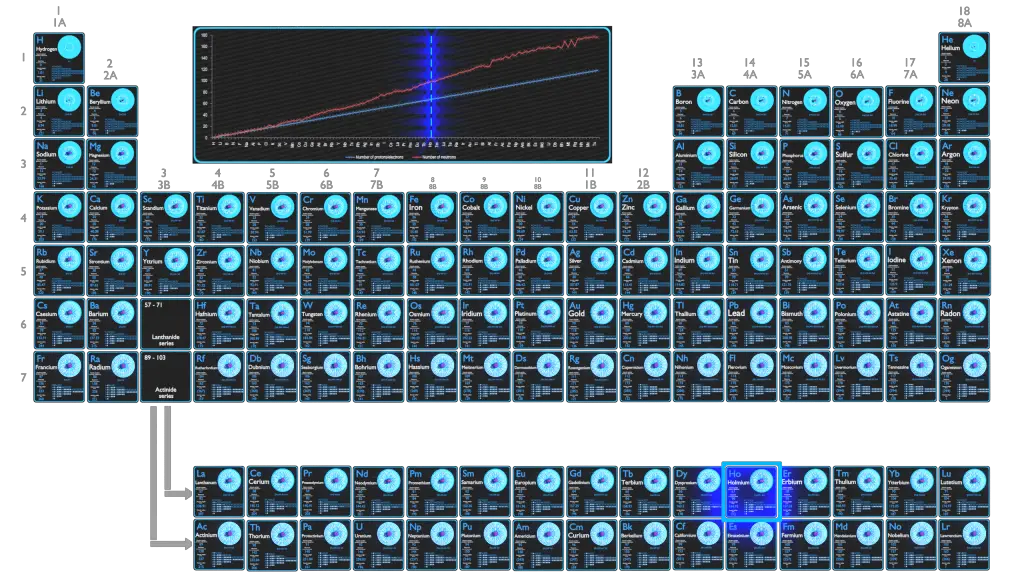
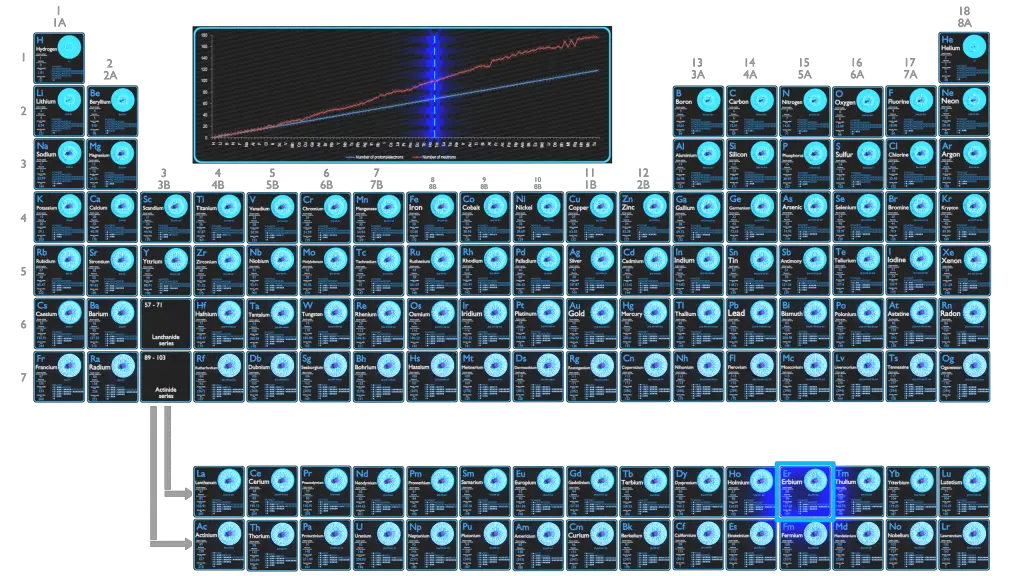
Holmium-periodic-table

Source: www.luciteria.com


Properties of other elements

Holmium - Comparison of Protons - Neutrons and Electrons

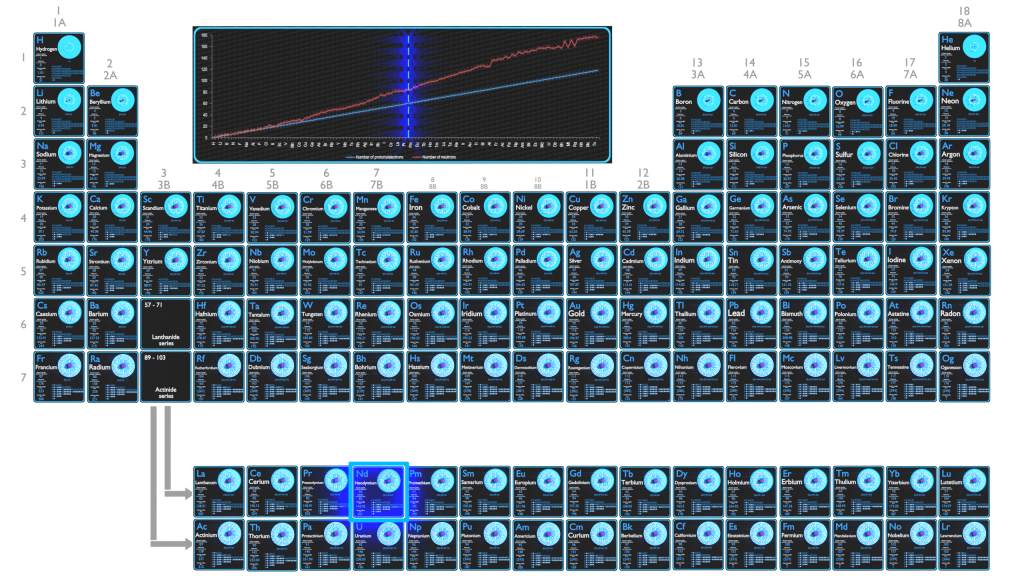
Periodic Table in 8K resolution

Other properties of Holmium
 

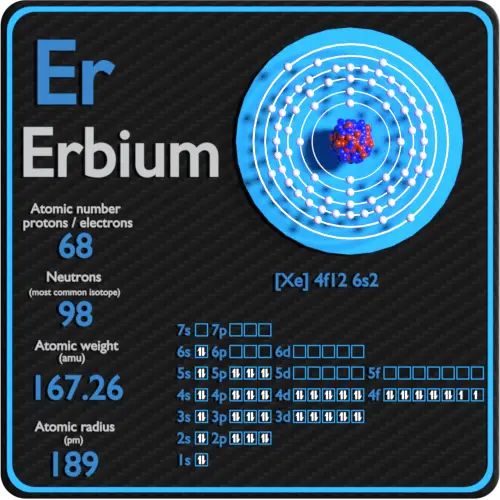
Erbium – Protons – Neutrons – Electrons – Electron Configuration

Erbium-protons-neutrons-electrons-configuration

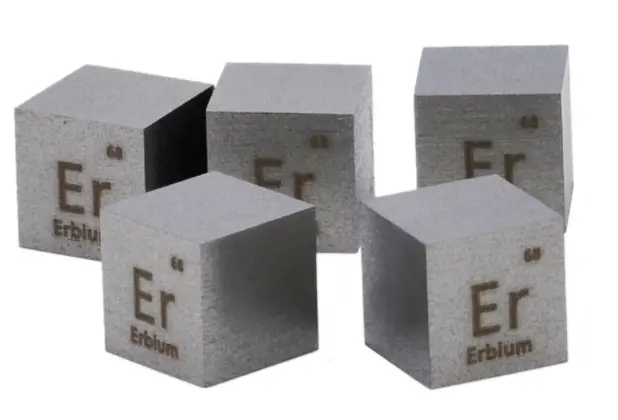
Erbium is a silvery-white solid metal when artificially isolated, natural erbium is always found in chemical combination with other elements. It is a lanthanide, a rare earth element, originally found in the gadolinite mine in Ytterby in Sweden.

Protons and Neutrons in Erbium

Proton Number - Atomic NumberErbium is a chemical element with atomic number 68 which means there are 68 protons in its nucleus. Total number of protons in the nucleus is called the atomic number of the atom and is given the symbol Z. The total electrical charge of the nucleus is therefore +Ze, where e (elementary charge) equals to 1,602 x 10-19 coulombs.

The total number of neutrons in the nucleus of an atom is called the neutron number of the atom and is given the symbol N. Neutron number plus atomic number equals atomic mass number: N+Z=A. The difference between the neutron number and the atomic number is known as the neutron excess: D = N – Z = A – 2Z.

For stable elements, there is usually a variety of stable isotopes. Isotopes are nuclides that have the same atomic number and are therefore the same element, but differ in the number of neutrons. Mass numbers of typical isotopes of Erbium are 162, 164, 166-168, 170. 

Main Isotopes of Erbium

Erbium occurs in 6 natural isotopes: 162Er, 164Er, 166Er, 167Er, 168Er and 170Er. 166Er is the most common isotope, having a natural abundance of approximately 33%.

Erbium-162 is composed of 68 protons, 94 neutrons, and 68 electrons.

Erbium-164 is composed of 68 protons, 96 neutrons, and 68 electrons.

Erbium-166 is composed of 68 protons, 98 neutrons, and 68 electrons.

Erbium-167 is composed of 68 protons, 99 neutrons, and 68 electrons.

Erbium-168 is composed of 68 protons, 100 neutrons, and 68 electrons.

Erbium-170 is composed of 68 protons, 102 neutrons, and 68 electrons.

Naturally Occuring Isotopes

Isotope Abundance Neutron Number
162Er 0.14% 94
164Er 1.60% 96
166Er 33.50% 98
167Er 22.87% 99
168Er 26.98% 100
170Er 14.91% 102

Typical Unstable Isotopes

Isotope Half-life Decay Mode Product
160Er 28.58 h electron capture 160Ho
169Er 9.4 d beta decay 169Tm
172Er 49.3 h beta decay 172Tm

Electrons and Electron Configuration

The number of electrons in an electrically-neutral atom is the same as the number of protons in the nucleus. Therefore, the number of electrons in neutral atom of Erbium is 68. Each electron is influenced by the electric fields produced by the positive nuclear charge and the other (Z – 1) negative electrons in the atom.

Since the number of electrons and their arrangement are responsible for the chemical behavior of atoms, the atomic number identifies the various chemical elements. The configuration of these electrons follows from the principles of quantum mechanics. The number of electrons in each element’s electron shells, particularly the outermost valence shell, is the primary factor in determining its chemical bonding behavior. In the periodic table, the elements are listed in order of increasing atomic number Z.

Electron configuration of Erbium is [Xe] 4f12 6s2.

Possible oxidation states are +3.

About Protons

protonA proton is one of the subatomic particles that make up matter. In the universe, protons are abundant, making up about half of all visible matter. It has a positive electric charge (+1e) and a rest mass equal to 1.67262 × 10⁻²⁷ kg (938.272 MeV/c2)— marginally lighter than that of the neutron but nearly 1836 times greater than that of the electron. The proton has a mean square radius of about 0.87 × 10⁻¹⁵ m, or 0.87 fm, and it is a spin – ½ fermion.

The protons exist in the nuclei of typical atoms, along with their neutral counterparts, the neutrons. Neutrons and protons, commonly called nucleons, are bound together in the atomic nucleus, where they account for 99.9 percent of the atom’s mass. Research in high-energy particle physics in the 20th century revealed that neither the neutron nor the proton is not the smallest building block of matter.

About Neutrons

A neutron is one of the subatomic particles that make up matter. In the universe, neutrons are abundant, making up more than half of all visible matter. It has no electric charge and a rest mass equal to 1.67493 × 10⁻²⁷ kg—marginally greater than that of the proton but nearly 1839 times greater than that of the electron. The neutron has a mean square radius of about 0.8×10⁻¹⁵ m, or 0.8 fm, and it is a spin-½ fermion.

Atomic nuclei consist of protons and neutrons, which attract each other through the nuclear force, while protons repel each other via the electric force due to their positive charge. These two forces compete, leading to various stability of nuclei. There are only certain combinations of neutrons and protons, which forms stable nuclei.

Neutrons stabilize the nucleus, because they attract each other and protons , which helps offset the electrical repulsion between protons. As a result, as the number of protons increases, an increasing ratio of neutrons to protons is needed to form a stable nucleus. If there are too many or too few neutrons for a given number of protons, the resulting nucleus is not stable and it undergoes radioactive decay. Unstable isotopes decay through various radioactive decay pathways, most commonly alpha decay, beta decay, or electron capture. Many other rare types of decay, such as spontaneous fission or neutron emission are known. It should be noted that all of these decay pathways may be accompanied by the subsequent emission of gamma radiation. Pure alpha or beta decays are very rare.

About Electrons and Electron Configuration

The periodic table is a tabular display of the chemical elements organized on the basis of their atomic numbers, electron configurations, and chemical properties. The electron configuration is the distribution of electrons of an atom or molecule (or other physical structure) in atomic or molecular orbitals. Knowledge of the electron configuration of different atoms is useful in understanding the structure of the periodic table of elements.

Every solid, liquid, gas, and plasma is composed of neutral or ionized atoms. The chemical properties of the atom are determined by the number of protons, in fact, by number and arrangement of electrons. The configuration of these electrons follows from the principles of quantum mechanics. The number of electrons in each element’s electron shells, particularly the outermost valence shell, is the primary factor in determining its chemical bonding behavior. In the periodic table, the elements are listed in order of increasing atomic number Z.

It is the Pauli exclusion principle that requires the electrons in an atom to occupy different energy levels instead of them all condensing in the ground state. The ordering of the electrons in the ground state of multielectron atoms, starts with the lowest energy state (ground state) and moves progressively from there up the energy scale until each of the atom’s electrons has been assigned a unique set of quantum numbers. This fact has key implications for the building up of the periodic table of elements.

electron configuration - blocks - elementsThe first two columns on the left side of the periodic table are where the s subshells are being occupied. Because of this, the first two rows of the periodic table are labeled the s block. Similarly, the p block are the right-most six columns of the periodic table, the d block is the middle 10 columns of the periodic table, while the f block is the 14-column section that is normally depicted as detached from the main body of the periodic table. It could be part of the main body, but then the periodic table would be rather long and cumbersome.

For atoms with many electrons, this notation can become lengthy and so an abbreviated notation is used. The electron configuration can be visualized as the core electrons, equivalent to the noble gas of the preceding period, and the valence electrons (e.g. [Xe] 6s2 for barium).

Oxidation States

Oxidation states are typically represented by integers which may be positive, zero, or negative. Most elements have more than one possible oxidation state. For example, carbon has nine possible integer oxidation states from −4 to +4.

The current IUPAC Gold Book definition of oxidation state is:

“Oxidation state of an atom is the charge of this atom after ionic approximation of its heteronuclear bonds…”

and the term oxidation number is nearly synonymous. An element that is not combined with any other different elements has an oxidation state of 0. Oxidation state 0 occurs for all elements – it is simply the element in its elemental form. An atom of an element in a compound will have a positive oxidation state if it has had electrons removed. Similarly, adding electrons results in a negative oxidation state. We have also distinguish between the possible and common oxidation states of every element. For example, silicon has nine possible integer oxidation states from −4 to +4, but only -4, 0 and +4 are common oxidation states.

Summary

Element Erbium
Number of protons 68
Number of neutrons (typical isotopes) 162, 164, 166-168, 170
Number of electrons 68
Electron configuration [Xe] 4f12 6s2
Oxidation states +3

Erbium-periodic-table

Source: www.luciteria.com


Properties of other elements

Erbium - Comparison of Protons - Neutrons and Electrons

Periodic Table in 8K resolution

Other properties of Erbium


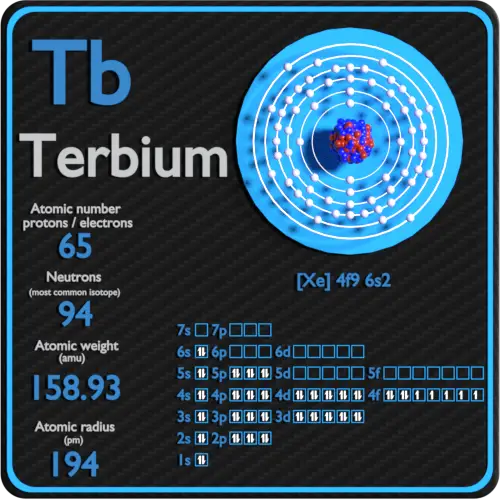
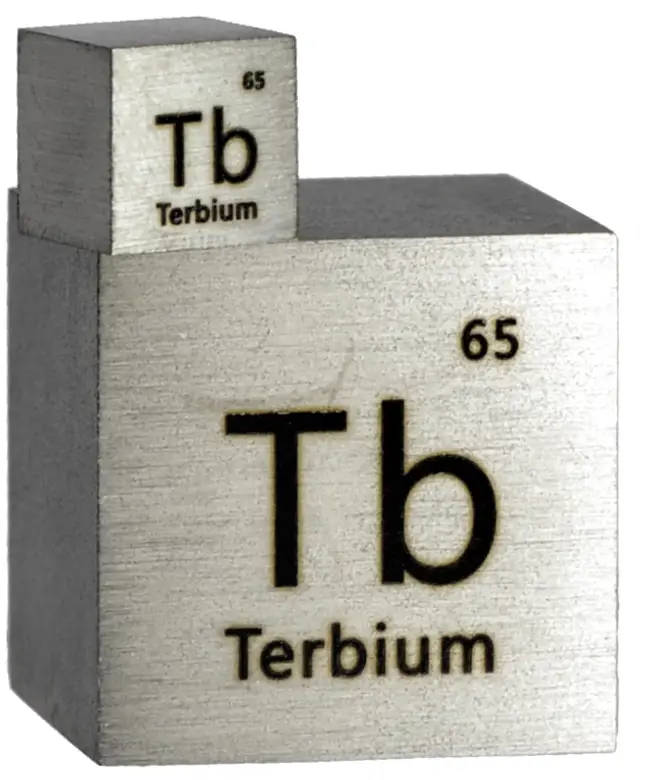
Terbium – Protons – Neutrons – Electrons – Electron Configuration

Terbium-protons-neutrons-electrons-configuration

Terbium is a silvery-white, rare earth metal that is malleable, ductile, and soft enough to be cut with a knife. The ninth member of the lanthanide series, terbium is a fairly electropositive metal that reacts with water, evolving hydrogen gas.

Protons and Neutrons in Terbium

Proton Number - Atomic NumberTerbium is a chemical element with atomic number 65 which means there are 65 protons in its nucleus. Total number of protons in the nucleus is called the atomic number of the atom and is given the symbol Z. The total electrical charge of the nucleus is therefore +Ze, where e (elementary charge) equals to 1,602 x 10-19 coulombs.

The total number of neutrons in the nucleus of an atom is called the neutron number of the atom and is given the symbol N. Neutron number plus atomic number equals atomic mass number: N+Z=A. The difference between the neutron number and the atomic number is known as the neutron excess: D = N – Z = A – 2Z.

For stable elements, there is usually a variety of stable isotopes. Isotopes are nuclides that have the same atomic number and are therefore the same element, but differ in the number of neutrons. Mass numbers of typical isotopes of Terbium are 159. 

Main Isotopes of Terbium

Terbium occurs only in one natural isotope – 159Tb.

Terbium-159 is composed of 65 protons, 94 neutrons, and 65 electrons.

Naturally Occuring Isotopes

Isotope Abundance Neutron Number
159Tb 100% 94

Typical Unstable Isotopes

Isotope Half-life Decay Mode Product
157Tb 71 y electron capture 157Gd
158Tb 180 y electron capture 158Gd

Electrons and Electron Configuration

The number of electrons in an electrically-neutral atom is the same as the number of protons in the nucleus. Therefore, the number of electrons in neutral atom of Terbium is 65. Each electron is influenced by the electric fields produced by the positive nuclear charge and the other (Z – 1) negative electrons in the atom.

Since the number of electrons and their arrangement are responsible for the chemical behavior of atoms, the atomic number identifies the various chemical elements. The configuration of these electrons follows from the principles of quantum mechanics. The number of electrons in each element’s electron shells, particularly the outermost valence shell, is the primary factor in determining its chemical bonding behavior. In the periodic table, the elements are listed in order of increasing atomic number Z.

Electron configuration of Terbium is [Xe] 4f9 6s2.

Possible oxidation states are +3.

Most Common Application of Terbium

Most of the world’s terbium supply is used in green phosphors. Terbium oxide is in fluorescent lamps and television and monitor cathode ray tubes (CRTs). The most common oxidation state of terbium is +3 (trivalent), such as TbCl3. In the solid state, tetravalent terbium is also known, in compounds such as TbO2 and TbF4.

About Protons

protonA proton is one of the subatomic particles that make up matter. In the universe, protons are abundant, making up about half of all visible matter. It has a positive electric charge (+1e) and a rest mass equal to 1.67262 × 10⁻²⁷ kg (938.272 MeV/c2)— marginally lighter than that of the neutron but nearly 1836 times greater than that of the electron. The proton has a mean square radius of about 0.87 × 10⁻¹⁵ m, or 0.87 fm, and it is a spin – ½ fermion.

The protons exist in the nuclei of typical atoms, along with their neutral counterparts, the neutrons. Neutrons and protons, commonly called nucleons, are bound together in the atomic nucleus, where they account for 99.9 percent of the atom’s mass. Research in high-energy particle physics in the 20th century revealed that neither the neutron nor the proton is not the smallest building block of matter.

About Neutrons

A neutron is one of the subatomic particles that make up matter. In the universe, neutrons are abundant, making up more than half of all visible matter. It has no electric charge and a rest mass equal to 1.67493 × 10⁻²⁷ kg—marginally greater than that of the proton but nearly 1839 times greater than that of the electron. The neutron has a mean square radius of about 0.8×10⁻¹⁵ m, or 0.8 fm, and it is a spin-½ fermion.

Atomic nuclei consist of protons and neutrons, which attract each other through the nuclear force, while protons repel each other via the electric force due to their positive charge. These two forces compete, leading to various stability of nuclei. There are only certain combinations of neutrons and protons, which forms stable nuclei.

Neutrons stabilize the nucleus, because they attract each other and protons , which helps offset the electrical repulsion between protons. As a result, as the number of protons increases, an increasing ratio of neutrons to protons is needed to form a stable nucleus. If there are too many or too few neutrons for a given number of protons, the resulting nucleus is not stable and it undergoes radioactive decay. Unstable isotopes decay through various radioactive decay pathways, most commonly alpha decay, beta decay, or electron capture. Many other rare types of decay, such as spontaneous fission or neutron emission are known. It should be noted that all of these decay pathways may be accompanied by the subsequent emission of gamma radiation. Pure alpha or beta decays are very rare.

About Electrons and Electron Configuration

The periodic table is a tabular display of the chemical elements organized on the basis of their atomic numbers, electron configurations, and chemical properties. The electron configuration is the distribution of electrons of an atom or molecule (or other physical structure) in atomic or molecular orbitals. Knowledge of the electron configuration of different atoms is useful in understanding the structure of the periodic table of elements.

Every solid, liquid, gas, and plasma is composed of neutral or ionized atoms. The chemical properties of the atom are determined by the number of protons, in fact, by number and arrangement of electrons. The configuration of these electrons follows from the principles of quantum mechanics. The number of electrons in each element’s electron shells, particularly the outermost valence shell, is the primary factor in determining its chemical bonding behavior. In the periodic table, the elements are listed in order of increasing atomic number Z.

It is the Pauli exclusion principle that requires the electrons in an atom to occupy different energy levels instead of them all condensing in the ground state. The ordering of the electrons in the ground state of multielectron atoms, starts with the lowest energy state (ground state) and moves progressively from there up the energy scale until each of the atom’s electrons has been assigned a unique set of quantum numbers. This fact has key implications for the building up of the periodic table of elements.

electron configuration - blocks - elementsThe first two columns on the left side of the periodic table are where the s subshells are being occupied. Because of this, the first two rows of the periodic table are labeled the s block. Similarly, the p block are the right-most six columns of the periodic table, the d block is the middle 10 columns of the periodic table, while the f block is the 14-column section that is normally depicted as detached from the main body of the periodic table. It could be part of the main body, but then the periodic table would be rather long and cumbersome.

For atoms with many electrons, this notation can become lengthy and so an abbreviated notation is used. The electron configuration can be visualized as the core electrons, equivalent to the noble gas of the preceding period, and the valence electrons (e.g. [Xe] 6s2 for barium).

Oxidation States

Oxidation states are typically represented by integers which may be positive, zero, or negative. Most elements have more than one possible oxidation state. For example, carbon has nine possible integer oxidation states from −4 to +4.

The current IUPAC Gold Book definition of oxidation state is:

“Oxidation state of an atom is the charge of this atom after ionic approximation of its heteronuclear bonds…”

and the term oxidation number is nearly synonymous. An element that is not combined with any other different elements has an oxidation state of 0. Oxidation state 0 occurs for all elements – it is simply the element in its elemental form. An atom of an element in a compound will have a positive oxidation state if it has had electrons removed. Similarly, adding electrons results in a negative oxidation state. We have also distinguish between the possible and common oxidation states of every element. For example, silicon has nine possible integer oxidation states from −4 to +4, but only -4, 0 and +4 are common oxidation states.

Summary

Element Terbium
Number of protons 65
Number of neutrons (typical isotopes) 159
Number of electrons 65
Electron configuration [Xe] 4f9 6s2
Oxidation states +3

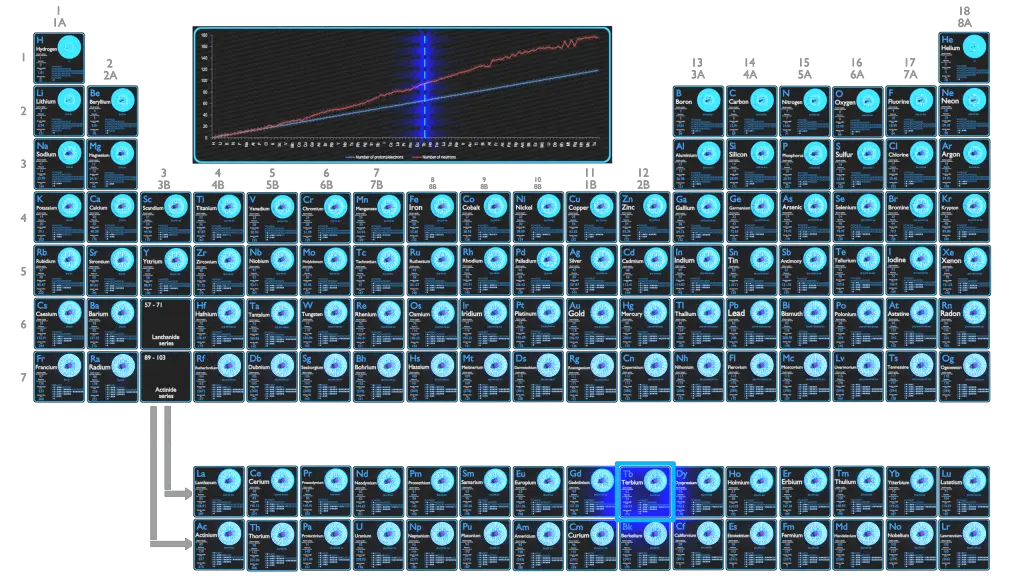
Terbium-periodic-table

Source: www.luciteria.com


Properties of other elements

Terbium - Comparison of Protons - Neutrons and Electrons

Periodic Table in 8K resolution

Other properties of Terbium


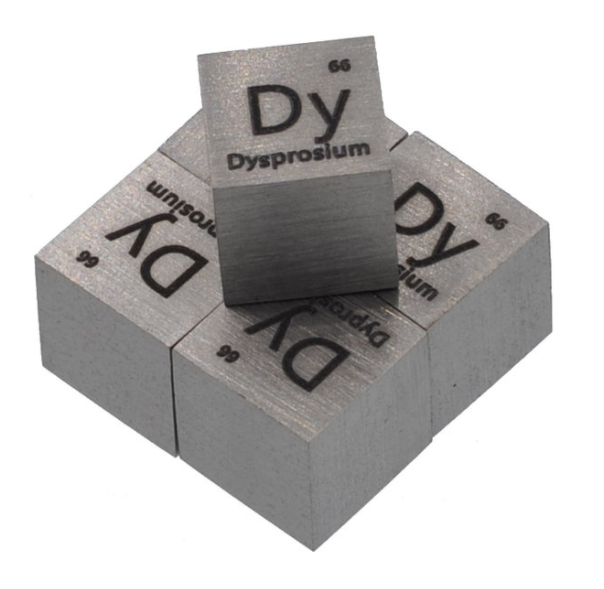
Dysprosium – Protons – Neutrons – Electrons – Electron Configuration

Dysprosium-protons-neutrons-electrons-configuration

Dysprosium is a rare earth element with a metallic silver luster. Dysprosium is used for its high thermal neutron absorption cross-section in making control rods in nuclear reactors, for its high magnetic susceptibility in data storage applications.

Protons and Neutrons in Dysprosium

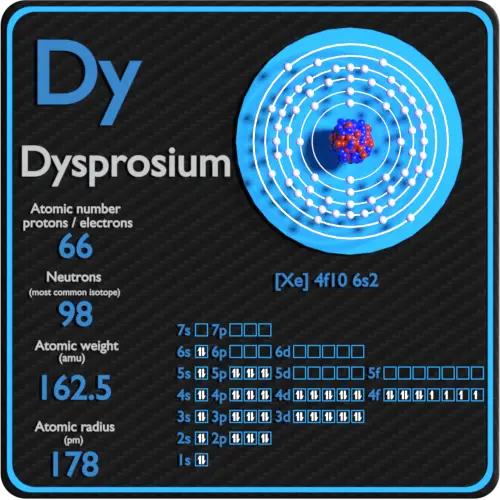
Proton Number - Atomic NumberDysprosium is a chemical element with atomic number 66 which means there are 66 protons in its nucleus. Total number of protons in the nucleus is called the atomic number of the atom and is given the symbol Z. The total electrical charge of the nucleus is therefore +Ze, where e (elementary charge) equals to 1,602 x 10-19 coulombs.

The total number of neutrons in the nucleus of an atom is called the neutron number of the atom and is given the symbol N. Neutron number plus atomic number equals atomic mass number: N+Z=A. The difference between the neutron number and the atomic number is known as the neutron excess: D = N – Z = A – 2Z.

For stable elements, there is usually a variety of stable isotopes. Isotopes are nuclides that have the same atomic number and are therefore the same element, but differ in the number of neutrons. Mass numbers of typical isotopes of Dysprosium are 156-164. 

Main Isotopes of Dysprosium

Dysprosium occurs in 7 natural isotopes: 156Dy, 158Dy, 160Dy, 161Dy, 162Dy, 163Dy and 164Dy. 164Dy is the most common isotope, having a natural abundance of approximately 28%.

Dysprosium-156 is composed of 66 protons, 90 neutrons, and 66 electrons.

Dysprosium-158 is composed of 66 protons, 92 neutrons, and 66 electrons.

Dysprosium-160 is composed of 66 protons, 94 neutrons, and 66 electrons.

Dysprosium-161 is composed of 66 protons, 95 neutrons, and 66 electrons.

Dysprosium-162 is composed of 66 protons, 96 neutrons, and 66 electrons.

Dysprosium-163 is composed of 66 protons, 97 neutrons, and 66 electrons.

Dysprosium-164 is composed of 66 protons, 98 neutrons, and 66 electrons.

Naturally Occuring Isotopes

Isotope Abundance Neutron Number
156Dy 0.056% 90
158Dy 0.095% 92
160Dy 2.329% 94
161Dy 18.889% 95
162Dy 25.475% 96
163Dy 24.896% 97
164Dy 28.260% 98

Typical Unstable Isotopes

Isotope Half-life Decay Mode Product
154Dy 3.0×10⁶ y alpha decay 150Gd

Electrons and Electron Configuration

The number of electrons in an electrically-neutral atom is the same as the number of protons in the nucleus. Therefore, the number of electrons in neutral atom of Dysprosium is 66. Each electron is influenced by the electric fields produced by the positive nuclear charge and the other (Z – 1) negative electrons in the atom.

Since the number of electrons and their arrangement are responsible for the chemical behavior of atoms, the atomic number identifies the various chemical elements. The configuration of these electrons follows from the principles of quantum mechanics. The number of electrons in each element’s electron shells, particularly the outermost valence shell, is the primary factor in determining its chemical bonding behavior. In the periodic table, the elements are listed in order of increasing atomic number Z.

Electron configuration of Dysprosium is [Xe] 4f10 6s2.

Possible oxidation states are +3.

Most Common Compound of Dysprosium

Dysprosium oxide (Dy2O3) is a sesquioxide compound of the rare earth metal dysprosium. It is a pastel yellowish-greenish, slightly hygroscopic powder having specialized uses in ceramics, glass, phosphors, dysprosium metal halide lamps and lasers.

About Protons

protonA proton is one of the subatomic particles that make up matter. In the universe, protons are abundant, making up about half of all visible matter. It has a positive electric charge (+1e) and a rest mass equal to 1.67262 × 10⁻²⁷ kg (938.272 MeV/c2)— marginally lighter than that of the neutron but nearly 1836 times greater than that of the electron. The proton has a mean square radius of about 0.87 × 10⁻¹⁵ m, or 0.87 fm, and it is a spin – ½ fermion.

The protons exist in the nuclei of typical atoms, along with their neutral counterparts, the neutrons. Neutrons and protons, commonly called nucleons, are bound together in the atomic nucleus, where they account for 99.9 percent of the atom’s mass. Research in high-energy particle physics in the 20th century revealed that neither the neutron nor the proton is not the smallest building block of matter.

About Neutrons

A neutron is one of the subatomic particles that make up matter. In the universe, neutrons are abundant, making up more than half of all visible matter. It has no electric charge and a rest mass equal to 1.67493 × 10⁻²⁷ kg—marginally greater than that of the proton but nearly 1839 times greater than that of the electron. The neutron has a mean square radius of about 0.8×10⁻¹⁵ m, or 0.8 fm, and it is a spin-½ fermion.

Atomic nuclei consist of protons and neutrons, which attract each other through the nuclear force, while protons repel each other via the electric force due to their positive charge. These two forces compete, leading to various stability of nuclei. There are only certain combinations of neutrons and protons, which forms stable nuclei.

Neutrons stabilize the nucleus, because they attract each other and protons , which helps offset the electrical repulsion between protons. As a result, as the number of protons increases, an increasing ratio of neutrons to protons is needed to form a stable nucleus. If there are too many or too few neutrons for a given number of protons, the resulting nucleus is not stable and it undergoes radioactive decay. Unstable isotopes decay through various radioactive decay pathways, most commonly alpha decay, beta decay, or electron capture. Many other rare types of decay, such as spontaneous fission or neutron emission are known. It should be noted that all of these decay pathways may be accompanied by the subsequent emission of gamma radiation. Pure alpha or beta decays are very rare.

About Electrons and Electron Configuration

The periodic table is a tabular display of the chemical elements organized on the basis of their atomic numbers, electron configurations, and chemical properties. The electron configuration is the distribution of electrons of an atom or molecule (or other physical structure) in atomic or molecular orbitals. Knowledge of the electron configuration of different atoms is useful in understanding the structure of the periodic table of elements.

Every solid, liquid, gas, and plasma is composed of neutral or ionized atoms. The chemical properties of the atom are determined by the number of protons, in fact, by number and arrangement of electrons. The configuration of these electrons follows from the principles of quantum mechanics. The number of electrons in each element’s electron shells, particularly the outermost valence shell, is the primary factor in determining its chemical bonding behavior. In the periodic table, the elements are listed in order of increasing atomic number Z.

It is the Pauli exclusion principle that requires the electrons in an atom to occupy different energy levels instead of them all condensing in the ground state. The ordering of the electrons in the ground state of multielectron atoms, starts with the lowest energy state (ground state) and moves progressively from there up the energy scale until each of the atom’s electrons has been assigned a unique set of quantum numbers. This fact has key implications for the building up of the periodic table of elements.

electron configuration - blocks - elementsThe first two columns on the left side of the periodic table are where the s subshells are being occupied. Because of this, the first two rows of the periodic table are labeled the s block. Similarly, the p block are the right-most six columns of the periodic table, the d block is the middle 10 columns of the periodic table, while the f block is the 14-column section that is normally depicted as detached from the main body of the periodic table. It could be part of the main body, but then the periodic table would be rather long and cumbersome.

For atoms with many electrons, this notation can become lengthy and so an abbreviated notation is used. The electron configuration can be visualized as the core electrons, equivalent to the noble gas of the preceding period, and the valence electrons (e.g. [Xe] 6s2 for barium).

Oxidation States

Oxidation states are typically represented by integers which may be positive, zero, or negative. Most elements have more than one possible oxidation state. For example, carbon has nine possible integer oxidation states from −4 to +4.

The current IUPAC Gold Book definition of oxidation state is:

“Oxidation state of an atom is the charge of this atom after ionic approximation of its heteronuclear bonds…”

and the term oxidation number is nearly synonymous. An element that is not combined with any other different elements has an oxidation state of 0. Oxidation state 0 occurs for all elements – it is simply the element in its elemental form. An atom of an element in a compound will have a positive oxidation state if it has had electrons removed. Similarly, adding electrons results in a negative oxidation state. We have also distinguish between the possible and common oxidation states of every element. For example, silicon has nine possible integer oxidation states from −4 to +4, but only -4, 0 and +4 are common oxidation states.

Summary

Element Dysprosium
Number of protons 66
Number of neutrons (typical isotopes) 156-164
Number of electrons 66
Electron configuration [Xe] 4f10 6s2
Oxidation states +3

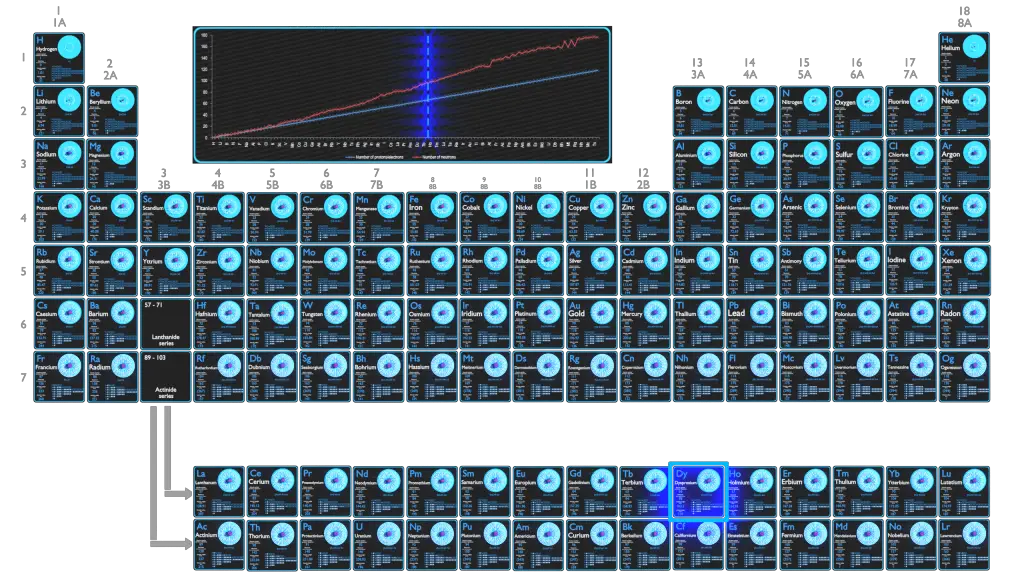
Dysprosium-periodic-table

Source: www.luciteria.com


Properties of other elements

Dysprosium - Comparison of Protons - Neutrons and Electrons

Periodic Table in 8K resolution

Other properties of Dysprosium


Gadolinium – Protons – Neutrons – Electrons – Electron Configuration

Gadolinium-protons-neutrons-electrons-configuration

Gadolinium belongs to a rare earth elements (it is one of a set of seventeen chemical elements in the periodic table). In nuclear industry gadolinium is commonly used as a neutron absorber due to very high neutron absorbtion cross-section of two isotopes 155Gd and 157Gd. Gadolinium is widely used as a burnable absorber, which is commonly used in fresh fuel to compensate an excess of reactivity of reactor core. Gadolinium is produced both from monazite and bastnäsite. Commercially, it is recovered from monazite sand and bastnasite by extraction processes and ion exchange techniques.

Protons and Neutrons in Gadolinium

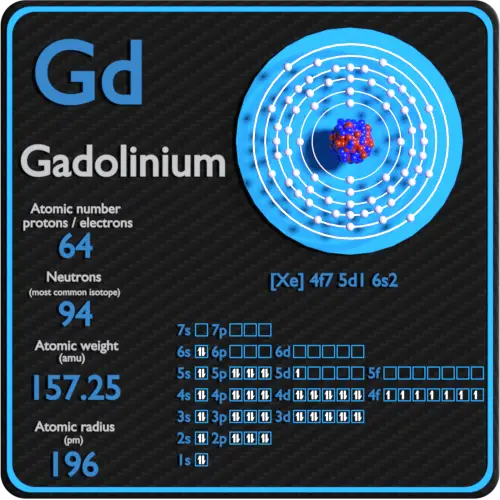
Proton Number - Atomic NumberGadolinium is a chemical element with atomic number 64 which means there are 64 protons in its nucleus. Total number of protons in the nucleus is called the atomic number of the atom and is given the symbol Z. The total electrical charge of the nucleus is therefore +Ze, where e (elementary charge) equals to 1,602 x 10-19 coulombs.

The total number of neutrons in the nucleus of an atom is called the neutron number of the atom and is given the symbol N. Neutron number plus atomic number equals atomic mass number: N+Z=A. The difference between the neutron number and the atomic number is known as the neutron excess: D = N – Z = A – 2Z.

For stable elements, there is usually a variety of stable isotopes. Isotopes are nuclides that have the same atomic number and are therefore the same element, but differ in the number of neutrons. Mass numbers of typical isotopes of Gadolinium are 154-160.

Main Isotopes of Gadolinium

Gadolinium occurs in 6 natural isotopes: 154Gd, 155Gd, 156Gd. 157Gd, 158Gd and 160Gd. 158Gd is the most common isotope, having a natural abundance of approximately 24%.

Gadolinium-154 is composed of 64 protons, 90 neutrons, and 64 electrons.

Gadolinium-155 is composed of 64 protons, 94 neutrons, and 64 electrons.

Gadolinium-156 is composed of 64 protons, 92 neutrons, and 64 electrons.

Gadolinium-157 is composed of 64 protons, 93 neutrons, and 64 electrons.

Gadolinium-158 is composed of 64 protons, 94 neutrons, and 64 electrons.

Gadolinium-160 is composed of 64 protons, 96 neutrons, and 64 electrons.

Stable Isotopes

Isotope Abundance Neutron Number
154Gd 2.18% 90
155Gd  14.80% 91
156Gd  20.47% 92
157Gd  15.65% 93
158Gd  24.84% 94
160Gd  21.86% 96

Typical Unstable Isotopes

Isotope Half-life Decay Mode Product
148Gd 75 y alpha decay 144Sm
150Gd 1.8×10⁶ y alpha decay 146Sm
152Gd 1.08×10¹⁴ y alpha decay 148Sm

Electrons and Electron Configuration

The number of electrons in an electrically-neutral atom is the same as the number of protons in the nucleus. Therefore, the number of electrons in neutral atom of Gadolinium is 64. Each electron is influenced by the electric fields produced by the positive nuclear charge and the other (Z – 1) negative electrons in the atom.

Since the number of electrons and their arrangement are responsible for the chemical behavior of atoms, the atomic number identifies the various chemical elements. The configuration of these electrons follows from the principles of quantum mechanics. The number of electrons in each element’s electron shells, particularly the outermost valence shell, is the primary factor in determining its chemical bonding behavior. In the periodic table, the elements are listed in order of increasing atomic number Z.

Electron configuration of Gadolinium is [Xe] 4f7 5d1 6s2.

Possible oxidation states are +3.

Like most of the rare earths, gadolinium forms trivalent ions with fluorescent properties, and salts of gadolinium(III) are used as phosphors in various applications.

The kinds of gadolinium(III) ions occurring in water-soluble salts are toxic to mammals. However, chelated gadolinium(III) compounds are far less toxic because they carry gadolinium(III) through the kidneys and out of the body before the free ion can be released into the tissues.

Most Common Chemical Compound of Gadolinium

Gadolinium(III) oxide (archaically gadolinia) is an inorganic compound with the formula Gd2O3. It is one of the most commonly available forms of the rare-earth element gadolinium, derivatives of which are potential contrast agents for magnetic resonance imaging.

About Protons

protonA proton is one of the subatomic particles that make up matter. In the universe, protons are abundant, making up about half of all visible matter. It has a positive electric charge (+1e) and a rest mass equal to 1.67262 × 10⁻²⁷ kg (938.272 MeV/c2)— marginally lighter than that of the neutron but nearly 1836 times greater than that of the electron. The proton has a mean square radius of about 0.87 × 10⁻¹⁵ m, or 0.87 fm, and it is a spin – ½ fermion.

The protons exist in the nuclei of typical atoms, along with their neutral counterparts, the neutrons. Neutrons and protons, commonly called nucleons, are bound together in the atomic nucleus, where they account for 99.9 percent of the atom’s mass. Research in high-energy particle physics in the 20th century revealed that neither the neutron nor the proton is not the smallest building block of matter.

About Neutrons

A neutron is one of the subatomic particles that make up matter. In the universe, neutrons are abundant, making up more than half of all visible matter. It has no electric charge and a rest mass equal to 1.67493 × 10⁻²⁷ kg—marginally greater than that of the proton but nearly 1839 times greater than that of the electron. The neutron has a mean square radius of about 0.8×10⁻¹⁵ m, or 0.8 fm, and it is a spin-½ fermion.

Atomic nuclei consist of protons and neutrons, which attract each other through the nuclear force, while protons repel each other via the electric force due to their positive charge. These two forces compete, leading to various stability of nuclei. There are only certain combinations of neutrons and protons, which forms stable nuclei.

Neutrons stabilize the nucleus, because they attract each other and protons , which helps offset the electrical repulsion between protons. As a result, as the number of protons increases, an increasing ratio of neutrons to protons is needed to form a stable nucleus. If there are too many or too few neutrons for a given number of protons, the resulting nucleus is not stable and it undergoes radioactive decay. Unstable isotopes decay through various radioactive decay pathways, most commonly alpha decay, beta decay, or electron capture. Many other rare types of decay, such as spontaneous fission or neutron emission are known. It should be noted that all of these decay pathways may be accompanied by the subsequent emission of gamma radiation. Pure alpha or beta decays are very rare.

About Electrons and Electron Configuration

The periodic table is a tabular display of the chemical elements organized on the basis of their atomic numbers, electron configurations, and chemical properties. The electron configuration is the distribution of electrons of an atom or molecule (or other physical structure) in atomic or molecular orbitals. Knowledge of the electron configuration of different atoms is useful in understanding the structure of the periodic table of elements.

Every solid, liquid, gas, and plasma is composed of neutral or ionized atoms. The chemical properties of the atom are determined by the number of protons, in fact, by number and arrangement of electrons. The configuration of these electrons follows from the principles of quantum mechanics. The number of electrons in each element’s electron shells, particularly the outermost valence shell, is the primary factor in determining its chemical bonding behavior. In the periodic table, the elements are listed in order of increasing atomic number Z.

It is the Pauli exclusion principle that requires the electrons in an atom to occupy different energy levels instead of them all condensing in the ground state. The ordering of the electrons in the ground state of multielectron atoms, starts with the lowest energy state (ground state) and moves progressively from there up the energy scale until each of the atom’s electrons has been assigned a unique set of quantum numbers. This fact has key implications for the building up of the periodic table of elements.

electron configuration - blocks - elementsThe first two columns on the left side of the periodic table are where the s subshells are being occupied. Because of this, the first two rows of the periodic table are labeled the s block. Similarly, the p block are the right-most six columns of the periodic table, the d block is the middle 10 columns of the periodic table, while the f block is the 14-column section that is normally depicted as detached from the main body of the periodic table. It could be part of the main body, but then the periodic table would be rather long and cumbersome.

For atoms with many electrons, this notation can become lengthy and so an abbreviated notation is used. The electron configuration can be visualized as the core electrons, equivalent to the noble gas of the preceding period, and the valence electrons (e.g. [Xe] 6s2 for barium).

Oxidation States

Oxidation states are typically represented by integers which may be positive, zero, or negative. Most elements have more than one possible oxidation state. For example, carbon has nine possible integer oxidation states from −4 to +4.

The current IUPAC Gold Book definition of oxidation state is:

“Oxidation state of an atom is the charge of this atom after ionic approximation of its heteronuclear bonds…”

and the term oxidation number is nearly synonymous. An element that is not combined with any other different elements has an oxidation state of 0. Oxidation state 0 occurs for all elements – it is simply the element in its elemental form. An atom of an element in a compound will have a positive oxidation state if it has had electrons removed. Similarly, adding electrons results in a negative oxidation state. We have also distinguish between the possible and common oxidation states of every element. For example, silicon has nine possible integer oxidation states from −4 to +4, but only -4, 0 and +4 are common oxidation states.

Summary

Element Gadolinium
Number of protons 64
Number of neutrons (typical isotopes) 154-160
Number of electrons 64
Electron configuration [Xe] 4f7 5d1 6s2
Oxidation states +3

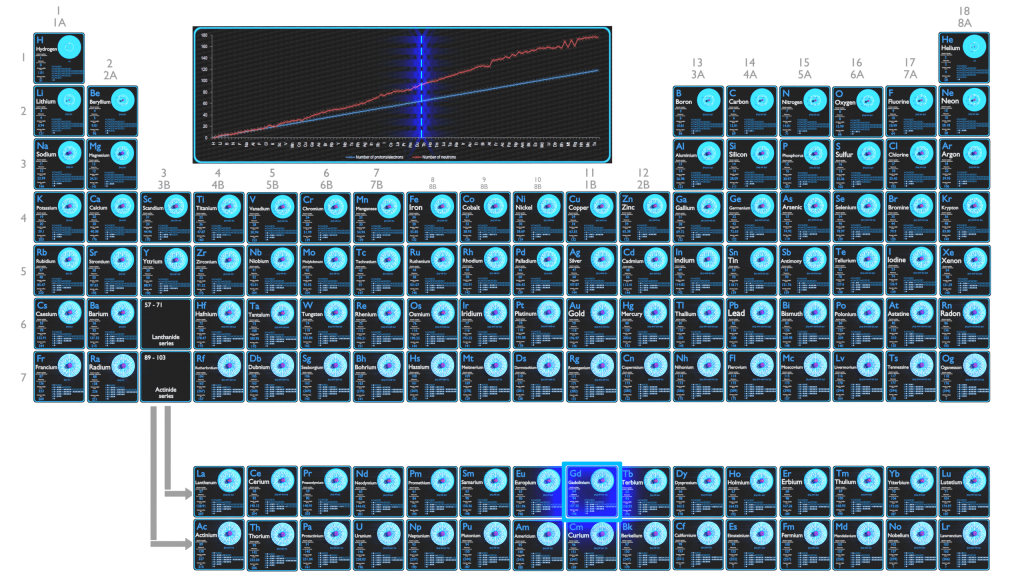
Gadolinium-periodic-table

Source: www.luciteria.com


Properties of other elements

Gadolinium - Comparison of Protons - Neutrons and Electrons

Periodic Table in 8K resolution

Other properties of Gadolinium


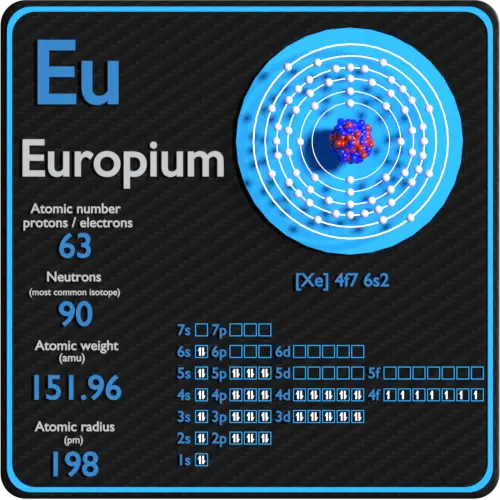
Europium – Protons – Neutrons – Electrons – Electron Configuration

Europium-protons-neutrons-electrons-configuration

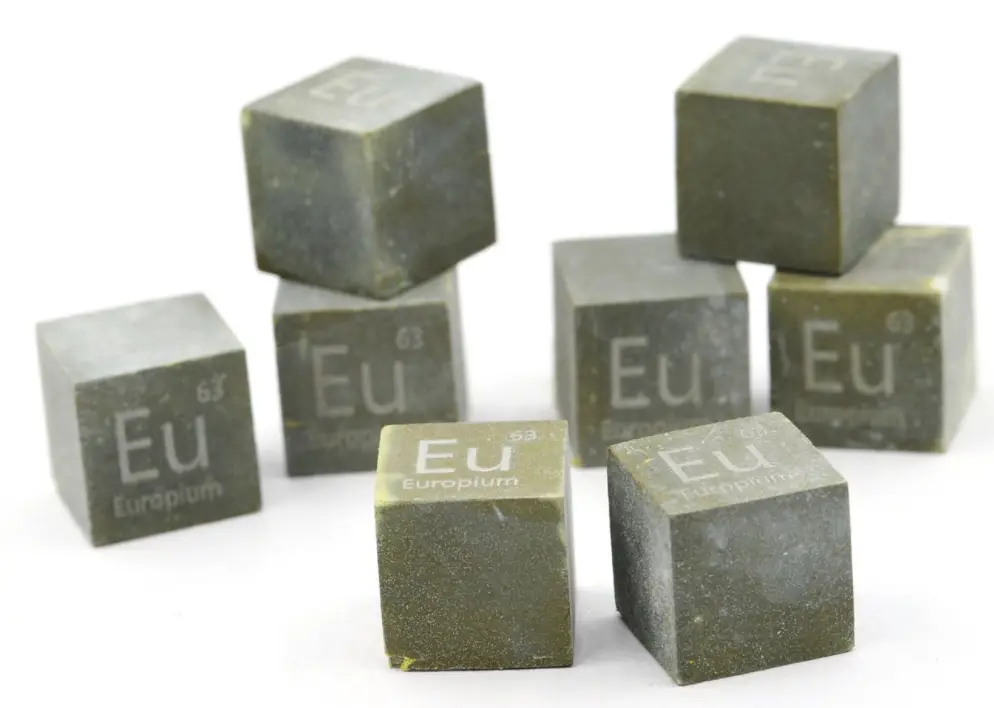
Europium is a moderately hard, silvery metal which readily oxidizes in air and water. Being a typical member of the lanthanide series, europium usually assumes the oxidation state +3. Europium is one of the least abundant elements in the universe. Only about 5×10⁻⁸% of all matter in the universe is europium.

Protons and Neutrons in Europium

Proton Number - Atomic NumberEuropium is a chemical element with atomic number 63 which means there are 63 protons in its nucleus. Total number of protons in the nucleus is called the atomic number of the atom and is given the symbol Z. The total electrical charge of the nucleus is therefore +Ze, where e (elementary charge) equals to 1,602 x 10-19 coulombs.

The total number of neutrons in the nucleus of an atom is called the neutron number of the atom and is given the symbol N. Neutron number plus atomic number equals atomic mass number: N+Z=A. The difference between the neutron number and the atomic number is known as the neutron excess: D = N – Z = A – 2Z.

For stable elements, there is usually a variety of stable isotopes. Isotopes are nuclides that have the same atomic number and are therefore the same element, but differ in the number of neutrons. Mass numbers of typical isotopes of Europium are 153. 

Main Isotopes of Europium

Europium occurs in 2 natural isotopes: 151Eu and 153Eu. 153Eu is the most common isotope, having a natural abundance of approximately 52%. Of these, 151Eu is very slightly radioactive, decaying by alpha decay with a half-life of 5×10¹⁸ years.

Europium-151 is composed of 63 protons, 88 neutrons, and 63 electrons.

Europium-153 is composed of 63 protons, 90 neutrons, and 63 electrons.

Naturally Occuring Isotopes

Isotope Abundance Neutron Number
151Eu 47.8% 88
153Eu 52.2% 90

Typical Unstable Isotopes

Isotope Half-life Decay Mode Product
150Eu 36.9 y electron capture 150Sm
151Eu 5×10¹⁸ y alpha decay 147Pm
152Eu 13.54 y beta decay or electron capture 152Gd or 152Sm
154Eu 8.59 y beta decay 154Gd
155Eu 4.76 y beta decay 155Gd

Electrons and Electron Configuration

The number of electrons in an electrically-neutral atom is the same as the number of protons in the nucleus. Therefore, the number of electrons in neutral atom of Europium is 63. Each electron is influenced by the electric fields produced by the positive nuclear charge and the other (Z – 1) negative electrons in the atom.

Since the number of electrons and their arrangement are responsible for the chemical behavior of atoms, the atomic number identifies the various chemical elements. The configuration of these electrons follows from the principles of quantum mechanics. The number of electrons in each element’s electron shells, particularly the outermost valence shell, is the primary factor in determining its chemical bonding behavior. In the periodic table, the elements are listed in order of increasing atomic number Z.

Electron configuration of Europium is [Xe] 4f7 6s2.

Possible oxidation states are +2,3.

Most Common Application of Europium

Europium is used in the printing of euro banknotes. It glows red under UV light, and forgeries can be detected by the lack of this red glow. Relative to most other elements, commercial applications for europium are few and rather specialized. Almost invariably, its phosphorescence is exploited, either in the +2 or +3 oxidation state. Europium is one of the elements involved in emitting red light in CRT televisions.

About Protons

protonA proton is one of the subatomic particles that make up matter. In the universe, protons are abundant, making up about half of all visible matter. It has a positive electric charge (+1e) and a rest mass equal to 1.67262 × 10⁻²⁷ kg (938.272 MeV/c2)— marginally lighter than that of the neutron but nearly 1836 times greater than that of the electron. The proton has a mean square radius of about 0.87 × 10⁻¹⁵ m, or 0.87 fm, and it is a spin – ½ fermion.

The protons exist in the nuclei of typical atoms, along with their neutral counterparts, the neutrons. Neutrons and protons, commonly called nucleons, are bound together in the atomic nucleus, where they account for 99.9 percent of the atom’s mass. Research in high-energy particle physics in the 20th century revealed that neither the neutron nor the proton is not the smallest building block of matter.

About Neutrons

A neutron is one of the subatomic particles that make up matter. In the universe, neutrons are abundant, making up more than half of all visible matter. It has no electric charge and a rest mass equal to 1.67493 × 10⁻²⁷ kg—marginally greater than that of the proton but nearly 1839 times greater than that of the electron. The neutron has a mean square radius of about 0.8×10⁻¹⁵ m, or 0.8 fm, and it is a spin-½ fermion.

Atomic nuclei consist of protons and neutrons, which attract each other through the nuclear force, while protons repel each other via the electric force due to their positive charge. These two forces compete, leading to various stability of nuclei. There are only certain combinations of neutrons and protons, which forms stable nuclei.

Neutrons stabilize the nucleus, because they attract each other and protons , which helps offset the electrical repulsion between protons. As a result, as the number of protons increases, an increasing ratio of neutrons to protons is needed to form a stable nucleus. If there are too many or too few neutrons for a given number of protons, the resulting nucleus is not stable and it undergoes radioactive decay. Unstable isotopes decay through various radioactive decay pathways, most commonly alpha decay, beta decay, or electron capture. Many other rare types of decay, such as spontaneous fission or neutron emission are known. It should be noted that all of these decay pathways may be accompanied by the subsequent emission of gamma radiation. Pure alpha or beta decays are very rare.

About Electrons and Electron Configuration

The periodic table is a tabular display of the chemical elements organized on the basis of their atomic numbers, electron configurations, and chemical properties. The electron configuration is the distribution of electrons of an atom or molecule (or other physical structure) in atomic or molecular orbitals. Knowledge of the electron configuration of different atoms is useful in understanding the structure of the periodic table of elements.

Every solid, liquid, gas, and plasma is composed of neutral or ionized atoms. The chemical properties of the atom are determined by the number of protons, in fact, by number and arrangement of electrons. The configuration of these electrons follows from the principles of quantum mechanics. The number of electrons in each element’s electron shells, particularly the outermost valence shell, is the primary factor in determining its chemical bonding behavior. In the periodic table, the elements are listed in order of increasing atomic number Z.

It is the Pauli exclusion principle that requires the electrons in an atom to occupy different energy levels instead of them all condensing in the ground state. The ordering of the electrons in the ground state of multielectron atoms, starts with the lowest energy state (ground state) and moves progressively from there up the energy scale until each of the atom’s electrons has been assigned a unique set of quantum numbers. This fact has key implications for the building up of the periodic table of elements.

electron configuration - blocks - elementsThe first two columns on the left side of the periodic table are where the s subshells are being occupied. Because of this, the first two rows of the periodic table are labeled the s block. Similarly, the p block are the right-most six columns of the periodic table, the d block is the middle 10 columns of the periodic table, while the f block is the 14-column section that is normally depicted as detached from the main body of the periodic table. It could be part of the main body, but then the periodic table would be rather long and cumbersome.

For atoms with many electrons, this notation can become lengthy and so an abbreviated notation is used. The electron configuration can be visualized as the core electrons, equivalent to the noble gas of the preceding period, and the valence electrons (e.g. [Xe] 6s2 for barium).

Oxidation States

Oxidation states are typically represented by integers which may be positive, zero, or negative. Most elements have more than one possible oxidation state. For example, carbon has nine possible integer oxidation states from −4 to +4.

The current IUPAC Gold Book definition of oxidation state is:

“Oxidation state of an atom is the charge of this atom after ionic approximation of its heteronuclear bonds…”

and the term oxidation number is nearly synonymous. An element that is not combined with any other different elements has an oxidation state of 0. Oxidation state 0 occurs for all elements – it is simply the element in its elemental form. An atom of an element in a compound will have a positive oxidation state if it has had electrons removed. Similarly, adding electrons results in a negative oxidation state. We have also distinguish between the possible and common oxidation states of every element. For example, silicon has nine possible integer oxidation states from −4 to +4, but only -4, 0 and +4 are common oxidation states.

Summary

Element Europium
Number of protons 63
Number of neutrons (typical isotopes) 153
Number of electrons 63
Electron configuration [Xe] 4f7 6s2
Oxidation states +2,3

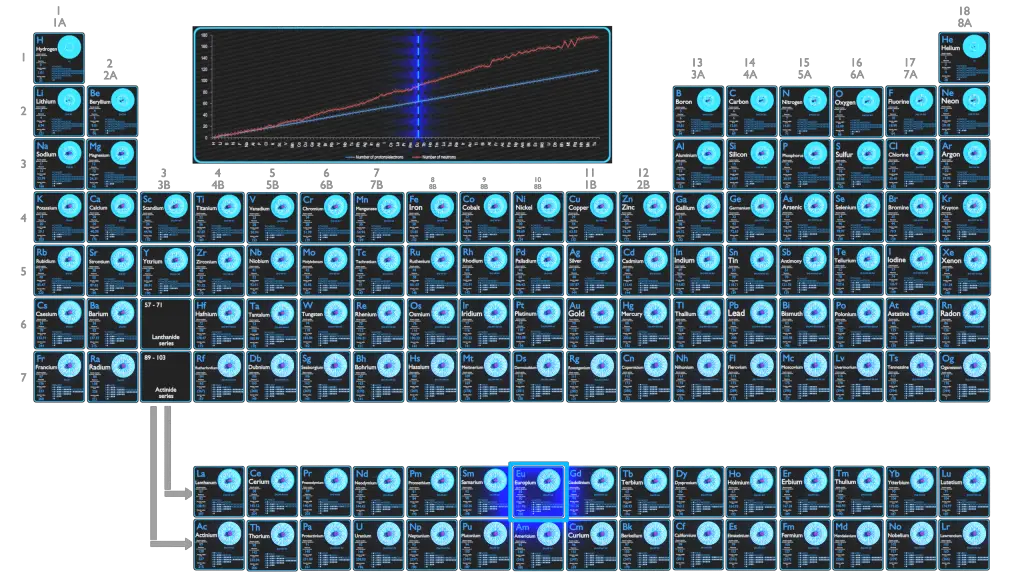
Europium-periodic-table

Source: www.luciteria.com


Properties of other elements

Europium - Comparison of Protons - Neutrons and Electrons

Periodic Table in 8K resolution

Other properties of Europium


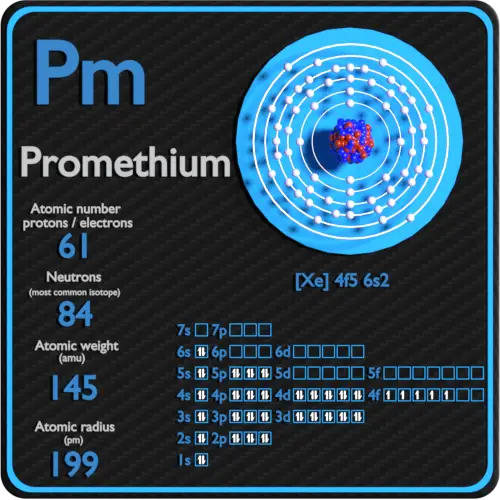
Promethium – Protons – Neutrons – Electrons – Electron Configuration

Promethium-protons-neutrons-electrons-configuration

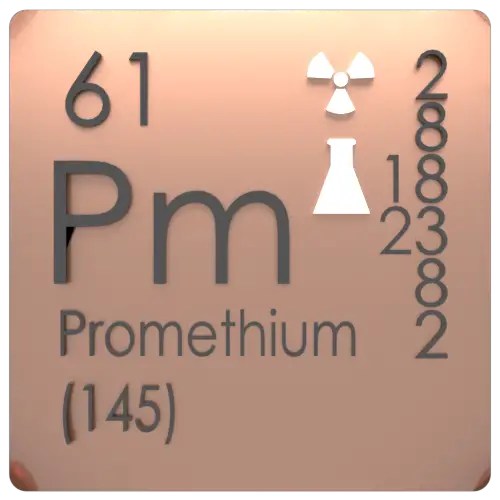
Promethium is one of only two such elements that are followed in the periodic table by elements with stable forms. All of its isotopes are radioactive. In nuclear reactors, promethium equilibrium exists in power operation. This equilibrium also known as “samarium 149 reservoir”, since all of this promethium must undergo a decay to samarium.

Protons and Neutrons in Promethium

Proton Number - Atomic NumberPromethium is a chemical element with atomic number 61 which means there are 61 protons in its nucleus. Total number of protons in the nucleus is called the atomic number of the atom and is given the symbol Z. The total electrical charge of the nucleus is therefore +Ze, where e (elementary charge) equals to 1,602 x 10-19 coulombs.

The total number of neutrons in the nucleus of an atom is called the neutron number of the atom and is given the symbol N. Neutron number plus atomic number equals atomic mass number: N+Z=A. The difference between the neutron number and the atomic number is known as the neutron excess: D = N – Z = A – 2Z.

For stable elements, there is usually a variety of stable isotopes. Isotopes are nuclides that have the same atomic number and are therefore the same element, but differ in the number of neutrons. Mass numbers of typical isotopes of Promethium are 149. 

Main Isotopes of Promethium

Promethium occurs in 2 natural isotopes: 145Pm and 147Pm. Both occur only in traces.

Promethium-145 is composed of 61 protons, 84 neutrons, and 61 electrons.

Promethium-147 is composed of 61 protons, 85 neutrons, and 61 electrons.

Naturally Occuring Isotopes

Isotope Abundance Neutron Number
145Pm (unstable) trace 84
147Pm (unstable) trace 85

Typical Unstable Isotopes

Isotope Half-life Decay Mode Product
145Pm 17.7 y electron capture 145Nd
146Pm 5.53 y beta decay 146Sm
147Pm 2.6234 y beta decay 147Sm

Electrons and Electron Configuration

The number of electrons in an electrically-neutral atom is the same as the number of protons in the nucleus. Therefore, the number of electrons in neutral atom of Promethium is 61. Each electron is influenced by the electric fields produced by the positive nuclear charge and the other (Z – 1) negative electrons in the atom.

Since the number of electrons and their arrangement are responsible for the chemical behavior of atoms, the atomic number identifies the various chemical elements. The configuration of these electrons follows from the principles of quantum mechanics. The number of electrons in each element’s electron shells, particularly the outermost valence shell, is the primary factor in determining its chemical bonding behavior. In the periodic table, the elements are listed in order of increasing atomic number Z.

Electron configuration of Promethium is [Xe] 4f5 6s2.

Possible oxidation states are +3.

Most Common Compounds of Promethium

Promethium belongs to the cerium group of lanthanides and is chemically very similar to the neighboring elements. Because of its instability, chemical studies of promethium are incomplete. Promethium is not extensively used metal. Most promethium is used only in research. Even though a few compounds have been synthesized, they are not fully studied; in general, they tend to be pink or red in color.

About Protons

protonA proton is one of the subatomic particles that make up matter. In the universe, protons are abundant, making up about half of all visible matter. It has a positive electric charge (+1e) and a rest mass equal to 1.67262 × 10⁻²⁷ kg (938.272 MeV/c2)— marginally lighter than that of the neutron but nearly 1836 times greater than that of the electron. The proton has a mean square radius of about 0.87 × 10⁻¹⁵ m, or 0.87 fm, and it is a spin – ½ fermion.

The protons exist in the nuclei of typical atoms, along with their neutral counterparts, the neutrons. Neutrons and protons, commonly called nucleons, are bound together in the atomic nucleus, where they account for 99.9 percent of the atom’s mass. Research in high-energy particle physics in the 20th century revealed that neither the neutron nor the proton is not the smallest building block of matter.

About Neutrons

A neutron is one of the subatomic particles that make up matter. In the universe, neutrons are abundant, making up more than half of all visible matter. It has no electric charge and a rest mass equal to 1.67493 × 10⁻²⁷ kg—marginally greater than that of the proton but nearly 1839 times greater than that of the electron. The neutron has a mean square radius of about 0.8×10⁻¹⁵ m, or 0.8 fm, and it is a spin-½ fermion.

Atomic nuclei consist of protons and neutrons, which attract each other through the nuclear force, while protons repel each other via the electric force due to their positive charge. These two forces compete, leading to various stability of nuclei. There are only certain combinations of neutrons and protons, which forms stable nuclei.

Neutrons stabilize the nucleus, because they attract each other and protons , which helps offset the electrical repulsion between protons. As a result, as the number of protons increases, an increasing ratio of neutrons to protons is needed to form a stable nucleus. If there are too many or too few neutrons for a given number of protons, the resulting nucleus is not stable and it undergoes radioactive decay. Unstable isotopes decay through various radioactive decay pathways, most commonly alpha decay, beta decay, or electron capture. Many other rare types of decay, such as spontaneous fission or neutron emission are known. It should be noted that all of these decay pathways may be accompanied by the subsequent emission of gamma radiation. Pure alpha or beta decays are very rare.

About Electrons and Electron Configuration

The periodic table is a tabular display of the chemical elements organized on the basis of their atomic numbers, electron configurations, and chemical properties. The electron configuration is the distribution of electrons of an atom or molecule (or other physical structure) in atomic or molecular orbitals. Knowledge of the electron configuration of different atoms is useful in understanding the structure of the periodic table of elements.

Every solid, liquid, gas, and plasma is composed of neutral or ionized atoms. The chemical properties of the atom are determined by the number of protons, in fact, by number and arrangement of electrons. The configuration of these electrons follows from the principles of quantum mechanics. The number of electrons in each element’s electron shells, particularly the outermost valence shell, is the primary factor in determining its chemical bonding behavior. In the periodic table, the elements are listed in order of increasing atomic number Z.

It is the Pauli exclusion principle that requires the electrons in an atom to occupy different energy levels instead of them all condensing in the ground state. The ordering of the electrons in the ground state of multielectron atoms, starts with the lowest energy state (ground state) and moves progressively from there up the energy scale until each of the atom’s electrons has been assigned a unique set of quantum numbers. This fact has key implications for the building up of the periodic table of elements.

electron configuration - blocks - elementsThe first two columns on the left side of the periodic table are where the s subshells are being occupied. Because of this, the first two rows of the periodic table are labeled the s block. Similarly, the p block are the right-most six columns of the periodic table, the d block is the middle 10 columns of the periodic table, while the f block is the 14-column section that is normally depicted as detached from the main body of the periodic table. It could be part of the main body, but then the periodic table would be rather long and cumbersome.

For atoms with many electrons, this notation can become lengthy and so an abbreviated notation is used. The electron configuration can be visualized as the core electrons, equivalent to the noble gas of the preceding period, and the valence electrons (e.g. [Xe] 6s2 for barium).

Oxidation States

Oxidation states are typically represented by integers which may be positive, zero, or negative. Most elements have more than one possible oxidation state. For example, carbon has nine possible integer oxidation states from −4 to +4.

The current IUPAC Gold Book definition of oxidation state is:

“Oxidation state of an atom is the charge of this atom after ionic approximation of its heteronuclear bonds…”

and the term oxidation number is nearly synonymous. An element that is not combined with any other different elements has an oxidation state of 0. Oxidation state 0 occurs for all elements – it is simply the element in its elemental form. An atom of an element in a compound will have a positive oxidation state if it has had electrons removed. Similarly, adding electrons results in a negative oxidation state. We have also distinguish between the possible and common oxidation states of every element. For example, silicon has nine possible integer oxidation states from −4 to +4, but only -4, 0 and +4 are common oxidation states.

Summary

Element Promethium
Number of protons 61
Number of neutrons (typical isotopes) 149
Number of electrons 61
Electron configuration [Xe] 4f5 6s2
Oxidation states +3

Promethium-periodic-table

Source: www.luciteria.com


Properties of other elements

Promethium - Comparison of Protons - Neutrons and Electrons

Periodic Table in 8K resolution

Other properties of Promethium


Samarium – Protons – Neutrons – Electrons – Electron Configuration

Samarium-protons-neutrons-electrons-configuration

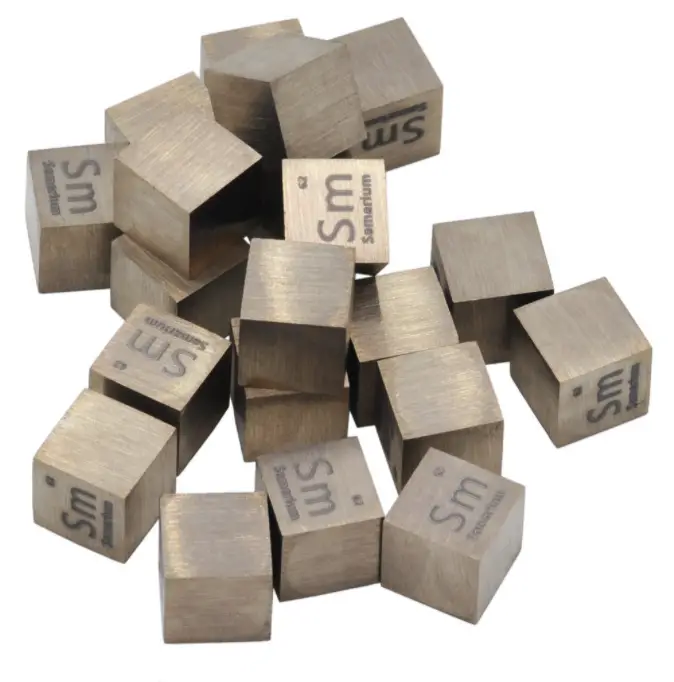
Samarium is a typical member of the lanthanide series, it is a moderately hard silvery metal that readily oxidizes in air. The name samarium is after the mineral samarskite from which it was isolated. Although classified as a rare earth element, samarium is the 40th most abundant element in the Earth’s crust and is more common than such metals as tin. In nuclear industry, especially natural and artificial samarium 149 has an important impact on the operation of a nuclear reactor. Samarium 149 has a very large neutron capture cross-section (about 42,000 barns). Since natural samarium contains about 14% of 149Sm, it can be used as an absorbing material in control rods.

Protons and Neutrons in Samarium

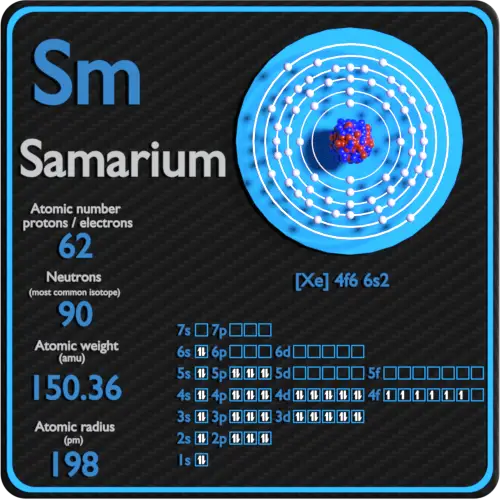
Proton Number - Atomic NumberSamarium is a chemical element with atomic number 62 which means there are 62 protons in its nucleus. Total number of protons in the nucleus is called the atomic number of the atom and is given the symbol Z. The total electrical charge of the nucleus is therefore +Ze, where e (elementary charge) equals to 1,602 x 10-19 coulombs.

The total number of neutrons in the nucleus of an atom is called the neutron number of the atom and is given the symbol N. Neutron number plus atomic number equals atomic mass number: N+Z=A. The difference between the neutron number and the atomic number is known as the neutron excess: D = N – Z = A – 2Z.

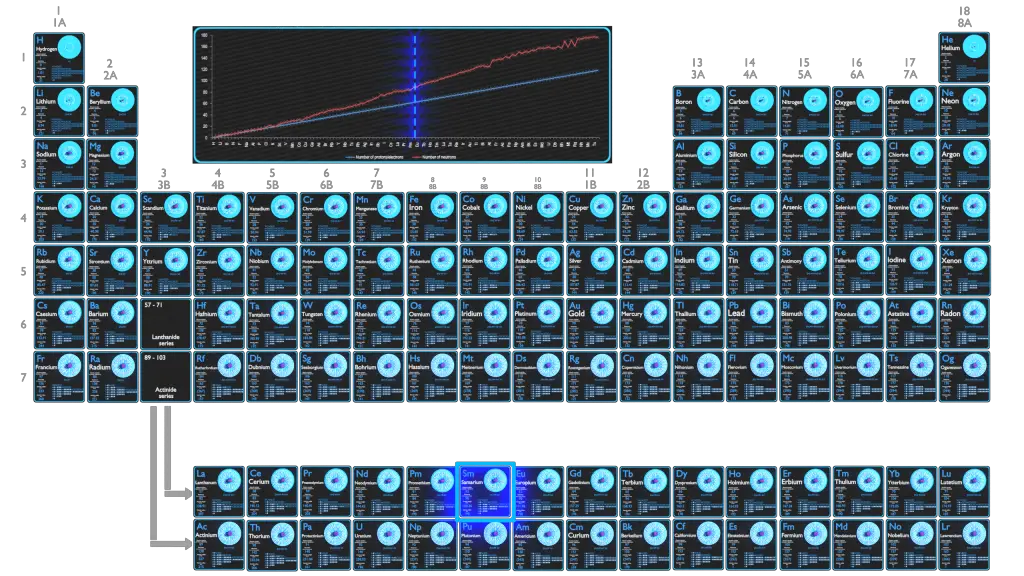
For stable elements, there is usually a variety of stable isotopes. Isotopes are nuclides that have the same atomic number and are therefore the same element, but differ in the number of neutrons. Mass numbers of typical isotopes of Samarium are 149, 150, 152, 154. 

Main Isotopes of Samarium

Samarium occurs in 7 natural isotopes: 144Sm, 147Sm, 148Sm, 149Sm, 150Sm, 152Sm and 154Sm. 152Sm is the most common isotope, having a natural abundance of approximately 26%. Of these, 147Sm and 148Sm are very slightly radioactive, decaying both by alpha decay with a half-life of 1.06×10¹¹ years and 7×10¹⁵ years.

Samarium-144 is composed of 62 protons, 82 neutrons, and 62 electrons.

Samarium-147 is composed of 62 protons, 85 neutrons, and 62 electrons.

Samarium-148 is composed of 62 protons, 86 neutrons, and 62 electrons.

Samarium-149 is composed of 62 protons, 87 neutrons, and 62 electrons.

Samarium-150 is composed of 62 protons, 88 neutrons, and 62 electrons.

Samarium-152 is composed of 62 protons, 90 neutrons, and 62 electrons.

Samarium-154 is composed of 62 protons, 92 neutrons, and 62 electrons.

Naturally Occuring Isotopes

Isotope Abundance Neutron Number
144Sm 3.08% 82
147Sm (unstable) 15.00% 85
148Sm (unstable) 11.25% 86
149Sm 13.82% 87
150Sm 7.37% 88
152Sm 26.74% 90
154Sm 22.74% 92

Typical Unstable Isotopes

Isotope Half-life Decay Mode Product
145Sm 340 d electron capture 145Pm
146Sm 6.8×10⁷ y alpha decay 142Nd
147Sm 1.06×10¹¹ y alpha decay 143Nd
148Sm 7×10¹⁵ y alpha decay 144Nd
151Sm 90 y beta decay 151Eu

Electrons and Electron Configuration

The number of electrons in an electrically-neutral atom is the same as the number of protons in the nucleus. Therefore, the number of electrons in neutral atom of Samarium is 62. Each electron is influenced by the electric fields produced by the positive nuclear charge and the other (Z – 1) negative electrons in the atom.

Since the number of electrons and their arrangement are responsible for the chemical behavior of atoms, the atomic number identifies the various chemical elements. The configuration of these electrons follows from the principles of quantum mechanics. The number of electrons in each element’s electron shells, particularly the outermost valence shell, is the primary factor in determining its chemical bonding behavior. In the periodic table, the elements are listed in order of increasing atomic number Z.

Electron configuration of Samarium is [Xe] 4f6 6s2.

Possible oxidation states are +2,3.

Most Common Application of Samarium

Samarium is mainly used in preparing samarium-cobalt alloy magnets for electric guitars, small motors and headphones. These samarium–cobalt magnet alloys (generally written as SmCo5, or SmCo Series 1:5) have one atom of rare-earth samarium per five atoms of cobalt. By weight this magnet alloy will typically contain 36% samarium with the balance cobalt. Samarium-cobalt magnets are much more powerful than iron magnets. They remain magnetic at high temperatures and so are used in microwave applications.

About Protons

protonA proton is one of the subatomic particles that make up matter. In the universe, protons are abundant, making up about half of all visible matter. It has a positive electric charge (+1e) and a rest mass equal to 1.67262 × 10⁻²⁷ kg (938.272 MeV/c2)— marginally lighter than that of the neutron but nearly 1836 times greater than that of the electron. The proton has a mean square radius of about 0.87 × 10⁻¹⁵ m, or 0.87 fm, and it is a spin – ½ fermion.

The protons exist in the nuclei of typical atoms, along with their neutral counterparts, the neutrons. Neutrons and protons, commonly called nucleons, are bound together in the atomic nucleus, where they account for 99.9 percent of the atom’s mass. Research in high-energy particle physics in the 20th century revealed that neither the neutron nor the proton is not the smallest building block of matter.

About Neutrons

A neutron is one of the subatomic particles that make up matter. In the universe, neutrons are abundant, making up more than half of all visible matter. It has no electric charge and a rest mass equal to 1.67493 × 10⁻²⁷ kg—marginally greater than that of the proton but nearly 1839 times greater than that of the electron. The neutron has a mean square radius of about 0.8×10⁻¹⁵ m, or 0.8 fm, and it is a spin-½ fermion.

Atomic nuclei consist of protons and neutrons, which attract each other through the nuclear force, while protons repel each other via the electric force due to their positive charge. These two forces compete, leading to various stability of nuclei. There are only certain combinations of neutrons and protons, which forms stable nuclei.

Neutrons stabilize the nucleus, because they attract each other and protons , which helps offset the electrical repulsion between protons. As a result, as the number of protons increases, an increasing ratio of neutrons to protons is needed to form a stable nucleus. If there are too many or too few neutrons for a given number of protons, the resulting nucleus is not stable and it undergoes radioactive decay. Unstable isotopes decay through various radioactive decay pathways, most commonly alpha decay, beta decay, or electron capture. Many other rare types of decay, such as spontaneous fission or neutron emission are known. It should be noted that all of these decay pathways may be accompanied by the subsequent emission of gamma radiation. Pure alpha or beta decays are very rare.

About Electrons and Electron Configuration

The periodic table is a tabular display of the chemical elements organized on the basis of their atomic numbers, electron configurations, and chemical properties. The electron configuration is the distribution of electrons of an atom or molecule (or other physical structure) in atomic or molecular orbitals. Knowledge of the electron configuration of different atoms is useful in understanding the structure of the periodic table of elements.

Every solid, liquid, gas, and plasma is composed of neutral or ionized atoms. The chemical properties of the atom are determined by the number of protons, in fact, by number and arrangement of electrons. The configuration of these electrons follows from the principles of quantum mechanics. The number of electrons in each element’s electron shells, particularly the outermost valence shell, is the primary factor in determining its chemical bonding behavior. In the periodic table, the elements are listed in order of increasing atomic number Z.

It is the Pauli exclusion principle that requires the electrons in an atom to occupy different energy levels instead of them all condensing in the ground state. The ordering of the electrons in the ground state of multielectron atoms, starts with the lowest energy state (ground state) and moves progressively from there up the energy scale until each of the atom’s electrons has been assigned a unique set of quantum numbers. This fact has key implications for the building up of the periodic table of elements.

electron configuration - blocks - elementsThe first two columns on the left side of the periodic table are where the s subshells are being occupied. Because of this, the first two rows of the periodic table are labeled the s block. Similarly, the p block are the right-most six columns of the periodic table, the d block is the middle 10 columns of the periodic table, while the f block is the 14-column section that is normally depicted as detached from the main body of the periodic table. It could be part of the main body, but then the periodic table would be rather long and cumbersome.

For atoms with many electrons, this notation can become lengthy and so an abbreviated notation is used. The electron configuration can be visualized as the core electrons, equivalent to the noble gas of the preceding period, and the valence electrons (e.g. [Xe] 6s2 for barium).

Oxidation States

Oxidation states are typically represented by integers which may be positive, zero, or negative. Most elements have more than one possible oxidation state. For example, carbon has nine possible integer oxidation states from −4 to +4.

The current IUPAC Gold Book definition of oxidation state is:

“Oxidation state of an atom is the charge of this atom after ionic approximation of its heteronuclear bonds…”

and the term oxidation number is nearly synonymous. An element that is not combined with any other different elements has an oxidation state of 0. Oxidation state 0 occurs for all elements – it is simply the element in its elemental form. An atom of an element in a compound will have a positive oxidation state if it has had electrons removed. Similarly, adding electrons results in a negative oxidation state. We have also distinguish between the possible and common oxidation states of every element. For example, silicon has nine possible integer oxidation states from −4 to +4, but only -4, 0 and +4 are common oxidation states.

Summary

Element Samarium
Number of protons 62
Number of neutrons (typical isotopes) 149, 150, 152, 154
Number of electrons 62
Electron configuration [Xe] 4f6 6s2
Oxidation states +2,3

Samarium-periodic-table

Source: www.luciteria.com


Properties of other elements

Samarium - Comparison of Protons - Neutrons and Electrons

Periodic Table in 8K resolution

Other properties of Samarium


Praseodymium – Protons – Neutrons – Electrons – Electron Configuration
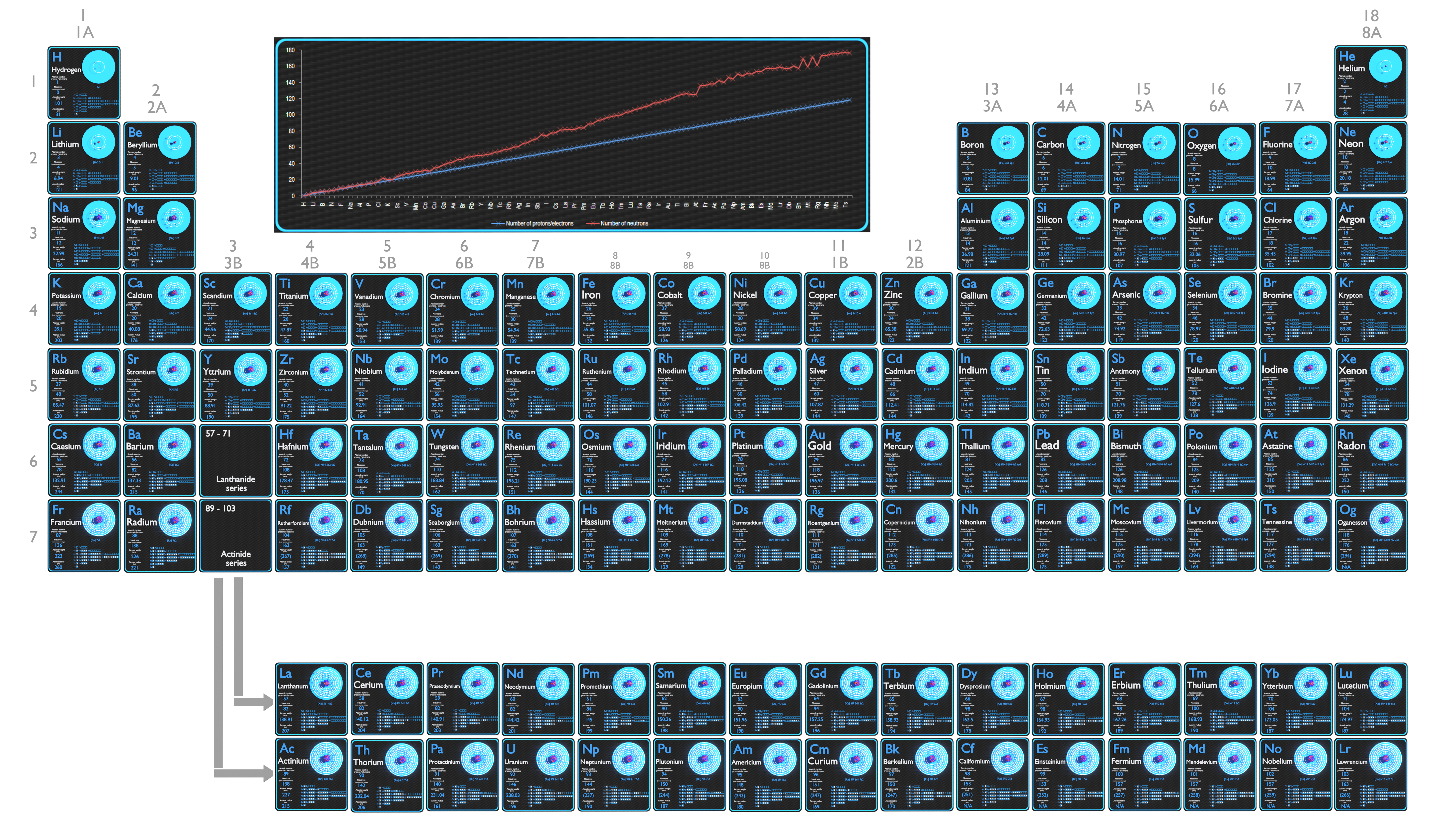
Praseodymium-protons-neutrons-electrons-configuration

Praseodymium is a soft, silvery, malleable and ductile metal, valued for its magnetic, electrical, chemical, and optical properties. Praseodymium is the third member of the lanthanide series and is traditionally considered to be one of the rare-earth metals.

Protons and Neutrons in Praseodymium

Proton Number - Atomic NumberPraseodymium is a chemical element with atomic number 59 which means there are 59 protons in its nucleus. Total number of protons in the nucleus is called the atomic number of the atom and is given the symbol Z. The total electrical charge of the nucleus is therefore +Ze, where e (elementary charge) equals to 1,602 x 10-19 coulombs.

The total number of neutrons in the nucleus of an atom is called the neutron number of the atom and is given the symbol N. Neutron number plus atomic number equals atomic mass number: N+Z=A. The difference between the neutron number and the atomic number is known as the neutron excess: D = N – Z = A – 2Z.

For stable elements, there is usually a variety of stable isotopes. Isotopes are nuclides that have the same atomic number and are therefore the same element, but differ in the number of neutrons. Mass numbers of typical isotopes of Praseodymium are 141. 

Main Isotopes of Praseodymium

Praseodymium occur only in one natural isotope – 141Pr.

Praseodymium-141 is composed of 59 protons, 82 neutrons, and 59 electrons.

Naturally Occuring Isotopes

Isotope Abundance Neutron Number
141Pr 100.00% 82

Typical Unstable Isotopes

Isotope Half-life Decay Mode Product
142Pr 19.12 h electron capture or beta decay 142Ce or 142Nd
143Pr 13.57 d beta decay 143Nd

Electrons and Electron Configuration

The number of electrons in an electrically-neutral atom is the same as the number of protons in the nucleus. Therefore, the number of electrons in neutral atom of Praseodymium is 59. Each electron is influenced by the electric fields produced by the positive nuclear charge and the other (Z – 1) negative electrons in the atom.

Since the number of electrons and their arrangement are responsible for the chemical behavior of atoms, the atomic number identifies the various chemical elements. The configuration of these electrons follows from the principles of quantum mechanics. The number of electrons in each element’s electron shells, particularly the outermost valence shell, is the primary factor in determining its chemical bonding behavior. In the periodic table, the elements are listed in order of increasing atomic number Z.

Electron configuration of Praseodymium is [Xe] 4f3 6s2.

Possible oxidation states are +3.

Most Common Application of Praseodymium

Praseodymium is used in a variety of alloys. The high-strength alloy it forms with magnesium is used in aircraft engines. Mischmetal is an alloy containing about 5% praseodymium and is used to make flints for cigarette lighters. In combination with neodymium, another rare-earth element, praseodymium is used to create high-power magnets notable for their strength and durability.

About Protons

protonA proton is one of the subatomic particles that make up matter. In the universe, protons are abundant, making up about half of all visible matter. It has a positive electric charge (+1e) and a rest mass equal to 1.67262 × 10⁻²⁷ kg (938.272 MeV/c2)— marginally lighter than that of the neutron but nearly 1836 times greater than that of the electron. The proton has a mean square radius of about 0.87 × 10⁻¹⁵ m, or 0.87 fm, and it is a spin – ½ fermion.

The protons exist in the nuclei of typical atoms, along with their neutral counterparts, the neutrons. Neutrons and protons, commonly called nucleons, are bound together in the atomic nucleus, where they account for 99.9 percent of the atom’s mass. Research in high-energy particle physics in the 20th century revealed that neither the neutron nor the proton is not the smallest building block of matter.

About Neutrons

A neutron is one of the subatomic particles that make up matter. In the universe, neutrons are abundant, making up more than half of all visible matter. It has no electric charge and a rest mass equal to 1.67493 × 10⁻²⁷ kg—marginally greater than that of the proton but nearly 1839 times greater than that of the electron. The neutron has a mean square radius of about 0.8×10⁻¹⁵ m, or 0.8 fm, and it is a spin-½ fermion.

Atomic nuclei consist of protons and neutrons, which attract each other through the nuclear force, while protons repel each other via the electric force due to their positive charge. These two forces compete, leading to various stability of nuclei. There are only certain combinations of neutrons and protons, which forms stable nuclei.

Neutrons stabilize the nucleus, because they attract each other and protons , which helps offset the electrical repulsion between protons. As a result, as the number of protons increases, an increasing ratio of neutrons to protons is needed to form a stable nucleus. If there are too many or too few neutrons for a given number of protons, the resulting nucleus is not stable and it undergoes radioactive decay. Unstable isotopes decay through various radioactive decay pathways, most commonly alpha decay, beta decay, or electron capture. Many other rare types of decay, such as spontaneous fission or neutron emission are known. It should be noted that all of these decay pathways may be accompanied by the subsequent emission of gamma radiation. Pure alpha or beta decays are very rare.

About Electrons and Electron Configuration

The periodic table is a tabular display of the chemical elements organized on the basis of their atomic numbers, electron configurations, and chemical properties. The electron configuration is the distribution of electrons of an atom or molecule (or other physical structure) in atomic or molecular orbitals. Knowledge of the electron configuration of different atoms is useful in understanding the structure of the periodic table of elements.

Every solid, liquid, gas, and plasma is composed of neutral or ionized atoms. The chemical properties of the atom are determined by the number of protons, in fact, by number and arrangement of electrons. The configuration of these electrons follows from the principles of quantum mechanics. The number of electrons in each element’s electron shells, particularly the outermost valence shell, is the primary factor in determining its chemical bonding behavior. In the periodic table, the elements are listed in order of increasing atomic number Z.

It is the Pauli exclusion principle that requires the electrons in an atom to occupy different energy levels instead of them all condensing in the ground state. The ordering of the electrons in the ground state of multielectron atoms, starts with the lowest energy state (ground state) and moves progressively from there up the energy scale until each of the atom’s electrons has been assigned a unique set of quantum numbers. This fact has key implications for the building up of the periodic table of elements.

electron configuration - blocks - elementsThe first two columns on the left side of the periodic table are where the s subshells are being occupied. Because of this, the first two rows of the periodic table are labeled the s block. Similarly, the p block are the right-most six columns of the periodic table, the d block is the middle 10 columns of the periodic table, while the f block is the 14-column section that is normally depicted as detached from the main body of the periodic table. It could be part of the main body, but then the periodic table would be rather long and cumbersome.

For atoms with many electrons, this notation can become lengthy and so an abbreviated notation is used. The electron configuration can be visualized as the core electrons, equivalent to the noble gas of the preceding period, and the valence electrons (e.g. [Xe] 6s2 for barium).

Oxidation States

Oxidation states are typically represented by integers which may be positive, zero, or negative. Most elements have more than one possible oxidation state. For example, carbon has nine possible integer oxidation states from −4 to +4.

The current IUPAC Gold Book definition of oxidation state is:

“Oxidation state of an atom is the charge of this atom after ionic approximation of its heteronuclear bonds…”

and the term oxidation number is nearly synonymous. An element that is not combined with any other different elements has an oxidation state of 0. Oxidation state 0 occurs for all elements – it is simply the element in its elemental form. An atom of an element in a compound will have a positive oxidation state if it has had electrons removed. Similarly, adding electrons results in a negative oxidation state. We have also distinguish between the possible and common oxidation states of every element. For example, silicon has nine possible integer oxidation states from −4 to +4, but only -4, 0 and +4 are common oxidation states.

Summary

Element Praseodymium
Number of protons 59
Number of neutrons (typical isotopes) 141
Number of electrons 59
Electron configuration [Xe] 4f3 6s2
Oxidation states +3

Praseodymium-periodic-table

Source: www.luciteria.com


Properties of other elements

Praseodymium - Comparison of Protons - Neutrons and Electrons

Periodic Table in 8K resolution

Other properties of Praseodymium


Neodymium – Protons – Neutrons – Electrons – Electron Configuration

Neodymium-protons-neutrons-electrons-configuration

Neodymium is a soft silvery metal that tarnishes in air. Neodymium is not found naturally in metallic form or unmixed with other lanthanides, and it is usually refined for general use. Although neodymium is classed as a rare earth, it is a fairly common element.

Protons and Neutrons in Neodymium

Proton Number - Atomic NumberNeodymium is a chemical element with atomic number 60 which means there are 60 protons in its nucleus. Total number of protons in the nucleus is called the atomic number of the atom and is given the symbol Z. The total electrical charge of the nucleus is therefore +Ze, where e (elementary charge) equals to 1,602 x 10-19 coulombs.

The total number of neutrons in the nucleus of an atom is called the neutron number of the atom and is given the symbol N. Neutron number plus atomic number equals atomic mass number: N+Z=A. The difference between the neutron number and the atomic number is known as the neutron excess: D = N – Z = A – 2Z.

For stable elements, there is usually a variety of stable isotopes. Isotopes are nuclides that have the same atomic number and are therefore the same element, but differ in the number of neutrons. Mass numbers of typical isotopes of Neodymium are 142, 143, 145-147. 

Main Isotopes of Neodymium

Neodymium occurs in 7 natural isotopes: 142Nd, 143Nd, 144Nd, 145Nd, 146Nd, 148Nd and 150Nd. Of these, 144Nd, 148Nd and 150Nd are unstable and very slightly radioactive. 142Nd is the most common isotope, having a natural abundance of approximately 27%.

Neodymium-142 is composed of 60 protons, 82 neutrons, and 60 electrons.

Neodymium-143 is composed of 60 protons, 83 neutrons, and 60 electrons.

Neodymium-144 is composed of 60 protons, 84 neutrons, and 60 electrons.

Neodymium-145 is composed of 60 protons, 85 neutrons, and 60 electrons.

Neodymium-146 is composed of 60 protons, 86 neutrons, and 60 electrons.

Neodymium-148 is composed of 60 protons, 88 neutrons, and 60 electrons.

Neodymium-150 is composed of 60 protons, 90 neutrons, and 60 electrons.

Naturally Occuring Isotopes

Isotope Abundance Neutron Number
142Nd 27.2% 82
143Nd 12.2% 83
144Nd (unstable) 23.8% 84
145Nd 8.3% 85
146Nd 17.2% 86
148Nd (unstable) 5.8% 88
150Nd (unstable) 5.6% 90

Typical Unstable Isotopes

Isotope Half-life Decay Mode Product
144Nd 2.29×10¹⁵ y aplha decay 140Ce
148Nd 2.7×10¹⁸ y double beta decay 148Sm
150Nd 21×1018 y double beta decay 150Sm

Electrons and Electron Configuration

The number of electrons in an electrically-neutral atom is the same as the number of protons in the nucleus. Therefore, the number of electrons in neutral atom of Neodymium is 60. Each electron is influenced by the electric fields produced by the positive nuclear charge and the other (Z – 1) negative electrons in the atom.

Since the number of electrons and their arrangement are responsible for the chemical behavior of atoms, the atomic number identifies the various chemical elements. The configuration of these electrons follows from the principles of quantum mechanics. The number of electrons in each element’s electron shells, particularly the outermost valence shell, is the primary factor in determining its chemical bonding behavior. In the periodic table, the elements are listed in order of increasing atomic number Z.

Electron configuration of Neodymium is [Xe] 4f4 6s2.

Possible oxidation states are +3.

Most Common Application of Neodymium

The most important use for neodymium is in an alloy with iron and boron to make very strong permanent magnets. A neodymium magnet is the most widely used type of rare-earth magnet. It is a permanent magnet made from an alloy of neodymium, iron, and boron to form the Nd2Fe14B tetragonal crystalline structure. These magnets are widely used in such products as microphones, professional loudspeakers, in-ear headphones, high performance hobby DC electric motors, and computer hard disks, where low magnet mass (or volume) or strong magnetic fields are required.

About Protons

protonA proton is one of the subatomic particles that make up matter. In the universe, protons are abundant, making up about half of all visible matter. It has a positive electric charge (+1e) and a rest mass equal to 1.67262 × 10⁻²⁷ kg (938.272 MeV/c2)— marginally lighter than that of the neutron but nearly 1836 times greater than that of the electron. The proton has a mean square radius of about 0.87 × 10⁻¹⁵ m, or 0.87 fm, and it is a spin – ½ fermion.

The protons exist in the nuclei of typical atoms, along with their neutral counterparts, the neutrons. Neutrons and protons, commonly called nucleons, are bound together in the atomic nucleus, where they account for 99.9 percent of the atom’s mass. Research in high-energy particle physics in the 20th century revealed that neither the neutron nor the proton is not the smallest building block of matter.

About Neutrons

A neutron is one of the subatomic particles that make up matter. In the universe, neutrons are abundant, making up more than half of all visible matter. It has no electric charge and a rest mass equal to 1.67493 × 10⁻²⁷ kg—marginally greater than that of the proton but nearly 1839 times greater than that of the electron. The neutron has a mean square radius of about 0.8×10⁻¹⁵ m, or 0.8 fm, and it is a spin-½ fermion.

Atomic nuclei consist of protons and neutrons, which attract each other through the nuclear force, while protons repel each other via the electric force due to their positive charge. These two forces compete, leading to various stability of nuclei. There are only certain combinations of neutrons and protons, which forms stable nuclei.

Neutrons stabilize the nucleus, because they attract each other and protons , which helps offset the electrical repulsion between protons. As a result, as the number of protons increases, an increasing ratio of neutrons to protons is needed to form a stable nucleus. If there are too many or too few neutrons for a given number of protons, the resulting nucleus is not stable and it undergoes radioactive decay. Unstable isotopes decay through various radioactive decay pathways, most commonly alpha decay, beta decay, or electron capture. Many other rare types of decay, such as spontaneous fission or neutron emission are known. It should be noted that all of these decay pathways may be accompanied by the subsequent emission of gamma radiation. Pure alpha or beta decays are very rare.

About Electrons and Electron Configuration

The periodic table is a tabular display of the chemical elements organized on the basis of their atomic numbers, electron configurations, and chemical properties. The electron configuration is the distribution of electrons of an atom or molecule (or other physical structure) in atomic or molecular orbitals. Knowledge of the electron configuration of different atoms is useful in understanding the structure of the periodic table of elements.

Every solid, liquid, gas, and plasma is composed of neutral or ionized atoms. The chemical properties of the atom are determined by the number of protons, in fact, by number and arrangement of electrons. The configuration of these electrons follows from the principles of quantum mechanics. The number of electrons in each element’s electron shells, particularly the outermost valence shell, is the primary factor in determining its chemical bonding behavior. In the periodic table, the elements are listed in order of increasing atomic number Z.

It is the Pauli exclusion principle that requires the electrons in an atom to occupy different energy levels instead of them all condensing in the ground state. The ordering of the electrons in the ground state of multielectron atoms, starts with the lowest energy state (ground state) and moves progressively from there up the energy scale until each of the atom’s electrons has been assigned a unique set of quantum numbers. This fact has key implications for the building up of the periodic table of elements.

electron configuration - blocks - elementsThe first two columns on the left side of the periodic table are where the s subshells are being occupied. Because of this, the first two rows of the periodic table are labeled the s block. Similarly, the p block are the right-most six columns of the periodic table, the d block is the middle 10 columns of the periodic table, while the f block is the 14-column section that is normally depicted as detached from the main body of the periodic table. It could be part of the main body, but then the periodic table would be rather long and cumbersome.

For atoms with many electrons, this notation can become lengthy and so an abbreviated notation is used. The electron configuration can be visualized as the core electrons, equivalent to the noble gas of the preceding period, and the valence electrons (e.g. [Xe] 6s2 for barium).

Oxidation States

Oxidation states are typically represented by integers which may be positive, zero, or negative. Most elements have more than one possible oxidation state. For example, carbon has nine possible integer oxidation states from −4 to +4.

The current IUPAC Gold Book definition of oxidation state is:

“Oxidation state of an atom is the charge of this atom after ionic approximation of its heteronuclear bonds…”

and the term oxidation number is nearly synonymous. An element that is not combined with any other different elements has an oxidation state of 0. Oxidation state 0 occurs for all elements – it is simply the element in its elemental form. An atom of an element in a compound will have a positive oxidation state if it has had electrons removed. Similarly, adding electrons results in a negative oxidation state. We have also distinguish between the possible and common oxidation states of every element. For example, silicon has nine possible integer oxidation states from −4 to +4, but only -4, 0 and +4 are common oxidation states.

Summary

Element Neodymium
Number of protons 60
Number of neutrons (typical isotopes) 142, 143, 145-147
Number of electrons 60
Electron configuration [Xe] 4f4 6s2
Oxidation states +3

Neodymium-periodic-table

Source: www.luciteria.com


Properties of other elements

Neodymium - Comparison of Protons - Neutrons and Electrons

Periodic Table in 8K resolution

Other properties of Neodymium