Facebook Instagram Youtube Twitter

Zirconium and Tungsten – Comparison – Properties

This article contains comparison of key thermal and atomic properties of zirconium and tungsten, two comparable chemical elements from the periodic table. It also contains basic descriptions and applications of both elements. Zirconium vs Tungsten.

zirconium and tungsten - comparison

Compare zirconium with another element

Titanium - Properties - Price - Applications - Production

Iron - Properties - Price - Applications - Production

Hafnium - Properties - Price - Applications - Production

Niobium - Properties - Price - Applications - Production

Tungsten - Properties - Price - Applications - Production

Uranium - Properties - Price - Applications - Production

Compare tungsten with another element

Titanium - Properties - Price - Applications - Production

Chromium - Properties - Price - Applications - Production

Cobalt - Properties - Price - Applications - Production

Zirconium - Properties - Price - Applications - Production

Molybdenum - Properties - Price - Applications - Production

Platinum - Properties - Price - Applications - Production

Rhenium - Properties - Price - Applications - Production

Gold - Properties - Price - Applications - Production

Iridium - Properties - Price - Applications - Production

Zirconium and Tungsten – About Elements

Zirconium

Zirconium is a lustrous, grey-white, strong transition metal that resembles hafnium and, to a lesser extent, titanium. Zirconium is mainly used as a refractory and opacifier, although small amounts are used as an alloying agent for its strong resistance to corrosion. Zirconium is widely used as a cladding for nuclear reactor fuels. The desired properties of these alloys are a low neutron-capture cross-section and resistance to corrosion under normal service conditions.

Tungsten

Tungsten is a rare metal found naturally on Earth almost exclusively in chemical compounds. Tungsten is an intrinsically brittle and hard material, making it difficult to work.

Zirconium in Periodic Table

Tungsten in Periodic Table

Source: www.luciteria.com

Zirconium and Tungsten – Applications

Zirconium

Most zircon is used directly in high-temperature applications. This material is refractory, hard, and resistant to chemical attack. Because of these properties, zircon finds many applications, few of which are highly publicized. Its main use is as an opacifier, conferring a white, opaque appearance to ceramic materials. Zirconium and its alloys are widely used as a cladding for nuclear reactor fuels. Zirconium alloyed with niobium or tin has excellent corrosion properties. The high corrosion resistance of zirconium alloys results from the natural formation of a dense stable oxide on the surface of the metal. This film is self healing, it continues to grow slowly at temperatures up to approximately 550 °C (1020 °F), and it remains tightly adherent. The desired property of these alloys is also a low neutron-capture cross-section. The disadvantages of zirconium are low strength properties and low heat resistance, which can be eliminated, for example, by alloying with niobium.

Tungsten

Tungsten is widely used metal. Approximately half of the tungsten is consumed for the production of hard materials – namely tungsten carbide – with the remaining major use being in alloys and steels. Mining and mineral processing demand wear-resistant machines and components, because the energies and masses of interacting bodies are significant. For this purposes, materials with the highest wear-resistance must be used. For example, tungsten carbide is used extensively in mining in top hammer rock drill bits, downhole hammers, roller-cutters, long wall plough chisels, long wall shearer picks, raiseboring reamers, and tunnel boring machines. The remaining 40% is generally used to make various alloys and specialty steels, electrodes, filaments, wires, as well as diverse components for electric, electronic, heating, lighting, and welding applications. High-speed steels are complex iron-base alloys of carbon, chromium, vanadium, molybdenum, or tungsten (as much as 18%), or combinations there of.

Zirconium and Tungsten – Comparison in Table

Element Zirconium Tungsten
Density 6.511 g/cm3 19.25 g/cm3
Ultimate Tensile Strength 330 MPa 980 MPa
Yield Strength 230 MPa 750 MPa
Young’s Modulus of Elasticity 88 GPa 411 GPa
Mohs Scale 5 7.5
Brinell Hardness 650 MPa 3000 MPa
Vickers Hardness 900 MPa 3500 MPa
Melting Point 1855 °C 3410 °C
Boiling Point 4377 °C 59300 °C
Thermal Conductivity 22.7 W/mK 170 W/mK
Thermal Expansion Coefficient 5.7 µm/mK 4.5 µm/mK
Specific Heat 0.27 J/g K 0.13 J/g K
Heat of Fusion 16.9 kJ/mol 35.4 kJ/mol
Heat of Vaporization 591 kJ/mol 824 kJ/mol


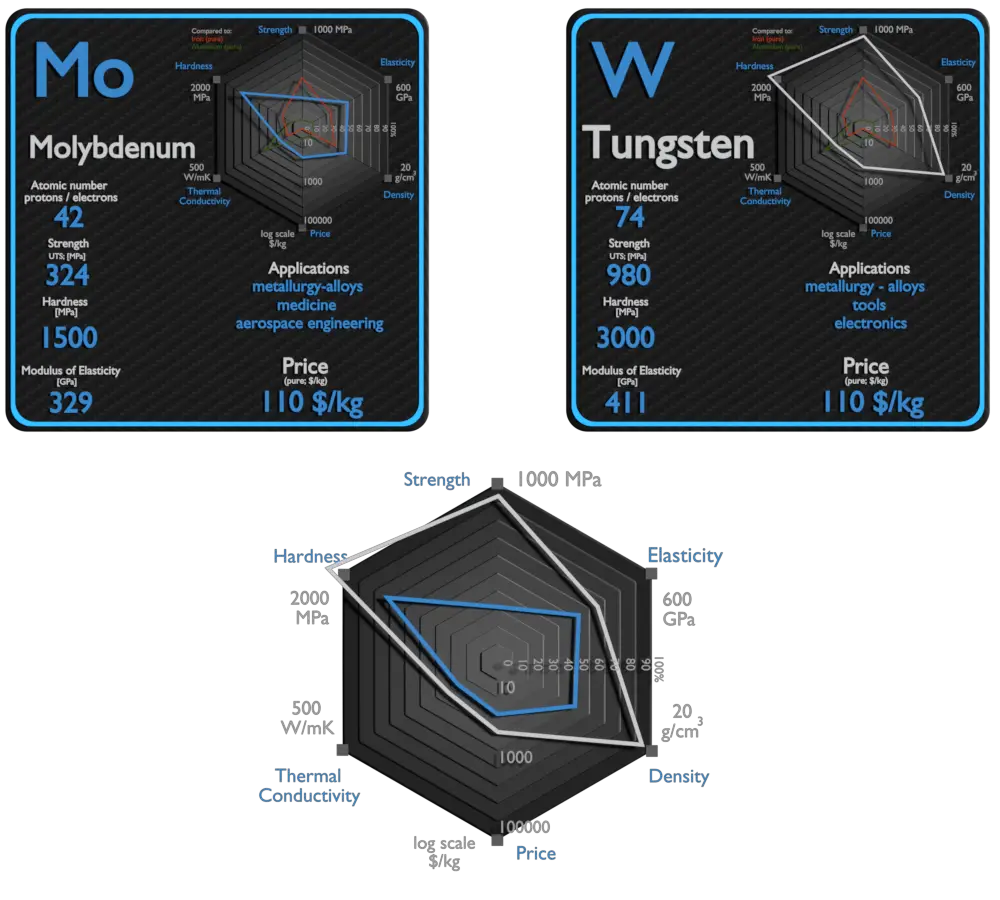
Molybdenum and Tungsten – Comparison – Properties

This article contains comparison of key thermal and atomic properties of molybdenum and tungsten, two comparable chemical elements from the periodic table. It also contains basic descriptions and applications of both elements. Molybdenum vs Tungsten.

molybdenum and tungsten - comparison

Compare molybdenum with another element

Chromium - Properties - Price - Applications - Production

Tungsten - Properties - Price - Applications - Production

Compare tungsten with another element

Titanium - Properties - Price - Applications - Production

Chromium - Properties - Price - Applications - Production

Cobalt - Properties - Price - Applications - Production

Zirconium - Properties - Price - Applications - Production

Molybdenum - Properties - Price - Applications - Production

Platinum - Properties - Price - Applications - Production

Rhenium - Properties - Price - Applications - Production

Gold - Properties - Price - Applications - Production

Iridium - Properties - Price - Applications - Production

Molybdenum and Tungsten – About Elements

Molybdenum

Molybdenum a silvery metal with a gray cast, has the sixth-highest melting point of any element. It readily forms hard, stable carbides in alloys, and for this reason most of world production of the element (about 80%) is used in steel alloys, including high-strength alloys and superalloys.

Tungsten

Tungsten is a rare metal found naturally on Earth almost exclusively in chemical compounds. Tungsten is an intrinsically brittle and hard material, making it difficult to work.

Molybdenum in Periodic Table

Tungsten in Periodic Table

Source: www.luciteria.com

Molybdenum and Tungsten – Applications

Molybdenum

About 86% of molybdenum produced is used in metallurgy, with the rest used in chemical applications. The estimated global use is structural steel 35%, stainless steel 25%, chemicals 14%, tool & high-speed steels 9%, cast iron 6%, molybdenum elemental metal 6%, and superalloys 5%. Molybdenum (about 0.50-8.00%) when added to a tool steel makes it more resistant to high temperature. Molybdenum increases hardenability and strength, particularly at high temperatures due to the high melting point of molybdenum. Molybdenum is unique in the extent to which it increases the high-temperature tensile and creep strengths of steel. Molybdenum anodes replace tungsten in certain low voltage X-ray sources for specialized uses such as mammography. The radioactive isotope molybdenum-99 is used to generate technetium-99m, used for medical imaging. The isotope is handled and stored as the molybdate.

Tungsten

Tungsten is widely used metal. Approximately half of the tungsten is consumed for the production of hard materials – namely tungsten carbide – with the remaining major use being in alloys and steels. Mining and mineral processing demand wear-resistant machines and components, because the energies and masses of interacting bodies are significant. For this purposes, materials with the highest wear-resistance must be used. For example, tungsten carbide is used extensively in mining in top hammer rock drill bits, downhole hammers, roller-cutters, long wall plough chisels, long wall shearer picks, raiseboring reamers, and tunnel boring machines. The remaining 40% is generally used to make various alloys and specialty steels, electrodes, filaments, wires, as well as diverse components for electric, electronic, heating, lighting, and welding applications. High-speed steels are complex iron-base alloys of carbon, chromium, vanadium, molybdenum, or tungsten (as much as 18%), or combinations there of.

Molybdenum and Tungsten – Comparison in Table

Element Molybdenum Tungsten
Density 10.28 g/cm3 19.25 g/cm3
Ultimate Tensile Strength 324 MPa 980 MPa
Yield Strength N/A 750 MPa
Young’s Modulus of Elasticity 329 GPa 411 GPa
Mohs Scale 5.5 7.5
Brinell Hardness 1500 MPa 3000 MPa
Vickers Hardness 1530 MPa 3500 MPa
Melting Point 2623 °C 3410 °C
Boiling Point 4639 °C 59300 °C
Thermal Conductivity 138 W/mK 170 W/mK
Thermal Expansion Coefficient 4.8 µm/mK 4.5 µm/mK
Specific Heat 0.25 J/g K 0.13 J/g K
Heat of Fusion 32 kJ/mol 35.4 kJ/mol
Heat of Vaporization 598 kJ/mol 824 kJ/mol


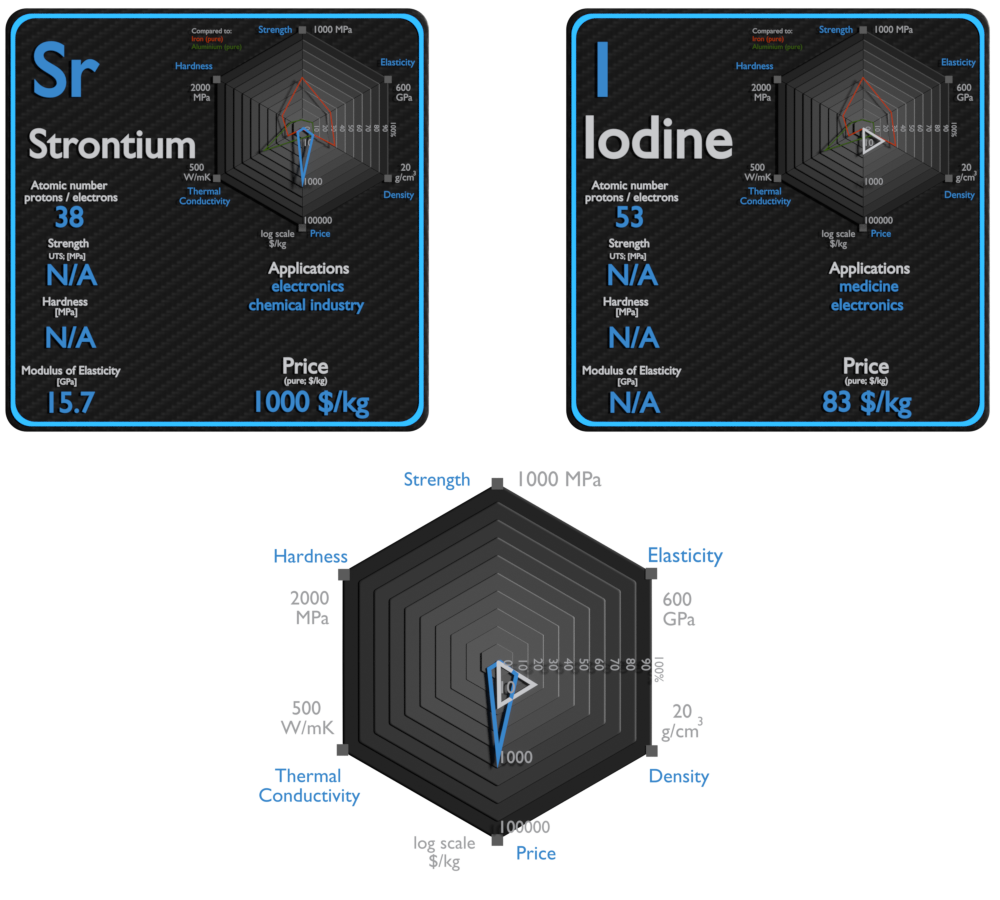
Strontium and Iodine – Comparison – Properties

This article contains comparison of key thermal and atomic properties of strontium and iodine, two comparable chemical elements from the periodic table. It also contains basic descriptions and applications of both elements. Strontium vs Iodine.

strontium and iodine - comparison

Compare strontium with another element

Rubidium - Properties - Price - Applications - Production

Iodine - Properties - Price - Applications - Production

Compare iodine with another element

Chlorine - Properties - Price - Applications - Production

Selenium - Properties - Price - Applications - Production

Bromine - Properties - Price - Applications - Production

Rubidium - Properties - Price - Applications - Production

Strontium - Properties - Price - Applications - Production

Mercury - Properties - Price - Applications - Production

Caesium - Properties - Price - Applications - Production

Strontium and Iodine – About Elements

Strontium

Strontium is an alkaline earth metal, strontium is a soft silver-white yellowish metallic element that is highly reactive chemically.

Iodine

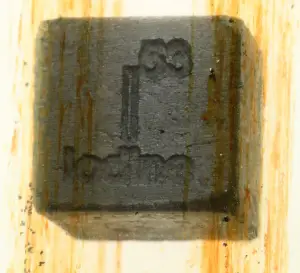
Iodine is the heaviest of the stable halogens, it exists as a lustrous, purple-black metallic solid at standard conditions that sublimes readily to form a violet gas. Iodine is the least abundant of the stable halogens, being the sixty-first most abundant element. It is even less abundant than the so-called rare earths. It is the heaviest essential mineral nutrient.

Strontium in Periodic Table

Iodine in Periodic Table

Source: www.luciteria.com

Strontium and Iodine – Applications

Strontium

Consuming 75% of production, the primary use for strontium was in glass for colour television cathode ray tubes. Strontium is best known for the brilliant reds its salts give to fireworks and flares. It is also used in producing ferrite magnets and refining zinc. Modern ‘glow-in-the-dark’ paints and plastics contain strontium aluminate. They absorb light during the day and release it slowly for hours afterwards. The isotope Sr90 has a half-life of 28 years and is one of the well-known high-energy beta emitters. Hence, it is employed in systems for nuclear auxiliary power (SNAP) devices, which find potential applications in remote weather stations, space vehicles, navigational buoys, etc.

Iodine

In addition to nutrition products, iodine and iodine derivatives are used in a wide range of medical, agricultural, and industrial applications. About half of all produced iodine goes into various organoiodine compounds, another 15% remains as the pure element, another 15% is used to form potassium iodide, and another 15% for other inorganic iodine compounds. The leading application is in the production of X-ray contrast media (22%). Iodine’s high atomic number and density make it ideally suited for this application, as its presence in the body can help to increase contrast between tissues, organs, and blood vessels with similar X-ray densities. It is used as an antiseptic for external wounds. Another application driving the demand for iodine is in polarizing film in liquidcrystal display (LCD) screens.

Strontium and Iodine – Comparison in Table

Element Strontium Iodine
Density 2.63 g/cm3 4.94 g/cm3
Ultimate Tensile Strength N/A N/A
Yield Strength N/A N/A
Young’s Modulus of Elasticity 15.7 GPa N/A
Mohs Scale 1.8 N/A
Brinell Hardness N/A N/A
Vickers Hardness N/A N/A
Melting Point 777 °C 113.5 °C
Boiling Point 1382 °C 184 °C
Thermal Conductivity 35.3 W/mK 0.449 W/mK
Thermal Expansion Coefficient 22.5 µm/mK N/A
Specific Heat 0.3 J/g K 0.214 J/g K
Heat of Fusion 8.3 kJ/mol 7.824 kJ/mol
Heat of Vaporization 144 kJ/mol 20.752 kJ/mol


Rubidium and Caesium – Comparison – Properties

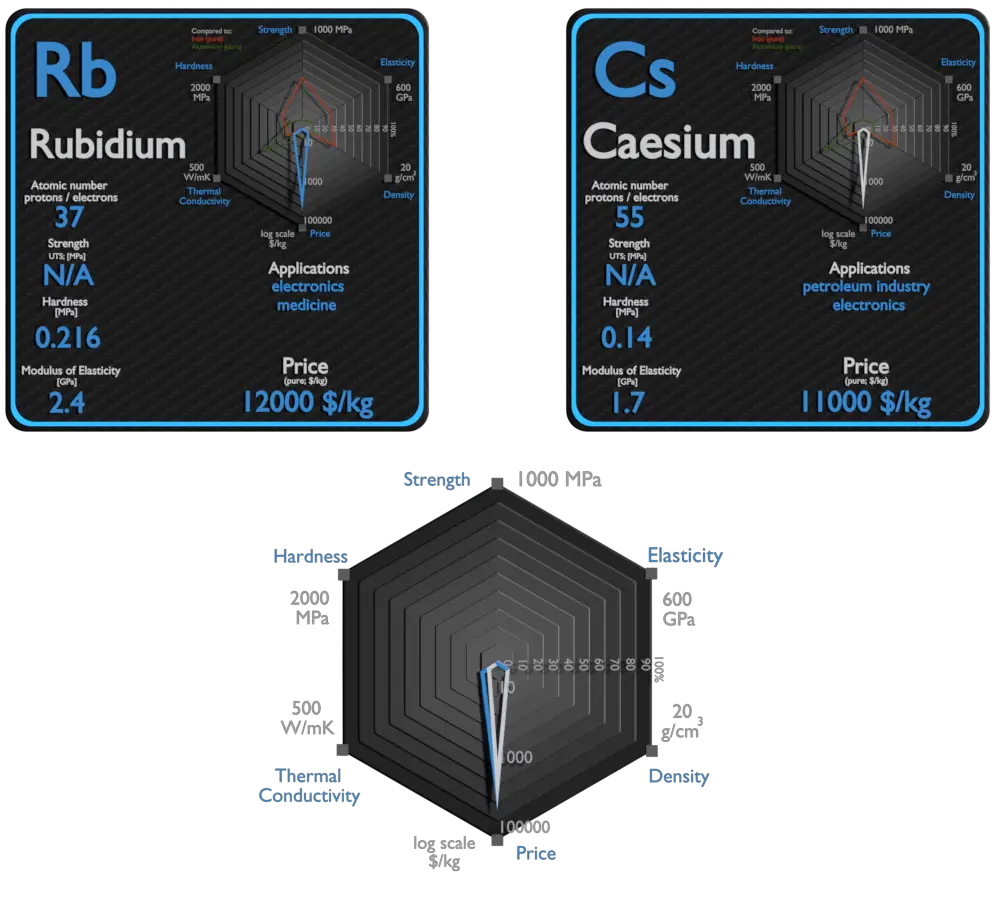
This article contains comparison of key thermal and atomic properties of rubidium and caesium, two comparable chemical elements from the periodic table. It also contains basic descriptions and applications of both elements. Rubidium vs Caesium.

rubidium and caesium - comparison

Compare rubidium with another element

Strontium - Properties - Price - Applications - Production

Iodine - Properties - Price - Applications - Production

Caesium - Properties - Price - Applications - Production

Compare caesium with another element

Chlorine - Properties - Price - Applications - Production

Rubidium - Properties - Price - Applications - Production

Iodine - Properties - Price - Applications - Production

Rubidium and Caesium – About Elements

Rubidium

Rubidium is a soft, silvery-white metallic element of the alkali metal group, with an atomic mass of 85.4678. Elemental rubidium is highly reactive, with properties similar to those of other alkali metals, including rapid oxidation in air.

Caesium

Caesium is a soft, silvery-gold alkali metal with a melting point of 28.5 °C, which makes it one of only five elemental metals that are liquid at or near room temperature. Caesium has physical and chemical properties similar to those of rubidium and potassium.

Strontium in Periodic Table

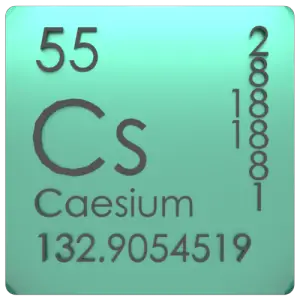
Caesium in Periodic Table

Source: www.luciteria.com

Rubidium and Caesium – Applications

Rubidium

The photoemissive property of rubidium, which is that of a surface emitting free electrons when impinged upon by electromagnetic radiation, makes possible the following applications. A rubidium-tellurium photoemissive surface is used in photoelectric cells, which are incorporated in a variety of electronic detection and activation devices. It is sensitive to a wide spectrum of radiation from the mid-ultraviolet through the visible into the near-infrared. A rubidium-cesium-antimony coating is commonly applied to the photocathodes of photomultiplier tubes. Rubidium-82 is used for positron emission tomography.

Caesium

The largest present-day use of nonradioactive caesium is in caesium formate drilling fluids for the extractive oil industry. They are also used to make special optical glass, as a catalyst promoter, in vacuum tubes and in radiation monitoring equipment. One of its most important uses is in the ‘caesium clock’ (atomic clock). These clocks are a vital part of the internetand mobile phone networks, as well as Global Positioning System (GPS) satellites. Caesium-137 is a radioisotope commonly used as a gamma-emitter in industrial applications.

Rubidium and Caesium – Comparison in Table

Element Rubidium Caesium
Density 1.532 g/cm3 1.879 g/cm3
Ultimate Tensile Strength N/A N/A
Yield Strength N/A N/A
Young’s Modulus of Elasticity 2.4 GPa 1.7 GPa
Mohs Scale 0.3 0.2
Brinell Hardness 0.216 MPa 0.14 MPa
Vickers Hardness N/A N/A
Melting Point 39.31 °C 28.4 °C
Boiling Point 688 °C 669 °C
Thermal Conductivity 58.2 W/mK 36 W/mK
Thermal Expansion Coefficient 90 µm/mK 97 µm/mK
Specific Heat 0.363 J/g K 0.24 J/g K
Heat of Fusion 2.192 kJ/mol 2.092 kJ/mol
Heat of Vaporization 72.216 kJ/mol 67.74 kJ/mol


Rubidium and Strontium – Comparison – Properties

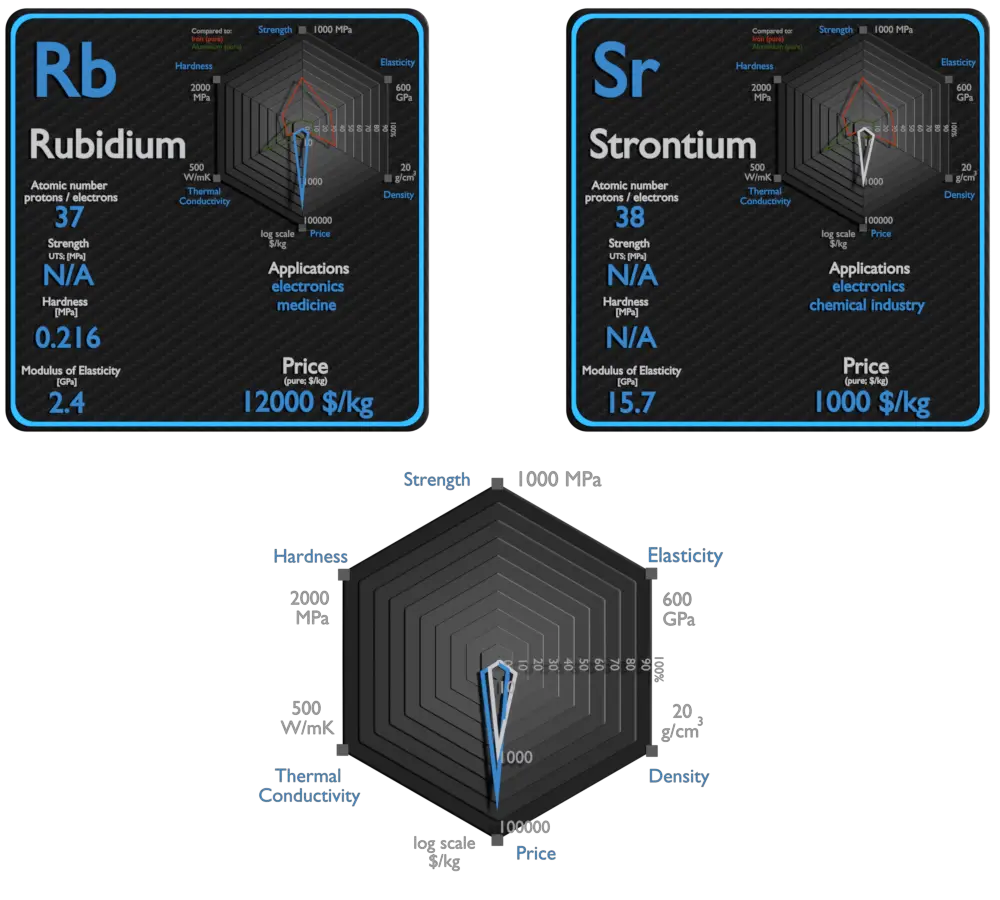
This article contains comparison of key thermal and atomic properties of rubidium and strontium, two comparable chemical elements from the periodic table. It also contains basic descriptions and applications of both elements. Rubidium vs Strontium.

rubidium and strontium - comparison

Compare rubidium with another element

Strontium - Properties - Price - Applications - Production

Iodine - Properties - Price - Applications - Production

Caesium - Properties - Price - Applications - Production

Compare strontium with another element

Rubidium - Properties - Price - Applications - Production

Iodine - Properties - Price - Applications - Production

Rubidium and Strontium – About Elements

Rubidium

Rubidium is a soft, silvery-white metallic element of the alkali metal group, with an atomic mass of 85.4678. Elemental rubidium is highly reactive, with properties similar to those of other alkali metals, including rapid oxidation in air.

Strontium

Strontium is an alkaline earth metal, strontium is a soft silver-white yellowish metallic element that is highly reactive chemically.

Strontium in Periodic Table

Iodine in Periodic Table

Source: www.luciteria.com

Rubidium and Strontium – Applications

Rubidium

The photoemissive property of rubidium, which is that of a surface emitting free electrons when impinged upon by electromagnetic radiation, makes possible the following applications. A rubidium-tellurium photoemissive surface is used in photoelectric cells, which are incorporated in a variety of electronic detection and activation devices. It is sensitive to a wide spectrum of radiation from the mid-ultraviolet through the visible into the near-infrared. A rubidium-cesium-antimony coating is commonly applied to the photocathodes of photomultiplier tubes. Rubidium-82 is used for positron emission tomography.

Strontium

Consuming 75% of production, the primary use for strontium was in glass for colour television cathode ray tubes. Strontium is best known for the brilliant reds its salts give to fireworks and flares. It is also used in producing ferrite magnets and refining zinc. Modern ‘glow-in-the-dark’ paints and plastics contain strontium aluminate. They absorb light during the day and release it slowly for hours afterwards. The isotope Sr90 has a half-life of 28 years and is one of the well-known high-energy beta emitters. Hence, it is employed in systems for nuclear auxiliary power (SNAP) devices, which find potential applications in remote weather stations, space vehicles, navigational buoys, etc.

Rubidium and Strontium – Comparison in Table

Element Rubidium Strontium
Density 1.532 g/cm3 2.63 g/cm3
Ultimate Tensile Strength N/A N/A
Yield Strength N/A N/A
Young’s Modulus of Elasticity 2.4 GPa 15.7 GPa
Mohs Scale 0.3 1.8
Brinell Hardness 0.216 MPa N/A
Vickers Hardness N/A N/A
Melting Point 39.31 °C 777 °C
Boiling Point 688 °C 1382 °C
Thermal Conductivity 58.2 W/mK 35.3 W/mK
Thermal Expansion Coefficient 90 µm/mK 22.5 µm/mK
Specific Heat 0.363 J/g K 0.3 J/g K
Heat of Fusion 2.192 kJ/mol 8.3 kJ/mol
Heat of Vaporization 72.216 kJ/mol 144 kJ/mol


Rubidium and Iodine – Comparison – Properties

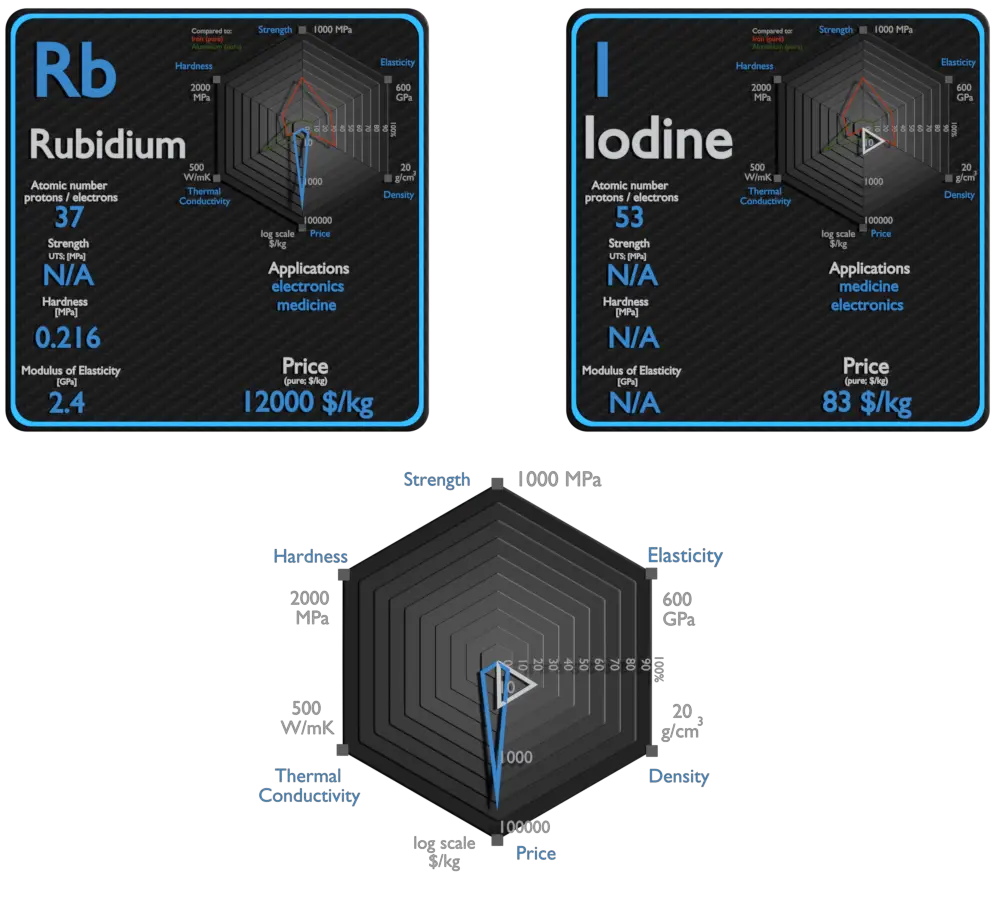
This article contains comparison of key thermal and atomic properties of rubidium and iodine, two comparable chemical elements from the periodic table. It also contains basic descriptions and applications of both elements. Rubidium vs Iodine.

rubidium and iodine - comparison

Compare rubidium with another element

Strontium - Properties - Price - Applications - Production

Iodine - Properties - Price - Applications - Production

Caesium - Properties - Price - Applications - Production

Compare iodine with another element

Chlorine - Properties - Price - Applications - Production

Selenium - Properties - Price - Applications - Production

Bromine - Properties - Price - Applications - Production

Rubidium - Properties - Price - Applications - Production

Strontium - Properties - Price - Applications - Production

Mercury - Properties - Price - Applications - Production

Caesium - Properties - Price - Applications - Production

Rubidium and Iodine – About Elements

Rubidium

Rubidium is a soft, silvery-white metallic element of the alkali metal group, with an atomic mass of 85.4678. Elemental rubidium is highly reactive, with properties similar to those of other alkali metals, including rapid oxidation in air.

Iodine

Iodine is the heaviest of the stable halogens, it exists as a lustrous, purple-black metallic solid at standard conditions that sublimes readily to form a violet gas. Iodine is the least abundant of the stable halogens, being the sixty-first most abundant element. It is even less abundant than the so-called rare earths. It is the heaviest essential mineral nutrient.

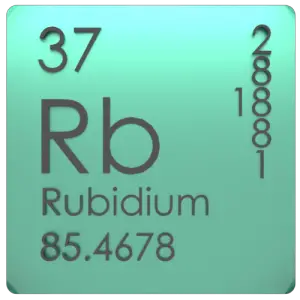
Rubidium in Periodic Table

Iodine in Periodic Table

Source: www.luciteria.com

Rubidium and Iodine – Applications

Rubidium

The photoemissive property of rubidium, which is that of a surface emitting free electrons when impinged upon by electromagnetic radiation, makes possible the following applications. A rubidium-tellurium photoemissive surface is used in photoelectric cells, which are incorporated in a variety of electronic detection and activation devices. It is sensitive to a wide spectrum of radiation from the mid-ultraviolet through the visible into the near-infrared. A rubidium-cesium-antimony coating is commonly applied to the photocathodes of photomultiplier tubes. Rubidium-82 is used for positron emission tomography.

Iodine

In addition to nutrition products, iodine and iodine derivatives are used in a wide range of medical, agricultural, and industrial applications. About half of all produced iodine goes into various organoiodine compounds, another 15% remains as the pure element, another 15% is used to form potassium iodide, and another 15% for other inorganic iodine compounds. The leading application is in the production of X-ray contrast media (22%). Iodine’s high atomic number and density make it ideally suited for this application, as its presence in the body can help to increase contrast between tissues, organs, and blood vessels with similar X-ray densities. It is used as an antiseptic for external wounds. Another application driving the demand for iodine is in polarizing film in liquidcrystal display (LCD) screens.

Rubidium and Iodine – Comparison in Table

Element Rubidium Iodine
Density 1.532 g/cm3 4.94 g/cm3
Ultimate Tensile Strength N/A N/A
Yield Strength N/A N/A
Young’s Modulus of Elasticity 2.4 GPa N/A
Mohs Scale 0.3 N/A
Brinell Hardness 0.216 MPa N/A
Vickers Hardness N/A N/A
Melting Point 39.31 °C 113.5 °C
Boiling Point 688 °C 184 °C
Thermal Conductivity 58.2 W/mK 0.449 W/mK
Thermal Expansion Coefficient 90 µm/mK N/A
Specific Heat 0.363 J/g K 0.214 J/g K
Heat of Fusion 2.192 kJ/mol 7.824 kJ/mol
Heat of Vaporization 72.216 kJ/mol 20.752 kJ/mol


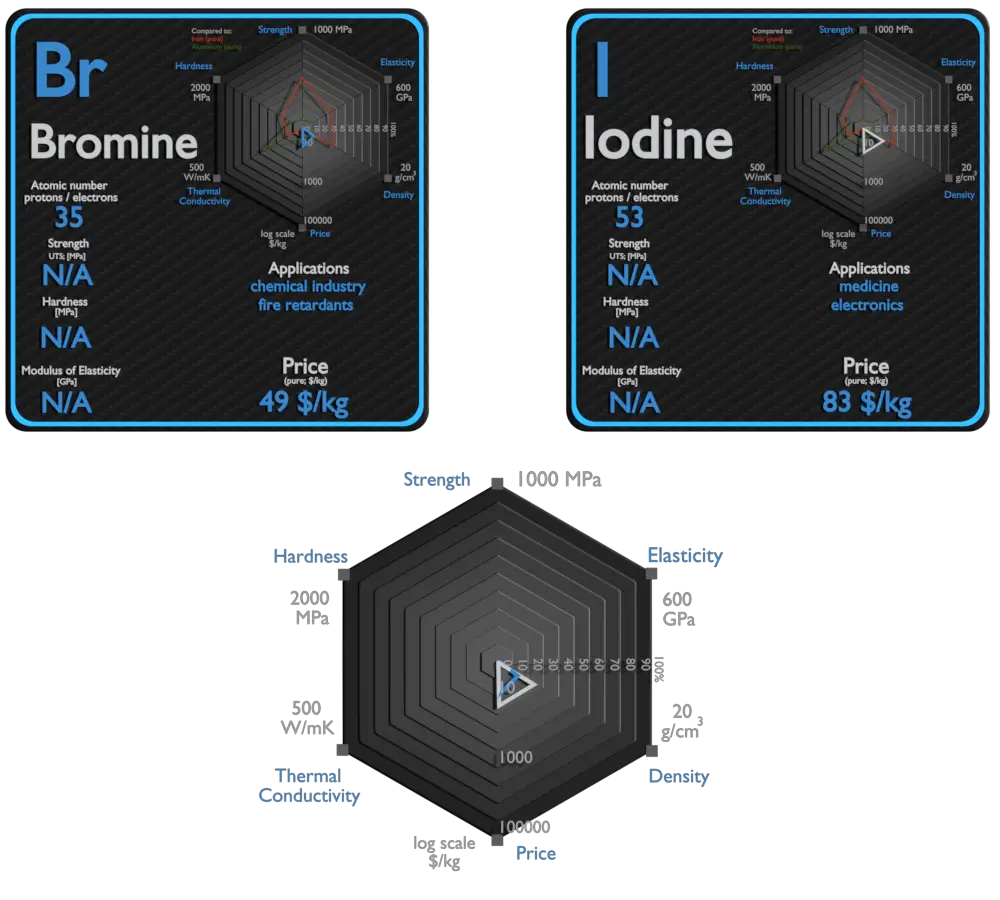
Bromine and Iodine – Comparison – Properties

This article contains comparison of key thermal and atomic properties of bromine and iodine, two comparable chemical elements from the periodic table. It also contains basic descriptions and applications of both elements. Bromine vs Iodine.

bromine and iodine - comparison

Compare bromine with another element

Carbon - Properties - Price - Applications - Production

Magnesium - Properties - Price - Applications - Production

Chlorine - Properties - Price - Applications - Production

Potassium - Properties - Price - Applications - Production

Iodine - Properties - Price - Applications - Production

Compare iodine with another element

Chlorine - Properties - Price - Applications - Production

Selenium - Properties - Price - Applications - Production

Bromine - Properties - Price - Applications - Production

Rubidium - Properties - Price - Applications - Production

Strontium - Properties - Price - Applications - Production

Mercury - Properties - Price - Applications - Production

Caesium - Properties - Price - Applications - Production

Bromine and Iodine – About Elements

Bromine

Bromine is the third-lightest halogen, and is a fuming red-brown liquid at room temperature that evaporates readily to form a similarly coloured gas. Its properties are thus intermediate between those of chlorine and iodine.

Iodine

Iodine is the heaviest of the stable halogens, it exists as a lustrous, purple-black metallic solid at standard conditions that sublimes readily to form a violet gas. Iodine is the least abundant of the stable halogens, being the sixty-first most abundant element. It is even less abundant than the so-called rare earths. It is the heaviest essential mineral nutrient.

Bromine in Periodic Table

Iodine in Periodic Table

Source: www.luciteria.com

Bromine and Iodine – Applications

Bromine

A wide variety of organobromine compounds are used in industry. Some are prepared from bromine and others are prepared from hydrogen bromide, which is obtained by burning hydrogen in bromine. Brominated flame retardants represent a commodity of growing importance, and make up the largest commercial use of bromine. One of the major uses of bromine is a water purifier/disinfectant, as an alternative to chlorine. Bromine compounds are effective pesticides, used both as soil fumigants in agriculture, particularly fruit-growing, and as a fumigant to prevent pests from attacking stored grain and other produce.

Iodine

In addition to nutrition products, iodine and iodine derivatives are used in a wide range of medical, agricultural, and industrial applications. About half of all produced iodine goes into various organoiodine compounds, another 15% remains as the pure element, another 15% is used to form potassium iodide, and another 15% for other inorganic iodine compounds. The leading application is in the production of X-ray contrast media (22%). Iodine’s high atomic number and density make it ideally suited for this application, as its presence in the body can help to increase contrast between tissues, organs, and blood vessels with similar X-ray densities. It is used as an antiseptic for external wounds. Another application driving the demand for iodine is in polarizing film in liquidcrystal display (LCD) screens.

Bromine and Iodine – Comparison in Table

Element Bromine Iodine
Density 3.12 g/cm3 4.94 g/cm3
Ultimate Tensile Strength N/A N/A
Yield Strength N/A N/A
Young’s Modulus of Elasticity N/A N/A
Mohs Scale N/A N/A
Brinell Hardness N/A N/A
Vickers Hardness N/A N/A
Melting Point -7.3 °C 113.5 °C
Boiling Point 59 °C 184 °C
Thermal Conductivity 0.122 W/mK 0.449 W/mK
Thermal Expansion Coefficient N/A N/A
Specific Heat 0.473 J/g K 0.214 J/g K
Heat of Fusion 5.286 kJ/mol 7.824 kJ/mol
Heat of Vaporization 15.438 kJ/mol 20.752 kJ/mol


Selenium and Iodine – Comparison – Properties

This article contains comparison of key thermal and atomic properties of selenium and iodine, two comparable chemical elements from the periodic table. It also contains basic descriptions and applications of both elements. Selenium vs Iodine.

selenium and iodine - comparison

Compare selenium with another element

Zinc - Properties - Price - Applications - Production

Iodine - Properties - Price - Applications - Production

Compare iodine with another element

Chlorine - Properties - Price - Applications - Production

Selenium - Properties - Price - Applications - Production

Bromine - Properties - Price - Applications - Production

Rubidium - Properties - Price - Applications - Production

Strontium - Properties - Price - Applications - Production

Mercury - Properties - Price - Applications - Production

Caesium - Properties - Price - Applications - Production

Selenium and Iodine – About Elements

Selenium

Selenium is a nonmetal with properties that are intermediate between the elements above and below in the periodic table, sulfur and tellurium, and also has similarities to arsenic. It rarely occurs in its elemental state or as pure ore compounds in the Earth’s crust.

Iodine

Iodine is the heaviest of the stable halogens, it exists as a lustrous, purple-black metallic solid at standard conditions that sublimes readily to form a violet gas. Iodine is the least abundant of the stable halogens, being the sixty-first most abundant element. It is even less abundant than the so-called rare earths. It is the heaviest essential mineral nutrient.

Selenium in Periodic Table

Iodine in Periodic Table

Source: www.luciteria.com

Selenium and Iodine – Applications

Selenium

The chief commercial uses for selenium today are glassmaking and pigments. Selenium finds applications in the various industries, for example, solar cells and photoconductor applications, manganese electrolysis, DC power surge protection or X-ray crystallography.

Iodine

In addition to nutrition products, iodine and iodine derivatives are used in a wide range of medical, agricultural, and industrial applications. About half of all produced iodine goes into various organoiodine compounds, another 15% remains as the pure element, another 15% is used to form potassium iodide, and another 15% for other inorganic iodine compounds. The leading application is in the production of X-ray contrast media (22%). Iodine’s high atomic number and density make it ideally suited for this application, as its presence in the body can help to increase contrast between tissues, organs, and blood vessels with similar X-ray densities. It is used as an antiseptic for external wounds. Another application driving the demand for iodine is in polarizing film in liquidcrystal display (LCD) screens.

Selenium and Iodine – Comparison in Table

Element Selenium Iodine
Density 4.819 g/cm3 4.94 g/cm3
Ultimate Tensile Strength 300 MPa N/A
Yield Strength 150 MPa N/A
Young’s Modulus of Elasticity 10 GPa N/A
Mohs Scale 2 N/A
Brinell Hardness 740 MPa N/A
Vickers Hardness N/A N/A
Melting Point 221 °C 113.5 °C
Boiling Point 685 °C 184 °C
Thermal Conductivity 2.04 W/mK 0.449 W/mK
Thermal Expansion Coefficient 37 µm/mK N/A
Specific Heat 0.32 J/g K 0.214 J/g K
Heat of Fusion 6.694 kJ/mol 7.824 kJ/mol
Heat of Vaporization 37.7 kJ/mol 20.752 kJ/mol


Arsenic and Cadmium – Comparison – Properties

This article contains comparison of key thermal and atomic properties of arsenic and cadmium, two comparable chemical elements from the periodic table. It also contains basic descriptions and applications of both elements. Arsenic vs Cadmium.

arsenic and cadmium - comparison

Compare arsenic with another element

Cadmium - Properties - Price - Applications - Production

Silicon - Properties - Price - Applications - Production

Gallium - Properties - Price - Applications - Production

Antimony - Properties - Price - Applications - Production

Lead - Properties - Price - Applications - Production

Compare cadmium with another element

Lithium - Properties - Price - Applications - Production

Cobalt - Properties - Price - Applications - Production

Arsenic - Properties - Price - Applications - Production

Lead - Properties - Price - Applications - Production

Arsenic and Cadmium – About Elements

Arsenic

Arsenic occurs in many minerals, usually in combination with sulfur and metals, but also as a pure elemental crystal. Arsenic is a metalloid.

Cadmium

Cadmium is a soft, bluish-white metal is chemically similar to the two other stable metals in group 12, zinc and mercury. In nuclear industry cadmium is commonly used as a thermal neutron absorber due to very high neutron absorption cross-section of 113Cd. 113Cd has specific absorption cross-section.

Arsenic in Periodic Table

Cadmium in Periodic Table

Source: www.luciteria.com

Arsenic and Cadmium – Applications

Arsenic

Arsenic is used as a doping agent in semiconductors (gallium arsenide) for solid-state devices. It is also used in bronzing, pyrotechnics and for hardening shot. Arsenic compounds can be used to make special glass and preserve wood.

Cadmium

Cadmium is primarily consumed for the production of rechargeable nickel cadmium batteries. In 2009, 86% of cadmium was used in batteries, predominantly in rechargeable nickel-cadmium batteries. Other end uses include pigments, coatings and plating, and as stabilizers for plastics. Solar cell manufacturing may become another significant market for cadmium in the future. In nuclear industry cadmium is commonly used as a thermal neutron absorber due to very high neutron absorption cross-section of 113Cd. 113Cd has specific absorption cross-section.

Arsenic and Cadmium – Comparison in Table

Element Arsenic Cadmium
Density 5.727 g/cm3 8.65 g/cm3
Ultimate Tensile Strength N/A 75 MPa
Yield Strength N/A N/A
Young’s Modulus of Elasticity 8 GPa 50 GPa
Mohs Scale 3.5 2
Brinell Hardness 1440 MPa 203 MPa
Vickers Hardness N/A N/A
Melting Point 817 °C 321.07 °C
Boiling Point 614 °C 767 °C
Thermal Conductivity 50 W/mK 97 W/mK
Thermal Expansion Coefficient 5.6 µm/mK 30.8 µm/mK
Specific Heat 0.33 J/g K 0.23 J/g K
Heat of Fusion N/A 6.192 kJ/mol
Heat of Vaporization 34.76 kJ/mol 99.57 kJ/mol


Arsenic and Antimony – Comparison – Properties

This article contains comparison of key thermal and atomic properties of arsenic and antimony, two comparable chemical elements from the periodic table. It also contains basic descriptions and applications of both elements. Arsenic vs Antimony.

arsenic and antimony - comparison

Compare arsenic with another element

Cadmium - Properties - Price - Applications - Production

Silicon - Properties - Price - Applications - Production

Gallium - Properties - Price - Applications - Production

Antimony - Properties - Price - Applications - Production

Lead - Properties - Price - Applications - Production

Compare antimony with another element

Arsenic - Properties - Price - Applications - Production

Tin - Properties - Price - Applications - Production

Arsenic and Antimony – About Elements

Arsenic

Arsenic occurs in many minerals, usually in combination with sulfur and metals, but also as a pure elemental crystal. Arsenic is a metalloid.

Antimony

Antimony is a lustrous gray metalloid, it is found in nature mainly as the sulfide mineral stibnite. Antimony compounds have been known since ancient times and were powdered for use as medicine and cosmetics, often known by the Arabic name, kohl.

Arsenic in Periodic Table

Antimony in Periodic Table

Source: www.luciteria.com

Arsenic and Antimony – Applications

Arsenic

Arsenic is used as a doping agent in semiconductors (gallium arsenide) for solid-state devices. It is also used in bronzing, pyrotechnics and for hardening shot. Arsenic compounds can be used to make special glass and preserve wood.

Antimony

The largest applications for metallic antimony are an alloy with lead and tin and the lead antimony plates in lead–acid batteries. Alloys of lead and tin with antimony have improved properties for solders, bullets, and plain bearings. Antimony can be used in fire retardants for many commercial and domestic products. Antimony trichloride is used in the manufacturing flame-proofing compounds as well as paints, ceramic enamels, glass and pottery. Other uses include ball bearings and mixing with alloys with percentages ranging from 1 to 20 greatly increasing the hardness and mechanical strength of the lead. The capability to strengthen already strong alloys is its largest and most widespread use.

Arsenic and Antimony – Comparison in Table

Element Arsenic Antimony
Density 5.727 g/cm3 6.697 g/cm3
Ultimate Tensile Strength N/A 11 MPa
Yield Strength N/A N/A
Young’s Modulus of Elasticity 8 GPa 55 GPa
Mohs Scale 3.5 3.15
Brinell Hardness 1440 MPa 300 MPa
Vickers Hardness N/A N/A
Melting Point 817 °C 631 °C
Boiling Point 614 °C 1950 °C
Thermal Conductivity 50 W/mK 24 W/mK
Thermal Expansion Coefficient 5.6 µm/mK 11 µm/mK
Specific Heat 0.33 J/g K 0.21 J/g K
Heat of Fusion N/A 19.87 kJ/mol
Heat of Vaporization 34.76 kJ/mol 77.14 kJ/mol