Facebook Instagram Youtube Twitter

Arsenic and Lead – Comparison – Properties

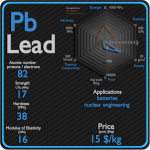
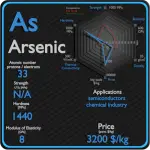
This article contains comparison of key thermal and atomic properties of arsenic and lead, two comparable chemical elements from the periodic table. It also contains basic descriptions and applications of both elements. Arsenic vs Lead.

arsenic and lead - comparison

Compare arsenic with another element

Cadmium - Properties - Price - Applications - Production

Silicon - Properties - Price - Applications - Production

Gallium - Properties - Price - Applications - Production

Antimony - Properties - Price - Applications - Production

Lead - Properties - Price - Applications - Production

Compare lead with another element

Iron - Properties - Price - Applications - Production

Arsenic - Properties - Price - Applications - Production

Cadmium - Properties - Price - Applications - Production

Tin - Properties - Price - Applications - Production

Antimony - Properties - Price - Applications - Production

Gold - Properties - Price - Applications - Production

Bismuth - Properties - Price - Applications - Production

Arsenic and Lead – About Elements

Arsenic

Arsenic occurs in many minerals, usually in combination with sulfur and metals, but also as a pure elemental crystal. Arsenic is a metalloid.

Lead

Lead is a heavy metal that is denser than most common materials. Lead is soft and malleable, and has a relatively low melting point. Lead is widely used as a gamma shield. Major advantage of lead shield is in its compactness due to its higher density. Lead has the highest atomic number of any stable element and concludes three major decay chains of heavier elements.

Arsenic in Periodic Table

Lead in Periodic Table

Source: www.luciteria.com

Arsenic and Lead – Applications

Arsenic

Arsenic is used as a doping agent in semiconductors (gallium arsenide) for solid-state devices. It is also used in bronzing, pyrotechnics and for hardening shot. Arsenic compounds can be used to make special glass and preserve wood.

Lead

Lead metal has several useful mechanical properties, including high density, low melting point, ductility, and relative inertness. Lead is widely used for car batteries, pigments, ammunition, cable sheathing, weights for lifting, weight belts for diving, lead crystal glass, radiation protection and in some solders. The largest use of lead in the early 21st century is in lead–acid batteries. The lead in batteries undergoes no direct contact with humans, so there are fewer toxicity concerns. Lead is used in high voltage power cables as sheathing material to prevent water diffusion into insulation; this use is decreasing as lead is being phased out. A lead is widely used as a gamma shield. Major advantage of lead shield is in its compactness due to its higher density. On the other hand depleted uranium is much more effective due to its higher Z. Depleted uranium is used for shielding in portable gamma ray sources.

Arsenic and Lead – Comparison in Table

Element Arsenic Lead
Density 5.727 g/cm3 11.34 g/cm3
Ultimate Tensile Strength N/A 17 MPa
Yield Strength N/A 5.5 MPa
Young’s Modulus of Elasticity 8 GPa 16 GPa
Mohs Scale 3.5 1.5
Brinell Hardness 1440 MPa 38 MPa
Vickers Hardness N/A N/A
Melting Point 817 °C 327.5 °C
Boiling Point 614 °C 1740 °C
Thermal Conductivity 50 W/mK 35 W/mK
Thermal Expansion Coefficient 5.6 µm/mK 28.9 µm/mK
Specific Heat 0.33 J/g K 0.13 J/g K
Heat of Fusion N/A 4.799 kJ/mol
Heat of Vaporization 34.76 kJ/mol 177.7 kJ/mol


Zinc and Selenium – Comparison – Properties

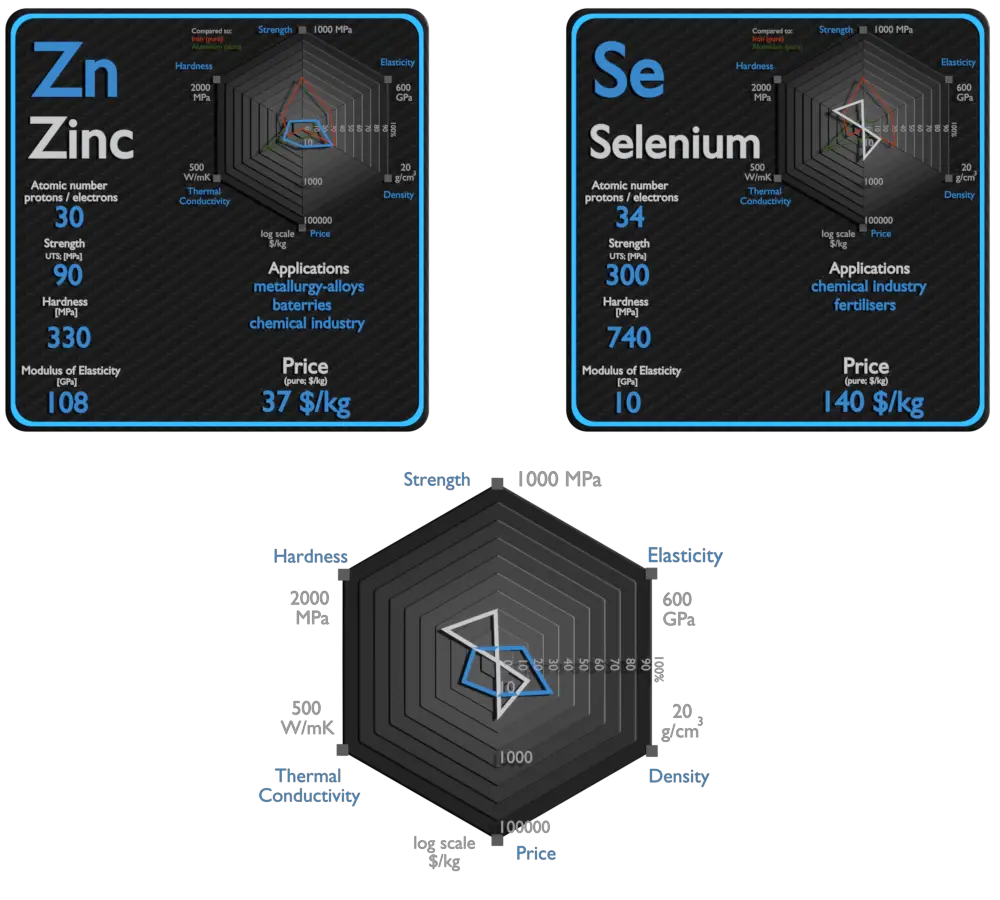
This article contains comparison of key thermal and atomic properties of zinc and selenium, two comparable chemical elements from the periodic table. It also contains basic descriptions and applications of both elements. Zinc vs Selenium.

zinc and selenium - comparison

Compare zinc with another element

Magnesium - Properties - Price - Applications - Production

Potassium - Properties - Price - Applications - Production

Titanium - Properties - Price - Applications - Production

Chromium - Properties - Price - Applications - Production

Manganese - Properties - Price - Applications - Production

Iron - Properties - Price - Applications - Production

Cobalt - Properties - Price - Applications - Production

Nickel - Properties - Price - Applications - Production

Indium - Properties - Price - Applications - Production

Selenium - Properties - Price - Applications - Production

Compare with selenium another element

Zinc - Properties - Price - Applications - Production

Iodine - Properties - Price - Applications - Production

Zinc and Selenium – About Elements

Zinc

In some respects zinc is chemically similar to magnesium: both elements exhibit only one normal oxidation state (+2), and the Zn2+ and Mg2+ ions are of similar size.

Selenium

Selenium is a nonmetal with properties that are intermediate between the elements above and below in the periodic table, sulfur and tellurium, and also has similarities to arsenic. It rarely occurs in its elemental state or as pure ore compounds in the Earth’s crust.

Zinc in Periodic Table

Selenium in Periodic Table

Source: www.luciteria.com

Zinc and Selenium – Applications

Zinc

Corrosion-resistant zinc plating of iron (hot-dip galvanizing) is the major application for zinc. Coating of steel constitutes the largest single use of zinc, but it is used in large tonnages in zinc alloy castings, as zinc dust and oxide, and in wrought zinc products. Galvanized steel is just plain carbon steel that has been coated with a thin zinc layer. The zinc protects iron by corroding first, but zinc corrodes at much lower rates than do steel. Other applications are in electrical batteries, small non-structural castings, and alloys such as brass. A variety of zinc compounds are commonly used, such as zinc carbonate and zinc gluconate (as dietary supplements), zinc chloride (in deodorants), zinc pyrithione (anti-dandruff shampoos), zinc sulfide (in luminescent paints), and dimethylzinc or diethylzinc in the organic laboratory. A key part of the modern materials world in which zinc finds itself is recycling. Zinc, in common with all metals (and unlike synthetic materials) can be recycled indefinitely without degradation.

Selenium

The chief commercial uses for selenium today are glassmaking and pigments. Selenium finds applications in the various industries, for example, solar cells and photoconductor applications, manganese electrolysis, DC power surge protection or X-ray crystallography.

Zinc and Selenium – Comparison in Table

Element Zinc Selenium
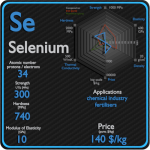
Density 7.14 g/cm3 4.819 g/cm3
Ultimate Tensile Strength 90 MPa 300 MPa
Yield Strength 75 MPa 150 MPa
Young’s Modulus of Elasticity 108 GPa 10 GPa
Mohs Scale 2.5 2
Brinell Hardness 330 MPa 740 MPa
Vickers Hardness N/A N/A
Melting Point 419.53 °C 221 °C
Boiling Point 907 °C 685 °C
Thermal Conductivity 116 W/mK 2.04 W/mK
Thermal Expansion Coefficient 30.2 µm/mK 37 µm/mK
Specific Heat 0.39 J/g K 0.23 J/g K
Heat of Fusion 7.322 kJ/mol 6.694 kJ/mol
Heat of Vaporization 115.3 kJ/mol 37.7 kJ/mol


Zinc and Indium – Comparison – Properties

This article contains comparison of key thermal and atomic properties of zinc and indium, two comparable chemical elements from the periodic table. It also contains basic descriptions and applications of both elements. Zinc vs Indium.

zinc and indium - comparison

Compare zinc with another element

Magnesium - Properties - Price - Applications - Production

Potassium - Properties - Price - Applications - Production

Titanium - Properties - Price - Applications - Production

Chromium - Properties - Price - Applications - Production

Manganese - Properties - Price - Applications - Production

Iron - Properties - Price - Applications - Production

Cobalt - Properties - Price - Applications - Production

Nickel - Properties - Price - Applications - Production

Indium - Properties - Price - Applications - Production

Selenium - Properties - Price - Applications - Production

Compare indium with another element

Zinc - Properties - Price - Applications - Production

Zinc and Indium – About Elements

Zinc

In some respects zinc is chemically similar to magnesium: both elements exhibit only one normal oxidation state (+2), and the Zn2+ and Mg2+ ions are of similar size.

Indium

Indium is a post-transition metal that makes up 0.21 parts per million of the Earth’s crust. Very soft and malleable, indium has a melting point higher than sodium and gallium, but lower than lithium and tin. Chemically, indium is similar to gallium and thallium.

Zinc in Periodic Table

Indium in Periodic Table

Source: www.luciteria.com

Zinc and Indium – Applications

Zinc

Corrosion-resistant zinc plating of iron (hot-dip galvanizing) is the major application for zinc. Coating of steel constitutes the largest single use of zinc, but it is used in large tonnages in zinc alloy castings, as zinc dust and oxide, and in wrought zinc products. Galvanized steel is just plain carbon steel that has been coated with a thin zinc layer. The zinc protects iron by corroding first, but zinc corrodes at much lower rates than do steel. Other applications are in electrical batteries, small non-structural castings, and alloys such as brass. A variety of zinc compounds are commonly used, such as zinc carbonate and zinc gluconate (as dietary supplements), zinc chloride (in deodorants), zinc pyrithione (anti-dandruff shampoos), zinc sulfide (in luminescent paints), and dimethylzinc or diethylzinc in the organic laboratory. A key part of the modern materials world in which zinc finds itself is recycling. Zinc, in common with all metals (and unlike synthetic materials) can be recycled indefinitely without degradation.

Indium

The primary consumption of indium worldwide is LCD production. Demand rose rapidly from the late 1990s to 2010 with the popularity of LCD computer monitors and television sets, which now account for 50% of indium consumption. It is most notably used in the semiconductor industry, in low-melting-point metal alloys such as solders, in soft-metal high-vacuum seals, and in the production of transparent conductive coatings of indium tin oxide (ITO) on glass. Indium is considered a technology-critical element.

Zinc and Indium – Comparison in Table

Element Zinc Indium
Density 7.14 g/cm3 7.31 g/cm3
Ultimate Tensile Strength 90 MPa 2.5 MPa
Yield Strength 75 MPa 1 MPa
Young’s Modulus of Elasticity 108 GPa 11 GPa
Mohs Scale 2.5 1.2
Brinell Hardness 330 MPa 10 MPa
Vickers Hardness N/A N/A
Melting Point 419.53 °C 156.6 °C
Boiling Point 907 °C 2072 °C
Thermal Conductivity 116 W/mK 82 W/mK
Thermal Expansion Coefficient 30.2 µm/mK 32.1 µm/mK
Specific Heat 0.39 J/g K 0.23 J/g K
Heat of Fusion 7.322 kJ/mol 3.263 kJ/mol
Heat of Vaporization 115.3 kJ/mol 231.5 kJ/mol


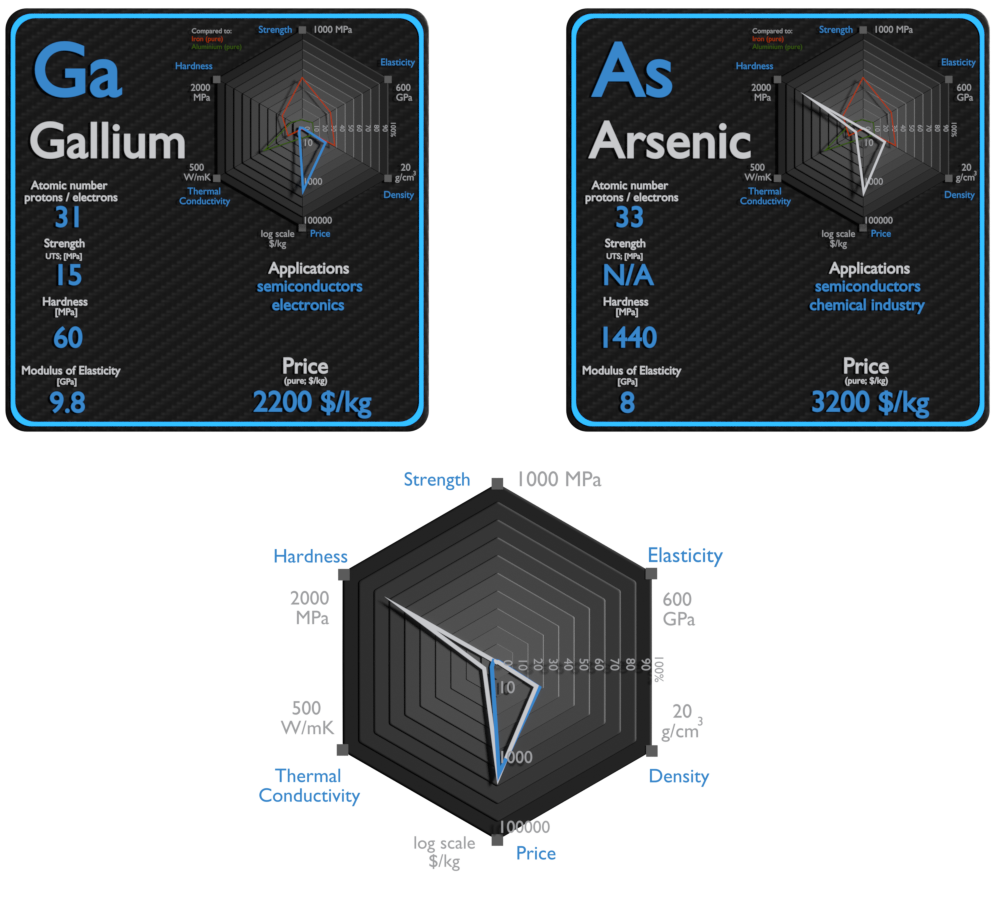
Gallium and Arsenic – Comparison – Properties

This article contains comparison of key thermal and atomic properties of gallium and arsenic, two comparable chemical elements from the periodic table. It also contains basic descriptions and applications of both elements. Gallium vs Arsenic.

gallium and arsenic - comparison

Compare gallium with another element

Aluminium - Properties - Price - Applications - Production

Arsenic - Properties - Price - Applications - Production

Compare arsenic with another element

Cadmium - Properties - Price - Applications - Production

Silicon - Properties - Price - Applications - Production

Gallium - Properties - Price - Applications - Production

Antimony - Properties - Price - Applications - Production

Lead - Properties - Price - Applications - Production

Gallium and Arsenic – About Elements

Gallium

Gallium has similarities to the other metals of the group, aluminium, indium, and thallium. Gallium does not occur as a free element in nature, but as gallium(III) compounds in trace amounts in zinc ores and in bauxite.

Arsenic

Arsenic occurs in many minerals, usually in combination with sulfur and metals, but also as a pure elemental crystal. Arsenic is a metalloid.

Gallium in Periodic Table

Arsenic in Periodic Table

Source: www.luciteria.com

Gallium and Arsenic – Applications

Gallium

Gallium consumption is centred on the superconductor industry. Semiconductor applications dominate the commercial demand for gallium, accounting for 98% of the total. When alloyed with arsenic to produce gallium arsenide (GaAs), it can convert electricity to light. Due to such properties, it is used in LEDs, and has been found to produce less heat than silicon, rendering it suitable for use in supercomputers.

Arsenic

Arsenic is used as a doping agent in semiconductors (gallium arsenide) for solid-state devices. It is also used in bronzing, pyrotechnics and for hardening shot. Arsenic compounds can be used to make special glass and preserve wood.

Gallium and Arsenic – Comparison in Table

Element Gallium Arsenic
Density 5.904 g/cm3 5.727 g/cm3
Ultimate Tensile Strength 15 MPa N/A
Yield Strength 8 MPa N/A
Young’s Modulus of Elasticity 9.8 GPa 8 GPa
Mohs Scale 1.5 3.5
Brinell Hardness 60 MPa 1440 MPa
Vickers Hardness N/A N/A
Melting Point 29.76 °C 817 °C
Boiling Point 2204 °C 614 °C
Thermal Conductivity 40.6 W/mK 50 W/mK
Thermal Expansion Coefficient 18 µm/mK 5.6 µm/mK
Specific Heat 0.37 J/g K 0.33 J/g K
Heat of Fusion 5.59 kJ/mol N/A
Heat of Vaporization 258.7 kJ/mol 34.76 kJ/mol


Copper and Gold – Comparison – Properties

This article contains comparison of key thermal and atomic properties of copper and gold, two comparable chemical elements from the periodic table. It also contains basic descriptions and applications of both elements. Copper vs Gold.

copper and gold - comparison

Compare copper with another element

Beryllium - Properties - Price - Applications - Production

Magnesium - Properties - Price - Applications - Production

Aluminium - Properties - Price - Applications - Production

Silicon - Properties - Price - Applications - Production

Chlorine - Properties - Price - Applications - Production

Titanium - Properties - Price - Applications - Production

Chromium - Properties - Price - Applications - Production

Manganese - Properties - Price - Applications - Production

Iron - Properties - Price - Applications - Production

Cobalt - Properties - Price - Applications - Production

Silver - Properties - Price - Applications - Production

Gold - Properties - Price - Applications - Production

Tin - Properties - Price - Applications - Production

Compare gold with another element

Titanium - Properties - Price - Applications - Production

Cobalt - Properties - Price - Applications - Production

Nickel - Properties - Price - Applications - Production

Copper - Properties - Price - Applications - Production

Rhodium - Properties - Price - Applications - Production

Palladium - Properties - Price - Applications - Production

Silver - Properties - Price - Applications - Production

Tungsten - Properties - Price - Applications - Production

Osmium - Properties - Price - Applications - Production

Iridium - Properties - Price - Applications - Production

Platinum - Properties - Price - Applications - Production

Lead - Properties - Price - Applications - Production

Copper and Gold – About Elements

Copper

Copper is a soft, malleable, and ductile metal with very high thermal and electrical conductivity. A freshly exposed surface of pure copper has a reddish-orange color. Copper is used as a conductor of heat and electricity, as a building material, and as a constituent of various metal alloys, such as sterling silver used in jewelry, cupronickel used to make marine hardware and coins, and constantan used in strain gauges and thermocouples for temperature measurement.

Gold

Gold is a bright, slightly reddish yellow, dense, soft, malleable, and ductile metal. Gold is a transition metal and a group 11 element. It is one of the least reactive chemical elements and is solid under standard conditions. Gold is thought to have been produced in supernova nucleosynthesis, from the collision of neutron stars.

Copper in Periodic Table

Gold in Periodic Table

Source: www.luciteria.com

Copper and Gold – Applications

Copper

Historically, alloying copper with another metal, for example tin to make bronze, was first practiced about 4000 years after the discovery of copper smelting, and about 2000 years after “natural bronze” had come into general use. An ancient civilization is defined to be in the Bronze Age either by producing bronze by smelting its own copper and alloying with tin, arsenic, or other metals. The major applications of copper are electrical wire (60%), roofing and plumbing (20%), and industrial machinery (15%). Copper is used mostly as a pure metal, but when greater hardness is required, it is put into such alloys as brass and bronze (5% of total use). Copper and copper-based alloys including brasses (Cu-Zn) and bronzes (Cu-Sn) are widely used in different industrial and societal applications. Some of the common uses for brass alloys include costume jewelry, locks, hinges, gears, bearings, ammunition casings, automotive radiators, musical instruments, electronic packaging, and coins. Bronze, or bronze-like alloys and mixtures, were used for coins over a longer period. is still widely used today for springs, bearings, bushings, automobile transmission pilot bearings, and similar fittings, and is particularly common in the bearings of small electric motors. Brass and bronze are common engineering materials in modern architecture and primarily used for roofing and facade cladding due to their visual appearance.

Gold

Gold is used extensively in jewellery, either in its pure form or as an alloy. About 75% of all gold produced is used in the jewelry industry. Pure gold is too soft to stand up to the stresses applied to many jewelry items. Craftsmen learned that alloying gold with other metals such as copper, silver, and platinum would increase its durability. The term ‘carat’ indicates the amount of gold present in an alloy. 24-carat is pure gold, but it is very soft. 18- and 9-carat gold alloys are commonly used because they are more durable. Gold’s high malleability, ductility, resistance to corrosion and most other chemical reactions, and conductivity of electricity have led to its continued use in corrosion resistant electrical connectors in all types of computerized devices (its chief industrial use). Gold is also used in infrared shielding, colored-glass production, gold leafing, and tooth restoration. Only 10% of the world consumption of new gold produced goes to industry, but by far the most important industrial use for new gold is in fabrication of corrosion-free electrical connectors in computers and other electrical devices.

Copper and Gold – Comparison in Table

Element Copper Gold
Density 8.92 g/cm3 19.3 g/cm3
Ultimate Tensile Strength 210 MPa 220 MPa
Yield Strength 33 MPa 205 MPa
Young’s Modulus of Elasticity 120 GPa 79 GPa
Mohs Scale 3 2.75
Brinell Hardness 250 MPa 190 MPa
Vickers Hardness 350 MPa 215 MPa
Melting Point 1084.62 °C 1064 °C
Boiling Point 2562 °C 2970 °C
Thermal Conductivity 401 W/mK 320 W/mK
Thermal Expansion Coefficient 16.5 µm/mK 14.2 µm/mK
Specific Heat 0.38 J/g K 0.128 J/g K
Heat of Fusion 13.05 kJ/mol 12.55 kJ/mol
Heat of Vaporization 300.3 kJ/mol 334.4 kJ/mol


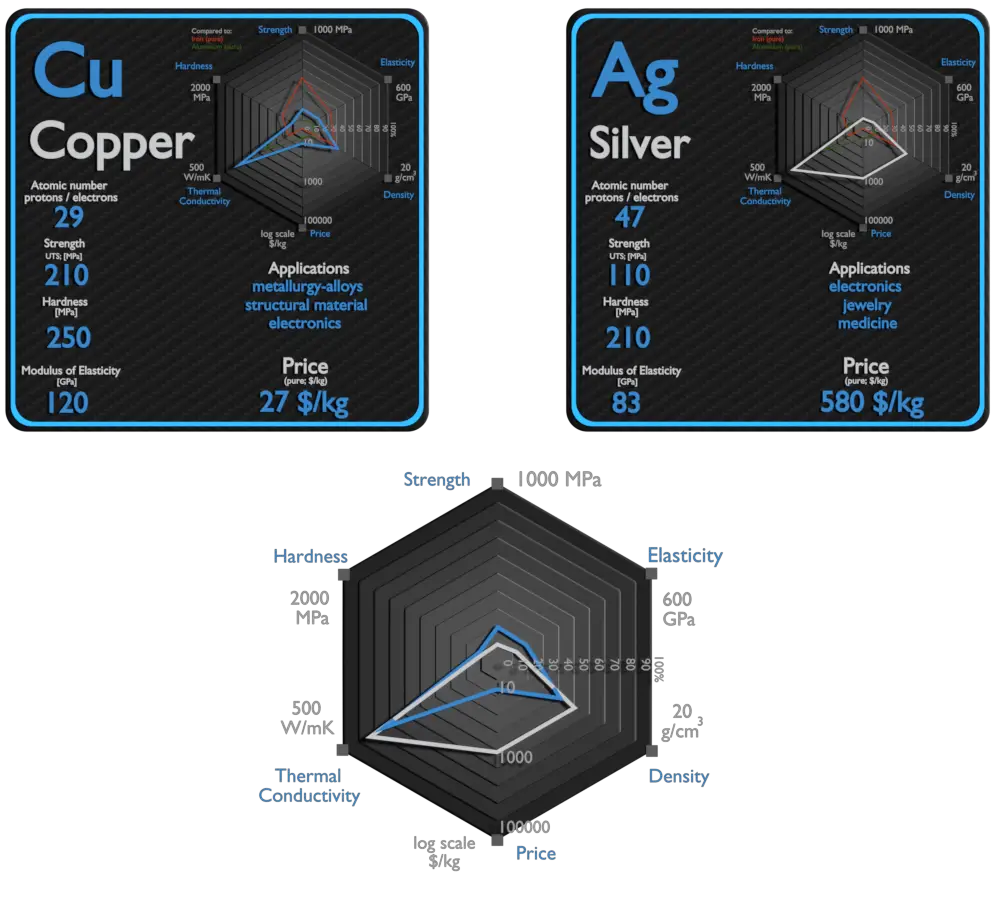
Copper and Silver – Comparison – Properties

This article contains comparison of key thermal and atomic properties of copper and silver, two comparable chemical elements from the periodic table. It also contains basic descriptions and applications of both elements. Copper vs Silver.

copper and silver - comparison

Compare copper with another element

Beryllium - Properties - Price - Applications - Production

Magnesium - Properties - Price - Applications - Production

Aluminium - Properties - Price - Applications - Production

Silicon - Properties - Price - Applications - Production

Chlorine - Properties - Price - Applications - Production

Titanium - Properties - Price - Applications - Production

Chromium - Properties - Price - Applications - Production

Manganese - Properties - Price - Applications - Production

Iron - Properties - Price - Applications - Production

Cobalt - Properties - Price - Applications - Production

Silver - Properties - Price - Applications - Production

Gold - Properties - Price - Applications - Production

Tin - Properties - Price - Applications - Production

Compare silver with another element

Chlorine - Properties - Price - Applications - Production

Cobalt - Properties - Price - Applications - Production

Nickel - Properties - Price - Applications - Production

Copper - Properties - Price - Applications - Production

Rhodium - Properties - Price - Applications - Production

Palladium - Properties - Price - Applications - Production

Gold - Properties - Price - Applications - Production

Platinum - Properties - Price - Applications - Production

Copper and Silver – About Elements

Copper

Copper is a soft, malleable, and ductile metal with very high thermal and electrical conductivity. A freshly exposed surface of pure copper has a reddish-orange color. Copper is used as a conductor of heat and electricity, as a building material, and as a constituent of various metal alloys, such as sterling silver used in jewelry, cupronickel used to make marine hardware and coins, and constantan used in strain gauges and thermocouples for temperature measurement.

Silver

Silver is a soft, white, lustrous transition metal, it exhibits the highest electrical conductivity, thermal conductivity, and reflectivity of any metal. The metal is found in the Earth’s crust in the pure, free elemental form (“native silver”), as an alloy with gold and other metals, and in minerals such as argentite and chlorargyrite. Most silver is produced as a byproduct of copper, gold, lead, and zinc refining.

Copper in Periodic Table

Silver in Periodic Table

Source: www.luciteria.com

Copper and Silver – Applications

Copper

Historically, alloying copper with another metal, for example tin to make bronze, was first practiced about 4000 years after the discovery of copper smelting, and about 2000 years after “natural bronze” had come into general use. An ancient civilization is defined to be in the Bronze Age either by producing bronze by smelting its own copper and alloying with tin, arsenic, or other metals. The major applications of copper are electrical wire (60%), roofing and plumbing (20%), and industrial machinery (15%). Copper is used mostly as a pure metal, but when greater hardness is required, it is put into such alloys as brass and bronze (5% of total use). Copper and copper-based alloys including brasses (Cu-Zn) and bronzes (Cu-Sn) are widely used in different industrial and societal applications. Some of the common uses for brass alloys include costume jewelry, locks, hinges, gears, bearings, ammunition casings, automotive radiators, musical instruments, electronic packaging, and coins. Bronze, or bronze-like alloys and mixtures, were used for coins over a longer period. is still widely used today for springs, bearings, bushings, automobile transmission pilot bearings, and similar fittings, and is particularly common in the bearings of small electric motors. Brass and bronze are common engineering materials in modern architecture and primarily used for roofing and facade cladding due to their visual appearance.

Silver

Silver has long been valued as a precious metal. Silver metal is used in many bullion coins, sometimes alongside gold. Silver has many important, far-reaching technological and electronic applications. It’s used in everything from cell phones, computers and semiconductors to automobiles, water-purification systems and—because it is the best conductor of heat of all elements—spacecraft solar radiation tiles. Silver is of the upmost importance in photography (where approximately 30% of the U.S. Industrial consumption goes into this application). The medical uses of silver include its use in wound dressings, creams, and as an antibiotic coating on medical devices. Wound dressings containing silver sulfadiazine or silver nanomaterials may be used on external infections.

Copper and Silver – Comparison in Table

Element Copper Silver
Density 8.92 g/cm3 10.49 g/cm3
Ultimate Tensile Strength 210 MPa 110 MPa
Yield Strength 33 MPa 45 MPa
Young’s Modulus of Elasticity 120 GPa 83 GPa
Mohs Scale 3 3.25
Brinell Hardness 250 MPa 210 MPa
Vickers Hardness 350 MPa 251 MPa
Melting Point 1084.62 °C 961.78 °C
Boiling Point 2562 °C 2162 °C
Thermal Conductivity 401 W/mK 430 W/mK
Thermal Expansion Coefficient 16.5 µm/mK 18.9 µm/mK
Specific Heat 0.38 J/g K 0.235 J/g K
Heat of Fusion 13.05 kJ/mol 11.3 kJ/mol
Heat of Vaporization 300.3 kJ/mol 250.58 kJ/mol


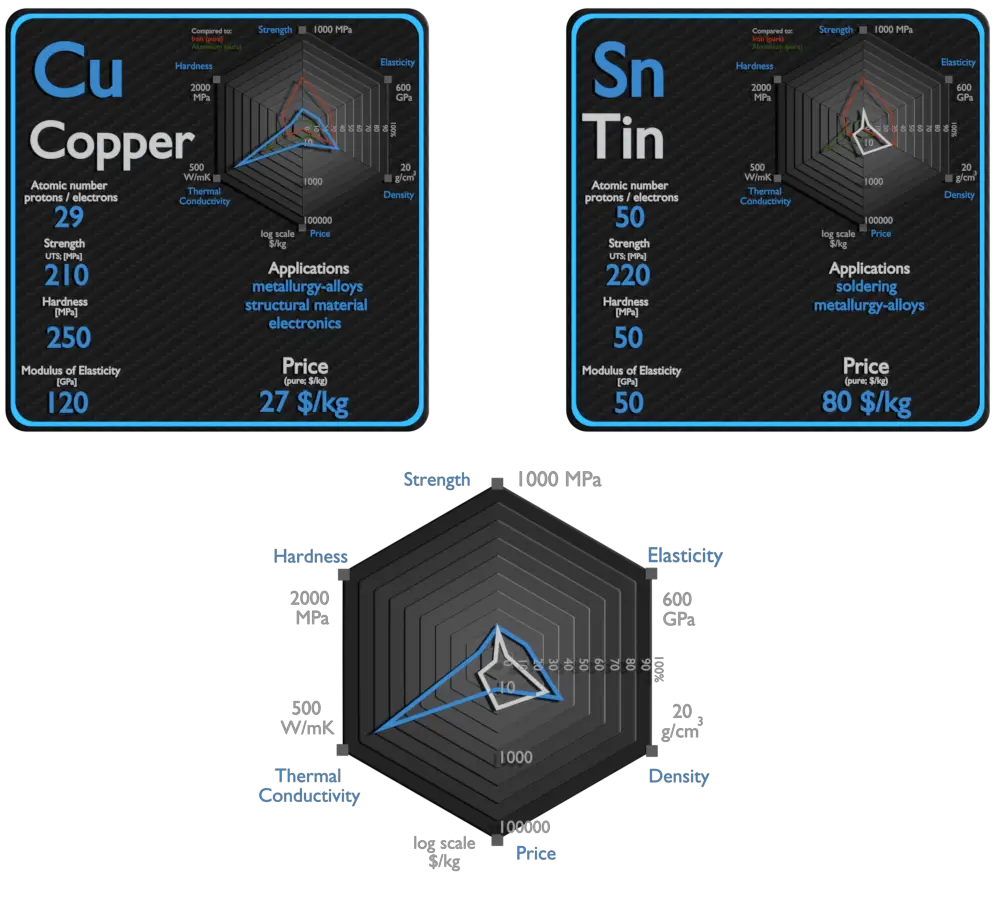
Copper and Tin – Comparison – Properties

This article contains comparison of key thermal and atomic properties of copper and tin, two comparable chemical elements from the periodic table. It also contains basic descriptions and applications of both elements. Copper vs Tin.

copper and tin - comparison

Compare copper with another element

Beryllium - Properties - Price - Applications - Production

Magnesium - Properties - Price - Applications - Production

Aluminium - Properties - Price - Applications - Production

Silicon - Properties - Price - Applications - Production

Chlorine - Properties - Price - Applications - Production

Titanium - Properties - Price - Applications - Production

Chromium - Properties - Price - Applications - Production

Manganese - Properties - Price - Applications - Production

Iron - Properties - Price - Applications - Production

Cobalt - Properties - Price - Applications - Production

Silver - Properties - Price - Applications - Production

Gold - Properties - Price - Applications - Production

Tin - Properties - Price - Applications - Production

Compare tin with another element

Nickel - Properties - Price - Applications - Production

Copper - Properties - Price - Applications - Production

Niobium - Properties - Price - Applications - Production

Antimony - Properties - Price - Applications - Production

Lead - Properties - Price - Applications - Production

Copper and Tin – About Elements

Copper

Copper is a soft, malleable, and ductile metal with very high thermal and electrical conductivity. A freshly exposed surface of pure copper has a reddish-orange color. Copper is used as a conductor of heat and electricity, as a building material, and as a constituent of various metal alloys, such as sterling silver used in jewelry, cupronickel used to make marine hardware and coins, and constantan used in strain gauges and thermocouples for temperature measurement.

Tin

Tin is a post-transition metal in group 14 of the periodic table. It is obtained chiefly from the mineral cassiterite, which contains tin dioxide. The first alloy used on a large scale was bronze, made of tin and copper, from as early as 3000 BC.

Copper in Periodic Table

Tin in Periodic Table

Source: www.luciteria.com

Copper and Tin – Applications

Copper

Historically, alloying copper with another metal, for example tin to make bronze, was first practiced about 4000 years after the discovery of copper smelting, and about 2000 years after “natural bronze” had come into general use. An ancient civilization is defined to be in the Bronze Age either by producing bronze by smelting its own copper and alloying with tin, arsenic, or other metals. The major applications of copper are electrical wire (60%), roofing and plumbing (20%), and industrial machinery (15%). Copper is used mostly as a pure metal, but when greater hardness is required, it is put into such alloys as brass and bronze (5% of total use). Copper and copper-based alloys including brasses (Cu-Zn) and bronzes (Cu-Sn) are widely used in different industrial and societal applications. Some of the common uses for brass alloys include costume jewelry, locks, hinges, gears, bearings, ammunition casings, automotive radiators, musical instruments, electronic packaging, and coins. Bronze, or bronze-like alloys and mixtures, were used for coins over a longer period. is still widely used today for springs, bearings, bushings, automobile transmission pilot bearings, and similar fittings, and is particularly common in the bearings of small electric motors. Brass and bronze are common engineering materials in modern architecture and primarily used for roofing and facade cladding due to their visual appearance.

Tin

The largest single application of tin is in the manufacture of tinplate (steel sheet coated with tin), which accounts for approximately 40% of total world tin consumption. Tin bonds readily to iron and steel to prevent corrosion. Tin-plated steel containers are widely used for food preservation, and this forms a large part of the market for metallic tin. Tinning is the process of thinly coating sheets of wrought iron or steel with tin, and the resulting product is known as tinplate. The term is also widely used for the different process of coating a metal with solder before soldering. There are two processes for the tinning of the black plates: hot-dipping and electroplating.

Copper and Tin – Comparison in Table

Element Copper Tin
Density 8.92 g/cm3 7.31 g/cm3
Ultimate Tensile Strength 210 MPa 220 MPa
Yield Strength 33 MPa N/A
Young’s Modulus of Elasticity 120 GPa 50 GPa
Mohs Scale 3 1.65
Brinell Hardness 250 MPa 50 MPa
Vickers Hardness 350 MPa N/A
Melting Point 1084.62 °C 231.93 °C
Boiling Point 2562 °C 2602 °C
Thermal Conductivity 401 W/mK 67 W/mK
Thermal Expansion Coefficient 16.5 µm/mK 22 µm/mK
Specific Heat 0.38 J/g K 0.227 J/g K
Heat of Fusion 13.05 kJ/mol 7.029 kJ/mol
Heat of Vaporization 300.3 kJ/mol 295.8 kJ/mol


Nickel and Platinum – Comparison – Properties

This article contains comparison of key thermal and atomic properties of nickel and platinum, two comparable chemical elements from the periodic table. It also contains basic descriptions and applications of both elements. Nickel vs Platinum.

nickel and platinum - comparison

Compare nickel with another element

Iron - Properties - Price - Applications - Production

Tin - Properties - Price - Applications - Production

Zinc - Properties - Price - Applications - Production

Silver - Properties - Price - Applications - Production

Gold - Properties - Price - Applications - Production

Platinum - Properties - Price - Applications - Production

Compare platinum with another element

Nickel - Properties - Price - Applications - Production

Rhodium - Properties - Price - Applications - Production

Palladium - Properties - Price - Applications - Production

Silver - Properties - Price - Applications - Production

Tungsten - Properties - Price - Applications - Production

Iridium - Properties - Price - Applications - Production

Gold - Properties - Price - Applications - Production

Nickel and Platinum – About Elements

Nickel

Nickel is a silvery-white lustrous metal with a slight golden tinge. Nickel belongs to the transition metals and is hard and ductile.

Platinum

Platinum is a dense, malleable, ductile, highly unreactive, precious, silverish-white transition metal. Platinum is one of the least reactive metals. It has remarkable resistance to corrosion, even at high temperatures, and is therefore considered a noble metal. Platinum is used in catalytic converters, laboratory equipment, electrical contacts and electrodes, platinum resistance thermometers, dentistry equipment, and jewelry.

Nickel in Periodic Table

Platinum in Periodic Table

Source: www.luciteria.com

Nickel and Platinum – Applications

Nickel

The global production of nickel is presently used as follows: 68% in stainless steel; 10% in nonferrous alloys; 9% in electroplating; 7% in alloy steel; 3% in foundries; and 4% other uses (including batteries). Nickel is used as a constituent of different types of alloys; for instance, Monel (corrosion resistant material), Nichrome (an alloy used for resistance heating elements), Permalloy (an alloy with high magnetic permeability at low field strength and low hysteresis loss), cupro-nickel, stainless steel, nickel silver, etc. Nickel based alloys (e.g. Fe-Cr-Ni(Mo) alloys) alloys exhibit excellent ductility and toughness, even at high strength levels and these properties are retained up to low temperatures. Nickel and its alloys are highly resistant to corrosion in many environments, especially those that are basic (alkaline). Nickel also reduces thermal expansion for better dimensional stability. Nickel is the base element for superalloys. These metals have excellent resistance to thermal creep deformation and retain their stiffness, strength, toughness and dimensional stability at temperatures much higher than the other aerospace structural materials.

Platinum

Platinum is primarily an industrial metal. It is a critical material for many industries and is considered a strategic metal. Platinum is used as a catalyst, platinum is mostly found in vehicle catalytic converters that reduce toxic exhaust chemicals, and also in fuel cells to increase efficiency. The most common use of platinum is as a catalyst in chemical reactions, often as platinum black. In catalytic converters, platinum allows the complete combustion of low concentrations of unburned hydrocarbons from the exhaust into carbon dioxide and water vapor. Platinum has been used in thermocouple devices that measure temperature with high accuracy. Platinum is a component in magnetic coatings for high-density hard disk drives and some of the newer optical storage systems.

Nickel and Platinum – Comparison in Table

Element Nickel Platinum
Density 8.908 g/cm3 21.09 g/cm3
Ultimate Tensile Strength 345 MPa 150 MPa
Yield Strength 700 MPa 70 MPa
Young’s Modulus of Elasticity 200 GPa 168 GPa
Mohs Scale 4 3.5
Brinell Hardness 700 MPa 400 MPa
Vickers Hardness 640 MPa 550 MPa
Melting Point 1455 °C 1772 °C
Boiling Point 2730 °C 3827 °C
Thermal Conductivity 90.7 W/mK 72 W/mK
Thermal Expansion Coefficient 13.4 µm/mK 8.8 µm/mK
Specific Heat 0.44 J/g K 0.13 J/g K
Heat of Fusion 17.47 kJ/mol 19.6 kJ/mol
Heat of Vaporization 370.4 kJ/mol 510 kJ/mol


Nickel and Gold – Comparison – Properties

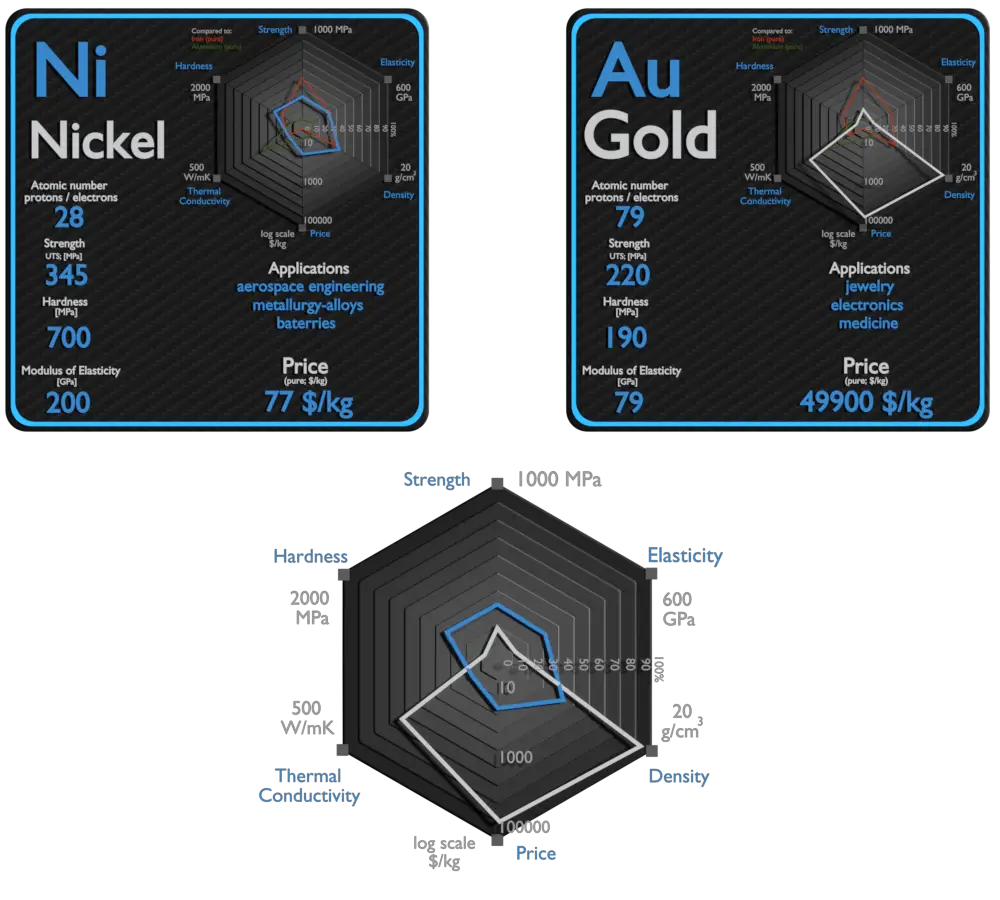
This article contains comparison of key thermal and atomic properties of nickel and gold, two comparable chemical elements from the periodic table. It also contains basic descriptions and applications of both elements. Nickel vs Gold.

nickel and gold - comparison

Compare nickel with another element

Iron - Properties - Price - Applications - Production

Tin - Properties - Price - Applications - Production

Zinc - Properties - Price - Applications - Production

Silver - Properties - Price - Applications - Production

Gold - Properties - Price - Applications - Production

Platinum - Properties - Price - Applications - Production

Compare gold with another element

Titanium - Properties - Price - Applications - Production

Cobalt - Properties - Price - Applications - Production

Nickel - Properties - Price - Applications - Production

Copper - Properties - Price - Applications - Production

Rhodium - Properties - Price - Applications - Production

Palladium - Properties - Price - Applications - Production

Silver - Properties - Price - Applications - Production

Tungsten - Properties - Price - Applications - Production

Osmium - Properties - Price - Applications - Production

Iridium - Properties - Price - Applications - Production

Platinum - Properties - Price - Applications - Production

Lead - Properties - Price - Applications - Production

Nickel and Gold – About Elements

Nickel

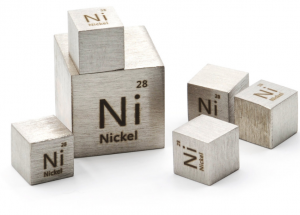
Nickel is a silvery-white lustrous metal with a slight golden tinge. Nickel belongs to the transition metals and is hard and ductile.

Gold

Gold is a bright, slightly reddish yellow, dense, soft, malleable, and ductile metal. Gold is a transition metal and a group 11 element. It is one of the least reactive chemical elements and is solid under standard conditions. Gold is thought to have been produced in supernova nucleosynthesis, from the collision of neutron stars.

Nickel in Periodic Table

Gold in Periodic Table

Source: www.luciteria.com

Nickel and Gold – Applications

Nickel

The global production of nickel is presently used as follows: 68% in stainless steel; 10% in nonferrous alloys; 9% in electroplating; 7% in alloy steel; 3% in foundries; and 4% other uses (including batteries). Nickel is used as a constituent of different types of alloys; for instance, Monel (corrosion resistant material), Nichrome (an alloy used for resistance heating elements), Permalloy (an alloy with high magnetic permeability at low field strength and low hysteresis loss), cupro-nickel, stainless steel, nickel silver, etc. Nickel based alloys (e.g. Fe-Cr-Ni(Mo) alloys) alloys exhibit excellent ductility and toughness, even at high strength levels and these properties are retained up to low temperatures. Nickel and its alloys are highly resistant to corrosion in many environments, especially those that are basic (alkaline). Nickel also reduces thermal expansion for better dimensional stability. Nickel is the base element for superalloys. These metals have excellent resistance to thermal creep deformation and retain their stiffness, strength, toughness and dimensional stability at temperatures much higher than the other aerospace structural materials.

Gold

Gold is used extensively in jewellery, either in its pure form or as an alloy. About 75% of all gold produced is used in the jewelry industry. Pure gold is too soft to stand up to the stresses applied to many jewelry items. Craftsmen learned that alloying gold with other metals such as copper, silver, and platinum would increase its durability. The term ‘carat’ indicates the amount of gold present in an alloy. 24-carat is pure gold, but it is very soft. 18- and 9-carat gold alloys are commonly used because they are more durable. Gold’s high malleability, ductility, resistance to corrosion and most other chemical reactions, and conductivity of electricity have led to its continued use in corrosion resistant electrical connectors in all types of computerized devices (its chief industrial use). Gold is also used in infrared shielding, colored-glass production, gold leafing, and tooth restoration. Only 10% of the world consumption of new gold produced goes to industry, but by far the most important industrial use for new gold is in fabrication of corrosion-free electrical connectors in computers and other electrical devices.

Nickel and Gold – Comparison in Table

Element Nickel Gold
Density 8.908 g/cm3 19.3 g/cm3
Ultimate Tensile Strength 345 MPa 220 MPa
Yield Strength 700 MPa 205 MPa
Young’s Modulus of Elasticity 200 GPa 79 GPa
Mohs Scale 4 2.75
Brinell Hardness 700 MPa 290 MPa
Vickers Hardness 640 MPa 215 MPa
Melting Point 1455 °C 1064 °C
Boiling Point 2730 °C 2970 °C
Thermal Conductivity 90.7 W/mK 320 W/mK
Thermal Expansion Coefficient 13.4 µm/mK 14.2 µm/mK
Specific Heat 0.44 J/g K 0.128 J/g K
Heat of Fusion 17.47 kJ/mol 12.55 kJ/mol
Heat of Vaporization 370.4 kJ/mol 33.44 kJ/mol


Nickel and Silver – Comparison – Properties

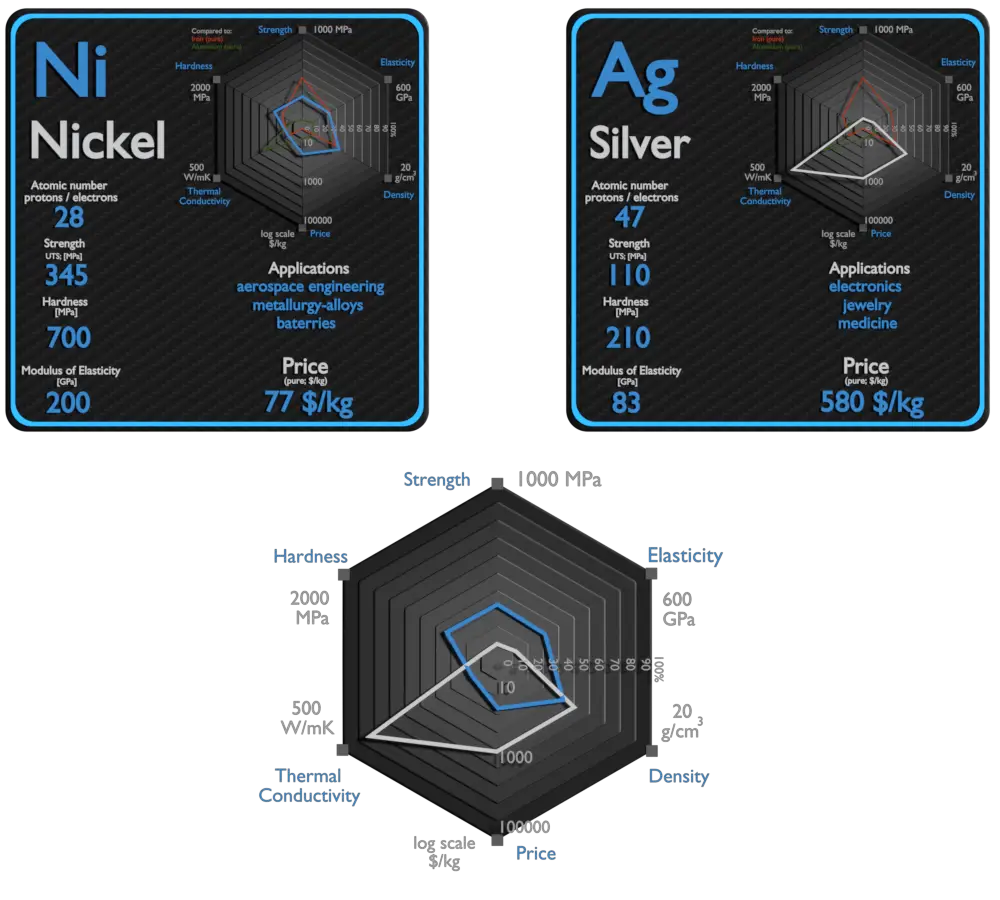
This article contains comparison of key thermal and atomic properties of nickel and silver, two comparable chemical elements from the periodic table. It also contains basic descriptions and applications of both elements. Nickel vs Silver.

nickel and silver - comparison

Compare nickel with another element

Iron - Properties - Price - Applications - Production

Tin - Properties - Price - Applications - Production

Zinc - Properties - Price - Applications - Production

Silver - Properties - Price - Applications - Production

Gold - Properties - Price - Applications - Production

Platinum - Properties - Price - Applications - Production

Compare silver with another element

Chlorine - Properties - Price - Applications - Production

Cobalt - Properties - Price - Applications - Production

Nickel - Properties - Price - Applications - Production

Copper - Properties - Price - Applications - Production

Rhodium - Properties - Price - Applications - Production

Palladium - Properties - Price - Applications - Production

Gold - Properties - Price - Applications - Production

Platinum - Properties - Price - Applications - Production

Nickel and Silver – About Elements

Nickel

Nickel is a silvery-white lustrous metal with a slight golden tinge. Nickel belongs to the transition metals and is hard and ductile.

Silver

Silver is a soft, white, lustrous transition metal, it exhibits the highest electrical conductivity, thermal conductivity, and reflectivity of any metal. The metal is found in the Earth’s crust in the pure, free elemental form (“native silver”), as an alloy with gold and other metals, and in minerals such as argentite and chlorargyrite. Most silver is produced as a byproduct of copper, gold, lead, and zinc refining.

Nickel in Periodic Table

Silver in Periodic Table

Source: www.luciteria.com

Nickel and Silver – Applications

Nickel

The global production of nickel is presently used as follows: 68% in stainless steel; 10% in nonferrous alloys; 9% in electroplating; 7% in alloy steel; 3% in foundries; and 4% other uses (including batteries). Nickel is used as a constituent of different types of alloys; for instance, Monel (corrosion resistant material), Nichrome (an alloy used for resistance heating elements), Permalloy (an alloy with high magnetic permeability at low field strength and low hysteresis loss), cupro-nickel, stainless steel, nickel silver, etc. Nickel based alloys (e.g. Fe-Cr-Ni(Mo) alloys) alloys exhibit excellent ductility and toughness, even at high strength levels and these properties are retained up to low temperatures. Nickel and its alloys are highly resistant to corrosion in many environments, especially those that are basic (alkaline). Nickel also reduces thermal expansion for better dimensional stability. Nickel is the base element for superalloys. These metals have excellent resistance to thermal creep deformation and retain their stiffness, strength, toughness and dimensional stability at temperatures much higher than the other aerospace structural materials.

Silver

Silver has long been valued as a precious metal. Silver metal is used in many bullion coins, sometimes alongside gold. Silver has many important, far-reaching technological and electronic applications. It’s used in everything from cell phones, computers and semiconductors to automobiles, water-purification systems and—because it is the best conductor of heat of all elements—spacecraft solar radiation tiles. Silver is of the upmost importance in photography (where approximately 30% of the U.S. Industrial consumption goes into this application). The medical uses of silver include its use in wound dressings, creams, and as an antibiotic coating on medical devices. Wound dressings containing silver sulfadiazine or silver nanomaterials may be used on external infections.

Nickel and Silver – Comparison in Table

Element Nickel Silver
Density 8.908 g/cm3 10.49 g/cm3
Ultimate Tensile Strength 345 MPa 110 MPa
Yield Strength 700 MPa 45 MPa
Young’s Modulus of Elasticity 200 GPa 83 GPa
Mohs Scale 4 3.25
Brinell Hardness 700 MPa 210 MPa
Vickers Hardness 640 MPa 251 MPa
Melting Point 1455 °C 961.78 °C
Boiling Point 2730 °C 2162 °C
Thermal Conductivity 90.7 W/mK 430 W/mK
Thermal Expansion Coefficient 13.4 µm/mK 18.9 µm/mK
Specific Heat 0.44 J/g K 0.235 J/g K
Heat of Fusion 17.47 kJ/mol 11.3 kJ/mol
Heat of Vaporization 370.4 kJ/mol 250.58 kJ/mol