Facebook Instagram Youtube Twitter

Boron – Latent Heat of Vaporization – Fusion – Heat Capacity

Boron-latent-heat-fusion-vaporization-specific-heat

About Boron

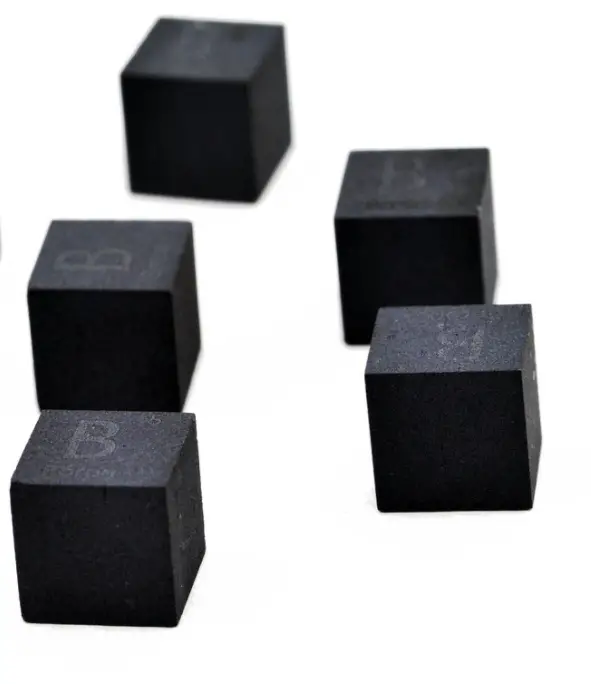
Significant concentrations of boron occur on the Earth in compounds known as the borate minerals. There are over 100 different borate minerals, but the most common are: borax, kernite, ulexite etc. Natural boron consists primarily of two stable isotopes, 11B (80.1%) and 10B (19.9%). In nuclear industry boron is commonly used as a neutron absorber due to the high neutron cross-section of isotope 10B. Its (n,alpha) reaction cross-section for thermal neutrons is about 3840 barns (for 0.025 eV neutron). Isotope 11B has absorption cross-section for thermal neutrons about 0.005 barns (for 0.025 eV neutron). Most of (n,alpha) reactions of thermal neutrons are 10B(n,alpha)7Li reactions accompanied by 0.48 MeV gamma emission.

Boron – Specific Heat, Latent Heat of Fusion, Latent Heat of Vaporization

Specific heat of Boron is 1.02 J/g K.

Heat capacity is an extensive property of matter, meaning it is proportional to the size of the system. Heat capacity C has the unit of energy per degree or energy per kelvin. When expressing the same phenomenon as an intensive property, the heat capacity is divided by the amount of substance, mass, or volume, thus the quantity is independent of the size or extent of the sample.

Latent Heat of Fusion of Boron is 50.2 kJ/mol.

Latent Heat of Vaporization of Boron is 508 kJ/mol.

Latent heat is the amount of heat added to or removed from a substance to produce a change in phase. This energy breaks down the intermolecular attractive forces, and also must provide the energy necessary to expand the gas (the pΔV work). When latent heat is added, no temperature change occurs. The enthalpy of vaporization is a function of the pressure at which that transformation takes place.

See also: Mechanical Properties of Boron

Heat Capacity of Elements
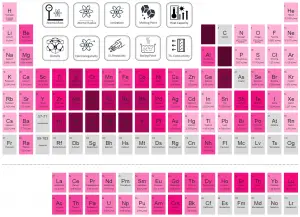
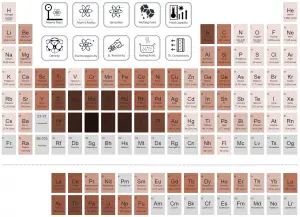
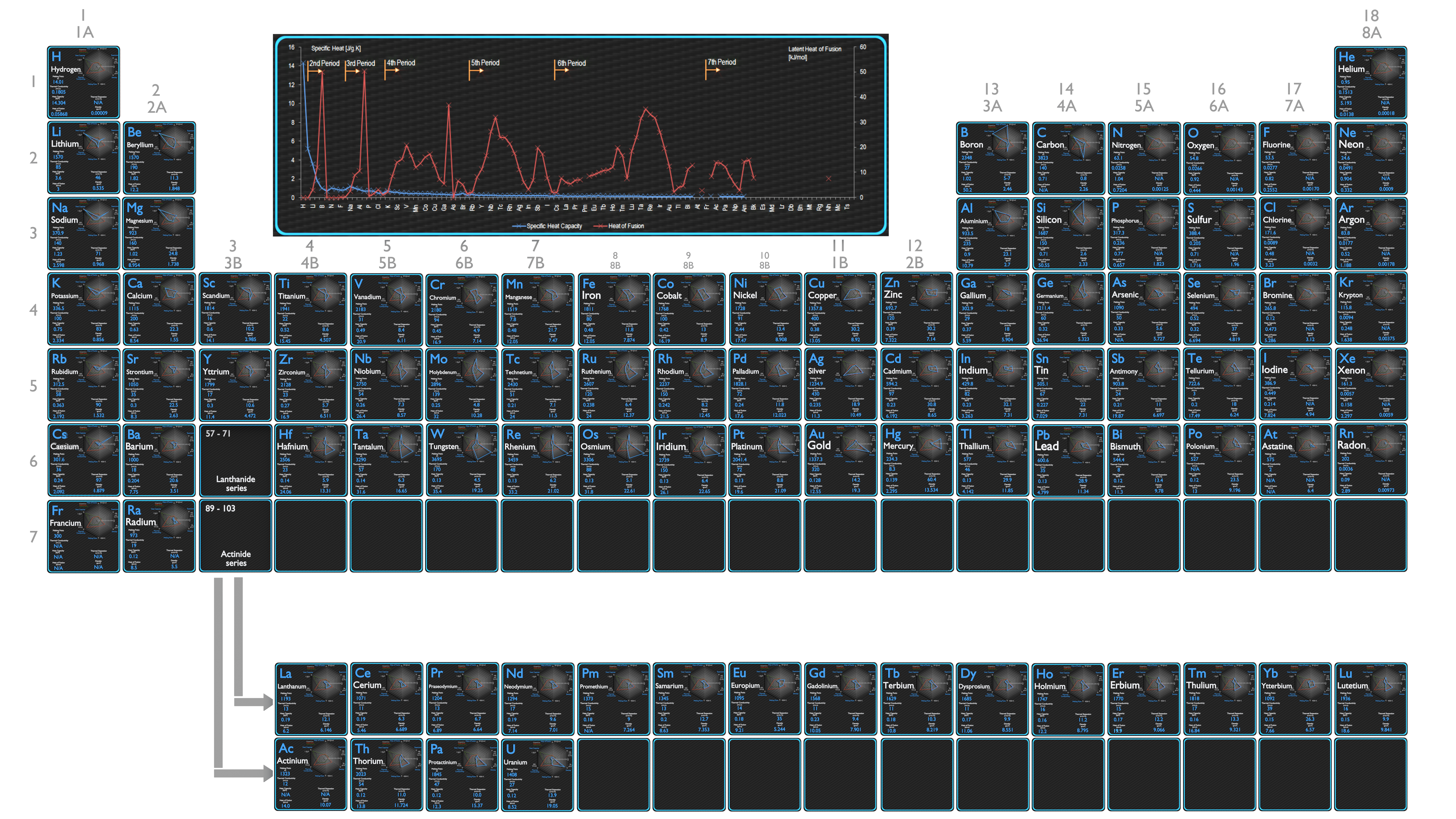
Periodic Table of Elements - heat capacity

Heat of Fusion of Elements

Periodic Table of Elements - latent heat fusion

Heat of Vaporization of Elements

Periodic Table of Elements - latent heat vaporization

About Specific Heat Capacity

Specific heat, or specific heat capacity, is a property related to internal energy that is very important in thermodynamics. The intensive properties cv and cp are defined for pure, simple compressible substances as partial derivatives of the internal energy u(T, v) and enthalpy h(T, p), respectively:
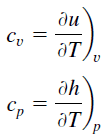
Table of specific heat capacitieswhere the subscripts v and p denote the variables held fixed during differentiation. The properties cv and cp are referred to as specific heats(or heat capacities) because under certain special conditions they relate the temperature change of a system to the amount of energy added by heat transfer. Their SI units are J/kg K or J/mol K.

Different substances are affected to different magnitudes by the addition of heat. When a given amount of heat is added to different substances, their temperatures increase by different amounts.

Heat capacity is an extensive property of matter, meaning it is proportional to the size of the system. Heat capacity C has the unit of energy per degree or energy per kelvin. When expressing the same phenomenon as an intensive property, the heat capacity is divided by the amount of substance, mass, or volume, thus the quantity is independent of the size or extent of the sample.

specific-heat-chemical-elements-chart

About Latent Heat

Latent Heat of Vaporization

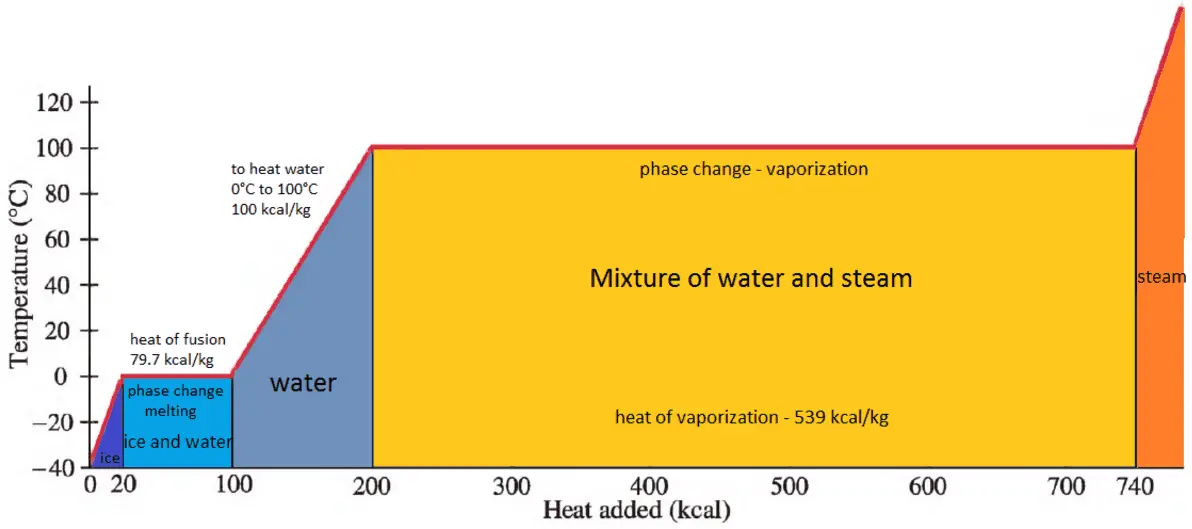
Phase-Changes-Heat-of-VaporizationIn general, when a material changes phase from solid to liquid, or from liquid to gas a certain amount of energy is involved in this change of phase. In case of liquid to gas phase change, this amount of energy is known as the enthalpy of vaporization, (symbol ∆Hvap; unit: J) also known as the (latent) heat of vaporization or heat of evaporation. As an example, see the figure, which descibes phase transitions of water.

Latent heat is the amount of heat added to or removed from a substance to produce a change in phase. This energy breaks down the intermolecular attractive forces, and also must provide the energy necessary to expand the gas (the pΔV work). When latent heat is added, no temperature change occurs. The enthalpy of vaporization is a function of the pressure at which that transformation takes place.

The temperature at which vaporization (boiling) starts to occur for a given pressure is also known as the saturation temperature and at this conditions a mixture of vapor and liquid can exist together. The liquid can be said to be saturated with thermal energy. Any addition of thermal energy results in a phase transition. At the boiling point the two phases of a substance, liquid and vapor, have identical free energies and therefore are equally likely to exist. Below the boiling point, the liquid is the more stable state of the two, whereas above the gaseous form is preferred.

Latent Heat of Fusion

In case of solid to liquid phase change, the change in enthalpy required to change its state is known as the enthalpy of fusion, (symbol ∆Hfus; unit: J) also known as the (latent) heat of fusion. Latent heat is the amount of heat added to or removed from a substance to produce a change in phase. This energy breaks down the intermolecular attractive forces, and also must provide the energy necessary to expand the system (the pΔV work).

The liquid phase has a higher internal energy than the solid phase. This means energy must be supplied to a solid in order to melt it and energy is released from a liquid when it freezes, because the molecules in the liquid experience weaker intermolecular forces and so have a higher potential energy (a kind of bond-dissociation energy for intermolecular forces).

The temperature at which the phase transition occurs is the melting point. The melting point also defines a condition in which the solid and liquid can exist in equilibrium. Adding a heat will convert the solid into a liquid with no temperature change. At the melting point the two phases of a substance, liquid and vapor, have identical free energies and therefore are equally likely to exist. Below the melting point, the solid is the more stable state of the two, whereas above the liquid form is preferred. The melting point of a substance depends on pressure and is usually specified at standard pressure. When considered as the temperature of the reverse change from liquid to solid, it is referred to as the freezing point or crystallization point.

heat-of-fusion-and-vaporization-chemical-elements

Summary

Element Boron
Specific Heat 1.02 J/g K
Heat of Fusion 50.2 kJ/mol
Heat of Vaporization 508 kJ/mol
Density 2.46 g/cm3

Boron-periodic-table

Source: www.luciteria.com


Properties of other elements

Boron - Comparison of Latent Heat and Specific Heat

Periodic Table in 8K resolution

Other properties of Boron


Beryllium – Latent Heat of Vaporization – Fusion – Heat Capacity

Beryllium-latent-heat-fusion-vaporization-specific-heat

About Beryllium

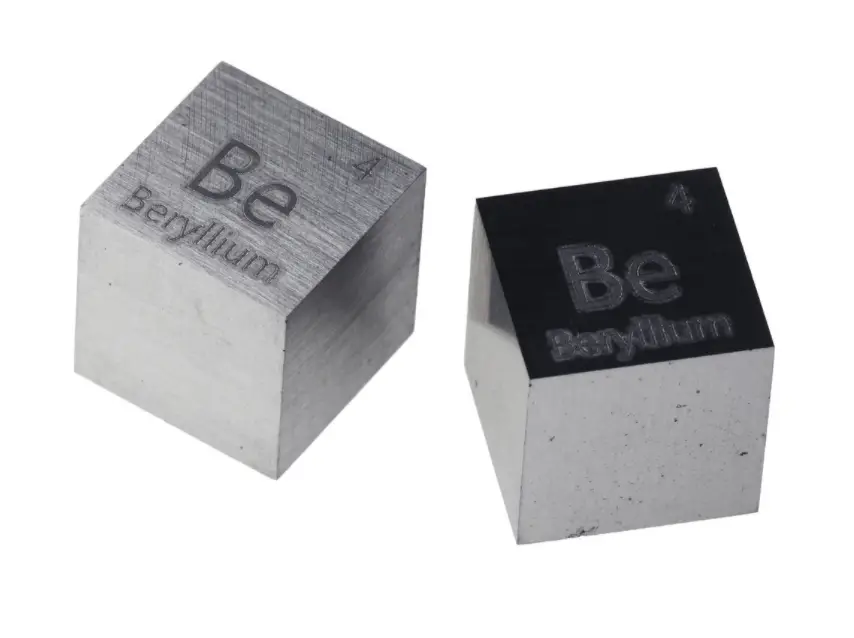
Beryllium is a hard, grayish metal naturally found in mineral rocks, coal, soil, and volcanic dust. The commercial use of beryllium requires the use of appropriate dust control equipment and industrial controls at all times because of the toxicity of inhaled beryllium-containing dusts that can cause a chronic life-threatening allergic disease in some people called berylliosis. Beryllium has a large scattering cross section for high-energy neutrons, about 6 barns for energies above approximately 10 keV. Therefore, it works as a neutron reflector and neutron moderator, effectively slowing the neutrons to the thermal energy. Since berylium has very low threshold energy for neutron emission, it can be used as a neutron source in nuclear reactors. The Sb-Be source is based on (γ,n) reaction (i.e. it emits photoneutrons).

Beryllium – Specific Heat, Latent Heat of Fusion, Latent Heat of Vaporization

Specific heat of Beryllium is 1.82 J/g K.

Heat capacity is an extensive property of matter, meaning it is proportional to the size of the system. Heat capacity C has the unit of energy per degree or energy per kelvin. When expressing the same phenomenon as an intensive property, the heat capacity is divided by the amount of substance, mass, or volume, thus the quantity is independent of the size or extent of the sample.

Latent Heat of Fusion of Beryllium is 12.2 kJ/mol.

Latent Heat of Vaporization of Beryllium is 292.4 kJ/mol.

Latent heat is the amount of heat added to or removed from a substance to produce a change in phase. This energy breaks down the intermolecular attractive forces, and also must provide the energy necessary to expand the gas (the pΔV work). When latent heat is added, no temperature change occurs. The enthalpy of vaporization is a function of the pressure at which that transformation takes place.

See also: Mechanical Properties of Beryllium

Heat Capacity of Elements

Periodic Table of Elements - heat capacity

Heat of Fusion of Elements

Periodic Table of Elements - latent heat fusion

Heat of Vaporization of Elements

Periodic Table of Elements - latent heat vaporization

About Specific Heat Capacity

Specific heat, or specific heat capacity, is a property related to internal energy that is very important in thermodynamics. The intensive properties cv and cp are defined for pure, simple compressible substances as partial derivatives of the internal energy u(T, v) and enthalpy h(T, p), respectively:
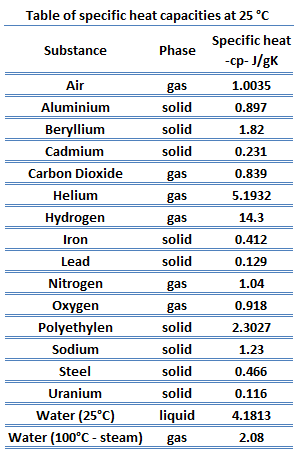
Table of specific heat capacitieswhere the subscripts v and p denote the variables held fixed during differentiation. The properties cv and cp are referred to as specific heats(or heat capacities) because under certain special conditions they relate the temperature change of a system to the amount of energy added by heat transfer. Their SI units are J/kg K or J/mol K.

Different substances are affected to different magnitudes by the addition of heat. When a given amount of heat is added to different substances, their temperatures increase by different amounts.

Heat capacity is an extensive property of matter, meaning it is proportional to the size of the system. Heat capacity C has the unit of energy per degree or energy per kelvin. When expressing the same phenomenon as an intensive property, the heat capacity is divided by the amount of substance, mass, or volume, thus the quantity is independent of the size or extent of the sample.
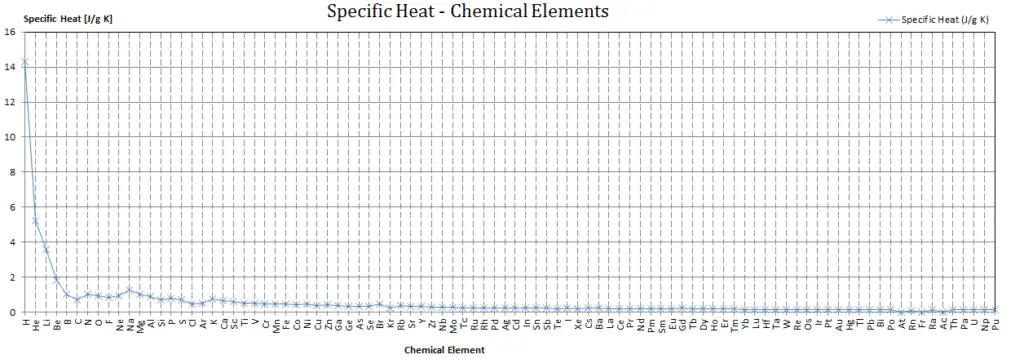
specific-heat-chemical-elements-chart

About Latent Heat

Latent Heat of Vaporization

Phase-Changes-Heat-of-VaporizationIn general, when a material changes phase from solid to liquid, or from liquid to gas a certain amount of energy is involved in this change of phase. In case of liquid to gas phase change, this amount of energy is known as the enthalpy of vaporization, (symbol ∆Hvap; unit: J) also known as the (latent) heat of vaporization or heat of evaporation. As an example, see the figure, which descibes phase transitions of water.

Latent heat is the amount of heat added to or removed from a substance to produce a change in phase. This energy breaks down the intermolecular attractive forces, and also must provide the energy necessary to expand the gas (the pΔV work). When latent heat is added, no temperature change occurs. The enthalpy of vaporization is a function of the pressure at which that transformation takes place.

The temperature at which vaporization (boiling) starts to occur for a given pressure is also known as the saturation temperature and at this conditions a mixture of vapor and liquid can exist together. The liquid can be said to be saturated with thermal energy. Any addition of thermal energy results in a phase transition. At the boiling point the two phases of a substance, liquid and vapor, have identical free energies and therefore are equally likely to exist. Below the boiling point, the liquid is the more stable state of the two, whereas above the gaseous form is preferred.

Latent Heat of Fusion

In case of solid to liquid phase change, the change in enthalpy required to change its state is known as the enthalpy of fusion, (symbol ∆Hfus; unit: J) also known as the (latent) heat of fusion. Latent heat is the amount of heat added to or removed from a substance to produce a change in phase. This energy breaks down the intermolecular attractive forces, and also must provide the energy necessary to expand the system (the pΔV work).

The liquid phase has a higher internal energy than the solid phase. This means energy must be supplied to a solid in order to melt it and energy is released from a liquid when it freezes, because the molecules in the liquid experience weaker intermolecular forces and so have a higher potential energy (a kind of bond-dissociation energy for intermolecular forces).

The temperature at which the phase transition occurs is the melting point. The melting point also defines a condition in which the solid and liquid can exist in equilibrium. Adding a heat will convert the solid into a liquid with no temperature change. At the melting point the two phases of a substance, liquid and vapor, have identical free energies and therefore are equally likely to exist. Below the melting point, the solid is the more stable state of the two, whereas above the liquid form is preferred. The melting point of a substance depends on pressure and is usually specified at standard pressure. When considered as the temperature of the reverse change from liquid to solid, it is referred to as the freezing point or crystallization point.

heat-of-fusion-and-vaporization-chemical-elements

Summary

Element Beryllium
Specific Heat 1.82 J/g K
Heat of Fusion 12.2 kJ/mol
Heat of Vaporization 292.4 kJ/mol
Density 1.848 g/cm3

Beryllium-periodic-table

Source: www.luciteria.com


Properties of other elements

Beryllium - Comparison of Latent Heat and Specific Heat

Periodic Table in 8K resolution

Other properties of Beryllium


Lithium – Latent Heat of Vaporization – Fusion – Heat Capacity

Lithium-latent-heat-fusion-vaporization-specific-heat

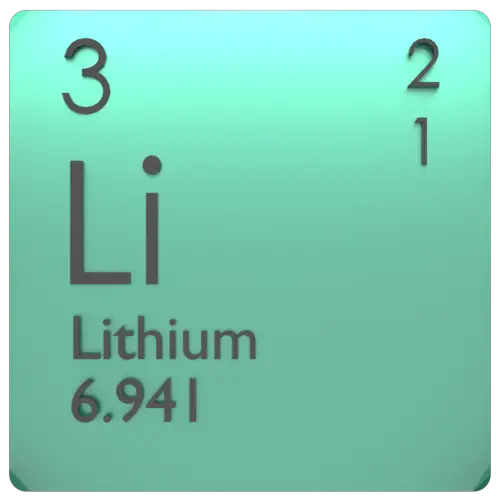
About Lithium

It is a soft, silvery-white alkali metal. Under standard conditions, it is the lightest metal and the lightest solid element. Like all alkali metals, lithium is highly reactive and flammable, and is stored in mineral oil.

Lithium – Specific Heat, Latent Heat of Fusion, Latent Heat of Vaporization

Specific heat of Lithium is 3.6 J/g K.

Heat capacity is an extensive property of matter, meaning it is proportional to the size of the system. Heat capacity C has the unit of energy per degree or energy per kelvin. When expressing the same phenomenon as an intensive property, the heat capacity is divided by the amount of substance, mass, or volume, thus the quantity is independent of the size or extent of the sample.

Latent Heat of Fusion of Lithium is 3 kJ/mol.

Latent Heat of Vaporization of Lithium is 145.92 kJ/mol.

Latent heat is the amount of heat added to or removed from a substance to produce a change in phase. This energy breaks down the intermolecular attractive forces, and also must provide the energy necessary to expand the gas (the pΔV work). When latent heat is added, no temperature change occurs. The enthalpy of vaporization is a function of the pressure at which that transformation takes place.

See also: Mechanical Properties of Lithium

Heat Capacity of Elements

Periodic Table of Elements - heat capacity

Heat of Fusion of Elements

Periodic Table of Elements - latent heat fusion

Heat of Vaporization of Elements

Periodic Table of Elements - latent heat vaporization

About Specific Heat Capacity

Specific heat, or specific heat capacity, is a property related to internal energy that is very important in thermodynamics. The intensive properties cv and cp are defined for pure, simple compressible substances as partial derivatives of the internal energy u(T, v) and enthalpy h(T, p), respectively:

Table of specific heat capacitieswhere the subscripts v and p denote the variables held fixed during differentiation. The properties cv and cp are referred to as specific heats(or heat capacities) because under certain special conditions they relate the temperature change of a system to the amount of energy added by heat transfer. Their SI units are J/kg K or J/mol K.

Different substances are affected to different magnitudes by the addition of heat. When a given amount of heat is added to different substances, their temperatures increase by different amounts.

Heat capacity is an extensive property of matter, meaning it is proportional to the size of the system. Heat capacity C has the unit of energy per degree or energy per kelvin. When expressing the same phenomenon as an intensive property, the heat capacity is divided by the amount of substance, mass, or volume, thus the quantity is independent of the size or extent of the sample.

specific-heat-chemical-elements-chart

About Latent Heat

Latent Heat of Vaporization

Phase-Changes-Heat-of-VaporizationIn general, when a material changes phase from solid to liquid, or from liquid to gas a certain amount of energy is involved in this change of phase. In case of liquid to gas phase change, this amount of energy is known as the enthalpy of vaporization, (symbol ∆Hvap; unit: J) also known as the (latent) heat of vaporization or heat of evaporation. As an example, see the figure, which descibes phase transitions of water.

Latent heat is the amount of heat added to or removed from a substance to produce a change in phase. This energy breaks down the intermolecular attractive forces, and also must provide the energy necessary to expand the gas (the pΔV work). When latent heat is added, no temperature change occurs. The enthalpy of vaporization is a function of the pressure at which that transformation takes place.

The temperature at which vaporization (boiling) starts to occur for a given pressure is also known as the saturation temperature and at this conditions a mixture of vapor and liquid can exist together. The liquid can be said to be saturated with thermal energy. Any addition of thermal energy results in a phase transition. At the boiling point the two phases of a substance, liquid and vapor, have identical free energies and therefore are equally likely to exist. Below the boiling point, the liquid is the more stable state of the two, whereas above the gaseous form is preferred.

Latent Heat of Fusion

In case of solid to liquid phase change, the change in enthalpy required to change its state is known as the enthalpy of fusion, (symbol ∆Hfus; unit: J) also known as the (latent) heat of fusion. Latent heat is the amount of heat added to or removed from a substance to produce a change in phase. This energy breaks down the intermolecular attractive forces, and also must provide the energy necessary to expand the system (the pΔV work).

The liquid phase has a higher internal energy than the solid phase. This means energy must be supplied to a solid in order to melt it and energy is released from a liquid when it freezes, because the molecules in the liquid experience weaker intermolecular forces and so have a higher potential energy (a kind of bond-dissociation energy for intermolecular forces).

The temperature at which the phase transition occurs is the melting point. The melting point also defines a condition in which the solid and liquid can exist in equilibrium. Adding a heat will convert the solid into a liquid with no temperature change. At the melting point the two phases of a substance, liquid and vapor, have identical free energies and therefore are equally likely to exist. Below the melting point, the solid is the more stable state of the two, whereas above the liquid form is preferred. The melting point of a substance depends on pressure and is usually specified at standard pressure. When considered as the temperature of the reverse change from liquid to solid, it is referred to as the freezing point or crystallization point.

heat-of-fusion-and-vaporization-chemical-elements

Summary

Element Lithium
Specific Heat 3.6 J/g K
Heat of Fusion 3 kJ/mol
Heat of Vaporization 145.92 kJ/mol
Density 0.535 g/cm3

Lithium-periodic-table

Source: www.luciteria.com


Properties of other elements

Lithium - Comparison of Latent Heat and Specific Heat

Periodic Table in 8K resolution

Other properties of Lithium


Helium – Latent Heat of Vaporization – Fusion – Heat Capacity

Helium-latent-heat-fusion-vaporization-specific-heat

About Helium

It is a colorless, odorless, tasteless, non-toxic, inert, monatomic gas, the first in the noble gas group in the periodic table. Its boiling point is the lowest among all the elements.

Helium – Specific Heat, Latent Heat of Fusion, Latent Heat of Vaporization

Specific heat of Helium is 5.193 J/g K.

Heat capacity is an extensive property of matter, meaning it is proportional to the size of the system. Heat capacity C has the unit of energy per degree or energy per kelvin. When expressing the same phenomenon as an intensive property, the heat capacity is divided by the amount of substance, mass, or volume, thus the quantity is independent of the size or extent of the sample.

Latent Heat of Fusion of Helium is 0.0138 kJ/mol.

Latent Heat of Vaporization of Helium is 0.0845 kJ/mol.

Latent heat is the amount of heat added to or removed from a substance to produce a change in phase. This energy breaks down the intermolecular attractive forces, and also must provide the energy necessary to expand the gas (the pΔV work). When latent heat is added, no temperature change occurs. The enthalpy of vaporization is a function of the pressure at which that transformation takes place.

See also: Mechanical Properties of Helium

Heat Capacity of Elements

Periodic Table of Elements - heat capacity

Heat of Fusion of Elements

Periodic Table of Elements - latent heat fusion

Heat of Vaporization of Elements

Periodic Table of Elements - latent heat vaporization

About Specific Heat Capacity

Specific heat, or specific heat capacity, is a property related to internal energy that is very important in thermodynamics. The intensive properties cv and cp are defined for pure, simple compressible substances as partial derivatives of the internal energy u(T, v) and enthalpy h(T, p), respectively:

Table of specific heat capacitieswhere the subscripts v and p denote the variables held fixed during differentiation. The properties cv and cp are referred to as specific heats(or heat capacities) because under certain special conditions they relate the temperature change of a system to the amount of energy added by heat transfer. Their SI units are J/kg K or J/mol K.

Different substances are affected to different magnitudes by the addition of heat. When a given amount of heat is added to different substances, their temperatures increase by different amounts.

Heat capacity is an extensive property of matter, meaning it is proportional to the size of the system. Heat capacity C has the unit of energy per degree or energy per kelvin. When expressing the same phenomenon as an intensive property, the heat capacity is divided by the amount of substance, mass, or volume, thus the quantity is independent of the size or extent of the sample.

specific-heat-chemical-elements-chart

About Latent Heat

Latent Heat of Vaporization

Phase-Changes-Heat-of-VaporizationIn general, when a material changes phase from solid to liquid, or from liquid to gas a certain amount of energy is involved in this change of phase. In case of liquid to gas phase change, this amount of energy is known as the enthalpy of vaporization, (symbol ∆Hvap; unit: J) also known as the (latent) heat of vaporization or heat of evaporation. As an example, see the figure, which descibes phase transitions of water.

Latent heat is the amount of heat added to or removed from a substance to produce a change in phase. This energy breaks down the intermolecular attractive forces, and also must provide the energy necessary to expand the gas (the pΔV work). When latent heat is added, no temperature change occurs. The enthalpy of vaporization is a function of the pressure at which that transformation takes place.

The temperature at which vaporization (boiling) starts to occur for a given pressure is also known as the saturation temperature and at this conditions a mixture of vapor and liquid can exist together. The liquid can be said to be saturated with thermal energy. Any addition of thermal energy results in a phase transition. At the boiling point the two phases of a substance, liquid and vapor, have identical free energies and therefore are equally likely to exist. Below the boiling point, the liquid is the more stable state of the two, whereas above the gaseous form is preferred.

Latent Heat of Fusion

In case of solid to liquid phase change, the change in enthalpy required to change its state is known as the enthalpy of fusion, (symbol ∆Hfus; unit: J) also known as the (latent) heat of fusion. Latent heat is the amount of heat added to or removed from a substance to produce a change in phase. This energy breaks down the intermolecular attractive forces, and also must provide the energy necessary to expand the system (the pΔV work).

The liquid phase has a higher internal energy than the solid phase. This means energy must be supplied to a solid in order to melt it and energy is released from a liquid when it freezes, because the molecules in the liquid experience weaker intermolecular forces and so have a higher potential energy (a kind of bond-dissociation energy for intermolecular forces).

The temperature at which the phase transition occurs is the melting point. The melting point also defines a condition in which the solid and liquid can exist in equilibrium. Adding a heat will convert the solid into a liquid with no temperature change. At the melting point the two phases of a substance, liquid and vapor, have identical free energies and therefore are equally likely to exist. Below the melting point, the solid is the more stable state of the two, whereas above the liquid form is preferred. The melting point of a substance depends on pressure and is usually specified at standard pressure. When considered as the temperature of the reverse change from liquid to solid, it is referred to as the freezing point or crystallization point.

heat-of-fusion-and-vaporization-chemical-elements

Summary

Element Helium
Specific Heat 5.193 J/g K
Heat of Fusion 0.0138 kJ/mol
Heat of Vaporization 0.0845 kJ/mol
Density 0.00018 g/cm3

Helium-periodic-table

Source: www.luciteria.com


Properties of other elements

Helium - Comparison of Latent Heat and Specific Heat

Periodic Table in 8K resolution

Other properties of Helium


Hydrogen – Latent Heat of Vaporization – Fusion – Heat Capacity

Hydrogen-latent-heat-fusion-vaporization-specific-heat

About Hydrogen

With a standard atomic weight of circa 1.008, hydrogen is the lightest element on the periodic table. Its monatomic form (H) is the most abundant chemical substance in the Universe, constituting roughly 75% of all baryonic mass.

Hydrogen – Specific Heat, Latent Heat of Fusion, Latent Heat of Vaporization

Specific heat of Hydrogen is 14.304 J/g K.

Heat capacity is an extensive property of matter, meaning it is proportional to the size of the system. Heat capacity C has the unit of energy per degree or energy per kelvin. When expressing the same phenomenon as an intensive property, the heat capacity is divided by the amount of substance, mass, or volume, thus the quantity is independent of the size or extent of the sample.

Latent Heat of Fusion of Hydrogen is 0.05868 kJ/mol.

Latent Heat of Vaporization of Hydrogen is 0.44936 kJ/mol.

Latent heat is the amount of heat added to or removed from a substance to produce a change in phase. This energy breaks down the intermolecular attractive forces, and also must provide the energy necessary to expand the gas (the pΔV work). When latent heat is added, no temperature change occurs. The enthalpy of vaporization is a function of the pressure at which that transformation takes place.

See also: Mechanical Properties of Hydrogen

Heat Capacity of Elements

Periodic Table of Elements - heat capacity

Heat of Fusion of Elements

Periodic Table of Elements - latent heat fusion

Heat of Vaporization of Elements

Periodic Table of Elements - latent heat vaporization

About Specific Heat Capacity

Specific heat, or specific heat capacity, is a property related to internal energy that is very important in thermodynamics. The intensive properties cv and cp are defined for pure, simple compressible substances as partial derivatives of the internal energy u(T, v) and enthalpy h(T, p), respectively:

Table of specific heat capacitieswhere the subscripts v and p denote the variables held fixed during differentiation. The properties cv and cp are referred to as specific heats(or heat capacities) because under certain special conditions they relate the temperature change of a system to the amount of energy added by heat transfer. Their SI units are J/kg K or J/mol K.

Different substances are affected to different magnitudes by the addition of heat. When a given amount of heat is added to different substances, their temperatures increase by different amounts.

Heat capacity is an extensive property of matter, meaning it is proportional to the size of the system. Heat capacity C has the unit of energy per degree or energy per kelvin. When expressing the same phenomenon as an intensive property, the heat capacity is divided by the amount of substance, mass, or volume, thus the quantity is independent of the size or extent of the sample.

specific-heat-chemical-elements-chart

About Latent Heat

Latent Heat of Vaporization

Phase-Changes-Heat-of-VaporizationIn general, when a material changes phase from solid to liquid, or from liquid to gas a certain amount of energy is involved in this change of phase. In case of liquid to gas phase change, this amount of energy is known as the enthalpy of vaporization, (symbol ∆Hvap; unit: J) also known as the (latent) heat of vaporization or heat of evaporation. As an example, see the figure, which descibes phase transitions of water.

Latent heat is the amount of heat added to or removed from a substance to produce a change in phase. This energy breaks down the intermolecular attractive forces, and also must provide the energy necessary to expand the gas (the pΔV work). When latent heat is added, no temperature change occurs. The enthalpy of vaporization is a function of the pressure at which that transformation takes place.

The temperature at which vaporization (boiling) starts to occur for a given pressure is also known as the saturation temperature and at this conditions a mixture of vapor and liquid can exist together. The liquid can be said to be saturated with thermal energy. Any addition of thermal energy results in a phase transition. At the boiling point the two phases of a substance, liquid and vapor, have identical free energies and therefore are equally likely to exist. Below the boiling point, the liquid is the more stable state of the two, whereas above the gaseous form is preferred.

Latent Heat of Fusion

In case of solid to liquid phase change, the change in enthalpy required to change its state is known as the enthalpy of fusion, (symbol ∆Hfus; unit: J) also known as the (latent) heat of fusion. Latent heat is the amount of heat added to or removed from a substance to produce a change in phase. This energy breaks down the intermolecular attractive forces, and also must provide the energy necessary to expand the system (the pΔV work).

The liquid phase has a higher internal energy than the solid phase. This means energy must be supplied to a solid in order to melt it and energy is released from a liquid when it freezes, because the molecules in the liquid experience weaker intermolecular forces and so have a higher potential energy (a kind of bond-dissociation energy for intermolecular forces).

The temperature at which the phase transition occurs is the melting point. The melting point also defines a condition in which the solid and liquid can exist in equilibrium. Adding a heat will convert the solid into a liquid with no temperature change. At the melting point the two phases of a substance, liquid and vapor, have identical free energies and therefore are equally likely to exist. Below the melting point, the solid is the more stable state of the two, whereas above the liquid form is preferred. The melting point of a substance depends on pressure and is usually specified at standard pressure. When considered as the temperature of the reverse change from liquid to solid, it is referred to as the freezing point or crystallization point.

heat-of-fusion-and-vaporization-chemical-elements

Summary

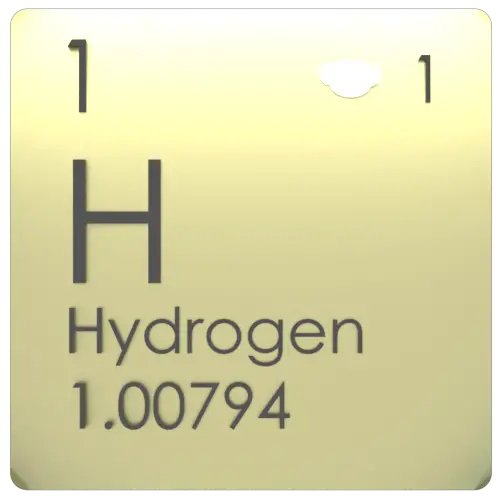
Element Hydrogen
Specific Heat 14.304 J/g K
Heat of Fusion 0.05868 kJ/mol
Heat of Vaporization 0.44936 kJ/mol
Density 0.00009 g/cm3

Hydrogen-periodic-table

Source: www.luciteria.com


Properties of other elements

Hydrogen - Comparison of Latent Heat and Specific Heat

Periodic Table in 8K resolution

Other properties of Hydrogen


Beryllium and Aluminium – Comparison – Properties

This article contains comparison of key thermal and atomic properties of beryllium and aluminium, two comparable chemical elements from the periodic table. It also contains basic descriptions and applications of both elements. Beryllium vs Aluminium.

beryllium and aluminium - comparison

Compare beryllium with another element

Oxygen - Properties - Price - Applications - Production

Aluminium - Properties - Price - Applications - Production

Nitrogen - Properties - Price - Applications - Production

Magnesium - Properties - Price - Applications - Production

Copper - Properties - Price - Applications - Production

Chlorine - Properties - Price - Applications - Production

Compare aluminium with another element

Hydrogen - Properties - Price - Applications - Production

Lithium - Properties - Price - Applications - Production

Beryllium - Properties - Price - Applications - Production

Carbon - Properties - Price - Applications - Production

Oxygen - Properties - Price - Applications - Production

Fluorine - Properties - Price - Applications - Production

Sodium - Properties - Price - Applications - Production

Magnesium - Properties - Price - Applications - Production

Copper - Properties - Price - Applications - Production

Mercury - Properties - Price - Applications - Production

Potassium - Properties - Price - Applications - Production

Silicon - Properties - Price - Applications - Production

Chlorine - Properties - Price - Applications - Production

Titanium - Properties - Price - Applications - Production

Iron - Properties - Price - Applications - Production

Gallium - Properties - Price - Applications - Production

Beryllium and Aluminium – About Elements

Beryllium

Beryllium is a hard, grayish metal naturally found in mineral rocks, coal, soil, and volcanic dust. The commercial use of beryllium requires the use of appropriate dust control equipment and industrial controls at all times because of the toxicity of inhaled beryllium-containing dusts that can cause a chronic life-threatening allergic disease in some people called berylliosis. Beryllium has a large scattering cross section for high-energy neutrons, about 6 barns for energies above approximately 10 keV. Therefore, it works as a neutron reflector and neutron moderator, effectively slowing the neutrons to the thermal energy. Since berylium has very low threshold energy for neutron emission, it can be used as a neutron source in nuclear reactors. The Sb-Be source is based on (γ,n) reaction (i.e. it emits photoneutrons).

Aluminium

Aluminium is a silvery-white, soft, nonmagnetic, ductile metal in the boron group. By mass, aluminium makes up about 8% of the Earth’s crust; it is the third most abundant element after oxygen and silicon and the most abundant metal in the crust, though it is less common in the mantle below.

Beryllium in Periodic Table

Aluminium in Periodic Table

Source: www.luciteria.com

Beryllium and Aluminium – Applications

Beryllium

Berylium can be utilized as alloying agent in production of beryllium-copper, X-ray detection diagnostics, manufacture of computer peripherals, in nuclear reactors as neutron moderators and reflectors. 80% of the beryllium used goes into copper beryllium alloys. The combination of light weight with high strength at extreme temperatures makes beryllium metal and aluminium beryllium alloys ideal for use in high performance aerospace applications such as components of rockets. Transparency to x-radiation makes pure beryllium metal essential in security equipment and high-resolution medical imaging technology, such as mammography to detect breast cancer. Copper beryllium is the hardest and strongest of any copper alloy (UTS up to 1,400 MPa), in the fully heat treated and cold worked condition. It combines high strength with non-magnetic and non-sparking qualities and it is similar in mechanical properties to many high strength alloy steels but, compared to steels, it has better corrosion resistance.

Aluminium

Aluminium and its alloys are used widely in aerospace, automotive, architectural, lithographic, packaging, electrical and electronic applications. It is the prime material of construction for the aircraft industry throughout most of its history. About 70% of commercial civil aircraft airframes are made from aluminium alloys, and without aluminium civil aviation would not be economically viable. Automotive industry now includes aluminium as engine castings, wheels, radiators and increasingly as body parts. 6111 aluminium and 2008 aluminium alloy are extensively used for external automotive body panels. Cylinder blocks and crankcases are often cast made of aluminium alloys.

Beryllium and Aluminium – Comparison in Table

Element Beryllium Aluminium
Density 1.848 g/cm3 2.7/cm3
Ultimate Tensile Strength 345 MPa 90 MPa (pure), 600 MPa (alloys)
Yield Strength N/A 11 MPa (pure), 400 MPa (alloys)
Young’s Modulus of Elasticity 287 GPa 70 GPa
Mohs Scale 5.5 2.8
Brinell Hardness 600 MPa 240 MPa
Vickers Hardness 1670 MPa 167 MPa
Melting Point 1278 °C 660 °C
Boiling Point 2469 °C 2467 °C
Thermal Conductivity 200 W/mK 237 W/mK
Thermal Expansion Coefficient 11.3 µm/mK 23.1 µm/mK
Specific Heat 1.82 J/g K 0.9 J/g K
Heat of Fusion 12.2 kJ/mol 10.79 kJ/mol
Heat of Vaporization 292.4 kJ/mol 293.4 kJ/mol


Beryllium and Chlorine – Comparison – Properties

This article contains comparison of key thermal and atomic properties of beryllium and chlorine, two comparable chemical elements from the periodic table. It also contains basic descriptions and applications of both elements. Beryllium vs Chlorine.

beryllium and chlorine - comparison

Compare beryllium with another element

Oxygen - Properties - Price - Applications - Production

Aluminium - Properties - Price - Applications - Production

Nitrogen - Properties - Price - Applications - Production

Magnesium - Properties - Price - Applications - Production

Copper - Properties - Price - Applications - Production

Chlorine - Properties - Price - Applications - Production

Compare chlorine with another element

Beryllium - Properties - Price - Applications - Production

Magnesium - Properties - Price - Applications - Production

Aluminium - Properties - Price - Applications - Production

Silicon - Properties - Price - Applications - Production

Chlorine - Properties - Price - Applications - Production

Titanium - Properties - Price - Applications - Production

Chromium - Properties - Price - Applications - Production

Manganese - Properties - Price - Applications - Production

Iron - Properties - Price - Applications - Production

Cobalt - Properties - Price - Applications - Production

Silver - Properties - Price - Applications - Production

Gold - Properties - Price - Applications - Production

Tin - Properties - Price - Applications - Production

Beryllium and Chlorine – About Elements

Beryllium

Beryllium is a hard, grayish metal naturally found in mineral rocks, coal, soil, and volcanic dust. The commercial use of beryllium requires the use of appropriate dust control equipment and industrial controls at all times because of the toxicity of inhaled beryllium-containing dusts that can cause a chronic life-threatening allergic disease in some people called berylliosis. Beryllium has a large scattering cross section for high-energy neutrons, about 6 barns for energies above approximately 10 keV. Therefore, it works as a neutron reflector and neutron moderator, effectively slowing the neutrons to the thermal energy. Since berylium has very low threshold energy for neutron emission, it can be used as a neutron source in nuclear reactors. The Sb-Be source is based on (γ,n) reaction (i.e. it emits photoneutrons).

Chlorine

Chlorine is a yellow-green gas at room temperature. It is an extremely reactive element and a strong oxidising agent: among the elements, it has the highest electron affinity and the third-highest electronegativity, behind only oxygen and fluorine.

Beryllium in Periodic Table

Chlorine in Periodic Table

Source: www.luciteria.com

Beryllium and Chlorine – Applications

Beryllium

Berylium can be utilized as alloying agent in production of beryllium-copper, X-ray detection diagnostics, manufacture of computer peripherals, in nuclear reactors as neutron moderators and reflectors. 80% of the beryllium used goes into copper beryllium alloys. The combination of light weight with high strength at extreme temperatures makes beryllium metal and aluminium beryllium alloys ideal for use in high performance aerospace applications such as components of rockets. Transparency to x-radiation makes pure beryllium metal essential in security equipment and high-resolution medical imaging technology, such as mammography to detect breast cancer. Copper beryllium is the hardest and strongest of any copper alloy (UTS up to 1,400 MPa), in the fully heat treated and cold worked condition. It combines high strength with non-magnetic and non-sparking qualities and it is similar in mechanical properties to many high strength alloy steels but, compared to steels, it has better corrosion resistance.

Chlorine

Chlorine is used in the manufacture of a wide range of consumer products, about two-thirds of them organic chemicals such as polyvinyl chloride (PVC), many intermediates for the production of plastics, and other end products which do not contain the element. As a common disinfectant, elemental chlorine and chlorine-generating compounds are used more directly in swimming pools to keep them sanitary. While perhaps best known for its role in providing clean drinking water, chlorine chemistry also helps provide energy-efficient building materials, electronics, fiber optics, solar energy cells, 93 percent of life-saving pharmaceuticals, 86 percent of crop protection compounds, medical plastics, and much more.

Beryllium and Chlorine – Comparison in Table

Element Beryllium Chlorine
Density 1.848 g/cm3 0.0032/cm3
Ultimate Tensile Strength 345 MPa N/A
Yield Strength N/A N/A
Young’s Modulus of Elasticity 287 GPa N/A
Mohs Scale 5.5 N/A
Brinell Hardness 600 MPa N/A
Vickers Hardness 1670 MPa N/A
Melting Point 1278 °C -101 °C
Boiling Point 2469 °C -34.6 °C
Thermal Conductivity 200 W/mK 0.0089 W/mK
Thermal Expansion Coefficient 11.3 µm/mK — µm/mK
Specific Heat 1.82 J/g K 0.48 J/g K
Heat of Fusion 12.2 kJ/mol 3.23 kJ/mol
Heat of Vaporization 292.4 kJ/mol 10.2 kJ/mol


Beryllium and Copper – Comparison – Properties

This article contains comparison of key thermal and atomic properties of beryllium and copper, two comparable chemical elements from the periodic table. It also contains basic descriptions and applications of both elements. Beryllium vs Copper.

beryllium and copper - comparison

Compare beryllium with another element

Oxygen - Properties - Price - Applications - Production

Aluminium - Properties - Price - Applications - Production

Nitrogen - Properties - Price - Applications - Production

Magnesium - Properties - Price - Applications - Production

Copper - Properties - Price - Applications - Production

Chlorine - Properties - Price - Applications - Production

Compare copper with another element

Beryllium - Properties - Price - Applications - Production

Magnesium - Properties - Price - Applications - Production

Aluminium - Properties - Price - Applications - Production

Silicon - Properties - Price - Applications - Production

Chlorine - Properties - Price - Applications - Production

Titanium - Properties - Price - Applications - Production

Chromium - Properties - Price - Applications - Production

Manganese - Properties - Price - Applications - Production

Iron - Properties - Price - Applications - Production

Cobalt - Properties - Price - Applications - Production

Silver - Properties - Price - Applications - Production

Gold - Properties - Price - Applications - Production

Tin - Properties - Price - Applications - Production

Beryllium and Copper – About Elements

Beryllium

Beryllium is a hard, grayish metal naturally found in mineral rocks, coal, soil, and volcanic dust. The commercial use of beryllium requires the use of appropriate dust control equipment and industrial controls at all times because of the toxicity of inhaled beryllium-containing dusts that can cause a chronic life-threatening allergic disease in some people called berylliosis. Beryllium has a large scattering cross section for high-energy neutrons, about 6 barns for energies above approximately 10 keV. Therefore, it works as a neutron reflector and neutron moderator, effectively slowing the neutrons to the thermal energy. Since berylium has very low threshold energy for neutron emission, it can be used as a neutron source in nuclear reactors. The Sb-Be source is based on (γ,n) reaction (i.e. it emits photoneutrons).

Copper

Copper is a soft, malleable, and ductile metal with very high thermal and electrical conductivity. A freshly exposed surface of pure copper has a reddish-orange color. Copper is used as a conductor of heat and electricity, as a building material, and as a constituent of various metal alloys, such as sterling silver used in jewelry, cupronickel used to make marine hardware and coins, and constantan used in strain gauges and thermocouples for temperature measurement.

Beryllium in Periodic Table

Copper in Periodic Table

Source: www.luciteria.com

Beryllium and Copper – Applications

Beryllium

Berylium can be utilized as alloying agent in production of beryllium-copper, X-ray detection diagnostics, manufacture of computer peripherals, in nuclear reactors as neutron moderators and reflectors. 80% of the beryllium used goes into copper beryllium alloys. The combination of light weight with high strength at extreme temperatures makes beryllium metal and aluminium beryllium alloys ideal for use in high performance aerospace applications such as components of rockets. Transparency to x-radiation makes pure beryllium metal essential in security equipment and high-resolution medical imaging technology, such as mammography to detect breast cancer. Copper beryllium is the hardest and strongest of any copper alloy (UTS up to 1,400 MPa), in the fully heat treated and cold worked condition. It combines high strength with non-magnetic and non-sparking qualities and it is similar in mechanical properties to many high strength alloy steels but, compared to steels, it has better corrosion resistance.

Copper

Historically, alloying copper with another metal, for example tin to make bronze, was first practiced about 4000 years after the discovery of copper smelting, and about 2000 years after “natural bronze” had come into general use. An ancient civilization is defined to be in the Bronze Age either by producing bronze by smelting its own copper and alloying with tin, arsenic, or other metals. The major applications of copper are electrical wire (60%), roofing and plumbing (20%), and industrial machinery (15%). Copper is used mostly as a pure metal, but when greater hardness is required, it is put into such alloys as brass and bronze (5% of total use). Copper and copper-based alloys including brasses (Cu-Zn) and bronzes (Cu-Sn) are widely used in different industrial and societal applications. Some of the common uses for brass alloys include costume jewelry, locks, hinges, gears, bearings, ammunition casings, automotive radiators, musical instruments, electronic packaging, and coins. Bronze, or bronze-like alloys and mixtures, were used for coins over a longer period. is still widely used today for springs, bearings, bushings, automobile transmission pilot bearings, and similar fittings, and is particularly common in the bearings of small electric motors. Brass and bronze are common engineering materials in modern architecture and primarily used for roofing and facade cladding due to their visual appearance.

Beryllium and Copper – Comparison in Table

Element Beryllium Copper
Density 1.848 g/cm3 8.92 g/cm3
Ultimate Tensile Strength 345 MPa 210 MPa
Yield Strength N/A 33  MPa
Young’s Modulus of Elasticity 287 GPa 120 GPa
Mohs Scale 5.5 3
Brinell Hardness 600 MPa 250 MPa
Vickers Hardness 1670 MPa 350 MPa
Melting Point 1278 °C 1084.62 °C
Boiling Point 2469 °C 2562 °C
Thermal Conductivity 200 W/mK 401 W/mK
Thermal Expansion Coefficient 11.3 µm/mK 16.5 µm/mK
Specific Heat 1.82 J/g K 0.38 J/g K
Heat of Fusion 12.2 kJ/mol 13.05 kJ/mol
Heat of Vaporization 292.4 kJ/mol 300.3 kJ/mol


Beryllium and Magnesium – Comparison – Properties

This article contains comparison of key thermal and atomic properties of beryllium and magnesium, two comparable chemical elements from the periodic table. It also contains basic descriptions and applications of both elements. Beryllium vs Magnesium.

beryllium and magnesium - comparison

Compare beryllium with another element

Oxygen - Properties - Price - Applications - Production

Aluminium - Properties - Price - Applications - Production

Nitrogen - Properties - Price - Applications - Production

Magnesium - Properties - Price - Applications - Production

Copper - Properties - Price - Applications - Production

Chlorine - Properties - Price - Applications - Production

Compare magnesium with another element

Lithium - Properties - Price - Applications - Production

Beryllium - Properties - Price - Applications - Production

Oxygen - Properties - Price - Applications - Production

Sodium - Properties - Price - Applications - Production

Calcium - Properties - Price - Applications - Production

Potassium - Properties - Price - Applications - Production

Chlorine - Properties - Price - Applications - Production

Zinc - Properties - Price - Applications - Production

Bromine - Properties - Price - Applications - Production

Aluminium - Properties - Price - Applications - Production

Iron - Properties - Price - Applications - Production

Copper - Properties - Price - Applications - Production

Beryllium and Magnesium – About Elements

Beryllium

Beryllium is a hard, grayish metal naturally found in mineral rocks, coal, soil, and volcanic dust. The commercial use of beryllium requires the use of appropriate dust control equipment and industrial controls at all times because of the toxicity of inhaled beryllium-containing dusts that can cause a chronic life-threatening allergic disease in some people called berylliosis. Beryllium has a large scattering cross section for high-energy neutrons, about 6 barns for energies above approximately 10 keV. Therefore, it works as a neutron reflector and neutron moderator, effectively slowing the neutrons to the thermal energy. Since berylium has very low threshold energy for neutron emission, it can be used as a neutron source in nuclear reactors. The Sb-Be source is based on (γ,n) reaction (i.e. it emits photoneutrons).

Magnesium

Magnesium is a shiny gray solid which bears a close physical resemblance to the other five elements in the second column (group 2, or alkaline earth metals) of the periodic table: all group 2 elements have the same electron configuration in the outer electron shell and a similar crystal structure.

Beryllium in Periodic Table

Magnesium in Periodic Table

Source: www.luciteria.com

Beryllium and Magnesium – Applications

Beryllium

Berylium can be utilized as alloying agent in production of beryllium-copper, X-ray detection diagnostics, manufacture of computer peripherals, in nuclear reactors as neutron moderators and reflectors. 80% of the beryllium used goes into copper beryllium alloys. The combination of light weight with high strength at extreme temperatures makes beryllium metal and aluminium beryllium alloys ideal for use in high performance aerospace applications such as components of rockets. Transparency to x-radiation makes pure beryllium metal essential in security equipment and high-resolution medical imaging technology, such as mammography to detect breast cancer. Copper beryllium is the hardest and strongest of any copper alloy (UTS up to 1,400 MPa), in the fully heat treated and cold worked condition. It combines high strength with non-magnetic and non-sparking qualities and it is similar in mechanical properties to many high strength alloy steels but, compared to steels, it has better corrosion resistance.

Magnesium

Magnesium is the third-most-commonly-used structural metal, following iron and aluminium.[35] The main applications of magnesium are, in order: aluminium alloys, die-casting (alloyed with zinc), removing sulfur in the production of iron and steel, and the production of titanium in the Kroll process. Magnesium alloys are used in a wide variety of structural and nonstructural applications. Structural applications include automotive, industrial, materials-handling, commercial, and aerospace equipment. Magnesium alloys are used for parts that operate at high speeds and thus must be light weight to minimize inertial forces. Commercial applications include hand-held tools, laptops, luggage, and ladders, automobiles (e.g., steering wheels and columns, seat frames, transmission cases). Magnox (alloy), whose name is an abbreviation for “magnesium non-oxidizing”, is 99% magnesium and 1% aluminum, and is used in the cladding of fuel rods in magnox nuclear power reactors.

Beryllium and Magnesium – Comparison in Table

Element Beryllium Magnesium
Density 1.848 g/cm3 1.738 g/cm3
Ultimate Tensile Strength 345 MPa 200 MPa
Yield Strength N/A N/A
Young’s Modulus of Elasticity 287 GPa 45 GPa
Mohs Scale 5.5 2.5
Brinell Hardness 600 MPa 260 MPa
Vickers Hardness 1670 MPa N/A
Melting Point 1278 °C 649 °C
Boiling Point 2469 °C 1090 °C
Thermal Conductivity 200 W/mK 156 W/mK
Thermal Expansion Coefficient 11.3 µm/mK 24.8 µm/mK
Specific Heat 1.82 J/g K 1.02 J/g K
Heat of Fusion 12.2 kJ/mol 8.954 kJ/mol
Heat of Vaporization 292.4 kJ/mol 127.4 kJ/mol


Beryllium and Nitrogen – Comparison – Properties

This article contains comparison of key thermal and atomic properties of beryllium and nitrogen, two comparable chemical elements from the periodic table. It also contains basic descriptions and applications of both elements. Beryllium vs Nitrogen.

beryllium and nitrogen - comparison

Compare beryllium with another element

Oxygen - Properties - Price - Applications - Production

Aluminium - Properties - Price - Applications - Production

Nitrogen - Properties - Price - Applications - Production

Magnesium - Properties - Price - Applications - Production

Copper - Properties - Price - Applications - Production

Chlorine - Properties - Price - Applications - Production

Compare nitrogen with another element

Hydrogen - Properties - Price - Applications - Production

Helium - Properties - Price - Applications - Production

Lithium - Properties - Price - Applications - Production

Beryllium - Properties - Price - Applications - Production

Carbon - Properties - Price - Applications - Production

Oxygen - Properties - Price - Applications - Production

Phosphorus - Properties - Price - Applications - Production

Beryllium and Nitrogen- About Elements

Beryllium

Beryllium is a hard, grayish metal naturally found in mineral rocks, coal, soil, and volcanic dust. The commercial use of beryllium requires the use of appropriate dust control equipment and industrial controls at all times because of the toxicity of inhaled beryllium-containing dusts that can cause a chronic life-threatening allergic disease in some people called berylliosis. Beryllium has a large scattering cross section for high-energy neutrons, about 6 barns for energies above approximately 10 keV. Therefore, it works as a neutron reflector and neutron moderator, effectively slowing the neutrons to the thermal energy. Since berylium has very low threshold energy for neutron emission, it can be used as a neutron source in nuclear reactors. The Sb-Be source is based on (γ,n) reaction (i.e. it emits photoneutrons).

Nitrogen

Nitrogen is a colourless, odourless unreactive gas that forms about 78% of the earth’s atmosphere. Liquid nitrogen (made by distilling liquid air) boils at 77.4 kelvins (−195.8°C) and is used as a coolant.

Beryllium in Periodic Table

Nitrogen in Periodic Table

Source: www.luciteria.com

Beryllium and Nitrogen – Applications

Beryllium

Berylium can be utilized as alloying agent in production of beryllium-copper, X-ray detection diagnostics, manufacture of computer peripherals, in nuclear reactors as neutron moderators and reflectors. 80% of the beryllium used goes into copper beryllium alloys. The combination of light weight with high strength at extreme temperatures makes beryllium metal and aluminium beryllium alloys ideal for use in high performance aerospace applications such as components of rockets. Transparency to x-radiation makes pure beryllium metal essential in security equipment and high-resolution medical imaging technology, such as mammography to detect breast cancer. Copper beryllium is the hardest and strongest of any copper alloy (UTS up to 1,400 MPa), in the fully heat treated and cold worked condition. It combines high strength with non-magnetic and non-sparking qualities and it is similar in mechanical properties to many high strength alloy steels but, compared to steels, it has better corrosion resistance.

Nitrogen

Nitrogen in various chemical forms plays a major role in large number of environmental issues. The applications of nitrogen compounds are naturally extremely widely varied due to the huge size of this class: hence, only applications of pure nitrogen itself will be considered here. Two-thirds of nitrogen produced by industry is sold as the gas and the remaining one-third as the liquid. In metallurgy, nitriding is a case hardening process in which the surface nitrogen concentration of a ferrous is increased by diffusion from the surrounding environment to create case-hardened surface. Nitriding produces hard, highly wear-resistant surface (shallow case depths) of product with fair capacity for contact load, good bending fatigue strength and excellent resistance to seizure. Synthetically produced ammonia and nitrates are key industrial fertilisers, and fertiliser nitrates are key pollutants in the eutrophication of water systems. Apart from its use in fertilisers and energy-stores, nitrogen is a constituent of organic compounds as diverse as Kevlar used in high-strength fabric and cyanoacrylate used in superglue.

Beryllium and Nitrogen – Comparison in Table

Element Beryllium Nitrogen
Density 1.848 g/cm3 0.00125 g/cm3
Ultimate Tensile Strength 345 MPa N/A
Yield Strength N/A N/A
Young’s Modulus of Elasticity 287 GPa N/A
Mohs Scale 5.5 N/A
Brinell Hardness 600 MPa N/A
Vickers Hardness 1670 MPa N/A
Melting Point 1278 °C -209.9 °C
Boiling Point 2469 °C -195.8 °C
Thermal Conductivity 200 W/mK 0.02598 W/mK
Thermal Expansion Coefficient 11.3 µm/mK — µm/mK
Specific Heat 1.82 J/g K 1.04 J/g K
Heat of Fusion 12.2 kJ/mol (N2) 0.7204 kJ/mol
Heat of Vaporization 292.4 kJ/mol (N2) 5.56 kJ/mol