Facebook Instagram Youtube Twitter

Beryllium and Oxygen – Comparison – Properties

This article contains comparison of key thermal and atomic properties of beryllium and oxygen, two comparable chemical elements from the periodic table. It also contains basic descriptions and applications of both elements. Beryllium vs Oxygen.

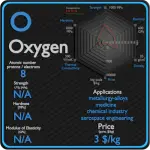
beryllium and oxygen - comparison

Compare beryllium with another element

Oxygen - Properties - Price - Applications - Production

Aluminium - Properties - Price - Applications - Production

Nitrogen - Properties - Price - Applications - Production

Magnesium - Properties - Price - Applications - Production

Copper - Properties - Price - Applications - Production

Chlorine - Properties - Price - Applications - Production

Compare oxygen with another element

Sodium - Properties - Price - Applications - Production

Fluorine - Properties - Price - Applications - Production

Magnesium - Properties - Price - Applications - Production

Aluminium - Properties - Price - Applications - Production

Silicon - Properties - Price - Applications - Production

Sulfur - Properties - Price - Applications - Production

Chlorine - Properties - Price - Applications - Production

Potassium - Properties - Price - Applications - Production

Calcium - Properties - Price - Applications - Production

Iron - Properties - Price - Applications - Production

Hydrogen - Properties - Price - Applications - Production

Helium - Properties - Price - Applications - Production

Lithium - Properties - Price - Applications - Production

Beryllium - Properties - Price - Applications - Production

Boron - Properties - Price - Applications - Production

Carbon - Properties - Price - Applications - Production

Beryllium and Oxygen- About Elements

Beryllium

Beryllium is a hard, grayish metal naturally found in mineral rocks, coal, soil, and volcanic dust. The commercial use of beryllium requires the use of appropriate dust control equipment and industrial controls at all times because of the toxicity of inhaled beryllium-containing dusts that can cause a chronic life-threatening allergic disease in some people called berylliosis. Beryllium has a large scattering cross section for high-energy neutrons, about 6 barns for energies above approximately 10 keV. Therefore, it works as a neutron reflector and neutron moderator, effectively slowing the neutrons to the thermal energy. Since berylium has very low threshold energy for neutron emission, it can be used as a neutron source in nuclear reactors. The Sb-Be source is based on (γ,n) reaction (i.e. it emits photoneutrons).

Oxygen

Oxygen is a colourless, odourless reactive gas, the chemical element of atomic number 8 and the life-supporting component of the air. It is a member of the chalcogen group on the periodic table, a highly reactive nonmetal, and an oxidizing agent that readily forms oxides with most elements as well as with other compounds. By mass, oxygen is the third-most abundant element in the universe, after hydrogen and helium.

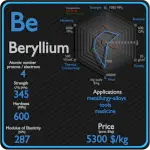
Beryllium in Periodic Table

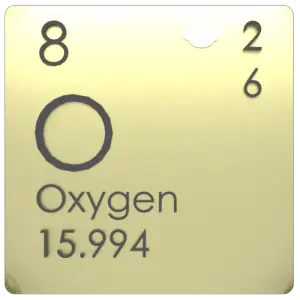
Oxygen in Periodic Table

Source: www.luciteria.com

Beryllium and Oxygen – Applications

Beryllium

Berylium can be utilized as alloying agent in production of beryllium-copper, X-ray detection diagnostics, manufacture of computer peripherals, in nuclear reactors as neutron moderators and reflectors. 80% of the beryllium used goes into copper beryllium alloys. The combination of light weight with high strength at extreme temperatures makes beryllium metal and aluminium beryllium alloys ideal for use in high performance aerospace applications such as components of rockets. Transparency to x-radiation makes pure beryllium metal essential in security equipment and high-resolution medical imaging technology, such as mammography to detect breast cancer. Copper beryllium is the hardest and strongest of any copper alloy (UTS up to 1,400 MPa), in the fully heat treated and cold worked condition. It combines high strength with non-magnetic and non-sparking qualities and it is similar in mechanical properties to many high strength alloy steels but, compared to steels, it has better corrosion resistance.

Oxygen

Common uses of oxygen include production of steel, plastics and textiles, brazing, welding and cutting of steels and other metals, rocket propellant, oxygen therapy, and life support systems in aircraft, submarines, spaceflight and diving. Smelting of iron ore into steel consumes 55% of commercially produced oxygen. In this process, oxygen is injected through a high-pressure lance into molten iron, which removes sulfur impurities and excess carbon as the respective oxides, sulfur dioxide and carbon dioxide. Uptake of oxygen from the air is the essential purpose of respiration, so oxygen supplementation is used in medicine. Treatment not only increases oxygen levels in the patient’s blood, but has the secondary effect of decreasing resistance to blood flow in many types of diseased lungs, easing work load on the heart.

Beryllium and Oxygen – Comparison in Table

Element Beryllium Oxygen
Density 1.848 g/cm3 0.00143 g/cm3
Ultimate Tensile Strength 345 MPa N/A
Yield Strength N/A N/A
Young’s Modulus of Elasticity 287 GPa N/A
Mohs Scale 5.5 N/A
Brinell Hardness 600 MPa N/A
Vickers Hardness 1670 MPa N/A
Melting Point 1278 °C -218.4 °C
Boiling Point 2469 °C -183 °C
Thermal Conductivity 200 W/mK 0.02674 W/mK
Thermal Expansion Coefficient 11.3 µm/mK — µm/mK
Specific Heat 1.82 J/g K 0.92 J/g K
Heat of Fusion 12.2 kJ/mol (O2) 0.444 kJ/mol
Heat of Vaporization 292.4 kJ/mol (O2) 6.82 kJ/mol


Lithium and Sulfur – Comparison – Properties

This article contains comparison of key thermal and atomic properties of lithium and sulfur, two comparable chemical elements from the periodic table. It also contains basic descriptions and applications of both elements. Lithium vs Sulfur.

lithium and sulfur - comparison

Compare lithium with another element

Hydrogen - Properties - Price - Applications - Production

Oxygen - Properties - Price - Applications - Production

Aluminium - Properties - Price - Applications - Production

Nitrogen - Properties - Price - Applications - Production

Sodium - Properties - Price - Applications - Production

Calcium - Properties - Price - Applications - Production

Silicon - Properties - Price - Applications - Production

Cadmium - Properties - Price - Applications - Production

Cobalt - Properties - Price - Applications - Production

Magnesium - Properties - Price - Applications - Production

Phosphorus - Properties - Price - Applications - Production

Potassium - Properties - Price - Applications - Production

Sulfur - Properties - Price - Applications - Production

Compare sulfur with another element

Lithium - Properties - Price - Applications - Production

Oxygen - Properties - Price - Applications - Production

Sodium - Properties - Price - Applications - Production

Chlorine - Properties - Price - Applications - Production

Potassium - Properties - Price - Applications - Production

Calcium - Properties - Price - Applications - Production

Lithium and Sulfur – About Elements

Lithium

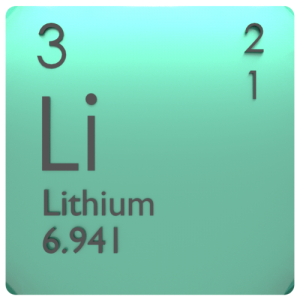
It is a soft, silvery-white alkali metal. Under standard conditions, it is the lightest metal and the lightest solid element. Like all alkali metals, lithium is highly reactive and flammable, and is stored in mineral oil.

Sulfur

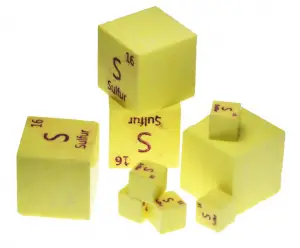
Sulfur is abundant, multivalent, and nonmetallic. Under normal conditions, sulfur atoms form cyclic octatomic molecules with a chemical formula S8. Elemental sulfur is a bright yellow crystalline solid at room temperature. Chemically, sulfur reacts with all elements except for gold, platinum, iridium, tellurium, and the noble gases.

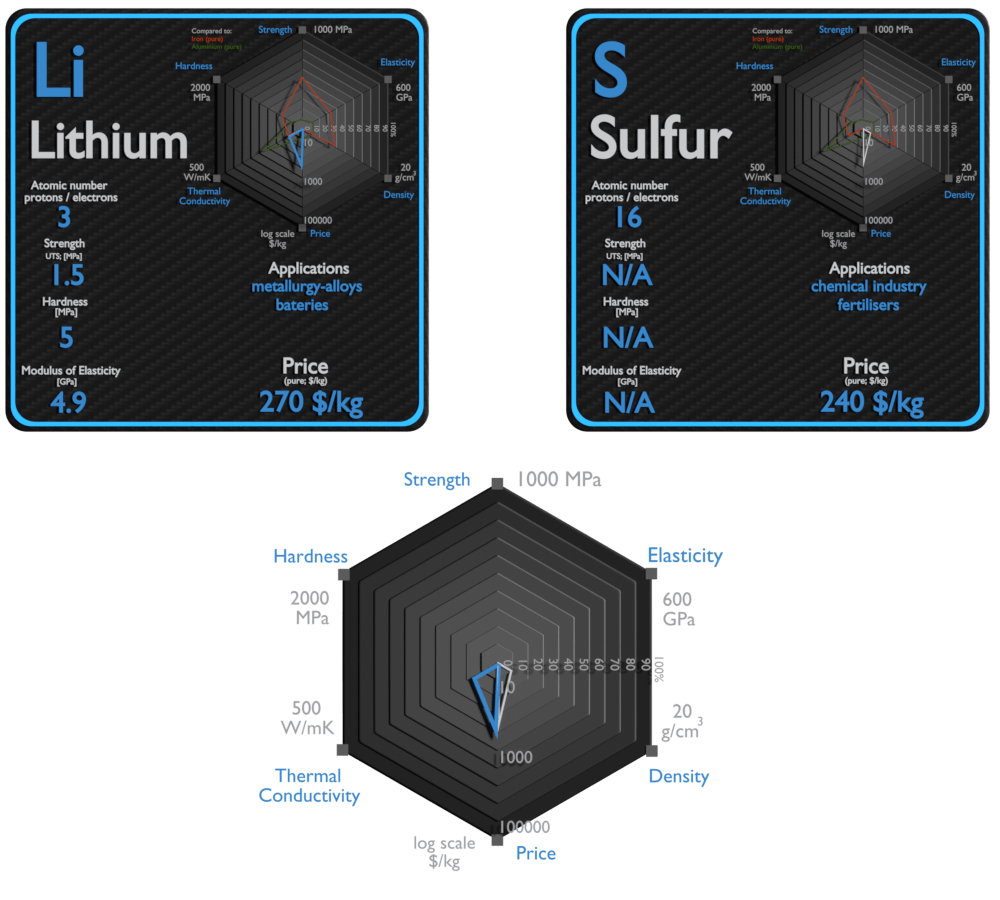
Lithium in Periodic Table

Sulfur in Periodic Table

Source: www.luciteria.com

Lithium and Sulfur – Applications

Lithium

Lithium has many applications, from lubricating grease, alloying additions in particular for aluminium and magnesium alloys, to glazes for ceramics, and finally, lithium batteries. In particular, lithium is and will continue to play an increasingly important role in the battery-powered clean air future. Lithium batteries are widely used in portable consumer electronic devices, and in electric vehicles ranging from full sized vehicles to radio controlled toys. The term “lithium battery” refers to a family of different lithium-metal chemistries, comprising many types of cathodes and electrolytes but all with metallic lithium as the anode.

Sulfur

The greatest commercial use of the element is the production of sulfuric acid for sulfate and phosphate fertilizers, and other chemical processes. Sulfur is increasingly used as a component of fertilizers. The most important form of sulfur for fertilizer is the mineral calcium sulfate. The element sulfur is used in matches, insecticides, and fungicides. Many sulfur compounds are odoriferous, and the smells of odorized natural gas, skunk scent, grapefruit, and garlic are due to organosulfur compounds.

Lithium and Sulfur – Comparison in Table

Element Lithium Sulfur
Density 0.535 g/cm3 1.96 g/cm3
Ultimate Tensile Strength 1.5 MPa N/A
Yield Strength N/A N/A
Young’s Modulus of Elasticity 4.9 GPa N/A
Mohs Scale 0.6 2
Brinell Hardness 5 MPa N/A
Vickers Hardness N/A N/A
Melting Point 180.5 °C 112.8 °C
Boiling Point 1342 °C 444.7 °C
Thermal Conductivity 85 W/mK 0.269 W/mK
Thermal Expansion Coefficient 46 µm/mK — µm/mK
Specific Heat 3.6 J/g K 0.71 J/g K
Heat of Fusion 3 kJ/mol 1.7175 kJ/mol
Heat of Vaporization 145.92 kJ/mol 45 kJ/mol


Lithium and Sodium – Comparison – Properties

This article contains comparison of key thermal and atomic properties of lithium and sodium, two comparable chemical elements from the periodic table. It also contains basic descriptions and applications of both elements. Lithium vs Sodium.

lithium and sodium - comparison

Compare lithium with another element

Hydrogen - Properties - Price - Applications - Production

Oxygen - Properties - Price - Applications - Production

Aluminium - Properties - Price - Applications - Production

Nitrogen - Properties - Price - Applications - Production

Sodium - Properties - Price - Applications - Production

Calcium - Properties - Price - Applications - Production

Silicon - Properties - Price - Applications - Production

Cadmium - Properties - Price - Applications - Production

Cobalt - Properties - Price - Applications - Production

Magnesium - Properties - Price - Applications - Production

Phosphorus - Properties - Price - Applications - Production

Potassium - Properties - Price - Applications - Production

Sulfur - Properties - Price - Applications - Production

Compare sodium with another element

Hydrogen - Properties - Price - Applications - Production

Lithium - Properties - Price - Applications - Production

Oxygen - Properties - Price - Applications - Production

Calcium - Properties - Price - Applications - Production

Magnesium - Properties - Price - Applications - Production

Potassium - Properties - Price - Applications - Production

Chlorine - Properties - Price - Applications - Production

Aluminium - Properties - Price - Applications - Production

Silicon - Properties - Price - Applications - Production

Sulfur - Properties - Price - Applications - Production

Lithium and Sodium – About Elements

Lithium

It is a soft, silvery-white alkali metal. Under standard conditions, it is the lightest metal and the lightest solid element. Like all alkali metals, lithium is highly reactive and flammable, and is stored in mineral oil.

Sodium

Sodium is a soft, silvery-white, highly reactive metal. Sodium is an alkali metal, being in group 1 of the periodic table, because it has a single electron in its outer shell that it readily donates, creating a positively charged atom—the Na+ cation.

Lithium in Periodic Table

Sodium in Periodic Table

Source: www.luciteria.com

Lithium and Sodium – Applications

Lithium

Lithium has many applications, from lubricating grease, alloying additions in particular for aluminium and magnesium alloys, to glazes for ceramics, and finally, lithium batteries. In particular, lithium is and will continue to play an increasingly important role in the battery-powered clean air future. Lithium batteries are widely used in portable consumer electronic devices, and in electric vehicles ranging from full sized vehicles to radio controlled toys. The term “lithium battery” refers to a family of different lithium-metal chemistries, comprising many types of cathodes and electrolytes but all with metallic lithium as the anode.

Sodium

Metallic sodium is used mainly for the production of sodium borohydride, sodium azide, indigo, and triphenylphosphine. A once-common use was the making of tetraethyllead and titanium metal; because of the move away from TEL and new titanium production methods. An electric current and sodium vapor combine to form a yellowish glow. This principle is used for the making of sodium vapor lamps. Sodium is occasionally used as a heat exchange medium in nuclear power plants. Liquid sodium is sealed into pipes surrounding the reactor core. Generated heat is absorbed by sodium and forced through the pipes in a heat exchanger which can be used to generate electricity.

Lithium and Sodium – Comparison in Table

Element Lithium Sodium
Density 0.535 g/cm3 0.968 g/cm3
Ultimate Tensile Strength 1.5 MPa N/A
Yield Strength N/A N/A
Young’s Modulus of Elasticity 4.9 GPa 10 GPa
Mohs Scale 0.6 0.4
Brinell Hardness 5 MPa 0.69 MPa
Vickers Hardness N/A N/A
Melting Point 180.5 °C 97.8 °C
Boiling Point 1342 °C 883 °C
Thermal Conductivity 85 W/mK 141 W/mK
Thermal Expansion Coefficient 46 µm/mK 71 µm/mK
Specific Heat 3.6 J/g K 1.23 J/g K
Heat of Fusion 3 kJ/mol 2.59 kJ/mol
Heat of Vaporization 145.92 kJ/mol 96.96 kJ/mol


Lithium and Potassium – Comparison – Properties

This article contains comparison of key thermal and atomic properties of lithium and potassium, two comparable chemical elements from the periodic table. It also contains basic descriptions and applications of both elements. Lithium vs Potassium.

lithium and potassium - comparison

Compare lithium with another element

Hydrogen - Properties - Price - Applications - Production

Oxygen - Properties - Price - Applications - Production

Aluminium - Properties - Price - Applications - Production

Nitrogen - Properties - Price - Applications - Production

Sodium - Properties - Price - Applications - Production

Calcium - Properties - Price - Applications - Production

Silicon - Properties - Price - Applications - Production

Cadmium - Properties - Price - Applications - Production

Cobalt - Properties - Price - Applications - Production

Magnesium - Properties - Price - Applications - Production

Phosphorus - Properties - Price - Applications - Production

Potassium - Properties - Price - Applications - Production

Sulfur - Properties - Price - Applications - Production

Compare potassium with another element

Lithium - Properties - Price - Applications - Production

Oxygen - Properties - Price - Applications - Production

Sodium - Properties - Price - Applications - Production

Magnesium - Properties - Price - Applications - Production

Aluminium - Properties - Price - Applications - Production

Phosphorus - Properties - Price - Applications - Production

Sulfur - Properties - Price - Applications - Production

Calcium - Properties - Price - Applications - Production

Iron - Properties - Price - Applications - Production

Zinc - Properties - Price - Applications - Production

Bromine - Properties - Price - Applications - Production

Lithium and Potassium – About Elements

Lithium

It is a soft, silvery-white alkali metal. Under standard conditions, it is the lightest metal and the lightest solid element. Like all alkali metals, lithium is highly reactive and flammable, and is stored in mineral oil.

Potassium

Potassium was first isolated from potash, the ashes of plants, from which its name derives. In the periodic table, potassium is one of the alkali metals. All of the alkali metals have a single valence electron in the outer electron shell, which is easily removed to create an ion with a positive charge – a cation, which combines with anions to form salts. Naturally occurring potassium is composed of three isotopes, of which 40K is radioactive. Traces of 40K are found in all potassium, and it is the most common radioisotope in the human body.

Lithium in Periodic Table

Potassium in Periodic Table

Source: www.luciteria.com

Lithium and Potassium – Applications

Lithium

Lithium has many applications, from lubricating grease, alloying additions in particular for aluminium and magnesium alloys, to glazes for ceramics, and finally, lithium batteries. In particular, lithium is and will continue to play an increasingly important role in the battery-powered clean air future. Lithium batteries are widely used in portable consumer electronic devices, and in electric vehicles ranging from full sized vehicles to radio controlled toys. The term “lithium battery” refers to a family of different lithium-metal chemistries, comprising many types of cathodes and electrolytes but all with metallic lithium as the anode.

Potassium

Potassium (K) is an essential nutrient for plant growth. It’s classified as a macronutrient because plants take up large quantities of K during their life cycle. Agricultural fertilizers consume 95% of global potassium chemical production, and about 90% of this potassium is supplied as KCl. Due to its high degree of reactivity, pure potassium is rarely used in its elemental /metallic form. It is used as a powerful reducing agent in organic chemistry. Potassium/Sodium alloys are It used as a heat exchange medium . The heat in the potassium warms water and makes it hot enough to boil. Then water is changed into steam, which is used to work devices that generate electricity.

Lithium and Potassium – Comparison in Table

Element Lithium Potassium
Density 0.535 g/cm3 0.856 g/cm3
Ultimate Tensile Strength 1.5 MPa N/A
Yield Strength N/A N/A
Young’s Modulus of Elasticity 4.9 GPa 3.53 GPa
Mohs Scale 0.6 0.4
Brinell Hardness 5 MPa 0.36 MPa
Vickers Hardness N/A N/A
Melting Point 180.5 °C 63.25 °C
Boiling Point 1342 °C 760 °C
Thermal Conductivity 85 W/mK 102.4 W/mK
Thermal Expansion Coefficient 46 µm/mK 83 µm/mK
Specific Heat 3.6 J/g K 0.75 J/g K
Heat of Fusion 3 kJ/mol 2.334 kJ/mol
Heat of Vaporization 145.92 kJ/mol 79.87 kJ/mol


Lithium and Phosphorus – Comparison – Properties

This article contains comparison of key thermal and atomic properties of lithium and phosphorus, two comparable chemical elements from the periodic table. It also contains basic descriptions and applications of both elements. Lithium vs Phosphorus.

lithium and phosphorus - comparison

Compare lithium with another element

Hydrogen - Properties - Price - Applications - Production

Oxygen - Properties - Price - Applications - Production

Aluminium - Properties - Price - Applications - Production

Nitrogen - Properties - Price - Applications - Production

Sodium - Properties - Price - Applications - Production

Calcium - Properties - Price - Applications - Production

Silicon - Properties - Price - Applications - Production

Cadmium - Properties - Price - Applications - Production

Cobalt - Properties - Price - Applications - Production

Magnesium - Properties - Price - Applications - Production

Phosphorus - Properties - Price - Applications - Production

Potassium - Properties - Price - Applications - Production

Sulfur - Properties - Price - Applications - Production

Compare phosphorus with another element

Lithium - Properties - Price - Applications - Production

Nitrogen - Properties - Price - Applications - Production

Calcium - Properties - Price - Applications - Production

Potassium - Properties - Price - Applications - Production

Magnesium - Properties - Price - Applications - Production

Lithium and Phosphorus – About Elements

Lithium

It is a soft, silvery-white alkali metal. Under standard conditions, it is the lightest metal and the lightest solid element. Like all alkali metals, lithium is highly reactive and flammable, and is stored in mineral oil.

Phosphorus

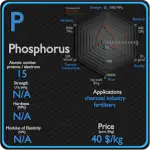
As an element, phosphorus exists in two major forms—white phosphorus and red phosphorus—but because it is highly reactive, phosphorus is never found as a free element on Earth. At 0.099%, phosphorus is the most abundant pnictogen in the Earth’s crust.

Lithium in Periodic Table

Phosphorus in Periodic Table

Source: www.luciteria.com

Lithium and Phosphorus – Applications

Lithium

Lithium has many applications, from lubricating grease, alloying additions in particular for aluminium and magnesium alloys, to glazes for ceramics, and finally, lithium batteries. In particular, lithium is and will continue to play an increasingly important role in the battery-powered clean air future. Lithium batteries are widely used in portable consumer electronic devices, and in electric vehicles ranging from full sized vehicles to radio controlled toys. The term “lithium battery” refers to a family of different lithium-metal chemistries, comprising many types of cathodes and electrolytes but all with metallic lithium as the anode.

Phosphorus

Phosphorus is an essential plant nutrient (the most often limiting nutrient, after nitrogen), and the bulk of all phosphorus production is in concentrated phosphoric acids for agriculture fertilisers, containing as much as 70% to 75% P2O5. The vast majority of phosphorus compounds mined are consumed as fertilisers. Phosphate is needed to replace the phosphorus that plants remove from the soil, and its annual demand is rising nearly twice as fast as the growth of the human population. Other applications include organophosphorus compounds in detergents, pesticides, and nerve agents.

Lithium and Phosphorus – Comparison in Table

Element Lithium Phosphorus
Density 0.535 g/cm3 1.823 g/cm3
Ultimate Tensile Strength 1.5 MPa N/A
Yield Strength N/A N/A
Young’s Modulus of Elasticity 4.9 GPa N/A
Mohs Scale 0.6 0.5
Brinell Hardness 5 MPa N/A
Vickers Hardness N/A N/A
Melting Point 180.5 °C 44.1 °C
Boiling Point 1342 °C 280 °C
Thermal Conductivity 85 W/mK 0.235 W/mK
Thermal Expansion Coefficient 46 µm/mK — µm/mK
Specific Heat 3.6 J/g K 0.77 J/g K
Heat of Fusion 3 kJ/mol 0.657 kJ/mol
Heat of Vaporization 145.92 kJ/mol 51.9 kJ/mol


Lithium and Nitrogen – Comparison – Properties

This article contains comparison of key thermal and atomic properties of lithium and nitrogen, two comparable chemical elements from the periodic table. It also contains basic descriptions and applications of both elements. Lithium vs Nitrogen.

lithium and nitrogen - comparison

Compare lithium with another element

Hydrogen - Properties - Price - Applications - Production

Oxygen - Properties - Price - Applications - Production

Aluminium - Properties - Price - Applications - Production

Nitrogen - Properties - Price - Applications - Production

Sodium - Properties - Price - Applications - Production

Calcium - Properties - Price - Applications - Production

Silicon - Properties - Price - Applications - Production

Cadmium - Properties - Price - Applications - Production

Cobalt - Properties - Price - Applications - Production

Magnesium - Properties - Price - Applications - Production

Phosphorus - Properties - Price - Applications - Production

Potassium - Properties - Price - Applications - Production

Sulfur - Properties - Price - Applications - Production

Compare nitrogen with another element

Hydrogen - Properties - Price - Applications - Production

Helium - Properties - Price - Applications - Production

Lithium - Properties - Price - Applications - Production

Beryllium - Properties - Price - Applications - Production

Carbon - Properties - Price - Applications - Production

Oxygen - Properties - Price - Applications - Production

Phosphorus - Properties - Price - Applications - Production

Lithium and Nitrogen – About Elements

Lithium

It is a soft, silvery-white alkali metal. Under standard conditions, it is the lightest metal and the lightest solid element. Like all alkali metals, lithium is highly reactive and flammable, and is stored in mineral oil.

Nitrogen

Nitrogen is a colourless, odourless unreactive gas that forms about 78% of the earth’s atmosphere. Liquid nitrogen (made by distilling liquid air) boils at 77.4 kelvins (−195.8°C) and is used as a coolant.

Lithium in Periodic Table

Nitrogen in Periodic Table

Source: www.luciteria.com

Lithium and Nitrogen – Applications

Lithium

Lithium has many applications, from lubricating grease, alloying additions in particular for aluminium and magnesium alloys, to glazes for ceramics, and finally, lithium batteries. In particular, lithium is and will continue to play an increasingly important role in the battery-powered clean air future. Lithium batteries are widely used in portable consumer electronic devices, and in electric vehicles ranging from full sized vehicles to radio controlled toys. The term “lithium battery” refers to a family of different lithium-metal chemistries, comprising many types of cathodes and electrolytes but all with metallic lithium as the anode.

Nitrogen

Nitrogen in various chemical forms plays a major role in large number of environmental issues. The applications of nitrogen compounds are naturally extremely widely varied due to the huge size of this class: hence, only applications of pure nitrogen itself will be considered here. Two-thirds of nitrogen produced by industry is sold as the gas and the remaining one-third as the liquid. In metallurgy, nitriding is a case hardening process in which the surface nitrogen concentration of a ferrous is increased by diffusion from the surrounding environment to create case-hardened surface. Nitriding produces hard, highly wear-resistant surface (shallow case depths) of product with fair capacity for contact load, good bending fatigue strength and excellent resistance to seizure. Synthetically produced ammonia and nitrates are key industrial fertilisers, and fertiliser nitrates are key pollutants in the eutrophication of water systems. Apart from its use in fertilisers and energy-stores, nitrogen is a constituent of organic compounds as diverse as Kevlar used in high-strength fabric and cyanoacrylate used in superglue.

Lithium and Nitrogen – Comparison in Table

Element Lithium Nitrogen
Density 0.535 g/cm3 0.00125 g/cm3
Ultimate Tensile Strength 1.5 MPa N/A
Yield Strength N/A N/A
Young’s Modulus of Elasticity 4.9 GPa N/A
Mohs Scale 0.6 N/A
Brinell Hardness 5 MPa N/A
Vickers Hardness N/A N/A
Melting Point 180.5 °C -209.9 °C
Boiling Point 1342 °C -195.8 °C
Thermal Conductivity 85 W/mK 0.02598 W/mK
Thermal Expansion Coefficient 46 µm/mK — µm/mK
Specific Heat 3.6 J/g K 1.04 J/g K
Heat of Fusion 3 kJ/mol (N2) 0.7204 kJ/mol
Heat of Vaporization 145.92 kJ/mol (N2) 5.56 kJ/mol


Lithium and Oxygen – Comparison – Properties

This article contains comparison of key thermal and atomic properties of lithium and oxygen, two comparable chemical elements from the periodic table. It also contains basic descriptions and applications of both elements. Lithium vs Oxygen.

lithium and oxygen - comparison

Compare lithium with another element

Hydrogen - Properties - Price - Applications - Production

Oxygen - Properties - Price - Applications - Production

Aluminium - Properties - Price - Applications - Production

Nitrogen - Properties - Price - Applications - Production

Sodium - Properties - Price - Applications - Production

Calcium - Properties - Price - Applications - Production

Silicon - Properties - Price - Applications - Production

Cadmium - Properties - Price - Applications - Production

Cobalt - Properties - Price - Applications - Production

Magnesium - Properties - Price - Applications - Production

Phosphorus - Properties - Price - Applications - Production

Potassium - Properties - Price - Applications - Production

Sulfur - Properties - Price - Applications - Production

Compare oxygen with another element

Sodium - Properties - Price - Applications - Production

Fluorine - Properties - Price - Applications - Production

Magnesium - Properties - Price - Applications - Production

Aluminium - Properties - Price - Applications - Production

Silicon - Properties - Price - Applications - Production

Sulfur - Properties - Price - Applications - Production

Chlorine - Properties - Price - Applications - Production

Potassium - Properties - Price - Applications - Production

Calcium - Properties - Price - Applications - Production

Iron - Properties - Price - Applications - Production

Hydrogen - Properties - Price - Applications - Production

Helium - Properties - Price - Applications - Production

Lithium - Properties - Price - Applications - Production

Beryllium - Properties - Price - Applications - Production

Boron - Properties - Price - Applications - Production

Carbon - Properties - Price - Applications - Production

Lithium and Oxygen – About Elements

Lithium

It is a soft, silvery-white alkali metal. Under standard conditions, it is the lightest metal and the lightest solid element. Like all alkali metals, lithium is highly reactive and flammable, and is stored in mineral oil.

Oxygen

Oxygen is a colourless, odourless reactive gas, the chemical element of atomic number 8 and the life-supporting component of the air. It is a member of the chalcogen group on the periodic table, a highly reactive nonmetal, and an oxidizing agent that readily forms oxides with most elements as well as with other compounds. By mass, oxygen is the third-most abundant element in the universe, after hydrogen and helium..

Lithium in Periodic Table

Oxygen in Periodic Table

Source: www.luciteria.com

Lithium and Oxygen – Applications

Lithium

Lithium has many applications, from lubricating grease, alloying additions in particular for aluminium and magnesium alloys, to glazes for ceramics, and finally, lithium batteries. In particular, lithium is and will continue to play an increasingly important role in the battery-powered clean air future. Lithium batteries are widely used in portable consumer electronic devices, and in electric vehicles ranging from full sized vehicles to radio controlled toys. The term “lithium battery” refers to a family of different lithium-metal chemistries, comprising many types of cathodes and electrolytes but all with metallic lithium as the anode.

Oxygen

Common uses of oxygen include production of steel, plastics and textiles, brazing, welding and cutting of steels and other metals, rocket propellant, oxygen therapy, and life support systems in aircraft, submarines, spaceflight and diving. Smelting of iron ore into steel consumes 55% of commercially produced oxygen. In this process, oxygen is injected through a high-pressure lance into molten iron, which removes sulfur impurities and excess carbon as the respective oxides, sulfur dioxide and carbon dioxide. Uptake of oxygen from the air is the essential purpose of respiration, so oxygen supplementation is used in medicine. Treatment not only increases oxygen levels in the patient’s blood, but has the secondary effect of decreasing resistance to blood flow in many types of diseased lungs, easing work load on the heart.

Lithium and Oxygen – Comparison in Table

Element Lithium Oxygen
Density 0.535 g/cm3 0.00143 g/cm3
Ultimate Tensile Strength 1.5 MPa N/A
Yield Strength N/A N/A
Young’s Modulus of Elasticity 4.9 GPa N/A
Mohs Scale 0.6 N/A
Brinell Hardness 5 MPa N/A
Vickers Hardness N/A N/A
Melting Point 180.5 °C -218.4 °C
Boiling Point 1342 °C -183 °C
Thermal Conductivity 85 W/mK 0.02674 W/mK
Thermal Expansion Coefficient 46 µm/mK — µm/mK
Specific Heat 3.6 J/g K 0.92 J/g K
Heat of Fusion 3 kJ/mol (O2) 0.444 kJ/mol
Heat of Vaporization 145.92 kJ/mol (O2) 6.82 kJ/mol


Lithium and Magnesium – Comparison – Properties

This article contains comparison of key thermal and atomic properties of lithium and magnesium, two comparable chemical elements from the periodic table. It also contains basic descriptions and applications of both elements. Lithium vs Magnesium.

lithium and magnesium - comparison

Compare lithium with another element

Hydrogen - Properties - Price - Applications - Production

Oxygen - Properties - Price - Applications - Production

Aluminium - Properties - Price - Applications - Production

Nitrogen - Properties - Price - Applications - Production

Sodium - Properties - Price - Applications - Production

Calcium - Properties - Price - Applications - Production

Silicon - Properties - Price - Applications - Production

Cadmium - Properties - Price - Applications - Production

Cobalt - Properties - Price - Applications - Production

Magnesium - Properties - Price - Applications - Production

Phosphorus - Properties - Price - Applications - Production

Potassium - Properties - Price - Applications - Production

Sulfur - Properties - Price - Applications - Production

Compare magnesium with another element

Lithium - Properties - Price - Applications - Production

Beryllium - Properties - Price - Applications - Production

Oxygen - Properties - Price - Applications - Production

Sodium - Properties - Price - Applications - Production

Calcium - Properties - Price - Applications - Production

Potassium - Properties - Price - Applications - Production

Chlorine - Properties - Price - Applications - Production

Zinc - Properties - Price - Applications - Production

Bromine - Properties - Price - Applications - Production

Aluminium - Properties - Price - Applications - Production

Iron - Properties - Price - Applications - Production

Copper - Properties - Price - Applications - Production

Lithium and Magnesium – About Elements

Lithium

It is a soft, silvery-white alkali metal. Under standard conditions, it is the lightest metal and the lightest solid element. Like all alkali metals, lithium is highly reactive and flammable, and is stored in mineral oil.

Magnesium

Magnesium is a shiny gray solid which bears a close physical resemblance to the other five elements in the second column (group 2, or alkaline earth metals) of the periodic table: all group 2 elements have the same electron configuration in the outer electron shell and a similar crystal structure.

Lithium in Periodic Table

Magnesium in Periodic Table

Source: www.luciteria.com

Lithium and Magnesium – Applications

Lithium

Lithium has many applications, from lubricating grease, alloying additions in particular for aluminium and magnesium alloys, to glazes for ceramics, and finally, lithium batteries. In particular, lithium is and will continue to play an increasingly important role in the battery-powered clean air future. Lithium batteries are widely used in portable consumer electronic devices, and in electric vehicles ranging from full sized vehicles to radio controlled toys. The term “lithium battery” refers to a family of different lithium-metal chemistries, comprising many types of cathodes and electrolytes but all with metallic lithium as the anode.

Magnesium

Magnesium is the third-most-commonly-used structural metal, following iron and aluminium.[35] The main applications of magnesium are, in order: aluminium alloys, die-casting (alloyed with zinc), removing sulfur in the production of iron and steel, and the production of titanium in the Kroll process. Magnesium alloys are used in a wide variety of structural and nonstructural applications. Structural applications include automotive, industrial, materials-handling, commercial, and aerospace equipment. Magnesium alloys are used for parts that operate at high speeds and thus must be light weight to minimize inertial forces. Commercial applications include hand-held tools, laptops, luggage, and ladders, automobiles (e.g., steering wheels and columns, seat frames, transmission cases). Magnox (alloy), whose name is an abbreviation for “magnesium non-oxidizing”, is 99% magnesium and 1% aluminum, and is used in the cladding of fuel rods in magnox nuclear power reactors.

Lithium and Magnesium – Comparison in Table

Element Lithium Magnesium
Density 0.535 g/cm3 1.738 g/cm3
Ultimate Tensile Strength 1.5 MPa 200 MPa
Yield Strength N/A N/A
Young’s Modulus of Elasticity 4.9 GPa 45 GPa
Mohs Scale 0.6 2.5
Brinell Hardness 5 MPa 260 MPa
Vickers Hardness N/A N/A
Melting Point 180.5 °C 649 °C
Boiling Point 1342 °C 1090 °C
Thermal Conductivity 85 W/mK 156 W/mK
Thermal Expansion Coefficient 46 µm/mK 24.8 µm/mK
Specific Heat 3.6 J/g K 1.02 J/g K
Heat of Fusion 3 kJ/mol 8.954 kJ/mol
Heat of Vaporization 145.92 kJ/mol 127.4 kJ/mol


Lithium and Aluminium – Comparison – Properties

This article contains comparison of key thermal and atomic properties of lithium and aluminium, two comparable chemical elements from the periodic table. It also contains basic descriptions and applications of both elements. Lithium vs Aluminium.

lithium and aluminium - comparison

Compare lithium with another element

Hydrogen - Properties - Price - Applications - Production

Oxygen - Properties - Price - Applications - Production

Aluminium - Properties - Price - Applications - Production

Nitrogen - Properties - Price - Applications - Production

Sodium - Properties - Price - Applications - Production

Calcium - Properties - Price - Applications - Production

Silicon - Properties - Price - Applications - Production

Cadmium - Properties - Price - Applications - Production

Cobalt - Properties - Price - Applications - Production

Magnesium - Properties - Price - Applications - Production

Phosphorus - Properties - Price - Applications - Production

Potassium - Properties - Price - Applications - Production

Sulfur - Properties - Price - Applications - Production

Compare aluminium with another element

Hydrogen - Properties - Price - Applications - Production

Lithium - Properties - Price - Applications - Production

Beryllium - Properties - Price - Applications - Production

Carbon - Properties - Price - Applications - Production

Oxygen - Properties - Price - Applications - Production

Fluorine - Properties - Price - Applications - Production

Sodium - Properties - Price - Applications - Production

Magnesium - Properties - Price - Applications - Production

Copper - Properties - Price - Applications - Production

Mercury - Properties - Price - Applications - Production

Potassium - Properties - Price - Applications - Production

Silicon - Properties - Price - Applications - Production

Chlorine - Properties - Price - Applications - Production

Titanium - Properties - Price - Applications - Production

Iron - Properties - Price - Applications - Production

Gallium - Properties - Price - Applications - Production

Lithium and Aluminium – About Elements

Lithium

It is a soft, silvery-white alkali metal. Under standard conditions, it is the lightest metal and the lightest solid element. Like all alkali metals, lithium is highly reactive and flammable, and is stored in mineral oil.

Aluminium

Aluminium is a silvery-white, soft, nonmagnetic, ductile metal in the boron group. By mass, aluminium makes up about 8% of the Earth’s crust; it is the third most abundant element after oxygen and silicon and the most abundant metal in the crust, though it is less common in the mantle below.

Lithium in Periodic Table

Aluminium in Periodic Table

Source: www.luciteria.com

Lithium and Aluminium – Applications

Lithium

Lithium has many applications, from lubricating grease, alloying additions in particular for aluminium and magnesium alloys, to glazes for ceramics, and finally, lithium batteries. In particular, lithium is and will continue to play an increasingly important role in the battery-powered clean air future. Lithium batteries are widely used in portable consumer electronic devices, and in electric vehicles ranging from full sized vehicles to radio controlled toys. The term “lithium battery” refers to a family of different lithium-metal chemistries, comprising many types of cathodes and electrolytes but all with metallic lithium as the anode.

Aluminium

Aluminium and its alloys are used widely in aerospace, automotive, architectural, lithographic, packaging, electrical and electronic applications. It is the prime material of construction for the aircraft industry throughout most of its history. About 70% of commercial civil aircraft airframes are made from aluminium alloys, and without aluminium civil aviation would not be economically viable. Automotive industry now includes aluminium as engine castings, wheels, radiators and increasingly as body parts. 6111 aluminium and 2008 aluminium alloy are extensively used for external automotive body panels. Cylinder blocks and crankcases are often cast made of aluminium alloys.

Lithium and Aluminium – Comparison in Table

Element Lithium Aluminium
Density 0.535 g/cm3 2.7 g/cm3
Ultimate Tensile Strength 1.5 MPa 90 MPa (pure), 600 MPa (alloys)
Yield Strength N/A 11 MPa (pure), 400 MPa (alloys)
Young’s Modulus of Elasticity 4.9 GPa 70 GPa
Mohs Scale 0.6 2.8
Brinell Hardness 5 MPa 240 MPa
Vickers Hardness N/A 167 MPa
Melting Point 180.5 °C 660 °C
Boiling Point 1342 °C 2467 °C
Thermal Conductivity 85 W/mK 237 W/mK
Thermal Expansion Coefficient 46 µm/mK 23.1 µm/mK
Specific Heat 3.6 J/g K 0.9 J/g K
Heat of Fusion 3 kJ/mol 10.79 kJ/mol
Heat of Vaporization 145.92 kJ/mol 293.4 kJ/mol


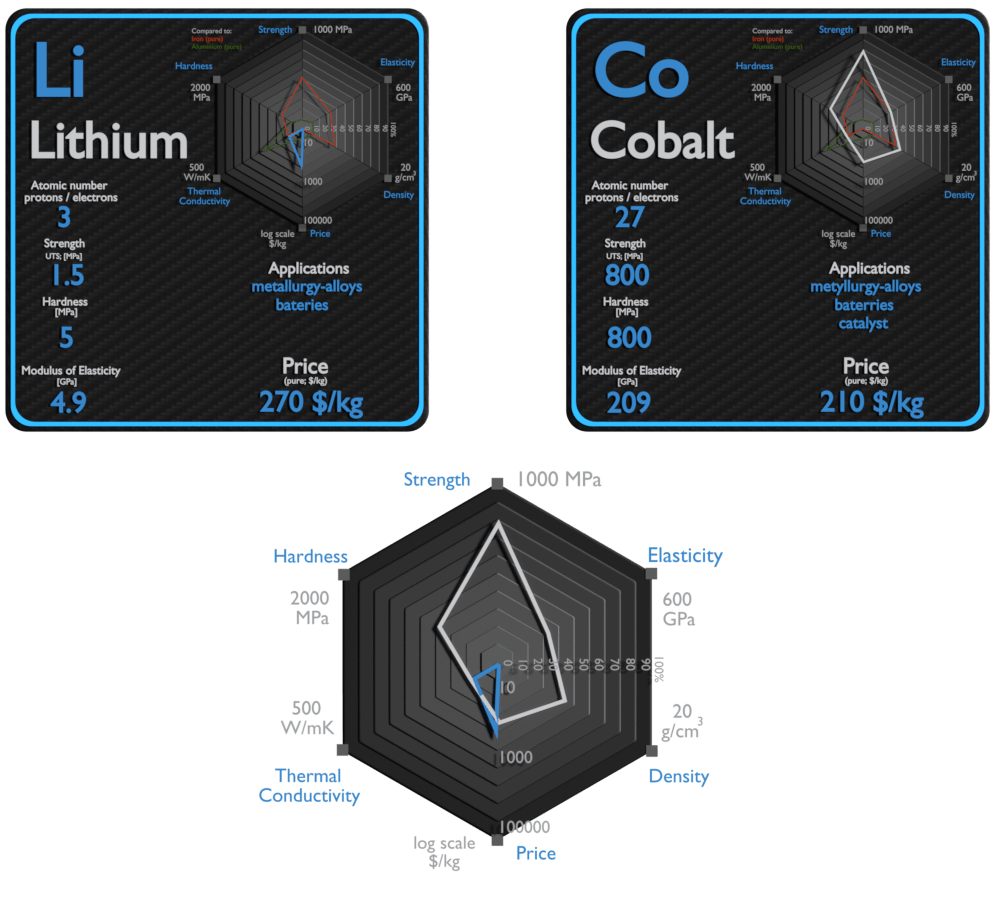
Lithium and Cobalt – Comparison – Properties

This article contains comparison of key thermal and atomic properties of lithium and cobalt, two comparable chemical elements from the periodic table. It also contains basic descriptions and applications of both elements. Lithium vs Cobalt.

lithium and cobalt - comparison

Compare lithium with another element

Hydrogen - Properties - Price - Applications - Production

Oxygen - Properties - Price - Applications - Production

Aluminium - Properties - Price - Applications - Production

Nitrogen - Properties - Price - Applications - Production

Sodium - Properties - Price - Applications - Production

Calcium - Properties - Price - Applications - Production

Silicon - Properties - Price - Applications - Production

Cadmium - Properties - Price - Applications - Production

Cobalt - Properties - Price - Applications - Production

Magnesium - Properties - Price - Applications - Production

Phosphorus - Properties - Price - Applications - Production

Potassium - Properties - Price - Applications - Production

Sulfur - Properties - Price - Applications - Production

Compare cobalt with another element

Lithium - Properties - Price - Applications - Production

Iron - Properties - Price - Applications - Production

Copper - Properties - Price - Applications - Production

Cobalt - Properties - Price - Applications - Production

Cadmium - Properties - Price - Applications - Production

Zinc - Properties - Price - Applications - Production

Silver - Properties - Price - Applications - Production

Gold - Properties - Price - Applications - Production

Tungsten - Properties - Price - Applications - Production

Lithium and Cobalt – About Elements

Lithium

It is a soft, silvery-white alkali metal. Under standard conditions, it is the lightest metal and the lightest solid element. Like all alkali metals, lithium is highly reactive and flammable, and is stored in mineral oil.

Cobalt

Cobalt is found in the Earth’s crust only in chemically combined form, save for small deposits found in alloys of natural meteoric iron. The free element, produced by reductive smelting, is a hard, lustrous, silver-gray metal.

Lithium in Periodic Table

Cobalt in Periodic Table

Source: www.luciteria.com

Lithium and Cobalt – Applications

Lithium

Lithium has many applications, from lubricating grease, alloying additions in particular for aluminium and magnesium alloys, to glazes for ceramics, and finally, lithium batteries. In particular, lithium is and will continue to play an increasingly important role in the battery-powered clean air future. Lithium batteries are widely used in portable consumer electronic devices, and in electric vehicles ranging from full sized vehicles to radio controlled toys. The term “lithium battery” refers to a family of different lithium-metal chemistries, comprising many types of cathodes and electrolytes but all with metallic lithium as the anode.

Cobalt

Cobalt has been used in many industrial, commercial, and military applications. Cobalt is primarily used in lithium-ion batteries, and in the manufacture of magnetic, wear-resistant and high-strength alloys. Cobalt-based Superalloys. This class of alloys is relatively new. In 2006, Sato et al. discovered a new phase in the Co–Al–W system. Unlike other superalloys, cobalt-base alloys are characterized by a solid-solution-strengthened austenitic (fcc) matrix in which a small quantity of carbide is distributed. While not used commercially to the extent of Ni-based superalloys, alloying elements found in research Co-based alloys are C, Cr, W, Ni, Ti, Al, Ir, and Ta. They possess better weldability and thermal fatigue resistance as compared to nickel based alloy. Moreover, they have excellent corrosion resistance at high temperatures (980-1100 °C) because of their higher chromium contents. Several cobalt compounds are oxidation catalysts. Typical catalysts are the cobalt carboxylates (known as cobalt soaps). They are also used in paints, varnishes, and inks as “drying agents” through the oxidation of drying oils.

Lithium and Cobalt – Comparison in Table

Element Lithium Cobalt
Density 0.535 g/cm3 8.9 g/cm3
Ultimate Tensile Strength 1.5 MPa 800 MPa
Yield Strength N/A 220 MPa
Young’s Modulus of Elasticity 4.9 GPa 209 GPa
Mohs Scale 0.6 5
Brinell Hardness 5 MPa 800 MPa
Vickers Hardness N/A 1040 MPa
Melting Point 180.5 °C 1495 °C
Boiling Point 1342 °C 2927 °C
Thermal Conductivity 85 W/mK 100 W/mK
Thermal Expansion Coefficient 46 µm/mK 13 µm/mK
Specific Heat 3.6 J/g K 0.42 J/g K
Heat of Fusion 3 kJ/mol 16.19 kJ/mol
Heat of Vaporization 145.92 kJ/mol 376.5 kJ/mol