Facebook Instagram Youtube Twitter

Hydrogen and Fluorine – Comparison – Properties

This article contains comparison of key thermal and atomic properties of hydrogen and fluorine, two comparable chemical elements from the periodic table. It also contains basic descriptions and applications of both elements. Hydrogen vs Fluorine.

hydrogen and fluorine - comparison

Compare hydrogen with another element

Helium - Properties - Price - Applications - Production

Oxygen - Properties - Price - Applications - Production

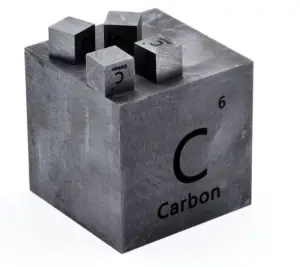
Carbon - Properties - Price - Applications - Production

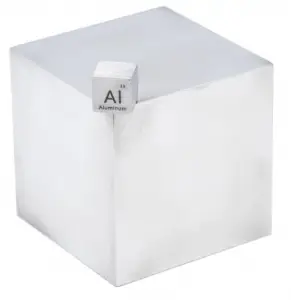
Aluminium - Properties - Price - Applications - Production

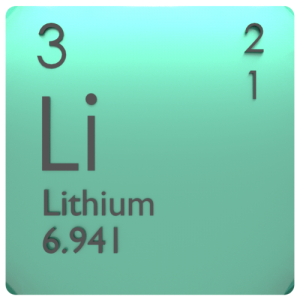
Lithium - Properties - Price - Applications - Production

Nitrogen - Properties - Price - Applications - Production

Fluorine - Properties - Price - Applications - Production

Sodium - Properties - Price - Applications - Production

Calcium - Properties - Price - Applications - Production

Compare fluorine with another element

Chlorine - Properties - Price - Applications - Production

Neon - Properties - Price - Applications - Production

Iron - Properties - Price - Applications - Production

Calcium - Properties - Price - Applications - Production

Aluminium - Properties - Price - Applications - Production

Hydrogen - Properties - Price - Applications - Production

Oxygen - Properties - Price - Applications - Production

Hydrogen and Fluorine – About Elements

Hydrogen

With a standard atomic weight of circa 1.008, hydrogen is the lightest element on the periodic table. Its monatomic form (H) is the most abundant chemical substance in the Universe, constituting roughly 75% of all baryonic mass.

Fluorine

Fluorine is the lightest halogen and exists as a highly toxic pale yellow diatomic gas at standard conditions. As the most electronegative element, it is extremely reactive: almost all other elements, including some noble gases, form compounds with fluorine.

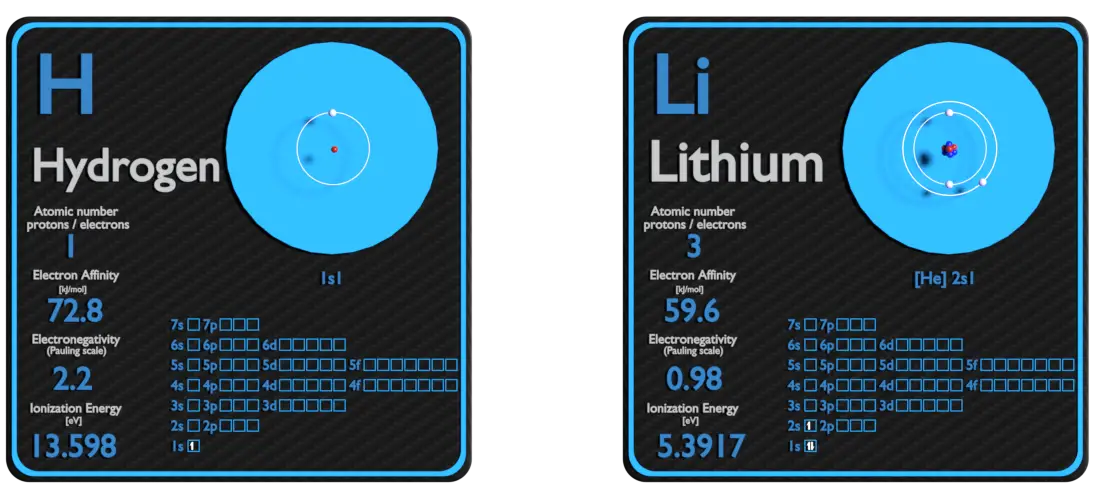
Hydrogen in Periodic Table

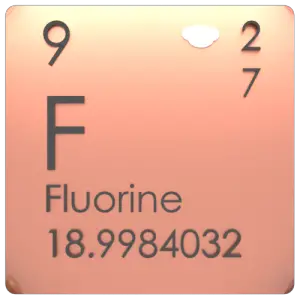
Fluorine in Periodic Table

Source: www.luciteria.com

Hydrogen and Fluorine – Applications

Hydrogen

Hydrogen is versatile and can be utilized in various ways. These multiple uses can be grouped into two large categories. Hydrogen as a feedstock. A role whose importance is being recognized for decades and will continue to grow and evolve. The largest single use of hydrogen in the world is in ammonia manufacture, which consumes about two-thirds of the world’s hydrogen production. Hydrogen is versatile and can be utilized in various ways. These multiple uses can be grouped into two large categories. Hydrogen as a feedstock for further chemical processes. A role whose importance is being recognized for decades and will continue to grow and evolve. And hydrogen as an energy carrier. Hydrogen is also commonly used in power stations as a coolant in generators due to a number of favorable properties that are a direct result of its light diatomic molecules.

Fluorine

Owing to the expense of refining pure fluorine, most commercial applications use fluorine compounds, with about half of mined fluorite used in steelmaking. The rest of the fluorite is converted into corrosive hydrogen fluoride en route to various organic fluorides, or into cryolite, which plays a key role in aluminium refining. Most commercial uranium enrichment processes (gaseous diffusion and the gas centrifuge method) require the uranium to be in a gaseous form, therefore the uranium oxide concentrate must be first converted to uranium hexafluoride, which is a gas at relatively low temperatures. Molecules containing a carbon–fluorine bond often have very high chemical and thermal stability; their major uses are as refrigerants, electrical insulation and cookware, the last as PTFE (Teflon).

Hydrogen and Fluorine – Comparison in Table

Element Hydrogen Fluorine
Density 0.00009 g/cm3 0.0017 g/cm3
Ultimate Tensile Strength N/A N/A
Yield Strength N/A N/A
Young’s Modulus of Elasticity N/A N/A
Mohs Scale N/A N/A
Brinell Hardness N/A N/A
Vickers Hardness N/A N/A
Melting Point -259.1 °C -219.8 °C
Boiling Point -252.9 °C -188.1 °C
Thermal Conductivity 0.1805 W/mK 0.0279 W/mK
Thermal Expansion Coefficient — µm/mK — µm/mK
Specific Heat 14.304 J/g K 0.82 J/g K
Heat of Fusion 0.05868 kJ/mol 0.2552 kJ/mol
Heat of Vaporization 0.44936 kJ/mol 3.2698 kJ/mol


Hydrogen and Nitrogen – Comparison – Properties

This article contains comparison of key thermal and atomic properties of hydrogen and nitrogen, two comparable chemical elements from the periodic table. It also contains basic descriptions and applications of both elements. Hydrogen vs Nitrogen.

hydrogen and nitrogen - comparison

Compare hydrogen with another element

Helium - Properties - Price - Applications - Production

Oxygen - Properties - Price - Applications - Production

Carbon - Properties - Price - Applications - Production

Aluminium - Properties - Price - Applications - Production

Lithium - Properties - Price - Applications - Production

Nitrogen - Properties - Price - Applications - Production

Fluorine - Properties - Price - Applications - Production

Sodium - Properties - Price - Applications - Production

Calcium - Properties - Price - Applications - Production

Compare nitrogen with another element

Hydrogen - Properties - Price - Applications - Production

Helium - Properties - Price - Applications - Production

Lithium - Properties - Price - Applications - Production

Beryllium - Properties - Price - Applications - Production

Carbon - Properties - Price - Applications - Production

Oxygen - Properties - Price - Applications - Production

Phosphorus - Properties - Price - Applications - Production

Hydrogen and Nitrogen – About Elements

Hydrogen

With a standard atomic weight of circa 1.008, hydrogen is the lightest element on the periodic table. Its monatomic form (H) is the most abundant chemical substance in the Universe, constituting roughly 75% of all baryonic mass.

Nitrogen

Nitrogen is a colourless, odourless unreactive gas that forms about 78% of the earth’s atmosphere. Liquid nitrogen (made by distilling liquid air) boils at 77.4 kelvins (−195.8°C) and is used as a coolant.

Hydrogen in Periodic Table

Nitrogen in Periodic Table

Source: www.luciteria.com

Hydrogen and Nitrogen – Applications

Hydrogen

Hydrogen is versatile and can be utilized in various ways. These multiple uses can be grouped into two large categories. Hydrogen as a feedstock. A role whose importance is being recognized for decades and will continue to grow and evolve. The largest single use of hydrogen in the world is in ammonia manufacture, which consumes about two-thirds of the world’s hydrogen production. Hydrogen is versatile and can be utilized in various ways. These multiple uses can be grouped into two large categories. Hydrogen as a feedstock for further chemical processes. A role whose importance is being recognized for decades and will continue to grow and evolve. And hydrogen as an energy carrier. Hydrogen is also commonly used in power stations as a coolant in generators due to a number of favorable properties that are a direct result of its light diatomic molecules.

Nitrogen

Nitrogen in various chemical forms plays a major role in large number of environmental issues. The applications of nitrogen compounds are naturally extremely widely varied due to the huge size of this class: hence, only applications of pure nitrogen itself will be considered here. Two-thirds of nitrogen produced by industry is sold as the gas and the remaining one-third as the liquid. In metallurgy, nitriding is a case hardening process in which the surface nitrogen concentration of a ferrous is increased by diffusion from the surrounding environment to create case-hardened surface. Nitriding produces hard, highly wear-resistant surface (shallow case depths) of product with fair capacity for contact load, good bending fatigue strength and excellent resistance to seizure. Synthetically produced ammonia and nitrates are key industrial fertilisers, and fertiliser nitrates are key pollutants in the eutrophication of water systems. Apart from its use in fertilisers and energy-stores, nitrogen is a constituent of organic compounds as diverse as Kevlar used in high-strength fabric and cyanoacrylate used in superglue.

Hydrogen and Nitrogen – Comparison in Table

Element Hydrogen Nitrogen
Density 0.00009 g/cm3 0.00125 g/cm3
Ultimate Tensile Strength N/A N/A
Yield Strength N/A N/A
Young’s Modulus of Elasticity N/A N/A
Mohs Scale N/A N/A
Brinell Hardness N/A N/A
Vickers Hardness N/A N/A
Melting Point -259.1 °C -209.9 °C
Boiling Point -252.9 °C -195.8 °C
Thermal Conductivity 0.1805 W/mK 0.02598 W/mK
Thermal Expansion Coefficient — µm/mK — µm/mK
Specific Heat 14.304 J/g K 1.04 J/g K
Heat of Fusion 0.05868 kJ/mol (N2) 0.7204 kJ/mol
Heat of Vaporization 0.44936 kJ/mol (N2) 5.56 kJ/mol


Hydrogen and Lithium – Comparison – Properties

This article contains comparison of key thermal and atomic properties of hydrogen and lithium, two comparable chemical elements from the periodic table. It also contains basic descriptions and applications of both elements. Hydrogen vs Lithium.

hydrogen and lithium - comparison

Compare hydrogen with another element

Helium - Properties - Price - Applications - Production

Oxygen - Properties - Price - Applications - Production

Carbon - Properties - Price - Applications - Production

Aluminium - Properties - Price - Applications - Production

Lithium - Properties - Price - Applications - Production

Nitrogen - Properties - Price - Applications - Production

Fluorine - Properties - Price - Applications - Production

Sodium - Properties - Price - Applications - Production

Calcium - Properties - Price - Applications - Production

Compare lithium with another element

Hydrogen - Properties - Price - Applications - Production

Oxygen - Properties - Price - Applications - Production

Aluminium - Properties - Price - Applications - Production

Nitrogen - Properties - Price - Applications - Production

Sodium - Properties - Price - Applications - Production

Calcium - Properties - Price - Applications - Production

Silicon - Properties - Price - Applications - Production

Cadmium - Properties - Price - Applications - Production

Cobalt - Properties - Price - Applications - Production

Magnesium - Properties - Price - Applications - Production

Phosphorus - Properties - Price - Applications - Production

Potassium - Properties - Price - Applications - Production

Sulfur - Properties - Price - Applications - Production

Hydrogen and Lithium – About Elements

Hydrogen

With a standard atomic weight of circa 1.008, hydrogen is the lightest element on the periodic table. Its monatomic form (H) is the most abundant chemical substance in the Universe, constituting roughly 75% of all baryonic mass.

Lithium

It is a soft, silvery-white alkali metal. Under standard conditions, it is the lightest metal and the lightest solid element. Like all alkali metals, lithium is highly reactive and flammable, and is stored in mineral oil.

Hydrogen in Periodic Table

Lithium in Periodic Table

Source: www.luciteria.com

Hydrogen and Lithium – Applications

Hydrogen

Hydrogen is versatile and can be utilized in various ways. These multiple uses can be grouped into two large categories. Hydrogen as a feedstock. A role whose importance is being recognized for decades and will continue to grow and evolve. The largest single use of hydrogen in the world is in ammonia manufacture, which consumes about two-thirds of the world’s hydrogen production. Hydrogen is versatile and can be utilized in various ways. These multiple uses can be grouped into two large categories. Hydrogen as a feedstock for further chemical processes. A role whose importance is being recognized for decades and will continue to grow and evolve. And hydrogen as an energy carrier. Hydrogen is also commonly used in power stations as a coolant in generators due to a number of favorable properties that are a direct result of its light diatomic molecules.

Lithium

Lithium has many applications, from lubricating grease, alloying additions in particular for aluminium and magnesium alloys, to glazes for ceramics, and finally, lithium batteries. In particular, lithium is and will continue to play an increasingly important role in the battery-powered clean air future. Lithium batteries are widely used in portable consumer electronic devices, and in electric vehicles ranging from full sized vehicles to radio controlled toys. The term “lithium battery” refers to a family of different lithium-metal chemistries, comprising many types of cathodes and electrolytes but all with metallic lithium as the anode.

Hydrogen and Lithium – Comparison in Table

Element Hydrogen Lithium
Density 0.00009 g/cm3 0.535 g/cm3
Ultimate Tensile Strength N/A 1.5 MPa
Yield Strength N/A N/A
Young’s Modulus of Elasticity N/A 4.9 GPa
Mohs Scale N/A 0.6
Brinell Hardness N/A N/A
Vickers Hardness N/A 167 MPa
Melting Point -259.1 °C 180.5 °C
Boiling Point -252.9 °C 1342 °C
Thermal Conductivity 0.1805 W/mK 85 W/mK
Thermal Expansion Coefficient — µm/mK 46 µm/mK
Specific Heat 14.304 J/g K 3.6 J/g K
Heat of Fusion 0.05868 kJ/mol 3 kJ/mol
Heat of Vaporization 0.44936 kJ/mol 145.92 kJ/mol


Hydrogen and Aluminium – Comparison – Properties

This article contains comparison of key thermal and atomic properties of hydrogen and aluminium, two comparable chemical elements from the periodic table. It also contains basic descriptions and applications of both elements. Hydrogen vs Aluminium.

hydrogen and aluminium - comparison

Compare hydrogen with another element

Helium - Properties - Price - Applications - Production

Oxygen - Properties - Price - Applications - Production

Carbon - Properties - Price - Applications - Production

Aluminium - Properties - Price - Applications - Production

Lithium - Properties - Price - Applications - Production

Nitrogen - Properties - Price - Applications - Production

Fluorine - Properties - Price - Applications - Production

Sodium - Properties - Price - Applications - Production

Calcium - Properties - Price - Applications - Production

Compare aluminium with another element

Hydrogen - Properties - Price - Applications - Production

Lithium - Properties - Price - Applications - Production

Beryllium - Properties - Price - Applications - Production

Carbon - Properties - Price - Applications - Production

Oxygen - Properties - Price - Applications - Production

Fluorine - Properties - Price - Applications - Production

Sodium - Properties - Price - Applications - Production

Magnesium - Properties - Price - Applications - Production

Copper - Properties - Price - Applications - Production

Mercury - Properties - Price - Applications - Production

Potassium - Properties - Price - Applications - Production

Silicon - Properties - Price - Applications - Production

Chlorine - Properties - Price - Applications - Production

Titanium - Properties - Price - Applications - Production

Iron - Properties - Price - Applications - Production

Gallium - Properties - Price - Applications - Production

Hydrogen and Aluminium – About Elements

Hydrogen

With a standard atomic weight of circa 1.008, hydrogen is the lightest element on the periodic table. Its monatomic form (H) is the most abundant chemical substance in the Universe, constituting roughly 75% of all baryonic mass.

Aluminium

Aluminium is a silvery-white, soft, nonmagnetic, ductile metal in the boron group. By mass, aluminium makes up about 8% of the Earth’s crust; it is the third most abundant element after oxygen and silicon and the most abundant metal in the crust, though it is less common in the mantle below.

Hydrogen in Periodic Table

Aluminium in Periodic Table

Source: www.luciteria.com

Hydrogen and Aluminium – Applications

Hydrogen

Hydrogen is versatile and can be utilized in various ways. These multiple uses can be grouped into two large categories. Hydrogen as a feedstock. A role whose importance is being recognized for decades and will continue to grow and evolve. The largest single use of hydrogen in the world is in ammonia manufacture, which consumes about two-thirds of the world’s hydrogen production. Hydrogen is versatile and can be utilized in various ways. These multiple uses can be grouped into two large categories. Hydrogen as a feedstock for further chemical processes. A role whose importance is being recognized for decades and will continue to grow and evolve. And hydrogen as an energy carrier. Hydrogen is also commonly used in power stations as a coolant in generators due to a number of favorable properties that are a direct result of its light diatomic molecules.

Aluminium

Aluminium and its alloys are used widely in aerospace, automotive, architectural, lithographic, packaging, electrical and electronic applications. It is the prime material of construction for the aircraft industry throughout most of its history. About 70% of commercial civil aircraft airframes are made from aluminium alloys, and without aluminium civil aviation would not be economically viable. Automotive industry now includes aluminium as engine castings, wheels, radiators and increasingly as body parts. 6111 aluminium and 2008 aluminium alloy are extensively used for external automotive body panels. Cylinder blocks and crankcases are often cast made of aluminium alloys.

Hydrogen and Aluminium – Comparison in Table

Element Hydrogen Aluminium
Density 0.00009 g/cm3 2.7 g/cm3
Ultimate Tensile Strength N/A 90 MPa (pure), 600 MPa (alloys)
Yield Strength N/A 11 MPa (pure), 400 MPa (alloys)
Young’s Modulus of Elasticity N/A 70 GPa
Mohs Scale N/A 2.8
Brinell Hardness N/A 240 MPa
Vickers Hardness N/A 167 MPa
Melting Point -259.1 °C 660 °C
Boiling Point -252.9 °C 2467 °C
Thermal Conductivity 0.1805 W/mK 237 W/mK
Thermal Expansion Coefficient — µm/mK 23.1 µm/mK
Specific Heat 14.304 J/g K 0.9 J/g K
Heat of Fusion 0.05868 kJ/mol 10.79 kJ/mol
Heat of Vaporization 0.44936 kJ/mol 293.4 kJ/mol


Hydrogen and Carbon – Comparison – Properties

This article contains comparison of key thermal and atomic properties of hydrogen and carbon, two comparable chemical elements from the periodic table. It also contains basic descriptions and applications of both elements. Hydrogen vs Carbon.

hydrogen and carbon - comparison - properties

Compare hydrogen with another element

Helium - Properties - Price - Applications - Production

Oxygen - Properties - Price - Applications - Production

Carbon - Properties - Price - Applications - Production

Aluminium - Properties - Price - Applications - Production

Lithium - Properties - Price - Applications - Production

Nitrogen - Properties - Price - Applications - Production

Fluorine - Properties - Price - Applications - Production

Sodium - Properties - Price - Applications - Production

Calcium - Properties - Price - Applications - Production

Compare carbon with another element

Hydrogen - Properties - Price - Applications - Production

Boron - Properties - Price - Applications - Production

Oxygen - Properties - Price - Applications - Production

Aluminium - Properties - Price - Applications - Production

Nitrogen - Properties - Price - Applications - Production

Iron - Properties - Price - Applications - Production

Chlorine - Properties - Price - Applications - Production

Bromine - Properties - Price - Applications - Production

Hydrogen and Carbon – About Elements

Hydrogen

With a standard atomic weight of circa 1.008, hydrogen is the lightest element on the periodic table. Its monatomic form (H) is the most abundant chemical substance in the Universe, constituting roughly 75% of all baryonic mass.

Carbon

It is nonmetallic and tetravalent—making four electrons available to form covalent chemical bonds. Carbon is one of the few elements known since antiquity. Carbon is the 15th most abundant element in the Earth’s crust, and the fourth most abundant element in the universe by mass after hydrogen, helium, and oxygen.

Hydrogen in Periodic Table

Carbon in Periodic Table

Source: www.luciteria.com

Hydrogen and Carbon – Applications

Hydrogen

Hydrogen is versatile and can be utilized in various ways. These multiple uses can be grouped into two large categories. Hydrogen as a feedstock. A role whose importance is being recognized for decades and will continue to grow and evolve. The largest single use of hydrogen in the world is in ammonia manufacture, which consumes about two-thirds of the world’s hydrogen production. Hydrogen is versatile and can be utilized in various ways. These multiple uses can be grouped into two large categories. Hydrogen as a feedstock for further chemical processes. A role whose importance is being recognized for decades and will continue to grow and evolve. And hydrogen as an energy carrier. Hydrogen is also commonly used in power stations as a coolant in generators due to a number of favorable properties that are a direct result of its light diatomic molecules.

Carbon

The major economic use of carbon other than food and wood is in the form of hydrocarbons, most notably the fossil fuel methane gas and crude oil (petroleum). Graphite and diamonds are two important allotropes of carbon that have wide applications. The uses of carbon and its compounds are extremely varied. It can form alloys with iron, of which the most common is carbon steel. Carbon is a non-metallic element, which is an important alloying element in all ferrous metal based materials. Carbon is always present in metallic alloys, i.e. in all grades of stainless steel and heat resistant alloys. Carbon is a very strong austenitizer and increases the strength of steel. In fact, it is the principal hardening element and is essential to the formation of cementite, Fe3C, pearlite, spheroidite, and iron-carbon martensite. Adding a small amount of non-metallic carbon to iron trades its great ductility for the greater strength. Graphite is combined with clays to form the ‘lead’ used in pencils used for writing and drawing. It is also used as a lubricant and a pigment, as a molding material in glass manufacture, in electrodes for dry batteries and in electroplating and electroforming, in brushes for electric motors and as a neutron moderator in nuclear reactors. Charcoal has been used since earliest times for a large range of purposes including art and medicine, but by far its most important use has been as a metallurgical fuel. Carbon fibers are used where low weight, high stiffness, high conductivity, or where the look of the carbon fiber weave desired.

Hydrogen and Carbon – Comparison in Table

Element Hydrogen Carbon
Density 0.00009 g/cm3 2.26 g/cm3
Ultimate Tensile Strength N/A 15 MPa (graphite); 3500 MPa (carbon fiber)
Yield Strength N/A N/A
Young’s Modulus of Elasticity N/A 4.1 GPa (graphite); 228 GPa (carbon fiber)
Mohs Scale N/A 0.8 (graphite)
Brinell Hardness N/A N/A
Vickers Hardness N/A N/A
Melting Point -259.1 °C 4099 °C
Boiling Point -252.9 °C 4527 °C
Thermal Conductivity 0.1805 W/mK 129 W/mK
Thermal Expansion Coefficient — µm/mK 0.8 µm/mK
Specific Heat 14.304 J/g K 0.71 J/g K
Heat of Fusion 0.05868 kJ/mol — kJ/mol
Heat of Vaporization 0.44936 kJ/mol 355.8 kJ/mol


Hydrogen and Helium – Comparison – Properties

This article contains comparison of key thermal and atomic properties of hydrogen and helium, two comparable chemical elements from the periodic table. It also contains basic descriptions and applications of both elements. Hydrogen vs Helium.

hydrogen and helium - comparison - properties

Compare hydrogen with another element

Helium - Properties - Price - Applications - Production

Oxygen - Properties - Price - Applications - Production

Carbon - Properties - Price - Applications - Production

Aluminium - Properties - Price - Applications - Production

Lithium - Properties - Price - Applications - Production

Nitrogen - Properties - Price - Applications - Production

Fluorine - Properties - Price - Applications - Production

Sodium - Properties - Price - Applications - Production

Calcium - Properties - Price - Applications - Production

Compare helium with another element

Oxygen - Properties - Price - Applications - Production

Argon - Properties - Price - Applications - Production

Aluminium - Properties - Price - Applications - Production

Neon - Properties - Price - Applications - Production

Xenon - Properties - Price - Applications - Production

Hydrogen and Helium – About Elements

Hydrogen

With a standard atomic weight of circa 1.008, hydrogen is the lightest element on the periodic table. Its monatomic form (H) is the most abundant chemical substance in the Universe, constituting roughly 75% of all baryonic mass.

Helium

It is a colorless, odorless, tasteless, non-toxic, inert, monatomic gas, the first in the noble gas group in the periodic table. Its boiling point is the lowest among all the elements.

Hydrogen in Periodic Table

Helium in Periodic Table

Source: www.luciteria.com

Hydrogen and Helium – Applications

Hydrogen

Hydrogen is versatile and can be utilized in various ways. These multiple uses can be grouped into two large categories. Hydrogen as a feedstock. A role whose importance is being recognized for decades and will continue to grow and evolve. The largest single use of hydrogen in the world is in ammonia manufacture, which consumes about two-thirds of the world’s hydrogen production. Hydrogen is versatile and can be utilized in various ways. These multiple uses can be grouped into two large categories. Hydrogen as a feedstock for further chemical processes. A role whose importance is being recognized for decades and will continue to grow and evolve. And hydrogen as an energy carrier. Hydrogen is also commonly used in power stations as a coolant in generators due to a number of favorable properties that are a direct result of its light diatomic molecules.

Helium

Helium is used for many purposes that require some of its unique properties, such as its low boiling point, low density, low solubility, high thermal conductivity, or inertness. Of the 2014 world helium total production of about 32 million kg (180 million standard cubic meters) helium per year, the largest use (about 32% of the total in 2014) is in cryogenic applications, most of which involves cooling the superconducting magnets in medical MRI scanners and NMR spectrometers. Most clinical magnets are superconducting magnets, which require liquid helium to keep them very cold.

Hydrogen and Helium – Comparison in Table

Element Hydrogen Helium
Density 0.00009 g/cm3 0.00018 g/cm3
Ultimate Tensile Strength N/A N/A
Yield Strength N/A N/A
Young’s Modulus of Elasticity N/A N/A
Mohs Scale N/A N/A
Brinell Hardness N/A N/A
Vickers Hardness N/A N/A
Melting Point -259.1 °C -272.2 °C
Boiling Point -252.9 °C -268.9 °C
Thermal Conductivity 0.1805 W/mK 0.1513 W/mK
Thermal Expansion Coefficient — µm/mK — µm/mK
Specific Heat 14.304 J/g K 5.193 J/g K
Heat of Fusion 0.05868 kJ/mol 0.0138 kJ/mol
Heat of Vaporization 0.44936 kJ/mol 0.0845 kJ/mol


Hydrogen and Oxygen – Comparison – Properties

This article contains comparison of key thermal and atomic properties of hydrogen and oxygen, two comparable chemical elements from the periodic table. It also contains basic descriptions and applications of both elements. Hydrogen vs Oxygen.

hydrogen and oxygen - comparison

Compare hydrogen with another element

Helium - Properties - Price - Applications - Production

Oxygen - Properties - Price - Applications - Production

Carbon - Properties - Price - Applications - Production

Aluminium - Properties - Price - Applications - Production

Lithium - Properties - Price - Applications - Production

Nitrogen - Properties - Price - Applications - Production

Fluorine - Properties - Price - Applications - Production

Sodium - Properties - Price - Applications - Production

Calcium - Properties - Price - Applications - Production

Compare oxygen with another element

Sodium - Properties - Price - Applications - Production

Fluorine - Properties - Price - Applications - Production

Magnesium - Properties - Price - Applications - Production

Aluminium - Properties - Price - Applications - Production

Silicon - Properties - Price - Applications - Production

Sulfur - Properties - Price - Applications - Production

Chlorine - Properties - Price - Applications - Production

Potassium - Properties - Price - Applications - Production

Calcium - Properties - Price - Applications - Production

Iron - Properties - Price - Applications - Production

Hydrogen - Properties - Price - Applications - Production

Helium - Properties - Price - Applications - Production

Lithium - Properties - Price - Applications - Production

Beryllium - Properties - Price - Applications - Production

Boron - Properties - Price - Applications - Production

Carbon - Properties - Price - Applications - Production

Hydrogen and Oxygen – About Elements

Hydrogen

With a standard atomic weight of circa 1.008, hydrogen is the lightest element on the periodic table. Its monatomic form (H) is the most abundant chemical substance in the Universe, constituting roughly 75% of all baryonic mass.

Oxygen

Oxygen is a colourless, odourless reactive gas, the chemical element of atomic number 8 and the life-supporting component of the air. It is a member of the chalcogen group on the periodic table, a highly reactive nonmetal, and an oxidizing agent that readily forms oxides with most elements as well as with other compounds. By mass, oxygen is the third-most abundant element in the universe, after hydrogen and helium.

Hydrogen in Periodic Table

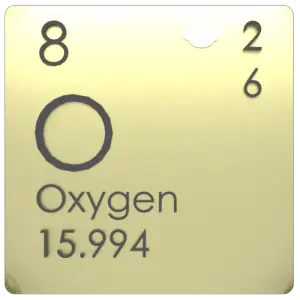
Oxygen in Periodic Table

Source: www.luciteria.com

Hydrogen and Oxygen – Applications

Hydrogen

Hydrogen is versatile and can be utilized in various ways. These multiple uses can be grouped into two large categories. Hydrogen as a feedstock. A role whose importance is being recognized for decades and will continue to grow and evolve. The largest single use of hydrogen in the world is in ammonia manufacture, which consumes about two-thirds of the world’s hydrogen production. Hydrogen is versatile and can be utilized in various ways. These multiple uses can be grouped into two large categories. Hydrogen as a feedstock for further chemical processes. A role whose importance is being recognized for decades and will continue to grow and evolve. And hydrogen as an energy carrier. Hydrogen is also commonly used in power stations as a coolant in generators due to a number of favorable properties that are a direct result of its light diatomic molecules.

Oxygen

Common uses of oxygen include production of steel, plastics and textiles, brazing, welding and cutting of steels and other metals, rocket propellant, oxygen therapy, and life support systems in aircraft, submarines, spaceflight and diving. Smelting of iron ore into steel consumes 55% of commercially produced oxygen. In this process, oxygen is injected through a high-pressure lance into molten iron, which removes sulfur impurities and excess carbon as the respective oxides, sulfur dioxide and carbon dioxide. Uptake of oxygen from the air is the essential purpose of respiration, so oxygen supplementation is used in medicine. Treatment not only increases oxygen levels in the patient’s blood, but has the secondary effect of decreasing resistance to blood flow in many types of diseased lungs, easing work load on the heart.

Hydrogen and Oxygen – Comparison in Table

Element Hydrogen Oxygen
Density 0.00009 g/cm3 0.00143 g/cm3
Ultimate Tensile Strength N/A N/A
Yield Strength N/A N/A
Young’s Modulus of Elasticity N/A N/A
Mohs Scale N/A N/A
Brinell Hardness N/A N/A
Vickers Hardness N/A N/A
Melting Point -259.1 °C -218.4 °C
Boiling Point -252.9 °C -183 °C
Thermal Conductivity 0.1805 W/mK 0.02674 W/mK
Thermal Expansion Coefficient — µm/mK — µm/mK
Specific Heat 14.304 J/g K 0.92 J/g K
Heat of Fusion 0.05868 kJ/mol (O2) 0.444 kJ/mol
Heat of Vaporization 0.44936 kJ/mol (O2) 6.82 kJ/mol


Protactinium – Strength – Hardness – Elasticity – Crystal Structure

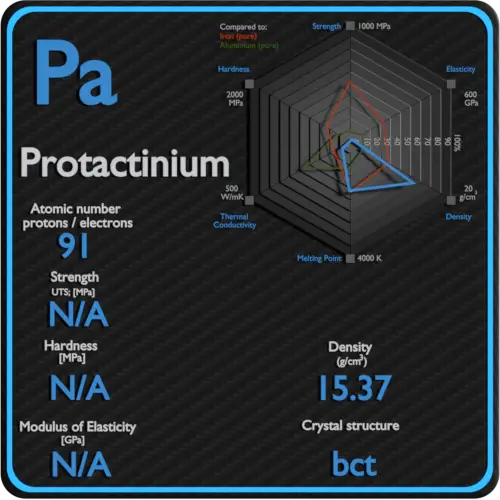
Protactinium-mechanical-properties-strength-hardness-crystal-structure

About Protactinium

Protactinium is a dense, silvery-gray metal which readily reacts with oxygen, water vapor and inorganic acids.

Strength of Protactinium

In mechanics of materials, the strength of a material is its ability to withstand an applied load without failure or plastic deformation. Strength of materials basically considers the relationship between the external loads applied to a material and the resulting deformation or change in material dimensions. In designing structures and machines, it is important to consider these factors, in order that the material selected will have adequate strength to resist applied loads or forces and retain its original shape. Strength of a material is its ability to withstand this applied load without failure or plastic deformation.

For tensile stress, the capacity of a material or structure to withstand loads tending to elongate is known as ultimate tensile strength (UTS). Yield strength or yield stress is the material property defined as the stress at which a material begins to deform plastically whereas yield point is the point where nonlinear (elastic + plastic) deformation begins.

Ultimate Tensile Strength of Protactinium

Ultimate tensile strength of Protactinium is -.

Yield Strength of Protactinium

Yield strength of Protactinium is -.

Modulus of Elasticity of Protactinium

The Young’s modulus of elasticity of Protactinium is -.

The shear modulus of elasticity of Protactinium is -.

The bulk modulus of elasticity of Protactinium is -.

Hardness of Protactinium

In materials science, hardness is the ability to withstand surface indentation (localized plastic deformation) and scratching. Brinell hardness test is one of indentation hardness tests, that has been developed for hardness testing. In Brinell tests, a hard, spherical indenter is forced under a specific load into the surface of the metal to be tested.

Brinell hardness of Protactinium is approximately -.

The Vickers hardness test method was developed by Robert L. Smith and George E. Sandland at Vickers Ltd as an alternative to the Brinell method to measure the hardness of materials. The Vickers hardness test method can be also used as a microhardness test method, which is mostly used for small parts, thin sections, or case depth work.

Vickers hardness of Protactinium is approximately -.

Scratch hardness is the measure of how resistant a sample is to permanent plastic deformation due to friction from a sharp object. The most common scale for this qualitative test is Mohs scale, which is used in mineralogy. The Mohs scale of mineral hardness is based on the ability of one natural sample of mineral to scratch another mineral visibly.

Protactinium is has a hardness of approximately .

Protactinium – Crystal Structure

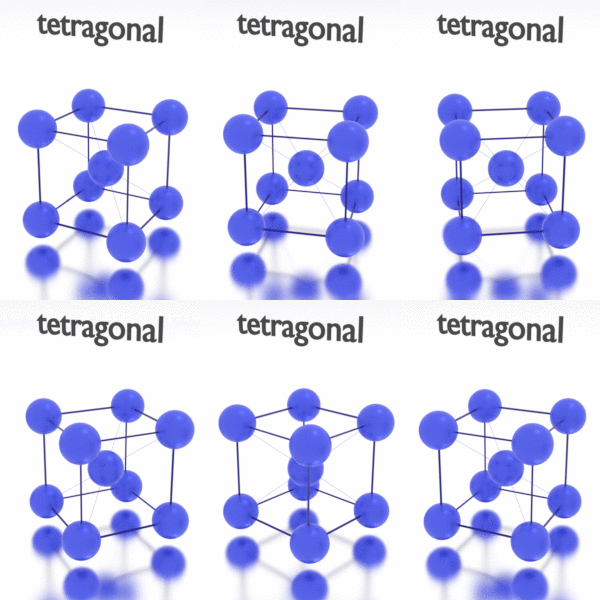
A possible crystal structure of Protactinium is body-centered tetragonal structure.

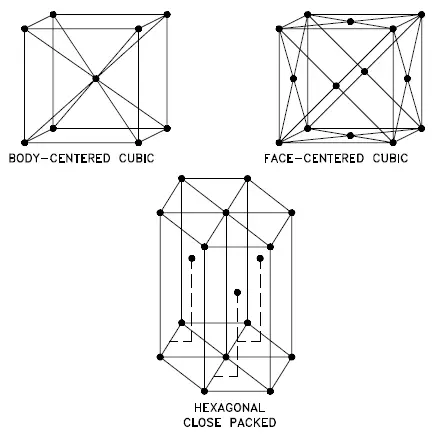
crystal structures - FCC, BCC, HCP

In metals, and in many other solids, the atoms are arranged in regular arrays called crystals. A crystal lattice is a repeating pattern of mathematical points that extends throughout space. The forces of chemical bonding causes this repetition. It is this repeated pattern which control properties like strength, ductility, density, conductivity (property of conducting or transmitting heat, electricity, etc.), and shape. There are 14 general types of such patterns known as Bravais lattices.

Crystal Structure of Protactinium
Crystal Structure of Protactinium is: body-centered tetragonal

Strength of Elements

Elasticity of Elements

Hardness of Elements


About Strength

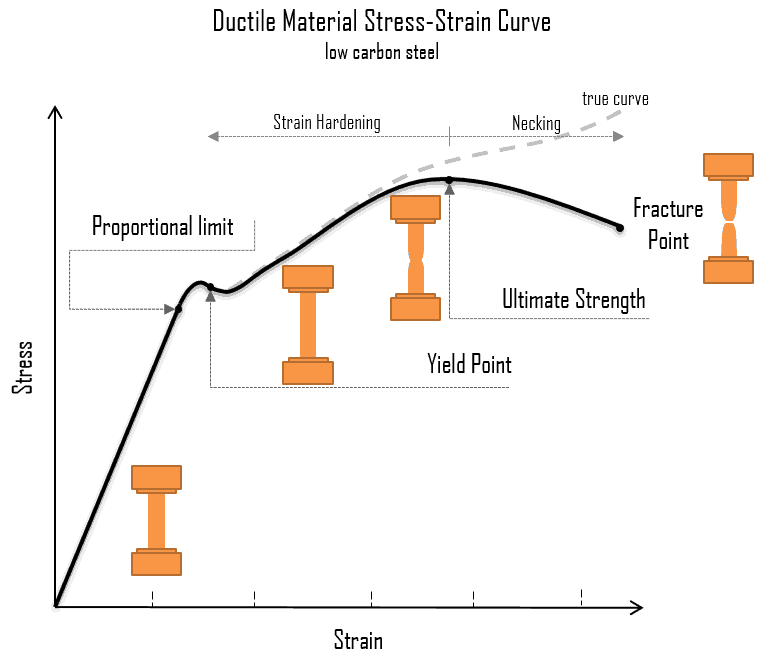
Stress-strain curve - Strength of MaterialsIn mechanics of materials, the strength of a material is its ability to withstand an applied load without failure or plastic deformation. Strength of materials basically considers the relationship between the external loads applied to a material and the resulting deformation or change in material dimensions. In designing structures and machines, it is important to consider these factors, in order that the material selected will have adequate strength to resist applied loads or forces and retain its original shape. Strength of a material is its ability to withstand this applied load without failure or plastic deformation.

A schematic diagram for the stress-strain curve of low carbon steel at room temperature is shown in the figure. There are several stages showing different behaviors, which suggests different mechanical properties. To clarify, materials can miss one or more stages shown in the figure, or have totally different stages. In this case we have to distinguish between stress-strain characteristics of ductile and brittle materials. The following points describe the different regions of the stress-strain curve and the importance of several specific locations.

  • Proportional limit. The proportional limit corresponds to the location of stress at the end of the linear region, so the stress-strain graph is a straight line, and the gradient will be equal to the elastic modulus of the material. For tensile and compressive stress, the slope of the portion of the curve where stress is proportional to strain is referred to as Young’s modulus and Hooke’s Law applies. Between the proportional limit and the yield point the Hooke’s Law becomes questionable between and strain increases more rapidly.
  • Yield Strength - Ultimate Tensile Strength - Table of MaterialsYield point. The yield point is the point on a stress-strain curve that indicates the limit of elastic behavior and the beginning plastic behavior. Yield strength or yield stress is the material property defined as the stress at which a material begins to deform plastically whereas yield point is the point where nonlinear (elastic + plastic) deformation begins. Prior to the yield point, the material will deform elastically and will return to its original shape when the applied stress is removed. Once the yield point is passed, some fraction of the deformation will be permanent and non-reversible. Some steels and other materials exhibit a behaviour termed a yield point phenomenon. Yield strengths vary from 35 MPa for a low-strength aluminum to greater than 1400 MPa for very high-strength steels.
  • Ultimate tensile strength. The ultimate tensile strength is the maximum on the engineering stress-strain curve. This corresponds to the maximum stress that can be sustained by a structure in tension. Ultimate tensile strength is often shortened to “tensile strength” or even to “the ultimate.”  If this stress is applied and maintained, fracture will result. Often, this value is significantly more than the yield stress (as much as 50 to 60 percent more than the yield for some types of metals). When a ductile material reaches its ultimate strength, it experiences necking where the cross-sectional area reduces locally. The stress-strain curve contains no higher stress than the ultimate strength. Even though deformations can continue to increase, the stress usually decreases after the ultimate strength has been achieved. It is an intensive property; therefore its value does not depend on the size of the test specimen. However, it is dependent on other factors, such as the preparation of the specimen, the presence or otherwise of surface defects, and the temperature of the test environment and material. Ultimate tensile strengths vary from 50 MPa for an aluminum to as high as 3000 MPa for very high-strength steels.
  • Fracture point: The fracture point is the point of strain where the material physically separates. At this point, the strain reaches its maximum value and the material actually fractures, even though the corresponding stress may be less than the ultimate strength at this point. Ductile materials have a fracture strength lower than the ultimate tensile strength (UTS), whereas in brittle materials the fracture strength is equivalent to the UTS. If a ductile material reaches its ultimate tensile strength in a load-controlled situation, it will continue to deform, with no additional load application, until it ruptures. However, if the loading is displacement-controlled, the deformation of the material may relieve the load, preventing rupture.
About Modulus of Elasticity

In case of tensional stress of a uniform bar (stress-strain curve), the Hooke’s law describes behaviour of a bar in the elastic region. In this region, the elongation of the bar is directly proportional to the tensile force and the length of the bar and inversely proportional to the cross-sectional area and the modulus of elasticity. Up to a limiting stress, a body will be able to recover its dimensions on removal of the load. The applied stresses cause the atoms in a crystal to move from their equilibrium position. All the atoms are displaced the same amount and still maintain their relative geometry. When the stresses are removed, all the atoms return to their original positions and no permanent deformation occurs. According to the Hooke’s law,  the stress is proportional to the strain (in the elastic region), and the slope is Young’s modulus.

We can extend the same idea of relating stress to strain to shear applications in the linear region, relating shear stress to shear strain to create Hooke’s law for shear stress:

Hooke’s law for shear stress

For isotropic materials within the elastic region, you can relate Poisson’s ratio (ν), Young’s modulus of elasticity (E), and the shear modulus of elasticity (G):

Hooke’s law - poissons ratio

The elastic moduli relevant to polycrystalline materials:

  • Young’s Modulus of Elasticity. The Young’s modulus of elasticity is the elastic modulus for tensile and compressive stress in the linear elasticity regime of a uniaxial deformation and is usually assessed by tensile tests.
  • Shear Modulus of Elasticity. The shear modulus, or the modulus of rigidity, is derived from the torsion of a cylindrical test piece. It describes the material’s response to shear stress. Its symbol is G. The shear modulus is one of several quantities for measuring the stiffness of materials and it arises in the generalized Hooke’s law.
  • Bulk Modulus of Elasticity. The bulk modulus of elasticity is describes volumetric elasticity, or the tendency of an object to deform in all directions when uniformly loaded in all directions. For example, it describes the elastic response to hydrostatic pressure and equilateral tension (like the pressure at the bottom of the ocean or a deep swimming pool). It is also the property of a material that determines the elastic response to the application of stress. For a fluid, only the bulk modulus is meaningful.
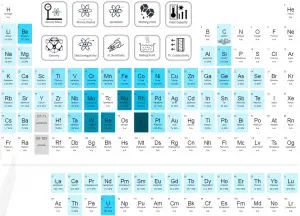
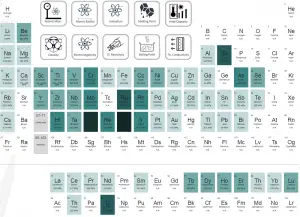
About Hardness

In materials science, hardness is the ability to withstand surface indentation (localized plastic deformation) and scratching. Hardness is probably the most poorly defined material property because it may indicate resistance to scratching, resistance to abrasion, resistance to indentation or even resistance to shaping or localized plastic deformation. Hardness is important from an engineering standpoint because resistance to wear by either friction or erosion by steam, oil, and water generally increases with hardness.

There are three main types of hardness measurements:

  • Mohs scale - mineral hardnessScratch hardness. Scratch hardness is the measure of how resistant a sample is to permanent plastic deformation due to friction from a sharp object. The most common scale for this qualitative test is Mohs scale, which is used in mineralogy. The Mohs scale of mineral hardness is based on the ability of one natural sample of mineral to scratch another mineral visibly. The hardness of a material is measured against the scale by finding the hardest material that the given material can scratch, or the softest material that can scratch the given material. For example, if some material is scratched by topaz but not by quartz, its hardness on the Mohs scale would fall between 7 and 8.
  • Indentation hardness. Indentation hardness measures the ability to withstand surface indentation (localized plastic deformation) and the resistance of a sample to material deformation due to a constant compression load from a sharp object. Tests for indentation hardness are primarily used in engineering and metallurgy fields. The traditional methods are based on well-defined physical indentation hardness tests. Very hard indenters of defined geometries and sizes are continuously pressed into the material under a particular force. Deformation parameters, such as the indentation depth in the Rockwell method, are recorded to give measures of hardness. Common indentation hardness scales are Brinell, Rockwell and Vickers.
  • Rebound hardness. Rebound hardness, also known as dynamic hardness, measures the height of the “bounce” of a diamond-tipped hammer dropped from a fixed height onto a material. One of devices used to take this measurement is known as a scleroscope. It consists of a steel ball dropped from a fixed height. This type of hardness is related to elasticity.
About Crystal Structure

The three most common basic crystal patterns are:

  • bcc. In a bcc (BCC) arrangement of atoms, the unit cell consists of eight atoms at the corners of a cube and one atom at the body center of the cube. In a bcc arrangement, a unit cell contains (8 corner atoms × ⅛) + (1 center atom × 1) = 2 atoms. The packing is more efficient (68%) than simple cubic and the structure is a common one for alkali metals and early transition metals. Metals containing BCC structures include ferrite, chromium, vanadium, molybdenum, and tungsten. These metals possess high strength and low ductility.
  • fcc.In a fcc (FCC) arrangement of atoms, the unit cell consists of eight atoms at the corners of a cube and one atom at the center of each of the faces of the cube. In a fcc arrangement, a unit cell contains (8 corner atoms × ⅛) + (6 face atoms × ½) = 4 atoms. This structure, along with its hexagonal relative (hcp), has the most efficient packing (74%). Metals containing FCC structures include austenite, aluminum, copper, lead, silver, gold, nickel, platinum, and thorium. These metals possess low strength and high ductility.
  • hcp. In a hcp (HCP) arrangement of atoms, the unit cell consists of three layers of atoms. The top and bottom layers contain six atoms at the corners of a hexagon and one atom at the center of each hexagon. The middle layer contains three atoms nestled between the atoms of the top and bottom layers, hence, the name close-packed. Hexagonal close packed (hcp) is one of the two simple types of atomic packing with the highest density, the other being the face centered cubic (fcc). However, unlike the fcc, it is not a Bravais lattice as there are two nonequivalent sets of lattice points. Metals containing HCP structures include beryllium, magnesium, zinc, cadmium, cobalt, thallium, and zirconium. HCP metals are not as ductile as FCC metals.

Summary

Element Protactinium
Ultimate Tensile Strength –
Yield Strength –
Young’s Modulus of Elasticity –
Shear Modulus of Elasticity –
Bulk Modulus of Elasticity –
Mohs Scale
Brinell Hardness –
Vickers Hardness –

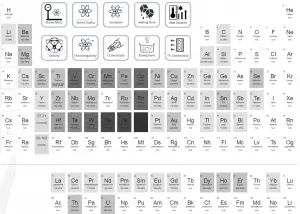
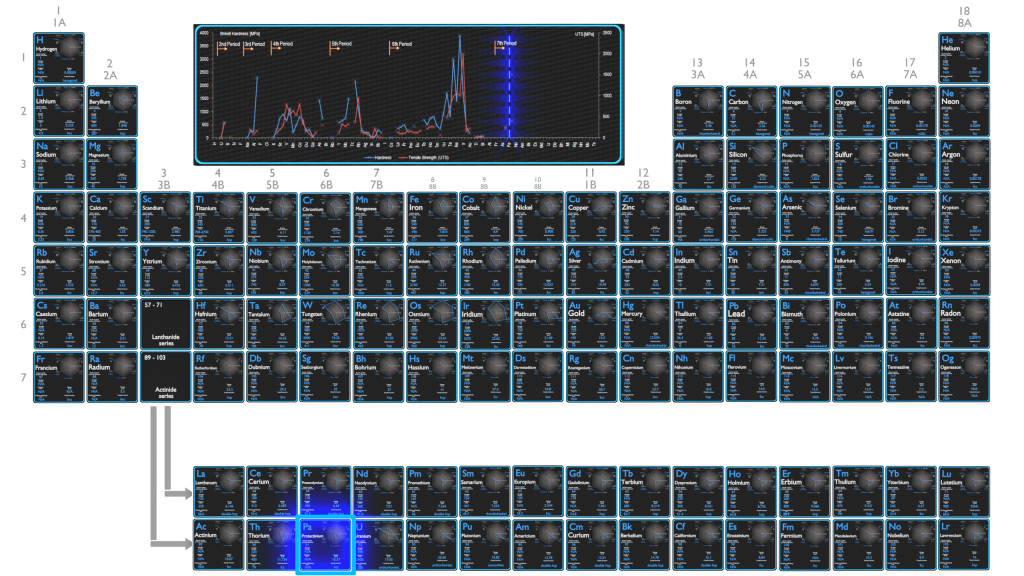
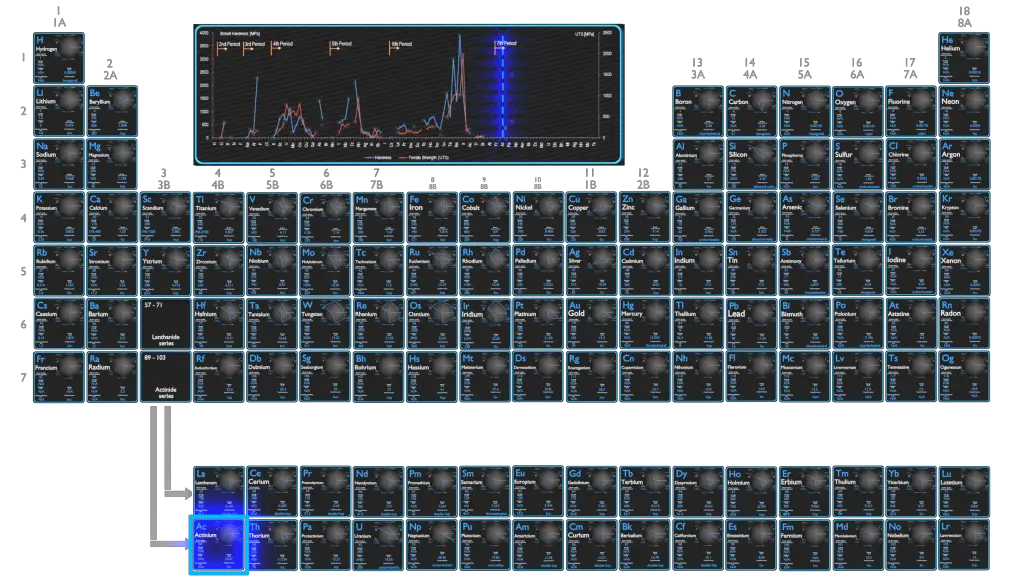
Protactinium-periodic-table

Source: www.luciteria.com


Properties of other elements

Protactinium - Comparison of Mechanical Properties

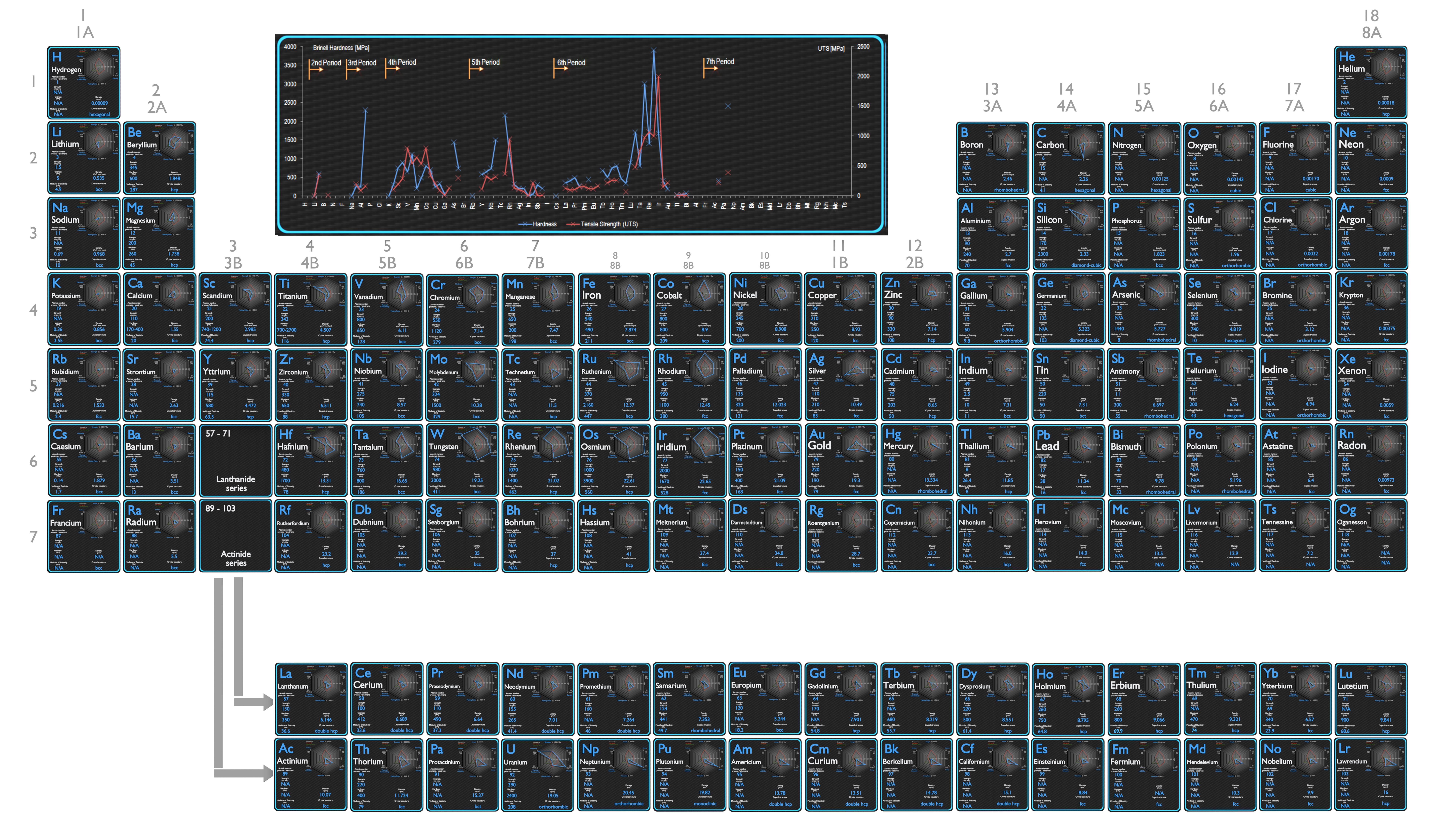
Periodic Table in 8K resolution

Other properties of Protactinium


Actinium – Strength – Hardness – Elasticity – Crystal Structure

Actinium-mechanical-properties-strength-hardness-crystal-structure

About Actinium

Actinium is a soft, silvery-white radioactive metal. Actinium gave the name to the actinide series, a group of 15 elements similar between actinium and lawrencium in the periodic table.

 Strength of Actinium

In the mechanics of materials, the strength of a material is its ability to support an applied load without rupture or plastic deformation. The strength of materials essentially considers the relationship between external loads applied to a material and the resulting deformation or change in the dimensions of the material. When designing structures and machinery, it is important to take these factors into account, so that the selected material has sufficient strength to withstand the applied loads or forces and retain its original shape. The strength of a material is its ability to withstand this applied load without failure or plastic deformation.

For tensile stress, the ability of a material or structure to withstand loads tending to elongate is called ultimate tensile strength (UTS). Yield strength or yield strength is the material property defined as the stress at which a material begins to deform plastically, while yield strength is the point where nonlinear (elastic + plastic) strain begins.

Ultimate Tensile Strength of Actinium

Ultimate tensile strength of Actinium is -.

Yield Strength of Actinium

Yield strength of Actinium is -.

Modulus of Elasticity of Actinium

The Young’s modulus of elasticity of Actinium is -.

The shear modulus of elasticity of Actinium is -.

The bulk modulus of elasticity of Actinium is -.

Hardness of Actinium

In materials science, hardness is the ability to resist surface indentation (localized plastic deformation) and scratching. Brinell hardness test is one of the indentation hardness tests, which was developed for hardness testing. In Brinell testing, a hard, spherical indenter is forced under a specific load into the surface of the metal under test.

Brinell hardness of Actinium is approximately -.

The Vickers hardness test method was developed by Robert L. Smith and George E. Sandland at Vickers Ltd as an alternative to the Brinell method to measure the hardness of materials. The Vickers hardness test method can be also used as a microhardness test method, which is mostly used for small parts, thin sections, or case depth work.

Vickers hardness of Actinium is approximately -.

Scratch hardness is the measure of how resistant a sample is to permanent plastic deformation due to friction from a sharp object. The most common scale for this qualitative test is Mohs scale, which is used in mineralogy. The Mohs scale of mineral hardness is based on the ability of one natural sample of mineral to scratch another mineral visibly.

Actinium is has a hardness of approximately -.

Actinium – Crystal Structure

A possible crystal structure of Actinium is body-centered cubic structure

crystal structures - FCC, BCC, HCP

In metals and many other solids, atoms are arranged in regular lattices called crystals. A crystal lattice is a repeating pattern of mathematical dots that extends throughout space. The forces of the chemical bond cause this repetition. It is this repeating pattern that controls properties such as strength, ductility, density, conductivity (property to conduct or transmit heat, electricity, etc.), and shape. There are 14 general types of these patterns known as Bravais lattices.

Crystal Structure of Actinium

Crystal Structure of Actinium is: face-centered cubic

Strength of Elements

Elasticity of Elements
Hardness of Elements
 

About Strength
Stress-strain curve - Strength of MaterialsIn the mechanics of materials, the strength of a material is its ability to withstand an applied load without failure or plastic deformation. The strength of materials basically considers the relationship between the external loads applied to a material and the resulting deformation or change in material dimensions. In designing structures and machines, it is important to consider these factors, in order that the material selected will have adequate strength to resist applied loads or forces and retain its original shape. The strength of a material is its ability to withstand this applied load without failure or plastic deformation.

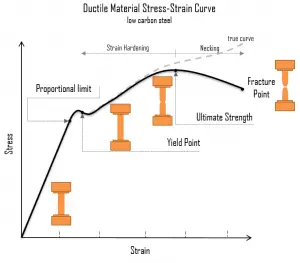
A schematic diagram for the stress-strain curve of low-carbon steel at room temperature is shown in the figure. There are several stages showing different behaviors, which suggests different mechanical properties. To clarify, materials can miss one or more stages shown in the figure, or have totally different stages. In this case, we have to distinguish between the stress-strain characteristics of ductile and brittle materials. The following points describe the different regions of the stress-strain curve and the importance of several specific locations.

  • Proportional limit. The proportional limit corresponds to the location of stress at the end of the linear region, so the stress-strain graph is a straight line, and the gradient will be equal to the elastic modulus of the material. For tensile and compressive stress, the slope of the portion of the curve where stress is proportional to strain is referred to as Young’s modulus, and Hooke’s Law applies. Between the proportional limit and the yield point, Hooke’s Law becomes questionable and strain increases more rapidly.
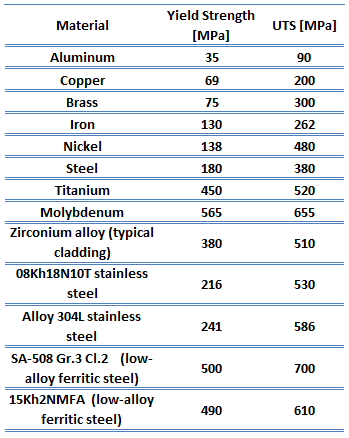
  • Yield Strength - Ultimate Tensile Strength - Table of MaterialsYield point. The yield point is the point on a stress-strain curve that indicates the limit of elastic behavior and the beginning plastic behavior. Yield strength or yield stress is the material property defined as the stress at which a material begins to deform plastically whereas yield point is the point where nonlinear (elastic + plastic) deformation begins. Prior to the yield point, the material will deform elastically and will return to its original shape when the applied stress is removed. Once the yield point is passed, some fraction of the deformation will be permanent and non-reversible. Some steels and other materials exhibit a behavior termed a yield point phenomenon. Yield strengths vary from 35 MPa for low-strength aluminum to greater than 1400 MPa for very high-strength steel.
  • Ultimate tensile strength. The ultimate tensile strength is the maximum on the engineering stress-strain curve. This corresponds to the maximum stress that can be sustained by a structure in tension. Ultimate tensile strength is often shortened to “tensile strength” or even to “the ultimate.”  If this stress is applied and maintained, a fracture will result. Often, this value is significantly more than the yield stress (as much as 50 to 60 percent more than the yield for some types of metals). When a ductile material reaches its ultimate strength, it experiences necking where the cross-sectional area reduces locally. The stress-strain curve contains no higher stress than the ultimate strength. Even though deformations can continue to increase, the stress usually decreases after the ultimate strength has been achieved. It is an intensive property; therefore its value does not depend on the size of the test specimen. However, it is dependent on other factors, such as the preparation of the specimen, the presence or otherwise of surface defects, and the temperature of the test environment and material. Ultimate tensile strengths vary from 50 MPa for aluminum to as high as 3000 MPa for very high-strength steels.
  • Fracture point: The fracture point is the point of strain where the material physically separates. At this point, the strain reaches its maximum value and the material actually fractures, even though the corresponding stress may be less than the ultimate strength at this point. Ductile materials have a fracture strength lower than the ultimate tensile strength (UTS), whereas in brittle materials the fracture strength is equivalent to the UTS. If a ductile material reaches its ultimate tensile strength in a load-controlled situation, it will continue to deform, with no additional load application, until it ruptures. However, if the loading is displacement-controlled, the deformation of the material may relieve the load, preventing rupture.
About Modulus of Elasticity

In the case of tensional stress of a uniform bar (stress-strain curve), Hooke’s law describes the behavior of a bar in the elastic region. In this region, the elongation of the bar is directly proportional to the tensile force and the length of the bar and inversely proportional to the cross-sectional area and the modulus of elasticity. Up to limiting stress, a body will be able to recover its dimensions on the removal of the load. The applied stresses cause the atoms in a crystal to move from their equilibrium position. All the atoms are displaced the same amount and still maintain their relative geometry. When the stresses are removed, all the atoms return to their original positions, and no permanent deformation occurs. According to Hooke’s law,  the stress is proportional to the strain (in the elastic region), and the slope is Young’s modulus.
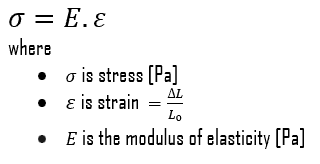
We can extend the same idea of relating stress to strain to shear applications in the linear region, relating shear stress to shear strain to create Hooke’s law for shear stress:
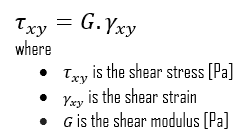
Hooke’s law for shear stress

For isotropic materials within the elastic region, you can relate Poisson’s ratio (ν), Young’s modulus of elasticity (E), and the shear modulus of elasticity (G):
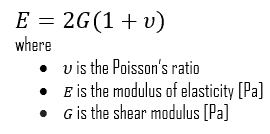
Hooke’s law - poissons ratio

The elastic moduli relevant to polycrystalline materials:

  • Young’s Modulus of Elasticity. The Young’s modulus of elasticity is the elastic modulus for tensile and compressive stress in the linear elasticity regime of a uniaxial deformation and is usually assessed by tensile tests.
  • Shear Modulus of Elasticity. The shear modulus, or the modulus of rigidity, is derived from the torsion of a cylindrical test piece. It describes the material’s response to shear stress. Its symbol is G. The shear modulus is one of several quantities for measuring the stiffness of materials and it arises in the generalized Hooke’s law.
  • Bulk Modulus of Elasticity. The bulk modulus of elasticity is describes volumetric elasticity, or the tendency of an object to deform in all directions when uniformly loaded in all directions. For example, it describes the elastic response to hydrostatic pressure and equilateral tension (like the pressure at the bottom of the ocean or a deep swimming pool). It is also the property of a material that determines the elastic response to the application of stress. For a fluid, only the bulk modulus is meaningful.
About Hardness

In materials science, hardness is the ability to withstand surface indentation (localized plastic deformation) and scratching. Hardness is probably the most poorly defined material property because it may indicate resistance to scratching, resistance to abrasion, resistance to indentation or even resistance to shaping or localized plastic deformation. Hardness is important from an engineering standpoint because resistance to wear by either friction or erosion by steam, oil, and water generally increases with hardness.

There are three main types of hardness measurements:
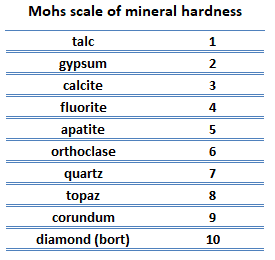
  • Mohs scale - mineral hardnessScratch hardness. Scratch hardness is the measure of how resistant a sample is to permanent plastic deformation due to friction from a sharp object. The most common scale for this qualitative test is Mohs scale, which is used in mineralogy. The Mohs scale of mineral hardness is based on the ability of one natural sample of mineral to scratch another mineral visibly. The hardness of a material is measured against the scale by finding the hardest material that the given material can scratch, or the softest material that can scratch the given material. For example, if some material is scratched by topaz but not by quartz, its hardness on the Mohs scale would fall between 7 and 8.
  • Indentation hardness. Indentation hardness measures the ability to withstand surface indentation (localized plastic deformation) and the resistance of a sample to material deformation due to a constant compression load from a sharp object. Tests for indentation hardness are primarily used in engineering and metallurgy fields. The traditional methods are based on well-defined physical indentation hardness tests. Very hard indenters of defined geometries and sizes are continuously pressed into the material under a particular force. Deformation parameters, such as the indentation depth in the Rockwell method, are recorded to give measures of hardness. Common indentation hardness scales are Brinell, Rockwell and Vickers.
  • Rebound hardness. Rebound hardness, also known as dynamic hardness, measures the height of the “bounce” of a diamond-tipped hammer dropped from a fixed height onto a material. One of devices used to take this measurement is known as a scleroscope. It consists of a steel ball dropped from a fixed height. This type of hardness is related to elasticity.
About Crystal Structure

The three most common basic crystal patterns are:

  • bcc. In a bcc (BCC) arrangement of atoms, the unit cell consists of eight atoms at the corners of a cube and one atom at the body center of the cube. In a bcc arrangement, a unit cell contains (8 corner atoms × ⅛) + (1 center atom × 1) = 2 atoms. The packing is more efficient (68%) than simple cubic and the structure is a common one for alkali metals and early transition metals. Metals containing BCC structures include ferrite, chromium, vanadium, molybdenum, and tungsten. These metals possess high strength and low ductility.
  • fcc.In a fcc (FCC) arrangement of atoms, the unit cell consists of eight atoms at the corners of a cube and one atom at the center of each of the faces of the cube. In a fcc arrangement, a unit cell contains (8 corner atoms × ⅛) + (6 face atoms × ½) = 4 atoms. This structure, along with its hexagonal relative (hcp), has the most efficient packing (74%). Metals containing FCC structures include austenite, aluminum, copper, lead, silver, gold, nickel, platinum, and thorium. These metals possess low strength and high ductility.
  • hcp. In a hcp (HCP) arrangement of atoms, the unit cell consists of three layers of atoms. The top and bottom layers contain six atoms at the corners of a hexagon and one atom at the center of each hexagon. The middle layer contains three atoms nestled between the atoms of the top and bottom layers, hence, the name close-packed. Hexagonal close packed (hcp) is one of the two simple types of atomic packing with the highest density, the other being the face centered cubic (fcc). However, unlike the fcc, it is not a Bravais lattice as there are two nonequivalent sets of lattice points. Metals containing HCP structures include beryllium, magnesium, zinc, cadmium, cobalt, thallium, and zirconium. HCP metals are not as ductile as FCC metals.

Summary

Element Actinium

Ultimate Tensile Strength –
Yield Strength –
Young’s Modulus of Elasticity –
Shear Modulus of Elasticity –
Bulk Modulus of Elasticity –
Mohs Scale
Brinell Hardness –
Vickers Hardness –

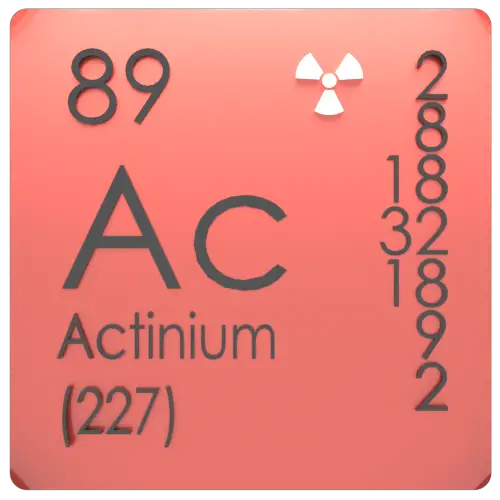
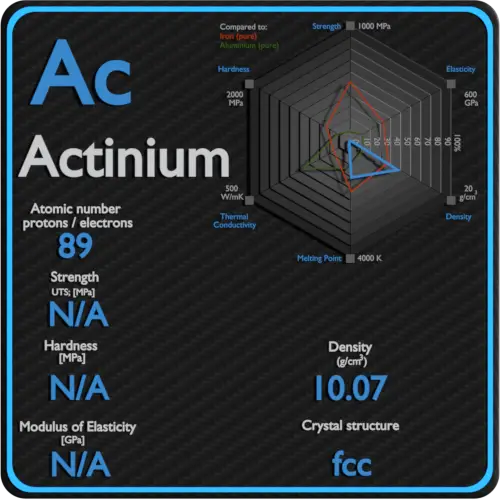
Actinium-periodic-table

Source: www.luciteria.com


Properties of other elements

Actinium - Comparison of Mechanical Properties

Periodic Table in 8K resolution

Other properties of Actinium