Facebook Instagram Youtube Twitter

Zirconium – Properties – Price – Applications – Production

Zirconium-properties-price-application-production

About Zirconium

Zirconium is a lustrous, grey-white, strong transition metal that resembles hafnium and, to a lesser extent, titanium. Zirconium is mainly used as a refractory and opacifier, although small amounts are used as an alloying agent for its strong resistance to corrosion. Zirconium is widely used as a cladding for nuclear reactor fuels. The desired properties of these alloys are a low neutron-capture cross-section and resistance to corrosion under normal service conditions.

Summary

Element Zirconium
Atomic number 40
Element category Transition Metal
Phase at STP Solid
Density 6.511 g/cm3
Ultimate Tensile Strength 330 MPa
Yield Strength 230 MPa
Young’s Modulus of Elasticity 88 GPa
Mohs Scale 5
Brinell Hardness 650 MPa
Vickers Hardness 900 MPa
Melting Point 1855 °C
Boiling Point 4377 °C
Thermal Conductivity 22.7 W/mK
Thermal Expansion Coefficient 5.7 µm/mK
Specific Heat 0.27 J/g K
Heat of Fusion 16.9 kJ/mol
Heat of Vaporization 591 kJ/mol
Electrical resistivity [nanoOhm meter] 421
Magnetic Susceptibility N/A

Applications of Zirconium

Most zircon is used directly in high-temperature applications. This material is refractory, hard, and resistant to chemical attack. Because of these properties, zircon finds many applications, few of which are highly publicized. Its main use is as an opacifier, conferring a white, opaque appearance to ceramic materials. Zirconium and its alloys are widely used as a cladding for nuclear reactor fuels. Zirconium alloyed with niobium or tin has excellent corrosion properties. The high corrosion resistance of zirconium alloys results from the natural formation of a dense stable oxide on the surface of the metal. This film is self healing, it continues to grow slowly at temperatures up to approximately 550 °C (1020 °F), and it remains tightly adherent. The desired property of these alloys is also a low neutron-capture cross-section. The disadvantages of zirconium are low strength properties and low heat resistance, which can be eliminated, for example, by alloying with niobium.

Zirconium-applications

Production and Price of Zirconium

Raw materials prices change daily. They are primarily driven by supply, demand and energy prices. In 2019, prices of pure Zirconium were at around 160 $/kg.

Approximately 900,000 tonnes of zirconium ores were mined in 1995, mostly as zircon. The production of zirconium metal requires special techniques due to the particular chemical properties of zirconium. Most Zr metal is produced from zircon (ZrSiO4) by the reduction of the zirconium chloride with magnesium metal in the Kroll process. The key feature of the Kroll process is reduction of zirconium chloride to metallic zirconium by magnesium. Commercial non-nuclear grade zirconium typically contains 1–5% of hafnium, whose neutron absorption cross-section is 600x that of zirconium. Hafnium must therefore be almost entirely removed (reduced to < 0.02% of the alloy) for reactor applications. In terms of cost, these alloys are also often the materials of choice for heat exchangers, and piping systems for the chemical-processing and nuclear industries. Zirconium is a by-product of the mining and processing of the titanium minerals, as well as tin mining. From 2003 to 2007, while prices for the mineral zircon steadily increased from $360 to $840 per tonne, the price for unwrought zirconium metal decreased from $39,900 to $22,700 per ton. Zirconium metal is much more expensive than zircon because the reduction processes are costly. All costs significantly vary with certain purity.
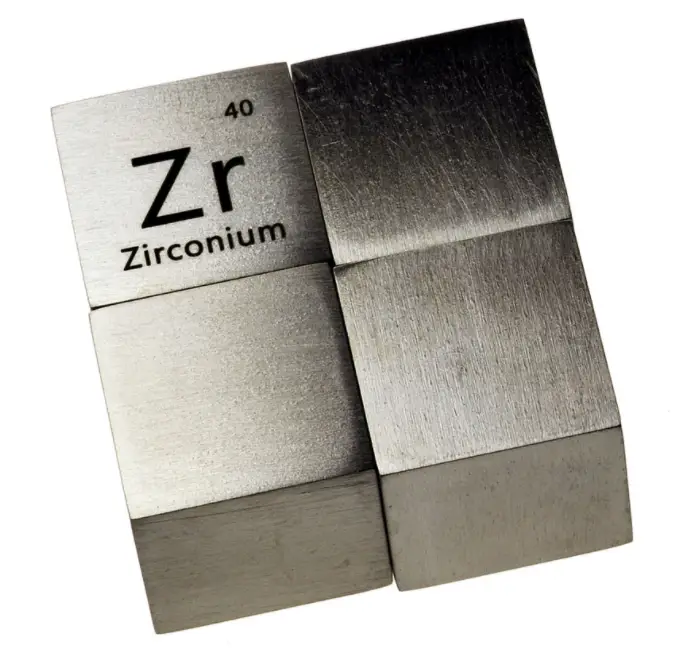
Zirconium-periodic-table

Source: www.luciteria.com

Mechanical Properties of Zirconium

Zirconium-mechanical-properties-strength-hardness-crystal-structure

Strength of Zirconium

In mechanics of materials, the strength of a material is its ability to withstand an applied load without failure or plastic deformation. Strength of materials basically considers the relationship between the external loads applied to a material and the resulting deformation or change in material dimensions. In designing structures and machines, it is important to consider these factors, in order that the material selected will have adequate strength to resist applied loads or forces and retain its original shape. Strength of a material is its ability to withstand this applied load without failure or plastic deformation.

For tensile stress, the capacity of a material or structure to withstand loads tending to elongate is known as ultimate tensile strength (UTS). Yield strength or yield stress is the material property defined as the stress at which a material begins to deform plastically whereas yield point is the point where nonlinear (elastic + plastic) deformation begins.

See also: Strength of Materials

Ultimate Tensile Strength of Zirconium

Ultimate tensile strength of Zirconium is 330 MPa.

Yield Strength of Zirconium

Yield strength of Zirconium is 230 MPa.

Modulus of Elasticity of Zirconium

The Young’s modulus of elasticity of Zirconium is 230 MPa.

Hardness of Zirconium

In materials science, hardness is the ability to withstand surface indentation (localized plastic deformation) and scratching. Brinell hardness test is one of indentation hardness tests, that has been developed for hardness testing. In Brinell tests, a hard, spherical indenter is forced under a specific load into the surface of the metal to be tested.

Brinell hardness of Zirconium is approximately 650 MPa.

The Vickers hardness test method was developed by Robert L. Smith and George E. Sandland at Vickers Ltd as an alternative to the Brinell method to measure the hardness of materials. The Vickers hardness test method can be also used as a microhardness test method, which is mostly used for small parts, thin sections, or case depth work.

Vickers hardness of Zirconium is approximately 900 MPa.

Scratch hardness is the measure of how resistant a sample is to permanent plastic deformation due to friction from a sharp object. The most common scale for this qualitative test is Mohs scale, which is used in mineralogy. The Mohs scale of mineral hardness is based on the ability of one natural sample of mineral to scratch another mineral visibly.

Zirconium is has a hardness of approximately 5.

See also: Hardness of Materials

Zirconium – Crystal Structure

A possible crystal structure of Zirconium is hexagonal close-packed structure.
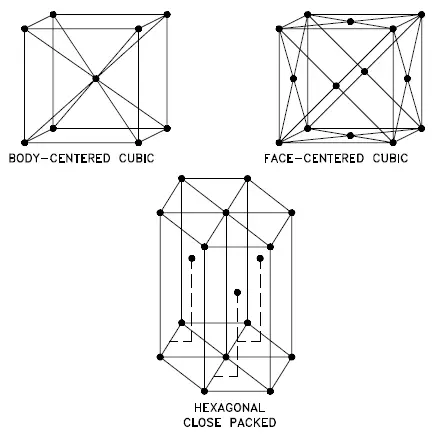
crystal structures - FCC, BCC, HCP

In metals, and in many other solids, the atoms are arranged in regular arrays called crystals. A crystal lattice is a repeating pattern of mathematical points that extends throughout space. The forces of chemical bonding causes this repetition. It is this repeated pattern which control properties like strength, ductility, density, conductivity (property of conducting or transmitting heat, electricity, etc.), and shape. There are 14 general types of such patterns known as Bravais lattices.

See also: Crystal Structure of Materials

Crystal Structure of Zirconium
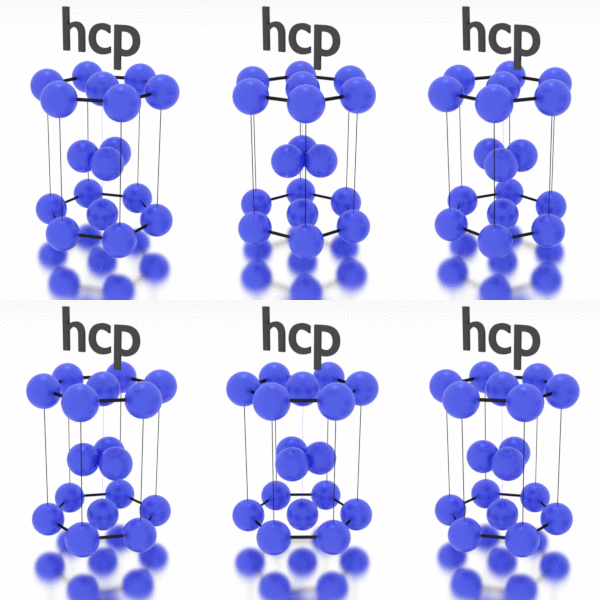
Crystal Structure of Zirconium is: hexagonal close-packed

Strength of Elements

Elasticity of Elements
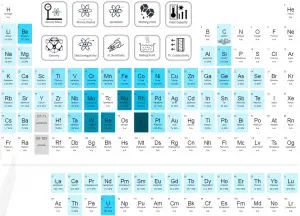
Hardness of Elements
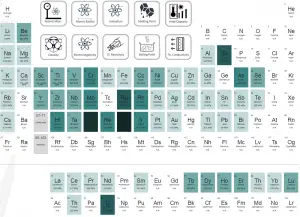
 

Thermal Properties of Zirconium

Zirconium-melting-point-conductivity-thermal-properties

Zirconium – Melting Point and Boiling Point

Melting point of Zirconium is 1855°C.

Boiling point of Zirconium is 4377°C.

Note that, these points are associated with the standard atmospheric pressure.

Zirconium – Thermal Conductivity

Thermal conductivity of Zirconium is 22.7 W/(m·K).

The heat transfer characteristics of a solid material are measured by a property called the thermal conductivity, k (or λ), measured in W/m.K. It is a measure of a substance’s ability to transfer heat through a material by conduction. Note that Fourier’s law applies for all matter, regardless of its state (solid, liquid, or gas), therefore, it is also defined for liquids and gases.

Coefficient of Thermal Expansion of Zirconium

Linear thermal expansion coefficient of Zirconium is 5.7 µm/(m·K)

Thermal expansion is generally the tendency of matter to change its dimensions in response to a change in temperature. It is usually expressed as a fractional change in length or volume per unit temperature change.

Zirconium – Specific Heat, Latent Heat of Fusion, Latent Heat of Vaporization

Specific heat of Zirconium is 0.27 J/g K.

Heat capacity is an extensive property of matter, meaning it is proportional to the size of the system. Heat capacity C has the unit of energy per degree or energy per kelvin. When expressing the same phenomenon as an intensive property, the heat capacity is divided by the amount of substance, mass, or volume, thus the quantity is independent of the size or extent of the sample.

Latent Heat of Fusion of Zirconium is 16.9 kJ/mol.

Latent Heat of Vaporization of Zirconium is 591 kJ/mol.

Latent heat is the amount of heat added to or removed from a substance to produce a change in phase. This energy breaks down the intermolecular attractive forces, and also must provide the energy necessary to expand the gas (the pΔV work). When latent heat is added, no temperature change occurs. The enthalpy of vaporization is a function of the pressure at which that transformation takes place.

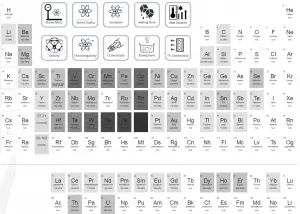
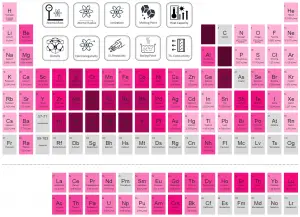
Melting Point of Elements
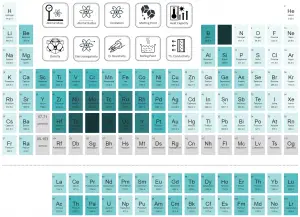
Periodic Table of Elements - melting point

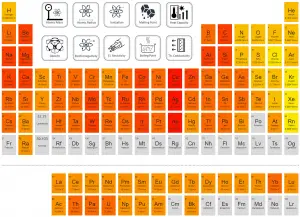
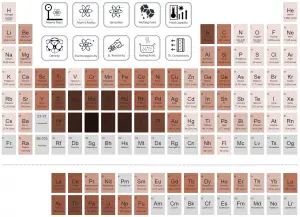
Thermal Conductivity of Elements

Periodic Table of Elements - thermal conductivity

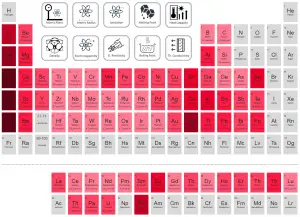
Thermal Expansion of Elements

Periodic Table of Elements - thermal expansion

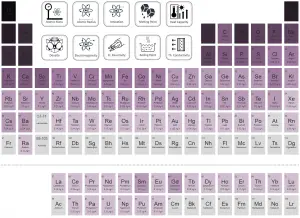
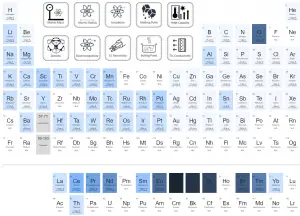
Heat Capacity of Elements

Periodic Table of Elements - heat capacity

Heat of Fusion of Elements

Periodic Table of Elements - latent heat fusion

Heat of Vaporization of Elements

Periodic Table of Elements - latent heat vaporization

Zirconium – Electrical Resistivity – Magnetic Susceptibility

Zirconium-electrical-resistivity-magnetic-susceptibility

Electrical property refers to the response of a material to an applied electric field. One of the principal characteristics of materials is their ability (or lack of ability) to conduct electrical current. Indeed, materials are classified by this property, that is, they are divided into conductors, semiconductors, and nonconductors.

See also: Electrical Properties

Magnetic property refers to the response of a material to an applied magnetic field. The macroscopic magnetic properties of a material are a consequence of interactions between an external magnetic field and the magnetic dipole moments of the constituent atoms. Different materials react to the application of magnetic field differently.

See also: Magnetic Properties

Electrical Resistivity of Zirconium

Electrical resistivity of Zirconium is 421 nΩ⋅m.

Electrical conductivity and its converse, electrical resistivity, is a fundamental property of a material that quantifies how Zirconium conducts the flow of electric current. Electrical conductivity or specific conductance is the reciprocal of electrical resistivity.

Magnetic Susceptibility of Zirconium

Magnetic susceptibility of Zirconium is N/A.

In electromagnetism, magnetic susceptibility is the measure of the magnetization of a substance. Magnetic susceptibility is a dimensionless proportionality factor that indicates the degree of magnetization of Zirconium in response to an applied magnetic field.

Electrical Resistivity of Elements
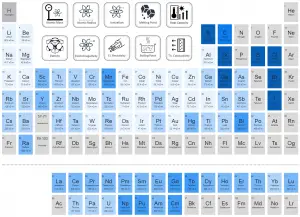
Periodic Table of Elements - electrical resistivity

Magnetic Susceptibility of Elements

Application and prices of other elements

Zirconium - Comparison of Properties and Prices

Periodic Table in 8K resolution

Other properties of Zirconium

 

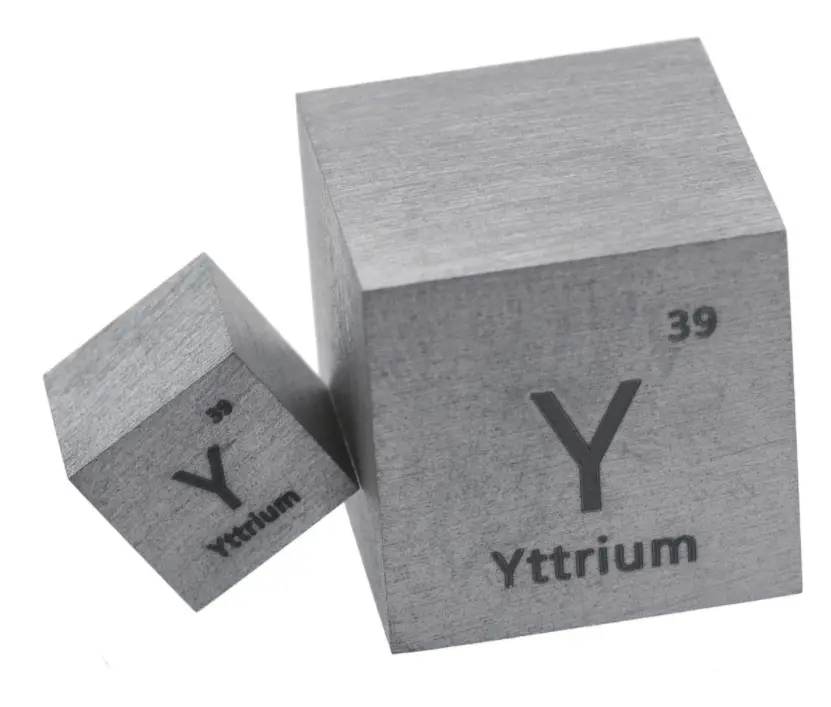
Yttrium – Properties – Price – Applications – Production

Yttrium-properties-price-application-production

About Yttrium

Yttrium is a silvery-metallic transition metal chemically similar to the lanthanides and has often been classified as a “rare-earth element”.

Summary

Element Yttrium
Atomic number 39
Element category Transition Metal
Phase at STP Solid
Density 4.472 g/cm3
Ultimate Tensile Strength 115 MPa
Yield Strength 50 MPa
Young’s Modulus of Elasticity 63.5 GPa
Mohs Scale N/A
Brinell Hardness 580 MPa
Vickers Hardness N/A
Melting Point 1526 °C
Boiling Point 2930 °C
Thermal Conductivity 17.2 W/mK
Thermal Expansion Coefficient 10.6 µm/mK
Specific Heat 0.3 J/g K
Heat of Fusion 11.4 kJ/mol
Heat of Vaporization 363 kJ/mol
Electrical resistivity [nanoOhm meter] 596
Magnetic Susceptibility +2.15e-6 cm^3/mol

Applications of Yttrium

The most important uses of yttrium are LEDs and phosphors, particularly the red phosphors in television set cathode ray tube displays. Yttrium is also used in the production of electrodes, electrolytes, electronic filters, lasers, superconductors, various medical applications, and tracing various materials to enhance their properties. Small amounts of yttrium (0.1 to 0.2%) have been used to reduce the grain sizes of chromium, molybdenum, titanium, and zirconium. Yttrium is used to increase the strength of aluminium and magnesium alloys.

Yttrium-applications

Production and Price of Yttrium

Raw materials prices change daily. They are primarily driven by supply, demand and energy prices. In 2019, prices of pure Yttrium were at around 2200 $/kg.

Commercially yttrium is refined from monazite and bastnasite sands which contain approximately 3% ands 0.2% respectively. Yttrium metal is commercially produced by the reduction of the fluoride with calcium metal, although other techniques also exist.

Yttrium-periodic-table

Source: www.luciteria.com

Mechanical Properties of Yttrium

Yttrium-mechanical-properties-strength-hardness-crystal-structure

Strength of Yttrium

In mechanics of materials, the strength of a material is its ability to withstand an applied load without failure or plastic deformation. Strength of materials basically considers the relationship between the external loads applied to a material and the resulting deformation or change in material dimensions. In designing structures and machines, it is important to consider these factors, in order that the material selected will have adequate strength to resist applied loads or forces and retain its original shape. Strength of a material is its ability to withstand this applied load without failure or plastic deformation.

For tensile stress, the capacity of a material or structure to withstand loads tending to elongate is known as ultimate tensile strength (UTS). Yield strength or yield stress is the material property defined as the stress at which a material begins to deform plastically whereas yield point is the point where nonlinear (elastic + plastic) deformation begins.

See also: Strength of Materials

Ultimate Tensile Strength of Yttrium

Ultimate tensile strength of Yttrium is 115 MPa.

Yield Strength of Yttrium

Yield strength of Yttrium is 50 MPa.

Modulus of Elasticity of Yttrium

The Young’s modulus of elasticity of Yttrium is 50 MPa.

Hardness of Yttrium

In materials science, hardness is the ability to withstand surface indentation (localized plastic deformation) and scratching. Brinell hardness test is one of indentation hardness tests, that has been developed for hardness testing. In Brinell tests, a hard, spherical indenter is forced under a specific load into the surface of the metal to be tested.

Brinell hardness of Yttrium is approximately 580 MPa.

The Vickers hardness test method was developed by Robert L. Smith and George E. Sandland at Vickers Ltd as an alternative to the Brinell method to measure the hardness of materials. The Vickers hardness test method can be also used as a microhardness test method, which is mostly used for small parts, thin sections, or case depth work.

Vickers hardness of Yttrium is approximately N/A.

Scratch hardness is the measure of how resistant a sample is to permanent plastic deformation due to friction from a sharp object. The most common scale for this qualitative test is Mohs scale, which is used in mineralogy. The Mohs scale of mineral hardness is based on the ability of one natural sample of mineral to scratch another mineral visibly.

Yttrium is has a hardness of approximately N/A.

See also: Hardness of Materials

Yttrium – Crystal Structure

A possible crystal structure of Yttrium is hexagonal close-packed structure.

crystal structures - FCC, BCC, HCP

In metals, and in many other solids, the atoms are arranged in regular arrays called crystals. A crystal lattice is a repeating pattern of mathematical points that extends throughout space. The forces of chemical bonding causes this repetition. It is this repeated pattern which control properties like strength, ductility, density, conductivity (property of conducting or transmitting heat, electricity, etc.), and shape. There are 14 general types of such patterns known as Bravais lattices.

See also: Crystal Structure of Materials

Crystal Structure of Yttrium
Crystal Structure of Yttrium is: hexagonal close-packed

Strength of Elements

Elasticity of Elements

Hardness of Elements


Thermal Properties of Yttrium

Yttrium-melting-point-conductivity-thermal-properties

Yttrium – Melting Point and Boiling Point

Melting point of Yttrium is 1526°C.

Boiling point of Yttrium is 2930°C.

Note that, these points are associated with the standard atmospheric pressure.

Yttrium – Thermal Conductivity

Thermal conductivity of Yttrium is 17.2 W/(m·K).

The heat transfer characteristics of a solid material are measured by a property called the thermal conductivity, k (or λ), measured in W/m.K. It is a measure of a substance’s ability to transfer heat through a material by conduction. Note that Fourier’s law applies for all matter, regardless of its state (solid, liquid, or gas), therefore, it is also defined for liquids and gases.

Coefficient of Thermal Expansion of Yttrium

Linear thermal expansion coefficient of Yttrium is 10.6 µm/(m·K)

Thermal expansion is generally the tendency of matter to change its dimensions in response to a change in temperature. It is usually expressed as a fractional change in length or volume per unit temperature change.

Yttrium – Specific Heat, Latent Heat of Fusion, Latent Heat of Vaporization

Specific heat of Yttrium is 0.3 J/g K.

Heat capacity is an extensive property of matter, meaning it is proportional to the size of the system. Heat capacity C has the unit of energy per degree or energy per kelvin. When expressing the same phenomenon as an intensive property, the heat capacity is divided by the amount of substance, mass, or volume, thus the quantity is independent of the size or extent of the sample.

Latent Heat of Fusion of Yttrium is 11.4 kJ/mol.

Latent Heat of Vaporization of Yttrium is 363 kJ/mol.

Latent heat is the amount of heat added to or removed from a substance to produce a change in phase. This energy breaks down the intermolecular attractive forces, and also must provide the energy necessary to expand the gas (the pΔV work). When latent heat is added, no temperature change occurs. The enthalpy of vaporization is a function of the pressure at which that transformation takes place.

Melting Point of Elements

Periodic Table of Elements - melting point

Thermal Conductivity of Elements

Periodic Table of Elements - thermal conductivity

Thermal Expansion of Elements

Periodic Table of Elements - thermal expansion

Heat Capacity of Elements

Periodic Table of Elements - heat capacity

Heat of Fusion of Elements

Periodic Table of Elements - latent heat fusion

Heat of Vaporization of Elements

Periodic Table of Elements - latent heat vaporization

Yttrium – Electrical Resistivity – Magnetic Susceptibility

Yttrium-electrical-resistivity-magnetic-susceptibility

Electrical property refers to the response of a material to an applied electric field. One of the principal characteristics of materials is their ability (or lack of ability) to conduct electrical current. Indeed, materials are classified by this property, that is, they are divided into conductors, semiconductors, and nonconductors.

See also: Electrical Properties

Magnetic property refers to the response of a material to an applied magnetic field. The macroscopic magnetic properties of a material are a consequence of interactions between an external magnetic field and the magnetic dipole moments of the constituent atoms. Different materials react to the application of magnetic field differently.

See also: Magnetic Properties

Electrical Resistivity of Yttrium

Electrical resistivity of Yttrium is 596 nΩ⋅m.

Electrical conductivity and its converse, electrical resistivity, is a fundamental property of a material that quantifies how Yttrium conducts the flow of electric current. Electrical conductivity or specific conductance is the reciprocal of electrical resistivity.

Magnetic Susceptibility of Yttrium

Magnetic susceptibility of Yttrium is +2.15e-6 cm^3/mol.

In electromagnetism, magnetic susceptibility is the measure of the magnetization of a substance. Magnetic susceptibility is a dimensionless proportionality factor that indicates the degree of magnetization of Yttrium in response to an applied magnetic field.

Electrical Resistivity of Elements

Periodic Table of Elements - electrical resistivity

Magnetic Susceptibility of Elements

Application and prices of other elements

Yttrium - Comparison of Properties and Prices

Periodic Table in 8K resolution

Other properties of Yttrium


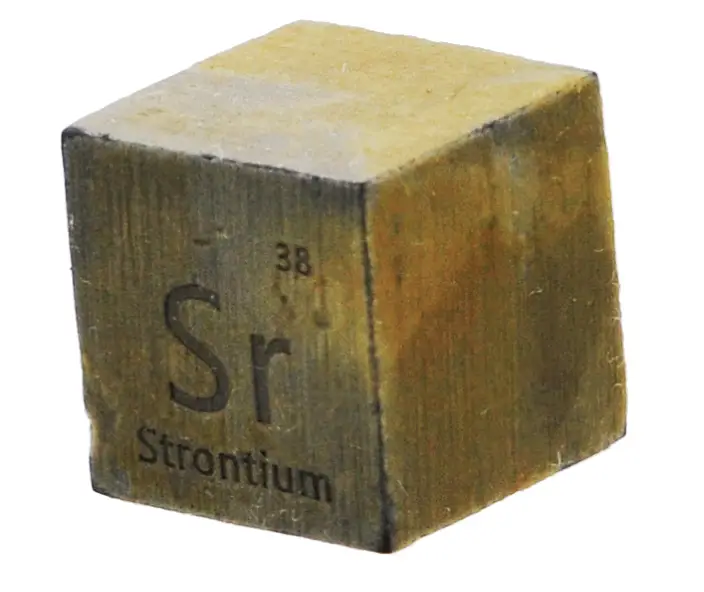
Strontium – Properties – Price – Applications – Production

Strontium-properties-price-application-production

About Strontium

Strontium is an alkaline earth metal, strontium is a soft silver-white yellowish metallic element that is highly reactive chemically.

Summary

Element Strontium
Atomic number 38
Element category Alkaline Earth Metal
Phase at STP Solid
Density 2.63 g/cm3
Ultimate Tensile Strength N/A
Yield Strength N/A
Young’s Modulus of Elasticity 15.7 GPa
Mohs Scale 1.8
Brinell Hardness N/A
Vickers Hardness N/A
Melting Point 777 °C
Boiling Point 1382 °C
Thermal Conductivity 35.3 W/mK
Thermal Expansion Coefficient 22.5 µm/mK
Specific Heat 0.3 J/g K
Heat of Fusion 8.3 kJ/mol
Heat of Vaporization 144 kJ/mol
Electrical resistivity [nanoOhm meter] 132
Magnetic Susceptibility −92e-6 cm^3/mol

Applications of Strontium

Consuming 75% of production, the primary use for strontium was in glass for colour television cathode ray tubes. Strontium is best known for the brilliant reds its salts give to fireworks and flares. It is also used in producing ferrite magnets and refining zinc. Modern ‘glow-in-the-dark’ paints and plastics contain strontium aluminate. They absorb light during the day and release it slowly for hours afterwards. The isotope Sr90 has a half-life of 28 years and is one of the well-known high-energy beta emitters. Hence, it is employed in systems for nuclear auxiliary power (SNAP) devices, which find potential applications in remote weather stations, space vehicles, navigational buoys, etc.

Strontium-applications

Production and Price of Strontium

Raw materials prices change daily. They are primarily driven by supply, demand and energy prices. In 2019, prices of pure Strontium were at around 1000 $/kg.

The three major producers of strontium as celestine as of 2015 are China (150,000 t), Spain (90,000 t), and Mexico (70,000 t); Argentina (10,000 t) and Morocco (2,500 t) are smaller producers. A large proportion of mined celestine (SrSO4) is converted to the carbonate by two processes. Either the celestine is directly leached with sodium carbonate solution or the celestine is roasted with coal to form the sulfide.

Strontium-periodic-table

Source: www.luciteria.com

Mechanical Properties of Strontium

Strontium-mechanical-properties-strength-hardness-crystal-structure

Strength of Strontium

In mechanics of materials, the strength of a material is its ability to withstand an applied load without failure or plastic deformation. Strength of materials basically considers the relationship between the external loads applied to a material and the resulting deformation or change in material dimensions. In designing structures and machines, it is important to consider these factors, in order that the material selected will have adequate strength to resist applied loads or forces and retain its original shape. Strength of a material is its ability to withstand this applied load without failure or plastic deformation.

For tensile stress, the capacity of a material or structure to withstand loads tending to elongate is known as ultimate tensile strength (UTS). Yield strength or yield stress is the material property defined as the stress at which a material begins to deform plastically whereas yield point is the point where nonlinear (elastic + plastic) deformation begins.

See also: Strength of Materials

Ultimate Tensile Strength of Strontium

Ultimate tensile strength of Strontium is N/A.

Yield Strength of Strontium

Yield strength of Strontium is N/A.

Modulus of Elasticity of Strontium

The Young’s modulus of elasticity of Strontium is N/A.

Hardness of Strontium

In materials science, hardness is the ability to withstand surface indentation (localized plastic deformation) and scratching. Brinell hardness test is one of indentation hardness tests, that has been developed for hardness testing. In Brinell tests, a hard, spherical indenter is forced under a specific load into the surface of the metal to be tested.

Brinell hardness of Strontium is approximately N/A.

The Vickers hardness test method was developed by Robert L. Smith and George E. Sandland at Vickers Ltd as an alternative to the Brinell method to measure the hardness of materials. The Vickers hardness test method can be also used as a microhardness test method, which is mostly used for small parts, thin sections, or case depth work.

Vickers hardness of Strontium is approximately N/A.

Scratch hardness is the measure of how resistant a sample is to permanent plastic deformation due to friction from a sharp object. The most common scale for this qualitative test is Mohs scale, which is used in mineralogy. The Mohs scale of mineral hardness is based on the ability of one natural sample of mineral to scratch another mineral visibly.

Strontium is has a hardness of approximately 1.8.

See also: Hardness of Materials

Strontium – Crystal Structure

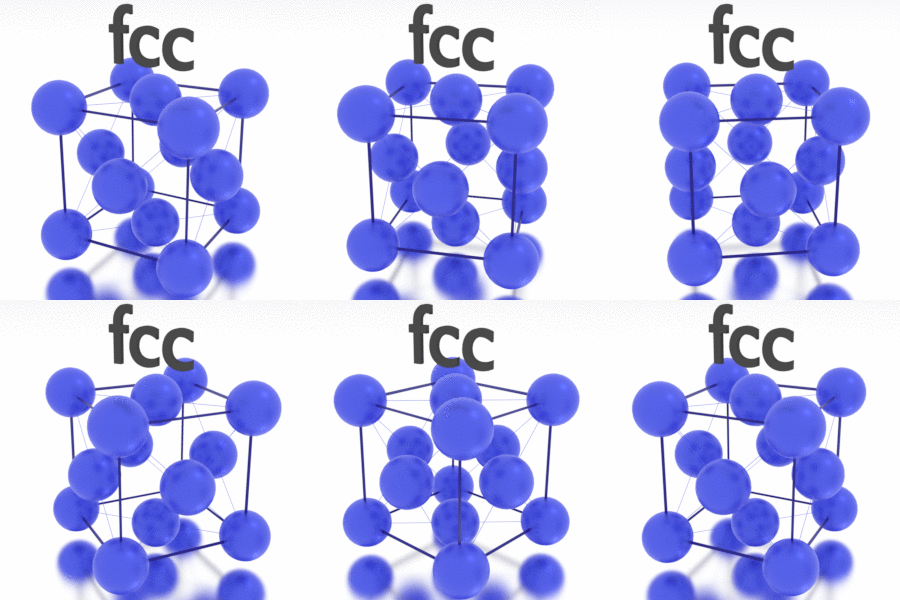
A possible crystal structure of Strontium is face-centered cubic structure.

crystal structures - FCC, BCC, HCP

In metals, and in many other solids, the atoms are arranged in regular arrays called crystals. A crystal lattice is a repeating pattern of mathematical points that extends throughout space. The forces of chemical bonding causes this repetition. It is this repeated pattern which control properties like strength, ductility, density, conductivity (property of conducting or transmitting heat, electricity, etc.), and shape. There are 14 general types of such patterns known as Bravais lattices.

See also: Crystal Structure of Materials

Crystal Structure of Strontium
Crystal Structure of Strontium is: face-centered cubic

Strength of Elements

Elasticity of Elements

Hardness of Elements


Thermal Properties of Strontium

Strontium-melting-point-conductivity-thermal-properties

Strontium – Melting Point and Boiling Point

Melting point of Strontium is 777°C.

Boiling point of Strontium is 1382°C.

Note that, these points are associated with the standard atmospheric pressure.

Strontium – Thermal Conductivity

Thermal conductivity of Strontium is 35.3 W/(m·K).

The heat transfer characteristics of a solid material are measured by a property called the thermal conductivity, k (or λ), measured in W/m.K. It is a measure of a substance’s ability to transfer heat through a material by conduction. Note that Fourier’s law applies for all matter, regardless of its state (solid, liquid, or gas), therefore, it is also defined for liquids and gases.

Coefficient of Thermal Expansion of Strontium

Linear thermal expansion coefficient of Strontium is 22.5 µm/(m·K)

Thermal expansion is generally the tendency of matter to change its dimensions in response to a change in temperature. It is usually expressed as a fractional change in length or volume per unit temperature change.

Strontium – Specific Heat, Latent Heat of Fusion, Latent Heat of Vaporization

Specific heat of Strontium is 0.3 J/g K.

Heat capacity is an extensive property of matter, meaning it is proportional to the size of the system. Heat capacity C has the unit of energy per degree or energy per kelvin. When expressing the same phenomenon as an intensive property, the heat capacity is divided by the amount of substance, mass, or volume, thus the quantity is independent of the size or extent of the sample.

Latent Heat of Fusion of Strontium is 8.3 kJ/mol.

Latent Heat of Vaporization of Strontium is 144 kJ/mol.

Latent heat is the amount of heat added to or removed from a substance to produce a change in phase. This energy breaks down the intermolecular attractive forces, and also must provide the energy necessary to expand the gas (the pΔV work). When latent heat is added, no temperature change occurs. The enthalpy of vaporization is a function of the pressure at which that transformation takes place.

Melting Point of Elements

Periodic Table of Elements - melting point

Thermal Conductivity of Elements

Periodic Table of Elements - thermal conductivity

Thermal Expansion of Elements

Periodic Table of Elements - thermal expansion

Heat Capacity of Elements

Periodic Table of Elements - heat capacity

Heat of Fusion of Elements

Periodic Table of Elements - latent heat fusion

Heat of Vaporization of Elements

Periodic Table of Elements - latent heat vaporization

Strontium – Electrical Resistivity – Magnetic Susceptibility

Strontium-electrical-resistivity-magnetic-susceptibility

Electrical property refers to the response of a material to an applied electric field. One of the principal characteristics of materials is their ability (or lack of ability) to conduct electrical current. Indeed, materials are classified by this property, that is, they are divided into conductors, semiconductors, and nonconductors.

See also: Electrical Properties

Magnetic property refers to the response of a material to an applied magnetic field. The macroscopic magnetic properties of a material are a consequence of interactions between an external magnetic field and the magnetic dipole moments of the constituent atoms. Different materials react to the application of magnetic field differently.

See also: Magnetic Properties

Electrical Resistivity of Strontium

Electrical resistivity of Strontium is 132 nΩ⋅m.

Electrical conductivity and its converse, electrical resistivity, is a fundamental property of a material that quantifies how Strontium conducts the flow of electric current. Electrical conductivity or specific conductance is the reciprocal of electrical resistivity.

Magnetic Susceptibility of Strontium

Magnetic susceptibility of Strontium is −92e-6 cm^3/mol.

In electromagnetism, magnetic susceptibility is the measure of the magnetization of a substance. Magnetic susceptibility is a dimensionless proportionality factor that indicates the degree of magnetization of Strontium in response to an applied magnetic field.

Electrical Resistivity of Elements

Periodic Table of Elements - electrical resistivity

Magnetic Susceptibility of Elements

Application and prices of other elements

Strontium - Comparison of Properties and Prices

Periodic Table in 8K resolution

Other properties of Strontium


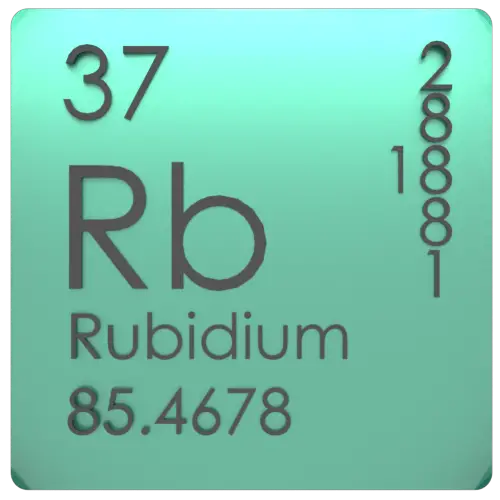
Rubidium – Properties – Price – Applications – Production

Rubidium-properties-price-application-production

About Rubidium

Rubidium is a soft, silvery-white metallic element of the alkali metal group, with an atomic mass of 85.4678. Elemental rubidium is highly reactive, with properties similar to those of other alkali metals, including rapid oxidation in air.

Summary

Element Rubidium
Atomic number 37
Element category Alkali Metal
Phase at STP Solid
Density 1.532 g/cm3
Ultimate Tensile Strength N/A
Yield Strength N/A
Young’s Modulus of Elasticity 2.4 GPa
Mohs Scale 0.3
Brinell Hardness 0.216 MPa
Vickers Hardness N/A
Melting Point 39.31 °C
Boiling Point 688 °C
Thermal Conductivity 58.2 W/mK
Thermal Expansion Coefficient 90 µm/mK
Specific Heat 0.363 J/g K
Heat of Fusion 2.192 kJ/mol
Heat of Vaporization 72.216 kJ/mol
Electrical resistivity [nanoOhm meter] 128
Magnetic Susceptibility +17e-6 cm^3/mol

Applications of Rubidium

The photoemissive property of rubidium, which is that of a surface emitting free electrons when impinged upon by electromagnetic radiation, makes possible the following applications. A rubidium-tellurium photoemissive surface is used in photoelectric cells, which are incorporated in a variety of electronic detection and activation devices. It is sensitive to a wide spectrum of radiation from the mid-ultraviolet through the visible into the near-infrared. A rubidium-cesium-antimony coating is commonly applied to the photocathodes of photomultiplier tubes. Rubidium-82 is used for positron emission tomography.

Rubidium-applications

Production and Price of Rubidium

Raw materials prices change daily. They are primarily driven by supply, demand and energy prices. In 2019, prices of pure Rubidium were at around 12000 $/kg.

Rubidium is obtained as a minor byproduct of the processing of lepidolite and pollucite. These ores are found, often together, in just a few zoned pegmatites around the world and are mined on a small scale by selective methods. The deposits are sought and mined primarily for their lithium content.

Rubidium-periodic-table

Source: www.luciteria.com

Mechanical Properties of Rubidium

Rubidium-mechanical-properties-strength-hardness-crystal-structure

Strength of Rubidium

In mechanics of materials, the strength of a material is its ability to withstand an applied load without failure or plastic deformation. Strength of materials basically considers the relationship between the external loads applied to a material and the resulting deformation or change in material dimensions. In designing structures and machines, it is important to consider these factors, in order that the material selected will have adequate strength to resist applied loads or forces and retain its original shape. Strength of a material is its ability to withstand this applied load without failure or plastic deformation.

For tensile stress, the capacity of a material or structure to withstand loads tending to elongate is known as ultimate tensile strength (UTS). Yield strength or yield stress is the material property defined as the stress at which a material begins to deform plastically whereas yield point is the point where nonlinear (elastic + plastic) deformation begins.

See also: Strength of Materials

Ultimate Tensile Strength of Rubidium

Ultimate tensile strength of Rubidium is N/A.

Yield Strength of Rubidium

Yield strength of Rubidium is N/A.

Modulus of Elasticity of Rubidium

The Young’s modulus of elasticity of Rubidium is 2.4 GPa.

Hardness of Rubidium

In materials science, hardness is the ability to withstand surface indentation (localized plastic deformation) and scratching. Brinell hardness test is one of indentation hardness tests, that has been developed for hardness testing. In Brinell tests, a hard, spherical indenter is forced under a specific load into the surface of the metal to be tested.

Brinell hardness of Rubidium is approximately 0.216 MPa.

The Vickers hardness test method was developed by Robert L. Smith and George E. Sandland at Vickers Ltd as an alternative to the Brinell method to measure the hardness of materials. The Vickers hardness test method can be also used as a microhardness test method, which is mostly used for small parts, thin sections, or case depth work.

Vickers hardness of Rubidium is approximately N/A.

Scratch hardness is the measure of how resistant a sample is to permanent plastic deformation due to friction from a sharp object. The most common scale for this qualitative test is Mohs scale, which is used in mineralogy. The Mohs scale of mineral hardness is based on the ability of one natural sample of mineral to scratch another mineral visibly.

Rubidium is has a hardness of approximately 0.3.

See also: Hardness of Materials

Rubidium – Crystal Structure

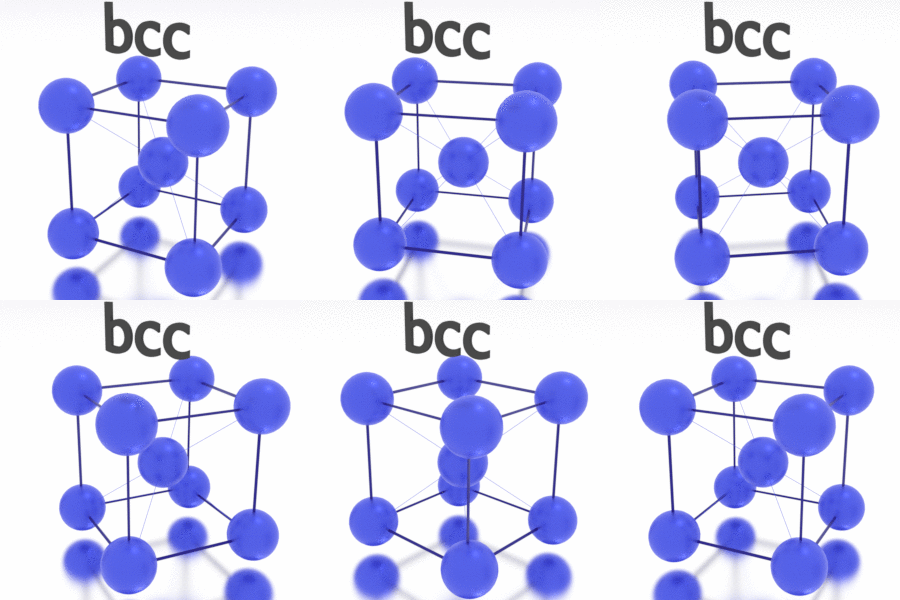
A possible crystal structure of Rubidium is body-centered cubic structure.

crystal structures - FCC, BCC, HCP

In metals, and in many other solids, the atoms are arranged in regular arrays called crystals. A crystal lattice is a repeating pattern of mathematical points that extends throughout space. The forces of chemical bonding causes this repetition. It is this repeated pattern which control properties like strength, ductility, density, conductivity (property of conducting or transmitting heat, electricity, etc.), and shape. There are 14 general types of such patterns known as Bravais lattices.

See also: Crystal Structure of Materials

Crystal Structure of Rubidium
Crystal Structure of Rubidium is: body-centered cubic

Strength of Elements

Elasticity of Elements

Hardness of Elements


Thermal Properties of Rubidium

Rubidium-melting-point-conductivity-thermal-properties

Rubidium – Melting Point and Boiling Point

Melting point of Rubidium is 39.31°C.

Boiling point of Rubidium is 688°C.

Note that, these points are associated with the standard atmospheric pressure.

Rubidium – Thermal Conductivity

Thermal conductivity of Rubidium is 58.2 W/(m·K).

The heat transfer characteristics of a solid material are measured by a property called the thermal conductivity, k (or λ), measured in W/m.K. It is a measure of a substance’s ability to transfer heat through a material by conduction. Note that Fourier’s law applies for all matter, regardless of its state (solid, liquid, or gas), therefore, it is also defined for liquids and gases.

Coefficient of Thermal Expansion of Rubidium

Linear thermal expansion coefficient of Rubidium is 90 µm/(m·K)

Thermal expansion is generally the tendency of matter to change its dimensions in response to a change in temperature. It is usually expressed as a fractional change in length or volume per unit temperature change.

Rubidium – Specific Heat, Latent Heat of Fusion, Latent Heat of Vaporization

Specific heat of Rubidium is 0.363 J/g K.

Heat capacity is an extensive property of matter, meaning it is proportional to the size of the system. Heat capacity C has the unit of energy per degree or energy per kelvin. When expressing the same phenomenon as an intensive property, the heat capacity is divided by the amount of substance, mass, or volume, thus the quantity is independent of the size or extent of the sample.

Latent Heat of Fusion of Rubidium is 2.192 kJ/mol.

Latent Heat of Vaporization of Rubidium is 72.216 kJ/mol.

Latent heat is the amount of heat added to or removed from a substance to produce a change in phase. This energy breaks down the intermolecular attractive forces, and also must provide the energy necessary to expand the gas (the pΔV work). When latent heat is added, no temperature change occurs. The enthalpy of vaporization is a function of the pressure at which that transformation takes place.

Melting Point of Elements

Periodic Table of Elements - melting point

Thermal Conductivity of Elements

Periodic Table of Elements - thermal conductivity

Thermal Expansion of Elements

Periodic Table of Elements - thermal expansion

Heat Capacity of Elements

Periodic Table of Elements - heat capacity

Heat of Fusion of Elements

Periodic Table of Elements - latent heat fusion

Heat of Vaporization of Elements

Periodic Table of Elements - latent heat vaporization

Rubidium – Electrical Resistivity – Magnetic Susceptibility

Rubidium-electrical-resistivity-magnetic-susceptibility

Electrical property refers to the response of a material to an applied electric field. One of the principal characteristics of materials is their ability (or lack of ability) to conduct electrical current. Indeed, materials are classified by this property, that is, they are divided into conductors, semiconductors, and nonconductors.

See also: Electrical Properties

Magnetic property refers to the response of a material to an applied magnetic field. The macroscopic magnetic properties of a material are a consequence of interactions between an external magnetic field and the magnetic dipole moments of the constituent atoms. Different materials react to the application of magnetic field differently.

See also: Magnetic Properties

Electrical Resistivity of Rubidium

Electrical resistivity of Rubidium is 128 nΩ⋅m.

Electrical conductivity and its converse, electrical resistivity, is a fundamental property of a material that quantifies how Rubidium conducts the flow of electric current. Electrical conductivity or specific conductance is the reciprocal of electrical resistivity.

Magnetic Susceptibility of Rubidium

Magnetic susceptibility of Rubidium is +17e-6 cm^3/mol.

In electromagnetism, magnetic susceptibility is the measure of the magnetization of a substance. Magnetic susceptibility is a dimensionless proportionality factor that indicates the degree of magnetization of Rubidium in response to an applied magnetic field.

Electrical Resistivity of Elements

Periodic Table of Elements - electrical resistivity

Magnetic Susceptibility of Elements

Application and prices of other elements

Rubidium - Comparison of Properties and Prices

Periodic Table in 8K resolution

Other properties of Rubidium


Krypton – Properties – Price – Applications – Production

Krypton-properties-price-application-production

About Krypton

Krypton is a member of group 18 (noble gases) elements. A colorless, odorless, tasteless noble gas, krypton occurs in trace amounts in the atmosphere and is often used with other rare gases in fluorescent lamps.

Summary

Element Krypton
Atomic number 36
Element category Noble Gas
Phase at STP Gas
Density 0.00375 g/cm3
Ultimate Tensile Strength N/A
Yield Strength N/A
Young’s Modulus of Elasticity N/A
Mohs Scale N/A
Brinell Hardness N/A
Vickers Hardness N/A
Melting Point -157.36 °C
Boiling Point -153.22 °C
Thermal Conductivity 0.00949 W/mK
Thermal Expansion Coefficient — µm/mK
Specific Heat 0.248 J/g K
Heat of Fusion 1.638 kJ/mol
Heat of Vaporization 9.029 kJ/mol
Electrical resistivity [nanoOhm meter] —
Magnetic Susceptibility −28.8e-6 cm^3/mol

Applications of Krypton

Krypton’s multiple emission lines make ionized krypton gas discharges appear whitish, which in turn makes krypton-based bulbs useful in photography as a white light source. Krypton is used in some photographic flashes for high speed photography. Krypton is also used in MRI/CT techniques.

Krypton-applications

Production and Price of Krypton

Raw materials prices change daily. They are primarily driven by supply, demand and energy prices. In 2019, prices of pure Krypton were at around 330 $/kg.

Krypton can be extracted by subjecting liquefied air to fractional distillation and removing carbon dioxide, nitrogen, water vapor and oxygen from the resulting residues of liquefied air. At present, xenon and krypton are produced as a by-product in giant air separation stations at metallurgical factories.

Krypton-periodic-table

Source: www.luciteria.com

Mechanical Properties of Krypton

Krypton-mechanical-properties-strength-hardness-crystal-structure

Strength of Krypton

In mechanics of materials, the strength of a material is its ability to withstand an applied load without failure or plastic deformation. Strength of materials basically considers the relationship between the external loads applied to a material and the resulting deformation or change in material dimensions. In designing structures and machines, it is important to consider these factors, in order that the material selected will have adequate strength to resist applied loads or forces and retain its original shape. Strength of a material is its ability to withstand this applied load without failure or plastic deformation.

For tensile stress, the capacity of a material or structure to withstand loads tending to elongate is known as ultimate tensile strength (UTS). Yield strength or yield stress is the material property defined as the stress at which a material begins to deform plastically whereas yield point is the point where nonlinear (elastic + plastic) deformation begins.

See also: Strength of Materials

Ultimate Tensile Strength of Krypton

Ultimate tensile strength of Krypton is N/A.

Yield Strength of Krypton

Yield strength of Krypton is N/A.

Modulus of Elasticity of Krypton

The Young’s modulus of elasticity of Krypton is N/A.

Hardness of Krypton

In materials science, hardness is the ability to withstand surface indentation (localized plastic deformation) and scratching. Brinell hardness test is one of indentation hardness tests, that has been developed for hardness testing. In Brinell tests, a hard, spherical indenter is forced under a specific load into the surface of the metal to be tested.

Brinell hardness of Krypton is approximately N/A.

The Vickers hardness test method was developed by Robert L. Smith and George E. Sandland at Vickers Ltd as an alternative to the Brinell method to measure the hardness of materials. The Vickers hardness test method can be also used as a microhardness test method, which is mostly used for small parts, thin sections, or case depth work.

Vickers hardness of Krypton is approximately N/A.

Scratch hardness is the measure of how resistant a sample is to permanent plastic deformation due to friction from a sharp object. The most common scale for this qualitative test is Mohs scale, which is used in mineralogy. The Mohs scale of mineral hardness is based on the ability of one natural sample of mineral to scratch another mineral visibly.

Krypton is has a hardness of approximately N/A.

See also: Hardness of Materials

Krypton – Crystal Structure

A possible crystal structure of Krypton is face-centered cubic structure.

crystal structures - FCC, BCC, HCP

In metals, and in many other solids, the atoms are arranged in regular arrays called crystals. A crystal lattice is a repeating pattern of mathematical points that extends throughout space. The forces of chemical bonding causes this repetition. It is this repeated pattern which control properties like strength, ductility, density, conductivity (property of conducting or transmitting heat, electricity, etc.), and shape. There are 14 general types of such patterns known as Bravais lattices.

See also: Crystal Structure of Materials

Crystal Structure of Krypton
Crystal Structure of Krypton is: face-centered cubic

Strength of Elements

Elasticity of Elements

Hardness of Elements


Thermal Properties of Krypton

Krypton-melting-point-conductivity-thermal-properties

Krypton – Melting Point and Boiling Point

Melting point of Krypton is -157.36°C.

Boiling point of Krypton is -153.22°C.

Note that, these points are associated with the standard atmospheric pressure.

Krypton – Thermal Conductivity

Thermal conductivity of Krypton is 0.00949 W/(m·K).

The heat transfer characteristics of a solid material are measured by a property called the thermal conductivity, k (or λ), measured in W/m.K. It is a measure of a substance’s ability to transfer heat through a material by conduction. Note that Fourier’s law applies for all matter, regardless of its state (solid, liquid, or gas), therefore, it is also defined for liquids and gases.

Coefficient of Thermal Expansion of Krypton

Linear thermal expansion coefficient of Krypton is — µm/(m·K)

Thermal expansion is generally the tendency of matter to change its dimensions in response to a change in temperature. It is usually expressed as a fractional change in length or volume per unit temperature change.

Krypton – Specific Heat, Latent Heat of Fusion, Latent Heat of Vaporization

Specific heat of Krypton is 0.248 J/g K.

Heat capacity is an extensive property of matter, meaning it is proportional to the size of the system. Heat capacity C has the unit of energy per degree or energy per kelvin. When expressing the same phenomenon as an intensive property, the heat capacity is divided by the amount of substance, mass, or volume, thus the quantity is independent of the size or extent of the sample.

Latent Heat of Fusion of Krypton is 1.638 kJ/mol.

Latent Heat of Vaporization of Krypton is 9.029 kJ/mol.

Latent heat is the amount of heat added to or removed from a substance to produce a change in phase. This energy breaks down the intermolecular attractive forces, and also must provide the energy necessary to expand the gas (the pΔV work). When latent heat is added, no temperature change occurs. The enthalpy of vaporization is a function of the pressure at which that transformation takes place.

Melting Point of Elements

Periodic Table of Elements - melting point

Thermal Conductivity of Elements

Periodic Table of Elements - thermal conductivity

Thermal Expansion of Elements

Periodic Table of Elements - thermal expansion

Heat Capacity of Elements

Periodic Table of Elements - heat capacity

Heat of Fusion of Elements

Periodic Table of Elements - latent heat fusion

Heat of Vaporization of Elements

Periodic Table of Elements - latent heat vaporization

Krypton – Electrical Resistivity – Magnetic Susceptibility

Krypton-electrical-resistivity-magnetic-susceptibility

Electrical property refers to the response of a material to an applied electric field. One of the principal characteristics of materials is their ability (or lack of ability) to conduct electrical current. Indeed, materials are classified by this property, that is, they are divided into conductors, semiconductors, and nonconductors.

See also: Electrical Properties

Magnetic property refers to the response of a material to an applied magnetic field. The macroscopic magnetic properties of a material are a consequence of interactions between an external magnetic field and the magnetic dipole moments of the constituent atoms. Different materials react to the application of magnetic field differently.

See also: Magnetic Properties

Electrical Resistivity of Krypton

Electrical resistivity of Krypton is — nΩ⋅m.

Electrical conductivity and its converse, electrical resistivity, is a fundamental property of a material that quantifies how Krypton conducts the flow of electric current. Electrical conductivity or specific conductance is the reciprocal of electrical resistivity.

Magnetic Susceptibility of Krypton

Magnetic susceptibility of Krypton is −28.8e-6 cm^3/mol.

In electromagnetism, magnetic susceptibility is the measure of the magnetization of a substance. Magnetic susceptibility is a dimensionless proportionality factor that indicates the degree of magnetization of Krypton in response to an applied magnetic field.

Electrical Resistivity of Elements

Periodic Table of Elements - electrical resistivity

Magnetic Susceptibility of Elements

Application and prices of other elements

Krypton - Comparison of Properties and Prices

Periodic Table in 8K resolution

Other properties of Krypton


Bromine – Properties – Price – Applications – Production

Bromine-properties-price-application-production

About Bromine

Bromine is the third-lightest halogen, and is a fuming red-brown liquid at room temperature that evaporates readily to form a similarly coloured gas. Its properties are thus intermediate between those of chlorine and iodine.

Summary

Element Bromine
Atomic number 35
Element category Halogen
Phase at STP Liquid
Density 3.12 g/cm3
Ultimate Tensile Strength N/A
Yield Strength N/A
Young’s Modulus of Elasticity N/A
Mohs Scale N/A
Brinell Hardness N/A
Vickers Hardness N/A
Melting Point -7.3 °C
Boiling Point 59 °C
Thermal Conductivity 0.122 W/mK
Thermal Expansion Coefficient — µm/mK
Specific Heat 0.473 J/g K
Heat of Fusion 5.286 kJ/mol
Heat of Vaporization 15.438 kJ/mol
Electrical resistivity [nanoOhm meter] 8E19
Magnetic Susceptibility −56e-6 cm^3/mol

Applications of Bromine

A wide variety of organobromine compounds are used in industry. Some are prepared from bromine and others are prepared from hydrogen bromide, which is obtained by burning hydrogen in bromine. Brominated flame retardants represent a commodity of growing importance, and make up the largest commercial use of bromine. One of the major uses of bromine is a water purifier/disinfectant, as an alternative to chlorine. Bromine compounds are effective pesticides, used both as soil fumigants in agriculture, particularly fruit-growing, and as a fumigant to prevent pests from attacking stored grain and other produce.

Bromine-applications

Production and Price of Bromine

Raw materials prices change daily. They are primarily driven by supply, demand and energy prices. In 2019, prices of pure Bromine were at around 49 $/kg.

The industrial production of bromine involves the direct reaction of chlorine with brine rich in bromine ions. The process is fast, simple and relatively economical. The industrial production of bromine involves the direct reaction of chlorine with brine rich in bromine ions. The process is fast, simple and relatively economical.The major areas of bromine production in the world are from salt brines found in the United Stated and China, from the Dead Sea in Israel and Jordan and from ocean water in Wales and Japan.

Bromine-periodic-table

Source: www.luciteria.com

Mechanical Properties of Bromine

Bromine-mechanical-properties-strength-hardness-crystal-structure

Strength of Bromine

In mechanics of materials, the strength of a material is its ability to withstand an applied load without failure or plastic deformation. Strength of materials basically considers the relationship between the external loads applied to a material and the resulting deformation or change in material dimensions. In designing structures and machines, it is important to consider these factors, in order that the material selected will have adequate strength to resist applied loads or forces and retain its original shape. Strength of a material is its ability to withstand this applied load without failure or plastic deformation.

For tensile stress, the capacity of a material or structure to withstand loads tending to elongate is known as ultimate tensile strength (UTS). Yield strength or yield stress is the material property defined as the stress at which a material begins to deform plastically whereas yield point is the point where nonlinear (elastic + plastic) deformation begins.

See also: Strength of Materials

Ultimate Tensile Strength of Bromine

Ultimate tensile strength of Bromine is N/A.

Yield Strength of Bromine

Yield strength of Bromine is N/A.

Modulus of Elasticity of Bromine

The Young’s modulus of elasticity of Bromine is N/A.

Hardness of Bromine

In materials science, hardness is the ability to withstand surface indentation (localized plastic deformation) and scratching. Brinell hardness test is one of indentation hardness tests, that has been developed for hardness testing. In Brinell tests, a hard, spherical indenter is forced under a specific load into the surface of the metal to be tested.

Brinell hardness of Bromine is approximately N/A.

The Vickers hardness test method was developed by Robert L. Smith and George E. Sandland at Vickers Ltd as an alternative to the Brinell method to measure the hardness of materials. The Vickers hardness test method can be also used as a microhardness test method, which is mostly used for small parts, thin sections, or case depth work.

Vickers hardness of Bromine is approximately N/A.

Scratch hardness is the measure of how resistant a sample is to permanent plastic deformation due to friction from a sharp object. The most common scale for this qualitative test is Mohs scale, which is used in mineralogy. The Mohs scale of mineral hardness is based on the ability of one natural sample of mineral to scratch another mineral visibly.

Bromine is has a hardness of approximately N/A.

See also: Hardness of Materials

Bromine – Crystal Structure

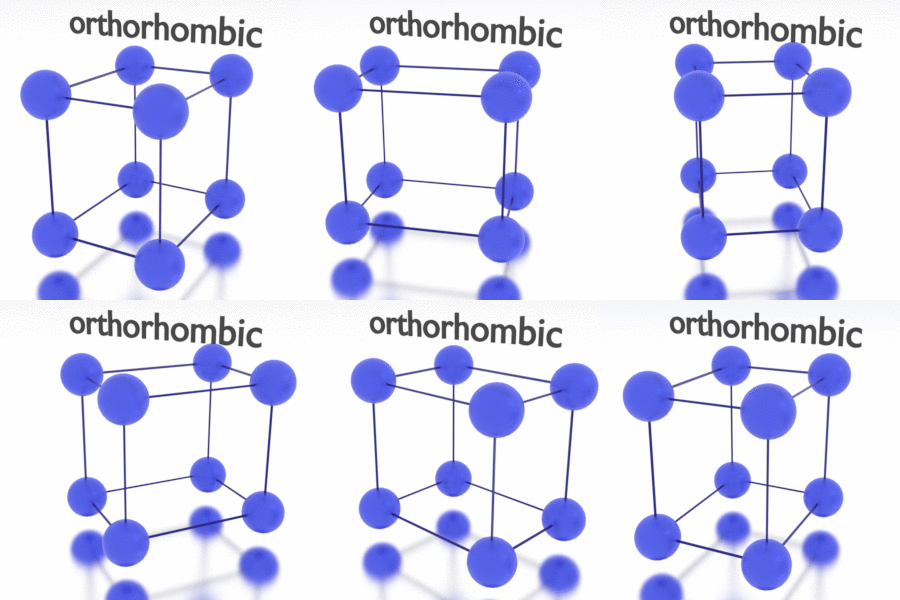
A possible crystal structure of Bromine is orthorhombic structure.

crystal structures - FCC, BCC, HCP

In metals, and in many other solids, the atoms are arranged in regular arrays called crystals. A crystal lattice is a repeating pattern of mathematical points that extends throughout space. The forces of chemical bonding causes this repetition. It is this repeated pattern which control properties like strength, ductility, density, conductivity (property of conducting or transmitting heat, electricity, etc.), and shape. There are 14 general types of such patterns known as Bravais lattices.

See also: Crystal Structure of Materials

Crystal Structure of Bromine
Crystal Structure of Bromine is: orthorhombic

Strength of Elements

Elasticity of Elements

Hardness of Elements


Thermal Properties of Bromine

Bromine-melting-point-conductivity-thermal-properties

Bromine – Melting Point and Boiling Point

Melting point of Bromine is -7.3°C.

Boiling point of Bromine is 59°C.

Note that, these points are associated with the standard atmospheric pressure.

Bromine – Thermal Conductivity

Thermal conductivity of Bromine is 0.122 W/(m·K).

The heat transfer characteristics of a solid material are measured by a property called the thermal conductivity, k (or λ), measured in W/m.K. It is a measure of a substance’s ability to transfer heat through a material by conduction. Note that Fourier’s law applies for all matter, regardless of its state (solid, liquid, or gas), therefore, it is also defined for liquids and gases.

Coefficient of Thermal Expansion of Bromine

Linear thermal expansion coefficient of Bromine is — µm/(m·K)

Thermal expansion is generally the tendency of matter to change its dimensions in response to a change in temperature. It is usually expressed as a fractional change in length or volume per unit temperature change.

Bromine – Specific Heat, Latent Heat of Fusion, Latent Heat of Vaporization

Specific heat of Bromine is 0.473 J/g K.

Heat capacity is an extensive property of matter, meaning it is proportional to the size of the system. Heat capacity C has the unit of energy per degree or energy per kelvin. When expressing the same phenomenon as an intensive property, the heat capacity is divided by the amount of substance, mass, or volume, thus the quantity is independent of the size or extent of the sample.

Latent Heat of Fusion of Bromine is 5.286 kJ/mol.

Latent Heat of Vaporization of Bromine is 15.438 kJ/mol.

Latent heat is the amount of heat added to or removed from a substance to produce a change in phase. This energy breaks down the intermolecular attractive forces, and also must provide the energy necessary to expand the gas (the pΔV work). When latent heat is added, no temperature change occurs. The enthalpy of vaporization is a function of the pressure at which that transformation takes place.

Melting Point of Elements

Periodic Table of Elements - melting point

Thermal Conductivity of Elements

Periodic Table of Elements - thermal conductivity

Thermal Expansion of Elements

Periodic Table of Elements - thermal expansion

Heat Capacity of Elements

Periodic Table of Elements - heat capacity

Heat of Fusion of Elements

Periodic Table of Elements - latent heat fusion

Heat of Vaporization of Elements

Periodic Table of Elements - latent heat vaporization

Bromine – Electrical Resistivity – Magnetic Susceptibility

Bromine-electrical-resistivity-magnetic-susceptibility

Electrical property refers to the response of a material to an applied electric field. One of the principal characteristics of materials is their ability (or lack of ability) to conduct electrical current. Indeed, materials are classified by this property, that is, they are divided into conductors, semiconductors, and nonconductors.

See also: Electrical Properties

Magnetic property refers to the response of a material to an applied magnetic field. The macroscopic magnetic properties of a material are a consequence of interactions between an external magnetic field and the magnetic dipole moments of the constituent atoms. Different materials react to the application of magnetic field differently.

See also: Magnetic Properties

Electrical Resistivity of Bromine

Electrical resistivity of Bromine is 8E19 nΩ⋅m.

Electrical conductivity and its converse, electrical resistivity, is a fundamental property of a material that quantifies how Bromine conducts the flow of electric current. Electrical conductivity or specific conductance is the reciprocal of electrical resistivity.

Magnetic Susceptibility of Bromine

Magnetic susceptibility of Bromine is −56e-6 cm^3/mol.

In electromagnetism, magnetic susceptibility is the measure of the magnetization of a substance. Magnetic susceptibility is a dimensionless proportionality factor that indicates the degree of magnetization of Bromine in response to an applied magnetic field.

Electrical Resistivity of Elements

Periodic Table of Elements - electrical resistivity

Magnetic Susceptibility of Elements

Application and prices of other elements

Bromine - Comparison of Properties and Prices

Periodic Table in 8K resolution

Other properties of Bromine


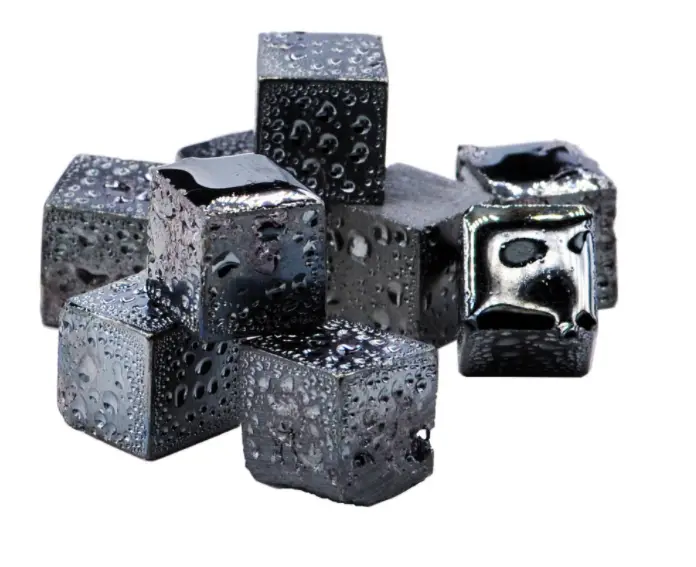
Selenium – Properties – Price – Applications – Production

Selenium-properties-price-application-production

About Selenium

Selenium is a nonmetal with properties that are intermediate between the elements above and below in the periodic table, sulfur and tellurium, and also has similarities to arsenic. It rarely occurs in its elemental state or as pure ore compounds in the Earth’s crust.

Summary

Element Selenium
Atomic number 34
Element category Non Metal
Phase at STP Solid
Density 4.819 g/cm3
Ultimate Tensile Strength 300 MPa
Yield Strength 150 MPa
Young’s Modulus of Elasticity 10 GPa
Mohs Scale 2
Brinell Hardness 740 MPa
Vickers Hardness N/A
Melting Point 221 °C
Boiling Point 685 °C
Thermal Conductivity 2.04 W/mK
Thermal Expansion Coefficient 37 µm/mK
Specific Heat 0.32 J/g K
Heat of Fusion 6.694 kJ/mol
Heat of Vaporization 37.7 kJ/mol
Electrical resistivity [nanoOhm meter] —
Magnetic Susceptibility −25e-6 cm^3/mol

Applications of Selenium

The chief commercial uses for selenium today are glassmaking and pigments. Selenium finds applications in the various industries, for example, solar cells and photoconductor applications, manganese electrolysis, DC power surge protection or X-ray crystallography.

Selenium-applications

Production and Price of Selenium

Raw materials prices change daily. They are primarily driven by supply, demand and energy prices. In 2019, prices of pure Selenium were at around 140 $/kg.

Selenium is most commonly produced from selenide in many sulfide ores, such as those of copper, nickel, or lead. Electrolytic metal refining is particularly productive of selenium as a byproduct, obtained from the anode mud of copper refineries. About 2,000 tonnes of selenium were produced in 2011 worldwide, mostly in Germany (650 t), Japan (630 t), Belgium (200 t), and Russia (140 t).

Selenium-periodic-table

Source: www.luciteria.com

Mechanical Properties of Selenium

Selenium-mechanical-properties-strength-hardness-crystal-structure

Strength of Selenium

In mechanics of materials, the strength of a material is its ability to withstand an applied load without failure or plastic deformation. Strength of materials basically considers the relationship between the external loads applied to a material and the resulting deformation or change in material dimensions. In designing structures and machines, it is important to consider these factors, in order that the material selected will have adequate strength to resist applied loads or forces and retain its original shape. Strength of a material is its ability to withstand this applied load without failure or plastic deformation.

For tensile stress, the capacity of a material or structure to withstand loads tending to elongate is known as ultimate tensile strength (UTS). Yield strength or yield stress is the material property defined as the stress at which a material begins to deform plastically whereas yield point is the point where nonlinear (elastic + plastic) deformation begins.

See also: Strength of Materials

Ultimate Tensile Strength of Selenium

Ultimate tensile strength of Selenium is 300 MPa.

Yield Strength of Selenium

Yield strength of Selenium is 150 MPa.

Modulus of Elasticity of Selenium

The Young’s modulus of elasticity of Selenium is 10 GPa.

Hardness of Selenium

In materials science, hardness is the ability to withstand surface indentation (localized plastic deformation) and scratching. Brinell hardness test is one of indentation hardness tests, that has been developed for hardness testing. In Brinell tests, a hard, spherical indenter is forced under a specific load into the surface of the metal to be tested.

Brinell hardness of Selenium is approximately 740 MPa.

The Vickers hardness test method was developed by Robert L. Smith and George E. Sandland at Vickers Ltd as an alternative to the Brinell method to measure the hardness of materials. The Vickers hardness test method can be also used as a microhardness test method, which is mostly used for small parts, thin sections, or case depth work.

Vickers hardness of Selenium is approximately N/A.

Scratch hardness is the measure of how resistant a sample is to permanent plastic deformation due to friction from a sharp object. The most common scale for this qualitative test is Mohs scale, which is used in mineralogy. The Mohs scale of mineral hardness is based on the ability of one natural sample of mineral to scratch another mineral visibly.

Selenium is has a hardness of approximately 2.

See also: Hardness of Materials

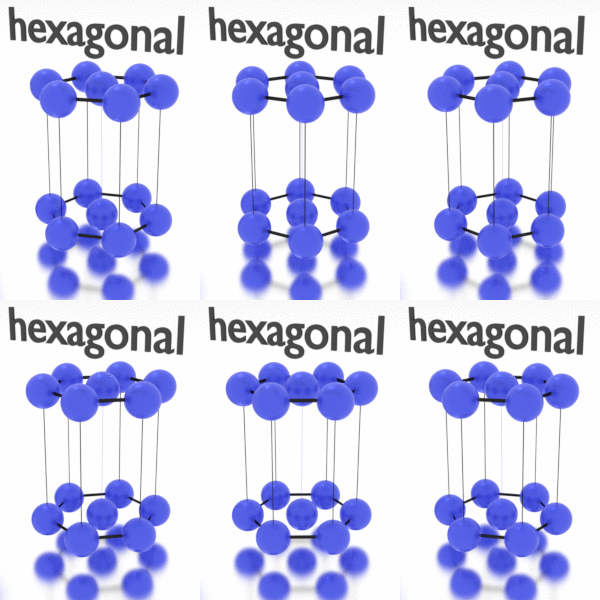
Selenium – Crystal Structure

A possible crystal structure of Selenium is hexagonal structure.

crystal structures - FCC, BCC, HCP

In metals, and in many other solids, the atoms are arranged in regular arrays called crystals. A crystal lattice is a repeating pattern of mathematical points that extends throughout space. The forces of chemical bonding causes this repetition. It is this repeated pattern which control properties like strength, ductility, density, conductivity (property of conducting or transmitting heat, electricity, etc.), and shape. There are 14 general types of such patterns known as Bravais lattices.

See also: Crystal Structure of Materials

Crystal Structure of Selenium
Crystal Structure of Selenium is: hexagonal

Strength of Elements

Elasticity of Elements

Hardness of Elements


Thermal Properties of Selenium

Selenium-melting-point-conductivity-thermal-properties

Selenium – Melting Point and Boiling Point

Melting point of Selenium is 221°C.

Boiling point of Selenium is 685°C.

Note that, these points are associated with the standard atmospheric pressure.

Selenium – Thermal Conductivity

Thermal conductivity of Selenium is 2.04 W/(m·K).

The heat transfer characteristics of a solid material are measured by a property called the thermal conductivity, k (or λ), measured in W/m.K. It is a measure of a substance’s ability to transfer heat through a material by conduction. Note that Fourier’s law applies for all matter, regardless of its state (solid, liquid, or gas), therefore, it is also defined for liquids and gases.

Coefficient of Thermal Expansion of Selenium

Linear thermal expansion coefficient of Selenium is 37 µm/(m·K)

Thermal expansion is generally the tendency of matter to change its dimensions in response to a change in temperature. It is usually expressed as a fractional change in length or volume per unit temperature change.

Selenium – Specific Heat, Latent Heat of Fusion, Latent Heat of Vaporization

Specific heat of Selenium is 0.32 J/g K.

Heat capacity is an extensive property of matter, meaning it is proportional to the size of the system. Heat capacity C has the unit of energy per degree or energy per kelvin. When expressing the same phenomenon as an intensive property, the heat capacity is divided by the amount of substance, mass, or volume, thus the quantity is independent of the size or extent of the sample.

Latent Heat of Fusion of Selenium is 6.694 kJ/mol.

Latent Heat of Vaporization of Selenium is 37.7 kJ/mol.

Latent heat is the amount of heat added to or removed from a substance to produce a change in phase. This energy breaks down the intermolecular attractive forces, and also must provide the energy necessary to expand the gas (the pΔV work). When latent heat is added, no temperature change occurs. The enthalpy of vaporization is a function of the pressure at which that transformation takes place.

Melting Point of Elements

Periodic Table of Elements - melting point

Thermal Conductivity of Elements

Periodic Table of Elements - thermal conductivity

Thermal Expansion of Elements

Periodic Table of Elements - thermal expansion

Heat Capacity of Elements

Periodic Table of Elements - heat capacity

Heat of Fusion of Elements

Periodic Table of Elements - latent heat fusion

Heat of Vaporization of Elements

Periodic Table of Elements - latent heat vaporization

Selenium – Electrical Resistivity – Magnetic Susceptibility

Selenium-electrical-resistivity-magnetic-susceptibility

Electrical property refers to the response of a material to an applied electric field. One of the principal characteristics of materials is their ability (or lack of ability) to conduct electrical current. Indeed, materials are classified by this property, that is, they are divided into conductors, semiconductors, and nonconductors.

See also: Electrical Properties

Magnetic property refers to the response of a material to an applied magnetic field. The macroscopic magnetic properties of a material are a consequence of interactions between an external magnetic field and the magnetic dipole moments of the constituent atoms. Different materials react to the application of magnetic field differently.

See also: Magnetic Properties

Electrical Resistivity of Selenium

Electrical resistivity of Selenium is — nΩ⋅m.

Electrical conductivity and its converse, electrical resistivity, is a fundamental property of a material that quantifies how Selenium conducts the flow of electric current. Electrical conductivity or specific conductance is the reciprocal of electrical resistivity.

Magnetic Susceptibility of Selenium

Magnetic susceptibility of Selenium is −25e-6 cm^3/mol.

In electromagnetism, magnetic susceptibility is the measure of the magnetization of a substance. Magnetic susceptibility is a dimensionless proportionality factor that indicates the degree of magnetization of Selenium in response to an applied magnetic field.

Electrical Resistivity of Elements

Periodic Table of Elements - electrical resistivity

Magnetic Susceptibility of Elements

Application and prices of other elements

Selenium - Comparison of Properties and Prices

Periodic Table in 8K resolution

Other properties of Selenium


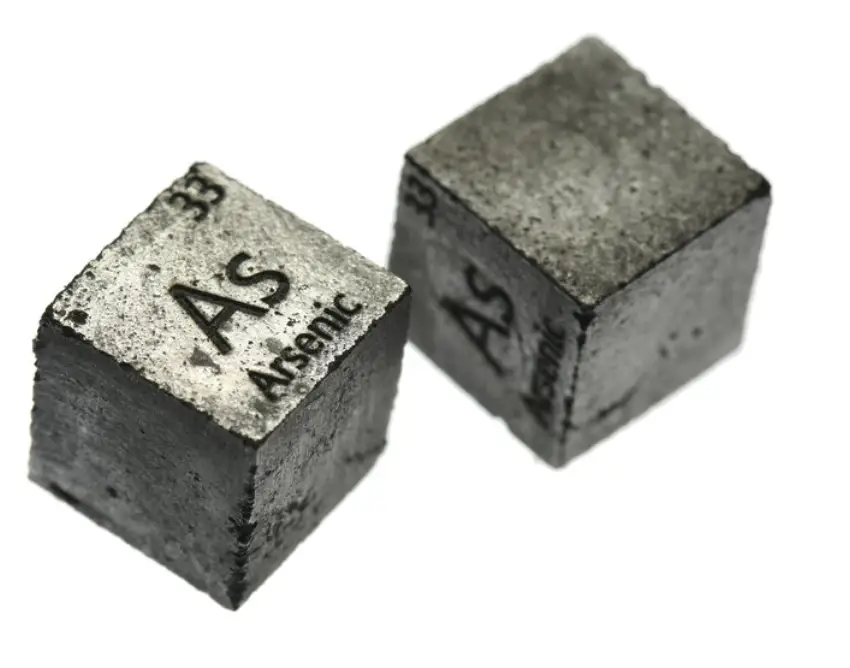
Arsenic – Properties – Price – Applications – Production

Arsenic-properties-price-application-production

About Arsenic

Arsenic occurs in many minerals, usually in combination with sulfur and metals, but also as a pure elemental crystal. Arsenic is a metalloid.

Summary

Element Arsenic
Atomic number 33
Element category Metalloids
Phase at STP Solid
Density 5.727 g/cm3
Ultimate Tensile Strength N/A
Yield Strength N/A
Young’s Modulus of Elasticity 8 GPa
Mohs Scale 3.5
Brinell Hardness 1440 MPa
Vickers Hardness N/A
Melting Point 817 °C
Boiling Point 614 °C
Thermal Conductivity 50 W/mK
Thermal Expansion Coefficient 5.6 µm/mK
Specific Heat 0.33 J/g K
Heat of Fusion — kJ/mol
Heat of Vaporization 34.76 kJ/mol
Electrical resistivity [nanoOhm meter] 333
Magnetic Susceptibility −5.5e-6 cm^3/mol

Applications of Arsenic

Arsenic is used as a doping agent in semiconductors (gallium arsenide) for solid-state devices. It is also used in bronzing, pyrotechnics and for hardening shot. Arsenic compounds can be used to make special glass and preserve wood.

Arsenic-applications

Production and Price of Arsenic

Raw materials prices change daily. They are primarily driven by supply, demand and energy prices. In 2019, prices of pure Arsenic were at around 3200 $/kg.

Minerals with the formula MAsS and MAs2 (M = Fe, Ni, Co) are the dominant commercial sources of arsenic, together with realgar (an arsenic sulfide mineral) and native (elemental) arsenic. In 2014, China was the top producer of white arsenic with almost 70% world share, followed by Morocco, Russia, and Belgium, according to the British Geological Survey and the United States Geological Survey.

Arsenic-periodic-table

Source: www.luciteria.com

Mechanical Properties of Arsenic

Arsenic-mechanical-properties-strength-hardness-crystal-structure

Strength of Arsenic

In mechanics of materials, the strength of a material is its ability to withstand an applied load without failure or plastic deformation. Strength of materials basically considers the relationship between the external loads applied to a material and the resulting deformation or change in material dimensions. In designing structures and machines, it is important to consider these factors, in order that the material selected will have adequate strength to resist applied loads or forces and retain its original shape. Strength of a material is its ability to withstand this applied load without failure or plastic deformation.

For tensile stress, the capacity of a material or structure to withstand loads tending to elongate is known as ultimate tensile strength (UTS). Yield strength or yield stress is the material property defined as the stress at which a material begins to deform plastically whereas yield point is the point where nonlinear (elastic + plastic) deformation begins.

See also: Strength of Materials

Ultimate Tensile Strength of Arsenic

Ultimate tensile strength of Arsenic is N/A.

Yield Strength of Arsenic

Yield strength of Arsenic is N/A.

Modulus of Elasticity of Arsenic

The Young’s modulus of elasticity of Arsenic is 8 GPa.

Hardness of Arsenic

In materials science, hardness is the ability to withstand surface indentation (localized plastic deformation) and scratching. Brinell hardness test is one of indentation hardness tests, that has been developed for hardness testing. In Brinell tests, a hard, spherical indenter is forced under a specific load into the surface of the metal to be tested.

Brinell hardness of Arsenic is approximately 1440 MPa.

The Vickers hardness test method was developed by Robert L. Smith and George E. Sandland at Vickers Ltd as an alternative to the Brinell method to measure the hardness of materials. The Vickers hardness test method can be also used as a microhardness test method, which is mostly used for small parts, thin sections, or case depth work.

Vickers hardness of Arsenic is approximately N/A.

Scratch hardness is the measure of how resistant a sample is to permanent plastic deformation due to friction from a sharp object. The most common scale for this qualitative test is Mohs scale, which is used in mineralogy. The Mohs scale of mineral hardness is based on the ability of one natural sample of mineral to scratch another mineral visibly.

Arsenic is has a hardness of approximately 3.5.

See also: Hardness of Materials

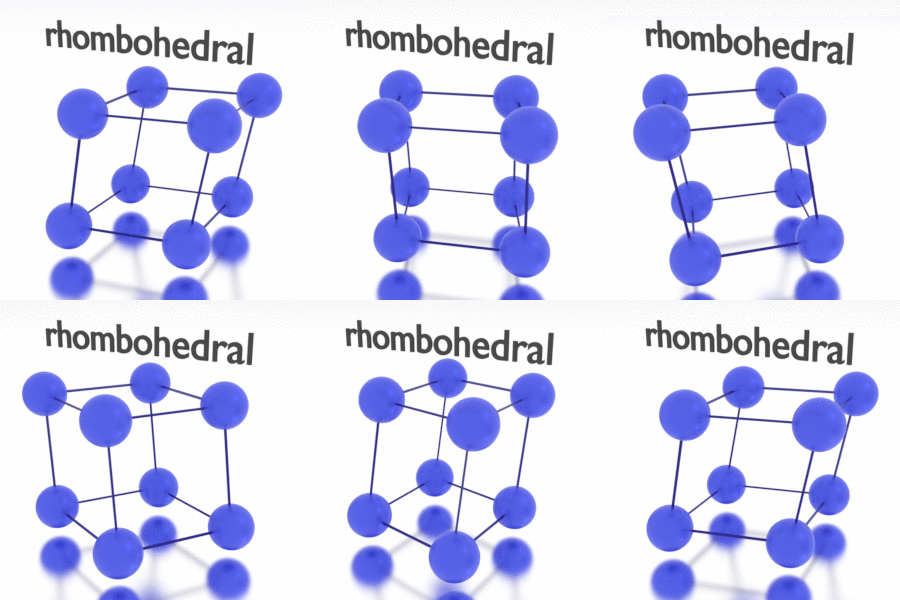
Arsenic – Crystal Structure

A possible crystal structure of Arsenic is rhombohedral structure.

crystal structures - FCC, BCC, HCP

In metals, and in many other solids, the atoms are arranged in regular arrays called crystals. A crystal lattice is a repeating pattern of mathematical points that extends throughout space. The forces of chemical bonding causes this repetition. It is this repeated pattern which control properties like strength, ductility, density, conductivity (property of conducting or transmitting heat, electricity, etc.), and shape. There are 14 general types of such patterns known as Bravais lattices.

See also: Crystal Structure of Materials

Crystal Structure of Arsenic
Crystal Structure of Arsenic is: rhombohedral

Strength of Elements

Elasticity of Elements

Hardness of Elements


Thermal Properties of Arsenic

Arsenic-melting-point-conductivity-thermal-properties

Arsenic – Melting Point and Boiling Point

Melting point of Arsenic is 817°C.

Boiling point of Arsenic is 614°C.

Note that, these points are associated with the standard atmospheric pressure.

Arsenic – Thermal Conductivity

Thermal conductivity of Arsenic is 50 W/(m·K).

The heat transfer characteristics of a solid material are measured by a property called the thermal conductivity, k (or λ), measured in W/m.K. It is a measure of a substance’s ability to transfer heat through a material by conduction. Note that Fourier’s law applies for all matter, regardless of its state (solid, liquid, or gas), therefore, it is also defined for liquids and gases.

Coefficient of Thermal Expansion of Arsenic

Linear thermal expansion coefficient of Arsenic is 5.6 µm/(m·K)

Thermal expansion is generally the tendency of matter to change its dimensions in response to a change in temperature. It is usually expressed as a fractional change in length or volume per unit temperature change.

Arsenic – Specific Heat, Latent Heat of Fusion, Latent Heat of Vaporization

Specific heat of Arsenic is 0.33 J/g K.

Heat capacity is an extensive property of matter, meaning it is proportional to the size of the system. Heat capacity C has the unit of energy per degree or energy per kelvin. When expressing the same phenomenon as an intensive property, the heat capacity is divided by the amount of substance, mass, or volume, thus the quantity is independent of the size or extent of the sample.

Latent Heat of Fusion of Arsenic is — kJ/mol.

Latent Heat of Vaporization of Arsenic is 34.76 kJ/mol.

Latent heat is the amount of heat added to or removed from a substance to produce a change in phase. This energy breaks down the intermolecular attractive forces, and also must provide the energy necessary to expand the gas (the pΔV work). When latent heat is added, no temperature change occurs. The enthalpy of vaporization is a function of the pressure at which that transformation takes place.

Melting Point of Elements

Periodic Table of Elements - melting point

Thermal Conductivity of Elements

Periodic Table of Elements - thermal conductivity

Thermal Expansion of Elements

Periodic Table of Elements - thermal expansion

Heat Capacity of Elements

Periodic Table of Elements - heat capacity

Heat of Fusion of Elements

Periodic Table of Elements - latent heat fusion

Heat of Vaporization of Elements

Periodic Table of Elements - latent heat vaporization

Arsenic – Electrical Resistivity – Magnetic Susceptibility

Arsenic-electrical-resistivity-magnetic-susceptibility

Electrical property refers to the response of a material to an applied electric field. One of the principal characteristics of materials is their ability (or lack of ability) to conduct electrical current. Indeed, materials are classified by this property, that is, they are divided into conductors, semiconductors, and nonconductors.

See also: Electrical Properties

Magnetic property refers to the response of a material to an applied magnetic field. The macroscopic magnetic properties of a material are a consequence of interactions between an external magnetic field and the magnetic dipole moments of the constituent atoms. Different materials react to the application of magnetic field differently.

See also: Magnetic Properties

Electrical Resistivity of Arsenic

Electrical resistivity of Arsenic is 333 nΩ⋅m.

Electrical conductivity and its converse, electrical resistivity, is a fundamental property of a material that quantifies how Arsenic conducts the flow of electric current. Electrical conductivity or specific conductance is the reciprocal of electrical resistivity.

Magnetic Susceptibility of Arsenic

Magnetic susceptibility of Arsenic is −5.5e-6 cm^3/mol.

In electromagnetism, magnetic susceptibility is the measure of the magnetization of a substance. Magnetic susceptibility is a dimensionless proportionality factor that indicates the degree of magnetization of Arsenic in response to an applied magnetic field.

Electrical Resistivity of Elements

Periodic Table of Elements - electrical resistivity

Magnetic Susceptibility of Elements

Application and prices of other elements

Arsenic - Comparison of Properties and Prices

Periodic Table in 8K resolution

Other properties of Arsenic


Germanium – Properties – Price – Applications – Production

Germanium-properties-price-application-production

About Germanium

Germanium is a lustrous, hard, grayish-white metalloid in the carbon group, chemically similar to its group neighbors tin and silicon. Pure germanium is a semiconductor with an appearance similar to elemental silicon.

Summary

Element Germanium
Atomic number 32
Element category Metalloids
Phase at STP Solid
Density 5.323 g/cm3
Ultimate Tensile Strength 135 MPa
Yield Strength 135 MPa
Young’s Modulus of Elasticity 103 GPa
Mohs Scale 6
Brinell Hardness N/A
Vickers Hardness N/A
Melting Point 938.3 °C
Boiling Point 2820 °C
Thermal Conductivity 59.9 W/mK
Thermal Expansion Coefficient 6 µm/mK
Specific Heat 0.32 J/g K
Heat of Fusion 36.94 kJ/mol
Heat of Vaporization 330.9 kJ/mol
Electrical resistivity [nanoOhm meter] 1E9
Magnetic Susceptibility −76.8e-6 cm^3/mol

Applications of Germanium

In gamma spectroscopy, germanium is preferred due to its atomic number being much higher than silicon and which increases the probability of gamma ray interaction. Moreover, germanium has lower average energy necessary to create an electron-hole pair, which is 3.6 eV for silicon and 2.9 eV for germanium. This also provides the latter a better resolution in energy. A large, clean and almost perfect germanium semiconductor is ideal as a counter for radioactivity. However, it is difficult and expensive to make large crystals with sufficient purity. On the other hand, in order to achieve maximum efficiency the detectors must operate at the very low temperatures of liquid nitrogen (-196°C), because at room temperatures the noise caused by thermal excitation is very high. Since germanium detectors produce the highest resolution commonly available today, they are used to measure radiation in a variety of applications including personnel and environmental monitoring for radioactive contamination, medical applications, radiometric assay, nuclear security and nuclear plant safety.

Germanium-applications

Production and Price of Germanium

Raw materials prices change daily. They are primarily driven by supply, demand and energy prices. In 2019, prices of pure Germanium were at around 3600 $/kg.

Germanium-periodic-table

Source: www.luciteria.com

Mechanical Properties of Germanium

Germanium-mechanical-properties-strength-hardness-crystal-structure

Strength of Germanium

In mechanics of materials, the strength of a material is its ability to withstand an applied load without failure or plastic deformation. Strength of materials basically considers the relationship between the external loads applied to a material and the resulting deformation or change in material dimensions. In designing structures and machines, it is important to consider these factors, in order that the material selected will have adequate strength to resist applied loads or forces and retain its original shape. Strength of a material is its ability to withstand this applied load without failure or plastic deformation.

For tensile stress, the capacity of a material or structure to withstand loads tending to elongate is known as ultimate tensile strength (UTS). Yield strength or yield stress is the material property defined as the stress at which a material begins to deform plastically whereas yield point is the point where nonlinear (elastic + plastic) deformation begins.

See also: Strength of Materials

Ultimate Tensile Strength of Germanium

Ultimate tensile strength of Germanium is 135 MPa.

Yield Strength of Germanium

Yield strength of Germanium is 135 MPa.

Modulus of Elasticity of Germanium

The Young’s modulus of elasticity of Germanium is 103 GPa.

Hardness of Germanium

In materials science, hardness is the ability to withstand surface indentation (localized plastic deformation) and scratching. Brinell hardness test is one of indentation hardness tests, that has been developed for hardness testing. In Brinell tests, a hard, spherical indenter is forced under a specific load into the surface of the metal to be tested.

Brinell hardness of Germanium is approximately N/A.

The Vickers hardness test method was developed by Robert L. Smith and George E. Sandland at Vickers Ltd as an alternative to the Brinell method to measure the hardness of materials. The Vickers hardness test method can be also used as a microhardness test method, which is mostly used for small parts, thin sections, or case depth work.

Vickers hardness of Germanium is approximately N/A.

Scratch hardness is the measure of how resistant a sample is to permanent plastic deformation due to friction from a sharp object. The most common scale for this qualitative test is Mohs scale, which is used in mineralogy. The Mohs scale of mineral hardness is based on the ability of one natural sample of mineral to scratch another mineral visibly.

Germanium is has a hardness of approximately 6.

See also: Hardness of Materials

Germanium – Crystal Structure

A possible crystal structure of Germanium is face-centered diamond cubic structure.

crystal structures - FCC, BCC, HCP

In metals, and in many other solids, the atoms are arranged in regular arrays called crystals. A crystal lattice is a repeating pattern of mathematical points that extends throughout space. The forces of chemical bonding causes this repetition. It is this repeated pattern which control properties like strength, ductility, density, conductivity (property of conducting or transmitting heat, electricity, etc.), and shape. There are 14 general types of such patterns known as Bravais lattices.

See also: Crystal Structure of Materials

Crystal Structure of Germanium
Crystal Structure of Germanium is: face-centered diamond cubic

Strength of Elements

Elasticity of Elements

Hardness of Elements


Thermal Properties of Germanium

Germanium-melting-point-conductivity-thermal-properties

Germanium – Melting Point and Boiling Point

Melting point of Germanium is 938.3°C.

Boiling point of Germanium is 2820°C.

Note that, these points are associated with the standard atmospheric pressure.

Germanium – Thermal Conductivity

Thermal conductivity of Germanium is 59.9 W/(m·K).

The heat transfer characteristics of a solid material are measured by a property called the thermal conductivity, k (or λ), measured in W/m.K. It is a measure of a substance’s ability to transfer heat through a material by conduction. Note that Fourier’s law applies for all matter, regardless of its state (solid, liquid, or gas), therefore, it is also defined for liquids and gases.

Coefficient of Thermal Expansion of Germanium

Linear thermal expansion coefficient of Germanium is 6 µm/(m·K)

Thermal expansion is generally the tendency of matter to change its dimensions in response to a change in temperature. It is usually expressed as a fractional change in length or volume per unit temperature change.

Germanium – Specific Heat, Latent Heat of Fusion, Latent Heat of Vaporization

Specific heat of Germanium is 0.32 J/g K.

Heat capacity is an extensive property of matter, meaning it is proportional to the size of the system. Heat capacity C has the unit of energy per degree or energy per kelvin. When expressing the same phenomenon as an intensive property, the heat capacity is divided by the amount of substance, mass, or volume, thus the quantity is independent of the size or extent of the sample.

Latent Heat of Fusion of Germanium is 36.94 kJ/mol.

Latent Heat of Vaporization of Germanium is 330.9 kJ/mol.

Latent heat is the amount of heat added to or removed from a substance to produce a change in phase. This energy breaks down the intermolecular attractive forces, and also must provide the energy necessary to expand the gas (the pΔV work). When latent heat is added, no temperature change occurs. The enthalpy of vaporization is a function of the pressure at which that transformation takes place.

Melting Point of Elements

Periodic Table of Elements - melting point

Thermal Conductivity of Elements

Periodic Table of Elements - thermal conductivity

Thermal Expansion of Elements

Periodic Table of Elements - thermal expansion

Heat Capacity of Elements

Periodic Table of Elements - heat capacity

Heat of Fusion of Elements

Periodic Table of Elements - latent heat fusion

Heat of Vaporization of Elements

Periodic Table of Elements - latent heat vaporization

Germanium – Electrical Resistivity – Magnetic Susceptibility

Germanium-electrical-resistivity-magnetic-susceptibility

Electrical property refers to the response of a material to an applied electric field. One of the principal characteristics of materials is their ability (or lack of ability) to conduct electrical current. Indeed, materials are classified by this property, that is, they are divided into conductors, semiconductors, and nonconductors.

See also: Electrical Properties

Magnetic property refers to the response of a material to an applied magnetic field. The macroscopic magnetic properties of a material are a consequence of interactions between an external magnetic field and the magnetic dipole moments of the constituent atoms. Different materials react to the application of magnetic field differently.

See also: Magnetic Properties

Electrical Resistivity of Germanium

Electrical resistivity of Germanium is 1E9 nΩ⋅m.

Electrical conductivity and its converse, electrical resistivity, is a fundamental property of a material that quantifies how Germanium conducts the flow of electric current. Electrical conductivity or specific conductance is the reciprocal of electrical resistivity.

Magnetic Susceptibility of Germanium

Magnetic susceptibility of Germanium is −76.8e-6 cm^3/mol.

In electromagnetism, magnetic susceptibility is the measure of the magnetization of a substance. Magnetic susceptibility is a dimensionless proportionality factor that indicates the degree of magnetization of Germanium in response to an applied magnetic field.

Electrical Resistivity of Elements

Periodic Table of Elements - electrical resistivity

Magnetic Susceptibility of Elements

Application and prices of other elements

Germanium - Comparison of Properties and Prices

Periodic Table in 8K resolution

Other properties of Germanium


Gallium – Properties – Price – Applications – Production

Gallium-properties-price-application-production

About Gallium

Gallium has similarities to the other metals of the group, aluminium, indium, and thallium. Gallium does not occur as a free element in nature, but as gallium(III) compounds in trace amounts in zinc ores and in bauxite.

Summary

Element Gallium
Atomic number 31
Element category Poor Metal
Phase at STP Solid
Density 5.904 g/cm3
Ultimate Tensile Strength 15 MPa
Yield Strength 8 MPa
Young’s Modulus of Elasticity 9.8 GPa
Mohs Scale 1.5
Brinell Hardness 60 MPa
Vickers Hardness N/A
Melting Point 29.76 °C
Boiling Point 2204 °C
Thermal Conductivity 40.6 W/mK
Thermal Expansion Coefficient 18 µm/mK
Specific Heat 0.37 J/g K
Heat of Fusion 5.59 kJ/mol
Heat of Vaporization 258.7 kJ/mol
Electrical resistivity [nanoOhm meter] 270
Magnetic Susceptibility −21.6e-6 cm^3/mol

Applications of Gallium

Gallium consumption is centred on the superconductor industry. Semiconductor applications dominate the commercial demand for gallium, accounting for 98% of the total. When alloyed with arsenic to produce gallium arsenide (GaAs), it can convert electricity to light. Due to such properties, it is used in LEDs, and has been found to produce less heat than silicon, rendering it suitable for use in supercomputers.

Gallium-applications

Production and Price of Gallium

Raw materials prices change daily. They are primarily driven by supply, demand and energy prices. In 2019, prices of pure Gallium were at around 2200 $/kg.

Current world production of gallium is about 200 mt per year, with the main producing nations being China, Germany, Kazakhstan and Ukraine. Gallium is mainly recovered as a by-product of treating bauxite (the main source of aluminium). During the processing of bauxite to alumina in the Bayer process, gallium accumulates in the sodium hydroxide liquor.

Gallium-periodic-table

Source: www.luciteria.com

Mechanical Properties of Gallium

Gallium-mechanical-properties-strength-hardness-crystal-structure

Strength of Gallium

In mechanics of materials, the strength of a material is its ability to withstand an applied load without failure or plastic deformation. Strength of materials basically considers the relationship between the external loads applied to a material and the resulting deformation or change in material dimensions. In designing structures and machines, it is important to consider these factors, in order that the material selected will have adequate strength to resist applied loads or forces and retain its original shape. Strength of a material is its ability to withstand this applied load without failure or plastic deformation.

For tensile stress, the capacity of a material or structure to withstand loads tending to elongate is known as ultimate tensile strength (UTS). Yield strength or yield stress is the material property defined as the stress at which a material begins to deform plastically whereas yield point is the point where nonlinear (elastic + plastic) deformation begins.

See also: Strength of Materials

Ultimate Tensile Strength of Gallium

Ultimate tensile strength of Gallium is 15 MPa.

Yield Strength of Gallium

Yield strength of Gallium is 8 MPa.

Modulus of Elasticity of Gallium

The Young’s modulus of elasticity of Gallium is 9.8 GPa.

Hardness of Gallium

In materials science, hardness is the ability to withstand surface indentation (localized plastic deformation) and scratching. Brinell hardness test is one of indentation hardness tests, that has been developed for hardness testing. In Brinell tests, a hard, spherical indenter is forced under a specific load into the surface of the metal to be tested.

Brinell hardness of Gallium is approximately 60 MPa.

The Vickers hardness test method was developed by Robert L. Smith and George E. Sandland at Vickers Ltd as an alternative to the Brinell method to measure the hardness of materials. The Vickers hardness test method can be also used as a microhardness test method, which is mostly used for small parts, thin sections, or case depth work.

Vickers hardness of Gallium is approximately N/A.

Scratch hardness is the measure of how resistant a sample is to permanent plastic deformation due to friction from a sharp object. The most common scale for this qualitative test is Mohs scale, which is used in mineralogy. The Mohs scale of mineral hardness is based on the ability of one natural sample of mineral to scratch another mineral visibly.

Gallium is has a hardness of approximately 1.5.

See also: Hardness of Materials

Gallium – Crystal Structure

A possible crystal structure of Gallium is orthorhombic structure.

crystal structures - FCC, BCC, HCP

In metals, and in many other solids, the atoms are arranged in regular arrays called crystals. A crystal lattice is a repeating pattern of mathematical points that extends throughout space. The forces of chemical bonding causes this repetition. It is this repeated pattern which control properties like strength, ductility, density, conductivity (property of conducting or transmitting heat, electricity, etc.), and shape. There are 14 general types of such patterns known as Bravais lattices.

See also: Crystal Structure of Materials

Crystal Structure of Gallium
Crystal Structure of Gallium is: orthorhombic

Strength of Elements

Elasticity of Elements

Hardness of Elements


Thermal Properties of Gallium

Gallium-melting-point-conductivity-thermal-properties

Gallium – Melting Point and Boiling Point

Melting point of Gallium is 29.76°C.

Boiling point of Gallium is 2204°C.

Note that, these points are associated with the standard atmospheric pressure.

Gallium – Thermal Conductivity

Thermal conductivity of Gallium is 40.6 W/(m·K).

The heat transfer characteristics of a solid material are measured by a property called the thermal conductivity, k (or λ), measured in W/m.K. It is a measure of a substance’s ability to transfer heat through a material by conduction. Note that Fourier’s law applies for all matter, regardless of its state (solid, liquid, or gas), therefore, it is also defined for liquids and gases.

Coefficient of Thermal Expansion of Gallium

Linear thermal expansion coefficient of Gallium is 18 µm/(m·K)

Thermal expansion is generally the tendency of matter to change its dimensions in response to a change in temperature. It is usually expressed as a fractional change in length or volume per unit temperature change.

Gallium – Specific Heat, Latent Heat of Fusion, Latent Heat of Vaporization

Specific heat of Gallium is 0.37 J/g K.

Heat capacity is an extensive property of matter, meaning it is proportional to the size of the system. Heat capacity C has the unit of energy per degree or energy per kelvin. When expressing the same phenomenon as an intensive property, the heat capacity is divided by the amount of substance, mass, or volume, thus the quantity is independent of the size or extent of the sample.

Latent Heat of Fusion of Gallium is 5.59 kJ/mol.

Latent Heat of Vaporization of Gallium is 258.7 kJ/mol.

Latent heat is the amount of heat added to or removed from a substance to produce a change in phase. This energy breaks down the intermolecular attractive forces, and also must provide the energy necessary to expand the gas (the pΔV work). When latent heat is added, no temperature change occurs. The enthalpy of vaporization is a function of the pressure at which that transformation takes place.

Melting Point of Elements

Periodic Table of Elements - melting point

Thermal Conductivity of Elements

Periodic Table of Elements - thermal conductivity

Thermal Expansion of Elements

Periodic Table of Elements - thermal expansion

Heat Capacity of Elements

Periodic Table of Elements - heat capacity

Heat of Fusion of Elements

Periodic Table of Elements - latent heat fusion

Heat of Vaporization of Elements

Periodic Table of Elements - latent heat vaporization

Gallium – Electrical Resistivity – Magnetic Susceptibility

Gallium-electrical-resistivity-magnetic-susceptibility

Electrical property refers to the response of a material to an applied electric field. One of the principal characteristics of materials is their ability (or lack of ability) to conduct electrical current. Indeed, materials are classified by this property, that is, they are divided into conductors, semiconductors, and nonconductors.

See also: Electrical Properties

Magnetic property refers to the response of a material to an applied magnetic field. The macroscopic magnetic properties of a material are a consequence of interactions between an external magnetic field and the magnetic dipole moments of the constituent atoms. Different materials react to the application of magnetic field differently.

See also: Magnetic Properties

Electrical Resistivity of Gallium

Electrical resistivity of Gallium is 270 nΩ⋅m.

Electrical conductivity and its converse, electrical resistivity, is a fundamental property of a material that quantifies how Gallium conducts the flow of electric current. Electrical conductivity or specific conductance is the reciprocal of electrical resistivity.

Magnetic Susceptibility of Gallium

Magnetic susceptibility of Gallium is −21.6e-6 cm^3/mol.

In electromagnetism, magnetic susceptibility is the measure of the magnetization of a substance. Magnetic susceptibility is a dimensionless proportionality factor that indicates the degree of magnetization of Gallium in response to an applied magnetic field.

Electrical Resistivity of Elements

Periodic Table of Elements - electrical resistivity

Magnetic Susceptibility of Elements

Application and prices of other elements

Gallium - Comparison of Properties and Prices

Periodic Table in 8K resolution

Other properties of Gallium