Facebook Instagram Youtube Twitter

Tin – Properties – Price – Applications – Production

Tin-properties-price-application-production

About Tin

Tin is a post-transition metal in group 14 of the periodic table. It is obtained chiefly from the mineral cassiterite, which contains tin dioxide. The first alloy used on a large scale was bronze, made of tin and copper, from as early as 3000 BC.

Summary

Element Tin
Atomic number 50
Element category Poor Metal
Phase at STP Solid
Density 7.31 g/cm3
Ultimate Tensile Strength 220 MPa
Yield Strength N/A
Young’s Modulus of Elasticity 50 GPa
Mohs Scale 1.65
Brinell Hardness 50 MPa
Vickers Hardness N/A
Melting Point 231.93 °C
Boiling Point 2602 °C
Thermal Conductivity 67 W/mK
Thermal Expansion Coefficient 22 µm/mK
Specific Heat 0.227 J/g K
Heat of Fusion 7.029 kJ/mol
Heat of Vaporization 295.8 kJ/mol
Electrical resistivity [nanoOhm meter] 115
Magnetic Susceptibility +3.1e-6 cm^3/mol

Applications of Tin

The largest single application of tin is in the manufacture of tinplate (steel sheet coated with tin), which accounts for approximately 40% of total world tin consumption. Tin bonds readily to iron and steel to prevent corrosion. Tin-plated steel containers are widely used for food preservation, and this forms a large part of the market for metallic tin. Tinning is the process of thinly coating sheets of wrought iron or steel with tin, and the resulting product is known as tinplate. The term is also widely used for the different process of coating a metal with solder before soldering. There are two processes for the tinning of the black plates: hot-dipping and electroplating.

Tin-applications

Production and Price of Tin

Raw materials prices change daily. They are primarily driven by supply, demand and energy prices. In 2019, prices of pure Tin were at around 80 $/kg.

China led the world in tin production in the early 21st century, accounting for nearly half of all production; Indonesia, Peru, and Bolivia were also top producers. Tin is produced by carbothermic reduction of the oxide ore with carbon or coke. Both reverberatory furnace and electric furnace can be used. In 2006, total worldwide tin mine production was 321,000 tons, and smelter production was 340,000 tons. From its production level of 186,300 tons in 1991, around where it had hovered for the previous decades, production of tin increased 89% to 351,800 tons in 2005.
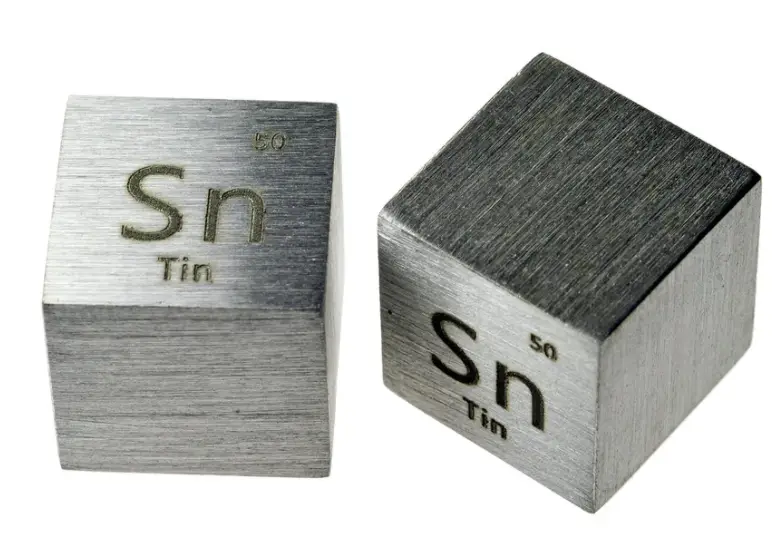
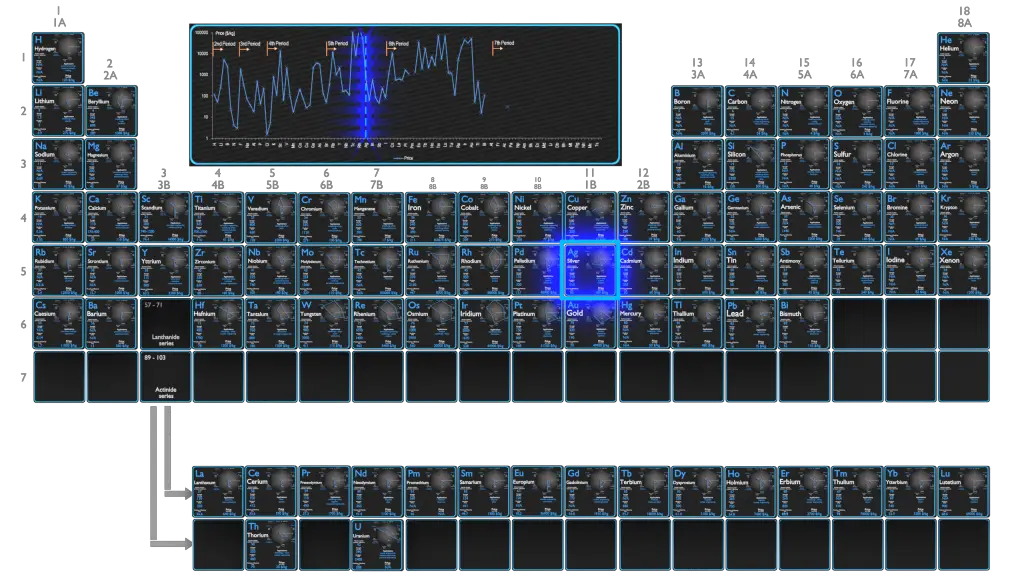
Tin-periodic-table

Source: www.luciteria.com

Mechanical Properties of Tin

Tin-mechanical-properties-strength-hardness-crystal-structure

Strength of Tin

In mechanics of materials, the strength of a material is its ability to withstand an applied load without failure or plastic deformation. Strength of materials basically considers the relationship between the external loads applied to a material and the resulting deformation or change in material dimensions. In designing structures and machines, it is important to consider these factors, in order that the material selected will have adequate strength to resist applied loads or forces and retain its original shape. Strength of a material is its ability to withstand this applied load without failure or plastic deformation.

For tensile stress, the capacity of a material or structure to withstand loads tending to elongate is known as ultimate tensile strength (UTS). Yield strength or yield stress is the material property defined as the stress at which a material begins to deform plastically whereas yield point is the point where nonlinear (elastic + plastic) deformation begins.

See also: Strength of Materials

Ultimate Tensile Strength of Tin

Ultimate tensile strength of Tin is 220 MPa.

Yield Strength of Tin

Yield strength of Tin is N/A.

Modulus of Elasticity of Tin

The Young’s modulus of elasticity of Tin is N/A.

Hardness of Tin

In materials science, hardness is the ability to withstand surface indentation (localized plastic deformation) and scratching. Brinell hardness test is one of indentation hardness tests, that has been developed for hardness testing. In Brinell tests, a hard, spherical indenter is forced under a specific load into the surface of the metal to be tested.

Brinell hardness of Tin is approximately 50 MPa.

The Vickers hardness test method was developed by Robert L. Smith and George E. Sandland at Vickers Ltd as an alternative to the Brinell method to measure the hardness of materials. The Vickers hardness test method can be also used as a microhardness test method, which is mostly used for small parts, thin sections, or case depth work.

Vickers hardness of Tin is approximately N/A.

Scratch hardness is the measure of how resistant a sample is to permanent plastic deformation due to friction from a sharp object. The most common scale for this qualitative test is Mohs scale, which is used in mineralogy. The Mohs scale of mineral hardness is based on the ability of one natural sample of mineral to scratch another mineral visibly.

Tin is has a hardness of approximately 1.65.

See also: Hardness of Materials

Tin – Crystal Structure

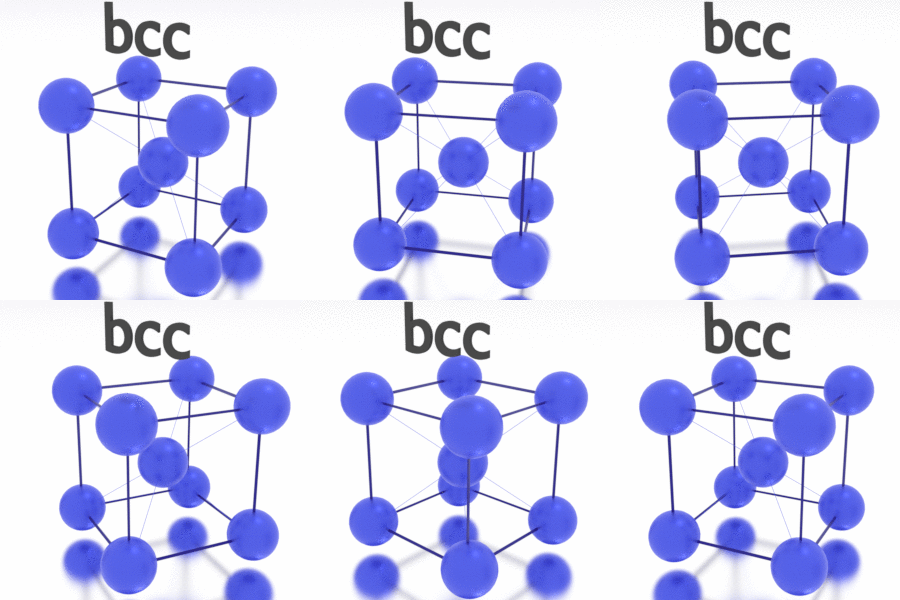
A possible crystal structure of Tin is body-centered tetragonal structure.
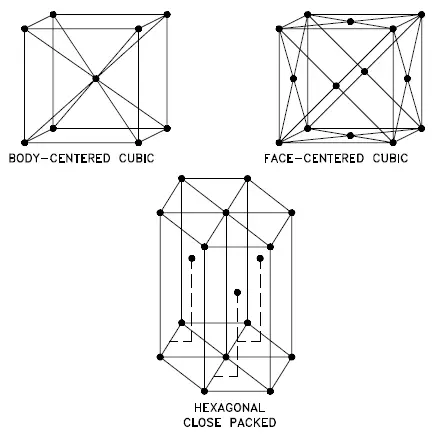
crystal structures - FCC, BCC, HCP

In metals, and in many other solids, the atoms are arranged in regular arrays called crystals. A crystal lattice is a repeating pattern of mathematical points that extends throughout space. The forces of chemical bonding causes this repetition. It is this repeated pattern which control properties like strength, ductility, density, conductivity (property of conducting or transmitting heat, electricity, etc.), and shape. There are 14 general types of such patterns known as Bravais lattices.

See also: Crystal Structure of Materials

Crystal Structure of Tin
Crystal Structure of Tin is: body-centered tetragonal

Strength of Elements

Elasticity of Elements
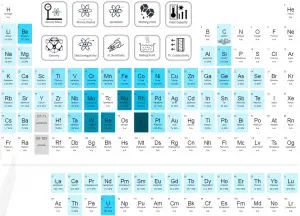
Hardness of Elements
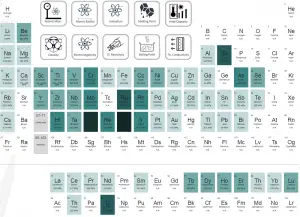
 

Thermal Properties of Tin
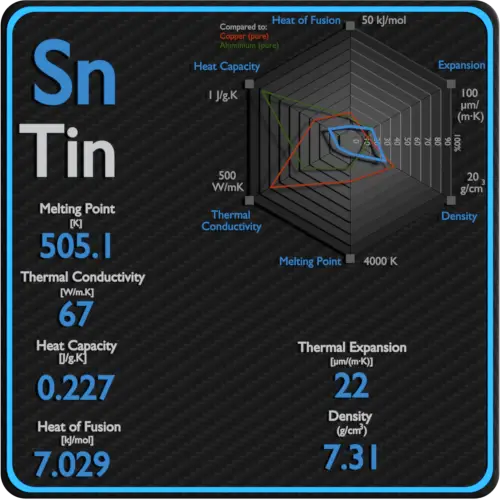
Tin-melting-point-conductivity-thermal-properties

Tin – Melting Point and Boiling Point

Melting point of Tin is 231.93°C.

Boiling point of Tin is 2602°C.

Note that, these points are associated with the standard atmospheric pressure.

Tin – Thermal Conductivity

Thermal conductivity of Tin is 67 W/(m·K).

The heat transfer characteristics of a solid material are measured by a property called the thermal conductivity, k (or λ), measured in W/m.K. It is a measure of a substance’s ability to transfer heat through a material by conduction. Note that Fourier’s law applies for all matter, regardless of its state (solid, liquid, or gas), therefore, it is also defined for liquids and gases.

Coefficient of Thermal Expansion of Tin

Linear thermal expansion coefficient of Tin is 22 µm/(m·K)

Thermal expansion is generally the tendency of matter to change its dimensions in response to a change in temperature. It is usually expressed as a fractional change in length or volume per unit temperature change.

Tin – Specific Heat, Latent Heat of Fusion, Latent Heat of Vaporization

Specific heat of Tin is 0.227 J/g K.

Heat capacity is an extensive property of matter, meaning it is proportional to the size of the system. Heat capacity C has the unit of energy per degree or energy per kelvin. When expressing the same phenomenon as an intensive property, the heat capacity is divided by the amount of substance, mass, or volume, thus the quantity is independent of the size or extent of the sample.

Latent Heat of Fusion of Tin is 7.029 kJ/mol.

Latent Heat of Vaporization of Tin is 295.8 kJ/mol.

Latent heat is the amount of heat added to or removed from a substance to produce a change in phase. This energy breaks down the intermolecular attractive forces, and also must provide the energy necessary to expand the gas (the pΔV work). When latent heat is added, no temperature change occurs. The enthalpy of vaporization is a function of the pressure at which that transformation takes place.

Melting Point of Elements
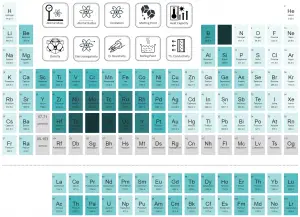
Periodic Table of Elements - melting point

Thermal Conductivity of Elements

Periodic Table of Elements - thermal conductivity

Thermal Expansion of Elements

Periodic Table of Elements - thermal expansion

Heat Capacity of Elements

Periodic Table of Elements - heat capacity

Heat of Fusion of Elements

Periodic Table of Elements - latent heat fusion

Heat of Vaporization of Elements

Periodic Table of Elements - latent heat vaporization

Tin – Electrical Resistivity – Magnetic Susceptibility

Tin-electrical-resistivity-magnetic-susceptibility

Electrical property refers to the response of a material to an applied electric field. One of the principal characteristics of materials is their ability (or lack of ability) to conduct electrical current. Indeed, materials are classified by this property, that is, they are divided into conductors, semiconductors, and nonconductors.

See also: Electrical Properties

Magnetic property refers to the response of a material to an applied magnetic field. The macroscopic magnetic properties of a material are a consequence of interactions between an external magnetic field and the magnetic dipole moments of the constituent atoms. Different materials react to the application of magnetic field differently.

See also: Magnetic Properties

Electrical Resistivity of Tin

Electrical resistivity of Tin is 115 nΩ⋅m.

Electrical conductivity and its converse, electrical resistivity, is a fundamental property of a material that quantifies how Tin conducts the flow of electric current. Electrical conductivity or specific conductance is the reciprocal of electrical resistivity.

Magnetic Susceptibility of Tin

Magnetic susceptibility of Tin is +3.1e-6 cm^3/mol.

In electromagnetism, magnetic susceptibility is the measure of the magnetization of a substance. Magnetic susceptibility is a dimensionless proportionality factor that indicates the degree of magnetization of Tin in response to an applied magnetic field.

Electrical Resistivity of Elements
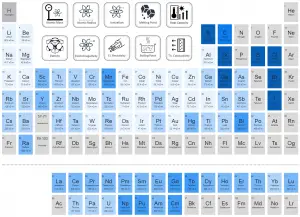
Periodic Table of Elements - electrical resistivity

Magnetic Susceptibility of Elements

Application and prices of other elements

Tin - Comparison of Properties and Prices

Periodic Table in 8K resolution

Other properties of Tin


Indium – Properties – Price – Applications – Production

Indium-properties-price-application-production

About Indium

Indium is a post-transition metal that makes up 0.21 parts per million of the Earth’s crust. Very soft and malleable, indium has a melting point higher than sodium and gallium, but lower than lithium and tin. Chemically, indium is similar to gallium and thallium.

Summary

Element Indium
Atomic number 49
Element category Poor Metal
Phase at STP Solid
Density 7.31 g/cm3
Ultimate Tensile Strength 2.5 MPa
Yield Strength 1 MPa
Young’s Modulus of Elasticity 11 GPa
Mohs Scale 1.2
Brinell Hardness 10 MPa
Vickers Hardness N/A
Melting Point 156.6 °C
Boiling Point 2072 °C
Thermal Conductivity 82 W/mK
Thermal Expansion Coefficient 32.1 µm/mK
Specific Heat 0.23 J/g K
Heat of Fusion 3.263 kJ/mol
Heat of Vaporization 231.5 kJ/mol
Electrical resistivity [nanoOhm meter] 83.7
Magnetic Susceptibility −64e-6 cm^3/mol

Applications of Indium

The primary consumption of indium worldwide is LCD production. Demand rose rapidly from the late 1990s to 2010 with the popularity of LCD computer monitors and television sets, which now account for 50% of indium consumption. It is most notably used in the semiconductor industry, in low-melting-point metal alloys such as solders, in soft-metal high-vacuum seals, and in the production of transparent conductive coatings of indium tin oxide (ITO) on glass. Indium is considered a technology-critical element.

Indium-applications

Production and Price of Indium

Raw materials prices change daily. They are primarily driven by supply, demand and energy prices. In 2019, prices of pure Indium were at around 600 $/kg.

Indium is produced mainly from residues generated during zinc ore processing. In the middle and late 1980’s, the development of indium phosphide semiconductors and indium-tin-oxide thin films for Liquid Crystal Displays (LCD) aroused much interest. By 1992, the thin-film application had become the largest end use. The amount of indium consumed is largely a function of worldwide LCD production. Increased manufacturing efficiency and recycling (especially in Japan) maintain a balance between demand and supply. Its main source material are sulfidic zinc ores, where it is mostly hosted by sphalerite.

Indium-periodic-table

Source: www.luciteria.com

Mechanical Properties of Indium

Indium-mechanical-properties-strength-hardness-crystal-structure

Strength of Indium

In mechanics of materials, the strength of a material is its ability to withstand an applied load without failure or plastic deformation. Strength of materials basically considers the relationship between the external loads applied to a material and the resulting deformation or change in material dimensions. In designing structures and machines, it is important to consider these factors, in order that the material selected will have adequate strength to resist applied loads or forces and retain its original shape. Strength of a material is its ability to withstand this applied load without failure or plastic deformation.

For tensile stress, the capacity of a material or structure to withstand loads tending to elongate is known as ultimate tensile strength (UTS). Yield strength or yield stress is the material property defined as the stress at which a material begins to deform plastically whereas yield point is the point where nonlinear (elastic + plastic) deformation begins.

See also: Strength of Materials

Ultimate Tensile Strength of Indium

Ultimate tensile strength of Indium is 2.5 MPa.

Yield Strength of Indium

Yield strength of Indium is 1 MPa.

Modulus of Elasticity of Indium

The Young’s modulus of elasticity of Indium is 1 MPa.

Hardness of Indium

In materials science, hardness is the ability to withstand surface indentation (localized plastic deformation) and scratching. Brinell hardness test is one of indentation hardness tests, that has been developed for hardness testing. In Brinell tests, a hard, spherical indenter is forced under a specific load into the surface of the metal to be tested.

Brinell hardness of Indium is approximately 10 MPa.

The Vickers hardness test method was developed by Robert L. Smith and George E. Sandland at Vickers Ltd as an alternative to the Brinell method to measure the hardness of materials. The Vickers hardness test method can be also used as a microhardness test method, which is mostly used for small parts, thin sections, or case depth work.

Vickers hardness of Indium is approximately N/A.

Scratch hardness is the measure of how resistant a sample is to permanent plastic deformation due to friction from a sharp object. The most common scale for this qualitative test is Mohs scale, which is used in mineralogy. The Mohs scale of mineral hardness is based on the ability of one natural sample of mineral to scratch another mineral visibly.

Indium is has a hardness of approximately 1.2.

See also: Hardness of Materials

Indium – Crystal Structure

A possible crystal structure of Indium is body-centered tetragonal structure.

crystal structures - FCC, BCC, HCP

In metals, and in many other solids, the atoms are arranged in regular arrays called crystals. A crystal lattice is a repeating pattern of mathematical points that extends throughout space. The forces of chemical bonding causes this repetition. It is this repeated pattern which control properties like strength, ductility, density, conductivity (property of conducting or transmitting heat, electricity, etc.), and shape. There are 14 general types of such patterns known as Bravais lattices.

See also: Crystal Structure of Materials

Crystal Structure of Indium
Crystal Structure of Indium is: body-centered tetragonal

Strength of Elements

Elasticity of Elements

Hardness of Elements


Thermal Properties of Indium

Indium-melting-point-conductivity-thermal-properties

Indium – Melting Point and Boiling Point

Melting point of Indium is 156.6°C.

Boiling point of Indium is 2072°C.

Note that, these points are associated with the standard atmospheric pressure.

Indium – Thermal Conductivity

Thermal conductivity of Indium is 82 W/(m·K).

The heat transfer characteristics of a solid material are measured by a property called the thermal conductivity, k (or λ), measured in W/m.K. It is a measure of a substance’s ability to transfer heat through a material by conduction. Note that Fourier’s law applies for all matter, regardless of its state (solid, liquid, or gas), therefore, it is also defined for liquids and gases.

Coefficient of Thermal Expansion of Indium

Linear thermal expansion coefficient of Indium is 32.1 µm/(m·K)

Thermal expansion is generally the tendency of matter to change its dimensions in response to a change in temperature. It is usually expressed as a fractional change in length or volume per unit temperature change.

Indium – Specific Heat, Latent Heat of Fusion, Latent Heat of Vaporization

Specific heat of Indium is 0.23 J/g K.

Heat capacity is an extensive property of matter, meaning it is proportional to the size of the system. Heat capacity C has the unit of energy per degree or energy per kelvin. When expressing the same phenomenon as an intensive property, the heat capacity is divided by the amount of substance, mass, or volume, thus the quantity is independent of the size or extent of the sample.

Latent Heat of Fusion of Indium is 3.263 kJ/mol.

Latent Heat of Vaporization of Indium is 231.5 kJ/mol.

Latent heat is the amount of heat added to or removed from a substance to produce a change in phase. This energy breaks down the intermolecular attractive forces, and also must provide the energy necessary to expand the gas (the pΔV work). When latent heat is added, no temperature change occurs. The enthalpy of vaporization is a function of the pressure at which that transformation takes place.

Melting Point of Elements

Periodic Table of Elements - melting point

Thermal Conductivity of Elements

Periodic Table of Elements - thermal conductivity

Thermal Expansion of Elements

Periodic Table of Elements - thermal expansion

Heat Capacity of Elements

Periodic Table of Elements - heat capacity

Heat of Fusion of Elements

Periodic Table of Elements - latent heat fusion

Heat of Vaporization of Elements

Periodic Table of Elements - latent heat vaporization

Indium – Electrical Resistivity – Magnetic Susceptibility

Indium-electrical-resistivity-magnetic-susceptibility

Electrical property refers to the response of a material to an applied electric field. One of the principal characteristics of materials is their ability (or lack of ability) to conduct electrical current. Indeed, materials are classified by this property, that is, they are divided into conductors, semiconductors, and nonconductors.

See also: Electrical Properties

Magnetic property refers to the response of a material to an applied magnetic field. The macroscopic magnetic properties of a material are a consequence of interactions between an external magnetic field and the magnetic dipole moments of the constituent atoms. Different materials react to the application of magnetic field differently.

See also: Magnetic Properties

Electrical Resistivity of Indium

Electrical resistivity of Indium is 83.7 nΩ⋅m.

Electrical conductivity and its converse, electrical resistivity, is a fundamental property of a material that quantifies how Indium conducts the flow of electric current. Electrical conductivity or specific conductance is the reciprocal of electrical resistivity.

Magnetic Susceptibility of Indium

Magnetic susceptibility of Indium is −64e-6 cm^3/mol.

In electromagnetism, magnetic susceptibility is the measure of the magnetization of a substance. Magnetic susceptibility is a dimensionless proportionality factor that indicates the degree of magnetization of Indium in response to an applied magnetic field.

Electrical Resistivity of Elements

Periodic Table of Elements - electrical resistivity

Magnetic Susceptibility of Elements

Application and prices of other elements

Indium - Comparison of Properties and Prices

Periodic Table in 8K resolution

Other properties of Indium


Cadmium – Properties – Price – Applications – Production

Cadmium-properties-price-application-production

About Cadmium

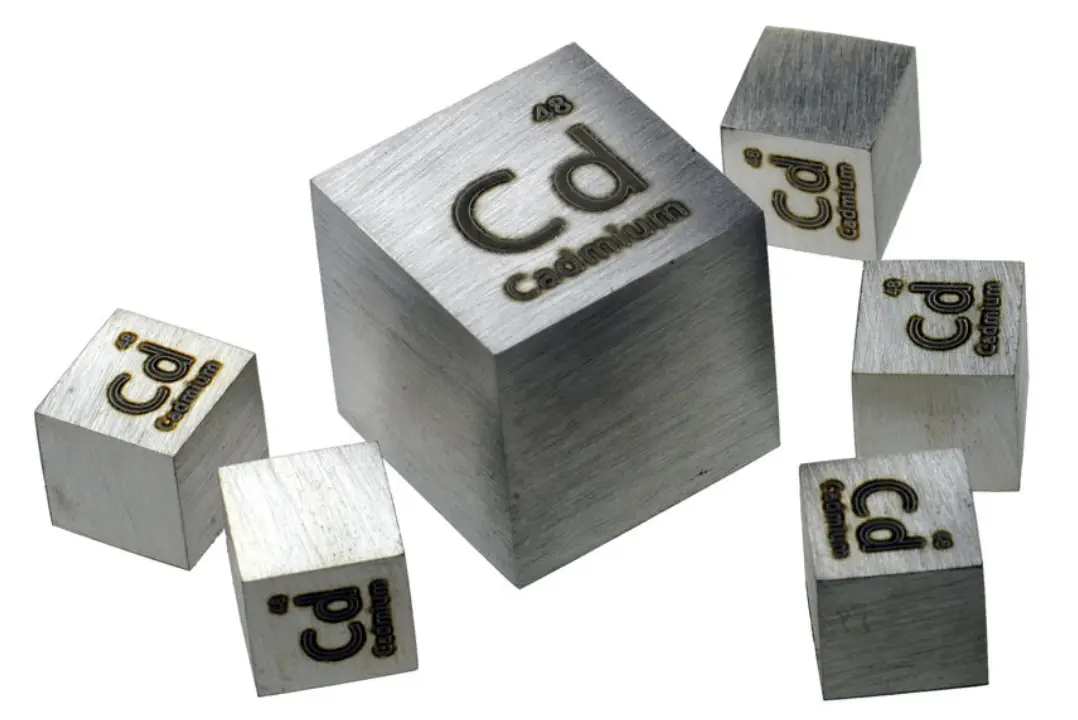
Cadmium is a soft, bluish-white metal is chemically similar to the two other stable metals in group 12, zinc and mercury. In nuclear industry cadmium is commonly used as a thermal neutron absorber due to very high neutron absorption cross-section of 113Cd. 113Cd has specific absorption cross-section.

Summary

Element Cadmium
Atomic number 48
Element category Transition Metal
Phase at STP Solid
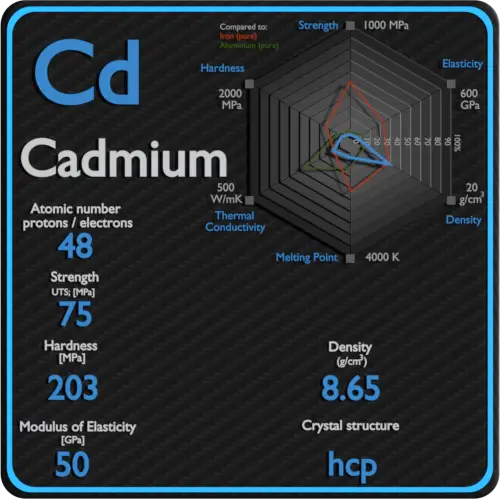
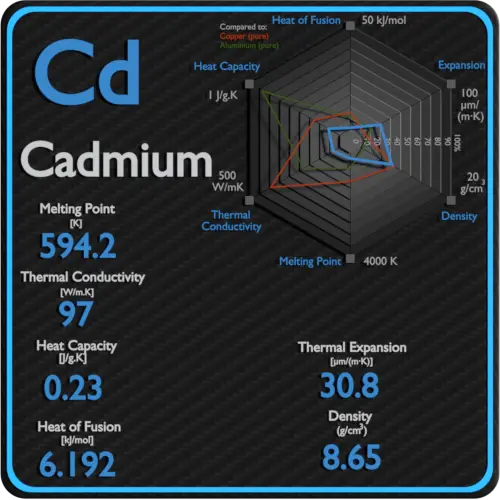
Density 8.65 g/cm3
Ultimate Tensile Strength 75 MPa
Yield Strength N/A
Young’s Modulus of Elasticity 50 GPa
Mohs Scale 2
Brinell Hardness 203 MPa
Vickers Hardness N/A
Melting Point 321.07 °C
Boiling Point 767 °C
Thermal Conductivity 97 W/mK
Thermal Expansion Coefficient 30.8 µm/mK
Specific Heat 0.23 J/g K
Heat of Fusion 6.192 kJ/mol
Heat of Vaporization 99.57 kJ/mol
Electrical resistivity [nanoOhm meter] 72.7
Magnetic Susceptibility −20e-6 cm^3/mol

Applications of Cadmium

Cadmium is primarily consumed for the production of rechargeable nickel cadmium batteries. In 2009, 86% of cadmium was used in batteries, predominantly in rechargeable nickel-cadmium batteries. Other end uses include pigments, coatings and plating, and as stabilizers for plastics. Solar cell manufacturing may become another significant market for cadmium in the future. In nuclear industry cadmium is commonly used as a thermal neutron absorber due to very high neutron absorption cross-section of 113Cd. 113Cd has specific absorption cross-section.

Cadmium-applications

Production and Price of Cadmium

Raw materials prices change daily. They are primarily driven by supply, demand and energy prices. In 2019, prices of pure Cadmium were at around 60 $/kg.

Cadmium is generally recovered as a byproduct from zinc concentrates. Zinc-to-cadmium ratios in typical zinc ores range from 200:1 to 400:1. Sphalerite (ZnS), the most economically significant zinc mineral, commonly contains minor amounts of other elements; cadmium, which shares certain similar chemical properties with zinc, will often substitute for zinc in the sphalerite crystal lattice.

Cadmium-periodic-table

Source: www.luciteria.com

Mechanical Properties of Cadmium

Cadmium-mechanical-properties-strength-hardness-crystal-structure

Strength of Cadmium

In mechanics of materials, the strength of a material is its ability to withstand an applied load without failure or plastic deformation. Strength of materials basically considers the relationship between the external loads applied to a material and the resulting deformation or change in material dimensions. In designing structures and machines, it is important to consider these factors, in order that the material selected will have adequate strength to resist applied loads or forces and retain its original shape. Strength of a material is its ability to withstand this applied load without failure or plastic deformation.

For tensile stress, the capacity of a material or structure to withstand loads tending to elongate is known as ultimate tensile strength (UTS). Yield strength or yield stress is the material property defined as the stress at which a material begins to deform plastically whereas yield point is the point where nonlinear (elastic + plastic) deformation begins.

See also: Strength of Materials

Ultimate Tensile Strength of Cadmium

Ultimate tensile strength of Cadmium is 75 MPa.

Yield Strength of Cadmium

Yield strength of Cadmium is N/A.

Modulus of Elasticity of Cadmium

The Young’s modulus of elasticity of Cadmium is N/A.

Hardness of Cadmium

In materials science, hardness is the ability to withstand surface indentation (localized plastic deformation) and scratching. Brinell hardness test is one of indentation hardness tests, that has been developed for hardness testing. In Brinell tests, a hard, spherical indenter is forced under a specific load into the surface of the metal to be tested.

Brinell hardness of Cadmium is approximately 203 MPa.

The Vickers hardness test method was developed by Robert L. Smith and George E. Sandland at Vickers Ltd as an alternative to the Brinell method to measure the hardness of materials. The Vickers hardness test method can be also used as a microhardness test method, which is mostly used for small parts, thin sections, or case depth work.

Vickers hardness of Cadmium is approximately N/A.

Scratch hardness is the measure of how resistant a sample is to permanent plastic deformation due to friction from a sharp object. The most common scale for this qualitative test is Mohs scale, which is used in mineralogy. The Mohs scale of mineral hardness is based on the ability of one natural sample of mineral to scratch another mineral visibly.

Cadmium is has a hardness of approximately 2.

See also: Hardness of Materials

Cadmium – Crystal Structure

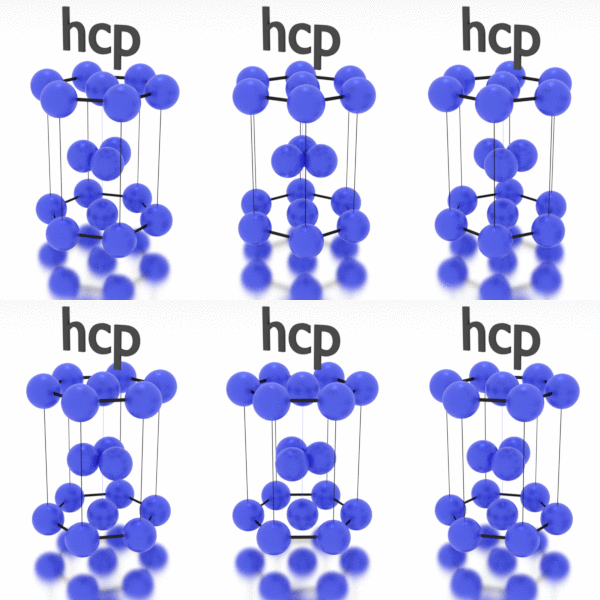
A possible crystal structure of Cadmium is hexagonal close-packed structure.

crystal structures - FCC, BCC, HCP

In metals, and in many other solids, the atoms are arranged in regular arrays called crystals. A crystal lattice is a repeating pattern of mathematical points that extends throughout space. The forces of chemical bonding causes this repetition. It is this repeated pattern which control properties like strength, ductility, density, conductivity (property of conducting or transmitting heat, electricity, etc.), and shape. There are 14 general types of such patterns known as Bravais lattices.

See also: Crystal Structure of Materials

Crystal Structure of Cadmium
Crystal Structure of Cadmium is: hexagonal close-packed

Strength of Elements

Elasticity of Elements

Hardness of Elements


Thermal Properties of Cadmium

Cadmium-melting-point-conductivity-thermal-properties

Cadmium – Melting Point and Boiling Point

Melting point of Cadmium is 321.07°C.

Boiling point of Cadmium is 767°C.

Note that, these points are associated with the standard atmospheric pressure.

Cadmium – Thermal Conductivity

Thermal conductivity of Cadmium is 97 W/(m·K).

The heat transfer characteristics of a solid material are measured by a property called the thermal conductivity, k (or λ), measured in W/m.K. It is a measure of a substance’s ability to transfer heat through a material by conduction. Note that Fourier’s law applies for all matter, regardless of its state (solid, liquid, or gas), therefore, it is also defined for liquids and gases.

Coefficient of Thermal Expansion of Cadmium

Linear thermal expansion coefficient of Cadmium is 30.8 µm/(m·K)

Thermal expansion is generally the tendency of matter to change its dimensions in response to a change in temperature. It is usually expressed as a fractional change in length or volume per unit temperature change.

Cadmium – Specific Heat, Latent Heat of Fusion, Latent Heat of Vaporization

Specific heat of Cadmium is 0.23 J/g K.

Heat capacity is an extensive property of matter, meaning it is proportional to the size of the system. Heat capacity C has the unit of energy per degree or energy per kelvin. When expressing the same phenomenon as an intensive property, the heat capacity is divided by the amount of substance, mass, or volume, thus the quantity is independent of the size or extent of the sample.

Latent Heat of Fusion of Cadmium is 6.192 kJ/mol.

Latent Heat of Vaporization of Cadmium is 99.57 kJ/mol.

Latent heat is the amount of heat added to or removed from a substance to produce a change in phase. This energy breaks down the intermolecular attractive forces, and also must provide the energy necessary to expand the gas (the pΔV work). When latent heat is added, no temperature change occurs. The enthalpy of vaporization is a function of the pressure at which that transformation takes place.

Melting Point of Elements

Periodic Table of Elements - melting point

Thermal Conductivity of Elements

Periodic Table of Elements - thermal conductivity

Thermal Expansion of Elements

Periodic Table of Elements - thermal expansion

Heat Capacity of Elements

Periodic Table of Elements - heat capacity

Heat of Fusion of Elements

Periodic Table of Elements - latent heat fusion

Heat of Vaporization of Elements

Periodic Table of Elements - latent heat vaporization

Cadmium – Electrical Resistivity – Magnetic Susceptibility

Cadmium-electrical-resistivity-magnetic-susceptibility

Electrical property refers to the response of a material to an applied electric field. One of the principal characteristics of materials is their ability (or lack of ability) to conduct electrical current. Indeed, materials are classified by this property, that is, they are divided into conductors, semiconductors, and nonconductors.

See also: Electrical Properties

Magnetic property refers to the response of a material to an applied magnetic field. The macroscopic magnetic properties of a material are a consequence of interactions between an external magnetic field and the magnetic dipole moments of the constituent atoms. Different materials react to the application of magnetic field differently.

See also: Magnetic Properties

Electrical Resistivity of Cadmium

Electrical resistivity of Cadmium is 72.7 nΩ⋅m.

Electrical conductivity and its converse, electrical resistivity, is a fundamental property of a material that quantifies how Cadmium conducts the flow of electric current. Electrical conductivity or specific conductance is the reciprocal of electrical resistivity.

Magnetic Susceptibility of Cadmium

Magnetic susceptibility of Cadmium is −20e-6 cm^3/mol.

In electromagnetism, magnetic susceptibility is the measure of the magnetization of a substance. Magnetic susceptibility is a dimensionless proportionality factor that indicates the degree of magnetization of Cadmium in response to an applied magnetic field.

Electrical Resistivity of Elements

Periodic Table of Elements - electrical resistivity

Magnetic Susceptibility of Elements

Application and prices of other elements

Cadmium - Comparison of Properties and Prices

Periodic Table in 8K resolution

Other properties of Cadmium


Silver – Properties – Price – Applications – Production

Silver-properties-price-application-production

About Silver

Silver is a soft, white, lustrous transition metal, it exhibits the highest electrical conductivity, thermal conductivity, and reflectivity of any metal. The metal is found in the Earth’s crust in the pure, free elemental form (“native silver”), as an alloy with gold and other metals, and in minerals such as argentite and chlorargyrite. Most silver is produced as a byproduct of copper, gold, lead, and zinc refining.

Summary

Element Silver
Atomic number 47
Element category Transition Metal
Phase at STP Solid
Density 10.49 g/cm3
Ultimate Tensile Strength 110 MPa
Yield Strength 45 MPa
Young’s Modulus of Elasticity 83 GPa
Mohs Scale 3.25
Brinell Hardness 210 MPa
Vickers Hardness 251 MPa
Melting Point 961.78 °C
Boiling Point 2162 °C
Thermal Conductivity 430 W/mK
Thermal Expansion Coefficient 18.9 µm/mK
Specific Heat 0.235 J/g K
Heat of Fusion 11.3 kJ/mol
Heat of Vaporization 250.58 kJ/mol
Electrical resistivity [nanoOhm meter] 15.9
Magnetic Susceptibility −19e-6 cm^3/mol

Applications of Silver

Silver has long been valued as a precious metal. Silver metal is used in many bullion coins, sometimes alongside gold. Silver has many important, far-reaching technological and electronic applications. It’s used in everything from cell phones, computers and semiconductors to automobiles, water-purification systems and—because it is the best conductor of heat of all elements—spacecraft solar radiation tiles. Silver is of the upmost importance in photography (where approximately 30% of the U.S. Industrial consumption goes into this application). The medical uses of silver include its use in wound dressings, creams, and as an antibiotic coating on medical devices. Wound dressings containing silver sulfadiazine or silver nanomaterials may be used on external infections.

Silver-applications

Production and Price of Silver

Raw materials prices change daily. They are primarily driven by supply, demand and energy prices. In 2019, prices of pure Silver were at around 580 $/kg.

The principal sources of silver are the ores of copper, copper-nickel, lead, and lead-zinc obtained from Peru, Bolivia, Mexico, China, Australia, Chile, Poland and Serbia. Commercial-grade fine silver is at least 99.9% pure, and purities greater than 99.999% are available. In 2014, Mexico was the top producer of silver (5,000 tonnes or 18.7% of the world’s total of 26,800 t), followed by China (4,060 t) and Peru (3,780 t). Today, silver metal is primarily produced instead as a secondary byproduct of electrolytic refining of copper, lead, and zinc, and by application of the Parkes process on lead bullion from ore that also contains silver.

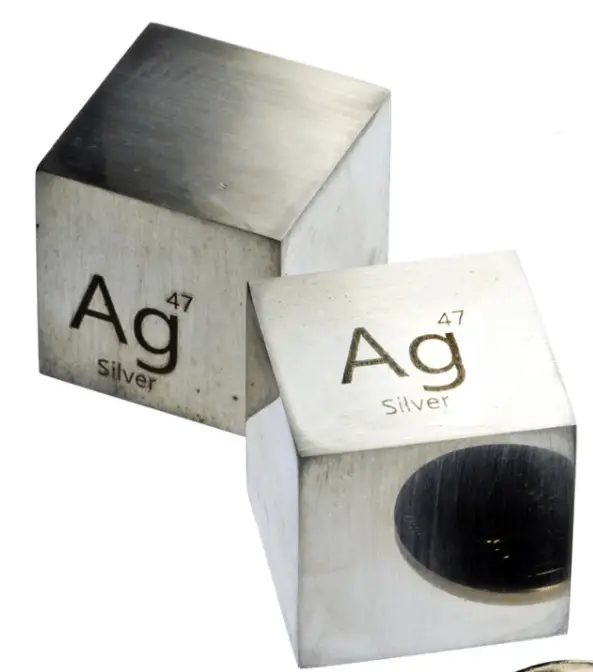
Silver-periodic-table

Source: www.luciteria.com

Mechanical Properties of Silver

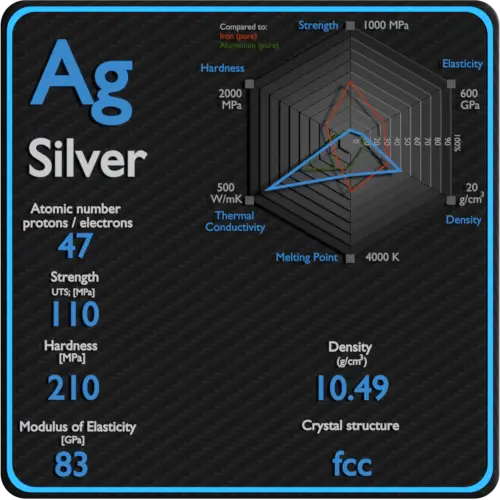
Silver-mechanical-properties-strength-hardness-crystal-structure

Strength of Silver

In mechanics of materials, the strength of a material is its ability to withstand an applied load without failure or plastic deformation. Strength of materials basically considers the relationship between the external loads applied to a material and the resulting deformation or change in material dimensions. In designing structures and machines, it is important to consider these factors, in order that the material selected will have adequate strength to resist applied loads or forces and retain its original shape. Strength of a material is its ability to withstand this applied load without failure or plastic deformation.

For tensile stress, the capacity of a material or structure to withstand loads tending to elongate is known as ultimate tensile strength (UTS). Yield strength or yield stress is the material property defined as the stress at which a material begins to deform plastically whereas yield point is the point where nonlinear (elastic + plastic) deformation begins.

See also: Strength of Materials

Ultimate Tensile Strength of Silver

Ultimate tensile strength of Silver is 110 MPa.

Yield Strength of Silver

Yield strength of Silver is 45 MPa.

Modulus of Elasticity of Silver

The Young’s modulus of elasticity of Silver is 45 MPa.

Hardness of Silver

In materials science, hardness is the ability to withstand surface indentation (localized plastic deformation) and scratching. Brinell hardness test is one of indentation hardness tests, that has been developed for hardness testing. In Brinell tests, a hard, spherical indenter is forced under a specific load into the surface of the metal to be tested.

Brinell hardness of Silver is approximately 210 MPa.

The Vickers hardness test method was developed by Robert L. Smith and George E. Sandland at Vickers Ltd as an alternative to the Brinell method to measure the hardness of materials. The Vickers hardness test method can be also used as a microhardness test method, which is mostly used for small parts, thin sections, or case depth work.

Vickers hardness of Silver is approximately 251 MPa.

Scratch hardness is the measure of how resistant a sample is to permanent plastic deformation due to friction from a sharp object. The most common scale for this qualitative test is Mohs scale, which is used in mineralogy. The Mohs scale of mineral hardness is based on the ability of one natural sample of mineral to scratch another mineral visibly.

Silver is has a hardness of approximately 3.25.

See also: Hardness of Materials

Silver – Crystal Structure

A possible crystal structure of Silver is face-centered cubic structure.

crystal structures - FCC, BCC, HCP

In metals, and in many other solids, the atoms are arranged in regular arrays called crystals. A crystal lattice is a repeating pattern of mathematical points that extends throughout space. The forces of chemical bonding causes this repetition. It is this repeated pattern which control properties like strength, ductility, density, conductivity (property of conducting or transmitting heat, electricity, etc.), and shape. There are 14 general types of such patterns known as Bravais lattices.

See also: Crystal Structure of Materials

Crystal Structure of Silver
Crystal Structure of Silver is: face-centered cubic

Strength of Elements

Elasticity of Elements

Hardness of Elements


Thermal Properties of Silver

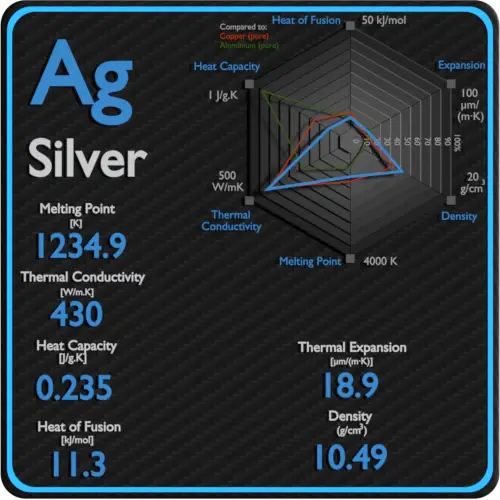
Silver-melting-point-conductivity-thermal-properties

Silver – Melting Point and Boiling Point

Melting point of Silver is 961.78°C.

Boiling point of Silver is 2162°C.

Note that, these points are associated with the standard atmospheric pressure.

Silver – Thermal Conductivity

Thermal conductivity of Silver is 430 W/(m·K).

The heat transfer characteristics of a solid material are measured by a property called the thermal conductivity, k (or λ), measured in W/m.K. It is a measure of a substance’s ability to transfer heat through a material by conduction. Note that Fourier’s law applies for all matter, regardless of its state (solid, liquid, or gas), therefore, it is also defined for liquids and gases.

Coefficient of Thermal Expansion of Silver

Linear thermal expansion coefficient of Silver is 18.9 µm/(m·K)

Thermal expansion is generally the tendency of matter to change its dimensions in response to a change in temperature. It is usually expressed as a fractional change in length or volume per unit temperature change.

Silver – Specific Heat, Latent Heat of Fusion, Latent Heat of Vaporization

Specific heat of Silver is 0.235 J/g K.

Heat capacity is an extensive property of matter, meaning it is proportional to the size of the system. Heat capacity C has the unit of energy per degree or energy per kelvin. When expressing the same phenomenon as an intensive property, the heat capacity is divided by the amount of substance, mass, or volume, thus the quantity is independent of the size or extent of the sample.

Latent Heat of Fusion of Silver is 11.3 kJ/mol.

Latent Heat of Vaporization of Silver is 250.58 kJ/mol.

Latent heat is the amount of heat added to or removed from a substance to produce a change in phase. This energy breaks down the intermolecular attractive forces, and also must provide the energy necessary to expand the gas (the pΔV work). When latent heat is added, no temperature change occurs. The enthalpy of vaporization is a function of the pressure at which that transformation takes place.

Melting Point of Elements

Periodic Table of Elements - melting point

Thermal Conductivity of Elements

Periodic Table of Elements - thermal conductivity

Thermal Expansion of Elements

Periodic Table of Elements - thermal expansion

Heat Capacity of Elements

Periodic Table of Elements - heat capacity

Heat of Fusion of Elements

Periodic Table of Elements - latent heat fusion

Heat of Vaporization of Elements

Periodic Table of Elements - latent heat vaporization

Silver – Electrical Resistivity – Magnetic Susceptibility

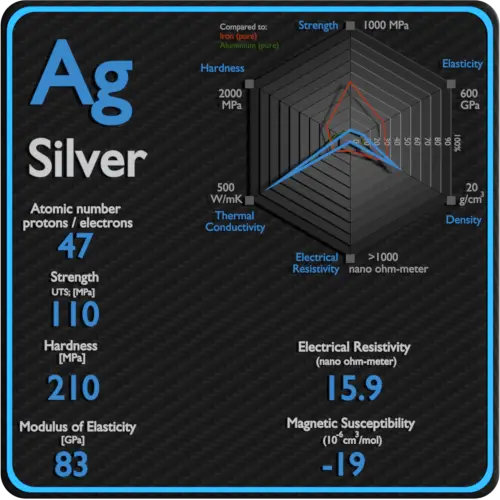
Silver-electrical-resistivity-magnetic-susceptibility

Electrical property refers to the response of a material to an applied electric field. One of the principal characteristics of materials is their ability (or lack of ability) to conduct electrical current. Indeed, materials are classified by this property, that is, they are divided into conductors, semiconductors, and nonconductors.

See also: Electrical Properties

Magnetic property refers to the response of a material to an applied magnetic field. The macroscopic magnetic properties of a material are a consequence of interactions between an external magnetic field and the magnetic dipole moments of the constituent atoms. Different materials react to the application of magnetic field differently.

See also: Magnetic Properties

Electrical Resistivity of Silver

Electrical resistivity of Silver is 15.9 nΩ⋅m.

Electrical conductivity and its converse, electrical resistivity, is a fundamental property of a material that quantifies how Silver conducts the flow of electric current. Electrical conductivity or specific conductance is the reciprocal of electrical resistivity.

Magnetic Susceptibility of Silver

Magnetic susceptibility of Silver is −19e-6 cm^3/mol.

In electromagnetism, magnetic susceptibility is the measure of the magnetization of a substance. Magnetic susceptibility is a dimensionless proportionality factor that indicates the degree of magnetization of Silver in response to an applied magnetic field.

Electrical Resistivity of Elements

Periodic Table of Elements - electrical resistivity

Magnetic Susceptibility of Elements

Application and prices of other elements

Silver - Comparison of Properties and Prices

Periodic Table in 8K resolution

Other properties of Silver


Palladium – Properties – Price – Applications – Production

Palladium-properties-price-application-production

About Palladium

Palladium, platinum, rhodium, ruthenium, iridium and osmium form a group of elements referred to as the platinum group metals (PGMs). These have similar chemical properties, but palladium has the lowest melting point and is the least dense of them. More than half the supply of palladium and its congener platinum is used in catalytic converters.

Summary

Element Palladium
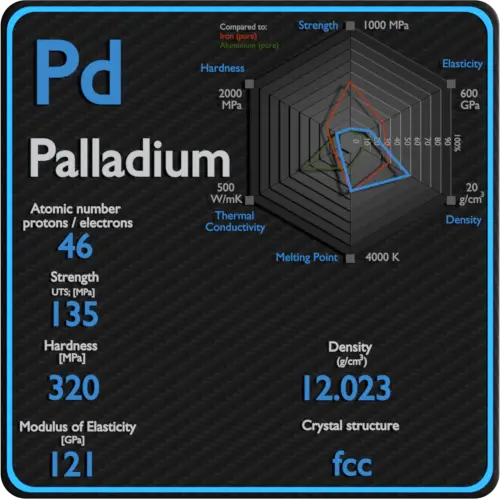
Atomic number 46
Element category Transition Metal
Phase at STP Solid
Density 12.023 g/cm3
Ultimate Tensile Strength 135 MPa
Yield Strength 30 MPa
Young’s Modulus of Elasticity 121 GPa
Mohs Scale 4.8
Brinell Hardness 320 MPa
Vickers Hardness 400 MPa
Melting Point 1554.9 °C
Boiling Point 2963 °C
Thermal Conductivity 72 W/mK
Thermal Expansion Coefficient 11.8 µm/mK
Specific Heat 0.24 J/g K
Heat of Fusion 17.6 kJ/mol
Heat of Vaporization 357 kJ/mol
Electrical resistivity [nanoOhm meter] 105
Magnetic Susceptibility +567e-6 cm^3/mol

Applications of Palladium

More than half the supply of palladium and its congener platinum is used in catalytic converters, which convert as much as 90% of the harmful gases in automobile exhaust into less noxious substances. Palladium is also used in electronics, dentistry, medicine, hydrogen purification, chemical applications, groundwater treatment, and jewelry. Palladium-based alloys are being extensively used in fuel cell technology applications. The metal is also employed in historic photographic printing process. Palladium has been used as a precious metal in jewelry since 1939 as an alternative to platinum in the alloys called “white gold”.

Palladium-applications

Production and Price of Palladium

Raw materials prices change daily. They are primarily driven by supply, demand and energy prices. In 2019, prices of pure Palladium were at around 48000 $/kg.

As overall mine production of palladium reached 208,000 kilograms in 2016, Russia was the top producer with 82,000 kilograms, followed by South Africa, Canada and the U.S. Russia’s company Norilsk Nickel ranks first among the largest palladium producers globally, accounting for 39% of the world’s production. The most important commercial sources are nickel-copper deposits found in the Sudbury Basin, Ontario, and the Norilsk–Talnakh deposits in Siberia.

Palladium-periodic-table

Source: www.luciteria.com

Mechanical Properties of Palladium

Palladium-mechanical-properties-strength-hardness-crystal-structure

Strength of Palladium

In mechanics of materials, the strength of a material is its ability to withstand an applied load without failure or plastic deformation. Strength of materials basically considers the relationship between the external loads applied to a material and the resulting deformation or change in material dimensions. In designing structures and machines, it is important to consider these factors, in order that the material selected will have adequate strength to resist applied loads or forces and retain its original shape. Strength of a material is its ability to withstand this applied load without failure or plastic deformation.

For tensile stress, the capacity of a material or structure to withstand loads tending to elongate is known as ultimate tensile strength (UTS). Yield strength or yield stress is the material property defined as the stress at which a material begins to deform plastically whereas yield point is the point where nonlinear (elastic + plastic) deformation begins.

See also: Strength of Materials

Ultimate Tensile Strength of Palladium

Ultimate tensile strength of Palladium is 135 MPa.

Yield Strength of Palladium

Yield strength of Palladium is 30 MPa.

Modulus of Elasticity of Palladium

The Young’s modulus of elasticity of Palladium is 30 MPa.

Hardness of Palladium

In materials science, hardness is the ability to withstand surface indentation (localized plastic deformation) and scratching. Brinell hardness test is one of indentation hardness tests, that has been developed for hardness testing. In Brinell tests, a hard, spherical indenter is forced under a specific load into the surface of the metal to be tested.

Brinell hardness of Palladium is approximately 320 MPa.

The Vickers hardness test method was developed by Robert L. Smith and George E. Sandland at Vickers Ltd as an alternative to the Brinell method to measure the hardness of materials. The Vickers hardness test method can be also used as a microhardness test method, which is mostly used for small parts, thin sections, or case depth work.

Vickers hardness of Palladium is approximately 400 MPa.

Scratch hardness is the measure of how resistant a sample is to permanent plastic deformation due to friction from a sharp object. The most common scale for this qualitative test is Mohs scale, which is used in mineralogy. The Mohs scale of mineral hardness is based on the ability of one natural sample of mineral to scratch another mineral visibly.

Palladium is has a hardness of approximately 4.8.

See also: Hardness of Materials

Palladium – Crystal Structure

A possible crystal structure of Palladium is face-centered cubic structure.

crystal structures - FCC, BCC, HCP

In metals, and in many other solids, the atoms are arranged in regular arrays called crystals. A crystal lattice is a repeating pattern of mathematical points that extends throughout space. The forces of chemical bonding causes this repetition. It is this repeated pattern which control properties like strength, ductility, density, conductivity (property of conducting or transmitting heat, electricity, etc.), and shape. There are 14 general types of such patterns known as Bravais lattices.

See also: Crystal Structure of Materials

Crystal Structure of Palladium
Crystal Structure of Palladium is: face-centered cubic

Strength of Elements

Elasticity of Elements

Hardness of Elements


Thermal Properties of Palladium

Palladium-melting-point-conductivity-thermal-properties

Palladium – Melting Point and Boiling Point

Melting point of Palladium is 1554.9°C.

Boiling point of Palladium is 2963°C.

Note that, these points are associated with the standard atmospheric pressure.

Palladium – Thermal Conductivity

Thermal conductivity of Palladium is 72 W/(m·K).

The heat transfer characteristics of a solid material are measured by a property called the thermal conductivity, k (or λ), measured in W/m.K. It is a measure of a substance’s ability to transfer heat through a material by conduction. Note that Fourier’s law applies for all matter, regardless of its state (solid, liquid, or gas), therefore, it is also defined for liquids and gases.

Coefficient of Thermal Expansion of Palladium

Linear thermal expansion coefficient of Palladium is 11.8 µm/(m·K)

Thermal expansion is generally the tendency of matter to change its dimensions in response to a change in temperature. It is usually expressed as a fractional change in length or volume per unit temperature change.

Palladium – Specific Heat, Latent Heat of Fusion, Latent Heat of Vaporization

Specific heat of Palladium is 0.24 J/g K.

Heat capacity is an extensive property of matter, meaning it is proportional to the size of the system. Heat capacity C has the unit of energy per degree or energy per kelvin. When expressing the same phenomenon as an intensive property, the heat capacity is divided by the amount of substance, mass, or volume, thus the quantity is independent of the size or extent of the sample.

Latent Heat of Fusion of Palladium is 17.6 kJ/mol.

Latent Heat of Vaporization of Palladium is 357 kJ/mol.

Latent heat is the amount of heat added to or removed from a substance to produce a change in phase. This energy breaks down the intermolecular attractive forces, and also must provide the energy necessary to expand the gas (the pΔV work). When latent heat is added, no temperature change occurs. The enthalpy of vaporization is a function of the pressure at which that transformation takes place.

Melting Point of Elements

Periodic Table of Elements - melting point

Thermal Conductivity of Elements

Periodic Table of Elements - thermal conductivity

Thermal Expansion of Elements

Periodic Table of Elements - thermal expansion

Heat Capacity of Elements

Periodic Table of Elements - heat capacity

Heat of Fusion of Elements

Periodic Table of Elements - latent heat fusion

Heat of Vaporization of Elements

Periodic Table of Elements - latent heat vaporization

Palladium – Electrical Resistivity – Magnetic Susceptibility

Palladium-electrical-resistivity-magnetic-susceptibility

Electrical property refers to the response of a material to an applied electric field. One of the principal characteristics of materials is their ability (or lack of ability) to conduct electrical current. Indeed, materials are classified by this property, that is, they are divided into conductors, semiconductors, and nonconductors.

See also: Electrical Properties

Magnetic property refers to the response of a material to an applied magnetic field. The macroscopic magnetic properties of a material are a consequence of interactions between an external magnetic field and the magnetic dipole moments of the constituent atoms. Different materials react to the application of magnetic field differently.

See also: Magnetic Properties

Electrical Resistivity of Palladium

Electrical resistivity of Palladium is 105 nΩ⋅m.

Electrical conductivity and its converse, electrical resistivity, is a fundamental property of a material that quantifies how Palladium conducts the flow of electric current. Electrical conductivity or specific conductance is the reciprocal of electrical resistivity.

Magnetic Susceptibility of Palladium

Magnetic susceptibility of Palladium is +567e-6 cm^3/mol.

In electromagnetism, magnetic susceptibility is the measure of the magnetization of a substance. Magnetic susceptibility is a dimensionless proportionality factor that indicates the degree of magnetization of Palladium in response to an applied magnetic field.

Electrical Resistivity of Elements

Periodic Table of Elements - electrical resistivity

Magnetic Susceptibility of Elements

Application and prices of other elements

Palladium - Comparison of Properties and Prices

Periodic Table in 8K resolution

Other properties of Palladium


Rhodium – Properties – Price – Applications – Production

Rhodium-properties-price-application-production

About Rhodium

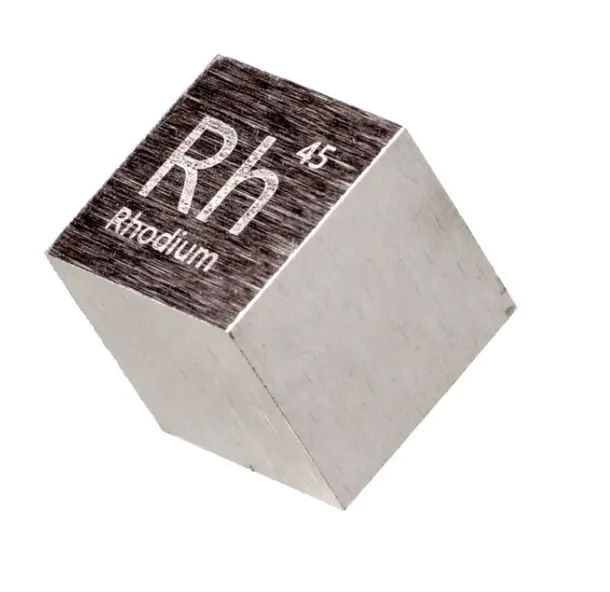
Rhodium is a rare, silvery-white, hard, corrosion resistant and chemically inert transition metal. It is a noble metal and a member of the platinum group.

Summary

Element Rhodium
Atomic number 45
Element category Transition Metal
Phase at STP Solid
Density 12.45 g/cm3
Ultimate Tensile Strength 950 MPa
Yield Strength N/A
Young’s Modulus of Elasticity 380 GPa
Mohs Scale 6
Brinell Hardness 1100 MPa
Vickers Hardness 1246 MPa
Melting Point 1964 °C
Boiling Point 3695 °C
Thermal Conductivity 150 W/mK
Thermal Expansion Coefficient 8.2 µm/mK
Specific Heat 0.242 J/g K
Heat of Fusion 21.5 kJ/mol
Heat of Vaporization 493 kJ/mol
Electrical resistivity [nanoOhm meter] 43.3
Magnetic Susceptibility +111e-6 cm^3/mol

Applications of Rhodium

The element’s major use (approximately 80% of world rhodium production) is as one of the catalysts in the three-way catalytic converters in automobiles. Because rhodium metal is inert against corrosion and most aggressive chemicals, and because of its rarity, rhodium is usually alloyed with platinum or palladium and applied in high-temperature and corrosion-resistive coatings. In nuclear reactors, rhodium-based detectors are often used for incore neutron flux measuring.

Rhodium-applications

Production and Price of Rhodium

Raw materials prices change daily. They are primarily driven by supply, demand and energy prices. In 2019, prices of pure Rhodium were at around 180000 $/kg.

Of 30,000 kg of rhodium consumed worldwide in 2012, 81% (24,300 kg) went into this application, and 8,060 kg was recovered from old converters. About 964 kg of rhodium was used in the glass industry, mostly for production of fiberglass and flat-panel glass, and 2,520 kg was used in the chemical industry. Rhodium is one of the rarest elements in the Earth’s crust. Its rarity affects its price and its use in commercial applications. The industrial extraction of rhodium is complex because the ores are mixed with other metals such as palladium, silver, platinum, and gold and there are very few rhodium-bearing minerals. The price of rhodium is highly variable. In 2007, rhodium cost approximately eight times more than gold, 450 times more than silver, and 27,250 times more than copper by weight. In 2008, the price briefly rose above $10,000 per ounce ($350,000 per kilogram). The economic slowdown of the 3rd quarter of 2008 pushed rhodium prices sharply back below $1,000 per ounce ($35,000 per kilogram); the price rebounded to $2,750 by early 2010 ($97,000 per kilogram) (more than twice the gold price), but in late 2013, the prices were less than $1000.

Rhodium-periodic-table

Source: www.luciteria.com

Mechanical Properties of Rhodium

Rhodium-mechanical-properties-strength-hardness-crystal-structure

Strength of Rhodium

In mechanics of materials, the strength of a material is its ability to withstand an applied load without failure or plastic deformation. Strength of materials basically considers the relationship between the external loads applied to a material and the resulting deformation or change in material dimensions. In designing structures and machines, it is important to consider these factors, in order that the material selected will have adequate strength to resist applied loads or forces and retain its original shape. Strength of a material is its ability to withstand this applied load without failure or plastic deformation.

For tensile stress, the capacity of a material or structure to withstand loads tending to elongate is known as ultimate tensile strength (UTS). Yield strength or yield stress is the material property defined as the stress at which a material begins to deform plastically whereas yield point is the point where nonlinear (elastic + plastic) deformation begins.

See also: Strength of Materials

Ultimate Tensile Strength of Rhodium

Ultimate tensile strength of Rhodium is 950 MPa.

Yield Strength of Rhodium

Yield strength of Rhodium is N/A.

Modulus of Elasticity of Rhodium

The Young’s modulus of elasticity of Rhodium is N/A.

Hardness of Rhodium

In materials science, hardness is the ability to withstand surface indentation (localized plastic deformation) and scratching. Brinell hardness test is one of indentation hardness tests, that has been developed for hardness testing. In Brinell tests, a hard, spherical indenter is forced under a specific load into the surface of the metal to be tested.

Brinell hardness of Rhodium is approximately 1100 MPa.

The Vickers hardness test method was developed by Robert L. Smith and George E. Sandland at Vickers Ltd as an alternative to the Brinell method to measure the hardness of materials. The Vickers hardness test method can be also used as a microhardness test method, which is mostly used for small parts, thin sections, or case depth work.

Vickers hardness of Rhodium is approximately 1246 MPa.

Scratch hardness is the measure of how resistant a sample is to permanent plastic deformation due to friction from a sharp object. The most common scale for this qualitative test is Mohs scale, which is used in mineralogy. The Mohs scale of mineral hardness is based on the ability of one natural sample of mineral to scratch another mineral visibly.

Rhodium is has a hardness of approximately 6.

See also: Hardness of Materials

Rhodium – Crystal Structure

A possible crystal structure of Rhodium is face-centered cubic structure.

crystal structures - FCC, BCC, HCP

In metals, and in many other solids, the atoms are arranged in regular arrays called crystals. A crystal lattice is a repeating pattern of mathematical points that extends throughout space. The forces of chemical bonding causes this repetition. It is this repeated pattern which control properties like strength, ductility, density, conductivity (property of conducting or transmitting heat, electricity, etc.), and shape. There are 14 general types of such patterns known as Bravais lattices.

See also: Crystal Structure of Materials

Crystal Structure of Rhodium
Crystal Structure of Rhodium is: face-centered cubic

Strength of Elements

Elasticity of Elements

Hardness of Elements


Thermal Properties of Rhodium

Rhodium-melting-point-conductivity-thermal-properties

Rhodium – Melting Point and Boiling Point

Melting point of Rhodium is 1964°C.

Boiling point of Rhodium is 3695°C.

Note that, these points are associated with the standard atmospheric pressure.

Rhodium – Thermal Conductivity

Thermal conductivity of Rhodium is 150 W/(m·K).

The heat transfer characteristics of a solid material are measured by a property called the thermal conductivity, k (or λ), measured in W/m.K. It is a measure of a substance’s ability to transfer heat through a material by conduction. Note that Fourier’s law applies for all matter, regardless of its state (solid, liquid, or gas), therefore, it is also defined for liquids and gases.

Coefficient of Thermal Expansion of Rhodium

Linear thermal expansion coefficient of Rhodium is 8.2 µm/(m·K)

Thermal expansion is generally the tendency of matter to change its dimensions in response to a change in temperature. It is usually expressed as a fractional change in length or volume per unit temperature change.

Rhodium – Specific Heat, Latent Heat of Fusion, Latent Heat of Vaporization

Specific heat of Rhodium is 0.242 J/g K.

Heat capacity is an extensive property of matter, meaning it is proportional to the size of the system. Heat capacity C has the unit of energy per degree or energy per kelvin. When expressing the same phenomenon as an intensive property, the heat capacity is divided by the amount of substance, mass, or volume, thus the quantity is independent of the size or extent of the sample.

Latent Heat of Fusion of Rhodium is 21.5 kJ/mol.

Latent Heat of Vaporization of Rhodium is 493 kJ/mol.

Latent heat is the amount of heat added to or removed from a substance to produce a change in phase. This energy breaks down the intermolecular attractive forces, and also must provide the energy necessary to expand the gas (the pΔV work). When latent heat is added, no temperature change occurs. The enthalpy of vaporization is a function of the pressure at which that transformation takes place.

Melting Point of Elements

Periodic Table of Elements - melting point

Thermal Conductivity of Elements

Periodic Table of Elements - thermal conductivity

Thermal Expansion of Elements

Periodic Table of Elements - thermal expansion

Heat Capacity of Elements

Periodic Table of Elements - heat capacity

Heat of Fusion of Elements

Periodic Table of Elements - latent heat fusion

Heat of Vaporization of Elements

Periodic Table of Elements - latent heat vaporization

Rhodium – Electrical Resistivity – Magnetic Susceptibility

Rhodium-electrical-resistivity-magnetic-susceptibility

Electrical property refers to the response of a material to an applied electric field. One of the principal characteristics of materials is their ability (or lack of ability) to conduct electrical current. Indeed, materials are classified by this property, that is, they are divided into conductors, semiconductors, and nonconductors.

See also: Electrical Properties

Magnetic property refers to the response of a material to an applied magnetic field. The macroscopic magnetic properties of a material are a consequence of interactions between an external magnetic field and the magnetic dipole moments of the constituent atoms. Different materials react to the application of magnetic field differently.

See also: Magnetic Properties

Electrical Resistivity of Rhodium

Electrical resistivity of Rhodium is 43.3 nΩ⋅m.

Electrical conductivity and its converse, electrical resistivity, is a fundamental property of a material that quantifies how Rhodium conducts the flow of electric current. Electrical conductivity or specific conductance is the reciprocal of electrical resistivity.

Magnetic Susceptibility of Rhodium

Magnetic susceptibility of Rhodium is +111e-6 cm^3/mol.

In electromagnetism, magnetic susceptibility is the measure of the magnetization of a substance. Magnetic susceptibility is a dimensionless proportionality factor that indicates the degree of magnetization of Rhodium in response to an applied magnetic field.

Electrical Resistivity of Elements

Periodic Table of Elements - electrical resistivity

Magnetic Susceptibility of Elements

Application and prices of other elements

Rhodium - Comparison of Properties and Prices

Periodic Table in 8K resolution

Other properties of Rhodium


Ruthenium – Properties – Price – Applications – Production

Ruthenium-properties-price-application-production

About Ruthenium

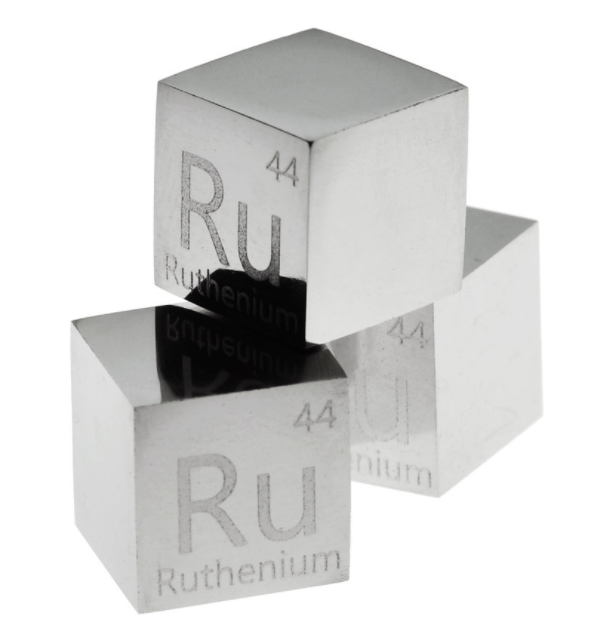
Ruthenium is a rare transition metal belonging to the platinum group of the periodic table. Like the other metals of the platinum group, ruthenium is inert to most other chemicals.

Summary

Element Ruthenium
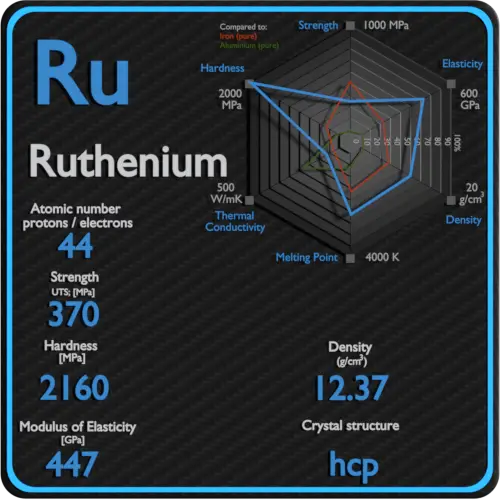
Atomic number 44
Element category Transition Metal
Phase at STP Solid
Density 12.37 g/cm3
Ultimate Tensile Strength 370 MPa
Yield Strength N/A
Young’s Modulus of Elasticity 447 GPa
Mohs Scale 6.5
Brinell Hardness 2160 MPa
Vickers Hardness N/A
Melting Point 2334 °C
Boiling Point 4150 °C
Thermal Conductivity 117 W/mK
Thermal Expansion Coefficient 6.4 µm/mK
Specific Heat 0.238 J/g K
Heat of Fusion 24 kJ/mol
Heat of Vaporization 595 kJ/mol
Electrical resistivity [nanoOhm meter] 71
Magnetic Susceptibility +39e-6 cm^3/mol

Applications of Ruthenium

Ruthenium finds use in electronic industry for manufacturing electrical contacts and chip resistors. Ruthenium oxide is used in the chemical industry to coat the anodes of electrochemical cells for chlorine production. Ruthenium is also used in catalysts for ammonia and acetic acid production. Ruthenium compounds can be used in solar cells, which turn light energy into electrical energy. The metal also serves as a hardener for platinum and palladium

Ruthenium-applications

Production and Price of Ruthenium

Raw materials prices change daily. They are primarily driven by supply, demand and energy prices. In 2019, prices of pure Ruthenium were at around 8000 $/kg.

Ruthenium is one of the rarest metals on Earth. It is found uncombined in nature; however, it is more commonly found associated with other platinum metals in the minerals pentlandite and pyroxinite. Roughly 30 tonnes of ruthenium are mined each year with world reserves estimated at 5,000 tonnes. It is obtained commercially from the wastes of nickel refining.

Ruthenium-periodic-table

Source: www.luciteria.com

Mechanical Properties of Ruthenium

Ruthenium-mechanical-properties-strength-hardness-crystal-structure

Strength of Ruthenium

In mechanics of materials, the strength of a material is its ability to withstand an applied load without failure or plastic deformation. Strength of materials basically considers the relationship between the external loads applied to a material and the resulting deformation or change in material dimensions. In designing structures and machines, it is important to consider these factors, in order that the material selected will have adequate strength to resist applied loads or forces and retain its original shape. Strength of a material is its ability to withstand this applied load without failure or plastic deformation.

For tensile stress, the capacity of a material or structure to withstand loads tending to elongate is known as ultimate tensile strength (UTS). Yield strength or yield stress is the material property defined as the stress at which a material begins to deform plastically whereas yield point is the point where nonlinear (elastic + plastic) deformation begins.

See also: Strength of Materials

Ultimate Tensile Strength of Ruthenium

Ultimate tensile strength of Ruthenium is 370 MPa.

Yield Strength of Ruthenium

Yield strength of Ruthenium is N/A.

Modulus of Elasticity of Ruthenium

The Young’s modulus of elasticity of Ruthenium is N/A.

Hardness of Ruthenium

In materials science, hardness is the ability to withstand surface indentation (localized plastic deformation) and scratching. Brinell hardness test is one of indentation hardness tests, that has been developed for hardness testing. In Brinell tests, a hard, spherical indenter is forced under a specific load into the surface of the metal to be tested.

Brinell hardness of Ruthenium is approximately 2160 MPa.

The Vickers hardness test method was developed by Robert L. Smith and George E. Sandland at Vickers Ltd as an alternative to the Brinell method to measure the hardness of materials. The Vickers hardness test method can be also used as a microhardness test method, which is mostly used for small parts, thin sections, or case depth work.

Vickers hardness of Ruthenium is approximately N/A.

Scratch hardness is the measure of how resistant a sample is to permanent plastic deformation due to friction from a sharp object. The most common scale for this qualitative test is Mohs scale, which is used in mineralogy. The Mohs scale of mineral hardness is based on the ability of one natural sample of mineral to scratch another mineral visibly.

Ruthenium is has a hardness of approximately 6.5.

See also: Hardness of Materials

Ruthenium – Crystal Structure

A possible crystal structure of Ruthenium is hexagonal close-packed structure.

crystal structures - FCC, BCC, HCP

In metals, and in many other solids, the atoms are arranged in regular arrays called crystals. A crystal lattice is a repeating pattern of mathematical points that extends throughout space. The forces of chemical bonding causes this repetition. It is this repeated pattern which control properties like strength, ductility, density, conductivity (property of conducting or transmitting heat, electricity, etc.), and shape. There are 14 general types of such patterns known as Bravais lattices.

See also: Crystal Structure of Materials

Crystal Structure of Ruthenium
Crystal Structure of Ruthenium is: hexagonal close-packed

Strength of Elements

Elasticity of Elements

Hardness of Elements


Thermal Properties of Ruthenium

Ruthenium-melting-point-conductivity-thermal-properties

Ruthenium – Melting Point and Boiling Point

Melting point of Ruthenium is 2334°C.

Boiling point of Ruthenium is 4150°C.

Note that, these points are associated with the standard atmospheric pressure.

Ruthenium – Thermal Conductivity

Thermal conductivity of Ruthenium is 117 W/(m·K).

The heat transfer characteristics of a solid material are measured by a property called the thermal conductivity, k (or λ), measured in W/m.K. It is a measure of a substance’s ability to transfer heat through a material by conduction. Note that Fourier’s law applies for all matter, regardless of its state (solid, liquid, or gas), therefore, it is also defined for liquids and gases.

Coefficient of Thermal Expansion of Ruthenium

Linear thermal expansion coefficient of Ruthenium is 6.4 µm/(m·K)

Thermal expansion is generally the tendency of matter to change its dimensions in response to a change in temperature. It is usually expressed as a fractional change in length or volume per unit temperature change.

Ruthenium – Specific Heat, Latent Heat of Fusion, Latent Heat of Vaporization

Specific heat of Ruthenium is 0.238 J/g K.

Heat capacity is an extensive property of matter, meaning it is proportional to the size of the system. Heat capacity C has the unit of energy per degree or energy per kelvin. When expressing the same phenomenon as an intensive property, the heat capacity is divided by the amount of substance, mass, or volume, thus the quantity is independent of the size or extent of the sample.

Latent Heat of Fusion of Ruthenium is 24 kJ/mol.

Latent Heat of Vaporization of Ruthenium is 595 kJ/mol.

Latent heat is the amount of heat added to or removed from a substance to produce a change in phase. This energy breaks down the intermolecular attractive forces, and also must provide the energy necessary to expand the gas (the pΔV work). When latent heat is added, no temperature change occurs. The enthalpy of vaporization is a function of the pressure at which that transformation takes place.

Melting Point of Elements

Periodic Table of Elements - melting point

Thermal Conductivity of Elements

Periodic Table of Elements - thermal conductivity

Thermal Expansion of Elements

Periodic Table of Elements - thermal expansion

Heat Capacity of Elements

Periodic Table of Elements - heat capacity

Heat of Fusion of Elements

Periodic Table of Elements - latent heat fusion

Heat of Vaporization of Elements

Periodic Table of Elements - latent heat vaporization

Ruthenium – Electrical Resistivity – Magnetic Susceptibility

Ruthenium-electrical-resistivity-magnetic-susceptibility

Electrical property refers to the response of a material to an applied electric field. One of the principal characteristics of materials is their ability (or lack of ability) to conduct electrical current. Indeed, materials are classified by this property, that is, they are divided into conductors, semiconductors, and nonconductors.

See also: Electrical Properties

Magnetic property refers to the response of a material to an applied magnetic field. The macroscopic magnetic properties of a material are a consequence of interactions between an external magnetic field and the magnetic dipole moments of the constituent atoms. Different materials react to the application of magnetic field differently.

See also: Magnetic Properties

Electrical Resistivity of Ruthenium

Electrical resistivity of Ruthenium is 71 nΩ⋅m.

Electrical conductivity and its converse, electrical resistivity, is a fundamental property of a material that quantifies how Ruthenium conducts the flow of electric current. Electrical conductivity or specific conductance is the reciprocal of electrical resistivity.

Magnetic Susceptibility of Ruthenium

Magnetic susceptibility of Ruthenium is +39e-6 cm^3/mol.

In electromagnetism, magnetic susceptibility is the measure of the magnetization of a substance. Magnetic susceptibility is a dimensionless proportionality factor that indicates the degree of magnetization of Ruthenium in response to an applied magnetic field.

Electrical Resistivity of Elements

Periodic Table of Elements - electrical resistivity

Magnetic Susceptibility of Elements

Application and prices of other elements

Ruthenium - Comparison of Properties and Prices

Periodic Table in 8K resolution

Other properties of Ruthenium


Technetium – Properties – Price – Applications – Production

Technetium-properties-price-application-production

About Technetium

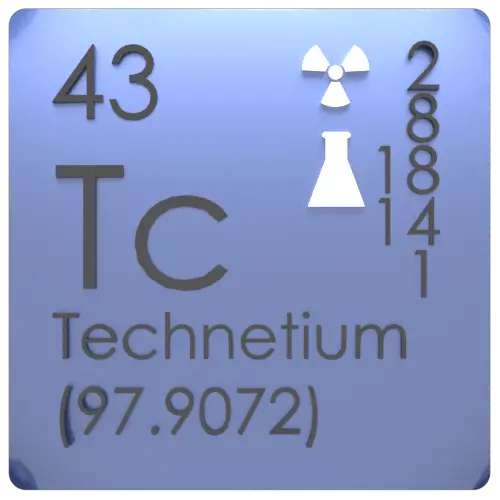
Technetium is the lightest element whose isotopes are all radioactive; none are stable. Nearly all technetium is produced synthetically, and only minute amounts are found in the Earth’s crust. The chemical properties of this silvery gray, crystalline transition metal are intermediate between rhenium and manganese.

Summary

Element Technetium
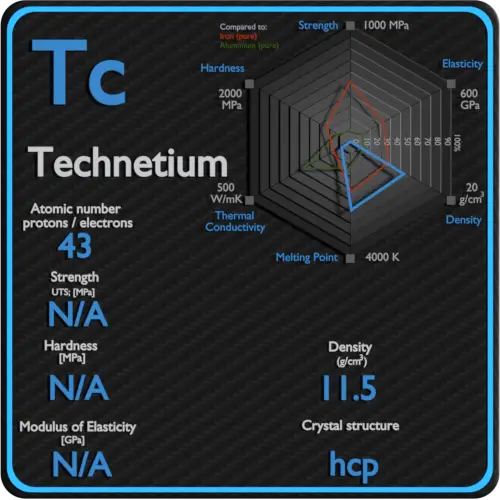
Atomic number 43
Element category Transition Metal
Phase at STP Synthetic
Density 11.5 g/cm3
Ultimate Tensile Strength N/A
Yield Strength N/A
Young’s Modulus of Elasticity N/A
Mohs Scale N/A
Brinell Hardness N/A
Vickers Hardness N/A
Melting Point 2157 °C
Boiling Point 4265 °C
Thermal Conductivity 50.6 W/mK
Thermal Expansion Coefficient 7.1 µm/mK
Specific Heat 0.21 J/g K
Heat of Fusion 24 kJ/mol
Heat of Vaporization 660 kJ/mol
Electrical resistivity [nanoOhm meter] 200
Magnetic Susceptibility +270e-6 cm^3/mol

Applications of Technetium

One shortlived gamma ray-emitting nuclear isomer, technetium-99m, is used in nuclear medicine for a wide variety of tests, such as bone cancer diagnoses. The ground state of the nuclide technetium-99 is used as a gamma-ray-free source of beta particles.

Technetium-applications

Production and Price of Technetium

Raw materials prices change daily. They are primarily driven by supply, demand and energy prices. In 2019, prices of pure Technetium were at around 100000 $/kg.

The vast majority of the technetium-99m used in medical work is produced by irradiating dedicated highly enriched uranium targets in a reactor, extracting molybdenum-99 from the targets in reprocessing facilities, and recovering at the diagnostic center the technetium-99m produced upon decay of molybdenum-99.

Technetium-periodic-table

Source: www.luciteria.com

Mechanical Properties of Technetium

Technetium-mechanical-properties-strength-hardness-crystal-structure

Strength of Technetium

In mechanics of materials, the strength of a material is its ability to withstand an applied load without failure or plastic deformation. Strength of materials basically considers the relationship between the external loads applied to a material and the resulting deformation or change in material dimensions. In designing structures and machines, it is important to consider these factors, in order that the material selected will have adequate strength to resist applied loads or forces and retain its original shape. Strength of a material is its ability to withstand this applied load without failure or plastic deformation.

For tensile stress, the capacity of a material or structure to withstand loads tending to elongate is known as ultimate tensile strength (UTS). Yield strength or yield stress is the material property defined as the stress at which a material begins to deform plastically whereas yield point is the point where nonlinear (elastic + plastic) deformation begins.

See also: Strength of Materials

Ultimate Tensile Strength of Technetium

Ultimate tensile strength of Technetium is N/A.

Yield Strength of Technetium

Yield strength of Technetium is N/A.

Modulus of Elasticity of Technetium

The Young’s modulus of elasticity of Technetium is N/A.

Hardness of Technetium

In materials science, hardness is the ability to withstand surface indentation (localized plastic deformation) and scratching. Brinell hardness test is one of indentation hardness tests, that has been developed for hardness testing. In Brinell tests, a hard, spherical indenter is forced under a specific load into the surface of the metal to be tested.

Brinell hardness of Technetium is approximately N/A.

The Vickers hardness test method was developed by Robert L. Smith and George E. Sandland at Vickers Ltd as an alternative to the Brinell method to measure the hardness of materials. The Vickers hardness test method can be also used as a microhardness test method, which is mostly used for small parts, thin sections, or case depth work.

Vickers hardness of Technetium is approximately N/A.

Scratch hardness is the measure of how resistant a sample is to permanent plastic deformation due to friction from a sharp object. The most common scale for this qualitative test is Mohs scale, which is used in mineralogy. The Mohs scale of mineral hardness is based on the ability of one natural sample of mineral to scratch another mineral visibly.

Technetium is has a hardness of approximately N/A.

See also: Hardness of Materials

Technetium – Crystal Structure

A possible crystal structure of Technetium is hexagonal close-packed structure.

crystal structures - FCC, BCC, HCP

In metals, and in many other solids, the atoms are arranged in regular arrays called crystals. A crystal lattice is a repeating pattern of mathematical points that extends throughout space. The forces of chemical bonding causes this repetition. It is this repeated pattern which control properties like strength, ductility, density, conductivity (property of conducting or transmitting heat, electricity, etc.), and shape. There are 14 general types of such patterns known as Bravais lattices.

See also: Crystal Structure of Materials

Crystal Structure of Technetium
Crystal Structure of Technetium is: hexagonal close-packed

Strength of Elements

Elasticity of Elements

Hardness of Elements


Thermal Properties of Technetium

Technetium-melting-point-conductivity-thermal-properties

Technetium – Melting Point and Boiling Point

Melting point of Technetium is 2157°C.

Boiling point of Technetium is 4265°C.

Note that, these points are associated with the standard atmospheric pressure.

Technetium – Thermal Conductivity

Thermal conductivity of Technetium is 50.6 W/(m·K).

The heat transfer characteristics of a solid material are measured by a property called the thermal conductivity, k (or λ), measured in W/m.K. It is a measure of a substance’s ability to transfer heat through a material by conduction. Note that Fourier’s law applies for all matter, regardless of its state (solid, liquid, or gas), therefore, it is also defined for liquids and gases.

Coefficient of Thermal Expansion of Technetium

Linear thermal expansion coefficient of Technetium is 7.1 µm/(m·K)

Thermal expansion is generally the tendency of matter to change its dimensions in response to a change in temperature. It is usually expressed as a fractional change in length or volume per unit temperature change.

Technetium – Specific Heat, Latent Heat of Fusion, Latent Heat of Vaporization

Specific heat of Technetium is 0.21 J/g K.

Heat capacity is an extensive property of matter, meaning it is proportional to the size of the system. Heat capacity C has the unit of energy per degree or energy per kelvin. When expressing the same phenomenon as an intensive property, the heat capacity is divided by the amount of substance, mass, or volume, thus the quantity is independent of the size or extent of the sample.

Latent Heat of Fusion of Technetium is 24 kJ/mol.

Latent Heat of Vaporization of Technetium is 660 kJ/mol.

Latent heat is the amount of heat added to or removed from a substance to produce a change in phase. This energy breaks down the intermolecular attractive forces, and also must provide the energy necessary to expand the gas (the pΔV work). When latent heat is added, no temperature change occurs. The enthalpy of vaporization is a function of the pressure at which that transformation takes place.

Melting Point of Elements

Periodic Table of Elements - melting point

Thermal Conductivity of Elements

Periodic Table of Elements - thermal conductivity

Thermal Expansion of Elements

Periodic Table of Elements - thermal expansion

Heat Capacity of Elements

Periodic Table of Elements - heat capacity

Heat of Fusion of Elements

Periodic Table of Elements - latent heat fusion

Heat of Vaporization of Elements

Periodic Table of Elements - latent heat vaporization

Technetium – Electrical Resistivity – Magnetic Susceptibility

Technetium-electrical-resistivity-magnetic-susceptibility

Electrical property refers to the response of a material to an applied electric field. One of the principal characteristics of materials is their ability (or lack of ability) to conduct electrical current. Indeed, materials are classified by this property, that is, they are divided into conductors, semiconductors, and nonconductors.

See also: Electrical Properties

Magnetic property refers to the response of a material to an applied magnetic field. The macroscopic magnetic properties of a material are a consequence of interactions between an external magnetic field and the magnetic dipole moments of the constituent atoms. Different materials react to the application of magnetic field differently.

See also: Magnetic Properties

Electrical Resistivity of Technetium

Electrical resistivity of Technetium is 200 nΩ⋅m.

Electrical conductivity and its converse, electrical resistivity, is a fundamental property of a material that quantifies how Technetium conducts the flow of electric current. Electrical conductivity or specific conductance is the reciprocal of electrical resistivity.

Magnetic Susceptibility of Technetium

Magnetic susceptibility of Technetium is +270e-6 cm^3/mol.

In electromagnetism, magnetic susceptibility is the measure of the magnetization of a substance. Magnetic susceptibility is a dimensionless proportionality factor that indicates the degree of magnetization of Technetium in response to an applied magnetic field.

Electrical Resistivity of Elements

Periodic Table of Elements - electrical resistivity

Magnetic Susceptibility of Elements

Application and prices of other elements

Technetium - Comparison of Properties and Prices

Periodic Table in 8K resolution

Other properties of Technetium


Molybdenum – Properties – Price – Applications – Production

Molybdenum-properties-price-application-production

About Molybdenum

Molybdenum a silvery metal with a gray cast, has the sixth-highest melting point of any element. It readily forms hard, stable carbides in alloys, and for this reason most of world production of the element (about 80%) is used in steel alloys, including high-strength alloys and superalloys.

Summary

Element Molybdenum
Atomic number 42
Element category Transition Metal
Phase at STP Solid
Density 10.28 g/cm3
Ultimate Tensile Strength 324 MPa
Yield Strength N/A
Young’s Modulus of Elasticity 329 GPa
Mohs Scale 5.5
Brinell Hardness 1500 MPa
Vickers Hardness 1530 MPa
Melting Point 2623 °C
Boiling Point 4639 °C
Thermal Conductivity 138 W/mK
Thermal Expansion Coefficient 4.8 µm/mK
Specific Heat 0.25 J/g K
Heat of Fusion 32 kJ/mol
Heat of Vaporization 598 kJ/mol
Electrical resistivity [nanoOhm meter] 53.4
Magnetic Susceptibility +89e-6 cm^3/mol

Applications of Molybdenum

About 86% of molybdenum produced is used in metallurgy, with the rest used in chemical applications. The estimated global use is structural steel 35%, stainless steel 25%, chemicals 14%, tool & high-speed steels 9%, cast iron 6%, molybdenum elemental metal 6%, and superalloys 5%. Molybdenum (about 0.50-8.00%) when added to a tool steel makes it more resistant to high temperature. Molybdenum increases hardenability and strength, particularly at high temperatures due to the high melting point of molybdenum. Molybdenum is unique in the extent to which it increases the high-temperature tensile and creep strengths of steel. Molybdenum anodes replace tungsten in certain low voltage X-ray sources for specialized uses such as mammography. The radioactive isotope molybdenum-99 is used to generate technetium-99m, used for medical imaging. The isotope is handled and stored as the molybdate.

Molybdenum-applications

Production and Price of Molybdenum

Raw materials prices change daily. They are primarily driven by supply, demand and energy prices. In 2019, prices of pure Molybdenum were at around 110 $/kg.

Molybdenum does not occur native, and is obtained mainly from molybdenite (MoS2). Other minor commercial ores of molybdenum are powellite (Ca(MoW)O4) and wulfenite (PbMoO4). Molybdenum is mined as a principal ore and is also recovered as a byproduct of copper and tungsten mining. The world’s production of molybdenum was 250,000 tonnes in 2011, the largest producers being China (94,000 t), the United States (64,000 t), Chile (38,000 t), Peru (18,000 t) and Mexico (12,000 t).

Molybdenum-periodic-table

Source: www.luciteria.com

Mechanical Properties of Molybdenum

Molybdenum-mechanical-properties-strength-hardness-crystal-structure

Strength of Molybdenum

In mechanics of materials, the strength of a material is its ability to withstand an applied load without failure or plastic deformation. Strength of materials basically considers the relationship between the external loads applied to a material and the resulting deformation or change in material dimensions. In designing structures and machines, it is important to consider these factors, in order that the material selected will have adequate strength to resist applied loads or forces and retain its original shape. Strength of a material is its ability to withstand this applied load without failure or plastic deformation.

For tensile stress, the capacity of a material or structure to withstand loads tending to elongate is known as ultimate tensile strength (UTS). Yield strength or yield stress is the material property defined as the stress at which a material begins to deform plastically whereas yield point is the point where nonlinear (elastic + plastic) deformation begins.

See also: Strength of Materials

Ultimate Tensile Strength of Molybdenum

Ultimate tensile strength of Molybdenum is 324 MPa.

Yield Strength of Molybdenum

Yield strength of Molybdenum is N/A.

Modulus of Elasticity of Molybdenum

The Young’s modulus of elasticity of Molybdenum is N/A.

Hardness of Molybdenum

In materials science, hardness is the ability to withstand surface indentation (localized plastic deformation) and scratching. Brinell hardness test is one of indentation hardness tests, that has been developed for hardness testing. In Brinell tests, a hard, spherical indenter is forced under a specific load into the surface of the metal to be tested.

Brinell hardness of Molybdenum is approximately 1500 MPa.

The Vickers hardness test method was developed by Robert L. Smith and George E. Sandland at Vickers Ltd as an alternative to the Brinell method to measure the hardness of materials. The Vickers hardness test method can be also used as a microhardness test method, which is mostly used for small parts, thin sections, or case depth work.

Vickers hardness of Molybdenum is approximately 1530 MPa.

Scratch hardness is the measure of how resistant a sample is to permanent plastic deformation due to friction from a sharp object. The most common scale for this qualitative test is Mohs scale, which is used in mineralogy. The Mohs scale of mineral hardness is based on the ability of one natural sample of mineral to scratch another mineral visibly.

Molybdenum is has a hardness of approximately 5.5.

See also: Hardness of Materials

Molybdenum – Crystal Structure

A possible crystal structure of Molybdenum is body-centered cubic structure.

crystal structures - FCC, BCC, HCP

In metals, and in many other solids, the atoms are arranged in regular arrays called crystals. A crystal lattice is a repeating pattern of mathematical points that extends throughout space. The forces of chemical bonding causes this repetition. It is this repeated pattern which control properties like strength, ductility, density, conductivity (property of conducting or transmitting heat, electricity, etc.), and shape. There are 14 general types of such patterns known as Bravais lattices.

See also: Crystal Structure of Materials

Crystal Structure of Molybdenum
Crystal Structure of Molybdenum is: body-centered cubic

Strength of Elements

Elasticity of Elements

Hardness of Elements


Thermal Properties of Molybdenum

Molybdenum-melting-point-conductivity-thermal-properties

Molybdenum – Melting Point and Boiling Point

Melting point of Molybdenum is 2623°C.

Boiling point of Molybdenum is 4639°C.

Note that, these points are associated with the standard atmospheric pressure.

Molybdenum – Thermal Conductivity

Thermal conductivity of Molybdenum is 138 W/(m·K).

The heat transfer characteristics of a solid material are measured by a property called the thermal conductivity, k (or λ), measured in W/m.K. It is a measure of a substance’s ability to transfer heat through a material by conduction. Note that Fourier’s law applies for all matter, regardless of its state (solid, liquid, or gas), therefore, it is also defined for liquids and gases.

Coefficient of Thermal Expansion of Molybdenum

Linear thermal expansion coefficient of Molybdenum is 4.8 µm/(m·K)

Thermal expansion is generally the tendency of matter to change its dimensions in response to a change in temperature. It is usually expressed as a fractional change in length or volume per unit temperature change.

Molybdenum – Specific Heat, Latent Heat of Fusion, Latent Heat of Vaporization

Specific heat of Molybdenum is 0.25 J/g K.

Heat capacity is an extensive property of matter, meaning it is proportional to the size of the system. Heat capacity C has the unit of energy per degree or energy per kelvin. When expressing the same phenomenon as an intensive property, the heat capacity is divided by the amount of substance, mass, or volume, thus the quantity is independent of the size or extent of the sample.

Latent Heat of Fusion of Molybdenum is 32 kJ/mol.

Latent Heat of Vaporization of Molybdenum is 598 kJ/mol.

Latent heat is the amount of heat added to or removed from a substance to produce a change in phase. This energy breaks down the intermolecular attractive forces, and also must provide the energy necessary to expand the gas (the pΔV work). When latent heat is added, no temperature change occurs. The enthalpy of vaporization is a function of the pressure at which that transformation takes place.

Melting Point of Elements

Periodic Table of Elements - melting point

Thermal Conductivity of Elements

Periodic Table of Elements - thermal conductivity

Thermal Expansion of Elements

Periodic Table of Elements - thermal expansion

Heat Capacity of Elements

Periodic Table of Elements - heat capacity

Heat of Fusion of Elements

Periodic Table of Elements - latent heat fusion

Heat of Vaporization of Elements

Periodic Table of Elements - latent heat vaporization

Molybdenum – Electrical Resistivity – Magnetic Susceptibility

Molybdenum-electrical-resistivity-magnetic-susceptibility

Electrical property refers to the response of a material to an applied electric field. One of the principal characteristics of materials is their ability (or lack of ability) to conduct electrical current. Indeed, materials are classified by this property, that is, they are divided into conductors, semiconductors, and nonconductors.

See also: Electrical Properties

Magnetic property refers to the response of a material to an applied magnetic field. The macroscopic magnetic properties of a material are a consequence of interactions between an external magnetic field and the magnetic dipole moments of the constituent atoms. Different materials react to the application of magnetic field differently.

See also: Magnetic Properties

Electrical Resistivity of Molybdenum

Electrical resistivity of Molybdenum is 53.4 nΩ⋅m.

Electrical conductivity and its converse, electrical resistivity, is a fundamental property of a material that quantifies how Molybdenum conducts the flow of electric current. Electrical conductivity or specific conductance is the reciprocal of electrical resistivity.

Magnetic Susceptibility of Molybdenum

Magnetic susceptibility of Molybdenum is +89e-6 cm^3/mol.

In electromagnetism, magnetic susceptibility is the measure of the magnetization of a substance. Magnetic susceptibility is a dimensionless proportionality factor that indicates the degree of magnetization of Molybdenum in response to an applied magnetic field.

Electrical Resistivity of Elements

Periodic Table of Elements - electrical resistivity

Magnetic Susceptibility of Elements

Application and prices of other elements

Molybdenum - Comparison of Properties and Prices

Periodic Table in 8K resolution

Other properties of Molybdenum


Niobium – Properties – Price – Applications – Production

Niobium-properties-price-application-production

About Niobium

Niobium is a soft, grey, ductile transition metal, often found in the minerals pyrochlore (the main commercial source for niobium) and columbite.

Summary

Element Niobium
Atomic number 41
Element category Transition Metal
Phase at STP Solid
Density 8.57 g/cm3
Ultimate Tensile Strength 275 MPa
Yield Strength 70 MPa
Young’s Modulus of Elasticity 105 GPa
Mohs Scale 6
Brinell Hardness 740 MPa
Vickers Hardness 1300 MPa
Melting Point 2477 °C
Boiling Point 4744 °C
Thermal Conductivity 53.7 W/mK
Thermal Expansion Coefficient 7.3 µm/mK
Specific Heat 0.26 J/g K
Heat of Fusion 26.4 kJ/mol
Heat of Vaporization 682 kJ/mol
Electrical resistivity [nanoOhm meter] 152
Magnetic Susceptibility N/A

Applications of Niobium

Niobium consumption is dominated by its use as additive to high strength low alloy steel and stainless steel for oil and gas pipelines, car and truck bodies, architectural requirements, tool steels, ships hulls, railroad tracks. However, there are a number of other applications for niobium metal and its compounds. Although niobium has many applications the majority is used in the production of high-grade structural steel. The second largest application for niobium is in nickel-based superalloys. Niobium-tin alloys are used as superconducting magnets.

Niobium-applications

Production and Price of Niobium

Raw materials prices change daily. They are primarily driven by supply, demand and energy prices. In 2019, prices of pure Niobium were at around 180 $/kg.

In general, niobium is found always together with tantalum, manganese and iron. The ores were broken, grinded and refined by gravity separation or flotation. The niobium ore is further purified by subsequent chemical treatment, depending on the used technique the Niobium concentrate is available as oxide, salt or chloride. Out of 44,500 tonnes of niobium mined in 2006, an estimated 90% was used in high-grade structural steel. The second largest application is superalloys.

Niobium-periodic-table

Source: www.luciteria.com

Mechanical Properties of Niobium

Niobium-mechanical-properties-strength-hardness-crystal-structure

Strength of Niobium

In mechanics of materials, the strength of a material is its ability to withstand an applied load without failure or plastic deformation. Strength of materials basically considers the relationship between the external loads applied to a material and the resulting deformation or change in material dimensions. In designing structures and machines, it is important to consider these factors, in order that the material selected will have adequate strength to resist applied loads or forces and retain its original shape. Strength of a material is its ability to withstand this applied load without failure or plastic deformation.

For tensile stress, the capacity of a material or structure to withstand loads tending to elongate is known as ultimate tensile strength (UTS). Yield strength or yield stress is the material property defined as the stress at which a material begins to deform plastically whereas yield point is the point where nonlinear (elastic + plastic) deformation begins.

See also: Strength of Materials

Ultimate Tensile Strength of Niobium

Ultimate tensile strength of Niobium is 275 MPa.

Yield Strength of Niobium

Yield strength of Niobium is 70 MPa.

Modulus of Elasticity of Niobium

The Young’s modulus of elasticity of Niobium is 70 MPa.

Hardness of Niobium

In materials science, hardness is the ability to withstand surface indentation (localized plastic deformation) and scratching. Brinell hardness test is one of indentation hardness tests, that has been developed for hardness testing. In Brinell tests, a hard, spherical indenter is forced under a specific load into the surface of the metal to be tested.

Brinell hardness of Niobium is approximately 740 MPa.

The Vickers hardness test method was developed by Robert L. Smith and George E. Sandland at Vickers Ltd as an alternative to the Brinell method to measure the hardness of materials. The Vickers hardness test method can be also used as a microhardness test method, which is mostly used for small parts, thin sections, or case depth work.

Vickers hardness of Niobium is approximately 1300 MPa.

Scratch hardness is the measure of how resistant a sample is to permanent plastic deformation due to friction from a sharp object. The most common scale for this qualitative test is Mohs scale, which is used in mineralogy. The Mohs scale of mineral hardness is based on the ability of one natural sample of mineral to scratch another mineral visibly.

Niobium is has a hardness of approximately 6.

See also: Hardness of Materials

Niobium – Crystal Structure

A possible crystal structure of Niobium is body-centered cubic structure.

crystal structures - FCC, BCC, HCP

In metals, and in many other solids, the atoms are arranged in regular arrays called crystals. A crystal lattice is a repeating pattern of mathematical points that extends throughout space. The forces of chemical bonding causes this repetition. It is this repeated pattern which control properties like strength, ductility, density, conductivity (property of conducting or transmitting heat, electricity, etc.), and shape. There are 14 general types of such patterns known as Bravais lattices.

See also: Crystal Structure of Materials

Crystal Structure of Niobium
Crystal Structure of Niobium is: body-centered cubic

Strength of Elements

Elasticity of Elements

Hardness of Elements


Thermal Properties of Niobium

Niobium-melting-point-conductivity-thermal-properties

Niobium – Melting Point and Boiling Point

Melting point of Niobium is 2477°C.

Boiling point of Niobium is 4744°C.

Note that, these points are associated with the standard atmospheric pressure.

Niobium – Thermal Conductivity

Thermal conductivity of Niobium is 53.7 W/(m·K).

The heat transfer characteristics of a solid material are measured by a property called the thermal conductivity, k (or λ), measured in W/m.K. It is a measure of a substance’s ability to transfer heat through a material by conduction. Note that Fourier’s law applies for all matter, regardless of its state (solid, liquid, or gas), therefore, it is also defined for liquids and gases.

Coefficient of Thermal Expansion of Niobium

Linear thermal expansion coefficient of Niobium is 7.3 µm/(m·K)

Thermal expansion is generally the tendency of matter to change its dimensions in response to a change in temperature. It is usually expressed as a fractional change in length or volume per unit temperature change.

Niobium – Specific Heat, Latent Heat of Fusion, Latent Heat of Vaporization

Specific heat of Niobium is 0.26 J/g K.

Heat capacity is an extensive property of matter, meaning it is proportional to the size of the system. Heat capacity C has the unit of energy per degree or energy per kelvin. When expressing the same phenomenon as an intensive property, the heat capacity is divided by the amount of substance, mass, or volume, thus the quantity is independent of the size or extent of the sample.

Latent Heat of Fusion of Niobium is 26.4 kJ/mol.

Latent Heat of Vaporization of Niobium is 682 kJ/mol.

Latent heat is the amount of heat added to or removed from a substance to produce a change in phase. This energy breaks down the intermolecular attractive forces, and also must provide the energy necessary to expand the gas (the pΔV work). When latent heat is added, no temperature change occurs. The enthalpy of vaporization is a function of the pressure at which that transformation takes place.

Melting Point of Elements

Periodic Table of Elements - melting point

Thermal Conductivity of Elements

Periodic Table of Elements - thermal conductivity

Thermal Expansion of Elements

Periodic Table of Elements - thermal expansion

Heat Capacity of Elements

Periodic Table of Elements - heat capacity

Heat of Fusion of Elements

Periodic Table of Elements - latent heat fusion

Heat of Vaporization of Elements

Periodic Table of Elements - latent heat vaporization

Niobium – Electrical Resistivity – Magnetic Susceptibility

Niobium-electrical-resistivity-magnetic-susceptibility

Electrical property refers to the response of a material to an applied electric field. One of the principal characteristics of materials is their ability (or lack of ability) to conduct electrical current. Indeed, materials are classified by this property, that is, they are divided into conductors, semiconductors, and nonconductors.

See also: Electrical Properties

Magnetic property refers to the response of a material to an applied magnetic field. The macroscopic magnetic properties of a material are a consequence of interactions between an external magnetic field and the magnetic dipole moments of the constituent atoms. Different materials react to the application of magnetic field differently.

See also: Magnetic Properties

Electrical Resistivity of Niobium

Electrical resistivity of Niobium is 152 nΩ⋅m.

Electrical conductivity and its converse, electrical resistivity, is a fundamental property of a material that quantifies how Niobium conducts the flow of electric current. Electrical conductivity or specific conductance is the reciprocal of electrical resistivity.

Magnetic Susceptibility of Niobium

Magnetic susceptibility of Niobium is N/A.

In electromagnetism, magnetic susceptibility is the measure of the magnetization of a substance. Magnetic susceptibility is a dimensionless proportionality factor that indicates the degree of magnetization of Niobium in response to an applied magnetic field.

Electrical Resistivity of Elements

Periodic Table of Elements - electrical resistivity

Magnetic Susceptibility of Elements

Application and prices of other elements

Niobium - Comparison of Properties and Prices

Periodic Table in 8K resolution

Other properties of Niobium