Facebook Instagram Youtube Twitter

Neodymium – Properties – Price – Applications – Production

Neodymium-properties-price-application-production

About Neodymium

Neodymium is a soft silvery metal that tarnishes in air. Neodymium is not found naturally in metallic form or unmixed with other lanthanides, and it is usually refined for general use. Although neodymium is classed as a rare earth, it is a fairly common element.

Summary

Element Neodymium
Atomic number 60
Element category Rare Earth Metal
Phase at STP Solid
Density 7.01 g/cm3
Ultimate Tensile Strength 155 MPa
Yield Strength 150 MPa
Young’s Modulus of Elasticity 41.4 GPa
Mohs Scale N/A
Brinell Hardness 265 MPa
Vickers Hardness 350 MPa
Melting Point 1016 °C
Boiling Point 3074 °C
Thermal Conductivity 17 W/mK
Thermal Expansion Coefficient 9.6 µm/mK
Specific Heat 0.19 J/g K
Heat of Fusion 7.14 kJ/mol
Heat of Vaporization 273 kJ/mol
Electrical resistivity [nanoOhm meter] 643
Magnetic Susceptibility +5628e-6 cm^3/mol

Applications of Neodymium

The most important use for neodymium is in an alloy with iron and boron to make very strong permanent magnets. These magnets are widely used in such products as microphones, professional loudspeakers, in-ear headphones, high performance hobby DC electric motors, and computer hard disks, where low magnet mass (or volume) or strong magnetic fields are required. Larger neodymium magnets are used in high-power-versus-weight electric motors (for example in hybrid cars) and generators (for example aircraft and wind turbine electric generators). Neodymium is a component, along with praseodymium, of didymium glass. This is a special glass for goggles used during glass blowing and welding. The element colours glass delicate shades of violet, wine-red and grey. Neodymium is also used in the glass for tanning booths, since it transmits the tanning UV rays but not the heating infrared rays.

Neodymium-applications

Production and Price of Neodymium

Raw materials prices change daily. They are primarily driven by supply, demand and energy prices. In 2019, prices of pure Neodymium were at around 1100 $/kg.

Commercially, it is recovered from monazite sand and bastnasite by extraction processes and ion exchange techniques. Monazite is an important ore for thorium, lanthanum, and cerium. It is often found in placer deposits. India, Madagascar, and South Africa have large deposits of monazite sands. The deposits in India are particularly rich in monazite. The world’s production of neodymium was about 7,000 tonnes in 2004.
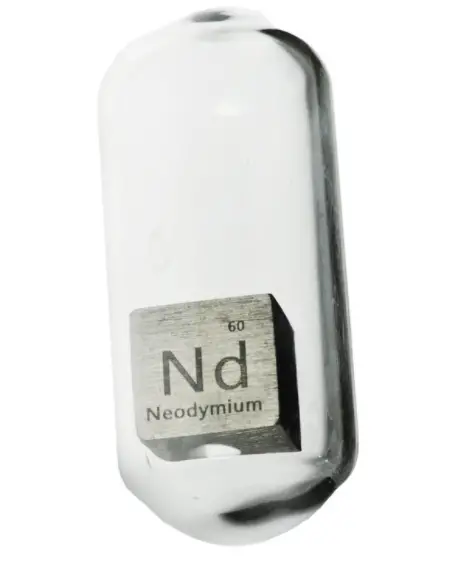
Neodymium-periodic-table

Source: www.luciteria.com

Mechanical Properties of Neodymium

Neodymium-mechanical-properties-strength-hardness-crystal-structure

Strength of Neodymium

In mechanics of materials, the strength of a material is its ability to withstand an applied load without failure or plastic deformation. Strength of materials basically considers the relationship between the external loads applied to a material and the resulting deformation or change in material dimensions. In designing structures and machines, it is important to consider these factors, in order that the material selected will have adequate strength to resist applied loads or forces and retain its original shape. Strength of a material is its ability to withstand this applied load without failure or plastic deformation.

For tensile stress, the capacity of a material or structure to withstand loads tending to elongate is known as ultimate tensile strength (UTS). Yield strength or yield stress is the material property defined as the stress at which a material begins to deform plastically whereas yield point is the point where nonlinear (elastic + plastic) deformation begins.

See also: Strength of Materials

Ultimate Tensile Strength of Neodymium

Ultimate tensile strength of Neodymium is 155 MPa.

Yield Strength of Neodymium

Yield strength of Neodymium is 150 MPa.

Modulus of Elasticity of Neodymium

The Young’s modulus of elasticity of Neodymium is 150 MPa.

Hardness of Neodymium

In materials science, hardness is the ability to withstand surface indentation (localized plastic deformation) and scratching. Brinell hardness test is one of indentation hardness tests, that has been developed for hardness testing. In Brinell tests, a hard, spherical indenter is forced under a specific load into the surface of the metal to be tested.

Brinell hardness of Neodymium is approximately 265 MPa.

The Vickers hardness test method was developed by Robert L. Smith and George E. Sandland at Vickers Ltd as an alternative to the Brinell method to measure the hardness of materials. The Vickers hardness test method can be also used as a microhardness test method, which is mostly used for small parts, thin sections, or case depth work.

Vickers hardness of Neodymium is approximately 350 MPa.

Scratch hardness is the measure of how resistant a sample is to permanent plastic deformation due to friction from a sharp object. The most common scale for this qualitative test is Mohs scale, which is used in mineralogy. The Mohs scale of mineral hardness is based on the ability of one natural sample of mineral to scratch another mineral visibly.

Neodymium is has a hardness of approximately N/A.

See also: Hardness of Materials

Neodymium – Crystal Structure

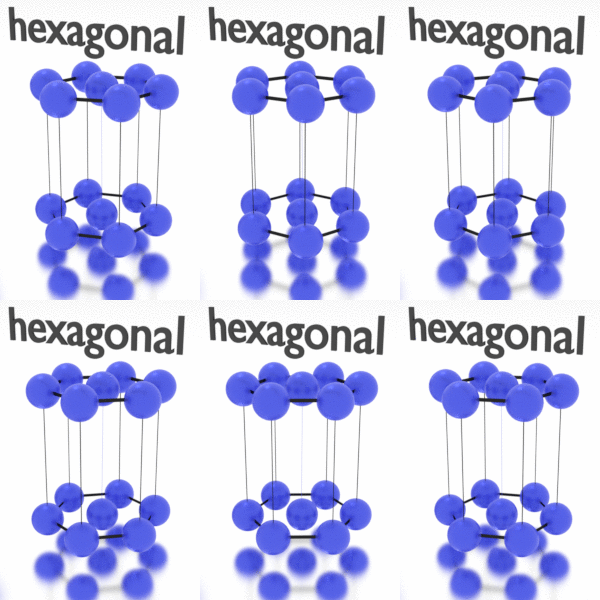
A possible crystal structure of Neodymium is double hexagonal close-packed structure.
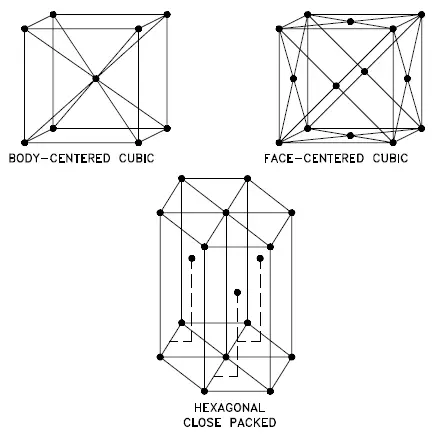
crystal structures - FCC, BCC, HCP

In metals, and in many other solids, the atoms are arranged in regular arrays called crystals. A crystal lattice is a repeating pattern of mathematical points that extends throughout space. The forces of chemical bonding causes this repetition. It is this repeated pattern which control properties like strength, ductility, density, conductivity (property of conducting or transmitting heat, electricity, etc.), and shape. There are 14 general types of such patterns known as Bravais lattices.

See also: Crystal Structure of Materials

Crystal Structure of Neodymium
Crystal Structure of Neodymium is: double hexagonal close-packed

Strength of Elements

Elasticity of Elements
Hardness of Elements
 

Thermal Properties of Neodymium

Neodymium-melting-point-conductivity-thermal-properties

Neodymium – Melting Point and Boiling Point

Melting point of Neodymium is 1016°C.

Boiling point of Neodymium is 3074°C.

Note that, these points are associated with the standard atmospheric pressure.

Neodymium – Thermal Conductivity

Thermal conductivity of Neodymium is 17 W/(m·K).

The heat transfer characteristics of a solid material are measured by a property called the thermal conductivity, k (or λ), measured in W/m.K. It is a measure of a substance’s ability to transfer heat through a material by conduction. Note that Fourier’s law applies for all matter, regardless of its state (solid, liquid, or gas), therefore, it is also defined for liquids and gases.

Coefficient of Thermal Expansion of Neodymium

Linear thermal expansion coefficient of Neodymium is 9.6 µm/(m·K)

Thermal expansion is generally the tendency of matter to change its dimensions in response to a change in temperature. It is usually expressed as a fractional change in length or volume per unit temperature change.

Neodymium – Specific Heat, Latent Heat of Fusion, Latent Heat of Vaporization

Specific heat of Neodymium is 0.19 J/g K.

Heat capacity is an extensive property of matter, meaning it is proportional to the size of the system. Heat capacity C has the unit of energy per degree or energy per kelvin. When expressing the same phenomenon as an intensive property, the heat capacity is divided by the amount of substance, mass, or volume, thus the quantity is independent of the size or extent of the sample.

Latent Heat of Fusion of Neodymium is 7.14 kJ/mol.

Latent Heat of Vaporization of Neodymium is 273 kJ/mol.

Latent heat is the amount of heat added to or removed from a substance to produce a change in phase. This energy breaks down the intermolecular attractive forces, and also must provide the energy necessary to expand the gas (the pΔV work). When latent heat is added, no temperature change occurs. The enthalpy of vaporization is a function of the pressure at which that transformation takes place.

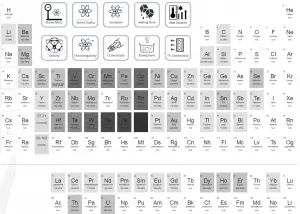
Melting Point of Elements
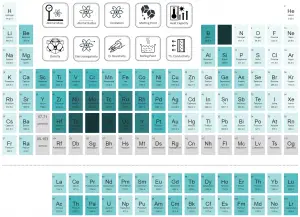
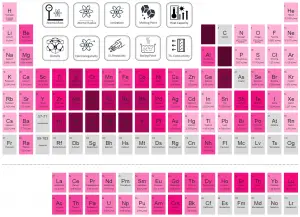
Periodic Table of Elements - melting point

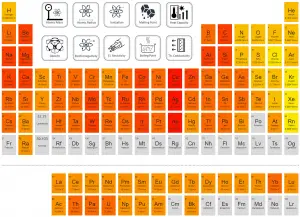
Thermal Conductivity of Elements

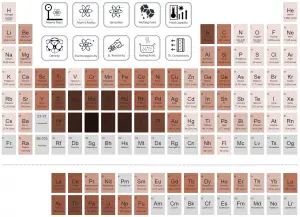
Periodic Table of Elements - thermal conductivity

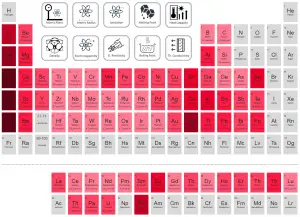
Thermal Expansion of Elements

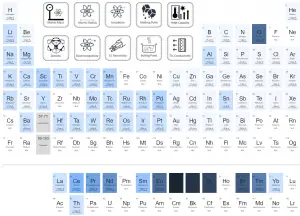
Periodic Table of Elements - thermal expansion

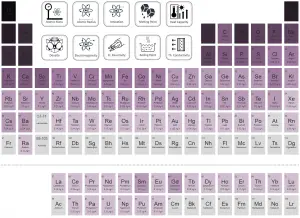
Heat Capacity of Elements

Periodic Table of Elements - heat capacity

Heat of Fusion of Elements

Periodic Table of Elements - latent heat fusion

Heat of Vaporization of Elements

Periodic Table of Elements - latent heat vaporization

Neodymium – Electrical Resistivity – Magnetic Susceptibility

Neodymium-electrical-resistivity-magnetic-susceptibility

Electrical property refers to the response of a material to an applied electric field. One of the principal characteristics of materials is their ability (or lack of ability) to conduct electrical current. Indeed, materials are classified by this property, that is, they are divided into conductors, semiconductors, and nonconductors.

See also: Electrical Properties

Magnetic property refers to the response of a material to an applied magnetic field. The macroscopic magnetic properties of a material are a consequence of interactions between an external magnetic field and the magnetic dipole moments of the constituent atoms. Different materials react to the application of magnetic field differently.

See also: Magnetic Properties

Electrical Resistivity of Neodymium

Electrical resistivity of Neodymium is 643 nΩ⋅m.

Electrical conductivity and its converse, electrical resistivity, is a fundamental property of a material that quantifies how Neodymium conducts the flow of electric current. Electrical conductivity or specific conductance is the reciprocal of electrical resistivity.

Magnetic Susceptibility of Neodymium

Magnetic susceptibility of Neodymium is +5628e-6 cm^3/mol.

In electromagnetism, magnetic susceptibility is the measure of the magnetization of a substance. Magnetic susceptibility is a dimensionless proportionality factor that indicates the degree of magnetization of Neodymium in response to an applied magnetic field.

Electrical Resistivity of Elements
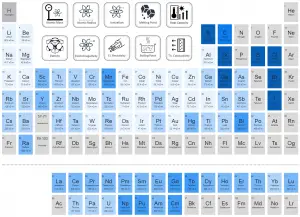
Periodic Table of Elements - electrical resistivity

Magnetic Susceptibility of Elements

Application and prices of other elements

Neodymium - Comparison of Properties and Prices

Periodic Table in 8K resolution

Other properties of Neodymium

 

Praseodymium – Properties – Price – Applications – Production
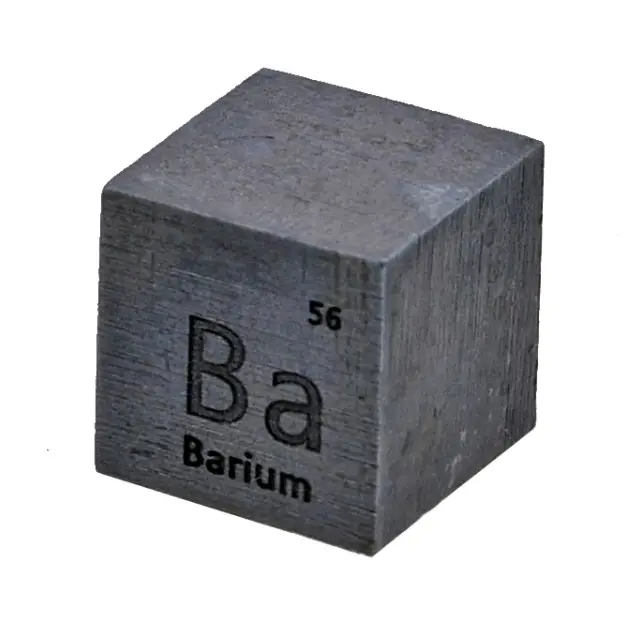
Praseodymium-properties-price-application-production

About Praseodymium

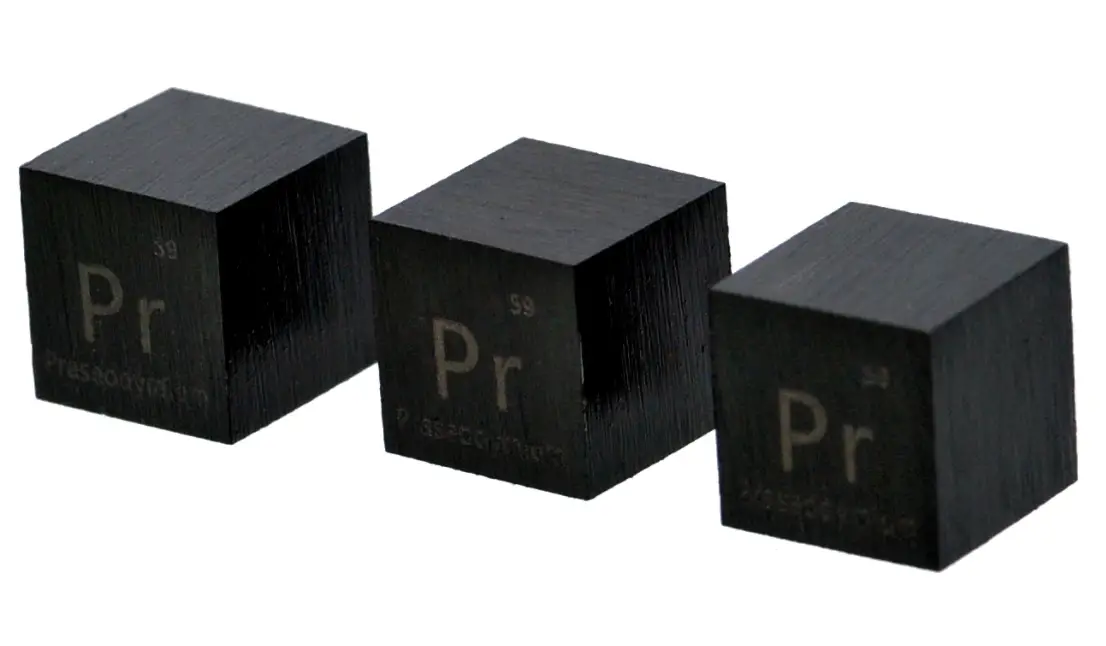
Praseodymium is a soft, silvery, malleable and ductile metal, valued for its magnetic, electrical, chemical, and optical properties. Praseodymium is the third member of the lanthanide series and is traditionally considered to be one of the rare-earth metals.
Summary

Element Praseodymium
Atomic number 59
Element category Rare Earth Metal
Phase at STP Solid
Density 6.64 g/cm3
Ultimate Tensile Strength 110 MPa
Yield Strength 103 MPa
Young’s Modulus of Elasticity 37.3 GPa
Mohs Scale N/A
Brinell Hardness 490 MPa
Vickers Hardness 400 MPa
Melting Point 931 °C
Boiling Point 3130 °C
Thermal Conductivity 13 W/mK
Thermal Expansion Coefficient 6.7 µm/mK
Specific Heat 0.19 J/g K
Heat of Fusion 6.89 kJ/mol
Heat of Vaporization 296.8 kJ/mol
Electrical resistivity [nanoOhm meter] 700
Magnetic Susceptibility +5000e-6 cm^3/mol

Applications of Praseodymium

Praseodymium is used in a variety of alloys. The high-strength alloy it forms with magnesium is used in aircraft engines. Mischmetal is an alloy containing about 5% praseodymium and is used to make flints for cigarette lighters. In combination with neodymium, another rare-earth element, praseodymium is used to create high-power magnets notable for their strength and durability. Praseodymium compounds give glasses and enamels a yellow color.

Praseodymium-applications

Production and Price of Praseodymium

Raw materials prices change daily. They are primarily driven by supply, demand and energy prices. In 2019, prices of pure Praseodymium were at around 1700 $/kg.

Commercially, it is recovered from monazite sand and bastnasite by extraction processes and ion exchange techniques. Monazite is an important ore for thorium, lanthanum, and cerium. It is often found in placer deposits. India, Madagascar, and South Africa have large deposits of monazite sands. The deposits in India are particularly rich in monazite.

Praseodymium-periodic-table

Source: www.luciteria.com

Mechanical Properties of Praseodymium

Praseodymium-mechanical-properties-strength-hardness-crystal-structure

Strength of Praseodymium

In mechanics of materials, the strength of a material is its ability to withstand an applied load without failure or plastic deformation. Strength of materials basically considers the relationship between the external loads applied to a material and the resulting deformation or change in material dimensions. In designing structures and machines, it is important to consider these factors, in order that the material selected will have adequate strength to resist applied loads or forces and retain its original shape. Strength of a material is its ability to withstand this applied load without failure or plastic deformation.

For tensile stress, the capacity of a material or structure to withstand loads tending to elongate is known as ultimate tensile strength (UTS). Yield strength or yield stress is the material property defined as the stress at which a material begins to deform plastically whereas yield point is the point where nonlinear (elastic + plastic) deformation begins.

See also: Strength of Materials

Ultimate Tensile Strength of Praseodymium

Ultimate tensile strength of Praseodymium is 110 MPa.

Yield Strength of Praseodymium

Yield strength of Praseodymium is 103 MPa.

Modulus of Elasticity of Praseodymium

The Young’s modulus of elasticity of Praseodymium is 103 MPa.

Hardness of Praseodymium

In materials science, hardness is the ability to withstand surface indentation (localized plastic deformation) and scratching. Brinell hardness test is one of indentation hardness tests, that has been developed for hardness testing. In Brinell tests, a hard, spherical indenter is forced under a specific load into the surface of the metal to be tested.

Brinell hardness of Praseodymium is approximately 490 MPa.

The Vickers hardness test method was developed by Robert L. Smith and George E. Sandland at Vickers Ltd as an alternative to the Brinell method to measure the hardness of materials. The Vickers hardness test method can be also used as a microhardness test method, which is mostly used for small parts, thin sections, or case depth work.

Vickers hardness of Praseodymium is approximately 400 MPa.

Scratch hardness is the measure of how resistant a sample is to permanent plastic deformation due to friction from a sharp object. The most common scale for this qualitative test is Mohs scale, which is used in mineralogy. The Mohs scale of mineral hardness is based on the ability of one natural sample of mineral to scratch another mineral visibly.

Praseodymium is has a hardness of approximately N/A.

See also: Hardness of Materials

Praseodymium – Crystal Structure

A possible crystal structure of Praseodymium is double hexagonal close-packed structure.

crystal structures - FCC, BCC, HCP

In metals, and in many other solids, the atoms are arranged in regular arrays called crystals. A crystal lattice is a repeating pattern of mathematical points that extends throughout space. The forces of chemical bonding causes this repetition. It is this repeated pattern which control properties like strength, ductility, density, conductivity (property of conducting or transmitting heat, electricity, etc.), and shape. There are 14 general types of such patterns known as Bravais lattices.

See also: Crystal Structure of Materials

Crystal Structure of Praseodymium
Crystal Structure of Praseodymium is: double hexagonal close-packed

Strength of Elements

Elasticity of Elements

Hardness of Elements


Thermal Properties of Praseodymium

Praseodymium-melting-point-conductivity-thermal-properties

Praseodymium – Melting Point and Boiling Point

Melting point of Praseodymium is 931°C.

Boiling point of Praseodymium is 3130°C.

Note that, these points are associated with the standard atmospheric pressure.

Praseodymium – Thermal Conductivity

Thermal conductivity of Praseodymium is 13 W/(m·K).

The heat transfer characteristics of a solid material are measured by a property called the thermal conductivity, k (or λ), measured in W/m.K. It is a measure of a substance’s ability to transfer heat through a material by conduction. Note that Fourier’s law applies for all matter, regardless of its state (solid, liquid, or gas), therefore, it is also defined for liquids and gases.

Coefficient of Thermal Expansion of Praseodymium

Linear thermal expansion coefficient of Praseodymium is 6.7 µm/(m·K)

Thermal expansion is generally the tendency of matter to change its dimensions in response to a change in temperature. It is usually expressed as a fractional change in length or volume per unit temperature change.

Praseodymium – Specific Heat, Latent Heat of Fusion, Latent Heat of Vaporization

Specific heat of Praseodymium is 0.19 J/g K.

Heat capacity is an extensive property of matter, meaning it is proportional to the size of the system. Heat capacity C has the unit of energy per degree or energy per kelvin. When expressing the same phenomenon as an intensive property, the heat capacity is divided by the amount of substance, mass, or volume, thus the quantity is independent of the size or extent of the sample.

Latent Heat of Fusion of Praseodymium is 6.89 kJ/mol.

Latent Heat of Vaporization of Praseodymium is 296.8 kJ/mol.

Latent heat is the amount of heat added to or removed from a substance to produce a change in phase. This energy breaks down the intermolecular attractive forces, and also must provide the energy necessary to expand the gas (the pΔV work). When latent heat is added, no temperature change occurs. The enthalpy of vaporization is a function of the pressure at which that transformation takes place.

Melting Point of Elements

Periodic Table of Elements - melting point

Thermal Conductivity of Elements

Periodic Table of Elements - thermal conductivity

Thermal Expansion of Elements

Periodic Table of Elements - thermal expansion

Heat Capacity of Elements

Periodic Table of Elements - heat capacity

Heat of Fusion of Elements

Periodic Table of Elements - latent heat fusion

Heat of Vaporization of Elements

Periodic Table of Elements - latent heat vaporization

Praseodymium – Electrical Resistivity – Magnetic Susceptibility

Praseodymium-electrical-resistivity-magnetic-susceptibility

Electrical property refers to the response of a material to an applied electric field. One of the principal characteristics of materials is their ability (or lack of ability) to conduct electrical current. Indeed, materials are classified by this property, that is, they are divided into conductors, semiconductors, and nonconductors.

See also: Electrical Properties

Magnetic property refers to the response of a material to an applied magnetic field. The macroscopic magnetic properties of a material are a consequence of interactions between an external magnetic field and the magnetic dipole moments of the constituent atoms. Different materials react to the application of magnetic field differently.

See also: Magnetic Properties

Electrical Resistivity of Praseodymium

Electrical resistivity of Praseodymium is 700 nΩ⋅m.

Electrical conductivity and its converse, electrical resistivity, is a fundamental property of a material that quantifies how Praseodymium conducts the flow of electric current. Electrical conductivity or specific conductance is the reciprocal of electrical resistivity.

Magnetic Susceptibility of Praseodymium

Magnetic susceptibility of Praseodymium is +5000e-6 cm^3/mol.

In electromagnetism, magnetic susceptibility is the measure of the magnetization of a substance. Magnetic susceptibility is a dimensionless proportionality factor that indicates the degree of magnetization of Praseodymium in response to an applied magnetic field.

Electrical Resistivity of Elements

Periodic Table of Elements - electrical resistivity

Magnetic Susceptibility of Elements

Application and prices of other elements

Praseodymium - Comparison of Properties and Prices

Periodic Table in 8K resolution

Other properties of Praseodymium


Cerium – Properties – Price – Applications – Production

Cerium-properties-price-application-production

About Cerium

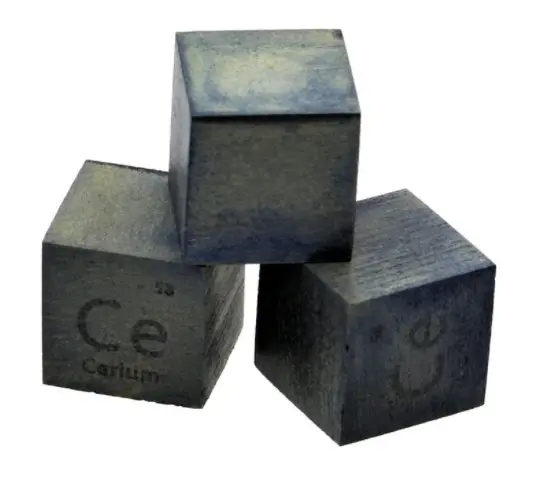
Cerium is a soft, ductile and silvery-white metal that tarnishes when exposed to air, and it is soft enough to be cut with a knife. Cerium is the second element in the lanthanide series. Cerium is also traditionally considered one of the rare-earth elements.

Summary

Element Cerium
Atomic number 58
Element category Rare Earth Metal
Phase at STP Solid
Density 6.689 g/cm3
Ultimate Tensile Strength 100 MPa
Yield Strength 90 MPa
Young’s Modulus of Elasticity 33.6 GPa
Mohs Scale 2.5
Brinell Hardness 412 MPa
Vickers Hardness 300 MPa
Melting Point 798 °C
Boiling Point 3457 °C
Thermal Conductivity 11 W/mK
Thermal Expansion Coefficient 6.3 µm/mK
Specific Heat 0.19 J/g K
Heat of Fusion 5.46 kJ/mol
Heat of Vaporization 414 kJ/mol
Electrical resistivity [nanoOhm meter] 828
Magnetic Susceptibility +2450e-6 cm^3/mol

Applications of Cerium

Cerium is an important component of mischmetal alloy. Ferrocerium is a synthetic pyrophoric alloy that produces hot sparks that can reach temperatures of 3,000 °C (5,430 °F) when rapidly oxidized by the process of striking the rod, thereby fragmenting it and exposing those fragments to the oxygen in the air. A typical composition includes approximately 55% cerium, 25% lanthanum, and 15-18% neodymium with other rare earth metals following. The best-known use for this alloy is in ‘flints’ for cigarette lighters. Ceria is the most widely used compound of cerium. The main application of ceria is as a polishing compound, for example in chemical-mechanical planarization (CMP).

Cerium-applications

Production and Price of Cerium

Raw materials prices change daily. They are primarily driven by supply, demand and energy prices. In 2019, prices of pure Cerium were at around 570 $/kg.

The ores containing cerium, such as monazite, are typically contain a range of other rare earths. Consequently they undergo a series of chemical treatments to remove rare earths such as thorium and cerium. Monazite is an important ore for thorium, lanthanum, and cerium. It is often found in placer deposits. India, Madagascar, and South Africa have large deposits of monazite sands. The deposits in India are particularly rich in monazite.

Cerium-periodic-table

Source: www.luciteria.com

Mechanical Properties of Cerium

Cerium-mechanical-properties-strength-hardness-crystal-structure

Strength of Cerium

In mechanics of materials, the strength of a material is its ability to withstand an applied load without failure or plastic deformation. Strength of materials basically considers the relationship between the external loads applied to a material and the resulting deformation or change in material dimensions. In designing structures and machines, it is important to consider these factors, in order that the material selected will have adequate strength to resist applied loads or forces and retain its original shape. Strength of a material is its ability to withstand this applied load without failure or plastic deformation.

For tensile stress, the capacity of a material or structure to withstand loads tending to elongate is known as ultimate tensile strength (UTS). Yield strength or yield stress is the material property defined as the stress at which a material begins to deform plastically whereas yield point is the point where nonlinear (elastic + plastic) deformation begins.

See also: Strength of Materials

Ultimate Tensile Strength of Cerium

Ultimate tensile strength of Cerium is 100 MPa.

Yield Strength of Cerium

Yield strength of Cerium is 90 MPa.

Modulus of Elasticity of Cerium

The Young’s modulus of elasticity of Cerium is 90 MPa.

Hardness of Cerium

In materials science, hardness is the ability to withstand surface indentation (localized plastic deformation) and scratching. Brinell hardness test is one of indentation hardness tests, that has been developed for hardness testing. In Brinell tests, a hard, spherical indenter is forced under a specific load into the surface of the metal to be tested.

Brinell hardness of Cerium is approximately 412 MPa.

The Vickers hardness test method was developed by Robert L. Smith and George E. Sandland at Vickers Ltd as an alternative to the Brinell method to measure the hardness of materials. The Vickers hardness test method can be also used as a microhardness test method, which is mostly used for small parts, thin sections, or case depth work.

Vickers hardness of Cerium is approximately 300 MPa.

Scratch hardness is the measure of how resistant a sample is to permanent plastic deformation due to friction from a sharp object. The most common scale for this qualitative test is Mohs scale, which is used in mineralogy. The Mohs scale of mineral hardness is based on the ability of one natural sample of mineral to scratch another mineral visibly.

Cerium is has a hardness of approximately 2.5.

See also: Hardness of Materials

Cerium – Crystal Structure

A possible crystal structure of Cerium is double hexagonal close-packed structure.

crystal structures - FCC, BCC, HCP

In metals, and in many other solids, the atoms are arranged in regular arrays called crystals. A crystal lattice is a repeating pattern of mathematical points that extends throughout space. The forces of chemical bonding causes this repetition. It is this repeated pattern which control properties like strength, ductility, density, conductivity (property of conducting or transmitting heat, electricity, etc.), and shape. There are 14 general types of such patterns known as Bravais lattices.

See also: Crystal Structure of Materials

Crystal Structure of Cerium
Crystal Structure of Cerium is: double hexagonal close-packed

Strength of Elements

Elasticity of Elements

Hardness of Elements


Thermal Properties of Cerium

Cerium-melting-point-conductivity-thermal-properties

Cerium – Melting Point and Boiling Point

Melting point of Cerium is 798°C.

Boiling point of Cerium is 3457°C.

Note that, these points are associated with the standard atmospheric pressure.

Cerium – Thermal Conductivity

Thermal conductivity of Cerium is 11 W/(m·K).

The heat transfer characteristics of a solid material are measured by a property called the thermal conductivity, k (or λ), measured in W/m.K. It is a measure of a substance’s ability to transfer heat through a material by conduction. Note that Fourier’s law applies for all matter, regardless of its state (solid, liquid, or gas), therefore, it is also defined for liquids and gases.

Coefficient of Thermal Expansion of Cerium

Linear thermal expansion coefficient of Cerium is 6.3 µm/(m·K)

Thermal expansion is generally the tendency of matter to change its dimensions in response to a change in temperature. It is usually expressed as a fractional change in length or volume per unit temperature change.

Cerium – Specific Heat, Latent Heat of Fusion, Latent Heat of Vaporization

Specific heat of Cerium is 0.19 J/g K.

Heat capacity is an extensive property of matter, meaning it is proportional to the size of the system. Heat capacity C has the unit of energy per degree or energy per kelvin. When expressing the same phenomenon as an intensive property, the heat capacity is divided by the amount of substance, mass, or volume, thus the quantity is independent of the size or extent of the sample.

Latent Heat of Fusion of Cerium is 5.46 kJ/mol.

Latent Heat of Vaporization of Cerium is 414 kJ/mol.

Latent heat is the amount of heat added to or removed from a substance to produce a change in phase. This energy breaks down the intermolecular attractive forces, and also must provide the energy necessary to expand the gas (the pΔV work). When latent heat is added, no temperature change occurs. The enthalpy of vaporization is a function of the pressure at which that transformation takes place.

Melting Point of Elements

Periodic Table of Elements - melting point

Thermal Conductivity of Elements

Periodic Table of Elements - thermal conductivity

Thermal Expansion of Elements

Periodic Table of Elements - thermal expansion

Heat Capacity of Elements

Periodic Table of Elements - heat capacity

Heat of Fusion of Elements

Periodic Table of Elements - latent heat fusion

Heat of Vaporization of Elements

Periodic Table of Elements - latent heat vaporization

Cerium – Electrical Resistivity – Magnetic Susceptibility

Cerium-electrical-resistivity-magnetic-susceptibility

Electrical property refers to the response of a material to an applied electric field. One of the principal characteristics of materials is their ability (or lack of ability) to conduct electrical current. Indeed, materials are classified by this property, that is, they are divided into conductors, semiconductors, and nonconductors.

See also: Electrical Properties

Magnetic property refers to the response of a material to an applied magnetic field. The macroscopic magnetic properties of a material are a consequence of interactions between an external magnetic field and the magnetic dipole moments of the constituent atoms. Different materials react to the application of magnetic field differently.

See also: Magnetic Properties

Electrical Resistivity of Cerium

Electrical resistivity of Cerium is 828 nΩ⋅m.

Electrical conductivity and its converse, electrical resistivity, is a fundamental property of a material that quantifies how Cerium conducts the flow of electric current. Electrical conductivity or specific conductance is the reciprocal of electrical resistivity.

Magnetic Susceptibility of Cerium

Magnetic susceptibility of Cerium is +2450e-6 cm^3/mol.

In electromagnetism, magnetic susceptibility is the measure of the magnetization of a substance. Magnetic susceptibility is a dimensionless proportionality factor that indicates the degree of magnetization of Cerium in response to an applied magnetic field.

Electrical Resistivity of Elements

Periodic Table of Elements - electrical resistivity

Magnetic Susceptibility of Elements

Application and prices of other elements

Cerium - Comparison of Properties and Prices

Periodic Table in 8K resolution

Other properties of Cerium


Lanthanum – Properties – Price – Applications – Production

Lanthanum-properties-price-application-production

About Lanthanum

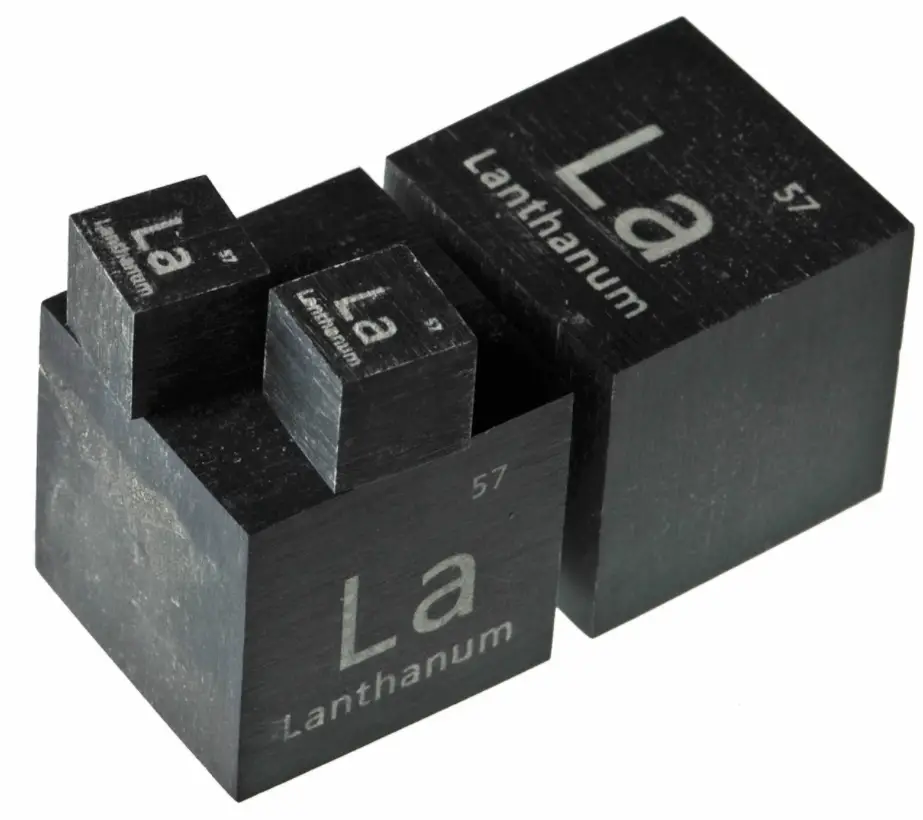
Lanthanum is a soft, ductile, silvery-white metal that tarnishes rapidly when exposed to air and is soft enough to be cut with a knife. It is the eponym of the lanthanide series, a group of 15 similar elements between lanthanum and lutetium in the periodic table, of which lanthanum is the first and the prototype. It is also sometimes considered the first element of the 6th-period transition metals and is traditionally counted among the rare earth elements.

Summary

Element Lanthanum
Atomic number 57
Element category Rare Earth Metal
Phase at STP Solid
Density 6.146 g/cm3
Ultimate Tensile Strength 130 MPa
Yield Strength 125 MPa
Young’s Modulus of Elasticity 36.6 GPa
Mohs Scale 2.5
Brinell Hardness 350 MPa
Vickers Hardness 360 MPa
Melting Point 920 °C
Boiling Point 3454 °C
Thermal Conductivity 13 W/mK
Thermal Expansion Coefficient 12.1 µm/mK
Specific Heat 0.19 J/g K
Heat of Fusion 6.2 kJ/mol
Heat of Vaporization 414 kJ/mol
Electrical resistivity [nanoOhm meter] 615
Magnetic Susceptibility +118.6e-6 cm^3/mol

Applications of Lanthanum

Lanthanum is not extensively used metal. However, its alloys have a variety of interesting uses. A lanthanum-nickel alloy is used to store hydrogen gas for use in hydrogen-powered vehicles. Lanthanum is also found in the anode of nickel metal hydride batteries (NiMH) used in hybrid cars. Lanthanum is an important component of mischmetal alloy. A typical composition includes approximately 55% cerium, 25% lanthanum, and 15-18% neodymium with other rare earth metals following. The best-known use for this alloy is in ‘flints’ for cigarette lighters.

Lanthanum-applications

Production and Price of Lanthanum

Raw materials prices change daily. They are primarily driven by supply, demand and energy prices. In 2019, prices of pure Lanthanum were at around 640 $/kg.

The ores containing lanthanum, such as monazite, are typically contain a range of other rare earths. Consequently they undergo a series of chemical treatments to remove rare earths such as thorium and cerium to yield lanthanum salts. Monazite is an important ore for thorium, lanthanum, and cerium. It is often found in placer deposits. India, Madagascar, and South Africa have large deposits of monazite sands. The deposits in India are particularly rich in monazite.

Lanthanum-periodic-table

Source: www.luciteria.com

Mechanical Properties of Lanthanum

Lanthanum-mechanical-properties-strength-hardness-crystal-structure

Strength of Lanthanum

In mechanics of materials, the strength of a material is its ability to withstand an applied load without failure or plastic deformation. Strength of materials basically considers the relationship between the external loads applied to a material and the resulting deformation or change in material dimensions. In designing structures and machines, it is important to consider these factors, in order that the material selected will have adequate strength to resist applied loads or forces and retain its original shape. Strength of a material is its ability to withstand this applied load without failure or plastic deformation.

For tensile stress, the capacity of a material or structure to withstand loads tending to elongate is known as ultimate tensile strength (UTS). Yield strength or yield stress is the material property defined as the stress at which a material begins to deform plastically whereas yield point is the point where nonlinear (elastic + plastic) deformation begins.

See also: Strength of Materials

Ultimate Tensile Strength of Lanthanum

Ultimate tensile strength of Lanthanum is 130 MPa.

Yield Strength of Lanthanum

Yield strength of Lanthanum is 125 MPa.

Modulus of Elasticity of Lanthanum

The Young’s modulus of elasticity of Lanthanum is 125 MPa.

Hardness of Lanthanum

In materials science, hardness is the ability to withstand surface indentation (localized plastic deformation) and scratching. Brinell hardness test is one of indentation hardness tests, that has been developed for hardness testing. In Brinell tests, a hard, spherical indenter is forced under a specific load into the surface of the metal to be tested.

Brinell hardness of Lanthanum is approximately 350 MPa.

The Vickers hardness test method was developed by Robert L. Smith and George E. Sandland at Vickers Ltd as an alternative to the Brinell method to measure the hardness of materials. The Vickers hardness test method can be also used as a microhardness test method, which is mostly used for small parts, thin sections, or case depth work.

Vickers hardness of Lanthanum is approximately 360 MPa.

Scratch hardness is the measure of how resistant a sample is to permanent plastic deformation due to friction from a sharp object. The most common scale for this qualitative test is Mohs scale, which is used in mineralogy. The Mohs scale of mineral hardness is based on the ability of one natural sample of mineral to scratch another mineral visibly.

Lanthanum is has a hardness of approximately 2.5.

See also: Hardness of Materials

Lanthanum – Crystal Structure

A possible crystal structure of Lanthanum is double hexagonal close-packed structure.

crystal structures - FCC, BCC, HCP

In metals, and in many other solids, the atoms are arranged in regular arrays called crystals. A crystal lattice is a repeating pattern of mathematical points that extends throughout space. The forces of chemical bonding causes this repetition. It is this repeated pattern which control properties like strength, ductility, density, conductivity (property of conducting or transmitting heat, electricity, etc.), and shape. There are 14 general types of such patterns known as Bravais lattices.

See also: Crystal Structure of Materials

Crystal Structure of Lanthanum
Crystal Structure of Lanthanum is: double hexagonal close-packed

Strength of Elements

Elasticity of Elements

Hardness of Elements


Thermal Properties of Lanthanum

Lanthanum-melting-point-conductivity-thermal-properties

Lanthanum – Melting Point and Boiling Point

Melting point of Lanthanum is 920°C.

Boiling point of Lanthanum is 3454°C.

Note that, these points are associated with the standard atmospheric pressure.

Lanthanum – Thermal Conductivity

Thermal conductivity of Lanthanum is 13 W/(m·K).

The heat transfer characteristics of a solid material are measured by a property called the thermal conductivity, k (or λ), measured in W/m.K. It is a measure of a substance’s ability to transfer heat through a material by conduction. Note that Fourier’s law applies for all matter, regardless of its state (solid, liquid, or gas), therefore, it is also defined for liquids and gases.

Coefficient of Thermal Expansion of Lanthanum

Linear thermal expansion coefficient of Lanthanum is 12.1 µm/(m·K)

Thermal expansion is generally the tendency of matter to change its dimensions in response to a change in temperature. It is usually expressed as a fractional change in length or volume per unit temperature change.

Lanthanum – Specific Heat, Latent Heat of Fusion, Latent Heat of Vaporization

Specific heat of Lanthanum is 0.19 J/g K.

Heat capacity is an extensive property of matter, meaning it is proportional to the size of the system. Heat capacity C has the unit of energy per degree or energy per kelvin. When expressing the same phenomenon as an intensive property, the heat capacity is divided by the amount of substance, mass, or volume, thus the quantity is independent of the size or extent of the sample.

Latent Heat of Fusion of Lanthanum is 6.2 kJ/mol.

Latent Heat of Vaporization of Lanthanum is 414 kJ/mol.

Latent heat is the amount of heat added to or removed from a substance to produce a change in phase. This energy breaks down the intermolecular attractive forces, and also must provide the energy necessary to expand the gas (the pΔV work). When latent heat is added, no temperature change occurs. The enthalpy of vaporization is a function of the pressure at which that transformation takes place.

Melting Point of Elements

Periodic Table of Elements - melting point

Thermal Conductivity of Elements

Periodic Table of Elements - thermal conductivity

Thermal Expansion of Elements

Periodic Table of Elements - thermal expansion

Heat Capacity of Elements

Periodic Table of Elements - heat capacity

Heat of Fusion of Elements

Periodic Table of Elements - latent heat fusion

Heat of Vaporization of Elements

Periodic Table of Elements - latent heat vaporization

Lanthanum – Electrical Resistivity – Magnetic Susceptibility

Lanthanum-electrical-resistivity-magnetic-susceptibility

Electrical property refers to the response of a material to an applied electric field. One of the principal characteristics of materials is their ability (or lack of ability) to conduct electrical current. Indeed, materials are classified by this property, that is, they are divided into conductors, semiconductors, and nonconductors.

See also: Electrical Properties

Magnetic property refers to the response of a material to an applied magnetic field. The macroscopic magnetic properties of a material are a consequence of interactions between an external magnetic field and the magnetic dipole moments of the constituent atoms. Different materials react to the application of magnetic field differently.

See also: Magnetic Properties

Electrical Resistivity of Lanthanum

Electrical resistivity of Lanthanum is 615 nΩ⋅m.

Electrical conductivity and its converse, electrical resistivity, is a fundamental property of a material that quantifies how Lanthanum conducts the flow of electric current. Electrical conductivity or specific conductance is the reciprocal of electrical resistivity.

Magnetic Susceptibility of Lanthanum

Magnetic susceptibility of Lanthanum is +118.6e-6 cm^3/mol.

In electromagnetism, magnetic susceptibility is the measure of the magnetization of a substance. Magnetic susceptibility is a dimensionless proportionality factor that indicates the degree of magnetization of Lanthanum in response to an applied magnetic field.

Electrical Resistivity of Elements

Periodic Table of Elements - electrical resistivity

Magnetic Susceptibility of Elements

Application and prices of other elements

Lanthanum - Comparison of Properties and Prices

Periodic Table in 8K resolution

Other properties of Lanthanum


Barium – Properties – Price – Applications – Production

Barium-properties-price-application-production

About Barium

Barium is the fifth element in group 2 and is a soft, silvery alkaline earth metal. Because of its high chemical reactivity, barium is never found in nature as a free element. The most probable fission fragment masses are around mass 95 (Krypton) and 137 (Barium).

Summary

Element Barium
Atomic number 56
Element category Alkaline Earth Metal
Phase at STP Solid
Density 3.51 g/cm3
Ultimate Tensile Strength N/A
Yield Strength N/A
Young’s Modulus of Elasticity 13 GPa
Mohs Scale 1.25
Brinell Hardness N/A
Vickers Hardness N/A
Melting Point 725 °C
Boiling Point 1845 °C
Thermal Conductivity 18 W/mK
Thermal Expansion Coefficient 20.6 µm/mK
Specific Heat 0.204 J/g K
Heat of Fusion 7.75 kJ/mol
Heat of Vaporization 142 kJ/mol
Electrical resistivity [nanoOhm meter] 332
Magnetic Susceptibility +20.6e-6 cm^3/mol

Applications of Barium

Barium is not an extensively used element. Most is used in drilling fluids for oil and gas wells. It is also used in paint and in glassmaking. Barium is also a key element in the production of ceramic superconductors. Lanthanum barium copper oxide, or LBCO, was discovered in 1986 and was the first high temperature superconductor.

Barium-applications

Production and Price of Barium

Raw materials prices change daily. They are primarily driven by supply, demand and energy prices. In 2019, prices of pure Barium were at around 550 $/kg.

The primary commercial source of barium is baryte (also called barytes or heavy spar), a barium sulfate mineral with deposits in many parts of the world. Another commercial source, far less important than baryte, is witherite, barium carbonate.

Barium-periodic-table

Source: www.luciteria.com

Mechanical Properties of Barium

Barium-mechanical-properties-strength-hardness-crystal-structure

Strength of Barium

In mechanics of materials, the strength of a material is its ability to withstand an applied load without failure or plastic deformation. Strength of materials basically considers the relationship between the external loads applied to a material and the resulting deformation or change in material dimensions. In designing structures and machines, it is important to consider these factors, in order that the material selected will have adequate strength to resist applied loads or forces and retain its original shape. Strength of a material is its ability to withstand this applied load without failure or plastic deformation.

For tensile stress, the capacity of a material or structure to withstand loads tending to elongate is known as ultimate tensile strength (UTS). Yield strength or yield stress is the material property defined as the stress at which a material begins to deform plastically whereas yield point is the point where nonlinear (elastic + plastic) deformation begins.

See also: Strength of Materials

Ultimate Tensile Strength of Barium

Ultimate tensile strength of Barium is N/A.

Yield Strength of Barium

Yield strength of Barium is N/A.

Modulus of Elasticity of Barium

The Young’s modulus of elasticity of Barium is N/A.

Hardness of Barium

In materials science, hardness is the ability to withstand surface indentation (localized plastic deformation) and scratching. Brinell hardness test is one of indentation hardness tests, that has been developed for hardness testing. In Brinell tests, a hard, spherical indenter is forced under a specific load into the surface of the metal to be tested.

Brinell hardness of Barium is approximately N/A.

The Vickers hardness test method was developed by Robert L. Smith and George E. Sandland at Vickers Ltd as an alternative to the Brinell method to measure the hardness of materials. The Vickers hardness test method can be also used as a microhardness test method, which is mostly used for small parts, thin sections, or case depth work.

Vickers hardness of Barium is approximately N/A.

Scratch hardness is the measure of how resistant a sample is to permanent plastic deformation due to friction from a sharp object. The most common scale for this qualitative test is Mohs scale, which is used in mineralogy. The Mohs scale of mineral hardness is based on the ability of one natural sample of mineral to scratch another mineral visibly.

Barium is has a hardness of approximately 1.25.

See also: Hardness of Materials

Barium – Crystal Structure

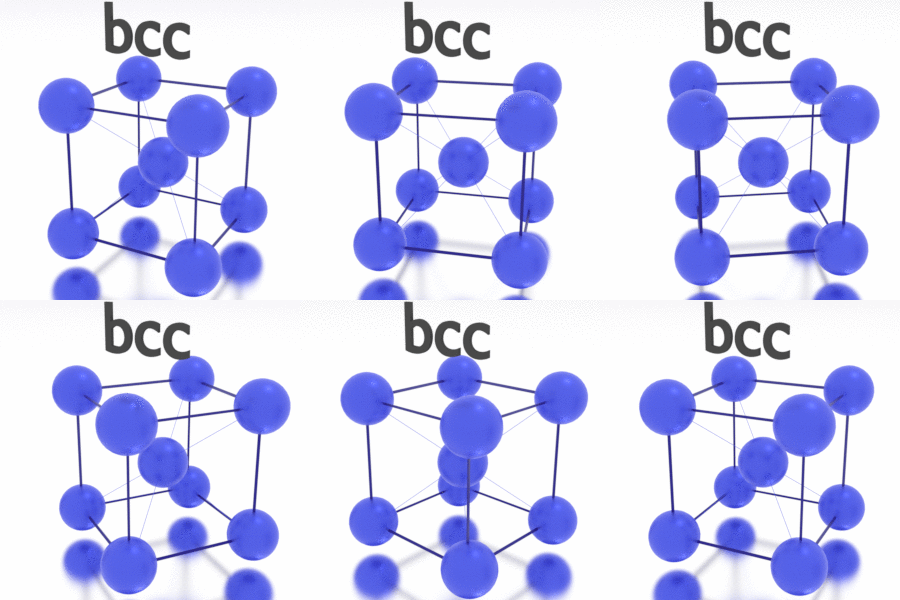
A possible crystal structure of Barium is body-centered cubic structure.

crystal structures - FCC, BCC, HCP

In metals, and in many other solids, the atoms are arranged in regular arrays called crystals. A crystal lattice is a repeating pattern of mathematical points that extends throughout space. The forces of chemical bonding causes this repetition. It is this repeated pattern which control properties like strength, ductility, density, conductivity (property of conducting or transmitting heat, electricity, etc.), and shape. There are 14 general types of such patterns known as Bravais lattices.

See also: Crystal Structure of Materials

Crystal Structure of Barium
Crystal Structure of Barium is: body-centered cubic

Strength of Elements

Elasticity of Elements

Hardness of Elements


Thermal Properties of Barium

Barium-melting-point-conductivity-thermal-properties

Barium – Melting Point and Boiling Point

Melting point of Barium is 725°C.

Boiling point of Barium is 1845°C.

Note that, these points are associated with the standard atmospheric pressure.

Barium – Thermal Conductivity

Thermal conductivity of Barium is 18 W/(m·K).

The heat transfer characteristics of a solid material are measured by a property called the thermal conductivity, k (or λ), measured in W/m.K. It is a measure of a substance’s ability to transfer heat through a material by conduction. Note that Fourier’s law applies for all matter, regardless of its state (solid, liquid, or gas), therefore, it is also defined for liquids and gases.

Coefficient of Thermal Expansion of Barium

Linear thermal expansion coefficient of Barium is 20.6 µm/(m·K)

Thermal expansion is generally the tendency of matter to change its dimensions in response to a change in temperature. It is usually expressed as a fractional change in length or volume per unit temperature change.

Barium – Specific Heat, Latent Heat of Fusion, Latent Heat of Vaporization

Specific heat of Barium is 0.204 J/g K.

Heat capacity is an extensive property of matter, meaning it is proportional to the size of the system. Heat capacity C has the unit of energy per degree or energy per kelvin. When expressing the same phenomenon as an intensive property, the heat capacity is divided by the amount of substance, mass, or volume, thus the quantity is independent of the size or extent of the sample.

Latent Heat of Fusion of Barium is 7.75 kJ/mol.

Latent Heat of Vaporization of Barium is 142 kJ/mol.

Latent heat is the amount of heat added to or removed from a substance to produce a change in phase. This energy breaks down the intermolecular attractive forces, and also must provide the energy necessary to expand the gas (the pΔV work). When latent heat is added, no temperature change occurs. The enthalpy of vaporization is a function of the pressure at which that transformation takes place.

Melting Point of Elements

Periodic Table of Elements - melting point

Thermal Conductivity of Elements

Periodic Table of Elements - thermal conductivity

Thermal Expansion of Elements

Periodic Table of Elements - thermal expansion

Heat Capacity of Elements

Periodic Table of Elements - heat capacity

Heat of Fusion of Elements

Periodic Table of Elements - latent heat fusion

Heat of Vaporization of Elements

Periodic Table of Elements - latent heat vaporization

Barium – Electrical Resistivity – Magnetic Susceptibility

Barium-electrical-resistivity-magnetic-susceptibility

Electrical property refers to the response of a material to an applied electric field. One of the principal characteristics of materials is their ability (or lack of ability) to conduct electrical current. Indeed, materials are classified by this property, that is, they are divided into conductors, semiconductors, and nonconductors.

See also: Electrical Properties

Magnetic property refers to the response of a material to an applied magnetic field. The macroscopic magnetic properties of a material are a consequence of interactions between an external magnetic field and the magnetic dipole moments of the constituent atoms. Different materials react to the application of magnetic field differently.

See also: Magnetic Properties

Electrical Resistivity of Barium

Electrical resistivity of Barium is 332 nΩ⋅m.

Electrical conductivity and its converse, electrical resistivity, is a fundamental property of a material that quantifies how Barium conducts the flow of electric current. Electrical conductivity or specific conductance is the reciprocal of electrical resistivity.

Magnetic Susceptibility of Barium

Magnetic susceptibility of Barium is +20.6e-6 cm^3/mol.

In electromagnetism, magnetic susceptibility is the measure of the magnetization of a substance. Magnetic susceptibility is a dimensionless proportionality factor that indicates the degree of magnetization of Barium in response to an applied magnetic field.

Electrical Resistivity of Elements

Periodic Table of Elements - electrical resistivity

Magnetic Susceptibility of Elements

Application and prices of other elements

Barium - Comparison of Properties and Prices

Periodic Table in 8K resolution

Other properties of Barium


Caesium – Properties – Price – Applications – Production

Caesium-properties-price-application-production

About Caesium

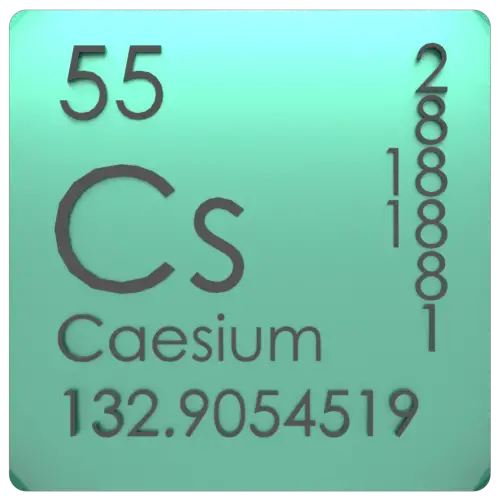
Caesium is a soft, silvery-gold alkali metal with a melting point of 28.5 °C, which makes it one of only five elemental metals that are liquid at or near room temperature. Caesium has physical and chemical properties similar to those of rubidium and potassium.

Summary

Element Caesium
Atomic number 55
Element category Alkali Metal
Phase at STP Solid
Density 1.879 g/cm3
Ultimate Tensile Strength N/A
Yield Strength N/A
Young’s Modulus of Elasticity 1.7 GPa
Mohs Scale 0.2
Brinell Hardness 0.14 MPa
Vickers Hardness N/A
Melting Point 28.4 °C
Boiling Point 669 °C
Thermal Conductivity 36 W/mK
Thermal Expansion Coefficient 97 µm/mK
Specific Heat 0.24 J/g K
Heat of Fusion 2.092 kJ/mol
Heat of Vaporization 67.74 kJ/mol
Electrical resistivity [nanoOhm meter] 205
Magnetic Susceptibility N/A

Applications of Caesium

The largest present-day use of nonradioactive caesium is in caesium formate drilling fluids for the extractive oil industry. They are also used to make special optical glass, as a catalyst promoter, in vacuum tubes and in radiation monitoring equipment. One of its most important uses is in the ‘caesium clock’ (atomic clock). These clocks are a vital part of the internetand mobile phone networks, as well as Global Positioning System (GPS) satellites. Caesium-137 is a radioisotope commonly used as a gamma-emitter in industrial applications.

Caesium-applications

Production and Price of Caesium

Raw materials prices change daily. They are primarily driven by supply, demand and energy prices. In 2019, prices of pure Caesium were at around 11000 $/kg.

Caesium is mined mostly from pollucite, while the radioisotopes, especially caesium-137, a fission product, are extracted from waste produced by nuclear reactors. Mining and refining pollucite ore is a selective process and is conducted on a smaller scale than for most other metals. The ore is crushed, hand-sorted, but not usually concentrated, and then ground. Caesium is then extracted from pollucite primarily by three methods: acid digestion, alkaline decomposition, and direct reduction.

Caesium-periodic-table

Source: www.luciteria.com

Mechanical Properties of Caesium

Caesium-mechanical-properties-strength-hardness-crystal-structure

Strength of Caesium

In mechanics of materials, the strength of a material is its ability to withstand an applied load without failure or plastic deformation. Strength of materials basically considers the relationship between the external loads applied to a material and the resulting deformation or change in material dimensions. In designing structures and machines, it is important to consider these factors, in order that the material selected will have adequate strength to resist applied loads or forces and retain its original shape. Strength of a material is its ability to withstand this applied load without failure or plastic deformation.

For tensile stress, the capacity of a material or structure to withstand loads tending to elongate is known as ultimate tensile strength (UTS). Yield strength or yield stress is the material property defined as the stress at which a material begins to deform plastically whereas yield point is the point where nonlinear (elastic + plastic) deformation begins.

See also: Strength of Materials

Ultimate Tensile Strength of Caesium

Ultimate tensile strength of Caesium is N/A.

Yield Strength of Caesium

Yield strength of Caesium is N/A.

Modulus of Elasticity of Caesium

The Young’s modulus of elasticity of Caesium is N/A.

Hardness of Caesium

In materials science, hardness is the ability to withstand surface indentation (localized plastic deformation) and scratching. Brinell hardness test is one of indentation hardness tests, that has been developed for hardness testing. In Brinell tests, a hard, spherical indenter is forced under a specific load into the surface of the metal to be tested.

Brinell hardness of Caesium is approximately 0.14 MPa.

The Vickers hardness test method was developed by Robert L. Smith and George E. Sandland at Vickers Ltd as an alternative to the Brinell method to measure the hardness of materials. The Vickers hardness test method can be also used as a microhardness test method, which is mostly used for small parts, thin sections, or case depth work.

Vickers hardness of Caesium is approximately N/A.

Scratch hardness is the measure of how resistant a sample is to permanent plastic deformation due to friction from a sharp object. The most common scale for this qualitative test is Mohs scale, which is used in mineralogy. The Mohs scale of mineral hardness is based on the ability of one natural sample of mineral to scratch another mineral visibly.

Caesium is has a hardness of approximately 0.2.

See also: Hardness of Materials

Caesium – Crystal Structure

A possible crystal structure of Caesium is body-centered cubic structure.

crystal structures - FCC, BCC, HCP

In metals, and in many other solids, the atoms are arranged in regular arrays called crystals. A crystal lattice is a repeating pattern of mathematical points that extends throughout space. The forces of chemical bonding causes this repetition. It is this repeated pattern which control properties like strength, ductility, density, conductivity (property of conducting or transmitting heat, electricity, etc.), and shape. There are 14 general types of such patterns known as Bravais lattices.

See also: Crystal Structure of Materials

Crystal Structure of Caesium
Crystal Structure of Caesium is: body-centered cubic

Strength of Elements

Elasticity of Elements

Hardness of Elements


Thermal Properties of Caesium

Caesium-melting-point-conductivity-thermal-properties

Caesium – Melting Point and Boiling Point

Melting point of Caesium is 28.4°C.

Boiling point of Caesium is 669°C.

Note that, these points are associated with the standard atmospheric pressure.

Caesium – Thermal Conductivity

Thermal conductivity of Caesium is 36 W/(m·K).

The heat transfer characteristics of a solid material are measured by a property called the thermal conductivity, k (or λ), measured in W/m.K. It is a measure of a substance’s ability to transfer heat through a material by conduction. Note that Fourier’s law applies for all matter, regardless of its state (solid, liquid, or gas), therefore, it is also defined for liquids and gases.

Coefficient of Thermal Expansion of Caesium

Linear thermal expansion coefficient of Caesium is 97 µm/(m·K)

Thermal expansion is generally the tendency of matter to change its dimensions in response to a change in temperature. It is usually expressed as a fractional change in length or volume per unit temperature change.

Caesium – Specific Heat, Latent Heat of Fusion, Latent Heat of Vaporization

Specific heat of Caesium is 0.24 J/g K.

Heat capacity is an extensive property of matter, meaning it is proportional to the size of the system. Heat capacity C has the unit of energy per degree or energy per kelvin. When expressing the same phenomenon as an intensive property, the heat capacity is divided by the amount of substance, mass, or volume, thus the quantity is independent of the size or extent of the sample.

Latent Heat of Fusion of Caesium is 2.092 kJ/mol.

Latent Heat of Vaporization of Caesium is 67.74 kJ/mol.

Latent heat is the amount of heat added to or removed from a substance to produce a change in phase. This energy breaks down the intermolecular attractive forces, and also must provide the energy necessary to expand the gas (the pΔV work). When latent heat is added, no temperature change occurs. The enthalpy of vaporization is a function of the pressure at which that transformation takes place.

Melting Point of Elements

Periodic Table of Elements - melting point

Thermal Conductivity of Elements

Periodic Table of Elements - thermal conductivity

Thermal Expansion of Elements

Periodic Table of Elements - thermal expansion

Heat Capacity of Elements

Periodic Table of Elements - heat capacity

Heat of Fusion of Elements

Periodic Table of Elements - latent heat fusion

Heat of Vaporization of Elements

Periodic Table of Elements - latent heat vaporization

Caesium – Electrical Resistivity – Magnetic Susceptibility

Caesium-electrical-resistivity-magnetic-susceptibility

Electrical property refers to the response of a material to an applied electric field. One of the principal characteristics of materials is their ability (or lack of ability) to conduct electrical current. Indeed, materials are classified by this property, that is, they are divided into conductors, semiconductors, and nonconductors.

See also: Electrical Properties

Magnetic property refers to the response of a material to an applied magnetic field. The macroscopic magnetic properties of a material are a consequence of interactions between an external magnetic field and the magnetic dipole moments of the constituent atoms. Different materials react to the application of magnetic field differently.

See also: Magnetic Properties

Electrical Resistivity of Caesium

Electrical resistivity of Caesium is 205 nΩ⋅m.

Electrical conductivity and its converse, electrical resistivity, is a fundamental property of a material that quantifies how Caesium conducts the flow of electric current. Electrical conductivity or specific conductance is the reciprocal of electrical resistivity.

Magnetic Susceptibility of Caesium

Magnetic susceptibility of Caesium is N/A.

In electromagnetism, magnetic susceptibility is the measure of the magnetization of a substance. Magnetic susceptibility is a dimensionless proportionality factor that indicates the degree of magnetization of Caesium in response to an applied magnetic field.

Electrical Resistivity of Elements

Periodic Table of Elements - electrical resistivity

Magnetic Susceptibility of Elements

Application and prices of other elements

Caesium - Comparison of Properties and Prices

Periodic Table in 8K resolution

Other properties of Caesium


Xenon – Properties – Price – Applications – Production

Xenon-properties-price-application-production

About Xenon

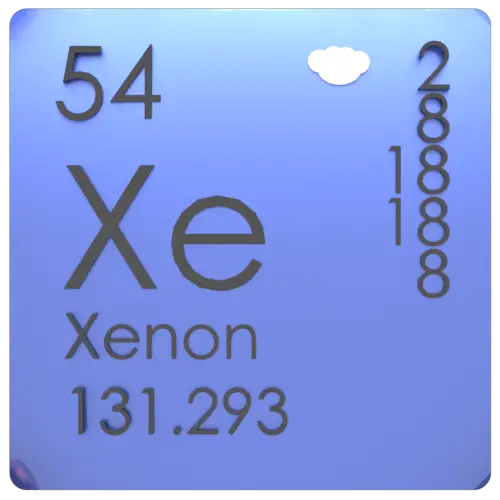
Xenon is a colorless, dense, odorless noble gas found in the Earth’s atmosphere in trace amounts.[10] Although generally unreactive, xenon can undergo a few chemical reactions. Xenon was first discovered in 1898 by the Scottish chemist William Ramsay and English chemist Morris Travers. The name xenon for this gas comes from the Greek word ξένον [xenon], neuter singular form of ξένος [xenos], meaning ‘foreign(er)’, ‘strange(r)’, or ‘guest’. In nuclear industry, especially artificial xenon 135 has a tremendous impact on the operation of a nuclear reactor. For physicists and for reactor operators, it is important to understand the mechanisms that produce and remove xenon from the reactor to predict how the reactor will respond following changes in power level.

Summary

Element Xenon
Atomic number 54
Element category Noble Gas
Phase at STP Gas
Density 0.0059 g/cm3
Ultimate Tensile Strength N/A
Yield Strength N/A
Young’s Modulus of Elasticity N/A
Mohs Scale N/A
Brinell Hardness N/A
Vickers Hardness N/A
Melting Point -111.8 °C
Boiling Point -107.1 °C
Thermal Conductivity 0.00565 W/mK
Thermal Expansion Coefficient — µm/mK
Specific Heat 0.158 J/g K
Heat of Fusion 2.297 kJ/mol
Heat of Vaporization 12.636 kJ/mol
Electrical resistivity [nanoOhm meter] —
Magnetic Susceptibility −44e-6 cm^3/mol

Applications of Xenon

Xenon is useful in the following applications. The white flash of light produced by xenon makes it suitable for usage in strobe lights and to power ruby lasers. Xenon is used in light-emitting devices called xenon flash lamps, used in photographic flashes and stroboscopic lamps.

Xenon-applications

Production and Price of Xenon

Raw materials prices change daily. They are primarily driven by supply, demand and energy prices. In 2019, prices of pure Xenon were at around 1200 $/kg.

Xenon can be extracted by subjecting liquefied air to fractional distillation and removing carbon dioxide, nitrogen, water vapor and oxygen from the resulting residues of liquefied air. At present, xenon and krypton are produced as a by-product in giant air separation stations at metallurgical factories.

Xenon-periodic-table

Source: www.luciteria.com

Mechanical Properties of Xenon

Xenon-mechanical-properties-strength-hardness-crystal-structure

Strength of Xenon

In mechanics of materials, the strength of a material is its ability to withstand an applied load without failure or plastic deformation. Strength of materials basically considers the relationship between the external loads applied to a material and the resulting deformation or change in material dimensions. In designing structures and machines, it is important to consider these factors, in order that the material selected will have adequate strength to resist applied loads or forces and retain its original shape. Strength of a material is its ability to withstand this applied load without failure or plastic deformation.

For tensile stress, the capacity of a material or structure to withstand loads tending to elongate is known as ultimate tensile strength (UTS). Yield strength or yield stress is the material property defined as the stress at which a material begins to deform plastically whereas yield point is the point where nonlinear (elastic + plastic) deformation begins.

See also: Strength of Materials

Ultimate Tensile Strength of Xenon

Ultimate tensile strength of Xenon is N/A.

Yield Strength of Xenon

Yield strength of Xenon is N/A.

Modulus of Elasticity of Xenon

The Young’s modulus of elasticity of Xenon is N/A.

Hardness of Xenon

In materials science, hardness is the ability to withstand surface indentation (localized plastic deformation) and scratching. Brinell hardness test is one of indentation hardness tests, that has been developed for hardness testing. In Brinell tests, a hard, spherical indenter is forced under a specific load into the surface of the metal to be tested.

Brinell hardness of Xenon is approximately N/A.

The Vickers hardness test method was developed by Robert L. Smith and George E. Sandland at Vickers Ltd as an alternative to the Brinell method to measure the hardness of materials. The Vickers hardness test method can be also used as a microhardness test method, which is mostly used for small parts, thin sections, or case depth work.

Vickers hardness of Xenon is approximately N/A.

Scratch hardness is the measure of how resistant a sample is to permanent plastic deformation due to friction from a sharp object. The most common scale for this qualitative test is Mohs scale, which is used in mineralogy. The Mohs scale of mineral hardness is based on the ability of one natural sample of mineral to scratch another mineral visibly.

Xenon is has a hardness of approximately N/A.

See also: Hardness of Materials

Xenon – Crystal Structure

A possible crystal structure of Xenon is face-centered cubic structure.

crystal structures - FCC, BCC, HCP

In metals, and in many other solids, the atoms are arranged in regular arrays called crystals. A crystal lattice is a repeating pattern of mathematical points that extends throughout space. The forces of chemical bonding causes this repetition. It is this repeated pattern which control properties like strength, ductility, density, conductivity (property of conducting or transmitting heat, electricity, etc.), and shape. There are 14 general types of such patterns known as Bravais lattices.

See also: Crystal Structure of Materials

Crystal Structure of Xenon
Crystal Structure of Xenon is: face-centered cubic

Strength of Elements

Elasticity of Elements

Hardness of Elements


Thermal Properties of Xenon

Xenon-melting-point-conductivity-thermal-properties

Xenon – Melting Point and Boiling Point

Melting point of Xenon is -111.8°C.

Boiling point of Xenon is -107.1°C.

Note that, these points are associated with the standard atmospheric pressure.

Xenon – Thermal Conductivity

Thermal conductivity of Xenon is 0.00565 W/(m·K).

The heat transfer characteristics of a solid material are measured by a property called the thermal conductivity, k (or λ), measured in W/m.K. It is a measure of a substance’s ability to transfer heat through a material by conduction. Note that Fourier’s law applies for all matter, regardless of its state (solid, liquid, or gas), therefore, it is also defined for liquids and gases.

Coefficient of Thermal Expansion of Xenon

Linear thermal expansion coefficient of Xenon is — µm/(m·K)

Thermal expansion is generally the tendency of matter to change its dimensions in response to a change in temperature. It is usually expressed as a fractional change in length or volume per unit temperature change.

Xenon – Specific Heat, Latent Heat of Fusion, Latent Heat of Vaporization

Specific heat of Xenon is 0.158 J/g K.

Heat capacity is an extensive property of matter, meaning it is proportional to the size of the system. Heat capacity C has the unit of energy per degree or energy per kelvin. When expressing the same phenomenon as an intensive property, the heat capacity is divided by the amount of substance, mass, or volume, thus the quantity is independent of the size or extent of the sample.

Latent Heat of Fusion of Xenon is 2.297 kJ/mol.

Latent Heat of Vaporization of Xenon is 12.636 kJ/mol.

Latent heat is the amount of heat added to or removed from a substance to produce a change in phase. This energy breaks down the intermolecular attractive forces, and also must provide the energy necessary to expand the gas (the pΔV work). When latent heat is added, no temperature change occurs. The enthalpy of vaporization is a function of the pressure at which that transformation takes place.

Melting Point of Elements

Periodic Table of Elements - melting point

Thermal Conductivity of Elements

Periodic Table of Elements - thermal conductivity

Thermal Expansion of Elements

Periodic Table of Elements - thermal expansion

Heat Capacity of Elements

Periodic Table of Elements - heat capacity

Heat of Fusion of Elements

Periodic Table of Elements - latent heat fusion

Heat of Vaporization of Elements

Periodic Table of Elements - latent heat vaporization

Xenon – Electrical Resistivity – Magnetic Susceptibility

Xenon-electrical-resistivity-magnetic-susceptibility

Electrical property refers to the response of a material to an applied electric field. One of the principal characteristics of materials is their ability (or lack of ability) to conduct electrical current. Indeed, materials are classified by this property, that is, they are divided into conductors, semiconductors, and nonconductors.

See also: Electrical Properties

Magnetic property refers to the response of a material to an applied magnetic field. The macroscopic magnetic properties of a material are a consequence of interactions between an external magnetic field and the magnetic dipole moments of the constituent atoms. Different materials react to the application of magnetic field differently.

See also: Magnetic Properties

Electrical Resistivity of Xenon

Electrical resistivity of Xenon is — nΩ⋅m.

Electrical conductivity and its converse, electrical resistivity, is a fundamental property of a material that quantifies how Xenon conducts the flow of electric current. Electrical conductivity or specific conductance is the reciprocal of electrical resistivity.

Magnetic Susceptibility of Xenon

Magnetic susceptibility of Xenon is −44e-6 cm^3/mol.

In electromagnetism, magnetic susceptibility is the measure of the magnetization of a substance. Magnetic susceptibility is a dimensionless proportionality factor that indicates the degree of magnetization of Xenon in response to an applied magnetic field.

Electrical Resistivity of Elements

Periodic Table of Elements - electrical resistivity

Magnetic Susceptibility of Elements

Application and prices of other elements

Xenon - Comparison of Properties and Prices

Periodic Table in 8K resolution

Other properties of Xenon


Iodine – Properties – Price – Applications – Production

Iodine-properties-price-application-production

About Iodine

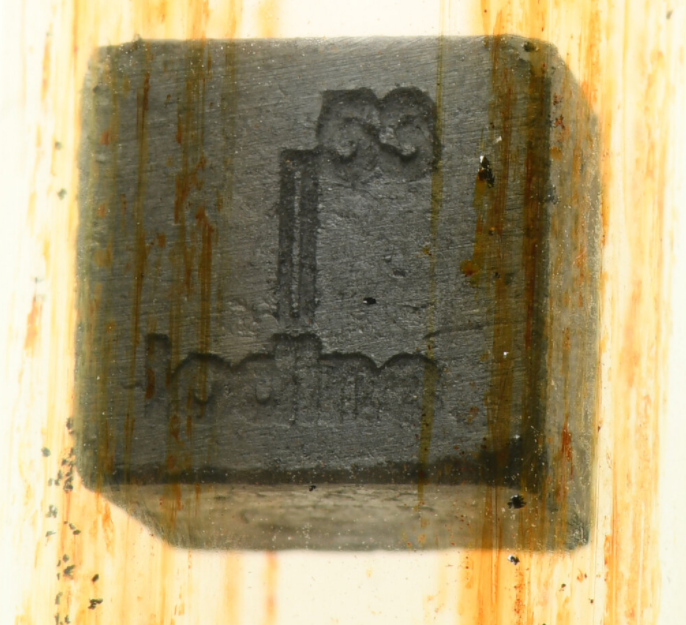
Iodine is the heaviest of the stable halogens, it exists as a lustrous, purple-black metallic solid at standard conditions that sublimes readily to form a violet gas. Iodine is the least abundant of the stable halogens, being the sixty-first most abundant element. It is even less abundant than the so-called rare earths. It is the heaviest essential mineral nutrient.

Summary

Element Iodine
Atomic number 53
Element category Halogen
Phase at STP Solid
Density 4.94 g/cm3
Ultimate Tensile Strength N/A
Yield Strength N/A
Young’s Modulus of Elasticity N/A
Mohs Scale N/A
Brinell Hardness N/A
Vickers Hardness N/A
Melting Point 113.5 °C
Boiling Point 184 °C
Thermal Conductivity 0.449 W/mK
Thermal Expansion Coefficient — µm/mK
Specific Heat 0.214 J/g K
Heat of Fusion 7.824 kJ/mol
Heat of Vaporization 20.752 kJ/mol
Electrical resistivity [nanoOhm meter] 1E16
Magnetic Susceptibility −88e-6 cm^3/mol

Applications of Iodine

In addition to nutrition products, iodine and iodine derivatives are used in a wide range of medical, agricultural, and industrial applications. About half of all produced iodine goes into various organoiodine compounds, another 15% remains as the pure element, another 15% is used to form potassium iodide, and another 15% for other inorganic iodine compounds. The leading application is in the production of X-ray contrast media (22%). Iodine’s high atomic number and density make it ideally suited for this application, as its presence in the body can help to increase contrast between tissues, organs, and blood vessels with similar X-ray densities. It is used as an antiseptic for external wounds. Another application driving the demand for iodine is in polarizing film in liquidcrystal display (LCD) screens

Iodine-applications

Production and Price of Iodine

Raw materials prices change daily. They are primarily driven by supply, demand and energy prices. In 2019, prices of pure Iodine were at around 83 $/kg.

Iodine is produced commercially from iodine-containing brines. Natural brines, or brines extracted from oil wells containing up to 150 mg per litre (0.02 ounce per gallon) of iodine, are found in Java, California, and northern Italy; the world’s top producers include Chile, Japan, China, Russia, and Azerbaijan.

Iodine-periodic-table

Source: www.luciteria.com

Mechanical Properties of Iodine

Iodine-mechanical-properties-strength-hardness-crystal-structure

Strength of Iodine

In mechanics of materials, the strength of a material is its ability to withstand an applied load without failure or plastic deformation. Strength of materials basically considers the relationship between the external loads applied to a material and the resulting deformation or change in material dimensions. In designing structures and machines, it is important to consider these factors, in order that the material selected will have adequate strength to resist applied loads or forces and retain its original shape. Strength of a material is its ability to withstand this applied load without failure or plastic deformation.

For tensile stress, the capacity of a material or structure to withstand loads tending to elongate is known as ultimate tensile strength (UTS). Yield strength or yield stress is the material property defined as the stress at which a material begins to deform plastically whereas yield point is the point where nonlinear (elastic + plastic) deformation begins.

See also: Strength of Materials

Ultimate Tensile Strength of Iodine

Ultimate tensile strength of Iodine is N/A.

Yield Strength of Iodine

Yield strength of Iodine is N/A.

Modulus of Elasticity of Iodine

The Young’s modulus of elasticity of Iodine is N/A.

Hardness of Iodine

In materials science, hardness is the ability to withstand surface indentation (localized plastic deformation) and scratching. Brinell hardness test is one of indentation hardness tests, that has been developed for hardness testing. In Brinell tests, a hard, spherical indenter is forced under a specific load into the surface of the metal to be tested.

Brinell hardness of Iodine is approximately N/A.

The Vickers hardness test method was developed by Robert L. Smith and George E. Sandland at Vickers Ltd as an alternative to the Brinell method to measure the hardness of materials. The Vickers hardness test method can be also used as a microhardness test method, which is mostly used for small parts, thin sections, or case depth work.

Vickers hardness of Iodine is approximately N/A.

Scratch hardness is the measure of how resistant a sample is to permanent plastic deformation due to friction from a sharp object. The most common scale for this qualitative test is Mohs scale, which is used in mineralogy. The Mohs scale of mineral hardness is based on the ability of one natural sample of mineral to scratch another mineral visibly.

Iodine is has a hardness of approximately N/A.

See also: Hardness of Materials

Iodine – Crystal Structure

A possible crystal structure of Iodine is orthorhombic structure.

crystal structures - FCC, BCC, HCP

In metals, and in many other solids, the atoms are arranged in regular arrays called crystals. A crystal lattice is a repeating pattern of mathematical points that extends throughout space. The forces of chemical bonding causes this repetition. It is this repeated pattern which control properties like strength, ductility, density, conductivity (property of conducting or transmitting heat, electricity, etc.), and shape. There are 14 general types of such patterns known as Bravais lattices.

See also: Crystal Structure of Materials

Crystal Structure of Iodine
Crystal Structure of Iodine is: orthorhombic

Strength of Elements

Elasticity of Elements

Hardness of Elements


Thermal Properties of Iodine

Iodine-melting-point-conductivity-thermal-properties

Iodine – Melting Point and Boiling Point

Melting point of Iodine is 113.5°C.

Boiling point of Iodine is 184°C.

Note that, these points are associated with the standard atmospheric pressure.

Iodine – Thermal Conductivity

Thermal conductivity of Iodine is 0.449 W/(m·K).

The heat transfer characteristics of a solid material are measured by a property called the thermal conductivity, k (or λ), measured in W/m.K. It is a measure of a substance’s ability to transfer heat through a material by conduction. Note that Fourier’s law applies for all matter, regardless of its state (solid, liquid, or gas), therefore, it is also defined for liquids and gases.

Coefficient of Thermal Expansion of Iodine

Linear thermal expansion coefficient of Iodine is — µm/(m·K)

Thermal expansion is generally the tendency of matter to change its dimensions in response to a change in temperature. It is usually expressed as a fractional change in length or volume per unit temperature change.

Iodine – Specific Heat, Latent Heat of Fusion, Latent Heat of Vaporization

Specific heat of Iodine is 0.214 J/g K.

Heat capacity is an extensive property of matter, meaning it is proportional to the size of the system. Heat capacity C has the unit of energy per degree or energy per kelvin. When expressing the same phenomenon as an intensive property, the heat capacity is divided by the amount of substance, mass, or volume, thus the quantity is independent of the size or extent of the sample.

Latent Heat of Fusion of Iodine is 7.824 kJ/mol.

Latent Heat of Vaporization of Iodine is 20.752 kJ/mol.

Latent heat is the amount of heat added to or removed from a substance to produce a change in phase. This energy breaks down the intermolecular attractive forces, and also must provide the energy necessary to expand the gas (the pΔV work). When latent heat is added, no temperature change occurs. The enthalpy of vaporization is a function of the pressure at which that transformation takes place.

Melting Point of Elements

Periodic Table of Elements - melting point

Thermal Conductivity of Elements

Periodic Table of Elements - thermal conductivity

Thermal Expansion of Elements

Periodic Table of Elements - thermal expansion

Heat Capacity of Elements

Periodic Table of Elements - heat capacity

Heat of Fusion of Elements

Periodic Table of Elements - latent heat fusion

Heat of Vaporization of Elements

Periodic Table of Elements - latent heat vaporization

Iodine – Electrical Resistivity – Magnetic Susceptibility

Iodine-electrical-resistivity-magnetic-susceptibility

Electrical property refers to the response of a material to an applied electric field. One of the principal characteristics of materials is their ability (or lack of ability) to conduct electrical current. Indeed, materials are classified by this property, that is, they are divided into conductors, semiconductors, and nonconductors.

See also: Electrical Properties

Magnetic property refers to the response of a material to an applied magnetic field. The macroscopic magnetic properties of a material are a consequence of interactions between an external magnetic field and the magnetic dipole moments of the constituent atoms. Different materials react to the application of magnetic field differently.

See also: Magnetic Properties

Electrical Resistivity of Iodine

Electrical resistivity of Iodine is 1E16 nΩ⋅m.

Electrical conductivity and its converse, electrical resistivity, is a fundamental property of a material that quantifies how Iodine conducts the flow of electric current. Electrical conductivity or specific conductance is the reciprocal of electrical resistivity.

Magnetic Susceptibility of Iodine

Magnetic susceptibility of Iodine is −88e-6 cm^3/mol.

In electromagnetism, magnetic susceptibility is the measure of the magnetization of a substance. Magnetic susceptibility is a dimensionless proportionality factor that indicates the degree of magnetization of Iodine in response to an applied magnetic field.

Electrical Resistivity of Elements

Periodic Table of Elements - electrical resistivity

Magnetic Susceptibility of Elements

Application and prices of other elements

Iodine - Comparison of Properties and Prices

Periodic Table in 8K resolution

Other properties of Iodine


Tellurium – Properties – Price – Applications – Production

Tellurium-properties-price-application-production

About Tellurium

Tellurium is a brittle, mildly toxic, rare, silver-white metalloid. Tellurium is chemically related to selenium and sulfur. It is occasionally found in native form as elemental crystals. Tellurium is far more common in the universe as a whole than on Earth. Its extreme rarity in the Earth’s crust, comparable to that of platinum.

Summary

Element Tellurium
Atomic number 52
Element category Metalloids
Phase at STP Solid
Density 6.24 g/cm3
Ultimate Tensile Strength 11 MPa
Yield Strength N/A
Young’s Modulus of Elasticity 43 GPa
Mohs Scale 2.3
Brinell Hardness 200 MPa
Vickers Hardness N/A
Melting Point 449.5 °C
Boiling Point 989.8 °C
Thermal Conductivity 3 W/mK
Thermal Expansion Coefficient 18 µm/mK
Specific Heat 0.2 J/g K
Heat of Fusion 17.49 kJ/mol
Heat of Vaporization 52.55 kJ/mol
Electrical resistivity [nanoOhm meter] —
Magnetic Susceptibility −39.5e-6 cm^3/mol

Applications of Tellurium

The largest consumer of tellurium is metallurgy in iron, stainless steel, copper, and lead alloys. Tellurium is used in alloys, mostly with copper and stainless steel, to improve their machinability. When added to lead it makes it more resistant to acids and improves its strength and hardness. Tellurium has been used to vulcanise rubber, to tint glass and ceramics, in solar cells, and as a catalyst in oil refining. Tellurium as a tellurium suboxide is used in the media later of several types of rewritable optical discs including CD-RW, DVD-RW and rewritable blu-ray discs. It can be doped with silver, gold, copper or tin in semiconductor applications. The use of high-purity tellurium in cadmium telluride solar cells is very promising. Some of the highest efficiencies for electric power generation have been obtained by using this material, but this application has not yet caused demand to increase significantly.

Tellurium-applications

Production and Price of Tellurium

Raw materials prices change daily. They are primarily driven by supply, demand and energy prices. In 2019, prices of pure Tellurium were at around 240 $/kg.

Commercial quantities of selenium are recovered as a byproduct of the electrolytic refining of copper where it accumulates in anode residues. Treatment of 1000 tons of copper ore typically yields one kilogram (2.2 pounds) of tellurium. Commercial-grade tellurium is usually marketed as 200-mesh powder but is also available as slabs, ingots, sticks, or lumps. The year-end price for tellurium in 2000 was US$14 per pound. In recent years, the tellurium price was driven up by increased demand and limited supply, reaching as high as US$100 per pound in 2006.

Tellurium-periodic-table

Source: www.luciteria.com

Mechanical Properties of Tellurium

Tellurium-mechanical-properties-strength-hardness-crystal-structure

Strength of Tellurium

In mechanics of materials, the strength of a material is its ability to withstand an applied load without failure or plastic deformation. Strength of materials basically considers the relationship between the external loads applied to a material and the resulting deformation or change in material dimensions. In designing structures and machines, it is important to consider these factors, in order that the material selected will have adequate strength to resist applied loads or forces and retain its original shape. Strength of a material is its ability to withstand this applied load without failure or plastic deformation.

For tensile stress, the capacity of a material or structure to withstand loads tending to elongate is known as ultimate tensile strength (UTS). Yield strength or yield stress is the material property defined as the stress at which a material begins to deform plastically whereas yield point is the point where nonlinear (elastic + plastic) deformation begins.

See also: Strength of Materials

Ultimate Tensile Strength of Tellurium

Ultimate tensile strength of Tellurium is 11 MPa.

Yield Strength of Tellurium

Yield strength of Tellurium is N/A.

Modulus of Elasticity of Tellurium

The Young’s modulus of elasticity of Tellurium is N/A.

Hardness of Tellurium

In materials science, hardness is the ability to withstand surface indentation (localized plastic deformation) and scratching. Brinell hardness test is one of indentation hardness tests, that has been developed for hardness testing. In Brinell tests, a hard, spherical indenter is forced under a specific load into the surface of the metal to be tested.

Brinell hardness of Tellurium is approximately 200 MPa.

The Vickers hardness test method was developed by Robert L. Smith and George E. Sandland at Vickers Ltd as an alternative to the Brinell method to measure the hardness of materials. The Vickers hardness test method can be also used as a microhardness test method, which is mostly used for small parts, thin sections, or case depth work.

Vickers hardness of Tellurium is approximately N/A.

Scratch hardness is the measure of how resistant a sample is to permanent plastic deformation due to friction from a sharp object. The most common scale for this qualitative test is Mohs scale, which is used in mineralogy. The Mohs scale of mineral hardness is based on the ability of one natural sample of mineral to scratch another mineral visibly.

Tellurium is has a hardness of approximately 2.3.

See also: Hardness of Materials

Tellurium – Crystal Structure

A possible crystal structure of Tellurium is hexagonal structure.

crystal structures - FCC, BCC, HCP

In metals, and in many other solids, the atoms are arranged in regular arrays called crystals. A crystal lattice is a repeating pattern of mathematical points that extends throughout space. The forces of chemical bonding causes this repetition. It is this repeated pattern which control properties like strength, ductility, density, conductivity (property of conducting or transmitting heat, electricity, etc.), and shape. There are 14 general types of such patterns known as Bravais lattices.

See also: Crystal Structure of Materials

Crystal Structure of Tellurium
Crystal Structure of Tellurium is: hexagonal

Strength of Elements

Elasticity of Elements

Hardness of Elements


Thermal Properties of Tellurium

Tellurium-melting-point-conductivity-thermal-properties

Tellurium – Melting Point and Boiling Point

Melting point of Tellurium is 449.5°C.

Boiling point of Tellurium is 989.8°C.

Note that, these points are associated with the standard atmospheric pressure.

Tellurium – Thermal Conductivity

Thermal conductivity of Tellurium is 3 W/(m·K).

The heat transfer characteristics of a solid material are measured by a property called the thermal conductivity, k (or λ), measured in W/m.K. It is a measure of a substance’s ability to transfer heat through a material by conduction. Note that Fourier’s law applies for all matter, regardless of its state (solid, liquid, or gas), therefore, it is also defined for liquids and gases.

Coefficient of Thermal Expansion of Tellurium

Linear thermal expansion coefficient of Tellurium is 18 µm/(m·K)

Thermal expansion is generally the tendency of matter to change its dimensions in response to a change in temperature. It is usually expressed as a fractional change in length or volume per unit temperature change.

Tellurium – Specific Heat, Latent Heat of Fusion, Latent Heat of Vaporization

Specific heat of Tellurium is 0.2 J/g K.

Heat capacity is an extensive property of matter, meaning it is proportional to the size of the system. Heat capacity C has the unit of energy per degree or energy per kelvin. When expressing the same phenomenon as an intensive property, the heat capacity is divided by the amount of substance, mass, or volume, thus the quantity is independent of the size or extent of the sample.

Latent Heat of Fusion of Tellurium is 17.49 kJ/mol.

Latent Heat of Vaporization of Tellurium is 52.55 kJ/mol.

Latent heat is the amount of heat added to or removed from a substance to produce a change in phase. This energy breaks down the intermolecular attractive forces, and also must provide the energy necessary to expand the gas (the pΔV work). When latent heat is added, no temperature change occurs. The enthalpy of vaporization is a function of the pressure at which that transformation takes place.

Melting Point of Elements

Periodic Table of Elements - melting point

Thermal Conductivity of Elements

Periodic Table of Elements - thermal conductivity

Thermal Expansion of Elements

Periodic Table of Elements - thermal expansion

Heat Capacity of Elements

Periodic Table of Elements - heat capacity

Heat of Fusion of Elements

Periodic Table of Elements - latent heat fusion

Heat of Vaporization of Elements

Periodic Table of Elements - latent heat vaporization

Tellurium – Electrical Resistivity – Magnetic Susceptibility

Tellurium-electrical-resistivity-magnetic-susceptibility

Electrical property refers to the response of a material to an applied electric field. One of the principal characteristics of materials is their ability (or lack of ability) to conduct electrical current. Indeed, materials are classified by this property, that is, they are divided into conductors, semiconductors, and nonconductors.

See also: Electrical Properties

Magnetic property refers to the response of a material to an applied magnetic field. The macroscopic magnetic properties of a material are a consequence of interactions between an external magnetic field and the magnetic dipole moments of the constituent atoms. Different materials react to the application of magnetic field differently.

See also: Magnetic Properties

Electrical Resistivity of Tellurium

Electrical resistivity of Tellurium is — nΩ⋅m.

Electrical conductivity and its converse, electrical resistivity, is a fundamental property of a material that quantifies how Tellurium conducts the flow of electric current. Electrical conductivity or specific conductance is the reciprocal of electrical resistivity.

Magnetic Susceptibility of Tellurium

Magnetic susceptibility of Tellurium is −39.5e-6 cm^3/mol.

In electromagnetism, magnetic susceptibility is the measure of the magnetization of a substance. Magnetic susceptibility is a dimensionless proportionality factor that indicates the degree of magnetization of Tellurium in response to an applied magnetic field.

Electrical Resistivity of Elements

Periodic Table of Elements - electrical resistivity

Magnetic Susceptibility of Elements

Application and prices of other elements

Tellurium - Comparison of Properties and Prices

Periodic Table in 8K resolution

Other properties of Tellurium


Antimony – Properties – Price – Applications – Production

Antimony-properties-price-application-production

About Antimony

Antimony is a lustrous gray metalloid, it is found in nature mainly as the sulfide mineral stibnite. Antimony compounds have been known since ancient times and were powdered for use as medicine and cosmetics, often known by the Arabic name, kohl.

Summary

Element Antimony
Atomic number 51
Element category Metalloids
Phase at STP Solid
Density 6.697 g/cm3
Ultimate Tensile Strength 11 MPa
Yield Strength N/A
Young’s Modulus of Elasticity 55 GPa
Mohs Scale 3.15
Brinell Hardness 300 MPa
Vickers Hardness N/A
Melting Point 631 °C
Boiling Point 1950 °C
Thermal Conductivity 24 W/mK
Thermal Expansion Coefficient 11 µm/mK
Specific Heat 0.21 J/g K
Heat of Fusion 19.87 kJ/mol
Heat of Vaporization 77.14 kJ/mol
Electrical resistivity [nanoOhm meter] 417
Magnetic Susceptibility −99e-6 cm^3/mol

Applications of Antimony

The largest applications for metallic antimony are an alloy with lead and tin and the lead antimony plates in lead–acid batteries. Alloys of lead and tin with antimony have improved properties for solders, bullets, and plain bearings. Antimony can be used in fire retardants for many commercial and domestic products. Antimony trichloride is used in the manufacturing flame-proofing compounds as well as paints, ceramic enamels, glass and pottery. Other uses include ball bearings and mixing with alloys with percentages ranging from 1 to 20 greatly increasing the hardness and mechanical strength of the lead. The capability to strengthen already strong alloys is its largest and most widespread use.

Antimony-applications

Production and Price of Antimony

Raw materials prices change daily. They are primarily driven by supply, demand and energy prices. In 2019, prices of pure Antimony were at around 45 $/kg.

The British Geological Survey (BGS) reported that in 2005 China was the top producer of antimony with approximately 84% of the world share, followed at a distance by South Africa, Bolivia and Tajikistan.

Antimony-periodic-table

Source: www.luciteria.com

Mechanical Properties of Antimony

Antimony-mechanical-properties-strength-hardness-crystal-structure

Strength of Antimony

In mechanics of materials, the strength of a material is its ability to withstand an applied load without failure or plastic deformation. Strength of materials basically considers the relationship between the external loads applied to a material and the resulting deformation or change in material dimensions. In designing structures and machines, it is important to consider these factors, in order that the material selected will have adequate strength to resist applied loads or forces and retain its original shape. Strength of a material is its ability to withstand this applied load without failure or plastic deformation.

For tensile stress, the capacity of a material or structure to withstand loads tending to elongate is known as ultimate tensile strength (UTS). Yield strength or yield stress is the material property defined as the stress at which a material begins to deform plastically whereas yield point is the point where nonlinear (elastic + plastic) deformation begins.

See also: Strength of Materials

Ultimate Tensile Strength of Antimony

Ultimate tensile strength of Antimony is 11 MPa.

Yield Strength of Antimony

Yield strength of Antimony is N/A.

Modulus of Elasticity of Antimony

The Young’s modulus of elasticity of Antimony is N/A.

Hardness of Antimony

In materials science, hardness is the ability to withstand surface indentation (localized plastic deformation) and scratching. Brinell hardness test is one of indentation hardness tests, that has been developed for hardness testing. In Brinell tests, a hard, spherical indenter is forced under a specific load into the surface of the metal to be tested.

Brinell hardness of Antimony is approximately 300 MPa.

The Vickers hardness test method was developed by Robert L. Smith and George E. Sandland at Vickers Ltd as an alternative to the Brinell method to measure the hardness of materials. The Vickers hardness test method can be also used as a microhardness test method, which is mostly used for small parts, thin sections, or case depth work.

Vickers hardness of Antimony is approximately N/A.

Scratch hardness is the measure of how resistant a sample is to permanent plastic deformation due to friction from a sharp object. The most common scale for this qualitative test is Mohs scale, which is used in mineralogy. The Mohs scale of mineral hardness is based on the ability of one natural sample of mineral to scratch another mineral visibly.

Antimony is has a hardness of approximately 3.15.

See also: Hardness of Materials

Antimony – Crystal Structure

A possible crystal structure of Antimony is rhombohedral structure.

crystal structures - FCC, BCC, HCP

In metals, and in many other solids, the atoms are arranged in regular arrays called crystals. A crystal lattice is a repeating pattern of mathematical points that extends throughout space. The forces of chemical bonding causes this repetition. It is this repeated pattern which control properties like strength, ductility, density, conductivity (property of conducting or transmitting heat, electricity, etc.), and shape. There are 14 general types of such patterns known as Bravais lattices.

See also: Crystal Structure of Materials

Crystal Structure of Antimony
Crystal Structure of Antimony is: rhombohedral

Strength of Elements

Elasticity of Elements

Hardness of Elements


Thermal Properties of Antimony

Antimony-melting-point-conductivity-thermal-properties

Antimony – Melting Point and Boiling Point

Melting point of Antimony is 631°C.

Boiling point of Antimony is 1950°C.

Note that, these points are associated with the standard atmospheric pressure.

Antimony – Thermal Conductivity

Thermal conductivity of Antimony is 24 W/(m·K).

The heat transfer characteristics of a solid material are measured by a property called the thermal conductivity, k (or λ), measured in W/m.K. It is a measure of a substance’s ability to transfer heat through a material by conduction. Note that Fourier’s law applies for all matter, regardless of its state (solid, liquid, or gas), therefore, it is also defined for liquids and gases.

Coefficient of Thermal Expansion of Antimony

Linear thermal expansion coefficient of Antimony is 11 µm/(m·K)

Thermal expansion is generally the tendency of matter to change its dimensions in response to a change in temperature. It is usually expressed as a fractional change in length or volume per unit temperature change.

Antimony – Specific Heat, Latent Heat of Fusion, Latent Heat of Vaporization

Specific heat of Antimony is 0.21 J/g K.

Heat capacity is an extensive property of matter, meaning it is proportional to the size of the system. Heat capacity C has the unit of energy per degree or energy per kelvin. When expressing the same phenomenon as an intensive property, the heat capacity is divided by the amount of substance, mass, or volume, thus the quantity is independent of the size or extent of the sample.

Latent Heat of Fusion of Antimony is 19.87 kJ/mol.

Latent Heat of Vaporization of Antimony is 77.14 kJ/mol.

Latent heat is the amount of heat added to or removed from a substance to produce a change in phase. This energy breaks down the intermolecular attractive forces, and also must provide the energy necessary to expand the gas (the pΔV work). When latent heat is added, no temperature change occurs. The enthalpy of vaporization is a function of the pressure at which that transformation takes place.

Melting Point of Elements

Periodic Table of Elements - melting point

Thermal Conductivity of Elements

Periodic Table of Elements - thermal conductivity

Thermal Expansion of Elements

Periodic Table of Elements - thermal expansion

Heat Capacity of Elements

Periodic Table of Elements - heat capacity

Heat of Fusion of Elements

Periodic Table of Elements - latent heat fusion

Heat of Vaporization of Elements

Periodic Table of Elements - latent heat vaporization

Antimony – Electrical Resistivity – Magnetic Susceptibility

Antimony-electrical-resistivity-magnetic-susceptibility

Electrical property refers to the response of a material to an applied electric field. One of the principal characteristics of materials is their ability (or lack of ability) to conduct electrical current. Indeed, materials are classified by this property, that is, they are divided into conductors, semiconductors, and nonconductors.

See also: Electrical Properties

Magnetic property refers to the response of a material to an applied magnetic field. The macroscopic magnetic properties of a material are a consequence of interactions between an external magnetic field and the magnetic dipole moments of the constituent atoms. Different materials react to the application of magnetic field differently.

See also: Magnetic Properties

Electrical Resistivity of Antimony

Electrical resistivity of Antimony is 417 nΩ⋅m.

Electrical conductivity and its converse, electrical resistivity, is a fundamental property of a material that quantifies how Antimony conducts the flow of electric current. Electrical conductivity or specific conductance is the reciprocal of electrical resistivity.

Magnetic Susceptibility of Antimony

Magnetic susceptibility of Antimony is −99e-6 cm^3/mol.

In electromagnetism, magnetic susceptibility is the measure of the magnetization of a substance. Magnetic susceptibility is a dimensionless proportionality factor that indicates the degree of magnetization of Antimony in response to an applied magnetic field.

Electrical Resistivity of Elements

Periodic Table of Elements - electrical resistivity

Magnetic Susceptibility of Elements

Application and prices of other elements

Antimony - Comparison of Properties and Prices

Periodic Table in 8K resolution

Other properties of Antimony