Facebook Instagram Youtube Twitter

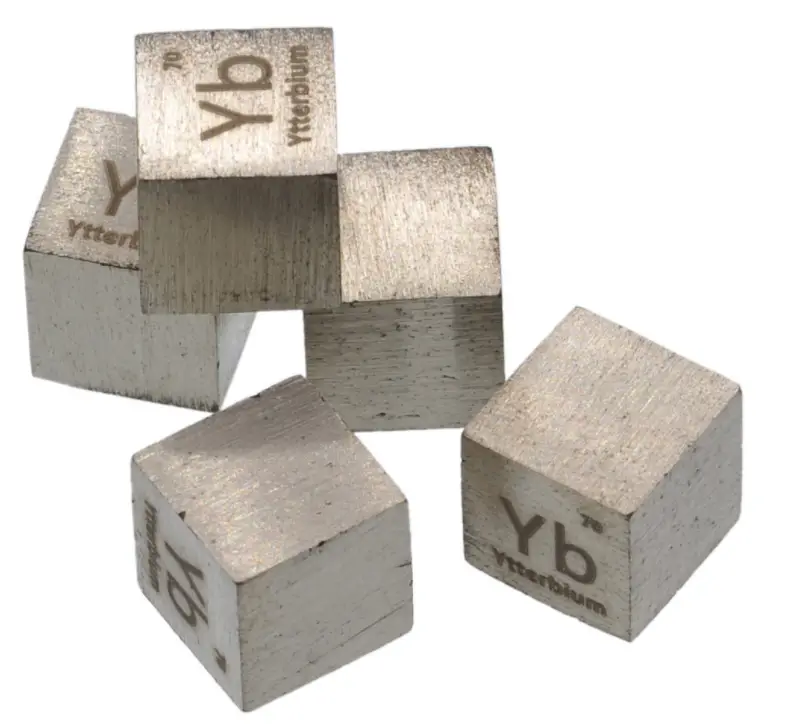
Ytterbium – Properties – Price – Applications – Production

Ytterbium-properties-price-application-production

About Ytterbium

Because of its closed-shell electron configuration, its density and melting and boiling points differ significantly from those of most other lanthanides.

Summary

Element Ytterbium
Atomic number 70
Element category Rare Earth Metal
Phase at STP Solid
Density 6.57 g/cm3
Ultimate Tensile Strength 69 MPa
Yield Strength 66 MPa
Young’s Modulus of Elasticity 23.9 GPa
Mohs Scale N/A
Brinell Hardness 340 MPa
Vickers Hardness 210 MPa
Melting Point 819 °C
Boiling Point 1196 °C
Thermal Conductivity 39 W/mK
Thermal Expansion Coefficient 26.3 µm/mK
Specific Heat 0.15 J/g K
Heat of Fusion 7.66 kJ/mol
Heat of Vaporization 128.9 kJ/mol
Electrical resistivity [nanoOhm meter] 250
Magnetic Susceptibility +249e-6 cm^3/mol

Applications of Ytterbium

Ytterbium is beginning to find a variety of uses, such as in memory devices and tuneable lasers. It can also be used as an industrial catalyst and is increasingly being used to replace other catalysts considered to be too toxic and polluting. A small amount of ytterbium is used to add strength to specific steel types. Ytterbium can also be used as a dopant to help improve the grain refinement, strength, and other mechanical properties of stainless steel.

Ytterbium-applications

Production and Price of Ytterbium

Raw materials prices change daily. They are primarily driven by supply, demand and energy prices. In 2019, prices of pure Ytterbium were at around 5300 $/kg.

Ytterbium is produced from its ores by reaction with lanthanum metal. For example, the element is extracted by solvent extraction and ion exchange from monazite. Monazite is an important ore for thorium, lanthanum, and cerium. It is often found in placer deposits. India, Madagascar, and South Africa have large deposits of monazite sands. The deposits in India are particularly rich in monazite.
Ytterbium-periodic-table

Source: www.luciteria.com

Mechanical Properties of Ytterbium

Ytterbium-mechanical-properties-strength-hardness-crystal-structure

Strength of Ytterbium

In mechanics of materials, the strength of a material is its ability to withstand an applied load without failure or plastic deformation. Strength of materials basically considers the relationship between the external loads applied to a material and the resulting deformation or change in material dimensions. In designing structures and machines, it is important to consider these factors, in order that the material selected will have adequate strength to resist applied loads or forces and retain its original shape. Strength of a material is its ability to withstand this applied load without failure or plastic deformation.

For tensile stress, the capacity of a material or structure to withstand loads tending to elongate is known as ultimate tensile strength (UTS). Yield strength or yield stress is the material property defined as the stress at which a material begins to deform plastically whereas yield point is the point where nonlinear (elastic + plastic) deformation begins.

See also: Strength of Materials

Ultimate Tensile Strength of Ytterbium

Ultimate tensile strength of Ytterbium is 69 MPa.

Yield Strength of Ytterbium

Yield strength of Ytterbium is 66 MPa.

Modulus of Elasticity of Ytterbium

The Young’s modulus of elasticity of Ytterbium is 66 MPa.

Hardness of Ytterbium

In materials science, hardness is the ability to withstand surface indentation (localized plastic deformation) and scratching. Brinell hardness test is one of indentation hardness tests, that has been developed for hardness testing. In Brinell tests, a hard, spherical indenter is forced under a specific load into the surface of the metal to be tested.

Brinell hardness of Ytterbium is approximately 340 MPa.

The Vickers hardness test method was developed by Robert L. Smith and George E. Sandland at Vickers Ltd as an alternative to the Brinell method to measure the hardness of materials. The Vickers hardness test method can be also used as a microhardness test method, which is mostly used for small parts, thin sections, or case depth work.

Vickers hardness of Ytterbium is approximately 210 MPa.

Scratch hardness is the measure of how resistant a sample is to permanent plastic deformation due to friction from a sharp object. The most common scale for this qualitative test is Mohs scale, which is used in mineralogy. The Mohs scale of mineral hardness is based on the ability of one natural sample of mineral to scratch another mineral visibly.

Ytterbium is has a hardness of approximately N/A.

See also: Hardness of Materials

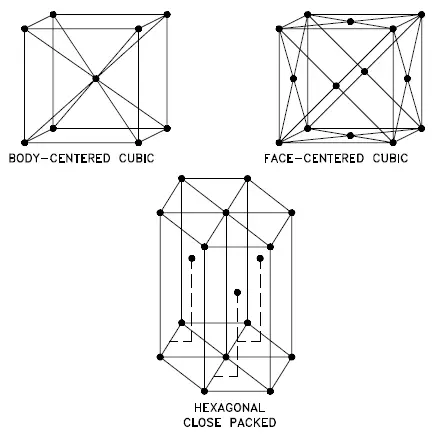
Ytterbium – Crystal Structure

A possible crystal structure of Ytterbium is face-centered cubic structure.
crystal structures - FCC, BCC, HCP

In metals, and in many other solids, the atoms are arranged in regular arrays called crystals. A crystal lattice is a repeating pattern of mathematical points that extends throughout space. The forces of chemical bonding causes this repetition. It is this repeated pattern which control properties like strength, ductility, density, conductivity (property of conducting or transmitting heat, electricity, etc.), and shape. There are 14 general types of such patterns known as Bravais lattices.

See also: Crystal Structure of Materials

Crystal Structure of Ytterbium

Crystal Structure of Ytterbium is: face-centered cubic

Strength of Elements

Elasticity of Elements
Hardness of Elements
 

Thermal Properties of Ytterbium

Ytterbium-melting-point-conductivity-thermal-properties

Ytterbium – Melting Point and Boiling Point

Melting point of Ytterbium is 819°C.

Boiling point of Ytterbium is 1196°C.

Note that, these points are associated with the standard atmospheric pressure.

Ytterbium – Thermal Conductivity

Thermal conductivity of Ytterbium is 39 W/(m·K).

The heat transfer characteristics of a solid material are measured by a property called the thermal conductivity, k (or λ), measured in W/m.K. It is a measure of a substance’s ability to transfer heat through a material by conduction. Note that Fourier’s law applies for all matter, regardless of its state (solid, liquid, or gas), therefore, it is also defined for liquids and gases.

Coefficient of Thermal Expansion of Ytterbium

Linear thermal expansion coefficient of Ytterbium is 26.3 µm/(m·K)

Thermal expansion is generally the tendency of matter to change its dimensions in response to a change in temperature. It is usually expressed as a fractional change in length or volume per unit temperature change.

Ytterbium – Specific Heat, Latent Heat of Fusion, Latent Heat of Vaporization

Specific heat of Ytterbium is 0.15 J/g K.

Heat capacity is an extensive property of matter, meaning it is proportional to the size of the system. Heat capacity C has the unit of energy per degree or energy per kelvin. When expressing the same phenomenon as an intensive property, the heat capacity is divided by the amount of substance, mass, or volume, thus the quantity is independent of the size or extent of the sample.

Latent Heat of Fusion of Ytterbium is 7.66 kJ/mol.

Latent Heat of Vaporization of Ytterbium is 128.9 kJ/mol.

Latent heat is the amount of heat added to or removed from a substance to produce a change in phase. This energy breaks down the intermolecular attractive forces, and also must provide the energy necessary to expand the gas (the pΔV work). When latent heat is added, no temperature change occurs. The enthalpy of vaporization is a function of the pressure at which that transformation takes place.

Melting Point of Elements
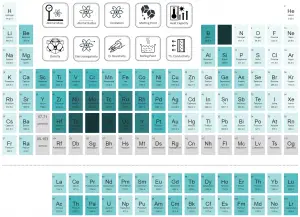
Periodic Table of Elements - melting point

Thermal Conductivity of Elements

Periodic Table of Elements - thermal conductivity

Thermal Expansion of Elements

Periodic Table of Elements - thermal expansion

Heat Capacity of Elements

Periodic Table of Elements - heat capacity

Heat of Fusion of Elements

Periodic Table of Elements - latent heat fusion

Heat of Vaporization of Elements

Periodic Table of Elements - latent heat vaporization

Ytterbium – Electrical Resistivity – Magnetic Susceptibility

Ytterbium-electrical-resistivity-magnetic-susceptibility

Electrical property refers to the response of a material to an applied electric field. One of the principal characteristics of materials is their ability (or lack of ability) to conduct electrical current. Indeed, materials are classified by this property, that is, they are divided into conductors, semiconductors, and nonconductors.

See also: Electrical Properties

Magnetic property refers to the response of a material to an applied magnetic field. The macroscopic magnetic properties of a material are a consequence of interactions between an external magnetic field and the magnetic dipole moments of the constituent atoms. Different materials react to the application of magnetic field differently.

See also: Magnetic Properties

Electrical Resistivity of Ytterbium

Electrical resistivity of Ytterbium is 250 nΩ⋅m.

Electrical conductivity and its converse, electrical resistivity, is a fundamental property of a material that quantifies how Ytterbium conducts the flow of electric current. Electrical conductivity or specific conductance is the reciprocal of electrical resistivity.

Magnetic Susceptibility of Ytterbium

Magnetic susceptibility of Ytterbium is +249e-6 cm^3/mol.

In electromagnetism, magnetic susceptibility is the measure of the magnetization of a substance. Magnetic susceptibility is a dimensionless proportionality factor that indicates the degree of magnetization of Ytterbium in response to an applied magnetic field.

Electrical Resistivity of Elements
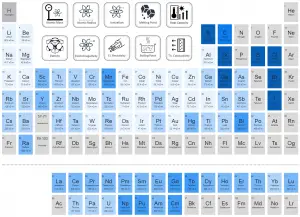
Periodic Table of Elements - electrical resistivity

Magnetic Susceptibility of Elements

Application and prices of other elements

Ytterbium - Comparison of Properties and Prices

Periodic Table in 8K resolution

Other properties of Ytterbium

 

Thulium – Properties – Price – Applications – Production

Thulium-properties-price-application-production

About Thulium

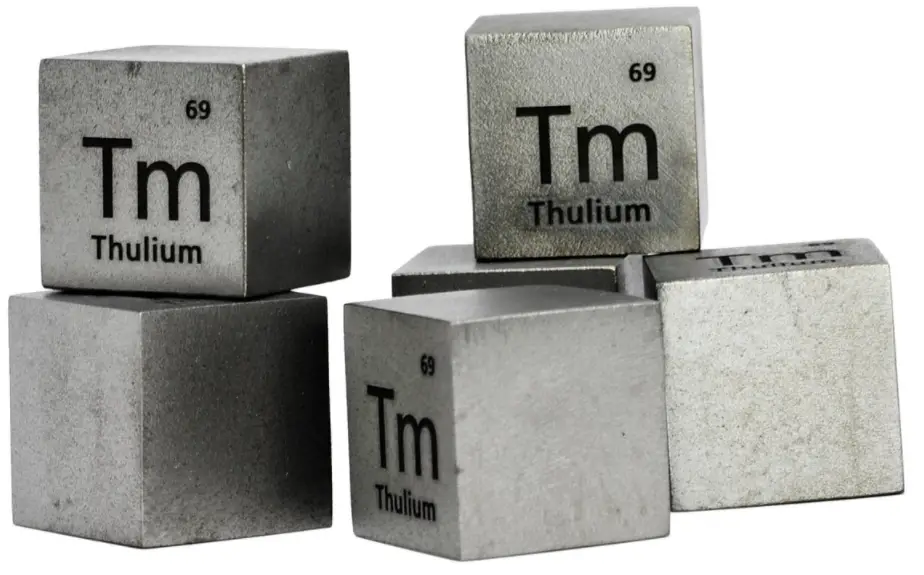
Thulium is an easily workable metal with a bright silvery-gray luster. It is fairly soft and slowly tarnishes in air. Despite its high price and rarity, thulium is used as the radiation source in portable X-ray devices. Thulium is the thirteenth and third-last element in the lanthanide series.

Summary

Element Thulium
Atomic number 69
Element category Rare Earth Metal
Phase at STP Solid
Density 9.321 g/cm3
Ultimate Tensile Strength N/A
Yield Strength N/A
Young’s Modulus of Elasticity 74 GPa
Mohs Scale N/A
Brinell Hardness 470 MPa
Vickers Hardness 520 MPa
Melting Point 1545 °C
Boiling Point 1950 °C
Thermal Conductivity 17 W/mK
Thermal Expansion Coefficient 13.3 µm/mK
Specific Heat 0.16 J/g K
Heat of Fusion 16.84 kJ/mol
Heat of Vaporization 191 kJ/mol
Electrical resistivity [nanoOhm meter] 676
Magnetic Susceptibility +25500e-6 cm^3/mol

Applications of Thulium

The pure metal and compound have few commercial uses: because it is very rare and expensive and has little to offer, thulium find little application outside chemical research. Thulium has been used to create lasers. Thulium lasers require less cooling and function very well at high temperatures and are used in satellites. When stable thulium (Tm-169) is bombarded in a nuclear reactor it can later serve as a radiation source in portable X-ray devices. Thulium-170 is gaining popularity as an X-ray source for cancer treatment via brachytherapy. Thulium has been used in high-temperature superconductors similarly to yttrium. Thulium potentially has use in ferrites, ceramic magnetic materials that are used in microwave equipment. Thulium-doped calcium sulphate has been used in personal radiation dosimeters because it can register, by its fluorescence, especially low levels.

Thulium-applications

Production and Price of Thulium

Raw materials prices change daily. They are primarily driven by supply, demand and energy prices. In 2019, prices of pure Thulium were at around 70000 $/kg.

Thulium is principally extracted from monazite ores (~0.007% thulium) found in river sands, through ion exchange. Monazite is an important ore for thorium, lanthanum, and cerium. It is often found in placer deposits. India, Madagascar, and South Africa have large deposits of monazite sands. The deposits in India are particularly rich in monazite. Approximately 50 tonnes per year of thulium oxide are produced.

Thulium-periodic-table

Source: www.luciteria.com

Mechanical Properties of Thulium

Thulium-mechanical-properties-strength-hardness-crystal-structure

Strength of Thulium

In mechanics of materials, the strength of a material is its ability to withstand an applied load without failure or plastic deformation. Strength of materials basically considers the relationship between the external loads applied to a material and the resulting deformation or change in material dimensions. In designing structures and machines, it is important to consider these factors, in order that the material selected will have adequate strength to resist applied loads or forces and retain its original shape. Strength of a material is its ability to withstand this applied load without failure or plastic deformation.

For tensile stress, the capacity of a material or structure to withstand loads tending to elongate is known as ultimate tensile strength (UTS). Yield strength or yield stress is the material property defined as the stress at which a material begins to deform plastically whereas yield point is the point where nonlinear (elastic + plastic) deformation begins.

See also: Strength of Materials

Ultimate Tensile Strength of Thulium

Ultimate tensile strength of Thulium is N/A.

Yield Strength of Thulium

Yield strength of Thulium is N/A.

Modulus of Elasticity of Thulium

The Young’s modulus of elasticity of Thulium is N/A.

Hardness of Thulium

In materials science, hardness is the ability to withstand surface indentation (localized plastic deformation) and scratching. Brinell hardness test is one of indentation hardness tests, that has been developed for hardness testing. In Brinell tests, a hard, spherical indenter is forced under a specific load into the surface of the metal to be tested.

Brinell hardness of Thulium is approximately 470 MPa.

The Vickers hardness test method was developed by Robert L. Smith and George E. Sandland at Vickers Ltd as an alternative to the Brinell method to measure the hardness of materials. The Vickers hardness test method can be also used as a microhardness test method, which is mostly used for small parts, thin sections, or case depth work.

Vickers hardness of Thulium is approximately 520 MPa.

Scratch hardness is the measure of how resistant a sample is to permanent plastic deformation due to friction from a sharp object. The most common scale for this qualitative test is Mohs scale, which is used in mineralogy. The Mohs scale of mineral hardness is based on the ability of one natural sample of mineral to scratch another mineral visibly.

Thulium is has a hardness of approximately N/A.

See also: Hardness of Materials

Thulium – Crystal Structure

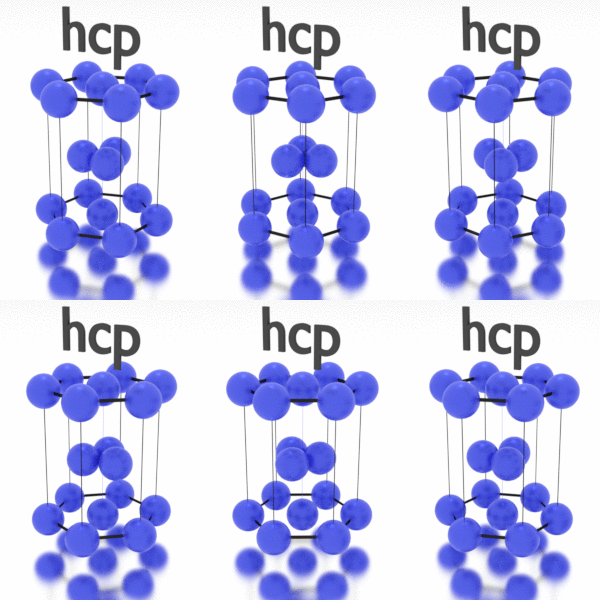
A possible crystal structure of Thulium is hexagonal close-packed structure.

crystal structures - FCC, BCC, HCP

In metals, and in many other solids, the atoms are arranged in regular arrays called crystals. A crystal lattice is a repeating pattern of mathematical points that extends throughout space. The forces of chemical bonding causes this repetition. It is this repeated pattern which control properties like strength, ductility, density, conductivity (property of conducting or transmitting heat, electricity, etc.), and shape. There are 14 general types of such patterns known as Bravais lattices.

See also: Crystal Structure of Materials

Crystal Structure of Thulium
Crystal Structure of Thulium is: hexagonal close-packed

Strength of Elements

Elasticity of Elements

Hardness of Elements


Thermal Properties of Thulium

Thulium-melting-point-conductivity-thermal-properties

Thulium – Melting Point and Boiling Point

Melting point of Thulium is 1545°C.

Boiling point of Thulium is 1950°C.

Note that, these points are associated with the standard atmospheric pressure.

Thulium – Thermal Conductivity

Thermal conductivity of Thulium is 17 W/(m·K).

The heat transfer characteristics of a solid material are measured by a property called the thermal conductivity, k (or λ), measured in W/m.K. It is a measure of a substance’s ability to transfer heat through a material by conduction. Note that Fourier’s law applies for all matter, regardless of its state (solid, liquid, or gas), therefore, it is also defined for liquids and gases.

Coefficient of Thermal Expansion of Thulium

Linear thermal expansion coefficient of Thulium is 13.3 µm/(m·K)

Thermal expansion is generally the tendency of matter to change its dimensions in response to a change in temperature. It is usually expressed as a fractional change in length or volume per unit temperature change.

Thulium – Specific Heat, Latent Heat of Fusion, Latent Heat of Vaporization

Specific heat of Thulium is 0.16 J/g K.

Heat capacity is an extensive property of matter, meaning it is proportional to the size of the system. Heat capacity C has the unit of energy per degree or energy per kelvin. When expressing the same phenomenon as an intensive property, the heat capacity is divided by the amount of substance, mass, or volume, thus the quantity is independent of the size or extent of the sample.

Latent Heat of Fusion of Thulium is 16.84 kJ/mol.

Latent Heat of Vaporization of Thulium is 191 kJ/mol.

Latent heat is the amount of heat added to or removed from a substance to produce a change in phase. This energy breaks down the intermolecular attractive forces, and also must provide the energy necessary to expand the gas (the pΔV work). When latent heat is added, no temperature change occurs. The enthalpy of vaporization is a function of the pressure at which that transformation takes place.

Melting Point of Elements

Periodic Table of Elements - melting point

Thermal Conductivity of Elements

Periodic Table of Elements - thermal conductivity

Thermal Expansion of Elements

Periodic Table of Elements - thermal expansion

Heat Capacity of Elements

Periodic Table of Elements - heat capacity

Heat of Fusion of Elements

Periodic Table of Elements - latent heat fusion

Heat of Vaporization of Elements

Periodic Table of Elements - latent heat vaporization

Thulium – Electrical Resistivity – Magnetic Susceptibility

Thulium-electrical-resistivity-magnetic-susceptibility

Electrical property refers to the response of a material to an applied electric field. One of the principal characteristics of materials is their ability (or lack of ability) to conduct electrical current. Indeed, materials are classified by this property, that is, they are divided into conductors, semiconductors, and nonconductors.

See also: Electrical Properties

Magnetic property refers to the response of a material to an applied magnetic field. The macroscopic magnetic properties of a material are a consequence of interactions between an external magnetic field and the magnetic dipole moments of the constituent atoms. Different materials react to the application of magnetic field differently.

See also: Magnetic Properties

Electrical Resistivity of Thulium

Electrical resistivity of Thulium is 676 nΩ⋅m.

Electrical conductivity and its converse, electrical resistivity, is a fundamental property of a material that quantifies how Thulium conducts the flow of electric current. Electrical conductivity or specific conductance is the reciprocal of electrical resistivity.

Magnetic Susceptibility of Thulium

Magnetic susceptibility of Thulium is +25500e-6 cm^3/mol.

In electromagnetism, magnetic susceptibility is the measure of the magnetization of a substance. Magnetic susceptibility is a dimensionless proportionality factor that indicates the degree of magnetization of Thulium in response to an applied magnetic field.

Electrical Resistivity of Elements

Periodic Table of Elements - electrical resistivity

Magnetic Susceptibility of Elements

Application and prices of other elements

Thulium - Comparison of Properties and Prices

Periodic Table in 8K resolution

Other properties of Thulium


Erbium – Properties – Price – Applications – Production

Erbium-properties-price-application-production

About Erbium

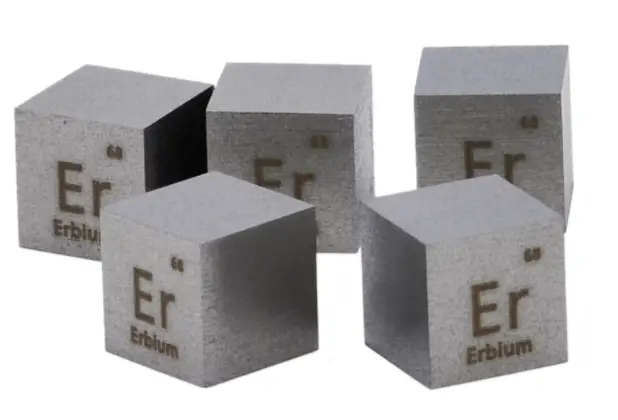
Erbium is a silvery-white solid metal when artificially isolated, natural erbium is always found in chemical combination with other elements. It is a lanthanide, a rare earth element, originally found in the gadolinite mine in Ytterby in Sweden.

Summary

Element Erbium
Atomic number 68
Element category Rare Earth Metal
Phase at STP Solid
Density 9.066 g/cm3
Ultimate Tensile Strength 260 MPa
Yield Strength 250 MPa
Young’s Modulus of Elasticity 69.9 GPa
Mohs Scale N/A
Brinell Hardness 800 MPa
Vickers Hardness 590 MPa
Melting Point 1529 °C
Boiling Point 2868 °C
Thermal Conductivity 15 W/mK
Thermal Expansion Coefficient 12.2 µm/mK
Specific Heat 0.17 J/g K
Heat of Fusion 19.9 kJ/mol
Heat of Vaporization 261 kJ/mol
Electrical resistivity [nanoOhm meter] 860
Magnetic Susceptibility +44000e-6 cm^3/mol

Applications of Erbium

Erbium is being used in metallurgical and nuclear sectors. In nuclear reactors, erbium is proposed as a burnable absorber to compensate inital reactivity at the beginning of fuel cycle. When this element is added to vanadium, it reduces the hardness and enhances the workability. Erbium salt has an attractive pastel color. Erbium oxide, which gives a pink color, has been utilized as a colorant in porcelain enamel glazes and glasses.

Erbium-applications

Production and Price of Erbium

Raw materials prices change daily. They are primarily driven by supply, demand and energy prices. In 2019, prices of pure Erbium were at around 2700 $/kg.

The principal commercial sources of erbium are from the minerals xenotime and euxenite, and most recently, the ion adsorption clays of southern China; in consequence, China has now become the principal global supplier of this element.

Erbium-periodic-table

Source: www.luciteria.com

Mechanical Properties of Erbium

Erbium-mechanical-properties-strength-hardness-crystal-structure

Strength of Erbium

In mechanics of materials, the strength of a material is its ability to withstand an applied load without failure or plastic deformation. Strength of materials basically considers the relationship between the external loads applied to a material and the resulting deformation or change in material dimensions. In designing structures and machines, it is important to consider these factors, in order that the material selected will have adequate strength to resist applied loads or forces and retain its original shape. Strength of a material is its ability to withstand this applied load without failure or plastic deformation.

For tensile stress, the capacity of a material or structure to withstand loads tending to elongate is known as ultimate tensile strength (UTS). Yield strength or yield stress is the material property defined as the stress at which a material begins to deform plastically whereas yield point is the point where nonlinear (elastic + plastic) deformation begins.

See also: Strength of Materials

Ultimate Tensile Strength of Erbium

Ultimate tensile strength of Erbium is 260 MPa.

Yield Strength of Erbium

Yield strength of Erbium is 250 MPa.

Modulus of Elasticity of Erbium

The Young’s modulus of elasticity of Erbium is 250 MPa.

Hardness of Erbium

In materials science, hardness is the ability to withstand surface indentation (localized plastic deformation) and scratching. Brinell hardness test is one of indentation hardness tests, that has been developed for hardness testing. In Brinell tests, a hard, spherical indenter is forced under a specific load into the surface of the metal to be tested.

Brinell hardness of Erbium is approximately 800 MPa.

The Vickers hardness test method was developed by Robert L. Smith and George E. Sandland at Vickers Ltd as an alternative to the Brinell method to measure the hardness of materials. The Vickers hardness test method can be also used as a microhardness test method, which is mostly used for small parts, thin sections, or case depth work.

Vickers hardness of Erbium is approximately 590 MPa.

Scratch hardness is the measure of how resistant a sample is to permanent plastic deformation due to friction from a sharp object. The most common scale for this qualitative test is Mohs scale, which is used in mineralogy. The Mohs scale of mineral hardness is based on the ability of one natural sample of mineral to scratch another mineral visibly.

Erbium is has a hardness of approximately N/A.

See also: Hardness of Materials

Erbium – Crystal Structure

A possible crystal structure of Erbium is hexagonal close-packed structure.

crystal structures - FCC, BCC, HCP

In metals, and in many other solids, the atoms are arranged in regular arrays called crystals. A crystal lattice is a repeating pattern of mathematical points that extends throughout space. The forces of chemical bonding causes this repetition. It is this repeated pattern which control properties like strength, ductility, density, conductivity (property of conducting or transmitting heat, electricity, etc.), and shape. There are 14 general types of such patterns known as Bravais lattices.

See also: Crystal Structure of Materials

Crystal Structure of Erbium
Crystal Structure of Erbium is: hexagonal close-packed

Strength of Elements

Elasticity of Elements

Hardness of Elements


Thermal Properties of Erbium

Erbium-melting-point-conductivity-thermal-properties

Erbium – Melting Point and Boiling Point

Melting point of Erbium is 1529°C.

Boiling point of Erbium is 2868°C.

Note that, these points are associated with the standard atmospheric pressure.

Erbium – Thermal Conductivity

Thermal conductivity of Erbium is 15 W/(m·K).

The heat transfer characteristics of a solid material are measured by a property called the thermal conductivity, k (or λ), measured in W/m.K. It is a measure of a substance’s ability to transfer heat through a material by conduction. Note that Fourier’s law applies for all matter, regardless of its state (solid, liquid, or gas), therefore, it is also defined for liquids and gases.

Coefficient of Thermal Expansion of Erbium

Linear thermal expansion coefficient of Erbium is 12.2 µm/(m·K)

Thermal expansion is generally the tendency of matter to change its dimensions in response to a change in temperature. It is usually expressed as a fractional change in length or volume per unit temperature change.

Erbium – Specific Heat, Latent Heat of Fusion, Latent Heat of Vaporization

Specific heat of Erbium is 0.17 J/g K.

Heat capacity is an extensive property of matter, meaning it is proportional to the size of the system. Heat capacity C has the unit of energy per degree or energy per kelvin. When expressing the same phenomenon as an intensive property, the heat capacity is divided by the amount of substance, mass, or volume, thus the quantity is independent of the size or extent of the sample.

Latent Heat of Fusion of Erbium is 19.9 kJ/mol.

Latent Heat of Vaporization of Erbium is 261 kJ/mol.

Latent heat is the amount of heat added to or removed from a substance to produce a change in phase. This energy breaks down the intermolecular attractive forces, and also must provide the energy necessary to expand the gas (the pΔV work). When latent heat is added, no temperature change occurs. The enthalpy of vaporization is a function of the pressure at which that transformation takes place.

Melting Point of Elements

Periodic Table of Elements - melting point

Thermal Conductivity of Elements

Periodic Table of Elements - thermal conductivity

Thermal Expansion of Elements

Periodic Table of Elements - thermal expansion

Heat Capacity of Elements

Periodic Table of Elements - heat capacity

Heat of Fusion of Elements

Periodic Table of Elements - latent heat fusion

Heat of Vaporization of Elements

Periodic Table of Elements - latent heat vaporization

Erbium – Electrical Resistivity – Magnetic Susceptibility

Erbium-electrical-resistivity-magnetic-susceptibility

Electrical property refers to the response of a material to an applied electric field. One of the principal characteristics of materials is their ability (or lack of ability) to conduct electrical current. Indeed, materials are classified by this property, that is, they are divided into conductors, semiconductors, and nonconductors.

See also: Electrical Properties

Magnetic property refers to the response of a material to an applied magnetic field. The macroscopic magnetic properties of a material are a consequence of interactions between an external magnetic field and the magnetic dipole moments of the constituent atoms. Different materials react to the application of magnetic field differently.

See also: Magnetic Properties

Electrical Resistivity of Erbium

Electrical resistivity of Erbium is 860 nΩ⋅m.

Electrical conductivity and its converse, electrical resistivity, is a fundamental property of a material that quantifies how Erbium conducts the flow of electric current. Electrical conductivity or specific conductance is the reciprocal of electrical resistivity.

Magnetic Susceptibility of Erbium

Magnetic susceptibility of Erbium is +44000e-6 cm^3/mol.

In electromagnetism, magnetic susceptibility is the measure of the magnetization of a substance. Magnetic susceptibility is a dimensionless proportionality factor that indicates the degree of magnetization of Erbium in response to an applied magnetic field.

Electrical Resistivity of Elements

Periodic Table of Elements - electrical resistivity

Magnetic Susceptibility of Elements

Application and prices of other elements

Erbium - Comparison of Properties and Prices

Periodic Table in 8K resolution

Other properties of Erbium


Holmium – Properties – Price – Applications – Production

Holmium-properties-price-application-production

About Holmium

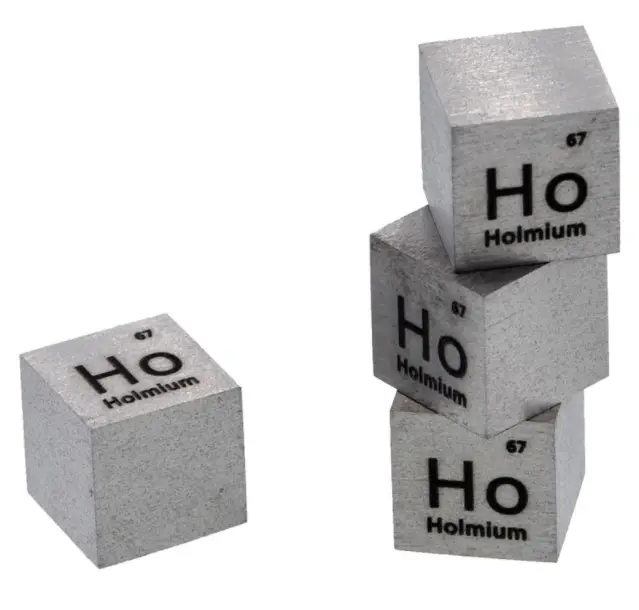
Holmium is a part of the lanthanide series, holmium is a rare-earth element. Holmium is a relatively soft and malleable silvery-white metal.

Summary

Element Holmium
Atomic number 67
Element category Rare Earth Metal
Phase at STP Solid
Density 8.795 g/cm3
Ultimate Tensile Strength 260 MPa
Yield Strength 220 MPa
Young’s Modulus of Elasticity 64.8 GPa
Mohs Scale N/A
Brinell Hardness 750 MPa
Vickers Hardness 490 MPa
Melting Point 1474 °C
Boiling Point 2600 °C
Thermal Conductivity 16 W/mK
Thermal Expansion Coefficient 11.2 µm/mK
Specific Heat 0.16 J/g K
Heat of Fusion 12.2 kJ/mol
Heat of Vaporization 241 kJ/mol
Electrical resistivity [nanoOhm meter] 814
Magnetic Susceptibility N/A

Applications of Holmium

Holmium has the highest magnetic strength of any element, and therefore is used to create the strongest artificially generated magnetic fields. Holmium can absorb neutrons, so it is used in nuclear reactors to keep a chain reaction under control. Its alloys are used in some magnets.

Holmium-applications

Production and Price of Holmium

Raw materials prices change daily. They are primarily driven by supply, demand and energy prices. In 2019, prices of pure Holmium were at around 7400 $/kg.

Pure holmium can be obtained through the reduction of holmium fluoride with calcium metal. It does occur combined with other elements in gadolinite (the black part of the specimen illustrated to the right), monazite and other rare-earth minerals. No holmium-dominant mineral has yet been found. The main mining areas are China, United States, Brazil, India, Sri Lanka, and Australia with reserves of holmium estimated as 400,000 tonnes.

Holmium-periodic-table

Source: www.luciteria.com

Mechanical Properties of Holmium

Holmium-mechanical-properties-strength-hardness-crystal-structure

Strength of Holmium

In mechanics of materials, the strength of a material is its ability to withstand an applied load without failure or plastic deformation. Strength of materials basically considers the relationship between the external loads applied to a material and the resulting deformation or change in material dimensions. In designing structures and machines, it is important to consider these factors, in order that the material selected will have adequate strength to resist applied loads or forces and retain its original shape. Strength of a material is its ability to withstand this applied load without failure or plastic deformation.

For tensile stress, the capacity of a material or structure to withstand loads tending to elongate is known as ultimate tensile strength (UTS). Yield strength or yield stress is the material property defined as the stress at which a material begins to deform plastically whereas yield point is the point where nonlinear (elastic + plastic) deformation begins.

See also: Strength of Materials

Ultimate Tensile Strength of Holmium

Ultimate tensile strength of Holmium is 260 MPa.

Yield Strength of Holmium

Yield strength of Holmium is 220 MPa.

Modulus of Elasticity of Holmium

The Young’s modulus of elasticity of Holmium is 220 MPa.

Hardness of Holmium

In materials science, hardness is the ability to withstand surface indentation (localized plastic deformation) and scratching. Brinell hardness test is one of indentation hardness tests, that has been developed for hardness testing. In Brinell tests, a hard, spherical indenter is forced under a specific load into the surface of the metal to be tested.

Brinell hardness of Holmium is approximately 750 MPa.

The Vickers hardness test method was developed by Robert L. Smith and George E. Sandland at Vickers Ltd as an alternative to the Brinell method to measure the hardness of materials. The Vickers hardness test method can be also used as a microhardness test method, which is mostly used for small parts, thin sections, or case depth work.

Vickers hardness of Holmium is approximately 490 MPa.

Scratch hardness is the measure of how resistant a sample is to permanent plastic deformation due to friction from a sharp object. The most common scale for this qualitative test is Mohs scale, which is used in mineralogy. The Mohs scale of mineral hardness is based on the ability of one natural sample of mineral to scratch another mineral visibly.

Holmium is has a hardness of approximately N/A.

See also: Hardness of Materials

Holmium – Crystal Structure

A possible crystal structure of Holmium is hexagonal close-packed structure.

crystal structures - FCC, BCC, HCP

In metals, and in many other solids, the atoms are arranged in regular arrays called crystals. A crystal lattice is a repeating pattern of mathematical points that extends throughout space. The forces of chemical bonding causes this repetition. It is this repeated pattern which control properties like strength, ductility, density, conductivity (property of conducting or transmitting heat, electricity, etc.), and shape. There are 14 general types of such patterns known as Bravais lattices.

See also: Crystal Structure of Materials

Crystal Structure of Holmium
Crystal Structure of Holmium is: hexagonal close-packed

Strength of Elements

Elasticity of Elements

Hardness of Elements


Thermal Properties of Holmium

Holmium-melting-point-conductivity-thermal-properties

Holmium – Melting Point and Boiling Point

Melting point of Holmium is 1474°C.

Boiling point of Holmium is 2600°C.

Note that, these points are associated with the standard atmospheric pressure.

Holmium – Thermal Conductivity

Thermal conductivity of Holmium is 16 W/(m·K).

The heat transfer characteristics of a solid material are measured by a property called the thermal conductivity, k (or λ), measured in W/m.K. It is a measure of a substance’s ability to transfer heat through a material by conduction. Note that Fourier’s law applies for all matter, regardless of its state (solid, liquid, or gas), therefore, it is also defined for liquids and gases.

Coefficient of Thermal Expansion of Holmium

Linear thermal expansion coefficient of Holmium is 11.2 µm/(m·K)

Thermal expansion is generally the tendency of matter to change its dimensions in response to a change in temperature. It is usually expressed as a fractional change in length or volume per unit temperature change.

Holmium – Specific Heat, Latent Heat of Fusion, Latent Heat of Vaporization

Specific heat of Holmium is 0.16 J/g K.

Heat capacity is an extensive property of matter, meaning it is proportional to the size of the system. Heat capacity C has the unit of energy per degree or energy per kelvin. When expressing the same phenomenon as an intensive property, the heat capacity is divided by the amount of substance, mass, or volume, thus the quantity is independent of the size or extent of the sample.

Latent Heat of Fusion of Holmium is 12.2 kJ/mol.

Latent Heat of Vaporization of Holmium is 241 kJ/mol.

Latent heat is the amount of heat added to or removed from a substance to produce a change in phase. This energy breaks down the intermolecular attractive forces, and also must provide the energy necessary to expand the gas (the pΔV work). When latent heat is added, no temperature change occurs. The enthalpy of vaporization is a function of the pressure at which that transformation takes place.

Melting Point of Elements

Periodic Table of Elements - melting point

Thermal Conductivity of Elements

Periodic Table of Elements - thermal conductivity

Thermal Expansion of Elements

Periodic Table of Elements - thermal expansion

Heat Capacity of Elements

Periodic Table of Elements - heat capacity

Heat of Fusion of Elements

Periodic Table of Elements - latent heat fusion

Heat of Vaporization of Elements

Periodic Table of Elements - latent heat vaporization

Holmium – Electrical Resistivity – Magnetic Susceptibility

Holmium-electrical-resistivity-magnetic-susceptibility

Electrical property refers to the response of a material to an applied electric field. One of the principal characteristics of materials is their ability (or lack of ability) to conduct electrical current. Indeed, materials are classified by this property, that is, they are divided into conductors, semiconductors, and nonconductors.

See also: Electrical Properties

Magnetic property refers to the response of a material to an applied magnetic field. The macroscopic magnetic properties of a material are a consequence of interactions between an external magnetic field and the magnetic dipole moments of the constituent atoms. Different materials react to the application of magnetic field differently.

See also: Magnetic Properties

Electrical Resistivity of Holmium

Electrical resistivity of Holmium is 814 nΩ⋅m.

Electrical conductivity and its converse, electrical resistivity, is a fundamental property of a material that quantifies how Holmium conducts the flow of electric current. Electrical conductivity or specific conductance is the reciprocal of electrical resistivity.

Magnetic Susceptibility of Holmium

Magnetic susceptibility of Holmium is N/A.

In electromagnetism, magnetic susceptibility is the measure of the magnetization of a substance. Magnetic susceptibility is a dimensionless proportionality factor that indicates the degree of magnetization of Holmium in response to an applied magnetic field.

Electrical Resistivity of Elements

Periodic Table of Elements - electrical resistivity

Magnetic Susceptibility of Elements

Application and prices of other elements

Holmium - Comparison of Properties and Prices

Periodic Table in 8K resolution

Other properties of Holmium


Dysprosium – Properties – Price – Applications – Production

Dysprosium-properties-price-application-production

About Dysprosium

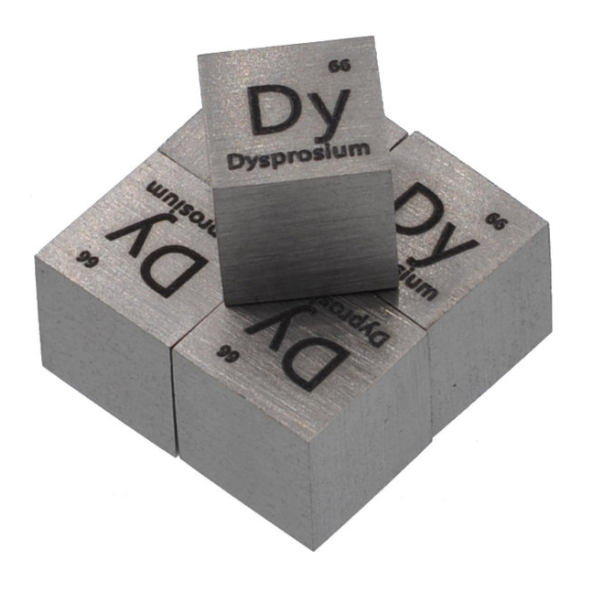
is a rare earth element with a metallic silver luster. Dysprosium is used for its high thermal neutron absorption cross-section in making control rods in nuclear reactors, for its high magnetic susceptibility in data storage applications.

Summary

Element Dysprosium
Atomic number 66
Element category Rare Earth Metal
Phase at STP Solid
Density 8.551 g/cm3
Ultimate Tensile Strength 220 MPa
Yield Strength 200 MPa
Young’s Modulus of Elasticity 61.4 GPa
Mohs Scale N/A
Brinell Hardness 500 MPa
Vickers Hardness 550 MPa
Melting Point 1412 °C
Boiling Point 2567 °C
Thermal Conductivity 11 W/mK
Thermal Expansion Coefficient 9.9 µm/mK
Specific Heat 0.17 J/g K
Heat of Fusion 11.06 kJ/mol
Heat of Vaporization 230.1 kJ/mol
Electrical resistivity [nanoOhm meter] 926
Magnetic Susceptibility +103000e-6 cm^3/mol

Applications of Dysprosium

Dysprosium is utilized in ferrites and magnetic alloys for microwave use. Dysprosium is increasingly in demand for the permanent magnets used in electric-car motors and wind-turbine generators. Special stainless steels alloyed with dysprosium are used in nuclear control applications, that is, nuclear reactor control rods. The candidate of a new absorber material for accident-tollerant control rods includes gadolinia (Gd2O3), samaria (Sm2O3), europia (Eu2O3), dysprosia (Dy2O3), hafnia (HfO2).

Dysprosium-applications

Production and Price of Dysprosium

Raw materials prices change daily. They are primarily driven by supply, demand and energy prices. In 2019, prices of pure Dysprosium were at around 2100 $/kg.

Dysprosium is obtained primarily from monazite sand, a mixture of various phosphates. The metal is obtained as a by-product in the commercial extraction of yttrium. Monazite is an important ore for thorium, lanthanum, and cerium. It is often found in placer deposits. India, Madagascar, and South Africa have large deposits of monazite sands. The deposits in India are particularly rich in monazite.

Dysprosium-periodic-table

Source: www.luciteria.com

Mechanical Properties of Dysprosium

Dysprosium-mechanical-properties-strength-hardness-crystal-structure

Strength of Dysprosium

In mechanics of materials, the strength of a material is its ability to withstand an applied load without failure or plastic deformation. Strength of materials basically considers the relationship between the external loads applied to a material and the resulting deformation or change in material dimensions. In designing structures and machines, it is important to consider these factors, in order that the material selected will have adequate strength to resist applied loads or forces and retain its original shape. Strength of a material is its ability to withstand this applied load without failure or plastic deformation.

For tensile stress, the capacity of a material or structure to withstand loads tending to elongate is known as ultimate tensile strength (UTS). Yield strength or yield stress is the material property defined as the stress at which a material begins to deform plastically whereas yield point is the point where nonlinear (elastic + plastic) deformation begins.

See also: Strength of Materials

Ultimate Tensile Strength of Dysprosium

Ultimate tensile strength of Dysprosium is 220 MPa.

Yield Strength of Dysprosium

Yield strength of Dysprosium is 200 MPa.

Modulus of Elasticity of Dysprosium

The Young’s modulus of elasticity of Dysprosium is 200 MPa.

Hardness of Dysprosium

In materials science, hardness is the ability to withstand surface indentation (localized plastic deformation) and scratching. Brinell hardness test is one of indentation hardness tests, that has been developed for hardness testing. In Brinell tests, a hard, spherical indenter is forced under a specific load into the surface of the metal to be tested.

Brinell hardness of Dysprosium is approximately 500 MPa.

The Vickers hardness test method was developed by Robert L. Smith and George E. Sandland at Vickers Ltd as an alternative to the Brinell method to measure the hardness of materials. The Vickers hardness test method can be also used as a microhardness test method, which is mostly used for small parts, thin sections, or case depth work.

Vickers hardness of Dysprosium is approximately 550 MPa.

Scratch hardness is the measure of how resistant a sample is to permanent plastic deformation due to friction from a sharp object. The most common scale for this qualitative test is Mohs scale, which is used in mineralogy. The Mohs scale of mineral hardness is based on the ability of one natural sample of mineral to scratch another mineral visibly.

Dysprosium is has a hardness of approximately N/A.

See also: Hardness of Materials

Dysprosium – Crystal Structure

A possible crystal structure of Dysprosium is hexagonal close-packed structure.

crystal structures - FCC, BCC, HCP

In metals, and in many other solids, the atoms are arranged in regular arrays called crystals. A crystal lattice is a repeating pattern of mathematical points that extends throughout space. The forces of chemical bonding causes this repetition. It is this repeated pattern which control properties like strength, ductility, density, conductivity (property of conducting or transmitting heat, electricity, etc.), and shape. There are 14 general types of such patterns known as Bravais lattices.

See also: Crystal Structure of Materials

Crystal Structure of Dysprosium
Crystal Structure of Dysprosium is: hexagonal close-packed

Strength of Elements

Elasticity of Elements

Hardness of Elements


Thermal Properties of Dysprosium

Dysprosium-melting-point-conductivity-thermal-properties

Dysprosium – Melting Point and Boiling Point

Melting point of Dysprosium is 1412°C.

Boiling point of Dysprosium is 2567°C.

Note that, these points are associated with the standard atmospheric pressure.

Dysprosium – Thermal Conductivity

Thermal conductivity of Dysprosium is 11 W/(m·K).

The heat transfer characteristics of a solid material are measured by a property called the thermal conductivity, k (or λ), measured in W/m.K. It is a measure of a substance’s ability to transfer heat through a material by conduction. Note that Fourier’s law applies for all matter, regardless of its state (solid, liquid, or gas), therefore, it is also defined for liquids and gases.

Coefficient of Thermal Expansion of Dysprosium

Linear thermal expansion coefficient of Dysprosium is 9.9 µm/(m·K)

Thermal expansion is generally the tendency of matter to change its dimensions in response to a change in temperature. It is usually expressed as a fractional change in length or volume per unit temperature change.

Dysprosium – Specific Heat, Latent Heat of Fusion, Latent Heat of Vaporization

Specific heat of Dysprosium is 0.17 J/g K.

Heat capacity is an extensive property of matter, meaning it is proportional to the size of the system. Heat capacity C has the unit of energy per degree or energy per kelvin. When expressing the same phenomenon as an intensive property, the heat capacity is divided by the amount of substance, mass, or volume, thus the quantity is independent of the size or extent of the sample.

Latent Heat of Fusion of Dysprosium is 11.06 kJ/mol.

Latent Heat of Vaporization of Dysprosium is 230.1 kJ/mol.

Latent heat is the amount of heat added to or removed from a substance to produce a change in phase. This energy breaks down the intermolecular attractive forces, and also must provide the energy necessary to expand the gas (the pΔV work). When latent heat is added, no temperature change occurs. The enthalpy of vaporization is a function of the pressure at which that transformation takes place.

Melting Point of Elements

Periodic Table of Elements - melting point

Thermal Conductivity of Elements

Periodic Table of Elements - thermal conductivity

Thermal Expansion of Elements

Periodic Table of Elements - thermal expansion

Heat Capacity of Elements

Periodic Table of Elements - heat capacity

Heat of Fusion of Elements

Periodic Table of Elements - latent heat fusion

Heat of Vaporization of Elements

Periodic Table of Elements - latent heat vaporization

Dysprosium – Electrical Resistivity – Magnetic Susceptibility

Dysprosium-electrical-resistivity-magnetic-susceptibility

Electrical property refers to the response of a material to an applied electric field. One of the principal characteristics of materials is their ability (or lack of ability) to conduct electrical current. Indeed, materials are classified by this property, that is, they are divided into conductors, semiconductors, and nonconductors.

See also: Electrical Properties

Magnetic property refers to the response of a material to an applied magnetic field. The macroscopic magnetic properties of a material are a consequence of interactions between an external magnetic field and the magnetic dipole moments of the constituent atoms. Different materials react to the application of magnetic field differently.

See also: Magnetic Properties

Electrical Resistivity of Dysprosium

Electrical resistivity of Dysprosium is 926 nΩ⋅m.

Electrical conductivity and its converse, electrical resistivity, is a fundamental property of a material that quantifies how Dysprosium conducts the flow of electric current. Electrical conductivity or specific conductance is the reciprocal of electrical resistivity.

Magnetic Susceptibility of Dysprosium

Magnetic susceptibility of Dysprosium is +103000e-6 cm^3/mol.

In electromagnetism, magnetic susceptibility is the measure of the magnetization of a substance. Magnetic susceptibility is a dimensionless proportionality factor that indicates the degree of magnetization of Dysprosium in response to an applied magnetic field.

Electrical Resistivity of Elements

Periodic Table of Elements - electrical resistivity

Magnetic Susceptibility of Elements

Application and prices of other elements

Dysprosium - Comparison of Properties and Prices

<

Terbium – Properties – Price – Applications – Production

Terbium-properties-price-application-production

About Terbium

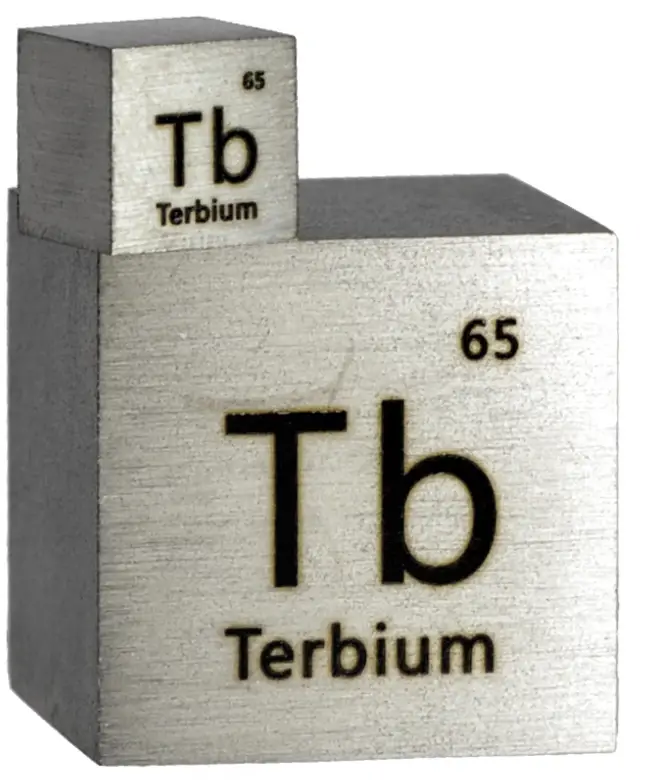
Terbium is a silvery-white, rare earth metal that is malleable, ductile, and soft enough to be cut with a knife. The ninth member of the lanthanide series, terbium is a fairly electropositive metal that reacts with water, evolving hydrogen gas.
Summary

Element Terbium
Atomic number 65
Element category Rare Earth Metal
Phase at STP Solid
Density 8.219 g/cm3
Ultimate Tensile Strength N/A
Yield Strength N/A
Young’s Modulus of Elasticity 55.7 GPa
Mohs Scale N/A
Brinell Hardness 680 MPa
Vickers Hardness 860 MPa
Melting Point 1365 °C
Boiling Point 3123 °C
Thermal Conductivity 11 W/mK
Thermal Expansion Coefficient 10.3 µm/mK
Specific Heat 0.18 J/g K
Heat of Fusion 10.8 kJ/mol
Heat of Vaporization 330.9 kJ/mol
Electrical resistivity [nanoOhm meter] 1150
Magnetic Susceptibility +146000e-6 cm^3/mol

Applications of Terbium

Terbium is used as a dopant in calcium fluoride, calcium tungstate, and strontium molybdate, materials that are used in solid-state devices. It is also used in low-energy lightbulbs and mercury lamps. Terbium oxide is used in green phosphors in fluorescent lamps and color TV tubes. It has been used to improve the safety of medical x-rays by allowing the same quality image to be produced with a much shorter exposure time. Terbium salts are used in laser devices.

Terbium-applications

Production and Price of Terbium

Raw materials prices change daily. They are primarily driven by supply, demand and energy prices. In 2019, prices of pure Terbium were at around 18000 $/kg.

The production of terbium involves obtaining fractions of different basicity from yttria using ammonium hydroxide. Two substances known as terbia and erbia were obtained from these fractions. Terbia and erbia contain the rare earth elements terbium and erbium.

Terbium-periodic-table

Source: www.luciteria.com

Mechanical Properties of Terbium

Terbium-mechanical-properties-strength-hardness-crystal-structure

Strength of Terbium

In mechanics of materials, the strength of a material is its ability to withstand an applied load without failure or plastic deformation. Strength of materials basically considers the relationship between the external loads applied to a material and the resulting deformation or change in material dimensions. In designing structures and machines, it is important to consider these factors, in order that the material selected will have adequate strength to resist applied loads or forces and retain its original shape. Strength of a material is its ability to withstand this applied load without failure or plastic deformation.

For tensile stress, the capacity of a material or structure to withstand loads tending to elongate is known as ultimate tensile strength (UTS). Yield strength or yield stress is the material property defined as the stress at which a material begins to deform plastically whereas yield point is the point where nonlinear (elastic + plastic) deformation begins.

See also: Strength of Materials

Ultimate Tensile Strength of Terbium

Ultimate tensile strength of Terbium is N/A.

Yield Strength of Terbium

Yield strength of Terbium is N/A.

Modulus of Elasticity of Terbium

The Young’s modulus of elasticity of Terbium is N/A.

Hardness of Terbium

In materials science, hardness is the ability to withstand surface indentation (localized plastic deformation) and scratching. Brinell hardness test is one of indentation hardness tests, that has been developed for hardness testing. In Brinell tests, a hard, spherical indenter is forced under a specific load into the surface of the metal to be tested.

Brinell hardness of Terbium is approximately 680 MPa.

The Vickers hardness test method was developed by Robert L. Smith and George E. Sandland at Vickers Ltd as an alternative to the Brinell method to measure the hardness of materials. The Vickers hardness test method can be also used as a microhardness test method, which is mostly used for small parts, thin sections, or case depth work.

Vickers hardness of Terbium is approximately 860 MPa.

Scratch hardness is the measure of how resistant a sample is to permanent plastic deformation due to friction from a sharp object. The most common scale for this qualitative test is Mohs scale, which is used in mineralogy. The Mohs scale of mineral hardness is based on the ability of one natural sample of mineral to scratch another mineral visibly.

Terbium is has a hardness of approximately N/A.

See also: Hardness of Materials

Terbium – Crystal Structure

A possible crystal structure of Terbium is hexagonal close-packed structure.

crystal structures - FCC, BCC, HCP

In metals, and in many other solids, the atoms are arranged in regular arrays called crystals. A crystal lattice is a repeating pattern of mathematical points that extends throughout space. The forces of chemical bonding causes this repetition. It is this repeated pattern which control properties like strength, ductility, density, conductivity (property of conducting or transmitting heat, electricity, etc.), and shape. There are 14 general types of such patterns known as Bravais lattices.

See also: Crystal Structure of Materials

Crystal Structure of Terbium
Crystal Structure of Terbium is: hexagonal close-packed

Strength of Elements

Elasticity of Elements

Hardness of Elements


Thermal Properties of Terbium

Terbium-melting-point-conductivity-thermal-properties

Terbium – Melting Point and Boiling Point

Melting point of Terbium is 1365°C.

Boiling point of Terbium is 3123°C.

Note that, these points are associated with the standard atmospheric pressure.

Terbium – Thermal Conductivity

Thermal conductivity of Terbium is 11 W/(m·K).

The heat transfer characteristics of a solid material are measured by a property called the thermal conductivity, k (or λ), measured in W/m.K. It is a measure of a substance’s ability to transfer heat through a material by conduction. Note that Fourier’s law applies for all matter, regardless of its state (solid, liquid, or gas), therefore, it is also defined for liquids and gases.

Coefficient of Thermal Expansion of Terbium

Linear thermal expansion coefficient of Terbium is 10.3 µm/(m·K)

Thermal expansion is generally the tendency of matter to change its dimensions in response to a change in temperature. It is usually expressed as a fractional change in length or volume per unit temperature change.

Terbium – Specific Heat, Latent Heat of Fusion, Latent Heat of Vaporization

Specific heat of Terbium is 0.18 J/g K.

Heat capacity is an extensive property of matter, meaning it is proportional to the size of the system. Heat capacity C has the unit of energy per degree or energy per kelvin. When expressing the same phenomenon as an intensive property, the heat capacity is divided by the amount of substance, mass, or volume, thus the quantity is independent of the size or extent of the sample.

Latent Heat of Fusion of Terbium is 10.8 kJ/mol.

Latent Heat of Vaporization of Terbium is 330.9 kJ/mol.

Latent heat is the amount of heat added to or removed from a substance to produce a change in phase. This energy breaks down the intermolecular attractive forces, and also must provide the energy necessary to expand the gas (the pΔV work). When latent heat is added, no temperature change occurs. The enthalpy of vaporization is a function of the pressure at which that transformation takes place.

Melting Point of Elements

Periodic Table of Elements - melting point

Thermal Conductivity of Elements

Periodic Table of Elements - thermal conductivity

Thermal Expansion of Elements

Periodic Table of Elements - thermal expansion

Heat Capacity of Elements

Periodic Table of Elements - heat capacity

Heat of Fusion of Elements

Periodic Table of Elements - latent heat fusion

Heat of Vaporization of Elements

Periodic Table of Elements - latent heat vaporization

Terbium – Electrical Resistivity – Magnetic Susceptibility

Terbium-electrical-resistivity-magnetic-susceptibility

Electrical property refers to the response of a material to an applied electric field. One of the principal characteristics of materials is their ability (or lack of ability) to conduct electrical current. Indeed, materials are classified by this property, that is, they are divided into conductors, semiconductors, and nonconductors.

See also: Electrical Properties

Magnetic property refers to the response of a material to an applied magnetic field. The macroscopic magnetic properties of a material are a consequence of interactions between an external magnetic field and the magnetic dipole moments of the constituent atoms. Different materials react to the application of magnetic field differently.

See also: Magnetic Properties

Electrical Resistivity of Terbium

Electrical resistivity of Terbium is 1150 nΩ⋅m.

Electrical conductivity and its converse, electrical resistivity, is a fundamental property of a material that quantifies how Terbium conducts the flow of electric current. Electrical conductivity or specific conductance is the reciprocal of electrical resistivity.

Magnetic Susceptibility of Terbium

Magnetic susceptibility of Terbium is +146000e-6 cm^3/mol.

In electromagnetism, magnetic susceptibility is the measure of the magnetization of a substance. Magnetic susceptibility is a dimensionless proportionality factor that indicates the degree of magnetization of Terbium in response to an applied magnetic field.

Electrical Resistivity of Elements

Periodic Table of Elements - electrical resistivity

Magnetic Susceptibility of Elements

Application and prices of other elements

Gadolinium – Properties – Price – Applications – Production

Gadolinium-properties-price-application-production

About Gadolinium

Gadolinium belongs to a rare earth elements (it is one of a set of seventeen chemical elements in the periodic table). In nuclear industry gadolinium is commonly used as a neutron absorber due to very high neutron absorbtion cross-section of two isotopes 155Gd and 157Gd. In fact their absorption cross-sections are the highest among all stable isotopes.

Summary

Element Gadolinium
Atomic number 64
Element category Rare Earth Metal
Phase at STP Solid
Density 7.901 g/cm3
Ultimate Tensile Strength 170 MPa
Yield Strength 160 MPa
Young’s Modulus of Elasticity 54.8 GPa
Mohs Scale N/A
Brinell Hardness N/A
Vickers Hardness 570 MPa
Melting Point 1313 °C
Boiling Point 3000 °C
Thermal Conductivity 11 W/mK
Thermal Expansion Coefficient 9.4 µm/mK
Specific Heat 0.23 J/g K
Heat of Fusion 10.05 kJ/mol
Heat of Vaporization 359.4 kJ/mol
Electrical resistivity [nanoOhm meter] 1310
Magnetic Susceptibility +755000e-6 cm^3/mol

Applications of Gadolinium

Gadolinium possesses unusual metallurgical properties, to the extent that as little as 1% of gadolinium can significantly improve the workability and resistance to oxidation at high temperatures of iron, chromium, and related metals. Gadolinium as a metal or a salt absorbs neutrons and is, therefore, used sometimes for shielding in neutron radiography and in nuclear reactors. Gadolinium is widely used as a burnable absorber, which is commonly used in fresh fuel to compensate an excess of reactivity of reactor core. Among all known stable elements, gadolinium has the highest thermal neutron capture cross-section (49,000 barns). Gadolinium barium copper oxide (GdBCO) has been researched for its superconducting properties with applications in superconducting motors or generators – for example in a wind turbine.

Gadolinium-applications

Production and Price of Gadolinium

Raw materials prices change daily. They are primarily driven by supply, demand and energy prices. In 2019, prices of pure Gadolinium were at around 1910 $/kg.

Gadolinium is produced both from monazite and bastnäsite. Commercially, it is recovered from monazite sand and bastnasite by extraction processes and ion exchange techniques. Monazite is an important ore for thorium, lanthanum, and cerium. It is often found in placer deposits. India, Madagascar, and South Africa have large deposits of monazite sands. The deposits in India are particularly rich in monazite.

Gadolinium-periodic-table

Source: www.luciteria.com

Mechanical Properties of Gadolinium

Gadolinium-mechanical-properties-strength-hardness-crystal-structure

Strength of Gadolinium

In mechanics of materials, the strength of a material is its ability to withstand an applied load without failure or plastic deformation. Strength of materials basically considers the relationship between the external loads applied to a material and the resulting deformation or change in material dimensions. In designing structures and machines, it is important to consider these factors, in order that the material selected will have adequate strength to resist applied loads or forces and retain its original shape. Strength of a material is its ability to withstand this applied load without failure or plastic deformation.

For tensile stress, the capacity of a material or structure to withstand loads tending to elongate is known as ultimate tensile strength (UTS). Yield strength or yield stress is the material property defined as the stress at which a material begins to deform plastically whereas yield point is the point where nonlinear (elastic + plastic) deformation begins.

See also: Strength of Materials

Ultimate Tensile Strength of Gadolinium

Ultimate tensile strength of Gadolinium is 170 MPa.

Yield Strength of Gadolinium

Yield strength of Gadolinium is 160 MPa.

Modulus of Elasticity of Gadolinium

The Young’s modulus of elasticity of Gadolinium is 160 MPa.

Hardness of Gadolinium

In materials science, hardness is the ability to withstand surface indentation (localized plastic deformation) and scratching. Brinell hardness test is one of indentation hardness tests, that has been developed for hardness testing. In Brinell tests, a hard, spherical indenter is forced under a specific load into the surface of the metal to be tested.

Brinell hardness of Gadolinium is approximately N/A.

The Vickers hardness test method was developed by Robert L. Smith and George E. Sandland at Vickers Ltd as an alternative to the Brinell method to measure the hardness of materials. The Vickers hardness test method can be also used as a microhardness test method, which is mostly used for small parts, thin sections, or case depth work.

Vickers hardness of Gadolinium is approximately 570 MPa.

Scratch hardness is the measure of how resistant a sample is to permanent plastic deformation due to friction from a sharp object. The most common scale for this qualitative test is Mohs scale, which is used in mineralogy. The Mohs scale of mineral hardness is based on the ability of one natural sample of mineral to scratch another mineral visibly.

Gadolinium is has a hardness of approximately N/A.

See also: Hardness of Materials

Gadolinium – Crystal Structure

A possible crystal structure of Gadolinium is hexagonal close-packed structure.

crystal structures - FCC, BCC, HCP

In metals, and in many other solids, the atoms are arranged in regular arrays called crystals. A crystal lattice is a repeating pattern of mathematical points that extends throughout space. The forces of chemical bonding causes this repetition. It is this repeated pattern which control properties like strength, ductility, density, conductivity (property of conducting or transmitting heat, electricity, etc.), and shape. There are 14 general types of such patterns known as Bravais lattices.

See also: Crystal Structure of Materials

Crystal Structure of Gadolinium
Crystal Structure of Gadolinium is: hexagonal close-packed

Strength of Elements

Elasticity of Elements

Hardness of Elements


Thermal Properties of Gadolinium

Gadolinium-melting-point-conductivity-thermal-properties

Gadolinium – Melting Point and Boiling Point

Melting point of Gadolinium is 1313°C.

Boiling point of Gadolinium is 3000°C.

Note that, these points are associated with the standard atmospheric pressure.

Gadolinium – Thermal Conductivity

Thermal conductivity of Gadolinium is 11 W/(m·K).

The heat transfer characteristics of a solid material are measured by a property called the thermal conductivity, k (or λ), measured in W/m.K. It is a measure of a substance’s ability to transfer heat through a material by conduction. Note that Fourier’s law applies for all matter, regardless of its state (solid, liquid, or gas), therefore, it is also defined for liquids and gases.

Coefficient of Thermal Expansion of Gadolinium

Linear thermal expansion coefficient of Gadolinium is 9.4 µm/(m·K)

Thermal expansion is generally the tendency of matter to change its dimensions in response to a change in temperature. It is usually expressed as a fractional change in length or volume per unit temperature change.

Gadolinium – Specific Heat, Latent Heat of Fusion, Latent Heat of Vaporization

Specific heat of Gadolinium is 0.23 J/g K.

Heat capacity is an extensive property of matter, meaning it is proportional to the size of the system. Heat capacity C has the unit of energy per degree or energy per kelvin. When expressing the same phenomenon as an intensive property, the heat capacity is divided by the amount of substance, mass, or volume, thus the quantity is independent of the size or extent of the sample.

Latent Heat of Fusion of Gadolinium is 10.05 kJ/mol.

Latent Heat of Vaporization of Gadolinium is 359.4 kJ/mol.

Latent heat is the amount of heat added to or removed from a substance to produce a change in phase. This energy breaks down the intermolecular attractive forces, and also must provide the energy necessary to expand the gas (the pΔV work). When latent heat is added, no temperature change occurs. The enthalpy of vaporization is a function of the pressure at which that transformation takes place.

Melting Point of Elements

Periodic Table of Elements - melting point

Thermal Conductivity of Elements

Periodic Table of Elements - thermal conductivity

Thermal Expansion of Elements

Periodic Table of Elements - thermal expansion

Heat Capacity of Elements

Periodic Table of Elements - heat capacity

Heat of Fusion of Elements

Periodic Table of Elements - latent heat fusion

Heat of Vaporization of Elements

Periodic Table of Elements - latent heat vaporization

Gadolinium – Electrical Resistivity – Magnetic Susceptibility

Gadolinium-electrical-resistivity-magnetic-susceptibility

Electrical property refers to the response of a material to an applied electric field. One of the principal characteristics of materials is their ability (or lack of ability) to conduct electrical current. Indeed, materials are classified by this property, that is, they are divided into conductors, semiconductors, and nonconductors.

See also: Electrical Properties

Magnetic property refers to the response of a material to an applied magnetic field. The macroscopic magnetic properties of a material are a consequence of interactions between an external magnetic field and the magnetic dipole moments of the constituent atoms. Different materials react to the application of magnetic field differently.

See also: Magnetic Properties

Electrical Resistivity of Gadolinium

Electrical resistivity of Gadolinium is 1310 nΩ⋅m.

Electrical conductivity and its converse, electrical resistivity, is a fundamental property of a material that quantifies how Gadolinium conducts the flow of electric current. Electrical conductivity or specific conductance is the reciprocal of electrical resistivity.

Magnetic Susceptibility of Gadolinium

Magnetic susceptibility of Gadolinium is +755000e-6 cm^3/mol.

In electromagnetism, magnetic susceptibility is the measure of the magnetization of a substance. Magnetic susceptibility is a dimensionless proportionality factor that indicates the degree of magnetization of Gadolinium in response to an applied magnetic field.

Electrical Resistivity of Elements

Periodic Table of Elements - electrical resistivity

Magnetic Susceptibility of Elements

Application and prices of other elements

Europium – Properties – Price – Applications – Production

Europium-properties-price-application-production

About Europium

Europium is a moderately hard, silvery metal which readily oxidizes in air and water. Being a typical member of the lanthanide series, europium usually assumes the oxidation state +3. Europium is one of the least abundant elements in the universe. Only about 5×10⁻⁸% of all matter in the universe is europium.

Summary

Element Europium
Atomic number 63
Element category Rare Earth Metal
Phase at STP Solid
Density 5.244 g/cm3
Ultimate Tensile Strength 120 MPa
Yield Strength 60 MPa
Young’s Modulus of Elasticity 18.2 GPa
Mohs Scale N/A
Brinell Hardness N/A
Vickers Hardness 170 MPa
Melting Point 822 °C
Boiling Point 1529 °C
Thermal Conductivity 14 W/mK
Thermal Expansion Coefficient 35 µm/mK
Specific Heat 0.18 J/g K
Heat of Fusion 9.21 kJ/mol
Heat of Vaporization 143.5 kJ/mol
Electrical resistivity [nanoOhm meter] 900
Magnetic Susceptibility +34600e-6 cm^3/mol

Applications of Europium

Europium is used in the printing of euro banknotes. It glows red under UV light, and forgeries can be detected by the lack of this red glow. It is a dopant in some types of glass in lasers and other optoelectronic devices. Since the isotopes of europium act as good neutron absorbers, they are being studied for use in nuclear control applications, such as in burnable absorbers.

Europium-applications

Production and Price of Europium

Raw materials prices change daily. They are primarily driven by supply, demand and energy prices. In 2019, prices of pure Europium were at around 36000 $/kg.

Europium is one of the rarest of the rare earth elements on Earth. The europium metal has a silvery-white appearance. Monazite and bastnasite are the main ores containing europium. Commercially, it is recovered from monazite sand and bastnasite by extraction processes and ion exchange techniques. Monazite is an important ore for thorium, lanthanum, and cerium. It is often found in placer deposits. India, Madagascar, and South Africa have large deposits of monazite sands. The deposits in India are particularly rich in monazite.

Europium-periodic-table

Source: www.luciteria.com

Mechanical Properties of Europium

Europium-mechanical-properties-strength-hardness-crystal-structure

Strength of Europium

In mechanics of materials, the strength of a material is its ability to withstand an applied load without failure or plastic deformation. Strength of materials basically considers the relationship between the external loads applied to a material and the resulting deformation or change in material dimensions. In designing structures and machines, it is important to consider these factors, in order that the material selected will have adequate strength to resist applied loads or forces and retain its original shape. Strength of a material is its ability to withstand this applied load without failure or plastic deformation.

For tensile stress, the capacity of a material or structure to withstand loads tending to elongate is known as ultimate tensile strength (UTS). Yield strength or yield stress is the material property defined as the stress at which a material begins to deform plastically whereas yield point is the point where nonlinear (elastic + plastic) deformation begins.

See also: Strength of Materials

Ultimate Tensile Strength of Europium

Ultimate tensile strength of Europium is 120 MPa.

Yield Strength of Europium

Yield strength of Europium is 60 MPa.

Modulus of Elasticity of Europium

The Young’s modulus of elasticity of Europium is 60 MPa.

Hardness of Europium

In materials science, hardness is the ability to withstand surface indentation (localized plastic deformation) and scratching. Brinell hardness test is one of indentation hardness tests, that has been developed for hardness testing. In Brinell tests, a hard, spherical indenter is forced under a specific load into the surface of the metal to be tested.

Brinell hardness of Europium is approximately N/A.

The Vickers hardness test method was developed by Robert L. Smith and George E. Sandland at Vickers Ltd as an alternative to the Brinell method to measure the hardness of materials. The Vickers hardness test method can be also used as a microhardness test method, which is mostly used for small parts, thin sections, or case depth work.

Vickers hardness of Europium is approximately 170 MPa.

Scratch hardness is the measure of how resistant a sample is to permanent plastic deformation due to friction from a sharp object. The most common scale for this qualitative test is Mohs scale, which is used in mineralogy. The Mohs scale of mineral hardness is based on the ability of one natural sample of mineral to scratch another mineral visibly.

Europium is has a hardness of approximately N/A.

See also: Hardness of Materials

Europium – Crystal Structure

A possible crystal structure of Europium is body-centered cubic structure.

crystal structures - FCC, BCC, HCP

In metals, and in many other solids, the atoms are arranged in regular arrays called crystals. A crystal lattice is a repeating pattern of mathematical points that extends throughout space. The forces of chemical bonding causes this repetition. It is this repeated pattern which control properties like strength, ductility, density, conductivity (property of conducting or transmitting heat, electricity, etc.), and shape. There are 14 general types of such patterns known as Bravais lattices.

See also: Crystal Structure of Materials

Crystal Structure of Europium
Crystal Structure of Europium is: body-centered cubic

Strength of Elements

Elasticity of Elements

Hardness of Elements


Thermal Properties of Europium

Europium-melting-point-conductivity-thermal-properties

Europium – Melting Point and Boiling Point

Melting point of Europium is 822°C.

Boiling point of Europium is 1529°C.

Note that, these points are associated with the standard atmospheric pressure.

Europium – Thermal Conductivity

Thermal conductivity of Europium is 14 W/(m·K).

The heat transfer characteristics of a solid material are measured by a property called the thermal conductivity, k (or λ), measured in W/m.K. It is a measure of a substance’s ability to transfer heat through a material by conduction. Note that Fourier’s law applies for all matter, regardless of its state (solid, liquid, or gas), therefore, it is also defined for liquids and gases.

Coefficient of Thermal Expansion of Europium

Linear thermal expansion coefficient of Europium is 35 µm/(m·K)

Thermal expansion is generally the tendency of matter to change its dimensions in response to a change in temperature. It is usually expressed as a fractional change in length or volume per unit temperature change.

Europium – Specific Heat, Latent Heat of Fusion, Latent Heat of Vaporization

Specific heat of Europium is 0.18 J/g K.

Heat capacity is an extensive property of matter, meaning it is proportional to the size of the system. Heat capacity C has the unit of energy per degree or energy per kelvin. When expressing the same phenomenon as an intensive property, the heat capacity is divided by the amount of substance, mass, or volume, thus the quantity is independent of the size or extent of the sample.

Latent Heat of Fusion of Europium is 9.21 kJ/mol.

Latent Heat of Vaporization of Europium is 143.5 kJ/mol.

Latent heat is the amount of heat added to or removed from a substance to produce a change in phase. This energy breaks down the intermolecular attractive forces, and also must provide the energy necessary to expand the gas (the pΔV work). When latent heat is added, no temperature change occurs. The enthalpy of vaporization is a function of the pressure at which that transformation takes place.

Melting Point of Elements

Periodic Table of Elements - melting point

Thermal Conductivity of Elements

Periodic Table of Elements - thermal conductivity

Thermal Expansion of Elements

Periodic Table of Elements - thermal expansion

Heat Capacity of Elements

Periodic Table of Elements - heat capacity

Heat of Fusion of Elements

Periodic Table of Elements - latent heat fusion

Heat of Vaporization of Elements

Periodic Table of Elements - latent heat vaporization

Europium – Electrical Resistivity – Magnetic Susceptibility

Europium-electrical-resistivity-magnetic-susceptibility

Electrical property refers to the response of a material to an applied electric field. One of the principal characteristics of materials is their ability (or lack of ability) to conduct electrical current. Indeed, materials are classified by this property, that is, they are divided into conductors, semiconductors, and nonconductors.

See also: Electrical Properties

Magnetic property refers to the response of a material to an applied magnetic field. The macroscopic magnetic properties of a material are a consequence of interactions between an external magnetic field and the magnetic dipole moments of the constituent atoms. Different materials react to the application of magnetic field differently.

See also: Magnetic Properties

Electrical Resistivity of Europium

Electrical resistivity of Europium is 900 nΩ⋅m.

Electrical conductivity and its converse, electrical resistivity, is a fundamental property of a material that quantifies how Europium conducts the flow of electric current. Electrical conductivity or specific conductance is the reciprocal of electrical resistivity.

Magnetic Susceptibility of Europium

Magnetic susceptibility of Europium is +34600e-6 cm^3/mol.

In electromagnetism, magnetic susceptibility is the measure of the magnetization of a substance. Magnetic susceptibility is a dimensionless proportionality factor that indicates the degree of magnetization of Europium in response to an applied magnetic field.

Electrical Resistivity of Elements

Periodic Table of Elements - electrical resistivity

Magnetic Susceptibility of Elements

Application and prices of other elements

Europium - Comparison of Properties and Prices

Periodic Table in 8K resolution

Other properties of Europium


Samarium – Properties – Price – Applications – Production

Samarium-properties-price-application-production

About Samarium

Samarium is a typical member of the lanthanide series, it is a moderately hard silvery metal that readily oxidizes in air. The name samarium is after the mineral samarskite from which it was isolated. Although classified as a rare earth element, samarium is the 40th most abundant element in the Earth’s crust and is more common than such metals as tin. In nuclear industry, especially natural and artificial samarium 149 has an important impact on the operation of a nuclear reactor. Samarium 149 has a very large neutron capture cross-section (about 42,000 barns). Since natural samarium contains about 14% of 149Sm, it can be used as an absorbing material in control rods.

Summary

Element Samarium
Atomic number 62
Element category Rare Earth Metal
Phase at STP Solid
Density 7.353 g/cm3
Ultimate Tensile Strength 124 MPa
Yield Strength 110 MPa
Young’s Modulus of Elasticity 49.7 GPa
Mohs Scale N/A
Brinell Hardness 441 MPa
Vickers Hardness 412 MPa
Melting Point 1074 °C
Boiling Point 1900 °C
Thermal Conductivity 13 W/mK
Thermal Expansion Coefficient 12.7 µm/mK
Specific Heat 0.2 J/g K
Heat of Fusion 8.63 kJ/mol
Heat of Vaporization 192 kJ/mol
Electrical resistivity [nanoOhm meter] 940
Magnetic Susceptibility +1860e-6 cm^3/mol

Applications of Samarium

Samarium is mainly used in preparing samarium-cobalt alloy magnets for electric guitars, small motors and headphones. Samarium-cobalt magnets are much more powerful than iron magnets. They remain magnetic at high temperatures and so are used in microwave applications. They enabled the miniaturisation of electronic devices. However, neodymium magnets are now more commonly used instead. Its oxide is used for manufacturing special infrared adsorbing glass for carbon arc-lamp electrodes. It is useful in doping calcium fluoride crystals employed in optical lasers.

Samarium-applications

Production and Price of Samarium

Raw materials prices change daily. They are primarily driven by supply, demand and energy prices. In 2019, prices of pure Samarium were at around 1300 $/kg.

Samarium occurs with concentration up to 2.8% in several minerals including cerite, gadolinite, samarskite, monazite and bastnäsite, the last two being the most common commercial sources of the element. These minerals are mostly found in China, the United States, Brazil, India, Sri Lanka and Australia; China is by far the world leader in samarium mining and production.

Samarium-periodic-table

Source: www.luciteria.com

Mechanical Properties of Samarium

Samarium-mechanical-properties-strength-hardness-crystal-structure

Strength of Samarium

In mechanics of materials, the strength of a material is its ability to withstand an applied load without failure or plastic deformation. Strength of materials basically considers the relationship between the external loads applied to a material and the resulting deformation or change in material dimensions. In designing structures and machines, it is important to consider these factors, in order that the material selected will have adequate strength to resist applied loads or forces and retain its original shape. Strength of a material is its ability to withstand this applied load without failure or plastic deformation.

For tensile stress, the capacity of a material or structure to withstand loads tending to elongate is known as ultimate tensile strength (UTS). Yield strength or yield stress is the material property defined as the stress at which a material begins to deform plastically whereas yield point is the point where nonlinear (elastic + plastic) deformation begins.

See also: Strength of Materials

Ultimate Tensile Strength of Samarium

Ultimate tensile strength of Samarium is 124 MPa.

Yield Strength of Samarium

Yield strength of Samarium is 110 MPa.

Modulus of Elasticity of Samarium

The Young’s modulus of elasticity of Samarium is 110 MPa.

Hardness of Samarium

In materials science, hardness is the ability to withstand surface indentation (localized plastic deformation) and scratching. Brinell hardness test is one of indentation hardness tests, that has been developed for hardness testing. In Brinell tests, a hard, spherical indenter is forced under a specific load into the surface of the metal to be tested.

Brinell hardness of Samarium is approximately 441 MPa.

The Vickers hardness test method was developed by Robert L. Smith and George E. Sandland at Vickers Ltd as an alternative to the Brinell method to measure the hardness of materials. The Vickers hardness test method can be also used as a microhardness test method, which is mostly used for small parts, thin sections, or case depth work.

Vickers hardness of Samarium is approximately 412 MPa.

Scratch hardness is the measure of how resistant a sample is to permanent plastic deformation due to friction from a sharp object. The most common scale for this qualitative test is Mohs scale, which is used in mineralogy. The Mohs scale of mineral hardness is based on the ability of one natural sample of mineral to scratch another mineral visibly.

Samarium is has a hardness of approximately N/A.

See also: Hardness of Materials

Samarium – Crystal Structure

A possible crystal structure of Samarium is rhombohedral structure.

crystal structures - FCC, BCC, HCP

In metals, and in many other solids, the atoms are arranged in regular arrays called crystals. A crystal lattice is a repeating pattern of mathematical points that extends throughout space. The forces of chemical bonding causes this repetition. It is this repeated pattern which control properties like strength, ductility, density, conductivity (property of conducting or transmitting heat, electricity, etc.), and shape. There are 14 general types of such patterns known as Bravais lattices.

See also: Crystal Structure of Materials

Crystal Structure of Samarium
Crystal Structure of Samarium is: rhombohedral

Strength of Elements

Elasticity of Elements

Hardness of Elements


Thermal Properties of Samarium

Samarium-melting-point-conductivity-thermal-properties

Samarium – Melting Point and Boiling Point

Melting point of Samarium is 1074°C.

Boiling point of Samarium is 1900°C.

Note that, these points are associated with the standard atmospheric pressure.

Samarium – Thermal Conductivity

Thermal conductivity of Samarium is 13 W/(m·K).

The heat transfer characteristics of a solid material are measured by a property called the thermal conductivity, k (or λ), measured in W/m.K. It is a measure of a substance’s ability to transfer heat through a material by conduction. Note that Fourier’s law applies for all matter, regardless of its state (solid, liquid, or gas), therefore, it is also defined for liquids and gases.

Coefficient of Thermal Expansion of Samarium

Linear thermal expansion coefficient of Samarium is 12.7 µm/(m·K)

Thermal expansion is generally the tendency of matter to change its dimensions in response to a change in temperature. It is usually expressed as a fractional change in length or volume per unit temperature change.

Samarium – Specific Heat, Latent Heat of Fusion, Latent Heat of Vaporization

Specific heat of Samarium is 0.2 J/g K.

Heat capacity is an extensive property of matter, meaning it is proportional to the size of the system. Heat capacity C has the unit of energy per degree or energy per kelvin. When expressing the same phenomenon as an intensive property, the heat capacity is divided by the amount of substance, mass, or volume, thus the quantity is independent of the size or extent of the sample.

Latent Heat of Fusion of Samarium is 8.63 kJ/mol.

Latent Heat of Vaporization of Samarium is 192 kJ/mol.

Latent heat is the amount of heat added to or removed from a substance to produce a change in phase. This energy breaks down the intermolecular attractive forces, and also must provide the energy necessary to expand the gas (the pΔV work). When latent heat is added, no temperature change occurs. The enthalpy of vaporization is a function of the pressure at which that transformation takes place.

Melting Point of Elements

Periodic Table of Elements - melting point

Thermal Conductivity of Elements

Periodic Table of Elements - thermal conductivity

Thermal Expansion of Elements

Periodic Table of Elements - thermal expansion

Heat Capacity of Elements

Periodic Table of Elements - heat capacity

Heat of Fusion of Elements

Periodic Table of Elements - latent heat fusion

Heat of Vaporization of Elements

Periodic Table of Elements - latent heat vaporization

Samarium – Electrical Resistivity – Magnetic Susceptibility

Samarium-electrical-resistivity-magnetic-susceptibility

Electrical property refers to the response of a material to an applied electric field. One of the principal characteristics of materials is their ability (or lack of ability) to conduct electrical current. Indeed, materials are classified by this property, that is, they are divided into conductors, semiconductors, and nonconductors.

See also: Electrical Properties

Magnetic property refers to the response of a material to an applied magnetic field. The macroscopic magnetic properties of a material are a consequence of interactions between an external magnetic field and the magnetic dipole moments of the constituent atoms. Different materials react to the application of magnetic field differently.

See also: Magnetic Properties

Electrical Resistivity of Samarium

Electrical resistivity of Samarium is 940 nΩ⋅m.

Electrical conductivity and its converse, electrical resistivity, is a fundamental property of a material that quantifies how Samarium conducts the flow of electric current. Electrical conductivity or specific conductance is the reciprocal of electrical resistivity.

Magnetic Susceptibility of Samarium

Magnetic susceptibility of Samarium is +1860e-6 cm^3/mol.

In electromagnetism, magnetic susceptibility is the measure of the magnetization of a substance. Magnetic susceptibility is a dimensionless proportionality factor that indicates the degree of magnetization of Samarium in response to an applied magnetic field.

Electrical Resistivity of Elements

Periodic Table of Elements - electrical resistivity

Magnetic Susceptibility of Elements

Application and prices of other elements

Samarium - Comparison of Properties and Prices

Periodic Table in 8K resolution

Other properties of Samarium


Promethium – Properties – Price – Applications – Production

Promethium-properties-price-application-production

About Promethium

Promethium is one of only two such elements that are followed in the periodic table by elements with stable forms. All of its isotopes are radioactive. In nuclear reactors, promethium equilibrium exists in power operation. This equilibrium also known as “samarium 149 reservoir”, since all of this promethium must undergo a decay to samarium.

Summary

Element Promethium
Atomic number 61
Element category Rare Earth Metal
Phase at STP Synthetic
Density 7.264 g/cm3
Ultimate Tensile Strength 160 MPa
Yield Strength 70 MPa
Young’s Modulus of Elasticity 46 GPa (est.)
Mohs Scale N/A
Brinell Hardness N/A
Vickers Hardness N/A
Melting Point 1042 °C
Boiling Point 3000 °C
Thermal Conductivity 15 W/mK
Thermal Expansion Coefficient 9 µm/mK
Specific Heat 0.18 J/g K
Heat of Fusion kJ/mol
Heat of Vaporization — kJ/mol
Electrical resistivity [nanoOhm meter] 750
Magnetic Susceptibility N/A

Applications of Promethium

Promethium is not extensively used metal. Most promethium is used only in research. A little promethium is used in specialised atomic batteries. In atomic batteries, the beta particles emitted by promethium-147 are converted into electric current by sandwiching a small promethium source between two semiconductor plates.

Promethium-applications

Production and Price of Promethium

Raw materials prices change daily. They are primarily driven by supply, demand and energy prices. In 2019, prices of pure Promethium were at around N/A $/kg.

Promethium can be produced by irradiating neodymium and praseodymium with neutrons, deuterons and alpha particles. It can also be prepared by ion exchange of nuclear reactor fuel processing wastes.

Promethium-periodic-table

Source: www.luciteria.com

Mechanical Properties of Promethium

Promethium-mechanical-properties-strength-hardness-crystal-structure

Strength of Promethium

In mechanics of materials, the strength of a material is its ability to withstand an applied load without failure or plastic deformation. Strength of materials basically considers the relationship between the external loads applied to a material and the resulting deformation or change in material dimensions. In designing structures and machines, it is important to consider these factors, in order that the material selected will have adequate strength to resist applied loads or forces and retain its original shape. Strength of a material is its ability to withstand this applied load without failure or plastic deformation.

For tensile stress, the capacity of a material or structure to withstand loads tending to elongate is known as ultimate tensile strength (UTS). Yield strength or yield stress is the material property defined as the stress at which a material begins to deform plastically whereas yield point is the point where nonlinear (elastic + plastic) deformation begins.

See also: Strength of Materials

Ultimate Tensile Strength of Promethium

Ultimate tensile strength of Promethium is 160 MPa.

Yield Strength of Promethium

Yield strength of Promethium is 70 MPa.

Modulus of Elasticity of Promethium

The Young’s modulus of elasticity of Promethium is 70 MPa.

Hardness of Promethium

In materials science, hardness is the ability to withstand surface indentation (localized plastic deformation) and scratching. Brinell hardness test is one of indentation hardness tests, that has been developed for hardness testing. In Brinell tests, a hard, spherical indenter is forced under a specific load into the surface of the metal to be tested.

Brinell hardness of Promethium is approximately N/A.

The Vickers hardness test method was developed by Robert L. Smith and George E. Sandland at Vickers Ltd as an alternative to the Brinell method to measure the hardness of materials. The Vickers hardness test method can be also used as a microhardness test method, which is mostly used for small parts, thin sections, or case depth work.

Vickers hardness of Promethium is approximately N/A.

Scratch hardness is the measure of how resistant a sample is to permanent plastic deformation due to friction from a sharp object. The most common scale for this qualitative test is Mohs scale, which is used in mineralogy. The Mohs scale of mineral hardness is based on the ability of one natural sample of mineral to scratch another mineral visibly.

Promethium is has a hardness of approximately N/A.

See also: Hardness of Materials

Promethium – Crystal Structure

A possible crystal structure of Promethium is double hexagonal close-packed structure.

crystal structures - FCC, BCC, HCP

In metals, and in many other solids, the atoms are arranged in regular arrays called crystals. A crystal lattice is a repeating pattern of mathematical points that extends throughout space. The forces of chemical bonding causes this repetition. It is this repeated pattern which control properties like strength, ductility, density, conductivity (property of conducting or transmitting heat, electricity, etc.), and shape. There are 14 general types of such patterns known as Bravais lattices.

See also: Crystal Structure of Materials

Crystal Structure of Promethium
Crystal Structure of Promethium is: double hexagonal close-packed

Strength of Elements

Elasticity of Elements

Hardness of Elements


Thermal Properties of Promethium

Promethium-melting-point-conductivity-thermal-properties

Promethium – Melting Point and Boiling Point

Melting point of Promethium is 1042°C.

Boiling point of Promethium is 3000°C.

Note that, these points are associated with the standard atmospheric pressure.

Promethium – Thermal Conductivity

Thermal conductivity of Promethium is 15 W/(m·K).

The heat transfer characteristics of a solid material are measured by a property called the thermal conductivity, k (or λ), measured in W/m.K. It is a measure of a substance’s ability to transfer heat through a material by conduction. Note that Fourier’s law applies for all matter, regardless of its state (solid, liquid, or gas), therefore, it is also defined for liquids and gases.

Coefficient of Thermal Expansion of Promethium

Linear thermal expansion coefficient of Promethium is 9 µm/(m·K)

Thermal expansion is generally the tendency of matter to change its dimensions in response to a change in temperature. It is usually expressed as a fractional change in length or volume per unit temperature change.

Promethium – Specific Heat, Latent Heat of Fusion, Latent Heat of Vaporization

Specific heat of Promethium is 0.18 J/g K.

Heat capacity is an extensive property of matter, meaning it is proportional to the size of the system. Heat capacity C has the unit of energy per degree or energy per kelvin. When expressing the same phenomenon as an intensive property, the heat capacity is divided by the amount of substance, mass, or volume, thus the quantity is independent of the size or extent of the sample.

Latent Heat of Fusion of Promethium is kJ/mol.

Latent Heat of Vaporization of Promethium is — kJ/mol.

Latent heat is the amount of heat added to or removed from a substance to produce a change in phase. This energy breaks down the intermolecular attractive forces, and also must provide the energy necessary to expand the gas (the pΔV work). When latent heat is added, no temperature change occurs. The enthalpy of vaporization is a function of the pressure at which that transformation takes place.

Melting Point of Elements

Periodic Table of Elements - melting point

Thermal Conductivity of Elements

Periodic Table of Elements - thermal conductivity

Thermal Expansion of Elements

Periodic Table of Elements - thermal expansion

Heat Capacity of Elements

Periodic Table of Elements - heat capacity

Heat of Fusion of Elements

Periodic Table of Elements - latent heat fusion

Heat of Vaporization of Elements

Periodic Table of Elements - latent heat vaporization

Promethium – Electrical Resistivity – Magnetic Susceptibility

Promethium-electrical-resistivity-magnetic-susceptibility

Electrical property refers to the response of a material to an applied electric field. One of the principal characteristics of materials is their ability (or lack of ability) to conduct electrical current. Indeed, materials are classified by this property, that is, they are divided into conductors, semiconductors, and nonconductors.

See also: Electrical Properties

Magnetic property refers to the response of a material to an applied magnetic field. The macroscopic magnetic properties of a material are a consequence of interactions between an external magnetic field and the magnetic dipole moments of the constituent atoms. Different materials react to the application of magnetic field differently.

See also: Magnetic Properties

Electrical Resistivity of Promethium

Electrical resistivity of Promethium is 750 nΩ⋅m.

Electrical conductivity and its converse, electrical resistivity, is a fundamental property of a material that quantifies how Promethium conducts the flow of electric current. Electrical conductivity or specific conductance is the reciprocal of electrical resistivity.

Magnetic Susceptibility of Promethium

Magnetic susceptibility of Promethium is N/A.

In electromagnetism, magnetic susceptibility is the measure of the magnetization of a substance. Magnetic susceptibility is a dimensionless proportionality factor that indicates the degree of magnetization of Promethium in response to an applied magnetic field.

Electrical Resistivity of Elements

Periodic Table of Elements - electrical resistivity

Magnetic Susceptibility of Elements

Application and prices of other elements

Promethium - Comparison of Properties and Prices

Periodic Table in 8K resolution

Other properties of Promethium